WO2007003863A2 - Utilisation d'extrait de biomasse fongique comme auxiliaire technologique pour le traitement de liquides alimentaires - Google Patents
Utilisation d'extrait de biomasse fongique comme auxiliaire technologique pour le traitement de liquides alimentaires Download PDFInfo
- Publication number
- WO2007003863A2 WO2007003863A2 PCT/FR2006/050674 FR2006050674W WO2007003863A2 WO 2007003863 A2 WO2007003863 A2 WO 2007003863A2 FR 2006050674 W FR2006050674 W FR 2006050674W WO 2007003863 A2 WO2007003863 A2 WO 2007003863A2
- Authority
- WO
- WIPO (PCT)
- Prior art keywords
- chitin
- wines
- wine
- glucan
- treatment
- Prior art date
- Legal status (The legal status is an assumption and is not a legal conclusion. Google has not performed a legal analysis and makes no representation as to the accuracy of the status listed.)
- Ceased
Links
Classifications
-
- C—CHEMISTRY; METALLURGY
- C12—BIOCHEMISTRY; BEER; SPIRITS; WINE; VINEGAR; MICROBIOLOGY; ENZYMOLOGY; MUTATION OR GENETIC ENGINEERING
- C12H—PASTEURISATION, STERILISATION, PRESERVATION, PURIFICATION, CLARIFICATION OR AGEING OF ALCOHOLIC BEVERAGES; METHODS FOR ALTERING THE ALCOHOL CONTENT OF FERMENTED SOLUTIONS OR ALCOHOLIC BEVERAGES
- C12H1/00—Pasteurisation, sterilisation, preservation, purification, clarification, or ageing of alcoholic beverages
- C12H1/02—Pasteurisation, sterilisation, preservation, purification, clarification, or ageing of alcoholic beverages combined with removal of precipitate or added materials, e.g. adsorption material
- C12H1/04—Pasteurisation, sterilisation, preservation, purification, clarification, or ageing of alcoholic beverages combined with removal of precipitate or added materials, e.g. adsorption material with the aid of ion-exchange material or inert clarification material, e.g. adsorption material
- C12H1/0416—Pasteurisation, sterilisation, preservation, purification, clarification, or ageing of alcoholic beverages combined with removal of precipitate or added materials, e.g. adsorption material with the aid of ion-exchange material or inert clarification material, e.g. adsorption material with the aid of organic added material
- C12H1/0424—Pasteurisation, sterilisation, preservation, purification, clarification, or ageing of alcoholic beverages combined with removal of precipitate or added materials, e.g. adsorption material with the aid of ion-exchange material or inert clarification material, e.g. adsorption material with the aid of organic added material with the aid of a polymer
Definitions
- the invention relates to the treatment of food liquids with a technological aid extracted from fungal biomass.
- Mycotoxins particularly ochratoxin A (OTA) and aflatoxins, have now been systematically controlled in foods and beverages since their toxic effects have been demonstrated (nephrotoxicity, neurotoxicity, immunodeficiency, suspected carcinogenicity). It is recommended today not to exceed a daily dose of mycotoxins 0.3-0.9 ⁇ g / day. Until a European directive sets the limit, the Office
- OTA control is essentially a matter of vineyard prophylaxis, with the disadvantage that the appearance of residues and metabolites of pesticides in grapes and musts. Few solutions emerge today especially at the oenological level. If the grape berries are contaminated, then in winemaking, the OTA content increases during the maceration. The OTA content is a function of the alcoholic degree. Alcohol is a solvent for the OTA molecule and solubilizes it in wine.
- thermovinifications seem certainly interesting, although additional studies on the optimization of the heating of the harvest remain to realize (time of heating, temperature, flash-relaxation).
- Research in microbiology distinguishes disinfection products in oenology more effective than others but with very high costs and risks of non-selectivity (elimination of yeast strains / bacteria useful for alcoholic or malolactic fermentation).
- oenological aids such as silica gel, oenological coal, potassium caseinate, gelatin or bentonites
- the results are not very conclusive because they eliminate very little OTA (except oenological charcoal and potassium caseinate) and lead to major disadvantages. All these products are likely to lead to the appearance of allergenic residues, especially in musts and wines.
- Phenolic compounds are essential as constituents conditioning the color and sensory perception of wines and other beverages obtained in particular by fermentation.
- Silica and gelatin gels are totally ineffective at removing OTA and are normally used to make tannin collages to clarify musts or wines (remove protein, or soften). Uses of too high doses of these oenological products have the major disadvantage of causing protein breaks in the case of gelatin and lead to significant risks of major losses of polyphenols for silica gels. Concerning the bentonites, they are used for the clarification or protein stabilization operations of musts and wines, and fix certain unstable proteins to allow their elimination. They are also able to fix dyestuffs. However, work shows that they release significant levels of aluminum in musts and wines. High intake of aluminum in the diet is likely to have public health implications for degenerative diseases.
- Annex IV of EC Regulation 1493/1999 provides for the treatment of white musts, new white wines still in fermentation and white wines with oenological coals within certain limits ( ⁇ 1 subparagraph i and ⁇ 3 subparagraph o).
- the Community legislation does not explicitly specify the purpose of this treatment, it can only be used to detach white wine products and in no case should it be used to deodorise wines with a bad taste. . In fact, it provides that the treatments may only be carried out in order to allow good vinification or preservation of the products concerned (Article 42 of Regulation (EC) No 1493/1999).
- activated carbon is not satisfactory to solve the technical problems posed below.
- the maximum copper content fixed by the OIV is 1 mg / l.
- the risk of ferric breakage comes from a content of about 8 mg / l.
- the ironing consists in eliminating the excess of iron likely to cause a ferric breakage, which causes a "shady" aspect unfit for consumption.
- the presence of an excess of iron is often due to a vat in bad condition or particles of land present on the grapes during the harvest.
- the addition products of wines treated are potassium ferrocyanide (white and rosé wine) and calcium phytate (red wine).
- Potassium ferrocyanide treatment can also remove traces of heavy metals. It is also possible to remove major and heavy metals, indirectly by means of electrodialysis or using a cation exchange resin. However this process is complicated to implement and is not accessible to all producers because its cost is high. In addition, this process is not allowed in all countries.
- deferrant products such as potassium ferrocyanide for white wines, and Acheroi based on phytate for red wines;
- soluble casein casei + (potassium caseinate), Polylact (PVPP, casein), Viniclar (PVPP)
- bentonites to eliminate any excess protein, for example microcol powder or granule.
- known processing aids may deteriorate the organoleptic properties, which is detrimental to the finished drink, especially in the context of beverages obtained from plants, such as beers, wines, champagnes, ciders , and fruit juices.
- chitosan has the disadvantage of coming from animal origin for almost all the chitosan available on the market, and therefore to present risks of allergies.
- the chitosan available on the market comes mainly shells of shellfish (shrimp, crab, lobster).
- chitosan is a polysaccharide that has demonstrated its ability to clarify and stabilize food liquids, and that is commercially available, nevertheless only for domestic and non-industrial uses as an auxiliary for the domestic production of wine and beer.
- the use of this animal chitosan as a processing aid for the treatment and stabilization of food liquids poses at least two problems.
- animal health technologic auxiliaries are not appreciated by most food liquids producers, and must or should be systematically mentioned on labeling as required by legislation.
- the patent application WO 98/17386 relates to a method for removing pesticides and / or phytochemicals from food and non-food liquids.
- reference is made to chitin and chitosan however no examples are given concerning these compounds.
- the compounds used in the examples of this patent application relate to derivatives of the alkyl ester or aryl ester type of chitin, polysaccharides, or chitosan.
- these hydrophobic compounds of the octanoyl- or benzoyl-chitin type allow the elimination of pesticides, which are lipophilic molecules, it is not obvious, without additional experience, that chitin alone would have eliminated pesticides. .
- the material to be The chitin base of fungal origin described in this document is not pure, in the sense that it may cause the release of soluble residues in the treated food liquid, which is contrary to the purpose of the present invention.
- This impure compound would make it possible to treat water, but would not be really suitable for treating food liquids of plant origin, which include, in particular, proteins, polyphenols, metals, mycotoxins, in particular for preserving and / or not alter its organoleptic properties.
- the prior art does not make it possible to provide a technological aid enabling the treatment of food liquids of vegetable origin, since either the aid may substantially deteriorate the organoleptic properties by releasing residues, or it may alter the organoleptic properties. by eliminating beneficial compounds, or it is not suitable for food use because of a generally undesirable animal origin.
- the main purpose of the invention is to solve the technical problem consisting in the provision of a technological aid for the treatment of food liquids, in particular of vegetable origin, such as in particular fermented beverages (wines, beer, champagnes, ciders). , etc.), spirits (whiskey, brandies, etc.), and fruit juices, without substantially deteriorating their organoleptic properties.
- a technological aid for the treatment of food liquids in particular of vegetable origin, such as in particular fermented beverages (wines, beer, champagnes, ciders). , etc.), spirits (whiskey, brandies, etc.), and fruit juices, without substantially deteriorating their organoleptic properties.
- the inventors have also sought to provide a technological aid which has an irreproachable food safety, while being available in large volume and at a cost compatible with the production practices of liquid foods.
- the inventors have again sought to provide a non-animal, high-quality, and with excellent traceability technology auxiliary of natural origin.
- the invention also aims to solve the technical problem of providing a technological aid to stabilize the finished food liquids, while preserving their organoleptic properties.
- the object of the invention is to solve the technical problem consisting in the provision of a technological aid for decontaminating finished food liquids, in particular for obtaining impurity contents below the levels defined by the legislation in force, in particular for wines , champagnes, ciders, and beers.
- the object of the invention is to solve the technical problem of providing a processing aid for clarifying finished food liquids.
- the present invention is intended to solve the problems defined above especially in the context of the treatment of wines, red wines and / or white wines and / or rosé wines and / or sweet wines. Still, the present invention aims to provide a unique technological aid to perform different stages of the treatment of a beverage, and preferably wine, champagne, cider, or beer. The present invention also aims to provide a useful technological aid for different wines, champagnes, ciders, beers, etc. Finally, the present invention aims to solve all of the above technical problems reliably, inexpensively and industrially usable, and in particular less costly and more cost-effective than using a non-animal chisosan.
- chitosan is not the most suitable polymer accessible by the method described in international application WO 03/068824 for clarifying and / or stabilizing liquid food.
- a fungal biomass extract comprising predominantly at least one nonionic polysaccharide can be used very satisfactorily in the context of the treatment of liquid foodstuffs, in particular food liquids of plant origin. optionally obtained by alcoholic fermentation, and preferably wines, beers, champagnes, ciders, and fruit juices.
- the present invention relates to the use of a fungal biomass extract comprising predominantly at least one nonionic polysaccharide as a technological aid for the treatment of liquid foodstuffs, in particular food liquids of vegetable origin, optionally obtained by alcoholic fermentation, and preferably wines.
- processing aid any substance not consumed as a food ingredient in itself or deliberately used in the processing of raw materials and which may result in the unintentional presence of technically unavoidable residues of this substance or its derivatives in the finished product .
- processing aids are not part of the ingredients of the liquid food, they are used only during the preparation of the product to facilitate it, but do not enter into the composition of the finished product.
- the inventors intend in particular any operation to stabilize the liquid by eliminating the compounds responsible for turbidity or instability over time, to make the liquid clean for consumption, in particular improving the appearance, the taste, while bringing the levels of impurities below the levels defined by the legislation in force.
- Vegetable food liquids are fruit juices
- examples of “vegetable food liquids obtained by alcoholic fermentation” are fermented beverages (wines, beer, etc.), and spirits ( whiskey, eaux-de-vie, etc.).
- Vegetable food liquids that can be treated with the fungal extract of the present invention are not limited and are for example chosen from alcoholic beverages (wines, ciders, champagnes, etc.), liqueurs (wines of liqueur, port, fruit liqueurs, etc.), distilled beverages (cognac, gin, tequila, spirits, etc.), alcoholic beverages (pastis, cocktails, etc.), fruit juices (including including vegetables), soups, vinegars, including mixtures thereof, and a mixture of one of the aforesaid beverages of vegetable origin with another non-vegetable beverage to make a liquid food mixture as per example a mixture of milk and fruit juice.
- the food liquid of vegetable origin is chosen from a fermented drink, and a fruit juice.
- the inventors mean by "predominantly at least one nonionic polysaccharide" an extract comprising an effective amount of nonionic polysaccharide for use as a technological aid according to the present invention, present in the technological auxiliary in greater quantity than the others. present compounds.
- the amount of nonionic polysaccharide for use in the processing aid can be determined by those skilled in the art, and is preferably greater than 70% by weight based on the total mass of the total processing aid, preferably greater than at 75%, preferably greater than 80%, preferably greater than 85%, preferably greater than 90%, and more preferably greater than 95%.
- the other compounds present in the technological aid do not act in the treatment of the liquid food, it is therefore preferable to eliminate them partially or totally, which increases the ability to treat the food liquid equivalent dose.
- the auxiliaries behave in particular as a layer of filter material and are therefore not present in the final liquid.
- the present invention which uses fungal extracts is very easy to use.
- the fungal extract according to the present invention is preferably used in the form of a powder which will flocculate by adsorbing the undesirable compounds. Its use is compatible with the practices used for the treatment of food liquids commonly used today, does not require special equipment, and is compatible with the usual price of the treatments used, especially for oenological treatments. They are therefore accessible to all producers.
- the fungal extract according to the present invention can be used at a concentration of between 1 g / hl and 1 kg / hl of liquid to be treated.
- an amount of between 10 g and 500 g per ni of liquid to be treated is used, and more preferably between 10 and 200 g / hl of liquid to be treated.
- the fungal extract according to the present invention can be added to the liquid to be treated contained in a tank, which is advantageously stirred to dilute the fungal extract.
- This operation can be carried out at ambient temperature (20-25 ° C.) but can also be done hot or cold within reasonable limits so as not to damage the future beverage. This operation can be carried out for a period of between a few hours and a few days, which is preferably adjusted by those skilled in the art.
- the fungal extract is advantageously separated from the liquid by methods known to those skilled in the art such as filtration or decantation.
- the production capacity of these fungal extracts linked to the presence of a renewable fungal source, gives access to compatible volumes. with the needs of the food industry, for example for the production of wines, beers, champagnes, ciders, or fruit juices.
- the fungal extract according to the present invention can be used in any step of the treatment of the liquid food, and preferably in a maximum of steps of this treatment.
- the fungal extract according to the present invention allows the partial or complete elimination of undesirable compounds, causes instability or health risks.
- the undesirable compounds are chosen from the group consisting of colloids causing instability, colloids causing the disorder, colloids providing poor quality organoleptic properties, proteins, metals, heavy metals, in particular copper, iron , cadmium and lead, residual pesticides such as fungicides, insecticides, and herbicides, and toxins such as bacterial mycotoxins and endotoxins, and that their removal is intended to improve the quality of the liquid food.
- the fungal extract according to the present invention allows the treatment of finished food liquids (treatments after fermentation such as bottling or aging).
- undesirable compounds can be removed in the food liquid to obtain a ready-to-drink beverage, or change the composition of the liquid to obtain a beverage having a preferred composition (color, taste, etc.), and optimized.
- the advantage of the use of the fungal extracts proposed by the inventors is that they make it possible to obtain an efficacy, in particular in the treatment of musts, wines and alcoholic or alcoholic beverages, to avoid ferric breakage, in order to eliminate the fungicidal products. oxidation, eliminate any biocides (pesticides, herbicides, fungicides, etc.), and / or proteins without significantly affecting the other constituents of the liquid food, as phenolic compounds especially for wine, and while avoiding any risk of release of residues, and any risk of allergenicity.
- Another advantage of the fungal extracts is to allow a reduction of the toxic contaminants of the various beverages, for example musts, wines and spirits, etc., such as mycotoxins, heavy metals (lead, cadmium), major metals (iron), pesticides.
- the technological auxiliary is advantageously used for the treatment of beverages of plant origin, such as fruit juices, wines and / or other beverages resulting from fermentation such as beer, champagne, cider, and especially allows; a) to eliminate the earthy particles; b) removing organic particles to reduce phenoloxidase activity; (c) to reduce native microbial flora; d) to reduce the colloid content and the turbidity; e) possibly to reduce the presence of polyphenolic compounds of the must to lower the astringency, prior to fermentation; f) removing insoluble particles in the must; (g) to facilitate the processing of new wines by the partial precipitation of excess protein materials; h) to carry out a preventive treatment of protein and cuprous breaks; i) to correct organoleptic characteristics of wines derived from must damaged by fungi such as rot or powdery mildew; (j) to eliminate potential contaminants; k) to correct the color;
- beverages of plant origin such as fruit juices, wines and / or other beverages resulting from fermentation such as
- the technological aid according to the present invention is not an enzymatic preparation to be added to the must or wine to improve filterability by enzymatic hydrolysis, in particular by enzymatic hydrolysis of pectins. and / or glucans ceded to the must or wine by Botrytis cinerea and / or certain yeast strains.
- the technological aid according to the present invention is used for the treatment of a fermented alcohol, a liquid which is particularly difficult to treat in order to preserve its organoleptic properties.
- the present invention relates to the use of a fungal biomass extract for the clarification of a food liquid of vegetable origin and preferably for the clarification of wine.
- the inventors mean by "clarification of the wine” the separation, before or during fermentation, more or less clear liquid solids suspended in the must and / or wine using appropriate auxiliaries.
- the auxiliaries used must comply with the legislation in force, and in the case of wine they must comply with the prescriptions of the International Oenological Codex.
- the technological aids according to the present invention are advantageously extracts of fungal biomasses predominantly comprising nonionic polysaccharides, advantageously comprising mainly at least one chitin-glucan copolymer.
- the nonionic polysaccharide comprises predominantly N-acetyl-D-glucosamine (chitin) and D-glucose (beta-glucan) units.
- the chitin-glucan copolymer is a copolymer which mainly comprises macromolecular chains of N-acetyl-D-glucosamine units linked together preferably by alpha (1,6) bonds.
- chitin and macromolecular chains of D-glucose units linked together preferably by beta (beta-glucan) bonds, for example beta (1,3), beta (1,4), beta ( 1,3-1,4), beta (1,6), preferably with a chitin / glucan ratio of from 95: 5 to 5:95, preferably from 70:30 to 20:80, and more preferably from 70:30 to 40:60 (m / m).
- beta (beta-glucan) bonds for example beta (1,3), beta (1,4), beta ( 1,3-1,4), beta (1,6), preferably with a chitin / glucan ratio of from 95: 5 to 5:95, preferably from 70:30 to 20:80, and more preferably from 70:30 to 40:60 (m / m).
- the chitin-glucan copolymer is a copolymer (N-acetyl-D-glucosamine) (D-glucose).
- the processing aids according to the present invention are obtained by the method described in the international application WO 03/068824 filed in the name of KitoZyme S.A. on 12.02.2003, which is incorporated herein by reference.
- the fungal extract can be obtained from non-animal resources, particularly from fungal mycelial cell wall of different groups, including Zygomycetes, Basidiomycetes, Ascomycetes and
- the invention relates to a method characterized in that the biomass is selected from the group consisting of filamentous fungi such as
- Lentinula and / or a mixture thereof.
- the common characteristic of these fungi is the presence of polysaccharides in their cell wall, preferably chitin and / or beta-glucan.
- the fungal extracts are obtained from Aspergillus niger, in an economically very profitable manner.
- the method according to the present invention comprises contacting the biomass with a basic solution, wherein an alkali-soluble fraction and an alkali-insoluble fraction are obtained and wherein the alkali-soluble fraction is removed and the fraction insoluble in an alkaline medium which comprises mainly nonionic polysaccharides is retained.
- the insoluble fraction in an alkaline medium mainly comprises nonionic polysaccharides which advantageously comprise at least one chitin-glucan copolymer.
- the alkaline solution used for digesting the fungal biomass is an aqueous alkali metal solution such as, for example, sodium hydroxide, potassium hydroxide, ammonium hydroxide, and preferably sodium hydroxide or sodium hydroxide. potassium.
- the concentration of the alkaline reagent is preferably between 0.1 and 40% (w / v), and preferably less than 10%, and preferably less than 1%.
- the reaction is carried out at a temperature preferably ranging from 5 to 120 ° C., and preferably below 60 ° C., and more preferably at room temperature.
- the biomass is reacted in suspension in an alkaline solution at a concentration preferably ranging from 1 to 15% (dry weight, m / v), preferably between 3 and 12%.
- the reaction is preferably carried out for less than 4 hours.
- the first extraction step makes it possible to eliminate soluble compounds in an alkaline medium, including pigments, proteins, some lipids, and some polysaccharides other than nonionic polysaccharides.
- Advantageously at least a portion of the epophilic compounds are removed from which residues can be released into the liquid food, causing an alteration of its taste.
- the biomass may be treated with the first alkaline solution, filtered by a technology known to those skilled in the art, preferably with the aid of a filter press, and treated again with a second alkaline solution at an alkaline reagent concentration equivalent to the first or different step. Additional reagents can be used to enhance the extraction of polysaccharides desired for the present invention.
- Such reagents are preferably chosen from organic solvents such as cyclohexane, ethyl acetate, methanol or ethanol; antifoam agents such as structol; surfactants such as sodium dodecyl sulphate, poly (vinyl alcohol), tween or a poloxamer; enzyme preparations containing carboxylesterase, carboxylic ester hydrolase, or triacylglycerol lipase, bleaching agents such as hydrogen peroxide.
- a preliminary step to alkaline treatment can be consisting of one or two rapid treatments in acidic medium, using a mineral acid.
- the first step is followed by repeated washing with water, followed by filtration, a treatment intended to eliminate lipid compounds using an organic solvent such as ethanol, filtration, and drying.
- a treatment intended to eliminate lipid compounds using an organic solvent such as ethanol, filtration, and drying is carried out with a filter press.
- the first step is for example followed by repeated washing with water, followed by other steps such as described below. It is also possible to obtain a polymer rich in chitin.
- a second step of the process according to the present invention comprises contacting the insoluble fraction in an alkaline medium with an acidic solution, suspending said insoluble fraction in an alkaline medium and bringing said suspended fraction in contact with the acidic solution so as to obtain an acidic solution. suspending the insoluble fraction in acidified alkaline medium comprising the nonionic polysaccharides.
- the insoluble product in alkaline medium can be suspended in water so as to obtain a concentration preferably of between 1 and 8% (w / v), and preferably between 1 and 5% insoluble product suspended in water.
- the pH of the aqueous suspension of insoluble product in alkaline medium is adjusted below 7.0 by the addition of an acid solution, preferably below 6.0, and preferably above 3.0.
- the acidic solution is preferably an aqueous solution of an acid, such as, for example, hydrochloric, acetic, formic, lactic, glutamic, aspartic or glycolic acid, and preferably acetic acid.
- This step is preferably carried out at a temperature of between 5 and 60 ° C., and preferably less than 30 ° C.
- a third step of the process according to the present invention comprises contacting the insoluble fraction in acidified alkaline medium with at least one enzymatic preparation rich in enzymes of beta-glucanase activity, beta-glucanase enzyme making it possible to obtain the extract of fungal biomass which mainly comprises nonionic polysaccharides enriched in chitin.
- the method is characterized in that the enzyme preparations contain at least one beta-glucanase activity enzyme chosen from the group of endo-beta- (1,3) -glucanase activities, exq-beta- (1, 3) - glucanase, beta- (1,3) (1,4) -glucanase, beta- (1,6) -glucanase, and any mixture thereof.
- beta-glucanase activity enzyme chosen from the group of endo-beta- (1,3) -glucanase activities, exq-beta- (1, 3) - glucanase, beta- (1,3) (1,4) -glucanase, beta- (1,6) -glucanase, and any mixture thereof.
- an enzyme mixture is added to the suspension of the acidified alkaline insoluble fraction to hydrolyze the betaglucan chains which are associated with chitin.
- the hydrolysis reaction is preferably carried out at a temperature of between 5 and 60 ° C., and more preferably below 40 ° C.
- the reaction time is preferably less than 5 days. Preferred preparations are illustrated in WO 03/068824.
- the fungal biomass extract comprises at least one chitin-glucan copolymer, optionally enriched with chitin.
- the chitin / glucan ratio can be easily adjusted by controlling the reaction conditions, including the beta-glucanase used and the reaction time.
- a chitin-glucan copolymer comprising a quantity of chitin (poly (N-acetyl-D-glucosamine)), less than 60% by weight relative to the total weight of the copolymer, preferably less than 50%, and still preferably between 20 and 50%.
- This copolymer is obtained in particular after the first treatment step with an alkaline solution. Examples for obtaining this copolymer are given in application WO 03/068824, Examples 1 and 2.
- a chitin-glucan copolymer comprising an amount of glucan (poly (D-glucose)) of less than 30% by weight relative to the total weight of the copolymer, preferably of less than 25%.
- This polymer enriched in chitin is obtained after the third step of treatment with an enzyme with beta-glucanase activity. Examples for obtaining this copolymer are given in application WO 03/068824, Examples 4 and 5.
- the figure illustrates the main extracts that can be obtained from mushrooms. Reference is here made to the fungal extracts used in the examples without limiting the scope of the invention.
- the extract F1 can be obtained by treating fungi with an alkaline solution, preferably at a concentration of less than 10%.
- the F4 extract is obtained by treating fungi with a first alkaline solution at a concentration preferably of less than 10%, followed by treatment with a second alkaline solution at a concentration preferably of greater than 10%.
- the F2 extract is obtained by the treatment of fungi by alkaline solution, treatment with an acid solution, and treatment with an enzyme with beta-glucanase activity.
- each example has a general scope.
- all percentages are given by mass, unless otherwise indicated, and the temperature is expressed in degrees Celsius unless otherwise indicated, and the pressure is atmospheric pressure, unless otherwise indicated.
- a mass of 50 kg (dry weight) of moist Aspergillus niger biomass is suspended in a hydrochloric acid solution at a concentration of 1%, and then filtered.
- the solid material is then suspended in 0.25% sodium hydroxide solution and filtered.
- the solid material is washed 4 times with water and then dried. It is then suspended in ethanol, then filtered and dried. About 20 kg of material Fl are obtained.
- a mass of 50 kg (dry weight) wet Aspergillus niger biomass is suspended in a hydrochloric acid solution at a concentration of 1%, and then filtered.
- the solid material is then suspended in 0.25% sodium hydroxide solution and filtered.
- the solid material is washed 4 times with water and then suspended in water.
- Glacial acetic acid is added to a pH of 5.3.
- 1 kg of Enzymatic preparation rich in beta-glucanase is added, and the reaction is continued for 4 days at room temperature.
- the material is filtered and then suspended in the ethanol in the presence of potassium hydroxide at 60 ° C. for 1 hour and then filtered.
- the material is then suspended in ethanol and filtered.
- the material made of the chitin-rich copolymer is then dried. About 8 kg of F2 material are obtained.
- a mass of 50 kg (dry weight) wet Aspergil / niger biomass is suspended in a hydrochloric acid solution at a concentration of 1%, and then filtered.
- the solid material is then suspended in 0.25% sodium hydroxide solution and filtered.
- the material is then placed in the presence of a solution of sodium hydroxide concentrated at 30% at 100 ° C. for 2 hours. It is then washed several times with water, then suspended in ethanol, then filtered and dried. About 5 kg of F4 material is obtained.
- Cl is a chitosan of crustacean origin commercially available. (Chitoclear LV, Primex, purity 99%, degree of acetylation 16 mol%, average molecular weight viscosimetric 70,000).
- F7 is a chitosan of fungal origin, obtained by deacetylation of a fungal extract rich in chitin (Kitozym, purity 97%, degree of acetylation 10 mol%, average molecular weight viscosimetric 10,000).
- Red and white wine must have been treated by adding the fungal extracts Fl, F2, F7 and Cl during fermentation.
- the fermentation was carried out with a S.cerevisiae yeast Lalvin BM 45 at 22 ° C.
- the addition of a fungal extract at a dose of 10 or 50 g / hL is carried out after 6 days, except for the control wine. The fermentation is stopped 3 days later.
- 110 liters of red grape must of Grenache Noir grapes and 110 liters of white Grenache grape must grape from I1NRA de Pech Rouge in Gruissan (Aude) were used.
- the fermentation is conducted at a temperature of 22 ° C and lasts 9 days. After 6 days of fermentation, one of the following compounds is added at a dose of 10 g / hl or 50 g / hl to the vats: F 2 fungal extract
- the control tank does not undergo any treatment.
- the fermentation continues until it stops after the sugars are exhausted at the end of the treatments (3 days).
- the measurement of the temperature and the measurement of the density are carried out daily in order to follow the evolution of the fermentation.
- the turbidity, the protein content and the concentration of polyphenolic compounds are measured on the wines at the end of fermentation, as explained below.
- Turbidity is measured by turbidimetry, official method of the OIV (Resolution Oeno 4/2000 -Turbidity of the wines) and expressed in NTU (unit of turbidity neeometric).
- the reduction in turbidity is measured by the official method of the OIV, OENO resolution 4/2000. This is the measure of reducing the transparency of a liquid due to the presence of undissolved materials.
- the apparatus used is a 2100N turbidimeter brand HACH.
- the unit of measurement of the turbidity index, the NTU corresponds to the measurement of the light diffused by a formazin standard suspension at an angle of 90 ° with respect to the direction of the incident beam. The measurement must be carried out at a temperature between 15 and 25 ° C.
- the protein content is determined by the Bradford method, expressed in mg protein / 1.
- the dosage used for protein removal is performed by determining the protein nitrogen content in the wines (Bradford Method, Bradford MM, Anal Biochem., 1976, 72, 248-254).
- the Bradford method involves reacting a wort sample with a bradford reagent reagent. The protocol takes place in two stages: first, 10 mL of must or wine is mixed with 10 mL of acetone. This mixture is cooled at -20 ° C. for 30 min. This mixture is then centrifuged at about 4000 rpm for 10 minutes. The acetone is then separated, and the precipitate is redissolved with 1 ml of 0.1 M sodium hydroxide and 4 ml of Bradford reagent.
- This mixture is adjusted to 10 ml with distilled water. After 15 min, the absorbance is read at 595 nm against a blank containing 1 ml of 0.1 M sodium hydroxide, 4 ml of Bradford reagent. and 5 ml of distilled water. The concentration obtained is expressed in mg of albumin serum bovine / 1.
- the content of total polyphenol compounds is determined by the Folin-Ciocalteu method, expressed in mg of gallic acid equivalent (mg eq GAE / I).
- the analysis of the total polyphenolic compounds is carried out according to the method described in "Singleton VL, Drapper DE, The transfer of phenolic compounds from grape seeds into wine, J. Enol. Vitic. 1964, 15, 131-145.
- the Folin-Ciocalteu method is based on a colorimetric reaction whose response depends on the phenolic compounds present in the phenolic extracts analyzed. The color development depends on the number of hydroxyl groups or potentially oxidizable group.
- the phenolic groups must be in phenolate form to cause the oxidation of phospho-tungtisks and phosphomidic anions present in the reagent. Practically, 200 ⁇ l of red wine diluted 5 times, or 200 ⁇ l of white wine are introduced into a 20 ml vial. 1 ml of Folin-Ciocalteu reagent, 12 ml of distilled water and 4 ml of Na 2 CO 3 (20%) are added. It is adjusted to the mark with distilled water. The absorbance is determined after 30 min at the spectrometer at 765 nm, the content of total phenol compounds being calculated relative to a calibration straight line made with gallic acid.
- a red wine (example 2), a white wine (example 3), and a rosé wine (example 4) were treated by adding extracts F4 and Cl in doses of 10, 50 and 200 g / hl, with a contact time of 24 hours, with or without gentle agitation.
- This method is also called tannin dosage, LA method or else method of assaying proanthocyanic tannins. It is based on the Bate-Smith reaction.
- the acidic heating of procyanidins leads to the breaking of certain bonds and to the formation of carbocations which partially transform into cyanidine if the medium is sufficiently oxidizing.
- the procedure comprises the preparation of two samples each containing 4 ml of wine diluted 1/50, 2 ml of water and 6 ml of pure HCI (12N); one of the tubes is heated in a water bath at 100 0 C for 30 minutes and 1 ml of 95% ethanol is added to solubilize the red color appeared (D2); the other is not heated, but receives 1 ml of 95% ethanol (Dl).
- the difference ⁇ d D2-D1 of the optical density is measured at 550 nm under 10 mm of optical path; by comparison with a solution of procyanidic oligomers of reference, the concentration is obtained:
- the color intensity represents the importance of color.
- composition of the color corresponds to the contribution as% of each of the three components to the overall color.
- OD 520 (%) (OD 420 / IC) x 100
- OD 620 (%) (OD 420 / IC) x 100
- dA (%) (1- (OD 420 + OD 620/2 x OD 520)) X 100
- EXAMPLE 2- Treatment of finished wines with a fungal biomass extract, or a crustacean biomass extract: red wines This example is particularly useful for illustrating the following effects:
- Table 10- Composition of the color of the control and treated red wines, after addition of the F4 and Cl products with agitation, contact time 24 hrs: optical density at the absorption wavelengths 420, 520 and 620 nm
- Table 24- Composition of the color of the control and treated rosé wines, after addition of the products F4 and Cl with agitation, contact time 24 hrs
- the assay method used for the analysis of the removal of heavy metals (lead, cadmium) and major metals (iron) in Examples 5 and 6 is: "Determination of the mineral content of the various tests" (according to the official method of the OIV: Compendium of International Methods of Analysis of Wine and Must p217-224, p227-228, p231-234).
- the copper and iron content was determined by flame atomic absorption spectrometry (SAA).
- the content of cadmium, and lead was determined by atomic absorption spectrometry (AAS) oven.
- the red, white and natural sweet wines were artificially contaminated with lead heavy metals at 500 ⁇ g / L and cadmium at 20 ⁇ g / L simultaneously).
- the extracts F1, F2, F7 or C1 are brought into contact with the wines at doses of 10, 50 or 200 g / hl.
- the metal contents in the control wines and in the treated wines are determined by atomic absorption spectrometry in furnace graite.
- the OIV's recommendations regarding maximum levels of heavy metals in wines are 200 ⁇ g / l for lead and 10 ⁇ g / l for cadmium.
- Red, white and natural sweet wines were artificially contaminated with iron at 20 mg / L.
- the extracts F1, F2, F7 or C1 are brought into contact with the wines at doses of 10, 50 or 200 g / hl.
- the iron content in the control wines and in the treated wines are determined by atomic absorption spectrometry of flame. Table 26- Elimination of iron in red, white and sweet wines
- red, white, and sweet wines identical to those of Examples 5 and 6 were used. These red, white and natural sweet wines were artificially contaminated with ochratoxin A (OTA) at a dose of 5 ⁇ g / l.
- the Fl, F2, F7 or Cl extracts are brought into contact with the wines at the doses of 500 g / hl.
- the OIV recommends not to exceed an ochratoxin A content of 2 ⁇ g / l in wines. No specific treatment has been recognized so far.
- the levels of ochratoxin A in the control wines and in the treated wines are determined by the official method of the OIV (resolution Oeno 16/2001).
- the assay is carried out by calculating the OTA content by the assay of ochratoxin A in wine after passage over a immunoaffinity and HPLC column with fluorimetric detection, according to "Determination ofochratoxin A in wine by means of immunoaffinity column dean-up and high". -performance liquid chromatogra y. A. Visconti, M. Pascale, G. Centonze. Journal of Chromatography, 864 (1999) 89-101.
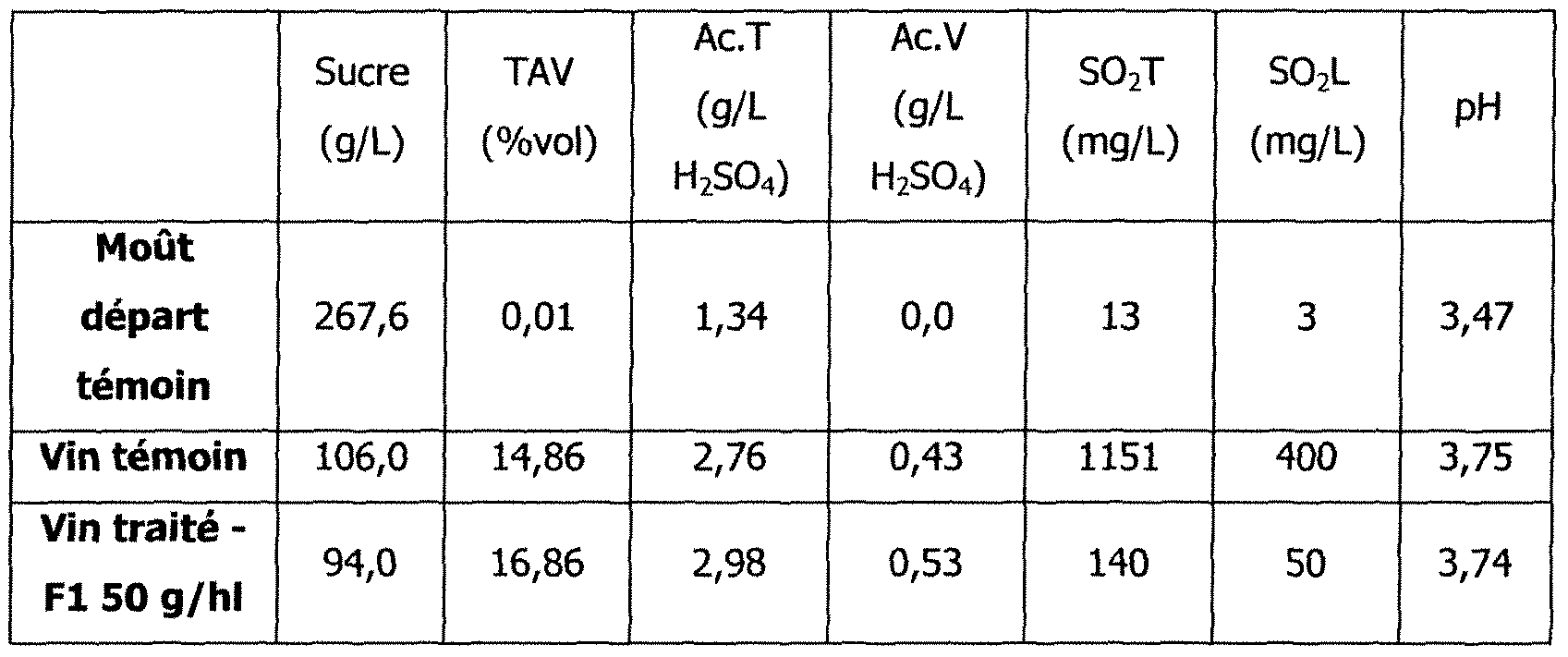
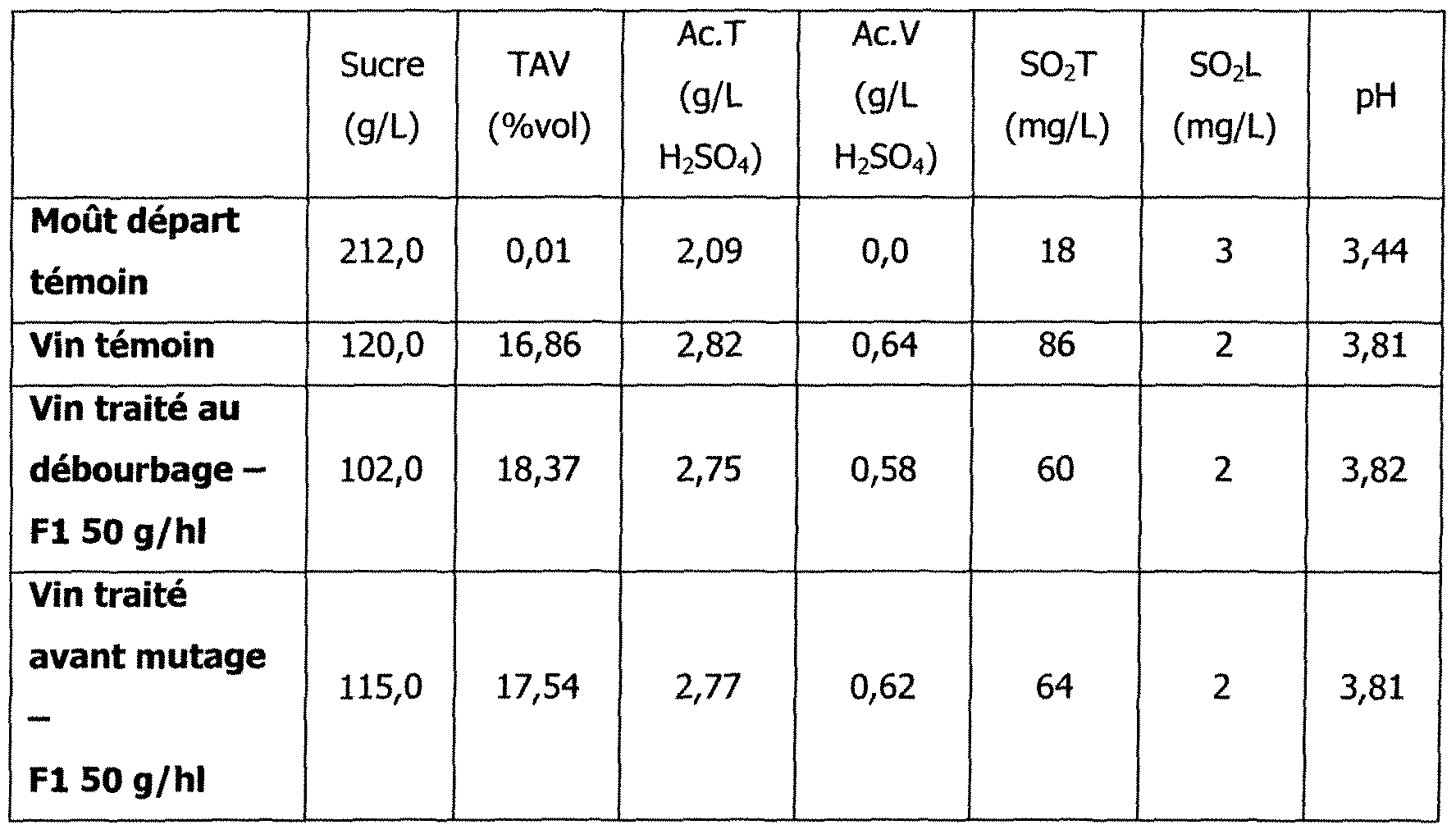
- a cellar A wort (10 I vat) and a cellar B wort (10 I vat) were treated by addition of fungal extract F1. This extract is added at the end of the alcoholic fermentation at the dose. 50 g / hl. The control must is clarified by natural decantation.
- TAV total acidity
- Ac. V volatile acidity
- SO 2 T total SO 2
- SO 2 volatile SO 2 L
- the treatment with chitin-glucan Fl contributes to the improvement of the clarification of red wines, without altering the content of total phenolic compounds and tannins, compared to the control wine which has been decanted naturally.
- a red wine from vineyard C (426 hl vat) and a red wine from vineyard D (3 hl vats) containing ochratoxin A contents close to the maximum level recommended by the OIV (2 ⁇ g / l) were treated by addition of fungal extract F1.
- Several treatment doses were tested: 129 g / hl, 300 g / hl, 400 g / hl and 500 g / hl.
- the fungal extract is left in contact with the wine for 3 days.
- the control wine has not undergone any treatment.
- the Fl treatment at a dose of 129 g / hl causes a 17.6% reduction in the OTA content of the red wine.
- the treatment Fl does not involve any modification of the conventional parameters of wine analyzes.
- a red wine of the domain M (bottles of 1 I) containing levels greater than or equal to OTA at the recommendation of the OIV were treated by addition of fungal extract Fl, at several doses and according to conditions of temperature and time variables, in one or two additions.
- the fungal extract is left in contact with the wine for 3 days.
- the control wine has not undergone any treatment.
- the elimination is at least 23% with the Fl treatment at a dose of 200 g / hl.
- the most effective treatment protocol is the successive addition of 2 times
- EXAMPLE 14 Filtration of a white beer in the presence of chitin-glucan at a dose of 200 g / hl at the laboratory scale
- a batch of 10 liters of white beer is selected to be filtered on a vertical candle in the presence of chitin-glucan at a dose of 200 g / hl.
- the chitin-glucan used is in the form of a powder with a particle size ranging from 50 to 90 ⁇ m.
- a pre-layer of chitin-glucan is formed on a 30 ⁇ m vertical aperture filter candle.
- the chitin-glucan powder is suspended at 10% in water and mixed for 1 hour before being deposited on the filter by circulating in a closed circuit at a flow rate of 20 hl ⁇ h ⁇ m -2 .
- the flow rate is reduced to 8 hl.h ⁇ .m "2 , and circulated a mixture of water / beer then beer in open circuit.
- the beer is previously put in the presence of chitin-glucan to a
- the beer is filtered at a rate of 7 to 8 hl.h ⁇ .m 2 on the chitin-glucan cake until the whole volume is filtered. then placed cold at 8 ° C, then a sample is taken for analysis of the coagulable nitrogen and total polyphenols.
- the chitin-glucan powder forms a little compressible cake on the filter medium used.
- the protein content, characterized by the coagulabie nitrogen content, of the beer filtered on this cake (OUT) is 57% lower than the protein content of the control beer (IN).
- the total polyphenol content is unchanged.
Landscapes
- Chemical & Material Sciences (AREA)
- Organic Chemistry (AREA)
- Engineering & Computer Science (AREA)
- General Health & Medical Sciences (AREA)
- Life Sciences & Earth Sciences (AREA)
- Biochemistry (AREA)
- Bioinformatics & Cheminformatics (AREA)
- General Engineering & Computer Science (AREA)
- Health & Medical Sciences (AREA)
- Genetics & Genomics (AREA)
- Food Science & Technology (AREA)
- Wood Science & Technology (AREA)
- Zoology (AREA)
- General Preparation And Processing Of Foods (AREA)
- Non-Alcoholic Beverages (AREA)
- Distillation Of Fermentation Liquor, Processing Of Alcohols, Vinegar And Beer (AREA)
Abstract
Description






Claims
Priority Applications (6)
| Application Number | Priority Date | Filing Date | Title |
|---|---|---|---|
| AU2006264743A AU2006264743B2 (en) | 2005-07-04 | 2006-07-04 | Use of a fungal biomass extract as technological additive for treating food-grade liquids |
| ES06779014.7T ES2455520T3 (es) | 2005-07-04 | 2006-07-04 | Utilización de extracto de biomasa fúngica como auxiliar tecnológico para el tratamiento de líquidos alimenticios |
| EP06779014.7A EP1917345B1 (fr) | 2005-07-04 | 2006-07-04 | Utilisation d'extrait de biomasse fongique comme auxiliaire technologique pour le traitement de liquides alimentaires |
| US11/785,769 US20070299034A1 (en) | 2002-02-12 | 2007-04-20 | Cell wall derivatives, their preparation process, and use thereof |
| US12/720,993 US20100222297A1 (en) | 2002-02-12 | 2010-03-10 | Cell wall derivatives, their preparation process, and use thereof |
| US12/720,946 US20100221382A1 (en) | 2002-02-12 | 2010-03-10 | Cell wall derivatives, their preparation process, and use thereof |
Applications Claiming Priority (2)
| Application Number | Priority Date | Filing Date | Title |
|---|---|---|---|
| FR0507066A FR2887750B1 (fr) | 2005-07-04 | 2005-07-04 | Utilisation d'extrait de biomasse fongique comme auxiliaire technologique pour le traitement de liquides alimentaires |
| FR0507066 | 2005-07-04 |
Related Child Applications (2)
| Application Number | Title | Priority Date | Filing Date |
|---|---|---|---|
| US10/504,046 Continuation-In-Part US7556946B2 (en) | 2002-02-12 | 2003-02-12 | Cell wall derivatives from biomass and preparation thereof |
| US11/785,769 Continuation-In-Part US20070299034A1 (en) | 2002-02-12 | 2007-04-20 | Cell wall derivatives, their preparation process, and use thereof |
Publications (2)
| Publication Number | Publication Date |
|---|---|
| WO2007003863A2 true WO2007003863A2 (fr) | 2007-01-11 |
| WO2007003863A3 WO2007003863A3 (fr) | 2007-03-22 |
Family
ID=36177287
Family Applications (1)
| Application Number | Title | Priority Date | Filing Date |
|---|---|---|---|
| PCT/FR2006/050674 Ceased WO2007003863A2 (fr) | 2002-02-12 | 2006-07-04 | Utilisation d'extrait de biomasse fongique comme auxiliaire technologique pour le traitement de liquides alimentaires |
Country Status (7)
| Country | Link |
|---|---|
| EP (1) | EP1917345B1 (fr) |
| AU (1) | AU2006264743B2 (fr) |
| ES (1) | ES2455520T3 (fr) |
| FR (1) | FR2887750B1 (fr) |
| PT (1) | PT1917345E (fr) |
| WO (1) | WO2007003863A2 (fr) |
| ZA (1) | ZA200800254B (fr) |
Families Citing this family (1)
| Publication number | Priority date | Publication date | Assignee | Title |
|---|---|---|---|---|
| ES2883048B2 (es) * | 2020-06-03 | 2022-04-07 | Inbiolev S L | Dispositivo y procedimiento para el tratamiento de la disminución o eliminación de las reducciones en los procesos fermentativos tanto en modo preventivo como curativo |
Family Cites Families (8)
| Publication number | Priority date | Publication date | Assignee | Title |
|---|---|---|---|---|
| GB1015831A (en) * | 1963-05-06 | 1966-01-05 | Baxter Laboratories Inc | Improvements in or relating to methods and composition of chillproofing |
| FR1408739A (fr) * | 1963-05-06 | 1965-08-20 | Baxter Laboratories Inc | Procédé et substances pour rendre des boissons insensibles au froid |
| CN1099951A (zh) * | 1993-09-11 | 1995-03-15 | 张益民 | 应用高分子量脱乙酰基甲壳素脱除果胶和澄清果(蔬)汁的方法 |
| IT1286276B1 (it) * | 1996-10-24 | 1998-07-08 | Univ Bologna | Metodo per la rimozione totale o parziale di pesticidi e/o fitofarmaci da liquidi alimentari e non mediante l'uso di derivati della |
| DE19810094A1 (de) * | 1998-03-10 | 1999-09-16 | Nukem Nuklear Gmbh | Adsorptionsmittel für Radionuklide |
| CN1101406C (zh) * | 1999-05-06 | 2003-02-12 | 浙江大学 | 真菌细胞壁结构性多糖的制备方法 |
| WO2001073104A1 (fr) * | 2000-03-24 | 2001-10-04 | Societe Des Produits Nestle S.A. | Beta-glucanes obtenus a partir d'un champignon filamenteux |
| BE1014638A6 (fr) * | 2002-02-12 | 2004-02-03 | Univ Liege | Methode de preparation de derives de la paroi cellulaire a partir de biomasse. |
-
2005
- 2005-07-04 FR FR0507066A patent/FR2887750B1/fr not_active Expired - Fee Related
-
2006
- 2006-07-04 PT PT06779014T patent/PT1917345E/pt unknown
- 2006-07-04 WO PCT/FR2006/050674 patent/WO2007003863A2/fr not_active Ceased
- 2006-07-04 AU AU2006264743A patent/AU2006264743B2/en not_active Ceased
- 2006-07-04 ES ES06779014.7T patent/ES2455520T3/es active Active
- 2006-07-04 EP EP06779014.7A patent/EP1917345B1/fr not_active Not-in-force
- 2006-07-04 ZA ZA200800254A patent/ZA200800254B/xx unknown
Also Published As
| Publication number | Publication date |
|---|---|
| EP1917345A2 (fr) | 2008-05-07 |
| AU2006264743A1 (en) | 2007-01-11 |
| WO2007003863A3 (fr) | 2007-03-22 |
| PT1917345E (pt) | 2014-03-31 |
| EP1917345B1 (fr) | 2014-01-01 |
| ZA200800254B (en) | 2009-04-29 |
| FR2887750B1 (fr) | 2008-07-04 |
| ES2455520T3 (es) | 2014-04-15 |
| AU2006264743B2 (en) | 2011-11-17 |
| FR2887750A1 (fr) | 2007-01-05 |
Similar Documents
| Publication | Publication Date | Title |
|---|---|---|
| Doco et al. | Effect of flash release and pectinolytic enzyme treatments on wine polysaccharide composition | |
| US20100222297A1 (en) | Cell wall derivatives, their preparation process, and use thereof | |
| Gambuti et al. | Performance of a protein extracted from potatoes for fining of white musts | |
| CN103209599A (zh) | 芒果果汁的处理方法 | |
| US20090169691A1 (en) | Methods and Compositions for Fining Beverages | |
| EP2760986B1 (fr) | Procede de preparation d'un produit alimentaire liquide enrichi en oligosaccharides et en polysaccharides | |
| Seidel et al. | Composition, ζ potential, and molar mass distribution of 20 must and wine colloids from five different cultivars obtained during four consecutive vintages | |
| Rogerson et al. | Alternative processing of port-wine using pectolytic enzymes procesado alternativo del vino de oporto usando enzimas pectolíticos procesado alternativo do viño de oporto usando enzimas pectolíticos | |
| Pettinelli et al. | Effect of flotation and vegetal fining agents on the aromatic characteristics of Malvasia del Lazio (Vitis vinifera L.) wine | |
| Piemolini-Barreto et al. | Variation in phenolic compounds, anthocyanins, and color in red wine treated with enzymatic extract of Kluyveromyces marxianus | |
| CA2802819C (fr) | Poudre de chitosane et ses utilisations pour le traitement de liquides alimentaires | |
| EP1917345B1 (fr) | Utilisation d'extrait de biomasse fongique comme auxiliaire technologique pour le traitement de liquides alimentaires | |
| Charpentier | Ageing on lees (sur lies) and the use of speciality inactive yeasts during wine fermentation | |
| Rodrigues et al. | Influence of Fining and Tartaric Stabilisation Procedures on White Wine Mannoprotein Content. | |
| JP4052403B2 (ja) | ワイン及びその製造法 | |
| EP4153715A1 (fr) | Procédé de production de vin à faible teneur en sulfites | |
| Kyzas et al. | Oenological Additives | |
| Fataliyev et al. | IDENTIFYING THE FACTORS ON THE INTENSIFICATION AFFECTING OF THE WINE CLARIFICATION PROCESS. | |
| RU2783427C1 (ru) | Способ производства белого яблочного вина | |
| Ramousse et al. | From must to wine: How winemaking choices influence lipid, vitamin, nitrogen, and volatile profiles | |
| RU2648165C1 (ru) | Способ производства яблочного столового вина | |
| KR20240007924A (ko) | 음료용 천연 청징제 | |
| Arora et al. | Impact of pectolytic enzyme on the fermentation time and free-run juice rate of Sharad red wine | |
| Pettinelli et al. | Effect of flotation and vegetal fining agents on the aromatic characteristics of Malvasia | |
| WO2021156473A1 (fr) | Additif pour améliorer la stabilité protéique dans une boisson |
Legal Events
| Date | Code | Title | Description |
|---|---|---|---|
| WWE | Wipo information: entry into national phase |
Ref document number: 11785769 Country of ref document: US |
|
| WWE | Wipo information: entry into national phase |
Ref document number: 2006779014 Country of ref document: EP |
|
| WWP | Wipo information: published in national office |
Ref document number: 11785769 Country of ref document: US |
|
| WWE | Wipo information: entry into national phase |
Ref document number: 2006264743 Country of ref document: AU |
|
| NENP | Non-entry into the national phase |
Ref country code: DE |
|
| WWW | Wipo information: withdrawn in national office |
Country of ref document: DE |
|
| WWE | Wipo information: entry into national phase |
Ref document number: 2006264743 Country of ref document: AU |
|
| WWP | Wipo information: published in national office |
Ref document number: 2006264743 Country of ref document: AU |
|
| WWP | Wipo information: published in national office |
Ref document number: 2006779014 Country of ref document: EP |