WO2007004622A1 - 衣料の洗濯方法及びそのための洗浄剤組成物 - Google Patents

衣料の洗濯方法及びそのための洗浄剤組成物 Download PDF

Info

Publication number
WO2007004622A1
WO2007004622A1 PCT/JP2006/313249 JP2006313249W WO2007004622A1 WO 2007004622 A1 WO2007004622 A1 WO 2007004622A1 JP 2006313249 W JP2006313249 W JP 2006313249W WO 2007004622 A1 WO2007004622 A1 WO 2007004622A1
Authority
WO
WIPO (PCT)
Prior art keywords
washing
chelating agent
agent
hardness
washing liquid
Prior art date
Legal status (The legal status is an assumption and is not a legal conclusion. Google has not performed a legal analysis and makes no representation as to the accuracy of the status listed.)
Ceased
Application number
PCT/JP2006/313249
Other languages
English (en)
French (fr)
Inventor
Kazuyoshi Arai
Tomoki Seo
Ryousuke Kurokawa
Current Assignee (The listed assignees may be inaccurate. Google has not performed a legal analysis and makes no representation or warranty as to the accuracy of the list.)
Miz Co Ltd
Original Assignee
Miz Co Ltd
Priority date (The priority date is an assumption and is not a legal conclusion. Google has not performed a legal analysis and makes no representation as to the accuracy of the date listed.)
Filing date
Publication date
Application filed by Miz Co Ltd filed Critical Miz Co Ltd
Priority to US11/994,360 priority Critical patent/US8389460B2/en
Priority to EP06780753A priority patent/EP1908817A4/en
Priority to JP2007524060A priority patent/JP4372823B2/ja
Publication of WO2007004622A1 publication Critical patent/WO2007004622A1/ja
Anticipated expiration legal-status Critical
Ceased legal-status Critical Current

Links

Classifications

    • CCHEMISTRY; METALLURGY
    • C11ANIMAL OR VEGETABLE OILS, FATS, FATTY SUBSTANCES OR WAXES; FATTY ACIDS THEREFROM; DETERGENTS; CANDLES
    • C11DDETERGENT COMPOSITIONS; USE OF SINGLE SUBSTANCES AS DETERGENTS; SOAP OR SOAP-MAKING; RESIN SOAPS; RECOVERY OF GLYCEROL
    • C11D3/00Other compounding ingredients of detergent compositions covered in group C11D1/00
    • C11D3/0005Other compounding ingredients characterised by their effect
    • C11D3/0036Soil deposition preventing compositions; Antiredeposition agents
    • CCHEMISTRY; METALLURGY
    • C11ANIMAL OR VEGETABLE OILS, FATS, FATTY SUBSTANCES OR WAXES; FATTY ACIDS THEREFROM; DETERGENTS; CANDLES
    • C11DDETERGENT COMPOSITIONS; USE OF SINGLE SUBSTANCES AS DETERGENTS; SOAP OR SOAP-MAKING; RESIN SOAPS; RECOVERY OF GLYCEROL
    • C11D3/00Other compounding ingredients of detergent compositions covered in group C11D1/00
    • C11D3/16Organic compounds
    • C11D3/20Organic compounds containing oxygen
    • C11D3/22Carbohydrates or derivatives thereof
    • C11D3/222Natural or synthetic polysaccharides, e.g. cellulose, starch, gum, alginic acid or cyclodextrin
    • C11D3/225Natural or synthetic polysaccharides, e.g. cellulose, starch, gum, alginic acid or cyclodextrin etherified, e.g. CMC
    • CCHEMISTRY; METALLURGY
    • C11ANIMAL OR VEGETABLE OILS, FATS, FATTY SUBSTANCES OR WAXES; FATTY ACIDS THEREFROM; DETERGENTS; CANDLES
    • C11DDETERGENT COMPOSITIONS; USE OF SINGLE SUBSTANCES AS DETERGENTS; SOAP OR SOAP-MAKING; RESIN SOAPS; RECOVERY OF GLYCEROL
    • C11D3/00Other compounding ingredients of detergent compositions covered in group C11D1/00
    • C11D3/16Organic compounds
    • C11D3/37Polymers
    • C11D3/3746Macromolecular compounds obtained by reactions only involving carbon-to-carbon unsaturated bonds
    • C11D3/3753Polyvinylalcohol; Ethers or esters thereof
    • CCHEMISTRY; METALLURGY
    • C11ANIMAL OR VEGETABLE OILS, FATS, FATTY SUBSTANCES OR WAXES; FATTY ACIDS THEREFROM; DETERGENTS; CANDLES
    • C11DDETERGENT COMPOSITIONS; USE OF SINGLE SUBSTANCES AS DETERGENTS; SOAP OR SOAP-MAKING; RESIN SOAPS; RECOVERY OF GLYCEROL
    • C11D3/00Other compounding ingredients of detergent compositions covered in group C11D1/00
    • C11D3/395Bleaching agents
    • C11D3/3953Inorganic bleaching agents
    • CCHEMISTRY; METALLURGY
    • C11ANIMAL OR VEGETABLE OILS, FATS, FATTY SUBSTANCES OR WAXES; FATTY ACIDS THEREFROM; DETERGENTS; CANDLES
    • C11DDETERGENT COMPOSITIONS; USE OF SINGLE SUBSTANCES AS DETERGENTS; SOAP OR SOAP-MAKING; RESIN SOAPS; RECOVERY OF GLYCEROL
    • C11D7/00Compositions of detergents based essentially on non-surface-active compounds
    • C11D7/02Inorganic compounds
    • CCHEMISTRY; METALLURGY
    • C11ANIMAL OR VEGETABLE OILS, FATS, FATTY SUBSTANCES OR WAXES; FATTY ACIDS THEREFROM; DETERGENTS; CANDLES
    • C11DDETERGENT COMPOSITIONS; USE OF SINGLE SUBSTANCES AS DETERGENTS; SOAP OR SOAP-MAKING; RESIN SOAPS; RECOVERY OF GLYCEROL
    • C11D7/00Compositions of detergents based essentially on non-surface-active compounds
    • C11D7/02Inorganic compounds
    • C11D7/04Water-soluble compounds
    • C11D7/10Salts
    • C11D7/14Silicates
    • CCHEMISTRY; METALLURGY
    • C11ANIMAL OR VEGETABLE OILS, FATS, FATTY SUBSTANCES OR WAXES; FATTY ACIDS THEREFROM; DETERGENTS; CANDLES
    • C11DDETERGENT COMPOSITIONS; USE OF SINGLE SUBSTANCES AS DETERGENTS; SOAP OR SOAP-MAKING; RESIN SOAPS; RECOVERY OF GLYCEROL
    • C11D7/00Compositions of detergents based essentially on non-surface-active compounds
    • C11D7/22Organic compounds
    • C11D7/26Organic compounds containing oxygen
    • C11D7/265Carboxylic acids or salts thereof
    • CCHEMISTRY; METALLURGY
    • C11ANIMAL OR VEGETABLE OILS, FATS, FATTY SUBSTANCES OR WAXES; FATTY ACIDS THEREFROM; DETERGENTS; CANDLES
    • C11DDETERGENT COMPOSITIONS; USE OF SINGLE SUBSTANCES AS DETERGENTS; SOAP OR SOAP-MAKING; RESIN SOAPS; RECOVERY OF GLYCEROL
    • C11D7/00Compositions of detergents based essentially on non-surface-active compounds
    • C11D7/22Organic compounds
    • C11D7/32Organic compounds containing nitrogen
    • C11D7/3245Aminoacids
    • CCHEMISTRY; METALLURGY
    • C11ANIMAL OR VEGETABLE OILS, FATS, FATTY SUBSTANCES OR WAXES; FATTY ACIDS THEREFROM; DETERGENTS; CANDLES
    • C11DDETERGENT COMPOSITIONS; USE OF SINGLE SUBSTANCES AS DETERGENTS; SOAP OR SOAP-MAKING; RESIN SOAPS; RECOVERY OF GLYCEROL
    • C11D2111/00Cleaning compositions characterised by the objects to be cleaned; Cleaning compositions characterised by non-standard cleaning or washing processes
    • C11D2111/10Objects to be cleaned
    • C11D2111/12Soft surfaces, e.g. textile

Definitions

  • the present invention relates to a method for washing clothes in which an organic chelating agent is washed as a main agent for washing and a cleaning composition therefor.
  • Synthetic detergents have been overwhelmingly supported by laundry because of their excellent cleaning power and ease of use. But synthetic detergents don't just benefit consumers. For example, synthetic detergents have begun to raise the problem of affecting aquatic organisms as one of the suspected environmental hormones. In addition, it is a fact that the surfactant contained in the synthetic detergent remains in the clothing even after repeated rinsing, and it is no mistake that the surfactant has some effect on the human body through the skin. The probability cannot be denied.
  • the applicant of the present invention is a detergent composition that does not substantially use a surfactant, and is equivalent to a synthetic detergent using a conventional surfactant as a main agent for washing.
  • a detergent composition having an alkaline buffering agent as a main agent for washing and a washing method using the same, which has higher washing performance and usability (Patent Document 1).
  • Patent Document 1 does not disclose or suggest that an organic chelating agent is a main agent for washing.
  • paragraph No. 0043 of the patent publication states that “in this cleaning agent, the main component reacts with a hardness component that becomes a detergency factor of detergency and invalidates it. Therefore, it is possible to obtain a practical water softening effect without the need to specifically cover softeners such as organic chelating agents and water-insoluble zeolites that are commonly used as synthetic detergent ingredients. " Do not mix chelating agents Even in view of the description of the purpose to be determined, the invention of Patent Document 1 is completely different from the present invention in which an organic chelating agent is used as a main component for washing action.
  • Patent Document 2 is intended to provide a washing method having excellent detergency even when the surfactant concentration is low, and washing clothes under specific high alkali and low hardness washing conditions. The fact that it is rinsed is described.
  • Patent Document 2 merely discloses a washing method and the like based on the use of a surfactant, and Patent Document 2 contains a surfactant as in the present invention. However, it has been disclosed and suggested that washing with washing liquid is performed.
  • Patent Document 1 Japanese Patent No. 3481615
  • Patent Document 2 Japanese Patent Application Laid-Open No. 9-132794
  • the present invention is a detergent composition that does not use a surfactant that has doubts about the safety to the human body and the reduction in environmental burden.
  • polyvalent cations such as calcium ions and magnesium ions in the washing liquid are bridged by both negatively charged substrates and soils in the washing liquid.
  • multivalent cation bridge In order to attract both by passing (so-called multivalent cation bridge), it prevents the substrate power of the dirt from peeling off.
  • the hardness component in the washing liquid is not only contained in the washing water, but also clothing and dirt, What was adhering to the washing tub was also eluted in the washing liquid during the washing process, and I learned that the hardness components including all of them were an obstacle to washing power.
  • the composition and recontamination preventive agent are obtained.
  • washing performance and usability that are equal to or better than those of synthetic detergents that use conventional surfactants as the main washing agent, without using any surfactants.
  • the present inventors have found that a cleaning composition comprising an organic chelating agent as a main agent for washing and a washing method using the same can be provided, and finally the present invention has been completed.
  • An organic chelating agent that is positioned as the most important component in the present invention is a chemical bond with a polyvalent cation (hardness component) in a washing liquid to form a metal ion complex to invalidate the hardness component in the washing liquid. Through the wrinkle mechanism, it plays a role as a washing agent in the present invention.
  • examples of substances that can be used as the organic chelating agent according to the present invention include oxalic acid (OA), citrate (CA), tartaric acid (TA), darcolic acid (DA).
  • OA oxalic acid
  • CA citrate
  • TA tartaric acid
  • DA darcolic acid
  • Sodium salt of organic carboxylic acids such as gluconic acid (GA), dihydroxyethyl glycine (DEG: N- (2-hydroxylethyl) glycine), triethanolamine (TEA), N- (2- Hydroethyl) iminodiacetic acid (HEIDA: N- (2-hydroxyethyl) iminodiacetic acid), hydroxyaminocarboxylic acid-based chelating agents that are sodium salts such as N- (hydroxyethyl) ethylene diamine tetraacetic acid (HEDTA: N- (hydroxyethyl) ethylene diamine tetraacetic acid), Ether carboxylic acid chelating agents that are
  • the organic chelating agent referred to in the present invention encompasses both the embodiment in which the organic chelating agent as described above is used alone and the embodiment in which a plurality of organic chelating agents are used in combination. It is a concept.
  • Quantitative conditions for selecting the organic chelating agent suitable for use in the present invention in terms of the side performance of washing performance are as follows: (0 ⁇ of 1% aqueous solution is 9 or more, preferably 10 to 12.5)
  • the G0 maximum calcium complex capacity (number of CaC03 mg per lg at pH 11) is 200 mgZg or more, preferably 300 mgZg or more.
  • ethylenediamine tetraacetic acid 4 sodium (hereinafter sometimes referred to as "EDTA-4Na”;): Torriron-B powder (registered trademark, manufactured by BASF)
  • MGDA-3Na methyl glycine diacetic acid trisodium
  • Trilon-M powder organic alkaline chelating agent such as Trilon-M powder (registered trademark, manufactured by BASF) I can make it.
  • both EDTA-4Na and MGDA-3Na are obtained by dissolving each substance in washing water while changing its concentration to obtain a plurality of washing liquids by concentration.
  • the pH, as well as the chelating ability and stability, change with the change in pH between the washing liquids at different concentrations. Then, even if the detergency is compared among the plurality of washing liquids by concentration as described above, it is difficult to examine whether the chelating agent composition contributes to the improvement of the detergency. Therefore, in order to eliminate this problem, the pH was adjusted to be constant (pH 11) by adding sodium hydroxide to each washing solution described above.
  • test conditions are as follows.
  • washing water 90 ppm hardness water was obtained by dissolving salt calcium carbonate dihydrate at a concentration of 133 mgZL in purified water, and this was used as washing water. In the following, the water obtained through these procedures is referred to as Japanese standard washing water.
  • the cleaning rate was calculated by the following formula.
  • Washing rate% (whiteness of contaminated cloth after washing 1 whiteness of contaminated cloth before washing)
  • Whiteness of uncontaminated fabric, whiteness of contaminated fabric before washing
  • X 100 Whiteness is measured by using a whiteness meter (CR-14, Whiteness Index Color Reader, manufactured by Minolta Co., Ltd.) Measured 10 points and found by averaging the measured values
  • Table 1 shows the washing results for each washing solution by concentration.
  • EDTA-4Na has a maximum calcium complex capacity of 225mgZg at pHl 1, and the required amount of EDTA_4Na (necessary) to completely disable the hardness component contained in Japanese standard washing water (containing 90mgZ liter hardness component)
  • concentration is given by:
  • the washing rate of wet artificially contaminated cloth is about 50% when laundered using washing solution (attack bioenzyme, detergent concentration 0.667gZL, manufactured by Kao Corporation, with enzyme and fluorescent whitening agent) Therefore, the detergency of using EDTA-4Na alone is equivalent to or exceeding that of commercially available powdered detergents in the range of use exceeding 0.43 gZ liter concentration (the cleaning rate at this time is 48.4%). You can see that In particular, it exceeds the cleaning power (about 50%) of commercially available powdered detergents in the range of use exceeding the 0.47 gZ liter concentration (the cleaning rate at this time is 59.5%).
  • Table 2 shows the washing results for each washing solution by concentration when MGDA-3Na was dissolved in Japanese standard washing water while changing its concentration.
  • MGDA-3Na has a maximum calcium complex capacity of 327mgZg at pHl 1, and the required amount of MGDA_3Na to completely invalidate the hardness component contained in Japanese standard washing water (containing 90mgZ liter hardness component) (required)
  • the calculated value of (concentration) is given by:
  • the cleaning power suddenly started to rise around the calculated value of 275 gZ liter concentration (the cleaning rate at this time is 25.7%), 0 3 It can be seen that it reaches a peak around 7gZ liter concentration (the cleaning rate at this time is 59.9%).
  • the washing rate of wet artificially contaminated cloth is about 50% when washing is performed using a washing solution prepared by dissolving a commercially available powdered synthetic detergent in Japanese standard washing water at a standard concentration.
  • Detergency of MGDA-3Na using a single agent is equivalent to or exceeding that of commercially available powdered detergents in the range of use exceeding 0.33 gZ liter concentration (at this time, the cleaning rate is 52.2%).
  • the cleaning rate at this time is 59.9%
  • the EDTA-4Na single agent concentration was 0.43 gZ liter (the cleaning rate at this time).
  • an alkali bicarbonate is disclosed.
  • a pH buffering salt such as a metal salt, an alkali metal borate or an alkali metal phosphate, and an alkali action salt such as an alkali metal silicate or alkali metal carbonate.
  • a single layer of crystalline layered sodium silicate or a mixture of a combination of crystalline layered sodium silicate and sodium bicarbonate is preferably used.
  • the effect of the alkaline buffering agent is to reduce the pH of the washing liquid even when an external factor that causes the pH of the washing liquid to fluctuate, such as contamination with acid, is present in the washing liquid.
  • an external factor that causes the pH of the washing liquid to fluctuate, such as contamination with acid, is present in the washing liquid is present in the washing liquid.
  • it is in the range of weak strength suitable for washing 9 to 11, preferably 10 to: L 1 to converge and maintain.
  • the organic chelating agent according to the present invention can fully exhibit its hardness component capturing ability. This is one of the washing conditions that the washing liquid should satisfy when clothing is put in.
  • alkali buffers crystalline layered alkali metal salts (crystalline layered sodium silicate)
  • crystalline layered sodium silicate crystalline layered sodium silicate
  • it has a hardness component scavenging ability (ion exchange ability) and is intended to supplement the hardness ingredient scavenging ability exhibited by the organic chelating agent according to the present invention.
  • a hardness component scavenging ability ion exchange ability
  • the cleaning power requested by the market (for example, the cleaning power of the wet artificially contaminated cloth in the cleaning test 1 described later)
  • a portion of the organic chelating agent is used as an alkaline buffer, in particular, about 40% of Japanese standard detergents, preferably about 50% of commercially available powder synthetic detergents).
  • an organic alkaline chelating agent When an organic alkaline chelating agent is blended in the cleaning composition of the present invention, blending of an alkaline buffer can be omitted.
  • the organic alkaline chelating agent serves as both a chelating agent and an alkaline buffer.
  • Nonionic water-soluble polymer substances such as senorelose, hydroxypropylcellulose, hydroxypropylmethylcellulose, hydroxyethylmethylcellulose, and partially hatched polybulal alcohol are preferably used.
  • the action of the anti-contamination agent is to prevent re-contamination of both hydrophilic fibers and hydrophobic fibers mainly by lowering the surface tension exhibited by the washing liquid to 0.058 NZm or less.
  • the cleaning composition for clothing according to the present invention comprises an organic alkaline chelating agent as an essential component, further contains a recontamination preventive agent, and contains no surfactant, and is a phosphorus-free cleaning composition for clothing.
  • the gist of the present invention is a phosphorus-free garment cleaning composition that contains an organic chelating agent, an alkaline buffer, and a recontamination preventive agent and does not contain a surfactant.
  • the organic alkaline chelating agent is an essential component. Further, it is necessary to further contain a recontamination preventive or to make the organic chelating agent, the alkaline buffering agent, and the recontamination preventive as essential components of the cleaning composition for clothing. Good for design and derived from that.
  • the sequestering agent is effective for invalidating the hardness component in the washing liquid, it forms a metal ion complex by chemically bonding with the metal ions in the washing liquid.
  • An organic chelating agent having a function of invalidating the hardness component is positioned as the most important component of the present invention.
  • ion exchangers for example, aluminosilicates and crystalline layered silicates
  • organic chelating agents for example
  • the hardness component in the washing liquid is substantially invalidated (the washing liquid hardness is lOppm or less) from the start to the end of washing.
  • the washing liquid hardness is lOppm or less
  • the washing condition when the garment is put in is as follows: "The pH force of the washing liquid ⁇ to 11 (preferably pHIO ⁇ : L 1) and the hardness component in the washing liquid. A substance capable of scavenging the hardness component for disabling is present in the washing liquid in an amount larger than that which can almost completely inactivate the hardness component (preferably, an amount capable of disabling all the hardness components). ”Was used.
  • the amount of the washing liquid having a pH of 9 to 11 and a substance having a hardness component scavenging ability for invalidating the hardness component in the washing liquid is more than the amount that can substantially invalidate the hardness component.
  • the wash ⁇ Existing in the rinsing solution '' means that the washing solution has a pH of 9 to 11 in which the pH of the washing solution can be extracted from the start to the end of washing, and the inherent hardness component scavenging ability of the organic chelating agent can be extracted. This means maintaining the state in which the hardness component in the washing liquid is almost invalidated (the hardness of the washing liquid is less than SlOppm).
  • the preferred embodiment of the present invention corresponding to "maintaining a state where the hardness component in the washing liquid is substantially invalidated (the hardness of the washing liquid is less than or equal to lOppm) until the end of the washing start force"
  • the substance having the ability to capture the hardness component in the washing liquid is a mixture of an organic chelating agent and an alkali metal salt of crystalline layered silicate (crystalline layered sodium silicate) of an alkaline buffer.
  • the first mode of use is that the organic chelating agent (a substance having the ability to capture the hardness component in the washing liquid) completely reduces the hardness component in the washing liquid in the laundry liquid when no clothing is put. Is present in an amount that exceeds the amount that can be almost invalidated (the hardness of the washing liquid can be reduced to lOppm or less).
  • the second mode of use is the organic chelating agent (hardness in the washing liquid). The substance with the component scavenging ability) is present in the washing liquid when clothes are not put in more than the amount that can completely eliminate the hardness component in the washing liquid (the hardness of the washing liquid can be Oppm or less). It is the aspect which is.
  • the usage amount of the organic chelating agent is lower than the calculated amount of the organic chelating agent required to completely invalidate the hardness component contained in the washing water.
  • a crystalline layered alkali metal salt of kale (crystalline layered sodium kainate) is used in a relatively large amount in order to supplement the hardness component capturing ability of the organic chelating agent.
  • Example 14 corresponds to the first usage state.
  • the amount of the organic chelating agent used is equal to or less than the calculated value of the organic chelating agent required to completely nullify the hardness component contained in the washing water.
  • the amount of crystalline layered alkali metal silicate (crystalline layered sodium silicate) used is the first use. A small amount is sufficient as compared with the embodiment. In the examples in the cleaning test described later. Except for Examples 3, 8, 13, 14, and 19 correspond to this second mode of use.
  • the amount of the organic chelating agent used in the second usage mode can be obtained from the following formula from the hardness Z amount of washing water and the chelating ability (maximum calcium capturing ability) of the organic chelating agent to be used. it can.
  • the washing conditions when clothes are put are as follows: “The pH of the washing liquid is 9 to 11 (preferably pHIO ⁇ : L 1), and , A substance having the ability to capture the hardness component to invalidate the hardness component in the washing liquid is present in the washing liquid in an amount more than that which can invalidate the same hardness component. It is going to be.
  • the amount of the washing liquid having a pH of 9 to 11 and having a hardness component scavenging ability for invalidating the hardness component in the washing liquid is more than an amount capable of invalidating all the hardness component.
  • ⁇ Existing in the same rinsing solution '' means that the washing solution can draw out the pH of the washing solution from the start to the end of the washing, and the ability to capture the inherent hardness component having the ability of an organic chelating agent. In a state where all the hardness components in the washing liquid are invalidated (the hardness force of the washing liquid is Oppm or less), and more preferably, the hardness components in the washing liquid are completely invalidated and are in excess. (The condition that the hardness of the washing liquid is Oppm or less and further the substance having the ability to capture the hardness component in the washing liquid is present excessively).
  • the hardness of the washing liquid is Oppm or less
  • the hardness component in the washing liquid is Maintain a state that is completely invalidated and remains in excess (the hardness of the washing liquid is Oppm or less and the substance that has the ability to capture the hardness component in the washing liquid is present excessively).
  • an embodiment in which the substance having the ability to capture the hardness component in the washing liquid is an organic chelating agent alone (in the examples in the washing test described later, Examples 3, 8, 13 , 19 corresponds to this use mode), and a mode of mixture of an organic chelating agent and an alkali buffer with a crystalline layered alkali metal salt of kale (crystalline layered sodium kainate).
  • an organic chelating agent alone in the examples in the washing test described later, Examples 3, 8, 13 , 19 corresponds to this use mode
  • composition and amount of detergent used when washing clothes largely depends on the hardness of the washing water, and therefore the composition and amount of detergent used must be different for each country. For example, in Japan, it is usually around 70 ppm, but in the United States, lOppm or more, and in Europe the hardness of the water is higher than 180 ppm. Then, the required amount of organic chelating agent will change according to the hardness of the washing water, and the standard usage will need to be adjusted.
  • the amount of water used for washing in a standard home is 30L in a fully automatic washing machine, drum type
  • the required amount (calculated value) of the organic chelating agent is set to 15 to 20 L, and the chelating ability of the chelating agent to be added (maximum calcium complexation) for each of the two typical regional hardnesses (90 ppm Z 250 ppm) described above. No.).
  • the required amount (calculated value) of the chelating agent thus determined is the minimum required amount of the chelating agent according to the hardness of each region.
  • the hardness component is not only contained in washing water, but also elutes clothing power, and elutes from dirt adhering to clothing.
  • the actual amount of chelating agent required is greater than the above minimum required amount, which has been a problem through cleaning tests. Therefore, it is preferable to appropriately design the necessary amount of chelating agent according to the actual situation for each chelating agent to be blended.
  • the actual required amount of chelating agent should be 105% to 160% of the minimum required amount in the case of a stirring type washing machine having a large bath ratio (the amount of water for washing is larger than the amount of items to be washed). Also, in the case of a drum-type washing machine with a small bath ratio (the amount of water for washing is small relative to the amount of items to be washed), it is appropriate that the minimum required amount is 210% to 320%. I am trying to improve through examinations.
  • the concentration of the recontamination inhibitor used is water for washing. Regardless of hardness, 1.5-2gZ30L (0.05-0.07gZ for a stirring washing machine, 3-4gZ (15-20L) (0.15-0.27gZ for a drum-type washing machine) .
  • the total use concentration including the organic chelating agent, the alkaline buffering agent, and the recontamination preventing agent, which are essential components of the present invention is 15.6 to 23.7g / 30L (0.52 ⁇ 0.79gZ, and in drum type washing machine 22 ⁇ 25.7g / (15 ⁇ 20L) (1.1 ⁇ 1.71gZ).
  • the amount of chelating agent used and the concentration to be used are calculated.
  • the standard concentration setting is 2.63 to 4. OgZ for drum-type washing machines.
  • a range of L is preferred.
  • a detergency equivalent to or higher than that of a standard synthetic detergent is obtained, up to about 50% of the use of the chelating agent described above, a part of the chelating agent is alkali buffer, especially crystalline layered key acid. It can be replaced with sodium.
  • the use concentration of the anti-contamination agent in the drum type washing machine is 0.15 to 0.27 gZL
  • the organic chelating agent, the alkaline buffer, and the anti-contamination agent, which are essential components of the present invention are used.
  • the total use concentration including the stopper is 2.83-4.27gZL.
  • the minimum required amount (concentration) of the chelating agent is calculated in the same manner as described above. Based on this calculation result and the above-described concept regarding the increase in the amount of chelating agent for each type of washing machine, the blending amount of chelating agent, the concentration used, and the concentration used for each essential component may be set as appropriate.
  • the use concentration range of the cleaning composition for clothing according to the present invention is 0.5 to 10.5 gZL.
  • the detergent composition of the present invention is a conventional detergent such as synthetic detergents such as laundry enzymes, oxygen bleaches, bactericides, fragrances, foaming agents, and the like, as long as they do not depart from the spirit of the present invention. May further contain substances contained as conventional ingredients.
  • Laundry enzymes include proteolytic enzymes (proteases), lipolytic enzymes (lipases), cellulose-degrading enzymes (cellulases), and starch-degrading enzymes (amylases).
  • proteolytic enzymes proteolytic enzymes
  • lipolytic enzymes lipolytic enzymes
  • cellulases cellulose-degrading enzymes
  • amlases starch-degrading enzymes
  • the amount of the enzyme may be about 0.3 to 3% by weight per enzyme with respect to the total amount of the detergent composition.
  • Examples of the oxygen bleaching agent include sodium percarbonate, sodium perborate, hydrogen peroxide, and the like.
  • the detergent composition of the present invention exhibits the same detergency as a synthetic detergent based on a conventional surfactant without the use of an oxygen-based bleach. However, the addition of a bleach further improves the washing performance. Improvement can be expected.
  • a bleach activator such as tetraacetyl ethylenediamine in order to expect further improvement in washing performance.
  • the disinfectant is formulated for the purpose of preventing the spoilage and brute force of the cleaning composition containing organic matter, such as benzalkonium chloride, paraben, propylene glycol and the like. Can be appropriately selected according to the purpose of use.
  • organic matter such as benzalkonium chloride, paraben, propylene glycol and the like.
  • citrus fruit is a grapefruit whose scientific name is Citrus Paradesi, and the extract itself is highly viscous, so when added, it is diluted with water, natural daricerine, propylene glycol, etc. It is preferable to use the dispersing agent.
  • Citruparadesi seed extract has antibacterial effects such as sterilization of bacteria and microorganisms, and antibacterial effects. Therefore, when it is added as an antibacterial additive to the cleaning composition of the present invention, an antibacterial effect of the object to be cleaned can be expected.
  • Other fungicides may be blended with natural fungicides obtained from tea leaves or bamboo! /
  • the cleaning composition of the present invention can be easily produced into various dosage forms by various methods because almost all of the raw materials are powders or granules and it is only necessary to uniformly mix them.
  • the simplest and most economical production method is to stir and mix these powder raw materials with a known batch-type mixer, thereby producing a powdery or granular detergent composition for clothing according to the present invention. can do.
  • the cleaning composition according to the present invention can be produced as a concentrated liquid type cleaning agent by mixing a powder raw material and water.
  • the present invention there is a question from the viewpoint of safety to the human body and reduction of environmental burden, and it is a cleaning composition that does not contain any surfactant that has been naturally used as a fixed idea in the past.
  • a detergent composition having an organic cleansing agent as a main agent for washing which has high washing performance and convenience equivalent to or higher than that of a synthetic detergent.
  • the clothes washing method and the clothes cleaning composition that are covered by the present invention there is a seemingly contradictory modern Japan between cleanliness that dislikes filth and health consciousness that dislikes the residue of detergent components in clothes. Both consumer needs, Can be satisfied with the level.
  • the washing machine is a fully automatic washing machine manufactured by Hitachi, Ltd. (NW-7P5 CP, 7 kg type, water level setting 30 liters, towel 1.5 kg as load), and tap water with a water temperature of 25 ° C (Fujisawa Waterworks) , PH 7.5, total hardness 60 ppm), washing for 8 minutes, rinsing twice and dehydration for 5 minutes.
  • contaminated cloth As the contaminated cloth, a wet artificial contaminated cloth (manufactured by the Laundry Science Association) with an artificial sebum soil adhered thereto was mainly used. At this time, for the purpose of averaging the difference in cleaning rate between different production lots, two contaminated cloths with different production lots are prepared, and 5 each (convenient 10 sheets) of these contaminated cloths are used as towels. Sewed and washed.
  • a soiled cloth with mineral oil and carbon black (EMPA101), a soiled cloth with olive oil and carbon black (EMPA106), and a soiled cloth with blood attached (EMPA106)
  • EMPA 111 contaminated cloth with protein cacao
  • EMPA 114 contaminated cloth with red wine
  • EMPA 116 contaminated cloth with blood, milk and carbon black
  • the cleaning rate was calculated by the following formula.
  • Washing rate% (whiteness of contaminated cloth after washing 1 whiteness of contaminated cloth before washing) ⁇ (Whiteness of uncontaminated fabric one whiteness of contaminated fabric before washing) X 100
  • Whiteness was determined by measuring 10 points on the front and back of each contaminated fabric using a whiteness meter (CR-14, Whiteness Index Color Reader, manufactured by Minolta Co., Ltd.) and averaging the measured values.
  • a whiteness meter CR-14, Whiteness Index Color Reader, manufactured by Minolta Co., Ltd.
  • the pH of the washing liquid was measured at 25 ° C. with a glass electrode pH meter (manufactured by Horiba) by adding the detergent composition to the washing water. At this time, the pH of the washing solution was determined so that the indicated value was sufficiently stable.
  • Example 4 In 30 liters of tap water, each component composition of methyl glycine diacetic acid trisodium 15 g, PVA 1.3 g and CMCO 2 g was dissolved, and the total amount of the same component was 16.5 g. A washing solution with 0.5 gZL and a pH of 10.0 was obtained. The washing rate of the wet artificially soiled cloth before and after washing when washing with this washing liquid was determined. The results are shown in Table 3. [0095] Example 4
  • 30 liters of tap water has 8 g of methyl glycine diacetate, 3 g of sodium acetate, 7.8 g of crystalline layered sodium silicate, 4.2 g of sodium bicarbonate, 1.3 g of PVA, 2 g of CMCO. 21. Dissolve 5g of detergent, detergent concentration is 0.72gZL, pH is 10.
  • 30 liters of tap water is composed of 10 g of methyl glycine diacetic acid, 3 g of sodium acetate, 6.5 g of crystalline layered sodium silicate, 3.5 g of sodium bicarbonate, 1.3 g of PVA, and 2 g of CMCO.
  • a total amount of 21.5 g of detergent was dissolved to obtain a washing liquid having a detergent concentration of 0.72 gZL and a pH of 10.3.
  • the washing rate of wet artificially contaminated cloth before and after washing when washing with this washing solution was determined. The results are shown in Table 3.
  • each component composition of methyl glycine diacetic acid trisodium 20 g, PVA 1.3 g, and CMCO 2 g was dissolved, and the total concentration of these components was 21.5 g.
  • a washing solution of 0.7 g / L and a pH of 10.3 was obtained. Laundry when washing with this washing liquid The washing rate of the wet artificially contaminated cloth before and after was determined. The results are shown in Table 3.
  • each component composition of methyl glycine diacetic acid trisodium 25 g, PVA 1.3 g, CMCO 2 g was dissolved, and the total concentration of the same component was 26.5 g.
  • a washing solution having a pH of 10.5 was obtained at 0.8 g / L.
  • the washing rate of the wet artificially soiled cloth before and after washing when washing with this washing liquid was determined. The results are shown in Table 3.
  • 30 liters of tap water has 3 g of methyl glycine diacetic acid 3 sodium salt, 19 g of crystalline layered sodium silicate silicate, 8 g of sodium bicarbonate, 1.3 g of PVA, 2 g of CMCO.
  • the detergent was dissolved to obtain a laundry solution having a detergent concentration of 1.05 gZL and a pH of 10.6.
  • the washing rate of wet artificially contaminated cloth before and after washing when washing with this washing liquid was determined. The results are shown in Table 4.
  • 30 liters of tap water is composed of 18 g of methyl glycine diacetic acid, 3 g of sodium acetate, 8.8 g of crystalline layered sodium silicate, 3.2 g of sodium bicarbonate, 1.3 g of PVA, and 2 g of CMCO.
  • a total amount of 31.5 g of detergent was dissolved to obtain a washing liquid having a detergent concentration of 1.05 gZL and a pH of 10.6.
  • the washing rate of wet artificially contaminated cloth before and after washing when washing with this washing solution was determined. The results are shown in Table 4.
  • each component composition of methyl glycine diacetic acid trisodium 30 g, PVAl. 3 g, CMCO. 2 g was dissolved, and the total concentration of the same component was 31.5 g. 1.
  • a washing solution having 05 g / L and a pH of 10.6 was obtained. The washing rate of the wet artificially soiled cloth before and after washing when washing with this washing liquid was determined. The results are shown in Table 4.
  • Synthetic detergent test methods (standard number J IS K 3362: 1998) standardized by the Japan Standards Association include linear alkylbenzene as a detergency indicator detergent (referred to as Japanese standard detergent in this specification). It is specified to use a mixture of sodium sulfonate, sodium silicate, sodium carbonate, sodium carboxymethylcellulose, and sodium sulfate in a ratio of 15: 5: 7: 1: 55.
  • Example 1 When comparing the washing rate of 20 with the washing rate of Comparative Example 67, it is found that in the washing liquid containing the organic chelating agent according to the present invention as the main agent for washing, a commercially available surfactant is washed. The cleaning rate is almost equal to or higher than that of the synthetic detergent used as the main agent.
  • Example 20 when comparing Example 20 and Comparative Example 67, those in Example 20 to which enzymes and reducing agents were further added included artificial sebum soil (artificial contaminated cloth).
  • artificial sebum soil artificial contaminated cloth.
  • EMPA101 olive oil and carbon black composite soil
  • EMPA106 blood
  • EMPAll protein
  • EMPA112 red silkworm
  • EMPA114 red silkworm
  • EMPA116 blood Combined dirt of milk and carbon black
  • Example 20 When comparing Example 20 with Comparative Examples 6-7 in terms of detergent concentration, the detergent concentration of Example 20 is 0.67 g / L, and the detergent concentration of Comparative Example 6 is 1.33 gZL.
  • the concentration of the cleaning agent in Comparative Example 7 is 0.67 gZL, and the amount of the cleaning agent used in Example 20 is about half that of the Japanese standard detergent in Comparative Example 6. Equivalent to 7 commercial powder synthetic detergents.
  • the washing liquid according to the example has an organic chelating agent as a main component for washing action.
  • the main agent for washing is defined as a component that mainly contributes to an improvement in detergency (cleaning rate) among the components of a certain detergent composition.
  • the main contribution to improving the cleaning power (cleaning rate) is that the cleaning power (cleaning rate) can be improved with a small amount of blending, and by adding it, the cleaning power (cleaning rate) can be raised to a high level. It is a concept that includes both the case where it is raised (for example, the cleaning rate equal to or higher than the cleaning rate of Comparative Example 7).
  • the washing liquid according to the embodiment of the present invention has an organic chelating agent as a main agent for washing
  • the washing agent consumption amount 'concentration, pH and other washing conditions are set.
  • the amount of cleaning agent used was 16.5 g (concentration of cleaning agent: 0.55 g / L), and three types of washing liquids with the same pH as 10.0 were used in Comparative Example 1.
  • 15 g of organic chelating agent in Example 3 15 g of organic chelating agent, and in Example 1, 10.5 g of organic chelating agent and 4.5 g of alkaline buffer, together with 1.5 g of common anti-contamination agent, tap water It is obtained by dissolving in 30 liters.
  • the amount of cleaning agent used was 21.5 g (cleaning agent concentration: 0.72 g / L), and the pH was the same as 10.3.
  • Three types of washing liquids that are arranged in one condition include 20 g of alkaline buffer in Comparative Example 2, 20 g of organic chelating agent in Example 8, and 10 g of organic chelating agent and 10 g of alkaline buffering agent in Example 5. These are obtained by dissolving in 1.5 liters of tap water together with 1.5 g of the common anti-recontamination agent.
  • the washing liquid according to Examples 10 and 13 uses the organic chelating agent as the main agent of the washing action. It can be said that
  • Comparative Example 4 three types of washing liquid with a cleaning agent consumption of 31.5 g (cleaning agent concentration: 1.05 g / L) and a pH adjusted to the same conditions as 10.6 are shown in Comparative Example 4.
  • 30 g of alkaline buffer, 30 g of organic chelating agent in Example 19, and 12 g of organic chelating agent and 18 g of alkaline buffering agent in Example 16 were added to 30 liters of tap water together with 1.5 g of common anti-contamination agent. It is obtained by dissolving in Here, comparing Examples 16 and 19 with Comparative Example 4, the alkali buffer alone (Comparative Example 4) was slightly inferior with a cleaning rate of 47.1%, but the chelating agent alone (Example 19).
  • Example 16 With a cleaning rate of 56.5%, a combination of organic chelating agent and alkaline buffer In the composition according to Example 16 (Example 16), a high cleaning rate of 57.1% was obtained in both cases. In this case, the organic chelating agent mainly contributed to the improvement of the cleaning power (cleaning rate). Since it is clear, it can be said that the washing liquid according to Examples 16 and 19 has an organic chelating agent as a main component of the washing action.
  • the washing liquids according to Examples 1 to 20 have an organic chelating agent as a main agent for washing action.
  • the amount of MGDA-3Na used was less than 5.5 g only in Example 14, and except for Example 14, MGDA-3Na was used.
  • the amount range is 6 to 30 g.
  • the organic chelating agent (MGDA-3Na) is used beyond the calculated amount!
  • Example 14 the amount of the organic chelating agent (MGDA-3Na) used was 3g (9.5% in terms of the blending ratio in the total amount of the cleaning agent), which was lower than the calculated required amount (5.5g). However, the amount of crystalline layered sodium silicate used is 19g (60.3% in the total amount of the detergent), and a large amount of crystalline layered sodium silicate is used.
  • MGDA-3Na the organic chelating agent
  • each component composition of methyl glycine diacetic acid trisodium 15 g, PVA 1.3 g, CMCO 2 g, protease 0.2 g, sodium sulfite 0.3 g Upon dissolution, a washing solution having a detergent concentration of 0.57 gZL and a pH of 10.5 was obtained. The washing rate of wet artificially contaminated cloth and EMPA contaminated cloth before and after washing when washing with this washing liquid was determined. The results are shown in Tables 6 and 7.
  • Example 21 Comparing the cleaning rate of 23 with the cleaning rate of Comparative Example 8, it is found that in the washing liquid containing the organic chelating agent according to the present invention as the main agent for washing, a commercially available surfactant is used for washing. The cleaning rate exceeds that of the synthetic detergent used as the base agent.
  • the cleaning rate of 23 is not only artificial sebum soil (artificial soiling cloth), but also mineral oil and carbon black composite soil (EMPA101), olive oil and carbon black composite soil (EMPA). 106), blood (EMPA111), protein (EMPA112), red wine (EMPA114), and all types of soil, such as blood, milk and carbon black composite soil (EMPA116), outperforms conventional synthetic detergents. It can be seen that it exhibits a full range of detergency. In comparison with Examples 21 to 23 and Comparative Example 8 in terms of detergent concentration, Shiga Koji was found to have a detergent concentration of 0.57 gZL in Examples 21 to 23 and 0 in Comparative Example 8.
  • the amount of cleaning agent used in Examples 21 to 23 is less than the commercial powder synthetic detergent in Comparative Example 8, and it is excellent not only in washing performance but also in terms of compact toy koji. You can see that When comparing Examples 21 to 23 with reference to Table 6, the blending ratio of organic chelating agents in the order of Examples 21, 22, and 23 is low, so the blending of organic substances in the detergent composition If requested to reduce the amount, use the composition of Example 24.
  • the washing liquids according to Examples 21 to 23 have an organic chelating agent as a main agent for washing action.
  • the amount of MGDA-3Na used was 0.33 g in Example 21, 0.4 g in Example 22, and 0.5 g in Example f row 23.
  • organic chelating agents (MG DA-3Na) is used in excess of the calculated required amount (about 0.28g).
  • the test conditions are almost the same as the above-mentioned detergency test No. 1, so the difference is referred to.
  • this detergency test No. 3 the drum type washing machine (W90 1, Cotton60 ° C course, load)
  • the materials and detergents shown in the examples and comparative examples below were used in washing water (water volume in the range of 15 to 20 liters) heated to 60 ° C according to the course program of the washing machine. Laundry was performed at a concentration. Washing water was obtained by dissolving salt calcium carbonate dihydrate at a concentration of 369 mg / L in purified water to obtain water having a hardness of 250 ppm, and this was used as washing water. In the following, the water obtained through these procedures is called European standard washing water.
  • European standard washing water 15-20 liters, methylglycine diacetic acid 3sodium 27g, sodium bicarbonate 3g, PVA2.6g, CMCO. 4g, totarase lg as enzyme, sodium sulfite 0.5g as enzyme stabilizer, other It contains 15 g of sodium percarbonate as a bleaching agent and 2.5 g of tetraacetylethylenediamine as an activator of the bleaching agent.
  • a washing liquid having a detergent concentration of 2.6-3.5 g ZL and a pH of 10.0 was obtained.
  • the washing rate of wet artificially contaminated cloth and EMPA contaminated cloth before and after washing with this washing solution was determined. The results are shown in Tables 8 and 9.
  • Example 24 shows the performance, and it can be seen that it exhibits a universal cleaning power.
  • the detergent concentration of Examples 24 and 25 is 2.6-3.5 g / L, which is that of Comparative Example 9.
  • the concentration of the cleaning agent is 3.8-5 gZL, and the amount of the cleaning agent used in Examples 24 and 25 is about 30% less than that of the commercially available powdered synthetic detergent in Comparative Example 9. It turns out that it is excellent not only in performance but also in terms of compactness.
  • Example 24 and 25 with reference to Table 8, in Example 24, the blending ratio of the organic chelating agent is low, so there is a request to reduce the blending amount of organic substances in the cleaning composition. If so, adopt the composition of Example 24.
  • both of Examples 24 and 25 were Methyl glycine as an organic chelating agent, diacetic acid, trisodium power
  • the composition ratio in the composition accounts for 50% or more, and by containing the organic chelating agent in such a composition ratio that exceeds 50%. It can be seen that a dramatic improvement in cleaning power (cleaning rate) has been realized.
  • washing liquids according to Examples 24 and 25 have an organic chelating agent as a main agent for washing action.
  • the amount of MGDA-3Na used was 27 g in Example 24 and 30 g in Example 25, and the amount of MGDA-3Na used was 27 to 30 g. It can be seen that about twice the amount of Togakuto (MGDA-3Na) is used, exceeding the calculated value (about 15 g for 20 liters of washing water).
  • Carboxymethylcellulose Cellogen BSH-12 (Daiichi Kogyo Seiyaku Co., Ltd.)
  • Enzyme stabilizer Sodium sulfite: Purified anhydrous sodium sulfite (Daito Chemical Co., Ltd.)
  • Bleaching agent activator Tetraacetyl ethylenediamine (manufactured by Clariant Japan)
  • Ethylenediamine tetraacetic acid EDTA-4Na
  • Torriron-B powder registered trademark, manufactured by BASF
  • the cleaning composition of the present invention is a cleaning composition that uses an organic chelating agent as a main agent for washing and does not use a surfactant, and a synthetic cleaning agent that uses a conventional surfactant as a main agent. It has the same or better cleaning power and usability.

Landscapes

  • Chemical & Material Sciences (AREA)
  • Life Sciences & Earth Sciences (AREA)
  • Engineering & Computer Science (AREA)
  • Chemical Kinetics & Catalysis (AREA)
  • Oil, Petroleum & Natural Gas (AREA)
  • Wood Science & Technology (AREA)
  • Organic Chemistry (AREA)
  • Health & Medical Sciences (AREA)
  • Inorganic Chemistry (AREA)
  • Emergency Medicine (AREA)
  • Molecular Biology (AREA)
  • Detergent Compositions (AREA)

Abstract

有機系アルカリ性キレート剤を必須成分とし、さらに再汚染防止剤を含有し、界面活性剤を含有しない無りんの衣料用洗浄剤組成物を用いて衣料を洗濯する。

Description

明 細 書
衣料の洗濯方法及びそのための洗浄剤組成物
技術分野
[0001] 本発明は、有機系キレート剤を洗濯作用主剤として洗濯する衣料の洗濯方法及び そのための洗浄剤組成物に関する。
背景技術
[0002] 衣料の洗濯において合成洗剤は、優れた洗浄力や使い勝手の良さから圧倒的な 支持を受けてきている。しかし、合成洗剤は消費者に利益だけを与えるものではない 。その一例をあげると、合成洗剤は環境ホルモンの疑いがあるものの一つとして水棲 生物への影響問題も提起されはじめてきている。また、合成洗剤に含まれる界面活 性剤は、繰り返しすすぎを行っても衣料に相当量残留することは誤りのない事実であ り、かかる界面活性剤が皮膚を通じて人体に何らかの影響を及ぼしている蓋然性は 否定できない。
[0003] 界面活性剤による優れた洗濯性能は広く認知されているものの、生物や環境への 影響を考えたとき、界面活性剤無添加であって、洗濯性能や使い勝手が合成洗剤と 同等またはそれ以上である新規な洗浄剤の出現が待たれるところである。
[0004] かかる技術背景のなかで、本件出願人は、実質的に界面活性剤を使用することの ない洗浄剤組成物であって、従来の界面活性剤を洗濯作用主剤とした合成洗剤と 同等もしくはそれ以上の洗濯性能及び使い勝手を有する、アルカリ緩衝剤を洗濯作 用主剤とする洗浄剤組成物及びそれを用いた洗濯方法を提案している (特許文献 1
) o
[0005] し力しながら、特許文献 1の発明には、有機系キレート剤を洗濯作用主剤とする旨 は開示も示唆もされていない。しかも、同特許文献 1には、その特許公報の段落番号 0043に、「このように本洗浄剤においてはその主成分が洗浄力阻害要因となる硬度 成分と反応しこれを無効化する作用があるため、合成洗剤成分として通常使用される 有機系のキレート剤や水不溶性のゼォライトなどの軟水ィ匕剤をとくにカ卩えることなぐ 実用的な軟水化効果を得ることができる。」と、そもそも有機系キレート剤の配合を否 定する趣旨の記載があることを鑑みても、特許文献 1の発明は、有機系キレート剤を 洗濯作用主剤とする本件発明とは全く別異のものである。
[0006] また、特許文献 2には、界面活性剤の濃度が低くとも洗浄力に優れる洗濯方法を提 供することを目的として、特定の高アルカリ '低硬度化された洗浄条件下で衣料を洗 濯する旨が記載されている。
[0007] しかしながら、特許文献 2の発明は、界面活性剤の使用を前提とする洗濯方法等を 開示するものに過ぎず、同特許文献 2には、本件発明のように界面活性剤を含有し な 、洗濯液により洗濯する旨は開示も示唆もされて 、な 、。
[0008] 特許文献 1 :特許第 3481615号公報
特許文献 2 :特開平 9— 132794号公報 本発明は、人体への安全性や環境負荷低 減の観点力 疑問がある界面活性剤を使用することのない洗浄剤組成物であって、 従来の界面活性剤を洗濯作用主剤とした合成洗剤と同等以上の洗濯性能、使い勝 手が得られる、有機系キレート剤を洗濯作用主剤とする洗浄剤組成物及びそれを用 Vヽた洗濯方法を提供することを目的とする。
発明の開示
[0009] 上記目的に鑑み本発明者らは、特許文献 1に係るアルカリ緩衝剤を洗濯作用主剤 とする洗浄剤の改良に取り組んでいたところ、同洗浄剤にある種の有機系キレート剤 を配合させると洗濯性能が格段に向上することを見出し、力かる有機系キレート剤に 着目して鋭意開発を進めていった結果、洗濯液中の硬度成分 (以下では、「多価陽 イオン」という場合がある。)を可能な限り無効化 (不活性化)することが、衣料の洗濯 性能を高める上できわめて重要な要素であると考えるに至った。
[0010] すなわち、洗濯のメカニズムについて説明すると、基質 (衣料)と汚れを引きつける 力は分子間力を含めてそのほとんどが弱い静電気力によるものである。そこで、洗濯 液中において基質と汚れ双方の負のゼータ電位を高めることで相互の反発力を高め てやることができれば、あとは機械力により比較的簡単に汚れを基質力 剥離させる ことがでさるはずである。
[0011] しかし、洗濯液中のカルシウムイオン、マグネシウムイオンをはじめとする多価陽ィ オン (硬度成分)は洗濯液中において、表面が負に帯電した基質と汚れの双方に橋 渡しをする(いわゆる多価陽イオンブリッジ)かたちで両者を引き付けるため、汚れの 基質力 の剥離を阻害する。
[0012] 本発明者らはこの点に着目し、洗濯液中における硬度成分の無効化を高い水準で 達成することが、衣料の洗濯性能を高める上できわめて重要な要素であると考えるに 至ったのである。
[0013] そうした考え方に沿って鋭意開発を進めているなかで、本発明者らは、洗濯液中の 硬度成分は単に洗濯用水中に含まれているもののみならず、衣類や汚れ、更には洗 濯槽に付着しているものも洗濯の過程で洗濯液中に溶出してきており、それら全てを 含めた硬度成分が洗浄力の阻害要因となっている実態を知った。
[0014] そこで、かかる洗浄力阻害要因を除去し、市場力 要請されている洗浄力を確保可 能な、有機系キレート剤主剤洗浄剤組成物を得る目的で、その組成及び再汚染防 止剤について検討し、さらに多少の添加剤をも考慮することで、界面活性剤を一切 使用しなくとも、従来の界面活性剤を洗濯作用主剤とした合成洗剤と同等以上の洗 濯性能や使い勝手が得られる、有機系キレート剤を洗濯作用主剤とする洗浄剤組成 物及びそれを用いた洗濯方法が提供できることを見出し、遂に本発明を完成させた
[0015] (1 1)有機系キレート剤
本発明において最重要成分として位置づけられる有機系キレート剤は、洗濯液中 の多価陽イオン (硬度成分)と化学結合し金属イオン錯体を形成することで洗濯液中 の硬度成分を無効化すると ヽぅメカニズムを通じて、本発明にお ヽて洗濯作用主剤と しての役割を担うものであり、 a)キレート化速度が速いこと、 b)キレート処理能力が高 いこと、 c)キレート効果が安定していること、 d)安全性が高いこと、 e)生分解性が良 好なこと、 D溶解性が良好なこと、の諸条件を満足するものが好適に用いられる。
[0016] ここで、本発明に係る有機系キレート剤として使用可能な物質を例示すると、シユウ 酸(OA: oxalic acid)、クェン酸(CA:citric acid)、酒石酸(TA: tartaric acid)、ダルコ ン酸(GA: gluconic acid)などの有機カルボン酸のナトリウム塩、ジヒドロキシェチルダ リシン(DEG: N-(2-hydroxylethyl) glycine)、トリエタノールァミン(TEA: triethanolami ne)、 N- (2-ヒドロキシェチル)イミノニ酢酸(HEIDA: N- (2- hydroxyethyl) iminodiacetic acid)、ヒドロキシェチルエチレンジァミン四酢酸(HEDTA:N- (hydroxyethyl)ethylene diamine tetraacetic acid)などのナトリウム塩であるヒドロキシァミノカルボン酸系キレー ト剤、カノレボキシメチノレタノレトロン酸(CMT: O-carboxymethyltartronic acid)、カノレボ キシメチルォキシコハク酸(CMOS: O-carboxymethloxysuccinic acid)などのナトリウ ム塩であるエーテルカルボン酸系キレート剤、ポリアクリル酸とアクリル酸 Zマレイン 酸共重合体 (コポリマー)などのナトリウム塩であるビュル型高分子電解質系キレート 剤、並びに、 NTA (二トリ口三酢酸: Nitrilo Triacetic Acid )、 DTPA (ジエチレントリアミ ン五酢酸: Diethylene Triamine Pentaacetic Acid )、 HEDTA (ヒドロキシェチルェチレ ンジァミン三酢酸: Hydroxyethyl Ethylene Diamine Triacetic Acid )、 EDTA (ェチレ ンジァミン四酢酸: Ethylene Diamine Tetraacetic Acid )、 MGDA (メチルグリシン二酢 酸: MethylGlycineDiacetic Acid )、 GLDA (Lグルタミン酸二酢酸: Dicarboxymethyle Glutamic Acid)、 ASDA (ァスパラギン酸二酢酸: Aspartate Diacetic Acid)、 EDDS (ェ チレンジアミンコハク酸: Ethylenediamine Disuccinic Acid)、 HIDS (ヒドロキシコハク酸 : Hydroxye Iminodisuccinic Acid)、 IDS (づミノンコノヽク酸: Iminoaisuccinic Acid)等の ナトリウム塩であるカルボン酸系キレート剤が好適に用いられる。なかでも、生分解性 が良好な、 MGDA、 GLDA、 ASDA, EDDS, HIDS, IDS等が、環境負荷低減の面から 好ましい。
[0017] なお、本発明でいう有機系キレート剤とは、上述したような有機系キレート剤を単独 で使用する態様、並びに、複数の有機系キレート剤を組み合わせて使用する態様の 両者を包括する概念である。
[0018] 本発明に用いて好適な有機系キレート剤を洗濯性能の側面力 選択する際の定量 的条件としては、(0その 1%水溶液の ρΗが 9以上、好ましくは 10〜12. 5の範囲にあ ること、 G0最大カルシウム錯ィ匕能(pHl lにおける lg当りの CaC03mg数)が 200mgZ g以上、好ましくは 300mgZg以上であること、があげられる。
[0019] こうした定量的条件を満足する物質として、特に、エチレンジァミン四酢酸 4ナトリウ ム(以下、 "EDTA-4Na"という場合がある。;):トリロン— B粉体 (登録商標、 BASF社製 )、並びに、メチルグリシン 2酢酸 3ナトリウム(以下、 "MGDA-3Na"という場合がある。 ) :トリロン— M粉末 (登録商標、 BASF社製)などの有機系アルカリ性キレート剤をあ げることができる。ちなみに、 EDTA- 4Naでは、その 1%水溶液の pHは 10. 5〜12. 5 、最大カルシウム錯ィ匕能は 225mgZgであり、 MGDA-3Naでは、その 1%水溶液の p Hは 10. 5〜12. 5、最大カルシウム錯ィ匕能は 327mgZgである。
[0020] (1 2)有機系アルカリ性キレート剤の洗浄力
EDTA-4Na、並びに、 MGDA-3Naの両者は、一剤でキレート作用とアルカリ緩衝作 用を併せ持つことから、本発明において、有機系キレート剤、並びにアルカリ緩衝剤 としてのふたつの役割を一剤で担っている。そこで、 EDTA-4Na、並びに、 MGDA-3N aの両者について、各物質を、その濃度を変えながら洗濯用水にそれぞれ溶解させ てゆくことで、濃度別の複数の各洗濯液を得たときの、各洗濯液毎の洗浄結果を調 ベてみた。なお、本洗浄力試験では、有機系アルカリ性キレート剤本来の実力を見 極める趣旨から、被験物質としてキレート剤のみを採用し、本発明に係る再汚染防止 剤や、その他の添加剤は一切配合していない。
[0021] ここで、 EDTA-4Na、並びに、 MGDA-3Naの両者ともに、各物質を、その濃度を変え ながら洗濯用水に溶解させてゆくことで濃度別の複数の洗濯液を得たときに、これら 濃度別の複数の洗濯液間で、その pH、並びに、この pHの変化に伴ってキレート能 や安定度などが変わっていってしまう。そうすると、前述した濃度別の複数の洗濯液 間での洗浄力比較を行ったとしても、キレート剤の配合が洗浄力の向上に寄与して いる力否かを検討することが難しい。そこで、この問題を除くために、上述の各洗濯 液に水酸ィ匕ナトリウムを加えることでその pHが一定 (pHl 1)になるように調整した。
[0022] 試験条件は下記の通りである。
[0023] (試験条件)
ターゴトメーターを使用して、回転数 Orpm 洗濯時間 10分、すすぎ 2回、温度 3 0° C、洗濯用水の量 1リットルにて、表 1に示す物質及び洗剤濃度にて洗濯を行つ た。洗濯用水は、精製水に塩ィ匕カルシウム二水和物を 133mgZL濃度で溶解させる ことにより硬度 90ppmの水を得て、これを洗濯用水として用いた。以下では、こうした 手順を経て得た水を、 日本標準洗濯用水という。
[0024] (汚染布)
人工皮脂汚れが付着した湿式人工汚染布 (財団法人洗濯科学協会製)を用いた。 [0025] (洗浄率の算出)
洗浄率は、下記式により算出した。
[0026] 洗浄率%= (洗濯後汚染布の白度一洗濯前汚染布の白度)
÷ (未汚染生地の白度一洗濯前汚染布の白度) X 100 白度は、白度計(ミノルタ株式会社製、 CR—14、 Whiteness Index Color Reader)を 用いて、各汚染布における表裏 10点を測定し、この測定値を平均することで求めた
[0027] EDTA-4Naを、その濃度を変えながら日本標準洗濯用水に溶解させたときの、濃度 別の各洗濯液毎の洗浄結果を表 1に示す。
[0028] [表 1] 1
Figure imgf000007_0001
EDTA-4Naの pHl 1における最大カルシウム錯ィ匕能は 225mgZgであり、日本標準 洗濯用水(90mgZリットルの硬度成分を含有)に含まれる硬度成分を完全に無効化 するための EDTA_4Naの必要量 (必要濃度)の計算値は次式で与えられる。
[0029] 洗濯用水の硬度 Z使用するキレート剤の最大カルシウム錯化能
= 90/225 = 0. 4gZリットル
ここで、表 1の試験結果と上記の計算値を比較すると、計算値である 0. 4gZリットル 濃度辺りから急に洗浄力が立ち上がりはじめ(このときの洗浄率は 32. 7%)、0. 47g Zリットル濃度辺りで頭打ちになる(このときの洗浄率は 59. 5%)ことがわかる。ちな みに、後述するように、市販の粉末合成洗剤を標準濃度で日本標準洗濯用水に溶 解させた洗濯液 (アタックバイオ酵素、洗浄剤濃度 0. 67gZL、花王株式会社製、 酵素及び蛍光増白剤入り)を用いて洗濯したときの、湿式人工汚染布の洗浄率は 50 %程度であるから、 EDTA- 4Naの単剤使用による洗浄力は、 0. 43gZリットル濃度( このときの洗浄率は 48. 4%)を超える使用範囲では、市販の粉末合成洗剤と同等、 又はそれを超えていることがわかる。特に、 0. 47gZリットル濃度 (このときの洗浄率 は 59. 5%)を超える使用範囲では、市販の粉末合成洗剤の洗浄力(50%程度)を 凌駕している。
[0030] 次に、 MGDA-3Naを、その濃度を変えながら日本標準洗濯用水に溶解させたとき の、濃度別の各洗濯液毎の洗浄結果を表 2に示す。
[0031] [表 2] 表 2
Figure imgf000008_0001
MGDA- 3Naの pHl 1における最大カルシウム錯ィ匕能は 327mgZgであり、 日本標準 洗濯用水(90mgZリットルの硬度成分を含有)に含まれる硬度成分を完全に無効化 するための MGDA_3Naの必要量 (必要濃度)の計算値は次式で与えられる。
[0032] 洗濯用水の硬度 Z使用するキレート剤の最大カルシウム錯ィ匕能
= 90/327 = 0. 275gZリツ卜ル
ここで、表 2の試験結果と上記の計算値を比較すると、計算値である 0. 275gZリット ル濃度辺りから急に洗浄力が立ち上がりはじめ(このときの洗浄率は 25. 7%)、0. 3 7gZリットル濃度辺りで頭打ちになる(このときの洗浄率は 59. 9%)ことがわかる。ち なみに、前述のように、市販の粉末合成洗剤を標準濃度で日本標準洗濯用水に溶 解させた洗濯液を用いて洗濯したときの、湿式人工汚染布の洗浄率は 50%程度で あるから、 MGDA- 3Naの単剤使用による洗浄力は、 0. 33gZリットル濃度 (このときの 洗浄率は 52. 2%)を超える使用範囲では、市販の粉末合成洗剤と同等、又はそれ を超えていることがわかる。特に、 0. 37gZリットル濃度 (このときの洗浄率は 59. 9% )を超える使用範囲では、市販の粉末合成洗剤の洗浄力(50%程度)を凌駕してい る。しかも、市販の粉末合成洗剤と同等の洗浄力(50%程度)を得るための下限使用 濃度に注目してみると、 EDTA-4Naの単剤使用では 0. 43gZリットル濃度 (このとき の洗浄率は 48. 4%)、MGDA- 3Naの単剤使用では 0. 33gZリットル濃度(このとき の洗浄率は 52. 2%)である。従って、 MGDA- 3Naの単剤使用では、 EDTA- 4Naの単 剤使用の場合と比較して、より少ない使用量で、市販の粉末合成洗剤と同等以上の 洗浄力を得ることができることがわかる。
[0033] (2)アルカリ緩衝剤
本発明に係るアルカリ緩衝剤としては、本件出願人が先に出願し既に登録され、引 用によりその開示が明細書中に取り込まれる、特許第 3481615号公報に開示され ている通り、重炭酸アルカリ金属塩、ほう酸アルカリ金属塩、りん酸アルカリ金属塩な どの pH緩衝作用塩と、ケィ酸アルカリ金属塩、炭酸アルカリ金属塩などのアルカリ作 用塩とを主成分として含有するものが用いられる。
[0034] このうち特に、結晶性層状ケィ酸ナトリウムの単剤使用、又は結晶性層状ケィ酸ナト リウムと炭酸水素ナトリウムの組み合わせに係る混合物が好適に用いられる。
[0035] アルカリ緩衝剤の作用は、洗濯液中に例えば酸性を呈する汚れが混入するなど、 洗濯液の pHを変動させようとする外部要因が生じた場合であっても、洗濯液の pHを 、洗浄力、キレートイ匕速度、及びキレート安定能等の観点から洗濯に適した弱アル力 リ性の範囲である 9〜11、好ましくは 10〜: L 1に収束維持させることにある。こうしたァ ルカリ性洗濯環境が維持されることによって、本発明に係る有機系キレート剤は、そ の硬度成分捕捉能を存分に発揮することができる。これは、衣料を入れた時に洗濯 液が充足すべき洗濯条件のひとつである。
[0036] アルカリ緩衝剤のうち、特に、結晶性層状アルカリ金属塩 (結晶性層状ケィ酸ナトリ ゥム)は、上述したアルカリ能、アルカリ緩衝能に加えて、硬度成分捕捉能 (イオン交 換能)を備えており、本発明に係る有機系キレート剤が発揮する硬度成分捕捉能を 補う目的で好適に使用できる。従って、本発明の洗浄剤組成物中における有機物の 配合量を減らす要請がある場合には、市場から要請されている洗浄力(例えば、後 述する洗浄試験その 1の湿式人工汚染布における洗浄力である、日本標準洗剤の 4 0%程度、好ましくは市販の粉末合成洗剤の 50%程度)を確保することを考慮しなが ら、有機系キレート剤の一部を、アルカリ緩衝剤、特に、結晶性層状ケィ酸アルカリ金 属塩 (結晶性層状ケィ酸ナトリウム)に置き換えて配合すればよ!、。
[0037] なお、本発明の洗浄剤組成物中に、有機系のアルカリ性キレート剤を配合する際 には、アルカリ緩衝剤の配合を省略することができる。この場合、有機系のアルカリ性 キレート剤が、キレート剤とアルカリ緩衝剤の役割を兼ねることになる。
[0038] (3)再汚染防止剤 (再汚染防止作用成分)
本発明に係る再汚染防止剤としては、本件出願人が先に出願し既に登録され、引 用によりその開示が明細書中に取り込まれる、特許第 3481615号公報に開示され ている通り、メチノレセノレロース、ヒドロキシプロピルセルロース、ヒドロキシプロピルメチ ルセルロース、ヒドロキシェチルメチルセルロース、部分鹼化型ポリビュルアルコール などの非イオン性水溶性高分子物質が好適に用いられる。
[0039] このうち特に、部分鹼化型ポリビュルアルコールと、カルボキシメチルセルロースの 組み合わせに係る混合物が好適に用いられる。
[0040] 再汚染防止剤の作用は、主として洗濯液が呈する表面張力を 0. 058NZm以下 に低下させることを通じて、親水性繊維並びに疎水性繊維の両者における再汚染を 防止することにある。
[0041] (4)衣料用洗浄剤組成物、及びその洗濯液
本発明に係る衣料用洗浄剤組成物は、有機系アルカリ性キレート剤を必須成分と し、さらに再汚染防止剤を含有し、界面活性剤を含有しない無りんの衣料用洗浄剤 組成物、または、有機系のキレート剤、アルカリ緩衝剤、及び再汚染防止剤を含有し 、界面活性剤を含有しない無りんの衣料用洗浄剤組成物、であることを要旨とする。
[0042] これは、実際の洗濯の場面を想定したとき、洗濯用水の硬度が軟水か硬水か?、 使用する洗濯機の種類がパルセーター式 zドラム式 z攪拌式のうちどれか?、被洗 物の量、汚れの種類'程度など、様々な洗濯環境の相違を柔軟に吸収することが要 請されており、カゝかる要請を考慮すると、有機系アルカリ性キレート剤を必須成分とし 、さらに再汚染防止剤を含有させるか、または、有機系のキレート剤、アルカリ緩衝剤 、及び再汚染防止剤の三者を衣料用洗浄剤組成物の必須構成成分とすることが、そ の組成設計上好まし 、ことに由来する。
[0043] 洗濯液中の硬度成分の無効化のためには金属イオン封鎖剤が有効である力 なか でも、洗濯液中の金属イオンと化学結合して金属イオン錯体を形成することで洗濯液 中の硬度成分を無効化する機能を有する有機系キレート剤は、本発明の最重要成 分として位置付けられる。
[0044] 洗濯の場面での金属イオン封鎖剤としては、有機系キレート剤以外では、イオン交 換体 (例えば、アルミノケィ酸塩や結晶性層状ケィ酸塩など)が用いられているが、ィ オン交換体の場合、イオン交換体と洗濯液中の金属イオンの濃度差に従ってイオン 交換が行われるため、力かる濃度差が平衡状態となる濃度以下にまで、洗濯液中の 金属イオン濃度を下げることは出来ないという本質的な問題が存在する。
[0045] これに対し、高 、洗濯性能を得る目的では、洗濯の開始から終了までの間、洗濯 液中の硬度成分がほぼ無効化された状態 (洗濯液の硬度が lOppm以下)を維持す ること、好ましくは、完全に無効化された状態 (洗濯液の硬度が Oppm以下)を維持す ること、さらに好ましくは、完全に無効化されて余りある状態 (洗濯液の硬度が Oppm 以下であって、さらに、洗濯液中の硬度成分を無効化するための硬度成分捕捉能を 有する物質が、余剰に存在している状態)を維持すること、がきわめて重要である。
[0046] そうした観点から、本発明では、衣料を入れた時の洗濯条件として、「洗濯液の pH 力^〜 11 (好ましくは、 pHIO〜: L 1)、かつ、洗濯液中の硬度成分を無効化するため の硬度成分捕捉能を有する物質が、同硬度成分をほぼ無効化できる以上の量 (好ま しくは、同硬度成分を全て無効化できる以上の量)、同洗濯液中に存在する」、を満 足する洗濯液を用いることとした。
[0047] ここで、「洗濯液の pHが 9〜11、かつ、洗濯液中の硬度成分を無効化するための 硬度成分捕捉能を有する物質が、同硬度成分をほぼ無効化できる以上の量、同洗 濯液中に存在する」とは、洗濯条件として、洗濯の開始から終了までの間、洗濯液の pHを、有機系キレート剤力もつ本来の硬度成分捕捉能を引き出し得る 9〜11の範囲 に維持するとともに、洗濯液中の硬度成分がほぼ無効化された状態 (洗濯液の硬度 力 SlOppm以下)を維持することを意味する。
[0048] さらに、「洗濯の開始力 終了までの間、洗濯液中の硬度成分がほぼ無効化された 状態 (洗濯液の硬度が lOppm以下)を維持する」に対応する本発明の好ま ヽ実施 態様としては、洗濯液中の硬度成分捕捉能を有する物質が、有機系キレート剤と、了 ルカリ緩衝剤のうち結晶性層状ケィ酸アルカリ金属塩 (結晶性層状ケィ酸ナトリウム) の混合物である態様を想定して 、る。
[0049] このうち、有機系キレート剤の使用態様の違いによって、さらにふたつの実施態様 が存在する。すなわち、第一の使用態様は、有機系キレート剤 (洗濯液中の硬度成 分捕捉能を有する物質)が、衣料を入れない時の洗濯液中に、洗濯液中の硬度成 分を完全には無効化できないが、ほぼ無効化できる(洗濯液の硬度を lOppm以下に できる)量以上、存在している態様であり、第二の使用態様は、有機系キレート剤 (洗 濯液中の硬度成分捕捉能を有する物質)が、衣料を入れない時の洗濯液中に、洗 濯液中の硬度成分を完全には無効化できる(洗濯液の硬度を Oppm以下にできる) 量以上、存在している態様である。
[0050] 上記第一の使用態様は、有機系キレート剤の使用量が、洗濯用水に含まれる硬度 成分を完全に無効化するための有機系キレート剤の必要量計算値を下回っている 使用態様であり、この場合、有機系キレート剤の硬度成分捕捉能を補う目的で、結晶 性層状ケィ酸アルカリ金属塩 (結晶性層状ケィ酸ナトリウム)が比較的多量に使用さ れる。なお、後述する洗浄試験における実施例では、実施例 14が本第一の使用態 様に該当する。
[0051] 一方、上記第二の使用態様は、有機系キレート剤の使用量が、洗濯用水に含まれ る硬度成分を完全に無効化するための有機系キレート剤の必要量計算値と同等以 上である使用態様であり、この場合、有機系キレート剤の硬度成分捕捉能を補う目的 では、結晶性層状ケィ酸アルカリ金属塩 (結晶性層状ケィ酸ナトリウム)の使用量は、 第一の使用態様と比較して少量でよい。なお、後述する洗浄試験における実施例で は、実施例 3, 8, 13, 14, 19以外が本第二の使用態様に該当する。また、第二の使 用態様における有機系キレート剤の使用量は、洗濯用水の硬度 Z量と、使用する有 機系キレート剤のキレート能 (最大カルシウム捕捉能)から、次式により求めることがで きる。
[0052] 洗濯用水の硬度 Z使用する有機系キレート剤のキレート能 (最大カルシウム捕捉能 ) *洗濯用水の量
しカゝも、さらなる洗濯性能の向上を狙って、本発明では、衣料を入れた時の洗濯条 件として、「洗濯液の pHが 9〜11 (好ましくは、 pHIO〜: L 1)、かつ、洗濯液中の硬度 成分を無効化するための硬度成分捕捉能を有する物質が、同硬度成分を全て無効 化できる以上の量、同洗濯液中に存在する」、を満足する洗濯液を用いることとして いる。
[0053] ここで、「洗濯液の pHが 9〜11、かつ、洗濯液中の硬度成分を無効化するための 硬度成分捕捉能を有する物質が、同硬度成分を全て無効化できる以上の量、同洗 濯液中に存在する」とは、洗濯条件として、洗濯の開始から終了までの間、洗濯液の pHを、有機系キレート剤力もつ本来の硬度成分捕捉能を引き出し得る 9〜11の範囲 に維持するとともに、洗濯液中の硬度成分が全て無効化された状態 (洗濯液の硬度 力 Oppm以下)、さらに好ましくは、洗濯液中の硬度成分が完全に無効化されて余り ある状態 (洗濯液の硬度が Oppm以下であって、さらに、洗濯液中の硬度成分捕捉 能を有する物質が、余剰に存在している状態)を維持することを意味する。
[0054] 上述の、「洗濯の開始から終了までの間、洗濯液中の硬度成分が全て無効化され た状態 (洗濯液の硬度が Oppm以下)、さらに好ましくは、洗濯液中の硬度成分が完 全に無効化されて余りある状態 (洗濯液の硬度が Oppm以下であって、さらに、洗濯 液中の硬度成分捕捉能を有する物質が、余剰に存在している状態)を維持する」に 対応する本発明の好ま ヽ実施態様としては、洗濯液中の硬度成分捕捉能を有する 物質が、有機系キレート剤単独である態様 (後述する洗浄試験における実施例では 、実施例 3, 8, 13, 19が本使用態様に該当)と、有機系キレート剤とアルカリ緩衝剤 のうち結晶性層状ケィ酸アルカリ金属塩 (結晶性層状ケィ酸ナトリウム)の混合物であ る態様を想定している。 [0055] 本発明によれば、洗濯用水中に含まれるもの、衣料力ゝら溶出してくるもの、及び衣 料に付着して!/ヽた汚れから溶出してくるものを含む多価陽イオンの合計量や、使用 する洗濯機の種類がパルセーター式 Zドラム式 Z攪拌式のうちどれか?、被洗物で ある衣料の量、汚れの種類'程度等の洗濯環境の変動要因がもれなく考慮された、 いわゆる多価陽イオンブリッジ由来の洗浄力低下要因を除去した理想的な洗濯環境 で、換言すれば、完全なる軟水化がなされた洗濯液を用いて洗濯を行うことができる ので、高い洗濯性能を得ることができる。
[0056] (5)衣料用洗浄剤組成並びに使用濃度の考え方
上述した衣料用洗浄剤組成物を市場に提案する際にお!/ヽて、その洗浄剤組成並 びに標準使用量をどのように設定すべきかが問題となる。
[0057] 衣料を洗濯する際に適切な洗浄剤組成並びに使用量は、洗濯用水の硬度により 大きく左右されるため、洗浄剤組成並びに使用量を各国毎に異ならせる必要がある 。例えば、日本国では通常 70ppm付近であるのに対し、米国では l lOppm以上、欧 州では 180ppmを越える高硬度の水を洗濯用水として使用して 、るのが実情である 。そうすると、洗濯用水の硬度に応じて、有機系キレート剤の必要量が変化してゆくと ともに、標準使用量も加減する必要がある。
[0058] そこで、本発明では、例えば、 A)低硬度で硬度範囲の小さ!/、地域 (0〜120ppm程 度)と、 B)高硬度で硬度範囲の大きい地域(120〜350ppm超)に分けて、洗浄剤組 成並びに標準使用量を各地域別に設定することで、洗濯用水の硬度変化による洗 濯事情の相違に起因した上記の問題を吸収することとした。
[0059] 前者の A地域の場合には、硬度: 90ppmの日本標準洗濯用水を用いて洗浄剤組 成並びに標準使用量を設定し、ごく限られた高硬度地域においては使用量を適宜 増やすことで対応すればょ ヽ。
[0060] 後者の B地域の場合には、欧州における硬度分類のタイプ II (125— 250ppm)を 想定し、硬度: 250ppmの欧州標準洗濯用水を用いて洗浄剤組成並びに標準使用 量を設定するとともに、使用地域での硬度分類及び汚れの程度に応じて使用量を適 宜増減させることで対応すればょ 、。
[0061] ここで、標準的な家庭での洗濯用水の使用量を、全自動洗濯機では 30L、ドラム式 では 15〜20Lとして、有機系キレート剤の必要量 (計算値)を、上述したふたつの代 表的な地域の硬度(90ppmZ250ppm)毎に、配合しょうとするキレート剤のキレート 能 (最大カルシウム錯化能)に基づいて求めてみる。こうして求めたキレート剤の必要 量 (計算値)が、各地域の硬度に応じたキレート剤の最低必要量となる。
[0062] しかし、先に述べたとおり、硬度成分は、洗濯用水中に含まれているもののみなら ず、衣料力も溶出してくるもの、及び衣料に付着していた汚れから溶出してくるもの、 さらには洗濯槽力 溶出してくるものをも考慮する必要がある。そうすると、実際のキ レート剤の必要量は、上記の最低必要量よりも多くなることが、洗浄試験等を通じて わ力つている。そこで、実情に合わせたキレート剤の必要量を、配合しょうとするキレ ート剤毎に適宜設計するのが好ましい。
[0063] なお、標準使用量を設定するにあたっては、洗濯機の種別に応じて異ならせるのが 好ましい。すなわち、実際のキレート剤の必要量は、浴比の大きい (被洗物の量に対 して洗濯用水量が多い)撹拌式洗濯機の場合には、最低必要量の 105%〜160% とし、また、浴比の小さい (被洗物の量に対して洗濯用水量が少ない)ドラム式洗濯機 の場合には、最低必要量の 210%〜320%とするのが適切であること力 洗浄試験 等を通じてわ力つている。
[0064] 具体的には、例えばキレート能(最大カルシウム錯ィ匕能)が 200mgZgのキレート剤 を配合しょうとする場合には、 日本標準洗濯用水 (硬度: 90ppm)では、下記計算式 より、キレート剤の最低必要量は 13. 5g/30L(0. 45gZUとなる。
[0065] 洗濯用水の硬度 Z使用する有機系キレート剤のキレート能 (最大カルシウム捕捉能 )水洗濯用水の量 =90/200水 30= 13. 5g/30L
そこで、標準的な使用量設定としては、撹拌式洗濯機では 14. 1〜21. 6g/30L( 0. 47〜0. 72gZ 力 ましく、ドラム式洗濯機では 19〜21. 6g/ (15~20L) (0 . 95〜: L 44gZL)の範囲が好ましい。標準的な合成洗剤と同等以上の洗浄力を得 るという前提では、上述したキレート剤の使用のうち約 50%程度を上限として、キレー ト剤の一部をアルカリ緩衝剤、特に結晶性層状ケィ酸ナトリウムに置き換えることもで きる。
[0066] 本発明に係る衣料用洗浄剤組成物のうち再汚染防止剤の使用濃度は、洗濯用水 の硬度によらず、撹拌式洗濯機では 1. 5〜2gZ30L (0. 05〜0. 07gZ であり、 ドラム式洗濯機では 3〜4gZ(15〜20L) (0. 15〜0. 27gZ である。
[0067] 従って、本発明の必須構成成分である、有機系キレート剤、アルカリ緩衝剤、及び 再汚染防止剤を含むトータルでの使用濃度は、撹拌式洗濯機では 15. 6〜23. 7g /30L (0. 52〜0. 79gZ であり、ドラム式洗濯機では 22〜25. 7g/ (15~20L) (1. 1〜1. 71gZ となる。
[0068] 一方、欧州標準洗濯用水 (硬度: 250ppm)の使用を想定した場合に、例えばキレ ート能 (最大カルシウム錯ィ匕能)が 200mgZgのキレート剤を配合しょうとする場合に は、キレート剤の最低必要量 (濃度)は 1. 25gZLとなる。
[0069] そこで、 日本標準洗濯用水の例と同様に、キレート剤の配合量並びに使用濃度を 求めると、標準的な濃度設定としては、ドラム式洗濯機の使用では、 2. 63〜4. OgZ Lの範囲が好ましい。標準的な合成洗剤と同等以上の洗浄力を得るという前提では、 上述したキレート剤の使用のうち約 50%程度を上限として、キレート剤の一部をアル カリ緩衝剤、特に結晶性層状ケィ酸ナトリウムに置き換えることもできる。
[0070] ドラム式洗濯機での再汚染防止剤の使用濃度は 0. 15〜0. 27gZLであるから、 本発明の必須構成成分である、有機系キレート剤、アルカリ緩衝剤、及び再汚染防 止剤を含むトータルでの使用濃度は、 2. 83-4. 27gZLとなる。
[0071] 同様に、キレート能 (最大カルシウム錯ィ匕能)が 300mgZgのキレート剤を配合しょう とする場合なども、前述と同様の手順でキレート剤の最低必要量 (濃度)を算出すると ともに、この算出結果と、上述した洗濯機の種別毎のキレート剤の割り増しに関する 考え方に基づいて、キレート剤の配合量並びに使用濃度や各必須成分毎の使用濃 度を、適宜設定すればよい。
[0072] 上述した洗濯用水の硬度等の違いを考慮したときの、本発明に係る衣料用洗浄剤 組成物の使用濃度範囲は 0. 5〜10. 5gZLとなる。
[0073] なお、本発明の必須構成成分の他に、例えば洗濯用酵素、酸素系漂白剤、殺菌 剤、香料、起泡剤などの添加剤を加える場合には、加えた添加剤の分だけ使用量を 増やせばよい。
[0074] (6)添加剤 本発明の洗浄剤組成物は、本発明の趣旨を逸脱しない範囲において、必要に応じ て、洗濯用酵素、酸素系漂白剤、殺菌剤、香料、起泡剤など合成洗剤等従来型の洗 剤に常用成分として含まれる物質をさらに含んでもよい。
[0075] これら添加剤のうち、最も重要なものは洗濯用酵素である。有機系キレート剤を洗 濯作用主剤とする本発明の洗濯系では除去し難い汚れ成分を除去するために有用 である。洗濯用酵素としては、タンパク質分解酵素 (プロテアーゼ)、脂肪分解酵素 (リ パーゼ)、セルロース分解酵素(セルラーゼ)、デンプン分解酵素(アミラーゼ)などが あるが、なかでもプロテアーゼは日常汚れに対して特に効果的であり、セルラーゼは 繰り返し洗濯した場合に木綿繊維の白さ維持や固体粒子汚れの除去等に効果があ り実用 ¾が高い。
[0076] 酵素の配合量は洗浄剤組成物総量に対して 1酵素あたりおよそ 0. 3%から 3重量 %程度でよい。
[0077] また、本洗浄剤の液性は弱アルカリ性であるので、酵素の配合を検討するにあたつ ては、その pH範囲にぉ 、て活性値が低下しな!、ものを選択しなければならな!/、。
[0078] なお、酵素の洗浄剤への配合にお!、て特に注意すべき点は、洗濯液中での酵素 活性の安定性であり、特に洗濯用水中に含まれる有効遊離塩素による失活には注 意しなければならない。
[0079] したがって、洗浄剤中への配合においては酵素と還元剤を同時に添加する必要が ある。還元剤としては亜硫酸塩、チォ硫酸塩が適当であるが、活性塩素をトラップし て酵素の失活を防止するものとして硫酸アンモ-ゥム塩などのアンモ-ゥム塩を用い る方法もある。これらの配合量は洗浄剤組成物総量に対して 0. 3%から 3重量%程 度がよい。
[0080] 酸素系漂白剤としては、過炭酸ナトリウム、過ホウ酸ナトリウム、過酸化水素などを挙 げることができる。本発明の洗浄剤組成物は酸素系漂白剤を使用しなくても従来の 界面活性剤を主剤とした合成洗剤と同等の洗浄力を発揮するが、漂白剤を加えるこ とでさらなる洗濯性能の向上が期待できる。なお、酸素系漂白剤を採用するにあたつ ては、例えばテトラァセチルエチレンジァミン等の漂白剤活性化剤を併用すれば、さ らなる洗濯性能の向上が期待できて好ましい。 [0081] 殺菌剤は、被洗浄物の殺菌の他、有機物を含む洗浄剤組成物の腐敗や力ビを防 ぐ効果を目的として配合され、塩化ベンザルコ-ゥムゃパラベン、プロピレングリコー ルなどのな力からその使用目的に応じて適宜選択することができる。人体への安全 性を考慮すると、柑橘類果実の種子力 抽出した抽出液を添加することが望ましい。 ここで、柑橘類果実とは、学術名をシトラスパラデシとする、グレープフルーツであり、 抽出液自体は高粘性であるため、添加する際には水で希釈するとともに、天然のダリ セリン、プロピレングリコールなどの分散剤を用いることが好ましい。シトラパラデシの 種子の抽出液は、細菌や微生物の殺菌、抗菌等の制菌効果があるため、本発明の 洗浄剤組成物に制菌添加剤として添加すると、被洗浄物の制菌効果が期待できる。 その他の殺菌剤として、お茶の葉や竹などから得られる天然殺菌剤を配合してもよ!/、
[0082] (7)衣料用洗浄剤組成物の製造方法
本発明の洗浄剤組成物は、その原料がほとんどすべて粉末もしくは粒状物であり、 それらを均一に混合しさえすればよいため、種々の方法で種々の剤形に容易に製造 できる。最も簡易で経済的な製造方法は、それら粉体原料を公知のバッチ式の混合 機で攪拌混合する方法であり、これにより、粉末又は粒状の本発明に係る衣料用洗 浄剤組成物を製造することができる。
[0083] 使い勝手の要請から 1回使用量毎の錠剤型やシート型にすることができる。また、 本発明に係る洗浄剤組成物は、粉体原料と水を混合して濃縮液体型の洗浄剤として 製造することちできる。
[0084] <発明の作用及び効果 >
本発明によれば、人体への安全性や環境負荷低減の観点カゝら疑問がある、従来で は固定観念として当然に使用されてきた界面活性剤を一切含有しない洗浄剤組成 物であって、合成洗剤と同等以上の高い洗濯性能と使い勝手を備えた、有機系キレ 一ト剤を洗濯作用主剤とする洗浄剤組成物を提供することができる。また、本発明に カゝかる衣料の洗濯方法、および衣料用洗浄剤組成物によれば、不潔を嫌う清潔志向 と、洗剤成分の衣料への残留を嫌う健康志向との、一見矛盾する現代日本の消費者 ニーズの両者を、
Figure imgf000018_0001
、水準で充足することができる。 発明を実施するための最良の形態
[0085] 以下、本発明の洗浄剤組成物もしくは洗濯液の洗濯性能を、従来の洗浄剤組成物 及びその洗濯液と比較した具体例を説明する。ただし、以下に示す具体的数値は本 発明の洗浄剤組成物の使用により得られる洗濯性能の一部を例示的に開示するも のであって、本発明を限定する趣旨ではない。なお、本明細書中に開示した洗浄力 試験に係る実施例又は比較例の洗浄力については、使用する汚染布のロット番号の 違いによって変わってくる場合があるため、汚染布のロット番号が相互に異なる試験 間での洗浄力を比較する際には、参考程度に留めておくのが望ましいことを付言し ておく。
[0086] 洗浄力試験その 1
(試験条件)
洗濯機は、株式会社日立製作所製の全自動洗濯機 (NW- 7P5 CP、 7kgタイプ 、水位設定 30リットル、負荷としてタオル 1. 5kg)を用い、水温 25° Cの水道水 (藤 沢巿水道、 pH7. 5、全硬度 60ppm)で洗いを 8分、すすぎを 2回、脱水を 5分実施し た。
[0087] 汚染布は、人工皮脂汚れが付着した湿式人工汚染布 (財団法人洗濯科学協会製) を主として用いた。この際に、異なる製造ロット間で生じる洗浄率の差分を平均化す る目的で、相互に製造ロットが異なる二つの汚染布を用意し、これらの汚染布各 5枚 ( 都合 10枚)をタオルに縫い付けて洗濯した。この湿式人工汚染布に加えて、一部の 試験では、鉱物油とカーボンブラックが付着した汚染布 (EMPA101)、ォリーブ油と カーボンブラックが付着した汚染布 (EMPA106)、血液が付着した汚染布 (EMPA 111)、タンパク質であるカカオが付着した汚染布 (EMPA112)、赤ワインが付着し た汚染布 (EMPA114)、並びに、血液とミルクとカーボンブラックが付着した汚染布 (EMPA116)を用いた。この際に、 EMPA汚染布各 3枚 (都合 18枚)をタオルに縫 い付けて洗濯した。
[0088] (洗浄率の算出)
洗浄率は、下記式により算出した。
[0089] 洗浄率%= (洗濯後汚染布の白度一洗濯前汚染布の白度) ÷ (未汚染生地の白度一洗濯前汚染布の白度) X 100
白度は、白度計(ミノルタ株式会社製、 CR—14、 Whiteness Index Color Reader)を 用いて、各汚染布における表裏 10点を測定し、この測定値を平均することで求めた
[0090] (洗濯液の pH)
洗濯液の pHは、洗濯用水に洗浄剤組成物を添加し、ガラス電極 pH計 (堀場製作 所製)により 25° Cで測定した。このとき、示された値が充分に安定した値をもって洗 濯液の pHとした。
[0091] なお、本明細書中に開示している洗浄力試験は、特にことわらない限り本試験条件 に則して実施されている。
[0092] 実施例 1
水道水 30リットルに、メチルグリシン 2酢酸 3ナトリウム 10. 5g、結晶性層状ケィ酸ナ トリウム 2. 9g、炭酸水素ナトリウム 1. 6g、ポリビュルアルコール(以下、「PVA」と省 略する。) 1. 3g、カルボキシメチルセルロース(以下、「CMC」と省略する。 ) 0. 2gの 各成分組成からなり、同成分総量が 16. 5gの洗浄剤を溶解して、洗浄剤濃度が 0. 5 5gZL、 pHが 10. 0の洗濯液を得た。この洗濯液を用いて洗濯したときの洗濯前後 における湿式人工汚染布の洗浄率を求めた。結果を表 3に示す。
[0093] 実飾 12
水道水 30リットルに、メチルグリシン 2酢酸 3ナトリウム 12g、結晶性層状ケィ酸ナトリ ゥム 2g、炭酸水素ナトリウム lg、 PVA1. 3g、 CMCO. 2gの各成分組成力もなり、同 成分総量が 16. 5gの洗浄剤を溶解して、洗浄剤濃度が 0. 55gZL、 pHが 10. 0の 洗濯液を得た。この洗濯液を用いて洗濯したときの洗濯前後における湿式人工汚染 布の洗浄率を求めた。結果を表 3に示す。
[0094] 実施例 3
水道水 30リットルに、メチルグリシン 2酢酸 3ナトリウム 15g、 PVA1. 3g、 CMCO. 2 gの各成分組成カゝらなり、同成分総量が 16. 5gの洗浄剤を溶解して、洗浄剤濃度が 0. 55gZL、 pHが 10. 0の洗濯液を得た。この洗濯液を用いて洗濯したときの洗濯 前後における湿式人工汚染布の洗浄率を求めた。結果を表 3に示す。 [0095] 実施例 4
水道水 30リットルに、メチルグリシン 2酢酸 3ナトリウム 8g、結晶性層状ケィ酸ナトリウ ム 7. 8g、炭酸水素ナトリウム 4. 2g、 PVA1. 3g、 CMCO. 2gの各成分組成力もなり 、同成分総量が 21. 5gの洗浄剤を溶解して、洗浄剤濃度が 0. 72gZL、 pHが 10.
3の洗濯液を得た。この洗濯液を用いて洗濯したときの洗濯前後における湿式人工 汚染布の洗浄率を求めた。結果を表 3に示す。
[0096] 実施例 5
水道水 30リットルに、メチルグリシン 2酢酸 3ナトリウム 10g、結晶性層状ケィ酸ナトリ ゥム 6. 5g、炭酸水素ナトリウム 3. 5g、 PVA1. 3g、 CMCO. 2gの各成分組成からな り、同成分総量が 21. 5gの洗浄剤を溶解して、洗浄剤濃度が 0. 72gZL、 pHが 10 . 3の洗濯液を得た。この洗濯液を用いて洗濯したときの洗濯前後における湿式人工 汚染布の洗浄率を求めた。結果を表 3に示す。
[0097] 実施例 6
水道水 30リットルに、メチルグリシン 2酢酸 3ナトリウム 12g、結晶性層状ケィ酸ナトリ ゥム 5. 2g、炭酸水素ナトリウム 2. 8g、 PVA1. 3g、 CMCO. 2gの各成分組成からな り、同成分総量が 21. 5gの洗浄剤を溶解して、洗浄剤濃度が 0. 72gZL、 pHが 10 . 3の洗濯液を得た。この洗濯液を用いて洗濯したときの洗濯前後における湿式人工 汚染布の洗浄率を求めた。結果を表 3に示す。
[0098] 実飾 17
水道水 30リットルに、メチルグリシン 2酢酸 3ナトリウム 16g、結晶性層状ケィ酸ナトリ ゥム 2. 6g、炭酸水素ナトリウム 1. 4g、 PVA1. 3g、 CMCO. 2gの各成分組成からな り、同成分総量が 21. 5gの洗浄剤を溶解して、洗浄剤濃度が 0. 72gZL、 pHが 10 . 3の洗濯液を得た。この洗濯液を用いて洗濯したときの洗濯前後における湿式人工 汚染布の洗浄率を求めた。結果を表 3に示す。
[0099] 実施例 8
水道水 30リットルに、メチルグリシン 2酢酸 3ナトリウム 20g、 PVA1. 3g、 CMCO. 2 gの各成分組成カゝらなり、同成分総量が 21. 5gの洗浄剤を溶解して、洗浄剤濃度が 0. 72g/L、pHが 10. 3の洗濯液を得た。この洗濯液を用いて洗濯したときの洗濯 前後における湿式人工汚染布の洗浄率を求めた。結果を表 3に示す。
[0100] 実施例 9
水道水 30リットルに、メチルグリシン 2酢酸 3ナトリウム 7. 5g、結晶性層状ケィ酸ナト リウム 12. 3g、炭酸水素ナトリウム 5. 2g、 PVA1. 3g、 CMCO. 2gの各成分組成か らなり、同成分総量が 26. 5gの洗浄剤を溶解して、洗浄剤濃度が 0. 88gZL、 pHが 10. 5の洗濯液を得た。この洗濯液を用いて洗濯したときの洗濯前後における湿式 人工汚染布の洗浄率を求めた。結果を表 3に示す。
[0101] 実施例 10
水道水 30リットルに、メチルグリシン 2酢酸 3ナトリウム 10g、結晶性層状ケィ酸ナトリ ゥム 10. 6g、炭酸水素ナトリウム 4. 4g、 PVA1. 3g、 CMCO. 2gの各成分組成から なり、同成分総量が 26. 5gの洗浄剤を溶解して、洗浄剤濃度が 0. 88gZL、pHが 1 0. 5の洗濯液を得た。この洗濯液を用いて洗濯したときの洗濯前後における湿式人 ェ汚染布の洗浄率を求めた。結果を表 3に示す。
[0102] 実施例 11
水道水 30リットルに、メチルグリシン 2酢酸 3ナトリウム 15g、結晶性層状ケィ酸ナトリ ゥム 7. 2g、炭酸水素ナトリウム 2. 8g、 PVA1. 3g、 CMCO. 2gの各成分組成からな り、同成分総量が 26. 5gの洗浄剤を溶解して、洗浄剤濃度が 0. 88gZL、 pHが 10 . 5の洗濯液を得た。この洗濯液を用いて洗濯したときの洗濯前後における湿式人工 汚染布の洗浄率を求めた。結果を表 3に示す。
[0103] 実施例 12
水道水 30リットルに、メチルグリシン 2酢酸 3ナトリウム 20g、結晶性層状ケィ酸ナトリ ゥム 3. 8g、炭酸水素ナトリウム 1. 2g、 PVA1. 3g、 CMCO. 2gの各成分組成からな り、同成分総量が 26. 5gの洗浄剤を溶解して、洗浄剤濃度が 0. 88gZL、 pHが 10 . 5の洗濯液を得た。この洗濯液を用いて洗濯したときの洗濯前後における湿式人工 汚染布の洗浄率を求めた。結果を表 3に示す。
[0104] 実施例 13
水道水 30リットルに、メチルグリシン 2酢酸 3ナトリウム 25g、 PVA1. 3g、 CMCO. 2 gの各成分組成カゝらなり、同成分総量が 26. 5gの洗浄剤を溶解して、洗浄剤濃度が 0. 88g/L pHが 10. 5の洗濯液を得た。この洗濯液を用いて洗濯したときの洗濯 前後における湿式人工汚染布の洗浄率を求めた。結果を表 3に示す。
[表 3]
Figure imgf000023_0001
実施例 14
水道水 30リットルに、メチルグリシン 2酢酸 3ナトリウム 3g、結晶性層状ケィ酸ナトリウ ム 19g、炭酸水素ナトリウム 8g、 PVA1. 3g、 CMCO. 2gの各成分組成力もなり、同 成分総量が 31. 5gの洗浄剤を溶解して、洗浄剤濃度が 1. 05gZL、 pHが 10. 6の 洗濯液を得た。この洗濯液を用いて洗濯したときの洗濯前後における湿式人工汚染 布の洗浄率を求めた。結果を表 4に示す。
[0106] 実施例 15
水道水 30リットルに、メチルグリシン 2酢酸 3ナトリウム 6g、結晶性層状ケィ酸ナトリウ ム 17g、炭酸水素ナトリウム 7g、 PVA1. 3g、 CMCO. 2gの各成分組成力もなり、同 成分総量が 31. 5gの洗浄剤を溶解して、洗浄剤濃度が 1. 05gZL、 pHが 10. 6の 洗濯液を得た。この洗濯液を用いて洗濯したときの洗濯前後における湿式人工汚染 布の洗浄率を求めた。結果を表 4に示す。
[0107] 実施例 16
水道水 30リットルに、メチルグリシン 2酢酸 3ナトリウム 12g、結晶性層状ケィ酸ナトリ ゥム 13g、炭酸水素ナトリウム 5g、 PVA1. 3g、 CMCO. 2gの各成分組成力もなり、 同成分総量が 31. 5gの洗浄剤を溶解して、洗浄剤濃度が 1. 05gZL、 pHが 10. 6 の洗濯液を得た。この洗濯液を用いて洗濯したときの洗濯前後における湿式人工汚 染布の洗浄率を求めた。結果を表 4に示す。
[0108] 実施例 17
水道水 30リットルに、メチルグリシン 2酢酸 3ナトリウム 18g、結晶性層状ケィ酸ナトリ ゥム 8. 8g、炭酸水素ナトリウム 3. 2g、 PVA1. 3g、 CMCO. 2gの各成分組成からな り、同成分総量が 31. 5gの洗浄剤を溶解して、洗浄剤濃度が 1. 05gZL、 pHが 10 . 6の洗濯液を得た。この洗濯液を用いて洗濯したときの洗濯前後における湿式人工 汚染布の洗浄率を求めた。結果を表 4に示す。
[0109] 実施例 18
水道水 30リットルに、メチルグリシン 2酢酸 3ナトリウム 24g、結晶性層状ケィ酸ナトリ ゥム 4. 4g、炭酸水素ナトリウム 1. 6g、 PVA1. 3g、 CMCO. 2gの各成分組成からな り、同成分総量が 31. 5gの洗浄剤を溶解して、洗浄剤濃度が 1. 05gZL、 pHが 10 . 6の洗濯液を得た。この洗濯液を用いて洗濯したときの洗濯前後における湿式人工 汚染布の洗浄率を求めた。結果を表 4に示す。
[0110] 実施例 19
水道水 30リットルに、メチルグリシン 2酢酸 3ナトリウム 30g、 PVAl. 3g、 CMCO. 2 gの各成分組成カゝらなり、同成分総量が 31. 5gの洗浄剤を溶解して、洗浄剤濃度が 1. 05g/L、 pHが 10. 6の洗濯液を得た。この洗濯液を用いて洗濯したときの洗濯 前後における湿式人工汚染布の洗浄率を求めた。結果を表 4に示す。
[0111] 実施例 20
水道水 30リットルに、メチルグリシン 2酢酸 3ナトリウム 10g、結晶性層状ケィ酸ナトリ ゥム 7. 2g、炭酸水素ナトリウム 0. 8g、 PVAl. 3g、 CMCO. 2g、プロテアーゼ 0. 2g 、亜硫酸ナトリウム 0. 3gの各成分組成からなり、同成分総量が 20gの洗浄剤を溶解 して、洗浄剤濃度が 0. 67g/L、 pHが 10. 5の洗濯液を得た。この洗濯液を用いて 洗濯したときの洗濯前後における湿式人工汚染布、並びに EMPA汚染布の洗浄率 を求めた。結果を表 4、表 5に示す。
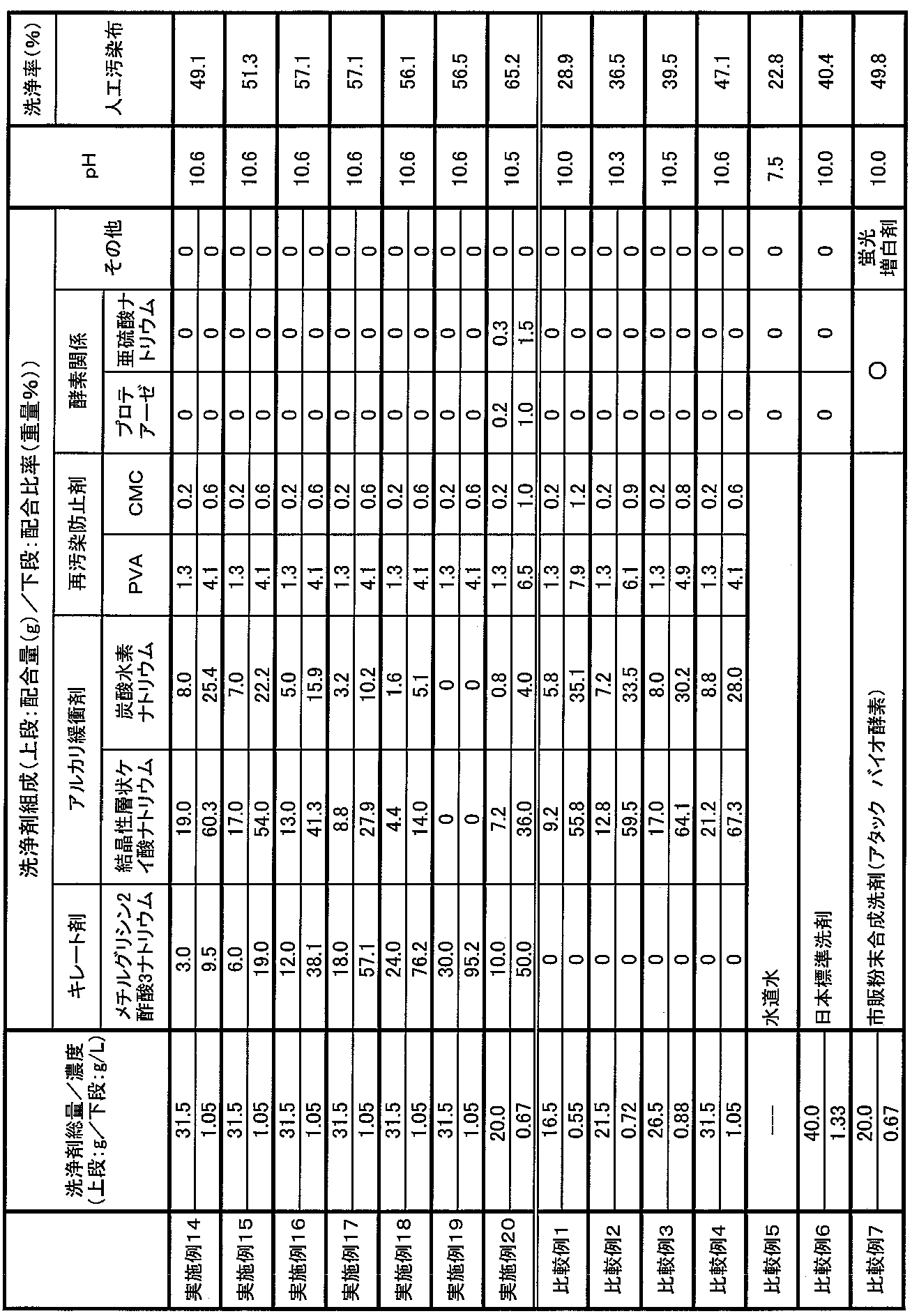
[0112] i . m
実施例 1乃至 20の比較例として、水道水 30リットルに、結晶性層状ケィ酸ナトリウム 9. 2g、炭酸水素ナトリウム 5. 8g、 PVAl. 3g、 CMCO. 2gの各成分組成力もなり、 同成分総量が 16. 5gの洗浄剤を溶解して、洗浄剤濃度が 0. 55gZL、 pHが 10. 0 の洗濯液を得た。この洗濯液を用いて洗濯したときの洗濯前後における湿式人工汚 染布の洗浄率を求めた。結果を表 4に示す。
[0113] 比較例 2
実施例 1乃至 20の比較例として、水道水 30リットルに、結晶性層状ケィ酸ナトリウム 12. 8g、炭酸水素ナトリウム 7. 2g、 PVAl. 3g、 CMCO. 2gの各成分組成力もなり、 同成分総量が 21. 5gの洗浄剤を溶解して、洗浄剤濃度が 0. 72gZL、 pHが 10. 3 の洗濯液を得た。この洗濯液を用いて洗濯したときの洗濯前後における湿式人工汚 染布の洗浄率を求めた。結果を表 4に示す。
[0114] 比較例 3
実施例 1乃至 20の比較例として、水道水 30リットルに、結晶性層状ケィ酸ナトリウム 17g、炭酸水素ナトリウム 8g、 PVAl. 3g、 CMCO. 2gの各成分組成力もなり、同成 分総量が 26. 5gの洗浄剤を溶解して、洗浄剤濃度が 0. 88gZL、 pHが 10. 5の洗 濯液を得た。この洗濯液を用いて洗濯したときの洗濯前後における湿式人工汚染布 の洗浄率を求めた。結果を表 4に示す。
[0115] 比較例 4
実施例 1乃至 20の比較例として、水道水 30リットルに、結晶性層状ケィ酸ナトリウム 21. 2g、炭酸水素ナトリウム 8. 8g、 PVAl. 3g、 CMCO. 2gの各成分組成力もなり、 同成分総量が 31. 5gの洗浄剤を溶解して、洗浄剤濃度が 1. 05gZL、 pHが 10. 6 の洗濯液を得た。この洗濯液を用いて洗濯したときの洗濯前後における湿式人工汚 染布の洗浄率を求めた。結果を表 4に示す。
[0116] 比較例 5
実施例 1乃至 20の比較例として、単に水道水 30リットルを用いて洗濯したときの、 洗濯前後における湿式人工汚染布、並びに EMPA汚染布の洗浄率を求めた。結果 を表 4、表 5に示す。
[0117] 比較例 6
財団法人日本規格協会によって規格化されている合成洗剤試験方法 (規格番号 J IS K 3362:1998)には、洗浄力判定用指標洗剤 (本明細書では日本標準洗剤という。 )として、直鎖アルキルベンゼンスルホン酸ナトリウム、ケィ酸ナトリウム、炭酸ナトリウ ム、カルボキシメチルセルロースナトリウム、および硫酸ナトリウムを 15 : 5 : 7 : 1 : 55で混 合したものを用いることが規定されて 、る。
[0118] そこで、実施例 1乃至 20の比較例として、上述の日本標準洗剤を標準濃度で水道 水 30リットルに溶解させた洗濯液 (洗浄剤濃度 1. 33gZL)を用いて洗濯したときの 、洗濯前後における湿式人工汚染布、並びに EMPA汚染布の洗浄率を求めた。結 果を表 4、表 5に示す。
[0119] 比較例 7
実施例 1乃至 20の比較例として、市販の粉末合成洗剤を標準濃度で水道水 30リツ トルに溶解させた洗濯液 (アタックバイオ酵素、洗浄剤濃度 0. 67gZL、花王株式会 社製、酵素及び蛍光増白剤入り)を用いて洗濯したときの、洗濯前後における湿式人 表 4
Figure imgf000027_0001
Figure imgf000027_0002
Figure imgf000027_0004
Figure imgf000027_0003
^01204 染布汚
人染布汚工 ま実施態実施例様好しい 20
Έ
道較例水水比 5
較例本標準洗剤比日 6
較市粉末合成洗剤比例販 7
d
IS
(洗浄力試験その 1 :洗浄試験結果、及びその考察)
実施例 1 20の洗浄率と、比較例 6 7の洗浄率とを比較してみると、本発明に係 る有機系キレート剤を洗濯作用主剤とする洗濯液では、市販の界面活性剤を洗濯作 用主剤とする合成洗剤とほぼ同等又はそれ以上の洗浄率を示している。
このうち、表 3を参照しつつ実施例 20と比較例 6 7とを比べてみると、酵素及び還 元剤をさらに添加した実施例 20のものは、人工皮脂汚れ (人工汚染布)をはじめとし て、鉱物油とカーボンブラックの複合汚れ (EMPA101)、ォリーブ油とカーボンブラ ックの複合汚れ (EMPA106)、血液(EMPAl l l)、タンパク質(EMPA112)、赤ヮ イン(EMPA114)、並びに血液とミルクとカーボンブラックの複合汚れ(EMPA116) など、あらゆる種類の汚れのすべてについて、従来の合成洗剤を超える洗濯性能を 示しており、まさに万能の洗浄力を発揮することがわかる。し力も、洗浄剤濃度の観点 で実施例 20と比較例 6〜7とを比べてみると、実施例 20の洗浄剤濃度は 0. 67g/L 、比較例 6の洗浄剤濃度は 1. 33gZL、比較例 7の洗浄剤濃度は 0. 67gZLであり 、洗浄剤の使用量をみても、実施例 20のものは、比較例 6の日本標準洗剤と比べて 約半分ですみ、また、比較例 7の市販粉末合成洗剤と同等であることがわ力る。
[0123] 次に、実施例に係る洗濯液が、有機系キレート剤を洗濯作用主剤とするものである とする根拠について言及する。なお、洗濯作用主剤とは、ある洗浄剤組成物の構成 成分のうち、洗浄力(洗浄率)の向上に主として貢献する成分である、と定義すること にする。また、洗浄力(洗浄率)の向上に主として貢献するとは、少量の配合で洗浄 力(洗浄率)が向上する場合と、それを配合することで洗浄力(洗浄率)が高水準に引 き上げられる (例えば、比較例 7の洗浄率と同等以上)場合と、の両者を含む概念で ある。
[0124] さて、本発明の実施例に係る洗濯液が、有機系キレート剤を洗濯作用主剤とするも のであることを明らかにするために、洗浄剤使用量'濃度、 pH等の洗濯条件を等しく 揃えた洗濯液であって、その組成が異なる三種類のものを相互に比較してみた。
[0125] まず、洗浄剤使用量を 16. 5g (洗浄剤濃度: 0. 55g/L)とし、 pHを 10. 0と同一 条件に揃えた三種類の洗濯液が、比較例 1ではアルカリ緩衝剤 15gを、実施例 3で は有機系キレート剤 15gを、そして実施例 1では有機系キレート剤 10. 5gとアルカリ 緩衝剤 4. 5gを、それぞれ共通の再汚染防止剤 1. 5gと共に水道水 30リットル中に 溶解させることで得られている。ここで、実施例 1, 3と、比較例 1を対比してみると、ァ ルカリ緩衝剤単独(比較例 1)では洗浄率 28. 9%と大きく見劣りするものの、有機系 キレート剤単独(実施例 3)では洗浄率 52. 2%、有機系キレート剤とアルカリ緩衝剤 の組み合わせに係る組成(実施例 1)では洗浄率 48. 9%と、両者共に高い洗浄率が 得られており、この場合、有機系キレート剤が洗浄力(洗浄率)の向上に主として貢献 していることは明らかであるから、実施例 1, 3に係る洗濯液は、有機系キレート剤を 洗濯作用主剤とするものであると言える。
[0126] 同様に、洗浄剤使用量を 21. 5g (洗浄剤濃度 : 0. 72g/L)とし、 pHを 10. 3と同 一条件に揃えた三種類の洗濯液が、比較例 2ではアルカリ緩衝剤 20gを、実施例 8 では有機系キレート剤 20gを、そして実施例 5では有機系キレート剤 10gとアルカリ緩 衝剤 10gを、それぞれ共通の再汚染防止剤 1. 5gと共に水道水 30リットル中に溶解 させることで得られている。ここで、実施例 5, 8と、比較例 2を対比してみると、アル力 リ緩衝剤単独(比較例 2)では洗浄率 36. 5%と見劣りするものの、有機系キレート剤 単独(実施例 8)では洗浄率 56. 2%、有機系キレート剤とアルカリ緩衝剤の組み合 わせに係る組成(実施例 5)では洗浄率 53. 6%と、両者共に高い洗浄率が得られて おり、この場合、有機系キレート剤が洗浄力(洗浄率)の向上に主として貢献している ことは明らかであるから、実施例 5, 8に係る洗濯液は、有機系キレート剤を洗濯作用 主剤とするものであると言える。
[0127] 同様に、洗浄剤使用量を 26. 5g (洗浄剤濃度 : 0. 88g/L)とし、 pHを 10. 5と同 一条件に揃えた三種類の洗濯液が、比較例 3ではアルカリ緩衝剤 25gを、実施例 13 では有機系キレート剤 25gを、そして実施例 10では有機系キレート剤 10gとアルカリ 緩衝剤 15gを、それぞれ共通の再汚染防止剤 1. 5gと共に水道水 30リットル中に溶 解させることで得られている。ここで、実施例 10, 13と、比較例 3を対比してみると、ァ ルカリ緩衝剤単独(比較例 3)では洗浄率 39. 5%と見劣りするものの、有機系キレー ト剤単独(実施例 13)では洗浄率 56. 5%、有機系キレート剤とアルカリ緩衝剤の組 み合わせに係る組成(実施例 10)では洗浄率 54. 6%と、両者共に高い洗浄率が得 られており、この場合、有機系キレート剤が洗浄力(洗浄率)の向上に主として貢献し ていることは明らかであるから、実施例 10, 13に係る洗濯液は、有機系キレート剤を 洗濯作用主剤とするものであると言える。
[0128] 同様に、洗浄剤使用量を 31. 5g (洗浄剤濃度:1. 05g/L)とし、 pHを 10. 6と同 一条件に揃えた三種類の洗濯液が、比較例 4ではアルカリ緩衝剤 30gを、実施例 19 では有機系キレート剤 30gを、そして実施例 16では有機系キレート剤 12gとアルカリ 緩衝剤 18gを、それぞれ共通の再汚染防止剤 1. 5gと共に水道水 30リットル中に溶 解させることで得られている。ここで、実施例 16, 19と、比較例 4を対比してみると、ァ ルカリ緩衝剤単独(比較例 4)では洗浄率 47. 1%とやや劣るものの、キレート剤単独 (実施例 19)では洗浄率 56. 5%、有機系キレート剤とアルカリ緩衝剤の組み合わせ に係る組成(実施例 16)では洗浄率 57. 1%と、両者共に高い洗浄率が得られており 、この場合、有機系キレート剤が洗浄力(洗浄率)の向上に主として貢献していること は明らかであるから、実施例 16, 19に係る洗濯液は、有機系キレート剤を洗濯作用 主剤とするものであると言える。
[0129] 上述した実施例 1, 3, 5, 8, 10, 13, 16, 19以外の例でも、有機系キレート剤を配 合すること〖こよって、洗浄力(洗浄率)の向上、又は洗浄力(洗浄率)の高水準への引 き上げが実現されている。
[0130] 従って、実施例 1〜20に係る洗濯液は、有機系キレート剤を洗濯作用主剤とするも のであると言える。
[0131] (洗浄力試験その 1 :まとめ)
洗浄力試験その 1の実施例 1〜20では、有機系キレート剤として、メチルグリシン 2 酢酸 3ナトリウム(MGDA-3Na、 pHl lにおける最大カルシウム錯ィ匕能は 327mg/g) を使用している力 本試験で使用した洗濯用水(60mgZリットルの硬度成分を含有、 洗濯用水量: 30リットル)に含まれる硬度成分を完全に無効化するための MGDA-3N aの必要量計算値は次式で与えられる。
[0132] 60Z327水 30=約 5. 5g
表 3, 4を参照すると、実施例 1〜20について、 MGDA-3Naの使用量が 5. 5gを下 回るのは実施例 14のみであり、同実施例 14を除くと、 MGDA-3Naの使用量範囲は 6 〜30gとなり、いずれの例でも有機系キレート剤(MGDA-3Na)は、必要量計算値を 超えた使用がなされて!/ヽることがゎカゝる。
[0133] なお、実施例 14では、有機系キレート剤 (MGDA-3Na)の使用量が 3g (洗浄剤総量 中の配合比率では 9. 5%)と必要量計算値(5. 5g)を下回っているものの、結晶性 層状ケィ酸ナトリウムの使用量が 19g (洗浄剤総量中の配合比率では 60. 3%)と多 量に使用されており、こうした結晶性層状ケィ酸ナトリウムの多量使用が、有機系キレ ート剤 (MGDA-3Na)の硬度成分捕捉能を補うことで、市販合成洗剤と同等の高い洗 浄力が維持されているものと考えられる。
[0134] 次に、日本巿場を対象とした洗浄剤組成物の好ましい実施例について、比較例と 対比しながら、洗浄力試験その 2に開示する。 [0135] 洗浄力試験その 2
試験条件については、上述した洗浄力試験その 1とほぼ共通のため、その相違点 について言及すると、本洗浄力試験その 2では、ターゴトメーターを使用して、回転数 120rpm、洗濯時間 10分、すすぎ 2回、温度 30° C、洗濯用水(日本標準洗濯用水 )の量 1リットルにて、下記実施例及び比較例に示す物質及び洗剤濃度にて洗濯を 行った。
[0136] 実施例 21
日本標準洗濯用水 30リットルに、メチルグリシン 2酢酸 3ナトリウム 10g、結晶性層状 ケィ酸ナトリウム 3. 5g、炭酸水素ナトリウム 1. 5g、 PVA1. 3g、 CMCO. 2g、プロテ ァーゼ 0. 2g、亜硫酸ナトリウム 0. 3gの各成分組成力もなり、同成分総量が 17gの洗 浄剤を溶解して、洗浄剤濃度が 0. 57gZL、 pHが 10. 5の洗濯液を得た。この洗濯 液を用いて洗濯したときの洗濯前後における湿式人工汚染布、並びに EMPA汚染 布の洗浄率を求めた。結果を表 6、表 7に示す。
[0137] 実飾 122
日本標準洗濯用水 30リットルに、メチルグリシン 2酢酸 3ナトリウム 12g、結晶性層状 ケィ酸ナトリウム 2g、炭酸水素ナトリウム lg、 PVA1. 3g、 CMCO. 2g、プロテアーゼ 0. 2g、亜硫酸ナトリウム 0. 3gの各成分組成力もなり、同成分総量が 17gの洗浄剤を 溶解して、洗浄剤濃度が 0. 57gZL、 pHが 10. 5の洗濯液を得た。この洗濯液を用 Vヽて洗濯したときの洗濯前後における湿式人工汚染布、並びに EMPA汚染布の洗 浄率を求めた。結果を表 6、表 7に示す。
[0138] 実施例 23
日本標準洗濯用水 30リットルに、メチルグリシン 2酢酸 3ナトリウム 15g、 PVA1. 3g 、 CMCO. 2g、プロテアーゼ 0. 2g、亜硫酸ナトリウム 0. 3gの各成分組成力 なり、 同成分総量が 17gの洗浄剤を溶解して、洗浄剤濃度が 0. 57gZL、pHが 10. 5の 洗濯液を得た。この洗濯液を用いて洗濯したときの洗濯前後における湿式人工汚染 布、並びに EMPA汚染布の洗浄率を求めた。結果を表 6、表 7に示す。
[0139] 比較例 8
実施例 21乃至 23の比較例として、市販の粉末合成洗剤を標準濃度で日本標準洗 濯用水 30リットルに溶解させた洗濯液 (アタックバイオ酵素、洗浄剤濃度 0. 67g/L 、花王株式会社製、酵素及び蛍光増白剤入り)を用いて洗濯したときの、洗濯前後に おける湿式人工汚染布、並びに EMPA汚染布の洗浄率を求めた。結果を表 6、表 7 に示す。
[表 6]
表 6
Figure imgf000034_0001
[0141」 [表 7]
Figure imgf000035_0001
Figure imgf000035_0002
Figure imgf000035_0003
(洗浄力試験その 2 :洗浄試験結果、及びその考察)
実施例 21 23の洗浄率と、比較例 8の洗浄率とを比較してみると、本発明に係る 有機系キレート剤を洗濯作用主剤とする洗濯液では、市販の界面活性剤を洗濯作 用主剤とする合成洗剤を凌駕する洗浄率を示してレ、る。
[0142] このうち、表 7を参照しつつ実施例 21 23と比較例 8とを比べてみると、実施例 21
23の洗浄率は、人工皮脂汚れ (人工汚染布)をはじめとして、鉱物油とカーボンブ ラックの複合汚れ (EMPA101)、ォリーブ油とカーボンブラックの複合汚れ (EMPA 106)、血液(EMPA111)、タンパク質(EMPA112)、赤ワイン(EMPA114)、並 びに血液とミルクとカーボンブラックの複合汚れ (EMPA116)など、あらゆる種類の 汚れのすべてについて、従来の合成洗剤を超える洗濯性能を示しており、まさに万 能の洗浄力を発揮することがわかる。しカゝも、洗浄剤濃度の観点で実施例 21〜23と 比較例 8とを比べてみると、実施例 21〜23の洗浄剤濃度は 0. 57gZL、比較例 8の 洗浄剤濃度は 0. 67gZLであり、洗浄剤の使用量をみても、実施例 21〜23のもの は、比較例 8の市販粉末合成洗剤よりも少なくてすみ、洗濯性能のみならず、コンパ クトイ匕の観点でも優れていることがわかる。なお、表 6を参照しつつ実施例 21〜23を 比べてみると、実施例 21、 22、 23の順序で有機系キレート剤の配合比率が低いの で、洗浄剤組成物中における有機物の配合量を減らす要請がある場合には、実施 例 24の組成を採用すればょ 、。
[0143] 次に、実施例 21〜23に係る洗濯液が、有機系キレート剤を洗濯作用主剤とするも のであるカゝ否かを検討してみると、実施例 21〜23のいずれも、有機系キレート剤とし てのメチルグリシン 2酢酸 3ナトリウム力 組成物中の配合比率で 50%以上を占めて おり、こうした 50%以上に及ぶ配合比率で有機系キレート剤を含有させることによつ て、洗浄力(洗浄率)の飛躍的な向上が実現されていることがわかる。
[0144] 従って、実施例 21〜23に係る洗濯液は、有機系キレート剤を洗濯作用主剤とする ものであると言える。
[0145] (洗浄力試験その 2 :まとめ)
洗浄力試験その 2の実施例 21〜23では、有機系キレート剤として、メチルグリシン 2酢酸 3ナトリウム(MGDA-3Na、 pHl lにおける最大カルシウム錯ィ匕能は 327mg/g) を使用している力 本試験で使用した洗濯用水(90mgZリットルの硬度成分を含有、 洗濯用水量: 1リットル)に含まれる硬度成分を完全に無効化するための MGDA-3Na の必要量計算値は次式で与えられる。
[0146] 90/327水 1 =約 0. 28g
表 6を参照すると、 MGDA-3Naの使用量は、実施例 21では 0. 33g、実施例 22では 0. 4g、実施 f列 23で ίま 0. 5gであり、 MGDA— 3Naの使用量範囲 ίま 0. 33〜0. 5g (洗 濯用水量が 30リットルでは 10〜15g)となり、いずれの例でも有機系キレート剤(MG DA-3Na)は、必要量計算値 (約 0. 28g)を超えて使用されていることがわかる。
[0147] 次に、欧州等の比較的洗濯用水の硬度が高い市場を対象とした洗浄剤組成物の 好ましい実施例について、比較例と対比しながら、洗浄力試験その 3に開示する。
[0148] 洗浄力試験その 3
試験条件については、上述した洗浄力試験その 1とほぼ共通のため、その相違点 について言及すると、本洗浄力試験その 3では、ミーレネ土製のドラム式洗濯機 (W90 1、 Cotton60° Cコース、負荷としてタオル 3kg)を用い、同洗濯機のコースプログラ ムに従って 60° Cに加温された洗濯用水(水量は 15〜20リットルの範囲)にて、下 記実施例及び比較例に示す物質及び洗剤濃度にて洗濯を行った。洗濯用水は、精 製水に塩ィ匕カルシウム二水和物を 369mg/L濃度で溶解させることにより硬度 250p pmの水を得て、これを洗濯用水として用いた。以下では、こうした手順を経て得た水 を、欧州標準洗濯用水という。
[0149] 実飾 124
欧州標準洗濯用水 15— 20リットルに、メチルグリシン 2酢酸 3ナトリウム 27g、炭酸 水素ナトリウム 3g、 PVA2. 6g、 CMCO. 4g、酵素としてトータラーゼ lg、酵素安定 ィ匕剤として亜硫酸ナトリウム 0. 5g、その他の添加剤である漂白剤として過炭酸ナトリ ゥム 15g、同漂白剤の活性化剤としてテトラァセチルエチレンジァミン 2. 5gの各成分 組成からなり、同成分総量が 52gの洗浄剤を溶解して、洗浄剤濃度が 2. 6- 3. 5g ZL、 pHが 10. 0の洗濯液を得た。この洗濯液を用いて洗濯したときの洗濯前後に おける湿式人工汚染布、並びに EMPA汚染布の洗浄率を求めた。結果を表 8、表 9 に示す。
[0150] 実施例 25
欧州標準洗濯用水 15— 20リットルに、メチルグリシン 2酢酸 3ナトリウム 30g、 PVA2 . 6g、 CMCO. 4g、酵素としてトータラーゼ lg、酵素安定化剤として亜硫酸ナトリウム 0. 5g、その他の添加剤である漂白剤として過炭酸ナトリウム 15g、同漂白剤の活性 ィ匕剤としてテトラァセチルエチレンジァミン 2. 5gの各成分組成力もなり、同成分総量 力 2gの洗浄剤を溶解して、洗浄剤濃度が 2. 6- 3. 5gZL、 pHが 10. 0の洗濯液 を得た。この洗濯液を用いて洗濯したときの洗濯前後における湿式人工汚染布、並 びに EMPA汚染布の洗浄率を求めた。結果を表 8、表 9に示す。
[0151] 比較例 9
実施例 24乃至 25の比較例として、市販の粉末合成洗剤を標準濃度で欧州標準洗 濯用水 15— 20リットルに溶解させた洗濯液(パーシル メガパールズ: Persil MEGAP EALS (登録商標) センシティブ: Sensitiv 洗浄剤濃度 3. 8 - 5gZL、ヘンケル社製 、ゼォライト及び漂白剤入り)を用いて洗濯したときの、洗濯前後における湿式人工 汚染布、並びに EMPA汚染布の洗浄率を求めた。結果を表 8、表 9に示す。
[0152] [表 8]
表 8
Figure imgf000039_0001
[0153] [表 9] 羅
画 ¾ 3 001 「WH9.. ol s
Figure imgf000040_0001
X
a.
Figure imgf000040_0002
lH
06)、血液(EMPA111)、タンパク質(EMPA112)、赤ワイン(EMPA114)、並び に血液とミルクとカーボンブラックの複合汚れ (EMPA116)など、あらゆる種類の汚 れのすべてについて、従来の合成洗剤を超える洗濯性能を示しており、まさに万能 の洗浄力を発揮することがわかる。し力も、洗浄剤濃度の観点で実施例 24、 25と比 較例 9とを比べてみると、実施例 24、 25の洗浄剤濃度は 2. 6- 3. 5g/L,比較例 9 の洗浄剤濃度は 3. 8— 5gZLであり、洗浄剤の使用量をみても、実施例 24、 25のも のは、比較例 9の市販粉末合成洗剤よりも約 3割ほど少なくてすみ、洗濯性能のみな らず、コンパクトィ匕の観点でも優れていることがわかる。なお、表 8を参照しつつ実施 例 24と 25を比べてみると、実施例 24では有機系キレート剤の配合比率が低 、ので 、洗浄剤組成物中における有機物の配合量を減らす要請がある場合には、実施例 2 4の組成を採用すればょ 、。
[0155] 次に、実施例 24、 25に係る洗濯液が、有機系キレート剤を洗濯作用主剤とするも のであるカゝ否かを検討してみると、実施例 24、 25のいずれも、有機系キレート剤とし てのメチルグリシン 2酢酸 3ナトリウム力 組成物中の配合比率で 50%以上を占めて おり、こうした 50%以上に及ぶ配合比率で有機系キレート剤を含有させることによつ て、洗浄力(洗浄率)の飛躍的な向上が実現されていることがわかる。
[0156] 従って、実施例 24、 25に係る洗濯液は、有機系キレート剤を洗濯作用主剤とする ものであると言える。
[0157] (洗浄力試験その 3 :まとめ)
洗浄力試験その 3の実施例 24〜25では、有機系キレート剤として、メチルグリシン 2酢酸 3ナトリウム(MGDA-3Na、 pHl lにおける最大カルシウム錯ィ匕能は 327mg/g) を使用している力 本試験で使用した洗濯用水(250mgZリットルの硬度成分を含有 、洗濯用水量: 15— 20リットル)に含まれる硬度成分を完全に無効化するための MG DA-3Naの必要量計算値は次式で与えられる。
[0158] 15リットル: 250,327 * 15 = 11. 47g
20リットル: 250,327 * 20= 15. 29g
表 8を参照すると、 MGDA-3Naの使用量は、実施例 24では 27g、実施例 25では 30 gであり、 MGDA-3Naの使用量範囲は 27〜30gとなり、いずれの例でも有機系キレー ト剤 (MGDA-3Na)は、必要量計算値 (洗濯用水量: 20リットルの場合で約 15g)を超 えて、約 2倍量が使用されていることがわかる。
[0159] (使用薬剤の特定)
本明細書中で開示した使用薬剤については下記のものを使用した。
[0160] 1.結晶性層状ケィ酸ナトリウム:プリフィード F品(トクャマシルテック社製)
2.重炭酸ナトリウム: Eグレード品(トクャマ社製)
3.ポリビュルアルコール(PVA):ポバール JP— 05S (日本酢ビ 'ポバール社製)
4.カルボキシメチルセルロース(CMC):セロゲン BSH— 12 (第一工業製薬社製)
5.酵素:プロテアーゼ ProperaselOOOE (ナガセケムテックス社製)
6.酵素:トータラーゼ (ノボザィム社製)
7.酵素安定化剤:亜硫酸ナトリウム:精製無水亜硫酸ソーダ (大東化学社製)
8.漂白剤:過炭酸ナトリウム (旭電ィ匕工業社製)
9.漂白剤活性化剤:テトラァセチルエチレンジァミン (クラリアントジャパン社製)
10.エチレンジァミン四酢酸(EDTA-4Na):トリロン—B粉体(登録商標、 BASF社製 )
11.メチルグリシン 2酢酸 3ナトリウム(MGDA-3Na):トリロン— M粉末(登録商標、 BA SF社製)
<産業上の利用可能性 >
本発明の洗浄剤組成物は、有機系キレート剤を洗濯作用主剤とし、界面活性剤を 使用することのな 、洗浄剤組成物であって、従来の界面活性剤を主剤とした合成洗 剤と同等以上の洗浄力及び使い勝手を有するものである。
[0161] 以上に述べた本発明は、明らかに同一性の範囲に属するものが多種存在する。そ のような多様性は発明の意図及び範囲カゝら離脱したものとはみなされず、当業者に 自明であるそのようなすべての変更は、本発明に係る請求の範囲の技術的射程範囲 内に含まれる。

Claims

請求の範囲
[1] 有機系アルカリ性キレート剤を必須成分とし、さらに再汚染防止剤を含有し、界面活 性剤を含有しな!、無りんの衣料用洗浄剤組成物を用いて衣料を洗濯することを特徴 とする衣料の洗濯方法。
[2] 有機系のキレート剤、アルカリ緩衝剤、及び再汚染防止剤を含有し、界面活性剤を 含有しない無りんの衣料用洗浄剤組成物を、 0. 5〜10. 5gZLの濃度に溶解した洗 濯液を用いて衣料を洗濯する方法であって、衣料を入れた時の洗濯条件として、洗 濯液の pHが 9〜11、かつ、洗濯液中の硬度成分を無効化するための硬度成分捕捉 能を有する物質が、同硬度成分をほぼ無効化できる以上の量、同洗濯液中に存在 する、を満足する洗濯液を用いることを特徴とする衣料の洗濯方法。
[3] 有機系のキレート剤、アルカリ緩衝剤、及び再汚染防止剤を含有し、界面活性剤を 含有しない無りんの衣料用洗浄剤組成物を、 0. 5〜10. 5gZLの濃度に溶解した洗 濯液を用いて衣料を洗濯する方法であって、衣料を入れた時の洗濯条件として、洗 濯液の pHが 9〜11、かつ、洗濯液中の硬度成分を無効化するための硬度成分捕捉 能を有する物質が、同硬度成分を全て無効化できる以上の量、同洗濯液中に存在 すること、を満足する洗濯液を用いることを特徴とする衣料の洗濯方法。
[4] 前記キレート剤は、その 1%水溶液の pHが 9以上、好ましくは 10〜12. 5の範囲にあ り、かつ、最大カルシウム錯ィ匕能(pHl lにおける lg当りの CaC03mg数)力 S200mg/ g以上、好ましくは 300mgZg以上であること、の条件を満足するものであることを特徴 とする請求項 1〜3のいずれかに記載の衣料の洗濯方法。
[5] 前記キレート剤は、カルボン酸系キレート剤であることを特徴とする請求項 1〜4のい ずれかに記載の衣料の洗濯方法。
[6] 前記アルカリ緩衝剤は、結晶性層状ケィ酸アルカリ金属塩であることを特徴とする請 求項 1〜5のいずれか〖こ記載の衣料の洗濯方法。
[7] 前記硬度成分捕捉能を有する物質は、前記キレート剤と前記結晶性層状ケィ酸アル カリ金属塩の混合物であることを特徴とする請求項 6に記載の衣料の洗濯方法。
[8] 前記硬度成分捕捉能を有する物質は、前記キレート剤であることを特徴とする請求 項 1〜6のいずれかに記載の衣料の洗濯方法。
[9] 前記洗濯液は、さらに洗濯用酵素、及び必要に応じて該酵素の失活を防ぐための還 元剤を含む請求項 1〜6のいずれかに記載の洗濯方法。
[10] 前記洗濯液は、さらに酸素系漂白剤を含む請求項 1〜7のいずれかに記載の洗濯方 法。
[11] 有機系アルカリ性キレート剤を必須成分とし、さらに再汚染防止剤を含有し、界面活 性剤を含有しないことを特徴とする無りんの衣料用洗浄剤組成物。
[12] 有機系のキレート剤、アルカリ緩衝剤、及び再汚染防止剤を含有し、界面活性剤を 含有しない無りんの衣料用洗浄剤組成物であって、前記洗浄剤組成物を 0. 5〜10 . 5gZLの濃度に溶解した、その pHが 9〜: L 1であり、かつ、洗濯液中の硬度成分を 無効化するための硬度成分捕捉能を有する物質を、同硬度成分をほぼ無効化でき る以上の量、存在させた、洗濯液が得られることを特徴とする特徴とする衣料用洗浄 剤組成物。
[13] 有機系のキレート剤、アルカリ緩衝剤、及び再汚染防止剤を含有し、界面活性剤を 含有しない無りんの衣料用洗浄剤組成物であって、前記洗浄剤組成物を 0. 5〜10 . 5gZLの濃度に溶解した、その pHが 9〜: L 1であり、かつ、洗濯液中の硬度成分を 無効化するための硬度成分捕捉能を有する物質を、同硬度成分を全て無効化でき る以上の量、存在させた、洗濯液が得られることを特徴とする特徴とする衣料用洗浄 剤組成物。
[14] 前記キレート剤は、その 1%水溶液の pHが 9以上、好ましくは 10〜12. 5の範囲にあ り、かつ、最大カルシウム錯ィ匕能(pHllにおける lg当りの CaC03mg数)力 S200mg/ g以上、好ましくは 300mgZg以上であること、の条件を満足するものであることを特徴 とする請求項 11〜13の ヽずれかに記載の衣料用洗浄剤組成物。
[15] 前記キレート剤は、カルボン酸系のキレート剤であることを特徴とする請求項 11〜14 の!、ずれかに記載の衣料用洗浄剤組成物。
[16] 前記アルカリ緩衝剤は、結晶性層状ケィ酸アルカリ金属塩であることを特徴とする請 求項 11〜 15の 、ずれかに記載の衣料用洗浄剤組成物。
[17] 前記硬度成分捕捉能を有する物質は、前記キレート剤と前記結晶性層状ケィ酸アル カリ金属塩の混合物であることを特徴とする請求項 16に記載の衣料用洗浄剤組成 物。
[18] 前記硬度成分捕捉能を有する物質は、前記キレート剤であることを特徴とする請求 項 11〜16の!、ずれかに記載の衣料の洗濯方法。
[19] さらに洗濯用酵素、及び必要に応じて該酵素の失活を防ぐための還元剤を添加した 請求項 11〜18の ヽずれかに記載の衣料用洗浄剤組成物。
[20] さらに酸素系漂白剤を添加した請求項 11〜19のいずれかに記載の衣料用洗浄剤 組成物。
PCT/JP2006/313249 2005-07-01 2006-07-03 衣料の洗濯方法及びそのための洗浄剤組成物 Ceased WO2007004622A1 (ja)

Priority Applications (3)

Application Number Priority Date Filing Date Title
US11/994,360 US8389460B2 (en) 2005-07-01 2006-07-03 Clothes washing method and surfactant-free detergent composition used for the same
EP06780753A EP1908817A4 (en) 2005-07-01 2006-07-03 WASHING AND WASHING MACHINE WASHING PROCESS
JP2007524060A JP4372823B2 (ja) 2005-07-01 2006-07-03 衣料の洗濯方法及びそのための洗浄剤組成物

Applications Claiming Priority (2)

Application Number Priority Date Filing Date Title
JP2005-194266 2005-07-01
JP2005194266 2005-07-01

Publications (1)

Publication Number Publication Date
WO2007004622A1 true WO2007004622A1 (ja) 2007-01-11

Family

ID=37604483

Family Applications (1)

Application Number Title Priority Date Filing Date
PCT/JP2006/313249 Ceased WO2007004622A1 (ja) 2005-07-01 2006-07-03 衣料の洗濯方法及びそのための洗浄剤組成物

Country Status (6)

Country Link
US (1) US8389460B2 (ja)
EP (1) EP1908817A4 (ja)
JP (2) JP4372823B2 (ja)
KR (2) KR20080033330A (ja)
CN (1) CN101248168A (ja)
WO (1) WO2007004622A1 (ja)

Cited By (8)

* Cited by examiner, † Cited by third party
Publication number Priority date Publication date Assignee Title
JP2009132934A (ja) * 2005-07-01 2009-06-18 Mizu Kk 衣料の洗濯方法及びそのための洗浄剤組成物
CN102010802A (zh) * 2010-12-13 2011-04-13 陈继峰 浓缩型多酶洗涤液及其制备方法
US20110185514A1 (en) * 2009-09-18 2011-08-04 Ecolab Usa Inc. Treatment of non-trans fats and fatty acids with a chelating agent
JP2014185239A (ja) * 2013-03-22 2014-10-02 Seiko Epson Corp インクジェット用インク、記録装置および記録物
US9670438B2 (en) 2015-01-29 2017-06-06 Ecolab Usa Inc. Composition and method for the treatment of sunscreen stains in textiles
US9719051B2 (en) 2009-09-18 2017-08-01 Ecolab Usa Inc. Treatment of non-trans fats with acidic tetra sodium L-glutamic acid, N, N-diacetic acid (GLDA)
US10253281B2 (en) 2012-08-20 2019-04-09 Ecolab Usa Inc. Method of washing textile articles
US12201154B2 (en) 2018-01-03 2025-01-21 Cqens Technologies Inc. Heat-not-burn device and method

Families Citing this family (8)

* Cited by examiner, † Cited by third party
Publication number Priority date Publication date Assignee Title
US9394508B2 (en) * 2012-10-26 2016-07-19 Ecolab Usa Inc. Phosphorus free low temperature ware wash detergent for reducing scale build-up
CN104178363A (zh) * 2013-05-23 2014-12-03 海安县国力化工有限公司 一种洗衣粉
EP3004316B1 (en) * 2013-05-27 2017-03-22 Basf Se Aqueous solutions containing a complexing agent in high concentration
WO2016054768A1 (en) * 2014-10-08 2016-04-14 Dow Global Technologies Llc Cleaning formulation for in-place cleaning of membrane filter module incorporated within washing machine
EP3026100B1 (en) * 2014-11-26 2018-07-25 The Procter and Gamble Company Cleaning pouch
US9890350B2 (en) 2015-10-28 2018-02-13 Ecolab Usa Inc. Methods of using a soil release polymer in a neutral or low alkaline prewash
EP3693450A1 (en) * 2019-02-08 2020-08-12 The Procter & Gamble Company Method of treating fabrics with automated pre-treatment of water
CN114471872B (zh) * 2021-12-21 2023-05-05 浙江永金生物科技有限公司 一种天然抗菌消炎的杭菊花酵素内衣手洗衣液及其提取制备设备

Citations (9)

* Cited by examiner, † Cited by third party
Publication number Priority date Publication date Assignee Title
JPS56151799A (en) * 1980-04-26 1981-11-24 Lion Corp Phosphorus-free detergent composition with less contamination
JPS6320397A (ja) * 1986-07-14 1988-01-28 日本パ−オキサイド株式会社 炭酸水素ナトリウムを主基材とする顆粒物
JPH07278597A (ja) * 1994-04-14 1995-10-24 Kao Corp 粉末漂白剤組成物
JPH0987678A (ja) * 1995-09-19 1997-03-31 Eco Japan:Kk 衣料用洗浄組成物
JPH09132794A (ja) * 1994-09-13 1997-05-20 Kao Corp 洗濯方法および衣料用洗剤組成物
WO1997033970A1 (fr) * 1996-03-15 1997-09-18 Kao Corporation Composition detergente granulaire a haute densite pour vetements
JPH11256192A (ja) * 1998-03-12 1999-09-21 Mizu Kk 洗浄剤
JP2004002869A (ja) * 2000-12-05 2004-01-08 Mizu Kk 衣料の洗濯方法及びそのための洗浄剤組成物
JP2004175871A (ja) * 2002-11-26 2004-06-24 Kurita Water Ind Ltd 金属表面の洗浄剤及びそれを用いた金属表面の洗浄方法

Family Cites Families (14)

* Cited by examiner, † Cited by third party
Publication number Priority date Publication date Assignee Title
DK132037A (ja) * 1969-01-10
GB8311865D0 (en) * 1983-04-29 1983-06-02 Procter & Gamble Ltd Bleach compositions
CN1093169C (zh) 1994-09-13 2002-10-23 花王株式会社 洗涤方法和衣物洗涤剂组合物
GB2311536A (en) * 1996-03-29 1997-10-01 Procter & Gamble Dishwashing and laundry detergents
DE19646866A1 (de) * 1996-11-13 1998-05-14 Henkel Ecolab Gmbh & Co Ohg Gewerbliches Waschverfahren unter Einsatz von schmutzablösevermögendem Polymer
JP3181927B2 (ja) * 1998-01-22 2001-07-03 ミズ株式会社 洗浄方法および洗浄装置
US20030104969A1 (en) * 2000-05-11 2003-06-05 Caswell Debra Sue Laundry system having unitized dosing
US7407924B2 (en) * 2000-12-05 2008-08-05 Miz Co., Ltd. Surfactant-free detergent composition comprising an anti-soil redeposition agent
DE10123621B4 (de) * 2001-05-15 2006-12-07 Henkel Kgaa Verfahren zur Herstellung einer Wasserenthärtertablette
US6835704B2 (en) * 2001-09-14 2004-12-28 Clean Control Corporation Surfactant-free cleaning compositions and processes for the use thereof
US7229505B2 (en) * 2001-09-14 2007-06-12 Clean Control Corporation Methods and compositions for surfactant-free cleaning
US8375494B2 (en) * 2001-09-14 2013-02-19 Clean Control Corporation Cleaning compositions containing a corrosion inhibitor
DE10336044A1 (de) * 2003-08-01 2005-02-17 Beiersdorf Ag Tensidfreie Rasierhilfszubereitung
CN101248168A (zh) * 2005-07-01 2008-08-20 水株式会社 衣料的洗涤方法及用于该方法的洗涤剂组合物

Patent Citations (9)

* Cited by examiner, † Cited by third party
Publication number Priority date Publication date Assignee Title
JPS56151799A (en) * 1980-04-26 1981-11-24 Lion Corp Phosphorus-free detergent composition with less contamination
JPS6320397A (ja) * 1986-07-14 1988-01-28 日本パ−オキサイド株式会社 炭酸水素ナトリウムを主基材とする顆粒物
JPH07278597A (ja) * 1994-04-14 1995-10-24 Kao Corp 粉末漂白剤組成物
JPH09132794A (ja) * 1994-09-13 1997-05-20 Kao Corp 洗濯方法および衣料用洗剤組成物
JPH0987678A (ja) * 1995-09-19 1997-03-31 Eco Japan:Kk 衣料用洗浄組成物
WO1997033970A1 (fr) * 1996-03-15 1997-09-18 Kao Corporation Composition detergente granulaire a haute densite pour vetements
JPH11256192A (ja) * 1998-03-12 1999-09-21 Mizu Kk 洗浄剤
JP2004002869A (ja) * 2000-12-05 2004-01-08 Mizu Kk 衣料の洗濯方法及びそのための洗浄剤組成物
JP2004175871A (ja) * 2002-11-26 2004-06-24 Kurita Water Ind Ltd 金属表面の洗浄剤及びそれを用いた金属表面の洗浄方法

Non-Patent Citations (1)

* Cited by examiner, † Cited by third party
Title
See also references of EP1908817A4 *

Cited By (13)

* Cited by examiner, † Cited by third party
Publication number Priority date Publication date Assignee Title
JP2009132934A (ja) * 2005-07-01 2009-06-18 Mizu Kk 衣料の洗濯方法及びそのための洗浄剤組成物
US9719051B2 (en) 2009-09-18 2017-08-01 Ecolab Usa Inc. Treatment of non-trans fats with acidic tetra sodium L-glutamic acid, N, N-diacetic acid (GLDA)
US20110185514A1 (en) * 2009-09-18 2011-08-04 Ecolab Usa Inc. Treatment of non-trans fats and fatty acids with a chelating agent
US8759272B2 (en) 2009-09-18 2014-06-24 Ecolab Usa Inc. Treatment of non-trans fats, fatty acids and sunscreen stains with a chelating agent
US8801806B2 (en) * 2009-09-18 2014-08-12 Ecolab Usa Inc. Treatment of non-trans fats and fatty acids with a chelating agent
CN102010802A (zh) * 2010-12-13 2011-04-13 陈继峰 浓缩型多酶洗涤液及其制备方法
US10995305B2 (en) 2012-08-20 2021-05-04 Ecolab Usa Inc. Method of washing textile articles
US10253281B2 (en) 2012-08-20 2019-04-09 Ecolab Usa Inc. Method of washing textile articles
US11773350B2 (en) 2012-08-20 2023-10-03 Ecolab Usa Inc. Method of washing textile articles
US12391902B2 (en) 2012-08-20 2025-08-19 Ecolab Usa Inc. Method of washing textile articles
JP2014185239A (ja) * 2013-03-22 2014-10-02 Seiko Epson Corp インクジェット用インク、記録装置および記録物
US9670438B2 (en) 2015-01-29 2017-06-06 Ecolab Usa Inc. Composition and method for the treatment of sunscreen stains in textiles
US12201154B2 (en) 2018-01-03 2025-01-21 Cqens Technologies Inc. Heat-not-burn device and method

Also Published As

Publication number Publication date
US8389460B2 (en) 2013-03-05
KR20090075735A (ko) 2009-07-08
EP1908817A4 (en) 2008-08-13
EP1908817A1 (en) 2008-04-09
JP4372823B2 (ja) 2009-11-25
JP2009132934A (ja) 2009-06-18
US20090119847A1 (en) 2009-05-14
KR20080033330A (ko) 2008-04-16
JPWO2007004622A1 (ja) 2009-01-29
CN101248168A (zh) 2008-08-20

Similar Documents

Publication Publication Date Title
JP2009132934A (ja) 衣料の洗濯方法及びそのための洗浄剤組成物
CA2748533C (en) Development of an aluminum hydroxycarboxylate builder
US8536106B2 (en) Ferric hydroxycarboxylate as a builder
JP3481615B2 (ja) 衣料の洗濯方法及びそのための洗浄剤組成物
JP5385521B2 (ja) 液体除菌洗浄剤組成物
JP4015778B2 (ja) 食器洗浄機用液体洗浄剤組成物
JP7245485B2 (ja) 衣料用液体洗浄剤組成物
EP2031050A1 (en) A process for cleaning fabrics
JP4476659B2 (ja) 繊維製品の洗浄方法
JP2008163240A (ja) 有機系キレート剤を主剤とした洗浄剤組成物
JP6923588B2 (ja) 洗浄剤セット及びその使用方法
JP4786079B2 (ja) 洗浄方法
JP2004002869A (ja) 衣料の洗濯方法及びそのための洗浄剤組成物
JP4439712B2 (ja) おむつの洗浄方法
JP2024099132A (ja) 繊維製品の洗浄方法
JPH0987685A (ja) 運動靴用洗浄剤組成物
JPH1053798A (ja) 粉末洗剤組成物
JP2024139618A (ja) 繊維製品用洗浄剤キット、繊維製品用洗浄剤組成物、及び繊維製品の洗浄方法
JPH0376799A (ja) 液体漂白剤組成物
JP2022083462A (ja) 液体洗浄剤組成物及び洗浄方法
JP2007137929A (ja) 衣料用洗剤組成物
JP2001123196A (ja) ランドリー用洗浄剤組成物
JPS61108697A (ja) 重合体含有洗剤組成物
JP2001164290A (ja) ランドリー用洗浄助剤組成物及び繊維製品洗浄方法
JP2014065758A (ja) 洗濯用組成物

Legal Events

Date Code Title Description
WWE Wipo information: entry into national phase

Ref document number: 200680030985.6

Country of ref document: CN

DPE2 Request for preliminary examination filed before expiration of 19th month from priority date (pct application filed from 20040101)
121 Ep: the epo has been informed by wipo that ep was designated in this application
WWE Wipo information: entry into national phase

Ref document number: 2007524060

Country of ref document: JP

WWE Wipo information: entry into national phase

Ref document number: 11994360

Country of ref document: US

NENP Non-entry into the national phase

Ref country code: DE

WWE Wipo information: entry into national phase

Ref document number: 2006780753

Country of ref document: EP

WWE Wipo information: entry into national phase

Ref document number: 898/DELNP/2008

Country of ref document: IN

WWE Wipo information: entry into national phase

Ref document number: 1020097010659

Country of ref document: KR