WO2007006387A2 - Verfahren zur herstellung von onium-alkylsulfonaten - Google Patents
Verfahren zur herstellung von onium-alkylsulfonaten Download PDFInfo
- Publication number
- WO2007006387A2 WO2007006387A2 PCT/EP2006/005741 EP2006005741W WO2007006387A2 WO 2007006387 A2 WO2007006387 A2 WO 2007006387A2 EP 2006005741 W EP2006005741 W EP 2006005741W WO 2007006387 A2 WO2007006387 A2 WO 2007006387A2
- Authority
- WO
- WIPO (PCT)
- Prior art keywords
- atoms
- substituted
- alkyl
- substituents
- partially
- Prior art date
- Legal status (The legal status is an assumption and is not a legal conclusion. Google has not performed a legal analysis and makes no representation as to the accuracy of the status listed.)
- Ceased
Links
- 0 CC1=C(*)*(*)=C(*)*1* Chemical compound CC1=C(*)*(*)=C(*)*1* 0.000 description 2
Classifications
-
- C—CHEMISTRY; METALLURGY
- C07—ORGANIC CHEMISTRY
- C07C—ACYCLIC OR CARBOCYCLIC COMPOUNDS
- C07C381/00—Compounds containing carbon and sulfur and having functional groups not covered by groups C07C301/00 - C07C337/00
-
- C—CHEMISTRY; METALLURGY
- C07—ORGANIC CHEMISTRY
- C07B—GENERAL METHODS OF ORGANIC CHEMISTRY; APPARATUS THEREFOR
- C07B45/00—Formation or introduction of functional groups containing sulfur
- C07B45/02—Formation or introduction of functional groups containing sulfur of sulfo or sulfonyldioxy groups
-
- C—CHEMISTRY; METALLURGY
- C07—ORGANIC CHEMISTRY
- C07C—ACYCLIC OR CARBOCYCLIC COMPOUNDS
- C07C209/00—Preparation of compounds containing amino groups bound to a carbon skeleton
- C07C209/68—Preparation of compounds containing amino groups bound to a carbon skeleton from amines, by reactions not involving amino groups, e.g. reduction of unsaturated amines, aromatisation, or substitution of the carbon skeleton
-
- C—CHEMISTRY; METALLURGY
- C07—ORGANIC CHEMISTRY
- C07C—ACYCLIC OR CARBOCYCLIC COMPOUNDS
- C07C303/00—Preparation of esters or amides of sulfuric acids; Preparation of sulfonic acids or of their esters, halides, anhydrides or amides
- C07C303/32—Preparation of esters or amides of sulfuric acids; Preparation of sulfonic acids or of their esters, halides, anhydrides or amides of salts of sulfonic acids
-
- C—CHEMISTRY; METALLURGY
- C07—ORGANIC CHEMISTRY
- C07D—HETEROCYCLIC COMPOUNDS
- C07D213/00—Heterocyclic compounds containing six-membered rings, not condensed with other rings, with one nitrogen atom as the only ring hetero atom and three or more double bonds between ring members or between ring members and non-ring members
- C07D213/02—Heterocyclic compounds containing six-membered rings, not condensed with other rings, with one nitrogen atom as the only ring hetero atom and three or more double bonds between ring members or between ring members and non-ring members having three double bonds between ring members or between ring members and non-ring members
- C07D213/04—Heterocyclic compounds containing six-membered rings, not condensed with other rings, with one nitrogen atom as the only ring hetero atom and three or more double bonds between ring members or between ring members and non-ring members having three double bonds between ring members or between ring members and non-ring members having no bond between the ring nitrogen atom and a non-ring member or having only hydrogen or carbon atoms directly attached to the ring nitrogen atom
- C07D213/06—Heterocyclic compounds containing six-membered rings, not condensed with other rings, with one nitrogen atom as the only ring hetero atom and three or more double bonds between ring members or between ring members and non-ring members having three double bonds between ring members or between ring members and non-ring members having no bond between the ring nitrogen atom and a non-ring member or having only hydrogen or carbon atoms directly attached to the ring nitrogen atom containing only hydrogen and carbon atoms in addition to the ring nitrogen atom
-
- C—CHEMISTRY; METALLURGY
- C07—ORGANIC CHEMISTRY
- C07D—HETEROCYCLIC COMPOUNDS
- C07D233/00—Heterocyclic compounds containing 1,3-diazole or hydrogenated 1,3-diazole rings, not condensed with other rings
- C07D233/54—Heterocyclic compounds containing 1,3-diazole or hydrogenated 1,3-diazole rings, not condensed with other rings having two double bonds between ring members or between ring members and non-ring members
-
- C—CHEMISTRY; METALLURGY
- C07—ORGANIC CHEMISTRY
- C07D—HETEROCYCLIC COMPOUNDS
- C07D295/00—Heterocyclic compounds containing polymethylene-imine rings with at least five ring members, 3-azabicyclo [3.2.2] nonane, piperazine, morpholine or thiomorpholine rings, having only hydrogen atoms directly attached to the ring carbon atoms
- C07D295/02—Heterocyclic compounds containing polymethylene-imine rings with at least five ring members, 3-azabicyclo [3.2.2] nonane, piperazine, morpholine or thiomorpholine rings, having only hydrogen atoms directly attached to the ring carbon atoms containing only hydrogen and carbon atoms in addition to the ring hetero elements
- C07D295/037—Heterocyclic compounds containing polymethylene-imine rings with at least five ring members, 3-azabicyclo [3.2.2] nonane, piperazine, morpholine or thiomorpholine rings, having only hydrogen atoms directly attached to the ring carbon atoms containing only hydrogen and carbon atoms in addition to the ring hetero elements with quaternary ring nitrogen atoms
-
- C—CHEMISTRY; METALLURGY
- C07—ORGANIC CHEMISTRY
- C07F—ACYCLIC, CARBOCYCLIC OR HETEROCYCLIC COMPOUNDS CONTAINING ELEMENTS OTHER THAN CARBON, HYDROGEN, HALOGEN, OXYGEN, NITROGEN, SULFUR, SELENIUM OR TELLURIUM
- C07F9/00—Compounds containing elements of Groups 5 or 15 of the Periodic Table
- C07F9/02—Phosphorus compounds
- C07F9/28—Phosphorus compounds with one or more P—C bonds
- C07F9/54—Quaternary phosphonium compounds
- C07F9/5407—Acyclic saturated phosphonium compounds
-
- C—CHEMISTRY; METALLURGY
- C07—ORGANIC CHEMISTRY
- C07F—ACYCLIC, CARBOCYCLIC OR HETEROCYCLIC COMPOUNDS CONTAINING ELEMENTS OTHER THAN CARBON, HYDROGEN, HALOGEN, OXYGEN, NITROGEN, SULFUR, SELENIUM OR TELLURIUM
- C07F9/00—Compounds containing elements of Groups 5 or 15 of the Periodic Table
- C07F9/02—Phosphorus compounds
- C07F9/28—Phosphorus compounds with one or more P—C bonds
- C07F9/54—Quaternary phosphonium compounds
- C07F9/5435—Cycloaliphatic phosphonium compounds
Definitions
- the invention relates to a process for the preparation of onium alkylsulfonates by reaction of an onium halide or - carboxylate with a symmetrically substituted dialkyl sulfite or with an asymmetrically substituted dialkyl sulfite at temperatures from 50 to 170 c C, and with this method, alkylsulfonates prepared.
- onium salts for example alkyl sulfonates
- ionic liquids put through your
- Ionic liquids or liquid salts are ionic species consisting of an organic cation and a generally inorganic anion. They contain no neutral molecules and usually have melting points less than 373 K. However, the melting point may also be higher without restricting the applicability of the salts in all fields of application.
- organic cations include tetraalkylammonium, tetraalkylphosphonium, N-alkylpyridinium, 1, 3-dialkylimidazolium or trialkylsulfonium.
- Suitable anions are, for example, BF 4 “ , PF 6 “ , SbF 6 ' , NO 3 “ , CF 3 SO 3 “ , (CF 3 SO 2 ) 2 N “ , ArylSO 3 ' , CF 3 CO 2 “ , CH 3 CO 2 “ or AI 2 CI 7 " to call.
- a general method for the preparation of onium alkyl sulfonates is the alkylation of an organic base, for example an amine, phosphine, guanidine or a heterocyclic base, with alkyl esters of alkanesulfonic acids, also known from the publication in the book "Lonic Liquids in Synthesis” by P. Wasserscheid and Tom Welton (Eds.), WILEY-VCH Verlag, 2003.
- the alkyl group of the ester group on the organic base to form the The above method has the
- WO 2003/074494 describes ionic liquids based on sulfates and sulfonates, but does not mention a process for preparing corresponding sulfonates.
- the object is achieved by the method according to the invention.
- the invention therefore provides a process for the preparation of onium alkyl sulfonates by reacting an onium halide or
- an exchange of the halide or carboxylate anion takes place, but also an isomerization of the sulfite unit into a sulfonate unit by the influence of the halide or carboxylate takes place.
- the inventive method has the advantage that no
- Alkyl group of the sulfite used is transferred to the cation and thus the substitution pattern in the cation of the choice of Alkansulfonatanions is independent.
- the dialkyl sulfites used are less toxic than the Alkylsu Ifatester.
- alkyl halides or esters are obtained, which in turn can be used as valuable reagents.
- the alkyl halides which are by-produced when using onium halides are generally gases or volatile compounds which can be removed from the reaction mixture without great expense in terms of process engineering.
- Onium halides suitable for the process according to the invention are ammonium halides, phosphonium halides, thiouronium halides, guanidinium halides or halides with a heterocyclic cation, it being possible to select the halides from the group of chlorides, bromides or iodides.
- Uronium iodides are also suitable.
- Suitable onium carboxylates for the process according to the invention are ammonium carboxylates, phosphonium carboxylates, thiouronium carboxylates, Guanidinium carboxylates or carboxylates with a heterocyclic cation, where the carboxylates can be selected from the group of carbonates, formates, acetates, propylates or butylates.
- Onium halides are preferably used in the process according to the invention.
- the onium halides or carboxylates are usually commercially available or can be prepared by synthetic methods as known from the literature, e.g. in the standard works such as Houben-Weyl, Methods of Organic Chemistry, Georg-Thieme-Verlag, Stuttgart or Richard C. Larock, Comprehensive Organic Transformations, 2nd Edition, Wiley-VCH, New York, 1999. One can also make use of known per se, not mentioned here variants.
- Ammonium or phosphonium halides can be described, for example, by the formula (1)
- R may simultaneously be H, straight-chain or branched alkyl having 1-20 C atoms, straight-chain or branched alkenyl having 2-20 C atoms and one or more double bonds, straight-chain or branched alkynyl having 2-20 C atoms and one or more triple bonds, saturated, partially or fully unsaturated cycloalkyl having 3-7 C atoms, which may be substituted by alkyl groups having 1-6 C atoms, wherein one or a plurality of R may be partially substituted with Cl, Br and / or CN or partially or completely substituted with -F or F and Cl, or F and Br, or F, Cl and Br, but not all four or three R are fully substituted with halogens and wherein one or two non-adjacent and non- ⁇ - or W-standing carbon atoms of R, by atoms and / or atomic groups selected from the group -O-, -C (O) -, -S-, -
- Tetra (nonafluorobutyl) phosphonium Tetra (nonafluorobutyl) phosphonium.
- Guanidinium halides can be described, for example, by the formula (2)
- R 1 to R 6 are each independently
- Atoms which may be substituted by alkyl groups having 1-6 C atoms, wherein one or more of the substituents R 1 to R 6 partially with -NO 2 , CN, Cl and / or Br, partially or completely with F, or F and Cl, or F and
- Br or F, Cl and Br may be substituted, but not all substituents on an N atom may be completely substituted by halogens, wherein the substituents R 1 to R 6 may be connected in pairs by single or double bond and wherein one or two non-adjacent, not directly attached to the heteroatom and not ⁇ -standing carbon atoms of the substituents R 1 to R 6 by atoms and / or atomic groups selected from the group -O-, -C (O) -, -S-, -S ( O) - or -SO 2 - may be replaced.
- Uronium and Thiouroniumhalogenide can, for example, by the
- R 1 to R 4 and R 7 are each independently
- Hydrogen or CN wherein hydrogen is excluded for R 7 , straight-chain or branched alkyl having 1 to 20 C atoms, straight-chain or branched alkenyl having 2-20 C atoms and one or more double bonds, straight-chain or branched alkynyl having 2-20 C. Atoms and one or more triple bonds, saturated, partially or completely unsaturated cycloalkyl having 3-7 C
- Atoms which may be substituted by alkyl groups having 1-6 C atoms means wherein one or more of the substituents R 1 to R 4 and R 7 may be partially or completely substituted with F, Cl and / or Br, in particular -F and / or -Cl, or partially substituted with CN, but not all substituents on a N-atom may be completely substituted by halogens, wherein the substituents R 1 to R 7 may be connected in pairs by single or double bond and wherein one or two non-adjacent, not directly bonded to the heteroatom and not ⁇ -standing carbon atoms of the substituents R 1 to and R 7 may be replaced by atoms and / or atomic groups selected from the group -O-, -C (O) -, -S-, -S (O) - or -SO 2 -.
- Halides having a heterocyclic cation can be described, for example, by the formula (4), [HetN] + Har (4), wherein
- Hal is Cl, Br or I and HetN + is a heterocyclic cation selected from the group
- R 1 'to R 4 ' are each independently
- Hydrogen or CN straight-chain or branched alkyl having 1-20 C atoms, straight-chain or branched alkenyl having 2-20 C atoms and one or more double bonds, straight-chain or branched alkynyl having 2-20 C atoms and one or more triple bonds,
- Atoms which may be substituted by alkyl groups having 1-6 C atoms or aryl-Ci-C ⁇ -alkyl, wherein the substituents R 1 'and R 4 ' partially or completely with F, Cl and / or Br, in particular -F and / or -Cl, but not simultaneously R 1 and R 4 are CN or may be completely substituted with F or other halogens, wherein the substituents R 2 and R 3 may be partially or completely substituted by F, Cl and / or Br, in particular -F and / or -Cl, or partially substituted by NO 2 or CN and wherein one or two non-adjacent, not directly on Heteroatom bonded and non- ⁇ -standing carbon atoms of the substituents R 1 'to R 4 ', by atoms and / or atomic groups selected from the group -O-, -C (O) -, -S-, -S (O) - or -SO 2 - can be replaced.
- the C 1 -C 20 -alkyl group is, for example, methyl, ethyl, isopropyl, propyl, butyl, sec-butyl or tert-butyl, and also pentyl, 1, 2 or 3
- Methylbutyl 1, 1, 1, 2- or 2,2-dimethylpropyl, 1-ethylpropyl, hexyl, heptyl, octyl, nonyl, decyl, undecyl, dodecyl, tridecyl or tetradecyl.
- fluorinated alkyl groups for example difluoromethyl, trifluoromethyl, tetrafluoroethyl, pentafluoroethyl, heptafluoropropyl or nonafluorobutyl.
- a straight-chain or branched alkenyl having 2 to 20 C atoms, wherein several double bonds may also be present, is, for example, vinyl, allyl, 2- or 3-butenyl, isobutenyl, sec-butenyl, furthermore 4-pentenyl, iso-pentenyl, Hexenyl, heptenyl, octenyl, -C 9 Hi 7 , -Ci 0 H 19 to -C 20 H 39 ; preferably vinyl, allyl, 2- or 3-butenyl, isobutenyl, sec-butenyl, furthermore preferred is 4-pentenyl, iso-pentenyl or hexenyl.
- a straight-chain or branched alkynyl having 2 to 20 C atoms, wherein a plurality of triple bonds may also be present is, for example, ethynyl, 1- or 2-propynyl, 2- or 3-butynyl, furthermore 4-pentynyl, 3-pentynyl, hexynyl, Heptynyl, octynyl, -C 9 Hi 5 , -Ci 0 Hi 7 to -C 20 H 37 , preferably ethynyl, 1- or 2-propynyl, 2- or 3-butynyl, 4-pentynyl, 3-pentynyl or hexynyl.
- completely unsaturated cycloalkyl also means aromatic substituents.
- Unsubstituted saturated or partially or fully unsaturated cycloalkyl groups having 3-7 C atoms are therefore cyclopropyl, cyclobutyl, cyclopentyl, cyclohexyl, cycloheptyl, cyclopentenyl, cyclopenta-1, 3-dienyl, cyclohexenyl, cyclohexa-1,3-dienyl, cyclohexa-1 , 4-dienyl, phenyl,
- Cycloheptenyl, cyclohepta-1, 3-dienyl, cyclohepta-1, 4-dienyl or cyclohepta-1, 5-dienyl which may be substituted by C r to C 6 alkyl groups, in turn, the cycloalkyl group or with the Cr to C 6 - Alkyl-substituted cycloalkyl group may also be substituted by F or F and Cl.
- the cycloalkyl groups may likewise be substituted by further functional groups, for example by CN, SO 2 R 1 , SO 2 OR 1 , SO 2 NH 2 , C (O) NH 2 or C (O) OR " defined below meaning.
- Aryl-C 1 -C 6 -alkyl is, for example, benzyl, phenylethyl, phenylpropyl, phenylbutyl, phenylpentyl or phenylhexyl, where both the phenyl ring and the alkylene chain, as described above, may be partially or completely substituted by -F, or F and Cl preferably benzyl or phenylpropyl.
- the phenyl ring or the alkylene chain can likewise be substituted by further functional groups, for example by CN, SO 2 R ', SO 2 OR', SO 2 NH 2 , C (O) NH 2 or C (O) OR '.
- R 'does not mean partially or perfluorinated C 1 -C 6 alkyl, C 3 -C 7 cycloalkyl, unsubstituted or substituted phenyl.
- C 3 - to C 7 - cycloalkyl is, for example, cyclopropyl, cyclobutyl, cyclopentyl, cyclohexyl or cycloheptyl.
- R ' substituted phenyl, by C r to C 6 alkyl, d- to C 6 - alkenyl, NO 2 , F, Cl, Br, I, C 1 -C 6 -alkoxy, SCF 3 , SO 2 CF 3 , SO 2 CH 3 , COOR ", SO 2 X ', SO 2 NR" 2 or SO 3 R "substituted phenyl, wherein X' is F, Cl or Br and R" is a non or partially fluorinated C 1 to C 6 alkyl or C 3 - to C 7 - Cycloalkyl as defined for R ', for example, o-, m- or p-methylphenyl, o-, m- or p-ethylphenyl, o-, m- or p-propylphenyl, o-, m- or p-isopropylphenyl, o-, m- or p-nitrophenyl
- R 1 to R 7 or R 1 to R 4 also one or two non-adjacent, not directly bonded to the heteroatom and not ⁇ -standing carbon atoms, by atoms and / or atomic groups selected from the group -O-, -C (O) -S-, -S (O) - or -SO 2 - be replaced.
- the substituents R 1 to R 7 are each, independently of one another, preferably a straight-chain or branched alkyl group having 1 to 10 C atoms.
- the substituents R 1 and R 2 , R 3 and R 4 and R 5 and R 6 in compounds of the formulas (2) and (3) may be the same or different.
- R 1 to R 7 are each independently methyl, ethyl, n-propyl, isopropyl, n-butyl, sec-butyl, phenyl or cyclohexyl, most preferably methyl, ethyl, n-propyl, isopropyl or n-butyl ,
- the substituents R and R 1 to R 7 may also be substituted by further functional groups, for example by
- R 1 SO 2 R 1, SO 2 OR ', SO 2 NH 2, SO 2 NR' 2, C (O) NH 2, C (O) NR '2 or C (O) OR'.
- R 1 has thereby a previously defined meaning.
- R 1 to R 4 of compounds of the formula (4) in addition to hydrogen according to the invention, preference is given in this connection to: CN, C 1 - to C 2 O--, in particular C 1 - to C 12 -alkyl groups, and saturated or unsaturated, ie also aromatic, C 3 - to C 7 -cycloalkyl groups which may be substituted by Cr to C 6 -alkyl groups, in particular phenyl or aryl-Ci-C 6 -alkyl.
- the substituents R 1 and R 4 are each, in each case independently of one another, more preferably CN, methyl, ethyl. Isopropyl, propyl, butyl, sec-butyl, pentyl, hexyl, octyl, decyl, cyclohexyl, phenyl, phenylpropyl or benzyl. They are very particularly preferably methyl, CN, ethyl, n-butyl or hexyl. In pyrrolidinium or piperidinium compounds, the two substituents R 1 and R 4 are preferably different.
- the substituent R 2 or R 3 is, in each case independently of one another, in particular hydrogen, dimethylamino, diethylamino, methyl, ethyl, isopropyl, propyl, butyl, sec-butyl, cyclohexyl, phenyl or benzyl.
- R 2 is particularly preferably hydrogen, methyl, ethyl, isopropyl, propyl, butyl, sec-butyl or dimethylamino. Most preferably, R 2 and R 3 'are hydrogen.
- the alkyl groups as substituents R and R 1 to R 6 and R 1 and R 4 of the heterocyclic cations of the formula (4) are different from the alkyl group of the anion in the onium alkyl sulfonate.
- the onium alkyl sulfonate prepared according to the invention may also have alkyl groups in the cation which are the same as the alkyl group in the anion, but which have not been introduced by alkylation according to the invention.
- Substituents R 1 to R 3 and R 6 may have a previously given or particularly preferred meaning.
- the carbocycles or heterocycles of the above guanidinium cations can still by Ci- to C- 6 alkyl, Ci to Ce alkenyl, NO 2 , F, Cl, Br, I, C 1 -C 6 -Akoxy, SCF 3 , SO 2 CF 3 , SO 2 CH 3 , CN, COOR ", SO 2 NR" 2 , SO 2 X 'or SO 3 R ", where X' is F, Cl or Br and R" is not or partially fluorinated Cr to C ⁇ -alkyl or C 3 - to Cr-cycloalkyl as defined for R 'or substituted by substituted or unsubstituted phenyl.
- Substituents R 1 , R 3 and R 7 may have a previously given or particularly preferred meaning.
- the carbocycles or heterocycles represented by the above uronium or thiouronium cations or by Cr to Ce alkyl, Ci to C 6 alkenyl, NO 2, F, Cl, Br, I, C 1 -C 6 -alkoxy, SCF 3 , SO 2 CF 3 , SO 2 CH 3 , COOR ", SO 2 NR" 2 , SO 2 X 1 or SO 3 R ", where X 'is F, Cl or Br and R" is a non, partial or perfluorinated Ci- to C ⁇ -alkyl or C 3 - to C 7 -cycloalkyl as defined for R 'or substituted by substituted or unsubstituted phenyl.
- substituents R 1 to R 4 may likewise be substituted by further functional groups, for example by CN, SO 2 R ',
- HetN + is particularly preferably imidazolium, pyrrolidinium or pyridinium, as defined above, wherein the substituents R 1 to R 4 each independently of one another have the meaning described above.
- Carboxylates replaced, as defined above.
- the choice of anion does not limit the choice of cation.
- dialkyl sulfite in the process according to the invention is preferably a dialkyl sulfite having a straight-chain or branched alkyl group having 1-10 C-atoms, preferably having 1-4 C-atoms, more preferably having 1-2 carbon atoms used
- Alkyl group is a straight-chain or branched alkyl group having 1-4 C-atoms, such as methyl, ethyl, isopropyl, propyl, butyl, sec-butyl or tert-butyl.
- the alkyl group is methyl or ethyl.
- symmetrically substituted dialkyl sulfites are dimethylsulfite
- the symmetrical dialkyl sulfites used are usually commercially available or can be prepared by synthetic methods as known from the literature, e.g. in the standard works such as Houben-Weyl, Methods of Organic Chemistry, Georg Thieme Verlag, Stuttgart or Richard C. Larock, Comprehensive Organic Transformations, 2nd Edition, Wiley-VCH, New York, 1999, or from the article by W. Voss and E. Blanke, Justus Liebigs Ann. Chem., 485 (1931), pp. 258-279.
- dialkyl sulfite is preferably a dialkyl sulfite having a straight-chain or branched alkyl group having 1 to 10 carbon atoms and a methyl or ethyl group as the second alkyl group, preferably having an alkyl group having 3-8 carbon atoms used.
- Examples of asymmetrically substituted dialkyl sulfites are methyl propyl sulfite, methyl butyl sulfite, ethyl butyl sulfite, methyl pentyl sulfite, ethyl pentyl sulfite, methyl hexyl sulfite, ethyl hexyl sulfite, methyl heptyl sulfite, ethyl heptyl sulfite, methyl octyl sulfite or ethyl octyl sulfite.
- the unsymmetrical dialkyl sulfites used can be prepared by synthesis processes as described in the literature, for example in the standard works such as Houben-Weyl, Methods of Organic Chemistry, Georg-Thieme-Verlag, Stuttgart or Richard C. Larock, Comprehensive Organic Transformations, 2nd Edition, Wiley-VCH, New York, 1999, or from the article by W. Voss and E. Blanke, Justus Liebigs Ann. Chem., 485 (1931), pp. 258-279, or VM Pavlov, J. Gen. Chem. Chem. USSR (Eng. Transl.), 41 (1971), pp. 2559-2561.
- a general scheme summarizes the process according to the invention, wherein the arrow in the resulting alkyl halogen compound is a symbol for the volatility of the compound:
- reaction with dialkyl sulfites is carried out at temperatures between 50 and
- 17O 0 C preferably carried out at temperatures between 60 and 13O 0 C, and more preferably at temperatures between 100 and 120 0 C.
- the temperatures from 50 ° C correspond to the temperature of the heat source, such as the oil bath.
- the choice of the optimum reaction temperature depends on the amount of the excess of dialkylisulfite and on the nature of the halide and the dialkyl sulfite used. Iodides are more reactive than chlorides, and generally higher temperatures and longer reaction times are required for dialkyl sulfites with longer alkyl chains. No solvent is needed.
- solvents for example dimethoxyethane, acetonitrile, acetone, tetrahydrofuran, dimethylformamide, dimethyl sulfoxide, dioxane, propionitrile, dichloromethane or mixtures with one another.
- the reaction is carried out with an excess or equimolar amount of dialkyl sulfite, preferably with an excess of dialkyl sulfite.
- onium salts with alkyl sulfonate anions can be prepared by direct alkylation of organic bases with dialkyl sulfites.
- the alkylation of aniline, dimethylaniline and pyridine with dimethyl sulfite to give the corresponding methyl sulfonates is described in the article by W. Voss and E. Blanke, Justus Liebigs Ann. Chem., 485 (1931), pp. 258-279.
- the disadvantage of this method lies in the formation of onium compounds, which have the same alkyl group in both the cation and the anion and thus limit the possible variety of substitution patterns.
- this reaction produces toxic sulfur dioxide in equimolar amounts.
- onium alkylsulfonates prepared by the process according to the invention. Some of the connections are known. By applying the method according to the invention, access to these connections is simplified and thus the possibility of using these connections is increased.
- the compounds of this invention are useful in any type of reaction known to those skilled in the art, e.g. Transition metal, enzyme, or other biocatalyst catalyzed reactions, e.g. Hydroformylation reactions, oligomerization reactions, C-C bond-linking reactions, e.g. the Heck coupling, but also esterifications, isomerization reactions or reactions for Amiditatisknüpfung.
- Transition metal e.g. Hydroformylation reactions, oligomerization reactions, C-C bond-linking reactions, e.g. the Heck coupling, but also esterifications, isomerization reactions or reactions for Amiditatisknüpfung.
- the NMR spectra were measured on solutions in deuterated solvents at 2O 0 C on a Bruker ARX 400 spectrometer with a 5 mm
- the measurement frequencies of the different cores are: 1 H: 400.13 MHz and 31 P .161.98 MHz.
- the referencing method is specified separately for each spectrum or for each data record.
- a mixture of 11.84 g (58.4 mmol) of 1-hexyl-3-methylimidazolium chloride and 12.11 g (87.6 mmol) of diethyl sulfite is at 120 0 C (temperature of the oil bath) for 44 hours under inert gas atmosphere (nitrogen) in a closed reaction vessel with pressure valve for Stirred at 1-1.5 bar overpressure. The end of the reaction is determined by NMR measurement.
- a mixture of 6.42 g (12.36 mmol) of trihexyltetradecylphosphonium chloride and 4.28 g (38.86 mmol) of dimethyl sulfite is heated at 110-115 ° C. (temperature of the oil bath) for 72 hours under an inert gas atmosphere (nitrogen) in a closed reaction vessel with pressure valve for 1- 1.5 bar overpressure stirred. The end of the reaction is determined by NMR measurement. The product is pumped off in vacuo at 13.3 Pa and 115 ° C (temperature of the oil bath) within 5 hours. 7.06 g of liquid trihexyl-tetradecyl-phosphonium methanesulfonate are obtained. The yield is almost quantitative.
- the residual chloride content is less than 5 ppm.
- the product is analyzed by NMR spectroscopy. 1 H NMR (Reference: TMS; Solvent: CD 3 CN), ppm: 0.84-0.92 m (4CH 3 ), 1.24-1.36 m (16CH 2 ), 1.36-1.56 m (8CH 2 ), 2.04-2.15 m (4CH 2 ); 2.44 s (CH 3 ).
- a mixture of 11.20 g (63.0 mmol) of 1-butyl-1-methylpyrrolidinium chloride and 13.0 g (118.0 mmol) of dimethyl sulfite is at 110-115 0 C (temperature of the oil bath) for 48 hours under inert gas atmosphere (nitrogen) in the closed reaction vessel with Pressure valve for 1-1.5 bar overpressure stirred. The end of the reaction is determined by NMR measurement. The product is pumped off in vacuo at 13.3 Pa and 115 ° C (temperature of the oil bath) within 5 hours. This gives 14.9 g of 1-butyl-1-methylpyrrolidinium methanesulfonate as a solid. The melting point is 59-60 0 C. The remaining chloride content is less than 5 ppm. The yield is almost quantitative. The product is analyzed by NMR spectroscopy.
- Example 8 N.N, N ', N'-tetramethyl-S-ethyl-thiouronium methanesulfonate
- a mixture of 12.94 g (40.14 mmol) of tetrabutylammonium bromide and 5.15 g (46.76 mmol) of dimethyl sulfite is at 110-115 0 C (temperature of the oil bath) for 96 hours under inert gas atmosphere (nitrogen) in a closed reaction vessel with pressure valve for 1-1, 5 bar Overpressure stirred. The end of the reaction is determined by NMR measurement.
- Example 10 Tetrabutylammonium methanesulfonate [(C 4 Hg) 4 N] + CH 3 C (O) O - + (CH 3 O) 2 SO - ⁇ [(C 4 Hg) 4 N] + CH 3 SO 3 - + CH 3 C (O) OCH 3
Landscapes
- Chemical & Material Sciences (AREA)
- Organic Chemistry (AREA)
- Health & Medical Sciences (AREA)
- Life Sciences & Earth Sciences (AREA)
- Biochemistry (AREA)
- General Health & Medical Sciences (AREA)
- Molecular Biology (AREA)
- Chemical Kinetics & Catalysis (AREA)
- Organic Low-Molecular-Weight Compounds And Preparation Thereof (AREA)
- Pyrrole Compounds (AREA)
- Pyridine Compounds (AREA)
Abstract
Die Erfindung betrifft ein Verfahren zur Herstellung von Onium-Alkylsulfonaten durch Umsetzung eines Onium-Halogenids oder -Carboxylats mit einem symmetrisch substituierten Dialkylsulfit oder mit einem unsymmetrisch substituierten Dialkylsulfit bei Temperaturen von 50 bis 170°C.
Description
Verfahren zur Herstellung von Onium-Alkylsulfonaten
Die Erfindung betrifft ein Verfahren zur Herstellung von Onium- Alkylsulfonaten durch Umsetzung eines Onium-Halogenids oder - Carboxylats mit einem symmetrisch substituierten Dialkylsulfit oder mit einem unsymmetrisch substituierten Dialkylsulfit bei Temperaturen von 50 bis 170cC sowie mit diesem Verfahren hergestellte Alkylsulfonate.
Eine große Anzahl von Onium-Salzen, beispielsweise Alkylsulfonate, sind ionische Flüssigkeiten. Ionische Flüssigkeiten stellen durch Ihre
Eigenschaften in der modernen Forschung eine wirksame Alternative zu traditionellen flüchtigen organischen Solventien für die organische Synthese dar. Die Verwendung von ionischen Flüssigkeiten als neues Reaktionsmedium könnte weiterhin eine praktische Lösung sowohl für die Lösungsmittel Emission als auch für Probleme in der Wiederaufbereitung von Katalysatoren sein.
Ionische Flüssigkeiten oder flüssige Salze sind ionische Spezies, die aus einem organischen Kation und einem in der Regel anorganischen Anion bestehen. Sie enthalten keine neutralen Moleküle und weisen meistens Schmelzpunkte kleiner 373 K auf. Der Schmelzpunkt kann jedoch auch höher liegen, ohne die Anwendbarkeit der Salze auf allen Anwendungsgebieten zu beschränken. Beispiele für organische Kationen sind unter anderem Tetraalkylammonium, Tetraalkylphosphonium, N- Alkylpyridinium, 1 ,3-Dialkylimidazolium oder Trialkylsulfonium. Unter einer Vielzahl von geeigneten Anionen sind beispielsweise BF4 ", PF6 ", SbF6 ', NO3 ", CF3SO3 ", (CF3SO2)2N", ArylSO3 ', CF3CO2 ", CH3CO2 " oder AI2CI7 " zu nennen.
Eine generelle Methode zur Herstellung von Onium-Alkylsulfonaten ist die Alkylierung einer organischen Base, beispielsweise eines Amins, Phosphins, Guanidins oder einer heterocyclischen Base, mit Alkylestem
von Alkansulfonsäuren, auch bekannt durch die Veröffentlichung im Buch „lonic Liquids in Synthesis" von P. Wasserscheid und Tom Welton (Eds.), WILEY-VCH Verlag, 2003. Bei dieser Methode wird die Alkylgruppe der Estergruppe auf die organische Base unter Ausbildung des entsprechenden Salzes transferiert. Die vorgenannte Methode hat den
Nachteil, dass die Methylester von Alkansulfonsäuren in der Regel giftig sind und als Verunreinigungen in der ionischen Flüssigkeit verbleiben können. Darüber hinaus ist der Zugang zu entsprechenden Estern limitiert, das heißt es stehen nur wenige Vertreter dieser Substanzklasse in ausreichender Menge zur Verfügung, die darüber hinaus auch relativ teuer sind. Ein weiterer Nachteil dieser Methode ist, dass ein Substituent des entstehenden Onium-Alkylsulfonats immer der entsprechenden Alkylgruppe des eingesetzten Alkylesters der Alkansulfonsäure entspricht. Die Herstellung von Onium-Alkylsulfonaten mit frei wählbaren Alkylgruppen im Kation ist damit eingeschränkt, weil immer der Alkylrest der Estergruppe auf das Kation transferiert wird. Dies schränkt die Möglichkeiten der Synthese von ionischen Flüssigkeiten dieses Typs weiter ein.
WO 2003/074494 beschreibt ionische Flüssigkeiten auf der Basis von Sulfaten und Sulfonaten, nennt aber kein Verfahren zur Herstellung entsprechender Sulfonate.
Aufgabe der vorliegenden Erfindung war dementsprechend ein alternatives Verfahren zur Herstellung von Onium-Alkylsulfonaten zur Verfügung zu stellen, welches zu Alkylsulfonaten mit frei wählbarem Substitutionsmuster bei Kation und Anion führt.
Die Aufgabe wird durch das erfindungsgemäße Verfahren gelöst. Gegenstand der Erfindung ist daher ein Verfahren zur Herstellung von Onium-Alkylsulfonaten durch Umsetzung eines Onium-Halogenids oder
Onium-Carboxylats mit einem symmetrisch substituierten Dialkylsulfit oder mit einem unsymmetrisch substituierten Dialkylsulfit bei Temperaturen von
50 bis 1700C. Überraschenderweise wurde gefunden, dass bei dieser Reaktion nicht nur ein Austausch des Halogenid- oder Carboxylat-Anions erfolgt, sondern darüber hinaus auch eine Isomerisierung der Sulfit-Einheit in eine Sulfonat-Einheit durch den Einfluß des Halogenids bzw. Carboxylats stattfindet. Das erfindungsgemäße Verfahren hat den Vorteil, dass keine
Alkylgruppe des eingesetzten Sulfits auf das Kation übertragen wird und damit das Substitutionsmuster im Kation von der Wahl des Alkansulfonatanions unabhängig ist. Darüber hinaus sind die eingesetzten Dialkylsulfite weniger toxisch als die Alkylsu Ifatester. Als Nebenprodukte des erfindungsgemäßen Verfahrens werden Alkylhalogenide oder Ester erhalten, die ihrerseits als wertvolle Reagenzien eingesetzt werden können. Die bei Verwendung von Onium-Halogeniden als Nebenprodukt entstehenden Alkylhalogenide sind darüber hinaus in der Regel Gase oder leicht flüchtige Verbindungen, die ohne großen prozesstechnischen Aufwand aus der Reaktionsmischung entfernt werden können.
Selbstverständlich ist der Einsatz sowohl von symmetrisch substituierten Dialkylsulfiten mit 1 bis 10 C-Atomen oder der Einsatz von unsymmetrisch substituierten Dialkylsulfiten mit 1 bis 10 C-Atomen oder noch höher alkylierten Edukten im erfindungsgemäßen Verfahren möglich.
Für das erfindungsgemäße Verfahren geeignete Onium-Halogenide sind Ammoniumhalogenide, Phosphoniumhalogenide, Thiouroniumhalogenide, Guanidiniumhalogenide oder Halogenide mit heterocyclischem Kation, wobei die Halogenide aus der Gruppe Chloride, Bromide oder lodide ausgewählt werden können. Bevorzugt werden im erfindungsgemäßen Verfahren Phosphonium-, Thiouronium-, Guanidiniumhalogenide oder Halogenide mit heterocyclischem Kation eingesetzt. Neben den oben genannten Kationen sind darüber hinaus auch Uroniumiodide geeignet.
Für das erfindungsgemäße Verfahren geeignete Onium-Carboxylate sind Ammoniumcarboxylate, Phosphoniumcarboxylate, Thiouroniumcarboxylate,
Guanidiniumcarboxylate oder Carboxylate mit heterocyclischem Kation, wobei die Carboxylate aus der Gruppe der Carbonate, Formiate, Acetate, Propylate oder Butylate ausgewählt werden können. Bevorzugt werden im erfindungsgemäßen Verfahren Ammonium-, Phosphonium-, Guanidiniumcarboxylate oder Carboxylate mit heterocyclischem Kation eingesetzt, insbesondere Ammonium-, Phosphonium-, Guanidiniumacetate oder Acetate mit heterocyclischem Kation.
Bevorzugt werden Onium-Halogenide in den erfindungsgemäßen Verfahren eingesetzt.
Die Onium-Halogenide oder -Carboxylate sind in der Regel kommerziell erhältlich oder können nach Syntheseverfahren hergestellt werden, wie sie aus der Literatur, z.B. in den Standardwerken wie Houben-Weyl, Methoden der organischen Chemie, Georg-Thieme-Verlag, Stuttgart oder Richard C. Larock, Comprehensive Organic Transformations, 2nd Edition, Wiley-VCH, New York, 1999 bekannt sind. Dabei kann man auch von an sich bekannten, hier nicht näher erwähnten Varianten Gebrauch machen.
Ammonium- oder Phosphoniumhalogenide können beispielsweise durch die Formel (1 ) beschrieben werden,
[XR4J+ HaI" (1), wobei X N, P
HaI Cl, Br oder I und
R jeweils unabhängig voneinander
H, wobei nicht alle Substituenten R gleichzeitig H sein dürfen, geradkettiges oder verzweigtes Alkyl mit 1-20 C-Atomen, geradkettiges oder verzweigtes Alkenyl mit 2-20 C-Atomen und einer oder mehreren Doppelbindungen bedeutet,
geradkettiges oder verzweigtes Alkinyl mit 2-20 C-Atomen und einer oder mehreren Dreifachbindungen, gesättigtes, teilweise oder vollständig ungesättigtes Cycloalkyl mit 3-7 C- Atomen, das mit Alkylgruppen mit 1-6 C-Atomen substituiert sein kann bedeutet, wobei ein oder mehrere R teilweise mit Cl, Br und/oder CN oder teilweise oder vollständig mit -F oder F und Cl, oder F und Br, oder F, Cl und Br substituiert sein können, wobei jedoch nicht alle vier oder drei R vollständig mit Halogenen substituiert sein dürfen, und wobei ein oder zwei nicht benachbarte und nicht α- oder w-ständige Kohlenstoffatome des R, durch Atome und/oder Atomgruppierungen ausgewählt aus der Gruppe -O-, -C(O)-, -S-, -S(O)- oder -SO2- ersetzt sein können.
Ausgeschlossen sind demnach Verbindungen der Formel (1), in denen alle vier oder drei Substituenten R vollständig mit Halogenen substituiert sind, beispielsweise Tris(trif!uormethy!)methy!ammon!umch!orid, Tetra(trifluormethyl)ammoniumchlorid oder
Tetra(nonafluorbutyl)phosphoniumchlorid.
Guanidiniumhalogenide können beispielsweise durch die Formel (2) beschrieben werden,
[C(NR1R2)(NR3R4)(NR5R6)]+ HaP (2), wobei HaI Cl, Br oder I und
R1 bis R6 jeweils unabhängig voneinander
Wasserstoff oder CN, geradkettiges oder verzweigtes Alkyl mit 1 bis 20 C-Atomen, geradkettiges oder verzweigtes Alkenyl mit 2-20 C-Atomen und einer oder mehreren Doppelbindungen, geradkettiges oder verzweigtes Alkinyl mit 2-20 C-Atomen und einer oder mehreren Dreifachbindungen,
gesättigtes, teilweise oder vollständig ungesättigtes Cycloalkyl mit 3-7 C-
Atomen, das mit Alkylgruppen mit 1-6 C-Atomen substituiert sein kann, bedeutet, wobei ein oder mehrere der Substituenten R1 bis R6 teilweise mit -NO2, CN, Cl und/oder Br, teilweise oder vollständig mit F, oder F und Cl, oder F und
Br oder F, Cl und Br substituiert sein können, wobei jedoch nicht alle Substituenten an einem N-Atom vollständig mit Halogenen substituiert sein dürfen, wobei die Substituenten R1 bis R6 paarweise durch Einfach- oder Doppelbindung miteinander verbunden sein können und wobei ein oder zwei nicht benachbarte, nicht direkt am Heteroatom gebundene und nicht ω-ständige Kohlenstoffatome der Substituenten R1 bis R6 durch Atome und/oder Atomgruppierungen ausgewählt aus der Gruppe -O-, -C(O)-, -S-, -S(O)- oder -SO2- ersetzt sein können.
Uronium- und Thiouroniumhalogenide können beispielsweise durch die
Forme! (3)
[(R1R2N)-C(=YR7)(NR3R4)]+ HaP (3) beschrieben werden, wobei
Y O1 S
HaI Br oder I, mit der Maßgabe, dass bei Y = O HaI = I ist, und
R1 bis R4 und R7 jeweils unabhängig voneinander
Wasserstoff oder CN, wobei Wasserstoff für R7 ausgeschlossen wird, geradkettiges oder verzweigtes Alkyl mit 1 bis 20 C-Atomen, geradkettiges oder verzweigtes Alkenyl mit 2-20 C-Atomen und einer oder mehreren Doppelbindungen, geradkettiges oder verzweigtes Alkinyl mit 2-20 C-Atomen und einer oder mehreren Dreifachbindungen, gesättigtes, teilweise oder vollständig ungesättigtes Cycloalkyl mit 3-7 C-
Atomen, das mit Alkylgruppen mit 1-6 C-Atomen substituiert sein kann, bedeutet,
wobei ein oder mehrere der Substituenten R1 bis R4 und R7 teilweise oder vollständig mit F, Cl und/oder Br, insbesondere -F und/oder -Cl, oder teilweise mit CN substituiert sein können, wobei jedoch nicht alle Substituenten an einem N-Atom vollständig mit Halogenen substituiert sein dürfen, wobei die Substituenten R1 bis und R7 paarweise durch Einfach- oder Doppelbindung miteinander verbunden sein können und wobei ein oder zwei nicht benachbarte, nicht direkt am Heteroatom gebundene und nicht ω-ständige Kohlenstoffatome der Substituenten R1 bis und R7 durch Atome und/oder Atomgruppierungen ausgewählt aus der Gruppe -O-, -C(O)-, -S-, -S(O)- oder -SO2- ersetzt sein können.
Halogenide mit heterocyclischem Kation können beispielsweise durch die Formel (4) beschrieben werden, [HetN]+ Har (4), wobei
HaI Cl, Br oder I und HetN+ ein heterocyclisches Kation, ausgewählt aus der Gruppe
Imidazolium 1 H-Pyrazolium 3H-Pyrazolium 4H-Pyrazolium 1-Pyrazolinium


R1' bis R4' jeweils unabhängig voneinander
Wasserstoff oder CN, geradkettiges oder verzweigtes Alkyl mit 1-20 C-Atomen, geradkettiges oder verzweigtes Alkenyl mit 2-20 C-Atomen und einer oder mehreren Doppelbindungen, geradkettiges oder verzweigtes Alkinyl mit 2-20 C-Atomen und einer oder mehreren Dreifachbindungen,
Dialkylamino mit Alkylgruppen mit 1-4 C-Atomen, welches jedoch nicht am Heteroatom des Heterocyclus gebunden vorliegt, gesättigtes, teilweise oder vollständig ungesättigtes Cycloalkyl mit 3-7 C-
Atomen, das mit Alkylgruppen mit 1-6 C-Atomen substituiert sein kann oder Aryl-Ci-Cβ-alkyl bedeutet, wobei die Substituenten R1' und R4' teilweise oder vollständig mit F, Cl und/oder Br, insbesondere -F und/oder -Cl substituiert sein können, wobei jedoch nicht gleichzeitig R1 und R4 CN sind oder vollständig mit F oder anderen Halogenen substituiert sein dürfen,
wobei die Substituenten R2 und R3 teilweise oder vollständig mit F, Cl und/oder Br, insbesondere -F und/oder -Cl, oder teilweise mit NO2 oder CN substituiert sein dürfen und wobei ein oder zwei nicht benachbarte, nicht direkt am Heteroatom gebundene und nicht ω-ständige Kohlenstoffatome der Substituenten R1' bis R4', durch Atome und/oder Atomgruppierungen ausgewählt aus der Gruppe -O-, -C(O)-, -S-, -S(O)- oder -SO2- ersetzt sein können.
Die Ci-C2o-Alkylgruppe ist beispielsweise Methyl, Ethyl, Isopropyl, Propyl, Butyl, sek.-Butyl oder tert.-Butyl, ferner auch Pentyl, 1 -, 2- oder 3-
Methylbutyl, 1 ,1-, 1 ,2- oder 2,2-Dimethylpropyl, 1-Ethylpropyl, Hexyl, Heptyl, Octyl, Nonyl, Decyl, Undecyl, Dodecyl, Tridecyl oder Tetradecyl. Gegebenenfalls fluorierte Alkylgruppen, beispielsweise Difluormethyl, Trifluormethyl, Tetrafluoroethyl, Pentafluorethyl, Heptafluorpropyl oder Nonafluorbutyl.
Ein geradkettiges oder verzweigtes Alkenyl mit 2 bis 20 C-Atomen, wobei auch mehrere Doppelbindungen vorhanden sein können, ist beispielsweise Vinyl, AIIyI, 2- oder 3-Butenyl, Isobutenyl, sek.-Butenyl, ferner 4-Pentenyl, iso-Pentenyl, Hexenyl, Heptenyl, Octenyl, -C9Hi7, -Ci0H19 bis -C20H39; vorzugsweise Vinyl, AIIyI, 2- oder 3-Butenyl, Isobutenyl, sek.-Butenyl, ferner bevorzugt ist 4-Pentenyl, iso-Pentenyl oder Hexenyl.
Ein geradkettiges oder verzweigtes Alkinyl mit 2 bis 20 C-Atomen, wobei auch mehrere Dreifachbindungen vorhanden sein können, ist beispielsweise Ethinyl, 1- oder 2-Propinyl, 2- oder 3-Butinyl, ferner 4- Pentinyl, 3-Pentinyl, Hexinyl, Heptinyl, Octinyl, -C9Hi5, -Ci0Hi7 bis -C20H37, vorzugsweise Ethinyl, 1- oder 2-Propinyl, 2- oder 3-Butinyl, 4-Pentinyl, 3- Pentinyl oder Hexinyl.
Unter vollständig ungesättigtem Cycloalkyl werden im Sinne der vorliegenden Erfindung auch aromatische Substituenten verstanden.
Unsubstituierte gesättigte oder teilweise oder vollständig ungesättigte Cycloalkylgruppen mit 3-7 C-Atomen sind daher Cyclopropyl, Cyclobutyl, Cyclopentyl, Cyclohexyl, Cycloheptyl, Cyclopentenyl, Cyclopenta-1 ,3- dienyl, Cyclohexenyl, Cyclohexa-1 ,3-dienyl, Cyclohexa-1 ,4-dienyl, Phenyl,
Cycloheptenyl, Cyclohepta-1 ,3-dienyl, Cyclohepta-1 ,4-dienyl oder Cyclohepta-1 ,5-dienyl, welche mit Cr bis C6-Alkylgruppen substituiert sein können, wobei wiederum die Cycloalkylgruppe oder die mit Cr bis C6- Alkylgruppen substituierte Cycloalkylgruppe auch mit F oder F und Cl substituiert sein kann. Die Cycloalkylgruppen können jedoch ebenfalls durch weitere funktionelle Gruppen substituiert sein, beispielsweise durch CN, SO2R1, SO2OR1, SO2NH2, C(O)NH2 oder C(O)OR". R' hat dabei eine nachfolgend definierte Bedeutung.
Aryl-Ci-C6-alkyl bedeutet beispielsweise Benzyl, Phenylethyl, Phenylpropyl, Phenylbutyl, Phenylpentyl oder Phenylhexyl, wobei sowohl der Phenylring als auch die Alkylenkette, wie zuvor beschrieben teilweise oder vollständig mit -F, oder F und Cl substituiert sein können, besonders bevorzugt Benzyl oder Phenylpropyl. Der Phenylring oder auch die Alkylenkette können jedoch ebenfalls durch weitere funktionelle Gruppen substituiert sein, beispielsweise durch CN, SO2R', SO2OR', SO2NH2, C(O)NH2 oder C(O)OR'.
R' bedeutet nicht, teilweise oder perfluoriertes Ci- bis Ce Alkyl, C3- bis C7- Cycloalkyl, unsubstituiertes oder substituiertes Phenyl. In R' ist C3- bis C7- Cycloalkyl beispielweise Cyclopropyl, Cyclobutyl, Cyclopentyl, Cyclohexyl oder Cycloheptyl.
In R' bedeutet substituiertes Phenyl, durch Cr bis C6-Alkyl, d- bis C6- Alkenyl, NO2, F, Cl, Br, I, C1-C6-AIkOXy, SCF3, SO2CF3, SO2CH3, COOR", SO2X', SO2NR"2 oder SO3R" substituiertes Phenyl, wobei X' F, Cl oder Br und R" ein nicht oder teilweise fluoriertes Cr bis C6-Alkyl oder C3- bis C7-
Cycloalkyl wie für R' definiert bedeutet, beispielsweise, o-, m- oder p- Methylphenyl, o-, m- oder p-Ethylphenyl, o-, m- oder p-Propylphenyl, o-, m- oder p-lsopropylphenyl, o-, m- oder p-Nitrophenyl, o-, m- oder p- Methoxyphenyl, o-, m- oder p-Ethoxyphenyl, o-, m-, p- (Trifluormethyl)phenyl, o-, m-, p-(Trifluormethoxy)phenyl, o-, m-, p-
(Trifluormethylsulfonyl)phenyl, o-, m- oder p-Fluorphenyl, o-, m- oder p- Chlorphenyl, o-, m- oder p-Bromphenyl, o-, m- oder p-lodphenyl, weiter bevorzugt 2,3-, 2,4-, 2,5-, 2,6-, 3,4- oder 3,5-Dimethylphenyl, 2,3-, 2,4-, 2,5- , 2,6-, 3,4- oder 3,5-Difluorphenyl, 2,3-, 2,4-, 2,5-, 2,6-, 3,4- oder 3,5- Dichlorphenyl, 2,3-, 2,4-, 2,5-, 2,6-, 3,4- oder 3,5-Dibromphenyl, 2,3-, 2,4-, 2,5-, 2,6-, 3,4- oder 3,5-Dimethoxyphenyl, 5-Fluor-2-methylphenyl, 3,4,5- Trimethoxyphenyl oder 2,4,5-Trimethylphenyl.
In den Substituenten R, R1 bis R7 oder R1 bis R4 können auch ein oder zwei nicht benachbarte, nicht direkt am Heteroatom gebundene und nicht ω-ständige Kohlenstoffatome, durch Atome und/oder Atomgruppierungen ausgewählt aus der Gruppe -O-, -C(O)- -S-, -S(O)- oder -SO2- ersetzt werden.
Ohne Einschränkung der Allgemeinheit sind Beispiele für derart modifizierte Substituenten R, R1 bis R7 und R1' bis R4':
-OCH3, -OCH(CH3)2, -CH2OCH3, -CH2-CH2-O-CH3, -C2H4OCH(CHa)2, -C2H4SC2H5, -C2H4SCH(CH3)2, -S(O)CH3, -SO2CH3, -SO2C6H5, -SO2C3H7, -SO2CH(CH3) 2> -SO2CH2CF37 -CH2SO2CH3, -0-C4H8-O-C4H9, -CF3, -C2F5, -C3F7, -C4F9, -CF2CF2H, -CF2CHFCF3, -CF2CH(CF3)2, -C2F4N(C2F5)C2F5, -CHF2, -CH2CF3, -C2F2H3, -C3FH6, -CH2C3F7, -CH2C(O)OCH3, -CH2C(O)CH3, -CH2C6H5 oder -C(O)C6H5.
Die Substituenten R1 bis R7 sind jeweils unabhängig voneinander bevorzugt eine geradkettige oder verzweigte Alkylgruppe mit 1 bis 10 C-Atomen. Die Substituenten R1 und R2, R3 und R4 und R5 und R6 in Verbindungen der Formeln (2) und (3) können dabei gleich oder verschieden sein.
Besonders bevorzugt sind R1 bis R7 jeweils unabhängig voneinander Methyl, Ethyl, n-Propyl, Isopropyl, n-Butyl, sek.-Butyl, Phenyl oder Cyclohexyl, ganz besonders bevorzugt Methyl, Ethyl, n-Propyl, Isopropyl oder n-Butyl. Die Substituenten R und R1 bis R7 können jedoch ebenfalls durch weitere funktionelle Gruppen substituiert sein, beispielsweise durch
CN1 SO2R1, SO2OR", SO2NH2, SO2NR'2, C(O)NH2, C(O)NR'2 oder C(O)OR'. R1 hat dabei eine zuvor definierte Bedeutung.
Als Substituenten R1 bis R4 von Verbindungen der Formel (4) kommen erfindungsgemäß dabei neben Wasserstoff bevorzugt in Frage: CN, d- bis C2O-, insbesondere C-i- bis Ci2-Alkylgruppen, und gesättigte oder ungesättigte, d.h. auch aromatische, C3- bis C7-Cycloalkylgruppen, die mit Cr bis C6-Alkylgruppen substituiert sein können, insbesondere Phenyl oder Aryl-Ci-C6-alkyl.
Die Substituenten R1 und R4 sind jeweils unabhängig voneinander insbesondere bevorzugt CN, Methyl, Ethyl. Isopropyl, Propyl, ButyL sek.- Butyl, Pentyl, Hexyl, Octyl, Decyl, Cyclohexyl, Phenyl, Phenylpropyl oder Benzyl. Sie sind ganz besonders bevorzugt Methyl, CN, Ethyl, n-Butyl oder Hexyl. In Pyrrolidinium- oder Piperidinium-Verbindungen sind die beiden Substituenten R1 und R4 bevorzugt unterschiedlich.
Der Substituent R2 oder R3 ist jeweils unabhängig voneinander insbesondere Wasserstoff, Dimethylamino, Diethylamino, Methyl, Ethyl, Isopropyl, Propyl, Butyl, sek.-Butyl, Cyclohexyl, Phenyl oder Benzyl.
Besonders bevorzugt ist R2 Wasserstoff, Methyl, Ethyl, Isopropyl, Propyl, Butyl, sek.-Butyl oder Dimethylamino. Ganz besonders bevorzugt sind R2 und R3' Wasserstoff.
In einer Ausführungsform sind die Alkylgruppen als Substituenten R und R1 bis R6 sowie R1 und R4 der heterocyclischen Kationen der Formel (4) unterschiedlich von der Alkylgruppe des Anions im Onium-Alkylsulfonat.
Das erfindungsgemäß hergestellte Onium-Alkylsulfonat kann jedoch auch Alkylgruppen im Kation haben, die zu der Alkylgruppe im Anion gleich sind, die jedoch erfindungsgemäß nicht durch Alkylierung eingeführt wurden.
Bis zu vier Substituenten des Guanidinium-Kations
[C(NR1R2)(NR3R4)(NR5R6)]+ können auch paarweise derart verbunden sein, dass mono-, bi- oder polycyclische Kationen entstehen.
Ohne Einschränkung der Allgemeinheit sind Beispiele für solche
Guanidinium-Kationen:

Substituenten R1 bis R3 und R6 eine zuvor angegebene oder besonders bevorzugte Bedeutung haben können.
Gegebenenfalls können die Carbocyclen oder Heterocyclen der zuvor angegebenen Guanidinium-Kationen noch durch Ci- bis C-6-Alkyl, C-i- bis Ce-Alkenyl, NO2, F, Cl, Br, I, C1-C6-AIkOXy, SCF3, SO2CF3, SO2CH3, CN, COOR", SO2NR"2, SO2X' oder SO3R" substituiert sein, wobei X' F, Cl oder Br und R" ein nicht oder teilweise fluoriertes Cr bis Cθ-Alkyl oder C3- bis Cr-Cycloalkyl wie für R' definiert bedeutet oder durch substituiertes oder unsubstituiertes Phenyl substituiert sein.
Bis zu vier Substituenten des Uroniums- oder Thiouroniumkations [(R1R2N)-C(=YR7)(NR3R4)]+ können auch paarweise derart verbunden sein, dass mono-, bi- oder polycyclische Kationen entstehen.
Ohne Einschränkung der Allgemeinheit sind Beispiele für solche Kationen im folgenden angegeben:


Substituenten R1, R3 und R7 eine zuvor angegebene oder besonders bevorzugte Bedeutung haben können.
Gegebenenfalls können die Carbocyclen oder Heterocyclen der zuvor angegebenen Uronium- oder Thiouronium-Kationen noch durch Cr bis Ce- Alkyl, Ci- bis C6-Alkenyl, NO2, F, Cl, Br, I, C1-C6-AIkOXy, SCF3, SO2CF3, SO2CH3, COOR", SO2NR"2, SO2X1 oder SO3R" substituiert sein, wobei X' F, Cl oder Br und R" ein nicht, teilweise oder perfluoriertes C-i- bis Cβ-Alkyl oder C3- bis C7-Cycloalkyl wie für R' definiert bedeutet oder durch substituiertes oder unsubstituiertes Phenyl substituiert sein.
Die Substituenten R1 bis R4 können jedoch ebenfalls durch weitere funktionelle Gruppen substituiert sein, beispielsweise durch CN, SO2R',
SO2OR' oder COOR'. R' hat dabei eine zuvor definierte Bedeutung.
HetN+ der Forme! (4) ist bevorzugt
Pyridinium Pyrimidinium
Imidazolium Pyrazolium Pyrrolidinium
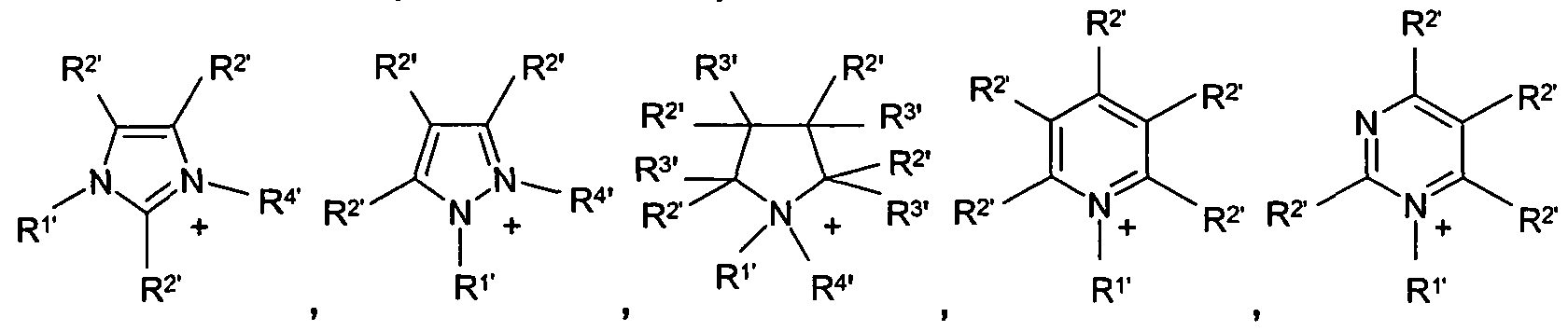
Piperidinium
Mor holinium

HetN+ ist besonders bevorzugt Imidazolium, Pyrrolidinium oder Pyridinium, wie zuvor definiert, wobei die Substituenten R1 bis R4 jeweils unabhängig voneinander eine zuvor beschriebene Bedeutung haben.
In den genannten Formeln (1 ) bis (4) kann erfindungsgemäß HaI durch
Carboxylate ersetzt sein, wie vorab definiert. Die Wahl des Anions schränkt die Auswahl des Kations nicht ein.
Als symmetrisch substituiertes Dialkylsulfit in den erfindungsgemäßen Verfahren wird bevorzugt ein Dialkylsulfit mit einer geradkettigen oder verzweigten Alkylgruppe mit 1-10 C-Atomen, bevorzugt mit 1-4 C-Atomen, besonders bevorzugt mit 1-2 C-Atomen eingesetzt Vorzugsweise ist die
Alkylgruppe eine geradkettige oder verzweigte Alkylgruppe mit 1-4 C- Atomen, wie beispielsweise Methyl, Ethyl, Isopropyl, Propyl, Butyl, sek.- Butyl oder tert.-Butyl. Bevorzugt ist die Alkylgruppe Methyl oder Ethyl.
Beispiele für symmetrisch substituierte Dialkylsulfite sind Dimethylsulfit,
Diethylsulfit, Di-(n-propyl)sulfit, Di-(iso-propyl)sulfit, Di-(n-butyl)sulfit oder
Di-(sek-butyl)sulfit. Vorzugsweise wird Dimethylsulfit oder Diethylsulfit eingesetzt.
Die eingesetzten symmetrischen Dialkylsulfite sind in der Regel kommerziell erhältlich oder können nach Syntheseverfahren hergestellt werden, wie sie aus der Literatur, z.B. in den Standardwerken wie Houben- Weyl, Methoden der organischen Chemie, Georg-Thieme-Verlag, Stuttgart oder Richard C. Larock, Comprehensive Organic Transformations, 2nd Edition, Wiley-VCH, New York, 1999, oder aus dem Artikel von W. Voss und E. Blanke, Justus Liebigs Ann. Chem., 485 (1931 ), S. 258-279 bekannt sind. Dabei kann man auch von an sich bekannten, hier nicht näher erwähnten Varianten Gebrauch machen.
Als unsymmetrisch substituiertes Dialkylsulfit wird bevorzugt ein Dialkylsulfit mit einer geradkettigen oder verzweigten Alkylgruppe mit 1 bis 10 C- Atomen und einer Methyl- oder Ethylgruppe als zweite Alkylgruppe, bevorzugt mit einer Alkylgruppe mit 3-8 C-Atomen, eingesetzt. Beispiele für unsymmetrisch substituierte Dialkylsulfite sind Methyl-propylsulfit, Methyl- butylsulfit, Ethyl-butylsulfit, Methyl-pentylsulfit, Ethyl-pentylsulfit, Methyl- hexylsulfit, Ethyl-hexylsulfit, Methyl-heptylsulfit, Ethyl-heptylsulfit, Methyl- octylsulfit oder Ethyl-octylsulfit.
Die eingesetzten unsymmetrischen Dialkylsulfite können nach Syntheseverfahren hergestellt werden, wie sie aus der Literatur, z.B. in den Standardwerken wie Houben-Weyl, Methoden der organischen Chemie, Georg-Thieme-Verlag, Stuttgart oder Richard C. Larock, Comprehensive Organic Transformations, 2nd Edition, Wiley-VCH, New York, 1999, oder aus dem Artikel von W. Voss und E. Blanke, Justus Liebigs Ann. Chem., 485 (1931 ), S. 258-279, oder von V.M. Pavlov, J. Gen. Chem. USSR (Eng. Transl.), 41 (1971 ), S. 2559-2561 bekannt sind. Dabei kann man auch von an sich bekannten, hier nicht näher erwähnten Varianten Gebrauch machen.
Ein allgemeines Schema fasst das erfindungsgemäße Verfahren zusammen, wobei der Pfeil bei der entstehenden Alkylhalogenverbindung ein Symbol für die Flüchtigkeit der Verbindung darstellt:
[XRJ+ HaI- (1) oder [C(NR1R2)(NR3R4)(NR5R6)]+ Hah (2) oder X = N1 P
[(R1R2N)-C(=YR7)(NR3R4)]+ HaI- (3) oder [HetN]+ Hah (4)
+ [(Alkyl-O)2SO]
[XR4]+[Alkyl-SO3]- (5) oder X = N1 P
[C(NR1R2)(NR3R4)(NR5R6)]+ [Alkyl-SO3]- (6) oder
+ Alkyl-Hal
[(R1 R2N )-C(= YR7XN R3R4J]+ [Alkyl-SO3]- (7) oder
[HetN]+ [Alkyl-SO3]- (8)
Die Substituenten R, R1 bis R7 und HetN+ der Verbindungen der Formeln (1 ) bis (8) entsprechen den Bedeutungen, wie zuvor beschrieben.
Die Reaktion mit Dialkylsulfiten wird bei Temperaturen zwischen 50 und
17O0C, vorzugsweise bei Temperaturen zwischen 60 und 13O0C durchgeführt, und besonders bevorzugt bei Temperaturen zwischen 100 und 1200C. Dabei entsprechen die Temperaturen ab 50°C der Temperatur der Heizquelle, beispielsweise des Ölbads. Die Auswahl der optimalen Reaktionstemperatur hängt dabei von der Höhe des Überschusses des Dialkyisuifits und von der Art des Haiogenids und des eingesetzten Dialkylsulfits ab. lodide sind reaktiver als Chloride und generell sind höhere Temperaturen und längere Reaktionszeiten bei Dialkylsulfiten mit längeren Alkylketten nötig.
Es wird kein Lösungsmittel benötigt. Es können jedoch auch Lösungsmittel eingesetzt werden, beispielsweise Dimethoxyethan, Acetonitril, Aceton, Tetrahydrofuran, Dimethylformamid, Dimethylsulfoxid, Dioxan, Propionitril, Dichlormethan oder Gemische untereinander.
Die Umsetzung wird mit einem Überschuss oder äquimolarer Menge an Dialkylsulfit durchgeführt, vorzugsweise mit einem Überschuss an Dialkylsulfit.
Alternativ lassen sich Oniumsalze mit Alkylsulfonat-Anionen durch direkte Alkylierung organischer Basen mit Dialkylsulfiten herstellen. Die Alkylierung von Anilin, Dimethylanilin und Pyridin mit Dimethylsulfit unter Bildung der entsprechenden Methylsulfonate ist im Artikel von W. Voss und E. Blanke, Justus Liebigs Ann. Chem., 485 (1931 ), S. 258-279 beschrieben. Der Nachteil dieser Methode liegt in der Bildung von Onium-Verbindungen, die sowohl im Kation als auch im Anion die gleiche Alkylgruppe aufweisen und damit die mögliche Vielfalt der Substitutionsmuster beschränken. Darüber hinaus bildet sich bei dieser Reaktion giftiges Schwefeldioxid in äquimolaren Mengen.
Ebenfalls Gegenstand der vorliegenden Erfindung sind Onium- Alkylsulfonate, hergestellt nach dem erfindungsgemäßen Verfahren. Einige der Verbindungen sind bekannt. Durch Anwendung des erfindungsgemäßen Verfahrens wird der Zugang zu diesen Verbindungen vereinfacht und damit die Möglichkeit der Nutzung dieser Verbindungen vergrößert.
Darüber hinaus sind Onium-Alkylsulfonate der Formel (9), erhältlich nach dem erfindungsgemäßen Verfahren, ebenfalls Gegenstand der vorliegenden Erfindung
[Kt]+ [Alkyl-SO3]- (9) wobei
Kt [(R1R2N)-CC=SR7XNR3R4)] oder [HetN] bedeutet, wobei [HetN] ausgewählt ist aus der Gruppe aus
Pyridazinium Pyrimidinium
Pyrrolidinium Piperidinium
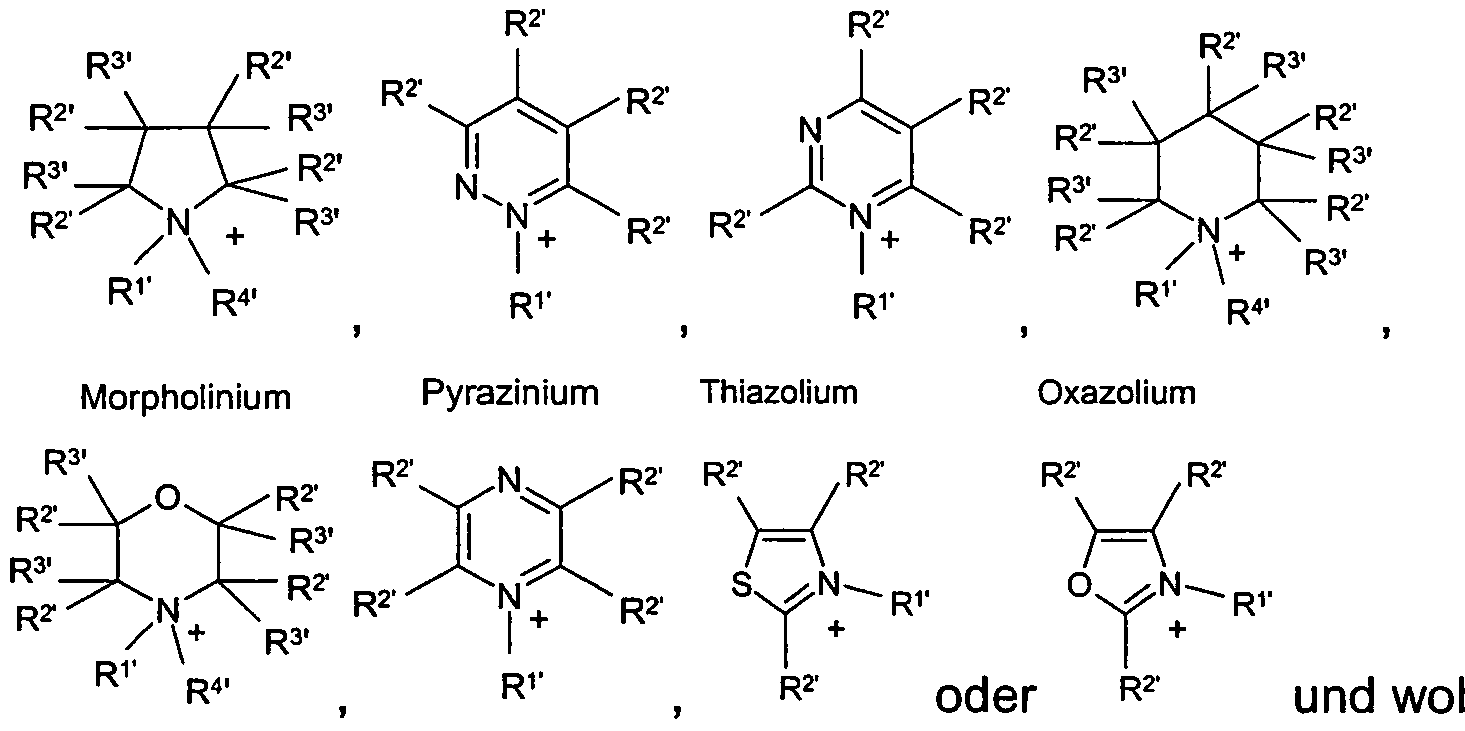
Alkyl geradkettige oder verzweigte Alkylgruppen mit 1-10 C-Atomen, bevorzugt mit 1-8 C-Atomen, bedeutet wobei die Alkylgruppen teilweise oder vollständig mit F, Cl und/oder Br, insbesondere -F und/oder -Cl, oder teilweise mit NO2 oder CN substituiert sein dürfen und wobei ein oder zwei nicht benachbarte, nicht direkt am Heteroatom gebundene und nicht abständige Kohlenstoffatome der Alkylgruppen durch Atome und/oder Atomgruppierungen ausgewählt aus der Gruppe -O-, -C(O)-, -S-, -S(O)- oder -SO2- ersetzt sein können und wobei R1 bis R7 und R1 ' bis R4' die zuvor genannte Bedeutung haben, mit der Maßgabe, dass bei [HetN] als Kation Kt, Alkyl nicht Trifluormethyl bedeutet. Verbindungen dieses Typs sind bislang nicht näher beschrieben bzw. charakterisiert.
Es versteht sich für den Fachmann von selbst, dass alle vorab genannten Substituenten wie beispielsweise H, N, O, Cl, F durch die entsprechenden Isotope ersetzt sein können.
Die Verwendung der erfindungsgemäßen Verbindungen der Formel (9) als Lösungsmittel, Lösungsmittelzusatz, Wärmeträger, Phasentransfer- Katalysator, als Extraktionsmittel, als Additiv, als oberflächenaktive
Substanz, als Elektrolyt in galvanischen Zellen, als Modifier oder als Weichmacher ist ebenfalls Gegenstand der vorliegenden Erfindung.
Im Falle des Einsatzes als Lösungsmittel oder Lösungsmittelzusatzes eignen sich die erfindungsgemäßen Verbindungen in jeder dem Fachmann bekannten Art von Reaktion, z.B. Übergangsmetall-, Enzym-, oder mit anderen Biokatalysatoren katalysierte Reaktionen, wie z.B. Hydroformilierungsreaktionen, Oligomerisierungsreaktionen, C-C- Bindungsknüpfungsreaktionen, z.B. die Heck-Kupplung, aber auch Veresterungen, Isomerisierungsreaktionen oder Reaktionen zur Amidbindungsknüpfung.
Auch ohne weitere Ausführungen wird davon ausgegangen, dass ein Fachmann die obige Beschreibung im weitesten Umfang nutzen kann. Die bevorzugten Ausführungsformen und Beispiele sind deswegen lediglich als beschreibende, keineswegs als in irgendeiner Weise limitierende Offenbarung aufzufassen.
Die NMR-Spektren wurden an Lösungen in deuterierten Lösungsmitteln bei 2O0C an einem Bruker ARX 400 Spektrometer mit einem 5 mm
Breitbandkopf 1H/BB mit Deuterium Lock gemessen, falls nicht in den Beispielen angegeben. Die Messfrequenzen der verschiedenen Kerne sind: 1H: 400,13 MHz und 31P .161.98 MHz. Die Methode der Referenzierung wird bei jedem Spektrum bzw. bei jedem Datensatz separat angegeben.
Beispiele:
Beispiel 1 : 1-Hexyl-3-methylimidazoliummethansulfonat
C6H13- + CH3CI
 CH3SO3-
Eine Mischung aus 10.84 g (53.5 mmol) 1-Hexyl-3- methylimidazoliumchlorid und 11.21 g (101.8 mmol) Dimethylsulfit wird bei 1200C (Temperatur des Ölbades) für 72 Stunden unter Inertgasatmosphäre (Stickstoff) im geschlossenem Reaktionsgefäß mit Druckventil für 1-1 ,5 bar Überdruck gerührt. Das Ende der Reaktion wird durch N M R-M essung bestimmt. Das Produkt wird im Vakuum bei 13.3 Pa und 12O0C (Temperatur des Ölbades) innerhalb von 5 Stunden abgepumpt. Man erhält 14.0 g flüssigen 1-Hexyl-3-methylimidazoliummethansulfonats. Die Ausbeute ist nahezu quantitativ. Das Produkt wird mittels NMR- Spektroskopie untersucht.
CH3SO3-
Eine Mischung aus 10.84 g (53.5 mmol) 1-Hexyl-3- methylimidazoliumchlorid und 11.21 g (101.8 mmol) Dimethylsulfit wird bei 1200C (Temperatur des Ölbades) für 72 Stunden unter Inertgasatmosphäre (Stickstoff) im geschlossenem Reaktionsgefäß mit Druckventil für 1-1 ,5 bar Überdruck gerührt. Das Ende der Reaktion wird durch N M R-M essung bestimmt. Das Produkt wird im Vakuum bei 13.3 Pa und 12O0C (Temperatur des Ölbades) innerhalb von 5 Stunden abgepumpt. Man erhält 14.0 g flüssigen 1-Hexyl-3-methylimidazoliummethansulfonats. Die Ausbeute ist nahezu quantitativ. Das Produkt wird mittels NMR- Spektroskopie untersucht.
1H NMR (Referenz: TMS; Lösungsmittel: CD3CN)1 ppm: 0.86 m (CH3); 1.28 m (3CH2); 1.81 m (CH2); 2.44 s (CH3); 3.84 s (CH3); 4.13 t (CH2); 7.39 d,d (CH); 7.42 d,d (CH); 8.81 br. s. (CH); 3JH,H = 7.1 Hz; JH,H = 1.5 Hz.
Beispiel 2: 1-Hexyl-3-methylimidazoliummethansulfonat
I

Eine Mischung aus 8.43 g (41.6 mmol) 1-Hexyl-3-methylimidazoliumchlorid und 4.58 g (41.6 mmol) Dimethylsulfit wird bei 1550C (Temperatur des Ölbades) für 19 Stunden unter Inertgasatmosphäre (Stickstoff) in einer 50 ml Rundflasche mit Rückkühler gerührt. Das Ende der Reaktion wird durch
NMR-Messung bestimmt. Das Produkt wird im Vakuum bei 13.3 Pa und
1000C (Temperatur des Ölbades) innerhalb von 2 Stunden abgepumpt. Man erhält 10.0 g flüssigen 1-Hexyl-3-methylimidazoliummethansulfonats. Die Ausbeute beträgt 91.7 %. Das Produkt wird mittels NMR-Spektroskopie untersucht.
1H NMR (Referenz: TMS ; Lösungsmittel: CD3CN), ppm: 0.84 m (CH3); 1.26 m (3CH2); 1.80 m (CH2); 2.45 s (CH3); 3.86 s (CH3); 4.17 t (CH2); 7.48 m (CH); 7.50 m (CH); 9.30 br. s. (CH); 3JH,H = 7.1 Hz.
Beispiel 3: i-Hexyl-3-methylimidazoliumethansulfonat
C6Hi3- + C2H5CI

Eine Mischung aus 11.84 g (58.4 mmol) 1-Hexyl-3-methylimidazolium- chlorid und 12.11 g (87.6 mmol) Diethylsulfit wird bei 1200C (Temperatur des Ölbades) für 44 Stunden unter Inertgasatmosphäre (Stickstoff) im geschlossenem Reaktionsgefäß mit Druckventil für 1-1.5 bar Überdruck gerührt. Das Ende der Reaktion wird durch NMR-Messung bestimmt. Das
Produkt wird im Vakuum bei 13.3 Pa und 12O0C (Temperatur des Ölbades) innerhalb von 3 Stunden abgepumpt. Man erhält 16.1 g flüssigen 1-Hexyl- 3-methylimidazoliumethansulfonats. Die Ausbeute ist nahezu quantitativ. Das Produkt wird mittels NMR-Spektroskopie untersucht.
1H NMR (Referenz: TMS; Lösungsmittel: CD3CN), ppm: 0.87 m (CH3); 1.17 t (CH3); 1.29 m (3CH2); 1.82 m (CH2); 2.59 q (CH2); 3.87 s (CH3); 4.17 1 (CH2); 7.44 m (CH); 7.47 m (CH); 9.11 br. s. (CH); 3JH,H = 7.1 HZ; 3JH,H = 7.4 Hz.
Beispiel 4: 1-Ethyl-3-methylimidazoliummethansulfonat
C2 2 Hr 5 ■- + ( .CH3 -O) . 2_SO 1 7 1 2 5° h C> C2H5- N vθ N-CH3 + CH3CI I

Eine Mischung aus 10.64 g (72.6 mmol) 1-Ethyl-3-methylimidazoliumchlorid und 14.39 g (130.7 mmol) Dimethylsulfit wird bei 110-1150C (Temperatur
des Ölbades) für 72 Stunden unter Inertgasatmosphäre (Stickstoff) im geschlossenem Reaktionsgefäß mit Druckventil für 1-1.5 bar Überdruck gerührt. Das Ende der Reaktion wird durch NMR-Messung bestimmt. Das Produkt wird im Vakuum bei 13.3 Pa und 115°C (Temperatur des Ölbades) innerhalb von 5 Stunden abgepumpt. Man erhält 14.78 g flüssigen 1-Ethyl-
3-methylimidazoliummethansulfonats. Die Ausbeute ist nahezu quantitativ. Der restliche Chlorid-Gehalt beträgt weniger als 5 ppm. Das Produkt wird mittels NMR-Spektroskopie untersucht.
1H NMR (Referenz: TMS; Lösungsmittel: CD3CN)1 ppm: 1.41 t (CH3); 2.44 s (CH3); 3.85 s (CH3); 4.19 q (CH2); 7.51 d,d (CH); 7.57 d,d (CH); 9.26 br. s. (CH); 3JH,H = 7.4 Hz ; JH,H = 1 -5 Hz.
Beispiel 5: Trihexyl-tetradecyl-phosphoniummethansulfonat
(C6H13)S(C14H29)P+ CI- + (CH3O)2SO 115° C> (C6H13J3(C14H29)P+ + CH3Cl I
72 h
CH3SO3-
Eine Mischung aus 6.42 g (12.36 mmol) Trihexyl-tetradecyl- phosphoniumchlorid und 4.28 g (38.86 mmol) Dimethylsulfit wird bei 110- 115°C (Temperatur des Ölbades) für 72 Stunden unter Inertgasatmosphäre (Stickstoff) im geschlossenem Reaktionsgefäß mit Druckventil für 1-1.5 bar Überdruck gerührt. Das Ende der Reaktion wird durch NMR-Messung bestimmt. Das Produkt wird im Vakuum bei 13.3 Pa und 115°C (Temperatur des Ölbades) innerhalb von 5 Stunden abgepumpt. Man erhält 7.06 g flüssigen Trihexyl-tetradecyl-phosphoniummethansulfonats. Die Ausbeute ist nahezu quantitativ. Der restliche Chlorid-Gehalt beträgt weniger als 5 ppm. Das Produkt wird mittels NMR-Spektroskopie untersucht.
1H NMR (Referenz: TMS; Lösungsmittel: CD3CN), ppm: 0.84-0.92 m (4CH3), 1.24-1.36 m (16CH2), 1.36-1.56 m (8CH2), 2.04-2.15 m (4CH2); 2.44 s (CH3).
31P {1H} NMR (Referenz: 85% H3PO4 - external; Lösungsmittel: CD3CN), ppm: 33.3
Beispiel 6: 1-Butylpyridiniummethansulfonat
+ ChUCll

Eine Mischung aus 11.88 g (69.2 mmol) 1-Butylpyridiniumchlorid und 13.69 g (124.3 mmol) Dimethylsulfit wird bei 110-1150C (Temperatur des Ölbades) für 72 Stunden unter Inertgasatmosphäre (Stickstoff) im geschlossenem Reaktionsgefäß mit Druckventile für 1-1.5 bar Überdruck gerührt. Das Ende der Reaktion wird durch NMR-Messung bestimmt. Das Produkt wird im Vakuum bei 13.3 Pa und 1150C (Temperatur des Ölbades) innerhalb von 5 Stunden abgepumpt. Man erhält 15.51 g 1-Butylpyridinium- methansulfonat als Feststoff. Der Schmelzpunkt beträgt 91-92°C. Die Ausbeute beträgt 96.9%. Der restliche Chlorid-Gehalt beträgt weniger als 5 ppm. Das Produkt wird mittels NMR-Spektroskopie untersucht.
1H NMR (Referenz: TMS; Lösungsmittel: CD3CN), ppm: 0.93 t (CH3); 1.36 m (CH2); 1.93 m (CH2); 2.43 s (CH3); 4.59 t (CH2); 8.04 m (2CH); 8.50 t
(CH); 8.90 d (2CH); 3JH,H = 7.4 Hz; 3JH,H = 7.6 Hz; 3JH,H = 7.9 Hz; 3JH,H = 6.6
Hz.
Elementaranalyse: gefunden, % : C 51.74; H 7.34; N 6.07; S 13.92; berechnet für C10Hi7NO3S , %: C 51.93; H 7.41 ; N 6.06; S 13.86.
Beispiel 7: 1-Butyl-1-methylpyrrolidiniummethansulfonat

Eine Mischung aus 11.20 g (63.0 mmol) 1-Butyl-1-methylpyrrolidinium- chlorid und 13.0 g (118.0 mmol) Dimethylsulfit wird bei 110-1150C (Temperatur des Ölbades) für 48 Stunden unter Inertgasatmosphäre (Stickstoff) im geschlossenem Reaktionsgefäß mit Druckventil für 1-1.5 bar Überdruck gerührt. Das Ende der Reaktion wird durch NMR-Messung bestimmt. Das Produkt wird im Vakuum bei 13.3 Pa und 115°C (Temperatur des Ölbades) innerhalb von 5 Stunden abgepumpt. Man erhält 14.9 g 1-Butyl-1-methylpyrrolidiniummethansulfonat als Feststoff. Der Schmelzpunkt beträgt 59-600C. Der restliche Chlorid-Gehalt beträgt weniger als 5 ppm. Die Ausbeute ist nahezu quantitativ. Das Produkt wird mittels NMR-Spektroskopie untersucht.
1H NMR (Referenz: TMS; Lösungsmittel: CD3CN), ppm: 0.94 t (CH3); 1.36 m (CH2); 1.70 m (CH2); 2.13 m (2CH2); 2.40 s (CH3); 2.97 s (CH3); 3.29 m (CH2); 3.45 m (2CH2); 3JH,H = 7.4 Hz.
Elementaranalyse: gefunden, %: C 50.29; H 9.97; N 5.90; S 13.52; berechnet für Ci0H23NO3S , %: C 50.60; H 9.77; N 5.90; S 13.51.
Beispiel 8: N. N, N', N' -Tetramethyl-S-ethyl-thiouroniummethansulfonat
[((CH3)2N)2CSC2H5]+ I- + (CH3O)2SO - [((CHg)2N)2CSC2Hs]+ + CH3I
CH3SO3- Eine Mischung aus 2.72 g (9.44 mmol) N,N,N',N' -Tetramethyl-S-ethyl- thiouroniumiodid und 1.04 g (9.44 mmol) Dimethylsulfit wird bei 6O0C (Temperatur des Ölbades) für 8 Stunden unter Inertgasatmosphäre (Stickstoff) im geschlossenem Reaktionsgefäß gerührt. Das Ende der Reaktion wird durch NMR-Messung bestimmt. Das Produkt wird im
Vakuum bei 13.3 Pa und 6O0C (Temperatur des Ölbades) innerhalb von 1 Stunde abgepumpt. Man erhält 2.39 g N1N, N', N' -Tetramethyl-S-ethyl- thiouroniummethansulfonat als Feststoff. Der Schmelzpunkt beträgt 75- 760C. Die Ausbeute ist nahezu quantitativ. Das Produkt wird mittels NMR- Spektroskopie untersucht.
1H NMR (Referenz: TMS; Lösungsmittel: CD3CN), ppm: 1.29 t (CH3); 2.39 s (CH3); 3.01 q (CH2); 3.23 s (4CH3); 3JH,H = 7.5 Hz.
Elementaranalyse: gefunden, %: C 36.95; H 7.92; N 10.78; berechnet für C8H20N2O3S2 , %: C 37.48; H 7.86; N 10.93.
Beispiel 9: Tetrabutylammoniummethansulfonat [(C4Hg)4N]+ Br" + (CH3O)2SO -^UU- [(C4Hg)4N]+ CH3SO3- + CH3BrI
96 h
Eine Mischung aus 12.94 g (40.14 mmol) Tetrabutylammoniumbromid und 5.15 g (46.76 mmol) Dimethylsulfit wird bei 110-1150C (Temperatur des Ölbades) für 96 Stunden unter Inertgasatmosphäre (Stickstoff) im geschlossenem Reaktionsgefäß mit Druckventil für 1-1 ,5 bar Überdruck gerührt. Das Ende der Reaktion wird durch NMR-Messung bestimmt. Das
Produkt wird im Vakuum bei 13.3 Pa und 115°C (Temperatur des Ölbades) innerhalb von 5 Stunden abgepumpt. Man erhält 13.53 g Tetrabutylammoniummethansulfonat als Feststoff. Der Schmelzpunkt beträgt 83-840C. Die Ausbeute ist nahezu quantitativ. Der restliche Bromid-
Gehalt beträgt weniger als 5 ppm. Das Produkt wird mittels NMR-
Spektroskopie untersucht.
1H NMR (Referenz: TMS; Lösungsmittel: CD3CN), ppm: 0.95 1 (CH3); 1.34 t,q (CH2); 1.60 m (CH2); 2.39 s (CH3); 3.11 m (CH2); 3JN H = 7.4 Hz.
Elementaranalyse: gefunden, %: C 60.47; H 11.90; N 4.18; S 9.60;
berechnet für Ci7H39NO3S , %: C 60.49; H 11.65; N 4.15; S 9.50.
Beispiel 10: Tetrabutylammoniummethansulfonat [(C4Hg)4N]+ CH3C(O)O- + (CH3O)2SO -→ [(C4Hg)4N]+CH3SO3- + CH3C(O)OCH3
Eine Mischung aus 0.56 g (1.86 mmol) Tetrabutylammoniumacetat und 0.41 g (3.72 mmol) Dimethylsulfit wird bei 120 (Temperatur des Ölbades) für 28 Stunden unter Inertgasatmosphäre (Stickstoff) im geschlossenem Reaktionsgefäß gerührt. Das Ende der Reaktion wird durch NMR-Messung bestimmt. Das Produkt wird im Vakuum bei 13.3 Pa und 700C (Temperatur des Ölbades) innerhalb von 2 Stunden abgepumpt. Man erhält 0.61 g Tetrabutylammoniummethansulfonat als Feststoff. Der Schmelzpunkt beträgt 84-85°C. Die Ausbeute ist nahezu quantitativ. Das Produkt wird mittels NMR-Spektroskopie untersucht.
1H NMR (Referenz: TMS; Lösungsmittel: CD3CN), ppm: 0.95 t (CH3); 1.34 t,q (CH2); 1.60 m (CH2); 2.42 s (CH3); 3.11 m (CH2); 3JH,H = 7.4 Hz.
Beispiel 11 : 1 ,3-Dimethylimidazoliurnmethansulfonat

(161.7 mmol) Dimethylsulfit wird bei 700C (Temperatur des Ölbades) für 72 Stunden unter Inertgasatmosphäre (Stickstoff) in einer 100 ml Rundflasche mit Rückkühler gerührt. Das Ende der Reaktion wird durch NMR-Messung bestimmt. Das Produkt wird im Vakuum bei 13.3 Pa und 8O0C (Temperatur des Ölbades) innerhalb von 2 Stunden abgepumpt. Man erhält 15.22 g 1 ,3- Dimethylimidazoliummethansulfonats als Feststoff. Der Schmelzpunkt
beträgt 72-73°C. Die Ausbeute ist 98 %. Das Produkt wird mittels NMR- Spektroskopie untersucht.
1H NMR (Referenz: TMS; Lösungsmittel: CD3CN), ppm: 2.44 s (CH3); 3.84 s (2CH3); 7.45 d (2CH) ; 9.12 br. s. (CH); 4JH,H = 1.6 Hz.
Elementaranalyse: gefunden, %: C 37.27; H 6.35; N 14.76; S 16.40; berechnet für C6H12N2O3S , %: C 37.49; H 6.29; N 14.57; S 16.68.
Claims
1. Verfahren zur Herstellung von Onium-Alkylsulfonaten durch Umsetzung eines Onium-Halogenids oder -Carboxylats mit einem symmetrisch substituierten Dialkylsulfit oder mit einem unsymmetrisch substituierten
Dialkylsulfit bei Temperaturen von 50 bis 1700C.
2. Verfahren nach Anspruch 1 , dadurch gekennzeichnet, dass die Umsetzung mit einem symmetrisch substituierten Dialkylsulfit, wobei die Alkylgruppe 1 bis 10 C-Atome haben kann, erfolgt.
3. Verfahren nach Anspruch 1 , dadurch gekennzeichnet, dass die Umsetzung mit einem unsymmetrisch substituierten Dialkylsulfit, wobei eine Alkylgruppe 1 bis 10 C-Atome haben kann und die zweite Alkylgruppe Methyl oder Ethyl bedeutet, erfolgt.
4. Verfahren nach einem oder mehreren der Ansprüche 1 bis 3, dadurch gekennzeichnet, dass das Halogenid ein Ammoniumhalogenid, Phosphoniumhalogenid, Thiouroniumhalogenid, Guanidiniumhalogenid oder Halogenid mit heterocyclischem Kation ist, wobei die Halogenide aus der Gruppe Chloride, Bromide oder lodide ausgewählt werden können oder ein Uroniumiodid ist.
5. Verfahren nach einem oder mehreren der Ansprüche 1 bis 4, dadurch gekennzeichnet, dass das Carboxylat ein Ammoniumacetat,
Phosphoniumacetat, ein Guanidiniumacetat oder ein Acetat mit einem heterocyclischem Kation ist.
6. Verfahren nach einem oder mehreren der Ansprüche 1 bis 4, dadurch gekennzeichnet, dass das Halogenid der Formel (1 ) entspricht,
[XR4J+ HaI" (1 ), wobei X N1 P
HaI Cl, Br oder I und
R jeweils unabhängig voneinander
H, wobei nicht alle Substituenten R gleichzeitig H sein dürfen, geradkettiges oder verzweigtes Alkyl mit 1-20 C-Atomen, geradkettiges oder verzweigtes Alkenyl mit 2-20 C-Atomen und einer oder mehreren Doppelbindungen bedeutet, geradkettiges oder verzweigtes Alkinyl mit 2-20 C-Atomen und einer oder mehreren Dreifachbindungen, gesättigtes, teilweise oder vollständig ungesättigtes Cycloalkyl mit 3-7 C-
Atomen, das mit Alkylgruppen mit 1-6 C-Atomen substituiert sein kann bedeutet, wobei ein oder mehrere R teilweise mit Cl, Br und/oder CN oder teilweise oder vollständig mit -F oder F und Cl, oder F und Br, oder F, Cl und Br substituiert sein können, wobei jedoch nicht alle vier oder drei R vollständig mit Halogenen substituiert sein dürfen, und wobei ein oder zwei nicht benachbarte und nicht α- oder oz-ständige
Kohlenstoffatome des R, durch Atome und/oder Atomgruppierungen ausgewählt aus der Gruppe -O-, -C(O)-, -S-, -S(O)- oder -SO2- ersetzt sein können.
7. Verfahren nach einem oder mehreren der Ansprüche 1 bis 4, dadurch gekennzeichnet, dass das Halogenid der Formel (2) entspricht, [C(NR1 R2)(NR3R4)(NR5R6)]+ HaI" (2), wobei
HaI Cl, Br oder I und
R1 bis R6 jeweils unabhängig voneinander
Wasserstoff oder CN, geradkettiges oder verzweigtes Alkyl mit 1 bis 20 C-Atomen, geradkettiges oder verzweigtes Alkenyl mit 2-20 C-Atomen und einer oder mehreren Doppelbindungen, geradkettiges oder verzweigtes Alkinyl mit 2-20 C-Atomen und einer oder mehreren Dreifachbindungen, gesättigtes, teilweise oder vollständig ungesättigtes Cycloalkyl mit 3-7 C- Atomen, das mit Alkylgruppen mit 1-6 C-Atomen substituiert sein kann, bedeutet, wobei ein oder mehrere der Substituenten R1 bis R6 teilweise mit -NO2, CN, Cl und/oder Br, teilweise oder vollständig mit F, oder F und Cl, oder F und Br oder F, Cl und Br substituiert sein können, wobei jedoch nicht alle Substituenten an einem N-Atom vollständig mit Halogenen substituiert sein dürfen, wobei die Substituenten R1 bis R6 paarweise durch Einfach- oder Doppelbindung miteinander verbunden sein können und wobei ein oder zwei nicht benachbarte, nicht direkt am Heteroatom gebundene und nicht w-ständige Kohlenstoffatome der Substituenten R1 bis R6 durch Atome und/oder Atomgruppierungen ausgewählt aus der
Gruppe -O-, -C(O)-, -S-, -S(O)- oder -SO2- ersetzt sein können.
8. Verfahren nach einem oder mehreren der Ansprüche 1 bis 4, dadurch gekennzeichnet, dass das Halogenid der Formel (3) entspricht, [(R1R2N)-C(=YR7)(NR3R4)]+ Haf (3) beschrieben werden, wobei
Y O1 S
HaI Br oder I, mit der Maßgabe, dass bei Y = O HaI = I ist, und R1 bis R4 und R7 jeweils unabhängig voneinander
Wasserstoff oder CN, wobei Wasserstoff für R7 ausgeschlossen wird, geradkettiges oder verzweigtes Alkyl mit 1 bis 20 C-Atomen, geradkettiges oder verzweigtes Alkenyl mit 2-20 C-Atomen und einer oder mehreren Doppelbindungen, geradkettiges oder verzweigtes Alkinyl mit 2-20 C-Atomen und einer oder mehreren Dreifachbindungen, gesättigtes, teilweise oder vollständig ungesättigtes Cycloalkyl mit 3-7 C-
Atomen, das mit Alkylgruppen mit 1-6 C-Atomen substituiert sein kann, bedeutet, wobei ein oder mehrere der Substituenten R1 bis R4 und R7 teilweise oder vollständig mit F, Cl und/oder Br, insbesondere -F und/oder -Cl, oder teilweise mit CN substituiert sein können, wobei jedoch nicht alle Substituenten an einem N-Atom vollständig mit Halogenen substituiert sein dürfen, wobei die Substituenten R1 bis und R7 paarweise durch Einfach- oder Doppelbindung miteinander verbunden sein können und wobei ein oder zwei nicht benachbarte, nicht direkt am Heteroatom gebundene und nicht αz-ständige Kohlenstoffatome der Substituenten R1 bis und R7 durch Atome und/oder Atomgruppierungen ausgewählt aus der Gruppe - O-, -C(O)-, -S-, -S(O)- oder -SO2- ersetzt sein können.
9. Verfahren nach einem oder mehreren der Ansprüche 1 bis 4, dadurch gekennzeichnet, dass das Halogenid der Formel (4) entspricht,
[HetN]+ Hai" (4), wobei HaI Cl, Br oder I und
HetN+ ein heterocyclisches Kation, ausgewählt aus der Gruppe
Imidazolium 1 H-Pyrazolium 3H-Pyrazolium 4H-Pyrazolium 1-Pyrazolinium

2-Pyrazolinium 3-Pyrazolinium 2,3-Dihydro-lmidazolinium 4,5-Dihydro-lmidazolinium

1 ,2,4-Triazolium 1 ,2,4-Triazolium

R1' bis R4' jeweils unabhängig voneinander
Wasserstoff oder CN1 geradkettiges oder verzweigtes Alkyl mit 1-20 C-Atomen, geradkettiges oder verzweigtes Alkenyl mit 2-20 C-Atomen und einer oder mehreren Doppelbindungen, geradkettiges oder verzweigtes Alkinyl mit 2-20 C-Atomen und einer oder mehreren Dreifachbindungen,
Dialkylamino mit Alkylgruppen mit 1-4 C-Atomen, welches jedoch nicht am Heteroatom des Heterocyclus gebunden vorliegt, gesättigtes, teilweise oder vollständig ungesättigtes Cycloalkyl mit 3-7 C-
Atomen, das mit Alkylgruppen mit 1-6 C-Atomen substituiert sein kann oder Aryl-CrCβ-alkyl bedeutet, wobei die Substituenten R1' und R4' teilweise oder vollständig mit F, Cl und/oder Br, insbesondere -F und/oder -Cl substituiert sein können, wobei jedoch nicht gleichzeitig R1 und R4 CN sind oder vollständig mit F oder anderen Halogenen substituiert sein dürfen, wobei die Substituenten R2 und R3 teilweise oder vollständig mit F, Cl und/oder Br1 insbesondere -F und/oder -Cl, oder teilweise mit NO2 oder CN substituiert sein dürfen und wobei ein oder zwei nicht benachbarte, nicht direkt am Heteroatom gebundene und nicht ω-ständige Kohlenstoffatome der Substituenten R1' bis R4', durch Atome und/oder Atomgruppierungen ausgewählt aus der Gruppe -O-, -C(O)-, -S-, -S(O)- oder -SO2- ersetzt sein können.
10. Verfahren nach einem oder mehreren der Ansprüche 1 bis 9, dadurch gekennzeichnet, dass die Reaktion des Halogenids mit dem
Dialkylsulfit ohne Lösungsmittel durchgeführt wird.
11. Onium-Alkylsulfonate der Formel (9), erhältlich nach dem Verfahren gemäß Anspruch 1 [Kt]+ [AIkVl-SO3]" (9) wobei Kt [(R1R2N)-C(=SR7)(NR3R4)] oder [HetN] bedeutet, wobei
[HetN] ausgewählt ist aus der Gruppe aus
Pyridazinium Pyrimidinium
Pyrrolidinium Piperidinium

Morpholinium Pyrazinium Thiazolium Oxazolium
*γr* °γNrRr  R2' oder R* und wobei
Alkyl geradkettige oder verzweigte Alkylgruppen mit 1-10 C-Atomen, bevorzugt mit 1-8 C-Atomen, bedeutet wobei die Alkylgruppen teilweise oder vollständig mit F, Cl und/oder Br, insbesondere -F und/oder -Cl, oder teilweise mit NO2 oder CN substituiert sein dürfen und wobei ein oder zwei nicht benachbarte, nicht direkt am Heteroatom gebundene und nicht Gc/-ständige Kohlenstoffatome der Alkylgruppen durch Atome und/oder Atomgruppierungen ausgewählt aus der Gruppe -O-, -C(O)-, - S-, -S(O)- oder -SO2- ersetzt sein können und wobei R1 bis R7 und R1 ' bis R4' die in Anspruch 8 oder 9 genannte Bedeutung haben, mit der Maßgabe, dass bei [HetN] als Kation Kt, Alkyl nicht Trifluormethyl bedeutet.
12. Verwendung von Verbindungen gemäß Anspruch 11 als
Lösungsmittel, Lösungsmittelzusatz, Wärmeträger, Phasentransfer- Katalysator, als Extraktionsmittel, als Additiv, als oberflächenaktive
Substanz, als Elektrolyt in galvanischen Zellen, als Modifier oder als Weichmacher.
Priority Applications (4)
| Application Number | Priority Date | Filing Date | Title |
|---|---|---|---|
| EP06754374A EP1902004B1 (de) | 2005-07-14 | 2006-06-14 | Verfahren zur herstellung von onium-alkylsulfonaten |
| US11/995,460 US7999111B2 (en) | 2005-07-14 | 2006-06-14 | Process for the preparation of onium alkylsulfonates |
| AT06754374T ATE541822T1 (de) | 2005-07-14 | 2006-06-14 | Verfahren zur herstellung von onium- alkylsulfonaten |
| JP2008520733A JP5270338B2 (ja) | 2005-07-14 | 2006-06-14 | アルキルスルホン酸オニウムの製造方法 |
Applications Claiming Priority (2)
| Application Number | Priority Date | Filing Date | Title |
|---|---|---|---|
| DE102005032836.9 | 2005-07-14 | ||
| DE102005032836A DE102005032836A1 (de) | 2005-07-14 | 2005-07-14 | Verfahren zur Herstellung von Onium-Alkylsulfonaten |
Publications (3)
| Publication Number | Publication Date |
|---|---|
| WO2007006387A2 true WO2007006387A2 (de) | 2007-01-18 |
| WO2007006387A3 WO2007006387A3 (de) | 2007-05-18 |
| WO2007006387A8 WO2007006387A8 (de) | 2007-06-14 |
Family
ID=36773844
Family Applications (1)
| Application Number | Title | Priority Date | Filing Date |
|---|---|---|---|
| PCT/EP2006/005741 Ceased WO2007006387A2 (de) | 2005-07-14 | 2006-06-14 | Verfahren zur herstellung von onium-alkylsulfonaten |
Country Status (6)
| Country | Link |
|---|---|
| US (1) | US7999111B2 (de) |
| EP (1) | EP1902004B1 (de) |
| JP (1) | JP5270338B2 (de) |
| AT (1) | ATE541822T1 (de) |
| DE (1) | DE102005032836A1 (de) |
| WO (1) | WO2007006387A2 (de) |
Families Citing this family (2)
| Publication number | Priority date | Publication date | Assignee | Title |
|---|---|---|---|---|
| JP4508490B2 (ja) * | 2000-09-11 | 2010-07-21 | パナソニック株式会社 | 符号化装置および復号化装置 |
| EP3126328B1 (de) * | 2014-04-03 | 2018-12-26 | Gotion, Inc. | Verwendung von reaktiven ionischen flüssigkeiten als additive für elektrolyte in sekundären lithiumionenbatterien |
Family Cites Families (18)
| Publication number | Priority date | Publication date | Assignee | Title |
|---|---|---|---|---|
| BE754167R (fr) * | 1969-07-31 | 1971-02-01 | Chatillon Italiana Fibre | Procede de polymerisation du chlorure de |
| DE3224148A1 (de) * | 1982-06-29 | 1983-12-29 | Hoechst Ag, 6230 Frankfurt | Quartaere ammoniumsalze und deren verwendung als stroemungsbeschleuniger |
| DE3516843A1 (de) * | 1985-05-10 | 1986-11-20 | Hoechst Ag, 6230 Frankfurt | Verfahren zur herstellung von halogenidfreien quaternaeren ammoniumsalzen |
| JPS63262830A (ja) | 1987-04-21 | 1988-10-31 | 三菱油化株式会社 | コンデンサ用電解液 |
| JPH05178798A (ja) * | 1991-12-27 | 1993-07-20 | Kao Corp | 4級アンモニウム有機酸塩の製造方法 |
| GB9425105D0 (en) | 1994-12-13 | 1995-02-08 | Bp Chem Int Ltd | Ionic liquids |
| JP2001322970A (ja) | 2000-05-12 | 2001-11-20 | Tonen Chem Corp | 四級アンモニウム塩の製造方法 |
| GB0024747D0 (en) | 2000-10-10 | 2000-11-22 | Univ Belfast | Aromatic sulfonation reactions |
| EP1201657B1 (de) | 2000-10-27 | 2004-05-06 | Centre National De La Recherche Scientifique (Cnrs) | Imidazolium-Salze und die Verwendung dieser ionischen Flüssigkeiten als Lösungsmittel und als Katalysator |
| CA2466780C (en) * | 2001-12-14 | 2008-05-20 | Cytec Canada Inc. | Preparation of ionic liquids |
| DE10208822A1 (de) * | 2002-03-01 | 2003-09-11 | Solvent Innovation Gmbh | Halogenfreie ionische Flüssigkeiten |
| KR100903862B1 (ko) | 2003-03-12 | 2009-06-24 | 주식회사 씨트리 | 고순도의 이온성 액체를 위한 정제방법 |
| DE10333239A1 (de) | 2003-07-21 | 2005-03-10 | Basf Ag | Verfahren zur Herstellung von gereinigten 1,3- substituierten Imidazoliumsalzen |
| JP4388776B2 (ja) * | 2003-09-09 | 2009-12-24 | 日華化学株式会社 | イオン性液体からなる難燃性溶媒及びその製造方法 |
| EP1784380A1 (de) | 2004-08-24 | 2007-05-16 | Basf Aktiengesellschaft | Verfahren zur herstellung quartärer ammoniumverbindungen hoher reinheit |
| KR20070057194A (ko) * | 2004-08-24 | 2007-06-04 | 바스프 악티엔게젤샤프트 | 고-순도 4차 암모늄 화합물의 제조 방법 |
| CN101006062A (zh) | 2004-08-24 | 2007-07-25 | 巴斯福股份公司 | 用作生产离子液体的起始化合物的咪唑甲基亚硫酸盐 |
| DE102005032837A1 (de) * | 2005-07-14 | 2007-02-08 | Merck Patent Gmbh | Verfahren zur Herstellung von Onium-Alkylsulfiten |
-
2005
- 2005-07-14 DE DE102005032836A patent/DE102005032836A1/de not_active Withdrawn
-
2006
- 2006-06-14 US US11/995,460 patent/US7999111B2/en not_active Expired - Fee Related
- 2006-06-14 AT AT06754374T patent/ATE541822T1/de active
- 2006-06-14 JP JP2008520733A patent/JP5270338B2/ja not_active Expired - Fee Related
- 2006-06-14 WO PCT/EP2006/005741 patent/WO2007006387A2/de not_active Ceased
- 2006-06-14 EP EP06754374A patent/EP1902004B1/de not_active Not-in-force
Non-Patent Citations (1)
| Title |
|---|
| None |
Also Published As
| Publication number | Publication date |
|---|---|
| WO2007006387A8 (de) | 2007-06-14 |
| EP1902004A2 (de) | 2008-03-26 |
| DE102005032836A1 (de) | 2007-01-18 |
| JP5270338B2 (ja) | 2013-08-21 |
| US7999111B2 (en) | 2011-08-16 |
| ATE541822T1 (de) | 2012-02-15 |
| EP1902004B1 (de) | 2012-01-18 |
| JP2009501166A (ja) | 2009-01-15 |
| WO2007006387A3 (de) | 2007-05-18 |
| US20080221334A1 (en) | 2008-09-11 |
Similar Documents
| Publication | Publication Date | Title |
|---|---|---|
| EP1888605A1 (de) | Ionische flüssigkeiten mit niedriger viskosität | |
| EP2114965B1 (de) | Verbindungen enthaltend organofluorochlorophosphatanionen | |
| DE102005035103A1 (de) | Verfahren zur Herstellung von Onium-Salzen mit Tetrafluoroborat-Anion mit reduziertem Halogenid-Gehalt | |
| EP1768962B1 (de) | Verfahren zur herstellung von onium-salzen mit geringem chlorid-gehalt | |
| EP2180002B1 (de) | Verfahren zur Herstellung von Onium-Salzen mit Diakylphosphinat Anionen mit geringem Halogenid-Gehalt | |
| EP1979361B1 (de) | Oxonium- und sulfoniumsalze | |
| EP1902004B1 (de) | Verfahren zur herstellung von onium-alkylsulfonaten | |
| EP1902035B1 (de) | Verfahren zur herstellung von onium-alkylsulfiten | |
| EP1824827B1 (de) | Verfahren zur herstellung von onium-salzen mit alkyl- oder arylsufonat-anionen oder alkyl- oder arylcarboxylat-anionen mit geringen halogenid-gehalt | |
| EP1831179B1 (de) | Verfahren zur herstellung von onium-salzen mit tetrafluoroborat-anion mit reduziertem halogenid-gehalt | |
| WO2007006389A1 (de) | Mischung von onium-alkylsulfonaten und onium-alkylsulfiten | |
| DE102004060073A1 (de) | Verfahren zur Hertellung von Onium-Salzen mit Tetrafluoroborat-Anion mit reduziertem Halogenid-Gehalt | |
| EP1786761A1 (de) | Verfahren zur herstellung von tricyanomethaniden organischer kationen | |
| EP1828142B1 (de) | Verfahren zur herstellung von onium alkylsulfaten mit geringem halogenid-gehalt | |
| EP2513123A1 (de) | Verbindungen mit (perfluoralkyl)fluorohydrogenphosphat-anionen |
Legal Events
| Date | Code | Title | Description |
|---|---|---|---|
| 121 | Ep: the epo has been informed by wipo that ep was designated in this application | ||
| WWE | Wipo information: entry into national phase |
Ref document number: 2006754374 Country of ref document: EP |
|
| WWE | Wipo information: entry into national phase |
Ref document number: 11995460 Country of ref document: US Ref document number: 2008520733 Country of ref document: JP |
|
| NENP | Non-entry into the national phase |
Ref country code: DE |
|
| WWW | Wipo information: withdrawn in national office |
Ref document number: DE |
|
| WWP | Wipo information: published in national office |
Ref document number: 2006754374 Country of ref document: EP |