WO2007006806A2 - Fungizide mischungen auf der basis von 1-methyl-pyrazol-4-yl-carbonsäureaniliden - Google Patents
Fungizide mischungen auf der basis von 1-methyl-pyrazol-4-yl-carbonsäureaniliden Download PDFInfo
- Publication number
- WO2007006806A2 WO2007006806A2 PCT/EP2006/064199 EP2006064199W WO2007006806A2 WO 2007006806 A2 WO2007006806 A2 WO 2007006806A2 EP 2006064199 W EP2006064199 W EP 2006064199W WO 2007006806 A2 WO2007006806 A2 WO 2007006806A2
- Authority
- WO
- WIPO (PCT)
- Prior art keywords
- methyl
- carboxylic acid
- amide
- pyrazole
- trifluoromethyl
- Prior art date
- Legal status (The legal status is an assumption and is not a legal conclusion. Google has not performed a legal analysis and makes no representation as to the accuracy of the status listed.)
- Ceased
Links
- 0 C[n]1nc(CC*)c(C(Nc2c(C3C(*)=CC=CC3)cccc2)=*)c1* Chemical compound C[n]1nc(CC*)c(C(Nc2c(C3C(*)=CC=CC3)cccc2)=*)c1* 0.000 description 1
Classifications
-
- A—HUMAN NECESSITIES
- A01—AGRICULTURE; FORESTRY; ANIMAL HUSBANDRY; HUNTING; TRAPPING; FISHING
- A01N—PRESERVATION OF BODIES OF HUMANS OR ANIMALS OR PLANTS OR PARTS THEREOF; BIOCIDES, e.g. AS DISINFECTANTS, AS PESTICIDES OR AS HERBICIDES; PEST REPELLANTS OR ATTRACTANTS; PLANT GROWTH REGULATORS
- A01N43/00—Biocides, pest repellants or attractants, or plant growth regulators containing heterocyclic compounds
- A01N43/48—Biocides, pest repellants or attractants, or plant growth regulators containing heterocyclic compounds having rings with two nitrogen atoms as the only ring hetero atoms
- A01N43/56—1,2-Diazoles; Hydrogenated 1,2-diazoles
Definitions
- the present invention relates to fungicidal mixtures containing as active components 1) i-methyl-pyrazol-4-ylcarbonklareanilide of formula I.
- R 1 is halogen, Ci-C 4 -alkyl or Ci-C 4 haloalkyl
- R 2 is hydrogen or halogen
- R 3 is nitro, cyano, halogen, Ci-C4-alkyl, Ci-C4-haloalkyl, Ci-C4-alkoxy, CrC 4 -
- Azoles selected from bitertanol, bromuconazole, cyproconazole, difenoconazole, diniconazole, enilconazole, epoxiconazole, fluquinconazole, fenbuconazole, flusilazole, flutriafol, hexaconazole, imibenconazole, ipconazole, metconazole, myclobutanil, penconazole, propiconazole, prothioconazole, Simeconazole, triadimefon, triadimenol, tebuconazole, tetraconazole, triticonazole, prochloraz, pefurazoate, imazalil, triflumizole, cyazofamide, benomyl, carbendazim, thiabendazole, fuberidazole, ethaboxam, etridiazole and hymexazole
- Carboxylic acid amides selected from carboxin, benalaxyl, boscalid, fenhexamid, flutolanil, furametpyr, mepronil, metalaxyl, mefenoxam, ofurace, oxadixyl, oxycarboxin, penthiopyrad, thifluzamide, tiadinil, 3,4-dichloro-N- (2 cyanophenyl) -isothiazole-5-carboxamide, dimethomorph, flumorph, fl uidover, fluopicolide (picobenzamide), zoxamide, carpropamide, diclocymet, Mandipropamide, N- (2- (4- [3- (4-Chloro-phenyl) -prop-2-ynyloxy] -3-methoxyphenyl) -ethyl) -2-methanesulfonylamino-3-methyl-butyrannide,
- R 4 is methyl or ethyl
- Heterocyclic compounds selected from fluazinam, pyrifenox, bupirimate, cyprodinil, fenarimol, ferimzone, mepanipyrim, nuarimol, pyrimethanil, triforin, fenpiclonil, fludioxonil, aldimorph, dodemorph, fenpropimorph, tridemorph, fenpropidin, iprodione, procymidone, vinclozoline, famoxadone , Fenamidone, octhilinone, probenazole, 5-chloro-7- (4-methylpiperidin-1-yl) -6- (2,4,6-trifluorophenyl) - [1, 2,4] triazolo [1, 5-a] pyrimidine, anilazine, diclomecine, pyroquilone, proquinazide, tricyclazole, the compound d-men-4-one)
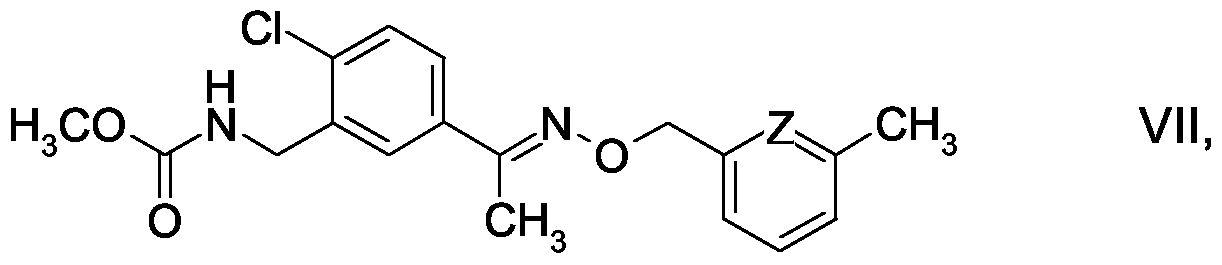
- Z is N or CH
- fungicides selected from guanidine, dodin, iminoctadine, guazatine, antibiotics: kasugamycin, streptomycin, polyoxin, validamycin A, nitrophenyl derivatives: binapacryl, dinocap, dinobuton,
- Sulfur-containing heterocyclyl compounds dithianone, isoprothiolane, organometallic compounds: fentin salts, such as fentin acetate, organophosphorus compounds: edifenphos, Iprobenfos, fosetyl, fosetyl-aluminum, phosphorous acid and its salts, pyrazophos, toiolo-fos-methyl,
- Organochlorine Compounds Chlorothalonil, Dichlofluanid, Flusulfamide, Hexachlorobenzene, Phthalide, Pencycuron, Quintozen, Thiophanate-Methyl, Tolylfluanid, Inorganic Substances: Bordeaux Broth, Copper Acetate, Copper Hydroxide, Copper Oxychloride, Basic Copper Sulfate, Sulfur, Other: Cyflufenamid, Cymoxanil, Dimethirimol, Ethirimol .
- the invention relates to a method for controlling harmful fungi with a mixture of at least one compound I and at least one of the active compounds II, the use of the compounds I and II for the preparation of such mixtures and agents and seeds containing these mixtures.
- the component 1) above referred to 1-methyl-pyrazole-4-ylcarbonklaanilide of the formula I, their preparation and their activity against Harmful fungi are known from the literature or can be prepared in the manner described there (cf., for example, EP-A 545099, EP-A 0589301 and WO 99/09013).
- the active compounds II mentioned above as component 2 their preparation and their action against harmful fungi are generally known (cf.: http://www.hclrss.demon.co.uk/index.html); they are commercially available.
- alkyl also includes octyl, decyl, tetradecyl and
- Guazatine mixture of the reaction products obtained from the amidation of technical lminodi (octamethylene) diamine containing various guanidines and polyamines [CAS RN 108173-90-6];
- Spiroxamine (8-tert-butyl-1,4-dioxaspiro [4.5] dec-2-yl) diethylamine (EP-A 281 842); Tridemorph, 2,6-dimethyl-4-tridecylmorpholine (DE-A 11 64 152);
- Penconazole 1- [2- (2,4-dichlorophenyl) pentyl] -1 H- [1,2,4] triazole (Pesticide Manual, 12.
- Prothioconazole 2- [2- (1-chlorocyclopropyl) -3- (2-chlorophenyl) -2-hydroxypropyl] -2,4-dihydro- [1,2,4] triazole-3-thione (WO 96/16048) ;
- Tetraconazole 1 - [2- (2,4-dichlorophenyl) -3- (1,1,2,2-tetrafluoroethoxy) propyl] -1H-1, 2,4-triazole (EP-A 234 242); Triadimefon, 1- (4-chlorophenoxy) -3,3-dimethyl-1- (1H-1, 2,4-triazol-1-yl) -2-butanone (BE
- Triflumizole (4-chloro-2-trifluoromethylphenyl) - (2-propoxy-1 - [1, 2,4] triazole-1-yl-ethylidene) -amine (JP-A 79/119 462);
- Metiram zinc ammonium ethylenebis (dithiocarbamate) (US 3,248,400);
- Propineb, zinc propylene bis (dithiocarbamate) polymer (BE 611 960);
- Boscalid 2-chloro-N- (4'-chlorobiphenyl-2-yl) nicotinamide (EP-A 545 099); Carbendazim, (1 H-benzimidazol-2-yl) -carbamic acid methyl ester (US 3,657,443);
- Cyazofamide 4-chloro-2-cyano-N, N-dimethyl-5- (4-methylphenyl) -1H-innidazole-1-sulfonamide (CAS RN 120116-88-3];
- Furametpyr 5-chloro-N- (1,3-dihydro-1,1,3-trimethyl-4-isobenzofuranyl) -1,3-dimethyl-1H-pyrazole-4-carboxamide [CAS RN 123572-88-3 ];
- Isoprothiolane, diisopropyl 1, 3-dithiolan-2-ylidenmalonate Proc. Insectic. Fungic. Conf.
- Tricyclazole 5-methyl-1,2,4-triazolo [3,4-b] [1,3] benzothiazole [CAS RN 41814-78-2]; Triforin, N, N '- ⁇ piperazine-1, 4-diylbis [(trichloromethyl) -nethylene ⁇ diformannanide (DE-A
- Nitrothal isopropyl, diisopropyl 5-nitroisophthalate Proc. Br. Insectic. Fungic. Conf.
- Carpropamide 2,2-dichloro-N- [1- (4-chlorophenyl) ethyl] -1-ethyl-3-methylcyclopropane carboxamide [CAS RN 104030-54-8]; Chlorothalonil, 2,4,5,6-tetrachloroisophthalonitrile (US 3,290,353);
- Fosetyl Fosetyl Aluminum, Ethyl Phosphonate (FR 22 54 276); Iprovalicarb, [(1S) -2-methyl-1- (1-p-tolyl-ethylcarbamoyl) -propyl] -carbamic acid isopropyl ester (EP-A 472 996);
- Penthiopyrad (RS) -N- [2- (1, 3-dimethylbutyl) -3-thienyl] -1-methyl-3- (trifluoromethyl) -1H-pyrazole-4-carboxamide (JP 10/130268); Propamocarb, 3- (dimethylamino) propylcarbamic acid isopropyl ester (DE-A 1567 169);
- Azoxystrobin 2- ⁇ 2- [6- (2-cyano-1-vinyl-penta-1,3-dienyloxy) -pyrimidin-4-yloxy] -phenyl ⁇ -
- Picoxystrobin 3-methoxy-2- [2- (6-trifluoromethylpyridin-2-yloxyn-ethyl) -phenyl] -acrylic acid methyl ester (EP-A 278 595); Pyraclostrobin, N- ⁇ 2- [1- (4-chlorophenyl) -1H-pyrazol-3-yloxymethyl] phenyl ⁇ (N-methoxy) carbamic acid, ethyl ester (WO 96/01256);
- Trifloxystrobin (E) -methoxyimino- ⁇ (E) - ⁇ - [1- ( ⁇ , ⁇ , ⁇ -trifluoro-n-tolyl) -ethylidene-amino-oxy] -o-tolyl ⁇ -acetic acid methyl ester (EP-A 460 575);
- the present invention was based on mixtures which show an improved action against harmful fungi, in particular for certain indications, with a reduced total amount of applied active substances.
- the mixtures of active ingredients I and II defined above were found. It has also been found that it is possible to combat harmful fungi more effectively than by using one or more of the active compounds II, or the compound (s) I and at least one of the active compounds II in successive, simultaneous or separate application of at least one compound I Single compounds alone (syn ergic mixtures).
- the compounds I can be used as synergists for a variety of different drugs.
- the fungicidal activity is increased in an excessively additive manner.
- the compounds I can be present in various crystal modifications, which may differ in their biological activity.
- halogen is fluorine, chlorine, bromine or iodine, preferably fluorine or chlorine;
- C 1 -C 4 -alkyl is methyl, ethyl, n-propyl, 1-methylethyl, n-butyl, 1-methylpropyl, 2-methylpropyl or 1, 1-dimethylethyl, preferably methyl or ethyl;
- Ci-C 4 haloalkyl is a partially or completely halogenated Ci-C 4 - alkyl group, wherein the / the halogen atom (s) is especially fluorine, chlorine and / or bromine / are eg chloromethyl, bromomethyl, dichloromethyl, trichloromethyl, Fluoromethyl, difluoromethyl, trifluoromethyl, chlorofluoromethyl, dichlorofluoromethyl, chlorodifluoromethyl, 1-chloroethyl, 1-bromoethyl, 1-fluoroethyl, 2-fluoroethyl, 2,2-difluoroethyl, 2,2,2-trifluoroethyl, 2-chloro-2 fluoroethyl, 2-chloro-2,2-difluoroethyl, 2,2-dichloro-2-fluoroethyl, 2,2,2-trichloroethyl, pentafluoroethyl
- C 1 -C 4 -alkoxy is OCH 3 , OC 2 H 5 , OCH 2 -C 2 H 5 , OCH (CH 3 ) 2 , n-butoxy, OCH (CH 3 ) -C 2 H 5 , OCH 2 -CH (CH 3 ) 2 or OC (CH 3 ) 3 , preferably for OCH 3 or OC 2 H 5 ;
- C 1 -C 4 -haloalkoxy represents a partially or completely halogenated C 1 -C 4 -alkoxy radical, where the halogen atom (s) is / are in particular fluorine, chlorine and / or bromine, ie, for example, chloromethoxy, bromomethoxy, dichloromethoxy, trichloromethoxy, FIu ormethoxy, difluoromethoxy, trifluoromethoxy, chlorofluoromethoxy, dichlorofluoromethoxy, chlorodifluoromethoxy, 1-chloroethoxy, 1-bromoethoxy, 1-fluoroethoxy, 2-fluoroethoxy, 2,2-difluoroethoxy, 2,2,2-trifluoroethoxy, 2-chloro-2-fluoroethoxy , 2-chloro-2,2-difluoroethoxy, 2,2-dichloro-2-fluoroethoxy, 2,2,2-trichloroethoxy
- C 1 -C 4 -alkylthio is SCH 3 , SC 2 H 5 , SCH 2 -C 2 H 5 , SCH (CH 3 ) 2 , n-butylthio, SCH (CH 3 ) -C 2 H 5 , SCH 2 -CH (CH 3 ) 2 or SC (CH 3 ) 3 , preferably for SCH 3 or SC 2 H 5 .
- the compounds I in which X is sulfur can be prepared, for example, by sulfurization of the corresponding compounds I in which X is oxygen (cf., for example, D. Petrova & K. Jakobcic, Croat. Chem. Acta 48, 49 (1976 ) and WO 01/42223).
- R 1 is Ci-C 4 alkyl or Ci-C 4 haloalkyl, preferably methyl or halomethyl, in particular CH 3, CHF 2 or CF 3.
- R 2 is hydrogen, fluorine or chlorine, in particular hydrogen.
- R 3 is halogen, Ci- C4 -alkyl, Ci-C 4 haloalkyl, Ci-C4-alkoxy, Ci-C4-haloalkoxy or Ci-C 4 alkylthio, preferably represents halogen, methyl, halomethyl, methoxy, halomethoxy or methylthio, in particular F, Cl, CH 3 , CF 3 , OCH 3 , OCHF 2 , OCF 3 or SCH 3 .
- Particular preference is given to the compounds I listed in the following Table 1, in which X is oxygen.
- mixtures of a compound of the formula I with at least one active compound selected from the group of the D) heterocyclic compounds are also preferred.
- mixtures of a compound of formula I with at least one active ingredient selected from the group of E) carbamates are also preferred.
- mixtures of a compound of formula I with at least one active ingredient selected from the group of F) other fungicides are also preferred.
- A) azoles selected from cyproconazole, difenoconazole, epoxiconazole, fluquinconazole, flusilazole, flutriafol, metconazole, myclobutanil, penconazole, propiconazole , Prothioconazole, t
- active compound selected from the group consisting of a) azoles selected from cyproconazole, difenoconazole, epoxiconazole, fluquinconazole, flusilazole, flutriafol, metconazole, myclobutanil, propiconazole, prothioconazole, triadimefon,
- active substance selected from the group of A) azoles selected from epoxiconazole, fluquinconazole, flutriafol, metconazole, tebuconazole, triticonazole, prochloraz and carbendazim.
- active substance selected from the group consisting of C) carboxylic acid amides, selected from hexhexamide, metalaxyl, mefenoxam, ofurace, dimethomorph, zoxamide and carpropamide.
- active compound selected from the group consisting of d) heterocyclic compounds selected from pyrimethanil, dodemorph, fenpropimorph, tridemorph, iprodione, vinclozoline, 5-chloro-7- (4-methylpiperidine 1-yl) -6- (2,4,6-trifluorophenyl) - [1,2,4
- active compound selected from the group of F fungicides selected from dithianone, fentin salts such as fentin acetate, fosetyl, fosetyl aluminum, phosphorous acid and their salts, chlorothalonil, dichlofluanide , Thiophanate-methyl, copper acetate, copper hydroxide, copper oxychloride, basic copper sulfate, sulfur, cymox
- Other fungicides selected from phosphorous acid and its salts, chlorothalonil and metrafenone.
- the mixtures of compound (s) I and at least one of the active compounds II, or the simultaneous joint or separate use of at least one compound I with at least one of the active compounds II, are distinguished by an outstanding activity against a broad spectrum of phytopathogenic fungi, in particular from the class of the Ascomycetes, Basidiomycetes, Deuteromycetes and Peronosporomycetes (syn. Oomycetes). They are partially systemically effective and can be used in crop protection as foliar, pickling and soil fungicides. They can also be used for seed treatment.
- Alternaria species on vegetables, rapeseed, sugar beets and fruits and rice e.g. A. solani or A. alternata on potatoes and tomatoes,
- Botrytis cinerea (gray mold) on strawberries, vegetables, flowers and vines, - Bremia lactucae on salad,
- Fusarium and Verticillium species on various plants e.g. F. graminearum or F. culmorum on cereal or F. oxysporum on a variety of plants, e.g. Tomatoes,
- Gaeumanomyces graminis on cereals - Gibberella species on cereals and rice (e.g., Gibberella fujikuroi on rice),
- Mycosphaerella species on cereals, bananas and peanuts e.g. M. graminicola on wheat or M. fijiesis on bananas,
- Peronospora species on cabbage and bulbous plants e.g. P. brassicae on cabbage or P. destructor on onion,
- Phytophthora species on various plants e.g. P. capsici on paprika
- Puccinia species on various plants for example P. triticina, P. striformins, P. hordei or P. graminis on cereals or P. asparagi on asparagus, Pyricularia oryzae, Corticium sasakii, Sarocladium oryzae, S. attenuatum, Entlyoma oryzae on rice , - Pyricularia grisea on grass and cereals,
- Rhynchosporium secalis on barley, rye and triticale Sclerotinia species on rape and sunflower, Septoria tritici and Stagonospora nodorum on wheat, - Erysiphe (syn. Uncinula) necator on grapevine, Setospaeria species on maize and turf, Sphacelotheca reilinia on maize, Thievaliopsis species Soybeans and cotton, Tilletia species on cereals, - Ustilago species on cereals, corn and sugar cane, eg U. maydis on corn, Venturia species (scab) on apples and pears, e.g. V. inaequalis to apple.
- the mixtures according to the invention are also suitable for controlling harmful fungi in the protection of materials (for example wood, paper, paint dispersions, fibers or fabrics) and in the protection of stored products.
- harmful fungi Ascomycetes such as Ophiostoma spp., Ceratocystis spp., Aureobasidium pullulans, Sclerophoma spp., Chaetomium spp., Humicola spp., Petriela spp., Trichurus spp .; Basidiomycetes such as Coniophora spp., Coriolus spp., Gloeophlum spp., Lentinus spp., Pleurotus spp., Poria spp., Serpula spp.
- Tyromyces spp. Deuteromycetes such as Aspergillus spp., Cladosporium spp., Penicillium spp., Trichoderm spp., Alternaria spp., Paecilomyces spp. and Zygomycetes such as Mucor spp., moreover, in the protection of the following yeasts: Candida spp. and Saccharomyces cerevisae.
- the compound (s) I with at least one of the active ingredients II can be applied simultaneously, namely jointly or separately, or in succession, the sequence in the case of separate application generally having no effect on the control result.
- the pure active compounds I to II which are further active substances against harmful fungi or against other pests such as insects, spider animals or nematodes or else herbicidal or growth-regulating substances. active ingredients or fertilizers.
- Such mixtures of three active ingredients consist, for example, of a compound of the formula I, in particular 1-methyl-3-trifluoromethyl-1H-pyrazole-4-carboxylic acid N- (2 1 -fluorobiphenyl-2-yl) -amide, 1-methyl 3-trifluoromethyl-1H-pyrazole-4-carboxylic acid N- (2'-chlorobiphenyl-2-yl) -amide, 1-methyl-3-difluoromethyl-1H-pyrazole-4-carboxylic acid N- (2 '- fluorobiphenyl-2-yl) -amide or 1-methyl-3-difluoromethyl-1H-pyrazole-4-carboxylic acid N- (2'-chlorobiphenyl-2-yl) -amide, an azole from the group A) , in particular epoxiconazole, metconazole, triticonazole or fluquinconazole, and an insecticide, in particular fipronil and neonicotinoids such as ace
- mixtures of at least one compound I and at least one active ingredient II are used.
- mixtures of at least one compound I with two or, if desired, several active components can also offer particular advantages.
- Suitable further active components in the above sense are, in particular, the active compounds II mentioned in the introduction and, in particular, the above-mentioned preferred active compounds II.
- Compound (s) I and active compound (II) II are usually used in a weight ratio of 100: 1 to 1: 100, preferably 20: 1 to 1:20, in particular 10: 1 to 1:10.
- the further active components are mixed in a ratio of from 20: 1 to 1:20 to give compound I.
- the application rates of the mixtures according to the invention, especially in agricultural crops, depending on the nature of the compounds I and II and the desired effect at 5 g / ha to 2000 g / ha, preferably 20 to 1500 g / ha, in particular 50 to 1000 g / ha.
- the application rates for the compound (s) I are accordingly generally 1 to 1000 g / ha, preferably 10 to 900 g / ha, in particular 20 to 750 g / ha.
- the application rates for the active compounds II are correspondingly generally 1 to 2000 g / ha, preferably 10 to 1500 g / ha, in particular 40 to 1000 g / ha.
- the method for controlling harmful fungi is carried out by the separate or combined application of compound (s) I and at least one of the active compounds II, or a mixture of compound (s) I and at least one of the active ingredients II, by spraying or dusting the seeds, the Plants or soils before or after sowing the plants or before or after emergence of the plants.
- the fungicidal mixtures according to the invention can be converted into the customary formulations, e.g. Solutions, emulsions, suspensions, dusts, powders, pastes and granules.
- the application form depends on the respective purpose; It should in any case ensure the finest possible and uniform distribution of the mixture according to the invention.
- the formulations are prepared in a manner known per se, e.g. by stretching the active compounds with solvents and / or carriers, if desired using emulsifiers and dispersants.
- Suitable solvents / auxiliaries are essentially:
- aromatic solvents for example Solvesso ® products, xylene
- paraffins for example mineral oil fractions
- alcohols for example methanol, butanol, pentanol, benzyl alcohol
- Ketones e.g., cyclohexanone, gamma-butyrolactone
- pyrrolidones N-methylpyrrolidone, N-octylpyrrolidone
- acetates glycols, dimethyl fatty acid amides, fatty acids, and fatty acid esters.
- solvent mixtures can also be used.
- Excipients such as ground natural minerals (e.g., kaolins, clays, talc,
- Chalk and ground synthetic minerals (e.g., fumed silica, silicates); Emulsifiers such as nonionic and anionic emulsifiers (for example polyoxyethylene fatty alcohol ethers, alkyl sulfonates and arylsulfonates) and dispersants such as lignin-sulphite liquors and methylcellulose.
- Emulsifiers such as nonionic and anionic emulsifiers (for example polyoxyethylene fatty alcohol ethers, alkyl sulfonates and arylsulfonates) and dispersants such as lignin-sulphite liquors and methylcellulose.
- the surface-active substances used are alkali metal, alkaline earth metal, ammonium salts of lignin sulfonic acid, naphthalenesulfonic acid, phenolsulfonic acid, dibutylnaphthalenesulfonic acid, alkylarylsulfonates, alkyl sulfates, alkyl sulfonates, fatty alcohol sulfates, fatty acids and sulfated fatty alcohol glycol ethers, and condensation products of sulfonated naphthalene and naphthalene derivatives with formaldehyde , Condensation products of naphthalene or naphthalenesulfonic acid with phenol and formaldehyde, polyoxyethylene octylphenol ether, ethoxylated isooctylphenol, octylphenol, nonylphenol, alkylphenol polyglycol ethers, tributylphenyl
- emulsions, pastes or oil dispersions come mineral oil fractions of medium to high boiling point, such as kerosene or diesel oil, coal tar oils and oils of vegetable or animal origin, aliphatic, cyclic and aromatic hydrocarbons, eg toluene, Xy- lol, paraffin, tetrahydronaphthalene, alkylated naphthalenes or derivatives thereof, methanol, ethanol, propanol, butanol, cyclohexanol, cyclohexanone, isophorone, strongly polar solvents, for example dimethyl sulfoxide, N-methylpyrrolidone or water into consideration.
- mineral oil fractions of medium to high boiling point such as kerosene or diesel oil, coal tar oils and oils of vegetable or animal origin, aliphatic, cyclic and aromatic hydrocarbons, eg toluene, Xy- lol, paraffin, tetrahydronaphthalene, al
- Powders, dispersants and dusts may be prepared by mixing or co-grinding the active substances with at least one solid carrier.
- Granules e.g. Coated, impregnated or homogeneous granules may be prepared by binding the active ingredients to at least one solid carrier.
- Solid carriers are e.g. Mineral soils such as silica gels, silicates, talc, kaolin, attaclay, limestone, lime, chalk, bolus, loess, clay, dolomite, diatomaceous earth, calcium and magnesium sulfate, magnesium oxide, ground plastics, fertilizers such as ammonium sulfate, ammonium phosphate, ammonium nitrate, ureas and vegetable Products such as cereal flour, tree bark, wood and nutshell flour, Ce I Iu loose powder or other solid carriers.
- the formulations generally contain from 0.01 to 95% by weight, preferably from 0.1 to 90% by weight, of the compound (s) I and at least one of the active compounds II or of the mixture of compound (I) I with at least one of the active ingredients II.
- the active ingredients are used in a purity of 90% to 100%, preferably 95% to 100% (according to NMR or HPLC spectrum).
- formulations are: 1. Products for dilution in water
- a mixture according to the invention 15 parts by weight of a mixture according to the invention are dissolved in 75 parts by weight of xylene with addition of calcium dodecylbenzenesulfonate and castor oil ethoxylate (in each case 5 parts by weight). Dilution in water results in an emulsion.
- the formulation has an active substance content of 15% by weight.
- a mixture according to the invention 25 parts by weight of a mixture according to the invention are dissolved in 35 parts by weight of xylene with addition of calcium dodecylbenzenesulfonate and castor oil ethoxylate in each case 5 parts by weight).
- This mixture is added to 30 parts by weight of water by means of an emulsifying machine (e.g., Ultraturrax) and made into a homogeneous emulsion. Dilution in water results in an emulsion.
- the formulation has an active ingredient content of 25% by weight.
- a mixture according to the invention 20 parts by weight of a mixture according to the invention are comminuted with the addition of 10 parts by weight of dispersants and wetting agents and 70 parts by weight of water or an organic solvent in a stirred ball mill to a fine active substance suspension. Dilution in water results in a stable suspension of the active ingredient.
- the active ingredient content in the formulation is 20% by weight.
- Water-dispersible and Water-soluble Granules 50 parts by weight of a mixture according to the invention are finely ground with the addition of 50 parts by weight dispersing and wetting agents and by means of technical equipment (eg extrusion, spray tower, fluidized bed) as water-dispersible or water-soluble granules produced. Dilution in water results in a stable dispersion or solution of the active ingredient.
- the formulation has an active ingredient content of 50% by weight.
- 75 parts by weight of a mixture according to the invention are ground with the addition of 25 parts by weight of dispersants and wetting agents and silica gel in a rotor-Strator mill. Dilution in water results in a stable dispersion or solution of the active ingredient.
- the active ingredient content of the formulation is 75% by weight.
- 0.5 parts by weight of a mixture according to the invention are finely ground and combined with 99.5 parts by weight of carriers. Common processes are extrusion, spray drying or fluidized bed. This gives a granulate for direct application with an active ingredient content of 0.5 wt .-%.
- the active compounds may be used as such, in the form of their formulations or the forms of use prepared therefrom, e.g. in the form of directly sprayable solutions, powders, suspensions or dispersions, emulsions, oil dispersions, pastes, dusts, scattering agents, granules by spraying, misting, dusting, scattering or pouring.
- the forms of application depend entirely on the intended use; In any case, they should ensure the finest possible distribution of active ingredients.
- Aqueous application forms can be prepared from emulsion concentrates, pastes or wettable powders (wettable powders, oil dispersions) by adding water.
- the substances as such or dissolved in an oil or solvent, can be homogenized in water by means of wetter, tackifier, dispersant or emulsifier. But it can also be made of effective substance wetting, adhesion, dispersing or emulsifying and possibly solvent or oil concentrates, which are suitable for dilution with water.
- the active compound concentrations in the ready-to-use preparations can be varied within wide ranges. In general, they are between 0.0001 and 10%, preferably between 0.01 and 1%.
- the active ingredients can also be used with great success in the ultra-low-volume (ULV) process, it being possible to apply formulations containing more than 95% by weight of active ingredient or even the active ingredient without additives.
- UUV ultra-low-volume
- wetting agents eg. Break Thru S 240 ®
- Alcohol alkoxylates eg. As Atplus 245 ®, Atplus MBA 1303 ®, Plurafac LF 300 ® and Lutensol ON 30 ®
- EO-PO block polymers eg. B.
- Pluro- nic RPE 2035 ® and Genapol B ® Alcohol ethoxylates, eg. As Lutensol XP 80 ®; and sodium dioctylsulfosuccinate, e. B. Leophen RA ®.
- the compounds I and II, or the mixtures or the corresponding formulations are applied by the harmful fungi, their habitat or the plants, seeds, soils, areas, materials or spaces to be kept free of them with a fungicidally effective amount of the mixture, or of compounds I and II when applied separately.
- the application can be made before or after the attack by the harmful fungi.
- the active compounds were prepared separately or together as a stock solution with 25 mg of active ingredient, which with a mixture of acetone and / or dimethyl sulfoxide and the emulsifier Uniperol ® EL (wetting agent with emulsifying and dispersing action based on ethoxylated alkylphenols) in the volume ratio solvent- Emulsifier from 99 to 1 ad 10 ml was filled. It was then made up to 100 ml with water. This stock solution was diluted with the described solvent-emulsifier-water mixture to the active ingredient concentration given below.
- Uniperol ® EL wetting agent with emulsifying and dispersing action based on ethoxylated alkylphenols
- the active ingredients epoxiconazole and pyraclostrobin were used as a commercially available ready-made formulation and diluted with water to the stated active substance concentrations.
- the efficiency (W) is calculated according to the formula of Abbot as follows:
- ⁇ corresponds to the fungal infestation of the treated plants in% and ⁇ corresponds to the fungal infestation of the untreated (control) plants in%
- ⁇ corresponds to the fungal infestation of the untreated (control) plants in%
- the infestation of the treated plants corresponds to that of the untreated control plants; at an efficiency of 100, the treated plants have no infestation.
- Leaves of potted tomato plants were sprayed to drip point with an aqueous suspension in the drug concentration below. The following day, the leaves were infected with an aqueous spore suspension of Alternaria solani in 2% biomalt solution with a density of 0.17 ⁇ 10 6 spores / ml. The plants were then placed in a water vapor-saturated chamber at temperatures between 20 and 22 0 C. After 5 days, the disease on the untreated, but infected control plants had developed so strongly that the infestation could be determined visually in%.
- Paprika seedlings of the cultivar "Neusiedler Ideal Elite" were sprayed to drip point with an aqueous suspension in the concentration of active compound below, after 2 - 3 leaves had developed well, the next day the treated plants were treated with a spore suspension of Botrytis cinerea, the 1 , 7 x 10 6 spores / ml in a 2% aqueous biomalt solution was inoculated, and then the test plants were placed in a climatic chamber at 22-24 ° C, in the dark and high humidity, after 5 days the extent of fungal attack on the leaves visually determined in%.
Landscapes
- Life Sciences & Earth Sciences (AREA)
- Agronomy & Crop Science (AREA)
- Pest Control & Pesticides (AREA)
- Plant Pathology (AREA)
- Health & Medical Sciences (AREA)
- Engineering & Computer Science (AREA)
- Dentistry (AREA)
- General Health & Medical Sciences (AREA)
- Wood Science & Technology (AREA)
- Zoology (AREA)
- Environmental Sciences (AREA)
- Agricultural Chemicals And Associated Chemicals (AREA)
- Pretreatment Of Seeds And Plants (AREA)
Abstract
Description









Claims


Priority Applications (4)
| Application Number | Priority Date | Filing Date | Title |
|---|---|---|---|
| JP2008520883A JP2009502747A (ja) | 2005-07-14 | 2006-07-13 | 1−メチル−ピラゾール−4−イルカルボキシアニリド類に基づく殺菌性混合物 |
| EP06777757A EP1903869A2 (de) | 2005-07-14 | 2006-07-13 | Fungizide mischungen auf der basis von 1-methyl-pyrazol-4-ylcarbonsäureaniliden |
| US11/988,660 US20090123561A1 (en) | 2005-07-14 | 2006-07-13 | Fungicide mixtures based on 1-methyl-pyrazol-4-ylcarboxanilides |
| BRPI0613007A BRPI0613007A2 (pt) | 2005-07-14 | 2006-07-13 | misturas fungicidas para combater fungos nocivos fitopatogênicos, agente, processo para combater fungos nocivos fitopatogênicos, semente, e, uso dos compostos |
Applications Claiming Priority (4)
| Application Number | Priority Date | Filing Date | Title |
|---|---|---|---|
| DE102005033517 | 2005-07-14 | ||
| DE102005033517.9 | 2005-07-14 | ||
| EP06100901.5 | 2006-01-26 | ||
| EP06100901A EP1813151A1 (de) | 2006-01-26 | 2006-01-26 | Fungizide Mischungen auf der Basis von 1-Methyl-pyrazol-4-yl-carbonsäureaniliden |
Publications (2)
| Publication Number | Publication Date |
|---|---|
| WO2007006806A2 true WO2007006806A2 (de) | 2007-01-18 |
| WO2007006806A3 WO2007006806A3 (de) | 2007-03-22 |
Family
ID=37517142
Family Applications (1)
| Application Number | Title | Priority Date | Filing Date |
|---|---|---|---|
| PCT/EP2006/064199 Ceased WO2007006806A2 (de) | 2005-07-14 | 2006-07-13 | Fungizide mischungen auf der basis von 1-methyl-pyrazol-4-yl-carbonsäureaniliden |
Country Status (5)
| Country | Link |
|---|---|
| US (1) | US20090123561A1 (de) |
| EP (1) | EP1903869A2 (de) |
| JP (1) | JP2009502747A (de) |
| BR (1) | BRPI0613007A2 (de) |
| WO (1) | WO2007006806A2 (de) |
Cited By (16)
| Publication number | Priority date | Publication date | Assignee | Title |
|---|---|---|---|---|
| WO2007017416A3 (de) * | 2005-08-05 | 2007-05-10 | Basf Ag | Fungizide mischungen enthaltend substituierte 1-methylpyrazol-4-ylcarbonsäureanilide |
| WO2008053044A3 (de) * | 2006-11-03 | 2008-09-12 | Basf Se | Hetarylcarbonsäure-n-(biphen-2-yl)amid-verbindungen |
| WO2007110173A3 (de) * | 2006-03-24 | 2009-03-19 | Bayer Cropscience Ag | Fungizide wirkstoffkombinationen |
| WO2009135808A2 (de) | 2008-05-05 | 2009-11-12 | Basf Se | Verfahren zur herstellung von 1,3,4-substituierten pyrazolverbindungen |
| JP2010517974A (ja) * | 2007-02-05 | 2010-05-27 | ビーエーエスエフ ソシエタス・ヨーロピア | 置換1−メチルピラゾール−4−イルカルボキシアニリド類を含む殺菌剤混合物 |
| WO2011054732A1 (en) | 2009-11-05 | 2011-05-12 | Basf Se | Process for preparing 1,3-disubstituted pyrazole compounds |
| WO2011054733A1 (en) | 2009-11-05 | 2011-05-12 | Basf Se | Process for preparing aminale and their use for preparing 1,3-disubstituted pyrazole compounds |
| WO2011135835A1 (en) | 2010-04-28 | 2011-11-03 | Sumitomo Chemical Company, Limited | Plant disease control composition and its use |
| WO2011135837A1 (en) | 2010-04-28 | 2011-11-03 | Sumitomo Chemical Company, Limited | Plant disease control composition and its use |
| WO2012065944A1 (en) | 2010-11-15 | 2012-05-24 | Bayer Cropscience Ag | N-aryl pyrazole(thio)carboxamides |
| US8314233B2 (en) | 2008-05-02 | 2012-11-20 | Basf Se | Process for preparing 2-(aminomethylidene)-4,4-difluoro-3-oxobutyric esters |
| US8344157B2 (en) | 2008-07-21 | 2013-01-01 | Basf Se | Process for preparing 1,3-disubstituted pyrazolecarboxylic esters |
| US8586750B2 (en) | 2008-05-02 | 2013-11-19 | Basf Se | Method for the production of halogen-substituted 2-(aminomethylidene)-3-oxobutyric acid esters |
| EP2563138A4 (de) * | 2010-04-28 | 2013-12-04 | Sumitomo Chemical Co | Zusammensetzung zur bekämpfung von pflanzenkrankheiten und ihre verwendung |
| US9375004B2 (en) | 2010-11-15 | 2016-06-28 | Bayer Intellectual Property Gmbh | 5-halogenopyrazolecarboxamides |
| EP3178813A1 (de) | 2015-12-09 | 2017-06-14 | Basf Se | Verfahren zur herstellung halogenierter 3-oxocarboxylate mit einer 2-alkoxymethyliden- oder 2-dialkylaminomethyliden-gruppe |
Families Citing this family (17)
| Publication number | Priority date | Publication date | Assignee | Title |
|---|---|---|---|---|
| BRPI0710774A2 (pt) * | 2006-05-03 | 2011-06-21 | Basf Se | método para proteger plantas após germinação contra o ataque de fungos fitopatogênicos foliares, formulação para tratamento de semente, semente, e, uso de pelo menos um composto |
| WO2010090025A1 (ja) * | 2009-02-05 | 2010-08-12 | パナソニック株式会社 | 撮像処理装置 |
| WO2011135827A1 (en) | 2010-04-27 | 2011-11-03 | Sumitomo Chemical Company, Limited | Pesticidal composition and its use |
| US8940781B2 (en) | 2010-04-27 | 2015-01-27 | Sumitomo Chemical Company, Limited | Pesticidal composition and its use |
| JP5782678B2 (ja) | 2010-04-27 | 2015-09-24 | 住友化学株式会社 | 有害生物防除組成物およびその用途 |
| CN102858167B (zh) | 2010-04-27 | 2016-03-16 | 住友化学株式会社 | 杀虫组合物及其用途 |
| JP5712504B2 (ja) | 2010-04-27 | 2015-05-07 | 住友化学株式会社 | 有害生物防除組成物およびその用途 |
| AU2011246799B9 (en) | 2010-04-28 | 2015-07-30 | Sumitomo Chemical Company, Limited | Pesticidal composition and its use |
| PH12012502025A1 (en) | 2010-04-28 | 2013-01-21 | Sumitomo Chemical Co | Plant disease control composition and its use |
| NZ603842A (en) | 2010-04-28 | 2014-09-26 | Sumitomo Chemical Co | Pesticidal composition and its use |
| JP5724212B2 (ja) * | 2010-04-28 | 2015-05-27 | 住友化学株式会社 | 植物病害防除組成物およびその用途 |
| JP5789918B2 (ja) * | 2010-04-28 | 2015-10-07 | 住友化学株式会社 | 植物病害防除組成物およびその用途 |
| KR20130119900A (ko) | 2010-06-07 | 2013-11-01 | 다우 아그로사이언시즈 엘엘씨 | 살진균제로서의 피라지닐 카르복스아미드 |
| AR083112A1 (es) * | 2010-10-01 | 2013-01-30 | Syngenta Participations Ag | Metodo para controlar enfermedades fitopatogenas y composiciones fungicidas utiles para dicho control |
| JP5857509B2 (ja) * | 2011-08-03 | 2016-02-10 | 住友化学株式会社 | 植物病害防除組成物およびその用途 |
| MX343611B (es) * | 2011-09-26 | 2016-11-14 | Sumitomo Chemical Co | Composicion de control de fitoenfermedades y su uso. |
| TWI503078B (zh) * | 2011-09-28 | 2015-10-11 | Sumitomo Chemical Co | 植物疾病防制組成物及其用途 |
Family Cites Families (14)
| Publication number | Priority date | Publication date | Assignee | Title |
|---|---|---|---|---|
| US5504005A (en) * | 1987-03-02 | 1996-04-02 | Albert Einstein College Of Medicine Of Yeshiva University | Recombinant mycobacterial vaccine |
| CA2081935C (en) * | 1991-11-22 | 2004-05-25 | Karl Eicken | Anilide derivatives and their use for combating botrytis |
| DE4231517A1 (de) * | 1992-09-21 | 1994-03-24 | Basf Ag | Carbonsäureanilide, Verfahren zu ihrer Herstellung und sie enthaltende Mittel zur Bekämpfung von Schadpilzen |
| DE19735224A1 (de) * | 1997-08-15 | 1999-02-18 | Basf Ag | Biphenylamide |
| AU752772B2 (en) * | 1997-12-18 | 2002-09-26 | Basf Aktiengesellschaft | Fungicide mixtures based on pyride amides and morpholine derivatives or piperidine derivatives |
| ATE292384T1 (de) * | 1997-12-18 | 2005-04-15 | Basf Ag | Fungizide mischungen auf der basis von pyridincarboxamidverbindungen |
| KR100539046B1 (ko) * | 1997-12-18 | 2005-12-27 | 바스프 악티엔게젤샤프트 | 피리딘 카르복사미드 기재의 살진균제 혼합물 |
| TW431861B (en) * | 1997-12-18 | 2001-05-01 | Basf Ag | Fungicidal mixtures based on amide compounds and azoles |
| DE59805925D1 (de) * | 1997-12-18 | 2002-11-14 | Basf Ag | Fungizide mischungen auf der basis von pyridincarboxamiden |
| EP1039806B1 (de) * | 1997-12-18 | 2003-05-07 | Basf Aktiengesellschaft | Fungizide mischungen auf der basis von pyridinamiden und fenarimol |
| TW491686B (en) * | 1997-12-18 | 2002-06-21 | Basf Ag | Fungicidal mixtures based on amide compounds and tetrachloroisophthalonitrile |
| TW450788B (en) * | 1997-12-18 | 2001-08-21 | Basf Ag | Fungicidal mixtures based on amide compounds and benzimidazoles or precursors which release them |
| JP2003516395A (ja) * | 1999-12-09 | 2003-05-13 | シンジェンタ パーティシペーションズ アクチェンゲゼルシャフト | 殺真菌剤としてのピラゾールカルボキサミド、及びピラゾールチオアミド |
| DE10347090A1 (de) * | 2003-10-10 | 2005-05-04 | Bayer Cropscience Ag | Synergistische fungizide Wirkstoffkombinationen |
-
2006
- 2006-07-13 JP JP2008520883A patent/JP2009502747A/ja not_active Withdrawn
- 2006-07-13 US US11/988,660 patent/US20090123561A1/en not_active Abandoned
- 2006-07-13 EP EP06777757A patent/EP1903869A2/de not_active Withdrawn
- 2006-07-13 WO PCT/EP2006/064199 patent/WO2007006806A2/de not_active Ceased
- 2006-07-13 BR BRPI0613007A patent/BRPI0613007A2/pt not_active IP Right Cessation
Cited By (25)
| Publication number | Priority date | Publication date | Assignee | Title |
|---|---|---|---|---|
| EA014099B1 (ru) * | 2005-08-05 | 2010-08-30 | Басф Се | Фунгицидные смеси, содержащие замещенные анилиды 1-метилпиразол-4-ил-карбоновой кислоты |
| WO2007017416A3 (de) * | 2005-08-05 | 2007-05-10 | Basf Ag | Fungizide mischungen enthaltend substituierte 1-methylpyrazol-4-ylcarbonsäureanilide |
| US8153819B2 (en) | 2005-08-05 | 2012-04-10 | Basf Se | Fungicidal mixtures comprising substituted 1-methylpyrazol-4-ylcarboxanilides |
| WO2007110173A3 (de) * | 2006-03-24 | 2009-03-19 | Bayer Cropscience Ag | Fungizide wirkstoffkombinationen |
| WO2008053044A3 (de) * | 2006-11-03 | 2008-09-12 | Basf Se | Hetarylcarbonsäure-n-(biphen-2-yl)amid-verbindungen |
| JP2010517974A (ja) * | 2007-02-05 | 2010-05-27 | ビーエーエスエフ ソシエタス・ヨーロピア | 置換1−メチルピラゾール−4−イルカルボキシアニリド類を含む殺菌剤混合物 |
| US8314233B2 (en) | 2008-05-02 | 2012-11-20 | Basf Se | Process for preparing 2-(aminomethylidene)-4,4-difluoro-3-oxobutyric esters |
| US8592578B2 (en) | 2008-05-02 | 2013-11-26 | Basf Se | Process for preparing 2-(aminomethylidene)-4,4-difluoro-3-oxobutyric esters |
| US8586750B2 (en) | 2008-05-02 | 2013-11-19 | Basf Se | Method for the production of halogen-substituted 2-(aminomethylidene)-3-oxobutyric acid esters |
| WO2009135808A2 (de) | 2008-05-05 | 2009-11-12 | Basf Se | Verfahren zur herstellung von 1,3,4-substituierten pyrazolverbindungen |
| US8598222B2 (en) | 2008-05-05 | 2013-12-03 | Basf Se | Method for preparing 1,3,4-substituted pyrazol compounds |
| US8344157B2 (en) | 2008-07-21 | 2013-01-01 | Basf Se | Process for preparing 1,3-disubstituted pyrazolecarboxylic esters |
| WO2011054732A1 (en) | 2009-11-05 | 2011-05-12 | Basf Se | Process for preparing 1,3-disubstituted pyrazole compounds |
| WO2011054733A1 (en) | 2009-11-05 | 2011-05-12 | Basf Se | Process for preparing aminale and their use for preparing 1,3-disubstituted pyrazole compounds |
| WO2011135837A1 (en) | 2010-04-28 | 2011-11-03 | Sumitomo Chemical Company, Limited | Plant disease control composition and its use |
| WO2011135835A1 (en) | 2010-04-28 | 2011-11-03 | Sumitomo Chemical Company, Limited | Plant disease control composition and its use |
| EP2563138A4 (de) * | 2010-04-28 | 2013-12-04 | Sumitomo Chemical Co | Zusammensetzung zur bekämpfung von pflanzenkrankheiten und ihre verwendung |
| EP2563139A4 (de) * | 2010-04-28 | 2013-12-04 | Sumitomo Chemical Co | Zusammensetzung zur bekämpfung von pflanzenkrankheiten und ihre verwendung |
| EP2563137A4 (de) * | 2010-04-28 | 2013-12-04 | Sumitomo Chemical Co | Zusammensetzung zur bekämpfung von pflanzenkrankheiten und ihre verwendung |
| WO2012065944A1 (en) | 2010-11-15 | 2012-05-24 | Bayer Cropscience Ag | N-aryl pyrazole(thio)carboxamides |
| CN103313971A (zh) * | 2010-11-15 | 2013-09-18 | 拜耳知识产权有限责任公司 | N-芳基吡唑(硫代)甲酰胺 |
| CN103313971B (zh) * | 2010-11-15 | 2015-12-02 | 拜耳知识产权有限责任公司 | N-芳基吡唑(硫代)甲酰胺 |
| US9206137B2 (en) | 2010-11-15 | 2015-12-08 | Bayer Intellectual Property Gmbh | N-Aryl pyrazole(thio)carboxamides |
| US9375004B2 (en) | 2010-11-15 | 2016-06-28 | Bayer Intellectual Property Gmbh | 5-halogenopyrazolecarboxamides |
| EP3178813A1 (de) | 2015-12-09 | 2017-06-14 | Basf Se | Verfahren zur herstellung halogenierter 3-oxocarboxylate mit einer 2-alkoxymethyliden- oder 2-dialkylaminomethyliden-gruppe |
Also Published As
| Publication number | Publication date |
|---|---|
| WO2007006806A3 (de) | 2007-03-22 |
| JP2009502747A (ja) | 2009-01-29 |
| US20090123561A1 (en) | 2009-05-14 |
| EP1903869A2 (de) | 2008-04-02 |
| BRPI0613007A2 (pt) | 2016-11-29 |
Similar Documents
| Publication | Publication Date | Title |
|---|---|---|
| JP5618479B2 (ja) | 置換1−メチルピラゾール−4−イルカルボキシアニリド類を含む殺菌性混合物 | |
| EP1903869A2 (de) | Fungizide mischungen auf der basis von 1-methyl-pyrazol-4-ylcarbonsäureaniliden | |
| JP5122452B2 (ja) | アゾロピリミジニルアミンをベースとする殺菌混合物 | |
| EP1732388A1 (de) | Ternäre fungizide mischungen | |
| EP1898704A1 (de) | Fungizide mischungen auf der basis von 2,5-disubstituierten pyrazolcarbonsäurebiphenylamiden | |
| EP1901609A2 (de) | Fungizide mischungen auf der basis von 3-monosubstituierten pyrazolcarbonsäurebiphenylamiden | |
| EP1898703A1 (de) | Fungizide mischungen auf der basis von 2,4-disubstituierten pyrazolcarbonsäurebiphenylamiden | |
| EP1813152A1 (de) | Fungizide Mischung auf der Basis von 3,4-disubstituierten Biphenylaniliden | |
| WO2007003643A1 (de) | Fungizide mischungen auf der basis von 3,4-disubstituierten pyrazolcarbonsäurebiphenylamiden | |
| EP1903868A1 (de) | Fungizide mischungen auf der basis von 1-methylpyrazol-4-ylcarbonsäureaniliden | |
| EP1903867A1 (de) | Fungizide mischungen auf der basis von 3,5-disubstituierten pyrazolcarbonsäurebiphenylamiden | |
| EP1813151A1 (de) | Fungizide Mischungen auf der Basis von 1-Methyl-pyrazol-4-yl-carbonsäureaniliden | |
| EP1912496A1 (de) | Fungizide mischungen enthaltend carbonsäure-n-[2-(halogenalk(enly)oxy)phenyl]amide | |
| CN101217873A (zh) | 由1-甲基吡唑-4-基甲酰苯胺制成的杀真菌混合物 | |
| US20090042725A1 (en) | Fungicidal Mixtures Based on 3,5-Disubstituted N-Biphenyl-Pyrazolcarboxamides | |
| CN101212901A (zh) | 基于2,5-二取代的吡唑甲酸联苯基酰胺的杀真菌混合物 | |
| JP2009526745A (ja) | 2,4−二置換n−ビフェニルピラゾールカルボキシアミドに基づく殺菌混合物 | |
| EP1793677A2 (de) | Fungizide mischungen auf der basis eines triazolopyrimidin-derivates |
Legal Events
| Date | Code | Title | Description |
|---|---|---|---|
| 121 | Ep: the epo has been informed by wipo that ep was designated in this application | ||
| WWE | Wipo information: entry into national phase |
Ref document number: 2006777757 Country of ref document: EP |
|
| WWE | Wipo information: entry into national phase |
Ref document number: 2008520883 Country of ref document: JP Ref document number: 11988660 Country of ref document: US |
|
| NENP | Non-entry into the national phase |
Ref country code: DE |
|
| WWE | Wipo information: entry into national phase |
Ref document number: 214/KOLNP/2008 Country of ref document: IN |
|
| WWW | Wipo information: withdrawn in national office |
Ref document number: DE |
|
| WWE | Wipo information: entry into national phase |
Ref document number: 200680033647.8 Country of ref document: CN |
|
| WWP | Wipo information: published in national office |
Ref document number: 2006777757 Country of ref document: EP |
|
| ENP | Entry into the national phase |
Ref document number: PI0613007 Country of ref document: BR Kind code of ref document: A2 Effective date: 20080114 |