WO2007042504A2 - Composes comprenant une partie de reconnaissance d'une cible biologique, couplee a une partie de signal capable de complexer le gallium - Google Patents
Composes comprenant une partie de reconnaissance d'une cible biologique, couplee a une partie de signal capable de complexer le gallium Download PDFInfo
- Publication number
- WO2007042504A2 WO2007042504A2 PCT/EP2006/067211 EP2006067211W WO2007042504A2 WO 2007042504 A2 WO2007042504 A2 WO 2007042504A2 EP 2006067211 W EP2006067211 W EP 2006067211W WO 2007042504 A2 WO2007042504 A2 WO 2007042504A2
- Authority
- WO
- WIPO (PCT)
- Prior art keywords
- chelate
- gallium
- pet
- imaging
- compound
- Prior art date
- Legal status (The legal status is an assumption and is not a legal conclusion. Google has not performed a legal analysis and makes no representation as to the accuracy of the status listed.)
- Ceased
Links
- 0 [O-]C(C(CCC(O)=O)NCCN(CCN(CCNC(CCC(O)=O)C([O-])=O)C(CCC(O)=O)C(O)=O)C(CCC(O)=O)*=O)=O Chemical compound [O-]C(C(CCC(O)=O)NCCN(CCN(CCNC(CCC(O)=O)C([O-])=O)C(CCC(O)=O)C(O)=O)C(CCC(O)=O)*=O)=O 0.000 description 6
- JYKDVPJZSPGDOE-UHFFFAOYSA-N CC(C)(C)OC(C(CCC(OCc1ccccc1)=O)N(CCNCCNC1)Cc2cccc1n2)=O Chemical compound CC(C)(C)OC(C(CCC(OCc1ccccc1)=O)N(CCNCCNC1)Cc2cccc1n2)=O JYKDVPJZSPGDOE-UHFFFAOYSA-N 0.000 description 1
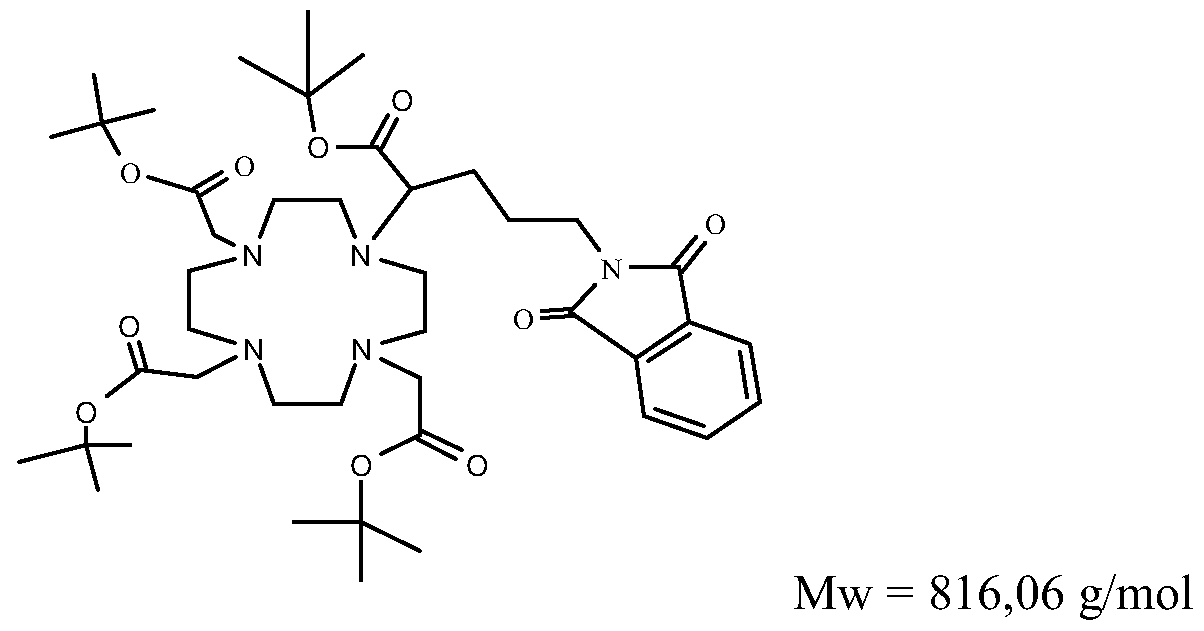
- ZBSNVQDXYDYBHO-UHFFFAOYSA-N CC(C)(C)OC(CN(CCN(CC(OC(C)(C)C)=O)CC1)CCN1C(CCCN(C(c1ccccc11)=O)C1=O)C(OC(C)(C)C)=O)C=O Chemical compound CC(C)(C)OC(CN(CCN(CC(OC(C)(C)C)=O)CC1)CCN1C(CCCN(C(c1ccccc11)=O)C1=O)C(OC(C)(C)C)=O)C=O ZBSNVQDXYDYBHO-UHFFFAOYSA-N 0.000 description 1
- IADARNZWAYHSRU-UHFFFAOYSA-N CC(C)(C)OC(CN1CCN(CC(OC(C)(C)C)=O)CCN(Cc(cc2)ccc2[N+]([O-])=O)CCN(CC(OC(C)(C)C)=O)CC1)=O Chemical compound CC(C)(C)OC(CN1CCN(CC(OC(C)(C)C)=O)CCN(Cc(cc2)ccc2[N+]([O-])=O)CCN(CC(OC(C)(C)C)=O)CC1)=O IADARNZWAYHSRU-UHFFFAOYSA-N 0.000 description 1
- RLMLYEICJULHFQ-UHFFFAOYSA-N CCCNC(CNCCCOCC)=O Chemical compound CCCNC(CNCCCOCC)=O RLMLYEICJULHFQ-UHFFFAOYSA-N 0.000 description 1
- OSAMMUYKJFJAMF-UHFFFAOYSA-N CCOCCCNC(OC(C)(C)C)=O Chemical compound CCOCCCNC(OC(C)(C)C)=O OSAMMUYKJFJAMF-UHFFFAOYSA-N 0.000 description 1
Classifications
-
- A—HUMAN NECESSITIES
- A61—MEDICAL OR VETERINARY SCIENCE; HYGIENE
- A61K—PREPARATIONS FOR MEDICAL, DENTAL OR TOILETRY PURPOSES
- A61K49/00—Preparations for testing in vivo
- A61K49/06—Nuclear magnetic resonance [NMR] contrast preparations; Magnetic resonance imaging [MRI] contrast preparations
- A61K49/08—Nuclear magnetic resonance [NMR] contrast preparations; Magnetic resonance imaging [MRI] contrast preparations characterised by the carrier
- A61K49/10—Organic compounds
-
- A—HUMAN NECESSITIES
- A61—MEDICAL OR VETERINARY SCIENCE; HYGIENE
- A61K—PREPARATIONS FOR MEDICAL, DENTAL OR TOILETRY PURPOSES
- A61K49/00—Preparations for testing in vivo
- A61K49/06—Nuclear magnetic resonance [NMR] contrast preparations; Magnetic resonance imaging [MRI] contrast preparations
- A61K49/08—Nuclear magnetic resonance [NMR] contrast preparations; Magnetic resonance imaging [MRI] contrast preparations characterised by the carrier
- A61K49/085—Nuclear magnetic resonance [NMR] contrast preparations; Magnetic resonance imaging [MRI] contrast preparations characterised by the carrier conjugated systems
-
- A—HUMAN NECESSITIES
- A61—MEDICAL OR VETERINARY SCIENCE; HYGIENE
- A61K—PREPARATIONS FOR MEDICAL, DENTAL OR TOILETRY PURPOSES
- A61K49/00—Preparations for testing in vivo
- A61K49/06—Nuclear magnetic resonance [NMR] contrast preparations; Magnetic resonance imaging [MRI] contrast preparations
- A61K49/08—Nuclear magnetic resonance [NMR] contrast preparations; Magnetic resonance imaging [MRI] contrast preparations characterised by the carrier
- A61K49/10—Organic compounds
- A61K49/14—Peptides, e.g. proteins
-
- A—HUMAN NECESSITIES
- A61—MEDICAL OR VETERINARY SCIENCE; HYGIENE
- A61K—PREPARATIONS FOR MEDICAL, DENTAL OR TOILETRY PURPOSES
- A61K51/00—Preparations containing radioactive substances for use in therapy or testing in vivo
- A61K51/02—Preparations containing radioactive substances for use in therapy or testing in vivo characterised by the carrier, i.e. characterised by the agent or material covalently linked or complexing the radioactive nucleus
- A61K51/04—Organic compounds
- A61K51/0497—Organic compounds conjugates with a carrier being an organic compounds
-
- A—HUMAN NECESSITIES
- A61—MEDICAL OR VETERINARY SCIENCE; HYGIENE
- A61K—PREPARATIONS FOR MEDICAL, DENTAL OR TOILETRY PURPOSES
- A61K51/00—Preparations containing radioactive substances for use in therapy or testing in vivo
- A61K51/02—Preparations containing radioactive substances for use in therapy or testing in vivo characterised by the carrier, i.e. characterised by the agent or material covalently linked or complexing the radioactive nucleus
- A61K51/04—Organic compounds
- A61K51/08—Peptides, e.g. proteins, carriers being peptides, polyamino acids, proteins
- A61K51/088—Peptides, e.g. proteins, carriers being peptides, polyamino acids, proteins conjugates with carriers being peptides, polyamino acids or proteins
-
- C—CHEMISTRY; METALLURGY
- C07—ORGANIC CHEMISTRY
- C07D—HETEROCYCLIC COMPOUNDS
- C07D471/00—Heterocyclic compounds containing nitrogen atoms as the only ring hetero atoms in the condensed system, at least one ring being a six-membered ring with one nitrogen atom, not provided for by groups C07D451/00 - C07D463/00
- C07D471/02—Heterocyclic compounds containing nitrogen atoms as the only ring hetero atoms in the condensed system, at least one ring being a six-membered ring with one nitrogen atom, not provided for by groups C07D451/00 - C07D463/00 in which the condensed system contains two hetero rings
- C07D471/08—Bridged systems
Definitions
- TITLE Compounds comprising a recognition part of a biological target, coupled to a signal part capable of complexing Gallium
- the invention provides compounds comprising a biological target recognition portion coupled to a signal portion capable of complexing Gallium.
- the invention also provides methods for obtaining such compounds, and screening methods capable of selecting such compounds for their chemical synthesis and diagnostic uses.
- a biovector coupled to a radionuclide is thus known.
- the biovector is coupled to the radionuclide either directly or via a chelate that complexes the radionuclide.
- they can be used for PET imaging or SPECT imaging.
- PET imaging emission of positrons giving rise to an emission of photons detected by a PET scanner
- Fl 8 is particularly used for the metabolic monitoring of tumor zones using FDG (fluorodeoxyglucose).
- a major drawback of the use of common isotopes such as Fl 8 in PET is the need for an isotope-producing cyclotron, and this is generally close to the site of administration of the product to the patient in view of the duration. isotopes, which poses significant cost and logistical problems. Numerous compounds using technicium and indium have been described for their use in SPECT imaging (photon emission, using radionuclides emitting an energy of the order of 100 to 200 keV in particular). SPECT, however, has a lower spatial resolution than PET and may involve visualization of the patient 2 to 3 days after administration of the product due to the life of certain isotopes such as ITnI 11.
- the choice between PET and SPECT depends in particular on the diagnostic indication, The applicant is particularly interested in the PET imaging use of Gallium Ga 68 because this isotope is produced, not by a cyclotron, but by a generator (Germanium Ge68 / Gallium Ga68), a much less complex and expensive device than the cyclotron.
- Specific compounds using Ga68 have been described, in particular Ga68 / S3N (tetradentate amine trithiolate chelating agent), DOTATOC (DOTA-DPhel-Tyr3-octreotide, the biovector being a somatostatin analogue). It is recalled that due to the 3+ oxidation state of Ga 68, it is typically coupled to different chelates including DOTA derivatives, DTPA, NOTE. Two methods of preparation are possible:
- the biovector is coupled to the chelate and the compound formed is complexed with the Ga68 produced by the generator
- the chelate is complexed with the Ga68 produced by the generator, and the complex formed is coupled to the biovector.
- the lifetime of Ga68 is 68 minutes, which makes its use possible in clinical PET, but requires, as for Fl 8 (which has a half-life of 121 minutes) a low preparation time of the product incorporating Ga68, and preferably less than about 40 minutes.
- a microwave preparation method for reducing the preparation time of compounds with Ga68 has been described in WO2004 / 089425.
- the applicant has succeeded in obtaining novel compounds of interest and the invention relates in one aspect to a method for selecting compounds effective in gallium gallium Ga68 imaging comprising:
- biovectors B having an affinity at least micromolar, preferably nanomolar, from a base of active pharmacological molecules
- chelates Ch having with gallium 68 Ga 3+ a log K affinity constant of at least 10, and preferably at least 20, at least 25, at least 30 or at least 35, in a linear or macrocyclic chelate library the selection of chemical links (linker) L intended for coupling at least one bio-vector with at least one chelate (designated Ch in the application)
- biovector derived from a base of active pharmacological molecules any molecule (designated as a bio vector) having a known activity for the targeting of a pathological and / or diagnostic zone of interest, in particular molecules derived from chemical libraries. , and in particular any biovector or category of biovectors cited in the present application.
- the base or the library is a library of biovectors used for SPECT imaging.
- the base or chemo library is a library of bio vectors used for PET imaging at Fl 8.
- the invention also relates to any vector product that can be used in gallium PET Ga68 imaging, obtained by the above selection method.
- the invention also relates to a process for the preparation of compounds effective in gallium gallium Ga68 imaging with or without microwaves comprising: the synthesis of a compound (B-Ch) by coupling a biovector to a linear or macrocyclic chelate complexation of the compound (B-Ch) with gallium Ga68 in less than 20 minutes.
- the yield will advantageously be greater than 30% and the purity greater than 50%
- the invention also relates to compounds for gallium-68 PET imaging comprising a biovector B and a chelate Ch capable of complexing Ga68, advantageously linked by an L-linker, the chelate comprising at least one part of the chelate masking in vivo , especially a hydrophilic group.
- this masking portion is chosen so as not to alter the affinity of the biovector with its biological target.
- the invention also relates to compounds for gallium 68 PET imaging comprising a biovector B and a chelate Ch capable of complexing Ga68, advantageously linked by a linker L, the chelate further comprising a recognition part of a target biological improving the biodistribution of the compound, said recognition portion being different from the biovector.
- the present invention relates to
- the applicant has targeted several major areas of improvement.
- the Applicant has studied products whose gallium complexing chelate does not alter the specificity of the recognition of the biological target by the product's bio-vector. The applicant has thus studied several chemical synthesis routes and several types of chelates that do not alter this recognition.
- the Applicant has studied products whose specificity of targeting is particularly high.
- the applicant has thus studied several routes of chemical synthesis and several types of bio vectors improving the specificity of the product.
- the applicant has thus sought biovectors with high specificity, including biovectors known in the therapeutic field, preferably having an affinity at least micro molar, especially nano molar, but not yet used in the diagnostic field.
- biovectors with each other or through the chelate (s) of the product:
- the biovectors are coupled together by a chemical linker group, at least one bio-vector being coupled to at least one chelate;
- the compound comprises a chelate qualified as central and carrying several biovectors via appropriate linkers
- the biovector is coupled to a chelate coupled itself to several chelates connected to each other by appropriate linkers.
- the applicant has also studied an assembly between the biovector (s) and the chelate (s) so that access to the target is not impeded despite the presence of the chelate (s):
- the chelate is spaced from the biovector (s) by a linker of sufficient size and a chemical structure such that the recognition of the biovector (s) by the target is not impaired for biovectors of a sufficient size
- the biovector comprises on the one hand a recognition part of the biological target not directly connected to the chelate, and on the other hand at least one part of structure whose connection (direct or by a linker) with one or more chelates does not interfere with the specific recognition.
- the structure of the chelate is defined so that it appears as invisible or transparent in biological environment vis-à-vis the biovector.
- chelates are particularly useful when the biovector must reach a recognition site difficult to access such as a catalytic site of an enzyme, or for biovectors whose coupling with known chelates poses a problem of specificity or recognition by their biological target (in particular small bio-vectors and / or having difficulties of access to a biological zone).
- This transparent character can be obtained by the use of suitable chemical groups including hydrophilic groups or on the contrary lipophilic masking the chelate.
- the chelate has at least one masking portion of the chelate in vivo.
- a central bio-vector connected to several chelates a central chelate connected to several identical or different bio-vectors a first set [biovector carrying chelates (s)] coupled through a hydrophobic or hydrophilic linker to a second set [biovector carrying chelates (s)], for example (Ch) 2 -Bl-Linker-B2 (Ch) 2 with Ch representing identical or different chelates and B1 and B2 representing biovectors identical or different several biovectors forming a sort of ring in interaction with gallium a set Bl- (Linker carrying Ch) - B2 - Ch
- the applicant has also studied compounds that can be used for PET imaging of Ga68 and also comprising the bio-vector and the chelate.
- a chemical structure conferring on it useful diagnostic properties according to a logic for example described in WO2005 / 082425 page 60-67, in particular polymers (polysaccharides, poly amino acids, hydrophilic polymers of the PEG type for example), systems liposome-type encapsulation, lipid transport systems and / or release of the diagnostic compound such as liposomes, micelles (which allow passage through the lymphatic system instead of the circulatory system), nanoemulsions.
- the applicant has also studied several routes of chemical synthesis and several types of chelates to activate the product at the targeting site, according to a function described as intelligent or smart.
- the product When the product is close to its target in vivo, it undergoes a structure modification such that the affinity of the biovector vis-à-vis its target is improved.
- improved affinity it is meant that the bio-vector has a better recognition and / or that its duration of interaction with its target is increased.
- the product undergoes a conformational change and / or a cleavage for example enzymatic resulting in a better exposure of the binding site of the biovector vis-à-vis its target.
- the origin of said structural modification can be locally especially related to the pH, to the oxidation-reduction potential, etc.
- the bio-vector may for example be a substrate or an inhibitor of an enzyme.
- compounds are sought whose biovector is coupled directly to at least one gallium, without the use of chelate, the recognition of the biovector not being altered by the interaction between the biovector and the gallium atom (s).
- biovector is coupled directly to at least one gallium, without the use of chelate, the recognition of the biovector not being altered by the interaction between the biovector and the gallium atom (s).
- the biovector comprises two sites, including a target recognition site and an interaction site with gallium, this second site forming a sort of box around the gallium.
- the bio-vector comprises several sites, each site being at the same time a recognition site and an interaction site with gallium, each site forming a kind of box around the gallium. Where appropriate, these two recognition sites are different biovectors targeting identical or different targets. It is also possible to use compounds comprising, in addition to the chelate and the targeting biovector part, a transport part capable of conveying the targeting biovector to a zone of interest.
- the area of interest will be a biological territory of the brain made accessible to the compound by a transporter capable of passing the blood-brain barrier (BBB).
- BBB blood-brain barrier
- the applicant has studied the use of biovectors known for their high specificity for a biological target associated with a pathological zone, but whose coupling with the isotopes commonly used in nuclear medicine, in particular with Fl 8, is chemically difficult and / or poses stability problems of the biovector complex-F18 synthesized.
- the applicant has thus studied the use of bio vectors known for their specificity (typically at least 10 " 9 to 10 " 12 M), and whose coupling with gallium (via the chelate) is much easier. and / or faster and / or provides a more stable compound than with F18. This also allows more time for the practitioner in the clinical use of the product.
- the applicant has also studied the use of gallium instead of Fl 8, for biovectors whose specificity of recognition of their target (especially between a normal zone and a pathological or pathological risk zone) is high enough to obtain a good contrast. in the image and therefore to meet the diagnostic need, even if the resolution in PET imaging with gallium is lower than with Fl 8.
- the Applicant has particularly studied the use of gallium for diagnostic indication myocardial perfusion in PET imaging, possibly in combination with a therapeutic treatment, by selecting biovectors among the many biovectors used or usable in this indication.
- the applicant has also studied diagnostic PET imaging products incorporating Ga68 for monitoring the efficacy of a therapeutic product, the biovector of the diagnostic compound being identical to or different from the biovector of the therapeutic product, the two products being coadministered simultaneously or delayed. It is also possible to use mixed compounds comprising a therapeutic part and a diagnostic part, possibly separating at the site of action of the mixed compound.
- the applicant has also investigated imaging methods more specifically for PET imaging of Ga68, in particular apparatus, sequences, signal processing methods, methods of acquisition, transfer and compilation of data, adapted to the particularities (half-life ...) of the Ga68.
- Physiological imaging with the PET imaging product of the Ga68 is optionally combined with an anatomical reading on the scanner with possibly contrast product for X-ray scanning.
- a PET product can be coadministered simultaneously or deferred. Ga68 and another contrast product.
- the applicant has thus studied the possibility of administering several products, almost simultaneous or, on the contrary, delayed by a few hours, for PET imaging, each product providing relevant diagnostic information, for example an Fl 8 labeled product and a labeled product. at the Ga68.
- the applicant has also investigated the possibilities of combining the results obtained on the same patient by combining the imaging modalities using products labeled with Ga68, for example PET-CT or PET MRI.
- the chelate and / or the chelate / biovector compound may be stable only 1 at 3 o'clock (the time of product preparation and patient imaging).
- the applicant has investigated compounds comprising bio vectors whose kinetics of biodistribution is such that the gallium is not disintegrated before reaching its biological target, these compounds reaching their target in the patient in less than two to three hours.
- biovectors used in therapy and / or in diagnostic imaging: proteins, glycoproteins, lipoproteins, polypeptides, peptides, peptidomimetics, dyes, sugars, oligosaccharides, neuromediators, and generally any peptide ligand or not known to those skilled in the art as capable of recognizing at least one biological target such as in particular receptors, enzymes, without the coupling with the chelate undesirably altering the biological activity of the target.
- biovectors the applicant was interested in any biovector
- the choice of the biovector can be made according to its structure and / or according to its desired use in imaging, such as the marking of a biological mechanism liable to be altered and resulting, for example, in a modified level of expression.
- of the target of the biovector compared to the non-pathological state cellular receptors, cellular metabolism, intra- or extracellular transport, informing molecules and / or effector or cell activators.
- bio-vectors capable of targeting a ligand associated with (directly or indirectly intervening and / or overexpressed in) a pathological process.
- Angiogenesis inhibitors in particular those tested in clinical trials or already marketed, in particular: angiogenesis inhibitors involving FGFR or VEGFR receptors such as SU101, SU5416, SU6668, ZD4190, PTK787, ZK225846, azacycle compounds ( WO00244156, WO02059110);
- inhibitors of angiogenesis involving MMPs such as BB25-16 (marimastat), AG3340 (prinomastat), solimastat, BAY12-9566, BMS275291, metastat, neovastat;
- angiogenesis inhibitors involving integrins such as SM256, SG545, adhesion molecules blocking EC-ECM (such as EMD 121-974, or vitaxine);
- drugs with a more indirect antiangiogenesis mechanism of action such as carboxiamidotriazole, TNP470, squalamine, ZDO101; inhibitors described in WO99 / 40947, highly selective monoclonal antibodies for KDR receptor binding, somatostatin analogs
- Bio vectors capable of targeting receptors CD36, EPAS-I, ARNT, NHE3, Tie-1, KDR, FIt-I, Tek, neuropilin-1, endoglin, pleientropin, endosialin, AxL, alPi, a2ssl , a4P1, a5pl, eph B4 (ephrin), laminin A receptor, neutrophilin 65 receptor, leptin receptor OB-RP, chemokine receptor CXCR-4 (and other receptors cited in WO99 / 40947), LHRH, bombesin / GRP, receptors gastrin, VIP, CCK.
- GPIIb / IIIa receptor inhibitors chosen from: (1) the Fab fragment of a GPIIb / IIIa monoclonal antibody, Abciximab (ReoPro TM), (2) intravenously injected small peptide and peptidomimetic molecules such as eptifibatide (Integrilin TM) and tirofiban (Aggrastat TM). Being reminded that the possible choice of an antibody will have to take into account the duration of reaching its target.
- fibrinogen receptor antagonist ligands EP425212
- Ilb / IIIa receptor ligand peptides fibrinogen ligands
- fibrinogen ligands thrombin ligands
- peptides capable of targeting atheromatous plaque platelets, fibrin, hirudin-based peptides, guanine-based derivatives targeting the Ilb / IIIa receptor.
- biovectors or biologically active fragments of biovectors known to those skilled in the art as drugs, anti-thrombotic action, anti platelet aggregation, antiatherosclerotic, antirestenotic, anticoagulant.
- biovectors or biologically active fragments of biovectors targeting ccv ⁇ 3, described in association with DOTA in patent US6537520 selected from the following: mitomycin, tretinoin, ribomustine, gemcitabine, vincristine, etoposide, cladribine, mitobronitol, methotrexate, doxorubicin , carboquone, pentostatin, nitracrine, zinostatin, cetrorelix, letrozole, raltitrexed, daunorubicin, fadrozole, fotemustine, thymalfasin, sobuzoxane, nedaplatin, cytarabine, bicalutamide, vinorelbine, vesnarinone, aminoglutethimide, amsacrine, proglumide, elliptinium acetate, ketanserin, doxifluridine, and
- biovectors targeting particular types of cancers for example, peptides targeting the ST receptor associated with colorectal cancer, or the tachykinin receptor.
- biovectors using phosphine compounds 11) biovectors using phosphine compounds. 11) targeting bio-vectors of P-selectin, E-selectin (e.g. the 8 amino acid peptide described by Morikawa et al, 1996, 951).
- any peptide obtained by targeting technologies such as phage display, optionally modified by non-natural amino acids (http // chemlibrary.bri.nrc.ca), for example peptides from phage display libraries: RGD, NGR , CRRETAWAC, KGD, RGD-4C, XXXY * XXX, RPLPP, APPLPPR.
- Hormonal receptor ligands including hormones and steroids.
- biovectors for targeting peptide receptors overexpressed in tumors LHRH receptors, bombesin / GRP, VIP receptors , CCK receptors, tachykinin receptors for example
- the somatostatin or bombesin analogues peptides derived from possibly glycosylated octreotide peptides, VIP peptides, alpha-MSH, CCK-B peptides peptides chosen from: cyclic peptides RGD, fibrin-alpha chain, CSVTCR, tuftsin, fMLF, YIGSR (receptor: laminin)
- biovectors used for smart products 23) biovectors used for smart products. 24) markers of myocardial viability (for example tetrofosmin and hexakis2-2-methoxypropylisonitrile).
- neurotransmitter receptor ligands D, 5HT, Ach, GABA, NA receptors.
- oligonucleotides oligonucleotides.
- biovectors already used for SPECT or PET cited in: WO03 / 018640, WO03 / 020701, WO03 / 078569, US2003 / 0152513, WO03 / 086475, WO2005 / 002293, US20050048000, WO2004 / 069365, WO2005 / 012335, WO2005 / 044312, WO2005 / 042033, WO2003 / 013346, WO2005 / 023314, WO2005 / 019247, WO2005 / 049096, WO2005 / 049095, WO2005 / 044313, WO2005 / 042033, US2004 / 0210041, US2005 / 201943, WO2005 / 082889.
- GLUT targeting bio vectors GLUT transporters (GLUT1 glucose receptors and others) which are already known to be coupled to chelates complexed with lanthanides such as Gd3 +.
- L includes substituted or unsubstituted or substituted saturated or unsubstituted straight or branched alkyl chains, peptides, polyethylene glycols and polyoxyethylenes. These include:
- L will for example have a molecular weight between 300 and 2000 g / mol, especially between 300 and 1000 g / mol.
- P1 and P2 are thus coupling groups of the linker with on the one hand the chelate and on the other hand the bio-vector.
- Groups capable of reacting especially with amino groups include:
- alkylation compounds alpha-haloacetyl compounds, N-maleemide derivatives, aryl compounds (nitrohaloaromatic compounds for example), aldehydes and ketones capable of forming Schiff bases, epoxide derivatives such as epichlorohydrin, triazine derivatives containing chlorine highly reactive with nucleophiles, aziridines, esters of squaric acid, alpha ethers. -halo alky the.
- acylation compounds isocyanates and isothiocyanates, sulfonyl chlorides, esters such as nitrophenyl esters or N-hydroxysuccinimidyl esters, acid anhydrides, acylazides, azlactones, imidoesters.
- Groups capable of reacting with carboxyl groups include compounds diazo (diazoacetate esters, diazoacetamides), compounds modifying carboxylic acids (carbodiimides for example), derivatives isoxazolium (nitrophenylchloroformate, carbonyldiimidazoles ...), quinoline derivatives.
- Groups capable of reacting with guanidinyl groups include dione compounds such as phenylenediglyoxal, diazonium salts.
- - W selected from O, S, NH, NHCO, CONH, CO, COO, OCO, NHCSNH, NHCONH, SO 2 , (OCH 2 CH 2 ) S , (CH 2 CH 2 O) 8. , (OCH 2 CH 2 CH 2 V (CH 2 CH 2 CH 2 O) 1 ;
- Z is selected from the group: O-substituted aryl, C 3 -C 10 cycloalkyl substituted with O to 3 R 10 , 5-10 membered heterocycle system containing 1-4 heteroatoms independently selected from N, S, O and substituted with 0 to 3 ri 0;
- - ru is independently selected from: H, aryl substituted with O to 1 R 12, 5-10 membered heterocyclic ring comprising 1-4 heteroatoms selected from N, S, O and substituted with O to 1 12 r, C3-C10 substituted with 0 to 12 , polyalkylene glycol substituted with 0 to 12 , carbohydrate substituted with 0 to 12 .
- - r 12 is a bond with the chelate; with k chosen from 0, 1, 2; h selected from 0, 1, 2; h 'selected from 0, 1, 2, 3, 4, 5; h "selected from 0, 1, 2, 3, 4, 5; g selected from 0, 1, 2, 3, 4, 5, 6, 7, 8, 9, 10; g 'selected from 0, 1, 2; , 3, 4, 5, 6, 7, 8, 9, 10; selected from 0, 1, 2, 3, 4, 5, 6, 7, 8, 9, 10; g '' selected from 0, 1, 2, 3, 4, 5, 6, 7, 8, 9, 10; selected from 0, 1, 2, 3, 4, 5, 6, 7, 8, 9, Is selected from 0, 1, 2, 3, 4, 5, 6, 7, 8, 9, 10; s "selected from 0, 1, 2, 3, 4, 5, 6, 7, 8, 9.10; t selected from 0, 1, 2, 3, 4, 5, 6, 7, 8, 9,10.
- Cyclic region (divalent cycloalkyls, divalent heterocycles) Polyalkylenes, polyalkylenes glycols
- the choice of links can be done in particular to control the load, lipophilicity, hydrophilicity of the product depending on the desired diagnostic indication, to optimize biological targeting, biodistribution.
- in vivo biodegradable linkers PEG linkers or mini-PEG linkers may be used.
- the invention particularly relates to compounds comprising a linker such that the compound prepared has an efficacy equivalent to that of the compounds exemplified in detail in the present application, the activity being measured using appropriate techniques in vitro, in vivo.
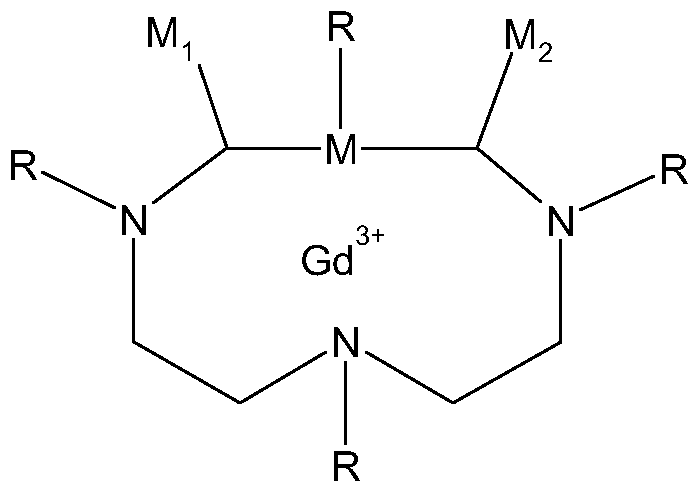
- a chelate of the following general formula may be used:
- M-M1-M2 form a pyridine ring or Ml and M2 are absent and M is a bond or M is NR and Ml and M2 represent a hydrogen atom or methyl with R is independently selected from CH 2 CO 2 - or H or CHX-CO 2 -, with at least one R being CHXCO 2 - and X being LB; and in particular a linear chelate selected from: EDTA, diethylenetriaminopentaacetic acid DTPA, N- [2- [bis (carboxymethyl) amino] -3- (4-ethoxyphenyl) propyl] -N- [2- [bis (carboxymethyl) amino] ethyl] -L-glycine (EOB-DTPA), N, N-bis [2- [bis (carboxymethyl) amino] ethyl] -L-glutamic acid (DTPA-GLU), N, N-bis [2- [bis (carboxymethyl) amino] ethyl] -L-ly
- a chelate from: DOTA gadofluorins, DO3A, HPDO3A, TETA, TRITA, HETA, DOTA-NHS, M4DOTA, M4DO3A, PCTA and their 2-benzyl-DOTA derivatives, alpha- (2-phenethyl) 1,4, 7,10 tetraazacyclododecane-1-acetic-4,7,10-tris (methylacetic) acid, 2-benzyl-cyclohexyldiethylenetriaminepentaacetic acid, 2-benzyl-6-methyl-DTPA, 6.6 "-bis [N, N, N", N " tetra (carboxymethyl) aminomethyl) -4'- (3-amino-4-methoxyphenyl) -2,2 ', 6', 2 "-terpyridine, N, N'-bis- (pyridoxal-5-phosphate) ethylenediamine-N , N'-diacetic acid (DPDP) and ethylene
- the chelate or chelates forming the signal entity can meet the formula of WOO 1/60416.
- the compounds DTPA, DOTA, NOTE, DO3A, and derivatives may be used, in particular:
- X a group capable of coordinating a metal cation, preferably O-, OH, NH 2 , OPO 3 -, NHR with R an aliphatic chain.
- chelates described in Inorg. Chim. Acta (1995), 75-82 (TACN-TM (1,77-tris (2-mercaptoethyl) -1,4,7-triazacyclononane), Bioconj Chem (2002), 1140-1145 (tripod trithiolate chelate), and generally any chelate capable of forming a sufficiently stable cage around Ga, especially any aliphatic, macrocyclic or linear amine, aminated macrocycle with tertiary amines.
- the applicant was particularly interested in chelates capable of complexing gallium and having at least one function of coupling the chelate to at least one bio-vector.
- complexes will be used such that the log K is of the order of 20 to 40, especially 25 to 35.
- a carrier macrocycle will be used, in addition to the 3 negatively charged acid functions coupled to Ga 3+. of at least one Ga 3+ protecting group.
- protective group is meant a group capable of protecting or improving the coordination of Ga 3+ with the functions of the chelate (COOH functions for example).
- chelates with a fairly complex structure intended to protect the Ga 3+ , for example by assembling linear or macrocyclic chelates.
- log K the gallium III-transferrin complex
- Chelates with one or more non-biovector functions coupled with at least one group to improve biovector recognition for its target have also been studied; for example, a group decreasing renal clearance, a group interacting with a target near the biological target (for example, this group stabilizes the structure of the biovector recognition site), a group modifying the pH, the charge or other physico-chemical parameters such as hydrophilicity or lipophilicity, so as to improve the affinity of the biovector for its target and / or to increase the modification of the bio vector if it is a substrate for an enzyme or a intra or extra cellular effector.
- nanoparticles comprising gallium chelates and a specific target bio-vector, for example for the targeting of nanoparticle integrins coated with a Ga68 chelate and biovector cover; in particular, superparamagnetic particles of iron oxides of the type (USPIO and SPIO), and quantum dots compounds, whose surface is adapted for this coverage of the chelate and the biovector.
- gallium-labeled vector compounds comprise, on the one hand, at least one gallium labeled vectorized compound, each vectorized compound comprising at least one biovector coupled to at least one Ga68 complexing chelate, and on the other hand at least one additive making it possible to stabilize the vectorized compound.
- the formulation administered to the patient comprises for this purpose as stabilizing additive an excess of chelate capable of complexing the free Ga68.
- the excess chelate may be the same as the chelate of the vectorized compound, or a different chelate provided it is suitable for the complexation of free Ga68.
- the chelate of the vectorized compound will be a macrocyclic chelate particularly advantageous for gallium chemistry, while the excess chelate in the formulation will be a linear chelate simpler to manufacture.
- the formulation comprises a compound according to the invention (ie a Ga68 gallium metal complex of formula Ch-LB or Ch-Lp-Bq) and a non-complexed linear or macrcyclic Ch chelate, advantageously present at a concentration of 0.01 to 10 ⁇ m, advantageously from 10 to 10 ⁇ m.
- a compound according to the invention ie a Ga68 gallium metal complex of formula Ch-LB or Ch-Lp-Bq
- a non-complexed linear or macrcyclic Ch chelate advantageously present at a concentration of 0.01 to 10 ⁇ m, advantageously from 10 to 10 ⁇ m.
- the formulation may also be an ionic formulation, in particular of calcium.
- the calcium can advantageously bind to the excess free chelate that may be present in the formulation or in the body of the patient.
- the general principle is to respond to a particular technical problem resulting from the use of Ga68 for the preparation of the vectorized compounds, in particular because of the desire to prepare a compound rapidly which may not allow an optimal purification or stabilization of the product.
- Such a formulation will, for example, make it possible to overcome the existence of by-products or excess reagents such as amines and acids.
- biovectors and chelates such that their coupling with gallium is sufficiently efficient and fast.
- WO2004 / 089425 discloses a microwave process for improved synthesis and purity of the product which incorporates the biovector and the Ga68-coupled chelate.
- the Applicant has examined the use of biovectors that may be sensitive to microwave treatment.
- a screening method consists of testing the stability of biovectors of diagnostic interest following a microwave treatment.
- the applicant was thus particularly interested in processes (thermal, physico-chemical, chemical ...) and devices, possibly already used or usable in nuclear medicine for other isotopes than gallium, and whose adaptation is appropriate in the case of Ga68 to solve these problems.
- the Ga68 is obtained by degradation of the Ge68 whose lifespan is 270 days.
- the Ge68 generators are based on the use of a matrix that absorbs the Ge68, the Ga68 being elected.
- a Ga68 concentration step is necessary because the eluted volume is too dilute; the applicant has studied means for concentrating the eluate and / or for reducing the volume of the eluate, in particular by improving the matrix used.
- the applicant has also studied the means for purifying the eluate of its impurities (Ti + in particular) likely to hinder the coupling with the chelate, and automate the concentration / purification step for example using chromatography columns , using an integrated device or output of the generator.
- the Ga68 can be coupled to the chelate, the complex formed being intended to be coupled to the biovector portion.
- the chelate has been previously coupled to the biovector so that this coupling reaction does not alter the stability of the chelate with gallium.
- the preparation of the product comprises a step of removing excess gallium which has not been complexed by the product.
- the Ga68 solution is made less acidic to facilitate coupling with the chelate.
- any type of activation method such as ultrasonic and clay processes can be used.
- the applicant was able to obtain stable compounds and complexing Ga68 as described in detail later with rapid heating of about 80 0 C for
- the Applicant has also studied the use of suitable chelates for a chelate coupling process and bio vector under conditions that are not optimal but sufficient for the desired reading.
- the coupling method comprises heating at a lower temperature than the optimum temperature, but sufficient for efficient PET reading.
- Ga68 is very fast and does not require a physical and / or chemical treatment altering the bio vector. This is intended to select very interesting chelates on this process criterion (speed of coupling), provided that their gallium complexation is sufficient for use in PET imaging of Ga68.
- the duration of exposure of the patient being much shorter than with radionuclides of long life such as technicium or indium, the dose of product with gallium injected can be significantly higher than with these radionuclides.
- the applicant has thus studied compounds effective at a radioactivity dose of the order of 1 to 1000 Curie / mol, in particular 1 to 10, 1 to 100, or even more than about 2000 to 3000 Curie / mol. It will also be possible to make several series of measurements, for example at a dose of radioactivity of the order of 0.1 to 1000 Curie / mol per measurement, in the same imaging session of the patient.
- the radioactivity of the product is for example between 100 and 1000 MBq / nmol.
- a kit comprising the gallium ligand, ie the chelate, to be coupled to the biovector or already coupled to the biovector is used.
- the radiopharmacist adds to this gallium ligand the sterile solution of gallium output from the generator.
- the ligand biologicalvector coupled to the chelate
- the ligand which is dissolved (for example with sterile water and a buffer such as sodium acetate), which is added by the radiopharmacist to the gallium solution.
- ligand solution whose desired parameters (stability, reactivity with gallium, sterility 9) are suitable for the complexation of gallium.
- desired parameters for ligands with low water solubility constraints with risk of precipitation, suitable DMSO and excipients can be used.
- the generator With regard to the generator itself, it is sought devices improving the miniaturization and sterility as described in WO2005 / 084168, for example with collection of the gallium solution output of the generator in a vacuum pre-sterilized packaging, the packaging filled with the Ga68 solution is then used with the administration kit comprising the ligand. In particular, it seeks to ensure sterility of the generator throughout its life, which is close to that of Germanium, so about a year. Suitable generators may also be of the type Ti 44 / SC44. Automated and preferably sterile systems including, for example:
- Ga68 generator producing a solution of Ga68, and if necessary concentration means, means for sterilizing the Ga68 solution, means for collecting the sterile Ga68 solution
- this part comprises a solution of stabilizing additives (pH, excess chelate, protecting groups, etc.) and heating / cooling means;
- the preparation method preferably includes an aspect of radioprotection of persons, which is obtained for example by the use of suitable conditioning devices and / or injection (syringes for example).
- PET imaging with Ga68 it will also be possible to couple PET imaging with Ga68 to certain specific MRI imaging modalities.
- the combination of PET (or PET CT with PET for functional imaging and CT CT for anatomical imaging) and MRI allows to combine the very high sensitivity of PET (but with a resolution lower than the 'MRI') at the very high resolution of MRI (but with a lower sensitivity than PET).
- at least one contrast medium for PET preferably with Ga68, which can detect all the tumor areas and metastases, and at least one product, can be administered simultaneously or at a later time.
- Automated methods will be particularly advantageous for such an imaging combination, for optimizing the administration, reading and image analysis, possibly using automatic injectors for contrast products.
- PET automatically zoom to one or more areas of interest identified with the PET, with or without injection of contrast medium.
- the invention thus also relates to an imaging method comprising: a) the administration of at least one Ga68 contrast product making it possible to detect, by PET imaging, at least one zone of diagnostic interest b) the administration of less a contrast agent for MRI or X-ray scanner, intended specifically to analyze the area (s) of diagnostic interest detected in (a).
- an RX or MRI contrast agent is effective in a diagnostic indication
- the diagnosis can be refined using a Ga68 product.
- the invention thus also relates to an imaging method comprising: a) the administration of at least one contrast agent for MRI or scanner RX capable of performing a first analysis of an area of diagnostic interest b) l administering at least one radiolabeled Ga68 contrast product for performing a second analysis of the area of diagnostic interest or a zone wider than the area of interest
- MRI contrast product As an MRI contrast product, it will also be possible to use a non-vectorized blood pool agent (BPA) product to accurately analyze tumor areas thanks to the high resolution.
- BPA blood pool agent
- compounds of the superparamagnetic particle type USPIO in particular, and in particular all those indicated in the application WO2004058275 and the application WO2005046563 (pages 5 to 9), and in particular comprising an oxide core of iron coated with dextran or any derivative of dextran.
- CT-CT contrast product it is possible to use radioisotopes for CT, known iodine products such as a monomer, an ionic or nonionic dimer, a mixture of a monomer and a nonionic dimer.
- a diagnostic composition comprising at least one detectable gallium contrast agent PET as described in the application will be prepared. and at least one detectable MRI contrast agent or at least one CT-detectable contrast agent.
- a superparamagnetic product of the USPIO type and a product usable for X-rays, such as an ionic or non-ionic monomer or dimer, will be used in combination.
- an agent capable of increasing the accessibility to the tumor of a contrast product in particular Ga68, and / or the duration of passage of the product of contrast in the tumor.
- agents can act, for example, by increasing the vascular permeability in the tumor zone (peripheral and / or intra-tumoral), so as to make the contrast medium penetrate more deeply into the tumor, or by reducing the pressure of the interstitial fluids in the tumor zone. tumor (the contrast medium has more time to enter the tumor).
- so-called stealth agents are used which are able to act very rapidly on these mechanisms and are rapidly removed from their zones of action, which allows both an improvement of the diagnosis and a non-toxicity.
- Tumor PET imaging can also be coupled with diffusion or perfusion imaging that investigates differences in diffusion or infusion of compounds or diffusion of water in diseased / healthy areas, possibly involving contrast PET or MRI. For example, the following steps will be taken: - possible first measurement on CT or MRI, before injection of contrast medium
- an automatic injector which is capable of integrating the results of the analysis of the data of a preliminary measurement carried out with or without contrast medium and optimize the flow rate and the dose of contrast medium.
- a PET / MRI or PET / CT or PET / CT / IRM installation will be used, including: - a PET module capable of making PET measurements, if necessary, an IRM module capable of making MRI measurements if necessary a module CT capable of making CT measurements - an analysis module comprising, on the one hand, a module for receiving the data of the signal emitted by the measurement module (PET, MRI, RX scanner, etc.) following a measurement with or without contrast medium, and on the other hand a data processing module capable of converting this data into a control signal of one or more injectors by giving them instructions concerning the contrast medium delivery parameters. or more injectors comprising a module for receiving the instructions of the analysis module, and an injection module controlled by the receiving module and connected to the patient to administer the dose of contrast medium adapted.
- a PET module capable of making PET measurements
- an IRM module capable of making MRI measurements if necessary
- a module CT capable of making CT measurements
- an analysis module comprising, on the one hand, a
- the analysis can be done, for example, with regard to behavioral models of the contrast products as a function of the category of product used, and where appropriate using confidence indices associated with calculated parametric maps. This data is for example compared to an internal database of the facility using the results obtained by a clinical data compilation software.
- the invention thus relates to an automated system comprising a device for preparing an injectable solution of gallium contrast medium, a portion of administration of the administration of said solution, and, if appropriate, control means of this administration according to biological data or patient imaging data.
- the invention also relates to a medical imaging facility (and the associated imaging method) comprising:
- an imaging device capable of performing measurements of imaging parameters with or without injection of contrast medium
- a device for injecting contrast product connected to the patient, the device possibly being an automatic syringe or pocket injector
- the device is of PET / CT, PET / MRI or PET / CT / MRI type.
- an IMR measurement is carried out and / or at the CT scanner using an appropriate contrast medium, and then a PET measurement with the gallium product.
- biovector a pharmacologically active molecule, in particular a peptide.
- Linker selected from: (CH 2 ) n , (CH 2 ) n -CO-, PEG
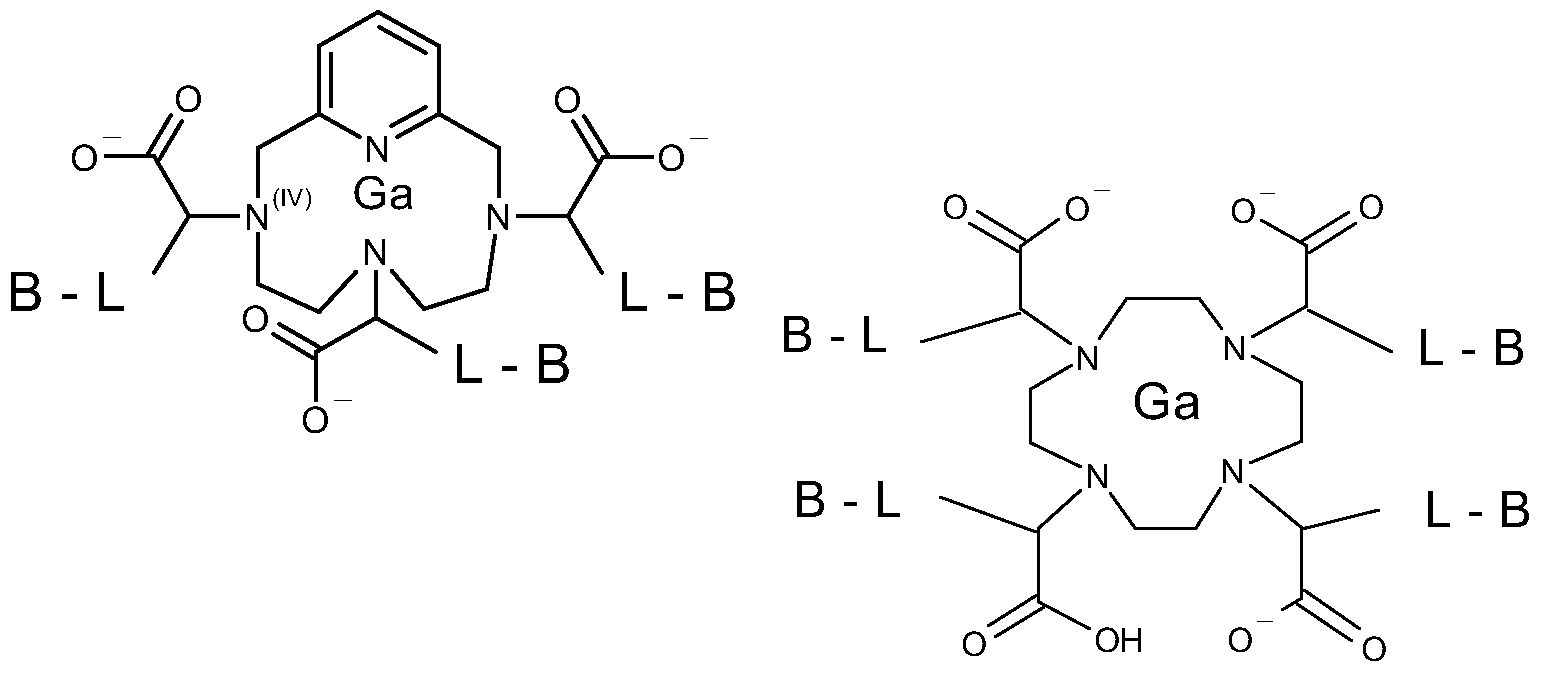
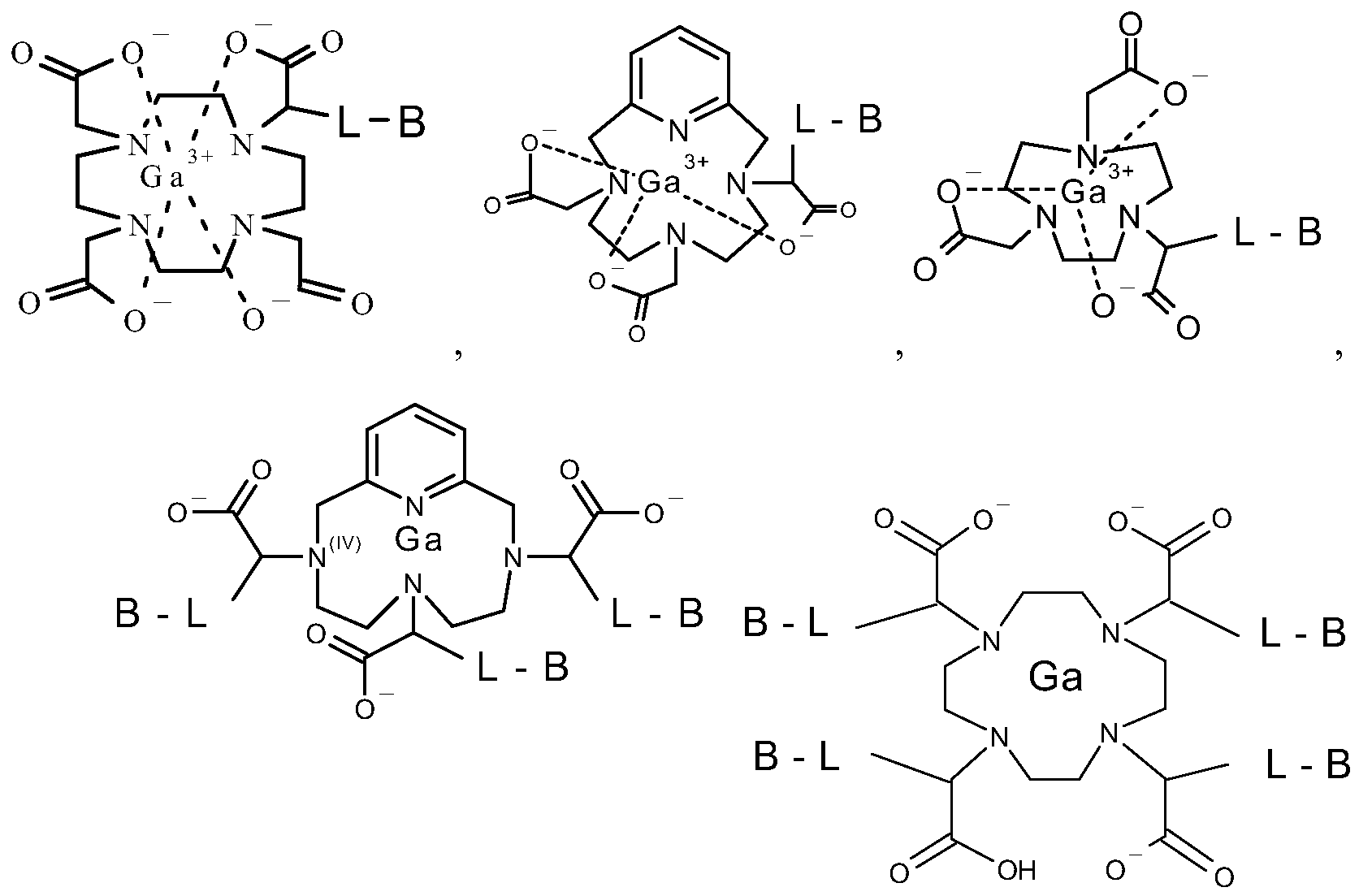
- M-M1-M2 form a pyridine ring or Ml and M2 are absent and M is a bond or M is NR and Ml and M2 represent a hydrogen atom or methyl with R is independently selected from CH 2 CO 2 - or H or CHX-CO 2 -, with at least one R being CHXCO 2 - and X being LB; especially the complexes of formulas:
- B is a biovector for targeting a biological target associated with a pathology, in particular chosen from enzymes (metalloproteases, COX, tyrosine kinase), cell receptors VEGF, KDR, CXC, LHRH, GPIIb / IIIa, bombesin / GRP , gastrin, VIP, CCK, GLUT, folate.
- enzymes metaloproteases, COX, tyrosine kinase
- L is a linker chosen from: a) P1-1-P2, with P1 and P2 identical or different chosen from O, S, NH, CO 2 , -NHCO, CONH, NHCONH, NHCSNH, SO 2 NH-, NHSO 2 -, and 1 represents an alkyl (advantageously C 1 -C 10 ), alkoxyalkyl (advantageously C 1 -C 10 ), polyalkoxyalkylene, alkyl interrupted by one or more squarate or by one or more aryls, advantageously phenyl, alkenyl ( preferably C 1 -C 6), alkynyl (preferably Ci-C 6) alkyl interrupted by one or more groups chosen from -NH-, -O-, -CO-, -NH (CO) -, - (CO ) NH-, -O (CO) -, or - (OC) O-;
- alkyl group advantageously C 1 -C 10
- alkyl group any alkyl group preferably of 1 to 10 carbon atoms, linear or branched, in particular, methyl, ethyl, n -propyl, iso- propyl, n-butyl, iso-butyl, sec-butyl, t-butyl, n-pentyl, n-hexyl.
- it is a methyl group.
- alkenyl group advantageously C 2 -C 6
- alkenyl group is intended to mean any alkenyl group advantageously of 2 to 6 carbon atoms, linear or branched, in particular the vinyl group.
- alkynyl group advantageously C 2 -C 6
- alkynyl group advantageously C 2 -C 6
- alkoxy group advantageously C 1 -C 10
- aryl group means one or more aromatic rings having 5 to 8 carbon atoms, which may be contiguous or fused, optionally substituted with halogen atoms, alkyl groups as defined above or the nitro group.
- the aryl groups may be monocyclic or bicyclic groups, preferably phenyl, naphthyl, tetrahydronaphthyl or indanyl.
- it is a phenyl group.
- heteroaryl group is intended to mean any hydrocarbon aromatic group of 3 to 9 atoms containing one or more heteroatoms, such as, for example, nitrogen or oxygen sulfur atoms, and capable of bearing one or more substituents, such as, for example, a C 1 -C 7 alkyl group as defined above, a C 2 -C 7 alkenyl group as defined above, or a halogen.
- heteroaryl groups are furyl, isoxazyl, pyridyl, pyrimidyl groups.
- Polyalkoxyalkylene is understood to mean a polyalkoxy (C 2 -C 3 ) alkylene (ie polyoxyethylenes and polyoxypropylenes), in particular polyethylene glycol PEG and its monoethers and C 1 to C 3 monoesters, with a molecular mass of preferably from 1000 to 2000.
- the expression "pharmacologically active molecule associated with a pathology" especially any biovector capable of specifically recognizing a biological target whose expression is modified in a pathological zone by report to the non-pathological state, which includes all the biovectors cited in the application.
- (L - B) represents CH 2 --CH 2 - CONH - Biovector or CH 2 - CH 2 - NHCO - Biovector, the biovectors B being identical or different from each other.
- the compounds according to the invention comprise at least one group capable of modifying the hydrophilicity or biodistribution of the compounds, or of masking the chelate so as not to alter the recognition of the biological target.
- this or these groups are advantageously grafted in place of a biovector B, for example of the compound:
- PART I Examples of macrocyclic chelates and biovectors coupled with chelates.
- Example 1 DOTA skeleton chelate
- Step 1 Benzyl ester of 5- (1,3-dioxo-1,3-dihydro-isoindol-2-yl) -2- (1H-octahydroxy-1-vinyl-ventanoic acid
- HBr 55 g of cyclen base (320 mmol) are dissolved in 550 mL of CH 3 CN, to which are added dropwise 119.8 g of bromo derivative (2-Bromo-5- (l, 3-dioxo-l, 3-dihydro- isoindol-2-yl) -pentanoic acid benzyl ester, 288 mmol) dissolved in 550 mL of
- Step 2 5- (1,3-Dioxo-1,3-dihydro-isoindol-2-yl) -2-benzyl acid benzyl ester
- Step 3 5-Amino-2- (4,7,10-tris-carboxymethyl) -1,4,7-tetraaza-cyclododec acid
- Step 4 5-Amino-2- (4,7,10-tris-carboxymethyl-1,4,7,10 tetraaza-cyclododec-1-yl) -yentanoic acid gallium complex
- Step 5 5- (2-Ethoxy-3,4-dioxo-cyclobut-1-enylamino) -2- (4,7,1-O-tris-carboxymethyl-1,4,7-tris-carboxymethyl) gallium complex 1 Otetraaza-cyclododec-1-yl) pentanoic
- Step 1 Coupling of peptides # 1, 2, 3, 4, 5 or 6 of the squarate derivative
- the compound obtained in Step 5 of Example 14 (lOO ⁇ g, 1.53 10 -7 mol) was dissolved in 15 ⁇ l of aqueous solution of Na 2 CO 3 pH 9.4.
- the protected peptide (1.6 ⁇ 10 -7 mol) is introduced while maintaining the pH at 9.4 by addition of Na 2 CO 3 . If the peptide is not soluble in water some microdroplets of DMF are added until complete dissolution. After 48 hours of reaction at ambient temperature, the medium is precipitated in an ethanol / ethyl ether mixture. The precipitate is filtered and then dried.
- Step 2 deprotection
- step 1 The compound obtained in step 1 is dissolved in a mixture of 10 .mu.l of TFA / TIS / H2O in the proportions 90/5/5.
- the medium is stirred for 5 hours at ambient temperature and the solvent is then evaporated off under reduced pressure.
- the residue is taken up in ethyl ether and the precipitate is filtered and dried.
- the product is then purified by preparative HPLC on a Symmetry® column with an eluent consisting of water / TFA PH 3 / CH 3 CN
- a solution containing 0.10 mmol of ammonia in 20 ⁇ l of water is prepared.
- the pH is adjusted to 6 with HCl.
- 1.8 mg of 3,6,9,15-tetraazabicyclo [9.3.1] pentadec-1 (15), 11,13-triene-3,6 gallium complex of gallium complex are added to the above solution.
- 9-tri (-glutaric) 0.2 mg of HOBT, 2.5 mg of EDCI and 15 ⁇ l of dioxane.
- the pH is adjusted to 6. After 24 hours, the reaction medium is concentrated to about 7 ml.
- the reaction medium is precipitated in 70 ⁇ L of ethanol + 20 ⁇ L of ether.
- the solid is filtered and then purified by chromatography on silanized silica RP2 eluting with water. 1.2 mg of product is obtained.
- a solution containing 0.26 mg of 3-amino-propane-1,2-diol in 6 ⁇ l of water is prepared.
- the pH is adjusted to 6 with HCl.
- 0.5 mg of 2- [4,7-bis (1,4-dicarboxy-butyl) -1,4,7,10-tetraaza-cyclododec-1-yl) gallium complex are added to the preceding solution.
- the pH is adjusted again before adding 0.071 mg of sulfo-NHS and 0.062 mg of EDCI
- the pH is controlled and adjusted to 6 with 2N NaOH
- the reaction medium is concentrated to about 2ml then precipitated in 10ml of ethanol.
- the solid is filtered, washed with ethanol and diethyl ether and then purified on silanized silica RP2 with elution with water only. 0.2 mg of product is obtained.
- aminoalcohol chains of this example 3b are an example of hydrophilic groups which can improve the hydrophilicity and, where appropriate, the masking of the chelate described in the application.
- This compound is prepared according to the following synthesis scheme starting from commercial triaza-1,4,7-cyclononane according to the procedures described in Example 1.
- Example 6 The compound obtained in the preceding example is coupled according to the procedure described in step 1 of Example 2 to a series of peptides whose sequence is given in Example 2. The deprotection is carried out according to the method described in step 2 of example 2.
- Example 6
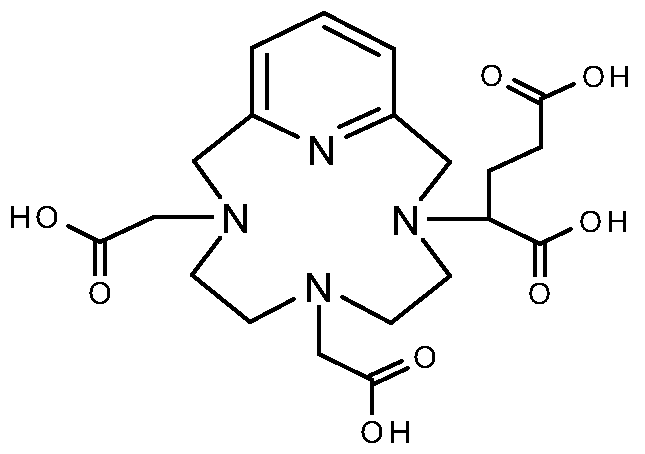
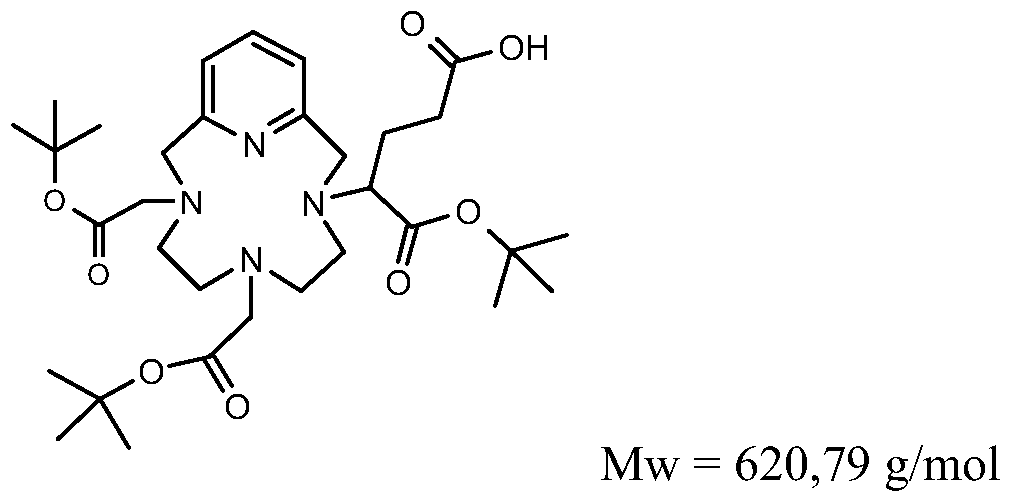
- Step 1 Diethyl ester of 2- (3,6,9,15-tetraaza-bicyclo [9.3.1] pentadeca-1 (15), 11,13-trien-3-yl) -pentanedioic acid
- Step 2 2- (6,9-Bis-ethoxycarbonylmethyl) -3,6,9,15-tetraaza-bicylate-9.3.1 -pentadecanoyl (15X11.13-trien-3-yl) -pentanedioic acid diethyl ester
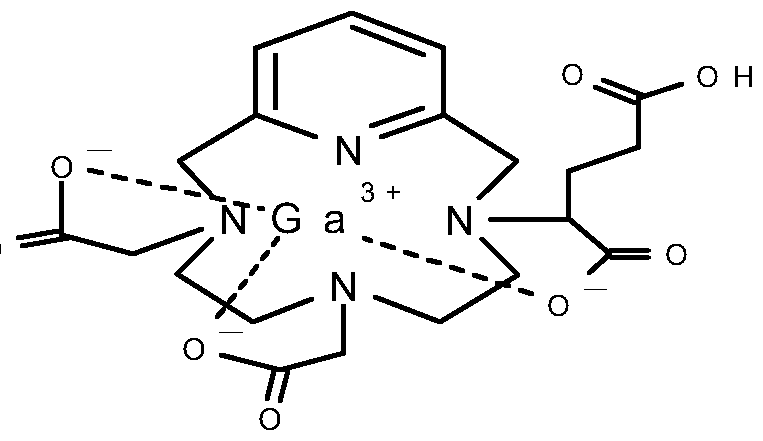
- Step 4 Gallium complex of 2- (6,9-Bis-carboxymethyl-3,6,9,15-tetraaza-bicyclo [9.3.1 lventadeca-1 (15), 11,13-triethylene 3-yl) -ventanedioigue
- EXAMPLE 7 The compound obtained in the preceding example is coupled according to the procedure described in Example 2 to a series of peptides whose sequence is given in Example 2. The deprotection is carried out according to the method described in Step 2 of Example 2.
- Example 8 (4,7-O-Tris-tert-butoxycarbonylmethyl-17A-tetraaza-cyclododec-1-yl) -acetic acid
- Step 1
- Solvent A formic acid 0.05%
- Solvent B CH 3 CN (+ formic acid 0.04%)
- Solvent A 0.05% formic acid
- Example 9 The compound obtained in Example 8 is coupled to a series of peptides whose sequences are given in Example 2 according to the following procedure.
- Step 1 Coupling Peptides Nos. 1, 2, 3, 4, 5 or 6 to the compound of Example 8 0.4 g of the compound obtained in Example 8 (0.7 mmol), 144 mg of DCC (0) 7 mmol) and 80 mg of NHS (0.7 mmol) are stirred in 10 ml of CH 2 Cl 2 for 20 min at RT. 20 ml of a solution of protected peptide (0.7 mmol) and triethylamine (1.4 mmol) in DMSO are added to the preactivated ester. After 30 minutes, the reaction medium is precipitated in 450 ml of ethyl ether. The precipitate is filtered and dried.
- Step 2 The deprotection is carried out according to the method described in step 2 of example 2.
- step 2 The compound obtained in step 2 (0.041 mmol) is dissolved in 1 ml of acetate buffer
- Example 8 The compound obtained in Example 8 is coupled to a series of folic acid derivatives
- derivative No. 9 The synthesis of derivative No. 9 is carried out from derivative 8 which is condensed in the linker whose structure is as follows.
- this linker is synthesized in 4 steps from 4,7,10-trioxa-1,13-tridecanediamine monoBoc (compound a) of Example 15 in the specific patent). Step 1 :
- Step 1 and 2 corresponding to the coupling of the folic acid derivatives No. 7, 8 or 9 on the acid derivative of Example 8 and the deprotection are carried out according to the same procedure as that described in Example 9 Step 3: 0.041 mmol complexation of the compound obtained in step 2 are dissolved in 1 ml of water. Anhydrous gallium chloride (0.041 mmol) is added, and the reaction medium is heated at 80 ° C. for 10 min. The reaction medium is concentrated.
- linker-biovector set on a single carboxylic function has been described in detail. Similarly, using appropriate protections / deprotections, several linker-biovector sets are coupled to the chelate, advantageously 3 or 4 sets (one set per carboxylic function).
- Example 11 4- (4-Isothiocvanato-phenyl) -2- (4,7-O-Tris-tert-butoxycarbonylmethyl-1, 4,7,1-tetraaza-cyclododec-1-yl) butyric acid tert-butyl ester
- Step 1 Same as Example 8 Step 2:
- Example 11 The compound obtained in Example 11 is coupled to a series of peptides whose sequences are given in Example 2 according to the following procedure.
- Step 1 Addition of Peptides Nos. 1, 2, 3, 4, 5 or 6 to the derivative of Example 11 1.2 g (1.5 mmol) of the compound obtained in Example 11 are solubilized in 30 ml of DMSO. The protected peptide (1.5 mmol) and 3 mmol of triethylamine are stirred for 24 hours. The reaction medium is then precipitated in 500 ml of diethyl ether.
- Step 2 and 3 Deprotection and complexation are performed as in Example 9 (step 2 and 3).
- Example 11 The compound of Example 11 was coupled to a series of folic acid derivatives whose structures are described in Example 10.
- the steps 1 and 2 corresponding to the coupling and deprotection steps are conducted in the same manner.
- procedure described in Example 12 step 1 and 2).
- the complexation is carried out under the same conditions as in step 3 of Example 10.
- Example 14 r4,7-Bis-tert-butoxycarbonylmethyl-10- (4-Isothiocvanato-benzyl) -1,4,7-tetraaza-cyclododec-1-yl) -acetic acid tert-butyl ester
- Step 1 Same as Example 8 Step 2:
- Example 14 The compound obtained in Example 14 is coupled to a series of peptides whose sequences are given in Example 2 according to the same procedure as that described in Example 12.
- Example 14 The compound of Example 14 was coupled to a series of folic acid derivatives whose structures are described in Example 10 according to the same procedure as in Example 13.
- Example 17 5- (2-Ethoxy-3,4-dioxo-cyclobut-1-enylamino) -2,7,7,0-tris-tert-butoxycarbonylmethyl-1, 4.7.1 Otetraaza-cyclododec-1-yl) -pentanoic acid ter-butyl ester
- Step 1 Same as Example 8 Step 2:
- Example 17 The compound obtained in Example 17 is coupled to a series of peptides whose sequences are given in Example 2.
- Step 2 same procedure as that described in Example 2.
- Step 3 The complexation is carried out according to the same procedure as in step 3 of Example 9.
- Example 17 The compound of Example 17 was coupled to a series of folic acid derivatives whose structures are described in Example 10.
- Step 2 same procedure as that described in Example 2.
- Step 3 The complexation is carried out according to the same procedure as in step 3 of Example 10.
- Step 1 Same as Example 8 Step 2:
- Example 20 The compound obtained in Example 20 is coupled to a series of peptides whose sequences are given in Example 2 according to the same procedure as that described in Example 9.
- Example 23 The compound obtained in Example 23 is coupled to a series of peptides whose sequences are given in Example 2 according to the same procedure as that described in Example 9. The products obtained are identical to those of the example 7.
- Step 3 and 4 same procedure as in step 3 and 4 of Example 17
- Step 1 Coupling scaffolds on the compound obtained in step 3 of Example 17. 5 mmol of scaffold, DCC Ig (5 mmol) and 0.6 g of NHS (5 mmol) are stirred in 50 ml of CH 2 Cl 2 for 20 min at RT. 20 ml of a solution of the compound obtained in step 3 of Example 17 (5 mmol) and triethylamine (5 mmol) in DMSO are added to the preactivated ester. After 30 minutes, the reaction medium is precipitated in 600 ml of ethyl ether. The precipitate is filtered and dried. Step 2 and 3: deprotection and complexation step same procedure as steps 2 and 3 of Example 9
Landscapes
- Health & Medical Sciences (AREA)
- Life Sciences & Earth Sciences (AREA)
- Chemical & Material Sciences (AREA)
- Epidemiology (AREA)
- Veterinary Medicine (AREA)
- Public Health (AREA)
- General Health & Medical Sciences (AREA)
- Animal Behavior & Ethology (AREA)
- Medicinal Chemistry (AREA)
- Proteomics, Peptides & Aminoacids (AREA)
- Organic Chemistry (AREA)
- Nuclear Medicine, Radiotherapy & Molecular Imaging (AREA)
- Radiology & Medical Imaging (AREA)
- Optics & Photonics (AREA)
- Physics & Mathematics (AREA)
- Pharmacology & Pharmacy (AREA)
- Medicines Containing Antibodies Or Antigens For Use As Internal Diagnostic Agents (AREA)
- Nitrogen Condensed Heterocyclic Rings (AREA)
- Steroid Compounds (AREA)
- Plural Heterocyclic Compounds (AREA)
- Peptides Or Proteins (AREA)
- Nitrogen And Oxygen Or Sulfur-Condensed Heterocyclic Ring Systems (AREA)
- Medicines That Contain Protein Lipid Enzymes And Other Medicines (AREA)
- Magnetic Resonance Imaging Apparatus (AREA)
- Nuclear Medicine (AREA)
Abstract
Description













Claims


Priority Applications (5)
| Application Number | Priority Date | Filing Date | Title |
|---|---|---|---|
| EP06807097.8A EP1940841B9 (fr) | 2005-10-07 | 2006-10-09 | Composes comprenant une partie de reconnaissance d'une cible biologique, couplee a une partie de signal capable de complexer le gallium |
| JP2008534028A JP5368099B2 (ja) | 2005-10-07 | 2006-10-09 | ガリウムと錯体形成することが可能なシグナル部分にカップリングされた、生物学的標的の認識のための部分を含んでなる化合物 |
| US12/083,269 US8926945B2 (en) | 2005-10-07 | 2006-10-09 | Compounds comprising a biological target recognizing part, coupled to a signal part capable of complexing gallium |
| CA2625196A CA2625196C (fr) | 2005-10-07 | 2006-10-09 | Composes comprenant une partie de reconnaissance d'une cible biologique, couplee a une partie de signal capable de complexer le gallium |
| US13/205,352 US8986650B2 (en) | 2005-10-07 | 2011-08-08 | Complex folate-NOTA-Ga68 |
Applications Claiming Priority (4)
| Application Number | Priority Date | Filing Date | Title |
|---|---|---|---|
| FR0510289 | 2005-10-07 | ||
| FR0510289A FR2891830B1 (fr) | 2005-10-07 | 2005-10-07 | Composes a chaines aminoalcools courtes et complexes metalliques pour l'imagerie medicale |
| FR0602975 | 2006-04-05 | ||
| FR0602975A FR2899585B1 (fr) | 2006-04-05 | 2006-04-05 | Composes comprenant une partie de reconnaissance d'une cible biologique, couplee a une partie de signal capable de complexer le gallium |
Related Child Applications (2)
| Application Number | Title | Priority Date | Filing Date |
|---|---|---|---|
| US12/083,269 A-371-Of-International US8926945B2 (en) | 2005-10-07 | 2006-10-09 | Compounds comprising a biological target recognizing part, coupled to a signal part capable of complexing gallium |
| US13/205,352 Continuation-In-Part US8986650B2 (en) | 2005-10-07 | 2011-08-08 | Complex folate-NOTA-Ga68 |
Publications (2)
| Publication Number | Publication Date |
|---|---|
| WO2007042504A2 true WO2007042504A2 (fr) | 2007-04-19 |
| WO2007042504A3 WO2007042504A3 (fr) | 2008-02-28 |
Family
ID=37943164
Family Applications (1)
| Application Number | Title | Priority Date | Filing Date |
|---|---|---|---|
| PCT/EP2006/067211 Ceased WO2007042504A2 (fr) | 2005-10-07 | 2006-10-09 | Composes comprenant une partie de reconnaissance d'une cible biologique, couplee a une partie de signal capable de complexer le gallium |
Country Status (5)
| Country | Link |
|---|---|
| US (1) | US8926945B2 (fr) |
| EP (1) | EP1940841B9 (fr) |
| JP (2) | JP5368099B2 (fr) |
| CA (1) | CA2625196C (fr) |
| WO (1) | WO2007042504A2 (fr) |
Cited By (43)
| Publication number | Priority date | Publication date | Assignee | Title |
|---|---|---|---|---|
| FR2914303A1 (fr) * | 2007-03-28 | 2008-10-03 | Guerbet Sa | Composes pour le diagnostic de l'apoptose. |
| DE202008010019U1 (de) | 2008-02-19 | 2009-08-06 | Guerbet | Pharmazeutische Formulierung von Kontrastmitteln |
| DE102008045937A1 (de) * | 2008-04-11 | 2009-10-15 | Johannes-Gutenberg-Universität Mainz | Verbindung aus einem Metallion und einem Markierungsvorläufer und Verwendung der Verbindung |
| US7700087B2 (en) | 1997-09-11 | 2010-04-20 | Cambridge Enterprise Limited | Compounds and methods to inhibit or augment an inflammatory response |
| WO2010092114A1 (fr) | 2009-02-13 | 2010-08-19 | Guerbet | Utilisation de tampons pour la complexation de radionucléides |
| JP2011509304A (ja) * | 2008-01-09 | 2011-03-24 | モレキュラ インサイト ファーマシューティカルズ インコーポレイテッド | 炭酸脱水酵素ixの阻害剤 |
| US7989466B2 (en) | 1999-03-17 | 2011-08-02 | Cambridge Enterprise Limited | Methods to inhibit or augment an inflammatory response |
| US8008283B2 (en) | 1998-12-23 | 2011-08-30 | Neurotherapeutics Pharma, Inc. | Methods and compositions for the treatment of neuropsychiatric disorders |
| WO2013024035A1 (fr) * | 2011-08-17 | 2013-02-21 | Merck & Cie | Conjugués avec des folates d'entités de liaison de l'albumine |
| WO2013037957A1 (fr) | 2011-09-15 | 2013-03-21 | Guerbet | Procede de purification de produits de contraste |
| CN103732563A (zh) * | 2011-08-22 | 2014-04-16 | 默克及其合伙人公司 | 18f-糖-叶酸类 |
| WO2014114724A1 (fr) | 2013-01-23 | 2014-07-31 | Guerbet | Magneto-emulsion vectorisee |
| US8840865B2 (en) | 2008-01-09 | 2014-09-23 | Molecular Insight Pharmaceuticals, Inc. | Technetium- and rhenium-bis(heteroaryl) complexes and methods of use thereof |
| US8926945B2 (en) | 2005-10-07 | 2015-01-06 | Guerbet | Compounds comprising a biological target recognizing part, coupled to a signal part capable of complexing gallium |
| US8934959B2 (en) | 2008-07-09 | 2015-01-13 | Koninklijke Philips N.V. | Physiological pharmacokinetic analysis for combined molecular MRI and dynamic PET imaging |
| US8986650B2 (en) | 2005-10-07 | 2015-03-24 | Guerbet | Complex folate-NOTA-Ga68 |
| US9120837B2 (en) | 2012-01-06 | 2015-09-01 | Molecular Insight Pharmaceuticals | Metal complexes of poly(carboxyl)amine-containing ligands having an affinity for carbonic anhydrase IX |
| US9149547B2 (en) | 2009-06-15 | 2015-10-06 | Molecular Insight Pharmaceuticals, Inc. | Process for production of heterodimers of glutamic acid |
| US20150307524A1 (en) * | 2007-01-11 | 2015-10-29 | Immunomedics, Inc. | Methods and Compositions for Improved F-18 Labeling of Proteins, Peptides and Other Molecules |
| CN108514646A (zh) * | 2013-11-14 | 2018-09-11 | 恩多塞特公司 | 用于正电子发射断层术的化合物 |
| US10086096B2 (en) | 2013-01-14 | 2018-10-02 | Molecular Insight Pharmaceuticals, Inc. | Triazine based radiopharmaceuticals and radioimaging agents |
| US10406240B2 (en) | 2007-08-17 | 2019-09-10 | Purdue Research Foundation | PSMA binding ligand-linker conjugates and methods for using |
| US10557128B2 (en) | 2010-02-25 | 2020-02-11 | Purdue Research Foundation | PSMA binding ligand-linker conjugates and methods for using |
| US10898596B2 (en) | 2015-01-07 | 2021-01-26 | Endocyte, Inc. | Conjugates for imaging |
| US10912840B2 (en) | 2012-11-15 | 2021-02-09 | Endocyte, Inc. | Conjugates for treating diseases caused by PSMA expressing cells |
| WO2024046833A1 (fr) | 2022-08-30 | 2024-03-07 | Bayer Aktiengesellschaft | Génération d'images radiologiques synthétiques |
| WO2024046831A1 (fr) | 2022-08-30 | 2024-03-07 | Bayer Aktiengesellschaft | Génération d'images radiologiques de synthese |
| WO2024046832A1 (fr) | 2022-08-30 | 2024-03-07 | Bayer Aktiengesellschaft | Génération d'images radiologiques synthétiques |
| WO2024052156A1 (fr) | 2022-09-05 | 2024-03-14 | Bayer Aktiengesellschaft | Génération d'images radiologiques améliorées par contraste artificiel |
| US11931430B2 (en) | 2013-10-18 | 2024-03-19 | Novartis Ag | Labeled inhibitors of prostate specific membrane antigen (PSMA) as agents for the treatment of prostate cancer |
| WO2024083466A1 (fr) | 2022-10-17 | 2024-04-25 | Bayer Aktiengesellschaft | Analyse automatisée d'images radiologiques |
| EP4369353A1 (fr) | 2022-11-12 | 2024-05-15 | Bayer Aktiengesellschaft | Génération d'enregistrements radiologiques artificiels renforcés par un agent de contraste |
| WO2024245867A1 (fr) | 2023-05-30 | 2024-12-05 | Bayer Aktiengesellschaft | Identification d'artefacts dans des enregistrements médicaux synthétiques |
| EP4475137A1 (fr) | 2023-06-05 | 2024-12-11 | Bayer AG | Génération d'enregistrements radiologiques artificiels à contraste amélioré |
| WO2024251601A1 (fr) | 2023-06-05 | 2024-12-12 | Bayer Aktiengesellschaft | Génération d'images radiologiques artificielles à contraste amélioré |
| US12208102B2 (en) | 2018-04-17 | 2025-01-28 | Endocyte, Inc. | Methods of treating cancer |
| EP4498324A1 (fr) | 2023-07-25 | 2025-01-29 | Bayer AG | Détection d'artéfacts dans des images synthétiques |
| EP4567716A1 (fr) | 2023-12-06 | 2025-06-11 | Bayer Aktiengesellschaft | Génération de représentations synthétiques |
| EP4567715A1 (fr) | 2023-12-06 | 2025-06-11 | Bayer Aktiengesellschaft | Génération de représentations synthétiques |
| WO2025190828A1 (fr) | 2024-03-15 | 2025-09-18 | Bayer Aktiengesellschaft | Correction d'une image irm |
| EP4664393A1 (fr) | 2024-06-10 | 2025-12-17 | Bayer Aktiengesellschaft | Génération d'enregistrements radiologiques synthétiques à contraste amélioré |
| US12558439B2 (en) | 2018-02-23 | 2026-02-24 | Sanochemia Pharmazeutika GmbH | Process for producing a contrast agent |
| US12655115B2 (en) | 2020-11-19 | 2026-06-16 | Novartis Ag | Synthesis of prostate specific membrane antigen (PSMA) ligands |
Families Citing this family (20)
| Publication number | Priority date | Publication date | Assignee | Title |
|---|---|---|---|---|
| WO2010066051A1 (fr) * | 2008-12-12 | 2010-06-17 | The Royal Institution For The Advancement Of Learning/Mcgill University | Dérivés de thiol-nota pour radiomarquage par kit 68ga |
| GB201019118D0 (en) * | 2010-11-11 | 2010-12-29 | King S College | Conjugates and their uses in molecular imaging |
| EP3747891A3 (fr) * | 2012-05-21 | 2021-03-24 | Agilent Technologies, Inc. | Compositions et procédés de conjugaison d'oligonucléotides |
| CN103435684B (zh) * | 2013-09-23 | 2015-10-28 | 武汉工程大学 | 18f-氟标记五肽配合物及合成方法 |
| US9890190B2 (en) | 2015-02-24 | 2018-02-13 | Agilent Technologies, Inc. | Preparation of long synthetic oligonucleotides by squarate conjugation chemistry |
| EP3380473A1 (fr) | 2015-11-26 | 2018-10-03 | Debreceni Egyetem | Nouveaux composés 2, 1 l-diaza-[3,3](2,6)pyridinophane et leur application comme ligands d'agents de contraste irm à base de d'ions métalliques essentiels et d'agents de contraste tep à base de 52mn |
| US10568976B2 (en) | 2015-11-26 | 2020-02-25 | Debreceni Egyetem | 3,6,9, 15-tetraaza-bicyclo [9.3.1 ]pentadeca-1(14), 11(15), 12-triene based compounds and their application as ligands of essential metal ion based MRI and 52MN based PET contrast agents |
| EP3380484A1 (fr) | 2015-11-26 | 2018-10-03 | Debreceni Egyetem | Nouveaux composés à base de dérivés de 6-oxa-3,9,15-triaza-bicyclo[9.3.1]pentadéca-1(14),11(15),12-triene et leur application à titre de ligands d'agents de contraste irm essentiels à base d'ions métalliques et d'agents de contraste pet essentiels à base de 52mn |
| KR102190674B1 (ko) * | 2017-12-20 | 2020-12-14 | (주)경인양행 | 리간드 화합물이 결합된 사카린 나트륨, 그 유도체 및 그 제조방법 |
| KR102232979B1 (ko) * | 2018-03-22 | 2021-03-29 | 경북대학교 산학협력단 | Do3a 가돌리늄 착물의 신규한 구조를 갖는 화합물, 이를 포함하는 항염증제 및 조영제 |
| DE102018126558A1 (de) * | 2018-10-24 | 2020-04-30 | Helmholtz-Zentrum Dresden - Rossendorf E.V. | Markierungsvorläufer mit Quadratsäure-Kopplung |
| EP3972627A4 (fr) | 2019-05-20 | 2023-06-21 | Endocyte, Inc. | Procédés de préparation de conjugués psma |
| WO2021142258A1 (fr) * | 2020-01-10 | 2021-07-15 | Fusion Pharmaceuticals Inc. | Chélates macrocycliques et leurs utilisations |
| HUE064567T2 (hu) * | 2020-07-16 | 2024-03-28 | Guerbet Sa | Eljárás 2-bróm-glutársav-diészterek elõállítására |
| CN113277989B (zh) * | 2021-04-27 | 2022-05-31 | 中南大学湘雅医院 | 一种68Ga标记的分子探针、制备方法及其应用 |
| EP4408839A4 (fr) * | 2021-09-29 | 2025-08-06 | Univ Melbourne | Composés contenant un macrocycle et leurs complexes radiomarqués, utilisés en tant que ligands dans des applications de radiothérapie ciblée |
| KR102785276B1 (ko) * | 2022-05-02 | 2025-03-21 | (주)에트노바테라퓨틱스 | 가돌리늄 착물을 함유하는 do3a 기반의 혈전억제제 또는 혈액용해제 |
| CN116496227A (zh) * | 2023-05-09 | 2023-07-28 | 郑州药领医药科技有限公司 | 一种高纯度dotaga中间体的制备方法 |
| WO2026019458A1 (fr) * | 2024-07-19 | 2026-01-22 | Monopar Therpeutics, Inc | Chélateurs bifonctionnels de squaramide et produits radiopharmaceutiques associés et procédés d'utilisation |
| CN121717810B (zh) * | 2026-02-25 | 2026-06-23 | 天津医科大学 | 一种新型铋基螯合物ct对比剂及其制备方法和应用 |
Family Cites Families (108)
| Publication number | Priority date | Publication date | Assignee | Title |
|---|---|---|---|---|
| US4017596A (en) * | 1975-03-03 | 1977-04-12 | Research Corporation | Radiopharmaceutical chelates and method of external imaging |
| US5334371A (en) | 1988-07-20 | 1994-08-02 | Schering Aktiengesellschaft | Marcocyclic polyaza bicyclo compounds containing 5 or 6 membered rings, and method for MRI |
| DE3825040A1 (de) | 1988-07-20 | 1990-01-25 | Schering Ag, 13353 Berlin | 5- oder 6-ring- enthaltende makrocyclische polyaza-verbindungen, verfahren zu ihrer herstellung und diese enthaltende pharmazeutische mittel |
| DE4001655A1 (de) | 1990-01-18 | 1991-07-25 | Schering Ag | 6-ring enthaltende makrocyclische tetraaza-verbindungen, verfahren zu ihrer herstellung und diese enthaltende pharmazeutische mittel |
| US5688488A (en) | 1989-04-03 | 1997-11-18 | Purdue Research Foundation | Composition and method for tumor imaging |
| CA2027936C (fr) | 1989-10-23 | 2001-07-24 | Smithkline Beecham Corporation | Peptides cycliques anti-agregants |
| US5079346A (en) * | 1990-05-01 | 1992-01-07 | Trustees Of The University Of Pennsylvania | Gallium-labelled imaging agents |
| US5965132A (en) | 1992-03-05 | 1999-10-12 | Board Of Regents, The University Of Texas System | Methods and compositions for targeting the vasculature of solid tumors |
| US5324502A (en) * | 1992-04-02 | 1994-06-28 | Purdue Research Foundation | Radiopharmaceuticals for imaging the heart |
| US5716596A (en) | 1992-06-23 | 1998-02-10 | Diatide, Inc. | Radioactively labeled somatostatin-derived peptides for imaging and therapeutic uses |
| WO1994004485A1 (fr) * | 1992-08-19 | 1994-03-03 | Mallinckrodt Medical, Inc. | LIGANDS UTILISES DANS LA TOMOGRAPHIE CARDIAQUE A POSITONS REALISEE AVEC DU Ga-68 |
| FR2695125B1 (fr) | 1992-08-25 | 1994-12-23 | Guerbet Sa | Nouveaux composés poly-iodés, procédé de préparation, produit de contraste les contenant. |
| WO1994005269A1 (fr) | 1992-09-08 | 1994-03-17 | Centocor, Inc. | Inhibiteurs peptidiques de fixation de la selectine |
| ES2156143T3 (es) | 1993-12-30 | 2001-06-16 | Guerbet Sa | Ligandos poliaminados, complejos metalicos, procedimiento de preparacion, aplicaciones diagnosticas y terapeuticas. |
| IT1269839B (it) | 1994-05-26 | 1997-04-15 | Bracco Spa | Coniugati di acidi biliari, loro derivati con complessi metallici e relativi usi |
| DE19505960A1 (de) | 1995-02-21 | 1996-08-22 | Deutsches Krebsforsch | Konjugat zur individuellen Dosierung von Arzneimitteln |
| US5707605A (en) | 1995-06-02 | 1998-01-13 | Research Corporation Technologies | Magnetic resonance imaging agents for the detection of physiological agents |
| ATE314097T1 (de) | 1996-10-28 | 2006-01-15 | Amersham Health As | Kontrastmittel |
| US6045774A (en) | 1997-01-10 | 2000-04-04 | Epicyte Pharmaceutical Inc. | J chain polypeptide targeting molecule linked to an imaging agent |
| WO1998039288A1 (fr) * | 1997-03-07 | 1998-09-11 | Nycomed Amersham Plc | Imines polydentes et leurs complexes metalliques |
| EP1034796A1 (fr) | 1997-03-18 | 2000-09-13 | Nihon Schering K. K. | Milieux de contraste pour irm, reconnaissant les modifications de l'environnement |
| CA2320339A1 (fr) | 1998-02-11 | 1999-08-19 | Resolution Pharmaceuticals Inc. | Molecules ciblant l'angiogenese |
| US6537520B1 (en) | 1998-03-31 | 2003-03-25 | Bristol-Myers Squibb Pharma Company | Pharmaceuticals for the imaging of angiogenic disorders |
| WO1999050249A2 (fr) | 1998-04-01 | 1999-10-07 | Du Pont Pharmaceuticals Company | Antagonistes de l'integrine |
| CA2326978A1 (fr) | 1998-04-03 | 1999-10-14 | Milind Rajopadhye | Produits radiopharmaceutiques pour visualiser des infections et des inflammations et pour visualiser et traiter le cancer |
| IL139187A0 (en) | 1998-04-23 | 2001-11-25 | Cortech Inc | Cysteine protease inhibitors |
| US6071490A (en) | 1998-05-07 | 2000-06-06 | Immunomedics, Inc. | Position emission tomography using gallium-68 chelates |
| WO2000021980A1 (fr) | 1998-10-13 | 2000-04-20 | Du Pont Pharmaceuticals Company | Utilisation de desintegrines synthetiques mimetiques arg-gly-asp (rgd) incorporees dans un chelateur comme agents d'imagerie |
| NZ511677A (en) | 1998-12-18 | 2003-10-31 | Du Pont Pharm Co | Vitronectin receptor antagonist pharmaceuticals |
| ES2321054T3 (es) | 1999-01-19 | 2009-06-02 | Molecular Insight Pharmaceuticals, Inc. | Conjugados de factores estimulantes de colonias de granulocitos para direccionamiento y formacion de imagenes de infeccion e inflamacion. |
| US6171578B1 (en) | 1999-04-14 | 2001-01-09 | Diatide, Inc. | Benzodiazepine derivatives for imaging thrombi |
| FR2793795B1 (fr) | 1999-05-21 | 2001-08-03 | Guerbet Sa | Isomeres de tetramides du complexe de gadolinium de l'acide (1,4,7,10-tetrazacyclododecane)1,4,7,10-tetra(2-glutarique) leur procede de preparation et leur application en imagerie medicale |
| FR2794744B1 (fr) * | 1999-06-09 | 2001-09-21 | Guerbet Sa | Complexes metalliques de polyaminoacides bicycliques, leur procede de preparation et leur application en imagerie medicale |
| CA2377018A1 (fr) | 1999-06-29 | 2001-01-04 | Mary M. Dyszlewski | Complexes de metaux de transition du groupe vii a ligands multicoordinants aminopolycarboxylate et trousse de production correspondante |
| EP1203026A4 (fr) | 1999-07-29 | 2005-03-16 | Dyax Corp | Fractions se liant la fibrine |
| AU6522400A (en) | 1999-08-10 | 2001-03-05 | Imarx Therapeutics, Inc. | Targeted thrombolytic agents |
| AU2001236485A1 (en) | 2000-01-21 | 2001-07-31 | Mallinckrodt, Inc. | Novel orthogonally protected amino acid chelators for biomedical applications |
| US20030082106A1 (en) * | 2000-01-22 | 2003-05-01 | Aleksandr Nivorozhkin | Magnetic resonance imaging using contrast agents bioactivated by enzymatic cleavage |
| US6656448B1 (en) | 2000-02-15 | 2003-12-02 | Bristol-Myers Squibb Pharma Company | Matrix metalloproteinase inhibitors |
| US6565828B2 (en) | 2000-04-07 | 2003-05-20 | Bristol-Myers Squibb Company | Macrocyclic chelants for metallopharmaceuticals |
| US6534038B2 (en) | 2000-04-07 | 2003-03-18 | Bristol-Myers Squibb Pharma Company | Ternary ligand complexes useful as radiopharmaceuticals |
| JP5043271B2 (ja) | 2000-04-12 | 2012-10-10 | ジーイー・ヘルスケア・アクスイェ・セルスカプ | ペプチドベースの化合物 |
| AU7748801A (en) | 2000-05-12 | 2002-04-02 | Mallinckrodt Inc | Prochelators for the preparation of radiometal labeled molecules having improvedbiological properties |
| EP1311292A2 (fr) | 2000-06-21 | 2003-05-21 | Bristol-Myers Squibb Pharma Company | Agents pharmaceutiques antagonistes du recepteur de la vitronectine |
| EP1296678A2 (fr) | 2000-06-21 | 2003-04-02 | Bristol-Myers Squibb Pharma Company | Produits pharmaceutiques d'antagonistes recepteurs de la vitronectine utilises en polytherapie |
| PT1292335E (pt) | 2000-06-23 | 2007-08-13 | Bayer Schering Pharma Ag | Combinações e composições que interferem na função de receptores vegf/vegf e angiopoietina/ tie e a sua utilização (ii) |
| US7311893B2 (en) | 2000-07-25 | 2007-12-25 | Neurochem (International) Limited | Amyloid targeting imaging agents and uses thereof |
| NO20004795D0 (no) | 2000-09-26 | 2000-09-26 | Nycomed Imaging As | Peptidbaserte forbindelser |
| WO2002028441A2 (fr) | 2000-10-04 | 2002-04-11 | California Institute Of Technology | Agents d'imagerie par resonance magnetique pour la detection et l'etiquetage in vivo de depots amyloides |
| WO2002032292A2 (fr) | 2000-10-18 | 2002-04-25 | The Board Of Trustess Of The Leland Stanford Junior University | Procedes pour la mise au point et l'utilisation d'agents diagnostiques et therapeutiques |
| WO2002040060A2 (fr) | 2000-10-31 | 2002-05-23 | Bracco International Bv | Conjugues d'antioxydants et de ligands de chelation metallique destines a des applications diagnostiques et therapeutiques |
| WO2002038546A1 (fr) | 2000-11-08 | 2002-05-16 | K.U. Leuven Research & Development | Derives de bis-indole substitue utilises comme agents de contraste, compositions pharmaceutiques contenant lesdits derives et intermediaires permettant de preparer ces derives |
| EP1337278A2 (fr) | 2000-11-27 | 2003-08-27 | Bristol-Myers Squibb Medical Imaging, Inc. | Visualisation simultanee d'une perfusion cardiaque et d'un agent de visualisation cible sur le recepteur de la vitronectine |
| AU2002251678A1 (en) | 2000-11-29 | 2002-08-19 | Bracco International B.V. | Linkable sialyl lewis x analogs |
| US7238813B2 (en) | 2000-11-29 | 2007-07-03 | Smithkline Beecham Corporation | Chemical compounds |
| MXPA03005696A (es) | 2000-12-21 | 2003-10-06 | Glaxo Group Ltd | Pirimidinaminas como moduladores de angiogenesis. |
| GB0031592D0 (en) | 2000-12-28 | 2001-02-07 | Nycomed Amersham Plc | Stabilised radiopharmaceutical compositions |
| EP1379284A4 (fr) | 2001-01-05 | 2007-07-25 | Gen Hospital | Sondes d'imagerie activables |
| CA2433657A1 (fr) | 2001-01-05 | 2002-07-11 | Duke University | Agent ameliorateur de contraste en imagerie par resonance magnetique |
| WO2002066512A1 (fr) | 2001-02-16 | 2002-08-29 | E.I. Dupont De Nemours And Company | Tripeptides inhibiteurs de l'angiogenese, compositions, et leurs procedes d'utilisation |
| US6562319B2 (en) | 2001-03-12 | 2003-05-13 | Yissum Research Development Company Of The Hebrew University Of Jerusalem | Radiolabeled irreversible inhibitors of epidermal growth factor receptor tyrosine kinase and their use in radioimaging and radiotherapy |
| US7556925B2 (en) | 2001-04-04 | 2009-07-07 | University Of Rochester | ανβ3 integrin-binding polypeptide monobodies and their use |
| EP1389209B1 (fr) | 2001-04-24 | 2009-04-08 | Purdue Research Foundation | Mimetiques de folate et ses conjugues se liant au recepteur de folate |
| ITMI20011057A1 (it) | 2001-05-22 | 2002-11-22 | Bracco Imaging Spa | Preparazione ed uso di peptidi ciclici e ramificati e loro deriati marcati come agenti terapeutici agonisti o antagonisti della colecistochi |
| WO2003006059A1 (fr) | 2001-07-13 | 2003-01-23 | Imclone Systems Incorporated | Anticorps diriges contre vegfr-1 pour traiter le cancer du sein |
| ITMI20011518A1 (it) | 2001-07-17 | 2003-01-17 | Bracco Imaging Spa | Leganti azotati multidentati capaci di complessare ioni metallici e loro uso in diagnostica e in terapia |
| TWI284539B (en) | 2001-07-30 | 2007-08-01 | Epix Pharm Inc | A method for making a magnetic resonance (MR) imaging agent, a MR imaging contrast agent, a method for altering stability of a peptide and a modified peptide |
| MXPA04001113A (es) * | 2001-08-08 | 2004-07-08 | Bristol Myers Squibb Pharma Co | Formacion de imagenes simultaneas de perfusion cardiaca y agente formador de imagenes dirigido al receptor de vitronectina. |
| AU2002336959B2 (en) | 2001-08-10 | 2006-07-13 | Novartis Ag | Peptides that bind to atherosclerotic lesions |
| US7344702B2 (en) | 2004-02-13 | 2008-03-18 | Bristol-Myers Squibb Pharma Company | Contrast agents for myocardial perfusion imaging |
| DE10141106A1 (de) | 2001-08-22 | 2003-03-13 | Aventis Pharma Gmbh | Verwendung von Heparinoid-Derivaten zur Behandlung und Diagnose von mit Heparinoiden behandelbaren Erkrankungen |
| WO2003020701A2 (fr) | 2001-09-04 | 2003-03-13 | Texas Tech University | Chelates d'imagerie multimodaux a usages multiples |
| US20030152513A1 (en) | 2001-09-06 | 2003-08-14 | Imetrix, Inc. | Intravascular delivery of therapeutic and imaging agents to stressed and apoptotic cells using annexin V as a targeting vector |
| US7011816B2 (en) * | 2001-12-26 | 2006-03-14 | Immunomedics, Inc. | Labeling targeting agents with gallium-68 and gallium-67 |
| US7261876B2 (en) | 2002-03-01 | 2007-08-28 | Bracco International Bv | Multivalent constructs for therapeutic and diagnostic applications |
| FR2836916B1 (fr) | 2002-03-05 | 2004-06-11 | Guerbet Sa | Oligomeres de chelates de gadolinium, leur application comme produits de contraste en imagerie par resonance magnetique et leurs intermediaires de synthese |
| US7381399B2 (en) | 2002-03-11 | 2008-06-03 | Molecular Insight Pharmaceuticals, Inc. | Technetium-dipyridine complexes, and methods of use thereof |
| EP1346729A1 (fr) | 2002-03-19 | 2003-09-24 | Cardiovascular Research Institute Maastricht | Cibler l'angiogénèse du myocarde à l'aide de CD13/APN |
| AU2003224747A1 (en) | 2002-04-08 | 2003-10-27 | Biostream, Inc. | Technetium-labeled rotenone derivatives, and methods of use thereof |
| WO2003086475A1 (fr) | 2002-04-12 | 2003-10-23 | A & D Bioscience, Inc. | Conjugues comprenant des ligands specifiques a des cellules cancereuses, un sucre et des agents de diagnostic, ainsi que leurs utilisations |
| US20040224986A1 (en) | 2002-08-16 | 2004-11-11 | Bart De Corte | Piperidinyl targeting compounds that selectively bind integrins |
| FR2848850B1 (fr) | 2002-12-20 | 2005-06-24 | Guerbet Sa | Nouvelles compositions de particules magnetiques recouvertes de derives gem-bisphosphonates. |
| EP1592458A1 (fr) | 2003-02-10 | 2005-11-09 | GE Healthcare Limited | Agents d'imagerie diagnostiques a activite inhibitrice de mmp |
| GB0308407D0 (en) * | 2003-04-11 | 2003-05-21 | Amersham Plc | Method of obtaining 68 GA |
| GB0308408D0 (en) | 2003-04-11 | 2003-05-21 | Amersham Plc | Microwave activation |
| WO2004112840A2 (fr) * | 2003-06-25 | 2004-12-29 | Guerbet | Compose d'imagerie diagnostique |
| JP2007524630A (ja) | 2003-06-25 | 2007-08-30 | バンダービルト・ユニバーシティ | Cox−2標的造影剤 |
| FR2856689A1 (fr) * | 2003-06-25 | 2004-12-31 | Guerbet Sa | Composes specifiques a forte relaxivite |
| CN100418585C (zh) | 2003-07-24 | 2008-09-17 | 伯拉考成像股份公司 | 稳定的放射性药物组合物及制备方法 |
| GB0317815D0 (en) | 2003-07-30 | 2003-09-03 | Amersham Health As | Imaging agents |
| WO2005019247A2 (fr) | 2003-08-15 | 2005-03-03 | Board Of Regents, The University Of Texas System | Compositions de peptides cycliques et de composes d'imagerie, et utilisations en imagerie et en therapie ciblees |
| US20050106100A1 (en) | 2003-09-03 | 2005-05-19 | Harris Thomas D. | Compounds containing matrix metalloproteinase substrates and methods of their use |
| US9186644B2 (en) | 2003-09-08 | 2015-11-17 | Proportional Technologies, Inc. | Miniaturized 62zn/62cu generator for high concentration clinical delivery of 62cu kit formulation for the facile preparation of radiolabeled cu-bis(thiosemicarbazone)compounds |
| US20050136003A1 (en) | 2003-10-31 | 2005-06-23 | Casebier David S. | Novel chemical agents comprising a cardiotonic moiety and an imaging moiety and methods of their use |
| US20050106101A1 (en) | 2003-10-31 | 2005-05-19 | Ajay Purohit | Novel chemical agents comprising an adenosine moiety or an adenosine analog moiety and an imaging moiety and methods of their use |
| US7785566B2 (en) | 2003-11-06 | 2010-08-31 | Ge Healthcare, Inc. | Pharmaceutical compounds |
| FR2861994A1 (fr) | 2003-11-12 | 2005-05-13 | Guerbet Sa | Nouvel agent de diagnostic pour l'irm dans les pathologies impliquant des proteinases |
| WO2005049096A2 (fr) | 2003-11-14 | 2005-06-02 | Dow Global Technologies Inc. | Chelateurs a retention sanguine amelioree |
| US7431914B2 (en) | 2003-11-24 | 2008-10-07 | Ge Healthcare As | Contrast agent |
| US7491191B2 (en) | 2004-02-13 | 2009-02-17 | Liebel-Flarsheim Company | Keep vein open method and injector with keep vein open function |
| CA2552356C (fr) | 2004-02-24 | 2013-11-19 | The General Hospital Corporation | Radiofluoration catalytique |
| EP1765812B1 (fr) | 2004-07-02 | 2009-04-29 | Bracco Imaging S.p.A | Agents de contraste dotes d'une relaxivite plus elevee, destines a etre utilises en imagerie par resonance magnetique (mri), contenant une fraction a pouvoir de chelation qui comporte des substituants polyhydroxyles |
| CA2592302C (fr) | 2004-12-23 | 2013-10-29 | Purdue Research Foundation | Procede d'imagerie par tomographie par emission de positrons |
| JP2008531988A (ja) * | 2005-02-22 | 2008-08-14 | ジーイー・ヘルスケア・リミテッド | 放射性標識ガリウム錯体、その合成法並びに悪性腫瘍におけるegfr発現のpetイメージングにおける使用 |
| ITMI20050328A1 (it) | 2005-03-03 | 2006-09-04 | Univ Degli Studi Milano | Composti peptidomimetrici e preparazione di derivati biologicamente attivi |
| FR2883562B1 (fr) * | 2005-03-24 | 2009-02-27 | Guerbet Sa | Chelates lipophiles et leur utilisation en imagerie |
| US8926945B2 (en) | 2005-10-07 | 2015-01-06 | Guerbet | Compounds comprising a biological target recognizing part, coupled to a signal part capable of complexing gallium |
| FR2942227B1 (fr) | 2009-02-13 | 2011-04-15 | Guerbet Sa | Utilisation de tampons pour la complexation de radionucleides |
-
2006
- 2006-10-09 US US12/083,269 patent/US8926945B2/en not_active Expired - Fee Related
- 2006-10-09 EP EP06807097.8A patent/EP1940841B9/fr not_active Not-in-force
- 2006-10-09 CA CA2625196A patent/CA2625196C/fr not_active Expired - Fee Related
- 2006-10-09 WO PCT/EP2006/067211 patent/WO2007042504A2/fr not_active Ceased
- 2006-10-09 JP JP2008534028A patent/JP5368099B2/ja not_active Expired - Fee Related
-
2013
- 2013-05-22 JP JP2013107700A patent/JP5706926B2/ja not_active Expired - Fee Related
Cited By (86)
| Publication number | Priority date | Publication date | Assignee | Title |
|---|---|---|---|---|
| US7700087B2 (en) | 1997-09-11 | 2010-04-20 | Cambridge Enterprise Limited | Compounds and methods to inhibit or augment an inflammatory response |
| US8008283B2 (en) | 1998-12-23 | 2011-08-30 | Neurotherapeutics Pharma, Inc. | Methods and compositions for the treatment of neuropsychiatric disorders |
| US7989466B2 (en) | 1999-03-17 | 2011-08-02 | Cambridge Enterprise Limited | Methods to inhibit or augment an inflammatory response |
| US8926945B2 (en) | 2005-10-07 | 2015-01-06 | Guerbet | Compounds comprising a biological target recognizing part, coupled to a signal part capable of complexing gallium |
| US8986650B2 (en) | 2005-10-07 | 2015-03-24 | Guerbet | Complex folate-NOTA-Ga68 |
| US20150307524A1 (en) * | 2007-01-11 | 2015-10-29 | Immunomedics, Inc. | Methods and Compositions for Improved F-18 Labeling of Proteins, Peptides and Other Molecules |
| WO2008125420A2 (fr) | 2007-03-28 | 2008-10-23 | Guerbet | Composes pour le diagnostique de l'apoptose |
| WO2008125420A3 (fr) * | 2007-03-28 | 2008-12-11 | Guerbet Sa | Composes pour le diagnostique de l'apoptose |
| FR2914303A1 (fr) * | 2007-03-28 | 2008-10-03 | Guerbet Sa | Composes pour le diagnostic de l'apoptose. |
| EP2474553A3 (fr) * | 2007-03-28 | 2012-08-22 | Guerbet | Composes pour le diagnostique de l'apoptose |
| US10828282B2 (en) | 2007-08-17 | 2020-11-10 | Purdue Research Foundation | PSMA binding ligand-linker conjugates and methods for using |
| US10624970B2 (en) | 2007-08-17 | 2020-04-21 | Purdue Research Foundation | PSMA binding ligand-linker conjugates and methods for using |
| US11298341B2 (en) | 2007-08-17 | 2022-04-12 | Purdue Research Foundation | PSMA binding ligand-linker conjugates and methods for using |
| US11318121B2 (en) | 2007-08-17 | 2022-05-03 | Purdue Research Foundation | PSMA binding ligand-linker conjugates and methods for using |
| US10646581B2 (en) | 2007-08-17 | 2020-05-12 | Purdue Research Foundation | PSMA binding ligand-linker conjugates and methods for using |
| US10624969B2 (en) | 2007-08-17 | 2020-04-21 | Purdue Research Foundation | PSMA binding ligand-linker conjugates and methods for using |
| US10624971B2 (en) | 2007-08-17 | 2020-04-21 | Purdue Research Foundation | PSMA binding ligand-linker conjugates and methods for using |
| US11083710B2 (en) | 2007-08-17 | 2021-08-10 | Purdue Research Foundation | PSMA binding ligand-linker conjugates and methods for using |
| US10517957B2 (en) | 2007-08-17 | 2019-12-31 | Purdue Research Foundation | PSMA binding ligand-linker conjugates and methods for using |
| US10517956B2 (en) | 2007-08-17 | 2019-12-31 | Purdue Research Foundation | PSMA binding ligand-linker conjugates and methods for using |
| US11369590B2 (en) | 2007-08-17 | 2022-06-28 | Purdue Research Foundation | PSMA binding ligand-linker conjugates and methods for using |
| US10485878B2 (en) | 2007-08-17 | 2019-11-26 | Purdue Research Foundation | PSMA binding ligand-linker conjugates and methods for using |
| US11717514B2 (en) | 2007-08-17 | 2023-08-08 | Purdue Research Foundation | PSMA binding ligand-linker conjugates and methods for using |
| US10406240B2 (en) | 2007-08-17 | 2019-09-10 | Purdue Research Foundation | PSMA binding ligand-linker conjugates and methods for using |
| US12496292B2 (en) | 2007-08-17 | 2025-12-16 | Purdue Research Foundation | PSMA binding ligand-linker conjugates and methods for using |
| US8840865B2 (en) | 2008-01-09 | 2014-09-23 | Molecular Insight Pharmaceuticals, Inc. | Technetium- and rhenium-bis(heteroaryl) complexes and methods of use thereof |
| US9433594B2 (en) | 2008-01-09 | 2016-09-06 | Molecular Insight Pharmaceuticals, Inc. | Technetium- and rhenium-bis(heteroaryl) complexes and methods of use thereof |
| US8877970B2 (en) | 2008-01-09 | 2014-11-04 | Molecular Insight Pharmaceuticals, Inc. | Inhibitors of carbonic anhydrase IX |
| US8962799B2 (en) | 2008-01-09 | 2015-02-24 | Molecular Insight Pharmaceuticals, Inc. | Technetium—and rhenium-bis(heteroaryl) complexes and methods of use thereof |
| AU2009204133B2 (en) * | 2008-01-09 | 2014-04-10 | Molecular Insight Pharmaceuticals, Inc. | Inhibitors of carbonic anhydrase IX |
| JP2011509304A (ja) * | 2008-01-09 | 2011-03-24 | モレキュラ インサイト ファーマシューティカルズ インコーポレイテッド | 炭酸脱水酵素ixの阻害剤 |
| US9655983B2 (en) | 2008-02-19 | 2017-05-23 | Guerbet | Process for preparing a pharmaceutical formulation of contrast agents |
| EP2591807A1 (fr) | 2008-02-19 | 2013-05-15 | Guerbet | Procédé de préparation d'une formulation pharmaceutique d'agents de contraste |
| US9636427B2 (en) | 2008-02-19 | 2017-05-02 | Guerbet | Process for preparing a pharmaceutical formulation of contrast agents |
| US9907866B2 (en) | 2008-02-19 | 2018-03-06 | Guerbet | Process for preparing a pharmaceutical formulation of contrast agents |
| EP3620179A1 (fr) | 2008-02-19 | 2020-03-11 | Guerbet | Procédé de préparation d'une formulation pharmaceutique d'agents de contraste |
| DE202008010019U1 (de) | 2008-02-19 | 2009-08-06 | Guerbet | Pharmazeutische Formulierung von Kontrastmitteln |
| DE102008045937B4 (de) * | 2008-04-11 | 2017-01-26 | Johannes-Gutenberg-Universität Mainz | Radiopharmakon aus einem Metallion und einem Markierungsvorläufer und Verwendung des Radiopharmakons |
| DE102008045937A1 (de) * | 2008-04-11 | 2009-10-15 | Johannes-Gutenberg-Universität Mainz | Verbindung aus einem Metallion und einem Markierungsvorläufer und Verwendung der Verbindung |
| US8934959B2 (en) | 2008-07-09 | 2015-01-13 | Koninklijke Philips N.V. | Physiological pharmacokinetic analysis for combined molecular MRI and dynamic PET imaging |
| CN102341127A (zh) * | 2009-02-13 | 2012-02-01 | 法国加柏公司 | 缓冲剂用于放射性核素络合的用途 |
| FR2942227A1 (fr) * | 2009-02-13 | 2010-08-20 | Guerbet Sa | Utilisation de tampons pour la complexation de radionucleides |
| JP2012517974A (ja) * | 2009-02-13 | 2012-08-09 | ゲルベ | 放射性核種錯化のための緩衝剤の使用 |
| WO2010092114A1 (fr) | 2009-02-13 | 2010-08-19 | Guerbet | Utilisation de tampons pour la complexation de radionucléides |
| US9149547B2 (en) | 2009-06-15 | 2015-10-06 | Molecular Insight Pharmaceuticals, Inc. | Process for production of heterodimers of glutamic acid |
| US11155800B2 (en) | 2010-02-25 | 2021-10-26 | Purdue Research Foundation | PSMA binding ligand-linker conjugates and methods for using |
| US10557128B2 (en) | 2010-02-25 | 2020-02-11 | Purdue Research Foundation | PSMA binding ligand-linker conjugates and methods for using |
| US12091693B2 (en) | 2010-02-25 | 2024-09-17 | Purdue Research Foundation | PSMA binding ligand-linker conjugates and methods for using |
| WO2013024035A1 (fr) * | 2011-08-17 | 2013-02-21 | Merck & Cie | Conjugués avec des folates d'entités de liaison de l'albumine |
| AU2012296937B2 (en) * | 2011-08-17 | 2017-10-12 | Merck & Cie | Folate conjugates of albumin-binding entities |
| US9295739B2 (en) | 2011-08-17 | 2016-03-29 | Merck & Cie | Folate conjugates of albumin-binding entities |
| CN103732563A (zh) * | 2011-08-22 | 2014-04-16 | 默克及其合伙人公司 | 18f-糖-叶酸类 |
| CN103732563B (zh) * | 2011-08-22 | 2016-04-20 | 默克及其合伙人公司 | 18f-糖-叶酸类 |
| WO2013037957A1 (fr) | 2011-09-15 | 2013-03-21 | Guerbet | Procede de purification de produits de contraste |
| US9120837B2 (en) | 2012-01-06 | 2015-09-01 | Molecular Insight Pharmaceuticals | Metal complexes of poly(carboxyl)amine-containing ligands having an affinity for carbonic anhydrase IX |
| US9422251B2 (en) | 2012-01-06 | 2016-08-23 | Molecular Insight Pharmaceuticals, Inc. | Metal complexes of poly(carboxyl)amine-containing ligands having an affinity for carbonic anhydrase IX |
| US10912840B2 (en) | 2012-11-15 | 2021-02-09 | Endocyte, Inc. | Conjugates for treating diseases caused by PSMA expressing cells |
| US10898598B2 (en) | 2013-01-14 | 2021-01-26 | Molecular Insight Pharmaceuticals, Inc. | Triazine based radiopharmaceuticals and radioimaging agents |
| US10086096B2 (en) | 2013-01-14 | 2018-10-02 | Molecular Insight Pharmaceuticals, Inc. | Triazine based radiopharmaceuticals and radioimaging agents |
| US10201624B2 (en) | 2013-01-14 | 2019-02-12 | Molecular Insight Pharmaceuticals, Inc. | Triazine based radiopharmaceuticals and radioimaging agents |
| US11712485B2 (en) | 2013-01-14 | 2023-08-01 | Molecular Insight Pharmaceuticals, Inc. | Triazine based radiopharmaceuticals and radioimaging agents |
| WO2014114724A1 (fr) | 2013-01-23 | 2014-07-31 | Guerbet | Magneto-emulsion vectorisee |
| US11931430B2 (en) | 2013-10-18 | 2024-03-19 | Novartis Ag | Labeled inhibitors of prostate specific membrane antigen (PSMA) as agents for the treatment of prostate cancer |
| US11951190B2 (en) | 2013-10-18 | 2024-04-09 | Novartis Ag | Use of labeled inhibitors of prostate specific membrane antigen (PSMA), as agents for the treatment of prostate cancer |
| CN108514646A (zh) * | 2013-11-14 | 2018-09-11 | 恩多塞特公司 | 用于正电子发射断层术的化合物 |
| US12178892B2 (en) | 2013-11-14 | 2024-12-31 | Purdue Research Foundation | Compounds for positron emission tomography |
| US10898596B2 (en) | 2015-01-07 | 2021-01-26 | Endocyte, Inc. | Conjugates for imaging |
| US12558439B2 (en) | 2018-02-23 | 2026-02-24 | Sanochemia Pharmazeutika GmbH | Process for producing a contrast agent |
| US12208102B2 (en) | 2018-04-17 | 2025-01-28 | Endocyte, Inc. | Methods of treating cancer |
| US12655115B2 (en) | 2020-11-19 | 2026-06-16 | Novartis Ag | Synthesis of prostate specific membrane antigen (PSMA) ligands |
| WO2024046831A1 (fr) | 2022-08-30 | 2024-03-07 | Bayer Aktiengesellschaft | Génération d'images radiologiques de synthese |
| WO2024046833A1 (fr) | 2022-08-30 | 2024-03-07 | Bayer Aktiengesellschaft | Génération d'images radiologiques synthétiques |
| WO2024046832A1 (fr) | 2022-08-30 | 2024-03-07 | Bayer Aktiengesellschaft | Génération d'images radiologiques synthétiques |
| WO2024052156A1 (fr) | 2022-09-05 | 2024-03-14 | Bayer Aktiengesellschaft | Génération d'images radiologiques améliorées par contraste artificiel |
| WO2024083466A1 (fr) | 2022-10-17 | 2024-04-25 | Bayer Aktiengesellschaft | Analyse automatisée d'images radiologiques |
| WO2024100233A1 (fr) | 2022-11-12 | 2024-05-16 | Bayer Aktiengesellschaft | Génération d'images radiologiques améliorées par contraste artificiel |
| EP4369353A1 (fr) | 2022-11-12 | 2024-05-15 | Bayer Aktiengesellschaft | Génération d'enregistrements radiologiques artificiels renforcés par un agent de contraste |
| WO2024245867A1 (fr) | 2023-05-30 | 2024-12-05 | Bayer Aktiengesellschaft | Identification d'artefacts dans des enregistrements médicaux synthétiques |
| WO2024251601A1 (fr) | 2023-06-05 | 2024-12-12 | Bayer Aktiengesellschaft | Génération d'images radiologiques artificielles à contraste amélioré |
| EP4485474A2 (fr) | 2023-06-05 | 2025-01-01 | Bayer AG | Génération d'enregistrements radiologiques artificiels à contraste amélioré |
| EP4475137A1 (fr) | 2023-06-05 | 2024-12-11 | Bayer AG | Génération d'enregistrements radiologiques artificiels à contraste amélioré |
| EP4498324A1 (fr) | 2023-07-25 | 2025-01-29 | Bayer AG | Détection d'artéfacts dans des images synthétiques |
| EP4567716A1 (fr) | 2023-12-06 | 2025-06-11 | Bayer Aktiengesellschaft | Génération de représentations synthétiques |
| EP4567715A1 (fr) | 2023-12-06 | 2025-06-11 | Bayer Aktiengesellschaft | Génération de représentations synthétiques |
| WO2025190828A1 (fr) | 2024-03-15 | 2025-09-18 | Bayer Aktiengesellschaft | Correction d'une image irm |
| EP4664393A1 (fr) | 2024-06-10 | 2025-12-17 | Bayer Aktiengesellschaft | Génération d'enregistrements radiologiques synthétiques à contraste amélioré |
Also Published As
| Publication number | Publication date |
|---|---|
| EP1940841B1 (fr) | 2016-12-07 |
| EP1940841A2 (fr) | 2008-07-09 |
| EP1940841B9 (fr) | 2017-04-19 |
| JP2013189454A (ja) | 2013-09-26 |
| JP2009519209A (ja) | 2009-05-14 |
| WO2007042504A3 (fr) | 2008-02-28 |
| JP5368099B2 (ja) | 2013-12-18 |
| US20110092806A1 (en) | 2011-04-21 |
| CA2625196A1 (fr) | 2007-04-19 |
| US8926945B2 (en) | 2015-01-06 |
| JP5706926B2 (ja) | 2015-04-22 |
| CA2625196C (fr) | 2016-04-05 |
Similar Documents
| Publication | Publication Date | Title |
|---|---|---|
| EP1940841B9 (fr) | Composes comprenant une partie de reconnaissance d'une cible biologique, couplee a une partie de signal capable de complexer le gallium | |
| CN101305006B (zh) | 含有短氨基醇链的化合物和用于医学成像的金属络合物 | |
| AU2014336638C1 (en) | Labeled inhibitors of prostate specific membrane antigen (PSMA), their use as imaging agents and pharmaceutical agents for the treatment of prostate cancer | |
| FR2942227A1 (fr) | Utilisation de tampons pour la complexation de radionucleides | |
| FR2856689A1 (fr) | Composes specifiques a forte relaxivite | |
| EP2322538B1 (fr) | Composés pour le diagnostique de maladies liées à l'expression de VCAM | |
| KR101451446B1 (ko) | 퍼플루오르화 peg기를 갖는 금속 킬레이트, 그의 제조 방법, 및 그의 용도 | |
| JP2009509915A (ja) | ペルフルオロアルキル含有錯体、ならびにnmr、x線および放射線診断、さらに放射線治療のための造影剤としてのその使用法 | |
| EP2474553B1 (fr) | Composes pour le diagnostique de l'apoptose | |
| JP4878119B2 (ja) | エナンチオマー純粋な(4S,8S)−及び(4R,8R)−4−p−ニトロベンジル−8−メチル−3,6,9−トリアザ−3N,6N,9N−トリカルボキシメチル−1,11−ウンデカン二酸及びそれらの誘導体、それらの製造方法並びに医薬品の製造のためのそれらの使用 | |
| FR2899585A1 (fr) | Composes comprenant une partie de reconnaissance d'une cible biologique, couplee a une partie de signal capable de complexer le gallium | |
| JP5162081B2 (ja) | エナンチオマー純粋な(4S,8S)−及び(4R,8R)−4−p−ベンジル−8−メチル−3,6,9−トリアザ−3N,6N,9N−トリカルボキシメチル−1,11−ウンデカン二酸と生体分子との結合体、その塩の製造方法並びに医薬品の製造のためのそれらの使用 | |
| HK40110189A (en) | Labeled inhibitors of prostate specific membrane antigen (psma), their use as imaging agents and pharmaceutical agents for the treatment of prostate cancer | |
| HK40080502A (en) | Labeled inhibitors of prostate specific membrane antigen (psma), their use as imaging agents and pharmaceutical agents for the treatment of prostate cancer | |
| FR2981849A1 (fr) | Nanoparticules fonctionnalisees pour le ciblage des proteoglycanes et leurs applications | |
| HK40006280A (en) | Labeled inhibitors of prostate specific membrane antigen (psma), their use as imaging agents and pharmaceutical agents for the treatment of prostate cancer |
Legal Events
| Date | Code | Title | Description |
|---|---|---|---|
| REEP | Request for entry into the european phase |
Ref document number: 2006807097 Country of ref document: EP |
|
| WWE | Wipo information: entry into national phase |
Ref document number: 2006807097 Country of ref document: EP |
|
| WWE | Wipo information: entry into national phase |
Ref document number: 2008534028 Country of ref document: JP |
|
| WWE | Wipo information: entry into national phase |
Ref document number: 2625196 Country of ref document: CA Ref document number: 12083269 Country of ref document: US |
|
| NENP | Non-entry into the national phase |
Ref country code: DE |
|
| WWP | Wipo information: published in national office |
Ref document number: 2006807097 Country of ref document: EP |