WO2007077953A1 - 液体洗浄剤 - Google Patents
液体洗浄剤 Download PDFInfo
- Publication number
- WO2007077953A1 WO2007077953A1 PCT/JP2006/326350 JP2006326350W WO2007077953A1 WO 2007077953 A1 WO2007077953 A1 WO 2007077953A1 JP 2006326350 W JP2006326350 W JP 2006326350W WO 2007077953 A1 WO2007077953 A1 WO 2007077953A1
- Authority
- WO
- WIPO (PCT)
- Prior art keywords
- acid
- component
- group
- liquid
- mass
- Prior art date
- Legal status (The legal status is an assumption and is not a legal conclusion. Google has not performed a legal analysis and makes no representation as to the accuracy of the status listed.)
- Ceased
Links
Classifications
-
- C—CHEMISTRY; METALLURGY
- C11—ANIMAL OR VEGETABLE OILS, FATS, FATTY SUBSTANCES OR WAXES; FATTY ACIDS THEREFROM; DETERGENTS; CANDLES
- C11D—DETERGENT COMPOSITIONS; USE OF SINGLE SUBSTANCES AS DETERGENTS; SOAP OR SOAP-MAKING; RESIN SOAPS; RECOVERY OF GLYCEROL
- C11D3/00—Other compounding ingredients of detergent compositions covered in group C11D1/00
- C11D3/39—Organic or inorganic per-compounds
-
- C—CHEMISTRY; METALLURGY
- C11—ANIMAL OR VEGETABLE OILS, FATS, FATTY SUBSTANCES OR WAXES; FATTY ACIDS THEREFROM; DETERGENTS; CANDLES
- C11D—DETERGENT COMPOSITIONS; USE OF SINGLE SUBSTANCES AS DETERGENTS; SOAP OR SOAP-MAKING; RESIN SOAPS; RECOVERY OF GLYCEROL
- C11D3/00—Other compounding ingredients of detergent compositions covered in group C11D1/00
- C11D3/39—Organic or inorganic per-compounds
- C11D3/3947—Liquid compositions
-
- C—CHEMISTRY; METALLURGY
- C11—ANIMAL OR VEGETABLE OILS, FATS, FATTY SUBSTANCES OR WAXES; FATTY ACIDS THEREFROM; DETERGENTS; CANDLES
- C11D—DETERGENT COMPOSITIONS; USE OF SINGLE SUBSTANCES AS DETERGENTS; SOAP OR SOAP-MAKING; RESIN SOAPS; RECOVERY OF GLYCEROL
- C11D1/00—Detergent compositions based essentially on surface-active compounds; Use of these compounds as a detergent
- C11D1/66—Non-ionic compounds
- C11D1/72—Ethers of polyoxyalkylene glycols
-
- C—CHEMISTRY; METALLURGY
- C11—ANIMAL OR VEGETABLE OILS, FATS, FATTY SUBSTANCES OR WAXES; FATTY ACIDS THEREFROM; DETERGENTS; CANDLES
- C11D—DETERGENT COMPOSITIONS; USE OF SINGLE SUBSTANCES AS DETERGENTS; SOAP OR SOAP-MAKING; RESIN SOAPS; RECOVERY OF GLYCEROL
- C11D1/00—Detergent compositions based essentially on surface-active compounds; Use of these compounds as a detergent
- C11D1/66—Non-ionic compounds
- C11D1/722—Ethers of polyoxyalkylene glycols having mixed oxyalkylene groups; Polyalkoxylated fatty alcohols or polyalkoxylated alkylaryl alcohols with mixed oxyalkylele groups
-
- C—CHEMISTRY; METALLURGY
- C11—ANIMAL OR VEGETABLE OILS, FATS, FATTY SUBSTANCES OR WAXES; FATTY ACIDS THEREFROM; DETERGENTS; CANDLES
- C11D—DETERGENT COMPOSITIONS; USE OF SINGLE SUBSTANCES AS DETERGENTS; SOAP OR SOAP-MAKING; RESIN SOAPS; RECOVERY OF GLYCEROL
- C11D17/00—Detergent materials or soaps characterised by their shape or physical properties
- C11D17/0008—Detergent materials or soaps characterised by their shape or physical properties aqueous liquid non soap compositions
- C11D17/0017—Multi-phase liquid compositions
-
- C—CHEMISTRY; METALLURGY
- C11—ANIMAL OR VEGETABLE OILS, FATS, FATTY SUBSTANCES OR WAXES; FATTY ACIDS THEREFROM; DETERGENTS; CANDLES
- C11D—DETERGENT COMPOSITIONS; USE OF SINGLE SUBSTANCES AS DETERGENTS; SOAP OR SOAP-MAKING; RESIN SOAPS; RECOVERY OF GLYCEROL
- C11D17/00—Detergent materials or soaps characterised by their shape or physical properties
- C11D17/08—Liquid soap, e.g. for dispensers; capsuled
-
- C—CHEMISTRY; METALLURGY
- C11—ANIMAL OR VEGETABLE OILS, FATS, FATTY SUBSTANCES OR WAXES; FATTY ACIDS THEREFROM; DETERGENTS; CANDLES
- C11D—DETERGENT COMPOSITIONS; USE OF SINGLE SUBSTANCES AS DETERGENTS; SOAP OR SOAP-MAKING; RESIN SOAPS; RECOVERY OF GLYCEROL
- C11D3/00—Other compounding ingredients of detergent compositions covered in group C11D1/00
- C11D3/0005—Other compounding ingredients characterised by their effect
- C11D3/0047—Other compounding ingredients characterised by their effect pH regulated compositions
-
- C—CHEMISTRY; METALLURGY
- C11—ANIMAL OR VEGETABLE OILS, FATS, FATTY SUBSTANCES OR WAXES; FATTY ACIDS THEREFROM; DETERGENTS; CANDLES
- C11D—DETERGENT COMPOSITIONS; USE OF SINGLE SUBSTANCES AS DETERGENTS; SOAP OR SOAP-MAKING; RESIN SOAPS; RECOVERY OF GLYCEROL
- C11D3/00—Other compounding ingredients of detergent compositions covered in group C11D1/00
- C11D3/02—Inorganic compounds ; Elemental compounds
- C11D3/04—Water-soluble compounds
- C11D3/042—Acids
-
- C—CHEMISTRY; METALLURGY
- C11—ANIMAL OR VEGETABLE OILS, FATS, FATTY SUBSTANCES OR WAXES; FATTY ACIDS THEREFROM; DETERGENTS; CANDLES
- C11D—DETERGENT COMPOSITIONS; USE OF SINGLE SUBSTANCES AS DETERGENTS; SOAP OR SOAP-MAKING; RESIN SOAPS; RECOVERY OF GLYCEROL
- C11D3/00—Other compounding ingredients of detergent compositions covered in group C11D1/00
- C11D3/02—Inorganic compounds ; Elemental compounds
- C11D3/04—Water-soluble compounds
- C11D3/046—Salts
-
- C—CHEMISTRY; METALLURGY
- C11—ANIMAL OR VEGETABLE OILS, FATS, FATTY SUBSTANCES OR WAXES; FATTY ACIDS THEREFROM; DETERGENTS; CANDLES
- C11D—DETERGENT COMPOSITIONS; USE OF SINGLE SUBSTANCES AS DETERGENTS; SOAP OR SOAP-MAKING; RESIN SOAPS; RECOVERY OF GLYCEROL
- C11D3/00—Other compounding ingredients of detergent compositions covered in group C11D1/00
- C11D3/16—Organic compounds
- C11D3/20—Organic compounds containing oxygen
- C11D3/2003—Alcohols; Phenols
- C11D3/2065—Polyhydric alcohols
-
- C—CHEMISTRY; METALLURGY
- C11—ANIMAL OR VEGETABLE OILS, FATS, FATTY SUBSTANCES OR WAXES; FATTY ACIDS THEREFROM; DETERGENTS; CANDLES
- C11D—DETERGENT COMPOSITIONS; USE OF SINGLE SUBSTANCES AS DETERGENTS; SOAP OR SOAP-MAKING; RESIN SOAPS; RECOVERY OF GLYCEROL
- C11D3/00—Other compounding ingredients of detergent compositions covered in group C11D1/00
- C11D3/16—Organic compounds
- C11D3/20—Organic compounds containing oxygen
- C11D3/22—Carbohydrates or derivatives thereof
- C11D3/221—Mono, di- or trisaccharides or derivatives thereof
-
- C—CHEMISTRY; METALLURGY
- C11—ANIMAL OR VEGETABLE OILS, FATS, FATTY SUBSTANCES OR WAXES; FATTY ACIDS THEREFROM; DETERGENTS; CANDLES
- C11D—DETERGENT COMPOSITIONS; USE OF SINGLE SUBSTANCES AS DETERGENTS; SOAP OR SOAP-MAKING; RESIN SOAPS; RECOVERY OF GLYCEROL
- C11D3/00—Other compounding ingredients of detergent compositions covered in group C11D1/00
- C11D3/39—Organic or inorganic per-compounds
- C11D3/3902—Organic or inorganic per-compounds combined with specific additives
- C11D3/3905—Bleach activators or bleach catalysts
- C11D3/3907—Organic compounds
-
- C—CHEMISTRY; METALLURGY
- C11—ANIMAL OR VEGETABLE OILS, FATS, FATTY SUBSTANCES OR WAXES; FATTY ACIDS THEREFROM; DETERGENTS; CANDLES
- C11D—DETERGENT COMPOSITIONS; USE OF SINGLE SUBSTANCES AS DETERGENTS; SOAP OR SOAP-MAKING; RESIN SOAPS; RECOVERY OF GLYCEROL
- C11D3/00—Other compounding ingredients of detergent compositions covered in group C11D1/00
- C11D3/395—Bleaching agents
-
- D—TEXTILES; PAPER
- D06—TREATMENT OF TEXTILES OR THE LIKE; LAUNDERING; FLEXIBLE MATERIALS NOT OTHERWISE PROVIDED FOR
- D06L—DRY-CLEANING, WASHING OR BLEACHING FIBRES, FILAMENTS, THREADS, YARNS, FABRICS, FEATHERS OR MADE-UP FIBROUS GOODS; BLEACHING LEATHER OR FURS
- D06L4/00—Bleaching fibres, filaments, threads, yarns, fabrics, feathers or made-up fibrous goods; Bleaching leather or furs
- D06L4/10—Bleaching fibres, filaments, threads, yarns, fabrics, feathers or made-up fibrous goods; Bleaching leather or furs using agents which develop oxygen
- D06L4/12—Bleaching fibres, filaments, threads, yarns, fabrics, feathers or made-up fibrous goods; Bleaching leather or furs using agents which develop oxygen combined with specific additives
Definitions
- the present invention relates to a liquid detergent, a garment washing method using the same, and a method for producing the liquid detergent.
- Conventional technology Liquid oxygen bleach containing hydrogen peroxide is a product that has received high support from consumers in that it can be used for colored products and can be applied directly to dirt.
- liquid oxygen bleaching agents have a problem of weak bleaching power because they have lower oxidizing power than chlorine bleaching agents.
- oxygen-based whitening agents further containing an organic peracid precursor-type bleach activator having higher oxidizing power than hydrogen peroxide have been used in the field of clothing and the like. It's being used.
- This organic peracid precursor-type bleach activator generates organic peracid by reacting with hydrogen peroxide in a laundry bath under weak strength. A bleaching effect is obtained by the oxidizing power of the generated organic peracid.
- bleach activators have active ester groups and so on, so it is necessary to pay attention to the storage stability in the product form. Powdered oxygen bleach is stabilized by isolating sodium percarbonate, which is a hydrogen peroxide source, and a granulation product of bleach activator as separate granules. ing. In contrast, liquid oxygen bleach cannot sequester hydrogen peroxide and bleach activator in the liquid, making it difficult to suppress hydrolysis of the bleach activator by hydrogen peroxide. It was very difficult to stably add the bleach activator.
- JP-B 266 9 590 discloses a liquid bleaching composition that is stably formulated by using a surfactant having high interaction with a bleaching activator to form mixed micelles.
- JP—A 1 0—7 2 5 9 5 includes a pH jump technology that uses both a boron compound and a polyol compound (a technology that uses a system in which pH increases above neutrality (pH 7) when diluted).
- a liquid bleach composition that is excellent in storage stability for a long period of time and that exhibits bleaching performance even when used alone is disclosed.
- Oxygen-based liquid bleach based on hydrogen peroxide has low damage to dyes and substrates, and In recent years, it has become popular because it can be applied directly to dirt. Since hydrogen peroxide undergoes self-decomposition and generates oxygen gas when it is weak, the liquidity of oxygen-based liquid bleaches currently on the market is adjusted to the acidic side. However, since the bleaching effect of hydrogen peroxide is higher on the neutral to alkaline side than on acid, a technique for stabilizing hydrogen peroxide at a higher pH has been desired.
- JP—A ll— 1 8 1 49 1 and JP—A ll— 1 8 1 49 2 are liquid bleach compositions in which hydrogen derivatives are stabilized in a high pH range (pH 4-7) with phenol derivatives. Things are disclosed.
- functional bases such as bleach activators, fragrances, and dyes into this hydrogen peroxide-containing product for the purpose of improving bleaching performance and taste.
- these bases have structures such as ester groups and unsaturated bonds, and are easily denatured and deactivated by hydrogen peroxide, so stabilization is difficult, and the conventional technology has long-term storage stability. There was a problem.
- the bleach activator reacts with hydrogen peroxide in the washing bath to produce a more oxidizing organic peracid, which strongly decomposes stain stains, which is a challenge for oxygen bleach.
- Bleaching power Improvement is realized.
- bleach activators used in recent years include tetraacetyl ethylenediamine (TAED), sodium nonanoyloxybenzene sulfonate, and the like. Since these molecules have a structure such as an unstable ester group or amide group in the molecule, hydrolysis and hydrogen peroxide decomposition progress in a hydrogen peroxide solution at pH 3 or higher, and they are deactivated. There is a problem that it is easy.
- JP—A 6— 20 7 1 96 includes the hydrolysis of ester bonds in surfactant micelles. A technique that applies that the solution is suppressed is disclosed.
- JP-All-5 9 94 discloses a bleaching composition having excellent storage stability and bleaching performance by using a hydrophobic bleach activator and blending a fatty acid or a salt thereof. Yes.
- fragrances In the field of fragrances, in recent years, in the fields of detergents, softeners, etc., attention has been focused on the development of products that incorporate the taste and emotion of fragrances. It's getting bigger. However, fragrances also have a problem that they have a highly oxidative sensitive structure such as an unsaturated bond or an aldehyde group in the molecule and are very unstable to hydrogen peroxide.
- JP-All-50099 discloses a composition in which a specific fragrance flavor and a specific aromatic compound are blended.
- JP-A 2000-3-38 9 9 discloses a technique in which a perfume stability under exposure is improved by containing a phenol compound and a chelating agent.
- the dye has the effect of improving the convenience by making it easier to see the amount of liquid at the time of measurement and where it has been applied to dirt.
- the dye has a highly oxidative sensitive structure such as a conjugated structure and a chromophore, the dye fading suppression effect in hydrogen peroxide is not sufficient. There was no.
- JP-B 26 8 8 844 discloses a composition containing a nonionic surfactant and an acid dye.
- JP—A 2 0 0 3—26 8 3 9 8 discloses a technique for improving storage stability in consideration of exposure by including a phenol radical trapping agent.
- .IP— A 5— 2 7 1 69 1 is a fluorescent brightener that is one of the dyes Is dispersed in a bleaching agent, and a liquid bleaching composition excellent in storage stability is disclosed. Disclosure of the invention
- the present invention relates to (a) hydrogen peroxide or a compound that generates hydrogen peroxide in water (hereinafter referred to as component (a)), (b) a bleach activator (hereinafter referred to as component (b)) 0.1 to 10% by mass, (c) nonionic surfactant (hereinafter referred to as component (c)) 45 to 80% by mass, (d) water (hereinafter referred to as component (d)), (e) boron At least one compound selected from acids, borax, and borates (hereinafter referred to as component (e)), and (f) a polyol compound (hereinafter referred to as component (f)),
- component (a) hydrogen peroxide or a compound that generates hydrogen peroxide in water
- component (b) a bleach activator
- component (c) nonionic surfactant
- component (e) 45 to 80% by mass
- boron At least one compound selected from acids, borax, and borates
- component (f)
- the above-described liquid detergent of the present invention is diluted with 50 to 1500 volume times water and heated to 2 O: ⁇ 60 to bleach, wash, disinfect and deodorize,
- the present invention relates to a method for washing clothing used to obtain at least one of the effects. Further, the present invention provides a step of preparing a mother liquor having a pH of 3 to 7, which comprises mixing (c) component, (d) component, (e) component, and (f) component, and (a) It relates to a method for producing the liquid detergent of the present invention, comprising the step of adding the component and (b) the component simultaneously or separately.
- the present invention relates to a liquid bleaching detergent composition containing hydrogen peroxide, wherein water droplets are dispersed in a continuous phase containing a surfactant. Type emulsion), and a liquid bleaching detergent composition.
- a liquid bleaching detergent composition containing hydrogen peroxide, wherein water droplets are dispersed in a continuous phase containing a surfactant. Type emulsion
- a liquid bleaching detergent composition containing water droplets are dispersed in a continuous phase containing a surfactant. Type emulsion
- JP-B 26 69 590 and JP-A 1 0— 7 2 5 9 5 indicate that the stability of the whitening activator is significantly lower in the neutral region than in the acidic region. No mention is made of the effect of pH on the stability of the bleach activator, and it does not suggest any method for stabilizing the bleach activator above PH 3, which was difficult with the current technology.
- the present invention has no problem with respect to the stability of hydrogen peroxide and the bleach activator even in the weakly acidic region, and can raise the pH to a satisfactory region after dilution with water, and the organic peracid can be removed from the bleach activator.
- a liquid detergent that can be sufficiently produced.
- the liquid detergent of the present invention is surprisingly peroxidized even in a weakly acidic region (pH of about 4 to about 7) by blending a nonionic surfactant with a specific content. It becomes possible to maintain the stability of hydrogen and the bleach activator.
- the liquid cleaning agent of the present invention can set the pH before water dilution in a weakly acidic region, the pH after water dilution can be increased to a high region (pH of about 8 or more), resulting in bleaching activity. It is possible to sufficiently generate organic peroxide from the agent.
- the liquid detergent of the present invention has no problem with respect to the stability of hydrogen peroxide and the bleach activator even in a weakly acidic region, and can raise the pH to a satisfactory region after dilution with water. Since organic peracid can be sufficiently generated, an effect is obtained that a liquid detergent having excellent bleaching performance can be obtained.
- the long-term storage stability is not sufficient, and there is a problem that, when used together with the bleach activator, yellow coloration occurs after storage and the commercial value is impaired.
- JP-A 6- 2 0 7 1 9 6 etc. all show higher stability compared to the prior art regarding bleach activators, fragrances, and dyes (including fluorescent brighteners). Since the base itself is limited from the viewpoint of stability, there are significant restrictions on the design of the composition.
- the present invention provides a liquid bleaching detergent composition having high stability that effectively suppresses the generation of gas due to decomposition of hydrogen peroxide under long-term storage even when the liquid property is in a weakly acidic region.
- the purpose is to provide.
- ingredients such as bleach activators, fragrances, and dyes that are unstable to hydrogen peroxide are blended, liquid bleaching cleaning that can achieve high stability without causing deterioration when inactivated for long-term storage.
- An agent composition is provided.
- the liquid bleaching detergent composition of the present invention effectively suppresses the generation of gas due to decomposition of hydrogen peroxide by utilizing the formation of a WZO type structure (emulsion) by a surfactant.
- the liquid bleaching detergent composition having high stability effectively suppressing gas generation due to decomposition of hydrogen peroxide under long-term storage. Things are provided. Furthermore, in the present invention, even if a component such as a bleach activator, a fragrance, or a dye that is unstable with respect to hydrogen peroxide is blended, it is a liquid that can realize high stability without causing deterioration if deactivated during long-term storage. A bleaching detergent composition is obtained.
- the present invention [1] and [2] include a liquid detergent embodiment (embodiment A) and a liquid bleaching detergent composition embodiment (embodiment B), respectively.
- the liquid detergent of the present invention comprises: (a) hydrogen peroxide or a compound that generates hydrogen peroxide in water (hereinafter referred to as component (a)); b) Bleach activator [hereinafter referred to as component (b)] 0.1 to 10% by mass, (c) Nonionic surfactant [hereinafter referred to as component (c)] 45 to 80% by mass, (d ) Water (hereinafter referred to as component (d)), (e) at least one compound selected from boric acid, borax, and borate (hereinafter referred to as component (e)), and ( ⁇ ) polyol compound [Hereinafter referred to as (f) component] and ⁇ H in 2 or is 4-7.
- the liquid detergent of the present invention contains hydrogen peroxide or a compound that generates hydrogen peroxide in water as the component (a).
- the compound that generates hydrogen peroxide in water include percarbonate and perborate.
- the content of the component (a) as hydrogen peroxide is preferably 0.1 to 6% by mass, more preferably 0.5 to 5% by mass, and further preferably 1 to 4.5% by mass in the liquid detergent. More preferably, it is 1 to 3% by mass. In such a range, an excellent bleaching effect can be obtained.
- the liquid detergent of the present invention contains a bleach activator as the (b) component.
- the bleach activator means a compound that generates an organic peracid by reacting with an inorganic peroxide.
- Examples of the bleach activator of the present invention include compounds having an ester bond represented by the following general formula.
- R-C ( 0) -LG
- R is a linear or branched alkyl group, alkenyl group, aryl group or alkyl group-substituted aryl group having about 6 to about 13 carbon atoms. Preferably, it is a branched alkyl group having about 6 to about 13 carbon atoms.
- LG is a leaving group, and specifically includes the following groups.
- R 1 is an alkylene group, p is 0 or 1
- M is a hydrogen atom Represents an alkali metal or an alkaline earth metal.
- the alkylene group for R 1 preferably has 1 to 5 carbon atoms.
- a bleach activator having an alkanol group having a total carbon number of 6 to 13 having a side chain at the ⁇ -position or iS-position with respect to the carbonyl carbon can be used.
- Such a bleach activator has a higher storage stability in a weakly acidic region than a bleach activator in which the alkanol group is linear. It is possible to impart a high bleaching effect and a high cleaning effect to the liquid detergent.
- Specific preferred compounds include compounds of the following general formula (2)
- R 2a —CO is an alkyl group having 6 to 13 carbon atoms, preferably 7 to 13 carbon atoms having a side chain at least one of the ⁇ -position and the 8-position with respect to the carbonyl carbon.
- R 2a — is preferably the following ⁇ -position branched type or the 8-position branched type.
- R 2b is an alkyl group having 4 to 10 carbon atoms
- R 2c is a group selected from a methyl group, an ethyl group, a propyl group, and a butyl group.
- X is - C_ ⁇ _OM, and - S_ ⁇ a 3 M or al chosen group, M represents a hydrogen atom, an alkali metal, or alkaline earth metal der
- the ⁇ -branched compound in the general formula (2) is obtained by subjecting a fatty aldehyde compound having 3 to 6 carbon atoms to aldol condensation, oxidizing an aldehyde group, and then obtaining the ⁇ -branch obtained.
- Type fatty acid (or an acid halide thereof) and ⁇ -hydroxybenzoic acid, salicylic acid, or ⁇ ⁇ ⁇ ⁇ ⁇ -hydroxybenzenesulfonate can be obtained by an esterification reaction.
- Specific examples of the branched branched fatty acids include 2-methylpentanoic acid, 2-ethylhexanoic acid, 2-propylheptanoic acid, 2-methylhexanoic acid, 2-ethylpentanoic acid, 2-ethylheptanoic acid, Examples thereof include 3-propylhexanoic acid and 2-butyl oxalic acid.
- the / 3-branched compound in the general formula (2) is obtained by oxidizing an aldehyde obtained by hydroformylating a 1-alkene, and then obtaining a / 3-branched fatty acid ( Or these acid halides) and ⁇ -hydroxybenzoic acid, salicylic acid,
- the fatty acid obtained through the hydroformylation step can be obtained; a mixture of a tri-branched fatty acid having a methyl group branched at the 6-position and a straight-chain fatty acid. It is preferable to use a fatty acid having a mass ratio of tri-branched fatty acid and linear fatty acid of 20 to 80 to 80/20.
- isobutene dimer and trimer as the branched 1-alkene from the viewpoint of stability, and the tribranched fatty acid obtained by hydroformylating each of the dimer and trimer of isobutene.
- 3,5,5-trimethylhexanoic acid 3,6,8,8-tetramethylnonanoic acid and the like are suitable.
- the component (b) of the present invention comprises the above ⁇ -branched fatty acid, 8-branched fatty acid, or an acid anhydride or acid halide of these fatty acids, ⁇ -hydroxybenzoic acid, salicylic acid, or ⁇ -hydroxybenzenesulfone. It can be obtained by an esterification reaction with an acid salt.
- R 3a has the same meaning as R 2a described above, M represents a hydrogen atom, an alkali metal, or an alkaline earth metal, and n represents a number from 2 to 5.
- a compound of the general formula (3) Not only reacts with hydrogen peroxide in a bleaching bath or in a washing bath to produce an organic peracid represented by R 3a C COH.
- the hydroxybenzene percarboxylic acid represented by the formula (1) is also produced, and a very high bleaching effect can be obtained. Furthermore, the general formula (1)
- the amount of the compound (3) is 0.1 to 50% by mass, preferably 0.1 to 30% by mass, more preferably 0.1 to 15% by mass with respect to the compound of the general formula (2). % Is preferred.
- R 2a — C 0 in the general formula (2) is 2-ethylhexyl group, 3,5,5-trimethylhexanol group, 2-ethylpentanenoyl group, or A 3, 6, 8, 8-tetramethylnonanoyl group is preferred, and a 3,5,5-trimethylhexanoyl group is most preferred.
- a compound that is X-COOH is preferred, and a compound having —COOH at the p-position is most preferred.
- the content of the component (b) in the liquid detergent of the present invention is 0.1 to 10% by mass, preferably 0.2 to 5% by mass, and more preferably 0.2 to 2% by mass.
- the liquid detergent of the present invention contains a nonionic surfactant as the component (C).
- a nonionic surfactant a compound represented by the following general formula (4) is preferable.
- R 4a represents an alkyl group or an alkenyl group having 10 to 18 carbon atoms, preferably 12 to 14 carbon atoms.
- a represents the number average number of added moles from 0 to 20
- b represents the number average number of added moles from 0 to 20, except when both a and b are 0.
- the number average addition mole number of a is 6 to 15, more preferably 7 to 12
- the number average addition mole number of b is 0 to 10, more preferably 1 to 5, especially.
- the number is preferably 1 to 3.
- EO and PO may be arranged in any form of a random copolymer or a block copolymer.
- the nonionic surfactant of the present invention is particularly preferably a polyoxyalkylene alkyl ether type nonionic surfactant having an oxyethylene group and an oxypropylene group.
- the polyoxyalkylene alkyl ether type nonionic surfactant may be arranged in any form of a random copolymer or a block copolymer, and among them, a block copolymer is preferable.
- a compound represented by the following general formula (5) is particularly preferred.
- R 5a represents an alkyl group or alkyl having 10 to 18 carbon atoms, preferably 12 to 14 carbon atoms.
- a kenyl group is shown.
- a represents the number of the number average added moles 1 to 20;
- b represents the number of the number average added moles 1 to 20;
- c represents the number of the number average added moles 1 to 20;
- the number average added mole number of a is 6 to 15, more preferably 7 to 12
- the number average added mole number of b is 1 to 10, more preferably 1 to 5, Particularly preferably, the number of 1 to 3 is good, and the number average added mole number of c is 6 to 15 and more preferably 7 to 12.
- the content of the component (c) in the liquid detergent is preferably 45 to 80% by mass, more preferably 50 to 75% by mass, particularly preferably from the viewpoint of improving the stability of the bleach activator. 5 5 to 70% by mass is desirable.
- the liquid detergent of the present invention contains at least one compound selected from boric acid, borax, and borate as the component (e).
- borates include sodium borate, potassium borate, ammonium borate, sodium tetraborate, potassium tetraborate, and ammonium tetraborate.
- the liquid detergent of the present invention contains a polyol compound as the component (f).
- a polyol compound is a compound that can form a mono- or di-form with the component (e) in a liquid detergent (see the general formula below), and is attached to both adjacent carbon atoms.
- a compound having one or more sites having one hydroxyl group and a compound having Z or three or more hydroxy groups are preferred. In addition, it has 3 or more hydroxyl groups, and each has one hydroxy group on both adjacent carbon atoms.
- a compound having a structure in which one or more sites exist is also preferable.
- Specific examples of the component (f) include the following compounds (1) to (4), and at least one selected from the group consisting of these compounds can be used.
- Glycerin diglycerin, triglycerin, alkyl (carbon number 1 to 10) polyglyceryl ether (eg, alkyl (carbon number 1 to 10) diglyceryl ether, alkyl (carbon number 1 to 10) Glyceryl ether)
- sugar alcohols selected from sorbitol, mannitol, maltose, inositol, and phytic acid;
- the liquid detergent of the present invention comprises a pH jump system comprising (e) a compound selected from boric acid, borax and borate as a component, and (f) a polyol compound as a component.
- a pH jump system comprising (e) a compound selected from boric acid, borax and borate as a component, and (f) a polyol compound as a component.
- a compound selected from boric acid, borax and borate as a component
- a polyol compound as a component.
- the liquid detergent of the present invention has an excellent p by further having such a specific composition and ratio.
- the pH of the diluted solution at 20 is 8.5 or more and less than 10.5, preferably 9 or more and less than 9.5. It is preferable for the purpose of obtaining a bleaching effect.
- the di-form is a main component of the ⁇ ⁇ jump system so that the ⁇ ⁇ of the diluted solution is 8.5 or more and less than 10.5, and the total boron present in the liquid detergent
- the di-form content is 70 to 100 mol%
- the mono-form content is 0 to less than 5 mol% with respect to the compound, and boric acid, borax and soot or boric acid present alone
- the salt content is 0 to less than 25 mol%.
- component (e) molar ratio of component (however, borax and 4-boron In the case of sodium acid, it is considered to be 4 equivalents because it contains 4 boron atoms), preferably 1.5 to 4, more preferably 1.5 to 2. 7, and more preferably 2 to 2.7. Particularly preferably, by adjusting to 2.2 to 2.7, an excellent pH jump effect, and stability of hydrogen peroxide and bleach activator can be obtained.
- component (e) and the component (f) are blended in the liquid detergent, the liquid detergent is generally converted into the mono- and di-form compounds.
- the content of the component (e) means the total content of the component (e) existing as a single product or a di product.
- the content of the component (f) means the total content of the component (f) existing as a single product or a di product.
- the content of the component (e) of the present invention is 0.05 to 1% by mass as a fluorine atom in the liquid detergent, preferably 0.15. ⁇ 0.5% by mass, more preferably 0.2 to 0.4% by mass.
- the content of the component is 3 to 35% by mass, preferably 5 to 30% by mass, more preferably 10 to 10% in the liquid detergent from the viewpoint of achieving an excellent pH jump effect. 20% by mass.
- the content of the converted mono- and di-forms can be calculated by using a combination of boron ( UB ) NMR spectroscopy and ICP emission spectrometry.
- component (g) a solvent
- component (g) As component, (g l) carbon number
- R 7a and R 7b each independently represent a hydrogen atom, an alkyl group having 1 to 6 carbon atoms, a phenyl group, or a benzyl group, but both R 7a and R 7b are hydrogen atoms. except. j represents a number from 0 to 10 and k represents a number from 0 to 10 except when both j and k are 0. R 8a and R 8b each independently represent an alkyl group having 1 to 3 carbon atoms. ]
- Examples of (g 1) monohydric alcohols having 1 to 5 carbon atoms generally include ethanol, pill alcohol, and isopropyl alcohol. By blending these lower alcohols, the stability of the system at low temperatures can be further improved.
- Examples of the polyhydric alcohol having 2 to 12 carbon atoms in (g 2) include isoprene glycol,
- the compound of (g 3) is particularly preferably 1 to 4 carbon atoms when R 7a and R 7b are each an alkyl group in the general formula (7).
- the average addition mole numbers j and k of ethylene oxide and propylene oxide are respectively.
- the compound of (g 4) includes 1, 3 _dimethyl-2-imidazolidinone, 1,3 1-jetyl 2-imidazolidinone is exemplified as a preferred one.
- the solvents (gl), (g2), and (g3) are preferable in order to satisfy the properties of the present invention, and in particular, ethanol, isopropyl alcohol, ethylene glycol, propylene glycol, diethylene glycol, dipropylene glycol.
- the selected solvent is preferable, and more preferably, polyoxyethylene (average added mole number 1 to 3) glycol monobutyl ether, polyoxyethylene (average added mole number 1 to 4) glycol monophenyl ether, or Ropi render recall is preferred.
- the liquid detergent of the present invention may contain the component (g) preferably in an amount of 0.01 to 40% by mass, preferably 0.1 to 30% by mass, and more preferably 1 to 20% by mass.
- a metal sequestering agent is preferably contained from the viewpoint of the stability of hydrogen peroxide, and a compound having a phosphonic acid group or a phosphonic acid base (hereinafter referred to as component (h)) is more preferred.
- Specific sequestering agents having a phosphonic acid group or a phosphonic acid group include: Even 1, 1, 1-diphosphonic acid, Even 1, 1, 2_triphosphonic acid, Jan 1 1-hydroxy Phosphonic acid selected from 1,1-diphosphonic acid, ethanehydroxy-1,1,2-triphosphonic acid, ethane-1,2-dicarboxy-1,2,2-diphosphonic acid, and methanehydroxyphosphonic acid Metal salt or alkanolamine salt, 2-phosphonobutane-1,2-dicarboxylic acid, 1 phosphonobu Examples thereof include phosphocarboxylic acids selected from tan-1,3,4-tricarboxylic acid and monomethylphosphonosuccinic acid, and their allylic metal salts or alkanolamine salts, preferably phosphonic acid or These alkali metal salts are preferred, and in particular, mono-hydroxy-1-1,1-diphosphonic acid or these alkaline metal salts are most preferred.
- the content of the component (h) is preferably 0.05% by mass or more and less than 0.3% by mass from the viewpoint of obtaining a more preferable pH jump effect and the stability of hydrogen peroxide. More preferably, the range is from 0.1% by mass to 0.25% by mass, and more preferably from 0.15% by mass to 0.2% by mass.
- the fatty acid or salt thereof in the present invention means a saturated or unsaturated fatty acid having 1 to 18 carbon atoms or a salt thereof, and the polycarboxylic acid is two in a molecule such as succinic acid or succinic acid.
- the above means a compound having a carboxylic acid group and a molecular weight of less than 100.
- An aminopolycarboxylic acid or a salt thereof is a compound in which an acetic acid group or a succinic acid group is bonded to an amino group, such as ethylenediaminetetraacetic acid or a salt thereof, nitrotriacetic acid or a salt thereof, or diethylenetriaminepentaacetic acid or a salt thereof.
- the molecular weight of the polymer cleansing agent is a molecular weight obtained by polymerizing a carboxylic acid compound having a polymerizable unsaturated bond such as acrylic acid, maleic acid, maleic acid, and crotonic acid. 0 0 0 0 or less compounds.
- These molecular weights are weight average molecular weights, GPC (gel It can be measured by a general method such as the one-chromatography method or the light scattering method.
- the total amount thereof in a liquid detergent is 0 Less than 2% by mass is preferable, and less than 0.1% by mass is more preferable.
- the liquid detergent of the present invention can contain a surfactant other than the nonionic surfactant (c) as the component (i). Examples of the surfactant that can be used include an anionic surfactant, a cationic surfactant, and / or an amphoteric surfactant.
- Anionic surfactants include linear or branched alkyl (8 to 18 carbon atoms) benzenesulfonate, alkyl (8 to 18 carbon atoms) sulfate ester or alkenyl (8 to 18 carbon atoms).
- the salt is sodium salt, strong lium salt, Magnesium salts, calcium salts, alkanolamine salts, ⁇ ammonium salts, and the like are preferable, and sodium salts, potassium salts, or magnesium salts are preferable from the viewpoint of cleaning effect.
- the cationic surfactant is a hydrocarbon group having 10 to 18 carbon atoms in which one or two of the groups bonded to the nitrogen atom may be separated by an ester group or an amide group, and the rest Quaternary ammonium salts in which is an alkyl group having 1 to 3 carbon atoms or a hydroxyalkyl group.
- the quaternary ammonium salt is preferably an alkyl sulfate ester having 1 to 3 carbon atoms.
- the amphoteric surfactant preferably contains a compound selected from the following general formula (9) and general formula (10) from the viewpoint of cleaning effect.
- R 9a is a linear alkyl group or alkenyl group having 8 to 16 carbon atoms, preferably 10 to 16 carbon atoms, particularly preferably 10 to 14 carbon atoms, and R 9e and R 9d are each independently And an alkyl group having 1 to 3 carbon atoms or a hydroxyalkyl group, preferably a methyl group, an ethyl group or a hydroxyethyl group.
- R 9b is an alkylene group having 1 to 5 carbon atoms, preferably 2 or 3 carbon atoms.
- A is one COO—, — CONH—, one OCO—, one A group selected from NH 2 CO— and 1 O—, and c is a number of 0 or 1.
- R IQa is an alkyl or alkenyl group having 9 to 23 carbon atoms, preferably 9 to 17 carbon atoms, particularly preferably 9 to 15 carbon atoms, and R lflb is 1 to 6 carbon atoms, preferably 2 or 3 is an alkylene group.
- B is a group selected from —COO—, —CQNH—, —OCO—, —NH 2 CO— and one O—, and d is a number of 0 or 1.
- R IQe and R l () d are each independently an alkyl group having 1 to 3 carbon atoms or a hydroxyalkyl group, and R lfle is 1 to 5 carbon atoms which may be substituted with a hydroxy group, preferably 1 to 3 alkylene groups.
- D is - CO_ ⁇ - one S_ ⁇ 3 - one ⁇ _S0 3 -, a group selected from.
- the content of the component (i) is preferably 0 to 10% by mass in the liquid detergent, more preferably 0 to 10% from the viewpoint of solution stability during storage and bleach activator stability. 5% by mass, particularly preferably 0 to 3% by mass.
- the above components (a), (b), (c), (e) and (f), and if necessary, the components (g), (h), (i) and the like are combined with the water (d).
- the water used can be obtained by mixing ion-exchanged water or distilled water from which a small amount of metal dissolved in water is removed. It is preferable from the viewpoint of storage stability.
- (c) component, (d) component, (e) component and (f) component are mixed, and the pH of the mixture is 3 to 7, preferably 3.5 to 6.5, particularly preferably Can prepare a liquid detergent by the steps of preparing 4-6 mother liquors and adding (a) component and (b) components simultaneously or separately to the mother liquor.
- the component (a) may be added first, or the component (b) may be added first. Furthermore, in order to add simultaneously, (a) component and (b) component may be mixed in advance and then added to the mother liquor, but from the viewpoint of the stability of the bleach activator, (a) component and ( b) It is preferred to add the components separately and simultaneously.
- a part of the component (c) and the component (b) may be mixed in advance, and this mixture may be added to the mother liquor. Further, when the component (g) is used, it may be added together with other components when preparing the mother liquor.
- the liquid cleaning agent of the present invention is used as a method of use by diluting the liquid cleaning agent with 50 to 1,500,000 volume times water and heating to 20 to 20 and preferably 25 to 40.
- 20 of the liquid detergent of the present invention? 1 is 4 to 7, preferably 4.3 to 6.5, more preferably 4.6 to 6.5, and particularly preferably 5 to 6.
- PH adjusting agents to adjust to such pH include inorganic acids such as hydrochloric acid and sulfuric acid, or succinic acid, succinic acid, malic acid, fumaric acid, tartaric acid, malonic acid and maleic acid.
- Acid agents such as any organic acid, or alkali agents such as sodium hydroxide, potassium hydroxide, ammonia and its derivatives, amine salts (monoethanolamine, diethanolamine, ⁇ ⁇ ⁇ rie nornoamine, etc.), sodium carbonate, potassium carbonate, etc.
- an inorganic acid selected from hydrochloric acid and sulfuric acid or an inorganic base selected from sodium hydroxide or power hydroxide.
- the liquid cleaning agent means a liquid cleaning agent in a transparent state, a translucent state, or an emulsion state.
- the liquid cleaning agent is in a transparent or translucent state, two or more phases are required even in one phase system. It may be a multiphase system (preferably two-phase or three-phase, more preferably two-phase).
- the liquid detergent of the present invention is composed of a multiphase system, it can be used by mixing uniformly by shaking or stirring before use.
- the liquid detergent of the present invention can be suitably used as a liquid detergent for washing textile products such as clothing, especially for washing machines.
- the liquid bleaching detergent composition of the present invention is a liquid bleaching detergent composition containing hydrogen peroxide, wherein aqueous droplets are dispersed in a continuous phase containing a surfactant. It consists of water-in-oil emulsion (WZ O emulsion).
- the composition of the present invention contains hydrogen peroxide (hereinafter referred to as component (A)) as a bleaching base. contains.
- component (A) hydrogen peroxide
- hydrogen peroxide that is liquid is more suitable than a powder type such as sodium percarbonate from the viewpoint of solution stability.
- the content of (A) hydrogen peroxide in the present invention is preferably from 0.:! To 20 mass in the liquid bleaching detergent composition. /. More preferably, 0.5 to 10 mass. /. More preferably, 1 to 6 mass. /. In such a range, an excellent bleaching effect can be obtained.
- the composition of the present invention utilizes the formation of a W / model structure by a surfactant to effectively suppress the generation of gas due to decomposition of hydrogen peroxide.
- a surfactant to effectively suppress the generation of gas due to decomposition of hydrogen peroxide.
- B component
- the surfactant that can be used include nonionic surfactants, anionic surfactants, cationic surfactants, and amphoteric surfactants.
- Examples of the anionic surfactant include alkyl having 8 to 18 carbon atoms or alkenyl group or alkenylbenzene sulphonate, polyoxyalkylene alkyl ether sulfate, alkyl Sulfuric acid ester salts, ⁇ -olefin sulfonates, ⁇ -sulfo fatty acid salts or ⁇ -sulfo fatty acid lower alkyl ester salts.
- alkylbenzene sulfonates any of those generally distributed in detergent detergents can be used as long as the average carbon number of the alkyl group is 8 to 16, such as Kao.
- Neobelex F 2 5 manufactured by Co., Ltd., D obs 1 0 2 manufactured by She 1 1 etc. can be used.
- raw materials for detergents It can also be obtained by sulfonating alkylbenzene, which is widely distributed, using an oxidizing agent such as kulpulsulfuric acid, phonic acid or sulfurous acid gas.
- the average carbon number of the alkyl group is preferably 10 to 14.
- polyoxyalkylene alkyl ether sulfate one molecule of ethylene oxide (hereinafter referred to as EO) is added to linear or branched primary alcohol or linear secondary alcohol having an average carbon number of 10 to 18.
- An average of 0.5 to 5 mol is added per unit, and this can be obtained, for example, by sulfation using the method described in JP-A No. 9-137718.
- the average carbon number of the alkyl group is preferably from 10 to 16.
- Al Kill 1 0-1 6 carbon atoms as a sulfate salt, preferably 1 0 ⁇ - 1 4 linear also is properly the branched primary alcohol or straight chain secondary alcohol S 0 3 or click Rorusuruho down It can be obtained by sulfonation with an acid and neutralization.
- alpha - Orefui Nsuruhon is a salt, 1 8-1 8 carbon atoms - sulfonating alkene S_ ⁇ 3, it can be generated through hydration and neutralization, heat Dorokishi group in the hydrocarbon group This is a mixture of a compound in which an unsaturated bond is present and a compound in which an unsaturated bond is present.
- the ⁇ -sulfo fatty acid lower alkyl ester salt the number of carbon atoms of the fatty acid residue is preferably 10 to 16, and methyl ester or ethyl ester is preferred from the viewpoint of cleaning effect.
- the salt of these (B 1) components sodium salt, potassium salt, magnesium salt, calcium salt, alminol amine salt, and ammonium salt are preferable, and sodium salt, potassium salt are preferable from the viewpoint of cleaning effect.
- Umu salt and magnesium salt are preferred.
- a polyoxyethylene alkyl sulfate ester salt having an alkyl group having 10 to 14 carbon atoms and having an average addition mole number of ethylene oxide of 1 to 3 and carbon atoms of 11 to 15 from the viewpoint of cleaning effect.
- Alkyl benzene sulfonates having the above alkyl groups are particularly good.
- component (B 2)) a compound of the following general formula (11) is preferable.
- R 1 13 represents an alkyl group or alkenyl group having 10 to 18 carbon atoms, preferably 12 to 14 carbon atoms.
- E ⁇ represents an ethyleneoxy group
- P ⁇ represents a propyleneoxy group.
- a represents an average number of added moles of 0 to 20;
- b represents an average number of added moles of 0 to 20; except when both a and b are 0;
- the average added mole number of a is 6 to 15, more preferably 7 to 12, and the average added mole number of b is 0 to 10, more preferably 1 to 5, particularly preferably. It is a number from 1 to 3.
- E0 and P0 may be arranged in any form of a random copolymer or a block copolymer.
- alkyl glyceryl ether having an alkyl group having 5 to 13 carbon atoms, preferably a branched alkyl group, can also be used.
- component (B 3) As a cationic surfactant (hereinafter referred to as component (B 3)), one or two of the four groups bonded to the nitrogen atom may be separated by an ester group or an amide group.
- a quaternary ammonium salt preferably an alkyl sulfate salt having 1 to 3 carbon atoms, preferably an alkyl group having 1 to 3 carbon atoms or a hydroxyalkyl group, preferably an alkyl sulfate salt having 1 to 3 carbon atoms.
- the amphoteric surfactant hereinafter referred to as “component (B 4)” has the following general formula (9) or It is preferable to contain a compound selected from the general formula (10) from the viewpoint of cleaning effect.
- R 9a is a linear alkyl group or alkenyl group having 8 to 16 carbon atoms, preferably 10 to 16 carbon atoms, particularly preferably 10 to 14 carbon atoms, and R 9e and R 9d are each independently And an alkyl group having 1 to 3 carbon atoms or a hydroxyalkyl group, preferably a methyl group, an ethyl group or a hydroxyethyl group.
- R 9b is an alkylene group having 1 to 5 carbon atoms, preferably 2 or 3 carbon atoms.
- A is a group selected from —COO_, 1 CONH—, _OC0 1, 1 NHCO— and 10 1, and c is a number of 0 or 1.
- R IQa is an alkyl group or alkenyl group having 9 to 23 carbon atoms, preferably 9 to 17 carbon atoms, particularly preferably 9 to 15 carbon atoms
- R IQb is 1 to 6 carbon atoms, preferably 2 or 3 is an alkylene group.
- B is a group selected from 1 COO—, 1 CONH—, 1 OCO—, 1 NH 2 CO— and 10—
- d is a number of 0 or 1.
- R l (k and R 1Qd are each independently an alkyl group having 1 to 3 carbon atoms or a hydroxyalkyl group.
- R IQe is an alkylene group having 5 to 5 carbon atoms, preferably 1 to 3 carbon atoms which may be substituted with a hydroxyl group.
- D one COO one S_ ⁇ 3 - one OS 0 3 -, a group selected from.
- a surfactant selected from the component (B 1) and the component (B 2) is preferable.
- a W / O emulsion is efficiently formed to suppress decomposition gas from hydrogen peroxide.
- the component (B 2) is more preferable.
- the proportion of the component (B 2) in the total surfactant is 60 mass. /. As mentioned above, it is more preferable that it is 70 mass% or more from the viewpoint of gas generation suppression effect.
- the content of the component (B) is 30 to 80 mass in the liquid bleaching detergent composition. /. From the viewpoint of solution stability during storage, more preferably 45 to 80 mass. /. More preferably, 50 to 75 mass. / 0 , particularly preferably 55 to 70% by mass.
- the amphoteric surfactant (B 4) must be used with caution because it may reduce stability when used in combination with a bleach activator.
- the content of the component (b 4) is 0.5% by mass or less, preferably 0.3% by mass or less, and particularly preferably 0.1% by mass or less.
- the component (B 2) is most preferable from the viewpoint of cleaning effect, and in particular, a polyoxyalkylene alkyl group having an oxyethylene group and an oxypropylene group. Tellurium type nonionic surfactants are preferred, and polyoxyalkylene alkyl ether type nonionic surfactants having a of 8 to 12 and b of 0 to 3 in the general formula (11) are most preferred. Les.
- the content of the component (B2) in the composition is 30 to 80 mass. / 0 , further 45 to 80 mass%, especially 50 to 75 mass. /.
- the liquid bleaching detergent composition of the present invention can contain an aqueous chelating agent and / or an antioxidant from the viewpoint of improving the stability of hydrogen peroxide.
- the aqueous chelating agent of the present invention is more preferably a compound having a phosphonic acid group or a phosphonic acid group.
- Specific examples of the aqueous chelating agent having a phosphonic acid group or a phosphonic acid group include ethane-1,1-diphosphonic acid, ethane-1,1,2-triphosphonic acid, ethane-1-hydroxy- Phosphonic acid selected from 1,1-diphosphonic acid, ethanehydroxy-1,1,2-triphosphonic acid, ethane-1,2-dicarboxy-1,2-diphosphonic acid, and methanehydroxyphosphonic acid, or these Al strength metal salt or Al strength noramine salt, 2-phosphonobutane-1, 2-dicarboxylic acid,
- the content of the (C 1) component is preferably 0.05% by mass or more and 2% by mass, more preferably from the viewpoint of hydrogen peroxide stability and solution stability. Is preferably in the range of 0.1% by mass to 1% by mass, more preferably 0.15% by mass to 0.2% by mass.
- a fatty acid having a carboxylic acid group or a salt thereof, a polycarboxylic acid or a salt thereof, an aminopolycarboxylic acid or a salt thereof, and Z or a high molecular weight chelate in addition to the phosphonic acid sequestering agent, a fatty acid having a carboxylic acid group or a salt thereof, a polycarboxylic acid or a salt thereof, an aminopolycarboxylic acid or a salt thereof, and Z or a high molecular weight chelate.
- An agent [hereinafter referred to as (C 1 ') component] may be used in combination.
- the fatty acid or salt thereof in the present invention means a saturated or unsaturated fatty acid having 1 to 18 carbon atoms or a salt thereof, and the polycarboxylic acid is two in a molecule such as succinic acid or succinic acid.
- the above means a compound having a carboxylic acid group and a molecular weight of less than 100.
- An aminopolycarboxylic acid or a salt thereof is a compound in which an oxalic acid group or a succinic acid group is bonded to an amino group, such as ethylenediaminetetraacetic acid or a salt thereof, nitrotriacetic acid or a salt thereof, or diethylenetriaminepentaacetic acid or a salt thereof.
- a polymer chelating agent a molecular weight obtained by polymerizing a carboxylic acid compound having a polymerizable unsaturated bond such as acrylic acid, methacrylic acid, maleic acid, and crotonic acid is 1,000 to 1,000,000.
- the following compounds are: These molecular weights are weight average molecular weights and can be measured by a general method such as GPC (gel permeation chromatography) or light scattering.
- GPC gel permeation chromatography
- the total amount thereof in the composition is 3 Less than mass% is preferable, Less than 2% by mass is more preferred.
- Antioxidants [hereinafter referred to as (C 2) component] that can be used in the present invention include dibutylhydroxytoluene (BHT), butylhydroxydisol (BHA), tocopherol (vitamin E), Examples include L-ascorbic acid, erythorbic acid, force textiles, phenol carboxylic acid (salt), phenol sulfonic acid (salt), etc. Tocopherol, catechin, phenol sulfonic acid (salt), phenol carboxylic acid (salt) are solution stable. From the viewpoint of sex.
- the content of the antioxidant is preferably from.
- the liquid bleach detergent composition of the present invention further comprises one or more hydrogen peroxide labile compounds selected from bleach activators, fragrances, and dyes (hereinafter referred to as (D) It is preferable for the purpose of improving the commercial value as a cleaning agent.
- the hydrogen peroxide labile compound means a compound having a structure in which the bond can be cleaved by hydrogen peroxide such as an ester group, an aldehyde group, an acetal group or an unsaturated bond in the molecule. .
- These hydrogen peroxide labile compounds have the problem that they are easily denatured and deactivated in hydrogen peroxide, but the hydrogen peroxide stabilization effect of the present invention realizes stabilization of these labile compounds. It has become possible.
- perfume used in the present invention includes I) aldehyde compounds,)) ester compounds, III) acetal compounds, IV) lactone compounds, and V) unsaturated bond-containing compounds. Those containing one or more selected fragrance ingredients are used. Since these compounds have a structure that is easily oxidized, they are generally known as perfume ingredients that are easily denatured. Specific examples of the perfume ingredients that can be used in the present invention include the following compounds.
- Aldehyde compounds Hexyl aldehyde, Heptyl aldehyde, Octyl aldehyde, Nonyl aldehyde, Decyl aldehyde, Undecyl aldehyde, Dodecyl aldehyde, Tridecyl aldehyde, Trimethyl hexyl aldehyde, Methyl octyl Acetaldehyde, Methinolenylacetoaldehyde, Trans-2-Hexenal, Cis-4-Heptenal, 2,6-Nonagenal, Cis-4-Desenal, Undecylenaldehyde, Trans -2-Dodecenal, Trimethylundecenal, 2, 6, 10-Trimethyl-5, 9-Undecadienoré, Citra Monore, Citronella Monore, Hydroxyci Tonerella Ichinole, Perrial Aldehyde, Metoshiji Doroshi Troneral
- Ester compounds Estenole formate, cis-3-hexyl formate, linalinole formate, citronellate formate, geranyl formate, benzyl formate, phenylethyl formate, ethyl acetate, butyl acetate, isoamyl acetate, cyclopentylidene acetate Methyl, hexyl acetate, cis-3-hexenyl acetate, trans-2-hexenyl acetate, isononyl acetate, citronellole acetate, lavandulyl acetate, geranyl acetate, linalyl acetate, mircenyl acetate, tarpini acetate , Methyl oxalate, methyl pentanol, acetic acid nopyl, oxalic acid ⁇ —bonole linole, iso born quinol
- the fragrance preferably contains 50% by mass or more, and further 60-90% by mass of the compound having an aldehyde group, an ester group, an acetal group, or an unsaturated bond in the total fragrance component.
- the blending amount of the fragrance of the present invention is not particularly limited, but from the viewpoint of palatability and solution stability, 0 to 10% by mass in the composition, preferably 0.1 to 5% by mass, More preferably 0.1 to 2 mass. / 0 is preferred.
- the dye used in the present invention is not particularly limited as long as it is generally used as a dye. Not only dyes as colorants for solutions but also fluorescent dyes are applicable.
- the dyes used in the present invention include those described in the Legal Color Handbook (Japan Cosmetics Industry Liaison), Dye Handbook (Organic Synthetic Handbook), and fluorescent dyes (fluorescent brighteners) generally blended in detergents.
- oil-soluble dyes (ii) disperse dyes, (iii) basic dyes, (iv) acid dyes, (V) direct dyes, (vi) azo compound dyes, and (Vii)
- One or more dye components selected from fluorescent dyes are used. Since these compounds all have a structure that is easily oxidized, they are generally components that are easily modified and colorless in the presence of hydrogen peroxide. Specific examples of the dye component that can be used in the present invention include the following compounds.
- Disperse Blue 62 CI Disperse Blue 64, C.1.Disperse Blue 72, CI Disperse Blue 73, CI Disperse Blue 81, CI Disperse Blue 87, CI Disperse Blue 90, CI Disperse Blue 91,
- Disperse Blue 97 C.1. Disperse Blue 98, C.1. Disperse Blue 99, I. Disperse Blue 103, C. I. Disperse Blue 104, C. I. Disperse Blue 105, C. I. Disperse Blue 108, etc.
- CI Azoic Coupling Component CI Azoic Coupling Component 3, C.1.Azoic Coupling Componen t 4, CI Azoic Coupling Componen t 7, CI Azoic Coupling Component 17, CI Azoic Coupling Component 18, CI Azoic Coupling Component 20, CI Azoic Coupling Component 23, CI Azoic Coupling Component 29, CI Azoic Coupling Component 36, CI Azoic Green 1, etc.
- Fluorescent dyes used in the present invention include 4, 4'-bis- (2-sulfostyryl) -biphenyl salt and bis (triazinylamino) stilbene sulfonic acid derivative from the viewpoint of suppressing unevenness in clothing. preferable.
- the blending amount of the dye used in the present invention is not particularly limited and can be appropriately adjusted depending on the type of the dye, etc., but from the viewpoint of liquid color preference and stickiness to clothing, the liquid color 0.00001-0.01 mass 0 / in dye for colored eyes. More preferably, the content is 0.0001 to 0.005% by mass. If the amount is too small, the color will not be sufficiently developed. If the amount is too large, there is a risk of sticking to the clothing and remaining.
- the fluorescent dye is 0.01 to 5% by weight, more preferably 0.1 to 1% by weight from the viewpoint of the effect after washing and the suppression of unevenness on clothing. /. Is preferred.
- the liquid bleaching detergent composition of the present invention preferably contains an organic solvent (hereinafter referred to as the component (E)), and from the viewpoint of hydrogen peroxide stability and solution stability, the solubility parameter.
- ( ⁇ ) is 7 or more and less than 20 and more preferably 8 to less than 18.
- organic solvents having a solubility parameter ( ⁇ ) of 7 or more and less than 20 include compounds represented by general formula (12), ester organic solvents (for example, methyl acetate, ethyl acetate, propionic acid). Methyl, etc.), ketone solvents (eg, acetone, jetylke) , Methyl ethyl ketone, diisopropyl ketone, methyl isobutyl ketone, methyl isopropyl ketone, etc.), ether type organic solvents (dioxane, tetrahydrofuran, triethylene glycol dimethyl ether, etc.), polyhydric alcohol type organic solvents (propylene glycol, Glycerin and the like).
- ester organic solvents for example, methyl acetate, ethyl acetate, propionic acid. Methyl, etc.
- ketone solvents eg, acetone, jetylke
- R ′ represents a hydrogen atom, a linear or branched alkyl group having 1 to 6 carbon atoms, a phenyl group or a benzyl group, and A represents a linear or branched alkylene group having 2 to 4 carbon atoms.
- the n A's may be the same or different.
- n is a number from 0 to 5 indicating the average number of moles of alkylene oxide added.
- Specific examples of the compound represented by the general formula (1 2) include alcohols such as ethanol, propanol and butanol, glycols such as ethylene glycol, diethylene glycol and triethylene glycol, diethylene glycol butyl ether and tri And polyalkylene glycol alkyl ethers such as ethylene glycol phenyl ether.
- alcohols such as ethanol, propanol and butanol
- glycols such as ethylene glycol, diethylene glycol and triethylene glycol, diethylene glycol butyl ether and tri
- polyalkylene glycol alkyl ethers such as ethylene glycol phenyl ether.
- the alkylene oxide chain-containing compound represented by the general formula (12) and the polyhydric alcohol-based organic solvent are preferable.
- ethanol polyethylene glycol monobutyl ether (average E ⁇ ) Chain length: 1-4), polyethylene glycol monopropyl ether (average E0 chain length: 1-4), polyethylene glycol monophenyl ether (average EO chain length: 1-4), ethylene glycol, propylene glycol, etc. are preferable .
- the content of the component (E) in the composition is 0 to
- a water-in-oil emulsion composition in which aqueous droplets are dispersed and / or emulsified in a continuous phase containing a surfactant using the above ingredients and water.
- a surfactant ion-exchanged water or distilled water from which the metal dissolved in is removed.
- the water content is 5 to 30% by mass, more preferably 10 to 25% by mass.
- the liquid bleaching detergent composition of the present invention is characterized by utilizing the formation of a W / O type structure (emulsion) composed of a surfactant and water. Normally, decomposition of hydrogen peroxide is promoted when pH becomes high, and oxygen gas is rapidly generated.
- pH of the liquid bleaching detergent composition of the present invention at 20 ° C. is 3 to 7, more preferably 4 to 6.5, and particularly preferably 4.5 to 6.
- pH adjusting agents for adjusting to pH include inorganic acids such as hydrochloric acid and sulfuric acid, citrate, succinic acid, lingoic acid, fumaric acid, tartaric acid, malonic acid, and maleic acid.
- Organic acid acids sodium hydroxide, potassium hydroxide, ammonia and its derivatives, amine salts such as monoethanolamine diethanolamine, triethanolamine, etc.
- an alcoholic agent such as hum, alone or in combination, and in particular, an acid agent selected from hydrochloric acid and sulfuric acid, sodium hydroxide, and an aluminum agent selected from lithium hydroxide.
- a strength agent pH was measured using pH METER (F-5 2) manufactured by Horiba, Ltd.
- phthalate (pH 4), neutral phosphate (pH 7), and borate (pH 9) manufactured by Sigma-Aldrich Japan were used.
- the above components (A) and (B), and if necessary, the components (C), (D) and (E) can be obtained by mixing with water.
- the particle size of the aqueous droplet in the liquid bleaching detergent composition of the present invention is 1 to 1,000 nm, preferably 10 to 100 nm. Storage stability of hydrogen peroxide From the point of view, it is preferable.
- the liquid bleaching detergent composition of the present invention has a viscosity in 2 O: of 3 to 100 O m Pa ⁇ s, preferably in the range of 10 to 500 m Pa ⁇ s, It is suitable from the viewpoints of usability and solution stability.
- the washing object of the liquid resting bleaching detergent composition of the present invention is preferably a textile product such as clothing, and is applied to textile products such as clothing to be bleached and washed using a washing machine. Is most preferred.
- FIG. 1 shows an apparatus used for measuring the amount of gas generated in Examples and Comparative Examples.
- Figure 2 shows the confirmation of the phase state by electrical conductivity measurement. Reference numerals in the figure will be described.
- Example 1 glass container, 2 scales. Examples The following examples describe the practice of the present invention. The examples are for illustration of the invention and are not intended to limit the invention.
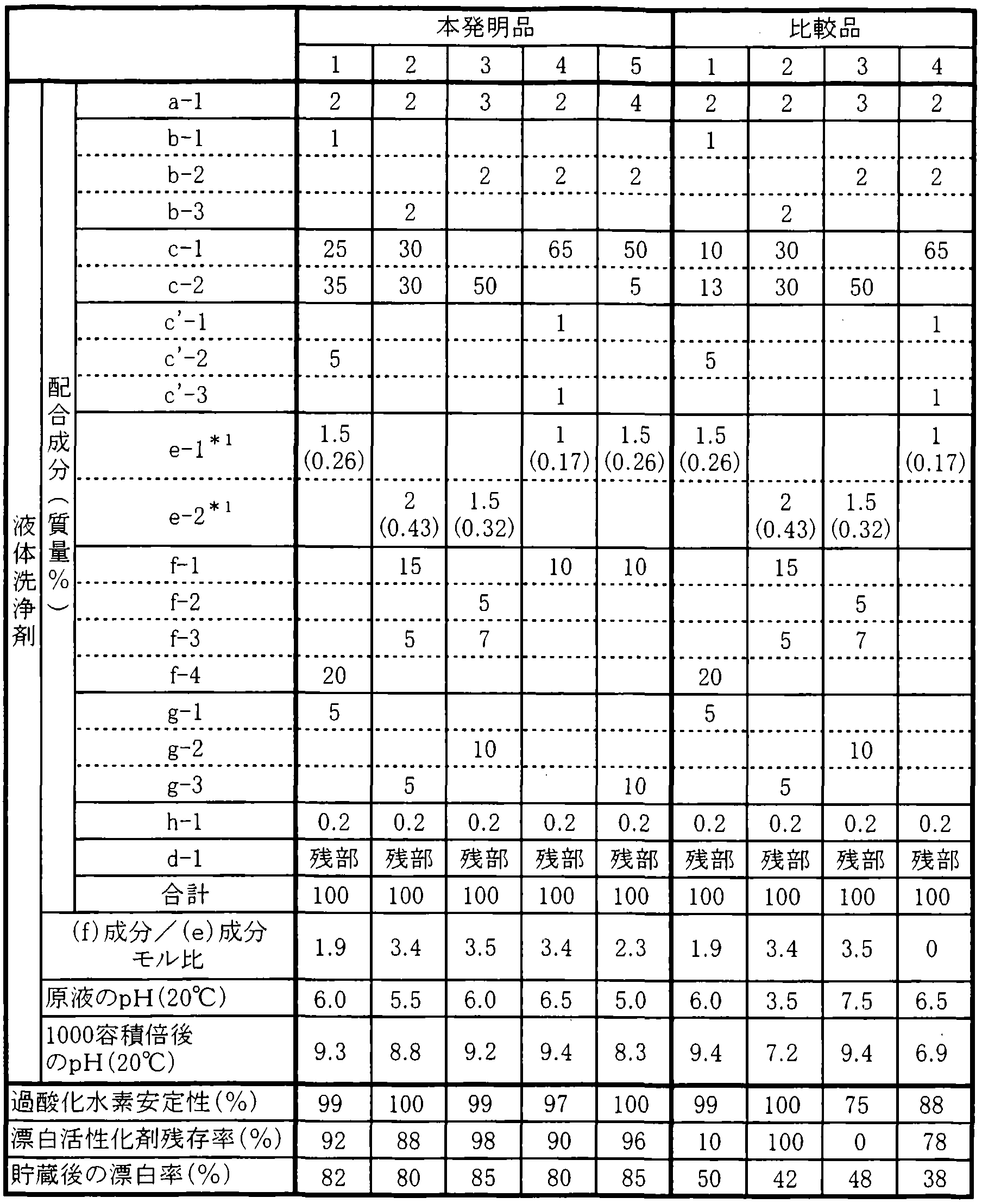
- Test Example A Using the following blending components, liquid detergents (invention products 1 to 5 and comparative products 1 to 4) shown in Table 1 were prepared and evaluated as follows. The results are shown in Table 1. Table 1 also shows the pH (20) of the stock solution and the pH of the liquid detergent after 100-fold volume dilution with water at 20.
- Bleaching power after storage After storing the liquid detergent at 3 O for 1 week, dilute to 3% DH hard water to a concentration of 0.1% by volume, and add 4 grape juice-contaminated cloths prepared below. Wash with 1 (80 r pmx i 0 min). Thereafter, the grape juice-contaminated cloth was rinsed with tap water and dried, and the bleaching rate was calculated according to the following formula.
- Bleach rate (%) (Reflectance after bleaching minus reflectance before bleaching)
- Z Reflectance of white cloth minus reflectance before bleaching
- X 1 0 0 Reflectance is NDR made by Nippon Denshoku Industries Co., Ltd. Measurements were taken at 10 DP using a 4600 nm filter.
- c— 1 Polyoxyethylene lauryl ether (average number of moles of ethylene oxide added 1 2) c-2; C, 2 H 25 0-(C 2 H 4 0) 7 — (C 3 H 6 ⁇ ) 2 — ( C 2 H 4 0) 5 — H c '-1; Sodium laurylbenzenesulfonate
- h _ 1 Phosphonic acid-based sequestering agent, Dyquest 2 0 10 (manufactured by Sol-Ishia)
- the method for identifying whether the solution state of the present invention forms WZ O type is to identify the continuous phase by measuring the conductivity of the solution and to determine the particle size of the structure by the dynamic photodegradation method (DLS). This can be confirmed by combining measurements.
- the results are shown in Table 2.
- Aroma stability (sensory evaluation) Compared to the storage before storage, the change in aroma of the liquid bleaching detergent composition after storage for 1 month at 40 was determined by the five panelists based on the following criteria. The average score is shown.
- Liquid Color Stability Change in liquid color of liquid bleaching detergent composition after storage for 1 month at 40 compared to before storage, determined by 5 panelists based on the following criteria The average score is shown.
- Example 1-1 ⁇ Method for confirming w / o composition> The solution state is confirmed by the following method.
- Example 1-1 or Comparative Example 1 The method for confirming the solution state using the surfactant and solvent of 15 is exemplified below.
- Example 1 A liquid detergent composition having a total amount (mass%) was prepared using the surfactant and solvent of Example 1 (projection example 2-1). Similarly, liquid detergent compositions having different total amounts were prepared using the surfactants and solvents of Comparative Examples 1 to 15 (Comparative Example 2-1) (Table 4). A 0.1 M KC 1 aqueous solution was added to the composition at each concentration, and the electrical conductivity was measured (Table 4 and Fig. 2).
- a surfactant nonionic surfactant
- QZW a structure is formed by the surfactant, and the connected phase is activated from the aqueous phase (QZW). It can be seen that the inflection point is considered to be transferred to the drug phase (WZO).
- WZO drug phase
Landscapes
- Chemical & Material Sciences (AREA)
- Life Sciences & Earth Sciences (AREA)
- Engineering & Computer Science (AREA)
- Organic Chemistry (AREA)
- Oil, Petroleum & Natural Gas (AREA)
- Wood Science & Technology (AREA)
- Chemical Kinetics & Catalysis (AREA)
- Inorganic Chemistry (AREA)
- Health & Medical Sciences (AREA)
- Emergency Medicine (AREA)
- Molecular Biology (AREA)
- Textile Engineering (AREA)
- Detergent Compositions (AREA)
Abstract
Description





Claims
Priority Applications (7)
| Application Number | Priority Date | Filing Date | Title |
|---|---|---|---|
| AU2006334048A AU2006334048B2 (en) | 2005-12-28 | 2006-12-26 | Liquid detergent |
| CN2006800478074A CN101341241B (zh) | 2005-12-28 | 2006-12-26 | 液体清洗剂 |
| EP06843722A EP1967579B1 (en) | 2005-12-28 | 2006-12-26 | Liquid detergent |
| US12/084,264 US7863234B2 (en) | 2005-12-28 | 2006-12-26 | Liquid detergent composition |
| DE602006020181T DE602006020181D1 (de) | 2005-12-28 | 2006-12-26 | Flüssiges reinigungsmittel |
| KR1020087013074A KR101295457B1 (ko) | 2005-12-28 | 2006-12-26 | 액체 세정제 |
| JP2007131591A JP4996970B2 (ja) | 2006-05-18 | 2007-05-17 | 液体漂白性洗浄剤組成物 |
Applications Claiming Priority (4)
| Application Number | Priority Date | Filing Date | Title |
|---|---|---|---|
| JP2005379146A JP4732166B2 (ja) | 2005-12-28 | 2005-12-28 | 液体洗浄剤 |
| JP2005-379146 | 2005-12-28 | ||
| JP2006-139116 | 2006-05-18 | ||
| JP2006139116 | 2006-05-18 |
Publications (1)
| Publication Number | Publication Date |
|---|---|
| WO2007077953A1 true WO2007077953A1 (ja) | 2007-07-12 |
Family
ID=38228296
Family Applications (1)
| Application Number | Title | Priority Date | Filing Date |
|---|---|---|---|
| PCT/JP2006/326350 Ceased WO2007077953A1 (ja) | 2005-12-28 | 2006-12-26 | 液体洗浄剤 |
Country Status (7)
| Country | Link |
|---|---|
| US (1) | US7863234B2 (ja) |
| EP (1) | EP1967579B1 (ja) |
| KR (1) | KR101295457B1 (ja) |
| AU (1) | AU2006334048B2 (ja) |
| DE (1) | DE602006020181D1 (ja) |
| TW (1) | TWI400330B (ja) |
| WO (1) | WO2007077953A1 (ja) |
Cited By (9)
| Publication number | Priority date | Publication date | Assignee | Title |
|---|---|---|---|---|
| JP2009120629A (ja) * | 2007-11-12 | 2009-06-04 | Kao Corp | 衣料用液体漂白剤組成物 |
| WO2009099244A1 (ja) | 2008-02-08 | 2009-08-13 | Kao Corporation | 液体漂白剤組成物 |
| JP2009292988A (ja) * | 2008-06-09 | 2009-12-17 | Dai Ichi Kogyo Seiyaku Co Ltd | 洗濯方法及びそれに用いる洗濯用洗剤 |
| WO2010012971A3 (en) * | 2008-07-29 | 2010-04-22 | Reckitt Benckiser (Uk) Limited | Cleaning composition and method |
| JP2011037945A (ja) * | 2009-08-07 | 2011-02-24 | Kao Corp | 液体洗浄剤組成物 |
| WO2012144254A1 (ja) * | 2011-04-22 | 2012-10-26 | 花王株式会社 | 液体洗浄剤組成物 |
| JP2012229327A (ja) * | 2011-04-26 | 2012-11-22 | Kao Corp | 液体洗浄剤組成物 |
| JP2014213072A (ja) * | 2013-04-26 | 2014-11-17 | 花王株式会社 | 液体賦香剤組成物 |
| JP2016512852A (ja) * | 2013-03-15 | 2016-05-09 | クリアー ソリューションズ | 多用途の硬質表面清浄剤 |
Families Citing this family (28)
| Publication number | Priority date | Publication date | Assignee | Title |
|---|---|---|---|---|
| KR101636566B1 (ko) * | 2009-08-21 | 2016-07-05 | 애경산업(주) | 액체 세정제 조성물 |
| AU2010306834A1 (en) * | 2009-10-13 | 2012-05-31 | Verutek Technologies, Inc. | Stabilized surfactant-oxidant compositions and related methods |
| HUE036334T2 (hu) * | 2010-08-27 | 2018-07-30 | Anitox Corp | Antimikrobális készítmény |
| US8846107B2 (en) | 2010-12-29 | 2014-09-30 | Ecolab Usa Inc. | In situ generation of peroxycarboxylic acids at alkaline pH, and methods of use thereof |
| WO2012090123A2 (en) | 2010-12-29 | 2012-07-05 | Ecolab Usa Inc. | GENERATION OF PEROXYCARBOXYLIC ACIDS AT ALKALINE pH, AND THEIR USE AS TEXTILE BLEACHING AND ANTIMICROBIAL AGENTS |
| DE102011016955A1 (de) | 2011-04-13 | 2012-10-18 | Clariant International Ltd. | Antimikrobielle Wirkmittelzubereitung |
| JP5661546B2 (ja) * | 2011-04-26 | 2015-01-28 | 花王株式会社 | 液体洗浄剤組成物 |
| JP5725986B2 (ja) * | 2011-06-13 | 2015-05-27 | 花王株式会社 | 液体洗浄剤組成物 |
| FR2978166B1 (fr) * | 2011-07-18 | 2019-06-21 | Safran Landing Systems | Bain de nettoyage pour pieces en alliage de metaux |
| US20140255963A1 (en) * | 2011-08-17 | 2014-09-11 | The Board Of Trustees Of The Leland Stanford Junior University | Degradable Detergents |
| WO2013059012A1 (en) | 2011-10-20 | 2013-04-25 | Anitox Corporation | Antimicrobial formulations with pelargonic acid |
| US9321664B2 (en) | 2011-12-20 | 2016-04-26 | Ecolab Usa Inc. | Stable percarboxylic acid compositions and uses thereof |
| BR112014020748B1 (pt) | 2012-03-30 | 2021-02-23 | Ecolab Usa Inc. | método de tratamento de águas, método de tratamento de uma fonte de água e composição aquosa de tratamento de água com atividade antimicrobiana |
| CN103173991B (zh) * | 2013-02-14 | 2015-06-17 | 上海秋橙新材料科技有限公司 | 桑蚕紬丝织物用漂白液及桑蚕紬丝织物的漂白方法 |
| CN103173990B (zh) * | 2013-02-14 | 2015-06-17 | 上海秋橙新材料科技有限公司 | 腈棉混纺织物用漂白液及腈棉混纺织物的漂白方法 |
| US10165774B2 (en) | 2013-03-05 | 2019-01-01 | Ecolab Usa Inc. | Defoamer useful in a peracid composition with anionic surfactants |
| US20140256811A1 (en) | 2013-03-05 | 2014-09-11 | Ecolab Usa Inc. | Efficient stabilizer in controlling self accelerated decomposition temperature of peroxycarboxylic acid compositions with mineral acids |
| US8822719B1 (en) | 2013-03-05 | 2014-09-02 | Ecolab Usa Inc. | Peroxycarboxylic acid compositions suitable for inline optical or conductivity monitoring |
| US9816055B2 (en) * | 2015-03-24 | 2017-11-14 | Gestalt Scientific Corporation | Compositions, devices, systems and methods relating to photo- and thermal-oxidative bleaching of pink-stains |
| PL3636691T3 (pl) | 2015-10-07 | 2021-09-27 | Elementis Specialties, Inc. | Środek zwilżający i przeciwpieniący |
| US10774291B2 (en) | 2016-06-16 | 2020-09-15 | Dow Global Technologies Llc | Automatic dishwashing compositions with spot prevention surfactant |
| GB2557343A (en) * | 2016-12-08 | 2018-06-20 | Reckitt Benckiser Vanish Bv | Composition |
| JP6736760B2 (ja) * | 2017-03-16 | 2020-08-05 | 株式会社ジーシー | 歯牙漂白用組成物 |
| BR112021002549A2 (pt) | 2018-08-22 | 2021-05-04 | Ecolab Usa Inc. | composição de ácido peroxicarboxílico estabilizada, e, método para reduzir uma população microbiana usando uma composição de ácido peroxicarboxílico estabilizada. |
| MX2021014340A (es) | 2019-05-31 | 2022-01-06 | Ecolab Usa Inc | Metodo de monitoreo de las concentraciones de peracidos mediante mediciones de conductividad y composiciones de peracidos. |
| US12096768B2 (en) | 2019-08-07 | 2024-09-24 | Ecolab Usa Inc. | Polymeric and solid-supported chelators for stabilization of peracid-containing compositions |
| US11932833B2 (en) | 2021-02-18 | 2024-03-19 | The Clorox Company | Stable activated peroxide sanitizing liquid compositions without added phosphorous compounds or cationic surfactants |
| CN115261159A (zh) * | 2022-07-15 | 2022-11-01 | 武汉诚载科技有限公司 | 一种环保型滤布清洗剂 |
Citations (15)
| Publication number | Priority date | Publication date | Assignee | Title |
|---|---|---|---|---|
| JPS6368700A (ja) * | 1986-09-02 | 1988-03-28 | コルゲート・パーモリブ・カンパニー | 油汚れの除去のための洗濯用組成物 |
| JPH05271691A (ja) | 1991-12-19 | 1993-10-19 | Ciba Geigy Ag | 貯蔵寿命の長い漂白剤の分散系 |
| JPH06207196A (ja) * | 1992-11-18 | 1994-07-26 | Kao Corp | 液体漂白剤組成物及びその製法 |
| JPH09157693A (ja) * | 1995-05-25 | 1997-06-17 | Clorox Co:The | 液状過酸前駆体のコロイド状分散:マクロエマルジョン |
| JP2688844B2 (ja) | 1989-06-15 | 1997-12-10 | ライオン株式会社 | 液体漂白剤組成物 |
| JPH1072595A (ja) * | 1996-07-01 | 1998-03-17 | Lion Corp | 液体酸素系漂白性組成物 |
| JPH10504584A (ja) * | 1994-06-17 | 1998-05-06 | ザ、プロクター、エンド、ギャンブル、カンパニー | 漂白組成物 |
| JPH11501354A (ja) * | 1995-11-27 | 1999-02-02 | ザ、プロクター、エンド、ギャンブル、カンパニー | 洗濯物の汚れ処理組成物、及び処理法 |
| JPH11502883A (ja) * | 1995-03-27 | 1999-03-09 | ザ、プロクター、エンド、ギャンブル、カンパニー | 活性化された液体漂白組成物 |
| JP2002338997A (ja) | 2001-05-18 | 2002-11-27 | Lion Corp | 液体漂白性組成物 |
| JP2003268398A (ja) | 2002-03-15 | 2003-09-25 | Lion Corp | 液体漂白性組成物 |
| JP2005273062A (ja) * | 2004-03-24 | 2005-10-06 | Kao Corp | 繊維製品の洗浄方法 |
| JP2006169517A (ja) * | 2004-11-19 | 2006-06-29 | Kao Corp | 液体洗浄剤組成物 |
| JP2006169515A (ja) * | 2004-11-19 | 2006-06-29 | Kao Corp | 液体洗浄剤組成物 |
| JP2006169516A (ja) * | 2004-11-19 | 2006-06-29 | Kao Corp | 液体洗浄剤組成物 |
Family Cites Families (11)
| Publication number | Priority date | Publication date | Assignee | Title |
|---|---|---|---|---|
| US4909962A (en) | 1986-09-02 | 1990-03-20 | Colgate-Palmolive Co. | Laundry pre-spotter comp. providing improved oily soil removal |
| US5827447A (en) | 1991-05-15 | 1998-10-27 | Kao Corporation | Liquid bleaching agent composition |
| US5880079A (en) | 1994-06-17 | 1999-03-09 | The Procter & Gamble Company | Bleaching compositions |
| JPH1072597A (ja) * | 1996-07-01 | 1998-03-17 | Lion Corp | 液体酸素系漂白性組成物 |
| US6020300A (en) * | 1996-09-16 | 2000-02-01 | The Procter & Gamble Company | Composition for treating stains on laundry items and methods of treatment |
| JPH1150099A (ja) | 1997-08-06 | 1999-02-23 | Lion Corp | 液体酸素系漂白剤組成物 |
| JP3766746B2 (ja) | 1997-12-24 | 2006-04-19 | ライオン株式会社 | 液体漂白剤組成物 |
| JPH11181491A (ja) | 1997-12-24 | 1999-07-06 | Lion Corp | 液体漂白剤組成物 |
| GB9901957D0 (en) | 1999-01-29 | 1999-03-17 | Yplon S A | Cleaning formulation |
| EP1190028A1 (en) * | 1999-06-28 | 2002-03-27 | The Procter & Gamble Company | Aqueous liquid detergent compositions comprising an effervescent system |
| WO2006054526A1 (ja) | 2004-11-19 | 2006-05-26 | Kao Corporation | 液体洗浄剤組成物 |
-
2006
- 2006-12-21 TW TW095148105A patent/TWI400330B/zh not_active IP Right Cessation
- 2006-12-26 KR KR1020087013074A patent/KR101295457B1/ko not_active Expired - Fee Related
- 2006-12-26 AU AU2006334048A patent/AU2006334048B2/en not_active Ceased
- 2006-12-26 WO PCT/JP2006/326350 patent/WO2007077953A1/ja not_active Ceased
- 2006-12-26 US US12/084,264 patent/US7863234B2/en not_active Expired - Fee Related
- 2006-12-26 EP EP06843722A patent/EP1967579B1/en not_active Not-in-force
- 2006-12-26 DE DE602006020181T patent/DE602006020181D1/de active Active
Patent Citations (15)
| Publication number | Priority date | Publication date | Assignee | Title |
|---|---|---|---|---|
| JPS6368700A (ja) * | 1986-09-02 | 1988-03-28 | コルゲート・パーモリブ・カンパニー | 油汚れの除去のための洗濯用組成物 |
| JP2688844B2 (ja) | 1989-06-15 | 1997-12-10 | ライオン株式会社 | 液体漂白剤組成物 |
| JPH05271691A (ja) | 1991-12-19 | 1993-10-19 | Ciba Geigy Ag | 貯蔵寿命の長い漂白剤の分散系 |
| JPH06207196A (ja) * | 1992-11-18 | 1994-07-26 | Kao Corp | 液体漂白剤組成物及びその製法 |
| JPH10504584A (ja) * | 1994-06-17 | 1998-05-06 | ザ、プロクター、エンド、ギャンブル、カンパニー | 漂白組成物 |
| JPH11502883A (ja) * | 1995-03-27 | 1999-03-09 | ザ、プロクター、エンド、ギャンブル、カンパニー | 活性化された液体漂白組成物 |
| JPH09157693A (ja) * | 1995-05-25 | 1997-06-17 | Clorox Co:The | 液状過酸前駆体のコロイド状分散:マクロエマルジョン |
| JPH11501354A (ja) * | 1995-11-27 | 1999-02-02 | ザ、プロクター、エンド、ギャンブル、カンパニー | 洗濯物の汚れ処理組成物、及び処理法 |
| JPH1072595A (ja) * | 1996-07-01 | 1998-03-17 | Lion Corp | 液体酸素系漂白性組成物 |
| JP2002338997A (ja) | 2001-05-18 | 2002-11-27 | Lion Corp | 液体漂白性組成物 |
| JP2003268398A (ja) | 2002-03-15 | 2003-09-25 | Lion Corp | 液体漂白性組成物 |
| JP2005273062A (ja) * | 2004-03-24 | 2005-10-06 | Kao Corp | 繊維製品の洗浄方法 |
| JP2006169517A (ja) * | 2004-11-19 | 2006-06-29 | Kao Corp | 液体洗浄剤組成物 |
| JP2006169515A (ja) * | 2004-11-19 | 2006-06-29 | Kao Corp | 液体洗浄剤組成物 |
| JP2006169516A (ja) * | 2004-11-19 | 2006-06-29 | Kao Corp | 液体洗浄剤組成物 |
Non-Patent Citations (1)
| Title |
|---|
| See also references of EP1967579A4 * |
Cited By (10)
| Publication number | Priority date | Publication date | Assignee | Title |
|---|---|---|---|---|
| JP2009120629A (ja) * | 2007-11-12 | 2009-06-04 | Kao Corp | 衣料用液体漂白剤組成物 |
| WO2009099244A1 (ja) | 2008-02-08 | 2009-08-13 | Kao Corporation | 液体漂白剤組成物 |
| JP2009292988A (ja) * | 2008-06-09 | 2009-12-17 | Dai Ichi Kogyo Seiyaku Co Ltd | 洗濯方法及びそれに用いる洗濯用洗剤 |
| WO2010012971A3 (en) * | 2008-07-29 | 2010-04-22 | Reckitt Benckiser (Uk) Limited | Cleaning composition and method |
| JP2011037945A (ja) * | 2009-08-07 | 2011-02-24 | Kao Corp | 液体洗浄剤組成物 |
| WO2012144254A1 (ja) * | 2011-04-22 | 2012-10-26 | 花王株式会社 | 液体洗浄剤組成物 |
| JP2012229327A (ja) * | 2011-04-26 | 2012-11-22 | Kao Corp | 液体洗浄剤組成物 |
| JP2016512852A (ja) * | 2013-03-15 | 2016-05-09 | クリアー ソリューションズ | 多用途の硬質表面清浄剤 |
| US10526569B2 (en) | 2013-03-15 | 2020-01-07 | Klear Solutions | Multi-purpose, hard surface cleaner |
| JP2014213072A (ja) * | 2013-04-26 | 2014-11-17 | 花王株式会社 | 液体賦香剤組成物 |
Also Published As
| Publication number | Publication date |
|---|---|
| EP1967579B1 (en) | 2011-02-16 |
| TW200728451A (en) | 2007-08-01 |
| DE602006020181D1 (de) | 2011-03-31 |
| TWI400330B (zh) | 2013-07-01 |
| US7863234B2 (en) | 2011-01-04 |
| EP1967579A1 (en) | 2008-09-10 |
| US20090249557A1 (en) | 2009-10-08 |
| AU2006334048A1 (en) | 2007-07-12 |
| AU2006334048B2 (en) | 2011-10-20 |
| KR101295457B1 (ko) | 2013-08-09 |
| KR20080080293A (ko) | 2008-09-03 |
| EP1967579A4 (en) | 2009-12-23 |
Similar Documents
| Publication | Publication Date | Title |
|---|---|---|
| WO2007077953A1 (ja) | 液体洗浄剤 | |
| CN101341241B (zh) | 液体清洗剂 | |
| JP2635288B2 (ja) | 漂白剤組成物及び漂白洗浄剤組成物 | |
| JP4996970B2 (ja) | 液体漂白性洗浄剤組成物 | |
| JPH08503245A (ja) | アミドペルオキシ酸を含む洗浄および漂白組成物 | |
| CN101223312B (zh) | 非水液体氧漂白组合物 | |
| JP3766746B2 (ja) | 液体漂白剤組成物 | |
| JPH06200292A (ja) | 液状洗剤組成物 | |
| CN101061210B (zh) | 液体洗涤剂组合物 | |
| JP3874832B2 (ja) | 液体漂白剤組成物 | |
| JPH04332796A (ja) | 漂白剤及び漂白洗浄剤組成物 | |
| JP4666930B2 (ja) | 液体漂白剤組成物 | |
| JPH0959675A (ja) | 液体漂白剤組成物 | |
| JP2008001770A (ja) | 洗浄剤組成物および洗浄方法 | |
| JP4694056B2 (ja) | 2剤型漂白剤 | |
| JP3558778B2 (ja) | 液体漂白剤組成物 | |
| JPH08295898A (ja) | 液体漂白剤組成物 | |
| JP3522942B2 (ja) | 液体漂白剤組成物 | |
| JPH11189789A (ja) | 液体漂白性組成物 | |
| JPH0525493A (ja) | 漂白剤組成物及び洗浄漂白剤組成物 | |
| JP4823452B2 (ja) | 液体漂白剤組成物 | |
| JP3354836B2 (ja) | 液体漂白剤組成物 | |
| JPH04345695A (ja) | 液体漂白剤組成物 | |
| JPH09217090A (ja) | 液体漂白剤組成物 | |
| KR0152202B1 (ko) | 액체 표백제 조성물 |
Legal Events
| Date | Code | Title | Description |
|---|---|---|---|
| WWE | Wipo information: entry into national phase |
Ref document number: 200680047807.4 Country of ref document: CN |
|
| 121 | Ep: the epo has been informed by wipo that ep was designated in this application | ||
| WWE | Wipo information: entry into national phase |
Ref document number: 2006843722 Country of ref document: EP |
|
| WWE | Wipo information: entry into national phase |
Ref document number: 12084264 Country of ref document: US |
|
| WWE | Wipo information: entry into national phase |
Ref document number: 1020087013074 Country of ref document: KR |
|
| WWE | Wipo information: entry into national phase |
Ref document number: 2006334048 Country of ref document: AU |
|
| NENP | Non-entry into the national phase |
Ref country code: DE |
|
| ENP | Entry into the national phase |
Ref document number: 2006334048 Country of ref document: AU Date of ref document: 20061226 Kind code of ref document: A |