WO2007089025A1 - 光学活性なアルコール化合物の製造法 - Google Patents

光学活性なアルコール化合物の製造法 Download PDF

Info

Publication number
WO2007089025A1
WO2007089025A1 PCT/JP2007/052070 JP2007052070W WO2007089025A1 WO 2007089025 A1 WO2007089025 A1 WO 2007089025A1 JP 2007052070 W JP2007052070 W JP 2007052070W WO 2007089025 A1 WO2007089025 A1 WO 2007089025A1
Authority
WO
WIPO (PCT)
Prior art keywords
group
optically active
tert
carbon atoms
bis
Prior art date
Legal status (The legal status is an assumption and is not a legal conclusion. Google has not performed a legal analysis and makes no representation as to the accuracy of the status listed.)
Ceased
Application number
PCT/JP2007/052070
Other languages
English (en)
French (fr)
Inventor
Kazuaki Sasaki
Current Assignee (The listed assignees may be inaccurate. Google has not performed a legal analysis and makes no representation or warranty as to the accuracy of the list.)
Sumitomo Chemical Co Ltd
Original Assignee
Sumitomo Chemical Co Ltd
Priority date (The priority date is an assumption and is not a legal conclusion. Google has not performed a legal analysis and makes no representation as to the accuracy of the date listed.)
Filing date
Publication date
Application filed by Sumitomo Chemical Co Ltd filed Critical Sumitomo Chemical Co Ltd
Priority to US12/161,695 priority Critical patent/US7906667B2/en
Priority to CN2007800039300A priority patent/CN101374792B/zh
Priority to EP07708119A priority patent/EP1982973A4/en
Publication of WO2007089025A1 publication Critical patent/WO2007089025A1/ja
Priority to IL192831A priority patent/IL192831A/en
Anticipated expiration legal-status Critical
Ceased legal-status Critical Current

Links

Classifications

    • CCHEMISTRY; METALLURGY
    • C07ORGANIC CHEMISTRY
    • C07CACYCLIC OR CARBOCYCLIC COMPOUNDS
    • C07C41/00Preparation of ethers; Preparation of compounds having groups, groups or groups
    • C07C41/01Preparation of ethers
    • C07C41/02Preparation of ethers from oxiranes
    • C07C41/03Preparation of ethers from oxiranes by reaction of oxirane rings with hydroxy groups
    • BPERFORMING OPERATIONS; TRANSPORTING
    • B01PHYSICAL OR CHEMICAL PROCESSES OR APPARATUS IN GENERAL
    • B01JCHEMICAL OR PHYSICAL PROCESSES, e.g. CATALYSIS OR COLLOID CHEMISTRY; THEIR RELEVANT APPARATUS
    • B01J31/00Catalysts comprising hydrides, coordination complexes or organic compounds
    • B01J31/16Catalysts comprising hydrides, coordination complexes or organic compounds containing coordination complexes
    • B01J31/22Organic complexes
    • B01J31/2204Organic complexes the ligands containing oxygen or sulfur as complexing atoms
    • B01J31/2208Oxygen, e.g. acetylacetonates
    • B01J31/2226Anionic ligands, i.e. the overall ligand carries at least one formal negative charge
    • B01J31/2243At least one oxygen and one nitrogen atom present as complexing atoms in an at least bidentate or bridging ligand
    • CCHEMISTRY; METALLURGY
    • C07ORGANIC CHEMISTRY
    • C07BGENERAL METHODS OF ORGANIC CHEMISTRY; APPARATUS THEREFOR
    • C07B53/00Asymmetric syntheses
    • CCHEMISTRY; METALLURGY
    • C07ORGANIC CHEMISTRY
    • C07CACYCLIC OR CARBOCYCLIC COMPOUNDS
    • C07C251/00Compounds containing nitrogen atoms doubly-bound to a carbon skeleton
    • C07C251/02Compounds containing nitrogen atoms doubly-bound to a carbon skeleton containing imino groups
    • C07C251/24Compounds containing nitrogen atoms doubly-bound to a carbon skeleton containing imino groups having carbon atoms of imino groups bound to carbon atoms of six-membered aromatic rings
    • BPERFORMING OPERATIONS; TRANSPORTING
    • B01PHYSICAL OR CHEMICAL PROCESSES OR APPARATUS IN GENERAL
    • B01JCHEMICAL OR PHYSICAL PROCESSES, e.g. CATALYSIS OR COLLOID CHEMISTRY; THEIR RELEVANT APPARATUS
    • B01J2231/00Catalytic reactions performed with catalysts classified in B01J31/00
    • B01J2231/40Substitution reactions at carbon centres, e.g. C-C or C-X, i.e. carbon-hetero atom, cross-coupling, C-H activation or ring-opening reactions
    • B01J2231/48Ring-opening reactions
    • B01J2231/482Ring-opening reactions asymmetric reactions, e.g. kinetic resolution of racemates
    • B01J2231/485Ring-opening reactions asymmetric reactions, e.g. kinetic resolution of racemates kinetic resolution of epoxide racemates
    • BPERFORMING OPERATIONS; TRANSPORTING
    • B01PHYSICAL OR CHEMICAL PROCESSES OR APPARATUS IN GENERAL
    • B01JCHEMICAL OR PHYSICAL PROCESSES, e.g. CATALYSIS OR COLLOID CHEMISTRY; THEIR RELEVANT APPARATUS
    • B01J2531/00Additional information regarding catalytic systems classified in B01J31/00
    • B01J2531/02Compositional aspects of complexes used, e.g. polynuclearity
    • B01J2531/0238Complexes comprising multidentate ligands, i.e. more than 2 ionic or coordinative bonds from the central metal to the ligand, the latter having at least two donor atoms, e.g. N, O, S, P
    • B01J2531/0241Rigid ligands, e.g. extended sp2-carbon frameworks or geminal di- or trisubstitution
    • B01J2531/0252Salen ligands or analogues, e.g. derived from ethylenediamine and salicylaldehyde
    • BPERFORMING OPERATIONS; TRANSPORTING
    • B01PHYSICAL OR CHEMICAL PROCESSES OR APPARATUS IN GENERAL
    • B01JCHEMICAL OR PHYSICAL PROCESSES, e.g. CATALYSIS OR COLLOID CHEMISTRY; THEIR RELEVANT APPARATUS
    • B01J2531/00Additional information regarding catalytic systems classified in B01J31/00
    • B01J2531/20Complexes comprising metals of Group II (IIA or IIB) as the central metal
    • B01J2531/22Magnesium
    • BPERFORMING OPERATIONS; TRANSPORTING
    • B01PHYSICAL OR CHEMICAL PROCESSES OR APPARATUS IN GENERAL
    • B01JCHEMICAL OR PHYSICAL PROCESSES, e.g. CATALYSIS OR COLLOID CHEMISTRY; THEIR RELEVANT APPARATUS
    • B01J2531/00Additional information regarding catalytic systems classified in B01J31/00
    • B01J2531/60Complexes comprising metals of Group VI (VIA or VIB) as the central metal
    • B01J2531/62Chromium
    • BPERFORMING OPERATIONS; TRANSPORTING
    • B01PHYSICAL OR CHEMICAL PROCESSES OR APPARATUS IN GENERAL
    • B01JCHEMICAL OR PHYSICAL PROCESSES, e.g. CATALYSIS OR COLLOID CHEMISTRY; THEIR RELEVANT APPARATUS
    • B01J2531/00Additional information regarding catalytic systems classified in B01J31/00
    • B01J2531/80Complexes comprising metals of Group VIII as the central metal
    • B01J2531/84Metals of the iron group
    • B01J2531/845Cobalt
    • CCHEMISTRY; METALLURGY
    • C07ORGANIC CHEMISTRY
    • C07BGENERAL METHODS OF ORGANIC CHEMISTRY; APPARATUS THEREFOR
    • C07B2200/00Indexing scheme relating to specific properties of organic compounds
    • C07B2200/07Optical isomers

Definitions

  • the present invention relates to a method for producing an optically active alcohol compound.
  • Optically active 1- (4-phenoxyphenoxy) 1 Optically active alcohol compounds represented by 2-propanol are useful as synthetic intermediates for pharmaceuticals, agricultural chemicals, etc. (See Sho 60-215671 and JP-B-5-59718).
  • a method for producing such an optically active alcohol compound a method in which a phenolic compound and a cyclic etheric compound are reacted using an optically active salen metal complex as a catalyst is known (for example, J. Am. Chem. S o c., 121, 6086 — 6087 (1999)).
  • an optically active salen metal complex reacts with a Lewis acid selected from the group consisting of aluminum halide, dialkylaluminum halide, trialkoxyaluminum, titanium halide, tetraalkoxytitanium, boron halide, and zinc rogenide.
  • a Lewis acid selected from the group consisting of aluminum halide, dialkylaluminum halide, trialkoxyaluminum, titanium halide, tetraalkoxytitanium, boron halide, and zinc rogenide.
  • the present invention provides the following formula (1)
  • Rl, R2, R3, R4, R5, R6, R7 and R8 are the same or different and each represents a hydrogen atom, halogen atom, alkyl group, alkenyl group, alkynyl group, alkoxy group, haloalkyl group, halo, Represents an alkoxy group, a substituted or unsubstituted aryl group, an aralkyl group, a hydroxyl group, a nitro group, an amino group, a strong rubamoyl group, a strong lpoxyl group or a silyl group, or Rl, R2, R3, R4, R5 , R6, R7 and R8 are bonded together to form a ring together with the benzene ring to which they are bonded to represent a naphthalene ring.
  • R9 and Rio represents a water atom
  • the other represents an alkyl group having 1 to 4 carbon atoms that may be substituted with a halogen atom, or 1 to 4 carbon atoms that may be substituted with a halogen atom.
  • a phenyl group or a naphthyl group which may be substituted with at least one selected from the group consisting of an alkoxy group and a halogen atom, or a pair of R9 and Rio bonded to different carbon atoms
  • One pair is bonded to form a tetramethylene group, and the other pair represents a hydrogen atom.
  • Q represents a single bond or an alkylene group having 1 to 4 carbon atoms, or Q, together with R 9 and Ri o, binds to a nitrogen atom at its 2 and 2 ′ positions.
  • , 1 ' represents a binaphthyl group.
  • M represents a metal ion.
  • A When the ionic valence of the metal ion and the coordination number of the ligand are the same, A does not exist, and when the ionic valence and the coordination number are different, A is a counter ion or a coordination ion. Represents a rank.
  • an asymmetric complex obtained by reacting an optically active metal complex with a metal sulfonate, an optically active alcoholic compound characterized by reacting a cyclic ether compound with a phenol compound.
  • optically active metal complex (1) an optically active metal complex represented by the above formula (1)
  • metal sulfonate a metal sulfonate
  • Rl, R2, R3, R4, R5, R6, R7 and R8 are the same or different and each represents a hydrogen atom, a halogen atom, an alkyl group or an alkenyl group.
  • halogen atom examples include a fluorine atom, a chlorine atom, and a bromine atom.
  • Alkyl groups include methyl, ethyl, n-propyl, isopropyl, n-butyl, isobutyl, sec-butyl, tert-butyl, n-pentyl, isopentyl, neopentyl, tert Examples thereof include linear, branched or cyclic alkyl groups having 1 to 6 carbon atoms such as —pentyl group, n-hexyl group, cyclopentyl group, cyclohexyl group and the like.
  • alkenyl group examples include a vinyl group, a propenyl group, a 1-butenyl group, a 2-butenyl group, a 2-methyl-1 monopropenyl group, a pentenyl group, a hexenyl group, and a cyclohexenyl group.
  • alkenyl group examples include a vinyl group, a propenyl group, a 1-butenyl group, a 2-butenyl group, a 2-methyl-1 monopropenyl group, a pentenyl group, a hexenyl group, and a cyclohexenyl group.
  • alkynyl group examples include linear or branched alkynyl groups having 2 to 6 carbon atoms such as an ethynyl group, a propynyl group, a 1-ptynyl group, a 2-ptynyl group, and a hexynyl group.
  • alkoxy group examples include methoxy group, ethoxy group, n -propoxy group, isopropoxy group, n-butoxy group, isobutoxy group, sec-butoxy group, tert-butoxy group, n-hexyloxy group, cyclohexyloxy group.
  • alkoxy group examples include linear, branched or cyclic alkoxy groups having 1 to 6 carbon atoms such as groups.
  • haloalkyl group at least one hydrogen atom of the alkyl group is Specific examples include chloromethyl group, chloroethyl group, fluoromethyl group, trifluoromethyl group and the like.
  • haloalkoxy group examples include those in which at least one hydrogen atom of the alkoxy group is substituted with the halogen atom. Specifically, a chloromethoxy group, a chloroethoxy group, a fluoromethoxy group, a trifluoro group, and the like. A methoxy group etc. are illustrated.
  • Examples of the unsubstituted aryl group include unsubstituted aryl groups having 6 to 10 carbon atoms such as a phenyl group and a naphthyl group.
  • Examples of the substituent of the substituted aryl group include the halogen atom, the alkyl group, the alkoxy group, and the nitro group.
  • Specific examples of the substituted aryl group include a tolyl group, a xylyl group, a nitrophenyl group, a methoxyphenyl group, and the like.
  • aralkyl group examples include those in which at least one hydrogen atom of the alkyl group is substituted with the substituted or unsubstituted aryl group. Specific examples include a benzyl group, a triphenylmethyl group, and 1-methyl-11. Examples include phenylethyl group and the like.
  • silyl group examples include silyl groups substituted with three hydrocarbon groups, and examples of the hydrocarbon group include the alkyl group, the substituted or unsubstituted aryl group, and the like. Specific examples include a trimethylsilyl group, a triethylsilyl group, a triphenylsilyl group, a tert-butyldimethylsilyl group, and the like.
  • Ri, R2, R3, R4, R5, R6, R7 and Re are bonded to form a ring together with the benzene ring to which they are bonded to represent a naphthalene ring.
  • any one of R 9 and Rio represents a hydrogen atom, and the other is substituted with a C 1-4 alkyl group which may be substituted with a halogen atom, or a halogen atom. It represents a phenyl group or a naphthyl group which may be substituted with at least one selected from the group consisting of an alkoxy group having 1 to 4 carbon atoms and an octacene atom which may be substituted.
  • any pair of R 9 and R 10 bonded to different carbon atoms is bonded to form a tetramethylene group, and the other pair represents a hydrogen atom.
  • Examples of the halogen atom include a fluorine atom, a chlorine atom, and a bromine atom.
  • Examples of the alkyl group having 1 to 4 carbon atoms include a linear or branched alkyl group such as a methyl group, an ethyl group, an n-propyl group, an isopyl pill group, an n-butyl group, and a tert-butyl group. Can be mentioned.
  • Examples of the C 1 to C 4 alkyl group substituted with a halogen atom include a fluorine atom, a chlorine atom, a bromine atom, etc., and a C 1 to C 4 alkyl substituted with a powerful halogen atom.
  • Specific examples of the group include a chloromethyl group, a chloroethyl group, a fluoromethyl group, and a trifluoromethyl group.
  • Examples of the alkoxy group having 1 to 4 carbon atoms include linear or branched alkoxy groups such as a methoxy group, an ethoxy group, an n-propoxy group, an isopropoxy group, an n-butoxy group, and a tert-butoxy group. It is done.
  • Examples of the halogen atom of the alkoxy group having 1 to 4 carbon atoms substituted with a halogen atom include a fluorine atom, a chlorine atom, a bromine atom, etc., and the alkoxy group having 1 to 4 carbon atoms substituted with such a halogen atom. Specific examples of these include a chloromethoxy group, a closed ethoxy group, a fluoromethoxy group, and a trifluoromethoxy group.
  • the optionally substituted phenyl group or naphthyl group include phenyl group, 1-naphthyl group, 2-naphthyl group, 2-methylphenyl group, 3-methylphenyl group, 4-methylphenyl group, 2-methoxyphenyl group.
  • Q represents a single bond or an alkylene group having 1 to 4 carbon atoms.
  • Q represents a 1,1'-one naphthyl group bonded to the nitrogen atom at the 2 and 2 'positions together with R9 and R i Q.
  • alkylene group having 1 to 4 carbon atoms include a methylene group, an ethylene group, a trimethylene group, and a tetramethylene group.
  • M represents a metal ion, and when the ionic valence of the metal ion and the coordination number of the ligand are the same, A does not exist, and when the ionic valence and the coordination number are different, A represents a counter ion or a ligand.
  • metal ions include cobalt ions, chromium ions, manganese ions, and the like.
  • Counter ions or ligands include, for example, halide ions such as chloride ion, bromide ion, iodide ion; perfluoroalkoxide ion such as nonafluoro-tert-butoxide ion; In terms of ease of preparation, halide ions are preferred, and iodide ions are more preferred.
  • Such optically active metal complexes (1) include iodinated (R, R) — (—) — N, N ′ — bis (3,5-di-tert-butylsalicylidene) 1,1,2-cyclo Hexandiaminocobalt (111), Chloride (R, R) One (one) One ⁇ , One bis (3,5-Dione tert-Butylsalicylidene) —1,2-Cyclohexanediaminocobalt (111), Bromide (R, R) One (One) —N, N 'One Bis (3, tert-Butylsalicylidene) —1, 2, 2-Cyclohexane diaminocopper ( ⁇ ), (R, R ) One (One) One N, N 'One Bis (3,5-Didi tert-Ptylsalicylidene) One 1,2-Cyclohexanediaminocobalt (III) Acetate, (R,
  • optically active metal complexes (1) may be commercially available, J. Am. Ch em. S oc, 121, 6086-6087 (1999), J. Am. C hem. S oc , 113, 6703-6704 (1991), J. Or. Chem., _5_6, 2296-2 298 (1991), etc. may be used.
  • the metal sulfonate is composed of a metal cation and a sulfonate anion, and the metal force thione is not particularly limited as long as it is a divalent or trivalent metal cation.
  • a copper cation, a tin cation, an aluminum cation, An indium cation or the like can be used, but preferably a cation of at least one metal element selected from the group consisting of Group 2 metal elements, Group 3 metal elements and lanthanoids of the periodic table is used.
  • Group 2 elements of the periodic table include magnesium, calcium, barium, etc.
  • Group 3 elements of the periodic table include scandium and yttrium.
  • Examples of lanthanoids include lanthanum, cerium, and samarium. , Gadolinium, ittel Pium etc. are mentioned. Of these, magnesium, scandium, yttrium, lanthanum, samarium or ytterbium is more preferable.
  • an alkane sulfonate anion having 1 to 10 carbon atoms which may be substituted with a fluorine atom is usually used.
  • a perfluoroalkane sulfonate having 1 to 10 carbon atoms is used.
  • Toanion is preferred.
  • Perfluoroalkane sulfonate anions having 1 to 10 carbon atoms include trifluoromethane sulfonate anion, pen fluorethane sulfonate anion, heptafluoropropane sulfonate anion, nona fluorov And trifluoromethanesulfonate.
  • trifluoromethanesulfonate is preferred, and the metal sulfonate is trifluoromethylate.
  • a commercially available metal sulfonate may be used, or a metal sulfonate prepared according to a known method such as a method of reacting a metal oxide with a corresponding sulfonic acid compound may be used. . .
  • the metal sulfonate may be used as it is or as a solution of an organic solvent.
  • Metal sulfonates that are unstable to air and moisture are preferably used as solutions in organic solvents.
  • organic solvents include aliphatic hydrocarbon solvents such as hexane and heptane; ether solvents such as diethyl ether and tert-butyl methyl ether.
  • the amount of the metal sulfonate used is not particularly limited, but is usually 0.2 to 10 mol, preferably 0.5 to 5 mol, relative to 1 mol of the optically active metal complex (1).
  • the reaction between the optically active metal complex (1) and the metal sulfonate is usually carried out in an organic solvent. Is carried out by contacting and mixing them. When an optically active metal complex (1) and a metal sulfonate are brought into contact with each other and mixed, a reaction occurs and a new asymmetric complex is formed.
  • the reaction temperature between the optically active metal complex (1) and the metal sulfonate is usually ⁇ 50 ° C. to the reflux temperature of the reaction mixture, preferably ⁇ 25 to 50 ”C.
  • organic solvents include ether solvents such as jetyl ether and tert-butyl methyl ether; aromatic hydrocarbon solvents such as toluene; halogenated hydrocarbons such as black benzene and black form; Examples thereof include aliphatic hydrocarbon solvents, and the amount used is not particularly limited.
  • a metal sulfonate that is unstable to moisture When a metal sulfonate that is unstable to moisture is used, if water is present in the reaction system, the metal sulfonate is likely to be decomposed. It is preferable that a dehydrating agent such as molecular sieves coexists in the reaction system.
  • a solution containing the new asymmetric complex to be produced is obtained.
  • -It may be used for the reaction of tellurium compounds with phenol compounds, or by taking out the new asymmetric complex by, for example, concentrating the obtained solution and using it for the reaction of cyclic etheric compounds and phenol compounds described later. May be.
  • the cyclic ether compound may be any reactive cyclic ether compound that undergoes a ring-opening reaction by reaction with a phenol compound.
  • the formula (2) is any reactive cyclic ether compound that undergoes a ring-opening reaction by reaction with a phenol compound.
  • Ri i represents a hydrogen atom
  • Ri 2 represents a hydrogen atom or an optionally substituted alkyl group having 1 to 4 carbon atoms
  • Ri i and Ri 2 are bonded to form 2 to 6 carbon atoms.
  • Ris is an optionally substituted alkyl group having 1 to 4 carbon atoms, an optionally substituted aryl group having 6 to 10 carbon atoms, or an optionally substituted alkyl group having 7 to 20 carbon atoms. Represents a group.
  • n represents 0 or 1.
  • alkyl group having 1 to 4 carbon atoms examples include linear or branched alkyl groups such as a methyl group, an ethyl group, an n-propyl group, an isopyl pill group, an n-butyl group, and an isobutyl group.
  • the substituents that may be present on these alkyl groups include: fluorine atoms, chlorine atoms, bromine atoms, octalogen atoms such as iodine atoms; methoxy groups, ethoxy groups, n-propoxy groups, isopropoxy groups , N-butoxy group, isobutoxy group, sec-butoxy group, tert-butoxy group, etc.
  • alkyl group substituted with these substituents include a fluoromethyl group, a trifluoromethyl group, a methoxymethyl group, and a hydroxymethyl group.
  • alkylene group having 2 to 6 primes formed by combining RH and Ri 2 examples include an ethylene group, a trimethylene group, a tetramethylene group, a pentamethylene group, and a hexamethylene group.
  • Examples of the aryl group having 6 to 10 carbon atoms include aryl groups such as a phenyl group and a naphthyl group.
  • the substituents that may be present on these aryl groups include halogen atoms such as fluorine atom, chlorine atom, bromine atom and iodine atom; methyl group, ethyl group, n-propyl group, isopropyl group, n-butyl Group, an alkyl group having 1 to 4 carbon atoms such as isoptyl group; carbon such as methoxy group, ethoxy group, n-propoxy group, isopropoxy group, n-butoxy group, isobutoxy group, sec_butoxy group, tert-butoxy group Examples thereof include alkoxy groups of 1 to 4. Specific examples of the aryl group substituted with such a substituent include a tolyl group, a xylyl group, and a methoxyphenyl group.
  • Examples of the optionally substituted aralkyl group having 7 to 20 carbon atoms include those in which at least one hydrogen atom of the optionally substituted alkyl group is substituted with the optionally substituted aryl group.
  • Specific examples include a benzyl group, a triphenylmethyl group, a 1-methyl-1-monophenyl group, and the like.
  • Such cyclic ether compounds include propylene oxide, chloromethyl oxysilane, bromomethyl oxysilane, odomethyl oxysilane, 1,2-epoxybutane, 1,2-epoxy hexane, 1,3-epoxy hexane. 1, 2—epoxy 4-methylpentane,
  • cyclic ether compounds include propylene oxide and 1,2-epoxybutane.
  • the phenolic compound is not particularly limited as long as it is a phenolic compound having a phenolic hydroxyl group and a theophenolic compound in which the oxygen atom of the hydroxyl group of the phenolic compound is replaced by a sulfur atom.
  • X represents an oxygen atom or a sulfur atom
  • R ", R, R", R 1 7 and R 18 are the same or different and each represents a hydrogen atom, a halogen atom, a nitro group, or a substituted group.
  • halogen atom examples include a fluorine atom, a chlorine atom, and a bromine atom.
  • alkyl group having 1 to 6 carbon atoms examples include linear groups such as a methyl group, an ethyl group, an n-propyl group, an isopyl pill group, an n-butyl group, an isobutyl group, an n-pentyl group, and an n-hexyl group. Or, a branched alkyl group may be mentioned.
  • the substituents that may be present on these alkyl groups include halogen atoms such as fluorine atom, chlorine atom and bromine atom; methoxy group, ethoxy group, n-propoxy group, isopropoxy group, n-butoxy And an alkoxy group having 1 to 6 carbon atoms such as an isobutoxy group, sec-butoxy group, and tert-butoxy group.
  • halogen atoms such as fluorine atom, chlorine atom and bromine atom
  • an alkoxy group having 1 to 6 carbon atoms such as an isobutoxy group, sec-butoxy group, and tert-butoxy group.
  • Specific examples of the alkyl group substituted with such a substituent include a chloromethyl group, a trifluoromethyl group, and a methoxymethyl group.
  • alkoxy group having 1 to 6 carbon atoms examples include straight chain such as methoxy group, ethoxy group, n-propoxy group, isopropoxy group, n-butoxy group, isobutoxy group, n-pentyloxy group, and n-hexyloxy group. And a branched or branched alkoxy group.
  • Substituents that may be present on these alkoxy groups include halogen atoms such as fluorine atom, chlorine atom and bromine atom; methoxy group, ethoxy group, n-propoxy group, isopropoxy group, n-butoxy group, Examples thereof include alkoxy groups having 1 to 6 carbon atoms such as isobutoxy group, sec-butoxy group, and tert-butoxy group. Specific examples of the alkoxy group substituted with such a substituent include a chloromethoxy group, a trifluoromethoxy group, and a methoxymethoxy group.
  • Substituents that may be present on the phenoxy group include halogen atoms such as fluorine atom, chlorine atom and bromine atom; methyl group, ethyl group, n-propyl group, isopropyl group, n-propyl group, isobutyl Alkyl group having 1 to 6 carbon atoms such as n-pentyl group and n-hexyl group; methoxy group, ethoxy group, n-propoxy group, isopropoxy group, n-butoxy group, isobutoxy group, sec-butoxy group Group, an alkoxy group having 1 to 6 carbon atoms such as tert-butoxy group; a phenoxy group and the like.
  • halogen atoms such as fluorine atom, chlorine atom and bromine atom
  • phenoxy group substituted with such a substituent examples include 4-chlorophenoxy group, 2-bromophenoxy group, 2-methylphenoxy group, 3 1-methylphenoxy group, 4-1-methylphenoxy group, 4-ethylphenoxy group, 4- Examples thereof include a propylphenoxy group, a 2-methoxyphenoxy group, a 3-methoxyphenoxy group, a 4-methoxyphenoxy group, a 4-ethoxyphenoxy group, and a 4-phenoxyphenoxy group.
  • Such phenol compounds include phenol, 4-chlorophenol, 2-bromophenol, 4-bromophenol, o-cresol, m-cresol, p_cresol, 2-methoxyphenol, 3-methoxyphenol, 4- Methoxyphenol, 4-Phenoxyphenol, 4-Nitrophenol, 2,3-Difluoro-6-Nitrophenol, Thiophenol, 2-Bromo-4-methylthiophenol, 4-Chlorothiophenol, 4-Methoxythiophenol, 4-phenoxythiophenol and the like can be mentioned.
  • Preferable phenol compounds include phenol, 2-methoxyphenol, 3-methoxyphenol, 4-methoxyphenol, 4-phenoxyphenol, 4-methoxythiophenol, and 4-phenoloxyphenol.
  • the amount of the cyclic ether compound used is usually 2 moles or more per mole of the phenol compound, and there is no particular upper limit. However, too much is likely to be economically disadvantageous, so it is practically 10 moles. It is as follows. ,
  • the reaction temperature is usually from 150 ° C. to the reflux temperature of the reaction mixture, preferably from ⁇ 25 to 50 ° C.
  • the reaction is carried out by contacting and mixing the asymmetric complex, cyclic ether compound and phenol compound, and the mixing order is not particularly limited.
  • the amount of asymmetric complex used is usually 1 mol% or more with respect to 1 mol of the phenol compound, and the upper limit is not particularly limited. However, if it is used too much, it tends to be economically disadvantageous.
  • the amount is from 0.1 to 10 mol%, preferably from 0.1 to 5 mol%.
  • organic solvents include aliphatic hydrocarbon solvents such as hexane and heptane; aromatic hydrocarbon solvents such as toluene; ether solvents such as jetyl ether and tert-butyl methyl ether; These halogenated hydrocarbon solvents are used alone or as a mixed solvent, and the amount used is not particularly limited.
  • the target optically active alcohol compound can be taken out by concentrating the reaction mixture.
  • an optically active alcoholic compound can be taken out by adding water and, if necessary, an organic solvent insoluble in water to the reaction mixture, performing an extraction treatment, and concentrating the obtained organic layer.
  • the taken out optically active alcohol compound may be further purified by ordinary purification means such as distillation, recrystallization, column chromatography and the like.
  • organic solvents insoluble in water examples include aromatic hydrocarbon solvents such as toluene and xylene; aliphatic hydrocarbon solvents such as hexane and heptane; halogens such as black mouth form and black mouth benzene
  • aromatic hydrocarbon solvents such as toluene and xylene
  • aliphatic hydrocarbon solvents such as hexane and heptane
  • halogens such as black mouth form and black mouth benzene
  • Non-limiting examples include hydrocarbon solvents
  • ether solvents such as jetyl ether and tert-butyl methyl ether
  • optically active allyl compound thus obtained includes optically active 1-phenoxy
  • Optically active 3 Phenoxypropane-1,2,2-diol, Optically active 3_ (4-Chlorophenoxy) propane-1,2,2-diol, Optically active 3— (2-Bromophenoxy) Propane 1, 2— Diol, optically active 3 _ (4-bromophenoxy) propane 1, 2,2-diol, optically active 3— (2-methylphenoxy) Propane 1, 2, 2-diol, optically active 3 one (3-methylphenoxy) Propane 1,2-diol, optical activity 3- (4-methylphenoxy) propane 1,2-diol, optical activity 3- (4-methoxyphenoxy) propan 1,2-diol, optical activity 3- (4-Phenoxyphenoxy) Propane 1,2—Diol, optically active 3-— (4-Nitrophenoxy) Propane-1,2-diol, optically active 3-— (2,3-Difluoro-6-ditrophenoxy) Propane 1, 2-diol, Optically active 3-
  • Example 2 The same procedure as in Example 1 was performed except that 149 mg of samarium trifluoromethanesulfonate was used instead of 134 mg of yttrium trifluoromethanesulfonate in Example 1, and 1 an oil containing 1-phenoxy — 2-pro'panol. I got a thing.
  • Example 2 The same procedure as in Example 1 was performed except that 155 mg of ytterbium trifluoromethanesulfonate was used in place of 134 mg of yttrium trifluoromethanesulfonate in Example 1, and 1 monophenyl 2-propanol An oil containing was obtained.
  • Example 1 it was carried out in the same manner as in Example 1 except that 123 mg of scandium trifluoromethanesulfonate was used instead of 134 mg of yttrium trifluoromethanesulfonate, and an oil containing 1-monophenyl-2-propanol. I got a thing.
  • Example 1 an oily substance containing 1-phenoxy-2-propanol was used in the same manner as in Example 1 except that 147 mg of lanthanum trifluoromethanesulfonate was used instead of 134 mg of yttrium trifluoromethanesulfonate.
  • the catalyst solution was cooled to 5 ° C., 4.71 g of phenol and 8.71 g of propylene oxide were added, and the mixture was stirred at the same temperature for 20 hours to be reacted. After completion of the reaction, the reaction mixture was concentrated to obtain an oily substance containing 1-phenoxy-2-propanol.
  • Example 7 except that ytterbium trifluoromethanesulfonate 31 Omg was used in place of 268 mg of yttrium trifluoromethanesulfonate, the same procedure as in Example 7 was performed. —Methoxyphenoxy) Contains 2-propanol W
  • Example 7 instead of 268 mg of yttrium trifluoromethanesulfonate, 1.0 M tetraisopropoxytitanium tert-butyl methyl ether solution was used, except that 1 mL was used. Chloro-3- (2-methoxyphenoxy) -1- An oil containing 2-propanol was obtained.
  • Example 1 in place of phenol, except that 4-monophenyl is used, By carrying out in the same manner as in Example 1, an oily substance containing optically active 11 (4 monophenoxyphenoxy) 1 2-propanol can be obtained.
  • Example 1 1
  • Example 6 in place of phenol, 4 monophenoxyphenol was used, and the same procedure as in Example 6 was carried out to obtain optically active 1- (4-phenoxyphenoxy) 1 2-propano. Oil can be obtained.
  • the asymmetric complex of the present invention exhibits high catalytic activity in the reaction between a cyclic ether compound and a phenol compound, an optically active alcohol compound is produced more advantageously industrially by using the asymmetric complex. be able to.

Landscapes

  • Chemical & Material Sciences (AREA)
  • Organic Chemistry (AREA)
  • Chemical Kinetics & Catalysis (AREA)
  • Inorganic Chemistry (AREA)
  • Engineering & Computer Science (AREA)
  • Materials Engineering (AREA)
  • Organic Low-Molecular-Weight Compounds And Preparation Thereof (AREA)
  • Catalysts (AREA)
  • Transition And Organic Metals Composition Catalysts For Addition Polymerization (AREA)
  • Low-Molecular Organic Synthesis Reactions Using Catalysts (AREA)

Description

明 細 書 光学活性なアルコール化合物の製造法 技術分野
本発明は、 光学活性なアルコール化合物の製造法に関する。 背景技術
光学活性 1— (4ーフエノキシフエノキシ) 一 2—プロパノールに代表される光学 活性なアルコ一ルイ匕合物は、例えば医薬、農薬等の合成中間体として有用である(例えば、 特開昭 60 - 215671号公報および特公平 5— 59718号公報参照。)。 かかる光学 活性なアルコール化合物の製造法として、 光学活性なサレン金属錯体を触媒として用いる フエノールイヒ合物と環状エーテルィヒ合物とを反応させる方法が知られている(例えば、 J. Am. Ch em. S o c., 121, 6086— 6087 (1999) 参照)。 また、 光学 活性なサレン金属錯体とハロゲン化アルミニウム、 ハロゲン化ジアルキルアルミニウム、 トリアルコキシアルミニウム、 ハロゲン化チタン、 テトラアルコキシチタン、 ハロゲン化 ホウ素およびノ、ロゲン化亜鉛からなる群から選ばれるルイス酸とを反応せしめてなる錯 体触媒を用いて、 フエノ一ル化合物と環状エーテル化合物とを反応させる方法も知られて いる (例えば、 米国特許第 6995110号明細書参照)。 しかしながら、 光学活性なサ レン金属錯体が高価であるため、 工業的には、 さらに高活性な触媒の開発が求められてい た。 発明の開示
本発明は、 式 (1)
Figure imgf000004_0001
(式中、 Rl、 R2、 R3、 R4、 R5、 R6、 R7および R8はそれぞれ同一または相異なつ て、水素原子、ハロゲン原子、 アルキル基、 アルケニル基、 アルキニル基、 アルコキシ基、 ハロアルキル基、 ハロアルコキシ基、 置換もしくは無置換ァリ一ル基、 ァラルキル基、 水 酸基、ニトロ基、アミノ基、力ルバモイル基、力ルポキシル基またはシリル基を表わすか、 または Rl、 R2、 R3、 R4、 R5、 R6、 R7および R8のうちの隣接する二つの基が結合 して、 それらが結合するベンゼン環とともに環を形成して、 ナフタレン環を表わす。
R9および Ri oのいずれか一方が水^原子を表わし、 他方が、ハロゲン原子で置換されて いてもよい炭素数 1 ~ 4のアルキル基、 ハロゲン原子で置換されていてもよい炭素数 1〜 4のアルコキシ基およびハロゲン原子からなる群から選ばれる少なくとも一つで置換さ れていてもよいフエニル基またはナフチル基を表わすか、 または、 異なる炭素原子に結合 した R9 と Ri o からなる対のうちのいずれか一対が結合してテトラメチレン基を形成し、 他方の対がそれぞれ水素原子を表わす。
Qは、 単結合もしくは炭素数 1〜4のアルキレン基を表わすか、 または、 Qが、 R9 およ び Ri o と一緒になつて、 その 2位および 2 '位で窒素原子と結合する 1 , 1 ' ービナフチ ル基を表わす。
Mは金属イオンを表わし、 金属イオンのイオン価と配位子の配位数が同一のとき、 Aは存 在せず、 前記イオン価と配位数が相異なるとき、 Aは対イオンまたは配位子を表わす。) で示される光学活性な金属錯体と金属スルホン酸塩とを反応せしめてなる不斉錯体の存 在下に、 環状エーテル化合物とフエノール化合物とを反応させることを特徵とする光学活 性なアルコールィヒ合物の製造法を提供するものである。 発明を実施するための最良の形態
まず、 上記式 (1 ) で示される光学活性な金属錯体 (以下、 光学活性な金属錯体 ( 1 ) と略記する。) と金属スルホン酸塩とを反応せしめてなる新規な不斉錯体について説明す る。
光学活性な金属錯体 ( 1 ) の式中、 Rl、 R2、 R 3、 R4、 R 5、 R6、 R 7 および R 8 はそれぞれ同一または相異なって、水素原子、ハロゲン原子、アルキル基、アルケニル基、 アルキニル基、 アルコキシ基、 ハロアルキル基、 ハロアルコキシ基、 置換もしくは無置換 ァリール基、 ァラルキル基、 水酸基、 ニトロ基、 アミノ基、 力ルバモイル基、 カルポキシ ル基またはシリル基を表わす。
ハロゲン原子としては、 フッ素原子、 塩素原子、 臭素原子等が挙げられる。
アルキル基としては、 メチル基、 ェチル基、 n—プロピル基、 イソプロピル基、 n— ブチル基、 イソブチル基、 s e c—ブチル基、 t e r t 一ブチル基、 n—ペンチル基、 ィ ソペンチル基、 ネオペンチル基、 t e r t—ペンチル基、 n—へキシル基、 シクロペンチ ル基、 シクロへキシル基等の炭素数 1 ~ 6の直鎖状、 分枝鎖状もしくは環状のアルキル基 が挙げられる。
アルケニル基としては、ビニル基、プロぺニル基、 1—ブテニル基、 2—ブテニル基、 2—メチル— 1一プロぺニル基、 ペンテニル基、 へキセニル基、 シクロへキセニル基等の 炭素数 2〜 6の直鎖状、 分枝鎖状または環状のアルケニル基が挙げられる。
アルキニル基としては、 ェチニル基、 プロピニル基、 1一プチニル基、 2—プチニル 基、 へキシニル基等の炭素数 2〜 6の直鎖状または分枝鎖状のアルキニル基が挙げられる。
アルコキシ基としては、 例えばメトキシ基、 エトキシ基、 n—プロボキシ基、 イソプ 口ポキシ基、 n—ブトキシ基、 イソブトキシ基、 s e c—ブトキシ基、 t e r t—ブトキ シ基、 n—へキシルォキシ基、 シクロへキシルォキシ基等の炭素数 1〜6の直鎖状、 分枝 鎖状または環状のアルコキシ基が挙げられる。
ハロアルキル基としては、 前記アルキル基の少なくとも一つの水素原子が、 前記八口 ゲン原子で置換されたものが挙げられ、 具体的には、 クロロメチル基、 クロ口ェチル基、 フルォロメチル基、 トリフルォロメチル基等が例示される。
ハロアルコキシ基としては、 前記アルコキシ基の少なくとも一つの水素原子が、 前記 ハロゲン原子で置換されたものが挙げられ、 具体的には、 クロロメトキシ基、 クロ口エト キシ基、 フルォロメトキシ基、 トリフルォロメトキシ基等が例示される。
無置換ァリール基としては、 例えばフエニル基、 ナフチル基等の炭素数 6〜1 0の無 置換ァリール基が挙げられる。 置換ァリール基の置換基としては、 前記ハロゲン原子、 前 記アルキル基、 前記アルコキシ基、 ニトロ基等が挙げられる。 かかる置換ァリール基の具 体例としては、 トルィル基、 キシリル基、 ニトロフエニル基、 メトキシフエ二ル基等が例 示される。
ァラルキル基としては、 前記アルキル基の少なくとも一つの水素原子が、 前記置換も しくは無置換ァリール基で置換されたものが挙げられ、 具体的には、 ベンジル基、 トリフ ェニルメチル基、 1ーメチルー 1一フエニルェチル基等が例示される。
シリル基としては、 3つの炭化水素基で置換されたシリル基が挙げられ、 炭化水素基 としては、 前記アルキル基、 前記置換もしくは無置換ァリール基等が挙げられる。 具体的 には、 トリメチルシリル基、 トリェチルシリル基、 トリフエニルシリル基、 t e r t—ブ チルジメチルシリル基等が例示される。
また、 Ri、 R2、 R3、 R4、 R5、 R6、 R 7および Reのうちの隣接する二つの基が 結合して、 それらが結合するベンゼン環とともに環を形成して、 ナフタレン環を表わす。
上記式 (1 ) 中、 R9および Ri oのいずれか一方が水素原子を表わし、 他方が、 ハロ ゲン原子で置換されていてもよい炭素数 1 ~ 4のアルキル基、 ハ口ゲン原子で置換されて いてもよい炭素数 1〜4のアルコキシ基および八口ゲン原子からなる群から選ばれる少 なくとも一つで置換されていてもよいフエニル基またはナフチル基を表わす。 また、 異な る炭素原子に結合した R 9と R 1 0からなる対のうちのいずれか一対が結合してテトラメチ レン基を形成し、 他方の対がそれぞれ水素原子を表わす。
ハロゲン原子としては、 フッ素原子、 塩素原子、 臭素原子等が挙げられる。 炭素数 1 ~ 4のアルキル基としては、 メチル基、 ェチル基、 n—プロピル基、 イソプ 口ピル基、 n—プチル基、 t e r t—プチル基等の直鎖状または分枝鎖状のアルキル基が 挙げられる。 ハロゲン原子で置換された炭素数 1〜 4のアルキル基のハ口ゲン原子として は、 フッ素原子、 塩素原子、 臭素原子等が挙げられ、 力 るハロゲン原子で置換された炭 素数 1〜4のアルキル基の具体例としては、 クロロメチル基、 クロ口ェチル基、 フルォロ メチル基、 トリフルォロメチル基等が例示される。
炭素数 1 ~ 4のアルコキシ基としては、メトキシ基、エトキシ基、 n—プロポキシ基、 イソプロポキシ基、 n—ブトキシ基、 t e r t—ブトキシ基等の直鎖状または分枝鎖状の アルコキシ基が挙げられる。 ハロゲン原子で置換された炭素数 1〜4のアルコキシ基のハ ロゲン原子としては、 フッ素原子、 塩素原子、 臭素原子等が挙げられ、 かかるハロゲン原 子で置換された炭素数 1〜4のアルコキシ基の具体例としては、 クロロメトキシ基、 クロ 口エトキシ基、 フルォロメトキシ基、 トリフルォロメトキシ基等が例示される。
ハロゲン原子で置換されていても'よい炭素数 1〜4のアルキル基、 ハロゲン原子で置 換されていてもよい炭素数 1〜4のアルコキシ基およびハロゲン原子からなる群から選 ばれる少なくとも一つで置換されていてもよいフエニル基またはナフチル基としては、 フ ェニル基、 1一ナフチル基、 2—ナフチル基、 2—メチルフエニル基、 3—メチルフエ二 ル基、 4一メチルフエニル基、 2—メトキシフェニル基、 3—メトキシフエニル基、 4 - メトキシフエ二ル基、 2—クロ口フエ二ル基、 3—クロ口フエ二ル基、 4—クロ口フエ二 ル基、 2—フルオロフェニル基、 3—フルオロフェニル基、 4一フルオロフェニル基、 4 一ブロモフエニル基、 2—トリフルォロメチルフエニル基、 3—トリフルォロメチルフエ ニル基、 4一トリフルォロメチルフエニル基、 2—メチルー 1一ナフチル基等が挙げられ る。
Qは、 単結合もしくは炭素数 1 ~ 4のアルキレン基を表わす。 また、 Qが、 R9 およ ぴ R i Q と一緒になつて、 その 2位および 2 '位で窒素原子と結合する 1 , 1 ' 一ピナフヂ ル基を表わす。 炭素数 1〜4のアルキレン基としては、 メチレン基、 エチレン基、 トリメ チレン基、 テトラメチレン基等が挙げられる。 上記式 (1 ) 中、 Mは金属イオンを表わし、 金属イオンのイオン価と配位子の配位数 が同一のとき、 Aは存在せず、 前記イオン価と配位数が相異なるとき、 Aは対イオンまた は配位子を表わす。
金属イオンとしては、 例えばコバルトイオン、 クロムイオン、 マンガンイオン等が挙 げられる。 対イオンまたは配位子としては、 例えば、 塩化物イオン、 臭化物イオン、 ヨウ 化物イオン等のハロゲン化物イオン;ノナフルオロー t e r t—ブトキシドイオン等のパ 一フルォロアルコキシドイオン;ァセテ一ト配位子等が挙げられ、調製が容易である点で、 ハロゲン化物イオンが好ましく、 ョゥ化物イオンがより好ましい。
かかる光学活性な金属錯体 ( 1 ) としては、 ヨウ化 (R, R) — (—) — N, N ' — ビス (3, 5—ジ— t e r t—プチルサリチリデン) 一 1, 2—シクロへキサンジァミノ コバルト (111)、 塩化 (R, R) 一 (一) 一 Ν, Ν ' 一ビス (3, 5—ジ一 t e r t—ブ チルサリチリデン) —1, 2—シクロへキサンジアミノコバルト (111)、 臭化 (R, R) 一 (一) —N, N ' 一ビス (3 , t e r t—ブチルサリチリデン) —1 , 2—シ クロへキサンジァミノコパルト (ΙΠ)、 (R, R) 一 (一) 一 N, N ' 一ビス (3, 5—ジ 一 t e r t—プチルサリチリデン) 一 1, 2—シクロへキサンジアミノコバルト (III) ァ セテート、 (R, R) 一 (一) 一 N, N ' —ビス (3, 5—ジー t e r t—ブチルサリチ リデン) 一 1 , 2—シクロへキサンジアミノコバルト (III) ノナフルオロー t e r t—ブ トキシド、 (R, R) - (一) 一 N, N ' —ビス (3, 5—ジ一 t e r t—プチルサリチ リデン) —1 , 2—シクロへキサンジアミノコバルト (III) へキサフルォロイソプロボキ シド、 ヨウ化 (R, R) - (一) 一 N, N ' —ビス (サリチリデン) ー1, 2—シクロへ キサンジアミノコバルト (111)、 塩化 (R, R) 一 (一) — N, N ' 一ビス (サリチリデ ン) 一 1, 2—シクロへキサンジアミノコバルト (111)、 臭化 (R, R) - (一) 一 N, N ' —ビス (サリチリデン) 一 1 , 2—シクロへキサンジアミノコバルト (111)、 (R, R) 一 (一) 一 N, N ' 一ビス (サリチリデン) —1 , 2—シクロへキサンジアミノコバルト (III) アセテート、 (R, R) 一 (一) - N, N, —ビス (サリチリデン) 一 1 , 2—シ クロへキサンジアミノコバルト (in) ノナフルオロー t e r t—ブトキシド、 ヨウ化 (R, R) ― (—) 一 N, N' 一ビス (3— t e r t—ブチル— 5—メチルサ リチリデン) 一1, 2—シクロへキサンジアミノコバルト (111)、 塩化 (R, R) 一 (一) -N, N' —ビス (3— t e r t—ブチルー 5—メチルサリチリデン) —1, 2—シクロ へキサンジアミノコバルト (111)、 臭ィ匕 (R, R) 一 (一) 一 N, N, 一ビス (3— t e r tーブチルー 5—メチルサリチリデン) 一 1, 2—シクロへキサンジアミノコバルト (111)、 (R, R) - (一) — N, N' 一ビス (3— t e r t—ブチル—5—メチルサリチ リデン) 一 1, 2—シクロへキサンジアミノコバルト (III)アセテート、 (R, R) ― (-) -N, N' —ビス (3— t e r t—ブチル— 5—メチルサリチリデン) 一 1, 2—シクロ へキサンジアミノコバルト (III) ノナフルオロー t e r t—ブトキシド、 ヨウ化(R, R) - (―) -N, N, —ビス (3— t e r t—ブチル—5—ニトロサリチリデン) —1, 2 ーシクロへキサンジアミノコバルト (ΠΙ)、 塩化 (R, R) 一 (-) — N, N' —ビス (3 — t e r t—ブチル— 5_ニトロサリチリデン) —1, 2—シクロへキサンジアミノコバ ルト (111)、 臭化 (R, R) 一 (-) -N, N' — ス (3— t e r t—ブチルー 5—二 トロサリチリデン) —1, 2—シクロへキサンジアミノコバルト (111)、 (R, R) - (-) — N, N' 一ビス (3— t e r t—プチルー 5—ニトロサリチリデン) —1, 2—シクロ へキサンジアミノコバルト (III) アセテート、 (R, R) — (-) — N, N' —ビス (3 - t e r t—ブチルー 5—ニトロサリチリデン) - 1, 2—シクロへキサンジアミノコバ ルト (III) ノナフルオロー t e r t—ブトキシド、
ヨウ化 (R, R) - (-) -N, N, 一ビス (3— t e r t—ブチルー 5—メトキシ サリチリデン) 一1, 2—シクロへキサンジアミノコバルト (111)、塩ィ匕(R, R) 一 (―) — N, N' —ビス (3— t e r t—ブチル—5—メトキシサリチリデン) 一1, 2—シク 口へキサンジアミノコバルト (111)、 臭化 (R, R) - (一) 一N, N' —ビス (3— t e r t—ブチル一 5—メトキシサリチリデン) 一1, 2—シクロへキサンジアミノコパル ト (111)、 (R, R) - (一) — N, N' —ビス (3— t e r t—ブチル— 5—メトキシサ リチリデン) 一1, 2—シクロへキサンジアミノコバルト (III) アセテート、 (R, R) - (一) -N, N, —ビス (3— t e r t—プチルー 5—メトキシサリチリデン) — 1, 2—シクロへキサンジアミノコバルト (III) ノナフルオロー t e r t—ブトキシド、 ヨウ 化 (R, R) ― (-) —N, N' —ビス (3— t e r t—ブチル _ 5—クロロサリチリデ ン) — 1, 2—シクロへキサンジァミノコバルト (111)、 塩化 (R, R) - (-) — N, N' —ビス (3— t e r t—プチルー 5—クロロサリチリデン) _1, 2—シクロへキサ ンジアミノコバルト (111)、 臭化 (R, R) - (―) — N, N' —ビス (3— t e r t— プチルー 5—クロロサリチリデン) —1, 2—シクロへキサンジアミノコバルト (111)、
(R, R) 一 (一) 一 N, N' —ビス (3— t e r t—プチル— 5—クロロサリチリデン) — 1, 2—シクロへキサンジアミノコバルト (III) アセテート、 (R, R) — (-) — N, N' —ビス (3— t e r t—プチルー 5—クロロサリチリデン) ー1, 2—シクロへキサ ンジアミノコバルト (III) ノナフルオロー t e r t—ブトキシド、
ヨウ化 (R, R) 一 (―) 一 N, N' 一ビス (3— t e r t—プチルサリチリデン) — 1, 2——ンクロへキサンジアミノコバルト (111)、 塩ィ匕 (R, R) - (-) 一 N, N' —ビス (3— t e r t—ブチルサリチリデン) 一1, 2—シクロへキサンジアミノコバル ト (111)、 臭化 (R, R) - (一) — N, N' 一ビス (3— t e r t—プチルサリチリデ ン) 一 1, 2—シクロへキサンジアミノコバルト (111)、 (R, R) ― (-) -N, N' 一 ビス (3— t e r t—ブチルサリチリデン) —1, 2—シクロへキサンジアミノコバルト
(III) アセテート、 (R, R) 一 (一) 一 N, N' —ビス (3— t e r t _ブチルサリチ リデン) — 1, 2―シクロへキサンジァミノコバルト (III) ノナフルオロー t e r t—ブ トキシド、 ヨウ化 (R, R) - (-) -N, N' —ビス [(5—メチル—3— (1—メチ ルー 1一フエニルェチル)サリチリデン)— 1 , 2—シクロへキサンジアミノコバルト(III)、 塩ィ匕 (R, R) - (-) — N, N, 一ビス [(5—メチル一3— (1—メチル一 1—フエ ニルェチル)サリチリデン)一 1, 2—シクロへキサンジアミノコバルト(111)、臭化(R, R) - (一) 一 N, N' —ビス [(5—メチル—3— ( 1ーメチルー 1一フエニルェチル) サリチリデン) 一1, 2—シクロへキサンジアミノコバルト (111)、 (R, R) 一 (一) - N, N, 一ビス [(5—メチルー 3— (1—メチル— 1一フエニルェチル) サリチリデン) 一 1, 2—シクロへキサンジアミノコバルト (III) アセテート、 (R, R) 一 (-) 一 N, Ν' —ビス [(5—メチル—3— (1—メチル一1—フエニルェチル)サリチリデン) 一 1, 2—シクロへキサンジアミノコバルト (III) ノナフルオロー t e r tーブトキシド、 ヨウ化 (R, R) 一 (―) 一 N, N' —ビス (3— t e r t—プチルー 5—トリフエ 二ルメチルサリチリデン) 一1, 2—シクロへキサンジアミノコバルト (111)、塩ィ匕(R, R) — (-) 一 N, N' 一ビス (3— t e r t—プチルー 5—トリフエニルメチルサリチ リデン) 一1, 2—シクロへキサンジアミノコバルト (111)、 臭化 (R, R) — (-) ― N, N' —ビス (3— t e r t—ブチル—5—トリフエ二ルメチルサリチリデン) — 1, 2—シクロへキサンジアミノコバルト (111)、 (R, R) - (一) -N, N' —ビス (3— t e r t—プチル—5—トリフエ二ルメチルサリチリデン) —1, 2—シクロへキサンジ アミノコバルト (III) アセテート、 (R, R) ― (一) -N, N' —ビス (3— t e r t —ブチルー 5—トリフエ二ルメチルサリチリデン) —1, 2—シクロへキサンジアミノコ バルト (ΠΙ) ノナフルオロー t e r t—ブトキシド、 ヨウ化 (R, R) - (-) — N, N' 一ビス [5— t e r t—ブチル—3— (1—メチル—1一フエニルェチル)サリチリデン] —1, 2—シクロへキサンジアミノコバルト (111)、 塩化 (R, R) - (一) -N, N' —ビス [5, t e r t—ブチル—3— (1ーメチルー 1一フエニルェチル)サリチリデン] —1, 2—シクロへキサンジアミノコバルト (111)、 臭化 (R, R) 一 (一) 一 N, N' 一ビス [5— t e r t—ブチル—3— (1—メチル— 1一フエニルェチル)サリチリデン] —1, 2—シクロへキサンジアミノコバルト (111)、 (R, R) ― (-) — N, N, 一ビス [5— t e r t—ブチルー 3 - (1—メチルー 1一フエニルェチル)サリチリデン]一 1, 2—シクロへキサンジアミノコバルト (III) アセテート、 (R, R) ― (一) 一N, N' —ビス [5— t e r t—プチルー 3— ( 1—メチルー 1—フエニルェチル)サリチリデン] —1, 2—シクロへキサンジアミノコバルト(III)ノナフルオロー t e r tーブトキシド、 ヨウ化 (R, R) - (一) 一 N, N' 一ビス (3, 5—ジ一 t e r t—ブチルサリチ リデン) —1, 2—ジフエ二ルエチレンジァミノコバルト (111)、 塩ィ匕 (R, R) ― (―) 一 N, N' 一ビス (3, .5—ジ一 t e r t—プチルサリチリデン) —1, 2—ジフエニル エチレンジアミノコバルト (111)、 臭ィ匕 (R, R) 一 (一) -N, N, 一ビス (3, 5— ジ一 t e r t—ブチルサリチリデン) 一 1, 2—ジフエニルエチレンジァミノコバルト (111)、 (R, R) ― (-) — N, N' 一ビス (3, 5—ジ— t e r t—ブチルサリチリデ ン) 一 1, 2—ジフエニルエチレンジァミノコバルト (III) アセテート、 (R, R) 一 (一) -N, N' 一ビス (3, 5—ジ— t e r t—プチルサリチリデン) 一 1, 2—ジフエニル エチレンジァミノコバルト (III) ノナフルォロ _t e r t—ブトキシド、 (R, R)一(―) _N, N' ーピズ (3, 5—ジ— t e r t—ブチルサリチリデン) 一 1, 2—ジフエニル エチレンジァミノコバルト (III) へキサフルォロイソプロポキシド、 ヨウ化 (R, R) 一 (-) 一 N, N' 一ビス (3,5—ジ— t e r t—プチルサリチリデン) — 1, 2—シクロ へキサンジァミノクロム (111)、 塩ィ匕 (R, R) - (―) -N, N' —ビス (3,5—ジ一 t e r t—プチルサリチリデン) 一 1, 2—シクロへキサンジァミノクロム (111)、 臭化 (R, R) ― (一) — N, N' —ビス (3,5—ジ— t e r t—プチルサリチリデン) —1, 2—シクロへキサンジァミノクロム (111)、 (R, R) 一 (一) 一 N, N' 一ビス (3, 5 —ジー t e r t—プチルサリチリデ ) 一1, 2—シクロへキサンジァミノクロム (III) アセテート、 (R, R) 一 (-) 一 N, N' 一ビス (3, 5—ジ— t e r t—ブチルサリ チリデン) 1, 2—シクロへキサンジァミノクロム (III) ノナフルオロー t e r t—プ トキシド、
ヨウ化 (R, R) 一 (一) — N, N' —ビス (サリチリデン) —1, 2—シクロへキ サンジァミノクロム (111)、 塩化 (R, R) 一 (一) 一 N, N' —ビス (サリチリデン) —1, 2—シクロへキサンジァミノクロム (111)、 臭化 (R, R) ― (一) -N, N' - ビス (サリチリデン) _1, 2—シクロへキサンジァミノクロム (111)、 (R, R) 一 (一) _N, N' —ビス (サリチリデン) 一1, 2—シクロへキサンジァミノクロム (III) ァセ テート、 (R, R) ― (一) 一 N, N, —ビス (サリチリデン) —1, 2—シクロへキサ ンジァミノクロム (III) ノナフルオロー t e r t—ブトキシド、 塩化 (R, R) 一 (一) 一 N, N' —ビス (3— t e r t—ブチル— 5—メチルサリチリデン) 一 1, 2—シクロ へキサンジァミノクロム (111)、 臭ィ匕 (R, R) - (―) 一 N, N' —ビス (3— t e r tーブチルー 5—メチルサリチリデン)ー1, 2—シクロへキサンジァミノクロム(111)、 (R, R) - (-) —N, N' —ビス (3_ t e r t—ブチル— 5—メチルサリチリデン) - 1, 2—シクロへキサンジァミノクロム (III) アセテート、 ヨウ化 (R, R) 一 (一) — N, N' —ビス (3— t e r t—ブチルー 5—メチルサリチリデン) —1, 2—シクロ へキサンジァミノクロム (111)、 (R, R) 一 (一) 一 N, N' —ビス (3— t e r t—ブ チル— 5—二トロサリチリデン) —1, 2—シクロへキサンジァミノクロム (III) ァセテ —ト、 ヨウ化 (R, R) ― (―) 一 N, N, —ビス (3— t e r t—ブチル— 5—二トロ サリチリデン) 一 1, 2—シクロへキサンジァミノクロム (111)、 塩化 (R, R) - (一) —N, N, 一ビス (3— t e r t—プチ Jレ _ 5—ニトロサリチリデン) 一 1, 2—シクロ へキサンジァミノクロム (111)、 臭化 (R, R) - (-) -N, N' 一ビス (3— t e r t—ブチル一 5—ニトロサリチリデン)一 1, 2—シクロへキサンジァミノクロム(111)、 ヨウ化 (R, R) - (-) -N, N' ビス (3— t e r t—ブチル—5—メトキシサリ チリデン) 一1, 2—シクロへキサンジァミノクロム (111)、 塩化 (R, R) - (-) 一 N, N' —ビス (3— t e r t—プチ)レー 5—メトキシサリチリデン) ー1, 2—シクロ へキサンジァミノクロム (111)、 臭化 (R, R) - (-) 一 N, N, 一ビス (3_ t e r tーブチルー 5—メトキシサリチリデン)一 1, 2—シクロへキサンジァミノクロム(111)、
(R, R) 一 (一) -N, N' —ビス (3— t e r t—ブチル—5—メトキシサリチリデ ン) 一 1, 2—シクロへキサンジァミノクロム (III) アセテート、
ヨウ化 (R, R) ― (一) 一 N, N' —ビス (3— t e r t—プチル— 5—クロロサ リチリデン) 一1, 2—シクロへキサンジァミノクロム (111)、 塩化 (R, R) ― (一) 一 N, N' 一ビス (3— t e r t—ブチル— 5—クロロサリチリデン) —1, 2—シクロ へキサンジァミノクロム (111)、 臭化 (R, R) 一 (一) 一N, N' —ビス (3— t e r t一プチルー 5—クロロサリチリデン)一 1, 2—シク口へキサンジアミノクロム (111)、
(R, R) ― (一) -N, N' 一ビス (3— t e r t—ブチル— 5—クロロサリチリデン) 一 1, 2—シクロへキサンジァミノクロム (III) アセテート、 ヨウ化 (R, R) 一 (-) 一 N, N' —ビス (3— t e r t—ブチルサリチリデン) —1, 2—シクロへキサンジァ ミノクロム (111)、 塩化 (R, R) ― (一) 一 N, Ν' 一ビス (3— t e r t—プチルサ リチリデン) 一 1, 2—シクロへキサンジァミノクロム (ΠΙ)、 臭化 (R, R) ― (一) — N, N' —ビス (3— t e r t—プチルサリチリデン) —1, 2—シクロへキサンジァ ミノクロム (111)、 (R, R) 一 (一) 一 N, N' 一ビス (3— t e r t—プチルサリチリ デン) 一1, 2—シクロへキサンジァミノクロム (III) アセテート、 ヨウ化 (R, R) - (一) 一 N, N' —ビス (3, 5—ジー t e r t—ブチルサリチリデン) —1, 2—ジフ ェニルエチレンジァミノクロム (ΙΠ)、 塩ィ匕 (R, R) 一 (一) 一 N, N' 一ビス (3, 5—ジ一 t e r t—ブチルサリチリデン) 一1, 2—ジフエニルエチレンジァミノクロム (111)、 臭化 (R, R) 一 (-) —N, N' —ビス (3, 5—ジ— t e r t—ブチルサリ チリデン) 一1, 2—ジフエニルエチレンジァミノクロム(111)、 (R, R) 一 (一) -N, N, 一ビス (3, 5—ジー t e r t—プチルサリチリデン) ー1, 2—ジフエニルェチレ ンジァミノクロム (III) アセテート、 (R, R) 一 (一) 一 N, N' —ビス (3, 5—ジ - t e r t—プチルサリチリデン) 一 1, 2—ジフエニルエチレンジァミノクロム (III) ノナフルオロー t e r t—ブトキシド:
ヨウ化 (R, R) — (一) 一 N, N' —ビス (3, 5—ジー t e r t—プチルサリチ リデン) 一1, 2—シクロへキサンジァミノマンガン (111)、 塩化 (R, R) 一 (-) - N, N' 一ビス (3, 5—ジー t e r t—プチルサリチリデン) 一 1, 2—シクロへキサ ンジァミノマンガン (111)、 臭化 (R, R) 一 (-) — N, N' 一ビス (3, 5—ジー t e r t—ブチルサリチリデン) —1, 2—シクロへキサンジァミノマンガン (111)、 (R, R) - (-) -N, N' 一ビス (3, 5—ジ一 t e r t—プチルサリチリデン) —1, 2 —シクロへキサンジァミノマンガン (III) アセテート、 (R, R) 一 (-) — N, N' 一 ビス (3, 5—ジ一 t e r t—プチルサリチリデン) —1, 2—シクロへキサンジァミノ マンガン (III) ノナフルォロ一 t e r t—ブトキシド、 ヨウ化 (R, R) 一 (一) — N, N'—ビス(サリチリデン)一 1, 2—シクロへキサンジァミノマンガン(111)、塩ィ匕(R, R) 一 (一) 一 N, N' 一ビス (サリチリデン) 一1, 2—シクロへキサンジァミノマン ガン (111)、 臭化 (R, R) 一 (-) — N, N' 一ビス (サリチリデン) 一 1, 2—シク 口へキサンジァミノマンガン (111)、 (R, R) ― (一) 一 N, Ν' —ビス (サリチリデン) —1, 2—シクロへキサンジァミノマンガン (III) アセテート、
ヨウ化 (R, R) 一 (一) —N, N, 一ビス (3— t e r t—プチルー 5—二トロサ リチリデン) 一 1, 2—シクロへキサンジァミノマンガン (111)、 塩化 (R, R) ― (一) — N, N, 一ビス (3— t e r t—ブチル— 5—ニトロサリチリデン) 一 1, 2—シクロ へキサンジァミノマンガン (111)、 臭ィ匕 (R, R) 一 (一) 一 N, N' —ビス (3— t e r t—プチルー 5—ニトロサリチリデン) 一 1, 2—シクロへキサンジァミノマンガン
(111)、 (R, R) 一 (一) — N, N' —ビス (3— t e r t—ブチルー 5—メチルサリチ リデン) 一1, 2—シクロへキサンジァミノマンガン(III)アセテート、 (R, R) - (一) 一 N, N' —ビス (3— t e r t—ブチル— 5—メチルサリチリデン) —1, 2—シクロ へキサンジァミノマンガン(III)ノナフルオロー t e r t—ブトキシド、 (R, R) - (-) -N, N' —ビス (3_ t e r t—プチルー 5—ニトロサリチリデン) 一 1, 2—シクロ へキサンジァミノマンガン (III) アセテート、 ヨウ化 (R, R) - (-) 一 N, N' ービ ス (3— t e r t—プチルー 5—メトキシサリチリデン) 一 1, 2—シクロへキサンジァ ミノマンガン (ΠΙ)、 塩化 (R, R) 一 (一) 一N, N' —ビス (3— t e r t—ブチル 一 5—メトキシサリチリデン) ー1, 2—シクロへキサンジァミノマンガン (ΠΙ)、 臭化
(R, R) 一 (-) -N, N' —ビス (3— t e r t—ブチルー 5—メトキシサリチリデ ン) 一 1, 2—シクロへキサンジァミノマンガン (111)、 (R, R) — (一) 一 N, N' 一 ビス (3— t e r t—ブチルー 5—メトキシサリチリデン) 一1, 2—シクロへキサンジ ァミノマンガン (III) アセテート、
ヨウ化 (R, R) - (-) -N, N, 一ビス (3— t e r t—ブチルー 5—クロロサ リチリデン) 一1, 2—シクロへキサンジァミノマンガン (111)、 塩化 (R, R) 一 (一) 一 N, N' —ビス (3— t e r t—ブチル一 5—クロロサリチリデン) —1, 2—シクロ へキサンジァミノマンガン (111)、 臭化 (R, R) — (一) 一 N, N' 一ビス (3— t e r t—プチルー 5—クロロサリチリデン) 一 1, 2—シクロへキサンジァミノマンガン
(111)、 (R, R) 一 ( ) 一 N, N' —ビス (3— t e r t_ブチル— 5—クロ口サリチ リデン) —1, 2—シクロへキサンジァミノマンガン (III) アセテート、 ヨウ化(R, R) - (-) — N, N' —ビス (3— t e r t—ブチルサリチリデン) 一 1, 2—シクロへキ サンジァミノマンガン (111)、 塩化 (R, R) - (一) 一 N, N' —ビス (3— t e r t —プチルサリチリデン) _1, 2—シクロへキサンジァミノマンガン (111)、 臭化 (R, R) 一 (一) 一 N, N' —ビス (3— t e r t—ブチルサリチリデン) —1, 2—シクロ へキサンジァミノマンガン (111)、 (R, R) 一 (一) -N, N' —ビス (3— t e r t— ブチルサリチリデン) 一 1, 2—シクロへキサンジァミノマンガン (III) アセテート、 ョ ゥ化 (R, R) - (一) -N, N' 一ビス [5—メチル一3— (1_メチル—1—フェニ ルェチル)サリチリデン] — 1, 2—シクロへキサンジァミノマンガン (111)、塩化 (R, R) 一 (一) 一 N, N, 一ビス [5—メチル一3— (1—メチルー 1—フエニルェチル) サリチリデン] —1, 2—シクロへキサンジァミノマンガン(111)、臭化(R, R) 一 (一) — N, N' —ビス [5—メチル—3— (1_メチル—1_フェニルェチル)サリチリデン] 一 1, 2—シクロへキサンジァミノマンガン (111)、 (R, R) ― (一) -N, N' —ビス
[5—メチル—3— (1—メチルー 1一フエニルェチル) サリチリデン] —1, 2—シク 口へキサンジァミノマンガン (III) アセテート、 ヨウ化 (R, R) 一 (-) -N, Ν' - ビス (3— t e r t—プチルー 5—トリフエ二ルメチルサリチリデン) —1, 2—シクロ へキサンジァミノマンガン (111)、 塩ィ匕 (R, R) 一 (-) -N, N' —ビス (3— t e r t—ブチル—5—トリフエ二ルメチルサリチリデン) 一 1, 2—シクロへキサンジアミ ノマンガン (111)、 臭ィ匕 (R, R) - (-) — N, N' —ビス (3— t e r t—プチル一 5—トリフエニルメチルサリチリデン)一 1, 2—シクロへキサンジァミノマンガン(III)、
(R, R) - (-) — N, N' —ビス (3— t e r t—ブチル— 5—トリフエニルメチル サリチリデン) 一1, 2—シクロへキサンジァミノマンガン (III) アセテート、
ヨウ化 (R, R) ― (-) _N, N' —ビス [5— t e r t_ブチル— 3— (1—メ チルー 1一フエニルェチル) サリチリデン] —1, 2—シクロへキサンジァミノマンガン
(111)、 塩ィ匕 (R, R) 一 (一) -N, N' —ビス [5— t e r t—プチルー 3— (1 - メチル _ 1—フエニルェチル) サリチリデン] 一 1, 2—シクロへキサンジァミノマンガ ン (111)、 臭化 (R, R) 一 (-) 一 N, N' —ビス [5— t e r t—ブチル— 3— (1 —メチルー 1—フエニルェチル) サリチリデン] —1, 2—シクロへキサンジァミノマン ガン (111)、 (R, R) ― (一) — N, N' —ビス [5— t e r t—ブチルー 3— (1—メ チ^/一 1—フエニルェチル) サリチリデン] ー1, 2—シクロへキサンジァミノマンガン (III) アセテート、 ヨウ化 (R, R) 一 (-) — N, N' 一ビス (3, 5—ジ— t e r t 一プチルサリチリデン)— 1, 2—ジフエ二ルエチレンジァミノマンガン(111)、塩ィ匕(R, R) 一 (―) — N, N' —ビス (3, 5—ジ— t e r t—ブチルサリチリデン) —1, 2 —ジフエニルエチレンジァミノマンガン, (111)、 臭ィ匕 (R, R) - (-) 一 N, N' —ピ ス (3, 5—ジ一 t e r t—ブチルサリチリデン) 一 1, 2—ジフエ二ルェチレンジアミ ノマンガン (111)、 (R, R) - (一) 一N, N' —ビス (3, 5—ジ一 t e r t—ブチル サリチリデン) —1, 2—ジフエニルエチレンジァミノマンガン(III) アセテート、 (R, R) 一 (一) — N, N' —ビス (3, 5—ジ— t e r t—ブチルサリチリデン) —1, 2 ージフエニルエチレンジァミノマンガン (III) ノナフルオロー t e r t一ブ卜キシド、 お よび上記した光学活性な金属錯体の立体配置 (R, R) — (一) が (S, S) — . (+) に 代わつた光学活性な金属錯体等が挙げられる。
かかる光学活性な金属錯体 (1) は、 市販のものを用いてもよいし、 J. Am. Ch em. S o c, 121, 6086-6087 (1999)、 J. Am. C h em. S o c, 113, 6703-6704 (1991)、 J. Or . Chem., _5_6, 2296-2 298 (1991) 等に記載の公知の方法に準じて製造したものを用いてもよい。
金属スルホン酸塩は、 金属カチオンとスルホナ一トァニオンとから構成され、 金属力 チオンとしては、 2価または 3価の金属カチオンであれば、 特に限定されず、 例えば、 銅 カチオン、 スズカチオン、 アルミニウムカチオン、 インジウムカチオン等を用いることも できるが、 好ましくは、 周期律表第 2族金属元素、 第 3族金属元素およびランタノイドか らなる群から選ばれる少なくとも一つの金属元素のカチオンが用いられる。
周期律表第 2族元素としては、 例えばマグネシウム、 カルシウム、 バリウム等が挙げ られ、 周期律表第 3族元素としては、 例えばスカンジウム、 イットリウムが挙げられ、 ラ ンタノイドとしては、 例えばランタン、 セリウム、 サマリウム、 ガドリニウム、 イツテル ピウム等が挙げられる。 なかでも、 マグネシウム、 スカンジウム、 イットリウム、 ランタ ン、 サマリウムまたはイッテルビウムがより好ましい。
スルホナートァニオンとしては、 通常、 フッ素原子で置換されていてもよい炭素数 1 〜1 0のアルカンスルホナ一トァニオンが用いられ、 なかでも炭素数 1 ~ 1 0のパーフル ォロアルカンスルホナ一トァニオンが好ましい。 炭素数 1〜1 0のパーフルォロアルカン スルホナ一トァニオンとしては、 トリフルォロメタンスルホナー卜ァニオン、 ペン夕フル ォロエタンスルホナートァニオン、 ヘプタフルォロプロパンスルホナートァニオン、 ノナ フルォロブ夕ンスルホナートァニオン、 ヘプタデカフルォロオクタンスルホナートァニォ ン等が挙げられ、入手性の点から、 トリフルォロメタンスルホナ一トァニオンが好ましレ^ かかる金属スルホン酸塩としては、 トリフルォロメ夕ンスルホン酸マグネシウム、 ト リフルォロメタンスルホン酸スカンジウム、 ノナフルォロブタンスルホン酸スカンジウム、 ヘプタデカフルォロオクタンスルホン酸スカンジゥム、 トリフルォロメ夕ンスルホン酸ィ ットリウム、 トリフルォロメタンスル^ン酸ランタン、 トリフルォロメタンスルホン酸サ マリゥム、 トリフルォロメタンスルホン酸ガドリニウム、 トリフルォロメタンスルホン酸 イッテルビウム、 ノナフルォロブタンスルホン酸ィッテルビウム、 ヘプタデカフルォロォ クタンスルホン酸イッテルビウム等が挙げられる。
金属スルホン酸塩は、 市販されているものを用いてもよいし、 例えば金属酸化物と対 応するスルホン酸化合物とを反応させる方法等の公知の方法に準じて製造したものを用 いてもよい。 .
金属スルホン酸塩は、そのまま用いてもよいし、有機溶媒の溶液として用いてもよい。 空気や水分に対して不安定な金属スルホン酸塩は、 有機溶媒の溶液として用いることが好 ましい。 かかる有機溶媒としては、 へキサン、 ヘプタン等の脂肪族炭化水素溶媒;ジェチ ルエーテル、 t e r t—プチルメチルエーテル等のエーテル溶媒等が挙げられる。
金属スルホン酸塩の使用量は特に制限されないが、 光学活性な金属錯体 ( 1 ) 1モル に対して、 通常 0 . 2〜1 0モル、 好ましくは 0 . 5〜5モルである。
光学活性な金属錯体 ( 1 ) と金属スルホン酸塩との反応は、 通常有機溶媒中で、 両者 を接触、 混合させることにより実施される。 光学活性な金属錯体 ( 1 ) と金属スルホン酸 塩とが接触、 混合されると、 反応が起こり、 新規な不斉錯体が生成する。
光学活性な金属錯体 ( 1 ) と金属スルホン酸塩との反応温度は、 通常— 5 0 °C〜反応 混合物の還流温度、 好ましくは— 2 5〜5 0 "Cである。
有機溶媒としては、 ジェチルェ一テル、 t e r t—ブチルメチルエーテル等のエーテ ル溶媒; トルエン等の芳香族炭化水素溶媒;クロ口ベンゼン、 クロ口ホルム等のハロゲン 化炭ィ匕水素溶媒;へキサン等の脂肪族炭化水素溶媒等が挙げられ、 その使用量は特に制限 されない。
水分に対して不安定な金属スルホン酸塩を用いた場合、 反応系中に水が存在すると、 金属スルホン酸塩が分解しやすいため、 用いる試剤、 溶媒等は予め脱水処理しておくか、 例えばモレキュラーシーブス等の脱水剤を反応系に共存させておくことが好ましい。
光学活性な金属錯体 ( 1 ) と金属スルホン酸塩とを有機溶媒中で反応させた場合、 生 成する新規な不斉錯体を含む溶液が得られるが、 得られた溶液をそのまま後述する環状ェ —テル化合物とフエノール化合物との反応に用いてもよいし、 例えば得られた溶液を濃縮 する等により、 新規な不斉錯体を取り出して、 後述する環状エーテルィヒ合物とフエノール 化合物との反応に用いてもよい。
次に、 上述した光学活性な金属錯体 (1 ) と金属スルホン酸塩とを反応せしめてなる 新規な不斉錯体の存在下に、 環状ェ一テル化合物とフエノール化合物とを反応させて、 光 学活性なアルコール化合物を製造する方法について説明する。
環状エーテル化合物としては、 フエノール化合物との反応により開環反応が起こる反 応性の環状エーテル化合物であればよく、 例えば、 式 (2 )
Figure imgf000019_0001
(式中、 Ri i は水素原子を、 Ri 2 は水素原子もしくは置換されていてもよい炭素数 1 ~ 4のアルキル基を表わすか、 または Ri i と Ri 2 が結合して炭素数 2〜 6のアルキレン基 を表わす。 Ri sは置換されていてもよい炭素数 1〜4のアルキル基、置換されていてもよ い炭素数 6 ~ 1 0のァリール基または置換されていてもよい炭素数 7〜 2 0のァラルキ ル基を表わす。 nは、 0または 1を表わす。)
で示される環状エーテル化合物が挙げられる。
炭素数 1 ~ 4のアルキル基としては、 メチル基、 ェチル基、 n—プロピル基、 イソプ 口ピル基、 n -ブチル基、 ィソブチル基等の直鎖状もしくは分枝鎖状のアルキル基が挙げ られる。 これらのアルキル基上に有して.いてもよい置換基としては、 フッ素原子、 塩素原 子、 臭素原子、 ヨウ素原子等の八ロゲン原子;メトキシ基、 エトキシ基、 n—プロポキシ 基、 イソプロポキシ基、 n—ブトキシ基、 イソブトキシ基、 s e c—ブトキシ基、 t e r t—ブトキシ基等の炭素数:!〜 4のアルコキシ基;水酸基等が挙げられる。 これらの置換 基で置換されたアルキル基の具体例としては、フルォロメチル基、 トリフルォロメチル基、 メトキシメチル基、 ヒドロキシメチル基等が例示される。
RHと Ri 2が結合して形成する 素数 2〜 6のアルキレン基としては、ェチレン基、 トリメチレン基、テトラメチレン基、ペンタメチレン基、へキサメチレン基が挙げられる。
炭素数 6 ~ 1 0のァリール基としては、 フエニル基、 ナフチル基等のァリール基が挙 げられる。 これらのァリール基上に有していてもよい置換基としては、 フッ素原子、 塩素 原子、 臭素原子、 ヨウ素原子等のハロゲン原子;メチル基、 ェチル基、 n—プロピル基、 イソプロピル基、 n—ブチル基、 イソプチル基等の炭素数 1〜4のアルキル基;メトキシ 基、 エトキシ基、 n—プロポキシ基、 イソプロポキシ基、 n—ブトキシ基、 イソブトキシ 基、 s e c _ブトキシ基、 t e r t—ブトキシ基等の炭素数 1〜4のアルコキシ基等が挙 げられる。 かかる置換基で置換されたァリール基の具体例としては、 トルィル基、 キシリ ル基、 メトキシフエニル基等が例示される。
置換されていてもよい炭素数 7〜 2 0のァラルキル基としては、 前記置換されていて もよいアルキル基の少なくとも一つの水素原子が、 前記置換されていてもよいァリール基 で置換されたものが挙げられ、 具体的には、 ベンジル基、 トリフエニルメチル基、 1—メ チルー 1一フエニルェチル基等が例示される。 かかる環状エーテル化合物としては、プロピレンォキシド、クロロメチルォキシラン、 ブロモメチルォキシラン、 ョードメチルォキシラン、 1, 2—エポキシブタン、 1, 2— エポキシへキサン、 1 , 3—エポキシへキサン、 1 , 2—エポキシ一 4ーメチルペンタン、
1 , 2—エポキシ一 3 _フエニルプロパン、 スチレンォキシド、 2, 3—エポキシ一 1一 プロパノール、 シクロへキセンォキシド、 シクロペンテンォキシド、 1 , 2—エポキシシ クロオクタン等が挙げられる。 好ましい環状ェ一テル化合物としては、 プロピレンォキシ ド、 1, 2—エポキシブタンが挙げられる。
フエノ一ル化合物としては、 フエノール性の水酸基を有するフエノ一ル化合物および 該フエノ一ル化合物の水酸基の酸素原子が硫黄原子に代わったテオフエノ一ル化合物で あれば特に制限されず、 例えば式 ( 3 )
Figure imgf000021_0001
(式中、 Xは酸素原子または硫黄原子を表わし、 R"、 R 、 R"、 R 1 7および R 1 8は、 それぞれ同一または相異なって、 水素原子、 ハロゲン原子、 ニトロ基、 置換されていても よい炭素数 1 ~ 6のアルキル基、 置換されていてもよい炭素数 1 ~ 6のアルコキシ基また は置換されていてもよいフエノキシ基を表わす。)
で示されるフエノール化合物が挙げられる。
ハロゲン原子としては、 フッ素原子、 塩素原子、 臭素原子等が挙げられる。
炭素数 1〜6のアルキル基としては、 メチル基、 ェチル基、 n—プロピル基、 イソプ 口ピル基、 n—ブチル基、 イソブチル基、 n—ペンチル基、 n—へキシル基等の直鎖状も しく 分枝鎖状のアルキル基が挙げられる。 これらのアルキル基上に有していてもよい置 換基としては、 フッ素原子、 塩素原子、 臭素原子等のハロゲン原子;メトキシ基、 ェトキ シ基、 n—プロポキシ基、 イソプロポキシ基、 n—ブトキシ基、 イソブトキシ基、 s e c 一ブトキシ基、 t e r t—ブトキシ基等の炭素数 1〜 6のアルコキシ基等が挙げられる。 かかる置換基で置換されたアルキル基の具体例としては、 クロロメチル基、 トリフルォロ メチル基、 メトキシメチル基等が挙げられる。
炭素数 1 ~ 6のアルコキシ基としては、 例えばメトキシ基、 エトキシ基、 n—プロボ キシ基、 イソプロポキシ基、 n—ブトキシ基、 イソブトキシ基、 n—ペンチルォキシ基、 n—へキシルォキシ基等の直鎖状もしくは分枝鎖状のアルコキシ基が挙げられる。 これら のアルコキシ基上に有していてもよい置換基としては、 フッ素原子、 塩素原子、 臭素原子 等のハロゲン原子;メトキシ基、 エトキシ基、 n—プロポキシ基、 イソプロポキシ基、 n —ブトキシ基、 イソブトキシ基、 s e c—ブトキシ基、 t e r t—ブトキシ基等の炭素数 1〜 6のアルコキシ基等が挙げられる。 かかる置換基で置換されたアルコキシ基の具体例 としては、 クロロメトキシ基、 トリフルォロメトキシ基、 メトキシメトキシ基等が挙げら れる。
フエノキシ基上に有していてもよい置換基としては、 フッ素原子、 塩素原子、 臭素原 子等のハロゲン原子;メチル基、 ェチル基、 n—プロピル基、 イソプロピル基、 n—プチ ル基、 イソブチル基、 n—ペンチル基、 n—へキシル基等の炭素数 1〜6のアルキル基; メトキシ基、 エトキシ基、 n—プロポキシ基、 イソプロポキシ基、 n—ブトキシ基、 イソ ブトキシ基、 s e c—ブトキシ基、 t e r t—ブトキシ基等の炭素数 1〜 6のアルコキシ 基;フエノキシ基等が挙げられる。 かかる置換基で置換されたフエノキシ基の具体例とし ては、 4—クロロフエノキシ基、 2—ブロモフエノキシ基、 2—メチルフエノキシ基、 3 一メチルフエノキシ基、 4一メチルフエノキシ基、 4—ェチルフエノキシ基、 4—プロピ ルフエノキシ基、 2—メトキシフエノキシ基、 3—メトキシフエノキシ基、 4—メトキシ フエノキシ基、 4一エトキシフエノキシ基、 4—フエノキシフエノキシ基等が例示される。
かかるフエノール化合物としては、 フエノール、 4一クロ口フエノール、 2—ブロモ フエノール、 4ーブロモフエノ一ル、 o—クレゾ一ル、 m—クレゾール、 p _クレゾール、 2—メトキシフエノール、 3—メトキシフエノール、 4ーメトキシフエノール、 4—フエ ノキシフエノール、 4—ニトロフエノール、 2 , 3—ジフルオロー 6—二トロフエノール、 チォフエノール、 2—ブロモ一 4ーメチルチオフエノール、 4—クロロチォフエノール、 4—メトキシチオフエノ一ル、 4—フエノキシチォフエノール等が挙げられる。 好ましい フエノール化合物としては、 フエノール、 2—メトキシフエノール、 3—メトキシフエノ ール、 4ーメトキシフエノール、 4一フエノキシフエノール、 4—メトキシチォフエノー ル、 4—フエノキシチォフエノールが挙げられる。
環状エーテル化合物の使用量は、 フエノール化合物 1モルに対して、 通常 2モル以上 であり、 その上限は特にないが、 あまり多すぎると経済的に不利になりやすいため、 実用 的には 1 0モル以下である。 ,
反応温度は、 通常一 5 0 °C〜反応混合物の還流温度、 好ましくは— 2 5〜 5 0 °Cであ る。
反応は、 不斉錯体、 環状エーテル化合物およびフエノール化合物を接触、 混合するこ とにより実施され、 その混合順序は特に制限されない。
不斉錯体の使用量は、 フエノール化合物 1モルに対して、 通常 1モル%以上であ り、その上限は特に限定されないが、あまり多く用いると経済的に不利になりやすいため、 実用的な使用量は、 0 . 1〜1 0モル%、 好ましくは 0 . 1〜5モル%である。
通常、 反応は有機溶媒の存在下に実施される。 有機溶媒としては、 へキサン、 ヘプ夕 ン等の脂肪族炭化水素溶媒; トルエン等の芳香族炭化水素溶媒;ジェチルエーテル、 t e r t—プチルメチルエーテル等のエーテル溶媒;クロ口ホルム、 クロ口ベンゼン等のハロ ゲン化炭化水素溶媒;等の単独または混合溶媒が挙げられ、 その使用量は特に制限されな い。
反応終了後、 例えば、 反応混合物を濃縮することにより、 目的とする光学活性なアル コール化合物を取り出すことができる。 また、 反応混合物に、 水および必要に応じて水に 不溶の有機溶媒を加え、 抽出処理し、 得られた有機層を濃縮することにより、 光学活性な アルコールィ匕合物を取り出すこともできる。 取り出した光学活性なアルコール化合物は、 例えば、 蒸留、 再結晶、 カラムクロマトグラフィ等の通常の精製手段により、 さらに精製 してもよい。水に不溶の有機溶媒としては、 トルエン、キシレン等の芳香族炭化水素溶媒; へキサン、 ヘプタン等の脂肪族炭化水素溶媒;クロ口ホルム、 クロ口ベンゼン等のハロゲ ン化炭化水素溶媒;ジェチルエーテル、 t e r t—ブチルメチルエーテル等のエーテル溶 媒;等が挙げられ、 その使用量は特に制限されない。
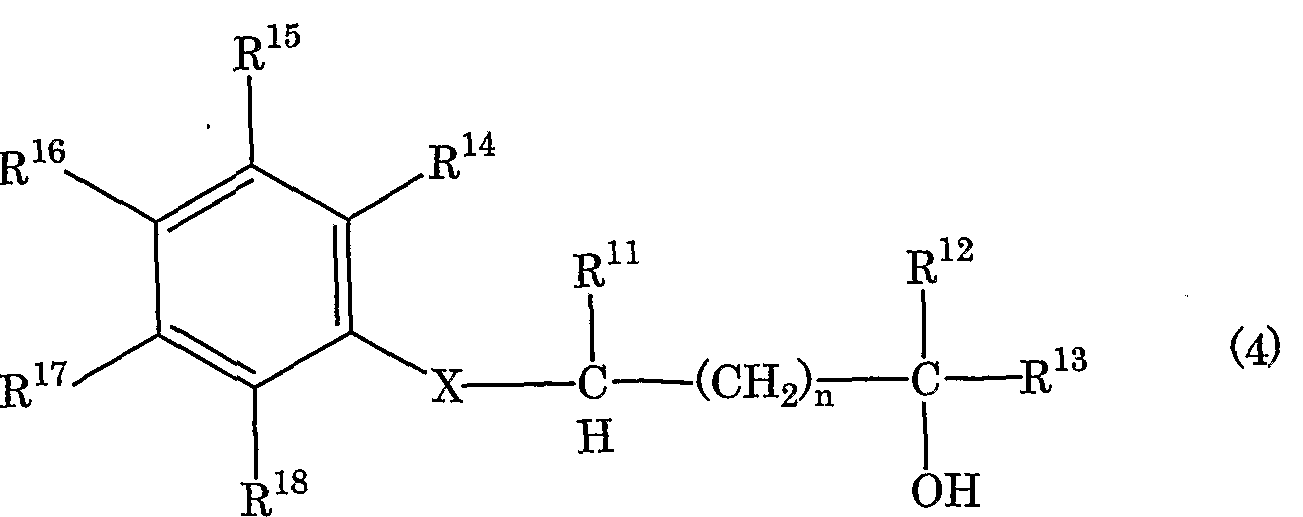
環状エーテル化合物として、 式 (2) で示される環状エーテル化合物を、 フエノール 化合物として、式 (3) で示されるフエノール化合物をそれぞれ用いた場合には、 式(4)
Figure imgf000024_0001
(式中、 RU、 R12、 R13、 R14、 R15、 R16、 R17、 R18、 Xおよび Πは、 それぞれ 上記と同一の意味を表わす。)
で示される光学活性なアルコール化合物が得られる。
かくして得られる光学活性なアル ール化合物としては、 光学活性 1ーフエノキシ—
2—プロパノール、光学活性 1一(4—クロロフエノキシ)一 2—プロパノール、 1— (2 一プロモフエノキシ) 一 2—プロパノール、 光学活性 1一 (4—プロモフエノキシ) 一 2 一プロパノール、 光学活性 1一 (2—メチルフエノキシ) 一2—プロパノール、 1一 (3 ーメチルフエノキシ) —2—プロパノール、 光学活性 1 - (4ーメチルフエノキシ) -2 —プロパノール、 光学活性 1一 (2—メトキシフエノキシ) —2—プロパノ一ル、 光学活 性 1_ (3—メトキシフエノキシ) —2—プロパノール、 光学活性 1一 (4ーメトキシフ エノキシ)一2—プロパノール、 1一(4ーフエノキシフエノキシ)一2—プロパノール、 光学活性 1一 (4一二トロフエノキシ) 一2—プロパノール、 光学活性 1— (2, 3—ジ フルオロー 6—二トロフエノキシ) —2—プロパノール、 光学活性 1—フエ二ルチオ一 2 —プロパノール、 1— (2—ブロモ—4一メチルフエ二ルチオ) —2—プロパノール、 光 学活性 1— (4—クロ口フエ二ルチオ) 一 2—プロパノール、 光学活性 1一 (4ーメトキ シフエ二ルチオ) 一2—プロパノール、 光学活性 1一 (4一フエノキシフエ二ルチオ) 一 2一プロパノール、 光学活性 1_フエノキシ一 2—ブタノール、 光学活性 1一 (4ークロロフエノキシ) 一 2—ブ夕ノール、 光学活性 1一 (2—ブロモフエノキシ) 一2—ブ夕ノ ル、 光学活性 1— (4一プロモフエノキシ) —2—ブタノール、光学活性 1一 (2—メチルフエノキシ) —2—ブタノール、 光学活性 1— (3—メチルフエノキシ) 一 2—ブタノール、 光学活性 1一 (4—メチルフエノキシ) 一 2—ブ夕ノール、 光学活性 1_ (4—メトキシフエノキ シ) 一 2—ブタノ一ル、 光学活性 1 - (4—フエノキシフエノキシ) 一 2—ブタノ一ル、 光学活性 1— (4一二トロフエノキシ) 一 2—ブタノール、 光学活性 1— (2, 3—ジフ ルォ口— 6—二トロフエノキシ) —2—ブタノ一ル、 光学活性 1—フエ二ルチオ— 2—ブ タノール、 光学活性 1一 (2—ブロモ—4—メチルフエ二ルチオ) 一 2—ブタノ一ル、 光 学活性 1— (4一クロ口フエ二ルチオ) 一2—ブタノール、 光学活性 1— (4ーメトキシ フエ二ルチオ) —2—ブタノール、 光学活性 1— (4—フエノキシフエ二ルチオ) —2— ブタノール、
光学活性 1 _フエノキシ _ 2—へ'キサノール、光学活性 1_ (4—クロロフエノキシ) 一 2—へキサノ一ル、 光学活性 1_ (2—ブロモフエノキシ) 一2—へキサノール、 光学 活性 1一 (4ーブロモフエノキシ) 一 2—へキサノール、 光学活性 1— (2—メチルフエ ノキシ) 一2—へキサノール、 光学活性 1一 (3—メチルフエノキシ) —2—へキサノー ル、 1― (4—メチルフエノキシ) 一 2—へキサノール、 光学活性 1一 (4ーメトキシフ エノキシ) 一2—へキサノール、 光学活性 1一 (4ーフエノキシフエノキシ) 一2—へキ サノール、光学活性 1一(4 _ニトロフエノキシ)一 2—へキサノール、光学活性 1— (2, 3—ジフルオロー 6—二トロフエノキシ) 一2—へキサノール、 光学活性 1—フエニルチ ォ一 2—へキサノール、 光学活性 1— (2—プロモー 4一メチルフエ二ルチオ) —2—へ キサノ一ル、 光学活性 1一 (4—クロ口フエ二ルチオ) 一 2—へキサノール、 光学活性 1 一 (4ーメトキシフエ二ルチオ) 一 2—へキサノール、 光学活性 1一 (4ーフエノキシフ ェニルチオ) 一 2—へキサノール、
光学活性 2—フエノキシ一 1—フエニルエタノール、 光学活性 2— (4—クロ口フエ ノキシ) 一 1—フエニルエタノール、 光学活性 2— (2—プロモフエノキシ) 一1—フエ ニルエタノール、 光学活性 2— (4—プロモフエノキシ) — 1一フエニルエタノール、 光 学活性 2— (2—メチルフエノキシ) 一 1一フエニルエタノール、 光学活性 2— (3—メ チルフエノキシ) 一 1一フエニルエタノール、 光学活性 2— (4ーメチルフエノキシ) 一 1_フエニルエタノール、 光学活性 2— (4ーメトキシフエノキシ) 一1—フエニルエタ ノール、光学活性 2— (4—フエノキシフエノキシ)一 1—フエニルエタノール、 2— (4 一二トロフエノキシ) 一 1—フエニルエタノール、 光学活性 2— (2, 3—ジフルオロー 6—ニトロフエノキシ) 一 1一フエニルエタノール、 光学活性 2—フエ二ルチオ一 1—フ ェニルエタノール、 光学活性 2— (2—プロモー 4—メチルフエ二ルチオ) — 1一フエ二 ルエタノール、 光学活性 2— (4—クロ口フエ二ルチオ) 一 1一フエニルエタノール、 光 学活性 2— (4—メトキシフエ二ルチオ) — 1一フエニルエタノール、 光学活性 2— (4 一フエノキシフエ二ルチオ) 一 1一フエニルエタノール、
光学活性 1—クロ口一 3—フエノキシ一 2_プロパノ一ル、 光学活性 1—クロ口一 3 - (4—クロロフエノキシ) 一2—プロパノール、 光学活性 1—クロロー 3— (2—プロ モフエノキシ)—2—プロパノ一ル、光学活性 1—クロ口一 3— (4—ブロモフエノキシ) —2—プロパノール、 光学活性 1—クロロー 3— (2—メチルフエノキシ) 一2—プロパ ノール、 光学活性 1—クロ口一 3— (3—メチルフエノキシ) 一2—プロパノール、 光学 活性 1—クロ口一 3— (4—メチルフエノキシ) 一2—プロパノール、 光学活性 1一クロ 口一 3— (2—メトキシフエノキシ)—2—プロパノール、光学活性 1一クロ口— 3— (3 ーメトキシフエノキシ) 一 2—プロパノール、 光学活性 1—クロロー 3— (4ーメトキシ フエノキシ) ー2—プロパノール、 光学活性 1一クロ口一 3— (4—フエノキシフエノキ シ) 一 2—プロパノール、 光学活性 1一クロ口一 3— (4—二トロフエノキシ) 一2—プ ロパノール、 光学活性 1—クロロー 3— (2, 3—ジフルオロー 6—ニトロフエノキシ) 一 2—プロパノール、 光学活性 1—クロロー 3—フエ二ルチオ一 2—プロパノール、 光学 活性 1—クロロー 3— (2—プロモ— 4—メチルフエ二ルチオ) —2—プロパノール、 光 学活性 1一クロ口— 3— (4一クロ口フエ二ルチオ) —2—プロパノール、 光学活性 1一 クロ口— 3— (4—メトキシフエ二ルチオ) 一2—プロパノール、 光学活性 1一クロ口一 3— (4—フエノキシフエ二ルチオ) 一 2—プロパノール、
光学活性 1ーブロモー 3—フエノキシ一 2—プロパノール、 1—ブロモ—3— (4- クロロフエノキシ) 一 2—プロパノール、 光学活性 1—クロロー 3— (2—ブロモフエノ キシ) —2—プロパノール、 光学活性 1一プロモー 3— (4ーブロモフエノキシ) _2— プ口パノール、光学活性 1—プロモー 3—( 2—メチルフエノキシ)一 2—プロパノール、 光学活性 1—プロモー 3— (3—メチルフエノキシ) 一 2—プロパノール、 1ーブロモー 3— (4—メチルフエノキシ) 一 2—プロパノ一ル、 光学活性 1—ブロモー 3— (2—メ トキシフエノキシ) 一 2—プロパノール、 光学活性 1_プロモー 3— (3—メトキシフエ ノキシ) —2—プロパノール、 光学活性 1ーブロモー 3— (4ーメトキシフエノキシ) 一 2—プロパノール、 光学活性 1一プロモー 3— (4—フエノキシフエノキシ) —2—プロ パノール、 光学活性 1—ブロモ _ 3— (4—ニトロフエノキシ) 一2—プロパノール、 光 学活性 1一プロモー 3— (2, 3—ジフルオロー 6—二トロフエノキシ) 一 2—プロパノ ール、 光学活性 1一プロモー 3—フエ'二ルチオ一 2—プロパノール、 光学活性 1—プロモ —3— (2—プロモ— 4一メチルフエ二ルチオ) —2—プロパノール、 光学活性 1—ブロ モー 3—(4—クロ口フエ二ルチオ)― 2—プロパノール、光学活性 1ーブロモー 3—(4 —メトキシフエ二ルチオ) 一 2—プロパノール、 光学活性 1—ブロモ一3— (4—フエノ キシフエ二ルチオ) —2—プロパノール、
光学活性 3—フエノキシプロパン— 1, 2—ジオール、 光学活性 3_ (4—クロロフ エノキシ) プロパン— 1, 2—ジォ一ル、 光学活性 3— (2—ブロモフエノキシ) プロパ ンー 1, 2—ジオール、 光学活性 3 _ (4—ブロモフエノキシ) プロパン一 1, 2—ジォ ール、 光学活性 3— (2—メチルフエノキシ) プロパン一 1, 2—ジオール、 光学活性 3 一 (3—メチルフエノキシ) プロパン一 1, 2—ジオール、 光学活性 3— (4—メチルフ エノキシ) プロパン一 1, 2—ジオール、 光学活性 3— (4—メトキシフエノキシ) プロ パン一 1, 2—ジォ一ル、 光学活性 3— (4—フエノキシフエノキシ) プロパン一 1, 2 —ジオール、 光学活性 3— (4—ニトロフエノキシ) プロパン一 1, 2—ジオール、 光学 活性 3— (2, 3—ジフルオロー 6—二トロフエノキシ) プロパン一 1, 2—ジオール、 光学活性 3—フエ二ルチオプロパン一 1 , 2—ジオール、 光学活性 3— (2—ブロモ—4 —メチルフエ二ルチオ) プロパン一 1, 2—ジオール、 光学活性 3— ( 4—クロ口フエ二 ルチオ) プロパン一 1 , 2—ジオール、 光学活性 3— (4ーメトキシフエ二ルチオ) プロ パン一 1, 2—ジオール、 光学活性 3— (4一フエノキシフエ二ルチオ) プロパン一 1 , 2—ジオール、
光学活性 2—フエノキシシクロへキサノール、光学活性 2—(4ークロロフエノキシ) シクロへキサノール、 光学活性 2— ( 2—プロモフエノキシ) シクロへキサノール、 光学 活性 2— ( 4—プロモフエノキシ) シクロへキサノール、 光学活性 2— ( 2—メチルフエ ノキシ) シクロへキサノール、 光学活性 2— ( 3—メチルフエノキシ) シクロへキサノー ル、 光学活性 2 - ( 4ーメチルフエノキシ) シクロへキサノール、 光学活性 2 - ( 4—メ トキシフエノキシ) シクロへキサノール、 光学活性 2— ( 4—フエノキシフエノキシ) シ クロへキサノール、 光学活性 2— (4一二トロフエノキシ) シクロへキサノール、 光学活 性 2— (2 , 3—ジフルオロー 6—ニトロフエノキシ) シクロへキサノ一ル、 光学活性 2 - (フエ二ルチオ) シクロへキサノール、 光学活性 2— ( 2—ブロモー 4一メチルフエ二 ルチオ) シクロへキサノール、 光学活性 2— (4—クロ口フエ二ルチオ) シクロへキサノ ール、光学活性 2—(4ーメトキシフエ二ルチオ)シクロへキサノール、光学活性 2— ( 4 一フエノキシフエ二ルチオ) シクロへキサノール、
光学活性 2—フエノキシシクロペン夕ノール、光学活性 2—(4ークロロフエノキシ) シクロペン夕ノール、 光学活性 2— (2—プロモフエノキシ) シクロペンタノ一ル、 光学 活性 2— (4ーブロモフエノキシ) シクロペンタノール、 光学活性 2— (2—メチルフエ ノキシ) シクロペンタノール、 光学活性 2— (3—メチルフエノキシ) シクロペンタノ一 ル、 光学活性 2— (4ーメチルフエノキシ) シクロペン夕ノール、 光学活性 2— (4—メ トキシフエノキシ) シクロペン夕ノール、 光学活性 2— (4—フエノキシフエノキシ) シ クロペン夕ノール、 光学活性 2— (4一二トロフエノキシ) シクロペンタノ一ル、 光学活 性 2— ( 2, 3—ジフルオロー 6—ニトロフエノキシ) シクロペン夕ノール、 光学活性 2 一 (フエ二ルチオ) シクロペン夕ノール、 光学活性 2— (2—ブロモ—4—メチルフエ二 ルチオ) シクロペン夕ノール、 光学活性 2— (4一クロ口フエ二ルチオ) シクロペンタノ ール、光学活性 2— (4—メトキシフエ二ルチオ)シクロペン夕ノール、光学活性 2— (4 —フエノキシフエ二ルチオ) シクロペン夕ノール、
光学活性 2—フエノキシシクロォク夕ノール、光学活性 2—(4一クロロフエノキシ) シクロォクタノール、 光学活性 2— (2—プロモフエノキシ) シクロォクタノール、 光学 活性 2— (4ーブロモフエノキシ) シクロォクタノール、 光学活性 2— (2—メチルフエ ノキシ) シクロォクタノール、 光学活性 2— (3—メチルフエノキシ) シクロォクタノー ル、 光学活性 2— (4—メチルフエノキシ) シクロォクタノール、 光学活性 2— (4—メ トキシフエノキシ) シクロォクタノ一ル、 光学活性 2— (4—フエノキシフエノキシ) シ クロォクタノール、 光学活性 2— (4一二トロフエノキシ) シクロォクタノール、 光学活 性 2— (2, 3—ジフルオロー 6—二トロフエノキシ) シクロォクタノール、 光学活性 2 - (フエ二ルチオ) シクロォクタノール、 光学活性 2— (2—プロモー 4一メチルフエ二 ルチオ) シクロォクタノール、 光学活性 2— (4一クロ口フエ二ルチオ) シクロォクタノ ール、光学活性 2— (4ーメトキシフエ二ルチオ)シクロォクタノール、光学活性 2— (4 一フエノキシフエ二ルチオ) シクロォクタノ一ル等が挙げられる。 実施例
以下、 実施例により本発明をさらに詳細に説明するが、 本発明はこれら実施例に限定 されない。なお、収率は、高速液体クロマトグラフィ分析の結果より算出し、光学純度は、 光学活性カラム (CH I RALCEL OD:ダイセル化学社製) を用いた高速液体クロ マトグラフィ分析の結果より算出した。 実施例 1
窒素置換したフラスコに、 (R, R) ― (一) -N, N' 一ビス (3, 5—ジ一 t e r t—ブチルサリチリデン) —1, 2—シクロへキサンジアミノコバルト (Π) 150. 9mgおよび t e r t—ブチルメチルエーテル 9. 5mLを仕込み、 さらに、 0. 25M W
28
のヨウ素 e r t一ブチルメチルエーテル溶液 0. 5mLを加え、 室温で 30分間攪拌 し、 ヨウ化 (R, R) ― (一) 一 N, N' —ビス (3, 5—ジー t e r t—ブチルサリチ リデン) ー1, 2—シクロへキサンジアミノコバルト (III) を含む混合物を得た。 得られ た混合物に、 トリフルォロメタンスルホン酸イットリウム 134m gを加えて 30分間攪 拌し、 触媒液を調製した。 該触媒液を 5 °Cまで冷却し、 フエノール 4. 71 gおよびプロ ピレンォキシド 6. 39 gを加え、 同温度で 20時間攪拌し、 反応させた。 反応終了後、 反応混合物を濃縮し、 1—フエノキシ—2—プロパノールを含む油状物を得た。
収率: 95% (フエノール基準)、 光学純度: 96. 7 e. e. (S体) 実施例 2
実施例 1において、 トリフルォロメタンスルホン酸イツトリウム 134mgに代えて、 トリフルォロメタンスルホン酸サマリウム 149mgを用いた以外は実施例 1と同様に 実施して、 1一フエノキシ _ 2—プロ'パノールを含む油状物を得た。
収率: 90% (フエノール基準)、 光学純度: 96. 4%e. e. (S体) 実施例 3
実施例 1において、 トリフルォロメタンスルホン酸イツトリウム 134m gに代えて、 トリフルォロメタンスルホン酸イッテルビウム 155 mgを用いた以外は実施例 1と同 様に実施して、 1一フエノキシ一 2—プロパノ一ルを含む油状物を得た。
収率: 86 % (フエノ一ル基準)、 光学純度: 96. 4%e. e. (S体) 実施例 4
実施例 1において、 トリフルォロメタンスルホン酸イツトリウム 134m gに代えて、 トリフルォロメタンスルホン酸スカンジウム 123 mgを用いた以外は実施例 1と同様 に実施して、 1一フエノキシ一 2—プロパノールを含む油状物を得た。
収率: 85% (フエノール基準)、 光学純度: 95. 9 e. e. (S体) W
29
実施例 5 ,
実施例 1において、 トリフルォロメタンスルホン酸イツトリウム 134mgに代えて、 トリフルォロメタンスルホン酸ランタン 147 mgを用いた以外は実施例 1と同様に実 施して、 1—フエノキシ—2—プロパノールを含む油状物を得た。
収率: 84% (フエノール基準)、 光学純度: 96. 5% e. e. (S体) 比較例 1
窒素置換したフラスコに、 (R, R) 一 (一) 一 N, N' 一ビス (3, 5—ジ— t e r t一プチルサリチリデン) — 1, 2—シクロへキサンジアミノコバルト (Π) 1 50.
9mgおよび t e r t—プチルメチルエーテル 9. 25mLを仕込み、 さらに、 0. 25 Mのヨウ素/ t e r t—プチルメチルエーテル溶液 0. 5mLを加え、 室温で 30分間攪 拌し、 ヨウ化 (R, R) 一 (一) -N, N' 一ビス (3, 5—ジ— t e r t—プチルサリ チリデン) — 1, 2—シクロへキサンジアミノコバルト (III) を含む混合物を得た。 得ら れた混合物に、 1. 0Mテトライソプロポキシチタン Z t e r t一ブチルメチルエーテル 溶液 0. 25 mLを加えて 30分間攪拌し、 触媒液を調製した。 該触媒液を 5 °Cまで冷却 し、 フエノール 4. 71 gおよびプロピレンォキシド 8. 7 1 gを加え、 同温度で 20時 間攪拌し、 反応させた。 反応終了後、 反応混合物を濃縮し、 1—フエノキシ—2—プロパ ノールを含む油状物を得た。
収率: 82% (フエノール基準)、 光学純度: 97. 2%e. e. (S体) 実施例 6
窒素置換したフラスコに、 (R, R) 一 (一) 一N, N' 一ビス (3, 5—ジ一 t e r t—プチルサリチリデン) — 1, 2—シクロへキサンジアミノコバルト (II) 301. 9mgおよび t e r t—プチルメチルエーテル 9. OmLを仕込み、 さらに、 0. 25M のヨウ素 Zt e r t一プチルメチルエーテル溶液 1. OmLを加え、 室温で 30分間攪拌 し、 ヨウ化 (R, R) 一 (-) — N, N, 一ビス (3, 5—ジ一 t e r t—プチルサリチ リデン) 一 1, 2—シクロへキサンジアミノコバルト (III) を含む混合物を得た。 得られ た混合物に、 トリフルォロメタンスルホン酸マグネシウム 16 lmgを加えて 30分間攪 拌し、 触媒液を調製した。 該触媒液を 5 °Cまで冷却し、 フエノール 4. 71 gおよびプロ ピレンォキシド 6. 39 gを加え、 同温度で 20時間攪拌し、 反応させた。 反応終了後、 反応混合物を濃縮し、 1一フエノキシ一 2一プロパノールを含む油状物を得た。
収率: 88% (フエノール基準)、 光学純度: 96. 9%e. e. (S体) 実施例 7
窒素置換したフラスコに、 (R, R) 一 (一) -N, N' —ビス (3, 5—ジ一 t e r t一プチルサリチリデン) 一 1, 2—シクロへキサンジアミノコバルト (Π) 301. 9mgおよび t e r t—ブチルメチルエーテル 3. OmLを仕込み、 さらに、 0. 25M のヨウ素 Zt e r t一ブチルメチルエーテル溶液 1. OmLを加え、 室温で 30分間攪拌 し、 ヨウ化 (R, R) - (-) 一 N, N, 一ビス (3, 5—ジ— t e r t—プチルサリチ リデン) —1, 2—シクロへキサンジアミノコバルト (ΠΙ) を含む混合物を得た。 得られ た混合物に、 トリフルォロメタンスルホン酸イットリウム 268 mgを加えて 30分間攪 拌し、 触媒液を調製した。 該触媒液を 5 °Cまで冷却し、 2—メトキシフエノール 1. 24 gおよび 2—クロロメチルォキシラン 2. 78 gを加え、 同温度で 20時間攪拌し、 反応 させた。反応終了後、反応混合物を濃縮し、 1一クロロー 3— (2—メトキシフエノキシ) _ 2—プロパノールを含む油状物を得た。
収率: 59% (2—メトキシフエノール基準)、 光学純度: 84. 2%e. e. (S体) 実施例 8
実施例 7において、 トリフルォロメタンスルホン酸イツトリウム 268mgに代えて、 トリフルォロメタンスルホン酸イッテルビウム 31 Omgを用いた以外は、 実施例 7と同 様に実施して、 1—クロ口一 3— (2—メトキシフエノキシ) 一 2—プロパノールを含む W
31
油状物を得た。
収率: 71% (2—メトキシフエノール基準)、 光学純度: 87. 3%e. e. (S体) 実施例 9
窒素置換したフラスコに、 (R, R) ― (一) 一 N, N, 一ビス (3, 5—ジ一 t e r tーブチルサリチリデン) —1, 2—シクロへキサンジアミノコバルト (II) 301. 9mgおよび t e r t—プチルメチルエーテル 4. OmLを仕込み、 さらに、 0. 25M のヨウ素 Zt e r t一ブチルメチルエーテル溶液 1. OmLを加え、 室温で 30分間攪拌 し、 ヨウ化 (R, R) - (一) 一 N, N' —ビス (3, 5—ジー t e r t—プチルサリチ リデン) 一 1 , 2—シクロへキサンジァミノコバルト (III) を含む混合物を得た。 得られ た混合物に、 トリフルォロメタンスルホン酸イットリウム 268mgを加えて 30分間攪 拌し、 触媒液を調製した。 該触媒液を 5 Tまで冷却し、 2—メトキシフエノール 3. 10 gおよび 2 _クロロメチルォキシラン 6. 94 gを加え、 同温度で 94時間攪拌し、 反応 させた。 反応終了後、 反応混合物を濃縮して、 1一クロロー 3— (2—メトキシフエノキ シ) 一 2—プロパノールを含む油状物を得た。
収率: 82% (2—メトキシフエノール基準)、 光学純度: 85. 2%e. e. (S体) 比較例 2
実施例 7において、 トリフルォロメタンスルホン酸イットリウム 268mgに代えて、 1. 0Mテトライソプロポキシチタン t e r t—ブチルメチルエーテル溶液 1. OmL を用いた以外は、 実施例 7と同様に実施して、 1—クロロー 3— (2—メトキシフエノキ シ) 一 2—プロパノールを含む油状物を得た。
収率: 37% (2—メトキシフヱノール基準)、 光学純度: 65. 3%e. e. (S体) 実施例 10
実施例 1において、フエノールに代えて、 4一フエノキシフエノールを用いる以外は、 実施例 1と同様に実施することにより、 光学活性な 1一 (4一フヱノキシフエノキシ) 一 2—プロパノールを含む油状物を得ることができる。 実施例 1 1
実施例 6において、フエノールに代えて、 4一フエノキシフエノールを用いる以外は、 実施例 6と同様に実施することにより、 光学活性な 1— (4—フエノキシフエノキシ) 一 2—プロパノ一ルを含む油状物を得ることができる。 産業上の利用可能性
本発明の不斉錯体は、 環状エーテル化合物とフエノール化合物との反応において、 高 い触媒活性を示すため、 該不斉錯体を用いることにより、 工業的に、 より有利に光学活性 アルコール化合物を製造することができる。

Claims

請 求 の 範 囲
Figure imgf000035_0001
(式中、 Rl、 R2、 R 3、 R 4、 R 5、 R 6、 R 7および R 8はそれぞれ同一または相異なつ て、水素原子、ハロゲン原子、 アルキル基、 アルケニル基、 アルキニル基、 アルコキシ基、 ハロアルキル基、 ハロアルコキシ基、 置換もしくは無置換ァリール基、 ァラルキル基、 水 酸基、ニトロ基、アミノ基、力ルバモイル基、力ルポキシル基またはシリル基を表わすか、 または R R2、 R 3、 R4、 R5、 R6、 R 7および R8のうちの隣接する二つの基が結合 して、 それらが結合するベンゼン環とともに環を形成して、 ナフ夕レン環を表わす。
R9および Ri oのいずれか一方が水素原子を表わし、他方が、ハロゲン原子で置換されて いてもよい炭素数 1〜4のアルキル基、 ハロゲン原子で置換されていてもよい炭素数 1 ~ 4のアルコキシ基およびハ口ゲン原子からなる群から選ばれる少なくとも一つで置換さ れていてもよいフエニル基またはナフチル基を表わすか、 または、 異なる炭素原子に結合 した R9 と Ri o からなる対のうちのいずれか一対が結合してテトラメチレン基を形成し、 他方の対がそれぞれ水素原子を表わす。
Qは、 単結合もしくは炭素数 1〜4のアルキレン基を表わすか、 または、 Qが、 R9 およ び Ri o と一緒になつて、 その 2位および 2 '位で窒素原子と結合する 1, 1 ' —ビナフチ ル基を表わす。
Mは金属イオンを表わし、 金属イオンのイオン価と配位子の配位数が同一のとき、 Aは存 在せず、 前記イオン価と配位数が相異なるとき、 Aは対イオンまたは配位子を表わす。) で示される光学活性な金属錯体と金属スルホン酸塩とを反応せしめてなる不斉錯体の存 在下に、 環状エーテル化合物とフエノール化合物とを反応させることを特徴とする光学活 性なアルコール化合物の製造法。
2. 環状エーテル化合物が、 式 (2)
Figure imgf000036_0001
(式中、 RH は水素原子を、 Ri2 は水素原子もしくは置換されていてもよい炭素数 1~ 4のアルキル基を表わすか、 または Rii と Ri2 が結合して炭素数 2 ~ 6のアルキレン基 を表わす。 Ri3は置換されていてもよい炭素数 1〜4のアルキル基、置換されていてもよ い炭素数 6~10のァリ一ル基または置換されていてもよい炭素数 7〜20のァラルキ ル基を表わす。 nは、 0または 1を表わす。)
で示される環状エーテル化合物であり、
フエノール化合物が、 式 (3)
Figure imgf000036_0002
(式中、 Xは酸素原子または硫黄原子を表わし、 R"、 R15、 R16、 R17および R18は、 それぞれ同一または相異なって、 水素原子、 ハロゲン原子、 ニトロ基、 置換されていても よい炭素数 1 ~ 6のアルキル基、 置換されていてもよい炭素数 1〜 6のアルコキシ基また は置換されていてもよいフエノキシ基を表わす。 )
で示されるフエノール化合物であり、
光学活性なアルコール化合物が、 式 (4)
Figure imgf000037_0001
(式中、 RH、 R 1 3、 R 1 4、 R15、 R 1 6、 R 1 7、 R 1 8、 Xおよび nは、 それぞれ 上記と同一の意味を表わす。 )
で示される光学活性なアルコール化合物である請求の範囲第 1項に記載の光学活性なァ ルコール化合物の製造法。
3 . 金属スルホン酸塩が、 金属カチオンと炭素数 1〜1 0のパーフルォロア ルカンスルホナートァニオンとから構成される金属スルホン酸塩である請求の範囲第 1 項または第 2項に記載の光学活性なアルコールィヒ合物の製造法。
4. 炭素数 1〜1 0のパーフルォロアルカンスルホナ一卜ァニオンが、 トリ フルォロメタンスルホナー卜ァニオンである請求の範囲第 3項に記載の光学活性なアル コール化合物の製造法。
5 . 金属カチオンが、 周期律表第 2族元素、 第 3族元素およびランタノイド から選ばれる少なくとも一つの金属元素のカチオンである請求の範囲第 3項に記載の光 学活性なアルコール化合物の製造法。
6 . 周期律表第 2族元素、 第 3族元素およびランタノイドから選ばれる少な くとも一つの金属元素が、 マグネシウム、 スカンジウム、 イットリウム、 ランタン、 サマ リウムおよびィッテルビゥムからなる群から選ばれる少なくとも一つの金属元素である 請求の範囲第 5項に記載の光学活性なアルコール化合物の製造法。
7 . Mが、 コバルトイオン、 クロムイオンまたはマンガンイオンである請求 の範囲第 1項または第 2項に記載の光学活性なアルコール化合物の製造方法。
8 . Aが、 .ハロゲンィ匕物イオンである請求の範囲第 1項または第 2項に記載 の光学活性なアルコール化合物の製造方法。
9 . 請求項 1に記載の光学活性な金属錯体と金属スルホン酸塩とを反応せ しめてなる不斉錯体。 .
1 0 . 金属スルホン酸塩が、 金属カチオンと炭素数 1〜1 0のパーフルォロア ルカンスルホナートァニオンとから構成される金属スルホン酸塩である請求の範囲第 9 に記載の不斉錯体。
1 1 . 炭素数 1〜 1 0のパーフルォロアルカンスルホナ一トァニオンが、 トリ フルォロメ夕ンスルホナ一トァニオンである請求の範囲第 1 0項に記載の不斉錯体。
1 2 . 金属カチオンが、 周期律表第 2族元素、 第 3族元素およびランタノィド から選ばれる少なくとも一つの金属元素のカチオンである請求の範囲第 1 0項に記載の 不斉錯体。
1 3 . 周期律表第 2族元素、 第 3族元素およびランタノィドから選ばれる少な くとも一つの金属元素が、 マグネシウム、 スカンジウム、 イットリウム、 ランタン、 サマ リウムおよびイッテルビウムからなる群から選ばれる少なくとも一つの金属元素である 請求の範囲第 1 2項に記載の不斉錯体。
1 . Mが、 コバルトイオン、 クロムイオンまたはマンガンイオンである請求 の範囲第 9項に記載の不斉錯体。
1 5 . Aが、 八ロゲン化物イオンである請求の範囲第 9項に記載の不斉錯体。
PCT/JP2007/052070 2006-02-01 2007-01-31 光学活性なアルコール化合物の製造法 Ceased WO2007089025A1 (ja)

Priority Applications (4)

Application Number Priority Date Filing Date Title
US12/161,695 US7906667B2 (en) 2006-02-01 2007-01-31 Method for producing optically active alcohol compound
CN2007800039300A CN101374792B (zh) 2006-02-01 2007-01-31 制备光学活性的醇化合物的方法
EP07708119A EP1982973A4 (en) 2006-02-01 2007-01-31 METHOD FOR PRODUCING AN OPTICALLY ACTIVE ALCOHOL COMPOUND
IL192831A IL192831A (en) 2006-02-01 2008-07-15 Method for producing optically active alcohol compound

Applications Claiming Priority (2)

Application Number Priority Date Filing Date Title
JP2006024214 2006-02-01
JP2006-024214 2006-02-01

Publications (1)

Publication Number Publication Date
WO2007089025A1 true WO2007089025A1 (ja) 2007-08-09

Family

ID=38327579

Family Applications (1)

Application Number Title Priority Date Filing Date
PCT/JP2007/052070 Ceased WO2007089025A1 (ja) 2006-02-01 2007-01-31 光学活性なアルコール化合物の製造法

Country Status (5)

Country Link
US (1) US7906667B2 (ja)
EP (1) EP1982973A4 (ja)
CN (1) CN101374792B (ja)
IL (1) IL192831A (ja)
WO (1) WO2007089025A1 (ja)

Families Citing this family (1)

* Cited by examiner, † Cited by third party
Publication number Priority date Publication date Assignee Title
US10385084B2 (en) * 2014-01-08 2019-08-20 The Governing Council Of The University Of Toronto Iron(II) catalysts containing tridentate PNP ligands, their synthesis, and use thereof

Citations (3)

* Cited by examiner, † Cited by third party
Publication number Priority date Publication date Assignee Title
JPH10330389A (ja) * 1997-06-02 1998-12-15 Nissan Chem Ind Ltd 光学活性クロム錯体及び不斉エポキシ化反応
JP2003002854A (ja) * 2001-04-18 2003-01-08 Sumitomo Chem Co Ltd 光学活性アルコール誘導体の製造方法およびその触媒
JP2005538838A (ja) * 2002-09-17 2005-12-22 ローディア ファーマ ソリューションズ インコーポレイティド 立体選択開環反応用の活性触媒

Family Cites Families (7)

* Cited by examiner, † Cited by third party
Publication number Priority date Publication date Assignee Title
JPS60176592A (ja) 1984-02-23 1985-09-10 Sumitomo Chem Co Ltd 光学活性1−(4−フエノキシフエノキシ)プロパン−2−オ−ルの生化学的製法
JPS60215671A (ja) 1984-04-10 1985-10-29 Sumitomo Chem Co Ltd 含窒素複素環化合物、その製造法およびそれを有効成分とする有害生物防除剤
JP3377449B2 (ja) * 1998-08-04 2003-02-17 科学技術振興事業団 水系ルイス酸触媒反応方法
ATE435069T1 (de) 2001-04-18 2009-07-15 Sumitomo Chemical Co ßKOMPLEXKATALYSATOR, VERFAHREN ZUR HERSTELLUNG DES KOMPLEXKATALYSATORS UND VERFAHREN ZUR HERSTELLUNG VON ALKOHOLDERIVATEN MIT DEM KOMPLEXKATALYSATORß
US6884750B2 (en) 2001-06-27 2005-04-26 Rs Tech Corp. Chiral salen catalyst and methods for the preparation of chiral compounds from racemic epoxides by using new catalyst
JP4305018B2 (ja) 2003-03-24 2009-07-29 住友化学株式会社 アルコール化合物の製造方法
US6916963B2 (en) 2003-07-14 2005-07-12 Saudi Basic Industries Corporation Process using water tolerant Lewis acids in catalytic hydration of alkylene oxides to alkylene glycols

Patent Citations (3)

* Cited by examiner, † Cited by third party
Publication number Priority date Publication date Assignee Title
JPH10330389A (ja) * 1997-06-02 1998-12-15 Nissan Chem Ind Ltd 光学活性クロム錯体及び不斉エポキシ化反応
JP2003002854A (ja) * 2001-04-18 2003-01-08 Sumitomo Chem Co Ltd 光学活性アルコール誘導体の製造方法およびその触媒
JP2005538838A (ja) * 2002-09-17 2005-12-22 ローディア ファーマ ソリューションズ インコーポレイティド 立体選択開環反応用の活性触媒

Non-Patent Citations (3)

* Cited by examiner, † Cited by third party
Title
LEPAGE C.R.J. ET AL.: "The oxidation of sulfides by chromium(V)", CANADIAN JOURNAL OF CHEMISTRY, vol. 81, no. 1, 2003, pages 75 - 80, XP003015879 *
SAMSEL E.G. ET AL.: "Mechanism of the chromium-catalyzed epoxidation of olefins. Role of oxochromium(V) cations", JOURNAL OF THE AMERICAN CHEMICAL SOCIETY, vol. 107, no. 25, 1985, pages 7606 - 7617, XP003015880 *
See also references of EP1982973A4 *

Also Published As

Publication number Publication date
IL192831A (en) 2011-11-30
IL192831A0 (en) 2009-02-11
US20100234629A1 (en) 2010-09-16
CN101374792A (zh) 2009-02-25
US7906667B2 (en) 2011-03-15
CN101374792B (zh) 2012-03-28
EP1982973A4 (en) 2009-09-09
EP1982973A1 (en) 2008-10-22

Similar Documents

Publication Publication Date Title
US6087513A (en) Epoxidation process for aryl allyl ethers
WO1999062894A2 (en) Process for epoxidation of aryl allyl ethers
US8217184B2 (en) Process for producing optically active cis-silyl olefin oxide compound
CN104801343B (zh) 一种三价钴Salen催化剂、合成方法及其在末端环氧化物拆分中的应用
WO2012061344A1 (en) System and method for fluoroalkylated fluorophthalocyanines with aggregating properties and catalytic driven pathway for oxidizing thiols
JPH06122678A (ja) 付加物の製造法
WO2007089025A1 (ja) 光学活性なアルコール化合物の製造法
Amantini et al. Nucleophilic ring opening of 1, 2-epoxides in aqueous medium
JP5211495B2 (ja) 光学活性なアルコール化合物の製造方法およびそれに用いる不斉錯体
JP5211496B2 (ja) 光学活性なアルコール化合物の製造法およびそれに用いる不斉錯体
JP4844130B2 (ja) β−ヒドロキシエーテル類の製造方法
ES2327718T3 (es) Catalizador complejo; su procedimiento de produccion y procedimiento de produccion de un derivado alcoholico realizado con este catalizador complejo.
CN108558916A (zh) 一种对苯丁氧基苯甲酸的合成工艺
WO2007089022A1 (ja) 光学活性なアルコール化合物の製造方法
CN102325820A (zh) 环氧树脂生产
JP4321005B2 (ja) 光学活性アルコール誘導体の製造方法およびその触媒
WO2012081488A1 (ja) ビス(トリフルオロメタンスルホニル)エチル基を有する化合物及び酸触媒、並びにその製造方法
JP2003176246A (ja) アルコール誘導体の製造方法およびその触媒
CN1863755A (zh) 羟芳族化合物的溴化
US9416080B2 (en) Catalytic C—H bond activation
Ryu et al. Fluorous solvents
JP4019144B2 (ja) 高分子炭酸エステルの製造方法
JP4623745B2 (ja) 光学活性β−ヒドロキシスルフィド化合物の製法
WO2013121873A1 (ja) ビアリール化合物の製造方法

Legal Events

Date Code Title Description
121 Ep: the epo has been informed by wipo that ep was designated in this application
WWE Wipo information: entry into national phase

Ref document number: 192831

Country of ref document: IL

WWE Wipo information: entry into national phase

Ref document number: 12161695

Country of ref document: US

WWE Wipo information: entry into national phase

Ref document number: 200780003930.0

Country of ref document: CN

NENP Non-entry into the national phase

Ref country code: DE

WWE Wipo information: entry into national phase

Ref document number: 2007708119

Country of ref document: EP

WWE Wipo information: entry into national phase

Ref document number: 4549/CHENP/2008

Country of ref document: IN