WO2007093264A1 - Mandelsäurehydrazide - Google Patents
Mandelsäurehydrazide Download PDFInfo
- Publication number
- WO2007093264A1 WO2007093264A1 PCT/EP2007/000430 EP2007000430W WO2007093264A1 WO 2007093264 A1 WO2007093264 A1 WO 2007093264A1 EP 2007000430 W EP2007000430 W EP 2007000430W WO 2007093264 A1 WO2007093264 A1 WO 2007093264A1
- Authority
- WO
- WIPO (PCT)
- Prior art keywords
- solvates
- stereoisomers
- hal
- salts
- including mixtures
- Prior art date
- Legal status (The legal status is an assumption and is not a legal conclusion. Google has not performed a legal analysis and makes no representation as to the accuracy of the status listed.)
- Ceased
Links
- 0 *c1c(*)c(*)c(*=C)c(C(C(I)=O)O*)c1* Chemical compound *c1c(*)c(*)c(*=C)c(C(C(I)=O)O*)c1* 0.000 description 1
Classifications
-
- C—CHEMISTRY; METALLURGY
- C07—ORGANIC CHEMISTRY
- C07C—ACYCLIC OR CARBOCYCLIC COMPOUNDS
- C07C243/00—Compounds containing chains of nitrogen atoms singly-bound to each other, e.g. hydrazines, triazanes
- C07C243/24—Hydrazines having nitrogen atoms of hydrazine groups acylated by carboxylic acids
- C07C243/38—Hydrazines having nitrogen atoms of hydrazine groups acylated by carboxylic acids with acylating carboxyl groups bound to carbon atoms of six-membered aromatic rings
-
- A—HUMAN NECESSITIES
- A61—MEDICAL OR VETERINARY SCIENCE; HYGIENE
- A61K—PREPARATIONS FOR MEDICAL, DENTAL OR TOILETRY PURPOSES
- A61K31/00—Medicinal preparations containing organic active ingredients
- A61K31/13—Amines
- A61K31/15—Oximes (>C=N—O—); Hydrazines (>N—N<); Hydrazones (>N—N=) ; Imines (C—N=C)
-
- A—HUMAN NECESSITIES
- A61—MEDICAL OR VETERINARY SCIENCE; HYGIENE
- A61P—SPECIFIC THERAPEUTIC ACTIVITY OF CHEMICAL COMPOUNDS OR MEDICINAL PREPARATIONS
- A61P1/00—Drugs for disorders of the alimentary tract or the digestive system
- A61P1/04—Drugs for disorders of the alimentary tract or the digestive system for ulcers, gastritis or reflux esophagitis, e.g. antacids, inhibitors of acid secretion, mucosal protectants
-
- A—HUMAN NECESSITIES
- A61—MEDICAL OR VETERINARY SCIENCE; HYGIENE
- A61P—SPECIFIC THERAPEUTIC ACTIVITY OF CHEMICAL COMPOUNDS OR MEDICINAL PREPARATIONS
- A61P1/00—Drugs for disorders of the alimentary tract or the digestive system
- A61P1/16—Drugs for disorders of the alimentary tract or the digestive system for liver or gallbladder disorders, e.g. hepatoprotective agents, cholagogues, litholytics
-
- A—HUMAN NECESSITIES
- A61—MEDICAL OR VETERINARY SCIENCE; HYGIENE
- A61P—SPECIFIC THERAPEUTIC ACTIVITY OF CHEMICAL COMPOUNDS OR MEDICINAL PREPARATIONS
- A61P1/00—Drugs for disorders of the alimentary tract or the digestive system
- A61P1/18—Drugs for disorders of the alimentary tract or the digestive system for pancreatic disorders, e.g. pancreatic enzymes
-
- A—HUMAN NECESSITIES
- A61—MEDICAL OR VETERINARY SCIENCE; HYGIENE
- A61P—SPECIFIC THERAPEUTIC ACTIVITY OF CHEMICAL COMPOUNDS OR MEDICINAL PREPARATIONS
- A61P11/00—Drugs for disorders of the respiratory system
-
- A—HUMAN NECESSITIES
- A61—MEDICAL OR VETERINARY SCIENCE; HYGIENE
- A61P—SPECIFIC THERAPEUTIC ACTIVITY OF CHEMICAL COMPOUNDS OR MEDICINAL PREPARATIONS
- A61P13/00—Drugs for disorders of the urinary system
- A61P13/12—Drugs for disorders of the urinary system of the kidneys
-
- A—HUMAN NECESSITIES
- A61—MEDICAL OR VETERINARY SCIENCE; HYGIENE
- A61P—SPECIFIC THERAPEUTIC ACTIVITY OF CHEMICAL COMPOUNDS OR MEDICINAL PREPARATIONS
- A61P19/00—Drugs for skeletal disorders
- A61P19/02—Drugs for skeletal disorders for joint disorders, e.g. arthritis, arthrosis
-
- A—HUMAN NECESSITIES
- A61—MEDICAL OR VETERINARY SCIENCE; HYGIENE
- A61P—SPECIFIC THERAPEUTIC ACTIVITY OF CHEMICAL COMPOUNDS OR MEDICINAL PREPARATIONS
- A61P25/00—Drugs for disorders of the nervous system
-
- A—HUMAN NECESSITIES
- A61—MEDICAL OR VETERINARY SCIENCE; HYGIENE
- A61P—SPECIFIC THERAPEUTIC ACTIVITY OF CHEMICAL COMPOUNDS OR MEDICINAL PREPARATIONS
- A61P25/00—Drugs for disorders of the nervous system
- A61P25/28—Drugs for disorders of the nervous system for treating neurodegenerative disorders of the central nervous system, e.g. nootropic agents, cognition enhancers, drugs for treating Alzheimer's disease or other forms of dementia
-
- A—HUMAN NECESSITIES
- A61—MEDICAL OR VETERINARY SCIENCE; HYGIENE
- A61P—SPECIFIC THERAPEUTIC ACTIVITY OF CHEMICAL COMPOUNDS OR MEDICINAL PREPARATIONS
- A61P27/00—Drugs for disorders of the senses
- A61P27/02—Ophthalmic agents
- A61P27/06—Antiglaucoma agents or miotics
-
- A—HUMAN NECESSITIES
- A61—MEDICAL OR VETERINARY SCIENCE; HYGIENE
- A61P—SPECIFIC THERAPEUTIC ACTIVITY OF CHEMICAL COMPOUNDS OR MEDICINAL PREPARATIONS
- A61P27/00—Drugs for disorders of the senses
- A61P27/02—Ophthalmic agents
- A61P27/12—Ophthalmic agents for cataracts
-
- A—HUMAN NECESSITIES
- A61—MEDICAL OR VETERINARY SCIENCE; HYGIENE
- A61P—SPECIFIC THERAPEUTIC ACTIVITY OF CHEMICAL COMPOUNDS OR MEDICINAL PREPARATIONS
- A61P29/00—Non-central analgesic, antipyretic or antiinflammatory agents, e.g. antirheumatic agents; Non-steroidal antiinflammatory drugs [NSAID]
-
- A—HUMAN NECESSITIES
- A61—MEDICAL OR VETERINARY SCIENCE; HYGIENE
- A61P—SPECIFIC THERAPEUTIC ACTIVITY OF CHEMICAL COMPOUNDS OR MEDICINAL PREPARATIONS
- A61P3/00—Drugs for disorders of the metabolism
-
- A—HUMAN NECESSITIES
- A61—MEDICAL OR VETERINARY SCIENCE; HYGIENE
- A61P—SPECIFIC THERAPEUTIC ACTIVITY OF CHEMICAL COMPOUNDS OR MEDICINAL PREPARATIONS
- A61P3/00—Drugs for disorders of the metabolism
- A61P3/04—Anorexiants; Antiobesity agents
-
- A—HUMAN NECESSITIES
- A61—MEDICAL OR VETERINARY SCIENCE; HYGIENE
- A61P—SPECIFIC THERAPEUTIC ACTIVITY OF CHEMICAL COMPOUNDS OR MEDICINAL PREPARATIONS
- A61P3/00—Drugs for disorders of the metabolism
- A61P3/06—Antihyperlipidemics
-
- A—HUMAN NECESSITIES
- A61—MEDICAL OR VETERINARY SCIENCE; HYGIENE
- A61P—SPECIFIC THERAPEUTIC ACTIVITY OF CHEMICAL COMPOUNDS OR MEDICINAL PREPARATIONS
- A61P3/00—Drugs for disorders of the metabolism
- A61P3/08—Drugs for disorders of the metabolism for glucose homeostasis
- A61P3/10—Drugs for disorders of the metabolism for glucose homeostasis for hyperglycaemia, e.g. antidiabetics
-
- A—HUMAN NECESSITIES
- A61—MEDICAL OR VETERINARY SCIENCE; HYGIENE
- A61P—SPECIFIC THERAPEUTIC ACTIVITY OF CHEMICAL COMPOUNDS OR MEDICINAL PREPARATIONS
- A61P31/00—Antiinfectives, i.e. antibiotics, antiseptics, chemotherapeutics
-
- A—HUMAN NECESSITIES
- A61—MEDICAL OR VETERINARY SCIENCE; HYGIENE
- A61P—SPECIFIC THERAPEUTIC ACTIVITY OF CHEMICAL COMPOUNDS OR MEDICINAL PREPARATIONS
- A61P31/00—Antiinfectives, i.e. antibiotics, antiseptics, chemotherapeutics
- A61P31/04—Antibacterial agents
-
- A—HUMAN NECESSITIES
- A61—MEDICAL OR VETERINARY SCIENCE; HYGIENE
- A61P—SPECIFIC THERAPEUTIC ACTIVITY OF CHEMICAL COMPOUNDS OR MEDICINAL PREPARATIONS
- A61P35/00—Antineoplastic agents
-
- A—HUMAN NECESSITIES
- A61—MEDICAL OR VETERINARY SCIENCE; HYGIENE
- A61P—SPECIFIC THERAPEUTIC ACTIVITY OF CHEMICAL COMPOUNDS OR MEDICINAL PREPARATIONS
- A61P43/00—Drugs for specific purposes, not provided for in groups A61P1/00-A61P41/00
-
- A—HUMAN NECESSITIES
- A61—MEDICAL OR VETERINARY SCIENCE; HYGIENE
- A61P—SPECIFIC THERAPEUTIC ACTIVITY OF CHEMICAL COMPOUNDS OR MEDICINAL PREPARATIONS
- A61P9/00—Drugs for disorders of the cardiovascular system
-
- A—HUMAN NECESSITIES
- A61—MEDICAL OR VETERINARY SCIENCE; HYGIENE
- A61P—SPECIFIC THERAPEUTIC ACTIVITY OF CHEMICAL COMPOUNDS OR MEDICINAL PREPARATIONS
- A61P9/00—Drugs for disorders of the cardiovascular system
- A61P9/04—Inotropic agents, i.e. stimulants of cardiac contraction; Drugs for heart failure
-
- A—HUMAN NECESSITIES
- A61—MEDICAL OR VETERINARY SCIENCE; HYGIENE
- A61P—SPECIFIC THERAPEUTIC ACTIVITY OF CHEMICAL COMPOUNDS OR MEDICINAL PREPARATIONS
- A61P9/00—Drugs for disorders of the cardiovascular system
- A61P9/10—Drugs for disorders of the cardiovascular system for treating ischaemic or atherosclerotic diseases, e.g. antianginal drugs, coronary vasodilators, drugs for myocardial infarction, retinopathy, cerebrovascula insufficiency, renal arteriosclerosis
Definitions
- the invention had the object of finding new compounds with valuable properties, in particular those that can be used for the production of medicaments.
- the present invention relates to compounds in which the inhibition, regulation and / or modulation of the signal transduction of kinases, in particular the cell volume-regulated human kinase h-sgk (human serum and glucocorticoid dependent kinase or SGK) plays a role, and also pharmaceutical compositions containing these compounds and the use of the compounds for the treatment of SGK-related diseases.
- kinases in particular the cell volume-regulated human kinase h-sgk (human serum and glucocorticoid dependent kinase or SGK) plays a role
- the SGK with the isoforms SGK-1, SGK-2 and SGK-3 are a serine / threonine protein kinase family (WO 02/17893).
- the compounds of the invention are preferably selective inhibitors of SGK-1. Further, they may be inhibitors of SGK-2 and / or SGK-3.
- the present invention relates to compounds containing the
- diabetes e.g., diabetes mellitus, diabetic nephropathy, diabetic neuropathy, diabetic angiopathy and microangiopathy
- metabolic syndrome dyslipidemia
- systemic and pulmonary hypertension cardiovascular disorders (e.g., cardiac fibrosis following myocardial infarction, cardiac hypertrophy and heart failure,
- Arteriosclerosis glomerulosclerosis, Nephrosclerosis, nephritis, nephropathy, disturbed electrolyte excretion
- kidney diseases eg glomerulosclerosis, Nephrosclerosis, nephritis, nephropathy, disturbed electrolyte excretion
- fibrosis and inflammatory processes eg liver cirrhosis, pulmonary fibrosis, fibrosing pancreatitis,
- the compounds of the invention can also increase the growth of
- the compounds according to the invention are also used in the treatment of peptic ulcers, in particular in forms which are triggered by stress.
- the compounds of the invention find further use for the treatment of coagulopathies, such as dysfibrinogenemia, hypoproconvertinemia, hemophilia B, Stuart Prower defect, prothrombin complex deficiency, coagulation, fibrinolysis,
- coagulopathies such as dysfibrinogenemia, hypoproconvertinemia, hemophilia B, Stuart Prower defect, prothrombin complex deficiency, coagulation, fibrinolysis,
- the invention 20 neuronal excitability, e.g. Epilepsy.
- Compounds can also be used in the treatment of glaucoma or
- Cataract can be used therapeutically.
- the compounds of the invention are also used in the treatment of bacterial infections as well as in an anti-infective
- the compounds of the invention counteract O0 cell aging and stress and thus increase life expectancy and fitness in old age.
- the compounds of the invention are also used in the
- Salts with good compatibility have very valuable pharmacological properties.
- the present invention therefore relates to compounds according to the invention as medicaments and / or active pharmaceutical ingredients in the treatment and / or prophylaxis of said diseases and the use of compounds according to the invention for the preparation of a pharmaceutical for the treatment and / or prophylaxis of said diseases as well as a method of treatment said diseases comprising administering one or more of the compounds of the invention to a patient in need of such administration.
- the host or patient may be of any mammalian species, e.g. A primate species, especially humans; Rodents, including mice, rats and hamsters; Rabbits; Horses, cattle, dogs, cats, etc. Animal models are of interest for experimental studies, providing a model for the treatment of human disease.
- Compounds may also serve as reagents for testing kinase-dependent
- kinase activity is a technique well known to those skilled in the art.
- Generic Assay Systems for Determining Kinase Activity with Substrates e.g. Histone (eg Alessi et al., FEBS Lett. 1996, 399, 3, pp. 333-338) or the myelin basic protein are described in the literature (eg Campos-Gonzalez, R. and Glenney, Jr., JR 1992, J. Biol. Chem. 267, page 14535).
- HTR-FRET homogenous time-resolved fluorescence resonance energy transfer
- FP fluorescence polarization
- Non-radioactive ELISA assay methods use specific phospho-antibodies (Phospho-AK).
- Phospho-AK binds only the phosphorylated substrate. This binding is detectable by chemiluminescence with a second peroxidase-conjugated anti-sheep antibody (Ross et al., Biochem. J., 2002, 366, 977-981).
- WO 00/62781 contains the use of medicaments
- Inhibitors of cell volume-regulated human kinase H-SGK are inhibitors of cell volume-regulated human kinase H-SGK.
- acylmandelic acid hydrazides are described as fungicides in WO 96/17840 and by P. Legrel in Tetrahedron 1988, 44, 4805-4814.
- Benzylidene benzohydrazides having antibacterial activity are described in WO 02/070464 A2.
- the use of acylhydrazides for the treatment of bacterial infections is disclosed in WO 01/70213.
- Other acylhydrazone derivatives, i.a. for the treatment of diabetes complications are disclosed in JP 11-106371.
- Methoxy-substituted aromatic acylhydrazone derivatives for the treatment of cancer are described by T. Kametani et al. in Yakugaku Zasshi (1963), 83, 851-
- Inhibitors in the treatment of diseases suggested and / or described 1: Chung EJ, Sung YK, Farooq M 1 Kim Y, S 1 Tak WY 1 Hwang YJ 1 Kim Yl, Han HS 1 Kim JC, Kim MK. Gene expression profile analysis in human hepatocellular carcinoma by cDNA microarray. Mol CeIIs. 2002; 14: 382-7.
- Glucocorticoid receptor-mediated protection from apoptosis is associated with induction of the serine / threonine survival kinase gene, sgk-1. J Biol Chem. 2001; 276: 16649-54.
- the invention relates to compounds of the formula I.
- R 1 , R 2 are each independently H, CHO or acetyl
- R 8 , R 9 , R 10 , R 11 are each independently
- R 3 and R 4 , R 7 and R 8 or R 8 and R 9 together also alkylene having 3, 4 or 5 C atoms, wherein one or two Chfe groups may be replaced by oxygen,
- A is unbranched or branched alkyl having 1-6 C atoms, wherein
- H atoms may be replaced by F, or alkyl having 3-7 C atoms
- Ar is unsubstituted or mono-, di- or trisubstituted by Hal, A,
- Phenyl, naphthyl or biphenyl, Het is a mononuclear or dinuclear saturated, unsaturated or aromatic heterocycle having 1 to 4 N, O and / or S atoms, which is mono-, di- or trisubstituted by Hal, A, OR 12 ,
- R 12 is H or A
- Hal is F, Cl, Br or I
- m is O, 1 or 2
- n is O 1 1, 2 or 3
- o is 1, 2 or 3
- the invention relates to the compounds of the formula I and their salts and to a process for the preparation of compounds of the formula I according to claims 1-16 and their pharmaceutically usable derivatives, solvates, salts and stereoisomers, characterized in that a) a compound of Formula Il
- R 1 , R 7 , R 8 , R 9 , R 10 and R 11 have the meanings given in claim 1,
- L is Cl, Br, I or a freely or reactively functionally modified OH group
- R 2 , R 3 , R 4 , R 5 and R 6 have the meanings given in claim 1,
- L is Cl, Br, I or a free or reactively functionally modified OH group and R 1 , R 7 , R 8 , R 9 , R 10 and R 11 are as defined in claim 1
- R 7 , R 8 , R 9 , R 10 and / or R 11 into another radical R 1 , R 2 , R 3 , R 4 , R 5 , R 6 , R 7 , R 8 , R 9 , R 10 and / or converts R 11 , by splitting an ether by hydrolysis or hydrogenolysis,
- the invention also relates to the stereoisomers (E, Z isomers) and the hydrates and solvates of these compounds.
- Solvates of the compounds are understood to mean additions of inert solvent molecules to the compounds which form due to their mutual attraction. Solvates are e.g. Mono or dihydrate or alcoholates.
- compositions are understood, for example, as the salts of the compounds according to the invention as well as so-called prodrug compounds.
- prodrug derivatives is understood with z. B. alkyl or acyl groups,
- biodegradable polymer derivatives of the compounds of the invention include biodegradable polymer derivatives of the compounds of the invention, as z. In Int. J. Pharm. 115, 61-67 (1995).
- an effective amount means the amount of a drug or pharmaceutical agent which elicits a biological or medical response in a tissue, system, animal or human, e.g. sought or desired by a researcher or physician.
- therapeutically effective amount means an amount that, compared to a corresponding subject, is the same
- Quantity has not received has the following: improved curative treatment, cure, prevention or elimination of a disease, a clinical picture, a disease state, a condition, a disorder or side effects or even a reduction in the progression of a disease, a condition or a disorder.
- terapéuticaally effective amount also includes the amounts effective to increase normal physiological function.
- the invention also provides mixtures of the compounds of the formula I according to the invention, e.g. Mixtures of two diastereomers or enantiomers e.g. in the ratio 1: 1, 1: 2, 1: 3, 1: 4, 1: 5, 1: 10, 1: 100 or 1: 1000.
- R 1 , R 2 , R 3 , R 4 , R 5 , R 6 , R 7 , R 8 , R 9 , R 10 and R 11 have the meanings given in the formula I, unless expressly stated otherwise.
- A is alkyl, is unbranched (linear) or branched, and has 1, 2, 3, 4, 5 or 6 carbon atoms.
- A is preferably methyl, furthermore ethyl, propyl, isopropyl, butyl, isobutyl, sec-butyl or tert-butyl, furthermore also pentyl, 1-, 2- or 3-methylbutyl, 1, 1, 1, 2 or 2,2-dimethylpropyl, 1-ethylpropyl, hexyl, 1-, 2-, 3- or 4-methylpentyl, 1, 1-, 1, 2-, 1, 3-, 2,2-, 2,3- or 3,3-dimethylbutyl, 1- or 2-ethylbutyl, 1-ethyl-1-methyl-propyl, 1-ethyl-2-methylpropyl, 1, 1, 2 or 1, 2,2-trimethylpropyl, more preferably, for example, trifluoromethyl , A very particularly preferably denotes alkyl having 1, 2, 3, 4, 5 or 6 C
- Ac is acetyl
- Bn is benzyl
- Ms is -SO 2 CH 3 .
- R 1 is preferably H, CHO or acetyl, more preferably H.
- R 2 is preferably H.
- R 3 , R 4 , R 5 , R 6 , R 7 , R 8 , R 9 , R 10 , R 11 are preferably each independently H, A 1 Hal, OR 12 or O- [C (R 12 ) 2 ] n Ar.
- R 3 particularly preferably denotes H, A or Hal.
- R 6 particularly preferably denotes OH.
- R 8 particularly preferably denotes OH, A, phenoxy or Hal.
- R 4 , R 5 , R 7 , R 9 , R 10 , R 11 are particularly preferably H or A.
- R 7 , R 10 , R 11 are also particularly preferably each independently H, or Hal.
- R 12 particularly preferably denotes H.
- Ar means e.g. Phenyl, o-, m- or p-tolyl, o-, m- or p-ethylphenyl, o-, m- or p-propylphenyl, o-, m- or p-isopropylphenyl, o-, m- or p- tert-butylphenyl, o-, m- or p-hydroxyphenyl, o-, m- or p-nitrophenyl, o-, m- or p-aminophenyl, o-, m- or p- (N-methylamino) -phenyl , o-, m- or p- (N-methylaminocarbonyl) -phenyl, o-, m- or p-acetamidophenyl, o-, m- or p-methoxyphenyl, o-, m
- Ar is preferably, for example, unsubstituted or mono-, di- or trisubstituted by Hal, A, OR 10 , SO 2 A, COOR 10 or CN
- Phenyl most preferably unsubstituted or mono-, di- or trisubstituted by Hal and / or A substituted phenyl, in particular Ar is phenyl.
- Isoindolyl 1-, 2-, 4- or 5-benzimidazolyl, 1-, 2-, 3-, 4-, 5-, 6- or 7-
- B. also mean 2,3-dihydro-2-, -3-, -4- or -5-furyl, 2,5-dihydro-2-, -3-, -4- or 5-furyl, tetrahydro-2 - or -3-furyl, 1, 3-dioxolan-4-yl, tetrahydro-2- or 3-thienyl, 2,3-dihydro-1-, -2-, -3-, -A- or -5- pyrrolyl, 2,5-dihydro-1-, -2-, -3-, -4- or -5-pyrrolyl, 1-, 2- or 3-pyrrolidinyl, tetrahydro-1-, -2 - or -4-imidazolyl, 2,3-dihydro-1-, -2-, -3-, -4- or -5-pyrazolyl, tetrahydro-1-, -3- or -4-pyrazolyl, 1,4 Di
- Het is preferably a monocyclic saturated, unsaturated or aromatic heterocycle having 1 to 2 N and / or O atoms, which may be unsubstituted or mono-, di- or trisubstituted by A 1 Hal, OH and / or OA. Het particularly preferably denotes a monocyclic saturated heterocycle having 1 to 2 N and / or O atoms, which may be unsubstituted or monosubstituted or disubstituted by A.
- Het very particularly preferably denotes pyrrolidinyl, piperidinyl, morpholinyl or piperazinyl.
- Het particularly preferably denotes unsubstituted or mono-, di- or trisubstituted by A, Hal, OH and / or OA-substituted furyl, thienyl, pyrrolyl, imidazolyl, pyridyl, pyrimidinyl, pyrazolyl, thiazolyl, indolyl, pyrrolidinyl, piperidinyl , Morpholinyl or piperazinyl.
- the compounds of the formula I can possess one or more chiral centers A c and therefore occur in different stereoisomeric forms.
- Formula I encompasses all these forms.
- R 2 is H
- R 8 , R 9 , R 10 , R 11 are each independently
- Ic R 6 is OH; in Id R 3 is H, A or Hal;
- R 4 , R 5 , R 7 , R 9 , R 10 , R 11 is H or A;
- R 7 , R 10 , R 11 are each independently H or Hal;
- Ih Ar is unsubstituted or mono-, di- or trisubstituted by Hal and / or A substituted phenyl;
- Ik Het a monocyclic saturated heterocycle having 1 to 2 N and / or O atoms, which may be unsubstituted or mono- or disubstituted by A, means;
- R 8 , R 9 , R 10 , R 11 are each independently H 1 A, Hal, OR 12 or O- [C (R 12 ) 2 ] n Ar,
- R 3 is H, A or Hal
- R 8 is OH, A, phenoxy or Hal
- R 10 , R 11 are each independently H 1 A or Hal,
- R 9 is H, Hal or OA
- R 8 and R 9 together also denote methylenedioxy
- Stereoisomers including mixtures thereof in all ratios.
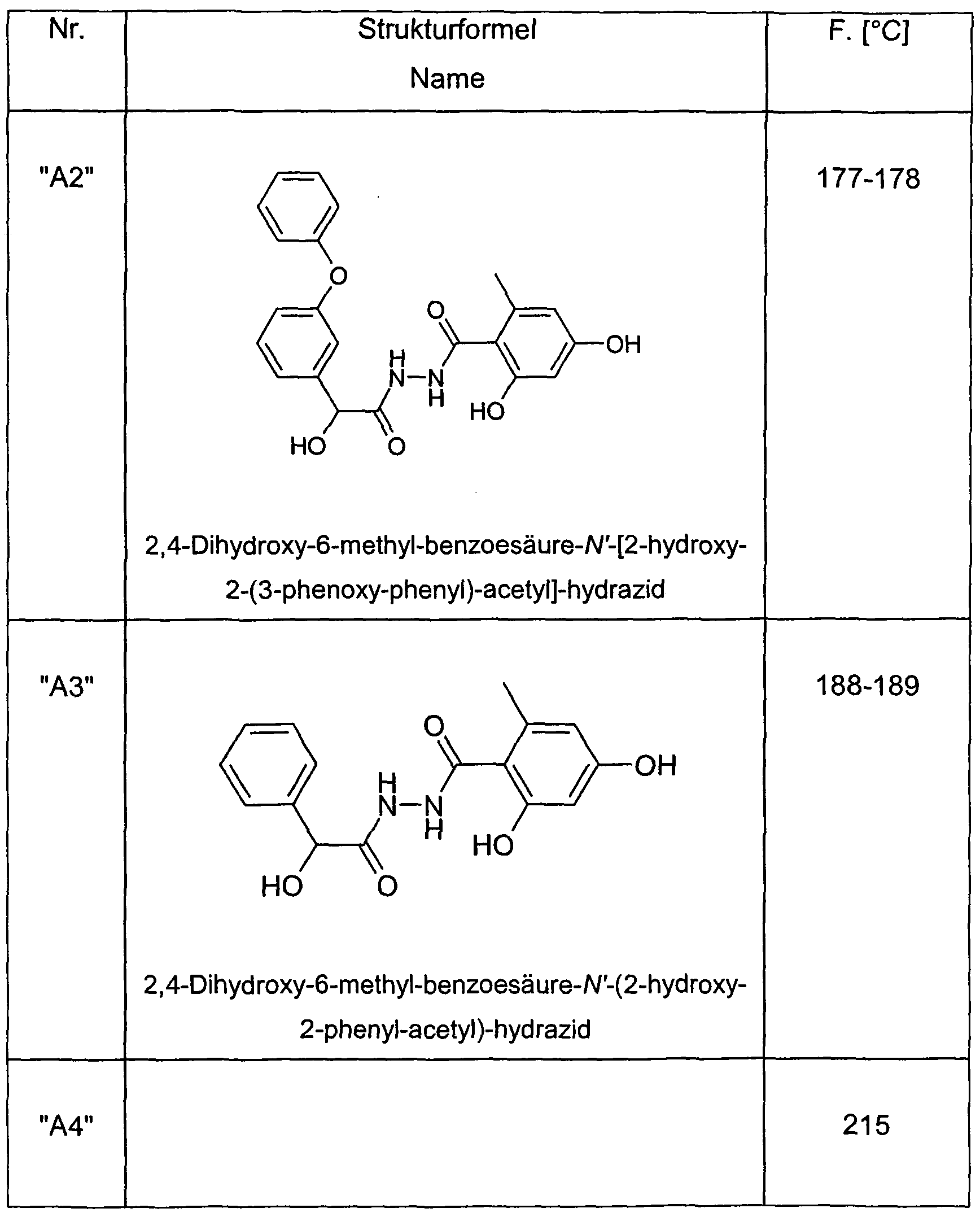
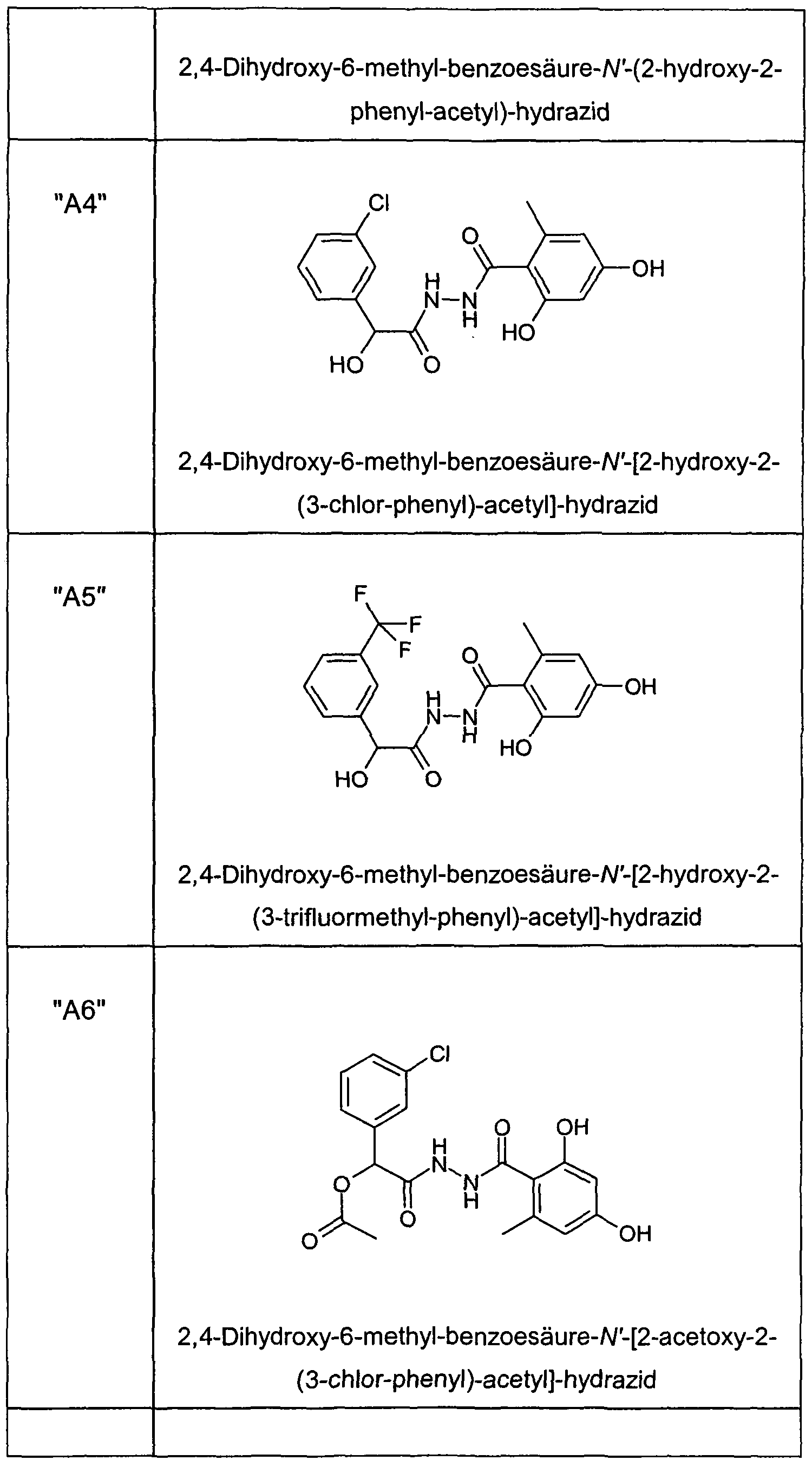
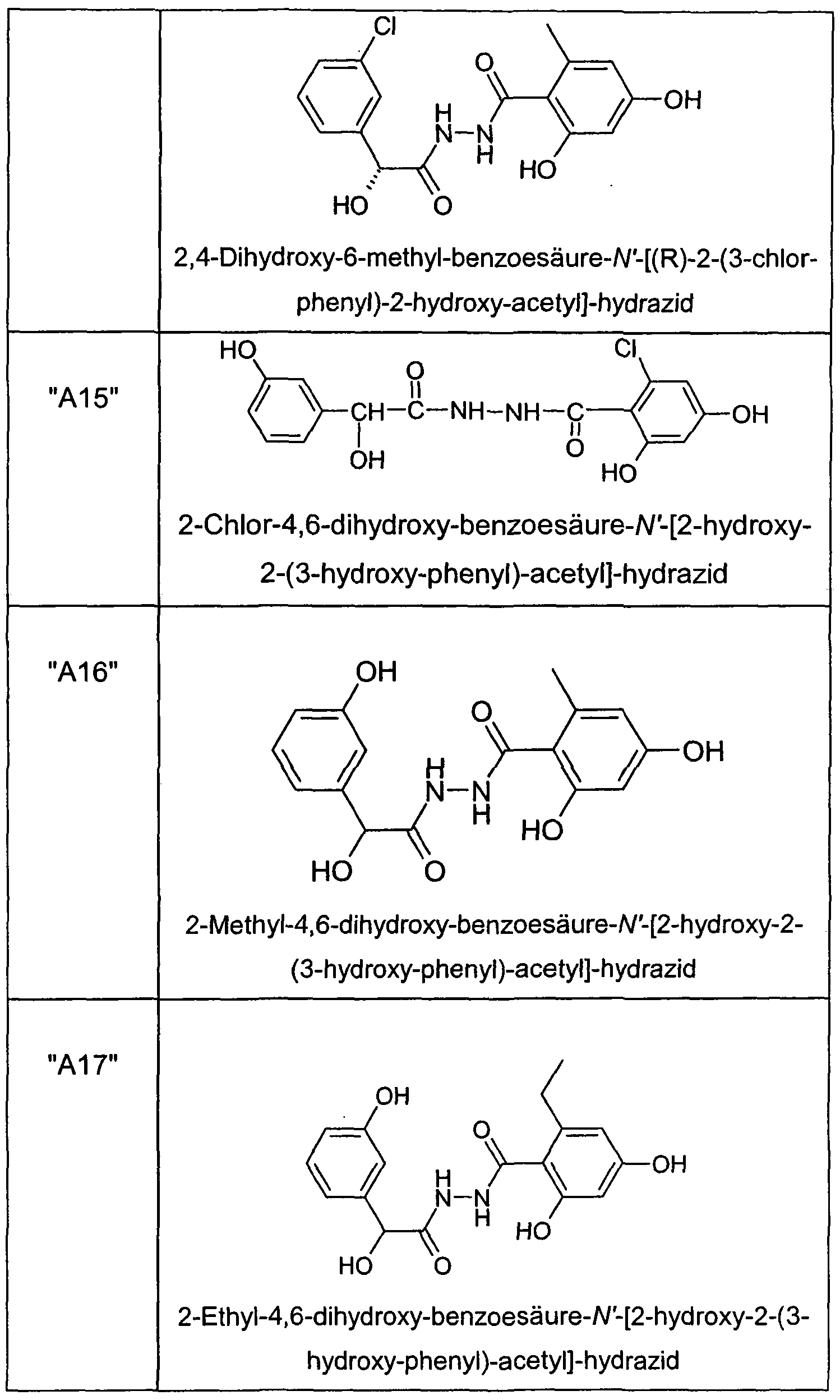
- the compounds of the formula I are particularly preferably selected from the group consisting of:
- the starting materials can, if desired, also be formed in situ, so that they are not isolated from the reaction mixture, but immediately further reacted to the compounds of the invention.
- the starting compounds are generally known. If they are new, they can be produced by methods known per se.
- Compounds of the formula I can preferably be obtained by reacting a hydrazide of the formula II with a compound of the formula III.
- the reaction is carried out by methods known to the person skilled in the art.
- the reaction is generally carried out in an inert solvent, if appropriate in the presence of an acid-binding agent, preferably an organic base such as DIPEA, triethylamine, dimethylaniline, pyridine or quinoline or an excess of the carboxy component of the formula III.
- an acid-binding agent preferably an organic base such as DIPEA, triethylamine, dimethylaniline, pyridine or quinoline or an excess of the carboxy component of the formula III.
- Suitable inert solvents are e.g. Hydrocarbons such as hexane,
- Tetrahydrofuran (THF) or dioxane Tetrahydrofuran (THF) or dioxane; Glycol ethers such as ethylene glycol monomethyl or monoethyl ether (methyl glycol or ethyl glycol), ethylene glycol dimethyl ether (diglyme); Ketones such as acetone or butanone; Amides such as acetamide, dimethylacetamide or dimethylformamide (DMF); Nitriles such as acetonitrile; Sulfoxides such as dimethylsulfoxide (DMSO); Sulfur carbon; Carboxylic acids such as formic acid or acetic acid; Nitro compounds such as nitromethane or nitrobenzene; Esters such as ethyl acetate or mixtures of said solvents. Particularly preferred solvents are water or DMF.
- an alkali or alkaline earth metal hydroxide, carbonate or bicarbonate or other salt of a weak acid of the alkali or alkaline earth metals preferably of potassium, sodium
- the reaction time is between a few minutes and 14 days, the reaction temperature between about -30 ° and 140 °, normally between -10 ° and 90 °, in particular between about 0 ° and about 70 °. 20
- L is preferably Cl, Br, I or a free or a reactively modified OH group, such as e.g. an activated ester, an imidazolide or alkylsulfonyloxy having 1-6 C atoms 25 (preferably methylsulfonyloxy or trifluoromethylsulfonyloxy) or arylsulfonyloxy having 6-10 C atoms (preferably phenyl- or p-tolylsulfonyl-oxy).
- an activated ester an imidazolide or alkylsulfonyloxy having 1-6 C atoms 25 (preferably methylsulfonyloxy or trifluoromethylsulfonyloxy) or arylsulfonyloxy having 6-10 C atoms (preferably phenyl- or p-tolylsulfonyl-oxy).
- Activated esters are conveniently formed in situ, e.g. B. by the addition of HOBt or N-hydroxysuccinimide.
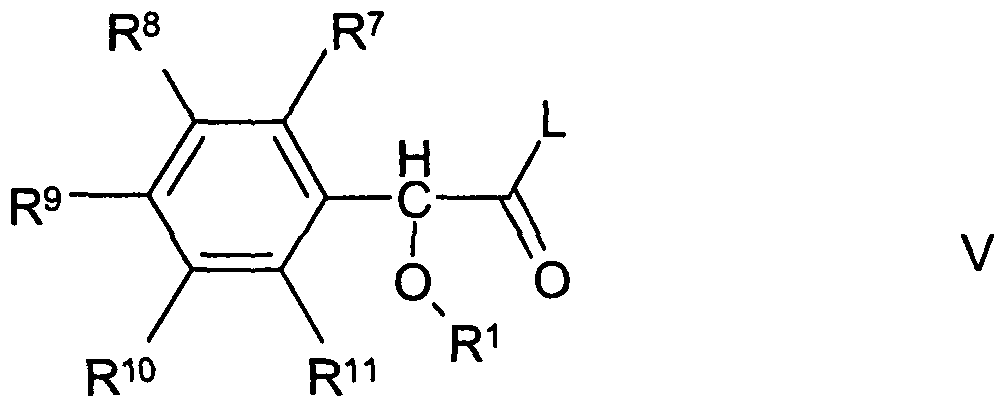
- 35 Compounds of the formula I can furthermore preferably be obtained by reacting a hydrazide of the formula IV with a compound of the formula V.
- the reaction is generally carried out in an inert solvent, in the presence of an acid-binding agent, preferably an organic base such as DIPEA, triethylamine, dimethylaniline, pyridine or quinoline or an excess of the carboxy component of the formula V.
- an acid-binding agent preferably an organic base such as DIPEA, triethylamine, dimethylaniline, pyridine or quinoline or an excess of the carboxy component of the formula V.
- Suitable inert solvents are e.g. Hydrocarbons such as hexane, petroleum ether, benzene, toluene or xylene; chlorinated hydrocarbons such as trichlorethylene, 1, 2-dichloroethane, carbon tetrachloride, chloroform or dichloromethane; Alcohols such as methanol, ethanol, isopropanol, n-propanol, n-butanol or tert-butanol; Ethers, such as diethyl ether, diisopropyl ether, tetrahydrofuran (THF) or dioxane; Glycol ethers, such as ethylene glycol monomethyl or monoethyl ether (methyl glycol or ethyl glycol),
- Ethylene glycol dimethyl ether diglyme
- Ketones such as acetone or butanone
- Amides such as acetamide, dimethylacetamide or dimethylformamide (DMF);
- Nitriles such as acetonitrile; Sulfoxides such as dimethylsulfoxide (DMSO); Carbon disulphide; Carboxylic acids such as formic acid or acetic acid; Nitro compounds such as nitromethane or nitrobenzene; Esters such as ethyl acetate or mixtures of said solvents.
- Sulfoxides such as dimethylsulfoxide (DMSO); Carbon disulphide
- Carboxylic acids such as formic acid or acetic acid
- Nitro compounds such as nitromethane or nitrobenzene
- Esters such as ethyl acetate or mixtures of said solvents.
- an alkali or alkaline earth metal hydroxide, carbonate or bicarbonate or other salt of a weak acid of the alkali or alkaline earth metals preferably of potassium, sodium, calcium or cesium may be beneficial.
- reaction time is between a few minutes and 14 days depending on the conditions used, the reaction temperature between about
- L preferably denotes Cl 1 Br 1 1 or a free or a reactively modified OH group, for example an activated ester, an imidazolide or alkylsulfonyloxy having 1-6 C atoms (preferably methylsulfonyloxy or trifluoromethylsulfonyloxy) or aryl sulfonyloxy having 6-10 C atoms (preferably phenyl or p-Tolylsulfonyl- oxy).
- Activated esters are conveniently formed in situ, e.g. B. by the addition of HOBt or N-hydroxysuccinimide.
- Compounds of the formula I can furthermore be obtained by reacting one radical R 1 , R 2 , R 3 , R 4 , R 5 , R 6 , R 7 , R 8 , R 9 , R 10 and / or R 11 in another Radical R 1 , R 2 , R 3 , R 4 , R 5 , R 6 , R 7 , R 8 , R 9 , R 10 and / or R 11 converts, for example, by cleaving an ether by hydrolysis or hydrogenolysis.
- cleavage of an ether is carried out by methods known to those skilled in the art.
- a standard method for ether cleavage, e.g. a methyl ether, is the use of boron tribromide.
- Hydrogenolytically removable groups e.g. the cleavage of a benzyl ether, z.
- a catalyst e.g., a noble metal catalyst such as palladium, conveniently on a support such as carbon.
- Suitable solvents are those given above, in particular z.
- alcohols such as methanol or ethanol or amides such as DMF.
- Hydrogenolysis is usually carried out at temperatures between about 0 and
- esters can be saponified with acetic acid or with NaOH or KOH in water, water-THF or water-dioxane at temperatures between 0 and 100 °. 5
- the invention also relates to the use of these compounds in the form of their pharmaceutically acceptable salts, which can be derived from various organic and inorganic acids and bases according to procedures known in the art.
- Pharmaceutically acceptable salts which can be derived from various organic and inorganic acids and bases according to procedures known in the art.
- salt forms of the compounds of the formula I are prepared conventionally. If the compound of the formula I contains a carboxylic acid group, one of its suitable salts can be formed by reacting the compound with a suitable base to give the corresponding
- bases are, for example, alkali metal
- hydroxides including potassium hydroxide, sodium hydroxide and lithium hydroxide
- Alkaline earth metal hydroxides such as barium hydroxide and calcium hydroxide
- Alkali metal alcoholates e.g. Potassium ethanolate and sodium propanolate
- various organic bases such as piperidine, diethanolamine and
- O0 acids for example hydrogen halides such as hydrogen chloride, hydrogen bromide or hydrogen iodide, other mineral acids and their corresponding salts such as sulfate, nitrate or phosphate and the like, and alkyl and monoarylsulfonates such as ethanesulfonate, toluenesulfonate and benzenesulfonate, and other organic acids and their corresponding salts such
- base salts of the invention include
- Salts of the compounds of formula I 1 derived from pharmaceutically acceptable organic non-toxic bases include salts of primary, secondary and tertiary amines, substituted amines, including naturally occurring substituted Q amines, cyclic amines and basic ion exchange resins, eg
- Arginine betaine, caffeine, chloroprocaine, choline, N, N'-dibenzylethylenediamine (benzathine), dicyclohexylamine, diethanolamine, diethylamine, 2-diethylaminoethanol, 2-dimethylaminoethanol, ethanolamine, ethylenediamine, N-
- Hydrabamine iso-propylamine, lidocaine, lysine, meglumine, N-methyl-D-glucamine, morpholine, piperazine, piperidine, polyamine resins, procaine, purines, Theobromine, triethanolamine, triethylamine, trimethylamine, tripropylamine and tris (hydroxymethyl) -methylamine (tromethamine), but this is not intended to be limiting.
- Groups can be, with agents such as (Ci-C 4 ) alkyl halides, such as methyl, ethyl, isopropyl and tert-butyl chloride, bromide and iodide; Di (C 1 -C 4 ) alkyl sulfates, eg dimethyl, diethyl and diamylsulfate; (C 10 -C 18) alkyl halides, for example decyl, dodecyl, lauryl, myristyl and
- compositions which are preferred include acetate, trifluoroacetate, besylate, citrate, fumarate, gluconate,
- the acid addition salts of basic compounds of formula I are prepared by contacting the free base form with a sufficient amount of the desired acid to form the salt in a conventional manner.
- the free base can be prepared by contacting the salt form with a base and isolating the free base to standard
- the salts of the invention otherwise correspond to their respective free base forms.
- the pharmaceutically acceptable base addition salts of the compounds of formula I are formed with metals or amines such as alkali metals and alkaline earth metals or organic amines.
- Preferred metals are sodium, potassium, magnesium and calcium.
- Preferred organic amines are N, N'-dibenzylethylenediamine, chloroprocaine,
- the base addition salts of acidic compounds of the invention are prepared by contacting the free acid form with a sufficient amount of the desired base to form the salt in a conventional manner.
- the free acid can be regenerated by contacting the salt form with an acid and isolating the free acid in a conventional manner.
- the free acid forms in some sense differ from their corresponding salt forms in terms of certain physical properties such as solubility in polar solvents; However, in the context of the invention, the salts otherwise correspond to their respective free acid forms.
- a compound according to the invention contains more than one group which can form such pharmaceutically acceptable salts, the invention also encompasses multiple salts.
- Typical multiple salt forms include, for example, bitartrate, diacetate, difumarate, dimeglumine,
- the term "pharmaceutically acceptable salt” in the present context means an active ingredient which contains a compound of the formula I in the form of one of its salts, especially if this salt form is the active ingredient in the Imparts improved pharmacokinetic properties to the free form of the active ingredient or any other salt form of the active ingredient which has previously been used.
- the pharmaceutical It is also possible to give this active substance its desired pharmacokinetic property, which it has not previously possessed, and may even determine the pharmacodynamics of this active ingredient in terms of its therapeutic activity in the
- Compounds of the formula I according to the invention may be chiral due to their molecular structure and may accordingly occur in different enantiomeric forms. They may therefore be in racemic or optically active form.
- diastereomers are formed from the mixture by reaction with an optically active release agent.
- Suitable release agents are e.g. optically active acids, such as the R and S forms of tartaric acid, diacetyltartaric acid, dibenzoyltartaric acid, mandelic acid,
- N-protected amino acids e.g., N-benzoylproline or N-benzenesulfonylproline
- camphorsulfonic acids e.g., N-benzoylproline or N-benzenesulfonylproline
- an optically active resolving agent for example dinitrobenzoylphenylglycine, cellulose triacetate or other derivatives of carbohydrates or silica-gel-fixed chirally derivatized methacrylate polymers.
- Suitable eluents for this purpose are aqueous or alcoholic solvent mixtures such. Hexane / isopropanol /
- Acetonitrile for example, in the ratio 82: 15: 3.
- the invention further relates to the use of the compounds and / or their physiologically acceptable salts for the preparation of a
- compositions in particular by non-chemical means.
- they can be brought into a suitable dosage form together with at least one solid, liquid and / or semi-liquid carrier or excipient and optionally in combination with one or more further active ingredients.
- the invention furthermore relates to medicaments comprising at least one compound according to the invention and / or pharmaceutically usable derivatives, solvates and stereoisomers thereof, including mixtures thereof in all ratios, and optionally excipients and / or adjuvants.
- compositions may be presented in the form of dosage units containing a predetermined amount of active ingredient per unit dose.
- a unit may, for example, 0.5 mg to
- dosage unit formulations are those containing a daily or partial dose as indicated above or a corresponding fraction of an active ingredient.
- pharmaceutical formulations can be prepared by any of the methods well known in the pharmaceutical art.
- compositions may be administered by any suitable route, for example oral (including buccal or sublingual), rectal, nasal, topical (including buccal, sublingual or transdermal), vaginal or parenteral (including subcutaneous, intramuscular, intravenous or intradermal) routes.
- oral including buccal or sublingual
- rectal including buccal or sublingual
- nasal including buccal, sublingual or transdermal
- vaginal or parenteral including subcutaneous, intramuscular, intravenous or intradermal
- Formulations can be prepared by any method known in the pharmaceutical art, for example, by bringing the active ingredient together with the carrier (s) or excipient (s).
- compositions adapted for oral administration may be administered as separate units, e.g. Capsules or tablets; Powder or granules; Solutions or suspensions in aqueous or non-aqueous liquids; edible foams or foam foods; or oil-in-water liquid emulsions or water-in-oil liquid emulsions.
- Tablet or capsule the active component with an oral, non-toxic and pharmaceutically acceptable inert carrier, such. Ethanol, glycerin, water and the like. combine. Powders are prepared by comminuting the compound to a suitable fine size and using a similarly comminuted pharmaceutical grade
- Carrier such as e.g. an edible carbohydrate such as starch or mannitol.
- a flavor, preservative, dispersant and dye may also be present.
- Capsules are made by preparing a powder mix as described above and filling shaped gelatin casings therewith.
- Lubricants such as e.g. fumed silica, talc,
- Magnesium stearate, calcium stearate or polyethylene glycol in solid form can be added to the powder mixture before the filling process.
- Disintegrants or solubilizers such as agar-agar, calcium carbonate or sodium carbonate may also be added to improve the availability of the drug after ingestion of the capsule.
- suitable binding, lubricating and disintegrants as well as dyes can also be incorporated into the mixture.
- suitable binders include starch, gelatin, natural sugars, e.g. Glucose or beta-lactose, corn sweeteners, natural and synthetic gums, e.g. acacia,
- tragacanth or sodium alginate carboxymethyl cellulose, polyethylene glycol, waxes, and the like.
- the lubricants used in these dosage forms include sodium oleate, sodium stearate, magnesium stearate, sodium benzoate, sodium acetate, sodium chloride and the like.
- ⁇ C include, but are not limited to, starch, methyl cellulose, agar, bentonite, xanthan gum Tablets are formulated, for example, preparing a powder mixture, granulating or dry-pressing, a lubricant and a disintegrating agent are added and the whole into tablets is pressed.
- a powder mixture is
- a binder e.g. Carboxymethylcellulose, an alginate, gelatin or polyvinylpyrrolidone, a solution
- a resorption accelerator such as a quaternary salt and / or an absorbent, e.g. Bentonite, kaolin or dicalcium phosphate is mixed.
- the powder mixture can be granulated by mixing it with a binder, e.g. Syrup, starch
- the powder mixture can be run through a tabletting machine to produce non-uniformly shaped lumps which are formed in
- Granules are broken up.
- the granules can be added by adding
- the compounds according to the invention can also be combined with a free-flowing inert carrier and then pressed directly into tablets without carrying out the granulation or dry-pressing steps. 5
- a transparent or opaque protective layer consisting of a shellac sealant, a layer of sugar or polymeric material, and a glossy layer of wax may be present. Dyes can be added to these coatings in order to distinguish between different dosage units.
- Oral fluids such as solution, syrups and elixirs can be prepared in the form of dosage units so that a given quantity -1 5 contains a predetermined amount of the compound.
- Syrups can be prepared by dissolving the compound in an appropriate taste aqueous solution while preparing elixirs using a non-toxic alcoholic vehicle.
- Suspensions may be prepared by dispersing the compound in a non-aqueous solution.
- Solubilizers and emulsifiers e.g. ethoxylated isostearyl alcohols and polyoxyethylene sorbitol ethers, preservatives, flavoring additives such as e.g. Peppermint oil or natural sweeteners or saccharin or other artificial sweeteners, i.a. 25 can also be added.
- the unit dosage formulations for oral administration may optionally be encapsulated in microcapsules.
- the formulation O0 can also be prepared so that the release is prolonged or retarded, such as by coating or embedding of particulate material in polymers, wax, etc.
- Liposome delivery systems such as small unilamellar vesicles, large unilamellar vesicles and multilamellar vesicles.
- Liposomes can be formed from various phospholipids such as cholesterol, stearylamine or phosphatidylcholines.
- the compounds of the invention as well as the salts, solvates and physiologically functional derivatives thereof can also be delivered using monoclonal antibodies as individual carriers to which the compound molecules are coupled.
- the compounds can also be coupled with soluble polymers as targeted drug carriers.
- Such polymers may include polyvinylpyrrolidone, pyran copolymer, polyhydroxypropylmethacrylamidephenol, polyhydroxyethylaspartamidephenol or polyethyleneoxidepolylysine substituted with palmitoyl radicals.
- compositions adapted for transdermal administration may be presented as discrete patches for prolonged, intimate contact with the epidermis of the recipient.
- the drug may be delivered from the patch by iontophoresis as generally described in Pharmaceutical Research, 3 (6), 318 (1986).
- compositions adapted for topical administration may be used as ointments, creams, suspensions, lotions, powders, solutions,
- the formulations are preferably applied as a topical ointment or cream.
- the active ingredient can be used with either a paraffinic or water miscible cream base.
- the active ingredient can be formulated into a cream with an oil-in-water cream base or a water-in-oil base.
- the pharmaceutical formulations adapted for topical application to the eye include eye drops wherein the active ingredient is dissolved or suspended in a suitable carrier, especially an aqueous solvent.
- Formulations include lozenges, lozenges and mouthwashes.
- compositions adapted for rectal administration may be presented in the form of suppositories or enemas.
- compositions adapted for nasal administration in which the vehicle is a solid contain a coarse powder having a particle size, for example, in the range of 20-500 microns, which is administered in the manner in which snuff is received, i. by rapid inhalation via the nasal passages from a container held close to the nose with the
- Powder Suitable formulations for administration as a nasal spray or
- compositions adapted for administration by inhalation include fine particulate dusts or mists, which may be delivered by inhalation various types of pressurized dispenser can be generated with aerosols, nebulizers or insufflators.
- compositions adapted for vaginal administration may be presented as pessaries, tampons, creams, gels, pastes, foams or spray formulations.
- compositions adapted for parenteral administration include aqueous and nonaqueous sterile injection solutions containing antioxidants, buffers, bacteriostats and solutes which render the formulation isotonic with the blood of the recipient to be treated; and aqueous and non-aqueous sterile suspensions which may contain suspending agents and thickeners.
- the formulations may be administered in single or multiple dose containers, e.g. sealed vials and vials, and stored in the freeze-dried (lyophilized) state so that only the addition of the sterile carrier liquid, e.g. Water for
- Injection solutions and suspensions prepared by formulation can be prepared from sterile powders, granules and tablets.
- formulations may include other means conventional in the art with respect to the particular type of formulation; for example, formulations suitable for oral administration may contain flavorings.
- a therapeutically effective amount of a compound of the present invention will depend on a number of factors, including e.g. the age and weight of the individual or animal, the exact condition of the disease requiring treatment, and the severity of the disease;
- an effective amount of a compound of the invention for treatment is generally in the range of 0.1 to 100 mg / kg of body weight of the recipient (mammal) per day, and more typically in the range of 1 to 10 mg / kg of body weight per day.
- the actual amount per day would usually be between 70 and 700 mg, this amount as a single dose per day or more commonly in a number of divided doses (such as two, three, four, five or six) per Day can be given so that the total daily dose is the same.
- An effective amount of a salt or solvate or a physiologically functional derivative thereof can be determined as a proportion of the effective amount of the compound of the invention per se. It can be assumed that similar dosages are suitable for the treatment of the other, above-mentioned disease states.
- the invention furthermore relates to medicaments comprising at least one compound according to the invention and / or pharmaceutically usable derivatives, solvates and stereoisomers thereof, including mixtures thereof in all ratios, and at least one further active pharmaceutical ingredient.
- the invention is also a set (kit), consisting of separate packages of
- kits contains suitable containers, such as boxes or boxes, individual bottles, bags or ampoules.
- suitable containers such as boxes or boxes, individual bottles, bags or ampoules.
- the kit may contain separate ampoules, each containing an effective amount of a compound of the invention and / or its pharmaceutically acceptable derivatives, solvates and stereoisomers, including theirs
- the present compounds are useful as pharmaceutical agents for mammals, particularly for humans, in the treatment of SGK-related diseases.
- the invention thus relates to the use of compounds according to claim 1, as well as their pharmaceutically acceptable derivatives, solvates and stereoisomers, including mixtures thereof in all proportions, for the preparation of a medicament for the treatment of diseases in which the inhibition, regulation and / or modulation of Signal transduction of kinases plays a role.
- Preferred here is SGK.
- the present invention comprises the use of the compounds of the invention according to claim 1 and / or their physiologically acceptable salts and solvates for the manufacture of a medicament for the treatment or prevention of diabetes (eg diabetes mellitus, diabetic nephropathy, diabetic neuropathy, diabetic angiopathy and microangiopathy), obesity, metabolic syndrome (dyslipidemia), systemic and pulmonary hypertension, cardiovascular diseases (eg cardiac fibrosis after myocardial infarction, cardiac
- kidney diseases e.g., glomerulosclerosis, nephrosclerosis, nephritis, nephropathy, electrolyte clearance disorder
- glomerulosclerosis glomerulosclerosis, nephrosclerosis, nephritis, nephropathy, electrolyte clearance disorder
- fibrosis and inflammatory processes e.g., cirrhosis of the liver
- the compounds of the invention can also increase the growth of
- the compounds of the invention are also used for the treatment of coagulopathies, e.g. Dysfibrinogenemia, hypopro- convertinemia, hemophilia B, Stuart-Prower defect, prothrombin
- the compounds of the invention may also be used in the treatment of glaucoma or cataract
- O0 be used therapeutically.
- the compounds of the invention are also used in the treatment of bacterial infections and in an anti-infective therapy.
- the compounds according to the invention can also be used for
- metabolic syndrome dyslipidemia
- pulmonary hypertension in general for any type of fibrosis and inflammatory processes, cancer, tumor cells, tumor metastases, coagulopathies, neuronal excitability, glaucoma, cataracts, bacterial infections and in an anti-infective Therapy to increase the ability to learn and attention, as well as to treat and prevent cell aging and stress.
- Diabetes is preferably diabetes mellitus, diabetic nephropathy, diabetic neuropathy, diabetic angiopathy and microangiopathy.
- Cardiovascular diseases are preferably cardiac
- Kidney disease is preferably glomerulo-sclerosis, nephrosclerosis, nephritis, nephropathy, and electrolyte clearance disorder.
- Fibrosis and inflammatory processes are preferably liver cirrhosis, pulmonary fibrosis, fibrosing pancreatitis,
- the inhibition of SGK1 protein kinase can be determined in the filter binding procedure.
- “usual workup” means adding water if necessary, adjusting to pH values between 2 and 10, if necessary, depending on the constitution of the final product, extracted with 20% ethyl acetate or dichloromethane, separating, drying the organic phase over sodium sulfate, evaporated and purified by chromatography on silica gel and / or by crystallization.
- N 2 H 5 OH is monoacylated with 2,4-dibenzyloxy-6-methylbenzoic acid. Yield: 2,4-Dibenzyloxy-6-methylbenzoic acid hydrazide (63%); F. 136-137 °.
- 2,4-Dibenzyloxy-6-methylbenzoic acid hydrazide is hydrogenated. Yield: 2,4-Dihydroxy-6-methylbenzoic acid hydrazide (89%); F. 226 ° (decomposition).
- the substance is prepared from 2,4-dibenzyloxy-6-methylbenzoic acid hydrazide and 3-hydroxymandelic acid in 47% yield as in Example 1, mp 181-182 ° (from Me 2 COH / Et 2 O).
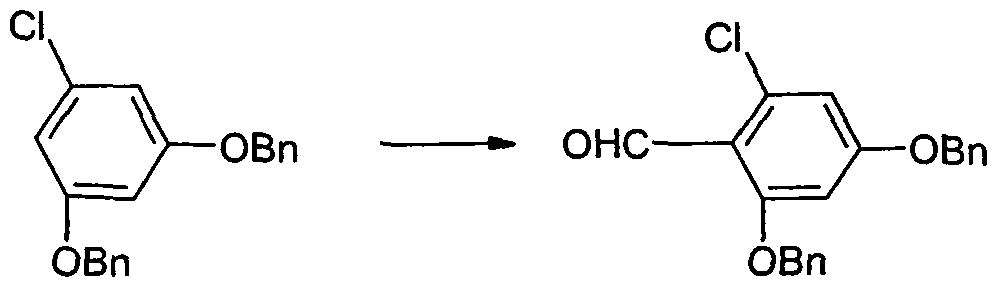
- Ether / petroleum ether 1 1 provide 3.5 g (88%) of 2,4-bis-benzyloxy-6-ethyl-benzaldehyde, which discolors in air.
- 3-Chloro-2-ethyl-4-hydroxy-benzoic acid is benzylated analogously: 3-chloro-2-ethyl-4-benzyloxy-benzoic acid is obtained in 78% yield, mp 208-210 °.
- the substance is prepared by the method shown in Example 1 from 2,4-bis-benzyloxy-6-ethyl-benzoic acid and hydrazinium hydroxide: Yield 75%, mp 140-141 °.
- 2,4-Dibenzyloxy-6-chloro-benzoic acid hydrazide is also prepared analogously: yield 61%, mp 166-167 ° and
- the compound is obtained by hydrogenation of 300 mg of 3-chloro-2-ethyl-4-
- Example A Injection glasses
- a solution of 100 g of an active ingredient according to the invention and 5 g of disodium hydrogen phosphate is adjusted to pH 6.5 in 2 l of bidistilled water with 2N hydrochloric acid, filtered sterile, filled into injection jars, lyophilized under sterile conditions and closed under sterile conditions.
- Injection jar contains 5 mg active substance.
- a mixture of 20 g of an active ingredient according to the invention is melted with 100 g of soya lecithin and 1400 g of cocoa butter, poured into molds and allowed to cool. Each suppository contains 20 mg of active ingredient.
- Example C Solution A solution of 1 g of an active ingredient according to the invention, 9.38 g of NaH 2 PO 4 .2H 2 O, 28.48 g of Na 2 HPO 4 .12H 2 O and 0.1 g of benzalkonium chloride in 940 is prepared ml of double distilled water. Adjust to pH 6.8, make up to 1 liter and sterilize by irradiation. This solution can be used in the form of eye drops.
- Example D Ointment
- 500 mg of an active ingredient according to the invention are mixed with 99.5 g of Vaseline under aseptic conditions.
- a mixture of 1 kg of active ingredient, 4 kg of lactose, 1, 2 kg of potato starch, 0.2 kg of talc and 0.1 kg of magnesium stearate is compressed in the usual way into tablets, such that each tablet contains 10 mg of active ingredient.
- Tablets are pressed analogously to Example E, which are then coated in the usual way with a coating of sucrose, potato starch, talc, tragacanth and dye.
- a solution of 1 kg of an active ingredient according to the invention in 60 l of bidistilled water is sterile filtered, filled into ampoules, lyophilized under sterile conditions and sealed sterile. Each vial contains 10 mg of active ingredient.
Landscapes
- Health & Medical Sciences (AREA)
- Chemical & Material Sciences (AREA)
- Organic Chemistry (AREA)
- General Health & Medical Sciences (AREA)
- Veterinary Medicine (AREA)
- Medicinal Chemistry (AREA)
- Public Health (AREA)
- Pharmacology & Pharmacy (AREA)
- Life Sciences & Earth Sciences (AREA)
- Animal Behavior & Ethology (AREA)
- Nuclear Medicine, Radiotherapy & Molecular Imaging (AREA)
- General Chemical & Material Sciences (AREA)
- Chemical Kinetics & Catalysis (AREA)
- Engineering & Computer Science (AREA)
- Bioinformatics & Cheminformatics (AREA)
- Diabetes (AREA)
- Cardiology (AREA)
- Ophthalmology & Optometry (AREA)
- Hematology (AREA)
- Obesity (AREA)
- Heart & Thoracic Surgery (AREA)
- Biomedical Technology (AREA)
- Neurosurgery (AREA)
- Neurology (AREA)
- Rheumatology (AREA)
- Oncology (AREA)
- Hospice & Palliative Care (AREA)
- Urology & Nephrology (AREA)
- Communicable Diseases (AREA)
- Immunology (AREA)
- Orthopedic Medicine & Surgery (AREA)
- Emergency Medicine (AREA)
- Child & Adolescent Psychology (AREA)
- Vascular Medicine (AREA)
- Psychiatry (AREA)
- Pain & Pain Management (AREA)
- Endocrinology (AREA)
- Physical Education & Sports Medicine (AREA)
- Pulmonology (AREA)
- Gastroenterology & Hepatology (AREA)
Abstract
Description





Claims






Priority Applications (9)
| Application Number | Priority Date | Filing Date | Title |
|---|---|---|---|
| CA002642232A CA2642232A1 (en) | 2006-02-14 | 2007-01-18 | Mandelic hydrazides |
| JP2008554620A JP2009526787A (ja) | 2006-02-14 | 2007-01-18 | マンデル酸ヒドラジド |
| AT07702867T ATE509906T1 (de) | 2006-02-14 | 2007-01-18 | Mandelsäurehydrazide |
| EA200801776A EA200801776A1 (ru) | 2006-02-14 | 2007-01-18 | Гидразиды миндальной кислоты |
| BRPI0707738-6A BRPI0707738A2 (pt) | 2006-02-14 | 2007-01-18 | hidrazidas mandÉlicas |
| EP07702867A EP1984324B1 (de) | 2006-02-14 | 2007-01-18 | Mandelsäurehydrazide |
| AU2007214798A AU2007214798A1 (en) | 2006-02-14 | 2007-01-18 | Mandelic hydrazides |
| US12/279,227 US7776920B2 (en) | 2006-02-14 | 2007-01-18 | Mandelic hydrazides |
| IL193382A IL193382A0 (en) | 2006-02-14 | 2008-08-07 | Mandelic hydrazides |
Applications Claiming Priority (2)
| Application Number | Priority Date | Filing Date | Title |
|---|---|---|---|
| DE102006006648A DE102006006648A1 (de) | 2006-02-14 | 2006-02-14 | Mandelsäurehydrazide |
| DE102006006648.0 | 2006-02-14 |
Publications (1)
| Publication Number | Publication Date |
|---|---|
| WO2007093264A1 true WO2007093264A1 (de) | 2007-08-23 |
Family
ID=38288661
Family Applications (1)
| Application Number | Title | Priority Date | Filing Date |
|---|---|---|---|
| PCT/EP2007/000430 Ceased WO2007093264A1 (de) | 2006-02-14 | 2007-01-18 | Mandelsäurehydrazide |
Country Status (16)
| Country | Link |
|---|---|
| US (1) | US7776920B2 (de) |
| EP (1) | EP1984324B1 (de) |
| JP (1) | JP2009526787A (de) |
| KR (1) | KR20080096824A (de) |
| CN (1) | CN101374800A (de) |
| AR (1) | AR059488A1 (de) |
| AT (1) | ATE509906T1 (de) |
| AU (1) | AU2007214798A1 (de) |
| BR (1) | BRPI0707738A2 (de) |
| CA (1) | CA2642232A1 (de) |
| DE (1) | DE102006006648A1 (de) |
| EA (1) | EA200801776A1 (de) |
| ES (1) | ES2365633T3 (de) |
| IL (1) | IL193382A0 (de) |
| WO (1) | WO2007093264A1 (de) |
| ZA (1) | ZA200807875B (de) |
Cited By (20)
| Publication number | Priority date | Publication date | Assignee | Title |
|---|---|---|---|---|
| WO2009021740A2 (de) | 2007-08-15 | 2009-02-19 | Sanofis-Aventis | Substituierte tetrahydronaphthaline, verfahren zu ihrer herstellung und ihre verwendung als arzneimittel |
| DE102008010362A1 (de) | 2008-02-18 | 2009-08-20 | Florian Prof. Dr. Lang | Sgk1 als therapeutisches und diagnostisches Target für virale Erkrankungen |
| DE102008010361A1 (de) | 2008-02-18 | 2009-08-20 | Merck Patent Gmbh | sgk1-Inhibitoren zur Prophylaxe und/oder Therapie von viralen Erkrankungen und/oder Karzinomen |
| DE102008010363A1 (de) | 2008-02-18 | 2009-08-20 | Lang, Florian, Prof. Dr.med. | Sgk1 als therapeutisches und diagnostisches Target für karzinomatöse Erkrankungen |
| DE102008029072A1 (de) | 2008-06-10 | 2009-12-17 | Lang, Florian, Prof. Dr.med. | Sgk3 als therapeutisches und diagnostisches Target für Alterserkrankungen |
| DE102008059133A1 (de) | 2008-11-26 | 2010-05-27 | Merck Patent Gmbh | Difluorphenyl-diacylhydrazid-derivate |
| WO2011107494A1 (de) | 2010-03-03 | 2011-09-09 | Sanofi | Neue aromatische glykosidderivate, diese verbindungen enthaltende arzneimittel und deren verwendung |
| WO2011157827A1 (de) | 2010-06-18 | 2011-12-22 | Sanofi | Azolopyridin-3-on-derivate als inhibitoren von lipasen und phospholipasen |
| WO2011161030A1 (de) | 2010-06-21 | 2011-12-29 | Sanofi | Heterocyclisch substituierte methoxyphenylderivate mit oxogruppe, verfahren zu ihrer herstellung und ihre verwendung als gpr40 rezeptor modulatoren |
| WO2012004270A1 (de) | 2010-07-05 | 2012-01-12 | Sanofi | Spirocyclisch substituierte 1,3-propandioxidderivate, verfahren zu ihrer herstellung und ihre verwendung als arzneimittel |
| WO2012004269A1 (de) | 2010-07-05 | 2012-01-12 | Sanofi | ( 2 -aryloxy -acetylamino) - phenyl - propionsäurederivate, verfahren zu ihrer herstellung und ihre verwendung als arzneimittel |
| WO2012010413A1 (de) | 2010-07-05 | 2012-01-26 | Sanofi | Aryloxy-alkylen-substituierte hydroxy-phenyl-hexinsäuren, verfahren zu ihrer herstellung und ihre verwendung als arzneimittel |
| WO2012120054A1 (de) | 2011-03-08 | 2012-09-13 | Sanofi | Di- und trisubstituierte oxathiazinderivate, verfahren zu deren herstellung, ihre verwendung als medikament sowie sie enthaltendes arzneimittel und deren verwendung |
| WO2012120052A1 (de) | 2011-03-08 | 2012-09-13 | Sanofi | Mit carbozyklen oder heterozyklen substituierte oxathiazinderivate, verfahren zu deren herstellung, diese verbindungen enthaltende arzneimittel und deren verwendung |
| WO2012120056A1 (de) | 2011-03-08 | 2012-09-13 | Sanofi | Tetrasubstituierte oxathiazinderivate, verfahren zu deren herstellung, ihre verwendung als medikament sowie sie enthaltendes arzneimittel und deren verwendung |
| WO2012120053A1 (de) | 2011-03-08 | 2012-09-13 | Sanofi | Verzweigte oxathiazinderivate, verfahren zu deren herstellung, ihre verwendung als medikament sowie sie enthaltendes arzneimittel und deren verwendung |
| WO2012120055A1 (de) | 2011-03-08 | 2012-09-13 | Sanofi | Di- und trisubstituierte oxathiazinderivate, verfahren zu deren herstellung, ihre verwendung als medikament sowie sie enthaltendes arzneimittel und deren verwendung |
| EP2567959A1 (de) | 2011-09-12 | 2013-03-13 | Sanofi | 6-(4-Hydroxy-phenyl)-3-styryl-1H-pyrazolo[3,4-b]pyridin-4-Carbonsäureamid-Derivate als Kinaseinhibitoren |
| WO2013037390A1 (en) | 2011-09-12 | 2013-03-21 | Sanofi | 6-(4-hydroxy-phenyl)-3-styryl-1h-pyrazolo[3,4-b]pyridine-4-carboxylic acid amide derivatives as kinase inhibitors |
| WO2013045413A1 (en) | 2011-09-27 | 2013-04-04 | Sanofi | 6-(4-hydroxy-phenyl)-3-alkyl-1h-pyrazolo[3,4-b]pyridine-4-carboxylic acid amide derivatives as kinase inhibitors |
Families Citing this family (6)
| Publication number | Priority date | Publication date | Assignee | Title |
|---|---|---|---|---|
| DE102005015255A1 (de) * | 2005-04-04 | 2006-10-05 | Merck Patent Gmbh | Acylhydrazide |
| PT3049085T (pt) | 2013-09-26 | 2021-10-01 | Beth Israel Deaconess Medical Ct Inc | Inibidores de sgk1 no tratamento da síndrome do qt longo |
| CN104610156A (zh) * | 2015-02-13 | 2015-05-13 | 佛山市赛维斯医药科技有限公司 | 一种环丙基酰肼和腈基苯类gpr119激动剂、制备方法及其用途 |
| CN104592120A (zh) * | 2015-02-13 | 2015-05-06 | 佛山市赛维斯医药科技有限公司 | 一种环丙基酰肼和甲氧苯类gpr119激动剂、制备方法及其用途 |
| CN108752233B (zh) * | 2018-07-18 | 2020-10-16 | 河北师范大学 | 小分子凝胶因子、凝胶材料及制备方法和应用 |
| WO2020031179A1 (en) * | 2018-08-06 | 2020-02-13 | Beetlebung Pharma Ltd. | Methods for synthesis of cannabinoid compounds |
Citations (2)
| Publication number | Priority date | Publication date | Assignee | Title |
|---|---|---|---|---|
| WO2005037773A1 (de) * | 2003-10-09 | 2005-04-28 | Merck Patent Gmbh | Acylhydrazonderivate und ihre verwendung bei der hemmung, regulierung und/oder modulation des signaltransduktion von kinasen |
| WO2006105850A1 (de) * | 2005-04-04 | 2006-10-12 | Merck Patent Gmbh | Acylhyclrazide als kinase inhibitoren insbesondere für sgk |
Family Cites Families (2)
| Publication number | Priority date | Publication date | Assignee | Title |
|---|---|---|---|---|
| AU4265596A (en) * | 1994-12-06 | 1996-06-26 | Agrevo Uk Limited | Heterocyclyl substituted hydroxyacetamide derivatives as fongicides |
| DE102004030987A1 (de) * | 2004-06-26 | 2006-01-12 | Merck Patent Gmbh | Ortho-substituierte (3-Hydroxyphenyl)-essigsäure-benzyliden-hydrazide |
-
2006
- 2006-02-14 DE DE102006006648A patent/DE102006006648A1/de not_active Withdrawn
-
2007
- 2007-01-18 CA CA002642232A patent/CA2642232A1/en not_active Abandoned
- 2007-01-18 ES ES07702867T patent/ES2365633T3/es active Active
- 2007-01-18 JP JP2008554620A patent/JP2009526787A/ja active Pending
- 2007-01-18 AT AT07702867T patent/ATE509906T1/de active
- 2007-01-18 AU AU2007214798A patent/AU2007214798A1/en not_active Abandoned
- 2007-01-18 CN CNA2007800037220A patent/CN101374800A/zh active Pending
- 2007-01-18 EA EA200801776A patent/EA200801776A1/ru unknown
- 2007-01-18 KR KR1020087022198A patent/KR20080096824A/ko not_active Withdrawn
- 2007-01-18 EP EP07702867A patent/EP1984324B1/de not_active Not-in-force
- 2007-01-18 US US12/279,227 patent/US7776920B2/en not_active Expired - Fee Related
- 2007-01-18 BR BRPI0707738-6A patent/BRPI0707738A2/pt not_active IP Right Cessation
- 2007-01-18 WO PCT/EP2007/000430 patent/WO2007093264A1/de not_active Ceased
- 2007-02-14 AR ARP070100614A patent/AR059488A1/es unknown
-
2008
- 2008-08-07 IL IL193382A patent/IL193382A0/en unknown
- 2008-09-12 ZA ZA200807875A patent/ZA200807875B/xx unknown
Patent Citations (2)
| Publication number | Priority date | Publication date | Assignee | Title |
|---|---|---|---|---|
| WO2005037773A1 (de) * | 2003-10-09 | 2005-04-28 | Merck Patent Gmbh | Acylhydrazonderivate und ihre verwendung bei der hemmung, regulierung und/oder modulation des signaltransduktion von kinasen |
| WO2006105850A1 (de) * | 2005-04-04 | 2006-10-12 | Merck Patent Gmbh | Acylhyclrazide als kinase inhibitoren insbesondere für sgk |
Cited By (29)
| Publication number | Priority date | Publication date | Assignee | Title |
|---|---|---|---|---|
| WO2009021740A2 (de) | 2007-08-15 | 2009-02-19 | Sanofis-Aventis | Substituierte tetrahydronaphthaline, verfahren zu ihrer herstellung und ihre verwendung als arzneimittel |
| DE102008010362A1 (de) | 2008-02-18 | 2009-08-20 | Florian Prof. Dr. Lang | Sgk1 als therapeutisches und diagnostisches Target für virale Erkrankungen |
| DE102008010361A1 (de) | 2008-02-18 | 2009-08-20 | Merck Patent Gmbh | sgk1-Inhibitoren zur Prophylaxe und/oder Therapie von viralen Erkrankungen und/oder Karzinomen |
| DE102008010363A1 (de) | 2008-02-18 | 2009-08-20 | Lang, Florian, Prof. Dr.med. | Sgk1 als therapeutisches und diagnostisches Target für karzinomatöse Erkrankungen |
| WO2009103484A1 (de) * | 2008-02-18 | 2009-08-27 | Merck Patent Gmbh | Sgk1-inhibitoren zur prophylaxe und/oder therapie von viralen erkrankungen und/oder karzinomen |
| DE102008010361A8 (de) * | 2008-02-18 | 2010-02-25 | Merck Patent Gmbh | sgk1-Inhibitoren zur Prophylaxe und/oder Therapie von viralen Erkrankungen und/oder Karzinomen |
| AU2009217028B2 (en) * | 2008-02-18 | 2013-09-26 | Merck Patent Gmbh | SGK1 inhibitors for the prophylaxis and/or therapy of viral diseases and/or carcinomas |
| US8546613B2 (en) | 2008-02-18 | 2013-10-01 | Merck Patent Gmbh | SGK1 inhibitors for the prophylaxis and/or therapy of viral diseases and/or carcinomas |
| JP2011512373A (ja) * | 2008-02-18 | 2011-04-21 | メルク パテント ゲゼルシャフト ミット ベシュレンクテル ハフツング | ウイルス性疾患および/または癌腫の予防および/または治療のためのsgk1阻害剤 |
| DE102008029072A1 (de) | 2008-06-10 | 2009-12-17 | Lang, Florian, Prof. Dr.med. | Sgk3 als therapeutisches und diagnostisches Target für Alterserkrankungen |
| WO2010060522A3 (de) * | 2008-11-26 | 2010-08-05 | Merck Patent Gmbh | Difluorphenyl-diacylhydrazid-derivate |
| AU2009319411B2 (en) * | 2008-11-26 | 2015-10-15 | Merck Patent Gmbh | Difluorophenyldiacylhydrazide derivatives |
| US8492440B2 (en) | 2008-11-26 | 2013-07-23 | Merck Patent Gmbh | Difluorophenyldiacylhydrazide derivatives |
| JP2012509915A (ja) * | 2008-11-26 | 2012-04-26 | メルク パテント ゲゼルシャフト ミット ベシュレンクテル ハフツング | ジフルオロフェニルジアシルヒドラジド誘導体 |
| DE102008059133A1 (de) | 2008-11-26 | 2010-05-27 | Merck Patent Gmbh | Difluorphenyl-diacylhydrazid-derivate |
| WO2011107494A1 (de) | 2010-03-03 | 2011-09-09 | Sanofi | Neue aromatische glykosidderivate, diese verbindungen enthaltende arzneimittel und deren verwendung |
| WO2011157827A1 (de) | 2010-06-18 | 2011-12-22 | Sanofi | Azolopyridin-3-on-derivate als inhibitoren von lipasen und phospholipasen |
| WO2011161030A1 (de) | 2010-06-21 | 2011-12-29 | Sanofi | Heterocyclisch substituierte methoxyphenylderivate mit oxogruppe, verfahren zu ihrer herstellung und ihre verwendung als gpr40 rezeptor modulatoren |
| WO2012004269A1 (de) | 2010-07-05 | 2012-01-12 | Sanofi | ( 2 -aryloxy -acetylamino) - phenyl - propionsäurederivate, verfahren zu ihrer herstellung und ihre verwendung als arzneimittel |
| WO2012010413A1 (de) | 2010-07-05 | 2012-01-26 | Sanofi | Aryloxy-alkylen-substituierte hydroxy-phenyl-hexinsäuren, verfahren zu ihrer herstellung und ihre verwendung als arzneimittel |
| WO2012004270A1 (de) | 2010-07-05 | 2012-01-12 | Sanofi | Spirocyclisch substituierte 1,3-propandioxidderivate, verfahren zu ihrer herstellung und ihre verwendung als arzneimittel |
| WO2012120056A1 (de) | 2011-03-08 | 2012-09-13 | Sanofi | Tetrasubstituierte oxathiazinderivate, verfahren zu deren herstellung, ihre verwendung als medikament sowie sie enthaltendes arzneimittel und deren verwendung |
| WO2012120053A1 (de) | 2011-03-08 | 2012-09-13 | Sanofi | Verzweigte oxathiazinderivate, verfahren zu deren herstellung, ihre verwendung als medikament sowie sie enthaltendes arzneimittel und deren verwendung |
| WO2012120055A1 (de) | 2011-03-08 | 2012-09-13 | Sanofi | Di- und trisubstituierte oxathiazinderivate, verfahren zu deren herstellung, ihre verwendung als medikament sowie sie enthaltendes arzneimittel und deren verwendung |
| WO2012120052A1 (de) | 2011-03-08 | 2012-09-13 | Sanofi | Mit carbozyklen oder heterozyklen substituierte oxathiazinderivate, verfahren zu deren herstellung, diese verbindungen enthaltende arzneimittel und deren verwendung |
| WO2012120054A1 (de) | 2011-03-08 | 2012-09-13 | Sanofi | Di- und trisubstituierte oxathiazinderivate, verfahren zu deren herstellung, ihre verwendung als medikament sowie sie enthaltendes arzneimittel und deren verwendung |
| EP2567959A1 (de) | 2011-09-12 | 2013-03-13 | Sanofi | 6-(4-Hydroxy-phenyl)-3-styryl-1H-pyrazolo[3,4-b]pyridin-4-Carbonsäureamid-Derivate als Kinaseinhibitoren |
| WO2013037390A1 (en) | 2011-09-12 | 2013-03-21 | Sanofi | 6-(4-hydroxy-phenyl)-3-styryl-1h-pyrazolo[3,4-b]pyridine-4-carboxylic acid amide derivatives as kinase inhibitors |
| WO2013045413A1 (en) | 2011-09-27 | 2013-04-04 | Sanofi | 6-(4-hydroxy-phenyl)-3-alkyl-1h-pyrazolo[3,4-b]pyridine-4-carboxylic acid amide derivatives as kinase inhibitors |
Also Published As
| Publication number | Publication date |
|---|---|
| ZA200807875B (en) | 2009-06-24 |
| EP1984324B1 (de) | 2011-05-18 |
| US7776920B2 (en) | 2010-08-17 |
| DE102006006648A1 (de) | 2007-08-23 |
| ES2365633T3 (es) | 2011-10-07 |
| AR059488A1 (es) | 2008-04-09 |
| BRPI0707738A2 (pt) | 2011-05-10 |
| JP2009526787A (ja) | 2009-07-23 |
| EP1984324A1 (de) | 2008-10-29 |
| CA2642232A1 (en) | 2007-08-23 |
| IL193382A0 (en) | 2009-05-04 |
| EA200801776A1 (ru) | 2009-02-27 |
| CN101374800A (zh) | 2009-02-25 |
| ATE509906T1 (de) | 2011-06-15 |
| AU2007214798A1 (en) | 2007-08-23 |
| KR20080096824A (ko) | 2008-11-03 |
| US20090221712A1 (en) | 2009-09-03 |
Similar Documents
| Publication | Publication Date | Title |
|---|---|---|
| EP1984324B1 (de) | Mandelsäurehydrazide | |
| EP1765788B1 (de) | 3-aminoindazole derivate und ihre verwendung zur behandlung sgk-bedingten krankheiten | |
| EP2102197B1 (de) | 5-([1,3,4]oxadiazol-2-yl)-1h-indazol und 5-([1,3,4]thiadiazol-2-yl)-1h-indazol derivate als sgk-inhibitoren zur behandlung von diabetes | |
| EP2155728B1 (de) | Heterocyclische indazolderivate | |
| EP2040701B1 (de) | Aminoindazolharnstoffderivate | |
| DE102004051277A1 (de) | Heterocyclische Carbonylverbindungen | |
| DE102005001053A1 (de) | Quadratsäurederivate | |
| EP1866280B1 (de) | Acylhyclrazide als kinase inhibitoren insbesondere für sgk | |
| EP2313380B1 (de) | Oxadiazolderivate für die behandlung von diabetes | |
| DE102005035742A1 (de) | Quadratsäurederivate II | |
| DE102006005179A1 (de) | Aminoindazolderivate | |
| EP1761482A1 (de) | Ortho-substituierte (3-hydroxyphenyl)-essigsäure benzyliden-hydrazide | |
| DE102005035741A1 (de) | Quadratsäurederivate | |
| WO2010020307A2 (de) | Indazol-5-carbonsäurehydrazid-derivate | |
| EP2349983B1 (de) | Difluorphenyl-diacylhydrazid-derivate | |
| DE102005039541A1 (de) | 3-Oxo-indazol-quadratsäurederivate | |
| DE102005015254A1 (de) | Indazol-quadratsäurederivate | |
| DE102005039066A1 (de) | Indazol-quadratsäurederivate 2 |
Legal Events
| Date | Code | Title | Description |
|---|---|---|---|
| 121 | Ep: the epo has been informed by wipo that ep was designated in this application | ||
| WWE | Wipo information: entry into national phase |
Ref document number: 2007702867 Country of ref document: EP |
|
| WWE | Wipo information: entry into national phase |
Ref document number: 200780003722.0 Country of ref document: CN |
|
| WWE | Wipo information: entry into national phase |
Ref document number: 193382 Country of ref document: IL |
|
| WWE | Wipo information: entry into national phase |
Ref document number: MX/a/2008/010243 Country of ref document: MX |
|
| WWE | Wipo information: entry into national phase |
Ref document number: 2642232 Country of ref document: CA |
|
| WWE | Wipo information: entry into national phase |
Ref document number: 2008554620 Country of ref document: JP |
|
| NENP | Non-entry into the national phase |
Ref country code: DE |
|
| WWE | Wipo information: entry into national phase |
Ref document number: 200801776 Country of ref document: EA |
|
| WWE | Wipo information: entry into national phase |
Ref document number: 2007214798 Country of ref document: AU |
|
| WWE | Wipo information: entry into national phase |
Ref document number: 3679/KOLNP/2008 Country of ref document: IN |
|
| WWE | Wipo information: entry into national phase |
Ref document number: 1020087022198 Country of ref document: KR |
|
| ENP | Entry into the national phase |
Ref document number: 2007214798 Country of ref document: AU Date of ref document: 20070118 Kind code of ref document: A |
|
| WWE | Wipo information: entry into national phase |
Ref document number: 12279227 Country of ref document: US |
|
| ENP | Entry into the national phase |
Ref document number: PI0707738 Country of ref document: BR Kind code of ref document: A2 Effective date: 20080812 |