WO2007101601A2 - Wirkstoffkombinationen mit insektiziden und akariziden eigenschaften - Google Patents
Wirkstoffkombinationen mit insektiziden und akariziden eigenschaften Download PDFInfo
- Publication number
- WO2007101601A2 WO2007101601A2 PCT/EP2007/001752 EP2007001752W WO2007101601A2 WO 2007101601 A2 WO2007101601 A2 WO 2007101601A2 EP 2007001752 W EP2007001752 W EP 2007001752W WO 2007101601 A2 WO2007101601 A2 WO 2007101601A2
- Authority
- WO
- WIPO (PCT)
- Prior art keywords
- spp
- plants
- order
- active
- combinations
- Prior art date
- Legal status (The legal status is an assumption and is not a legal conclusion. Google has not performed a legal analysis and makes no representation as to the accuracy of the status listed.)
- Ceased
Links
Classifications
-
- A—HUMAN NECESSITIES
- A01—AGRICULTURE; FORESTRY; ANIMAL HUSBANDRY; HUNTING; TRAPPING; FISHING
- A01N—PRESERVATION OF BODIES OF HUMANS OR ANIMALS OR PLANTS OR PARTS THEREOF; BIOCIDES, e.g. AS DISINFECTANTS, AS PESTICIDES OR AS HERBICIDES; PEST REPELLANTS OR ATTRACTANTS; PLANT GROWTH REGULATORS
- A01N41/00—Biocides, pest repellants or attractants, or plant growth regulators containing organic compounds containing a sulfur atom bound to a hetero atom
- A01N41/02—Biocides, pest repellants or attractants, or plant growth regulators containing organic compounds containing a sulfur atom bound to a hetero atom containing a sulfur-to-oxygen double bond
- A01N41/10—Sulfones; Sulfoxides
Definitions
- the present invention relates to novel drug combinations which consist of at least one known compound of formula (I) on the one hand and at least one other known active ingredient from the class of Aka ⁇ zide other hand, and are very suitable for controlling animal pests such as insects and unwanted Aka ⁇ den
- Hal is chlorine, bromine or iodine
- insecticidal activity of the active ingredient combination according to the invention is substantially higher than the sum of the effects of the individual active ingredients. There is an unpredictable true synergistic effect and not just an effect supplement.
- the acaricidal action of the active ingredient combination according to the invention is substantially higher than the sum of the effects of the individual active ingredients. There is an unpredictable true synergistic effect and not just an effect supplement.
- the active compound combinations according to the invention contain, in addition to at least one active compound of the formula (I) in enantiomerically pure form or as a mixture of the two enantiomers in any ratio at least one of the acaricides 1 to 4 listed above.
- the active compound combinations according to the invention preferably comprise one of the active compounds (Ia), (Ib) or (Ic) and one of the acaricides listed individually above.
- the combinations according to the invention contain an active compound of the formula (I) and one of the acaricides 1 to 4 in the following preferred and particularly preferred mixing ratios:
- Particularly preferred mixing ratio 25: 1 to 1:25
- the mixing ratios are based on weight ratios.
- the ratio is to be understood as the active substance of the formula (I): acaricide.
- the active compound combinations according to the invention are suitable for good plant tolerance, favorable toxicity to warm-blooded animals and good environmental compatibility for the protection of plants and plant organs, for increasing crop yields, improving the quality of the crop and for controlling animal pests, in particular insects, arachnids, helminths, nematodes and mollusks in agriculture, horticulture, livestock, forests, gardens and recreational facilities, in the protection of materials and materials and in the hygiene sector. They can preferably be used as crop protection agents. They are effective against normally sensitive and resistant species as well as against all or individual stages of development.
- the above mentioned pests include:
- Anoplura e.g. Damalinia spp., Haematopinus spp., Linognathus spp., Pediculus spp., Trichodectes spp.
- Epitrimerus pyri Eutetranychus spp., Eriophyes Spp., Hemitarsonemus spp., Hyalomma spp., Ixodes spp., Latrodectus mactans, Metatetranychus spp., Oligonychus spp., Ornithodoros spp., Panonychus spp., Phyllocoptruta oleivora, Polyphagotarsonemus latus, Psoroptes spp., Rhipicephalus spp., Rhizoglyphus spp , Sarcoptes spp., Scorpio maurus, Stenotarsonemus spp., Tarsonemus spp., Tetranychus spp., Vasates lycopersici.
- Ceuthorhynchus spp. Ceuthorhynchus spp., Cleonus mendicus, Conoderus spp., Cosmopolites spp., Costelytra zealandica, Curculio spp., Cryptorhynchus lapathi, Dermestes spp., Diabrotica spp., Epilachna spp., Faustinus cubae, Gibbium psylloides, Heteronychus arator, Hylamorpha elegans, Hylotrupes bajulus, Hypera postica, Hypothenemus spp., Lachnosterna consanguinea, Leptinotarsa decemlineata, Lissorhoptrus oryzophilus, Lixus spp., Lyctus spp., Meligethes aeneus, Melolontha melolontha, Migdolus spp., Mono
- Gastropoda eg Arion spp., Biomphalaria spp., Bulinus spp., Deroceras spp., Galba spp., Lymnaea spp., Oncomelania spp., Succinea spp.
- helminths e.g. Ancylostoma duodenale, Ancylostoma ceylanicum, Acylostoma braziliensis, Ancylostoma spp., Ascaris lubricoides, Ascaris spp., Brugia malayi, Brugia timori, Bunostomum spp., Chabertia spp., Clonorchis spp., Cooperia spp., Dicrocoelium spp, Dictyocaulus filaria, Diphyllobothrium latum , Dracunculus medinensis, Echinococcus granulosus, Echinococcus multilocularis, Enterobius vermicularis, Faciola spp., Haemonchus spp., Heterakis spp., Hymenolepis nana, Hyostrongulus spp., Loa Loa, Ne
- protozoa such as Eimeria
- Eimeria protozoa
- Heliopeltis spp. Horcias nobilellus, Leptocorisa spp., Leptoglossus phyllopus, Lygus spp., Macropes excavatus, Miridae, Nezara spp., Oebalus spp., Pentomidae, Piesma quadrata, Piezodorus spp., Psallus seriatus, Pseudacysta persea, Rhodnius spp. Sahlbergella singularis, Scotinophora spp., Stephanitis nashi, Tibraca spp., Triatoma spp.
- Hymenoptera e.g. Diprion spp., Hoplocampa spp., Lasius spp., Monomorium pharaonis, Vespa spp.
- Pseudoplusia includens, Pyrausta nubilalis, Spodoptera spp., Thermesia gemmatalis, Tinea pellionella, Tineola bisselliella, Tortrix viridana, Trichoplusia spp.
- Orthoptera e.g. Acheta domesticus, Blatta orientalis, Blattella germanica, Gryllotalpa spp., Leucophaea maderae, Locusta spp., Melanoplus spp., Periplaneta americana, Schistocerca gregaria.
- siphonaptera e.g. Ceratophyllus spp., Xenopsylla cheopis.
- Symphyla eg Scutigerella immaculata.
- Thysanoptera eg Basothrips biformis, Enneothrips flavens, Frankliniella spp., Heliothrips spp., Hercinothrips femoralis, Kakothrips spp., Rhipiphorothrips crutentatus, Scirtothrips spp., Taeniothrips cardamoni, Thrips spp.
- Thysanura e.g. Lepisma saccharina.
- the plant parasitic nematodes include e.g. Anguina spp., Aphelenchoides spp., Belonoaimus spp., Bursaphelenchus spp., Ditylenchus dipsaci, Globodera spp., Heliocotylenchus spp., Heterodera spp., Longidorus spp., Meloidogyne spp., Pratylenchus spp., Radopholus similis, Rotylenchus spp. Trichodorus spp., Tylenchorhynchus spp., Tylenchulus spp., Tylenchulus semipenetrans, Xiphinema spp.
- Anguina spp. Aphelenchoides spp., Belonoaimus spp., Bursaphelenchus spp., Ditylenchus dipsaci, Globodera
- the active compound combinations according to the invention may optionally also be used in certain concentrations or application rates as herbicides, safeners, growth regulators or agents for improving plant properties, or as microbicides, for example as fungicides, antimycotics, bactericides, viricides (including anti-viral agents) or as anti-MLO agents ( Mycoplasma-like-organism) and RLO (Rickettsia-like-organism). If appropriate, they can also be used as intermediates or precursors for the synthesis of further active ingredients.
- plants are understood as meaning all plants and plant populations, such as desired and undesired wild plants or crop plants (including naturally occurring crop plants).
- Crop plants can be plants which can be obtained by conventional breeding and optimization methods or by biotechnological and genetic engineering methods or combinations of these methods, including the transgenic plants and including the plant varieties which can or can not be protected by plant breeders' rights.
- Plant parts are to be understood as meaning all aboveground and underground parts and organs of the plants, such as shoot, leaf, flower and root, examples of which include leaves, needles, stems, stems, flowers, fruiting bodies, fruits and seeds, as well as roots, tubers and rhizomes.
- the plant parts also include crops and vegetative and generative propagation material, such as cuttings, tubers, rhizomes, offshoots and seeds.
- the treatment according to the invention of the plants and plant parts with the active substance combinations takes place directly or by acting on their environment, habitat or storage space according to the customary treatment methods, eg by dipping, spraying, evaporating, Nebulizing, spreading, brushing, injecting and propagating material, especially in seeds, further by single or multi-layer wrapping.
- the active compound combinations can be converted into the customary formulations, such as solutions, emulsions, wettable powders, water- and oil-based suspensions, powders, dusts, pastes, soluble powders, soluble granules, scattering granules, suspension-emulsion concentrates, active substance-impregnated natural products, active ingredient Impregnated synthetic materials, fertilizers and Feinstverkapselitch in polymeric materials.
- customary formulations such as solutions, emulsions, wettable powders, water- and oil-based suspensions, powders, dusts, pastes, soluble powders, soluble granules, scattering granules, suspension-emulsion concentrates, active substance-impregnated natural products, active ingredient Impregnated synthetic materials, fertilizers and Feinstverkapselitch in polymeric materials.
- formulations are prepared in a known manner, e.g. by mixing the active compounds with extenders, ie liquid solvents and / or solid carriers, if appropriate using surface-active agents, ie emulsifiers and / or dispersants and / or foam-forming agents.
- extenders ie liquid solvents and / or solid carriers
- surface-active agents ie emulsifiers and / or dispersants and / or foam-forming agents.
- auxiliaries are: extenders, solvents and carriers.
- polar and non-polar organic chemical liquids e.g. from the classes of aromatic and non-aromatic hydrocarbons (such as paraffins, alkylbenzenes, alkylnaphthalenes, chlorobenzenes), alcohols and polyols (which may also be substituted, etherified and / or esterified), ketones (such as acetone, cyclohexanone), Esters (also fats and oils) and (poly) ethers, the simple and substituted amines, amides, lactams (such as N-alkylpyrrolidones) and lactones, the sulfones and sulfoxides (such as dimethyl sulfoxide).
- aromatic and non-aromatic hydrocarbons such as paraffins, alkylbenzenes, alkylnaphthalenes, chlorobenzenes
- alcohols and polyols which may also be substituted, etherified and / or esterified
- Aromatics such as xylene, toluene, or alkylnaphthalenes, chlorinated aromatics and chlorinated aliphatic hydrocarbons, such as chlorobenzenes, chloroethylenes or methylene chloride, aliphatic hydrocarbons, such as cyclohexane or paraffins, e.g. Petroleum fractions, mineral and vegetable oils, alcohols such as butanol or glycol and their ethers and esters, ketones such as acetone, methyl ethyl ketone, methyl isobutyl ketone or cyclohexanone, strongly polar solvents such as dimethyl sulfoxide, and water.
- chlorinated aromatics and chlorinated aliphatic hydrocarbons such as chlorobenzenes, chloroethylenes or methylene chloride
- aliphatic hydrocarbons such as cyclohexane or paraffins, e.g. Petroleum fractions, mineral and vegetable oils, alcohols such as but
- Suitable solid carriers are: For example, ammonium salts and ground natural minerals, such as kaolins, clays, talc, chalk, quartz, attapulgite, montmorillonite or diatomaceous earth and synthetic minerals, such as finely divided silica, alumina and silicates, as solid carriers for granules in question: eg broken and fractionated natural rocks such Calcite, marble, pumice, sepiolite, dolomite and synthetic granules of inorganic and organic flours and granules of organic material such as paper, sawdust, coconut shells, corn cobs and tobacco stalks; suitable emulsifiers and / or foam formers are: for example nonionic and anionic emulsifiers, such as polyoxyethylene fatty acid esters, polyoxyethylene fatty alcohol ethers, for example alkylaryl polyglycol ethers, alkylsulfonates, alkyl sulfates, arylsulfonates and
- oligo- or polymers for example starting from vinylic monomers, from acrylic acid, from EO and / or PO alone or in combination with, for example, (poly) alcohols or (poly) amines.
- lignin and its sulfonic acid derivatives simple and modified celluloses, aromatic and / or aliphatic sulfonic acids and their adducts with formaldehyde.
- Adhesives such as carboxymethylcellulose, natural and synthetic powdery, granular or latex-type polymers such as gum arabic, polyvinyl alcohol, polyvinyl acetate, and natural phospholipids such as cephalins and lecithins and synthetic phospholipids may be used in the formulations.
- Dyes such as inorganic pigments, e.g. Iron oxide, titanium oxide, ferrocyan blue and organic dyes such as alizarin, azo and metal phthalocyanine dyes and trace nutrients such as salts of iron, manganese, boron, copper, cobalt, molybdenum and zinc.
- inorganic pigments e.g. Iron oxide, titanium oxide, ferrocyan blue and organic dyes such as alizarin, azo and metal phthalocyanine dyes and trace nutrients such as salts of iron, manganese, boron, copper, cobalt, molybdenum and zinc.
- additives may be fragrances, mineral or vegetable optionally modified oils, waxes and nutrients (also trace nutrients), such as salts of iron, manganese, boron, copper, cobalt, molybdenum and zinc.
- Stabilizers such as cold stabilizers, preservatives, antioxidants, light stabilizers or other chemical and / or physical stability-improving agents may also be present.
- the formulations generally contain between 0.01 and 98% by weight of active ingredient, preferably between 0.5 and 90%.
- the active compound combinations according to the invention can be present in commercial formulations and in the formulations prepared from these formulations in admixture with other active ingredients, such as insecticides, attractants, sterilants, bactericides, acaricides, nematicides, fungicides, growth-regulating substances or herbicides.
- active ingredients such as insecticides, attractants, sterilants, bactericides, acaricides, nematicides, fungicides, growth-regulating substances or herbicides.
- the insecticides include, for example, phosphoric acid esters, carbamates, carboxylic esters, chlorinated hydrocarbons, phenylureas, microorganism-produced substances and the like.
- the active compound combinations according to the invention may also be present when used as insecticides in their commercial formulations as well as in the formulations prepared from these formulations in admixture with synergists.
- Synergists are compounds that increase the effect of the active ingredients without the added synergist itself having to be active.
- the active substance content of the application forms prepared from the commercial formulations can vary within wide ranges.
- the active ingredient concentration of the use forms may be from 0.00000001 up to 95% by weight of active compound, preferably between 0.00001 and 1% by weight.
- the application is done in a custom forms adapted to the application.
- plants and their parts can be treated.
- wild-type or plant species obtained by conventional biological breeding methods such as crossing or protoplast fusion
- plant cultivars and their parts are treated.
- transgenic plants and plant cultivars obtained by genetic engineering if appropriate in combination with conventional methods (Genetically Modified Organisms), and parts thereof are treated.
- the terms "parts” or “parts of plants” or “plant parts” have been explained above.
- Plant varieties are understood as meaning plants having new traits which have been bred by conventional breeding, by mutagenesis or by recombinant DNA techniques. These can be varieties, biotypes and genotypes. Depending on the plant species or plant cultivars, their location and growth conditions (soils, climate, vegetation period, diet), the treatment according to the invention may also give rise to superadditive (“synergistic”) effects.
- the preferred plants or plant varieties to be treated according to the invention to be treated include all plants which, as a result of the genetic engineering modification, obtained genetic material which gives these plants particularly advantageous valuable properties ("traits").
- traits are better plant growth, increased tolerance to high or low temperatures, increased tolerance to dryness or to bottoms, increased flowering, easier harvest, acceleration of ripeness, higher crop yields, higher quality and / or higher nutritional value the harvested products, higher shelf life and / or workability of the harvested products.
- Further and particularly emphasized examples of such properties are an increased defense of the plants against animal and microbial pests, as against insects, mites, phytopathogenic fungi, bacteria and / or viruses as well as an increased tolerance of the plants against certain herbicidal active substances.
- transgenic plants are the important crops such as cereals (wheat, rice), corn, soybeans, potatoes, sugar beets, tomatoes, peas and other vegetables, cotton, tobacco, oilseed rape and fruit plants (with the fruits apples, pears, citrus fruits and Grapes), with special emphasis on maize, soya, potato, cotton, tobacco and oilseed rape.
- Traits that are particularly emphasized are the increased defense of the plants against insects, arachnids, nematodes and snails by toxins produced in the plants, in particular those which are produced by the genetic material from Bacillus thuringiensis (eg by the genes Cry ⁇ A (a) , Cry ⁇ A (b), Cry ⁇ A (c), CryllA, CrylllA, CryIIIB2, Cry9c Cry2Ab, Cry3Bb and CrylF and combinations thereof) in the plants (hereinafter "Bt plants”). Traits also highlight the increased resistance of plants to fungi, bacteria and viruses by systemic acquired resistance (SAR), systemin, phytoalexins, elicitors and resistance genes and correspondingly expressed proteins and toxins.
- SAR systemic acquired resistance
- twins are further emphasized the increased tolerance of the Plants against certain herbicidal active compounds, for example imidazolinones, sulfonylureas, glyphosate or phosphinotricin (eg "PAT” gene).
- the genes which confer the desired properties (“traits”) can also occur in combinations with one another in the transgenic plants.
- Examples of “Bt plants” are maize varieties, cotton varieties, soybean varieties and potato varieties which are sold under the trade names YIELD GARD® (eg corn, cotton, soya), KnockOut® (eg maize), StarLink® (eg maize), Bollgard® ( Cotton), Nucotn® (cotton) and NewLeaf® (potato).
- herbicide-tolerant plants maize varieties, cotton varieties and soybean varieties are mentioned, under the trade names Roundup Ready® (tolerance to glyphosate eg corn, cotton, soy), Liberty Link® (tolerance to phosphinotricin, eg rapeseed), EMI® (tolerance against imidazolinone) and STS® (tolerance to sulfonylureas eg corn).
- Roundup Ready® tolerance to glyphosate eg corn, cotton, soy
- Liberty Link® tolerance to phosphinotricin, eg rapeseed
- EMI® tolerance against imidazolinone
- STS® tolerance to sulfonylureas eg corn.
- Clearfield® varieties eg corn
- the listed plants can be treated particularly advantageously with the active compound combinations according to the invention.
- the preferred ranges given above for the active substance combinations also apply to the treatment of these plants.
- Particularly emphasized is the plant treatment with the active ingredient combinations specifically mentioned in the present text.
- the active compound combinations according to the invention not only act against plant, hygiene and storage pests, but also in the veterinary sector against animal parasites (ecto- and endoparasites) such as ticks, leather ticks, mange mites, running mites, flies (stinging and licking), parasitic fly larvae, lice , Hair pieces, featherlings and fleas.
- animal parasites ecto- and endoparasites
- ticks such as ticks, leather ticks, mange mites, running mites, flies (stinging and licking), parasitic fly larvae, lice , Hair pieces, featherlings and fleas.
- parasites include:
- Anoplurida e.g. Haematopinus spp., Linognathus spp., Pediculus spp., Phtirus spp., Solenopotes spp.
- Trimenopon spp. Menopon spp., Trinoton spp., Bovicola spp., Werneckiella spp., Lepikentron spp., Damalina spp., Trichodectes spp., Felicola spp.
- Nematocerina and Brachycerina eg Aedes spp., Anopheles spp., Culex spp., Simulium spp., Eusimulium spp., Phlebotomus spp., Lutzomyia spp., Culicoides spp., Chrysops spp., Hybomitra spp.
- Atylotus spp. Tabanus spp., Haematopota Spp., Philipomyia spp., Braula spp., Musca spp., Hydrotaea spp., Stomoxys spp., Haematobia spp., Morellia spp., Fannia spp., Glossina spp., Calliphora spp., Lucilia spp., Chrysomyia spp.
- siphonaptrida e.g. Pulex spp., Ctenocephalides spp., Xenopsylla spp., Ceratophyllus spp.
- heteropterid e.g. Cimex spp., Triatoma spp., Rhodnius spp., Panstrongylus spp.
- Actinedida Prostigmata
- Acaridida e.g. Acarapis spp., Cheyletiella spp., Ornitrocheyletia spp., Myobia spp., Psorergates spp., Demodex spp., Trombicula spp., Listrophorus spp., Acarus spp., Tyrophagus spp., Caloglyphus spp., Hypodectes spp., Pterolichus spp , Psoroptes spp., Chorioptes spp., Otodectes spp., Sarcoptes spp., Notoedres spp., Knemidocoptes spp., Cytodites spp., Laminosioptes spp.
- the active compound combinations according to the invention are also suitable for controlling arthropods which are farm animals, such as e.g. Cattle, sheep, goats, horses, pigs, donkeys, camels, buffaloes, rabbits, chickens, turkeys, ducks, geese, bees, other pets such as e.g. Dogs, cats, caged birds, aquarium fish and so-called experimental animals, such. Hamsters, guinea pigs, rats and mice.
- arthropods are farm animals, such as e.g. Cattle, sheep, goats, horses, pigs, donkeys, camels, buffaloes, rabbits, chickens, turkeys, ducks, geese, bees, other pets such as e.g. Dogs, cats, caged birds, aquarium fish and so-called experimental animals, such. Hamsters, guinea pigs, rats and mice.
- the application of the active compound combinations according to the invention takes place in the veterinary sector and in animal husbandry in a known manner by enteral administration in the form of, for example, tablets, capsules, infusions, drenches, granules, pastes, boilies, the feed-through process, suppositories, by parenteral administration, as by injections (intramuscular, subcutaneous, intravenous, intraperitoneal, etc.), implants, by nasal application, by dermal application in the form of, for example, the dipping or bathing (dipping), spraying, pouring (pour-on and spot-on), washing, Einpudems and with the aid of active substance-containing moldings, such as collars, ear tags, tail marks, limb bands , Halters, marking devices, etc.
- enteral administration in the form of, for example, tablets, capsules, infusions, drenches, granules, pastes, boilies, the feed-through process, suppositories
- parenteral administration as by injection
- the active ingredient combinations When used for livestock, poultry, pets, etc., the active ingredient combinations may be used as formulations (for example, powders, emulsions, flowables) containing the active ingredients in an amount of 1 to 80% by weight, directly or after 100 to 10,000 dilution or use as a chemical bath.
- formulations for example, powders, emulsions, flowables
- the active compound combinations according to the invention show a high insecticidal activity against insects which destroy industrial materials.
- insects By way of example and preferably without limiting however, the following insects are mentioned:
- Hymenoptera such as Sirex juvencus, Urocerus gigas, Urocerus gigas taignus, Urocerus augur;
- Termites such as Kalotermes flavicollis, Cryptotermes brevis, Heterotermes indicola, Reticulitermes flavipes, Reticulitermes santonensis, Reticulitermes lucifugus, Mastotermes darwiniensis, Zootermopsis nevadensis, Coptotermes formosanus;
- Non-living materials such as preferably plastics, adhesives, glues, papers and cardboard, leather, wood, wood processing products and paints.
- the ready-to-use agents may optionally contain further insecticides and optionally one or more fungicides.
- the active compound combinations according to the invention can be used to protect against fouling of objects, in particular of hulls, screens, nets, structures, quays and signal systems, which come into contact with seawater or brackish water.
- active compound combinations according to the invention can be used alone or in combinations with other active substances as antifouling agents.
- the active ingredient combinations are also suitable for controlling animal pests in household, hygiene and storage protection, in particular of insects, arachnids and mites, which are used in closed rooms, such as apartments, factory buildings, offices, vehicle cabins u.a. occurrence. They can be used to control these pests, alone or in combination with other active ingredients and adjuvants in household insecticide products. They are effective against sensitive and resistant species and against all stages of development. These pests include:
- Acarina e.g. Argas persicus, Argas reflexus, Bryobia ssp., Dermanyssus gallinae, Glyciphagus domesticus, Ornithodorus moubat, Rhipicephalus sanguineus, Trombicula alfreddugesi, Neutrombicula autumnalis, Dermatophagoides pteronissimus, Dermatophagoides forinae.
- Opiliones e.g. Pseudoscorpiones chelifer, Pseudoscorpiones cheiridium, Opiliones phalangium.
- Zygentoma e.g. Ctenolepisma spp., Lepisma saccharina, Lepismodes inquilinus.
- Diptera e.g. Aedes aegypti, Aedes albopictus, Aedes taeniorhynchus, Anopheles spp., Calliphora erythrocephala, Chrysozona pluvialis, Culex quinquefasciatus, Culex pipiens, Culex tarsalis, Drosophila spp., Fannia canicularis, Musca domestica, Phlebotomus spp., Sarcophaga carnaria, Simulium spp., Stomoxys Calcitrans, Tipula paludosa.
- Lepidoptera e.g. Achroia grisella, Galleria mellonella, Plodia interpunctella, Tinea cloacella, Tinea pellionella, Tineola bisselliella.
- Ctenocephalides canis Ctenocephalides felis, Pulex irritans, Tunga penetrans, Xenopsylla cheopis.
- Hymenoptera e.g. Camponotus herculeanus, Lasius fuliginosus, Lasius niger, Lasius umbratus, Monomorium pharaonis, Paravespula spp., Tetramorium caespitum.
- Heteroptera e.g. Cimex hemipterus, Cimex lectularius, Rhodinus prolixus, Triatoma infestans.
- propellergetrics include evaporators, energyless or passive evaporation systems, moth papers, moth cakes and moth gels, as granules or dusts, in litter baits or bait stations.
- a synergistic effect is always present in insecticides and acaricides whenever the effect of the active ingredient combinations is greater than the sum of the effects of the individually applied active ingredients.
- X is the degree of kill, expressed as% of untreated control, using the
- Active ingredient A at a rate of m g / ha or in a concentration of m ppm
- Y means the degree of killing, expressed in% of the untreated control, when using the active ingredient B in an application rate of n g / ha or in a concentration of n ppm
- E means the degree of killing, expressed in% of the untreated control, when using the active compounds A and B at application rates of m and n g / ha or in a concentration of m and n ppm,
- the combination in its killing is over-additive, i. there is a synergistic effect.
- the actually observed kill rate must be greater than the expected kill rate (E) value calculated from the above formula.
- Emulsifier 0.5 part by weight of alkylaryl polyglycol ether
- active compound 1 part by weight of active compound is mixed with the indicated amounts of solvent and emulsifier, and the concentrate is diluted with emulsifier-containing water to the desired concentration.
- Cabbage leaves ⁇ Brassica olerace®) that are heavily infested with the green peach aphid (Myzus persicae) are treated by spraying with the preparation of active compound in the desired concentration.
- the kill is determined in%. 100% means that all aphids have been killed; 0% means that no aphids have been killed.
- the determined kill values are calculated according to the Colby formula (see page 1).
- Tetranychus urticae - test surgical-resistant / spray treatment
- Emulsifier 0.5 part by weight of alkylaryl polyglycol ether
- active compound 1 part by weight of active compound is mixed with the indicated amounts of solvent and emulsifier, and the concentrate is diluted with emulsifier-containing water to the desired concentration.
- Bean leaf discs Phaseolus vulgaris infected by all stages of the common spider mite (Tetranychus urticae) are sprayed with an active compound preparation of the desired concentration.
- the effect is determined in%. 100% means that all spider mites have been killed; 0% means that no spider mites have been killed.
Landscapes
- Life Sciences & Earth Sciences (AREA)
- Agronomy & Crop Science (AREA)
- Pest Control & Pesticides (AREA)
- Plant Pathology (AREA)
- Health & Medical Sciences (AREA)
- Engineering & Computer Science (AREA)
- Dentistry (AREA)
- General Health & Medical Sciences (AREA)
- Wood Science & Technology (AREA)
- Zoology (AREA)
- Environmental Sciences (AREA)
- Agricultural Chemicals And Associated Chemicals (AREA)
Abstract
Die neuen Mischungen enthaltend mindestens einen Wirkstoff der Formel (I), wobei Hal für Chlor, Brom oder Iod steht, und mindestens einen der in der Beschreibung aufgeführten Wirkstoffe 1 bis 4 aus der Klasse der Akarizide besitzen sehr gute insektizide und akarizide Eigenschaften.
Description
Wirkstoffkombinationen mit insektiziden und akariziden Eigenschaften
Die vorliegende Erfindung betrifft neue Wirkstoffkombinationen, die aus mindestens einer bekannten Verbindung der Formel (I) einerseits und mindestens einem weiteren bekannten Wirkstoff aus der Klasse der Akaπzide andererseits bestehen und sehr gut zur Bekämpfung von tierischen Schädlingen wie Insekten und unerwünschten Akaπden geeignet sind
Es ist bereits bekannt, dass Verbindungen der Formel (I)
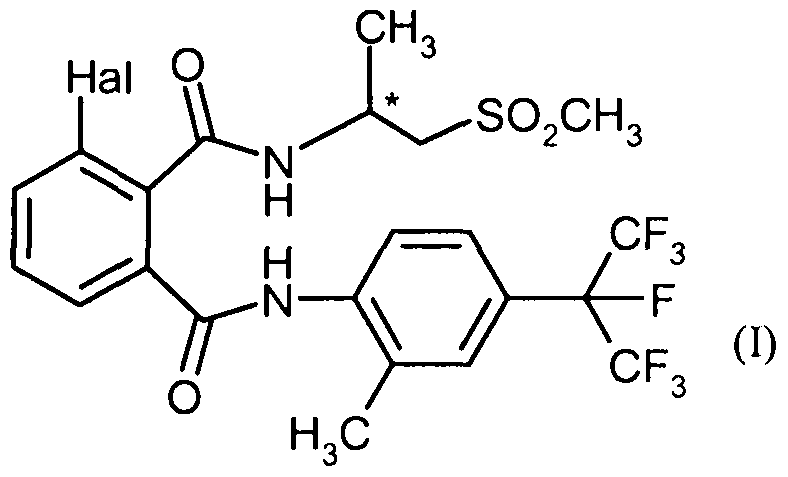
wobei
HaI für Chlor, Brom oder Iod steht,
ein Kohlenstoffatom in der R- oder der S-Konfiguration, bevorzugt in der S-Konfigu- ration, kennzeichnet,
Insektizide Wirkung aufweisen Dies gilt für die racerrusche Form der Verbindungen (EP-A 1 006 107) und in noch höherem Maß für die (S)-konfiguπerten Enantiomere (WO 06/22225) Im Einzelnen seien die Verbindungen (Ia), (Ib) und (Ic) genannt

(Ia) (S)-3-iod-N'-{2-methyl-4-[l ,2,2,2-tetrafluor-l -(tπfluormethyl)ethyl]phenyl}-N2-(l -methyl-2- methylsulfonylethyOphthalamid

(Ib): (S)-3-chlor-N'-{2-rnethyl-4-[l ,2,2,2-tetrafluor-l-(trifluormethyl)ethyl]phenyl}-N2-(l-methyl- 2-methylsulfonylethyl)phthalamid
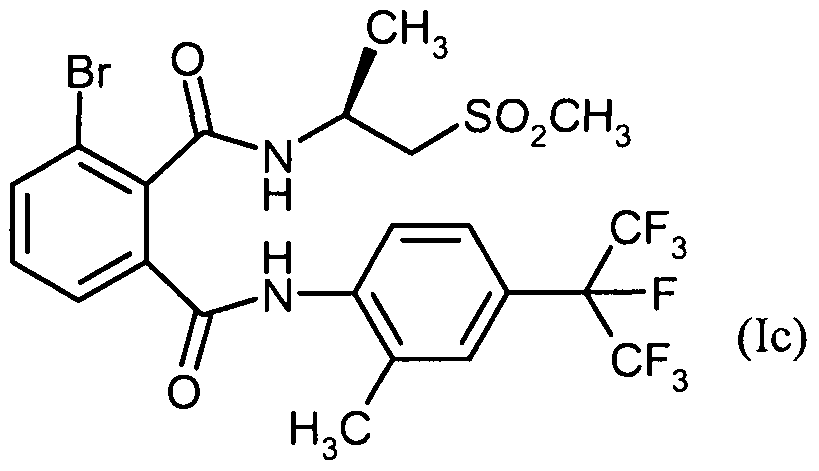
(Ic): (S)-3-brom-N'-{2-methyl-4-[l ,2,2,2-tetrafluor-l-(trifluormethyl)ethyl]phenyl}-N2-(l -methyl- 2-methylsulfonylethyl)phthalamid
Weiterhin ist bekannt, dass bestimmte Verbindungen akarizide Eigenschaften aufweisen. Zu diesen gehören beispielsweise:
1. Propargite (bekannt aus US-A 3,272,854)


3. Diafenthiuron (bekannt aus DE-A 3034905)

4. Etoxazol (bekannt aus EP-A 0 639 572)

Überraschenderweise ist die akarizide Wirkung der erfindungsgemäßen Wirkstoffkombination wesentlich höher als die Summe der Wirkungen der einzelnen Wirkstoffe. Es liegt ein nicht vorhersehbarer echter synergistischer Effekt vor und nicht nur eine Wirkungsergänzung.
Die erfindungsgemäßen Wirkstoffkombinationen enthalten neben mindestens einem Wirkstoff der Formel (I) in enantiomerenreiner Form oder als Mischung der beiden Enantiomere in beliebigem Verhältnis mindestens eines der oben einzeln aufgeführten Akarizide 1 bis 4.
Bevorzugt enthalten die erfindungsgemäßen Wirkstoffkombinationen einen der Wirkstoffe (Ia), (Ib) oder (Ic) und eines der oben einzeln aufgeführten Akarizide.
Besonders bevorzugt sind die in Tabelle 1 aufgeführten Mischungen.
Tabelle 1
Mischung enthaltend
Ia und Propargite
Ia und Fenbutatin Oxid
Ia und Diafenthiuron
Ia und Etoxazol
Ib und Propargite
Ib und Fenbutatin Oxid
Ib und Diafenthiuron
Ib und Etoxazol
Ic und Propargite
Ic und Fenbutatin Oxid
Ic und Diafenthiuron
Ic und Etoxazol
Ganz besonders bevorzugt sind die in Tabelle 2 aufgeführten Mischungen.
Tabelle 2
Mischung enthaltend
Ib und Propargite
Ib und Fenbutatin Oxid
Ib und Diafenthiuron
Ib und Etoxazol
Wenn die Wirkstoffe in den erfindungsgemäßen Wirkstoffkombinationen in bestimmten Gewichtsverhältnissen vorhanden sind, zeigt sich der synergistische Effekt besonders deutlich. Jedoch können die Gewichtsverhältnisse den Wirkstoffe in der Wirkstoffkombinationen in einem relativ großen Bereich variiert werden. Im allgemeinen enthalten die erfindungsgemäßen Kombinationen einen Wirkstoff der Formel (I) und eines der Akarizide 1 bis 4 in den in folgendem bevorzugten und besonders bevorzugten Mischungsverhältnissen:
Bevorzugtes Mischungsverhältnis: 125: 1 bis 1 : 125
Besonders bevorzugtes Mischungsverhältnis: 25: 1 bis 1 :25
Die Mischungsverhältnisse basieren auf Gewichtsverhältnissen. Das Verhältnis ist zu verstehen als Wirkstoff der Formel (I) : Akarizid.
Die erfindungsgemäßen Wirkstoffkombinationen eignen sich bei guter Pflanzenverträglichkeit, günstiger Warmblütertoxizität und guter Umweltverträglichkeit zum Schutz von Pflanzen und Pflanzenorganen, zur Steigerung der Ernteerträge, Verbesserung der Qualität des Erntegutes und zur Bekämpfung von tierischen Schädlingen, insbesondere Insekten, Spinnentieren, Helminthen, Nematoden und Mollusken, die in der Landwirtschaft, im Gartenbau, bei der Tierzucht, in Forsten, in Gärten und Freizeiteinrichtungen, im Vorrats- und Materialschutz sowie auf dem Hygienesektor vorkommen. Sie können vorzugsweise als Pflanzenschutzmittel eingesetzt werden. Sie sind gegen normal sensible und resistente Arten sowie gegen alle oder einzelne Entwicklungsstadien wirksam. Zu den oben erwähnten Schädlingen gehören:
Aus der Ordnung der Anoplura (Phthiraptera) z.B. Damalinia spp., Haematopinus spp., Linognathus spp., Pediculus spp., Trichodectes spp.
Aus der Klasse der Arachnida z.B. Acarus siro, Aceria sheldoni, Aculops spp., Aculus spp., Amblyomma spp., Argas spp., Boophilus spp., Brevipalpus spp., Bryobia praetiosa, Chorioptes spp., Dermanyssus gallinae, Eotetranychus spp., Epitrimerus pyri, Eutetranychus spp., Eriophyes
spp., Hemitarsonemus spp., Hyalomma spp., Ixodes spp., Latrodectus mactans, Metatetranychus spp., Oligonychus spp., Ornithodoros spp., Panonychus spp., Phyllocoptruta oleivora, Polyphagotarsonemus latus, Psoroptes spp., Rhipicephalus spp., Rhizoglyphus spp., Sarcoptes spp., Scorpio maurus, Stenotarsonemus spp., Tarsonemus spp., Tetranychus spp., Vasates lycopersici.
Aus der Klasse der Bivalva z.B. Dreissena spp.
Aus der Ordnung der Chilopoda z.B. Geophilus spp., Scutigera spp.
Aus der Ordnung der Coleoptera z.B. Acanthoscelides obtectus, Adoretus spp., Agelastica alni, Agriotes spp., Amphimallon solstitialis, Anobium punctatum, Anoplophora spp., Anthonomus spp., Anthrenus spp., Apogonia spp., Atomaria spp., Attagenus spp., Bruchidius obtectus, Bruchus spp., Ceuthorhynchus spp., Cleonus mendicus, Conoderus spp., Cosmopolites spp., Costelytra zea- landica, Curculio spp., Cryptorhynchus lapathi, Dermestes spp., Diabrotica spp., Epilachna spp., Faustinus cubae, Gibbium psylloides, Heteronychus arator, Hylamorpha elegans, Hylotrupes bajulus, Hypera postica, Hypothenemus spp., Lachnosterna consanguinea, Leptinotarsa decemlineata, Lissorhoptrus oryzophilus, Lixus spp., Lyctus spp., Meligethes aeneus, Melolontha melolontha, Migdolus spp., Monochamus spp., Naupactus xanthographus, Niptus hololeucus, Oryctes rhinoceros, Oryzaephilus surinamensis, Otiorrhynchus sulcatus, Oxycetonia jucunda, Phaedon cochleariae, Phyllophaga spp., Popillia japonica, Premnotrypes spp., Psylliodes chryso- cephala, Ptinus spp., Rhizobius ventralis, Rhizopertha dominica, Sitophilus spp., Sphenophorus spp., Sternechus spp., Symphyletes spp., Tenebrio molitor, Tribolium spp., Trogoderma spp., Tychius spp., Xylotrechus spp., Zabrus spp.
Aus der Ordnung der Collembola z.B. Onychiurus armatus.
Aus der Ordnung der Dermaptera z.B. Forficula auricularia.
Aus der Ordnung der Diplopoda z.B. Blaniulus guttulatus.
Aus der Ordnung der Diptera z.B. Aedes spp., Anopheles spp., Bibio hortulanus, Calliphora erythrocephala, Ceratitis capitata, Chrysomyia spp., Cochliomyia spp., Cordylobia anthropophaga, Culex spp., Cuterebra spp., Dacus oleae, Dermatobia hominis, Drosophila spp., Fannia spp., Gastrophilus spp., Hylemyia spp., Hyppobosca spp., Hypoderma spp., Liriomyza spp., Lucilia spp., Musca spp., Nezara spp., Oestrus spp., Oscinella frit, Pegomyia hyoscyami, Phorbia spp., Stomoxys spp., Tabanus spp., Tannia spp., Tipula paludosa, Wohlfahrtia spp.
Aus der Klasse der Gastropoda z.B. Arion spp., Biomphalaria spp., Bulinus spp., Deroceras spp., Galba spp., Lymnaea spp., Oncomelania spp., Succinea spp.
Aus der Klasse der Helminthen z.B. Ancylostoma duodenale, Ancylostoma ceylanicum, Acylostoma braziliensis, Ancylostoma spp., Ascaris lubricoides, Ascaris spp., Brugia malayi, Brugia timori, Bunostomum spp., Chabertia spp., Clonorchis spp., Cooperia spp., Dicrocoelium spp, Dictyocaulus filaria, Diphyllobothrium latum, Dracunculus medinensis, Echinococcus granulosus, Echinococcus multilocularis, Enterobius vermicularis, Faciola spp., Haemonchus spp., Heterakis spp., Hymenolepis nana, Hyostrongulus spp., Loa Loa, Nematodirus spp., Oesophagostomum spp., Opisthorchis spp., Onchocerca volvulus, Ostertagia spp., Paragonimus spp., Schistosomen spp, Strongyloides fuelleborni, Strongyloides stercoralis, Stronyloides spp., Taenia saginata, Taenia solium, Trichinella spiralis, Trichinella nativa, Trichinella britovi, Trichinella nelsoni, Trichinella pseudopsiralis, Trichostrongulus spp., Trichuris trichuria, Wuchereria bancrofti.
Weiterhin lassen sich Protozoen, wie Eimeria, bekämpfen.
Aus der Ordnung der Heteroptera z.B. Anasa tristis, Antestiopsis spp., Blissus spp., Calocoris spp., Campylomma livida, Cavelerius spp., Cimex spp., Creontiades dilutus, Dasynus piperis, Dichelops furcatus, Diconocoris hewetti, Dysdercus spp., Euschistus spp., Eurygaster spp., Heliopeltis spp., Horcias nobilellus, Leptocorisa spp., Leptoglossus phyllopus, Lygus spp., Macropes excavatus, Miridae, Nezara spp., Oebalus spp., Pentomidae, Piesma quadrata, Piezodorus spp., Psallus seriatus, Pseudacysta persea, Rhodnius spp., Sahlbergella singularis, Scotinophora spp., Stephanitis nashi, Tibraca spp., Triatoma spp.
Aus der Ordnung der Homoptera z.B. Acyrthosipon spp., Aeneolamia spp., Agonoscena spp., Aleurodes spp., Aleurolobus barodensis, Aleurothrixus spp., Amrasca spp., Anuraphis cardui, Aonidiella spp., Aphanostigma piri, Aphis spp., Arboridia apicalis, Aspidiella spp., Aspidiotus spp., Atanus spp., Aulacorthum solani, Bemisia spp., Brachycaudus helichrysii, Brachycolus spp., Brevicoryne brassicae, Calligypona marginata, Carneocephala fulgida, Ceratovacuna lanigera, Cercopidae, Ceroplastes spp., Chaetosiphon fragaefolii, Chionaspis tegalensis, Chlorita onukii, Chromaphis juglandicola, Chrysomphalus ficus, Cicadulina mbila, Coccomytilus halli, Coccus spp., Cryptomyzus ribis, Dalbulus spp., Dialeurodes spp., Diaphorina spp., Diaspis spp., Doralis spp., Drosicha spp., Dysaphis spp., Dysmicoccus spp., Empoasca spp., Eriosoma spp., Erythroneura spp., Euscelis bilobatus, Geococcus coffeae, Homalodisca coagulata, Hyalopterus arundinis, Icerya spp., Idiocerus spp., Idioscopus spp., Laodelphax striatellus, Lecanium spp., Lepidosaphes spp., Lipaphis erysimi, Macrosiphum spp., Mahanarva fϊmbriolata, Melanaphis
sacchari, Metcalfϊella spp., Metopolophium dirhodum, Monellia costalis, Monelliopsis pecanis, Myzus spp., Nasonovia ribisnigri, Nephotettix spp., Nilaparvata lugens, Oncometopia spp., Orthezia praelonga, Parabemisia myricae, Paratrioza spp., Parlatoria spp., Pemphigus spp., Pere- grinus maidis, Phenacoccus spp., Phloeomyzus passerinii, Phorodon humuli, Phylloxera spp., Pinnaspis aspidistrae, Planococcus spp., Protopulvinaria pyriformis, Pseudaulacaspis pentagona, Pseudococcus spp., Psylla spp., Pteromalus spp., Pyrilla spp., Quadraspidiotus spp., Quesada gigas, Rastrococcus spp., Rhopalosiphum spp., Saissetia spp., Scaphoides titanus, Schizaphis graminum, Selenaspidus articulatus, Sogata spp., Sogatella furcifera, Sogatodes spp., Stictocephala festina, Tenalaphara malayensis, Tinocallis caryaefoliae, Tomaspis spp., Toxoptera spp., Tri- aleurodes vaporariorum, Trioza spp., Typhlocyba spp., Unaspis spp., Viteus vitifolii.
Aus der Ordnung der Hymenoptera z.B. Diprion spp., Hoplocampa spp., Lasius spp., Monomorium pharaonis, Vespa spp.
Aus der Ordnung der Isopoda z.B. Armadillidium vulgäre, Oniscus asellus, Porcellio scaber.
Aus der Ordnung der Isoptera z.B. Reticulitermes spp., Odontotermes spp.
Aus der Ordnung der Lepidoptera z.B. Acronicta major, Aedia leucomelas, Agrotis spp., Alabama argillacea, Anticarsia spp., Barathra brassicae, Bucculatrix thurberiella, Bupalus piniarius, Cacoecia podana, Capua reticulana, Carpocapsa pomonella, Cheimatobia brumata, Chilo spp., Choristoneura fumiferana, Clysia ambiguella, Cnaphalocerus spp., Earias insulana, Ephestia kuehniella, Euproctis chrysorrhoea, Euxoa spp., Feltia spp., Galleria mellonella, Helicoveφa spp., Heliothis spp., Hofmannophila pseudospretella, Homona magnanima, Hyponomeuta padella, La- phygma spp., Lithocolletis blancardella, Lithophane antennata, Loxagrotis albicosta, Lymantria spp., Malacosoma neustria, Mamestra brassicae, Mocis repanda, Mythimna separata, Oria spp., Oulema oryzae, Panolis flammea, Pectinophora gossypiella, Phyllocnistis citrella, Pieris spp., Plutella xylostella, Prodenia spp., Pseudaletia spp., Pseudoplusia includens, Pyrausta nubilalis, Spodoptera spp., Thermesia gemmatalis, Tinea pellionella, Tineola bisselliella, Tortrix viridana, Trichoplusia spp.
Aus der Ordnung der Orthoptera z.B. Acheta domesticus, Blatta orientalis, Blattella germanica, Gryllotalpa spp., Leucophaea maderae, Locusta spp., Melanoplus spp., Periplaneta americana, Schistocerca gregaria.
Aus der Ordnung der Siphonaptera z.B. Ceratophyllus spp., Xenopsylla cheopis.
Aus der Ordnung der Symphyla z.B. Scutigerella immaculata.
Aus der Ordnung der Thysanoptera z.B. Baliothrips biformis, Enneothrips flavens, Frankliniella spp., Heliothrips spp., Hercinothrips femoralis, Kakothrips spp., Rhipiphorothrips crυentatus, Scirtothrips spp., Taeniothrips cardamoni, Thrips spp.
Aus der Ordnung der Thysanura z.B. Lepisma saccharina.
Zu den pflanzenparasitären Nematoden gehören z.B. Anguina spp., Aphelenchoides spp., Belonoaimus spp., Bursaphelenchus spp., Ditylenchus dipsaci, Globodera spp., Heliocotylenchus spp., Heterodera spp., Longidorus spp., Meloidogyne spp., Pratylenchus spp., Radopholus similis, Rotylenchus spp., Trichodorus spp., Tylenchorhynchus spp., Tylenchulus spp., Tylenchulus semipenetrans, Xiphinema spp.
Die erfindungsgemäßen Wirkstoffkombinationen können gegebenenfalls in bestimmten Konzentrationen bzw. Aufwandmengen auch als Herbizide, Safener, Wachstumsregulatoren oder Mittel zur Verbesserung der Pflanzeneigenschaften, oder als Mikrobizide, beispielsweise als Fungizide, Antimykotika, Bakterizide, Virizide (einschließlich Mittel gegen Viroide) oder als Mittel gegen MLO (Mycoplasma-like-organism) und RLO (Rickettsia-like-organism) verwendet werden. Sie lassen sich gegebenenfalls auch als Zwischen- oder Vorprodukte für die Synthese weiterer Wirkstoffe einsetzen.
Erfindungsgemäß können alle Pflanzen und Pflanzenteile behandelt werden. Unter Pflanzen werden hierbei alle Pflanzen und Pflanzenpopulationen verstanden, wie erwünschte und unerwünschte Wildpflanzen oder Kulturpflanzen (einschließlich natürlich vorkommender Kulturpflanzen). Kulturpflanzen können Pflanzen sein, die durch konventionelle Züchtungs- und Optimierungsmethoden oder durch biotechnologische und gentechnologische Methoden oder Kombinationen dieser Methoden erhalten werden können, einschließlich der transgenen Pflanzen und einschließlich der durch Sortenschutzrechte schützbaren oder nicht schützbaren Pflanzensorten. Unter Pflanzenteilen sollen alle oberirdischen und unterirdischen Teile und Organe der Pflanzen, wie Spross, Blatt, Blüte und Wurzel verstanden werden, wobei beispielhaft Blätter, Nadeln, Stängel, Stämme, Blüten, Fruchtkörper, Früchte und Saatgut sowie Wurzeln, Knollen und Rhizome aufgeführt werden. Zu den Pflanzenteilen gehört auch Erntegut sowie vegetatives und generatives Vermehrungsmaterial, beispielsweise Stecklinge, Knollen, Rhizome, Ableger und Saatgut.
Die erfindungsgemäße Behandlung der Pflanzen und Pflanzenteile mit den Wirkstoffkombinationen erfolgt direkt oder durch Einwirkung auf deren Umgebung, Lebensraum oder Lagerraum nach den üblichen Behandlungsmethoden, z.B. durch Tauchen, Sprühen, Verdampfen,
Vernebeln, Streuen, Aufstreichen, Injizieren und bei Vermehrungsmaterial, insbesondere bei Saatgut, weiterhin durch ein- oder mehrschichtiges Umhüllen.
Die Wirkstoffkombinationen können in die üblichen Formulierungen überführt werden, wie Lösungen, Emulsionen, Spritzpulver, wasser- und ölbasierte Suspensionen, Pulver, Stäubemittel, Pasten, lösliche Pulver, lösliche Granulate, Streugranulate, Suspensions-Emulsions-Konzentrate, Wirkstoff-imprägnierte Naturstoffe, Wirkstoff-imprägnierte synthetische Stoffe, Düngemittel sowie Feinstverkapselungen in polymeren Stoffen.
Diese Formulierungen werden in bekannter Weise hergestellt, z.B. durch Vermischen der Wirkstoffe mit Streckmitteln, also flüssigen Lösungsmitteln und/oder festen Trägerstoffen, gegebenenfalls unter Verwendung von oberflächenaktiven Mitteln, also Emulgiermitteln und/oder Dispergiermitteln und/oder schaumerzeugenden Mitteln. Die Herstellung der Formulierungen erfolgt entweder in geeigneten Anlagen oder auch vor oder während der Anwendung.
Als Hilfsstoffe können solche Stoffe Verwendung finden, die geeignet sind, dem Mittel selbst oder und/oder davon abgeleitete Zubereitungen (z.B. Spritzbrühen, Saatgutbeizen) besondere Eigen- Schäften zu verleihen, wie bestimmte technische Eigenschaften und/oder auch besondere biologische Eigenschaften. Als typische Hilfsmittel kommen in Frage: Streckmittel, Lösemittel und Trägerstoffe.
Als Streckmittel eignen sich z.B. Wasser, polare und unpolare organische chemische Flüssigkeiten z.B. aus den Klassen der aromatischen und nicht-aromatischen Kohlenwasserstoffe (wie Paraffine, Alkylbenzole, Alkylnaphthaline, Chlorbenzole), der Alkohole und Polyole (die ggf. auch substituiert, verethert und/oder verestert sein können), der Ketone (wie Aceton, Cyclohexanon), Ester (auch Fette und Öle) und (poly-)Ether, der einfachen und substituierten Amine, Amide, Lac- tame (wie N-Alkylpyrrolidone) und Lactone, der Sulfone und Sulfoxide (wie Dimethylsysulfoxid).
Im Falle der Benutzung von Wasser als Streckmittel können z.B. auch organische Lösemittel als Hilfslösungsmittel verwendet werden. Als flüssige Lösemittel kommen im wesentlichen in Frage:
Aromaten, wie Xylol, Toluol, oder Alkylnaphthaline, chlorierte Aromaten und chlorierte aliphatische Kohlenwasserstoffe, wie Chlorbenzole, Chlorethylene oder Methylenchlorid, alipha- tische Kohlenwasserstoffe, wie Cyclohexan oder Paraffine, z.B. Erdöl fraktionen, mineralische und pflanzliche Öle, Alkohole, wie Butanol oder Glykol sowie deren Ether und Ester, Ketone wie Aceton, Methylethylketon, Methylisobutylketon oder Cyclohexanon, stark polare Lösungsmittel, wie Dimethylsulfoxid, sowie Wasser.
Als feste Trägerstoffe kommen in Frage:
z.B. Ammoniumsalze und natürliche Gesteinsmehle, wie Kaoline, Tonerden, Talkum, Kreide, Quarz, Attapulgit, Montmorillonit oder Diatomeenerde und synthetische Gesteinsmehle, wie hochdisperse Kieselsäure, Aluminiumoxid und Silikate, als feste Trägerstoffe für Granulate kommen in Frage: z.B. gebrochene und fraktionierte natürliche Gesteine wie Calcit, Marmor, Bims, Sepiolith, Dolomit sowie synthetische Granulate aus anorganischen und organischen Mehlen sowie Granulate aus organischem Material wie Papier, Sägemehl, Kokosnußschalen, Maiskolben und Tabakstengeln; als Emulgier- und/oder schaumerzeugende Mittel kommen in Frage: z.B. nichtionogene und anionische Emulgatoren, wie Polyoxyethylen-Fettsäure-Ester, Polyoxyethylen- Fettalkohol-Ether, z.B. Alkylaryl-polyglykolether, Alkylsulfonate, Alkylsulfate, Arylsulfonate sowie Eiweißhydrolysate; als Dispergiermittel kommen in Frage nicht-ionische und/oder ionische Stoffe, z.B. aus den Klassen der Alkohol-POE- und/oder POP-Ether, Säure- und/oder POP- POE- Ester, Alkyl-Aryl- und/oder POP- POE-Ether, Fett- und/oder POP- POE-Addukte, POE- und/oder POP-Polyol Derivate, POE- und/oder POP-Sorbitan- oder-Zucker-Addukte, Alky- oder Aryl- Sulfate, Sulfonate und Phosphate oder die entsprechenden PO-Ether-Addukte. Ferner geeignete Oligo- oder Polymere, z.B. ausgehend von vinylischen Monomeren, von Acrylsäure, aus EO und/oder PO allein oder in Verbindung mit z.B. (poly-) Alkoholen oder (poly-) Aminen. Ferner können Einsatz finden Lignin und seine Sulfonsäure-Derivate, einfache und modifizierte Cellulosen, aromatische und/oder aliphatische Sulfonsäuren sowie deren Addukte mit Formaldehyd.
Es können in den Formulierungen Haftmittel wie Carboxymethylcellulose, natürliche und synthetische pulvrige, körnige oder latexförmige Polymere verwendet werden, wie Gummi- arabicum, Polyvinylalkohol, Polyvinylacetat, sowie natürliche Phospholipide, wie Kephaline und Lecithine und synthetische Phospholipide.
Es können Farbstoffe wie anorganische Pigmente, z.B. Eisenoxid, Titanoxid, Ferrocyanblau und organische Farbstoffe, wie Alizarin-, Azo- und Metallphthalocyaninfarbstoffe und Spurennährstoffe wie Salze von Eisen, Mangan, Bor, Kupfer, Kobalt, Molybdän und Zink verwendet werden.
Weitere Additive können Duftstoffe, mineralische oder vegetabile gegebenenfalls modifizierte Öle, Wachse und Nährstoffe (auch Spurennährstoffe), wie Salze von Eisen, Mangan, Bor, Kupfer, Kobalt, Molybdän und Zink sein.
Weiterhin enthalten sein können Stabilisatoren wie Kältestabilisatoren, Konservierungsmittel, Oxidationsschutzmittel, Lichtschutzmittel oder andere die chemische und/oder physikalische Stabilität verbessernde Mittel.
Die Formulierungen enthalten im allgemeinen zwischen 0,01 und 98 Gew.-% Wirkstoff, vorzugsweise zwischen 0,5 und 90 %.
Die erfindungsgemäßen Wirkstoffkombinationen können in handelsüblichen Formulierungen sowie in den aus diesen Formulierungen bereiteten Anw endungs formen in Mischung mit anderen Wirkstoffen, wie Insektiziden, Lockstoffen, Sterilantien, Bakteriziden, Akariziden, Nematiziden, Fungiziden, wachstumsregulierenden Stoffen oder Herbiziden vorliegen. Zu den Insektiziden zählen beispielsweise Phosphorsäureester, Carbamate, Carbonsäureester, chlorierte Kohlenwasserstoffe, Phenylharnstoffe, durch Mikroorganismen hergestellte Stoffe u.a.
Auch eine Mischung mit anderen bekannten Wirkstoffen, wie Herbiziden oder mit Düngemitteln und Wachstumsregulatoren ist möglich.
Die erfindungsgemäßen Wirkstoffkombinationen können ferner beim Einsatz als Insektizide in ihren handelsüblichen Formulierungen sowie in den aus diesen Formulierungen bereiteten Anwendungsformen in Mischung mit Synergisten vorliegen. Synergisten sind Verbindungen, durch die die Wirkung der Wirkstoffe gesteigert wird, ohne dass der zugesetzte Synergist selbst aktiv wirksam sein muss.
Der Wirkstoffgehalt der aus den handelsüblichen Formulierungen bereiteten Anwendungsformen kann in weiten Bereichen variieren. Die Wirkstoffkonzentration der Anwendungsformen kann von 0,00000001 bis zu 95 Gew.-% Wirkstoff, vorzugsweise zwischen 0,00001 und 1 Gew.-% liegen.
Die Anwendung geschieht in einer den Anwendungsformen angepaßten üblichen Weise.
Wie bereits oben erwähnt, können erfindungsgemäß alle Pflanzen und deren Teile behandelt werden. In einer bevorzugten Ausführungsform werden wild vorkommende oder durch konventionelle biologische Zuchtmethoden, wie Kreuzung oder Protoplastenfusion erhaltenen Pflanzenarten und Pflanzensorten sowie deren Teile behandelt. In einer weiteren bevorzugten Ausführungsform werden transgene Pflanzen und Pflanzensorten, die durch gentechnologische Methoden gegebenenfalls in Kombination mit konventionellen Methoden erhalten wurden (Genetically Modified Organisms) und deren Teile behandelt. Die Begriffe "Teile" bzw. "Teile von Pflanzen" oder "Pflanzenteile" wurden oben erläutert.
Besonders bevorzugt werden erfindungsgemäß Pflanzen der jeweils handelsüblichen oder in Gebrauch befindlichen Pflanzensorten behandelt. Unter Pflanzensorten versteht man Pflanzen mit neuen Eigenschaften ("Traits"), die sowohl durch konventionelle Züchtung, durch Mutagenese oder durch rekombinante DNA-Techniken gezüchtet worden sind. Dies können Sorten, Bio- und Genotypen sein.
Je nach Pflanzenarten bzw. Pflanzensorten, deren Standort und Wachstumsbedingungen (Böden, Klima, Vegetationsperiode, Ernährung) können durch die erfindungsgemäße Behandlung auch überadditive ("synergistische") Effekte auftreten. So sind beispielsweise erniedrigte Aufwandmengen und/oder Erweiterungen des Wirkungsspektrums und/oder eine Verstärkung der Wirkung der erfindungsgemäß verwendbaren Stoffe und Mittel, besseres Pflanzenwachstum, erhöhte Toleranz gegenüber hohen oder niedrigen Temperaturen, erhöhte Toleranz gegen Trockenheit oder gegen Wasser- bzw. Bodensalzgehalt, erhöhte Blühleistung, erleichterte Ernte, Beschleunigung der Reife, höhere Ernteerträge, höhere Qualität und/oder höherer Ernährungswert der Ernteprodukte, höhere Lagerfähigkeit und/oder Bearbeitbarkeit der Ernteprodukte möglich, die über die eigentlich zu erwartenden Effekte hinausgehen.
Zu den bevorzugten erfindungsgemäß zu behandelnden transgenen (gentechnologisch erhaltenen) Pflanzen bzw. Pflanzensorten gehören alle Pflanzen, die durch die gentechnologische Modifikation genetisches Material erhielten, welches diesen Pflanzen besondere vorteilhafte wertvolle Eigenschaften ("Traits") verleiht. Beispiele für solche Eigenschaften sind besseres Pflanzenwachs- tum, erhöhte Toleranz gegenüber hohen oder niedrigen Temperaturen, erhöhte Toleranz gegen Trockenheit oder gegen Wasser- bzw. Bodensalzgehalt, erhöhte Blühleistung, erleichterte Ernte, Beschleunigung der Reife, höhere Ernteerträge, höhere Qualität und/oder höherer Ernährungswert der Ernteprodukte, höhere Lagerfähigkeit und/oder Bearbeitbarkeit der Ernteprodukte. Weitere und besonders hervorgehobene Beispiele für solche Eigenschaften sind eine erhöhte Abwehr der Pflanzen gegen tierische und mikrobielle Schädlinge, wie gegenüber Insekten, Milben, pflanzenpathogenen Pilzen, Bakterien und/oder Viren sowie eine erhöhte Toleranz der Pflanzen gegen bestimmte herbizide Wirkstoffe. Als Beispiele transgener Pflanzen werden die wichtigen Kulturpflanzen, wie Getreide (Weizen, Reis), Mais, Soja, Kartoffel, Zuckerrüben, Tomaten, Erbsen und andere Gemüsesorten, Baumwolle, Tabak, Raps, sowie Obstpflanzen (mit den Früchten Äpfel, Birnen, Zitrusfrüchten und Weintrauben) erwähnt, wobei Mais, Soja, Kartoffel, Baumwolle, Tabak und Raps besonders hervorgehoben werden. Als Eigenschaften ("Traits") werden besonders hervorgehoben die erhöhte Abwehr der Pflanzen gegen Insekten, Spinnentiere, Nematoden und Schnecken durch in den Pflanzen entstehende Toxine, insbesondere solche, die durch das genetische Material aus Bacillus Thuringiensis (z.B. durch die Gene CryΙA(a), CryΙA(b), CryΙA(c), CryllA, CrylllA, CryIIIB2, Cry9c Cry2Ab, Cry3Bb und CrylF sowie deren Kombinationen) in den Pflanzen erzeugt werden (im folgenden "Bt Pflanzen"). Als Eigenschaften ("Traits") werden auch besonders hervorgehoben die erhöhte Abwehr von Pflanzen gegen Pilze, Bakterien und Viren durch Systemische Akquirierte Resistenz (SAR), Systemin, Phytoalexine, Elicitoren sowie Resistenzgene und entsprechend exprimierte Proteine und Toxine. Als Eigenschaften ("Traits") werden weiterhin besonders hervorgehoben die erhöhte Toleranz der
Pflanzen gegenüber bestimmten herbiziden Wirkstoffen, beispielsweise Imidazolinonen, Sulfonylharnstoffen, Glyphosate oder Phosphinotricin (z.B. "PAT"-Gen). Die jeweils die gewünschten Eigenschaften ("Traits") verleihenden Gene können auch in Kombinationen miteinander in den transgenen Pflanzen vorkommen. Als Beispiele für "Bt Pflanzen" seien Maissorten, Baumwollsorten, Sojasorten und Kartoffelsorten genannt, die unter den Handelsbezeichnungen YIELD GARD® (z.B. Mais, Baumwolle, Soja), KnockOut® (z.B. Mais), StarLink® (z.B. Mais), Bollgard® (Baumwolle), Nucotn® (Baumwolle) und NewLeaf® (Kartoffel) vertrieben werden. Als Beispiele für Herbizid-tolerante Pflanzen seien Maissorten, Baumwollsorten und Sojasorten genannt, die unter den Handelsbezeichnungen Roundup Ready® (Toleranz gegen Glyphosate z.B. Mais, Baumwolle, Soja), Liberty Link® (Toleranz gegen Phosphinotricin, z.B. Raps), EMI® (Toleranz gegen Imidazolinone) und STS® (Toleranz gegen Sulfonylharnstoffe z.B. Mais) vertrieben werden. Als Herbizid- resistente (konventionell auf Herbizid-Toleranz gezüchtete) Pflanzen seien auch die unter der Bezeichnung Clearfield® vertriebenen Sorten (z.B. Mais) erwähnt. Selbstverständlich gelten diese Aussagen auch für in der Zukunft entwickelte bzw. zukünftig auf den Markt kommende Pflanzensorten mit diesen oder zukünftig entwickelten genetischen Eigenschaften ("Traits").
Die aufgeführten Pflanzen können besonders vorteilhaft mit den erfindungsgemäßen Wirkstoffkombinationen behandelt werden. Die bei den Wirkstoffkombinationen oben angegebenen Vorzugsbereiche gelten auch für die Behandlung dieser Pflanzen. Besonders hervorgehoben sei die Pflanzenbehandlung mit den im vorliegenden Text speziell aufgeführten Wirkstoffkombinationen.
Die erfindungsgemäßen Wirkstoffkombinationen wirken nicht nur gegen Pflanzen-, Hygiene- und Vorratsschädlinge, sondern auch auf dem veterinärmedizinischen Sektor gegen tierische Parasiten (Ekto- und Endoparasiten) wie Schildzecken, Lederzecken, Räudemilben, Laufmilben, Fliegen (stechend und leckend), parasitierende Fliegenlarven, Läuse, Haarlinge, Federlinge und Flöhe. Zu diesen Parasiten gehören:
Aus der Ordnung der Anoplurida z.B. Haematopinus spp., Linognathus spp., Pediculus spp., Phtirus spp., Solenopotes spp.
Aus der Ordnung der Mallophagida und den Unterordnungen Amblycerina sowie Ischnocerina z.B. Trimenopon spp., Menopon spp., Trinoton spp., Bovicola spp., Werneckiella spp., Lepikentron spp., Damalina spp., Trichodectes spp., Felicola spp.
Aus der Ordnung Diptera und den Unterordnungen Nematocerina sowie Brachycerina z.B. Aedes spp., Anopheles spp., Culex spp., Simulium spp., Eusimulium spp., Phlebotomus spp., Lutzomyia spp., Culicoides spp., Chrysops spp., Hybomitra spp., Atylotus spp., Tabanus spp., Haematopota
spp., Philipomyia spp., Braula spp., Musca spp., Hydrotaea spp., Stomoxys spp., Haematobia spp., Morellia spp., Fannia spp., Glossina spp., Calliphora spp., Lucilia spp., Chrysomyia spp., Wohlfahrtia spp., Sarcophaga spp., Oestrus spp., Hypoderma spp., Gasterophilus spp., Hippobosca spp., Lipoptena spp., Melophagus spp.
Aus der Ordnung der Siphonapterida z.B. Pulex spp., Ctenocephalides spp., Xenopsylla spp., Ceratophyllus spp.
Aus der Ordnung der Heteropterida z.B. Cimex spp., Triatoma spp., Rhodnius spp., Panstrongylus spp.
Aus der Ordnung der Blattarida z.B. Blatta orientalis, Periplaneta americana, Blattela germanica, Supella spp.
Aus der Unterklasse der Acari (Acarina) und den Ordnungen der Meta- sowie Mesostigmata z.B. Argas spp., Ornithodorus spp., Otobius spp., Ixodes spp., Amblyomma spp., Boophilus spp., Dermacentor spp., Haemophysalis spp., Hyalomma spp., Rhipicephalus spp., Dermanyssus spp., Raillietia spp., Pneumonyssus spp., Sternostoma spp., Varroa spp.
Aus der Ordnung der Actinedida (Prostigmata) und Acaridida (Astigmata) z.B. Acarapis spp., Cheyletiella spp., Ornithocheyletia spp., Myobia spp., Psorergates spp., Demodex spp., Trombicula spp., Listrophorus spp., Acarus spp., Tyrophagus spp., Caloglyphus spp., Hypodectes spp., Pterolichus spp., Psoroptes spp., Chorioptes spp., Otodectes spp., Sarcoptes spp., Notoedres spp., Knemidocoptes spp., Cytodites spp., Laminosioptes spp.
Die erfindungsgemäßen Wirkstoffkombinationen eignen sich auch zur Bekämpfung von Arthropoden, die landwirtschaftliche Nutztiere, wie z.B. Rinder, Schafe, Ziegen, Pferde, Schweine, Esel, Kamele, Büffel, Kaninchen, Hühner, Puten, Enten, Gänse, Bienen, sonstige Haustiere wie z.B. Hunde, Katzen, Stubenvögel, Aquarienfische sowie sogenannte Versuchstiere, wie z.B. Hamster, Meerschweinchen, Ratten und Mäuse befallen. Durch die Bekämpfung dieser Arthropoden sollen Todesfälle und Leistungsminderungen (bei Fleisch, Milch, Wolle, Häuten, Eiern, Honig usw.) vermindert werden, so daß durch den Einsatz der erfindungsgemäßen Wirkstoffkombinationen eine wirtschaftlichere und einfachere Tierhaltung möglich ist.
Die Anwendung der erfindungsgemäßen Wirkstoffkombinationen geschieht im Veterinärsektor und bei der Tierhaltung in bekannter Weise durch enterale Verabreichung in Form von beispielsweise Tabletten, Kapseln, Tränken, Drenchen, Granulaten, Pasten, BoIi, des feed-through- Verfahrens, von Zäpfchen, durch parenterale Verabreichung, wie zum Beispiel durch Injektionen (intramuskulär, subcutan, intravenös, intraperitonal u.a.), Implantate, durch nasale Applikation,
durch dermale Anwendung in Form beispielsweise des Tauchens oder Badens (Dippen), Sprühens (Spray), Aufgießens (Pour-on und Spot-on), des Waschens, des Einpudems sowie mit Hilfe von wirkstoffhaltigen Formkörpern, wie Halsbändern, Ohrmarken, Schwanzmarken, Gliedmaßenbändern, Halftern, Markierungsvorrichtungen usw.
Bei der Anwendung für Vieh, Geflügel, Haustiere etc. kann man die Wirkstoffkombinationen als Formulierungen (beispielsweise Pulver, Emulsionen, fließfähige Mittel), die die Wirkstoffe in einer Menge von 1 bis 80 Gew.-% enthalten, direkt oder nach 100 bis 10 000-facher Verdünnung anwenden oder sie als chemisches Bad verwenden.
Außerdem wurde gefunden, daß die erfindungsgemäßen Wirkstoffkombinationen eine hohe in- sektizide Wirkung gegen Insekten zeigen, die technische Materialien zerstören.
Beispielhaft und vorzugsweise - ohne jedoch zu limitieren - seien die folgenden Insekten genannt:
Käfer wie Hylotrupes bajulus, Chlorophorus pilosis, Anobium punctatum, Xestobium rufovillo- sum, Ptilinus pecticornis, Dendrobium pertinex, Ernobius mollis, Priobium carpini, Lyctus brunneus, Lyctus africanus, Lyctus planicollis, Lyctus linearis, Lyctus pubescens, Trogoxylon aequale, Minthes rugicollis, Xyleborus spec. Tryptodendron spec. Apate monachus, Bostrychus capucins, Heterobostrychus brunneus, Sinoxylon spec. Dinoderus minutus;
Hautflügler wie Sirex juvencus, Urocerus gigas, Urocerus gigas taignus, Urocerus augur;
Termiten wie Kalotermes flavicollis, Cryptotermes brevis, Heterotermes indicola, Reticulitermes flavipes, Reticulitermes santonensis, Reticulitermes lucifugus, Mastotermes darwiniensis, Zootermopsis nevadensis, Coptotermes formosanus;
Borstenschwänze wie Lepisma saccharina.
Unter technischen Materialien sind im vorliegenden Zusammenhang nicht-lebende Materialien zu verstehen, wie vorzugsweise Kunststoffe, Klebstoffe, Leime, Papiere und Kartone, Leder, Holz, Holzverarbeitungsprodukte und Anstrichmittel.
Die anwendungsfertigen Mittel können gegebenenfalls noch weitere Insektizide und gegebenenfalls noch ein oder mehrere Fungizide enthalten.
Hinsichtlich möglicher zusätzlicher Zumischpartner sei auf die oben genannten Insektizide und Fungizide verwiesen.
Zugleich können die erfindungsgemäßen Wirkstoffkombinationen zum Schutz vor Bewuchs von Gegenständen, insbesondere von Schiffskörpern, Sieben, Netzen, Bauwerken, Kaianlagen und Signalanlagen, welche mit See- oder Brackwasser in Verbindung kommen, eingesetzt werden.
Weiter können die erfindungsgemäßen Wirkstoffkombinationen allein oder in Kombinationen mit anderen Wirkstoffen als Antifouling-Mittel eingesetzt werden.
Die Wirkstoffkombinationen eignen sich auch zur Bekämpfung von tierischen Schädlingen im Haushalts-, Hygiene- und Vorratsschutz, insbesondere von Insekten, Spinnentieren und Milben, die in geschlossenen Räumen, wie beispielsweise Wohnungen, Fabrikhallen, Büros, Fahrzeugkabinen u.a. vorkommen. Sie können zur Bekämpfung dieser Schädlinge allein oder in Kombination mit anderen Wirk- und Hilfsstoffen in Haushaltsinsektizid-Produkten verwendet werden. Sie sind gegen sensible und resistente Arten sowie gegen alle Entwicklungsstadien wirksam. Zu diesen Schädlingen gehören:
Aus der Ordnung der Scorpionidea z.B. Buthus occitanus.
Aus der Ordnung der Acarina z.B. Argas persicus, Argas reflexus, Bryobia ssp., Dermanyssus gallinae, Glyciphagus domesticus, Ornithodorus moubat, Rhipicephalus sanguineus, Trombicula alfreddugesi, Neutrombicula autumnalis, Dermatophagoides pteronissimus, Dermatophagoides forinae.
Aus der Ordnung der Araneae z.B. Aviculariidae, Araneidae.
Aus der Ordnung der Opiliones z.B. Pseudoscorpiones chelifer, Pseudoscorpiones cheiridium, Opiliones phalangium.
Aus der Ordnung der Isopoda z.B. Oniscus asellus, Porcellio scaber.
Aus der Ordnung der Diplopoda z.B. Blaniulus guttulatus, Polydesmus spp.
Aus der Ordnung der Chilopoda z.B. Geophilus spp.
Aus der Ordnung der Zygentoma z.B. Ctenolepisma spp., Lepisma saccharina, Lepismodes inquilinus.
Aus der Ordnung der Blattaria z.B. Blatta orientalies, Blattella germanica, Blattella asahinai, Leucophaea maderae, Panchlora spp., Parcoblatta spp., Periplaneta australasiae, Periplaneta americana, Periplaneta brunnea, Periplaneta fuliginosa, Supella longipalpa.
Aus der Ordnung der Saltatoria z.B. Acheta domesticus.
Aus der Ordnung der Dermaptera z.B. Forficula auricularia.
Aus der Ordnung der Isoptera z.B. Kalotermes spp., Reticulitermes spp.
Aus der Ordnung der Psocoptera z.B. Lepinatus spp., Liposcelis spp.
Aus der Ordnung der Coleoptera z.B. Anthrenus spp., Attagenus spp., Dermestes spp., Latheticus oryzae, Necrobia spp., Ptinus spp., Rhizopertha dominica, Sitophilus granarius, Sitophilus oryzae, Sitophilus zeamais, Stegobium paniceum.
Aus der Ordnung der Diptera z.B. Aedes aegypti, Aedes albopictus, Aedes taeniorhynchus, Anopheles spp., Calliphora erythrocephala, Chrysozona pluvialis, Culex quinquefasciatus, Culex pipiens, Culex tarsalis, Drosophila spp., Fannia canicularis, Musca domestica, Phlebotomus spp., Sarcophaga carnaria, Simulium spp., Stomoxys calcitrans, Tipula paludosa.
Aus der Ordnung der Lepidoptera z.B. Achroia grisella, Galleria mellonella, Plodia interpunctella, Tinea cloacella, Tinea pellionella, Tineola bisselliella.
Aus der Ordnung der Siphonaptera z.B. Ctenocephalides canis, Ctenocephalides felis, Pulex irritans, Tunga penetrans, Xenopsylla cheopis.
Aus der Ordnung der Hymenoptera z.B. Camponotus herculeanus, Lasius fuliginosus, Lasius niger, Lasius umbratus, Monomorium pharaonis, Paravespula spp., Tetramorium caespitum.
Aus der Ordnung der Anoplura z.B. Pediculus humanus capitis, Pediculus humanus corporis, Pemphigus spp., Phylloera vastatrix, Phthirus pubis.
Aus der Ordnung der Heteroptera z.B. Cimex hemipterus, Cimex lectularius, Rhodinus prolixus, Triatoma infestans.
Die Anwendung im Bereich der Haushaltsinsektizide erfolgt allein oder in Kombination mit anderen geeigneten Wirkstoffen wie Phosphorsäureestern, Carbamaten, Pyrethroiden, Neo- nicotinoiden, Wachstumsregulatoren oder Wirkstoffen aus anderen bekannten Insektizidklassen.
Die Anwendung erfolgt in Aerosolen, drucklosen Sprühmitteln, z.B. Pump- und Zerstäubersprays, Nebelautomaten, Foggern, Schäumen, Gelen, Verdampferprodukten mit Verdampferplättchen aus Cellulose oder Kunststoff, Flüssigverdampfern, Gel- und Membranverdampfern, propellergetrie-
benen Verdampfern, energielosen bzw. passiven Verdampfungssystemen, Mottenpapieren, Mottensäckchen und Mottengelen, als Granulate oder Stäube, in Streuködern oder Köderstationen.
Die gute insektizide und akarizide Wirkung der erfindungsgemäßen Wirkstoffkombinationen geht aus den nachfolgenden Beispielen hervor. Während die einzelnen Wirkstoffe in der Wirkung Schwächen aufweisen, zeigen die Kombinationen eine Wirkung, die über eine einfache Wirkungssummierung hinausgeht.
Ein synergistischer Effekt liegt bei Insektiziden und Akariziden immer dann vor, wenn die Wirkung der Wirkstoffkombinationen größer ist als die Summe der Wirkungen der einzeln applizierten Wirkstoffe.
Die zu erwartende Wirkung für eine gegebene Kombination zweier Wirkstoffe kann nach S. R. Colby, Weeds Jl (1967), 20-22 wie folgt berechnet werden:
Wenn
X den Abtötungsgrad, ausgedrückt in % der unbehandelten Kontrolle, beim Einsatz des
Wirkstoffes A in einer Aufwandmenge von m g/ha oder in einer Konzentration von m ppm bedeutet,
Y den Abtötungsgrad, ausgedrückt in % der unbehandelten Kontrolle, beim Einsatz des Wirkstoffes B in einer Aufwandmenge von n g/ha oder in einer Konzentration von n ppm bedeutet und
E den Abtötungsgrad, ausgedrückt in % der unbehandelten Kontrolle, beim Einsatz der Wirkstoffe A und B in Aufwandmengen von m und n g/ha oder in einer Konzentration von m und n ppm bedeutet,
dann ist
X Y
E=X + Y- 100
Ist der tatsächliche insektizide oder akarizide Abtötungsgrad größer als berechnet, so ist die Kom- bination in ihrer Abtötung überadditiv, d.h. es liegt ein synergistischer Effekt vor. In diesem Fall muss der tatsächlich beobachtete Abtötungsgrad größer sein als der aus der oben angeführten Formel errechnete Wert für den erwarteten Abtötungsgrad (E).
Beispiel A
Myzus persicae -Test
Lösungsmittel: 78 Gewichtsteile Aceton
1 ,5 Gewichtsteile Dimethylformamid
Emulgator: 0,5 Gewichtsteile Alkylarylpolyglykolether
Zur Herstellung einer zweckmäßigen Wirkstoffzubereitung vermischt man 1 Gewichtsteil Wirkstoff mit den angegebenen Mengen Lösungsmittel und Emulgator und verdünnt das Konzentrat mit emulgatorhaltigem Wasser auf die gewünschte Konzentration.
Kohlblätter {Brassica oleraceά), die stark von der Grünen Pfirsichblattlaus (Myzus persicae) befallen sind, werden durch Sprühen mit der Wirkstoffzubereitung in der gewünschten Konzentration behandelt.
Nach der gewünschten Zeit wird die Abtötung in % bestimmt. Dabei bedeutet 100 %, dass alle Blattläuse abgetötet wurden; 0 % bedeutet, dass keine Blattläuse abgetötet wurden. Die ermittelten Abtötungswerte verrechnet man nach der Colby-Formel (siehe Blatt 1).
Bei diesem Test zeigen z. B. die folgenden Wirkstoffkombinationen gemäß vorliegender Anmeldung eine synergistisch verstärkte Wirksamkeit im Vergleich zu den einzeln angewendeten Wirkstoffen:
Tabelle A, Seite 1
Pflanzenschädigende Insekten Myzus persicae - Test

*gef.=gefundeneWirkung
** ber. = nach der Colby-Formel berechnete Wirkung
Beispiel B
Tetranychus urticae - Test (OP-resistent/Spritzbehandlung)
Lösungsmittel: 78 Gewichtsteile Aceton 1 ,5 Gewichtsteile Dimethylformamid
Emulgator: 0,5 Gewichtsteile Alkylarylpolyglykolether
Zur Herstellung einer zweckmäßigen Wirkstoffzubereitung vermischt man 1 Gewichtsteil Wirkstoff mit den angegebenen Mengen Lösungsmittel und Emulgator und verdünnt das Konzentrat mit emulgatorhaltigem Wasser auf die gewünschte Konzentration.
Bohnenblattscheiben (Phaseolus vulgaris), die von allen Stadien der Gemeinen Spinnmilbe (Tetranychus urticae) befallen sind, werden mit einer Wirkstoffzubereitung der gewünschten Konzentration gespritzt.
Nach der gewünschten Zeit wird die Wirkung in % bestimmt. Dabei bedeutet 100 %, dass alle Spinnmilben abgetötet wurden; 0 % bedeutet, dass keine Spinnmilben abgetötet wurden.
Bei diesem Test zeigte die folgende Wirkstoffkombination gemäß vorliegender Anmeldung eine synergistisch verstärkte Wirksamkeit im Vergleich zu den einzeln angewendeten Wirkstoffen:
Tabelle B, Seite
Pflanzenschädigende Spinnmilben Tetranychus urticae - Test

** ber. = nach der Colby-Formel berechnete Wirkung
Claims
1. Zusammensetzung umfassend die Komponenten (a) und (b), wobei
Komponente (a) ausgewählt ist aus den Wirkstoffen der Formel (I)

wobei
HaI für Chlor, Brom oder Iod steht,
* ein Kohlenstoffatom in der R- oder der S-Konfiguration kennzeichnet, und
Komponente (b) ausgewählt ist aus Propargite
Fenbutatin Oxid
Diafenthiuron
Etoxazol
2. Mittel gemäß Anspruch 1 wobei Komponente (a) (S)-3-chlor-N'-{2-methyl-4-[l , 2,2,2- tetrafluor- 1 -(trifluormethyl)ethyl]phenyl} -N2-( 1 -methyl-2-methylsulfonylethyl)phthalamid der Formel (Ib) ist.

3. Verwendung von Zusammensetzungen gemäß Anspruch 1 oder 2 zur Bekämpfung tierischer Schädlinge.
4. Verwendung von Zusammensetzungen gemäß Anspruch 1 oder 2 zur Behandlung von Saatgut.
5. Verwendung von Zusammensetzungen gemäß Anspruch 1 oder 2 zur Behandlung von transgenen Pflanzen.
6. Verwendung von Zusammensetzungen gemäß Anspruch 1 oder 2 zur Behandlung von Saatgut transgener Pflanzen.
7. Saatgut, welches mit einer Zusammensetzung gemäß Anspruch 1 oder 2 behandelt wurde.
8. Verfahren zur Bekämpfung von unerwünschten tierischen Schädlingen, dadurch gekennzeichnet, dass man eine Zusammensetzung gemäß Anspruch 1 oder 2 auf die unerwünschten tierischen Schädlinge und/oder deren Lebensraum und/oder Saatgut ausbringt.
9. Verfahren zur Herstellung insektizider und akarizider Mittel, dadurch gekennzeichnet, dass man Zusammensetzungen gemäß Anspruch 1 oder 2 mit Streckmitteln und/oder oberflächenaktiven Stoffen vermischt.
Applications Claiming Priority (2)
| Application Number | Priority Date | Filing Date | Title |
|---|---|---|---|
| DE200610010211 DE102006010211A1 (de) | 2006-03-06 | 2006-03-06 | Wirkstoffkombinationen mit insektiziden und akariziden Eigenschaften |
| DE102006010211.8 | 2006-03-06 |
Publications (2)
| Publication Number | Publication Date |
|---|---|
| WO2007101601A2 true WO2007101601A2 (de) | 2007-09-13 |
| WO2007101601A3 WO2007101601A3 (de) | 2008-03-20 |
Family
ID=38335846
Family Applications (1)
| Application Number | Title | Priority Date | Filing Date |
|---|---|---|---|
| PCT/EP2007/001752 Ceased WO2007101601A2 (de) | 2006-03-06 | 2007-03-01 | Wirkstoffkombinationen mit insektiziden und akariziden eigenschaften |
Country Status (4)
| Country | Link |
|---|---|
| AR (1) | AR059737A1 (de) |
| DE (1) | DE102006010211A1 (de) |
| TW (1) | TW200803729A (de) |
| WO (1) | WO2007101601A2 (de) |
Cited By (2)
| Publication number | Priority date | Publication date | Assignee | Title |
|---|---|---|---|---|
| EP2033515A1 (de) * | 2007-09-05 | 2009-03-11 | Bayer CropScience AG | Verfahren zur verbesserten Nutzung des Produktionspotentials transgener Pflanzen |
| EP2500340A1 (de) | 2008-01-25 | 2012-09-19 | Syngenta Participations AG. | 2-Cyanophenylsulfonamidderivate als Pestizide |
Family Cites Families (3)
| Publication number | Priority date | Publication date | Assignee | Title |
|---|---|---|---|---|
| CZ299375B6 (cs) * | 1998-11-30 | 2008-07-09 | Nihon Nohyaku Co., Ltd. | Ftalamidové deriváty nebo jejich soli, zemedelsko-zahradnický insekticid je obsahující a jeho použití |
| PT1380209E (pt) * | 2001-04-17 | 2012-09-27 | Nihon Nohyaku Co Ltd | Composição de agente de controlo de pragas e método de utilização da mesma |
| AU2005275886A1 (en) * | 2004-08-23 | 2006-03-02 | Nihon Nohyaku Co., Ltd. | Optically active phthalamide derivative, agricultural or horticultural insecticide, and method of using the same |
-
2006
- 2006-03-06 DE DE200610010211 patent/DE102006010211A1/de not_active Withdrawn
-
2007
- 2007-03-01 WO PCT/EP2007/001752 patent/WO2007101601A2/de not_active Ceased
- 2007-03-05 AR ARP070100898A patent/AR059737A1/es unknown
- 2007-03-05 TW TW96107419A patent/TW200803729A/zh unknown
Cited By (2)
| Publication number | Priority date | Publication date | Assignee | Title |
|---|---|---|---|---|
| EP2033515A1 (de) * | 2007-09-05 | 2009-03-11 | Bayer CropScience AG | Verfahren zur verbesserten Nutzung des Produktionspotentials transgener Pflanzen |
| EP2500340A1 (de) | 2008-01-25 | 2012-09-19 | Syngenta Participations AG. | 2-Cyanophenylsulfonamidderivate als Pestizide |
Also Published As
| Publication number | Publication date |
|---|---|
| WO2007101601A3 (de) | 2008-03-20 |
| DE102006010211A1 (de) | 2007-09-13 |
| TW200803729A (en) | 2008-01-16 |
| AR059737A1 (es) | 2008-04-23 |
Similar Documents
| Publication | Publication Date | Title |
|---|---|---|
| EP2558458B1 (de) | Neue heterocyclische verbindungen als schädlingsbekämpfungsmittel | |
| EP2001297B1 (de) | Wirkstoffkombinationen mit insektiziden eigenschaften | |
| EP2001295B1 (de) | Wirkstoffkombinationen mit insektiziden und akariziden eigenschaften | |
| DE102006015197A1 (de) | Wirkstoffkombination mit insektiziden Eigenschaften | |
| EP2001873B1 (de) | Wirkstoffkombinationen mit insektiziden eigenschaften | |
| EP2001303B1 (de) | Wirkstoffkombinationen mit insektiziden eigenschaften | |
| WO2007112843A1 (de) | Wirkstoffkombinationen mit insektiziden eigenschaften | |
| WO2007112895A1 (de) | Wirkstoffkombinationen mit insektiziden eigenschaften | |
| EP2200435B1 (de) | Wirkstoffkombinationen mit insektiziden und akariziden eingenschaften | |
| WO2007101542A1 (de) | Wirkstoffkombinationen mit insektiziden eigenschaften | |
| WO2007112848A2 (de) | Wirkstoffkombinationen mit insektiziden und akariziden eigenschaften | |
| WO2007101546A2 (de) | Wirkstoffkombinationen mit insektiziden und akariziden eigenschaften enthaltend phtalsäurediamidderivaten | |
| WO2007112846A1 (de) | Wirkstoffkombinationen mit insektiziden und akariziden eigenschaften | |
| EP2078013B1 (de) | Neue kristalline modifikation von 4- (n-methyl-2-chloro-5-pyridylmethylamino) -2,5-dihydrofuran-2-on | |
| WO2007101539A2 (de) | Wirkstoffkombinationen mit insektiziden und akariziden eigenschaften | |
| TW200803729A (en) | Active compound combinations having insecticidal and acaricidal properties | |
| WO2007101544A2 (de) | Wirkstoffkombinationen mit insektiziden eigenschaften | |
| DE102006010206A1 (de) | Wirkstoffkombinationen mit insektiziden und akariziden Eigenschaften |
Legal Events
| Date | Code | Title | Description |
|---|---|---|---|
| NENP | Non-entry into the national phase |
Ref country code: DE |
|
| 121 | Ep: the epo has been informed by wipo that ep was designated in this application |
Ref document number: 07722986 Country of ref document: EP Kind code of ref document: A2 |
|
| 122 | Ep: pct application non-entry in european phase |
Ref document number: 07722986 Country of ref document: EP Kind code of ref document: A2 |