WO2007113322A2 - Substituierte 5-hetarylpyrimidine zur bekämpfung von pflanzenschädigenden pilzen und von krebserkrankungen - Google Patents
Substituierte 5-hetarylpyrimidine zur bekämpfung von pflanzenschädigenden pilzen und von krebserkrankungen Download PDFInfo
- Publication number
- WO2007113322A2 WO2007113322A2 PCT/EP2007/053332 EP2007053332W WO2007113322A2 WO 2007113322 A2 WO2007113322 A2 WO 2007113322A2 EP 2007053332 W EP2007053332 W EP 2007053332W WO 2007113322 A2 WO2007113322 A2 WO 2007113322A2
- Authority
- WO
- WIPO (PCT)
- Prior art keywords
- het
- alkyl
- compounds
- methyl
- hetarylpyrimidines
- Prior art date
- Legal status (The legal status is an assumption and is not a legal conclusion. Google has not performed a legal analysis and makes no representation as to the accuracy of the status listed.)
- Ceased
Links
- 0 Cc(c(I)c(*)[o]1)c1I Chemical compound Cc(c(I)c(*)[o]1)c1I 0.000 description 4
- XSACRLLGFZSEAN-UHFFFAOYSA-N Cc1cc(C)nc(SI)n1 Chemical compound Cc1cc(C)nc(SI)n1 XSACRLLGFZSEAN-UHFFFAOYSA-N 0.000 description 1
Classifications
-
- C—CHEMISTRY; METALLURGY
- C07—ORGANIC CHEMISTRY
- C07D—HETEROCYCLIC COMPOUNDS
- C07D401/00—Heterocyclic compounds containing two or more hetero rings, having nitrogen atoms as the only ring hetero atoms, at least one ring being a six-membered ring with only one nitrogen atom
- C07D401/02—Heterocyclic compounds containing two or more hetero rings, having nitrogen atoms as the only ring hetero atoms, at least one ring being a six-membered ring with only one nitrogen atom containing two hetero rings
- C07D401/04—Heterocyclic compounds containing two or more hetero rings, having nitrogen atoms as the only ring hetero atoms, at least one ring being a six-membered ring with only one nitrogen atom containing two hetero rings directly linked by a ring-member-to-ring-member bond
-
- A—HUMAN NECESSITIES
- A01—AGRICULTURE; FORESTRY; ANIMAL HUSBANDRY; HUNTING; TRAPPING; FISHING
- A01N—PRESERVATION OF BODIES OF HUMANS OR ANIMALS OR PLANTS OR PARTS THEREOF; BIOCIDES, e.g. AS DISINFECTANTS, AS PESTICIDES OR AS HERBICIDES; PEST REPELLANTS OR ATTRACTANTS; PLANT GROWTH REGULATORS
- A01N43/00—Biocides, pest repellants or attractants, or plant growth regulators containing heterocyclic compounds
- A01N43/48—Biocides, pest repellants or attractants, or plant growth regulators containing heterocyclic compounds having rings with two nitrogen atoms as the only ring hetero atoms
- A01N43/54—1,3-Diazines; Hydrogenated 1,3-diazines
-
- A—HUMAN NECESSITIES
- A61—MEDICAL OR VETERINARY SCIENCE; HYGIENE
- A61P—SPECIFIC THERAPEUTIC ACTIVITY OF CHEMICAL COMPOUNDS OR MEDICINAL PREPARATIONS
- A61P35/00—Antineoplastic agents
Definitions
- the present invention relates to the use of 5-hetarylpyrimidines for controlling phytopathogenic fungi, novel 5-hetarylpyrimidines and pesticides containing at least one such compound as an active ingredient.
- WO 01/96314, WO 02/074753, WO 03/070721, WO 03/043993, WO 2004/103978 and WO 2005/019187 disclose 5-phenyl-4-aminopyrimidines and their use for controlling phytopathogenic fungi (phytopathogenic fungi) known.
- the 5-phenyl-4-aminopyrimidines known from the prior art are in some cases unsatisfactory with regard to their fungicidal action or have undesired properties, such as a low compatibility with crops.
- the present invention is therefore based on the object of providing compounds with better fungicidal activity and / or a better crop tolerance.
- the present invention thus relates to the use of 5-hetarylpyrimidine compounds of the general formula I.
- R 1 is d-C ⁇ -alkyl, C 3 -C 8 cycloalkyl, C 5 -C 0 bicycloalkyl, C 2 -C 8 alkenyl, C 4 -C 0 - alkadienyl, C 3 -C 6 cycloalkenyl, C C 2 -C 8 -alkynyl, phenyl, naphthyl, or a C-bound five- or six-membered saturated, partially unsaturated or aromatic heterocycle having one, two, three or four heteroatoms from the group O, N or S as ring members;
- R 11 cyano, nitro, amino, hydroxy, C (O) NH 2, C (S) NH 2, carboxyl, C r C 6 - alkylcarbonyl, C 3 -C 6 cycloalkyl, Ci-C 6 -alkoxy, CrC 6 alkoxycarbonyl, d-Ce-alkylthio, C r C 6 alkylamino, di-C r C 6 alkylamino, C r C 6 -
- R 11 wherein the aliphatic, alicyclic, heterocyclic and aromatic groups in R 11 may in turn be partially or completely halogenated or may carry one, two or three groups R 12 :
- R 12 is cyano, nitro, hydroxyl, mercapto, amino, carboxyl, aminocarbonyl, aminothiocarbonyl, alkyl, haloalkyl, alkenyl, alkadienyl, alkenyloxy, alkynyloxy, alkoxy, haloalkoxy, alkylthio, alkylamino, dialkylamino, formyl, alkylcarbonyl, alkylsulfonyl, Alkylsulfoxyl, alkoxycarbonyl, alkylcarbonyloxy, alkylaminocarbonyl, dialkylaminocarbonyl, alkylaminothiocarbonyl, dialkylaminothiocarbonyl, where the alkyl groups in these radicals contain 1 to 6 carbon atoms and said alkenyl, alkadienyl or alkynyl groups in these radicals contain 2 to 8 carbon atoms;
- Z is O, S, NR 33 , NOR 34 or N-NR 35 R 36 ;
- Z ' is a chemical bond, oxygen, a carbonyl group, a group
- R 21 , R 22 , R 23 , R 24 , R 25 , R 26 , R 27 , R 28 , R 29 , R 30 , R 31 , R 32 , R 32a , R 33 , R 34 , R 35 and R 36 independently of one another are hydrogen, C 1 -C 6 -alkyl, C 2 -C 6 -alkenyl, C 2 -C -alkynyl, C 3 -C 8 -cycloalkyl or C 4 -C 8 -cycloalkenyl;
- R 23a has, except for hydrogen, one of the meanings given for R 21 ;
- R 22 , R 28 and R 32 may additionally denote -CO-R 25 ;
- R 22 can furthermore be -CO-OR 21 or -CO-NR 23 R 23b , where R 23b has one of the meanings given for R 21 ;
- R 22 and R 23 or R 22 and R 23a may also together form a C 3 -C 6 alkylene group which may be interrupted by an oxygen atom or may have a double bond;
- R 31 , R 32 , R 32a , R 33 , R 34 or R 35 with another radical R 21 , R 22 , R 23 , R 24 , R 25 or R 31 can also together form a C 1 -C 6 -alkylene group which in the Case of C 2 -C 6 alkylene may have a double bond;
- R 26 and R 22 , R 26 and R 27 , R 26 and R 28 or R 29 and R 30 may also together form a C 3 -C 6 -alkylene group which may be interrupted by an oxygen atom or may have a double bond;
- R w is halogen, cyano, C r C 8 alkyl, C 2 -C 0 alkenyl, C 2 -C 0 alkynyl, C r C 6 - alkoxy, C 2 -C 0 alkenyloxy, C 2 -C 0 - Alkynyloxy, C 3 -C 6 -cycloalkyl, C 3 -C 6 -
- R 2 is a cyclic radical selected from C 3 -C 0 cycloalkyl, phenyl and five-, six- or seven-membered saturated, partially unsaturated or aromatic heterocycles see which one, two, three or four heteroatoms from the group O .
- R 3 is hydrogen, OH, halogen, cyano, C r C 8 alkyl, C r C 8 alkoxy, C r C 8 alkylthio, C r Cs-alkylsulfinyl, C r C 8 alkylsulfonyl, C 2 -C 8 - alkenyl or C 2 -C 8 -alkynyl, where the 7 last-mentioned radicals may be partially or fully halogenated and / or one, two or three substituents selected from nitro, cyano, OH, -C 2 - alkoxy, -C 4 alkoxycarbonyl, amino , Ci-C 4 -alkylamino and Di-CrC 4 -
- Alkylamino can carry
- Het is a substituted C- or N-linked, 5- or 6-membered aromatic heterocycle having 1, 2, 3 or 4 heteroatoms selected from nitrogen, oxygen and sulfur as ring members and having the general formula:
- # indicates the binding site to the 5-position of the pyrimidine ring;
- X is N, N- (C 1 -C 4 -alkyl), S, O or CR 4 ;
- Y is C or N;
- k is 1, 2 or 3 and when X is N- (C r C 4 alkyl) or CR 4 , also
- 0 can be
- R 4 represents halogen, cyano, Ci-C4-alkyl, Ci-C4-haloalkyl, Ci-C 4 -alkoxy, or C is 4 -haloalkoxy;
- L is selected from halogen, cyano, hydroxy, cyanato (OCN), nitro, d- C ⁇ alkyl, C 2 -Cio-alkenyl, C 2 -C 0 alkynyl, C r C 6 haloalkyl, C 2 -C 0 -
- R 5 are independently selected from hydrogen, d-C ⁇ -alkyl, C 2 -C 0 alkenyl, C 2 -C 0 alkynyl, C 3 -C 6 cycloalkyl or C 3 - C 6 cycloalkenyl, where the 5 last-mentioned radicals to be partially or fully halogenated and / or one, two, three or four groups selected from cyano, CrC 4 -Alkoximino, C 2 -C 4 -
- a 1 is hydrogen, hydroxy, C 1 -C 6 -alkyl, amino, C 1 -C 6 -alkylamino or di- (C 1 -C 8 -alkyl) amino;
- n O, 1 or 2;
- a 2 is C 2 -C 8 alkenyl, C r C 8 alkoxy, C r C 6 haloalkoxy, C 2 -C 0 - alkenyloxy, C 2 -C 0 alkynyloxy or one of said at A 1 group- pen stands;
- a 3 and A 4 are each independently -C 8 alkyl, C 2 -C 8 -alkenyl, CrC 8 -
- Haloalkyl C 2 -C 8 haloalkenyl, C 3 -C 6 cycloalkyl, dC 8 alkoxy, C
- R 7 , R 8 , R 9 , R 10 and R 11 are independently selected from
- R 8 and R 9 and / or R 10 and R 11 together with the nitrogen atom to which they are attached form a four-, five- or six-membered saturated or partially unsaturated ring which is one, two, three or four, independently of one another under R a may carry selected substituents;
- R a is halo, OH, C r C 8 alkyl or C r C 8 alkoxy
- the present invention further provides an agent for controlling harmful fungi, comprising at least one compound of general formula I and / or an agriculturally useful salt thereof and at least one liquid or solid carrier.
- the present invention furthermore relates to novel 5-hetaryl-4-aminopyrimidines of the general formula I in which Het, W, R 1 , R 2 and R 3 have the meanings mentioned above, except compounds of the formula I in which R 2 is C 6 -C 6 -alkoxy means.
- the invention also provides the salts of 5-hetaryl-4-aminopyrimidines of the general formula I, in particular their agriculturally useful salts and their pharmaceutically suitable salts.
- the present invention furthermore relates to the use of 5-hetaryl-4-aminopyrimidines of the general formula I and / or a pharmaceutically suitable salt thereof as medicaments, in particular for the treatment of cancers.
- the present invention furthermore relates to pharmaceutical compositions comprising at least one 5-hetaryl-4-aminopyrimidine of the general formula I and / or a pharmaceutically suitable salt thereof and a pharmaceutically acceptable carrier.
- the present invention furthermore relates to the use of 5-hetaryl-4-aminopyrimidines of the general formula I and / or pharmaceutically suitable salts thereof for the production of a medicament for the treatment of cancers.
- the present invention furthermore relates to a method for the treatment of cancers in mammals, comprising administering to the mammal in need thereof an effective amount of a 5-hetaryl-4-aminopyrimidine of the general formula I and / or a pharmaceutically acceptable salt thereof.
- the compounds of the formula I can have one or more centers of chirality and are then present as enantiomer or diastereomer mixtures.
- the invention relates to both the pure enantiomers or diastereomers and mixtures thereof.
- Suitable compounds of general formula I also include all possible stereoisomers (cis / trans isomers) and mixtures thereof.
- Suitable agriculturally useful salts are, in particular, the salts of those cations or the acid addition salts of those acids whose cations or anions have the pesticidal activity, e.g. the fungicidal, insecticidal or nematicidal action which does not adversely affect compounds I.
- the ions of the alkali metals preferably sodium and potassium, the alkaline earth metals, preferably calcium, magnesium and barium, and the transition metals, preferably manganese, copper, zinc and iron, and the ammonium ion, the desired one to four Ci-C4 Alkyl substituents and / or a phenyl or benzyl substituent, preferably diisopropylammonium, tetramethylammonium, tetrabutylammonium, trimethylbenzylammonium, furthermore phosphonium ions, sulfonium ions, preferably tri (C 1 -C 4 -alkyl) sulfonium and sulfoxonium ions, preferably tri (C 1 -C 4 -alkyl) alkyl) sulfoxonium, into consideration.
- the alkali metals preferably sodium and potassium
- the alkaline earth metals preferably calcium, magnesium and barium
- the transition metals preferably manganes
- Anions of useful acid addition salts are primarily chloride, bromide, fluoride, hydrogen sulfate, sulfate, dihydrogen phosphate, hydrogen phosphate, phosphate, nitrate, bicarbonate, carbonate, hexafluorosilicate, hexafluorophosphate, benzoate, and the anions of C 1 -C 4 alkanoic acids, preferably formate, acetate , Propionate and butyrate.
- You can by reaction of I with an acid of the corresponding Anions preferably hydrochloric acid, hydrobromic acid, sulfuric acid, phosphoric acid or nitric acid, are formed.
- Suitable pharmaceutically suitable salts are, in particular, physiologically tolerated salts of compound I, in particular the acid addition salts with physiologically tolerated acids.
- suitable, physiologically compatible organic and inorganic acids are hydrochloric acid, hydrobromic acid, phosphoric acid, nitric acid, sulfuric acid, C 1 -C 4 -alkylsulfonic acids such as methanesulfonic acid, cycloaliphatic sulfonic acids such as S - (+) - 10-camphorsulfonic acid, aromatic sulfonic acids such as benzenesulfonic acid , cis- and cinnamic acid, fluorescein and toluenesulfonic acid, C 2 -C 10 -hydroxycarboxylic acids such as glycolic acid, di- and tri-C 2 -C 10 -carboxylic acids and -hydroxycarboxylic acids such as oxalic acid, malonic acid, maleic acid, fumaric acid, lactic acid
- physiologically tolerated salts of the compounds I can be present as mono-, bis-, tris- and tetrakis salts, i. H. they may have 1, 2, 3 or 4 of the aforementioned acid molecules per molecule of formula I.
- the acid molecules may be in protonated form or as anions.
- Halogen fluorine, chlorine, bromine and iodine
- Alkenyl and the alkenyl moieties in alkenyloxy monounsaturated, straight-chain or branched hydrocarbon radicals having 2 to 4, 2 to 6, 2 to 8 or 2 to 10 carbon atoms and a double bond in any position, e.g.
- C2-C6 alkenyl such as ethenyl, 1-propenyl, 2-propenyl, 1-methylethenyl, 1-butenyl, 2-butenyl, 3-butenyl, 1-methyl-1-propenyl, 2-methyl-1-propenyl, 1 Methyl 2-propenyl, 2-methyl-2-propenyl, 1-pentenyl, 2-pentenyl, 3-pentenyl, 4-pentenyl, 1-methyl-1-butenyl, 2-methyl-1-butenyl, 3-methyl 1-butenyl, 1-methyl-2-butenyl, 2-methyl-2-butenyl, 3-methyl-2-butenyl, 1-methyl-3-butenyl, 2-methyl-3-butenyl, 3-methyl-3-butenyl, 1-ethyl-1-propenyl, 1-ethyl-2-propenyl, 1-ethyl-1-propenyl, 1-ethyl-2-propenyl, 1-ethyl-1-propen
- Alkadienyl diunsaturated, straight-chain or branched hydrocarbon radicals having 4 to 10 carbon atoms and two double bonds in any position, for example 1, 3-butadienyl, 1-methyl-1,3-butadienyl, 2-methyl-1,3-butadienyl, penta- 1, 3-dien-1-yl, hexa-1, 4-dien-1-yl, hexa-1, 4-dien-3-yl, hexa-1, 4-dien-6-yl, hexa-1, 5-dien-1-yl, hexa-1, 5-dien-3-yl, hexa-1, 5-dien-4-yl, hepta-1, 4-dien-1-yl, hepta-1, 4 dien-3-yl, hepta-1, 4-dien-6-yl, hepta-1, 4-dien-7-yl, hepta-1, 5-dien-1-yl, hepta-1, 5-diene 3-y
- Haloalkenyl unsaturated, straight-chain or branched hydrocarbon radicals having 2 to 10 carbon atoms and a double bond in any position (as mentioned above), wherein in these groups, the hydrogen atoms partially or completely replaced by halogen atoms as mentioned above, in particular fluorine, chlorine and bromine could be;
- Alkynyl and the alkynyl moieties in alkynyloxy straight or branched hydrocarbon groups having 2 to 4, 2 to 6, 2 to 8 or 2 to 10 carbon atoms and one or two triple bonds in any position, e.g.
- C 2 -C 6 -alkynyl such as ethynyl, 1-propynyl, 2-propynyl, 1-butynyl, 2-butynyl, 3-butynyl, 1-methyl-2-propynyl, 1-pentynyl, 2-pentynyl, 3-pentynyl, 4- Pentynyl, 1-methyl-2-butynyl, 1-methyl-3-butynyl, 2-methyl-3-butynyl, 3-methyl-1-butynyl, 1, 1-dimethyl-2-propynyl, 1-ethyl-2- propynyl, 1-hexynyl, 2-hexynyl, 3-hexynyl, 4-hexynyl, 5-hexynyl, 1-methyl-2-pentynyl, 1-methyl-3-pentynyl, 1-methyl-4-pentynyl, 2-methyl 3-pentynyl, 2-methyl-4-p
- Cycloalkyl and the cycloalkyl moieties in cycloalkoxy monocyclic saturated hydrocarbon groups having 3 to 8 carbon ring members such as cyclopropyl, cyclobutyl, cyclopentyl, cyclohexyl, cycloheptyl and cyclooctyl;
- Cycloalkenyl monocyclic monounsaturated hydrocarbon groups having 3 to 8, preferably 5 to 6 carbon ring members such as cyclopenten-1-yl, cyclopenten-3-yl, cyclohexen-1-yl, cyclohexen-3-yl, cyclohexen-4-yl and the like ;
- Bicycloalkyl bicyclic hydrocarbon radical having 5 to 10 carbon atoms such as bicyclo [2.2.1] hept-1-yl, bicyclo [2.2.1] hept-2-yl, bicyclo [2.2.1] hept-7-yl, Bicyclo [2.2.2] oct-1-yl, bicyclo [2.2.2] oct-2-yl, bicyclo [3.3.0] octyl, bicyclo [4.4.0] decyl and the like; CrC 4 -alkoxy: for an oxygen-bonded alkyl group having 1 to 4 C atoms: z. Methoxy, ethoxy, n -propoxy, 1-methylethoxy, butoxy, 1-methylpropoxy, 2-methylpropoxy or 1, 1-dimethylethoxy;
- d-Cs-alkoxy for Ci-C 4 -Akoxy, as mentioned above, and z.
- Pentoxy 1-methylbutoxy, 2-methylbutoxy, 3-methylbutoxy, 1, 1-dimethylpropoxy, 1, 2-dimethylpropoxy, 2,2-dimethylpropoxy, 1-ethylpropoxy, hexoxy, 1-methylpentoxy, 2-methylpentoxy, 3- Methylpentoxy, 4-methylpentoxy, 1, 1-dimethylbutoxy, 1, 2-dimethylbutoxy, 1, 3-dimethylbutoxy, 2,2-dimethylbutoxy, 2,3-dimethylbutoxy, 3,3-dimethylbutoxy, 1-ethylbutoxy, 2-ethylbutoxy, 1, 1, 2-trimethylpropoxy, 1, 2,2-trimethylpropoxy, 1-ethyl-1-methylpropoxy or 1-ethyl-2-methylpropoxy;
- C 1 -C 4 -haloalkoxy a C 1 -C 4 -alkoxy radical as mentioned above which is partially or completely substituted by fluorine, chlorine, bromine and / or iodine, preferably by fluorine, eg OCH 2 F, OCHF 2 , OCF 3 , OCH 2 Cl, OCHCl 2 , OCCl 3 , chlorofluoromethoxy, dichlorofluoromethoxy, chlorodifluoromethoxy, 2-fluoroethoxy, 2-chloroethoxy, 2-bromoethoxy, 2-iodoethoxy, 2,2-difluoroethoxy, 2,2,2-trifluoroethoxy, 2-chloro-2-fluoroethoxy, 2-chloro-2,2-difluoroethoxy, 2,2-dichloro-2-fluoroethoxy, 2,2,2-trichloroethoxy, OC 2 F 5 , 2-fluoropropoxy, 3-fluor
- Ci-C ⁇ -haloalkoxy for Ci-C4-haloalkoxy, as mentioned above, as well as e.g. 5-fluoropentoxy, 5-chloropentoxy, 5-bromopentoxy, 5-iodopentoxy, undecafluoropentoxy, 6-fluorohexoxy, 6-chlorohexoxy, 6-bromohexoxy, 6-iodohexoxy or dodecafluorohexoxy;
- Alkenyloxy alkenyl as mentioned above, which is bonded via an oxygen atom, for example C 3 -C 6 -alkenyloxy such as 1-propenyloxy, 2-propenyloxy, 1-methylethenyloxy, 1-butenyloxy, 2-butenyloxy, 3-butenyloxy, 1-methyl- 1 -propenyloxy, 2-methyl-1-propenyloxy, 1-methyl-2-propenyloxy, 2-methyl-2-propenyloxy, 1-pentenyloxy, 2-pentenyloxy, 3-pentenyloxy, 4-pentenyloxy, 1-methyl-1 - butenyloxy, 2-methyl-1-butenyloxy, 3-methyl-1-butenyloxy, 1-methyl-2-butenyloxy, 2-methyl-2-butenyloxy, 3-methyl-2-butenyloxy, 1-methyl-3-butenyloxy, 2-methyl-3-butenyloxy, 3-methyl-3-butenyl, 1, 1-dimethyl-2-propeny
- Alkynyloxy alkynyl as mentioned above, which is bonded via an oxygen atom, e.g. C 3 -C 6 -alkynyloxy, such as 2-propynyloxy, 2-butynyloxy, 3-butynyloxy, 1-methyl-2-propynyloxy, 2-pentynyloxy, 3-pentynyloxy, 4-pentynyloxy, 1-methyl-2-butynyloxy, 1-methyl 3-butynyloxy, 2-methyl-3-butynyloxy, 1-ethyl-2-propynyloxy, 2-hexynyloxy, 3-hexynyloxy, 4-hexynyloxy, 5-hexynyloxy, 1-methyl-2-pentynyloxy, 1-methyl-3 pentynyloxy and the like;
- C 3 -C 6 -alkynyloxy such as 2-propynyloxy, 2-butynyloxy, 3-buty
- Alkylthio Alkyl as defined above attached via an S atom.
- Alkylsulfinyl alkyl as defined above bonded through an SO group.
- Alkylsulfonyl Alkyl as defined above attached via an S (O) 2 group.
- heterocyclyl Five- or six-membered saturated or partially unsaturated heterocycle (hereinafter also heterocyclyl) containing one, two, three or four heteroatoms from the group oxygen, nitrogen and sulfur as ring members: for example, monocyclic saturated or partially unsaturated heterocycles containing one to three nitrogen atoms in addition to carbon ring members and / or an oxygen or sulfur atom or one or two oxygen and / or sulfur atoms, eg 2-tetrahydrofuranyl, 3-tetrahydrofuranyl, 2-tetrahydrothienyl, 3-tetrahydrothienyl, 2-pyrrolidinyl, 3-pyrrolidinyl, 3-isoxazolidinyl, 4- isoxazolidinyl, 5-isoxazolidinyl, 3-isothiazolidinyl, 4-isothiazolidinyl, 5-isothiazolidinyl, 3-pyrazolidinyl, 4-pyrazolidinyl, 5-pyrazolidinyl
- Seven-membered saturated or partially unsaturated heterocycle containing one, two, three or four heteroatoms from the group consisting of oxygen, nitrogen and sulfur as ring members e.g. mono- and bicyclic heterocycles having 7 ring members, containing in addition to carbon ring members one to three nitrogen atoms and / or one oxygen or sulfur atom or one or two oxygen and / or sulfur atoms, for example tetra-. and hexahydroazepinyl like
- Alkylene divalent unbranched chains of 1 to 6 CH 2 groups, eg CH 2 , CH 2 CH 2 , CH 2 CH 2 CH 2 , CH 2 CH 2 CH 2 CH 2 , CH 2 CH 2 CH 2 CH 2 and CH 2 CH 2 CH 2 CH 2 CH 2 CH 2 ;
- Oxyalkylene divalent unbranched chains of 2 to 4 CH 2 groups, wherein a valence is bonded to the skeleton via an oxygen atom, for example OCH 2 CH 2 , OCH 2 CH 2 CH 2 and OCH 2 CH 2 CH 2 CH 2 ;
- Oxyalkylenoxy divalent unbranched chains of 1 to 3 CH 2 groups, both valences being bonded to the skeleton via an oxygen atom, eg OCH 2 O, OCH 2 CH 2 O and OCH 2 CH 2 CH 2 O.
- Het is bound via N, i. in the case of N-linked heteroaromatic radicals, Y in formula Q stands for N and in the case of C-linked heteroaromatic radicals for C.
- Het carries at least one substituent, ie in formula Q k is 1, 2 or 3 and / or X is CR 4 .
- Het has 1, 2, 3 or 4 heteroatoms selected from nitrogen, oxygen and sulfur as ring members. These heteroatoms may be however, Het may also have other heteroatoms as ring members, where the total number of all ring atoms is 5 or 6 and the total number of all heteroatom ring atoms is 1, 2, 3 or 4.
- W is oxygen
- R 1 is in particular d-C ⁇ -alkyl, C 2 -C 8 -alkenyl, C 2 -C 8 kinyl -alkyl, C 3 -C 8 -cycloalkyl which contains 1, 2, 3, 4, 5 or 6 under Halogen and CrC 4 -AlkVl can carry selected substituents, or Ci-C 8 haloalkyl.
- a particularly preferred embodiment relates to compounds of the general formula I in which R 1 is a group B:
- Z 1 is hydrogen, fluorine or C 1 -C 4 -fluoroalkyl
- Z 2 is hydrogen or fluorine
- R 42 is hydrogen or methyl.
- radicals B examples include 2,2,2-trifluoroethyl, 1-methyl-2,2,2-trifluoroethyl, 2,2,3,3,3-pentafluoropropyl, 3,3,4,4,4-pentafluorobutyl, 2,2,3,3,3-pentafluoro-1-methylpropyl, and 2,3,3-trifluoro-2-propenyl.
- a further preferred embodiment relates to compounds of the formula I in which R 1 represents branched C 3 -C 8 -alkyl, such as 1-methylpropyl, 1-methylbutyl, 2-methylpropyl, 1,2-dimethylpropyl or 1,2,2-trimethylpropyl or C3-Cs alkenyl such as 2-propenyl, 2-methyl-2-propenyl.
- R 1 represents branched C 3 -C 8 -alkyl, such as 1-methylpropyl, 1-methylbutyl, 2-methylpropyl, 1,2-dimethylpropyl or 1,2,2-trimethylpropyl or C3-Cs alkenyl such as 2-propenyl, 2-methyl-2-propenyl.
- a further preferred embodiment relates to compounds of the formula I in which R 1 is C 3 -C 6 -cycloalkyl which may be substituted by C 1 -C 4 -alkyl.
- R 2 is a 5- or 6-membered heterocyclic radical. Particularly preferred are compounds I in which R 2 is selected from pyrrolyl, pyrazolyl, imidazolyl, 1, 2,3-triazolyl, 1, 2,4-triazolyl, tetrazolyl, oxazolyl, isoxazolyl, 1, 3,4-oxadiazolyl, furyl , Thienyl, thiazolyl, isothiazolyl, pyridinyl, pyrimidinyl, pyrazinyl, pyridazinyl, 1, 2,3-triazinyl, 1, 2,4-triazinyl, 1, 3,5-triazinyl, 1-pyridine (1, 2-dihydro) - 2-one, pyrazol-3-one-1-yl, imidazol-2-one-1-yl, pyrazolin-3-one-1-yl, imidazolin-2-one-1-yl, 1, 2,
- heterocyclic radical is unsubstituted.
- R x which are halogen, cyano, C 1 -C 4 -alkyl, C 1 -C 2 -haloalkyl, C 1 -C 4 -alkoxy, C 2 hal
- R 2 is an aromatic five-membered heterocycle which is preferably bonded via N and / or may be substituted by one, two or three radicals R x , where R x preferably has the meanings mentioned as being preferred.
- R x preferably has the meanings mentioned as being preferred.
- R 2 is 1-pyrazolyl, [1, 2,4] triazol-1-yl or [1, 2, 3] triazol-1-yl, where the abovementioned radicals unsubstituted or by 1, 2 or 3 radicals R x can be substituted.
- R 2 is one of the following radicals:
- NR 32 OR 21 such as N (C (OO) CH 3 ) (O-C 1 -C 4 -alkyl),
- radicals NR 32 NR 22 R 23 are NHNHC (OO) OCH 3 , NHNHC (OO) OC 2 H 5 , NHNHC (OO) OC 3 H 7 , NHNHC (OO) OC 4 H 9 .
- R 3 is preferably halogen, cyano, Ci -C4 -alkyl, Ci-C 4 haloalkyl, Ci-C 4 - alkoxy or C 2 -haloalkoxy.
- compounds of general formula I are preferred in which R 3 is halogen, C 1 -C 2 -alkyl, cyano or C 1 -C 2 -
- Alkoxy such as chlorine, fluorine, bromine, methyl, cyano, methoxy or ethoxy.
- R 3 is halogen and especially chlorine.
- R 3 is methoxy.
- R 3 is methyl.
- R 3 is cyano.
- X in formula Q is N, N-C 1 -C 4 -alkyl, O or S, in particular N, ie one of the heteroatoms of the heteroaromatic radical Het is ortho to the point of attachment of Het to the pyrimidine skeleton arranged.
- Preferred substituents L in the ortho position are fluorine, chlorine, bromine, C 1 -C 2 -alkyl, such as methyl or ethyl, C 1 -C 2 -fluoroalkyl, such as trifluoromethyl, C 1 -C 2 -alkoxy, such as methoxy and C 1 -C 2 -haloalkoxy, such as difluoromethoxy and trifluoromethoxy ,
- X is CR 4 , in which R 4 has the abovementioned meanings and in particular represents fluorine, chlorine, bromine, C 1 -C 2 -alkyl, such as methyl or ethyl, C 1 -C 2 -fluoroalkyl, such as trifluoromethyl, C 1 -C 2 -cycloalkyl, Alkoxy such as methoxy or Ci-C2 haloalkoxy such as difluoromethoxy or trifluoromethoxy.
- Preferred substituents L in the formula Q are halogen, cyano, nitro, NH2, Ci-C ⁇ alkyl, d-C ⁇ -haloalkyl, Ci-C 6 alkoxy, Ci-C 6 -alkylamino, di-Ci-C 6 -alkylamino, NH-C (O) -Ci-C ⁇ -alkyl, a group C (S) A 2 and a group C (O) A 2 .
- a 2 has the abovementioned meanings and is preferably C 1 -C 4 -alkoxy, NH 2, C 1 -C 4 -alkylamino or C 1 -C 4 -alkylamino.
- L groups are independently selected from fluorine, chlorine, bromine, cyano, nitro, Ci-C4-alkyl, Ci-C 4 - haloalkyl, Ci-C4-alkoxy and Ci-C4 alkoxycarbonyl, most preferably below Fluorine, chlorine, C 1 -C 2 -alkyl, such as methyl or ethyl, C 1 -C 2 -fluoroalkyl, such as trifluoromethyl, C 1 -C 2 -alkoxy, such as methoxy, or C 1 -C 2 -alkoxycarbonyl, such as methoxycarbonyl.
- Preferred substituents R 4 are fluorine, chlorine, bromine, C 1 -C 2 -alkyl, such as methyl or ethyl, C 1 -C 2 -fluoroalkyl, such as trifluoromethyl, C 1 -C 2 -alkoxy, such as methoxy and C 1 -C 2 -haloalkoxy, such as difluoromethoxy and trifluoromethoxy.
- Het is a substituted 5-membered heteroaromatic radical containing at least one nitrogen atom and optionally 1 or 2 further heteroatoms selected from O, S and N as Has ring members.
- Examples thereof are compounds of formula I wherein Het is selected from substituted pyrrolyl, pyrazolyl, imidazolyl, 1, 2,3-triazolyl, 1, 2,4-triazolyl, oxazolyl, thiazolyl, isoxazolyl and isothiazolyl.
- Het is in particular one of the radicals Het-1 to Het-31 given below:
- R 4a , R 4b are hydrogen or have one of the meanings given for R 4 , with the proviso that in the formulas Het-4, Het-6, Het-10, Het-13 and Each of at least one of R 4a or R 4b is other than hydrogen;
- R is C 1 -C 4 -alkyl, in particular methyl or ethyl; # denotes the point of attachment to the 5-position of the pyrimidine ring; and L 1 , L 2 , and L 3 independently of one another are hydrogen or have one of the meanings given for L, with the proviso that in the formulas Het-1, Het-7, Het-8, Het-9, Het- 11, Het-12, Het-14 to Het-18, Het-23, Het-24 and Het-25 each of at least one of L 1 , L 2 or L 3 is other than hydrogen.
- the radicals L 1 , L 2 and L 3 are independently selected from hydrogen, halogen, nitro, cyano, C 1 -C 4 -alkyl, C 1 -C 4 -haloalkyl, especially C 1 -C 2 -fluoroalkyl, C 1 -C 4 -alkoxy and C 1 -C 4 -alkyl. C 4 alkoxycarbonyl.
- L 1 , L 2 and L 3 are independently selected from hydrogen, nitro, cyano, fluoro, chloro, bromo, methyl, ethyl, isopropyl, trifluoromethyl, fluoromethyl, methoxy and methoxycarbonyl.
- R 4a and R 4b are in particular selected from fluorine, chlorine, bromine, C 1 -C 2 -alkyl, such as methyl or ethyl, C 1 -C 2 -fluoroalkyl, such as trifluoromethyl, C 1 -C 2 -alkoxy, such as methoxy and C 1 -C 2 -haloalkoxy, such as difluoromethoxy and trifluoromethoxy ,
- Het-1 examples are 3,5-dimethylpyrazol-1-yl, 3,5-diisopropylpyrazol-1-yl, 3-methyl-5-isopropyl-pyrazol-1-yl, 3-isopropyl-5-methyl-pyrazole 1 -yl, 3-ethyl-5-methyl-pyrazol-1-yl, 3,4,5-trimethyl-pyrazol-1-yl, 3-chloro-pyrazol-1-yl, 3-methyl-pyrazole-1 - yl, 3-methyl-4-chloro-pyrazol-1-yl, 3-trifluoromethyl-pyrazol-1-yl, 3-trifluoromethyl-5-methoxy-pyrazol-1-yl, 3-trifluoromethyl-5-methyl-pyrazole 1 -yl, 3-methyl-5-methoxypyrazol-1-yl, 3,5-dichloro-4-methyl-pyrazol-1-yl, 3,5-dimethyl-4-chloro-pyrazol-1-yl, 3, 5-d
- Het-2 are 1, 3-dimethylpyrazol-5-yl and 1-methyl-3-trifluoromethylpyrazol-5-yl.
- Het-3 are 1, 5-dimethylpyrazol-3-yl and 1-methyl-5-methoxypyrazol-3-yl.
- Het-4 examples include 1, 3-dimethylpyrazol-4-yl, 1, 5-dimethylpyrazol-4-yl, 1, 3,5-trimethylpyrazol-4-yl, 1-methyl-3-trifluoromethylpyrazol-4-yl and 1-methyl-5-trifluoromethylpyrazole-4-yl.
- Het-5 are 1-methylpyrrol-2-yl, 1, 4-dimethylpyrrol-2-yl, 1-methyl-5-chloropyrrol-2-yl and 1-methyl-3,5- dichloropyrrole-2-yl.
- Het-6 is 1, 4-dimethylpyro-3-yl.
- Het-7 2-methyl-thiazol-4-yl
- Het-10 are 3-methyl-isothiazol-4-yl and 3-methyl-5-chloro-isothiazol-4-yl.
- het-13 examples include 3,5-dimethylisoxazol-4-yl, 3-methylisoxazol-4-yl and 3-chloro-isoxazol-4-yl.
- Het-16 examples include 2-methyl-oxazol-4-yl and 2,5-dimethyloxazol-4-yl.
- Het-19 examples include 4,5-dichloro-imidazol-1-yl and 4,5-dimethyl-imidazol-1-yl.
- Het-20 is 1-methyl-imidazol-4-yl.
- Het-21 is 1-methylimidazol-2-yl.
- Het-22 is 1-methylimidazol-5-yl.
- het-23 examples include 3-chloro-1, 2,4-triazol-1-yl, 3-fluoro-1, 2,4-triazol-1-yl,
- Het-24 examples include 4,5-dimethyl-1,2,3-triazol-1-yl,
- Het-26 is 1-methyl-1,2,4-triazol-5-yl.
- Het-27 is 1-methyl-1,2,3-triazol-5-yl.
- Het-28 is 2-methyl-1,2,3-triazol-4-yl.
- Het-29 is 1-methyl-1,2,4-triazol-3-yl.
- Het-30 is 1-methyl-1,2,3-tiazol-4-yl.
- Het-31 is 2-methyl-1,2,3-triazol-5-yl.
- Het is substituted thienyl. Accordingly, Het is one of the following residues Het-32 or Het-33:
- R 4a , R 4b are hydrogen or have one of the meanings given for R 4 , with the proviso that at least one of the radicals R 4a or R 4b is different from hydrogen;
- # denotes the point of attachment to the 5-position of the pyrimidine ring;
- L 1 , L 2 , and L 3 independently of one another are hydrogen or have one of the meanings given for L, with the proviso that in the formula Het-32 at least one of the radicals L 1 , L 2 or L 3 is different from hydrogen is.
- the radicals L 1 , L 2 and L 3 are independently selected from hydrogen, halogen, nitro, cyano, C 1 -C 4 -alkyl, C 1 -C 4 -haloalkyl, especially C 1 -C 2 -fluoroalkyl, C 1 -C 4 -alkoxy and C 1 C 4 alkoxycarbonyl.
- L 1 , L 2 and L 3 are independently selected from hydrogen, nitro, cyano, fluoro, chloro, bromo, methyl, ethyl, isopropyl, trifluoromethyl, fluoromethyl, methoxy and methoxycarbonyl.
- R 4a and R 4b are in particular selected from fluorine, chlorine, bromine, C 1 -C 2 -alkyl, such as methyl or ethyl, C 1 -C 2 -fluoroalkyl, such as trifluoromethyl, C 1 -C 2 -alkoxy, such as methoxy and C 1 -C 2 -haloalkoxy, such as difluoromethoxy and trifluoromethoxy ,
- Het-32 are 5-methylthiophene-2-yl, 4-methylthiophene-2-yl, 5-chlorothiophene-2-yl, 3-cyanothiophene-2-yl, 5-acetylthiophene-2-yl, 5-bromothiophene 2-yl, 3,5-dichlorothiophen-2-yl, and 3,4,5-trichlorothiophen-2-yl.
- Het-33 examples are 2-methylthiophen-3-yl, 2,5-dichlorothiophen-3-yl, 2,4,5-trichloro-thiophen-3-yl and 2,5-dibromothiophene-3-yl. According to a further embodiment of the invention, Het is substituted fu- ryl. Accordingly, Het is one of the following residues Het-34 or Het-35:
- R 4a , R 4b are hydrogen or have one of the meanings given for R 4 , with the proviso that at least one of the radicals R 4a or R 4b is different from hydrogen;
- # denotes the point of attachment to the 5-position of the pyrimidine ring;
- L 1 , L 2 , and L 3 independently of one another represent hydrogen or have one of the meanings given for L, with the proviso that in the formula Het-34 at least one of the radicals L 1 , L 2 or L 3 is different from hydrogen is.
- the radicals L 1 , L 2 and L 3 are independently selected from hydrogen, halogen, nitro, cyano, C 1 -C 4 -alkyl, C 1 -C 4 -haloalkyl, especially C 1 -C 2 -fluoroalkyl, C 1 -C 4 -alkoxy and C 1 C 4 alkoxycarbonyl.
- L 1 , L 2 and L 3 are independently selected from hydrogen, nitro, cyano, fluoro, chloro, bromo, methyl, ethyl, isopropyl, trifluoromethyl, fluoromethyl, methoxy and methoxycarbonyl.
- R 4a and R 4b are in particular selected from fluorine, chlorine, bromine, C 1 -C 2 -alkyl, such as methyl or ethyl, C 1 -C 2 -fluoroalkyl, such as trifluoromethyl, C 1 -C 2 -alkoxy, such as methoxy and C 1 -C 2 -haloalkoxy, such as difluoromethoxy and trifluoromethoxy ,
- Het-34 are 5-methylfuran-2-yl, 5-chlorofuran-2-yl, 4-methylfuran-2-yl, 3-cyanofuran-2-yl, 5-acetyl-furan-2-yl, 5-bromofuran 2-yl, 3,5-dichloro-furan-2-yl and 3,4,5-trichlorofuran-2-yl.
- Het-35 examples are 2-methylfuran-3-yl, 2,5-dimethylfuran-3-yl and 2,5-dibromofuran-3-yl.
- a further preferred embodiment of the invention relates to compounds of general formula I wherein Het is a substituted 6-membered heteroaromatic radical having 1, 2 or 3 nitrogen atoms as ring members.
- Het preferably stands for substituted pyridinyl, pyrimidinyl, pyrazinyl, pyridazinyl or triazinyl, in particular substituted pyridinyl, or pyrimidinyl.
- compounds of general formula I wherein Het is substituted pyridinyl
- compounds of the formula I in which Het is 2-pyridinyl which has 1 or 2 substituents L.
- those compounds are particularly preferred in which one of the substituents L is located in the 5-position of the pyridinyl ring.
- most preferred are compounds I wherein one of the substituents L is located in the 3-position of the pyridinyl ring.
- L has in particular the meanings given as preferred.
- Also preferred among the compounds of this embodiment are compounds of general formula I, wherein Het is 4-pyridinyl, which carries a substituent R 4 and optionally has 1 or 2 substituents L.
- compounds of this embodiment further preferred are compounds of the general formula I in which Het is substituted pyrimidinyl and in particular 2- or 4-pyrimidinyl which has 1, 2 or 3 substituents L.
- Het is substituted pyrimidinyl and in particular 2- or 4-pyrimidinyl which has 1, 2 or 3 substituents L.
- compounds of the formula I in which Het is 2-pyrimidinyl or 4-pyrimidinyl which has 1 or 2 substituents L particularly preferred are those compounds wherein one of the substituents L is located in the 5-position of the pyrimidinyl ring. L has in this case in particular the meanings given as preferred.
- a further preferred embodiment of the invention relates to compounds of general formula I wherein Het is 2-pyrazinyl having 1, 2 or 3 substituents L.
- a further preferred embodiment of the invention relates to compounds of the general formula I in which Het is 4-pyridazinyl which has 1, 2 or 3 substituents L.
- a further preferred embodiment of the invention relates to compounds of the general formula I in which Het is 1,3,5-triazinyl which has 1 or 2 substituents L.
- heterocyclic radicals Het of this embodiment are the radicals Het-36 to Het-41 given below:
- R 4a , R 4b are hydrogen or have one of the meanings given for R 4 , with the proviso that in the formulas Het-37, Het-38 and Het-40 at least one of R 4a or R 4b is different from hydrogen ;
- L 1 , L 2 , L 3 and L 4 independently of one another are hydrogen or have one of the meanings given for L, with the proviso that in the formulas Het-36, Het-39 and Het-41 in each case at least one of the radicals L 1 , L 2 , L 3 or L 4 is different from hydrogen.
- the radicals L 1, L 2, L 3 and L 4 are independently selected from hydrogen, halogen, nitro, cyano, -C 4 alkyl, dC 4 -haloalkyl, especially Cr C 2 fluoroalkyl, Ci-C 4 -alkoxy and dC 4 alkoxycarbonyl.
- L 1 , L 2 , L 3 and L 4 are independently selected from hydrogen, nitro, cyano, fluoro, chloro, bromo, methyl, ethyl, isopropyl, trifluoromethyl, fluoromethyl, methoxy and methoxycarbonyl.
- R 4a and R 4b are in particular selected from fluorine, chlorine, bromine, C 1 -C 2 -alkyl, such as methyl or ethyl, C 1 -C 2 -fluoroalkyl, such as trifluoromethyl, C 1 -C 2 -alkoxy, such as methoxy, and C 1 -C 2 -haloalkoxy, such as difluoromethoxy and trifluoromethoxy.
- Het-36 are 3-fluoro-pyidin-2-yl, 3-chloro-pyridine-in-2-yl, 3-bromo-2-pyridin-2-yl, 3-trifluoromethyl-pyridin-2-yl, 3-methylpyridin-2-yl, 3-ethyl-pyridin-2-yl, 3,5-difluoro-pyridin-2-yl, 3,5-dichloro-pyridin-2-yl, 3,5-dibromo pyridin-2-yl, 3,5-dimethylpyridin-2-yl, 3-fluoro-5-trifluoromethylpyridin-2-yl, 3-chloro-5-fluoropyridin-2-yl, 3-chloro 5-methyl-pyridin-2-yl, 3-fluoro-5-chloro-pyridin-2-yl, 3-fluoro-5-methyl-pyridin-2-yl, 3-methyl-5-fluoro-pyridine-2-yl yl, 3-methyl-5-flu
- Het-37 examples are 2-chloro-pyridin-3-yl, 2-bromo-pyridin-3-yl, 2-fluoro-pyridin-3-yl, 2-methyl-pyridin-3-yl, 2,4-dichloro-pyridine 3-yl, 2,4-dibromopyridin-3-yl, 2,4-difluoropyridin-3-yl, 2-fluoro-4-chloropyridin-3-yl, 2-chloro-4- fluoropyridin-3-yl, 2-chloro-4-methylpyridin-3-yl, 2-methyl-4-fluoropyridin-3-yl, 2-methyl-4-chloropyridin-3-yl, 2,4-dimethyl-pyridin-3-yl, 2,4,6-trichloropyridin-3-yl, 2,4,6-tribromopyridin-3-yl, 2,4,6-trimethyl-pyridin-3-yl, 2-chloro-6-methyl-pyridin
- Het-38 examples include 3-chloro-pyridin-4-yl, 3-bromo-pyridin-4-yl, 3-methyl-pyridin-4-yl, 3,5-dichloro-pyridin-4-yl, 3, 5-dibromo-pyridin-4-yl and 3,5-dimethyl-pyridin-4-yl.
- Het-39 examples include 5-chloropyrimidin-4-yl, 5-fluoropyrimidin-4-yl, 5-fluoro-6-chloropyrimidin-4-yl, 2-methyl-6-trifluoromethyl-pyrimidin-4-yl,
- Het-40 examples include 4-methyl-pyrimidin-5-yl, 4,6-dimethyl-pyrimidin-5-yl, 2,4,6-trimethyl-pyrimidin-5-yl and 4-trifluoromethyl-6-methyl-pyrimidine. 5-yl.
- Het-41 examples include 4,6-dimethyl-pyrimidin-2-yl, 4,5,6-trimethyl-pyrimidin-2-yl, 4,6-ditrifluoromethyl-pyrimidin-2-yl and 4,6-dimethyl-5-chloro pyrimidin-2-yl.
- R 5 and R 6 independently of one another preferably represent hydrogen or C 1 -C 4 -alkyl.
- R 7 is preferably hydrogen or in particular Ci-C ⁇ -alkyl.
- R 8 and R 9 independently of one another preferably represent hydrogen or C 1 -C 6 -alkyl.
- R 10 and R 11 are preferably independently selected from hydrogen or C 1 -C 6 -alkyl.
- a 1 is preferably hydrogen, C 1 -C 6 -alkyl or amino.
- the index n is preferably 0, 1 or 2.
- a 2 is preferably C 1 -C 4 -alkoxy, NH 2, C 1 -C 4 -alkylamino or C 1 -C 4 -alkylamino.
- Z is preferably O, S or NOR 34 .
- Z ' is preferably a direct bond.
- R 2 I 1 R 2 S 1 R 24j R 2 S 1 R 26i R 2 T 1 R 2 S 1 R 2 R 3 O 1 R 3 R 32 R 33j R 34 R 35 and R 36 are preferably for hydrogen or C 1 -C 4 -alkyl.
- R 22 is preferably hydrogen, C 1 -C 4 -alkyl, -CO-OR 21 or -COR 25 .
- R 1 , R 3 and Het have the abovementioned meanings, in particular the meanings mentioned as being preferred.
- R is C 1 -C 4 -alkyl, in particular methyl
- Het 1 is methyl-5-trifluoromethylpyrazol-4-yl and the combination of R 1 and R 3 for a connection corresponds in each case to one row of Table A.
- Table 103 Compounds of the formulas 1.1, I.2, I.3, I.4, I.5, I.6, I.7, I.8, I.9, 1.10, 1.11, 1.12, 1.13,
- Table 109 Compounds of the formulas 1.1, I.2, I.3, I.4, I.5, I.6, I.7, I.8, I.9, 1.10, 1.11, 1.12, 1.13,
- Table 1 14 Compounds of the formulas 1.1, I.2, I.3, I.4, I.5, I.6, I.7, I.8, I.9, 1.10, 1.11, 1.12, 1.13,
- Table 141 Compounds of the formulas 1.1, I.2, I.3, I.4, I.5, I.6, I.7, I.8, I.9, 1.10, 1.11, 1.12, 1.13,
- Trimethylpyrimidin-5-yl and the combination of R 1 and R 3 for a compound corresponds in each case to one row of Table A.
- Table 151 Compounds of the formulas 1.1, I.2, I.3, I.4, I.5, I.6, I.7, I.8, I.9, 1.10, 1.11, 1.12, 1.13,
- Table 152 Compounds of the formulas 1.1, I.2, I.3, I.4, I.5, I.6, I.7, I.8, I.9, 1.10, 1.11, 1.12, 1.13,
- Examples of compounds of the general formula I are also those compounds of the formula I which correspond to the compounds mentioned in Tables 1 to 154, in which W is sulfur instead of oxygen.
- novel compounds of the formula I can be prepared analogously to known processes of the prior art.
- the compounds of the formula I can be prepared by reacting appropriately substituted 5-halopyrimidines II with correspondingly substituted organometallic compounds III (see Scheme 1)
- Y, L, k, R 1 , R 2 , R 3 and X have the meanings given above, R 3 typically not being OH, Br or I.
- R 3 is in particular hydrogen, alkyl, alkoxy, fluorine or chlorine; Hal is halogen, preferably bromine or iodine.
- W is oxygen or sulfur, in particular for oxygen.
- the reaction is carried out in the presence of catalytically active amounts of a transition metal of group 10 of the periodic table (group 10 according to IUPAC), z.
- a transition metal of group 10 of the periodic table group 10 according to IUPAC
- nickel palladium or platinum, especially in the presence of a palladium catalyst.
- Suitable catalysts are, for example, palladium-phosphine complexes such as tetrakis (triphenylphosphine) palladium (0), PdCl2 (o-tolyl3P) 2, bis (triphenylphosphine) -palladium (II) chloride, [1, 1'-bis (diphenylphosphino) ferrocene] palladium (II) chloride-dichloromethane complex, bis [1,2-bis (diphenylphosphine) ethane] palladium (0) and [1,4-bis (diphenylphosphine) butane] palladium (II) chloride, palladium on activated charcoal in the presence of phosphine compounds and palladium (II) compounds such as palladium (II) chloride or bis (acetonitrile) palladium (II) chloride, in the presence of phosphine compounds such as triphenylphosphine,
- Hetaryllithium compounds can in turn be prepared by direct metallation of CH-acidic heteroaromatics with lithium bases such as lithium diisopropylamide or butyllithium, or by lithiation of halo-hetaryl compounds with alkyllithium such as n-butyllithium.
- the reaction then takes place under the conditions of a Stille coupling, as described, for example, by D. Milstein, JK Stille, J. Am. Chem. Soc. 1978, 100, pp. 3636-3638 or V. Farina, V. Krishnamurthy, WJ Scott, Org. React. 1997, 50, 1-652 are known.
- Hetarylstannanes IM can be prepared analogously to known processes by reacting hetaryllithium compounds with RaSnCl.
- the reaction then takes place under the conditions of a Kumada coupling, as described, for. From Kumada, Tetrahedron, 1982, 38, 3347 or A.C. Frisch, N. Shaikh, A. Zapf, M. Beller, Angew. Chem., 2002, 114, 4218-4221.
- the reaction then takes place under the conditions of a Negishi coupling, as described for. From A. Lützen, M. Hapke, Eur. J. Org. Chem., 2002, 2292-2297.
- Hetarylzincitatien can fertilize in a conventional manner from the Hetaryllithiumverbin- or be prepared from the HetarylmagnesiumENSen by reaction with zinc salts such as zinc chloride.
- Suitable bases are alkali metal carbonates and alkali metal bicarbonates, such as sodium carbonate, potassium carbonate, cesium carbonate, sodium bicarbonate, alkaline earth metal carbonates and alkaline earth metal hydrogencarbonates, such as magnesium carbonate or magnesium hydrogencarbonate or tertiary amines, such as triethylamine, trimethylamine, triisopropylamine or N-ethyl-N-diisopropylamine.
- solvents are organic solvents such as ethers, z. B. 1, 2-dimethoxyethane, cyclic ethers such as tetrahydrofuran or 1, 4-dioxane, polyalkylene glycols such as diethylene glycol, carbonitriles such as acetonitrile, propionitrile, Carbon Text- suitable as dimethylformamide or dimethylacetamide.
- organic solvents such as ethers, z. B. 1, 2-dimethoxyethane, cyclic ethers such as tetrahydrofuran or 1, 4-dioxane, polyalkylene glycols such as diethylene glycol, carbonitriles such as acetonitrile, propionitrile, Carbon Tar- suitable as dimethylformamide or dimethylacetamide.
- the aforementioned solvents can also be used in admixture with water, for.
- the ratio of organic solvent to water may range from 5: 1 to 1: 5.
- R 1 , R 2 , R 3 and Hal have the meanings given above.
- R 3 is in particular alkyl or halogen.
- R ' is Ci-C ⁇ -alkyl, and Hal is halogen, preferably bromine or iodine.
- W stands for oxygen or sulfur, in particular for oxygen.
- the sulfones of the formula IV are reacted with compounds V usually under basic conditions. For practical reasons, it is possible to use directly the alkali metal, alkaline earth metal or ammonium salt of compound V. Alternatively, the addition of base is possible.
- This reaction typically occurs under the conditions of nucleophilic substitution; usually at 0 to 200 ° C, preferably at 10 to 150 ° C.
- a phase transfer catalyst for. B. 18-crown-6, perform.
- the reaction takes place in the presence of a dipolar aprotic solvent such as N, N-dialkylated carboxylic acid amides, for.
- N, N-dimethylformamide, cyclic ethers e.g. As tetrahydrofuran or carbonitriles such as acetonitrile [cp. DE-A 39 01 084; Chimia, Vol. 50, pp. 525-530 (1996); Khim. Geterotsikl. Soedin, Vol. 12, pp. 1696-1697 (1998)].
- compounds IV and V are used in approximately stoichiometric amounts.
- the reaction is carried out in the presence of a base, which can be used equimolar or in excess.
- Suitable bases are alkali metal carbonates and bicarbonates, for example sodium carbonate and sodium hydrogencarbonate, nitrogen bases, such as triethylamine, tributylamine and pyridine, alkali metal alcoholates, such as sodium methoxide or potassium tert-butoxide, alkali metal amides, such as sodium amide or alkali metal hydrides, such as lithium hydride or sodium hydride , in question.
- nitrogen bases such as triethylamine, tributylamine and pyridine
- alkali metal alcoholates such as sodium methoxide or potassium tert-butoxide
- alkali metal amides such as sodium amide or alkali metal hydrides, such as lithium hydride or sodium hydride , in question.
- Suitable solvents are halogenated hydrocarbons, ethers, such as diethyl ether, diisopropyl ether, tert-butyl ether, 1,2-dimethoxyethane, dioxane, anisole and tetrahydrofuran, and also dimethyl sulfoxide, N, N-dialkylated carboxamides, such as dimethylformamide or dimethylacetamide. Particularly preferred are ethanol, dichloromethane, acetonitrile and tetrahydrofuran. It is also possible to use mixtures of the solvents mentioned.
- CR 26 R 27 - NR 22 R 23 can be advantageously obtained from compounds II in which R 2 is cyano, according to standard methods for the derivatization of CN groups.
- R 2 CN
- R 2 COOH
- W, R 1 , R 3 , R 22 , R 23 have the meanings given above.
- R 3 is in particular alkyl or halogen
- Hal is halogen, preferably bromine or iodine.
- the saponification of the nitrile II is usually carried out in inert polar solvents, such as water or alcohols, preferably with inorganic bases, such as alkali or alkaline earth metal hydroxides, in particular NaOH.
- the saponification of the nitrile II is carried out by reaction with hydrogen peroxide under alkaline conditions.
- the reaction of the acid II (R 2 is COOH) with the amine VI is advantageously carried out under the conditions known from Chem. And Pharm. Bull. 1982, Vol. 30, N12, page 4314. If appropriate, it may be advantageous to activate the acid II before the reaction with the amine VI, for example to convert it into its acid chloride. In the case of carboxylic acids II, which tend to decarboxylate, it may be advantageous not to isolate the free acid but their alkali metal salt directly with conventional halogenating agents, for example, transfer with oxalyl chloride in the acid chloride and the latter with the amine, optionally in To implement the presence of an auxiliary base.
- the substituted hydroxylamines can be used as free base or preferably in the form of their acid addition salts.
- the halides such as chlorides or sulfates come into consideration.
- Suitable alkylating agents are, for example, C 1 -C 6 -alkyl halides, di-C 1 -C 6 -alkyl sulfates or phenolsulfonic acid C 1 -C 6 -alkyl esters, where the phenyl radical optionally has one or two radicals selected from nitro and C 1 -C 6 -alkyl. te wears.
- the alkylation is carried out in the presence of a base. Basically, all compounds which are capable of deprotonating the amide nitrogen are suitable as the base.
- Suitable bases are, for example, alkali metal or alkaline earth metal hydroxides such as sodium hydroxide, potassium hydroxide or lithium hydroxide.
- W, R 1 , R 3 , R 22 , R 23 , R 34 have the meanings given above, R 3 is in particular alkyl or halogen and Hal is halogen, preferably bromine or iodine.
- OR 21 can be obtained by esterification of the compounds II (R 2 is COOH) under acidic or basic conditions.
- R 3 is in particular alkyl or halogen
- Hal is halogen, preferably bromine or iodine.
- the cyano compound II is reacted in the presence of a solvent or diluent with hydrogen sulfide gas.
- Suitable solvents or diluents are, for example, aromatic amines such as pyridine, substitutu ized pyridines, such as collidine and lutidine, or tertiary amines, such as trimethylamine, triethylamine, triisopropylamine and N-methylpiperidine.
- the resulting aminothiocarbonyl compounds II (R 2 is C (SS) NH 2 ) can then optionally be alkylated once or twice on the amide nitrogen.
- suitable methods for alkylation reference is made to the above.
- suitable sulfurizing agents are organophosphorus sulfides such as Lawesson's reagent, (2,2-bis (4-methoxyphenyl) -1, 3,2,4-dithiodiphosphetane-2,4-disulfide, organotin sulfides such as bis (tricyclohexyltin) sulfide or phosphorus pentasulfide (see also J. March, Advanced Organic Chemistry, 4th Ed., Wiley Interscience 1992, p.893f and the literature cited therein).
- R 1 and R 3 have the meanings given above.
- R 3 is in particular alkyl or halogen.
- Hal is halogen, preferably bromine or iodine, and R 'is C 1 -C 6 -alkyl.
- Suitable oxidizing agents are, for example, hydrogen peroxide, selenium dioxide [cf. WO 02/88127] or organic carboxylic acids such as 3-chloroperbenzoic acid.
- the oxidation is preferably carried out at from 10 to 50 ° C. in the presence of protic or aprotic solvents [cf. B. Cor. Chem. Soc., Vol. 16, pp. 489-492 (1995); Z. Chem., Vol. 17, p. 63 (1977)].
- Compounds VII in which Hal represents halogen, in particular bromine or iodine are obtainable, for example, according to the synthetic route outlined in Scheme 4.
- R 1 and R 3 have the meanings given above.
- R 3 is in particular alkyl or halogen, R 'is C 1 -C 6 -alkyl.
- Hal is halogen, preferably bromine or iodine.
- Suitable halogenating agents are preferably chlorinating agents, brominating agents and iodinating agents.
- a suitable chlorinating agent is, for example, N-chlorosuccinimide.
- Suitable brominating agents are bromine and N-bromosuccinimide.
- the bromination takes place in the presence of a solvent.
- Suitable solvents for the bromination are, for example, carboxylic acids such as acetic acid.
- Suitable iodinating agents are hydrogen iodide, chloroiodide or N-iodosuccinimide. The iodination is usually carried out in a solvent.
- Suitable solvents are chlorinated hydrocarbons such as dichloromethane using hydrogen iodide, C 1 -C 4 -alcohols such as methanol or carboxylic acids such as acetic acid when using chloroiodide and halogenated carboxylic acids such as trifluoroacetic acid when using N-iodosuccinimide.
- the halogenation is usually carried out between 10 ° C and the boiling point of the solvent.
- Ether compounds VIII can be prepared starting from 4-halopyrimidine compounds IX by reaction with HOR 1 , compound X (see Scheme 5).
- R 1 and R 3 have the meanings given above.
- R 3 is in particular halogen or alkyl
- R ' is C 1 -C 6 -alkyl
- Hal' is halogen, in particular chlorine.
- a base such as tertiary amines, for example triethylamine, or inorganic bases such as alkali metal or alkaline earth metal carbonates, alkali metal or alkaline earth metal hydrogencarbonates, alkali metal hydrides or alkaline earth metal hydrides such as sodium hydride or calcium hydride.
- the reaction can be carried out in a solvent which is inert under the reaction conditions.
- the compound X used in the excess is used as solvent.
- the reaction is advantageously carried out at 0 ° C to the boiling point of the reaction mixture, for example 10 to 35 ° C.
- 4-halopyrimidines IX in which R 3 is alkyl are advantageously obtained by reacting 4,6-dihalopyrimidines XI with a Grignard reagent R 3 -MgCl under the conditions of a Kumada coupling, as described in Scheme 6.
- Hal ' are independently halogen, preferably chlorine.
- 4,6-Dihalogenpy ⁇ imidine Xl are advantageously obtained, for example, by reacting 4,6-dihydroxypyrimidines XII with halogenating agents, in particular chlorinating agent or brominating agent; as described in Scheme 7.
- Hal ' is independently halogen, preferably chlorine.
- Suitable chlorinating agents for the conversion of the dihydroxy compound XII into the compounds XI are in particular POCb, PCI3 / CI2 or PCI5, or mixtures of these reagents.
- the reaction can be carried out in excess of chlorinating agent (POCb) or an inert solvent such as carbonitriles, e.g. Acetonitrile or propionitrile, aromatic hydrocarbons, e.g. As toluene, chlorinated hydrocarbons, eg. B. 1, 2-dichloroethane or chlorinated aromatic hydrocarbons such as chlorobenzene can be performed.
- the reaction usually takes place between 10 and 180 ° C.
- the process is advantageously carried out with the addition of N, N-dimethylformamide in catalytic or sub-catalytic amounts or nitrogen bases, such as N, N-dimethylaniline.
- 4,6-dihydroxypyrimidines XII can be obtained by the route outlined in Scheme 8.
- the malonic acid ester XIII is converted with thiourea into the 2-mercaptopyrimidine compound XIIIa.
- the subsequent alkylation with an alkylating agent gives the compound XII.
- alkylating agents come z.
- B. Ci-C ⁇ -alkyl halides, preferably alkyl bromides and alkyl chlorides, di-Ci-C ⁇ - alkyl sulfates or phenolsulfonic Ci-C6-alkyl esters into consideration.
- the reaction of the malonic esters of the formula XIII with thiourea can be carried out in the presence or absence of solvents. It is advantageous to use those solvents to which the starting materials are largely inert and in which they are completely or partially soluble.
- the malonic acid ester XIII can also be reacted with an S-alkylisothiourea to give directly the thioether XII; see Scheme 8.
- R * is alkyl, preferably C 1 -C 6 -alkyl and R 'is C 1 -C 6 -alkyl.
- R * is alkyl, preferably Ci-C ⁇ -alkyl
- R ' is Ci-C ⁇ -alkyl
- Hal' is halogen, preferably chlorine.
- a ⁇ -ketoester of formula XIV is converted to a 2-thioether compound XV either by reaction with an S-alkylisothiourea or by reaction with thiourea and subsequent alkylation, as described in Scheme 8. Thereafter, the thioether XV is reacted with a halogenating agent under the conditions described in Scheme 7 to give a 4-halopyrimidine of the formula IX.
- R 1 , X, Y, (L) k have the meanings given above, R * is alkyl, preferably Ci-C ⁇ -alkyl, R 'is Ci-C ⁇ -alkyl and Hal' is halogen.
- step i) hetarylmalonates of the general formula XVI are reacted with thiourea and subsequently with an alkylating agent to give the thioether XVII, or the hetarylmalonate XVI is reacted directly with the S-alkylisothiourea to give the compound XVIII.
- the reaction takes place as described in Scheme 8.
- the compounds XVII thus obtained can then be converted into the dihalogen compounds XVIII in step ii) by the processes described in Scheme 7.
- the dihalo compounds XVIII can then be converted to the ether compound XIX in step iii) according to the procedures described in Scheme 5.
- step iv) The thiol group in the 2-position of the compound XIX is oxidized to the alkylsulfonyl group in step iv) according to the process described in Scheme 3 and thus converted into a good leaving group for further exchange reactions.
- the introduction of the radical R 2 (step v) can be carried out, for example, as described in step 2.
- step v) further transformations follow, as described above, for example in schemes 2a, 2b or 2c.
- Scheme 1 1 skiziiert Another route for the preparation of compound I in which R 3 is alkyl is shown in Scheme 1 1 skiziiert.
- R 1 , X, Y, (L) k have the abovementioned meaning
- R * is alkyl, preferably Ci-C ⁇ -alkyl
- R ' is Ci-C ⁇ -alkyl
- Hal' is halogen.
- the halopyridmidine compound of the formula XIX is converted in step vi) into the corresponding alkylpyrimidine compound XXI as described in scheme 6.
- the thiol group in the 2-position of compound XXI is oxidized to the alkylsulfonyl group in step vii) according to the procedure described in Scheme 3 and thus converted into a good leaving group for further exchange reactions.
- the introduction of the radical R 2 (step vi) may, for example, be carried out as described in step 2. If appropriate, further conversions follow step v), as described above, for example in schemes 2a, 2b or 2c.
- X, Y, (L) k have the abovementioned meaning
- R * is alkyl, preferably C 1 -C 6 -alkyl
- R ' is C 1 -C 6 -alkyl
- R 3 is alkyl.
- step ix the substituted ⁇ -ketoester XXIII is reacted with thiourea and subsequently with an alkylating agent to give the thioether XXI, or the hetaryl substituted ⁇ -ketoester is reacted directly with the S-alkylisothiourea to give the compound XXI.
- the reactions are carried out as described in Scheme 9.
- the cation M 1 in formula XXIV has little significance; For practical reasons, ammonium, tetraalkylammonium salts such as tetramethylammonium or tetraethylammonium salts or alkali or alkaline earth metal salts are usually preferred (Scheme 13).
- the reaction temperature is 0 to 120 ° C, preferably at 10 to 40 0 C [cp. J. Heterocycl. Chem., Vol. 12, pp. 861-863 (1975)].
- Suitable solvents include ethers, such as dioxane, diethyl ether, methyl tert-butyl ether and, preferably, tetrahydrofuran, halogenated hydrocarbons, such as dichloromethane or dichloroethane, aromatic hydrocarbons, such as toluene, and mixtures thereof.
- the reaction is preferably carried out in the presence of catalytic or in particular at least equimolar amounts of transition metal salts and / or compounds, in particular in the presence of Cu salts such as Cu (l) halides and especially Cu (I) iodide.
- the reaction is carried out in an inert organic solvent, for example one of the abovementioned ethers, in particular tetrahydrofuran, an aliphatic or cycloaliphatic hydrocarbon such as hexane, cyclohexane and the like, an aromatic hydrocarbon such as toluene or in a mixture of these solvents.
- the required temperatures are in the range of -100 to +100 ° C and especially in the range of - 80 ° C to + 40 ° C. Methods for this are known, for. B. from WO 03/004465
- the reaction mixtures are worked up in the usual way, e.g. by mixing with water, separation of the phases and optionally chromatographic purification of the crude products.
- the intermediate and end products are z.T. in the form of colorless or pale brownish, viscous oils, which are freed or purified under reduced pressure and at moderately elevated temperature from volatile constituents. If the intermediate and end products are obtained as solids, the purification can also be carried out by recrystallization or trituration.
- Hetarylmalonates of the formula XVI can be prepared starting from hetaryl compounds of the formula XXV by reaction with one or two equivalents of a carbonic acid ester or a chloroformate (compound XXVI) in the presence of a strong base (see Scheme 14).
- R z is hydrogen or a Q is halogen or C 1 -C 4 -alkoxy, in particular methoxy or ethoxy.
- X, Y, (L) k have the meanings given above and R is Ci-C 4 -AlkVl.
- R z H, at least 2 equivalents of Compound XXVI must be used to achieve complete conversion of XXV.
- the reaction shown in Scheme 14 is usually in the presence of strong bases.
- R z is hydrogen, it is usual to use alkali metal amides such as sodium amide or lithium diisopropylamide, or lithium organic compounds such as phenyl lithium or butyl lithium as base. In this case, the base will be used at least equimolar, based on the compound XXV, in order to achieve complete conversion.
- R z is an alkoxycarbonyl group, it is preferable to use an alkali metal alcoholate, for example sodium or potassium ethanolate, sodium or potassium butoxide, sodium or potassium methoxide as the base.
- reaction of XXV with XXVI can be carried out in one stage or in two separate stages, in which case the intermediate XXVI in which R z is an alkoxycarbonyl group is obtained as intermediate.
- the reaction of XXV with XXVI can be carried out in analogy to the method described in J. Med. Chem. 25, 1982, p. 745.
- malonates of the formula XVI is also advantageously achieved by reaction of corresponding bromine-hetaryl compounds Br-Het with dialkylmalonates under Cu (I) catalysis [cf. Chemistry Letters, pp. 367-370, 1981; EP-A 10 02 788].
- substituted .beta.-keto esters of the formula XXIII is advantageously achieved, for example, by reaction of corresponding bromo-hetaryl compounds Br-Het with unsubstituted .beta.-ketoesters under Cu (I) catalysis.
- the compounds I are suitable as fungicides. They are distinguished by outstanding activity against a broad spectrum of phytopathogenic fungi from the classes of the Ascomycetes, Deuteromycetes, Oomycetes and Basidiomycetes, in particular from the class of the Oomycetes. They are partially systemically effective and can be used in crop protection as foliar, pickling and soil fungicides.
- fungi are particularly important for the control of a variety of fungi on various crops such as wheat, rye, barley, oats, rice, corn, grass, bananas, cotton, soy, coffee, sugar cane, wine, fruit and ornamental plants and vegetables such as cucumbers. Beans, tomatoes, potatoes and pumpkins, as well as the seeds of these plants. They may also be used in cultures tolerant of insect or fungal growth by breeding, including genetic engineering methods. In addition, they are suitable for the control of Botryosphaeria species, Cylindrocarpon species, Eutypa lata, Neonectria liriodendri and Stereum hirsutum, which attack, among other things, the wood or the roots of grapevines.
- Ascochyta species on cereals and vegetables e.g. Ascochyta tritici (leaf drought) on wheat,
- Bipolaris and Drechslera species on maize, cereals, rice and turf eg D. maydis on maize, D. teres on barley, D. tritci-repentis on wheat), - Blumeria graminis (powdery mildew) on cereals (eg wheat or barley )
- Botrytis cinerea (gray mold) on strawberries, vegetables, flowers, wheat and vines
- Cercospora species on corn, soybeans, rice and sugar beets and e.g. Cercospora sojina (leaf spot) or Cercospora kikuchii (leaf spot) on soybeans ,
- Macrophomina phaseolina root / stem rot
- Michrodochium nivale on cereals (eg wheat or barley)
- Microsphaera diffusa powdery mildew
- Mycosphaerella species on cereals
- bananas and peanuts M. graminicola on wheat, M. fijiesis Banana
- Peronospora species on cabbage e.g., P. brassicae
- bulbous plants e.g., P. destructor
- Peronospora manshurica downy mildew
- Phakopsara pachyrhizi and Phakopsara meibomiae on soybeans
- Phialophora gregata stalk disease
- - Phomopsis species on soybeans
- sunflowers and vines P. viticola on vines, P. helianthii on sunflowers
- Phytophthora species on various plants for example P. capsici on paprika, Phytophthora megasperma (leaf rot rot) on soybeans, Phytophthora indans on potatoes and tomatoes, Plasmopara viticola on vines,
- Pseudoperonospora species on hops and cucurbits e.g., P. cubenis on cucumber or P. humili on hops
- Puccinia species on various plants e.g. P. triticina, P. striformins, P. hordei or P. graminis on cereals (for example wheat or barley) or asparagus
- Ramularia collo-cygni (Ramularia / sunburn complex / Physiological leaf spots) on barley
- Rhizoctonia species e.g., R. solani
- Rhizoctonia solani root / stem rot
- Rhizoctonia cerealis Spitzer
- Sclerotinia species on oilseed rape, sunflowers and other plants e.g. Sclerotinia sclerotiorum (stem disease) or Sclerotinia rolfsii (stem disease)
- Venturia species scab on apple and pear (eg V. inaequalis on apple).
- they are suitable for controlling harmful fungi from the class of Peronosporomycetes (syn.Oomyceten), such as Peronospora species, Phytophthora species, Plasmopara viticola, Pseudoperonospora species and Pythium species.
- the compounds I are also suitable for controlling harmful fungi in the protection of materials (for example wood, paper, paint dispersions, fibers or fabrics) and in the protection of stored products.
- harmful fungi ascomycetes such as Ophiostoma spp., Ceratocystis spp., Aureobasidium pullulans, Sciophoma spp., Chaetomium spp., Humicola spp., Petriella spp., Trichurus spp .; Basidiomycetes such as Coniophora spp., Coriolus spp., Gloeophyllum spp., Lentinus spp., Pleu- rotus spp., Poria spp., Serpula spp.
- Tyromyces spp. Deuteromycetes such as Aspergillus spp., Cladosporium spp., Penicillium spp., Trichoderma spp., Alternaria spp., Paecilomyces spp. and Zygomycetes such as Mucor spp., moreover, in the protection of the following yeasts: Candida spp. and Saccharomyces cerevisae.
- the compounds I are used by treating the fungi or the plants, seeds, materials or the soil to be protected against fungal attack with a fungicidally effective amount of the active ingredients.
- the application can be done both before and after the infection of the materials, plants or seeds by the fungi.
- the fungicidal compositions generally contain between 0.1 and 95, preferably between 0.5 and 90 wt .-% of active ingredient.
- the application rates in the application in crop protection depending on the nature of the desired effect between 0.01 and 2.0 kg of active ingredient per ha.
- active ingredient in general, amounts of active ingredient of 1 to 1000 g / 100 kg, preferably 5 to 100 g / 100 kg of seed are needed.
- the application rate of active ingredient depends on the type of application and the desired effect. Usual application rates are, for example, 0.001 g to 2 kg, preferably 0.005 g to 1 kg of active ingredient per cubic meter of material treated in the material protection.
- the compounds of the formula I can be present in various crystal modifications, which may differ in their biological activity. They are also the subject of the present invention.
- the compounds I can be converted into the customary formulations, for example solutions, emulsions, suspensions, dusts, powders, pastes and granules.
- the application form depends on the respective purpose; she should be in everyone Case to ensure a fine and uniform distribution of the compound of the invention.
- the formulations are prepared in a known manner, e.g. by stretching the active ingredient with solvents and / or carriers, if desired using emulsifiers and dispersants.
- Suitable solvents / auxiliaries are essentially:
- aromatic solvents eg Solvesso products, xylene
- paraffins eg petroleum fractions
- alcohols eg methanol, butanol, pentanol, benzyl alcohol
- ketones eg cyclohexanone, gamma-butyrolactone
- pyrrolidones NMP, NOP
- glycol diacetate glycols, dimethyl fatty acid amides, fatty acids and fatty acid esters.
- solvent mixtures can also be used
- Excipients such as ground natural minerals (e.g., kaolins, clays, talc, chalk) and ground synthetic minerals (e.g., fumed silica, silicates); Emulsifiers such as non-ionic and anionic emulsifiers (for example polyoxyethylene
- the surface-active substances are alkali metal, alkaline earth metal, ammonium salts of lignin sulfonic acid, naphthalenesulfonic acid, phenolsulfonic acid, dibutylnaphthalenesulfonic acid,
- mineral oil fractions of medium to high boiling point such as kerosine or diesel oil, coal tar oils and oils of vegetable or animal origin, aliphatic, cyclic and aromatic hydrocarbons, e.g. Toluene, xylene, paraffin, tetrahydronaphthalene, alkylated naphthalenes or their derivatives, methanol, ethanol, propanol, butanol, cyclohexanol, cyclohexanone, isophorone, strong polar solvents, e.g. Dimethylsulfoxide, N-methylpyrrolidone or water into consideration.
- mineral oil fractions of medium to high boiling point such as kerosine or diesel oil, coal tar oils and oils of vegetable or animal origin, aliphatic, cyclic and aromatic hydrocarbons, e.g. Toluene, xylene, paraffin, tetrahydronaphthalene, alkylated naphthalenes or their derivative
- Powders, dispersants and dusts may be prepared by mixing or co-grinding the active substances with a solid carrier.
- Granules for example coated, impregnated and homogeneous granules, can be prepared by binding the active compounds to solid carriers.
- Solid carriers are, for example, mineral earths, such as silica gels, silicates, talc, kaolin, attaclay, limestone, lime, chalk, bolus, loess, clay, dolomite, diatomaceous earth, calcium and magnesium sulfate, magnesium oxide, ground plastics, fertilizers, such as ammonium sulfate , Ammonium phosphate, ammonium nitrate, ureas and vegetable products such as cereal flour, bark, wood and nutshell flour, cellulose powder and other solid carriers.
- mineral earths such as silica gels, silicates, talc, kaolin, attaclay, limestone, lime, chalk, bolus, loess, clay, dolomite, diatomaceous earth, calcium and magnesium sulfate, magnesium oxide, ground plastics, fertilizers, such as ammonium sulfate , Ammonium phosphate, ammonium nitrate, ureas and vegetable products such as cereal flour
- the formulations generally contain between 0.01 and 95 wt .-%, preferably between 0.1 and 90 wt .-% of the active ingredient.
- the active ingredients are used in a purity of 90% to 100%, preferably 95% to 100% (according to NMR spectrum).
- a Water Soluble Concentrates 10 parts by weight of the active ingredients are dissolved with 90 parts by weight of water or a water-soluble solvent. Alternatively, wetting agents or other adjuvants are added. When diluted in water, the active ingredient dissolves. This gives a formulation with 10 wt .-% active ingredient content.
- the active compounds 20 parts by weight are dissolved in 70 parts by weight of cyclohexanone with the addition of 10 parts by weight of a dispersant, e.g. Polyvinylpyrrolidone dissolved. Dilution in water gives a dispersion.
- a dispersant e.g. Polyvinylpyrrolidone dissolved. Dilution in water gives a dispersion.
- the active ingredient content is 20% by weight
- the active ingredients 20 parts by weight of the active ingredients are comminuted with the addition of 10 parts by weight of dispersants and wetting agents and 70 parts by weight of water or an organic solvent in a stirred ball mill to a fine active substance suspension. Dilution in water results in a stable suspension of the active ingredient.
- the active ingredient content in the formulation is 20% by weight.
- Water-dispersible and water-soluble granules 50 parts by weight of the active compounds are finely ground with the addition of 50 parts by weight of dispersing and wetting agents and prepared by means of industrial equipment (for example extrusion, spray tower, fluidized bed) as water-dispersible or water-soluble granules. Dilution in water results in a stable dispersion or solution of the active ingredient.
- the formulation has an active ingredient content of 50% by weight.
- the active ingredients 75 parts by weight of the active ingredients are ground with the addition of 25 parts by weight of dispersing and wetting agents and silica gel in a rotor-Strator mill. Dilution in water results in a stable dispersion or solution of the active ingredient.
- the active ingredient content of the formulation is 75% by weight.
- I dusts (DP, DS) 5 parts by weight of the active ingredients are finely ground and intimately mixed with 95 parts by weight of finely divided kaolin. This gives a dust with 5 wt .-% active ingredient content.
- J Granules 0.5 parts by weight of the active ingredients are finely ground and combined with 99.5 parts by weight of carriers. Common processes are extrusion, spray drying or fluidized bed. This gives a granulate for direct application with 0.5 wt .-% active ingredient content.
- LS water-soluble concentrates
- FS suspensions
- DS dusts
- WS water-dispersible and water-soluble powders
- ES emulsions
- EC emulsifiable concentrates
- gel formulations GF
- the active compounds may be used as such, in the form of their formulations or the forms of use prepared therefrom, e.g. in the form of directly sprayable solutions, powders, suspensions or dispersions, emulsions, oil dispersions, pastes, dusts, litter, granules by spraying, misting, dusting, scattering or pouring.
- the forms of application depend entirely on the purposes of use; In any case, they should ensure the finest possible distribution of the active compounds according to the invention.
- Aqueous application forms can be prepared from emulsion concentrates, pastes or wettable powders (spray powders, oil dispersions) by addition of water.
- the substances as such or dissolved in an oil or solvent, can be homogenized in water by means of wetter, tackifier, dispersant or emulsifier.
- concentrates which are active substance, adhesion, dispersant or emulsifier and, if appropriate, solvent or oil, concentrates which are suitable for dilution with water.
- the active compound concentrations in the ready-to-use preparations can be varied within wide ranges. In general, they are between 0.0001 and 10%, preferably between 0.01 and 1%.
- the active ingredients can also be used with great success in the ultra-low-volume (ULV) process, it being possible to apply formulations containing more than 95% by weight of active ingredient or even the active ingredient without additives.
- UUV ultra-low-volume
- wetting agents To the active ingredients oils of various types, wetting agents, adjuvants, herbicides, fungicides, other pesticides, bactericides, possibly also just immediately before use (tank mix), are added. These agents can be added to the compositions according to the invention in a weight ratio of 1: 100 to 100: 1, preferably 1:10 to 10: 1.
- organically modified polysiloxanes eg Break Thru S 240 ®
- Alcohol alkoxylates eg. B. Atplus 245 ®, Atplus MBA 1303 ®, Plurafac LF 300 ® and Lutensol ON 30 ®
- EO-PO block polymers eg. B. Pluro- nic RPE 2035 ® and Genapol B ®
- Alcohol ethoxylates eg. As Lutensol XP 80 ®
- sodium dioctylsulfosuccinate e. B. Leophen RA ®.
- the agents according to the invention in the form of application as fungicides, may also be present together with other active substances, e.g. with herbicides, insecticides, growth regulators, fungicides or with fertilizers.
- other active substances e.g. with herbicides, insecticides, growth regulators, fungicides or with fertilizers.
- Azoxystrobin dimoxystrobin, enestroburine, fluoxastrobin, kresoxim-methyl, metominostrobin, picoxystrobin, pyraclostrobin, trifloxystrobin, orysastrobin, (2-chloro-5- [1- (3-methyl-benzyloxyimino) -ethyl] -benzyl) -carbamic acid methyl ester, (2-Chloro-5- [1- (6-methyl-pyridin-2-ylmethoxyimino) -ethyl] -benzyl) -carbamic acid methyl ester, 2- (ortho- (2,5-dimethylphenyl-oxymethylene) -phenyl) -3- methoxy-methyl acrylate;
- Benzoic acid amides flumetover, fluopicolide (picobenzamide), zoxamide;
- Other carboxamides carpropamide, diclocymet, mandipropamide, N- (2- (4- [3- (4-chloro-phenyl) -prop-2-ynyloxy] -3-methoxyphenyl) -ethyl) -2-methanesulfonylamino 3-methyl-butyramide, N- (2- (4- [3- (4-chloro-phenyl) -prop-2-ynyloxy] -3-methoxy-phenyl) -ethyl) -2-ethanesulfonyl-amino-3-methyl- butyramide;
- bitertanol bromuconazoles, cyproconazole, difenoconazole, diniconazole, enilconazole, epoxiconazole, fenbuconazole, flusilazole, fluquinconazole, flutria folic acid, hexaconazole, imibenconazole, ipconazole, metconazole, myclobutanil, penconazole, propiconazole, prothioconazole, simeconazole, tebuconazole, tetraconazole, triadimenol, triadimefon, triticonazole;
- - imidazoles cyazofamide, imazalil, pefurazoate, prochloraz, triflumizole; Benzimidazoles: benomyl, carbendazim, fuberidazole, thiabendazole;
- Pyridines fluazinam, pyrifenox, 3- [5- (4-chlorophenyl) -2,3-dimethylisoxazolidin-3-yl] pyridine;
- Pyrimidines bupirimate, cyprodinil, ferimzone, fenarimol, mepanipyrim, nuarimol, pyrimethanil;
- Dicarboximides iprodione, procymidone, vinclozolin;
- acibenzolar-S-methyl anilazine, captan, captafol, dazomet, diclomethine, fenoxanil, folpet, fenpropidin, famoxadone, fenamidone, octhilinone, probenazole, proquinazide, pyroquilon, quinoxyfen, tricyclazole, 5-chloro-7- ( 4-methyl-piperidin-1-yl) -6- (2,4,6-trifluorophenyl) - [1,2,4] triazolo [1,5-a] pyrimidine, 2-butoxy-6- iodo-3-propyl-chromen-4-one, 3- (3-bromo-6-fluoro-2-methylindol-1-sulfonyl) - [1, 2,4] triazole-1-sulfonic acid dimethylamide;
- Carbamates and Dithiocarbamates - Dithiocarbamates Ferbam, Mancozeb, Maneb, Metiram, Metam, Propineb, Thiram, Zineb, Ziram;
- guanidines dodine, iminoctadine, guazatine
- Sulfur-containing heterocyclyl compounds isoprothiolanes, dithianone;
- Organophosphorus compounds edifenphos, fosetyl, fosetyl-aluminum, Iprobenfos, pyrazophos, tolclofos-methyl, phosphorous acid and their salts;
- Organochlorine compounds thiophanates methyl, chlorothalonil, dichlofluanid, toiylfluanid, flusulfamides, phthalides, hexachlorobenzene, pencycuron, quintozene;
- Nitrophenyl derivatives binapacryl, dinocap, dinobuton;
- - Inorganic active substances Bordeaux broth, copper acetate, copper hydroxide, copper oxychloride, basic copper sulphate, sulfur;
- the compounds of the formula I according to the invention and their salts, in particular their agriculturally acceptable salts, are furthermore suitable for controlling arthropodic plant pests, in particular plant-damaging insects and arachnids. Furthermore, the compounds of the formula I according to the invention and their salts, in particular their agriculturally acceptable salts, are suitable for combating nemathodes, in particular plant-damaging nematodes.
- phytopathogenic arthropods are insects
- the order Lepidoptera e.g. Agrotis ypsilon, Agrotis segetum, Alabama argillacea, Anticarsia gemmatalis, Argyresthia conjugella, Autographa gamma, Bupalus piniarius, Cacoecia murinana, Capua reticulana, Cheimatobia brumata, Choristoneura fumiferana, Choristoneura occidentalis, Cirphis unipuncta, Cydia pomonella, Dendrolimus pini, Diaphania nitidalis, Diatraea grandiosella, Earias insulana, Elasmopalpus lignosellus, Eupoecilia ambiguella, Evetria bouliana, Feltia subterranea, Galleria mellonella, Grapholitha funebrana, Grapholitha molesta, Heliothis armigera,
- Heliothis virescens Heliothis zea, Heliuta undalis, Hibernia defoliaria, Hyphantria cunea, Hyponomeuta malinellus, Keiferia lycopersicella, Lambdina fiscellaria, Laphygma exigua, Leucoptera coffeella, Leucoptera scitella, Lithocolletis blancardel Ia, Lobesia botrana, Loxostege sticticalis, Lymantria dispar, Lymantria monacha, Lyonetia clerkella, Malacosoma neustria, Mamestra brassicae, Orgyia pseudotsugata, Ostrinia nubilalis, Panolis flammea, Pectinophora gossypiella, Peridroma saucia, Phalera bucephala, Phthorimaea operculella, Phyllocnistis citrella, Pieris brassica
- the order Coleoptera (beetle), e.g. Agrilus sinuatus, Agriotes lineatus, Agriotes obscurus, Amphimallus solstitialis, Anisandrus dispar, Anthonomus grandis, Anthomorphus pomorum, Atomaria linearis, Blastophagus piniperda, Blitophaga undata,
- the order Diptera e.g. Aedes aegypti, Aedes vexans, Anastrepha ludens, Anopheles maculipennis, Ceratitis capitata, Chrysomia bezziana, Chrysomya hominivorax, Chrysomia macellaria, Contarina sorghicola, Cordylobia anthropophaga, Culex pipiens, Dacus cucurbitae, Dacus oleae, Dasineura brassicae, Fannia canicularis , Gasterophilus intestinalis, Glossina morsitans, Haematobia irritans, Haplodipis equestris, Hylemyia platura, Hypoderma lineata, Liriomyza sativae, Liriomyza trifolii, Lucilia caprina, Lucilia cuprina, Lucilia sericata, Lycoria pectoralis, Mayetiola de
- Thysanoptera e.g. Dichromothrips spp., Frankliniella fusca, Frankliniella occidentalis, Frankliniella tritici, Scirtothrips citri, Thrips oryzae, Thrips palmi and Thrips tabaci,
- Hymenoptera e.g. Athalia rosae, Atta cephalotes, Atta sexdens, Atta texana, Hoplocampa minuta, Hoplocampa testudinea, Monomorium pharaonis, Solenopsis geminata and Solenopsis invicta,
- Heteroptera e.g. Acrosternum hilare, Blissus leucopterus, Cyrtopeltis notatus, Dysdercus cingulatus, Dysdercus intermedius, Eurygaster integriceps,
- the order Homoptera e.g. Acyrthosiphon onobrychis, Adelges laricis, Aphidula nasturtii, Aphis craccivora, Aphis fabae, Aphis forbesi, Aphis pomi, Aphis gossypii,
- the order Isoptera (termites), e.g. Calotermes flavicollis, Leucotermes flavipes, Reticulitermes lucifugus and Termes natalensis, and
- Orthoptera e.g. Acheta domestica, Blatta orientalis, Blattella germanica, Forficula auricularia, Gryllotalpa gryllotalpa, Locusta migratoria, Melanoplus bivittatus, Melanoplus femur-rubrum, Melanoplus mexicanus, Melanoplus sanguinipes, Melanoplus spretus, Nomadacris septemfasciata, Periplaneta americana, Schistocerca americana, Schistocerca peregrina , Stauronotus maroccanus and
- arachnids such as Acaria (Acarina), for example the families Argagridae, Ixodidae and Sarcoptidae, such as Amblyomma americanum, Amblyomma variegatum, Argas persicus, Boophilus annulatus Boophilus decoloratus, Boophilus micro-plus, Dermacentor silvarum, Hyalomma truncatum, Ixodes ricinus, Ixodes rubicundus, Ornithodorus moubata, Otobius megnini, Dermanyssus gallinae, Psoroptes ovis, Rhipicephalus appendiculatus, Rhipicephalus evertsi, Sarcoptes scabiei, and Eriophyida spp.
- Arachnoidea such as Acaria (Acarina)
- Amblyomma americanum Amblyomma variegatum
- Tetranychus cinabarinus Tetranychus kanzawai, Tetranychus pacificus, Tetranychus telarius and Tetranychus urticae, Panonychus ulmi, Panonychus citri, and Oligonychus pratensis.
- the compounds of the formula I and their salts are also suitable for combating nematodes, for example root-gland nematodes, for example Meloidogyne hapla, Meloyndyne incognita, Meloidogyne javanica, cyst-forming nematodes, eg Globodera rostochiensis, Heterodera avenae, Heterodera glycines, Heterodera schachtii, Het- erodera trifolii, stem and leaf nematodes, eg, Belonolaimus longicaudatus, Ditylenchus destructor, Ditylenchus dipsaci, Heliocotylenchus multicinctus, Longidorus eligatus, Radopholus similis, Rotylenchus robustus, Trichodorus primitivus, Tylenchorhynchus claytoni, Tylenchorhynchus dubius,
- the invention also relates to a method for controlling the aforementioned animal pests, which comprises treating the animal plant pests or the plants, seeds, materials or the soil to be protected against attack by these harmful organisms with an effective amount of the compounds of formula I or their salts ,
- the application can be carried out both before and after the infestation of the materials, plants or seeds by the harmful organisms.
- 5-hetarylpyrimidines of the general formula I in particular the 5-hetarylpyrimidines of the formula I described in the preceding description, and their pharmaceutically suitable salts effectively inhibit the growth and / or proliferation of tumor cells, as in standard tests on tumor cell lines , such as HeLa, MCF-7 and COLO 205, can be shown.
- pyrimidines of the invention exhibit the general formula I in IC 5 o values ⁇ 10 "6 mol / l (ie ⁇ 1 uM), preferably IC 50 values ⁇ 10" 7 mol / l (ie ⁇ 100 nM) for Zellzyklusinhi- beer in HeLa cells.
- the 5-hetarylpyrimidines of the formula I are therefore suitable for the treatment, inhibition or control of the growth and / or proliferation of tumor cells and associated diseases suitable. Accordingly, they are for cancer therapy in warm-blooded vertebrates, ie of mammals and birds, especially in humans, but also in other mammals, especially in domestic and domestic animals such as dogs, cats, pigs, ruminants (cattle, sheep, goats, bison, etc.). ), Horse and birds such as chicken, turkey, duck, goose, guinea fowl and the like.
- 5-hetarylpyrimidines of the formula I are suitable for the treatment of cancer or cancerous diseases of the following organs: breast, lung , Intestine, prostate, skin (melanoma), kidney, bladder, mouth, larynx, esophagus, stomach, ovaries, pancreas, liver and brain.
- the invention further relates to the pharmaceutical use of the 5-hetarylpyrimidines of the formula I and their pharmaceutically suitable salts, in particular the use of the preferred 5-hetarylpyrimidines of the formula I and their pharmaceutically acceptable salts, and especially their use for the manufacture of a medicament for the treatment of cancer.
- the present invention relates to a pharmaceutical composition containing at least one 5-hetarylpyrimidine of the formula I and / or a pharmaceutically acceptable salt thereof and optionally at least one pharmaceutically acceptable carrier.
- a pharmaceutical composition containing at least one 5-hetarylpyrimidine of the formula I and / or a pharmaceutically acceptable salt thereof and optionally at least one pharmaceutically acceptable carrier.
- pharmaceutical compositions which contain at least one (that is to say novel) 5-hetarylpyrimidine of the formula I according to the invention and / or a pharmaceutically suitable salt thereof.
- those pharmaceutical compositions which contain at least one previously mentioned as preferred 5-hetaryl-pyrimidine of the formula I and / or a pharmaceutically suitable salt thereof.
- compositions according to the invention contain, in addition to a 5-hetarylpyrimidine of the formula I and / or a pharmaceutically suitable salt thereof, optionally at least one suitable carrier.
- suitable carriers include, for example, the solvents, carriers, excipients, excipients and the like commonly used for pharmaceutical formulations, which are exemplified below for single modes of administration.
- the compounds of the formula I according to the invention or used according to the invention can be administered in the usual way, for.
- oral intravenous, intramuscular or subcutaneous.
- the active ingredient may be mixed with an inert diluent or with an edible carrier; it can be embedded in a hard or soft gelatin capsule, pressed into tablets or mixed directly with the food / feed.
- the active ingredient may be mixed with excipients and administered in the form of indigestible tablets, buccal tablets, troches, pills, capsules, suspensions, juices, syrups and the like.
- Such preparations should contain at least 0.1% active ingredient.
- the composition of the preparation may of course vary. It usually contains from 2 to 60% by weight of active compound, based on the total weight of the particular preparation (dosage unit).
- Preferred preparations of the compound I according to the invention or used according to the invention contain 10 to 1000 mg of active ingredient per oral dosage unit.
- the tablets, troches, pills, capsules and the like may also contain the following ingredients: excipients such as tragacanth, acacia, corn starch or gelatin, excipients such as dicalcium phosphate, disintegrants such as corn starch, potato starch, alginic acid and the like, lubricants such as magnesium stearate, sweetener, such as sucrose, lactose, or saccharin, and / or flavorants such as peppermint, vanilla, and the like.
- Capsules may also contain a liquid carrier.
- Other substances which change the nature of the dosing unit can also be used. be set. For example, tablets, pills and capsules may be coated with shellac, sugar or mixtures thereof.
- Syrups or juices may contain, in addition to the active ingredient, also sugar (or other sweetening agents), methyl or propylparaben preservatives, a dye and / or a flavoring agent.
- sugar or other sweetening agents
- methyl or propylparaben preservatives e.g., a dye and / or a flavoring agent.
- the constituents of the active compound preparations in the quantities used must be pharmaceutically pure and non-toxic.
- the active compounds may be used as controlled-release preparations, e.g. As a sustained-release preparations formulated.
- the active substances can also be administered parenterally or intraperitoneally. Solutions or suspensions of the active compounds or their salts can be prepared with water using suitable wetting agents such as hydroxypropylcellulose. Dispersions can also be made with glycerin, liquid polyethylene glycols, and mixtures thereof in oils. Often these preparations also contain a preservative to prevent the growth of microorganisms.
- Preparations for injections include sterile aqueous solutions and dispersions as well as sterile powders for the preparation of sterile solutions and dispersions.
- the preparation must be sufficiently liquid so that it is injectable. It must be stable under the conditions of manufacture and storage and be protected against microbial contamination.
- the carrier can be a solvent or a dispersion medium, e.g. Water, ethanol, polyols (e.g., glycerol, propylene glycol, or liquid polyethylene glycol), mixtures thereof, and / or vegetable oils.
- the active ingredients were formulated separately as a stock solution in dimethylsulfoxide at a concentration of 10,000 ppm.
- the stock solution is pipetted into a microtiter plate (MTP) and diluted with an aqueous malt-based fungal nutrient medium to the stated active substance concentration. This was followed by the addition of an aqueous spore suspension of Pyricularia oryzae.
- MTP microtiter plate
- the plates were placed in a water vapor saturated chamber at temperatures of 18 ° C. With an absorbance photometer, the MTP's were measured at 405 nm on the 7th day after inoculation. The measured parameters were compared with the growth of the drug-free control variant and the fungus- and drug-free blank to determine the relative growth in% of the pathogens in the individual drugs.
- Example 3 the sample treated with 125 ppm of the compound from Example 1, Example 2 or Example 3 showed a maximum of 5% relative growth of the pathogen.
- the respective active ingredient was prepared as a stock solution with 25 mg of active ingredient, which in a mixture of acetone and / or dimethyl sulfoxide (DMSO) and the emulsifier Wettol EM 31 (wetting agent with emulsifying and dispersing action based on ethoxylated alkylphenols) in the volume ratio solvent Emulsifier from 99 to 1 ad 10 ml was filled. It was then made up to 100 ml with water. This stock solution was diluted with the described solvent-emulsifier-water mixture to the drug concentration given below.
- DMSO dimethyl sulfoxide
- Wettol EM 31 wetting agent with emulsifying and dispersing action based on ethoxylated alkylphenols
- Leaves of potted tomato plants were sprayed to drip point with an aqueous suspension in the drug concentration below. The following day, the leaves were infected with an aqueous spore suspension of Alternaria solani in 2% biomalt solution with a density of 0.17 x 10 6 spores / ml. Subsequently, the plants were placed in a water vapor-saturated chamber at temperatures between 20 and 22 0 C. After 5 days, the disease on the untreated, but infected control plants had developed so strongly that the infestation could be determined visually in%.
Landscapes
- Organic Chemistry (AREA)
- Chemical & Material Sciences (AREA)
- Life Sciences & Earth Sciences (AREA)
- Health & Medical Sciences (AREA)
- General Health & Medical Sciences (AREA)
- Environmental Sciences (AREA)
- General Chemical & Material Sciences (AREA)
- Engineering & Computer Science (AREA)
- Wood Science & Technology (AREA)
- Zoology (AREA)
- Plant Pathology (AREA)
- Pest Control & Pesticides (AREA)
- Agronomy & Crop Science (AREA)
- Chemical Kinetics & Catalysis (AREA)
- Dentistry (AREA)
- Medicinal Chemistry (AREA)
- Nuclear Medicine, Radiotherapy & Molecular Imaging (AREA)
- Pharmacology & Pharmacy (AREA)
- Animal Behavior & Ethology (AREA)
- Public Health (AREA)
- Veterinary Medicine (AREA)
- Plural Heterocyclic Compounds (AREA)
- Agricultural Chemicals And Associated Chemicals (AREA)
Abstract
Die vorliegende Erfindung betrifft 5-Hetaryl-4-pyrimidine der Formel (I) und ihre Salze sowie Pflanzenschutzmittel, die wenigstens eine derartige Verbindung als wirksamen Bestandteil enthalten worin W für Sauerstoff, Schwefel, eine Gruppe S=O oder S(=O)2 steht und die Variablen R1, R2, R3 und Het wie in den Ansprüchen definiert sind. Die Erfindung betrifft auch die Verwendung von 5-Hetaryl-4-pyrimidinen der Formel (I) und ihrer Salze zur Bekämpfung von pflanzenschädigenden Pilzen.
Description
Substituierte 5-Hetarylpyrimidine
Beschreibung
Die vorliegende Erfindung betrifft die Verwendung von 5-Hetarylpyrimidinen zur Bekämpfung von pflanzenschädigenden Pilzen, neue 5-Hetarylpyrimidine und Pflanzenschutzmittel, die wenigstens eine derartige Verbindung als wirksamen Bestandteil enthalten.
Aus WO 01/96314, WO 02/074753, WO 03/070721 , WO 03/043993, WO 2004/103978 und WO 2005/019187 sind 5-Phenyl-4-aminopyrimidine und deren Verwendung zur Bekämpfung von pflanzenschädigenden Pilzen (pflanzenpathogenen Pilzen) bekannt. Die aus dem Stand der Technik bekannten 5-Phenyl-4-aminopyrimidine sind hinsichtlich ihrer fungiziden Wirkung teilweise nicht zufriedenstellend oder besitzen uner- wünschte Eigenschaften, wie eine geringe Nutzpflanzenverträglichkeit.
Der vorliegenden Erfindung liegt daher die Aufgabe zugrunde, Verbindungen mit besserer fungizider Wirksamkeit und/oder einer besseren Nutzpflanzenverträglichkeit bereitzustellen.
Diese Aufgabe wird überraschenderweise gelöst durch 5-Hetarylpyrimidine der im Folgenden definierten allgemeinen Formel I und durch die landwirtschaftlich verträglichen Salze der Verbindungen I.
Die vorliegende Erfindung betrifft somit die Verwendung von 5-Hetarylpyrimidin- Verbindungen der allgemeinen Formel I

W für Sauerstoff, Schwefel, eine Gruppe S=O oder S(=O)2 steht;
R1 für d-Cβ-Alkyl, C3-C8-Cycloalkyl, C5-Ci0-Bicycloalkyl, C2-C8-Alkenyl, C4-Ci0- Alkadienyl, C3-C6-Cycloalkenyl, C2-C8-Alkinyl, Phenyl, Naphthyl, oder ein C- gebundener fünf- oder sechsgliedriger gesättigter, partiell ungesättigter oder a-
romatischer Heterocyclus steht, der ein, zwei, drei oder vier Heteroatome aus der Gruppe O, N oder S als Ringlieder aufweist;
wobei die Wasserstoffatome der vorgenannten Reste R1 teilweise oder vollstän- dig durch Halogen ersetzt sein können und/oder ein, zwei oder drei Wasserstoffatome der vorgenannten Reste R1 durch Gruppen R11 ersetzt sein können:
R11 Cyano, Nitro, Amino, Hydroxy, C(O)NH2, C(S)NH2, Carboxyl, CrC6- Alkylcarbonyl, C3-C6-Cycloalkyl, Ci-C6-AIkOXy, CrC6-Alkoxycarbonyl, d-Ce-Alkylthio, CrC6-Alkylamino, Di-CrC6-Alkylamino, CrC6-
Alkylaminocarbonyl, Di-d-Ce-Alkylaminocarbonyl, C2-Ce-Alkenyl, C4- Cio-Alkadienyl, C3-C8-Cycloalkenyl, C2-C6-Alkenyloxy, C2-C6-Alkinyl, C3-C6-Alkinyloxy, C3-C6-Cycloalkoxy, C3-C6-Cycloalkenyloxy, Oxy-d- C3-alkylenoxy, Phenyl, Naphthyl, ein fünf-, sechs-, sieben-, acht-, neun- oder zehngliedriger gesättigter, partiell ungesättigter oder aromatischer Heterocyclus, der ein, zwei, drei oder vier Heteroatome aus der Gruppe O, N oder S als Ringlieder aufweist,
wobei die aliphatischen, alicyclischen, heterocyclischen und aromati- sehen Gruppen in R11 ihrerseits partiell oder vollständig halogeniert sein oder eine, zwei oder drei Gruppen R12 tragen können:
R12 Cyano, Nitro, Hydroxy, Mercapto, Amino, Carboxyl, Aminocar- bonyl, Aminothiocarbonyl, Alkyl, Haloalkyl, Alkenyl, Alkadienyl, Alkenyloxy, Alkinyloxy, Alkoxy, Halogenalkoxy, Alkylthio, Alkyl- amino, Dialkylamino, Formyl, Alkylcarbonyl, Alkylsulfonyl, Alkyl- sulfoxyl, Alkoxycarbonyl, Alkylcarbonyloxy, Alkylaminocarbonyl, Dialkylaminocarbonyl, Alkylaminothiocarbonyl, Dialkylaminothi- ocarbonyl, wobei die Alkylgruppen in diesen Resten 1 bis 6 Kohlenstoffatome enthalten und die genannten Alkenyl-, Alkadienyl- oder Alkinylgruppen in diesen Resten 2 bis 8 Kohlenstoffatome enthalten;
Cycloalkyl, Bicycloalkyl, Cycloalkoxy, Heterocyclyl, Heterocycly- loxy, wobei die cyclischen Systeme 3 bis 10 Ringglieder enthalten, Aryl, Aryloxy, Arylthio, Aryl-CrC6-alkoxy, Aryl-CrC6-alkyl, Hetaryl, Hetaryloxy, Hetarylthio, wobei die Arylreste vorzugsweise 6, 7, 8, 9 oder 10 Ringglieder, die Hetarylreste 5 oder 6 Ringglieder enthalten, wobei die cyclischen Systeme partiell oder vollständig halogeniert oder durch Alkyl- oder Haloal- kylgruppen substituiert sein können;
für Halogen, Cyano, Hydroxy, Mercapto, N3, d-C6-Alkyl, C2-C8-Alkenyl, C2-C8- Alkinyl, CrC6-Halogenalkyl, CrC6-Alkoxy, C3-C8-Alkenyloxy, C3-C8-Alkinyloxy, CrC6-Halogenalkoxy, Ci-Cβ-Alkylthio, C3-C8-Alkenylthio, C3-C8-Alkinylthio, CrC6-Halogenalkylthio, oder für einen Rest der Formeln
C(=Z)OR21, C(=Z)NR22R23, C(=Z)NR24-NR22R23, C(=Z)R25, CR26R27-OR28, CR26R27-NR22R23, ON(=CR29R30), O-C(=Z)R25, NR22R23a, NR31(C(=Z)R25), NR31(C(=Z)OR21), NR31(C(=Z)-NR22R23), NR32a(N=CR29R30), NR32NR22R23, NR32OR21, oder C(=N-Z'-R25)SR21 steht, wobei
Z O, S, NR33 , NOR34 oder N-NR35R36 bedeutet;
Z' eine chemische Bindung, Sauerstoff, eine Carbonylgruppe, eine Gruppe
NR32 oder eine der folgenden Gruppen: -(C=O)-NH- oder -(C=O)-O-, wobei die Carbonylgruppe an das Stickstoffatom gebunden ist;
R21, R22, R23, R24, R25, R26, R27, R28, R29, R30, R31, R32, R32a, R33, R34, R35 und R36 unabhängig voneinander für Wasserstoff, Ci-Cβ-Alkyl, C2-C6-Alkenyl, C2-CO- Alkinyl, C3-C8-Cycloalkyl oder C4-C8-Cycloalkenyl stehen;
R23a bis auf Wasserstoff eine der für R21 angegebenen Bedeutungen aufweist;
R22, R28 und R32 zusätzlich -CO-R25 bedeuten können;
R22 weiterhin -CO-OR21 oder -CO-NR23R23b bedeuten kann, wobei R23b eine der für R21 angegebenen Bedeutungen aufweist;
R22 und R23 oder R22 und R23a auch gemeinsam eine C3-C6-Alkylengruppe bilden können, die durch ein Sauerstoffatom unterbrochen sein kann oder eine Doppelbindung aufweisen kann;
R31, R32, R32a, R33, R34 oder R35 mit einem weiteren Rest R21, R22, R23, R24, R25 oder R31 auch gemeinsam eine CrC6-Alkylengruppe bilden können, die im Falle von C2-C6-Alkylen eine Doppelbindung aufweisen kann;
R26 und R22, R26 und R27, R26 und R28 oder R29 und R30 auch gemeinsam eine C3- C6-Alkylengruppe bilden können, die durch ein Sauerstoffatom unterbrochen sein kann oder eine Doppelbindung aufweisen kann;
R30 auch für einen Rest der Formel A-CO-OR21 oder -CO-NR23R23b stehen kann, worin A für d-C4-Alkylen steht;
R31 auch für eine Gruppe der Formeln NR22R23, N=CR29R20 oder N=C(R25)NR22R23 stehen kann;
wobei die aliphatischen oder alicyclischen Gruppen der Restedefinitionen von R21-R36 ihrerseits partiell oder vollständig halogeniert sein und/oder eine bis vier Gruppen Rw tragen können:
Rw Halogen, Cyano, CrC8-Alkyl, C2-Ci0-Alkenyl, C2-Ci0-Alkinyl, CrC6- Alkoxy, C2-Ci0-Alkenyloxy, C2-Ci0-Alkinyloxy, C3-C6-Cycloalkyl, C3-C6-
Cycloalkenyl, C3-C6-Cycloalkoxy, C3-C6-Cycloalkenyloxy; oder
R2 für einen cyclischen Rest steht, der unter C3-Ci0-Cycloalkyl, Phenyl und fünf-, sechs- oder siebengliedrigen gesättigten, partiell ungesättigten oder aromati- sehen Heterocyclen, die ein, zwei, drei oder vier Heteroatome aus der Gruppe O,
N oder S und/oder 1 oder 2 Carbonylgruppen als Ringlieder aufweisen, ausgewählt ist, wobei der cylische Rest teilweise oder vollständig halogeniert sein kann und/oder 1 , 2 oder 3 Reste Rx aufweisen, kann, wobei Rx eine der für L genannten Bedeutungen aufweist.
R3 Wasserstoff, OH, Halogen, Cyano, CrC8-Alkyl, CrC8-Alkoxy, CrC8-Alkylthio, Cr Cs-Alkylsulfinyl, CrC8-Alkylsulfonyl, C2-C8-Alkenyl oder C2-C8-Alkinyl, wobei die 7 letztgenannten Reste teilweise oder vollständig halogeniert sein können und/oder ein, zwei oder drei Substituenten, ausgewählt unter Nitro, Cyano, OH, CrC2- Alkoxy, CrC4-Alkoxycarbonyl, Amino, Ci-C4-Alkylamino und Di-CrC4-
Alkylamino, tragen können;
Het für einen substituierten C- oder N-gebundenen, 5- oder 6-gliedrigen aromatischen Heterocyclus steht, der 1 , 2, 3 oder 4 unter Stickstoff, Sauerstoff und Schwefel ausgewählte Heteroatome als Ringglieder aufweist, und der die folgende allgemeinen Formel aufweist:

worin
# die Bindungstelle an die 5-Postion des Pyrimidinrings anzeigt; X für N, N-(CrC4-Alkyl), S, O oder C-R4 steht;
Y für C oder N steht;
k 1 , 2 oder 3 bedeutet und wenn X für N-(CrC4-Alkyl) oder C-R4 steht, auch
0 sein kann;
R4 für Halogen, Cyano, Ci-C4-Alkyl, Ci-C4-Halogenalkyl, Ci-C4-AIkOXy, oder Ci-C4-Halogenalkoxy steht;
L ausgewählt ist unter Halogen, Cyano, Hydroxy, Cyanato (OCN), Nitro, d- Cβ-Alkyl, C2-Cio-Alkenyl, C2-Ci0-Alkinyl, CrC6-Halogenalkyl, C2-Ci0-
Halogenalkenyl, CrC6-Alkoxy, C2-Ci0-Alkenyloxy, C2-Ci0-Alkinyloxy, CrC6- Halogenalkoxy, C3-C6-Cycloalkyl, C3-C8-Cycloalkenyl, C3-C6-Cycloalkoxy, CrCe-Alkoximinoalkyl, C2-Ci0-Alkenyloximinoalkyl, C2-Ci0- Alkinyloximinoalkyl, C2-Ci0-Alkinylcarbonyl, C3-C6-Cycloalkylcarbonyl, NR5R6, NR5-C(=O)-R6, NR5-C(=S)-R6, S(=O)nA1, C(=O)A2, C(=S)A2, eine
Gruppe -C(=N-OR7)A3, eine Gruppe -C(=N-NR8R9)A4, Phenyl oder ein fünf-, sechs-, sieben-, acht-, neun- oder zehngliedriger gesättigter, partiell ungesättigter oder aromatischer Heterocyclus, der ein, zwei, drei oder vier Heteroatome aus der Gruppe O, N oder S als Ringglieder aufweist und worin Phenyl und der Heterocyclus unsubstituiert sind oder 1 , 2, 3 oder 4
Substituenten aufweisen können, die unter Halogen, Nitro, Cyano, OH, d- C2-Alkyl, CrC2-Halogenalkyl, CrC2-Alkoxy, CrC2-Halogenalkoxy, CrC4- Alkoxycarbonyl, Ci-C4-Alkylcarbonyl, Amino, CrC4-Alkylamino und Di-Cr C4-Alkylamino ausgewählt sind, worin
R5, R6 unabhängig voneinander ausgewählt sind unter Wasserstoff, d-Cβ-Alkyl, C2-Ci0-Alkenyl, C2-Ci0-Alkinyl, C3-C6-Cycloalkyl oder C3- C6-Cycloalkenyl, wobei die 5 letztgenannten Reste partiell oder vollständig halogeniert sein können und/oder ein, zwei, drei oder vier Reste ausgewählt unter Cyano, CrC4-Alkoximino, C2-C4-
Alkenyloximino, C2-C4-Alkinyloximino oder CrC4-Alkoxy tragen können;
A1 für Wasserstoff, Hydroxy, Ci-Cβ-Alkyl, Amino, d-Cβ-Alkylamino oder Di-(CrC8-alkyl)amino steht;
n für O, 1 oder 2 steht;
A2 für C2-C8-Alkenyl, CrC8-Alkoxy, CrC6-Halogenalkoxy, C2-Ci0- Alkenyloxy, C2-Ci0-Alkinyloxy oder eine der bei A1 genannten Grup-
pen steht;
A3 und A4 unabhängig voneinander für CrC8-Alkyl, C2-C8-Alkenyl, CrC8-
Halogenalkyl, C2-C8-Halogenalkenyl, C3-C6-Cycloalkyl, d-C8-Alkoxy, C-|-C6-Halogenalkoxy, C2-Cio-Alkenyloxy, C2-Cio-Alkinyloxy oder eine
Gruppe NR10R11 stehen;
R7, R8, R9, R10 und R11 unabhängig voneinander ausgewählt sind unter
Wasserstoff, CrC6-Alkyl, C3-C6-Cycloalkyl, C2-C6-Alkenyl oder C2-C6- Alkinyl, wobei die vier letztgenannten Reste ein, zwei, drei, vier, fünf oder sechs Reste Ra aufweisen können; oder
R8 und R9 und/oder R10 und R11 zusammen mit dem Stickstoffatom, an die sie gebunden sind, einen vier-, fünf- oder sechsgliedrigen gesät- tigten oder partiell ungesättigten Ring bilden, der ein, zwei, drei oder vier, unabhängig voneinander unter Ra ausgewählte Substituenten tragen kann;
Ra für Halogen, OH, CrC8-Alkyl oder CrC8-Alkoxy steht;
und/oder ihrer landwirtschaftlich brauchbaren Salze zur Bekämpfung von pflanzenschädigenden Pilzen.
Gegenstand der vorliegenden Erfindung ist weiterhin ein Mittel zur Bekämpfung von Schadpilzen, enthaltend wenigstens eine Verbindung der allgemeinen Formel I und/oder ein landwirtschaftlich brauchbares Salz davon und wenigstens einen flüssigen oder festen Trägerstoff.
Gegenstand der vorliegenden Erfindung sind weiterhin neue 5-Hetaryl-4- aminopyrimidine der allgemeinen Formel I, worin Het, W, R1, R2 und R3 zuvor genannten Bedeutungen aufweisen, ausgenommen Verbindungen der Formel I, worin R2 Cr Cβ-Alkoxy bedeutet. Gegenstand der Erfindung sind auch die Salze der 5-Hetaryl-4- aminopyrimidine der allgemeinen Formel I, insbesondere ihre landwirtschaftlich brauchbaren Salze und ihre pharmazeutisch geeigneten Salze.
Gegenstand der vorliegenden Erfindung ist weiterhin die Verwendung von 5-Hetaryl-4- aminopyrimidinen der allgemeinen Formel I und/oder eines pharmazeutisch geeigneten Salzes davon als Arzneimittel, insbesondere zur Behandlung von Krebserkrankungen.
Gegenstand der vorliegenden Erfindung sind weiterhin pharmazeutische Zusammensetzungen, enthaltend wenigstens ein 5-Hetaryl-4-aminopyrimidin der allgemeinen Formel I und/oder ein pharmazeutisch geeignetes Salz davon und einen pharmazeutisch verträglichen Träger.
Gegenstand der vorliegenden Erfindung ist weiterhin die Verwendung von 5-Hetaryl-4- aminopyrimidinen der allgemeinen Formel I und/oder deren pharmazeutisch geeigneten Salze zur Herstellung eines Medikaments zur Behandlung von Krebserkrankungen.
Gegenstand der vorliegenden Erfindung ist weiterhin ein Verfahren zur Behandlung von Krebserkrankungen bei Säugern, bei dem man dem Säuger, der dies benötigt, eine wirksame Menge eines 5-Hetaryl-4-aminopyrimidins der allgemeinen Formel I und/oder eines pharmazeutisch geeignetes Salzes davon verabreicht.
Die Verbindungen der Formel I können je nach Substitutionsmuster ein oder mehrere Chiralitätszentren aufweisen und liegen dann als Enantiomeren- oder Diastereomeren- gemische vor. Gegenstand der Erfindung sind sowohl die reinen Enantiomere oder Diastereomere als auch deren Gemische. Geeignete Verbindungen der allgemeinen Formel I umfassen auch alle möglichen Stereoisomere (cis/trans-lsomere) und Gemi- sehe davon.
Als landwirtschaftlich brauchbare Salzen kommen vor allem die Salze derjenigen Kationen oder die Säureadditionssalze derjenigen Säuren in Betracht, deren Kationen beziehungsweise Anionen die Pestizide Wirkung, z.B. die fungizide, insektizide oder ne- matizide Wirkung, der Verbindungen I nicht negativ beeinträchtigen. So kommen als Kationen insbesondere die Ionen der Alkalimetalle, vorzugsweise Natrium und Kalium, der Erdalkalimetalle, vorzugsweise Calcium, Magnesium und Barium, und der Übergangsmetalle, vorzugsweise Mangan, Kupfer, Zink und Eisen, sowie das Ammoniumion, das gewünschtenfalls ein bis vier Ci-C4-Alkylsubstituenten und/oder einen Phenyl- oder Benzylsubstituenten tragen kann, vorzugsweise Diisopropylammonium, Tetramethylammonium, Tetrabutylammonium, Trimethylbenzylammonium, des weiteren Phosphoniumionen, Sulfoniumionen, vorzugsweise Tri(Ci-C4-alkyl)sulfonium und SuI- foxoniumionen, vorzugsweise Tri(Ci-C4-alkyl)sulfoxonium, in Betracht.
Anionen von brauchbaren Säureadditionssalzen sind in erster Linie Chlorid, Bromid, Fluorid, Hydrogensulfat, Sulfat, Dihydrogenphosphat, Hydrogenphosphat, Phosphat, Nitrat, Hydrogencarbonat, Carbonat, Hexafluorosilikat, Hexafluorophosphat, Benzoat, sowie die Anionen von Ci-C4-Alkansäuren, vorzugsweise Formiat, Acetat, Propionat und Butyrat. Sie können durch Reaktion von I mit einer Säure des entsprechenden
Anions, vorzugsweise der Chlorwasserstoffsäure, Bromwasserstoffsäure, Schwefelsäure, Phosphorsäure oder Salpetersäure, gebildet werden.
Als pharmazeutisch geeignete Salze kommen vor allem physiologisch tolerierte Salze der Verbindung I in Betracht, insbesondere die Säureadditionssalze mit physiologisch verträglichen Säuren. Beispiele für geeignete, physiologisch verträgliche organische und anorganische Säuren sind Salzsäure, Bromwasserstoffsäure, Phosphorsäure, Salpetersäure, Schwefelsäure, Ci-C4-Alkylsulfonsäuren wie Methansulfonsäure, cyclo- aliphatische Sulfonsäuren wie S-(+)-10-Camphersulfonsäure, aromatische Sulfonsäu- ren wie Benzolsulfonsäure, eis- und trans-Zimtsäure, Fluoresäure und Toluolsulfonsäu- re, C2-Cio-Hydroxycarbonsäuren wie Glykolsäure, Di- und Tri-C2-Cio-carbonsäuren und -hydroxycarbonsäuren wie Oxalsäure, Malonsäure, Maleinsäure, Fumarsäure, Milchsäure, Weinsäure, Adipinsäure, Zitronensäure, Schleimsäure und Benzoesäure. Weitere geeignete Säuren sind beispielsweise in Fortschritte der Arzneimittelforschung, Band 10, Seiten 224 ff., Birkhäuser Verlag, Basel und Stuttgart, 1966 beschrieben, worauf hiermit in vollem Umfang Bezug genommen wird. Die physiologisch tolerierten Salze der Verbindungen I können als Mono-, Bis-, Tris- and Tetrakis-Salze vorliegen, d. h. sie können 1 , 2, 3 oder 4 der vorgenannten Säuremoleküle pro Molekül der Formel I aufweisen. Die Säuremoleküle können in protonierter Form oder als Anionen vor- liegen.
Bei den in den vorstehenden Formeln angegebenen Definitionen der Variablen werden Sammelbegriffe verwendet, die allgemein repräsentativ für die jeweiligen Substituenten stehen. Die Bedeutung Cn-Cm gibt die jeweils mögliche Anzahl von Kohlenstoffatomen in dem jeweiligen Substituenten oder Substituententeil an:
Halogen: Fluor, Chlor, Brom und lod;
Alkyl sowie die Alkylteile in Alkyloxy, Alkylthio, Alkylsulfinyl und Alkylsulfonyl: gesättig- te, geradkettige oder verzweigte Kohlenwasserstoffreste mit 1 bis 4, 6 oder 8 Kohlenstoffatomen, z.B. Ci-Ce-Alkyl wie Methyl, Ethyl, Propyl, 1-Methylethyl, Butyl, 1-Methyl- propyl, 2-Methylpropyl, 1 ,1-Dimethylethyl, Pentyl, 1-Methylbutyl, 2-Methylbutyl, 3- Methylbutyl, 2,2-Di-methylpropyl, 1-Ethylpropyl, Hexyl, 1 ,1-Dimethylpropyl, 1 ,2- Dimethylpropyl, 1-Methylpentyl, 2-Methylpentyl, 3-Methylpentyl, 4-Methylpentyl, 1 ,1- Dimethylbutyl, 1 ,2-Dimethylbutyl, 1 ,3-Dimethylbutyl, 2,2-Dimethylbutyl, 2,3-Dime- thylbutyl, 3,3-Dimethylbutyl, 1-Ethylbutyl, 2-Ethylbutyl, 1 ,1 ,2-Trimethylpropyl, 1 ,2,2-Tri- methylpropyl, 1-Ethyl-1-methylpropyl, 1-Ethyl-2-methylpropyl und dergleichen;
Halogenalkyl: geradkettige oder verzweigte Alkylgruppen mit 1 bis 2, 4, 6 oder 8 Kohlenstoffatomen (wie vorstehend genannt), wobei in diesen Gruppen teilweise oder vollständig die Wasserstoffatome durch Halogenatome wie vorstehend genannt ersetzt sein können: insbesondere Ci-C2-Halogenalkyl wie Chlormethyl, Brommethyl, Dichlor- methyl, Trichlormethyl, Fluormethyl, Difluormethyl, Trifluormethyl, Chlorfluormethyl, Dichlorfluormethyl, Chlordifluormethyl, 1-Chlorethyl, 1-Bromethyl, 1-Fluorethyl, 2-Fluor- ethyl, 2,2-Difluorethyl, 2,2,2-Trifluorethyl, 2-Chlor-2-fluorethyl, 2-Chlor-2,2-difluorethyl, 2,2-Dichlor-2-fluorethyl, 2,2,2-Trichlorethyl, Pentafluorethyl oder 1 ,1 ,1 -Trifluorprop-2-yl;
Alkenyl sowie die Alkenylteile in Alkenyloxy: einfach ungesättigte, geradkettige oder verzweigte Kohlenwasserstoffreste mit 2 bis 4, 2 bis 6, 2 bis 8 oder 2 bis 10 Kohlenstoffatomen und einer Doppelbindung in einer beliebigen Position, z.B. C2-C6-Alkenyl wie Ethenyl, 1-Propenyl, 2-Propenyl, 1-Methylethenyl, 1-Butenyl, 2-Butenyl, 3-Butenyl, 1-Methyl-1-propenyl, 2-Methyl-1-propenyl, 1-Methyl-2-propenyl, 2-Methyl-2-propenyl, 1-Pentenyl, 2-Pentenyl, 3-Pentenyl, 4-Pentenyl, 1-Methyl-1-butenyl, 2-Methyl-1- butenyl, 3-Methyl-1-butenyl, 1-Methyl-2-butenyl, 2-Methyl-2-butenyl, 3-Methyl-2- butenyl, 1-Methyl-3-butenyl, 2-Methyl-3-butenyl, 3-Methyl-3-butenyl, 1 ,1-Dimethyl-2- propenyl, 1 ,2-Dimethyl-1-propenyl, 1 ,2-Dimethyl-2-propenyl, 1-Ethyl-1 propenyl, 1- Ethyl-2-propenyl, 1-Hexenyl, 2-Hexenyl, 3-Hexenyl, 4-Hexenyl, 5-Hexenyl, 1-Methyl-1- pentenyl, 2-Methyl-1-pentenyl, 3-Methyl-1-pentenyl, 4-Methyl-1-pentenyl, 1 -Methyl-2- pentenyl, 2-Methyl-2-pentenyl, 3-Methyl-2-pentenyl, 4-Methyl-2-pentenyl, 1 -Methyl-3- pentenyl, 2-Methyl-3pentenyl, 3-Methyl-3-pentenyl, 4-Methyl-3-pentenyl, 1 -Methyl-4- pentenyl, 2-Methyl-4-pentenyl, 3-Methyl-4-pentenyl, 4-Methyl-4-pentenyl, 1 ,1-Dimethyl- 2-butenyl, 1 ,1-Dimethyl-3-butenyl, 1 ,2-Dimethyl-1-butenyl, 1 ,2-Dimethyl-2-butenyl, 1 ,2- Dimethyl-3-butenyl, 1 ,3-Dimethyl-1-butenyl, 1 ,3-Dimethyl-2-butenyl, 1 ,3-Dimethyl-3- butenyl, 2,2-Dimethyl-3-butenyl, 2,3-Dimethyl-1-butenyl, 2,3-Dimethyl-2-butenyl, 2,3- Dimethyl-3-butenyl, 3,3-Dimethyl-1-butenyl, 3,3-Dimethyl-2-butenyl, 1-Ethyl-1-butenyl, 1-Ethyl-2-butenyl, 1-Ethyl-3-butenyl, 2-Ethyl-1-butenyl, 2-Ethyl-2-butenyl, 2-Ethyl-3- butenyl, 1 ,1 ,2-Trimethyl-2-propenyl, 1-Ethyl-1-methyl-2-propenyl, 1-Ethyl-2-methyl-1- propenyl, 1-Ethyl-2-methyl-2-propenyl und dergleichen;
Alkadienyl: zweifach ungesättigte, geradkettige oder verzweigte Kohlenwasserstoffreste mit 4 bis 10 Kohlenstoffatomen und zwei Doppelbindungen in einer beliebigen Position z.B. 1 ,3-Butadienyl, 1-Methyl-1 ,3-butadienyl, 2-Methyl-1 ,3-butadienyl, Penta-1 ,3- dien-1-yl, Hexa-1 ,4-dien-1-yl, Hexa-1 ,4-dien-3-yl, Hexa-1 ,4-dien-6-yl, Hexa-1 ,5-dien-1- yl, Hexa-1 ,5-dien-3-yl, Hexa-1 ,5-dien-4-yl, Hepta-1 ,4-dien-1-yl, Hepta-1 ,4-dien-3-yl, Hepta-1 ,4-dien-6-yl, Hepta-1 ,4-dien-7-yl, Hepta-1 ,5-dien-1-yl, Hepta-1 ,5-dien-3-yl, Hep- ta-1 ,5-dien-4-yl, Hepta-1 ,5-dien-7-yl, Hepta-1 ,6-dien-1-yl, Hepta-1 ,6-dien-3-yl, Hepta- 1 ,6-dien-4-yl, Hepta-1 ,6-dien-5-yl, Hepta-1 ,6-dien-2-yl, Octa-1 ,4-dien-1-yl, Octa-1 ,4-
dien-2-yl, Octa-1 ,4-dien-3-yl, Octa-1 ,4-dien-6-yl, Octa-1 ,4-dien-7-yl, Octa-1 ,5-dien-1-yl, Octa-1 ,5-dien-3-yl, Octa-1 ,5-dien-4-yl, Octa-1 ,5-dien-7-yl, Octa-1 ,6-dien-1-yl, Octa-1 ,6- dien-3-yl, Octa-1 ,6-dien-4-yl, Octa-1 ,6-dien-5-yl, Octa-1 ,6-dien-2-yl, Deca-1 ,4-dienyl, Deca-1 ,5-dienyl, Deca-1 ,6-dienyl, Deca-1 ,7-dienyl, Deca-1 ,8-dienyl, Deca-2,5-dienyl, Deca-2,6-dienyl, Deca-2,7-dienyl, Deca-2,8-dienyl und dergleichen;
Halogenalkenyl: ungesättigte, geradkettige oder verzweigte Kohlenwasserstoffreste mit 2 bis 10 Kohlenstoffatomen und einer Doppelbindung in beliebiger Position (wie vorstehend genannt), wobei in diesen Gruppen die Wasserstoffatome teilweise oder voll- ständig gegen Halogenatome wie vorstehend genannt, insbesondere Fluor, Chlor und Brom, ersetzt sein können;
Alkinyl sowie die Alkinylteile in Alkinyloxy: geradkettige oder verzweigte Kohlenwasserstoffgruppen mit 2 bis 4, 2 bis 6, 2 bis 8 oder 2 bis 10 Kohlenstoffatomen und einer oder zwei Dreifachbindungen in beliebiger Position, z.B. C2-C6-Alkinyl wie Ethinyl, 1- Propinyl, 2-Propinyl, 1-Butinyl, 2-Butinyl, 3-Butinyl, 1-Methyl-2-propinyl, 1-Pentinyl, 2- Pentinyl, 3-Pentinyl, 4-Pentinyl, 1-Methyl-2-butinyl, 1-Methyl-3-butinyl, 2-Methyl-3- butinyl, 3-Methyl-1 -butinyl, 1 ,1-Dimethyl-2-propinyl, 1 -Ethyl-2-propinyl, 1-Hexinyl, 2- Hexinyl, 3-Hexinyl, 4-Hexinyl, 5-Hexinyl, 1-Methyl-2-pentinyl, 1-Methyl-3-pentinyl, 1- Methyl-4-pentinyl, 2-Methyl-3-pentinyl, 2-Methyl-4-pentinyl, 3-Methyl-1-pentinyl, 3-
Methyl-4-pentinyl, 4-Methyl-1-pentinyl, 4-Methyl-2-pentinyl, 1 ,1-Dimethyl-2-butinyl, 1 ,1- Dimethyl-3-butinyl, 1 ,2-Dimethyl-3-butinyl, 2,2-Dimethyl-3-butinyl, 3,3-Dimethyl-1- butinyl, 1-Ethyl-2-butinyl, 1-Ethyl-3-butinyl, 2-Ethyl-3-butinyl, 1-Ethyl-1-methyl-2- propinyl und dergleichen;
Cycloalkyl sowie die Cycloalkylteile in Cycloalkoxy: monocyclische, gesättigte Kohlenwasserstoffgruppen mit 3 bis 8 Kohlenstoffringgliedern, wie Cyclopropyl, Cyclobutyl, Cyclopentyl, Cyclohexyl, Cycloheptyl und Cyclooctyl;
Cycloalkenyl: monocyclische, einfach ungesättigte Kohlenwasserstoffgruppen mit 3 bis 8, vorzugsweise 5 bis 6 Kohlenstoffringgliedern, wie Cyclopenten-1-yl, Cyclopenten-3- yl, Cyclohexen-1-yl, Cyclohexen-3-yl, Cyclohexen-4-yl und dergleichen;
Bicycloalkyl: bicyclischer Kohlenwasserstoffrest mit 5 bis 10 C-Atomen wie Bicyc- lo[2.2.1]hept-1-yl, Bicyclo[2.2.1]hept-2-yl, Bicyclo[2.2.1]hept-7-yl, Bicyclo[2.2.2]oct-1-yl, Bicyclo[2.2.2]oct-2-yl, Bicyclo[3.3.0]octyl, Bicyclo[4.4.0]decyl und dergleichen;
CrC4-AIkOXy: für eine über ein Sauerstoff gebundene Alkylgruppe mit 1 bis 4 C- Atomen: z. B. Methoxy, Ethoxy, n-Propoxy, 1 -Methylethoxy, Butoxy, 1-Methylpropoxy, 2-Methylpropoxy oder 1 ,1-Dimethylethoxy;
d-Cs-Alkoxy: für Ci-C4-AIkOXy, wie voranstehend genannt, sowie z. B. Pentoxy, 1- Methylbutoxy, 2-Methylbutoxy, 3-Methylbutoxy, 1 ,1-Dimethylpropoxy, 1 ,2- Dimethylpropoxy, 2,2-Dimethylpropoxy, 1-Ethylpropoxy, Hexoxy, 1-Methylpentoxy, 2- Methylpentoxy, 3-Methylpentoxy, 4-Methylpentoxy, 1 ,1-Dimethylbutoxy, 1 ,2- Dimethylbutoxy, 1 ,3-Dimethylbutoxy, 2,2-Dimethylbutoxy, 2,3-Dimethylbutoxy, 3,3- Dimethylbutoxy, 1-Ethylbutoxy, 2-Ethylbutoxy, 1 ,1 ,2-Trimethylpropoxy, 1 ,2,2- Trimethylpropoxy, 1-Ethyl-1-methylpropoxy oder 1-Ethyl-2-methylpropoxy;
Ci-C4-Halogenalkoxy: für einen Ci-C4-Alkoxyrest wie vorstehend genannt, der partiell oder vollständig durch Fluor, Chlor, Brom und/oder lod, vorzugsweise durch Fluor sub- stituiert ist, also z.B. OCH2F, OCHF2, OCF3, OCH2CI, OCHCI2, OCCI3, Chlorfluor- methoxy, Dichlorfluormethoxy, Chlordifluormethoxy, 2-Fluorethoxy, 2-Chlorethoxy, 2-Bromethoxy, 2-lodethoxy, 2,2-Difluorethoxy, 2,2,2-Trifluorethoxy, 2-Chlor-2- fluorethoxy, 2-Chlor-2,2-difluorethoxy, 2,2-Dichlor-2-fluorethoxy, 2,2,2-Trichlorethoxy, OC2F5, 2-Fluorpropoxy, 3-Fluorpropoxy, 2,2-Difluorpropoxy, 2,3-Difluorpropoxy, 2-Chlorpropoxy, 3-Chlorpropoxy, 2,3-Dichlorpropoxy, 2-Brompropoxy, 3-Brompropoxy, 3,3,3-Trifluorpropoxy, 3,3,3-Trichlorpropoxy, OCH2-C2F5, OCF2-C2F5, 1-(CH2F)-2- fluorethoxy, 1-(CH2CI)-2-chlorethoxy, 1-(CH2Br)-2-bromethoxy, 4-Fluorbutoxy, 4- Chlorbutoxy, 4-Brombutoxy oder Nonafluorbutoxy;
Ci-Cβ-Halogenalkoxy: für Ci-C4-Halogenalkoxy, wie voranstehend genannt, sowie z.B. 5-Fluorpentoxy, 5-Chlorpentoxy, 5-Brompentoxy, 5-lodpentoxy, Undecafluorpentoxy, 6- Fluorhexoxy, 6-Chlorhexoxy, 6-Bromhexoxy, 6-lodhexoxy oder Dodecafluorhexoxy;
Alkenyloxy: Alkenyl wie vorstehend genannt, das über ein Sauerstoffatom gebunden ist, z.B. C3-C6-Alkenyloxy wie 1-Propenyloxy, 2-Propenyloxy, 1 -Methylethenyloxy, 1- Butenyloxy, 2-Butenyloxy, 3-Butenyloxy, 1 -Methyl-1 -propenyloxy, 2-Methyl-1- propenyloxy, 1 -Methyl-2-propenyloxy, 2-Methyl-2-propenyloxy, 1-Pentenyloxy, 2- Pentenyloxy, 3-Pentenyloxy, 4-Pentenyloxy, 1 -Methyl-1 -butenyloxy, 2-Methyl-1- butenyloxy, 3-Methyl-1 -butenyloxy, 1 -Methyl-2-butenyloxy, 2-Methyl-2-butenyloxy, 3- Methyl-2-butenyloxy, 1-Methyl-3-butenyloxy, 2-Methyl-3-butenyloxy, 3-Methyl-3- butenyl, 1 ,1-Dimethyl-2-propenyloxy, 1 ,2-Dimethyl-1 -propenyloxy, 1 ,2-Dimethyl-2- propenyloxy, 1-Ethyl-1 propenyloxy, 1-Ethyl-2-propenyloxy, 1-Hexenyloxy, 2- Hexenyloxy, 3-Hexenyloxy, 4-Hexenyloxy, 5-Hexenyloxy, 1 -Methyl-1 -pentenyloxy, 2- Methyl-1-pentenyloxy, 3-Methyl-1 -pentenyloxy, 4-Methyl-1 -pentenyloxy, 1-Methyl-2-
pentenyloxy, 2-Methyl-2-pentenyloxy, 3-Methyl-2-pentenyloxy, 4-Methyl-2-pentenyloxy, 1 -Methyl-3-pentenyloxy, 2-Methyl-3pentenyloxy, 3-Methyl-3-pentenyloxy, 4-Methyl-3- pentenyloxy, 1 -Methyl-4-pentenyloxy, 2-Methyl-4-pentenyloxy, 3-Methyl-4-pentenyloxy, 4-Methyl-4-pentenyloxy, 1 ,1-Dimethyl-2-butenyloxy, 1 ,1-Dimethyl-3-butenyloxy, 1 ,2- Dimethyl-1-butenyloxy, 1 ,2-Dimethyl-2-butenyloxy, 1 ,2-Dimethyl-3-butenyloxy, 1 ,3- Dimethyl-1-butenyloxy, 1 ,3-Dimethyl-2-butenyloxy, 1 ,3-Dimethyl-3-butenyloxy, 2,2- Dimethyl-3-butenyloxy, 2,3-Dimethyl-1-butenyloxy, 2,3-Dimethyl-2-butenyloxy, 2,3- Dimethyl-3-butenyloxy, 3,3-Dimethyl-1-butenyloxy, 3,3-Dimethyl-2-butenyloxy, 1-Ethyl- 1-butenyloxy, 1-Ethyl-2-butenyloxy, 1-Ethyl-3-butenyloxy, 2-Ethyl-1-butenyloxy, 2- Ethyl-2-butenyloxy, 2-Ethyl-3-butenyloxy, 1 ,1 ,2-Trimethyl-2-propenyloxy, 1 -Ethyl-1 - methyl-2-propenyloxy, 1-Ethyl-2-methyl-1 propenyloxy und 1-Ethyl-2-methyl-2- propenyloxy;
Alkinyloxy: Alkinyl wie vorstehend genannt, das über ein Sauerstoffatom gebunden ist, z.B. C3-C6-Alkinyloxy wie 2-Propinyloxy, 2-Butinyloxy, 3-Butinyloxy, 1 -Methyl-2- propinyloxy, 2-Pentinyloxy, 3-Pentinyloxy, 4-Pentinyloxy, 1-Methyl-2-butinyloxy, 1- Methyl-3-butinyloxy, 2-Methyl-3-butinyloxy, 1-Ethyl-2-propinyloxy, 2-Hexinyloxy, 3- Hexinyloxy, 4-Hexinyloxy, 5-Hexinyloxy, 1-Methyl-2-pentinyloxy, 1-Methyl-3-pentinyloxy und dergleichen;
Alkylthio: Alkyl, wie vorstehend definiert, das über ein S-Atom gebunden ist.
Alkylsulfinyl: Alkyl, wie vorstehend definiert, das über eine SO-Gruppe gebunden ist.
Alkylsulfonyl: Alkyl, wie vorstehend definiert, das über eine S(O)2-Gruppe gebunden ist.
5-, 6-, 7-, 8-, 9- oder 10-gliedriger gesättigter, partiell ungesättigter oder aromatischer Heterocyclus, enthaltend 1 , 2, 3 oder 4 Heteroatome aus der Gruppe Sauerstoff, Stickstoff oder Schwefel:
fünf- oder sechsgliedriger gesättigter oder partiell ungesättigter Heterocyclus (im Folgenden auch Heterocyclyl), enthaltend ein, zwei, drei oder vier Heteroatome aus der Gruppe Sauerstoff, Stickstoff und Schwefel als Ringglieder: z.B. monocyclische gesättigte oder partiell ungesättigte Heterocyclen enthaltend neben Kohlenstoffringgliedern ein bis drei Stickstoffatome und/oder ein Sauerstoff- oder Schwefelatom oder ein oder zwei Sauerstoff- und/oder Schwefelatome, z.B. 2-Tetrahydrofuranyl, 3- Tetrahydrofuranyl, 2-Tetrahydrothienyl, 3-Tetrahydrothienyl, 2-Pyrrolidinyl, 3- Pyrrolidinyl, 3-lsoxazolidinyl, 4-lsoxazolidinyl, 5-lsoxazolidinyl, 3-lsothiazolidinyl, 4- Isothiazolidinyl, 5-lsothiazolidinyl, 3-Pyrazolidinyl, 4-Pyrazolidinyl, 5-Pyrazolidinyl, 2-
Oxazolidinyl, 4-Oxazolidinyl, 5-Oxazolidinyl, 2-Thiazolidinyl, 4-Thiazolidinyl, 5- Thiazolidinyl, 2-lmidazolidinyl, 4-lmidazolidinyl, 1 ,2,4-Oxadiazolidin-3-yl, 1 ,2,4- Oxadiazolidin-5-yl, 1 ,2,4-Thiadiazolidin-3-yl, 1 ,2,4-Thiadiazolidin-5-yl, 1 ,2,4-Triazolidin- 3-yl, 1 ,3,4-Oxadiazolidin-2-yl, 1 ,3,4-Thiadiazolidin-2-yl, 1 ,3,4-Triazolidin-2-yl, 2,3- Dihydrofur-2-yl, 2,3-Dihydrofur-3-yl, 2,4-Dihydrofur-2-yl, 2,4-Dihydrofur-3-yl, 2,3-
Dihydrothien-2-yl, 2,3-Dihydrothien-3-yl, 2,4-Dihydrothien-2-yl, 2,4-Dihydrothien-3-yl, 2- Pyrrolin-2-yl, 2-Pyrrolin-3-yl, 3-Pyrrolin-2-yl, 3-Pyrrolin-3-yl, 2-lsoxazolin-3-yl, 3- lsoxazolin-3-yl, 4-lsoxazolin-3-yl, 2-lsoxazolin-4-yl, 3-lsoxazolin-4-yl, 4-lsoxazolin-4-yl, 2-lsoxazolin-5-yl, 3-lsoxazolin-5-yl, 4-lsoxazolin-5-yl, 2-lsothiazolin-3-yl, 3-lsothiazolin- 3-yl, 4-lsothiazolin-3-yl, 2-lsothiazolin-4-yl, 3-lsothiazolin-4-yl, 4-lsothiazolin-4-yl, 2- lsothiazolin-5-yl, 3-lsothiazolin-5-yl, 4-lsothiazolin-5-yl, 2,3-Dihydropyrazol-1-yl, 2,3- Dihydropyrazol-2-yl, 2,3-Dihydropyrazol-3-yl, 2,3-Dihydropyrazol-4-yl, 2,3- Dihydropyrazol-5-yl, 3,4-Dihydropyrazol-1-yl, 3,4-Dihydropyrazol-3-yl, 3,4- Dihydropyrazol-4-yl, 3,4-Dihydropyrazol-5-yl, 4,5-Dihydropyrazol-1-yl, 4,5- Dihydropyrazol-3-yl, 4,5-Dihydropyrazol-4-yl, 4,5-Dihydropyrazol-5-yl, 2,3-
Dihydrooxazol-2-yl, 2,3-Dihydrooxazol-3-yl, 2,3-Dihydrooxazol-4-yl, 2,3-Dihydrooxazol- 5-yl, 3,4-Dihydrooxazol-2-yl, 3,4-Dihydrooxazol-3-yl, 3,4-Dihydrooxazol-4-yl, 3,4- Dihydrooxazol-5-yl, 3,4-Dihydrooxazol-2-yl, 3,4-Dihydrooxazol-3-yl, 3,4-Dihydrooxazol- 4-yl, 2-Piperidinyl, 3-Piperidinyl, 4-Pipeιϊdinyl, 1 ,3-Dioxan-5-yl, 2-Tetrahydropyranyl, 4-Tetrahydropyranyl, 2-Tetrahydrothienyl, 3-Hexahydropyridazinyl, A-
Hexahydropyridazinyl, 2-Hexahydropyrimidinyl, 4-Hexahydropyrimidinyl, 5- Hexahydropyrimidinyl, 2-Piperazinyl, 1 ,3,5-Hexahydro-triazin-2-yl und 1 ,2,4- Hexahydrotriazin-3-yl sowie die entsrpechenden -yliden-Reste;
siebengliedriger gesättigter oder partiell ungesättigter Heterocyclus, enthaltend ein, zwei, drei oder vier Heteroatome aus der Gruppe Sauerstoff, Stickstoff und Schwefel als Ringglieder: z.B. mono- und bicyclische Heterocyclen mit 7 Ringgliedern, enthaltend neben Kohlenstoffringgliedern ein bis drei Stickstoffatome und/oder ein Sauerstoff- oder Schwefelatom oder ein oder zwei Sauerstoff- und/oder Schwefelatome, bei- spielsweise Tetra-. und Hexahydroazepinyl wie
2,3,4,5-Tetrahydro[1 H]azepin-1-, -2-, -3-, -A-, -5-, -6- oder -7-yl, 3,4,5,6-Tetrahydro[2H]azepin-2-, -3-, -A-, -5-, -6- oder -7-yl, 2,3,4,7-Tetrahydro[1 H]azepin-1-, -2-, -3-, -A-, -5-, -6- oder -7-yl, 2,3,6,7-Tetrahydro[1 H]azepin-1-, -2-, -3-, -A-, -5-, -6- oder -7-yl, Hexahydroazepin-1-, -2-, -3- oder ^-yl, Tetra-. und Hexahydrooxepinyl wie 2,3,4,5-
Tetrahydro[1 H]oxepin-2-, -3-, -A-, -5-, -6- oder -7-yl, 2,3,4, 7-Tetrahydro[1 H]oxepin-2-, - 3-, -A-, -5-, -6- oder -7-yl, 2,3,6,7-Tetrahydro[1 H]oxepin-2-, -3-, -A-, -5-, -6- oder -7-yl, Hexahydroazepin-1-, -2-, -3- oder ^-yl, Tetra-. und Hexahydro-1 ,3-diazepinyl, Tetra- und Hexahydro-1 ,4-diazepinyl, Tetra- und Hexahydro-1 ,3-oxazepinyl,
Tetra- und Hexahydro-1 ,4-oxazepinyl, Tetra-. und Hexahydro-1 ,3-dioxepinyl, Tetra- und Hexahydro-1 ,4-dioxepinyl und die entsprechenden yliden-Reste.
fünf- oder sechsgliedriger aromatischer Heterocyclus (= heteroaromatischer Rest, He- taryl), enthaltend ein, zwei, drei oder vier Heteroatome aus der Gruppe Sauerstoff, Stickstoff oder Schwefel, z.B. C-gebundenes 5-gliedriges Heteroaryl, enthaltend ein bis drei Stickstoffatome oder ein oder zwei Stickstoffatome und ein Schwefel- oder Sauerstoffatom als Ringglieder wie 2-Furyl, 3-Furyl, 2-Thienyl, 3-Thienyl, 2-Pyrrolyl, 3- Pyrrolyl, 3-lsoxazolyl, 4-lsoxazolyl, 5-lsoxazolyl, 3-lsothiazolyl, 4-lsothiazolyl, 5- Isothiazolyl, 3-Pyrazolyl, 4-Pyrazolyl, 5-Pyrazolyl, 2-Oxazolyl, 4-Oxazolyl, 5-Oxazolyl, 2-Thiazolyl, 4-Thiazolyl, 5-Thiazolyl, 2-lmidazolyl, 4-lmidazolyl, 1 ,2,4-Oxadiazol-3-yl, 1 ,2,4-Oxadiazol-5-yl, 1 ,2,4-Thiadiazol-3-yl, 1 ,2,4-Thiadiazol-5-yl, 1 ,2,4-Triazol-3-yl, 1 ,3,4-Oxadiazol-2-yl, 1 ,3,4-Thiadiazol-2-yl und 1 ,3,4-Triazol-2-yl; über Stickstoff gebundenes 5-gliedriges Heteroaryl, enthaltend ein bis drei Stickstoffatome als Ringglie- der wie Pyrrol-1-yl, Pyrazol-1-yl, lmidazol-1-yl, 1 ,2,3-Triazol-1-yl und 1 ,2,4-Triazol-1-yl; 6-gliedriges Heteroaryl, enthaltend ein, zwei oder drei Stickstoffatome als Ringglieder wie Pyridin-2-yl, Pyridin-3-yl, Pyridin-4-yl, 3-Pyridazinyl, 4-Pyridazinyl, 2-Pyrimidinyl, 4- Pyrimidinyl, 5-Pyrimidinyl, 2-Pyrazinyl, 1 ,3,5-Triazin-2-yl und 1 ,2,4-Triazin-3-yl;
Alkylen: divalente unverzweigte Ketten aus 1 bis 6 CH2-Gruppen, z.B. CH2, CH2CH2, CH2CH2CH2, CH2CH2CH2CH2, CH2CH2CH2CH2CH2 und CH2CH2CH2CH2CH2CH2;
Oxyalkylen: divalente unverzweigte Ketten aus 2 bis 4 CH2-Gruppen, wobei eine Valenz über ein Sauerstoffatom an das Gerüst gebunden ist, z.B. OCH2CH2, OCH2CH2CH2 und OCH2CH2CH2CH2;
Oxyalkylenoxy: divalente unverzweigte Ketten aus 1 bis 3 CH2-Gruppen, wobei beide Valenzen über ein Sauerstoffatom an das Gerüst gebunden ist, z.B. OCH2O, OCH2CH2O und OCH2CH2CH2O.
Erfindungsgemäß ist Het über N gebunden, d.h. im Falle N-gebundener heteroaromatischer Reste steht Y in Formel Q für N und im Falle C-gebundener heteroaromatischer Reste für C.
Erfindungsgemäß trägt Het wenigstens einen Substituenten, d.h. in Formel Q steht k für 1 , 2 oder 3 und/oder X steht für C-R4.
Erfindungsgemäß weist Het 1 , 2, 3 oder 4 unter Stickstoff, Sauerstoff und Schwefel ausgewählte Heteroatome als Ringglieder auf. Bei diesen Heteroatomen kann es sich
um die durch X und Y bezeichneten Atome handeln, jedoch kann Het auch weitere Heteroatome als Ringglieder aufweisen, wobei die Gesamtzahl aller Ringatome 5 oder 6 ist und die Gesamtzahl aller Heteroatomringatome 1 , 2, 3 oder 4 ist.
Hinsichtlich der fungiziden Wirksamkeit werden Verbindungen der allgemeinen Formel I bevorzugt, worin Het, W, R1, R2 und R3 und unabhängig voneinander und besonders bevorzugt in Kombination die im folgenden als bevorzugt angegebenen Bedeutungen aufweisen:
Gemäß einer bevorzugten Ausführungsform steht W für Sauerstoff.
Gemäß einer anderen Ausführungsform steht W für S, S=O oder S(=O)2.
R1 steht insbesondere für d-Cβ-Alkyl, C2-C8-Al kenyl, C2-C8-Al kinyl, C3-C8-Cycloalkyl, welches 1 , 2, 3, 4, 5 oder 6 unter Halogen und CrC4-AIkVl ausgewählte Substituenten tragen kann, oder Ci-C8-Halogenalkyl.
Hierunter betrifft eine besonders bevorzugte Ausführungsform Verbindungen der allgemeinen Formel I, in denen R1 für eine Gruppe B steht:

p 0 oder 1 ; und q 0 oder 1 ist; und
Z1 Wasserstoff, Fluor oder Ci-C4-Fluoralkyl;
Z2 Wasserstoff oder Fluor; oder
Z1 und Z2, sofern p =1 , bilden gemeinsam eine Doppelbindung; und
R42 Wasserstoff oder Methyl bedeuten.
Beispiele für solche Reste B sind 2,2,2-Trifluorethyl, 1-Methyl-2,2,2-trifluorethyl, 2,2,3,3,3-Pentafluorpropyl, 3,3,4,4,4-Pentafluorbutyl, 2,2,3,3,3-Pentafluor-i- methylpropyl, und 2,3,3-Trifluor-2-propenyl.
Hierunter betrifft eine weitere bevorzugte Ausführungsform Verbindungen der Formel I, worin R1 für verzweigtes C3-C8-Alkyl wie 1-Methylpropyl, 1-Methylbutyl, 2-Methylpropyl,
1 ,2-Dimethylpropyl oder 1 ,2,2-Trimethylpropyl oder C3-Cs-Alkenyl wie 2-Propenyl, 2- Methyl-2-propenyl steht.
Hierunter betrifft eine weitere bevorzugte Ausführungsform Verbindungen der Formel I, in denen R1 für C3-C6-Cycloalkyl steht, welches durch Ci-C4-AIkVl substituiert sein kann.
Des Weiteren werden Verbindungen I bevorzugt, in denen R2 für einen 5- oder 6- gliedrigen heterocyclischen Rest steht. Besonders bevorzugt werden Verbindungen I, in denen R2 ausgewählt ist unter Pyrrolyl, Pyrazolyl, Imidazolyl, 1 ,2,3-Triazolyl, 1 ,2,4- Triazolyl, Tetrazolyl, Oxazolyl, Isoxazolyl, 1 ,3,4-Oxadiazolyl, Furyl, Thienyl, Thiazolyl, Isothiazolyl, Pyridinyl, Pyrimidinyl, Pyrazinyl, Pyridazinyl, 1 ,2,3-Triazinyl, 1 ,2,4-Triazinyl, 1 ,3,5-Triazinyl, 1-Pyridin(1 ,2-dihydro)-2-on, Pyrazol-3-on-1-yl, lmidazol-2-on-1-yl, Pyrazolin-3-on-1-yl, lmidazolin-2-on-1-yl, 1 ,2,4-Triazol-5-on-1-yl, 1 ,2,4-Triazolin-5-on-1- yl oder 1-Pyrrolidon, wobei der heterocylische Rest teilweise oder vollständig halogeniert sein kann und/oder 1 , 2 oder 3 Reste Rx aufweisen kann. Verbindungen I werden bevorzugt, in denen der heterocyclische Rest unsubstituiert ist. Gleichermaßen bevorzugt werden Verbindungen I, in denen der heterocyclische Rest 1 , 2 oder 3 Reste Rx trägt, die unter Halogen, Cyano, Ci-C4-Alkyl, Ci-C2-Halogenalkyl, Ci-C4-Alkoxy, d- C2-Halogenalkoxy, -C(=O)-A2, -C(=N-OR7)A3, NR5R6, NR5-C(=O)-R6 ausgewählt sind.
Besonders bevorzugt werden Verbindungen I, in denen R2 für einen aromatischen fünfgliedrigen Heterocyclus steht, welcher bevorzugt über N gebunden ist und/oder durch eine, zwei oder drei Reste Rx substituiert sein kann, wobei Rx vorzugsweise die als bevorzugt genannten Bedeutungen aufweist. Insbesondere bevorzugt sind
Verbindungen I, in denen R2 für 1 -Pyrazolyl, [1 ,2,4]Triazol-1-yl oder [1 ,2, 3]Triazol-1-yl steht, wobei die vorgenannten Reste unsubstituiert oder durch 1 , 2 oder 3 Reste Rx substituiert sein können.
Gleichermaßen bevorzugt werden Verbindungen I, in denen R2 ausgewählt ist unter Halogen, N3, CN, C(=Z)OR21, C(=Z)NR22R23, C(=Z)NR24-NR22R23, C(=Z)R25, ON(=CR29R30), O-C(=Z)R25, NR22R233, NR31(C(=Z)R25), NR31(C(=Z)OR21), NR31(C(=Z)-NR22R23), NR32(N=CR29R30), NR32NR22R23, NR32OR21 und C(=N-Z'-R25)SR21 steht.
In besonders bevorzugten Verbindungen der Formel I ist R2 ausgewählt unter CN, C(=Z)OR21, C(=Z)NR22R23, C(=Z)NR24-NR22R23, C(=Z)R25 und C(=N-Z'-R25)SR21.
Hierunter werden insbesondere Verbindungen I bevorzugt, in denen R2 für einen der folgenden Reste steht: C(=O)OR21, wie C(=O)-Ci-C4-alkyl, C(=O)NR22R23, wie C(=O)NH2 oder C(=O)NH-Ci-C4-alkyl, C(=S)NR22R23, wie C(=S)NH2,
C(=NOR34)NR22R23, wie C(=N-O-Ci-C4-alkyl)NH2, C(=O)NR24-NR22R23, wie C(=O)NHNH2,
C(=Z)R25, wie C(=O)H, C(=O)-Ci-C4-alkyl, C(=NO-Ci-C4-alkyl)H, und C(=NO-Ci-C4-alkyl)-Ci-C4-alkyl, C(=N-OR25)SR21 oder C(=N-R25)SR21 steht.
Hierunter werden ganz besonders bevorzugt Verbindungen I, in denen R2 für C(=O)NR22R23, speziell C(=O)NH2, oder für C(=NOR34)NR22R23, speziell C(=NOCH3)NH2 steht.
Ebenfalls bevorzugt sind Verbindungen der Formel I, worin R2 ausgewählt ist unter
ON(=CR29R30), O-C(=Z)R25, NR22R233, NR31(C(=Z)R25), NR31(C(=Z)OR21),
NR21(C(=Z)-NR22R23), NR32(N=CR29R30), NR32NR22R23 und NR32OR41.
Hierunter werden insbesondere Verbindungen I bevorzugt, in denen R2 für einen der folgenden Reste steht:
ON(=CR29R30), wie ON(=C(Ci-C4-alkyl)2),
NR31(C(=O)R25), wie NH(C=O)H und NH(C(=O)-Ci-C4-alkyl), NR31(C(=O)OR21), wie NH(C(=O)O-Ci-C4-alkyl),
NR31(C(=O)-NR22R23), wie NH(C(=O)NH2) oder NH(C(=O)NH(Ci-C4-alkyl)),
NR32(N=CR29R30), wie NH(N=C(CH3)CH(CH3)C(=O)OCi-C4-alkyl)
NR32OR21, wie N(C(=O)CH3)(O-Ci-C4-alkyl),
Beispiele für Reste NR32NR22R23 sind NHNHC(=O)OCH3, NHNHC(=O)OC2H5, NHNHC(=O)OC3H7, NHNHC(=O)OC4H9.
R3 steht vorzugsweise für Halogen, Cyano, Ci -C4-Al kyl, Ci-C4-Halogenalkyl, Ci-C4- Alkoxy oder Ci-C2-Halogenalkoxy. Insbesondere werden Verbindungen der allgemei- nen Formel I bevorzugt, in denen R3 für Halogen, Ci-C2-Alkyl, Cyano oder CrC2-
Alkoxy, wie Chlor, Fluor, Brom, Methyl, Cyano, Methoxy oder Ethoxy steht. Insbesondere werden Verbindungen I bevorzugt, in denen R3 für Halogen und speziell für Chlor steht. Ebenfalls bevorzugt werden Verbindungen I, in denen R3 für Methoxy steht.
Ebenfalls bevorzugt werden Verbindungen I, in denen R3 für Methyl steht. Ebenfalls bevorzugt werden Verbindungen I, in denen R3 für Cyano steht.
In einer ersten bevorzugten Ausführungsform steht X in Formel Q für N, N-Ci-C4-AIkVl, O oder S, insbesondere für N, d.h. eines der Heteroatome des heteroaromatischen Rests Het ist in ortho-Position zur Bindungsstelle von Het an das Pyrimidingerüst angeordnet. In dieser Ausführungsform sind solche Verbindungen der Formel I bevorzugt, die zusätzlich in der anderen ortho-Position einen Substituenten L tragen. Bevorzugten Substituenten L in der ortho-Position sind Fluor, Chlor, Brom, Ci-C2-Alkyl wie Methyl oder Ethyl, Ci-C2-Fluoralkyl wie Trifluormethyl, Ci-C2-Alkoxy wie Methoxy und C1-C2- Halogenalkoxy wie Difluormethoxy und Trifluormethoxy.
In einer anderen bevorzugten Ausführungsform steht X für C-R4, worin R4 die zuvor genannten Bedeutungen aufweiset und insbesondere für Fluor, Chlor, Brom, C1-C2- Alkyl wie Methyl oder Ethyl, Ci-C2-Fluoralkyl wie Trifluormethyl, Ci-C2-Alkoxy wie Methoxy oder Ci-C2-Haloalkoxy wie Difluormethoxy oder Trifluormethoxy steht.
Insbesondere bevorzugt werden Verbindungen der Formel I, worin Het wenigstens ein Ring-Stickstoffatom aufweist und die Bindungsstelle von Het an die 5-Position des Py- rimidin-Gerüsts in der ortho-Position zu dem wenigstens einen Stickstoffatom ist, d.h. X in Formel Q steht für N.
Bevorzugte Substituenten L in Formel Q sind Halogen, Cyano, Nitro, NH2, Ci-Cδ-Alkyl, d-Cβ-Halogenalkyl, Ci-C6-Alkoxy, Ci-C6-Alkylamino, Di-Ci-C6-alkylamino, NH-C(O)- Ci-Cβ-Alkyl, eine Gruppe C(S)A2 und einer Gruppe C(O)A2. Hierin hat A2 die vorgenannten Bedeutungen und steht vorzugsweise für Ci-C4-AIkOXy, NH2, Ci-C4-Alkylamino oder Di-Ci-C4-alkylamino. Insbesondere bevorzugte Reste L sind unabhängig voneinander ausgewählt unter Fluor, Chlor, Brom, Cyano, Nitro, Ci-C4-Alkyl, Ci-C4- Halogenalkyl, Ci-C4-Alkoxy und Ci-C4-Alkoxycarbonyl, besonders bevorzugt unter FIu- or, Chlor, Ci-C2-Alkyl wie Methyl oder Ethyl, Ci-C2-Fluoralkyl wie Trifluormethyl, C1-C2- Alkoxy wie Methoxy oder Ci-C2-Alkoxycarbonyl wie Methoxycarbonyl.
Bevorzugte Substituenten R4 sind Fluor, Chlor, Brom, Ci-C2-Alkyl wie Methyl oder E- thyl, Ci-C2-Fluoralkyl wie Trifluormethyl, Ci-C2-Alkoxy wie Methoxy und C1-C2- Halogenalkoxy wie Difluormethoxy und Trifluormethoxy.
Gemäß einer ersten bevorzugten Ausführungsform der Erfindung steht Het für einen substituierten 5-gliedrigen heteroaromatischer Rest, der wenigstens ein Stickstoffatom und gegebenenfalls 1 oder 2 unter O, S und N ausgewählte weitere Heteroatome als
Ringglieder aufweist. Beispiele hierfür sind Verbindungen der Formel I, worin Het ausgewählt ist unter substituiertem Pyrrolyl, Pyrazolyl, Imidazolyl, 1 ,2,3-Triazolyl, 1 ,2,4- Triazolyl, Oxazolyl, Thiazolyl, Isoxazolyl und Isothiazolyl.
Unter den vorgenannten Verbindungen I sind insbesondere solche bevorzugt, worin Het für substituiertes Thiazolyl, Imidazolyl, Pyrazolyl, 1 ,2,4-Triazolyl oder 1 ,2,3- Triazolyl steht. Speziell werden solche Verbindungen I bevorzugt, worin Het für Pyra- zol-1-yl steht, das 1 , 2 oder 3 Substituenten L aufweist. Speziell werden ebenfalls solche Verbindungen I bevorzugt, worin Het für Thiazol-2-yl steht, das 1 oder 2 Substituenten L aufweist.
In dieser Ausführungsform steht Het insbesondere für einen der nachfolgend angegebenen Reste Het-1 bis Het-31 :


Het- 10 Het- 11 Het-12 Het-13 Het-14

Het-15 Het-16 Het-17 Het-18

Het-23 Het-24 Het-25

Het-26 Het-27 Het-28

Het-29 Het-30 Het-31
worin
R4a, R4b für Wasserstoff stehen oder eine der für R4 genannten Bedeutungen aufweisen, mit der Maßgabe, dass in den Formeln Het-4, Het-6, Het-10, Het-13 und
Het-19 jeweils wenigstens einer der Reste R4a oder R4b von Wasserstoff verschieden ist;
R für CrC4-Alkyl, insbesondere für Methyl oder Ethyl steht; # die Anknüpfungsstelle an die 5-Position des Pyrimidinrings bezeichnet; und L1, L2, und L3 unabhängig voneinander für Wasserstoff stehen oder eine der für L genannten Bedeutungen aufweisen, mit der Maßgabe, dass in den Formeln Het-1 , Het-7, Het-8, Het-9, Het-11 , Het-12, Het-14 bis Het-18, Het-23, Het-24 und Het- 25 jeweils wenigstens einer der Reste L1, L2 oder L3 von Wasserstoff verschieden ist.
Vorzugsweise sind die Reste L1, L2 und L3 unabhängig voneinander ausgewählt unter Wasserstoff, Halogen, Nitro, Cyano, Ci-C4-Alkyl, Ci-C4-Halogenalkyl, speziell C1-C2- Fluoralkyl, CrC4-AIkOXy und Ci-C4-Alkoxycarbonyl. In besonders bevorzugten Ausführungsformen sind L1, L2 und L3 unabhängig voneinander ausgewählt unter Wasserstoff, Nitro, Cyano, Fluor, Chlor, Brom, Methyl, Ethyl, Isopropyl, Trifluorm ethyl, Fluormethyl, Methoxy und Methoxycarbonyl. R4a und R4b sind insbesondere ausgewählt unter Fluor, Chlor, Brom, Ci-C2-Alkyl wie Methyl oder Ethyl, Ci-C2-Fluoralkyl wie Trifluormethyl, d- C2-Alkoxy wie Methoxy und Ci-C2-Haloalkoxy wie Difluormethoxy und Trifluormethoxy.
Beispiele für Het-1 sind 3,5-Dimethylpyrazol-1-yl, 3,5-Diisopropylpyrazol-1-yl, 3-Methyl-5-isopropyl-pyrazol-1 -yl, 3-lsopropyl-5-methyl-pyrazol-1 -yl, 3-Ethyl-5-methyl-pyrazol-1 -yl, 3,4,5-Trimethyl-pyrazol-1 -yl, 3-Chlor-pyrazol-1 -yl, 3-Methyl-pyrazol-1 -yl, 3-Methyl-4-chlor-pyrazol-1 -yl, 3-Trifluormethyl-pyrazol-1 -yl, 3-Trifluormethyl-5-methoxy-pyrazol-1 -yl, 3-Trifluormethyl-5-methyl-pyrazol-1 -yl, 3-Methyl-5-methoxypyrazol-1 -yl, 3,5-Dichlor-4-methyl-pyrazol-1 -yl, 3,5-Dimethyl-4-chlor-pyrazol-1 -yl, 3,5-Ditrifluormethyl-pyrazol-1 -yl und 3,4-Dichlor-5-trichlormethylpyrazol.
Beispiele für Het-2 sind 1 ,3-Dimethylpyrazol-5-yl und 1-Methyl-3-trifluormethylpyrazol- 5-yl.
Beispiele für Het-3 sind 1 ,5-Dimethylpyrazol-3-yl und 1-Methyl-5-methoxypyrazol-3-yl.
Beispiele für Het-4 umfassen 1 ,3-Dimethylpyrazol-4-yl, 1 ,5-Dimethylpyrazol-4-yl, 1 ,3,5-Trimethylpyrazol-4-yl, 1-Methyl-3-trifluormethylpyrazol-4-yl und 1-Methyl-5-trifluormethylpyrazol-4-yl.
Beispiele für Het-5 sind 1-Methyl-pyrrol-2-yl, 1 ,4-Dimethyl-pyrrol-2-yl, 1 -Methyl-5-chlor-pyrrol-2-yl und 1 -Methyl-3,5-dichlorpyrrol-2-yl.
Beispiele für Het-6 ist 1 ,4-Dimethylpyτrol-3-yl.
Beispiele für Het-7 sind 2-Methyl-thiazol-4-yl,
2-Methyl-5-brom-thiazol-4-yl, 2-Methyl-5-chlor-thiazol-4-yl und 2,5-Dichlor-thiazol-4-yl.
Beispiele für Het-10 sind 3-Methyl-isothiazol-4-yl und 3-Methyl-5-chlor-isothiazol-4-yl.
Beispiele für Het-13 umfassen 3,5-Dimethyl-isoxazol-4-yl, 3-Methyl-isoxazol-4-yl und 3-Chlor-isoxazol-4-yl.
Beispiele für Het-16 umfassen 2-Methyl-oxazol-4-yl und 2,5-Dimethyloxazol-4-yl.
Beispiele für Het-19 umfassen 4,5-Dichlor-imidazol-1-yl und 4,5-Dimethyl-imidazol-1-yl.
Ein Beispiel für Het-20 ist 1-Methyl-imidazol-4-yl.
Ein Beispiel für Het-21 ist 1-Methylimidazol-2-yl.
Ein Beispiel für Het-22 ist 1-Methylimidazol-5-yl.
Beispiele für Het-23 umfassen 3-Chlor-1 ,2,4-triazol-1-yl, 3-Fluor-1 ,2,4-triazol-1-yl,
3-Brom-1 ,2,4-triazol-1 -yl, 3-Trifluormethyl-1 ,2,4-triazol-1 -yl,
3,5-Dimethyl-1 ,2,4-triazol-1 -yl, 3,5-Dichlor-1 ,2,4-triazol-1 -yl,
3,5-Dibrom-1 ,2,4-triazol-1 -yl, 3,5-Difluor-1 ,2,4-triazol-1 -yl und 3,5-Ditrifluormethyl-1 ,2,4-triazol-1 -yl.
Beispiele für Het-24 umfassen 4,5-Dimethyl-1 ,2,3-triazol-1-yl,
4,5-Dichlor-1 ,2,3-triazol-1-yl, 4,5-Dibrom-1 ,2,3-triazol-1-yl, 4,5-Difluor-1 ,2,3-triazol-1-yl, 4,5-Ditrifluormethyl-1 ,2,3-triazol-1 -yl, 5-Methyl-1 ,2,3-triazol-1 -yl, 5-Chlor-1 ,2,3-triazol-1 -yl, 5-Fluor-1 ,2,3-triazol-1 -yl, 5-Brom-1 ,2,3-triazol-1 -yl, 5-Trifluormethyl-1 ,2,3-triazol-1 -yl.
Ein Beispiel für Het-26 ist 1-Methyl-1 ,2,4-triazol-5-yl.
Ein Beispiel für Het-27 ist 1 -Methyl-1 ,2,3-triazol-5-yl.
Ein Beispiel für Het-28 ist 2-Methyl-1 ,2,3-triazol-4-yl.
Ein Beispiel für Het-29 ist 1 -Methyl-1 ,2,4-triazol-3-yl.
Ein Beispiel für Het-30 ist 1-Methyl-1 ,2,3-tιϊazol-4-yl.
Ein Beispiel für Het-31 ist 2-Methyl-1 ,2,3-triazol-5-yl.
Gemäß einer weiteren Ausführungsform der Erfindung steht Het für substituiertes Thienyl. Dementsprechend steht Het für einen der folgenden Reste Het-32 oder Het- 33:

Het-32 Het-33 worin
R4a, R4b für Wasserstoff stehen oder eine der für R4 genannten Bedeutungen aufweisen, mit der Maßgabe dass wenigstens einer der Reste R4a oder R4b von Wasserstoff verschieden ist; # die Anknüpfungsstelle an die 5-Position des Pyrimidinrings bezeichnet; und
L1, L2, und L3 unabhängig voneinander für Wasserstoff stehen oder eine der für L genannten Bedeutungen aufweisen, mit der Maßgabe, dass in der Formel Het-32 jeweils wenigstens einer der Reste L1, L2 oder L3 von Wasserstoff verschieden ist.
Vorzugsweise sind die Reste L1, L2 und L3 unabhängig voneinander ausgewählt unter Wasserstoff, Halogen, Nitro, Cyano, Ci-C4-AIkVl, Ci-C4-Halogenalkyl, speziell C1-C2- Fluoralkyl, CrC4-AIkOXy und Ci-C4-Alkoxycarbonyl. In besonders bevorzugten Ausführungsformen sind L1, L2 und L3 unabhängig voneinander ausgewählt unter Wasserstoff, Nitro, Cyano, Fluor, Chlor, Brom, Methyl, Ethyl, Isopropyl, Trifluormethyl, Fluormethyl, Methoxy und Methoxycarbonyl. R4a und R4b sind insbesondere ausgewählt unter Fluor, Chlor, Brom, Ci-C2-Alkyl wie Methyl oder Ethyl, Ci-C2-Fluoralkyl wie Trifluormethyl, d- C2-Alkoxy wie Methoxy und Ci-C2-Haloalkoxy wie Difluormethoxy und Trifluormethoxy.
Beispiele für Het-32 sind 5-Methylthiophen-2-yl, 4-Methylthiophen-2-yl, 5- Chlorthiophen-2-yl, 3-Cyanothiophen-2-yl, 5-Acetylthiophen-2-yl, 5-Bromthiophen-2-yl, 3,5-Dichlorthiophen-2-yl, und 3,4,5-Trichlorthiophen-2-yl.
Beispiele für Het-33 sind 2-Methylthiophen-3-yl, 2,5-Dichlorthiophen-3-yl, 2,4,5-Trichlor-thiophen-3-yl und 2,5-Dibromthiophen-3-yl.
Gemäß einer weiteren Ausführungsform der Erfindung steht Het für substituiertes Fu- ryl. Dementsprechend steht Het für einen der folgenden Reste Het-34 oder Het-35:

Het-34 Het-35 worin
R4a, R4b für Wasserstoff stehen oder eine der für R4 genannten Bedeutungen aufweisen, mit der Maßgabe dass wenigstens einer der Reste R4a oder R4b von Wasserstoff verschieden ist; # die Anknüpfungsstelle an die 5-Position des Pyrimidinrings bezeichnet; und
L1, L2, und L3 unabhängig voneinander für Wasserstoff stehen oder eine der für L genannten Bedeutungen aufweisen, mit der Maßgabe, dass in der Formel Het-34 jeweils wenigstens einer der Reste L1, L2 oder L3 von Wasserstoff verschieden ist.
Vorzugsweise sind die Reste L1, L2 und L3 unabhängig voneinander ausgewählt unter Wasserstoff, Halogen, Nitro, Cyano, Ci-C4-AIkVl, Ci-C4-Halogenalkyl, speziell C1-C2- Fluoralkyl, CrC4-AIkOXy und Ci-C4-Alkoxycarbonyl. In besonders bevorzugten Ausführungsformen sind L1, L2 und L3 unabhängig voneinander ausgewählt unter Wasserstoff, Nitro, Cyano, Fluor, Chlor, Brom, Methyl, Ethyl, Isopropyl, Trifluormethyl, Fluormethyl, Methoxy und Methoxycarbonyl. R4a und R4b sind insbesondere ausgewählt unter Fluor, Chlor, Brom, Ci-C2-Alkyl wie Methyl oder Ethyl, Ci-C2-Fluoralkyl wie Trifluormethyl, d- C2-Alkoxy wie Methoxy und Ci-C2-Haloalkoxy wie Difluormethoxy und Trifluormethoxy.
Beispiele für Het-34 sind 5-Methylfuran-2-yl, 5-Chlorfuran-2-yl, 4-Methylfuran-2-yl, 3-Cyanofuran-2-yl, 5-Acetylfuran-2-yl, 5-Bromfuran-2-yl, 3,5-Dichlorfuran-2-yl und 3,4,5-Trichlorfuran-2-yl.
Beispiele für Het-35 sind 2-Methylfuran-3-yl, 2,5-Dimethylfuran-3-yl und 2,5-Dibromfuran-3-yl.
Eine weitere bevorzugte Ausführungsform der Erfindung betrifft Verbindungen der allgemeinen Formel I, worin Het für einen substituierten 6-gliedrigen heteroaromatischer Rest steht, der 1 , 2 oder 3 Stickstoffatome als Ringlieder aufweist. In dieser Ausfüh-
rungsform steht Het vorzugsweise für substituiertes Pyridinyl, Pyrimidinyl, Pyrazinyl, Pyridazinyl oder Triazinyl, insbesondere für substituiertes Pyridinyl, oder Pyrimidinyl.
Unter den Verbindungen dieser Ausführungsform sind Verbindungen der allgemeinen Formel I, worin Het für substituiertes Pyridinyl steht, bevorzugt. Hierunter besonders bevorzugt sind Verbindungen der Formel I, worin Het für 2-Pyridinyl steht, das 1 oder 2 Substituenten L aufweist. Hierunter sind solche Verbindungen ganz besonders bevorzugt, worin einer der Substituenten L in der 5-Position des Pyridinyl-Rings angeordnet ist. Außerdem sind hierunter Verbindungen I ganz besonders bevorzugt, worin einer der Substituenten L in der 3-Position des Pyridinyl-Rings angeordnet ist. L hat dabei insbesondere die als bevorzugt angegebenen Bedeutungen.
Unter den Verbindungen dieser Ausführungsform sind außerdem Verbindungen der allgemeinen Formel I bevorzugt, worin Het für 3-Pyridinyl steht, das einen Substituen- ten R4 trägt und gegebenenfalls 1 oder 2 Substituenten L aufweist. Hierunter sind solche Verbindungen bevorzugt, die einen Substituenten R4 in der 2-Position oder der 4- Position aufweisen.
Unter den Verbindungen dieser Ausführungsform sind außerdem Verbindungen der allgemeinen Formel I bevorzugt, worin Het für 4-Pyridinyl steht, das einen Substituenten R4 trägt und gegebenenfalls 1 oder 2 Substituenten L aufweist.
Unter den Verbindungen dieser Ausführungsform sind weiterhin Verbindungen der allgemeinen Formel I bevorzugt, worin Het für substituiertes Pyrimidinyl und insbesonde- re für 2- oder 4-Pyrimidinyl steht, das 1 , 2 oder 3 Substituenten L aufweist. Hierunter besonders bevorzugt sind Verbindungen der Formel I, worin Het für 2-Pyrimidinyl oder 4-Pyrimidinyl steht, das 1 oder 2 Substituenten L aufweist. Hierunter sind solche Verbindungen besonders bevorzugt, worin einer der Substituenten L in der 5-Position des Pyrimidinyl-Rings angeordnet ist. L hat dabei insbesondere die als bevorzugt angege- benen Bedeutungen.
Eine weitere bevorzugte Ausführungsform der Erfindung betrifft Verbindungen der allgemeinen Formel I, worin Het für 2-Pyrazinyl steht, das 1 , 2 oder 3 Substituenten L aufweist.
Eine weitere bevorzugte Ausführungsform der Erfindung betrifft Verbindungen der allgemeinen Formel I, worin Het für 4-Pyridazinyl steht, das 1 , 2 oder 3 Substituenten L aufweist.
Eine weitere bevorzugte Ausführungsform der Erfindung betrifft Verbindungen der allgemeinen Formel I, worin Het für 1 ,3,5-Triazinyl steht, das 1 oder 2 Substituenten L aufweist.
Beispiele für besonders bevorzugte heterocyclische Reste Het dieser Ausführungsform sind die im Folgenden angegebenen Reste Het-36 bis Het-41 :

Het-39 Het-40 Het-41
worin
R4a, R4b für Wasserstoff stehen oder eine der für R4 genannten Bedeutungen aufweisen, mit der Maßgabe, dass in den Formeln Het-37, Het-38 und Het-40 wenigstens einer der Reste R4a oder R4b von Wasserstoff verschieden ist;
# die Anknüpfungsstelle an die 5-Position des Pyrimidinrings bezeichnet; und
L1, L2, L3 und L4 unabhängig voneinander für Wasserstoff stehen oder eine der für L genannten Bedeutungen aufweisen, mit der Maßgabe, dass in den Formeln Het- 36, Het-39 und Het-41 jeweils wenigstens einer der Reste L1, L2, L3 oder L4 von Wasserstoff verschieden ist.
Vorzugsweise sind die Reste L1, L2, L3 und L4 unabhängig voneinander ausgewählt unter Wasserstoff, Halogen, Nitro, Cyano, CrC4-Alkyl, d-C4-Halogenalkyl, speziell Cr C2-Fluoralkyl, Ci-C4-AIkOXy und d-C4-Alkoxycarbonyl. In besonders bevorzugten Ausführungsformen sind L1, L2, L3 und L4 unabhängig voneinander ausgewählt unter Wasserstoff, Nitro, Cyano, Fluor, Chlor, Brom, Methyl, Ethyl, Isopropyl, Trifluormethyl, Fluormethyl, Methoxy und Methoxycarbonyl. R4a und R4b sind insbesondere ausgewählt unter Fluor, Chlor, Brom, CrC2-Alkyl wie Methyl oder Ethyl, CrC2-Fluoralkyl wie Trifluormethyl, CrC2-Alkoxy wie Methoxy und d-C2-Haloalkoxy wie Difluormethoxy und Trifluormethoxy.
Beispiele für Het-36 sind 3-Fluor-pyτidin-2-yl, 3-ChI or-pyrid in-2-yl , 3-Brom-2-pyridin-2-yl, 3-Trifluormethyl-pyridin-2-yl, 3-Methyl-pyridin-2-yl, 3-Ethyl-pyridin-2-yl, 3,5-Difluor-pyridin-2-yl, 3,5-Dichlor-pyridin-2-yl, 3,5-Dibrom-pyridin-2-yl, 3,5-Dimethyl-pyridin-2-yl, 3-Fluor-5-trifluormethyl-pyridin-2-yl, 3-Chlor-5-fluor-pyridin-2-yl, 3-Chlor-5-methyl-pyridin-2-yl, 3-Fluor-5-chlor-pyridin-2-yl, 3-Fluor-5-methyl-pyridin-2-yl, 3-Methyl-5-fluor-pyridin-2-yl, 3-Methyl-5-chlor-pyridin-2-yl, 5-Nitro-pyridin-2-yl, 5-Cyano-pyridin-2-yl, 5-Methoxycarbonyl-pyridin-2-yl, 5-Trifluormethyl-pyridin-2-yl, 5-Methyl-pyridin-2-yl, 4-Methyl-pyridin-2-yl, 6- Ethoxypyridin-2-yl, 6-Methoxypyιϊdin-2-yl, 6-Methylsulfanylpyridin-2-yl, Ethylsulfanylpy- ridin-2-yl und 6-Methyl-pyridin-2-yl.
Beispiele für Het-37 sind 2-Chlor-pyridin-3-yl, 2-Brom-pyridin-3-yl, 2-Fluorpyridin-3-yl 2-Methyl-pyridin-3-yl, 2,4-Dichlor-pyridin-3-yl, 2,4-Dibrom-pyridin-3-yl, 2,4- Dif I u orpyrid i n-3-yl , 2-Fluor-4-chlorpyridin-3-yl, 2-Chlor-4-fluor-pyrdin-3-yl, 2-Chlor-4- methyl-pyridin-3-yl, 2-Methyl-4-fluor-pyridin-3-yl, 2-Methyl-4-chlor-pyridin-3-yl, 2,4-Dimethyl-pyridin-3-yl, 2,4,6-Trichlorpyridin-3-yl, 2,4,6-Tribrompyridin-3-yl, 2,4,6-Trimethyl-pyridin-3-yl, 2-Chlor-6-methylpyridin-3-yl, 2-Fluor-6-methylpyridin-3-yl und 2,4-Dichlor-6-methylpyridin-3-yl.
Beispiele für Het-38 umfassen 3-Chlor-pyridin-4-yl, 3-Brom-pyridin-4-yl, 3-Methyl-pyridin-4-yl, 3,5-Dichlor-pyridin-4-yl, 3,5-Dibrom-pyridin-4-yl und 3,5-Dimethyl-pyridin-4-yl.
Beispiele für Het-39 umfassen 5-Chlorpyrimidin-4-yl, 5-Fluorpyrimidin-4-yl, 5-Fluor-6-chlorpyrimidin-4-yl, 2-Methyl-6-trifluormethyl-pyrimidin-4-yl,
2,5-Dimethyl-6-trifluormethyl-pyrimidin-4-yl, 5-Methyl-6-trifluormethyl-pyrimidin-4-yl,
6-Trifluormethyl-pyrimidin-4-yl, 2-Methyl-5-fluor-pyrimidin-4-yl,
2-Methyl-5-chlor-pyrimidin-4-yl, 5-Chlor-6-methyl-pyrimidin-4-yl,
5-Chlor-6-ethyl-pyrimdin-4-yl, 5-Chlor-6-isopropyl-pyrimidin-4-yl, 5-Brom-6-methyl-pyrimidin-4-yl, 5-Fluor-6-methyl-pyrimidin-4-yl,
5-Fluor-6-fluormethyl-pyrimidin-4-yl, 2,6-Dimethyl-5-chlor-pyrimidin-4-yl,
5,6-Dimethyl-pyrimidin-4-yl, 2,5-Dimethyl-pyrimidin-4-yl, 2,5,6-Trimethyl-pyrimidin-4-yl und 5-Methyl-6-methoxy-pyrimidin-4-yl.
Beispiele für Het-40 umfassen 4-Methyl-pyrimidin-5-yl, 4,6-Dimethyl-pyrimidin-5-yl, 2,4,6-Trimethylpyrimidin-5-yl und 4-Trifluormethyl-6-methyl-pyrimidin-5-yl.
Beispiele für Het-41 umfassen 4,6-Dimethylpyτimidin-2-yl, 4,5,6-Trimethylpyrimidin-2-yl, 4,6-Ditrifluormethyl-pyrimidin-2-yl und 4,6-Dimethyl-5-chlor-pyrimidin-2-yl.
Im Übrigen stehen R5 und R6 unabhängig voneinander vorzugsweise für Wasserstoff oder Ci-C4-Alkyl.
R7 steht vorzugsweise für Wasserstoff oder insbesondere für Ci-Cδ-Alkyl.
R8 und R9 stehen unabhängig voneinander vorzugsweise für Wasserstoff oder Ci-Cβ- Alkyl.
R10 und R11 sind vorzugsweise unabhängig voneinander ausgewählt unter Wasserstoff oder d-Cβ-Alkyl.
Des Weiteren steht A1 vorzugsweise für Wasserstoff, Ci-Cβ-Alkyl oder Amino. Der Index n steht vorzugsweise für 0, 1 oder 2.
A2 steht vorzugsweise für Ci-C4-AIkOXy, NH2, Ci-C4-Alkylamino oder Di-Ci-C4- alkylamino.
Z steht vorzugsweise für O, S oder NOR34.
Z' steht vorzugsweise für eine direkte Bindung.
R2I1 R2S1 R24j R2S1 R26i R2T1 R2S1 R2^ R3O1 R3^ R32> R33j R34> R35 und R36 stehen vorzugsweise für Wasserstoff oder Ci-C4-Alkyl.
R22 steht vorzugsweise für Wasserstoff, Ci -C4-Al kyl, -CO-OR21 oder -COR25.
Insbesondere sind die folgenden Gruppen von Verbindungen der Formel I mit W = Sauerstoff bevorzugt (Verbindungen 1.1 bis 1.23):


I.7 I.8 I.9

1.16 1.17 1.18

'■22 I.23
In den Formeln 1.1 bis 1.23 haben R1, R3 und Het die zuvor genannten Bedeutungen, insbesondere die als bevorzugt genannten Bedeutungen. In Formeln 1.22 und 1.23 steht R für Ci-C4-Alkyl, insbesondere für Methyl und RA und RA' bedeuten Ci-C4-Alkyl, insbesondere Methyl.
Insbesondere sind im Hinblick auf ihre Verwendung die in den folgenden Tabellen 1 bis 154 zusammengestellten Verbindungen I bevorzugt. Die in den Tabellen 1 bis 154 für einen Substituenten Het genannten Gruppen stellen außerdem für sich betrachtet, unabhängig von der Kombination, in der sie genannt sind, eine besonders bevorzugte Ausgestaltung des betreffenden Substituenten dar.
Tabelle 1
Verbindungen der Formeln 1.1 , I.2, I.3, I.4, I.5, I.6, I.7, I.8, I.9, 1.10, 1.11 , 1.12, 1.13, 1.14, 1.15, 1.16, 1.17, 1.18, 1.19, I.20, 1.21 , I.22 und I.23, in denen Het 3-Methyl-5- isopropylpyrazol-1-yl bedeutet und die Kombination von R1 und R3 für eine Verbindung jeweils einer Zeile der Tabelle A entspricht.
Tabelle 2
Verbindungen der Formeln 1.1 , I.2, I.3, I.4, I.5, I.6, I.7, I.8, I.9, 1.10, 1.1 1 , 1.12, 1.13, 1.14, 1.15, 1.16, 1.17, 1.18, 1.19, I.20, 1.21 , I.22 und I.23, in denen Het 3,5-Dimethyl- pyrazol-1-yl bedeutet und die Kombination von R1 und R3 für eine Verbindung je- weils einer Zeile der Tabelle A entspricht.
Tabelle 3
Verbindungen der Formeln 1.1 , I.2, I.3, I.4, I.5, I.6, I.7, I.8, I.9, 1.10, 1.11 , 1.12, 1.13, 1.14, 1.15, 1.16, 1.17, 1.18, 1.19, I.20, 1.21 , I.22 und I.23, in denen Het 3-lsopropyl-5-
methylpyrazol-1-yl bedeutet und die Kombination von R1 und R3 für eine Verbindung jeweils einer Zeile der Tabelle A entspricht.
Tabelle 4 Verbindungen der Formeln 1.1 , I.2, I.3, I.4, I.5, I.6, I.7, I.8, I.9, 1.10, 1.11 , 1.12, 1.13,
1.14, 1.15, 1.16, 1.17, 1.18, 1.19, I.20, 1.21 , I.22 und I.23, in denen Het 3-Ethyl-5- methylpyrazol-1-yl bedeutet und die Kombination von R1 und R3 für eine Verbindung jeweils einer Zeile der Tabelle A entspricht.
Tabelle 5
Verbindungen der Formeln 1.1 , I.2, I.3, I.4, I.5, I.6, I.7, I.8, I.9, 1.10, 1.11 , 1.12, 1.13, 1.14, 1.15, 1.16, 1.17, 1.18, 1.19, I.20, 1.21 , I.22 und I.23, in denen Het 3-Methyl-5- methoxypyrazol-1-yl bedeutet und die Kombination von R1 und R3 für eine Verbindung jeweils einer Zeile der Tabelle A entspricht.
Tabelle 6
Verbindungen der Formeln 1.1 , I.2, I.3, I.4, I.5, I.6, I.7, I.8, I.9, 1.10, 1.11 , 1.12, 1.13, 1.14, 1.15, 1.16, 1.17, 1.18, 1.19, I.20, 1.21 , I.22 und I.23, in denen Het 3,4,5- Trimethylpyrazol-1-yl bedeutet und die Kombination von R1 und R3 für eine Verbin- düng jeweils einer Zeile der Tabelle A entspricht.
Tabelle 7
Verbindungen der Formeln 1.1 , I.2, I.3, I.4, I.5, I.6, I.7, I.8, I.9, 1.10, 1.11 , 1.12, 1.13, 1.14, 1.15, 1.16, 1.17, 1.18, 1.19, I.20, 1.21 , I.22 und I.23, in denen Het 3,5-Dimethyl-4- chlorpyrazol-1-yl bedeutet und die Kombination von R1 und R3 für eine Verbindung jeweils einer Zeile der Tabelle A entspricht.
Tabelle 8
Verbindungen der Formeln 1.1 , I.2, I.3, I.4, I.5, I.6, I.7, I.8, I.9, 1.10, 1.11 , 1.12, 1.13, 1.14, 1.15, 1.16, 1.17, 1.18, 1.19, I.20, 1.21 , I.22 und I.23, in denen Het 3-Chlorpyrazol-
1-yl bedeutet und die Kombination von R1 und R3 für eine Verbindung jeweils einer Zeile der Tabelle A entspricht.
Tabelle 9 Verbindungen der Formeln 1.1 , I.2, I.3, I.4, I.5, I.6, I.7, I.8, I.9, 1.10, 1.11 , 1.12, 1.13,
1.14, 1.15, 1.16, 1.17, 1.18, 1.19, I.20, 1.21 , I.22 und I.23, in denen Het 3,4-Dichlor-5- trichlormethylpyrazol-1-yl bedeutet und die Kombination von R1 und R3 für eine Verbindung jeweils einer Zeile der Tabelle A entspricht.
Tabelle 10
Verbindungen der Formeln 1.1 , I.2, I.3, I.4, I.5, I.6, I.7, I.8, I.9, 1.10, 1.11 , 1.12, 1.13,
1.14, 1.15, 1.16, 1.17, 1.18, 1.19, I.20, 1.21 , I.22 und I.23, in denen Het 3-Methyl- pyrazol-1-yl bedeutet und die Kombination von R1 und R3 für eine Verbindung jeweils einer Zeile der Tabelle A entspricht.
Tabelle 1 1
Verbindungen der Formeln 1.1 , I.2, I.3, I.4, I.5, I.6, I.7, I.8, I.9, 1.10, 1.1 1 , 1.12, 1.13, 1.14, 1.15, 1.16, 1.17, 1.18, 1.19, I.20, 1.21 , I.22 und I.23, in denen Het 3,5-Dichlor-4- methylpyrazol-1-yl bedeutet und die Kombination von R1 und R3 für eine Verbindung jeweils einer Zeile der Tabelle A entspricht.
Tabelle 12
Verbindungen der Formeln 1.1 , I.2, I.3, I.4, I.5, I.6, I.7, I.8, I.9, 1.10, 1.11 , 1.12, 1.13, 1.14, 1.15, 1.16, 1.17, 1.18, 1.19, I.20, 1.21 , I.22 und I.23, in denen Het 3-Methyl-4- chlorpyrazol-1-yl bedeutet und die Kombination von R1 und R3 für eine Verbindung jeweils einer Zeile der Tabelle A entspricht.
Tabelle 13
Verbindungen der Formeln 1.1 , I.2, I.3, I.4, I.5, I.6, I.7, I.8, I.9, 1.10, 1.11 , 1.12, 1.13, 1.14, 1.15, 1.16, 1.17, 1.18, 1.19, I.20, 1.21 , I.22 und I.23, in denen Het 1 ,3-Dimethyl- pyrazol-5-yl bedeutet und die Kombination von R1 und R3 für eine Verbindung jeweils einer Zeile der Tabelle A entspricht.
Tabelle n
Verbindungen der Formeln 1.1 , I.2, I.3, I.4, I.5, I.6, I.7, I.8, I.9, 1.10, 1.11 , 1.12, 1.13, 1.14, 1.15, 1.16, 1.17, 1.18, 1.19, I.20, 1.21 , I.22 und I.23, in denen Het 1 -Methyl-3- trifluormethylpyrazol-5-yl bedeutet und die Kombination von R1 und R3 für eine Verbindung jeweils einer Zeile der Tabelle A entspricht.
Tabelle 15 Verbindungen der Formeln 1.1 , I.2, I.3, I.4, I.5, I.6, I.7, I.8, I.9, 1.10, 1.11 , 1.12, 1.13,
1.14, 1.15, 1.16, 1.17, 1.18, 1.19, I.20, 1.21 , I.22 und I.23, in denen Het 1 ,5- Dimethylpyrazol-3-yl bedeutet und die Kombination von R1 und R3 für eine Verbindung jeweils einer Zeile der Tabelle A entspricht.
Tabelle 16
Verbindungen der Formeln 1.1 , I.2, I.3, I.4, I.5, I.6, I.7, I.8, I.9, 1.10, 1.11 , 1.12, 1.13, 1.14, 1.15, 1.16, 1.17, 1.18, 1.19, I.20, 1.21 , I.22 und I.23, in denen Het 1 -Methyl-5- methoxypyrazol-3-yl bedeutet und die Kombination von R1 und R3 für eine Verbindung jeweils einer Zeile der Tabelle A entspricht.
Tabelle 17
Verbindungen der Formeln 1.1 , I.2, I.3, I.4, I.5, I.6, I.7, I.8, I.9, 1.10, 1.11 , 1.12, 1.13, 1.14, 1.15, 1.16, 1.17, 1.18, 1.19, I.20, 1.21 , I.22 und I.23, in denen Het 1 ,3,5- Trimethylpyrazol-4-yl bedeutet und die Kombination von R1 und R3 für eine Verbin- düng jeweils einer Zeile der Tabelle A entspricht.
Tabelle 18
Verbindungen der Formeln 1.1 , I.2, I.3, I.4, I.5, I.6, I.7, I.8, I.9, 1.10, 1.11 , 1.12, 1.13, 1.14, 1.15, 1.16, 1.17, 1.18, 1.19, I.20, 1.21 , I.22 und I.23, in denen Het 1 -Methyl-3- trifluormethylpyrazol-4-yl bedeutet und die Kombination von R1 und R3 für eine Verbindung jeweils einer Zeile der Tabelle A entspricht.
Tabelle 19
Verbindungen der Formeln 1.1 , I.2, I.3, I.4, I.5, I.6, I.7, I.8, I.9, 1.10, 1.11 , 1.12, 1.13, 1.14, 1.15, 1.16, 1.17, 1.18, 1.19, I.20, 1.21 , I.22 und I.23, in denenHet 1 ,3-Dimethyl- pyrazol-4-yl bedeutet und die Kombination von R1 und R3 für eine Verbindung jeweils einer Zeile der Tabelle A entspricht.
Tabelle 20 Verbindungen der Formeln 1.1 , I.2, I.3, I.4, I.5, I.6, I.7, I.8, I.9, 1.10, 1.11 , 1.12, 1.13,
1.14, 1.15, 1.16, 1.17, 1.18, 1.19, I.20, 1.21 , I.22 und I.23, in denen Het 1 -Methyl-5- trifluormethylpyrazol-4-yl bedeutet und die Kombination von R1 und R3 für eine Verbindung jeweils einer Zeile der Tabelle A entspricht.
Tabelle 21
Verbindungen der Formeln 1.1 , I.2, I.3, I.4, I.5, I.6, I.7, I.8, I.9, 1.10, 1.11 , 1.12, 1.13, 1.14, 1.15, 1.16, 1.17, 1.18, 1.19, I.20, 1.21 , I.22 und I.23, in denen Het 1 ,5-Dimethyl- pyrazol-4-yl bedeutet und die Kombination von R1 und R3 für eine Verbindung jeweils einer Zeile der Tabelle A entspricht.
Tabelle 22
Verbindungen der Formeln 1.1 , I.2, I.3, I.4, I.5, I.6, I.7, I.8, I.9, 1.10, 1.11 , 1.12, 1.13, 1.14, 1.15, 1.16, 1.17, 1.18, 1.19, I.20, 1.21 , I.22 und I.23, in denen Het 1 -Methylpyrrol- 2-yl bedeutet und die Kombination von R1 und R3 für eine Verbindung jeweils einer Zeile der Tabelle A entspricht.
Tabelle 23
Verbindungen der Formeln 1.1 , I.2, I.3, I.4, I.5, I.6, I.7, I.8, I.9, 1.10, 1.11 , 1.12, 1.13, 1.14, 1.15, 1.16, 1.17, 1.18, 1.19, I.20, 1.21 , I.22 und I.23, in denen Het 1 ,4- Dimethylpyrrol-2-yl bedeutet und die Kombination von R1 und R3 für eine Verbin-
düng jeweils einer Zeile der Tabelle A entspricht.
Tabelle 24
Verbindungen der Formeln 1.1 , I.2, I.3, I.4, I.5, I.6, I.7, I.8, I.9, 1.10, 1.11 , 1.12, 1.13, 1.14, 1.15, 1.16, 1.17, 1.18, 1.19, I.20, 1.21 , I.22 und I.23, in denen Het 1 -Methyl-5- chlor-pyrrol-2-yl bedeutet und die Kombination von R1 und R3 für eine Verbindung jeweils einer Zeile der Tabelle A entspricht.
Tabelle 25 Verbindungen der Formeln 1.1 , I.2, I.3, I.4, I.5, I.6, I.7, I.8, I.9, 1.10, 1.11 , 1.12, 1.13,
1.14, 1.15, 1.16, 1.17, 1.18, 1.19, I.20, 1.21 , I.22 und I.23, in denen Het 1-Methyl-3,5- dichlorpyrrol-2-yl bedeutet und die Kombination von R1 und R3 für eine Verbindung jeweils einer Zeile der Tabelle A entspricht.
Tabelle 26
Verbindungen der Formeln 1.1 , I.2, I.3, I.4, I.5, I.6, I.7, I.8, I.9, 1.10, 1.11 , 1.12, 1.13, 1.14, 1.15, 1.16, 1.17, 1.18, 1.19, I.20, 1.21 , I.22 und I.23, in denen Het 2-Methylthiazol- 4-yl bedeutet und die Kombination von R1 und R3 für eine Verbindung jeweils einer Zeile der Tabelle A entspricht.
Tabelle 27
Verbindungen der Formeln 1.1 , I.2, I.3, I.4, I.5, I.6, I.7, I.8, I.9, 1.10, 1.11 , 1.12, 1.13, 1.14, 1.15, 1.16, 1.17, 1.18, 1.19, I.20, 1.21 , I.22 und I.23, in denen Het Thiazol-4-yl bedeutet und die Kombination von R1 und R3 für eine Verbindung jeweils einer Zeile der Tabelle A entspricht.
Tabelle 28
Verbindungen der Formeln 1.1 , I.2, I.3, I.4, I.5, I.6, I.7, I.8, I.9, 1.10, 1.11 , 1.12, 1.13, 1.14, 1.15, 1.16, 1.17, 1.18, 1.19, I.20, 1.21 , I.22 und I.23, in denen Het 2-Methyl-5- chlorthiazol-4-yl bedeutet und die Kombination von R1 und R3 für eine Verbindung jeweils einer Zeile der Tabelle A entspricht.
Tabelle 29
Verbindungen der Formeln 1.1 , I.2, I.3, I.4, I.5, I.6, I.7, I.8, I.9, 1.10, 1.11 , 1.12, 1.13, 1.14, 1.15, 1.16, 1.17, 1.18, 1.19, I.20, 1.21 , I.22 und I.23, in denen Het 2,5-
Dichlorthiazol-4-yl bedeutet und die Kombination von R1 und R3 für eine Verbindung jeweils einer Zeile der Tabelle A entspricht.
Tabelle 30 Verbindungen der Formeln 1.1 , I.2, I.3, I.4, I.5, I.6, I.7, I.8, I.9, 1.10, 1.11 , 1.12, 1.13,
1.14, 1.15, 1.16, 1.17, 1.18, 1.19, I.20, 1.21 , I.22 und I.23, in denen Het 2-Methyl-5-
brom-thiazol-4-yl bedeutet und die Kombination von R1 und R3 für eine Verbindung jeweils einer Zeile der Tabelle A entspricht.
Tabelle 31 Verbindungen der Formeln 1.1 , I.2, I.3, I.4, I.5, I.6, I.7, I.8, I.9, 1.10, 1.11 , 1.12, 1.13,
1.14, 1.15, 1.16, 1.17, 1.18, 1.19, I.20, 1.21 , I.22 und I.23, in denen Het 3- Methylisothiazol-4-yl bedeutet und die Kombination von R1 und R3 für eine Verbindung jeweils einer Zeile der Tabelle A entspricht.
Tabelle 32
Verbindungen der Formeln 1.1 , I.2, I.3, I.4, I.5, I.6, I.7, I.8, I.9, 1.10, 1.11 , 1.12, 1.13, 1.14, 1.15, 1.16, 1.17, 1.18, 1.19, I.20, 1.21 , I.22 und I.23, in denen Het 3-Methyl-5- chlorisothiazol-4-yl bedeutet und die Kombination von R1 und R3 für eine Verbindung jeweils einer Zeile der Tabelle A entspricht.
Tabelle 33
Verbindungen der Formeln 1.1 , I.2, I.3, I.4, I.5, I.6, I.7, I.8, I.9, 1.10, 1.11 , 1.12, 1.13, 1.14, 1.15, 1.16, 1.17, 1.18, 1.19, I.20, 1.21 , I.22 und I.23, in denen Het 3,5-Dimethyl- isoxazol-4-yl bedeutet und die Kombination von R1 und R3 für eine Verbindung je- weils einer Zeile der Tabelle A entspricht.
Tabelle 34
Verbindungen der Formeln 1.1 , I.2, I.3, I.4, I.5, I.6, I.7, I.8, I.9, 1.10, 1.11 , 1.12, 1.13, 1.14, 1.15, 1.16, 1.17, 1.18, 1.19, I.20, 1.21 , I.22 und I.23, in denen Het 3-Chlor- isoxazol-4-yl bedeutet und die Kombination von R1 und R3 für eine Verbindung jeweils einer Zeile der Tabelle A entspricht.
Tabelle 35
Verbindungen der Formeln 1.1 , I.2, I.3, I.4, I.5, I.6, I.7, I.8, I.9, 1.10, 1.11 , 1.12, 1.13, 1.14, 1.15, 1.16, 1.17, 1.18, 1.19, I.20, 1.21 , I.22 und I.23, in denen Het 3-Methyl- isoxazol-4-yl bedeutet und die Kombination von R1 und R3 für eine Verbindung jeweils einer Zeile der Tabelle A entspricht.
Tabelle 36 Verbindungen der Formeln 1.1 , I.2, I.3, I.4, I.5, I.6, I.7, I.8, I.9, 1.10, 1.11 , 1.12, 1.13,
1.14, 1.15, 1.16, 1.17, 1.18, 1.19, I.20, 1.21 , I.22 und I.23, in denen Het 2,5-Dimethyl- oxazol-4-yl bedeutet und die Kombination von R1 und R3 für eine Verbindung jeweils einer Zeile der Tabelle A entspricht.
Tabelle 37
Verbindungen der Formeln 1.1 , I.2, I.3, I.4, I.5, I.6, I.7, I.8, I.9, 1.10, 1.11 , 1.12, 1.13,
1.14, 1.15, 1.16, 1.17, 1.18, 1.19, I.20, 1.21 , I.22 und I.23, in denen Het 2-Methyloxazol- 4-yl bedeutet und die Kombination von R1 und R3 für eine Verbindung jeweils einer Zeile der Tabelle A entspricht.
Tabelle 38
Verbindungen der Formeln 1.1 , I.2, I.3, I.4, I.5, I.6, I.7, I.8, I.9, 1.10, 1.11 , 1.12, 1.13, 1.14, 1.15, 1.16, 1.17, 1.18, 1.19, I.20, 1.21 , I.22 und I.23, in denen Het 4,5-Dichlor- imidazol-1-yl bedeutet und die Kombination von R1 und R3 für eine Verbindung jeweils einer Zeile der Tabelle A entspricht.
Tabelle 39
Verbindungen der Formeln 1.1 , I.2, I.3, I.4, I.5, I.6, I.7, I.8, I.9, 1.10, 1.11 , 1.12, 1.13, 1.14, 1.15, 1.16, 1.17, 1.18, 1.19, I.20, 1.21 , I.22 und I.23, in denen Het 4,5-Dimethyl- imidazol-1-yl bedeutet und die Kombination von R1 und R3 für eine Verbindung je- weils einer Zeile der Tabelle A entspricht.
Tabelle 40
Verbindungen der Formeln 1.1 , I.2, I.3, I.4, I.5, I.6, I.7, I.8, I.9, 1.10, 1.11 , 1.12, 1.13, 1.14, 1.15, 1.16, 1.17, 1.18, 1.19, I.20, 1.21 , I.22 und I.23, in denen Het 3,5-Dimethyl- 1 ,2,4-triazol-1-yl bedeutet und die Kombination von R1 und R3 für eine Verbindung jeweils einer Zeile der Tabelle A entspricht.
Tabelle 41
Verbindungen der Formeln 1.1 , I.2, I.3, I.4, I.5, I.6, I.7, I.8, I.9, 1.10, 1.11 , 1.12, 1.13, 1.14, 1.15, 1.16, 1.17, 1.18, 1.19, I.20, 1.21 , I.22 und I.23, in denen Het 3,5-Dichlor-
1 ,2,4-triazol-1-yl bedeutet und die Kombination von R1 und R3 für eine Verbindung jeweils einer Zeile der Tabelle A entspricht.
Tabelle 42 Verbindungen der Formeln 1.1 , I.2, I.3, I.4, I.5, I.6, I.7, I.8, I.9, 1.10, 1.11 , 1.12, 1.13,
1.14, 1.15, 1.16, 1.17, 1.18, 1.19, I.20, 1.21 , I.22 und I.23, in denen Het 3,5-Dibrom- 1 ,2,4-triazol-1-yl bedeutet und die Kombination von R1 und R3 für eine Verbindung jeweils einer Zeile der Tabelle A entspricht.
Tabelle 43
Verbindungen der Formeln 1.1 , I.2, I.3, I.4, I.5, I.6, I.7, I.8, I.9, 1.10, 1.11 , 1.12, 1.13, 1.14, 1.15, 1.16, 1.17, 1.18, 1.19, I.20, 1.21 , I.22 und I.23, in denen Het 3,5-Difluor- 1 ,2,4-triazol-1-yl bedeutet und die Kombination von R1 und R3 für eine Verbindung jeweils einer Zeile der Tabelle A entspricht.
Tabelle 44
Verbindungen der Formeln 1.1 , I.2, I.3, I.4, I.5, I.6, I.7, I.8, I.9, 1.10, 1.11 , 1.12, 1.13, 1.14, 1.15, 1.16, 1.17, 1.18, 1.19, I.20, 1.21 , I.22 und I.23, in denen Het 3,5-Ditrifluor- methyl-1 ,2,4-triazol-1-yl bedeutet und die Kombination von R1 und R3 für eine Ver- bindung jeweils einer Zeile der Tabelle A entspricht.
Tabelle 45
Verbindungen der Formeln 1.1 , I.2, I.3, I.4, I.5, I.6, I.7, I.8, I.9, 1.10, 1.1 1 , 1.12, 1.13, 1.14, 1.15, 1.16, 1.17, 1.18, 1.19, I.20, 1.21 , I.22 und I.23, in denen Het 3-Methyl-1 ,2,4- triazol-1-yl bedeutet und die Kombination von R1 und R3 für eine Verbindung jeweils einer Zeile der Tabelle A entspricht.
Tabelle 46
Verbindungen der Formeln 1.1 , I.2, I.3, I.4, I.5, I.6, I.7, I.8, I.9, 1.10, 1.11 , 1.12, 1.13, 1.14, 1.15, 1.16, 1.17, 1.18, 1.19, I.20, 1.21 , I.22 und I.23, in denen Het 3-Chlor-1 ,2,4- triazol-1-yl bedeutet und die Kombination von R1 und R3 für eine Verbindung jeweils einer Zeile der Tabelle A entspricht.
Tabelle 47 Verbindungen der Formeln 1.1 , I.2, I.3, I.4, I.5, I.6, I.7, I.8, I.9, 1.10, 1.11 , 1.12, 1.13,
1.14, 1.15, 1.16, 1.17, 1.18, 1.19, I.20, 1.21 , I.22 und I.23, in denen Het 3-Fluor-1 ,2,4- triazol-1-yl bedeutet und die Kombination von R1 und R3 für eine Verbindung jeweils einer Zeile der Tabelle A entspricht.
Tabelle 48
Verbindungen der Formeln 1.1 , I.2, I.3, I.4, I.5, I.6, I.7, I.8, I.9, 1.10, 1.11 , 1.12, 1.13, 1.14, 1.15, 1.16, 1.17, 1.18, 1.19, I.20, 1.21 , I.22 und I.23, in denen Het 3-Brom-1 ,2,4- triazol-1-yl bedeutet und die Kombination von R1 und R3 für eine Verbindung jeweils einer Zeile der Tabelle A entspricht.
Tabelle 49
Verbindungen der Formeln 1.1 , I.2, I.3, I.4, I.5, I.6, I.7, I.8, I.9, 1.10, 1.11 , 1.12, 1.13, 1.14, 1.15, 1.16, 1.17, 1.18, 1.19, I.20, 1.21 , I.22 und I.23, in denen Het 3-Trifluor- methyl-1 ,2,4-triazol-1-yl bedeutet und die Kombination von R1 und R3 für eine Ver- bindung jeweils einer Zeile der Tabelle A entspricht.
Tabelle 50
Verbindungen der Formeln 1.1 , I.2, I.3, I.4, I.5, I.6, I.7, I.8, I.9, 1.10, 1.1 1 , 1.12, 1.13, 1.14, 1.15, 1.16, 1.17, 1.18, 1.19, I.20, 1.21 , I.22 und I.23, in denen Het 4,5-Dimethyl- 1 ,2,3-triazol-1-yl bedeutet und die Kombination von R1 und R3 für eine Verbindung
jeweils einer Zeile der Tabelle A entspricht.
Tabelle 51
Verbindungen der Formeln 1.1 , I.2, I.3, I.4, I.5, I.6, I.7, I.8, I.9, 1.10, 1.11 , 1.12, 1.13, 1.14, 1.15, 1.16, 1.17, 1.18, 1.19, I.20, 1.21 , I.22 und I.23, in denen Het 4,5-Dichlor-
1 ,2,3-triazol-1-yl bedeutet und die Kombination von R1 und R3 für eine Verbindung jeweils einer Zeile der Tabelle A entspricht.
Tabelle 52 Verbindungen der Formeln 1.1 , I.2, I.3, I.4, I.5, I.6, I.7, I.8, I.9, 1.10, 1.11 , 1.12, 1.13,
1.14, 1.15, 1.16, 1.17, 1.18, 1.19, I.20, 1.21 , I.22 und I.23, in denen Het 4,5-Dibrom- 1 ,2,3-triazol-1-yl bedeutet und die Kombination von R1 und R3 für eine Verbindung jeweils einer Zeile der Tabelle A entspricht.
Tabelle 53
Verbindungen der Formeln 1.1 , I.2, I.3, I.4, I.5, I.6, I.7, I.8, I.9, 1.10, 1.11 , 1.12, 1.13, 1.14, 1.15, 1.16, 1.17, 1.18, 1.19, I.20, 1.21 , I.22 und I.23, in denen Het 4,5-Difluor- 1 ,2,3-triazol-1-yl bedeutet und die Kombination von R1 und R3 für eine Verbindung jeweils einer Zeile der Tabelle A entspricht.
Tabelle 54
Verbindungen der Formeln 1.1 , I.2, I.3, I.4, I.5, I.6, I.7, I.8, I.9, 1.10, 1.11 , 1.12, 1.13, 1.14, 1.15, 1.16, 1.17, 1.18, 1.19, I.20, 1.21 , I.22 und I.23, in denen Het 4,5-Ditrifluor- methyl-1 ,2,3-triazol-1-yl bedeutet und die Kombination von R1 und R3 für eine Ver- bindung jeweils einer Zeile der Tabelle A entspricht.
Tabelle 55
Verbindungen der Formeln 1.1 , I.2, I.3, I.4, I.5, I.6, I.7, I.8, I.9, 1.10, 1.11 , 1.12, 1.13, 1.14, 1.15, 1.16, 1.17, 1.18, 1.19, I.20, 1.21 , I.22 und I.23, in denen Het 5-Methyl-1 ,2,3- triazol-1-yl bedeutet und die Kombination von R1 und R3 für eine Verbindung jeweils einer Zeile der Tabelle A entspricht.
Tabelle 56
Verbindungen der Formeln 1.1 , I.2, I.3, I.4, I.5, I.6, I.7, I.8, I.9, 1.10, 1.11 , 1.12, 1.13, 1.14, 1.15, 1.16, 1.17, 1.18, 1.19, I.20, 1.21 , I.22 und I.23, in denen Het 5-Chlor-1 ,2,3- triazol-1-yl bedeutet und die Kombination von R1 und R3 für eine Verbindung jeweils einer Zeile der Tabelle A entspricht.
Tabelle 57 Verbindungen der Formeln 1.1 , I.2, I.3, I.4, I.5, I.6, I.7, I.8, I.9, 1.10, 1.11 , 1.12, 1.13,
1.14, 1.15, 1.16, 1.17, 1.18, 1.19, I.20, 1.21 , I.22 und I.23, in denen Het 5-Fluor-1 ,2,3-
triazol-1-yl bedeutet und die Kombination von R1 und R3 für eine Verbindung jeweils einer Zeile der Tabelle A entspricht.
Tabelle 58 Verbindungen der Formeln 1.1 , I.2, I.3, I.4, I.5, I.6, I.7, I.8, I.9, 1.10, 1.11 , 1.12, 1.13,
1.14, 1.15, 1.16, 1.17, 1.18, 1.19, I.20, 1.21 , I.22 und I.23, in denen Het 5-Brom-1 ,2,3- triazol-1-yl bedeutet und die Kombination von R1 und R3 für eine Verbindung jeweils einer Zeile der Tabelle A entspricht.
Tabelle 59
Verbindungen der Formeln 1.1 , I.2, I.3, I.4, I.5, I.6, I.7, I.8, I.9, 1.10, 1.1 1 , 1.12, 1.13, 1.14, 1.15, 1.16, 1.17, 1.18, 1.19, I.20, 1.21 , I.22 und I.23, in denen Het 5-Trifluor- methyl-1 ,2,3-triazol-1-yl bedeutet und die Kombination von R1 und R3 für eine Verbindung jeweils einer Zeile der Tabelle A entspricht.
Tabelle 60
Verbindungen der Formeln 1.1 , I.2, I.3, I.4, I.5, I.6, I.7, I.8, I.9, 1.10, 1.11 , 1.12, 1.13, 1.14, 1.15, 1.16, 1.17, 1.18, 1.19, I.20, 1.21 , I.22 und I.23, in denen Het 3,5-Dichlor- thiophen-2-yl bedeutet und die Kombination von R1 und R3 für eine Verbindung je- weils einer Zeile der Tabelle A entspricht.
Tabelle 61
Verbindungen der Formeln 1.1 , I.2, I.3, I.4, I.5, I.6, I.7, I.8, I.9, 1.10, 1.11 , 1.12, 1.13, 1.14, 1.15, 1.16, 1.17, 1.18, 1.19, I.20, 1.21 , I.22 und I.23, in denen Het 3,4,5-Trichlor- thiophen-2-yl bedeutet und die Kombination von R1 und R3 für eine Verbindung jeweils einer Zeile der Tabelle A entspricht.
Tabelle 62
Verbindungen der Formeln 1.1 , I.2, I.3, I.4, I.5, I.6, I.7, I.8, I.9, 1.10, 1.11 , 1.12, 1.13, 1.14, 1.15, 1.16, 1.17, 1.18, 1.19, I.20, 1.21 , I.22 und I.23, in denen Het 5-Chlor- thiophen-2-yl bedeutet und die Kombination von R1 und R3 für eine Verbindung jeweils einer Zeile der Tabelle A entspricht.
Tabelle 63 Verbindungen der Formeln 1.1 , I.2, I.3, I.4, I.5, I.6, I.7, I.8, I.9, 1.10, 1.11 , 1.12, 1.13,
1.14, 1.15, 1.16, 1.17, 1.18, 1.19, I.20, 1.21 , I.22 und I.23, in denen Het 5-Brom- thiophen-2-yl bedeutet und die Kombination von R1 und R3 für eine Verbindung jeweils einer Zeile der Tabelle A entspricht.
Tabelle 64
Verbindungen der Formeln 1.1 , I.2, I.3, I.4, I.5, I.6, I.7, I.8, I.9, 1.10, 1.1 1 , 1.12, 1.13,
1.14, 1.15, 1.16, 1.17, 1.18, 1.19, I.20, 1.21 , I.22 und I.23, in denen Het 5- Methylthiophen-2-yl bedeutet und die Kombination von R1 und R3 für eine Verbindung jeweils einer Zeile der Tabelle A entspricht.
Tabelle 65
Verbindungen der Formeln 1.1 , I.2, I.3, I.4, I.5, I.6, I.7, I.8, I.9, 1.10, 1.11 , 1.12, 1.13, 1.14, 1.15, 1.16, 1.17, 1.18, 1.19, I.20, 1.21 , I.22 und I.23, in denen Het 2,5- Dichlorthiophen-3-yl bedeutet und die Kombination von R1 und R3 für eine Verbindung jeweils einer Zeile der Tabelle A entspricht.
Tabelle 66
Verbindungen der Formeln 1.1 , I.2, I.3, I.4, I.5, I.6, I.7, I.8, I.9, 1.10, 1.11 , 1.12, 1.13, 1.14, 1.15, 1.16, 1.17, 1.18, 1.19, I.20, 1.21 , I.22 und I.23, in denen Het 2,5-Dibrom- thiophen-3-yl bedeutet und die Kombination von R1 und R3 für eine Verbindung je- weils einer Zeile der Tabelle A entspricht.
Tabelle 67
Verbindungen der Formeln 1.1 , I.2, I.3, I.4, I.5, I.6, I.7, I.8, I.9, 1.10, 1.11 , 1.12, 1.13, 1.14, 1.15, 1.16, 1.17, 1.18, 1.19, I.20, 1.21 , I.22 und I.23, in denen Het 2-Methyl- thiophen-3-yl bedeutet und die Kombination von R1 und R3 für eine Verbindung jeweils einer Zeile der Tabelle A entspricht.
Tabelle 68
Verbindungen der Formeln 1.1 , I.2, I.3, I.4, I.5, I.6, I.7, I.8, I.9, 1.10, 1.11 , 1.12, 1.13, 1.14, 1.15, 1.16, 1.17, 1.18, 1.19, I.20, 1.21 , I.22 und I.23, in denen Het 4-Methyl- thiophen-2-yl bedeutet und die Kombination von R1 und R3 für eine Verbindung jeweils einer Zeile der Tabelle A entspricht.
Tabelle 69 Verbindungen der Formeln 1.1 , I.2, I.3, I.4, I.5, I.6, I.7, I.8, I.9, 1.10, 1.11 , 1.12, 1.13,
1.14, 1.15, 1.16, 1.17, 1.18, 1.19, I.20, 1.21 , I.22 und I.23, in denen Het 3-Cyano- thiophen-2-yl bedeutet und die Kombination von R1 und R3 für eine Verbindung jeweils einer Zeile der Tabelle A entspricht.
Tabelle 70
Verbindungen der Formeln 1.1 , I.2, I.3, I.4, I.5, I.6, I.7, I.8, I.9, 1.10, 1.11 , 1.12, 1.13, 1.14, 1.15, 1.16, 1.17, 1.18, 1.19, I.20, 1.21 , I.22 und I.23, in denen Het 5-Acetyl- thiophen-2-yl bedeutet und die Kombination von R1 und R3 für eine Verbindung jeweils einer Zeile der Tabelle A entspricht.
Tabelle 71
Verbindungen der Formeln 1.1 , I.2, I.3, I.4, I.5, I.6, I.7, I.8, I.9, 1.10, 1.11 , 1.12, 1.13, 1.14, 1.15, 1.16, 1.17, 1.18, 1.19, I.20, 1.21 , I.22 und I.23, in denen Het 4-Methylfuran- 2-yl bedeutet und die Kombination von R1 und R3 für eine Verbindung jeweils einer Zeile der Tabelle A entspricht.
Tabelle 72
Verbindungen der Formeln 1.1 , I.2, I.3, I.4, I.5, I.6, I.7, I.8, I.9, 1.10, 1.11 , 1.12, 1.13, 1.14, 1.15, 1.16, 1.17, 1.18, 1.19, I.20, 1.21 , I.22 und I.23, in denen Het 3-Cyanofuran- 2-yl bedeutet und die Kombination von R1 und R3 für eine Verbindung jeweils einer
Zeile der Tabelle A entspricht.
Tabelle 73
Verbindungen der Formeln 1.1 , I.2, I.3, I.4, I.5, I.6, I.7, I.8, I.9, 1.10, 1.11 , 1.12, 1.13, 1.14, 1.15, 1.16, 1.17, 1.18, 1.19, I.20, 1.21 , I.22 und I.23, in denen Het 5-Acetylfuran-2- yl bedeutet und die Kombination von R1 und R3 für eine Verbindung jeweils einer Zeile der Tabelle A entspricht.
Tabelle 74 Verbindungen der Formeln 1.1 , I.2, I.3, I.4, I.5, I.6, I.7, I.8, I.9, 1.10, 1.11 , 1.12, 1.13,
1.14, 1.15, 1.16, 1.17, 1.18, 1.19, I.20, 1.21 , I.22 und I.23, in denen Het 3-Chlorpyridin- 2-yl bedeutet und die Kombination von R1 und R3 für eine Verbindung jeweils einer Zeile der Tabelle A entspricht.
Tabelle 75
Verbindungen der Formeln 1.1 , I.2, I.3, I.4, I.5, I.6, I.7, I.8, I.9, 1.10, 1.11 , 1.12, 1.13, 1.14, 1.15, 1.16, 1.17, 1.18, 1.19, I.20, 1.21 , I.22 und I.23, in denen Het 3-Brompyridin- 2-yl bedeutet und die Kombination von R1 und R3 für eine Verbindung jeweils einer Zeile der Tabelle A entspricht.
Tabelle 76
Verbindungen der Formeln 1.1 , I.2, I.3, I.4, I.5, I.6, I.7, I.8, I.9, 1.10, 1.11 , 1.12, 1.13, 1.14, 1.15, 1.16, 1.17, 1.18, 1.19, I.20, 1.21 , I.22 und I.23, in denen Het 3,5-Dibrom- pyridin-2-yl bedeutet und die Kombination von R1 und R3 für eine Verbindung je- weils einer Zeile der Tabelle A entspricht.
Tabelle 77
Verbindungen der Formeln 1.1 , I.2, I.3, I.4, I.5, I.6, I.7, I.8, I.9, 1.10, 1.11 , 1.12, 1.13, 1.14, 1.15, 1.16, 1.17, 1.18, 1.19, I.20, 1.21 , I.22 und I.23, in denen Het 3,5- Dimethylpyridin-2-yl bedeutet und die Kombination von R1 und R3 für eine Verbin-
düng jeweils einer Zeile der Tabelle A entspricht.
Tabelle 78
Verbindungen der Formeln 1.1 , I.2, I.3, I.4, I.5, I.6, I.7, I.8, I.9, 1.10, 1.11 , 1.12, 1.13, 1.14, 1.15, 1.16, 1.17, 1.18, 1.19, I.20, 1.21 , I.22 und I.23, in denen Het 5-Nitropyridin-
2-yl bedeutet und die Kombination von R1 und R3 für eine Verbindung jeweils einer Zeile der Tabelle A entspricht.
Tabelle 79 Verbindungen der Formeln 1.1 , I.2, I.3, I.4, I.5, I.6, I.7, I.8, I.9, 1.10, 1.11 , 1.12, 1.13,
1.14, 1.15, 1.16, 1.17, 1.18, 1.19, I.20, 1.21 , I.22 und I.23, in denen Het 5-Cyanopyridin- 2-yl bedeutet und die Kombination von R1 und R3 für eine Verbindung jeweils einer Zeile der Tabelle A entspricht.
Tabelle 80
Verbindungen der Formeln 1.1 , I.2, I.3, I.4, I.5, I.6, I.7, I.8, I.9, 1.10, 1.1 1 , 1.12, 1.13, 1.14, 1.15, 1.16, 1.17, 1.18, 1.19, I.20, 1.21 , I.22 und I.23, in denen Het 5-Methoxy- carbonylpyridin-2-yl bedeutet und die Kombination von R1 und R3 für eine Verbindung jeweils einer Zeile der Tabelle A entspricht.
Tabelle 81
Verbindungen der Formeln 1.1 , I.2, I.3, I.4, I.5, I.6, I.7, I.8, I.9, 1.10, 1.11 , 1.12, 1.13, 1.14, 1.15, 1.16, 1.17, 1.18, 1.19, I.20, 1.21 , I.22 und I.23, in denen Het 5-Methylpyridin- 2-yl bedeutet und die Kombination von R1 und R3 für eine Verbindung jeweils einer Zeile der Tabelle A entspricht.
Tabelle 82
Verbindungen der Formeln 1.1 , I.2, I.3, I.4, I.5, I.6, I.7, I.8, I.9, 1.10, 1.11 , 1.12, 1.13, 1.14, 1.15, 1.16, 1.17, 1.18, 1.19, I.20, 1.21 , I.22 und I.23, in denen Het 4-Methylpyridin-
2-yl bedeutet und die Kombination von R1 und R3 für eine Verbindung jeweils einer Zeile der Tabelle A entspricht.
Tabelle 83
Verbindungen der Formeln 1.1 , I.2, I.3, I.4, I.5, I.6, I.7, I.8, I.9, 1.10, 1.11 , 1.12, 1.13, 1.14, 1.15, 1.16, 1.17, 1.18, 1.19, I.20, 1.21 , I.22 und I.23, in denen Het 3-Methylpyridin- 2-yl bedeutet und die Kombination von R1 und R3 für eine Verbindung jeweils einer Zeile der Tabelle A entspricht.
Tabelle 84
Verbindungen der Formeln 1.1 , I.2, I.3, I.4, I.5, I.6, I.7, I.8, I.9, 1.10, 1.11 , 1.12, 1.13, 1.14, 1.15, 1.16, 1.17, 1.18, 1.19, I.20, 1.21 , I.22 und I.23, in denen Het 3-Ethylpyridin- 2-yl bedeutet und die Kombination von R1 und R3 für eine Verbindung jeweils einer
Zeile der Tabelle A entspricht.
Tabelle 85
Verbindungen der Formeln 1.1 , I.2, I.3, I.4, I.5, I.6, I.7, I.8, I.9, 1.10, 1.1 1 , 1.12, 1.13, 1.14, 1.15, 1.16, 1.17, 1.18, 1.19, I.20, 1.21 , I.22 und I.23, in denen Het 6-Methylpyridin-
2-yl bedeutet und die Kombination von R1 und R3 für eine Verbindung jeweils einer Zeile der Tabelle A entspricht.
Tabelle 86 Verbindungen der Formeln 1.1 , I.2, I.3, I.4, I.5, I.6, I.7, I.8, I.9, 1.10, 1.11 , 1.12, 1.13,
1.14, 1.15, 1.16, 1.17, 1.18, 1.19, I.20, 1.21 , I.22 und I.23, in denen Het 5-Trifluor- methylpyridin-2-yl bedeutet und die Kombination von R1 und R3 für eine Verbindung jeweils einer Zeile der Tabelle A entspricht.
Tabelle 87
Verbindungen der Formeln 1.1 , I.2, I.3, I.4, I.5, I.6, I.7, I.8, I.9, 1.10, 1.11 , 1.12, 1.13, 1.14, 1.15, 1.16, 1.17, 1.18, 1.19, I.20, 1.21 , I.22 und I.23, in denen Het 3-Trifluor- methylpyridin-2-yl bedeutet und die Kombination von R1 und R3 für eine Verbindung jeweils einer Zeile der Tabelle A entspricht.
Tabelle 88
Verbindungen der Formeln 1.1 , I.2, I.3, I.4, I.5, I.6, I.7, I.8, I.9, 1.10, 1.11 , 1.12, 1.13, 1.14, 1.15, 1.16, 1.17, 1.18, 1.19, I.20, 1.21 , I.22 und I.23, in denen Het 5-Fluorpyridin- 2-yl bedeutet und die Kombination von R1 und R3 für eine Verbindung jeweils einer Zeile der Tabelle A entspricht.
Tabelle 89
Verbindungen der Formeln 1.1 , I.2, I.3, I.4, I.5, I.6, I.7, I.8, I.9, 1.10, 1.11 , 1.12, 1.13, 1.14, 1.15, 1.16, 1.17, 1.18, 1.19, I.20, 1.21 , I.22 und I.23, in denen Het 3-Fluorpyridin- 2-yl bedeutet und die Kombination von R1 und R3 für eine Verbindung jeweils einer
Zeile der Tabelle A entspricht.
Tabelle 90
Verbindungen der Formeln 1.1 , I.2, I.3, I.4, I.5, I.6, I.7, I.8, I.9, 1.10, 1.11 , 1.12, 1.13, 1.14, 1.15, 1.16, 1.17, 1.18, 1.19, I.20, 1.21 , I.22 und I.23, in denen Het 3,5-Difluor- pyridin-2-yl bedeutet und die Kombination von R1 und R3 für eine Verbindung je-
weils einer Zeile der Tabelle A entspricht.
Tabelle 91
Verbindungen der Formeln 1.1 , I.2, I.3, I.4, I.5, I.6, I.7, I.8, I.9, 1.10, 1.11 , 1.12, 1.13, 1.14, 1.15, 1.16, 1.17, 1.18, 1.19, I.20, 1.21 , I.22 und I.23, in denen Het 3,5-Dichlor- pyridin-2-yl bedeutet und die Kombination von R1 und R3 für eine Verbindung jeweils einer Zeile der Tabelle A entspricht.
Tabelle 92 Verbindungen der Formeln 1.1 , I.2, I.3, I.4, I.5, I.6, I.7, I.8, I.9, 1.10, 1.11 , 1.12, 1.13,
1.14, 1.15, 1.16, 1.17, 1.18, 1.19, I.20, 1.21 , I.22 und I.23, in denen Het 3-Fluor-5- methyl-pyridin-2-yl bedeutet und die Kombination von R1 und R3 für eine Verbindung jeweils einer Zeile der Tabelle A entspricht.
Tabelle 93
Verbindungen der Formeln 1.1 , I.2, I.3, I.4, I.5, I.6, I.7, I.8, I.9, 1.10, 1.11 , 1.12, 1.13, 1.14, 1.15, 1.16, 1.17, 1.18, 1.19, I.20, 1.21 , I.22 und I.23, in denen Het 3-Fluor-5-chlor- pyridin-2-yl bedeutet und die Kombination von R1 und R3 für eine Verbindung jeweils einer Zeile der Tabelle A entspricht.
Tabelle 94
Verbindungen der Formeln 1.1 , I.2, I.3, I.4, I.5, I.6, I.7, I.8, I.9, 1.10, 1.11 , 1.12, 1.13, 1.14, 1.15, 1.16, 1.17, 1.18, 1.19, I.20, 1.21 , I.22 und I.23, in denen Het 3-Chlor-5-fluor- pyridin-2-yl bedeutet und die Kombination von R1 und R3 für eine Verbindung je- weils einer Zeile der Tabelle A entspricht.
Tabelle 95
Verbindungen der Formeln 1.1 , I.2, I.3, I.4, I.5, I.6, I.7, I.8, I.9, 1.10, 1.1 1 , 1.12, 1.13, 1.14, 1.15, 1.16, 1.17, 1.18, 1.19, I.20, 1.21 , I.22 und I.23, in denen Het 3-Chlor-5- methyl-pyridin-2-yl bedeutet und die Kombination von R1 und R3 für eine Verbindung jeweils einer Zeile der Tabelle A entspricht.
Tabelle 96
Verbindungen der Formeln 1.1 , I.2, I.3, I.4, I.5, I.6, I.7, I.8, I.9, 1.10, 1.11 , 1.12, 1.13, 1.14, 1.15, 1.16, 1.17, 1.18, 1.19, I.20, 1.21 , I.22 und I.23, in denen Het 3-Methyl-5- chlor-pyridin-2-yl bedeutet und die Kombination von R1 und R3 für eine Verbindung jeweils einer Zeile der Tabelle A entspricht.
Tabelle 97 Verbindungen der Formeln 1.1 , I.2, I.3, I.4, I.5, I.6, I.7, I.8, I.9, 1.10, 1.11 , 1.12, 1.13,
1.14, 1.15, 1.16, 1.17, 1.18, 1.19, I.20, 1.21 , I.22 und I.23, in denen Het 3-Methyl-5-
fluor-pyridin-2-yl bedeutet und die Kombination von R1 und R3 für eine Verbindung jeweils einer Zeile der Tabelle A entspricht.
Tabelle 98 Verbindungen der Formeln 1.1 , I.2, I.3, I.4, I.5, I.6, I.7, I.8, I.9, 1.10, 1.11 , 1.12, 1.13,
1.14, 1.15, 1.16, 1.17, 1.18, 1.19, I.20, 1.21 , I.22 und I.23, in denen Het 6- Methoxypyridin-2-yl bedeutet und die Kombination von R1 und R3 für eine Verbindung jeweils einer Zeile der Tabelle A entspricht.
Tabelle 99
Verbindungen der Formeln 1.1 , I.2, I.3, I.4, I.5, I.6, I.7, I.8, I.9, 1.10, 1.11 , 1.12, 1.13, 1.14, 1.15, 1.16, 1.17, 1.18, 1.19, I.20, 1.21 , I.22 und I.23, in denen Het 6- Ethoxypyridin-2-yl bedeutet und die Kombination von R1 und R3 für eine Verbindung jeweils einer Zeile der Tabelle A entspricht.
Tabelle 100
Verbindungen der Formeln 1.1 , I.2, I.3, I.4, I.5, I.6, I.7, I.8, I.9, 1.10, 1.11 , 1.12, 1.13, 1.14, 1.15, 1.16, 1.17, 1.18, 1.19, I.20, 1.21 , I.22 und I.23, in denen Het 6- Methylthiopyridin-2-yl bedeutet und die Kombination von R1 und R3 für eine Verbin- düng jeweils einer Zeile der Tabelle A entspricht.
Tabelle 101
Verbindungen der Formeln 1.1 , I.2, I.3, I.4, I.5, I.6, I.7, I.8, I.9, 1.10, 1.11 , 1.12, 1.13, 1.14, 1.15, 1.16, 1.17, 1.18, 1.19, I.20, 1.21 , I.22 und I.23, in denen Het 6- Ethylthiopyridin-2-yl bedeutet und die Kombination von R1 und R3 für eine Verbindung jeweils einer Zeile der Tabelle A entspricht.
Tabelle 102
Verbindungen der Formeln 1.1 , I.2, I.3, I.4, I.5, I.6, I.7, I.8, I.9, 1.10, 1.11 , 1.12, 1.13, 1.14, 1.15, 1.16, 1.17, 1.18, 1.19, I.20, 1.21 , I.22 und I.23, in denen Het 2-Chlorpyridin-
3-yl bedeutet und die Kombination von R1 und R3 für eine Verbindung jeweils einer Zeile der Tabelle A entspricht.
Tabelle 103 Verbindungen der Formeln 1.1 , I.2, I.3, I.4, I.5, I.6, I.7, I.8, I.9, 1.10, 1.11 , 1.12, 1.13,
1.14, 1.15, 1.16, 1.17, 1.18, 1.19, I.20, 1.21 , I.22 und I.23, in denen Het 2,4- Dichlorpyridin-3-yl bedeutet und die Kombination von R1 und R3 für eine Verbindung jeweils einer Zeile der Tabelle A entspricht.
Tabelle 104
Verbindungen der Formeln 1.1 , I.2, I.3, I.4, I.5, I.6, I.7, I.8, I.9, 1.10, 1.11 , 1.12, 1.13,
1.14, 1.15, 1.16, 1.17, 1.18, 1.19, I.20, 1.21 , I.22 und I.23, in denen Het 2,4,6- Trichlorpyridin-3-yl bedeutet und die Kombination von R1 und R3 für eine Verbindung jeweils einer Zeile der Tabelle A entspricht.
Tabelle 105
Verbindungen der Formeln 1.1 , I.2, I.3, I.4, I.5, I.6, I.7, I.8, I.9, 1.10, 1.11 , 1.12, 1.13, 1.14, 1.15, 1.16, 1.17, 1.18, 1.19, I.20, 1.21 , I.22 und I.23, in denen Het 2-Brompyridin- 3-yl bedeutet und die Kombination von R1 und R3 für eine Verbindung jeweils einer Zeile der Tabelle A entspricht.
Tabelle 106
Verbindungen der Formeln 1.1 , I.2, I.3, I.4, I.5, I.6, I.7, I.8, I.9, 1.10, 1.1 1 , 1.12, 1.13, 1.14, 1.15, 1.16, 1.17, 1.18, 1.19, I.20, 1.21 , I.22 und I.23, in denen Het 2,4- Dibrompyridin-3-yl bedeutet und die Kombination von R1 und R3 für eine Verbin- düng jeweils einer Zeile der Tabelle A entspricht.
Tabelle 107
Verbindungen der Formeln 1.1 , I.2, I.3, I.4, I.5, I.6, I.7, I.8, I.9, 1.10, 1.11 , 1.12, 1.13, 1.14, 1.15, 1.16, 1.17, 1.18, 1.19, I.20, 1.21 , I.22 und I.23, in denen Het 2,4,6- Tribrompyridin-3-yl bedeutet und die Kombination von R1 und R3 für eine Verbindung jeweils einer Zeile der Tabelle A entspricht.
Tabelle 108
Verbindungen der Formeln 1.1 , I.2, I.3, I.4, I.5, I.6, I.7, I.8, I.9, 1.10, 1.11 , 1.12, 1.13, 1.14, 1.15, 1.16, 1.17, 1.18, 1.19, I.20, 1.21 , I.22 und I.23, in denen Het 2-Methylpyridin-
3-yl bedeutet und die Kombination von R1 und R3 für eine Verbindung jeweils einer Zeile der Tabelle A entspricht.
Tabelle 109 Verbindungen der Formeln 1.1 , I.2, I.3, I.4, I.5, I.6, I.7, I.8, I.9, 1.10, 1.11 , 1.12, 1.13,
1.14, 1.15, 1.16, 1.17, 1.18, 1.19, I.20, 1.21 , I.22 und I.23, in denen Het 2,4- Dimethylpyridin-3-yl bedeutet und die Kombination von R1 und R3 für eine Verbindung jeweils einer Zeile der Tabelle A entspricht.
Tabelle 1 10
Verbindungen der Formeln 1.1 , I.2, I.3, I.4, I.5, I.6, I.7, I.8, I.9, 1.10, 1.11 , 1.12, 1.13, 1.14, 1.15, 1.16, 1.17, 1.18, 1.19, I.20, 1.21 , I.22 und I.23, in denen Het 2,4,6- Trimethylpyridin-3-yl bedeutet und die Kombination von R1 und R3 für eine Verbindung jeweils einer Zeile der Tabelle A entspricht.
Tabelle 1 11
Verbindungen der Formeln 1.1 , I.2, I.3, I.4, I.5, I.6, I.7, I.8, I.9, 1.10, 1.11 , 1.12, 1.13, 1.14, 1.15, 1.16, 1.17, 1.18, 1.19, I.20, 1.21 , I.22 und I.23, in denen Het 2,4-Dichlor-6- methylpyridin-3-yl bedeutet und die Kombination von R1 und R3 für eine Verbindung jeweils einer Zeile der Tabelle A entspricht.
Tabelle 1 12
Verbindungen der Formeln 1.1 , I.2, I.3, I.4, I.5, I.6, I.7, I.8, I.9, 1.10, 1.11 , 1.12, 1.13, 1.14, 1.15, 1.16, 1.17, 1.18, 1.19, I.20, 1.21 , I.22 und I.23, in denen Het 2,4- Difluorpyridin-3-yl bedeutet und die Kombination von R1 und R3 für eine Verbindung jeweils einer Zeile der Tabelle A entspricht.
Tabelle 1 13
Verbindungen der Formeln 1.1 , I.2, I.3, I.4, I.5, I.6, I.7, I.8, I.9, 1.10, 1.11 , 1.12, 1.13, 1.14, 1.15, 1.16, 1.17, 1.18, 1.19, I.20, 1.21 , I.22 und I.23, in denen Het 2-Fluor-4- chlorpyridin-3-yl bedeutet und die Kombination von R1 und R3 für eine Verbindung jeweils einer Zeile der Tabelle A entspricht.
Tabelle 1 14 Verbindungen der Formeln 1.1 , I.2, I.3, I.4, I.5, I.6, I.7, I.8, I.9, 1.10, 1.11 , 1.12, 1.13,
1.14, 1.15, 1.16, 1.17, 1.18, 1.19, I.20, 1.21 , I.22 und I.23, in denen Het 2-Chlor-4-fluor- pyridin-3-yl bedeutet und die Kombination von R1 und R3 für eine Verbindung jeweils einer Zeile der Tabelle A entspricht.
Tabelle 1 15
Verbindungen der Formeln 1.1 , I.2, I.3, I.4, I.5, I.6, I.7, I.8, I.9, 1.10, 1.11 , 1.12, 1.13, 1.14, 1.15, 1.16, 1.17, 1.18, 1.19, I.20, 1.21 , I.22 und I.23, in denen Het 2-Chlor-4- methylpyridin-3-yl bedeutet und die Kombination von R1 und R3 für eine Verbindung jeweils einer Zeile der Tabelle A entspricht.
Tabelle 1 16
Verbindungen der Formeln 1.1 , I.2, I.3, I.4, I.5, I.6, I.7, I.8, I.9, 1.10, 1.11 , 1.12, 1.13, 1.14, 1.15, 1.16, 1.17, 1.18, 1.19, I.20, 1.21 , I.22 und I.23, in denen Het 2-Methyl-4- chlorpyridin-3-yl bedeutet und die Kombination von R1 und R3 für eine Verbindung jeweils einer Zeile der Tabelle A entspricht.
Tabelle 1 17
Verbindungen der Formeln 1.1 , I.2, I.3, I.4, I.5, I.6, I.7, I.8, I.9, 1.10, 1.11 , 1.12, 1.13, 1.14, 1.15, 1.16, 1.17, 1.18, 1.19, I.20, 1.21 , I.22 und I.23, in denen Het 2-Methyl-4- fluorpyridin-3-yl bedeutet und die Kombination von R1 und R3 für eine Verbindung
jeweils einer Zeile der Tabelle A entspricht.
Tabelle 1 18
Verbindungen der Formeln 1.1 , I.2, I.3, I.4, I.5, I.6, I.7, I.8, I.9, 1.10, 1.11 , 1.12, 1.13, 1.14, 1.15, 1.16, 1.17, 1.18, 1.19, I.20, 1.21 , I.22 und I.23, in denen Het 2-Chlor-6- methylpyridin-3-yl bedeutet und die Kombination von R1 und R3 für eine Verbindung jeweils einer Zeile der Tabelle A entspricht.
Tabelle 1 19 Verbindungen der Formeln 1.1 , I.2, I.3, I.4, I.5, I.6, I.7, I.8, I.9, 1.10, 1.11 , 1.12, 1.13,
1.14, 1.15, 1.16, 1.17, 1.18, 1.19, I.20, 1.21 , I.22 und I.23, in denen Het 2-Fluorpyridin- 3-yl bedeutet und die Kombination von R1 und R3 für eine Verbindung jeweils einer Zeile der Tabelle A entspricht.
Tabelle 120
Verbindungen der Formeln 1.1 , I.2, I.3, I.4, I.5, I.6, I.7, I.8, I.9, 1.10, 1.11 , 1.12, 1.13, 1.14, 1.15, 1.16, 1.17, 1.18, 1.19, I.20, 1.21 , I.22 und I.23, in denen Het 2-Fluor-6- methylpyridin-3-yl bedeutet und die Kombination von R1 und R3 für eine Verbindung jeweils einer Zeile der Tabelle A entspricht.
Tabelle 121
Verbindungen der Formeln 1.1 , I.2, I.3, I.4, I.5, I.6, I.7, I.8, I.9, 1.10, 1.11 , 1.12, 1.13, 1.14, 1.15, 1.16, 1.17, 1.18, 1.19, I.20, 1.21 , I.22 und I.23, in denen Het 3-Chlorpyridin- 4-yl bedeutet und die Kombination von R1 und R3 für eine Verbindung jeweils einer Zeile der Tabelle A entspricht.
Tabelle 122
Verbindungen der Formeln 1.1 , I.2, I.3, I.4, I.5, I.6, I.7, I.8, I.9, 1.10, 1.11 , 1.12, 1.13, 1.14, 1.15, 1.16, 1.17, 1.18, 1.19, I.20, 1.21 , I.22 und I.23, in denen Het 3,5- Dichlorpyridin-4-yl bedeutet und die Kombination von R1 und R3 für eine Verbindung jeweils einer Zeile der Tabelle A entspricht.
Tabelle 123
Verbindungen der Formeln 1.1 , I.2, I.3, I.4, I.5, I.6, I.7, I.8, I.9, 1.10, 1.11 , 1.12, 1.13, 1.14, 1.15, 1.16, 1.17, 1.18, 1.19, I.20, 1.21 , I.22 und I.23, in denen Het 3-Brompyridin-
4-yl bedeutet und die Kombination von R1 und R3 für eine Verbindung jeweils einer Zeile der Tabelle A entspricht.
Tabelle 124 Verbindungen der Formeln 1.1 , I.2, I.3, I.4, I.5, I.6, I.7, I.8, I.9, 1.10, 1.11 , 1.12, 1.13,
1.14, 1.15, 1.16, 1.17, 1.18, 1.19, I.20, 1.21 , I.22 und I.23, in denen Het 3,5-
Dibrompyridin-4-yl bedeutet und die Kombination von R1 und R3 für eine Verbindung jeweils einer Zeile der Tabelle A entspricht.
Tabelle 125 Verbindungen der Formeln 1.1 , I.2, I.3, I.4, I.5, I.6, I.7, I.8, I.9, 1.10, 1.11 , 1.12, 1.13,
1.14, 1.15, 1.16, 1.17, 1.18, 1.19, I.20, 1.21 , I.22 und I.23, in denen Het 3-Methylpyridin- 4-yl bedeutet und die Kombination von R1 und R3 für eine Verbindung jeweils einer Zeile der Tabelle A entspricht.
Tabelle 126
Verbindungen der Formeln 1.1 , I.2, I.3, I.4, I.5, I.6, I.7, I.8, I.9, 1.10, 1.1 1 , 1.12, 1.13, 1.14, 1.15, 1.16, 1.17, 1.18, 1.19, I.20, 1.21 , I.22 und I.23, in denen Het 3,5-Dimethyl- pyridin-4-yl bedeutet und die Kombination von R1 und R3 für eine Verbindung jeweils einer Zeile der Tabelle A entspricht.
Tabelle 127
Verbindungen der Formeln 1.1 , I.2, I.3, I.4, I.5, I.6, I.7, I.8, I.9, 1.10, 1.11 , 1.12, 1.13, 1.14, 1.15, 1.16, 1.17, 1.18, 1.19, I.20, 1.21 , I.22 und I.23, in denen Het 5- Chlorpyrimidin-4-yl bedeutet und die Kombination von R1 und R3 für eine Verbin- düng jeweils einer Zeile der Tabelle A entspricht.
Tabelle 128
Verbindungen der Formeln 1.1 , I.2, I.3, I.4, I.5, I.6, I.7, I.8, I.9, 1.10, 1.11 , 1.12, 1.13, 1.14, 1.15, 1.16, 1.17, 1.18, 1.19, I.20, 1.21 , I.22 und I.23, in denen Het 5- Fluorpyrimidin-4-yl bedeutet und die Kombination von R1 und R3 für eine Verbindung jeweils einer Zeile der Tabelle A entspricht.
Tabelle 129
Verbindungen der Formeln 1.1 , I.2, I.3, I.4, I.5, I.6, I.7, I.8, I.9, 1.10, 1.11 , 1.12, 1.13, 1.14, 1.15, 1.16, 1.17, 1.18, 1.19, I.20, 1.21 , I.22 und I.23, in denen Het 2-Methyl-6- trifluormethylpyrimidin-4-yl bedeutet und die Kombination von R1 und R3 für eine Verbindung jeweils einer Zeile der Tabelle A entspricht.
Tabelle 130 Verbindungen der Formeln 1.1 , I.2, I.3, I.4, I.5, I.6, I.7, I.8, I.9, 1.10, 1.11 , 1.12, 1.13,
1.14, 1.15, 1.16, 1.17, 1.18, 1.19, I.20, 1.21 , I.22 und I.23, in denen Het 2,5-Dimethyl-6- trifluormethylpyrimidin-4-yl bedeutet und die Kombination von R1 und R3 für eine Verbindung jeweils einer Zeile der Tabelle A entspricht.
Tabelle 131
Verbindungen der Formeln 1.1 , I.2, I.3, I.4, I.5, I.6, I.7, I.8, I.9, 1.10, 1.11 , 1.12, 1.13,
1.14, 1.15, 1.16, 1.17, 1.18, 1.19, I.20, 1.21 , I.22 und I.23, in denen Het 5-Methyl-6- trifluormethylpyrimidin-4-yl bedeutet und die Kombination von R1 und R3 für eine Verbindung jeweils einer Zeile der Tabelle A entspricht.
Tabelle 132
Verbindungen der Formeln 1.1 , I.2, I.3, I.4, I.5, I.6, I.7, I.8, I.9, 1.10, 1.11 , 1.12, 1.13, 1.14, 1.15, 1.16, 1.17, 1.18, 1.19, I.20, 1.21 , I.22 und I.23, in denen Het 6-Trifluor- methylpyrimidin-4-yl bedeutet und die Kombination von R1 und R3 für eine Verbindung jeweils einer Zeile der Tabelle A entspricht.
Tabelle 133
Verbindungen der Formeln 1.1 , I.2, I.3, I.4, I.5, I.6, I.7, I.8, I.9, 1.10, 1.11 , 1.12, 1.13, 1.14, 1.15, 1.16, 1.17, 1.18, 1.19, I.20, 1.21 , I.22 und I.23, in denen Het 5-Chlor-6- ethylpyrimidin-4-yl bedeutet und die Kombination von R1 und R3 für eine Verbin- düng jeweils einer Zeile der Tabelle A entspricht.
Tabelle 134
Verbindungen der Formeln 1.1 , I.2, I.3, I.4, I.5, I.6, I.7, I.8, I.9, 1.10, 1.11 , 1.12, 1.13, 1.14, 1.15, 1.16, 1.17, 1.18, 1.19, I.20, 1.21 , I.22 und I.23, in denen Het 5-Chlor-6- methylpyrimidin-4-yl bedeutet und die Kombination von R1 und R3 für eine Verbindung jeweils einer Zeile der Tabelle A entspricht.
Tabelle 135
Verbindungen der Formeln 1.1 , I.2, I.3, I.4, I.5, I.6, I.7, I.8, I.9, 1.10, 1.1 1 , 1.12, 1.13, 1.14, 1.15, 1.16, 1.17, 1.18, 1.19, I.20, 1.21 , I.22 und I.23, in denen Het 5-Chlor-6- isopropylpyrimidin-4-yl bedeutet und die Kombination von R1 und R3 für eine Verbindung jeweils einer Zeile der Tabelle A entspricht.
Tabelle 136 Verbindungen der Formeln 1.1 , I.2, I.3, I.4, I.5, I.6, I.7, I.8, I.9, 1.10, 1.11 , 1.12, 1.13,
1.14, 1.15, 1.16, 1.17, 1.18, 1.19, I.20, 1.21 , I.22 und I.23, in denen Het 5-Fluor-6- chlorpyrimidin-4-yl bedeutet und die Kombination von R1 und R3 für eine Verbindung jeweils einer Zeile der Tabelle A entspricht.
Tabelle 137
Verbindungen der Formeln 1.1 , I.2, I.3, I.4, I.5, I.6, I.7, I.8, I.9, 1.10, 1.11 , 1.12, 1.13, 1.14, 1.15, 1.16, 1.17, 1.18, 1.19, I.20, 1.21 , I.22 und I.23, in denen Het 5-Brom-6- methylpyrimidin-4-yl bedeutet und die Kombination von R1 und R3 für eine Verbindung jeweils einer Zeile der Tabelle A entspricht.
Tabelle 138
Verbindungen der Formeln 1.1 , I.2, I.3, I.4, I.5, I.6, I.7, I.8, I.9, 1.10, 1.11 , 1.12, 1.13, 1.14, 1.15, 1.16, 1.17, 1.18, 1.19, I.20, 1.21 , I.22 und I.23, in denen Het 5-Fluor-6- methylpyrimidin-4-yl bedeutet und die Kombination von R1 und R3 für eine Verbin- düng jeweils einer Zeile der Tabelle A entspricht.
Tabelle 139
Verbindungen der Formeln 1.1 , I.2, I.3, I.4, I.5, I.6, I.7, I.8, I.9, 1.10, 1.11 , 1.12, 1.13, 1.14, 1.15, 1.16, 1.17, 1.18, 1.19, I.20, 1.21 , I.22 und I.23, in denen Het 5-Fluor-6- fluormethylpyrimidin-4-yl bedeutet und die Kombination von R1 und R3 für eine Verbindung jeweils einer Zeile der Tabelle A entspricht.
Tabelle 140
Verbindungen der Formeln 1.1 , I.2, I.3, I.4, I.5, I.6, I.7, I.8, I.9, 1.10, 1.11 , 1.12, 1.13, 1.14, 1.15, 1.16, 1.17, 1.18, 1.19, I.20, 1.21 , I.22 und I.23, in denen Het 2,6-Dimethyl-5- chlorpyrimidin-4-yl bedeutet und die Kombination von R1 und R3 für eine Verbindung jeweils einer Zeile der Tabelle A entspricht.
Tabelle 141 Verbindungen der Formeln 1.1 , I.2, I.3, I.4, I.5, I.6, I.7, I.8, I.9, 1.10, 1.11 , 1.12, 1.13,
1.14, 1.15, 1.16, 1.17, 1.18, 1.19, I.20, 1.21 , I.22 und I.23, in denen Het 5,6-Dimethyl- pyrimidin-4-yl bedeutet und die Kombination von R1 und R3 für eine Verbindung jeweils einer Zeile der Tabelle A entspricht.
Tabelle 142
Verbindungen der Formeln 1.1 , I.2, I.3, I.4, I.5, I.6, I.7, I.8, I.9, 1.10, 1.11 , 1.12, 1.13, 1.14, 1.15, 1.16, 1.17, 1.18, 1.19, I.20, 1.21 , I.22 und I.23, in denen Het 2,5-Dimethyl- pyrimidin-4-yl bedeutet und die Kombination von R1 und R3 für eine Verbindung jeweils einer Zeile der Tabelle A entspricht.
Tabelle 143
Verbindungen der Formeln 1.1 , I.2, I.3, I.4, I.5, I.6, I.7, I.8, I.9, 1.10, 1.11 , 1.12, 1.13, 1.14, 1.15, 1.16, 1.17, 1.18, 1.19, I.20, 1.21 , I.22 und I.23, in denen Het 2,5,6- Trimethylpyrimidin-4-yl bedeutet und die Kombination von R1 und R3 für eine Ver- bindung jeweils einer Zeile der Tabelle A entspricht.
Tabelle 144
Verbindungen der Formeln 1.1 , I.2, I.3, I.4, I.5, I.6, I.7, I.8, I.9, 1.10, 1.11 , 1.12, 1.13, 1.14, 1.15, 1.16, 1.17, 1.18, 1.19, I.20, 1.21 , I.22 und I.23, in denen Het 5-Methyl-6- methoxypyrimidin-4-yl bedeutet und die Kombination von R1 und R3 für eine Ver-
bindung jeweils einer Zeile der Tabelle A entspricht.
Tabelle 145
Verbindungen der Formeln 1.1 , I.2, I.3, I.4, I.5, I.6, I.7, I.8, I.9, 1.10, 1.11 , 1.12, 1.13, 1.14, 1.15, 1.16, 1.17, 1.18, 1.19, I.20, 1.21 , I.22 und I.23, in denen Het 2-Methyl-5- chlorpyrimidin-4-yl bedeutet und die Kombination von R1 und R3 für eine Verbindung jeweils einer Zeile der Tabelle A entspricht.
Tabelle 146 Verbindungen der Formeln 1.1 , I.2, I.3, I.4, I.5, I.6, I.7, I.8, I.9, 1.10, 1.11 , 1.12, 1.13,
1.14, 1.15, 1.16, 1.17, 1.18, 1.19, I.20, 1.21 , I.22 und I.23, in denen Het 2-Methyl-5- fluorpyrimidin-4-yl bedeutet und die Kombination von R1 und R3 für eine Verbindung jeweils einer Zeile der Tabelle A entspricht.
Tabelle 147
Verbindungen der Formeln 1.1 , I.2, I.3, I.4, I.5, I.6, I.7, I.8, I.9, 1.10, 1.11 , 1.12, 1.13, 1.14, 1.15, 1.16, 1.17, 1.18, 1.19, I.20, 1.21 , I.22 und I.23, in denen Het 4-Methyl- pyrimidin-5-yl bedeutet und die Kombination von R1 und R3 für eine Verbindung jeweils einer Zeile der Tabelle A entspricht.
Tabelle 148
Verbindungen der Formeln 1.1 , I.2, I.3, I.4, I.5, I.6, I.7, I.8, I.9, 1.10, 1.11 , 1.12, 1.13, 1.14, 1.15, 1.16, 1.17, 1.18, 1.19, I.20, 1.21 , I.22 und I.23, in denen Het 4,6- Dimethylpyrimidin-5-yl bedeutet und die Kombination von R1 und R3 für eine Ver- bindung jeweils einer Zeile der Tabelle A entspricht.
Tabelle 149
Verbindungen der Formeln 1.1 , I.2, I.3, I.4, I.5, I.6, I.7, I.8, I.9, 1.10, 1.11 , 1.12, 1.13, 1.14, 1.15, 1.16, 1.17, 1.18, 1.19, I.20, 1.21 , I.22 und I.23, in denen Het 4- Trifluormethyl-6-methylpyrimidin-5-yl bedeutet und die Kombination von R1 und R3 für eine Verbindung jeweils einer Zeile der Tabelle A entspricht.
Tabelle 150
Verbindungen der Formeln 1.1 , I.2, I.3, I.4, I.5, I.6, I.7, I.8, I.9, 1.10, 1.11 , 1.12, 1.13, 1.14, 1.15, 1.16, 1.17, 1.18, 1.19, I.20, 1.21 , I.22 und I.23, in denen Het 2,4,6-
Trimethylpyrimidin-5-yl bedeutet und die Kombination von R1 und R3 für eine Verbindung jeweils einer Zeile der Tabelle A entspricht.
Tabelle 151 Verbindungen der Formeln 1.1 , I.2, I.3, I.4, I.5, I.6, I.7, I.8, I.9, 1.10, 1.11 , 1.12, 1.13,
1.14, 1.15, 1.16, 1.17, 1.18, 1.19, I.20, 1.21 , I.22 und I.23, in denen Het 4,6-Dimethyl-
pyrimidin-2-yl bedeutet und die Kombination von R1 und R3 für eine Verbindung jeweils einer Zeile der Tabelle A entspricht.
Tabelle 152 Verbindungen der Formeln 1.1 , I.2, I.3, I.4, I.5, I.6, I.7, I.8, I.9, 1.10, 1.11 , 1.12, 1.13,
1.14, 1.15, 1.16, 1.17, 1.18, 1.19, I.20, 1.21 , I.22 und I.23, in denen Het 4,5,6-Trimethyl- pyrimidin-2-yl bedeutet und die Kombination von R1 und R3 für eine Verbindung jeweils einer Zeile der Tabelle A entspricht.
Tabelle 153
Verbindungen der Formeln 1.1 , I.2, I.3, I.4, I.5, I.6, I.7, I.8, I.9, 1.10, 1.1 1 , 1.12, 1.13, 1.14, 1.15, 1.16, 1.17, 1.18, 1.19, I.20, 1.21 , I.22 und I.23, in denen Het 4,6-Ditrifluor- methylpyrimidin-2-yl bedeutet und die Kombination von R1 und R3 für eine Verbindung jeweils einer Zeile der Tabelle A entspricht.
Tabelle 154
Verbindungen der Formeln 1.1 , I.2, I.3, I.4, I.5, I.6, I.7, I.8, I.9, 1.10, 1.11 , 1.12, 1.13, 1.14, 1.15, 1.16, 1.17, 1.18, 1.19, I.20, 1.21 , I.22 und I.23, in denen Het 4,6-Dimethyl-5- chlorpyrimidin-2-yl bedeutet und die Kombination von R1 und R3 für eine Verbin- düng jeweils einer Zeile der Tabelle A entspricht.
Tabelle A


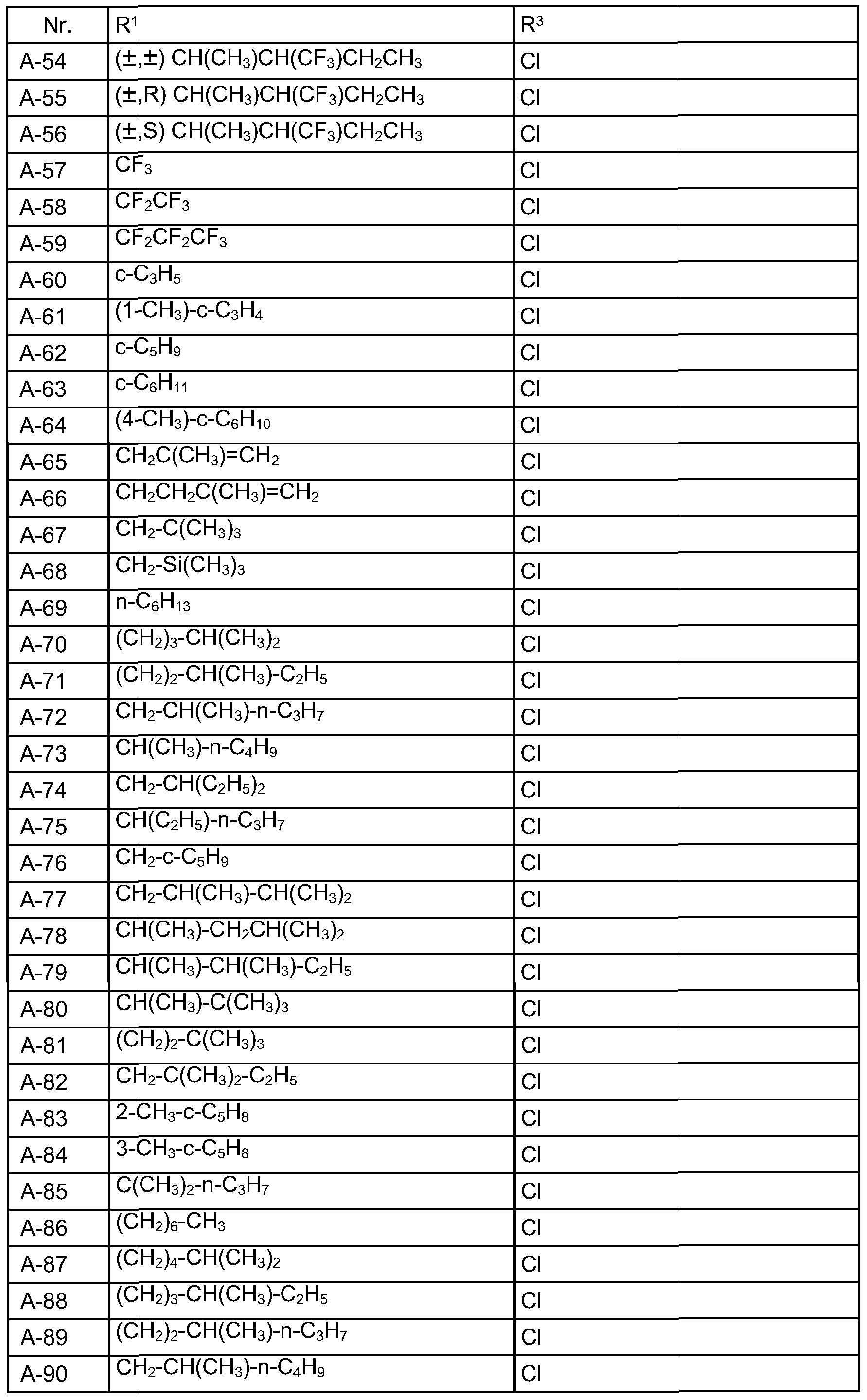


Beispiele für Verbindungen der allgemeinen Formel I sind auch diejenigen Verbindungen der Formel I, die den in Tabellen 1 bis 154 genannten Verbindungen entsprechen, worin W anstelle für Sauerstoff für Schwefel steht.
Beispiele für Verbindungen der allgemeinen Formel I sind auch diejenigen Verbindungen der Formel I, die den in Tabellen 1 bis 154 genannten Verbindungen entsprechen, worin W anstelle für Sauerstoff für S=O steht.
Beispiele für Verbindungen der allgemeinen Formel I sind auch diejenigen Verbindungen der Formel I, die den in Tabellen 1 bis 154 genannten Verbindungen entsprechen, worin W anstelle für Sauerstoff für S(=O)2 steht.
Die neuen Verbindungen der Formel I können in Analogie zu bekannten Verfahren des Standes der Technik hergestellt werden.
Beispielsweise können die Verbindungen der Formel I durch Umsetzung von entsprechend substituierten 5-Halogenpyrimidinen Il mit entsprechend substituierten metallorganischen Verbindungen IM (siehe Schema 1 ) hergestellt werden
Schema 1 :

(H)
(I)
In Schema 1 weisen Y, L, k, R1, R2, R3 und X die zuvor genannten Bedeutungen auf, wobei R3 typischerweise nicht für OH, Br oder I steht. R3 steht insbesondere für Wasserstoff, Alkyl, Alkoxy, Fluor oder Chlor; HaI steht für Halogen, vorzugsweise Brom oder lod. In den Formeln I und Il steht W für Sauerstoff oder Schwefel, insbesondere
für Sauerstoff. Met steht für einen über ein Metallatom wie Sn, Zn oder Mg oder ein Halbmetallatom B gebundenen Rest, beispielsweise für B(OH)2 oder B(OR)(OR') mit R, R' = Ci-C4-Alkyl, MgHaI' mit HaI' = Halogen, Zn-R" mit R" = Alkyl, oder für SnR3 mit R = Ci-C4-Alkyl.
Vorzugsweise erfolgt die Umsetzung in Gegenwart katalytisch aktiver Mengen eines Übergangsmetalls der Gruppe 10 des Periodensystems (Gruppe 10 nach IUPAC), z. B. Nickel, Palladium oder Platin, insbesondere in Gegenwart eines Palladiumkatalysators. Geeignete Katalysatoren sind beispielsweise Palladium-Phosphin-Komplexe wie Tetrakis(triphenylphosphin)palladium(0), PdCl2(o-tolyl3P)2, Bis(triphenylphosphin)- palladium(ll)-chlorid, der [1 ,1 '-Bis(diphenylphosphino)ferrocen]palladium(ll)-chlorid- Dichlormethan-Komplex, Bis-[1 ,2-bis(diphenylphosphin)ethan]palladium(0) und [1 ,4- Bis(diphenylphosphin)butan]palladium(ll)-chlorid, Palladium auf Aktivkohle in Gegenwart von Phosphin-Verbindungen sowie Palladium(ll)-Verbindungen wie Palladi- um(ll)chlorid oder Bis(acetonitril)palladium(ll)-chlorid, in Gegenwart von Phosphinver- bindungen wie Triphenylphosphin, 1 ,1 '-Bis(diphenylphosphino)ferrocen, 1 ,2- Bis(diphenylphosphin)ethan, 1 ,3-Bis(diphenylphosphin)propan und 1 ,4- Bis(diphenylphosphin)butan. Die Menge an Katalysator beträgt üblicherweise 0,1 bis 20 mol-%, bezogen auf die Verbindung II.
Geeignete metallorganische Verbindungen III sind insbesondere entsprechend substituierte Hetarylboronsäure und Hetarylboronsäureester (Verbindungen IM mit Met = B(OH)2 oder B(OR)(OR') mit R, R' = Ci-C4-Alkyl). Ebenfalls geeignet sind Verbindungen Het-Met, die für ein entsprechendes Boronsäureanhydrid der Formel

Geeignete metallorganische Verbindungen III sind weiterhin Grignardreagenzien (Ver- bindungen III mit Met = Mg-HaI' mit HaI' = Cl, Br, insbesondere Br). Die Umsetzung erfolgt dann unter den Bedingungen einer Kumada-Kupplung, wie sie z. B. aus Kuma- da, Tetrahedron, 1982, 38, 3347 oder A. C. Frisch, N. Shaikh, A. Zapf, M. Beller, An- gew. Chem., 2002, 114, 4218-4221 bekannt sind.
Geeignete metallorganische Verbindungen III sind weiterhin zinkorganische Verbindungen (Verbindungen III mit Met = Zn-HaI' mit HaI' = Cl, Br, insbesondere Br). Die Umsetzung erfolgt dann unter den Bedingungen einer Negishi-Kupplung, wie sie z. B. aus A. Lützen, M. Hapke, Eur. J. Org. Chem., 2002, 2292-2297 bekannt sind. Hetaryl- zinkverbindungen können in an sich bekannter Weise aus den Hetaryllithiumverbin- düngen oder aus den Hetarylmagnesiumverbindungen durch Umsetzung mit Zinksalzen wie Zink-Chlorid hergestellt werden.
Die Umsetzung von Il mit der metallorganischen Verbindung IM erfolgt insbesondere im Falle der Suzuki-Kupplung unter basischen Bedingungen. Geeignete Basen sind Alka- limetallcarbonate und Alkalimetallhydrogencarbonate wie Natriumcarbonat, Kalium- carbonat, Cäsiumcarbonat, Natriumhydrogencarbonat, Erdalkalimetallcarbonate und Erdalkalimetallhydrogencarbonate, wie Magnesiumcarbonat oder Magnesiumhydro- gencarbonat oder tertiäre Amine, wie Triethylamin, Trimethylamin, Triisopropylamin oder N-Ethyl-N-diisopropylamin.
Üblicherweise erfolgt die Kupplung der Verbindung Il mit der Verbindung Ml in einem Lösungsmittel. Als Lösungsmittel sind organische Solventien wie Ether, z. B. 1 ,2-Di- methoxyethan, cyclische Ether wie Tetrahydrofuran oder 1 ,4-Dioxan, Polyalkylen- glykole wie Diethylenglykol, Carbonsäurenitrile wie Acetonitril, Propionitril, Carbonsäu- reamide wie Dimethylformamid oder Dimethylacetamid geeignet. Bei der Suzuki- Kupplung können die vorgenannten Lösungsmittel auch im Gemisch mit Wasser eingesetzt werden, z. B. kann das Verhältnis von organischem Lösungsmittel zu Wasser im Bereich von 5:1 bis 1 :5 liegen.
Die Verbindungen II, worin R2 für Cyano oder für eine über ein Heteroatom gebundene Gruppe steht, wie Hydroxy, Mercapto, Azido, Alkoxy, Alkenyloxy, Alkinyloxy, Haloge- nalkoxy, Alkylthio, Alkenylthio, Alkinylthio, Halogenalkylthio, ON(=CR29R30), O-C(=Z)R25, NR22R233, NR31(C(=Z)R25), NR31(C(=Z)OR21), NR31(C(=Z)-NR22R23), NR32a(N=CR29R30), NR32NR22R23 oder NR32OR21, können vorteilhaft aus den entsprechend substituierten Sulfonen IV erhalten werden (siehe Schema 2).
Schema 2:

In Schema 2 haben R1, R2, R3 und HaI die zuvor genannten Bedeutungen auf. R3 steht insbesondere für Alkyl oder Halogen. R' steht für Ci-Cδ-Alkyl, und HaI steht für Halogen, vorzugsweise Brom oder lod. W steht für Sauerstoff oder Schwefel, insbesondere für Sauerstoff.
Die Sulfone der Formel IV werden mit Verbindungen V in der Regel unter basischen Bedingungen umgesetzt. Aus praktischen Gründen kann man direkt das Alkalimetall-, Erdalkalimetall- oder Ammoniumsalz der Verbindung V eingesetzt werden. Alternativ ist der Zusatz von Base möglich. Diese Umsetzung erfolgt typischerweise unter den Bedingungen einer nucleophilen Substitution; üblicherweise bei 0 bis 200 °C, vorzugsweise bei 10 bis 150 °C. Gegebenenfalls kann es von Vorteil sein, die Umsetzung in Gegenwart eines Phasentransferkatalysators, z. B. 18-Krone-6, durchzuführen. Üblicherweise erfolgt die Umsetzung in Gegenwart eines dipolar aprotischen Lösungsmittels wie N,N-dialkylierte Carbonsäureamide, z. B. N,N-Dimethylformamid, cyclische Ether, z. B. Tetrahydrofuran oder Carbonsäurenitrile wie Acetonitril [vgl. DE-A 39 01 084; Chimia, Bd. 50, S. 525-530 (1996); Khim. Geterotsikl. Soedin, Bd. 12, S. 1696- 1697 (1998)].
Im Allgemeinen werden die Verbindungen IV und V in etwa stöchiometrischen Mengen eingesetzt. Es kann jedoch von Vorteil sein, das Nucleophil der Formel R2-H im Über- schuss einzusetzen, beispielsweise in einem bis zu 10-fachem, insbesondere bis zu 3- fachem Überschuss, bezogen auf die Verbindung II.
In der Regel wird die Umsetzung in Gegenwart einer Base durchgeführt, die äquimolar oder auch im Überschuss eingesetzt werden kann. Als Basen kommen Alkalimetallcar- bonate und -hydrogencarbonate, beispielsweise Natriumcarbonat und Natriumhydro- gencarbonat, Stickstoffbasen, wie Triethylamin, Tributylamin und Pyridin, Alkalimetal- lalkoholate, wie Natriummethanolat oder Kalium-tert.-butanolat, Alkalimetallamide wie Natriumamid oder Alkalimetallhydride, wie Lithiumhydrid oder Natriumhydrid, in Frage.
Geeignete Lösungsmittel sind halogenierte Kohlenwasserstoffe, Ether wie Diethylether, Disopropylether, tert.-Butylether, 1 ,2-Dimethoxyethan, Dioxan, Anisol und Tetrahydro- furan, sowie Dimethylsulfoxid, N,N-dialkylierte Carbonsäureamide, wie Dimethylform- amid oder Dimethylacetamid. Besonders bevorzugt werden Ethanol, Dichlormethan, Acetonitril und Tetrahydrofuran. Es können auch Gemische der genannten Lösungsmittel verwendet werden.
Verbindungen II, in denen R2 für Cyano steht, sind wertvolle Zwischenverbindungen zur Herstellung weiterer Verbindungen I.
Verbindungen II, in denen R2 für einen derivatisierten Carbonssäurerest steht, wie C(=O)OR21, C(=O)NR22R23, C(=NOR34)NR22R23, C(=O)NR24-NR22R23, C(=N-NR35R36)NR22R23, C(=NOR34)NR24-NR22R23, C(=O)R25, CR26R27-OR28,
C R26 R27- N R22 R23 können vorteilhaft aus Verbindungen II, in denen R2 für Cyano steht, nach Standardverfahren zur Derivatisierung von CN-Gruppen erhalten werden.
Verbindungen II, in denen R2 für C(=O)NR22R23 steht, sind aus Verbindungen II, in de- nen R2 für Cyano steht, durch Verseifung zu den Carbonsäuren (R2 steht für COOH) unter sauren oder basischen Bedingungen und Amidierung mit Aminen VI, HNR22R23, erhältlich, siehe Schema 2a.
Schema 2a:

(R2 = CN) (R2 = COOH) (R2 = = CONR22 R23)
In Schema 2a haben W, R1, R3, R22, R23 die zuvor genannten Bedeutungen. R3 steht insbesondere für Alkyl oder Halogen, HaI steht für Halogen, vorzugsweise Brom oder lod. Die Verseifung des Nitrils Il (R2 steht fürCN) erfolgt üblicherweise in inerten polaren Lösungsmitteln, wie Wasser oder Alkoholen, bevorzugt mit anorganischen Basen, wie Alkali- oder Erdalkalimetallhydroxiden, insbesondere NaOH. In einer bevorzugten Ausgestaltung erfolgt die Verseifung des Nitrils Il durch Umsetzung mit Wasserstoffperoxid unter alkalischen Bedingungen.
Die Umsetzung der Säure Il (R2 steht für COOH) mit dem Amin VI erfolgt vorteilhaft unter den aus Chem. and Pharm. Bull. 1982, Bd. 30, N12, S. 4314, bekannten Bedingungen. Gegebenenfalls kann es von Vorteil sein, die Säure Il vor der Umsetzung mit dem Amin VI zu aktivieren, z.B. in ihr Säurechlorid zu überführen. Im Falle von Carbonsäuren II, die zur Decarboxylierung neigen, kann es von Vorteil sein, die freie Säure nicht zu isolieren sondern ihr Alkalimetallsalz direkt mit üblichen Halogenierungsmit- teln, beispielsweise mit Oxalylchlorid in das Säurechlorid zu überführen und letzteres mit dem Amin, ggf. in Anwesenheit einer Hilfsbase umzusetzen.
Die Herstellung der Amide Il gelingt alternativ nach Standardmethoden aus den entsprechenden Iminoestern (R2 steht für C(=NH)OR21), die ihrerseits durch saure Versei- fung der Nitrile Il in alkoholischen Lösungsmitteln hergestellt werden können.
Aus Amiden der Formel Il (mit R2 steht für CONR22R23) werden durch Oximierung mit Hydroxylamin oder substituierten Hydroxylaminen H2N-OR34 unter basischen Bedingungen die Verbindungen der Formel II, in denen R2 für C(=NOR34)NR22R23 steht, er- halten [vgl. US 4,876,252]. Die substituierten Hydroxylamine können als freie Base oder bevorzugt in Form ihrer Säureadditionssalze eingesetzt werden. Aus praktischen Gründen kommen insbesondere die Halogenide, wie Chloride oder die Sulfate in Betracht.
Alternativ können die Amidoxime der Formel II, in denen R2 für C(=NOR34)NR22R23 steht, auch aus den entsprechenden Nitrilen Il durch Umsetzung mit Hydroxylamin beziehungsweise substituierten Hydroxylaminen H2N-OR34 unter basischen Bedingungen hergestellt werden, siehe Schema 2b. Diese Umsetzung erfolgt vorteilhaft unter den aus DE-A 198 37 794 bekannten Bedingungen. Die erhaltenen Verbindungen II, in denen R2 für C(=NOR34)NH2 steht, können mono- oder dialkyliert werden, wobei man die Verbindungen C(=NOR34)NR22R23 erhält, in denen R22 und/oder R23 von Wasserstoff verschieden ist. Geeignete Alkylierungsmittel sind beispielsweise Ci-Cδ-Alkyl- halogenide, Di-Ci-Cβ-alkylsulfate oder Phenolsulfonsäure-Ci-Cδ-alkylester, wobei der Phenylrest gegebenenfalls ein oder zwei unter Nitro und Ci-C6-Alkyl ausgewählte Res-
te trägt. Üblicherweise führt man die Alkylierung in Gegenwart einer Base durch. Als Base kommen grundsätzlich alle Verbindungen in Betracht, die in der Lage sind, den Amidstickstoff zu deprotonieren. Geeignete Basen sind beispielsweise Alkalimetalloder Erdalkalimetallhydroxide wie Natriumhydroxid, Kaliumhydroxid oder Lithiumhydro- xid.
Schema 2b:

(H) (N) (N)
(R2 = CN) (R2 = H2NC(OR34)) (R2 = (R22XR23 )N-C(NOR34))
In Schema 2b weisen W, R1, R3, R22, R23, R34 die zuvor genannten Bedeutungen auf, R3 steht insbesondere für Alkyl oder Halogen und HaI steht für Halogen, vorzugsweise Brom oder lod.
Verbindungen der Formel II, in denen R2 für C(=N-NR35R36)NR22R23 steht, können vor- teilhaft aus den entsprechenden Cyanoverbindungen Il durch Umsetzung mit
H2N-NR35R36 zu den entsprechenden Verbindungen II, worin R2 für C(=N-NR35R36)NH2 steht, hergestellt werden. Die auf diese Weise erhaltenen Verbindungen können mono- oder dialkyliert werden, wobei man Verbindungen Il erhält, worint R2 für C(=N-NR35R36)NR22R23 steht und in denen R22 und/oderR23 von Wasserstoff verschie- den ist. Bezüglich geeigneter Verfahren zur Alkylierung wird auf das zuvor Gesagte Bezug genommen.
Verbindungen der Formel II, in denen R2 für C(=O)R25 steht, sind aus den entsprechenden Cyanoverbindungen Il durch Umsetzung mit Grignard-Reagentien R25-Mg- HaI', in denen HaI' für ein Halogenatom, insbesondere für Chlor oder Brom steht, zugänglich. Diese Umsetzung erfolgt vorteilhaft unter den aus J. Heterocycl. Chem. 1994, Bd. 31 (4), S. 1041 bekannten Bedingungen.
Verbindungen der Formel II, in denen R2 für CR26R27-OR28 steht, sind aus den entspre- chenden Ketonen, in denen R2 für C(=O)R25 steht, durch Umsetzung mit Grignard-
Reagenzien R26R27-Mg-Hal*, in denen HaI* für ein Halogenatom, insbesondere für Chlor oder Brom steht, und gegebenenfalls anschließende Alkylierung zugänglich.
Verbindungen der Formel II, in denen R2 für CH2-OR28steht, sind aus den entspre- chenden Ketonen, in denen R2 für C(=O)R25 steht, durch Reduktion mit einem Metallhydrid, beispielsweise Lithiumaluminiumhydrid und gegebenenfalls anschließende Alkylierung zugänglich.
Verbindungen der Formel II, in denen R2 für C(=N-NR35R36)R25 steht, sind über Verbin- düngen Il (worin R2 für C(=O)R25 steht) zugänglich, welche mit Hydrazinen HaNNR35R36 umgesetzt werden, bevorzugt unter den aus J. Org. Chem. 1966, Bd. 31 , S. 677 bekannten Bedingungen.
Verbindungen II, in denen R2 für C(=NOR34)R25 steht, sind über Oximierung von Verbindungen Il (R2 steht für C(=O)R25) zugänglich. Die Oximierung erfolgt wie voranstehend beschrieben.
Verbindungen II, in denen R2 für C(=O)OR21 steht, sind durch Veresterung der Verbindungen Il (R2 steht für COOH) unter sauren oder basischen Bedingungen erhältlich.
Verbindungen II, in denen R2 für C(=S)NR22R23 steht, sind durch Umsetzung von Verbindungen II, in denen R2 für CN steht, erhältlich, siehe Schema 2c.
Schema 2c:

(R2 = CN) (R2 = C(S)NH2) (R2 = = C(S)NR22 R23)
In Schema 2c haben W, R1, R3, R22, R23 die zuvor genannten Bedeutungen. R3 steht insbesondere für Alkyl oder Halogen, HaI steht für Halogen, vorzugsweise Brom oder lod. In der Regel setzt man die Cyanoverbindung Il in Gegenwart eines Lösungsmittels oder Verdünnungsmittels mit Schwefelwasserstoffgas um. Geeignete Lösungsmittel oder Verdünnungsmittel sind beispielsweise aromatische Amine wie Pyridin, substitutu-
ierte Pyridine, wie Collidin und Lutidin, oder tertiäre Amine, wie Trimethylamin, Triethyl- amin, Triisopropylamin und N-Methylpiperidin. Die so erhaltenen Aminothiocarbonyl- verbindungen Il (R2 steht für C(=S)NH2) können dann gegebenenfalls am Amid- stickstoff ein- oder zweifach alkyliert werden. Bezüglich geeigneter Verfahren zur Alky- lierung wird auf das zuvor Gesagte Bezug genommen.
Alternativ sind Verbindungen II, in denen R2 für C(=S)NR22R23 steht, durch Schwefelung aus den entsprechenden Carbonsäureamidverbindungen Il (Verbindungen II, worin R2 für C(=O)NR22R23 steht) erhältlich. Beispiele für geeignete Schwefelungsmittel sind Organophosphorsulfide wie das Lawessons Reagenz, (2,2-Bis-(4- methoxyphenyl)-1 ,3,2,4-dithiodiphosphetan-2,4-disulfid, Organozinnnsulfide, wie Bis(tricyclohexylzinn)sulfid oder Phosphorpentasulfid (siehe auch J. March, Advanced Organic Chemistry, 4. Aufl., Wiley Interscience 1992, S.893f und die darin zitierte Literatur).
Verbindungen IV, worin W für Sauerstoff steht, können beispielsweise nach der in Schema 3 dargestellten Synthese durch Oxidation der Thioether VII hergestellt werden.

In Schema 3 weisen R1 und R3 die zuvor genannten Bedeutungen auf. R3 steht insbesondere für Alkyl oder Halogen. HaI steht für Halogen, vorzugsweise Brom oder lod und R' steht für Ci-C6-Alkyl.
Geeignete Oxidationsmittel sind beispielsweise Wasserstoffperoxid, Selendioxid [vgl. WO 02/88127] oder organische Carbonsäuren wie 3-Chlorperbenzoesäure. Die Oxidation wird vorzugsweise bei 10 bis 50 °C in Gegenwart protischer oder aprotischer Lö- sungsmittel durchgeführt [vgl. B. Kor. Chem. Soc, Bd. 16, S. 489-492 (1995); Z. Chem., Bd. 17, s. 63 (1977)].
Verbindungen VII, in denen HaI für Halogen, insbesondere Brom oder lod steht, sind beispielsweise gemäß dem in Schema 4 skizzierten Syntheseweg erhältlich.

In Schema 4 haben R1 und R3 die zuvor genannten Bedeutungen. R3 steht insbesondere für Alkyl oder Halogen, R' steht für Ci-C6-Alkyl. HaI steht für Halogen, vorzugsweise Brom oder lod.
Die Etherverbindung VIII können nach üblichen Methoden in die 5-Halogenpyrimidine VII überführt werden. Geeignete Halogenierungsmittel sind vorzugsweise Chlorierungsmittel, Bromierungsmittel und lodierungsmittel. Ein geeignetes Chlorierungsmittel ist beispielsweise N-Chlorsuccinimid. Geeignete Bromierungsmittel sind Brom und N- Bromsuccinimid. Üblicherweise erfolgt die Bromierung in Gegenwart eines Lösungsmittels. Geeignete Lösungsmittel für die Bromierung sind beispielsweise Carbonsäuren wie Essigsäure. Geeignete lodierungsmittel sind lodwasserstoff, Chloriodid oder N- lodsuccinimid. Die lodierung erfolgt üblicherweise in einem Lösungsmittel. Geeignete Lösungsmittel sind chlorierte Kohlenwasserstoffe wie Dichlormethan bei Verwendung von lodwasserstoff, Ci-C4-Alkohole wie Methanol oder Carbonsäuren wie Essigsäure bei Verwendung von Chloriodid und halogenierte Carbonsäuren wie Trifluoressigsäure bei Verwendung von N-Iodsuccinimid. Die Halogenierung erfolgt üblicherweise zwischen 10 °C und der Siedetemperatur des Lösungsmittels.
Etherverbindungen VIII können ausgehend von 4-Halogenpyrimidinverbindungen IX durch Umsetzung mit HOR1, Verbindung X, hergestellt werden (siehe Schema 5).

In Schema 5 haben R1 und R3 die zuvor genannten Bedeutungen. R3 steht insbesondere für Halogen oder Alkyl, R' steht für Ci-Cβ-Alkyl, und HaI' steht für Halogen, insbesondere Chlor. Gegebenenfalls kann es von Vorteil sein, die Umsetzung in Gegenwart einer Base, wie tertiäre Amine, beispielsweise Triethylamin, oder anorganische Basen wie Alkalimetall- oder Erdalkalimetallcarbonate, Alkalimetall- oder Erdalkalimetall- hydrogencarbonate, Alkalimetallhydride oder Erdalkalimetallhydride wie Natriumhydrid oder Calciumhydrid, durchzuführen. Man kann die Umsetzung in einem Lösungsmittel durchführen, das unter den Reaktionsbedingungen inert ist. Alternativ dient die im Ll- berschuss eingesetzte Verbindung X als Lösungsmittel. Die Umsetzung erfolgt vorteilhaft bei 0 °C bis zur Siedetemperatur des Reaktionsgemisches, beispielsweise 10 bis 35 °C. In entsprechender weise gelingt auch die Herstellung von Verbindungen Villa, die sich von den Verbindungen VIII dadurch unterscheiden, dass der Pyrimidinring anstelle der Gruppe OR1 eine Gruppe SR1 trägt.
4-Halogenpyrimidine IX, in denen R3 für Alkyl steht, werden vorteilhaft erhalten, indem man 4,6-Dihalogenpyrimidine Xl mit einem Grignardreagenz R3-MgCI unter den Bedin- gungen einer Kumada-Kupplung umsetzt, wie in Schema 6 beschrieben.
Schema 6

In Schema 6 stehen HaI' unabhängig voneinander für Halogen, vorzugsweise für Chlor.
4,6-Dihalogenpyτimidine Xl werden beispielsweise vorteilhaft erhalten, indem man 4,6- Dihydroxypyrimidine XII mit Halogenierungsmitteln, insbesondere Chlorierungsmittel oder Bromierungsmittel, umsetzt; wie in Schema 7 beschrieben.
Schema 7

In Schema 7 steht HaI' unabhängig voneinander für Halogen, vorzugsweise Chlor. Als Chlorierungsmittel für die Umwandlung der Dihydroxyverbindung XII in die Verbindun- gen Xl eignen sich insbesondere POCb, PCI3/CI2 oder PCI5, oder Mischungen dieser Reagentien. Die Umsetzung kann in überschüssigem Chlorierungsmitteln (POCb) oder einem inerten Lösungsmittel, wie beispielsweise Carbonsäurenitrile, z.B. Acetonitril oder Propionitril, aromatische Kohlenwasserstoffe, z. B. Toluol, chlorierte Kohlenwasserstoffe, z. B. 1 ,2-Dichlorethan oder chlorierte aromatische Kohlenwaserstoffe wie Chlorbenzol durchgeführt werden.
Die Umsetzung erfolgt in der Regel zwischen 10 und 180 °C. Das Verfahren wird vorteilhaft unter Zusatz von N,N-Dimethylformamid in katalytischen oder subkatalytischen Mengen oder von Stickstoffbasen, wie beispielsweise N,N-Dimethylanilin durchgeführt.
4,6-Dihydroxypyrimidine XII können beispielsweise nach der in Schema 8 skiziierten Route erhalten werden. Zunächst wird der Malonsäureester XIII mit Thioharnstoff in die 2-Mercaptopyrimidinverbindung XIIIa überführt. Die anschließende Alkylierung mit einem Alkylierungsmittel ergibt die Verbindung XII. Als Alkylierungsmittel kommen z. B. Ci-Cδ-Alkylhalogenide, vorzugsweise Alkylbromide und Alkylchloride, Di-Ci-Cδ- alkylsulfate oder Phenolsulfonsäure-Ci-C6-alkylester in Betracht. Die Umsetzung der Malonester der Formel XIII mit Thioharnstoff kann in Gegenwart oder Abwesenheit von Lösungsmitteln durchgeführt werden. Vorteilhaft ist es, solche Lösungsmittel zu verwenden, gegenüber denen die Einsatzstoffe weitgehend inert sind und in denen sie ganz oder teilweise löslich sind.
Gegebenenfalls kann es von Vorteil sein, die Alkylierung in Gegenwart einer Base durchzuführen.
Alternativ kann man den Malonsäureester XIII auch mit einem S-Alkylisothioharnstoff umsetzen, so dass man direkt den Thioether XII erhält; siehe Schema 8.
Schema 8:
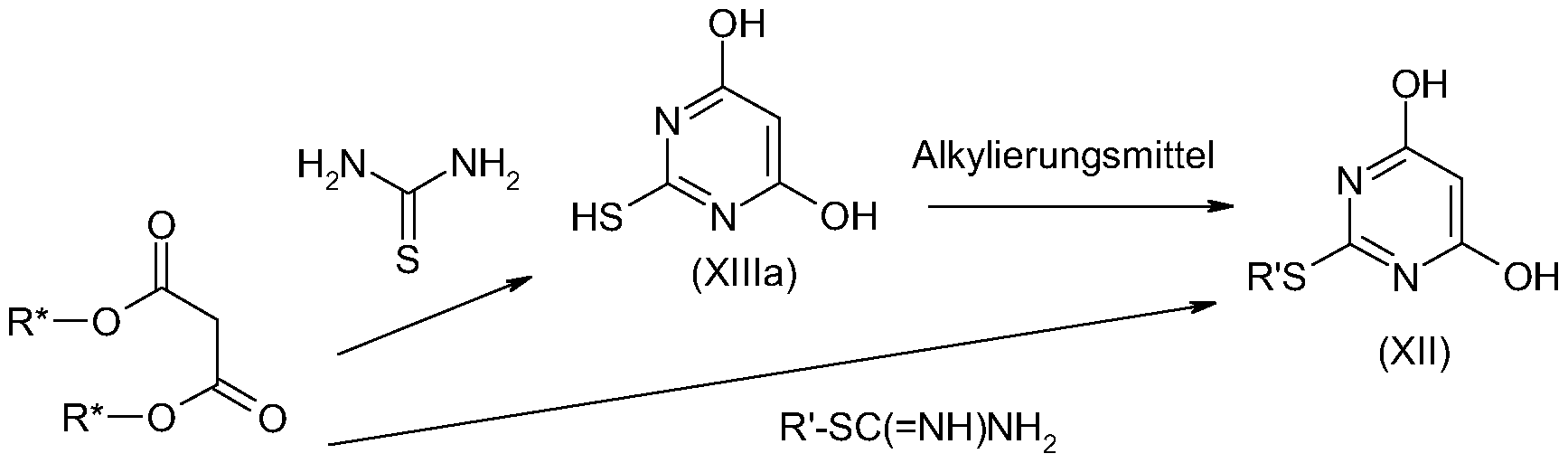
(XIII) I n Schema 8 steht R* für Alkyl, vorzugsweise Ci-C6-Alkyl und R' steht für Ci-C6-Alkyl.
Verbindungen IX, in denen R3 für Alkyl steht, sind alternativ auf dem in Schema 9 dargestellten Weg erhältlich.

(IX)
(XiV) (XV)
In Schema 9 steht R* für Alkyl, vorzugsweise Ci-Cδ-Alkyl, R' steht für Ci-Cβ-Alkyl und HaI' für Halogen, vorzugsweise Chlor.
Zunächst wird ein ß-Ketoester der Formel XIV entweder durch Umsetzung mit einem S-Alkylisothioharnstoff oder durch Umsetzung mit Thioharnstoff und anschließende Alkylierung in eine 2-Thioetherverbindung XV umgewandelt, wie in Schema 8 beschrieben. Danach setzt man den Thioether XV mit einem Halogenierungsmittel unter den in Schema 7 beschriebenen Bedingungen zu einem 4-Halogenpyrimidin der Formel IX um.
Alternativ können Verbindungen der Formel I auch wie in den Schemata 10 und 11 beschrieben erhalten werden.
Schema 10:

(XVII) (XVi) R'-SC(=NH)NH2

In Schema 10 haben R1, X, Y, (L)k die zuvor genannten Bedeutungen auf, R* steht für Alkyl, vorzugsweise Ci-Cβ-Alkyl, R' steht für Ci-Cβ-Alkyl und HaI' steht für Halogen.
In Schritt i) setzt man Hetarylmalonate der allgemeinen Formel XVI mit Thioharnstoff und anschließend mit einem Alkylierungsmittel unter Erhalt des Thioethers XVII um, oder man setzt das Hetarylmalonat XVI direkt mit dem S-Alkylisothioharnstoff unter Erhalt der Verbindung XVIII um. Die Umsetzung erfolgt wie in Schema 8 beschrieben. Die so erhaltenen Verbindungen XVII können danach in Schritt ii) nach den in Schema 7 beschriebenen Verfahren in die Dihalogenverbindungen XVIII umgewandelt werden. Die Dihalogenverbindungen XVIII können danach in Schritt iii) in die Etherverbindung XIX nach den in Schema 5 beschriebenen Verfahren umgewandelt werden. Die Thio- latgruppe in 2-Position der Verbindung XIX wird zur Alkylsulfonylgruppe in Schritt iv) gemäß dem in Schema 3 beschriebenen Verfahren oxidiert und so in eine gute Ab- gangsgruppe für weitere Austausch-Reaktionen überführt. Die Einführung des Restes R2 (Schritt v) kann beispielsweise wie in Schritt 2 beschrieben erfolgen. Gegebenenfalls schließen sich an Schritt v) noch weitere Umwandlungen an, wie zuvor beschrieben, beispielsweise in den Schemata 2a, 2b oder 2 c.
Eine weitere Route zur Herstellung der Verbindung I, in denen R3 für Alkyl steht ist in Schema 1 1 skiziiert.
Schema 11 :

(XXII) (I) (R3 = Alkyl)
In Schema 1 1 haben R1, X, Y, (L)k die zuvor genannte Bedeutung, R* für Alkyl, vorzugsweise Ci-Cδ-Alkyl, R' steht für Ci-Cβ-Alkyl und HaI' steht für Halogen.
Die Halogenpyridmidinverbindung der Formel XIX wird in Schritt vi) in die entsprechende Alkylpyrimidinverbindung XXI wie in Schema 6 beschrieben überführt. Die Thio- latgruppe in 2-Position der Verbindung XXI wird zur Alkylsulfonylgruppe in Schritt vii) gemäß dem in Schema 3 beschriebenen Verfahren oxidiert und so in eine gute Abgangsgruppe für weitere Austausch-Reaktionen überführt. Die Einführung des Restes R2 (Schritt viü) kann beispielsweise wie in Schritt 2 beschrieben erfolgen. Gegebenenfalls schließen sich an Schritt v) noch weitere Umwandlungen an, wie zuvor beschrie- ben, beispielsweise in den Schemata 2a, 2b oder 2 c.
Eine weitere Route zur Herstellung von Verbindung XXI ist in Schema 12 skiziiert.
Schema 12:

(XXIII) (XXI)
In Schema 12 haben X, Y, (L)k die zuvor genannte Bedeutung, R* für Alkyl, vorzugsweise Ci-Ce-Alkyl, R' steht für Ci -C6-Al kyl und R3 steht für Alkyl.
In Schritt ix) setzt man den substituierten ß-Ketoester XXIII mit Thioharnstoff und anschließend mit einem Alkylierungsmittel unter Erhalt des Thioethers XXI um, oder man setzt den Hetaryl substituierten ß-Ketoester direkt mit dem S-Alkylisothioharnstoff unter Erhalt der Verbindung XXI um. Die Umsetzungen erfolgen wie in Schema 9 beschrie- ben.
Verbindungen der Formel I, in denen R3 für Cyano, Ci-Cs-Alkoxy, d-Cs-Alkylthio oder Ci-Ce-Halogenalkoxy steht, können vorteilhaft durch Umsetzung von Verbindungen I, in denen R3 Halogen, bevorzugt Chlor bedeutet, mit Verbindungen M1-R3* (im Folgen- den auch Verbindungen der Formel XXIV) erhalten werden. Bei den Verbindungen der Formel XXIV handelt es sich abhängig von der einzuführenden Gruppe R3* um ein anorganisches Cyanid, ein Alkoxylat, ein Thiolat oder ein Halogenalkoxylat. Die Umsetzung erfolgt vorteilhaft in einem inerten Lösungsmittel. Das Kation M1 in Formel XXIV hat geringe Bedeutung; aus praktischen Gründen sind üblicherweise Ammonium-, Tetraalkylammoniumsalze wie Tetramethylammonium- oder Tetraethylammoniumsalze oder Alkali- oder Erdalkalimetallsalze bevorzugt (Schema 13).
Schema 13:
(I) + IvT-R3* *■ (I)
(R3 = Halogen) (χχιv) {R3=R3* = CN, C1-C8-AIkOXy, CrC8-Halogenalkoxy}
Üblicherweise liegt die Reaktionstemperatur bei 0 bis 120 °C, bevorzugt bei 10 bis 40 0C [vgl. J. Heterocycl. Chem., Bd.12, S. 861-863 (1975)].
Geeignete Lösungsmittel umfassen Ether, wie Dioxan, Diethylether, Methyl-tert- butylether und, bevorzugt Tetrahydrofuran, halogenierte Kohlenwasserstoffe wie Di- chlormethan oder Dichlorethan, aromatische Kohlenwasserstoffe, wie Toluol und Gemische davon.
Verbindungen der Formel I, in denen R3 für d-Cβ-Alkyl, d-Cs-Halogenalkyl, C2-C8- Alkenyl, C2-C8-Halogenalkenyl, C2-Cs-Alkinyl oder C2-C8-Halogenalkinyl steht, können in vorteilhafter Weise durch Umsetzung von Verbindungen I, in denen R3 für Halogen, insbesondere für Chlor steht, mit metallorganischen Verbindungen Xa-Mt, worin Xa für Ci-Cs-Alkyl, Ci-C8-Halogenalkyl, C2-C8-Alkenyl, C2-C8-Halogenalkenyl, C2-C8-Alkinyl oder C2-C8-Halogenalkinyl und Mt für Lithium, Magnesium-Hai' oder Zink-Hai' (mit HaI' = Halogen) steht, hergestellt werden. Die Umsetzung erfolgt vorzugsweise in Gegenwart katalytischer oder insbesondere wenigstens äquimolarer Mengen an Übergangsmetallsalzen und/oder -Verbindungen, insbesondere in Gegenwart von Cu-Salzen wie Cu(l)halogenide und speziell Cu(l)-iodid. In der Regel erfolgt die Umsetzung in einem inerten organischen Lösungsmittel, beispielsweise einem der vorgenannten Ether, insbesondere Tetrahydrofuran, einem aliphatischen oder cycloaliphatischen Kohlenwasserstoff wie Hexan, Cyclohexan und dergleichen, einem aromatischen Kohlenwasserstoff wie Toluol oder in einer Mischung dieser Lösungsmittel. Die hierfür erforderlichen Temperaturen liegen im Bereich von -100 bis +100 °C und speziell im Bereich von - 80°C bis +40°C. Verfahren hierzu sind bekannt, z. B. aus WO 03/004465
Die Reaktionsgemische werden in üblicher weise aufgearbeitet, z.B. durch Mischen mit Wasser, Trennung der Phasen und gegebenenfalls chromatographische Reinigung der Rohprodukte. Die Zwischen- und Endprodukte fallen z.T. in Form farbloser oder schwach bräunlicher, zäher Öle an, die unter vermindertem Druck und bei mäßig erhöhter Temperatur von flüchtigen Anteilen befreit oder gereinigt werden. Sofern die Zwischen- und Endprodukte als Feststoffe erhalten werden, kann die Reinigung auch durch Umkristallisieren oder Digerieren erfolgen.
Sofern einzelne Verbindungen I nicht auf den voranstehend beschriebenen Wegen zugänglich sind, können sie durch Derivatisierung anderer Verbindungen I hergestellt werden.
Hetarylmalonate der Formel XVI können ausgehend von Hetarylverbindungen der Formel XXV durch Umsetzung mit einem bzw. zwei Äquivalenten eines Kohlensäureesters oder eines Chloroformiats (Verbindung XXVI) in Gegenwart einer starken Base hergestellt werden (siehe Schema 14).
Schema 14:

(XXV) (XVI)
In Schema 14 steht Rz für Wasserstoff oder eine
 Q steht für Halogen oder Ci-C4-AIkOXy, insbesondere für Methoxy oder Ethoxy. X, Y, (L)k haben die zuvor genannten Bedeutungen und R steht für Ci-C4-AIkVl. Der Fachmann wird erkennen, dass im Falle von Rz = H wenigstens 2 Äquivalente der Verbindung XXVI eingesetzt werden müssen, um einen vollständigen Umsatz von XXV zu erzielen.
Die in Schema 14 gezeigte Umsetzung erfolgt üblicherweise in Gegenwart von starken Basen. Sofern Rz für Wasserstoff steht, wird man üblicherweise Alkalmetallamide wie Natriumamid oder Lithiumdiisopropylamid, oder Lithium-organische Verbindungen wie Phenyllithium oder Butyllithium als Base einsetzen. In diesem Falle wird man die Base wenigstens äquimolar, bezogen auf die Verbindung XXV einsetzten, um einen vollständigen Umsatz zu erreichen. Sofern Rz für eine Alkoxycarbonylgruppe steht, wird man vorzugsweise ein Alkalimetallalkoholat, z.B. Natrium- oder Kaliumethanolat, Natrium- oder Kaliumbutanolat, Natrium- oder Kaliummethanolat als Base einsetzten. Für Rz = H kann die Umsetzung von XXV mit XXVI in einer Stufe oder in zwei separaten Stufen durchgeführt werden, wobei man in letzem Fall als Zwischenprodukt die Verbindung XXV erhält, worin Rz für eine Alkoxycarbonylgruppe steht. Im Übrigen kann die Umsetzung von XXV mit XXVI in Analogie zu der in J. Med. Chem. 25, 1982, S. 745 beschriebenen Methode durchgeführt werden.
Die Herstellung von Malonaten der Formel XVI gelingt außerdem vorteilhaft durch Reaktion entsprechender Brom-Hetarylverbindungen Br-Het mit Dialkylmalonaten unter Cu(l)-Katalyse [vgl. Chemistry Letters, S. 367-370, 1981 ; EP-A 10 02 788].
Die Herstellung von substituierten ß-Ketoestern der Formel XXIII gelingt beispielsweise vorteilhaft durch Reaktion entsprechender Brom-Hetarylverbindungen Br-Het mit un- substituierten ß-Ketoestern unter Cu(l)-Katalyse.
Sofern bei der Synthese Isomerengemische anfallen, ist im Allgemeinen jedoch eine Trennung nicht unbedingt erforderlich, da sich die einzelnen Isomere teilweise während der Aufbereitung für die Anwendung oder bei der Anwendung (z.B. unter Licht-, Säure-
oder Baseneinwirkung) ineinander umwandeln können. Entsprechende Umwandlungen können auch nach der Anwendung, beispielsweise bei der Behandlung von Pflanzen in der behandelten Pflanze oder im zu bekämpfenden Schadpilz erfolgen.
Die Verbindungen I eignen sich als Fungizide. Sie zeichnen sich aus durch eine hervorragende Wirksamkeit gegen ein breites Spektrum von pflanzenpathogenen Pilzen aus der Klasse der Ascomyceten, Deuteromyceten, Oomyceten und Basidiomyceten, insbesondere aus der Klasse der Oomyceten. Sie sind zum Teil systemisch wirksam und können im Pflanzenschutz als Blatt-, Beiz- und Bodenfungizide eingesetzt werden.
Besondere Bedeutung haben sie für die Bekämpfung einer Vielzahl von Pilzen an verschiedenen Kulturpflanzen wie Weizen, Roggen, Gerste, Hafer, Reis, Mais, Gras, Bananen, Baumwolle, Soja, Kaffee, Zuckerrohr, Wein, Obst- und Zierpflanzen und Gemüsepflanzen wie Gurken, Bohnen, Tomaten, Kartoffeln und Kürbissen, sowie an den Samen dieser Pflanzen. Sie können auch in Kulturen, die durch Züchtung, einschließlich gentechnischer Methoden, gegen Insekten- oder Pilzbefall tolerant sind, verwendet werden. Darüber hinaus sind sie geeignet für die Bekämpfung von Botryosphaeria Arten, Cylindrocarpon Arten, Eutypa lata, Neonectria liriodendri und Stereum hirsutum, die unter anderem das Holz oder die Wurzeln von Weinreben befallen.
Speziell eignen sie sich zur Bekämpfung folgender Pflanzenkrankheiten:
Alternaria Arten an Gemüse, Raps, Zuckerrüben Obst, Reis, Sojabohnen sowie an Kartoffeln (z.B. A. solani oder A. alternata) und Tomaten (z.B. A. solani oder A. alternata) und Alternaria ssp. (Ährenschwärze) an Weizen, - Aphanomyces Arten an Zuckerrüben und Gemüse,
Ascochyta Arten an Getreide and Gemüse z.B. Ascochyta tritici (Blattdürre) an Weizen,
Bipolaris- und Drechslera Arten an Mais, Getreide, Reis und Rasen (z.B. D. maydis an Mais, D. teres an Gerste, D. tritci-repentis an Weizen), - Blumeria graminis (Echter Mehltau) an Getreide (z.B. Weizen oder Gerste),
Botrytis cinerea (Grauschimmel) an Erdbeeren, Gemüse, Blumen, Weizen und Weinreben,
Bremia lactucae an Salat,
Cercospora Arten an Mais, Sojabohnen, Reis und Zuckerrüben und z.B. Cer- cospora sojina (Blattflecken) oder Cercospora kikuchii (Blattflecken) an Sojabohnen,,
Cladosporium herbarum (Ährenschwärze) an Weizen, Cochliobolus Arten an Mais, Getreide, Reis (z.B. Cochliobolus sativus an Getreide, Cochliobolus miyabeanus an Reis),
Colletotricum Arten an Sojabohnen, Baumwolle und anderen Pflanzen (z.B. C. acutatum an verschiedenen Pflanzen und z.B. Colletotrichum truncatum (Antracnose) an Sojabohnen), Corynespora cassiicola (Blattflecken) an Sojabohnen, - Dematophora necatrix (Wurzel-/Stengelfäule) an Sojabohnen, Diaporthe phaseolorum (Stengelkrankheit) an Sojabohnen, Drechslera Arten, Pyrenophora Arten an Mais, Getreide, Reis und Rasen, an Gerste (z.B. D. teres) und an Weizen (z.B. D. tritici-repentis), Esca an Weinrebe, verursacht durch Phaeoacremonium chlamydosporium, Ph. Aleophilum, und Formitipora punctata (syn. Phellinus punctatus),
Elsinoe ampelina an Weinrebe, Epicoccum spp. (Ährenschwärze) an Weizen, Exserohilum Arten an Mais, Erysiphe cichoracearumund Sphaerotheca fuliginea an Gurkengewächsen, - Fusarium und Verticillium Arten (z.B. V. dahliae) an verschiedenen Pflanzen: z.B. F. graminearum oder F. culmorum (Wurzelfäule) an Getreide (z.B. Weizen oder Gerste) oder z.B. F. oxysporum an Tomaten und Fusarium solani (Stengelkrankheit) an Sojabohnen, Gaeumanomyces graminis an Getreide (z.B. Weizen oder Gerste), - Gibberella Arten an Getreide und Reis (z.B. Gibberella fujikuroi an Reis), Glomerella cingulata an Weinrebe und anderen Pflanzen, Grainstaining complex an Reis, Guignardia budwelli an Weinrebe, Helminthosporium Arten (z.B. H. graminicola) an Mais und Reis, - lsariopsis clavispora an Weinrebe,
Macrophomina phaseolina (Wurzel-/Stengelfäule) an Sojabohnen, Michrodochium nivale an Getreide (z.B. Weizen oder Gerste), Microsphaera diffusa (Echter Mehltau) an Sojabohnen, Mycosphaerella Arten an Getreide, Bananen und Erdnüssen (M. graminicola an Weizen, M. fijiesis an Banane),
Peronospora Arten an Kohl (z.B. P. brassicae), Zwiebelgewächsen (z.B. P. de- structor) und z.B. Peronospora manshurica (Falscher Mehltau) an Sojabohnen Phakopsara pachyrhizi und Phakopsara meibomiae an Sojabohnen, Phialophora gregata (Stengelkrankheit) an Sojabohnen, - Phomopsis Arten an Sojabohnen, Sonnenblumen und Weinreben (P. viticola an Weinreben, P. helianthii an Sonnenblumen),
Phytophthora Arten an verschiedenen Pflanzen z.B. P. capsici an Paprika, Phy- topthora megasperma (BlatWStengelfäule) an Sojabohnen, Phytophthora in- festans an Kartoffeln und Tomaten,
Plasmopara viticola an Weinreben,
Podosphaera leucotricha an Apfel,
Pseudocercosporella herpotrichoides an Getreide,
Pseudoperonospora Arten an Hopfen und Gurkengewächsen (z.B. P. cubenis an Gurke oder P. humili an Hopfen),
Pseudopezicula tracheiphilai an Weinrebe,
Puccinia Arten an verschiedenen Pflanzen z.B. P. triticina, P. striformins, P. hor- dei oder P. graminis an Getreide (z.B. Weizen oder Gerste) oder an Spargel
(z.B. P. asparagi), - Pyrenophora Arten an Getreide,
Pyricularia oryzae, Corticium sasakii, Sarocladium oryzae, S.attenuatum,
Entyloma oryzae an Reis,
Pyricularia grisea an Rasen und Getreide,
Pythium spp. an Rasen, Reis, Mais, Baumwolle, Raps, Sonnenblumen, Zucker- rüben, Gemüse und anderen Pflanzen (z.B. P. ultiumum oder P. aphaniderma- tum),
Ramularia collo-cygni (Ramularia/Sonnenbrand-Komplex/Physiological leaf spots) an Gerste,
Rhizoctonia-Arten (z.B. R. solani) an Baumwolle, Reis, Kartoffeln, Rasen, Mais, Raps, Kartoffeln, Zuckerrüben, Gemüse und anderen Pflanzen, z.B. Rhizoctonia solani (Wurzel-/Stengelfäule) an Sojabohnen oder Rhizoctonia cerealis (Spitzer
Augenfleck) an Weizen oder Gerste,
Rhynchosporium secalis an Gerste (Blattflecken), Roggen und Triticale,
Sclerotinia Arten an Raps, Sonnenblumen und anderen Pflanzen, z.B. Scleroti- nia sclerotiorum (Stengelkrankheit) oder Sclerotinia rolfsii (Stengelkrankheit) an
Sojabohnen,
Septoria glycines (Blattflecken) an Sojabohnen,
Septoria tritici und Stagonospora nodorum an Weizen,
Erysiphe (syn. Uncinulanecator) an Weinrebe, - Setospaeria Arten an Mais und Rasen,
Sphacelotheca reilinia an Mais,
Stagonospora nodorum (Ährenseptoria) an Weizen,
Thievaliopsis Arten an Sojabohnen und Baumwolle,
Tilletia Arten an Getreide, - Typhula incarnata (Schneefäule) an Weizen oder Gerste,
Ustilago Arten an Getreide, Mais und Zuckerrübe und
Venturia Arten (Schorf) an Apfel und Birne (z.B. V. inaequalis an Apfel).
Insbesondere eignen sie sich zur Bekämpfung von Schadpilzen aus der Klasse der Peronosporomycetes (syn.Oomyceten), wie Peronospora-Arten, Phytophthora-Arten, Plasmopara viticola , Pseudoperonospora-Arten und Pythium-Arten.
Die Verbindungen I eignen sich außerdem zur Bekämpfung von Schadpilzen im Materialschutz (z.B. Holz, Papier, Dispersionen für den Anstrich, Fasern bzw. Gewebe) und im Vorratsschutz. Im Holzschutz finden insbesondere folgende Schadpilze Beachtung: Ascomyceten wie Ophiostoma spp., Ceratocystis spp., Aureobasidium pullulans, ScIe- rophoma spp., Chaetomium spp., Humicola spp., Petriella spp., Trichurus spp.; Basidi- omyceten wie Coniophora spp., Coriolus spp., Gloeophyllum spp., Lentinus spp., Pleu- rotus spp., Poria spp., Serpula spp. und Tyromyces spp., Deuteromyceten wie Aspergillus spp., Cladosporium spp., Penicillium spp., Trichoderma spp., Alternaria spp., Paecilomyces spp. und Zygomyceten wie Mucor spp., darüber hinaus im Materialschutz folgende Hefepilze: Candida spp. und Saccharomyces cerevisae.
Die Verbindungen I werden angewendet, indem man die Pilze oder die vor Pilzbefall zu schützenden Pflanzen, Saatgüter, Materialien oder den Erdboden mit einer fungizid wirksamen Menge der Wirkstoffe behandelt. Die Anwendung kann sowohl vor als auch nach der Infektion der Materialien, Pflanzen oder Samen durch die Pilze erfolgen.
Die fungiziden Mittel enthalten im allgemeinen zwischen 0,1 und 95, vorzugsweise zwischen 0,5 und 90 Gew.-% Wirkstoff.
Die Aufwandmengen liegen bei der Anwendung im Pflanzenschutz je nach Art des gewünschten Effektes zwischen 0,01 und 2,0 kg Wirkstoff pro ha.
Bei der Saatgutbehandlung werden im allgemeinen Wirkstoffmengen von 1 bis 1000 g/100 kg, vorzugsweise 5 bis 100 g/100 kg Saatgut benötigt.
Bei der Anwendung im Material- bzw. Vorratsschutz richtet sich die Aufwandmenge an Wirkstoff nach der Art des Einsatzgebietes und des gewünschten Effekts. Übliche Aufwandmengen sind im Materialschutz beispielsweise 0,001 g bis 2 kg, vorzugsweise 0,005 g bis 1 kg Wirkstoff pro Kubikmeter behandelten Materials.
Die Verbindungen der Formel I können in verschiedenen Kristallmodifikationen vorliegen, die sich in der biologischen Wirksamkeit unterscheiden können. Sie sind ebenfalls Gegenstand der vorliegenden Erfindung.
Die Verbindungen I können in die üblichen Formulierungen überführt werden, z.B. Lö- sungen, Emulsionen, Suspensionen, Stäube, Pulver, Pasten und Granulate. Die Anwendungsform richtet sich nach dem jeweiligen Verwendungszweck; sie soll in jedem
Fall eine feine und gleichmäßige Verteilung der erfindungsgemäßen Verbindung gewährleisten.
Die Formulierungen werden in bekannter Weise hergestellt, z.B. durch Verstrecken des Wirkstoffs mit Lösungsmitteln und/oder Trägerstoffen, gewünschtenfalls unter Verwendung von Emulgiermitteln und Dispergiermitteln. Als Lösungsmittel / Hilfsstoffe kommen dafür im wesentlichen in Betracht:
- Wasser, aromatische Lösungsmittel (z.B. Solvesso Produkte, XyIoI), Paraffine (z.B. Erdölfraktionen), Alkohole (z.B. Methanol, Butanol, Pentanol, Benzylalkohol), Keto- ne (z.B. Cyclohexanon, gamma-Butryolacton), Pyrrolidone (NMP, NOP), Acetate
(Glykoldiacetat), Glykole, Dimethylfettsäureamide, Fettsäuren und Fettsäureester. Grundsätzlich können auch Lösungsmittelgemische verwendet werden,
- Trägerstoffe wie natürliche Gesteinsmehle (z.B. Kaoline, Tonerden, Talkum, Kreide) und synthetische Gesteinsmehle (z.B. hochdisperse Kieselsäure, Silikate); Emul- giermittel wie nichtionogene und anionische Emulgatoren (z.B. Polyoxyethylen-
Fettalkohol-Ether, Alkylsulfonate und Arylsulfonate) und Dispergiermittel wie Lignin- Sulfitablaugen und Methylcellulose.
Als oberflächenaktive Stoffe kommen Alkali-, Erdalkali-, Ammoniumsalze von Ligninsul- fonsäure, Naphthalinsulfonsäure, Phenolsulfonsäure, Dibutylnaphthalinsulfonsäure,
Alkylarylsulfonate, Alkylsulfate, Alkylsulfonate, Fettalkoholsulfate, Fettsäuren und sulfa- tierte Fettalkoholglykolether zum Einsatz, ferner Kondensationsprodukte von sulfonier- tem Naphthalin und Naphthalinderivaten mit Formaldehyd, Kondensationsprodukte des Naphthalins bzw. der Naphtalinsulfonsäure mit Phenol und Formaldehyd, Polyoxyethy- lenoctylphenolether, ethoxyliert.es Isooctylphenol, Octylphenol, Nonylphenol, Alkylphe- nolpolyglykolether, Tributylphenylpolyglykolether, Tristerylphenylpolyglykolether, Alkyl- arylpolyetheralkohole, Alkohol- und Fettalkoholethylenoxid-Kondensate, ethoxyliert.es Rizinusöl, Polyoxyethylenalkylether, ethoxyliertes Polyoxypropylen, Laurylalkoholpoly- glykoletheracetal, Sorbitester, Ligninsulfitablaugen und Methylcellulose in Betracht.
Zur Herstellung von direkt versprühbaren Lösungen, Emulsionen, Pasten oder Öldis- persionen kommen Mineralölfraktionen von mittlerem bis hohem Siedepunkt, wie Kero- sin oder Dieselöl, ferner Kohlenteeröle sowie Öle pflanzlichen oder tierischen Ursprungs, aliphatische, cyclische und aromatische Kohlenwasserstoffe, z.B. Toluol, Xy- lol, Paraffin, Tetrahydronaphthalin, alkylierte Naphthaline oder deren Derivate, Methanol, Ethanol, Propanol, Butanol, Cyclohexanol, Cyclohexanon, Isophoron, stark polare Lösungsmittel, z.B. Dimethylsulfoxid, N-Methylpyrrolidon oder Wasser in Betracht.
Pulver-, Streu- und Stäubemittel können durch Mischen oder gemeinsames Vermählen der wirksamen Substanzen mit einem festen Trägerstoff hergestellt werden.
Granulate, z.B. Umhüllungs-, Imprägnierungs- und Homogengranulate, können durch Bindung der Wirkstoffe an feste Trägerstoffe hergestellt werden. Feste Trägerstoffe sind z.B. Mineralerden, wie Kieselgele, Silikate, Talkum, Kaolin, Attaclay, Kalkstein, Kalk, Kreide, Bolus, Löß, Ton, Dolomit, Diatomeenerde, Calcium- und Magnesiumsul- fat, Magnesiumoxid, gemahlene Kunststoffe, Düngemittel, wie z.B. Ammoniumsulfat, Ammoniumphosphat, Ammoniumnitrat, Harnstoffe und pflanzliche Produkte, wie Getreidemehl, Baumrinden-, Holz- und Nußschalenmehl, Cellulosepulver und andere feste Trägerstoffe.
Die Formulierungen enthalten im Allgemeinen zwischen 0,01 und 95 Gew.-%, vorzugsweise zwischen 0,1 und 90 Gew.-% des Wirkstoffs. Die Wirkstoffe werden dabei in einer Reinheit von 90% bis 100%, vorzugsweise 95% bis 100% (nach NMR-Spektrum) eingesetzt.
Beispiele für Formulierungen sind:
1. Produkte zur Verdünnung in Wasser
A Wasserlösliche Konzentrate (SL, LS) 10 Gew.-Teile der Wirkstoffe werden mit 90 Gew.-Teilen Wasser oder einem wasserlöslichen Lösungsmittel gelöst. Alternativ werden Netzmittel oder andere Hilfsmittel zugefügt. Bei der Verdünnung in Wasser löst sich der Wirkstoff. Man erhält auf diese Weise eine Formulierung mit 10 Gew.-% Wirkstoffgehalt.
B Dispergierbare Konzentrate (DC)
20 Gew.-Teile der Wirkstoffe werden in 70 Gew.-Teilen Cyclohexanon unter Zusatz von 10 Gew.-Teilen eines Dispergiermittels z.B. Polyvinylpyrrolidon gelöst. Bei Verdünnung in Wasser ergibt sich eine Dispersion. Der Wirkstoffgehalt beträgt 20 Gew.-%
C Emulgierbare Konzentrate (EC)
15 Gew.-Teile der Wirkstoffe werden in 75 Gew.-Teilen XyIoI unter Zusatz von Ca- Dodecylbenzolsulfonat und Ricinusölethoxylat (jeweils 5 Gew.-Teile) gelöst. Bei der Verdünnung in Wasser ergibt sich eine Emulsion. Die Formulierung hat 15 Gew.-% Wirkstoffgehalt.
D Emulsionen (EW, EO, ES)
25 Gew.-Teile der Wirkstoffe werden in 35 Gew.-Teile XyIoI unter Zusatz von Ca- Dodecylbenzolsulfonat und Ricinusölethoxylat (jeweils 5 Gew.-Teile) gelöst. Diese Mischung wird mittels einer Emulgiermaschine (z.B. Ultraturax) in 30 Gew.Teile Wasser gegeben und zu einer homogenen Emulsion gebracht. Bei der Verdünnung in Wasser ergibt sich eine Emulsion. Die Formulierung hat einen Wirkstoffgehalt von 25 Gew.-%.
E Suspensionen (SC, OD, FS)
20 Gew.-Teile der Wirkstoffe werden unter Zusatz von 10 Gew.-Teilen Dispergier- und Netzmitteln und 70 Gew.-Teilen Wasser oder einem organischen Lösungsmittel in einer Rührwerkskugelmühle zu einer feinen Wirkstoffsuspension zerkleinert. Bei der Verdünnung in Wasser ergibt sich eine stabile Suspension des Wirkstoffs. Der Wirkstoffgehalt in der Formulierung beträgt 20 Gew.-% .
F Wasserdispergierbare und wasserlösliche Granulate (WG, SG) 50 Gew.-Teile der Wirkstoffe werden unter Zusatz von 50 Gew-Teilen Dispergier- und Netzmitteln fein gemahlen und mittels technischer Geräte (z.B. Extrusion, Sprühturm, Wirbelschicht) als wasserdispergierbare oder wasserlösliche Granulate hergestellt. Bei der Verdünnung in Wasser ergibt sich eine stabile Dispersion oder Lösung des Wirkstoffs. Die Formulierung hat einen Wirkstoffgehalt von 50 Gew.-%.
G Wasserdispergierbare und wasserlösliche Pulver (WP, SP, SS, WS)
75 Gew.-Teile der Wirkstoffe werden unter Zusatz von 25 Gew.-Teilen Dispergier- und Netzmitteln sowie Kieselsäuregel in einer Rotor-Strator Mühle vermählen. Bei der Verdünnung in Wasser ergibt sich eine stabile Dispersion oder Lösung des Wirkstoffs. Der Wirkstoffgehalt der Formulierung beträgt 75 Gew.-%.
H Gelformulierungen (GF)
In einer Kugelmühle werden 20 Gew.-Teile der Wirkstoffe, 10 Gew.-Teile Dispergiermittel, 1Gew.-Teil Quellmittel („gelling agent") und 70 Gew.-Teile Wasser oder eines organischen Lösungsmittels zu einer feinen Suspension vermählen. Bei der Verdün- nung mit Wasser ergibt sich eine stabile Suspension mit 20 Gew.-% Wirkstoffgehalt.
2. Produkte für die Direktapplikation
I Stäube (DP, DS) 5 Gew.-Teile der Wirkstoffe werden fein gemahlen und mit 95 Gew.-Teilen feinteiligem Kaolin innig vermischt. Man erhält dadurch ein Stäubemittel mit 5 Gew.-% Wirkstoffgehalt.
J Granulate (GR, FG, GG, MG) 0,5 Gew-Teile der Wirkstoffe werden fein gemahlen und mit 99,5 Gewichtsteilen Trägerstoffe verbunden. Gängige Verfahren sind dabei die Extrusion, die Sprühtrocknung oder die Wirbelschicht. Man erhält dadurch ein Granulat für die Direktapplikation mit 0,5 Gew.-% Wirkstoffgehalt.
K ULV- Lösungen (UL)
10 Gew.-Teile der Wirkstoffe werden in 90 Gew.-Teilen eines organischen Lösungsmit-
tel z.B. XyIoI gelöst. Dadurch erhält man ein Produkt für die Direktapplikation mit 10 Gew.-% Wirkstoffgehalt.
Für die Saatgutbehandlung werden üblicherweise wasserlösliche Konzentrate (LS), Suspensionen (FS), Stäube (DS), wasserdispergierbare und wasserlösliche Pulver (WS, SS), Emulsionen (ES), emulgierbare Konzentrate (EC) und Gelformulierungen (GF) verwendet. Diese Formulierungen können auf das Saatgut unverdünnt oder, bevorzugt, verdünnt angewendet werden. Die Anwendung kann vor der Aussaat erfolgen.
Die Wirkstoffe können als solche, in Form ihrer Formulierungen oder den daraus bereiteten Anwendungsformen, z.B. in Form von direkt versprühbaren Lösungen, Pulvern, Suspensionen oder Dispersionen, Emulsionen, Öldispersionen, Pasten, Stäubemitteln, Streumitteln, Granulaten durch Versprühen, Vernebeln, Verstäuben, Verstreuen oder Gießen angewendet werden. Die Anwendungsformen richten sich ganz nach den Ver- wendungszwecken; sie sollten in jedem Fall möglichst die feinste Verteilung der erfindungsgemäßen Wirkstoffe gewährleisten.
Wässrige Anwendungsformen können aus Emulsionskonzentraten, Pasten oder netzbaren Pulvern (Spritzpulver, Öldispersionen) durch Zusatz von Wasser bereitet wer- den. Zur Herstellung von Emulsionen, Pasten oder Öldispersionen können die Substanzen als solche oder in einem Öl oder Lösungsmittel gelöst, mittels Netz-, Haft-, Dispergier- oder Emulgiermitttel in Wasser homogenisiert werden. Es können aber auch aus wirksamer Substanz Netz-, Haft-, Dispergier- oder Emulgiermittel und eventuell Lösungsmittel oder Öl bestehende Konzentrate hergestellt werden, die zur Ver- dünnung mit Wasser geeignet sind.
Die Wirkstoffkonzentrationen in den anwendungsfertigen Zubereitungen können in größeren Bereichen variiert werden. Im Allgemeinen liegen sie zwischen 0,0001 und 10%, vorzugsweise zwischen 0,01 und 1 %.
Die Wirkstoffe können auch mit gutem Erfolg im Ultra-Low-Volume-Verfahren (ULV) verwendet werden, wobei es möglich ist, Formulierungen mit mehr als 95 Gew.-% Wirkstoff oder sogar den Wirkstoff ohne Zusätze auszubringen.
Zu den Wirkstoffen können Öle verschiedenen Typs, Netzmittel, Adjuvante, Herbizide, Fungizide, andere Schädlingsbekämpfungsmittel, Bakterizide, gegebenenfalls auch erst unmittelbar vor der Anwendung (Tankmix), zugesetzt werden. Diese Mittel können zu den erfindungsgemäßen Mitteln im Gewichtsverhältnis 1 :100 bis 100:1 , bevorzugt 1 :10 bis 10:1 zugemischt werden.
Als Adjuvante in diesem Sinne kommen insbesondere in Frage: organisch modifizierte Polysiloxane, z.B. Break Thru S 240®; Alkoholalkoxylate, z. B. Atplus 245®, Atplus MBA
1303®, Plurafac LF 300® und Lutensol ON 30®; EO-PO-Blockpolymerisate, z. B. Pluro- nic RPE 2035® und Genapol B®; Alkoholethoxylate, z. B. Lutensol XP 80®; und Natri- umdioctylsulfosuccinat, z. B. Leophen RA®.
Die erfindungsgemäßen Mittel können in der Anwendungsform als Fungizide auch zusammen mit anderen Wirkstoffen vorliegen, der z.B. mit Herbiziden, Insektiziden, Wachstumsregulatoren, Fungiziden oder auch mit Düngemitteln. Beim Vermischen der Verbindungen (I) bzw. der sie enthaltenden Mittel mit einem oder mehreren weiteren Wirkstoffen, insbesondere Fungiziden, kann beispielsweise in vielen Fällen das Wir- kungsspektrum verbreitert werden oder Resistenzentwicklungen vorgebeugt werden. In vielen Fällen erhält man dabei synergistische Effekte.
Die folgende Liste von Fungiziden, mit denen die erfindungsgemäßen Verbindungen gemeinsam angewendet werden können, soll die Kombinationsmöglichkeiten erläutern, nicht aber einschränken:
Strobilurine
Azoxystrobin, Dimoxystrobin, Enestroburin, Fluoxastrobin, Kresoxim-methyl, Metomi- nostrobin, Picoxystrobin, Pyraclostrobin, Trifloxystrobin, Orysastrobin, (2-Chlor-5-[1-(3- methyl-benzyloxyimino)-ethyl]-benzyl)-carbaminsäuremethylester, (2-Chlor-5-[1 -(6- methyl-pyridin-2-ylmethoxyimino)-ethyl]-benzyl)-carbaminsäuremethyl ester, 2-(ortho- (2,5-Dimethylphenyl-oxymethylen)phenyl)-3-methoxy-acrylsäuremethylester;
Carbonsäureamide - Carbonsäureanilide: Benalaxyl, Benodanil, Boscalid, Carboxin, Mepronil, Fenfuram, Fenhexamid, Flutolanil, Furametpyr, Metalaxyl, Ofurace, Oxadixyl, Oxycarboxin, Penthiopyrad, Thifluzamide, Tiadinil, 4-Difluormethyl-2-methyl-thiazol-5-carbon- säure-(4'-brom-biphenyl-2-yl)-amid, 4-Difluormethyl-2-methyl-thiazol-5-carbonsäure- (4'-trifluormethyl-biphenyl-2-yl)-amid, 4-Difluormethyl-2-methyl-thiazol-5-carbon- säure-(4'-chlor-3'-fluor-biphenyl-2-yl)-amid, 3-Difluormethyl-1-methyl-pyrazol-4-car- bonsäure-(3',4'-dichlor-4-fluor-biphenyl-2-yl)-amid, 3,4-Dichlor-isothiazol-5-carbon- säure-(2-cyano-phenyl)-amid;
- Carbonsäuremorpholide: Dimethomorph, Flumorph;
- Benzoesäureamide: Flumetover, Fluopicolide (Picobenzamid), Zoxamide; - Sonstige Carbonsäureamide: Carpropamid, Diclocymet, Mandipropamid, N-(2-(4-[3- (4-Chlor-phenyl)-prop-2-inyloxy]-3-methoxy-phenyl)-ethyl)-2-methansulfonylamino- 3-methyl-butyramid, N-(2-(4-[3-(4-Chlor-phenyl)-prop-2-inyloxy]-3-methoxy-phenyl)- ethyl)-2-ethansulfonylamino-3-methyl-butyramid;
Azole
- Triazole: Bitertanol, Bromuconazole, Cyproconazole, Difenoconazole, Diniconazole, Enilconazole, Epoxiconazole, Fenbuconazole, Flusilazole, Fluquinconazole, Flutria-
fol, Hexaconazol, Imibenconazole, Ipconazole, Metconazol, Myclobutanil, Pencona- zole, Propiconazole, Prothioconazole, Simeconazole, Tebuconazole, Tetraconazo- Ie, Triadimenol, Triadimefon, Triticonazole;
- Imidazole: Cyazofamid, Imazalil, Pefurazoate, Prochloraz, Triflumizole; - Benzimidazole: Benomyl, Carbendazim, Fuberidazole, Thiabendazole;
- Sonstige: Ethaboxam, Etridiazole, Hymexazole;
Stickstoffhaltige Heterocyclylverbindungen
- Pyridine: Fluazinam, Pyrifenox, 3-[5-(4-Chlor-phenyl)-2,3-dimethyl-isoxazolidin-3-yl]- pyridin;
- Pyrimidine: Bupirimate, Cyprodinil, Ferimzone, Fenarimol, Mepanipyrim, Nuarimol, Pyrimethanil;
- Piperazine: Triforine;
- Pyrrole: Fludioxonil, Fenpiclonil; - Morpholine: Aldimorph, Dodemorph, Fenpropimorph, Tridemorph;
- Dicarboximide: Iprodione, Procymidone, Vinclozolin;
- sonstige: Acibenzolar-S-methyl, Anilazin, Captan, Captafol, Dazomet, Diclomezine, Fenoxanil, Folpet, Fenpropidin, Famoxadone, Fenamidone, Octhilinone, Probena- zole, Proquinazid, Pyroquilon, Quinoxyfen, Tricyclazole, 5-Chlor-7-(4-methyl-piperi- din-1 -yl)-6-(2,4,6-trifluor-phenyl)-[1 ,2,4]triazolo[1 ,5-a]pyrimidin, 2-Butoxy-6-iodo-3- propyl-chromen-4-on, 3-(3-Brom-6-fluoro-2-methyl-indol-1 -sulfonyl)-[1 ,2,4]triazol-1 - sulfonsäuredimethylamid;
Carbamate und Dithiocarbamate - Dithiocarbamate: Ferbam, Mancozeb, Maneb, Metiram, Metam, Propineb, Thiram, Zineb, Ziram;
- Carbamate: Diethofencarb, Flubenthiavalicarb, Iprovalicarb, Propamocarb, 3-(4- Chlor-phenyl)-3-(2-isopropoxycarbonylamino-3-methyl-butyrylamino)-propionsäure- methylester, N-(1 -(1 -(4-cyanophenyl)ethansulfonyl)-but-2-yl) carbaminsäure-(4-fluor- phenyl)ester;
Sonstige Fungizide
- Guanidine: Dodine, Iminoctadine, Guazatine;
- Antibiotika: Kasugamycin, Polyoxine, Streptomycin, Validamycin A; - Organometallverbindungen: Fentin Salze;
- Schwefelhaltige Heterocyclylverbindungen: Isoprothiolane, Dithianon;
- Organophosphorverbindungen: Edifenphos, Fosetyl, Fosetyl-aluminium, Iprobenfos, Pyrazophos, Tolclofos-methyl, Phosphorige Säure und ihre Salze;
- Organochlorverbindungen: Thiophanate Methyl, Chlorothalonil, Dichlofluanid, ToI- ylfluanid, Flusulfamide, Phthalide, Hexachlorbenzene, Pencycuron, Quintozene;
- Nitrophenylderivate: Binapacryl, Dinocap, Dinobuton;
- Anorganische Wirkstoffe: Bordeaux Brühe, Kupferacetat, Kupferhydroxid, Kupfer- oxychlorid, basisches Kupfersulfat, Schwefel;
- Sonstige: Spiroxamine, Cyflufenamid, Cymoxanil, Metrafenone.
Die erfindungsgemäßen Verbindungen der Formel I und ihre Salze, insbesondere ihre landwirtschaftlich verträglichen Salze, sind außerdem zur Bekämpfung von arthropo- den Pflanzenschädlingen, insbesondere pflanzenschädigenden Insekten und Arachni- den geeignet. Weiterhin eignen sich die erfindungsgemäßen Verbindungen der Formel I und ihre Salze, insbesondere ihre landwirtschaftlich verträglichen Salze, zur Bekämp- fung von Nemathoden, insbesondere pflanzenschädigende Nematoden.
Beispiele für pflanzenschädigende Arthropoden sind Insekten
• der Ordnung Lepidoptera, z.B. Agrotis ypsilon, Agrotis segetum, Alabama argilla- cea, Anticarsia gemmatalis, Argyresthia conjugella, Autographa gamma, Bupalus piniarius, Cacoecia murinana, Capua reticulana, Cheimatobia brumata, Choristo- neura fumiferana, Choristoneura occidentalis, Cirphis unipuncta, Cydia pomonella, Dendrolimus pini, Diaphania nitidalis, Diatraea grandiosella, Earias insulana, Elas- mopalpus lignosellus, Eupoecilia ambiguella, Evetria bouliana, Feltia subterranea, Galleria mellonella, Grapholitha funebrana, Grapholitha molesta, Heliothis armigera,
Heliothis virescens, Heliothis zea, HeIIuIa undalis, Hibernia defoliaria, Hyphantria cunea, Hyponomeuta malinellus, Keiferia lycopersicella, Lambdina fiscellaria, Laphygma exigua, Leucoptera coffeella, Leucoptera scitella, Lithocolletis blancardel- Ia, Lobesia botrana, Loxostege sticticalis, Lymantria dispar, Lymantria monacha, Lyonetia clerkella, Malacosoma neustria, Mamestra brassicae, Orgyia pseudotsuga- ta, Ostrinia nubilalis, Panolis flammea, Pectinophora gossypiella, Peridroma saucia, Phalera bucephala, Phthorimaea operculella, Phyllocnistis citrella, Pieris brassicae, Plathypena scabra, Plutella xylostella, Pseudoplusia includens, Rhyacionia frustra- na, Scrobipalpula absoluta, Sitotroga cerealella, Sparganothis pilleriana, Spodoptera eridania, Spodoptera frugiperda, Spodoptera littoralis, Spodoptera litura, Thaumato- poea pityocampa, Tortrix viridana, Trichoplusia ni und Zeiraphera canadensis,
• der Ordnung Coleoptera (Käfer), z.B. Agrilus sinuatus, Agriotes lineatus, Agriotes obscurus, Amphimallus solstitialis, Anisandrus dispar, Anthonomus grandis, Antho- nomus pomorum, Atomaria linearis, Blastophagus piniperda, Blitophaga undata,
Bruchus rufimanus, Bruchus pisorum, Bruchus lentis, Byctiscus betulae, Cassida nebulosa, Cerotoma trifurcata, Ceuthorrhynchus assimilis, Ceuthorrhynchus napi, Chaetocnema tibialis, Conoderus vespertinus, Crioceris asparagi, Diabrotica longi- cornis, Diabrotica 12-punctata, Diabrotica virgifera, Epilachna varivestis, Epitrix hirti-
pennis, Eutinobothrus brasiliensis, Hylobius abietis, Hypera brunneipennis, Hypera postica, Ips typographus, Lema bilineata, Lema melanopus, Leptinotarsa decemli- neata, Limonius californicus, Lissorhoptrus oryzophilus, Melanotus communis, MeIi- gethes aeneus, Melolontha hippocastani, Melolontha melolontha, Oulema oryzae, Ortiorrhynchus sulcatus, Otiorrhynchus ovatus, Phaedon cochleariae, Phyllotreta chrysocephala, Phyllophaga sp., Phyllopertha horticola, Phyllotreta nemorum, Phyllotreta striolata, Popillia japonica, Sitona lineatus und Sitophilus granaria,
• der Ordnung Diptera, z.B. Aedes aegypti, Aedes vexans, Anastrepha ludens, A- nopheles maculipennis, Ceratitis capitata, Chrysomya bezziana, Chrysomya homi- nivorax, Chrysomya macellaria, Contarinia sorghicola, Cordylobia anthropophaga, Culex pipiens, Dacus Cucurbitae, Dacus oleae, Dasineura brassicae, Fannia canicu- laris, Gasterophilus intestinalis, Glossina morsitans, Haematobia irritans, Haplo- diplosis equestris, Hylemyia platura, Hypoderma lineata, Liriomyza sativae, Liriomy- za trifolii, Lucilia caprina, Lucilia cuprina, Lucilia sericata, Lycoria pectoralis, Maye- tiola destructor, Musca domestica, Muscina stabulans, Oestrus ovis, Oscinella frit, Pegomya hysocyami, Phorbia antiqua, Phorbia brassicae, Phorbia coarctata, Rha- goletis cerasi, Rhagoletis pomonella, Tabanus bovinus, Tipula oleracea und Tipula paludosa,
• der Ordnung Thysanoptera (Thripse), z.B. Dichromothrips spp., Frankliniella fusca, Frankliniella occidentalis, Frankliniella tritici, Scirtothrips citri, Thrips oryzae, Thrips palmi und Thrips tabaci,
• der Ordnung Hymenoptera z.B. Athalia rosae, Atta cephalotes, Atta sexdens, Atta texana, Hoplocampa minuta, Hoplocampa testudinea, Monomorium pharaonis, So- lenopsis geminata und Solenopsis invicta,
• der Ordnung Heteroptera, z.B. Acrosternum hilare, Blissus leucopterus, Cyrtopeltis notatus, Dysdercus cingulatus, Dysdercus intermedius, Eurygaster integriceps,
Euschistus impictiventris, Leptoglossus phyllopus, Lygus lineolaris, Lygus pratensis, Nezara viridula, Piesma quadrata, Solubea insularis und Thyanta perditor,
• der Ordnung Homoptera, z.B. Acyrthosiphon onobrychis, Adelges laricis, Aphidula nasturtii, Aphis craccivora, Aphis fabae, Aphis forbesi, Aphis pomi, Aphis gossypii,
Aphis grossulariae, Aphis schneiden, Aphis spiraecola, Aphis sambuci, Acyrthosiphon pisum, Aulacorthum solani, Bemisa tabaci, Bemisa argentifolii, Brachycaudus cardui, Brachycaudus helichrysi, Brachycaudus persicae, Brachycaudus prunicola, Brevicoryne brassicae, Capitophorus horni, Cerosipha gossypii, Chaetosiphon fra-
gaefolii, Cryptomyzus ribis, Dreyfusia nordmannianae, Dreyfusia piceae, Dysaphis radicola, Dysaulacorthum pseudosolani, Dysaphis plantaginea, Dysaphis pyri, Em- poasca fabae, Hyalopterus pruni, Hyperomyzus lactucae, Macrosiphum avenae, Macrosiphum euphorbiae, Macrosiphon rosae, Megoura viciae, Melanaphis pyrarius, Metopolophium dirhodum, Myzodes persicae, Myzus ascalonicus, Myzus cerasi, Myzus varians, Nasonovia ribis-nigri, Nilaparvata lugens, Pemphigus bursa- rius, Perkinsiella saccharicida, Phorodon humuli, Psylla mali, Psylla piri, Rhopalo- myzus ascalonicus, Rhopalosiphum maidis, Rhopalosiphum padi, Rhopalosiphum insertum, Sappaphis mala, Sappaphis mali, Schizaphis graminum, Schizoneura Ia- nuginosa, Sitobion avenae, Trialeurodes vaporariorum, Toxoptera aurantiiand und
Viteus vitifolii,
• der Ordnung Isoptera (Termiten), z.B. Calotermes flavicollis, Leucotermes flavipes, Reticulitermes lucifugus und Termes natalensis, und
• der Ordnung Orthoptera, z.B. Acheta domestica, Blatta orientalis, Blattella ger- manica, Forficula auricularia, Gryllotalpa gryllotalpa, Locusta migratoria, Melanoplus bivittatus, Melanoplus femur-rubrum, Melanoplus mexicanus, Melanoplus san- guinipes, Melanoplus spretus, Nomadacris septemfasciata, Periplaneta americana, Schistocerca americana, Schistocerca peregrina, Stauronotus maroccanus und
Tachycines asynamorus.
Die Verbindungen der Formel I und ihre Salze eingnen sich auch zur Bekämpfung von Arachniden (Arachnoidea), wie Acaria (Acarina), beispielsweise der FamilienArgasi- dae, Ixodidae and Sarcoptidae, such as Amblyomma americanum, Amblyomma varie- gatum, Argas persicus, Boophilus annulatus, Boophilus decoloratus, Boophilus micro- plus, Dermacentor silvarum, Hyalomma truncatum, Ixodes ricinus, Ixodes rubicundus, Ornithodorus moubata, Otobius megnini, Dermanyssus gallinae, Psoroptes ovis, Rhipicephalus appendiculatus, Rhipicephalus evertsi, Sarcoptes scabiei, und Eriophyi- dae spp. wie Aculus schlechtendali, Phyllocoptrata oleivora und Eriophyes sheldoni; Tarsonemidae spp. iwe Phytonemus pallidus und Polyphagotarsonemus latus; Tenui- palpidae spp. wie Brevipalpus phoenicis; Tetranychidae spp. such as Tetranychus cin- nabarinus, Tetranychus kanzawai, Tetranychus pacificus, Tetranychus telarius und Tetranychus urticae, Panonychus ulmi, Panonychus citri, und Oligonychus pratensis.
Die Verbindungen der Formel I und ihre Salze eingnen sich auch zur Bekämpfung von Nematoden, beispielsweise Wurzelgallen Nematoden, z.B. Meloidogyne hapla, Meloi- dogyne incognita, Meloidogyne javanica, Zysten-bildenden Nematoden, z.B. Globodera rostochiensis, Heterodera avenae, Heterodera glycines, Heterodera schachtii, Het-
erodera trifolii, stem and Blatt-Nematoden, z.B. Belonolaimus longicaudatus, Ditylen- chus destructor, Ditylenchus dipsaci, Heliocotylenchus multicinctus, Longidorus elon- gatus, Radopholus similis, Rotylenchus robustus, Trichodorus primitivus, Tylencho- rhynchus claytoni, Tylenchorhynchus dubius, Pratylenchus neglectus, Pratylenchus penetrans, Pratylenchus curvitatus und Pratylenchus goodeyi.
Demnach betrifft die Erfindung auch ein Verfahren zur Bekämpfung der vorgenannten tierischen Schädlinge, bei dem man die tierischen Pflanzenschädlinge oder die vor Befall mit diesen Schadorganismen zu schützenden Pflanzen, Saatgüter, Materialien oder den Erdboden mit einer wirksamen Menge der Verbindungen der Formel I oder ihrer Salze behandelt. Die Anwendung kann sowohl vor als auch nach dem Befall der Materialien, Pflanzen oder Samen durch die Schadorganismen erfolgen.
Die 5-Hetarylpyrimidine der allgemeinen Formel I, insbesondere die in der vorherge- henden Beschreibung als bevorzugt beschriebenen 5-Hetarylpyrimidine der Formel I, und deren pharmazeutisch geeigneten Salze inhibieren effektiv das Wachstum und/oder die Vermehrung von Tumorzellen, wie dies in Standardtests an Tumorzelllinien, wie HeLa, MCF-7 und COLO 205, gezeigt werden kann. Insbesondere zeigen die erfindungsgemäßen Pyrimidine der Formel I im Allgemeinen IC5o-Werte < 10"6 mol/l (d.h. < 1 μM), vorzugsweise IC50-Werte < 10"7 mol/l (d.h. < 100 nM) für Zellzyklusinhi- bierung in HeLa Zellen. Die 5-Hetarylpyrimidine der Formel I, insbesondere die in der vorhergehenden Beschreibung als bevorzugt beschriebenen erfindungsgemäßen 5- Hetarylpyrimidine der Formel I und deren pharmazeutisch geeigneten Salze sind daher für die Behandlung, Inhibierung oder Kontrolle des Wachstums und/oder der Vermeh- rung von Tumorzellen und damit verbundenen Erkrankungen geeignet. Dementsprechend sind sie für die Krebstherapie bei warmblütigen Wirbeltieren, d. h. von Säugetieren und Vögeln, insbesondere bei Menschen, aber auch bei anderen Säugetieren, insbesondere bei Nutz- und Haustieren wie Hund, Katze, Schwein, Wiederkäuer (Rind, Schaf, Ziege, Bison etc.), Pferd und Vögel wie Huhn, Truthahn, Ente, Gans, Perlhuhn und dergleichen, geeignet.
Insbesondere sind 5-Hetarylpyrimidine der Formel I, vor allem die in der vorhergehenden Beschreibung als bevorzugt beschriebenen erfindungsgemäßen 5-Hetaryl- pyrimidine der Formel I, und deren pharmazeutisch geeigneten Salze für die Therapie von Krebs oder krebsartigen Erkrankungen der folgenden Organe geeignet: Brust, Lunge, Darm, Prostata, Haut (Melanom), Niere, Blase, Mund, Larynx, Speiseröhre, Magen, Ovarien, Bauchspeicheldrüse, Leber und Gehirn.
Die Erfindung betrifft ferner die pharmazeutische Verwendung der 5-Hetarylpyrimidine der Formel I und deren pharmazeutisch geeigneten Salze, insbesondere die Verwendung der als bevorzugt beschriebenen 5-Hetarylpyrimidine der Formel I und deren
pharmazeutisch geeigneten Salze, und speziell deren Verwendung zur Herstellung eines Medikaments zur Behandlung von Krebs.
Weiterhin betrifft die vorliegende Erfindung eine pharmazeutische Zusammensetzung, die wenigstens ein 5-Hetarylpyrimidin der Formel I und/oder ein pharmazeutisch verträgliches Salz davon und gegebenenfalls wenigstens einen pharmazeutisch verträglichen Träger enthält. Hierunter sind insbesondere solche pharmazeutischen Zusammensetzungen bevorzugt, die wenigstens ein erfindungsgemäßes (d. h. neues) 5- Hetarylpyrimidin der Formel I und/oder ein pharmazeutisch geeignetes Salz davon ent- halten. Hierunter sind ebenfalls insbesondere solche pharmazeutischen Zusammensetzungen bevorzugt, die wenigstens eines zuvor als bevorzugt genanntes 5-Hetaryl- pyrimidin der Formel I und/oder ein pharmazeutisch geeignetes Salz davon enthalten.
Die erfindungsgemäßen pharmazeutischen Zusammensetzungen enthalten neben einem 5-Hetarylpyrimidin der Formel I und/oder einem pharamazeutisch geeigneten Salz davon gegebenenfalls wenigstens einen geeigneten Träger. Geeignete Träger sind beispielsweise die für pharmazeutische Formulierungen üblicherweise verwendeten Lösungsmittel, Träger, Excipienten, Bindemittel und dergleichen, die nachstehend für einzelne Verabreichungsarten beispielhaft beschrieben werden.
Die erfindungsgemäßen bzw. erfindungsgemäß verwendeten Verbindungen der Formel I können auf übliche Weise verabreicht werden, z. B. oral, intravenös, intramuskulär oder subkutan. Für die orale Verabreichung kann der Wirkstoff beispielsweise mit einem inerten Verdünnungsmittel oder mit einem essbaren Träger gemischt werden; er kann in eine harte oder weiche Gelatinekapsel eingebettet, zu Tabletten gepresst oder direkt mit dem Essen/Futter vermischt werden. Der Wirkstoff kann mit Excipienten gemischt und in Form unverdaulicher Tabletten, Bukkaltabletten, Pastillen, Pillen, Kapseln, Suspensionen, Säften, Sirups und dergleichen verabreicht werden. Solche Zubereitungen sollten wenigstens 0,1 % Wirkstoff enthalten. Die Zusammensetzung der Zubereitung kann natürlich variieren. Üblicherweise enthält sie 2 bis 60 Gew.-% Wirkstoff, bezogen auf das Gesamtgewicht der jeweiligen Zubereitung (Dosiereinheit). Bevorzugte Zubereitungen der erfindungsgemäßen bzw. erfindungsgemäß verwendeten Verbindung I enthalten 10 bis 1000 mg Wirkstoff pro orale Dosiereinheit.
Die Tabletten, Pastillen, Pillen, Kapseln und dergleichen können außerdem folgende Bestandteile enthalten: Bindemittel, wie Traganth, Acacia, Maisstärke oder Gelatine, Excipienten, wie Dicalciumphosphat, Zerfallsmittel, wie Maisstärke, Kartoffelstärke, Algininsäure und dergleichen, Gleitmittel, wie Magnesiumstearat, Süßungsmitel, wie Saccharose, Lactose, oder Saccharin, und/oder Geschmacksstoffe, wie Pfefferminze, Vanille und dergleichen. Kapseln können außerdem einen flüssigen Träger enthalten. Auch andere Stoffe, die die Beschaffenheit der Dosiereinheit verändern, können einge-
setzt werden. Beispielsweise können Tabletten, Pillen und Kapseln mit Schellack, Zucker oder Gemischen davon überzogen werden. Sirups oder Säfte können neben dem Wirkstoff noch Zucker (oder andere Süßungsmittel), Methyl- oder Propylparaben als Konservierungsmittel, einen Farbstoff und/oder einen Geschmacksstoff enthalten. Na- türlich müssen die Bestandteile der Wirkstoffzubereitungen in den eingesetzten Mengen pharmazeutisch rein und nichttoxisch sein. Des Weiteren können die Wirkstoffe als Zubereitungen mit kontrollierter Wirkstofffreisetzung, z. B. als Retard-Präparate, formuliert werden.
Die Wirkstoffe können auch parenteral oder intraperitoneal verabreicht werden. Lösungen oder Suspensionen der Wirkstoffe oder ihrer Salze können mit Wasser unter Verwendung geeigneter Netzmittel, wie Hydroxypropylcellulose, hergestellt werden. Dispersionen können auch mit Glycerin, flüssigen Polyethylenglykolen und Gemische davon in Ölen hergestellt werden. Häufig enthalten diese Zubereitungen außerdem ein Konservierungsmittel, um das Wachstum von Mikroorganismen zu verhindern.
Für Injektionen vorgesehenen Zubereitungen umfassen sterile wässrige Lösungen und Dispersionen sowie sterile Pulver zur Herstellung steriler Lösungen und Dispersionen. Die Zubereitung muss ausreichend flüssig sein, so dass sie injizierbar ist. Sie muss unter den Herstellungs- und Lagerbedingungen stabil sein und gegen die Kontamination mit Mikroorganismen geschützt sein. Beim Träger kann es sich um ein Lösungsmittel oder ein Dispersionsmedium handeln, z. B. um Wasser, Ethanol, Polyole (z.B. Glycerin, Propylenglykol oder flüssiges Polyethylenglykol), Gemische davon und/oder Pflanzenöle.
Synthesebeispiele
Beispiel 9: 2-Cyano-4-isopropoxy-5-(6-methoxypyridin-2-yl)-6-methylpyrimidin
9.1 5 5--Brom-4-isopropoxy-6-methyl-2-methylthiopyrimidin
Man versetzte 37,8 g (0,191 Mol) 4-lsopropoxy-6-methyl-2-methylthiopyrimidin in 190 ml Essigsäure mit 17,2 g (0,210 Mol) Natriumacetat. Unter Rühren tropfte man dann bei 18-25°C 32,0 g (0,200 Mol) Brom zu und rührte 16 h bei Raumtemperatur nach. Die Reaktionsmischung wurde in 1 I Eiswasser gegossen, dreimal mit je 300 ml Essigsäu- reethylester extrahiert, die vereinigten Extrakte über Natriumsulfat getrocknet und im Vakuum eingeengt. Ausbeute 51 ,5 g, die direkt weiter umgesetzt wurden.
9.2 5-Brom-4-isopropoxy-6-methyl-2-methylsulphonylpyrimidin
Man versetzte 10,0 g (36,1 mmol) 5-Brom-4-isopropoxy-6-methyl-2-methylthiopyrimidin in 120 ml Methylenchlorid bei 0-5°C portionsweise mit 17,8 g (72,2 mmol) 70%iger 3- Chlorperbenzoesäure und rührte 7 h bei 5°C sowie 16 h bei Raumtemperatur nach. Das Lösungsmittel wurde im Vakuum entfernt, der Rückstand in 500 ml Essigsäure- ethylester aufgenommen, dreimal mit je 70 ml gesättigter Natriumhydrogencarbonat- Lösung gewaschen, über Natriumsulfat getrocknet und im Vakuum eingeengt. Ausbeute 10,7 g, die direkt weiterverwendet wurden.
9.3 5-Brom-2-cyano-4-isopropoxy-6-methylpyrimidin
Man versetzte 26,5 g (85,7 mmol) 5-Brom-4-isopropoxy-6-methyl-2-methylsulphonyl- pyrimidin in 170 ml Acetonitril mit 9,49 g (145,7 mmol) Kaliumcyanid und 0,45 g (1 ,71 mmol) Kronenether (18-Krone-6) und erwärmte 7 h unter Rückfluss. Die Reaktionsmischung wurde im Vakuum eingeengt, in 300 ml Essigsäureethylester aufgenommen, dreimal mit je 100 ml Wasser gewaschen, über Natriumsulfat getrocknet und im Vakuum eingeengt. Zur Reinigung wurde mit Cyclohexan/Methyl-tert.-butylether an Kieselgel chromatographiert. Ausbeute 17,4 g. 1H-NMR (CDCI3) δ = 1 ,40 (d); 2,62 (s); 5,40 (m).
9.4 2-Cyano-4-isopropoxy-5-(6-methoxypyridin-2-yl)-6-methylpyrimidin
500 mg (1 ,95 mmol) 5-Brom-2-cyano-4-isopropoxy-6-methylpyrimidin, 1 ,01 g (2,54 mmol) 2-Methoxy-6-tributylstannylpyridin, 45 mg (0,04 mmol) Tetrakis(triphenyl- phosphin)palladium und 9 mg (0,04 mmol) 2,6-Di-tert.-butyl-4-methylphenol in 5,0 ml Diethylenglykoldimethylether wurden unter Rühren 3,5 h auf 125°C erhitzt. Die Reaktionsmischung wurde mit Methyl-tert.-butylether verdünnt, mit einer Lösung von 1 ,5 g Kaliumfluorid in 15 ml Wasser versetzt und 30 min nachgerührt. Vom ausgefallenen Niederschlag wurde über Celite abfiltriert, mit Methyl-tert.-butylether nachgewaschen, über Natriumsulfat getrocknet und im Vakuum eingeengt. Zur Reinigung wurde noch- mals in Methyl-tert.-butylether aufgenommen, mit Wasser gewaschen, über Natriumsulfat getrocknet, im Vakuum eingeengt und mit Cyclohexan/Methyl-tert.-butylether an Kieselgel chromatographiert. Ausbeute 288 mg. 1H-NMR (CDCI3) δ = 1 ,30 (d); 2,43 (s); 3,93 (s); 5,43 (m); 6,77 (d); 6,96 (d); 7,67 (t). Beispiel 12: N-Methoxy-4-isopropoxy-5-(6-methoxypyridin-2-yl)-6-methylpyrimidin-2- carboximidamid
270 mg (0,95 mmol) 2-Cyano-4-isopropoxy-5-(6-methoxypyridin-2-yl)-6- methylpyrimidin aus Beispiel 9.4 wurden in 3,0 ml Methanol suspendiert, mit 2 mg (0,09 mmol) Lithiumhydroxid versetzt und über Nacht bei Raumtemperatur gerührt.
Anschließend wurden 100 mg (1 ,14 mmol) Methoxyamin-Hydrochlorid zugegeben und über Nacht bei Raumtemperatur nachgerührt. Die Reaktionsmischung wurde im Vaku-
um eingeengt, in 20 ml Essigsäureethylester und 10 ml Wasser aufgenommen, die wässrige Phase zweimal mit je 10 ml Essigsäureethylester extrahiert, die vereinigten organischen Phasen zweimal mit je 10 ml Wasser gewaschen, über Natriumsulfat getrocknet und im Vakuum eingeengt. Der Rückstand wurde mit 1 ,5 ml Diisopropylether verrührt, abfiltriert und im Vakuum getrocknet, wobei 216 mg der Titelverbindung mit einem Schmelzpunkt von 115-1 16°C erhalten wurden.
Tabelle 1 :


Anwendungsbeispiele
Mikrotiter-Test:
Die Wirkstoffe wurden getrennt als Stammlösung in Dimethylsulfoxid formuliert mit einer Konzentration von 10000 ppm.
Anwendungsbeispiel 1 - Aktivität gegen den Verursacher des Reisbrandes Pyricularia oryzae im Mikrotiter-Test:
Die Stammlösung wird in eine Mikrotitterplatte (MTP) pipettiert und mit einem wässri- gen Pilznährmedium auf Malzbasis auf die angegebene Wirkstoffkonzentration verdünnt. Anschließend erfolgte die Zugabe einer wässrigen Sporensuspension von Pyricularia oryzae. Die Platten wurden in einer wasserdampf-gesättigten Kammer bei Temperaturen von 18 °C aufgestellt. Mit einem Absorbtionsphotometer wurden die MTP's am 7. Tag nach der Inokulation bei 405nm gemessen. Die gemessenen Parameter wurden mit dem Wachstum der wirkstofffreien Kontrollvariante und dem pilz- und wirkstofffreien Leerwert verrechnet, um das relative Wachstum in % der Pathogene in den einzelnen Wirkstoffen zu ermitteln.
In diesem Test zeigte die mit 125 ppm der Verbindung aus Beispiel 1 , Beispiel 2 beziehungsweise Beispiel 3 behandelte Probe maximal 5 % relatives Wachstum des Patho- gens.
Die fungizide Wirkung der Verbindungen der Formel I ließ sich durch die folgenden Versuche zeigen:
Der jeweilige Wirkstoff wurden als eine Stammlösung aufbereitet mit 25 mg Wirkstoff, welcher in einem Gemisch aus Aceton und/oder Dimethylsulfoxid (DMSO) und dem Emulgator Wettol EM 31 (Netzmittel mit Emulgier- und Dispergierwirkung auf der Basis ethoxylierter Alkylphenole) im Volumen-Verhältnis Lösungsmittel-Emulgator von 99 zu 1 ad 10 ml aufgefüllt wurde. Anschließend wurde ad 100 ml mit Wasser aufgefüllt.
Diese Stammlösung wurde mit dem beschriebenen Lösungsmittel-Emulgator-Wasser Gemisch zu der unten angegebenen Wirkstoffkonzentration verdünnt.
Anwendungsbeispiel 2 - Wirksamkeit gegen die Dürrfleckenkrankheit der Tomate, ver- ursacht durch Alternaria solani
Blätter von getopften Tomatenpflanzen wurden mit einer wässrigen Suspension in der unten angegebenen Wirkstoffkonzentration bis zur Tropfnässe besprüht. Am folgenden Tag wurden die Blätter mit einer wässrigen Sporenaufschwemmung von Alternaria solani in 2 % Biomalzlösung mit einer Dichte von 0,17 x 10⁶ Sporen/ml infiziert. Anschließend wurden die Pflanzen in einer wasserdampfgesättigten Kammer bei Temperaturen zwischen 20 und 220C aufgestellt. Nach 5 Tagen hatte sich die Krankheit auf den unbehandelten, jedoch infizierten Kontrollpflanzen so stark entwickelt, dass der Befall visuell in % ermittelt werden konnte.
In diesem Test zeigten die mit 250 ppm der Verbindung aus Beispiel 5 behandelten Pflanzen keinen Befall, während die unbehandelten Pflanzen zu 90 % befallen waren.
Anwendungsbeispiel 3 - Protektive Wirksamkeit gegen Puccinia recondita an Weizen (Weizenbraunrost)
Blätter von in Töpfen gewachsenen Weizensämlingen der Sorte "Kanzler" wurden mit einer wässrigen Suspension in der unten angegebenen Wirkstoffkonzentration bis zur Tropfnässe besprüht. Am nächsten Tag wurden die behandelten Pflanzen mit einer Spo- rensuspension des Weizenbraunrosts (Puccinia recondita) inokuliert. Danach wurden die Pflanzen für 24 Stunden in eine Kammer mit hoher Luftfeuchtigkeit (90 bis 95 %) und 20 bis 22 0C gestellt. Während dieser Zeit keimten die Sporen aus und die Keimschläuche drangen in das Blattgewebe ein. Am folgenden Tag wurden die Versuchspflanzen ins Gewächshaus zurückgestellt und bei Temperaturen zwischen 20 und 22 0 C und 65 bis 70 % relativer Luftfeuchte für weitere 7 Tage kultiviert. Dann wurde das Ausmaß der Rostpilzentwicklung auf den Blättern ermittelt.
In diesem Test zeigten die mit 250 ppm der Verbindung aus Beispiel 1 1 behandelten Pflanzen keinen Befall, während die unbehandelten Pflanzen zu 90 % befallen waren.
Claims
Patentansprüche
1. 5-Hetarylpyrimidine der allgemeinen Formel I
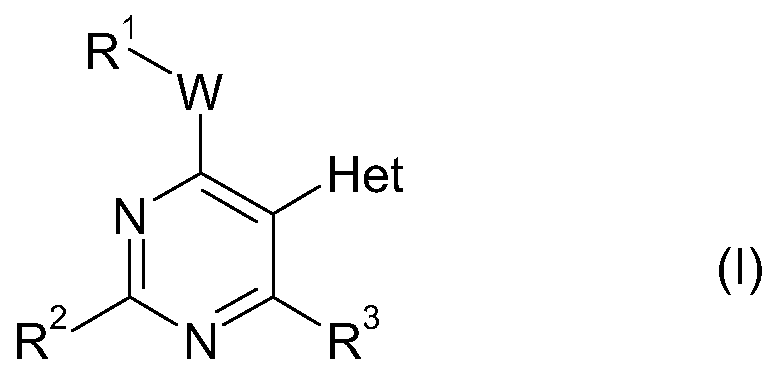
W für Sauerstoff, Schwefel, eine Gruppe S=O oder S(=O)2 steht;
R1 für d-Cs-Alkyl, C3-C8-Cycloalkyl, C5-Ci0-Bicycloalkyl, C2-C8-Alkenyl, C4-Ci0-
Alkadienyl, C3-C6-Cycloalkenyl, C2-C8-Alkinyl, Phenyl, Naphthyl, oder einen C-gebundenen fünf- oder sechsgliedrigen gesättigten, partiell ungesättigten oder aromatischen Heterocyclus steht, der ein, zwei, drei oder vier Hetero- atome aus der Gruppe O, N oder S als Ringlieder aufweist;
wobei die Wasserstoffatome der vorgenannten Reste R1 teilweise oder vollständig durch Halogen ersetzt sein können und/oder ein, zwei oder drei Wasserstoffatome der vorgenannten Reste R1 durch Gruppen R11 ersetzt sein können:
R11 Cyano, Nitro, Amino, Hydroxy, C(O)NH2, C(S)NH2, Carboxyl, CrC6- Alkylcarbonyl, C3-C6-Cycloalkyl, d-C6-Alkoxy, CrC6-Alkoxycarbonyl, d-Ce-Alkylthio, CrC6-Alkylamino, Di-CrC6-Alkylamino, CrC6- Alkylaminocarbonyl, Di-Ci-Cβ-Alkylaminocarbonyl, C2-C8-Alkenyl, C4- Ciθ-Alkadienyl, C3-C8-Cycloalkenyl, C2-C6-Alkenyloxy, C2-C6-Alkinyl,
C3-C6-Alkinyloxy, C3-C6-Cycloalkoxy, C3-C6-Cycloalkenyloxy, Oxy-Cr C3-alkylenoxy, Phenyl, Naphthyl, ein fünf-, sechs-, sieben-, acht-, neun- oder zehngliedriger gesättigter, partiell ungesättigter oder aromatischer Heterocyclus, der ein, zwei, drei oder vier Heteroatome aus der Gruppe O, N oder S als Ringlieder aufweist,
wobei die aliphatischen, alicyclischen, heterocyclischen und aromatischen Gruppen in R11 ihrerseits partiell oder vollständig halogeniert sein oder eine, zwei oder drei Gruppen R12 tragen können:
R12 Cyano, Nitro, Hydroxy, Mercapto, Amino, Carboxyl, Aminocar- bonyl, Aminothiocarbonyl, Alkyl, Haloalkyl, Alkenyl, Alkadienyl,
Alkenyloxy, Alkinyloxy, Alkoxy, Halogenalkoxy, Alkylthio, Alkyl- amino, Dialkylamino, Formyl, Alkylcarbonyl, Alkylsulfonyl, Alkyl- sulfoxyl, Alkoxycarbonyl, Alkylcarbonyloxy, Alkylaminocarbonyl, Dialkylaminocarbonyl, Alkylaminothiocarbonyl, Dialkylaminothi- 5 ocarbonyl, wobei die Alkylgruppen in diesen Resten 1 bis 6
Kohlenstoffatome enthalten und die genannten Alkenyl-, Alka- dienyl- oder Alkinylgruppen in diesen Resten 2 bis 8 Kohlenstoffatome enthalten;
10 Cycloalkyl, Bicycloalkyl, Cycloalkoxy, Heterocyclyl, Heterocycly- loxy, wobei die cyclischen Systeme 3 bis 10 Ringglieder enthalten, Aryl, Aryloxy, Arylthio, Aryl-Ci-C6-alkoxy, Aryl-CrC6-alkyl, Hetaryl, Hetaryloxy, Hetarylthio, wobei die Arylreste vorzugsweise 6, 7, 8, 9 oder 10 Ringglieder, die Hetarylreste 5 oder 6
15 Ringglieder enthalten, wobei die cyclischen Systeme partiell oder vollständig halogeniert oder durch Alkyl- oder Haloal- kylgruppen substituiert sein können;
R2 für Halogen, Cyano, Hydroxy, Mercapto, N3, Ci-C6-Alkyl, C2-Cs-Alkenyl, C2- 20 Cs-Alkinyl, Ci-C6-Halogenalkyl, Ci-C6-Alkoxy, C3-C8-Alkenyloxy,
C3-C8-Alkinyloxy, Ci-C6-Halogenalkoxy, Ci -C6-Al kylthio, C3-C8-Alkenylthio,
Ca-Cs-Alkinylthio, Ci-Cβ-Halogenalkylthio, oder für einen Rest der Formeln C(=Z)OR21, C(=Z)NR22R23, C(=Z)NR24-NR22R23, C(=Z)R25, CR26R27-OR28, CR26R27-NR22R23, ON(=CR29R30), O-C(=Z)R25, NR22R23a, NR31(C(=Z)R25), 25 NR31(C(=Z)OR21), NR31(C(=Z)-NR22R23), NR32a(N=CR29R30), NR32NR22R23,
NR32OR21, oder C(=N-Z'-R25)SR21 steht, wobei
Z O, S, NR33 , NOR34 oder N-NR35R36 bedeutet;
30 Z' eine chemische Bindung, Sauerstoff, eine Carbonylgruppe, eine
Gruppe NR32 oder eine der folgenden Gruppen: -(C=O)-NH- oder -(C=O)-O-, wobei die Carbonylgruppe an das Stickstoffatom gebunden ist;
O C D21 r->22 r->23 r->24 r->25 r->26 r->27 r->28 r->29 D30 D31 r->32 D32a r->33 r->34 r->35
OO r\ , r\ , r\ , r\ , r\ , r\ , r\ , r\ , r\ , r\ , r\ , r\ , r\ , r\ , r\ , r\ und R36 unabhängig voneinander für Wasserstoff, Ci-Cβ-Alkyl, C2-C6- Alkenyl, C2-C6-Alkinyl, C3-C8-Cycloalkyl oder C4-C8-Cycloalkenyl stehen;
40 R23a bis auf Wasserstoff eine der für R21 angegebenen Bedeutungen aufweist;
R22, R28 und R32 zusätzlich -CO-R25 bedeuten können;
R22 weiterhin -CO-OR21 oder -CO-NR23R23b bedeuten kann, wobei R23b eine der für R21 angegebenen Bedeutungen aufweist;
R22 und R23 oder R22 und R23a auch gemeinsam eine C3-C6-Alkylengruppe bilden können, die durch ein Sauerstoffatom unterbrochen sein kann oder eine Doppelbindung aufweisen kann;
R31, R32, R32a, R33, R34 oder R35 mit einem weiteren Rest R21, R22, R23, R24, R25 oder R31 auch gemeinsam eine CrC6-Alkylengruppe bilden können, die im Falle von C2-C6-Alkylen eine Doppelbindung aufweisen kann;
R26 und R22, R26 und R27, R26 und R28 oder R29 und R30 auch gemeinsam eine C3-C6-Alkylengruppe bilden können, die durch ein Sauerstoffatom unterbrochen sein kann oder eine Doppelbindung aufweisen kann;
R30 auch für einen Rest der Formel A-CO-OR21 oder -CO-NR23R23b stehen kann, worin A für d-C4-Alkylen steht;
R31 auch für eine Gruppe der Formeln NR22R23, N=CR29R20 oder N=C(R25)NR22R23 stehen kann;
wobei die aliphatischen oder alicyclischen Gruppen der Restedefinitionen von R21-R36 ihrerseits partiell oder vollständig halogeniert sein und/oder eine bis vier Gruppen Rw tragen können:
Rw Halogen, Cyano, CrC8-Alkyl, C2-Ci0-Alkenyl, C2-Ci0-Alkinyl, CrC6- Alkoxy, C2-Ci0-Alkenyloxy, C2-Ci0-Alkinyloxy, C3-C6-Cycloalkyl, C3-C6- Cycloalkenyl, C3-C6-Cycloalkoxy, C3-C6-Cycloalkenyloxy; oder
für einen cyclischen Rest steht, der unter C3-Cio-Cycloalkyl, Phenyl und fünf-, sechs- oder siebengliedrigen gesättigten, partiell ungesättigten oder aromatischen Heterocyclen, die ein, zwei, drei oder vier Heteroatome aus der Gruppe O, N oder S und/oder 1 oder 2 Carbonylgruppen als Ringlieder aufweisen, ausgewählt ist, wobei der cyclische Rest teilweise oder vollstän- dig halogeniert sein kann und/oder 1 , 2 oder 3 Reste Rx aufweisen, kann,
wobei Rx eine der für L genannten Bedeutungen aufweist;
R3 Wasserstoff, OH, Halogen, Cyano, CrC8-Alkyl, CrC8-Alkoxy, CrC8-
Alkylthio, CrC8-Alkylsulfinyl, CrC8-Alkylsulfonyl, C2-C8-Alkenyl oder C2-C8- Alkinyl, wobei die 7 letztgenannten Reste teilweise oder vollständig haloge- niert sein können und/oder ein, zwei oder drei Substituenten, ausgewählt unter Nitro, Cyano, OH, Ci-C2-AIkOXy, d-C4-Alkoxycarbonyl, Amino, CrC4- Alkylamino und Di-Ci-C4-Alkylamino, tragen können;
Het für einen substituierten C- oder N-gebundenen, 5- oder 6-gliedrigen aromatischen Heterocyclus steht, der 1 , 2, 3 oder 4 unter Stickstoff, Sauerstoff und Schwefel ausgewählte Heteroatome als Ringglieder aufweist, und der die folgende allgemeinen Formel aufweist:

worin
# die Bindungstelle an die 5-Position des Pyrimidinrings anzeigt; X für N, N-(Ci-C4-Alkyl), S, O oder C-R4 steht;
Y für C oder N steht;
k 1 , 2 oder 3 bedeutet und wenn X für N-(CrC4-Alkyl) oder C-R4 steht, auch
0 sein kann;
R4 für Halogen, Cyano, Ci-C4-Alkyl, Ci-C4-Halogenalkyl, Ci-C4-Alkoxy, oder Ci-C4-Halogenalkoxy steht;
L ausgewählt ist unter Halogen, Cyano, Hydroxy, Cyanato (OCN), Nitro, Cr C8-Alkyl, C2-Ci0-Alkenyl, C2-Ci0-Alkinyl, CrC6-Halogenalkyl, C2-Ci0-
Halogenalkenyl, CrC6-Alkoxy, C2-Ci0-Alkenyloxy, C2-Ci0-Alkinyloxy, CrC6- Halogenalkoxy, C3-C6-Cycloalkyl, C3-C8-Cycloalkenyl, C3-C6-Cycloalkoxy, CrC8-Alkoximinoalkyl, C2-Ci0-Alkenyloximinoalkyl, C2-Ci0- Alkinyloximinoalkyl, C2-Ci0-Alkinylcarbonyl, C3-C6-Cycloalkylcarbonyl, NR5R6, NR5-C(=O)-R6, NR5-C(=S)-R6, S(=O)nA1, C(=O)A2, C(=S)A2, eine
Gruppe -C(=N-OR7)A3, eine Gruppe -C(=N-NR8R9)A4, Phenyl oder ein fünf-, sechs-, sieben-, acht-, neun- oder zehngliedriger gesättigter, partiell ungesättigter oder aromatischer Heterocyclus, der ein, zwei, drei oder vier Heteroatome aus der Gruppe O, N oder S als Ringglieder aufweist und
worin Phenyl und der Heterocyclus unsubstituiert sind oder 1 , 2, 3 oder 4 Substituenten aufweisen können, die unter Halogen, Nitro, Cyano, OH, d- C2-Alkyl, CrC2-Halogenalkyl, CrC2-Alkoxy, CrC2-Halogenalkoxy, CrC4- Alkoxycarbonyl, CrC4-Alkylcarbonyl, Amino, CrC4-Alkylamino und Di-Cr C4-Alkylamino ausgewählt sind,
worin
R5, R6 unabhängig voneinander ausgewählt sind unter Wasserstoff, CrC6- Alkyl, C2-Cio-Alkenyl, C2-Ci0-Alkinyl, C3-C6-Cycloalkyl oder C3-C6-
Cycloalkenyl, wobei die 5 letztgenannten Reste partiell oder vollständig halogeniert sein können und/oder ein, zwei, drei oder vier Reste ausgewählt unter Cyano, CrC4-Alkoximino, C2-C4-Alkenyloximino, C2-C4-Alkinyloximino oder d-C4-Alkoxy tragen können;
A1 für Wasserstoff, Hydroxy, CrC8-Alkyl, Amino, Ci-C8-Alkylamino oder Di-(Ci-C8-alkyl)amino steht;
n für O, 1 oder 2 steht;
A2 für C2-C8-Alkenyl, CrC8-Alkoxy, CrC6-Halogenalkoxy, C2-Ci0-
Alkenyloxy, C2-Ci0-Alkinyloxy oder eine der bei A1 genannten Gruppen steht;
A3 und A4 unabhängig voneinander für d-Cβ-Alkyl, C2-Ce-Alkenyl, CrCe-
Halogenalkyl, C2-C8-Halogenalkenyl, C3-C6-Cycloalkyl, d-Cβ-Alkoxy, CrC6-Halogenalkoxy, C2-Ci0-Alkenyloxy, C2-Ci0-Alkinyloxy oder eine Gruppe NR10R11 stehen;
R7, R8, R9, R10 und R11 unabhängig voneinander ausgewählt sind unter
Wasserstoff, CrC6-Alkyl, C3-C6-Cycloalkyl, C2-C6-Alkenyl oder C2-C6- Alkinyl, wobei die vier letztgenannten Reste ein, zwei, drei, vier, fünf oder sechs Reste Ra aufweisen können; oder
R8 und R9 und/oder R10 und R11 zusammen mit dem Stickstoffatom, an die sie gebunden sind, einen vier-, fünf- oder sechsgliedrigen gesättigten oder partiell ungesättigten Ring bilden, der ein, zwei, drei oder vier, unabhängig voneinander unter Ra ausgewählte Substituenten tragen kann;
Ra für Halogen, OH, CrC8-Alkyl oder CrC8-Alkoxy steht,
und deren Salze, ausgenommen Verbindungen der Formel I, worin R2 Ci-Cβ- Alkoxy bedeutet.
2. 5-Hetarylpyrimidine nach Anspruch 1 , wobei R2 für einen 5- oder 6-gliedrigen heterocyclischen Rest steht.
3. 5-Hetarylpyrimidine nach Anspruch 2, wobei R2 ausgewählt ist unter Pyrrolyl, Pyrazolyl, Imidazolyl, 1 ,2,3-Triazolyl, 1 ,2,4-Triazolyl, Tetrazolyl, Oxazolyl, Isoxazolyl, 1 ,3,4-Oxadiazolyl, Furyl, Thienyl, Thiazolyl, Isothiazolyl, Pyridinyl,
Pyrimidinyl, Pyrazinyl, Pyridazinyl, 1 ,2,3-Triazinyl, 1 ,2,4-Triazinyl, 1 ,3,5-Triazinyl, 1-Pyridin(1 ,2-dihydro)-2-on, Pyrazol-3-on-1-yl, lmidazol-2-on-1-yl, Pyrazolin-3-on- 1-yl, lmidazolin-2-on-1-yl, 1 ,2,4-Triazol-5-on-1-yl, 1 ,2,4-Triazolin-5-on-1-yl oder 1- Pyrrolidon bedeutet, wobei der heterocylische Rest teilweise oder vollständig halogeniert sein kann und/oder 1 , 2 oder 3 Reste Rx aufweisen kann.
4. 5-Hetarylpyrimidine nach Anspruch 1 , wobei R2 ausgewählt ist unter Halogen, N3, CN, C(=Z)OR21, C(=Z)NR22R23, C(=Z)NR24-NR22R23, C(=Z)R25, ON(=CR29R30), O-C(=Z)R25, NR22R233, NR31(C(=Z)R25), NR31(C(=Z)OR21), NR31(C(=Z)-NR22R23), NR32(N=CR29R20), NR32NR22R23, NR32OR21 und
C(=N-X-R25)SR21.
5. 5-Hetarylpyrimidine nach Anspruch 4, wobei R2 ausgewählt ist unter CN, C(=O)OR21, C(=O)NR22R23, C(=NOR34)NR22R23, C(=O)NR24-NR22R23, C(=Z)R25, ON(=CR29R30), NR31(C(=O)R25), NR31(C(=O)OR21), NR31(C(=O)-NR22R23),
NR32(N=CR29R30), NR32OR21, C(=N-OR25)SR21 und C(=N-R25)SR21.
6. 5-Hetarylpyrimidine nach Anspruch 5, wobei R2 ausgewählt ist unter C(=O)NR22R23 und C(=NOR34)NR22R23.
7. 5-Hetarylpyrimidine nach einem der vorhergehenden Ansprüche, worin R1 die folgenden Bedeutungen aufweist:
R1 d-Cβ-Alkyl, C2-C6-Alkenyl, C2-C6-Alkinyl, C3-C6-CyCl oa I ky I, welches 1 , 2, 3 oder 4-fach durch Halogen und/oder d-C4-Alkyl substituiert sein kann, o- der Ci-C8-Halogenalkyl.
8. 5-Hetarylpyrimidine nach einem der vorhergehenden Ansprüche, worin R3 für Halogen, Cyano, Ci-C4-Alkyl, Ci-C4-Halogenalkyl, CrC4-AIkOXy oder C1-C2-
Halogenalkoxy steht.
9. 5-Hetarylpyrimidine nach einem der vorhergehenden Ansprüche, worin X für N steht.
10. 5-Hetarylpyrimidine nach einem der vorhergehenden Ansprüche, worin Het für einen substituierten 5-gliedrigen heteroaromatischer Rest steht, der wenigstens ein Stickstoffatom und gegebenenfalls 1 oder 2 unter O, S und N ausgewählte weitere Heteroatome als Ringglieder aufweist.
1 1. 5-Hetarylpyrimidine nach Anspruch 10, worin Het ausgewählt ist unter substituiertem Pyrrolyl, Pyrazolyl, Imidazolyl, 1 ,2,3-Triazolyl, 1 ,2,4-Triazolyl, Oxazolyl, Thia- zolyl, Isoxazolyl und Isothiazolyl.
12. 5-Hetarylpyrimidine nach Anspruch 11 , worin Het für substituiertes Pyrazol-1 -yl steht.
13. 5-Hetarylpyrimidine nach Anspruch 11 , worin Het für substituiertes Thiazol-2-yl steht.
14. 5-Hetarylpyrimidine nach einem der Ansprüche 1 bis 9, worin Het für einen substituierten 6-gliedrigen heteroaromatischer Rest steht, der 1 , 2 oder 3 Stickstoffatome als Ringlieder aufweist.
16. 5-Hetarylpyrimidine nach Anspruch 14, worin Het ausgewählt ist unter substituiertem Pyridinyl und Pyrimidinyl.
17. 5-Hetarylpyrimidine nach Anspruch 16, worin Het für substituiertes 2-Pyridinyl steht.
18. 5-Hetarylpyrimidine nach Anspruch 17, worin k für 1 , 2 oder 3 steht und einer der Substituenten L in der 5-Position des Pyridinyl-Rings angeordnet ist.
19. 5-Hetarylpyrimidine nach Anspruch 17 oder 18, worin einer der Substituenten L in der 3-Position des Pyridinyl-Rings angeordnet ist.
20. 5-Hetarylpyrimidine nach einem der vorhergehenden Ansprüche, worin W für Sauerstoff steht.
21. 5-Hetarylpyτimidine nach einem der vorhergehenden Ansprüche, worin die Sub- stituenten L unabhängig voneinander ausgewählt sind unter Halogen, Cyano, Nitro, NH2, Ci -C6-Al kyl, Ci-C6-Halogenalkyl, Ci-C6-Alkoxy, Ci-C6-Alkylamino, Di- Ci-C6-alkylamino, NH-C(O)-Ci-C6-Alkyl, eine Gruppe C(S)A2 und einer Gruppe C(O)A2.
22. Mittel zur Bekämpfung von pflanzenpathogenen Pilzen, enthaltend wenigstens eine Verbindung der allgemeinen Formel I gemäß einem der Ansprüche 1 bis 21 und/oder ein landwirtschaftlich brauchbares Salz von I und wenigstens einen fes- ten oder flüssigen Trägerstoff.
23. Verfahren zur Bekämpfung von pflanzenpathogenen Pilzen, dadurch gekennzeichnet, dass man die Pilze oder die vor Pilzbefall zu schützenden Materialien, Pflanzen, den Boden oder Saatgüter mit einer wirksamen Menge wenigstens ei- ner Verbindung der allgemeinen Formel I, wie in einem der Ansprüche 1 bis 21 definiert, und/oder einem landwirtschaftlich brauchbaren Salz von I behandelt.
24. Verwendung von 5-Hetarylpyrimidinen der allgemeinen Formel I, wie in einem der Ansprüche 1 bis 21 definiert und/oder ihrer landwirtschaftlich brauchbaren Salze zur Bekämpfung von pflanzenschädigenden Pilzen.
25. Verwendung von 5-Hetarylpyrimidinen der allgemeinen Formel I, wie in einem der Ansprüche 1 bis 21 definiert, und ihrer landwirtschaftlich brauchbaren Salze zur Bekämpfung von arthropoden Pflanzenschädlingen.
26. Verwendung von 5-Hetarylpyrimidinen der allgemeinen Formel I, wie in einem der Ansprüche 1 bis 21 definiert, und ihrer landwirtschaftlich brauchbaren Salze zur Bekämpfung von Nematoden.
27. Saatgut, enthaltend wenigstens ein 5-Hetarylpyrimidin der Formel I gemäß einem der Ansprüche 1 bis 21.
28. Verwendung von 5-Hetarylpyrimidinen der allgemeinen Formel I, wie in einem der Ansprüche 1 bis 21 definiert, und ihrer pharmazeutisch geeigneten Salze zur Herstellung eines Medikaments.
29. Verwendung nach Anspruch 28 zur Herstellung eines Medikaments zur Behandlung von Krebserkrankungen.
30. Pharmazeutische Zusammensetzung, enthaltend wenigstens ein 5-Hetaryl- pyrimidin der allgemeinen Formel I, wie in einem der Ansprüche 1 bis 21 definiert, und/oder ein pharmazeutisch geeignetes Salz davon und einen pharmazeutisch verträglichen Träger.
31. Verfahren zur Behandlung von Krebserkrankungen bei Säugern, bei dem man dem Säuger, der dies benötigt, eine wirksame Menge eines 5-Hetarylpyrimidins der allgemeinen Formel I, wie in einem der Ansprüche 1 bis 21 definiert, und/oder eines pharmazeutisch geeigneten Salzes davon verabreicht.
Applications Claiming Priority (2)
| Application Number | Priority Date | Filing Date | Title |
|---|---|---|---|
| EP06007208 | 2006-04-05 | ||
| EP06007208.9 | 2006-04-05 |
Publications (2)
| Publication Number | Publication Date |
|---|---|
| WO2007113322A2 true WO2007113322A2 (de) | 2007-10-11 |
| WO2007113322A3 WO2007113322A3 (de) | 2008-07-03 |
Family
ID=38564013
Family Applications (1)
| Application Number | Title | Priority Date | Filing Date |
|---|---|---|---|
| PCT/EP2007/053332 Ceased WO2007113322A2 (de) | 2006-04-05 | 2007-04-04 | Substituierte 5-hetarylpyrimidine zur bekämpfung von pflanzenschädigenden pilzen und von krebserkrankungen |
Country Status (1)
| Country | Link |
|---|---|
| WO (1) | WO2007113322A2 (de) |
Cited By (1)
| Publication number | Priority date | Publication date | Assignee | Title |
|---|---|---|---|---|
| WO2009007187A1 (de) * | 2007-07-09 | 2009-01-15 | Basf Se | Substituierte 5-hetarylpyrimidine |
Family Cites Families (3)
| Publication number | Priority date | Publication date | Assignee | Title |
|---|---|---|---|---|
| DE3504895A1 (de) * | 1985-02-13 | 1986-08-14 | Basf Ag, 6700 Ludwigshafen | 4-aminopyrimidine und diese enthaltende fungizide |
| US5935966A (en) * | 1995-09-01 | 1999-08-10 | Signal Pharmaceuticals, Inc. | Pyrimidine carboxylates and related compounds and methods for treating inflammatory conditions |
| HUP0300649A3 (en) * | 2000-06-13 | 2003-10-28 | Basf Ag | Fungicidal 5-phenyl substituted 2-(cyanoamino)pyrimidines, preparation and use thereof |
-
2007
- 2007-04-04 WO PCT/EP2007/053332 patent/WO2007113322A2/de not_active Ceased
Cited By (1)
| Publication number | Priority date | Publication date | Assignee | Title |
|---|---|---|---|---|
| WO2009007187A1 (de) * | 2007-07-09 | 2009-01-15 | Basf Se | Substituierte 5-hetarylpyrimidine |
Also Published As
| Publication number | Publication date |
|---|---|
| WO2007113322A3 (de) | 2008-07-03 |
Similar Documents
| Publication | Publication Date | Title |
|---|---|---|
| US20090069179A1 (en) | Pyridin-4-ylmethylamides | |
| US20100222219A1 (en) | Thiophene-Sulphonic Acid Picolyl Amides | |
| WO2008037607A1 (de) | Carbonylgruppen-enthaltende heterocyclische verbindungen und deren verwendung zur bekämpfung von phytopathogenen pilzen | |
| EP2049498A1 (de) | Pyrimidinverbundungen zur bekämpfung von schadpilzen und krebs | |
| TW202115045A (zh) | 殺真菌的㗁二唑 | |
| AU2020406139A1 (en) | Substituted thiophene carboxamides, thiophene carboxylic acids and derivatives thereof | |
| EP2066643B1 (de) | Als fungizide und gegen gliederfüsser einsetzbare pyridazin-4-yl-methyl-sulfonamide | |
| US8178540B2 (en) | Pyrimidylmethyl-sulfonamide compounds | |
| EP2001298A2 (de) | Substituierte 5-hetaryl-4-aminopyrimidine | |
| WO2009007187A1 (de) | Substituierte 5-hetarylpyrimidine | |
| WO2008107398A2 (en) | Pyrazine compounds | |
| WO2007012642A1 (de) | 7-amino-6-thiadiazolyl- und -oxadiazolyl- 1 , 2 , 4-triazolo [1 , 5 -a] pyrimidin- verbindungen und ihre verwendung zur bekämpfung von schadpilzen | |
| WO2020035826A1 (en) | 1,2-dithiolone compounds and use thereof | |
| WO2019150311A1 (en) | 1-3 dithiol compounds and their use for the protection of crops from phytopathogenic microorganisms | |
| DE19834557A1 (de) | (Hetero)Arylverbindungen, Verfahren und Zwischenprodukte zu ihrer Herstellung und ihre Verwendung zur Bekämpfung von Schadpilzen und tierischen Schädlingen | |
| WO2007118844A1 (de) | Substituierte pyrazolopyrimidine, verfahren zu ihrer herstellung und ihre verwendung zur bekämpfung von schadpilzen sowie sie enthaltende mittel | |
| WO2007023018A1 (de) | 7-amino-6-triazolyl-1,2,4-triazolo[1,5-a]pyrimidin-verbindungen und ihre verwendung zur bekämpfung von schadpilzen | |
| WO2007006724A1 (de) | 5-alkyl-7-amino-6-heteroaryl-1 , 2 , 4-triazolo (1 , 5-a) pyrimidin-vξrbindungen und ihre? verwendung zur bekämpfung von schadpilzen | |
| MX2008009989A (en) | Pyridin-4 -ylmethylamides for combating pests | |
| WO2007054472A1 (de) | Verhenkelte pyridin- und pyrimidinderivate, verfahren zu ihrer herstellung und ihre verwendung als pestizid | |
| WO2007006723A1 (de) | 7-amino-6-tetrazolyl-1,2,4-triazolo[1,5-a]pyrimidin-verbindungen und ihre verwendung zur bekämpfung von schadpilzen |
Legal Events
| Date | Code | Title | Description |
|---|---|---|---|
| NENP | Non-entry into the national phase |
Ref country code: DE |
|
| 121 | Ep: the epo has been informed by wipo that ep was designated in this application |
Ref document number: 07727801 Country of ref document: EP Kind code of ref document: A2 |
|
| 122 | Ep: pct application non-entry in european phase |
Ref document number: 07727801 Country of ref document: EP Kind code of ref document: A2 |