WO2007114213A1 - 置換二環式環状誘導体及びその用途 - Google Patents
置換二環式環状誘導体及びその用途 Download PDFInfo
- Publication number
- WO2007114213A1 WO2007114213A1 PCT/JP2007/056791 JP2007056791W WO2007114213A1 WO 2007114213 A1 WO2007114213 A1 WO 2007114213A1 JP 2007056791 W JP2007056791 W JP 2007056791W WO 2007114213 A1 WO2007114213 A1 WO 2007114213A1
- Authority
- WO
- WIPO (PCT)
- Prior art keywords
- group
- ethyl
- methyl
- amino
- piperidino
- Prior art date
- Legal status (The legal status is an assumption and is not a legal conclusion. Google has not performed a legal analysis and makes no representation as to the accuracy of the status listed.)
- Ceased
Links
Classifications
-
- C—CHEMISTRY; METALLURGY
- C07—ORGANIC CHEMISTRY
- C07D—HETEROCYCLIC COMPOUNDS
- C07D209/00—Heterocyclic compounds containing five-membered rings, condensed with other rings, with one nitrogen atom as the only ring hetero atom
- C07D209/02—Heterocyclic compounds containing five-membered rings, condensed with other rings, with one nitrogen atom as the only ring hetero atom condensed with one carbocyclic ring
- C07D209/04—Indoles; Hydrogenated indoles
- C07D209/10—Indoles; Hydrogenated indoles with substituted hydrocarbon radicals attached to carbon atoms of the hetero ring
- C07D209/18—Radicals substituted by carbon atoms having three bonds to hetero atoms with at the most one bond to halogen, e.g. ester or nitrile radicals
-
- A—HUMAN NECESSITIES
- A61—MEDICAL OR VETERINARY SCIENCE; HYGIENE
- A61P—SPECIFIC THERAPEUTIC ACTIVITY OF CHEMICAL COMPOUNDS OR MEDICINAL PREPARATIONS
- A61P11/00—Drugs for disorders of the respiratory system
-
- A—HUMAN NECESSITIES
- A61—MEDICAL OR VETERINARY SCIENCE; HYGIENE
- A61P—SPECIFIC THERAPEUTIC ACTIVITY OF CHEMICAL COMPOUNDS OR MEDICINAL PREPARATIONS
- A61P17/00—Drugs for dermatological disorders
-
- A—HUMAN NECESSITIES
- A61—MEDICAL OR VETERINARY SCIENCE; HYGIENE
- A61P—SPECIFIC THERAPEUTIC ACTIVITY OF CHEMICAL COMPOUNDS OR MEDICINAL PREPARATIONS
- A61P19/00—Drugs for skeletal disorders
- A61P19/02—Drugs for skeletal disorders for joint disorders, e.g. arthritis, arthrosis
-
- A—HUMAN NECESSITIES
- A61—MEDICAL OR VETERINARY SCIENCE; HYGIENE
- A61P—SPECIFIC THERAPEUTIC ACTIVITY OF CHEMICAL COMPOUNDS OR MEDICINAL PREPARATIONS
- A61P21/00—Drugs for disorders of the muscular or neuromuscular system
-
- A—HUMAN NECESSITIES
- A61—MEDICAL OR VETERINARY SCIENCE; HYGIENE
- A61P—SPECIFIC THERAPEUTIC ACTIVITY OF CHEMICAL COMPOUNDS OR MEDICINAL PREPARATIONS
- A61P25/00—Drugs for disorders of the nervous system
-
- A—HUMAN NECESSITIES
- A61—MEDICAL OR VETERINARY SCIENCE; HYGIENE
- A61P—SPECIFIC THERAPEUTIC ACTIVITY OF CHEMICAL COMPOUNDS OR MEDICINAL PREPARATIONS
- A61P25/00—Drugs for disorders of the nervous system
- A61P25/04—Centrally acting analgesics, e.g. opioids
-
- A—HUMAN NECESSITIES
- A61—MEDICAL OR VETERINARY SCIENCE; HYGIENE
- A61P—SPECIFIC THERAPEUTIC ACTIVITY OF CHEMICAL COMPOUNDS OR MEDICINAL PREPARATIONS
- A61P29/00—Non-central analgesic, antipyretic or antiinflammatory agents, e.g. antirheumatic agents; Non-steroidal antiinflammatory drugs [NSAID]
-
- A—HUMAN NECESSITIES
- A61—MEDICAL OR VETERINARY SCIENCE; HYGIENE
- A61P—SPECIFIC THERAPEUTIC ACTIVITY OF CHEMICAL COMPOUNDS OR MEDICINAL PREPARATIONS
- A61P29/00—Non-central analgesic, antipyretic or antiinflammatory agents, e.g. antirheumatic agents; Non-steroidal antiinflammatory drugs [NSAID]
- A61P29/02—Non-central analgesic, antipyretic or antiinflammatory agents, e.g. antirheumatic agents; Non-steroidal antiinflammatory drugs [NSAID] without antiinflammatory effect
-
- A—HUMAN NECESSITIES
- A61—MEDICAL OR VETERINARY SCIENCE; HYGIENE
- A61P—SPECIFIC THERAPEUTIC ACTIVITY OF CHEMICAL COMPOUNDS OR MEDICINAL PREPARATIONS
- A61P31/00—Antiinfectives, i.e. antibiotics, antiseptics, chemotherapeutics
-
- A—HUMAN NECESSITIES
- A61—MEDICAL OR VETERINARY SCIENCE; HYGIENE
- A61P—SPECIFIC THERAPEUTIC ACTIVITY OF CHEMICAL COMPOUNDS OR MEDICINAL PREPARATIONS
- A61P35/00—Antineoplastic agents
-
- A—HUMAN NECESSITIES
- A61—MEDICAL OR VETERINARY SCIENCE; HYGIENE
- A61P—SPECIFIC THERAPEUTIC ACTIVITY OF CHEMICAL COMPOUNDS OR MEDICINAL PREPARATIONS
- A61P37/00—Drugs for immunological or allergic disorders
- A61P37/02—Immunomodulators
-
- A—HUMAN NECESSITIES
- A61—MEDICAL OR VETERINARY SCIENCE; HYGIENE
- A61P—SPECIFIC THERAPEUTIC ACTIVITY OF CHEMICAL COMPOUNDS OR MEDICINAL PREPARATIONS
- A61P37/00—Drugs for immunological or allergic disorders
- A61P37/02—Immunomodulators
- A61P37/06—Immunosuppressants, e.g. drugs for graft rejection
-
- A—HUMAN NECESSITIES
- A61—MEDICAL OR VETERINARY SCIENCE; HYGIENE
- A61P—SPECIFIC THERAPEUTIC ACTIVITY OF CHEMICAL COMPOUNDS OR MEDICINAL PREPARATIONS
- A61P37/00—Drugs for immunological or allergic disorders
- A61P37/08—Antiallergic agents
-
- A—HUMAN NECESSITIES
- A61—MEDICAL OR VETERINARY SCIENCE; HYGIENE
- A61P—SPECIFIC THERAPEUTIC ACTIVITY OF CHEMICAL COMPOUNDS OR MEDICINAL PREPARATIONS
- A61P43/00—Drugs for specific purposes, not provided for in groups A61P1/00-A61P41/00
-
- A—HUMAN NECESSITIES
- A61—MEDICAL OR VETERINARY SCIENCE; HYGIENE
- A61P—SPECIFIC THERAPEUTIC ACTIVITY OF CHEMICAL COMPOUNDS OR MEDICINAL PREPARATIONS
- A61P9/00—Drugs for disorders of the cardiovascular system
-
- C—CHEMISTRY; METALLURGY
- C07—ORGANIC CHEMISTRY
- C07C—ACYCLIC OR CARBOCYCLIC COMPOUNDS
- C07C59/00—Compounds having carboxyl groups bound to acyclic carbon atoms and containing any of the groups OH, O—metal, —CHO, keto, ether, groups, groups, or groups
- C07C59/40—Unsaturated compounds
- C07C59/58—Unsaturated compounds containing ether groups, groups, groups, or groups
- C07C59/64—Unsaturated compounds containing ether groups, groups, groups, or groups containing six-membered aromatic rings
-
- C—CHEMISTRY; METALLURGY
- C07—ORGANIC CHEMISTRY
- C07C—ACYCLIC OR CARBOCYCLIC COMPOUNDS
- C07C59/00—Compounds having carboxyl groups bound to acyclic carbon atoms and containing any of the groups OH, O—metal, —CHO, keto, ether, groups, groups, or groups
- C07C59/40—Unsaturated compounds
- C07C59/58—Unsaturated compounds containing ether groups, groups, groups, or groups
- C07C59/64—Unsaturated compounds containing ether groups, groups, groups, or groups containing six-membered aromatic rings
- C07C59/66—Unsaturated compounds containing ether groups, groups, groups, or groups containing six-membered aromatic rings the non-carboxylic part of the ether containing six-membered aromatic rings
- C07C59/68—Unsaturated compounds containing ether groups, groups, groups, or groups containing six-membered aromatic rings the non-carboxylic part of the ether containing six-membered aromatic rings the oxygen atom of the ether group being bound to a non-condensed six-membered aromatic ring
-
- C—CHEMISTRY; METALLURGY
- C07—ORGANIC CHEMISTRY
- C07C—ACYCLIC OR CARBOCYCLIC COMPOUNDS
- C07C59/00—Compounds having carboxyl groups bound to acyclic carbon atoms and containing any of the groups OH, O—metal, —CHO, keto, ether, groups, groups, or groups
- C07C59/40—Unsaturated compounds
- C07C59/58—Unsaturated compounds containing ether groups, groups, groups, or groups
- C07C59/72—Unsaturated compounds containing ether groups, groups, groups, or groups containing six-membered aromatic rings and other rings
-
- C—CHEMISTRY; METALLURGY
- C07—ORGANIC CHEMISTRY
- C07C—ACYCLIC OR CARBOCYCLIC COMPOUNDS
- C07C69/00—Esters of carboxylic acids; Esters of carbonic or haloformic acids
- C07C69/612—Esters of carboxylic acids having a carboxyl group bound to an acyclic carbon atom and having a six-membered aromatic ring in the acid moiety
- C07C69/616—Esters of carboxylic acids having a carboxyl group bound to an acyclic carbon atom and having a six-membered aromatic ring in the acid moiety polycyclic
-
- C—CHEMISTRY; METALLURGY
- C07—ORGANIC CHEMISTRY
- C07C—ACYCLIC OR CARBOCYCLIC COMPOUNDS
- C07C69/00—Esters of carboxylic acids; Esters of carbonic or haloformic acids
- C07C69/612—Esters of carboxylic acids having a carboxyl group bound to an acyclic carbon atom and having a six-membered aromatic ring in the acid moiety
- C07C69/618—Esters of carboxylic acids having a carboxyl group bound to an acyclic carbon atom and having a six-membered aromatic ring in the acid moiety having unsaturation outside the six-membered aromatic ring
-
- C—CHEMISTRY; METALLURGY
- C07—ORGANIC CHEMISTRY
- C07C—ACYCLIC OR CARBOCYCLIC COMPOUNDS
- C07C69/00—Esters of carboxylic acids; Esters of carbonic or haloformic acids
- C07C69/66—Esters of carboxylic acids having esterified carboxylic groups bound to acyclic carbon atoms and having any of the groups OH, O—metal, —CHO, keto, ether, acyloxy, groups, groups, or in the acid moiety
- C07C69/73—Esters of carboxylic acids having esterified carboxylic groups bound to acyclic carbon atoms and having any of the groups OH, O—metal, —CHO, keto, ether, acyloxy, groups, groups, or in the acid moiety of unsaturated acids
- C07C69/732—Esters of carboxylic acids having esterified carboxylic groups bound to acyclic carbon atoms and having any of the groups OH, O—metal, —CHO, keto, ether, acyloxy, groups, groups, or in the acid moiety of unsaturated acids of unsaturated hydroxy carboxylic acids
-
- C—CHEMISTRY; METALLURGY
- C07—ORGANIC CHEMISTRY
- C07C—ACYCLIC OR CARBOCYCLIC COMPOUNDS
- C07C69/00—Esters of carboxylic acids; Esters of carbonic or haloformic acids
- C07C69/66—Esters of carboxylic acids having esterified carboxylic groups bound to acyclic carbon atoms and having any of the groups OH, O—metal, —CHO, keto, ether, acyloxy, groups, groups, or in the acid moiety
- C07C69/73—Esters of carboxylic acids having esterified carboxylic groups bound to acyclic carbon atoms and having any of the groups OH, O—metal, —CHO, keto, ether, acyloxy, groups, groups, or in the acid moiety of unsaturated acids
- C07C69/734—Ethers
- C07C69/736—Ethers the hydroxy group of the ester being etherified with a hydroxy compound having the hydroxy group bound to a carbon atom of a six-membered aromatic ring
-
- C—CHEMISTRY; METALLURGY
- C07—ORGANIC CHEMISTRY
- C07D—HETEROCYCLIC COMPOUNDS
- C07D211/00—Heterocyclic compounds containing hydrogenated pyridine rings, not condensed with other rings
- C07D211/04—Heterocyclic compounds containing hydrogenated pyridine rings, not condensed with other rings with only hydrogen or carbon atoms directly attached to the ring nitrogen atom
- C07D211/06—Heterocyclic compounds containing hydrogenated pyridine rings, not condensed with other rings with only hydrogen or carbon atoms directly attached to the ring nitrogen atom having no double bonds between ring members or between ring members and non-ring members
- C07D211/08—Heterocyclic compounds containing hydrogenated pyridine rings, not condensed with other rings with only hydrogen or carbon atoms directly attached to the ring nitrogen atom having no double bonds between ring members or between ring members and non-ring members with hydrocarbon or substituted hydrocarbon radicals directly attached to ring carbon atoms
- C07D211/10—Heterocyclic compounds containing hydrogenated pyridine rings, not condensed with other rings with only hydrogen or carbon atoms directly attached to the ring nitrogen atom having no double bonds between ring members or between ring members and non-ring members with hydrocarbon or substituted hydrocarbon radicals directly attached to ring carbon atoms with radicals containing only carbon and hydrogen atoms attached to ring carbon atoms
- C07D211/14—Heterocyclic compounds containing hydrogenated pyridine rings, not condensed with other rings with only hydrogen or carbon atoms directly attached to the ring nitrogen atom having no double bonds between ring members or between ring members and non-ring members with hydrocarbon or substituted hydrocarbon radicals directly attached to ring carbon atoms with radicals containing only carbon and hydrogen atoms attached to ring carbon atoms with hydrocarbon or substituted hydrocarbon radicals attached to the ring nitrogen atom
-
- C—CHEMISTRY; METALLURGY
- C07—ORGANIC CHEMISTRY
- C07D—HETEROCYCLIC COMPOUNDS
- C07D213/00—Heterocyclic compounds containing six-membered rings, not condensed with other rings, with one nitrogen atom as the only ring hetero atom and three or more double bonds between ring members or between ring members and non-ring members
- C07D213/02—Heterocyclic compounds containing six-membered rings, not condensed with other rings, with one nitrogen atom as the only ring hetero atom and three or more double bonds between ring members or between ring members and non-ring members having three double bonds between ring members or between ring members and non-ring members
- C07D213/04—Heterocyclic compounds containing six-membered rings, not condensed with other rings, with one nitrogen atom as the only ring hetero atom and three or more double bonds between ring members or between ring members and non-ring members having three double bonds between ring members or between ring members and non-ring members having no bond between the ring nitrogen atom and a non-ring member or having only hydrogen or carbon atoms directly attached to the ring nitrogen atom
- C07D213/24—Heterocyclic compounds containing six-membered rings, not condensed with other rings, with one nitrogen atom as the only ring hetero atom and three or more double bonds between ring members or between ring members and non-ring members having three double bonds between ring members or between ring members and non-ring members having no bond between the ring nitrogen atom and a non-ring member or having only hydrogen or carbon atoms directly attached to the ring nitrogen atom with substituted hydrocarbon radicals attached to ring carbon atoms
- C07D213/28—Radicals substituted by singly-bound oxygen or sulphur atoms
- C07D213/30—Oxygen atoms
-
- C—CHEMISTRY; METALLURGY
- C07—ORGANIC CHEMISTRY
- C07D—HETEROCYCLIC COMPOUNDS
- C07D213/00—Heterocyclic compounds containing six-membered rings, not condensed with other rings, with one nitrogen atom as the only ring hetero atom and three or more double bonds between ring members or between ring members and non-ring members
- C07D213/02—Heterocyclic compounds containing six-membered rings, not condensed with other rings, with one nitrogen atom as the only ring hetero atom and three or more double bonds between ring members or between ring members and non-ring members having three double bonds between ring members or between ring members and non-ring members
- C07D213/04—Heterocyclic compounds containing six-membered rings, not condensed with other rings, with one nitrogen atom as the only ring hetero atom and three or more double bonds between ring members or between ring members and non-ring members having three double bonds between ring members or between ring members and non-ring members having no bond between the ring nitrogen atom and a non-ring member or having only hydrogen or carbon atoms directly attached to the ring nitrogen atom
- C07D213/24—Heterocyclic compounds containing six-membered rings, not condensed with other rings, with one nitrogen atom as the only ring hetero atom and three or more double bonds between ring members or between ring members and non-ring members having three double bonds between ring members or between ring members and non-ring members having no bond between the ring nitrogen atom and a non-ring member or having only hydrogen or carbon atoms directly attached to the ring nitrogen atom with substituted hydrocarbon radicals attached to ring carbon atoms
- C07D213/54—Radicals substituted by carbon atoms having three bonds to hetero atoms with at the most one bond to halogen, e.g. ester or nitrile radicals
- C07D213/55—Acids; Esters
-
- C—CHEMISTRY; METALLURGY
- C07—ORGANIC CHEMISTRY
- C07D—HETEROCYCLIC COMPOUNDS
- C07D215/00—Heterocyclic compounds containing quinoline or hydrogenated quinoline ring systems
- C07D215/02—Heterocyclic compounds containing quinoline or hydrogenated quinoline ring systems having no bond between the ring nitrogen atom and a non-ring member or having only hydrogen atoms or carbon atoms directly attached to the ring nitrogen atom
- C07D215/12—Heterocyclic compounds containing quinoline or hydrogenated quinoline ring systems having no bond between the ring nitrogen atom and a non-ring member or having only hydrogen atoms or carbon atoms directly attached to the ring nitrogen atom with substituted hydrocarbon radicals attached to ring carbon atoms
- C07D215/14—Radicals substituted by oxygen atoms
-
- C—CHEMISTRY; METALLURGY
- C07—ORGANIC CHEMISTRY
- C07D—HETEROCYCLIC COMPOUNDS
- C07D217/00—Heterocyclic compounds containing isoquinoline or hydrogenated isoquinoline ring systems
-
- C—CHEMISTRY; METALLURGY
- C07—ORGANIC CHEMISTRY
- C07D—HETEROCYCLIC COMPOUNDS
- C07D231/00—Heterocyclic compounds containing 1,2-diazole or hydrogenated 1,2-diazole rings
- C07D231/54—Heterocyclic compounds containing 1,2-diazole or hydrogenated 1,2-diazole rings condensed with carbocyclic rings or ring systems
-
- C—CHEMISTRY; METALLURGY
- C07—ORGANIC CHEMISTRY
- C07D—HETEROCYCLIC COMPOUNDS
- C07D265/00—Heterocyclic compounds containing six-membered rings having one nitrogen atom and one oxygen atom as the only ring hetero atoms
- C07D265/28—1,4-Oxazines; Hydrogenated 1,4-oxazines
- C07D265/30—1,4-Oxazines; Hydrogenated 1,4-oxazines not condensed with other rings
-
- C—CHEMISTRY; METALLURGY
- C07—ORGANIC CHEMISTRY
- C07D—HETEROCYCLIC COMPOUNDS
- C07D277/00—Heterocyclic compounds containing 1,3-thiazole or hydrogenated 1,3-thiazole rings
- C07D277/60—Heterocyclic compounds containing 1,3-thiazole or hydrogenated 1,3-thiazole rings condensed with carbocyclic rings or ring systems
- C07D277/62—Benzothiazoles
-
- C—CHEMISTRY; METALLURGY
- C07—ORGANIC CHEMISTRY
- C07D—HETEROCYCLIC COMPOUNDS
- C07D295/00—Heterocyclic compounds containing polymethylene-imine rings with at least five ring members, 3-azabicyclo [3.2.2] nonane, piperazine, morpholine or thiomorpholine rings, having only hydrogen atoms directly attached to the ring carbon atoms
- C07D295/04—Heterocyclic compounds containing polymethylene-imine rings with at least five ring members, 3-azabicyclo [3.2.2] nonane, piperazine, morpholine or thiomorpholine rings, having only hydrogen atoms directly attached to the ring carbon atoms with substituted hydrocarbon radicals attached to ring nitrogen atoms
- C07D295/14—Heterocyclic compounds containing polymethylene-imine rings with at least five ring members, 3-azabicyclo [3.2.2] nonane, piperazine, morpholine or thiomorpholine rings, having only hydrogen atoms directly attached to the ring carbon atoms with substituted hydrocarbon radicals attached to ring nitrogen atoms substituted by carbon atoms having three bonds to hetero atoms with at the most one bond to halogen, e.g. ester or nitrile radicals
-
- C—CHEMISTRY; METALLURGY
- C07—ORGANIC CHEMISTRY
- C07D—HETEROCYCLIC COMPOUNDS
- C07D307/00—Heterocyclic compounds containing five-membered rings having one oxygen atom as the only ring hetero atom
- C07D307/02—Heterocyclic compounds containing five-membered rings having one oxygen atom as the only ring hetero atom not condensed with other rings
- C07D307/34—Heterocyclic compounds containing five-membered rings having one oxygen atom as the only ring hetero atom not condensed with other rings having two or three double bonds between ring members or between ring members and non-ring members
- C07D307/38—Heterocyclic compounds containing five-membered rings having one oxygen atom as the only ring hetero atom not condensed with other rings having two or three double bonds between ring members or between ring members and non-ring members with substituted hydrocarbon radicals attached to ring carbon atoms
- C07D307/54—Radicals substituted by carbon atoms having three bonds to hetero atoms with at the most one bond to halogen, e.g. ester or nitrile radicals
-
- C—CHEMISTRY; METALLURGY
- C07—ORGANIC CHEMISTRY
- C07D—HETEROCYCLIC COMPOUNDS
- C07D307/00—Heterocyclic compounds containing five-membered rings having one oxygen atom as the only ring hetero atom
- C07D307/77—Heterocyclic compounds containing five-membered rings having one oxygen atom as the only ring hetero atom ortho- or peri-condensed with carbocyclic rings or ring systems
- C07D307/78—Benzo [b] furans; Hydrogenated benzo [b] furans
- C07D307/79—Benzo [b] furans; Hydrogenated benzo [b] furans with only hydrogen atoms, hydrocarbon or substituted hydrocarbon radicals, directly attached to carbon atoms of the hetero ring
- C07D307/80—Radicals substituted by oxygen atoms
-
- C—CHEMISTRY; METALLURGY
- C07—ORGANIC CHEMISTRY
- C07D—HETEROCYCLIC COMPOUNDS
- C07D319/00—Heterocyclic compounds containing six-membered rings having two oxygen atoms as the only ring hetero atoms
- C07D319/10—1,4-Dioxanes; Hydrogenated 1,4-dioxanes
- C07D319/14—1,4-Dioxanes; Hydrogenated 1,4-dioxanes condensed with carbocyclic rings or ring systems
- C07D319/16—1,4-Dioxanes; Hydrogenated 1,4-dioxanes condensed with carbocyclic rings or ring systems condensed with one six-membered ring
- C07D319/20—1,4-Dioxanes; Hydrogenated 1,4-dioxanes condensed with carbocyclic rings or ring systems condensed with one six-membered ring with substituents attached to the hetero ring
-
- C—CHEMISTRY; METALLURGY
- C07—ORGANIC CHEMISTRY
- C07D—HETEROCYCLIC COMPOUNDS
- C07D333/00—Heterocyclic compounds containing five-membered rings having one sulfur atom as the only ring hetero atom
- C07D333/02—Heterocyclic compounds containing five-membered rings having one sulfur atom as the only ring hetero atom not condensed with other rings
- C07D333/04—Heterocyclic compounds containing five-membered rings having one sulfur atom as the only ring hetero atom not condensed with other rings not substituted on the ring sulphur atom
- C07D333/06—Heterocyclic compounds containing five-membered rings having one sulfur atom as the only ring hetero atom not condensed with other rings not substituted on the ring sulphur atom with only hydrogen atoms, hydrocarbon or substituted hydrocarbon radicals, directly attached to the ring carbon atoms
- C07D333/24—Radicals substituted by carbon atoms having three bonds to hetero atoms with at the most one bond to halogen, e.g. ester or nitrile radicals
-
- C—CHEMISTRY; METALLURGY
- C07—ORGANIC CHEMISTRY
- C07D—HETEROCYCLIC COMPOUNDS
- C07D333/00—Heterocyclic compounds containing five-membered rings having one sulfur atom as the only ring hetero atom
- C07D333/50—Heterocyclic compounds containing five-membered rings having one sulfur atom as the only ring hetero atom condensed with carbocyclic rings or ring systems
- C07D333/52—Benzo[b]thiophenes; Hydrogenated benzo[b]thiophenes
- C07D333/54—Benzo[b]thiophenes; Hydrogenated benzo[b]thiophenes with only hydrogen atoms, hydrocarbon or substituted hydrocarbon radicals, directly attached to carbon atoms of the hetero ring
- C07D333/60—Radicals substituted by carbon atoms having three bonds to hetero atoms with at the most one bond to halogen, e.g. ester or nitrile radicals
-
- C—CHEMISTRY; METALLURGY
- C07—ORGANIC CHEMISTRY
- C07D—HETEROCYCLIC COMPOUNDS
- C07D401/00—Heterocyclic compounds containing two or more hetero rings, having nitrogen atoms as the only ring hetero atoms, at least one ring being a six-membered ring with only one nitrogen atom
- C07D401/02—Heterocyclic compounds containing two or more hetero rings, having nitrogen atoms as the only ring hetero atoms, at least one ring being a six-membered ring with only one nitrogen atom containing two hetero rings
- C07D401/10—Heterocyclic compounds containing two or more hetero rings, having nitrogen atoms as the only ring hetero atoms, at least one ring being a six-membered ring with only one nitrogen atom containing two hetero rings linked by a carbon chain containing aromatic rings
-
- C—CHEMISTRY; METALLURGY
- C07—ORGANIC CHEMISTRY
- C07D—HETEROCYCLIC COMPOUNDS
- C07D401/00—Heterocyclic compounds containing two or more hetero rings, having nitrogen atoms as the only ring hetero atoms, at least one ring being a six-membered ring with only one nitrogen atom
- C07D401/02—Heterocyclic compounds containing two or more hetero rings, having nitrogen atoms as the only ring hetero atoms, at least one ring being a six-membered ring with only one nitrogen atom containing two hetero rings
- C07D401/12—Heterocyclic compounds containing two or more hetero rings, having nitrogen atoms as the only ring hetero atoms, at least one ring being a six-membered ring with only one nitrogen atom containing two hetero rings linked by a chain containing hetero atoms as chain links
-
- C—CHEMISTRY; METALLURGY
- C07—ORGANIC CHEMISTRY
- C07D—HETEROCYCLIC COMPOUNDS
- C07D401/00—Heterocyclic compounds containing two or more hetero rings, having nitrogen atoms as the only ring hetero atoms, at least one ring being a six-membered ring with only one nitrogen atom
- C07D401/14—Heterocyclic compounds containing two or more hetero rings, having nitrogen atoms as the only ring hetero atoms, at least one ring being a six-membered ring with only one nitrogen atom containing three or more hetero rings
-
- C—CHEMISTRY; METALLURGY
- C07—ORGANIC CHEMISTRY
- C07D—HETEROCYCLIC COMPOUNDS
- C07D403/00—Heterocyclic compounds containing two or more hetero rings, having nitrogen atoms as the only ring hetero atoms, not provided for by group C07D401/00
- C07D403/02—Heterocyclic compounds containing two or more hetero rings, having nitrogen atoms as the only ring hetero atoms, not provided for by group C07D401/00 containing two hetero rings
- C07D403/10—Heterocyclic compounds containing two or more hetero rings, having nitrogen atoms as the only ring hetero atoms, not provided for by group C07D401/00 containing two hetero rings linked by a carbon chain containing aromatic rings
-
- C—CHEMISTRY; METALLURGY
- C07—ORGANIC CHEMISTRY
- C07D—HETEROCYCLIC COMPOUNDS
- C07D403/00—Heterocyclic compounds containing two or more hetero rings, having nitrogen atoms as the only ring hetero atoms, not provided for by group C07D401/00
- C07D403/02—Heterocyclic compounds containing two or more hetero rings, having nitrogen atoms as the only ring hetero atoms, not provided for by group C07D401/00 containing two hetero rings
- C07D403/12—Heterocyclic compounds containing two or more hetero rings, having nitrogen atoms as the only ring hetero atoms, not provided for by group C07D401/00 containing two hetero rings linked by a chain containing hetero atoms as chain links
-
- C—CHEMISTRY; METALLURGY
- C07—ORGANIC CHEMISTRY
- C07D—HETEROCYCLIC COMPOUNDS
- C07D405/00—Heterocyclic compounds containing both one or more hetero rings having oxygen atoms as the only ring hetero atoms, and one or more rings having nitrogen as the only ring hetero atom
- C07D405/02—Heterocyclic compounds containing both one or more hetero rings having oxygen atoms as the only ring hetero atoms, and one or more rings having nitrogen as the only ring hetero atom containing two hetero rings
- C07D405/10—Heterocyclic compounds containing both one or more hetero rings having oxygen atoms as the only ring hetero atoms, and one or more rings having nitrogen as the only ring hetero atom containing two hetero rings linked by a carbon chain containing aromatic rings
-
- C—CHEMISTRY; METALLURGY
- C07—ORGANIC CHEMISTRY
- C07D—HETEROCYCLIC COMPOUNDS
- C07D405/00—Heterocyclic compounds containing both one or more hetero rings having oxygen atoms as the only ring hetero atoms, and one or more rings having nitrogen as the only ring hetero atom
- C07D405/02—Heterocyclic compounds containing both one or more hetero rings having oxygen atoms as the only ring hetero atoms, and one or more rings having nitrogen as the only ring hetero atom containing two hetero rings
- C07D405/12—Heterocyclic compounds containing both one or more hetero rings having oxygen atoms as the only ring hetero atoms, and one or more rings having nitrogen as the only ring hetero atom containing two hetero rings linked by a chain containing hetero atoms as chain links
-
- C—CHEMISTRY; METALLURGY
- C07—ORGANIC CHEMISTRY
- C07D—HETEROCYCLIC COMPOUNDS
- C07D409/00—Heterocyclic compounds containing two or more hetero rings, at least one ring having sulfur atoms as the only ring hetero atoms
- C07D409/02—Heterocyclic compounds containing two or more hetero rings, at least one ring having sulfur atoms as the only ring hetero atoms containing two hetero rings
- C07D409/10—Heterocyclic compounds containing two or more hetero rings, at least one ring having sulfur atoms as the only ring hetero atoms containing two hetero rings linked by a carbon chain containing aromatic rings
-
- C—CHEMISTRY; METALLURGY
- C07—ORGANIC CHEMISTRY
- C07C—ACYCLIC OR CARBOCYCLIC COMPOUNDS
- C07C2601/00—Systems containing only non-condensed rings
- C07C2601/12—Systems containing only non-condensed rings with a six-membered ring
- C07C2601/14—The ring being saturated
-
- C—CHEMISTRY; METALLURGY
- C07—ORGANIC CHEMISTRY
- C07C—ACYCLIC OR CARBOCYCLIC COMPOUNDS
- C07C2602/00—Systems containing two condensed rings
- C07C2602/02—Systems containing two condensed rings the rings having only two atoms in common
- C07C2602/04—One of the condensed rings being a six-membered aromatic ring
- C07C2602/10—One of the condensed rings being a six-membered aromatic ring the other ring being six-membered, e.g. tetraline
-
- C—CHEMISTRY; METALLURGY
- C07—ORGANIC CHEMISTRY
- C07C—ACYCLIC OR CARBOCYCLIC COMPOUNDS
- C07C2602/00—Systems containing two condensed rings
- C07C2602/02—Systems containing two condensed rings the rings having only two atoms in common
- C07C2602/14—All rings being cycloaliphatic
- C07C2602/22—All rings being cycloaliphatic the ring system containing eight carbon atoms, e.g. pentalene
Definitions
- the present invention relates to a novel substituted bicyclic cyclic derivative. More specifically, it relates to a substituted bicyclic derivative useful as an active ingredient of a medicine.
- Prostaglandins and leukotrienes are all metabolites of arachidonic acid, which are physiologically active substances called lipid mediators. By binding to receptors expressed on various cell surfaces or in cells, various types of mammals are used. Cause a physiological response.
- Arachidonic acid is produced by phospholipase A (PLA) enzymatic activity using phospholipids, which are components of cell membranes such as phosphatidylcholine, as substrates.
- PHA phospholipase A
- Arachidonic acid produced by PLA is a constitutive cycloxygenase (COX) -1
- arachidonic acid is also metabolized by 5-lipoxygenase (5-LO) to become leukotriene (LT) A.
- 5-lipoxygenase 5-LO
- LT leukotriene
- LTA hydrolase LTC synthase is glutathione.
- Prostaglandins bind to specific receptors, for example, fever, increased vascular permeability, vasodilation, swelling or pain, inflammatory reactions, bronchial smooth muscle contraction, platelet aggregation, tumor cell proliferation It plays an important role in the development of symptoms and pathogenesis in various diseases by promoting bone resorption and neurodegeneration.
- Leukotrienes bind to specific receptors, for example, excessive accumulation of leukocytes It is a physiologically active substance that causes inflammatory reactions such as increased vascular permeability, smooth muscle contraction, mucus secretion, and tumor cell proliferation, and plays an important role in the development of symptoms and pathogenesis in various diseases.
- the biological state in which an acute or chronic inflammatory response described in the present specification is observed refers to a state in which an inflammatory response that is acute transient or chronic persistent excessive or non-beneficial is occurring.
- Inflammatory reactions are a series of events caused by stimuli such as physical damage caused by heat, infectious substances, ischemia, antigen-antibody reactions, etc., and are well-known macroscopic clinical signs.
- mice lacking FLAP a protein required for 5-LO activation
- mice lacking FLAP a protein required for 5-LO activation
- mice lacking FLAP a protein required for 5-LO activation
- mice lacking FLAP a protein required for 5-LO activation
- Creaths et al. Journal 'Ob'Experimental' Medicine (J. Exp. Med), 1997, 185 ⁇ , p. 1123
- Rheumatoid Arthritis Pathology It has been shown that prostaglandins and leukotrienes play an important role in formation.
- Alzheimer's disease In the pathological tissue of Alzheimer's disease, one of the diseases associated with neurodegeneration, COX activity and 5-LO activity are increased, and prostaglandins and leukotrienes are one of the etiological agents of Alzheimer's disease. It has been shown to cause the formation of j8 amyloid protein as well as further neuronal degeneration [Sugaya et al., Japanese Journal of Pharmacology (Jpn. J. Pharmacol. 2000, 82 ⁇ , 85], Prostaglandin and leukotrien are thought to play an important role in the formation of neurodegenerative diseases such as Arno and Imah's disease.
- COX and 5-LO are expressed in the pathological tissues of colorectal cancer, and the production of prostaglandins and leukotrienes has increased [Dreyling et al. (Biochim. Biophys. Acta) ⁇ 1986, 878 ⁇ , p. 184], and leukotrienes have been reported to cause proliferation of colon cancer cells [Qiao et al., Biochim. Biophys. Acta), 1995, 125 8 pp. 215], [Hong et al., Cancer Res., 1999, 59: 2223]. Prostaglandins and leukotrienes are also considered to play an important role in colorectal cancer tissues.
- prostaglandins and Z or leukotrienes in diseases and pathologies is not limited to the diseases exemplified above, but prostaglandins in various conditions, various diseases or various conditions in which acute or chronic inflammatory reactions are observed. And Z or Leukotrien involved They are shown to play an important role.
- NSAIDS non-steroidal anti-inflammatory drugs
- treatments for rheumatoid arthritis and osteoarthritis anti-inflammatory analgesics for trauma, cerebral infarction or myocardium It is used as a prophylactic agent for infarction or as a preventive agent for colorectal polyposis.
- Steroids are used as prophylactic or therapeutic agents for biological conditions, various diseases or conditions in which various acute or chronic inflammatory reactions are observed because they suppress the production of both prostaglandins and leukotrienes. Its effects are not limited to the production of lipid mediators, but it also induces and exacerbates infections due to its immune-suppressing action, growth retardation due to its ability to inhibit normal cell proliferation, strong and side effects such as skin atrophy or peptic ulcer. Use is restricted.
- a compound that suppresses the production of both prostaglandins and leukotrienes and has few side effects is a therapeutic or prophylactic agent for the above-mentioned biological condition, disease or pathology in mammals. Since it is considered effective, and the method of combining such a compound with an existing drug is considered to be a more effective treatment or prevention method, the production of both prostaglandins and leukotriens can be reduced. There is a strong demand for the development of compounds to be suppressed and their medicinalization.
- W099Z19291 reports a biphenyl 5-alkanoic acid derivative and its use.
- the portion corresponding to the ring (E) and AR is a phenyl group, and structural features are different.
- US Pat. No. 5,391,817 JP-A-7-22399) describes a biarylphospholipase A inhibitor.
- WO00Z35886 reports a bicyclic heterocyclic compound as a protease inhibitor, but the portion of the compound of the present invention is different from the ring (E) in general formula (I) and the substituent on AR, and further, It should be noted that no mention is made as to whether or not the compound disclosed in the patent specification has a prostaglandin production inhibitory action or leukotriene production inhibitory action.
- WO03 / 011842 i3 ⁇ 4 Indan succinic acid derivative power
- WO04 / 0114 46 reports indane, dihydrobenzofuran and tetrahydronaphthalene carboxylic acid derivatives.
- the general formula (I) of the compound of the present invention Further, there is a difference in the parts to be compared, and furthermore, no mention is made as to whether or not the compounds disclosed in the patent specifications have a prostaglandin production inhibitory action or leukotriene production inhibitory action.
- WO03Z07686 reports a substituted phenylalkanoic acid derivative and its use.
- the structure of the compound of the present invention is limited to the benzene ring in the general formula (I) in which the portion corresponding to the ring (E) is limited.
- WO05Z016862 is a substituted aryl alkanoic acid derivative and its use, but the structure of the compound of the present invention is limited to the benzene ring and the pyridine ring in the general formula (I) where the portion corresponding to the ring (E) is limited.
- the above features are different.
- Patent Document 1 International Publication No. W099Z19291 Pamphlet
- Patent Document 2 Pamphlet of US Pat. No. 5,391,817
- Patent Document 3 International Publication No. WO00Z35886 Pamphlet
- Patent Document 4 International Publication No. WO03Z011842 Pamphlet
- Patent Document 5 International Publication No. WO04Z011446 Pamphlet
- Patent Document 6 International Publication No. WO03Z07686 Pamphlet
- Patent Document 7 International Publication No. WO05Z016862 Pamphlet
- the substituted bicyclic cyclic derivative represented by the following general formula which is a novel compound, is excellent in inhibiting prostaglandin production. And it discovered that it had a leukotriene production inhibitory effect, and completed this invention.
- the present invention relates to the following.
- Nini represents a single bond or a double bond (provided that the ring carbon atom at the 1-position on the ring (E) and the ring carbon atom at the 2-position, and the ring (E) The bond between the ring carbon atom at position 1 and the Link moiety does not both represent a double bond, and when the link is a single bond, the bond between the ring carbon atom at position 1 on the ring (E) and the Link moiety Represents a single bond);
- Link represents a single bond or a linear saturated or unsaturated hydrocarbon having 1 to 2 carbon atoms
- W represents a single bond, a methylene group, an oxygen atom, a Z atom, or N (Rw);
- Rw represents a hydrogen atom, an alkyl group having 1 to 8 carbon atoms, or A 6 — Qp;
- a 6 represents a single bond or a methylene group
- Qp represents a phenyl group, which may be substituted with one or two or more of the same or different;
- T 1 is a linear or branched saturated alkyl group having 1 to 4 carbon atoms, a hydroxyl group, a fluorine atom, a chlorine atom, a bromine atom, a trifluoromethyl group, a nitro group, or 1 to 4 carbon atoms.
- Rs represents D—Rx or 1 N (Ry) (Rz);
- D is a single bond, oxygen atom, io atom, —S (O) —, —S (O) —, or C (O)
- Rx is a force indicating a linear or branched saturated alkyl group having 3 to 8 carbon atoms, or the following formula:
- Rb represented by the following formula:
- a a in Ra represents a single bond, alkylene having 1 to 3 carbon atoms (aa), or alkylene having 2 to 3 carbon atoms ( aa '), alkylene ( aa ) and alkenylene ( aa ′) may be independently substituted with a lower alkyl group having 1 to 4 carbon atoms;
- R 1 represents a cyclic saturated alkyl group having 3 to 7 carbon atoms or a condensed cyclic saturated alkyl group having 6 to 8 carbon atoms, and R 1 is 1 or the same or different two or more carbon atoms having 1 to 2 carbon atoms. May be substituted with 4 lower alkyl groups;
- Q in Rb is a mono- or fused bicyclic carbocycle that is partially or fully unsaturated.
- a heterocycle (q) which is bonded to A 2 at any position on the ring, and the heterocycle (q) is a group consisting of a nitrogen atom, an oxygen atom, and a sulfur nuclear power.
- a 1 represents a single bond, alkylene having 1 to 3 carbon atoms (al), or alkenylene having 2 to 3 carbon atoms (al,). May be independently substituted with a lower alkyl group or a phenyl group having 1 to 4 carbon atoms!
- a 2 represents a single bond, an oxygen atom, a Z atom, S (O) —, — S (O) —, or — N (R 4 ) —.
- a 2 is an oxygen atom, io atom, —S (O) —, —S (O) —, or N (R 4 ) —
- a 1 represents ethylene or trimethylene
- R 2 and R 3 are each independently a hydrogen atom, a linear or branched saturated alkyl group having 1 to 4 carbon atoms, an oxo group, a thixo group, a fluorine atom, a chlorine atom, a bromine atom, or a trifluoromethyl group.
- OR 5 — N (R 6 ) (R 6 ), — NHCOR 7 , — NHSO R 8 , or — A 6 — Q
- Qa represents a partially or fully unsaturated monocyclic or fused bicyclic carbocycle or heterocycle (qa), which is bonded to A 6 at any position on the ring and is one, the same or different A heterocycle (qa) that may be substituted with two or more T 1 groups includes 1 to 4 heteroatoms of the same or different ring structure selected from nitrogen, oxygen, and sulfur.
- R 4 and R 6 each independently represent a hydrogen atom or a lower alkyl group having 1 to 4 carbon atoms
- R 5 and R 7 each independently represent a hydrogen atom, a lower alkyl group having 1 to 4 carbon atoms, or A 6 —Qa;
- R 8 represents a lower alkyl group having 1 to 4 carbon atoms
- R 6 has the same meaning as R 6 force or together with connected to the R 6 nitrogen atom to which they are attached
- P in Rc represents an integer of 2 to 4.
- a 4 represents a single bond, methylene or ethylene
- a 5 represents C (O) —, — C (S) —, or —S (O) —;
- Rd represents a hydrogen atom, an alkyl group having 1 to 8 carbon atoms, or Qa; Re represents an alkyl group having 1 to 8 carbon atoms, A 6 — Qa, — (CH 2) R ′′, —OR 28 , — SR 28 ,
- i represents an integer from 1 to 3;
- R 14 represents a hydroxyl group, an alkoxy group having 1 to 4 carbon atoms, a carboxyl group, or an N, N dialkyl-powered rubermoyl group having 1 to 4 carbon atoms;
- R 28 represents an alkyl group having 1 to 8 carbon atoms or —A 6 —Qa;
- R 29 represents an alkyl group having 1 to 8 carbon atoms, an alkoxycarbo group having 1 to 4 carbon atoms, or A 6 —Qa;
- R 3Q is a hydrogen atom or a lower alkyl group having 1 to 4 carbon atoms, or a nitrogen atom saturated with nitrogen by forming a 3- to 6-membered ring together with the nitrogen atom to which R 29 is bonded.
- Rz is a force having the same meaning as Rx or a methyl group, an ethyl group, or one A 5 — Re;
- Ry is a hydrogen atom, an alkyl group having 1 to 8 carbon atoms, or a force representing —A 6 —Qp Alternatively, it is connected to Rz to form a saturated or unsaturated cyclic substituent (qy) having 3 to 7 atoms together with the nitrogen atom, and the cyclic substituent (qy) is a nitrogen atom, oxygen atom, or Further, the cyclic substituent (qy) which may contain any one of the atoms may be substituted with one or two identical or different Rf;
- Rf represents an alkyl group having 1 to 8 carbon atoms or —A 6 —Qp;
- V 1 and V 2 one of these represents Zx and the other then represents AR;
- Zx represents a hydrogen atom, a linear or branched saturated alkyl group having 1 to 4 carbon atoms, a fluorine atom, a chlorine atom, a bromine atom, a nitro group, OR 9 , or NO ⁇ n 1 ) (Rn 2 );
- R 9 represents a hydrogen atom, a lower alkyl group having 1 to 4 carbon atoms, or —A 6 —Qp;
- Rn 1 represents a hydrogen atom or a linear or branched saturated alkyl group having 1 to 4 carbon atoms
- Rn 2 represents a force having the same meaning as Rn 1 , or —COR 23 or —SO R 24 , or Rn 1
- R 23 represents a hydrogen atom, a lower alkyl group having 1 to 4 carbon atoms, or a lower alkoxy group having 1 to 4 carbon atoms.
- R 25 represents a hydrogen atom or a linear or branched saturated alkyl group having 1 to 4 carbon atoms
- R 26 has the same meaning as R 25 , or forms a saturated nitrogen-containing cycloalkyl group or morpholino group by forming a 3- to 6-membered ring together with the nitrogen atom to which R 25 is bonded to R 25 ;
- R 24 represents a lower alkyl group having 1 to 4 carbon atoms, an amino group, or a mono or dialkylamino group having 1 to 4 carbon atoms;
- AR represents a fused bicyclic carbocycle or heterocycle (ar) that is partially unsaturated or fully unsaturated, optionally substituted by one or the same or different two or more Xa; ar) contains 1 to 4 heteroatoms of the same or different ring structure selected from the group forces of nitrogen, oxygen and sulfur nuclear power;
- Xa is a linear or branched saturated alkyl group having 1 to 4 carbon atoms, a cyclic saturated alkyl group having 3 to 7 carbon atoms, oxo group, thixo group, fluorine atom, chlorine atom, trifluoromethyl group, One (CH 3) R 14 , —OR 10 , —N (R U ) (R 12 ), one SO R 13 , or one COR 27 ;
- R 1Q represents a hydrogen atom, a lower alkyl group having 1 to 4 carbon atoms, or — (CH 2) R ′′;
- R 11 represents a hydrogen atom or a lower alkyl group having 1 to 4 carbon atoms
- R 12 represents a hydrogen atom, a lower alkyl group having 1 to 4 carbon atoms, a hydroxyalkyl group having 2 to 4 carbon atoms, COR 15 or SO R 16 , or connected to R 11 to bond them.
- a saturated nitrogen-containing cycloalkyl group or morpholino group by forming a 3- to 6-membered ring with the nitrogen atom
- R 15 represents a lower alkyl group having 1 to 4 carbon atoms, a hydroxyalkyl group having 2 to 4 carbon atoms, an amino group, a mono- or dialkylamino group having 1 to 4 carbon atoms, or —A 6 —Qa
- Each of R 13 and R 16 independently represents a lower alkyl group having 1 to 4 carbon atoms, an amino group, or a mono or dialkylamino group having 1 to 4 carbon atoms;
- R 27 represents a hydrogen atom, a hydroxyl group, an alkoxy group having 1 to 4 carbon atoms, a lower alkyl group having 1 to 4 carbon atoms, an amino group, or a mono- or dialkylamino group having 1 to 4 carbon atoms;
- Y is a hydrogen atom, a lower alkyl group having 1 to 4 carbon atoms, one (CH 3) N (R 18 ) (R 19 ), or
- R 18 is the same as R 19 forces, or together with connected with R 19 the nitrogen atom to which they are attached
- R 19 represents a methyl group, an ethyl group, or a propyl group
- R 2Q represents a hydrogen atom, a methyl group, an ethyl group, or a propyl group
- R 21 represents a lower alkyl group having 1 to 4 carbon atoms, a cyclic saturated alkyl group having 3 to 6 carbon atoms, or a phenyl group;
- a 3 represents a single bond or an oxygen atom. Or a salt thereof (hereinafter sometimes simply referred to as “the present compound (I)”).
- ⁇ 2> the compound or salt thereof according to ⁇ 1>, wherein in general formula (I), V 1 is Zx and V 2 is AR.
- ⁇ 3> The compound or salt thereof according to any one of 1) or ⁇ 2> above, which is a W force methylene group in the general formula (I).
- the bond between the ring carbon atom at position 1 on ring (E) and the Link moiety is either a single bond or a double bond;
- Link is CH or CH 2 CH, or the ring-forming carbon atom at position 1 on ring (E) Connection with Link site
- Link is CH when the bond is a double bond
- the bond between the ring carbon atom at position 1 on ring (E) and the Link moiety is either a single bond or a double bond;
- Link is a force that is CH, or the carbon atom at position 1 on ring (E) The double bond
- link is CH;
- the bond between the ring carbon atom at position 1 on ring (E) and the Link site is a single bond
- the bond between the ring carbon atom at position 1 on ring (E) and the Link site is a single bond
- Link is either CH or CH CH;
- the bond between the ring carbon atom at position 1 on ring (E) and the Link site is a single bond
- Link is either CH or CH CH;
- AR which is either V 1 or V 2 is a naphthalene-2-yl group, a naphthalene-1-yl group, a benzofuran-5-yl group, a benzofuran-4-yl group, Benzofuran 2-yl group, benzo [b] thiophene 5-yl group, benzo [b] thiophene-4-yl group, benzo [b] thiophene-2-yl group, indole-5-yl group, indole-4-yl group Group, indole-6-yl group, benzothiazole-6-yl group, benzothiazole-7-yl group, benzothiazole-5-yl group, benzothiazole-4-yl group, dihydro-3H-benzothiazole-6- Group, dihydro-3H-benzothiazole-7-yl group, dihydro-3H-benzothiazole-5-yl group, dihydro-3H-benzothiazole
- AR force that is either V 1 or V 2 Naphthalene-2-yl group, 6-hydroxynaphthalene-2-yl group, 6-methoxynaphthalene-2- Yl group, 6-aminonaphthalene-2-yl group, 6- (N, N dimethylamino) naphthalene-2-yl group, benzo [b] furan-5-yl group, benzo [b] thiophene 5 -Yl group, 1H-indole-5-yl group, 1-methyl- 1H-indole-5-yl group, 1-ethyl-1H indole 5-yl group, benzothiazole-6-yl group, 2-aminobenzothiothiazo 6-yl group, 2-oxo 2,3-dihydrobenzothiazole 6-yl group, quinolin 3-yl group, quinoline 6-yl group, 2-oxo 1,2-dihydroquinoline 1- Group, 1H-in
- Qa is a fur group or pyridyl group.
- a benzothiazolyl group, or an indazolyl group (the above group may be substituted by one or two or more identical or different T 1 groups, and may be bonded to A 6 at any position on the ring).
- Rs represents D—Rx
- D is a single bond, an oxygen atom, or a thio atom, or the compound according to any one of the above ⁇ 1> Karaku 13> or a compound thereof salt.
- Rx is propyl group, isopropyl group, butyl group, isobutyl group, pentyl group, isopentyl group, 2-ethylbutyl group, cyclopentyl group, cyclohexyl group, cycloheptyl group, cyclopentylmethyl group, cyclohexylmethyl group, cyclohexane
- Rx represents Rb
- Q in Rb is a phenyl group, a chael group, a furyl group, a pyridyl group, an oxazolyl group, a naphthyl group, a tetrahydronaphthyl group, an indanyl group, an indolyl group, or a dihydrobenzodio.
- a 2 of Rb is either a single bond, an oxygen atom, a Z atom, N (methyl) mono, or N (ethyl);
- a 1 of Rb is a single bond, a methylene group, a methylmethylene group, an ethylmethylene group, a phenylmethylene group, an ethylene group, a methylethylene group, a dimethylethylene group, an ethylethylene group, a phenylethylene group, an ethylene group, or a trimethylene group.
- a 1 is an ethylene group, a methylethylene group, a dimethyl group, Ethylene, ethylethylene, phenylethylene, etylene, trimethylene, or methyltrimethylene Either);
- R 2 and R 3 are each independently a hydrogen atom, a methyl group, a fluorine atom, a chlorine atom, a trifluoromethyl group, a hydroxyl group, a methoxy group, an N, N dimethylamino group, a piperidino group, a morpholino group, an acetylylamino group, or a methylsulfo-lumino group.
- R 2 and R 3 are each independently a hydrogen atom, a methyl group, a fluorine atom, a chlorine atom, a trifluoromethyl group, a hydroxyl group, a methoxy group, an N, N dimethylamino group, a piperidino group, a morpholino group, an acetylylamino group, or a methylsulfo-lumino group.
- Rz when Rs is -N (Ry) (Rz) is a force having the same meaning as Rx, or a methyl group or an ethynole group;
- Ry is a hydrogen atom, a methyl group, an ethyl group, a propyl group, an isopropyl group, a butyl group, an isobutyl group, a pentyl group, or an isopentyl group, provided that Rz is a methyl group or an ethyl group.
- Ry is a substituent other than a hydrogen atom.
- a cyclic substituent (qy) which may form a cyclic substituent (qy) selected from a group, a pyrazole-1-yl group, or a thiomorpholino group is one, or the same or different two carbon atoms 1 to 8 alkyl groups, a phenyl group, or a phenylmethyl group (provided that the benzene rings of the phenyl group and the phenylmethyl group are one, two identical or different benzene rings) Group, a fluorine atom, a chlorine atom, a trifluoromethyl group, a hydroxyl group, a methoxy group, a dimethylamino group, a group force selected, or a substituted group selected from the above ⁇ 1> ⁇ 13> !, a compound or a salt thereof according to any one of the above.
- Rx is propyl group, isopropyl group, butyl group, isobutyl group, pentyl group, isopentyl group, 2-ethylbutyl group, cyclopentyl group, cyclohexyl group, cycloheptyl group, cyclopentylmethyl group, cyclohexylmethyl group, cyclohexane
- Rx represents Rb
- Q in Rb is any of a phenyl group, a 2-cell group, a 3-cell group, a 2-furyl group, a 3-furyl group, or an indan-2-yl group.
- a 2 of Rb is any one of a single bond, an oxygen atom, a Y atom, N (methyl) one, or N (ethyl);
- a 1 of Rb is either a force that is a single bond when A 2 is a single bond, or a methylene group, a methylmethylene group, or an ethylene group, and A 2 is an oxygen atom, a thio atom, or N (medium Til) mono, or N (ethyl) mono is an ethylene group;
- R 2 and R 3 are each independently a hydrogen atom, a methyl group, a fluorine atom, a chlorine atom, a trifluoromethyl group, a hydroxyl group, a methoxy group, or a dimethylamino group;
- Rz when Rs is -N (Ry) (Rz) is a force having the same meaning as Rx, or a methyl group or an ethynole group;
- Ry is a hydrogen atom, a methyl group, an ethyl group, a propyl group, an isopropyl group, a butyl group, an isobutyl group, a pentyl group, or an isopentyl group, provided that Rz represents a methyl group or an ethyl group.
- Ry is a substituent other than a hydrogen atom, and may be linked to Rz to form a cyclic substituent (qy) selected with a nitrogen atom together with a pyrrolidino group, piperidino group, morpholino group, or piperazino group.
- the cyclic substituent (qy) is one or two identical, or different, methyl, ethyl, propyl, isopropyl, butyl, isobutyl, cyclopentyl, cyclohexyl, cyclopentylmethyl, cyclohexyl Xylmethyl group, phenyl group, or phenylmethyl group (provided that the benzene ring of the phenyl group and the phenylmethyl group is one, or two identical or different Substituted with a substituent selected from the group consisting of a til group, a fluorine atom, a chlorine atom, a trifluoromethyl group, a hydroxyl group, a methoxy group, and a dimethylamino group, from the above ⁇ 1> ⁇ 13>
- the compound or salt thereof according to any one of ⁇ 13>.
- Rx is a propyl group, an isopropyl group, a butyl group, an isobutyl group, an isopentyl group, a 2-ethylbutyl group, a cyclopentyl group, a cyclohexyl group, a cycloheptyl group, a cyclopentylmethyl group, a cyclohexylmethyl group, or a cycloheptylmethyl group.
- Rs represents a phenyl group, a 2-methylphenol group, a 3-methylphenol group, a 4-methylphenol group, a 2,3-dimethylphenol group, 3, 5 Dimethylphenyl group, 2-methoxyphenyl group, 3-methoxyphenyl group, 4-methoxyphenyl group, 2-fluorophenol group, 3-fluorophenyl group, 4-fluorophenyl group, 2-clonal-phenyl group Group, 3 port mouth group, 4 port end group, 2, 3 difluorophenol group, 2,4-difluorophenol group, 2,5 difluorophenol group, 3, 4 difluorophenol- Group, 2,3 dichlorophenol group, 2,4 dichlorophenyl group, 2,5 dichlorophenyl group, 2,6 dichlorophenyl group, 3,4 dichlorophenyl group, 3,5 dichlorophenyl group 2 trifluoromethylphenol, 3 trifluoromethylphenol, 4 trifluoromethylphenol,
- Zx force which is either V 1 or V 2 Hydrogen atom, fluorine atom, chlorine atom, bromine atom, methyl group, hydroxyl group, amino group, or N— Methylamino
- Zx force which is either V 1 or V 2 Hydrogen atom, fluorine atom, chlorine atom, bromine atom, methyl group, hydroxyl group, amino group, or N— Methylamino
- the compound or a salt thereof according to any one of ⁇ 1> to ⁇ 22>, which is a group.
- ⁇ 26> The compound or salt thereof according to any one of ⁇ 1> to ⁇ 24> above, wherein ⁇ is any one of a hydrogen atom, a methyl group, and an ethyl group.
- the bond between the ring carbon atom at position 1 on the ring ( ⁇ ) and the Link moiety is either a single bond or a double bond;
- Link is either CH or CH CH, and the ring-constituting carbon at position 1 on ring (E) Atom and Link part
- Rs is either D—Rx or —N (Ry) (Rz);
- D is either a single bond, an oxygen atom, or a Y atom
- Rx is propyl group, isopropyl group, butyl group, isobutyl group, pentyl group, isopentyl group, 2-ethylbutyl group, cyclopentyl group, cyclohexyl group, cycloheptyl group, cyclopentylmethyl group, cyclohexylmethyl group, cyclohexane Either a heptylmethyl group, a 2-cyclopentylethyl group, a 2-cyclohexylethyl group, or a 2-cycloheptylethyl group, or Rb as shown above;
- Q in Rb is any of phenyl group, chael group, furyl group, pyridyl group, oxazolyl group, naphthyl group, tetrahydronaphthyl group, indanyl group, indolyl group or dihydrobenzodioxy group.
- a 2 of Rb is either a single bond, an oxygen atom, a Z atom, N (methyl) mono, or N (ethyl);
- a 1 of Rb is a single bond, a methylene group, a methylmethylene group, an ethylmethylene group, a phenylmethylene group, an ethylene group, a methylethylene group, a dimethylethylene group, an ethylethylene group, a phenylethylene group, a trimethylene group, or a methyltrimethylene group.
- One of the groups (where A 2 is an acid A 1 is an ethylene group, a methylethylene group, a dimethylethylene group, an ethylethylene group, a phenylethylene group, or a trimethylene group when any of an elementary atom, a nitrogen atom, N (methyl)-, or —N (ethyl)-is present. Any of the methyltrimethylene groups);
- R 2 and R 3 are each independently a hydrogen atom, a methyl group, a fluorine atom, a chlorine atom, a trifluoromethyl group, a hydroxyl group, a methoxy group, an N, N dimethylamino group, a piperidino group, a morpholino group, an acetylylamino group, or a methylsulfo-lumino group. Any of the groups;
- Rz is a force having the same meaning as Rx, or a methyl group or an ethyl group
- Ry is a hydrogen atom, a methyl group, an ethyl group, a propyl group, an isopropyl group, a butyl group, an isobutyl group, a pentyl group, Or a force that is either an isopentyl group (however, when Rz is a methyl group or an ethyl group, Ry is a substituent other than a hydrogen atom), a pyrrolidino group, a piperidino group together with a nitrogen atom connected to Rz, Forming a cyclic substituent (qy) selected from a homopiperidino group, a morpholino group, a piperazino group, a homopiperazino group, a pyrrole-1-yl group, an imidazole-1-yl group, a pyrazole-1-yl group, or
- the cyclic substituent (qy) is one, or the same or different two C 1-8 alkyl group, a phenol group, or a phenylmethyl group (provided that a phenyl group, And the benzene ring of the phenylmethyl group is a substituent selected from the group force consisting of one, two or the same or different methyl group, fluorine atom, chlorine atom, trifluoromethyl group, hydroxyl group, methoxy group, and dimethylamino group. May be replaced with));
- Zx is a hydrogen atom, fluorine atom, chlorine atom, bromine atom, nitro group, methyl group, hydroxyl group, methoxy group, amino group, N-methylamino group, N ethylamino group, N propylamino group, N isopropylamino group, or One of N, N dimethylamino groups;
- AR is naphthalene, benzofuran, benzo [b] thiophene, indole, benzothiazole, dihydro-1H benzothiazole, quinoline, dihydro-1H quinoline, benzo [d] isothiazole, 1H-indazole, benzo [c] isothiazole, 2H —Indazole, imidazo [1,2-a] pyridine, 1H pyrophlo [2,3-b] pyridine, isoquinoline, dihydro-2H-isoquinoline, cinnoline, quinazoline, quinoxaline, 1H-benzoimidazole, benzoxazole, 1H-pyro mouth [3, 2-b] pyridine, benzo [1, 2, 5] thiadiazole 1H-benzotriazolone, 1,3-dihydropyrrolo [2,3-b] pyridine, 1,3-dihydrobenzimidazole, dihydro-3H-benz
- Xa is an oxo group, thixo group, fluorine atom, chlorine atom, trifluoromethyl group, methyl group, ethyl group, propyl group, 2-hydroxyethyl group, carboxymethyl group, 2-carboxetyl group, N, N —Dimethylcarbamoylmethyl group, hydroxyl group, methoxy group, 2-hydroxychetyloxy group, carboxymethyloxy group, 2-carboxyethyloxy group, N 2, N-dimethylcarbamoylmethyloxy group, amino group, methylamino group, dimethylamino Group, 2-hydroxyethylamino group, rubamoylamino group, acetylamino group, furan 2-carboxyamino group, 2-hydroxyacetylamino group, 2-aminoacetylamino group, methylsulfo-lumino group, ( N, N—dimethylsulfamoyl) amino group, methane
- Y force The compound according to ⁇ 1> or a salt thereof, which is either a hydrogen atom or a lower alkyl group having 1 to 4 carbon atoms.
- the bond between the ring carbon atom at position 1 on ring (E) and the Link site is a single bond;
- Link is either CH or CH CH;
- w is an oxygen atom
- Rs is either D—Rx or —N (Ry) (Rz);
- D is either a single bond, an oxygen atom, or a Y atom
- Rx is propyl group, isopropyl group, butyl group, isobutyl group, pentyl group, isopentyl group, 2-ethylbutyl group, cyclopentyl group, cyclohexyl group, cycloheptyl group, cyclopentylmethyl group, cyclohexylmethyl group, cyclohexane Either a heptylmethyl group, a 2-cyclopentylethyl group, a 2-cyclohexylethyl group, or a 2-cycloheptylethyl group, or Rb as shown above;
- Q in Rb is any of phenyl group, chael group, furyl group, pyridyl group, oxazolyl group, naphthyl group, tetrahydronaphthyl group, indanyl group, indolyl group or dihydrobenzodioxy group.
- a 2 of Rb is either a single bond, an oxygen atom, a Z atom, N (methyl) mono, or N (ethyl);
- a 1 of Rb is a single bond, a methylene group, a methylmethylene group, an ethylmethylene group, a phenylmethylene group, an ethylene group, a methylethylene group, a dimethylethylene group, an ethylethylene group, a phenylethylene group, an ethylene group, or a trimethylene group.
- a 1 is an ethylene group, methyl Ethylene group, dimethylethylene group, ethylethylene group, phenylethylene group, etylene group, trimethylene group, methyltrimethylene group);
- R 2 and R 3 are each independently a hydrogen atom, a methyl group, a fluorine atom, a chlorine atom, a trifluoromethyl group, a hydroxyl group, a methoxy group, an N, N dimethylamino group, a piperidino group, a morpholino group, an acetylylamino group, or a methylsulfo-lumino group. Any of the groups;
- Rz is a force having the same meaning as Rx, or a methyl group or an ethyl group
- Ry is a hydrogen atom, a methyl group, an ethyl group, a propyl group, an isopropyl group, a butyl group, an isobutyl group, a pentyl group, Or a force that is either an isopentyl group (provided that when Rz is either a methyl group or an ethyl group, Ry is a substituent other than a hydrogen atom), Rz and Connected with nitrogen atom together with pyrrolidino group, piperidino group, homopiperidino group, morpholino group
- cyclic substituents that may form a selected cyclic substituent (qy) (qy) is one, or the same or different two alkyl groups having 1 to 8 carbon atoms, a phenyl group, or a phenylmethyl group (provided that the benzene ring of the phenyl group and the phenylmethyl group) May be substituted with a substituent selected from the group consisting of one or two of the same or different methyl group, fluorine atom, chlorine atom, trifluoromethyl group, hydroxyl group, methoxy group, and dimethylamino group. May be substituted with i);
- Zx is a hydrogen atom, fluorine atom, chlorine atom, bromine atom, nitro group, methyl group, hydroxyl group, methoxy group, amino group, N-methylamino group, N ethylamino group, N propylamino group, N isopropylamino group, or One of N, N dimethylamino groups;
- AR is naphthalene, benzofuran, benzo [b] thiophene, indole, benzothiazole, dihydro-1H benzothiazole, quinoline, dihydro-1H quinoline, benzo [d] isothiazole, 1H-indazole, benzo [c] isothiazole, 2H —Indazole, imidazo [1,2-a] pyridine, 1H pyrophlo [2,3-b] pyridine, isoquinoline, dihydro-2H-isoquinoline, cinnoline, quinazoline, quinoxaline, 1H-benzoimidazole, benzoxazole, 1H-pyro-mouth [3, 2-b] pyridine, benzo [1, 2, 5] thiadiazole, 1H benzotriazolole, 1,3 dihydropyro-mouth [2,3-b] pyridine, 1,3 dihydrobenzo Imidazole, dihydro-3H benzo
- Xa is an oxo group, thixo group, fluorine atom, chlorine atom, trifluoromethyl group, methyl group, ethyl group, propyl group, 2-hydroxyethyl group, carboxymethyl group, 2-carboxetyl group, N, N —Dimethylcarbamoylmethyl group, hydroxyl group, methoxy group, 2-hydroxychetyloxy group, carboxymethyloxy group, 2-carboxyethyloxy group, N 2, N-dimethylcarbamoylmethyloxy group, amino group, methylamino group, dimethylamino Group, 2-hydroxyethylamino group, rubamoylamino group, acetylamino group, furan 2-carboxyamino group, 2-hydroxyacetylamino group, 2-aminoacetylamino group, methylsulfo-lumino group, ( N, N—dimethylsulfamoyl) amino group, methane
- Y force The compound according to ⁇ 1> or a salt thereof, which is either a hydrogen atom or a lower alkyl group having 1 to 4 carbon atoms.
- the bond between the ring carbon atom at position 1 on ring (E) and the Link site is a single bond
- Link is either CH or CH CH;
- W is NH or N (methyl)!
- Rs is either —D—Rx or —N (Ry) (Rz);
- D is either a single bond, an oxygen atom, or a Y atom
- Rx is propyl group, isopropyl group, butyl group, isobutyl group, pentyl group, isopentyl group, 2-ethylbutyl group, cyclopentyl group, cyclohexyl group, cycloheptyl group, cyclopentylmethyl group, cyclohexylmethyl group, cyclohexane Either a heptylmethyl group, a 2-cyclopentylethyl group, a 2-cyclohexylethyl group, or a 2-cycloheptylethyl group, or Rb as shown above;
- Q in Rb is a phenyl group, a chael group, a furyl group, a pyridyl group, an oxazolyl group, a naphthol group, Any of the groups til, tetrahydronaphthyl, indanyl, indolyl, or dihydrobenzodioxy;
- a 2 of Rb is either a single bond, an oxygen atom, a Z atom, N (methyl) mono, or N (ethyl);
- a 1 of Rb is a single bond, a methylene group, a methylmethylene group, an ethylmethylene group, a phenylmethylene group, an ethylene group, a methylethylene group, a dimethylethylene group, an ethylethylene group, a phenylethylene group, an ethylene group, or a trimethylene group.
- a 1 is an ethylene group, methyl Ethylene group, dimethylethylene group, ethylethylene group, phenylethylene group, etylene group, trimethylene group, methyltrimethylene group);
- R 2 and R 3 are each independently a hydrogen atom, a methyl group, a fluorine atom, a chlorine atom, a trifluoromethyl group, a hydroxyl group, a methoxy group, an N, N dimethylamino group, a piperidino group, a morpholino group, an acetylylamino group, or a methylsulfo-lumino group. Any of the groups;
- Rz is a force having the same meaning as Rx, or a methyl group or an ethyl group
- Ry is a hydrogen atom, a methyl group, an ethyl group, a propyl group, an isopropyl group, a butyl group, an isobutyl group, a pentyl group, Or a force that is either an isopentyl group (provided that when Rz is either a methyl group or an ethyl group, Ry is a substituent other than a hydrogen atom), pyrrolidino group, piperidino together with nitrogen atom Group, homopiperidino group, morpholino group, piperazino group, homopiperazino group, pyrrole-1-yl group, imidazole-1-yl group, pyrazole-1-yl group, or thiomorpholino group force to form a selected cyclic substituent (qy)
- the cyclic substituent (qy) may be an
- Zx is hydrogen atom, fluorine atom, chlorine atom, bromine atom, nitro group, methyl group, hydroxyl group, Any one of a toxi group, an amino group, an N-methylamino group, an N ethylamino group, an N propylamino group, an N isopropylamino group, or an N, N dimethylamino group;
- AR is naphthalene, benzofuran, benzo [b] thiophene, indole, benzothiazole, dihydro-1H benzothiazole, quinoline, dihydro-1H quinoline, benzo [d] isothiazole, 1H-indazole, benzo [c] isothiazole, 2H —Indazole, imidazo [1,2-a] pyridine, 1H pyrophlo [2,3-b] pyridine, isoquinoline, dihydro-2H-isoquinoline, cinnoline, quinazoline, quinoxaline, 1H-benzoimidazole, benzoxazole, 1H-pyro-mouth [3, 2-b] pyridine, benzo [1, 2, 5] thiadiazole, 1H benzotriazolole, 1,3 dihydropyro-mouth [2,3-b] pyridine, 1,3 dihydrobenzo Imidazole, dihydro-3H benzo
- Xa is oxo group, thixo group, fluorine atom, chlorine atom, trifluoromethyl group, methyl group, ethyl group, propyl group, 2-hydroxyethyl group, carboxymethyl group, 2-carboxetyl group, N, N Dimethylcarbamoylmethyl group, hydroxyl group, methoxy group, 2-hydroxychetyloxy group, carboxymethyloxy group, 2-carboxyethyloxy group, N, N dimethylcarbamoylmethyloxy group, amino group, methylamino group, dimethylamino group, 2-hydroxyethylamino group, rubamoylamino group, acetylamino group, furan 2-carboxyamino group, 2-hydroxyacetylamino group, 2-aminoacetylamino group, methylsulfo-lumino group, (N, N-dimethylsulfamoyl) amino group, methanesulfo- Group
- Y force The compound according to ⁇ 1> or a salt thereof, which is either a hydrogen atom or a lower alkyl group having 1 to 4 carbon atoms.
- the bond between the ring carbon atom at position 1 on ring (E) and the Link moiety is either a single bond or a double bond;
- Link is either CH or CH CH, and the ring-constituting carbon at position 1 on ring (E) Atom and Link part
- Rs is either D—Rx or —N (Ry) (Rz);
- D is either a single bond, an oxygen atom, or a Y atom
- Rx is propyl group, isopropyl group, butyl group, isobutyl group, pentyl group, isopentyl group, 2-ethylbutyl group, cyclopentyl group, cyclohexyl group, cycloheptyl group, cyclopentylmethyl group, cyclohexylmethyl group, cyclohexane
- Q in Rb is any of phenyl group, chael group, furyl group, pyridyl group, oxazolyl group, naphthyl group, tetrahydronaphthyl group, indanyl group, indolyl group or dihydrobenzodioxy group.
- a 2 of Rb is either a single bond, an oxygen atom, a Z atom, N (methyl) mono, or N (ethyl);
- a 1 of Rb is a single bond, a methylene group, a methylmethylene group, an ethylmethylene group, a phenylmethylene group, an ethylene group, a methylethylene group, a dimethylethylene group, an ethylethylene group, a phenylethylene group, an ethylene group, or a trimethylene group.
- a 1 is an ethylene group, a methylethylene group, a dimethylethylene group, an ethethylene group, a phenylethylene group, Any of an ethylene group, a trimethylene group, or a methyltrimethylene group);
- R 2 and R 3 are each independently a hydrogen atom, a methyl group, a fluorine atom, a chlorine atom, a trifluoromethyl group, a hydroxyl group, a methoxy group, an N, N dimethylamino group, a piperidino group, a morpholino group, an acetylylamino group, or a methylsulfo-lumino group. Any of the groups;
- Rz is a force having the same meaning as Rx, or a methyl group or an ethyl group
- Ry is a hydrogen atom, a methyl group, an ethyl group, a propyl group, an isopropyl group, a butyl group, an isobutyl group, a pentyl group, Or a force that is either an isopentyl group (provided that when Rz is either a methyl group or an ethyl group, Ry is a substituent other than a hydrogen atom), pyrrolidino group, piperidino together with nitrogen atom Group, homopiperidino group, morpholino group, piperazino group, homopiperazino group, pyrrole-1-yl group, imidazole-1-yl group, pyrazole-1-yl group, or thiomorpholino group force to form a selected cyclic substituent (qy)
- the cyclic substituent (qy) may be an
- Zx is a hydrogen atom, fluorine atom, chlorine atom, bromine atom, nitro group, methyl group, hydroxyl group, methoxy group, amino group, N-methylamino group, N ethylamino group, N propylamino group, N isopropylamino group, or One of N, N dimethylamino groups;
- AR is a naphthalene-2-yl group, naphthalene-1-yl group, benzofuran-1-yl group, benzofuran-4-yl group, benzofuran-2-yl group, benzo [b] thiophene 5-yl group, Benzo [b] thiophene-4-yl group, benzo [b] thiophene 2-yl group, indole 5-yl group, indole-4-yl group, indole-6-yl group, benzothiazo-l-ruyl 6-yl group, benzo Thiazole-7-yl group, benzothiazole-5-yl group, Benzothiazol 4-yl group, dihydro-3H-benzothiazole-6-yl group, dihydro-3H-benzothiazolole-7-inole group, dihydro 3H-benzothiazolazole 5-yl group, dihydro-3H-benzothiazole-4-yl Group
- Xa is an oxo group, thixo group, fluorine atom, chlorine atom, trifluoromethyl group, methyl group , Ethyl group, propyl group, 2-hydroxyethyl group, carboxymethyl group, 2-carboxetyl group, N, N dimethylcarbamoylmethyl group, hydroxyl group, methoxy group, 2-hydroxychetyloxy group, carboxymethyloxy group, 2 —Carboxyethyloxy group, N 1, N 2 dimethylcarbamoylmethyloxy group, amino group, methylamino group, dimethylamino group, 2-hydroxyethylamino group, rubamoylamino group, acetylamino group, furan 2-carboxyamino Group, 2-hydroxyacetylamino group, 2-aminoacetylamino group, methylsulfolumino group, (N, N dimethylsulfamoyl) amino group, methanesulfol
- Y force The compound according to ⁇ 1> or a salt thereof, which is either a hydrogen atom or a lower alkyl group having 1 to 4 carbon atoms.
- the bond between the ring carbon atom at position 1 on ring (E) and the Link site is a single bond
- Link is either CH or CH CH;
- w is an oxygen atom
- Rs is either D—Rx or —N (Ry) (Rz);
- D is either a single bond, an oxygen atom, or a Y atom
- Rx is propyl group, isopropyl group, butyl group, isobutyl group, pentyl group, isopentyl group, 2-ethylbutyl group, cyclopentyl group, cyclohexyl group, cycloheptyl group, cyclopentylmethyl group, cyclohexylmethyl group, cyclohexane Either a heptylmethyl group, a 2-cyclopentylethyl group, a 2-cyclohexylethyl group, or a 2-cycloheptylethyl group, or Rb as shown above;
- Q in Rb is any of phenyl group, chael group, furyl group, pyridyl group, oxazolyl group, naphthyl group, tetrahydronaphthyl group, indanyl group, indolyl group or dihydrobenzodioxy group.
- a 2 of Rb is a single bond, oxygen atom, Z atom, N (methyl) mono, or N (ethyl)
- Rb is a single bond, oxygen atom, Z atom, N (methyl) mono, or N (ethyl)
- a 1 of Rb is a single bond, a methylene group, a methylmethylene group, an ethylmethylene group, a phenylmethylene group, an ethylene group, a methylethylene group, a dimethylethylene group, an ethylethylene group, a phenylethylene group, an ethylene group, or a trimethylene group.
- a 1 is an ethylene group, methyl Ethylene group, dimethylethylene group, ethylethylene group, phenylethylene group, etylene group, trimethylene group, methyltrimethylene group);
- R 2 and R 3 are each independently a hydrogen atom, a methyl group, a fluorine atom, a chlorine atom, a trifluoromethyl group, a hydroxyl group, a methoxy group, an N, N dimethylamino group, a piperidino group, a morpholino group, an acetylylamino group, or a methylsulfo-lumino group. Any of the groups;
- Rz is a force having the same meaning as Rx, or a methyl group or an ethyl group
- Ry is a hydrogen atom, a methyl group, an ethyl group, a propyl group, an isopropyl group, a butyl group, an isobutyl group, a pentyl group, Or a force that is either an isopentyl group (provided that when Rz is either a methyl group or an ethyl group, Ry is a substituent other than a hydrogen atom), pyrrolidino group, piperidino together with nitrogen atom Group, homopiperidino group, morpholino group, piperazino group, homopiperazino group, pyrrole-1-yl group, imidazole-1-yl group, pyrazole-1-yl group, or thiomorpholino group force to form a selected cyclic substituent (qy)
- the cyclic substituent (qy) may be an
- Zx is a hydrogen atom, fluorine atom, chlorine atom, bromine atom, nitro group, methyl group, hydroxyl group, methoxy group, amino group, N-methylamino group, N ethylamino group, N propylamino group, N isopropylamino group, or One of N, N dimethylamino groups;
- AR is naphthalene-2-yl group, naphthalene-1-yl group, benzofuran-5-yl group Benzofuran-4-yl group, benzofuran-2-yl group, benzo [b] thiophene 5-yl group, benzo [b] thiophene-4-yl group, benzo [b] thiophene-2-yl group, indole 5-yl Group, indole-4-yl group, indole-6-yl group, benzothiazo 1-lu 6-yl group, benzothiazole-7-yl group, benzothiazole-5-yl group, benzothiazole-4-yl group, dihydro-3H -Benzothiazol-6-yl group, dihydro-3H-benzothiazolole-7-inole group, dihydro 3H-benzothiazolole 5-yl group, dihydro-3H-benzothiazole-4-yl group, quinoline 6-
- Xa is an oxo group, thixo group, fluorine atom, chlorine atom, trifluoromethyl group, methyl group, ethyl group, propyl group, 2-hydroxyethyl group, carboxymethyl group, 2-carboxetyl group, N, N —Dimethylcarbamoylmethyl group, hydroxyl group, methoxy group, 2-hydroxychetyloxy group, carboxymethyloxy group, 2-carboxyethyloxy group, N 2, N-dimethylcarbamoylmethyloxy group, amino group, methylamino group, dimethylamino Group, 2-hydroxyethylamino group, rubamoylamino group, acetylamino group, furan 2-carboxyamino group, 2-hydroxyacetylamino group, 2-aminoacetylamino group, methylsulfo-lumino group, ( N, N—dimethylsulfamoyl) amino group, methane
- Y force The compound according to ⁇ 1> or a salt thereof, which is either a hydrogen atom or a lower alkyl group having 1 to 4 carbon atoms.
- the bond between the ring carbon atom at position 1 on ring (E) and the Link site is a single bond
- Link is either CH or CH CH;
- W is NH or N (methyl)!
- Rs is either —D—Rx or —N (Ry) (Rz);
- D is either a single bond, an oxygen atom, or a Y atom
- Rx is propyl group, isopropyl group, butyl group, isobutyl group, pentyl group, isopentyl group, 2-ethylbutyl group, cyclopentyl group, cyclohexyl group, cycloheptyl group, cyclopentylmethyl group, cyclohexylmethyl group, cyclohexane Either a heptylmethyl group, a 2-cyclopentylethyl group, a 2-cyclohexylethyl group, or a 2-cycloheptylethyl group, or Rb as shown above;
- Q in Rb is any of phenyl group, chael group, furyl group, pyridyl group, oxazolyl group, naphthyl group, tetrahydronaphthyl group, indanyl group, indolyl group or dihydrobenzodioxy group.
- a 2 of Rb is either a single bond, an oxygen atom, a Z atom, N (methyl) mono, or N (ethyl);
- a 1 of Rb is a single bond, a methylene group, a methylmethylene group, an ethylmethylene group, a phenylmethylene group, an ethylene group, a methylethylene group, a dimethylethylene group, an ethylethylene group, a phenylethylene group, an ethylene group, or a trimethylene group.
- a 1 is an ethylene group, methyl Ethylene group, dimethylethylene group, ethylethylene group, phenylethylene group, etylene group, trimethylene group, methyltrimethylene group);
- R 2 and R 3 are each independently a hydrogen atom, a methyl group, a fluorine atom, a chlorine atom, a trifluoromethyl group, a hydroxyl group, a methoxy group, an N, N dimethylamino group, a piperidino group, a morpholino group, an acetylylamino group, or a methylsulfo-lumino group. Any of the groups;
- Rz is a force having the same meaning as Rx, or a methyl group or an ethyl group
- Ry is a hydrogen atom, a methyl group, an ethyl group, a propyl group, an isopropyl group, a butyl group, an isobutyl group, a pentyl group, Or a force that is either an isopentyl group (provided that when Rz is either a methyl group or an ethyl group, Ry is a substituent other than a hydrogen atom), pyrrolidino group, piperidino together with nitrogen atom Group, homopiperidino group, morpholino group, piperazino group, homopiperazino group, pyrrole-1-yl group, imidazole-1-yl group, pyrazole-1-yl group, or thiomorpholino group force to form a selected cyclic substituent (qy)
- the cyclic substituent (qy) may be an
- the substituent V 1 on ring (E) represents Zx, V 2 represents AR;
- Zx is a hydrogen atom, fluorine atom, chlorine atom, bromine atom, nitro group, methyl group, hydroxyl group, methoxy group, amino group, N-methylamino group, N ethylamino group, N propylamino group, N isopropylamino group, or One of N, N dimethylamino groups;
- AR is a naphthalene-2-yl group, naphthalene-1-yl group, benzofuran-1-yl group, benzofuran-4-yl group, benzofuran-2-yl group, benzo [b] thiophene 5-yl group, Benzo [b] thiophene-4-yl group, benzo [b] thiophene 2-yl group, indole 5-yl group, indole-4-yl group, indole-6-yl group, benzothiazo-l-ruyl 6-yl group, benzo Thiazole-7-yl group, benzothiazole-5-yl group, benzothiazole-4-yl group, dihydro-3H-benzothiazole-6-yl group, dihydro-3H-benzothiazolole-7-inore group, dihydro 3H—Benzothiazonole 5-yl group, dihydro-3H—Benzothiazole 4-yl group,
- Xa is an oxo group, thixo group, fluorine atom, chlorine atom, trifluoromethyl group, methyl group, ethyl group, propyl group, 2-hydroxyethyl group, carboxymethyl group, 2-carboxetyl group, N, N Dimethylcarbamoylmethyl group, hydroxyl group, methoxy group, 2-hydroxychetyloxy group, carboxymethyloxy group, 2-carboxyethyloxy group, N, N dimethylcarbamoylmethyloxy group, amino group, methylamino group, dimethylamino group, 2-hydroxyethylamino group, rubamoylamino group, acetylamino group, furan 2-carboxyamino group, 2-hydroxyacetylamino group, 2-aminoacetylamino group, methylsulfo-lumino group, (N, N-dimethylsulfamoyl) amino group, methanesulfol
- Y force The compound according to ⁇ 1> or a salt thereof, which is either a hydrogen atom or a lower alkyl group having 1 to 4 carbon atoms.
- the bond between the ring carbon atom at position 1 on ring (E) and the Link moiety is either a single bond or a double bond;
- Link is either CH or CH CH, and the ring-constituting carbon at position 1 on ring (E) Atom and Link part
- Rx is propyl group, isopropyl group, butyl group, isobutyl group, pentyl group, isopentyl group, 2-ethylbutyl group, cyclopentyl group, cyclohexyl group, cycloheptyl group, cyclopentylmethyl group, cyclohexylmethyl group, cyclohexane
- Q in Rb is any of phenyl group, chael group, furyl group, pyridyl group, oxazolyl group, naphthyl group, tetrahydronaphthyl group, indanyl group, indolyl group or dihydrobenzodioxy group.
- a 2 of Rb is either a single bond, an oxygen atom, a Z atom, N (methyl) mono, or N (ethyl);
- a 1 of Rb is a single bond, a methylene group, a methylmethylene group, an ethylmethylene group, a phenylmethylene group, an ethylene group, a methylethylene group, a dimethylethylene group, an ethylethylene group, a phenylethylene group, an ethylene group, or a trimethylene group.
- Any of methyltrimethylene groups (provided that when A 2 represents an oxygen atom, a nitrogen atom, N (methyl) 1 or N (ethyl)), A 1 represents an ethylene group, a methylethylene group, or a dimethylethylene group.
- R 2 and R 3 are each independently a hydrogen atom, a methyl group, a fluorine atom, a chlorine atom, a trifluoromethyl group, a hydroxyl group, a methoxy group, an N, N dimethylamino group, a piperidino group, a morpholino group, an acetylylamino group, or a methylsulfo-lumino group. Any of the groups;
- Zx is a hydrogen atom, fluorine atom, chlorine atom, bromine atom, nitro group, methyl group, hydroxyl group, methoxy group, amino group, N-methylamino group, N ethylamino group, N propylamino group, N isopropylamino group, or One of N, N dimethylamino groups;
- AR is a naphthalene-2-yl group, naphthalene-1-yl group, benzofuran-1-yl group, benzofuran-4-yl group, benzofuran-2-yl group, benzo [b] thiophene 5-yl group, Benzo [b] thiophene-4-yl group, benzo [b] thiophene-2-yl group, Dole 5-yl group, indole 4-yl group, indole 6-yl group, benzothiazo 1-lu 6-yl group, benzothiazole-7-yl group, benzothiazole-5-yl group, benzothiazole 4 Group, dihydro-3H-benzothiazole-6-yl group, dihydro-3H-benzothiazonole-7-inole group, dihydro 3H-benzothiazonole 5-yl group, dihydro-3H-benzothiazole-4-yl group, quinoline 6 —Yl group
- Xa is an oxo group, thixo group, fluorine atom, chlorine atom, trifluoromethyl group, methyl group, ethyl group, propyl group, 2-hydroxyethyl group, carboxymethyl group, 2-carboxetyl group, N, N —Dimethylcarbamoylmethyl group, hydroxyl group, methoxy group, 2-hydroxychetyloxy group, carboxymethyloxy group, 2-carboxyethyloxy group, N 2, N-dimethylcarbamoylmethyloxy group, amino group, methylamino group, dimethylamino Group, 2-hydroxyethylamino group, rubamoylamino group, acetylamino group, furan 2-carboxyamino group, 2-hydroxyacetylamino group, 2-aminoacetylamino group, methylsulfo-lumino group, ( N, N—dimethylsulfamoyl) amino group, methane
- Y force The compound according to ⁇ 1> or a salt thereof, which is either a hydrogen atom or a lower alkyl group having 1 to 4 carbon atoms.
- the bond between the ring carbon atom at position 1 on ring (E) and the Link moiety is either a single bond or a double bond;
- Link is either CH or CH CH, and the ring-constituting carbon at position 1 on ring (E) Atom and Link part
- Rx is propyl group, isopropyl group, butyl group, isobutyl group, pentyl group, isopentyl group, 2-ethylbutyl group, cyclopentyl group, cyclohexyl group, cycloheptyl group, cyclopentylmethyl group, cyclohexylmethyl group, cyclohexane
- Q in Rb is any of phenyl group, chael group, furyl group, pyridyl group, oxazolyl group, naphthyl group, tetrahydronaphthyl group, indanyl group, indolyl group or dihydrobenzodioxy group.
- a 2 of Rb is either a single bond, an oxygen atom, a Z atom, N (methyl) mono, or N (ethyl);
- a 1 of Rb is a single bond, a methylene group, a methylmethylene group, an ethylmethylene group, a phenylmethylene group, an ethylene group, a methylethylene group, a dimethylethylene group, an ethylethylene group, a phenylethylene group, an ethylene group, or a trimethylene group.
- Any of methyltrimethylene groups (provided that when A 2 represents an oxygen atom, a nitrogen atom, N (methyl) 1 or N (ethyl)), A 1 represents an ethylene group, a methylethylene group, or a dimethylethylene group.
- R 2 and R 3 are each independently a hydrogen atom, a methyl group, a fluorine atom, a chlorine atom, a trifluoromethyl group, a hydroxyl group, a methoxy group, an N, N dimethylamino group, a piperidino group, a morpholino group, an acetylylamino group, or a methylsulfo-lumino group. Any of the groups;
- Zx is a hydrogen atom, fluorine atom, chlorine atom, bromine atom, nitro group, methyl group, hydroxyl group, methoxy group, amino group, N-methylamino group, N ethylamino group, N propylamino group, N isopropylamino group, or One of N, N dimethylamino groups;
- AR is a naphthalene-2-yl group, naphthalene-1-yl group, benzofuran-1-yl group, benzofuran-4-yl group, benzofuran-2-yl group, benzo [b] thiophene 5-yl group, Benzo [b] thiophene-4-yl group, benzo [b] thiophene 2-yl group, indole 5-yl group, indole-4-yl group, indole-6-yl group, benzothiazo-l-ruyl 6-yl group, benzo Thiazol-7-yl group, benzothiazole-5-yl group, benzothiazole-4-yl group, dihydro-3H-benzothiazole-6-yl group, dihydro-3H-benzothiazonole 7-inore group, dihydro 3H —Benzothiazonole 5-yl group, dihydro-3H-benzothiazole- 4-yl
- Xa is an oxo group, thixo group, fluorine atom, chlorine atom, trifluoromethyl group, methyl group, ethyl group, propyl group, 2-hydroxyethyl group, carboxymethyl group, 2-carboxetyl group, N, N Dimethylcarbamoylmethyl group, hydroxyl group, methoxy group, 2-hydroxychetyloxy group, carboxymethyloxy group, 2-carboxyethyloxy group, N, N dimethylcarbamoylmethyloxy group, amino group, methylamino group, dimethylamino Groups, 2-hydroxyethylamino groups, ruberamoylamino groups, acetylamino groups, furan 2-carboxyamino groups, 2-hydroxyacetylamino groups, 2-aminoacetylamino groups, methylsulfo-lumino groups, ( N, N dimethylsulfamoyl) amino group, methanesulfol
- Y force The compound according to ⁇ 1> or a salt thereof, which is either a hydrogen atom or a lower alkyl group having 1 to 4 carbon atoms.
- the bond between the ring carbon atom at position 1 on ring (E) and the Link moiety is either a single bond or a double bond;
- Link is either CH or CH CH, and the ring-constituting carbon at position 1 on ring (E) Atom and Link part
- Rx is propyl group, isopropyl group, butyl group, isobutyl group, pentyl group, isopentyl group, 2-ethylbutyl group, cyclopentyl group, cyclohexyl group, cycloheptyl group, cyclopentylmethyl group, cyclohexylmethyl group, cyclohexane
- Q in Rb is any of phenyl group, chael group, furyl group, pyridyl group, oxazolyl group, naphthyl group, tetrahydronaphthyl group, indanyl group, indolyl group or dihydrobenzodioxy group.
- a 2 of Rb is either a single bond, an oxygen atom, a Z atom, N (methyl) mono, or N (ethyl);
- a 1 of Rb is a single bond, a methylene group, a methylmethylene group, an ethylmethylene group, a phenylmethyl Ren group, ethylene group, methylethylene group, dimethylethylene group, Echiruechiren group, full E - Ruechiren group, Eteyuren group, a trimethylene group, or a methyltrimethylene group (provided that A 2 is an oxygen atom, Iou atoms, N When (methyl) mono or N (ethyl) is represented, A 1 is any one of an ethylene group, a methylethylene group, a dimethylethylene group, an ethylethylene group, a phenylethylene group, an etylene group, a trimethylene group, and a methyltrimethylene group. );
- R 2 and R 3 are each independently a hydrogen atom, a methyl group, a fluorine atom, a chlorine atom, a trifluoromethyl group, a hydroxyl group, a methoxy group, an N, N dimethylamino group, a piperidino group, a morpholino group, an acetylylamino group, or a methylsulfo-lumino group. Any of the groups;
- Zx is a hydrogen atom, fluorine atom, chlorine atom, bromine atom, nitro group, methyl group, hydroxyl group, methoxy group, amino group, N-methylamino group, N ethylamino group, N propylamino group, N isopropylamino group, or One of N, N dimethylamino groups;
- AR is a naphthalene-2-yl group, naphthalene-1-yl group, benzofuran-1-yl group, benzofuran-4-yl group, benzofuran-2-yl group, benzo [b] thiophene 5-yl group, Benzo [b] thiophene-4-yl group, benzo [b] thiophene 2-yl group, indole 5-yl group, indole-4-yl group, indole-6-yl group, benzothiazo-l-ruyl 6-yl group, benzo Thiazol-7-yl group, benzothiazole-5-yl group, benzothiazole-4-yl group, dihydro-3H-benzothiazole-6-yl group, dihydro-3H-benzothiazonole 7-inore group, dihydro 3H —Benzothiazonole 5-yl group, dihydro-3H-benzothiazole- 4-yl
- Xa is an oxo group, thixo group, fluorine atom, chlorine atom, trifluoromethyl group, methyl group, ethyl group, propyl group, 2-hydroxyethyl group, carboxymethyl group, 2-carboxetyl group, N, N Dimethylcarbamoylmethyl group, hydroxyl group, methoxy group, 2-hydroxychetyloxy group, carboxymethyloxy group, 2-carboxyethyloxy group, N, N dimethylcarbamoylmethyloxy group, amino group, methylamino group, dimethylamino group, 2-hydroxyethylamino group, rubamoylamino group, acetylamino group, furan 2-carboxyamino group, 2-hydroxyacetylamino group, 2-aminoacetylamino group, methylsulfo-lumino group, (N, N-dimethylsulfamoyl) amino group, methanesulfol
- the bond between the ring carbon atom at position 1 on the ring ( ⁇ ) and the Link moiety is either a single bond or a double bond;
- Link is either CH or CH CH, and the ring-constituting carbon at position 1 on ring (E) Atom and Link part
- Rz is methyl, ethyl, propyl, isopropyl, butyl, isobutyl, pentyl, isopentyl, 2-ethylbutyl, cyclopentyl, cyclohexyl, cycloheptyl, cyclopentylmethyl, A force that is one of a cyclohexylmethyl group, a cycloheptylmethyl group, a 2-cyclopentylethyl group, a 2-cyclohexylethyl group, and a 2-cycloheptylethyl group, Rb as shown above;
- Q in Rb is any of phenyl group, chael group, furyl group, pyridyl group, oxazolyl group, naphthyl group, tetrahydronaphthyl group, indanyl group, indolyl group or dihydrobenzodioxy group.
- a 2 of Rb is either a single bond, an oxygen atom, a Z atom, N (methyl) mono, or N (ethyl);
- a 1 of Rb is a single bond, a methylene group, a methylmethylene group, an ethylmethylene group, a phenylmethylene group, an ethylene group, a methylethylene group, a dimethylethylene group, an ethylethylene group, a phenylethylene group, an ethylene group, or a trimethylene group.
- Any of methyltrimethylene groups (provided that when A 2 represents an oxygen atom, a nitrogen atom, N (methyl) 1 or N (ethyl)), A 1 represents an ethylene group, a methylethylene group, or a dimethylethylene group.
- R 2 and R 3 are each independently a hydrogen atom, a methyl group, a fluorine atom, a chlorine atom, a trifluoromethyl group, a hydroxyl group, a methoxy group, an N, N dimethylamino group, a piperidino group, a morpholino group, an acetylylamino group, or a methylsulfo-lumino group. Any of the groups;
- Ry is a hydrogen atom, a methyl group, an ethyl group, a propyl group, an isopropyl group, a butyl group, an isobutyl group, a pentyl group, or an isopentyl group, provided that Rz is a methyl group or an ethyl group.
- Ry is a substituent other than a hydrogen atom when it is either), pyrrolidino group, piperidino group, homopiperidino group, morpholino group, piperazino group, homopiperazino group, pyrrole 1-yl group, imidazole, together with nitrogen atom, linked to Rz 1-yl group, pyrazole- 1-yl group, or thiomorpholino group force
- the cyclic substituent (qy) that may form the selected cyclic substituent (qy) is one, or two carbons that are the same or different 1 to 8 alkyl groups, phenyl groups, or phenylmethyl groups (provided that the benzene ring force of the phenyl group and the phenylmethyl group is one, or two identical or different Group groups such as methyl group, fluorine atom, chlorine atom, trifluoromethyl group, hydroxyl group, methoxy group, and dimethylamino group may be substituted with a selected substituent.
- Zx is a hydrogen atom, fluorine atom, chlorine atom, bromine atom, nitro group, methyl group, hydroxyl group, methoxy group, amino group, N-methylamino group, N ethylamino group, N propylamino group, N isopropylamino group, or One of N, N dimethylamino groups;
- AR is a naphthalene-2-yl group, naphthalene-1-yl group, benzofuran-1-yl group, benzofuran-4-yl group, benzofuran-2-yl group, benzo [b] thiophene 5-yl group, Benzo [b] thiophene-4-yl group, benzo [b] thiophene 2-yl group, indole 5-yl group, indole-4-yl group, indole-6-yl group, benzothiazo-l-ruyl 6-yl group, benzo Thiazol-7-yl group, benzothiazole-5-yl group, benzothiazole-4-yl group, dihydro-3H-benzothiazole-6-yl group, dihydro-3H-benzothiazonole 7-inore group, dihydro 3H —Benzothiazonole 5-yl group, dihydro-3H-benzothiazole- 4-yl
- Xa is oxo group, thixo group, fluorine atom, chlorine atom, trifluoromethyl group, methyl group, ethyl group, propyl group, 2-hydroxyethyl group, carboxymethyl group, 2-carboxetyl group, N, N Dimethylcarbamoylmethyl group, hydroxyl group, methoxy group, 2-hydroxychetyloxy group, carboxymethyloxy group, 2-carboxyethyloxy group, N, N dimethylcarbamoylmethyloxy group, amino group, methylamino group, dimethylamino group, 2-hydroxyethylamino group, strong ruberamoylamino group, acetylamino group, furan 2-carboxymamino group, 2-hydroxyacetylamino group, 2-aminoacetylamino group, methylsulfo-lumino group, (N, N dimethylsulfamoyl) amino group, methanesulfol
- Y force The compound according to ⁇ 1> or a salt thereof, which is either a hydrogen atom or a lower alkyl group having 1 to 4 carbon atoms.
- the bond between the ring carbon atom at position 1 on ring (E) and the Link moiety is either a single bond or a double bond;
- Link is CH
- the bond between the ring carbon atom at position 1 on ring (E) and the Link moiety is The bond is a double bond
- Rs is either D—Rx or —N (Ry) (Rz);
- D is either a single bond or an oxygen atom
- Rx is propyl group, isopropyl group, butyl group, isobutyl group, pentyl group, isopentyl group, 2-ethylbutyl group, cyclopentyl group, cyclohexyl group, cycloheptyl group, cyclopentylmethyl group, cyclohexylmethyl group, cyclohexane Any of the heptylmethyl groups, or Rb as shown above;
- Q in Rb is any of a phenyl group, a 2-cell group, a 3-cell group, a 2-furyl group, a 3-furyl group, or an indan-2-yl group;
- a 2 of Rb is either a single bond, an oxygen atom, a Z atom, N (methyl) mono, or N (ethyl);
- a 1 of Rb is either a force that is a single bond when A 2 is a single bond, or a methylene group, a methylmethylene group, or an ethylene group, and A 2 is an oxygen atom, a thio atom, or N (medium Til) mono, or N (ethyl) mono is an ethylene group;
- R 2 and R 3 are each independently a hydrogen atom, a methyl group, a fluorine atom, a chlorine atom, a trifluoromethyl group, a hydroxyl group, a methoxy group, or a dimethylamino group;
- Rz is a force having the same meaning as Rx, or a methyl group or an ethyl group
- Ry is a hydrogen atom, a methyl group, an ethyl group, a propyl group, an isopropyl group, a butyl group, an isobutyl group, a pentyl group, Or an isopentyl group (provided that when Rz is either a methyl group or an ethyl group, Ry is a substituent other than a hydrogen atom) and is linked to Rz together with a nitrogen atom to form a pyrrolidino group or piperidino group.
- a cyclic substituent (qy) that may form a cyclic substituent (qy) selected from a group, a morpholino group, or a piperazino group is one or two or the same or different two methyl groups, an ethyl group, Propyl group, isopropyl group, butyl group, isobutyl group, cyclopentyl group, cyclohexyl group, cyclopentylmethyl group, cyclohexylmethyl group, phenol group, or phenylmethyl group (however, The benzene ring of the ether group and the phenylmethyl group consists of one, two identical or different methyl groups, a fluorine atom, a chlorine atom, a trifluoromethyl group, a hydroxyl group, a methoxy group, and a dimethylamino group. May be substituted with a substituent selected from the group ⁇ );
- Zx is any one of a hydrogen atom, a fluorine atom, a chlorine atom, a bromine atom, a methyl group, a hydroxyl group, an amino group, or an N-methylamino group;
- AR is naphthalene-2-yl group, naphthalene-1-yl group, benzofuran-5-yl group
- Benzofuran 4-yl group benzo [b] thiophene 5-yl group, benzo [b] thiophene- 4- yl group, indole-5-yl group, indole-4-yl group, benzothiazol 6-yl group, benzothiazole-7- Group, quinoline 6-yl group, quinoline 3-yl group, dihydro-1H-quinoline-6-yl group, benzo [d] isothiazole-5-yl group, 1H-indazole-5-yl group, 1H-indazole-4 -Yl group, imidazo [1,2-a] pyridine-6-yl group, 1H-pyro [2,3-b] pyridine-5-yl group, isoquinolin-6-yl group, dihydro-2H-isoquinoline 6 --Yl group, cinnoline 6yl group and benzoxazole-5yl group (the above groups may be substituted by one or two or more of the same
- Xa force oxo group methyl group, ethyl group, propyl group, 2-hydroxyethyl group, hydroxyl group, A methoxy group, 2-hydroxyethyloxy group, amino group, N-methylamino group, N, N dimethylamino group, 2-hydroxyethylamino group, or carboxyl group;
- Y force hydrogen atom The compound or a salt thereof according to ⁇ 1>, wherein the compound is a methyl group or an ethyl group.
- the bond between the ring carbon atom at position 1 on ring (E) and the Link moiety is either a single bond or a double bond;
- Link is CH
- the bond between the ring carbon atom at position 1 on ring (E) and the Link moiety is The bond is a double bond
- Rs is either D—Rx or —N (Ry) (Rz);
- D is either a single bond or an oxygen atom
- Rx is a propyl group, an isopropyl group, a butyl group, an isobutyl group, an isopentyl group, a 2-ethylbutyl group, a cyclopentyl group, a cyclohexyl group, a cycloheptyl group, a cyclopentylmethyl group, a cyclohexylmethyl group, or a cycloheptylmethyl group.
- Substituent N (Ry) (Rz) is N, N dimethylamino group, N ethyl-N-methylamino group, N, N jetylamino group, N-methyl-N-propylamino group, N-ethyl-N-propylamino group, N-isopropyl N-methylamino, N-ethyl-N-isopropylamino, N-butylamino, N-butyl-N-methylamino, N-butyl-N-ethylamino, N-isobutylamino, N-isobutyl-N-methylamino, N-ethyl-N-isobutylamino Group, N-isopentylamino group, N-isopentyl-N-methylamino group, N-ethyl-N-isopentylamino group, N- (2-ethylbutyl) amino group, N- (2-e
- 6-dichlorophenyl) amino group N— (2,6-dichlorophenylmethyl) N-methylamino group, N— (3,4-dichlorophenylmethyl) amino group, N— (3,4-dichlorophenylmethyl) N —Methylamino group, N— (3,5-dichlorophenylmethyl) amino group, N— (
- Zx is any one of a hydrogen atom, a fluorine atom, a chlorine atom, a bromine atom, a methyl group, a hydroxyl group, an amino group, or an N-methylamino group;
- AR is a naphthalene-2-yl group, 6-hydroxynaphthalene-2-yl group, 6-methoxynaphthalene-2-yl group, 6- (2 hydroxyethyloxy) naphthalene-2-yl group, 6 Minonaphthalene-2-yl group, 6- (N-methylamino) naphthalene-2-yl group, 6- (N, N dimethylamino) naphthalene-2-yl group, 6- (2 hydroxyethylamino) Naphthalene-2-yl group, benzo [b] furan 5-yl group, 2 methylbenzo [b] furan 5-yl group, 3 methylbenzo [b] furan 5-yl group, 2, 3 dimethylbenzo [b] Furan 5-yl group, benzo [b] thiophene 5-yl group, 2-methylbenzo [b] thiophene-5-yl group, 3 methylbenzo [b] thiophene 5-yl group, 2,
- Y force The compound or salt thereof according to ⁇ 1> above, which is any one of a hydrogen atom, a methyl group, and an ethyl group.
- the bond between the ring carbon atom at position 1 on ring (E) and the Link site is a single bond
- w is an oxygen atom
- D is either a single bond or an oxygen atom
- Rx is a propyl group, an isopropyl group, a butyl group, an isobutyl group, an isopentyl group, a 2-ethylbutyl group, a cyclopentyl group, a cyclohexyl group, a cycloheptyl group, a cyclopentylmethyl group, a cyclohexylmethyl group, or a cycloheptylmethyl group.
- Zx is hydrogen atom, fluorine atom, chlorine atom, bromine atom, methyl group, hydroxyl group, amino group, Is one of the N-methylamino groups;
- AR is a naphthalene-2-yl group, 6-hydroxynaphthalene-2-yl group, 6-methoxynaphthalene-2-yl group, 6- (2 hydroxyethyloxy) naphthalene-2-yl group, 6 Minonaphthalene-2-yl group, 6- (N-methylamino) naphthalene-2-yl group, 6- (N, N dimethylamino) naphthalene-2-yl group, 6- (2 hydroxyethylamino) Naphthalene-2-yl group, benzo [b] furan 5-yl group, 2 methylbenzo [b] furan 5-yl group, 3 methylbenzo [b] furan 5-yl group, 2, 3 dimethylbenzo [b] Furan 5-yl group, benzo [b] thiophene 5-yl group, 2-methylbenzo [b] thiophene-5-yl group, 3 methylbenzo [b] thiophene 5-yl group, 2,
- Y force The compound or salt thereof according to ⁇ 1> above, which is any one of a hydrogen atom, a methyl group, and an ethyl group.
- the bond between the ring carbon atom at position 1 on ring (E) and the Link site is a single bond
- w is an oxygen atom
- Substituent N (Ry) (Rz) is N, N dimethylamino group, N ethyl-N-methylamino group, N, N jetylamino group, N-methyl-N-propylamino group, N-ethyl-N-propylamino group, N-isopropyl N-methylamino, N-ethyl-N-isopropylamino, N-butylamino, N-butyl-N-methylamino, N-butyl-N-ethylamino, N-isobutylamino, N-isobutyl-N-methylamino, N-ethyl-N-isobutylamino Group, N-isopentylamino group, N-isopentyl-N-methylamino group, N-ethyl-N-isopentylamino group, N- (2-ethylbutyl) ) Amino group, N
- 6-dichlorophenyl) amino group N— (2,6-dichlorophenylmethyl) N-methylamino group, N— (3,4-dichlorophenylmethyl) amino group, N— (3,4-dichlorophenylmethyl) N —Methylamino group, N— (3,5-dichlorophenylmethyl) amino group, N— (
- Zx is any one of a hydrogen atom, a fluorine atom, a chlorine atom, a bromine atom, a methyl group, a hydroxyl group, an amino group, or an N-methylamino group;
- AR is a naphthalene-2-yl group, 6-hydroxynaphthalene-2-yl group, 6-methoxynaphthalene-2-yl group, 6- (2 hydroxyethyloxy) naphthalene-2-yl group, 6 Minonaphthalene-2-yl group, 6- (N-methylamino) naphthalene-2-yl group, 6- (N, N dimethylamino) naphthalene-2-yl group, 6- (2 hydroxyethylamino) Naphthalene-2-yl group, benzo [b] furan 5-yl group, 2 methylbenzo [b] furan 5-yl group, 3 methylbenzo [b] furan 5-yl group, 2, 3 dimethylbenzo [b] Furan 5-yl group, benzo [b] thiophene 5-yl group, 2-methylbenzo [b] thiophene-5-yl group, 3 methylbenzo [b] thiophene 5-yl group, 2,
- Y force The compound or salt thereof according to ⁇ 1> above, which is any one of a hydrogen atom, a methyl group, and an ethyl group.
- the bond between the ring carbon atom at position 1 on ring (E) and the Link moiety is either a single bond or a double bond;
- Link When the bond between the ring carbon atom at position 1 on ring (E) and the Link moiety is a single bond, Link is CH, and the bond between the ring carbon atom at position 1 on ring (E) and the Link moiety is The bond is a double bond When Link is CH;
- Rs is a propyl group, an isopropyl group, a butyl group, an isobutyl group, an isopentyl group, a 2-ethylbutyl group, a cyclopentyl group, a cyclohexyl group, a cycloheptyl group, a cyclopentylmethyl group, a cyclohexylmethyl group, or a cycloheptylmethyl group.
- Zx is any one of a hydrogen atom, a fluorine atom, a chlorine atom, a bromine atom, a methyl group, a hydroxyl group, an amino group, or an N-methylamino group;
- AR is a naphthalene-2-yl group, 6-hydroxynaphthalene-2-yl group, 6-methoxynaphthalene-2-yl group, 6- (2 hydroxyethyloxy) naphthalene-2-yl group, 6 Minonaphthalene-2-yl group, 6- (N-methylamino) naphthalene-2-yl group, 6- (N, N dimethylamino) naphthalene-2-yl group, 6- (2 hydroxyethylamino) Naphthalene-2-yl group, benzo [b] furan 5-yl group, 2 methylbenzo [b] furan 5-yl group, 3 methylbenzo [b] furan 5-yl group, 2, 3 dimethylbenzo [b] Furan 5-yl group, benzo [b] thiophene 5-yl group, 2 methylbenzo [b] thiophene 5-yl group, 3-methylbenzo [b] thiophene 5-yl group, 2,3
- Y force The compound or salt thereof according to ⁇ 1> above, which is any one of a hydrogen atom, a methyl group, and an ethyl group.
- the bond between the ring carbon atom at position 1 on ring (E) and the Link moiety is either a single bond or a double bond;
- Link is CH
- the bond between the ring carbon atom at position 1 on ring (E) and the Link moiety is The bond is a double bond
- Rx is a propyl group, an isopropyl group, a butyl group, an isobutyl group, an isopentyl group, a 2-ethylbutyl group, a cyclopentyl group, a cyclohexyl group, a cycloheptyl group, a cyclopentylmethyl group, a cyclohexylmethyl group, or a cycloheptylmethyl group.
- Zx is any one of a hydrogen atom, a fluorine atom, a chlorine atom, a bromine atom, a methyl group, a hydroxyl group, an amino group, or an N-methylamino group;
- AR is a naphthalene-2-yl group, 6-hydroxynaphthalene-2-yl group, 6-methoxynaphthalene-2-yl group, 6- (2 hydroxyethyloxy) naphthalene-2-yl group, 6 Minonaphthalene-2-yl group, 6- (N-methylamino) naphthalene-2-yl group, 6- (N, N dimethylamino) naphthalene-2-yl group, 6- (2 hydroxyethylamino) Naphthalene-2-yl group, benzo [b] furan 5-yl group, 2 methylbenzo [b] furan 5-yl group, 3 methylbenzo [b] furan 5-yl group, 2, 3 dimethylbenzo [b] Furan 5-yl group, benzo [b] thiophene 5-yl group, 2-methylbenzo [b] thiophene-5-yl group, 3 methylbenzo [b] thiophene 5-yl group, 2,
- Y force The compound or salt thereof according to ⁇ 1> above, which is any one of a hydrogen atom, a methyl group, and an ethyl group.
- the bond between the ring carbon atom at position 1 on ring (E) and the Link moiety is either a single bond or a double bond;
- Link is CH
- the bond between the ring carbon atom at position 1 on ring (E) and the Link moiety is The bond is a double bond
- Substituent N (Ry) (Rz) is N, N dimethylamino group, N ethyl-N-methylamino group, N, N jetylamino group, N-methyl-N-propylamino group, N-ethyl-N-propylamino group, N-isopropyl N-methylamino, N-ethyl-N-isopropylamino, N-butylamino, N-butyl-N-methylamino, N-butyl-N-ethylamino, N-isobutylamino, N-isobutyl-N-methylamino, N-ethyl-N-isobutylamino Group, N-isopentylamino group, N-isopentyl-N-methylamino group, N-ethyl-N-isopentylamino group, N- (2-ethylbutyl) amino group, N- (2-e
- 6-dichlorophenyl) amino group N— (2,6-dichlorophenylmethyl) N-methylamino group, N— (3,4-dichlorophenylmethyl) amino group, N— (3,4-dichlorophenylmethyl) N —Methylamino group, N— (3,5-dichlorophenylmethyl) amino group, N— (
- Zx is any one of a hydrogen atom, a fluorine atom, a chlorine atom, a bromine atom, a methyl group, a hydroxyl group, an amino group, or an N-methylamino group;
- AR is a naphthalene-2-yl group, 6-hydroxynaphthalene-2-yl group, 6-methoxynaphthalene-2-yl group, 6- (2 hydroxyethyloxy) naphthalene-2-yl group, 6 Minonaphthalene-2-yl group, 6- (N-methylamino) naphthalene-2-yl group, 6- (N, N dimethylamino) naphthalene-2-yl group, 6- (2 hydroxyethylamino) Naphthalene-2-yl group, benzo [b] furan 5-yl group, 2 methylbenzo [b] furan 5-yl group, 3 methylbenzo [b] furan 5-yl group, 2, 3 dimethylbenzo [b] Furan 5-yl group, benzo [b] thiophene 5-yl group, 2-methylbenzo [b] thiophene-5-yl group, 3 methylbenzo [b] thiophene 5-yl group, 2,
- Y force The compound or salt thereof according to ⁇ 1> above, which is any one of a hydrogen atom, a methyl group, and an ethyl group.
- the bond between the ring carbon atom at position 1 on ring (E) and the Link moiety is either a single bond or a double bond;
- Link is CH
- the bond between the ring carbon atom at position 1 on ring (E) and the Link moiety is The bond is a double bond
- Rs is a phenyl group, a 2-methylphenol group, a 3-methylphenyl group, a 4-methylphenyl group, a 2,3-dimethylphenyl group, a 3,5-dimethylphenyl group, a 2-methoxyphenyl group, 3 —Methoxyphenyl group, 4-methoxyphenyl group, 2-fluorophenol group, 3-fluorine-phenol group, 4-fluorophenol group, 2-chlorophenol group, 3-chlorophenol group, 4-chlorophenyl group Mouth-phenol group, 2,3 difluorophenol group, 2,4 difluorophenol group, 2,5 difluorophenol group, 3,4 difluorophenol group, 2,3 dichlorophenol group, 2,4 dichlorophenyl group, 2,5 dichlorophenyl group, 2,6 dichlorophenyl group, 3,4 dichlorophenyl group, 3,5 dichlorophenyl group, 2 trifluoromethylphenol group, 3-trifluoromethylphenol group, 4 tri
- Zx is any one of a hydrogen atom, a fluorine atom, a chlorine atom, a bromine atom, a methyl group, a hydroxyl group, an amino group, or an N-methylamino group;
- AR is a naphthalene-2-yl group, 6-hydroxynaphthalene-2-yl group, 6-methoxynaphthalene-2-yl group, 6- (2 hydroxyethyloxy) naphthalene-2-yl group, 6 Minonaphthalene-2-yl group, 6- (N-methylamino) naphthalene-2-yl group, 6- (N, N dimethylamino) naphthalene-2-yl group, 6- (2 hydroxyethylamino) Naphthalene-2-yl group, benzo [b] furan 5-yl group, 2 methylbenzo [b] furan 5-yl group, 3 methylbenzo [b] furan 5-yl group, 2, 3 dimethylbenzo [b] Furan 5-yl group, benzo [b] thiophene 5-yl group, 2-methylbenzo [b] thiophene-5-yl group, 3 methylbenzo [b] thiophene 5-yl group, 2,
- Y force The compound or salt thereof according to ⁇ 1> above, which is any one of a hydrogen atom, a methyl group, and an ethyl group.
- the bond between the ring carbon atom at position 1 on ring (E) and the Link site is a single bond
- Rs is either D—Rx or —N (Ry) (Rz);
- D is either a single bond or an oxygen atom
- Rx is propyl, isopropyl, butyl, isobutyl, pentyl, isopentyl, 2-ethylbutyl, cyclopentyl, cyclohexyl, cycloheptyl A substituent of any of the group, cyclopentylmethyl group, cyclohexylmethyl group, cycloheptylmethyl group, or Rb as shown above;
- Q in Rb is any of a phenyl group, a 2-cell group, a 3-cell group, a 2-furyl group, a 3-furyl group, or an indan-2-yl group;
- a 2 of Rb is either a single bond, an oxygen atom, a Z atom, N (methyl) mono, or N (ethyl);
- a 1 of Rb is either a force that is a single bond when A 2 is a single bond, or a methylene group, a methylmethylene group, or an ethylene group, and A 2 is an oxygen atom, a thio atom, or N (medium Til) mono, or N (ethyl) mono is an ethylene group;
- R 2 and R 3 are each independently a hydrogen atom, a methyl group, a fluorine atom, a chlorine atom, a trifluoromethyl group, a hydroxyl group, a methoxy group, or a dimethylamino group;
- Rz is a force having the same meaning as Rx, or a methyl group or an ethyl group
- Ry is a hydrogen atom, a methyl group, an ethyl group, a propyl group, an isopropyl group, a butyl group, an isobutyl group, a pentyl group, Or a force that is either an isopentyl group (however, when Rz is a methyl group or an ethyl group, Ry is a substituent other than a hydrogen atom), a pyrrolidino group, a piperidino group together with a nitrogen atom connected to Rz, Morpholino group or piperazino group
- the cyclic substituent (qy) that may form the selected cyclic substituent (qy) is one, or the same or different two methyl groups, ethyl groups, propyl groups, isopropyl groups , Butyl group, isobutyl group, cycl
- Zx is any one of a hydrogen atom, a fluorine atom, a chlorine atom, a bromine atom, a methyl group, a hydroxyl group, an amino group, or an N-methylamino group;
- AR is naphthalene-2-yl group, benzofuran-5-yl group, benzo [b] thiophene 5-yl group, indole-5-yl group, benzothiazol-6-yl group, quinoline 6- A yl group, quinoline-3-yl group, 1H-indazole-5-yl group, isoquinoline-6-yl group, cinnoline-6-yl group, or benzoxazole-5-yl group (The above group may be substituted with one or two or more of the same or different Xa);
- Y force The compound or a salt thereof according to ⁇ 1> above, which is any one of a hydrogen atom, a methyl group, and an ethyl group.
- the bond between the ring carbon atom at position 1 on ring (E) and the Link site is a single bond
- Rs is either D—Rx or —N (Ry) (Rz);
- D is either a single bond or an oxygen atom
- Rx is a propyl group, an isopropyl group, a butyl group, an isobutyl group, an isopentyl group, a 2-ethylbutyl group, a cyclopentyl group, a cyclohexyl group, a cycloheptyl group, a cyclopentylmethyl group, a cyclohexylmethyl group, or a cycloheptylmethyl group.
- Substituent N (Ry) (Rz) is N, N dimethylamino group, N ethyl-N-methylamino group, N, N jetylamino group, N-methyl-N-propylamino group, N-ethyl-N-propylamino group, N-isopropyl N-methylamino, N-ethyl-N-isopropylamino, N-butylamino, N-butyl-N-methylamino, N-butyl-N-ethylamino, N-isobutylamino, N-isobutyl-N-methylamino, N-ethyl-N-isobutylamino Group, N-isopentylamino group, N-isopentyl-N-methylamino group, N-ethyl-N-isopentylamino group, N- (2-ethylbutyl) amino group, N- (2-e
- 6-dichlorophenyl) amino group N— (2,6-dichlorophenylmethyl) N-methylamino group, N— (3,4-dichlorophenylmethyl) amino group, N— (3,4-dichlorophenylmethyl) N —Methylamino group, N— (3,5-dichlorophenylmethyl) amino group, N— (
- Zx is any one of a hydrogen atom, a fluorine atom, a chlorine atom, a bromine atom, a methyl group, a hydroxyl group, an amino group, or an N-methylamino group;
- AR is a naphthalene-2-yl group, 6-hydroxynaphthalene-2-yl group, 6-methoxynaphthalene-2-yl group, 6-aminonaphthalene-2-yl group, 6- (N, N dimethyla Mino) naphthalene 2-yl group, benzo [b] furan 5-yl group, benzo [b] thiophene 5-yl group, 1H-indole-5-yl group, 1-methyl-1H-indole-5-yl group 1-ethyl-1H-indole-5-yl group, benzothiazol-6-yl group, 2-aminobenzozozonole 6-inole group, 2 oxo 2, 3 dihydrobenzothiazol 6-yl group, quinoline 3- Group, quinoline 1-6-yl group, 2-oxo 1,2 dihydroquinoline-6-yl group, 1H-indazol-5-yl group, 1-methyl- 1H-indazol
- Y force The compound or salt thereof according to ⁇ 1> above, which is any one of a hydrogen atom, a methyl group, and an ethyl group.
- the bond between the ring carbon atom at position 1 on ring (E) and the Link site is a single bond
- Rs is a propyl group, an isopropyl group, a butyl group, an isobutyl group, an isopentyl group, a 2-ethylbutyl group, a cyclopentyl group, a cyclohexyl group, a cycloheptyl group, a cyclopentylmethyl group, a cyclohexylmethyl group, or a cycloheptylmethyl group.
- Zx is any one of a hydrogen atom, a fluorine atom, a chlorine atom, a bromine atom, a methyl group, a hydroxyl group, an amino group, or an N-methylamino group;
- AR is a naphthalene-2-yl group, 6-hydroxynaphthalene-2-yl group, 6-methoxynaphthalene-2-yl group, 6-aminonaphthalene-2-yl group, 6- (N, N dimethyla Mino) naphthalene 2-yl group, benzo [b] furan 5-yl group, benzo [b] thiophene 5-yl group, 1H-indole-5-yl group, 1-methyl-1H-indole-5-yl group 1-ethyl-1H-indole-5-yl group, benzothiazol-6-yl group, 2-aminobenzozozonole 6-inole group, 2 oxo 2, 3 dihydrobenzothia
- Y force The compound or salt thereof according to ⁇ 1> above, which is any one of a hydrogen atom, a methyl group, and an ethyl group.
- the bond between the ring carbon atom at position 1 on ring (E) and the Link site is a single bond
- Rx is propyl group, isopropyl group, butyl group, isobutyl group, isopentyl group, 2-ethylbutyl group, cyclopentyl group, cyclohexyl group, cycloheptyl group, cyclopentylmethyl group, cyclohexylmethyl group, cycloheptylmethyl group.
- Zx is any one of a hydrogen atom, a fluorine atom, a chlorine atom, a bromine atom, a methyl group, a hydroxyl group, an amino group, or an N-methylamino group;
- AR is a naphthalene-2-yl group, 6-hydroxynaphthalene-2-yl group, 6-methoxynaphthalene-2-yl group, 6-aminonaphthalene-2-yl group, 6- (N, N dimethyla Mino) naphthalene 2-yl group, benzo [b] furan 5-yl group, benzo [b] thiophene 5-yl group, 1H-indole-5-yl group, 1-methyl-1H-indole-5-yl group 1-ethyl-1H-indole-5-yl group, benzothiazol-6-yl group, 2-aminobenzozozonole 6-inole group, 2 oxo 2, 3 dihydrobenzothiazol 6-yl group, quinoline 3- Group, quinoline 1-6-yl group, 2-oxo 1,2 dihydroquinoline-6-yl group, 1H-indazol-5-yl group, 1-methyl- 1H-indazol
- Y force The compound or salt thereof according to ⁇ 1> above, which is any one of a hydrogen atom, a methyl group, and an ethyl group.
- the bond between the ring carbon atom at position 1 on ring (E) and the Link site is a single bond
- Substituent N (Ry) (Rz) is N, N dimethylamino group, N ethyl-N-methylamino group, N, N jetylamino group, N-methyl-N-propylamino group, N-ethyl-N-propylamino group, N-isopropyl N-methylamino, N-ethyl-N-isopropylamino, N-butylamino, N-butyl-N-methylamino, N-butyl-N-ethylamino, N-isobutylamino, N-isobutyl-N-methylamino, N-ethyl-N-isobutylamino Group, N-isopentylamino group, N-isopentyl-N-methylamino group, N-ethyl-N-isopentylamino group, N- (2-ethylbutyl) amino group, N- (2-e
- 6-dichlorophenyl) amino group N— (2,6-dichlorophenylmethyl) N-methylamino group, N— (3,4-dichlorophenylmethyl) amino group, N— (3,4-dichlorophenylmethyl) N —Methylamino group, N— (3,5-dichlorophenylmethyl) amino group, N— (
- Zx is any one of a hydrogen atom, a fluorine atom, a chlorine atom, a bromine atom, a methyl group, a hydroxyl group, an amino group, or an N-methylamino group;
- AR is a naphthalene-2-yl group, 6-hydroxynaphthalene-2-yl group, 6-methoxynaphthalene-2-yl group, 6-aminonaphthalene-2-yl group, 6- (N, N dimethyla Mino) naphthalene 2-yl group, benzo [b] furan 5-yl group, benzo [b] thiophene 5-yl group, 1H-indole-5-yl group, 1-methyl-1H-indole-5-yl group 1-ethyl-1H-indole-5-yl group, benzothiazol-6-yl group, 2-aminobenzozozonole 6-inole group, 2 oxo 2, 3 dihydrobenzothiazol 6-yl group, quinoline 3- Group, quinoline 1-6-yl group, 2-oxo 1,2 dihydroquinoline-6-yl group, 1H-indazol-5-yl group, 1-methyl- 1H-indazol
- Y force The chemical compound according to ⁇ 1>, which is any one of a hydrogen atom, a methyl group, and an ethyl group. Compound or salt thereof.
- W is a methylene group or an oxygen atom
- Zx is a hydrogen atom or an amino group
- the bond between the ring carbon atom at position 1 on ring (E) and the Link moiety is either a single bond or a double bond;
- Link is CH or CH 2 CH, or the ring-forming carbon atom at position 1 on ring (E) Connection with Link site
- Link is CH when the bond is a double bond
- W is a methylene group
- Zx is a hydrogen atom or an amino group
- the bond between the ring carbon atom at position 1 on ring (E) and the Link moiety is either a single bond or a double bond;
- Link is a force that is CH, or the ring atom at position 1 on ring (E) and the Link moiety The double bond
- Zx is a hydrogen atom or an amino group
- the bond between the ring carbon atom at position 1 on ring (E) and the Link site is a single bond
- W is a methylene group
- Zx is a hydrogen atom or an amino group
- the bond between the ring carbon atom at position 1 on ring (E) and the Link site is a single bond
- Link is either CH or CH CH;
- w is an oxygen atom
- Zx is a hydrogen atom or an amino group
- W is a methylene group
- Rs is either D—Rx or —N (Ry) (Rz);
- D is a single bond or an oxygen atom
- Zx is a hydrogen atom or an amino group
- Rx is propyl group, isopropyl group, butyl group, isobutyl group, pentyl group, isopentyl group, 2-ethylbutyl group, cyclopentyl group, cyclohexyl group, cycloheptyl group, cyclopentylmethyl group, cyclohexylmethyl group, Either a cycloheptylmethyl group, a 2-cyclopentylethyl group, a 2-cyclohexylethyl group, or a 2-cycloheptylethyl group, or Rb as shown above;
- Q in Rb is any of phenyl group, chael group, furyl group, pyridyl group, oxazolyl group, naphthyl group, tetrahydronaphthyl group, indanyl group, indolyl group or dihydrobenzodioxy group.
- a 2 of Rb is either a single bond, an oxygen atom, a Z atom, N (methyl) mono, or N (ethyl);
- a 1 of Rb is a single bond, a methylene group, a methylmethylene group, an ethylmethylene group, a phenylmethylene group, an ethylene group, a methylethylene group, a dimethylethylene group, an ethylethylene group, a phenylethylene group, an ethylene group, or a trimethylene group.
- a 1 is an ethylene group, methyl Ethylene group, dimethylethylene group, ethylethylene group, phenylethylene group, etylene group, trimethylene group, methyltrimethylene group);
- R 2 and R 3 are each independently a hydrogen atom, a methyl group, a fluorine atom, a chlorine atom, a trifluoromethyl group, a hydroxyl group, a methoxy group, an N, N dimethylamino group, a piperidino group, or a morpholino group.
- Rx force Propyl group, isopropyl group, butyl group, isobutyl group, isopentyl group, 2-ethylbutyl group, cyclopentyl group, cyclohexyl group, cycloheptyl group, cyclopentylmethyl group, cyclohexylmethyl group, cycloheptylmethyl Group, phenyl group, 2-methylphenol group, 4-methylphenol group, 2-fluorophenol group, 3-fluorophenol group, 4-fluorophenol group, 2-chlorophenol group, 3-chloroolefin -Lu group, 4-Chrome-Fuel group, 2-Chayl group, 3-Chael group, 2-Furyl group, 3-Furyl group, Indan 2-yl group, 4-Methylindan 2-yl group, 5-Methyl Indan 2-yl group, 4, 7 Dimethylindan 2-yl group, 5, 6 Dimethylindan 2-yl group, 4 Fluoroindan 2-
- Rz is methyl, ethyl, propyl, isopropyl, butyl, isobutyl, pentyl, isopentyl, 2-ethylbutyl, cyclopentyl, cyclohexyl, cycloheptyl, cyclopentyl
- Rb is methyl, ethyl, propyl, isopropyl, butyl, isobutyl, pentyl, isopentyl, 2-ethylbutyl, cyclopentyl, cyclohexyl, cycloheptyl, cyclopentyl
- Rb as shown above;
- Q in Rb is any of phenyl group, chael group, furyl group, pyridyl group, oxazolyl group, naphthyl group, tetrahydronaphthyl group, indanyl group, indolyl group or dihydrobenzodioxy group.
- a 2 of Rb is a single bond, oxygen atom, Z atom, N (methyl) mono, or N (ethyl)
- Rb is a single bond, oxygen atom, Z atom, N (methyl) mono, or N (ethyl)
- a 1 of Rb is a single bond, a methylene group, a methylmethylene group, an ethylmethylene group, a phenylmethylene group, an ethylene group, a methylethylene group, a dimethylethylene group, an ethylethylene group, a phenylethylene group, an ethylene group, or a trimethylene group.
- Any of methyltrimethylene groups (provided that when A 2 represents an oxygen atom, a nitrogen atom, N (methyl) 1 or N (ethyl)), A 1 represents an ethylene group, a methylethylene group, or a dimethylethylene group.
- R 2 and R 3 are each independently a hydrogen atom, a methyl group, a fluorine atom, a chlorine atom, a trifluoromethyl group, a hydroxyl group, a methoxy group, an N, N dimethylamino group, a piperidino group, a morpholino group, an acetylylamino group, or a methylsulfo-lumino group. Any of the groups;
- Ry is a hydrogen atom, a methyl group, an ethyl group, a propyl group, an isopropyl group, a butyl group, an isobutyl group, a pentyl group, or an isopentyl group, provided that Rz is a methyl group or an ethyl group.
- Ry is a substituent other than a hydrogen atom when it is either), pyrrolidino group, piperidino group, homopiperidino group, morpholino group, piperazino group, homopiperazino group, pyrrole 1-yl group, imidazole, together with nitrogen atom, linked to Rz 1-yl group, pyrazole- 1-yl group, or thiomorpholino group force
- the cyclic substituent (qy) that may form the selected cyclic substituent (qy) is one, or two carbons that are the same or different 1 to 8 alkyl groups, phenyl groups, or phenylmethyl groups (provided that the benzene ring force of the phenyl group and the phenylmethyl group is one, or two identical or different A methyl group, a fluorine atom, a chlorine atom, a trifluoromethyl group, a hydroxyl group, a methoxy group, a dimethylamino group, or the
- AR is an indole-5-yl group, indole-4-yl group, indole-6-yl group, 1H-indazole-5-yl group, 1H-indazole-4-yl group, or 1H-indazole-6-yl group ( The above-mentioned ⁇ 50> to ⁇ 59>, or a salt thereof, wherein the above group is substituted with one or two or more identical or different Xa.
- AR is 1H-indole-5-yl group, 2-methyl- 1H-indole-5-yl group, 3-methyl- 1H-indole-5-yl group, 2, 3 dimethyl- 1H-indole lu 5- Group, 1-methyl-1H-indole-5-yl group, 1,2 dimethyl-1H indole-5-yl group, 1,3 dimethyl-1H-indole-5-yl group, 1, 2, 3 trimethyl 1H- Indole 5—yl group, 1-ethyl 1H—indole 5—yl group, 1-ethyl 2-methyl 1H—indole 5—yl group, 1-ethyl 3-methyl 1H—indole 5—yl group, 1-ethyl 2 , 3 Dimethyl 1H—Indolulu 5—yl group, 1-propyl— 1H—Indole—5-yl group, 2-methyl—1—propyl 1H—Indole 5—yl group
- AR is 1H-indole-5-yl group, 1-methyl-1H-indole-5-yl group, 1-ethyl-1H-indole-5-yl group, 1H-indazole-5-yl group, 1-methyl-1H- ⁇ 50> to ⁇ 59> of the above-mentioned ⁇ 50> to ⁇ 59>, or a salt thereof, which is an indazole-5-yl group or 1-ethyl-1H-indazole 5-yl group.
- the bond between the ring carbon atom at position 1 on ring (E) and the Link moiety is either a single bond or a double bond;
- Link is CH
- the bond between the ring carbon atom at position 1 on ring (E) and the Link moiety is The bond is a double bond
- Rs is either D—Rx or —N (Ry) (Rz);
- D is either a single bond or an oxygen atom
- Rx is propyl group, isopropyl group, butyl group, isobutyl group, isopentyl group, 2-ethylbutyl group, cyclopentyl group, cyclohexyl group, cycloheptyl group, cyclopentylmethyl group, cyclohexylmethyl group, cycloheptylmethyl group.
- Substituent N (Ry) (Rz) is N, N dimethylamino group, N ethyl-N-methylamino group, N, N jetylamino group, N-methyl-N-propylamino group, N-ethyl-N-propylamino group, N-isopropyl N-methylamino, N-ethyl-N-isopropylamino, N-butylamino, N-butyl-N-methylamino, N-butyl-N-ethylamino, N-isobutylamino, N-isobutyl-N-methylamino, N-ethyl-N-isobutylamino Group, N-isopentylamino group, N-isopentyl-N-methylamino group, N-ethyl-N-isopentylamino group, N- (2-ethylbutyl) amino group, N- (2-e
- 6-dichlorophenyl) amino group N— (2,6-dichlorophenylmethyl) N-methylamino group, N— (3,4-dichlorophenylmethyl) amino group, N— (3,4-dichlorophenylmethyl) N —Methylamino group, N— (3,5-dichlorophenylmethyl) amino group, N— (
- Zx force is either a hydrogen atom or an amino group
- AR is 1H-indole-5-yl group, 2-methyl- 1H-indole-5-yl group, 3-methyl- 1H-indole-5-yl group, 2, 3 dimethyl- 1H-indole-5-yl group, 1- Methyl—1H—indole—5-yl group, 1, 2 dimethyl- 1H—Indoluru 5--yl group, 1,3 Dimethyl- 1H—indole—5-yl group, 1, 2, 3 Trimethyl 1H—indole— 5-yl group, 1-ethyl 1H-indole 5-yl group, 1-ethyl 2-methyl 1 H-indole 5-yl group, 1-ethyl 3-methyl 1 H indole 5-yl group, 1-ethyl 2-, 3-dimethyl- 1H—Indore 5— Group, 1-propyl-1H-indole-5-yl group, 2-methyl-1-propyl 1H —indole-5-y
- Y force The compound or salt thereof according to ⁇ 1> above, which is any one of a hydrogen atom, a methyl group, and an ethyl group.
- a medicament comprising as an active ingredient the compound represented by the general formula (I) or any pharmacologically acceptable salt thereof including any combination of all the options described in the present specification;
- the medicament of the present invention is
- ⁇ 70> A medicine according to ⁇ 64> above for antipyretic and Z or analgesia in mammals; ⁇ 71> a medicine according to ⁇ 64> above for prevention and Z or treatment of fibrosis in mammals;
- ⁇ 72> Also provided is a medicament according to ⁇ 64> for the prevention and Z or treatment of a biological condition in which an acute or chronic inflammatory reaction is observed in a mammal.
- a pharmaceutical composition comprising the compound represented by the above general formula (I) or a pharmaceutically acceptable salt thereof and a pharmaceutically acceptable carrier in an amount effective for the prevention and Z or treatment.
- a pharmaceutical according to any one of the above-mentioned forms of 64> Karaku 72> is provided.
- Methods for the prevention and Z or treatment of diseases caused by the production of prostaglandins and Z or leukotrienes including any combination of all the options described herein (I) And a method comprising administering to a mammal a prophylactic and Z or therapeutically effective amount of a compound represented by or a pharmaceutically acceptable salt thereof.
- Examples of the prevention and Z or treatment methods described above include:
- ⁇ 76> The method according to ⁇ 74> above, which is a method for preventing and / or treating an autoimmune disease in a mammal;
- ⁇ 77> The method according to ⁇ 74> above, which is a method for preventing and / or treating allergic diseases in mammals; ⁇ 78> The method according to ⁇ 74> above, which is a method for reducing fever and Z or analgesia in mammals; and
- Examples of the disease or symptom to which the pharmaceutical or preventive and Z or therapeutic method of the present invention is applied include, for example, arthritis, rheumatoid arthritis, malignant rheumatoid arthritis, juvenile rheumatoid arthritis, Ferti syndrome, adult Still disease, osteoarthritis.
- Synovitis gout, loose joints, fever, general cold, hyperalgesia, burns, burns, keloid formation, menstrual pain, dysmenorrhea, menstrual cramps, allergic reactions, allergic contact hypersensitivity, allergies Rhinitis, hay fever, allergic conjunctivitis, hypersensitivity pneumonitis, allergic bronchopulmonary mycosis, emphysema, acute respiratory distress syndrome, asthma, bronchitis, chronic obstructive pulmonary disease, chronic tracheositis, emphysema, diffuse Panbronchiolitis, airway obstruction, graft-versus-host syndrome, hives, UV dermatitis, atopic dermatitis, cancer, myeloid leukemia, sarcoma, brain tumor, Fluid, tissue ulcer, peptic ulcer, gastritis, acute and chronic splenitis, localized enteritis, ulcerative colitis, diverticulitis, recurrent gastrointestinal lesions, gastrointestinal bleeding
- the compound (I) of the present invention or a pharmacologically acceptable salt thereof has an inhibitory action on the production of both prostaglandins and oral cocotrines, and when administered to human animals, prostaglandins. It exhibits excellent preventive and Z or therapeutic effects on diseases and conditions involving Z and leukotrienes, and has extremely low toxicity and ⁇ characteristics.
- Nini in the general formula (I) represents a single bond or a double bond.
- the bond between the 1-position ring-constituting carbon atom on the ring ( ⁇ ) and the 2-position ring-constituting carbon atom, and the 1-position ring-constituting carbon atom on the ring ( ⁇ ) and the Link site do not both represent a double bond.
- Link shows a single bond
- the bond between the ring carbon atom at position 1 on ring (E) and the Link site shows a single bond.
- the bond between the ring carbon atom at position 1 and ring carbon atom at position 2 on ring (E), and the bond between the ring atom at position 1 on ring (E) and the Link site When both represent a single bond, the ring-constituting carbon atom on the ring (E) is an asymmetric carbon atom, and there are at least two types of optical isomers.
- any pure stereoisomers such as diastereoisomers due to asymmetric carbons present in other substituents, or any mixture of stereoisomers, racemates, etc. are all included in the scope of the present invention. Is done.
- the Link in the general formula (I) is exemplified by a straight-chain saturated or unsaturated hydrocarbon which shows a single bond or has 1 to 2 carbon atoms.
- Link represents a single bond
- the COOY is directly bonded to the 1st ring carbon atom on ring (E) in general formula (I).
- the 1-position ring carbon atom and COOY are bonded by a single bond.
- linear saturated hydrocarbon having 1 to 2 carbon atoms CH or CH 2 CH is preferable.
- the bond between the ring carbon atom and the Link moiety is a single bond.
- the unsaturated hydrocarbon having 1 to 2 carbon atoms includes a carbon bond including a bond to the ring-forming carbon atom at the 1-position on the ring (E). A double bond or a triple bond unsaturated bond is included in the carbon bond. Means hydrocarbon. Specific examples of unsaturated hydrocarbons containing a bond with COOY at the 1-position on ring (E) and COOY include
- Ring carbon atom at position 1 on ring (E) (double bond) CH COOY; Is a particularly preferred example.
- CH, CH and CH CH are preferred examples of Link, and CH and CH are particularly preferred examples.
- CH is a very preferred example.
- W in the general formula (I) is a single bond, a methylene group, an oxygen atom, a Z atom, or N
- ring (E) is shown. That is, when W is a single bond, ring (E) is a benzocyclobutane ring, is a benzocyclobutene ring, and when W is a methylene group, ring (E) is an indane ring or an indene ring, When W represents an oxygen atom, ring (E) represents a dihydrobenzofuran ring or benzofuran ring, and when W represents a atom, ring (E) represents a dihydrobenzothiophene ring or a benzothiophene ring. When represents N (Rw), ring (E) represents an indoline ring or an indole ring.
- W include a methylene group, an oxygen atom, N (Rw) and the like, and a methylene group is particularly preferred and an example.
- N (Rw) Rw is a hydrogen atom, an alkyl group having 1 to 8 carbon atoms, or A.
- the alkyl group having 1 to 8 carbon atoms is a linear or branched saturated alkyl group, a linear or branched partially unsaturated alkyl group, or a cycloalkyl having 3 to 7 carbon atoms.
- substituent - A 6 - A 6 in Qp is a single bond or a methylene group, Qp is substituted one or identical Wakashi Ku in different two or more T 1, even if I, phenylene The ru group is shown.
- Substituent T 1 is carbon A linear or branched saturated alkyl group having 1 to 4 carbon atoms, a hydroxyl group, a fluorine atom, a chlorine atom, a bromine atom, a trifluoromethyl group, a nitro group, an alkoxy group having 1 to 4 carbon atoms, or A mono- or dialkylamino group having 1 to 4 carbon atoms is shown.
- substituent A 6 Qp examples include a phenyl group, a methylphenol group, a black-mouthed phenyl group, a benzyl group, a methylbenzyl group, a black-ended benzyl group, a dichlorobenzyl group, and a fluorobenzyl group. Trifluoromethylbenzyl group, nitrobenzyl group, methoxyphenyl group, N-methylaminobenzyl group, N, N dimethylaminobenzyl group and the like.
- a preferable example of a ring (E) containing W is a W-power methylene group, and the bond between the ring-constituting carbon atom at the 1-position and the ring-constituting carbon atom at the 2-position on the ring (E) is simple. Examples which show a bond, ie a ring (E) force indan ring.
- W represents an oxygen atom
- the bond between the ring carbon atom at position 1 and the ring carbon atom at position 2 on ring (E) represents a double bond, i.e. a ring (E ) Represents a benzofuran ring.
- W represents NH or N (methyl), and the bond between the ring-forming carbon atom at position 1 and the ring-forming carbon atom at position 2 on the ring (E) is a double bond.
- ring (E) represents a 1H indole ring or a 1 methylindole ring are shown. Of these, an example in which ring (E) represents an indane ring is particularly preferred.
- Rs represents D—Rx or N (Ry) (Rz).
- D is a single bond, oxygen atom, io atom, —S (O) —, —S (O) —, or C (O)
- a single bond, an oxygen atom, and an ion atom are preferred examples, and a single bond and an oxygen atom are particularly preferred and examples.
- Rx represents a linear or branched saturated alkyl group having 3 to 8 carbon atoms, or Ra, Rb or Rc described above.
- Examples of the linear or branched saturated alkyl group having 3 to 8 carbon atoms in Rx include For example, propyl group, isopropyl group, butyl group, isobutyl group, 1 methylpropyl group, t-butyl group, pentyl group, isopentyl group, 2-methylbutyl group, 2,2-dimethylpropyl group, hexyl group, 4-methylpentyl group 2,3 dimethylbutyl group, 2 butylbutyl group, heptyl group, octyl group and the like
- propyl group, isopropyl group, butyl group, isobutyl group, pentyl group, isopentyl group, 2-ethylbutyl group and the like are particularly preferable.
- R 1 in Rx is a force substituted with a lower alkyl group having 1 to 4 carbon atoms, or an unsubstituted cyclic saturated alkyl group having 3 to 7 carbon atoms or a condensed ring having 6 to 8 carbon atoms. Defined as a saturated alkyl group.
- the cyclic saturated alkyl group having 3 to 7 carbon atoms in R 1 include cyclopropyl group, cyclobutyl group, cyclopentyl group, cyclohexyl group, cycloheptyl group and the like. Cyclopentyl group, cyclohexyl group, cyclohexane Heptyl groups are particularly preferred.
- Examples of the condensed cyclic saturated alkyl group having 6 to 8 carbon atoms in R 1 include a bicyclo [2,2,1] heptyl group and a bicyclo [2,2,2] octyl group.
- Examples of the lower alkyl group having 1 to 4 carbon atoms substituted for R 1 include a methyl group, an ethyl group, a propyl group, an isopropyl group, a butyl group, an isobutyl group, and a t-butyl group.
- R 1 substituted with a lower alkyl group having 1 to 4 carbon atoms examples include a methylcyclopentyl group, a methylcyclohexyl group, and a methylbicyclo [2,2,1] heptyl group.
- a a is a single bond, alkylene having 1 to 3 carbon atoms (aa), that is, a methylene group, ethylene group, or trimethylene group, or is an alkylene having 2 to 3 carbon atoms (aa,), that is, an ethylene group or a pro Defined as a belylene group.
- Alkylene (a) and alkylene (a,) may be substituted with a lower alkyl group having 1 to 4 carbon atoms.
- the lower alkyl group having 1 to 4 carbon atoms include a methyl group, an ethyl group, a propyl group, an isopropyl group, a butyl group, an isobutyl group, and a t-butyl group.
- Preferred examples of A a include a single bond, a methylene group, an ethylene group, and a trimethylene group.
- a single bond, a methylene group, or an ethylene group is particularly preferred, and examples thereof are given
- Ra examples include cyclopropyl, cyclobutyl, cyclopentyl, cyclohexyl, cycloheptyl, cyclopropylmethyl, cyclobutylmethyl, cyclopentylmethyl, cyclohexylmethyl, cycloheptylmethyl.
- R 2 A 2 is a single bond, oxygen atom, io atom, —S (O) —, —S (O) —, or
- R 4 is defined as a lower alkyl group having 1 to 4 carbon atoms, and includes a methyl group, an ethyl group, a propyl group, an isopropyl group, a butyl group, an isobutyl group, and a t-butyl group. This is a particularly preferred example.
- Particularly preferred examples of A 2 include a single bond, oxygen atom, iow atom, N (methyl) 1 and N (ethyl).
- a 1 is a single bond, alkylene having 1 to 3 carbon atoms (al), that is, a methylene group, ethylene group, or trimethylene group, or is an alkylene having 2 to 3 carbon atoms (al,) that is, an etylene group or a pro Defined as a benylene group.
- a 2 represents an oxygen atom, a nitrogen atom, S (O) —, — S (O) — or — N (R 4 ) —
- a 1 represents alkylene (al) or alkellene (
- alkylene (al) and alkene (al,) may be substituted with a lower alkyl group or phenyl group having 1 to 4 carbon atoms.
- the lower alkyl group having 1 to 4 carbon atoms include a methyl group, an ethyl group, a propyl group, an isopropyl group, a butyl group, an isobutyl group, and a t-butyl group, but a methyl group and an ethyl group are preferable. It is an example.
- a 1 examples include a single bond, a methylene group, a methylmethylene group, an ethylmethylene group, a phenylmethylene group, an ethylene group, a methylethylene group, and a dimethylethylene.
- a 1 is a single bond or a methylene group, a methylmethylene group, or an ethylene group (provided that A 2 is an oxygen atom, a thio atom, S ( O) —, — S (O) — or — N (R 4 ) —
- a 1 is particularly preferably an ethylene group,
- Q in Rb is defined as a residue of a mono- or fused bicyclic carbocycle or heterocycle (q) that is partially unsaturated or fully unsaturated, where heterocycle (q) is a nitrogen atom, oxygen Atomic and sulfur Nuclear power means a ring containing 1 to 4 heteroatoms of the same or different ring structure selected.
- a “residue” is a monovalent group formed by removing a hydrogen atom bonded to a ring member atom.
- a monocyclic carbocyclic or heterocyclic residue is a partially saturated or fully unsaturated substituent having 5 to 7 atoms, such as a phenyl group, a chael group, a furyl group, a pyrrolyl group.
- a furyl group, a phenyl group, a furyl group, a pyridyl group, an oxazolyl group, and the like are preferable examples, and a phenyl group, a phenyl group, a furyl group, and the like are particularly preferable examples.
- a fused bicyclic carbocyclic or heterocyclic ring is a partially unsaturated or fully unsaturated ring having 8 to 11 atoms.
- the residue include a naphthyl group, a tetrahydronaphthyl group, an indanyl group, Indenyl group, quinolyl group, isoquinolyl group, indolyl group, benzofuryl group, benzochel group, benzimidazolyl group, benzoxazolyl group, benzothiazolyl group, indazolyl group, 4H-chromel group, dihydrobenzodio Xyl group, benzoisoxazolyl group, pyro-orthopyridyl group, pyrazo-oracyl pyridyl group, triazolopyridinyl group, chenoviridinyl group, chenovirazolyl group, 3- dihydrobenzoimidazole group, dihydro 3H— Examples include benzo
- naphthyl group tetrahydronaphthyl group
- indanyl group indolyl Group
- dihydrobenzodioxyl group and the like are mentioned as preferred examples, and indanyl group is particularly preferred and is one example.
- Q is bonded to A 2 at any position on the ring.
- Preferred examples of Q representing the bonding position include a phenol group, a 2 or 3 chael group, a 2 or 3 furyl group, a 2-, 3 or 4 pyridyl group, a 2-, 4 mono- or 5-oxazolyl group.
- Particularly preferred are, for example, ruthel groups, 2 or 3 chael groups, 2 or 3 furyl groups, and indanyl 2-yl groups.
- Rb R 2 and R 3 are substituents of Q, each independently a hydrogen atom, a linear or branched saturated alkyl group having 1 to 4 carbon atoms, an oxo group, a thixo group, a fluorine atom, Chloride atom, bromine atom, trifluoromethyl group, OR 5 , — N (R 6 ) (R 6 ), — NHCOR 7 , —NHSO R 8 , one A 6 — Qa indicating force or these are connected to each other Methylenedioxy
- indicating group a hydrogen atom, a fluorine atom, a chlorine atom, a trifluoromethyl group and the like are particularly preferred examples.
- linear or branched saturated alkyl group having 1 to 4 carbon atoms include a methyl group, an ethyl group, a propyl group, an isopropyl group, a butyl group, an isobutyl group, and a t-butyl group. Is a particularly preferred example.
- R 6 is shows the hydrogen atom or a C1-4 lower alkyl group carbon atoms of the substituent -N (R 6) (R 6 ').
- R 6 has the same meaning as R 6 , or is linked to R 6 to form a 3- to 6-membered ring together with the nitrogen atom to which they are bonded to form a saturated nitrogen-containing cycloalkyl group or morpholino group.
- Examples of the case of “linking to R 6 to form a 3- or 6-membered ring together with the nitrogen atom to which they are bonded to form a saturated nitrogen-containing cycloalkyl group or morpholino group” include, for example, a pyrrolidino group
- -N (R 6 ) (R 6 ') include an amino group, N-methylamino group, N-ethylamino group, N-propylamino group, N-isopropylamino group, N, N dimethylamino group, N , N Jetylamino group, piperidino group, pyrrolidino group, morpholino group etc.
- N, N dimethylamino group is a particularly preferred example.
- R 5 and R 7 are each independently defined as a hydrogen atom, a lower alkyl group having 1 to 4 carbon atoms, or an A 6 —Qa group.
- a hydrogen atom is a particularly preferred example.
- the lower alkyl group having 1 to 4 carbon atoms include a methyl group, an ethyl group, a propyl group, an isopropyl group, a butyl group, an isobutyl group, and a tbutyl group, and among them, a methyl group is a preferred example.
- substituent - A 6 - the A 6 of Qa is synonymous with the aforementioned.
- Qa is defined as a partially or fully unsaturated monocyclic or fused bicyclic carbocycle or heterocycle (qa), where the heterocycle (qa) is a group of nitrogen, oxygen, and sulfur nuclear powers. Means a substituent containing 1 to 4 hetero atoms having the same or different ring structure.
- a monocyclic carbocycle or heterocycle is a partially unsaturated or fully unsaturated ring having 5 to 7 atoms. Examples of the residue include phenyl group, phenyl group, furyl group, and pyrrolyl group.
- the condensed bicyclic carbocycle or heterocycle represents a partially unsaturated or fully unsaturated ring having 8 to 11 atoms, and examples of the residue include a naphthyl group, an indanyl group, an indur group, a quinolyl group.
- Qa binds to A 6 at any position on the ring. Further, Qa may be substituted with one or two or more identical or different T 1 s . T 1 has the same meaning as described above.
- a 6 Qa include a phenyl group, a methylphenol group, a black-mouthed phenyl group, a benzyl group, a methylbenzyl group, a black-ended benzyl group, a dichlorobenzyl group, a fluorobenzyl group, a trifluoro group.
- R 8 is defined as a lower alkyl group having 1 to 4 carbon atoms, and examples of the lower alkyl group having 1 to 4 carbon atoms include methyl group, ethyl group, propyl group, isopropyl group, butyl group, isobutyl group, t A butyl group etc. are mentioned.
- R 2 and R 3 include hydrogen atom, methyl group, fluorine atom, chlorine atom, trifluoromethyl group, hydroxyl group, methoxy group, N, N dimethylamino group, piperidino group, morpholino group, acetylylamino group, methylsulfonyl.
- Examples include an amino group, and a hydrogen atom, a methyl group, a fluorine atom, a chlorine atom, a trifluoromethyl group, a hydroxyl group, a methoxy group, and a dimethylamino group are particularly preferable.
- Rb include a phenyl group, a 2-methylphenol group, a 4-methylphenol group, a 2-fluorophenol group, a 3-fluorophenol group, a 4-fluorophenol group, and a 2-chlorophenol.
- P in Rc is defined as an integer of 2 to 4, specifically, when p is 2, it represents ethylene, when 3 is trimethylene, and when 4 is tetramethylene.
- a 4 represents a single bond, methylene, or ethylene.
- Rd represents a hydrogen atom, an alkyl group having 1 to 8 carbon atoms, or a group Qa.
- substituent —A 4 —Rd include a hydrogen atom, a methyl group, an ethyl group, and propyl.
- a 5 represents one C (O) —, one C (S) —, or one S (O) —.
- Re is an alkyl group having 1 to 8 carbon atoms, A 6 — Qa group,-(CH) R "group, -OR 28 group,-
- the radicals Qa and —A 6 —Qa are as defined above.
- the alkyl group having 1 to 8 carbon atoms is a linear or branched saturated alkyl group, a linear or branched alkyl group containing a partially unsaturated bond, or a cycloalkyl having 3 to 7 carbon atoms.
- R 14 i represents an integer of 1 to 3
- ⁇ 4 alkoxy groups, carboxyl groups, or N, N-dialkyl having 1 to 4 carbon atoms represents a rubermoyl group.
- alkoxy group having 1 to 4 carbon atoms include a methoxy group, an ethoxy group, Examples thereof include a propyloxy group, an isopropyloxy group, a butoxy group, an isobutyloxy group, and a t-butyloxy group.
- Examples of the N, N dialkyl strong rubermoyl group having 1 to 4 carbon atoms include N, N dimethylcarbamoyl group, N, N jetylcarbamoyl group and the like.
- R 28 in the substituent —OR 28 or —SR 28 represents an alkyl group having 1 to 8 carbon atoms or —A 6 —Qa, and these are as defined above.
- R 29 is an alkyl group having 1-8 carbon atoms (R 3Q), number 1-4 Al Kokishikarubo carbon - group, or an A 6 Qa. Of these, an alkyl group having 1 to 8 carbon atoms and —A 6 —Qa are as defined above.
- Examples of the alkoxycarbon group having 1 to 4 carbon atoms include a methyloxycarbonyl group, an ethyloxycarbonyl group, a propyloxycarbonyl group, an isopropyloxycarbonyl group, a butoxycarbonyl group, and isobutyl. Examples thereof include an oxycarbonyl group, and a t-butyloxycarbo yl group.
- R 3Q is a hydrogen atom or a force representing a lower alkyl group having 1 to 4 carbon atoms, or a saturated nitrogen-containing cycloalkyl group formed by forming a 3- to 6-membered ring together with the nitrogen atom to which R 29 is bonded. Forms a morpholino group.
- the meaning of the lower alkyl group having 1 to 4 carbon atoms is as defined above.
- Examples of the case of “forming a saturated nitrogen-containing cycloalkyl group or morpholino group by forming a 3- to 6-membered ring together with the nitrogen atom to which R 29 is connected to R 29 ” include, for example, a pyrrolidino group, a piperazino group, And cyclic aminoalkyl groups containing a nitrogen atom such as morpholino groups.
- substituent —A 5 — Re include a acetyl group, a thioacetyl group, a methanesulfonyl group, a propiol group, an ethylthiocarbol group, a butyryl group, a propylthio group, an isobutyryl group, Isopropylthiocarbon group, isopropylsulfol group, valeryl group, butylthiocarbonyl group, isovaleryl group, isobutylthiocarbonyl group, pivaloyl group, t-butylthiocarbon group, cyclopropylcarbon group, cyclo Propylthiocarbon group, cyclopentylcarbol group, cyclopentylthiocarbol group, cyclohexylcarbol group, cyclohexylthiocarbol group, cyclopentylmethylcarbol group, cyclopentylmethylthio
- Rc examples include 2- (N-isobutylyl N-methylamino) ethyl group, 2- (N-ethyl-N isobutyrylamino). ) Ethyl group, 2- (N-isobutyryl N-propylamino) ethyl group, 2- (N-isobutyryl-N-isopropylamino) ethyl group, 2- (N-butyl-N-isobutyrylamino) ethyl group, 2- (N Isobutyl-N isobutylyllumino) ethyl group, 2- (N cyclopropyl-N-isobutyrylamino) ethyl group, 2- (N cyclopentyl-N-isobutyrylamino) ethyl group, 2- (N cyclopropyl) N-methyl-N-isobutyrylamino) ethyl group, 2- (N-cyclo
- Specific examples include propyl, isopropyl, butyl, Sobutyl group, isopentyl group, 2-ethylbutyl group, cyclopentyl group, cyclohexyl group, cycloheptyl group, cyclopentylmethyl group, cyclohexylmethyl group, cycloheptylmethyl group, phenol group, 2-methylphenol group, 4 Methylphenol group, 2 Fluorophenol group, 3 Fluorophenol group, 4 Fluorophenol group, 2 Chlorophore group, 3 Chlorophore group, 4 Chlorophore group, 2 Chael group, 3 chael group, 2 furyl group, 3 furyl group, indan-2-yl group, 4-methylindan 2-yl group, 5-methylindan-2-yl group, 4, 7 dimethyl Indane-2-yl group, 5, 6-Dimethylindan 2-yl group, 4 Fluoroindan 2-yl group, 5 Fluoroindan 2-yl group,
- Rz is Rx and synonymous force or a methyl group, Echiru group, or - is defined to represent the Re group - A 5 The A 5 — Re !!, which has the same meaning as above.
- Rz are the same as the preferred examples of Rx, or a methyl group or an ethyl group when Ry represents a substituent other than a hydrogen atom, and particularly preferred examples of Rx are also particularly preferred.
- the force Ry represents a substituent other than a hydrogen atom, it is a methyl group or an ethyl group.
- Particularly preferred specific examples of Rz other than methyl group and ethyl group include propyl group, isopropyl group, butyl group, isobutyl group, isopentyl group, 2-ethylbutyl group, cyclopentyl group, cyclohexyl group, cycloheptyl group, cyclopentyl group.
- Ry represents a hydrogen atom, an alkyl group having 1 to 8 carbon atoms, or A 6 — Qp. Specific examples include a methyl group, an ethyl group, a propyl group, an isopropyl group, a butyl group, an isobutyl group, a t-butyl group, a pentyl group, an isopentyl group, a 2-methylbutyl group, a 2,2-dimethylpropyl group, and a hexyl group.
- Ry include a hydrogen atom, a methyl group, an ethyl group, a propyl group, an isopropyl group, a butyl group, an isobutyl group, a pentyl group, an isopentyl group, and particularly preferable examples include a hydrogen atom, a methyl group.
- a cyclic substituent (qy) that may be bonded to Rz to form a saturated or unsaturated cyclic substituent (qy) having 3 to 7 atoms together with the nitrogen atom is a nitrogen atom.
- the cyclic substituent (qy) which may contain any one of an oxygen atom or a thio atom may be substituted with one, or two identical or different Rf.
- cyclic substituent (qy) include pyrrolidino group, piperidino group, homopiperidino group, morpholino group, piperazino group, homopiperazino group, pyrrole-1-yl group, imidazole-1-yl group, and pyrazole-1-yl.
- cyclic substituents containing a nitrogen atom such as a thiomorpholino group, pyrrolidino group, piperidino group, piperazino group, morpholino group and the like are particularly preferred examples.
- Rf represents an alkyl group having 1 to 8 carbon atoms or —A 6 —Qp, and the substituent —A 6 —Qp has the same meaning as described above.
- Rf include an alkyl group having 1 to 8 carbon atoms, a phenyl group, or a phenylmethyl group (provided that the benzene rings of the phenyl group and the phenylmethyl group are one or the same. Or two different methyl groups, a fluorine atom, a chlorine atom, a trifluoromethyl group, a hydroxyl group, a methoxy group, and a dimethylamino group, which may be substituted with a selected substituent.
- the phenyl group, and the benzene ring of the phenylmethyl group are one, two identical or different methyl groups, fluorine atom, chlorine atom, trifluoromethyl group, water An acid group, a methoxy group, a dimethylamino group, and a group force that may be substituted with a selected substituent).
- Rf! / Particularly preferred for Rf! /, Specific examples include methyl, ethyl, propyl, isopropyl, butyl, isobutyl, cyclopentyl, cyclohexyl, cyclopentylmethyl, cyclohexylmethyl, phenol Group, 2-methylphenol group, 4-methylphenol group, 2-fluorophenol group, 3-fluorophenol group, 4-fluorophenol group ⁇ 2-chlorophole group, 3-chlorophenol group, 4 Chlorophenyl group, benzyl group, 2 methylphenol methyl group, 3-methylphenol methyl group, 4 methylphenol methyl group, 2, 3 dimethylphenol methyl group, 3, 5 dimethylphenol methyl group, 2 fluorophenol Rumethyl group, 3 fluorophenyl methyl group, 4 fluorophenyl methyl group, 2 — black-mouthed phenylmethyl group, 3 — black-mouthed phenylmethyl group, 4 — black-mouthe
- cyclic substituent (qy) is a piperazino group or a homopiperazino group which is a saturated ring containing two nitrogen atoms, it binds to ring E, and the nitrogen atom is substituted with Rf.
- Rf is A 6 —Qp, and specific examples include a phenol group, a 2-methylphenol group, a 4-methylphenol group, and a 2-fluorophenol group.
- Examples include 4-dichlorophenylmethyl group, 3,5-dichlorophenylmethyl group, 3,6-dichlorophenylmethyl group, 2-methoxyphenylmethyl group, 3-methoxyphenylmethyl group, and 4-methoxyphenylmethyl group.
- Preferred examples of the substituent N (Ry) (Rz) include
- Rz is methyl, ethyl, propyl, isopropyl, butyl, isobutyl, pentyl, isopentyl, 2-ethylbutyl, cyclopentyl, cyclohexyl, cycloheptyl, cyclopentylmethyl, , A force indicating a substituent of any one of cyclohexylmethyl group, cycloheptylmethyl group, 2-cyclopentylethyl group, 2-cyclohexylethyl group, or 2-cycloheptylethyl group, and Rb shown above;
- Q in Rb is a phenyl group, a chael group, a furyl group, a pyridyl group, an oxazolyl group, a naphthol group, Represents any group of til, tetrahydronaphthyl, indanyl, indolyl, or dihydrobenz
- a 2 of Rb represents a single bond, an oxygen atom, a Z atom, —N (methyl) mono, or —N (ethyl);
- a 1 in Rb is a single bond, a methylene group, a methylmethylene group, an ethylmethylene group, a phenylmethylene group, an ethylene group, a methylethylene group, a dimethylethylene group, an ethylethylene group, a phenylethylene group, an ethylene group, or a trimethylene group.
- R 2 and R 3 are each independently a hydrogen atom, a methyl group, a fluorine atom, a chlorine atom, a trifluoromethyl group, a hydroxyl group, a methoxy group, an N, N dimethylamino group, a piperidino group, a morpholino group, an acetylamino group, or a methylsulfonylamino group. Indicate a group;
- Ry is a hydrogen atom, a methyl group, an ethyl group, a propyl group, an isopropyl group, a butyl group, an isobutyl group, a pentyl group, or an isopentyl group (provided that Rz represents a methyl group or an ethyl group)
- Ry represents a substituent other than a hydrogen atom
- pyrrolidino group piperidino group, homopiperidino group, morpholino group
- the cyclic substituent (qy) which may form a cyclic substituent (qy) selected from the group consisting of a pyrrole group, a pyrazole-l-yl group, or a thiomorpholino group is one, or the same or different two carbon atoms.
- ⁇ 8 alkyl groups, phenyl groups, or phenylmethyl groups (provided that the benzene ring of the phenyl group and the phenylmethyl group is one, two identical or different methyl groups, Substituted with a substituent selected from the group consisting of a group consisting of an atomic atom, a chlorine atom, a trifluoromethyl group, a hydroxyl group, a methoxy group, and a dimethylamino group. The case where it satisfies is mentioned.
- Rz is methyl, ethyl, propyl, isopropyl, butyl, isobutyl, pentyl, isopentyl, 2-ethylbutyl, cyclopentyl, cyclohexyl
- Rb cycloheptyl, cyclopentylmethyl, cyclohexylmethyl, cycloheptylmethyl, Rb as shown above;
- Q in Rb represents any of a phenyl group, a 2-cell group, a 3-cell group, a 2-furyl group, a 3-furyl group, or an indan-2-yl group;
- a 2 of Rb represents a single bond, an oxygen atom, a Z atom, —N (methyl) mono, or —N (ethyl);
- a 1 of Rb is a single bond when A 2 is a single bond, or a methylene group, a methylmethylene group, or an ethylene group, and A 2 is an oxygen atom, a thio atom, or N (medium Til) mono, or —N (ethyl), R 1 A 1 represents an ethylene group;
- R 2 and R 3 each independently represent a hydrogen atom, a methyl group, a fluorine atom, a chlorine atom, a trifluoromethyl group, a hydroxyl group, a methoxy group, or a dimethylamino group;
- Ry is a hydrogen atom, a methyl group, an ethyl group, a propyl group, an isopropyl group, a butyl group, an isobutyl group, a pentyl group, or an isopentyl group, wherein Rz represents a methyl group or an ethyl group.
- Ry represents a substituent other than a hydrogen atom), and may form a cyclic substituent (qy) selected from a pyrrolidino group, piperidino group, morpholino group, or piperazino group together with a nitrogen atom linked to Rz.
- the cyclic substituent (qy) is one or two identical or different methyl groups, ethyl groups, propyl groups, isopropyl groups, butyl groups, isobutyl groups, cyclopentyl groups, cyclohexyl groups, cyclopentylmethyl groups, cyclohexyl groups.
- Xylmethyl group, phenyl group, or phenylmethyl group (provided that the benzene ring of the phenyl group and the phenylmethyl group is one, or two identical or different Substituted with a substituent selected from the group consisting of a til group, a fluorine atom, a chlorine atom, a trifluoromethyl group, a hydroxyl group, a methoxy group, and a dimethylamino group! ⁇ ] t ⁇ ⁇ There are cases where the conditions are met.
- substituent N (Ry) (Rz) include N, N dimethylamino group, N ethyl-N-methylamino group, N, N jetylamino group, N-methyl-N-propylamino group, N ethyl N propyl.
- [Rs represents one D—Rx or one N (Ry) (Rz);
- D represents a single bond, an oxygen atom, or a io atom
- Rx is propyl, isopropyl, butyl, isobutyl, pentyl, isopentyl, 2-ethylbutyl, cyclopentyl, cyclohexyl, cycloheptyl, cyclopentylmethyl, cyclohexylmethyl, cyclo A heptylmethyl group, a 2-cyclopentylethyl group, a 2-cyclohexylethyl group, or a 2-cycloheptylethyl group, or Rb as shown above;
- Q in Rb is a group of phenyl, chael, furyl, pyridyl, oxazolyl, naphthyl, tetrahydronaphthyl, indanyl, indolyl, or dihydrobenzodioxy.
- a 2 of Rb represents a single bond, an oxygen atom, a Z atom, —N (methyl) mono, or —N (ethyl);
- a 1 in Rb is a single bond, a methylene group, a methylmethylene group, an ethylmethylene group, a phenylmethylene group, an ethylene group, a methylethylene group, a dimethylethylene group, an ethylethylene group, a phenylethylene group, an ethylene group, or a trimethylene group.
- a 2 represents an oxygen atom, a nitrogen atom, N (methyl) 1 or N (ethyl)
- a 1 represents an ethylene group, a methylethylene group, or a dimethylethylene group.
- R 2 and R 3 are each independently a hydrogen atom, a methyl group, a fluorine atom, a chlorine atom, a trifluoromethyl group, a hydroxyl group, a methoxy group, an N, N dimethylamino group, a piperidino group, a morpholino group, an acetylamino group, or a methylsulfonylamino group. Indicate a group;
- Rz represents a force having the same meaning as Rx, or a methyl group, or an ethyl group
- Ry is a hydrogen atom, a methyl group, an ethyl group, a propyl group, an isopropyl group, a butyl group, an isobutyl group, a pentyl group, or an isopentyl group (where Rz represents a methyl group or an ethyl group).
- Ry represents a substituent other than a hydrogen atom), connected to Rz, together with a nitrogen atom, pyrrolidino group, piperidino group, homopiperidino group, morpholino group, piperazino group, homopiperazino group, pyrrole 1-yl group, imidazole 1-yl
- a cyclic substituent (qy) that may form a cyclic substituent (qy) or a cyclic substituent (qy) selected from a group, a pyrazole-1-yl group, or a thiomorpholino group Is one or two of the same or different alkyl groups having 1 to 8 carbon atoms, a phenyl group, or a phenylmethyl group (provided that the benzene ring of the phenyl group and the phenylmethyl group is 1 Are substituted with the same or different two methyl groups, a fluorine atom, a chlorine atom, a trifluoromethyl group,
- [Rs represents one D—Rx or one N (Ry) (Rz);
- D represents a single bond or an oxygen atom
- Rx is propyl, isopropyl, butyl, isobutyl, pentyl, isopentyl, 2-ethylbutyl, cyclopentyl, cyclohexyl, cycloheptyl, cyclopentylmethyl, cyclohexylmethyl, cyclo Indicates any substituent of heptylmethyl group or Rb as indicated above;
- Q in Rb represents any of a phenyl group, a 2-cell group, a 3-cell group, a 2-furyl group, a 3-furyl group, or an indan-2-yl group;
- a 2 of Rb represents a single bond, an oxygen atom, a Z atom, —N (methyl) mono, or —N (ethyl);
- a 1 in Rb is a single bond when A 2 represents a single bond, or a methylene group, methylmethyl
- R 2 and R 3 each independently represent a hydrogen atom, a methyl group, a fluorine atom, a chlorine atom, a trifluoromethyl group, a hydroxyl group, a methoxy group, or a dimethylamino group;
- Rz represents a force having the same meaning as Rx, or a methyl group, or an ethyl group
- Ry is a hydrogen atom, a methyl group, an ethyl group, a propyl group, an isopropyl group, a butyl group, an isobutyl group, a pentyl group, or an isopentyl group, wherein Rz represents a methyl group or an ethyl group.
- Ry represents a substituent other than a hydrogen atom), and may form a cyclic substituent (qy) selected from a pyrrolidino group, piperidino group, morpholino group, or piperazino group together with a nitrogen atom linked to Rz.
- the cyclic substituent (qy) is one or two identical, or different, methyl, ethyl, propyl, isopropyl, butyl, isobutyl, cyclopentyl, cyclohexyl, cyclopentylmethyl, and cyclohexyl groups.
- Xylmethyl group, phenyl group, or phenylmethyl group (provided that the benzene ring of the phenyl group and the phenylmethyl group is one, or two identical or different Substituted with a substituent selected from the group consisting of a til group, a fluorine atom, a chlorine atom, a trifluoromethyl group, a hydroxyl group, a methoxy group, and a dimethylamino group! ⁇ ] t ⁇ ⁇ There are cases where the conditions are met.
- Rx is propyl group, isopropyl group, butyl group, isobutyl group, isopentyl group, 2-ethylbutyl group, cyclopentyl group, cyclohexyl group, cycloheptyl group, cyclopentylmethyl group, cyclohexylmethyl group, cycloheptylmethyl group.
- one N (Ry) (Rz) represents N, N dimethylamino group, N-ethylyl N-methylamino group, N, N jetylamino group, N-methyl-N-propyl group.
- N-ethyl-N-propylamino group N-isopropyl N-methylamino group, N-ethyl-N-isopropylamino group, N-butylamino group, N-butyl-N-methylamino group, N-butyl-N-ethylamino group, N-isobutylamino group Group, N-isobutyryl N-methylamino group, N-ethyl-N-isobutylamino group, N-isopentylamino group, N-isopentyl-N-methylamino group, N-ethyl-N-isopentylamino group, N- (2 -Ethylbutyl) amino group, N- (2-ethylbutyl) -N-methylamino group, N cyclopentylamino group, N cyclopentyl-N-methylamino group, N cyclohexyl
- Rs represents ⁇ D—RX
- D represents a single bond
- Rx represents Rb
- AA 2 in Rb is a single bond.
- Rs is a phenyl group, a 2-methylphenol group, a 3-methylphenol group, a 4-methylphenol group, a 2,3-dimethylphenol group, a 3,5-dimethylphenol group, 2 —Methoxyphenyl group, 3-methoxyphenyl group, 4-methoxyphenyl group, 2-fluorophenol group, 3-fluorophenol group, 4-fluorine group, 2-chloro-phase group, 3-chloro-group Phenol group, 4-cylinder pell group, 2, 3 Difluorophenyl group, 2,4 Difluorophenyl group, 2,5 Difluorophenyl group, 3,4 Difluorophenyl group, 2,3 Dichlorophenol group, 2,4 Dichlorophenol group, 2, 5 Dichlor
- V 1 and V 2 on the ring (E) in the general formula (I) represents Zx, and the other represents AR. That is V 2 when V 1 is a Zx is AR, also V 1 when V 2 is Zx is AR. Of these, V 1 is Zx and V 2 is AR, which is a preferred example.
- Zx is a hydrogen atom, a linear or branched saturated alkyl group having 1 to 4 carbon atoms, a fluorine atom, a chlorine atom, a bromine atom, a nitro group, —OR 9 , or —NO ⁇ n 1 ) ( Rn 2 ).
- a hydrogen atom, a fluorine atom, a chlorine atom, a bromine atom, a nitro group, and the like are listed as preferred examples, and a hydrogen atom, a fluorine atom, a chlorine atom, a bromine atom, and the like are listed as particularly preferred examples.
- Examples of the linear or branched saturated alkyl group having 1 to 4 carbon atoms in Zx include a methyl group, an ethyl group, a propyl group, an isopropyl group, a butyl group, an isobutyl group, and a t-butyl group. Of these, the methyl group is particularly preferred and is an example.
- R 9 represents a hydrogen atom, a lower alkyl group having 1 to 4 carbon atoms, or —A 6 —Qp.
- a hydrogen atom is a particularly preferred example.
- a lower alkyl group having 1 to 4 carbon atoms and Examples thereof include a methyl group, an ethyl group, a propyl group, an isopropyl group, a butyl group, an isobutyl group, or a t-butyl group, and the methyl group is a particularly preferable example.
- a 6 — Qp A 6 and Qp are as defined above.
- Preferred examples of —OR 9 include a hydroxyl group and a methoxy group, and the hydroxyl group is particularly preferred and is an example.
- Rn 1 represents a hydrogen atom or a linear or branched saturated alkyl group having 1 to 4 carbon atoms
- a hydrogen atom is a particularly preferred example.
- the linear or branched saturated alkyl group having 1 to 4 carbon atoms include a methyl group, an ethyl group, a propyl group, an isopropyl group, a butyl group, an isobutyl group, and a t-butyl group.
- a methyl group, an ethyl group, a propyl group, an isopropyl group, etc. are mentioned as preferred examples, and a methyl group is a particularly preferred example.
- Rn 2 is a force having the same meaning as Rn 1 , or a force Rn 1 representing one COR 23 group or one SO R 24 group.
- R 23 represents a hydrogen atom, a lower alkyl group having 1 to 4 carbon atoms, a lower alkoxy group having 1 to 4 carbon atoms, O—A 6 —Qp, or —N (R 25 ) (R 26 ).
- R 25 represents a hydrogen atom or a linear or branched saturated alkyl group having 1 to 4 carbon atoms.
- R 26 has the same meaning as R 25 , or represents a saturated nitrogen-containing cycloalkyl group or morpholino group by forming a 3- to 6-membered ring together with the nitrogen atom to which R 25 is bonded.
- Examples of the case of “linking to R 25 to form a 3- or 6-membered ring together with the nitrogen atom to which they are bonded to form a saturated nitrogen-containing cycloalkyl group or morpholino group” include, for example, pyrrolidino group, piperazino group, morpholino group The case where a cyclic aminoalkyl group containing a nitrogen atom such as is formed can be mentioned.
- COR 23 examples include formyl group, acetyl group, t-butyloxycarbonyl group, phenoxycarbonyl group, benzyloxycarbonyl group, force rubamoyl group, N-methylcarbamoyl group, N , N dimethylcarbamoyl group, piperidine 1 carbo group, morpholine 4 carbo group and the like.
- R 24 represents a 1-4 lower alkyl group, amino group or several 1-4 mono- or dialkylamino group having a carbon atoms.
- SO R 24 include mesyl group, sulfamoy
- N-methylsulfamoyl group N, N dimethylsulfamoyl group, etc. It is.
- Rn 2 a hydrogen atom, a methyl group, and the like are preferred, and examples are hydrogen atoms, and particularly preferred are examples.
- -N (Rn) (Rn 2 ) include amino group, N-methylamino group, N ethylamino group, N propylamino group, N isopropylamino group, N, N dimethylamino group, N, N-jetylamino group, Piperidino group, pyrrolidino group, morpholino group, formylamino group, acetylamino group, t-butyloxycarbolamino group, phenoxycarbolamamino group, benzyloxycarbolamino group, rubamoylamino group, N-methylcarbamoylamino group Group, N, N dimethylcarbamoylamino group, piperidine 1-carboamino group, morpholine-4 carbolumino group, mesylamino group, sulfamoylamino group, N-methylsulfamoylamino group, N, N dimethylsulfam
- preferred examples include an amino group and N-methyl.
- Amino groups, N Echiruamino group, N-propylamino group, N- isopropylamino group, N, N Jimechiruamino group like are elevation Gerare, amino group, such as N- Mechiruamino groups mentioned as particularly preferable examples.
- Zx examples include a hydrogen atom, a fluorine atom, a chlorine atom, a bromine atom, a nitro group, a methyl group, a hydroxyl group, a methoxy group, an amino group, an N-methylamino group, an N-ethylamino group, an N-propylamino group, and an N-isopropyl.
- Amino group, N, N dimethylamino group and the like can be mentioned, and particularly preferred examples include hydrogen atom, fluorine atom, chlorine atom, bromine atom, methyl group, hydroxyl group, amino group and N-methylamino group.
- the most preferred examples include a hydrogen atom or an amino group.
- AR in the general formula (I) is defined as a residue of a fused bicyclic carbocycle or heterocycle (ar) that is partially unsaturated or fully unsaturated. AR may be substituted with one or two or more Xa that are the same or different.
- Heterocycle (ar) means a ring containing 1 to 4 heteroatoms of the same or different ring structure selected from the group power of nitrogen atom, oxygen atom, and sulfur nuclear power.
- “Fused bicyclic carbocycle or heterocycle” means a ring having 8 to 11 atoms which is partially unsaturated or fully unsaturated.
- 5-membered heterocycles containing one or two ring heteroatoms selected from the group consisting of nitrogen, oxygen, and thio nuclear power are fused together.
- a group of nuclear powers, partially unsaturated or fully unsaturated, nitrogen, oxygen, and ⁇ atomic forces Group power of choice Five-membered heterocyclic ring containing one or two heteroatoms and 6 9 atomic nuclear partially unsaturated or fully unsaturated fused with a 6-membered heterocyclic ring containing 1 or 2 heteroatoms selected from the group consisting of a carbocyclic ring or nitrogen, oxygen and thio atoms A saturated ring, or a 6-membered carbocyclic ring or a group force consisting of nitrogen, oxygen, and xio atoms.
- the ring are: In the case of a carbocyclic ring that does not contain a hetero atom among the rings constituting AR, a naphthalene ring is a particularly preferred example.
- the heterocycles (ar) containing a ring-forming heteroatom among the rings constituting the AR the number of ring-forming heteroatoms is preferably 1 to 2.
- suitable rings constituting the AR in the general formula (I) include naphthalene, benzofuran, benzo [b] thiophene, indole, benzothiazole, dihydro 3H benzothiazonole, quinoline, Dihydro-1H-quinoline, benzo [d] isothiazole, 1H-indazole, benzo [c] isothiazole, 2H-indazole, imidazo [1,2-a] pyridine, 1H pyrophlo [2,3-b] pyridine, isoquinoline , Dihydro-2H isoquinoline, cinnoline, quinazoline, quinoxaline, 1H-benzoimidazole, benzoxazole, 1H-pyro- [3,2-b] pyridine, benzo [1,2,5] thiadiazole, 1H-benzo Triazole, 1,3 dihydropyro [2,3-b] pyridine, 1,3 dihydrobenzoi
- Naphthalene, benzofuran, benzo [b] thiophene, indole, benzothiazole, quinoline, 1H-indazole and isoquinoline are very preferred examples.
- Indole or 1H-indazole is the most preferred example.
- AR is bonded to any carbon atom on AR and the ring-constituting carbon atom on the aromatic ring (E) in the general formula (I).
- suitable examples of the aromatic ring (E) and the substitution position are as follows: naphthalene 2-yl group, naphthalene 1-yl group, benzofuran 5-yl group, benzofuran-4-yl group, benzofuran- 2-yl group, benzo [b] thiophene-5-yl group, benzo [b] thiophene-4-yl group, benzo [b] thiophene-2-yl group, indole-5-yl group, indole-4-yl group, Indole-6-yl group, benzothiazole-6-yl group, benzothiazole-7-yl group, benzothiazole-5-yl group, benzothiazole-4-yl group, dihydro-3H-benzothiazole-6-yl group, Di
- indole-5-yl group, indole-4-yl group, indole-6-yl group, 1H indazole-5-yl group, 1H-indazole-4-yl group, or 1H-indazole-6-yl group are most preferred. This is an example.
- AR may be substituted with one or two or more of the same or different Xa.
- substitution position of Xa include! /, Na! /, A carbon atom on AR, and, when Z or a nitrogen atom is present, on the nitrogen atom.
- Substituent Xa is a linear or branched saturated alkyl group having 1 to 4 carbon atoms, a cyclic saturated alkyl group having 3 to 7 carbon atoms, an oxo group, a thixo group, a fluorine atom, a chlorine atom, or a trifluoromethyl group. ,-(CH) R 14 , --OR 10 ,-N (R U ) (R 12 ), --SO R 13 , or-COR 27
- Xa is a linear or branched saturated alkyl group having 1 to 4 carbon atoms, cyclic saturated with 3 to 7 carbon atoms It represents either an alkyl group or one (CH 3) R 14 .
- the linear or branched saturated alkyl group having 1 to 4 carbon atoms in the substituent Xa is a methyl group, an ethyl group, a propyl group, an isopropyl group, a butyl group, an isobutyl group, or a t-butyl group.
- a methyl group, an ethyl group, or a propyl group is a particularly preferable example.
- Examples of the cyclic saturated alkyl group having 3 to 7 carbon atoms include a cyclopropyl group, a cyclobutyl group, a cyclopentyl group, a cyclohexyl group, and a cycloheptyl group.
- -(CH) R 14 is a force having the same meaning as described above.
- a ruoxymethyl group, a 2-carboxyethyl group, and an N, N dimethylcarbamoylmethyl group are preferred examples, and a 2-hydroxyethyl group is particularly preferred and an example.
- R 1Q of OR 1Q is a hydrogen atom, a lower alkyl group having 1 to 4 carbon atoms, or — (CH 2) R 14 group
- a hydrogen atom is a particularly preferred example.
- the lower alkyl group having 1 to 4 carbon atoms include methyl group, ethyl group, propyl group, isopropyl group, butyl group, and isobutyl group. Examples thereof include a til group and a t-butyl group. Of these, a methyl group is a particularly preferred example.
- Droxychetyloxy group, carboxymethyloxy group, 2-carboxyethyloxy group, N, N dimethylcarbamoylmethyloxy group and the like are preferable examples.
- Hydroxyl group, methoxy group, 2-hydroxyethyloxy group Groups are particularly preferred and are examples.
- R 11 of N (R U ) (R 12 ) represents a hydrogen atom or a lower alkyl group having 1 to 4 carbon atoms
- R 12 represents a hydrogen atom, a lower alkyl group having 1 to 4 carbon atoms, or a carbon number of 2 Represents ⁇ 4 hydroxyalkyl groups, COR 15 , or SO R 16 , or is linked to R 11
- R 15 in —COR 15 is a lower alkyl group having 1 to 4 carbon atoms, a hydroxyalkyl group having 2 to 4 carbon atoms, an amino group, a mono- or dialkylamino group having 1 to 4 carbon atoms, or —A 6 — Represents Qa.
- the - SO R 16 in R 16 is from 1 to 4 carbon atoms lower alkyl
- -N (R n ) (R 12 ) include an amino group, N-methylamino group, N ethylamino group, N-propylamino group, N-isopropylamino group, N, N dimethylamino group, N, N Jetylamino group, piperidino group, pyrrolidino group, morpholino group, 2-hydroxyethylamino group, formylamino group, acetylamino group, benzoyl group, furan 2-carboxyamino group, 2-hydroxyacetylamino group, 2-aminoacetylamino group, strong ruberamoylamino group, N-methylcarbamoylamino group, N, N dimethylcarbamoylamino group, methylsulfolamino group, sulfamoylamino group,
- amino group preferred examples are amino group, methylamino group, dimethyl group and the like.
- R 13 in R 13 is a lower alkyl group having 1 to 4 carbon atoms, an amino group, or 1 to 4 carbon atoms
- a preferred example of SO R 13 is methanesulfo -Lu group, sulfamoyl group, N-methylsulfamoyl group, or N, N dimethylsulfamoyl group.
- R 27 in COR 27 represents a hydrogen atom, a hydroxyl group or an alkoxy group having 1 to 4 carbon atoms, a lower alkyl group having 1 to 4 carbon atoms, an amino group, or a mono or dialkylamino group having 1 to 4 carbon atoms.
- —COR 27 include formyl group, carboxyl group, methoxy carb group, ethoxy carbo group, acetyl group, propio group, rubamoyl group, N-methyl carbamoyl group, or N, N Examples thereof include a dimethylcarbamoyl group, a carboxyl group, a acetyl group, a strong rubamoyl group, or an N, N dimethylcarbamoyl group is an example, and a carboxyl group is a particularly preferable example.
- Preferred examples of the group Xa include oxo group, thixo group, fluorine atom, chlorine atom, trifluoromethyl group, methyl group, ethyl group, propyl group, 2-hydroxyethyl group, carboxymethyl group, 2-carboxyethyl group.
- Particularly preferred examples of the group Xa include oxo group, methyl group, ethyl group, propyl group, 2-hydroxyethyl group, hydroxyl group, methoxy group, 2-hydroxyethyloxy group, amino group, N —Methylamino group, N, N-dimethylamino group, 2-hydroxyethylamino group, carboxyl group and the like can be mentioned.
- Preferred examples of the group Xa that may be substituted on the nitrogen atom include a methyl group, an ethyl group, a propyl group, a hydroxymethyl group, a 2-hydroxyethyl group, a carboxymethyl group, and a 2-carboxyethyl group.
- N, N dimethylcarbamoylmethyl group particularly preferred examples include a methyl group, an ethyl group, a propyl group, and a 2-hydroxyethyl group.
- preferred examples include naphthalene 1-yl group, naphthalene-2-yl group, 6 fluoronaphthalene-2-yl group, 6 chloronaphthalene 1 —Yl group, 6- (trifluoromethyl) naphthalene-2-yl group, 5-hydroxynaphthalene-1-yl group, 5-hydroxynaphthalene-2-yl group, 6 hydroxysinaphthalene-1-yl group, 6-hydroxynaphthalene-2-yl group, 7-hydroxynaphthalene-1-yl group, 7-hydroxynaphthalene-2-yl group, 5-methoxynaphthalene-1-yl group, 5-methoxynaphthalene-1-yl group, 5-methoxynaphthalene-1-yl group, 5-me
- Particularly preferred examples include naphthalene-2-yl group, 6-hydroxynaphthalene-2-yl group, 6-methoxynaphthalene-2-yl group, and 6- (2 hydroxyethyloxy) naphthalene.
- naphthalene-2-yl group 6-hydroxynaphthalene-2-yl group, 6-methoxynaphthalene-1-yl group, 6-aminonaphthalene-2-yl group, 6- (N, N-dimethylamino) naphthalene-2-yl group, benzo [b] furan-5-yl group, benzo [b] thiophene 5-yl group, 1H-indole-5-yl group, 1 -Methyl- 1H-indole-5-yl group, 1-ethyl- 1H-indole-5-yl group, benzothi Azol-6-yl, 2-aminobenzothiazole-6-yl, 2-oxo-2,3-dihydrobenzothiazole-6-yl, quinoline 3-yl, quinoline 6-yl, 2-oxo1 , 2 Dihydroquinoline 6-yl, 1H-indazole-5-yl, 1H-indazo
- the most preferred examples are 1H-indole-5-yl group, 1-methyl 1H-indole-5-yl group, 1-ethyl-1H-indole-5-yl group, 1H-indazole-5-yl group.
- the group Y in the general formula (I) is a hydrogen atom, a lower alkyl group having 1 to 4 carbon atoms, one (CH 3) 2 N (R 18 ) (R 19 ), or —C (R 2 °) OC (0) A 21 defined as hydrogen atom
- a lower alkyl group having 1 to 4 carbon atoms is a preferred example, and a hydrogen atom is a particularly preferred example.
- Examples of the lower alkyl group having 1 to 4 carbon atoms include methyl group, ethyl group, propyl group, isopropyl group, butyl group, isobutyl group and t-butyl group. Of these, a methyl group and an ethyl group are particularly preferred examples.
- R 18 is the same as R 19
- R 19 A force of R 19 to form a 3- to 6-membered ring with a nitrogen atom to form a saturated nitrogen-containing cycloalkyl group or a morpholino group with a nitrogen atom, and R 19 is a methyl group , Ethyl group or propyl group. (CH) N (R 18 ) (R 19 ) example
- R 2Q is a hydrogen atom, a methyl group, an ethyl group or a propyl group.
- R is defined as a lower alkyl group having 1 to 4 carbon atoms, a cyclic saturated alkyl group having 3 to 6 carbon atoms, or a phenyl group.
- Examples of the lower alkyl group having 1 to 4 carbon atoms include a methyl group, an ethyl group, a propyl group, an isopropyl group, a butyl group, an isobutyl group, and a tert-butyl group, and a cyclic saturated alkyl group having 3 to 6 carbon atoms.
- Examples of the group include a cyclopropyl group, a cyclobutyl group, a cyclopentyl group, and a cyclohexyl group.
- a 3 is defined as a single bond or an oxygen atom.
- Examples of -C (R 20 ) OC (0) A 3 R 21 include a
- the compound represented by the general formula (I) or a salt thereof satisfies all the following conditions.
- the bond between the ring-forming carbon atom at position 1 on ring (E) and the ring-forming carbon atom at position 2 indicates a single bond; the bond between the ring-forming carbon atom at position 1 on ring (E) and the Link moiety is single. Indicates either a bond or a double bond;
- Link represents CH or CH CH, and the ring carbon atom at position 1 on ring E and the Link moiety.
- Link represents CH when it is a double bond
- W represents a methylene group
- Rs is D—Rx or 1 N (Ry) (Rz);
- D represents a single bond, an oxygen atom, or a io atom
- Rx is propyl, isopropyl, butyl, isobutyl, pentyl, isopentyl, 2-ethylbutyl, cyclopentyl, cyclohexyl, cycloheptyl, cyclopentylmethyl, cyclohexylmethyl, cyclo A heptylmethyl group, a 2-cyclopentylethyl group, a 2-cyclohexylethyl group, or a 2-cycloheptylethyl group, or Rb as shown above;
- Q in Rb is a group of phenyl, chael, furyl, pyridyl, oxazolyl, naphthyl, tetrahydronaphthyl, indanyl, indolyl, or dihydrobenzodioxy.
- a 2 of Rb represents a single bond, an oxygen atom, a Z atom, —N (methyl) mono, or —N (ethyl);
- a 1 in Rb is a single bond, a methylene group, a methylmethylene group, an ethylmethylene group, a phenylmethylene group, an ethylene group, a methylethylene group, a dimethylethylene group, an ethylethylene group, a phenylethylene group, a trimethylene group, or a methyltrimethylene group.
- a 1 represents an ethylene group, a methylethylene group, a dimethylethylene group, An ethylethylene group, a phenylethylene group, a trimethylene group, or a methyltrimethylene group);
- R 2 and R 3 are each independently a hydrogen atom, a methyl group, a fluorine atom, a chlorine atom, a trifluoromethyl group, a hydroxyl group, a methoxy group, an N, N dimethylamino group, a piperidino group, a morpholino group, an acetylylamino group, or a methylsulfonyl group. Indicates a mino group;
- Rz represents a force having the same meaning as Rx, or a methyl group, or an ethyl group
- Ry is a hydrogen atom, a methyl group, an ethyl group, a propyl group, an isopropyl group, a butyl group, an isobutyl group, a pentyl group, or an isopentyl group.
- Ry represents a substituent other than a hydrogen atom when it represents a group or an ethyl group), and is linked to Rz, together with a nitrogen atom, a pyrrolidino group, a piperidino group, a homopiperidino group, a morpholino group, a piperazino group, a homopiperazino group, A cyclic substituent (qy) which may form a cyclic substituent (qy) selected from the group: 2 different alkyl groups having 1 to 8 carbon atoms, a phenyl group, or a phenylmethyl group (provided that the benzene rings of the phenyl group and the phenylmethyl group are one or the same or different 2 A group of methyl groups, fluorine atoms, chlorine atoms, trifluoromethyl groups, hydroxyl groups, methoxy groups, dimethylamino groups, and the like.
- Zx is a hydrogen atom, fluorine atom, chlorine atom, bromine atom, nitro group, methyl group, hydroxyl group, methoxy group, amino group, N-methylamino group, N ethylamino group, N propylamino group, N isopropylamino group, or Any one of N and N dimethylamino groups;
- AR is naphthalene, benzofuran, benzo [b] thiophene, indole, benzothiazole, dihydro-1H benzothiazole, quinoline, dihydro-1H quinoline, benzo [d] isothiazole, 1H-indazole, benzo [c] isothiazole, 2H —Indazole, imidazo [1,2-a] pyridine, 1H pyrophlo [2,3-b] pyridine, isoquinoline, dihydro-2H-isoquinoline, cinnoline, quinazoline, quinoxaline, 1H-benzoimidazole, benzoxazole, 1H-pyro-mouth [3, 2-b] pyridine, benzo [1, 2, 5] thiadiazole, 1H benzotriazolole, 1, 3 dihydropyro-mouth [2, 3-b] pyridine, 1, 3 dihydrobenzo Imidazole, dihydro-3H benzox
- Xa is oxo group, thixo group, fluorine atom, chlorine atom, trifluoromethyl group, methyl group, ethyl group, propyl group, 2-hydroxyethyl group, carboxymethyl group, 2-carboxetyl group, N, N Dimethylcarbamoylmethyl group, hydroxyl group, methoxy group, 2-hydroxychetyloxy group, carboxymethyloxy group, 2-carboxyethyloxy group, N, N dimethylcarbamoylmethyloxy group, amino group, methylamino group, dimethylamino group, 2-hydroxyethylamino group, rubamoylamino group, acetylamino group, furan 2-carboxyamino group, 2-hydroxyacetylamino group, 2-aminoacetylamino group, methylsulfo-lumino group, (N, N-dimethylsulfamoyl) amino group, methanesulfol group
- Y represents a hydrogen atom or a lower alkyl group having 1 to 4 carbon atoms.
- the compound or salt represented by the general formula (I) satisfies all of the following conditions.
- the bond between ring carbon atom at position 1 and ring carbon atom at position 2 on ring (E) is a double bond
- the bond between the ring carbon atom at position 1 on ring (E) and the Link site is a single bond
- Link indicates either CH or CH CH
- w represents an oxygen atom
- Rs represents D—Rx or one N (Ry) (Rz);
- D represents a single bond, an oxygen atom, or a io atom
- Rx is propyl, isopropyl, butyl, isobutyl, pentyl, isopentyl, 2-ethylbutyl, cyclopentyl, cyclohexyl, cycloheptyl, cyclopentylmethyl, cyclohexylmethyl, cyclo Heptylmethyl group, 2-cyclopentylethyl group, 2-cyclohexylethyl group, or 2-cycloheptyl group Indicates a til group or Rb as indicated above;
- Q in Rb is a group of phenyl, chael, furyl, pyridyl, oxazolyl, naphthyl, tetrahydronaphthyl, indanyl, indolyl, or dihydrobenzodioxy.
- a 2 of Rb represents a single bond, an oxygen atom, a Z atom, —N (methyl) mono, or —N (ethyl);
- a 1 in Rb is a single bond, a methylene group, a methylmethylene group, an ethylmethylene group, a phenylmethylene group, an ethylene group, a methylethylene group, a dimethylethylene group, an ethylethylene group, a phenylethylene group, an ethylene group, or a trimethylene group.
- a methyltrimethylene group provided that A 2 represents an oxygen atom, a nitrogen atom, N (methyl) 1 or N (ethyl), A 1 represents an ethylene group, a methylethylene group, or a dimethylethylene group.
- R 2 and R 3 are each independently a hydrogen atom, a methyl group, a fluorine atom, a chlorine atom, a trifluoromethyl group, a hydroxyl group, a methoxy group, an N, N dimethylamino group, a piperidino group, a morpholino group, an acetylylamino group, or a methylsulfonyl group. Indicates a mino group;
- Rz represents a force having the same meaning as Rx, or a methyl group, or an ethyl group
- Ry is a hydrogen atom, a methyl group, an ethyl group, a propyl group, an isopropyl group, a butyl group, an isobutyl group, a pentyl group, or an isopentyl group (where Rz represents a methyl group or an ethyl group).
- Ry represents a substituent other than a hydrogen atom), connected to Rz, together with a nitrogen atom, pyrrolidino group, piperidino group, homopiperidino group, morpholino group, piperazino group, homopiperazino group, pyrrole 1-yl group, imidazole 1-yl
- the cyclic substituent (qy) that may form the cyclic substituent (qy) selected from the group, pyrazole-1-yl group, or thiomorpholino group is one, or the same or different two carbon atoms.
- Zx is a hydrogen atom, fluorine atom, chlorine atom, bromine atom, nitro group, methyl group, hydroxyl group, methoxy group, amino group, N-methylamino group, N ethylamino group, N propylamino group, N isopropylamino group, or Any one of N and N dimethylamino groups;
- AR is naphthalene, benzofuran, benzo [b] thiophene, indole, benzothiazole, dihydro-1H benzothiazole, quinoline, dihydro-1H quinoline, benzo [d] isothiazole, 1H-indazole, benzo [c] isothiazole, 2H —Indazole, imidazo [1,2-a] pyridine, 1H pyrophlo [2,3-b] pyridine, isoquinoline, dihydro-2H-isoquinoline, cinnoline, quinazoline, quinoxaline, 1H-benzoimidazole, benzoxazole, 1H-pyro-mouth [3, 2-b] pyridine, benzo [1, 2, 5] thiadiazole, 1H benzotriazolole, 1,3 dihydropyro-mouth [2,3-b] pyridine, 1,3 dihydrobenzo Imidazole, dihydro-3H benzo
- Xa is an oxo group, thixo group, fluorine atom, chlorine atom, trifluoromethyl group, methyl group, ethyl group, propyl group, 2-hydroxyethyl group, carboxymethyl group, 2-carboxetyl group, N, N Dimethylcarbamoylmethyl group, hydroxyl group, methoxy group, 2-hydroxychetyloxy group, carboxymethyloxy group, 2-carboxyethyloxy group, N, N dimethylcarbamoylmethyloxy group, amino group, methylamino group, dimethylamino group, 2-Hydroxyethylamino group, rubamoylamino group, acetylamino group, furan 2-carboxyamino group, 2-hydroxyacetylamino group, 2-aminoacetylamino group, methylsulfo-lumino group, (N, N dimethylsulfamoyl) amino group, methanesulf
- Y represents a hydrogen atom or a lower alkyl group having 1 to 4 carbon atoms.
- the bond between ring carbon atom at position 1 and ring carbon atom at position 2 on ring (E) is a double bond
- the bond between the ring carbon atom at position 1 on ring (E) and the Link site is a single bond
- Link indicates either CH or CH CH
- W represents NH or N (methyl);
- Rs represents D—Rx or one N (Ry) (Rz);
- D represents a single bond, an oxygen atom, or a io atom
- Rx is propyl, isopropyl, butyl, isobutyl, pentyl, isopentyl, 2-ethylbutyl, cyclopentyl, cyclohexyl, cycloheptyl, cyclopentylmethyl, cyclohexylmethyl, cyclo A heptylmethyl group, a 2-cyclopentylethyl group, a 2-cyclohexylethyl group, or a 2-cycloheptylethyl group, or Rb as shown above;
- Q in Rb is a group of phenyl, chael, furyl, pyridyl, oxazolyl, naphthyl, tetrahydronaphthyl, indanyl, indolyl, or dihydrobenzodioxy.
- a 2 of Rb represents a single bond, an oxygen atom, a Z atom, —N (methyl) mono, or —N (ethyl);
- a 1 in Rb is a single bond, a methylene group, a methylmethylene group, an ethylmethylene group, a phenylmethylene group, an ethylene group, a methylethylene group, a dimethylethylene group, an ethylethylene group, a phenylethylene group, an ethylene group, or a trimethylene group.
- a 1 represents an ethylene group, a methylethylene group, a dimethylethylene group, an ethethylene group, a phenylethylene group, Represents any of an ethylene group, a trimethylene group, or a methyltrimethylene group);
- R 2 and R 3 are each independently a hydrogen atom, a methyl group, a fluorine atom, a chlorine atom, a trifluoromethyl group, a hydroxyl group, a methoxy group, an N, N dimethylamino group, a piperidino group, a morpholino group, an acetylylamino group, or a methylsulfonyl group. Indicates a mino group;
- Rz represents a force having the same meaning as Rx, or a methyl group, or an ethyl group
- Ry is a hydrogen atom, a methyl group, an ethyl group, a propyl group, an isopropyl group, a butyl group, an isobutyl group, a pentyl group, or an isopentyl group, wherein Rz represents a methyl group or an ethyl group.
- Ry represents a substituent other than a hydrogen atom), connected to Rz together with a nitrogen atom together with a pyrrolidino group, piperidino group, homopiperidino group, morpholino group, piperazino group, homopiperazino group, pyrrole 1-yl group, imidazole 1-yl
- the cyclic substituent (qy) which may form a cyclic substituent (qy) selected from a group, a pyrazole-1-yl group or a thiomorpholino group is one or two carbon atoms which are the same or different 1 to 8 alkyl groups, a phenyl group, or a phenylmethyl group (provided that the benzene rings of the phenyl group and the phenylmethyl group are one, two identical or different benzene rings) Group, a fluorine atom, a chlorine atom, triflate Ruo Russia methyl group, a hydroxyl group, a methoxy group
- Zx is a hydrogen atom, fluorine atom, chlorine atom, bromine atom, nitro group, methyl group, hydroxyl group, methoxy group, amino group, N-methylamino group, N ethylamino group, N propylamino group, N isopropylamino group, or Any one of N and N dimethylamino groups;
- AR is naphthalene, benzofuran, benzo [b] thiophene, indole, benzothiazole, dihydro-1H benzothiazole, quinoline, dihydro-1H quinoline, benzo [d] isothiazole, 1H-indazole, benzo [c] isothiazole, 2H —Indazole, imidazo [1,2-a] pyridine, 1H pyrophlo [2,3-b] pyridine, isoquinoline, dihydro-2H-isoquinoline, cinnoline, quinazoline, quinoxaline, 1H-benzoimidazole, Nzooxazole, 1H-pyro-mouth [3,2-b] pyridine, benzo [1,2,5] thiadiazole, 1H-benzotriazolene, 1,3-dihydropyro-mouth [2,3-b] pyridine, 1 , 3-dihydrobenzimidazole, dihydr
- Xa is oxo group, thixo group, fluorine atom, chlorine atom, trifluoromethyl group, methyl group, ethyl group, propyl group, 2-hydroxyethyl group, carboxymethyl group, 2-carboxetyl group, N, N —Dimethylcarbamoylmethyl group, hydroxyl group, methoxy group, 2-hydroxychetyloxy group, carboxymethyloxy group, 2-carboxyethyloxy group, N 2, N-dimethylcarbamoylmethyloxy group, amino group, methylamino group, dimethylamino Group, 2-hydroxyethylamino group, rubamoylamino group, acetylamino group, furan 2-carboxyamino group, 2-hydroxyacetylamino group, 2-aminoacetylamino group, methylsulfo-lumino group, ( N, N—dimethylsulfamoyl) amino group, methanes
- Y represents a hydrogen atom or a lower alkyl group having 1 to 4 carbon atoms.
- the compound or salt represented by the general formula (I) satisfies all of the following conditions.
- the bond between the ring carbon atom at position 1 and the ring carbon atom at position 2 on ring (E) is a single bond; Indicates whether the bond between the ring carbon atom at position 1 on ring (E) and the Link site is a single bond or a double bond;
- Link represents CH or CH CH
- the ring carbon atom at position 1 on ring E and the Link moiety
- Link represents CH when it is a double bond
- W represents a methylene group
- Rs represents D—Rx or one N (Ry) (Rz);
- D represents a single bond, an oxygen atom, or a io atom
- Rx is propyl, isopropyl, butyl, isobutyl, pentyl, isopentyl, 2-ethylbutyl, cyclopentyl, cyclohexyl, cycloheptyl, cyclopentylmethyl, cyclohexylmethyl, cyclo A heptylmethyl group, 2-cyclopentylethyl group, 2-cyclohexylethyl group, 2-cycloheptylethyl group, or Rb as shown above;
- Q in Rb is a group of phenyl, chael, furyl, pyridyl, oxazolyl, naphthyl, tetrahydronaphthyl, indanyl, indolyl, or dihydrobenzodioxy.
- a 2 of Rb represents a single bond, an oxygen atom, a Z atom, —N (methyl) mono, or —N (ethyl);
- a 1 in Rb is a single bond, a methylene group, a methylmethylene group, an ethylmethylene group, a phenylmethylene group, an ethylene group, a methylethylene group, a dimethylethylene group, an ethylethylene group, a phenylethylene group, an ethylene group, or a trimethylene group.
- a methyltrimethylene group provided that A 2 represents an oxygen atom, a nitrogen atom, N (methyl) 1 or N (ethyl), A 1 represents an ethylene group, a methylethylene group, or a dimethylethylene group.
- R 2 and R 3 are each independently a hydrogen atom, a methyl group, a fluorine atom, a chlorine atom, a trifluoromethyl group, a hydroxyl group, a methoxy group, an N, N dimethylamino group, a piperidino group, a morpholino group, an acetylylamino group, or a methylsulfonyl group.
- Rz represents a force having the same meaning as Rx, or a methyl group, or an ethyl group;
- Ry is a hydrogen atom, a methyl group, an ethyl group, a propyl group, an isopropyl group, a butyl group, an isobutyl group, a pentyl group, or an isopentyl group, wherein Rz represents a methyl group or an ethyl group.
- Ry represents a substituent other than a hydrogen atom), connected to Rz together with a nitrogen atom together with a pyrrolidino group, piperidino group, homopiperidino group, morpholino group, piperazino group, homopiperazino group, pyrrole 1-yl group, imidazole 1-yl
- the cyclic substituent (qy) which may form a cyclic substituent (qy) selected from a group, a pyrazole-1-yl group or a thiomorpholino group is one or two carbon atoms which are the same or different 1 to 8 alkyl groups, a phenyl group, or a phenylmethyl group (provided that the benzene rings of the phenyl group and the phenylmethyl group are one, two identical or different benzene rings) Group, a fluorine atom, a chlorine atom, triflate Ruo Russia methyl group, a hydroxyl group, a methoxy group
- Zx is a hydrogen atom, fluorine atom, chlorine atom, bromine atom, nitro group, methyl group, hydroxyl group, methoxy group, amino group, N-methylamino group, N ethylamino group, N propylamino group, N isopropylamino group, or Any one of N and N dimethylamino groups;
- AR is naphthalene-2-yl group, naphthalene-1-yl group, benzofuran-1-yl group, benzofuran-4-yl group, benzofuran-2-yl group, benzo [b] thiophene 5-yl group, Benzo [b] thiophene-4-yl group, benzo [b] thiophene 2-yl group, indole 5-yl group, indole-4-yl group, indole-6-yl group, benzothiazo-l-ruyl 6-yl group, benzo Thiazole-7-yl group, benzothiazole-5-yl group, benzothiazole-4-yl group, dihydro-3H-benzothiazol-6-yl group, dihydro-3H-benzothiazonole 7-inore group, dihydro 3H —Benzothiazonole 5-yl group, dihydro-3H-benzothiazole- 4-yl group,
- Xa is an oxo group, thixo group, fluorine atom, chlorine atom, trifluoromethyl group, methyl group, ethyl group, propyl group, 2-hydroxyethyl group, carboxymethyl group, 2-carboxetyl group, N, N Dimethylcarbamoylmethyl group, hydroxyl group, methoxy group, 2-hydroxychetyloxy group, carboxymethyloxy group, 2-carboxyethyloxy group, N, N dimethylcarbamoylmethyloxy group, amino group, methylamino group, dimethylamino group, 2-hydroxyethylamino group, rubamoylamino group, acetylamino group, furan 2-carboxyamino group, 2-hydroxyacetylamino group, 2-aminoacetylamino group, methylsulfo-lumino group, (N, N-dimethylsulfamoyl) amino group, methanesulfo-
- Y represents a hydrogen atom or a lower alkyl group having 1 to 4 carbon atoms.
- the compound or salt represented by the general formula (I) satisfies all of the following conditions.
- the bond between the ring-forming carbon atom at position 1 and the ring-forming carbon atom at position 2 on ring (E) is a single bond; the bond between the ring-forming carbon atom at position 1 on ring (E) and the Link moiety is single. Indicates either a bond or a double bond;
- Link represents CH or CH CH
- the ring carbon atom at position 1 on ring E and the Link moiety
- Link represents CH when it is a double bond
- W represents a methylene group
- Rx is propyl, isopropyl, butyl, isobutyl, pentyl, isopentyl, 2-ethylbutyl, cyclopentyl, cyclohexyl, cycloheptyl, cyclopentylmethyl, cyclohexylmethyl, cyclo A heptylmethyl group, 2-cyclopentylethyl group, 2-cyclohexylethyl group, 2-cycloheptylethyl group, or Rb as shown above;
- Q in Rb is a group of phenyl, chael, furyl, pyridyl, oxazolyl, naphthyl, tetrahydronaphthyl, indanyl, indolyl, or dihydrobenzodioxy.
- a 2 of Rb represents a single bond, an oxygen atom, a Z atom, —N (methyl) mono, or —N (ethyl);
- a 1 in Rb is a single bond, a methylene group, a methylmethylene group, an ethylmethylene group, a phenylmethylene group, an ethylene group, a methylethylene group, a dimethylethylene group, an ethylethylene group, a phenylethylene group, an ethylene group, or a trimethylene group.
- R 2 and R 3 are each independently a hydrogen atom, a methyl group, a fluorine atom, a chlorine atom, a trifluoromethyl group, a hydroxyl group, a methoxy group, an N, N dimethylamino group, a piperidino group, a morpholino group, an acetylylamino group, or a methylsulfonyl group. Indicates a mino group;
- Zx is a hydrogen atom, fluorine atom, chlorine atom, bromine atom, nitro group, methyl group, hydroxyl group, methoxy group, amino group, N-methylamino group, N ethylamino group, N propylamino group, N isopropylamino group, or Any one of N and N dimethylamino groups;
Landscapes
- Chemical & Material Sciences (AREA)
- Organic Chemistry (AREA)
- Health & Medical Sciences (AREA)
- Life Sciences & Earth Sciences (AREA)
- General Health & Medical Sciences (AREA)
- Veterinary Medicine (AREA)
- Chemical Kinetics & Catalysis (AREA)
- General Chemical & Material Sciences (AREA)
- Medicinal Chemistry (AREA)
- Nuclear Medicine, Radiotherapy & Molecular Imaging (AREA)
- Public Health (AREA)
- Pharmacology & Pharmacy (AREA)
- Animal Behavior & Ethology (AREA)
- Bioinformatics & Cheminformatics (AREA)
- Engineering & Computer Science (AREA)
- Immunology (AREA)
- Neurology (AREA)
- Pain & Pain Management (AREA)
- Rheumatology (AREA)
- Biomedical Technology (AREA)
- Orthopedic Medicine & Surgery (AREA)
- Physical Education & Sports Medicine (AREA)
- Neurosurgery (AREA)
- Pulmonology (AREA)
- Oncology (AREA)
- Communicable Diseases (AREA)
- Transplantation (AREA)
- Heart & Thoracic Surgery (AREA)
- Cardiology (AREA)
- Dermatology (AREA)
- Pharmaceuticals Containing Other Organic And Inorganic Compounds (AREA)
- Plural Heterocyclic Compounds (AREA)
- Pyridine Compounds (AREA)
- Hydrogenated Pyridines (AREA)
- Heterocyclic Carbon Compounds Containing A Hetero Ring Having Nitrogen And Oxygen As The Only Ring Hetero Atoms (AREA)
- Indole Compounds (AREA)
- Quinoline Compounds (AREA)
- Acyclic And Carbocyclic Compounds In Medicinal Compositions (AREA)
- Organic Low-Molecular-Weight Compounds And Preparation Thereof (AREA)
- Heterocyclic Compounds That Contain Two Or More Ring Oxygen Atoms (AREA)
Description


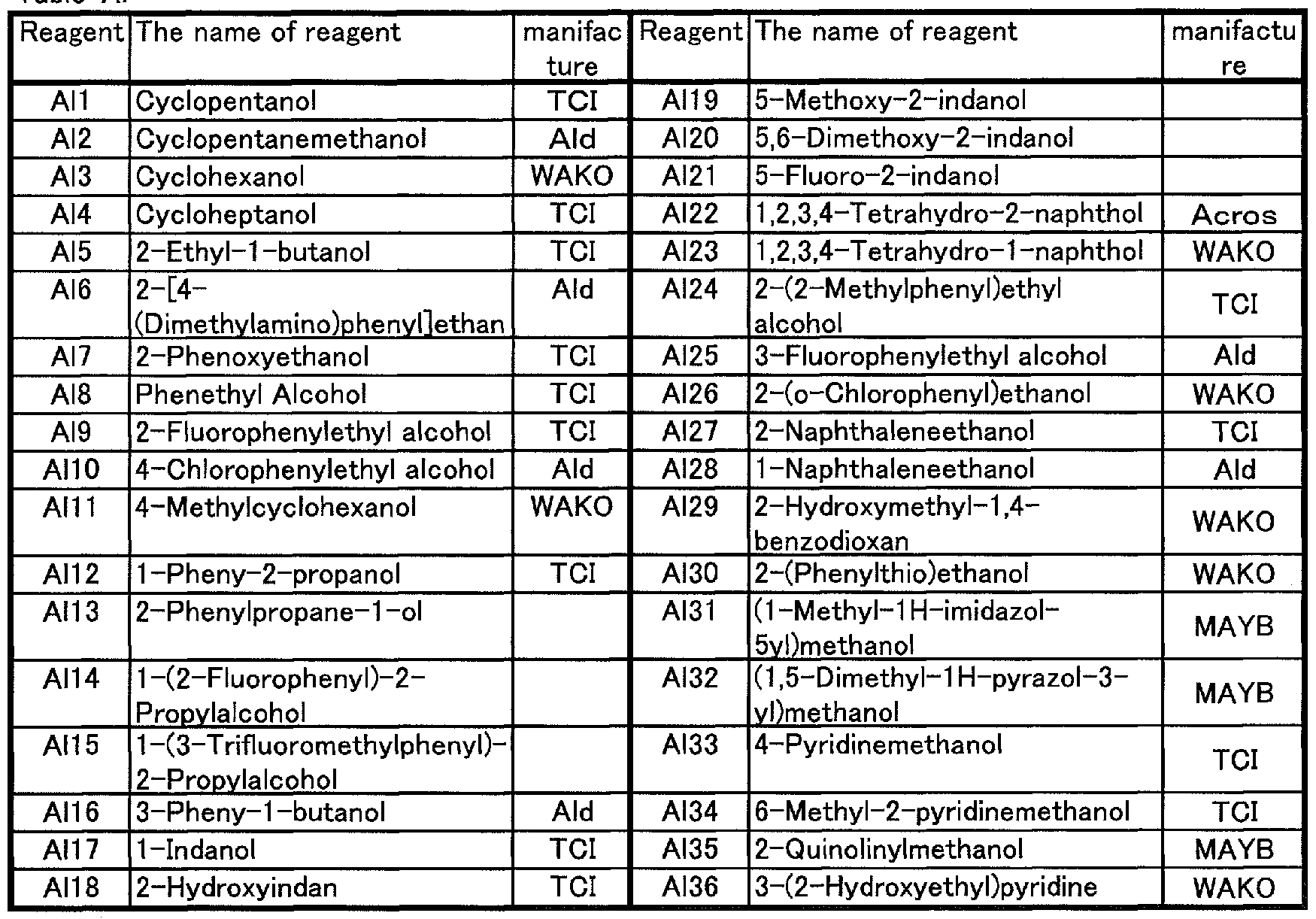


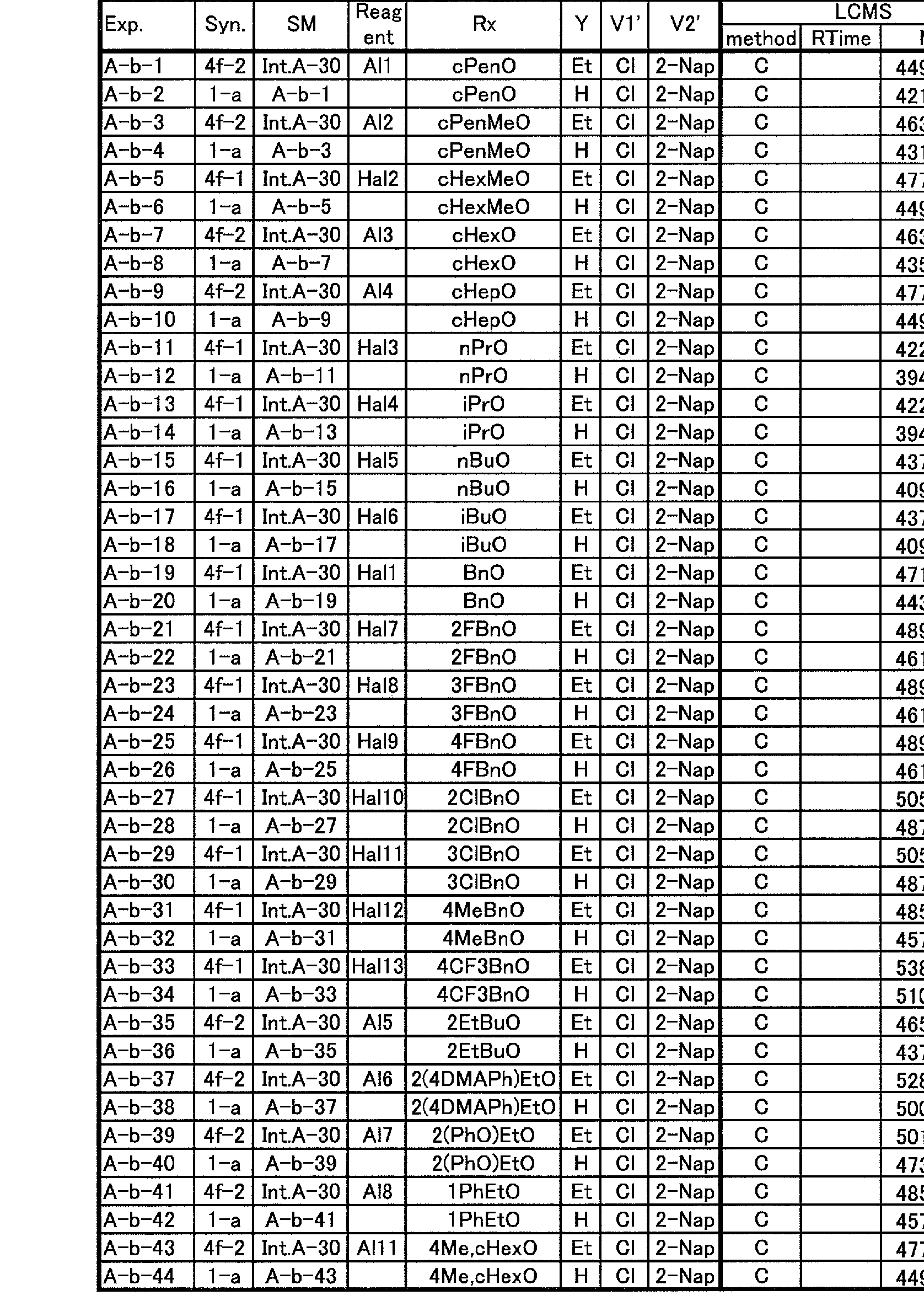


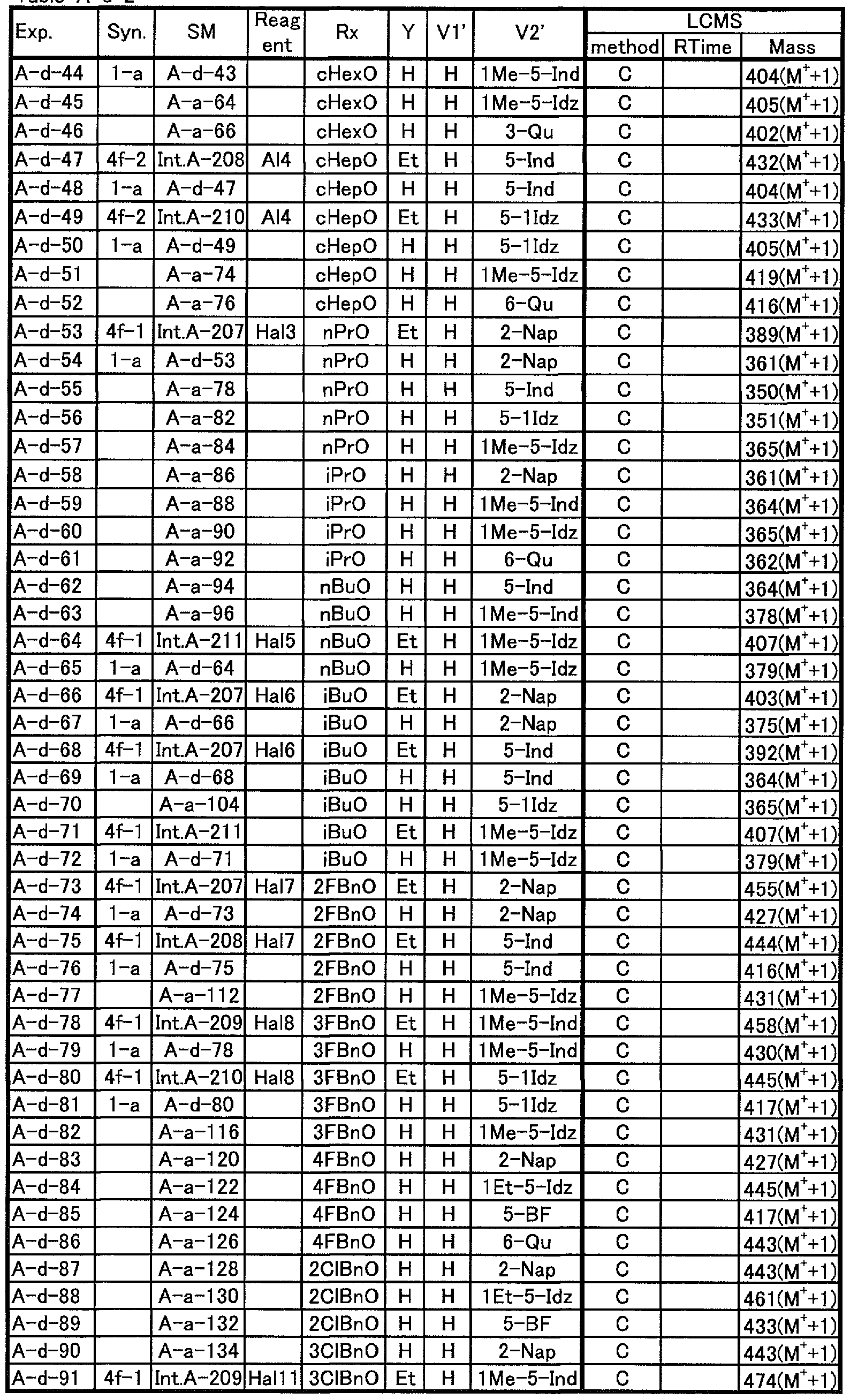


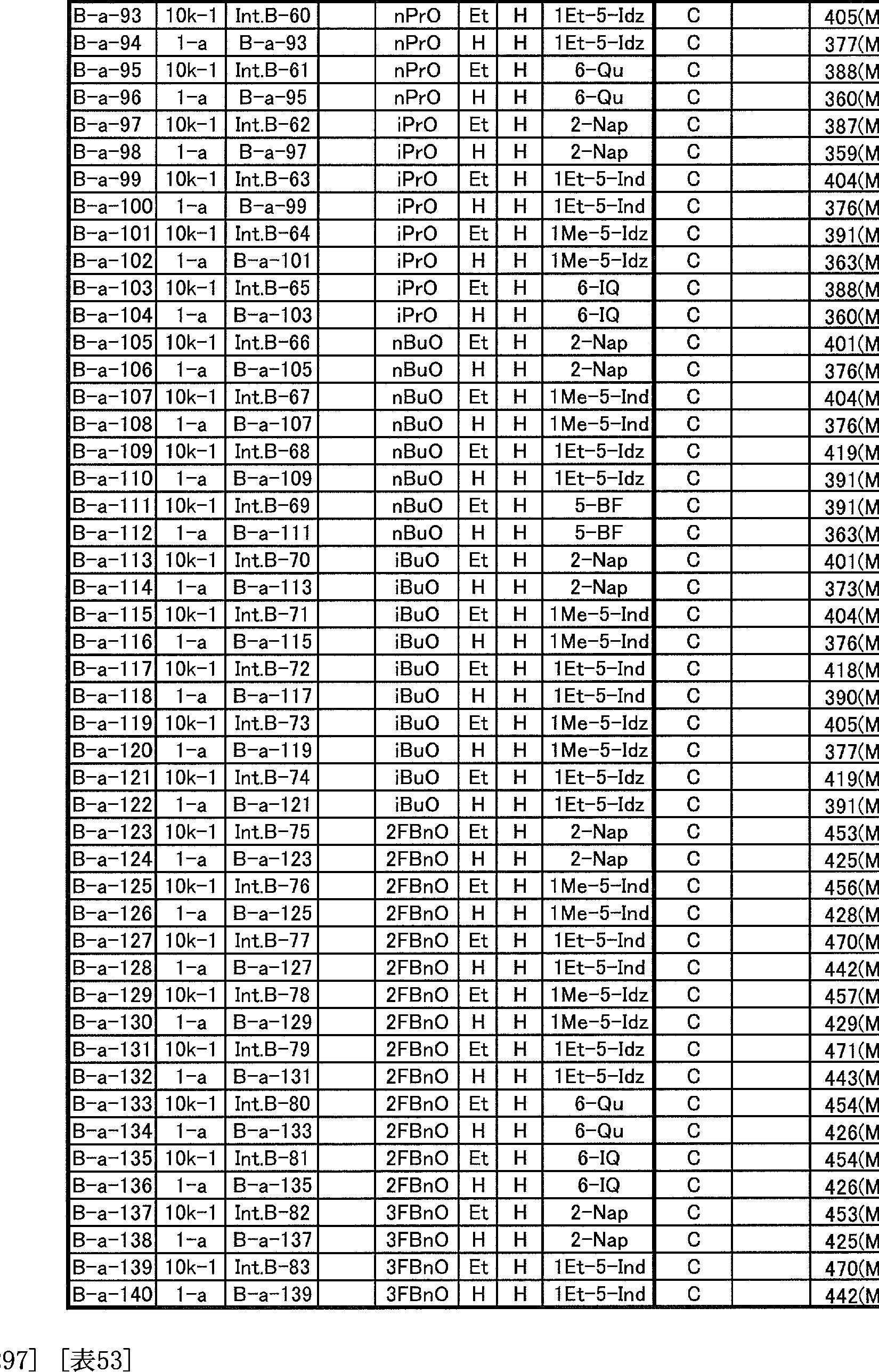


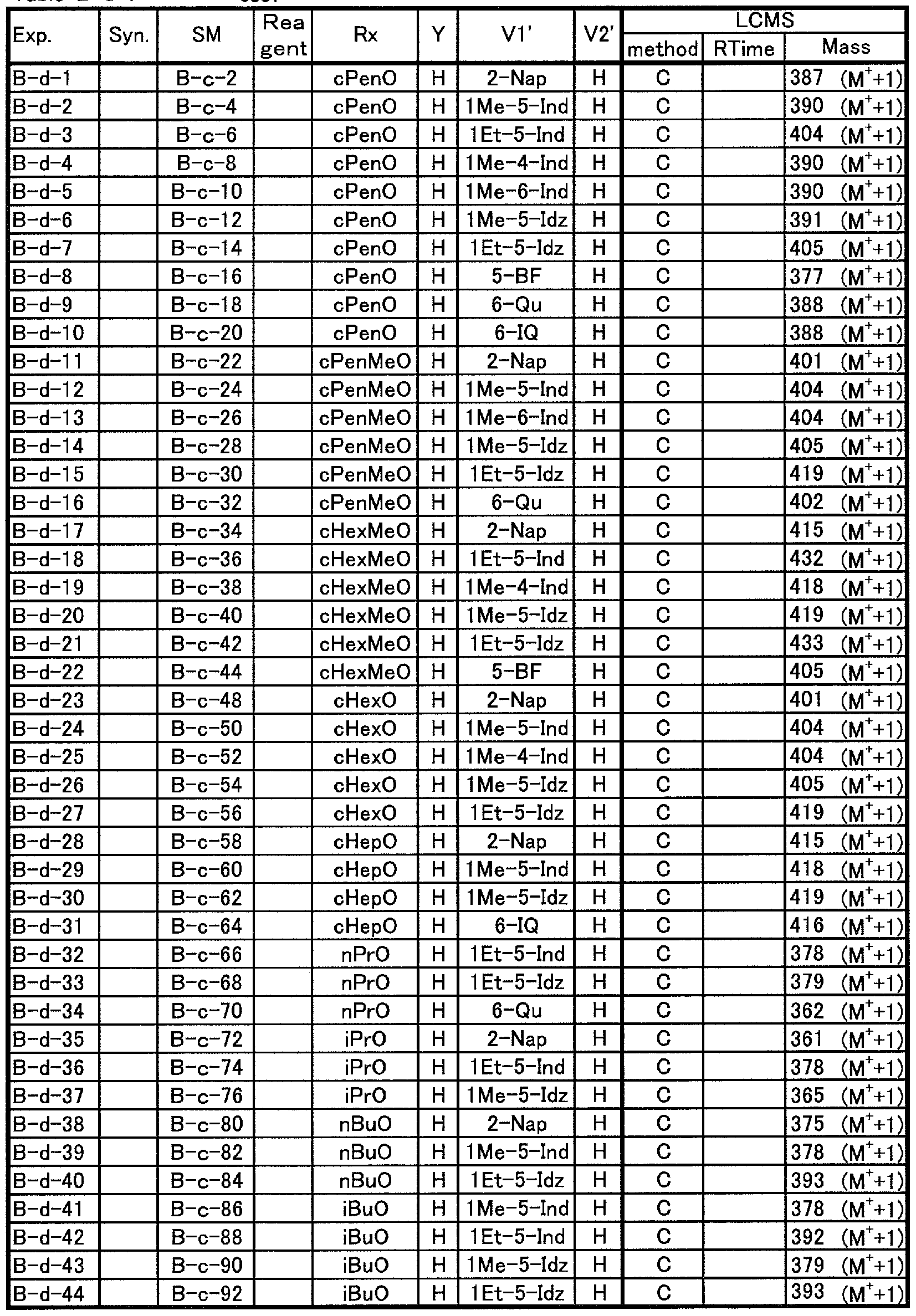
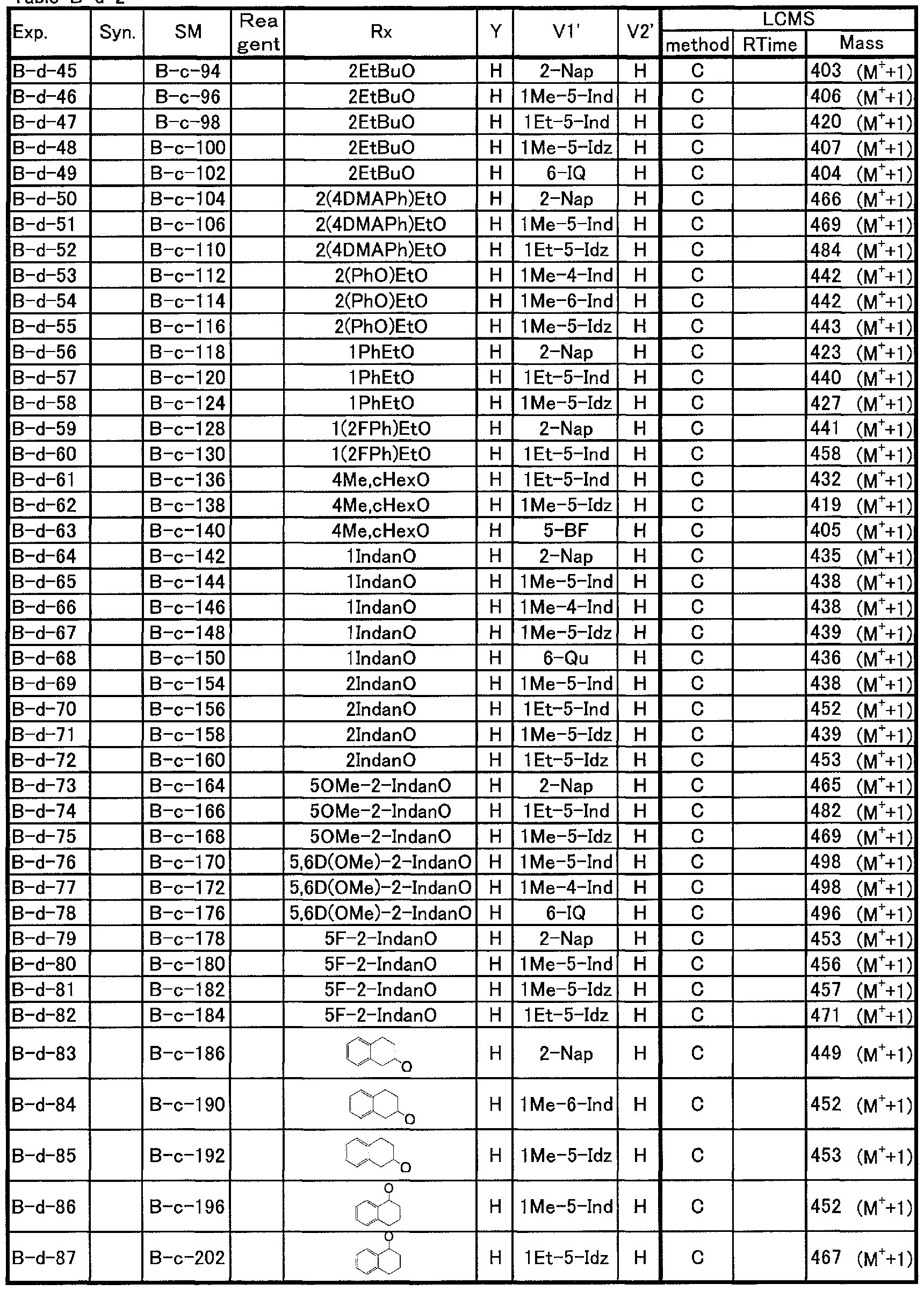


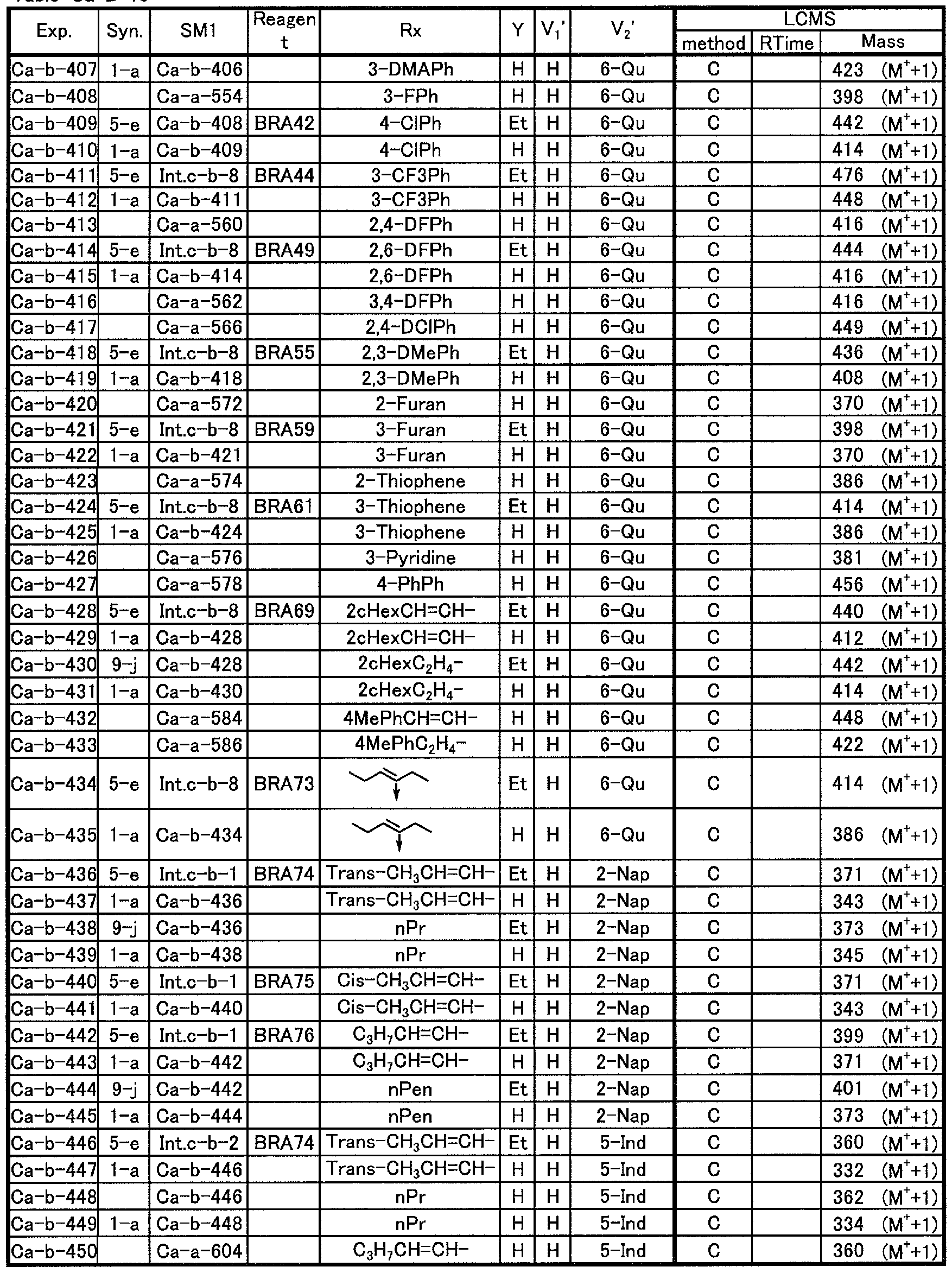


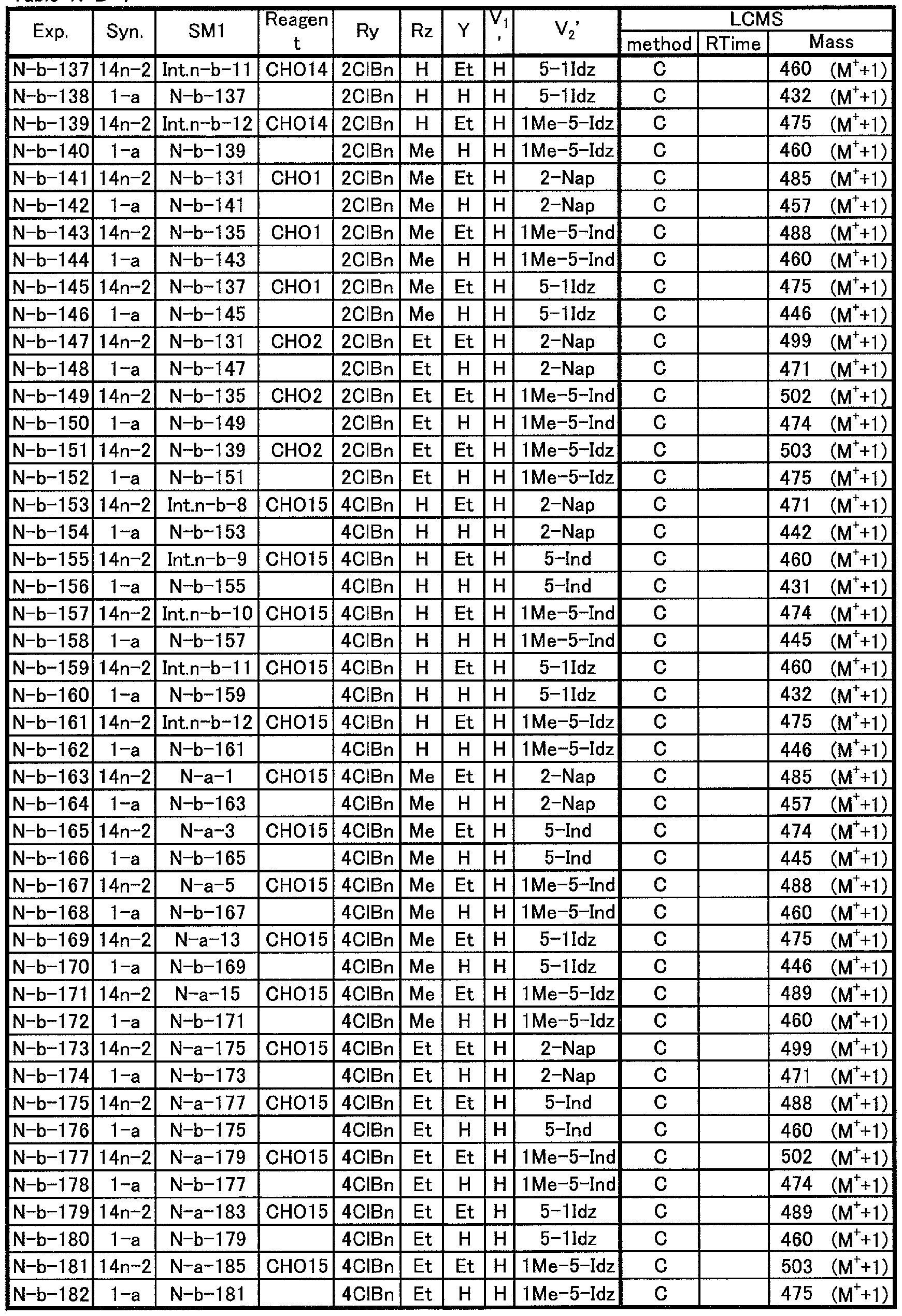


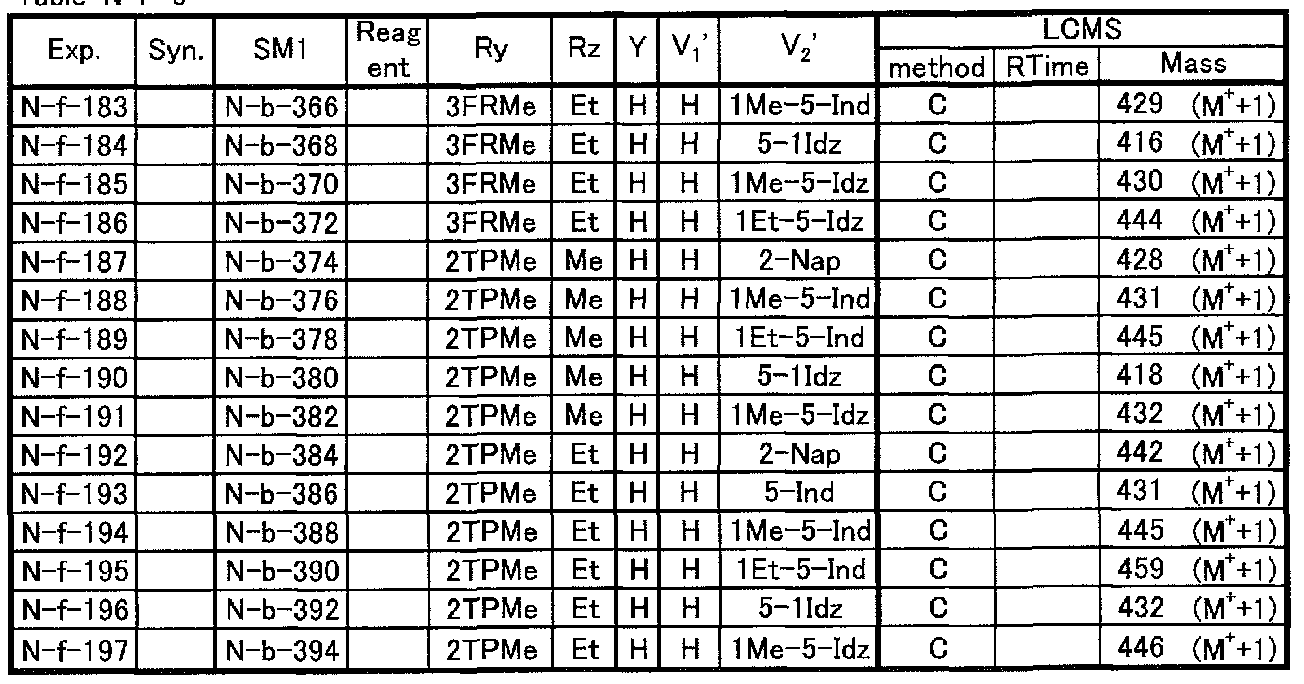


Claims


Priority Applications (5)
| Application Number | Priority Date | Filing Date | Title |
|---|---|---|---|
| JP2008508588A JPWO2007114213A1 (ja) | 2006-03-30 | 2007-03-29 | 置換二環式環状誘導体及びその用途 |
| MX2008012529A MX2008012529A (es) | 2006-03-30 | 2007-03-29 | Derivado biciclico substituido y uso del mismo. |
| EP07740229A EP2006271A4 (en) | 2006-03-30 | 2007-03-29 | SUBSTITUTED BICYCLIC CYCLIC DERIVATIVE AND USE THEREOF |
| AU2007233035A AU2007233035A1 (en) | 2006-03-30 | 2007-03-29 | Substituted bicyclic derivative and use thereof |
| CA002647811A CA2647811A1 (en) | 2006-03-30 | 2007-03-29 | Substituted bicyclic derivative and use thereof |
Applications Claiming Priority (2)
| Application Number | Priority Date | Filing Date | Title |
|---|---|---|---|
| JP2006095008 | 2006-03-30 | ||
| JP2006-095008 | 2006-03-30 |
Publications (1)
| Publication Number | Publication Date |
|---|---|
| WO2007114213A1 true WO2007114213A1 (ja) | 2007-10-11 |
Family
ID=38563482
Family Applications (1)
| Application Number | Title | Priority Date | Filing Date |
|---|---|---|---|
| PCT/JP2007/056791 Ceased WO2007114213A1 (ja) | 2006-03-30 | 2007-03-29 | 置換二環式環状誘導体及びその用途 |
Country Status (9)
| Country | Link |
|---|---|
| US (1) | US20090054401A1 (ja) |
| EP (1) | EP2006271A4 (ja) |
| JP (1) | JPWO2007114213A1 (ja) |
| KR (1) | KR20080103584A (ja) |
| CN (1) | CN101410366A (ja) |
| AU (1) | AU2007233035A1 (ja) |
| CA (1) | CA2647811A1 (ja) |
| MX (1) | MX2008012529A (ja) |
| WO (1) | WO2007114213A1 (ja) |
Cited By (4)
| Publication number | Priority date | Publication date | Assignee | Title |
|---|---|---|---|---|
| JP2012529422A (ja) * | 2009-06-09 | 2012-11-22 | 武田薬品工業株式会社 | 新規な縮合環化合物およびその用途 |
| JP2013544268A (ja) * | 2010-12-01 | 2013-12-12 | ベーリンガー インゲルハイム インターナショナル ゲゼルシャフト ミット ベシュレンクテル ハフツング | インダニルオキシジヒドロベンゾフラニル酢酸 |
| US8889730B2 (en) | 2012-04-10 | 2014-11-18 | Pfizer Inc. | Indole and indazole compounds that activate AMPK |
| US9394285B2 (en) | 2013-03-15 | 2016-07-19 | Pfizer Inc. | Indole and indazole compounds that activate AMPK |
Families Citing this family (11)
| Publication number | Priority date | Publication date | Assignee | Title |
|---|---|---|---|---|
| EP2272832A4 (en) * | 2008-04-28 | 2011-09-07 | Asahi Kasei Pharma Corp | PHENYLPROPIONIC ACID DERIVATIVE AND USE THEREOF |
| US8642585B2 (en) | 2012-03-26 | 2014-02-04 | Boehringer Ingelheim International Gmbh | Indanyloxydihydrobenzofuranylacetic acids |
| US8809376B2 (en) | 2012-04-30 | 2014-08-19 | Boehringer Ingelheim International Gmbh | Indanyloxydihydrobenzofuranylacetic acids |
| JP6283862B2 (ja) | 2012-12-07 | 2018-02-28 | ベーリンガー インゲルハイム インターナショナル ゲゼルシャフト ミット ベシュレンクテル ハフツング | 新規インダニルオキシジヒドロベンゾフラニル酢酸 |
| KR102362143B1 (ko) * | 2014-01-28 | 2022-02-10 | 바이엘 크롭사이언스 악티엔게젤샤프트 | 1-인다놀 및 1-인단아민의 제조방법 |
| US10913720B2 (en) | 2017-01-26 | 2021-02-09 | Boehringer Ingelheim International Gmbh | Benzyloxypyridylcyclopropanecarboxylic acids, pharmaceutical compositions and uses thereof |
| JP7050792B2 (ja) | 2017-01-26 | 2022-04-08 | ベーリンガー インゲルハイム インターナショナル ゲゼルシャフト ミット ベシュレンクテル ハフツング | ベンジルオキシピラジニルシクロプロパンカルボン酸、その医薬組成物及び使用 |
| CN110177773B (zh) | 2017-01-26 | 2023-08-25 | 勃林格殷格翰国际有限公司 | 苄基氨基吡啶基环丙烷羧酸、其药物组合物及其用途 |
| EP3573959B1 (en) | 2017-01-26 | 2021-07-28 | Boehringer Ingelheim International GmbH | Benzylaminopyrazinylcyclopropanecarboxylic acids, pharmaceutical compositions and uses thereof |
| US10550127B1 (en) | 2017-02-08 | 2020-02-04 | Boehringer Ingelheim International Gmbh | Indanylaminoazadihydrobenzofuranylacetic acids, pharmaceutical compositions for the treatment of diabetes |
| KR20250170090A (ko) * | 2023-03-31 | 2025-12-04 | 플렉시스 아이피 홀딩스, 엘엘씨 | 6-아미노퀴놀린 분해 방지제 |
Citations (11)
| Publication number | Priority date | Publication date | Assignee | Title |
|---|---|---|---|---|
| EP0279263A2 (en) | 1987-02-10 | 1988-08-24 | Abbott Laboratories | Indole, benzofuran, benzothiophene containing lipoxygenase inhibiting compounds |
| JPH05502222A (ja) * | 1989-10-27 | 1993-04-22 | アメリカン・ホーム・プロダクツ・コーポレイション | Pla↓2およびリポキシゲナーゼの阻害剤としての置換インドール―、インデン―、ピラノインドール―およびテトラヒドロカルバゾール―アルカン酸誘導体 |
| JPH0722399A (ja) | 1993-06-28 | 1995-01-24 | Kawasaki Steel Corp | 埋込プラグの形成方法およびその装置 |
| US5391817A (en) | 1993-12-21 | 1995-02-21 | Bristol-Myers Squibb | Biaryl phospholipase A2 inhibitors |
| WO1999019291A1 (en) | 1997-10-14 | 1999-04-22 | Asahi Kasei Kogyo Kabushiki Kaisha | Biphenyl-5-alkanoic acid derivatives and use thereof |
| WO2000035886A2 (en) | 1998-12-18 | 2000-06-22 | Axys Pharmaceuticals, Inc. | (hetero)aryl-bicyclic heteroaryl derivatives, their preparation and their use as protease inhibitors |
| WO2003007686A2 (en) | 2001-07-19 | 2003-01-30 | Dmi Biosciences, Inc. | Use of copper chelators to inhibit the inactivation of protein c |
| WO2003011842A1 (en) | 2001-07-27 | 2003-02-13 | Bayer Pharmaceuticals Corporation | Indane acetic acid derivatives and their use as pharmaceutical agents, intermediates, and method of preparation |
| WO2004011446A1 (en) | 2002-07-26 | 2004-02-05 | Bayer Pharmaceuticals Corporation | Indane, dihydrobenzofuran, and tetrahydronaphthalene carboxylic acid derivatives and their use as antidiabetics |
| WO2005016862A1 (en) | 2003-08-14 | 2005-02-24 | Asahi Kasei Pharma Corporation | Substituted arylalkanoic acid derivative and use thereof |
| JP2006095008A (ja) | 2004-09-29 | 2006-04-13 | Gen Tec:Kk | 視線検出方法 |
Family Cites Families (6)
| Publication number | Priority date | Publication date | Assignee | Title |
|---|---|---|---|---|
| CH585687A5 (ja) * | 1972-08-24 | 1977-03-15 | Ciba Geigy Ag | |
| US7217722B2 (en) * | 2000-02-01 | 2007-05-15 | Kirin Beer Kabushiki Kaisha | Nitrogen-containing compounds having kinase inhibitory activity and drugs containing the same |
| JPWO2002100833A1 (ja) * | 2001-06-12 | 2004-09-24 | 住友製薬株式会社 | Rhoキナーゼ阻害剤 |
| WO2003031414A1 (en) * | 2001-10-03 | 2003-04-17 | Nippon Soda Co.,Ltd. | Novel heterocyclic compound and anti-inflammatory agent |
| ITRM20020016A1 (it) * | 2002-01-15 | 2003-07-15 | Sigma Tau Ind Farmaceuti | Derivati di acidi fenil(alchil)carbossilici e derivati fenilalchileterociclici dionici, loro uso come medicamenti ad attivita' ipoglicemizza |
| KR100772297B1 (ko) * | 2002-11-22 | 2007-11-02 | 니뽄 다바코 산교 가부시키가이샤 | 융합 비시클릭 질소-함유 헤테로사이클 |
-
2007
- 2007-03-29 EP EP07740229A patent/EP2006271A4/en not_active Withdrawn
- 2007-03-29 KR KR1020087023463A patent/KR20080103584A/ko not_active Ceased
- 2007-03-29 MX MX2008012529A patent/MX2008012529A/es not_active Application Discontinuation
- 2007-03-29 AU AU2007233035A patent/AU2007233035A1/en not_active Abandoned
- 2007-03-29 WO PCT/JP2007/056791 patent/WO2007114213A1/ja not_active Ceased
- 2007-03-29 CA CA002647811A patent/CA2647811A1/en not_active Abandoned
- 2007-03-29 JP JP2008508588A patent/JPWO2007114213A1/ja not_active Withdrawn
- 2007-03-29 CN CNA200780010705XA patent/CN101410366A/zh active Pending
- 2007-03-30 US US11/729,795 patent/US20090054401A1/en not_active Abandoned
Patent Citations (11)
| Publication number | Priority date | Publication date | Assignee | Title |
|---|---|---|---|---|
| EP0279263A2 (en) | 1987-02-10 | 1988-08-24 | Abbott Laboratories | Indole, benzofuran, benzothiophene containing lipoxygenase inhibiting compounds |
| JPH05502222A (ja) * | 1989-10-27 | 1993-04-22 | アメリカン・ホーム・プロダクツ・コーポレイション | Pla↓2およびリポキシゲナーゼの阻害剤としての置換インドール―、インデン―、ピラノインドール―およびテトラヒドロカルバゾール―アルカン酸誘導体 |
| JPH0722399A (ja) | 1993-06-28 | 1995-01-24 | Kawasaki Steel Corp | 埋込プラグの形成方法およびその装置 |
| US5391817A (en) | 1993-12-21 | 1995-02-21 | Bristol-Myers Squibb | Biaryl phospholipase A2 inhibitors |
| WO1999019291A1 (en) | 1997-10-14 | 1999-04-22 | Asahi Kasei Kogyo Kabushiki Kaisha | Biphenyl-5-alkanoic acid derivatives and use thereof |
| WO2000035886A2 (en) | 1998-12-18 | 2000-06-22 | Axys Pharmaceuticals, Inc. | (hetero)aryl-bicyclic heteroaryl derivatives, their preparation and their use as protease inhibitors |
| WO2003007686A2 (en) | 2001-07-19 | 2003-01-30 | Dmi Biosciences, Inc. | Use of copper chelators to inhibit the inactivation of protein c |
| WO2003011842A1 (en) | 2001-07-27 | 2003-02-13 | Bayer Pharmaceuticals Corporation | Indane acetic acid derivatives and their use as pharmaceutical agents, intermediates, and method of preparation |
| WO2004011446A1 (en) | 2002-07-26 | 2004-02-05 | Bayer Pharmaceuticals Corporation | Indane, dihydrobenzofuran, and tetrahydronaphthalene carboxylic acid derivatives and their use as antidiabetics |
| WO2005016862A1 (en) | 2003-08-14 | 2005-02-24 | Asahi Kasei Pharma Corporation | Substituted arylalkanoic acid derivative and use thereof |
| JP2006095008A (ja) | 2004-09-29 | 2006-04-13 | Gen Tec:Kk | 視線検出方法 |
Non-Patent Citations (54)
| Title |
|---|
| "Jikken Kagaku Koza", vol. 20, MARUZEN CO., LTD., pages: 191 |
| "Jikken Kagaku Koza", vol. 20, MARUZEN CO., LTD., pages: 200 |
| "Jikken Kagaku Koza", vol. 20, MARUZEN CO., LTD., pages: 445 |
| "Jikken Kagaku Koza", vol. 21, MARUZEN CO., LTD., pages: 89 |
| "Jikken Kagaku Koza", vol. 25, MARUZEN CO., LTD., pages: 403 |
| "Jikken Kagaku Koza", vol. 25, MARUZEN CO., LTD., pages: 73 |
| "Jikken Kagaku Koza", vol. 26, MARUZEN CO., LTD., pages: 197 |
| "Shin Jikken Kagaku Koza", vol. 14, MARUZEN CO., LTD., pages: 1002 |
| "Shin Jikken Kagaku Koza", vol. 14, MARUZEN CO., LTD., pages: 1045 |
| "Shin Jikken Kagaku Koza", vol. 14, MARUZEN CO., LTD., pages: 1346 |
| "Shin Jikken Kagaku Koza", vol. 14, MARUZEN CO., LTD., pages: 1385 |
| "Shin Jikken Kagaku Koza", vol. 14, MARUZEN CO., LTD., pages: 1716 |
| "Shin Jikken Kagaku Koza", vol. 14, MARUZEN CO., LTD., pages: 1793 |
| "Shin Jikken Kagaku Koza", vol. 14, MARUZEN CO., LTD., pages: 238 |
| "Shin Jikken Kagaku Koza", vol. 14, MARUZEN CO., LTD., pages: 354 |
| "Shin Jikken Kagaku Koza", vol. 14, MARUZEN CO., LTD., pages: 423 |
| "Shin Jikken Kagaku Koza", vol. 15, MARUZEN CO., LTD., pages: 1088 |
| 0. MITSUNOBU, SYNTHESIS, 1981, pages L |
| BONNET ET AL., PROSTAGLANDINS, vol. 50, 1995, pages 127 |
| BUCHWALD ET AL., JOURNAL OF AMERICAN CHEMICAL SOCIETY, 1994, pages 7901 |
| CHEMICAL REVIEW, vol. 95, 1995, pages 2457 |
| CLARK ET AL., CELL, vol. 65, 1991, pages 1043 |
| CLARK ET AL., PROCEEDING OF NATIONAL ACADEMY OF SCIENCE USA, vol. 87, 1990, pages 7708 |
| CROMBIE ET AL., JOURNAL OF CHEMICAL SOCIETY PERKIN TRANSI, 1982, pages 1477 |
| DALKO ET AL., JOURNAL OF ORGANIC CHEMISTRY, 1998, pages 8107 |
| DREYLING ET AL., BIOCHIM. BIOPHYS. ACTA., vol. 878, 1986, pages 184 |
| FUJII ET AL., JOURNAL OF AMERICAN CHEMICAL SOCIETY, 1996, pages 2521 |
| FUNK, C.D., SCIENCE, vol. 294, 2001, pages 1871 |
| GOODMAN; GILMAN: "Pharmacological Basis of Therapeutics", 1999, pages: 801 |
| GOODMAN; GILMAN: "Pharmacological Basis of Therapeutics", 1999, pages: 827 |
| GRIFFITHS ET AL., J. EXP. MED., vol. 185, 1997, pages 1123 |
| GRONICH ET AL., BIOCHEMICAL JOURNAL, vol. 271, 1990, pages 37 |
| HARTMANN ET AL., JOURNAL OF MEDICINAL CHEMISTRY, 1994, pages 1275 |
| HARTWIG ET AL., JOURNAL OF AMERICAN CHEMICAL SOCIETY, 1994, pages 5969 |
| HASHIGUCHI ET AL., JOURNAL OF AMERICAN CHEMICAL SOCIETY, 1995, pages 7562 |
| HEINZELMANN ET AL., JOURNAL OF AMERICAN CHEMICAL SOCIETY, 1948, pages 1386 |
| HILLIER ET AL., ORGANIC LETTERS, 2004, pages 573 |
| HONG ET AL., CANCER RES., vol. 59, 1999, pages 2223 |
| INGOLD ET AL., JOURNAL OF CHEMICAL SOCIETY, 1923, pages 1508 |
| J. TSUJI, JOURNAL OF ORGANIC SYNTHESIS ASSOCIATION, vol. 59, no. 6, 2001, pages 609 |
| JOHNSON ET AL., JOURNAL OF AMERICAN CHEMICAL SOCIETY, 1944, pages 218 |
| KRAMER ET AL., JOURNAL OF BIOLOGICAL CHEMISTRY, vol. 266, 1991, pages 5268 |
| LIU ET AL., ORGANIC LETTERS, 2004, pages 169 |
| MATSUOKA ET AL., SCIENCE, vol. 287, 2000, pages 2013 |
| MIYAURA, N.; SUZUKI, A., CHEMICAL REVIEW, vol. 95, 1995, pages 2457 |
| NIMITZ ET AL., LIEBIGS OFANNNUAL CHEMISTRY, 1987, pages 765 |
| OHTSUKI ET AL., AM. J. PHYSIOL., vol. 268, 1995, pages 1249 |
| QIAO ET AL., BIOCHIM. BIOPHYS. ACTA, vol. 1258, 1995, pages 215 |
| SATOH, Y., SYNTHESIS, 1994, pages 1146 |
| See also references of EP2006271A4 * |
| SLATER ET AL., JOURNAL OF CHEMICAL SOCIETY, 1920, pages 314 |
| SNIECKUS, V., CHEMICAL REVIEW, vol. 90, 1990, pages 879 |
| SUGAYA ET AL., JPN. J. PHARMACOL., vol. 82, 2000, pages 85 |
| WENZEL ET AL., AM REV. RESPIR. DIS., vol. 142, 1990, pages 112 |
Cited By (4)
| Publication number | Priority date | Publication date | Assignee | Title |
|---|---|---|---|---|
| JP2012529422A (ja) * | 2009-06-09 | 2012-11-22 | 武田薬品工業株式会社 | 新規な縮合環化合物およびその用途 |
| JP2013544268A (ja) * | 2010-12-01 | 2013-12-12 | ベーリンガー インゲルハイム インターナショナル ゲゼルシャフト ミット ベシュレンクテル ハフツング | インダニルオキシジヒドロベンゾフラニル酢酸 |
| US8889730B2 (en) | 2012-04-10 | 2014-11-18 | Pfizer Inc. | Indole and indazole compounds that activate AMPK |
| US9394285B2 (en) | 2013-03-15 | 2016-07-19 | Pfizer Inc. | Indole and indazole compounds that activate AMPK |
Also Published As
| Publication number | Publication date |
|---|---|
| AU2007233035A8 (en) | 2009-01-08 |
| EP2006271A4 (en) | 2011-08-10 |
| CN101410366A (zh) | 2009-04-15 |
| JPWO2007114213A1 (ja) | 2009-08-13 |
| MX2008012529A (es) | 2008-10-14 |
| KR20080103584A (ko) | 2008-11-27 |
| US20090054401A1 (en) | 2009-02-26 |
| EP2006271A9 (en) | 2009-07-29 |
| AU2007233035A1 (en) | 2007-10-11 |
| CA2647811A1 (en) | 2007-10-11 |
| EP2006271A2 (en) | 2008-12-24 |
Similar Documents
| Publication | Publication Date | Title |
|---|---|---|
| WO2007114213A1 (ja) | 置換二環式環状誘導体及びその用途 | |
| KR20060079190A (ko) | 치환 아릴알칸산 유도체 및 그의 용도 | |
| TWI436986B (zh) | 新穎之2環性雜環化合物 | |
| DE69118388T2 (de) | Substituierte bizyklische arylderivate mit selektiver leukotrien b4 antagonistischer wirkung | |
| CN102149384B (zh) | 作为ep4受体拮抗剂的杂环酰胺衍生物 | |
| DE602005002562T2 (de) | Pyrrolylsubstituierte pyridoä2,3-düpyrimidin-7-one und derivate davon als therapeutische mittel | |
| RU2477281C2 (ru) | Азотсодержащие гетероциклические соединения | |
| CN110337433B (zh) | 用于调节sgk活性的化合物和药物组合物及其方法 | |
| KR20160127646A (ko) | 신규의 4-메톡시 피롤 유도체 또는 이의 염 및 이를 포함하는 약학 조성물 | |
| JP2011505367A (ja) | プロリルヒドロキシラーゼ阻害剤 | |
| TW200426144A (en) | GFAT inhibitors | |
| KR20160006207A (ko) | 사이클로알킬산 유도체, 그의 제조 방법, 및 그의 약학적 용도 | |
| WO2020228635A1 (zh) | 一种egfr激酶抑制剂及其在制备抗癌药物方面的应用 | |
| KR20100122512A (ko) | 질소 함유 이환성 복소환 화합물 | |
| EP4037677A1 (en) | Antagonists of the muscarinic acetylcholine receptor m4 | |
| CN116891463A (zh) | 作为at2r激动剂的杂环化合物 | |
| JP4725963B2 (ja) | アリールインデノピリジンおよびアリールインデノピリミジンならびにアデノシンA2a受容体アンタゴニストとしてのそれらの使用 | |
| CN109134463B (zh) | β-咔啉类5型磷酸二酯酶抑制剂及其制备方法和用途 | |
| JP6914974B2 (ja) | 腎疾患、心血管疾患、および線維性障害の治療に有用な二環式イミダゾール誘導体 | |
| JPWO2006129583A1 (ja) | ピラゾロン誘導体 | |
| CN108484574A (zh) | 四氢异喹啉衍生物的制备及应用 | |
| JPWO2006129587A1 (ja) | ピラゾロン誘導体を含有する医薬組成物 | |
| JPWO2019088057A1 (ja) | アニリド誘導体及びその医薬用途 | |
| CN110003033A (zh) | 氟比洛芬查尔酮曼尼希碱类化合物、其制备方法和用途 | |
| WO2025044927A1 (zh) | 一种作为at2r激动剂的噻吩磺酰基氨基甲酸酯及其用途 |
Legal Events
| Date | Code | Title | Description |
|---|---|---|---|
| 121 | Ep: the epo has been informed by wipo that ep was designated in this application |
Ref document number: 07740229 Country of ref document: EP Kind code of ref document: A1 |
|
| WWE | Wipo information: entry into national phase |
Ref document number: 2008508588 Country of ref document: JP Ref document number: 200780010705.X Country of ref document: CN Ref document number: 1020087023463 Country of ref document: KR |
|
| WWE | Wipo information: entry into national phase |
Ref document number: 2647811 Country of ref document: CA |
|
| WWE | Wipo information: entry into national phase |
Ref document number: MX/a/2008/012529 Country of ref document: MX |
|
| NENP | Non-entry into the national phase |
Ref country code: DE |
|
| WWE | Wipo information: entry into national phase |
Ref document number: 2007740229 Country of ref document: EP |
|
| WWE | Wipo information: entry into national phase |
Ref document number: 2007233035 Country of ref document: AU |
|
| ENP | Entry into the national phase |
Ref document number: 2007233035 Country of ref document: AU Date of ref document: 20070329 Kind code of ref document: A |