WO2007132831A1 - 保存安定性に優れたs-アデノシル-l-メチオニン含有乾燥酵母の製造方法、その製造物及び経口摂取用組成物 - Google Patents
保存安定性に優れたs-アデノシル-l-メチオニン含有乾燥酵母の製造方法、その製造物及び経口摂取用組成物 Download PDFInfo
- Publication number
- WO2007132831A1 WO2007132831A1 PCT/JP2007/059917 JP2007059917W WO2007132831A1 WO 2007132831 A1 WO2007132831 A1 WO 2007132831A1 JP 2007059917 W JP2007059917 W JP 2007059917W WO 2007132831 A1 WO2007132831 A1 WO 2007132831A1
- Authority
- WO
- WIPO (PCT)
- Prior art keywords
- yeast
- methionine
- adenosyl
- same
- producing
- Prior art date
- Legal status (The legal status is an assumption and is not a legal conclusion. Google has not performed a legal analysis and makes no representation as to the accuracy of the status listed.)
- Ceased
Links
Classifications
-
- C—CHEMISTRY; METALLURGY
- C12—BIOCHEMISTRY; BEER; SPIRITS; WINE; VINEGAR; MICROBIOLOGY; ENZYMOLOGY; MUTATION OR GENETIC ENGINEERING
- C12N—MICROORGANISMS OR ENZYMES; COMPOSITIONS THEREOF; PROPAGATING, PRESERVING, OR MAINTAINING MICROORGANISMS; MUTATION OR GENETIC ENGINEERING; CULTURE MEDIA
- C12N1/00—Microorganisms; Compositions thereof; Processes of propagating, maintaining or preserving microorganisms or compositions thereof; Processes of preparing or isolating a composition containing a microorganism; Culture media therefor
- C12N1/14—Fungi; Culture media therefor
- C12N1/16—Yeasts; Culture media therefor
- C12N1/18—Baker's yeast; Brewer's yeast
-
- A—HUMAN NECESSITIES
- A61—MEDICAL OR VETERINARY SCIENCE; HYGIENE
- A61K—PREPARATIONS FOR MEDICAL, DENTAL OR TOILETRY PURPOSES
- A61K9/00—Medicinal preparations characterised by special physical form
- A61K9/14—Particulate form, e.g. powders, Processes for size reducing of pure drugs or the resulting products, Pure drug nanoparticles
- A61K9/16—Agglomerates; Granulates; Microbeadlets ; Microspheres; Pellets; Solid products obtained by spray drying, spray freeze drying, spray congealing,(multiple) emulsion solvent evaporation or extraction
- A61K9/1605—Excipients; Inactive ingredients
- A61K9/1617—Organic compounds, e.g. phospholipids, fats
-
- A—HUMAN NECESSITIES
- A61—MEDICAL OR VETERINARY SCIENCE; HYGIENE
- A61K—PREPARATIONS FOR MEDICAL, DENTAL OR TOILETRY PURPOSES
- A61K9/00—Medicinal preparations characterised by special physical form
- A61K9/14—Particulate form, e.g. powders, Processes for size reducing of pure drugs or the resulting products, Pure drug nanoparticles
- A61K9/19—Particulate form, e.g. powders, Processes for size reducing of pure drugs or the resulting products, Pure drug nanoparticles lyophilised, i.e. freeze-dried, solutions or dispersions
-
- A—HUMAN NECESSITIES
- A61—MEDICAL OR VETERINARY SCIENCE; HYGIENE
- A61P—SPECIFIC THERAPEUTIC ACTIVITY OF CHEMICAL COMPOUNDS OR MEDICINAL PREPARATIONS
- A61P25/00—Drugs for disorders of the nervous system
- A61P25/20—Hypnotics; Sedatives
-
- A—HUMAN NECESSITIES
- A61—MEDICAL OR VETERINARY SCIENCE; HYGIENE
- A61P—SPECIFIC THERAPEUTIC ACTIVITY OF CHEMICAL COMPOUNDS OR MEDICINAL PREPARATIONS
- A61P3/00—Drugs for disorders of the metabolism
- A61P3/06—Antihyperlipidemics
-
- A—HUMAN NECESSITIES
- A61—MEDICAL OR VETERINARY SCIENCE; HYGIENE
- A61P—SPECIFIC THERAPEUTIC ACTIVITY OF CHEMICAL COMPOUNDS OR MEDICINAL PREPARATIONS
- A61P43/00—Drugs for specific purposes, not provided for in groups A61P1/00-A61P41/00
-
- A—HUMAN NECESSITIES
- A61—MEDICAL OR VETERINARY SCIENCE; HYGIENE
- A61P—SPECIFIC THERAPEUTIC ACTIVITY OF CHEMICAL COMPOUNDS OR MEDICINAL PREPARATIONS
- A61P9/00—Drugs for disorders of the cardiovascular system
- A61P9/10—Drugs for disorders of the cardiovascular system for treating ischaemic or atherosclerotic diseases, e.g. antianginal drugs, coronary vasodilators, drugs for myocardial infarction, retinopathy, cerebrovascula insufficiency, renal arteriosclerosis
-
- C—CHEMISTRY; METALLURGY
- C07—ORGANIC CHEMISTRY
- C07H—SUGARS; DERIVATIVES THEREOF; NUCLEOSIDES; NUCLEOTIDES; NUCLEIC ACIDS
- C07H19/00—Compounds containing a hetero ring sharing one ring hetero atom with a saccharide radical; Nucleosides; Mononucleotides; Anhydro-derivatives thereof
- C07H19/02—Compounds containing a hetero ring sharing one ring hetero atom with a saccharide radical; Nucleosides; Mononucleotides; Anhydro-derivatives thereof sharing nitrogen
- C07H19/04—Heterocyclic radicals containing only nitrogen atoms as ring hetero atom
- C07H19/16—Purine radicals
- C07H19/167—Purine radicals with ribosyl as the saccharide radical
-
- C—CHEMISTRY; METALLURGY
- C12—BIOCHEMISTRY; BEER; SPIRITS; WINE; VINEGAR; MICROBIOLOGY; ENZYMOLOGY; MUTATION OR GENETIC ENGINEERING
- C12N—MICROORGANISMS OR ENZYMES; COMPOSITIONS THEREOF; PROPAGATING, PRESERVING, OR MAINTAINING MICROORGANISMS; MUTATION OR GENETIC ENGINEERING; CULTURE MEDIA
- C12N1/00—Microorganisms; Compositions thereof; Processes of propagating, maintaining or preserving microorganisms or compositions thereof; Processes of preparing or isolating a composition containing a microorganism; Culture media therefor
- C12N1/04—Preserving or maintaining viable microorganisms
-
- C—CHEMISTRY; METALLURGY
- C12—BIOCHEMISTRY; BEER; SPIRITS; WINE; VINEGAR; MICROBIOLOGY; ENZYMOLOGY; MUTATION OR GENETIC ENGINEERING
- C12P—FERMENTATION OR ENZYME-USING PROCESSES TO SYNTHESISE A DESIRED CHEMICAL COMPOUND OR COMPOSITION OR TO SEPARATE OPTICAL ISOMERS FROM A RACEMIC MIXTURE
- C12P19/00—Preparation of compounds containing saccharide radicals
- C12P19/26—Preparation of nitrogen-containing carbohydrates
- C12P19/28—N-glycosides
- C12P19/38—Nucleosides
- C12P19/40—Nucleosides having a condensed ring system containing a six-membered ring having two nitrogen atoms in the same ring, e.g. purine nucleosides
Definitions
- the present invention uses a method for producing SAMe-containing dry yeast having excellent storage stability using a yeast having the ability to produce S-adenosyl-L-methionine (hereinafter referred to as SAMe), and a method for producing the same.
- SAMe S-adenosyl-L-methionine
- ascorbic acid or a salt thereof is added to a yeast cell concentrate obtained from a yeast cell culture solution.
- the concentrate is dried, a method for producing a dry yeast containing S adenosyl-L-methionine excellent in storage stability, a SAMe-containing dry yeast obtained by the production method, and the The present invention relates to a composition for oral consumption molded using SAMe-containing dry yeast.
- SAMe is a water-soluble bioactive substance that plays an important role as a methyl group donor in methylation reactions by various transmethylases in vivo, and is found in almost all cells of the human body. It acts as a cofactor in various biochemical reactions and is, for example, a substance indispensable for the maintenance of soft bones and the biosynthesis of substances in the brain.
- SAMe functional studies have also reported on therapeutic effects on fatty liver, hyperlipidemia, arteriosclerosis, insomnia, and the like.
- SAMe is an important physiologically active substance and is widely used in Western countries as a therapeutic agent for depression, liver disease, arthritis, etc., or as a health food.
- SAMe synthase methionine adenosyltransferase isolated and purified from microorganisms such as yeast is used, and adenosine 5'-triphosphate (ATP) is used and SAMe is enzymatically used as a substrate.
- ATP adenosine 5'-triphosphate
- the SAMe composition obtained by the above-described production method is purified by chromatography or the like, and then converted into a salt with sulfuric acid, p-toluenesulfonic acid, or butanedisulfonic acid, and the like.
- a method that powers stability is common (see, for example, Patent Documents 1 to 3, 6 to 10), and requires a lot of labor and cost, so it has excellent storage stability, which is important as a therapeutic drug and health food. It was extremely difficult to manufacture and provide SAMe at low cost.
- Patent Document 1 Japanese Patent Publication No. 21478
- Patent Document 2 Japanese Patent Publication No. 6-30607
- Patent Document 3 European Patent No. 1091001 Specification
- Patent Document 4 Japanese Patent Laid-Open No. 61-227792
- Patent Document 5 US Patent No. 6881837
- Patent Document 6 Japanese Patent Laid-Open No. 59-51213
- Patent Document 7 Japanese Patent Laid-Open No. 52-48691
- Patent Document 8 Japanese Patent Publication No. 1-49274
- Patent Document 9 Japanese Patent Publication No. 1-49275
- Patent Document 10 Japanese Patent Publication No. 3-501970
- Non-Patent Document 1 Schlenk F., DePalma RE, J. Biol. Chem., 229, 1037-1050 (1957)
- Non-Patent Document 2 Shiozaki S., et all, Agric. Biol. Chem., 48, 2293 2300 (1984)
- Non-Patent Document 3 Shiozaki S., et all. Agric. Biol. Chem., 53, 3269-3274 (1989)
- Non-Patent Document 4 Kusakabe, H., Kuninaka, A., Yoshino, H., Agric. Biol. Chem., 38, 1669-1
- Non-Patent Document 5 Mudd SH., Cantoni GL., Et all, J. Biol. Chem., 231, 481- 492 (1958)
- Non-Patent Document 6 Shiozaki S., et all, J. Biotechnology., 4, 345- 354 (1986)
- Non-Patent Document 7 Thomas D., Surdin-Kerjan Y., J. Biol. Chem., 262, 16704-16709 (1987)
- Non-Patent Document 8 Markham GD, et all J. Biol. Chem., 255, 9082 9092 (1980)
- Non-Patent Document 9 Markham DJ., DeParisis J., J. Biol. Chem., 259, 14505-14507 (1984)
- Non-Patent Document 10 Thomas D., Cherest H., et all, Mol. Cell. Biol. , 8, 5132-5139 (1988)
- Non-Patent Document 11 Jeongho Parkjunzhe Tai, Charles A. Roessner and A. Ian Scott., Bioorganic & Medical Chemistry, Vol. 4, No. l2, 2179-2185 (1996)
- Non-Patent Document 12 Jose R. Mator, Frank M. Raushel, Cni-Huey Wong., Biotechnology and Applied Biochemistry., 9,39-52 (1987)
- the object of the present invention was to establish a method by which SAMe-containing dry yeast containing SAMe at a high concentration and excellent in storage stability can be produced at low cost and obtained by the production method.
- An object of the present invention is to provide a SAMe-containing dry yeast and a composition for oral consumption molded using the dry yeast.
- the inventors of the present invention have eagerly devised a method for economically producing a composition having excellent performance and capable of being stored in a stable state for a long period of time.
- SAMe was produced and accumulated at a high concentration in the cells using yeast that has SAMe-producing ability and can be taken orally, and then the yeast cells were separated from the culture solution by a separation means such as centrifugation. After adding ascorbic acid or a salt thereof to the obtained yeast cell concentrate, it is dried so that it contains the desired SAMe in a high concentration and is safe for storage.
- the inventors have found that SAMe-containing dry yeast having excellent qualities can be easily produced in good yield, and have completed the present invention.
- the present invention provides the following methods (1) to (8) for producing a dry yeast containing SAMe excellent in storage stability at a high concentration, the SAMe-containing dry yeast obtained by the production method, and the The present invention relates to a composition for ingestion molded using dry yeast.
- a method for producing a dry yeast containing S-adenosyl-L-methionine was applied to a yeast cell concentrate isolated from a yeast cell culture solution.
- the amount of ascorbic acid or a salt thereof added is in the range of 0.05 to 5 times mol with respect to S-adenosyl-L-methionine contained in the yeast cell concentrate, The method for producing S-adenosyl-L-methionine-containing dry yeast according to (1).
- FIG. 1 Sodium L-ascorbate against SAMe in yeast cell concentrate in a storage stability test in a sealed glass container under accelerated conditions of 40 ° C and RH (relative humidity) 75% Relationship between added amount (molar ratio) and SAMe residual rate in dry yeast cells.
- the type of yeast used in the present invention is not particularly limited as long as it has SAMe-producing ability and can be taken orally.
- Preferred examples thereof include yeast belonging to the genus Saccharomyces. Of these, yeasts belonging to Saccharomyces cerevisiae, for example, fermentation yeasts such as sake yeast, baker's yeast, brewer's yeast, wine yeast, etc. are more preferred, and among these, sake yeast is even more preferred.
- yeast cells 5'-nucleotides, free amino acids, daltathion, which has an antioxidative effect and helps improve liver function, ⁇ -glucan and dietary fiber, which have an enhanced immune function and an intestinal function, are useful. It contains many ingredients and is widely used as a health food.
- the carbon source used for culturing the yeast is not particularly limited as long as the yeast can assimilate, for example, carbohydrates such as glucose, sucrose, starch, and molasses, alcohols such as ethanol, or acetic acid.
- Organic acids such as
- the nitrogen source is not particularly limited as long as it can be assimilated by the yeast to be used, for example, containing an inorganic nitrogen compound such as ammonia, nitric acid, urea, or an organic nitrogen compound such as yeast extract or malt extract.
- inorganic salts include phosphoric acid, potassium, sodium, magnesium, calcium
- a salt of iron, zinc, manganese, cobalt, copper, molybdenum or the like is used. Furthermore, it can be cultured with methionine, Ryozanin, and adenosylribonucleoside, which are strong in the skeleton structure of SAM e.
- the culture temperature and the pH of the culture solution vary depending on the type of yeast used, the culture temperature should be in the range of 20 to 35 ° C, and the culture solution pH should be in the range of pH 4 to 7. Is possible.
- the culture tank is not particularly limited as long as it can be ventilated and can be stirred if necessary.
- a mechanical stirring culture tank, an air lift type culture tank, a bubble tower type culture tank, or the like can be used.
- the method of supplying the culture components such as the carbon source, nitrogen source, various inorganic salts, and various additives to the medium is carried out collectively or individually continuously or intermittently.
- a substrate such as sucrose or ethanol may be supplied to the culture tank as a mixture with other medium components, or may be supplied to the culture tank independently of the other medium components.
- the pH control of the culture solution is performed with acid and alkali solutions.
- the alkali it is desirable to control the pH using ammonia, urea, or a non-nitrogen base used as a nitrogen source, such as caustic soda or caustic potash.
- the acid an inorganic acid such as phosphoric acid, sulfuric acid, nitric acid, or an organic acid is used.
- inorganic salts such as phosphate, potassium salt, sodium salt and nitrate.
- the culture solution is extracted from the culture tank, and then separated to obtain a yeast cell concentrate.
- the separation method is not particularly limited as long as it can efficiently separate and wash the cells, but a suitable example is an ultrafiltration device using a countercurrent type yeast separator or a separation membrane. It is done.
- ascorbic acid or a salt thereof is added to the isolated yeast cell concentrate. This increases the storage stability of SAMe in the dry yeast and can also improve the yield in the yeast drying process.
- Ascorbic acid or a salt thereof used in the present invention includes ascorbic acid or a salt thereof, or an ascorbic acid derivative or a salt thereof.
- ascorbic acid or a salt thereof examples include L-ascorbic acid, alkali metal salts such as sodium L-ascorbate and potassium L-ascorbate, and alkaline earth metal salts such as calcium L-ascorbate.
- Ascorbic acid derivatives or salts thereof include ascorbic acid 2-darcoside, ascorbic acid phosphate ester, ascorbyl palmitate ester, ascorbic acid stearate or a salt thereof. Among them, preferred is ascorbic acid or a salt thereof, more preferred is -ascorbic acid or sodium L-ascorbate, and particularly preferred is sodium -ascorbate.
- Ascorbic acids or salts thereof are in the form of powder, granules, Or it is widely used in pharmaceutical and food applications in crystalline form and can be used safely.
- the amount of ascorbic acid or salt thereof added is such that the molar ratio of ascorbic acid or salt added to the SA Me contained in the yeast cell concentrate is 0.05 to 5 times mol. An amount in the range is preferred. An amount in the range of 0.1 to 3.5 moles is more preferred. If it is less than 0. 05 times mole, the storage stability of SAMe in dry yeast may be insufficient, and if it exceeds 5 times mole, the storage stability of SAMe in dry yeast will be increased. It shows a tendency to decrease dependently. Further, as the amount of sodium L-ascorbate added, it is more preferable that the molar ratio with respect to SAMe contained in the yeast cell concentrate is in the range of 0.1 to 3.0 times mol.
- an amount in the range of 2 to 1.0 mole is particularly preferred. Further, as the amount of L-ascorbic acid added, the amount in which the above molar ratio is in the range of 1.8 to 3.1 times the mole is particularly preferred. Particularly preferred is an amount in which the molar ratio is in the range of 0.3 to 1.9 moles. As the amount of potassium L-ascorbate added, the molar ratio is 1.5 to 3.5 moles. An amount in the range is particularly preferred.
- SAMe-containing dry yeast can be stably stored for a long period of time by adding a combination of sulfuric acid and ascorbic acid or a salt thereof to the yeast cell concentrate isolated from the cell culture solution described above. be able to.
- the addition amount of sulfuric acid at which the pH of the yeast cell concentrate separated from the cell culture solution described above becomes 2 to 4 the addition amount of sulfuric acid at which the pH of the yeast cell concentrate separated from the cell culture solution described above becomes 2 to 4
- the combination of the amount of ascorbic acid or salt thereof in the range of 0.5 to 3.0 moles as the molar ratio of ascorbic acid or salt thereof to SAMe contained in the yeast cell concentrate is preferred.
- the combination of the amount of sulfuric acid added so that the pH is 2 to 3 and the amount of ascorbic acid or its salt added in the range of 1.0 to 2.0 moles as the molar ratio is more preferable.
- a combination of the amount of sulfuric acid added to 2 to 3 and the amount of added ascorbic acid or salt thereof in the range of 1.0 to 1.7 times the molar ratio is more preferred.
- the yeast cell concentrate is evaporated to dry yeast by a drying method such as spray drying or freeze drying using a spray dryer. Eggplant.
- a drying method such as spray drying or freeze drying using a spray dryer. Eggplant.
- the inlet temperature is 210. It is desirable to dry at an outlet temperature of 110 ° C or less. In freeze-drying, it is desirable to dry at a final shelf temperature of 30 ° C or less. From the viewpoint of storage stability, it is desirable that the SAMe-containing composition for oral consumption of the present invention has a water content of 5.0% by mass or less.
- the dried yeast is crushed into a powder form, or, if necessary, additives such as other physiologically active ingredients and excipients are added to the powdered dry yeast and then compressed into tablets. It can be made into a tablet-like composition for oral consumption, and the surface thereof can be coated. It is also possible to granulate the powder into condylar particles, or to pack and encapsulate the powder or granulated granules.
- Non-patent Document 1 Known culture methods described above (Schlenk F., DePalma REJ Biol. Chem., 229, 1037-1050 (1957) (Non-patent Document 1), Shiozaki S., et all, Agric. Biol. Chem., 53, 3269-3274 (1989) (Non-Patent Document 3)), the medium containing L-methionine (Shiozaki S., et all, J. Biotechnology, 4, 345-354 (1986) (Non-Patent Document 6)) Yeast Saccharomyces cerevisiae IF02346 belonging to the plant was inoculated and cultured at a culture temperature of 27 to 29 ° C. for 6 days with aerobic aeration and aeration without stirring. As a result, a bacterial cell concentration of 3.5% by mass and an SAMe content of 205 mg / g dry yeast were obtained.
- the above yeast cell culture solution 18L was processed with a continuous rotary centrifuge (Hitachi HIMAC CEN TRIFUGE CR10B2), and the yeast concentration in a liquid state corresponding to 18% by mass in terms of dry matter 3. 49kg Got.
- the above yeast cell concentrate 3. 49 kg of sodium L-corcorbate with respect to SAMe in the yeast concentrate 0.05, 0.1, 0.2, 0.6, 1.0, 3.0, 5.0 or 6.0-fold mol, yeast cells with stirring and dissolution at room temperature for 30 minutes and sodium L-ascorbate added A concentrate was obtained.
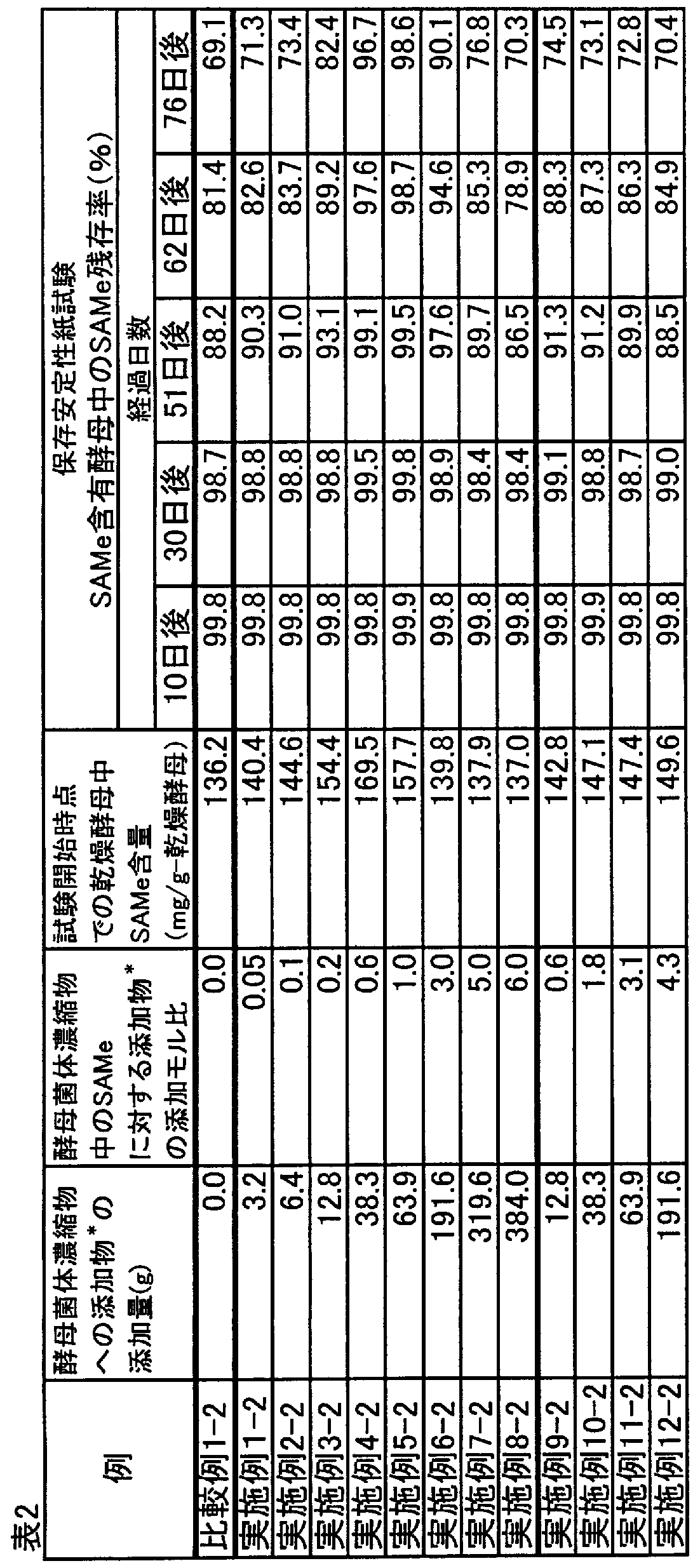
- the yeast cell concentrate containing the above-mentioned sodium L ascorbate was poured into a freeze-drying stainless steel tray in a freeze dryer (Nihon Vacuum Technology Co., Ltd.), frozen at 50 ° C, and then the final shelf temperature 25 ° C. It was freeze-dried for 36 hours under the conditions of C. The obtained freeze-dried yeast was further pulverized to obtain powder-dried yeast. The powder dried yeast thus obtained was packed in a closed glass container and subjected to a storage stability test under accelerated conditions of 40 ° C, RH75%, and 30 ° C. Table 1 (Examples 1 to 8-1) and Fig. 1 show the results at 40 ° C and RH 75%. Table 2 (Examples 1 to 2 to 8-2) and Fig. 2 show the results at 30 ° C. Results are shown. Tables 1 and 2 show the SAMe content in the obtained dry powder yeast.
- the SAMe residual ratio was determined by extracting SAMe from a SAMe-containing dry yeast by a known method using perchloric acid (for example, Non-Patent Document 2) and quantifying it by liquid chromatography. The following analysis conditions were used for liquid chromatography.
- the yeast cell concentrate was treated in the same manner as in Example 1 except that L-ascorbic acid was added in a molar amount of 0.6, 1.8, 3.1, or 4.3 to SAMe in the yeast concentrate.
- a powder dry fermentation mother was obtained.
- the results of the storage stability test of the obtained SAMe-containing dry yeast in a sealed glass container under accelerated conditions of 40 ° C and RH75% are shown in Table 1 (Examples 9 to 12-1).
- the results of the storage stability test under the temperature conditions are shown in Table 2 (Examples 9 to 12-2).
- Tables 1 and 2 show the SAMe content in the obtained dry powder yeast.
- Example 1 except that calcium ascorbate was added to the yeast cell concentrate at 0.3, 0.8, 1.4, 1.9, or 2.5 times the molar amount of SAMe in the yeast concentrate. The same treatment was performed to obtain dry powder yeast. SAMe content in the obtained dry powder yeast and storage stability of the obtained dry powder yeast in a sealed glass container under accelerated conditions of 40 ° C and RH75% The test results are shown in Table 1 (Examples 13-1 to 17-1).
- Example 1 except that potassium L-ascorbate was added to the yeast cell concentrate in an amount of 0.5, 1.5, 2.5, 3.5, or 4.5 equivalents relative to SAMe in the yeast concentrate. The same treatment was performed to obtain powdered dry yeast. Table 1 shows the results of the storage stability test under accelerated conditions of 40 ° C and RH 75% in a sealed glass container of the obtained powder dry yeast and the SAMe content in the obtained powder dry yeast. It is shown in 18-1 to 22-1).
- This yeast cell is spray-dried using a spray dryer with a two-fluid nozzle as a micronizer, under the conditions of a drying chamber inlet temperature of 145 ° C, outlet temperature of 85 ° C, and liquid flow rate of 1.5 gZ.
- a powdered dry yeast was obtained.
- Table 3 shows the SAMe content of the obtained powdered dry yeast and the results of the storage stability test of the obtained SAMe-containing dry yeast in a sealed glass container under accelerated conditions of 40 ° C and RH75%. 23—1, 24- 1).
- Powdered dry yeast was obtained in the same manner as in Example 1 except that ascorbic acid or a salt thereof was not added to the yeast cell concentrate.
- Tables 1 and 2 show the SAMe content in the obtained dry powder yeast.
- Table 1 (Comparative Example 11) and FIG. 1 show the results of the storage stability test of the obtained SAMe-containing dry yeast in a sealed glass container under accelerated conditions of 40 ° C. and RH 75%. The results of the storage stability test under the temperature condition of 30 ° C are shown in Table 2 (Comparative Example 12) and Fig. 2.
- Powdered dry yeast was obtained by treating the yeast cell concentrate in the same manner as in Example 1 except that 2.8 equivalents of cenoic acid was added to the SAMe molar ratio in the yeast concentrate.
- SAME content in the obtained powder dry yeast, and in a sealed glass container of the obtained SAMe-containing dry yeast Table 1 shows the results of storage stability tests under accelerated conditions of -40 ° C and RH75%.
- Powdered dry yeast was obtained by treating in the same manner as in Example 1 except that EDTA was added to the yeast cell concentrate in an amount of 1.9 equivalents relative to the SAMe molar ratio in the yeast concentrate.
- Table 1 shows the results of the storage stability test under accelerated conditions of 40 ° C and RH75% in a sealed glass container of the obtained SAMe-containing dry yeast. It is shown in 3-1.
- Example 1 In the operation of (c), sulfuric acid was added to the yeast cell concentrate obtained in (b) so that the pH was 2, 3, or 4, and then sodium L-ascorbate was added to the yeast concentrate. Powdered yeast was obtained in the same manner as in Example 1 except that 0.6, 1. 0, 1. 7, 2. 8 or 3.9 times the molar amount of SA Me was added. Table 4 shows the results of the storage stability test under accelerated conditions of 40 ° C and RH 75% in a sealed glass container of the obtained powder dry yeast and the SAMe content in the obtained powder dry yeast. — 1-35 ⁇ : Shown in L).
- Table 1 Storage stability test results of SAMe-containing dry yeast in a closed glass container under accelerated conditions of 40 ° C and RH75%.
- Example 1 1 8-1 is supplemented with sodium L-ascorbate (drying method is freeze-dried) * Example 9 1 12-1 is supplemented with L-ascorbic acid (drying method is freeze-dried) * Example 13— 1 17— 1 is supplemented with calcium calcium calcium ascorbate (freeze-drying method)
- Example 1-2 ⁇ 8-2 added sodium L-ascorbate (drying method was freeze-dried)
- Example 9 2 ⁇ 12-2 was added L-ascorbic acid (drying method was freeze-dried) )
- Example 5-1 is supplemented with sodium L-ascorbate (drying method is freeze-dried) * Examples 9 and 10-1 are supplemented with L-ascorbic acid (drying method is freeze-dried) * Example 23-1 is supplemented with sodium L-ascorbate (drying method is spray dried) * Example 24-1 is supplemented with L-ascorbic acid (dry method is spray dried)
Landscapes
- Health & Medical Sciences (AREA)
- Life Sciences & Earth Sciences (AREA)
- Chemical & Material Sciences (AREA)
- Engineering & Computer Science (AREA)
- Organic Chemistry (AREA)
- Bioinformatics & Cheminformatics (AREA)
- General Health & Medical Sciences (AREA)
- Biotechnology (AREA)
- Genetics & Genomics (AREA)
- Zoology (AREA)
- Wood Science & Technology (AREA)
- Medicinal Chemistry (AREA)
- Biochemistry (AREA)
- Veterinary Medicine (AREA)
- Animal Behavior & Ethology (AREA)
- Public Health (AREA)
- Pharmacology & Pharmacy (AREA)
- Molecular Biology (AREA)
- Mycology (AREA)
- General Engineering & Computer Science (AREA)
- Microbiology (AREA)
- General Chemical & Material Sciences (AREA)
- Chemical Kinetics & Catalysis (AREA)
- Biomedical Technology (AREA)
- Epidemiology (AREA)
- Tropical Medicine & Parasitology (AREA)
- Virology (AREA)
- Nuclear Medicine, Radiotherapy & Molecular Imaging (AREA)
- Biophysics (AREA)
- Botany (AREA)
- Hematology (AREA)
- Anesthesiology (AREA)
- Vascular Medicine (AREA)
- Heart & Thoracic Surgery (AREA)
- Urology & Nephrology (AREA)
- Diabetes (AREA)
- Obesity (AREA)
- Cardiology (AREA)
- Neurology (AREA)
- Neurosurgery (AREA)
Abstract
Description




Claims
Priority Applications (4)
| Application Number | Priority Date | Filing Date | Title |
|---|---|---|---|
| JP2008515554A JP5136409B2 (ja) | 2006-05-16 | 2007-05-15 | 保存安定性に優れたs−アデノシル−l−メチオニン含有乾燥酵母の製造方法、その製造物及び経口摂取用組成物 |
| CN2007800162146A CN101437935B (zh) | 2006-05-16 | 2007-05-15 | 储存稳定性优良的含s-腺苷-l-甲硫氨酸的干燥酵母的制备方法及其产品以及口服用组合物 |
| US12/300,826 US9080158B2 (en) | 2006-05-16 | 2007-05-15 | Method of producing S-adenosyl-L-methionine-containing dry yeast having excellent storage stability, the product thereof and composition for oral intake |
| EP07743352.2A EP2017331B1 (en) | 2006-05-16 | 2007-05-15 | Method of producing s-adenosyl-l-methionine-containing dry yeast having excellent storage stability |
Applications Claiming Priority (2)
| Application Number | Priority Date | Filing Date | Title |
|---|---|---|---|
| JP2006135957 | 2006-05-16 | ||
| JP2006-135957 | 2006-05-16 |
Publications (1)
| Publication Number | Publication Date |
|---|---|
| WO2007132831A1 true WO2007132831A1 (ja) | 2007-11-22 |
Family
ID=38693921
Family Applications (1)
| Application Number | Title | Priority Date | Filing Date |
|---|---|---|---|
| PCT/JP2007/059917 Ceased WO2007132831A1 (ja) | 2006-05-16 | 2007-05-15 | 保存安定性に優れたs-アデノシル-l-メチオニン含有乾燥酵母の製造方法、その製造物及び経口摂取用組成物 |
Country Status (6)
| Country | Link |
|---|---|
| US (1) | US9080158B2 (ja) |
| EP (1) | EP2017331B1 (ja) |
| JP (1) | JP5136409B2 (ja) |
| CN (1) | CN101437935B (ja) |
| TW (1) | TW200813217A (ja) |
| WO (1) | WO2007132831A1 (ja) |
Cited By (2)
| Publication number | Priority date | Publication date | Assignee | Title |
|---|---|---|---|---|
| WO2009081833A1 (ja) * | 2007-12-20 | 2009-07-02 | Kaneka Corporation | 安定化された(ss)-s-アデノシル-l-メチオニンを含有する微生物乾燥菌体又は微生物エキス、及びその製造方法 |
| WO2011126030A1 (ja) * | 2010-04-07 | 2011-10-13 | 三菱瓦斯化学株式会社 | 保存安定性に優れたs-アデノシル-l-メチオニン含有乾燥酵母組成物及びその製造方法 |
Families Citing this family (1)
| Publication number | Priority date | Publication date | Assignee | Title |
|---|---|---|---|---|
| CN103704723A (zh) * | 2013-12-11 | 2014-04-09 | 北京凯因科技股份有限公司 | 一种富含活性氨基酸的营养配制品 |
Citations (17)
| Publication number | Priority date | Publication date | Assignee | Title |
|---|---|---|---|---|
| GB1064212A (en) | 1964-05-29 | 1967-04-05 | Toyo Jozo Kk | A process for preparing an active, dry powdery yeast |
| FR1509676A (fr) * | 1967-01-30 | 1968-01-12 | Procédé de fabrication de levure alimentaire activée | |
| JPS5248691A (en) | 1975-10-16 | 1977-04-18 | Yamasa Shoyu Co Ltd | Method of stabilizing s-adenosyl-l-methionine |
| JPS57156500A (en) | 1981-03-23 | 1982-09-27 | Kanegafuchi Chem Ind Co Ltd | Composition containing s-adenosyl-l-methionine and its preparation |
| JPS5951213A (ja) | 1982-09-17 | 1984-03-24 | Kanegafuchi Chem Ind Co Ltd | S−アデノシル−l−メチオニン含有組成物およびその製造法 |
| JPS61227792A (ja) | 1985-01-25 | 1986-10-09 | イ−ライ・リリ−・アンド・カンパニ− | 純化したメチオニンアデノシル転移酵素を使用するs−アデノシルメチオニンの酵素的合成法 |
| US4677073A (en) | 1982-12-10 | 1987-06-30 | Dox-Al Italia S.P.A. | Process for preparing a stabilized Saccharomyces cerevisiae cell culture |
| JPH0149275B2 (ja) | 1981-08-24 | 1989-10-24 | Bioresearch Spa | |
| JPH0149274B2 (ja) | 1981-08-24 | 1989-10-24 | Bioresearch Spa | |
| JPH03501970A (ja) | 1987-10-09 | 1991-05-09 | ザッピア ヴィンセンツォ | S‐アデノシル‐l‐メチオニン(sam)のアシル化タウリン誘導体との親油性塩 |
| JPH0421478B2 (ja) | 1983-08-24 | 1992-04-10 | Bioresearch Spa | |
| JPH0630607B2 (ja) | 1984-05-16 | 1994-04-27 | バイオリサーチ・エス.ピー.エイ | 非経口用に特に適した安定なスルホ‐アデノシル‐l‐メチオニン塩 |
| JPH07203953A (ja) * | 1993-12-24 | 1995-08-08 | Gist Brocades Nv | 乾燥酵母組成物 |
| JPH0977674A (ja) * | 1995-07-07 | 1997-03-25 | Kawashima Takaaki | 薬用乾燥酵母含有機能性組成物 |
| EP1091001A1 (en) | 1999-10-05 | 2001-04-11 | CHEMENTECNO S.r.l. | Process for the purification of S-adenosyl-L-methionine and for the preparation of the pharmaceutically acceptable salts thereof |
| US6881837B2 (en) | 2001-06-07 | 2005-04-19 | Orchid Chemicals & Pharmaceuticals Ltd. | Chemical synthesis of S-adenosyl-L-methionine with enrichment of (S,S)-isomer |
| JP2005229812A (ja) | 2004-02-17 | 2005-09-02 | Kohjin Co Ltd | 安定化されたsamを含有する乾燥微生物又は微生物抽出物、及びその製造方法 |
Family Cites Families (7)
| Publication number | Priority date | Publication date | Assignee | Title |
|---|---|---|---|---|
| JPH0669953B2 (ja) * | 1985-08-16 | 1994-09-07 | 日産化学工業株式会社 | 脳脊髄系神経栄養剤 |
| GB9002003D0 (en) * | 1990-01-29 | 1990-03-28 | Ici Plc | Stabilized cultures of microorganisms |
| JPH0421478A (ja) | 1990-05-16 | 1992-01-24 | Nec Corp | データ印刷制御方式 |
| JPH0630607A (ja) | 1992-07-20 | 1994-02-08 | Yanmar Agricult Equip Co Ltd | い草移植機の植付爪 |
| WO2007030253A2 (en) * | 2005-09-02 | 2007-03-15 | Bunge Oils, Inc. | Edible oils and methods of making edible oils |
| US8148348B2 (en) * | 2006-01-17 | 2012-04-03 | Mitsubishi Gas Chemical Company, Inc. | Method of stabilizing S-adenosyl-L-methionine and stabilized composition |
| KR101070494B1 (ko) | 2006-05-10 | 2011-10-05 | 미쓰비시 타나베 파마 코퍼레이션 | S-아데노실-l-메티오닌 함유 건조 효모의 제조방법 및 경구 섭취용 조성물 |
-
2007
- 2007-05-15 EP EP07743352.2A patent/EP2017331B1/en not_active Ceased
- 2007-05-15 CN CN2007800162146A patent/CN101437935B/zh active Active
- 2007-05-15 JP JP2008515554A patent/JP5136409B2/ja active Active
- 2007-05-15 US US12/300,826 patent/US9080158B2/en not_active Expired - Fee Related
- 2007-05-15 WO PCT/JP2007/059917 patent/WO2007132831A1/ja not_active Ceased
- 2007-05-16 TW TW096117323A patent/TW200813217A/zh unknown
Patent Citations (17)
| Publication number | Priority date | Publication date | Assignee | Title |
|---|---|---|---|---|
| GB1064212A (en) | 1964-05-29 | 1967-04-05 | Toyo Jozo Kk | A process for preparing an active, dry powdery yeast |
| FR1509676A (fr) * | 1967-01-30 | 1968-01-12 | Procédé de fabrication de levure alimentaire activée | |
| JPS5248691A (en) | 1975-10-16 | 1977-04-18 | Yamasa Shoyu Co Ltd | Method of stabilizing s-adenosyl-l-methionine |
| JPS57156500A (en) | 1981-03-23 | 1982-09-27 | Kanegafuchi Chem Ind Co Ltd | Composition containing s-adenosyl-l-methionine and its preparation |
| JPH0149275B2 (ja) | 1981-08-24 | 1989-10-24 | Bioresearch Spa | |
| JPH0149274B2 (ja) | 1981-08-24 | 1989-10-24 | Bioresearch Spa | |
| JPS5951213A (ja) | 1982-09-17 | 1984-03-24 | Kanegafuchi Chem Ind Co Ltd | S−アデノシル−l−メチオニン含有組成物およびその製造法 |
| US4677073A (en) | 1982-12-10 | 1987-06-30 | Dox-Al Italia S.P.A. | Process for preparing a stabilized Saccharomyces cerevisiae cell culture |
| JPH0421478B2 (ja) | 1983-08-24 | 1992-04-10 | Bioresearch Spa | |
| JPH0630607B2 (ja) | 1984-05-16 | 1994-04-27 | バイオリサーチ・エス.ピー.エイ | 非経口用に特に適した安定なスルホ‐アデノシル‐l‐メチオニン塩 |
| JPS61227792A (ja) | 1985-01-25 | 1986-10-09 | イ−ライ・リリ−・アンド・カンパニ− | 純化したメチオニンアデノシル転移酵素を使用するs−アデノシルメチオニンの酵素的合成法 |
| JPH03501970A (ja) | 1987-10-09 | 1991-05-09 | ザッピア ヴィンセンツォ | S‐アデノシル‐l‐メチオニン(sam)のアシル化タウリン誘導体との親油性塩 |
| JPH07203953A (ja) * | 1993-12-24 | 1995-08-08 | Gist Brocades Nv | 乾燥酵母組成物 |
| JPH0977674A (ja) * | 1995-07-07 | 1997-03-25 | Kawashima Takaaki | 薬用乾燥酵母含有機能性組成物 |
| EP1091001A1 (en) | 1999-10-05 | 2001-04-11 | CHEMENTECNO S.r.l. | Process for the purification of S-adenosyl-L-methionine and for the preparation of the pharmaceutically acceptable salts thereof |
| US6881837B2 (en) | 2001-06-07 | 2005-04-19 | Orchid Chemicals & Pharmaceuticals Ltd. | Chemical synthesis of S-adenosyl-L-methionine with enrichment of (S,S)-isomer |
| JP2005229812A (ja) | 2004-02-17 | 2005-09-02 | Kohjin Co Ltd | 安定化されたsamを含有する乾燥微生物又は微生物抽出物、及びその製造方法 |
Non-Patent Citations (15)
| Title |
|---|
| HEICK H.M.C. ET AL.: "The occurrence of ascorbic acid among the yeasts", CAN. J. MICROBIOL., vol. 18, 1972, pages 597 - 600, XP000886146 * |
| HOLCOMB E.R. ET AL.: "Assay and regulation of S-adenosylmethionine synthetase in Saccharomyces cerevisiae and Candida utilis", J. BACTERIOL., vol. 121, 1975, pages 267 - 271, XP003019204 * |
| JEONGHO PARK, JUNZHE TAI, CHARLES A. ROESSNER, A. IAN SCOTT., BIOORGANIC & MEDICAL CHEMISTRY, vol. 4, no. 12, 1996, pages 2179 - 2185 |
| JOSE R. MATOR, FRANK M. RAUSHEL, CHI-HUEY WONG., BIOTECHNOLOGY AND APPLIED BIOCHEMISTRY, vol. 9, 1987, pages 39 - 52 |
| KUSAKABE H., KUNINAKA A., YOSHINO H., AGRIC. BIOL. CHEM., vol. 38, 1974, pages 1669 - 1672 |
| MARKHAM DJ., DEPARISIS J., J. BIOL. CHEM., vol. 259, 1984, pages 14505 - 14507 |
| MARKHAM G.D. ET AL., J. BIOL. CHEM., vol. 255, 1980, pages 9082 - 9092 |
| MUDD SH., CANTONI GL. ET AL., J. BIOL. CHEM., vol. 231, 1958, pages 481 - 492 |
| SCHLENK F., DEPALMA R.E., J. BIOL.CHEM., vol. 229, 1957, pages 1037 - 1050 |
| See also references of EP2017331A4 * |
| SHIOZAKI S. ET AL., AGRIC. BIOL. CHEM., vol. 48, 1984, pages 2293 - 2300 |
| SHIOZAKI S. ET AL., AGRIC. BIOL. CHEM., vol. 53, 1989, pages 3269 - 3274 |
| SHIOZAKI S. ET AL., J. BIOTECHNOLOGY, vol. 4, 1986, pages 345 - 354 |
| THOMAS D., CHEREST H. ET AL., MOL. CELL. BIOL., vol. 8, 1988, pages 5132 - 5139 |
| THOMAS D., SURDIN-KERJAN Y., J. BIOL. CHEM., vol. 262, 1987, pages 16704 - 16709 |
Cited By (4)
| Publication number | Priority date | Publication date | Assignee | Title |
|---|---|---|---|---|
| WO2009081833A1 (ja) * | 2007-12-20 | 2009-07-02 | Kaneka Corporation | 安定化された(ss)-s-アデノシル-l-メチオニンを含有する微生物乾燥菌体又は微生物エキス、及びその製造方法 |
| WO2011126030A1 (ja) * | 2010-04-07 | 2011-10-13 | 三菱瓦斯化学株式会社 | 保存安定性に優れたs-アデノシル-l-メチオニン含有乾燥酵母組成物及びその製造方法 |
| JPWO2011126030A1 (ja) * | 2010-04-07 | 2013-07-11 | 三菱瓦斯化学株式会社 | 保存安定性に優れたs−アデノシル−l−メチオニン含有乾燥酵母組成物及びその製造方法 |
| US9404076B2 (en) | 2010-04-07 | 2016-08-02 | Mitsubishi Gas Chemical Company, Inc. | S-adenosyl-L-methionine-containing dry yeast composition with excellent storage stability and process for producing same |
Also Published As
| Publication number | Publication date |
|---|---|
| CN101437935A (zh) | 2009-05-20 |
| TW200813217A (en) | 2008-03-16 |
| CN101437935B (zh) | 2012-06-20 |
| EP2017331A4 (en) | 2010-06-09 |
| JP5136409B2 (ja) | 2013-02-06 |
| US20090186400A1 (en) | 2009-07-23 |
| JPWO2007132831A1 (ja) | 2009-09-24 |
| US9080158B2 (en) | 2015-07-14 |
| EP2017331B1 (en) | 2015-04-01 |
| EP2017331A1 (en) | 2009-01-21 |
Similar Documents
| Publication | Publication Date | Title |
|---|---|---|
| AU2008208325B2 (en) | Method for production of dry yeast containing S-adenosyl-L-methionine and having excellent storage stability, product produced by the method, and molded composition of the dry yeast | |
| JP4914890B2 (ja) | S−アデノシル−l−メチオニン含有乾燥酵母の製造方法及び経口摂取用組成物 | |
| EP2742943B1 (en) | Composition containing s-adenosyl-l-methionine with excellent storage stability | |
| JP5974891B2 (ja) | 保存安定性に優れたs−アデノシル−l−メチオニン含有乾燥酵母組成物及びその製造方法 | |
| JP5136409B2 (ja) | 保存安定性に優れたs−アデノシル−l−メチオニン含有乾燥酵母の製造方法、その製造物及び経口摂取用組成物 | |
| JP5071112B2 (ja) | S−アデノシル−l−メチオニンの安定化法及び安定化された組成物 |
Legal Events
| Date | Code | Title | Description |
|---|---|---|---|
| 121 | Ep: the epo has been informed by wipo that ep was designated in this application |
Ref document number: 07743352 Country of ref document: EP Kind code of ref document: A1 |
|
| WWE | Wipo information: entry into national phase |
Ref document number: 2008515554 Country of ref document: JP |
|
| WWE | Wipo information: entry into national phase |
Ref document number: 200780016214.6 Country of ref document: CN |
|
| WWE | Wipo information: entry into national phase |
Ref document number: 2007743352 Country of ref document: EP |
|
| WWE | Wipo information: entry into national phase |
Ref document number: 12300826 Country of ref document: US |
|
| NENP | Non-entry into the national phase |
Ref country code: DE |