WO2008006485A1 - Kosmetische oder dermatologische zubereitungen mit einem gehalt an folsäure und einem oder mehreren polyolen - Google Patents
Kosmetische oder dermatologische zubereitungen mit einem gehalt an folsäure und einem oder mehreren polyolen Download PDFInfo
- Publication number
- WO2008006485A1 WO2008006485A1 PCT/EP2007/005870 EP2007005870W WO2008006485A1 WO 2008006485 A1 WO2008006485 A1 WO 2008006485A1 EP 2007005870 W EP2007005870 W EP 2007005870W WO 2008006485 A1 WO2008006485 A1 WO 2008006485A1
- Authority
- WO
- WIPO (PCT)
- Prior art keywords
- polyols
- folic acid
- weight
- pentanediol
- preparations
- Prior art date
- Legal status (The legal status is an assumption and is not a legal conclusion. Google has not performed a legal analysis and makes no representation as to the accuracy of the status listed.)
- Ceased
Links
Classifications
-
- A—HUMAN NECESSITIES
- A61—MEDICAL OR VETERINARY SCIENCE; HYGIENE
- A61K—PREPARATIONS FOR MEDICAL, DENTAL OR TOILETRY PURPOSES
- A61K8/00—Cosmetics or similar toiletry preparations
- A61K8/18—Cosmetics or similar toiletry preparations characterised by the composition
- A61K8/30—Cosmetics or similar toiletry preparations characterised by the composition containing organic compounds
- A61K8/67—Vitamins
-
- A—HUMAN NECESSITIES
- A61—MEDICAL OR VETERINARY SCIENCE; HYGIENE
- A61K—PREPARATIONS FOR MEDICAL, DENTAL OR TOILETRY PURPOSES
- A61K8/00—Cosmetics or similar toiletry preparations
- A61K8/18—Cosmetics or similar toiletry preparations characterised by the composition
- A61K8/30—Cosmetics or similar toiletry preparations characterised by the composition containing organic compounds
- A61K8/33—Cosmetics or similar toiletry preparations characterised by the composition containing organic compounds containing oxygen
- A61K8/34—Alcohols
- A61K8/345—Alcohols containing more than one hydroxy group
-
- A—HUMAN NECESSITIES
- A61—MEDICAL OR VETERINARY SCIENCE; HYGIENE
- A61K—PREPARATIONS FOR MEDICAL, DENTAL OR TOILETRY PURPOSES
- A61K8/00—Cosmetics or similar toiletry preparations
- A61K8/18—Cosmetics or similar toiletry preparations characterised by the composition
- A61K8/30—Cosmetics or similar toiletry preparations characterised by the composition containing organic compounds
- A61K8/67—Vitamins
- A61K8/676—Ascorbic acid, i.e. vitamin C
-
- A—HUMAN NECESSITIES
- A61—MEDICAL OR VETERINARY SCIENCE; HYGIENE
- A61P—SPECIFIC THERAPEUTIC ACTIVITY OF CHEMICAL COMPOUNDS OR MEDICINAL PREPARATIONS
- A61P17/00—Drugs for dermatological disorders
-
- A—HUMAN NECESSITIES
- A61—MEDICAL OR VETERINARY SCIENCE; HYGIENE
- A61Q—SPECIFIC USE OF COSMETICS OR SIMILAR TOILETRY PREPARATIONS
- A61Q17/00—Barrier preparations; Preparations brought into direct contact with the skin for affording protection against external influences, e.g. sunlight, X-rays or other harmful rays, corrosive materials, bacteria or insect stings
- A61Q17/04—Topical preparations for affording protection against sunlight or other radiation; Topical sun tanning preparations
-
- A—HUMAN NECESSITIES
- A61—MEDICAL OR VETERINARY SCIENCE; HYGIENE
- A61Q—SPECIFIC USE OF COSMETICS OR SIMILAR TOILETRY PREPARATIONS
- A61Q19/00—Preparations for care of the skin
- A61Q19/08—Anti-ageing preparations
Definitions
- Cosmetic or dermatological preparations containing folic acid and one or more polyols containing folic acid and one or more polyols
- the present invention relates to cosmetic or dermatological preparations containing folic acid and one or more polyols.
- the skin is exposed to a variety of environmental factors that can lead to their damage.
- lipids and proteins especially the DNA is affected.
- UVC range rays with a wavelength less than 290 nm
- UVB range rays in the range between 290 nm and 320 nm, the so-called UVB range, cause erythema , a simple sunburn or even more or less severe burns.
- UVA range it is important to have available filter substances, since its rays can cause reactions in photosensitive skin. It has been proven that UVA radiation leads to damage to the elastic and collagen fibers of the connective tissue, which the skin ages prematurely, and that it can be seen as the cause of numerous phototoxic and photoallergic reactions. The damaging influence of UVB radiation can be amplified by UVA radiation.
- DNA replication required in view of the large number of nucleotides that have to be copied per cell division is guaranteed, on the one hand, by the specificity of the DNA polymerases involved in replication (replicases) and, on the other hand, by their additional exonuclease activity: They catalyze the excision of inappropriate nucleotides and their replacement by the correct ones immediately after the new synthesis.
- the damage caused by chemical action (by mutagens, some of which can intervene between two superimposed base pairs of the double helix) as well as the radiation-induced changes (eg two superimposed thymine residues can dimerize) help repair enzymes (including: Endonucleases, polymerases, ligases) that cut out and replace inappropriate nucleotides again from the DNA.
- repair enzymes including: Endonucleases, polymerases, ligases
- Some of these repair systems are inducible, i. H. they are synthesized only when needed. The question of which strand contains the original information and which was wrongly synthesized is apparently decided by the repair enzyme on the basis of the state of methylation.
- Exposure to environmental influences causes damage to the DNA molecules of the cells of the body, which can, however, be remedied by cellular DNA repair mechanisms.
- the DNA damage is detected and then the damage is repaired. If the damage is not completely eliminated shortly after it has been formed by repair processes, these accumulate in the form of permanent DNA damage in the cells and are subsequently passed on to the daughter cells.
- This permanent damage in particular due to possible late effects (gradual loss of function), has a high potential for damage and is playing an increasingly important role in aging processes and in the initiation of damage already in childhood.
- Object of the present invention was therefore to remedy the evils of the prior art remedy.
- active ingredients and preparations should be provided which should ensure a reliable prophylaxis of damage to the skin's own DNA and / or in a particular embodiment should be used to repair damage already occurred to the skin's own DNA.
- Folic acid has the following structure:
- Folic acid occurs in liver, kidney, yeast, fungi, cereals and green leaves, predominantly as a conjugate with poly- ⁇ -L-glutamic acid (pteroylpolyglutamic acids). It has been discovered as a growth substance for various microorganisms and has a vitamin character for the human organism. Adult human needs are about 200 ⁇ g per day of bioavailable folate.
- H 2 folate 7,8-dihydrofolic acid
- FH 2 7,8-dihydrofolic acid
- nicotinamide adenine dinucleotide phosphate and the enzyme dihydrofolate reductase.
- H 2 folate is produced in plants and some microorganisms via several intermediates of guanosine 5'-triphosphate (guanosine phosphates) and with the help of dihydrofolate reductase to (6S) -5,6,7,8-tetrahydrofolic acid, the actual physiologically active form of folic acid.
- 7,8-Dihydrofolic acid has the following chemical structure:
- derivatives of folic acid is to be understood in particular as meaning the abovementioned dihydrofolic acid and the tetrahydrofolic acid.
- Folic acid is an active ingredient that can only be dissolved at a pH of> 6.5. However, there is often a desire to make an emulsion independent of pH / at lower pH.
- folic acid and / or derivatives thereof have a high potential for repairing damaged DNA. Furthermore, folic acid and / or its derivatives provide effective prophylaxis against DNA damage, especially those caused by UV radiation.
- polyols are: erythritol, arabitol, adonite, sorbitol, dulcitol, 1, 2-butanediol, 1, 3-butanediol, 1, 4-butanediol, 2,3-butanediol, 1, 5-pentanediol, 2,4- Pentanediol, 2-methyl-1,3-propanediol, 2-methyl-2,4-pentanediol, 1,6-hexanediol, 2,3-dimethyl-2,3-butanediol, 2,2-diethyl-1,3 propanediol, 2-ethyl-1,3-hexanediol, 2,2,4-trimethyl-1,3-pentanediol, 2-ethyl-2-butyl-1,3-propanediol, 1, 2,4-butanetriol, 1, 2,6-hexanetriol
- the ratio of folic acid to polyol should be 1:10 to 1: 1000.
- the cosmetic or dermatological preparations may be composed as usual and used for the treatment, care and cleansing of the skin and / or the hair and as a make-up product in decorative cosmetics.
- They preferably contain from 0.001% by weight to 10% by weight, preferably from 0.05% by weight to 5% by weight, in particular from 0.1% to 2.0% by weight, based on the total weight of the preparations, of folic acid and / or its derivatives.
- the cosmetic or dermatological preparations furthermore preferably contain from 0.001% by weight to 30% by weight, preferably from 0.05% by weight to 10% by weight, in particular from 0.1-2.0% by weight, based on the total weight of the preparations, on one or more polyols.
- Cosmetic and dermatological preparations according to the invention can be present in various forms. For example, they may contain a solution, an anhydrous preparation, an emulsion or microemulsion of the water-in-oil (W / O) type or of the oil-in-water (O / W) type, a multiple emulsion, for example water-type. in-oil-in-water (W / O / W), a gel, a solid stick, an ointment or even an aerosol.
- folic acid and / or derivatives thereof in encapsulated form, for example in collagen matrices and other customary encapsulating materials, for example as encapsulated encapsulations, in gelatin, wax matrices or liposomally encapsulated.
- wax matrices as described in DE-OS 43 08 282 have been found to be favorable.
- folic acid and / or derivatives thereof are also possible and advantageous for the purposes of the present invention to incorporate folic acid and / or derivatives thereof into aqueous systems or surfactant preparations for cleaning the skin and hair.
- the cosmetic and dermatological preparations according to the invention may comprise cosmetic adjuvants such as are conventionally used in such preparations, e.g. Preservatives, bactericides, perfumes, foaming inhibitors, colorants, pigments having a coloring effect, thickeners, surface-active substances, emulsifiers, softening, moistening and / or moisturizing substances, fats, oils, waxes or other conventional ingredients of a cosmetic or cosmetic dermatological formulation such as alcohols, polyols, polymers, foam stabilizers, electrolytes, organic solvents or silicone derivatives.
- cosmetic adjuvants such as are conventionally used in such preparations, e.g. Preservatives, bactericides, perfumes, foaming inhibitors, colorants, pigments having a coloring effect, thickeners, surface-active substances, emulsifiers, softening, moistening and / or moisturizing substances, fats, oils, waxes or other conventional ingredients of a cosmetic or cosmetic dermatological formulation such as alcohol
- folic acid and / or its derivatives can also be combined with other antioxidants and / or radical scavengers.
- the amount of antioxidants (one or more compounds) in the preparations is preferably from 0.001 to 30% by weight, particularly preferably from 0.05 to 20% by weight, in particular from 1 to 10% by weight, based on the total weight of the preparation ,
- the lipid phase can advantageously be selected from the following substance group: Mineral oils, mineral waxes
- Oils such as triglycerides of capric or caprylic acid, further natural oils such as e.g. Castor oil;
- Fats, waxes and other natural and synthetic fats preferably esters of fatty acids with lower C-number alcohols, e.g. with isopropanol, propylene glycol or glycehn, or esters of fatty alcohols with alkanoic acids of low C number or with fatty acids; benzoates;
- Silicone oils such as dimethylpolysiloxanes, diethylpolysiloxanes, diphenylpolysiloxanes and mixed forms thereof.
- the oil phase of the emulsions, oleogels or hydrodispersions or lipodispersions in the context of the present invention is advantageously selected from the group of esters of saturated and / or unsaturated, branched and / or unbranched alkanecarboxylic acids having a chain length of 3 to 30 carbon atoms and saturated and / or or unsaturated, branched and / or unbranched alcohols having a chain length of 3 to 30 carbon atoms, from the group of esters of aromatic carboxylic acids and saturated and / or unsaturated, branched and / or unbranched alcohols having a chain length of 3 to 30 carbon atoms.
- ester oils can then advantageously be selected from the group isopropyl myristate, isopropyl palmitate, isopropyl stearate, isopropyl oleate, n-butyl stearate, n-hexyl laurate, n-decyl oleate, isooctyl stearate, isononyl stearate, isononyl isononanoate, 2-ethylhexyl palmitate, 2-ethylhexyl laurate, 2-hexyldecyl stearate, 2 Octyldodecyl palmitate, oleyl oleate, oleyl erucate, erucyl oleate, erucyl erucate and synthetic, semi-synthetic and natural mixtures of such esters, eg Jojoba oil.
- the aqueous phase of the preparations according to the invention optionally advantageously contains alcohols, diols or polyols of low C number, and their ethers, preferably ethanol, isopropanol, propylene glycol, glycerol, ethylene glycol, ethylene glycol monoethyl or -mob nobutyl ether, propylene glycol monomethyl, -monoethyl- or -monobutylether , Diethylene glycol monomethyl or monoethyl ether and analogous products, furthermore low-C alcohols, for example ethanol, isopropanol, 1,2-propanediol, glycerol and, in particular, one or more thickeners, which may advantageously be selected from the group silicon dioxide, Aluminum silicates, polysaccharides or their derivatives, for example hyaluronic acid, xanthan gum, hydroxypropylmethylcellulose, particularly advantageously from Group of polyacrylates, preferably a polyacryl
- mixtures of the abovementioned solvents are used.
- alcoholic solvents water can be another ingredient.
- Emulsions of the invention are advantageous and contain e.g. the said fats, oils, waxes and other fatty substances, as well as water and an emulsifier, as commonly used for such a type of formulation.
- Gels according to the invention usually contain low C number alcohols, e.g. Ethanol, isopropanol, 1, 2-propanediol, glycerol and water or an above-mentioned oil in the presence of a thickener which is oxy-alcoholic gels preferably silica or an aluminosilicate, in aqueous-alcoholic or alcoholic gels preferably a polyacrylate.
- low C number alcohols e.g. Ethanol, isopropanol, 1, 2-propanediol, glycerol and water or an above-mentioned oil
- a thickener which is oxy-alcoholic gels preferably silica or an aluminosilicate, in aqueous-alcoholic or alcoholic gels preferably a polyacrylate.
- Suitable propellants for preparations which can be sprayed from aerosol containers according to the invention are the customary known highly volatile, liquefied propellants, for example hydrocarbons (propane, butane, isobutane), which can be used alone or mixed with one another. Also, compressed air is advantageous to use.
- preparations according to the invention may also contain substances which absorb UV radiation in the UVB range, the total amount of filter substances being e.g. 0.1 wt .-% to 30 wt .-%, preferably 0.5 to 10 wt .-%, in particular 1, 0 to 6.0 wt .-%, based on the total weight of the preparations to cosmetic preparations for To provide the hair or the skin against the entire range of ultraviolet radiation. They can also serve as a sunscreen for hair or skin.
Landscapes
- Health & Medical Sciences (AREA)
- Life Sciences & Earth Sciences (AREA)
- Animal Behavior & Ethology (AREA)
- General Health & Medical Sciences (AREA)
- Public Health (AREA)
- Veterinary Medicine (AREA)
- Dermatology (AREA)
- Birds (AREA)
- Epidemiology (AREA)
- Emergency Medicine (AREA)
- Gerontology & Geriatric Medicine (AREA)
- Engineering & Computer Science (AREA)
- Bioinformatics & Cheminformatics (AREA)
- Chemical & Material Sciences (AREA)
- Chemical Kinetics & Catalysis (AREA)
- General Chemical & Material Sciences (AREA)
- Medicinal Chemistry (AREA)
- Nuclear Medicine, Radiotherapy & Molecular Imaging (AREA)
- Organic Chemistry (AREA)
- Pharmacology & Pharmacy (AREA)
- Cosmetics (AREA)
Abstract
Kosmetische oder dermatologische Zubereitungen mit einem Gehalt an Folsäure und/oder deren Derivaten und einem oder mehreren Polyolen.
Description
Beschreibung
Kosmetische oder dermatologische Zubereitungen mit einem Gehalt an Folsäure und einem oder mehreren Polyolen
Die vorliegende Erfindung betrifft kosmetische oder dermatologische Zubereitungen mit einem Gehalt an Folsäure und einem oder mehreren Polyolen.
Die Haut ist einer Vielzahl von Umwelteinflüssen ausgesetzt, die zu ihrer Schädigung führen können. Neben Lipiden und Proteinen ist dabei vor allem die DNA betroffen.
Die schädigende Wirkung des ultravioletten Teils der Sonnenstrahlung auf die Haut ist allgemein bekannt. Während Strahlen mit einer Wellenlänge, die kleiner als 290 nm ist (der so genannte UVC-Bereich), von der Ozonschicht in der Erdatmosphäre absorbiert werden, verursachen Strahlen im Bereich zwischen 290 nm und 320 nm, dem so genannten UVB- Bereich, ein Erythem, einen einfachen Sonnenbrand oder sogar mehr oder weniger starke Verbrennungen.
Als ein Maximum der Erythemwirksamkeit des Sonnenlichtes wird der engere Bereich um 308 nm angegeben.
Zum Schutz gegen UVB-Strahlung sind zahlreiche Verbindungen bekannt, bei denen es sich um Derivate des 3-Benzylidencamphers, der 4-Aminobenzoesäure, der Zimtsäure, der SaIi- cylsäure, des Benzophenons sowie auch des 2-Phenylbenzimidazols handelt.
Auch für den Bereich zwischen etwa 320 nm und etwa 400 nm, des sogenannten UVA- Bereich, ist es wichtig, Filtersubstanzen zur Verfügung zu haben, da dessen Strahlen Reaktionen bei lichtempfindlicher Haut hervorrufen können. Es ist erwiesen, dass UVA-Strahlung zu einer Schädigung der elastischen und kollagenen Fasern des Bindegewebes führt, was
die Haut vorzeitig altern läßt, und dass sie als Ursache zahlreicher phototoxischer und photoallergischer Reaktionen zu sehen ist. Der schädigende Einfluß der UVB-Strahlung kann durch UVA-Strahlung verstärkt werden.
Insbesondere Hautzellen erhalten durch häufige UV-Exposition einen hohen Anteil an DNA- Schäden und benötigen deshalb besonders effiziente und leistungsfähige Reparatursysteme. Nur effiziente hauteigene DNA-Reparatursysteme sind in der Lage, Schäden schnell zu beseitigen, wodurch Hautveränderungen und ein frühzeitiges Auftreten von Hautalterungserscheinungen verhindert werden können. Effiziente DNA-Reparatur trägt damit entscheidend zum Erhalt einer gesunden, vitalen Haut bei. Stimulierung und Unterstützung hauteigener Reparatursysteme durch kosmetisch-dermatologische Inhaltsstoffe sind deshalb sehr wichtig-
Die angesichts der großen Anzahl Nucleotide, die pro Zellteilung kopiert werden müssen, notwendige hohe Zuverlässigkeit bei der DNA-Replikation wird einerseits durch die Spezifität der DNA-Polymerasen, die an der Replikation beteiligt sind (Replicasen), andererseits durch deren zusätzlich vorhandene Exonucleaseaktivität garantiert: Sie katalysieren das Herausschneiden unpassender Nucleotide und deren Ersatz durch die richtigen sofort nach der Neusynthese. Den durch chemische Einwirkung entstehenden Schäden (durch Mutagene, von denen einige sich zwischen zwei übereinanderliegende Basenpaare der Doppelhelix einschieben können) sowie den von Strahlungseinwirkung herrührenden Veränderungen (wobei z. B. zwei übereinanderliegende Thymin-Reste dimerisieren können) helfen Reparatur-Enzyme (darunter: Endonucleasen, Polymerasen, Ligasen) ab, die unpassende Nucleotide wieder aus den DNA herausschneiden und ersetzen. Einige dieser Reparatursysteme sind induzierbar, d. h. sie werden erst bei Bedarf synthetisiert. Die Frage, welcher Strang die Original-Information enthält und welcher falsch synthetisiert wurde, wird vom Reparaturenzym offenbar anhand des Methylierungszustands entschieden.
Durch Exposition zu Umwelteinflüssen (z.B. UV-Strahlung, chemische und physikalische Faktoren) entstehen Schäden an den DNA-Molekülen der Zellen des Körpers, die jedoch durch zelleigene DNA-Reparaturmechanismen behoben werden können. Dabei erfolgt zuerst die Erkennung des DNA-Schadens und dann die Reparatur des vorliegenden Schadens.
Werden die Schäden nicht vollständig kurz nach ihrer Entstehung durch Reparaturprozesse beseitigt, reichern sich diese in Form von permanenten DNA-Schäden in den Zellen an und werden nachfolgend an die Tochterzellen weitergegeben. Diese permanenten Schäden besitzen insbesondere durch mögliche Spätfolgen (schrittweise Funktionsausfälle) ein hohes Schadenspotential und spielen einen immer größere Rolle in Alterungsprozessen und bei der Schadensauslösung bereits im Kindesalter.
Aufgabe der vorliegenden Erfindung war es mithin, den Übelständen des Standes der Technik Abhilfe zu schaffen. Insbesondere sollten Wirkstoffe und Zubereitungen zur Verfügung gestellt werden, die eine sichere Prophylaxe von Schäden an der hauteigenen DNA gewährleisten und/oder in einer besonderen Ausführungsform zur Reparatur bereits eingetretener Schäden an der hauteigenen DNA dienen sollte.
Folsäure weist folgende Struktur auf:
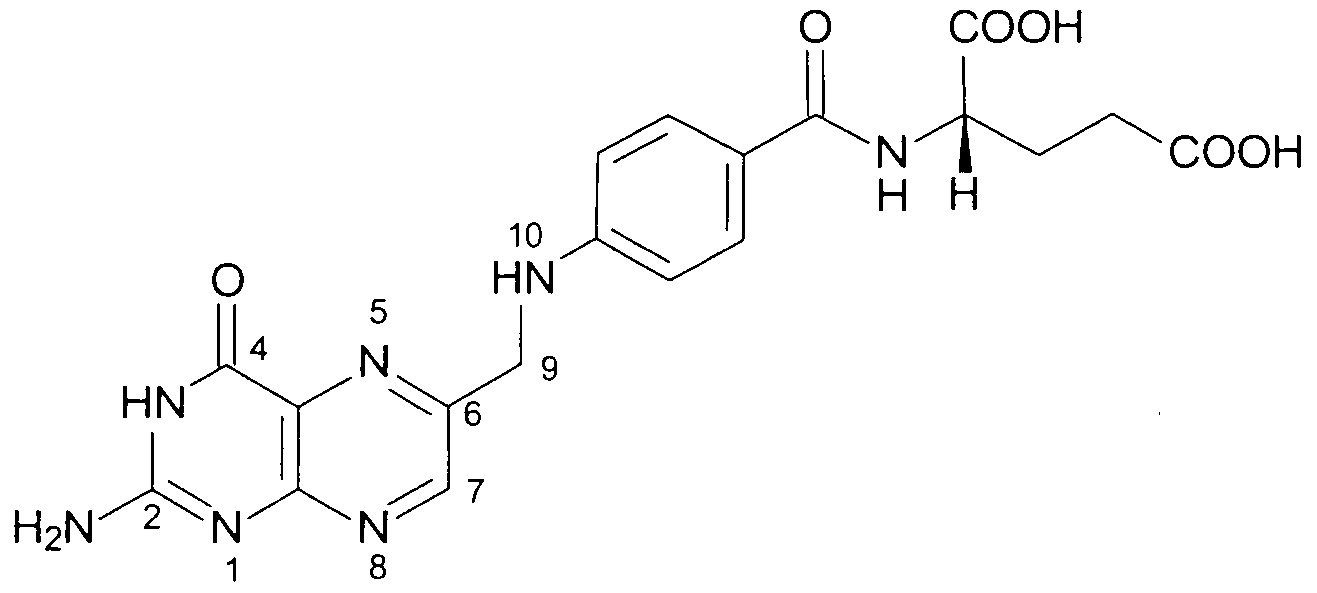
Folsäure kommt in Leber, Niere, Hefe, Pilzen, Getreide und grünen Blättern, vorwiegend als Konjugat mit Poly-γ-L-glutaminsäure (Pteroylpolyglutaminsäuren) vor. Sie wurde als Wuchsstoff für verschiedene Mikroorganismen entdeckt und hat für den menschlichen Organismus Vitamincharakter. Der Bedarf des erwachsenen Menschen beträgt etwa 200 μg je Tag an bioverfügbarem Folat.
Folsäure steht im Organismus im Gleichgewicht mit 7,8-Dihydrofolsäure (H2Folat; alte Abkürzung: FH2) unter Beteiligung von Nicotinamid-Adenin-Dinucleotid-Phosphat und des Enzyms Dihydrofolat-Reduktase. H2Folat wiederum entsteht in Pflanzen und einigen Mikroorganismen über mehrere Zwischenstufen aus Guanosin-5'-triphosphat (Guanosinphosphate) und
setzt sich mit Hilfe der Dihydrofolat-Reduktase zu (6S)-5,6,7,8-Tetrahydrofolsäure um, der eigentlichen physiologisch wirksamen Form der Folsäure.
7,8-Dihydrofolsäure hat folgende chemische Struktur:

(6S)-5,6,7,8-Tetrahydrofolsäure hat folgende chemische Struktur:

Unter dem Begriff der Derivate der Folsäure sind insbesondere die vorgenannte Dihydrofol- säure und die Tetrahydrofolsäure zu verstehen.
Folsäure ist ein Wirkstoff, der nur bei einem pH Wert von > 6,5 gelöst werden kann. Häufig besteht jedoch der Wunsch, eine Emulsion unabhängig von pH Wert / bei niedrigerem pH Wert herzustellen.
Erstaunlicherweise werden diese Aufgaben gelöst durch kosmetische oder dermatologische Zubereitungen mit einem Gehalt an Folsäure und/oder deren Derivate und einem oder mehreren Polyolen.
Erfindungsgemäß weisen Folsäure und/oder deren Derivate ein hohes Potential zur Reparatur geschädigter DNA auf. Ferner bieten Folsäure und/oder deren Derivate wirksame Prophylaxe gegen DNA-Schäden, insbesondere solche Schäden, die durch UV-Strahlung hervorgerufen werden.
Erfindungsgemäß wird eine vom pH-Wert unabhängige Löslichkeit von Folsäure erreicht.
Vorteilhafte Beispiele für Poylyole sind: Erythrit, Arabit, Adonit, Sorbit, Dulcit, 1 ,2-Butandiol, 1 ,3-Butandiol, 1 ,4-Butandiol, 2,3-Butandiol, 1 ,5-Pentandiol, 2,4-Pentandiol, 2-Methyl-1 ,3- Propandiol, 2-Methyl-2,4-pentandiol, 1 ,6-Hexandiol, 2,3-Dimethyl-2,3-butandiol, 2,2-Diethyl- 1 ,3-propandiol, 2-Ethyl-1 ,3-hexandiol, 2,2,4-Trimethyl-1 ,3-pentandiol, 2-Ethyl-2-butyl-1 ,3-pro- pandiol, 1 ,2,4-Butantriol, 1 ,2,6-Hexantriol, 2,2-Dihydroxymethyl-i -butanol, 1 ,2-Octan- diol.Tetramethylolmethan, dem α-Mono-methylether von Glycerin, dem α-Mono-n-butylether von Glycerin, 2-O-α-D-Glucopyranosyl-L-ascorbinsäure, 3-(2-Ethylhexyloxy)-1 ,2-propandiol, 1 ,2-Hexandiol.
Bevorzugt sind Polyole, die 2 bis 3 Sauerstoffatome enthalten und mindestens 4 Kohlenstoffatome.
Das Verhältnis von Folsäure zu Polyol (bzw. der Gesamtmenge an Polyolen) sollte 1 :10 bis 1 :1000 betragen.
Die kosmetischen oder dermatologischen Zubereitungen können erfindungsgemäß wie üblich zusammengesetzt sein und zur Behandlung, der Pflege und der Reinigung der Haut und/oder der Haare und als Schminkprodukt in der dekorativen Kosmetik dienen.
Sie enthalten bevorzugt 0,001 Gew.-% bis 10 Gew.-%, bevorzugt 0,05 Gew.-% bis 5 Gew.- %, insbesondere 0,1 - 2,0 Gew.-%, bezogen auf das Gesamtgewicht der Zubereitungen, an Folsäure und/oder deren Derivaten.
Die kosmetischen oder dermatologischen Zubereitungen enthalten ferner bevorzugt 0,001 Gew.-% bis 30 Gew.-%, bevorzugt 0,05 Gew.-% bis 10 Gew.-%, insbesondere 0,1 - 2,0 Gew.-%, bezogen auf das Gesamtgewicht der Zubereitungen, an einem oder mehreren Polyolen.
Erfindungsgemäße kosmetische und dermatologische Zubereitungen können in verschiedenen Formen vorliegen. So können sie z.B. eine Lösung, eine wasserfreie Zubereitung, eine Emulsion oder Mikroemulsion vom Typ Wasser-in-ÖI (W/O) oder vom Typ Öl-in-Wasser (O/W), eine multiple Emulsionen, beispielsweise vom Typ Wasser-in-ÖI-in-Wasser (W/O/W), ein Gel, einen festen Stift, eine Salbe oder auch ein Aerosol darstellen. Es ist auch erfin- dugsgemäß vorteilhaft, Folsäure und/oder deren Derivate in verkapselter Form darzureichen, z.B. in Kollagenmatrices und anderen üblichen Verkapselungsmaterialien, z.B. als CeIIuIo- severkapselungen, in Gelatine, Wachsmatrices oder liposomal verkapselt. Insbesondere Wachsmatrices wie sie in der DE-OS 43 08 282 beschrieben werden, haben sich als günstig herausgestellt.
Es ist auch möglich und vorteilhaft im Sinne der vorliegenden Erfindung, Folsäure und/oder deren Derivate in wäßrige Systeme bzw. Tensidzubereitungen zur Reinigung der Haut und der Haare einzufügen.
Die erfindungsgemäßen kosmetischen und dermatologischen Zubereitungen können kosmetische Hilfsstoffe enthalten, wie sie üblicherweise in solchen Zubereitungen verwendet werden, z.B. Konservierungsmittel, Bakterizide, Parfüme, Substanzen zum Verhindern des Schäumens, Farbstoffe, Pigmente, die eine färbende Wirkung haben, Verdickungsmittel, oberflächenaktive Substanzen, Emulgatoren, weichmachende, anfeuchtende und/oder feuchhaltende Substanzen, Fette, Öle, Wachse oder andere übliche Bestandteile einer kosmetischen oder dermatologischen Formulierung wie Alkohole, Polyole, Polymere, Schaumstabilisatoren, Elektrolyte, organische Lösemittel oder Siliconderivate.
Insbesondere können Folsäure und/oder deren Derivate erfindungsgemäß auch mit anderen Antioxidantien und/oder Radikalfängern kombiniert werden.
Die Menge an Antioxidantien (eine oder mehrere Verbindungen) in den Zubereitungen beträgt vorzugsweise 0,001 bis 30 Gew.-%, besonders bevorzugt 0,05 - 20 Gew.-%, insbesondere 1 - 10 Gew.-%, bezogen auf das Gesamtgewicht der Zubereitung.
Die Lipidphase kann vorteilhaft gewählt werden aus folgender Substanzgruppe:
Mineralöle, Mineralwachse
Öle, wie Triglyceride der Caprin- oder der Caprylsäure, ferner natürliche Öle wie z.B. Rizinusöl;
Fette, Wachse und andere natürliche und synthetische Fettkörper, vorzugsweise Ester von Fettsäuren mit Alkoholen niedriger C-Zahl, z.B. mit Isopropanol, Propylengly- kol oder Glycehn, oder Ester von Fettalkoholen mit Alkansäuren niedriger C-Zahl o- der mit Fettsäuren; Alkylbenzoate;
Siliconöle wie Dimethylpolysiloxane, Diethylpolysiloxane, Diphenylpolysiloxane sowie Mischformen daraus.
Die Ölphase der Emulsionen, Oleogele bzw. Hydrodispersionen oder Lipodispersionen im Sinne der vorliegenden Erfindung wird vorteilhaft gewählt aus der Gruppe der Ester aus gesättigten und/oder ungesättigten, verzweigten und/oder unverzweigten Alkancarbonsäuren einer Kettenlänge von 3 bis 30 C-Atomen und gesättigten und/oder ungesättigten, verzweigten und/oder unverzweigten Alkoholen einer Kettenlänge von 3 bis 30 C-Atomen, aus der Gruppe der Ester aus aromatischen Carbonsäuren und gesättigten und/oder ungesättigten, verzweigten und/oder unverzweigten Alkoholen einer Kettenlänge von 3 bis 30 C-Atomen. Solche Esteröle können dann vorteilhaft gewählt werden aus der Gruppe Isopropylmyristat, Isopropylpalmitat, Isopropylstearat, Isopropyloleat, n-Butylstearat, n-Hexyllaurat, n- Decyloleat, Isooctylstearat, Isononylstearat, Isononylisononanoat, 2-Ethylhexylpalmitat, 2- Ethylhexyllaurat, 2-Hexyldecylstearat, 2-Octyldodecylpalmitat, Oleyloleat, Oleylerucat, Eru- cyloleat, Erucylerucat sowie synthetische, halbsynthetische und natürliche Gemische solcher Ester, z.B. Jojobaöl.
Die wäßrige Phase der erfindungsgemäßen Zubereitungen enthält gegebenenfalls vorteilhaft Alkohole, Diole oder Polyole niedriger C-Zahl, sowie deren Ether, vorzugsweise Ethanol, Isopropanol, Propylenglykol, Glycerin, Ethylenglykol, Ethylenglykolmonoethyl- oder -mo- nobutylether, Propylenglykolmonomethyl, -monoethyl- oder -monobutylether, Diethy- lenglykolmonomethyl- oder -monoethylether und analoge Produkte, ferner Alkohole niedriger C-Zahl, z.B. Ethanol, Isopropanol, 1 ,2-Propandiol, Glycerin sowie insbesondere ein oder mehrere Verdickungsmittel, welches oder welche vorteilhaft gewählt werden können aus der Gruppe Siliciumdioxid, Aluminiumsilikate, Polysaccharide bzw. deren Derivate, z.B. Hyalu- ronsäure, Xanthangummi, Hydroxypropylmethylcellulose, besonders vorteilhaft aus der
Gruppe der Polyacrylate, bevorzugt ein Polyacrylat aus der Gruppe der sogenannten Carbo- pole, beispielsweise Carbopole der Typen 980, 981 , 1382, 2984, 5984, jeweils einzeln oder in Kombination.
Insbesondere werden Gemische der vorstehend genannten Lösemittel verwendet. Bei alkoholischen Lösemitteln kann Wasser ein weiterer Bestandteil sein.
Erfindungsgemäße Emulsionen sind vorteilhaft und enthalten z.B. die genannten Fette, Öle, Wachse und anderen Fettkörper, sowie Wasser und einen Emulgator, wie er üblicherweise für einen solchen Typ der Formulierung verwendet wird.
Gele gemäß der Erfindung enthalten üblicherweise Alkohole niedriger C-Zahl, z.B. Ethanol, Isopropanol, 1 ,2-Propandiol, Glycerin und Wasser bzw. ein vorstehend genanntes Öl in Gegenwart eines Verdickungsmittels, das bei ölig-alkoholischen Gelen vorzugsweise Siliciumdi- oxid oder ein Aluminiumsilikat, bei wäßrig-alkoholischen oder alkoholischen Gelen vorzugweise ein Polyacrylat ist.
Als Treibmittel für erfindungsgemäße, aus Aerosolbehältern versprühbare Zubereitungen sind die üblichen bekannten leichtflüchtigen, verflüssigten Treibmittel, beispielsweise Kohlenwasserstoffe (Propan, Butan, Isobutan) geeignet, die allein oder in Mischung miteinander eingesetzt werden können. Auch Druckluft ist vorteilhaft zu verwenden.
Vorteilhaft können erfindungsgemäße Zubereitungen außerdem Substanzen enthalten, die UV-Strahlung im UVB-Bereich absorbieren, wobei die Gesamtmenge der Filtersubstanzen z.B. 0,1 Gew.-% bis 30 Gew.-%, vorzugsweise 0,5 bis 10 Gew.-%, insbesondere 1 ,0 bis 6,0 Gew.-% beträgt, bezogen auf das Gesamtgewicht der Zubereitungen, um kosmetische Zubereitungen zur Verfügung zu stellen, die das Haar bzw. die Haut vor dem gesamten Bereich der ultravioletten Strahlung schützen. Sie können auch als Sonnenschutzmittel fürs Haar oder die Haut dienen.
Die nachfolgenden Beispiele sollen die vorliegende Erfindung verdeutlichen, ohne sie einzuschränken. Alle Mengenangaben, Anteile und Prozentanteile sind, soweit nicht anders angegeben, Gewichtsprozente, auf das Gewicht und die Gesamtmenge bzw. auf das Gesamtgewicht der Zubereitungen bezogen.

Claims
1. Kosmetische oder dermatologische Zubereitungen mit einem Gehalt an Folsäure und/oder deren Derivaten und einem oder mehreren Polyolen.
2. Zubereitungen nach Anspruch 1 , dadurch gekennzeichnet, dass das oder die Polyole gewählt werden aus der Gruppe Erythrit, Arabit, Adonit, Sorbit, Dulcit, 1 ,2-Butandiol, 1 ,3- Butandiol, 1 ,4-Butandiol, 2,3-Butandiol, 1 ,5-Pentandiol, 2,4-Pentandiol, 2-Methyl-1 ,3- Propandiol, 2-Methyl-2,4-pentandiol, 1 ,6-Hexandiol, 2,3-Dimethyl-2,3-butandiol, 2,2-Diethyl- 1 ,3-propandiol, 2-Ethyl-1 ,3-hexandiol, 2,2,4-Trimethyl-1 ,3-pentandiol, 2-Ethyl-2-butyl-1 ,3-pro- pandiol, 1 ,2,4-Butantriol, 1 ,2,6-Hexantriol, 2,2-Dihydroxymethyl-1-butanol, 1 ,2-Octan- diol.Tetramethylolmethan, dem α-Mono-methylether von Glycerin, dem α-Mono-n-butylether von Glycerin, 2-O-α-D-Glucopyranosyl-L-ascorbinsäure, 3-(2-Ethylhexyloxy)-1 ,2-propandiol, 1 ,2-Hexandiol.
3. Zubereitungen nach Anspruch 1 , dadurch gekennzeichnet, dass das oder die Polyole gewählt werden aus der Gruppe 1 ,5-Pentandiol, 2,4-Pentandiol, 2-Methyl-1 ,3-Propandiol, 2- Methyl-2,4-pentandiol, 1 ,6-Hexandiol, 1 ,2-Octandiol, 3-(2-Ethylhexyloxy)-1 ,2-propandiol, 1 ,2- Hexandiol.
4. Zubereitungen nach einem der vorstehenden Ansprüche, dadurch gekennzeichnet, dass sie 0,001 Gew.-% bis 10 Gew.-%, bevorzugt 0,01 Gew.-% bis 1 ,0 Gew.-%, insbesondere 0,05 - 0,5 Gew.-%, bezogen auf das Gesamtgewicht der Zubereitungen, an Folsäure und/oder deren Derivaten, enthalten.
5. Zubereitungen nach einem der vorstehenden Ansprüche, dadurch gekennzeichnet, dass sie 0,001 Gew.-% bis 30 Gew.-%, bevorzugt 0,05 Gew.-% bis 10 Gew.-%, insbesondere 0,1 - 2,0 Gew.-%, bezogen auf das Gesamtgewicht der Zubereitungen, an einem oder mehreren Polyolen.
6. Zubereitungen nach einem der vorstehenden Ansprüche, dadurch gekennzeichnet, dass das Verhältnis von Folsäure zu Polyol (bzw. der Gesamtmenge an Polyolen) aus dem Bereich 1 :10 bis 1 :1000 gewählt wird.
Priority Applications (1)
| Application Number | Priority Date | Filing Date | Title |
|---|---|---|---|
| EP07785882.7A EP2046276B1 (de) | 2006-07-13 | 2007-07-03 | Kosmetische oder dermatologische zubereitungen mit einem gehalt an folsäure und einem oder mehreren polyolen |
Applications Claiming Priority (2)
| Application Number | Priority Date | Filing Date | Title |
|---|---|---|---|
| DE102006032413A DE102006032413A1 (de) | 2006-07-13 | 2006-07-13 | Kosmetische oder dermatologische Zubereitungen mit einem Gehalt an Folsäure und einem oder mehreren Polyolen |
| DE102006032413.7 | 2006-07-13 |
Publications (1)
| Publication Number | Publication Date |
|---|---|
| WO2008006485A1 true WO2008006485A1 (de) | 2008-01-17 |
Family
ID=38472938
Family Applications (1)
| Application Number | Title | Priority Date | Filing Date |
|---|---|---|---|
| PCT/EP2007/005870 Ceased WO2008006485A1 (de) | 2006-07-13 | 2007-07-03 | Kosmetische oder dermatologische zubereitungen mit einem gehalt an folsäure und einem oder mehreren polyolen |
Country Status (3)
| Country | Link |
|---|---|
| EP (1) | EP2046276B1 (de) |
| DE (1) | DE102006032413A1 (de) |
| WO (1) | WO2008006485A1 (de) |
Families Citing this family (1)
| Publication number | Priority date | Publication date | Assignee | Title |
|---|---|---|---|---|
| KR101381903B1 (ko) * | 2011-03-10 | 2014-04-10 | 주식회사 엘지생활건강 | 3-부톡시-1,2-프로판다이올을 함유하는 항균 또는 보존용 조성물 |
Citations (12)
| Publication number | Priority date | Publication date | Assignee | Title |
|---|---|---|---|---|
| GB1289096A (de) * | 1968-10-03 | 1972-09-13 | ||
| EP0311259A2 (de) * | 1987-09-14 | 1989-04-12 | The Procter & Gamble Company | Orale-Zusammensetzungen |
| EP0652012A1 (de) * | 1989-03-27 | 1995-05-10 | Albert Naito | Kombinationen von Zuckern mit Aminsäuren und anderen Mitteln |
| DE4341001A1 (de) * | 1993-12-02 | 1995-06-08 | Beiersdorf Ag | Topische Zubereitungen mit einem Gehalt an L-Arginin |
| JP2002097141A (ja) * | 2000-09-19 | 2002-04-02 | Nikken Chem Co Ltd | ビタミンb類含有水溶液組成物 |
| EP1214927A1 (de) * | 2000-12-14 | 2002-06-19 | Beiersdorf AG | Verwendung von Folsäure und/oder deren Derivaten zur Herstellung topischer Zubereitungen |
| WO2004054936A1 (en) * | 2002-12-16 | 2004-07-01 | Holger Blum | Stabilized aqueous folic acid preparation and process for providing the same |
| DE10300782A1 (de) * | 2003-01-11 | 2004-07-22 | Beiersdorf Ag | Hautpflegeprodukte mit labilen Wirkstoffen in multiplen Emulsionen |
| WO2005063184A1 (en) * | 2003-12-22 | 2005-07-14 | Imrex, Inc. | Methods and compositions for oral hygiene |
| EP1609462A1 (de) * | 2004-04-22 | 2005-12-28 | JUVENA (International) AG | Kosmetische oder dermatologische Zubereitung umfassend eine Nährmedienphase |
| US20060120967A1 (en) * | 2004-12-07 | 2006-06-08 | Qpharma, Llc | Solution forms of cyclodextrins for nasal or throat delivery of essential oils |
| WO2007014644A1 (de) * | 2005-08-01 | 2007-02-08 | Beiersdorf Ag | Stabile wirkstoffkombinationen auf der grundlage von folsäure |
Family Cites Families (5)
| Publication number | Priority date | Publication date | Assignee | Title |
|---|---|---|---|---|
| US5738873A (en) * | 1996-09-27 | 1998-04-14 | Herman Bleiweiss | Pharmaceutical formulations and methods for treating patients suffering from diseases that cause muscular hypotonia |
| EP1275369A1 (de) * | 2001-07-10 | 2003-01-15 | Goldschmidt AG | Folsäure enthaltende Körperpflegemittel |
| DE10206159A1 (de) * | 2002-02-14 | 2003-08-28 | Kosmas Kg | Mittel, enthaltend Folsäure, Vitamin B6 und Vitamin B12, und dessen Verwendung |
| DE102005001479A1 (de) * | 2005-01-12 | 2006-07-20 | Synavit Gmbh | Mittel, enthaltend Folsäure, Vitamin B6 und Vitamin B12, und dessen Verwendung |
| DE102005009379A1 (de) * | 2005-03-01 | 2006-09-07 | Synavit Gmbh | Mittel, enthaltend Folsäure, Vitamin B6 und Vitamin B12, und dessen Verwendung |
-
2006
- 2006-07-13 DE DE102006032413A patent/DE102006032413A1/de not_active Ceased
-
2007
- 2007-07-03 WO PCT/EP2007/005870 patent/WO2008006485A1/de not_active Ceased
- 2007-07-03 EP EP07785882.7A patent/EP2046276B1/de active Active
Patent Citations (12)
| Publication number | Priority date | Publication date | Assignee | Title |
|---|---|---|---|---|
| GB1289096A (de) * | 1968-10-03 | 1972-09-13 | ||
| EP0311259A2 (de) * | 1987-09-14 | 1989-04-12 | The Procter & Gamble Company | Orale-Zusammensetzungen |
| EP0652012A1 (de) * | 1989-03-27 | 1995-05-10 | Albert Naito | Kombinationen von Zuckern mit Aminsäuren und anderen Mitteln |
| DE4341001A1 (de) * | 1993-12-02 | 1995-06-08 | Beiersdorf Ag | Topische Zubereitungen mit einem Gehalt an L-Arginin |
| JP2002097141A (ja) * | 2000-09-19 | 2002-04-02 | Nikken Chem Co Ltd | ビタミンb類含有水溶液組成物 |
| EP1214927A1 (de) * | 2000-12-14 | 2002-06-19 | Beiersdorf AG | Verwendung von Folsäure und/oder deren Derivaten zur Herstellung topischer Zubereitungen |
| WO2004054936A1 (en) * | 2002-12-16 | 2004-07-01 | Holger Blum | Stabilized aqueous folic acid preparation and process for providing the same |
| DE10300782A1 (de) * | 2003-01-11 | 2004-07-22 | Beiersdorf Ag | Hautpflegeprodukte mit labilen Wirkstoffen in multiplen Emulsionen |
| WO2005063184A1 (en) * | 2003-12-22 | 2005-07-14 | Imrex, Inc. | Methods and compositions for oral hygiene |
| EP1609462A1 (de) * | 2004-04-22 | 2005-12-28 | JUVENA (International) AG | Kosmetische oder dermatologische Zubereitung umfassend eine Nährmedienphase |
| US20060120967A1 (en) * | 2004-12-07 | 2006-06-08 | Qpharma, Llc | Solution forms of cyclodextrins for nasal or throat delivery of essential oils |
| WO2007014644A1 (de) * | 2005-08-01 | 2007-02-08 | Beiersdorf Ag | Stabile wirkstoffkombinationen auf der grundlage von folsäure |
Non-Patent Citations (1)
| Title |
|---|
| DATABASE CA [online] CHEMICAL ABSTRACTS SERVICE, COLUMBUS, OHIO, US; 25 April 2002 (2002-04-25), SHINSHI, KAZUNORI ET AL: "Aqueous solutions containing vitamin B", XP002450774, retrieved from STN Database accession no. 136:284437 * |
Also Published As
| Publication number | Publication date |
|---|---|
| EP2046276A1 (de) | 2009-04-15 |
| EP2046276B1 (de) | 2015-12-30 |
| DE102006032413A1 (de) | 2008-01-17 |
Similar Documents
| Publication | Publication Date | Title |
|---|---|---|
| DE10136077A1 (de) | Kosmetische oder dermatologische Zubereitungen mit einer Kombination von Kreatinin und/oder Kreatininderivaten mit Kreatin und/oder seinen Derivaten | |
| DE10132953A1 (de) | Verwendung von Hopfen-bzw. Hopfen-Malz-Extrakten in kosmetischen oder dermatologischen Zubereitungen zur Prophylaxe gegen und Behandlung von degenerativen Hauterscheinungen | |
| EP1214927A1 (de) | Verwendung von Folsäure und/oder deren Derivaten zur Herstellung topischer Zubereitungen | |
| DE102007024679B4 (de) | Verwendung von kosmetisch aktiven Wirkstoffen zum Schützen von FGF-2 | |
| EP2090296B1 (de) | Verwendung von Wirkstoffkomplexen aus Panthenol, Glycerin, Citrat und/oder Bisabolol gegen Pollenallergien | |
| EP2046276B1 (de) | Kosmetische oder dermatologische zubereitungen mit einem gehalt an folsäure und einem oder mehreren polyolen | |
| EP2072038A2 (de) | Wirkstoffkombinationen aus Anisfruchtextrakt und einem oder mehreren 2,3-Dibenzylbutyrolactonen | |
| DE10040933A1 (de) | Verwendung von beta-Mannosylglycerat (Firoin) und/oder Derivaten, insbesondere dem beta-Mannosylglyceramid (Firoin-A), in kosmetischen und dermatologischen Formulierungen | |
| WO2007096090A1 (de) | Wirkstoffkombination aus hydroxymatairesinol, phenoxyethanol und gewünschtenfalls glycerin | |
| EP2421502A2 (de) | Verwendung von glycyrrhetinsäure und/oder deren derivaten zur herstellung kosmetischer oder dermatologischer zubereitungen zur prophylaxe von schäden an der hauteigenen dna und/oder zur reparatur bereits eingetretener schäden an der hauteigenen dna | |
| DE102012213935A1 (de) | Kosmetische oder dermatologische Zubereitungen mit einem Gehalt an Harnstoff und einem Gehalt an Licochalcon A oder einem wäßrigen Extrakt aus Radix Glycyrrhizae inflatae, enthaltend Licochalcon A | |
| EP2046280A1 (de) | Kosmetische oder dermatologische zubereitungen mit einem gehalt an folsäure, flüchtigen und nichtflüchtigen siliconen | |
| EP2076240B1 (de) | Kosmetische oder dermatologische zubereitungen mit einem gehalt an 2-isopropyl-5- methyl-cyclohexancarbonyl-d-alaninmethylester und einem oder mehreren anti-entzündlichen wirkstoffen | |
| DE102015207267A1 (de) | Verwendung von Hibifolin gegen Hautalterung | |
| DE10316666A1 (de) | Kosmetische oder dermatologische Zubereitungen mit einer Kombination von Kreatinin und/oder Kreatininderivaten mit Kreatin und/oder seinen Derivaten und Biochinonen | |
| EP1311237A2 (de) | VERWENDUNG VON CYCLISCHEM 2,4 DIPHOSPHOGLYCERAT (cDGP) UND/ODER DERIVATEN IN KOSMETISCHEN UND DERMATOLOGISCHEN FORMULIERUNGEN | |
| EP1834631A1 (de) | Kosmetische oder dermatologische Zubereitungen enthaltend Glycyrrhetin und/oder Glycyrrhizin sowie Glucosederivate bzw. Glycerinether | |
| DE102014104254B4 (de) | Wirkstoffkombinationen aus 4-Hydroxyacetophenon und einem oder mehreren Zimtsäurederivaten | |
| DE102016225095B4 (de) | "Kosmetische Gesichtspflegeformulierungen zur Stimulierung der körpereigenen Abwehr gegen freie Radikale" | |
| DE102012222445A1 (de) | Kosmetische oder dermatologische Zubereitungen mit Kombinationen aus4-n-Butylresorcin und einem oder mehreren nichtterpenoiden Parfumrohstoffen | |
| EP4065240A1 (de) | Wirkstoffkombinationen aus ubichinol und hyaluronsäure und kosmetische oder dermatologische zubereitungen, solche wirkstoffkombinationen enthaltend | |
| DE102006047154A1 (de) | Kosmetische oder dermatologische Zubereitungen mit einem Gehalt an 2-Isopropyl-5-Methyl-Cyclohexancarbonyl-D-Alaninethylester und einem oder mehreren anti-entzündlichen Wirkstoffen | |
| DE102014217490A1 (de) | Verwendung von Gossypetin und/oder Gossypin gegen Hautalterung | |
| DE102012213940A1 (de) | Verwendung von Kokosestern zur Hautbefeuchtung | |
| WO2008040453A1 (de) | Kosmetische oder dermatologische zubereitungen mit einem gehalt an 2-isopropyl-5- methyl-cyclohexancarbonyl-d-alaninmethylester und einem oder mehreren hautbefeuchtungsmitteln |
Legal Events
| Date | Code | Title | Description |
|---|---|---|---|
| 121 | Ep: the epo has been informed by wipo that ep was designated in this application |
Ref document number: 07785882 Country of ref document: EP Kind code of ref document: A1 |
|
| WWE | Wipo information: entry into national phase |
Ref document number: 2007785882 Country of ref document: EP |
|
| NENP | Non-entry into the national phase |
Ref country code: DE |
|
| NENP | Non-entry into the national phase |
Ref country code: RU |