WO2008023582A1 - Depsipeptide containing lactic acid residue - Google Patents

Depsipeptide containing lactic acid residue Download PDF

Info

Publication number
WO2008023582A1
WO2008023582A1 PCT/JP2007/065720 JP2007065720W WO2008023582A1 WO 2008023582 A1 WO2008023582 A1 WO 2008023582A1 JP 2007065720 W JP2007065720 W JP 2007065720W WO 2008023582 A1 WO2008023582 A1 WO 2008023582A1
Authority
WO
WIPO (PCT)
Prior art keywords
gly
pro
lac
lie
temperature
Prior art date
Legal status (The legal status is an assumption and is not a legal conclusion. Google has not performed a legal analysis and makes no representation as to the accuracy of the status listed.)
Ceased
Application number
PCT/JP2007/065720
Other languages
English (en)
French (fr)
Inventor
Hiroyuki Oku
Yuya Shimoda
Aya Inoue
Chie Takayama
Keiichi Yamada
Ryoichi Katakai
Current Assignee (The listed assignees may be inaccurate. Google has not performed a legal analysis and makes no representation or warranty as to the accuracy of the list.)
Gunma University
Original Assignee
Gunma University
Priority date (The priority date is an assumption and is not a legal conclusion. Google has not performed a legal analysis and makes no representation as to the accuracy of the date listed.)
Filing date
Publication date
Application filed by Gunma University filed Critical Gunma University
Priority to EP07792365A priority Critical patent/EP2058324B1/en
Priority to JP2008530857A priority patent/JP5158716B2/ja
Priority to US12/438,694 priority patent/US8153759B2/en
Publication of WO2008023582A1 publication Critical patent/WO2008023582A1/ja
Anticipated expiration legal-status Critical
Ceased legal-status Critical Current

Links

Classifications

    • C—CHEMISTRY; METALLURGY
    • C07—ORGANIC CHEMISTRY
    • C07K—PEPTIDES
    • C07K11/00—Depsipeptides having up to 20 amino acids in a fully defined sequence; Derivatives thereof
    • C07K11/02—Depsipeptides having up to 20 amino acids in a fully defined sequence; Derivatives thereof cyclic, e.g. valinomycins ; Derivatives thereof
    • C—CHEMISTRY; METALLURGY
    • C07—ORGANIC CHEMISTRY
    • C07K—PEPTIDES
    • C07K11/00—Depsipeptides having up to 20 amino acids in a fully defined sequence; Derivatives thereof
    • A—HUMAN NECESSITIES
    • A61—MEDICAL OR VETERINARY SCIENCE; HYGIENE
    • A61K—PREPARATIONS FOR MEDICAL, DENTAL OR TOILETRY PURPOSES
    • A61K38/00—Medicinal preparations containing peptides

Definitions

  • the present invention relates to a novel depsipeptide compound that can be used as a temperature-responsive material and a depsipeptide polymer obtained by polymerizing the depsipeptide compound. More specifically, the present invention relates to a novel depsipeptide compound having a depsipeptide formed by dehydration condensation of a lactic acid residue and an amino acid residue as a constituent component and a depsipeptide polymer obtained by polymerizing the depsipeptide compound.
  • the material of the present invention aggregates or dissolves in water, buffer or water-containing solvent in response to temperature.
  • thermoabsorbable compositions can be used as a temperature-responsive material, so it can be used to make bioabsorbable compositions, environmentally degradable compositions, cell adhesives, artificial muscles, microcapsules, biomachines, biosensors, separation membranes, test kits, etc. Useful.
  • a depsipeptide is a polymer or oligomer in which the main chain is linked by an ester bond and an amide bond as shown in Formula (A).
  • the structure skeleton consists of an amide bond and an ester bond.
  • the amide bond and ester bond contained in the skeleton are known to have three types of interactions at the molecular level.
  • amide bonds at the molecular level, hydrogen bonds within the molecule and between molecules cause strong interaction and stabilization of the molecular structure.
  • intermolecular and intramolecular interactions due to hydrogen bonds do not occur between ester bonds at the molecular level. Therefore, macroscopically, flexibility or weakness due to a decrease in mechanical strength is expected.
  • depsipeptides can be used as materials that have the characteristics of oligomers and polymers of amino acids and hydroxycarboxylic acids. In other words, materials having a wide range of properties can be synthesized by changing the types, compositions, and sequences of amino acids and hydroxycarboxylic acids.
  • depsipeptides are that it is difficult to cause inflammation in the body, that it can be used as a drug delivery material for substances that are weak against acidic components, and that the strength of the molded product is increased by intermolecular and intramolecular interactions such as hydrogen bonds and hydrophobic interactions. Three points are extremely high. Thus, depsipeptide is a very attractive substance.
  • Non-patent Document 2 The power that did not cause inflammation with polydepsipeptides
  • materials that use only polyhydroxycarboxylic acid cause a inflammatory reaction when the degradation is fast
  • This is thought to be due to the accumulation of relatively strong acidic components such as lactic acid and glycolic acid.
  • depsipeptide oligomers are produced as degradation products, so acidic components are not accumulated, and it is considered that inflammation was not observed even when the degradation rate was high.
  • a dedepsipeptide can be produced by reacting a carboxyl group of an amino acid with a protected amino group with a hydroxyl group of a hydroxycarboxylic acid having an unprotected carboxyl group using an aminoviridine compound as a catalyst. It has become possible (Patent Document 1, Non-Patent Documents 3 and 4). These studies have made it possible to more easily produce depsipeptides having repetitive sequences without forming a protective group for the carboxyl group of hydroxycarboxylic acid.
  • thermoresponsive materials have also been developed by methods using depsipeptides.
  • Patent Document 2 Non-Patent Document 5
  • a polymer is disclosed. These are characterized by having a 0-branched hydroxycarboxylic acid called valic acid (Hmb). This is because it has been considered that a / 3-branched amino acid or a hydroxycarboxylic acid is required at the position of valic acid in the sequence shown here for the expression of temperature responsiveness.
  • Non-Patent Document 11 That is, in the conventional temperature-responsive material, It was necessary to introduce a 13-branched amino acid at a fixed position, and there was a problem in that the restriction on the sequence was large.
  • Hydroxycarboxylic acids that are actually commercially available as biomaterials so far mainly contain lactic acid and glycolic acid as constituent components. These have many examples of use, and their strengths and weaknesses are excellent.
  • the conventional temperature-responsive material using depsipeptides uses other phosphoric acid, nornoic acid (Hmb). Since this is contained in many natural products such as antibiotics, it is expected that there will be almost no problem. For this reason, there still remains a problem in that the application of temperature-responsive polymers containing phosphoric acid (Hmb) to a living body requires many studies including pharmacokinetics.
  • Non-Patent Documents 12 and 13 Polymers with two types of repeating sequences-Va ⁇ Pro-Gly-Hmb-Gly- and -V a ⁇ Ala-Pro-Gly-Hmb-Gly- have been reported. . These are low-yields of the most important reactions that do not show temperature responsiveness, have many synthetic steps, and produce ester or amide bonds, called condensation reactions (5 reactions are described, (23, 33, 54, 70, 76% respectively), and there was a problem in four points: only 10 mg of the final product polymer was obtained as a result of low yield. In fact, in the paper,
  • Patent Document 2 In other words, except for the cases reported by the present inventors (Patent Document 2 and Non-Patent Document 5), generally, synthesis of polydepsipeptide and oligodepsipeptide sequences related to temperature-responsive materials has been very difficult until now. Has been considered impractical.
  • Patent Document 1 JP 2004-269462
  • Patent Document 2 WO2006 / 043644A1
  • Non-Patent Document 1 Yoshida et al., Journal of Biomedical Materials Research, 1990, 24, 117 3
  • Non-Patent Document 2 Yasuo Shikinami, Department of Rheumatology, 1999, Vol. 21, No. 3, p. 267
  • Non-Patent Document 3 Katakai et al., Biopolymers, 2004, 73, 641
  • Non-Patent Document 4 Oku, Acta Crystallographica Section E, 2004, E60, o927
  • Non-Patent Document 5 Shichiri, Peptide Science 2004, 2005, p. 633
  • Non-Patent Document 6 Chang et al., Journal of Biomolecular Structure and Dynamics 1989, Vol. 6, p. 851
  • Non-Patent Document 7 Ury et al., Biochemistry and Biophysics Research Communication, 197 7, 79, 700
  • Non-Patent Document 8 Ury et al., Biopolymers, 1989, 28, 819
  • Non-Patent Document 9 Ury et al., Progress in Biophysics and Molecular Biology, 1992, 57
  • Non-Patent Document 10 Ury et al., Biopolymers, 1986, 25, 1939
  • Non-Patent Document 11 Funo Blade et al., International Journal of Peptide and Protein Research ⁇ 197
  • Non-Patent Document 12 Arad & Goodman, Biopolymers, 1990, 29, 1633
  • Non-Patent Document 13 Arad & Goodman, Biopolymers, 1990, 29, 1651 Disclosure of the Invention
  • An object of the present invention is to provide a novel depsipeptide which has a constituent component preferable as a biomaterial and can be used as a temperature-responsive material.
  • the present inventors focused on a new amino acid sequence.
  • an elastin-like polypeptide sequence that has been noted for its irreversible temperature response and the resulting insolubility, the amino acid that is not a ⁇ -branched amino acid, alanine (Ala), -Gly-Ile We focused on -Gly-Ala-Pro- (SEQ ID NO: 1).
  • these polydepsipeptides easily become aqueous solutions, and are visually measured by a measuring device. Clear temperature responsiveness was confirmed. The temperature response behavior was found to be reversible. As a result of synthesizing depsipeptides containing various lactic acid residues and intensively studying the temperature response, the present invention has been completed.
  • the present invention is as follows.
  • a bonded amino acid, polypeptide or hydroxycarboxylic acid, R represents a hydroxy group, an amino acid or polypeptide bonded with an amide bond, or a hydroxycarboxylic acid bonded with an ester bond.
  • a suspension, a homogeneous solution, or a composition that forms a phase separated state A suspension, a homogeneous solution, or a composition that forms a phase separated state.
  • (6) The composition according to (5), wherein water molecules are released by heating and water molecules are taken in by cooling.
  • a temperature-responsive composition comprising the compound (1) or (2) or the polymer (3).
  • FIG. 1 is a spectrum of poly (Gly-Ile-Gly-Lac-Pro), which is one embodiment of the present invention, measured by MALD-TOF mass spectrometry.
  • FIG. 2 is a spectrum of poly (Ala-Ile-Gly-Lac-Pro), which is one embodiment of the present invention, measured by MALDI-T0F mass spectrometry.
  • FIG. 3 shows an embodiment of the present invention, an aqueous solution of poly (Gly-Ile-Gly-Lac-Pro) (0.1 mg / mL) is placed in a 1 mm thick quartz absorption spectrum cell, This is a temperature-changing circular dichroism spectrum measured when the temperature is increased between 0 to 80 ° C every 10 ° C and temperature equilibrium is reached at each temperature.
  • FIG. 4 shows an embodiment of the present invention.
  • An aqueous solution of poly (Ala-Ile-Gly-Lac-Pro) (0.1 mg / mL) is placed in a 1 mm thick quartz absorption spectrum cell. This is a temperature-changing circular dichroism spectrum measured when the temperature is increased between 10 and 70 ° C every 10 ° C and temperature equilibrium is reached at each temperature.
  • FIG. 7 is a spectrum of poly (Gly_VaVGly-Lac-Pro), which is one embodiment of the present invention, measured by MALD and T0F mass spectrometry.
  • FIG. 8 shows an embodiment of the present invention, in which an aqueous solution (0.1 mg / mL) of poly (Gly-Va to Gly-Lac-Pro) is placed in a 1 mm thick quartz absorption spectrum cell. Temperature-changed circularly polarized light measured when the temperature was increased between 10-70 ° C every 10 ° C and temperature equilibrium was reached at each temperature. It is a dichroic spectrum.
  • FIG. 10 shows an embodiment of the present invention, poly (Gly-Va to Gly-Lac-Pro), aqueous solutions having different concentrations (10, 20, 30, 40 mg / mL) having a thickness of 1 mm.
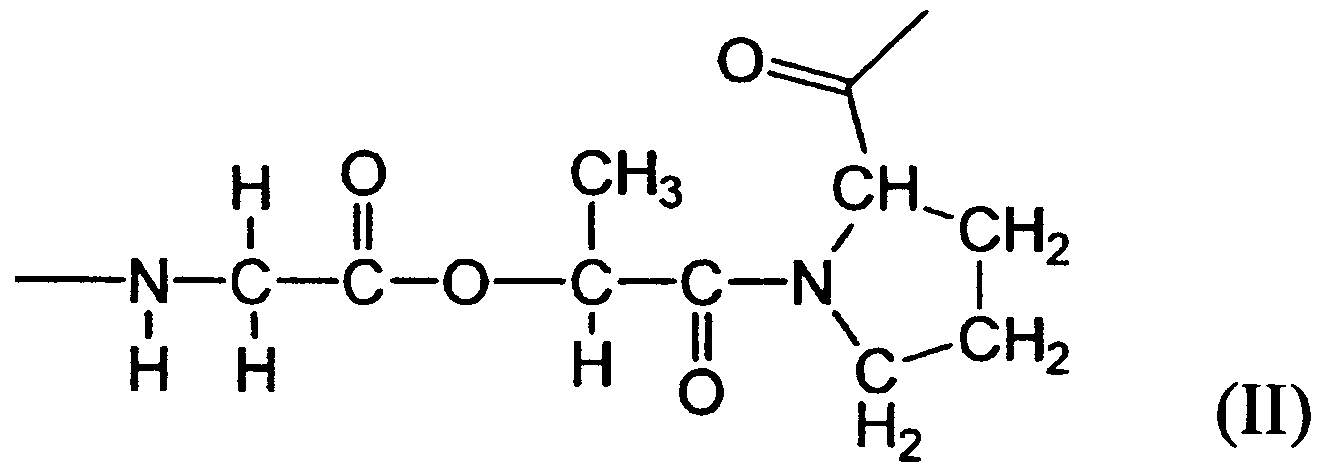
  • the compound (depsipeptide) of the present invention is represented by the following general formula (I).
  • Gly-Lac-Pro represents a tridepsipeptide structure in which a glycine residue, a lactic acid residue, and a proline residue of the following formula ( ⁇ ) are combined.
  • R is an H atom of an amino group, an amino acid linked by an amide bond, a polypeptide or a hydride.
  • Roxycarboxylic acid R represents an OH group of carboxylic acid, an amino acid or polypeptide linked by an amide bond, or a hydroxycarboxylic acid linked by an ester bond.
  • R is an amino acid or a polypeptide
  • the amino terminal of R is protected with an amino group.
  • a protective group may be added.
  • R is an OH group, an amino acid or a polypeptide
  • a carboxyl protecting group may be added to the carboxy terminus of R.
  • the protecting group for the amino group include Boc: tert_butoxycarbonyl (t-Bu-0-CO-).
  • Examples of the protecting group for the carboxyl group include OSu: N-hydroxysuccinimide, OB zl: benzyl (-0-CH 2 -CH 3), and the like.
  • R and R amino acids are ⁇ -amino acids
  • the side chain may be modified, or the side chain may be bound with a peptide.
  • R and R are polypeptides, those having 2 to 20 amino acids
  • the types of amino acids (including those constituting polypeptides) in R and R are the temperature
  • Selection is made in accordance with the components of the responsive composition for the purpose of adjusting the response temperature and solubility. For example, in general, if there is no charge, the higher the hydrophobicity of the amino acid side chain, the lower the response temperature, and the higher the hydrophilicity, the higher the temperature. This is clear from the researches of the inventors (eg, Macromolecules, 1998, 31 pages, 3383 pages; Macromolecules, 1996, 29 volumes, 1065 pages). .
  • hydroxycarboxylic acids that can be contained in R and R include valic acid, lactic acid, and glycosyl.
  • formic acid For example, formic acid.
  • the compound of the present invention has the alignment force X-X Gly- Lac- Pro represented by the general formula (I).
  • X and X represent any ⁇ -amino acid residue.
  • Specific examples include, but are not limited to, Ala-lie-Gly-Lac-Pro, Gly-lie-Gly-Lac- ⁇ , and Gly-Va-Gly-Lac-Pro.
  • the polymer compound of the present invention is a polymer obtained by polymerizing the depsipeptide compound of the general formula (I).
  • the structure of the polymer compound is preferably a linear structure! /, But branched from the amino acid side chain It may have a chain.
  • the degree of polymerization of the depsipeptide polymer is not particularly limited, and may be an oligomer in which about 2 to 10 depsipeptide compounds of the general formula (I) are repeated.
  • the total number of amino acid residues and hydroxy acid residues contained in the polymer compound of the present invention is preferably 1000 or less, more preferably 500 or less.
  • the polymer compound of the present invention preferably has a molecular weight of from 1500 to 100,000, more preferably from 1500 to 50,000.
  • the polymer compound of the present invention may contain two or more types of depsipeptide units of the general formula (I).
  • the polymer compound of the present invention can be obtained, for example, by first synthesizing a compound of general formula (I) (debushipeptide) and polymerizing it.
  • the compound of the general formula (I) can be obtained by chemical synthesis as in Examples described later.
  • the chemical synthesis methods described in the examples described below compared with the production scale of a polypeptide temperature-responsive material by genetic recombination, can only be carried out once or several times in a small experimental facility. Therefore, it is possible to obtain a temperature-responsive material in an amount comparable to that of large-scale genetic engineering manufacturing equipment.
  • the target product can be obtained on a scale of 100 times or more.
  • the polymerization reaction of the compound of the general formula (I) can be performed by a normal amide condensation reaction.
  • the polymerization reaction is performed while protecting the side chain. It is preferable.
  • segment condensation an extension reaction of one unit called segment condensation can also be used.
  • the compound and polymer compound of the present invention may have a protecting group. When at least one of the N-terminal and C-terminal amino acid residues is deprotected, it is suitable for dissolution in an aqueous environment. .
  • the compound and polymer compound of the present invention may have other compounds or materials bonded to the terminal.
  • the terminal may be either the amino terminal side or the carboxy terminal side, either or both.
  • Other compounds and materials include hydroxy acid ligand IJ, amino acid sequence, sugar chain sequence, protein, Polysaccharides, metal complexes or polymer carriers, gels, films, latex particles, metal fine particles, plastic plates and the like can be used.
  • Other compounds and materials can be bonded by covalent bonds, coordinate bonds, ionic bonds, hydrophobic interactions, hydrogen bonds, and the like.
  • the compound and the polymer compound of the present invention are mixed with water, a buffer solution, a saline solution, or a water-containing organic solvent to be in a solvated state, a gel state, a suspension, a homogeneous solution, or a phase-separated state.
  • a composition can be formed.
  • the compounds and polymer compounds of the present invention preferably have temperature responsiveness. Temperature responsiveness is a property that aggregates when heated from a first temperature on the low temperature side to a second temperature on the high temperature side in water, a buffer solution, a saline solution, or a water-containing organic solvent. Say.
  • the first temperature and the second temperature vary depending on the type of amino acid contained in the polymer compound and the type of other compounds to be bonded to the terminal, and are appropriately set for each polymer compound. The difference is preferably 10 ° C or more.
  • Aggregation can be confirmed by visual observation, a change in transmittance using a spectrophotometer, and an apparent change in absorbance.
  • the compounds and polymer compounds of the present invention can be used in the production of temperature-responsive compositions.
  • the temperature-responsive composition comprises the compound of the present invention (depsipeptide or polymer thereof) or the compound of the present invention bound to the above-mentioned other compound or material alone or in combination with a physiologically acceptable carrier. used.
  • the physiologically acceptable carrier is not particularly limited and may be a solid agent such as a powder or a powder.
  • the compound of the present invention is usually used as a liquid agent in combination with a liquid carrier.
  • liquid carriers include water, physiological saline, buffer solution (such as phosphate buffer solution), alcohol aqueous solution (such as ethanol aqueous solution), polyhydric alcohol aqueous solution (5% glycerin aqueous solution, ethylene glycol aqueous solution, propylene glycol aqueous solution, etc.) ), Sugar aqueous solutions (5% glucose aqueous solution, glucose aqueous solution, etc.), albumin aqueous solutions (5% albumin solution, etc.) and the like.
  • buffer solution such as phosphate buffer solution
  • alcohol aqueous solution such as ethanol aqueous solution
  • polyhydric alcohol aqueous solution 5% glycerin aqueous solution, ethylene glycol aqueous solution, propylene glycol aque
  • a liquid agent is a solution agent, a suspension agent, an emulsion, an ointment, It may be an aerosol or a patch (pasta or poultice).
  • the temperature-responsive composition includes various physiologically or pharmacologically acceptable additives such as polymers such as polyvinylinolepyrrolidone, macrogonores, polyvinylenolenoconole, cenorelose derivatives (such as cenolate mouth ethers). , Preservatives, stabilizers, emulsifiers and suspending agents, pH adjusters, buffers, drugs (bactericides, disinfectants, antibacterial agents, antiviral agents, anti-inflammatory agents, antiallergic agents, analgesics, hemostatic agents Etc.) may be included.
  • physiologically or pharmacologically acceptable additives such as polymers such as polyvinylinolepyrrolidone, macrogonores, polyvinylenolenoconole, cenorelose derivatives (such as cenolate mouth ethers).
  • Preservatives, stabilizers, emulsifiers and suspending agents pH adjusters, buffers, drugs (bactericides, disinfectants, antibacterial agents,
  • the temperature-responsive composition of the present invention has the property of being agglomerated in response to temperature (for example, changing from a liquid to a gel), and has high safety in vivo. There are also advantages to! /, And! /. Therefore, a gel-like film can be formed on the application part by application to a living body (for example, an affected part).
  • the polymer or composition of the present invention is a composition that is decomposed and absorbed in a living body, a composition that is decomposed and absorbed in an environment such as soil, a cell adhesive, a wound dressing material, a microcapsule, a biomachine, a biosensor, and a separation membrane. Can be used to construct test kits, etc.
  • a method for synthesizing -Gly-Ile-Gly-Lac-Pro-unit which is an embodiment of the present invention, and a polymer compound poly (Gly-Ile-Gly-Lac-Pro) obtained by using them Details of the synthesis method are shown in Examples 1 and 2, respectively.
  • Examples 3, 4 and 5 are shown.
  • -Gly-Va ⁇ Gly-Lac-Pro-unit synthesis method and the synthesis method of the polymer compound poly (Gly_Va ⁇ Gly-Lac-Pro) obtained using these Example 9 shows.
  • operations common in the implementation are shown as synthesis procedures 1 to 3.
  • the following specific examples are not intended to limit the present invention.
  • the protecting group and the condensing agent can be appropriately changed by substituting with other conventional ones.
  • N-a-t_butoxycarbonyl-L-glycine or N-a-t_butoxycarbonyl-L-alanine
  • N-a-t It is similarly carried out by using the corresponding N-a _t-butoxycarbonyl-amino acid instead of _butoxycarbonyl-L-isoleucine.
  • Boc-Gly-OH N-a _t_butoxycarbonyl-glycine
  • Boc-Ala-OH N-a _t_Butoxycarbonyl _L_Alanine
  • Boc-Ile-OH N-a _t_butoxycarbonyl _L_isoleucine
  • Boc tert-Butoxycarbonyl (t-Bu-0-CO-)
  • EDC ⁇ HC1 1-Ethyl-3- (3_dimethylaminopropyl) -carpositimide hydrochloride
  • DMAP ⁇ , ⁇ '-Dimethylaminopyridine
  • L-amino acid or L-amino acid with protected side chain (1.0 mol) was dissolved in 4M NaOH (250 mL, 1.0 mol) and dissolved in a minimum amount of dioxane while slowly cooling with ice-MeOH (Boc) 0 (240.0 g, 1.1 mol) was gradually added over 30 minutes. The mixture was stirred for 1 hour in an ice bath and 1.5 hours at room temperature. The precipitated NaHCO is filtered off, adjusted to pH 3.0 and extracted with AcOEt. 10 extraction solutions
  • a peptide compound in which the amino group was protected with N-a_t-butoxycarbonyl was placed in a 300 mL eggplant flask, and TFA or 4M HC1 in dioxane was added and dissolved in a fume hood. The cap was immediately covered with a calcium chloride tube to prevent moisture from entering. After confirming the completion of the reaction by TLC, concentrate, and repeatedly add distilled Et 0 until TFA smell (hydrochloric acid smell) disappears and concentrate to obtain a white powder of TFA salt or hydrochloride). The yield is almost quantitative.
  • Yields can be obtained in the range of approximately 70-90%.
  • Boc-Gly-OH (1.54 g, 8.82 mmol) was added to 500 mL of Nasflask and dissolved in distilled CHC1, and then DCU (2.18 g, 10.6 mmol), HOSu (1.21 g, 10.6 mmol) ) And stirring was started under cooling. After standing overnight, the completion of the reaction was confirmed by TLC, and after concentrating and filtering DCUrea, DCUrea dissolved in AcOEt and precipitated again was filtered. Then, it was concentrated and recrystallized twice with AcOEt-distilled Et 0 to obtain Boc-Gly-OSu.
  • Boc-Gly-OSu (27.2 g, 100 mmol) and DMAP (4.89 g, 40.0 mmol) are placed in a 500 mL eggplant flask and dissolved in 100 mL of distilled THF. I let you. At this time, a little undissolved residue was dissolved by adding 1 mL of acetonitrile. To another 300 mL eggplant flask, H-Lac-OH (10.81 g, 120 mmol) was added, dissolved in distilled THF, and neutralized with pyridine (9.67 mL, 120 mmol). It was added to the ice-cooled 500 mL eggplant flask side.
  • the reaction mixture was allowed to warm to room temperature after 1 hour and continued to stir. After 44 hours from the start of the reaction, some unreacted product was confirmed by TLC, but the solvent was distilled off under reduced pressure. The residue was covered with EtOAc and washed 4 times with 10% aqueous citrate solution and twice with distilled water. After washing, the target product was extracted into the aqueous phase three times with a saturated aqueous solution of sodium hydrogen carbonate, and about 150 mL of 4M aqueous hydrochloric acid solution was added to the aqueous phase while stirring with ice cooling to adjust the pH to 2-3. Thereafter, the target product was extracted with EtOAc. After confirming the completion of extraction by TLC, Na 2 SO 4 was added to the organic phase and dried.
  • Boc-Gly-Ile-Gly-Lac-Pro-OBzl (3.45 g, 5.71 mmol) was placed in a 300 mL eggplant flask, and methanol was added to give a solution. After adding two microspatulas of palladium carbon powder to the solution, the entire system was replaced with hydrogen gas and a catalytic reduction reaction was carried out for 11 hours. After completion of the reaction, 5% palladium carbon was filtered off and the solvent was distilled off under reduced pressure. Benzene was added to the residue and azeotropic dehydration was performed three times. When hexane was added to the residue, it crystallized. This was collected by filtration and dried under reduced pressure to obtain the desired product. Yield 2.55 g (Yield 87.0%) .: H NMR (DMSO-d, 3
  • Boc-Gly-Ile-Gly-Lac-Pro-OH (2.55 g, 4.95 mmol) and HOSu (0.57 g, 4.95 mmol) were added to a 300 mL eggplant flask and dissolved in distilled THF.
  • DCC (1.12 g, 5.4 5 mmol) was added while stirring with ice cooling, followed by stirring for 1 hour under ice cooling and 24 hours at room temperature.
  • DCUrea was filtered off and the filtrate was concentrated under reduced pressure.
  • Ethyl acetate was added to the residue and left in a refrigerator for 1 day. The produced DCUrea was filtered off, and the filtrate was concentrated again under reduced pressure.
  • Boc-Gly-lie-Gly-Lac-Pro-OSu (3.03 g, 4.95 mmol) was deprotected with 4M HCl / dioxane (15 mL) to obtain a colorless powder. Yield: 2.57 g (94.5% yield).
  • the degree of polymerization of the obtained polymer was about 3 (molecular weight was about 1200).
  • Boc-Ala-lie-Gly-Lac-Pro-OBzl (3.34 g, 5.39 mmol) was placed in a 300 mL eggplant flask, and methanol was added to dissolve. After adding 2 cups of 5% palladium carbon powder for micro spatula, the entire system was replaced with hydrogen gas, and catalytic reduction reaction was carried out for 11 hours. After completion of the reaction, 5% palladium carbon was filtered off and the solvent was distilled off under reduced pressure. Benzene was added to the residue and azeotropic dehydration was performed three times. After adding a small amount of ethyl acetate to the residue, hexane was added to crystallize. This was collected by filtration and dried under reduced pressure to obtain the desired product.
  • the degree of polymerization of the obtained polymer was about 10 (molecular weight was about 4500).
  • Boc- (Gly-Ile-Gly-Lac-Pro) -OBzl (1.20 g, 1.15 mmol) to 4M HCl / dioxane (0.850 m
  • the MALDI-spectrum was measured for the polymer compounds obtained in Examples 2 and 4. This confirms the strength of the molecular weight of the compound synthesized by the polymerization reaction.
  • examples of poly (Gly-Ile-Gly-Lac-Pro) and poly (Ala-Ile-Gly-Lac-Pro) are shown in FIGS.
  • a temperature change circular dichroism spectrum was measured for the polymer compounds obtained in Examples 2 and 4. This makes it possible to obtain information different from the temperature response change by visual observation. For example, it is knowledge about a solution structure.
  • a pol y in FIG. 3 and FIG. 4 (Gly-Ile- Gly-Lac -Pro) and poly (Ala-Ile-Gly- Lac-Pro).
  • the spectra changed while showing isocircular dichroic points at 205 nm and 210 mm, respectively. No aggregation is observed due to dilute aqueous solution (0.1 mg / mL). It can be seen that the negative bands seen at 195 nm and 198 nm decrease with increasing temperature.
  • poly (Gly-Ile-Gly-Lac_Pr 0) has a reversible temperature response that gels when the temperature is raised and liquefies when cooled.
  • poly (Ala-Ile-Gly-Lac-Pro) shows an irreversible temperature response in the range of several hours even after cooling.
  • aggregation is sufficiently advanced even when the turbidity exceeds approximately 10 20%.
  • poly (Ala-Ile-Gly-Lac-Pro) is reversible, but when the aggregation state at high temperature is reduced to low temperature (4 ° C), the rapid temperature response in a few seconds normally seen (uniform solution) This is the first example in that no return was found. Actually, the solution was finally allowed to return to a homogeneous solution by standing at 4 ° C for 2 days. The very slow response at low temperatures (returning to a homogeneous solution) is a completely new property that has never been seen before.
  • the MALDI-spectrum was measured for the polymer compound obtained in Example 9. This confirms how large the molecular weight of the compound synthesized by the polymerization reaction is.
  • an example of poly (Gly_Val_Gly-Lac-Pro) is shown in FIG.
  • the signal in the low molecular weight region apparently corresponds to a 2-4 tetramer. In fact, high molecular weight multivalent ions were also observed.
  • a temperature change circular dichroism spectrum of the polymer compound obtained in Example 9 was measured. This makes it possible to obtain information different from the temperature response change by visual observation. For example, this is the knowledge of the solution structure.
  • Fig. 8 shows an example of poly (Gly_Va ⁇ Gly-Lac-Pro). As a result, the spectrum changed while showing an isocircular dichroic point at 210 mm. No aggregation is observed due to the dilute aqueous solution (0.1 mg / mL). It can be seen that the negative band intensity seen at 200 nm decreases with increasing temperature.
  • poly (Gly_Va to Gly-Lac-Pro) may have an aggregation temperature of 70 ° C or higher under the same conditions. all right. This can be explained by the fact that the higher the hydrophobicity, the lower the phase transition temperature.
  • the depsipeptide compound or polymer thereof of the present invention can be used as a temperature-responsive depsipeptide material or a temperature-responsive composition containing the same.
  • the temperature-responsive material or composition of the present invention is a composition that is decomposed and absorbed in vivo, a composition that is decomposed and absorbed in an environment such as soil, a cell adhesive, a drug carrier, a wound dressing material, and an artificial muscle. It can be used to construct microcapsules, biomachines, biosensors, separation membranes, test kits, etc. This can be easily developed based on the inventors' related research (for example, Yoshida et al., Advanced Materials, 1997, Vol. 9, p.

Landscapes

  • Chemical & Material Sciences (AREA)
  • Organic Chemistry (AREA)
  • Genetics & Genomics (AREA)
  • Biochemistry (AREA)
  • Biophysics (AREA)
  • General Health & Medical Sciences (AREA)
  • Health & Medical Sciences (AREA)
  • Medicinal Chemistry (AREA)
  • Molecular Biology (AREA)
  • Proteomics, Peptides & Aminoacids (AREA)
  • Life Sciences & Earth Sciences (AREA)
  • Peptides Or Proteins (AREA)
  • Polyamides (AREA)
  • Medicines That Contain Protein Lipid Enzymes And Other Medicines (AREA)

Description

[0001] 本発明は、 度応答性材料として使用しうる新規なデプシペプチド化合物およびそ れを重合させて得られるデプシペプチドポリマーに関する。更に詳しくは、乳酸残基 とアミノ酸残基が脱水縮合されてできたデプシペプチドを構成成分として持つ新規な デプシペプチド化合物およびそれを重合させて得られるデプシペプチドポリマーに
明
関する。
本発明の材料は水、緩衝液または含水溶媒中で温度に応答し凝集または溶解す
書
る温度応答性材料として使用しうるため、生体吸収性組成物、環境分解性組成物、 細胞接着剤、人工筋肉、マイクロカプセル、バイオマシン、バイオセンサー、分離膜、 検査キットなどを構成するのに有用である。
背景技術
[0002] (1)デプシペプチドおよび関連材料の現況:
デプシペプチドは式 (A)に示すように主鎖がエステル結合とアミド結合で連結され たポリマーまたはオリゴマーである。その構造の骨格はアミド結合とエステル結合から できている。
アミ ド結合 エステル結合
Figure imgf000004_0001
[0003] 骨格に含まれるアミド結合とエステル結合は分子レベルでは 3種類の相互作用が 知られている。即ちアミド結合同士では、分子レベルでは分子内と分子間に水素結 合により、強い相互作用と分子構造の安定化を起こす。よって巨視的には溶媒への 不溶化と機械的強度の向上が期待される。またエステル結合同士では、分子レベル では水素結合による分子間と分子内の相互作用が生じない。よって巨視的には機械 的強度の減少による柔軟性または弱さが期待される。即ちアミド結合とエステル結合 の間では、分子レベルでは分子内と分子間にエステル部位の酸素原子とアミド部位 の NHの間でやや弱い水素結合により、分子構造の構造安定化を起こす。よって巨 視的にはアミド結合のみの場合より小さな機械的強度の向上が期待される。従ってデ プシペプチドはアミノ酸ゃヒドロキシカルボン酸によるオリゴマーやポリマーの特徴を 生力、した材料とすること力 Sできる。つまりアミノ酸とヒドロキシカルボン酸の種類や組成 、配列を変化させることで幅広い特性を持つ材料を合成することができる。さらに、デ プシペプチドの長所として、体内に炎症をおこしにくいこと、酸性成分に弱い物質の 薬物運搬材料として利用できること、水素結合と疎水性相互作用といった分子間や 分子内相互作用により成型物の強度が極めて高いこと、の 3点が挙げられる。このよ うにデプシペプチドは極めて魅力的な物質である。
[0004] 実際にポリデプシペプチドにつ!/、てはさまざまな研究が行われた。例えばヒドロキシ カルボン酸の側鎖を H -、 CH -、 (CH ) CH -、 (CH ) CH-CH -のように疎水性と立体 障害の大きさを変化させると生体内での分解速度力 ¾週間から 6ヶ月まで幅広く調節 すること力 Sできること力 Sわ力、つている。また生体組織との接合面に炎症はみられないこ とも特徴的である (非特許文献 1)。
ポリデプシペプチドでは炎症が見られなかった力 一般にポリヒドロキシカルボン酸 のみを使用する材料では分解が速い場合、炎症反応を引き起こしゃすいことが知ら れている(非特許文献 2)。これは乳酸ゃグリコール酸のような比較的強い酸性成分 が蓄積するためと考えられている。一方、ポリデプシペプチドではデプシペプチドオリ ゴマーが分解物として生成するために酸性成分が蓄積されず、分解速度が速くても 炎症が見られなかったと考えられる。
[0005] ポリデプシペプチドは、合成方法の点からも近年改良が行われてきた。例えば反応 ステップ数を削減する研究である。すなわち、アミノ基を保護されたアミノ酸のカルボ キシル基と、無保護のカルボキシル基を有するヒドロキシカルボン酸のヒドロキシル基 とを、アミノビリジン化合物を触媒として反応させ、ジデプシペプチドを生成することが できるようになった(特許文献 1、非特許文献 3, 4)。これらの研究により、ヒドロキシカ ルボン酸のカルボキシル基の保護基を形成せずに繰り返し配列をもつデプシぺプチ ドをより簡便に製造できるようになった。即ち、実験室レベルの合成設備 (数 mL〜数 百 mL)でも、純粋なポリデプシペプチドを数百 mg〜数 gの単位で一度に合成すること が可能となった。工場設備 (数 L〜数百 L)へ規模拡大した場合は数 kg単位での製造 を十分に行うことができる。
[0006] (2)温度応答性材料の現況:
近年、温度を上昇させることで凝集する温度応答性材料の研究に注目が集まって いる。これらは水を多く含有する性質を利用して薬物運搬体、創傷被覆材料、人工 筋肉、マイクロカプセル、バイオマシン、バイオセンサー、分離膜などへの利用が期 待されている。
[0007] デプシペプチドを用いた方法によっても近年、温度応答性材料が開発された。 (特 許文献 2、非特許文献 5)例えば、 -Gly-Val-Gly-Hmb-Pro-と _Gly_Va卜 Gly-Hmb- Ala-Pro- (Hmb = ノ リン酸残基)を繰り返し単位とするデプシペプチドポリマーが開示 されている。これらはバリン酸(Hmb)と呼ばれる 0分岐型ヒドロキシカルボン酸を有す る点を特徴としている。ここで示した配列に於けるバリン酸の位置には、温度応答性 の発現のために、 /3分岐型アミノ酸ほたはヒドロキシカルボン酸)が必要であると考 えられてきたためである。
[0008] デプシペプチドまたはペプチドによる温度応答性材料に於いて、 /3分岐型アミノ酸 の役割は、加熱により Val γ CH (または Hmb γ CH )と Pro δ CHの疎水性水和した水 分子が熱エネルギーによる分子運動の増大で側鎖から遊離して、側鎖間に疎水性 相互作用を起こすこと(加熱による温度応答性の凝集現象)、またその逆の過程が起 こること (冷却による温度応答性の溶解現象)で、可逆的な温度応答性を引き起こす と考えられてきた。 (Val残基での例として、非特許文献 6〜9) (lie残基での例として、 非特許文献 10)
[0009] ペプチドによる温度応答性材料に於!/、て、実際に /3分岐型アミノ酸ではない、ァラ ニン (Ala)残基の場合、非可逆な温度応答を示し直ちに水に不溶な物質になってし まうことが指摘されて!/、る。 (非特許文献 11)すなわち従来の温度応答性材料には、 決まった位置に 13分岐型アミノ酸を導入する必要があり、配列の制限が大きい点で 問題があった。
[0010] これまでの生体材料として実際に市販されてきたヒドロキシカルボン酸は、主に乳酸 とグリコール酸を構成成分としている。これらは多くの使用例があり、長所と短所がわ 力、つて!/、る点で優れて!/、る。
一方、これまでのデプシペプチドによる温度応答性材料は、その他のヒドロキシカ ノレボン酸である、ノ リン酸(Hmb)を使用している。これは抗生物質のように多くの天然 物に含まれるためほとんど問題はないと予想される力 S、生体材料として使用された事 例は少ない。そのため、ノ リン酸 (Hmb)を含んだ温度応答性高分子の生体応用には 、体内動態を含めて多くの検討が必要と考えられる点で、まだ問題が残っていた。
[0011] 興味深い研究として、温度応答性材料に関連したポリデプシペプチド配列力 199 0年に報告されている。 (非特許文献 12、 13)ここでは- Va卜 Pro-Gly-Hmb-Gly-と -V a卜 Ala-Pro-Gly-Hmb-Gly-の 2種類の繰り返し配列をもつポリマーが報告されている 。これらは、温度応答性が示されていない、合成ステップ数が多い、縮合反応と呼ば れるエステル結合又はアミド結合を生成する最も重要な反応が低収率であること(5 つの反応が記載され、それぞれ 23、 33, 54, 70、 76%)、低収率の結果最終生成 物のポリマー体が 10 mgしか得られていないこと、の 4点に於いて問題があった。実際 、論文中には、
この配列の合成がいかに困難であるか述べてある点は注目される。
即ち、本発明者らの報告した事例 (特許文献 2、非特許文献 5)を除き、一般には現 在まで、温度応答性材料に関連したポリデプシペプチドおよびオリゴデプシペプチド 配列の合成は非常に困難であり、実用的ではないと考えられてきた。
特許文献 1:特開 2004-269462
特許文献 2: WO2006/043644A1
非特許文献 1 :吉田ら、 Journal of Biomedical Materials Research, 1990年、 24巻、 117 3ページ
非特許文献 2 :敷波保夫、リウマチ科、 1999年、 21巻第 3号、 267ページ
非特許文献 3 :片貝ら、 Biopolymers, 2004年、 73巻、 641ページ 非特許文献 4 :奥ら、 Acta Crystallographica Section E、 2004年、 E60巻、 o927ページ 非特許文献 5 :七里ら、 Peptide Science 2004、 2005年、 633ページ
非特許文献 6 :チャンら、 Journal of Biomolecular Structure and Dynamics 1989年、 6 巻、 851ページ
非特許文献 7 :ゥリーら、 Biochemistry and Biophysics Research Communication、 197 7年、 79巻、 700ページ
非特許文献 8 :ゥリーら、 Biopolymers, 1989年、 28巻、 819ページ
非特許文献 9 :ゥリーら、 Progress in Biophysics and Molecular Biology, 1992年、 57巻
、 23ページ
非特許文献 10 :ゥリーら、 Biopolymers, 1986年、 25巻、 1939ページ
非特許文献 11:フノ 刃ら、 International Journal of Peptide and Protein Research^ 197
8年、 81ページ
非特許文献 12 :ァラッド &グッドマン、 Biopolymers、 1990年、 29巻、 1633ページ 非特許文献 13 :ァラッド &グッドマン、 Biopolymers、 1990年、 29巻、 1651ページ 発明の開示
[0012] 本発明の課題は、生体材料として好ましい構成成分を有し温度応答性材料として 使用しうる、新規なデプシペプチドを提供することにある。
[0013] 本発明者らは、上記目的を達成するために新たなアミノ酸配列に着目した。即ち従 来は不可逆的な温度応答とその結果生じる不溶性のために注目されてこな力、つた、 β分岐型アミノ酸ではないアミノ酸、ァラニン (Ala)を持つエラスチン様ポリペプチドの 配列、 -Gly-Ile-Gly-Ala-Pro- (配列番号 1)に着目した。更にァラニン (Ala)をヒドロキ シカルボン酸の乳酸(Lac)に置換したデプシペプチド、 -X -X -Gly-Lac-Pro- (Xお
1 2 1 よび Xは任意のアミノ酸残基)の化学合成を計画した。
[0014] はじめに- X -X -Gly-Lac-Pro-の配列を持つポリデプシペプチドとして、 poly(Gly_Il
1 2
e-Gly-Lac-Pro),および poly(Ala-Ile-Gly-Lac-Pro)の化学合成を計画した。合成方 法や各反応段階での条件を精査することで、実験室規模の設備 (数 mL〜数百 mL) にも関わらず、数百 mg〜数 gの単位を一度の工程で化学合成することができた。
[0015] さらに、これらのポリデプシペプチドは容易に水溶液となり、 目視ゃ測定装置によつ て明瞭な温度応答性が確認された。また、温度応答挙動は可逆的であることがわか つた。このように種々の乳酸残基を含むデプシペプチドについて合成を行い温度応 答性について鋭意検討した結果、本発明を完成するに至った。
すなわち、本発明は以下のとおりである。
(1)下記一般式(I)
R -Glv-Lac-Pro-R (I)
1 2
で表される化合物。
(式中、— Gly— Lac— Pro—は下記式 (Π)の構造を示し、 Rは水素原子、アミド結合で
1
結合したアミノ酸、ポリペプチドまたはヒドロキシカルボン酸、 Rは水酸基、アミド結合 で結合したアミノ酸もしくはポリペプチド、またはエステル結合で結合したヒドロキシカ ルボン酸を表す。 )
[化 2]
Figure imgf000009_0001
(2)前記一般式 (I)が、 X -X -Gly -Lac -Pro (Xおよび Xは α —アミノ酸残基を示
1 2 1 2
す)である(1)の化合物。
(3) (1)または(2)の化合物を重合させて得られるポリマー。
(4)末端に糖鎖配歹 IJ、タンパク質、多糖、金属錯体、高分子担体、ゲル、フィルム、ラ テックス粒子、金属微粒子、無機微粒子、ガラスプレート、もしくはプラスチックプレー トが結合した、(1)もしくは(2)の化合物、または(3)のポリマー。
(5) (1)もしくは(2)の化合物または(3)のポリマーを、水、緩衝液、食塩水、または含 水有機溶媒と混合させることにより得られる組成物であって、溶媒和状態、ゲル状態
、懸濁物、均一な溶液、または相分離状態を形成する組成物。 (6)加温により水分子を放出し、冷却により水分子を取り込む(5)の組成物。
(7) (1)もしくは(2)の化合物または(3)のポリマーを含む温度応答性組成物。
図面の簡単な説明
[図 1]図 1は本発明の一実施態様である、 poly(Gly-Ile-Gly-Lac-Pro)を MALDト TOF 質量分析法により測定したスペクトルである。
[図 2]図 2は本発明の一実施態様である、 poly(Ala-Ile-Gly-Lac-Pro)を MALDI-T0F 質量分析法により測定したスペクトルである。
[図 3]図 3は本発明の一実施態様である、 poly(Gly-Ile-Gly-Lac-Pro)の水溶液(0.1 m g/mL)を 1 mm厚の石英製吸収スペクトル用セルに入れ、 0〜80°Cの間で 10°C毎に 温度上昇させ、各温度での温度平衡になった際に測定された、温度変化円偏光二 色性スペクトルである。
[図 4]図 4は本発明の一実施態様である、 poly(Ala-Ile-Gly-Lac-Pro)の水溶液(0.1 m g/mL)を 1 mm厚の石英製吸収スペクトル用セルに入れ、 10〜70°Cの間で 10°C毎 に温度上昇させ、各温度での温度平衡になった際に測定された、温度変化円偏光 二色性スペクトルである。
[図 5]図 5は本発明の一実施態様である、 poly(Gly-Ile-Gly-Lac-Pro)の水溶液(10 m g/mL)を 1 mm厚の石英製吸収スペクトル用セルに入れ、 20〜70°Cの間、 l°C/5分 の速度で温度を上昇、次には下降させた。 1°C毎に各温度での 350 nmの光に対して 透過率 (%)を測定し、 100—透過率 (%) =濁度 (%)としてプロットしたグラフである。
[図 6]図 6は本発明の一実施態様である、 poly(Ala-Ile-Gly-Lac-Pro)の水溶液(10 mg /mL)を 1 mm厚の石英製吸収スペクトル用セルに入れ、 20〜70°Cの間、 l°C/5分の 速度で温度を上昇、次には下降させた。 1°C毎に各温度での 350匪の光に対して透 過率 (%)を測定し、 100—透過率 (%) =濁度 (%)としてプロットしたグラフである。
[図 7]図 7は本発明の一実施態様である、 poly(Gly_Va卜 Gly-Lac-Pro)を MALDト T0F 質量分析法により測定したスペクトルである。
[図 8]図 8は本発明の一実施態様である、 poly(Gly-Vaト Gly-Lac-Pro)の水溶液(0.1 mg/mL)を 1 mm厚の石英製吸収スペクトル用セルに入れ、 10〜70°Cの間で 10°C毎 に温度上昇させ、各温度での温度平衡になった際に測定された、温度変化円偏光 二色性スペクトルである。
[図 9]図 9は本発明の一実施態様である、 poly(Gly_Va卜 Gly-Lac-Pro)の水溶液(10 m g/mL)を 1 mm厚の石英製吸収スペクトル用セルに入れ、 20〜70°Cの間、 l°C/5分 の速度で温度を上昇、次には下降させた。 1°C毎に各温度での 350 nmの光に対して 透過率 (%)を測定し、 100 透過率 (%) =濁度 (%)としてプロットしたグラフである。また 比較例として poly(Gly_Va卜 Gly-Hmb-Pro)の水溶液(10 mg/mL)を示した。
[図 10]図 10は本発明の一実施態様である、 poly(Gly-Vaト Gly-Lac-Pro)について濃 度の異なる水溶液(10, 20, 30, 40 mg/mL)を 1 mm厚の石英製吸収スペクトル用セル に入れ、 20〜70°Cの間、 l°C/5分の速度で温度を上昇させた。 1°C毎に各温度での 350 nmの光に対して透過率 (%)を測定し、 100 透過率 (%) =濁度 (%)としてプロットし たグラフである。
[図 11]図 11は本発明の一実施態様である、 poly(Gly-Vaト Gly-Lac-Pro)の水溶液(4 0 mg/mL)を 1 mm厚の石英製吸収スペクトル用セルに入れ、 20〜70°Cの間、 l°C/5 分の速度で温度を上昇、次には下降させた。 1°C毎に各温度での 350匪の光に対し て透過率 (%)を測定し、 100 透過率 (%) =濁度 (%)としてプロットしたグラフである。 発明を実施するための最良の形態
本発明の化合物(デブシペプチド)は、下記一般式(I)で表される。
R -Gly-Lac-Pro-R (I)
1 2
式 (I)中、 Gly— Lac— Pro は下記式 (Π)のグリシン残基と乳酸残基とプロリン残基 の結合したトリデプシペプチド構造を示す。
[化 3]
Figure imgf000011_0001
また、 Rはァミノ基の H原子、アミド結合で結合したアミノ酸、ポリペプチドまたはヒド ロキシカルボン酸を示し、 Rはカルボン酸の OH基、アミド結合で結合したアミノ酸もし くはポリペプチド、またはエステル結合で結合したヒドロキシカルボン酸を示す。
なお、 Rがアミノ酸またはポリペプチドである場合、 Rのァミノ末端にはァミノ基の保
1 1
護基が付加されていてもよい。また、 Rが OH基またはアミノ酸もしくはポリペプチドで ある場合、 Rのカルボキシ末端にはカルボキシル基の保護基が付加されていてもよ い。ァミノ基の保護基としては、 Boc : tert_ブトキシカルボニル(t-Bu-0-CO-)などが 挙げられる。カルボキシル基の保護基としては、 OSu : N-ヒドロキシスクシンイミドゃ OB zl :ベンジル(-0-CH -C H )などが挙げられる。
2 6 5
[0019] R及び Rに含まれるアミノ酸 (ポリペプチドを構成するものも含む)は α アミノ酸が
1 2
好ましい。また、側鎖が修飾されたもの、側鎖にペプチドなどが結合したものなどであ つてもよい。また、 R及び Rがポリペプチドの場合、アミノ酸の数が 2〜20個のものが
1 2
好ましぐ 2〜9個のものがより好ましい。
R及び Rに含まれるアミノ酸 (ポリペプチドを構成するものも含む)の種類は、温度
1 2
応答性組成物の成分に合わせて、応答温度や溶解性ゃ膨潤性の調節を目的として 選択が行われる。例えば一般に電荷を帯びることがなければ、アミノ酸側鎖の疎水性 が大きいほど応答温度が低温側へ、親水性が大きいほど高温側に調節することが可 能である。これは発明者らの関連研究(例えば Macromolecules、 1998年、 31巻、 3383 ページ; Macromolecules、 1996年、 29巻、 1065ページなど)ゃゥリーらの研究例(特表 2004-501784)により明らかである。
また、 R及び Rに含まれうるヒドロキシカルボン酸としてはバリン酸、乳酸、グリコー
1 2
ル酸などが挙げられる。
[0020] 本発明の化合物は、上記一般式(I)で表される配列力 X -X Gly— Lac— Proで
1 2
あることが好ましい。ここで、 Xおよび Xは任意の α—アミノ酸残基を示す。
1 2
具体的には、 Ala- lie- Gly-Lac- Pro、または Gly- lie- Gly-Lac- ΡΓΟ、 Gly- Vaト Gly- La c-Proなどが挙げられるがこれらには限定されない。
[0021] 本発明のポリマー化合物は上記一般式 (I)のデプシペプチド化合物を重合させて 得られるポリマーである。
ポリマー化合物の構造は直鎖状構造が好まし!/、が、アミノ酸側鎖から分岐した分岐 鎖を有するものであってもよレ、。
デプシペプチドポリマーの重合度は特に制限されず、一般式 (I)のデプシペプチド 化合物が 2〜; 10個程度繰り返されたオリゴマーであってもよい。なお、本発明のポリ マー化合物に含まれるアミノ酸残基及びヒドロキシ酸残基の総数は好ましくは 1000 個以下、より好ましくは 500個以下である。本発明のポリマー化合物は分子量 1500 〜; 10万であることが好ましぐ 1500〜5万であること力 り好ましい。
本発明のポリマー化合物は、一般式 (I)のデプシペプチド単位を 2種類以上含むも のであってもよい。
[0022] 本発明のポリマー化合物は、例えば、まず、一般式 (I)の化合物(デブシペプチド) を合成し、これを重合させることにより得ること力 Sできる。
一般式 (I)の化合物は後述の実施例のように化学合成によって得ることができる。 後述の実施例に記載の化学合成法は、遺伝子組み換えによるポリペプチド温度応 答性材料の製造スケールと比較すると、わず力、 1回〜数回の合成を小規模の実験施 設で行うだけで、大規模遺伝子組み換え法製造設備に匹敵する量の温度応答性材 料を得ること力 Sできる。また従来報告されてきた化学合成の方法 (ァラッド &グッドマ ン、 Biopolymers、 1990年、 29巻、 1633ページ。)と比較しても 100倍以上のスケール で目的物が得られる。
[0023] 一方、一般式 (I)の化合物の重合反応は通常のアミド縮合反応によって行うことが できるが、反応性側鎖を有するアミノ酸が含まれる場合は側鎖を保護して重合反応を 行うことが好ましい。
また、セグメント縮合と呼ばれる一単位ずつの伸長反応を用いることもできる。 なお、本発明の化合物およびポリマー化合物は保護基を有するものであってもよい 、 N末端及び C末端の少なくとも一方のアミノ酸残基が脱保護された場合、水系環 境への溶解に適している。
[0024] 本発明の化合物およびポリマー化合物は、末端に他の化合物や材料が結合したも のであってもよレ、。末端はァミノ末端側とカルボキシ末端側の!/ヽずれか一方でもよレヽ し、両方でもよい。
他の化合物や材料には、ヒドロキシ酸配歹 IJ、アミノ酸配列、糖鎖配列、タンパク質、 多糖、金属錯体または高分子担体、ゲル、フィルム、ラテックス粒子、金属微粒子、プ ラスチックプレートなどを使用することができる。他の化合物や材料とは、共有結合、 配位結合、イオン結合、疎水性相互作用、水素結合などで結合させることができる。
[0025] 本発明の化合物およびポリマー化合物は、水、緩衝液、食塩水、または含水有機 溶媒と混合することにより、溶媒和状態、ゲル状態、懸濁物、均一な溶液、または相 分離状態の組成物を形成することができる。
本発明の化合物およびポリマー化合物は温度応答性を有しているものが好ましい 。温度応答性とは、例えば、水中、緩衝液、食塩水、または含水有機溶媒中におい て、低温側の第一の温度から高温側の第二の温度まで加温されることで凝集する性 質をいう。第一の温度、第二の温度はポリマー化合物に含まれるアミノ酸の種類や末 端に結合させる他の化合物の種類によって異なり、ポリマー化合物ごとに適宜設定さ れるカ 第二の温度と第一の温度の差は 10°C以上であることが好ましい。
なお、凝集は目視、分光光度計を用いた透過率変化やみかけ上の吸光度変化な どによって確言忍することができる。
また、加温により水分子を放出し、冷却により水分子を取り込むという可逆的温度応 答十生を有するものが好ましレヽ。
このような性質により、本発明の化合物およびポリマー化合物は温度応答性組成物 の製造に用いることができる。
[0026] 温度応答性組成物は、本発明の化合物(デブシペプチドもしくはそのポリマー)また は上記他の化合物や材料に結合した本発明の化合物を単独、または、生理学的に 許容される担体と組み合わせて使用される。
生理学的に許容される担体は、特に制限されず、粉体、散剤などの固形剤であつ てもよいが、本発明の化合物は、通常、液体の担体と組み合わせることにより液剤と して利用される。すなわち、液剤の担体としては、水、生理食塩水、緩衝液(リン酸緩 衝液など)、アルコール水溶液 (エタノール水溶液など)、多価アルコール水溶液(5 %グリセリン水溶液、エチレングリコール水溶液、プロピレングリコール水溶液など)、 糖水溶液(5%グルコース水溶液、ブドウ糖水溶液など)、アルブミン水溶液(5%アル ブミン溶液など)などが例示できる。なお、液剤は、溶液剤、懸濁剤、乳剤、軟膏剤、 エアゾール剤、貼付剤 (パスタ剤、パップ剤)などであってもよい。液剤中の温度応答 性材料(又は温度応答性重合体)の濃度は、重合体の溶液粘度などに応じて、例え ば、 0. ;!〜 90重量0 /0、好ましくは 0. 5〜50重量0 /0、さらに好ましくは;!〜 30重量0 /0 ( 例えば、;!〜 15重量%)、特に 1〜; 10重量%程度の範囲から選択できる。
温度応答性組成物は、生理的又は薬理的に許容される種々の添加剤、例えば、ポ リビニノレピロリドン、マクロゴーノレ、ポリビニノレアノレコーノレ、セノレロース誘導体(セノレ口 ースエーテル類など)などの高分子、保存剤、安定剤、乳化剤や懸濁化剤、 pH調整 剤、緩衝剤、薬剤 (殺菌剤、消毒剤、抗菌剤、抗ウィルス剤、抗炎症剤、抗アレルギ 一剤、鎮痛剤、止血剤など)などを含んでいてもよい。
[0027] 本発明の温度応答性組成物は、温度に応答して凝集する(例えば、液体からゲル へ変化する)とレ、う性質を有しており、さらに生体内での安全性が高!/、と!/、う利点もあ る。そのため、生体 (例えば、患部など)への適用により、塗布部にゲル状の皮膜を形 成できる。本発明のポリマーや組成物は生体内で分解吸収される組成物、土壌など の環境下で分解吸収される組成物、細胞接着剤、創傷被覆材料、マイクロカプセル 、バイオマシン、バイオセンサー、分離膜、検査キットなどを構成するのに利用できる 。これは発明者らの関連研究を踏まえれば容易に開発することが可能である(例えば 、吉田ら、 Advanced Materials, 1997年、 9巻、 757ページ;廣木ら、 Journal of Polymer Science, 1998年、 36巻、 1495ページ;特開平 7-233194 ;吉田ら、 Drug Design and D elivery, 1991年、 7巻、 159ページ;真下ら、北関東医学、 1991年、 41巻、 311ページ)
〇
実施例
[0028] 以下本発明の実施態様である、 -Gly-Ile-Gly-Lac-Pro-ユニットの合成方法、および これらを用いて得られる、ポリマー化合物 poly(Gly-Ile-Gly-Lac-Pro)の合成方法に ついて詳細をそれぞれ実施例 1、 2に示す。またその他の実施態様として、 -Ala-Ile- Gly-Lac-Pro-ユニットの合成方法、 poly(Ala-Ile-Gly-Lac-Pro)の合成方法、 -(Ala-Il e-Gly-Lac-Pro) _ (n = 2, 3, 4)オリゴマーの合成方法について詳細をそれぞれ実施
n
例 3、 4、 5に示す。 -Gly-Va卜 Gly-Lac-Pro-ユニットの合成方法、およびこれらを用い て得られる、ポリマー化合物 poly(Gly_Va卜 Gly-Lac-Pro)の合成方法について詳細を 実施例 9に示す。また実施に於いて共通した操作は合成手順 1〜3として示した。し 力、し以下の具体例は本発明を限定するものではなぐ例えば保護基や縮合剤を他の 慣用のものと置換することなど、適宜変更できることは勿論である。
[0029] その他のデプシペプチド単位、つまり例えば、 -X -X -Gly-Lac-Pro-に於ける Xと X
1 2 1 2 への任意のアミノ酸残基の導入は実施例の N- a -t_ブトキシカルボニル -L-グリシン( または N- a -t_ブトキシカルボニル- L-ァラニン)と N- a -t_ブトキシカルボニル- L-ィ ソロイシンに代えて、対応する N- a _t-ブトキシカルボニル-アミノ酸を使用することで 同様に実施される。
[0030] なお、以下の実施例では次のような略号を使用した。
[0031] (アミノ酸誘導体)
Boc-Gly-OH: N- a _t_ブトキシカルボニル-グリシン
Boc-Ala-OH: N- a _t_ブトキシカルボニル _L_ァラニン
Boc-Ile-OH: N- a _t_ブトキシカルボニル _L_イソロイシン
HCl ' H-Pro-OBzl : L-プロリンベンジルエステル塩酸塩
[0032] (ヒドロキシカルボン酸)
H-Lac-OH: L-乳酸
[0033] (アミノ酸の主鎖および側鎖保護基)
Boc: tert-ブトキシカルボニル(t-Bu-0-CO-)
OBzl :ベンジル(-0-CH -C H )
2 6 5
[0034] (ペプチド合成用試薬、その関連化合物)
DCC: N,N '-ジクロロへキシルカルポジイミド
DCUrea:ジシクロへキシルゥレア
HOSu: N-ヒドロキシスクシンイミド
HOBt : 1-ヒドロキシベンゾトリアゾール
TFA :トリフルォロ酢酸
(Boc) 0 :ジ -t-ブチルカルボネート
NMM: N-メチルモルホリン
EDC · HC1: 1-ェチル -3-(3_ジメチルァミノプロピル) -カルポジイミド塩酸塩 DMAP : Ν,Ν'-ジメチルァミノピリジン
[0035] (溶媒)
THF :テトラヒドロフラン
CHC1 :クロロホルム
CDC1:重水素化クロ口ホルム
AcOEt:酢酸ェチノレ
DMF: Ν,Ν'-ジメチノレホノレムアミド
DMSO-d:重水素化ジメチルスルホキシド
MeOH :メタノーノレ
Et 0:ジェチノレエーテノレ
[0036] (その他)
TLC:薄相クロマトグラフィー
[0037] [合成手順 1: Boc-L-アミノ酸の合成]
L-アミノ酸または側鎖を保護した L-アミノ酸(1.0 mol)を 4M NaOH (250 mL, 1.0 mol) に溶かし、氷- MeOHで徐々に冷却しながら最小量のジォキサンに溶力、した (Boc) 0 ( 240.0 g, 1.1 mol)を 30分かけて徐々に加えた。氷浴で 1時間、室温で 1時間半攪拌し た。析出した NaHCOをろ別した後、 pH3.0にして AcOEtで抽出する。抽出溶液は 10
%クェン酸水溶液で洗浄の後、 Na SOで乾燥させた。乾燥剤をろ別後、ろ液は減圧 濃縮し、残渣にへキサンを加えて結晶化させた。その後、 AcOEt-へキサンで再結晶 を行い、 Boc-L-アミノ酸を得た。
[0038] [合成手順 2 :アミノ基末端の脱保護反応、脱 Boc化合物の合成]
アミノ基を N- a _t-ブトキシカルボニル保護したペプチド化合物を 300 mLナスフラスコ に入れドラフト内で TFAほたは 4M HC1のジォキサン溶液)を加え溶解させた。直ち に塩化カルシウム管で蓋をし、水分の混入を防いだ。 TLCにより反応の終了を確認 後、濃縮し TFA臭ほたは塩酸臭)がなくなるまで繰り返し蒸留 Et 0を加えて濃縮する と最終的に TFA塩ほたは塩酸塩)の白色粉末を得る。収率は、ほぼ定量的である。
[0039] [合成手順 3 :縮合反応]
アミノ基を N_ a _t -ブトキシカルボニルで保護し、カルボキシル末端を脱保護したぺ プチド化合物(2.1 mmol)を 300 mL三角フラスコに入れ蒸留 CHC1に溶力、し、 HOBt
(0.28 g, 2.1 mmol), EDC -HCl (0.40 g, 2.1 mmol) (または DCC (0.43 g, 2.1 mmol))を 加え攪拌した。次に 300 mlのナスフラスコにアミノ基を上記合成手順 2で脱保護し TF A塩のペプチド化合物(1.4 mmol)を入れ NMMで TFA塩を中和する。ほぼ等モル (0.1 5 mL, 1.40 mmol)で中和を確認できる力 結晶性が悪い塩の場合やや多くなることが ある。二つの溶液を混合攪拌しながら、直ちに氷冷し反応を開始した。そのままゆつ くり室温に戻して一晩攪拌する。この混合物をエバポレーターにより濃縮し AcOEtに 溶かしてから、(DCCを使用した場合は AcOEtに不溶の DCUreaを除く) 10%クェン酸 水溶液、蒸留水、飽和 NaHCO水溶液、蒸留水、飽和食塩水の順に洗浄を行い Na S
0で乾燥し濃縮してオイル状または無色粉末の縮合生成物を得る。これを、シリカゲ ノレクロマトグラフィー(蒸留 CH C卜へキサンまたは AcOEt-ベンゼン)またはゲルろ過 クロマトグラフィー(フアルマシア製 LH20、 DMFまたは MeOH)により精製する。無色粉 末の場合は AcOEt-蒸留 Et 0や蒸留 CH C卜へキサンの溶媒系を
用いて再結晶により精製しても良い。収率はおおよそ 70-90%の範囲で得ることがで きる。
[0040] [実施例 1]
( 1 ) Boc-Gly-Ile-Gly-Lac-Pro-OBzlの合成
(la : Boc-Gly_OSuの合成) Boc-Gly-OH (1.54 g, 8.82 mmol)を 500 mLのナスフラス コに入れ蒸留 CHC1に溶かし、 DCU (2.18 g, 10.6 mmol), HOSu (1.21 g, 10.6 mmol) を入れ冷却下で攪拌を開始した。一晩放置後、 TLCにより反応の終了を確認後、濃 縮し DCUreaをろ過した後、 AcOEtに溶かし再度析出した DCUreaをろ過した。その後 、濃縮し AcOEt-蒸留 Et 0による再結晶を 2回行い Boc-Gly-OSuを得た。収量 1.74 g (63.9%) . :H NMR (CDCl, 300 MHz) : 5.04 (1H, Boc— Gly NH); 4.27, 4.23 (2H, Gly a CH ); 2.79 (4H, OSu); 1.40 (9H, Boc t— Bu).
[0041] (lb : HCl'H-Pro_OBzlの合成)排気フード内で 1L三口丸底フラスコにベンジルアル コール(200 mL)を入れ冷却攪拌した。そこへ塩化チォニル(20.0 g, 0.168 mol)を 1 時間かけてゆっくり滴下した。滴下終了後 10分間撹拌させた後、プロリン(28.8 g, 0. 250 mol)を加えた。反応系はゆっくり室温に戻しそのまま 48時間攪拌を続けた。ベン ジルアルコールをロータリーエバポレーターで除き、蒸留 Et 0を加えて結晶化させた 。精製は熱エタノールより再結晶を繰り返すことで行った。収量, 45.1 g (74.7%). :H NMR (CDC1, 300 MHz) : 7.30 (5H,— OBzl C H ); 5.21 (2H, OBzl— CH -); 4.80 (1H
, Pro a CH); 3.51 (2H, Pro δ CH ); 2.20, 1.90 (2H, Pro β CH ); 1.99 (2H, Pro y C H X
[0042] ( lc : Boc-Gly-Lac_OHの合成) 500 mLナスフラスコに Boc-Gly-OSu (27.2 g, 100 m mol)と DMAP (4.89 g, 40.0 mmol)を入れ、蒸留 THF 100 mLに溶解させた。この時、わ ずかな溶け残りを 1 mLのァセトニトリルを加えて溶解させた。別の 300 mLナスフラスコ に H- Lac-OH (10.81 g, 120 mmol)を入れ、蒸留 THFに溶解させ、ピリジン(9.67 mL, 120 mmol)で中和させた。それを氷冷した 500 mLナスフラスコ側に加えた。反応混合 物は 1時間後に室温へ戻して撹拌を続けた。反応開始から 44時間後、 TLCによりわ ずかな未反応物が確認されたが、そのまま溶媒を減圧留去した。残渣に EtOAcをカロ え、 10%クェン酸水溶液で 4回、蒸留水で 2回洗浄した。洗浄後、飽和炭酸水素ナトリ ゥム水溶液で水相に目的物を 3回抽出し、氷冷撹拌しながら水相に 4M塩酸水溶液を 約 150 mL加えて、 pHを 2〜3にした。その後、 EtOAcで目的物を抽出した。 TLCにて 抽出が完了したことを確認後、有機相に Na SOを加えて乾燥させた。乾燥剤をろ別 後、ろ液は濃縮し、 目的物の Boc-Gly-Lac-OHを無色オイルとして得た。収量 13.08 g (52.9%). :H NMR (CDC1, 300 MHz) : 7.90 (1H, Lac - COOH); 6.31 (1H, Lac a C
H); 5.19 (1H, Gly NH); 3.98, 3.77 (2H, a CH ) ; 1.55 (3H, Lac β CH ) ; 1.45 (9H, B oc t-Bu).
[0043] ( l d : Boc- Gly-Lac- Pro- OBzlの合成) Boc-Gly-Lac- OH (7.17 g, 28.8 mmol)の入つ た 500 mLナスフラスコに蒸留クロ口ホルムを加え溶解させ、 DCC (6.54 g, 31.7 mmol) と HOBt (4.86 g, 31.7 mmol)を加えた。別の 300 mLナスフラスコに HCl ' H-Pro-OBzl (7.66 g, 31.7 mmol)を入れて蒸留クロ口ホルムで溶解した。 NMM (2.84 mL, 34.1 mm ol)を加えて中性になったことを確認した後、 500 mLナスフラスコに加えた。氷冷下の 攪拌を 1時間、その後、反応系を室温に戻し更に 42時間撹拌を続けた。 TLCにより反 応終了を確認した後、析出した DCUreaをろ別し、濃縮した。残渣に AcOEtを加えて 3 0分間冷蔵保存した。ふたたび析出してきた DCUreaをろ別し、 10%クェン酸水溶液を 加えて 1時間攪拌した。これを分液ロートに移し、 10%クェン酸水溶液で 3回、水で 2回 、飽和 NaCO水溶液で 2回、蒸留水で 2回、飽和 NaCl水溶液で 1回洗浄した後、 Na S
0で乾燥させた。乾燥剤をろ別し、減圧濃縮した。残渣にベンゼンを加え脱水操作 を 3回行った。残渣はへキサンを加えても結晶化しないため、を試みたが結晶化しな かったため、シリカゲルカラムクロマトグラフィー (展開溶媒 AcOEt-ベンゼン = 1 :3 (= v/v》にて精製し、 目的物を Boc-Gly-Lac-Pro-OBzlを薄黄色のオイルとして得た。収 量 5.95 g (収率 47.6%). :H NMR (CDCl, 300 MHz): 7.37 (5H,— OBzl C H ); 5.21 (1
H, Lac a CH); 5.19, 5. 16 (2H, OBzl - CH -); 5.20, 5.18 (1H, Gly NH); 5.07 (1H, P ro a CH); 4.61 , 4.59 (2H, Gly a CH ); 3.95, 3.93 (2H, Pro δ CH ); 3.73, 3.68 (2H, Pro β CH ); 3.55, 3.54 (2H, Pro y CH ); 1.46 (9H, Boc t— Bu); 1.24 (3H, Lac β C H ).
[0044] ( le : Boc- lie- Gly-Lac- Pro- OBzlの合成) HCl ' H-Gly-Lac- Pro- OBzl (5.42 g, 14.6 mmol), NMM (1.61 ml, 14.6 mmol), Boc- lie- ΟΗ · 1/2H O (4.21 g, 17.52 mmol), ED C . HC1 (3.36 g, 17.52 mmol), HOBt (2.68 g, 17.52 mmol)を使用し、縮合反応を行い 、黄色オイルを得た。収量 8.61 g (収率—100 %). :H NMR (DMSO-d, 300 MHz) : 8.
30 (1H, Gly NH); 7.35 (5H, -OBzl C H ); 6.65 (1H, lie NH); 5.21 (1H, Lac a CH);
5. 19, 5.16 (2H, OBzl - CH -); 4.39 (1H, Pro a CH); 3.99 (1H, lie a CH); 3.85, 3.8 2 (2H, Gly a CH ); 3.78, 3.76 (2H, Pro δ CH ); 2.19, 2. 13 (2H, Pro β CH ); 1.94, 1.92 (2H, Pro y CH ); 1.36 (9H, Boc t_Bu); 1.27 (3H, Lac β CH ); 1.08 (2H, lie y
CH ); 0.83 (3H, lie y CH ); 0.77 (3H, lie δ CH ).
[0045] [実施例 2]
(2) poly(Gly- lie- Gly-Lac- Pro)の合成
(2a: Boc-Gly-Ile-Gly-Lac-Pro-OBzlの合成)
HCl ' H- lie- Gly-Lac- Pro- OBzl (3.28 g, 6.80 mmol), NMM (0.75 mし, 6.80 mmol), B oc-Gly-OH (1.31 g, 7.50 mmol), EDC.HC1 (1.44 g, 7.50 mmol), HOBt (1. 15 g, 7.50 mmol)を使用し、縮合反応を行い、黄色オイルを得た。収量 3.45 g (収率 83.9%). :H NMR (DMSO-d, 500 MHz) : 8.51 (1H, Gly1 NH); 7.66 (1H, lie NH); 7.35 (5H,—OB zl C H ); 7.00 (1H Gly3 NH); 5.21 (1H, Lac a CH); 5.11 , 5.08 (2H, OBzl— CH -); 4 .35 (1H, Pro a CH); 4.20 (1H, lie a CH) ;3.94, 3.93 (2H, Gly3 a CH ); 3.77, 3.76 ( 2H, Gly1 a CH ); 3.51 , 3.49 (2H, Pro δ CH ); 2.19, 2.17 (2H, Pro β CH ); 1.93, 1. 91 (2H, Pro y CH ); 1.34 (9H, Boc t— Bu); 1.26 (3H, Lac β CH ); 1.03 (2H, lie y C
H ); 0.83 (3H, lie y CH ); 0.77 (3H, lie δ CH ).
[0046] (2b: Boc- Gly- lie- Gly-Lac- Pro- OHの合成)
Boc-Gly-Ile- Gly-Lac- Pro- OBzl (3.45 g, 5.71 mmol)を 300 mLナスフラスコに入れ、 メタノールを加えて溶液とした。溶液中にパラジウムカーボン粉末をミクロスパチュラ 2 杯分加えた後、系全体を水素ガスに置換して接触還元反応を 11時間行った。反応 終了後、 5%パラジウムカーボンをろ別、溶媒を減圧留去した。残渣にベンゼンを加 え共沸による脱水操作を 3回行った。残渣にへキサンを加えると結晶化した。これをろ 取し、減圧乾燥して目的物を得た。収量 2.55 g (収率 87.0 %). :H NMR (DMSO-d, 3
00 MHz) : 8.50 (1H, Gly1 NH); 7.64 (1H, lie NH); 6.97 (1H, Gly3 NH); 5.21 (1H, La c a CH); 4.73 (1H, Pro a CH); 4.21 (1H, lie a CH); 3.99, 3.97 (2H, Gly3 a CH ); 3.81 , 3.79 (2H, Gly1 a CH ); 3.51 , 3.49 (2H, Pro δ CH ); 2.19, 2.17 (2H, Pro β C H2); 2.03, 2.01 (2H, Pro y CH ); 1.32 (9H, Boc t— Bu); 1.24 (3H, Lac β CH ); 1.04 (2H, lie y CH ); 0.83 (3H, lie y CH ); 0.77 (3H, lie δ CH ).
[0047] (2c: Boc-Gly-Ile-Gly-Lac-Pro-OSuの合成)
300 mLナスフラスコに Boc-Gly-Ile-Gly-Lac-Pro-OH (2.55 g, 4.95 mmol)と HOSu(0. 57g, 4.95 mmol)を加え、蒸留 THFに溶解させた。氷冷撹拌しながら DCC (1.12 g, 5.4 5 mmol)を加え、氷冷下で 1時間、室温で 24時間撹拌した。 TLCにより反応の終了を 確認後、 DCUreaをろ別し、ろ液は減圧濃縮した。残渣に酢酸ェチルを加え 1日間冷 蔵庫で静置した。生成した DCUreaをろ別し、ろ液は再び減圧濃縮した。残渣に蒸留 THFをカロえた後、へキサンで結晶化させた。蒸留 THF—へキサンより再結晶した。収 量 3· 12 g (収率〜100 %). :H NMR (DMSO-d, 300 MHz) : 8.50 (1H, Gly1 NH); 7.42
(1H, lie NH); 6.97 (1H, Gly3 NH); 5.21 (1H, Lac a CH); 4.73 (1H, Pro a CH); 4.21 (1H, lie a CH); 3.99, 3.97 (2H, Gly3 a CH ); 3.81 , 3.79 (2H, Gly1 a CH ); 3.51 , 3. 49 (2H, Pro δ CH ); 2.19, 2.17 (2H, Pro β CH ); 2.03, 2.01 (2H, Pro y CH ); 2.78 (4H, OSu); 1.32 (9H, Boc t_Bu); 1.24 (3H, Lac β CH ); 1.04 (2H, lie y CH ); 0.84 (3H, lie y CH ); 0.78 (3H, lie δ CH ).
[0048] (2d: HCl · H_Gly- lie- Gly-Lac- Pro- OSuの合成)
Boc- Gly- lie- Gly-Lac- Pro- OSu (3.03 g, 4.95 mmol)を 4M HCl/dioxane (15 mL)によ り、アミノ基末端を脱保護し無色粉末を得た。収量: 2.57 g (収率 94.5%).
[0049] (2e: poly(Gly- lie- Gly-Lac- Pro)の合成)
100 mLナスフラスコに HCl.H-Gly-Ile-Gly-Lac-Pro-OSu (2.57 g, 4.69 mmol)を入れ 、蒸留 DMF 40 mLで溶解させた。トリエチノレアミン(0.65 mL, 4.69 mmol)を加えて反 応を開始した。これを室温で 2週間攪拌した。反応終了後、真空ポンプで DMFを減圧 留去し、蒸留水を滴下すると無色固体が生成し、これをろ別した。ろ液に食塩を加え た後、クロ口ホルムで 4回抽出を行った。有機層を減圧濃縮後、脱水エーテルを加え て結晶化し、これをろ取した。収量 0.98 g (収率 46.2%)·
下記の MALDI-TOF法による質量分析から、得られたポリマーの重合度はおよそ 3 であった(分子量はおよそ 1200であった)。
[0050] [実施例 3]
(3) Boc-Ala-Ile-Gly-Lac-Pro_OBzlの合成
(3a: Boc-Ala-Ile-Gly-Lac-Pro-OBzlの合成)
HCl ' H- lie- Gly-Lac- Pro- OBzl (3.96 g, 8.18 mmol), NMM (0.90 mし, 8.18 mmol), B oc-Ala-OH (1.86 g, 9.82 mmol), EDC.HC1(1.88 g, 9.82 mmol), HOBt (1.50 g, 9.82 mmol)を用いて縮合反応を行い、無色結晶を得た。収量 4.93 g (収率 58.1 %). 'Η醒 R (DMSO-d, 300 MHz) : 8.47 (1H, Gly NH); 7.53 (1H, lie NH); 7.34 (5H,— OBzl C
H ); 7.02 (1H, Ala NH); 5.21 (1H, Lac a CH); 5. 17, 5.14 (2H, OBzl— CH -); 4.38 (
1H, Pro a CH); 4.20 (1H, lie a CH); 3.98, 3.94 (2H, Gly a CH ); 3.86 (1H, Ala a CH); 3.64, 3.61 (2H, Pro δ CH ); 2.19, 2.17 (2H, Pro β CH ); 1.93, 1.91 (2H, Pro y CH ); 1.36 (9H, Boc t_Bu); 1.31 (3H, Ala β CH ); 1.13 (3H, Lac β CH ); 1.03 (2
H, lie y CH ); 0.83 (3H, lie y CH ); 0.77 (3H, lie δ CH ).
[0051] [実施例 4]
(4) poly(Ala-Ile-Gly-Lac-Pro)の合成
(4a: Boc-Ala-Ile-Gly-Lac-Pro-OHの合成) 300 mLナスフラスコに Boc- Ala- lie- Gly-Lac- Pro- OBzl (3.34 g, 5.39 mmol)を入れ、 メタノールを加えて溶解させた。 5%パラジウムカーボン粉末をミクロスパチュラ 2杯分 加えた後、系全体を水素ガスに置換して接触還元反応を 11時間行った。反応終了 後、 5%パラジウムカーボンをろ別、溶媒を減圧留去した。残渣にベンゼンを加え共 沸による脱水操作を 3回行った。残渣に少量の酢酸ェチルを加えた後、へキサンを 加えると結晶化した。これをろ取し、減圧乾燥して目的物を得た。
収量 2.20 g (収率 77.2%)· :H NMR (DMSO-d , 300 MHz) : 8.46 (1H, Gly NH); 7.55 (
1H, lie NH); 7.01 (1H, Ala NH); 5.21 (1H, Lac a CH); 4.21 (1H, Pro a CH); 3.98 ( 1H, lie a CH); 3.97, 3.96 (2H, Gly a CH ); 3.72 (1H, Ala a CH); 3.59, 3.50 (2H, P ro δ CH ); 2.14, 2.16 (2H, Pro β CH ); 1.93, 1.91 (2H, Pro y CH ); 1.36 (9H, Boc t-Bu); 1.32 (3H, Ala β CH ); 1.14 (3H, Lac β CH ); 1.12 (2H, lie y CH ); 0.83 (3H
, lie y CH ); 0.80 (3H, lie δ CH ).
[0052] (4b: Boc- Ala- lie- Gly-Lac- Pro- OSuの合成)
Boc— Ala— He— Gly-Lac— Pro— OH (2. 18 g, 4.12 mmol)と HOSu (0.47g, 4.12 mmol)を 30 0 mLナスフラスコに入れ、蒸留 THFに溶解させた。氷冷撹拌しながら DCC (0.93 g, 4 .53 mmol)を加えて反応を開始した。氷冷下 1時間、室温で 21時間撹拌した。 TLCに より反応の終了を確認後、 DCUreaをろ別し、ろ液を減圧濃縮し、残渣に AcOEtを加 え 1日間冷蔵庫で静置した。生成した DCUreaを再びろ別した後、へキサンにより結晶 化させた。さらに酢酸ェチルーへキサンより再結晶した。収量 2.49
g (収率 96.5 %). :H NMR (DMSO-d , 300 MHz) : 8.48 (1H, Gly NH); 7.55 (1H, lie N
H); 7.00 (1H, Ala NH); 5.24 (1H, Lac a CH); 4.73 (1H, Pro a CH); 3.97 (1H, lie a CH); 3.78, 3.74 (2H, Gly a CH ); 3.66 (1H, Ala a CH); 3.57, 3.43 (2H, Pro δ C H ); 2.79 (4H, OSu); 2.14, 2. 16 (2H, Pro β CH ); 1.93, 1.91 (2H, Pro y CH ); 1.36 (9H, Boc t-Bu); 1.33 (3H, Ala β CH ); 1.15 (3H, Lac β CH ); 1.12 (2H, lie y CH )
; 0.83 (3H, lie y CH ); 0.80 (3H, lie δ CH ).
[0053] (4c: HC1 · H-Ala- lie- Gly- Lac- Pro- OSuの合成)
Boc-Ala— lie— Gly-Lac— Pro— OSu (3.03 g, 4.95 mmol)を 4M HCl/dioxane (15 mL)によ り、アミノ基末端を脱保護し無色粉末を得た。収量: 2.51 g (収率〜100%). [0054] (4d : poly(Ala- lie- Gly-Lac- Pro)の合成)
100 mLナスフラスコに HCl.H_Ala-Ile-Gly_Lac-Pro-OSu (1.20 g, 2.13 mmol)を入れ 、蒸留 DMF 4.0 mLで溶解させた。トリエチノレアミン(0.30 mL, 2.13 mmol)を加えて反 応を開始した。これを約 35°Cの水浴で温めながら攪拌した。反応系の粘度が上昇す るに従い DMFを加え、最終的に 16.0 mLとなった。 36時間後、反応系に蒸留水を滴 下すると無色固体が生成し、これをろ別した。ろ液に食塩を加えた後、クロ口ホルムで 4回抽出を行った。有機層を減圧濃縮後、脱水エーテルを加えて結晶化し、これをろ 取した。収量 0.20 g (収率 21.3%).融点 212- 214。C. [ a 20 = -82.4。 .
D
下記の MALDI-TOF法による質量分析から、得られたポリマーの重合度はおよそ 1 0であった(分子量はおよそ 4500であった)。
[0055] [実施例 5]
(5) Boc- (Ala- lie- Gly-Lac- Pro) -OBzl(n = 2,3,4)の合成
n
(5a: Boc-(Ala-Ile-Gly-Lac-Pro) -OBzlの合成)
HCl ' H-Ala— He— Gly-Lac— Pro— OBzl (2.55 g, 4.58 mmol), NMM (0.51 mし, 4.58 mmol )、 Boc- Ala- lie- Gly-Lac- Pro- OH (2.67 g, 5.05 mmol), EDC - HC1(0.97 g, 5.05 mmo 1)、 HOBt (0.77 g, 5.05 mmol)を用いて縮合反応を行い、無色結晶を得た。収量 3.70 g (収率 77.2 %).融点 159-161°C. [ α ] 20 = -160.6。 . 'Η NMR (DMSO- d, 500 MHz
D 6
): 8.50 (1H, Gly3 NH); 8.45 (1H, Gly8 NH); 8.04 (1H, Ala6 NH); 7.61 (1H, lie7 NH); 7.57 (1H, lie2 NH); 7.34 (5H,— OBzl C H ); 7.05, 6.55 (1H Ala1 NH); 5.21 (2H, Lac
6 5
, Lac9 a CH); 5. 10, 5.05 (2H, OBzl— CH -); 4.40, 4.30 (2H, Pro5, Pro10 a CH); 4.2 5 (1H, Ala6 a CH); 4.20 (2H, lie2, lie7 a CH); 4.00 (1H, Alal a CH); 3.98, 3.97 (2 H, Gly3, Gly8 a CH ); 3.70, 3.72 (2H, Gly3, Gly8 a CH ); 3.57, 3.53 (4H, Pro5, Pro10 δ CH ); 2.14, 2.04 (4H, Pro5, Pro10 β CH ); 1.91 , 1.80 (4H, Pro y CH ); 1.65 (2H, lie2, lie7 y CH ); 1.36 (9H, Boc t_Bu); 1.30 (3H, Lac9 β CH ); 1.25 (3H, Lac β C
2 3
H ); 1.15 (6H, Ala1, Ala6 β CH ); 1.12 (2H, lie2, lie7 y CH ); 0.83 (6H, lie2, lie7 γ C
3 3 2
H ); 0.80 (6H, lie2, lie7 y CH ).
3 3
[0056] (5b: HC1. H_(Ala- lie- Gly- Lac- Pro) -OBzlの合成)
Boc- (Gly- lie- Gly-Lac- Pro) -OBzl (1.20 g, 1.15 mmol)を 4M HCl/dioxane (2.9 mL) により、アミノ基末端を脱保護し無色粉末を得た。収量 1.02 g (収率 91. 1%).
[0057] (5c: Boc- (Ala- lie- Gly-Lac- Pro) -OBzlの合成)
HCl ' H- (Ala- lie- Gly- Lac- Pro) - OBzl (1.02 g, 0.97 mmol), NMM (0. 118 mし, 0.970 mmol), Boc— Ala— lie— Gly-Lac— Pro— OH (0.570 g, 1.07 mmol), EDC - HC1(0.220 g, 1.0 7 mmol), HOBt (0.145 g, 1.07 mmol)を用いて縮合反応を行い、無色結晶を得た。収 量 0.90 g (収率 62.8%).融点 190- 192。C. [ α ] 20 = -148.8° . :Η NMR (DMSO-d, 500
MHz): 8.48 (1H, Gly3 NH); 8.43 (1H, Gly8, Gly13 NH); 8.05 (1H, Ala6, Ala11 NH); 7. 65 (2H, lie7, lie12 NH); 7.55 (1H, lie2 NH); 7.34 (5H, -OBzl C H ); 7.05, 6.53 (1H,
Ala1 NH); 5.20 (3H, Lac4, Lac9, Lac13 a CH); 5. 10, 5.05 (2H, OBzl - CH -); 4.40, 4. 30 (3H, Pro5, Pro10, Pro15 a CH); 4.25 (2H, Ala6, Ala11 a CH); 4.20 (3H, lie2, lie7, II e12 a CH); 3.90 (1H, Ala1 a CH); 3.98, 3.97 (3H, Gly3, Gly8, Gly13 a CH ); 3.70, 3. 72 (3H, Gly3, Gly8, Gly13 a CH ); 3.57, 3.53 (6H, Pro5, Pro10, Pro15 δ CH ) ;2. 14, 2. 04 (6H, Pro5, Pro10, Pro15 β CH ); 1.91 , 1.80 (6H, Pro5, Pro10, Pro15 y CH ); 1.65 (3 H, lie2, lie7, lie12 γ CH ); 1.36 (9H, Boc t— Bu); 1.30 (6H, Lac9, Lac13 β CH ); 1.25 (
3H, Lac4 β CH ); 1.15 (6H, Ala6, Ala11 β CH ); 1.10 (3H, Ala1 β CH ); 1.05 (3H, II e , lie7, lie12 y CH ); 0.83 (9H, lie2, lie7, lie12 γ CH ); 0.75 (9H, lie2, lie7, lie12 y CH
)·
[0058] (5d: HC1 · H_(Ala- lie- Gly- Lac- Pro) -OBzlの合成)
Boc-(Gly-Ile-Gly-Lac-Pro) -OBzl (1.20 g, 1.15 mmol)を 4M HCl/dioxane (0.850 m
L)により、アミノ基末端を脱保護し無色粉末を得た。収量 0.48 g (収率〜 100%).
[0059] (5e: Boc- (Ala- lie- Gly-Lac- Pro) -OBzlの合成)
HC1 - H-(Ala-Ile-Gly-Lac-Pro) -OBzl (0.48 g, 0.34 mmol), NMM (0.037 mし, 0.34 m mol)、 Boc— Ala— lie— Gly-Lac— Pro— OH (0.20 g, 5.05 mmol), EDC.HCl (0.76 g, 0.37 m mol)、 HOBt (0.050 g, 0.37 mmol)を用いて縮合反応を行い、無色粉末を得た。収量 0.370 g (収率 57.5 %). :H NMR (DMSO-d, 500 MHz): 8.48 (1H, Gly3 NH); 8.43 (1
H, Gly8, Gly13, Gly18 NH); 8.05 (1H, Ala6, Ala11, Ala16 NH); 7.65 (3H, lie7, lie12, lie17 NH); 7.55 (1H, lie2 NH); 7.34 (5H, -OBzl C H ); 7.05, 6.53 (1H, Ala1 NH); 5.20 (4
H, Lac4, Lac9, Lac14, Lac18 a CH); 5.10, 5.05 (2H, OBzl— CH -); 4.40, 4.30 (4H, Pr o5, Pro10, Pro15, Pro20 a CH); 4.25 (3H, Ala6, Ala11, Ala16 a CH); 4.20 (4H, lie2, lie7, lie12, lie17 a CH); 3.90 (1H, Ala1 a CH); 3.98, 3.97 (4H, Gly3, Gly8, Gly13, Gly18 a CH ); 3.70, 3.72 (4H, Gly3, Gly8, Gly13, Gly18 a CH ); 3.57, 3.53 (8H, Pro5, Pro10, P ro15, Pro20 δ CH ); 2. 14, 2.04 (8H, Pro5, Pro10, Pro15, Pro20 β CH ); 1.91 , 1.80 (8H, Pro5, Pro10, Pro15, Pro20 y CH ); 1.65 (4H, lie2, lie7, lie12, lie17 γ CH ); 1.36 (9H, Bo c t-Bu); 1.30 (9H, Lac9, Lac14, Lac19 β CH ); 1.25 (3H, Lac4 β CH ); 1.15 (9H, Al a6, Alal l , Ala 16 β CH ); 1.10 (3H, Ala1 β CH ); 1.05 (4H, lie2, lie7, lie12, lie17 y C
H ); 0.83 (12H, lie2, lie7, lie12, lie17 γ CH ); 0.75 (12H, lie2, lie7, lie12, lie17 y CH ).
[0060] [実施例 6]
(6) MALDI-TOF法による質量分析
実施例 2および 4で得られたポリマー化合物について MALDI-スペクトルを測定した。 これは重合反応で合成された化合物がどの程度の大きさの分子量を持ったポリマー である力、確かめることができる。ここには図 1と図 2に poly(Gly-Ile-Gly-Lac-Pro)と poly (Ala-Ile-Gly-Lac-Pro)の例を示した。その結果、 oly(Gly-Ile-Gly-Lac-Pro) (モノマ 一ユニットの質量 = 396.19)は 2〜4量体が観測された。また、 poly(Ala-Ile-Gly_Lac- Pro) (モノマーユニットの質量 = 428.2)は 7〜15量体が観測された。ここで用いた試 料は透析膜による精製を行ってレ、なレ、こと、高分子量側のピークは照射レーザー強 度によって変化することの 2点から、特に poly(Gly-Ile-Gly-LaC-Pro)では低い重合度 の化合物が観測されたと考えられる。
[0061] [実施例 7]
(7)円偏光二色性スペクトル
実施例 2および 4で得られたポリマー化合物について温度変化円偏光二色性スぺク トルを測定した。これは目視観測による温度応答性変化とは異なった情報を得ること ができる。例えば溶液構造についての知見である。ここには図 3と図 4に poly(Gly-Ile- Gly-Lac-Pro)と poly(Ala-Ile-Gly-Lac-Pro)の例を示した。その結果、スペクトルはそ れぞれ、 205 nmと 210匪に等円二色性点を示しながら変化した。希薄水溶液 (0.1 m g/mL)のために凝集はみられない。温度が上昇するに従ってそれぞれ、 195 nmと 198 nmに見られる負のバンドが減少してゆくことがわかる。これは発明者らの関連研究に より溶液構造がより乱雑になってゆくためと考えられている。 (例えば、奥ら、 Journal o f Polymer Science, Part A, Polymer Chemistry, 2000年、 38巻、 4524ページ。および 、奥ら、 Journal of Polymer Science, Part A, Polymer Chemistry 2000年、 39巻、 56ぺ 一ジ。)
[0062] [実施例 8]
(8)見かけの吸光度による温度応答性の観測
実施例 2および 4で得られたポリマーについてそれらの水系溶液を加温することによ る温度応答性変化をみかけの吸光度により観測した。観測波長には 350 を用いた 。これは目視による光の散乱即ち白濁する現象に対応している。ここには図 5と図 6に poly(Gly-Ile-Gly-Lac-Pro)と poly(Ala-Ile-Gly-Lac-Pro)の例を示した。グラフの縦軸 は透過率から換算した濁度を用いた。これにより温度応答の速さを比較することがで きる。すなわち、昇温速度と降温速度が l°C/5 minの場合、 poly(Gly-Ile-Gly-Lac_Pr 0)は温度を上げるとゲル化し、冷却すると液状化するという可逆的な温度応答性を示 すのに対し、 poly(Ala-Ile-Gly-Lac-Pro)は冷却しても数時間の範囲で非可逆な温度 応答を示すことがわかる。また、 目視による観測と測定された濁度の比較では、濁度 がおおよそ 10 20%を越えた時点でも十分に凝集が進行している。
特に poly(Ala-Ile-Gly-Lac-Pro)は可逆ではあるものの、高温時の凝集状態を低温( 4°C)にした際に、通常見られる数秒間での素早い温度応答 (均一な溶液への戻り) が見られなかった点で初めての例である。実際には、溶液を;!〜 2日間 4°Cに静置す ることで、ようやく均一な溶液に戻すことができた。低温での非常にゆっくりとした応答 (均一な溶液への戻り)を示す点は、これまでにない全く新規な性質である。
また、実施例 5で得られたオリゴデプシペプチド Boc-(Ala-Ile-Gly-Lac-Pro) -OBzl ( n n = 2-4)についても、カルボキシ末端ゃァミノ末端の保護基を外すことにより容易に 水溶液となり、ポリデプシペプチドと同様な温度応答性が確認することができた。
[0063] [実施例 9]
(9) poly(Gly_Va卜 Gly-Lac-Pro)の合成
(9a : Boc- Vaト Gly-Lac- Pro- OBzlの合成) HCl' H-Gly-Lac- Pro- ΟΒζ1(6· 18 g, 16.7m mol NMM(1830 mし, 16.70 mmol Boc- Va卜 OH(3.96 g, 18.20 mmol DCC(3.78 g, 18.30 mmol)と ΗΟΒΐ · Η2Ο(0.50 g, 3.26 mmol)を使用し、縮合反応を行い、黄色オイ ルを得た。収量 8.8 g (収率 99 %). :H NMR (DMSO-d, 300 MHz): 8· 32(1Η, Glv Ν
H); 7.37 (5Η, OBzl C H -); 6.66 (1H, Val NH); 5.22 (1H, Lac a CH); 5.08 (2H, OB zl - CH -), 4.39 (1H, Pro a CH); 4.06 (1H, Val a CH); 3.77 (2H, Gly a CH ); 3.53 (2H, Pro y CH ); 2.20 (1H, Val β CH); 1.93 (2H, Pro y CH ); 1.37 (9H, Boc t_Bu- ); 1.27 (3H, Lac β CH ); 0.87 (3H, Val y CH ).
[0064] (9b : HCl ' H-Vaト Gly-Lac- Pro- OBzlの合成) Boc- Vaト Gly-Lac- Pro- OBzl (2.35g, 4 .40 mmol)の THF溶液に 4 M HC1 1ジォキサン(11 mL)を加えてアミノ基末端を脱保 護した。無色固体。収量 1.9 g (収率 92 %). :H NMR (DMSO-d, 300 MHz): 8.90 (1
H, Gly NH); 8. 17 (2H, Val NH3+- ); 7.35 (5H, OBzl C H -); 5.25 (Lac a CH); 5.09 (
2H, OBzl -CH -); 4.37 (1H, Pro a CH); 4.17 (1H, Val a CH); 3.89 (Gly a CH ); 3. 48 (2H, Pro y CH ); 2.20 (1H, Val β CH); 1.91 (2H, Pro y CH ); 1.39 (3H, Lac β CH ); 0.97 (6H, Val y CH ).
[0065] (9c: Boc- Gly1- Val2- Gly3- Lac4- Pro5- OBzlの合成) HCl ' Vaト Gly-Lac- Pro- ΟΒζ1(3·5 5 g, 7.55 mmol), NMM (830 mL, 7.55 mmol), Boc— Gly—OH (1.47g, 8.39 mmol), ED C - HCl (1.57 g, 8. 19 mmol), HOBt - H O (O. l lg, 0.718 mmol)を用いて縮合反応を行 い、黄色オイルを得た。収量 7.7 g (収率 86 %). :H NMR (DMSO-d, 300 MHz): 8.4
8 (1H, Gly3 NH); 7.60 (1H, Val NH); 7.33 (5H, OBzl C H -); 6.98 (1H, Gly1 NH); 5.
21 (1H, Lac a CH); 5.17 (2H, OBzl -CH -); 4.36 (1H, Pro a CH); 4.21 (1H, Val a CH); 3.73 (2H, Gly a CH ); 3.55 (2H, Pro δ CH ); 2.19 (1H, Val β CH); 1.94 (2 H, Pro y CH ); 1.36 (9H, Boc tBu- ); 1.25 (3H, Lac β CH ); 0.87 (6H, Val y CH ).
[0066] (9d : Boc- Gly1- Val2- Gly3- Lac4- Pro5- OHの合成) Boc- Gly- Val-Gly-Lac- Pro- OBzl (0.81 g, 1.37 mmol),を 300 mLナスフラスコに入れ、メタノールを加えて溶解させた後 、 Pd-C粉末をミクロスパチュラ 2杯加えた。装置を組み立て、 300 mLナスフラスコ中を 水素ガスで満たしてから撹拌を始め接触還元を行った。 5時間後、 TLCにより反応終 了を確認した。 Pd-C粉末を除去し、ろ液を濃縮した後、ベンゼン共沸によりメタノー ルと水分を十分に留去した。残渣に酢酸ェチル続いてへキサンを加え、これをろ取し て減圧乾燥させて無色結晶を得た。収量 0.5 g (収量 73 %). :H NMR (DMSO-d, 50 0 MHz): 8.51 (1H, Gly3 NH); 7.67, 7.65 (1H, Val NH,構造異性に由来する 2つのシ ダナノレ); 7.00 (1H, Gly1 NH); 5.21 (1H, Lac a CH); 4.20 (1H, Pro a CH); 3.98 (1H, Val a CH); 3.77 (2H, Gly a CH ); 3.56 (2H, Pro δ CH ); 2. 15 (1H, Val /3 CH); 1. 80 (2H, Pro y CH ); 1.35 (9H, Boc tBu- ); 1.29 (3H, Lac β CH ); 0.85 (6H, Val y
CH ).
[0067] (9e: Boc- Gly1- Val2- Gly3- Lac4- Pro5- OSuの合成) Boc- Gly- Val-Gly-Lac- Pro- OH ( 0.80 g, 1.60 mmol)、 HOSu (0.19 g, 1.65 mmol)、 DCC (0.39 g, 1.89 mmol)を用い、 蒸留 THF中で縮合反応を行い、無色結晶を得た。収量 0.8 g (収率 85 %). :H NMR (DMSO-d, 500 MHz): 8.51 (1H, Gly3 NH); 7.66, 7.63 (1H, Val NH,構造異性に由 来する 2つのシグナル); 7.00 (1H, Gly1 NH); 5·26(1Η, Lac a CH); 4.72 (1H, Pro a CH); 4.23 (1H, Val a CH); 3.77 (2H, Gly a CH ); 3.56 (2H, Pro δ CH ); 2.79 (1H, Val β CH); 1.80 (2H, Pro y CH ); 1.35 (9H, Boc tBu-); 1.29 (3H, Lac β CH ); 0.8
5 (6H, Val y CH ).
[0068] (9f: HCl ' H- Gly1- Val2- Gly3- Lac4- Pro5- OSuの合成) Boc- Gly- Vd-Gly- Lac- Pro- O Su (0.81 g, 1.35 mmol)の蒸留クロ口ホルム溶液にを加えてアミノ基末端を脱保護した 。無色固体。収量 726 mg (収率ほぼ定量的). :H NMR (DMSO-d, 300 MHz): 8.61
(1H, Gly3 NH); 8.52, 8.45 (1H, Val NH); 8.07 (1H, Gly1 NH3+-); 5.24 (1H, Lac a C H); 4.74 (1H, Pro a CH); 4.26 (1H, Val a CH); 3.77 (2H, Gly a CH ); 3.62 (2H, Pr o δ CH ); 2.04 (3H, Val CH, Pro y CH ); 1.34 (3H, Lac β CH ); 0.92 (6H, Val y CH ).
[0069] (9g : poly(Gly_Vaト Gly-Lac- Pro)の合成) HCl ' H-Gly-Vaト Gly-Lac- Pro- OSu(1.38 g , 2.58 mmol)を 25mLバイアルに入れ、蒸留 DMFを 1.2 mL加えて溶解させた。トリェチ ルァミン(358 mM, 2.58 mmol)を加えて、 35°C付近で約 3週間攪拌した。 3週間後に 反応系を減圧濃縮し、ァセトニトリルをゆっくり滴下した。無色粉末が析出したのでろ 取した。 NMR測定から目的物であるとわかった。ほぼ無色の目的物固体。収量 67 3 mg (収率 65 %). 1H NMR (DMSO-d, 300 MHz): 8.70 (1H, Gly3 NH); 8.16 (1H,
Gly1 NH); 7.67, 7.63 (1H, Val NH); 5.25 (1H, Lac a CH); 4.20 (1H, Pro a CH); 3.6 8 (1H, Val a CH); 3.60 (2H, Gly a CH ); 2.0 (5H, Val [i CH, Pro y CH , Pro δ C H ); 1.33 (3H, Lac β CH ); 0.88 (6H, Val y CH ).
[0070] [実施例 10]
(10) MALDKTOF法による質量分析
実施例 9で得られたポリマー化合物について MALDI-スペクトルを測定した。これは 重合反応で合成された化合物がどの程度の大きさの分子量を持ったポリマーである か確かめることができる。ここには図 7に poly(Gly_Val_Gly-Lac-Pro)の例を示した。そ の結果、 poly(Gly-Va卜 Gly- Lac-Pro) (モノマーユニットの質量 = 382.41)は 12〜; 18 量体の領域に強レ、シグナルが観測された。低分子量領域のシグナルは見かけ上 2 〜4量体に相当する。し力も実際には高分子量体の多価イオンが観測されたと考えら れる。
[0071] [実施例 11]
( 1 1 )円偏光二色性スペクトル
実施例 9で得られたポリマー化合物について温度変化円偏光二色性スペクトルを測 定した。これは目視観測による温度応答性変化とは異なった情報を得ることができる 。例えば溶液構造にっレ、ての知見である。ここには図 8に poly(Gly_Va卜 Gly-Lac-Pro )の例を示した。その結果、スペクトルは 210匪に等円二色性点を示しながら変化し た。希薄水溶液 (0.1 mg/mL)のために凝集はみられない。温度が上昇するに従って 200 nmに見られる負のバンド強度が減少してゆくことがわかる。
[0072] [実施例 12]
(12)見かけの吸光度による温度応答性の観測
実施例 9で得られたポリマーについて、水系溶液を加温することによる温度応答性変 化を、みかけの吸光度により観測した。観測波長には 350匪を用いた。これは目視 による光の散乱、即ち白濁する現象に対応している。ここには図 9に poly(Gly-Vaト G1 y-Hmb-Pro) (Hmb = 2-hydroxy- 3-methylbutanoic acid)との比較例を示した。グラフ の縦軸は透過率から換算した濁度を用いた。これにより、ヒドロキシカルボン酸残基 の違いによる、相転移温度の差を明らかにできる。すなわち、昇温速度と降温速度が 1 °C/5 minの場合、 poly(Gly-Val-Gly-Hmb-Pro)は 20〜30°Cで凝集を起こした。一 方、 poly(Gly_Vaト Gly-Lac-Pro)は同じ条件では凝集温度が 70°C以上になることが わかった。これは疎水性が高いほど相転移温度が低くなることで説明できる。
[0073] 図 10に示すとおり、 poly(Gly-Vaト Gly-Lac-Pro)水溶液の濃度が高くなるにつれて、 凝集が 70°C以下で観察されるようになった。また、この相転移現象は可逆(図 11)で あり、凝集温度は、 10-40 mg/mLの範囲では、濃度が増加するにつれて低下する ことがわかった(図 10)。
産業上の利用可能性
[0074] 本発明のデプシペプチド化合物またはそのポリマーは温度応答性デプシペプチド 材料やこれを含む温度応答性組成物として使用することができる。本発明の温度応 答性材料や組成物は生体内で分解吸収される組成物、土壌などの環境下で分解吸 収される組成物、細胞接着剤、薬物運搬体、創傷被覆材料、人工筋肉、マイクロカブ セル、バイオマシン、バイオセンサー、分離膜、検査キットなどを構成するのに利用で きる。これは発明者らの関連研究を踏まえれば容易に開発することが可能である(例 えば、吉田ら、 Advanced Materials, 1997年、 9巻、 757ページ;廣木ら、 Journal of Pol ymer Science, 1998年、 36巻、 1495ページ;特開平 7-233194 ;吉田ら、 Drug Design a nd Delivery, 1991年、 7巻、 159ページ;真下ら、北関東医学、 1991年、 41巻、 311ぺ 一ジ)。

Claims

請求の範囲 下記一般式(I) R— Gly— Lac— Pro— R (I)で表される化合物。 1 2 (式中、 Gly— Lac— Pro—は下記式 (Π)の構造を示し、 Rは水素原子、アミド結合で 1 結合したアミノ酸、ポリペプチドまたはヒドロキシカルボン酸、 Rは水酸基、アミド結合 で結合したアミノ酸もしくはポリペプチド、またはエステル結合で結合したヒドロキシカ ルボン酸を表す。 )
[化 1]
Figure imgf000032_0001
[2] 前記一般式 (I)が、 X -X -Gly -Lac -Pro (Xおよび Xは α アミノ酸残基を示す)
1 2 1 2
である請求項 1に記載の化合物。
[3] 請求項 1または 2に記載の化合物を重合させて得られるポリマー。
[4] 末端に糖鎖配列、タンパク質、多糖、金属錯体、高分子担体、ゲル、フィルム、ラテツ タス粒子、金属微粒子、無機微粒子、ガラスプレート、もしくはプラスチックプレートが 結合した、請求項 1もしくは 2に記載の化合物、または請求項 3に記載のポリマー。
[5] 請求項 1もしくは 2に記載の化合物または請求項 3に記載のポリマーを、水、緩衝液、 食塩水、または含水有機溶媒と混合させることにより得られる組成物であって、溶媒 和状態、ゲル状態、懸濁物、均一な溶液、または相分離状態を形成する組成物。
[6] 加温により水分子を放出し、冷却により水分子を取り込む請求項 5に記載の組成物。
[7] 請求項 1もしくは 2に記載の化合物または請求項 3に記載のポリマーを含む温度応答 性組成物。
PCT/JP2007/065720 2006-08-24 2007-08-10 Depsipeptide containing lactic acid residue Ceased WO2008023582A1 (en)

Priority Applications (3)

Application Number Priority Date Filing Date Title
EP07792365A EP2058324B1 (en) 2006-08-24 2007-08-10 Depsipeptide containing lactic acid residue
JP2008530857A JP5158716B2 (ja) 2006-08-24 2007-08-10 乳酸残基を含有するデプシペプチド
US12/438,694 US8153759B2 (en) 2006-08-24 2007-08-10 Depsipeptide containing lactic acid residue

Applications Claiming Priority (2)

Application Number Priority Date Filing Date Title
JP2006228281 2006-08-24
JP2006-228281 2006-08-24

Publications (1)

Publication Number Publication Date
WO2008023582A1 true WO2008023582A1 (en) 2008-02-28

Family

ID=39106668

Family Applications (1)

Application Number Title Priority Date Filing Date
PCT/JP2007/065720 Ceased WO2008023582A1 (en) 2006-08-24 2007-08-10 Depsipeptide containing lactic acid residue

Country Status (4)

Country Link
US (1) US8153759B2 (ja)
EP (1) EP2058324B1 (ja)
JP (1) JP5158716B2 (ja)
WO (1) WO2008023582A1 (ja)

Cited By (2)

* Cited by examiner, † Cited by third party
Publication number Priority date Publication date Assignee Title
JP2009102488A (ja) * 2007-10-22 2009-05-14 Gunma Univ 温度応答性配列を含むデプシペプチド構造と親水性高分子構造からなるブロック共重合体
JP2009256324A (ja) * 2008-03-27 2009-11-05 Gunma Univ 微粒子およびその製造方法

Families Citing this family (2)

* Cited by examiner, † Cited by third party
Publication number Priority date Publication date Assignee Title
EP1806377B1 (en) * 2004-10-20 2012-09-05 National University Corporation Gunma University Temperature-responsive depsipeptide polymer
CN113080426B (zh) * 2021-04-08 2022-10-25 华南理工大学 一种呈味肽及其制备方法

Citations (4)

* Cited by examiner, † Cited by third party
Publication number Priority date Publication date Assignee Title
JPH07233194A (ja) 1994-02-22 1995-09-05 Japan Atom Energy Res Inst メタクリロイルもしくはアクリロイル誘導体化合物、又はこれを使用したマラリア診断材
JP2004501784A (ja) 2000-06-23 2004-01-22 バイオイラスティックス リサーチ,リミティド バイオエラストマーのナノマシンとバイオセンサー
JP2004269462A (ja) 2003-03-11 2004-09-30 Japan Science & Technology Agency デプシペプチドの製造方法
WO2006043644A1 (ja) 2004-10-20 2006-04-27 National University Corporation Gunma University 温度応答性デプシペプチドポリマー

Family Cites Families (3)

* Cited by examiner, † Cited by third party
Publication number Priority date Publication date Assignee Title
US3832337A (en) * 1970-07-28 1974-08-27 Squibb & Sons Inc Peptide enzyme inhibitors
GB0026924D0 (en) * 2000-11-03 2000-12-20 Univ Cambridge Tech Antibacterial agents
US6734165B2 (en) * 2001-08-23 2004-05-11 The Trustees Of Columbia University In The City Of New York Method for re-sensitizing vancomycin resistant bacteria which selectively cleave a cell wall depsipeptide

Patent Citations (4)

* Cited by examiner, † Cited by third party
Publication number Priority date Publication date Assignee Title
JPH07233194A (ja) 1994-02-22 1995-09-05 Japan Atom Energy Res Inst メタクリロイルもしくはアクリロイル誘導体化合物、又はこれを使用したマラリア診断材
JP2004501784A (ja) 2000-06-23 2004-01-22 バイオイラスティックス リサーチ,リミティド バイオエラストマーのナノマシンとバイオセンサー
JP2004269462A (ja) 2003-03-11 2004-09-30 Japan Science & Technology Agency デプシペプチドの製造方法
WO2006043644A1 (ja) 2004-10-20 2006-04-27 National University Corporation Gunma University 温度応答性デプシペプチドポリマー

Non-Patent Citations (29)

* Cited by examiner, † Cited by third party
Title
ARAD O.: "Depsipeptide Analogues of Elastin Repeating Sequences: Conformational Analysis", BIOPOLYMERS, vol. 29, no. 12-13, 1990, pages 1651 - 1668, XP003020280 *
ARAD; GOODMAN, BIOPOLYMERS, vol. 29, 1990, pages 1633
ARAD; GOODMAN, BIOPOLYMERS, vol. 29, 1990, pages 1651
AYRES L. ET AL.: "Stimulus Responsive Behavior of Elastin-Based Side Chain Polymers", MACROMOLECULES, vol. 38, no. 5, 2005, pages 1699 - 1704, XP002395692 *
CHAN ET AL., JOURNAL OF BIOMOLECULAR STRUCTURE AND DYNAMICS, vol. 6, 1989, pages 851
HIROKI ET AL., JOURNAL OF POLYMER SCIENCE, vol. 36, 1998, pages 1495
MACROMOLECULES, vol. 29, 1996, pages 1065
MACROMOLECULES, vol. 31, 1998, pages 3383
MASHITA ET AL., THE KITAKANTO MEDICAL JOURNAL, vol. 41, 1991, pages 311
NANASATO ET AL., PEPTIDE SCIENCE, 2004, pages 633
OKU ET AL., ACTA CRYSTALLOGRAPHICA SECTION E, vol. E60, 2004, pages 927
OKU ET AL., JOURNAL OF POLYMER SCIENCE, PART A, POLYMER CHEMISTRY, vol. 38, 2000, pages 4524
OKU ET AL., JOURNAL OF POLYMER SCIENCE, PART A, POLYMER CHEMISTRY, vol. 39, 2000, pages 56
OKU H. ET AL.: "Ondo Otosei Poly Depsipeptide no Gosei to Seishitsu", POLYMER PREPRINTS, vol. 55, no. 1, 10 May 2006 (2006-05-10), pages 1827, XP009097237 *
OKU K. ET AL.: "Ondo Otosei Poly Depsipeptide no Gosei to Seishitsu", CSJ: THE CHEMICAL SOCIETY OF JAPAN KOEN YOKOSHU, vol. 85TH, no. 2, 2005, pages 1216 + ABSTR. NO. 3 FI-50, XP003020278 *
RAPAKA ET AL., INTERNATIONAL JOURNAL OF PEPTIDE AND PROTEIN RESEARCH, 1978, pages 81
See also references of EP2058324A4 *
SHICHIRI K. ET AL.: "Synthesis and Properties of a Thermo-Responsible polydepsipeptide Containing Hmb (2-Hydroxy-3-Methylbutanoic Acid) Residues", PEPTIDE SCIENCE, vol. 2004, no. 41ST, 2005, pages 633 - 636, XP009097248 *
SHIMODA Y. ET AL.: "Nyusan Zanki o Fukunda Ondo Otosei Poly Depsipeptide no Gosei to Seishitsu", POLYMER PREPRINTS, JAPAN, vol. 55, no. 2, 5 September 2006 (2006-09-05), pages 4879, XP003020277 *
SUDA T. ET AL.: "Poly Depsipeptide no Gosei Oyobi Seitai Zairyo eno Oyo", POLYMER PREPRINTS, JAPAN, vol. 54, no. 1, 2005, pages 329, XP003020279 *
TAIRA T. ET AL.: "Synthesis and Properties of an Elastin Model Depsipeptide Sequences, Containing -Gly-Val-Gly-Hmb-Pro (Hmb=2-Hydroxy-3-Methylbutanoic Acid)", PEPTIDE SCIENCE, vol. 2003, no. 40ST, 2004, pages 177 - 180, XP009097247 *
URRY ET AL., BIOCHEMISTRY AND BIOPHYSICS .RESEARCH COMMUNICATION, vol. 79, 1977, pages 700
URRY ET AL., BIOPOLYMERS, vol. 25, 1986, pages 1939
URRY ET AL., BIOPOLYMERS, vol. 28, 1989, pages 819
URRY ET AL., PROGRESS IN BIOPHYSICS AND MOLECULAR BIOLOGY, vol. 57, 1992, pages 23
YASUO SHIKINAMI, RHEUMATOLOGY, vol. 21, no. 3, 1999, pages 267
YOSHIDA ET AL., ADVANCED MATERIALS, vol. 9, 1997, pages 757
YOSHIDA ET AL., DRUG DESIGN AND DELIVERY, vol. 7, 1991, pages 159
YOSHIDA ET AL., JOURNAL OF BIOMEDICAL MATERIALS RESEARCH, vol. 24, 1990, pages 1173

Cited By (2)

* Cited by examiner, † Cited by third party
Publication number Priority date Publication date Assignee Title
JP2009102488A (ja) * 2007-10-22 2009-05-14 Gunma Univ 温度応答性配列を含むデプシペプチド構造と親水性高分子構造からなるブロック共重合体
JP2009256324A (ja) * 2008-03-27 2009-11-05 Gunma Univ 微粒子およびその製造方法

Also Published As

Publication number Publication date
JPWO2008023582A1 (ja) 2010-01-07
US20100099846A1 (en) 2010-04-22
EP2058324B1 (en) 2012-02-22
JP5158716B2 (ja) 2013-03-06
EP2058324A1 (en) 2009-05-13
EP2058324A4 (en) 2010-10-13
US8153759B2 (en) 2012-04-10

Similar Documents

Publication Publication Date Title
DE69220382T2 (de) Verwendung von Peptidderivaten
JP2726420B2 (ja) エラスチンポリテトラペプチド及びポリペンタペプチドの温度と相関する力及び構造の発生
KR20100058453A (ko) 신규 지질트리펩티드성 히드로겔화제 및 히드로겔
US20130281602A1 (en) Thermo-responsive polymer covalently bound with a peptide
EP3101064B1 (en) Diamine crosslinking agent, acidic polysaccharide crosslinked body, and medical material
JP5158716B2 (ja) 乳酸残基を含有するデプシペプチド
CN109517162B (zh) 可注射水凝胶及制备方法
Little et al. Evolution of branched peptides as novel biomaterials
Mathias et al. Polydepsipeptides. 6. Synthesis of sequential polymers containing varying ratios of L-alanine and L-lactic acid
JP4911523B2 (ja) 温度応答性配列を含むデプシペプチド構造と親水性高分子構造からなるブロック共重合体
EP0644181B1 (en) Amino acid derivative and use thereof
JP4599567B2 (ja) 温度応答性デプシペプチドポリマー
CN111454457B (zh) 一种以树状分子为侧链的手性肽类抗菌聚合物及其制备方法
Roberts et al. Multifunctional thermally transitioning oligopeptides prepared by ring-opening metathesis polymerization
JPH05271094A (ja) カルボキシメチル化キチン誘導体を用いる癌転移抑制剤
Proks et al. Biodegradable copolymers carrying cell-adhesion peptide sequences
WO2014182249A1 (en) Modified collagen molecules
JPH10316581A (ja) 医療用手当材およびそれに用いる新規なペプチド
JPH04305597A (ja) ペプチド含有ポリエチレングリコール誘導体
JPH047360B2 (ja)
JP3190758B2 (ja) ペプチド誘導体及びその用途
JPH05222092A (ja) ペプチド誘導体およびその用途
KR20250044925A (ko) 겔 형성용 재료 및 겔 조성물
JPH05170796A (ja) 細胞接着活性ペプチド及びその高分子修飾体
Krishna Conformational assembly and biological properties of collagen mimetic peptides and their thermally responsive polymer conjugates

Legal Events

Date Code Title Description
121 Ep: the epo has been informed by wipo that ep was designated in this application

Ref document number: 07792365

Country of ref document: EP

Kind code of ref document: A1

WWE Wipo information: entry into national phase

Ref document number: 2008530857

Country of ref document: JP

NENP Non-entry into the national phase

Ref country code: DE

WWE Wipo information: entry into national phase

Ref document number: 2007792365

Country of ref document: EP

WWE Wipo information: entry into national phase

Ref document number: 12438694

Country of ref document: US

NENP Non-entry into the national phase

Ref country code: RU