WO2008047543A1 - Urethane emulsion - Google Patents
Urethane emulsion Download PDFInfo
- Publication number
- WO2008047543A1 WO2008047543A1 PCT/JP2007/068759 JP2007068759W WO2008047543A1 WO 2008047543 A1 WO2008047543 A1 WO 2008047543A1 JP 2007068759 W JP2007068759 W JP 2007068759W WO 2008047543 A1 WO2008047543 A1 WO 2008047543A1
- Authority
- WO
- WIPO (PCT)
- Prior art keywords
- group
- urethane
- compound
- carboxy group
- urethane prepolymer
- Prior art date
- Legal status (The legal status is an assumption and is not a legal conclusion. Google has not performed a legal analysis and makes no representation as to the accuracy of the status listed.)
- Ceased
Links
Classifications
-
- C—CHEMISTRY; METALLURGY
- C08—ORGANIC MACROMOLECULAR COMPOUNDS; THEIR PREPARATION OR CHEMICAL WORKING-UP; COMPOSITIONS BASED THEREON
- C08G—MACROMOLECULAR COMPOUNDS OBTAINED OTHERWISE THAN BY REACTIONS ONLY INVOLVING UNSATURATED CARBON-TO-CARBON BONDS
- C08G18/00—Polymeric products of isocyanates or isothiocyanates
- C08G18/06—Polymeric products of isocyanates or isothiocyanates with compounds having active hydrogen
- C08G18/08—Processes
- C08G18/10—Prepolymer processes involving reaction of isocyanates or isothiocyanates with compounds having active hydrogen in a first reaction step
- C08G18/12—Prepolymer processes involving reaction of isocyanates or isothiocyanates with compounds having active hydrogen in a first reaction step using two or more compounds having active hydrogen in the first polymerisation step
-
- C—CHEMISTRY; METALLURGY
- C08—ORGANIC MACROMOLECULAR COMPOUNDS; THEIR PREPARATION OR CHEMICAL WORKING-UP; COMPOSITIONS BASED THEREON
- C08G—MACROMOLECULAR COMPOUNDS OBTAINED OTHERWISE THAN BY REACTIONS ONLY INVOLVING UNSATURATED CARBON-TO-CARBON BONDS
- C08G18/00—Polymeric products of isocyanates or isothiocyanates
- C08G18/06—Polymeric products of isocyanates or isothiocyanates with compounds having active hydrogen
- C08G18/70—Polymeric products of isocyanates or isothiocyanates with compounds having active hydrogen characterised by the isocyanates or isothiocyanates used
- C08G18/72—Polyisocyanates or polyisothiocyanates
- C08G18/80—Masked polyisocyanates
- C08G18/8061—Masked polyisocyanates masked with compounds having only one group containing active hydrogen
- C08G18/8064—Masked polyisocyanates masked with compounds having only one group containing active hydrogen with monohydroxy compounds
-
- B—PERFORMING OPERATIONS; TRANSPORTING
- B32—LAYERED PRODUCTS
- B32B—LAYERED PRODUCTS, i.e. PRODUCTS BUILT-UP OF STRATA OF FLAT OR NON-FLAT, e.g. CELLULAR OR HONEYCOMB, FORM
- B32B27/00—Layered products comprising a layer of synthetic resin
- B32B27/40—Layered products comprising a layer of synthetic resin comprising polyurethanes
-
- C—CHEMISTRY; METALLURGY
- C08—ORGANIC MACROMOLECULAR COMPOUNDS; THEIR PREPARATION OR CHEMICAL WORKING-UP; COMPOSITIONS BASED THEREON
- C08G—MACROMOLECULAR COMPOUNDS OBTAINED OTHERWISE THAN BY REACTIONS ONLY INVOLVING UNSATURATED CARBON-TO-CARBON BONDS
- C08G18/00—Polymeric products of isocyanates or isothiocyanates
- C08G18/06—Polymeric products of isocyanates or isothiocyanates with compounds having active hydrogen
- C08G18/08—Processes
- C08G18/0804—Manufacture of polymers containing ionic or ionogenic groups
- C08G18/0819—Manufacture of polymers containing ionic or ionogenic groups containing anionic or anionogenic groups
- C08G18/0823—Manufacture of polymers containing ionic or ionogenic groups containing anionic or anionogenic groups containing carboxylate salt groups or groups forming them
-
- C—CHEMISTRY; METALLURGY
- C08—ORGANIC MACROMOLECULAR COMPOUNDS; THEIR PREPARATION OR CHEMICAL WORKING-UP; COMPOSITIONS BASED THEREON
- C08G—MACROMOLECULAR COMPOUNDS OBTAINED OTHERWISE THAN BY REACTIONS ONLY INVOLVING UNSATURATED CARBON-TO-CARBON BONDS
- C08G18/00—Polymeric products of isocyanates or isothiocyanates
- C08G18/06—Polymeric products of isocyanates or isothiocyanates with compounds having active hydrogen
- C08G18/28—Polymeric products of isocyanates or isothiocyanates with compounds having active hydrogen characterised by the compounds used containing active hydrogen
- C08G18/30—Low-molecular-weight compounds
- C08G18/38—Low-molecular-weight compounds having heteroatoms other than oxygen
-
- C—CHEMISTRY; METALLURGY
- C08—ORGANIC MACROMOLECULAR COMPOUNDS; THEIR PREPARATION OR CHEMICAL WORKING-UP; COMPOSITIONS BASED THEREON
- C08G—MACROMOLECULAR COMPOUNDS OBTAINED OTHERWISE THAN BY REACTIONS ONLY INVOLVING UNSATURATED CARBON-TO-CARBON BONDS
- C08G18/00—Polymeric products of isocyanates or isothiocyanates
- C08G18/06—Polymeric products of isocyanates or isothiocyanates with compounds having active hydrogen
- C08G18/28—Polymeric products of isocyanates or isothiocyanates with compounds having active hydrogen characterised by the compounds used containing active hydrogen
- C08G18/30—Low-molecular-weight compounds
- C08G18/38—Low-molecular-weight compounds having heteroatoms other than oxygen
- C08G18/3802—Low-molecular-weight compounds having heteroatoms other than oxygen having halogens
- C08G18/3804—Polyhydroxy compounds
- C08G18/3812—Polyhydroxy compounds having fluorine atoms
-
- C—CHEMISTRY; METALLURGY
- C08—ORGANIC MACROMOLECULAR COMPOUNDS; THEIR PREPARATION OR CHEMICAL WORKING-UP; COMPOSITIONS BASED THEREON
- C08G—MACROMOLECULAR COMPOUNDS OBTAINED OTHERWISE THAN BY REACTIONS ONLY INVOLVING UNSATURATED CARBON-TO-CARBON BONDS
- C08G18/00—Polymeric products of isocyanates or isothiocyanates
- C08G18/06—Polymeric products of isocyanates or isothiocyanates with compounds having active hydrogen
- C08G18/28—Polymeric products of isocyanates or isothiocyanates with compounds having active hydrogen characterised by the compounds used containing active hydrogen
- C08G18/40—High-molecular-weight compounds
- C08G18/61—Polysiloxanes
-
- C—CHEMISTRY; METALLURGY
- C08—ORGANIC MACROMOLECULAR COMPOUNDS; THEIR PREPARATION OR CHEMICAL WORKING-UP; COMPOSITIONS BASED THEREON
- C08G—MACROMOLECULAR COMPOUNDS OBTAINED OTHERWISE THAN BY REACTIONS ONLY INVOLVING UNSATURATED CARBON-TO-CARBON BONDS
- C08G18/00—Polymeric products of isocyanates or isothiocyanates
- C08G18/06—Polymeric products of isocyanates or isothiocyanates with compounds having active hydrogen
- C08G18/28—Polymeric products of isocyanates or isothiocyanates with compounds having active hydrogen characterised by the compounds used containing active hydrogen
- C08G18/40—High-molecular-weight compounds
- C08G18/62—Polymers of compounds having carbon-to-carbon double bonds
- C08G18/6275—Polymers of halogen containing compounds having carbon-to-carbon double bonds; halogenated polymers of compounds having carbon-to-carbon double bonds
- C08G18/6279—Polymers of halogen containing compounds having carbon-to-carbon double bonds; halogenated polymers of compounds having carbon-to-carbon double bonds containing fluorine atoms
-
- C—CHEMISTRY; METALLURGY
- C08—ORGANIC MACROMOLECULAR COMPOUNDS; THEIR PREPARATION OR CHEMICAL WORKING-UP; COMPOSITIONS BASED THEREON
- C08L—COMPOSITIONS OF MACROMOLECULAR COMPOUNDS
- C08L83/00—Compositions of macromolecular compounds obtained by reactions forming in the main chain of the macromolecule a linkage containing silicon with or without sulfur, nitrogen, oxygen or carbon only; Compositions of derivatives of such polymers
- C08L83/04—Polysiloxanes
- C08L83/06—Polysiloxanes containing silicon bound to oxygen-containing groups
-
- C—CHEMISTRY; METALLURGY
- C09—DYES; PAINTS; POLISHES; NATURAL RESINS; ADHESIVES; COMPOSITIONS NOT OTHERWISE PROVIDED FOR; APPLICATIONS OF MATERIALS NOT OTHERWISE PROVIDED FOR
- C09D—COATING COMPOSITIONS, e.g. PAINTS, VARNISHES OR LACQUERS; FILLING PASTES; CHEMICAL PAINT OR INK REMOVERS; INKS; CORRECTING FLUIDS; WOODSTAINS; PASTES OR SOLIDS FOR COLOURING OR PRINTING; USE OF MATERIALS THEREFOR
- C09D175/00—Coating compositions based on polyureas or polyurethanes; Coating compositions based on derivatives of such polymers
- C09D175/04—Polyurethanes
-
- Y—GENERAL TAGGING OF NEW TECHNOLOGICAL DEVELOPMENTS; GENERAL TAGGING OF CROSS-SECTIONAL TECHNOLOGIES SPANNING OVER SEVERAL SECTIONS OF THE IPC; TECHNICAL SUBJECTS COVERED BY FORMER USPC CROSS-REFERENCE ART COLLECTIONS [XRACs] AND DIGESTS
- Y10—TECHNICAL SUBJECTS COVERED BY FORMER USPC
- Y10T—TECHNICAL SUBJECTS COVERED BY FORMER US CLASSIFICATION
- Y10T428/00—Stock material or miscellaneous articles
- Y10T428/31504—Composite [nonstructural laminate]
- Y10T428/31551—Of polyamidoester [polyurethane, polyisocyanate, polycarbamate, etc.]
-
- Y—GENERAL TAGGING OF NEW TECHNOLOGICAL DEVELOPMENTS; GENERAL TAGGING OF CROSS-SECTIONAL TECHNOLOGIES SPANNING OVER SEVERAL SECTIONS OF THE IPC; TECHNICAL SUBJECTS COVERED BY FORMER USPC CROSS-REFERENCE ART COLLECTIONS [XRACs] AND DIGESTS
- Y10—TECHNICAL SUBJECTS COVERED BY FORMER USPC
- Y10T—TECHNICAL SUBJECTS COVERED BY FORMER US CLASSIFICATION
- Y10T428/00—Stock material or miscellaneous articles
- Y10T428/31504—Composite [nonstructural laminate]
- Y10T428/31551—Of polyamidoester [polyurethane, polyisocyanate, polycarbamate, etc.]
- Y10T428/31598—Next to silicon-containing [silicone, cement, etc.] layer
- Y10T428/31601—Quartz or glass
-
- Y—GENERAL TAGGING OF NEW TECHNOLOGICAL DEVELOPMENTS; GENERAL TAGGING OF CROSS-SECTIONAL TECHNOLOGIES SPANNING OVER SEVERAL SECTIONS OF THE IPC; TECHNICAL SUBJECTS COVERED BY FORMER USPC CROSS-REFERENCE ART COLLECTIONS [XRACs] AND DIGESTS
- Y10—TECHNICAL SUBJECTS COVERED BY FORMER USPC
- Y10T—TECHNICAL SUBJECTS COVERED BY FORMER US CLASSIFICATION
- Y10T428/00—Stock material or miscellaneous articles
- Y10T428/31504—Composite [nonstructural laminate]
- Y10T428/31551—Of polyamidoester [polyurethane, polyisocyanate, polycarbamate, etc.]
- Y10T428/31605—Next to free metal
Definitions
- the present invention relates to a urethane emulsion.
- water-based polyurethane emulsion water-based polyurethane resin
- Patent Documents 1 and 2 have been proposed for the purpose of providing a water-based polyurethane emulsion having water repellency.
- Rf is a perfluoroalkyl group
- R is a divalent organic group
- n is an integer of 2 to 6).
- Copolymers copolymerized with methacrylic acid esters, acrylic acid esters or vinylidene chloride are described.
- Patent Document 2 includes (i) a carboxyl group or a salt thereof, a hydroxyl group, an epoxy group, a phosphate group, an alkoxysilane group, an imine group, a sulfonic acid group, an amino group, an isocyanate group, and a blocked isocyanate group.
- An antifouling polymer having a reactive group selected from the group and (ii) a fluoroalkyl group is described.
- Patent Document 1 Japanese Patent Laid-Open No. 10-183476
- Patent Document 2 Japanese Patent Laid-Open No. 10-316719
- the film obtained from conventional polymer emulsions slid water droplets on the film.
- the present inventor has found that the sliding angle required for the adjustment is large.
- an object of the present invention is to provide a urethane emulsion that is a cured product having excellent water repellency.
- the present inventor stirs a urethane prepolymer composition containing a specific urethane prepolymer having a carboxy group, water, and a neutralizing agent. As a result, it was found that the urethane emulsion obtained by the above method becomes a cured product having excellent water repellency, and the present invention was completed.
- the present invention provides the following (1) to (7).
- the urethane prepolymer is
- a polyisocyanate compound having two or more isocyanate groups having two or more isocyanate groups
- a carboxy group-containing compound having two or more hydroxy groups and a carboxy group, a molar ratio of the isocyanate group to the carboxy group is 15 to 200, and the total of the dimethylsiloxane and the fluoroethylene of the isocyanate group Monole to the quantity 4., 4. 65-25,
- a laminate comprising the (;) layer and a substrate according to any one of (1) to (4) above.
- the urethane emulsion of the present invention is a cured product having excellent water repellency.
- FIG. 1 is a perspective view schematically showing an example of a laminate of the present invention.
- FIG. 2 is a perspective view schematically showing an example of a laminate used in a sliding angle evaluation test.
- FIG. 3 is a front view schematically showing a tilted laminated body.
- the urethane prepolymer is
- a polyisocyanate compound having two or more isocyanate groups having two or more isocyanate groups
- a carboxy group-containing compound having two or more hydroxy groups and a carboxy group, a molar ratio of the isocyanate group to the carboxy group is 15 to 200, and the total of the dimethylsiloxane and the fluoroethylene of the isocyanate group Monole to the quantity 4., 4. 65-25,
- the urethane prepolymer will be described below.
- the urethane precursor used in producing the urethane emulsion of the present invention includes a polyisocyanate compound having two or more isocyanate groups,
- a carboxy group-containing compound having two or more hydroxy groups and a carboxy group, a molar ratio of the isocyanate group to the carboxy group is 15 to 200, and the total of the dimethylsiloxane and the fluoroethylene of the isocyanate group Monole to the quantity 4., 4. 65-25,
- the urethane prepolymer having a carboxy group is sometimes referred to as “carboxy group-containing urethane prepolymer”.
- a polyisocyanate compound having two or more isocyanate groups having two or more isocyanate groups
- a carboxy group-containing compound having two or more hydroxy groups and a carboxy group, a molar ratio of the isocyanate group to the carboxy group is 15 to 200, and the total of the dimethylsiloxane and the fluoroethylene of the isocyanate group
- the monore to quantity is 4. 65-25,
- the molar ratio of the dimethylsiloxane to the fluoroethylene is from 0.79 to 9.5.
- the polyisocyanate compound used for producing the carboxyl group-containing urethane prepolymer is not particularly limited as long as it has two or more isocyanate groups, and various compounds used for the production of ordinary polyurethane resins should be used. Can do. Specifically, for example, TDI such as 2,4-tolylene diisocyanate, 2,6-tolylene diisocyanate, etc .; MDI such as diphenylmethane-1,4'A-diisocyanate; tetramethylxylylene diisocyanate Cyanate (TMXDI), trimethylhexamethylene diisocyanate (TMHMDI), 1, 5
- TDI such as 2,4-tolylene diisocyanate, 2,6-tolylene diisocyanate, etc .
- MDI such as diphenylmethane-1,4'A-diisocyanate
- TMXDI tetramethylxylylene diisocyanate Cyanate
- HDI hexamethylene diisocyanate
- IPDI isophorone diisocyanate
- XDI xylylene diisocyanate
- NBDI norbornane skeleton
- isophorone diisocyanate is preferable from the viewpoint of easy emulsification that does not easily react with water.
- Polyisocyanate compounds are used alone or in combination of two or more.
- siloxane-containing polyol compound will be described below.
- siloxane-containing polyols used in the production of carboxy group-containing urethane prepolymers and dimethylsiloxane [Si (— CH)
- One molecule of the siloxane-containing polyol compound has two or more hydroxy groups.
- 2 to 3 is preferable, and 2 is more preferable.
- the dimethylsiloxane contained in one molecule of the siloxane-containing polyol compound is 10 to 13;
- the structure other than having two or more hydroxy groups and dimethylsiloxane is not particularly limited.
- Examples of the structure other than having two or more hydroxy groups and dimethylsiloxane include a hydrocarbon group having at least one selected from the group consisting of an oxygen atom, a nitrogen atom, a key atom and a sulfur atom. .
- the hydrocarbon group can be branched.
- siloxane-containing polyol compound examples include compounds represented by the following formula (1).
- R represents a hydrocarbon group
- n is an integer of 9 to 131.
- the number average molecular weight of the siloxane-containing polyol compound is preferably 1, 000-15, 000 from the viewpoint of stably obtaining urethane emulsion or higher water repellency. 000—10,000 is better than moss.
- hydrocarbon group examples include a methyl group and an ethyl group.
- siloxane-containing polyol compound Commercially available products can be used as the siloxane-containing polyol compound. Examples of commercially available siloxane-containing polyol compounds include Silaplane FM-DA11, Silaplane FM-DA21, and Silaplane FM-DA26 (all manufactured by Chisso Corporation). The siloxane-containing polyol compounds can be used alone or in combination of two or more.
- the fluorine-containing polyol compound used for producing the carboxyl group-containing urethane prepolymer is not particularly limited as long as it is a compound having two or more hydroxy groups and fluoroethylene.
- two carbon atoms in the fluoroethylene constitute the main chain of the fluorine-containing polyol compound.
- An example of the funneleo ethylene is CFH—CH—CF—CH CF—CFH—CF—CF.
- Fluoroethylene in one molecule of the fluorine-containing polyol compound is at least one selected from the group consisting of CFH—CH 2 CF 3 —CH 2 —CF—CFH and CF—CF—.
- One molecule of the fluorine-containing polyol compound has 2 or more hydroxy groups, and it is 24 from the viewpoint that the product is difficult to gel when producing a urethane group-containing urethane prepolymer. It is more preferable that the number is 2 or 3.
- the number of fluoroethylenes contained in one molecule of the fluorine-containing polyol compound is preferably 230 270, more preferably 270.
- the structure other than having two or more hydroxy groups and fluoroethylene is not particularly limited.
- Examples of the structure other than having two or more hydroxy groups and fluoroethylene include, for example, a urethane bond, an ether bond, an ester bond, a carboxy group, a chlorine atom, a bromine atom, and a fluorine atom.
- One example is a hydrocarbon group.
- Examples of the fluorine-containing polyol compound include a compound represented by the following formula (2).
- A represents a hydroxy group or R 5 —NH—COO—
- R represents a hydrocarbon group
- X represents a fluorine atom or a chlorine atom
- R 1 and R 2 each independently represents an alkyl group
- R 3 and R 4 each independently represents an alkylene group
- n is an integer of 40 to 52.
- the alkyl group as R 2 , the alkylene group as R 3 and R 4 , and the hydrocarbon group as R 5 are not particularly limited.
- the number average molecular weight of the fluorine-containing polyol compound is from the viewpoint that a urethane emulsion can be stably obtained, and has a higher water repellency, strength, and the like, 25,000 to 32,000. Preferable ⁇ 28,000-30,000 is preferred.
- the preparation of the fluorine-containing polyol compound is not particularly limited.
- the preparation may be performed by, for example, combining a fluorine-containing polyol compound having three or more hydroxy groups as a raw material with a monoisocyanate compound at 80 ° C. for 12 hours. The method of making it react on conditions is mentioned.
- the fluorine-containing polyol compound which has 3 or more of hydroxyl groups used in the case of preparation of a fluorine-containing polyol compound is not restrict
- Noremiflon manufactured by Asahi Glass Co., Ltd.
- Asa commercial product of a fluorine-containing polyol compound having three or more hydroxy groups for example, Noremiflon (manufactured by Asahi Glass Co., Ltd.) can be mentioned.
- the monoisocyanate compound used in the preparation of the fluorine-containing polyol compound is not particularly limited as long as it is a compound having one isocyanate group.
- TDI tolylene diisocyanate
- IPDI isophorone diisocyanate
- IPA isopropyl alcohol
- 2-EH 2-ethylhexanol
- BA butyl alcohol
- the alcohol used in preparing the monoisocyanate compound has a boiling point of 80 ° C or higher.
- Fluorine-containing polyol compounds can be used alone or in combination of two or more.
- the carboxy group-containing compound used in producing the carboxy group-containing urethane prepolymer is a compound having two or more hydroxy groups and a carboxy group.
- the number of carboxy groups that one molecule of carboxy group-containing compound can have is preferably 1 to 4 from the viewpoint of ensuring the stability of urethane emulsion and improving water resistance; Two is more preferable.
- the number of hydroxy groups that one molecule of carboxy group-containing compound can have is preferably 2 to 3 from the viewpoint of stably introducing the carboxy group-containing compound into the urethane emulsion. It is more preferable that
- carboxy group-containing compound examples include dihydroxycarboxylic acids such as dimethylolbutanoic acid, dimethylolpropionic acid, dimethylolacetic acid, glyceric acid, and tartaric acid.
- dimethylolbutanoic acid is preferred from the viewpoint of improving the stability of urethane emulsion.
- Carboxy group-containing compounds can be used alone or in combination of two or more.
- the polyisocyanate compound and the carboxyl group-containing polyol have a molar ratio of the isocyanate group to the carboxyl group (isocyanate group / carboxy group) of 15 to 200. React in volume.
- the molar ratio of the isocyanate group to the carboxy group is preferably 20 to 80 from the viewpoint of securing the stability of the urethane emulsion.
- the polyisocyanate compound, the siloxane-containing polyol, and the fluorine-containing polyol are the dimethyl group of isocyanate group.
- the total amount of rusiloxane and fluoroethylene)] is 4.65-25.
- the molar ratio of the isocyanate group to the total amount of dimethylsiloxane and fluoroethylene is preferably 4.65-9.52 from the viewpoint of obtaining higher water repellency.
- a siloxane-containing polyol and a fluorine-containing polyol are reacted with a molar ratio of dimethylsiloxane to fluoroethylene [dimethylsiloxane / fluoroethylene] of 0 ⁇ 79-9.5. .
- the molar ratio of dimethylsiloxane to fluoroethylene is preferably 1.19 to 9.50 from the viewpoint of superior water repellency.
- the polyisocyanate compound, the siloxane-containing polyol, the fluorine-containing polyol compound, and the carboxy group-containing compound may be used in, for example, a polyisocyanate compound, a siloxane-containing polyol, a fluorine-containing polyol compound, and a carboxyl group-containing compound.
- a polyisocyanate compound ⁇ 50 mass%
- fluorine-containing polyol compound 0-98.9 mass% carboxy group-containing
- carboxy group-containing A preferred embodiment is that the compound is 0.;! To 20% by mass.
- the carboxy group-containing urethane precursor for example, a polyisocyanate compound, a siloxane-containing polyol compound and / or a fluorine-containing polyol and a carboxy group-containing compound are polymerized by stirring (at the same time).
- the order of adding the polyisocyanate compound, the siloxane-containing polyol compound and / or the fluorine-containing polyol compound, and the carboxyl group-containing compound is not particularly limited during the production of the carboxyl group-containing urethane prepolymer. Or all may be added simultaneously. Either one may be added first.
- a polyisocyanate compound is reacted with a siloxane-containing polyol compound and / or a fluorine-containing polyol compound to produce a urethane prepolymer, and then a carboxyl group-containing compound. And can be further polymerized for production.
- organic organic tin compounds include, for example, first stannous acetoacetate, first stannous octotanate, first laurauric phosphate first 1st tins, such as 1st tins, oleileiic acid 1st stuns, etc .; dijibutytiltins tin acetoate, dijibutychinorreless tins jijira laurere Tote, Djibouti Chino Norreuzu Suzu Mamare Tote, Djibouti Chino Norreuzu Suzujijia 22——Echichinonorere Hekiso Soto Ato, Jijira Laurino Norreuzu Suzujia Acetate The power of Notorebobonic acid such as Toto, Jiji talented kuchinchinoreruzusuzujidia acetoate etc.
- Hydroxidic acid oxidation such as hydroxoxidized totrilimethytillus tins, hydroxoxidized totrilibbutytils tins, hydroxidized tritolyoctoctyl rutins, etc.
- Acid-oxidized didiarals such as: acid-oxidized didibutylbutyryl rutins, acid-oxidized didioctoctyl rutins, acid-oxidized dijylaratyllurus tins, etc.
- Kilulurous tins ; dichlorinated didiarbutyryl rutins tins, dichlorinated didioctyl rutile tins, etc. You can be. . Tote is a comparatively cheaper and cheaper electrode, and it's easy to use ! //. .
- Each catalyst catalyst can be used alone or in combination with at least 22 types or more combined. I can do it. .
- the intermediate neutralizing agent is formed by reacting with the carboxboxoxy group of the ureretan tamp pre-repopoly rimmer containing the carboxboxoxy group and reacting with the carboxboxoxy group.
- ureretan tanpreprepo polyremer polymer containing carboleboxoxy group and ureretan tanpreprepo polylimomer containing carbolebobonate group It is a thing that can be considered as a remarmer. .
- the intermediate neutralizing agent used in the production and production of the ureretantanemamar horrijon of the present invention is a carcarboxoxy group. Since it can react with the group, it will not be restricted. .
- tertiary tertiary amiminin, Aanmonomonia, hydroxanized sodium natritriumum, and hydroxidized kakaririumum are listed. .
- a tertiary tertiary amino acid can be, for example, Totryjechitilium, 22-- (( Nomemetinonorle)) Fuenoenolulu, 22, 44, 66——Totrilith ((Dimethimetillua minominomechichinonorel)) Fuenoenolulu 11, 11, 88——Digia Zazabibishikukuro [[55 ..
- the neutralizing agents can be used alone or in combination of two or more.
- the amount of the neutralizing agent is such that the urethane emulsion becomes more stable! /, From the viewpoint, the molar ratio with respect to the carboxy group of the carboxy group-containing urethane prepolymer. It is preferably 1.0 to 1.3 in terms of (number of moles of neutralizing agent / carboxy group of carboxy group-containing urethane prepolymer), more preferably 1.0 to 1.1.
- the pH of the urethane emulsion is 7.0 to 8.0. It is more preferable that
- the amount of water is not particularly limited, as long as the amount can disperse the carboxy group-containing urethane prepolymer.
- the neutralizing agent and water for example, a viscosity modifier or a chain extender is used as necessary. That's the power S.
- Examples of the viscosity modifier that can be used in producing the urethane emulsion of the present invention include an organic solvent that is compatible with water. Specific examples include ethyl acetate, acetone, and methyl ethyl ketone.
- Viscosity modifiers can be used alone or in combination of two or more.
- the amount of the viscosity modifier is 50 to 300 parts by mass with respect to 100 parts by mass of the carboxy group-containing urethane prepolymer from the viewpoint of suppressing the viscosity increase of the urethane prepolymer and enhancing the dispersibility during emulsification. It is preferably 50 to; more preferably 150 parts by mass.
- the chain extender that can be used in producing the urethane emulsion of the present invention is not particularly limited as long as it can be used in the urethane emulsion.
- aliphatic diamines such as ethylene diamine, propylene diamine, hexamethylene diamine and triethylene tetramine
- cycloaliphatic diamines such as isophorone diamine and piperazine
- aromatic diamines such as diphenyl diamine
- Triamine and the like can be mentioned.
- the amount of the chain extender is 5 to 20 parts by mass with respect to 100 parts by mass of the carboxy group-containing urethane prepolymer from the viewpoint of increasing the molecular weight and obtaining an emulsion of polymer particles. It is preferably 5 to 10 mass parts.
- the urethane emulsion of the present invention is a urethane prepolymer composition containing a carboxy group-containing urethane prepolymer, a neutralizing agent and water, and a viscosity modifier and a chain extender that can be used as necessary. Can be prepared by stirring.
- the shear rate at the time of stirring the urethane prepolymer composition is such that the urethane emulsion in which the obtained urethane emulsion has a small particle size and a narrow average particle size distribution becomes stable, and the carboxylate ion From the point of view that many can be present on the surface of the carboxylate-containing urethane prepolymer particles, 5,000-19,000s- 1 is preferred, and 12,000-15,000s- 1 It's better than the mosquito.
- Examples of the stirring device that can be used in producing the urethane emulsion of the present invention include a thin-film swirling stirrer.
- the thin film swirl type agitator is a stirring device using a thin film swirl method.
- the thin film swirl method is a stirring method in which a processing liquid is accommodated in a container, and the stirring tool is rotated in the processing liquid to stir the processing liquid.
- a stirring tool having an end reaching the inner peripheral surface of the container is used. It rotates at high speed in the processing liquid, and the processing liquid is pressed against the inner surface of the container by centrifugal force by the rotation of the stirring tool and stirred at the end of the stirring tool while rotating in a hollow thin film shape. Let's do it.
- the treatment liquid rotates at a high speed in response to the energy of the stirring tool, and is rotated into a hollow thin film by being crimped to the inner surface of the container by centrifugal force. Slower than rotation speed. For this reason, the processing liquid on the rotating surface of the stirrer is agitated by the end of the stirrer and is agitated along with the rotation of the flow to be refined.
- the urethane emulsion obtained has a small particle size and a narrow average particle size distribution, and the urethane emulsion becomes stable, and many carboxylate ions may be present on the surface of the carboxylate-containing urethane prepolymer particles.
- the stirring device is preferably a thin-film swirling stirrer.
- the thin-film swirl stirrer include those described in JP-A-09-75698.
- the urethane prepolymer composition is preferably a urethane emulsion in which urethane prepolymer particles having a carboxylate salt are dispersed in water after stirring.
- the urethane prepolymer having a carboxylate may be referred to as a “carboxylate-containing urethane prepolymer”.
- the carboxylate of the carboxylate-containing urethane prepolymer is not particularly limited as long as it is dissociated in water to generate a carboxylate ion (one COO—).
- the cation that forms a salt with the carboxylate ion is not particularly limited as long as it is a cation generated from a neutralizing agent.
- examples thereof include alkali metal ions such as sodium ion and potassium ion; ions containing nitrogen atoms such as ammonium ion and quaternary ammonium ion.
- the molar ratio of the total amount of urethane bonds (one carbon dioxide—CO —) —) and isocyanate groups to carboxylates [(the number of urethane bonds and isocyanate groups)
- the total amount) / carboxylate] is preferably 15 to 200 from the viewpoint that the stability of the composition is superior, and the resulting cured product is more excellent in water repellency and water resistance. 80 is more preferable.
- the carboxylate is formed by neutralizing the carboxy group of the carboxy group-containing urethane prepolymer with a neutralizing agent.
- the number of moles of the carboxylate is the same as the number of moles of the carboxy group of the carboxy group-containing urethane prepolymer. If all the carboxy groups are not neutralized, the number of moles of the carboxylate is It is a value obtained by adding the number of moles of carboxy groups not neutralized to the number of moles of carbonate (that is, the number of moles of carboxy groups in the carboxyl group-containing urethane prepolymer).
- the average particle size of the particles of the carboxylate-containing urethane prepolymer is such that the total surface area of the particles of the carboxylate-containing urethane prepolymer increases, and the resulting cured product has better water repellency and better water resistance. From this point of view, it is preferable that it is 25 m or less 0.;! ⁇ 1 ⁇ m is more preferable! /.
- the average particle diameter of the particles was measured using a Microtrac particle size distribution measuring apparatus (manufactured by Nikkiso Co., Ltd.).
- the standard deviation of the average particle size is preferably 10 m or less, more preferably 0.1 to l ⁇ m, from the viewpoint of uniform particle size.
- the pH of the urethane emulsion is from the viewpoint of obtaining a more stable urethane emulsion, force, etc., a force of 7.0 to 8.0 ⁇ preferably, 7.0 to 7.5 More preferred than
- the urethane emulsion of the present invention contains a crosslinking agent and / or an additive having at least two selected from the group consisting of an oxazoline group, a carpositimide group and an aziridine group, as necessary. be able to.
- the crosslinking agent that can be contained in the urethane emulsion of the present invention is not particularly limited as long as it is a compound having at least one selected from the group consisting of an oxazoline group, a carpositimide group, and an aziridine group. .
- at least one selected from the group consisting of an oxazoline group, a carpositimide group, and an aziridine group has two or more in the molecule, and is compatible with an aqueous resin and / or emulsion emulsion. From the point which is excellent in it. These may be used alone or in combination of two or more.
- a crosslinking agent having two or more oxazoline groups is preferred because it reacts with a carboxy group at a relatively low temperature
- the aqueous resin is an aqueous resin (polymer) having at least one selected from the group consisting of an oxazoline group, a carpositimide group and an aziridine group in the molecule.
- the aqueous resin preferably has an acrylic main chain.
- the aqueous resin can be used by dissolving in an appropriate solvent in advance.
- the solvent include water and solvents such as 1-methoxy-2-propanol.
- the solid content is preferably 5 to 30% by mass.
- water-based resin a commercially available product may be used.
- cross-linking agents having an oxazoline group include, for example, Epocros WS-500, Epocros WS-700 (V, both are manufactured by Nippon Shokubai Co., Ltd.), and cross-linking agents having a carposimide group include, for example, Calpolite V-02. , Calpositelite V-02-L2, calpositelite V-04 (all manufactured by Nisshinbo Industries, Inc.) and the like.
- the emulsion is a group consisting of an oxazoline group, a carpositimide group, and an aziridine group. It is an emulsion having at least two selected from the above in the molecule.
- the resin component contained in the emulsion preferably has an acrylic main chain.
- the emulsion is preferably one having a solid content of 10 to 60% by mass.
- emulsion a commercially available product may be used.
- cross-linking agents having an oxazoline group include, for example, Epocros K-1010 E, Epocros K-1020E, Epocros K-1030E, Epocros K 2010E, Epocros K 2020E, Epocros K 2030E (all Nippon Shokubai Co., Ltd.) Etc.)
- crosslinking agents having an aziridine group XAMA2, XAMA7 (both manufactured by EIT), PFAZ-322 (made by Cybron Chemicals), etc.
- crosslinking agents having a carposimide group Use UCARLNK Croslinker XL—29SE (manufactured by Union Carbide), Calpositelite E—01, Calpositelite E—02 (all manufactured by Nisshinbo Co., Ltd.), etc.
- the amount of the crosslinking agent is a molar ratio of the carboxylate salt of the carboxylate-containing urethane prepolymer to the sum of the oxazoline group, the carpositimide group and the aziridine group of the crosslinking agent [carboxylate / (oxazoline group, carpositimide). Group and aziridine group)] force 1. 0/0. 5—1.0 / 2.0, preferably 1.0 / 0.5—1.0 / 1.5 More preferably, it is from 1.0 / 0.8 to 1.0; When the molar ratio is within this range, a cured product excellent in water resistance can be obtained in which the effect of improving the hardness of the film by crosslinking is large. Moreover, it is excellent in storage stability.
- the cross-linking agent can be reacted with the carboxylate urethane prepolymers contained in the urethane emulsion.
- additives that can be contained in the urethane emulsion of the present invention include fillers, antioxidants, antioxidants, pigments (dyes), plasticizers, thixotropic agents, ultraviolet absorbers, flame retardants, and the like. Agents, surfactants (including leveling agents), dispersants, dehydrating agents, adhesion-imparting agents, and antistatic agents.
- Examples of the filler include organic or inorganic fillers of various shapes. Specifically, for example, fumed silica, calcined silica, precipitated silica, ground silica, fused silica; Soil; iron oxide, zinc oxide, titanium oxide, barium oxide, magnesium oxide; calcium carbonate, magnesium carbonate, zinc carbonate; wax stone clay, kaolin clay, calcined clay; carbon black; treated with these fatty acids, resin acid treatment Products, urethane compound treated products, fatty acid ester treated products, and the like.
- anti-aging agent examples include hindered phenol compounds.
- antioxidants examples include butylhydroxytoluene (BHT) and butyhydroxydiazole (BHA).
- the pigment include inorganic pigments such as titanium oxide, zinc oxide, ultramarine, ⁇ ngala, lithopon, lead, cadmium, iron, cobalt, aluminum, hydrochloride, sulfate, etc .; Facial pigment, phthalocyanine pigment, quinacridone pigment, quinacridone quinone pigment, dioxazine pigment, anthrapyrimidine pigment, ansanthrone pigment, indanthrone pigment, flavanthrone pigment, perylene pigment, perinone pigment, diketopyrrolopyrrole pigment, quinonaphthalone pigment, a Examples thereof include organic pigments such as nthraquinone pigments, thioindigo pigments, benzimidazolone pigments, isoindoline pigments, and bonbon black.
- inorganic pigments such as titanium oxide, zinc oxide, ultramarine, ⁇ ngala, lithopon, lead, cadmium, iron, cobalt, aluminum, hydro
- plasticizer examples include, for example, diisononyl phthalate (DINP); dioctyl adipate, isodecyl succinate; diethylene glycol dibenzoate, pentaerythritol ester; butyl oleate, methyl acetylethyl ricinoleate; tricresyl phosphate And trioctyl phosphate; propylene glycol adipate polyester, butylene glycol adipate polyester, and the like.
- DIDP diisononyl phthalate
- dioctyl adipate isodecyl succinate
- diethylene glycol dibenzoate pentaerythritol ester
- butyl oleate methyl acetylethyl ricinoleate
- tricresyl phosphate And trioctyl phosphate propylene glycol adipate polyester, butylene glycol adipate polyester,
- thixotropic agent examples include aerosil (manufactured by Nippon Air Port Jill Co., Ltd.), disparon (manufactured by Enomoto Kasei Co., Ltd.) and the like.
- adhesion-imparting agent examples include terpene resins, phenol resins, terpene phenol resins, rosin resins, xylene resins, and the like.
- flame retardant examples include black mouth alkyl phosphate, dimethyl 'methyl phosphonate, bromine' phosphorus compound, ammonium polyphosphate, neopentyl bromide polyether, brominated polyether, and the like. Is mentioned.
- antistatic agent examples include quaternary ammonium salts; And hydrophilic compounds such as ethylene oxide derivatives.
- the production thereof is not particularly limited.
- the urethane emulsion prepared as described above by sufficiently kneading the crosslinking agent and / or additive using a stirrer such as a mixing mixer.
- a stirrer such as a mixing mixer.
- the urethane emulsion of the present invention it can be prepared by further adding a crosslinking agent and / or additive to the carboxy group-containing urethane prepolymer, the neutralizing agent and water and stirring them.
- the urethane emulsion of the present invention can be used for both one-pack type and two-pack type.
- the urethane emulsion of the present invention has excellent stability, so it is preferable to use it as a one-pack type.
- the curing of the urethane emulsion of the present invention is not particularly limited. For example, by drying at about 50 to 120 ° C. for 0.3 to 2 hours, a film can be formed, and a cured product having more excellent water repellency can be obtained.
- the cured product obtained from the urethane emulsion of the present invention is excellent in oil repellency.
- the urethane emulsion of the present invention can be applied to a substrate such as glass, metal, plastic, concrete, and mortar.
- a primer or a paint may be applied to the substrate.
- Applications of the urethane emulsion of the present invention include, for example, coating materials for vehicle glass, coating materials for road signs, coating materials for electronic parts, and coating materials for dropping graffiti.
- the laminate of the present invention comprises the urethane emulsion layer of the present invention and a substrate.
- the urethane emulsion used in the laminate of the present invention is not particularly limited as long as it is the urethane emulsion of the present invention! /.
- the base material used in the laminate of the present invention is not particularly limited, and examples thereof include glass, metal, plastic, mortar, and concrete.
- a primer or a paint may be applied to the substrate.
- FIG. 1 is a perspective view schematically showing an example of a laminate of the present invention.
- a laminate 10 includes a urethane emulsion layer 12 and a base material 14.
- the laminate of the present invention is not limited to the attached drawings! /.
- the production of the laminate of the present invention is not particularly limited.
- a method having an application step of applying urethane emulsion to a base material and a drying step of drying the base material coated with urethane emulsion is exemplified.
- a urethane emulsion is applied to the base material to obtain a base material coated with the urethane emulsion.
- the amount of urethane emulsion is not particularly limited.
- the method for applying the urethane emulsion is not particularly limited.
- the substrate coated with urethane emulsion can be dried to obtain a laminate.
- the drying temperature is preferably 50 to 120 ° C. 80 to 120 ° C., more preferably 120 ° C.
- the drying time is preferably 0.3 to 2 hours, more preferably 0.5 to 1 hour.
- the urethane emulsion layer preferably has a thickness of 0.1;! To 10 mm, more preferably 0.1 to 1 mm 111 force S.
- the laminated body preferably has a water sliding angle of 40 degrees or less, more preferably 10 to 15 degrees.
- the sliding angle was measured as follows.
- urethane emulsion is applied to a square glass having a length of 10 cm and a width of 10 cm, and dried at 20 ° C. for 1 hour to form a urethane emulsion to form a glass having a coating.
- place the glass with the coating horizontally drop a drop of water on the coating, fix one of the four sides of the glass, and slowly raise the opposite side to cover the coating. Tilt the glass to have.
- water droplets begin to move on the glass with the coating, The angle that the glass made with the glass when placed horizontally was measured, and this angle was taken as the sliding angle.
- urethane emulsions have poor water repellency because the starting urethane prepolymer has an emulsifying component such as a carboxy group.
- the coating film obtained with the conventional urethane emulsion strength is intended to solve the water repellency from the viewpoint of increasing the contact angle of water droplets.
- the present inventor reduced the affinity of the coating obtained from the urethane emulsion to water by reducing the amount of carboxy groups in the carboxy group-containing urethane prepolymer used in the urethane emulsion. It was found that the sliding angle of water can be reduced.
- the sliding angle of water is The present invention has been completed by finding that it is even smaller.
- FIG. 2 is a perspective view schematically showing an example of a laminated body used in a sliding angle evaluation test.
- FIG. 3 is a front view schematically showing a tilted laminated body.
- a laminate 20 has a urethane emulsion coating 22 obtained on a square glass 24 having a length of 10 cm and a width of 10 cm.
- the laminate 20 was obtained by coating the obtained urethane emulsion on the glass 24 and drying it at 20 ° C. for 1 hour to form a urethane emulsion. With the body 20 placed horizontally, as shown in FIG. 2, four water drops 32 (mass per piece: 0.04 g) are dropped on the laminated body 20 near the side 28 in a line at equal intervals.
- the laminated body 20 is slowly raised in the direction of the arrow 30 while the side 26 of the glass 24 is fixed on the horizontal plane 36, and the laminated body 20 is tilted.
- fluorine-containing polyol compound having 12 hydroxy groups (Lumiflon, number average molecular weight 30,000, manufactured by Asahi Glass Co., Ltd.) and the monoisocyanate compound 1 ⁇ 07 g obtained above were placed in a container and placed at 80 ° A fluorine-containing polyol compound having two hydroxy groups was prepared by heating to C and reacting for 6 hours.
- the polyisocyanate compound, the siloxane-containing polyol compound, the fluorine-containing polyol compound and the carboxy group-containing compound prepared as described above were charged into the stirrer in the amounts (moles) shown in Table 1 below.
- Carboxy group-containing urethane prepolymers were synthesized by reacting at 70 ° C for 8 hours.
- the resulting carboxy group-containing urethane prepolymer had a molecular weight of 5,000.
- the film After dissolving the carboxy group-containing urethane prepolymer obtained after the synthesis in the viscosity control agent in a viscosity modifier, the film is swirled with water, neutralizing agent and chain extender. Put into a stirrer (trade name ⁇ ⁇ K. Fillmix 80-50, manufactured by Primix), stir at 10 ° C with the shear rate shown in Table 1 for 1 hour to disperse. Was prepared.
- a stirrer trade name ⁇ ⁇ K. Fillmix 80-50, manufactured by Primix
- “Isocyanate group / carboxy group” in Table 1 means the polyisocyanate compound and the carboxy group-containing compound used in the synthesis of the urethane prepolymer. It means the molar ratio of the isocyanate group possessed by the compound to the carboxyl group possessed by the carboxy group-containing compound (isocyanate group / carboxy group).
- Chain extender Piperazine hexahydrate (Nippon Emulsifier Co., Ltd.)
- Viscosity modifier Methyl ethyl ketone (Kanto Chemical Co., Inc.)
- Comparative Examples 1 to 4 in which the mole ratio of isocyanate group to carboxy group is less than 15 are the sum of isocyanate group dimethylsiloxane and fluoroethylene having a large sliding angle.
- the urethane emulsions of Examples 1 to 9 were cured products having small water sliding angles and excellent water repellency.
- the urethane emulsions of Examples 1 to 9 were stable in the emulsified state.
- the urethane emulsion of the present invention is a cured product having excellent water repellency.
Landscapes
- Chemical & Material Sciences (AREA)
- Organic Chemistry (AREA)
- Chemical Kinetics & Catalysis (AREA)
- Medicinal Chemistry (AREA)
- Polymers & Plastics (AREA)
- Health & Medical Sciences (AREA)
- Engineering & Computer Science (AREA)
- Life Sciences & Earth Sciences (AREA)
- Materials Engineering (AREA)
- Wood Science & Technology (AREA)
- Manufacturing & Machinery (AREA)
- Polyurethanes Or Polyureas (AREA)
- Laminated Bodies (AREA)
- Paints Or Removers (AREA)
Description
技術分野
[0001] 本発明は、ウレタンェマルジヨンに関する。
背景技術
[0002] 溶剤系接着剤を使用する生産ラインにお!/、て、職場環境の改善や、製品の VOC 対策等の観点から、接着剤の無溶剤化の技術が開発されてきている。この無溶剤化 明
の技術としては、水系ポリウレタンェマルジヨン (水系ポリウレタン樹脂)を用いることが 知られている。
書
また、撥水性を有する水系ポリウレタンェマルジヨンの提供を目的として、例えば、 特許文献 1〜2が提案されている。
[0003] 特許文献 1には、一般式 RfROCONHR NHCOOC H OCH CH=CH (ここで n 2n 2 2
、 Rfはパーフルォロアルキル基であり、 Rは 2価の有機基であり、 はジイソシァネ ート残基であり、 nは 2〜6の整数である)で表わされるフルォロアルキル基含有ァリノレ ウレタンをメタクリル酸エステル、アクリル酸エステルまたは塩化ビニリデンと共重合さ せた共重合体が記載されて V、る。
また、特許文献 2には、(i)カルボキシル基またはその塩、水酸基、エポキシ基、リン 酸基、アルコキシシラン基、イミン基、スルホン酸基、アミノ基、イソシァネート基および ブロックされたイソシァネート基からなる群から選択された反応性基、および (ii)フノレ ォロアルキル基を有する防汚加工用重合体が記載されている。
[0004] 特許文献 1:特開平 10— 183476号公報
特許文献 2:特開平 10— 316719号公報
発明の開示 発明が解決しょうとする課題
[0005] しかしながら、特許文献 1および特許文献 2に記載されている重合体のェマルジョ ンから得られる被膜は、撥水性に劣ることを本発明者は見出した。
つまり、従来の重合体のェマルジヨンから得られる被膜は、被膜の上の水滴を滑落
させるために必要な滑落角度が大きいことを本発明者は見出した。
[0006] したがって、本発明は、撥水性に優れる硬化物となるウレタンェマルジヨンを提供す ることを目白勺とする。
課題を解決するための手段
[0007] 本発明者は、上記課題を解決すべく鋭意検討した結果、カルボキシ基を有する特 定のウレタンプレポリマーと、水と、中和剤とを含有するウレタンプレポリマー組成物を 撹拌することによって得られるウレタンェマルジヨンが、撥水性に優れる硬化物となる ことを知見し、本発明を完成させた。
[0008] 即ち、本発明は、下記(1)〜(7)を提供する。
(1) カルボキシ基を有するウレタンプレポリマーと、中和剤と、水とを含有するウレ タンプレボリマー組成物を撹拌することによって得られるウレタンェマルジヨンであつ て、
前記ウレタンプレポリマーが、
イソシァネート基を 2個以上有するポリイソシァネート化合物と、
ヒドロキシ基を 2個以上とジメチルシロキサンとを有するシロキサン含有ポリオール化 合物、および/またはヒドロキシ基を 2個以上とフルォロエチレンとを有するフッ素含 有ポリオールと、
ヒドロキシ基を 2個以上とカルボキシ基とを有するカルボキシ基含有化合物とを、 前記イソシァネート基の前記カルボキシ基に対するモル比を、 15〜200で、 前記イソシァネート基の、前記ジメチルシロキサンと前記フルォロエチレンとの合計 量に対するモノレ 匕を、 4. 65〜25で、
前記ジメチルシロキサンの、前記フルォロエチレンに対するモル比を、 0. 79〜9. 5 で反応させることによって得られるものであるウレタンェマルジヨン。
(2) 前記フッ素含有ポリオールにおいて、前記ヒドロキシ基が 2〜3個である上記( 1)に記載のウレタンエマノレジョン。
(3) 前記撹拌において、せん断速度が 5, 000-19, 000s— 1である上記(1)また は(2)に記載のウレタンェマルジヨン。
(4) 前記撹拌において、薄膜旋回型撹拌機を使用する上記(1)〜(3)のいずれ
かに記載 (;
(5) 上記(1)〜(4)のいずれかに記載 (; )層と基材とを具備 する積層体。
(6) 前記基材が、ガラス、金属、プラスチック、モルタルまたはコンクリートである上 記(5)に記載の積層体。
(7) 水の滑落角度が 40度以下である上記(5)または(6)に記載の積層体。 発明の効果
[0009] 本発明のウレタンェマルジヨンは、撥水性に優れる硬化物となる。
図面の簡単な説明
[0010] [図 1]図 1は、本発明の積層体の一例を模式的に示す斜視図である。
[図 2]図 2は、滑落角度の評価試験に用いる積層体の一例を模式的に示す斜視図で ある。
[図 3]図 3は、傾けた積層体を模式的に示す正面図である。
符号の説明
[0011] 10 20
12
14 基材
22 被膜
24 ガラス
26 辺
28 辺
Θ 角度
32 水滴
30 34 矢印
36 水平面
発明を実施するための最良の形態
[0012] 以下、本発明をより詳細に説明する。
まず、本発 こついて説明する。
本発

カルボキシ基を有するウレタンプレポリマーと、中和剤と、水とを含有するウレタンプ レポリマー組成物を撹拌すること

前記ウレタンプレポリマーが、
イソシァネート基を 2個以上有するポリイソシァネート化合物と、
ヒドロキシ基を 2個以上とジメチルシロキサンとを有するシロキサン含有ポリオール化 合物、および/またはヒドロキシ基を 2個以上とフルォロエチレンとを有するフッ素含 有ポリオールと、
ヒドロキシ基を 2個以上とカルボキシ基とを有するカルボキシ基含有化合物とを、 前記イソシァネート基の前記カルボキシ基に対するモル比を、 15〜200で、 前記イソシァネート基の、前記ジメチルシロキサンと前記フルォロエチレンとの合計 量に対するモノレ 匕を、 4. 65〜25で、
前記ジメチルシロキサンの、前記フルォロエチレンに対するモル比を、 0. 79〜9. 5 で反応させることによって得られるものであるェマルジヨンである。
ウレタンプレポリマーについて以下に説明する。
本発明のウレタンェマルジヨンを製造する際に使用されるウレタンプレボリマーは、 イソシァネート基を 2個以上有するポリイソシァネート化合物と、
ヒドロキシ基を 2個以上とジメチルシロキサンとを有するシロキサン含有ポリオール化 合物、および/またはヒドロキシ基を 2個以上とフルォロエチレンとを有するフッ素含 有ポリオールと、
ヒドロキシ基を 2個以上とカルボキシ基とを有するカルボキシ基含有化合物とを、 前記イソシァネート基の前記カルボキシ基に対するモル比を、 15〜200で、 前記イソシァネート基の、前記ジメチルシロキサンと前記フルォロエチレンとの合計 量に対するモノレ 匕を、 4. 65〜25で、
前記ジメチルシロキサンの、前記フルォロエチレンに対するモル比を、 0. 79〜9. 5 で反応させることによって得られ、カルボキシ基を有するものであれば特に制限され ない。
なお、カルボキシ基を有するウレタンプレボリマーを、以下、「カルボキシ基含有ウレ タンプレポリマー」と!/、うことがある。
[0014] カルボキシ基含有ウレタンプレボリマーを製造する方法としては、
イソシァネート基を 2個以上有するポリイソシァネート化合物と、
ヒドロキシ基を 2個以上とジメチルシロキサンとを有するシロキサン含有ポリオール化 合物、および/またはヒドロキシ基を 2個以上とフルォロエチレンとを有するフッ素含 有ポリオールと、
ヒドロキシ基を 2個以上とカルボキシ基とを有するカルボキシ基含有化合物とを、 前記イソシァネート基の前記カルボキシ基に対するモル比を、 15〜200で、 前記イソシァネート基の、前記ジメチルシロキサンと前記フルォロエチレンとの合計 量に対するモノレ匕を、 4. 65〜25で、
前記ジメチルシロキサンの、前記フルォロエチレンに対するモル比を、 0. 79〜9. 5 で反応させるものである。
[0015] ポリイソシァネート化合物について以下に説明する。
カルボキシ基含有ウレタンプレボリマーを製造する際に使用されるポリイソシァネー ト化合物は、イソシァネート基を 2個以上有するものであれば特に制限されず、通常 のポリウレタン樹脂の製造に用いられる種々のものを用いることができる。具体的には 、例えば、 2, 4—トリレンジイソシァネート、 2, 6—トリレンジイソシァネート等の TDI ; ジフエニルメタン一 4, A' ージイソシァネート等の MDI ;テトラメチルキシリレンジイソ シァネート(TMXDI)、トリメチルへキサメチレンジイソシァネート(TMHMDI)、 1 , 5
、テトラメチレンジイソシァネート、へキサメチレンジイソシァネート(HDI)、イソホロン ジイソシァネート(IPDI)、キシリレンジイソシァネート(XDI)、トリフエニルメタントリイソ シァネート、ノルボルナン骨格を有するジイソシァネート(NBDI)、およびこれらのイソ シァヌレート体等の変成品が挙げられる。
なかでも、水と反応しにくぐ乳化が容易であるという観点から、イソホロンジイソシァ ネートが好ましい。
ポリイソシァネート化合物は、それぞれ単独でまたは 2種以上を組み合わせて使用
すること力 Sでさる。
[0016] シロキサン含有ポリオール化合物について以下に説明する。
カルボキシ基含有ウレタンプレボリマーを製造する際に使用されるシロキサン含有 ポリオール化 2個以上とジメチルシロキサン [ Si (— CH )
3 2 o—]とを有する化合物であれば特に制限されない。
[0017] 1分子のシロキサン含有ポリオール化合物が有するヒドロキシ基は、 2個以上であり
、 2〜3個であるのが好ましぐ 2個であるのがより好ましい。
1分子のシロキサン含有ポリオール化合物が有するジメチルシロキサンは、 10〜; 13
2個であるのが好ましぐ 63〜132個であるのがより好ましい。
[0018] シロキサン含有ポリオール化合物において、ヒドロキシを 2個以上とジメチルシロキ サンとを有する以外の構造は、特に制限されない。ヒドロキシ基を 2個以上とジメチル シロキサンとを有する以外の構造としては、例えば、酸素原子、窒素原子、ケィ素原 子および硫黄原子からなる群から選ばれる少なくとも 1種を有する炭化水素基が挙げ られる。炭化水素基は分岐することができる。
[0019] シロキサン含有ポリオール化合物としては、例えば、下記式(1)で表される化合物 が挙げられる。
[0020] [化 1]

[0021] 式中、 Rは炭化水素基を表し、 nは 9〜131の整数である。
シロキサン含有ポリオール化合物の数平均分子量は、ウレタンェマルジヨンを安定 に得られる、またはより高い撥水効果が得られるという観点から、 1 , 000-15, 000 であるのカ好まし <、 5, 000—10, 000であるのカより好ましレヽ。
炭化水素基としては、例えば、メチル基、ェチル基が挙げられる。
[0022] シロキサン含有ポリオール化合物は市販品を使用することができる。シロキサン含 有ポリオール化合物の市販品としては、例えば、サイラプレーン FM— DA11、サイ ラプレーン FM— DA21、サイラプレーン FM— DA26 (いずれもチッソ社製)が挙 げられる。
シロキサン含有ポリオール化合物は、それぞれ単独でまたは 2種以上を組み合わ せて使用すること力できる。
[0023] フッ素含有ポリオール化合物について以下に説明する。
カルボキシ基含有ウレタンプレボリマーを製造する際に使用されるフッ素含有ポリオ ール化合物は、ヒドロキシ基を 2個以上とフルォロエチレンとを有する化合物であれ ば特に制限されない。
本発明において、フルォロエチレン中の 2個の炭素原子は、フッ素含有ポリオール 化合物の主鎖を構成するものである。
フノレオ口エチレンとしては、 CFH— CH -CF -CH CF— CFH -CF -CF一がある。
フッ素含有ポリオール化合物 1分子中のフルォロエチレンは、 CFH— CH CF -CH -CF—CFH および CF—CF—からなる群から選ばれる少な くとも 1種が選択される。
1分子のフッ素含有ポリオール化合物が有するヒドロキシ基は、 2個以上であり、力 ルポキシ基含有ウレタンプレボリマーを製造する際に生成物がゲル化しにくいとレ、う 観点から、 2 4個であるのが好ましぐ 2 3個であるのがより好ましい。
1分子のフッ素含有ポリオール化合物が有するフルォロエチレンは、 230 270個 であるのが好ましぐ 270個であるのがより好ましい。
[0024] フッ素含有ポリオール化合物において、ヒドロキシ基を 2個以とフルォロエチレンと を有する以外の構造は、特に制限されない。ヒドロキシ基を 2個以上とフルォロェチレ ンとを有する以外の構造としては、例えば、ウレタン結合、エーテル結合、エステル結 合、カルボキシ基、塩素原子、臭素原子およびフッ素原子からなる群から選ばれる少 なくとも 1種を有する炭化水素基が挙げられる。
[0025] フッ素含有ポリオール化合物としては、例えば、下記式(2)で表される化合物が挙 げられる。
[0026] [化 2]
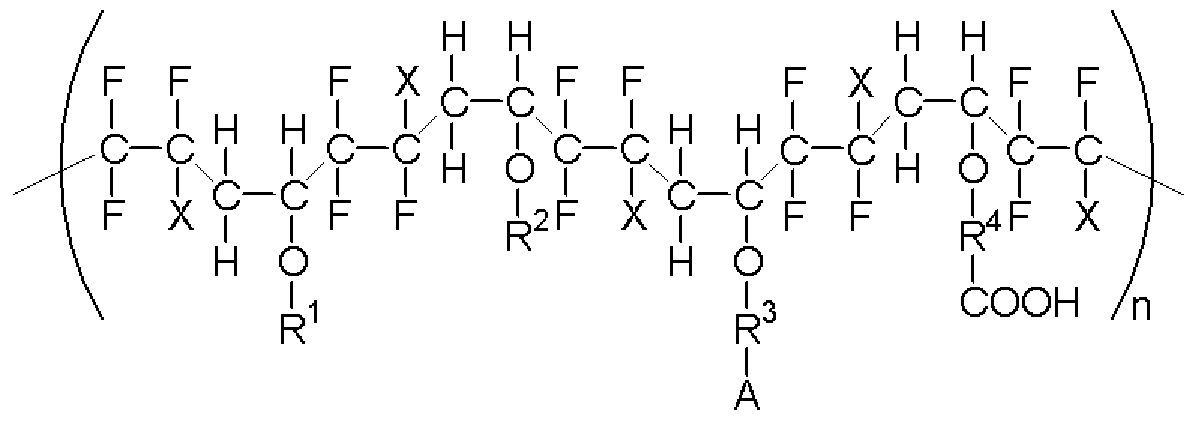
[0027] 、 Aはヒドロキシ基または R5— NH— COO—を表し、 Rは炭化水素基であり、 Xはフッ素原子または塩素原子を表し、 R1, R2はそれぞれ独立にアルキル基を表し、 R3、 R4はそれぞれ独立にアルキレン基を表し、 nは 40〜52の整数である。
R2としてのアルキル基、 R3、 R4としてのアルキレン基、 R5としての炭化水素基は 特に制限されない。
[0028] フッ素含有ポリオール化合物の数平均分子量は、ウレタンェマルジヨンが安定に得 られ、力、つより高い撥水効果を奏するという観点、力、ら、 25, 000-32, 000であるの カ好まし <、 28, 000—30, 000であるのカより好ましレヽ。
[0029] フッ素含有ポリオール化合物の調製は特に制限されない。
フッ素含有ポリオール化合物がヒドロキシ基を 2個有する場合、その調製としては、 例えば、原料としてのヒドロキシ基を 3個以上有するフッ素含有ポリオール化合物と、 モノイソシァネート化合物とを 80°C、 12時間の条件下で反応させる方法が挙げられ フッ素含有ポリオール化合物の調製の際に使用されるヒドロキシ基を 3個以上有す るフッ素含有ポリオール化合物は特に制限されない。
ヒドロキシ基を 3個以上有するフッ素含有ポリオール化合物の市販品として、例えば 、ノレミフロン (旭ガラス社製)が挙げられる。
フッ素含有ポリオール化合物の調製の際に使用されるモノイソシァネート化合物は イソシァネート基を 1個有する化合物であれば、特に制限されない。例えば、トリレン ジイソシァネート (TDI)およびイソホロンジイソシァネート(IPDI)力もなる群から選ば れる少なくとも 1種のジイソシァネートと、イソプロピルアルコール(IPA)、 2—ェチル へキサノール(2— EH)およびブチルアルコール(BA)からなる群から選ばれる少な くとも 1種のアルコールとを、等モル用いて、 80°C付近の温度下で約 12時間反応さ せることによって得られるもの力 S挙げられる。
モノイソシァネート化合物を調製する際に使用するアルコールは、沸点が 80°C以 上のものであるのが好ましい態様の 1つとして挙げられる。
フッ素含有ポリオール化合物は、それぞれ単独でまたは 2種以上を組み合わせて 使用すること力でさる。
[0030] カルボキシ基含有化合物について以下に説明する。
カルボキシ基含有ウレタンプレボリマーを製造する際に使用されるカルボキシ基含 有化合物は、ヒドロキシ基を 2個以上とカルボキシ基とを有する化合物である。
1分子のカルボキシ基含有化合物が有することができるカルボキシ基の数は、ウレ タンェマルジヨンの安定性を確保できかつ耐水性を向上させるという観点から、 1〜4 個であるのが好ましぐ;!〜 2個であるのがより好ましい。
1分子のカルボキシ基含有化合物が有することができるヒドロキシ基の数は、安定に ウレタンェマルジヨン中にカルボキシ基含有化合物を導入するという観点から、 2〜3 個であるのが好ましぐ 2個であるのがより好ましい。
カルボキシ基含有化合物としては、例えば、ジメチロールブタン酸、ジメチロールプ ロピオン酸、ジメチロール酢酸、グリセリン酸、酒石酸等のジヒドロキシカルボン酸が 挙げられる。
なかでも、ウレタンェマルジヨンの安定性の向上という観点から、ジメチロールブタン 酸が好ましい。
カルボキシ基含有化合物は、それぞれ単独でまたは 2種以上を組み合わせて使用 すること力 Sでさる。
[0031] カルボキシ基含有ウレタンプレボリマーを調製する際、ポリイソシァネート化合物と カルボキシ基含有ポリオールとは、イソシァネート基の前記カルボキシ基に対するモ ル比(イソシァネート基/カルボキシ基)が 15〜200となる量で反応させる。
また、イソシァネート基の前記カルボキシ基に対するモル比は、ウレタンェマルジョ ンの安定性を確保するという観点から、 20〜80であるのが好ましい。
[0032] カルボキシ基含有ウレタンプレボリマーを調製する際、ポリイソシァネート化合物と シロキサン含有ポリオールとフッ素含有ポリオールとは、イソシァネート基の、ジメチル
ルシロキサンとフルォロエチレンとの合計量)]が 4. 65〜25となる量で反応させる。 また、イソシァネート基の、ジメチルシロキサンとフルォロエチレンとの合計量に対す るモル比は、より高い撥水性を得るという観点から、 4. 65-9. 52であるのが好まし い。
[0033] カルボキシ基含有ウレタンプレボリマーを調製する際、シロキサン含有ポリオールと フッ素含有ポリオールとは、ジメチルシロキサンの、フルォロエチレンに対するモル比 [ジメチルシロキサン/フルォロエチレン]を、 0· 79-9. 5で反応させる。
また、ジメチルシロキサンの、フルォロエチレンに対するモル比は、撥水性により優 れるという観点、力、ら、 1. 19〜9. 50であるのカ好ましい。
[0034] また、ポリイソシァネート化合物、シロキサン含有ポリオール、フッ素含有ポリオール 化合物およびカルボキシ基含有化合物の使用量としては、例えば、ポリイソシァネー ト化合物、シロキサン含有ポリオール、フッ素含有ポリオール化合物およびカルボキ シ基含有化合物の合計質量に対して、ポリイソシァネート化合物を:!〜 50質量%、シ ロキサン含有ポリオール化合物を 0〜98. 9質量%、フッ素含有ポリオール化合物を 0-98. 9質量%、カルボキシ基含有化合物を 0.;!〜 20質量%であるのが好ましい 態様として挙げられる。
[0035] カルボキシ基含有ウレタンプレボリマーの製造としては、例えば、ポリイソシァネート 化合物と、シロキサン含有ポリオール化合物および/またはフッ素含有ポリオールと カルボキシ基含有化合物とを同時に(一時に)撹拌等して重合する方法が挙げられ カルボキシ基含有ウレタンプレボリマーの製造の際、ポリイソシァネート化合物、シ ロキサン含有ポリオール化合物および/またはフッ素含有ポリオール化合物、カルボ キシ基含有化合物を添加する順番は、特に限定されず、全部同時に添加してもよぐ いずれかを先に添加してもよい。例えば、通常のウレタンプレボリマーの製造方法に 従い、ポリイソシァネート化合物とシロキサン含有ポリオール化合物および/またはフ ッ素含有ポリオール化合物とを反応させてウレタンプレボリマーを製造した後、カルボ キシ基含有化合物を添加してさらに重合を行い製造することができる。
ポリイソシァネート化合物、シロキサン含有ポリオール、フッ素含有ポリオール化合
物物おおよよびびカカルルボボキキシシ基基含含有有化化合合物物のの混混合合物物をを不不活活性性ガガスス雰雰囲囲気気下下、、 6600〜〜9900°°CC下下 でで 22〜〜88時時間間程程度度撹撹拌拌ししてて、、カカルルボボキキシシ基基含含有有ウウレレタタンンププレレボボリリママーーをを得得るるここととががでできき
[[00003366]] カカルルボボキキシシ基基含含有有ウウレレタタンンププレレボボリリママーーのの製製造造はは、、必必要要にに応応じじてて、、有有機機ススズズ化化合合物物 、、有有機機ビビススママスス、、ァァミミンン等等ののウウレレタタンン化化触触媒媒のの存存在在下下でで行行ううここととががででききるる。。有有機機ススズズ化化 合合物物のの存存在在下下でで行行ううののがが好好ままししいい態態様様ととししてて挙挙げげらられれるる。。
有有機機ススズズ化化合合物物ととししててはは、、例例ええばば、、酢酢酸酸第第一一ススズズ、、オオククタタンン酸酸第第一一ススズズ、、ララウウリリンン酸酸 第第一一ススズズ、、ォォレレイインン酸酸第第一一ススズズ等等ののカカルルボボンン酸酸第第一一ススズズ;;ジジブブチチルルススズズアアセセテテーートト、、ジジ ブブチチノノレレススズズジジララウウレレーートト、、ジジブブチチノノレレススズズママレレエエーートト、、ジジブブチチノノレレススズズジジーー 22——ェェチチノノレレへへキキ ソソエエーートト、、ジジララウウリリノノレレススズズジジアアセセテテーートト、、ジジ才才ククチチノノレレススズズジジアアセセテテーートト等等のの力力ノノレレボボンン酸酸のの ジジアアルルキキルルススズズ塩塩;;水水酸酸化化トトリリメメチチルルススズズ、、水水酸酸化化トトリリブブチチルルススズズ、、水水酸酸化化トトリリオオククチチルル ススズズ等等のの水水酸酸化化トトリリアアルルキキルルススズズ::酸酸化化ジジブブチチルルススズズ、、酸酸化化ジジォォククチチルルススズズ、、酸酸化化ジジララ ゥゥリリルルススズズ等等のの酸酸化化ジジアアルルキキルルススズズ;;二二塩塩化化ジジブブチチルルススズズ、、二二塩塩化化ジジォォククチチルルススズズ等等 のの塩塩化化ジジアアルルキキルルススズズ等等がが挙挙げげらられれるる。。 ーートトがが、、比比較較的的安安価価でで取取りり极极レレ、、ややすす!!//、、点点かからら好好まましし!!//、、。。
触触媒媒はは、、そそれれぞぞれれ単単独独ででままたたはは 22種種以以上上をを組組みみ合合わわせせてて使使用用すするるここととががででききるる。。
[[00003377]] 中中和和剤剤ににつついいてて以以下下にに説説明明すするる。。
中中和和剤剤はは、、カカルルボボキキシシ基基含含有有ウウレレタタンンププレレポポリリママーーののカカルルボボキキシシ基基とと反反応応ししててカカルル ボボキキシシ基基ををカカルルボボンン酸酸塩塩ととしし、、カカルルボボキキシシ基基含含有有ウウレレタタンンププレレポポリリママーーををカカルルボボンン酸酸塩塩 をを有有すするるウウレレタタンンププレレポポリリママーーととししううるるももののででああるる。。
本本発発明明ののウウレレタタンンェェママルルジジョョンンをを製製造造すするる際際にに使使用用さされれるる中中和和剤剤はは、、カカルルボボキキシシ基基 とと反反応応ししううるるももののででああれればば特特にに制制限限さされれなないい。。例例ええばば、、第第三三級級ァァミミンン、、アアンンモモニニアア、、水水 酸酸化化ナナトトリリウウムム、、水水酸酸化化カカリリウウムムがが挙挙げげらられれるる。。
[[00003388]] 第第三三級級ァァミミンンととししててはは、、例例ええばば、、トトリリェェチチルルァァミミンン、、 22-- ((ジジメメチチノノレレアアミミノノメメチチノノレレ))フフエエノノ ーールル、、 22,, 44,, 66——トトリリスス((ジジメメチチルルアアミミノノメメチチノノレレ))フフエエノノーールル、、 11 ,, 88——ジジァァザザーービビシシククロロ [[55..

ななかかででもも、、ェェママルルジジヨヨンンのの乾乾燥燥時時にに揮揮発発ししややすすいい点点かからら、、トトリリエエチチルルァァミミンン、、アアンンモモニニ
ァが好ましい。
中和剤は、それぞれ単独でまたは 2種以上を組み合わせて使用することができる。
[0039] 本発明にお!/、て、中和剤の量は、ウレタンェマルジヨンがより安定となると!/、う観点 から、カルボキシ基含有ウレタンプレポリマーのカルボキシ基に対して、モル比(中和 剤のモル数/カルボキシ基含有ウレタンプレポリマーのカルボキシ基)で 1. 0〜; 1. 3 であるのが好ましぐ 1. 0〜; 1. 1であるのがより好ましい。
また、中和剤の量が、カルボキシ基に対して等モルである場合、ウレタンェマルジョ ンの pHが、 7· 0〜8. 0となるのが好ましぐ 7. 0〜7. 5であるのがより好ましい。
[0040] 本発明において、水の量は特に制限されず、カルボキシ基含有ウレタンプレポリマ 一を分散しうる量であればょレ、。
[0041] 本発明のウレタンェマルジヨンを製造する際、カルボキシ基含有ウレタンプレボリマ 一、中和剤および水のほかに、必要に応じて、例えば、粘度調整剤、鎖延長剤を使 用すること力 Sでさる。
[0042] 本発明のウレタンェマルジヨンを製造する際に使用できる粘度調整剤としては、例 えば、水と相溶する有機溶剤が挙げられる。具体的には、例えば、酢酸ェチル、ァセ トン、メチルェチルケトンが挙げられる。
粘度調整剤は、それぞれ単独でまたは 2種以上を組み合わせて使用することがで きる。
[0043] 粘度調整剤の量は、ウレタンプレボリマーの増粘を抑え、乳化時の分散性を高める という観点から、カルボキシ基含有ウレタンプレポリマー 100質量部に対して、 50〜3 00質量部であるのが好ましぐ 50〜; 150質量部であるのがより好ましい。
[0044] 本発明のウレタンェマルジヨンを製造する際に使用できる鎖延長剤は、ウレタンェ マルジヨンに使用できるものであれば特に制限されない。例えば、エチレンジァミン、 プロピレンジァミン、へキサメチレンジァミン、トリエチレンテトラミン等の脂肪族ジアミ ン;イソホロンジァミン、ピぺラジン等の脂環式ジァミン;ジフエ二ルジァミン等の芳香 族ジァミン;トリァミン等が挙げられる。
[0045] 鎖延長剤の量は、分子量を増大させポリマー粒子のェマルジヨンを得るという観点 から、カルボキシ基含有ウレタンプレポリマー 100質量部に対して、 5〜20質量部で
あるのが好ましぐ 5〜; 10質量部であるのがより好ましい。
[0046] 本発明のウレタンェマルジヨンは、カルボキシ基含有ウレタンプレポリマー、中和剤 および水、ならびに必要に応じて使用することができる粘度調整剤、鎖延長剤を含有 するウレタンプレボリマー組成物を撹拌することによって調製することができる。
[0047] ウレタンプレボリマー組成物を撹拌する際のせん断速度は、得られるウレタンエマ ルジョンの粒径が小さぐ平均粒子径の分布が狭ぐウレタンェマルジヨンが安定とな り、カルボキシラートイオンの多くをカルボン酸塩含有ウレタンプレポリマーの粒子の 表面に存在させることができるという観点から、 5, 000-19, 000s— 1であるのが好ま しく、 12, 000—15, 000s— 1であるのカより好ましレヽ。
[0048] 本発明のウレタンェマルジヨンを製造する際に使用することができる撹拌装置として は、例えば、薄膜旋回型撹拌機が挙げられる。
薄膜旋回型撹拌機は、薄膜旋回法を利用した撹拌装置である。
薄膜旋回法は、容器中に処理液を収容し、該処理液中で撹拌具を回転して処理 液を撹拌する撹拌方法において、前記容器の内周面近傍に達する端部をもつ撹拌 具を処理液中で高速回転し、該撹拌具の回転に伴う処理液の回転により該処理液を 遠心力で容器内面に圧着させると共に中空の薄膜状で回転させながら前記撹拌具 の端部で撹拌する方法をレ、う。
この方法によれば、処理液は、撹拌具のエネルギーを受けて高速回転し、遠心力 で容器の内面に圧着されて中空の薄膜状になって回転するが、その回転速度は撹 拌具の回転速度より遅い。このため撹拌具の回転面にある処理液は、撹拌具の端部 によって撹拌作用を受けると共に流れの回転に伴う撹拌作用が生じて微細化されう
[0049] 得られるウレタンェマルジヨンの粒径が小さぐ平均粒子径の分布が狭ぐウレタン ェマルジヨンが安定となり、カルボキシラートイオンの多くをカルボン酸塩含有ウレタン プレボリマーの粒子の表面に存在させることができるという観点から、撹拌装置は、薄 膜旋回型撹拌機が好ましい。薄膜旋回型撹拌機としては、例えば、特開平 09— 756 98号公報に記載されているものが挙げられる。また、薄膜旋回型撹拌機の市販品と して ίま、 ί列免 ίま、、 Τ. Κ.フィノレミックス 30— 25型、 Τ. Κ.フィノレミックス 56— 50型、 Τ
. K. フィルミックス 80— 50型(いずれもプライミクス社製)が挙げられる。
[0050] 本発明のウレタンェマルジヨンにおいて、ウレタンプレポリマー組成物は、撹拌後、 水中にカルボン酸塩を有するウレタンプレポリマーの粒子が分散しているウレタンェ マルジヨンとなるのが好ましい。カルボン酸塩を有するウレタンプレポリマーを以下、「 カルボン酸塩含有ウレタンプレポリマー」ということがある。
[0051] カルボン酸塩含有ウレタンプレポリマーのカルボン酸塩は、水中で解離して、カル ボキシラートイオン(一 COO—)を生成するものであれば特に制限されない。
カルボキシラートイオンと塩を形成するカチオンは、中和剤から生成するカチオンで あれば特に制限されない。例えば、ナトリウムイオン、カリウムイオンのようなアルカリ 金属イオン;アンモニゥムイオン、第四級アンモニゥムイオンのような窒素原子を含有 するイオンが挙げられる。
[0052] カルボン酸塩含有ウレタンプレポリマー内の、ウレタン結合(一 ΝΗ— CO— Ο—)と イソシァネート基との合計量の、カルボン酸塩に対するモル比 [ (ウレタン結合の数と イソシァネート基との合計量) /カルボン酸塩]は、組成物の安定性により優れ、得ら れる硬化物がより撥水性に優れ、耐水性に優れるという観点から、 15〜200であるの が好ましぐ 20〜80であるのがより好ましい。
カルボン酸塩は、カルボキシ基含有ウレタンプレポリマーのカルボキシ基が中和剤 によって中和されて生成するものである。本発明において、カルボン酸塩のモル数は 、カルボキシ基含有ウレタンプレポリマーのカルボキシ基のモル数と同じであり、もし すべてのカルボキシ基が中和されていない場合、カルボン酸塩のモル数は、カルボ ン酸塩のモル数に中和されていないカルボキシ基のモル数を足した値(つまりカルボ キシ基含有ウレタンプレポリマーのカルボキシ基のモル数)であるものとする。
[0053] カルボン酸塩含有ウレタンプレポリマーの粒子の平均粒子径は、カルボン酸塩含 有ウレタンプレボリマーの粒子の総表面積が大きくなり、得られる硬化物の撥水性が より優れ、耐水性が優れるという観点から、 25 m以下であるのが好ましぐ 0. ;!〜 1 μ mであるのがより好まし!/、。
なお、本発明において、粒子の平均粒子径は、マイクロトラック粒度分布測定装置( 日機装社製)を用いて測定した。
[0054] また、平均粒子径の標準偏差は、粒子径が均一となるという観点から、 10 m以下 であるのが好ましぐ 0. l〜l〃mであるのがより好ましい。
また、ウレタンェマルジヨンの pHは、より安定なウレタンェマルジヨンを得るという観 点、力、ら、 7. 0〜8. 0であるの力《好ましく、 7. 0〜7. 5であるのカより好ましい。
[0055] 本発明のウレタンェマルジヨンは、必要に応じて、ォキサゾリン基、カルポジイミド基 およびアジリジン基からなる群から選択される少なくとも 1種を 2個以上有する架橋剤 および/または添加剤を含有することができる。
[0056] 本発明のウレタンェマルジヨンが含有できる架橋剤は、ォキサゾリン基、カルポジィ ミド基およびアジリジン基からなる群から選択される少なくとも 1種を 2個以上有する化 合物であれば特に限定されない。具体的には、例えば、ォキサゾリン基、カルポジィ ミド基およびアジリジン基からなる群から選択される少なくとも 1種を分子中に 2個以 上有する、水系樹脂および/またはェマルジヨン力 ウレタンェマルジヨンに対する 相溶性に優れる点から好ましい。これらは、単独で用いてもよぐ 2種以上を併用して あよい。
これらの中でも、カルボキシ基と比較的低温で反応する点から、ォキサゾリン基を 2 個以上有する架橋剤が好まし!/、。
[0057] 水系樹脂は、ォキサゾリン基、カルポジイミド基およびアジリジン基からなる群から選 択される少なくとも 1種を分子中に 2個以上有する水系樹脂(ポリマー)である。水系 樹脂はアクリル系の主鎖を有するのが好ましい。
水系樹脂は、予め適当な溶媒に溶解させて用いることができる。溶媒としては、具 体的には、例えば、水、 1ーメトキシー 2—プロパノール等の溶媒が好適に挙げられる 。このとき、固形分が 5〜30質量%であるものが好ましい。
[0058] 水系樹脂は、公知の方法により製造してもよぐ市販品を用いてもよい。
市販品としては、ォキサゾリン基を有する架橋剤は、例えば、ェポクロス WS— 50 0、ェポクロス WS— 700 (V、ずれも日本触媒社製)、カルポジイミド基を有する架橋 剤は、例えば、カルポジライト V— 02、カルポジライト V— 02— L2、カルポジライト V — 04 (いずれも日清紡績社製)等が挙げられる。
[0059] ェマルジヨンは、ォキサゾリン基、カルポジイミド基およびアジリジン基からなる群か
ら選択される少なくとも 1種を分子中に 2個以上有するェマルジヨンである。ェマルジ ヨンに含有される樹脂成分は、アクリル系の主鎖を有するのが好ましい。
ェマルジヨンは、固形分が 10〜60質量%であるものが好ましい。
[0060] ェマルジヨンは、公知の方法により製造してもよぐ市販品を用いてもよい。
市販品としては、ォキサゾリン基を有する架橋剤は、例えば、ェポクロス K— 1010 E、ェポクロス K— 1020E、ェポクロス K— 1030E、ェポクロス K 2010E、ェポ クロス K 2020E、ェポクロス K 2030E (いずれも日本触媒社製)等が挙げられ
[0061] 上述した市販品以外に、アジリジン基を有する架橋剤として、 XAMA2、 XAMA7 ( いずれも、 EIT社製)、 PFAZ— 322 (サイブロン.ケミカルズ社製)等、カルポジイミド 基を有する架橋剤として、 UCARLNK Croslinker XL— 29SE (ユニオンカーバ イド社製)、カルポジライト E— 01、カルポジライト E— 02 (いずれも日清紡績社製)等 を用いること力 Sでさる。
[0062] 架橋剤の量は、カルボン酸塩含有ウレタンプレポリマーが有するカルボン酸塩の、 架橋剤が有するォキサゾリン基、カルポジイミド基およびアジリジン基の合計に対する モル比 [カルボン酸塩/ (ォキサゾリン基、カルポジイミド基およびアジリジン基の合 計)]力 1. 0/0. 5—1. 0/2. 0であるのカ好ましく、 1. 0/0. 5—1. 0/1. 5で あるのがより好ましく、 1. 0/0. 8〜; 1. 0/1. 2であるのが更に好ましい。上記モル 比がこの範囲である場合、架橋による被膜の硬度向上効果が大きぐ耐水性に優れ た硬化物が得られる。また、貯蔵安定性にも優れる。
架橋剤は、ウレタンェマルジヨンに含有されるカルボン酸塩ウレタンプレボリマーと 反応すること力 Sでさる。
[0063] 本発明のウレタンェマルジヨンが含有できる添加剤としては、例えば、充填剤、老化 防止剤、酸化防止剤、顔料 (染料)、可塑剤、揺変性付与剤、紫外線吸収剤、難燃 剤、界面活性剤 (レべリング剤を含む)、分散剤、脱水剤、接着付与剤、帯電防止剤 が挙げられる。
[0064] 充填剤としては、各種形状の有機または無機の充填剤が挙げられる。具体的には 、例えば、ヒュームドシリカ、焼成シリカ、沈降シリカ、粉砕シリカ、溶融シリカ;ケイソゥ
土;酸化鉄、酸化亜鉛、酸化チタン、酸化バリウム、酸化マグネシウム;炭酸カルシゥ ム、炭酸マグネシウム、炭酸亜鉛;ろう石クレー、カオリンクレー、焼成クレー;カーボ ンブラック;これらの脂肪酸処理物、樹脂酸処理物、ウレタン化合物処理物、脂肪酸 エステル処理物等が挙げられる。
[0065] 老化防止剤としては、具体的には、例えば、ヒンダードフエノール系等の化合物が 挙げられる。
酸化防止剤としては、具体的には、例えば、ブチルヒドロキシトルエン(BHT)、ブチ ルヒドロキシァ二ソール(BHA)等が挙げられる。
[0066] 顔料としては、具体的には、例えば、酸化チタン、酸化亜鉛、群青、 ^ンガラ、リトポ ン、鉛、カドミウム、鉄、コバルト、アルミニウム、塩酸塩、硫酸塩等の無機顔料;ァゾ顔 料、フタロシアニン顔料、キナクリドン顔料、キナクリドンキノン顔料、ジォキサジン顔 料、アントラピリミジン顔料、アンサンスロン顔料、インダンスロン顔料、フラバンスロン 顔料、ペリレン顔料、ペリノン顔料、ジケトピロロピロール顔料、キノナフタロン顔料、ァ ントラキノン顔料、チォインジゴ顔料、ベンズイミダゾロン顔料、イソインドリン顔料、力 一ボンブラック等の有機顔料等が挙げられる。
[0067] 可塑剤としては、具体的には、例えば、ジイソノニルフタレート(DINP);アジピン酸 ジォクチル、コハク酸イソデシル;ジエチレングリコールジベンゾエート、ペンタエリスリ トールエステル;ォレイン酸ブチル、ァセチルリシノール酸メチル;リン酸トリクレジル、 リン酸トリオクチル;アジピン酸プロピレングリコールポリエステル、アジピン酸ブチレン グリコールポリエステル等が挙げられる。
[0068] 揺変性付与剤としては、具体的には、例えば、エアロジル(日本エア口ジル社製)、 ディスパロン (楠本化成社製)等が挙げられる。
接着付与剤としては、具体的には、例えば、テルペン樹脂、フエノール樹脂、テル ペン フエノール樹脂、ロジン樹脂、キシレン樹脂等が挙げられる。
[0069] 難燃剤としては、具体的には、例えば、クロ口アルキルホスフェート、ジメチル 'メチ ノレホスホネート、臭素'リン化合物、アンモニゥムポリホスフェート、ネオペンチルブロ マイドーポリエーテル、臭素化ポリエーテル等が挙げられる。
帯電防止剤としては、具体的には、例えば、第四級アンモニゥム塩;ポリダリコール
、エチレンオキサイド誘導体等の親水性化合物等が挙げられる。
[0070] 本発明のウレタンェマルジヨンが架橋剤および/または添加剤を含有する場合、そ の製造について特に限定されない。例えば、上述のように調製したウレタンェマルジ ヨンと、架橋剤および/または添加剤とを、混合ミキサー等の撹拌機を用いて十分に 混練することによって製造すること力 Sできる。また、本発明のウレタンェマルジヨンを製 造する際、カルボキシ基含有ウレタンプレボリマー、中和剤および水に、さらに架橋 剤および/または添加剤を添加して撹拌し調製することができる。
[0071] 本発明のウレタンェマルジヨンは、 1液型および 2液型のいずれにも用いることがで きる。
1液型として用いる場合は、主剤と硬化剤 (架橋剤)を現場で混合する手間がない ため作業性に優れる。
また、本発明のウレタンェマルジヨンは、優れた安定性を有するので 1液型として用 V、るのが好まし!/、態様として挙げられる。
[0072] 本発明のウレタンェマルジヨンは、その硬化について、特に限定されない。例えば、 50〜120°C程度で 0. 3〜2時間乾燥することによって、被膜を形成でき、より撥水性 に優れる硬化物となる。
[0073] また、本発明のウレタンェマルジヨンから得られる硬化物は、撥油性に優れる。
本発明のウレタンェマルジヨンは、例えば、ガラス、金属、プラスチック、コンクリート 、モルタルのような基材に塗布することができる。
基材は、例えば、プライマー、塗料が塗布されていてもよい。
本発明のウレタンェマルジヨンの用途としては、例えば、車両のガラス用コーティン グ材、道路標識用コーティング材、電子部品用コーティング材、落書きを落とすため のコーティング材が挙げられる。
[0074] 次に本発明の積層体について以下に説明する。
本発明の積層体は、本発明のウレタンェマルジヨンの層と基材とを具備するもので ある。
[0075] 本発明の積層体において使用されるウレタンェマルジヨンは、本発明のウレタンェ マルジヨンであれば特に制限されな!/、。
また、本発明の積層体において使用される基材は、特に制限されず、例えば、ガラ ス、金属、プラスチック、モルタル、コンクリートが挙げられる。
基材には、例えば、プライマー、塗料が塗布されていてもよい。
[0076] 本発明の積層体について添付の図面を用いて以下に説明する。
図 1は、本発明の積層体の一例を模式的に示す斜視図である。
図 1において、積層体 10は、ウレタンェマルジヨンの層 12と基材 14とを具備する。 なお、本発明の積層体は添付の図面に限定されな!/、。
[0077] 本発明の積層体は、その製造について特に制限されない。
例えば、基材にウレタンェマルジヨンを塗布する塗布工程と、ウレタンェマルジヨン が塗布された基材を乾燥させる乾燥工程とを有する方法が挙げられる。
[0078] まず、塗布工程にお!/、て、基材にウレタンェマルジヨンを塗布して、ウレタンェマル ジョンが塗布された基材とする。
ウレタンェマルジヨンの量は特に制限されない。
ウレタンェマルジヨンを塗布する方法は、特に制限されない。
[0079] 塗布工程後、乾燥工程において、ウレタンェマルジヨンが塗布された基材を乾燥さ せて、積層体を得ること力 Sできる。
乾燥温度は、 50〜; 120°Cが好ましぐ 80〜; 120°Cがより好ましい。
乾燥時間は、 0. 3〜2時間が好ましぐ 0. 5〜1時間がより好ましい。
[0080] 積層体において、ウレタンェマルジヨンの層は、厚さ 0. ;!〜 10〃 mであるのが好ま しく、 0. 1〜1〃111力 Sより好ましい。
積層体は、水の滑落角度が 40度以下であるのが好ましぐ 10〜; 15度であるのがよ り好ましい。
本発明にお!/、て、滑落角度の測定は以下のように行った。
まず、ウレタンェマルジヨンを、縦 10cm、横 10cmの四角形のガラスに塗布し、 20 °Cの条件下で 1時間乾燥させてウレタンェマルジヨンを被膜化させて、被膜を有する ガラスとする。次に、被膜を有するガラスを水平に置いて、被膜の上に水滴を 1滴落と し、ガラスの 4辺のうちの 1辺を固定して、この辺と反対側の辺をゆっくり上げて被膜を 有するガラスを傾ける。そして、水滴が被膜を有するガラス上を移動しはじめた時の、
ガラスが、水平に置いたときのガラスに対してなす角度を測定し、この角度を滑落角 度とした。
[0081] 従来、ウレタンェマルジヨンは、原料のウレタンプレポリマーがカルボキシ基のような 乳化成分を有するため、得られる被膜が撥水性に劣ることを本発明者は見出した。 つまり、従来のウレタンェマルジヨン力 得られる被膜は、水滴の接触角を大きくす るとレ、う観点からの撥水性を解決することを目的として!/、た。
しかしながら、従来のウレタンェマルジヨンの被膜を有する基材を傾けても、被膜上 の水滴は基材から転がりにくぐ基材の表面に付着したままであることが多い。また、 水滴を基材から滑り落とすためには、基材を大きく傾けなければならないということを 、本発明者は見出した。
これに対して、本発明者は、ウレタンェマルジヨンに使用されるカルボキシ基含有ゥ レタンプレボリマーが有するカルボキシ基の量を減らすことによって、ウレタンエマノレ ジョンから得られる被膜の水に対する親和性を低下させ、水の滑落角度を小さくする ことができるということを見出した。
また、本発明者は、カルボキシ基含有ウレタンプレボリマー力 S、シロキサン含有ポリ オール化合物および/またはフッ素含有ポリオール化合物を特定の量で使用するこ とによって得られるものであるとき、水の滑落角度がさらに小さくなることを見出して本 発明を完成させたのである。
実施例
[0082] 以下、実施例を示して、本発明を具体的に説明する。ただし、本発明はこれらに限 定されるものではない。
1.評価
得られたウレタンェマルジヨンを用いて、以下の方法により、ウレタンェマルジヨンの 滑落角度、安定性を評価した。結果を第 1表に示す。
[0083] (1)滑落角度
滑落角度の評価について添付の図面を用いて以下に説明する。
図 2は、滑落角度の評価試験に用いる積層体の一例を模式的に示す斜視図である
図 3は、傾けた積層体を模式的に示す正面図である。
図 2において、積層体 20は、縦 10cm、横 10cmの四角形のガラス 24の上に、得ら れたウレタンェマルジヨンの被膜 22を有するものである。
積層体 20は、得られたウレタンェマルジヨンをガラス 24の上に塗布し 20°Cの条件 下で 1時間乾燥させてウレタンェマルジヨンを被膜化することによって得たものである まず、積層体 20を水平に置いて、図 2に示すように積層体 20の上の、辺 28近くに 4 個の水滴 32 (1個当りの質量: 0. 04g)を等間隔で一列に滴下する。
次に、図 3に示すように、ガラス 24の辺 26を水平面 36の上に固定したまま積層体 2 0を矢印 30の方向へゆっくり上げ、積層体 20を傾ける。
そして、各水滴 32が矢印 34の方向へ移動しはじめた時の、積層体 20と水平面 36 との間の角度 Θを測定しそれらの平均値を滑落角度とした。
[0084] (2)乳化状態
得られたウレタンェマルジヨンの乳化の状態を目視で観察した。
ウレタンェマルジヨンが均一に分散している場合を「〇」、ウレタンェマルジヨンが分 離している場合を「X」とした。
[0085] 2.成分の調製
(1)モノイソシァネート化合物
2—ェチルへキサノール 12. 27g (関東化学社製試薬)とイソホロンジイソシァネート 21g (三井武田ケミカル社製)とを容器に入れて 80°Cに加熱し 6時間反応させてモノ イソシァネート化合物を得た。
[0086] (2)フッ素含有ポリオール化合物
ヒドロキシ基を 12個有するフッ素含有ポリオール化合物 137. 93g (ルミフロン、数 平均分子量 30, 000、旭ガラス社製)と上記で得たモノイソシァネート化合物 1 · 07g とを容器に入れて、 80°Cに加熱し、 6時間反応させることによって、ヒドロキシ基を 2個 有するフッ素含有ポリオール化合物を調製した。
得られたフッ素含有ポリオール化合物をカルボキシ基含有ウレタンプレボリマーの 調製に使用した。
[0087] (3)カルボキシ基含有ウレタンプレポリマーの合成
ポリイソシァネート化合物、シロキサン含有ポリオール化合物、上記のとおり調製し たフッ素含有ポリオール化合物およびカルボキシ基含有化合物を、下記第 1表に示 す量 (モル)で撹拌機に投入し、窒素気流下、 70°Cで 8時間反応させ、カルボキシ基 含有ウレタンプレボリマーを合成した。
得られたカルボキシ基含有ウレタンプレポリマーは、分子量 5, 000であった。
[0088] 3. ウレタンェマルジヨンの調製
次レ、で、得られたカルボキシ基含有ウレタンプレボリマー(合成後単離しなレ、状態 のもの)を粘度調整剤に溶解させた後に、水、中和剤および鎖延長剤と共に、薄膜 旋回型撹拌機(商品名 Τ· K.フィルミックス 80— 50型、プライミクス社製)に投入し、 10°Cで、第 1表に示すせん断速度で、 1時間撹拌して分散させ、ウレタンェマルジョ ンを調製した。
粘度調整剤、水、中和剤および鎖延長剤の量ならびに得られた各ウレタンェマル ジョンから粘度調整剤および水を除く固形分 (質量%)を下記第 1表に示す。
なお、第 1表中の「イソシァネート基/カルボキシ基」は、ウレタンプレポリマーの合 成において、合成の際に使用されるポリイソシァネート化合物とカルボキシ基含有化 合物とについて、ポリイソシァネート化合物が有するイソシァネート基の、カルボキシ 基含有化合物が有するカルボキシ基に対するモル比 (イソシァネート基/カルボキシ 基)を意味する。
[0089] [表 1]
第 1表 (その 1

[0090] [表 2]

[0091] 第 1表に示す各成分の詳細は以下のとおりである。
•ポリイソシァネート化合物:イソホロンジイソシァネート(三井武田ケミカル社製) 'シロキサン含有ポリオール化合物:サイラプレーン FM— DA21、チッソ社製 •フッ素含有ポリオール化合物:上記のとおり調製したフッ素含有ポリオール •カルボキシ基含有化合物:ジメチロールブタン酸(日本化成社製)
•中和剤:トリェチルァミン(関東化学社製)
•鎖延長剤:ピぺラジン 6水和物(日本乳化剤社製)
•粘度調整剤:メチルェチルケトン(関東化学社製)
[0092] 第 1表に示す結果から明らかなように、イソシァネート基のカルボキシ基に対するモ ル比が 15未満である比較例 1〜4は滑落角度が大きぐイソシァネート基のジメチル シロキサンとフルォロエチレンとの合計量に対するモル比が 9· 52より大きく、ジメチ ルシロキサンの、フルォロエチレンに対するモル比が 10より大きい比較例 5は、滑落 角度が大きかった。
これらに対して、実施例 1〜9のウレタンェマルジヨンは、水の滑落角度が小さぐ撥 水性に優れる硬化物となった。また、実施例 1〜9のウレタンェマルジヨンは、乳化状 態が安定していた。
産業上の利用可能性
[0093] 本発明のウレタンェマルジヨンは、撥水性に優れる硬化物となる。
Claims
[1] カルボキシ基を有するウレタンプレポリマーと、中和剤と、水とを含有するウレタンプ レポリマー組成物を撹拌することによって得られるウレタンェマルジヨンであって、 前記ウレタンプレポリマーが、
イソシァネート基を 2個以上有するポリイソシァネート化合物と、
ヒドロキシ基を 2個以上とジメチルシロキサンとを有するシロキサン含有ポリオール化 合物、および/またはヒドロキシ基を 2個以上とフルォロエチレンとを有するフッ素含 有ポリオールと、
ヒドロキシ基を 2個以上とカルボキシ基とを有するカルボキシ基含有化合物とを、 前記イソシァネート基の前記カルボキシ基に対するモル比を、 15〜200で、 前記イソシァネート基の、前記ジメチルシロキサンと前記フルォロエチレンとの合計 量に対するモノレ 匕を、 4. 65〜25で、
前記ジメチルシロキサンの、前記フルォロエチレンに対するモル比を、 0. 79〜9. 5 で反応させることによって得られるものであるウレタンェマルジヨン。
[2] 前記フッ素含有ポリオールにおいて、前記ヒドロキシ基が 2〜3個である請求項 1に
[3] 前記撹拌において、せん断速度が 5, 000-19, 000s— 1である請求項 1または 2に
[4] 前記撹拌において、薄膜旋回型撹拌機を使用する請求項 1〜3のいずれかに記載
[5] 請求項 1〜4のいずれかに記載のウレタンェマルジヨンの層と基材とを具備する積 層体。
[6] 前記基材が、ガラス、金属、プラスチック、モルタルまたはコンクリートである請求項 5に記載の積層体。
[7] 水の滑落角度が 40度以下である請求項 5または 6に記載の積層体。
Priority Applications (3)
| Application Number | Priority Date | Filing Date | Title |
|---|---|---|---|
| EP07828505A EP2067803A4 (en) | 2006-09-28 | 2007-09-27 | URETHANE EMULSION |
| KR1020097006096A KR101141561B1 (ko) | 2006-09-28 | 2007-09-27 | 우레탄 에멀션 |
| US12/443,527 US20100092783A1 (en) | 2006-09-28 | 2007-09-27 | Urethane emulsion |
Applications Claiming Priority (2)
| Application Number | Priority Date | Filing Date | Title |
|---|---|---|---|
| JP2006264884A JP5463612B2 (ja) | 2006-09-28 | 2006-09-28 | ウレタンエマルジョン |
| JP2006-264884 | 2006-09-28 |
Publications (1)
| Publication Number | Publication Date |
|---|---|
| WO2008047543A1 true WO2008047543A1 (en) | 2008-04-24 |
Family
ID=39313792
Family Applications (1)
| Application Number | Title | Priority Date | Filing Date |
|---|---|---|---|
| PCT/JP2007/068759 Ceased WO2008047543A1 (en) | 2006-09-28 | 2007-09-27 | Urethane emulsion |
Country Status (5)
| Country | Link |
|---|---|
| US (1) | US20100092783A1 (ja) |
| EP (1) | EP2067803A4 (ja) |
| JP (1) | JP5463612B2 (ja) |
| KR (1) | KR101141561B1 (ja) |
| WO (1) | WO2008047543A1 (ja) |
Families Citing this family (12)
| Publication number | Priority date | Publication date | Assignee | Title |
|---|---|---|---|---|
| KR101048319B1 (ko) * | 2009-08-06 | 2011-07-14 | 주식회사 한산스틸플러스 | 변성 실리콘-우레탄 수지, 그로부터 제조된 코팅 조성물 및 이의 코팅 기재 |
| DE102010021465A1 (de) | 2010-05-25 | 2011-12-01 | Clariant International Ltd. | Wässrige Polyurethan-Polyharnstoff-Dispersionen |
| KR20140106641A (ko) * | 2011-12-06 | 2014-09-03 | 다우 코닝 코포레이션 | 경화성 실리콘 조성물, 경화물, 제조품, 방법 및 용도 |
| CN104379341B (zh) | 2012-05-14 | 2018-03-16 | 巴斯夫欧洲公司 | 防潮石膏板和用于制备其的浆料 |
| EP2690117A1 (en) * | 2012-07-24 | 2014-01-29 | ALLNEX AUSTRIA GmbH | Aqueously Dispersible Polyurethane |
| TWI480299B (zh) * | 2013-09-23 | 2015-04-11 | Univ Tamkang | 非氟素疏水性之水性聚胺甲酸酯樹脂分散液、及其製備方法與用途 |
| KR101947421B1 (ko) * | 2014-10-20 | 2019-02-14 | (주)엘지하우시스 | 표면코팅용 수성 조성물 및 이를 적용한 자동차용 시트 |
| JP6675847B2 (ja) * | 2015-09-28 | 2020-04-08 | 理研ビタミン株式会社 | 熱可塑性樹脂用撥水剤 |
| JP7018931B2 (ja) * | 2016-08-09 | 2022-02-14 | ソルベイ スペシャルティ ポリマーズ イタリー エス.ピー.エー. | 多孔質膜 |
| JP6863706B2 (ja) * | 2016-10-14 | 2021-04-21 | 松本油脂製薬株式会社 | 撥水剤組成物、撥水性繊維製品及び撥水性繊維製品の製造方法 |
| JP6919992B2 (ja) * | 2017-01-30 | 2021-08-18 | 信越化学工業株式会社 | 伸縮性膜及びその形成方法 |
| CN117285859B (zh) * | 2023-08-15 | 2025-11-18 | 中国热带农业科学院农产品加工研究所 | 一种用于橡胶制品表面的交联涂层、制备方法及应用 |
Citations (12)
| Publication number | Priority date | Publication date | Assignee | Title |
|---|---|---|---|---|
| JPS6392631A (ja) * | 1986-07-03 | 1988-04-23 | アウシモント・ソチエタ・ペル・アツィオニ | 弗素化されかつシラン化されたポリイソシアネートを基剤にした高官能価のワニス掛け用組成物及びそれらの製造方法 |
| JPS6443520A (en) * | 1987-08-10 | 1989-02-15 | Dainichiseika Color Chem | Polyurethane emulsion |
| JPH03152119A (ja) * | 1989-11-10 | 1991-06-28 | Dainippon Ink & Chem Inc | 樹脂組成物 |
| JPH07150041A (ja) * | 1993-09-23 | 1995-06-13 | A Andrew Shores | コーティング用シリコーン含有高分子電解質水性液、その製造法およびその用途 |
| JPH08269156A (ja) * | 1995-03-30 | 1996-10-15 | Mitsuhiro Nakayama | 樹脂組成物 |
| JPH08512088A (ja) * | 1994-04-19 | 1996-12-17 | ヘルバーツ・ゲゼルシャフト・ミット・ベシュレンクテル・ハフツング | シロキサン・リンケージを含むポリウレタンの水性ディスパージョン、その製造、およびコーティング組成物における使用 |
| JPH0975698A (ja) | 1995-07-10 | 1997-03-25 | Tokushu Kika Kogyo Kk | 高速攪拌方法及び装置 |
| JPH09509198A (ja) * | 1994-02-04 | 1997-09-16 | ミネソタ マイニング アンド マニュファクチャリング カンパニー | 水性ポリウレタンポリマー、剥離コーティング、接着テープ及びそれらの製造方法 |
| JPH10183476A (ja) | 1996-12-20 | 1998-07-14 | Nippon Mektron Ltd | 新規フルオロアルキル基含有アリルウレタン、その共重合体および共重合体を有効成分とする撥水撥油防汚加工剤 |
| JPH10316719A (ja) | 1997-05-20 | 1998-12-02 | Daikin Ind Ltd | 新規重合体およびそれを含む防汚加工剤組成物 |
| JP2001329038A (ja) * | 2000-03-07 | 2001-11-27 | Dainichiseika Color & Chem Mfg Co Ltd | フッ素含有ジオール及びその利用 |
| JP2003012760A (ja) * | 2001-06-27 | 2003-01-15 | Nippon Nsc Ltd | 両性ウレタン樹脂の製造方法、その製造方法で得られる両性ウレタン樹脂及び樹脂組成物 |
Family Cites Families (9)
| Publication number | Priority date | Publication date | Assignee | Title |
|---|---|---|---|---|
| US4098742A (en) * | 1977-01-24 | 1978-07-04 | Ciba-Geigy Corporation | Fluorine and silicone containing polymers |
| US4631329A (en) * | 1985-11-29 | 1986-12-23 | Dow Corning Corporation | Moisture resistant polyurethanes derived from non-aromatic diisocyanates |
| US5543171A (en) * | 1992-12-14 | 1996-08-06 | Shores; A. Andrew | Process of manufacturing a coated article |
| US5750630A (en) * | 1994-02-04 | 1998-05-12 | Minnesota Mining And Manufacturing Company | Water-based polyurethane polymer, release coating, adhesive tape and process of preparation |
| US6313335B1 (en) * | 1997-11-25 | 2001-11-06 | 3M Innovative Properties | Room temperature curable silane terminated and stable waterborne polyurethane dispersions which contain fluorine and/or silicone and low surface energy coatings prepared therefrom |
| US6784248B2 (en) * | 2002-02-15 | 2004-08-31 | Ppg Industries Ohio, Inc. | Thermosetting compositions containing alternating copolymers of isobutylene type monomers |
| DE10208567A1 (de) * | 2002-02-27 | 2003-09-11 | Degussa Construction Chem Gmbh | Wässriges fluormodifiziertes Polyurethansystem für Anti-Graffiti- und Anti-Soiling-Beschichtungen |
| DE10216896A1 (de) * | 2002-04-17 | 2003-11-13 | Goldschmidt Ag Th | Wässrige Polysiloxan-Polyurethan-Dispersion, ihre Herstellung und Verwendung in Beschichtungsmitteln |
| US20050209428A1 (en) * | 2002-06-19 | 2005-09-22 | Krishnan Tamareselvy | Breathable polyurethanes, blends, and articles |
-
2006
- 2006-09-28 JP JP2006264884A patent/JP5463612B2/ja not_active Expired - Fee Related
-
2007
- 2007-09-27 WO PCT/JP2007/068759 patent/WO2008047543A1/ja not_active Ceased
- 2007-09-27 US US12/443,527 patent/US20100092783A1/en not_active Abandoned
- 2007-09-27 KR KR1020097006096A patent/KR101141561B1/ko not_active Expired - Fee Related
- 2007-09-27 EP EP07828505A patent/EP2067803A4/en not_active Withdrawn
Patent Citations (12)
| Publication number | Priority date | Publication date | Assignee | Title |
|---|---|---|---|---|
| JPS6392631A (ja) * | 1986-07-03 | 1988-04-23 | アウシモント・ソチエタ・ペル・アツィオニ | 弗素化されかつシラン化されたポリイソシアネートを基剤にした高官能価のワニス掛け用組成物及びそれらの製造方法 |
| JPS6443520A (en) * | 1987-08-10 | 1989-02-15 | Dainichiseika Color Chem | Polyurethane emulsion |
| JPH03152119A (ja) * | 1989-11-10 | 1991-06-28 | Dainippon Ink & Chem Inc | 樹脂組成物 |
| JPH07150041A (ja) * | 1993-09-23 | 1995-06-13 | A Andrew Shores | コーティング用シリコーン含有高分子電解質水性液、その製造法およびその用途 |
| JPH09509198A (ja) * | 1994-02-04 | 1997-09-16 | ミネソタ マイニング アンド マニュファクチャリング カンパニー | 水性ポリウレタンポリマー、剥離コーティング、接着テープ及びそれらの製造方法 |
| JPH08512088A (ja) * | 1994-04-19 | 1996-12-17 | ヘルバーツ・ゲゼルシャフト・ミット・ベシュレンクテル・ハフツング | シロキサン・リンケージを含むポリウレタンの水性ディスパージョン、その製造、およびコーティング組成物における使用 |
| JPH08269156A (ja) * | 1995-03-30 | 1996-10-15 | Mitsuhiro Nakayama | 樹脂組成物 |
| JPH0975698A (ja) | 1995-07-10 | 1997-03-25 | Tokushu Kika Kogyo Kk | 高速攪拌方法及び装置 |
| JPH10183476A (ja) | 1996-12-20 | 1998-07-14 | Nippon Mektron Ltd | 新規フルオロアルキル基含有アリルウレタン、その共重合体および共重合体を有効成分とする撥水撥油防汚加工剤 |
| JPH10316719A (ja) | 1997-05-20 | 1998-12-02 | Daikin Ind Ltd | 新規重合体およびそれを含む防汚加工剤組成物 |
| JP2001329038A (ja) * | 2000-03-07 | 2001-11-27 | Dainichiseika Color & Chem Mfg Co Ltd | フッ素含有ジオール及びその利用 |
| JP2003012760A (ja) * | 2001-06-27 | 2003-01-15 | Nippon Nsc Ltd | 両性ウレタン樹脂の製造方法、その製造方法で得られる両性ウレタン樹脂及び樹脂組成物 |
Non-Patent Citations (1)
| Title |
|---|
| See also references of EP2067803A4 |
Also Published As
| Publication number | Publication date |
|---|---|
| KR20090057048A (ko) | 2009-06-03 |
| EP2067803A4 (en) | 2010-12-01 |
| JP5463612B2 (ja) | 2014-04-09 |
| KR101141561B1 (ko) | 2012-05-16 |
| US20100092783A1 (en) | 2010-04-15 |
| EP2067803A1 (en) | 2009-06-10 |
| JP2008081654A (ja) | 2008-04-10 |
Similar Documents
| Publication | Publication Date | Title |
|---|---|---|
| WO2008047543A1 (en) | Urethane emulsion | |
| WO2011070865A1 (ja) | ウレタン樹脂組成物、コーティング剤及び接着剤、ならびにそれを用いて得られる硬化物及び硬化物の製造方法 | |
| CN1760330A (zh) | 具有柔软感效果的水性发泡涂料 | |
| JP4475090B2 (ja) | 2液硬化型ポリウレタン樹脂組成物 | |
| WO2020203601A1 (ja) | ブロックイソシアネート、複層膜の製造方法、および、複層膜 | |
| CN101054431A (zh) | 储存稳定性得到改进的水性聚氨酯分散体 | |
| CN106715509B (zh) | 生产和使用聚氨酯水性分散体的方法及其在涂覆剂中的用途 | |
| JP5073470B2 (ja) | ポリウレタンエマルジョンとその硬化物 | |
| JP5604785B2 (ja) | ウレタンエマルジョン | |
| EP3015511A1 (en) | Titanium dioxide pigment and manufacturing method | |
| WO2021084954A1 (ja) | 繊維基材、及び、人工皮革 | |
| JP4650139B2 (ja) | ウレタンエマルジョンおよびそれを用いた水系ポリウレタン組成物 | |
| JP2014065827A (ja) | トップコート剤ならびにそれを用いて得られたトップコート層を備えた表示装置及びタッチパネル | |
| JP2010138274A (ja) | 水性コーティング剤 | |
| JP2006111805A (ja) | 2液硬化型ポリウレタン樹脂組成物 | |
| JP2006057023A (ja) | ポリウレタン樹脂系水性分散体組成物およびその製造方法 | |
| JP2021127352A (ja) | 水系コーティング剤 | |
| JP2011126945A (ja) | 水性ポリウレタン樹脂組成物並びにそれを用いた水性塗料組成物 | |
| JP2006160875A (ja) | ウレタン樹脂組成物 | |
| JP7754615B2 (ja) | シーリング材組成物 | |
| ES2833098T3 (es) | Procedimiento para la producción de preparaciones de poliuretano acuosas | |
| JP4904711B2 (ja) | 硬化性樹脂組成物 | |
| JP6709357B2 (ja) | 表面塗布剤およびそれを用いた方法 | |
| JP2004149662A (ja) | ポリウレタンエマルジョンとその硬化物 | |
| JP2003226815A (ja) | 揺変性樹脂組成物及び揺変性室温硬化性組成物並びにその製造方法 |
Legal Events
| Date | Code | Title | Description |
|---|---|---|---|
| 121 | Ep: the epo has been informed by wipo that ep was designated in this application |
Ref document number: 07828505 Country of ref document: EP Kind code of ref document: A1 |
|
| WWE | Wipo information: entry into national phase |
Ref document number: 1020097006096 Country of ref document: KR |
|
| WWE | Wipo information: entry into national phase |
Ref document number: 12443527 Country of ref document: US Ref document number: 2007828505 Country of ref document: EP |
|
| NENP | Non-entry into the national phase |
Ref country code: DE |