WO2009003568A2 - Pigmentzubereitungen auf basis von dioxazinen - Google Patents
Pigmentzubereitungen auf basis von dioxazinen Download PDFInfo
- Publication number
- WO2009003568A2 WO2009003568A2 PCT/EP2008/004522 EP2008004522W WO2009003568A2 WO 2009003568 A2 WO2009003568 A2 WO 2009003568A2 EP 2008004522 W EP2008004522 W EP 2008004522W WO 2009003568 A2 WO2009003568 A2 WO 2009003568A2
- Authority
- WO
- WIPO (PCT)
- Prior art keywords
- pigment
- formula
- acid
- pigment preparation
- resin
- Prior art date
- Legal status (The legal status is an assumption and is not a legal conclusion. Google has not performed a legal analysis and makes no representation as to the accuracy of the status listed.)
- Ceased
Links
- 0 CCC(*)(CC)Cc1c(C)nc[n]1 Chemical compound CCC(*)(CC)Cc1c(C)nc[n]1 0.000 description 1
Classifications
-
- C—CHEMISTRY; METALLURGY
- C09—DYES; PAINTS; POLISHES; NATURAL RESINS; ADHESIVES; COMPOSITIONS NOT OTHERWISE PROVIDED FOR; APPLICATIONS OF MATERIALS NOT OTHERWISE PROVIDED FOR
- C09B—ORGANIC DYES OR CLOSELY-RELATED COMPOUNDS FOR PRODUCING DYES, e.g. PIGMENTS; MORDANTS; LAKES
- C09B67/00—Influencing the physical, e.g. the dyeing or printing properties of dyestuffs without chemical reactions, e.g. by treating with solvents grinding or grinding assistants, coating of pigments or dyes; Process features in the making of dyestuff preparations; Dyestuff preparations of a special physical nature, e.g. tablets, films
- C09B67/0033—Blends of pigments; Mixtured crystals; Solid solutions
- C09B67/0034—Mixtures of two or more pigments or dyes of the same type
-
- C—CHEMISTRY; METALLURGY
- C08—ORGANIC MACROMOLECULAR COMPOUNDS; THEIR PREPARATION OR CHEMICAL WORKING-UP; COMPOSITIONS BASED THEREON
- C08K—Use of inorganic or non-macromolecular organic substances as compounding ingredients
- C08K5/00—Use of organic ingredients
- C08K5/0008—Organic ingredients according to more than one of the "one dot" groups of C08K5/01 - C08K5/59
- C08K5/0041—Optical brightening agents, organic pigments
-
- C—CHEMISTRY; METALLURGY
- C08—ORGANIC MACROMOLECULAR COMPOUNDS; THEIR PREPARATION OR CHEMICAL WORKING-UP; COMPOSITIONS BASED THEREON
- C08K—Use of inorganic or non-macromolecular organic substances as compounding ingredients
- C08K5/00—Use of organic ingredients
- C08K5/16—Nitrogen-containing compounds
- C08K5/34—Heterocyclic compounds having nitrogen in the ring
- C08K5/35—Heterocyclic compounds having nitrogen in the ring having also oxygen in the ring
- C08K5/357—Six-membered rings
-
- C—CHEMISTRY; METALLURGY
- C09—DYES; PAINTS; POLISHES; NATURAL RESINS; ADHESIVES; COMPOSITIONS NOT OTHERWISE PROVIDED FOR; APPLICATIONS OF MATERIALS NOT OTHERWISE PROVIDED FOR
- C09B—ORGANIC DYES OR CLOSELY-RELATED COMPOUNDS FOR PRODUCING DYES, e.g. PIGMENTS; MORDANTS; LAKES
- C09B67/00—Influencing the physical, e.g. the dyeing or printing properties of dyestuffs without chemical reactions, e.g. by treating with solvents grinding or grinding assistants, coating of pigments or dyes; Process features in the making of dyestuff preparations; Dyestuff preparations of a special physical nature, e.g. tablets, films
- C09B67/0001—Post-treatment of organic pigments or dyes
- C09B67/0002—Grinding; Milling with solid grinding or milling assistants
-
- C—CHEMISTRY; METALLURGY
- C09—DYES; PAINTS; POLISHES; NATURAL RESINS; ADHESIVES; COMPOSITIONS NOT OTHERWISE PROVIDED FOR; APPLICATIONS OF MATERIALS NOT OTHERWISE PROVIDED FOR
- C09B—ORGANIC DYES OR CLOSELY-RELATED COMPOUNDS FOR PRODUCING DYES, e.g. PIGMENTS; MORDANTS; LAKES
- C09B67/00—Influencing the physical, e.g. the dyeing or printing properties of dyestuffs without chemical reactions, e.g. by treating with solvents grinding or grinding assistants, coating of pigments or dyes; Process features in the making of dyestuff preparations; Dyestuff preparations of a special physical nature, e.g. tablets, films
- C09B67/0001—Post-treatment of organic pigments or dyes
- C09B67/0014—Influencing the physical properties by treatment with a liquid, e.g. solvents
-
- C—CHEMISTRY; METALLURGY
- C09—DYES; PAINTS; POLISHES; NATURAL RESINS; ADHESIVES; COMPOSITIONS NOT OTHERWISE PROVIDED FOR; APPLICATIONS OF MATERIALS NOT OTHERWISE PROVIDED FOR
- C09D—COATING COMPOSITIONS, e.g. PAINTS, VARNISHES OR LACQUERS; FILLING PASTES; CHEMICAL PAINT OR INK REMOVERS; INKS; CORRECTING FLUIDS; WOODSTAINS; PASTES OR SOLIDS FOR COLOURING OR PRINTING; USE OF MATERIALS THEREFOR
- C09D11/00—Inks
- C09D11/02—Printing inks
- C09D11/03—Printing inks characterised by features other than the chemical nature of the binder
- C09D11/037—Printing inks characterised by features other than the chemical nature of the binder characterised by the pigment
-
- C—CHEMISTRY; METALLURGY
- C09—DYES; PAINTS; POLISHES; NATURAL RESINS; ADHESIVES; COMPOSITIONS NOT OTHERWISE PROVIDED FOR; APPLICATIONS OF MATERIALS NOT OTHERWISE PROVIDED FOR
- C09D—COATING COMPOSITIONS, e.g. PAINTS, VARNISHES OR LACQUERS; FILLING PASTES; CHEMICAL PAINT OR INK REMOVERS; INKS; CORRECTING FLUIDS; WOODSTAINS; PASTES OR SOLIDS FOR COLOURING OR PRINTING; USE OF MATERIALS THEREFOR
- C09D11/00—Inks
- C09D11/30—Inkjet printing inks
- C09D11/32—Inkjet printing inks characterised by colouring agents
- C09D11/324—Inkjet printing inks characterised by colouring agents containing carbon black
- C09D11/326—Inkjet printing inks characterised by colouring agents containing carbon black characterised by the pigment dispersant
-
- C—CHEMISTRY; METALLURGY
- C09—DYES; PAINTS; POLISHES; NATURAL RESINS; ADHESIVES; COMPOSITIONS NOT OTHERWISE PROVIDED FOR; APPLICATIONS OF MATERIALS NOT OTHERWISE PROVIDED FOR
- C09D—COATING COMPOSITIONS, e.g. PAINTS, VARNISHES OR LACQUERS; FILLING PASTES; CHEMICAL PAINT OR INK REMOVERS; INKS; CORRECTING FLUIDS; WOODSTAINS; PASTES OR SOLIDS FOR COLOURING OR PRINTING; USE OF MATERIALS THEREFOR
- C09D17/00—Pigment pastes, e.g. for mixing in paints
- C09D17/003—Pigment pastes, e.g. for mixing in paints containing an organic pigment
Definitions
- Pigment preparations are combinations of base pigments and auxiliaries.
- the auxiliaries can be subdivided into two categories: into the so-called pigment dispersants, which are pigments substituted with specific active groups and into the non-pigmentary auxiliaries.
- the adjuvants are added to the pigments to facilitate dispersion in the application media, particularly in paints, inks and inks, and to improve the rheological and coloristic properties of the pigments.
- a pigment concentrate with high pigmentation (> 15%) is produced from the pigments in the first step. These color concentrates are then adjusted to the printing ink concentration (6 - 10%) for printing ink production.
- the dioxazine colorants described in EP-A-0 321 919 and EP-A-0 504 923 show a not completely satisfactory viscosity and storage stability in the concentrate. This leads to problems in the ink production and storage of
- the aim of the present invention was to provide a colorant with a violet hue for the use of printing inks, which overcomes the deficiencies explained above.
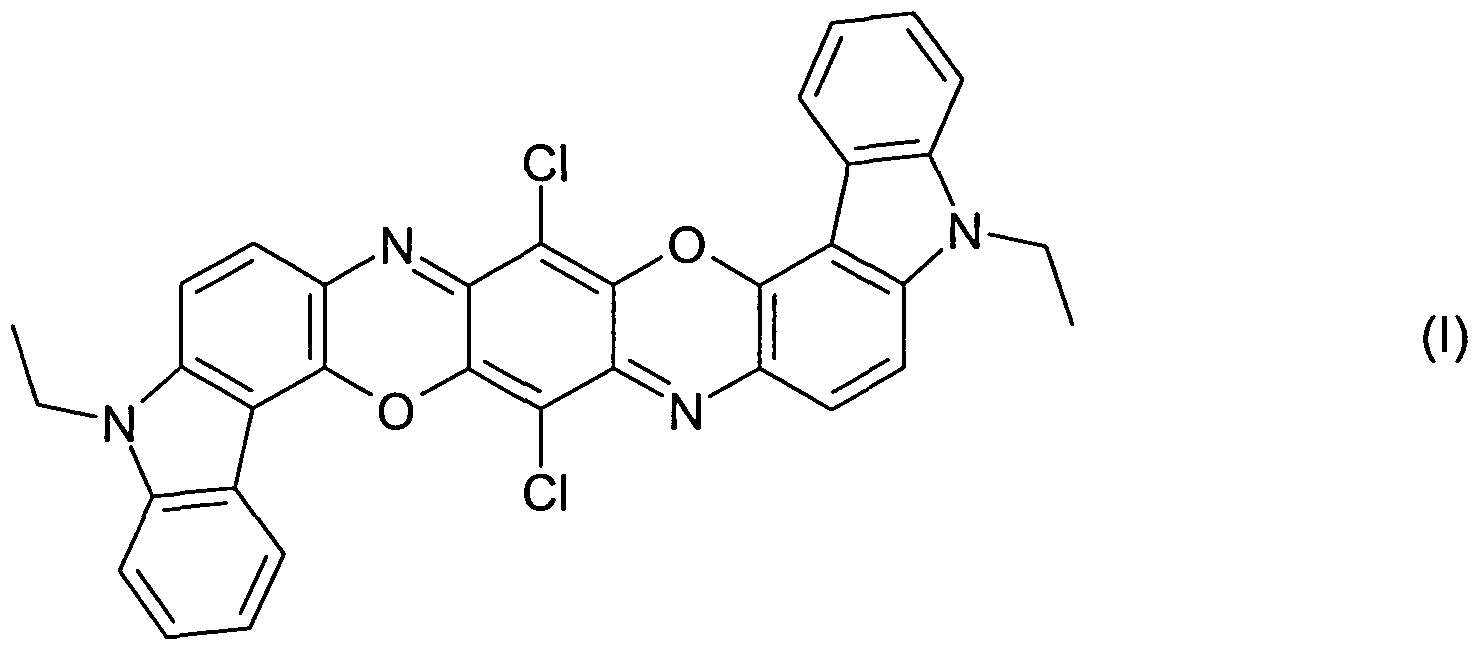
- the object was surprisingly achieved by a pigment preparation from a combination of PV 23, resin acids or resin acid derivatives and special pigment dispersants based on dioxazine compounds.
- the present invention is a pigment preparation, characterized by a content of a) a dioxazine compound of the formula (I) as a base pigment
- Q is an m-valent radical of the base pigment of the formula (I),
- X denotes an imidazole radical bonded to the bridge member Y via a C atom
- m indicates a numerical value between 1 and 4
- pigment dispersants of the formula (II) in which Y is methylene, ethylene or propylene,
- X is imidazolyl bonded to the bridge member Y via position 5, and m is a number from 1 to 2.5.
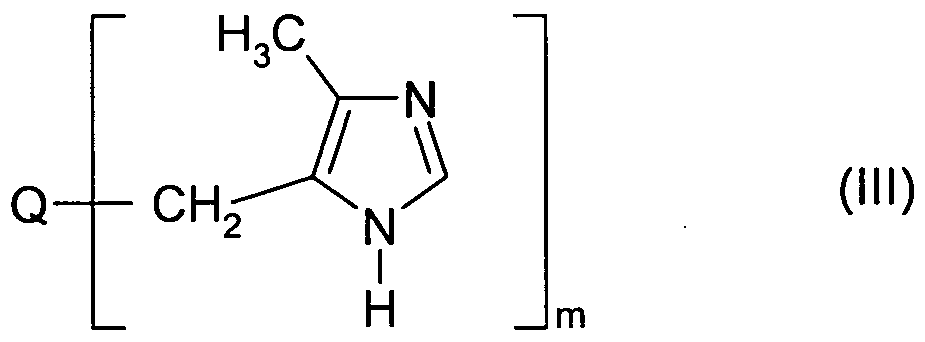
- pigment dispersants of the formula (III) For the purposes of the present invention, very particular preference is given to pigment dispersants of the formula (III)
- Q has the abovementioned meaning, and m is a numerical value of 1 to 2.5, in particular 1 to 2, stands.
- Preferred resin components are commercially available rosins and salts of said acids, also called resin soaps, where the cations are metal cations, preferably from the group of alkali metals, alkaline earth metals, earth metals and transition metals, such as Cr, Mn 1 Fe, Co, Ni, Cu, Zn, Ag. Particularly preferred are Li, Na, K, Mg, Ca, Sr, especially Na and K.
- a pigment preparation comprising a) from 50 to 99.7% by weight, particularly preferably from 80 to 99.7% by weight, very particularly preferably from 90 to 99.2% by weight, of a base pigment of the formula I,
- the pigment preparations of the invention may contain, in addition to the components mentioned, other conventional auxiliaries or additives, such as surfactants, dispersants, fillers, extenders, resins other than those mentioned above, waxes, defoamers, anti-dusting agents, extenders, antistatic agents, preservatives, drying retardants, wetting agents, antioxidants , UV absorbers and light stabilizers, preferably in an amount of 0.1 to 10 wt .-%, in particular 0.5 to 5 wt .-%, based on the total weight of the pigment preparation.
- auxiliaries or additives such as surfactants, dispersants, fillers, extenders, resins other than those mentioned above, waxes, defoamers, anti-dusting agents, extenders, antistatic agents, preservatives, drying retardants, wetting agents, antioxidants , UV absorbers and light stabilizers, preferably in an amount of 0.1 to 10 wt .-%, in particular 0.5 to 5 wt .-%
- Suitable surfactants are anionic or anionic, cationic or cationic and nonionic or amphoteric substances or mixtures of these agents.
- the invention also provides a process for the preparation of a pigment preparation according to the invention, characterized in that Cl. Pigment Violet 23 before or during a fine distribution, such.
- a process for the preparation of a pigment preparation according to the invention characterized in that Cl. Pigment Violet 23 before or during a fine distribution, such.
- a kneading, wet grinding or dry grinding, or immediately before or during a finish treatment with the pigment dispersant of the formula (II) and the resin component As a kneading, wet grinding or dry grinding, or immediately before or during a finish treatment with the pigment dispersant of the formula (II) and the resin component.
- the dry components may be mixed in granule or powder form before or after grinding; the one component may be added to the other component in wet or dry form, for example by mixing the components in the form of wet
- the mixing can be carried out, for example, by milling in dry form, in moist form, for example by kneading, or in suspension, or by a combination of these processes.
- the grinding can with the addition of
- Kneading which leads to the fine distribution of the pigment crystals is particular salt kneading in the presence of an organic solvent.
- the addition of the pigment dispersant and the resin component to the base pigment of the formula I takes place during wet grinding or during a finish treatment.
- the finishing treatment in water and / or solvents and usually under elevated temperature, for example up to 200 0 C, and optionally increased pressure.
- the pigment dispersant and the resin component may also be added in partial portions at different times.
- drying units In the drying of a wet pigment preparation, the known drying units can be used, such as drying cabinets,
- Paddle wheel dryers tumble dryers, contact dryers and in particular spinflash and spray dryers.
- the invention also provides a pigment preparation obtainable by the process described above.
- the pigment preparations according to the invention can be used for pigmenting high molecular weight organic materials of natural or synthetic origin, for example plastics, resins, paints, paints, electrophotographic toners and developers, color filters and inks, also inkjet inks, and in particular for printing inks.
- plastics for example plastics, resins, paints, paints, electrophotographic toners and developers, color filters and inks, also inkjet inks, and in particular for printing inks.
- the pigment preparations according to the invention show excellent rheological properties even with high pigmentation (eg 22%) of the printing ink concentrates.
- the invention also ink concentrates, characterized by a content of 15 to 25 wt .-%, preferably 17 to 24 wt .-%, in particular 18 to 22 wt .-%, of the pigment preparation of the invention.
- the printing inks prepared from the pigment preparations according to the invention show a very good viscosity, thixotropy and storage stability in accordance with the test specification PV 3/20 (Clariant International AG, Global Quality Assurance, July 2005) in NC gravure printing (Table 1):
- 252 g of dioxazine Pigment Violet 23 are mixed with 1,125 g of sodium chloride ( ⁇ 30 micrometer) in a laboratory kneader with 230 ml DMF at 50 0 C for 8 h kneaded. Subsequently, the kneading mass is mixed with 11,000 g of 5% strength by weight hydrochloric acid, filtered off with suction and washed with e-water.
- the filter cake is pasted into 500 ml of E water and at 60 0 C with 85 g of an aqueous 5% solution of a partially hydrogenated rosin in sodium hydroxide and 105 g of a 9% aqueous suspension of the pigment of formula (III) with m equal to 1 added. Subsequently, the approach is sucked hot. The product is washed salt-free and dried at 80 0 C in a vacuum and then pulverized.
Landscapes
- Chemical & Material Sciences (AREA)
- Organic Chemistry (AREA)
- Chemical Kinetics & Catalysis (AREA)
- Wood Science & Technology (AREA)
- Engineering & Computer Science (AREA)
- Materials Engineering (AREA)
- Life Sciences & Earth Sciences (AREA)
- Health & Medical Sciences (AREA)
- Medicinal Chemistry (AREA)
- Polymers & Plastics (AREA)
- General Chemical & Material Sciences (AREA)
- Inks, Pencil-Leads, Or Crayons (AREA)
- Paints Or Removers (AREA)
- Pigments, Carbon Blacks, Or Wood Stains (AREA)
- Agricultural Chemicals And Associated Chemicals (AREA)
Abstract
Description

Claims


Priority Applications (5)
| Application Number | Priority Date | Filing Date | Title |
|---|---|---|---|
| CN200880018558.5A CN101679766B (zh) | 2007-07-05 | 2008-06-05 | 基于二噁嗪的颜料制剂 |
| JP2010513700A JP5578727B2 (ja) | 2007-07-05 | 2008-06-05 | ジオキサジンベースの顔料調合物 |
| EP08773367A EP2176358B1 (de) | 2007-07-05 | 2008-06-05 | Pigmentzubereitungen auf basis von dioxazinen |
| US12/667,626 US8293441B2 (en) | 2007-07-05 | 2008-06-05 | Pigment preparations based on dioxazines |
| ES08773367T ES2389669T3 (es) | 2007-07-05 | 2008-06-05 | Preparados de pigmentos a base de dioxazinas |
Applications Claiming Priority (2)
| Application Number | Priority Date | Filing Date | Title |
|---|---|---|---|
| DE102007031354.5 | 2007-07-05 | ||
| DE102007031354A DE102007031354A1 (de) | 2007-07-05 | 2007-07-05 | Pigmentzubereitungen auf Basis von Dioxazinen |
Publications (2)
| Publication Number | Publication Date |
|---|---|
| WO2009003568A2 true WO2009003568A2 (de) | 2009-01-08 |
| WO2009003568A3 WO2009003568A3 (de) | 2009-06-04 |
Family
ID=40092459
Family Applications (1)
| Application Number | Title | Priority Date | Filing Date |
|---|---|---|---|
| PCT/EP2008/004522 Ceased WO2009003568A2 (de) | 2007-07-05 | 2008-06-05 | Pigmentzubereitungen auf basis von dioxazinen |
Country Status (7)
| Country | Link |
|---|---|
| US (1) | US8293441B2 (de) |
| EP (1) | EP2176358B1 (de) |
| JP (1) | JP5578727B2 (de) |
| CN (1) | CN101679766B (de) |
| DE (1) | DE102007031354A1 (de) |
| ES (1) | ES2389669T3 (de) |
| WO (1) | WO2009003568A2 (de) |
Cited By (1)
| Publication number | Priority date | Publication date | Assignee | Title |
|---|---|---|---|---|
| JP2011157510A (ja) * | 2010-02-02 | 2011-08-18 | Fujifilm Corp | 顔料微粒子分散体、これを用いた光硬化性組成物及びカラーフィルタ、これに用いられる新規化合物 |
Families Citing this family (5)
| Publication number | Priority date | Publication date | Assignee | Title |
|---|---|---|---|---|
| TW201105750A (en) * | 2009-03-31 | 2011-02-16 | Solvay | Process for the preparation of easily dispersible violet pigment |
| WO2012089516A1 (en) | 2010-12-30 | 2012-07-05 | Basf Se | Surface-modified pigment preparations |
| CN103408965A (zh) * | 2013-08-08 | 2013-11-27 | 大连理工大学 | 一类含有酰亚胺和三苯二噁嗪结构的染料及其制备方法 |
| JP6162069B2 (ja) * | 2014-03-31 | 2017-07-12 | 富士フイルム株式会社 | 水系インクジェット用顔料分散体及びその製造方法、並びに水系インクジェットインク |
| JP6219333B2 (ja) * | 2015-03-31 | 2017-10-25 | 富士フイルム株式会社 | 顔料分散物及びその製造方法 |
Citations (6)
| Publication number | Priority date | Publication date | Assignee | Title |
|---|---|---|---|---|
| US4253839A (en) | 1977-09-22 | 1981-03-03 | Hoechst Aktiengesellschaft | Process for the fine distribution of pigments of the dioxazine series |
| EP0321919A2 (de) | 1987-12-22 | 1989-06-28 | Hoechst Aktiengesellschaft | Neue Pigmente und ihre Verwendung |
| EP0504923A1 (de) | 1991-03-22 | 1992-09-23 | Hoechst Aktiengesellschaft | Verfahren zur Herstellung von Pigmentzubereitungen auf Basis von C.I. Pigment Violet 23 |
| EP0803544A2 (de) | 1996-04-24 | 1997-10-29 | Hoechst Aktiengesellschaft | Oberflächenbehandelte Chinacridon- und Dioxazin-Pigmente |
| DE102005028106A1 (de) | 2004-06-16 | 2006-01-12 | Colour Ltd. | Verfahren zur Herstellung von organischen Pigmenten und deren Verwendung |
| WO2006128539A2 (de) | 2005-05-31 | 2006-12-07 | Clariant Produkte (Deutchland) Gmbh | Blaues farbmittel auf basis von c.i. pigment blue 80 |
Family Cites Families (8)
| Publication number | Priority date | Publication date | Assignee | Title |
|---|---|---|---|---|
| US595129A (en) * | 1897-12-07 | Signature-register and machine-index | ||
| FR2515668A1 (fr) * | 1981-11-02 | 1983-05-06 | Sandoz Sa | Nouveaux composes dioxaziniques, leur preparation et leur utilisation comme pigments |
| DE4400329A1 (de) | 1994-01-07 | 1995-07-20 | Hoechst Ag | Verwendung von Fettsäuretauriden zum Dispergieren polycyclischer Pigmente |
| DE19709798A1 (de) | 1997-03-10 | 1998-09-17 | Clariant Gmbh | Pigmentzubereitungen und Verfahren zu ihrer Herstellung |
| JPH11302553A (ja) * | 1998-04-24 | 1999-11-02 | Dainippon Ink & Chem Inc | 表面処理顔料の製造方法 |
| GB9911719D0 (en) * | 1999-05-21 | 1999-07-21 | Clariant Int Ltd | Organic compounds |
| DE102004010282A1 (de) * | 2004-03-03 | 2005-09-22 | Clariant Gmbh | Violettes Farbmittel für Color Filter, Ink Jet Tinten, elektrophotographische Toner und Entwickler und e-inks |
| US7569106B2 (en) * | 2004-06-16 | 2009-08-04 | Colour Ltd. | Method for producing β copper phthalocyanine blue pigments and use thereof |
-
2007
- 2007-07-05 DE DE102007031354A patent/DE102007031354A1/de not_active Withdrawn
-
2008
- 2008-06-05 ES ES08773367T patent/ES2389669T3/es active Active
- 2008-06-05 WO PCT/EP2008/004522 patent/WO2009003568A2/de not_active Ceased
- 2008-06-05 JP JP2010513700A patent/JP5578727B2/ja not_active Expired - Fee Related
- 2008-06-05 CN CN200880018558.5A patent/CN101679766B/zh active Active
- 2008-06-05 US US12/667,626 patent/US8293441B2/en active Active
- 2008-06-05 EP EP08773367A patent/EP2176358B1/de active Active
Patent Citations (6)
| Publication number | Priority date | Publication date | Assignee | Title |
|---|---|---|---|---|
| US4253839A (en) | 1977-09-22 | 1981-03-03 | Hoechst Aktiengesellschaft | Process for the fine distribution of pigments of the dioxazine series |
| EP0321919A2 (de) | 1987-12-22 | 1989-06-28 | Hoechst Aktiengesellschaft | Neue Pigmente und ihre Verwendung |
| EP0504923A1 (de) | 1991-03-22 | 1992-09-23 | Hoechst Aktiengesellschaft | Verfahren zur Herstellung von Pigmentzubereitungen auf Basis von C.I. Pigment Violet 23 |
| EP0803544A2 (de) | 1996-04-24 | 1997-10-29 | Hoechst Aktiengesellschaft | Oberflächenbehandelte Chinacridon- und Dioxazin-Pigmente |
| DE102005028106A1 (de) | 2004-06-16 | 2006-01-12 | Colour Ltd. | Verfahren zur Herstellung von organischen Pigmenten und deren Verwendung |
| WO2006128539A2 (de) | 2005-05-31 | 2006-12-07 | Clariant Produkte (Deutchland) Gmbh | Blaues farbmittel auf basis von c.i. pigment blue 80 |
Cited By (1)
| Publication number | Priority date | Publication date | Assignee | Title |
|---|---|---|---|---|
| JP2011157510A (ja) * | 2010-02-02 | 2011-08-18 | Fujifilm Corp | 顔料微粒子分散体、これを用いた光硬化性組成物及びカラーフィルタ、これに用いられる新規化合物 |
Also Published As
| Publication number | Publication date |
|---|---|
| US20100196816A1 (en) | 2010-08-05 |
| WO2009003568A3 (de) | 2009-06-04 |
| JP2010532398A (ja) | 2010-10-07 |
| ES2389669T3 (es) | 2012-10-30 |
| DE102007031354A1 (de) | 2009-01-08 |
| JP5578727B2 (ja) | 2014-08-27 |
| EP2176358B1 (de) | 2012-08-15 |
| EP2176358A2 (de) | 2010-04-21 |
| CN101679766B (zh) | 2014-04-09 |
| CN101679766A (zh) | 2010-03-24 |
| US8293441B2 (en) | 2012-10-23 |
Similar Documents
| Publication | Publication Date | Title |
|---|---|---|
| EP0538784B1 (de) | Pigmentzubereitungen | |
| CH685162A5 (de) | Pigmentzusammensetzungen. | |
| EP2396371B1 (de) | Leicht dispergierbare feste pigmentzubereitungen | |
| EP2176358B1 (de) | Pigmentzubereitungen auf basis von dioxazinen | |
| EP0504922B1 (de) | Neue Pigmentzubereitungen auf Basis von Dioxazinverbindungen | |
| EP1664203B1 (de) | Pigmentzusammensetzungen aus organischen und anorganischen pigmenten | |
| DE69716338T2 (de) | Verfahren zur Herstellung einer Pigmentzubereitun | |
| EP2129726B1 (de) | Verfahren zur herstellung von transparentem pigment violett 23 | |
| EP1658336B1 (de) | Mischkristalle mit derivaten von c.i. pigment red 170 | |
| EP0033913B1 (de) | Verfahren zur Herstellung von Pigmentpräparationen und ihre Verwendung | |
| EP0489421B1 (de) | Pigmentzubereitungen | |
| DE4400329A1 (de) | Verwendung von Fettsäuretauriden zum Dispergieren polycyclischer Pigmente | |
| DE69711995T2 (de) | Disazopigmentzusammensetzung und Drucktinten | |
| EP0796900A2 (de) | Für wasserverdünnbare Druckfarben und Lacke geeignete Pigmentzubereitungen | |
| DE60115213T3 (de) | Verfahren zur herstellung von kupferphthalocyanin-pigment in der beta-phase | |
| EP0656402A2 (de) | Pigmentzusammensetzung aus modifiziertem Diketopyrrolopyrrol und Aminoalkylacrylatharz | |
| WO2009049758A2 (de) | Feinteiliges c.i. pigment yellow 155 | |
| DE2753042A1 (de) | Kupferphthalocyaninderivate | |
| DE2811539A1 (de) | Verfahren zur konditionierung eines phthalocyaninpigments | |
| EP4526383B1 (de) | Pigmentzubereitung auf basis von c. i. pigment violett 23 | |
| EP0656403A2 (de) | Pigmentzusammensetzung aus Diketopyrrolopyrrol und Aminoalkylacrylatharz | |
| EP1067156B1 (de) | Vefahren zur Herstellung hochkonzentrierter Pigmentpresskuchen | |
| EP2370523B1 (de) | Flockungsstabile diketopyrrolopyrrol-pigmentzubereitungen |
Legal Events
| Date | Code | Title | Description |
|---|---|---|---|
| WWE | Wipo information: entry into national phase |
Ref document number: 200880018558.5 Country of ref document: CN |
|
| 121 | Ep: the epo has been informed by wipo that ep was designated in this application |
Ref document number: 08773367 Country of ref document: EP Kind code of ref document: A2 |
|
| WWE | Wipo information: entry into national phase |
Ref document number: 2008773367 Country of ref document: EP |
|
| WWE | Wipo information: entry into national phase |
Ref document number: 2010513700 Country of ref document: JP |
|
| WWE | Wipo information: entry into national phase |
Ref document number: 12667626 Country of ref document: US |