WO2009018740A1 - Monohalogenated pyrethric acid alpha-cyano-4-fluoro-3-phenoxybenzyl ester and its preparation method and use - Google Patents
Monohalogenated pyrethric acid alpha-cyano-4-fluoro-3-phenoxybenzyl ester and its preparation method and use Download PDFInfo
- Publication number
- WO2009018740A1 WO2009018740A1 PCT/CN2008/071600 CN2008071600W WO2009018740A1 WO 2009018740 A1 WO2009018740 A1 WO 2009018740A1 CN 2008071600 W CN2008071600 W CN 2008071600W WO 2009018740 A1 WO2009018740 A1 WO 2009018740A1
- Authority
- WO
- WIPO (PCT)
- Prior art keywords
- fluoro
- cyano
- compound
- phenoxy
- benzyl
- Prior art date
- Legal status (The legal status is an assumption and is not a legal conclusion. Google has not performed a legal analysis and makes no representation as to the accuracy of the status listed.)
- Ceased
Links
Classifications
-
- A—HUMAN NECESSITIES
- A01—AGRICULTURE; FORESTRY; ANIMAL HUSBANDRY; HUNTING; TRAPPING; FISHING
- A01N—PRESERVATION OF BODIES OF HUMANS OR ANIMALS OR PLANTS OR PARTS THEREOF; BIOCIDES, e.g. AS DISINFECTANTS, AS PESTICIDES OR AS HERBICIDES; PEST REPELLANTS OR ATTRACTANTS; PLANT GROWTH REGULATORS
- A01N53/00—Biocides, pest repellants or attractants, or plant growth regulators containing cyclopropane carboxylic acids or derivatives thereof
-
- C—CHEMISTRY; METALLURGY
- C07—ORGANIC CHEMISTRY
- C07C—ACYCLIC OR CARBOCYCLIC COMPOUNDS
- C07C253/00—Preparation of carboxylic acid nitriles
- C07C253/30—Preparation of carboxylic acid nitriles by reactions not involving the formation of cyano groups
-
- C—CHEMISTRY; METALLURGY
- C07—ORGANIC CHEMISTRY
- C07C—ACYCLIC OR CARBOCYCLIC COMPOUNDS
- C07C255/00—Carboxylic acid nitriles
- C07C255/01—Carboxylic acid nitriles having cyano groups bound to acyclic carbon atoms
- C07C255/32—Carboxylic acid nitriles having cyano groups bound to acyclic carbon atoms having cyano groups bound to acyclic carbon atoms of a carbon skeleton containing at least one six-membered aromatic ring
- C07C255/38—Carboxylic acid nitriles having cyano groups bound to acyclic carbon atoms having cyano groups bound to acyclic carbon atoms of a carbon skeleton containing at least one six-membered aromatic ring the carbon skeleton being further substituted by esterified hydroxy groups
- C07C255/39—Carboxylic acid nitriles having cyano groups bound to acyclic carbon atoms having cyano groups bound to acyclic carbon atoms of a carbon skeleton containing at least one six-membered aromatic ring the carbon skeleton being further substituted by esterified hydroxy groups with hydroxy groups esterified by derivatives of 2,2-dimethylcyclopropane carboxylic acids, e.g. of chrysanthemumic acids
-
- C—CHEMISTRY; METALLURGY
- C07—ORGANIC CHEMISTRY
- C07C—ACYCLIC OR CARBOCYCLIC COMPOUNDS
- C07C2601/00—Systems containing only non-condensed rings
- C07C2601/02—Systems containing only non-condensed rings with a three-membered ring
Definitions
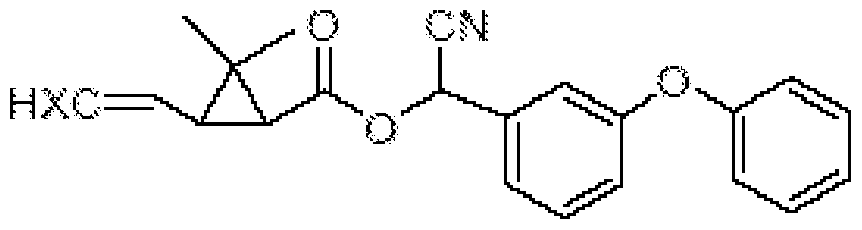
- the present invention relates to the field of pesticides, in particular, the present invention relates to a novel class of pyrethroid insecticides: a-cyano-4-fluoro-3-phenyl ether benzyl carbamate, the present invention also relates to the insecticidal A method of preparing the agent and the use of the insecticide. Background technique
- Pyrethroid insecticides are a class of high-efficiency, broad-spectrum insecticides with low insecticidal spectrum, low toxicity, and safe for humans and animals. They are widely used and have become one of the main products of insecticides.
- the first chrysanthemum series of methrin, methrin, fenthrin, and fenvalerate play an extremely important role in public health and disease vector insect control; cypermethrin (M. Ell iott et Ger P2326077, 1974), deltamethrin (M.
- deltamethrin is a type II pyrethroid-like biomimetic insecticide containing a cyano group synthesized by Ell iott in 1974 based on the study of the chemical structure of natural pyrethrin. It is the most invasive virulence of synthetic pyrethroid insecticides. It is small in dosage, stable to light, rapid in metabolism and excretion in mammals, and has broad-spectrum and low-residue characteristics. It is effective against insects that are resistant to organic phosphorus and has certain advantages. It is mainly used for controlling cotton fields and vegetables. Agricultural pests on the ground, fruit trees and tea, as well as sanitary pests, are also used in fishery production to kill parasites.
- deltamethrin the main pyrethroid product
- cypermethrin Another major product of pyrethroids, cypermethrin, has recently been suspected to be an endocrine disruptor (ie, environmental hormone) and was included in the US Our Stolen Future website (Ren Ren, Huang Jun, Safety and Environmental Engineering, 2004, 11 (3), 7.). It is considered an estrogen that interferes with the reproductive function of humans and animals.
- transhalofulrim such as ⁇ -cyano-3-phenoxybenzyl- 2,2-dimethyl- 3-(2-chlorovinyl)cyclopropanecarboxylate, ⁇ -cyano-3-phenoxybenzyl- 2,2-dimethyl-3-(2-bromoethenyl)cyclopropanecarboxylate, They are only detected in trace amounts in the biological or optical degradation products of cypermethrin and deltamethrin and have not been effectively utilized.
- the present invention aims to provide a novel class of highly active, low residual pyrethroid insecticides, namely, alpha-cyano-4-fluoro-3-phenyl ether benzyl lactobate, to overcome the prior art defect.
- One object of the present invention is to provide the above-mentioned benzyl ⁇ -cyano-4-fluoro-3-phenylether benzyl ester.
- the pyrethroid of pyrethroids is a 3 ⁇ 4 atom removed from the double bond, and a hydrogen atom is introduced. Such a structure is less stable to light than a structure with two halogen atoms.
- X represents a halogen atom, that is, an F, Cl, Br atom.
- the compound is selected from the group consisting of:
- a second aspect of the invention provides a process for the preparation of a compound of formula (I), which comprises:
- the halo-acid ( ⁇ ) can be synthesized by a known method (e.g., Pestic. Sci. 17, 1986, 708.); the compound of formula (V) can be used with a halo-acid (II) and thionyl chloride. Synthetic methods are synthesized (such as Zhang Qiuxian, Chen Zhen, Zou Xinyu, "Synthesis and insecticidal activity of second chrysanthemic mixed fluorobenzyl esters", Organic Chemistry, 2005, 25, 991).
- a third aspect of the invention also proposes a novel method for the synthesis of a haloacid ( ⁇ ):
- French Patent No. 2185612 and CN1044650A propose a process for preparing a halo-substituted acid ( ⁇ ) using the corresponding t-butyl chrysanthemate when X is a chlorine atom and a bromine atom.
- the present invention provides a method for preparing a biased acid ( ⁇ ) by directly performing a Witting reaction using a racemic or chiral trans or cis or a mixture thereof of an industrial product, such as Process 1 and Scheme 2. Shown. The details are detailed in the experimental section.
- the fourth aspect of the present invention relates to the use of lysyl gallate ⁇ -cyano-4-fluoro-3-phenylether benzyl ester as an insecticide.
- the present invention provides a mixture of a compound of the formula (I) or a stereoisomer thereof or a stereoisomer thereof in the preparation of a vector for controlling or killing public health epidemics and parasitic in agricultural animals and plants.
- insecticides for insects, nematodes, and mites are examples of insects, nematodes, and mites.
- the invention also relates in particular to a method of controlling mosquitoes, ticks or house flies comprising applying a compound of formula (I) or a stereoisomer thereof or a mixture of stereoisomers thereof.
- a fifth aspect of the invention relates to a pesticidal composition comprising a compound of formula (I) or a stereoisomer thereof or a mixture of its stereoisomers, and an agriculturally acceptable inert carrier. If desired, one or more other insecticides may be added to the a-cyano-4-fluoro-3-phenyl ether benzyl ester (I); or added to ensure a uniform distribution of the active ingredient. Agents and solvents.
- the composition is preferably in the form of a powder, a granule, or an emulsion. detailed description
- pyrethrylic acid was obtained by the procedure of the above-mentioned preparation method 1.1, and recrystallized from ethyl acetate to obtain colorless cis-3 (E-2-chlorovinyl) 2, 2 Crystals of dimethylcyclopropanecarboxylic acid. Melting point 103-105 ° C.
- Phenyl bromide scale vacuum, nitrogen, add 40ml anhydrous ether, 2.1ml piperidine, stir, liquid nitrogen cooled to -70 ⁇ -60 ° C, add 9.5ml 2.2mol / L butyl lithium, low temperature
- a solution of 3.3 g of methyl benzoate and 10 ml of benzene was added, and the mixture was stirred at a low temperature for 20 minutes and then reacted at room temperature for 3 days (a large amount of pale yellow solid was precipitated in the reaction flask, and the reaction liquid was milky white).
- the solid was washed with anhydrous diethyl ether, and the filtrate was washed with 10% sulfuric acid and saturated sodium chloride. After drying over anhydrous magnesium sulfate, the solvent was evaporated, and the crude product was purified by column chromatography.
- the mixed leucovorin obtained by the preparation method 1.4 was mixed with 5.7 mmol and 5.0 ml of thionyl chloride, and after stirring for 4-5 hours, the pump was dehydrated to remove excess thionyl chloride, and diluted with 5.0 mL of benzene for use.
- the trans-permethrinic acid obtained by the preparation method 1.3 and 2,3,5,6-tetrafluoro-4-methylbenzyl alcohol were subjected to esterification reaction in the same manner as in Example 2 to obtain a target compound.
- 3 ⁇ 4 NMR (CDC1 3 ) ⁇ (ppm): 1.16 (s, 3H, ring-CH 3 ); 1.24 (s, 3 ⁇ , ring-CH 3 ); 1.55 (d, 1H, J 6 Hz, ring-CH); 2 ⁇ 05 ⁇ 2 ⁇ 08 (m, 0 ⁇ 7 X IH, ring-CH); 2.29 (s, 3H, ArCH 3 ) 2.41 ⁇ 2 ⁇ 43 (m, 0 ⁇ 3X1H, ring-CH); 5.16 ⁇ 5.19 (m, 2H, -C00CH 2 );
- Example 1 Killing effect on cockroaches:
- test temperature is: 26 ⁇ 1 °C
- humidity 70 ⁇ 10%
- a certain amount of the test compound in acetone and purified water is 500, 250, 100, 50, 25, 12. 5, 6. 25, 3. 125, 1, 0. 5, 0. 25, 0. 1, 0. 05, 0. 025, 0. 01, 0. 005, 0. 0025, 0.
- the compounds of Nos. 6 to 11 are respectively representative examples of the polyfluorobenzyl alcohol-haloperylic acid esters referred to in CN1044650A, and correspond to the compounds of Reference Examples 1 to 6 in the present specification, respectively;
- Compounds Nos. 12 to 13 are representative examples of ⁇ -cyano-3-phenylene ether dihalothoacetate described by Ell iott in Pestic. Sci. 17, 1986, 708 as a comparative example, 12 and 13
- the compounds of the formula correspond to the compounds of Reference Examples 7 and 8 in the present specification, respectively.
- the polyfluorobenzyl alcohol transpermethrin having the highest insecticidal activity is a comparative example
- the compound No. 2, No. 3 is a representative example of the compound (I) according to the present invention.
- the insecticidal action against armyworms was tested. Mythimna separata. Test temperature: 26 ⁇ 1 ° C, humidity: 70 ⁇ 10%; using corn leaf dip method, the corn leaves were immersed in dimethyl sulfoxide solvent for 5 seconds and then taken out, After the drug solution is dried, the corn leaves are cut and the 3rd instar larvae are fed, with 3 replicates per treatment. After 48 hours, the number of dead insects was examined and the mortality was calculated. The test results are shown in Table 2.
- the insecticidal action against aphids was tested using the compound No. 9 as a comparative example and the compounds Nos. 2 and 3 as a representative of the compound (I) of the present invention.
- the knockdown effect on Musca domestica was tested using Compound No. 9 as a control example and Compound No. 2 and No. 3 as a representative example of Compound (I) involved in the present invention.
- Musca domestica a sensitive strain raised indoors, 3-5 days of adult emergence, male and female.
- Test temperature 26 ⁇ 1 °C Humidity: 70 ⁇ 10%.
- Test method liquid film contact method. 0. 1% acetone solution 1 ml was uniformly applied to a 500 ml Erlenmeyer flask to form a film. After drying, put into adult 20 to 25 heads, observe the knockdown time and knockdown number, and repeat 3 times in parallel. The test results are shown in Table 5.
- Table 5 The knockdown effect of the compound (I) of the present invention on Musca domestica
- Composition Example 1 Preparation of a water-based concentrate
- a homogeneous mixture was prepared from the following ingredients:
- Example 2 The compound of Example 2 (cis-a-cyano-3-phenoxy-4-fluoro-benzyl- 2,2-dimethyl-3-(2-chlorovinyl)cyclopropanecarboxylic acid Ester) and the corresponding dichloro compound (cis-a-cyano-3-phenoxy-4-fluoro-benzyl- 2,2-dimethyl-3-(2,2-dichlorovinyl)
- the cyclopropane carboxylate was separately added to two vessels and 50 ml of cyclohexane was added. They were irradiated for 30 minutes under a 500W UV lamp. Then, 0.15 mmol of n-dodecane was added as an internal standard for gas chromatography analysis.
- the former is 30% photodegraded; the latter 14% is photodegraded. It shows that the former is roughly equivalent to the theoretical prediction, and its light stability is higher than that of the first chrysanthemic acid and lower than that of the second-halogenyl ester, that is, it has appropriate stability. It is photo-degraded by a speed of 1.9 times that of the latter, that is, if the same amount is used, the former has a lower residue in the environment than the latter.
- the present invention has the following positive effects:
- the compound (I) according to the invention has high insecticidal activity and wide insecticidal spectrum: the relative toxicity of the compound of Example 2 to the common household pest Culex pipiens larvae is much greater than that of the tetrahalobenzyl halenate.
- the ester (which is 125 to 1128 times the compound of Reference Examples 1 to 6); is also referred to as 2.55 times of the highest insecticidal activity of deltamethrin; 22.55 times of cypermethrin; Large, most of the insecticides exhibiting low killing activity also showed high killing activity, and the average mortality rate against armyworms at a low concentration of 1 mg/L was 66.7%. Better than insecticides such as deltamethrin.
- the compound (I) according to the invention has a high safety factor.
- LD 5 It is roughly equivalent to 70 ⁇ 140 mg/Kg, so its safety factor, ie the toxicity ratio, is also better than that of deltamethrin. 2. 55 times.
- the compound (I) according to the present invention is easy to synthesize, has low production cost, and is easy to industrialize: whether it is compared with the expensive polyfluorobenzyl alcohol of tetrafluorobenzyl valerate, or a single chiral isomer
- the raw material 3-phenoxy-4-fluoro-benzaldehyde (III) and compound of the alcohol component of the compound (I) of the present invention are compared with the body (1/8), the deltamethrin having a low atomic production efficiency.
- the compound (I) according to the present invention has a light stability higher than that of the first chrysanthemate and lower than that of the second chrysanthemum due to the asymmetric azithic acid and fluorine-containing structure of the molecule, that is, it is suitably stabilized. Sex; the residue in the environment is lower than that of the fenflurin. In addition, it has the advantages of quick-acting and reducing insect resistance.
Landscapes
- Chemical & Material Sciences (AREA)
- Organic Chemistry (AREA)
- Life Sciences & Earth Sciences (AREA)
- Dentistry (AREA)
- Health & Medical Sciences (AREA)
- Engineering & Computer Science (AREA)
- Plant Pathology (AREA)
- General Health & Medical Sciences (AREA)
- Wood Science & Technology (AREA)
- Zoology (AREA)
- Environmental Sciences (AREA)
- Pest Control & Pesticides (AREA)
- Agronomy & Crop Science (AREA)
- Chemical Kinetics & Catalysis (AREA)
- Organic Low-Molecular-Weight Compounds And Preparation Thereof (AREA)
Description



Claims


Priority Applications (3)
| Application Number | Priority Date | Filing Date | Title |
|---|---|---|---|
| BRPI0814985-2A2A BRPI0814985A2 (pt) | 2007-08-03 | 2008-07-10 | Meta-halo piretrato de alfa-ciano-4-flúor-3-fenoxibenzila, um processo para preparar o mesmo e os usos do mesmo. |
| EP08773154.3A EP2186794B1 (en) | 2007-08-03 | 2008-07-10 | Monohalogenated pyrethric acid alpha-cyano-4-fluoro-3-phenoxybenzyl ester and its preparation method and use |
| US12/671,886 US8202904B2 (en) | 2007-08-03 | 2008-07-10 | α-cyano-4-fluoro-3-phenoxybenzyl meta-halo pyrethrate, a process for preparing the same and the uses thereof |
Applications Claiming Priority (2)
| Application Number | Priority Date | Filing Date | Title |
|---|---|---|---|
| CNB2007100445429A CN100500649C (zh) | 2007-08-03 | 2007-08-03 | 偏卤菊酸α-氰基-4-氟-3-苯醚苄酯、其制备方法和所述化合物的用途 |
| CN200710044542.9 | 2007-08-03 |
Publications (1)
| Publication Number | Publication Date |
|---|---|
| WO2009018740A1 true WO2009018740A1 (en) | 2009-02-12 |
Family
ID=39034923
Family Applications (1)
| Application Number | Title | Priority Date | Filing Date |
|---|---|---|---|
| PCT/CN2008/071600 Ceased WO2009018740A1 (en) | 2007-08-03 | 2008-07-10 | Monohalogenated pyrethric acid alpha-cyano-4-fluoro-3-phenoxybenzyl ester and its preparation method and use |
Country Status (5)
| Country | Link |
|---|---|
| US (1) | US8202904B2 (zh) |
| EP (1) | EP2186794B1 (zh) |
| CN (1) | CN100500649C (zh) |
| BR (1) | BRPI0814985A2 (zh) |
| WO (1) | WO2009018740A1 (zh) |
Families Citing this family (4)
| Publication number | Priority date | Publication date | Assignee | Title |
|---|---|---|---|---|
| CN101492393B (zh) * | 2009-03-04 | 2013-06-05 | 江苏扬农化工股份有限公司 | 一种拟除虫菊酯化合物及其制备方法和应用 |
| CN109851525A (zh) * | 2019-02-27 | 2019-06-07 | 黄山学院 | 一种甲氯代含氟氰拟除虫菊酯化合物及其制备方法和应用 |
| CN110256285B (zh) * | 2019-07-09 | 2022-03-18 | 上海出入境检验检疫局动植物与食品检验检疫技术中心 | 一种稳定同位素标记拟除虫菊酯的合成方法 |
| CN116375604B (zh) * | 2022-02-22 | 2024-10-22 | 江苏扬农化工股份有限公司 | 一种双键含氰基的拟除虫菊酯化合物及合成方法与应用 |
Citations (3)
| Publication number | Priority date | Publication date | Assignee | Title |
|---|---|---|---|---|
| DE2326077A1 (de) | 1972-05-25 | 1974-01-03 | Nat Res Dev | Insektizide auf der grundlage von pyrethrinderivaten |
| EP0381563A1 (fr) | 1989-01-30 | 1990-08-08 | Roussel-Uclaf | Nouveaux dérivés de l'acide 2,2-diméthyl 3-(2-monohaloéthényl) cyclopropane carboxylique, leur procédé de préparation et leur application comme pesticides |
| CN1508124A (zh) * | 2002-12-18 | 2004-06-30 | 颜汉新 | 一种用对氟苯甲醛合成氟氯氰菊酯的方法 |
Family Cites Families (4)
| Publication number | Priority date | Publication date | Assignee | Title |
|---|---|---|---|---|
| DE2709264C3 (de) * | 1977-03-03 | 1982-01-21 | Bayer Ag, 5090 Leverkusen | Substituierte Phenoxybenzyloxycarbonylderivate, Verfahren zu ihrer Herstellung und ihre Verwendung als Insektizide und Akarizide sowie neue Zwischenprodukte |
| DE2919820A1 (de) * | 1979-05-16 | 1980-11-20 | Bayer Ag | Fluor-substituierte oxyalkenyl-cyclopropancarbonsaeureester, verfahren zu ihrer herstellung sowie ihre verwendung als insektizide und akarizide |
| DE2936864A1 (de) * | 1979-09-12 | 1981-04-02 | Bayer Ag, 5090 Leverkusen | (+-)-trans-3-(e, z-2-chlor-2-(4-chlorphenyl)-vinyl)-, 2,2-dimethyl-cyclopropan-carbonsaeure-(+-)-(alpha)-cyano-3-phenoxy-4-fluor-benzyl)-ester, die einzelnen e- und z-isomeren, verfahren zur herstellung dieser verbindungen und ihre verwendung als ektoparasitizide |
| GB9010600D0 (en) * | 1990-05-11 | 1990-07-04 | Ici Plc | Insecticidal compound |
-
2007
- 2007-08-03 CN CNB2007100445429A patent/CN100500649C/zh not_active Expired - Fee Related
-
2008
- 2008-07-10 WO PCT/CN2008/071600 patent/WO2009018740A1/zh not_active Ceased
- 2008-07-10 EP EP08773154.3A patent/EP2186794B1/en not_active Not-in-force
- 2008-07-10 US US12/671,886 patent/US8202904B2/en not_active Expired - Fee Related
- 2008-07-10 BR BRPI0814985-2A2A patent/BRPI0814985A2/pt not_active IP Right Cessation
Patent Citations (5)
| Publication number | Priority date | Publication date | Assignee | Title |
|---|---|---|---|---|
| DE2326077A1 (de) | 1972-05-25 | 1974-01-03 | Nat Res Dev | Insektizide auf der grundlage von pyrethrinderivaten |
| FR2185612A1 (zh) | 1972-05-25 | 1974-01-04 | Nat Res Dev | |
| EP0381563A1 (fr) | 1989-01-30 | 1990-08-08 | Roussel-Uclaf | Nouveaux dérivés de l'acide 2,2-diméthyl 3-(2-monohaloéthényl) cyclopropane carboxylique, leur procédé de préparation et leur application comme pesticides |
| CN1044650A (zh) | 1989-01-30 | 1990-08-15 | 鲁索-艾克勒夫公司 | 新的2,2-二甲基-3-(2-单卤代乙烯基)-环丙烷羧酸衍生物的制备方法及杀虫剂 |
| CN1508124A (zh) * | 2002-12-18 | 2004-06-30 | 颜汉新 | 一种用对氟苯甲醛合成氟氯氰菊酯的方法 |
Non-Patent Citations (9)
| Title |
|---|
| "The development strategy of the 21 century Organic Chemistry", 2002, CHEMICAL INDUSTRY PRESS, pages: 371 - 380 |
| M.ELLIOTT ET AL., NATURE, vol. 248, 1974, pages 710 |
| QIUXIAN ZHANG; XIA CHEN; XINZHUO ZOU: "The synthesis of the secondary pyrethric acid mixed fluoro-containing benzyl ester and its insecticidal activity", ORGANIC CHEMISTRY, vol. 25, 2005, pages 991 |
| REN REN; JUN HUANG, SAFETY AND ENVIRONMENTAL ENGINEERING, vol. 11, no. 3, 2004, pages 7 |
| See also references of EP2186794A4 * |
| WEIHUA ZHENG; JIANZHUANG ZHAO; DEYING MA; SHICONG HOU, AGRICULTURE COLLEGE OF BEIJING, vol. 19, no. 1, 2004, pages 77 |
| XIAOPENG CAO; CAIHONG YU; XIWU GAO, CHINESE VECTOR BIOLOGY AND CONTROL JOURNAL, vol. 15, no. 2, 2004, pages 105 |
| ZHENGJUN SHAN; ZHONGLIN ZHU ET AL., PESTICIDE SCIENCE AND ADMINISTRATION, vol. 21, no. 5, 2000, pages 22 |
| ZONGBING ZHANG: "the assay of toxicity of insecticides", 1988, SCIENCE PRESS |
Also Published As
| Publication number | Publication date |
|---|---|
| CN101100445A (zh) | 2008-01-09 |
| US20100286265A1 (en) | 2010-11-11 |
| EP2186794A1 (en) | 2010-05-19 |
| US8202904B2 (en) | 2012-06-19 |
| BRPI0814985A2 (pt) | 2015-02-03 |
| EP2186794A4 (en) | 2013-10-23 |
| EP2186794B1 (en) | 2014-11-26 |
| CN100500649C (zh) | 2009-06-17 |
Similar Documents
| Publication | Publication Date | Title |
|---|---|---|
| DE2826864C2 (zh) | ||
| DE2547534C2 (de) | Cyclopropancarbonsäureester, Verfahren zu deren Herstellung und deren Verwendung | |
| CS209913B2 (en) | Insecticide means and method of making the active substances | |
| DK162516B (da) | Phenoxybenzylalkoholer til brug ved fremstilling af substituerede phenoxybenzyloxycarbonylderivater | |
| JPH0112742B2 (zh) | ||
| JPS6337776B2 (zh) | ||
| CS196253B2 (en) | Insecticide and process for preparing effective compound thereof | |
| DD147665A5 (de) | Verfahren zur herstellung von substituierten 3-(2,2-dihalogenaethenyl)-2,2-dimethylcyclopropancarbonsaeure-eckige klammer auf 1,1'-biphenyl eckige klammer zu-3-ylmethylestern | |
| CS203967B2 (en) | Insecticide means | |
| CS196210B2 (en) | Insecticide and acaricide and process for preparing effective compounds | |
| CN100500649C (zh) | 偏卤菊酸α-氰基-4-氟-3-苯醚苄酯、其制备方法和所述化合物的用途 | |
| JP5557741B2 (ja) | 殺虫活性の高いポリエニルシクロプロパンカルボン酸エステル | |
| US4515808A (en) | Pesticides | |
| US8629296B2 (en) | Pyrethroid compound, preparation process and use thereof | |
| WO2018120881A1 (zh) | 一种具有类似拟除虫菊酯结构的醚类杀虫化合物 | |
| CN109851525A (zh) | 一种甲氯代含氟氰拟除虫菊酯化合物及其制备方法和应用 | |
| JPS6133142A (ja) | 新規のハロゲン化ビニルベンジルエステル、その製造法及び該化合物を含有する殺虫剤 | |
| JPS6330452A (ja) | フルオルベンジルエステル化合物、その製造法及びこれを含む殺虫、殺ダニ組成物 | |
| JPS6261015B2 (zh) | ||
| JPS6342620B2 (zh) | ||
| WO2018120880A1 (zh) | 一种具有醚键结构的杀虫化合物 | |
| JPS5857336A (ja) | 弗素置換エ−テル基を有するベンジルエステル、その製法及び害虫駆除剤としてのその使用 | |
| JPS6049197B2 (ja) | フツ素含有フエニル酢酸エステルの製造のための中間体およびその製造方法 | |
| JPS6141903B2 (zh) | ||
| JPH0250081B2 (zh) |
Legal Events
| Date | Code | Title | Description |
|---|---|---|---|
| 121 | Ep: the epo has been informed by wipo that ep was designated in this application |
Ref document number: 08773154 Country of ref document: EP Kind code of ref document: A1 |
|
| NENP | Non-entry into the national phase |
Ref country code: DE |
|
| WWE | Wipo information: entry into national phase |
Ref document number: 260/MUMNP/2010 Country of ref document: IN |
|
| WWE | Wipo information: entry into national phase |
Ref document number: 2008773154 Country of ref document: EP |
|
| WWE | Wipo information: entry into national phase |
Ref document number: 12671886 Country of ref document: US |
|
| ENP | Entry into the national phase |
Ref document number: PI0814985 Country of ref document: BR Kind code of ref document: A2 Effective date: 20100203 |