WO2009050194A1 - Verfahren zur isomerisierung von olefinen - Google Patents
Verfahren zur isomerisierung von olefinen Download PDFInfo
- Publication number
- WO2009050194A1 WO2009050194A1 PCT/EP2008/063859 EP2008063859W WO2009050194A1 WO 2009050194 A1 WO2009050194 A1 WO 2009050194A1 EP 2008063859 W EP2008063859 W EP 2008063859W WO 2009050194 A1 WO2009050194 A1 WO 2009050194A1
- Authority
- WO
- WIPO (PCT)
- Prior art keywords
- catalyst
- isomerization
- butene
- mixture
- metathesis
- Prior art date
- Legal status (The legal status is an assumption and is not a legal conclusion. Google has not performed a legal analysis and makes no representation as to the accuracy of the status listed.)
- Ceased
Links
Classifications
-
- C—CHEMISTRY; METALLURGY
- C07—ORGANIC CHEMISTRY
- C07C—ACYCLIC OR CARBOCYCLIC COMPOUNDS
- C07C11/00—Aliphatic unsaturated hydrocarbons
- C07C11/02—Alkenes
- C07C11/06—Propene
-
- C—CHEMISTRY; METALLURGY
- C07—ORGANIC CHEMISTRY
- C07C—ACYCLIC OR CARBOCYCLIC COMPOUNDS
- C07C5/00—Preparation of hydrocarbons from hydrocarbons containing the same number of carbon atoms
- C07C5/22—Preparation of hydrocarbons from hydrocarbons containing the same number of carbon atoms by isomerisation
- C07C5/23—Rearrangement of carbon-to-carbon unsaturated bonds
- C07C5/25—Migration of carbon-to-carbon double bonds
- C07C5/2506—Catalytic processes
- C07C5/2512—Catalytic processes with metal oxides
-
- C—CHEMISTRY; METALLURGY
- C07—ORGANIC CHEMISTRY
- C07C—ACYCLIC OR CARBOCYCLIC COMPOUNDS
- C07C6/00—Preparation of hydrocarbons from hydrocarbons containing a different number of carbon atoms by redistribution reactions
- C07C6/02—Metathesis reactions at an unsaturated carbon-to-carbon bond
- C07C6/04—Metathesis reactions at an unsaturated carbon-to-carbon bond at a carbon-to-carbon double bond
-
- C—CHEMISTRY; METALLURGY
- C07—ORGANIC CHEMISTRY
- C07C—ACYCLIC OR CARBOCYCLIC COMPOUNDS
- C07C2521/00—Catalysts comprising the elements, oxides or hydroxides of magnesium, boron, aluminium, carbon, silicon, titanium, zirconium or hafnium
- C07C2521/02—Boron or aluminium; Oxides or hydroxides thereof
- C07C2521/04—Alumina
-
- C—CHEMISTRY; METALLURGY
- C07—ORGANIC CHEMISTRY
- C07C—ACYCLIC OR CARBOCYCLIC COMPOUNDS
- C07C2523/00—Catalysts comprising metals or metal oxides or hydroxides, not provided for in group C07C2521/00
- C07C2523/70—Catalysts comprising metals or metal oxides or hydroxides, not provided for in group C07C2521/00 of the iron group metals or copper
- C07C2523/76—Catalysts comprising metals or metal oxides or hydroxides, not provided for in group C07C2521/00 of the iron group metals or copper combined with metals, oxides or hydroxides provided for in groups C07C2523/02 - C07C2523/36
- C07C2523/84—Catalysts comprising metals or metal oxides or hydroxides, not provided for in group C07C2521/00 of the iron group metals or copper combined with metals, oxides or hydroxides provided for in groups C07C2523/02 - C07C2523/36 with arsenic, antimony, bismuth, vanadium, niobium, tantalum, polonium, chromium, molybdenum, tungsten, manganese, technetium or rhenium
- C07C2523/85—Chromium, molybdenum or tungsten
-
- C—CHEMISTRY; METALLURGY
- C07—ORGANIC CHEMISTRY
- C07C—ACYCLIC OR CARBOCYCLIC COMPOUNDS
- C07C2523/00—Catalysts comprising metals or metal oxides or hydroxides, not provided for in group C07C2521/00
- C07C2523/70—Catalysts comprising metals or metal oxides or hydroxides, not provided for in group C07C2521/00 of the iron group metals or copper
- C07C2523/76—Catalysts comprising metals or metal oxides or hydroxides, not provided for in group C07C2521/00 of the iron group metals or copper combined with metals, oxides or hydroxides provided for in groups C07C2523/02 - C07C2523/36
- C07C2523/84—Catalysts comprising metals or metal oxides or hydroxides, not provided for in group C07C2521/00 of the iron group metals or copper combined with metals, oxides or hydroxides provided for in groups C07C2523/02 - C07C2523/36 with arsenic, antimony, bismuth, vanadium, niobium, tantalum, polonium, chromium, molybdenum, tungsten, manganese, technetium or rhenium
- C07C2523/85—Chromium, molybdenum or tungsten
- C07C2523/88—Molybdenum
- C07C2523/885—Molybdenum and copper
-
- C—CHEMISTRY; METALLURGY
- C07—ORGANIC CHEMISTRY
- C07C—ACYCLIC OR CARBOCYCLIC COMPOUNDS
- C07C2523/00—Catalysts comprising metals or metal oxides or hydroxides, not provided for in group C07C2521/00
- C07C2523/70—Catalysts comprising metals or metal oxides or hydroxides, not provided for in group C07C2521/00 of the iron group metals or copper
- C07C2523/76—Catalysts comprising metals or metal oxides or hydroxides, not provided for in group C07C2521/00 of the iron group metals or copper combined with metals, oxides or hydroxides provided for in groups C07C2523/02 - C07C2523/36
- C07C2523/84—Catalysts comprising metals or metal oxides or hydroxides, not provided for in group C07C2521/00 of the iron group metals or copper combined with metals, oxides or hydroxides provided for in groups C07C2523/02 - C07C2523/36 with arsenic, antimony, bismuth, vanadium, niobium, tantalum, polonium, chromium, molybdenum, tungsten, manganese, technetium or rhenium
- C07C2523/85—Chromium, molybdenum or tungsten
- C07C2523/888—Tungsten
Definitions
- the present invention relates to a process for the isomerization of olefins from olefin-containing hydrocarbon mixtures having 4 to 20 C atoms, in particular a process for the isomerization of 1-butene to 2-butene.
- the double bond isomerization can be carried out using hydrogen on noble metal-containing catalysts. These processes often take place in combination with a diolefin hydrogenation. As a side reaction of the isomerization it often comes to the formation of alkanes by overhydration.
- Suitable catalysts for such isomerization reactions are, for example, the alkaline earth oxides described in EP 0 718 036 A1 on alumina, and the mixed alumina / silica supports known from US 4,814,542, which are doped with oxides of alkaline earth metals, boron group metals, lanthanides or elements of the iron group, or with Alkali metals occupied ⁇ -alumina, which is described in JP 51-108691.
- catalysts of manganese oxide on alumina described in US 4,289,919; Catalysts of magnesium, alkali and zirconium oxides dispersed on an alumina carrier described in EP 0 234 498 A1; and alumina catalysts additionally containing sodium oxide and silica described in US 4,229,610.
- the catalysts mentioned have the disadvantage that they have only ty at reaction temperatures above 250 0 C a significant Isomertechnischsjuri-. Therefore, superbasic catalysts based on alkali metal (suboxide) / carrier are used in the isomerization processes described in DE 23 36 138. These can also be used at temperatures below 100 0 C.
- the disadvantage here is the high moisture sensitivity of the catalyst.
- the invention therefore an object of the invention to provide a process for the isomerization of olefins, in particular for the isomerization of n-butenes, which selectively allows the formation of olefins with internal double bonds in high yields at low temperatures. Furthermore, the formation of undesired dienes, eg. B. 1, 3-butadiene can be avoided.
- This object has been achieved by a process for the isomerization of olefins from olefin-containing hydrocarbon mixtures having 4 to 20 C atoms at temperatures of 20 to 200 0 C and pressures of 1 to 200 bar in the liquid phase in the presence of a heterogeneous catalyst, characterized in that one uses a catalyst, on an alumina support 1 to 20 wt .-%, preferably 5 to 15 wt .-%, particularly preferably 7 to 12 wt .-% nickel in oxidic form and 1 to 20 wt.
- wt .-% preferably 2 to 12 wt .-%, particularly preferably 3 to 9 wt .-% of at least one element of the group VIB contains, wherein the wt .-% information indicate the amounts of the respective metals, based on the total weight of the invention used catalyst.
- group VI B element tungsten or molybdenum or mixtures of tungsten and molybdenum are preferably used in each case in oxidic form, particularly preferably used tungsten in oxidic form.
- the catalyst may moreover contain from 0.1 to 10% by weight, preferably from 0.3 to 5% by weight, particularly preferably from 0.5 to 2% by weight, of one or more elements of group VB in oxidic form, in particular Vanadium and / or 0.1 to 1 wt .-%, preferably 0.1 to 0.8 wt .-%, particularly preferably 0.1 to 0.5 wt .-% boron or phosphorus or a mixture of boron and phosphorus each contained in oxidic form.
- the catalyst may further contain 0.01 to 0.5% by weight, preferably 0.1 to 0.4% by weight of sulfur in oxidic form, provided that the ratio of sulfur to nickel is in the range of 0, 01 to 0.1 mol / mol is to effectively suppress typical side reactions such as skeletal isomerization and oligomerization.
- the alumina used as support material for the catalysts used in the process according to the invention are preferably gamma-AbCh, theta-AbO 3 or eta-AbO 3 or mixtures thereof, as described, for example, by BASF, SASOL, Alcoa, Grace and Rhone Poulenc are commercially available. Particular preference is given to those alumina supports which consist predominantly of gamma-Al 2 O 3.
- these aluminas have a water absorption capacity of from 0.2 to 1.5 ml / g of carrier material, preferably from 0.4 to 1.0 ml / g of carrier material and an inner surface, measured by BET, of from 100 to 600 m 2 / g, preferably from 120 to 450 m 2 / g, particularly preferably from 150 to 350 m 2 / g. Also preferred are such aluminas having a content of less than 0.2% Na 2 O, 0.2% Fe 2 O 3 and / or 0.1% SO 3 .
- the active components, additives and / or dopants contained in the catalyst can be applied to the support by any known method, for example by coating from the gas phase (chemical or physical vapor deposition) or impregnation of the support material in a solution containing the substances to be separated and / or compounds.
- Impregnation processes for the separation of active components, additives and / or dopants on a support are known.
- the carrier is impregnated with an aqueous or alcoholic solution of salts of the components to be separated, which convert in the course of further catalyst production in the substances to be deposited, the volume of the solution is so dimensioned that the solution is almost completely absorbed by the pore volume of the carrier becomes ("in- centip wetness" method).
- Suitable VI B compounds are all compounds of the group VIB which, when heated in the presence of oxygen or oxygen-containing gas mixtures such as air, can be converted into an oxidic form of the metal under the calcining conditions.
- VI B compound water-soluble group VI B salts, especially ammonium tungstates, Ammoniummolybdate, molybdic acids, tungstic acids or heteropolyacids in H or NhU form.
- Suitable nickel compounds are all compounds of nickel which can be converted into an oxidic form of the metal on heating in the presence of oxygen or oxygen-containing gas mixtures such as air under the calcination conditions.
- the nickel compound used is preferably water-soluble nickel salts, for example with an organic anion such as the formate, oxalate, acetylacetone or 2-ethylhexanoate and, in particular, optionally hydrated nickel nitrate.
- the substances to be deposited can be removed individually and / or in partial quantities in several process steps or together and completely in one process step. to be divorced.
- the co-deposition is in a impregnation step.
- concentration of the salts in the solution is such that after impregnation and conversion of the supported catalyst to the finished catalyst, the components to be deposited are present in the desired concentration on the catalyst.
- the salts are chosen so as not to leave any residues which interfere with the preparation of the catalyst or its subsequent use.
- water-soluble compounds of sulfur, boron, phosphorus, vanadium and / or niobium which may be converted to an oxidic form of the element upon heating in the presence of oxygen or oxygen-containing gas mixtures such as air under the calcination conditions, may also be added to the above impregnating solution become.
- the soaked carrier is dried in a conventional manner. This is generally carried out in the air stream at a temperature in the range from 60 to 300 ° C., preferably in the range from 80 to 250 ° C., more preferably in the range from 100 to 200 ° C., very particularly preferably in the range from 110 to 180 ° C. Drying is continued until substantially all of the water present in the impregnated catalyst has escaped, which is generally the case after a few hours. Typical drying times are in the range of 1 to 30 hours and depend on the set drying temperature, with a higher drying temperature shortening the drying time. The drying can be further accelerated by applying a negative pressure.
- the drying of the impregnated catalyst is carried out with simultaneous movement of the impregnated support material, for example in a rotary kiln furnace.
- the air stream used for drying is passed in countercurrent through the rotary tube.
- the catalyst is prepared in a conventional manner by calcination.
- This calcination essentially serves to convert the impregnated salts into the components or precursors of such components to be deposited.
- substantially the nitrates are decomposed into metals and / or metal oxides remaining in the catalyst and nitrous gases which escape.
- the catalytically active oxide nickel and group VI B-containing active composition is formed from the nickel compound and the VI B compound.
- the calcination temperature is generally 200 to 900 ° C., preferably 280 to 800 ° C., more preferably 300 to 600 ° C.
- the calcination time is generally between 0.5 and 20 hours, more preferably between 0.5 and 10 hours preferably between 0.5 and 5 hours.
- the calcination is carried out in a conventional oven, for example in a rotary kiln, in a belt calciner or in a chamber furnace. The calcination may be followed directly by the drying without intermediate cooling of the supported and dried support.
- the drying and the calcination of the catalyst are combined in a rotary kiln.
- the catalysts prepared in this way are expediently conditioned in the dry gas stream (eg dry nitrogen), eg. B. at atmospheric pressure and temperatures of 20 to 500 0 C, preferably 100 to 250 0 C to remove traces of moisture (such as from the air) from the catalyst.
- dry gas stream eg dry nitrogen
- temperatures eg. B. at atmospheric pressure and temperatures of 20 to 500 0 C, preferably 100 to 250 0 C to remove traces of moisture (such as from the air) from the catalyst.
- a fixed-bed reactor is preferably used. It can also be other types of reactors such. As a fluidized bed reactor, a moving bed reactor, tubular reactors or tube bundle reactors can be used. The reaction is slightly exothermic. The reaction can be carried out isothermally or adiabatically.
- the isomerization is carried out at a temperature at which a shift of the double bond is ensured, skeleton isomerization and oligomerization, however, are largely avoided.
- the reaction temperature is therefore generally from 20 to 200 0 C, preferably at 20 to 120 0 C, particularly preferably at 30 to 110 0 C.
- the pressure is adjusted so that the olefin is in liquid form. It is generally 1 to 200 bar, preferably 1 to 100 bar, more preferably 4 to 30 bar.
- the loading of the catalyst is generally 0.01 to 20 kg, preferably 0.05 to 15 kg, particularly preferably 0.1 to 10 kg to be isomerized olefin per kg of catalyst per hour.
- Suitable starting materials are olefins or olefin-containing hydrocarbon mixtures having 4 to 20 carbon atoms and a high proportion of 1-olefins.
- pure 1-butene as well as hydrocarbon mixtures with a high proportion of 1-butene can be used for the process according to the invention, for example C4 fractions, as obtained in steam or FCC cracking or in the dehydrogenation of butane.
- High in this sense is a salary that is higher than the salary in the thermodynamic equilibrium below the temperatures set in the reaction.
- Inventive isomerization and olefin metathesis eg, reaction of ethylene with 2-butenes to produce propylene
- Combination C isomerization and olefin alkylation according to the invention (eg reaction of long-chain linear internal olefins with maleic anhydride to alkylsuccinic anhydrides);
- Inventive isomerization and olefin oligomerization for example for the preparation of alkylate (reaction of i-butene with n / i-butenes).
- Preferred process combinations which comprise the isomerization process according to the invention are the combinations A and B.
- Olefin metathesis has become an extremely valuable tool in organic synthesis in recent years. Also on an industrial scale, a number of applications have been established, for example, the process of Shell AG (SHOP process) for the production of internal olefins and in particular the Phillips process for the preparation of propene by ethenolysis (metathetic cleavage by ethene) of 2 But the metathesis step is an important building block.
- SHOP process Shell AG
- Phillips process for the preparation of propene by ethenolysis (metathetic cleavage by ethene) of 2
- the metathesis step is an important building block.
- metathesis catalysts deactivate relatively quickly in comparison with other technically used catalyst systems. Because of the often expensive transition metal catalysts used, which are methane active, it is desirable to reduce or avoid the deactivation due, for example, to feed contaminants.
- the deactivating substances mentioned in the literature are acetylenic compounds, isobutene and 1,3-butadiene, since they tend to form oligomers by cationic mechanisms, which act as a diffusion barrier.
- polar, basic components are mentioned as an important class of deactivating substances. This influence is known and is avoided in the prior art by the use of adsorptive feed cleaning - protective beds (eg molecular sieves).
- adsorptive feed cleaning - protective beds eg molecular sieves.
- a detailed study of the influence of oxygen-containing compounds on metathesis catalysts can be found in J. A. K. du Plissis, J. Mol. Cat. A: Chemical, 1989, 133, pages 181 to 186.
- adsorptive feed purification in particular zeolites or aluminum oxides are suitable.
- EP 0 742 195 A1 describes a process for converting C4 or C5 cuts into ethers and propylene.
- the diolefins and acetylenic impurities initially contained are selectively hydrogenated, the hydrogenation being linked to an isomerization of 1-butene to 2-butene.
- the yield of 2-butenes should be maximized.
- the ratio of 2-butene to 1-butene after hydrogenation is about 9: 1.
- the resulting effluent containing predominantly 2-butene besides alkanes is then reacted with ethylene in the presence of a metathesis catalyst to obtain a reaction effluent containing propylene as product.
- the metathesis is carried out in the presence of a catalyst containing rhenium oxide on a support.
- DE-A 198 13 720 relates to a process for the preparation of propene from a C4 stream.
- DE 100 13 253 A1 describes suitable pretreatments for C4 streams used for metathesis.
- the separation of 1, 3-butadiene and acetylenic compounds is achieved by extraction and / or selective hydrogenation.
- the limit value for the sum of dienes is defined as less than 10 ppm in DE 100 13 253 A1.
- butene mixtures as obtained in the dehydrogenation of butanes or by dimerization of ethene, can be used.
- Butanes contained in the C4 fraction are inert. Dienes, alkynes or enynes are removed before the metathesis step according to the invention by conventional methods such as extraction or selective hydrogenation.
- the butene content of the C4 fraction used in the process is from 1 to 100% by weight, preferably from 50 to 90% by weight.
- the butene content refers to 1-butene, 2-butene and isobutene.
- a C4 fraction is used, as obtained in the steam or FCC cracking or in the dehydrogenation of butane.
- butadienes (1,2- and 1,3-butadiene) as well as alkynes or alkenines contained in the C4 cut are selectively hydrogenated in a generally two-stage process.
- the refinery derived C4 stream can also be fed directly to the second step of the selective hydrogenation.
- the first step of the hydrogenation is preferably carried out on a catalyst containing 0.1 to 0.5 wt .-% palladium supported on alumina.
- the reaction is operated in gas / liquid phase in a fixed bed (trickle-flow mode) with a liquid circuit.
- the hydrogenation is carried out at a temperature in the range 40 to 80 0 C and a pressure of 10 to 30 bar, a molar ratio of hydrogen to butadiene of 10 to 50 and a volume velocity LHSV of up to 15 m 3 Frischfeed per m 3 of catalyst per hour and a Ratio of Recycle operated by 5 to 20 inflow.
- the second step of the hydrogenation is preferably carried out on a catalyst containing 0.1 to 0.5% by weight of palladium on alumina as carrier.
- the reaction is carried out in gas / liquid phase in a fixed bed (trickle-bed method) with a liquid operated cycle.
- the hydrogenation is carried out at a temperature in the range of 50 to 90 0 C and a pressure of 10 to 30 bar, a molar ratio of hydrogen to butadiene of 1, 0 to 10 and a volume velocity LHSV of 5 to 20 m 3 Frischfeed per m 3 of catalyst operated per hour and a ratio of recycle to inflow from 0 to 15.
- a C 4 -olefin mixture having a content of 1,3-butadiene of 100 to 500 ppm, preferably 110 to 400 ppm, particularly preferably 120 to 300 ppm, and a content of cumulated dienes such as propadiene, 1, 2-butadiene, 1, 2-pentadiene or 2,3-pentadiene of less than 10 ppm, preferably from 1 to 10 ppm, more preferably from 2 to 10 ppm.
- the product stream obtained after the selective hydrogenation can then be used directly in the isomerization reaction already described above.
- the isomerization of n-butenes in the preparation of propylene from n-butenes and ethylene in the so-called metathesis process is a very important process step because, as stated in US Pat. No. 6,743,958, the selectivity to propylene and thus the product yield of propylene and the Energy consumption of the process is optimal, if as little as 1-butene, but as much as possible 2-butene in the feed mixture of the metathesis process is present.
- the composition of the feed mixture used for the metathesis must often be preceded by a catalytic hydrogenation and an isomerization of the metathesis stage because, as already mentioned, some components of the mixture such. Butadienes are harmful to the metathesis stage (eg as a catalyst poison).
- the catalytic hydrogenation stage is frequently constructed in such a way that, as far as possible, the hydroisomerization should also take place simultaneously in the hydrogenation reactor of the hydrogenation stage.
- Butadiene is hydrogenated, but not the butene. Experts call such hydrogenation processes selective hydrogenations. The implementation of these methods is very complex and / or not applicable everywhere.
- the catalysts according to US Pat. No. 6,743,958 have to be prepared separately in a tedious complex production process.
- the use of CO according to US 2006/0235254 A1 is often out of the question because CO is poisonous and must be separated again in subsequent stages before the products of the process can be used.
- each individual process step can be optimized so that it is optimally hydrogenated and, in the other process step, optimal 1-butene is isomerized to 2-butene.
- To carry out the hydrogenation step can be selected from catalysts that are offered by many manufacturers. These are usually Pd, Pt or Ni-containing catalysts, which are often applied to oxidic supports, preferably alumina supports. In the isomerization step, it is possible to use the catalyst according to the invention.
- the selective hydrogenation step and the isomerization step can take place in separate process steps or separate reactors. However, it is also possible to drain the selective hydrogenation step and the isomerization step in the same reactor, for.
- Example characterized in that the different catalysts are superimposed into the reactor, wherein preferably the hydrogenation catalyst is charged at the top and the amount of hydrogen is such that the hydrogen in the hydrogenation catalyst by reaction with the unsaturated hydrocarbons to less than 0.5 mol of hydrogen / moles of diene is abreacted.
- the metathesis reaction which can be used in combination with the isomerization process according to the invention can be carried out, for example, as described in WO 00/39058 or DE 100 13 253 A1.
- Suitable metathesis catalysts are, in principle, homogeneous and heterogeneous transition metal compounds, in particular those of VI. to VIII. sub-group of the Periodic Table of the Elements and homogeneous and heterogeneous catalyst systems in which these compounds are contained.
- Particularly preferred in the context of the present invention are those metathesis processes which start from C4 streams having a ratio of 2-butene to 1-butene of between 5 and 40.
- DE 199 32 060 A1 describes a process for preparing C 5 - / C 6 -olefins by reacting an initial stream which comprises 1-butene, 2-butene and isobutene to give a mixture of C 2-6 -olefins.
- propene is obtained from butenes.
- hexene and methylpentene are discharged as products.
- no ethene is added.
- ethene formed in the metathesis is recycled to the reactor.
- the butene content of the C4 fraction used in the process can be in the range from 1 to 100% by weight, preferably 60 to 90% by weight.
- the butene content refers to 1-butene, 2-butene and isobutene.
- the C 4 -olefin mixture used may, if appropriate, be treated prior to the metathesis reaction of a corresponding treatment on adsorber protection beds, preferably on high-surface area aluminas or molecular sieves, to remove interfering impurities.
- the metathesis reaction is preferably carried out in the presence of heterogeneous, not or only slightly isomerization-active metathesis catalysts which are selected from the class of transition metal compounds applied to inorganic supports. fertilize metals of the VI. b, VII. b or VIII. Group of the Periodic Table of the Elements are selected.
- Rhenium oxide is preferably used as a metathesis catalyst on a carrier, preferably on ⁇ -aluminum oxide or on Al 2 O 3 / B 2 O 3 / SiO 2 mixed carriers.
- Re2 ⁇ 7 / ⁇ -Ab ⁇ 3 having a rhenium oxide content of 1 to 20 wt .-%, preferably 3 to 15 wt .-%, particularly preferably 6 to 12 wt .-% is used as the catalyst.
- the metathesis is preferably carried out in the liquid way at a temperature of 0 to 150 0 C, more preferably 20 to 80 0 C and a pressure of 2 to 200 bar, particularly preferably 5 to 30 bar performed.
- the temperature is preferably 100 to 450 ° C., more preferably 200 to 350 ° C.
- the pressure in this case is preferably 1 to 40 bar, particularly preferably 1 to 30 bar.
- the catalysts are used freshly calcined and require no further activation (eg by alkylating agents).
- Deactivated catalyst can be regenerated by burning off Coke residues at temperatures above 400 0 C in the air stream and cooling under inert gas atmosphere several times.
- the present invention also provides a process for the preparation of propylene from n-butenes and ethylene
- a catalyst which comprises on an alumina support 1 to 20% by weight, preferably 5 to 15% by weight, particularly preferably 7 to 12% by weight .-% nickel in oxidic form and 1 to 20 wt .-%, preferably 2 to 12 wt .-%, particularly preferably 3 to 9 wt .-% of at least one element of group VIB contains, wherein the wt .-% information refer to the total weight of the catalyst used in the invention.
- group VI B element tungsten or molybdenum or mixtures of tungsten and molybdenum are preferably used in each case in oxidic form, particularly preferably used tungsten in oxidic form.
- the catalyst may moreover contain from 0.1 to 10% by weight, preferably from 0.3 to 5% by weight, particularly preferably from 0.5 to 2% by weight, of one or more elements of group VB in oxidic form, in particular Vanadium and / or 0.1 to 1 wt .-%, preferably 0.1 to 0.8 wt .-%, particularly preferably 0.1 to 0.5 wt .-% boron or phosphorus or a mixture of boron and phosphorus each contained in oxidic form.
- the catalyst may also be 0.01 to 0.5 wt .-%, preferably 0.1 to 0.4
- Wt .-% sulfur in oxidic form provided that the ratio of sulfur to nickel in the range of 0.01 to 0.1 mol / mol, to effectively suppress typical side reactions such as skeletal isomerization and oligomerization.
- a preferred embodiment of the process according to the invention is characterized in that the C4 mixture used for the selective hydrogenation in process step a) additionally contains n-butane, isobutane or isobutene or mixtures thereof.
- a further preferred embodiment of the process according to the invention is characterized in that the isomerization in process step b) is carried out without the addition of hydrogen, in contrast to the so-called hydroisomerization.
- the product stream obtained by metathesis c) is first separated by distillation into a low-boiling fraction A containing C2-C3-olefins and high-boiling fraction B containing C4-C6-olefins and butanes; e) the low-boiling fraction A obtained from d) is then separated by distillation into a fraction containing ethylene and a fraction containing propylene, the ethylene-containing fraction being recycled to process step c) and the fraction containing propylene being discharged as product, and f) the from d) obtained high-boiling fraction B with the obtained according to process step a), selectively hydrogenated C4 mixture and re-used in the isomerization b).
- the product stream obtained by metathesis c) is first separated by distillation into a low-boiling fraction A containing C2-C3-olefins and high-boiling fraction B containing C4-C6-olefins and butanes; e) the low-boiling fraction A obtained from d) is then separated by distillation into a fraction containing ethylene and a fraction containing propylene, the ethylene-containing fraction being recycled to process step c) and the fraction containing propylene being discharged as product, and f) the from d) obtained high-boiling fraction B with the obtained according to process step b), selectively hydrogenated and isomerized C4 mixture and re-used in the metathesis c).
- the isomerization is carried out at a temperature at which a shift of the double bond is ensured, skeleton isomerization and oligomerization, however, are largely avoided.
- the reaction temperature is, therefore, generally at 20 to 200 0 C, preferably at 20 to 120 0 C, particularly preferably at 30 to 110 0 C.
- the pressure is adjusted so that the olefin is in liquid form. It is generally 1 to 200 bar, preferably 1 to 100 bar, more preferably 4 to 30 bar.
- a preferred embodiment of the process according to the invention is characterized in that the ratio of 2-butene to 1-butene in the exit of the isomerization stage b) is between 5 and 40, more preferably between 10 and 30.
- the selective hydrogenation and metathesis used together with the isomerization according to the invention are known to the person skilled in the art from the prior art and have already been described in more detail above with regard to the catalysts used therefor and the reaction conditions.
- the present invention also provides a process for the preparation of propylene from n-butenes and ethylene
- a catalyst which contains on an alumina support 1 to 20 wt .-% nickel in oxidic form and 1 to 20 wt .-% of at least one element of group VIB.
- a preferred embodiment of the process according to the invention is characterized in that the catalyst in process step d) additionally contains 0.1 to 10% by weight, preferably 0.3 to 5% by weight, particularly preferably 0.5 to 2% by weight. one or more elements of group VB, in particular vanadium in oxidic form.
- a further preferred embodiment of the process according to the invention is characterized in that the catalyst in process step d) additionally contains 0.1 to 1 wt.%, Preferably 0.1 to 0.8 wt.%, Particularly preferably 0.1 to 0, 5 wt .-% boron or phosphorus or a mixture of boron and phosphorus in each case in oxidic form.
- a further preferred embodiment of the process according to the invention is characterized in that the catalyst in process step d) additionally contains 0.01 to 0.5 wt .-%, preferably 0.1 to 0.4 wt .-% sulfur in oxidic form , with the Provided that the ratio of sulfur to nickel is in the range of 0.01 to 0.1 mol / mol.
- a further preferred embodiment of the process according to the invention is characterized in that the C4 mixture used for the selective hydrogenation in process step a) additionally contains n-butane, isobutane or isobutene or mixtures thereof.
- the isomerization is carried out at a temperature at which a shift of the double bond is ensured, skeleton isomerization and oligomerization, however, are largely avoided.
- the reaction temperature is therefore generally from 20 to 200 0 C, preferably at 20 to 120 0 C, particularly preferably at 30 to 1 10 0 C.
- the pressure is adjusted so that the olefin is in liquid form. It is generally 1 to 200 bar, preferably 1 to 100 bar, more preferably 4 to 30 bar.
- a further preferred embodiment of the process according to the invention is characterized in that the ratio of 2-butene to 1-butene at the exit of the isomerization stage is between 5 and 40, more preferably between 10 and 30.
- Example 1 [NiO x / Al 2 O 3 ]
- Example 2 [Ni 3 SbO x ZAI 2 O 3 ]
- Elemental analysis revealed a Ni content of 8.8 wt% and an S content of 0.8 wt%, which corresponds to an S: Ni ratio of 0.17 mol / mol.
- the catalyst strands were comminuted and pressed through a sieve with the upper mesh size 1, 0 mm and the lower mesh size 0.5 mm.
- Example 3 (Inventive Example 1) [Ni a WbO x / Al 2 ⁇ 3]
- Example 4 (Inventive Example 2) [Ni a WbO x / Al 2 ⁇ 3]
- Example 5 (Inventive Example 3) [Ni 3 SbWcOxZAI 2 O 3 ]
- 200 g of an Al2O3 carrier material (1, 5 mm strands D10-10 from BASF AG) were (with a solution consisting of 108 g of Ni (NO 3) 2 * 6H 2 O, 3.2 g H 2 SO 4 96% solution , calculated 100%) and 15.4 g (NH 4 ) GH 2 Wi 2 O 4 O filled with H 2 O applied to a volume of 160 ml in a rotating flask. After drying at 120 ° C. in a drying oven overnight, the dried catalyst was calcined in a rotary tube while passing through 300 l of air / h over a period of 2 h at 500 ° C.
- Example 6 (Inventive Example 4) [Ni 3 BbWcOxZAI 2 O 3 ]
- the elemental analysis revealed a Ni content of 8.7 wt%, a B content of 0.3 wt% and a W content of 4.3 wt%.
- the catalyst strands were crushed and forced through a sieve with the upper mesh size 1, 0 mm and the lower mesh size 0.5 mm.
- Example 7 (Inventive Example 5) [Ni a M ⁇ bW c O x / Al 2 O 3]
- 200 g of an Al2O3 carrier material (1, 5 mm strands D10-10 from BASF AG) were (with a solution consisting of 108 g of Ni (NO 3) 2 * 6H2 ⁇ , 10.4 g (NH 4) eM ⁇ 7 ⁇ 24 and 15.4 g NH4) 6H2Wi2 ⁇ 4o filled up with H2O to a volume of 160 ml in the rotating piston.
- the dried catalyst was calcined in a rotary tube while passing through 300 l of air / h over a period of 2 h at 500 ° C.
- the elemental analysis showed a Ni content of 8.4 wt .-%, a Mo content of 2.1 wt .-% and a W content of 4.2% by weight.
- the catalyst strands were crushed and forced through a sieve with the upper mesh size 1, 0 mm and the lower mesh size 0.5 mm.
- Example 8 (Inventive Example 6) [Ni 3 WcOxZAI 2 O 3 ]
- Example 9 (Inventive Example 7) [Ni a W c O x / Al 2 ⁇ 3]
- Example 10 [Ni a PbMo c O x / Al 2 ⁇ 3]
- Example 1 (Inventive Example 9) [Ni a VbMo c O x / Al 2 ⁇ 3]
- the elemental analysis revealed a Ni content of 8.7 wt%, a V content of 0.55 wt%, a P content of 0.09 wt% and a Mo content of 2.2 wt .-%.
- the catalyst strands were crushed and forced through a sieve with the upper mesh size 1, 0 mm and the lower mesh size 0.5 mm.
- Example 12 (Inventive Example 10) [Ni 3 VbWcOxZAI 2 O 3 ]
- the dried catalyst was Rohr in turning while passing 300 l of air / h over a period of 2 hours at 500 0 C calcined.
- the elemental analysis showed a Ni content of 8.7 wt .-%, a V content of 1, 2 wt .-% and a W content of 4.3 wt .-%.
- the catalyst strands were crushed and pressed through a sieve with the upper mesh size 1, 0 mm and the lower mesh size 0.5 mm.
- Catalyst Tests (Comparative Catalysts 1 and 2 vs. Inventive Catalysts 1 to 10)
- the experiments were carried out in a laboratory facility with eight parallel tube reactors with a length of 25 cm and a width of 1 cm, which were installed in a circulating air oven for tempering. Each reactor was first filled with 5 ml of inert material and then with 15 g of catalyst in the form of 0.5 to 1 mm chippings. After activation of the catalysts in the ISb stream (10 NI / h per reactor, without pressure) at 250 0 C over a period of 16 h, the reactors were cooled in the ISb stream to below 30 0 C. After switching off the supply of nitrogen, the olefin starting material was pressed to 20 bar reaction pressure. Finally, the feed dosage was adjusted by HPLC pump to the desired value. To ensure adequate catalyst wetting and reproducible conditions (stirred tank characteristics), a circulating pump was additionally added to circulate the feed, which was operated in a ratio of approximately 20: 1 (recycle: feed).
- the circulation pump was turned off to simulate a tube characteristic in these examples.
- raffinate II with the composition 42% 1-butene, 32% 2-butenes, 2% i-butene, 24% butanes, ⁇ 100 ppm butadiene and 1-dodecene (96% pure) was used as the feed.
- the analysis was carried out by means of on-line GC analysis (GC area percent).
- thermodynamic data GGW-2-butene 1-butene ratio of 40 0 C: 30; 60 0 C: 23; 80 0 C: 18; 100 ° C: 16; 120 0 C: 14; 250 ° C; 8th
- Part A 235.2 g of SiO 2 strands (BASF) with a diameter of 1, 5 mm were soaked in water uptake with an aqueous solution of 30.9 g of ammonium metatungstate and 635 g of water. After 15 minutes, the strands were pre-dried on a rotary evaporator at 80 0 C and 50 mbar, then dried overnight at 120 0 C in a vacuum oven and finally calcined at 600 0 C in N 2 stream.
- BASF SiO 2 strands
- Part B 400 g AbCh extrudates (BASF) with a diameter of 1.5 mm were soaked in water with an aqueous solution of 368.9 g magnesium nitrate hexahydrate and 8.1 g sodium nitrate, made up to 281 ml. The strands were dried overnight at 120 0 C in a drying oven and finally calcined at 500 0 C in N 2 stream.
- BASF AbCh extrudates
- Example 14/1 - Part A 20 g of catalyst were incorporated as a mixture of 5 g of catalyst according to Example 14/1 - Part A and 15 g of catalyst according to Example 14/1 - Part B in the form of 1, 5 mm stranded.
- the catalyst was activated by passing air at 600 0 C, inerting in N 2 stream with cooling to 530 0 C and passing a Raffinatstroms with simultaneous cooling to the reaction temperature.
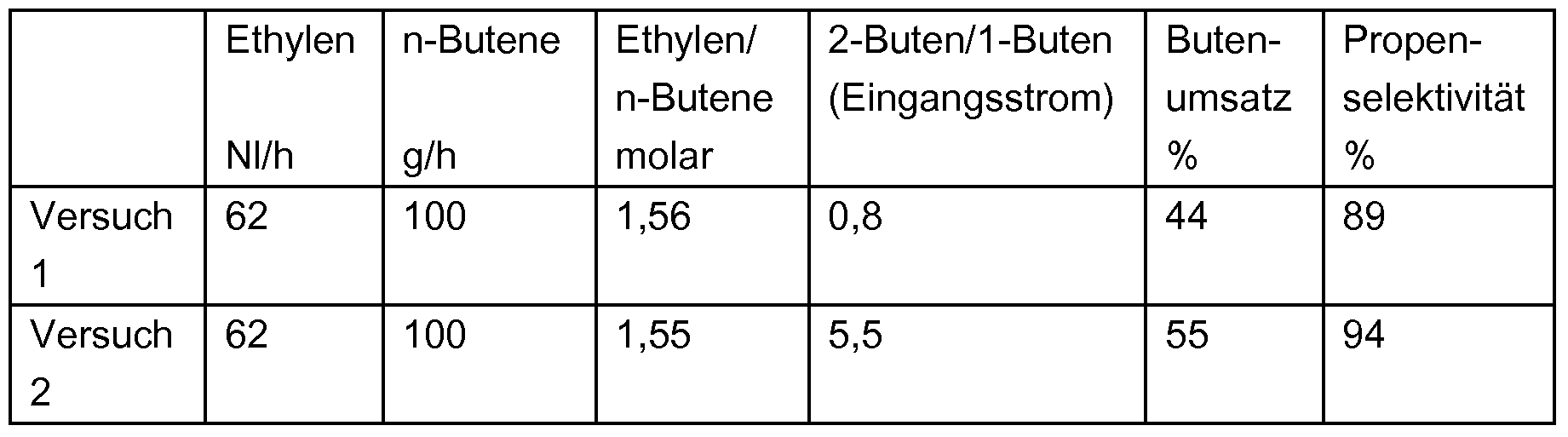
- the feed consisted of ethylene and raffinate 2H.
- raffinate 2H a mixture of about 85% by weight of linear butenes, about 2.5% by weight of isobutene and butanes (remainder to 100% by weight) was used directly (experiment 1) or after enrichment with 2- Butene (experiment 2) used.
- the reaction was carried out at 300 0 C and 25 bar.
- the input and output compositions were determined by online GC.
- Table 3 shows the conversions and mass selectivities for metathesis for the two experiments with different 2-butene / 1-butene ratio in the raffinate.
- the mass selectivity indicates the mass fraction of propene in the product (propene plus olefins from C5).
- the higher 2-butene / 1-butene ratio in experiment 2 in this case corresponds to a feed as it is supplied from the isomerization according to the invention.
Landscapes
- Chemical & Material Sciences (AREA)
- Organic Chemistry (AREA)
- Chemical Kinetics & Catalysis (AREA)
- Organic Low-Molecular-Weight Compounds And Preparation Thereof (AREA)
- Low-Molecular Organic Synthesis Reactions Using Catalysts (AREA)
Abstract
Description


Claims
Priority Applications (4)
| Application Number | Priority Date | Filing Date | Title |
|---|---|---|---|
| JP2010529366A JP2011500628A (ja) | 2007-10-15 | 2008-10-15 | オレフィンの異性化方法 |
| US12/738,034 US20100286458A1 (en) | 2007-10-15 | 2008-10-15 | Method for isomerizing olefins |
| CN200880111678A CN101827804A (zh) | 2007-10-15 | 2008-10-15 | 异构化烯烃的方法 |
| EP08838846A EP2212267A1 (de) | 2007-10-15 | 2008-10-15 | Verfahren zur isomerisierung von olefinen |
Applications Claiming Priority (2)
| Application Number | Priority Date | Filing Date | Title |
|---|---|---|---|
| EP07118502.9 | 2007-10-15 | ||
| EP07118502 | 2007-10-15 |
Publications (1)
| Publication Number | Publication Date |
|---|---|
| WO2009050194A1 true WO2009050194A1 (de) | 2009-04-23 |
Family
ID=40225591
Family Applications (1)
| Application Number | Title | Priority Date | Filing Date |
|---|---|---|---|
| PCT/EP2008/063859 Ceased WO2009050194A1 (de) | 2007-10-15 | 2008-10-15 | Verfahren zur isomerisierung von olefinen |
Country Status (6)
| Country | Link |
|---|---|
| US (1) | US20100286458A1 (de) |
| EP (1) | EP2212267A1 (de) |
| JP (1) | JP2011500628A (de) |
| KR (1) | KR20100075997A (de) |
| CN (1) | CN101827804A (de) |
| WO (1) | WO2009050194A1 (de) |
Cited By (4)
| Publication number | Priority date | Publication date | Assignee | Title |
|---|---|---|---|---|
| WO2011076718A1 (de) | 2009-12-22 | 2011-06-30 | Basf Se | Isomerisierung von linearen alpha-olefinen |
| CN102372573A (zh) * | 2010-08-23 | 2012-03-14 | 中国石油化工股份有限公司 | 醚后碳四和乙烯制丙烯的方法 |
| JP2012520348A (ja) * | 2009-07-21 | 2012-09-06 | ラマス テクノロジー インコーポレイテッド | エチレンと2−ブテンのメタセシス及び/又は二重結合異性化用の触媒 |
| EP2702017A4 (de) * | 2011-04-28 | 2015-02-25 | Basf Se | Isomerisierung leichter alpha-olefine zu leichten internen olefinen |
Families Citing this family (18)
| Publication number | Priority date | Publication date | Assignee | Title |
|---|---|---|---|---|
| KR101669300B1 (ko) | 2008-11-19 | 2016-10-25 | 바스프 에스이 | 올레핀의 올리고머화 |
| CN102180771B (zh) * | 2011-03-31 | 2013-05-15 | 新煤化工技术(上海)有限公司 | 一种3-甲基-3-丁烯-1-醇的制备方法 |
| CN102267853A (zh) * | 2011-09-01 | 2011-12-07 | 成都欣华源科技有限责任公司 | 一种2-丁烯异构化生产1-丁烯的方法 |
| CN103030509B (zh) * | 2011-09-29 | 2015-06-10 | 中国石油化工股份有限公司 | 碳四和乙烯制丙烯的方法 |
| JP6039971B2 (ja) * | 2012-04-24 | 2016-12-07 | 花王株式会社 | オレフィンの製造方法 |
| CN103772114B (zh) * | 2013-08-23 | 2015-09-16 | 山东海成石化工程设计有限公司 | 一种催化异构丁烯提浓的方法 |
| CN104857953B (zh) * | 2015-05-08 | 2018-10-12 | 宁波富德能源有限公司 | 一种用于碳四和乙烯歧化制丙烯的催化剂的制备方法 |
| CN106008131A (zh) * | 2016-06-16 | 2016-10-12 | 天津海成能源工程技术有限公司 | 一种丁烯异构联产mtbe的节能设备及生产工艺 |
| US12030849B2 (en) | 2017-05-15 | 2024-07-09 | Technip Process Technology, Inc. | Liquid isomerization for methathesis process |
| CN111050910A (zh) * | 2017-08-17 | 2020-04-21 | 沙特阿拉伯石油公司 | 用于表面物质的受控涂覆以生成催化剂的气溶胶处理方法 |
| US11369950B2 (en) | 2018-02-21 | 2022-06-28 | Saudi Arabian Oil Company | Multi-functional composite catalyst materials and methods of synthesizing the catalyst materials |
| US11033892B2 (en) | 2019-01-24 | 2021-06-15 | Saudi Arabian Oil Company | Methods for reacting chemical streams with catalysts comprising silica, alumina, and tungsten |
| US11311869B2 (en) | 2019-12-03 | 2022-04-26 | Saudi Arabian Oil Company | Methods of producing isomerization catalysts |
| US11517892B2 (en) | 2019-12-03 | 2022-12-06 | Saudi Arabian Oil Company | Methods of producing isomerization catalysts |
| US11679378B2 (en) | 2021-02-25 | 2023-06-20 | Saudi Arabian Oil Company | Methods of producing isomerization catalysts |
| WO2023008464A1 (ja) * | 2021-07-27 | 2023-02-02 | 花王株式会社 | 内部オレフィンの製造方法、内部オレフィンスルホン酸塩の製造方法及び低温安定化方法 |
| JPWO2023042898A1 (de) * | 2021-09-17 | 2023-03-23 | ||
| CN115490567B (zh) * | 2022-10-19 | 2025-06-27 | 西安交通大学 | 一种铜催化合成的1,3-烯炔类化合物及其合成方法 |
Citations (4)
| Publication number | Priority date | Publication date | Assignee | Title |
|---|---|---|---|---|
| US3268617A (en) * | 1963-05-02 | 1966-08-23 | Goodyear Tire & Rubber | Isomerization of methyl-pentenes using tungsten oxide catalysts |
| EP1110934A1 (de) * | 1999-12-24 | 2001-06-27 | Institut Francais Du Petrole | Herstellung von sehr reinem Isobuten und von Propen aus Kohlenwasserstoffschnitten mit vier Kohlenstoffatomen |
| US6420619B1 (en) * | 2001-01-25 | 2002-07-16 | Robert J. Gartside | Cracked gas processing and conversion for propylene production |
| US20060235253A1 (en) * | 2005-04-15 | 2006-10-19 | Gartside Robert J | Process for the double bond hydroisomerization of butenes |
Family Cites Families (4)
| Publication number | Priority date | Publication date | Assignee | Title |
|---|---|---|---|---|
| US5182247A (en) * | 1991-02-11 | 1993-01-26 | Texaco Inc. | Sulfated catalyst for skeletal isomerization of olefins |
| US20050124839A1 (en) * | 2001-06-13 | 2005-06-09 | Gartside Robert J. | Catalyst and process for the metathesis of ethylene and butene to produce propylene |
| US20060235255A1 (en) * | 2005-04-15 | 2006-10-19 | Gartside Robert J | Double bond hydroisomerization process |
| US7888541B2 (en) * | 2005-04-15 | 2011-02-15 | Catalytic Distillation Technologies | Double bond hydroisomerization of butenes |
-
2008
- 2008-10-15 EP EP08838846A patent/EP2212267A1/de not_active Withdrawn
- 2008-10-15 US US12/738,034 patent/US20100286458A1/en not_active Abandoned
- 2008-10-15 JP JP2010529366A patent/JP2011500628A/ja active Pending
- 2008-10-15 KR KR1020107009794A patent/KR20100075997A/ko not_active Withdrawn
- 2008-10-15 WO PCT/EP2008/063859 patent/WO2009050194A1/de not_active Ceased
- 2008-10-15 CN CN200880111678A patent/CN101827804A/zh active Pending
Patent Citations (4)
| Publication number | Priority date | Publication date | Assignee | Title |
|---|---|---|---|---|
| US3268617A (en) * | 1963-05-02 | 1966-08-23 | Goodyear Tire & Rubber | Isomerization of methyl-pentenes using tungsten oxide catalysts |
| EP1110934A1 (de) * | 1999-12-24 | 2001-06-27 | Institut Francais Du Petrole | Herstellung von sehr reinem Isobuten und von Propen aus Kohlenwasserstoffschnitten mit vier Kohlenstoffatomen |
| US6420619B1 (en) * | 2001-01-25 | 2002-07-16 | Robert J. Gartside | Cracked gas processing and conversion for propylene production |
| US20060235253A1 (en) * | 2005-04-15 | 2006-10-19 | Gartside Robert J | Process for the double bond hydroisomerization of butenes |
Cited By (9)
| Publication number | Priority date | Publication date | Assignee | Title |
|---|---|---|---|---|
| JP2012520348A (ja) * | 2009-07-21 | 2012-09-06 | ラマス テクノロジー インコーポレイテッド | エチレンと2−ブテンのメタセシス及び/又は二重結合異性化用の触媒 |
| JP2014058519A (ja) * | 2009-07-21 | 2014-04-03 | Lummus Technology Inc | エチレンと2−ブテンのメタセシス及び/又は二重結合異性化用の触媒 |
| KR20140065023A (ko) * | 2009-07-21 | 2014-05-28 | 루머스 테크놀로지 인코포레이티드 | 에틸렌 및 2-부텐의 복분해 및/또는 이중결합 이성질화를 위한 촉매 |
| KR101643062B1 (ko) | 2009-07-21 | 2016-07-26 | 루머스 테크놀로지 인코포레이티드 | 에틸렌 및 2-부텐의 복분해 및/또는 이중결합 이성질화를 위한 촉매 |
| WO2011076718A1 (de) | 2009-12-22 | 2011-06-30 | Basf Se | Isomerisierung von linearen alpha-olefinen |
| US8624075B2 (en) | 2009-12-22 | 2014-01-07 | Basf Se | Isomerization of linear alpha-olefins |
| CN102372573A (zh) * | 2010-08-23 | 2012-03-14 | 中国石油化工股份有限公司 | 醚后碳四和乙烯制丙烯的方法 |
| CN102372573B (zh) * | 2010-08-23 | 2014-07-23 | 中国石油化工股份有限公司 | 醚后碳四和乙烯制丙烯的方法 |
| EP2702017A4 (de) * | 2011-04-28 | 2015-02-25 | Basf Se | Isomerisierung leichter alpha-olefine zu leichten internen olefinen |
Also Published As
| Publication number | Publication date |
|---|---|
| EP2212267A1 (de) | 2010-08-04 |
| KR20100075997A (ko) | 2010-07-05 |
| US20100286458A1 (en) | 2010-11-11 |
| JP2011500628A (ja) | 2011-01-06 |
| CN101827804A (zh) | 2010-09-08 |
Similar Documents
| Publication | Publication Date | Title |
|---|---|---|
| EP2212267A1 (de) | Verfahren zur isomerisierung von olefinen | |
| EP0992284B1 (de) | Katalysator und Verfahren zur Selektivhydrierung ungesättigter Verbindungen in Kohlenwasserstoffströmen | |
| EP1134271B1 (de) | Verfahren zur flexiblen Herstellung von Propen und Hexen | |
| DE60003143T2 (de) | Herstellung von sehr reinem Isobuten und von Propen aus Kohlenwasserstoffschnitten mit vier Kohlenstoffatomen | |
| EP1069101B1 (de) | Verfahren zur Herstellung von C5-/C6-Olefinen | |
| DE3119850C2 (de) | ||
| EP1802559B1 (de) | Verfahren zur herstellung eines c4-olefin-gemisches durch selektivhydrierung und metatheseverfahren zur verwendung dieses stroms | |
| DE102004059282A1 (de) | Selektivhydrierkatalysator | |
| EP2041051A1 (de) | Verfahren zur herstellung von o-xylol | |
| EP1242181A1 (de) | Trägerkatalysator zur selektivhydrierung von alkinen und dienen | |
| DE102005009596A1 (de) | Verfahren zur Metathese umfassend die Reinigung der Ausgangsstoffe | |
| WO2015090998A1 (de) | Herstellung von butadien durch oxidative dehydrierung von n-buten nach vorhergehender isomerisierung | |
| DE2109011A1 (de) | Verfahren zur Disproportionierung von äthylenisch ungesättigten Verbindungen | |
| DE10319439A1 (de) | Aktivierte Metathesekatalysatoren | |
| EP0124744B1 (de) | Hydrierkatalysator, Verfahren zu seiner Herstellung und seine Verwendung | |
| EP2285488B1 (de) | Verfahren zur herstellung von gesättigten ethern durch hydrierung ungesättigter ether | |
| EP1581485B1 (de) | Verfahren zur herstellung von alkylarylsulfonaten mittels modifizierter, dimerisierter olefine | |
| DE2137361C3 (de) | Verfahren zur Disproportionierung von acyclischen Alkenen in Gegenwart von molekularem Wasserstoff und einem Katalysator | |
| EP3366643A1 (de) | Selektive oligomerisierung von olefinen | |
| WO2008138785A1 (de) | Selektivhydrierkatalysator | |
| DE4445680A1 (de) | Katalysator und Verfahren zur Isomerisierung von aliphatischen C¶4¶-C¶1¶¶0¶-Monoolefinen | |
| EP1633689B1 (de) | Verfahren zur doppelbindungsisomerisierung bei olefinen | |
| DE1618914B2 (de) | Verfahren zur Disproportionierung von acyclischen Alkenen | |
| DE60009432T2 (de) | Verfahren zur selektiven Herstellung von Propen aus Kohlenwasserstoffschnitten mit vier Kohlenstoffatomen | |
| DE19947352A1 (de) | Metathese-Katalysator auf Rhenium- und Cäsiumbasis und Verfahren zur Umwandlung von C4-Olefin-Fraktionen durch Metathese |
Legal Events
| Date | Code | Title | Description |
|---|---|---|---|
| WWE | Wipo information: entry into national phase |
Ref document number: 200880111678.X Country of ref document: CN |
|
| 121 | Ep: the epo has been informed by wipo that ep was designated in this application |
Ref document number: 08838846 Country of ref document: EP Kind code of ref document: A1 |
|
| WWE | Wipo information: entry into national phase |
Ref document number: 2008838846 Country of ref document: EP |
|
| WWE | Wipo information: entry into national phase |
Ref document number: 12738034 Country of ref document: US Ref document number: 2010529366 Country of ref document: JP |
|
| NENP | Non-entry into the national phase |
Ref country code: DE |
|
| ENP | Entry into the national phase |
Ref document number: 20107009794 Country of ref document: KR Kind code of ref document: A |