WO2009053055A2 - Herbizid-kombination - Google Patents
Herbizid-kombination Download PDFInfo
- Publication number
- WO2009053055A2 WO2009053055A2 PCT/EP2008/008944 EP2008008944W WO2009053055A2 WO 2009053055 A2 WO2009053055 A2 WO 2009053055A2 EP 2008008944 W EP2008008944 W EP 2008008944W WO 2009053055 A2 WO2009053055 A2 WO 2009053055A2
- Authority
- WO
- WIPO (PCT)
- Prior art keywords
- ion
- alkyl
- alkoxy
- substituted
- group
- Prior art date
- Legal status (The legal status is an assumption and is not a legal conclusion. Google has not performed a legal analysis and makes no representation as to the accuracy of the status listed.)
- Ceased
Links
Classifications
-
- A—HUMAN NECESSITIES
- A01—AGRICULTURE; FORESTRY; ANIMAL HUSBANDRY; HUNTING; TRAPPING; FISHING
- A01N—PRESERVATION OF BODIES OF HUMANS OR ANIMALS OR PLANTS OR PARTS THEREOF; BIOCIDES, e.g. AS DISINFECTANTS, AS PESTICIDES OR AS HERBICIDES; PEST REPELLANTS OR ATTRACTANTS; PLANT GROWTH REGULATORS
- A01N47/00—Biocides, pest repellants or attractants, or plant growth regulators containing organic compounds containing a carbon atom not being member of a ring and having no bond to a carbon or hydrogen atom, e.g. derivatives of carbonic acid
- A01N47/08—Biocides, pest repellants or attractants, or plant growth regulators containing organic compounds containing a carbon atom not being member of a ring and having no bond to a carbon or hydrogen atom, e.g. derivatives of carbonic acid the carbon atom having one or more single bonds to nitrogen atoms
- A01N47/28—Ureas or thioureas containing the groups >N—CO—N< or >N—CS—N<
- A01N47/36—Ureas or thioureas containing the groups >N—CO—N< or >N—CS—N< containing the group >N—CO—N< directly attached to at least one heterocyclic ring; Thio analogues thereof
Definitions
- Herbicidal combination comprising 2-iodo-N - [(4-methoxy-6-methyl-1,3,5-triazin-2-yl) carbamoyl] benzenesulfonamide and / or its salts and herbicidal active compounds from the group of (Het) aryl carboxylic acids.
- the present invention is in the technical field of crop protection agents which are resistant to undesired plant growth, e.g. pre-sowing (with or without incorporation), pre-emergence or postemergence in arable crops such as wheat (durum wheat and common wheat), maize, soya, sugarbeet, sugarcane, cotton, rice, beans (such as bushbeam and horse bean), flax, Barley, oats, rye, triticale, rapeseed, potato and millet (sorghum), pasture grass and green / lawns are used.
- the invention relates to a herbicidal combination containing at least two herbicides and their use for controlling undesired plant growth.
- substituted phenylsulfonylureas have herbicidal properties. These are e.g. phenyl derivatives which are monosubstituted or polysubstituted (for example US 4127405, WO 9209608, BE 853374, WO 9213845, EP 84020, WO 9406778, WO 02072560, US 4169719, US 4629494, DE 4038430).
- the object of the present invention was to provide an improved crop protection agent.
- the present invention thus provides a herbicide combination containing herbicides of (A) and herbicides of (B) 1 wherein
- cation (M + ) (a) is an ion of the alkali metals, preferably lithium, sodium, potassium, or
- alkaline earth metals preferably calcium and magnesium
- transition metals preferably manganese, copper
- an oxonium ion preferably tri - ((C 1 -C 4 ) -alkyl) -oxonium, or (h) a saturated or unsaturated radical which is optionally singly or multiply fused and / or substituted by (C 1 -C 4 ) -alkyl / aromatic N-containing heterocyclic ionic compound having 1-10 C atoms in the ring system.
- Preferred herbicides (A) are 2-iodo-N - [(4-methoxy-6-methyl-1,3,5-triazin-2-yl) carbamoyl] benzenesulfonamide and compounds of the formula (I) in which Cation (M + )
- transition metals preferably manganese, copper, zinc and iron, or
- a tertiary sulfonium ion preferably tri - ((C 1 -C 4 ) -alkyl) sulfonium or triphenyl-sulfonium, where the (C 1 -C 4 ) -alkyl radicals and the phenyl radicals are optionally mono- or polysubstituted by identical or different radicals halogen, such as F, Cl, Br or I, (C- ⁇ -C 2) alkyl, (C 1 -C 2) -haloalkyl, (C 3 -C 4) -
- halogen such as F, Cl, Br or I
- Cycloalkyl, (Ci-C 2 ) alkoxy and (CrC 2 ) haloalkoxy are substituted, or
- a tertiary oxonium ion preferably tri - ((C 1 -C 4 ) -alkyl) -oxonium, where the (C 1 -C 4 ) -alkyl radicals are optionally mono- or polysubstituted by identical or different radicals from
- Group halogen such as F, Cl, Br or I 1 (Ci-C 2 ) -alkyl, (C 1 -C 2 ) - haloalkyl, (C 3 -C 4 ) -cycloalkyl, (Ci-C 2 ) -alkoxy and (C 1 -C 2 ) - haloalkoxy, or (h) a cation from the series of the following heterocyclic compounds, such as, for example, pyridine, quinoline, 2-
- hydrocarbon radicals mentioned in the radical definitions such as alkyl, alkenyl or alkynyl, also in combinations with heteroatoms, such as in alkoxy, alkylthio, haloalkyl or alkylamino, are also straight-chain or branched, even if not expressly stated.
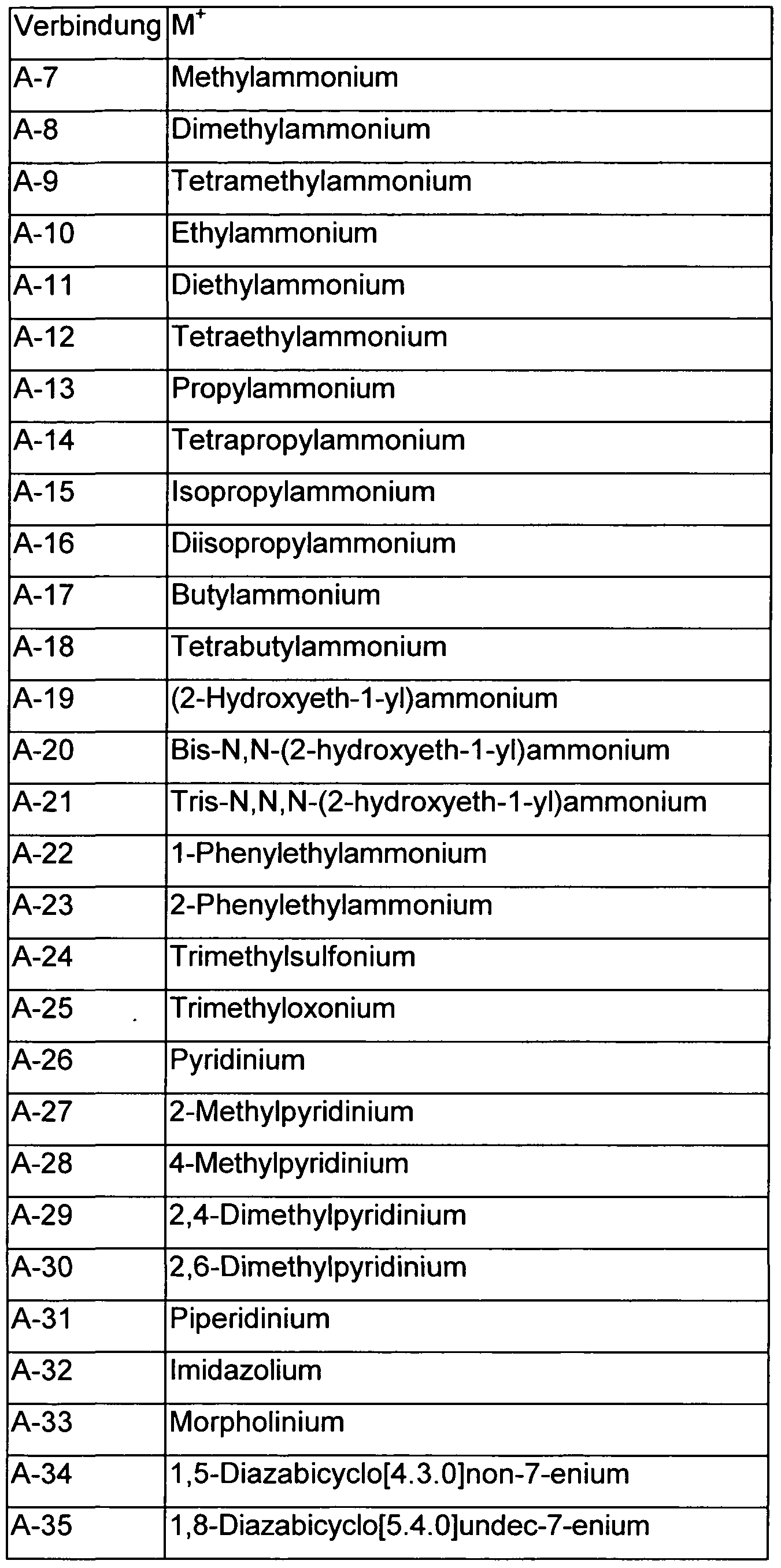
- Examples of compounds which are preferably used as herbicide (A) are 2-iodo-N - [(4-methoxy-6-methyl-1,3,5-triazin-2-yl) carbamoyl] benzenesulfonamide (AO) and those described in US Pat compounds of the formula (I) below (ie the compounds (A-1 to A-35)).
- herbicides (A) are 2-iodo-N - [(4-methoxy-6-methyl-1,3,5-triazin-2-yl) carbamoyl] benzenesulfonamide and compounds of the formula (I) in which the cation (M + ) is a sodium ion, a potassium ion, a lithium ion, a magnesium ion, a calcium ion, an NH 4 + ion, a (2-hydroxyeth-1-yl) ammonium ion, bis-N, N- (2-hydroxyeth-1-yl) ammonium ion, Tris-N, N, N- (2-hydroxyeth-1-yl) ammonium ion, a methylammonium ion, a dimethylammonium ion, Ion, a trimethylammonium ion, a tetramethylammonium ion, an ethylammonium ion, a die
- herbicides (A) are 2-iodo-N - [(4-methoxy-6-methyl-1,3,5-triazin-2-yl) carbamoyl] benzenesulfonamide and compounds of the formula (I) in which the cation (M + ) is a sodium ion, a potassium ion, a magnesium ion, a calcium ion, or an NH 4 + ion.
- herbicide (A) are the 2-iodo-N - [(4-methoxy-6-methyl-1,3,5-triazin-2-yl) carbamoyl] benzenesulfonamide and compounds of the formula (I), in those containing the cation (M + ), in which the cation (M + ) is a sodium ion, a potassium ion or an NH 4 -lon.
- the herbicides (A) and / or (B) may be present as stereoisomers, depending on the nature and linkage of the substituents.
- the possible stereoisomers defined by their specific spatial form, such as enantiomers, diastereomers, Z and E isomers, are all encompassed by the formula (I).
- diastereomers Z and E isomers
- enantiomers if one or more alkenyl groups are present, diastereomers (Z and E isomers) can occur.
- enantiomers if one or more asymmetric carbon atoms are present, then enantiomers and
- Stereoisomers occur. Stereoisomers can be obtained from the mixtures obtained in the preparation by customary separation methods, for example by chromatographic separation methods. Similarly, stereoisomers can be selectively prepared by using stereoselective reactions using optically active sources and / or adjuvants. The invention thus also relates to all stereoisomers of herbicides (A) and / or (B), but which are no longer specified with their specific stereoform, and mixtures thereof.
- the herbicide combinations of the invention may contain additional additional components, e.g. As agrochemical agents of other types and / or customary in plant protection additives and / or formulation auxiliaries, or used together with these.
- the synergistic effects can be observed, for example, when the herbicides (A) and (B) are applied together, for example as a co-formulation or as a tank mixture, but they can also be detected in the case of splitting. It is also possible to use the herbicides or herbicide combinations in several portions (sequence application), eg. After pre-emergence applications, followed by post-emergence applications or early post-emergence applications, followed by mid-late post-emergence applications. Preference is given to the joint or the timely application of the herbicides (A) and (B) of the respective combination.
- the synergistic effects allow a reduction in the application rates of the individual herbicides, a higher potency at the same rate, the control of previously unrecognized species (gaps), the control of species that have tolerances or resistance to single or multiple herbicides, an extension of the period of application and / or a reduction in the number of individual applications required and - as a result for the user - economically and ecologically more advantageous weed control systems.
- the combinations of herbicides (A) + (B) according to the invention make possible synergistic increases in activity which go far and unexpectedly beyond the effects achieved with the individual herbicides (A) and (B).
- Said formula (I) comprises all stereoisomers and mixtures thereof, in particular racemic mixtures, and - as far as enantiomers are possible - the respective biologically active enantiomers.
- the herbicides of group (A) inhibit the enzyme acetolactate synthase (ALS) and thus protein biosynthesis in plants.
- a relatively broad spectrum of harmful plants is fought, for example on annual and perennial, monocotyledonous or dicotyledonous weeds as well as on unwanted crop plants Range from 0.01 g to 1000 g AS / ha, preferably 0.1 g to 500 g AS / ha, particularly preferably 0.5 g to 250 g AS / ha.
- the group (B) herbicides for example, affect auxin metabolism, gibberillin biosynthesis, cellulose biosynthesis, or act as a plant growth factor and are suitable for both preemergence and postemergence use.
- the application rates of group (B) herbicides are generally lower, for example in the range from 1 g to 1000 g AS / ha, preferably from 0.3 g to 10000 g AS / ha, more preferably 0.3 g to 5000 g AS / ha.
- the one or more other herbicides (A) and (B) different agrochemical Active substances which likewise have the function of a selective herbicide.
- herbicides according to the invention various agrochemical active ingredients, for example from the group of safeners, fungicides, insecticides, structurally from the herbicides (A) and (B) different herbicides and plant growth regulators or from the group of customary in plant protection additives and formulation auxiliaries
- herbicides for example, the following of the herbicides (A) and (B) structurally different herbicides in question, preferably herbicidal active ingredients which are based on an inhibition of, for example, acetolactate synthase, acetyl coenzyme A carboxylase, PS I, PS II, HPPDO, phytoene desaturase, protoporphyrinogen oxidase, glutamine synthetase, cellulose biosynthesis, 5-enolpyruvylshikimate 3-phosphate synthetase are based as in Weed Research 26, 441-445 (1986), or "The Pesticide Manual", 13th edition, The British Crop Protection Council, 2003, or 14th Edition 2006/2007, or in the corresponding "e-Pesticide Manual", version 4 (2006), published by the British Crop Protection Council (hereinafter also referred to as "PM”), and references cited therein.
- PM British Crop Protection Council
- the herbicides are either with the "common name” according to the International Organization for Standardization (ISO) or with the chemical name, possibly together with a common code number and always include all forms of application such as acids, salts, esters and isomers such as stereoisomers and optical isomers, in particular the commercial form or the commercially available forms, unless otherwise stated in connection with the context.
- sulfonamides such as sulfonylureas with salts and the which are formed by replacement of a hydrogen atom on the sulfonamide group by a cation.
- Ester derivatives eg, butyl ester, DEH-112; cyperquat; cyprazine; cyprazole; daimuron; 2,4-D; 2,4-DB; dalapon; daminozide; dazomet; n-decanol; desmedipham; Desmetryn; di-allate; dichlobenil; dichlormid; dichlorprop (-P) salts; diclofop and its esters such as diclofop-methyl; diclofop-P (methyl); diclosulam; diethatyl (-ethyl); difenoxuron; difenzoquat (-metilsulfate); diflufenican; diflufenzopyr (-sodium); dimefuron; dimepiperate; dimethachlor; dimethametryn; dimethazone; dimethenamid
- SAN-582H dimethenamide-P; dimethylarsinic acid; dimethipin; dimetrasulfuron; dimexyflam; dinitramine; dinoseb; dinoterb; diphenamid; dipropetryn; diquat salts; dithiopyr; diuron; DNOC; eglinazine-ethyl; EL 77, i.
- Metolachlor metosulam (XRD 511); metoxuron; metribuzin; metsulfuron-methyl; molinate; monalide; monocarbamide dihydrogen sulfates; monolinuron; monuron; monosulfuron; MT 128, i. 6-chloro-N- (3-chloro-2-propenyl) -
- RP-020630 oxadiazon; oxasulfuron; oxaziclomefone; oxyfluorfen; paclobutrazol; paraquat (dichlorides); pebulate; pelargonic acid; pendimethalin; penoxulam; pentachlorophenol; Pentanochlor; pentoxazone; perfluidone; pethoxamid; phenisopham; phenmedipham; picolinafen; pinoxaden; piperophos; piributicarb; pirifenop-butyl; pretilachlor; primisulfuron (-methyl); probenazole; procarbazone-
- Ester derivatives eg quizalofop-ethyl; quizalofop-P-tefuryl and -ethyl; renriduron; rimsulfuron (DPX-E 9636); S 275, ie 2- [4-chloro-2-fluoro-5- (2-propynyloxy) -phenyl] -4,5,6,7-tetrahydro-2H-indazole; secbumeton; sethoxydim; siduron; simazine; simetryn; sintofen; SN 106279, ie 2 - [[7- [2-chloro-4- (trifluoromethyl) phenoxy] -2-naphthalenyl] oxy] propanoic acid and methyl ester; sulcotrione; sulfentrazone (FMC- 97285, F-6285); sulfazuron; sulfometuron (-methyl); sulfo
- herbicides (A) and (B) already have very good to sufficient selectivity in many cultures, phytotoxicities on the crop plants can in principle occur in some crops and, above all, in the case of mixtures with other herbicides which are less selective.
- combinations of herbicides (A) and (B) which contain the herbicidally combined active ingredients and one or more safeners according to the invention.
- the safeners which are used in an antidote effective content, reduce the phytotoxic side effects of the herbicides / pesticides used, eg. B. in economically important crops such as cereals (wheat, barley, rye, corn, rice, millet), sugar beet, sugar cane, rapeseed, cotton and soybeans, preferably cereals.
- the safeners are preferably selected from the group consisting of:
- ⁇ A is a natural number of 0 to 5, preferably 0 to 3;
- RA 1 is halogen, (dC ⁇ alkyl, (CrC 4) -alkoxy, nitro or (C r C 4) -haloalkyl;
- W A is an unsubstituted or substituted divalent heterocyclic radical from the group of the partially unsaturated or aromatic five-membered heterocycles having 1 to 3 hetero ring atoms of the type N or O 1, wherein at least one N atom and at most one O atom is contained in the ring, preferably one Remainder of the group (W A 1 ) to (W A 4 ),
- RA 2 is ORA 3 , SR A 3 or NR A 3 R A 4 or a saturated or unsaturated 3- to 7-membered heterocycle having at least one N atom and up to 3 heteroatoms, preferably from the group O and S, via the N-atom is bonded to the carbonyl group in (SI) and is unsubstituted or substituted by radicals from the group (C 1 -C 4 ) -alkyl, (C 1 -C 4 ) -alkoxy or optionally substituted phenyl, preferably a radical of the formula OR A 3 , NHR A 4 or N (CH 3) 2, in particular of the formula OR A 3 ;
- R A 3 is hydrogen or an unsubstituted or substituted aliphatic hydrocarbon radical, preferably having a total of 1 to 18 C atoms;
- RA 4 is hydrogen, (C 1 -C 6 ) -alkyl, (C 1 -C 6 ) -alkoxy or substituted or unsubstituted phenyl;
- RA 5 is H, (Ci-C 8) alkyl, C r C 8 (haloalkyl), (Ci-C 4) alkoxy (C 1 -C 8) -alkyl, cyano or
- R A 9 is hydrogen, (C r C 8 ) alkyl, (C r C 8 ) haloalkyl, (C 1 -C 4 ) alkoxy (C r C 4 ) alkyl, (Ci-C 6 ) -hydroxyalkyl, (C 3 -C 2 ) -cycloalkyl or Tn- (C 1 -
- Ethyl 1- (2,4-dichlorophenyl) -5-isopropyl-pyrazole-3-carboxylate (S1-3), 1- (2,4-dichlorophenyl) -5- (1,1-dimethyl-ethyl) -pyrazole-3- carboxylic acid ethyl ester (S1-4), 1- (2,4-dichlorophenyl) -5-phenyl-pyrazole-3-carboxylic acid ethyl ester (S1-5) and related compounds as described in EP-A-333 131 and EP-A -269 806 are described; c) compounds of the triazolecarboxylic acid type, preferably compounds such as fenchlorazole (ethyl), i.
- RB 1 is halogen, (CrC 4) alkyl, (C 1 -CO--alkoxy, nitro or (C r C 4) -haloalkyl
- ⁇ B is a natural number of 0 to 5, preferably 0 to 3,
- R B 3 is hydrogen or an unsubstituted or substituted aliphatic hydrocarbon radical, preferably having a total of 1 to 18 C atoms;
- RB 4 is hydrogen, (C 1 -C 6 ) -alkyl, (C 1 -C 6 ) -alkoxy or substituted or unsubstituted phenyl;
- T B is a (Ci or C 2 ) alkanediyl chain which is unsubstituted or substituted by one or two (C 1 -C 4 ) -alkyl radicals or by [(C 1 -C 3 ) -alkoxy] -carbonyl;
- S2 8-quinolinoxyacetic acid
- Rc 1 is (C r C4) alkyl, (CrC 4) -haloalkyl, (C 2 -C 4) alkenyl, (C 2 -C 4) haloalkenyl, (C 3 -C 7) -cycloalkyl, preferably dichloromethyl;
- Rc 2, rc 3 is identical or different hydrogen, (CrC 4) alkyl, (C 2 -C 4) alkenyl, (C 2 -C 4) -alkynyl, (C r C4) -haloalkyl, (C 2 -C 4) haloalkenyl, (C r C 4) alkylcarbamoyl (CrC 4) alkyl, (C 2 -C 4) -Alkenylcarbamoyl- (C 1 -C 4) alkyl, (CrC 4) alkoxy (C r C4) alkyl, dioxolanyl (CrC 4) alkyl, thiazolyl, furyl, furylalkyl, thienyl, piperidyl, substituted or unsubstituted phenyl, or Rc 2 and Rc 3 together form a substituted or unsubstituted heterocyclic ring, preferably a Oxazolidine,
- PPG-1292 N-allyl-N - [(1,3-dioxolan-2-yl) -methyl] -dichloroacetamide from the company
- TI-35 1-dichloroacetyl-azepane from TRI-Chemical RT
- diclonone dicyclonone
- BAS145138 or "LAB145138”
- MON 13900 3-dichloroacetyl-2,5,5-trimethyl-1, 3-diazabicyclo [4.3.0] nonane from BASF
- XD is CH or N
- RD 1 is CO-NRD 5 RD 6 or NHCO-RD 7 ;
- R 0 2 is halogen, (C 1 -C 6 -haloalkyl, (C 1 -C 4 ) -haloalkoxy, nitro, (C 1 -C 4 ) -alkyl, (C r
- R 0 3 is hydrogen, (Ci-C 4) -alkyl, (C 2 -C 4) -alkenyl or (C 2 -C 4) alkynyl;
- RD 4 is halogen, nitro, (C r C 4 ) -alkyl, (C r C 4 ) -haloalkyl, (C r C 4 ) -haloalkoxy, (C 3 - C 6) -cycloalkyl, phenyl, (C r C4) alkoxy, cyano, (dd) alkylthio, (dd) alkyl- sulfinyl, (C r C 4) alkylsulfonyl, (CrC 4) -alkoxycarbonyl or ( C 1 -C 4 ) -alkylcarbonyl;
- R D 5 is hydrogen, (C 1 -C 6 ) -alkyl, (C 3 -C 6 ) -cycloalkyl, (C 2 -C 6 ) -alkenyl, (C 2 -C 6 ) -alkynyl, (C 5 -C 6 ) -Cy
- R D 6 is hydrogen, (C 1 -C 6 ) -alkyl, (C 2 -C 6 ) -alkenyl or (C 2 -C 6 ) -alkynyl, where the last three radicals mentioned are represented by VD radicals from the group consisting of halogen, hydroxyl, (C 1 -C 4 ) -alkyl, (C 1 -C 4 ) -alkoxy and (C 1 -C 4 ) -alkylthio are substituted, or
- R D 7 is hydrogen, (C 1 -C 4 ) -alkylamino, di- (C 1 -C 4 ) -alkylamino, (C 1 -C 6 ) -alkyl, (C 3 -C 6 ) -cycloalkyl, where the 2 last-mentioned radicals are represented by v D substituents from the group halogen, (C 1 -C 4 ) alkoxy, halogeno (C 1 -C 6 ) -alkoxy and (C 1 -C 4 ) -alkylthio and in the case of cyclic radicals also (C 1 -C 4 ) -alkyl and (C 1) -haloalkyl;
- R 0 7 (Ci-C ⁇ JAlkyl, (C 3 -C 6 ) cycloalkyl, wherein the latter two radicals by VD
- R 0 4 halogen, (C 1 -C 4 ) -alkyl, (C 1 -C 4 ) -alkoxy, CF 3; m is D 1 or 2; v D is 0, 1, 2 or 3;
- RD 8 and R D 9 independently of one another are hydrogen, (C 1 -C 6) -alkyl, (C 3 -Cs) -
- R 0 4 halogen, (C r C 4 ) alkyl, (dC 4 ) alkoxy, CF 3 triD is 1 or 2;
- H) active compounds from the class of 1, 2-dihydroquinoxaline-2-ones e.g. 1-Methyl-3- (2-thienyl) -1,2-dihydroquinoxalin-2-one, 1-methyl-3- (2-thienyl) -1,2-dihydroquinoxaline-2-thione, 1- (2 -Aminoethyl) -3- (2-thienyl) -1,2-dihydroquinoxalin-2-one hydrochloride, 1- (2-methylsulphonylaminoethyl) -3- (2-thienyl) -1,2-dihydrochloride quinoxalin-2-one as described in WO 2005/12630,
- R ⁇ 1, RK 2, independently of one another are halogen, (C- ⁇ -C 4) alkyl, (Ci-C 4) -alkoxy, (C 1 -
- a ⁇ COORK 3 or COOR K 4 R ⁇ 3 , RK 4 independently of one another are hydrogen, (C 1 -C 4 ) -alkyl, (C 2 -C 6 ) -alkenyl,
- Halobenzyl, pyridinylalkyl and alkylammonium, n ⁇ 1 0 or 1 n ⁇ 2 , n ⁇ 3 are independently 0, 1 or 2
- RL 1 is halogen, (Ci-C 4) alkyl, (Ci-C 4) -haloalkyl, (C r C4) alkoxy, (dC ⁇ haloalkoxy, nitro, (Ci-C 4) alkylthio, (CrC 4) alkylsulfonyl, (C r C4) -alkoxycarbonyl, optionally substituted.
- phenyl, optionally substituted phenoxy, RL 2 is hydrogen or (C r C 4) -alkyl
- R L 3 is hydrogen, (C 1 -C 8 ) -alkyl, (C 2 -C 4 ) -alkenyl, (C 2 -C 4 ) -alkynyl, or aryl, where each of the abovementioned C-containing radicals is unsubstituted or substituted by one or more carbon atoms a plurality of, preferably up to three, identical or different radicals from the group consisting of halogen and alkoxy is substituted; or their salts.
- R 1 is halogen, (Ci-C 4) alkyl, methoxy, nitro, cyano, CF 3, OCF 3 Y, Z are each independently O or S, n N is an integer of 0 to 4,
- R N 2 is (Ci-Ci ⁇ ) -alkyl, (C 2 -C 6 ) -alkenyl, (C 3 -C 6 ) -cycloalkyl, aryl; Benzyl, halobenzyl, R N 3 is hydrogen, (C 1 -C 6 ) alkyl;
- Cyanomethoxyimino (phenyl) acetonitrile (Cyometrinil), 1, 3-dioxolan-2-ylmethoxyimino (phenyl) acetonitrile (oxabetrinil),
- a mixture with other known active ingredients such as fungicides, insecticides, Akahziden, nematicides, bird repellents, plant nutrients and soil conditioners is possible.
- Some of the safeners are already known as herbicides and therefore, in addition to the herbicidal effect on harmful plants, also have a protective effect on the crop plants.
- the weight ratios of herbicide (mixture) to safener generally depends on the application rate of herbicide and the effectiveness of each safener and may vary within wide limits, for example in the range of 20,000: 1 to 1: 20,000, preferably 15,000: 1 to 1: 15,000, in particular 10,000: 1 to 1: 10,000.
- the safeners can be formulated analogously to the compounds of the formula (I) or mixtures thereof with further herbicides / pesticides and provided and used as finished formulation or tank mixture with the herbicides.
- the combinations according to the invention have an excellent herbicidal activity against a broad spectrum of economically important monocotyledonous and dicotyledonous harmful plants such as weeds, including species which are resistant to herbicidal active substances such as glyphosate, glufosinate, atrazine or imidazolinone herbicides. Even difficult to control perennial weeds, which expel from rhizomes, rhizomes or other permanent organs, are well detected by the active ingredients.
- the substances may be e.g. be applied in pre-sowing, pre-emergence or post-emergence, e.g. together or separately. Preferred is e.g. the postemergence application, in particular the accumulated harmful plants.
- weeds e.g. Avena spp., Alopecurus spp., Apera spp., Brachiaria spp., Bromus spp., Digitaria spp., Lolium spp., Echinochloa spp., Panicum spp., Phalaris spp., Poa spp., Setaria spp. such as
- Cyperus species from the Basle group and on the part of the perennial species Agropyron, Cynodon, Imperata and Sorghum and also perennial Cyperusart well grasped.
- the spectrum of activity extends to species such as Abutilon spp., Amaranthus spp., Chenopodium spp., Chrysanthemum spp., Galium spp., Ipomoea spp., Kochia spp., Lamium spp., Matricaria spp., Pharitis spp. . Polygonum spp., Sida spp., Sinapis spp., Solanum spp., Stellaria spp., Veronica spp. and Viola spp., Xanthium spp., on the annual side, as well as Convolvulus, Cirsium, Rumex, and Artemisia in perennial weeds.
- the herbicidal compositions according to the invention are distinguished by a rapidly onset and long-lasting herbicidal action.
- the rainfastness of the active ingredients in the combinations according to the invention is generally favorable.
- a particular advantage is the fact that the effective and used in combinations combinations of compounds (A) and (B) can be set so low that their soil effect is optimally low. Thus, their use is not only possible in sensitive cultures, but groundwater contaminations are virtually avoided.
- By the combinations of active ingredients according to the invention a significant reduction of the required application rate of the active ingredients is made possible.
- Amount of harmful ingredients, such as nitrogen or oleic acid, and their entry into the soil reduced.
- the agents for combating harmful plants can be used in known plant crops or tolerant or genetically modified crops to be developed.
- the transgenic plants are usually characterized by particular advantageous properties, in addition to the resistance to the inventive compositions, for example, by resistance to plant diseases or pathogens of plant diseases such as certain insects or microorganisms such as fungi, bacteria or viruses.
- Other special properties relate to z. B. the crop in terms of quantity, quality, shelf life, composition and special ingredients.
- transgenic plants with increased starch content or altered quality of the starch or those with other fatty acid composition of the crop are known.
- the active compounds can also be used to control harmful plants in crops of known or yet to be developed mutant-selected plants.
- Well-known routes for the production of new plants which have modified properties compared to previously occurring plants consist, for example, in classical breeding methods and the production of mutants.
- new plants with altered properties can be generated by means of genetic engineering methods (see, for example, EP-A-0221044, EP-A-0131624).
- nucleic acid molecules can be introduced into plasmids that allow mutagenesis or sequence alteration by recombination of DNA sequences.
- z For example, base substitutions are made, partial sequences are removed, or natural or synthetic sequences are added.
- adapters or linkers can be attached to the fragments.
- the production of plant cells having a reduced activity of a gene product can be achieved, for example, by the expression of at least one corresponding antisense RNA, a sense RNA to obtain a cosuppression effect, or the expression of at least one appropriately engineered ribozyme which specifically cleaves transcripts of the above gene product.
- DNA molecules may be used which comprise the entire coding sequence of a gene product, including any flanking sequences that may be present, as well as DNA molecules which comprise only parts of the coding sequence, which parts must be long enough to be present in the cells to cause an antisense effect. It is also possible to use DNA sequences which have a high degree of homology to the coding sequences of a gene product, but are not completely identical.
- the synthesized protein may be located in any compartment of the plant cell. But to achieve the localization in a particular compartment, z.
- the coding region can be linked to DNA sequences that ensure localization in a particular compartment.
- sequences are known to those skilled in the art (see, for example, Braun et al., EMBO J. 11 (1992), 3219-3227; Wolter et al., Proc. Natl. Acad., U.S.A. 85 (1988), 846-850; Sonnewald et al., Plant J. 1 (1991), 95-106).
- the transgenic plant cells can be regenerated to whole plants by known techniques.
- the transgenic plants may in principle be plants of any plant species, ie both monocotyledonous and dicotyledonous plants.
- the present invention further relates to a method for controlling unwanted plants, preferably in plant crops, which is characterized in that the herbicides (A) and (B) of the herbicidal combination according to the invention on the plants (eg harmful plants such as mono- or dicots
- the seeds e.g., grains, seeds or vegetative propagules such as tubers or sprouts with buds
- the area on which the plants grow e.g., the acreage
- One or more herbicides (A) may be applied to the plants, the seed or the area on which the plants grow (e.g.
- Undesirable plants are understood to mean all plants that grow in places where they are undesirable. This can e.g. Harmful plants (e.g., mono- or dicotyledonous weeds or undesired crops), e.g. also those which are resistant to certain herbicidal active substances such as glyphosate, atrazine, glufosinate or imidazolinone herbicides.
- Harmful plants e.g., mono- or dicotyledonous weeds or undesired crops
- certain herbicidal active substances such as glyphosate, atrazine, glufosinate or imidazolinone herbicides.
- the herbicide combinations according to the invention will be used selectively for controlling undesired plant growth, for example in crops such as field crops such as monocotyledonous crops such as cereals (eg wheat, barley, rye, oats), rice, corn, millet or dicotyledonous crops such as sugar beet, rapeseed, cotton , Sunflowers and legumes, for example of the genera Glycine (eg Glycine max. (Soy) as non-transgenic Glycine max. (Eg conventional varieties such as STS varieties) or transgenic Glycine max.
- crops such as field crops such as monocotyledonous crops such as cereals (eg wheat, barley, rye, oats), rice, corn, millet or dicotyledonous crops such as sugar beet, rapeseed, cotton , Sunflowers and legumes
- crops such as field crops such as monocotyledonous crops such as cereals (eg wheat, barley, rye,
- the application is preferably carried out on the accumulated harmful plants (for example, weeds or unwanted crops), in particular before the emergence of (desired) crops.
- the invention also provides the use of the herbicidal combinations according to the invention for controlling unwanted plant growth, preferably in plant crops.
- the herbicide combinations of the invention may be prepared by known methods, e.g. be prepared as mixed formulations of the individual components, optionally with other active ingredients, additives and / or customary formulation auxiliaries, which are then diluted with water used in the usual way, or prepared as so-called tank mixes by co-diluting the separately formulated or partially separately formulated components with water become. Also possible is the staggered application (split application) of the separately formulated or partially separately formulated individual components. It is also possible to use the herbicides or herbicide combinations in several portions (sequence application), eg. After pre-emergence applications, followed by post-emergence applications or early post-emergence applications, followed by mid-late post-emergence applications. Preference is given to the common or timely use of the active ingredients of the respective combination.
- the herbicides (A) and (B) can be converted together or separately into customary formulations, such as solutions, emulsions, suspensions, powders, foams, pastes, granules, aerosols, active substance-impregnated natural and synthetic substances, microencapsulations in polymeric substances.
- the formulations may contain the usual auxiliaries and additives.
- formulations are prepared in a known manner, e.g. by mixing the active compounds with extenders, ie liquid solvents, liquefied gases under pressure and / or solid carriers, optionally with the use of surface-active agents, ie
- Emulsifiers and / or dispersants and / or foam-forming agents can also be used as auxiliary solvent.
- Suitable liquid solvents are essentially: aromatics, such as XyIoI 1 toluene, alkylnaphthalenes, chlorinated aromatics or chlorinated aliphatic hydrocarbons, such as chlorobenzenes, chloroethylenes, or methylene chloride, aliphatic
- Hydrocarbons such as cyclohexane or paraffins, e.g. Petroleum fractions, mineral and vegetable oils, alcohols such as butanol or glycol and their ethers and esters, ketones such as acetone, methyl ethyl ketone, methyl isobutyl ketone or cyclohexanone, strongly polar solvents such as dimethylformamide or dimethyl sulfoxide, and water.
- cyclohexane or paraffins e.g. Petroleum fractions, mineral and vegetable oils, alcohols such as butanol or glycol and their ethers and esters, ketones such as acetone, methyl ethyl ketone, methyl isobutyl ketone or cyclohexanone, strongly polar solvents such as dimethylformamide or dimethyl sulfoxide, and water.
- Suitable solid carriers are: e.g. Ammonium salts and ground natural minerals, such as kaolins, clays, talc, chalk, quartz, attapulgite, montmorillonite or diatomaceous earth, and ground synthetic minerals, such as fumed silica, alumina and silicates; suitable solid carriers for granules are: e.g. crushed and fractionated natural rocks such as calcite, marble, pumice, sepiolite, dolomite and synthetic granules of inorganic and organic flours and granules of organic material such as sawdust, coconut shells, corn cobs and tobacco stalks; suitable emulsifiers and / or foam formers are: e.g.
- nonionic and anionic emulsifiers such as polyoxyethylene fatty acid esters, polyoxyethylene fatty alcohol ethers, e.g. Alkylaryl polyglycol ethers, alkylsulfonates, alkylsulfates, arylsulfonates and protein hydrolysates; suitable dispersants are: e.g. Ligninsulfitablaugen and methylcellulose.
- Adhesives such as carboxymethylcellulose, natural and synthetic, powdery, granular or latex polymers may be used in the formulations, such as gum arabic, polyvinyl alcohol, polyvinyl acetate, as well as natural phospholipids such as cephalins and lecithins and synthetic phospholipids.
- Other additives may be mineral and vegetable oils.
- the herbicidal action of the herbicidal combinations according to the invention can be improved, for example, equally by surface-active substances, preferably by wetting agents from the series of fatty alcohol polyglycol ethers.
- the fatty alcohol polyglycol ethers preferably contain 10 to 18 C atoms in the fatty alcohol radical and 2 to 20 ethylene oxide units in the polyglycol ether section.
- the fatty alcohol polyglycol ethers may be nonionic or ionic, eg in the form of fatty alcohol polyglycol ether sulfates, which are used, for example, as alkali salts (eg sodium and potassium salts) or ammonium salts, or else as alkaline earth salts, such as magnesium salts, such as C 1 - / Cu.
- fatty alcohol diglykolethersulfat- sodium (Genapol ® LRO, Clariant GmbH); See, for example, EP-A-0476555, EP-A-0048436, EP-A-0336151 or US-A-4,400,196 and Proc. EWRS Symp.
- Nonionic fatty alcohol polyglycol ethers are, for example, 2-20, preferably 3-15, (C-io-C-is) containing ethylene oxide units, preferably (Cio-C- 4 ) fatty alcohol polyglycol ethers (eg isotridecyl alcohol polyglycol ethers), for example from US Pat Genapol ® X series, such as Genapol ® X-030, Genapol ® X-060, Genapol ® X-080 or Genapol ® X-150 (all from Clariant GmbH).
- Genapol ® X series such as Genapol ® X-030, Genapol ® X-060, Genapol ® X-080 or Genapol ® X-150 (all from Clariant GmbH).
- the present invention further comprises the combination of components A and B with the aforementioned wetting agents from the series of fatty alcohol polyglycol ethers which preferably contain 10 to 18 C atoms in the fatty alcohol radical and 2 to 20 ethylene oxide units in the polyglycol ether part and nonionic or ionic (for example as Fatty alcohol polyglycol ether sulfates) may be present.
- fatty alcohol polyglycol ethers which preferably contain 10 to 18 C atoms in the fatty alcohol radical and 2 to 20 ethylene oxide units in the polyglycol ether part and nonionic or ionic (for example as Fatty alcohol polyglycol ether sulfates) may be present.
- Genapol ® X series such as Genapol ® X-030, Genapol ® X - C 2 / C 4 fatty alcohol diglycol ether sulfate sodium (Genapol ® LRO, Clariant GmbH) and isotridecyl alcohol polyglycol ether having 3 are preferably -060, Genapol ® X-080 and Genapol ® X-150 (all from Clariant GmbH).
- fatty alcohol polyglycol ethers such as nonionic or ionic fatty alcohol polyglycol ethers (eg fatty alcohol polyglycol ether) are also suitable as a penetration aid and enhancer for a number of other herbicides (see, for example, EP-A-0502014).
- fatty alcohol polyglycol ethers such as nonionic or ionic fatty alcohol polyglycol ethers (eg fatty alcohol Polyglykolethersulfate) also are suitable as penetration aids and enhancers for a number of other herbicides (see, for example, EP-A-0502014).
- the herbicidal action of the herbicidal combinations according to the invention can also be enhanced by the use of vegetable oils.
- vegetable oils refers to oils from oil-supplying plant species such as soybean oil, rapeseed oil, corn oil, sunflower oil, cottonseed oil, linseed oil, coconut oil, palm oil, thistle oil or castor oil, in particular rapeseed oil, and their transesterification products, e.g. Alkyl esters such as rapeseed oil methyl ester or rapeseed oil ethyl ester.
- the vegetable oils are preferably esters of Cio-C22- > preferably C12-C20 fatty acids.
- the C O -C 22 -fatty acid esters are, for example, esters of unsaturated or saturated Cio-C 22 fatty acids, especially with an even number of carbon atoms, for example erucic acid, lauric acid, palmitic acid and in particular C-
- Cio-C 22 fatty acid esters are esters obtained by reacting glycerol or glycol with the C O -C 22 fatty acids, such as those contained in oils from oil-plant species, for example, or Ci-C 2 o alkyl-C- ⁇ oC 22 -fatty acid esters, such as for example, by transesterification of the abovementioned glycerol- or glycol-C 0 -C 2 2- fatty acid esters with Ci-C 2 o-alcohols (for example methanol, ethanol, propanol or butanol ) can be obtained.
- Ci-C 2 o-alcohols for example methanol, ethanol, propanol or butanol
- Ci-C2o-alkyl-Cio-C 22 fatty acid esters are preferably Methylester, ethyl ester, propyl ester, butyl ester, 2-ethyl-hexyl and dodecyl.
- Preferred glycol and glycerol-C 20 -C 22 -fatty acid esters are the uniform or mixed glycol esters and glycerol esters of C 10 -C 22 -fatty acids, in particular of such even-numbered fatty acids, eg erucic acid, lauric acid, palmitic acid and, in particular, Fatty acids such as stearic acid, oleic acid, linoleic acid or linolenic acid.
- the vegetable oils can be present in the inventive herbicidal compositions, for example in the form of commercially available oil-containing formulation additives, in particular those based on rapeseed oil such as Hasten ® (Victorian Chemical Company, Australia, hereinbelow termed Hasten, main ingredient: rapeseed oil ethyl ester), Actirob ® B (Novance, France, hereinafter called ActirobB, main ingredient: Rapsölmethylester), Rako-binol ® (Bayer AG, Germany, referred to as Rako-binol called main constituent: rapeseed oil), Renol ® (Stefes, Germany, termed Renol, vegetable oil ingredient: Rapsölmethylester) or Stefes Mero ® (Stefes , Germany, hereinafter referred to as Mero, main component: rapeseed oil methyl ester) may be contained.
- Hasten ® Vanictorian Chemical Company, Australia, hereinbelow termed
- the present invention comprises combinations with the abovementioned vegetable oils such as rapeseed oil, preferably in the form of commercially available oil-containing formulation additives, in particular those based on rapeseed oil such as Hasten® (Victorian Chemical Company, Australia, hereinafter referred to as Hasten, main constituent: rapeseed oil ethyl ester), Actirob ® B (Novance, France, hereinafter referred ActirobB, main ingredient: Rapsölmethylester), Rako-binol ® (called Bayer AG, Germany, referred to as Rako-binol, main ingredient: rapeseed oil), Renol ® (Stefes, Germany, termed Renol, vegetable oil ingredient : Rapeseed oil methyl ester) or Stefes Mero® (Stefes, Germany, hereinafter referred to as Mero, main component: rapeseed oil methyl ester).
- Hasten® Vanictorian Chemical Company, Australia, here
- Dyes such as inorganic pigments, e.g. Iron oxide, titanium oxide, ferrocyan blue and organic dyes such as alizarin, azo and metal phthalocyanine dyes and trace nutrients such as salts of iron, manganese, boron, copper, cobalt, molybdenum and zinc.
- inorganic pigments e.g. Iron oxide, titanium oxide, ferrocyan blue and organic dyes such as alizarin, azo and metal phthalocyanine dyes and trace nutrients such as salts of iron, manganese, boron, copper, cobalt, molybdenum and zinc.
- the formulations generally contain between 0.1 and 95 percent by weight of active compound, preferably between 0.5 and 90 percent by weight.
- the herbicides (A) and (B) can be used as such or in their formulations also in admixture with other agrochemical active ingredients such as known herbicides for controlling undesired plant growth, for example for controlling weeds or for controlling unwanted crops, eg finished formulations or tank mixes possible are.
- the herbicides (A) and (B) can be used as such, in the form of their formulations or the use forms prepared therefrom by further dilution, such as ready-to-use solutions, suspensions, emulsions, powders, pastes and granules.
- the application is done in the usual way, e.g. by pouring, spraying, spraying, sprinkling.
- the active substances can be applied to the plants (for example harmful plants such as monocotyledonous or dicotyledonous weeds or undesired crop plants), the seeds (for example grains, seeds or vegetative propagation organs such as tubers or sprouts with buds) or the cultivation area (for example arable soil), preferably to the green plants and parts of plants and, where appropriate, on the farmland.
- harmful plants such as monocotyledonous or dicotyledonous weeds or undesired crop plants
- the seeds for example grains, seeds or vegetative propagation organs such as tubers or sprouts with buds
- the cultivation area for example arable soil
- a common herbicidal formulation of the combination of herbicides (A) and (B) according to the invention has the advantage of easier applicability, wherein the amounts of the components can be adjusted already in the optimal ratio to each other.
- the adjuvants in the formulation can be optimally matched to one another.
- Seeds or rhizome pieces of monocotyledonous and dicotyledonous weed plants were placed in sandy soil in cardboard pots and covered with soil.
- the formulated in the form of wettable powders or emulsion concentrates active compounds (A) and (B) were then applied as aqueous suspensions or emulsions with a water application rate of 100 to 800 l / ha in different dosages on the surface of the cover soil.
- the pots were placed in the greenhouse and kept under good growth conditions for the weeds.
- the optical assessment of the plant damage and / or the emergence damage occurred after emergence of the test plants after a test time of 3 to 4 weeks in comparison to untreated controls. As the results show, the tested herbicide combinations have a good herbicidal pre-emergence activity against a broad spectrum of grass weeds and weeds.
- the herbicide combinations of the 2-lodo-N - [(4-methoxy-6-methyl-1,3,5-triazin-2-yl) carbamoyl] benzenesulfonamide and of the compounds of the formula (I) mentioned in Table A have Compounds of group B have very good synergistic herbicidal activity against harmful plants such as Sinapis alba, Chrysanthemum segetum, Avena sativa, Stellaria media, Echinochloa crus-galli, Lolium multiflorum, Setaria viridis, Abutilon theophrasti, Amaranthus retroflexus and Panicum miliaceum pre-emergence at an application rate of 100 g and less active substance per hectare.
- Seeds or rhizome pieces of monocotyledonous and dicotyledonous weeds were placed in sandy loam soil in plastic pots, covered with soil and covered in soil Greenhouse under good growth conditions. Three weeks after sowing, the test plants were treated at the 2-4 leaf stage.
- the compounds according to the invention formulated as wettable powders or as emulsion concentrates were applied to the green in various dosages with a water application rate of 100 to 800 l / ha
- the herbicidal combinations according to the invention have a good herbicidal activity against the emergence of a broad spectrum of economically important weeds and weeds.
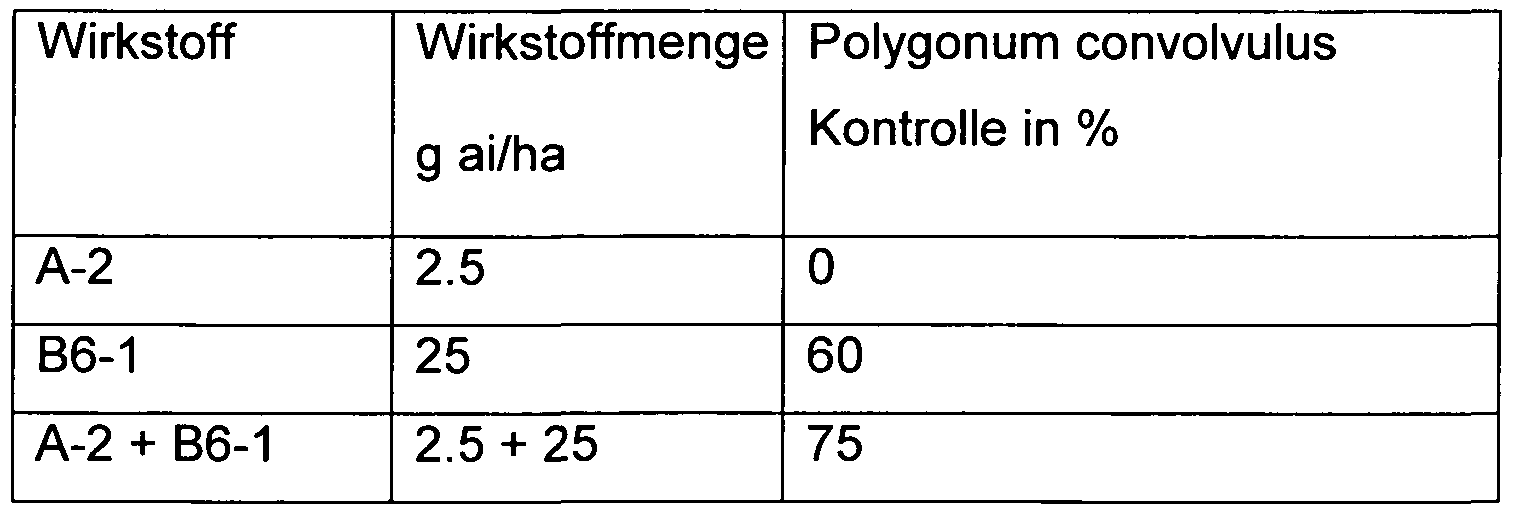
- the herbicide combinations of 2-iodo-N - [(4-methoxy-6-methyl-1,3,5-triazin-2-yl) carbamoyl] benzenesulfonamide and of compounds of the formula (I) mentioned in Table A have Group B compounds have very good synergistic herbicidal activity against harmful plants such as Sinapis alba, Echinochloa crus-galli, Digitaria sanguinalis, Lolium multiflorum, Chrysanthemum segetum, Setaria viridis, Polygonum convolvulus, Abutilon theophrasti, Amaranthus retroflexus, Panicum miliaceum and Avena sativa postemergence at one Application rate of 100 g and less active substance per hectare.
Landscapes
- Life Sciences & Earth Sciences (AREA)
- Agronomy & Crop Science (AREA)
- Pest Control & Pesticides (AREA)
- Plant Pathology (AREA)
- Health & Medical Sciences (AREA)
- Engineering & Computer Science (AREA)
- Dentistry (AREA)
- General Health & Medical Sciences (AREA)
- Wood Science & Technology (AREA)
- Zoology (AREA)
- Environmental Sciences (AREA)
- Agricultural Chemicals And Associated Chemicals (AREA)
Abstract
Description






Claims

Priority Applications (7)
| Application Number | Priority Date | Filing Date | Title |
|---|---|---|---|
| EA201000524A EA201000524A1 (ru) | 2007-10-24 | 2008-10-22 | Гербицидная комбинация |
| CN2008801224411A CN101909447A (zh) | 2007-10-24 | 2008-10-22 | 除草剂结合物 |
| US12/739,296 US20110009264A1 (en) | 2007-10-24 | 2008-10-22 | Herbicidal combination |
| EP08841964A EP2205093A2 (de) | 2007-10-24 | 2008-10-22 | Herbizid-kombination |
| BRPI0818824-6A2A BRPI0818824A2 (pt) | 2007-10-24 | 2008-10-22 | Composição herbicida |
| CA2703580A CA2703580A1 (en) | 2007-10-24 | 2008-10-22 | Herbicidal combination |
| AU2008315605A AU2008315605A1 (en) | 2007-10-24 | 2008-10-22 | Herbicidal combination |
Applications Claiming Priority (2)
| Application Number | Priority Date | Filing Date | Title |
|---|---|---|---|
| EP07020856.6 | 2007-10-24 | ||
| EP07020856A EP2052613A1 (de) | 2007-10-24 | 2007-10-24 | Herbizid-Kombination |
Publications (2)
| Publication Number | Publication Date |
|---|---|
| WO2009053055A2 true WO2009053055A2 (de) | 2009-04-30 |
| WO2009053055A3 WO2009053055A3 (de) | 2010-04-22 |
Family
ID=39576014
Family Applications (1)
| Application Number | Title | Priority Date | Filing Date |
|---|---|---|---|
| PCT/EP2008/008944 Ceased WO2009053055A2 (de) | 2007-10-24 | 2008-10-22 | Herbizid-kombination |
Country Status (10)
| Country | Link |
|---|---|
| US (1) | US20110009264A1 (de) |
| EP (2) | EP2052613A1 (de) |
| CN (1) | CN101909447A (de) |
| AR (1) | AR068991A1 (de) |
| AU (1) | AU2008315605A1 (de) |
| BR (1) | BRPI0818824A2 (de) |
| CA (1) | CA2703580A1 (de) |
| CL (1) | CL2008003148A1 (de) |
| EA (1) | EA201000524A1 (de) |
| WO (1) | WO2009053055A2 (de) |
Cited By (1)
| Publication number | Priority date | Publication date | Assignee | Title |
|---|---|---|---|---|
| WO2011060230A1 (en) * | 2009-11-13 | 2011-05-19 | Dow Agrosciences Llc | Synergistic herbicidal composition containing aminopyralid and sulfonylureas |
Families Citing this family (8)
| Publication number | Priority date | Publication date | Assignee | Title |
|---|---|---|---|---|
| KR20150056537A (ko) * | 2012-08-17 | 2015-05-26 | 올팩터 래버러토리스, 인코포레이티드 | 곤충의 유인 및 기피를 위한 조성물 및 방법 |
| AU2013312913B2 (en) | 2012-09-04 | 2016-12-08 | Corteva Agriscience Llc | Synergistic weed control from applications of aminocyclopyrachlor and clopyralid |
| DE112013004795T5 (de) | 2012-09-28 | 2015-07-16 | Dow Agrosciences Llc | Synergistische Unkrautbekämpfung durch Anwendungen von Aminocyclopyrachlor und Aminopyralid |
| CN104812248A (zh) | 2012-09-28 | 2015-07-29 | 美国陶氏益农公司 | 源自于施用环丙嘧啶酸和三氯吡氧乙酸的协同杂草控制 |
| US9426991B2 (en) | 2012-12-12 | 2016-08-30 | Dow Agrosciences Llc | Synergistic weed control from applications of aminocyclopyrachlor and picloram |
| US9149037B2 (en) | 2012-12-12 | 2015-10-06 | Dow Agrosciences Llc | Synergistic weed control from applications of aminocyclopyrachlor and 2,4 dichlorophenoxyacetic acid (2,4-D) |
| US10412964B2 (en) | 2012-12-14 | 2019-09-17 | Dow Agrosciences Llc | Synergistic weed control from applications of aminopyralid and clopyralid |
| AU2013360195B2 (en) | 2012-12-14 | 2017-05-04 | Corteva Agriscience Llc | Synergistic weed control from applications of aminopyralid and clopyralid |
Family Cites Families (64)
| Publication number | Priority date | Publication date | Assignee | Title |
|---|---|---|---|---|
| NL222768A (de) | 1957-09-26 | |||
| US3013054A (en) | 1958-08-04 | 1961-12-12 | Velsicol Chemical Corp | 2-methoxy-3, 6-dichlorobenzoates |
| US3051723A (en) | 1961-06-27 | 1962-08-28 | Union Carbide Corp | Synthesis of 3-indolealkanoic acid compounds |
| US3285925A (en) | 1962-03-06 | 1966-11-15 | Dow Chemical Co | Amino-trichloropicolinic acid compounds |
| US3317549A (en) | 1963-03-25 | 1967-05-02 | Dow Chemical Co | Picolinic acid compounds |
| US4110104A (en) | 1973-03-19 | 1978-08-29 | The Dow Chemical Company | Herbicidal use of aminohalopyridyloxy acids and derivatives thereof |
| US3862952A (en) | 1973-08-30 | 1975-01-28 | Dow Chemical Co | Method for preparing 3,5,6-trichloro-2-pyridyloxyacetic acid |
| US4169719A (en) | 1976-04-07 | 1979-10-02 | E. I. Du Pont De Nemours And Co. | Herbicidal sulfonamides |
| OA05625A (fr) | 1976-04-07 | 1981-04-30 | Du Pont | N-(hétérocyclique aminocarbonyl) aryl sulfonamides herbicides, compositions les contenant et procédés les utilisant . |
| DE3035554A1 (de) | 1980-09-20 | 1982-05-06 | Hoechst Ag, 6000 Frankfurt | Herbizide mittel |
| AR230049A1 (es) | 1980-09-30 | 1984-02-29 | Chugai Pharmaceutical Co Ltd | Derivados de isonicotinanilida,proceso para su preparacion y composicion reguladora del crecimiento de las plantas conteniendo los mismos |
| DE3108873A1 (de) | 1981-03-09 | 1982-09-16 | Basf Ag, 6700 Ludwigshafen | Dichlorchinolinderivate, ihre herstellung, ihre verwendung als herbizide und mittel dafuer |
| US4629494A (en) | 1981-12-07 | 1986-12-16 | E. I. Du Pont De Nemours And Company | Herbicidal sulfonamides |
| MA19680A1 (fr) | 1982-01-11 | 1983-10-01 | Novartis Ag | N- arylsulfonyl - n' - pyrimidinylurees. |
| MA19709A1 (fr) | 1982-02-17 | 1983-10-01 | Ciba Geigy Ag | Application de derives de quinoleine a la protection des plantes cultivees . |
| ATE103902T1 (de) | 1982-05-07 | 1994-04-15 | Ciba Geigy Ag | Verwendung von chinolinderivaten zum schuetzen von kulturpflanzen. |
| DE3233089A1 (de) | 1982-09-07 | 1984-03-08 | Basf Ag, 6700 Ludwigshafen | Chinolinderivate, verfahren zu ihrer herstellung und ihre verwendung zur bekaempfung unerwuenschten pflanzenwuchses |
| EP0131624B1 (de) | 1983-01-17 | 1992-09-16 | Monsanto Company | Plasmide zur transformation von pflanzenzellen |
| BR8404834A (pt) | 1983-09-26 | 1985-08-13 | Agrigenetics Res Ass | Metodo para modificar geneticamente uma celula vegetal |
| JPS6087254A (ja) | 1983-10-19 | 1985-05-16 | Japan Carlit Co Ltd:The | 新規尿素化合物及びそれを含有する除草剤 |
| DE3525205A1 (de) | 1984-09-11 | 1986-03-20 | Hoechst Ag, 6230 Frankfurt | Pflanzenschuetzende mittel auf basis von 1,2,4-triazolderivaten sowie neue derivate des 1,2,4-triazols |
| BR8600161A (pt) | 1985-01-18 | 1986-09-23 | Plant Genetic Systems Nv | Gene quimerico,vetores de plasmidio hibrido,intermediario,processo para controlar insetos em agricultura ou horticultura,composicao inseticida,processo para transformar celulas de plantas para expressar uma toxina de polipeptideo produzida por bacillus thuringiensis,planta,semente de planta,cultura de celulas e plasmidio |
| DE3680212D1 (de) | 1985-02-14 | 1991-08-22 | Ciba Geigy Ag | Verwendung von chinolinderivaten zum schuetzen von kulturpflanzen. |
| ATE80182T1 (de) | 1985-10-25 | 1992-09-15 | Monsanto Co | Pflanzenvektoren. |
| US5013659A (en) | 1987-07-27 | 1991-05-07 | E. I. Du Pont De Nemours And Company | Nucleic acid fragment encoding herbicide resistant plant acetolactate synthase |
| IL83348A (en) | 1986-08-26 | 1995-12-08 | Du Pont | Nucleic acid fragment encoding herbicide resistant plant acetolactate synthase |
| DE3633840A1 (de) | 1986-10-04 | 1988-04-14 | Hoechst Ag | Phenylpyrazolcarbonsaeurederivate, ihre herstellung und verwendung als pflanzenwachstumsregulatoren und safener |
| DE3809159A1 (de) | 1988-03-18 | 1989-09-28 | Hoechst Ag | Fluessige herbizide mittel |
| DE3817192A1 (de) | 1988-05-20 | 1989-11-30 | Hoechst Ag | 1,2,4-triazolderivate enthaltende pflanzenschuetzende mittel sowie neue derivate des 1,2,4-triazols |
| EP0365484B1 (de) | 1988-10-20 | 1993-01-07 | Ciba-Geigy Ag | Sulfamoylphenylharnstoffe |
| DE3938564A1 (de) | 1989-11-21 | 1991-05-23 | Hoechst Ag | Herbizide mittel |
| DE3939010A1 (de) | 1989-11-25 | 1991-05-29 | Hoechst Ag | Isoxazoline, verfahren zu ihrer herstellung und ihre verwendung als pflanzenschuetzende mittel |
| DE3939503A1 (de) | 1989-11-30 | 1991-06-06 | Hoechst Ag | Neue pyrazoline zum schutz von kulturpflanzen gegenueber herbiziden |
| ATE241007T1 (de) | 1990-03-16 | 2003-06-15 | Calgene Llc | Dnas, die für pflanzliche desaturasen kodieren und deren anwendungen |
| EP0536293B1 (de) | 1990-06-18 | 2002-01-30 | Monsanto Technology LLC | Erhöhter stärkegehalt in pflanzen |
| DE4029304A1 (de) | 1990-09-15 | 1992-03-19 | Hoechst Ag | Synergistische herbizide mittel |
| DE4038430A1 (de) | 1990-12-01 | 1992-06-04 | Basf Ag | Herbizide n-((1,3,5-triazin-2-yl)-aminocarbonyl) benzolsulfonamide |
| SE467358B (sv) | 1990-12-21 | 1992-07-06 | Amylogene Hb | Genteknisk foeraendring av potatis foer bildning av staerkelse av amylopektintyp |
| EP0492366B1 (de) | 1990-12-21 | 1997-03-26 | Hoechst Schering AgrEvo GmbH | Neue 5-Chlorchinolin-8-oxyalkancarbonsäurederivate, Verfahren zu ihrer Herstellung und ihre Verwendung als Antidots von Herbiziden |
| ZA92970B (en) | 1991-02-12 | 1992-10-28 | Hoechst Ag | Arylsulfonylureas,processes for their preparation,and their use as herbicides and growth regulators |
| DE4104782B4 (de) | 1991-02-13 | 2006-05-11 | Bayer Cropscience Gmbh | Neue Plasmide, enthaltend DNA-Sequenzen, die Veränderungen der Karbohydratkonzentration und Karbohydratzusammensetzung in Pflanzen hervorrufen, sowie Pflanzen und Pflanzenzellen enthaltend dieses Plasmide |
| TW259690B (de) | 1992-08-01 | 1995-10-11 | Hoechst Ag | |
| RU2040179C1 (ru) * | 1992-09-04 | 1995-07-25 | Латвийская фирма "КАРЕ" | Синергетический гербицидный состав и способ борьбы с нежелательной растительностью |
| DE4230933A1 (de) | 1992-09-16 | 1994-03-17 | Hoechst Ag | Hydroxylamino-phenylsulfonylharnstoffe, Darstellung und Verwendung als Herbizide und Pflanzenwachstumsregulatoren |
| CN1189763A (zh) * | 1995-06-08 | 1998-08-05 | 赫彻斯特-舍林农业发展有限公司 | 包含4-碘-2-[3-(4-甲氧基-6-甲基-1,3,5-三嗪-2-基)脲基磺酰基]苯甲酸酯的除草组合物 |
| DE19520839A1 (de) * | 1995-06-08 | 1996-12-12 | Hoechst Schering Agrevo Gmbh | Herbizide Mittel mit 4-Iodo-2-[3- (4-methoxy-6-methyl-1,3,5-triazin-2-yl) ureidosulfonyl] -benzoesäureestern |
| DE19534910A1 (de) * | 1995-09-20 | 1997-03-27 | Basf Ag | Herbizide Mischungen mit synergistischer Wirkung |
| DE19621522A1 (de) | 1996-05-29 | 1997-12-04 | Hoechst Schering Agrevo Gmbh | Neue N-Acylsulfonamide, neue Mischungen aus Herbiziden und Antidots und deren Verwendung |
| US6294504B1 (en) | 1996-09-26 | 2001-09-25 | Syngenta Crop Protection, Inc. | Herbicidal composition |
| DE19652961A1 (de) | 1996-12-19 | 1998-06-25 | Hoechst Schering Agrevo Gmbh | Neue 2-Fluoracrylsäurederivate, neue Mischungen aus Herbiziden und Antidots und deren Verwendung |
| US6071856A (en) | 1997-03-04 | 2000-06-06 | Zeneca Limited | Herbicidal compositions for acetochlor in rice |
| DE19727410A1 (de) | 1997-06-27 | 1999-01-07 | Hoechst Schering Agrevo Gmbh | 3-(5-Tetrazolylcarbonyl)-2-chinolone und diese enthaltende nutzpflanzenschützende Mittel |
| DE19742951A1 (de) | 1997-09-29 | 1999-04-15 | Hoechst Schering Agrevo Gmbh | Acylsulfamoylbenzoesäureamide, diese enthaltende nutzpflanzenschützende Mittel und Verfahren zu ihrer Herstellung |
| AR031027A1 (es) | 2000-10-23 | 2003-09-03 | Syngenta Participations Ag | Composiciones agroquimicas |
| DE10111649A1 (de) | 2001-03-12 | 2002-09-19 | Bayer Ag | Substituierte Fluoralkoxyphenylsulfonylharnstoffe |
| CN1764374B (zh) | 2003-03-26 | 2010-09-22 | 拜尔作物科学股份公司 | 芳族羟基化合物用作安全剂的用途 |
| DE10335726A1 (de) | 2003-08-05 | 2005-03-03 | Bayer Cropscience Gmbh | Verwendung von Hydroxyaromaten als Safener |
| DE10335725A1 (de) | 2003-08-05 | 2005-03-03 | Bayer Cropscience Gmbh | Safener auf Basis aromatisch-aliphatischer Carbonsäuredarivate |
| DE102004023332A1 (de) | 2004-05-12 | 2006-01-19 | Bayer Cropscience Gmbh | Chinoxalin-2-on-derivate, diese enthaltende nutzpflanzenschützende Mittel und Verfahren zu ihrer Herstellung und deren Verwendung |
| DE102004035137A1 (de) | 2004-07-20 | 2006-02-16 | Bayer Cropscience Gmbh | Wirkstoffe zur Steigerung der Pathogenabwehr in Pflanzen und Methoden zu ihrer Auffindung |
| EP1717232A1 (de) * | 2005-04-28 | 2006-11-02 | Bayer CropScience GmbH | Phenylsulfonylharnstoffe mit herbizider Wirkung |
| WO2007023719A1 (ja) | 2005-08-22 | 2007-03-01 | Kumiai Chemical Industry Co., Ltd. | 薬害軽減剤及び薬害が軽減された除草剤組成物 |
| WO2007023764A1 (ja) | 2005-08-26 | 2007-03-01 | Kumiai Chemical Industry Co., Ltd. | 薬害軽減剤及び薬害が軽減された除草剤組成物 |
| AU2007238732A1 (en) * | 2006-04-10 | 2007-10-25 | E. I. Du Pont De Nemours And Company | Herbicidal mixtures |
-
2007
- 2007-10-24 EP EP07020856A patent/EP2052613A1/de not_active Withdrawn
-
2008
- 2008-10-22 CN CN2008801224411A patent/CN101909447A/zh active Pending
- 2008-10-22 AR ARP080104601A patent/AR068991A1/es unknown
- 2008-10-22 CA CA2703580A patent/CA2703580A1/en not_active Abandoned
- 2008-10-22 WO PCT/EP2008/008944 patent/WO2009053055A2/de not_active Ceased
- 2008-10-22 AU AU2008315605A patent/AU2008315605A1/en not_active Abandoned
- 2008-10-22 US US12/739,296 patent/US20110009264A1/en not_active Abandoned
- 2008-10-22 EP EP08841964A patent/EP2205093A2/de not_active Withdrawn
- 2008-10-22 BR BRPI0818824-6A2A patent/BRPI0818824A2/pt not_active Application Discontinuation
- 2008-10-22 EA EA201000524A patent/EA201000524A1/ru unknown
- 2008-10-24 CL CL2008003148A patent/CL2008003148A1/es unknown
Cited By (2)
| Publication number | Priority date | Publication date | Assignee | Title |
|---|---|---|---|---|
| WO2011060230A1 (en) * | 2009-11-13 | 2011-05-19 | Dow Agrosciences Llc | Synergistic herbicidal composition containing aminopyralid and sulfonylureas |
| CN102711469A (zh) * | 2009-11-13 | 2012-10-03 | 陶氏益农公司 | 含有氯氨吡啶酸和磺酰脲的协同除草组合物 |
Also Published As
| Publication number | Publication date |
|---|---|
| CL2008003148A1 (es) | 2009-03-06 |
| CA2703580A1 (en) | 2009-04-30 |
| WO2009053055A3 (de) | 2010-04-22 |
| EP2052613A1 (de) | 2009-04-29 |
| AR068991A1 (es) | 2009-12-23 |
| EA201000524A1 (ru) | 2010-10-29 |
| BRPI0818824A2 (pt) | 2014-10-07 |
| AU2008315605A1 (en) | 2009-04-30 |
| CN101909447A (zh) | 2010-12-08 |
| EP2205093A2 (de) | 2010-07-14 |
| US20110009264A1 (en) | 2011-01-13 |
Similar Documents
| Publication | Publication Date | Title |
|---|---|---|
| EP2205090A2 (de) | Herbizid-safener-kombination | |
| EP2205089A2 (de) | Herbizid-kombination | |
| EP2205093A2 (de) | Herbizid-kombination | |
| WO2009053061A2 (de) | Herbizid-kombination | |
| EP2209378A2 (de) | Herbizid-kombination | |
| EP2211621A2 (de) | Verwendung des 2-iodo-n-[(4-methoxy-6-methyl-1,3,5-triazin-2-yl)carbamoyl]benzolsulfonamids und/oder dessen salze zur bekämpfung von unerwünschtem pflanzenwuchs in ausgewählten nutzpflanzenkulturen oder nichtkulturland | |
| WO2011107445A1 (de) | Hydrat und wasserfreie kristallform des natriumsalzes des 2-iodo-n-[(4-methoxy-6-methyl-1,3,5-triazin-2-yl)carbamoyl]benzolsulfonamids, verfahren zu deren herstellung, sowie deren verwendung als herbizide und pflanzenwachstumsregulatoren | |
| EP2205092A2 (de) | Herbizid-kombination | |
| EP2205094A2 (de) | Herbizid-kombination | |
| WO2009053060A2 (de) | Herbizid-kombination | |
| WO2009053057A2 (de) | Herbizid-kombination | |
| WO2009053052A2 (de) | Herbizid-kombination | |
| EP2205095A2 (de) | Herbizid-kombination | |
| WO2009053059A2 (de) | Herbizid-kombination |
Legal Events
| Date | Code | Title | Description |
|---|---|---|---|
| WWE | Wipo information: entry into national phase |
Ref document number: 200880122441.1 Country of ref document: CN |
|
| 121 | Ep: the epo has been informed by wipo that ep was designated in this application |
Ref document number: 08841964 Country of ref document: EP Kind code of ref document: A2 |
|
| DPE1 | Request for preliminary examination filed after expiration of 19th month from priority date (pct application filed from 20040101) | ||
| WWE | Wipo information: entry into national phase |
Ref document number: 2008841964 Country of ref document: EP |
|
| WWE | Wipo information: entry into national phase |
Ref document number: 2307/CHENP/2010 Country of ref document: IN Ref document number: 201000524 Country of ref document: EA |
|
| WWE | Wipo information: entry into national phase |
Ref document number: 2703580 Country of ref document: CA |
|
| NENP | Non-entry into the national phase |
Ref country code: DE |
|
| WWE | Wipo information: entry into national phase |
Ref document number: 2008315605 Country of ref document: AU |
|
| WWE | Wipo information: entry into national phase |
Ref document number: a201004919 Country of ref document: UA |
|
| ENP | Entry into the national phase |
Ref document number: 2008315605 Country of ref document: AU Date of ref document: 20081022 Kind code of ref document: A |
|
| WWE | Wipo information: entry into national phase |
Ref document number: 12739296 Country of ref document: US |
|
| ENP | Entry into the national phase |
Ref document number: PI0818824 Country of ref document: BR Kind code of ref document: A2 Effective date: 20100422 |