WO2009056603A1 - Kapsel zur aufnahme von pharmazeutischen wirkstoffformulierungen - Google Patents
Kapsel zur aufnahme von pharmazeutischen wirkstoffformulierungen Download PDFInfo
- Publication number
- WO2009056603A1 WO2009056603A1 PCT/EP2008/064743 EP2008064743W WO2009056603A1 WO 2009056603 A1 WO2009056603 A1 WO 2009056603A1 EP 2008064743 W EP2008064743 W EP 2008064743W WO 2009056603 A1 WO2009056603 A1 WO 2009056603A1
- Authority
- WO
- WIPO (PCT)
- Prior art keywords
- amino
- phenyl
- quinazoline
- chloro
- capsule
- Prior art date
- Legal status (The legal status is an assumption and is not a legal conclusion. Google has not performed a legal analysis and makes no representation as to the accuracy of the status listed.)
- Ceased
Links
Classifications
-
- A—HUMAN NECESSITIES
- A61—MEDICAL OR VETERINARY SCIENCE; HYGIENE
- A61K—PREPARATIONS FOR MEDICAL, DENTAL OR TOILETRY PURPOSES
- A61K9/00—Medicinal preparations characterised by special physical form
- A61K9/48—Preparations in capsules, e.g. of gelatin, of chocolate
- A61K9/4816—Wall or shell material
-
- A—HUMAN NECESSITIES
- A61—MEDICAL OR VETERINARY SCIENCE; HYGIENE
- A61K—PREPARATIONS FOR MEDICAL, DENTAL OR TOILETRY PURPOSES
- A61K9/00—Medicinal preparations characterised by special physical form
- A61K9/0012—Galenical forms characterised by the site of application
- A61K9/007—Pulmonary tract; Aromatherapy
- A61K9/0073—Sprays or powders for inhalation; Aerolised or nebulised preparations generated by other means than thermal energy
- A61K9/0075—Sprays or powders for inhalation; Aerolised or nebulised preparations generated by other means than thermal energy for inhalation via a dry powder inhaler [DPI], e.g. comprising micronized drug mixed with lactose carrier particles
-
- A—HUMAN NECESSITIES
- A61—MEDICAL OR VETERINARY SCIENCE; HYGIENE
- A61K—PREPARATIONS FOR MEDICAL, DENTAL OR TOILETRY PURPOSES
- A61K9/00—Medicinal preparations characterised by special physical form
- A61K9/48—Preparations in capsules, e.g. of gelatin, of chocolate
- A61K9/4816—Wall or shell material
- A61K9/4825—Proteins, e.g. gelatin
-
- A—HUMAN NECESSITIES
- A61—MEDICAL OR VETERINARY SCIENCE; HYGIENE
- A61M—DEVICES FOR INTRODUCING MEDIA INTO, OR ONTO, THE BODY; DEVICES FOR TRANSDUCING BODY MEDIA OR FOR TAKING MEDIA FROM THE BODY; DEVICES FOR PRODUCING OR ENDING SLEEP OR STUPOR
- A61M15/00—Inhalators
- A61M15/0028—Inhalators using prepacked dosages, one for each application, e.g. capsules to be perforated or broken-up
- A61M15/003—Inhalators using prepacked dosages, one for each application, e.g. capsules to be perforated or broken-up using capsules, e.g. to be perforated or broken-up
-
- A—HUMAN NECESSITIES
- A61—MEDICAL OR VETERINARY SCIENCE; HYGIENE
- A61M—DEVICES FOR INTRODUCING MEDIA INTO, OR ONTO, THE BODY; DEVICES FOR TRANSDUCING BODY MEDIA OR FOR TAKING MEDIA FROM THE BODY; DEVICES FOR PRODUCING OR ENDING SLEEP OR STUPOR
- A61M2202/00—Special media to be introduced, removed or treated
- A61M2202/06—Solids
- A61M2202/064—Powder
Definitions
- the invention relates to a capsule for receiving pharmaceutical active ingredient formulations as a primary packaging component of a packaging unit and a use thereof.
- Capsules with pharmaceutical drug formulations are widely used in the therapy and diagnosis of diseases.
- the capsules may be administered orally or used in certain medical devices, such as powder inhalers.
- the capsules consist of two parts, namely a capsule body and a capsule cap, which are pushed telescopically into one another. Also multi-part capsules are known.
- Capsule material used for primary packaging of pharmaceutical products is used for primary packaging of pharmaceutical products.
- the gelatin capsule also has significant disadvantages, among other things, it will become brittle at low ambient humidity.
- BSE bovine spongiform encephalopathy
- Challenge of gelatin as a product of animal origin in the manufacture of capsules If necessary, gelatine must be replaced by alternative materials.
- HPMC hydroxypropyl methylcellulose
- the aim is to use as many plastics as possible, which, among other things, have a very low water content, in order to even introduce as little water as possible into the packaging.
- the very low water absorption capacity is increasingly proving to be a decisive disadvantage compared to the highly water-absorptive gelatin capsule.
- the remaining packaging materials such as films, bottles and the like, as well as by the product itself moisture is registered in a primary packaging. This moisture is trapped in the primary packaging after the packaging process and can only diffuse out slowly.
- the relative humidity increases considerably and endangers the product. A decomposition, a clumping or recrystallization of powders, etc. may be the result.
- WO 2006/122790 A1 discloses a capsule for packaging inhalation formulations in which at least a cavity is enclosed by a wall. At least part of the wall has a polymer composition containing at least one adsorbent.
- the adsorbent for example silica gel, drying or moisture or water adsorbing clays, aluminosilicates such as zeolites or bentonites, molecular sieves, activated carbon, ⁇ rdalkalioxide, calcium sulfate or mixtures thereof, is attached to the polymer composition.
- the adsorbent also has an influence on the mechanical properties of the polymer composition.
- Packaging components are conditioned, the Heidelbergsprozes ⁇ is provided even in a conditioned climate and / or primary packaging with desiccant-equipped secondary packaging (pouches) are surrounded.
- Such a packaging unit is described for example in the form of a case box with blister cards in EP 0 479 282 A1.
- EP 1 100 474 A1 discloses e.g. Plastic capsules, which consist of a capsule body and a capsule cap, both made of the same non-water-soluble, hydrophobic plastic and which can be interconnected so that a stable, closed cavity of defined volume is formed.
- the plastic is polyethylene.
- Such capsules are suitable for use in, inter alia Powder inhalers determined.
- powder inhalers may be mentioned are: HandiHaler ®, as has been disclosed, for example 483 in the EP 1 342 Spinhaler ®, Rotaha- ler ®, Aerolizer ®, Plowcaps ®, Turbo ⁇ pin ®, AIR DPI ®, Orbital ® or Directhaler ® so such as inhalers, which, inter alia, in the
- the object is achieved in that the capsule is completely made of a water absorptive material and is conditioned at a low relative humidity.
- the material from which the capsule or its wall is made is itself an adsorbent and is not composed of a base material and an adsorbent.
- the capsule is made of the water-absorptive material which is conditioned at a low relative humidity, ie has a relatively residual moisture due to the treatment, the capsule itself absorbs most of the moisture in the packaging ("moisture sink"). ) and thus lowers the moisture in the product.
- the conditioning of this capsule material before the packaging process at low humidity serves to maximize the water absorption capacity and thus the absorber function.
- the starting moisture in the packaging unit can thereby be drastically reduced. Furthermore, the starting moisture can be determined and controlled by a suitable choice of conditioning.
- polyamide Ph-6, PA-6.6
- cellulose acetate As a water-absorptive material in particular polyamide (Ph-6, PA-6.6) or cellulose acetate is particularly advantageous. These plastics have an over other plastics extremely high water absorption and are therefore particularly suitable for use as a water absorber.
- the water-absorptive material As a water-absorptive material, gelatin which has been previously heated is preferably suitable. Sufficient heating is beneficial in terms of preventing BSE (bovine spongiform encephalopathy).
- the water-absorptive material has a water absorption capacity of greater than or equal to 1.5% under standard conditions according to ISO 62. This is achieved in particular by polyamides. Water absorption in the range above 3%, preferably up to 3%, can be achieved with these materials.
- the water-absorptive material is conditioned at a relative humidity of less than or equal to 20%. This can already be achieved an effective moisture reduction. In order to achieve a particularly effective moisture reduction, the water-absorptive material is conditioned at a relative humidity of less than or equal to 10%.
- the water-absorptive material is conditioned as a bulk product.
- the starting value in the packaging can be determined specifically.
- the water-absorptive material is conditioned by a single conditioning step. Since ⁇ by a strong simplification of the packaging process can be realized.
- the capsule material within the packaging unit is the only water-absorptive material. This stabilizes low moisture levels in the packaging over a long period of time without further aids such as pouches or desiccants.
- An advantageous use of the capsule provides the use as a primary packaging for receiving particularly moisture-sensitive drugs, such as finely powdered pharmaceutical agents, before. Especially with such inhalants, moisture absorption is important.
- W is a pharmacologically active agent and (for example) selected from the group consisting of betamimetics, anticholinergics, corticosteroids, PDE4 inhibitors, LTD4 antagonists, EGFR inhibitors, dopamine agonists, HIV antihistamines, PAF Antagonists and PI3 kinase inhibitors.
- a pharmacologically active agent selected from the group consisting of betamimetics, anticholinergics, corticosteroids, PDE4 inhibitors, LTD4 antagonists, EGFR inhibitors, dopamine agonists, HIV antihistamines, PAF Antagonists and PI3 kinase inhibitors.
- two- or three-fold combinations of W can be combined and used for application in the device according to the invention. Exemplary combinations of W were:
- W represents a betamimetics combined with an anticholinergic, corticosteroids, PDE4 inhibitors, EGFR inhibitors or LTD4 antagonists,
- W represents an anticholinergic agent combined with a betamimetics, corticosteroids, PDE4 inhibitors,
- W represents a corticosteroid combined with a PDE4 inhibitor
- EGFR inhibitor or LTD4 antagonist - W represents a PDE4 inhibitor combined with an EGFR inhibitor or LTD4 antagonist
- W represents an EGFR inhibitor combined with a LTD4 antagonist.
- Suitable betamimetics are preferably compounds which are selected from the group consisting of albuterol, arformoterol, bambuterol, bitolertrol, broxaterol, carbuterol, clenbuterol, fenoterol, formermol, hexoprenaline, ibuterol, isoetharine, isoprenaline , Levosalbutamol, Mabuterol, Meluadrine, Metaproterenol, Orciprenaline, Pirbuterol, Procaterol, Reproterol, Rimiterol, Ritodrine, Salmefamol, Salmeterol, Soterenol, ⁇ ulphonterol, Terbutaline, Tiaramide, Tolubuterol, Zinterol, CHF-1035, HOKU-81, KUL -1248 and
- N-adamantan-2-yl-2 - (3 - ⁇ 2- [2-hydroxy-2- ⁇ 4-hydroxy-3-hydroxymethylphenyl) -ethylamino] -propyl ⁇ -phenyl) -acetamide optionally in the form of their racemates, enantiomers, diastereomers and optionally in the form of their pharmacologically acceptable acid addition salts, solvates or hydrates.
- the acid addition salts of the betamimetics selected from the group consisting of hydrochloride, hydrobromide, hydroiodide, hydrosulfate, hydrophosphate, hydromethanesulfonate, hydronitrate, hydromaleate, hydroacetate, hydrocitrate, hydrofumarate, hydrotartrate, hydroxalate, hydrosuccinate, hydrobenzoate and hydro-p Toluenesulfonate.
- Preferred anticholinergic compounds are compounds which are selected from the group consisting of tiotropium salts, preferably the bromide salt, oxitropium salts, preferably the bromide salt, flutropium salts, preferably the bromide salt, ipratropium salts, preferably the bromide salt, glycopyrronium salts the bromide salt, trospium salts, preferably the chloride salt, tolterodine.
- tiotropium salts preferably the bromide salt, oxitropium salts, preferably the bromide salt, flutropium salts, preferably the bromide salt, ipratropium salts, preferably the bromide salt, glycopyrronium salts the bromide salt, trospium salts, preferably the chloride salt, tolterodine.
- tiotropium salts preferably the bromide salt, oxitropium salts, preferably the bromide salt, flutropium salts, preferably the bromide salt,
- the above genann ⁇ th salts may preferably contain chloride, bromide, iodide, sulfate, phosphate, methanesulfonate, nitrate, maleate, acetate, citrate, fumarate, tartrate , Oxalate, succinate, benzoate or p-toluenesulfonate, with chloride, bromide, iodide, sulfate, methanesulfonate or p-toluenesulfonate being preferred as counterions.
- the chlorides, bromides, iodides and methanesulfonates are particularly preferred.
- preferred anticholinergics are selected from the salts of the formula AC-I
- X is a singly negatively charged anion, preferably an anion selected from the group consisting of fluoride, chloride, bromide, iodide, sulfate, phosphate, methanesulphonate, nitrate, maleate, acetate, citrate, fumarate, tartrate, oxalate, succinate, Benzoate and p-toluenesulfonate, preferably a single negatively charged anion, more preferably an anion selected from the group consisting of fluoride, chloride, bromide, methanesulfonate and p-toluenesulfonate, most preferably bromide, optionally in the form of their racemates, enantiomers or hydrates.
- anion selected from the group consisting of fluoride, chloride, bromide, iodide, sulfate, phosphate, methanesulphonate, nitrate, maleate, acetate, citrate,
- X - may have the meanings given above.
- Further preferred anticholinergics are selected from the salts of the formula AC-2
- R is either methyl or ethyl and wherein X - may have the meanings given above.
- the compound of the formula AC-2 may also be present in the form of the free base AC-2-base.
- Preferred corticosteroids are compounds which are selected from the group consisting of beclomethasone, betamethasone, budesonide, Buxtococort, ciclesonide, deflazacort, dexamethasone, etipredanol, flunisolide, fluticasone, loteprednol, mometasone,
- Examples of possible salts and derivatives of the steroids may be: alkali metal salts, such as, for example, sodium or potassium salts, sulphobenzoates, phosphates, isonotinotinates, acetates, dichloroacetates, propionates, dihydrogenphosphates, palmitates, pivalates or furoates.
- alkali metal salts such as, for example, sodium or potassium salts, sulphobenzoates, phosphates, isonotinotinates, acetates, dichloroacetates, propionates, dihydrogenphosphates, palmitates, pivalates or furoates.
- PDE4 inhibitors compounds which are selected from the group consisting of enprofylline, theophylline, roflumilase, ariflo (cilomilast), tofimilast, pumafentrin, lirilmast, arofylline, atizoram, D-4418, bayonitrile, are preferably used here.
- the pressure additi ⁇ onssalze of PDE4 are preferred according inhibitors selected from the group consisting of hydrochloride, hydrobromide, hydroiodide, rosulfat hydrauli-, hydrophosphate, hydromethanesulphonate, Hydronit- rat, Hydromaleat, hydroacetate, Hydrocitrat, Hydrofumarat, Hydrotartrat, Hydrooxalat, Hydrosuccinat, Hydrobenzoat and hydro-p-toluenesulfonate.
- inhibitors selected from the group consisting of hydrochloride, hydrobromide, hydroiodide, rosulfat hydrauli-, hydrophosphate, hydromethanesulphonate, Hydronit- rat, Hydromaleat, hydroacetate, Hydrocitrat, Hydrofumarat, Hydrotartrat, Hydrooxalat, Hydrosuccinat, Hydrobenzoat and hydro-p-toluenesulfonate.
- Preferred LTD4 antagonists here are compounds selected from the group consisting of montelukast, pranlukast, zafirlukast, MCC-847 (ZD-3523), MN-OOI, MEN-91507 (LM-1507), VUF -5078, VUF-K-8707, L-733321 and - 1 - (((R) - (3 - ⁇ 2 - (6,7-di-fluoro-2-quinolinyl) -1-phenyl) -3- (2- (2-hydroxy-2-propyl) phenyl) thio ) methyl cyclopropane-acetic acid,
- these acid addition salts are selected from the group consisting of hydrochloride, hydrobroride, hydroiodide, hydrosulfate, hydrophosphate, hydromethanesulfonate, hydronitrate, hydromaleate, hydroacetate, hydrocitrate, hydrofumarate, hydrotartrate, hydroxalate, hydrosuccinate, hydrobenzoate and hydro-p - Toluenesulfonate.
- salts or derivatives which BiI- d ü ng the LTD4 antagonists optionally are able to be for example: alkali metal salts such as sodium or potassium salts, alkaline earth metal salts, sulphobenzoates, phosphates, isonicotinates, acetates, propionitrile nate, dihydrogen phosphates, Palmitate, pivalate or furoate.
- alkali metal salts such as sodium or potassium salts, alkaline earth metal salts, sulphobenzoates, phosphates, isonicotinates, acetates, propionitrile nate, dihydrogen phosphates, Palmitate, pivalate or furoate.
- Preferred EGFR inhibitors are compounds selected from the group consisting of cetuximab, trastuzumab, ABX-EGF, Mab ICR-62 and - 4- [(3-chloro-4-fluorophenyl) amino] -6- ⁇ [4- (morpholin-4-yl ) -1-oxo-2-buten-1-yl] amino ⁇ -7-cyclopropylmethoxyquinazoline
- these acid addition salts are selected from the group consisting of hydrochloride, hydrobromide, hydroiodide, hydrosulfate, hydrophosphate, hydromethanesulfonate, hydronitrate, hydroraaleate, hydroacetate, hydrocitrate, hydrofumarate, hydrotartrate, hydroxalate, hydrosuccinate, hydrobenzoate and hydro p-toluenesulfonate.
- Preferred dopamine agonists are compounds selected from the group consisting of bromocriptine, cabergoline, alpha-dihydroergocryptine, lisuride, pergolide, pramipexole, rooxinol, ropinirole, talipexol, terguride and viozan, optionally in the form of theirs Racemates, enantiomers, diastereomers and optionally in the form of their pharmacologically acceptable acid addition salts, solvates or hydrates.
- these acid addition salts are selected from the group consisting of hydrochloride, hydrobromide, hydroiodide, hydrosulfate, hydrophosphate, hydromethanesulfonate, hydronitrate, hydromaleate, hydroacetate , Hydrocitrate, hydrofumarate, hydrotartrate, hydrooxalate, hydrosuccinate, hydrobenzoate and hydro-p-toluenesulfonate.
- Hl-antihistamines here preferably compounds are used, which are selected from the group consisting of epinastine, cetirizine, azelastine, fexofenadine, levocabastine, loratadine, mizolastine, ketotifen, emedastine, dimetindene, clemastine, bamipin, Cexch- lormeniramine, pheniramine, doxylamine, chlorophenoxamine, dimenhydrinate, diphenhydramine, promethazine, ebastine, desoratidin and meclocine, optionally in the form of their racemates, enantiomers, diastereomers and optionally in the form of their pharmacologically acceptable acid addition salts, solvates or hydrates.
- these acid addition salts are selected from the group consisting of hydrochloride, hydrobromide, hydroiodide, hydrosulfate, hydrophosphate, hydromethanesulfonate, hydronitrate, hydromaleate, hydroacetate, hydrocitrate, hydrofumarate, hydrotartrate, hydroxalate, hydrosuccinate, hydrobenzoate and hydro-p-toluenesulfonate ,
- substance formulations or substance mixtures all inhalable compounds are used, such as e.g. also inhalable macromolecules, as disclosed in EP 1 003 478.
- substances, substance formulations or substance mixtures are used for the treatment of respiratory diseases, which are used in the inhalation field.
- the compound may be derived from the group of derivatives of ergot alkaloids, the triptans, the CGRP inhibitors, the phosphodiesterase V inhibitors, optionally in the form of their racemates, enantiomers or diastereomers, optionally in the form of their pharmacologically acceptable acid addition salts, their solvates and / or hydrates.
- results of the simulation show that the starting moisture can be controlled and controlled with the help of a single - the dominant - component of a packaging. This option represents a significant reduction in the cost of packaging and its control process.
- the simulation calculation was carried out on a currently installed blister system.
- the capsule used in this case was replaced by a PA-capsule.
Landscapes
- Health & Medical Sciences (AREA)
- Life Sciences & Earth Sciences (AREA)
- Engineering & Computer Science (AREA)
- Veterinary Medicine (AREA)
- Public Health (AREA)
- General Health & Medical Sciences (AREA)
- Animal Behavior & Ethology (AREA)
- Pharmacology & Pharmacy (AREA)
- Chemical & Material Sciences (AREA)
- Medicinal Chemistry (AREA)
- Bioinformatics & Cheminformatics (AREA)
- Epidemiology (AREA)
- Pulmonology (AREA)
- Hematology (AREA)
- Heart & Thoracic Surgery (AREA)
- Biomedical Technology (AREA)
- Anesthesiology (AREA)
- Otolaryngology (AREA)
- Pharmaceuticals Containing Other Organic And Inorganic Compounds (AREA)
- Acyclic And Carbocyclic Compounds In Medicinal Compositions (AREA)
Abstract
Eine Kapsel zur Aufnahme von pharmazeutischen Wirkstoffformulierungen als Primärverpackungskomponente einer Verpackungseinheit besteht Kapseln vollständig aus einem wasseraufnahmefähigen Material und ist bei einer niedrigen relativen Feuchte konditioniert.
Description
Kapsel zur Aufnahme von pharmazeutischen Wirkstoffformulierungen
Beschreibung
Die Erfindung bezieht sich auf eine Kapsel zur Aufnahme von pharmazeutischen Wirkstoffformulierungen als Primär- verpackungskomponente einer Verpackungseinheit und eine Verwendung dazu.
Kapseln mit pharmazeutischen Wirkstoffformulierungen werden vielfältig in der Therapie und Diagnose von Krankheiten eingesetzt. Die Kapseln können oral verabreicht werden oder kommen in bestimmten medizinischen Vorrichtungen, wie Pulverinhalatoren, zum Einsatz. In der Regel be- stehen die Kapseln aus zwei Teilen, nämlich einem Kapselkörper und einer Kapselkappe, die teleskopartig ineinander geschoben werden. Auch mehrteilige Kapseln sind bekannt .
Über eine längere Zeitspanne hinweg wurde Gelatine als
Kapselmaterial zur Primärverpackung pharmazeutischer Produkte verwendet. Neben einer Reihe von Vorteilen weist die Gelatinekapsel allerdings auch entscheidende Nachteile auf, unter anderem wird sie bei niedriger Umgebungs- feuchte brüchig wird. Darüber hinaus führte die Diskussion um BSE (Bovine spongiforme Enzephalopathie) u.a. zur
Hinterfragung der Gelatine als Produkt tierischen Ursprungs in der Herstellung von Kapseln. Gegebenenfalls muss Gelatine durch alternative Materialien ersetzt werden muss. Als eine der Alternativen zu Gelatine wird die Verwendung von Hydroxypropylmethylcellulose (HPMC) diskutiert.
Bei der derzeitigen Suche nach Alternativen wird angestrebt, möglichst Kunststoffe zu verwenden, die unter an- derem einen sehr geringen Wassergehalt aufweisen, um selbst möglichst wenig Wasser in die Verpackung einzubringen. Die sehr geringe Wasseraufnahmefähigkeit erweist sich jedoch zunehmend als entscheidender Nachteil gegenüber der stark wasseraufnahmefähigen Gelatinekapsel . Es ist technisch nicht zu vermeiden, dass über die restlichen Verpackungsmaterialien, wie z.B. Folien, Flaschen und dergleichen, sowie durch das Produkt selbst Feuchte in eine PrimärVerpackung eingetragen wird. Diese Feuchte ist nach dem Verpackungsprozess in der Primärverpackung eingeschlossen und kann nur langsam heraus diffundieren. Je nach den Werten der relativen Feuchte in bzw. außer¬ halb der Verpackung diffundiert sogar noch weitere Feuchte in die Primärverpackung hinein. Mangels wasseraufnahmefähiger Verpackungsmaterialien innerhalb der Primärver- packung steigt dadurch die relative Feuchte dort beträchtlich an und gefährdet somit das Produkt. Eine Zersetzung, ein Verklumpen bzw. eine Rekristallisation von Pulvern usw. kann die Folge sein.
Die WO 2006/122790 Al offenbart eine Kapsel zur Verpackung von Inhalationsformulierungen, bei der wenigstens
ein Hohlraum von einer Wandung umschlossen ist. Zumindest ein Teil der Wandung weist eine PolymerZusammensetzung auf, die mindestens ein Adsorbens enthält. Hierbei ist nicht die Polymerzusammensetzung selbst das Adsorbens, sondern das Adsorbens, beispielsweise Silicagel, trocknende bzw. Feuchtigkeit oder Wasser adsorbierende Tone, Alumosilicate wie Zeolithe oder Bentonite, Molekularsiebe, Aktivkohle, Ξrdalkalioxide, Calciumsulfat oder deren Mischungen, ist der Polymerzusammensetzung beigefügt. Das Adsorbens hat auch einen Einfluεs auf die mechanischen Eigenschaften der Polymerzusammensetzung.
Derzeit wird versucht, diesen Feuchteanstieg mit relativ hohem Aufwand zu verhindern, indem z.B. Packmittelkompo- nenten konditioniert werden, der Verpackungsprozesε selbst in konditioniertem Klima vorgesehen wird und/oder Primärverpackungen mit trockenmittelbestückten Sekundärverpackungen (Pouches) umgeben werden. Eine derartige Verpackungseinheit ist beispielsweise in Form einer FaIt- Schachtel mit Blisterkarten in der EP 0 479 282 Al beschrieben.
Die EP 1 100 474 Al offenbart z.B. Kunststoffkapεeln, die aus einem Kapselkörper und einer Kapselkappe bestehen, die beide aus dem gleichen nicht-wasserlöslichen, hydrophoben Kunststoff bestehen und die so miteinander verbunden werden können, dass ein stabiler, abgeschlossener Hohlraum von definiertem Volumen gebildet wird. Insbesondere handelt es sich bei dem Kunststoff um Polyethylen.
Derartige Kapseln sind unter anderem zur Verwendung in
Pulverinhalatoren bestimmt. Als Beispiele für derartige Pulverinhalatoren seien genannt: HandiHaler®, wie er z.B. in der EP 1 342 483 offenbart wurde, Spinhaler®, Rotaha- ler®, Aerolizer®, Plowcaps®, Turboεpin®, AIR DPI®, Orbital® oder Directhaler® so wie Inhalatoren, die u.a. in den
Schriften DE 3345722, EP 0591136, DE 4318455, WO91/02558, FR-A-2146202, US-A-4069819 , EP 666085, EP 869079, US 3,991,761, WO99/45987, WO 200051672, Bell, J. Pharm. Sei. 60, 1559 {1971); Cox, Brit. Med. J. 2, 634 (1969), be- schrieben sind.
Es ist Aufgabe der Erfindung zur Vermeidung der oben genannten Nachteile eine hinsichtlich des Feuchteschutzes optimierte Kapsel der eingangs genannten Art bereitzu- stellen.
Erfindungsgemäß wird die Aufgabe dadurch gelöst, dass die Kapsel vollständig aus einem waεseraufnahmefähigen Material besteht und bei einer niedrigen relativen Feuchte konditioniert ist.
Im Gegensatz zu der eingangs beschriebenen Kapsel gemäß der WO 2006/122790 Al stellt das Material, aus dem die Kapsel bzw. deren Wandung hergestellt ist, selbst ein Ad- Sorbens dar und ist nicht aus einem Grundmaterial und einem Adsorbens zusammengesetzt. Dadurch, dass die Kapsel aus dem wasseraufnahmefähigen Material gefertigt ist, das bei einer niedrigen relativen Feuchte konditioniert ist, also durch die Behandlung eine verhältnismäßige Rest- feuchte aufweist, nimmt Kapsel selbst den größten Teil der Feuchtigkeit in der Verpackung auf („Feuchte-Senke")
und senkt somit die Feuchtigkeit im Produkt. Die Konditionierung dieses Kapselmaterials vor dem Verpackungspro- zess bei geringer Feuchte dient der Maximierung der Wasseraufnahmefähigkeit und damit der Absorberfunktion. Die Startfeuchte in der Verpackungseinheit kann dadurch drastisch reduziert werden. Weiterhin kann die Startfeuchte durch geeignete Wahl der Konditionierung festgelegt und kontrolliert werden. Darüber hinaus hält ein derartiger Feuchteabsorber durch seine hohe Wasseraufnahmefähigkeit die relative Feuchte in der Verpackungseinheit über den HaItbarkeits Zeitraum hinweg bei geringen Werten und schützt damit das Produkt. Ein weiterer Vorteil gegenüber dem Stand der Technik ist, dass das Material der Kapsel in seinen mechanischen Eigenschaften nicht durch ein Ad- Sorbens beeinflusst wird, sondern die Wasseraufnahmefähigkeit des Materials der Kapsel die relative Feuchte bestimmt .
Als wasseraufnahmefähiges Material ist insbesondere PoIy- amid (Ph-6 , PA-6.6) oder Celluloseacetat von besonderem Vorteil. Diese Kunststoffe weisen eine gegenüber anderen Kunststoffen extrem hohe Wasseraufnahmefähigkeit auf und eignen sich daher besonders zum gezielten Einsatz als Wasser-Absorber .
Alternativ ist bevorzugt als wasseraufnahmefähiges Material Gelatine geeignet, die zuvor erhitzt ist. Eine hinreichende Erhitzung ist im Hinblick auf eine Prävention bezüglich BSE (Bovine spongiforme Enzephalopathie) von Vorteil.
In weiterer Ausgestaltung weist das wasseraufnahmefähige Material eine Wasseraufnahmefähigkeit von größer oder gleich 1,5 % bei Normklima gemäß ISO 62 auf. Dies wird insbesondere durch Polyamide erreicht. Wasseraufnahmen im Bereich über 3 %, vorzugsweise bis 3 %, können mit diesen Materialien erzielt werden.
Zweckmäßigerweise ist das wasseraufnahmefähige Material bei einer relativen Feuchte von kleiner oder gleich 20 % konditioniert. Damit kann bereits eine effektive Feuchtereduzierung erzielt werden. Um eine besonders effektive Feuchtereduzierung zu erreichen, ist das wasseraufnahmefähige Material bei einer relativen Feuchte von kleiner oder gleich 10 % konditioniert.
Zur Erzielung einer einfachen Konditionierung mit geringem prozesstechnischem Aufwand ist das wasseraufnahmefähige Material als Bulkware konditioniert. Dadurch kann der Startwert in der Verpackung gezielt bestimmt werden.
Bevorzugt ist das wasseraufnahmefähige Material durch einen einzigen Konditionierungεschritt konditioniert. Da¬ durch kann eine starke Vereinfachung des Verpackungspro- zesses realisiert werden.
In weiterer Ausgestaltung ist das Kapselmaterial innerhalb der Verpackungseinheit das einzige wasseraufnahmefähige Material. Hierdurch ist eine Stabilisierung geringer Feuchtewerte in der Verpackung über einen langen Zeitraum ohne weitere Hilfsmittel, wie beispielsweise Pouch oder Trockenmittel, gegeben.
Eine vorteilhafte Verwendung der Kapsel sieht den Einsatz als Primärverpackung zur Aufnahme von besonders feuchtempfindlichen Arzneimitteln, z.B. von fein pulverisierten pharmazeutischen Wirkstoffen, vor. Insbesondere bei derartigen Inhalativen ist eine Feuchteabsorption von Bedeutung.
Die unten genannten Verbindungen können allein oder in Kombination zur Anwendung in der erfindungsgemäßen Vorrichtung gelangen. In den unten genannten Verbindungen ist W einen pharmakologisch, aktiver Wirkstoff und (beispielsweise) ausgewählt aus der Gruppe bestehend aus Betamimetika, Anticholinergika, Corticosteroiden, PDE4- Inhibitoren, LTD4-Antagonisten, EGFR-Hemmern, Dopamin- Agonisten, Hl-Antihistaminika, PAF-Antagonisten und PI3- Kinase Inhibitoren. Weiterhin können zwei- oder dreifach Kombinationen von W kombiniert werden und zur Anwendung in der erfindungsgemäßen Vorrichtung gelangen. Beispiel- haft genannte Kombinationen von W waren:
- W stellt ein Betamimetika dar, kombiniert mit einem Anticholinergika, Corticosteroide, PDE4-Inhibitore, EGFR-Hemmern oder LTD4-Antagonisten,
- W stellt ein Anticholinergika dar, kombiniert mit ei- nem Betamimetika, Corticosteroiden, PDE4-Inhibitoren,
EGFR-Hemmern oder LTD4-Antagonisten,
W stellt ein Corticosteroiden dar, kombiniert mit einem PDE4-Inhibitoren, EGFR-Hemmern oder LTD4- Antagonisten - W stellt ein PDE4-Inhibitoren dar, kombiniert mit einem EGFR-Hemmern oder LTD4-Antagonisten
- W stellt ein EGFR-Hemmern dar, kombiniert mit einem LTD4-Antagonisten .
Als Betamimetika gelangen hierbei vorzugsweise Verbindun- gen zur Anwendung, die ausgewählt sind aus der Gruppe bestehend aus Albuterol, Arformoterol, Bambuterol, Bitolte- rol, Broxaterol, Carbuterol, Clenbuterol, Fenoterol, For- moterol, Hexoprenaline, Ibuterol, Isoetharine, Isoprena- line, Levosalbutamol, Mabuterol, Meluadrine, Metaprotere- nol, Orciprenaline, Pirbuterol, Procaterol, Reproterol, Rimiterol, Ritodrine, Salmefamol, Salmeterol, Soterenol, Ξulphonterol, Terbutaline, Tiaramide, Tolubuterol, Zinte- rol, CHF-1035, HOKU-81, KUL-1248 und
3- (4- {6- [2-Hydroxy-2- (4-hydroxy-3-hydroxymethyl- phenyl) -ethylamino] -hexyloxy}-butyl) -benzyl-sulfonamid 5- [2- (5 , 6-Diethyl-indan-2-ylamino) -1-hydroxy-ethyl] -8- hydroxy-lH-quinolin-2-on
- 4-Hydroxy-7-[2-{ [2-{ [3-(2- phenylethoxy)propyl] sulphonyl}ethyl] -amino} ethyl] - 2 (3H) -benzothiazolon
- 1- (2-Fluor-4-hydroxyρhenyl) -2- [4- (1-benzimidazolyl) -2- methyl-2-butylamino] ethanol
1- [3- (4-Methoxybenzyl-amino) -4-hydroxyphenyl] -2- [4- (1- benzimidazolyl) -2-methyl-2-butylamino] ethanol - 1- [2H-5-hydroxy-3-oxo-4H-l, 4-benzoxazin-8-yl] -2- [3- {4- N,N-dimethylaminophenyl) -2-methyl-2- propylamino] ethanol
- 1- [2H-5-hydroxy-3-oxo-4H-l, 4-benzoxazin~8-yl] -2- [3- (4- methoxyphenyl) -2-methyl-2-propylamino] ethanol - 1- [2H-5-hydroxy-3-oxo-4H-l, 4-benzoxazin-8-yl] -2- [3- (4- n-butyloxyphenyl) -2-methyl-2-propylamino] ethanol
- 1- [2H-5-hydroxy-3-oxo-4H-l, 4-benzoxazin-8-yl] -2-{4- [3- (4-methoxyphenyl) -1,2, 4-triazol-3-yl] -2-methyl-2- butylamino}ethanol
5-Hydroxy-8- (l-hydroxy-2-isopropylaminobutyl) -2H-1, 4- benzoxazin-3- (4H) -on
1- (4-Aπύno-3-chlor-5-trifluormethylphenyl ) -2-tert . - butylamino) ethanol
- 6-Hydroxy-8-{l-hydroxy-2- [2- (4-methoxy-phenyl) -1, 1- dimethyl-ethylamino] -ethyl}-4H-benzo [1, 4] oxazin-3-on - 6-Hydroxy-8-{l-hydroxy-2- [2- (4-phenoxy- essigsäureethylester) -1, 1-dimethyl-ethylamino] -ethyl} - 4H-benzo [1, 4] oxazin-3-on
6-Hydroxy-8-{l-hydroxy-2- [2- (4-phenoxy-essigsäure) - 1, 1-dimethyl-ethylamino] -ethyl} -4H-benzo [1,4] oxazin-3- on
- 8-{2-[l,l-Dimethyl-2- (2 , 4 , 6-trimethylphenyl) - ethylamino] -l-hydroxy-ethyl}-6-hydroxy-4H- benzo [1,4] oxazin-3-on
- 6 -Hydroxy-8- { 1-hydroxy-2 - [ 2 - ( 4-hydroxy-pheny1 ) - 1 , 1 - dimethyl-ethylamino] -ethyl} -4H-benzo [1,4] oxazin-3-on
- 6-Hydroxy-8-{l-hydroxy-2- [2- ( 4-isopropyl-phenyl) -
1, ldimethyl-ethylamino] -ethyl} -4H-benzo [1, 4]oxazin-3- on
- 8-{2- [2- (4-Ethyl-phenyl) -1, 1-dimethyl-ethylamino] -1- hydroxy-ethy1 } -6-hydroxy-4H-benzo [1,4] oxazin-3 -on
- 8- {2- [2- (4-Ethoxy-phenyl) -1, 1-dimethyl-ethylamino] -1- hydroxy-ethyl}-6-hydroxy-4H-benzo [1,4] oxazin-3-on
- 4- (4-{2- [2 -Hydroxy-2- ( 6-hydroxy-3-oxo-3 , 4-dihydro-2H- benzo [1,4] oxazin-8-yl) -ethylamino] -2-methyl-propyl} - phenoxy) -buttersäure
- 8-{2- [2- (3, 4-Difluor-phenyl) -1, 1-dimethyl-ethylamino] - 1-hydroxy-ethyl} -6-hydroxy-4H-benzo [1,4] oxazin-3-on
1- (4-Eth.oxy-carbonylamino-3-cyano-5-fluoroph.enyl) -2- C tert . -butylamino ) ethanol - 2 -Hydroxy-5- (l~hydroxy-2- {2- [4- (2 -hydroxy-2 -phenyl- ethylamino) -phenyl] -ethylamino} -ethyl) -benzaldehyd
- N- [2-Hydroxy-5- (l-hydroxy-2- {2- [4- (2 -hydroxy-2 -phenyl- ethylamino) -phenyl] -ethylamino} -ethyl) -phenyl] - formamid - 8-Hydroxy-5- (l-hydroxy-2- {2- [4- (6-methoxy-biphenyl-3- ylamino) -phenyl] -ethylamino} -ethyl) -lH-guinolin-2-on 8-Hydroxy-5- [l-hydroxy-2- ( 6-phenethylamino- hexylamino) -ethyl] -lH-quinolin-2-on 5-[2-(2-{4-[4- (2-Amino-2-methyl-propoxy) -phenylamino] - phenyl} -ethylamino) -1-hydroxy-ethyl] -8-hydroxy-lH- quinolin-2-on
[3- (4- {6- [2-Hydroxy-2- (4-hydroxy-3-hydroxymethyl- phenyl) -ethylamino] -hexyloxy}-butyl) - 5 -methyl-phenyl] - harnstof f - 4- (2-{6- [2- (2 , 6-Dichloro-benzyloxy) -ethoxy] - hexylamino} -1-hydroxy-ethyl ) -2 -hydroxymethy1-phenol 3- (4- {6- [2-Hydroxy-2- ( 4 -hydroxy-3 -hydroxymethy1- phenyl) -ethylamino] -hexyloxy} -butyl) -benzylsulfonamid 3- (3- {7- [2-Hydroxy-2- {4-hydroxy-3-hydroxymethyl- phenyl) -ethylamino] -heptyloxy} -propyl) - benzy1sulfonamid
4- (2- {6- [4- ( 3-Cyclopentaneεulfonyl-phenyl) -butoxy] - hexylamino } -1-hydroxy-ethyl ) -2 -hydroxymethy1-pheno1
- N-Adamantan-2 -y1- 2 - ( 3 - { 2- [ 2-hydroxy-2- { 4 -hydroxy-3 - hydroxymethyl-phenyl) -ethylamino] -propyl } -phenyl ) - acetamid
gegebenenfalls in Form ihrer Racemate, Enantiomere, Di- astereomere und gegebenenfalls in Form ihrer pharmakologisch verträglichen Säureadditionεsalze, Solvate oder Hydrate. Ξrfindungsgemäß bevorzugt sind die Säureadditi- onssalze der Betamimetika ausgewählt aus der Gruppe bestehend aus Hydrochlorid, Hydrobromid, Hydroiodid, Hydro- sulfat, Hydrophosphat , Hydromethansulfonat , Hydronitrat, Hydromaleat, Hydroacetat, Hydrocitrat, Hydrofumarat , Hydrotartrat, Hydrooxalat, Hydrosuccinat, Hydrobenzoat und Hydro-p-toluolsulfonat .
Als Anticholinergika gelangen hierbei vorzugsweise Ver- bindungen zur Anwendung, die ausgewählt sind aus der Gruppe bestehend aus Tiotropiumsalzen, bevorzugt das Bro- midsalz, Oxitropiumsalzen, bevorzugt das Bromidsalz, Flutropiumsalzen, bevorzugt das Bromidsalz, Ipratropium- salzen, bevorzugt das Bromidsalz, Glycopyrroniumsalzen, bevorzugt das Bromidsalz, Trospiumsalzen, bevorzugt das Chloridsalz, Tolterodin. In den vorstehend genannten Sal¬ zen stellen die Kationen die pharmakologisch aktiven Bestandteile dar. Als Anionen können die vorstehend genann¬ ten Salze bevorzugt enthalten Chlorid, Bromid, Iodid, Sulfat, Phosphat, Methansulfonat, Nitrat, Maleat, Acetat, Citrat, Fumarat, Tartrat, Oxalat, Succinat, Benzoat oder p-Toluolsulfonat, wobei Chlorid, Bromid, Iodid, Sulfat, Methansulfonat oder p-Toluolsulfonat als Gegenionen bevorzugt sind. Von allen Salzen sind die Chloride, Bromi- de, lodide und Methansulfonate besonders bevorzugt.
Ebenfalls bevorzugte Anticholinergika sind ausgewählt aus den Salzen der Formel AC-I

worin X - ein einfach negativ geladenes Anion, bevorzugt ein Anion ausgewählt aus der Gruppe bestehend aus Fluorid, Chlorid, Bromid, Iodid, Sulfat, Phosphat, Methansul- fonat, Nitrat, Maleat, Acetat, Citrat, Fumarat, Tartrat, Oxalat, Succinat, Benzoat und p-Toluolsulfonat , bevorzugt ein einfach negativ geladenes Anion, besonders bevorzugt ein Anion ausgewählt aus der Gruppe bestehend aus Fluorid, Chlorid, Bromid, Methansulfonat und p- Toluolsulfonat, insbesondere bevorzugt Bromid, bedeutet gegebenenfalls in Form ihrer Racemate, Enantiomere oder Hydrate. Von besonderer Bedeutung sind solche Arzneimittelkombinationen, die die Enantiomere der Formel AC-l-exi
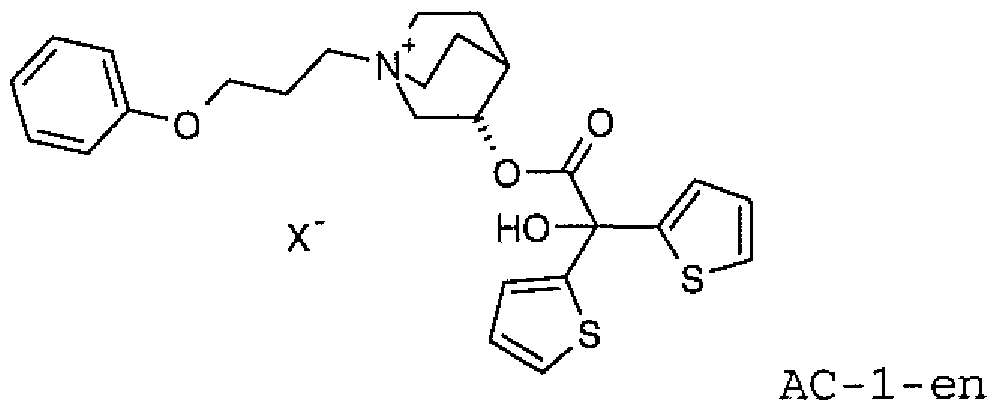
enthalten, worin X - die vorstehend genannten Bedeutungen aufweisen kann. Weiterhin bevorzugte Anticholinergika sind ausgewählt aus den Salzen der Formel AC-2

worin R entweder Methyl oder Ethyl bedeuten und worin X - die vorstehend genannte Bedeutungen aufweisen kann. In einer alternativen Ausführungsform kann die Verbindung der Formel AC-2 auch in Form der freien Base AC-2-base vorliegen .

Weiterhin genannte Verbindungen sind:
2 , 2-Diphenylpropionsäuretropenolester-Methobromid 2 , 2 -Diphenylpropionsäurescopinester-Methobromid - 2-Fluor-2 , 2-Diphenylessigsäurescopinester-Methobromid 2-Fluor-2 , 2-Diphenylessigsäuretropenolester- Methobromid
3,3' ,4,4' -Tetrafluorbenzilsäuretropenolester- Methobromid - 3 , 3 ' , 4 , 4 ' -Tetrafluorbenzilsäurescopinester-Methobromid 4,4' -Difluorbenzilsäuretropenolester-Methobromid 4,4' -Difluorbenzilsäurescopinester-Methobromid
3,3' -Difluorbenzilεäuretropenolester-Methobromid
3,3' -Difluorbenzilεäurescopinester-Methobromid
9-Hydroxy-fluoren-9 -carbonsäuretropenolester-
Methobromid - 9-Fluor-fluoren- 9 -carbonsäuretropenolester-Methobromid
9-Hydroxy-fluoren- 9 -carbonsäurescopinester-Methobromid
9-Fluor-fluoren-9 -carbonsäureεcopinester-Methobromid
9-Methyl-fluoren-9 -carbonsäuretropenolester-
Methobromid - 9-Methyl-fluoren-θ-carboπsäurescopinester-Methobromid
Benzilsäurecyclopropyltropinester-Methobromid
2, 2-Diphenylpropionsäurecyclopropyltropinester-
Methobromid g-Hydroxy-xanthen-g-carbonsäurecyclopropyltropinester- Methobromid
9-Methyl-fluoren-9-carbonsäurecyclopropyltropinester-
Methobromid θ-Methyl-xanthen-g-carbonsäurecyclopropyltropinester-
Methobromid - 9-Hydroxy-fluoren-θ-carbonsäurecyclopropyltropinester-
Methobromid
- 4,4'-
Difluorbenzilsäuremethylestereyelopropyltropinester-
Methobromid - 9~Hydroxy-xanthen-9-carbonsäuretropenolester-
Methobromid
9 -Hydroxy-xanthen-9-carbonsäurescopinester-Methobromid
9 -Methyl-xanthen-9-carbonsäuretropenolester-
Methobromid - 9-Methyl-xanthen-9-carbonsäurescopinester-Methobromid
g-Ethyl-xanthen-g-carbonsäuretropenolester-Methobromid
9-Difluormethyl -xanthen-9 -carbonsäuretropenolester-
Methobromid
9-Hydroxymethyl -xanthen- 9 -carbonsäurescopinester- Methobromid
Die vorstehend genannten Verbindungen sind im Rahmen der vorliegenden Erfindung auch als Salze einsetzbar, in denen statt des Methobromids, die Salze Metho-X zur Anwendung gelangen, wobei X die vorstehend für X- genannten Bedeutungen haben kann.
Als Corticosteroide gelangen hierbei vorzugsweise Verbin- düngen zur Anwendung, die ausgewählt sind aus der Gruppe bestehend aus Beclomethason, Betamethason, Budesonid, Bu- tixocort, Ciclesonid, Deflazacort, Dexamethason, Etipred- nol, Flunisolid, Fluticason, Loteprednol, Mometason,
Prednisolon, Prednison, Rofleponid, Triamcinolon, RPR- 106541, NS-126, ST-26 und
6, 9-Difluor-17- [ (2-furanylcarbonyl ) oxy] -ll-hydroxy-16- methyl-3-oxo-androsta-l , 4-dien-17-carbothionsäure (S) - fluoromethylester
6 , 9-Difluor-ll-hydroxy-16-methyl-3-oxo-17- ρropionyloxy-androsta-1, 4-dien-17-carbothionsäure (S)-
(2-oxo-tetrahydro-furan-3S-yl) ester , - 6D, 9D-difluoro-llD-hydroxy-16D-methyl-3-oxo-17D-
(2,2,3, 3-tertamethylcyclopropylcarbonyl) oxy-androsta- 1 , 4-diene-17D-carbonsaure cyanomethyl ester gegebenenfalls in Form ihrer Racemate, Enantiomere oder Diastereomere und gegebenenfalls in Form ihrer Salze und
Derivate, ihrer Solvate und/oder Hydrate. Jede Bezugnahme auf Steroide schließt eine Bezugnahme auf deren gegebenenfalls existierende Salze oder Derivate, Hydrate oder Solvate mit ein. Beispiele möglicher Salze und Derivate der Steroide können sein: Alkalisalze, wie beispielsweise Natrium- oder Kaliumsalze, SuIfobenzoate, Phosphate, Iso- nicotinate, Acetate, Dichloroacetate, Propionate, Di- hydrogenphosphate, Palmitate, Pivalate oder auch Furoate.
Als PDE4-Inhibitoren gelangen hierbei vorzugsweise Verbindungen zur Anwendung, die ausgewählt sind aus der Gruppe bestehend aus Enprofyllin, Theophyllin, Roflumi- laεt, Ariflo (Cilomilast) , Tofimilast, Pumafentrin, Liri- milast, Arofyllin, Atizoram, D-4418, Bay-198004, BY343, CP-325,366, D-4396 (Sch-351591) , AWD-12-281 (GW-842470), NCS-613, CDP-840, D-4418, PD-168787, T-440, T-2585, V- 11294A, Cl-1018, CDC-801, CDC-3052, D-22888, YM-58997, Z- 15370 und - N- (3, 5-Dichloro-l-oxo-pyridin-4-yl) -4-difluormethoxy- 3-cyclopropylmethoxybenzamid
- ( - ) p- [ ( 4aR* , 1ObS* ) -9-Ethoxy-l ,2,3,4,4a, 10b-hexahydro- 8-methoxy-2-methylbenzo[s] [1, 6] naphthyridin-6-yl] -N, N- diisopropylbenzamid _ (R) - { + ) -l- (4-Brombenzyl) -4- [ (3-cyclopentyloxy) -4- methoxyphenyl] -2-pyrrolidon
- 3- (Cyclopentyloxy-4-methoxyphenyl) -1- (4-N' - [N-2-cyano- S-methyl-isothioureido]benzyl) -2-pyrrolidon eis [4-Cyano-4- { 3-cyclopentyloxy-4- methoxyphenyl) cyclohexan-1-carbonsäure]
2-carbomethoxy-4-cyano-4- (3-cyclopropylmethoxy~4- difluoromethoxyphenyl ) cyclohexan-1-on eis [4-Cyano-4- {3-cyclopropylmethoxy-4- difluormethoxyphenyl ) cyclohexan-1-ol] - (R) - ( + ) -Ethyl [4- (3-cyclopentyloxy-4- methoxyphenyl}pyrrolidin-2-yliden] acetat (S) - (-) -Ethyl [4- {3-cyclopentyloxy-4- methoxyphenyl)pyrrolidin-2-yliden] acetat
- 9-Cyclopentyl-5, 6-dihydro-7-ethyl-3- (2-thienyl) -9H- pyrazolo [3, 4-c] -1, 2, 4-triazolo [4, 3-a]pyridin
- 9-Cyclopentyl-5, 6-dihydro-7-ethyl-3- (tert-butyl) -9H- pyrazolo[3 , 4-c] -1, 2, 4-triazolo [4 , 3-a]pyridin gegebenenfalls in Form ihrer Racemate, Enantiomere, Di¬ as tereomere und gegebenenfalls in Form ihrer pharmakolo- gisch verträglichen Säureadditionssalze, Solvate oder Hydrate. Erfindungsgemäß bevorzugt sind die Säureadditi¬ onssalze der PDE4- Inhibitoren ausgewählt aus der Gruppe bestehend aus Hydrochlorid, Hydrobromid, Hydroiodid, Hyd- rosulfat, Hydrophosphat, Hydromethansulfonat , Hydronit- rat, Hydromaleat, Hydroacetat, Hydrocitrat, Hydrofumarat , Hydrotartrat, Hydrooxalat, Hydrosuccinat , Hydrobenzoat und Hydro-p-toluolsulfonat .
Als LTD4-Antagonisten gelangen hierbei vorzugsweise Verbindungen zur Anwendung, die ausgewählt sind aus der Gruppe bestehend aus Montelukast, Pranlukast, Zafirlu- kast, MCC-847 (ZD-3523) , MN-OOl, MEN-91507 (LM-1507), VUF-5078, VUF-K-8707, L-733321 und
- l- ( ( ( R) - ( 3 - { 2 - ( 6 , 7 -Di f luor-2 - quino1iny1 ) etheny1 ) pheny1 ) -3- ( 2- ( 2- hydroxy-2- propyl ) phenyl ) thio)methylcyclopropan-essigsäure,
- 1- { ( (1 (R) -3 (3- (2- (2, 3-Dichlorthieno[3,2-b]pyridin~5- yl) - (E) -ethenyl) phenyl) -3- (2- ( 1-hydroxy- 1- mefchylethyl ) phenyl ) propyl ) thio) methyl ) cyclopropan- essigεäure
[2- [ [2- {4-tert-Butyl-2-thiazolyl) -5- benzofuranyl] oxymethyl] phenyl] essigsaure gegebenenfalls in Form ihrer Racemate, Enantiomere, Di- astereomere und gegebenenfalls in Form ihrer pharmakologisch verträglichen Säureadditionssalze, Solvate oder Hydrate. Ξrfindungsgemäß bevorzugt sind diese Säureadditionssalze ausgewählt aus der Gruppe bestehend aus Hydro- Chlorid, Hydrobroraid, Hydroiodid, Hydrosulfat, Hydrophos- phat, Hydromethansulfonat, Hydronitrat, Hydromaleat, Hyd- roacetat, Hydrocitrat, Hydrofumarat, Hydrotartrat , Hydrooxalat, Hydrosuccinat, Hydrobenzoat und Hydro-p- toluolsulfonat . Unter Salzen oder Derivaten zu deren BiI- düng die LTD4 -Antagonisten gegebenenfalls in der Lage sind, werden beispielsweise verstanden: Alkalisalze, wie beispielsweise Natrium- oder Kaliumsalze, Erdalkalisalze, Sulfobenzoate, Phosphate, Isonicotinate, Acetate, Propio- nate, Dihydrogenphosphate, Palmitate, Pivalate oder auch Furoate.
Als EGFR-Hemmer gelangen hierbei vorzugsweise Verbindungen zur Anwendung, die ausgewählt sind aus der Gruppe be- stehend aus Cetuximab, Trastuzumab, ABX-EGF, Mab ICR-62 und
- 4- [ (3-Chlor-4-fluorphenyl)amino] -6-{ [4- (morpholin-4- yl) -l-oxo-2-buten-l-yl] amino} -7-cyclopropylmethoxy- chinazolin
- 4- [ (3-Chlor-4-fluorphenyl)amino]-6-{ [4- (N, N- diethylamino) -l-oxo-2-buten-l-yl ] amino} -7- cyclopropylmethoxy-chinazolin
- 4- [ (3-Chlor-4-fluorphenyl) amino] -6-{ [4- (N, N- dimethylamino) -l-oxo-2-buten-l-yl] amino} -7- cyclopropylmethoxy-chinazolin - 4- t (R) - { l-Phenyl-ethyl) amino] -6-{ [4- (morpholin-4-yl) - l-oxo-2-buten-l-yl] amino} -7-cyclopentyloxy-chinazolin
- 4- [ (3-Chlor-4-fluor-phenyl) amino] -6-{ [4- ( (R) -6-methyl- 2-oxo-morpholin-4-yl) -l-oxo-2-buten-l-yl] amino} -7- eyelopropylmethoxy-chinazolin - 4- [ {3-Chlor-4-fluor-phenyl) amino] -6-{ [4- { (R) -6-methyl- 2-oxo-morpholin-4-yl ) -l-oxo-2-buten-l-yl] amino} -7- [ (S) - ( tetrahydrofuran-3-yl) oxy] -chinazolin
- 4-[ (3-Chlor-4-f luor-phenyl) amino] -6-{ [4-( (R) -2- methoxymethy1- 6 -oxo-morpholin-4 -y1 } - 1-oxo-2-buten-1- yl] amino} -7-cyclopropylmethoxy-chinazolin
- 4- [ ( 3 -Chlor-4-fluor-phenyl) amino] -6- [2- ( (S) -6-methyl- 2-oxo-morpholin-4-yl) -ethoxy] -7-methoxy-chinazolin
- 4- [ (3-Chlor-4-fluorphenyl) amino] -6- { {4- [N- (2-methoxy- ethyl) -N-methyl-amino] -l-oxo-2-buten-l-yl } amino) -7- cyclopropylmethoxy-chinazolin
- 4- [ (3-Chlor-4-fluorphenyl)amino] ~β-{ [4- (N,N- dimethylamino) -l-oxo-2-buten-l-yl] amino} -7- cyclopentyloxy-chinazolin
- 4- [ (R) - (l-Phenyl-ethyl) amino] -6-{ [4- (N,N-bis- (2- methoxy-ethyl ) -amino} -l-oxo-2-buten-l-yl] amino} -7- cyclopropylmethoxy-chinazolin
- 4- [ (R) - (1-Phenyl-ethyl) amino] -6- ( {4- [N- (2-methoxy- ethyl) -N-ethyl-amino] -l-oxo-2-buten-l-yl}amino) -7- cyclopropylmethoxy-chinazolin
- 4- [ (R)-(l-Phenyl-ethyl)amino]-6-({4- [N- ( 2-methoxy- ethyl) -N-methyl-amino] -l-oxo-2-buten-l-yl} amino) -7- cyclopropylmethoxy-chinazolin
- 4-[ (R)- (l-Phenyl-ethyl)amino]-6-({4- [N-
( tetrahydropyran-4-yl) -N-methyl-amino] -l-oxo-2-buten- 1-y1 } amino ) -7-eye1opropyImethoxy-chinazo1in - 4- [ (3-Chlor-4-fluorphenyl)amino] -6-{ [4- (N, N- dimethylamino) -l-oxo-2-buten-l-yl] amino} -7- ( (R) - tetrahydrofuran-3-yloxy) -chinazolin
- 4- [ (3-Chlor-4-fluorphenyl)amino] -6-{ [4- (N, N- dimethylamino) -l-oxo-2-buten-l-yl] amino} -7- ( (S) - tetrahydrofuran-3-yloxy) -chinazolin
4- [ (3-Chlor-4-fluorphenyl) amino] -6- ( {4- [N- (2-methoxy- ethyl ) -N-methyl-amino] -l-oxo-2-buten-l-yl}amino) -7- cyclopentyloxy-chinazolin
4- [ { 3 -Chlor-4-fluorphenyl ) amino] -6- { [4- (N-cyclopropyl- N-methyl-amino) -l-oxo-2-buten-l-yl] amino} -7- cyclopentyloxy-chinazolin
- 4- [ (3 -Chlor-4-fluorphenyl) amino] -6-{ [4- (N, N- dimethylamino) -l-oxo-2-buten-l-yl] amino} -7- [ (R) -
( tetrahydrofuran-2-yl)methoxy] -chinazolin - 4- [ (3-Chlor-4-fluorphenyl) amino] -6- { [4- (N, N- dimethylamino) -l-oxo-2-buten-l-yl] amino} -7- [ (S) - ( tetrahydrofuran-2-yl)methoxy] -chinazolin 4- [ ( 3 -Ethiny1-pheny1 ) amino ] -6 , 7-bis- ( 2 -methoxy- ethoxy) -chinazolin - 4- [ (3-Chlor-4-fluorphenyl) arnino] -7- [3- (morpholin-4- yl ) -propyloxy] -6- [ (vinylearbonyl ) amino] -chinazolin
- 4- [ (R) - (1-Phenyl-ethyl) amino] -6- ( 4-hydroxy-phenyl) -7H- pyrrolo [2 , 3-d] pyrimidin
- 3-Cyano-4- [ ( 3 -chlor-4-fluorphenyl) amino] -6-{ [4- (N, N- dimethylamino) -l-oxo-2-buten-l-yl] amino} -7-ethoxy- chinolin
4- { [3-Chlor-4- (3-fluor-benzyloxy) -phenyl j araino} -6- ( 5- { [ (2-methansulfonyl-ethyl) amino] methyl}-furan-2- yl) chinazolin
- 4-[ (R) -(1-Phenyl-ethyl) amino] -6-{ [4- ( (R) -6-methyl-2- oxo-morpholin-4-yl) -l-oxo-2-buten-l-yl] amino} -7- methoxy-chinazolin
4- [ (3-Chlor-4-fluorphenyl) amino] -6- { [4- (morpholin-4- yl) -l-oxo-2-buten-l-yl] amino} -7- [ ( tetrahydrofuran-2- yljmethoxy] -chinazolin - 4- [ (3-Chlor-4-fluorphenyl) amino] -6- ({4- [N,N-bis- (2- methoxy-ethyl) -amino] -l-oxo-2-buten-l-yl }amino) -7- [ (tetrahydrofuran-2-yl)methoxy] -chinazolin
- 4- [ (3-Ethinyl-phenyl) amino] -6- { [4- (5 , 5-dimethyl-2-oxo- morpholin-4-yl) -l-oxo-2-buten-l-yl] amino} -chinazolin - 4- [ (3-Chlor-4-fluor-phenyl) amino] -6- [2- (2, 2-dimethyl- 6-oxo-morpholin-4-yl) -ethoxy] -7-methoxy-chinazolin
- 4- [ (3-Chlor-4-fluor-phenyl) amino] -6- [2- (2 , 2-dimethyl- 6-oxo-morpholin-4-yl) -ethoxy] -7- [ (R) - ( tetrahydrofuran- 2-yl)methoxy] -chinazolin - 4- [ (3-Chlor-4-fluor-phenyl)amino] -7- [2- (2, 2-dimethyl- 6-oχo-morpholin-4-yl) -ethoxy] -6- [ (S) - ( tetrahydrofuran- 2-yl)methoxy] -chinazolin
- 4- [ (3-Chlor-4-fluor-phenyl) amino] -6-{2- [4- (2-oxo- morpholin-4-yl) -piperidin-1-yl] -ethoxy} -7 -methoxy- chinazolin
- 4-[ ( 3-Chlor-4-fluor-phenyl) amino] -6- [l-(tert. - butyloxycarbonyl) -piperidin-4-yloxy] -7-methoxy- chinazolin
4- [ (3-Chlor-4~fluor-phenyl) amino] -6- ( trans-4-amino- cyclohexan-1-yloxy) -7-methoxy-chinazolin
4- [ (3-Chlor-4-fluor-phenyl) amino] -6- { trans-4- methansulfonylamino-eyelohexan-1~yloxy) -7 -methoxy- chinazolin
4- [ ( 3-Chlor-4-fluor-phenyl) amino] -6- ( tetrahydropyran- 3-yloxy) -7-methoxy-chinazolin
4- [ ( 3 -Chlor-4-fluor-phenyl) amino] -6- (1-methyl- piperidin-4-yloxy) -7-methoxy-chinazolin 4- [ (3~Chlor-4-fluor-phenyl) amino] -6- { 1- [ (morpholin-4- yl) carbonyl] -piperidin-4-yloxy} -7-methoxy-chinazolin - 4- [ ( 3 -Chlor- 4-f luor-phenyl ) amino ] - 6- { l-
[ (methoxymethyl) carbonyl] -piperidin-4-yloxy} -7- methoxy-chinazolin
- 4- [ (3-Chlor-4-fluor-phenyl) amino] -6- {piperidin-3- yloxy) -7-methoxy-chinazolin - 4- [ (3-Chlor-4-fluor-phenyl) amino] -6- [1- (2-acetylamino- ethyl) -piperidin-4-yloxy] -7-methoxy-chinazolin 4- [ (3-Chlor-4-fluor-phenyl) amino] -6- ( tetrahydropyran- 4-yloxy) ~7-ethoxy-chinazolin
- 4- [ (3-Chlor-4-fluor-phenyl) amino] -6- { (S) - tetrahydrofuran-3-yloxy) -7~hydroxy-chinazolin
4- [ (3-Chlor-4-fluor-phenyl) amino] -6- ( tetrahydropyran-
4-yloxy) -7- (2-methoxy-ethoxy ) -chinazolin
4- [ (3 -Chlor-4-fluor-phenyl} amino] -6-{trans-4-
[ (dimethylamino) sulfonylamino] -cyclohexan-1-yloxy} -7- methoxy-chinazolin
4- [ (3-Chlor-4-fluor-phenyl) amino] -6- { trans-4- [ (morpholin-4-yl) carbonylamino] -cyclohexan-1-yloxy} -7- methoxy-chinazolin
4- [ (3-Chlor-4-fluor-phenyl) amino] -6- { trans-4- [ (morpholin-4-yl) sulfonylamino] -cyclohexan-1-yloxy} -7- methoxy-chinazolin
4- [ (3-Chlor-4-fluor-phenyl) amino] -6- (tetrahydropyran- 4-yloxy) -7- {2-acetylamino-ethoxy) -chinazolin 4- [ (3-Chlor-4-fluor-phenyl) amino] -6- { tetrahydropyran- 4-yloxy) -7- (2-methansulfonylamino-ethoxy) -chinazolin 4- [ (3-Chlor-4-fluor-phenyl) amino] -6- { 1- [ (piperidin-1- yl) carbonyl] -piperidin-4-yloxy} -7-methoxy-chinazolin 4- [ ( 3 -Chlor-4-fluor-phenyl ) amino] -6- ( 1- aminocarbonylmethyl-piperidin-4-yloxy) -7^methoxy- chinazolin
- 4- [ (3 -Chlor-4-fluor-phenyl) amino] -6- (cis-4-{N-
[ (tetrahydropyran-4-yl) carbonyl] -N-methyl-amino} - cyclohexan-1-yloxy) -7-methoxy-chinazolin 4- [ (3-Chlor-4-fluor-phenyl) amino] -6- {cis-4- {N- [ (morpholin-4-yl) carbonyl] -N-methyl-amino} -cyclohexan- 1-yloxy) -7-methoxy-chinazolin
- 4- [ {3 -Chlor-4-fluor-phenyl) amino] -6- (cis-4-{N-
[ (morpholin-4-yl) sulfonyl] -N-methyl-amino} -cyclohexan- 1-yloxy) -7-methoxy- chinazolin - 4- [ (3-Chlor-4-fluor-phenyl) amino] -6- ( trans-4- ethansu1fonylamino-cyclohexan- 1-y1oxy) -7 -methoxy- chinazolin
4- [ (3-Chlor-4-fluor-phenyl) amino] -6- { 1-methansulfonyl- piperidin-4-yloxy) -7-ethoxy-chinazolin - 4- [ (3 -Chlor-4-f luor-phenyl) amino] -6- (1-methansulfonyl- piperidin-4-yloxy) -7- (2-methoxy-ethoxy) -chinazolin
4- [ (3-Chlor-4-fluor-phenyl) amino] -6- [1- (2-methoxy- acetyl) -piperidin-4-yloxy] -7- (2-methoxy-ethoxy) - chinazolin
4- [ (3-Chlor-4-fluor-phenyl) amino] -6- (cis-4- acetylamino-cyclohexan-l-yloxy) -7-methoxy-chinazolin
- 4- [ (3-Ethinyl-phenyl) amino] -6- [1- (tert.- butyloxycarbonyl) -piperidin-4-yloxy] -7-methoxy- chinazolin
4- [ (3-Ethinyl-phenyl) amino] -6- ( tetrahydropyran-4- yloxy] -7-methoxy-chinazolin
4- [ (3-Chlor-4-fluor-phenyl) amino 3 -6- (cis-4- {N-
[ (piperidin-1-yl) carbonyl] -N-methyl-amino} -cyclohexan-
1-yloxy) -7-methoxy-chinazolin
- 4- [ ( 3-Chlor- 4- fluor-phenyl) amino] -6- (cis-4-{N- [ (4- methyl-piperazin-1-yl) carbonyl] -N-methyl-amino} - eyelohexan-1-yloxy) -7-methoxy-chinazolin
4- [ (3-Chlor-4-fluor-phenyl) amino] -6- {cis-4-
[ (morpholin-4-yl) carbonylamino] -eyelohexan-1-yloxy} -7- methoxy-chinazolin - 4- [ (3-Chlor-4-fluor-phenyl} amino] -6-{l- [2- (2- oxopyrrolidin-1-yl) ethyl] -piperidin-4-yloxy} -7- methoxy-chinazolin
4- [ ( 3 -Chlor-4-fluor-phenyl) amino] -6- {1- [ (morpholin-4- yl) carbonyl] -piperidin-4-yloxy} -7- (2-methoxy-ethoxy) - chinazolin
4- [ (3-Ethinyl-phenyl) amino] -6- (l-acetyl-piperidin-4- yloxy) -7-methoxy-chinazolin
4- [ (3-Ethinyl-phenyl) amino] -6- (l-methyl-piperidin-4- yloxy) -7-methoxy-chinazolin - 4- [ (3-Ethinyl-phenyl) amino] -6- (1-methansulfonyl- piperidin-4-yloxy) -7-methoxy-chinazolin
- 4- [ (3-Chlor-4-fluor-phenyl}amino] -6- (1-methyl- piperidin-4-yloxy) -7 {2-methoxy-ethoxy) -chinazolin
- 4- [ (3-Chlor-4-fluor-phenyl) amino] -6- (1- isopropyloxycarbonyl-piperidin-4-yloxy) -7-methoxy- chinazolin
4- [ (3-Chlor-4-fluor-phenyl ) amino] -6- (eisernethylamino-eyelohexan-1-yloxy) -7-methoxy-chinazolin
- 4- [ (3 -Chlor-4-fluor-phenyl) amino] -6-{cis-4- [N- (2- methoxy-acetyl) -N-raethyl-amino] -cyclohexan-1-yloxy} -7- methoxy-chinazolin
4- [ (3-Ethinyl-phenyl ) amino] -6- (piperidin-4-yloxy) -7- methoxy-chinazolin
4- [ (3-Ethinyl-phenyl) amino] -6- [1- (2-methoxy-acetyl ) - piperidin-4-yloxy] -7 -methoxy-chinazolin - 4- [ (3-Ethinyl-phenyl) amino] -6- {1- [ (morpholin-4- yl) carbonyl] -piperidin-4-yloxy} -7-methoxy-chinazolin
- 4- [ { 3 -Chlor-4-fluor-phenyl) amino] -6-{l- [ (cis-2, 6- dimethyl-morpholin-4-yl) carbonyl] -piperidin-4-yloxy} - 7-methoxy-chinazolin - 4- [ (3-Chlor-4-fluor-phenyl) amino] -6- {1- [ (2-methyl- morpholin-4-yl ) carbonyl] -piperidin-4-yloxy} -7-methoxy- chinazolin
- 4- [ (3-Chlor-4-fluor-phenyl) amino] -6-{l-[(S,S)- (2-oxa- 5-aza-bicyclo [2.2.1] hept-5-yl) carbonyl ] -piperidin-4- yloxy} -7-methoxy-chinazolin
- 4-[ (3-Chlor-4-fluor-phenyl)amino]-6-{l-[ (N-methyl-N-2- methoxyethyl-amino) carbonyl] -piperidin-4-yloxy} ~7- methoxy-chinazolin
4- [ (3 -Chlor-4-fluor-phenyl} amino] -6- (1-ethyl- ρiperidin-4-yloxy) -7-methoxy-chinazolin
- 4-[ (3-Chlor-4-fluor-phenyl)amino]-6-{l-[ (2- methoxyethyl) carbonyl] -piperidin-4-yloxy} -7-methoxy- chinazolin
- 4- [ (3-Chlor-4-fluor-phenyl)amino] -6-{l- [ (3- methoxypropyl-amino) -carbonyl] -piperidin-4-yloxy} -7- methoxy-chinazolin
- 4- [ (3-Chlor-4-fluor-phenyl) amino] -6- [cis-4- (N- methansulfonyl-N-methyl-amino) -cyclohexan-1-yloxy] -7- methoxy-chinazolin ~ 4- [ (3-Chlor-4-fluor-phenyl) amino] -6- [cis-4- (N-acetyl- N-methyl-amino) -cyclohexan-1-yloxy] -7 -methoxy- chinazolin
4- [ (3-Chlor-4-fluor-phenyl) amino] -6- (trans-4- methylamino-eyelohexan-1-y1oxy) -7 -methoxy-chinazo1in - 4- [ (3-Chlor-4-fluor-phenyl) amino] -6- [trans-4- (N- methanεulfonyl-N-methyl-amino) -cyclohexan-1-yloxy] -7- methoxy-chinazolin
- 4- [ (3-Chlor-4-fluor-phenyl) amino] -6- (trans-4- dimethylamino-cyclohexan-1-yloxy) -7 -methoxy-chinazolin - 4- [ (3-Chlor-4-fluor-phenyl) amino] -6- (trans-4-{N-
[ (morpholin-4-yl) carbonyl] -N-methyl-amino} -cyclohexan- 1-yloxy) -7-methoxy-chinazolin
- 4- [ ( 3 -Chlor-4-fluor-phenyl) amino] -6- [2- (2, 2-dimethyl- 6-oxo-morpholin-4-yl) -ethoxy] -7- [ (S) - ( tetrahydrofuran- 2-yl)methoxy] -chinazolin
4- [ (3-Chlor-4-fluor-phenyl) amino] -6- (1-methansulfonyl- piperidin-4-yloxy) -7-methoxy-chinazolin
4- [ (3-Chlor-4-fluor-phenyl) amino] -6- (1-cyano- piperidin-4-yloxy) -7-methoxy-chinazolin gegebenenfalls in Form ihrer Racemate, Enantiomere, Di- astereomere und gegebenenfalls in Form ihrer pharmakolo-
gisch verträglichen Säureadditionssalze, Solvate oder Hydrate. Erfindüngsgemäß bevorzugt sind diese Säureaddi- tionssalze ausgewählt aus der Gruppe bestehend aus Hydro- chlorid, Hydrobromid, Hydroiodid, Hydrosulfat, Hydrophos- phat, Hydromethansulfonat, Hydronitrat, Hydroraaleat, Hyd- roacetat, Hydrocitrat, Hydrofumarat, Hydrotartrat, Hydrooxalat, Hydrosuccinat , Hydrobenzoat und Hydro-p- toluolsulfonat .
Als Dopamin-Agoni εten gelangen hierbei vorzugsweise Verbindungen zur Anwendung, die ausgewählt sind aus der Gruppe bestehend aus Bromocriptin, Cabergolin, Alpha- Dihydroergocryptin, Lisurid, Pergolid, Pramipexol, Roxin- dol, Ropinirol, Talipexol, Tergurid und Viozan, gegebenenfalls in Form ihrer Racemate, Enantiomere, Diastereo- mere und gegebenenfalls in Form ihrer pharmakologisch verträglichen Ξäureadditionssalze, Solvate oder Hydrate, Erfindungsgemäß bevorzugt sind diese Säureadditionssalze ausgewählt aus der Gruppe bestehend aus Hydrochlorid, Hydrobromid, Hydroiodid, Hydrosulfat, Hydrophosphat, Hydromethansulfonat, Hydronitrat, Hydromaleat, Hydroace- tat, Hydrocitrat, Hydrofumarat, Hydrotartrat, Hydrooxalat, Hydrosuccinat, Hydrobenzoat und Hydro-p- toluolsulfonat .
Als Hl-Antihistaminika gelangen hierbei vorzugsweise Verbindungen zur Anwendung, die ausgewählt sind aus der Gruppe bestehend aus Epinastin, Cetirizin, Azelastin, Fe- xofenadin, Levocabastin, Loratadin, Mizolastin, Ketotifen, Emedastin, Dimetinden, Clemastin, Bamipin, Cexch-
lorpheniramin, Pheniramin, Doxylamin, Chlorphenoxamin, Dimenhydrinat, Diphenhydramin, Promethazin, Ebastin, Des- loratidin und Meclozin, gegebenenfalls in Form ihrer Ra- cemate, Enantiomere, Diastereomere und gegebenenfalls in Form ihrer pharmakologisch verträglichen Säureadditions- salze, Solvate oder Hydrate. Erfindungsgemäß bevorzugt sind diese Säureadditionssalze ausgewählt aus der Gruppe bestehend aus Hydrochlorid, Hydrobromid, Hydroiodid, Hyd- rosulfat, Hydrophosphat, Hydromethansulfonat, Hydronit- rat, Hydromaleat, Hydroacetat, Hydrocitrat, Hydrofumarat , Hydrotartrat, Hydrooxalat, Hydrosuccinat , Hydrobenzoat und Hydro-p-toluolsulfonat .
Als pharmazeutisch wirksame Substanzen, Subεtanzformulie- rungen oder Substanzmischungen werden alle inhalierbaren Verbindungen eingesetzt, wie z.B. auch inhalierbare Makromoleküle, wie in EP 1 003 478 offenbart. Vorzugsweise werden Substanzen, Substanzformulierungen oder Substanzmischungen zur Behandlung von Atemwegserkrankungen einge- setzt, die im inhalativen Bereich Verwendung finden.
Weiterhin kann die Verbindung aus der Gruppe der Derivate von Mutterkornalkaloiden, der Triptane, der CGRP-Hemmern, der Phosphodiesteraεe-V-Hemmer stammen, gegebenenfalls in Form ihrer Racemate, Enantiomere oder Diastereomere, gegebenenfalls in Form ihrer pharmakologisch verträglichen Säureadditionssalze, ihrer Solvate und/oder Hydrate.
Als Derivate der Mutterkornalkaloide : Dihydroergotamin, Ergotamin.
Weitere Vorteile der erfindungsgemäßen Kapsel ergeben sich im Hinblick auf eine einfachere Herstellung und Handhabung. So ist beispielsweise eine einfache Konditio- nierung auf einen bestimmten relativen Feuchtewert möglich, was auch reversibel gestaltet werden kann. Im Gegensatz dazu kann der Feuchtegehalt aus Materialien mit integriertem Trockenmittel oft nicht mehr zerstörungsfrei entfernt bzw. reduziert werden. Falsch gelagerte Kapseln mit integriertem Trockenmittel werden dadurch unbrauchbar. Weiterhin kann durch die Ausgestaltung des Kapselma- terials eine geringere Wandstärke realisiert werden. Zusammen mit einem geringeren spezifischen Gewicht des Kapselmaterials gegenüber demjenigen mit integriertem Tro- ckenmittel kann ein deutlich geringeres Gesamtgewicht der Kapsel erzielt werden. Dies lässt insbesondere im Hinblick auf den Einsatz in einem Inhalationsgerät (Inhaler) eine stärkere Vibration und damit eine schnellere und vollständige Entleerung der Kapsel zu.
Es versteht sich, dass die vorstehend genannten und nachstehend noch zu erläuternden Merkmale nicht nur in der jeweils angegebenen Kombination, sondern auch in anderen Kombinationen verwendbar sind. Der Rahmen der Erfindung ist nur durch die Ansprüche definiert.
Die Erfindung wird im Folgenden anhand einer Simulations- rechnung, deren Ergebnis in der Fig. in Form eines Diagramms dargestellt ist, näher erläutert.
Im Rahmen der Simulationsrechnung wurde als Beispiel das
Material Polyamid-6 als Kapselmaterial in einer gängigen Kapsel-Blister-Kombination eingesetzt .
Folgende Annahmen wurden zugrunde gelegt: β Bodenfolie: Aluminium / Polypropylen {60 μm) ; Konditionierung bei 60 % rel . Feuchte, Permeationsrate 0,4 μg/d (aus Spurenfeuchte) , β Deckfolie: Aluminium / Heißsiegellack (7 g/m2); Konditionierung bei 60 % rel. Feuchte, β Klima bei Verblisterung: 60 % rel. Feuchte bzw. 10 % rel. Feuchte, β Temperatur: 25 0C, » Wasseraufnahmefähigkeit von Polyamid-6 (PA- 6) : ca. 1,9
% bei Normklima gemäß ISO 62 (Literaturwert) ; einige Literaturwerte gehen für PA-Materialien sogar von wesentlich höheren Werten aus (PA-6 bis zu 3 % und PA- 6.6 bis 2,8 %) , β Konditionierung der PA-Kapsel inkl. angenommener Lac- tose-Füllung bei 10 % rel. Feuchte, » Lagerung der Blister nach der Verpackung bei 25 0C und 60 % rel. Feuchte ohne Umverpackung (d.h. ohne Pouch) .
In dem Diagramm sind zwei Verlaufskurven 13, 14 der relativen Feuchte 11 in % innerhalb der Blisterkavität bei verschiedenen Bedingungen in Abhängigkeit von der Zeit 12 (Lagerdauer) in Monaten gezeigt. Die Verlaufskurve 13 berücksichtigt ein Klima von 10 % rel, Feuchte bei der Verblisterung und die Verlaufskurve 14 hingegen ein Klima von 60 % rel. Feuchte bei der Verblisterung.
Das aus dem Diagramm erkennbare Ergebnis zeigt, dass die
hohe Wasseraufnahmefähigkeit des Absorbers, also des Polyamid- 6, dazu führt, dass der Feuchteeintrag der übrigen Komponenten kaum zu einem nennenswert erhöhten Feuchte- Startwert führt, da die Feuchte aus den Verpackungsmate- rialien vom Absorber aufgenommen wird. Bei einer angenommenen Konditionierung des Absorbers vor der Verpackung bei 10 % rel . Feuchte liegen die errechneten Startwerte in der Verpackung lediglich bei ca. 12 % rel. Feuchte. Eine möglichst niedrige Startfeuchte in einer Verpackung ist sehr oft ausschlaggebend für die Stabilität eines Produkts .
Darüber hinaus zeigen die Ergebnisse der Simulationεrech- nung, dass mit Hilfe einer einzigen - der dominanten - Komponente einer Verpackung die Startfeuchte gezielt gesteuert und kontrolliert werden kann. Diese Option stellt eine beträchtliche Verringerung des Aufwandes beim Verpa- ckungs- und dessen Kontrollprozess dar.
Im Übrigen wurde die Simulationsrechnung an einem derzeit bereits realisierten Blistersystem durchgeführt. Als ein¬ zige Änderung wurde die hierbei verwendete Kapsel durch eine PA-Kapsel ersetzt.
Die Ergebnisse zeigen außerdem durch den geringen Feuch- teanεtieg, dass die während der Lagerdauer eindiffundierende Feuchte in einem hohen Maße von der PA-Kapsel aufgenommen werden kann. Dies führt dazu, dass sogar nach 60 Monaten Lagerdauer bei 60 % rel. Feuchte die relative Feuchte 11 innerhalb der Blisterkavität noch deutlich unterhalb von 30 % rel. Feuchte gehalten werden kann.
Claims
1. Kapsel zur Aufnahme von pharmazeutischen Wirkstofffor- mulierungen als Primärverpackungskomponente einer Ver- packungseinheit, dadurch gekennzeichnet, dass die Kapsel vollständig aus einem wasseraufnahmefähigen Material besteht und bei einer niedrigen relativen Feuchte konditioniert ist.
2. Kapsel nach Anspruch 1, dadurch gekennzeichnet/ dass das wasseraufnahmefähige Material aus Polyamid oder Celluloseacetat besteht.
3. Kapsel nach Anspruch 1, dadurch gekennzeichnet, dass das wasseraufnahmefähige Material aus Gelatine besteht, die zuvor erhitzt ist.
4. Kapsel nach einem der Ansprüche 1 bis 3 , dadurch gekennzeichnet/ dass das wasseraufnahmefähige Material eine Wasseraufnahmefähigkeit von größer oder gleich 1,5 % bei Normklima gemäß ISO 62 aufweist.
5. Kapsel nach einem der Ansprüche 1 bis 4, dadurch gekennzeichnet, dass das wasseraufnahmefähige Material bei einer relativen Feuchte von kleiner oder gleich 20 % konditioniert ist.
6. Kapsel nach einem der Ansprüche 1 bis 4, dadurch gekennzeichnet, dass das wasseraufnahmefähige Material bei einer relativen Feuchte von kleiner oder gleich 10 % konditioniert ist.
7. Kapsel nach einem der Ansprüche 1 bis 6, dadurch ge- kennzeichnet, dass das wasseraufnahmefähige Material als Bulkware konditioniert ist.
8. Kapsel nach einem der Ansprüche 1 bis 7, dadurch gekennzeichnet, dass das wasseraufnahmefähige Material durch einen einzigen Konditionierungsschritt konditioniert ist.
9. Kapsel nach einem der Ansprüche 1 bis 8, dadurch gekennzeichnet, dass das Kapselmaterial innerhalb der Verpackungseinheit das einzige wasseraufnahmefähige Material ist.
10. Verwendung der Kapsel nach einem der Ansprüche 1 bis 9 zur Aufnahme von Arzneimitteln.
11. Verwendung der Kapsel nach einem der Ansprüche 1 bis 9 zur Aufnahme von Inhalativen.
Applications Claiming Priority (2)
| Application Number | Priority Date | Filing Date | Title |
|---|---|---|---|
| DE102007052871.1 | 2007-11-02 | ||
| DE200710052871 DE102007052871A1 (de) | 2007-11-02 | 2007-11-02 | Kapsel zur Aufnahme von pharmazeutischen Wirkstoffformulierungen |
Publications (1)
| Publication Number | Publication Date |
|---|---|
| WO2009056603A1 true WO2009056603A1 (de) | 2009-05-07 |
Family
ID=40189269
Family Applications (1)
| Application Number | Title | Priority Date | Filing Date |
|---|---|---|---|
| PCT/EP2008/064743 Ceased WO2009056603A1 (de) | 2007-11-02 | 2008-10-30 | Kapsel zur aufnahme von pharmazeutischen wirkstoffformulierungen |
Country Status (2)
| Country | Link |
|---|---|
| DE (1) | DE102007052871A1 (de) |
| WO (1) | WO2009056603A1 (de) |
Citations (3)
| Publication number | Priority date | Publication date | Assignee | Title |
|---|---|---|---|---|
| DE605541C (de) * | 1926-05-09 | 1934-11-13 | August Adolf Dulitz | Verfahren zur Herstellung von Schrumpfkapseln aus Acetylcellulose |
| DE10126924A1 (de) * | 2001-06-01 | 2002-12-05 | Boehringer Ingelheim Pharma | Inhalationskapseln |
| US20040043064A1 (en) * | 2002-08-29 | 2004-03-04 | Iorio Theodore L. | Dosage forms having reduced moisture transmission |
Family Cites Families (14)
| Publication number | Priority date | Publication date | Assignee | Title |
|---|---|---|---|---|
| IT941426B (it) | 1971-07-17 | 1973-03-01 | Isf Spa | Inalatore a camera di turbinio per sostanze medicamentose polveriformi |
| US4069819A (en) | 1973-04-13 | 1978-01-24 | Societa Farmaceutici S.P.A. | Inhalation device |
| IT1016489B (it) | 1974-03-18 | 1977-05-30 | Isf Spa | Inalatore |
| DE3345722A1 (de) | 1983-12-17 | 1985-06-27 | Boehringer Ingelheim KG, 6507 Ingelheim | Inhalator |
| DE3927170A1 (de) | 1989-08-17 | 1991-02-21 | Boehringer Ingelheim Kg | Inhalator |
| DE9013901U1 (de) | 1990-10-05 | 1990-12-20 | Hoechst Ag, 6230 Frankfurt | Arzneimittelverpackung mit Kappenverschluß |
| DE4318455A1 (de) | 1993-06-03 | 1994-12-08 | Boehringer Ingelheim Kg | Kapselhalterung |
| PT101450B (pt) | 1994-02-02 | 1999-11-30 | Hovione Produtos Farmaceuticos | Novo dispositivo para inalacao |
| PT101988B (pt) | 1997-04-04 | 2004-02-27 | Hovione Farmaciencia Sa | Sistema de orientacao e posicionamento de um objecto |
| DE19733651A1 (de) | 1997-08-04 | 1999-02-18 | Boehringer Ingelheim Pharma | Wässrige Aerosolzubereitungen enthaltend biologisch aktive Markomoleküle und Verfahren zur Erzeugung entsprechender Aerosole |
| GB9805102D0 (en) | 1998-03-10 | 1998-05-06 | Ciba Geigy Ag | Device |
| DE19835346A1 (de) | 1998-08-05 | 2000-02-10 | Boehringer Ingelheim Pharma | Zweiteilige Kapsel zur Aufnahme von pharmazeutischen Zubereitungen für Pulverinhalatoren |
| NZ514442A (en) | 1999-03-03 | 2003-08-29 | Optinose As | Nasal delivery device |
| DE102005022862A1 (de) | 2005-05-18 | 2006-12-14 | Airsec S.A.S | Kapseln für Inhalatoren |
-
2007
- 2007-11-02 DE DE200710052871 patent/DE102007052871A1/de not_active Withdrawn
-
2008
- 2008-10-30 WO PCT/EP2008/064743 patent/WO2009056603A1/de not_active Ceased
Patent Citations (3)
| Publication number | Priority date | Publication date | Assignee | Title |
|---|---|---|---|---|
| DE605541C (de) * | 1926-05-09 | 1934-11-13 | August Adolf Dulitz | Verfahren zur Herstellung von Schrumpfkapseln aus Acetylcellulose |
| DE10126924A1 (de) * | 2001-06-01 | 2002-12-05 | Boehringer Ingelheim Pharma | Inhalationskapseln |
| US20040043064A1 (en) * | 2002-08-29 | 2004-03-04 | Iorio Theodore L. | Dosage forms having reduced moisture transmission |
Non-Patent Citations (1)
| Title |
|---|
| BAUER, K.H., FRÖMMING, K.-H., FÜHRER, C.: "Pharmazeutische Technologie", 1993, GEORG THIEME VERLAG STUTTGART, STUTTGART, ISBN: 3-13-692504-1, XP002519951 * |
Also Published As
| Publication number | Publication date |
|---|---|
| DE102007052871A1 (de) | 2009-05-07 |
Similar Documents
| Publication | Publication Date | Title |
|---|---|---|
| EP2007458B1 (de) | Inhalator | |
| EP2254630A1 (de) | Pulverinhalatoren | |
| EP2007459A1 (de) | Inhalator | |
| EP2066382B1 (de) | Kolbendosierer | |
| EP1948274B1 (de) | Nadel zum lochen von pulverkapseln für die inhalation | |
| EP2004262A2 (de) | Medikamentenmagazin für einen inhalator, sowie mehrdosispulverinhalator | |
| EP2007349B1 (de) | Aerosolsuspensionsformulierungen mit tg 227 ea oder tg 134 a als treibmittel | |
| WO2007118801A1 (de) | Inhalator | |
| EP2066380A2 (de) | Inhalator | |
| EP2001601B1 (de) | Vorrichtung zur verabreichung von pharmazeutischen zubereitungen | |
| WO2007048763A1 (de) | Inhalator mit mundstück mit mikrobiologischer schutzfunktion | |
| EP2170730A1 (de) | Neue pulverförmige arzneimittel enthaltend tiotropium und salmeterol sowie laktrose als hilfsstoff | |
| EP2091571B1 (de) | Verfahren zum sterilisieren eines folienbehaelters | |
| EP2004261B1 (de) | Medikamenten-Ausgabevorrichtung | |
| DE102007036412A1 (de) | Prüfvorrichtung | |
| WO2009056603A1 (de) | Kapsel zur aufnahme von pharmazeutischen wirkstoffformulierungen | |
| WO2009098083A1 (de) | Verfahren und vorrichtung zur befüllung von kapseln | |
| WO2007048764A2 (de) | Treibgasabsorbtion bei dosieraerosolen mit verpackungen | |
| EP1919549A1 (de) | Transcorneales system zur abgabe eines arzneimittel-wirkstoffes | |
| EP2001536A1 (de) | Packmittel für mehrdosispulverinhalatoren mit optimierten entleerungseigenschaften | |
| EP2007649A1 (de) | Zweiteilige kapsel aus metall zur aufnahme von pharmazeutischen zubereitungen für pulverinhalatoren | |
| EP2198972A1 (de) | Reservoir und Zerstäuber |
Legal Events
| Date | Code | Title | Description |
|---|---|---|---|
| 121 | Ep: the epo has been informed by wipo that ep was designated in this application |
Ref document number: 08844072 Country of ref document: EP Kind code of ref document: A1 |
|
| NENP | Non-entry into the national phase |
Ref country code: DE |
|
| 122 | Ep: pct application non-entry in european phase |
Ref document number: 08844072 Country of ref document: EP Kind code of ref document: A1 |