WO2009062425A1 - A method for matching turbo code rate and for reading code word bit - Google Patents
A method for matching turbo code rate and for reading code word bit Download PDFInfo
- Publication number
- WO2009062425A1 WO2009062425A1 PCT/CN2008/072307 CN2008072307W WO2009062425A1 WO 2009062425 A1 WO2009062425 A1 WO 2009062425A1 CN 2008072307 W CN2008072307 W CN 2008072307W WO 2009062425 A1 WO2009062425 A1 WO 2009062425A1
- Authority
- WO
- WIPO (PCT)
- Prior art keywords
- reading
- columns
- buffer
- harq
- column
- Prior art date
- Legal status (The legal status is an assumption and is not a legal conclusion. Google has not performed a legal analysis and makes no representation as to the accuracy of the status listed.)
- Ceased
Links
Classifications
-
- H—ELECTRICITY
- H04—ELECTRIC COMMUNICATION TECHNIQUE
- H04L—TRANSMISSION OF DIGITAL INFORMATION, e.g. TELEGRAPHIC COMMUNICATION
- H04L1/00—Arrangements for detecting or preventing errors in the information received
- H04L1/004—Arrangements for detecting or preventing errors in the information received by using forward error control
- H04L1/0056—Systems characterized by the type of code used
- H04L1/0067—Rate matching
-
- H—ELECTRICITY
- H04—ELECTRIC COMMUNICATION TECHNIQUE
- H04L—TRANSMISSION OF DIGITAL INFORMATION, e.g. TELEGRAPHIC COMMUNICATION
- H04L1/00—Arrangements for detecting or preventing errors in the information received
- H04L1/12—Arrangements for detecting or preventing errors in the information received by using return channel
- H04L1/16—Arrangements for detecting or preventing errors in the information received by using return channel in which the return channel carries supervisory signals, e.g. repetition request signals
- H04L1/18—Automatic repetition systems, e.g. Van Duuren systems
- H04L1/1812—Hybrid protocols; Hybrid automatic repeat request [HARQ]
- H04L1/1819—Hybrid protocols; Hybrid automatic repeat request [HARQ] with retransmission of additional or different redundancy
-
- H—ELECTRICITY
- H04—ELECTRIC COMMUNICATION TECHNIQUE
- H04L—TRANSMISSION OF DIGITAL INFORMATION, e.g. TELEGRAPHIC COMMUNICATION
- H04L1/00—Arrangements for detecting or preventing errors in the information received
- H04L1/004—Arrangements for detecting or preventing errors in the information received by using forward error control
- H04L1/0056—Systems characterized by the type of code used
- H04L1/0064—Concatenated codes
- H04L1/0066—Parallel concatenated codes
Definitions
- the present invention relates to digital communication systems, and more particularly to a method for turbo code rate matching and codeword bit reading in channel coding of a digital communication system.
- the digital communication system usually includes a source, a source encoder, a channel encoder and a modulator, and the receiving end usually includes a demodulator, a channel decoder, a source decoder and a sink, as shown in FIG. Show.
- the channel coder is used to introduce information bits into the redundant information according to certain rules so that the receiving channel decoder can correct the error occurring when the information is transmitted on the channel to some extent.
- Turbo codes are currently recognized as one of the best forward error correction codes.
- the error correction performance of Turbo codes is far superior to that of other codes, and the more decoding iterations, the better the performance of decoding and error correction. Therefore, it is often recommended to use in data transmission where reliability is very high.
- the third generation mobile communication uses the 8-state 1/3 bit rate binary turbo code as the channel coding standard.
- the commonly used binary Turbo coding is a parallel concatenated code with an internal interleaver, which is generally formed by parallel concatenation of two recursive systematic convolutional code (RSC) component code encoders of the same structure.
- the Turbo intra-code interleaver randomly replaces the bit positions in the input binary information sequence before the second component code encoder.
- the Turbo code When the interleaver is sufficiently large, the Turbo code has the characteristics of an approximately random long code.
- Such a binary Turbo code is used in WCDMA (Wideband Code Division Multiple Access) and TD-SCDMA (Time Division Synchronous Code Division Multiple Access), and the structure is as shown in FIG.
- the input binary information sequence; ⁇ generates a one-way 3 full sequence Z k through the first component code encoder.
- the input binary information sequence Xji is interleaved by the Turbo code interleaver, and the second component code encoder generates another check sequence Z k '.
- the output code rate of the Turbo code is 1/3, and the coded bit sequence obtained by the output is: , ⁇ , ⁇ , '' ⁇ 1 ⁇ 2 , where is the length of the input binary information sequence.
- the tail bits need to be taken out of the shift register feedback to perform the trellis operation termination.
- the first three tail bits are used to terminate the first component code encoder, and the last three tail bits are used to terminate the second component code encoder. According to the above operation, you can get 12 grids.
- the transmitted bit terminated by the shape operation, the bit order is:
- each code when designing a coded modulation scheme, different order modulation modes (such as quadrature phase shift keying QPSK, 16QAM (Quadrature Amplitude Modulation), 64QAM, etc.) are usually set. Different codes (such as convolutional codes, convolutional Turbo codes, etc.), each code usually has a different code rate (Rate, such as 1/2, 2/3, 3/4, 5/6, etc.). When the system is scheduled, a specific coding modulation mode is arranged for each burst according to the channel quality and service requirements. In order to achieve better link adaptation, each code is better able to achieve a smaller granularity when transforming the code rate.
- QPSK quadrature phase shift keying
- 16QAM Quadrature Amplitude Modulation
- 64QAM Quadrature Amplitude Modulation
- Different codes such as convolutional codes, convolutional Turbo codes, etc.
- each code When the system is scheduled, a specific coding modulation mode is arranged for each burst according to the channel quality and service
- Rate Match Rate Matching, or RM
- HARQ hybrid automatic repeat request
- CB RM Chemical Buffer Rate Matching
- CB RM provides a method for simply generating a punctual pattern with excellent performance.
- the specific structure is shown in Figure 3.
- each data stream will be rearranged by a respective sub-interleaver, which is called sub-block interleaver; usually, in order to simplify the hardware implementation, the number of columns of the block interleaver is fixed.
- the number of rows changes as the length of the interleave changes, so the circular buffer can be thought of as a row buffer of "R rows x C columns", that is, as a "R row x C column” virtual buffer.
- the intra-block interleaving used in the cyclic buffer matching method of 3GPP is a block interleaver with a fixed number of columns of 32 columns. Since there are three data streams of system bits, first parity bits and second parity bits in the loop buffer, the "loop buffer" can be regarded as a virtual buffer with 96 columns.
- the cyclic buffer rate matching bit selection is to sequentially read L bits from the beginning of the buffer somewhere as a rate matched output.
- the bits selected for transmission can be read from any point in the buffer, and if they reach the end of the buffer, they can be wound into the buffer. The starting position continues to read the data until the completion of reading L bits.
- the bits selected for transmission are preferably read from a certain column start position of the virtual buffer instead of any one bit position.
- redundancy versions can be specified by defining different starting points.
- the introduction of the redundancy version helps to simplify the synchronous HARQ operation.
- the introduction of the redundancy version may cause the overlapping of the codewords corresponding to different HARQ sub-packets, and the redundancy version is also selected during the asynchronous HARQ operation. It needs to be controlled by signaling, thus increasing the signaling overhead of the system.
- the technical problem to be solved by the present invention is to provide a cyclic buffer rate matching method and a bit reading method, so that the HARQ of the turbo code is retransmitted to the optimized orthogonal retransmission; and the HARQ retransmission is not required to be defined.
- the redundancy version number can save signaling overhead.
- the present invention provides a method for rate matching of Turbo codes, including the following steps:
- the foregoing method may further have the following feature, in the step (c), reading the HARQ When the required E codeword bits are transmitted, the reading begins from the next column of the column of the transmitted codeword bits of the previous HARQ transmission.
- the above method may further have the following feature: the reading from the next column of the column of the codeword bits transmitted from the previous HARQ transmission refers to reading from the starting position of the next column.
- the reading position of each HARQ sub-package is determined according to the following principles:
- the number of columns; ife/to is the number of offset columns in the first transmission; it indicates that the number of columns corresponding to the "R row x C column" virtual buffer is transmitted in the previous n transmissions.
- the above method may further have the following features, and the C fatigue is further determined by:
- the above method may also have the following characteristics: the bit position of the current n + 1th start reading is read according to the following principles:
- R is the number of rows in the virtual buffer; the total number of columns in the virtual buffer; delta is the number of offset columns in the first transmission; indicating that the previous n transmissions have a total of "R rows XC columns" "The number of columns in the virtual buffer.”
- the above method may further have the following feature: if the codeword bit is read, the end of the circular buffer is reached, and the code sub-bit is continuously read from the beginning position of the circular buffer until the reading E is completed. Codeword bits.
- the present invention also proposes a method for reading codeword bits, which sequentially reads E codeword bits required for each HARQ transmission from a circular buffer, wherein the current nth + 1th start reading bit position Read according to the following principles:
- R is the number of rows in the virtual buffer; the total number of columns in the virtual buffer; delta is the number of offset columns in the first transmission; indicating that the previous n transmissions are transmitted in a corresponding "R" Row XC column” The number of columns in the virtual buffer.
- the cyclic buffer-based rate matching algorithm proposed by the present invention completely implements orthogonal retransmission of Turbo codes to optimize Turbo decoding performance; and the rate matching algorithm proposed by the present invention does not need to define a redundancy version number. Save signaling overhead.
- 1 is a schematic structural diagram of a digital communication system
- Figure 2 is the structure of a Turbo encoder
- Figure 3 is a structure of the existing cyclic buffer rate matching
- Figure 4 is a structure of continuous transmission loop buffer rate matching
- Figure 5 is a continuous transfer structure of virtual loop buffer rate matching.
- the present invention is directed to the characteristics of the cyclic buffer rate matching, and proposes that the codeword bits selected for each HARQ retransmission sub-packet are immediately following the codeword bits of the previous HARQ sub-packet.
- the loop buffer can be regarded as a "virtual loop buffer" of "R row x C column", as shown in Fig. 5.
- the circular buffer in the 3GPP rate matching algorithm can be thought of as a 96-column virtual buffer.
- the current HARQ sub-packet reads the codeword bit from the i+1th column, and if it reaches the end of the buffer, The data is read until the start position of the buffer continues until the L bits are read, as shown in FIG.
- the present invention provides a method for Turbo code rate matching, comprising the following steps:
- the information packet is sent to a turbo code encoder having a code rate of 1/r, and a system bit stream and (r-1) parity bit streams are generated.
- the code rate is 1/3
- the check bit stream is two.
- the code rate is 1/5
- the check bit stream is
- the technical content of the present invention will be further described below by taking the 1/3 code rate of 3GPP as an example.
- the present invention provides a Turbo code rate matching method, which includes the following steps:
- the system bit stream is then placed in front of the circular buffer, and the bit streams of the first and second parity are placed erroneously behind the system bit stream, resulting in a total of 96 columns of virtual circular buffers.
- R is the number of rows of the virtual buffer (that is, the number of rows of the sub-interleaver); represents the total number of columns of the virtual buffer; ife/to is the number of offset columns at the time of the first transmission, and % indicates Modular operation. Therefore, the current HARQ sub-package is read from the (C n + i ⁇ column).
- the offset column number delta of the first transmission is 2 .
- E 2 bits are read to form a HARQ sub-packet. And so on.
- the cyclic buffer-based rate matching algorithm proposed by the present invention completely implements orthogonal retransmission of Turbo codes to optimize Turbo decoding performance; and the rate matching algorithm proposed by the present invention does not need to define a redundancy version number. Save signaling overhead.
Landscapes
- Engineering & Computer Science (AREA)
- Computer Networks & Wireless Communication (AREA)
- Signal Processing (AREA)
- Error Detection And Correction (AREA)
- Detection And Prevention Of Errors In Transmission (AREA)
Abstract
Description
一种 Turbo码速率匹配及码字比特读取的方法 Turbo code rate matching and code word bit reading method
技术领域 Technical field
本发明涉及数字通信系统,特别是涉及数字通信系统的信道编码时 Turbo 码速率匹配及码字比特读取的方法。 The present invention relates to digital communication systems, and more particularly to a method for turbo code rate matching and codeword bit reading in channel coding of a digital communication system.
背景技术 Background technique
数字通信系统通常发射端通常包括信源、 信源编码器、 信道编码器和调 制器等部分, 接收端通常包括解调器、 信道译码器、 信源译码器和信宿, 如 图 1所示。 信道编码器用于给信息比特按照一定的规则引入冗余信息以便接 收端信道译码器能够在一定程度上糾正信息在信道上传输时发生的误码。 The digital communication system usually includes a source, a source encoder, a channel encoder and a modulator, and the receiving end usually includes a demodulator, a channel decoder, a source decoder and a sink, as shown in FIG. Show. The channel coder is used to introduce information bits into the redundant information according to certain rules so that the receiving channel decoder can correct the error occurring when the information is transmitted on the channel to some extent.
在诸多信道编码技术中, Turbo码是目前公认的最好的前向糾错编码之 一。 Turbo码的纠错性能远比其它编码的纠错性能优越, 而且译码迭代的次数 越多, 译码纠错的性能越好, 因此通常多被建议在可靠性要求很高的数据传 输场合使用。 例如, 第三代移动通信就釆用了 8状态 1/3码率的二进制 Turbo 码作为信道编码的标准。 通常应用的二进制 Turbo编码是一种带有内部交织器的并行级联码, 一 般由两个结构相同的递归系统卷积码(RSC )分量码编码器并行级联而成。 Turbo码内交织器在第二个分量码编码器之前将输入的二进制信息序列中的 比特位置进行随机置换, 当交织器充分大时, Turbo码就具有近似随机长码的 特性。 在 WCDMA (宽带码分多址)和 TD-SCDMA (时分同步码分多址)中 就使用了这样一种二进制 Turbo码,结构如图 2。输入的二进制信息序列;^经 过第一个分量码编码器生成一路校 3全序列 Zk。 同时输入二进制信息序列 Xji 过 Turbo码内交织器交织后, 由第二个分量码编码器生成另一路校验序列 Zk'。 此时, 如果不对编码比特打孔, Turbo编码的输出码率为 1/3 , 输出端得到的 编码比特序列为: ,^,^,''^^½, , 其中 为输入二进制信息序列 长度。 当所有信息比特序列编码完成后, 需要从移位寄存器反馈中取出尾比 特来执行格形运算终止。 最先的 3个尾比特用于终止第一个分量码编码器, 最后的三个尾比特用于终止第二个分量码编码器。按以上操作可得到 12个格 形 运 算 终 止 的 发 送 比 特 , 其 比 特 顺 序 为 : Among many channel coding techniques, Turbo codes are currently recognized as one of the best forward error correction codes. The error correction performance of Turbo codes is far superior to that of other codes, and the more decoding iterations, the better the performance of decoding and error correction. Therefore, it is often recommended to use in data transmission where reliability is very high. . For example, the third generation mobile communication uses the 8-state 1/3 bit rate binary turbo code as the channel coding standard. The commonly used binary Turbo coding is a parallel concatenated code with an internal interleaver, which is generally formed by parallel concatenation of two recursive systematic convolutional code (RSC) component code encoders of the same structure. The Turbo intra-code interleaver randomly replaces the bit positions in the input binary information sequence before the second component code encoder. When the interleaver is sufficiently large, the Turbo code has the characteristics of an approximately random long code. Such a binary Turbo code is used in WCDMA (Wideband Code Division Multiple Access) and TD-SCDMA (Time Division Synchronous Code Division Multiple Access), and the structure is as shown in FIG. The input binary information sequence; ^ generates a one-way 3 full sequence Z k through the first component code encoder. At the same time, the input binary information sequence Xji is interleaved by the Turbo code interleaver, and the second component code encoder generates another check sequence Z k '. At this time, if the coded bits are not punctured, the output code rate of the Turbo code is 1/3, and the coded bit sequence obtained by the output is: , ^, ^, ''^^ 1⁄2 , where is the length of the input binary information sequence. After all the information bit sequences have been encoded, the tail bits need to be taken out of the shift register feedback to perform the trellis operation termination. The first three tail bits are used to terminate the first component code encoder, and the last three tail bits are used to terminate the second component code encoder. According to the above operation, you can get 12 grids. The transmitted bit terminated by the shape operation, the bit order is:
, 添加在编码比特序列 后, 就完成了一次 Turbo编码。 After adding the encoded bit sequence, a Turbo encoding is completed.
在通常的数字通信系统中, 当设计编码调制方案的时候, 通常设置不同 阶数的调制方式 (如正交相移键控 QPSK、 16QAM ( Quadrature Amplitude Modulation, 正交幅度调制)和 64QAM等)和不同的码(如卷积码、 卷积 Turbo码等), 每种码通常有不同的码率(Rate,如 1/2、 2/3、 3/4和 5/6等)。 系统调度的时候按照信道质量和业务需求对每个突发安排一种特定的编码调 制方式。 为了取得更好的链路适配的效果, 每种码在变换码率的时候最好能 做到比较小的粒度。 In a typical digital communication system, when designing a coded modulation scheme, different order modulation modes (such as quadrature phase shift keying QPSK, 16QAM (Quadrature Amplitude Modulation), 64QAM, etc.) are usually set. Different codes (such as convolutional codes, convolutional Turbo codes, etc.), each code usually has a different code rate (Rate, such as 1/2, 2/3, 3/4, 5/6, etc.). When the system is scheduled, a specific coding modulation mode is arranged for each burst according to the channel quality and service requirements. In order to achieve better link adaptation, each code is better able to achieve a smaller granularity when transforming the code rate.
对于数字通信系统中常用的 Turbo码来说, 其码率的提高是通过对低码 率的母码进行删余(puncture )来得到更高码率的编码, 我们也将这种方法归 纳为速率匹配 ( Rate Matching, 或 RM ) 。 对于 3 GPP的 Turbo码来说, 系统 还通过速率匹配支持各种可能码率以及混合自动重传请求(HARQ )过程。 For the Turbo code commonly used in digital communication systems, the increase of the code rate is obtained by puncturing the low code rate mother code to obtain higher code rate coding. We also classify this method as the rate. Match ( Rate Matching, or RM). For 3GPP GPP Turbo codes, the system also supports various possible code rates and hybrid automatic repeat request (HARQ) procedures through rate matching.
作为 3GPP Rel-6 速率匹配算法的替代, 基于循环緩冲区的速率匹配 As an alternative to the 3GPP Rel-6 rate matching algorithm, rate matching based on circular buffer
(Circular Buffer Rate Matching, CB RM)提供一个可以简单地生成性能优良的 删余图样的方法, 其具体结构如图 3所示。 在循环緩冲速率匹配方法中, 每 个数据流将被各自的子交织器重新排列, 被称为块内交织 ( sub-block interleaver ) ; 通常为了简化硬件实现, 块交织器的列数固定, 行数随着交织 长度的改变而改变, 因此循环緩冲器可以看作一个 "R行 x C列" 的行列緩 冲器, 即看作一个 "R行 x C列"虚拟的緩冲器。 如 3GPP的循环緩冲速率匹 配方法中所釆用的块内交织就是一个列数固定 32列的块交织器。 因为循环緩 冲器中有系统比特、 第一校验比特和第二校验比特三个数据流, 所以 "循环 緩冲器" 可以看作一个列数是 96列的虚拟緩冲器。 (Circular Buffer Rate Matching, CB RM) provides a method for simply generating a punctual pattern with excellent performance. The specific structure is shown in Figure 3. In the cyclic buffer rate matching method, each data stream will be rearranged by a respective sub-interleaver, which is called sub-block interleaver; usually, in order to simplify the hardware implementation, the number of columns of the block interleaver is fixed. The number of rows changes as the length of the interleave changes, so the circular buffer can be thought of as a row buffer of "R rows x C columns", that is, as a "R row x C column" virtual buffer. The intra-block interleaving used in the cyclic buffer matching method of 3GPP is a block interleaver with a fixed number of columns of 32 columns. Since there are three data streams of system bits, first parity bits and second parity bits in the loop buffer, the "loop buffer" can be regarded as a virtual buffer with 96 columns.
然后, 在单一输出緩冲器中, 将重排后的系统比特放在开始位置, 随后 交错地放置两个重排的校验比特数据流, 被称为块间交织。 对于期望的码率 ( Rate ) ,循环緩冲速率匹配的比特选择是从緩冲器的某处开始点顺序读出 L 个比特, 作为速率匹配的输出。 总的来说, 被选择用于传输的比特可以从緩 冲器的任何一个点开始被读出来, 如果到达緩冲器的末尾, 可以绕到緩冲器 的开始位置继续读数据, 直到完成读取 L个比特为止。 考虑到硬件实现的便 利, 被选择用于传输的比特最好从虚拟緩冲器的某一列开始位置被读出来, 而不是任意一个比特位置。 Then, in a single output buffer, the rearranged systematic bits are placed at the start position, and then two rearranged parity bit data streams are interleaved, referred to as inter-block interleaving. For the desired rate (rate), the cyclic buffer rate matching bit selection is to sequentially read L bits from the beginning of the buffer somewhere as a rate matched output. In general, the bits selected for transmission can be read from any point in the buffer, and if they reach the end of the buffer, they can be wound into the buffer. The starting position continues to read the data until the completion of reading L bits. In view of the convenience of hardware implementation, the bits selected for transmission are preferably read from a certain column start position of the virtual buffer instead of any one bit position.
在基于循环緩冲速率匹配的 HARQ系统中, 通过定义不同的起点可以指 定不同的冗余版本 (Xrv)。 例如在 3GPP 系统中, 基于循环緩冲速率匹配的 HARQ处理过程定义 4种 RV版本( RV=0,1,2,3 ) 。 每次 HARQ重传 L长的 子包是从冗余版本定义的起点开始, 顺时针选取 L个比特组成的。 In a HARQ system based on cyclic buffer rate matching, different redundancy versions (Xrv) can be specified by defining different starting points. For example, in the 3GPP system, the HARQ process based on the cyclic buffer rate matching defines four RV versions (RV = 0, 1, 2, 3). Each time the HARQ retransmits the L-long sub-packet, it starts from the starting point defined by the redundancy version and selects L bits clockwise.
冗余版本的引入有助于简化同步 HARQ操作, 不过冗余版本的引入可能 会引起不同 HARQ子包所对应的码字出现重叠现象(Overlapping ) , 而且异 步 HARQ操作时, 冗余版本的选择还需要通过信令控制, 因而增加了系统的 信令开销。 The introduction of the redundancy version helps to simplify the synchronous HARQ operation. However, the introduction of the redundancy version may cause the overlapping of the codewords corresponding to different HARQ sub-packets, and the redundancy version is also selected during the asynchronous HARQ operation. It needs to be controlled by signaling, thus increasing the signaling overhead of the system.
发明内容 Summary of the invention
本发明要解决的技术问题是, 提供一种基于循环緩冲器速率匹配方法及 比特读取方法, 使 Turbo码的 HARQ重传达到最优化的正交重传; 而且不需 要定义 HARQ重传的冗余版本号, 可以节省信令开销。 The technical problem to be solved by the present invention is to provide a cyclic buffer rate matching method and a bit reading method, so that the HARQ of the turbo code is retransmitted to the optimized orthogonal retransmission; and the HARQ retransmission is not required to be defined. The redundancy version number can save signaling overhead.
为了解决上述技术问题, 本发明提供了一种 Turbo码速率匹配的方法, 包括以下步骤: In order to solve the above technical problem, the present invention provides a method for rate matching of Turbo codes, including the following steps:
( a )将信息分组送到码率为 1/r的 Turbo码编码器, 产生系统比特流和 ( r-1 )个校验的比特流; (a) sending the information packet to a turbo code encoder having a code rate of 1/r, generating a system bit stream and (r-1) a checked bit stream;
( b )将 Turbo编码器编出的系统比特流和( r-1 )个校验的比特流分别通 过各自的子交织器, 经交织后, 系统比特流放在循环緩冲器中的前面, 校验 比特流交错地放在系统比特流后面, 形成循环緩冲区; (b) The system bit stream programmed by the Turbo encoder and the (r-1) check bit stream are respectively passed through respective sub-interleavers, and after interleaving, the system bit stream is placed in front of the circular buffer. The bit stream is interleaved after the system bit stream to form a circular buffer;
( c )从循环緩冲区中顺序读取每次混合自动重传请求 HARQ传输所需 的 E个码字比特, 组成一个 HARQ子包。 (c) sequentially reading E codeword bits required for each hybrid automatic repeat request HARQ transmission from the circular buffer to form a HARQ sub-packet.
进一步的, 上述方法还可具有以下特点, 所述步骤(c ) 中, 读取 HARQ 传输所需的 E个码字比特时, 从前一次 HARQ传输已传输的码字比特的列的 下一列开始读取。 Further, the foregoing method may further have the following feature, in the step (c), reading the HARQ When the required E codeword bits are transmitted, the reading begins from the next column of the column of the transmitted codeword bits of the previous HARQ transmission.
进一步的, 上述方法还可具有以下特点, 所述从前一次 HARQ传输已传 输的码字比特的列的下一列开始读取是指从下一列的起始位置开始读取。 Further, the above method may further have the following feature: the reading from the next column of the column of the codeword bits transmitted from the previous HARQ transmission refers to reading from the starting position of the next column.
进一步的, 上述方法还可具有以下特点, 每次 HARQ子包的读取位置具 体依据以下原则决定: Further, the foregoing method may also have the following features: The reading position of each HARQ sub-package is determined according to the following principles:
设前面 n次 HARQ子包的长度为 E i=0 , 1 ... ... n-1 , 则当前的 HARQ 子包从第^: 列开始读取,其中, 表示虚拟緩冲器的总列数; ife/to是第一次传输时的偏移列数目; 表示前面 n次传输一共传输了对应着 "R行 x C列" 的虚拟緩冲区的列数。 Let the length of the first n HARQ sub-packets be E i=0 , 1 ... n-1, then the current HARQ sub-packets are read from the ^: column, where the total of the virtual buffers is represented. The number of columns; ife/to is the number of offset columns in the first transmission; it indicates that the number of columns corresponding to the "R row x C column" virtual buffer is transmitted in the previous n transmissions.
进一步的, 上述方法还可具有以下特点, 所述 C„进一步由下式确定: Further, the above method may further have the following features, and the C„ is further determined by:
Cn =∑ 「,表示向上取整运算, R表示虚拟緩冲器的行数。C n = ∑ ", indicating rounding up, and R is the number of rows in the virtual buffer.

进一步的, 上述方法还可具有以下特点, 当前第 n + 1次开始读取的比特 位置依据以下原则读取: Further, the above method may also have the following characteristics: the bit position of the current n + 1th start reading is read according to the following principles:
K = R ((Cn + delta)%Cm K = R ((C n + delta)%C m
其中, R表示虚拟緩冲器的行数; 表示虚拟緩冲器的总列数; delta 是第一次传输时的偏移列数目; 表示前面 n次传输一共传输了对应着 "R 行 X C列 " 的虚拟緩冲区的列数。 Where R is the number of rows in the virtual buffer; the total number of columns in the virtual buffer; delta is the number of offset columns in the first transmission; indicating that the previous n transmissions have a total of "R rows XC columns" "The number of columns in the virtual buffer."
进一步的, 上述方法还可具有以下特点, 如果读取码字比特时, 到达所 述循环緩冲器的末尾, 从所述循环緩冲器的开始位置继续读取码子比特, 直 到完成读取 E个码字比特。 Further, the above method may further have the following feature: if the codeword bit is read, the end of the circular buffer is reached, and the code sub-bit is continuously read from the beginning position of the circular buffer until the reading E is completed. Codeword bits.
本发明还提出一种读取码字比特的方法, 从循环緩冲区中顺序读取每次 HARQ传输所需的 E个码字比特, 其中, 当前第 n + 1次开始读取的比特位置 依据以下原则读取: The present invention also proposes a method for reading codeword bits, which sequentially reads E codeword bits required for each HARQ transmission from a circular buffer, wherein the current nth + 1th start reading bit position Read according to the following principles:
K = R ((Cn + delta)%Cm K = R ((C n + delta)%C m
其中, R表示虚拟緩冲器的行数; 表示虚拟緩冲器的总列数; delta 是第一次传输时的偏移列数目; 表示前面 n次传输一共传输了对应着 "R 行 X C列 " 的虚拟緩冲区的列数。 Where R is the number of rows in the virtual buffer; the total number of columns in the virtual buffer; delta is the number of offset columns in the first transmission; indicating that the previous n transmissions are transmitted in a corresponding "R" Row XC column" The number of columns in the virtual buffer.
釆用本发明提出的基于循环緩冲器的速率匹配算法, 完全实现 Turbo码 的正交重传, 使 Turbo译码性能最优化; 而且本发明提出的速率匹配算法不 用定义冗余版本号, 可以节省信令开销。 The cyclic buffer-based rate matching algorithm proposed by the present invention completely implements orthogonal retransmission of Turbo codes to optimize Turbo decoding performance; and the rate matching algorithm proposed by the present invention does not need to define a redundancy version number. Save signaling overhead.
附图概述 BRIEF abstract
图 1是数字通信系统结构示意图; 1 is a schematic structural diagram of a digital communication system;
图 2是 Turbo编码器的结构; Figure 2 is the structure of a Turbo encoder;
图 3是现有循环緩冲速率匹配的结构; Figure 3 is a structure of the existing cyclic buffer rate matching;
图 4是连续传输循环緩冲速率匹配的结构; Figure 4 is a structure of continuous transmission loop buffer rate matching;
图 5是虚拟循环緩冲速率匹配的连续传输结构。 Figure 5 is a continuous transfer structure of virtual loop buffer rate matching.
本发明的较佳实施方式 Preferred embodiment of the invention
为便于深刻理解本发明的技术内容, 下面结合附图及具体实施例对本发 明进行详细说明。 In order to facilitate a deep understanding of the technical content of the present invention, the present invention will be described in detail below with reference to the accompanying drawings and specific embodiments.
本发明针对循环緩冲器速率匹配的特点, 提出每次 HARQ重传子包所选 择的码字比特, 是紧接着前面的 HARQ子包的码字比特的。 具体地, 由于循 环緩冲器又可以看作一个 "R行 x C列" 的 "虚拟循环緩冲器" , 如图 5所 示。 例如 3GPP速率匹配算法中的循环緩冲器可以看作是一个 96列的虚拟緩 冲器。 如果前面的 HARQ子包传输到第 i列, 即使这一列还没有被传输完, 那么当前的 HARQ子包就从第 i+1列开始读取码字比特, 如果到达緩冲器的 末尾, 就绕到緩冲器的开始位置继续读数据, 直到完成读取 L个比特为止, 如图 4所示。 The present invention is directed to the characteristics of the cyclic buffer rate matching, and proposes that the codeword bits selected for each HARQ retransmission sub-packet are immediately following the codeword bits of the previous HARQ sub-packet. Specifically, since the loop buffer can be regarded as a "virtual loop buffer" of "R row x C column", as shown in Fig. 5. For example, the circular buffer in the 3GPP rate matching algorithm can be thought of as a 96-column virtual buffer. If the previous HARQ sub-packet is transmitted to the i-th column, even if the column has not been transmitted yet, the current HARQ sub-packet reads the codeword bit from the i+1th column, and if it reaches the end of the buffer, The data is read until the start position of the buffer continues until the L bits are read, as shown in FIG.
本发明提供了一种 Turbo码速率匹配的方法, 包括以下步骤: The present invention provides a method for Turbo code rate matching, comprising the following steps:
( a )将信息分组送到码率为 1/r的 Turbo码编码器, 产生系统比特流和 ( r-1 )个校验的比特流。 当码率为是 1/3时, 校验比特流为 2个, 当码率为 1/5时, 校验比特流为(a) The information packet is sent to a turbo code encoder having a code rate of 1/r, and a system bit stream and (r-1) parity bit streams are generated. When the code rate is 1/3, the check bit stream is two. When the code rate is 1/5, the check bit stream is
4个; 4;
( b )将 Turbo编码器编出的系统比特流和( r-1 )个校验的比特流分别通 过各自的子交织器, 经交织后, 系统比特流放在循环緩冲器中的前面, 校验 比特流交错地放在系统比特流后面, 形成循环緩冲区; (b) The system bit stream programmed by the Turbo encoder and the (r-1) check bit stream are respectively passed through respective sub-interleavers, and after interleaving, the system bit stream is placed in front of the circular buffer. The bit stream is interleaved after the system bit stream to form a circular buffer;
( c )从循环緩冲区中顺序读取每次 HARQ传输所需的 E个的码字比特, 组成一个 HARQ子包, 其中,每次循环緩冲区读取码字比特组成 HARQ子包 时, 其读取的位置是从前一次 HARQ传输已传输了的列的下一列开始。 例如, 如果前一次的 HARQ子包传输到第 i列, 即使这一列还没有被传输完, 那么 当前的 HARQ子包就从第 i+1列开始读取码字比特。 (c) sequentially reading E codeword bits required for each HARQ transmission from the circular buffer to form a HARQ sub-packet, wherein each time the circular buffer reads the codeword bits to form a HARQ sub-packet , the location of the read is from the next column of the column that the previous HARQ transmission has transmitted. For example, if the previous HARQ sub-packet is transmitted to the i-th column, even if the column has not been transmitted yet, the current HARQ sub-packet reads the codeword bit from the i+1th column.
以下以 3GPP 的 1/3码率为例对本发明的技术内容作进一步的说明。 本发明提供了一种 Turbo码速率匹配方法, 包括以下步骤: The technical content of the present invention will be further described below by taking the 1/3 code rate of 3GPP as an example. The present invention provides a Turbo code rate matching method, which includes the following steps:
( a )将长度为 K的信息分组送到 3GPP 的 1/3码率 Turbo码编码器, 产 生一个系统比特流和第一、 第二奇偶校验的比特流, 因为加上 12个尾比特, 所以每个比特流的长度为 K+4。 (a) sending a packet of length K to a 3GPP 1/3 bit rate turbo code encoder to generate a systematic bit stream and a first and second parity bit stream, since 12 tail bits are added, So each bit stream has a length of K+4.
( b )对 Turbo编码器编出的码字进行基于循环緩冲器的速率匹配, 系统 比特流和第一、 第二奇偶校验的比特流分别通过一个子交织器, 这里的子交 织器取 3GPP Turbo速率匹配算法中的列数为 32列的子交织器, 所以子交织 器的行数, 也就是每列的长度为 (b) performing cyclic buffer-based rate matching on the codewords encoded by the Turbo encoder, and the system bit stream and the first and second parity bit streams are respectively passed through a sub-interleaver, where the sub-interleaver takes The number of columns in the 3GPP Turbo rate matching algorithm is 32 columns of sub-interleavers, so the number of rows of the sub-interleaver, that is, the length of each column is
K + 4 K + 4
, 这里「,表示向上取整运算, , here ", means rounding up,
32 然后系统比特流放在循环緩冲器前面, 第一、 第二奇偶校验的比特流交 错地放在系统比特流后面, 最终形成一个一共 96列的虚拟循环緩冲区。 32 The system bit stream is then placed in front of the circular buffer, and the bit streams of the first and second parity are placed erroneously behind the system bit stream, resulting in a total of 96 columns of virtual circular buffers.
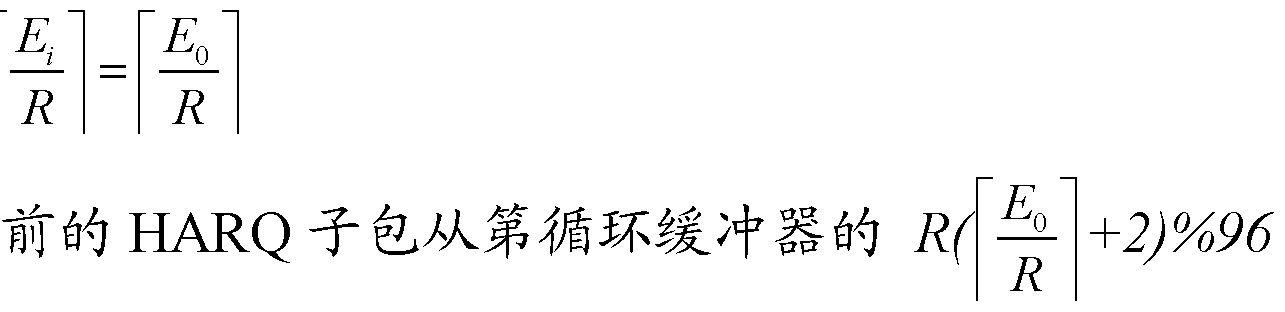
( c )从循环緩冲区中顺序读取每次 HARQ传输所需的 E个码字比特, 组成一个 HARQ子包。特别地,每次 HARQ子包的读取位置由下面过程决定: 设前面 n次 HARQ子包的长度分别为 , =0 , 1 ... ... n-1 , 首次传输或第 一次传输其索引 i=0,第二次传输 i=l , 以此类推,则当前第 n + 1次传输即 i=n 开始读取的比特位置是: K = R ((Cn + delta)%Cm (c) sequentially reading the E codeword bits required for each HARQ transmission from the circular buffer to form a HARQ sub-packet. In particular, the reading position of each HARQ sub-packet is determined by the following process: Let the length of the first n HARQ sub-packets be =0, 1 ... n-1, first transmission or first transmission Its index i=0, the second transmission i=l, and so on, then the current n+1th transmission, i=n, starts reading the bit position: K = R ((C n + delta)%C m
这里, R是虚拟緩冲器的行数(也就是子交织器的行数) ; 表示虚 拟緩冲器的总列数; ife/to是第一次传输时的偏移列数目, %表示取模运算。 因此当前的 HARQ子包从第 (Cn+ i^ 列开始读取。 Here, R is the number of rows of the virtual buffer (that is, the number of rows of the sub-interleaver); represents the total number of columns of the virtual buffer; ife/to is the number of offset columns at the time of the first transmission, and % indicates Modular operation. Therefore, the current HARQ sub-package is read from the (C n + i^ column).
其中 需进一步由下式求得:

i 「,表示向上取整运算, 表示前面 n次传输一共传输了对应着 "R 行 X C列 " 的虚拟緩冲区的列数。 i "," means rounding up, indicating that the previous n transfers have transmitted a total of the number of columns corresponding to the "R row X C column" virtual buffer.
具体地, 对于 3GPP的循环緩冲速率匹配算法, 等于 96; 第一次传 输时的偏移列数 delta取 2。 Specifically, for the 3GPP cyclic buffer rate matching algorithm, it is equal to 96; the offset column number delta of the first transmission is 2 .
所以如果当前传输是第 1次, 即首次传输, n=0 , 则可算得: So if the current transmission is the first time, that is, the first transmission, n=0, then it can be calculated as:
C。 =∑ = 0 C. =∑ = 0
R 因此当前的 HARQ子包从第循环緩冲器的 ^<¾+^%9(5位置开始读取,即 从^ = R*2位置开始读取 EQ个比特, 组成一个 HARQ子包。 R Therefore, the current HARQ sub-packets are read from the loop buffer's ^<3⁄4 + ^%9 (5 positions), that is, E Q bits are read from the ^ = R*2 position to form a HARQ sub-packet.
如果当前传输是第 2次, 前面有一次传输, 即 n=l , 则可算得: If the current transmission is the second time, there is a previous transmission, ie n=l, then it can be calculated as:
因此当 位置开始读取
£个比特, 组成一个 HARQ子包。 £ bits, forming a HARQ sub-packet.
如果当前传输是第 3次, 前面有两次传输, 即 n=2 , 则可算得:

因此当前的 HARQ子包从第循环緩冲器的 R ( +2 %9(5位置开 So the current HARQ sub-packet from the R of the circular buffer ( +2 %9 (5 position open)

始读取 E2个比特, 组成一个 HARQ子包。 如此类推。 E 2 bits are read to form a HARQ sub-packet. And so on.
当然, 本发明还可有其他多种实施例, 熟悉本领域的技术人员当可根据 本发明作出各种相应的改变和变形, 但这些相应的改变和变形都应属于本发 明所附的权利要求的保护范围。 The invention may, of course, be embodied in a variety of other embodiments, and various modifications and changes can be made thereto in accordance with the present invention. The scope of protection.
工业实用性 Industrial applicability
釆用本发明提出的基于循环緩冲器的速率匹配算法, 完全实现 Turbo码 的正交重传, 使 Turbo译码性能最优化; 而且本发明提出的速率匹配算法不 用定义冗余版本号, 可以节省信令开销。 The cyclic buffer-based rate matching algorithm proposed by the present invention completely implements orthogonal retransmission of Turbo codes to optimize Turbo decoding performance; and the rate matching algorithm proposed by the present invention does not need to define a redundancy version number. Save signaling overhead.
Claims

Applications Claiming Priority (2)
| Application Number | Priority Date | Filing Date | Title |
|---|---|---|---|
| CN2007101657523A CN101159513B (en) | 2007-10-29 | 2007-10-29 | A method for rate matching of Turbo codes and codeword bits reading |
| CN200710165752.3 | 2007-10-29 |
Publications (1)
| Publication Number | Publication Date |
|---|---|
| WO2009062425A1 true WO2009062425A1 (en) | 2009-05-22 |
Family
ID=39307454
Family Applications (1)
| Application Number | Title | Priority Date | Filing Date |
|---|---|---|---|
| PCT/CN2008/072307 Ceased WO2009062425A1 (en) | 2007-10-29 | 2008-09-09 | A method for matching turbo code rate and for reading code word bit |
Country Status (2)
| Country | Link |
|---|---|
| CN (1) | CN101159513B (en) |
| WO (1) | WO2009062425A1 (en) |
Families Citing this family (12)
| Publication number | Priority date | Publication date | Assignee | Title |
|---|---|---|---|---|
| CN101159513B (en) * | 2007-10-29 | 2012-05-23 | 中兴通讯股份有限公司 | A method for rate matching of Turbo codes and codeword bits reading |
| CN101640580B (en) * | 2008-07-31 | 2012-12-12 | 华为技术有限公司 | Method for perforating bit stream coded by Turbo and device |
| CN102611528A (en) * | 2008-07-31 | 2012-07-25 | 华为技术有限公司 | Method and device for punching bit stream after Turbo encoding |
| CN101436865B (en) * | 2008-07-31 | 2012-01-04 | 华为技术有限公司 | Method and device for punching turbo-encoded bit stream |
| CN101547064B (en) * | 2009-05-06 | 2011-11-09 | 普天信息技术研究院有限公司 | Interleaving and rate matching and de-interleaving and rate de-matching methods |
| AU2014383811B2 (en) | 2014-02-21 | 2017-09-28 | Huawei Technologies Co., Ltd. | Rate matching method and apparatus for polar code |
| CN105874736B (en) | 2014-03-19 | 2020-02-14 | 华为技术有限公司 | Polar code rate matching method and rate matching device |
| RU2685034C2 (en) * | 2014-12-22 | 2019-04-16 | Хуавэй Текнолоджиз Ко., Лтд. | Encoding device and encoding method with polar code |
| CN107786300B (en) * | 2016-08-26 | 2022-06-14 | 中兴通讯股份有限公司 | Data sending method and device |
| CN109257137B (en) * | 2017-07-12 | 2021-03-05 | 普天信息技术有限公司 | Method and device for selecting redundancy version during data transmission |
| CN110557220B (en) * | 2018-05-30 | 2023-06-27 | 上海矽久微电子有限公司 | Physical layer channel coding and decoding method |
| CN112290956B (en) * | 2020-10-19 | 2024-12-10 | 南京宁麒智能计算芯片研究院有限公司 | A CTC encoder and encoding method based on pipeline structure |
Citations (4)
| Publication number | Priority date | Publication date | Assignee | Title |
|---|---|---|---|---|
| CA2277239A1 (en) * | 1999-07-08 | 2001-01-08 | Wen Tong | Puncturing of convolutional codes |
| CN1461120A (en) * | 2003-06-06 | 2003-12-10 | 上海华龙信息技术开发中心 | Rate matching device for CDMA communication system |
| CN101060338A (en) * | 2007-06-18 | 2007-10-24 | 中兴通讯股份有限公司 | A convolutional code rate matching method and device |
| CN101159513A (en) * | 2007-10-29 | 2008-04-09 | 中兴通讯股份有限公司 | A method for rate matching of Turbo codes and codeword bits reading |
Family Cites Families (2)
| Publication number | Priority date | Publication date | Assignee | Title |
|---|---|---|---|---|
| KR100834655B1 (en) * | 2002-01-26 | 2008-06-02 | 삼성전자주식회사 | Apparatus and method for data transmission / reception using bit / symbol reliability in code division multiple access mobile communication system |
| CN100571046C (en) * | 2006-04-20 | 2009-12-16 | 北京信威通信技术股份有限公司 | A Device and Method for Realizing Turbo Coding and Decoding Scheme in SCDMA System |
-
2007
- 2007-10-29 CN CN2007101657523A patent/CN101159513B/en not_active Expired - Fee Related
-
2008
- 2008-09-09 WO PCT/CN2008/072307 patent/WO2009062425A1/en not_active Ceased
Patent Citations (4)
| Publication number | Priority date | Publication date | Assignee | Title |
|---|---|---|---|---|
| CA2277239A1 (en) * | 1999-07-08 | 2001-01-08 | Wen Tong | Puncturing of convolutional codes |
| CN1461120A (en) * | 2003-06-06 | 2003-12-10 | 上海华龙信息技术开发中心 | Rate matching device for CDMA communication system |
| CN101060338A (en) * | 2007-06-18 | 2007-10-24 | 中兴通讯股份有限公司 | A convolutional code rate matching method and device |
| CN101159513A (en) * | 2007-10-29 | 2008-04-09 | 中兴通讯股份有限公司 | A method for rate matching of Turbo codes and codeword bits reading |
Also Published As
| Publication number | Publication date |
|---|---|
| CN101159513A (en) | 2008-04-09 |
| CN101159513B (en) | 2012-05-23 |
Similar Documents
| Publication | Publication Date | Title |
|---|---|---|
| CN101159513B (en) | A method for rate matching of Turbo codes and codeword bits reading | |
| US7260770B2 (en) | Block puncturing for turbo code based incremental redundancy | |
| JP3701263B2 (en) | Data transmission / reception apparatus and method in CDMA mobile communication system | |
| CN101183875B (en) | Velocity matching method for limited longness circulation caching of Turbo code | |
| JP3476807B2 (en) | Apparatus and method for transmitting data in data communication system using combined retransmission scheme | |
| CN101119182B (en) | Bit priority selection method of high-order modulation | |
| US7000173B2 (en) | Turbo code based incremental redundancy | |
| WO2013135022A1 (en) | Data sending method and device based on finite length circular buffer rate matching | |
| CN101217352B (en) | A buffering setting method of phase rate matching | |
| CN101867443B (en) | Rate matching method and device | |
| CN102037671A (en) | Selection of retransmission settings for HARQ in WCDMA and LTE networks | |
| US6973611B2 (en) | Interleaved coder and method | |
| JP2004512740A (en) | Method and apparatus for transmitting packet data in a mobile communication system | |
| WO2008024541A2 (en) | Method and apparatus for generating a punctured symbol vector for a given information vector | |
| WO2008153353A1 (en) | Method for sub -packet generation with adaptive bit index | |
| CN101741527A (en) | Rate adaption method and device | |
| CN101442383A (en) | Bit priority mapping method for high-step modulation | |
| Mantha et al. | A capacity-approaching hybrid ARQ scheme using turbo codes | |
| CN101330351B (en) | Method for mapping bit with priority based on circulation caching speed matching | |
| WO2008149216A2 (en) | Computationally efficient convolutional coding with rate-matching | |
| CN102035617B (en) | Channel coding rate matching method and device in communication system | |
| Zhou et al. | Optimum sub-packet transmission for turbo-coded hybrid ARQ systems | |
| CN102075285B (en) | Rate matching method and device | |
| CN101567748A (en) | Convolutional/topological code encoder and encoding method thereof |
Legal Events
| Date | Code | Title | Description |
|---|---|---|---|
| 121 | Ep: the epo has been informed by wipo that ep was designated in this application |
Ref document number: 08800819 Country of ref document: EP Kind code of ref document: A1 |
|
| NENP | Non-entry into the national phase |
Ref country code: DE |
|
| 122 | Ep: pct application non-entry in european phase |
Ref document number: 08800819 Country of ref document: EP Kind code of ref document: A1 |