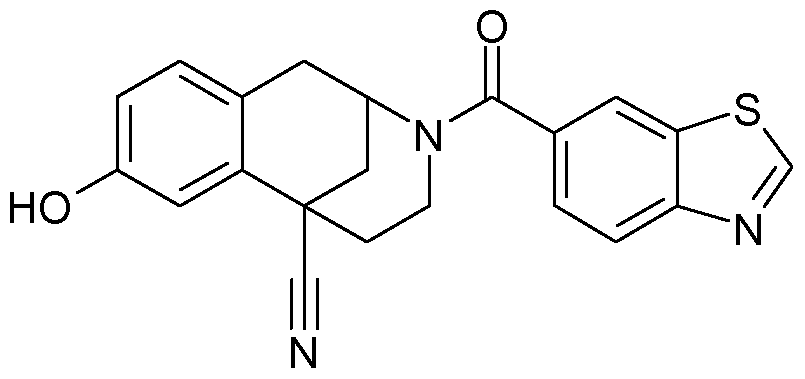
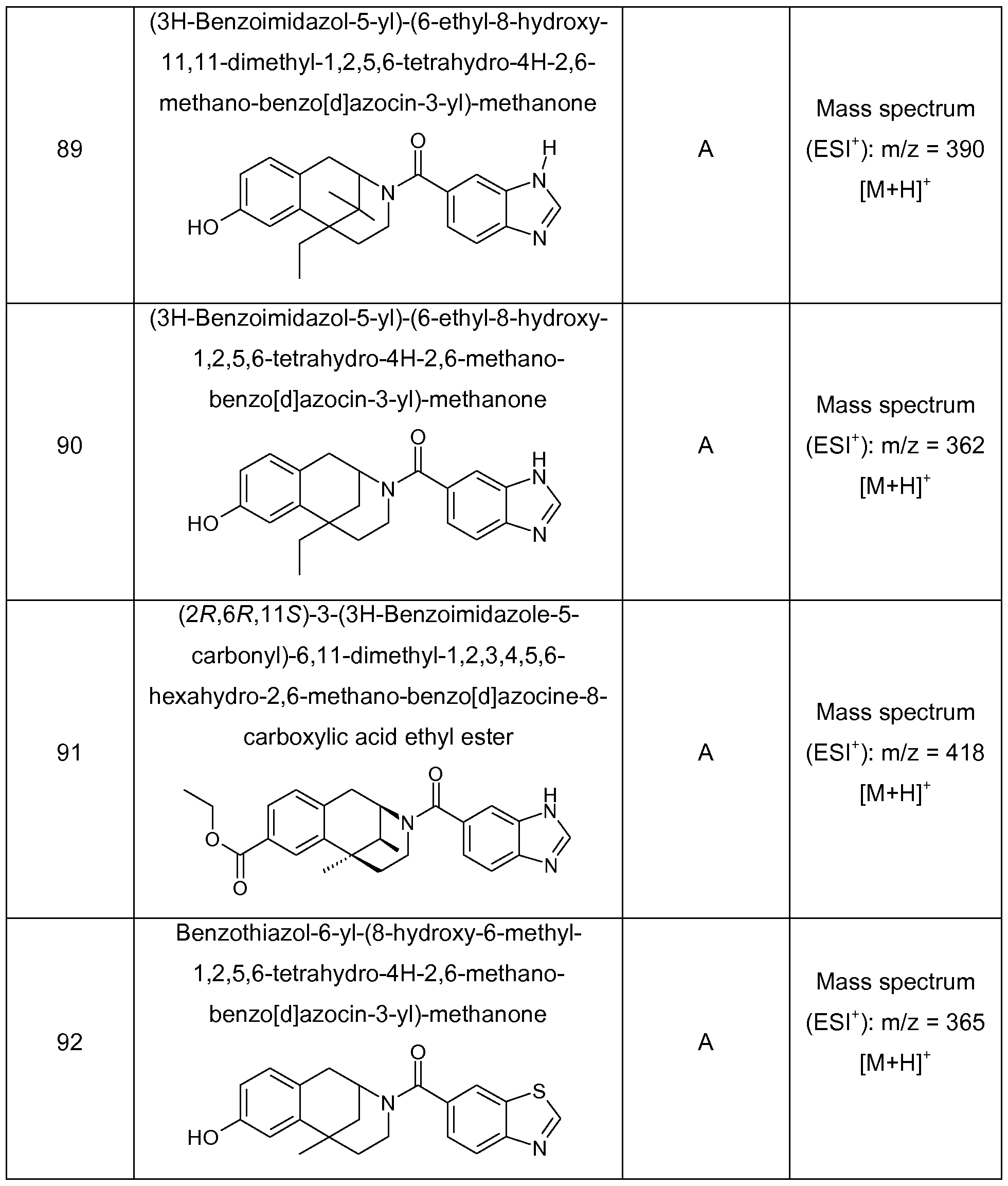
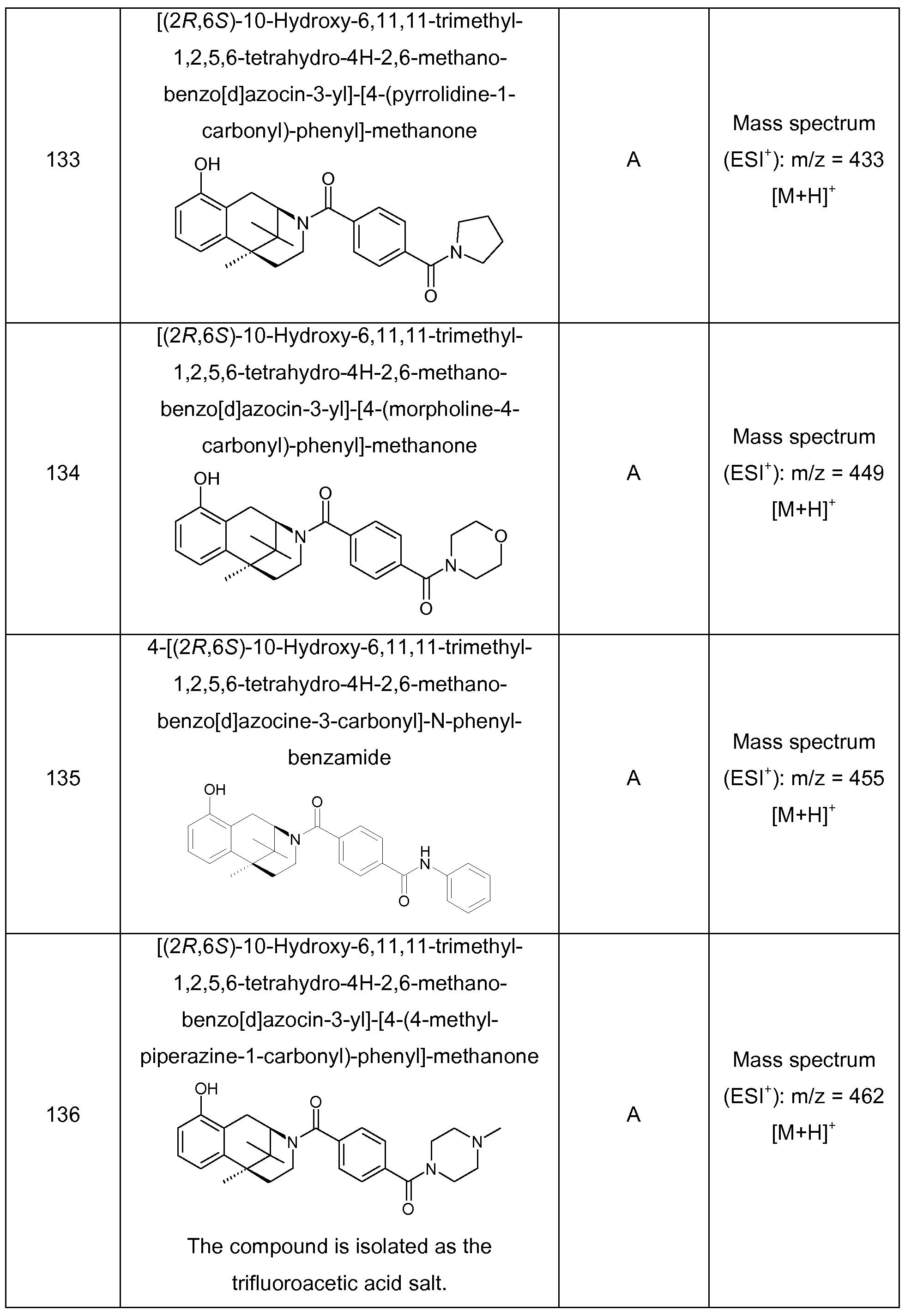
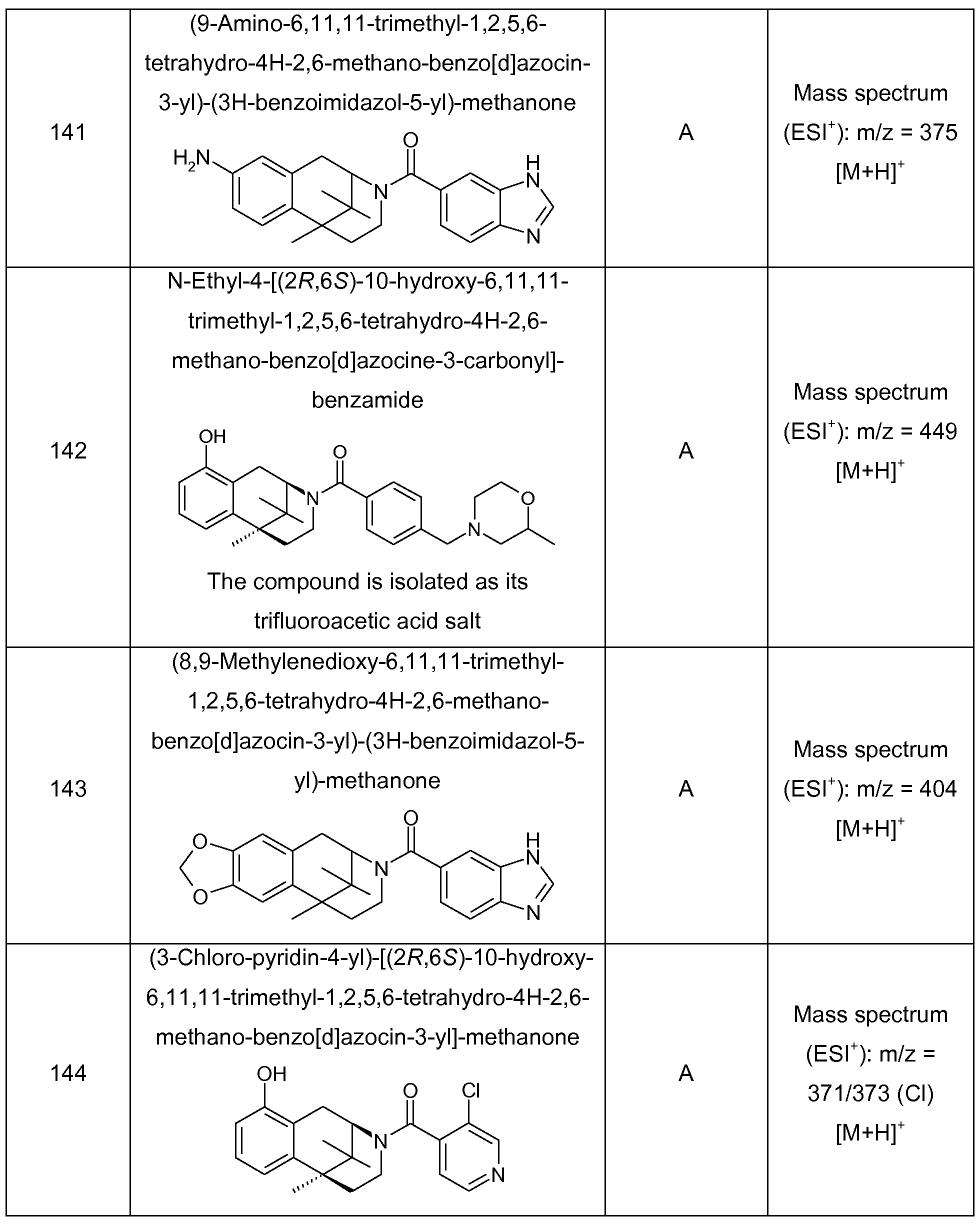
WO2009063061A2 - Aryl- and heteroarylcarbonyl derivatives of benzomorphanes and related scaffolds, medicaments containing such compounds and their use - Google Patents

Aryl- and heteroarylcarbonyl derivatives of benzomorphanes and related scaffolds, medicaments containing such compounds and their use Download PDF

Info

Publication number
WO2009063061A2
WO2009063061A2 PCT/EP2008/065577 EP2008065577W WO2009063061A2 WO 2009063061 A2 WO2009063061 A2 WO 2009063061A2 EP 2008065577 W EP2008065577 W EP 2008065577W WO 2009063061 A2 WO2009063061 A2 WO 2009063061A2
Authority
WO
WIPO (PCT)
Prior art keywords
alkyl
alkyloxy
oxo
carbonyl
piperazin
Prior art date
Legal status (The legal status is an assumption and is not a legal conclusion. Google has not performed a legal analysis and makes no representation as to the accuracy of the status listed.)
Ceased
Application number
PCT/EP2008/065577
Other languages
French (fr)
Other versions
WO2009063061A3 (en
Inventor
Frank Himmelsbach
Matthias Eckhardt
Bradford S. Hamilton
Armin Heckel
Joerg Kley
Thorsten Lehmann-Lintz
Herbert Nar
Stefan Peters
Annette Schuler-Metz
Matthias Zentgraf
Current Assignee (The listed assignees may be inaccurate. Google has not performed a legal analysis and makes no representation or warranty as to the accuracy of the list.)
Boehringer Ingelheim International GmbH
Original Assignee
Boehringer Ingelheim International GmbH
Priority date (The priority date is an assumption and is not a legal conclusion. Google has not performed a legal analysis and makes no representation as to the accuracy of the date listed.)
Filing date
Publication date
Application filed by Boehringer Ingelheim International GmbH filed Critical Boehringer Ingelheim International GmbH
Priority to EP08850194.5A priority Critical patent/EP2220048B1/en
Priority to US12/742,680 priority patent/US8859580B2/en
Priority to JP2010533594A priority patent/JP5769970B2/en
Priority to CA2704628A priority patent/CA2704628C/en
Publication of WO2009063061A2 publication Critical patent/WO2009063061A2/en
Publication of WO2009063061A3 publication Critical patent/WO2009063061A3/en
Anticipated expiration legal-status Critical
Ceased legal-status Critical Current

Links

Classifications

    • CCHEMISTRY; METALLURGY
    • C07ORGANIC CHEMISTRY
    • C07DHETEROCYCLIC COMPOUNDS
    • C07D221/00Heterocyclic compounds containing six-membered rings having one nitrogen atom as the only ring hetero atom, not provided for by groups C07D211/00 - C07D219/00
    • C07D221/02Heterocyclic compounds containing six-membered rings having one nitrogen atom as the only ring hetero atom, not provided for by groups C07D211/00 - C07D219/00 condensed with carbocyclic rings or ring systems
    • C07D221/22Bridged ring systems
    • C07D221/26Benzomorphans
    • AHUMAN NECESSITIES
    • A61MEDICAL OR VETERINARY SCIENCE; HYGIENE
    • A61PSPECIFIC THERAPEUTIC ACTIVITY OF CHEMICAL COMPOUNDS OR MEDICINAL PREPARATIONS
    • A61P3/00Drugs for disorders of the metabolism
    • AHUMAN NECESSITIES
    • A61MEDICAL OR VETERINARY SCIENCE; HYGIENE
    • A61PSPECIFIC THERAPEUTIC ACTIVITY OF CHEMICAL COMPOUNDS OR MEDICINAL PREPARATIONS
    • A61P3/00Drugs for disorders of the metabolism
    • A61P3/04Anorexiants; Antiobesity agents
    • AHUMAN NECESSITIES
    • A61MEDICAL OR VETERINARY SCIENCE; HYGIENE
    • A61PSPECIFIC THERAPEUTIC ACTIVITY OF CHEMICAL COMPOUNDS OR MEDICINAL PREPARATIONS
    • A61P3/00Drugs for disorders of the metabolism
    • A61P3/06Antihyperlipidemics
    • AHUMAN NECESSITIES
    • A61MEDICAL OR VETERINARY SCIENCE; HYGIENE
    • A61PSPECIFIC THERAPEUTIC ACTIVITY OF CHEMICAL COMPOUNDS OR MEDICINAL PREPARATIONS
    • A61P3/00Drugs for disorders of the metabolism
    • A61P3/08Drugs for disorders of the metabolism for glucose homeostasis
    • A61P3/10Drugs for disorders of the metabolism for glucose homeostasis for hyperglycaemia, e.g. antidiabetics
    • AHUMAN NECESSITIES
    • A61MEDICAL OR VETERINARY SCIENCE; HYGIENE
    • A61PSPECIFIC THERAPEUTIC ACTIVITY OF CHEMICAL COMPOUNDS OR MEDICINAL PREPARATIONS
    • A61P43/00Drugs for specific purposes, not provided for in groups A61P1/00-A61P41/00
    • CCHEMISTRY; METALLURGY
    • C07ORGANIC CHEMISTRY
    • C07DHETEROCYCLIC COMPOUNDS
    • C07D401/00Heterocyclic compounds containing two or more hetero rings, having nitrogen atoms as the only ring hetero atoms, at least one ring being a six-membered ring with only one nitrogen atom
    • C07D401/02Heterocyclic compounds containing two or more hetero rings, having nitrogen atoms as the only ring hetero atoms, at least one ring being a six-membered ring with only one nitrogen atom containing two hetero rings
    • C07D401/06Heterocyclic compounds containing two or more hetero rings, having nitrogen atoms as the only ring hetero atoms, at least one ring being a six-membered ring with only one nitrogen atom containing two hetero rings linked by a carbon chain containing only aliphatic carbon atoms
    • CCHEMISTRY; METALLURGY
    • C07ORGANIC CHEMISTRY
    • C07DHETEROCYCLIC COMPOUNDS
    • C07D401/00Heterocyclic compounds containing two or more hetero rings, having nitrogen atoms as the only ring hetero atoms, at least one ring being a six-membered ring with only one nitrogen atom
    • C07D401/14Heterocyclic compounds containing two or more hetero rings, having nitrogen atoms as the only ring hetero atoms, at least one ring being a six-membered ring with only one nitrogen atom containing three or more hetero rings
    • CCHEMISTRY; METALLURGY
    • C07ORGANIC CHEMISTRY
    • C07DHETEROCYCLIC COMPOUNDS
    • C07D403/00Heterocyclic compounds containing two or more hetero rings, having nitrogen atoms as the only ring hetero atoms, not provided for by group C07D401/00
    • C07D403/02Heterocyclic compounds containing two or more hetero rings, having nitrogen atoms as the only ring hetero atoms, not provided for by group C07D401/00 containing two hetero rings
    • C07D403/06Heterocyclic compounds containing two or more hetero rings, having nitrogen atoms as the only ring hetero atoms, not provided for by group C07D401/00 containing two hetero rings linked by a carbon chain containing only aliphatic carbon atoms
    • CCHEMISTRY; METALLURGY
    • C07ORGANIC CHEMISTRY
    • C07DHETEROCYCLIC COMPOUNDS
    • C07D405/00Heterocyclic compounds containing both one or more hetero rings having oxygen atoms as the only ring hetero atoms, and one or more rings having nitrogen as the only ring hetero atom
    • C07D405/02Heterocyclic compounds containing both one or more hetero rings having oxygen atoms as the only ring hetero atoms, and one or more rings having nitrogen as the only ring hetero atom containing two hetero rings
    • C07D405/06Heterocyclic compounds containing both one or more hetero rings having oxygen atoms as the only ring hetero atoms, and one or more rings having nitrogen as the only ring hetero atom containing two hetero rings linked by a carbon chain containing only aliphatic carbon atoms
    • CCHEMISTRY; METALLURGY
    • C07ORGANIC CHEMISTRY
    • C07DHETEROCYCLIC COMPOUNDS
    • C07D413/00Heterocyclic compounds containing two or more hetero rings, at least one ring having nitrogen and oxygen atoms as the only ring hetero atoms
    • C07D413/02Heterocyclic compounds containing two or more hetero rings, at least one ring having nitrogen and oxygen atoms as the only ring hetero atoms containing two hetero rings
    • C07D413/06Heterocyclic compounds containing two or more hetero rings, at least one ring having nitrogen and oxygen atoms as the only ring hetero atoms containing two hetero rings linked by a carbon chain containing only aliphatic carbon atoms
    • CCHEMISTRY; METALLURGY
    • C07ORGANIC CHEMISTRY
    • C07DHETEROCYCLIC COMPOUNDS
    • C07D413/00Heterocyclic compounds containing two or more hetero rings, at least one ring having nitrogen and oxygen atoms as the only ring hetero atoms
    • C07D413/14Heterocyclic compounds containing two or more hetero rings, at least one ring having nitrogen and oxygen atoms as the only ring hetero atoms containing three or more hetero rings
    • CCHEMISTRY; METALLURGY
    • C07ORGANIC CHEMISTRY
    • C07DHETEROCYCLIC COMPOUNDS
    • C07D417/00Heterocyclic compounds containing two or more hetero rings, at least one ring having nitrogen and sulfur atoms as the only ring hetero atoms, not provided for by group C07D415/00
    • C07D417/02Heterocyclic compounds containing two or more hetero rings, at least one ring having nitrogen and sulfur atoms as the only ring hetero atoms, not provided for by group C07D415/00 containing two hetero rings
    • C07D417/06Heterocyclic compounds containing two or more hetero rings, at least one ring having nitrogen and sulfur atoms as the only ring hetero atoms, not provided for by group C07D415/00 containing two hetero rings linked by a carbon chain containing only aliphatic carbon atoms
    • CCHEMISTRY; METALLURGY
    • C07ORGANIC CHEMISTRY
    • C07DHETEROCYCLIC COMPOUNDS
    • C07D451/00Heterocyclic compounds containing 8-azabicyclo [3.2.1] octane, 9-azabicyclo [3.3.1] nonane, or 3-oxa-9-azatricyclo [3.3.1.0<2,4>] nonane ring systems, e.g. tropane or granatane alkaloids, scopolamine; Cyclic acetals thereof
    • C07D451/02Heterocyclic compounds containing 8-azabicyclo [3.2.1] octane, 9-azabicyclo [3.3.1] nonane, or 3-oxa-9-azatricyclo [3.3.1.0<2,4>] nonane ring systems, e.g. tropane or granatane alkaloids, scopolamine; Cyclic acetals thereof containing not further condensed 8-azabicyclo [3.2.1] octane or 3-oxa-9-azatricyclo [3.3.1.0<2,4>] nonane ring systems, e.g. tropane; Cyclic acetals thereof
    • C07D451/04Heterocyclic compounds containing 8-azabicyclo [3.2.1] octane, 9-azabicyclo [3.3.1] nonane, or 3-oxa-9-azatricyclo [3.3.1.0<2,4>] nonane ring systems, e.g. tropane or granatane alkaloids, scopolamine; Cyclic acetals thereof containing not further condensed 8-azabicyclo [3.2.1] octane or 3-oxa-9-azatricyclo [3.3.1.0<2,4>] nonane ring systems, e.g. tropane; Cyclic acetals thereof with hetero atoms directly attached in position 3 of the 8-azabicyclo [3.2.1] octane or in position 7 of the 3-oxa-9-azatricyclo [3.3.1.0<2,4>] nonane ring system
    • C07D451/06Oxygen atoms
    • CCHEMISTRY; METALLURGY
    • C07ORGANIC CHEMISTRY
    • C07DHETEROCYCLIC COMPOUNDS
    • C07D471/00Heterocyclic compounds containing nitrogen atoms as the only ring hetero atoms in the condensed system, at least one ring being a six-membered ring with one nitrogen atom, not provided for by groups C07D451/00 - C07D463/00
    • C07D471/02Heterocyclic compounds containing nitrogen atoms as the only ring hetero atoms in the condensed system, at least one ring being a six-membered ring with one nitrogen atom, not provided for by groups C07D451/00 - C07D463/00 in which the condensed system contains two hetero rings
    • C07D471/08Bridged systems
    • CCHEMISTRY; METALLURGY
    • C07ORGANIC CHEMISTRY
    • C07DHETEROCYCLIC COMPOUNDS
    • C07D498/00Heterocyclic compounds containing in the condensed system at least one hetero ring having nitrogen and oxygen atoms as the only ring hetero atoms
    • C07D498/02Heterocyclic compounds containing in the condensed system at least one hetero ring having nitrogen and oxygen atoms as the only ring hetero atoms in which the condensed system contains two hetero rings
    • C07D498/08Bridged systems

Definitions

  • the present invention relates to compounds derived from the following chemical scaffold which is structurally defined by the formula I
  • the invention further relates to pharmaceutical compositions containing a compound of formula I according to the invention as well as the use of a compound according to the invention for preparing a pharmaceutical composition for the treatment of metabolic disorders.
  • the invention relates to processes for preparing a pharmaceutical composition as well as a compound according to the invention.
  • HSD hydroxysteroid dehydrogenase
  • R 1 , R 2 , Q', and Z are as described therein.
  • R 1 , R 2 , R 3 , and R 5 are as defined therein and R 4 is 2-methoxymethylfuran-3-yl or 3- methoxymethylfuran-2-yl, are described as intermediates for the preparation of the corresponding N-furanylmethyl-benzomorphanes.
  • R, R 1 , R 2 , R 3 , and Y are as defined therein, are described as intermediates for the preparation of benzomorphanes that may be useful as analgesics and antitussives.
  • R', R 1 , and Z are principally described as possible intermediates for the preparation of benzomorphanes that may have valuable therapeutic properties.
  • R 1 , R 2 , R 4 , and Z are described as principle intermediates for the preparation of benzomorphanes that may have analgetic activity.
  • R, R 1 , R 2 , X, and Y are as defined therein, that may be useful as anti-inflammatory and analgesic agents, are described.
  • the aim of the present invention is to find new benzomorphanes or related compounds, particularly those which are active with regard to the enzyme 1 1 ⁇ -hydroxysteroid dehydrogenase (HSD) 1.
  • a further aim of the present invention is to discover benzomorphanes or related compounds which have an inhibitory effect on the enzyme 1 1 ⁇ - hydroxysteroid dehydrogenase (HSD) 1 in vitro and/or in vivo and possess suitable pharmacological and pharmacokinetic properties to use them as medicaments.
  • a further aim of the present invention is to provide new pharmaceutical compositions which are suitable for the prevention and/or treatment of metabolic disorders, particularly diabetes and dyslipidemia.
  • Other aims of the present invention will become apparent to the skilled man directly from the foregoing and following remarks.
  • R 1 denotes aryl or heteroaryl
  • aryl is meant phenyl or naphthyl
  • heteroaryl by heteroaryl is meant pyrrolyl, furanyl, thienyl, pyridyl, indolyl, benzofuranyl, benzothiophenyl, quinolinyl, isoquinolinyl, or
  • indolyl benzofuranyl, benzothiophenyl, quinolinyl, or isoquinolinyl, wherein 1 to 3 CH are replaced by N, or
  • aryl or heteroaryl rings are optionally substituted with one R 4 , one to four identical or different R 5 , and one R 6 , and all heteroaryl rings are attached to the carbonyl group via a carbon atom,
  • a pyrrolo, furo, thieno, pyridazino, pyrimido or pyrazino ring optionally substituted with two substituents selected from R 7 , R 8 and R 9 ,
  • a 1 ,2,3-triazolo ring optionally substituted with d- 4 -alkyl or with phenyl that is optionally additionally substituted with one to three R 10 ,
  • R 4 denotes fluorine, chlorine, bromine, iodine
  • aminosulfonyl d- 3 -alkyl-aminosulfonyl, di-(Ci- 3 -alkyl)-aminosulfonyl, pyrrolidin-1 -yl- sulfonyl, piperidin-1 -yl-sulfonyl, morpholin-4-yl-sulfonyl, piperazin-1-yl-sulfonyl, 4-(Ci -3 - alkyl)-piperazin-1 -yl-sulfonyl,
  • azetidin-1-yl, pyrrolidin-1-yl and piperidin-1-yl moieties are optionally substituted with one or two groups selected from methyl, ethyl, methoxymethyl, hydroxy or methoxy, and,
  • (het)aryl is phenyl, naphthyl, pyrrolyl, furanyl, thienyl, tetrazolyl, pyridyl, indolyl, benzofuranyl, benzothiophenyl, quinolinyl, isoquinolinyl, or
  • R 5 and R 6 which may be identical or different, denote halogen, d- 3 -alkyl, C 2 - 3 -alkynyl, trifluormethyl, hydroxy, Ci -3 -alkyloxy, cyano, or R 5 together with R 6 , if bound to adjacent carbon atoms, may additionally be methylenedioxy, difluoromethylenedioxy, ethylenedioxy, C 3-5 -alkylene, or
  • R 5 together with R 6 may form together with the carbon atoms to which they are attached, a pyrazolo, imidazo, oxazolo, thiazolo, isoxazolo, or isothiazolo ring, that optionally are substituted with d-3-alkyl, trifluoromethyl, amino, Ci -3 - alkylamino, di-(Ci -3 -alkyl)amino, hydroxy, Ci -3 -alkyloxy,
  • R 7 denotes fluorine, chlorine, bromine, iodine
  • Ci -4 -alkyloxy-Ci -4 -alkyloxy Ci -4 -alkylsulfanyl-Ci -4 -alkyloxy, Ci -4 - alkylsulfinyl-Ci -4 -alkyloxy, Ci -4 -alkylsulfonyl-Ci -4 -alkyloxy, amino-Ci -4 -alkyloxy, Ci -4 - alkylamino-Ci -4 -alkyloxy, di-(Ci -4 -alkyl)-amino-Ci -4 -alkyloxy, pyrrolidin-1 -yl-Ci -4 -alkyloxy,
  • aminosulfonyl d- 4 -alkyl-aminosulfonyl, di-(Ci. 4 -alkyl)-aminosulfonyl, pyrrolidin-1-yl- sulfonyl, piperidin-1-yl-sulfonyl, morpholin-4-yl-sulfonyl, piperazin-1-yl-sulfonyl, 4-(Ci -4 - alkyl)-piperazin-1 -yl-sulfonyl,
  • R 8 and R 9 which may be identical or different, are halogen, d- 3 -alkyl, trifluormethyl, hydroxy, d- 3 -alkyloxy, cyano, or R 8 together with R 9 , if bound to adjacent carbon atoms, may additionally be methylenedioxy, difluoromethylenedioxy, ethylenedioxy, C 3-5 -alkylene, or
  • R 8 together with R 9 may also form together with the carbon atoms to which they are attached, a benzo, pyrido, pyrimido, pyrazino, pyridazino, pyrazolo, imidazo, triazolo, oxazolo, thiazolo, isoxazolo, or isothiazolo ring, that all optionally are substituted with one L and/or one or two substituents independently selected from halogen, Ci -3 -alkyl, trifluoromethyl, amino, Ci -3 -alkylamino, di-(Ci -3 -alkyl)amino, hydroxy, Ci -3 - alkyloxy,
  • L is L 1 or L 2 and L 1 denotes halogen, Ci -6 -alkyl, hydroxy-Ci -4 -alkyl, Ci -3 -alkyloxy-Ci -3 -alkyl, C 3- 6 -cycloalkyl, hydroxy-C 4-6 -cycloalkyl, d-s-alkyloxy-Cs-e-cycloalkyl, azetidinyl, 1-(Ci -3 -alkyl)- azetidinyl, 1-(Ci -3 -alkylcarbonyl)-azetidinyl, pyrrolidinyl, 1-(Ci -3 -alkyl)-pyrrolidinyl, 1 -(Ci -3 - alkylcarbonyl)-pyrrolidinyl, piperidinyl, 1-(Ci -3 -alkyl)-piperidinyl, 1-(Ci -3 -alkylcarbonyl)-
  • L 2 denotes phenyl
  • each of the groups mentioned hereinbefore under L 2 is optionally substituted with one or two groups independently selected from fluorine, chlorine, Ci -3 -alkyl, difluoromethyl, trifluoromethyl, cyano, amino, acetylamino, methylsulfonylamino, carboxy, Ci -4 -alkyl- oxycarbonyl, aminocarbonyl, Ci -3 -alkylaminocarbonyl, di-(Ci -3 -alkyl)-aminocarbonyl, hydroxy, Ci -3 -alkyloxy, difluoromethoxy, and trifluoromethoxy,
  • R 10 is R 10' or R 10" and R 10 denotes halogen, d- 3 -alkyl, difluoromethyl, trifluoromethyl, cyano, nitro, amino, acetylamino, methylsulfonylamino, carboxy, Ci -4 -alkyloxycarbonyl, aminocarbonyl, Ci- 3 -alkylaminocarbonyl, di-(Ci- 3 -alkyl)-aminocarbonyl, aminosulfonyl, methylsulfanyl, methylsulfinyl, methylsulfonyl, hydroxy, C- ⁇ -3-alkyloxy, difluoromethoxy, or trifluoromethoxy,
  • R 10 denotes pyrrolyl, furanyl, thienyl, pyridyl, wherein in any of these groups 1 or 2 CH optionally are replaced by N atoms, or
  • indolyl benzofuranyl, benzothiophenyl, quinolinyl, isoquinolinyl, wherein in any of these groups 1 to 3 CH optionally are replaced by N atoms, or
  • any of the groups mentioned hereinbefore under R 10" optionally are substituted independently with one or two groups selected from halogen, d- 3 -alkyl, difluoromethyl, trifluoromethyl, cyano, nitro, amino, acetylamino, methylsulfonylamino, carboxy, Ci -4 -alkyl- oxycarbonyl, aminocarbonyl, Ci -3 -alkylaminocarbonyl, di-(Ci -3 -alkyl)-aminocarbonyl, aminosulfonyl, methylsulfanyl, methylsulfinyl, methylsulfonyl, hydroxy, Ci -3 -alkyloxy, difluoromethoxy, and trifluoromethoxy,
  • X denotes CH or N
  • n, o denote 0, 1 or 2
  • R 11 denotes fluorine, Ci -4 -alkyl, (het)aryl, hydroxy, Ci -4 -alkyloxy, cyano, carboxy, Ci -4 -alkyloxycarbonyl, aminocarbonyl, Ci -4 -alkylamino-carbonyl, di-(Ci -4 -alkyl)- aminocarbonyl, hydroxy-Ci -4 -alkyl or Ci -3 -alkyloxy-Ci -4 -alkyl, wherein (het)aryl is as described hereinbefore,
  • R 12 denotes fluorine or Ci -4 -alkyl
  • R 13 and R 14 which may be identical or different, denote Ci -4 -alkyl
  • alkyl or alkylene moieties are branched or unbranched
  • R is any substituent
  • M 1 is d- 4 -alkyl
  • M 2 and M 3 independently of each other are hydrogen or Ci -4 -alkyl
  • M 4 is hydrogen or hydroxy
  • M 5 is hydrogen or hydroxy
  • M 6 denotes phenyl, which may be substituted with one to three substituents selected from the group consisting of halogen, hydroxy, alkyl, nitro, cyano, trifluoromethyl, methoxy, naphthyl or biphenylyl, which may be substituted with one to three substituents selected from the group consisting of halogen, alkyl, nitro, cyano, trifluoromethyl, methoxy, pyridyl, which may be substituted with halogen, alkyl, nitro, cyano, trifluoromethyl, methoxy, and NR'R", where R' and R" are each independently hydrogen or alkyl, or form together with the nitrogen atom a 3- to 7-membered alicyclic ring optionally having a double bond, quinolinyl, isoquinolinyl, 4-cyclohexylphenyl, 4-oxo-4H-chromenyl, indolyl, benzothiophenyl,
  • M 1 is d- 4 -alkyl
  • M 2 is hydrogen or Ci -4 -alkyl
  • M 6 denotes 2-acetoxy-phenyl, 2-ethylamino-phenyl, 2-phenylamino-phenyl, 2-(2,3-dimethyl- phenylamino)-phenyl, 2-(3-methylsulfanylphenylamino)-phenyl, or pyridyl
  • R is hydrogen, Ci -6 -alkyl
  • M 1 is hydrogen or d- 4 -alkyl
  • M 4 is hydrogen or hydroxy
  • M 6 is phenyl, methylphenyl, or methoxyphenyl
  • the compounds of general formula I according to the invention and the physiologically acceptable salts thereof have valuable pharmacological properties, particularly an inhibitory effect on the enzyme 11 ⁇ -hydroxysteroid dehydrogenase (HSD) 1.
  • HSD ⁇ -hydroxysteroid dehydrogenase
  • the first aspect of the invention also relates to the physiologically acceptable salts of the compounds of general formula I with inorganic or organic acids, except for the salts of the compounds comprised by the formulae 11.1 to II.8.
  • this invention relates to pharmaceutical compositions, containing at least one compound of general formula I, except for the compounds comprised by the formulae 11.1 to II.8, or a physiologically acceptable salt according to the invention, optionally together with one or more inert carriers and/or diluents.
  • this invention relates to the compounds according to general formula I, including the compounds comprised by the formulae 11.1 to II.8, or the physiologically acceptable salts thereof, for treatment or prevention of diseases or conditions which can be influenced by inhibiting the enzyme 1 1 ⁇ -hydroxysteroid dehydrogenase (HSD) 1 , such as metabolic disorders.
  • HSD ⁇ -hydroxysteroid dehydrogenase
  • this invention relates to the use of at least one compound according to general formula I, including the compounds comprised by the formulae 11.1 to II.8, or one of the physiologically acceptable salts thereof for preparing a pharmaceutical composition which is suitable for the treatment or prevention of diseases or conditions which can be influenced by inhibiting the enzyme 1 1 ⁇ -hydroxysteroid dehydrogenase (HSD) 1 , such as metabolic disorders.
  • HSD ⁇ -hydroxysteroid dehydrogenase
  • the invention relates to a process for preparing a pharmaceutical composition according to the invention, characterized in that a compound of general formula I, except for the compounds comprised by the formulae 11.1 to II.8, or one of the physiologically acceptable salts thereof is incorporated in one or more inert carriers and/or diluents by a non-chemical method.
  • the present invention relates to a process for preparing the compounds of general formula I, except for the compounds comprised by the formulae 11.1 to II.8, characterized in that in order to prepare compounds of general formula I which are defined as hereinbefore and hereinafter,
  • R 1 -CO-Y is reacted with R 1 -CO-Y, optionally prepared in situ from the corresponding carboxylic acid, wherein
  • Y is a leaving group and in particular
  • alkyl, alkenyl, and alkynyl groups mentioned in the definition of the above groups may be mono- or polysubstituted with fluorine, chlorine, Ci -3 -alkyl, or Ci -3 -alkoxy,
  • aryl groups mentioned in the definition of the above groups denote phenyl or naphthyl groups and the heteroaryl groups mentioned in the definition of the above groups, either alone or as part of another group, denote pyridinyl, pyrimidinyl, triazinyl, imidazolyl, pyrazolyl, triazolyl, tetrazolyl, whilst both the aryl and heteroaryl groups optionally are independently mono or polysubstituted with fluorine, chlorine, bromine, Ci -3 -alkyl, Ci -3 -alkyloxy, nitro, cyano, or di-(Ci -3 -alkyl)amino groups, and R 1 is defined as hereinbefore and hereinafter,
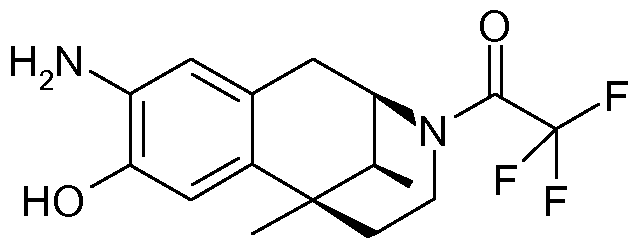
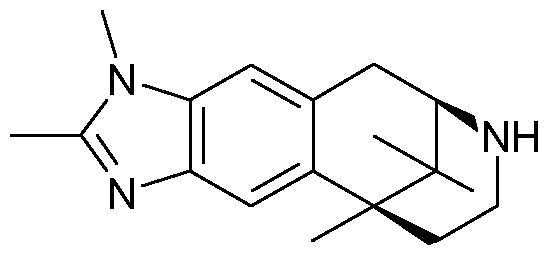
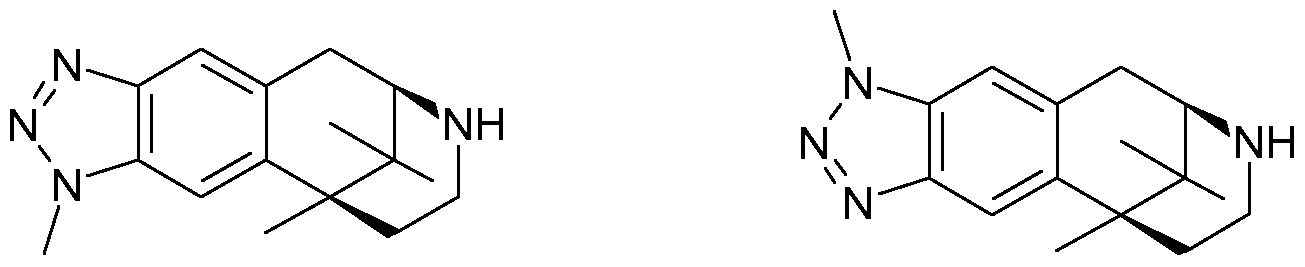
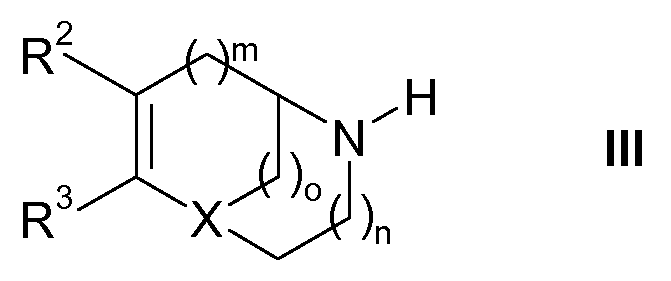
  • the present invention relates to novel compounds of formulae Ilia to INg, representing subgeneric structures of formula III, including their tautomers, their stereoisomers, and the salts thereof, which are suitable as intermediates in the synthesis of compounds of formula I, characterised by
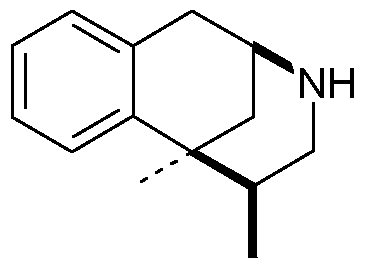
  • bicyclic substructure of formual Ilia (2-aza-bicyclo[3.3.1]non-6-ene, comprised by the core structure of formula I) is optionally substituted with one to three methyl groups and wherein A denotes an heteroarylo ring that is annelated to the polycyclic scaffold in formula Ilia via two adjacent carbon atoms of the benzo ring and wherein
  • heteroarylo denotes triazolo or d-3-alkyl-triazolo or pyrido, pyrimido, pyrazino, pyridazino, each of them being optionally substituted with one L and/or one or two substituents independently selected from fluorine, chlorine, C- ⁇ -3-alkyl, trifluoromethyl, hydroxy, Ci -3 -alkyloxy, or pyrazolo, imidazo, N-d-3-alkyl-imidazo, oxazolo, thiazolo, isoxazolo, or isothiazolo, each of them being optionally substituted with one L, preferably, heteroarylo denotes triazolo or methyl-triazolo, or pyrazino optionally substituted with one L and/or one substituent selected from fluorine, methyl, and methoxy, or imidazo, N-methyl-imidazo, or oxazolo, each of them being optional
  • T denotes fluorine, chlorine, hydroxy, Ci -3 -alkyl, Ci -3 -alkyloxy, preferably, fluorine, methyl, hydroxy, and methoxy,
  • n denotes 0, 1 , or 2, preferably, 0 or 1 ,
  • bicyclic substructure of formual INb (2-aza-bicyclo[3.3.1]non-6-ene) is optionally substituted with one to three methyl groups and wherein
  • S 1 denotes fluorine, chlorine, ethyl, propyl, isopropyl, trifluoromethyl, hydroxy-Ci -3 -alkyl, cyano, carboxy, Ci -3 -alkyloxycarbonyl, aminocarbonyl, Ci -3 -alkylaminocarbonyl, di-(Ci -3 - alkyl)aminocarbonyl, Ci -3 -alkylsulfonyl,
  • S 1 denotes fluorine, cyano, carboxy, Ci -3 -alkyloxycarbonyl, aminocarbonyl, methylaminocarbonyl, dimethylaminocarbonyl, methylsulfonyl,
  • n denotes 0, 1 , 2, or 3, preferably, 0 or 1 ,
  • bicyclic substructure of formual INc (2-aza-bicyclo[3.3.1]non-6-ene) is optionally substituted with one to three methyl groups and wherein
  • S 2 denotes fluorine, Ci -3 -alkyl, amino-Ci -3 -alkyl, acetylamino-Ci -3 -alkyl, hydroxy-Ci -3 -alkyl, Ci -3 -alkylcarbonyl, cyano, carboxy, Ci -3 -alkyloxycarbonyl, aminocarbonyl, Ci -3 -alkylamino carbonyl, di-(Ci -3 -alkyl)aminocarbonyl, amino, Ci -3 -alkylcarbonylamino, Ci -3 -alkylsulfonylami no, di-(Ci -3 -alkyl)-aminosulfonyl, or phenyl, pyridinyl, pyrimidinyl, pyrazinyl, pyridazinyl, oxazolyl, thiazolyl, or N-methyl-pyridin-2- onyl, each of them being
  • S 2 denotes fluorine, methyl, aminomethyl, acetylaminomethyl, hydroxyethyl, methylcarbonyl, cyano, carboxy, Ci -3 -alkyloxycarbonyl, aminocarbonyl, methylaminocarbonyl, dimethylaminocarbonyl, amino, acetylamino, methylsulfonylamino, dimethylaminosulfonyl, or phenyl or oxadiazolyl, each of them being optionally monosubstituted with methyl,
  • T and n are as defined hereinbefore;
  • bicyclic substructure of formual INd (2-aza-bicyclo[3.3.1]non-6-ene) is optionally substituted with one to three methyl groups and wherein
  • S 3 denotes Ci -3 -alkyl, amino-Ci -3 -alkyl, hydroxy-Ci -4 -alkyl, hydroxy-trifluromethyl-Ci -3 -alkyl,
  • N-methyl-pyridin-2-onyl N-methyl-pyridazin-3-onyl, oxadiazolyl, each of them being optionally additionally substituted with methyl,
  • T and n are as defined hereinbefore;
  • bicyclic substructure of formual INe (2-aza-bicyclo[3.3.1]non-6-ene) is optionally substituted with one to three methyl groups and wherein
  • S 4 denotes fluorine, ethyl, propyl, isopropyl, trifluoromethyl, hydroxy-Ci -3 -alkyl, cyano, carboxy, Ci -3 -alkyloxycarbonyl, aminocarbonyl, Ci -3 -alkylaminocarbonyl, di-(Ci -3 -alkyl) aminocarbonyl, nitro, amino, Ci -3 -alkylcarbonylamino, Ci -3 -alkylsulfonylamino, or phenyl, pyridinyl, pyrimidinyl, pyrazinyl, pyridazinyl, oxazolyl, thiazolyl, pyrrol-1-yl, N-(Ci -3 - alkyl)-pyridin-2-onyl, each of them being optionally mono- or disubstituted with substituents independently selected from fluorine, Ci -3 -alkyl, triflu
  • S 4 denotes cyano, nitro, amino, methylsulfonylamino, pyridinyl, pyrrol-1-yl,
  • T and n are as defined hereinbefore;
  • S 5 denotes hydrogen, Ci -4 -alkyl, preferably, hydrogen or methyl, and
  • S 6 denotes hydrogen, Ci -4 -alkyl, preferably, hydrogen or methyl.
  • a compound of general formula I which contains an amino, alkylamino or imino group, this may be converted by acylation or sulfonylation into a corresponding acyl or sulfonyl compound of general formula I;
  • a compound of general formula I which contains an aromatic substructure, this may be derivatized with a chlorine, bromine, or iodine atom or a nitro, sulfonic acid, or acyl group to a corresponding compound of general formula I by an electrophilic substitution reaction;
  • a compound of general formula I which contains an aromatic amino group, this may be transformed into a corresponding cyano, fluoro, chloro, bromo, iodo, hydroxy, mercapto, or azido compound of general formula I by diazotization and subsequent replacement of the diazo group with cyanide, fluoride, chloride, bromide, iodide, hydroxide, alkyl or hydrogen sulfide, or azide, respectively;
  • a compound of general formula I which contains an aromatic chloro, bromo, iodo, trifluoromethylsulfonyloxy, mesyloxy, or tosyloxy group, this may be converted into a corresponding aryl, alkenyl, alkynyl, or alkyl derivatized compound of general formula I by replacement of the respective group by aryl, alkenyl, alkynyl, or alkyl using a transition metal species mediated process;
  • the subsequent esterification is optionally carried out in a solvent or mixture of solvents such as methylene chloride, dimethylformamide, benzene, toluene, chlorobenzene, tetrahydro- furan, benzene/tetrahydrofuran or dioxane or particularly advantageously in the correspon- ding alcohol optionally in the presence of an acid such as hydrochloric acid or in the presence of a dehydrating agent, e.g.
  • the subsequent ester formation may also be carried out by reacting a compound which contains a carboxy group with a corresponding alkyl halide.
  • the subsequent acylation or sulfonylation is optionally carried out in a solvent or mixture of solvents such as methylene chloride, dimethylformamide, benzene, toluene, chlorobenzene, tetrahydrofuran, benzene/tetrahydrofuran or dioxane with a corresponding acyl or sulfonyl derivative optionally in the presence of a tertiary organic base or in the presence of an inorganic base or in the presence of a dehydrating agent, e.g.
  • the subsequent alkylation is optionally carried out in a solvent or mixture of solvents such as methylene chloride, dimethylformamide, benzene, toluene, chlorobenzene, tetrahydrofuran, benzene/tetrahydrofuran or dioxane with an alkylating agent such as a corresponding halide or sulfonic acid ester, e.g. methyl iodide, ethyl bromide, dimethylsulfate, or benzyl chloride, optionally in the presence of a tertiary organic base or in the presence of an inorganic base at temperatures between 0 and 150 0 C, preferably between 0 and 100 0 C.
  • solvent or mixture of solvents such as methylene chloride, dimethylformamide, benzene, toluene, chlorobenzene, tetrahydrofuran, benzene/tetrahydrofuran or dioxane with an al
  • the subsequent reductive alkylation is carried out with a corresponding carbonyl compound such as e.g. formaldehyde, acetaldehyde, propionaldehyde, acetone or butyraldehyde in the presence of a complex metal hydride such as sodium borohydride, lithium borohydride, sodium triacetoxyborohydride or sodium cyanoborohydride conveniently at a pH of 6-7 and at ambient temperature or using hydrogen in the presence of a transition metal catalyst, e.g. palladium/charcoal at a hydrogen pressure of 1 to 5 bar.
  • the methylation may also be carried out in the presence of formic acid as reducing agent at elevated temperature, e.g. between 60 and 120 0 C.
  • the subsequent reduction of a nitro group is carried out, for example, with hydrogen and a catalyst such as palladium on carbon, platinum dioxide or Raney nickel, or using other reducing agents such as iron or zinc in the presence of an acid such as acetic acid.
  • a catalyst such as palladium on carbon, platinum dioxide or Raney nickel, or using other reducing agents such as iron or zinc in the presence of an acid such as acetic acid.
  • the subsequent nitrosation of an imino group followed by reduction to obtain the N-amino- imino compound is carried out, for example, with an alkyl nitrite such as isoamyl nitrite to form the N-nitroso-imino compound that is then reduced to the N-amino-imino compound using, for example, zinc in the presence of an acid such as acetic acid.
  • an alkyl nitrite such as isoamyl nitrite
  • the subsequent cleaving of a Ci -3 -alkyloxycarbonyl group to obtain the carboxy group is carried out, for example, by hydrolysis with an acid such as hydrochloric acid or sulfuric acid or an alkali metal hydroxide such as lithium hydroxide, sodium hydroxide, or potassium hydroxide.
  • an acid such as hydrochloric acid or sulfuric acid
  • an alkali metal hydroxide such as lithium hydroxide, sodium hydroxide, or potassium hydroxide.
  • the subsequent amide formation is carried out by reacting a corresponding reactive car- boxylic acid derivative with a corresponding amine optionally in a solvent or mixture of sol- vents such as methylene chloride, dimethylformamide, benzene, toluene, chlorobenzene, tetrahydrofuran, benzene/tetrahydrofuran or dioxane, while the amine used may also serve as solvent, optionally in the presence of a tertiary organic base or in the presence of an inorganic base or with a corresponding carboxylic acid in the presence of a dehydrating agent, e.g.
  • chlorine and bromine electrophiles may be e.g. N-halo- succinimide, HOCI, HOBr, te/fBuOCI, te/fBuOBr, chlorine, bromine, dibromoisocyanuric acid, pyridinium dichlorobromate, pyridinium tribromide, or sulfuryl chloride that may be used alone or in combination with an acid, e.g.
  • hydrochloric acid hydrobromic acid, tetrafluoroboric acid, triflic acid, sulfuric acid, or acetic acid, or a Lewis acid, e.g. iron(lll) halide, borontri- fluoride hydrate, borontrifluoride etherate, or aluminum halide.
  • Lewis acid e.g. iron(lll) halide, borontri- fluoride hydrate, borontrifluoride etherate, or aluminum halide.
  • Further useful combinations may be LiBr and eerie ammonium nitrate, KCI or KBr with Oxone ® , or KBr and sodium perborate.
  • Suited iodine electrophiles may be generated from iodine combined with an oxidizing agent such as nitric acid, sulfur trioxide, manganese dioxide, HIO3, hydrogen peroxide, sodi- urn periodate, peroxydisulfates, and Oxone ® .
  • an oxidizing agent such as nitric acid, sulfur trioxide, manganese dioxide, HIO3, hydrogen peroxide, sodi- urn periodate, peroxydisulfates, and Oxone ® .
  • Further suited iodine electrophiles may be e.g. iodine chloride, dichloroiodates, and N-iodosuccinimide. These iodine electrophiles may be used without an additive or in the presence of an acid such as e.g.
  • acetic acid trifluoroacetic acid, or sulfuric acid, or a Lewis acid such as borontrifluoride hydrate, or copper salts.
  • a nitro group is to be introduced appropriate nitro electrophiles may be generated from, for example, nitric acid, acetyl nitrate, eerie ammonium nitrate, sodium nitrate, N 2 O 5 , alkyl nitrate, and nitronium tetrafluoroborate.
  • Some of these reagents may be used without an additive, though, several of them are better used in combination with an acid, e.g.
  • the SO 3 H group may be introduced by reacting the aromatic com- pound with, for example, concentrated sulfuric acid, SO 3 , CISO 3 H, or CISO 2 NMe 2 combined with indium triflate.
  • Acylating the aromatic part is conducted using an acyl electrophile that may be generated from the respective acyl halide, e.g. chloride, or acyl anhydride and a Lewis acid such as e.g.
  • Preferred solvents for the electrophilic substitutions described may differ depending on the electrophile employed; in the following some more generally applicable are mentioned: methylene chloride, dichloroethane, chlorobenzene, dichlorobenzene, ether, fluorinated hydrocarbons, hexanes, quinoline, or acetonitrile.
  • the temperatures preferably applied range from 0 to 180 0 C.
  • a nitrous acid or nitrosonium source or equivalent such as a nitrite salt combined with an acid, e.g. sodium nitrite and hydrochloric acid, nitrosonium tetrafluoroborate, or an alkylnitrite, e.g. te/fbutylnitrite or /soamylnitrite.
  • the diazotization is optionally carried out in methylene chloride, dichloroethane, dimethylformamide, N-methylpyrrolidinone, benzene, toluene, chlorobenzene, tetrahydrofuran, water, ethyl acetate, alcohol, ether, dimethoxyethane, dioxane or mixtures thereof at temperatures between -10 0 C and 100 0 C (diazotization of amino groups is detailed in, for example, Angew. Chem. Int. Ed. 1976, 15, 251 ).
  • the subsequent displacement of the diazo group for a cyano group, chlorine, or bromine using cuprous cyanide, chloride, or bromide, respectively, is known as the Sand- meyer reaction (see e.g. March's Advanced Organic Chemistry, Michael B. Smith and Jerry March, John Wiley & Sons Inc., 6. Ed., New Jersey, 2007 and references quoted therein); the reaction is optionally conducted between -10 0 C and 120 0 C in one of the solvents or mixtures mentioned above.
  • the replacement of the diazo group for a fluorine atom may be achieved with a tetrafluoroborate salt or acid and heating to 20 to 160 0 C; the reaction is known as the Schiemann reaction.
  • Iodine may be introduced by treatment of the diazo compound with an iodide salt, e.g. sodium iodide, preferably using water or an aqueous solvent mixture at temperatures between 0 and 120 0 C.
  • the diazo group is replaced for hydroxy using water or an aqueous solvent mixture at temperatures between 0 and 180 0 C.
  • the reaction usually works without further additives but the addition of cuprous oxide or strong acid may be advantageous.
  • Mercapto or alkylmercapto may be introduced via their corresponding disulfide salts or dialkyldisulfides at temperatures between 0 and 120 0 C; depending on the sulfur species used an inert solvent or aqueous solvent system may be preferred (see e.g. Synth. Commun. 2001 , 31, 1857 and references quoted therein).
  • the subsequent replacement of an aromatic amino group by an aryl group may be carried out via the corresponding diazo compound obtainable as described above.
  • the reaction with an aryl nucleophile, preferably an aryl boronic acid, boronic ester, trifluoroborate, zinc halide, or stannane is conducted in the presence of a transition metal species derived from palladi- um, nickel, rhodium, copper, or iron, preferably palladium.
  • the active catalyst may be a complex of the transition metal with ligands such as e.g.
  • phosphines phosphites, imdiazole car- benes, imidazolidine carbenes, dibenzylideneacetone, allyl, or nitriles, an elemental form of the transition metal such as palladium on carbon or nanoparticles, or salts such as chloride, bromide, acetate, or trifluoroacetate.
  • the diazo compound is preferably employed as its tetrafluoroborate salt optionally in methylene chloride, dimethylformamide, N-methylpyrrolidinone, benzene, toluene, tetrahydrofuran, water, ethyl acetate, alcohol, ether, dimethoxyethane, dioxane, or mixtures thereof at temperatures between 10 0 C and 180 0 C, preferably between 20 0 C and 140 0 C.
  • the subsequent replacement of an aromatic chloro, bromo, iodo atom or an aromatic triflu- oromethylsulfonyloxy, mesyloxy, or tosyloxy group for an aryl, alkenyl, alkynyl, or alkyl residue is preferably mediated by a transition metal species derived from palladium, nickel, rhodium, copper, or iron.
  • the active catalyst may be a complex of the transition metal with ligands such as e.g. phosphines (e.g.
  • trite/fbutylphosphine tricyclohexylphosphine, substi- tuted biphenyldicyclohexylphosphines, substituted biphenyldite/fbutylphosphines, triphenyl- phosphine, tritolylphosphine, trifurylphosphine, 1 ,1 '-bis(diphenylphosphino)ferrocene), phosphites, imdiazole carbenes, imidazolidine carbenes, dibenzylideneacetone, allyl, or nitriles, an elemental form of the transition metal such as palladium on carbon or nanopar- ticles of iron or palladium, or a salt such as fluoride, chloride, bromide, acetate, triflate, or trifluoroacetate.
  • a salt such as fluoride, chloride, bromide, acetate, triflate, or trifluoro
  • the replacement is preferably conducted with a trifluoroborate, boronic acid, or boronic ester (Suzuki or Suzuki-type reaction), zinc halide (Negishi or Negishi-type reac- tion), stannane (Stille or Stille-type reaction), silane (Hiyama or Hiyama-type reaction), magnesium halide (Kumada or Kumada-type reaction) of the aryl, alkenyl, or alkyl residue to be introduced.
  • the terminal alkyne is preferably used as it is or as the zinc acetylide derivative.
  • additives such as halide salts, e.g.
  • Copper iodide is a preferred additive in the coupling with a terminal alkyne group (Sonogashira reaction).
  • the coupling reactions are optionally conducted in methylene chloride, dimethylformamide, N-methylpyrrolidinone, benzene, toluene, tetra- hydrofuran, water, ethyl acetate, alcohol, ether, dimethylsulfoxide, dimethoxyethane, diox- ane, or mixtures thereof, though, depending on the nucleophile some of them are less or not suited at all.
  • Preferred temperatures are in the range from -10 0 C to 180 0 C.
  • the subsequent replacement of an aromatic chlorine, bromine, iodine atom or an aromatic trifluoromethylsulfonyloxy, mesyloxy, or tosyloxy group for a hydrogen atom is preferably mediated by a transition metal species derived from palladium, nickel, platinum, rhodium, or ruthenium.
  • the active catalyst may be a complex of the transition metal with ligands, an elemental form, or a salt of the transition metal as mentioned above. Raney nickel or palladium on carbon are among the preferred catalyst species.
  • Suited hydrogen sources may be hydrogen, preferably at pressures of 1 to 5 bar, silanes, e.g. trialkoxysilane, boranes, hydrides, e.g.
  • alkali metal borohydride formic acid, or formates, e.g. ammonium formate.
  • the reactions are preferably carried out in methylene chloride, dimethylformamide, dimethylacet- amide, N-methylpyrrolidinone, benzene, toluene, tetrahydrofuran, water, ethyl acetate, alcohol, ether, dimethoxyethane, dioxane, or mixtures thereof at -10 0 C to 180 0 C, more preferably at 20 0 C to 140 0 C.
  • the subsequent cyclization of two adjacent heteroatoms is optionally conducted with a carboxy equivalent such as nitrile, carboxylic chloride or fluoride, carboxylic acid, ketene, carboxylic ester, or carboxylic thioester.
  • the overall transformation consists of two reaction steps: attachment of the carboxy equivalent to one of the two heteroatoms followed by cyclization with the other heteroatom.
  • the first step is an amide formation with the amino functionality that may be carried out as described hereinbefore.
  • the ensuing reaction step, cyclization with the second heteroatom may be accomplished by heating in the presence of an acid, e.g. acetic acid, trifluoroacetic acid, sulfuric acid, or hydrochloric acid, or a base, e.g.
  • dehydrating reagents such as anhydrides, e.g. acetic anhydride, orthoesters, e.g. trimethylorthoformate, thionyl- chloride, phosgene, diphosgene, triphosgene, phosphorous oxychloride, phosphorous penta- chloride, dialkylcarbodiimides, combinations of phosphines, e.g. triphenylphosphine or trialkylphosphine with dialkyl azodicarboxylates, bromine, iodine, or 1 ,2-dihaloethanes, e.g.
  • anhydrides e.g. acetic anhydride
  • orthoesters e.g. trimethylorthoformate
  • thionyl- chloride e.g. trimethylorthoformate
  • thionyl- chloride e.g. trimethylorthoformate
  • thionyl- chloride
  • 1 ,2-dibromotetrafluoroethane may be advantageous.
  • the reactions are preferably carried out in inert solvents or mixtures such as methylene chloride, dichloroethane, benzene, toluene, tetrahydrofuran, ether, or combinations thereof, though, cyclization in the presence of an acid or a base may also be conducted in water or an alcohol, e.g. methanol, ethanol, /sopropanol, or te/fbutanol, or combinations with these solvents.
  • the reactions are carried out at temperatures between 0 0 C and 200 0 C, preferably between 20 0 C and 140 0 C.
  • transition metal species may be derived from palladium, nickel, platinum, rhodium, or ruthenium such as, for example, palladium on charcoal, palladium hydroxide, platinum oxide, or Raney nickel that may be used in solvents such as ethyl acetate, alcohols, e.g.
  • methanol or ethanol dichloromethane, tetrahydrofuran, ether, benzene, toluene, dimethylformamide, or N-methylpyrrolidinone at hydrogen pressures between 1 and 10 bar, preferably between 1 and 5 bar, and at temperatures between 0 and 180 0 C, preferably between 20 and 120 0 C.
  • Additives such as acids, e.g. hydrochloric acid, methanesulfonic acid, sulfuric acid, or acetic acid, may be beneficial for the hydrogenation.
  • Appropriate hydride sources may be selected from e.g. borohydrides, e.g.
  • Some of these reagents are best used in combination with nickel chloride or cobalt chloride as sodium borohydride.
  • These reagents may be used in e.g. tetrahydrofuran, ether, dioxane, 1 ,2-dimethoxyethane, dichloromethane, 1 ,2-dichloroethane, benzene, or toluene; some are also compatible with alcoholic solutions.
  • Preferred reaction temperatures range from -80 0 C to 160 0 C, more preferred from -40 0 C to 60 0 C.
  • the subsequent formation of a N-hydroxycarbamimidoyl group from a cyano group may be carried out by the treatment of the cyano compound with hydroxylamine.
  • the reaction is preferably conducted in aqueous or alcoholic solvents at temperatures between 0 0 C and 140 0 C.
  • the subsequent formation of an oxadiazole from an N-hydroxycarbamimidoyl is optionally conducted with a carboxy equivalent such as nitrile, carboxylic chloride or fluoride, carboxylic acid, ketene, carboxylic ester, or carboxylic thioester.
  • the transformation is related to the formation of a ring starting from two adjacent heteroatoms described above and may be carried out analogously.
  • a dehydrating reagent such as e.g. anhydride, e.g. acetic anhydride, triflu- oroacetic anhydride, or triflic anhydride, phosgene, thionyl chloride, oxalyl chloride, POCI 3 , PCI 5 , P 4 O 1 0, triphenylphosphite, or triphenyl- or trialkylphosphine combined with tetrachloro- methane, 1 ,2-dibromotetrafluoroethane, or bromine.
  • a dehydrating reagent such as e.g. anhydride, e.g. acetic anhydride, triflu- oroacetic anhydride, or triflic anhydride, phosgene, thionyl chloride, oxalyl chloride, POCI 3 , PCI 5 , P 4 O 1 0, triphenylphosphite, or triphenyl- or
  • the reactions are preferably carried out in dichloromethane, 1 ,2-dichloroethane, hexanes, ether, dioxane, benzene, toluene, aceto- nitrile, mixtures thereof, or without a solvent at temperatures between 0 0 C and 140 0 C.
  • Additives such as amines, e.g. pyridine or triethylamine, or dimethylformamide may be beneficial.
  • the subsequent addition of a carbon nucleophile to a keto or an aldehydic group to obtain a tertiary or secondary alcohol may be carried out with an alkyl or aryl metal compound, preferably with a lithium or magnesium derivative.
  • the reactions are preferably conducted in hexa- nes, ether, dioxane, tetrahydrofuran, 1 ,2-dimethoxyethane, benzene, toluene, or mixtures thereof between -80 0 C and 50 0 C.
  • the subsequent reduction of a keto or an aldehydic group to obtain a secondary or primary alcohol may be carried out with a complex metal hydride such as sodium borohydride, lithium borohydride, lithium triethylborohydride, diisobutylaluminum hydide, or lithium aluminum hydride.
  • a complex metal hydride such as sodium borohydride, lithium borohydride, lithium triethylborohydride, diisobutylaluminum hydide, or lithium aluminum hydride.
  • the reductions may be conducted in e.g. dichloromethane, 1 ,2-dichloroethane, hexanes, ether, dioxane, tetrahydrofuran, dimethylformamide, N-methylpyrrolidinone, benzene, toluene, alcohols, e.g.
  • reducing agents are compatible with all of these solvents.
  • Preferred temperatures are between -80 0 C and 140 0 C depending on the reducing power of the reagent.
  • hydrogen in the presence of a transition metal catalyst may be used for the reduction.
  • the subsequent conversion of a cyano into a tetrazolyl group may be achieved by reacting the cyanide with sodium azide or trimethylsilyl azide in e.g. toluene, xylene, cyclohexane, dimethylformamide, dimethylacetamide, N-methylpyrrolidinone, tetrahydrofuran, dioxane,
  • Beneficial additives may be ZnBr 2 , Bu 3 SnCI, NH 4 CI, Bu 2 SnO, AICI 3 , AIMe 3 , HNEt 3 CI, and NEt 3 .
  • the reactions are preferably conducted between 20 0 C and 160 0 C.
  • the subsequent reduction of a nitro group is carried out, for example, with hydrogen and a catalyst such as palladium on carbon, platinum dioxide, or Raney nickel, or using other reducing agents such as iron or zinc in the presence of an acid such as acetic acid.
  • a catalyst such as palladium on carbon, platinum dioxide, or Raney nickel
  • other reducing agents such as iron or zinc in the presence of an acid such as acetic acid.
  • the subsequent formation of a pyrrolyl ring from an amino group may be accomplished, for instance, by reacting the amino compound with succinaldehyde or a derivative thereof, e.g. 2,5-dimethoxy-tetrahydrofuran or hexane-2,5-dione, in the presence of a Lewis acid, e.g. acetic acid, p-toluenesulfonic acid, or Bi(OSO 2 CF 3 ) 3 , in e.g. acetic acid, water, methanol, ethanol, acetonitrile, 1 ,4-dioxane, tetrahydrofuran, toluene, at 20 to 140 0 C.
  • Additives such as molecular sieves or other dehydrating reagents such as acetic anhydride may be beneficial.
  • any reactive group present such as hydroxy, car- boxy, amino, alkylamino, or imino group may be protected during the reaction by conventional protecting groups which are cleaved again after the reaction.
  • a protecting group for a hydroxy group may be a trimethylsilyl, terfoutyldime- thylsilyl, triisopropylsilyl, acetyl, pivaloyl, benzoyl, methyl, ethyl, te/f-butyl, allyl, trityl, benzyl, 4-methoxybenzyl, tetrahydropyranyl, methoxymethyl, ethoxymethyl, or 2-trimethylsilylethoxy- methyl group,
  • protecting groups for a carboxy group may be trimethylsilyl, methyl, ethyl, te/fbutyl, allyl, benzyl, or tetrahydropyranyl,
  • protecting groups for a ketone or aldehyde may be a ketal or acetal, respectively, e.g. derived from methanol, glycol, or propane-1 ,3-diol,
  • protecting groups for an amino, alkylamino, or imino group may be methyl, formyl, acetyl, trifluoroacetyl, ethoxycarbonyl, tert-butoxycarbonyl, benzyloxycarbonyl, benzyl, methoxy- benzyl, or 2,4-dimethoxybenzyl and additionally, for the amino group, phthalyl, and
  • protecting groups for a terminal alkyne may be trimethylsilyl, trisopropylsilyl, te/fbutyldime- thylsilyl, or 2-hydroxy-isopropyl.
  • Any acyl protecting group may be cleaved, for example, hydrolytically in an aqueous solvent, e.g.
  • a trifluoroacetyl group is preferably cleaved by treating with an acid such as hydrochloric acid, optionally in a solvent such as acetic acid, at temperatures between 50 and 120 0 C or by treating with sodium hydroxide solution, optionally in an additional solvent such as tetrahydrofuran or methanol, at tempera- tures between 0 and 80 0 C.
  • an acid such as hydrochloric acid
  • a solvent such as acetic acid
  • sodium hydroxide solution optionally in an additional solvent such as tetrahydrofuran or methanol
  • Any acetal or ketal protecting group used may be cleaved, for example, hydrolytically in an aqueous solvent, e.g. in water, isopropanol/water, acetic acid/water, tetrahydrofuran/water, or dioxane/water, in the presence of an acid such as trifluoroacetic acid, hydrochloric acid, or sulfuric acid or aprotically, e.g. in the presence of iodotrimethylsilane, at temperatures between 0 and 120 0 C, preferably between 10 and 100 0 C.
  • an aqueous solvent e.g. in water, isopropanol/water, acetic acid/water, tetrahydrofuran/water, or dioxane/water
  • an acid such as trifluoroacetic acid, hydrochloric acid, or sulfuric acid or aprotically, e.g. in the presence of iodotrimethylsilane, at
  • a trimethylsilyl group is cleaved, for example, in water, an aqueous solvent mixture or an alcohol, such as methanol or ethanol, in the presence of a base such as lithium hydroxide, sodium hydroxide, potassium carbonate, or sodium methoxide.
  • Acids such as e.g. hydrochloric acid, trifluoroacetic acid, or acetic acid may also be suitable.
  • the cleavage usually takes place at comparatively low temperatures, e.g. between -60 and 60 0 C.
  • SiIyI groups other than trimethylsilyl are preferentially cleaved in the presence of an acid, e.g. trifluoroacetic acid, hydrochloric acid, or sulfuric acid, at temperatures between 0 0 C and 100 0 C.
  • a particularly suited cleaving method for silyl groups is based on the use of fluoride salts, e.g.
  • tetrabutylammonium fluoride hydrogen fluoride, or potassium fluoride
  • organic solvents such as for example diethyl ether, tetrahydrofuran, dioxane, dimethoxy- ethane, toluene, benzene, dichloroethane, or dichloromethane, at temperatures between -20 and 100 0 C.
  • a benzyl, methoxybenzyl, or benzyloxycarbonyl group is advantageously cleaved hydro- genolytically, e.g. with hydrogen in the presence of a catalyst such as palladium on carbon, palladium hydroxide, or platinum oxide in a solvent such as methanol, ethanol, ethyl acetate, or glacial acetic acid, optionally in the presence of an acid, such as hydrochloric acid, at temperatures between 0 and 100 0 C, preferably between 20 and 60 0 C, and at hydrogen pressures of 1 to 7 bar, preferably 3 to 5 bar.
  • a catalyst such as palladium on carbon, palladium hydroxide, or platinum oxide
  • a solvent such as methanol, ethanol, ethyl acetate, or glacial acetic acid
  • an acid such as hydrochloric acid
  • Trimethylsilyl iodide, boron trichloride, or boron trifluoride in the presence of a scavenger such as anisol, thioanisol, or pentamethylbenzene may also be used with benzylether derivatives.
  • An electron-rich benzyl residue, such as methoxybenzyl may also be cleaved oxidatively with e.g. 2,3-dichloro-5,6-dicyano-1 ,4-ben- zoquinone (DDQ) or eerie ammonium nitrate (CAN) preferably in an alcoholic or aqueous solvent at temperatures between 10 and 120 0 C.
  • DDQ 2,3-dichloro-5,6-dicyano-1 ,4-ben- zoquinone
  • CAN eerie ammonium nitrate
  • a 2,4-dimethoxybenzyl group is preferably cleaved in trifluoroace
  • a terfoutyl or terfoutyloxycarbonyl group is preferably cleaved by treating with an acid such as trifluoroacetic acid, sulfuric acid, or hydrochloric acid or by treating with iodotrimethylsilane optionally using a solvent such as methylene chloride, dioxane, methanol, isopropanol, water, or diethylether.
  • an acid such as trifluoroacetic acid, sulfuric acid, or hydrochloric acid
  • iodotrimethylsilane optionally using a solvent such as methylene chloride, dioxane, methanol, isopropanol, water, or diethylether.
  • a methyl group at an tertiary amine may be cleaved by the treatment with 1-chloroethyl chloroformate.
  • Hydrobromic acid and borontribromide are particularly suited for the cleavage of methylethers.
  • the compounds of general formula I may be resolved into their enantiomers and/or dia- stereomers, as mentioned before.
  • cis/trans mixtures may be resolved into their cis and trans isomers, and racemic compounds may be separated into their enantiomers.
  • the cis/trans mixtures may be resolved, for example, by chromatography into the cis and trans isomers thereof.
  • the compounds of general formula I which occur as racemates may be separated by methods known per se (cf. Allinger N. L. and ENeI E. L. in "Topics in Stereochemistry", Vol. 6, Wiley Interscience, 1971 ) into their optical antipodes and dia- stereomeric mixtures of compounds of general formula I may be resolved into their dia- stereomers by taking advantage of their different physico-chemical properties using methods known per se, e.g. chromatography and/or fractional crystallization; if the compounds obtained thereafter are racemates, they may be resolved into the enantiomers as mentioned above.
  • racemates are preferably resolved by column chromatography on chiral phases or by crystallisation from an optically active solvent or by reacting with an optically active substance which forms salts or derivatives, such as e.g. esters or amides, with the racemic compound.
  • Salts may be formed with enantiopure acids for basic compounds and with enantiopure bases for acidic compounds.
  • Diastereomeric derivatives are formed with enantiopure auxiliary compounds such as e.g. acids, their activated derivatives, or alcohols. Separation of the diastereomeric mixture of salts or derivatives thus obtained may be achieved by taking advantage of their different physico-chemical properties, e.g.
  • Optically active acids in common use for such a purpose are e.g. the D- and L-forms of tartaric acid, dibenzoyltartaric acid, di-o-tolyltartaric acid, malic acid, mandelic acid, camphorsulfonic acid, glutamic acid, aspartic acid, or quinic acid.
  • Optically active alcohols applicable as auxiliary may be, for example, (+) or (-)-menthol and optically active acyl groups in amides may be, for example, (+)- or (-)-menthyloxycarbonyl.
  • the compounds of formula I may be converted into salts, particularly for pharmaceutical use into the physiologically acceptable salts with inorganic or organic acids provided that compound I bears a basic residue.
  • Acids which may be used for this purpose include for example hydrochloric acid, hydrobromic acid, sulfuric acid, methanesulfonic acid, phosphoric acid, fumaric acid, succinic acid, lactic acid, citric acid, tartaric acid, or maleic acid.
  • the compounds of formula I may be converted into the salts thereof with inorganic or organic bases, particularly for pharmaceutical use into the physiologically acceptable salts thereof.
  • bases for this purpose include, for example, sodium hydroxide, potassium hydroxide, calcium hydroxide, calcium isopropoxide, magnesium hydroxide, magnesium ethoxide, ammonium hydroxide, cyclohexylamine, ethanolamine, diethanolamine, triethanolamine, N-methyl-D-glucamine, L- lysine, L-arginine, and piperazine.
  • a first subgeneric embodiment of this invention is directed to compounds described by general formula 1.1 wherein the bicyclic core structure of general formula 1.1 is optionally substituted with R 11 to R 14 , and wherein R 1 to R 3 and R 11 to R 14 are defined as hereinbefore and hereinafter, except for the compounds comprised by the formulae 11.1 to II.8, their tautomers, their stereoisomers, mixtures thereof and the salts thereof.
  • a second subgeneric embodiment of this invention is directed to compounds described by general formula 1.2
  • bicyclic core structure of general formula I.2 is optionally substituted with R to R 14 , and wherein R 1 to R 3 and R 11 to R 14 are defined as hereinbefore and hereinafter, their tautomers, their stereoisomers, mixtures thereof and the salts thereof.
  • a third subgeneric embodiment of this invention is directed to compounds described by general formula 1.3
  • bicyclic core structure of general formula 1.3 is optionally substituted with R to R 14 , and wherein R 1 to R 3 and R 11 to R 14 are defined as hereinbefore and hereinafter, their tautomers, their stereoisomers, mixtures thereof and the salts thereof.
  • a fourth subgeneric embodiment of this invention is directed to compounds described by general formula 1.4 wherein the bicyclic core structure of general formula 1.4 is optionally substituted with R to R 14 , and wherein R 1 to R 3 and R 11 to R 14 are defined as hereinbefore and hereinafter, their tautomers, their stereoisomers, mixtures thereof and the salts thereof.
  • a fifth subgeneric embodiment of this invention is directed to compounds described by general formula 1.5
  • bicyclic core structure of general formula 1.5 is optionally substituted with R 11 to
  • R 14 and wherein R 1 to R 3 and R 11 to R 14 are defined as hereinbefore and hereinafter, while the compounds of formulae II.7 and II.8 are excluded, their tautomers, their stereoisomers, mixtures thereof and the salts thereof.
  • a sixth subgeneric embodiment of this invention is directed to compounds described by general formula 1.6
  • bicyclic core structure of general formula 1.6 is optionally substituted with R 11 to R 14 , and wherein R 1 to R 3 and R 11 to R 14 are defined as hereinbefore and hereinafter, their tautomers, their stereoisomers, mixtures thereof and the salts thereof.
  • a seventh subgeneric embodiment of this invention is directed to compounds described by general formula 1.7 wherein the bicyclic core structure of general formula 1.7 is optionally substituted with R 11 to R 14 , and wherein R 1 to R 3 and R 11 to R 14 are defined as hereinbefore and hereinafter, while the compounds comprised by the formula II.3 are excluded, their tautomers, their stereoisomers, mixtures thereof and the salts thereof.
  • An eighth subgeneric embodiment of this invention is directed to compounds described by general formula 1.8
  • bicyclic core structure of general formula 1.8 is optionally substituted with R 11 to
  • R 14 and wherein R 1 to R 3 and R 11 to R 14 are defined as hereinbefore and hereinafter, their tautomers, their stereoisomers, mixtures thereof and the salts thereof.
  • a ninth subgeneric embodiment of this invention is directed to compounds described by general formula 1.9
  • bicyclic core structure of general formula 1.9 is optionally substituted with R 11 to R 14 , and wherein R 1 to R 3 and R 11 to R 14 are defined as hereinbefore and hereinafter, their tautomers, their stereoisomers, mixtures thereof and the salts thereof.
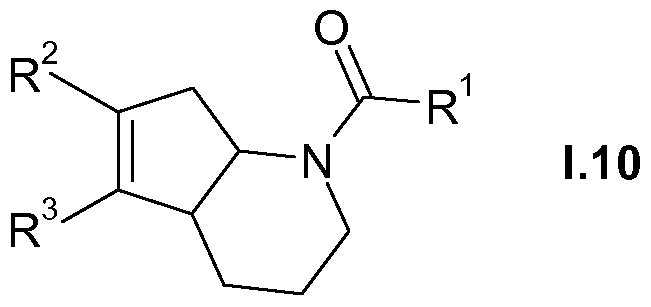
  • a tenth subgeneric embodiment of this invention is directed to compounds described by general formula 1.10 wherein the bicyclic core structure of general formula 1.10 is optionally substituted with R 11 to R 14 , and wherein R 1 to R 3 and R 11 to R 14 are defined as hereinbefore and hereinafter, their tautomers, their stereoisomers, mixtures thereof and the salts thereof.
  • Preferred compounds according to the invention are those of general formulae 1.1 to 1.10, wherein
  • R 1 denotes aryl or heteroaryl
  • aryl is meant phenyl or naphthyl
  • heteroaryl by heteroaryl is meant pyrrolyl, furanyl, thienyl, pyridinyl, indolyl, benzofuranyl, benzo- thiophenyl, quinolinyl, isoquinolinyl, or
  • R 1 denotes phenyl, naphthyl, furanyl, pyrazolyl, imidazolyl, pyridinyl, pyrimidinyl, pyrazinyl, pyridazinyl, indolyl, benzimidazolyl, indazolyl, benzotriazolyl, benzoxazolyl, benzo- thiazolyl, quinolinyl, isoquinolinyl, quinazolinyl, naphthyridinyl, quinoxalinyl, 2,3-dihydro-2- oxo-indolyl, or 1 ,2,3,4-tetrahydro-3-oxo-quinoxalinyl, wherein any of these groups optionally are independently substituted with one R 4 , one to four identical or different R 5 , and one R 6 .
  • R 1 denotes phenyl, naphthyl, pyrazolyl, pyridinyl, pyrimidinyl, naphthyl, benzofuranyl, indolyl, benzothiophenyl, benzimidazolyl, indazolyl, benzotriazolyl, benzoxazolyl, benzothiazolyl, quinolinyl, isoquinolinyl, quinazolinyl, naphthyridinyl, quinoxalinyl, 2,3-dihydro-2-oxo-indolyl, or 1 ,2,3,4-tetrahydro-3-oxo-quinoxalinyl, wherein any of these groups optionally are independently substituted with one R 4 and one to four different or identical R 5 .
  • R 1 denotes phenyl, pyrazolyl, pyridinyl, benzofuranyl, indolyl, benzimidazolyl, indazolyl, benzotriazolyl, benzothiazolyl, 2,3-dihydro-2-oxo-indolyl, or 1 ,2,3,4-tetrahydro-3-oxo-quinoxalinyl, wherein any of these groups optionally are independently substituted with one R 4 and one to four different or identical R 5 .
  • R 2 and R 3 together with the double bond to which they are attached, denote a benzo or pyrido ring, optionally both independently substituted with R 7 , R 8 and R 9 , or denote a furo, pyrrolo, pyridazino, pyrimido, or pyrazino ring, wherein any of these groups optionally are independently substituted with R 7 and R 8 or R 8 and R 9 , or denote a pyrazolo, imidazo, oxazolo, thiazolo, isoxazolo, or isothiazolo ring, wherein any of these groups optionally are independently substituted with R 7 .
  • R 2 and R 3 together with the double bond to which they are attached, denote a benzo or pyrido ring, both optionally independently substituted with R 7 , R 8 and R 9 , or denote a pyrrolo, pyridazino, pyrimido, or pyrazino ring, wherein any of these groups optionally are independently substituted with R 7 and R 8 or R 8 and R 9 , or denote a pyrazolo or imidazo ring, both optionally substituted with R 7 .
  • R 2 and R 3 together with the double bond to which they are attached, denote a benzo or pyrido ring, both independently substituted with R 7 , R 8 and R 9 , or denote a pyrrolo ring optionally substituted independently with R 7 and R 8 or R 8 and R 9 , particularly a benzo ring optionally substituted independently with R 7 , R 8 and R 9 .
  • R 4 denotes fluorine, chlorine, bromine, C- M -alkyl, hydroxy, C- M -alkyloxy,
  • R 4 denotes fluorine, chlorine, d- 4 -alkyl, hydroxy, Ci -4 -alkyloxy, amino, Ci -3 - alkylamino, di-(Ci -3 -alkyl)amino, pyrrolidin-1-yl, piperidin-1-yl, morpholin-4-yl, Ci -3 -alkyl- carbonylamino, aminocarbonyl, Ci -3 -alkyl-aminocarbonyl, di-(Ci -3 -alkyl)-aminocarbonyl, (N-methyl)-benzylaminocarbonyl, (N-methyl)-phenylaminocarbonyl, pyrrolidin-1 -yl- carbonyl, 2-(methoxymethyl)-pyrrolidin-1-yl-carbonyl, 3-(methoxymethyl)-pyrrolidin-1-yl- carbonyl, piperidin-1-yl-carbonyl, morpholin-4-
  • R 4 denotes fluorine, chlorine, methyl, hydroxy, methoxy, methylamino, morpholin-4-yl, acetylamino, aminocarbonyl, (N-methyl)-propylaminocarbonyl, (N- methyl)-benzylaminocarbonyl, (N-methyl)-phenylaminocarbonyl, dimethylamino-carbo- nyl, diethylaminocarbonyl, piperidin-1-ylcarbonyl, morpholin-4-ylcarbonyl, pyrrolidin-1 - yl-carbonyl, 2-(methoxymethyl)-pyrrolidin-1-yl-carbonyl, 1-hydroxy-ethyl, 1 -hydroxy-1 - methyl-ethyl, 2,2,2-trifluoro-1 -hydroxy-1 -methyl-ethyl, 2, 2, 2-trifluoro-1 -hydroxy-1 - trifluoromethyl-ethyl, acetyl,
  • R 5 and R 6 are independently selected from among fluorine, chlorine, bromine, C- ⁇ -3-alkyl, C 2 -3- alkynyl, trifluoromethyl, hydroxy, Ci -3 -alkyloxy, and cyano, preferably from hydrogen, fluorine, chlorine, methyl, ethyl, ethynyl, trifluoromethyl, hydroxy, methoxy, and ethoxy, more preferably from hydrogen, fluorine, chlorine, methyl, ethynyl, hydroxy, and methoxy.
  • R 5 and R 6 are bound to adjacent carbon atoms they together may additionally denote methylenedioxy, difluoromethylenedioxy, ethylenedioxy, or C3 -5 -alkylene, preferably methy- lenedioxy, ethylene-1 ,2-dioxy, propylene, or butylene, more preferably methylenedioxy or ethylene-1 ,2-dioxy, most preferably ethylene-1 ,2-dioxy.
  • R 7 denotes fluorine, chlorine, C- M -alkyl, hydroxy, C- M -alkyloxy,
  • R 7 denotes fluorine, chlorine, C- ⁇ - 4 -alkyl, hydroxy, C- ⁇ -alkyloxy,
  • cyano-d-3-alkyloxy aminocarbonyl-d-3-alkyloxy, d-s-alkyl-aminocarbonyl-d-s-alkyl- oxy, di-(Ci-3-alkyl)-aminocarbonyl-Ci-3-alkyloxy, pyrrolidin-1 -yl-carbonyl-d-s-alkyl-oxy, piperidin-i-yl-carbonyl-d-s-alkyloxy, morpholin ⁇ -yl-carbonyl-d-s-alkyl-oxy,
  • R 7 denote phenyl, furanyl, thienyl, oxazolyl, thiazolyl, isoxazolyl, imidazolyl, pyrazolyl, oxadiazolyl, triazolyl, tetrazolyl, pyridinyl, pyrimidinyl, pyrazinyl, pyridazinyl, or triazinyl, wherein any of these groups are optionally mono- or disubstituted with R 10 .
  • R 7 denotes fluorine, chlorine, Ci -3 -alkyl, hydroxy, Ci -3 -alkyloxy, amino, Ci -3 -alkyl-carbonylamino, Ci -3 -alkyl-sulfonylamino, cyano, (hydroxyimino)aminomethyl, carboxy, Ci -3 -alkyloxy-carbonyl, aminocarbonyl, d- 3 -alkyl- aminocarbonyl, di-(Ci -3 -alkyl)-aminocarbonyl, hydroxy-Ci -3 -alkyl, trifluoromethyl-hydroxy-d-3- alkyl, Ci -3 -alkyloxy-Ci -3 -alkyl, d-s-alkyl-carbonyl-amino-d-s-alkyl, hydroxy-Ci -3 -alkyloxy, Ci -3 - alkyloxy-Ci -3 -alkyloxy, trifluoromethyl
  • R 7 denotes fluorine, chlorine, methyl, hydroxy, methoxy, amino, acetylamino, methylsulfonylamino, cyano, (hydroxyimino)aminomethyl, carboxy, methoxycarbonyl, ethoxycarbonyl, aminocarbonyl, methylaminocarbonyl, dimethylaminocarbonyl, acetylaminomethyl, acetyl, 1-hydroxy-ethyl, 1-hydroxy-1 -methyl-ethyl, 2,2,2-trifluoro-1- hydroxy-1 -methyl-ethyl, methylsulfonyl, aminosulfonyl, methylaminosulfonyl, dimethylaminosulfonyl, phenyl, pyrrol-1-yl, pyridin-3-yl, pyridin-4-yl, 1 ,2-dihydro-1-methyl-2- oxo-pyridin-5-yl, 1 ,2-di
  • R 8 and R 9 which may be identical or different, denote fluorine, chlorine, bromine, d -3 -alkyl, trifluoromethyl, hydroxy, d -3 -alkyloxy, or cyano. More preferably R 8 and R 9 independently denote fluorine, chlorine, methyl, ethyl, isopropyl, trifluoromethyl, hydroxy, methoxy, ethoxy, or cyano. Most preferably, R 8 denotes hydroxyl, or methoxy.
  • R 8 and R 9 are bound to adjacent carbon atoms they together may additionally denote methylenedioxy, difluoromethylenedioxy, ethylenedioxy, C 3-5 -alkylene, or form together with the carbon atoms to which they are attached a benzo, pyrazino, pyra- zolo, imidazo, N-(Ci -3 -alkyl)-pyrazolo, N-(Ci -3 -alkyl)-imidazo, triazolo, oxazolo, thiazolo, isoxazolo, or isothiazolo ring, wherein any of the five-membered aromatics are optionally additionally monosubstituted with L and any six-membered rings are optionally mono- or disubstituted with one L and/or one substituent selected from fluorine, Ci -3 -alkyl, trifluoromethyl, amino, Ci_3-alkylamino, di-(Ci_3-alky
  • R 8 and R 9 if bound to adjacent carbon atoms, together may additionally denote methylenedioxy, ethylene-1 ,2-dioxy, propylene, butylene or together with the carbon atoms to which they are attached form a benzo, pyrazino, pyrazolo, imidazo, N-(Ci -3 -alkyl)-pyrazolo, N-(Ci -3 -alkyl)-imidazo, triazolo, oxazolo, thiazolo, isoxazolo, or isothiazolo ring, wherein any of the five-membered aromatics are optionally additionally monosubstituted with L and any six-membered rings are optionally mono- or disubstituted with one L and/or one substituent selected from fluorine, methyl, trifluoromethyl, methylamino, dimethylamino, hydroxyl, or methoxy.
  • R 8 and R 9 if bound to adjacent carbon atoms, together may additionally denote methylenedioxy or ethylene-, 12-dioxy or together with the carbon atoms to which they are attached form a benzo, pyrazino, imidazo, N-(Ci -3 -alkyl)-imidazo, triazolo, oxazolo, or thiazolo ring, wherein the benzo and pyrazino ring are optionally substituted with one or two methyl groups and the imidazo, N-Ci -3 -alkylimidazo, oxazolo, and thiazolo ring are optionally additionally substituted with L.
  • R 8 and R 9 if bound to adjacent carbon atoms, together may additionally denote methylenedioxy or together with the carbon atoms to which they are attached form an optionally additionally with methyl, tert-butyl, cyclopropyl, tetrahydrofuran-2-yl, 1-acetyl- piperidin-4-yl, pyridin-3-yl, 1 ,2-dihydro-1-methyl-2-oxo-pyridin-5-yl, pyridazin-4-yl, pyrazinyl, or 5-methyl-pyrazin-2-yl substituted oxazolo, imidazo, or N-methyl-imidazo group, an optionally with methyl substituted triazolo group, or an optionally methyl or dimethyl substituted benzo or pyrazino ring.
  • L preferably is fluorine, Ci -4 -alkyl, C 3-6 -cycloalkyl, pyrrolidinyl, 1-methyl-pyrrolidinyl, 1-acetyl- pyrrolidinyl, piperidinyl, 1-methyl-piperidinyl, 1-acetyl-piperidinyl, tetrahydrofuranyl, tetrahydropyranyl, trifluoromethyl, cyano, amino, acetylamino, methylsulfonylamino, carboxy, Ci -3 -alkyloxycarbonyl, aminocarbonyl, methylaminocarbonyl, dimethylaminocarbonyl, aminosulfonyl, hydroxy, Ci -3 -alkyloxy, or phenyl, pyridyl, pyridazinyl, pyrazinyl, pyrimidinyl, 1 ,2-dihydro-2-oxo-pyridinyl,
  • L is fluorine, methyl, ethyl, tert-butyl, C 3 _ 6 -cycloalkyl, pyrrolidinyl, 1-methyl- pyrrolidinyl, 1-acetyl-pyrrolidinyl, piperidinyl, 1-methyl-piperidinyl, 1-acetyl-piperidinyl, tetrahydrofuranyl, tetrahydropyranyl, trifluoromethyl, cyano, amino, acetylamino, methylsulfonylamino, carboxy, methoxycarbonyl, ethoxycarbonyl, aminocarbonyl, methylaminocarbonyl, dimethylaminocarbonyl, aminosulfonyl, hydroxy, methoxy, or phenyl, pyridyl, pyridazinyl, pyrazinyl, pyrimidinyl, 1 ,2-dihydro-2-oxo
  • L is fluorine, methyl, cyclopropyl, 1-acetyl-piperidinyl, tetrahydrofuranyl, acetylamino, methylsulfonylamino, carboxy, hydroxy, methoxy, or pyridyl, pyridazinyl, pyrazinyl, 1 ,2-dihydro-2-oxo-pyridinyl, which are optionally substituted with one or two methyl groups; particularly, L is methyl, tert-butyl, cyclopropyl, tetrahydrofuran-2-yl, 1-acetyl-piperidin-4-yl, pyrid-3-yl, pyridazin-3-yl, pyrazinyl, 5- methylpyrazin-2-yl, 1 ,2-dihydro-2-oxo-pyridin-5-yl.
  • R 10 preferably denotes fluorine, chlorine, bromine, Ci -3 -alkyl, difluoromethyl, trifluoromethyl, cyano, nitro, amino, acetylamino, methylsulfonylamino, carboxy, Ci -4 -alkyloxycarbonyl, aminocarbonyl, d- 3 -alkylaminocarbonyl, di-(Ci_ 3 -alkyl)-aminocarbonyl, aminosulfonyl, methylsulfanyl, methylsulfinyl, methylsulfonyl, phenyl, hydroxy, Ci -3 -alkyloxy, difluoromethoxy, or trifluoromethoxy.
  • R 10 denotes fluorine, chlorine, methyl, difluoromethyl, trifluoromethyl, cyano, hydroxy, methoxy, difluoromethoxy, or trifluoromethoxy, most preferably, R 10 denotes methyl.
  • R 11 preferably denotes fluorine, Ci -3 -alkyl, phenyl, hydroxy, Ci -3 -alkyloxy, cyano, carboxy, C- ⁇ - 4 -alkyloxycarbonyl, aminocarbonyl, d- 4 -alkylamino-carbonyl, di-(Ci_ 4 -alkyl)-aminocarbonyl, hydroxy-d- 4 -alkyl, or Ci-3-alkyloxy-Ci- 4 -alkyl. More preferably R 11 denotes fluorine, Ci -3 -alkyl, hydroxyl, or Ci -3 -alkyloxy. Most preferably, R 11 denotes methyl, ethyl, propyl, hydroxy, or methoxy, particularly hydrogen, methyl, or methoxy.
  • R 12 preferably denotes fluorine, or Ci -3 -alkyl, more preferably methyl or ethyl; and R 13 and R 14 , which may be identical or different, preferably denote C- ⁇ -3-alkyl. More preferably, R 13 and R 14 denote methyl.
  • substituted means that any one or more hydrogens on the designated atom is replaced with a selection from the indicated group, provided that the designated atom's normal valence is not exceeded, and that the substitution results in a stable compound.
  • halogen denotes an atom selected from the group consisting of F, Cl, Br and I.
  • Ci -n -alkyl wherein n may have a value of 1 to 18, denotes a saturated, branched or unbranched hydrocarbon group with 1 to n C atoms.
  • examples of such groups include methyl, ethyl, n-propyl, iso-propyl, butyl, iso-butyl, sec-butyl, tert-butyl, n-pentyl, iso-pentyl, neo-pentyl, tert-pentyl, n-hexyl, iso-hexyl, etc.
  • groups include ethenyl, 1-propenyl, 2-propenyl, 1-butenyl, 2-butenyl, 3-butenyl, 1-pentenyl, 2- pentenyl, 3-pentenyl, 4-pentenyl, 1-hexenyl, 2-hexenyl, 3-hexenyl, 4-hexenyl, 5-hexenyl etc.
  • C 2 - n -alkynyl wherein n has a value of 3 to 6, denotes a branched or unbranched hydrocarbon group with 2 to n C atoms and a C ⁇ C triple bond.
  • groups include ethynyl, 1-propynyl, 2-propynyl, 1-butynyl, 2-butynyl, 3-butynyl, 1-pentynyl, 2- pentynyl, 3-pentynyl, 4-pentynyl, 1-hexynyl, 2-hexynyl, 3-hexynyl, 4-hexynyl, 5-hexynyl etc.
  • alkynyl groups are connected to the remainder of the molecule via the C atom in position 1. Therefore terms such as 1-propynyl, 2-propynyl, 1-butynyl, etc. are equivalent to the terms 1-propyn-1-yl, 2-propyn-1-yl, 1-butyn-1-yl, etc.. This also applies analogously to C 2 - n -alkenyl groups.
  • Ci -n -alkoxy denotes a Ci -n -alkyl-0 group, wherein Ci -n -alkyl is as hereinbefore defined.
  • groups include methoxy, ethoxy, n-propoxy, iso-propoxy, n- butoxy, iso-butoxy, sec-butoxy, tert-butoxy, n-pentoxy, iso-pentoxy, neo-pentoxy, tert- pentoxy, n-hexoxy, iso-hexoxy, etc.
  • groups include methylcarbonyl, ethylcarbonyl, n- propylcarbonyl, iso-propylcarbonyl, n-butylcarbonyl, iso-butylcarbonyl, sec-butylcarbonyl, tert-butylcarbonyl, n-pentylcarbonyl, iso-pentylcarbonyl, neo-pentylcarbonyl, tert- pentylcarbonyl, n-hexylcarbonyl, iso-hexylcarbonyl, etc.
  • C 3-n -cycloalkyl denotes a saturated mono-, bi-, tri- or spirocarbocyclic group with 3 to n C atoms.
  • groups include cyclopropyl, cyclobutyl, cyclopentyl, cyclohexyl, cycloheptyl, cyclooctyl, cyclononyl, cyclododecyl, bicyclo[3.2.1.]octyl, spiro[4.5]decyl, norpinyl, norbonyl, norcaryl, adamantyl, etc.
  • C 3-7 - cycloalkyl denotes saturated monocyclic groups.
  • tri-(Ci -4 -alkyl)silyl comprises silyl groups which have identical or two or three different alkyl groups.
  • di-(Ci -3 -alkyl)amino comprises amino groups which have identical or two different alkyl groups.
  • alkyl group is optionally mono- or polyfluorinated this comprises also alkyl residues which are part of larger groups, e.g. alkyloxy, alkylcarbonyl, alkoxyalkyl, etc. or if a (het)aryl group is optionally mono- or polysubstituted with a certain substituent or a set of substituents this also includes (het)aryl groups which are part of larger groups, e.g.
  • a CH 2 group may be replaced by O, S, NR, CO, or SO 2 .
  • a residue having inter alia the meaning hydroxy-Ci -3 -alkyl, in which a CH 2 group may be replaced by CO this comprises carboxy, carboxymethyl, hydroxymethylcarbonyl, carboxyethyl, hydroxymethylcarbonylmethyl, and hydroxyethyl- carbonyl.
  • the compounds according to the invention may be obtained using methods of synthesis known in principle.
  • the compounds are obtained by the following methods according to the invention which are described in more detail hereinafter.
  • a general strategy to access compounds of the invention is delineated in Scheme 1 ;
  • R 2 , R 3 , X, m, n, and o have the meanings as defined hereinbefore and hereinafter.
  • the key reaction to assemble the bicyclic framework is an intramolecular merger of an amino functionality with a carboxy group that results in the formation of an amide linkage.
  • the fusion of the carboxylic acid function and the amino group may be carried out with or without an additive at elevated temperatures, preferably between 20 and 200 0 C.
  • Additives that remove the water forming during the reaction such as molecular sieves or orthoesters, or other additives such as ba- ses, e.g. hexamethyldisilazides, or boronic acids may facilitate the reaction.
  • acyl halides are acyl chloride and acyl fluoride.
  • esters and thioesters are derived from e.g.
  • mixed anhydrides are derived from alkylcarboxylic acids, e.g. pivalic acid, carbonates, e.g. methyl and ethyl carbonate, carbamates, e.g. N,N-dimethyl carbamate, phosphoric acids, e.g.
  • N acylated derivatives derived from azaheteroaromatics such as imidazole, triazole, tetrazole, or pyridine such as e.g. 4-dimethylaminopyridine may be used as well.
  • Some of the more popular reagents used for the activation of the carboxylic acid function are N,N'-carbonyldiimidazol, dicyclohexylcarbodiimide, (benzotriazol-1-yloxy)- dipiperidinocarbenium hexafluorophospate or tetrafluoroborate, (benzotriazol-i-yloxy)dipyr- rolidinocarbenium hexafluorophospate or tetrafluoroborate, 1-(3-dimethylaminopropyl)-3- ethylcarbodiimide methiodide, POCI 3 , SOCI 2 , (COCI) 2 , COCI 2 , arylboronic acid, TiCI 4 , (MeO) 2 POCI, cyanuric chloride, 1 -hydroxybenzotriazol, 1-hydroxy-7-azabenzotriazol, benzol- triazol-1-yloxytri
  • ethyldiisopropylamine triethylamine, alkali metal carbonate, pyridine, 4-dimethylaminopyridine, imidazole, dimethylaluminum amides, lithium amides, alkali metal cyanide, or alkali metal hexamethyldisilazide.
  • the reactions are preferably conducted in organic solvents but may also be carried out in aqueous solvents.
  • organic solvents ordinarily used are dimethylformamide, dimethylacetamide, N-methyl- pyrrolidinone, dimethylsulfoxide, tetrahydrofuran, hexane, ether, dioxane, dimethoxyethane, dichloromethane, dichloroethane, toluene, benzene, ethyl acetate, quinoline, pyridine, or mixtures thereof.
  • the reactions may be carried out at -80 0 C to 220 0 C, preferably between - 10 0 C and 120 0 C. Subsequently, the lactam group is reduced to give the secondary amine.
  • This transformation is a well established reaction that may be carried out, for example, using LiAIH 4 , hydrogen in the presence of a catalyst, NaBH 4 in the presence of e.g. iodine, LiBH 4 , borane, sodium in propanol, CIsSiH, silanes, e.g. Et 3 SiH, in the presence of a transition metal such as rhenium, 9-BBN, LiBH 3 NMe 2 , or Et 3 SiH combined with LiEt 3 BH.
  • Solvents such as e.g.
  • tetrahydrofuran, ether, dimethoxyethane, dioxane, hexane, benzene, toluene, dichloromethane, alcohols, water, or mixtures thereof may be employed at -78 0 C to 200 0 C, preferably between -10 0 C and 120 0 C; though, in combination with some reducing reagents only a few of these solvents are usable. This strategy is well suited for the synthesis of the scaffolds 1.1 to 1.10.
  • R 2 , R 3 , X, m, n, and o have the meanings as defined hereinbefore and hereinafter.
  • the bicyclic framework is formed via an intramolecular reductive amination reaction of a primary amine with a ketone functionality. Reductive aminations have large precedence in organic chemistry and may be carried out e.g. using hydrogen in the presence of a transition metal catalyst such as one derived from Ni, Rh, Pd, or Pt, borohydride reagents, e.g.
  • Some of these reagents are preferably used in combination with an additive such as acid, e.g. acetic acid or mineral acid.
  • the reactions are preferably conducted in organic solvents or aqueous mixtures, e.g.
  • the reactions may be carried out at -80 0 C to 200 0 C, preferably between -10 0 C and 100 0 C.
  • Scheme 4 shows another approach to assemble the bicyclic framework.
  • This approach is an intramolecular alkylation of the nitrogen group with an appropriate electrophile of the side- chain.
  • the nitrogen group may be an amino group, i.e. R a denotes e.g. hydrogen, methyl, allyl, benzyl, or dimethoxybenzyl, or an amide group, i.e. R a denotes e.g.
  • a base such as e.g. triethylamine, ethyldiisopropylamine, diazabicycloundecene, alkali metal carbonate, alkali metal te/fbutoxide, alkali metal diisopropylamide, butyllithium, or sodium hydride.
  • the stronger bases among them are preferably used in combination with the amides in e.g.
  • N-methylpyrrolidinone dimethylsulfoxide, tetrahydrofuran, hexane, ether, dioxane, dimethoxyethane, toluene, benzene, terfoutanol, isopropanol, or mixtures thereof at temperatures between -70 and 100 0 C, preferably between -30 and 60 0 C.
  • the milder bases listed are preferably used in combination with the amines in dichloromethane, dimethylform- amide, N-methylpyrrolidinone, dimethylsulfoxide, tetrahydrofuran, hexane, ether, dioxane, dimethoxyethane, toluene, benzene, methanol, ethanol, te/fbutanol, isopropanol, water, or mixtures thereof at temperatures between 0 and 140 0 C, preferably between 20 and 120 0 C.
  • the conditions originally reported by Mitsunobu may be used as well.
  • a phosphine e.g. triphenylphosphine or tributylphosphine
  • an azodicarboxylate e.g. diethyl azodicarboxylate, diisopropyl azodicarboxylate, or azodi- carboxylic dipiperidide.
  • Suited solvents may be selected from among dimethylformamide, N- methylpyrrolidinone, dichloromethane, tetrahydrofuran, hexane, ether, dioxane, dimethoxyethane, toluene, benzene, and mixtures thereof.
  • the reaction is preferably conducted at temperatures between 0 and 100 0 C.
  • the opposite way around, i.e. LG denotes NHR a and NHR a denotes LG, may be applicable as well. Reaction conditions are equivalent to the original way around.
  • a further generally applicable approach is based on an electrophilic aromatic substitution reaction (Scheme 5);
  • R 2 , R 3 , m, n, and o have the meanings as defined hereinbefore and hereinafter.
  • the aromatic part of the molecule reacts with an activated carbon atom of the azacycle to form the bicyclic framework.
  • the reactive intermediate bears a (partially) positively charged carbon atom in the azacycle that may be generated by the addition of an acid to an olefinic bond or by the activation of an appropriately positioned leaving group.
  • a huge number of Bronstedt and Lewis acids have been described for this classical reaction that may also be used here.
  • hydrobromic acid hydroiodic acid, hydrochloric acid, sulfuric acid, phosphoric acid, P 4 Oi 0
  • trifluoroacetic acid methanesulfonic acid, toluenesulfonic acid, trifluormethanesulfonic acid, Sc(OTf) 3 , SnCI 4 , FeCI 3 , AIBr 3 , AICI 3 , SbCI 5 , BCI 3 , BF 3 , ZnCI 2 , montmorillonites, POCI 3 , and PCI 5 .
  • a more or less powerful acid catalyst has to be used.
  • silver salts e.g. AgOTf
  • Preferred solvents are hydrocarbons such as hexane or cyclohexane, chlorinated hydrocarbons such as dichloromethane or dichloro- ethane, perfluorinated hydrocarbons, nitrobenzene, chlorinated benzenes, heteroaromatics such as quinoline, dimethoxyethane, dioxane, ether, ionic liquids, or mixtures thereof.
  • the reactions may be carried out between -10 0 C and 220 0 C, preferably between 20 0 C and 180 0C.
  • the reactions may also be conducted under microwave irradiation. This synthetic strategy is particularly suited for the scaffolds 1.1 and 1.3 to 1.10 bearing an electron rich aromatic.
  • the bicyclic scaffold may also be accessed via the route delineated in Scheme 6; m has the meaning as defined hereinbefore and hereinafter and PG and PG' are protective groups such as e.g. trialkylsilyl for PG and benzyl or methyl for PG'.
  • the cyclization is realized by the addition of a radical intermediate, generated from the trichloromethyl group and a chlorine abstracting reagent, onto the double bond. Suited chlorine abstracting reagents are Bu 3 Sn* and (Me 3 Si) 3 Si* that are formed in situ by a radical initiator, such as azobisisobutyronitrile or dibenzoylperoxide, from Bu 3 SnH and (Me 3 Si) 3 SiH, respectively.
  • a radical initiator such as azobisisobutyronitrile or dibenzoylperoxide
  • the reaction is preferably conducted in benzene, toluene, cyclohexane, or hexanes at elevated temperature.
  • This approach is reported inter alia in Tetrahedron: Asymmetry 1999, 10, 2399-2410.
  • These transformations are described hereinbefore and hereinafter and are known for similar compounds from the organic chemistry literature (see e.g. Thomas L. Gilchrist, Heterocyclenchemie, VCH, Weinheim, 1995).
  • the compounds according to the invention are advantageously also obtainable using the methods described in the examples that follow, which may also be combined for this purpose with methods known to the skilled man from the literature.
  • the compounds of general formula I according to the invention and the physiologically acceptable salts thereof have valuable pharmacological properties, particularly an inhibitory effect on the enzyme 11 ⁇ -hydroxysteroid dehydrogenase (HSD) 1.
  • the biological properties of the new compounds may be investigated as follows:
  • the incubation period for detection reaction was typically 2 hours.
  • the amount of Cortisol is determined by reading the time-resolved fluorescence of the wells (Ex 320/75 nm; Em 615/8.5 nm and 665/7.5 nm). The ratio of the two emission signals is then calculated (Em665 * 10000/Em615).
  • Each assay contained incubations with vehicle controls instead of compound as controls for non-inhibited Cortisol generation (100% CTL; 'high values') and incubations with carbenoxolone as controls for fully inhibited enzyme and Cortisol background (0% CTL; 'low values').
  • Each assay also contai- ned a calibration curve with Cortisol to transform the fluorescent data into Cortisol concentrations. Percent inhibition of each compound was determined relative to the carbenoxolone signal and IC 50 curves were generated.
  • the compounds of general formula I according to the invention may for example have IC 50 values below 10000 nM, particularly below 1000 nM, most preferably below 100 nM.
  • IC 50 values below 10000 nM, particularly below 1000 nM, most preferably below 100 nM.
  • Table 2 compounds of the invention (specified in Table 3) and their inhibitory activity determined as described above are compiled.
  • the compounds of general formula I according to the invention and the corresponding pharma- ceutically acceptable salts thereof are theoretically suitable for the treatment and/or preventative treatment of all those conditions or diseases which may be affected by the inhibition of the 1 1 ⁇ -hydroxysteroid dehydrogenase (HSD) 1 activity. Therefore, compounds according to the invention are particularly suitable for the prevention or treatment of diseases, particularly metabolic disorders, or conditions such as type 1 and type 2 diabetes mellitus, complications of diabetes (such as e.g.
  • retinopathy retinopathy, nephropathy or neuropathies, diabetic foot, ulcers, macroangiopathies, slow or poor wound healing
  • metabolic acidosis or ketosis reactive hypoglycaemia, hyperinsulinaemia, glucose metabolic disorder, insulin resistance, metabolic syndrome, dyslipidaemias of different origins, atherosclerosis and related diseases, obesity, high blood pressure, chronic heart failure, edema and hyperuricaemia.
  • beta-cell degeneration such as e.g. apoptosis or necrosis of pancreatic beta cells.
  • the substances are also suitable for improving or restoring the functionality of pancreatic cells, and also of increasing the number and size of pancreatic beta cells.
  • the compounds according to the invention may also be used as diuretics or antihypertensives and are suitable for the prevention and treatment of acute renal failure.
  • HSD 11 ⁇ -hydroxysteroid dehydrogenase
  • the compounds may have beneficial effects against osteoporosis.
  • Cortisol has been associated with brain neuronal loss or dysfunction. Treatment with an 11 ⁇ - hydroxysteroid dehydrogenase (HSD) 1 inhibitor may result in amelioration or prevention of cognitive impairment. Such compounds may also be useful in treating anxiety or depression.
  • HSD 11 ⁇ - hydroxysteroid dehydrogenase
  • the dynamic interaction between the immune system and the HPA (hypothalamopituitary- adrenal) axis is known, and glucocorticoids help balance between cell-mediated responses and humoral responses.
  • the immune reaction is typically biased towards a humoral res- ponse in certain disease states, such as tuberculosis, leprosy, and psoriasis. More appropriate would be a cell-based response.
  • An 1 1 ⁇ -hydroxysteroid dehydrogenase (HSD) 1 inhibitor would bolster a temporal immune response in association with immunization to ensure that a cell based response would be obtained, and as such could be useful in immunomodulation.
  • the compounds according to the invention are suitable for the prevention or treatment of diabetes, particularly type 1 and type 2 diabetes mellitus, and/or diabetic complications.
  • the dosage required to achieve the corresponding activity for treatment or prevention usually depends on the compound which is to be administered, the patient, the nature and gravity of the illness or condition and the method and frequency of administration and is for the patient's doctor to decide.
  • the dosage may be from 1 to 100 mg, preferably 1 to 30 mg, by intravenous route, and 1 to 1000 mg, preferably 1 to 100 mg, by oral route, in each case administered 1 to 4 times a day.
  • the compounds of formula I prepared according to the invention may be formulated, optionally together with other active substances, together with one or more inert conventional carriers and/or diluents, e.g.
  • the compounds according to the invention may also be used in conjunction with other active substances, particularly for the treatment and/or prevention of the diseases and conditions mentioned above.
  • Other active substances which are suitable for such combinations include for example those which potentiate the therapeutic effect of an 11 ⁇ -hydroxysteroid dehydrogenase (HSD) 1 inhibitor according to the invention with respect to one of the indications mentioned and/or which allow the dosage of an 11 ⁇ -hydroxysteroid dehydrogenase (HSD) 1 inhibitor according to the invention to be reduced.
  • Therapeutic agents which are suitable for such a combination include, for example, antidiabetic agents such as metformin, sulfonylureas (e.g.
  • glibenclamide tolbutamide, glimepiride
  • nateglinide repaglinide
  • thiazolidinediones e.g. rosiglitazone, pioglitazone
  • SGLT 2 inhibitors e.g. dapagliflozin, sergliflozin
  • PPAR- gamma-agonists e.g. Gl 262570
  • antagonists PPAR-gamma/alpha modulators
  • PPAR-gamma/alpha modulators e.g. KRP 297
  • alpha-glucosidase inhibitors e.g. acarbose, voglibose
  • DPPIV inhibitors e.g.
  • Sitagliptin Vildagliptin, Saxagliptin, Alogliptin, BI 1356), alpha2-antagonists, insulin and insulin analogues, GLP-1 and GLP-1 analogues (e.g. exendin-4) or amylin.
  • the list also includes inhibitors of protein tyrosinephosphatase 1 , substances that affect deregulated glucose production in the liver, such as e.g.
  • lipid lowering agents such as for example HMG-CoA-reductase inhibitors (e.g. simvastatin, atorvastatin), fibrates (e.g.
  • PPAR-alpha agonists e.g. avasimibe
  • cholesterol absorption inhibitors such as, for example, ezetimibe
  • bile acid-binding substances such as, for example, cholestyramine, inhibitors of ileac bile acid transport, HDL-raising compounds such as CETP inhibitors or ABC1 regulators or active substances for treating obesity, such as sibutramine or tetrahydrolipostatin, SDRIs, axokine, leptin, leptin mimetics, antagonists of the cannabinoidi receptor, MCH-1 receptor antagonists, MC4 receptor agonists, NPY5 or NPY2 antagonists or ⁇ 3-agonists such as SB-418790 or AD-9677 and agonists of the 5HT2c receptor.
  • ACAT inhibitors e.g. avasimibe
  • cholesterol absorption inhibitors such as, for example, ezetimibe
  • bile acid-binding substances such as, for example,
  • drugs for influencing high blood pressure, chronic heart failure or atherosclerosis such as e.g. A-Il antagonists or ACE inhibitors, ECE inhibitors, diuretics, ⁇ - blockers, Ca-antagonists, centrally acting antihypertensives, antagonists of the alpha-2-adre- nergic receptor, inhibitors of neutral endopeptidase, thrombocyte aggregation inhibitors and others or combinations thereof are suitable.
  • angiotensin Il receptor antagonists examples include candesartan cilexetil, potassium losartan, eprosartan mesylate, valsartan, telmisartan, irbesartan, EXP-3174, L-158809, EXP-3312, olmesartan, medoxomil, tasosartan, KT-3-671 , GA-0113, RU-64276, EMD-90423, BR-9701 , etc.
  • Angiotensin Il receptor antagonists are preferably used for the treatment or prevention of high blood pressure and complications of diabetes, often combined with a diuretic such as hydrochlorothiazide.
  • a combination with uric acid synthesis inhibitors or uricosurics is suitable for the treatment or prevention of gout.
  • a combination with GABA-receptor antagonists, Na-channel blockers, topiramat, protein- kinase C inhibitors, advanced glycation end product inhibitors or aldose reductase inhibitors may be used for the treatment or prevention of complications of diabetes.
  • the dosage for the combination partners mentioned above is usefully 1/5 of the lowest dose normally recommended up to 1/1 of the normally recommended dose.
  • this invention relates to the use of a compound according to the invention or a physiologically acceptable salt of such a compound combined with at least one of the active substances described above as a combination partner, for preparing a pharma- ceutical composition which is suitable for the treatment or prevention of diseases or conditions which can be affected by inhibiting the enzyme 11 ⁇ -hydroxysteroid dehydrogenase (HSD) 1.
  • HSD enzyme 11 ⁇ -hydroxysteroid dehydrogenase
  • this invention relates to a pharmaceutical composition which comprises a compound according to the invention or a physiologically acceptable salt of such a compound and at least one of the active substances described above as combination partners, optionally together with one or more inert carriers and/or diluents.
  • a pharmaceutical composition according to the invention comprises a combination of a compound of formula I according to the invention or a physiologically acceptable salt of such a compound and at least one angiotensin Il receptor antagonist optionally together with one or more inert carriers and/or diluents.
  • the compound according to the invention, or a physiologically acceptable salt thereof, and the additional active substance to be combined therewith may both be present together in one formulation, for example a tablet or capsule, or separately in two identical or different formulations, for example as a so-called kit-of-parts.
  • Phenylacetylene (15.4 ml.) is added to a mixture of 2-bromo-4-methyl-pyridine (20.0 g), CuI
  • the starting material 3,11 ,11-trimethyl-2,3,4,5-tetrahydro-1 H-2,6-methano-benzo[d]azocin-6- ol, is obtained in analogy to EP 28717 (1981 ) from 2-benzyl-1 ,3,3-trimethyl-piperidinone.
  • the starting material 8-hydroxy-3-methyl-2,3,4,5-tetrahydro-1 H-2,6-methano- benzo[d]azocine-6-carboxylic acid methyl ester, may be obtained in analogy to J. Med. Chem. 1962, 5, 357-361 and US 3687957 (1972) from 8-methoxy-3-methyl-1-oxo-2,3,4,5- tetrahydro-1 H-2,6-methano-benzo[d]azocine-6-carbonitrile.
  • the methoxy group on the aromatic ring may be cleaved by using boron tribromide in dichloromethane or hydrobromic acid in acetic acid (see e.g. J. Med. Chem. 1992, 35, 4135-4142; J. Med. Chem. 2004, 47, 165-174).
  • the starting material may also be obtained by reacting compound Example XXII(I ) with boron tribromide according to Procedure J.
  • the starting material 3,11 ,1 1-trimethyl-6-phenyl-1 ,2,3,4,5,6-hexahydro-2,6-methano- benzo[d]azocin-8-ol, may be obtained as described in DE 2027077 (1970).
  • 3-methyl-6-propyl-1 ,2,3,4,5,6-hexahydro-2,6-methano-benzo[d]azocin- 8-ol may be obtained as described in J. Med. Chem. 1963, 6, 322-5.
  • the starting material 3,6-Dimethyl-1 ,2,3,4,5,6-hexahydro-2,6-methano-benzo[d]azocin-8-ol, may be obtained as described in J. Org. Chem. 1960, 25, 1386-8.
  • the compound is prepared from (2/?,6S)-9-methoxy-6,1 1 ,1 1 -trimethyl-1 , 2, 3,4,5, 6-hexahydro- 2,6-methano-benzo[d]azocine [tartaric acid salt, for preparation see WO 9959976 (1999)] and isolated as the hydrogen bromide salt.
  • Di-te/fbutyl dicarbonate (8.7 g) is added to a solution of 6, 1 1 , 1 1 -trimethyl-1 ,2, 3, 4, 5, 6- hexahydro-2,6-methano-benzo[d]azocin-9-ol (12.0 g) and triethylamine (8 ml) in dioxane (100 ml.) and water (100 ml_). The solution is stirred at room temperature overnight. Then, ethyl acetate is added and the organic phase is separated. The aqueous phase is extracted with ethyl acetate and the organic extract and phase are combined.
  • the compound may be obtained by resolution of the racemic mixture by HPLC on chiral phase.
  • the compound may be obtained by resolution of the racemic mixture by HPLC on chiral phase.
  • the compound may be obtained by resolution of the racemic mixture by HPLC on chiral phase.
  • the compound may be obtained by resolution of the racemic mixture by HPLC on chiral phase.
  • the compound may be obtained by resolution of the racemic mixture by HPLC on chiral phase or by using the enantiomerically pure starting material that in turn may be obtained as described in Example XIII(I ) or by resolution of the racemic mixture by HPLC on chiral phase.
  • the synthesis of the racemic starting material is described in EP 521422 (1993).
  • Trifluoro-methanesulfonic acid 3-(benzothiazole-6-carbonyl)-6-methyl-1 ,2,3 ,4,5,6-hexahvdro- 2,6-methano-benzo[d1azocin-8-yl ester
  • Trifluoromethanesulfonic anhydride (0.77 mL) is added to a solution of benzothiazol-6-yl-(8- hydroxy-6-methyl-1 ,2,5,6-tetrahydro-4H-2,6-methano-benzo[d]azocin-3-yl)-methanone (1.24 g; for synthesis see Example 92), triethylamine (3.4 mL), and 4-dimethylaminopyridine (10 mg) in dichloromethane (12 mL) chilled to -10 0 C under argon atmosphere. The solution is stirred at ca. -5 0 C for 30 min and then at room temperature overnight.
  • Tetrakis(triphenylphosphine)palladium(0) (2.79 g) is added to a mixture of (2/?,6S)-trifluoro- methanesulfonic acid 3-benzyl-6,1 1 ,1 1-trimethyl-1 ,2,3,4,5,6-hexahydro-2,6-methano- benzo[d]azocin-10-yl ester (7.30 g) and zinc cyanide (2.85 g) in dimethylformamide (35 ml.) kept in argon atmosphere. The resulting mixture is stirred at 100 0 C for 6 h.
  • the compound is prepared from 6,11 ,1 1-trimethyl-1 ,2,3,4,5,6-hexahydro-2,6-methano- benzo[d]azocine-9-carbonitrile applying the procedure described above.
  • the compound is prepared from (2R,6R11 S)-6,11-dimethyl-1 , 2,3,4, 5,6-hexahydro-2,6- methano-benzo[d]azocine-8-carbonitrile applying the procedure described above.
  • the compound may be prepared from 1-hydroxy-8-methoxy-3-methyl-2,3,4,5-tetrahydro-1 H- 2,6-methano-benzo[d]azocine-6-carbonitrile [for synthesis see US 3687957 (1972)] as described above using methanol instead of ethanol.
  • Pd(OH) 2 (0.20 g) is added to a solution of (2R,6S)-3-benzyl-6,1 1 ,1 1-trimethyl-1 ,2,3,4,5,6- hexahydro-2,6-methano-benzo[d]azocine-10-carboxylic acid ethyl ester (1.13 g) in ethanol
  • the debenzylation is carried out in the presence of 1 equivalent of 1 M hydrochloric acid as described above.
  • Aqueous 2 M Na 2 CC>3 solution (5 ml.) is added to a mixture of 6, 1 1 ,11 -trimethyl-9-trifluoro- methanesulfonyloxy-I ⁇ -tetrahydro ⁇ H ⁇ -methano-benzotdlazocine-S-carboxylic acid tert-butyl ester (1.00 g) and phenylboronic acid (0.34 g) in dimethylformamide (5 ml.) in argon atmosphere.
  • the compound is obtained as its trifluoroacetic acid salt.
  • the compound is obtained as its double trifluoroacetic acid salt.
  • the compound is obtained as its double trifluoroacetic acid salt.
  • the compound may be obtained by resolution of the racemic mixture by HPLC on chiral phase or by using the enantiomerically pure (2S,6R)-8-methoxy-6,9,11 ,1 1-tetramethyl- I ⁇ -tetrahydro ⁇ H ⁇ -methano-benzotdJazocine-S-carboxylic acid tert-butyl ester.
  • the compound may be obtained by resolution of the racemic mixture by HPLC on chiral phase or by using the enantiomerically pure (2/?,6S)-8-methoxy-6,9,1 1 ,11-tetramethyl- 1 ,2,5,6-tetrahydro-4H-2,6-methano-benzo[d]azocine-3-carboxylic acid tert-butyl ester.
  • the compound may be obtained by resolution of the racemic mixture by HPLC on chiral phase or by using the enantiomerically pure (2S,6R)-9-methoxy-6,8,1 1 ,1 1-tetramethyl- 1 ,2,5,6-tetrahydro-4H-2,6-methano-benzo[d]azocine-3-carboxylic acid tert-butyl ester.
  • the compound may be obtained by resolution of the racemic mixture by HPLC on chiral phase or by using the enantiomerically pure (2/?,6S)-9-methoxy-6,8,1 1 ,11-tetramethyl- I ⁇ -tetrahydrc ⁇ lH ⁇ -rnethano-benzotdJazocine-S-carboxylic acid tert-butyl ester. (9) 8,9-Dimethoxy-6,1 1 ,11-trimethyl-1 ,2,3,4,5,6-hexahydro-2,6-methano-benzo[d]azocine
  • the compound is obtained as its trifluoroacetic acid salt.
  • the compound may be obtained from the racemic mixture by separation from the enantiomer by HPLC on chiral phase.
  • the compound is isolated as its trifluoroacetic acid salt.
  • the compound may be obtained from 1-hydroxy-8-methoxy-3-methyl-2,3,4,5-tetrahydro-1 H- 2,6-methano-benzo[d]azocine-6-carboxylic acid methyl ester employing the procedure described above.
  • the reduction may be conducted in analogy to J. Org. Chem. 1987, 52, 5233-5239.
  • a mixture of 8, 9-dihydroxy-6,1 1 ,11 -trimethyl-1 ,2,5, 6-tetrahydro-4H-2,6-methano-benzo[d]- azocine-3-carboxylic acid tert-butyl ester (0.21 g), K 2 CO 3 (0.19 g) and diiodomethane (54 ⁇ l_) in dimethylformamide (5 ml.) is heated to 100 0 C and stirred at this temperature for 2 h. Then, another portion of diiodomethane (54 ⁇ l_) and K 2 CO 3 (0.18 g) is added and the mixture is further stirred at 100 0 C for 5 h.
  • the racemic product mixture is resolved into its enantiomers by using HPLC on chiral phase.
  • the compound may also be obtained in analogy to the procedure described in J. Med. Chem. 1997, 40, 2922-2930.
  • the compound is isolated as its trifluoroacetic acid salt
  • the compound is isolated as its trifluoroacetic acid salt
  • the compound is isolated as its trifluoroacetic acid salt
  • the compound is isolated as its trifluoroacetic acid salt
  • the compound is isolated as its trifluoroacetic acid salt
  • the compound is isolated as its trifluoroacetic acid salt
  • (2R6S)-6,1 1 ,11-Trimethyl-1 ,2,3,4,5,6-hexahvdro-2,6-methano-benzordlazocine 10% Pd/C (0.20 g) is added to a solution of (2R,6S)-trifluoro-methanesulfonic acid 3-benzyl- 6,1 1 ,1 1-trimethyl-1 ,2,3,4,5,6-hexahydro-2,6-methano-benzo[d]azocin-10-yl ester (0.50 g) in ethanol (10 ml_). The resulting mixture is shaken under hydrogen atmosphere (50 psi) at room temperature overnight.
  • Trifluoroacetic anhydride (5.0 ml.) is added to a solution of the hydrobromic acid salt of
  • Nitric acid (0.4 ml.) is slowly added to a solution of 2,2,2-trifluoro-1-[(2R,6S)-10-hydroxy- 6,1 1 ,1 1-trimethyl-1 ,2,5,6-tetrahydro-4H-2,6-methano-benzo[d]azocin-3-yl]-ethanone (2.9 g) in acetic acid (5 ml.) chilled in an ice bath. The ice bath is removed and the solution is stirred at ambient temperature overnight. The solution is poured into ice-cold water and the resulting mixture is extracted with ethyl acetate. The combined extracts are washed with brine and dried (Na 2 SC> 4 ).
  • the compound is obtained in a mixture with compound Example XXXI 11(3) that is separated by chromatography as described above.
  • Methyl iodide (80 ⁇ l_) is added to a mixture of (2R,6S)-2,2,2-trifluoro-1-(10-hydroxy-6,1 1 ,1 1- trimethyl-9-nitro-1 ,2,5,6-tetrahydro-4H-2,6-methano-benzo[d]azocin-3-yl)-ethanone (0.40 g) and potassium carbonate (0.17 g) in dimethylformamide (5 ml_). The mixture is stirred at room temperature overnight, before another portion of methyl iodide (80 ⁇ l_) and potassium carbonate (0.16 g) are added. The mixture is stirred for another 6 h at room temperature.
  • the compound may be obtained by resolution of the racemic mixture by HPLC on chiral phase or by using the enantiomerically pure (2S,6R)-8-hydroxy-6,9,1 1 ,11-tetramethyl- 1 ,2,5,6-tetrahydro-4H-2,6-methano-benzo[d]azocine-3-carboxylic acid tert-butyl ester.
  • the compound may be obtained by resolution of the racemic mixture by HPLC on chiral phase or by using the enantiomerically pure (2/?,6S)-8-hydroxy-6,9,11 ,1 1-tetramethyl- 1 ,2,5,6-tetrahydro-4H-2,6-methano-benzo[d]azocine-3-carboxylic acid tert-butyl ester.
  • the compound may be obtained by resolution of the racemic mixture by HPLC on chiral phase or by using the enantiomerically pure (2S,6R)-9-hydroxy-6,8,1 1 ,11-tetramethyl- I ⁇ -tetrahydrc ⁇ lH ⁇ -rnethano-benzotdJazocine-S-carboxylic acid tert-butyl ester.
  • the compound may be obtained by resolution of the racemic mixture by HPLC on chiral phase or by using the enantiomerically pure (2/?,6S)-9-hydroxy-6,8,11 ,1 1-tetramethyl- I ⁇ -tetrahydrc ⁇ lH ⁇ -rnethano-benzotdJazocine-S-carboxylic acid tert-butyl ester.
  • the compound is obtained in a mixture with 8-hydroxy-9-methoxy-6,1 1 ,11 -trimethyl-1 , 2,5,6- tetrahydro-4H-2,6-methano-benzo[d]azocine-3-carboxylic acid tert-butyl ester and 8,9- dimethoxy-6,1 1 ,11 -trimethyl-1 ,2,5, 6-tetrahydro-4H-2,6-methano-benzo[d]azocine-3- carboxylic acid tert-butyl ester from 8, 9-dihydroxy-6, 1 1 ,1 1 -trimethyl-1 ,2, 5, 6-tetrahydro-4H- 2,6-methano-benzo[d]azocine-3-carboxylic acid tert-butyl ester that may be separated by HPLC on reversed phase.
  • the compound is obtained in a mixture with 9-hydroxy-8-methoxy-6,1 1 ,11 -trimethyl-1 , 2,5,6- tetrahydro-4H-2,6-methano-benzo[d]azocine-3-carboxylic acid tert-butyl ester and 8,9- dimethoxy-6,1 1 ,11 -trimethyl-1 ,2,5, 6-tetrahydro-4H-2,6-methano-benzo[d]azocine-3- carboxylic acid tert-butyl ester from 8,9-dihydroxy-6,1 1 ,1 1 -trimethyl-1 ,2,5,6-tetrahydro-4H- 2,6-methano-benzo[d]azocine-3-carboxylic acid tert-butyl ester that may be separated by HPLC on reversed phase.
  • the compound may be obtained from the racemic mixture by HPLC on chiral phase.
  • the reaction mixture is stirred at 170 0 C for 5 h.
  • Dimethylamine (3.3 mL, 2 M in THF) is added to a mixture of (2R6S)-6,1 1 ,1 1-trimethyl-3- (2,2,2-trifluoro-acetyl)-1 ,2,3,4,5,6-hexahydro-2,6-methano-benzo[d]azocine-8-sulfonyl chloride and (2R !
  • Acetyl chloride (0.25 mL) is added to a suspension of AICI3 (1.3 g) in dichloromethane (5 ml.) chilled in an ice bath. After stirring the mixture for 5 min, 2,2,2-trifluoro-1 -[(2R,6S)-6,1 1 ,11 - trimethyl-1 ,2,5,6-tetrahydro-4H-2,6-methano-benzo[d]azocin-3-yl]-ethanone (1.0 g) dissolved in dichloromethane (5 mL) is added dropwise. The mixture is stirred at ambient temperature overnight and then poured into ice-cold half-concentrated hydrochloric acid (20 mL).

Landscapes

  • Chemical & Material Sciences (AREA)
  • Organic Chemistry (AREA)
  • Health & Medical Sciences (AREA)
  • Diabetes (AREA)
  • Pharmacology & Pharmacy (AREA)
  • General Health & Medical Sciences (AREA)
  • Veterinary Medicine (AREA)
  • Chemical Kinetics & Catalysis (AREA)
  • General Chemical & Material Sciences (AREA)
  • Medicinal Chemistry (AREA)
  • Nuclear Medicine, Radiotherapy & Molecular Imaging (AREA)
  • Bioinformatics & Cheminformatics (AREA)
  • Engineering & Computer Science (AREA)
  • Life Sciences & Earth Sciences (AREA)
  • Animal Behavior & Ethology (AREA)
  • Public Health (AREA)
  • Obesity (AREA)
  • Hematology (AREA)
  • Emergency Medicine (AREA)
  • Endocrinology (AREA)
  • Child & Adolescent Psychology (AREA)
  • Pharmaceuticals Containing Other Organic And Inorganic Compounds (AREA)
  • Nitrogen Condensed Heterocyclic Rings (AREA)
  • Plural Heterocyclic Compounds (AREA)
  • Nitrogen And Oxygen Or Sulfur-Condensed Heterocyclic Ring Systems (AREA)
  • Other In-Based Heterocyclic Compounds (AREA)
  • Acyclic And Carbocyclic Compounds In Medicinal Compositions (AREA)

Abstract

The present invention relates to compounds defined by formula (I), wherein the groups R1 to R3, X, m, n and o are defined as in claim 1, possessing valuable pharmacological activity. Particularly the compounds are inhibitors of 11 β-hydroxysteroid dehydrogenase (HSD) 1 and thus are suitable for treatment and prevention of diseases which can be influenced by inhibition of this enzyme, such as metabolic diseases, in particular diabetes type 2, obesity and dyslipidemia.

Description

Aryl- and Heteroarylcarbonyl derivatives of benzomorphanes and related scaffolds, medicaments containing such compounds and their use
The present invention relates to compounds derived from the following chemical scaffold which is structurally defined by the formula I
Figure imgf000002_0001
wherein the groups R1 to R3, X, m, n and o are as defined hereinafter, including the tautomers, the stereoisomers, the mixtures thereof and the salts thereof. The invention further relates to pharmaceutical compositions containing a compound of formula I according to the invention as well as the use of a compound according to the invention for preparing a pharmaceutical composition for the treatment of metabolic disorders. In addition, the invention relates to processes for preparing a pharmaceutical composition as well as a compound according to the invention.
In the literature, compounds which have an inhibitory effect on the enzyme 1 1 β- hydroxysteroid dehydrogenase (HSD) 1 are proposed for the treatment of the metabolic syndrome, in particular diabetes type 2, obesity and dyslipidemia.
In the scientific publications Acta Poloniae Pharmaceutics 1982, 39, p. 61-64 and Acta Poloniae Pharmaceutica 1986, 43, p. 403-405 the syntheses of the following benzomorphanes, that may have various pharmacological activities, particularly analgetic acitivity, are described:
Figure imgf000002_0002
The scientific publication Chem. Ber. 1976, 109, p. 2657-2669 reports the following microbiological transformations of a benzomorphane:
Figure imgf000003_0001
The scientific publication Heterocycles 1980, 14, p. 1983-1988 describes a method for the synthesis of the following heteromorphanes:
Figure imgf000003_0002
In the scientific publications Tetrahedron 2007, 63, p. 7523-7531 and Synthesis 2007, p. 161-163 the formal syntheses of (+)- and (-)-aphanorphine are reported that leads via the pure enantiomers of the following benzomorphane as intermediates:
Figure imgf000003_0003
The patent DE 23 38 369 describes a microbiological hydroxylation method for the preparation of benzomorphanes of the general formula
Figure imgf000003_0004
wherein R1, R2, Q', and Z are as described therein.
In the WO 03/097608 opioid and opioid-like compounds of the general formula R-A-X wherein R, A and X are as defined therein, are described for the treatment and prevention of septic shock and other disorders. Inter alia A denotes benzomorphanes of the general formula
Figure imgf000004_0001
In the US 4,108,857 derivatives of benzomorphanes of the general formula
Figure imgf000004_0002
are described as compounds having anticonvulsant, central nervous system depressant and diuretic activity.
In the DE 23 54 002 derivatives of benzomorphanes of the general formula
Figure imgf000004_0003
wherein R1, R2, R3, and R5 are as defined therein and R4 is 2-methoxymethylfuran-3-yl or 3- methoxymethylfuran-2-yl, are described as intermediates for the preparation of the corresponding N-furanylmethyl-benzomorphanes.
In the DE 2 229 695 derivatives of benzomorphanes of the general formula
Figure imgf000004_0004
wherein R, R1, R2, R3, and Y are as defined therein, are described as intermediates for the preparation of benzomorphanes that may be useful as analgesics and antitussives.
In the DE 2 108 954 derivatives of benzomorphanes of the general formula
Figure imgf000004_0005
wherein R', R1, and Z are as defined therein, are principally described as possible intermediates for the preparation of benzomorphanes that may have valuable therapeutic properties.
In the DE 2 105 743 derivatives of benzomorphanes of the general formula
Figure imgf000005_0001
wherein R1, R2, R4, and Z are as defined therein, are described as principle intermediates for the preparation of benzomorphanes that may have analgetic activity.
In the US 3,703,529 tricyclic nitrogen-containing compounds of the general formula
Figure imgf000005_0002
wherein R, R1, R2, X, and Y are as defined therein, that may be useful as anti-inflammatory and analgesic agents, are described.
The inventors are not aware that N-aryl- or heteroarylcarbonyl derivatives of benzomorphanes have been described as inhibitors of 1 1 β-hydroxysteroid dehydrogenase (HSD) L
Aim of the invention The aim of the present invention is to find new benzomorphanes or related compounds, particularly those which are active with regard to the enzyme 1 1 β-hydroxysteroid dehydrogenase (HSD) 1. A further aim of the present invention is to discover benzomorphanes or related compounds which have an inhibitory effect on the enzyme 1 1 β- hydroxysteroid dehydrogenase (HSD) 1 in vitro and/or in vivo and possess suitable pharmacological and pharmacokinetic properties to use them as medicaments.
A further aim of the present invention is to provide new pharmaceutical compositions which are suitable for the prevention and/or treatment of metabolic disorders, particularly diabetes and dyslipidemia. Other aims of the present invention will become apparent to the skilled man directly from the foregoing and following remarks.
Object of the invention
In a first aspect the present invention relates in its broadest embodiment to compounds derived from the following chemical scaffolds which are structurally defined by the formula I
Figure imgf000006_0001
wherein
R1 denotes aryl or heteroaryl,
while by aryl is meant phenyl or naphthyl and
by heteroaryl is meant pyrrolyl, furanyl, thienyl, pyridyl, indolyl, benzofuranyl, benzothiophenyl, quinolinyl, isoquinolinyl, or
pyrrolyl, furanyl, thienyl, pyridyl in which 1 or 2 CH are replaced by N, or
indolyl, benzofuranyl, benzothiophenyl, quinolinyl, or isoquinolinyl, wherein 1 to 3 CH are replaced by N, or
1 ,2-dihydro-2-oxo-pyridinyl, 1 ,4-dihydro-4-oxo-pyridinyl, 2,3-dihydro-3-oxo-pyridazinyl, 1 ,2,3,6-tetrahydro-3,6-dioxo-pyridazinyl, 1 ,2-dihydro-2-oxo-pyrimidinyl, 3,4-dihydro-4- oxo-pyrimidinyl, 1 ,2,3,4-tetrahydro-2,4-dioxo-pyrimidinyl, 1 ,2-dihydro-2-oxo-pyrazinyl,
1 ,2,3,4-tetrahydro-2,3-dioxo-pyrazinyl, indanyl, 1-oxo-indanyl, 2,3-dihydro-indolyl, 2,3- dihydro-1 H-isoindolyl, 2,3-dihydro-2-oxo-indolyl, 2,3-dihydro-1-oxo-isoindolyl, 2,3- dihydrobenzo-furanyl, 2,3-dihydro-2-oxo-1 H-benzimidazolyl, 2,3-dihydro-2-oxo- benzoxazolyl, benzo[1 ,3]dioxolyl, 2-oxo-benzo[1 ,3]dioxolyl, 1 ,2,3,4-tetrahydro-naphthyl, 1 ,2,3,4-tetrahydro-quinolinyl, 1 ,2,3,4-tetrahydro-2-oxo-quinolinyl, 1 ,2-dihydro-2-oxo- quinolinyl, 1 ,4-dihydro-4-oxo-quinolinyl, 1 ,2,3,4-tetrahydro-isoquinolinyl, 1 ,2,3,4- tetrahydro-1 -oxo-isoquinolinyl, 1 ,2-dihydro-1 -oxo-isoquinolinyl, 1 ,4-dihydro-4-oxo- cinnolinyl, 1 ,2-dihydro-2-oxo-quinazolinyl, 1 ,4-dihydro-4-oxo-quina-zolinyl, 1 ,2,3,4- tetrahydro-2,4-dioxo-quinazolinyl, 1 ,2-dihydro-2-oxoquinoxalinyl, 1 ,2,3,4-tetrahydro-3- oxo-quinoxalinyl, 1 ,2,3,4-tetrahydro-2,3-dioxo-quinoxalinyl, 1 ,2-dihydro-1 -oxo- phthalazinyl, 1 ,2,3,4-tetrahydro-1 ,4-dioxo-phthalazinyl, chromanyl, coumarinyl, 2,3- dihydro-benzo[1 ,4]dioxin-yl, or 3,4-dihydro-3-oxo-2/-/-benzo[1 ,4]oxazinyl,
wherein the above-mentioned aryl or heteroaryl rings are optionally substituted with one R4, one to four identical or different R5, and one R6, and all heteroaryl rings are attached to the carbonyl group via a carbon atom,
R2 and R3 together with the double bond to which they are attached denote
a benzo ring optionally substituted with R7, R8 and R9, a pyrido ring optionally substituted with R7, R8 and R9,
a pyrrolo, furo, thieno, pyridazino, pyrimido or pyrazino ring optionally substituted with two substituents selected from R7, R8 and R9,
a pyrazolo, imidazo, oxazolo, thiazolo, isoxazolo, or isothiazolo ring optionally substituted with R7, or
a 1 ,2,3-triazolo ring optionally substituted with d-4-alkyl or with phenyl that is optionally additionally substituted with one to three R10,
R4 denotes fluorine, chlorine, bromine, iodine,
d-6-alkyl, C2-6-alkenyl, C2-6-alkynyl, hydroxy, Ci-4-alkyloxy,
nitro, amino, C-ι-3-alkylamino, di-(Ci_3-alkyl)amino, pyrrolidin-1-yl, 2-oxo-pyrrolidin-1-yl, piperidin-1-yl, 2-oxo-piperidin-1-yl, morpholin-4-yl, 3-oxo-morpholin-4-yl, piperazin-1-yl, 2-oxo-piperazin-1-yl, 3-oxo-piperazin-1-yl, 4-(Ci-3-alkyl)-piperazin-1-yl, 4-(Ci-4-alkylcar- bonyl)-piperazin-1-yl, 4-(C3-6-cycloalkylcarbonyl)-piperazin-1-yl, 4-(Ci-4-alkyloxycarbo- nyl)-piperazin-1 -yl, 4-(Ci-4-alkylsulfonyl)-piperazin-1 -yl, 2-oxo-4-(d-3-alkyl)-piperazin-1 - yl, 3-oxo-4-(Ci-3-alkyl)-piperazin-1 -yl,
d-3-alkyl-carbonylamino, (het)aryl-carbonylamino, (het)aryl-d-3-alkyl-carbonylamino, d-3-alkyloxy-carbonylamino, aminocarbonylamino, d-3-alkyl-aminocarbonylamino, di-
(d-3-alkyl)aminocarbonylamino, pyrrolidin-1 -yl-carbonylamino, piperidin-1 -yl-carbo- nylamino, morpholin-4-yl-carbonylamino, piperazin-1 -yl-carbonylamino, 4-(Ci_3-alkyl)- piperazin-1-yl-carbonylamino, Ci-3-alkyl-sulfonylamino, aminosulfonylamino, d-3-alkyl- amino-sulfonylamino, di-(Ci-3-alkyl)amino-sulfonylamino, pyrrolidin-1 -yl-sulfonylamino, piperidin-1 -yl-sulfonylamino, morpholin-4-yl-sulfonylamino, piperazin-1 -yl-sulfonylamino, 4-(Ci_3-alkyl)-piperazin-1 -yl-sulfonylamino, (d-3-alkyloxy-carbonylamino)car- bonylamino, (het)arylsulfonylamino, (het)aryl-Ci-3-alkyl-sulfonylamino,
N-(Ci-3-alkyl)-Ci-3-alkyl-carbonylamino, N-(Ci-3-alkyl)-(het)arylcarbonylamino, N-(Ci-3- alkyl)-(het)aryl-Ci-3-alkyl-carbonylamino, N-(Ci-3-alkyl)-Ci-3-alkyloxy-carbonylamino, N- (aminocarbonyl)-Ci-3-alkylamino, N-(Ci-3-alkyl-aminocarbonyl)-Ci-3-alkylamino, N-[di- (Ci-s-alkyOaminocarbonylJ-Ci-s-alkylamino, N-(Ci-3-alkyl)-Ci-3-alkyl-sulfonylamino, N-
(Ci-3-alkyl)-(het)arylsulfonylamino, N-(Ci-3-alkyl)-(het)aryl-Ci-3-alkyl-sulfonylamino,
oxo-imidazolidin-1-yl, 2,4-dioxo-imidazolidin-1-yl, 2,5-dioxo-imidazolidin-1-yl, 2-oxo- hexahydropyrimidin-1-yl, wherein the nitrogen atom in position 3 of the aforementioned groups is optionally substituted with methyl or ethyl,
cyano, carboxy, Ci-3-alkyloxy-carbonyl, aminocarbonyl, d-s-alkyl-aminocarbonyl, CIi-(C1- 3-alkyl)-aminocarbonyl, pyrrolidin-1 -yl-carbonyl, piperidin-1 -yl-carbonyl, morpholin-4-yl- carbonyl, piperazin-1 -yl-carbonyl, 4-(d-3-alkyl)-piperazin-1 -yl-carbonyl, (het)arylamino- carbonyl, N-(Ci-3-alkyl)-(het)arylaminocarbonyl, (het)aryl-Ci-3-alkylaminocarbonyl, N-
(Ci-3-alkyl)-(het)aryl-Ci-3-alkylaminocarbonyl,
Ci-3-alkyl-carbonyl, (het)aryl-carbonyl,
carboxy-Ci-3-alkyl, d-s-alkyloxy-carbonyl-d-s-alkyl, cyano-Ci-3-alkyl, aminocarbonyl- d-3-alkyl, d-s-alkyl-aminocarbonyl-d-s-alkyl, di-(Ci-3-alkyl)-aminocarbonyl-Ci-3-alkyl, pyrrolidin-1 -yl-carbonyl-d-3-alkyl, piperidin-1 -yl-carbonyl-d-3-alkyl, morpholin-4-yl- carbonyl-d-3-alkyl, piperazin-1 -yl-carbonyl-d-3-alkyl, 4-(d-3-alkyl)-piperazin-1 -yl- carbonyl-d-3-alkyl,
carboxy-d-3-alkyloxy, d-s-alkyloxy-carbonyl-d-s-alkyloxy, cyano-Ci-3-alkyloxy, amino- carbonyl-d-3-alkyloxy, d-s-alkyl-aminocarbonyl-d-s-alkyloxy, di-(d-3-alkyl)-amino- carbonyl-d-3-alkyloxy, pyrrolidin-1 -yl-carbonyl-d-s-alkyl-oxy, piperidin-1 -yl-carbonyl-Ci. 3-alkyloxy, morpholin^-yl-carbonyl-d-s-alkyl-oxy, piperazin-1 -yl-carbonyl-Ci-3-alkyloxy, 4-(Ci-3-alkyl)-piperazin-1 -yl-carbonyl-Ci-3-alkyloxy, hydroxy-d-3-alkyl, d-s-alkyloxy-d-s-alkyl, amino-Ci-3-alkyl, d-s-alkylamino-d-s-alkyl, di-(Ci-3-alkyl)-amino-Ci-3-alkyl, pyrrolidin-1 -yl-d-3-alkyl, 2-oxo-pyrrolidin-1 -yl-d-3-alkyl, piperidin-1-yl-Ci-3-alkyl, 2-oxo-piperidin-1-yl-d-3-alkyl, morpholin-4-yl-d-3-alkyl, 3-oxo- morpholin-4-yl-Ci-3-alkyl, piperazin-1-yl-Ci-3-alkyl, 2-oxo-piperazin-1-yl-Ci-3-alkyl, 3-oxo- piperazin-1-yl-Ci-3-alkyl, 4-(Ci-3-alkyl)-piperazin-1-yl-Ci-3-alkyl, 2-oxo-4-(d-3-alkyl)- piperazin-1 -yl-Ci-3-alkyl, 3-oxo-4-(Ci-3-alkyl)-piperazin-1 -yl-Ci-3-alkyl,
d-s-alkylcarbonylamino-d-s-alkyl, arylcarbonylamino-d-3-alkyl,
hydroxy-d-3-alkyloxy, d-s-alkyloxy-d-s-alkyloxy, d-s-alkylsulfanyl-d-s-alkyloxy, Ci-3- alkylsulfinyl-d-3-alkyloxy, d-s-alkylsulfonyl-d-s-alkyloxy, amino-Ci-3-alkyloxy, Ci-3- alkylamino-Ci-3-alkyloxy, di-(Ci-3-alkyl)-amino-Ci-3-alkyloxy, pyrrolidin-1 -yl-Ci-3-alkyloxy, 2-oxo-pyrrolidin-1 -yl-Ci-3-alkyloxy, piperidin-1 -yl-Ci-3-alkyloxy, 2-oxo-piperidin-1 -yl-d-3- alkyloxy, morpholin-4-yl-Ci-3-alkyloxy, S-oxo-morpholin^-yl-d-s-alkyloxy, piperazin-1- yl-d-3-alkyloxy, 2-oxo-piperazin-1-yl-d-3-alkyloxy, 3-oxo-piperazin-1-yl-d-3-alkyloxy, 4-
(d-s-alkyl^piperazin-i-yl-d-s-alkyloxy, 2-oxo-4-(Ci-3-alkyl)-piperazin-1-yl-Ci-3-alkyloxy, 3-oxo-4-(Ci-3-alkyl)-piperazin-1-yl-Ci-3-alkyloxy,
d-3-alkylsulfanyl, d-3-alkysulfinyl, d-3-alkylsulfonyl, d-3-alkylsulfonyloxy, (het)aryl- sulfonyl, (het)arylsulfonyloxy, trifluoromethylsulfanyl, trifluoromethylsulfinyl, trifluoro- methylsulfonyl,
aminosulfonyl, d-3-alkyl-aminosulfonyl, di-(Ci-3-alkyl)-aminosulfonyl, pyrrolidin-1 -yl- sulfonyl, piperidin-1 -yl-sulfonyl, morpholin-4-yl-sulfonyl, piperazin-1-yl-sulfonyl, 4-(Ci-3- alkyl)-piperazin-1 -yl-sulfonyl,
difluoromethyl, trifluoromethyl, difluoromethoxy, trifluoromethoxy,
2,2,2-trifluoro-i -hydroxyethyl, 2,2,2-trifluoro-i -hydroxy-1 -methylethyl, 2,2,2-trifluoro-i - hydroxy-1 -(trifluoromethyl)ethyl,
C3-6-cycloalkyl, C3-6-cycloalkyloxy,
C^e-cycloalkyl-d-s-alkyl, Cs-e-cycloalkyl-d-s-alkyloxy,
(het)aryl, (het)aryloxy, (het)aryl-Ci-3-alkyl, (het)aryl-Ci-3-alkyloxy, (het)aryloxy-Ci-3-alkyl, or tetrahydrofuran-3-yloxy, tetrahydropyran-3-yloxy, tetrahydropyran-4-yl-oxy, tetrahydro- furanyl-d-3-alkyloxy, tetrahydropyranyl-Ci-3-alkyloxy,
wherein the above-mentioned azetidin-1-yl, pyrrolidin-1-yl and piperidin-1-yl moieties are optionally substituted with one or two groups selected from methyl, ethyl, methoxymethyl, hydroxy or methoxy, and,
wherein the above-mentioned piperazin-1-yl and morpholin-4-yl moieties are optionally substituted with one or two groups selected from methyl, ethyl or methoxymethyl, and
wherein the above-mentioned (het)aryl is phenyl, naphthyl, pyrrolyl, furanyl, thienyl, tetrazolyl, pyridyl, indolyl, benzofuranyl, benzothiophenyl, quinolinyl, isoquinolinyl, or
pyrrolyl, furanyl, thienyl, pyridyl in which 1 or 2 CH are replaced by N, or
indolyl, benzofuranyl, benzothiophenyl, quinolinyl, isoquinolinyl in which 1 to 3 CH are replaced by N, or
1 ,2-dihydro-2-oxo-pyridinyl, 1 ,4-dihydro-4-oxo-pyridinyl, 2,3-dihydro-3-oxo-pyridazinyl,
1 ,2,3,6-tetrahydro-3,6-dioxo-pyridazinyl, 1 ,2-dihydro-2-oxo-pyrimidinyl, 3,4-dihydro-4- oxo-pyrimidinyl, 1 ,2,3,4-tetrahydro-2,4-dioxo-pyrimidinyl, 1 ,2-dihydro-2-oxo-pyrazinyl, 1 ,2,3,4-tetrahydro-2,3-dioxo-pyrazinyl, 2,3-dihydro-2-oxo-indolyl, 2,3-dihydrobenzo- furanyl, 2,3-dihydro-2-oxo-1 /-/-benzimidazolyl, 2,3-dihydro-2-oxo-benzoxazolyl, 1 ,2- dihydro-2-oxo-quinolinyl, 1 ,4-dihydro-4-oxo-quinolinyl, 1 ,2-dihydro-1-oxo-isoquinolinyl,
1 ,4-dihydro-4-oxo-cinnolinyl, 1 ,2-dihydro-2-oxo-quinazolinyl, 1 ,4-dihydro-4-oxo- quinazolinyl, 1 ,2,3,4-tetrahydro-2,4-dioxo-quinazolinyl, 1 ,2-dihydro-2-oxoquinoxalinyl, 1 ,2,3,4-tetrahydro-3-oxo-quinoxalinyl, 1 ,2,3,4-tetrahydro-2,3-dioxo-quinoxalinyl, 1 ,2- dihydro-1-oxo-phthalazinyl, 1 ,2,3,4-tetrahydro-1 ,4-dioxo-phthalazinyl, chromanyl, coumarinyl, 2,3-dihydro-benzo[1 ,4]dioxinyl, 3,4-dihydro-3-oxo-2/-/-benzo[1 ,4]oxazinyl,
and wherein the above-mentioned (het)aryl groups are optionally substituted with one or two R10 which may be identical or different,
R5 and R6, which may be identical or different, denote halogen, d-3-alkyl, C2-3-alkynyl, trifluormethyl, hydroxy, Ci-3-alkyloxy, cyano, or R5 together with R6, if bound to adjacent carbon atoms, may additionally be methylenedioxy, difluoromethylenedioxy, ethylenedioxy, C3-5-alkylene, or
R5 together with R6, if bound to adjacent carbon atoms, may form together with the carbon atoms to which they are attached, a pyrazolo, imidazo, oxazolo, thiazolo, isoxazolo, or isothiazolo ring, that optionally are substituted with d-3-alkyl, trifluoromethyl, amino, Ci-3- alkylamino, di-(Ci-3-alkyl)amino, hydroxy, Ci-3-alkyloxy,
R7 denotes fluorine, chlorine, bromine, iodine,
d-4-alkyl, hydroxy, Ci-4-alkyloxy,
nitro, amino, Ci-4-alkylamino, di-(Ci-4-alkyl)amino, pyrrolidin-1-yl, 2-oxo-pyrrolidin-1-yl, piperidin-1-yl, 2-oxo-piperidin-1-yl, morpholin-4-yl, 3-oxo-morpholin-4-yl, piperazin-1-yl, 2-oxo-piperazin-1-yl, 3-oxo-piperazin-1-yl, 4-(Ci-4-alkyl)-pi-perazin-1-yl, 4-(Ci-4-alkylcar- bonyl)-piperazin-1 -yl, 4-(C3-6-cycloalkylcarbonyl)-piperazin-1 -yl, 4-(Ci-4-alkyloxycarbo- nyl)-piperazin-1 -yl, 4-(Ci-4-alkylsulfonyl)-piperazin-1 -yl, 2-oxo-4-(Ci-4-alkyl)-piperazin-1 - yl, 3-oxo-4-(Ci_4-alkyl)-piperazin-1 -yl,
d-4-alkyl-carbonylamino, (het)aryl-carbonylamino, (het)aryl-Ci-4-alkyl-carbonylamino,
Ci.-alkyloxy-carbonylamino, aminocarbonylamino, Ci^-alkyl-aminocarbonylamino, di- (Ci-4-alkyl)aminocarbonylamino, pyrrolidin-1 -yl-carbonylamino, piperidin-1 -yl-carbo- nylamino, morpholin-4-yl-carbonylamino, piperazin-1 -yl-carbonylamino, 4-(Ci-4-alkyl)- piperazin-1 -yl-carbonylamino, Ci-4-alkyl-sulfonylamino, aminosulfonylamino, Ci-4-alkyl- amino-sulfonylamino, di-(Ci-4-alkyl)amino-sulfonylamino, pyrrolidin-1 -yl-sulfonylamino, piperidin-1 -yl-sulfonylamino, morpholin-4-yl-sulfonylamino, piperazin-1 -yl-sulfonylamino, 4-(Ci-4-alkyl)-piperazin-1 -yl-sulfonylamino, (Ci-4-alkyloxy-carbonylamino)- carbonylamino, (het)arylsulfonylamino, (het)aryl-Ci-4-alkyl-sulfonylamino,
N-(Ci-4-alkyl)-Ci.4-alkyl-carbonylamino, N-(Ci-4-alkyl)-(het)arylcarbonylamino, N-(Ci-4- alkyl)-(het)aryl-Ci-4-alkyl-carbonylamino, N-(Ci-4-alkyl)-Ci.4-alkyloxy-carbonylamino, N- (aminocarbonyl)-Ci-4-alkylamino, N-(Ci.4-alkyl-aminocarbonyl)-Ci.4-alkylamino, N-[di- (Ci-4-alkyl)aminocarbonyl]-Ci.4-alkylamino, N-(Ci-4-alkyl)-Ci.4-alkyl-sulfonylamino, N- (Ci-4-alkyl)-(het)arylsulfonylamino, N-(Ci-4-alkyl)-(het)aryl-Ci.4-alkyl-sulfonylamino, oxo-imidazolidin-1-yl, 2,4-dioxo-imidazolidin-1-yl, 2,5-dioxo-imidazolidin-1-yl, 2-oxo- hexahydropyrimidin-1-yl, wherein the nitrogen atom in position 3 of the aforementioned groups is optionally substituted with methyl or ethyl,
cyano, (hydroxyimino)aminomethyl, (Ci-4-alkyloxyimino)aminomethyl, carboxy, Ci-4- alkyloxy-carbonyl, aminocarbonyl, Ci-4-alkyl-aminocarbonyl, di-(Ci-4-alkyl)-amino- carbonyl, pyrrolidin-1-yl-carbonyl, piperidin-1-yl-carbonyl, morpholin-4-yl-carbonyl, piperazin-1 -yl-carbonyl, 4-(Ci-4-alkyl)-piperazin-1 -yl-carbonyl,
Ci-4-alkyl-carbonyl, (het)aryl-carbonyl,
carboxy-Ci-4-alkyl, Ci-4-alkyloxy-carbonyl-Ci-4-alkyl, cyano-Ci-4-alkyl, aminocarbonyl- Ci-4-alkyl, Ci-4-alkyl-aminocarbonyl-Ci-4-alkyl, di-(Ci-4-alkyl)-aminocarbonyl-Ci-4-alkyl, pyrrolidin-1-yl-carbonyl-Ci-4-alkyl, piperidin-1-yl-carbonyl-Ci-4-alkyl, morpholin-4-yl- carbonyl-Ci-4-alkyl, piperazin-1 -yl-carbonyl-Ci-4-alkyl, 4-(Ci-4-alkyl)-piperazin-1-yl- carbonyl-Ci-4-alkyl,
carboxy-Ci-4-alkyloxy, Ci-4-alkyloxy-carbonyl-Ci-4-alkyloxy, cyano-Ci-4-alkyloxy, amino- carbonyl-Ci-4-alkyloxy, Ci-4-alkyl-aminocarbonyl-Ci-4-alkyloxy, di-(Ci-4-alkyl)-amino- carbonyl-Ci-4-alkyloxy, pyrrolidin-1 -yl-carbonyl-Ci^-alkyl-oxy, piperidin-1 -yl-carbonyl-Ci.
4-alkyloxy, morpholin-4-yl-carbonyl-Ci-4-alkyl-oxy, piperazin-1 -yl-carbonyl-Ci-4-alkyloxy, 4-(Ci-4-alkyl)-piperazin-1-yl-carbonyl-Ci-4-alkyloxy,
hydroxy-Ci-4-alkyl, Ci-4-alkyloxy-Ci-4-alkyl, amino-Ci-4-alkyl, Ci-4-alkylamino-Ci-4-alkyl, di-(Ci-4-alkyl)-amino-Ci-4-alkyl, pyrrolidin-1 -yl-Ci-4-alkyl, Ci-4-alkylcarbonyl-amino-Ci-4- alkyl, N-(Ci-4-alkyl)-Ci-4-alkylcarbonyl-amino-Ci-4-alkyl,
2-oxo-pyrrolidin-1 -yl-Ci-4-alkyl, piperidin-1 -yl-Ci-4-alkyl, 2-oxo-piperidin-1 -yl-Ci-4-alkyl, morpholin-4-yl-Ci-4-alkyl, 3-oxo-morpholin-4-yl-Ci-4-alkyl, piperazin-1 -yl-Ci-4-alkyl, 2- oxo-piperazin-1-yl-Ci-4-alkyl, 3-oxo-piperazin-1-yl-Ci-4-alkyl, 4-(Ci-4-alkyl)-piperazin-1- yl-Ci-4-alkyl, 2-oxo-4-(Ci-4-alkyl)-piperazin-1 -yl-Ci^-alkyl, 3-oxo-4-(Ci-4-alkyl)-piperazin- 1-yl-Ci-4-alkyl,
hydroxy-Ci-4-alkyloxy, Ci-4-alkyloxy-Ci-4-alkyloxy, Ci-4-alkylsulfanyl-Ci-4-alkyloxy, Ci-4- alkylsulfinyl-Ci-4-alkyloxy, Ci-4-alkylsulfonyl-Ci-4-alkyloxy, amino-Ci-4-alkyloxy, Ci-4- alkylamino-Ci-4-alkyloxy, di-(Ci-4-alkyl)-amino-Ci-4-alkyloxy, pyrrolidin-1 -yl-Ci-4-alkyloxy,
2-oxo-pyrrolidin-1 -yl-Ci-4-alkyloxy, piperidin-1 -yl-Ci-4-alkyloxy, 2-oxo-piperidin-1 -yl-Ci-4- alkyloxy, morpholin-4-yl-Ci.4-alkyloxy, 3-oxo-morpholin-4-yl-Ci.4-alkyloxy, piperazin-1- yl-d-4-alkyloxy, 2-oxo-piperazin-1-yl-Ci-4-alkyloxy, 3-oxo-piperazin-1-yl-d-4-alkyloxy, 4- (Ci.4-alkyl)-piperazin-1-yl-Ci.4-alkyloxy, 2-oxo-4-(Ci.4-alkyl)-piperazin-1-yl-Ci.4-alkyloxy, 3-oxo-4-(Ci.4-alkyl)-piperazin-1-yl-Ci.4-alkyloxy,
d-4-alkylsulfanyl, Ci-4-alkysulfinyl, Ci-4-alkylsulfonyl, Ci-4-alkylsulfonyloxy, (het)arylsul- fonyl, (het)arylsulfonyloxy, trifluoromethylsulfanyl, trifluoromethylsulfinyl, trifluoro- methylsulfonyl, Cs-β-cycloalkylsulfanyl, Cs-β-cycloalkylsulfinyl, Cs-β-cycloalkylsulfonyl, C3- 6-cycloalkyl-Ci-3-alkylsulfanyl, d-e-cycloalkyl-d-s-alkylsulfinyl, C3-6-cycloalkyl-d-3- alkylsulfonyl,
aminosulfonyl, d-4-alkyl-aminosulfonyl, di-(Ci.4-alkyl)-aminosulfonyl, pyrrolidin-1-yl- sulfonyl, piperidin-1-yl-sulfonyl, morpholin-4-yl-sulfonyl, piperazin-1-yl-sulfonyl, 4-(Ci-4- alkyl)-piperazin-1 -yl-sulfonyl,
difluoromethyl, trifluoromethyl, difluoromethoxy, trifluoromethoxy,
2,2,2-trifluoro-i -hydroxyethyl, 2,2,2-trifluoro-i -hydroxy-1 -methylethyl, 2,2,2-trifluoro-i - hydroxy-1-(trifluoromethyl)ethyl,
C3-6-cycloalkyl, C3-6-cycloalkyloxy,
hydroxy-C4-6-cycloalkyl, d-s-alkyloxy-Cs-e-cycloalkyl,
Cs-β-cycloalkyl-d-s-alkyl, Cs-β-cycloalkyl-d-s-alkyloxy,
(het)aryl, (het)aryloxy, (het)aryl-d-3-alkyl, (het)aryl-Ci-3-alkyloxy, (het)aryloxy-Ci-3-alkyl, or
tetrahydrofuran-3-yloxy, tetrahydropyran-3-yloxy, tetrahydropyran-4-yloxy, tetrahydro- furanyl-d-3-alkyloxy, tetrahydropyranyl-d-3-alkyloxy,
wherein the above-mentioned (het)aryl is defined as described hereinbefore,
R8 and R9, which may be identical or different, are halogen, d-3-alkyl, trifluormethyl, hydroxy, d-3-alkyloxy, cyano, or R8 together with R9, if bound to adjacent carbon atoms, may additionally be methylenedioxy, difluoromethylenedioxy, ethylenedioxy, C3-5-alkylene, or
R8 together with R9, if bound to adjacent carbon atoms, may also form together with the carbon atoms to which they are attached, a benzo, pyrido, pyrimido, pyrazino, pyridazino, pyrazolo, imidazo, triazolo, oxazolo, thiazolo, isoxazolo, or isothiazolo ring, that all optionally are substituted with one L and/or one or two substituents independently selected from halogen, Ci-3-alkyl, trifluoromethyl, amino, Ci-3-alkylamino, di-(Ci-3-alkyl)amino, hydroxy, Ci-3- alkyloxy,
L is L1 or L2 and L1 denotes halogen, Ci-6-alkyl, hydroxy-Ci-4-alkyl, Ci-3-alkyloxy-Ci-3-alkyl, C3- 6-cycloalkyl, hydroxy-C4-6-cycloalkyl, d-s-alkyloxy-Cs-e-cycloalkyl, azetidinyl, 1-(Ci-3-alkyl)- azetidinyl, 1-(Ci-3-alkylcarbonyl)-azetidinyl, pyrrolidinyl, 1-(Ci-3-alkyl)-pyrrolidinyl, 1 -(Ci-3- alkylcarbonyl)-pyrrolidinyl, piperidinyl, 1-(Ci-3-alkyl)-piperidinyl, 1-(Ci-3-alkylcarbonyl)- piperidinyl, tetrahydrofuranyl, tetrahydropyranyl, difluoromethyl, trifluoromethyl, cyano, nitro, amino, acetylamino, methylsulfonylamino, carboxy, Ci-4-alkyloxycarbonyl, aminocarbonyl, Ci-3-alkylaminocarbonyl, di-(Ci-3-alkyl)-aminocarbonyl, aminosulfonyl, methylsulfanyl, methylsulfinyl, methylsulfonyl, hydroxy, Ci-3-alkyloxy, difluoromethoxy, or trifluoromethoxy,
L2 denotes phenyl, or
pyrrolyl, furanyl, thienyl, pyridyl, where in any of these groups 1 or 2 CH are optionally replaced by N atoms, or
1 ,2-dihydro-2-oxo-pyridinyl, 1 ,4-dihydro-4-oxo-pyridinyl, 2,3-dihydro-3-oxo-pyridazinyl, 1 ,2,3,6-tetrahydro-3,6-dioxo-pyridazinyl, 1 ,2-dihydro-2-oxo-pyrimidinyl, 3,4-dihydro-4-oxo- pyrimidinyl, 1 ,2,3,4-tetrahydro-2,4-dioxo-pyrimidinyl, or 1 ,2-dihydro-2-oxo-pyrazinyl,
wherein each of the groups mentioned hereinbefore under L2 is optionally substituted with one or two groups independently selected from fluorine, chlorine, Ci-3-alkyl, difluoromethyl, trifluoromethyl, cyano, amino, acetylamino, methylsulfonylamino, carboxy, Ci-4-alkyl- oxycarbonyl, aminocarbonyl, Ci-3-alkylaminocarbonyl, di-(Ci-3-alkyl)-aminocarbonyl, hydroxy, Ci-3-alkyloxy, difluoromethoxy, and trifluoromethoxy,
R10 is R10' or R10" and R10 denotes halogen, d-3-alkyl, difluoromethyl, trifluoromethyl, cyano, nitro, amino, acetylamino, methylsulfonylamino, carboxy, Ci-4-alkyloxycarbonyl, aminocarbonyl, Ci-3-alkylaminocarbonyl, di-(Ci-3-alkyl)-aminocarbonyl, aminosulfonyl, methylsulfanyl, methylsulfinyl, methylsulfonyl, hydroxy, C-ι-3-alkyloxy, difluoromethoxy, or trifluoromethoxy,
R10 denotes pyrrolyl, furanyl, thienyl, pyridyl, wherein in any of these groups 1 or 2 CH optionally are replaced by N atoms, or
indolyl, benzofuranyl, benzothiophenyl, quinolinyl, isoquinolinyl, wherein in any of these groups 1 to 3 CH optionally are replaced by N atoms, or
phenyl, naphthyl, tetrazolyl, 1 ,2-dihydro-2-oxo-pyridinyl, 1 ,4-dihydro-4-oxo-pyridinyl, 2,3-di- hydro-3-oxo-pyridazinyl, 1 ,2,3,6-tetrahydro-3,6-dioxo-pyridazinyl, 1 ,2-dihydro-2-oxo-pyrimi- dinyl, 3,4-dihydro-4-oxo-pyrimidinyl, 1 ,2,3,4-tetrahydro-2,4-dioxo-pyrimidinyl, 1 ,2-dihydro-2- oxo-pyrazinyl, 1 ,2,3,4-tetrahydro-2,3-dioxo-pyrazinyl, 2,3-dihydro-2-oxo-indolyl, 2,3-dihydro- benzofuranyl, 2,3-dihydro-2-oxo-1 /-/-benzimidazolyl, 2,3-dihydro-2-oxo-benzoxazolyl, 1 ,2- dihydro-2-oxo-quinolinyl, 1 ,4-dihydro-4-oxo-quinolinyl, 1 ,2-dihydro-1-oxo-isoquinolinyl, 1 ,4- dihydro-4-oxo-cinnolinyl, 1 ,2-dihydro-2-oxo-quinazolinyl, 1 ,4-dihydro-4-oxo-quinazolinyl, 1 ,2,3,4-tetrahydro-2,4-dioxo-quinazolinyl, 1 ,2-dihydro-2-oxoquinoxalinyl, 1 ,2,3,4-tetrahydro-3- oxo-quinoxalinyl, 1 ,2,3,4-tetrahydro-2,3-dioxo-quinoxalinyl, 1 ,2-dihydro-1 -oxo-phthalazinyl, 1 ,2,3,4-tetrahydro-1 ,4-dioxo-phthalazinyl, chromanyl, coumarinyl, 2,3-dihydro-benzo[1 ,4]di- oxinyl, or 3,4-dihydro-3-oxo-2/-/-benzo[1 ,4]oxazinyl,
and wherein any of the groups mentioned hereinbefore under R10" optionally are substituted independently with one or two groups selected from halogen, d-3-alkyl, difluoromethyl, trifluoromethyl, cyano, nitro, amino, acetylamino, methylsulfonylamino, carboxy, Ci-4-alkyl- oxycarbonyl, aminocarbonyl, Ci-3-alkylaminocarbonyl, di-(Ci-3-alkyl)-aminocarbonyl, aminosulfonyl, methylsulfanyl, methylsulfinyl, methylsulfonyl, hydroxy, Ci-3-alkyloxy, difluoromethoxy, and trifluoromethoxy,
X denotes CH or N,
m, n, o denote 0, 1 or 2,
and wherein the bicyclic core structure of general formula I is optionally substituted independently with R11 to R14, wherein R11 denotes fluorine, Ci-4-alkyl, (het)aryl, hydroxy, Ci-4-alkyloxy, cyano, carboxy, Ci-4-alkyloxycarbonyl, aminocarbonyl, Ci-4-alkylamino-carbonyl, di-(Ci-4-alkyl)- aminocarbonyl, hydroxy-Ci-4-alkyl or Ci-3-alkyloxy-Ci-4-alkyl, wherein (het)aryl is as described hereinbefore,
R12 denotes fluorine or Ci-4-alkyl, and
R13 and R14, which may be identical or different, denote Ci-4-alkyl,
and
whilst the above-mentioned alkyl or alkylene moieties are branched or unbranched,
the tautomers, the stereoisomers thereof, the mixtures thereof, and the salts thereof,
while the compounds comprised by the formulae 11.1 to II.8
Figure imgf000016_0001
wherein
R is any substituent, M1 is d-4-alkyl,
M2 and M3 independently of each other are hydrogen or Ci-4-alkyl,
M4 is hydrogen or hydroxy,
M5 is hydrogen or hydroxy, and
M6 denotes phenyl, which may be substituted with one to three substituents selected from the group consisting of halogen, hydroxy, alkyl, nitro, cyano, trifluoromethyl, methoxy, naphthyl or biphenylyl, which may be substituted with one to three substituents selected from the group consisting of halogen, alkyl, nitro, cyano, trifluoromethyl, methoxy, pyridyl, which may be substituted with halogen, alkyl, nitro, cyano, trifluoromethyl, methoxy, and NR'R", where R' and R" are each independently hydrogen or alkyl, or form together with the nitrogen atom a 3- to 7-membered alicyclic ring optionally having a double bond, quinolinyl, isoquinolinyl, 4-cyclohexylphenyl, 4-oxo-4H-chromenyl, indolyl, benzothiophenyl, benzofuranyl, 5,6,7,8-tetrahydro-naphthalen-1-yl, 5,6,7,8- tetrahydro-naphthalen-2-yl, furanyl, methylfuranyl, ethylfuranyl, methoxyme- thylfuranyl, thienyl, methylthienyl, or ethylthienyl,
Figure imgf000017_0001
wherein M1 is d-4-alkyl, M2 is hydrogen or Ci-4-alkyl, M6 denotes 2-acetoxy-phenyl, 2-ethylamino-phenyl, 2-phenylamino-phenyl, 2-(2,3-dimethyl- phenylamino)-phenyl, 2-(3-methylsulfanylphenylamino)-phenyl, or pyridyl,
Figure imgf000017_0002
wherein
R is hydrogen, Ci-6-alkyl M1 is hydrogen or d-4-alkyl, M4 is hydrogen or hydroxy, M6 is phenyl, methylphenyl, or methoxyphenyl,
Figure imgf000017_0003
are excluded. The compounds of general formula I according to the invention and the physiologically acceptable salts thereof have valuable pharmacological properties, particularly an inhibitory effect on the enzyme 11 β-hydroxysteroid dehydrogenase (HSD) 1.
The first aspect of the invention also relates to the physiologically acceptable salts of the compounds of general formula I with inorganic or organic acids, except for the salts of the compounds comprised by the formulae 11.1 to II.8.
In a second aspect this invention relates to pharmaceutical compositions, containing at least one compound of general formula I, except for the compounds comprised by the formulae 11.1 to II.8, or a physiologically acceptable salt according to the invention, optionally together with one or more inert carriers and/or diluents.
In a third aspect this invention relates to the compounds according to general formula I, including the compounds comprised by the formulae 11.1 to II.8, or the physiologically acceptable salts thereof, for treatment or prevention of diseases or conditions which can be influenced by inhibiting the enzyme 1 1 β-hydroxysteroid dehydrogenase (HSD) 1 , such as metabolic disorders.
In a fourth aspect this invention relates to the use of at least one compound according to general formula I, including the compounds comprised by the formulae 11.1 to II.8, or one of the physiologically acceptable salts thereof for preparing a pharmaceutical composition which is suitable for the treatment or prevention of diseases or conditions which can be influenced by inhibiting the enzyme 1 1 β-hydroxysteroid dehydrogenase (HSD) 1 , such as metabolic disorders.
In a fifth aspect the invention relates to a process for preparing a pharmaceutical composition according to the invention, characterized in that a compound of general formula I, except for the compounds comprised by the formulae 11.1 to II.8, or one of the physiologically acceptable salts thereof is incorporated in one or more inert carriers and/or diluents by a non-chemical method.
In a sixth aspect the present invention relates to a process for preparing the compounds of general formula I, except for the compounds comprised by the formulae 11.1 to II.8, characterized in that in order to prepare compounds of general formula I which are defined as hereinbefore and hereinafter,
a compound of general formula III
Figure imgf000019_0001
wherein
the groups R2, R3 and X, m, n and o are defined as hereinbefore and hereinafter;
is reacted with R1-CO-Y, optionally prepared in situ from the corresponding carboxylic acid, wherein
Y is a leaving group and in particular
denotes fluorine, chlorine, bromine, cyano, Ci.io-alkoxy, Ci-6-alkylsulfanyl, C2-4-alkenyl- oxy, C2-4-alkynyloxy, oxyarylotriazol, oxyheteroarylotriazol, heteroaryl, succinyl-N-oxy, d-4-alkylcarbonyloxy, di-(Ci-4-alkyl)aminocarbonyloxy, pyrrolylcarbonyloxy, piperidinyl- carbonyloxy, morpholinylcarbonyloxy, tri-(Ci-4-alkyl)carbamimidoyloxy, N,N,N',N'-tetra- (Ci-4-alkyl)uronyl, N,N'-dicyclohexyluronyl, di-(Ci-4-alkyloxy)-phosphoryloxy, di-(di-Ci-4- alkylamino)-phosphoryloxy, dipyrrolidinophosphoryloxy, arylsulfanyl, heteroarylsulfanyl, aryloxy, or heteroaryloxy,
while the alkyl, alkenyl, and alkynyl groups mentioned in the definition of the above groups, either alone or as part of another group, may be mono- or polysubstituted with fluorine, chlorine, Ci-3-alkyl, or Ci-3-alkoxy,
while the aryl groups mentioned in the definition of the above groups, either alone or as part of another group, denote phenyl or naphthyl groups and the heteroaryl groups mentioned in the definition of the above groups, either alone or as part of another group, denote pyridinyl, pyrimidinyl, triazinyl, imidazolyl, pyrazolyl, triazolyl, tetrazolyl, whilst both the aryl and heteroaryl groups optionally are independently mono or polysubstituted with fluorine, chlorine, bromine, Ci-3-alkyl, Ci-3-alkyloxy, nitro, cyano, or di-(Ci-3-alkyl)amino groups, and R1 is defined as hereinbefore and hereinafter,
optionally in the presence of a base or another additive;
and, if necessary any protective group used in the reactions described above is cleaved concurrently or subsequently;
if desired a compound of general formula I obtained as described above is resolved into its stereoisomers;
if desired a compound of general formula I thus obtained is converted into the salts thereof, particularly for pharmaceutical use into the physiologically acceptable salts thereof.
In a seventh aspect the present invention relates to novel compounds of formulae Ilia to INg, representing subgeneric structures of formula III, including their tautomers, their stereoisomers, and the salts thereof, which are suitable as intermediates in the synthesis of compounds of formula I, characterised by
formula
Figure imgf000020_0001
wherein the bicyclic substructure of formual Ilia (2-aza-bicyclo[3.3.1]non-6-ene, comprised by the core structure of formula I) is optionally substituted with one to three methyl groups and wherein A denotes an heteroarylo ring that is annelated to the polycyclic scaffold in formula Ilia via two adjacent carbon atoms of the benzo ring and wherein
heteroarylo denotes triazolo or d-3-alkyl-triazolo or pyrido, pyrimido, pyrazino, pyridazino, each of them being optionally substituted with one L and/or one or two substituents independently selected from fluorine, chlorine, C-ι-3-alkyl, trifluoromethyl, hydroxy, Ci-3-alkyloxy, or pyrazolo, imidazo, N-d-3-alkyl-imidazo, oxazolo, thiazolo, isoxazolo, or isothiazolo, each of them being optionally substituted with one L, preferably, heteroarylo denotes triazolo or methyl-triazolo, or pyrazino optionally substituted with one L and/or one substituent selected from fluorine, methyl, and methoxy, or imidazo, N-methyl-imidazo, or oxazolo, each of them being optionally substituted with one L,
T denotes fluorine, chlorine, hydroxy, Ci-3-alkyl, Ci-3-alkyloxy, preferably, fluorine, methyl, hydroxy, and methoxy,
m denotes 0, 1 , or 2, preferably, 0 or 1 ,
and wherein L is as defined hereinbefore and hereinafter; and
Figure imgf000021_0001
wherein the bicyclic substructure of formual INb (2-aza-bicyclo[3.3.1]non-6-ene) is optionally substituted with one to three methyl groups and wherein
S1 denotes fluorine, chlorine, ethyl, propyl, isopropyl, trifluoromethyl, hydroxy-Ci-3-alkyl, cyano, carboxy, Ci-3-alkyloxycarbonyl, aminocarbonyl, Ci-3-alkylaminocarbonyl, di-(Ci-3- alkyl)aminocarbonyl, Ci-3-alkylsulfonyl,
preferably, S1 denotes fluorine, cyano, carboxy, Ci-3-alkyloxycarbonyl, aminocarbonyl, methylaminocarbonyl, dimethylaminocarbonyl, methylsulfonyl,
n denotes 0, 1 , 2, or 3, preferably, 0 or 1 ,
and T is as defined hereinbefore; and
Figure imgf000021_0002
wherein the bicyclic substructure of formual INc (2-aza-bicyclo[3.3.1]non-6-ene) is optionally substituted with one to three methyl groups and wherein
S2 denotes fluorine, Ci-3-alkyl, amino-Ci-3-alkyl, acetylamino-Ci-3-alkyl, hydroxy-Ci-3-alkyl, Ci-3-alkylcarbonyl, cyano, carboxy, Ci-3-alkyloxycarbonyl, aminocarbonyl, Ci-3-alkylamino carbonyl, di-(Ci-3-alkyl)aminocarbonyl, amino, Ci-3-alkylcarbonylamino, Ci-3-alkylsulfonylami no, di-(Ci-3-alkyl)-aminosulfonyl, or phenyl, pyridinyl, pyrimidinyl, pyrazinyl, pyridazinyl, oxazolyl, thiazolyl, or N-methyl-pyridin-2- onyl, each of them being optionally substituted with one or two groups independently selected from fluorine, Ci-3-alkyl, trifluoromethyl, and Ci-3-alkyloxy, or oxadiazolyl optionally substituted with Ci-4-alkyl,
preferably, S2 denotes fluorine, methyl, aminomethyl, acetylaminomethyl, hydroxyethyl, methylcarbonyl, cyano, carboxy, Ci-3-alkyloxycarbonyl, aminocarbonyl, methylaminocarbonyl, dimethylaminocarbonyl, amino, acetylamino, methylsulfonylamino, dimethylaminosulfonyl, or phenyl or oxadiazolyl, each of them being optionally monosubstituted with methyl,
and T and n are as defined hereinbefore; and
formula
Figure imgf000022_0001
wherein the bicyclic substructure of formual INd (2-aza-bicyclo[3.3.1]non-6-ene) is optionally substituted with one to three methyl groups and wherein
S3 denotes Ci-3-alkyl, amino-Ci-3-alkyl, hydroxy-Ci-4-alkyl, hydroxy-trifluromethyl-Ci-3-alkyl,
Ci-4-alkylcarbonyl, cyano, carboxy, Ci-3-alkyloxycarbonyl, aminocarbonyl, Ci-3-alkylamino carbonyl, di-(Ci-3-alkyl)aminocarbonyl, Ci-3-alkylsulfonyl, aminosulfonyl, Ci-3-alkylamino sulfonyl, di-(Ci-3-alkyl)-aminosulfonyl, tetrazolyl, or phenyl, pyridinyl, pyrimidinyl, pyrazinyl, pyridazinyl, oxazolyl, thiazolyl, triazolyl, N-(Ci-3-alkyl)- pyridin-2-onyl, N-(Ci-3-alkyl)-pyridazin-3-onyl, each of them being optionally mono- or disubstituted with substituents independently selected from fluorine, Ci-3-alkyl, trifluorome thyl, and Ci-3-alkyloxy, or oxadiazolyl optionally substituted with Ci-4-alkyl, preferably, S3 denotes aminomethyl, hydroxy-Ci-3-alkyl, hydroxy-trifluromethyl-ethyl, methyl carbonyl, cyano, carboxy, Ci-3-alkyloxycarbonyl, aminocarbonyl, methylaminocarbonyl, dimethylaminocarbonyl, methylsulfonyl, aminosulfonyl, methylaminosulfonyl, dimethylamino sulfonyl, tetrazolyl, or phenyl, pyridinyl, pyrimidinyl, pyrazinyl, pyridazinyl, triazolyl, each of them being optionally mono- or disubstituted with methyl, or
N-methyl-pyridin-2-onyl, N-methyl-pyridazin-3-onyl, oxadiazolyl, each of them being optionally additionally substituted with methyl,
and T and n are as defined hereinbefore; and
formula
Figure imgf000023_0001
wherein the bicyclic substructure of formual INe (2-aza-bicyclo[3.3.1]non-6-ene) is optionally substituted with one to three methyl groups and wherein
S4 denotes fluorine, ethyl, propyl, isopropyl, trifluoromethyl, hydroxy-Ci-3-alkyl, cyano, carboxy, Ci-3-alkyloxycarbonyl, aminocarbonyl, Ci-3-alkylaminocarbonyl, di-(Ci-3-alkyl) aminocarbonyl, nitro, amino, Ci-3-alkylcarbonylamino, Ci-3-alkylsulfonylamino, or phenyl, pyridinyl, pyrimidinyl, pyrazinyl, pyridazinyl, oxazolyl, thiazolyl, pyrrol-1-yl, N-(Ci-3- alkyl)-pyridin-2-onyl, each of them being optionally mono- or disubstituted with substituents independently selected from fluorine, Ci-3-alkyl, trifluoromethyl, and Ci-3-alkyloxy, or
preferably, S4 denotes cyano, nitro, amino, methylsulfonylamino, pyridinyl, pyrrol-1-yl,
and T and n are as defined hereinbefore; and
formulae
Figure imgf000024_0001
wherein the bicyclic substructure of formual INf and INg (2-aza-bicyclo[3.3.1]non-6-ene) is optionally substituted with one to three methyl groups and wherein
S5 denotes hydrogen, Ci-4-alkyl, preferably, hydrogen or methyl, and
S6 denotes hydrogen, Ci-4-alkyl, preferably, hydrogen or methyl.
Compounds according to the invention obtained by the synthetic routes described may be subsequently converted into other compounds of the invention by routine processes applicable for conversion of functional groups. Examples for subsequent conversion processes are provided in the following paragraphs.
If according to the invention a compound of general formula I is obtained which contains an amino, alkylamino or imino group, this may be converted by acylation or sulfonylation into a corresponding acyl or sulfonyl compound of general formula I;
if a compound of general formula I is obtained which contains a hydroxy group, this may be converted by acylation or sulfonylation into a corresponding acyl or sulfonyl compound of general formula I;
if a compound of general formula I is obtained which contains an amino, alkylamino or imino group, this may be converted by alkylation or reductive alkylation into a corresponding alkyl compound of general formula I;
if a compound of general formula I is obtained which contains a nitro group, this may be converted by reduction into a corresponding amino compound;
if a compound of general formula I is obtained which contains an imino group, this may be converted by nitrosation and subsequent reduction into a corresponding N-amino-imino compound; if a compound of general formula I is obtained which contains a Ci_3-alkyloxycarbonyl group, this may be converted by cleavage of the ester into the corresponding carboxy compound;
if a compound of general formula I is obtained which contains a carboxy group, this may be converted by esterification into a corresponding ester of general formula I;
if a compound of general formula I is obtained which contains a carboxy or ester group, this may be converted by reaction with an amine into a corresponding amide of general formula I;
if a compound of general formula I is obtained which contains an aromatic substructure, this may be derivatized with a chlorine, bromine, or iodine atom or a nitro, sulfonic acid, or acyl group to a corresponding compound of general formula I by an electrophilic substitution reaction;
if a compound of general formula I is obtained which contains an aromatic amino group, this may be transformed into a corresponding cyano, fluoro, chloro, bromo, iodo, hydroxy, mercapto, or azido compound of general formula I by diazotization and subsequent replacement of the diazo group with cyanide, fluoride, chloride, bromide, iodide, hydroxide, alkyl or hydrogen sulfide, or azide, respectively;
if a compound of general formula I is obtained which contains an aromatic amino group, this may be converted into a corresponding aryl derivatized aromatic compound of general formula I by diazotization and subsequent replacement of the diazo group with an appropriate aryl nucleophile mediated by a suited transition metal species;
if a compound of general formula I is obtained which contains an aromatic chloro, bromo, iodo, trifluoromethylsulfonyloxy, mesyloxy, or tosyloxy group, this may be converted into a corresponding aryl, alkenyl, alkynyl, or alkyl derivatized compound of general formula I by replacement of the respective group by aryl, alkenyl, alkynyl, or alkyl using a transition metal species mediated process;
if a compound of general formula I is obtained which contains an aromatic chloro, bromo, iodo, trifluoromethylsulfonyloxy, mesyloxy, or tosyloxy group, this may be replaced for hydrogen to give a corresponding aromatic compound of general formula I;
if a compound of general formula I is obtained which contains two adjacent heteroatoms that are amino and hydroxy, amino, or mercapto, these heteroatoms may be linked via a carboxy carbon atom to form a cyclic amidine, imino ester, or imino thioester substructure that may be part of an aromatic ring;
if a compound of general formula I is obtained which contains a cyano group, this may be converted into an amino alkyl derivatized compound of general formula I by reduction;
if a compound of general formula I is obtained which contains a cyano group, this may be converted into a N-hydroxycarbamimidoyl group by the treatment with hydroxylamine;
if a compound of general formula I is obtained which contains an N-hydroxycarbamimidoyl group, this may be converted to an oxadiazole derivatized compound of general formula I by the treatment with a carboxylic or related group;
if a compound of general formula I is obtained which contains an aminocarbonyl group, this may be converted by dehydration into a corresponding cyano compound of general formula I;
if a compound of general formula I is obtained which contains a keto or aldehydic group, this may be converted by reaction with a carbon nucleophile into a corresponding hydroxy alkyl compound of general formula I;
if a compound of general formula I is obtained which contains a keto or aldehydic group, this may be converted by reduction into a corresponding hydroxyl compound of general formula I;
if a compound of general formula I is obtained which contains a cyano group, this may be converted into a corresponding tetrazolyl compound of general formula I by reacting with an azide salt or derivative;
if a compound of general formula I is obtained which contains a nitro group, this may be converted by reduction into a corresponding amino compound; and/or
if a compound of general formula I is obtained which contains an amino group, this may be converted to a corresponding pyrrolyl substituted compound of general formula I by reaction with an 1 ,4-dicarbonyl compound or a synthon thereof.
The subsequent esterification is optionally carried out in a solvent or mixture of solvents such as methylene chloride, dimethylformamide, benzene, toluene, chlorobenzene, tetrahydro- furan, benzene/tetrahydrofuran or dioxane or particularly advantageously in the correspon- ding alcohol optionally in the presence of an acid such as hydrochloric acid or in the presence of a dehydrating agent, e.g. isobutyl chloroformate, thionyl chloride, trimethylchlorosilane, sulfuric acid, methanesulfonic acid, p-toluenesulfonic acid, phosphorus trichloride, phosphorus pentoxide, N,N'-dicyclohexylcarbodiimide, N,N'-dicyclohexylcarbodiimide/N-hydroxy- succinimide or 1-hydroxy-benzotriazole and optionally additionally in the presence of 4-dime- thylamino-pyridine, N,N'-carbonyldiimidazole or triphenylphosphine/carbon tetrachloride, conveniently at temperatures between 0 and 1500C, preferably between 0 and 800C.
The subsequent ester formation may also be carried out by reacting a compound which contains a carboxy group with a corresponding alkyl halide.
The subsequent acylation or sulfonylation is optionally carried out in a solvent or mixture of solvents such as methylene chloride, dimethylformamide, benzene, toluene, chlorobenzene, tetrahydrofuran, benzene/tetrahydrofuran or dioxane with a corresponding acyl or sulfonyl derivative optionally in the presence of a tertiary organic base or in the presence of an inorganic base or in the presence of a dehydrating agent, e.g. in the presence of isobutyl chloroformate, thionyl chloride, trimethylchlorosilane, sulfuric acid, methanesulfonic acid, p-toluenesulfonic acid, phosphorus trichloride, phosphorus pentoxide, N,N'-dicyclohexyl- carbodiimide, N,N'-dicyclohexylcarbodiimide/N-hydroxysuccinimide or 1-hydroxy-benzotri- azole and optionally additionally in the presence of 4-dimethylamino-pyridine, N,N'-carbo- nyldiimidazole or triphenylphosphine/carbon tetrachloride, at temperatures between 0 and 150°C, preferably between 0 and 800C.
The subsequent alkylation is optionally carried out in a solvent or mixture of solvents such as methylene chloride, dimethylformamide, benzene, toluene, chlorobenzene, tetrahydrofuran, benzene/tetrahydrofuran or dioxane with an alkylating agent such as a corresponding halide or sulfonic acid ester, e.g. methyl iodide, ethyl bromide, dimethylsulfate, or benzyl chloride, optionally in the presence of a tertiary organic base or in the presence of an inorganic base at temperatures between 0 and 1500C, preferably between 0 and 1000C.
The subsequent reductive alkylation is carried out with a corresponding carbonyl compound such as e.g. formaldehyde, acetaldehyde, propionaldehyde, acetone or butyraldehyde in the presence of a complex metal hydride such as sodium borohydride, lithium borohydride, sodium triacetoxyborohydride or sodium cyanoborohydride conveniently at a pH of 6-7 and at ambient temperature or using hydrogen in the presence of a transition metal catalyst, e.g. palladium/charcoal at a hydrogen pressure of 1 to 5 bar. The methylation may also be carried out in the presence of formic acid as reducing agent at elevated temperature, e.g. between 60 and 1200C.
The subsequent reduction of a nitro group is carried out, for example, with hydrogen and a catalyst such as palladium on carbon, platinum dioxide or Raney nickel, or using other reducing agents such as iron or zinc in the presence of an acid such as acetic acid.
The subsequent nitrosation of an imino group followed by reduction to obtain the N-amino- imino compound is carried out, for example, with an alkyl nitrite such as isoamyl nitrite to form the N-nitroso-imino compound that is then reduced to the N-amino-imino compound using, for example, zinc in the presence of an acid such as acetic acid.
The subsequent cleaving of a Ci-3-alkyloxycarbonyl group to obtain the carboxy group is carried out, for example, by hydrolysis with an acid such as hydrochloric acid or sulfuric acid or an alkali metal hydroxide such as lithium hydroxide, sodium hydroxide, or potassium hydroxide.
The subsequent amide formation is carried out by reacting a corresponding reactive car- boxylic acid derivative with a corresponding amine optionally in a solvent or mixture of sol- vents such as methylene chloride, dimethylformamide, benzene, toluene, chlorobenzene, tetrahydrofuran, benzene/tetrahydrofuran or dioxane, while the amine used may also serve as solvent, optionally in the presence of a tertiary organic base or in the presence of an inorganic base or with a corresponding carboxylic acid in the presence of a dehydrating agent, e.g. in the presence of isobutyl chloroformate, thionyl chloride, trimethylchlorosilane, phosphorus trichloride, phosphorus pentoxide, N,N'-dicyclohexylcarbodiimide, N,N'-dicyclo- hexylcarbodiimide/N-hydroxysuccinimide or 1-hydroxy-benzotriazole and optionally additionally in the presence of 4-dimethylamino-pyridine, N,N'-carbonyldiimidazole or triphenyl- phosphine/carbon tetrachloride, conveniently at temperatures between 0 and 1500C, preferably between 0 and 80°C.
The subsequent introduction of a chlorine, bromine, or iodine atom onto an aromatic substructure may be carried out by reacting the aromatic compound with an appropriate elec- trophile of the halogen atom. Suited chlorine and bromine electrophiles may be e.g. N-halo- succinimide, HOCI, HOBr, te/fBuOCI, te/fBuOBr, chlorine, bromine, dibromoisocyanuric acid, pyridinium dichlorobromate, pyridinium tribromide, or sulfuryl chloride that may be used alone or in combination with an acid, e.g. hydrochloric acid, hydrobromic acid, tetrafluoroboric acid, triflic acid, sulfuric acid, or acetic acid, or a Lewis acid, e.g. iron(lll) halide, borontri- fluoride hydrate, borontrifluoride etherate, or aluminum halide. Further useful combinations may be LiBr and eerie ammonium nitrate, KCI or KBr with Oxone®, or KBr and sodium perborate. Suited iodine electrophiles may be generated from iodine combined with an oxidizing agent such as nitric acid, sulfur trioxide, manganese dioxide, HIO3, hydrogen peroxide, sodi- urn periodate, peroxydisulfates, and Oxone®. Further suited iodine electrophiles may be e.g. iodine chloride, dichloroiodates, and N-iodosuccinimide. These iodine electrophiles may be used without an additive or in the presence of an acid such as e.g. acetic acid, trifluoroacetic acid, or sulfuric acid, or a Lewis acid such as borontrifluoride hydrate, or copper salts. If a nitro group is to be introduced appropriate nitro electrophiles may be generated from, for example, nitric acid, acetyl nitrate, eerie ammonium nitrate, sodium nitrate, N2O5, alkyl nitrate, and nitronium tetrafluoroborate. Some of these reagents may be used without an additive, though, several of them are better used in combination with an acid, e.g. sulfuric acid or triflic acid, acetic anhydride, trifluoroacetic anhydride, Lewis acid, e.g. ytterbium triflate or iron acetate, P2O5, or a base. The SO3H group may be introduced by reacting the aromatic com- pound with, for example, concentrated sulfuric acid, SO3, CISO3H, or CISO2NMe2 combined with indium triflate. Acylating the aromatic part is conducted using an acyl electrophile that may be generated from the respective acyl halide, e.g. chloride, or acyl anhydride and a Lewis acid such as e.g. aluminum halide, diethylaluminum halide, indium halide, iron(lll) halide, tin(IV) halide, borontrifluoride, titanium(IV) halide, or a Brønsted acid, e.g. sulfuric acid or triflic acid. The formyl group is best introduced using the so-called Vilsmeier or Vilsmeier- Haack conditions: dialkylformamide combined with phosgene, thionyl chloride, POCI3, or oxalyl chloride. Preferred solvents for the electrophilic substitutions described may differ depending on the electrophile employed; in the following some more generally applicable are mentioned: methylene chloride, dichloroethane, chlorobenzene, dichlorobenzene, ether, fluorinated hydrocarbons, hexanes, quinoline, or acetonitrile. The temperatures preferably applied range from 0 to 1800C.
The subsequent replacement of an aromatic amino group is initiated by diazotization of the amino group using a nitrous acid or nitrosonium source or equivalent such as a nitrite salt combined with an acid, e.g. sodium nitrite and hydrochloric acid, nitrosonium tetrafluoroborate, or an alkylnitrite, e.g. te/fbutylnitrite or /soamylnitrite. The diazotization is optionally carried out in methylene chloride, dichloroethane, dimethylformamide, N-methylpyrrolidinone, benzene, toluene, chlorobenzene, tetrahydrofuran, water, ethyl acetate, alcohol, ether, dimethoxyethane, dioxane or mixtures thereof at temperatures between -10 0C and 100 0C (diazotization of amino groups is detailed in, for example, Angew. Chem. Int. Ed. 1976, 15, 251 ). The subsequent displacement of the diazo group for a cyano group, chlorine, or bromine using cuprous cyanide, chloride, or bromide, respectively, is known as the Sand- meyer reaction (see e.g. March's Advanced Organic Chemistry, Michael B. Smith and Jerry March, John Wiley & Sons Inc., 6. Ed., New Jersey, 2007 and references quoted therein); the reaction is optionally conducted between -10 0C and 120 0C in one of the solvents or mixtures mentioned above. The replacement of the diazo group for a fluorine atom may be achieved with a tetrafluoroborate salt or acid and heating to 20 to 160 0C; the reaction is known as the Schiemann reaction. Iodine may be introduced by treatment of the diazo compound with an iodide salt, e.g. sodium iodide, preferably using water or an aqueous solvent mixture at temperatures between 0 and 120 0C. The diazo group is replaced for hydroxy using water or an aqueous solvent mixture at temperatures between 0 and 180 0C. The reaction usually works without further additives but the addition of cuprous oxide or strong acid may be advantageous. Mercapto or alkylmercapto may be introduced via their corresponding disulfide salts or dialkyldisulfides at temperatures between 0 and 120 0C; depending on the sulfur species used an inert solvent or aqueous solvent system may be preferred (see e.g. Synth. Commun. 2001 , 31, 1857 and references quoted therein).
The subsequent replacement of an aromatic amino group by an aryl group may be carried out via the corresponding diazo compound obtainable as described above. The reaction with an aryl nucleophile, preferably an aryl boronic acid, boronic ester, trifluoroborate, zinc halide, or stannane, is conducted in the presence of a transition metal species derived from palladi- um, nickel, rhodium, copper, or iron, preferably palladium. The active catalyst may be a complex of the transition metal with ligands such as e.g. phosphines, phosphites, imdiazole car- benes, imidazolidine carbenes, dibenzylideneacetone, allyl, or nitriles, an elemental form of the transition metal such as palladium on carbon or nanoparticles, or salts such as chloride, bromide, acetate, or trifluoroacetate. In these reactions the diazo compound is preferably employed as its tetrafluoroborate salt optionally in methylene chloride, dimethylformamide, N-methylpyrrolidinone, benzene, toluene, tetrahydrofuran, water, ethyl acetate, alcohol, ether, dimethoxyethane, dioxane, or mixtures thereof at temperatures between 10 0C and 180 0C, preferably between 20 0C and 140 0C.
The subsequent replacement of an aromatic chloro, bromo, iodo atom or an aromatic triflu- oromethylsulfonyloxy, mesyloxy, or tosyloxy group for an aryl, alkenyl, alkynyl, or alkyl residue is preferably mediated by a transition metal species derived from palladium, nickel, rhodium, copper, or iron. The active catalyst may be a complex of the transition metal with ligands such as e.g. phosphines (e.g. trite/fbutylphosphine, tricyclohexylphosphine, substi- tuted biphenyldicyclohexylphosphines, substituted biphenyldite/fbutylphosphines, triphenyl- phosphine, tritolylphosphine, trifurylphosphine, 1 ,1 '-bis(diphenylphosphino)ferrocene), phosphites, imdiazole carbenes, imidazolidine carbenes, dibenzylideneacetone, allyl, or nitriles, an elemental form of the transition metal such as palladium on carbon or nanopar- ticles of iron or palladium, or a salt such as fluoride, chloride, bromide, acetate, triflate, or trifluoroacetate. The replacement is preferably conducted with a trifluoroborate, boronic acid, or boronic ester (Suzuki or Suzuki-type reaction), zinc halide (Negishi or Negishi-type reac- tion), stannane (Stille or Stille-type reaction), silane (Hiyama or Hiyama-type reaction), magnesium halide (Kumada or Kumada-type reaction) of the aryl, alkenyl, or alkyl residue to be introduced. The terminal alkyne is preferably used as it is or as the zinc acetylide derivative. Depending on the electrophilic and nucleophilic reaction partners additives such as halide salts, e.g. lithium chloride, potassium fluoride, tetrabutylammonium fluoride, hydroxide sour- ces such as potassium hydroxide or potassium carbonate, silver salts such as silver oxide or triflate, copper salts such as copper chloride or copper thiophenecarboxylate may be advantageous or even essential. Copper iodide is a preferred additive in the coupling with a terminal alkyne group (Sonogashira reaction). The coupling reactions are optionally conducted in methylene chloride, dimethylformamide, N-methylpyrrolidinone, benzene, toluene, tetra- hydrofuran, water, ethyl acetate, alcohol, ether, dimethylsulfoxide, dimethoxyethane, diox- ane, or mixtures thereof, though, depending on the nucleophile some of them are less or not suited at all. Preferred temperatures are in the range from -10 0C to 180 0C.
The subsequent replacement of an aromatic chlorine, bromine, iodine atom or an aromatic trifluoromethylsulfonyloxy, mesyloxy, or tosyloxy group for a hydrogen atom is preferably mediated by a transition metal species derived from palladium, nickel, platinum, rhodium, or ruthenium. The active catalyst may be a complex of the transition metal with ligands, an elemental form, or a salt of the transition metal as mentioned above. Raney nickel or palladium on carbon are among the preferred catalyst species. Suited hydrogen sources may be hydrogen, preferably at pressures of 1 to 5 bar, silanes, e.g. trialkoxysilane, boranes, hydrides, e.g. alkali metal borohydride, formic acid, or formates, e.g. ammonium formate. The reactions are preferably carried out in methylene chloride, dimethylformamide, dimethylacet- amide, N-methylpyrrolidinone, benzene, toluene, tetrahydrofuran, water, ethyl acetate, alcohol, ether, dimethoxyethane, dioxane, or mixtures thereof at -10 0C to 180 0C, more preferably at 20 0C to 140 0C.
The subsequent cyclization of two adjacent heteroatoms is optionally conducted with a carboxy equivalent such as nitrile, carboxylic chloride or fluoride, carboxylic acid, ketene, carboxylic ester, or carboxylic thioester. The overall transformation consists of two reaction steps: attachment of the carboxy equivalent to one of the two heteroatoms followed by cyclization with the other heteroatom. The first step is an amide formation with the amino functionality that may be carried out as described hereinbefore. The ensuing reaction step, cyclization with the second heteroatom, may be accomplished by heating in the presence of an acid, e.g. acetic acid, trifluoroacetic acid, sulfuric acid, or hydrochloric acid, or a base, e.g. sodium hydroxide, sodium ethoxide, or sodium te/fbutoxide. The use of dehydrating reagents such as anhydrides, e.g. acetic anhydride, orthoesters, e.g. trimethylorthoformate, thionyl- chloride, phosgene, diphosgene, triphosgene, phosphorous oxychloride, phosphorous penta- chloride, dialkylcarbodiimides, combinations of phosphines, e.g. triphenylphosphine or trialkylphosphine with dialkyl azodicarboxylates, bromine, iodine, or 1 ,2-dihaloethanes, e.g. 1 ,2-dibromotetrafluoroethane, may be advantageous. The reactions are preferably carried out in inert solvents or mixtures such as methylene chloride, dichloroethane, benzene, toluene, tetrahydrofuran, ether, or combinations thereof, though, cyclization in the presence of an acid or a base may also be conducted in water or an alcohol, e.g. methanol, ethanol, /sopropanol, or te/fbutanol, or combinations with these solvents. The reactions are carried out at temperatures between 0 0C and 200 0C, preferably between 20 0C and 140 0C.
The subsequent reduction of a cyano group to obtain an aminomethyl group is optionally conducted with hydrogen in the presence of a transition metal species or with a hydride. Suited transition metals may be derived from palladium, nickel, platinum, rhodium, or ruthenium such as, for example, palladium on charcoal, palladium hydroxide, platinum oxide, or Raney nickel that may be used in solvents such as ethyl acetate, alcohols, e.g. methanol or ethanol, dichloromethane, tetrahydrofuran, ether, benzene, toluene, dimethylformamide, or N-methylpyrrolidinone at hydrogen pressures between 1 and 10 bar, preferably between 1 and 5 bar, and at temperatures between 0 and 180 0C, preferably between 20 and 120 0C. Additives such as acids, e.g. hydrochloric acid, methanesulfonic acid, sulfuric acid, or acetic acid, may be beneficial for the hydrogenation. Appropriate hydride sources may be selected from e.g. borohydrides, e.g. sodium borohydride, potassium trisecbutylborohydride, borane, or lithium triethylborohydride, or alanates, e.g. lithium aluminum hydride or diisobutylalumi- num hydride. Some of these reagents are best used in combination with nickel chloride or cobalt chloride as sodium borohydride. These reagents may be used in e.g. tetrahydrofuran, ether, dioxane, 1 ,2-dimethoxyethane, dichloromethane, 1 ,2-dichloroethane, benzene, or toluene; some are also compatible with alcoholic solutions. Preferred reaction temperatures range from -80 0C to 160 0C, more preferred from -40 0C to 60 0C.
The subsequent formation of a N-hydroxycarbamimidoyl group from a cyano group may be carried out by the treatment of the cyano compound with hydroxylamine. The reaction is preferably conducted in aqueous or alcoholic solvents at temperatures between 0 0C and 140 0C. The subsequent formation of an oxadiazole from an N-hydroxycarbamimidoyl is optionally conducted with a carboxy equivalent such as nitrile, carboxylic chloride or fluoride, carboxylic acid, ketene, carboxylic ester, or carboxylic thioester. The transformation is related to the formation of a ring starting from two adjacent heteroatoms described above and may be carried out analogously.
The subsequent formation of a cyano group from an amino carbonyl group is optionally conducted by using a dehydrating reagent such as e.g. anhydride, e.g. acetic anhydride, triflu- oroacetic anhydride, or triflic anhydride, phosgene, thionyl chloride, oxalyl chloride, POCI3, PCI5, P4O10, triphenylphosphite, or triphenyl- or trialkylphosphine combined with tetrachloro- methane, 1 ,2-dibromotetrafluoroethane, or bromine. The reactions are preferably carried out in dichloromethane, 1 ,2-dichloroethane, hexanes, ether, dioxane, benzene, toluene, aceto- nitrile, mixtures thereof, or without a solvent at temperatures between 0 0C and 140 0C. Additives such as amines, e.g. pyridine or triethylamine, or dimethylformamide may be beneficial.
The subsequent addition of a carbon nucleophile to a keto or an aldehydic group to obtain a tertiary or secondary alcohol may be carried out with an alkyl or aryl metal compound, preferably with a lithium or magnesium derivative. The reactions are preferably conducted in hexa- nes, ether, dioxane, tetrahydrofuran, 1 ,2-dimethoxyethane, benzene, toluene, or mixtures thereof between -80 0C and 50 0C.
The subsequent reduction of a keto or an aldehydic group to obtain a secondary or primary alcohol may be carried out with a complex metal hydride such as sodium borohydride, lithium borohydride, lithium triethylborohydride, diisobutylaluminum hydide, or lithium aluminum hydride. The reductions may be conducted in e.g. dichloromethane, 1 ,2-dichloroethane, hexanes, ether, dioxane, tetrahydrofuran, dimethylformamide, N-methylpyrrolidinone, benzene, toluene, alcohols, e.g. methanol, water, or mixtures thereof, though, not all reducing agents are compatible with all of these solvents. Preferred temperatures are between -80 0C and 140 0C depending on the reducing power of the reagent. Alternatively, hydrogen in the presence of a transition metal catalyst may be used for the reduction.
The subsequent conversion of a cyano into a tetrazolyl group may be achieved by reacting the cyanide with sodium azide or trimethylsilyl azide in e.g. toluene, xylene, cyclohexane, dimethylformamide, dimethylacetamide, N-methylpyrrolidinone, tetrahydrofuran, dioxane,
1 ,2-dimethoxyethane, alcohol, water, or mixtures thereof. Beneficial additives may be ZnBr2, Bu3SnCI, NH4CI, Bu2SnO, AICI3, AIMe3, HNEt3CI, and NEt3. The reactions are preferably conducted between 20 0C and 160 0C.
The subsequent reduction of a nitro group is carried out, for example, with hydrogen and a catalyst such as palladium on carbon, platinum dioxide, or Raney nickel, or using other reducing agents such as iron or zinc in the presence of an acid such as acetic acid.
The subsequent formation of a pyrrolyl ring from an amino group may be accomplished, for instance, by reacting the amino compound with succinaldehyde or a derivative thereof, e.g. 2,5-dimethoxy-tetrahydrofuran or hexane-2,5-dione, in the presence of a Lewis acid, e.g. acetic acid, p-toluenesulfonic acid, or Bi(OSO2CF3)3, in e.g. acetic acid, water, methanol, ethanol, acetonitrile, 1 ,4-dioxane, tetrahydrofuran, toluene, at 20 to 140 0C. Additives such as molecular sieves or other dehydrating reagents such as acetic anhydride may be beneficial.
In the reactions described hereinbefore, any reactive group present such as hydroxy, car- boxy, amino, alkylamino, or imino group may be protected during the reaction by conventional protecting groups which are cleaved again after the reaction.
For example, a protecting group for a hydroxy group may be a trimethylsilyl, terfoutyldime- thylsilyl, triisopropylsilyl, acetyl, pivaloyl, benzoyl, methyl, ethyl, te/f-butyl, allyl, trityl, benzyl, 4-methoxybenzyl, tetrahydropyranyl, methoxymethyl, ethoxymethyl, or 2-trimethylsilylethoxy- methyl group,
protecting groups for a carboxy group may be trimethylsilyl, methyl, ethyl, te/fbutyl, allyl, benzyl, or tetrahydropyranyl,
protecting groups for a ketone or aldehyde may be a ketal or acetal, respectively, e.g. derived from methanol, glycol, or propane-1 ,3-diol,
protecting groups for an amino, alkylamino, or imino group may be methyl, formyl, acetyl, trifluoroacetyl, ethoxycarbonyl, tert-butoxycarbonyl, benzyloxycarbonyl, benzyl, methoxy- benzyl, or 2,4-dimethoxybenzyl and additionally, for the amino group, phthalyl, and
protecting groups for a terminal alkyne may be trimethylsilyl, trisopropylsilyl, te/fbutyldime- thylsilyl, or 2-hydroxy-isopropyl. Any acyl protecting group may be cleaved, for example, hydrolytically in an aqueous solvent, e.g. in water, isopropanol/water, acetic acid/water, tetrahydrofuran/water, or dioxane/water, in the presence of an acid such as trifluoroacetic acid, hydrochloric acid, or sulfuric acid or in the presence of an alkali metal base such as lithium hydroxide, sodium hydroxide, or potas- sium hydroxide or aprotically, e.g. in the presence of iodotrimethylsilane, at temperatures between 0 and 120 0C, preferably between 10 and 100 0C. A trifluoroacetyl group is preferably cleaved by treating with an acid such as hydrochloric acid, optionally in a solvent such as acetic acid, at temperatures between 50 and 120 0C or by treating with sodium hydroxide solution, optionally in an additional solvent such as tetrahydrofuran or methanol, at tempera- tures between 0 and 80 0C.
Any acetal or ketal protecting group used may be cleaved, for example, hydrolytically in an aqueous solvent, e.g. in water, isopropanol/water, acetic acid/water, tetrahydrofuran/water, or dioxane/water, in the presence of an acid such as trifluoroacetic acid, hydrochloric acid, or sulfuric acid or aprotically, e.g. in the presence of iodotrimethylsilane, at temperatures between 0 and 120 0C, preferably between 10 and 100 0C.
A trimethylsilyl group is cleaved, for example, in water, an aqueous solvent mixture or an alcohol, such as methanol or ethanol, in the presence of a base such as lithium hydroxide, sodium hydroxide, potassium carbonate, or sodium methoxide.
Acids such as e.g. hydrochloric acid, trifluoroacetic acid, or acetic acid may also be suitable. The cleavage usually takes place at comparatively low temperatures, e.g. between -60 and 60 0C. SiIyI groups other than trimethylsilyl are preferentially cleaved in the presence of an acid, e.g. trifluoroacetic acid, hydrochloric acid, or sulfuric acid, at temperatures between 0 0C and 100 0C. A particularly suited cleaving method for silyl groups is based on the use of fluoride salts, e.g. tetrabutylammonium fluoride, hydrogen fluoride, or potassium fluoride, in organic solvents, such as for example diethyl ether, tetrahydrofuran, dioxane, dimethoxy- ethane, toluene, benzene, dichloroethane, or dichloromethane, at temperatures between -20 and 100 0C.
A benzyl, methoxybenzyl, or benzyloxycarbonyl group is advantageously cleaved hydro- genolytically, e.g. with hydrogen in the presence of a catalyst such as palladium on carbon, palladium hydroxide, or platinum oxide in a solvent such as methanol, ethanol, ethyl acetate, or glacial acetic acid, optionally in the presence of an acid, such as hydrochloric acid, at temperatures between 0 and 100 0C, preferably between 20 and 60 0C, and at hydrogen pressures of 1 to 7 bar, preferably 3 to 5 bar. Trimethylsilyl iodide, boron trichloride, or boron trifluoride in the presence of a scavenger such as anisol, thioanisol, or pentamethylbenzene may also be used with benzylether derivatives. An electron-rich benzyl residue, such as methoxybenzyl, may also be cleaved oxidatively with e.g. 2,3-dichloro-5,6-dicyano-1 ,4-ben- zoquinone (DDQ) or eerie ammonium nitrate (CAN) preferably in an alcoholic or aqueous solvent at temperatures between 10 and 120 0C. A 2,4-dimethoxybenzyl group is preferably cleaved in trifluoroacetic acid in the presence of a scavenger such as anisole.
A terfoutyl or terfoutyloxycarbonyl group is preferably cleaved by treating with an acid such as trifluoroacetic acid, sulfuric acid, or hydrochloric acid or by treating with iodotrimethylsilane optionally using a solvent such as methylene chloride, dioxane, methanol, isopropanol, water, or diethylether.
A methyl group at an tertiary amine may be cleaved by the treatment with 1-chloroethyl chloroformate. Hydrobromic acid and borontribromide are particularly suited for the cleavage of methylethers.
The compounds of general formula I may be resolved into their enantiomers and/or dia- stereomers, as mentioned before. Thus, for example, cis/trans mixtures may be resolved into their cis and trans isomers, and racemic compounds may be separated into their enantiomers.
The cis/trans mixtures may be resolved, for example, by chromatography into the cis and trans isomers thereof. The compounds of general formula I which occur as racemates may be separated by methods known per se (cf. Allinger N. L. and ENeI E. L. in "Topics in Stereochemistry", Vol. 6, Wiley Interscience, 1971 ) into their optical antipodes and dia- stereomeric mixtures of compounds of general formula I may be resolved into their dia- stereomers by taking advantage of their different physico-chemical properties using methods known per se, e.g. chromatography and/or fractional crystallization; if the compounds obtained thereafter are racemates, they may be resolved into the enantiomers as mentioned above.
The racemates are preferably resolved by column chromatography on chiral phases or by crystallisation from an optically active solvent or by reacting with an optically active substance which forms salts or derivatives, such as e.g. esters or amides, with the racemic compound. Salts may be formed with enantiopure acids for basic compounds and with enantiopure bases for acidic compounds. Diastereomeric derivatives are formed with enantiopure auxiliary compounds such as e.g. acids, their activated derivatives, or alcohols. Separation of the diastereomeric mixture of salts or derivatives thus obtained may be achieved by taking advantage of their different physico-chemical properties, e.g. differences in solubility; the free antipodes may be released from the pure diastereomeric salts or derivatives by the action of suitable agents. Optically active acids in common use for such a purpose are e.g. the D- and L-forms of tartaric acid, dibenzoyltartaric acid, di-o-tolyltartaric acid, malic acid, mandelic acid, camphorsulfonic acid, glutamic acid, aspartic acid, or quinic acid. Optically active alcohols applicable as auxiliary may be, for example, (+) or (-)-menthol and optically active acyl groups in amides may be, for example, (+)- or (-)-menthyloxycarbonyl.
As mentioned above, the compounds of formula I may be converted into salts, particularly for pharmaceutical use into the physiologically acceptable salts with inorganic or organic acids provided that compound I bears a basic residue. Acids which may be used for this purpose include for example hydrochloric acid, hydrobromic acid, sulfuric acid, methanesulfonic acid, phosphoric acid, fumaric acid, succinic acid, lactic acid, citric acid, tartaric acid, or maleic acid.
If the compounds of formula I contain an acidic residue like, for example, a carboxy group, they may be converted into the salts thereof with inorganic or organic bases, particularly for pharmaceutical use into the physiologically acceptable salts thereof. Suitable bases for this purpose include, for example, sodium hydroxide, potassium hydroxide, calcium hydroxide, calcium isopropoxide, magnesium hydroxide, magnesium ethoxide, ammonium hydroxide, cyclohexylamine, ethanolamine, diethanolamine, triethanolamine, N-methyl-D-glucamine, L- lysine, L-arginine, and piperazine.
Detailed Description of the invention
Unless otherwise stated, the groups, residues and substituents, particularly R1 to R14, L, X, m, n, and o are defined as above and hereinafter. If residues, substituents, or groups occur several times in a compound they may have the same or different meanings. Some preferred meanings of individual scaffolds, groups, and substituents of the compounds according to the invention will be given hereinafter.
First aspect of the invention
A first subgeneric embodiment of this invention is directed to compounds described by general formula 1.1
Figure imgf000038_0001
wherein the bicyclic core structure of general formula 1.1 is optionally substituted with R11 to R14, and wherein R1 to R3 and R11 to R14 are defined as hereinbefore and hereinafter, except for the compounds comprised by the formulae 11.1 to II.8, their tautomers, their stereoisomers, mixtures thereof and the salts thereof.
A second subgeneric embodiment of this invention is directed to compounds described by general formula 1.2
Figure imgf000038_0002
wherein the bicyclic core structure of general formula I.2 is optionally substituted with R to R14, and wherein R1 to R3 and R11 to R14 are defined as hereinbefore and hereinafter, their tautomers, their stereoisomers, mixtures thereof and the salts thereof.
A third subgeneric embodiment of this invention is directed to compounds described by general formula 1.3
Figure imgf000038_0003
wherein the bicyclic core structure of general formula 1.3 is optionally substituted with R to R14, and wherein R1 to R3 and R11 to R14 are defined as hereinbefore and hereinafter, their tautomers, their stereoisomers, mixtures thereof and the salts thereof.
A fourth subgeneric embodiment of this invention is directed to compounds described by general formula 1.4
Figure imgf000039_0001
wherein the bicyclic core structure of general formula 1.4 is optionally substituted with R to R14, and wherein R1 to R3 and R11 to R14 are defined as hereinbefore and hereinafter, their tautomers, their stereoisomers, mixtures thereof and the salts thereof.
A fifth subgeneric embodiment of this invention is directed to compounds described by general formula 1.5
Figure imgf000039_0002
wherein the bicyclic core structure of general formula 1.5 is optionally substituted with R11 to
R14, and wherein R1 to R3 and R11 to R14 are defined as hereinbefore and hereinafter, while the compounds of formulae II.7 and II.8 are excluded, their tautomers, their stereoisomers, mixtures thereof and the salts thereof.
A sixth subgeneric embodiment of this invention is directed to compounds described by general formula 1.6
Figure imgf000039_0003
wherein the bicyclic core structure of general formula 1.6 is optionally substituted with R11 to R14, and wherein R1 to R3 and R11 to R14 are defined as hereinbefore and hereinafter, their tautomers, their stereoisomers, mixtures thereof and the salts thereof.
A seventh subgeneric embodiment of this invention is directed to compounds described by general formula 1.7
Figure imgf000040_0001
wherein the bicyclic core structure of general formula 1.7 is optionally substituted with R11 to R14, and wherein R1 to R3 and R11 to R14 are defined as hereinbefore and hereinafter, while the compounds comprised by the formula II.3 are excluded, their tautomers, their stereoisomers, mixtures thereof and the salts thereof.
An eighth subgeneric embodiment of this invention is directed to compounds described by general formula 1.8
Figure imgf000040_0002
wherein the bicyclic core structure of general formula 1.8 is optionally substituted with R11 to
R14, and wherein R1 to R3 and R11 to R14 are defined as hereinbefore and hereinafter, their tautomers, their stereoisomers, mixtures thereof and the salts thereof.
A ninth subgeneric embodiment of this invention is directed to compounds described by general formula 1.9
Figure imgf000040_0003
wherein the bicyclic core structure of general formula 1.9 is optionally substituted with R11 to R14, and wherein R1 to R3 and R11 to R14 are defined as hereinbefore and hereinafter, their tautomers, their stereoisomers, mixtures thereof and the salts thereof.
A tenth subgeneric embodiment of this invention is directed to compounds described by general formula 1.10
Figure imgf000041_0001
wherein the bicyclic core structure of general formula 1.10 is optionally substituted with R11 to R14, and wherein R1 to R3 and R11 to R14 are defined as hereinbefore and hereinafter, their tautomers, their stereoisomers, mixtures thereof and the salts thereof.
Preferred compounds according to the invention are those of general formulae 1.1 to 1.10, wherein
R1 denotes aryl or heteroaryl,
while by aryl is meant phenyl or naphthyl and
by heteroaryl is meant pyrrolyl, furanyl, thienyl, pyridinyl, indolyl, benzofuranyl, benzo- thiophenyl, quinolinyl, isoquinolinyl, or
pyrrolyl, furanyl, thienyl, pyridinyl wherein 1 or 2 CH are replaced by N, or
indolyl, benzofuranyl, benzothiophenyl, quinolinyl, isoquinolinyl, wherein 1 or 2 CH are replaced by N, or
1-oxo-indanyl, 2,3-dihydro-indolyl, 2,3-dihydro-2-oxo-indolyl, 2,3-dihydrobenzofuranyl, 2,3-dihydro-2-oxo-1 /-/-benzimidazolyl, 2,3-dihydro-2-oxo-benzoxazolyl, benzo[1 ,3]- dioxolyl, 1 ,2-dihydro-2-oxo-quinolinyl, 1 ,4-dihydro-4-oxo-quinolinyl, 1 ,2-dihydro-1-oxo- isoquinolinyl, 1 ,2-dihydro-2-oxo-quinazolinyl, 1 ,4-dihydro-4-oxo-quinazolinyl, 1 ,2- dihydro-2-oxoquinoxalinyl, or 1 ,2,3,4-tetrahydro-3-oxo-quinoxalinyl,
wherein the above-mentioned aryl and heteroaryl rings are optionally independently substituted with one R4, one to four identical or different R5, and one R6.
Preferably R1 denotes phenyl, naphthyl, furanyl, pyrazolyl, imidazolyl, pyridinyl, pyrimidinyl, pyrazinyl, pyridazinyl, indolyl, benzimidazolyl, indazolyl, benzotriazolyl, benzoxazolyl, benzo- thiazolyl, quinolinyl, isoquinolinyl, quinazolinyl, naphthyridinyl, quinoxalinyl, 2,3-dihydro-2- oxo-indolyl, or 1 ,2,3,4-tetrahydro-3-oxo-quinoxalinyl, wherein any of these groups optionally are independently substituted with one R4, one to four identical or different R5, and one R6.
More preferably, R1 denotes phenyl, naphthyl, pyrazolyl, pyridinyl, pyrimidinyl, naphthyl, benzofuranyl, indolyl, benzothiophenyl, benzimidazolyl, indazolyl, benzotriazolyl, benzoxazolyl, benzothiazolyl, quinolinyl, isoquinolinyl, quinazolinyl, naphthyridinyl, quinoxalinyl, 2,3-dihydro-2-oxo-indolyl, or 1 ,2,3,4-tetrahydro-3-oxo-quinoxalinyl, wherein any of these groups optionally are independently substituted with one R4 and one to four different or identical R5.
Most preferably, R1 denotes phenyl, pyrazolyl, pyridinyl, benzofuranyl, indolyl, benzimidazolyl, indazolyl, benzotriazolyl, benzothiazolyl, 2,3-dihydro-2-oxo-indolyl, or 1 ,2,3,4-tetrahydro-3-oxo-quinoxalinyl, wherein any of these groups optionally are independently substituted with one R4 and one to four different or identical R5. Particularly preferred are 4-carbamoyl-phenyl, 4-(morpholin-4-ylmethyl)phenyl, 4-amino- phenyl, 4-hydroxyphenyl, 4-amino-3-fluoro-phenyl, 4-amino-3-chloro-phenyl, 4-amino-3,5- dichloro-phenyl, indol-3-yl, indol-5-yl, indol-6-yl, benzimidazol-5-yl, indazol-5-yl, benzothiazol- 5-yl, and benzothiazol-6-yl.
R2 and R3, together with the double bond to which they are attached, denote a benzo or pyrido ring, optionally both independently substituted with R7, R8 and R9, or denote a furo, pyrrolo, pyridazino, pyrimido, or pyrazino ring, wherein any of these groups optionally are independently substituted with R7 and R8 or R8 and R9, or denote a pyrazolo, imidazo, oxazolo, thiazolo, isoxazolo, or isothiazolo ring, wherein any of these groups optionally are independently substituted with R7.
Preferably, R2 and R3, together with the double bond to which they are attached, denote a benzo or pyrido ring, both optionally independently substituted with R7, R8 and R9, or denote a pyrrolo, pyridazino, pyrimido, or pyrazino ring, wherein any of these groups optionally are independently substituted with R7 and R8 or R8 and R9, or denote a pyrazolo or imidazo ring, both optionally substituted with R7.
More preferably, R2 and R3, together with the double bond to which they are attached, denote a benzo or pyrido ring, both independently substituted with R7, R8 and R9, or denote a pyrrolo ring optionally substituted independently with R7 and R8 or R8 and R9, particularly a benzo ring optionally substituted independently with R7, R8 and R9. denotes fluorine, chlorine, bromine, d-4-alkyl, hydroxy, d-4-alkyloxy,
nitro, amino, C-ι-3-alkylamino, di-(Ci_3-alkyl)amino, pyrrolidin-1-yl, 2-oxo-pyrrolidin-1-yl, piperidin-1-yl, 2-oxo-piperidin-1-yl, morpholin-4-yl, 3-oxo-morpholin-4-yl, piperazin-1-yl, 2-oxo-piperazin-1-yl, 3-oxo-piperazin-1-yl, 4-(Ci-3-alkyl)-piperazin-1-yl, 4-(Ci-4-alkylcar- bonyl)-piperazin-1 -yl, 4-(C3-6-cycloalkylcarbonyl)-piperazin-1 -yl, 4-(Ci-4-alkyloxycarbo- nyl)-piperazin-1 -yl, 4-(Ci-4-alkylsulfonyl)-piperazin-1 -yl, 2-oxo-4-(d-3-alkyl)-piperazin-1 - yl, 3-oxo-4-(Ci-3-alkyl)-piperazin-1 -yl,
d-3-alkyl-carbonylamino, (het)arylcarbonylamino, (het)aryl-Ci-3-alkyl-carbonylamino, d-3-alkyloxy-carbonylamino, aminocarbonylamino, Ci-3-alkyl-aminocarbonylamino, di- (Ci-3-alkyl)aminocarbonylamino, pyrrolidin-1 -yl-carbonylamino, piperidin-1 -yl-carbonyl- amino, morpholin-4-yl-carbonylamino, piperazin-1 -yl-carbonylamino, 4-(d-3-alkyl)-pi- perazin-1 -yl-carbonylamino, d-3-alkyl-sulfonylamino, (het)arylsulfonylamino, (het)aryl- d-3-alkyl-sulfonylamino,
N-(d-3-alkyl)-d-3-alkyl-carbonylamino, N-(d-3-alkyl)-(het)arylcarbonylamino, N-(Ci-3- alkyl)-(het)aryl-Ci-3-alkyl-carbonylamino, N-(Ci-3-alkyl)-d-3-alkyloxy-carbonylamino, N- (aminocarbonyl)-Ci-3-alkylamino, N-(Ci-3-alkyl-aminocarbonyl)-d-3-alkylamino, N-[di- (d-3-alkyl)aminocarbonyl]-d-3-alkylamino, N-(Ci-3-alkyl)-d-3-alkyl-sulfonylamino, N-
(Ci-3-alkyl)-(het)arylsulfonylamino, N-(Ci-3-alkyl)-(het)aryl-d-3-alkyl-sulfonylamino,
oxo-imidazolidin-1-yl, 2,4-dioxo-imidazolidin-1-yl, 2,5-dioxo-imidazolidin-1-yl, 2-oxo- hexahydropyrimidin-1-yl, wherein the nitrogen atom in position 3 of the aforementioned groups is optionally substituted with methyl,
cyano, carboxy, d-3-alkyloxy-carbonyl, aminocarbonyl, d-3-alkyl-aminocarbonyl, di-(d- 3-alkyl)-aminocarbonyl, pyrrolidin-1 -yl-carbonyl, 2-(methoxymethyl)-pyrrolidin-1 -yl-car- bonyl, 3-(methoxymethyl)-pyrrolidin-1 -yl-carbonyl, piperidin-1 -yl-carbonyl, morpholin-4- yl-carbonyl, piperazin-1 -yl-carbonyl, 4-(d-3-alkyl)-piperazin-1 -yl-carbonyl, (het)arylami- nocarbonyl, N-(d-3-alkyl)-(het)arylaminocarbonyl, (het)aryl-Ci-3-alkylaminocarbonyl, N- (Ci-3-alkyl)-(het)aryl-Ci-3-alkylaminocarbonyl,
d-3-alkyl-carbonyl, (het)aryl-carbonyl,
carboxy-d-3-alkyl, d-s-alkyloxy-carbonyl-d-s-alkyl, cyano-Ci-3-alkyl, aminocarbonyl- d-3-alkyl, d-s-alkyl-aminocarbonyl-d-s-alkyl, di-(Ci-3-alkyl)-aminocarbonyl-Ci-3-alkyl, pyrrolidin-i-yl-carbonyl-d-s-alkyl, piperidin-i-yl-carbonyl-d-s-alkyl, morpholin-4-yl- carbonyl-d-3-alkyl, piperazin-1 -yl-carbonyl-d-3-alkyl, 4-(d-3-alkyl)-piperazin-1 -yl- carbonyl-d-3-alkyl,
carboxy-d-3-alkyloxy, d-s-alkyloxy-carbonyl-d-s-alkyloxy, cyano-Ci-3-alkyloxy, amino- carbonyl-d-3-alkyloxy, d-s-alkyl-aminocarbonyl-d-s-alkyloxy, di-(d-3-alkyl)-aminocar- bonyl-d-3-alkyloxy, pyrrolidin-1 -yl-carbonyl-d-s-alkyl-oxy, piperidin-1 -yl-carbonyl-d-3- alkyloxy, morpholin^-yl-carbonyl-d-s-alkyl-oxy, piperazin-1 -yl-carbonyl-Ci-3-alkyloxy, 4-(d-3-alkyl)-piperazin-1 -yl-carbonyl-Ci-3-alkyloxy,
hydroxy-d-3-alkyl, d-s-alkyloxy-d-s-alkyl, amino-Ci-3-alkyl, d.3-alkylamino-d-3-alkyl, di-(Ci-3-alkyl)-amino-Ci-3-alkyl, pyrrolidin-1 -yl-d-3-alkyl, 2-oxo-pyrrolidin-1 -yl-d-3-alkyl, piperidin-1 -yl-d-3-alkyl, 2-oxo-piperidin-1-yl-d-3-alkyl, morpholin-4-yl-d-3-alkyl, (me- thyl-morpholin-4-yl)-d-3-alkyl, (dimethyl-morpholin-4-yl)-Ci-3-alkyl, 3-oxo-morpholin-4- yl-Ci-3-alkyl, piperazin-1 -yl-d-3-alkyl, 2-oxo-piperazin-1-yl-Ci-3-alkyl, 3-oxo-piperazin-1- yl-Ci-3-alkyl, 4-(d-3-alkyl)-piperazin-1 -yl-Ci-3-alkyl, 2-oxo-4-(Ci-3-alkyl)-piperazin-1 -yl- Ci-3-alkyl, 3-oxo-4-(d-3-alkyl)-piperazin-1 -yl-Ci-3-alkyl,
d-s-alkylcarbonylamino-d-s-alkyl, (het)arylcarbonylamino-Ci-3-alkyl,
hydroxy-d-3-alkyloxy, d-s-alkyloxy-d-s-alkyloxy, d-s-alkylsulfanyl-d-s-alkyloxy, Ci-3- alkylsulfinyl-d-3-alkyloxy, d.3-alkylsulfonyl-d-3-alkyloxy, amino-Ci-3-alkyloxy, Ci-3- alkylamino-Ci-3-alkyloxy, di-(Ci-3-alkyl)-amino-Ci-3-alkyloxy, pyrrolidin-1 -yl-Ci-3-alkyloxy, 2-oxo-pyrrolidin-1 -yl-Ci-3-alkyloxy, piperidin-1 -yl-Ci-3-alkyloxy, 2-oxo-piperidin-1 -yl-Ci-3- alkyloxy, morpholin-4-yl-Ci-3-alkyloxy, S-oxo-morpholin^-yl-d-s-alkyloxy, piperazin-1 - yl-d-3-alkyloxy, 2-oxo-piperazin-1-yl-d-3-alkyloxy, S-oxo-piperazin-i-yl-d-s-alkyloxy, 4- (d-s-alky^-piperazin-i-yl-d-s-alkyloxy, 2-oxo-4-(Ci-3-alkyl)-piperazin-1-yl-Ci-3-alkyloxy, 3-oxo-4-(Ci-3-alkyl)-piperazin-1-yl-Ci-3-alkyloxy,
d-3-alkylsulfanyl, d-3-alkysulfinyl, d-3-alkylsulfonyl, (het)arylsulfonyl,
aminosulfonyl, d-3-alkyl-aminosulfonyl, di-(Ci-3-alkyl)-aminosulfonyl, pyrrolidin-1 -yl- sulfonyl, piperidin-1 -yl-sulfonyl, morpholin-4-yl-sulfonyl, piperazin-1 -yl-sulfonyl, 4-(Ci-3- alkyl)-piperazin-1 -yl-sulfonyl, difluoromethyl, trifluoromethyl, difluoromethoxy, trifluoromethoxy,2,2,2-trifluoro-1- hydroxyethyl, 2,2,2-trifluoro-1 -hydroxy-1 -methylethyl, 2,2,2-trifluoro-1 -hydroxy-1 - (trifluoromethyl)ethyl,
C3-6-cycloalkyl, C3-6-cycloalkyloxy, Cs-e-cycloalkyl-d-s-alkyl, C3-6-cycloalkyl-Ci-3-alkyl- oxy,
(het)aryl, (het)aryloxy, (het)aryl-Ci-3-alkyl, (het)aryl-Ci-3-alkyloxy, (het)aryloxy-Ci-3-alkyl, or
tetrahydrofuran-3-yl-oxy, tetrahydropyran-3-yl-oxy, tetrahydropyran-4-yl-oxy, tetra- hydrofuranyl-Ci-3-alkyloxy, tetrahydropyranyl-Ci-3-alkyloxy,
wherein the above-mentioned (het)aryl groups are phenyl, naphthyl, or
pyrrolyl, furanyl, thienyl, pyridyl, indolyl, benzofuranyl, benzothiophenyl, quinolinyl, isoquinolinyl, or
pyrrolyl, furanyl, thienyl, pyridyl wherein 1 or 2 CH are replaced by N, or
indolyl, benzofuranyl, benzothiophenyl, quinolinyl, isoquinolinyl wherein 1 to 3 CH are replaced by N, or
1 ,2-dihydro-2-oxo-pyridinyl, 1 ,4-dihydro-4-oxo-pyridinyl, 2,3-dihydro-3-oxo-pyridazinyl, 1 ,2,3,6-tetrahydro-3,6-dioxo-pyridazinyl, 1 ,2-dihydro-2-oxo-pyrimidinyl, 3,4-dihydro-4- oxo-pyrimidinyl, 1 ,2,3,4-tetrahydro-2,4-dioxo-pyrimidinyl, 1 ,2-dihydro-2-oxo-pyrazinyl,
1 ,2,3,4-tetrahydro-2,3-dioxo-pyrazinyl, 2,3-dihydro-2-oxo-indolyl, 2,3-dihydrobenzo- furanyl, 2,3-dihydro-2-oxo-1 /-/-benzimidazolyl, 2,3-dihydro-2-oxo-benzoxazolyl, 1 ,2- dihydro-2-oxo-quinolinyl, 1 ,4-dihydro-4-oxo-quinolinyl, 1 ,2-dihydro-1 -oxo-isoquinolinyl, 1 ,4-dihydro-4-oxo-cinnolinyl, 1 ,2-dihydro-2-oxo-quinazolinyl, 1 ,4-dihydro-4-oxo-quina- zolinyl, 1 ,2,3,4-tetrahydro-2,4-dioxo-quinazolinyl, 1 ,2-dihydro-2-oxoquinoxalinyl,
1 ,2,3,4-tetrahydro-3-oxo-quinoxalinyl, 1 ,2,3,4-tetrahydro-2,3-dioxo-quinoxalinyl, 1 ,2- dihydro-1-oxo-phthalazinyl, 1 ,2,3,4-tetrahydro-1 ,4-dioxo-phthalazinyl, chromanyl, coumarinyl, 2,3-dihydro-benzo[1 ,4]dioxinyl, or 3,4-dihydro-3-oxo-2/-/-benzo[1 ,4]oxazin- yl, and wherein any of the groups mentioned for the (het)aryl groups are optionally substituted with one or two R10 which may be identical or different.
Preferably R4 denotes fluorine, chlorine, bromine, C-M-alkyl, hydroxy, C-M-alkyloxy,
amino, C-ι-3-alkylamino, di-(Ci_3-alkyl)amino, pyrrolidin-1-yl, 2-oxo-pyrrolidin-1-yl, piperidin-1-yl, 2-oxo-piperidin-1-yl, morpholin-4-yl, 3-oxo-morpholin-4-yl, piperazin-1-yl, 2-oxo-piperazin-1-yl, 3-oxo-piperazin-1-yl, 4-(Ci-3-alkyl)-piperazin-1-yl, 4-(Ci-4-alkyl- carbonyl)-piperazin-1 -yl, 4-(C3-6-cycloalkylcarbonyl)-piperazin-1 -yl, 4-(Ci-4-alkyloxy- carbonyl)-piperazin-1-yl, 4-(Ci-4-alkylsulfonyl)-piperazin-1-yl, 2-oxo-4-(d-3-alkyl)- piperazin-1 -yl, 3-oxo-4-(d-3-alkyl)-piperazin-1 -yl,
d-s-alkyl-carbonylamino, (het)arylcarbonylamino, (het)aryl-Ci-3-alkyl-carbonylamino, d-3-3lkyloxy-carbonylamino, aminocarbonylamino, d-3-alkyl-aminocarbonylamino, di- (Ci-3-alkyl)aminocarbonylamino, pyrrolidin-1-yl-carbonylamino, piperidin-1-yl-carbonyl- amino, morpholin-4-yl-carbonylamino, piperazin-1-yl-carbonylamino, 4-(Ci_3-alkyl)- piperazin-1 -yl-carbonylamino,
cyano, carboxy, d-3-alkyloxy-carbonyl, aminocarbonyl, d-3-alkyl-aminocarbonyl, di-(d- 3-alkyl)-aminocarbonyl, pyrrolidin-1-yl-carbonyl, 2-(methoxymethyl)-pyrrolidin-1-yl- carbonyl, 3-(methoxymethyl)-pyrrolidin-1-yl-carbonyl, piperidin-1-yl-carbonyl, morpho- lin-4-yl-carbonyl, piperazin-1-yl-carbonyl, 4-(d-3-alkyl)-piperazin-1-yl-carbonyl, N-(Ci-3- alkyl)-(het)arylaminocarbonyl, N-(Ci-3-alkyl)-(het)aryl-Ci-3-alkylaminocarbonyl,
d-3-alkyl-carbonyl, (het)aryl-carbonyl,
hydroxy-d-3-alkyl, d-s-alkyloxy-d-s-alkyl, amino-Ci-3-alkyl, d-3-alkylamino-d-3-alkyl, di-(Ci-3-alkyl)-amino-Ci-3-alkyl, pyrrolidin-1 -yl-d-3-alkyl, 2-oxo-pyrrolidin-1 -yl-d-3-alkyl, morpholin-4-yl-Ci-3-alkyl, (methyl-morpholin-4-yl)-d-3-alkyl, (dimethyl-morpholin-4-yl)- d-3-alkyl, 3-oxo-morpholin-4-yl-d-3-alkyl,
d-s-alkylcarbonylamino-d-s-alkyl, (het)arylcarbonylamino-Ci-3-alkyl,
hydroxy-d-3-alkyloxy, d-s-alkyloxy-d-s-alkyloxy,
trifluoromethyl, difluoromethoxy, trifluoromethoxy, 2,2,2-trifluoro-1-hydroxyethyl, 2,2,2- trifluoro-1 -hydroxy-1 -methylethyl, 2,2,2-trifluoro-1 -hydroxy-1 -trifluoromethyl-ethyl, aminosulfonyl,
(het)aryl, (het)aryl-Ci-3-alkyl, or (het)aryloxy,
wherein the above-mentioned (het)aryl groups are phenyl, naphthyl, pyrrolyl, furanyl, thienyl, pyridyl, indolyl, benzofuranyl, benzothiophenyl, quinolinyl, and isoquinolinyl, or
pyrrolyl, furanyl, thienyl, or pyridyl wherein 1 or 2 CH are replaced by N, or
indolyl, benzofuranyl, benzothiophenyl, quinolinyl, or isoquinolinyl wherein 1 to 3 CH are replaced by N, and
wherein the above-mentioned (het)aryl groups optionally are substituted with R10.
More preferably, R4 denotes fluorine, chlorine, d-4-alkyl, hydroxy, Ci-4-alkyloxy, amino, Ci-3- alkylamino, di-(Ci-3-alkyl)amino, pyrrolidin-1-yl, piperidin-1-yl, morpholin-4-yl, Ci-3-alkyl- carbonylamino, aminocarbonyl, Ci-3-alkyl-aminocarbonyl, di-(Ci-3-alkyl)-aminocarbonyl, (N-methyl)-benzylaminocarbonyl, (N-methyl)-phenylaminocarbonyl, pyrrolidin-1 -yl- carbonyl, 2-(methoxymethyl)-pyrrolidin-1-yl-carbonyl, 3-(methoxymethyl)-pyrrolidin-1-yl- carbonyl, piperidin-1-yl-carbonyl, morpholin-4-yl-carbonyl, hydroxy-Ci-3-alkyl, Ci-3- alkyloxy-Ci-3-alkyl, amino-Ci-3-alkyl, Ci-3-alkylamino-Ci-3-alkyl, di-(Ci-3-alkyl)-amino-Ci. 3-alkyl, morpholin-4-yl-Ci-3-alkyl, (2-methyl-morpholin-4-yl)-Ci-3-alkyl, (2,6-dimethyl- morpholin-4-yl)-Ci-3-alkyl, 3-oxo-morpholin-4-yl-methyl, pyrrolidin-1 -yl-Ci-3-alkyl, 2-oxo- pyrrolidin-1 -yl-Ci-3-alkyl, d-s-alkylcarbonylamino-d-s-alkyl, phenylcarbonylamino-Ci-3- alkyl, imidazolyl-Ci-3-alkyl, triazolyl-Ci-3-alkyl, trifluoromethyl, difluoromethoxy, trifluoromethoxy, 2,2,2-trifluoro-1 -hydroxyethyl, 2,2,2-trifluoro-1 -hydroxy-1 -methyl-ethyl, or 2, 2, 2-trifluoro-1 -hydroxy-1 -trifluoromethyl-ethyl, or aminosulfonyl.
Most preferably, R4 denotes fluorine, chlorine, methyl, hydroxy, methoxy, methylamino, morpholin-4-yl, acetylamino, aminocarbonyl, (N-methyl)-propylaminocarbonyl, (N- methyl)-benzylaminocarbonyl, (N-methyl)-phenylaminocarbonyl, dimethylamino-carbo- nyl, diethylaminocarbonyl, piperidin-1-ylcarbonyl, morpholin-4-ylcarbonyl, pyrrolidin-1 - yl-carbonyl, 2-(methoxymethyl)-pyrrolidin-1-yl-carbonyl, 1-hydroxy-ethyl, 1 -hydroxy-1 - methyl-ethyl, 2,2,2-trifluoro-1 -hydroxy-1 -methyl-ethyl, 2, 2, 2-trifluoro-1 -hydroxy-1 - trifluoromethyl-ethyl, acetylaminomethyl, phenylcarbonylaminomethyl, 2-oxo-pyrrolidin- 1-yl-methyl, morpholin-4-yl-methyl, 3-oxo-morpholin-4-yl-methyl, imidazol-1-ylmethyl, triazol-1-ylmethyl, (2-methylmorpholin-4-yl)-methyl, or aminosulfonyl.
R5 and R6 are independently selected from among fluorine, chlorine, bromine, C-ι-3-alkyl, C2-3- alkynyl, trifluoromethyl, hydroxy, Ci-3-alkyloxy, and cyano, preferably from hydrogen, fluorine, chlorine, methyl, ethyl, ethynyl, trifluoromethyl, hydroxy, methoxy, and ethoxy, more preferably from hydrogen, fluorine, chlorine, methyl, ethynyl, hydroxy, and methoxy.
If R5 and R6 are bound to adjacent carbon atoms they together may additionally denote methylenedioxy, difluoromethylenedioxy, ethylenedioxy, or C3-5-alkylene, preferably methy- lenedioxy, ethylene-1 ,2-dioxy, propylene, or butylene, more preferably methylenedioxy or ethylene-1 ,2-dioxy, most preferably ethylene-1 ,2-dioxy.
Preferably R7 denotes fluorine, chlorine, C-M-alkyl, hydroxy, C-M-alkyloxy,
nitro, amino, C-ι-3-alkylamino, di-(Ci_3-alkyl)amino, pyrrolidin-1-yl, 2-oxo-pyrrolidin-1-yl, piperidin-1-yl, 2-oxo-piperidin-1-yl, morpholin-4-yl, 3-oxo-morpholin-4-yl, 3-oxo- piperazin-1 -yl, 4-(Ci-4-alkylcarbonyl)-piperazin-1 -yl,
d-3-alkyl-carbonylamino, (het)aryl-carbonylamino, Ci-3-alkyloxy-carbonylamino, Ci-3- alkyl-aminocarbonylamino, di-(Ci-3-alkyl)aminocarbonylamino, pyrrolidin-1 -yl-carbonyl- amino, piperidin-1-yl-carbonylamino, morpholin-4-yl-carbonylamino, d-3-alkyl-sulfonyl- amino, Ci-3-alkylamino-sulfonylamino, di-(Ci-3-alkyl)amino-sulfonylamino, pyrrolidin-1 - yl-sulfonylamino, piperidin-1-yl-sulfonylamino, morpholin-4-yl-sulfonylamino, (het)aryl- sulfonylamino,
N-(Ci-3-alkyl)-Ci-3-alkyl-carbonylamino, N-(Ci-3-alkyl)-(het)arylcarbonylamino, N-(Ci-3- alkyl)-Ci-3-alkyloxy-carbonylamino, N-(Ci-3-alkyl-aminocarbonyl)-Ci-3-alkylamino, N-[di- (Ci-s-alkyOaminocarbonyO-d-s-alkylamino, N-(Ci-3-alkyl)-Ci-3-alkyl-sulfonylamino, N- (Ci-3-alkyl)-(het)arylsulfonylamino,
cyano, (hydroxyimino)aminomethyl, (Ci-3-alkyloxyimino)aminomethyl, carboxy, Ci-3- alkyloxy-carbonyl, aminocarbonyl, Ci-3-alkyl-aminocarbonyl, di-(Ci-3-alkyl)-amino- carbonyl, pyrrolidin-1 -yl-carbonyl, piperidin-1-yl-carbonyl, morpholin-4-yl-carbonyl,
Ci-3-alkyl-carbonyl, (het)aryl-carbonyl, carboxy-d-3-alkyl, d-s-alkyloxy-carbonyl-d-s-alkyl, cyano-Ci-3-alkyl, aminocarbonyl-Ci. 3-alkyl, d-s-alkyl-aminocarbonyl-d-s-alkyl, di-(Ci-3-alkyl)-aminocarbonyl-Ci-3-alkyl, pyrrolidin-1 -yl-carbonyl-Ci-3-alkyl, piperidin-1 -yl-carbonyl-Ci-3-alkyl, morpholin-4-yl- carbonyl-d-3-alkyl,
carboxy-d-3-alkyloxy, d-s-alkyloxy-carbonyl-d-s-alkyloxy, cyano-Ci-3-alkyloxy, aminocarbonyl-d-3-alkyloxy, d-s-alkyl-aminocarbonyl-d-s-alkyloxy, di-(d-3-alkyl)- aminocarbonyl-d-3-alkyloxy, pyrrolidin-1 -yl-carbonyl-d-s-alkyl-oxy, piperidin-1 -yl- carbonyl-d-3-alkyloxy, morpholin^-yl-carbonyl-d-s-alkyl-oxy,
hydroxy-d-4-alkyl, Ci.3-alkyloxy-Ci-4-alkyl, amino-Ci-3-alkyl, d-s-alkylamino-d-s-alkyl, di-(Ci-3-alkyl)-amino-Ci-3-alkyl, pyrrolidin-1 -yl-d-3-alkyl, 2-oxo-pyrrolidin-1 -yl-d-3-alkyl, d^-alkylcarbonyl-amino-d-s-alkyl, N-(Ci-3-alkyl)-Ci-4-alkylcarbonyl-amino-Ci-3-alkyl, 2- oxo-piperidin-1-yl-Ci-3-alkyl, 3-oxo-morpholin-4-yl-d-3-alkyl,
hydroxy-d-4-alkyloxy, Ci^-alkyloxy-Ci^-alkyloxy, d-s-alkylsulfinyl-d-s-alkyloxy, Ci-3- alkylsulfonyl-d-3-alkyloxy, di-(d.3-alkyl)-amino-d-3-alkyloxy, 2-oxo-pyrrolidin-1 -yl-d-3- alkyloxy, 2-oxo-piperidin-1-yl-d-3-alkyloxy, morpholin-4-yl-d-3-alkyloxy, 3-oxo- morpholin-4-yl-Ci-3-alkyloxy,
d-4-alkylsulfanyl, d-4-alkysulfinyl, Ci-4-alkylsulfonyl, (het)arylsulfonyl, C3-6- cycloalkylsulfanyl, Cs-e-cycloalkylsulfinyl, Cs-e-cycloalkylsulfonyl,
aminosulfonyl, Ci-3-alkyl-aminosulfonyl, di-(Ci-3-alkyl)-aminosulfonyl, pyrrolidin-1 -yl- sulfonyl, piperidin-1 -yl-sulfonyl, morpholin-4-yl-sulfonyl,
difluoromethyl, trifluoromethyl, difluoromethoxy, trifluoromethoxy,
C3-6-cycloalkyl, C3-6-cycloalkyloxy, Cs-e-cycloalkyl-d-s-alkyl, Cs-β-cycloalkyl-d-s-alkoxy,
(het)aryl, (het)aryloxy, (het)aryl-Ci-3-alkyl, (het)aryl-Ci-3-alkyloxy, (het)aryloxy-Ci-3-alkyl, or
tetrahydrofuran-3-yloxy, tetrahydropyran-3-yloxy, tetrahydropyran-4-yloxy, tetrahydro- furanyl-d-3-alkyloxy, or tetrahydropyranyl-d-3-alkyloxy, wherein the above-mentioned (het)aryl groups are defined as described hereinbefore under R4.
More preferably R7 denotes fluorine, chlorine, C-ι-4-alkyl, hydroxy, C-^-alkyloxy,
nitro, amino, C-ι-3-alkylamino,
2-oxo-pyrrolidin-1-yl, 2-oxo-piperidin-1-yl, morpholin-4-yl, 3-oxo-morpholin-4-yl,
d-3-alkyl-carbonylamino, (het)aryl-carbonylamino, Ci-3-alkyl-sulfonylamino, N-(Ci-3- alkyl)-Ci-3-alkyl-carbonylamino, N-(Ci-3-alkyl)-(het)arylcarbonylamino, N-(d-3-alkyl)-d. 3-alkyl-sulfonylamino, N-(Ci-3-alkyl)-(het)arylsulfonylamino, cyano, (hydroxyimino)ami- nomethyl, (Ci-3-alkyloxyimino)aminomethyl, carboxy, Ci-3-alkyloxy-carbonyl, aminocar- bonyl, d-s-alkyl-aminocarbonyl, di-(Ci-3-alkyl)-aminocarbonyl, pyrrolidin-1-yl-carbonyl, piperidin-1-yl-carbonyl, morpholin-4-yl-carbonyl, Ci-3-alkyl-carbonyl,
carboxy-Ci-3-alkyl, d-s-alkyloxy-carbonyl-d-s-alkyl, cyano-d-3-alkyl, aminocarbonyl-Ci. 3-alkyl, d-s-alkyl-aminocarbonyl-d-s-alkyl, di-(Ci-3-alkyl)-aminocarbonyl-d-3-alkyl, pyrrolidin-i-yl-carbonyl-d-3-alkyl, piperidin-i-yl-carbonyl-Ci-3-alkyl, morpholin-4-yl- carbonyl-d-3-alkyl,
cyano-d-3-alkyloxy, aminocarbonyl-d-3-alkyloxy, d-s-alkyl-aminocarbonyl-d-s-alkyl- oxy, di-(Ci-3-alkyl)-aminocarbonyl-Ci-3-alkyloxy, pyrrolidin-1 -yl-carbonyl-d-s-alkyl-oxy, piperidin-i-yl-carbonyl-d-s-alkyloxy, morpholin^-yl-carbonyl-d-s-alkyl-oxy,
hydroxy-d-3-alkyl, d-s-alkyloxy-d-s-alkyl, d^-alkylcarbonyl-amino-d-s-alkyl, N-(Ci-3- alkyl^d^-alkylcarbonyl-amino-d-s-alkyl, 2-oxo-pyrrolidin-1 -yl-d-3-alkyl, 2-oxo-piperid- in-1-yl-d-3-alkyl, 3-oxo-morpholin-4-yl-d-3-alkyl, hydroxy-Ci-3-alkyloxy, d-3-alkyloxy- Ci-3-alkyloxy,
d-4-alkylsulfanyl, d-4-alkysulfinyl, d-4-alkylsulfonyl, Cs-6-cycloalkylsulfanyl, C3-6- cycloalkylsulfinyl, Cs-e-cycloalkylsulfonyl,
aminosulfonyl, d-3-alkyl-aminosulfonyl, di-(Ci-3-alkyl)-aminosulfonyl,
trifluoromethyl, difluoromethoxy, trifluoromethoxy, Cs-β-cycloalkyloxy, tetrahydrofuran-3-yloxy, tetrahydropyran-3-yloxy, tetrahydropyran-4- yloxy, tetrahydrofuranyl-d-3-alkyloxy, tetrahydropyranyl-Ci-3-alkyloxy,
(het)aryl or (het)aryloxy,
wherein the above-mentioned (het)aryl groups for R7 denote phenyl, furanyl, thienyl, oxazolyl, thiazolyl, isoxazolyl, imidazolyl, pyrazolyl, oxadiazolyl, triazolyl, tetrazolyl, pyridinyl, pyrimidinyl, pyrazinyl, pyridazinyl, or triazinyl, wherein any of these groups are optionally mono- or disubstituted with R10. Most preferably R7 denotes fluorine, chlorine, Ci-3-alkyl, hydroxy, Ci-3-alkyloxy, amino, Ci-3-alkyl-carbonylamino, Ci-3-alkyl-sulfonylamino, cyano, (hydroxyimino)aminomethyl, carboxy, Ci-3-alkyloxy-carbonyl, aminocarbonyl, d-3-alkyl- aminocarbonyl, di-(Ci-3-alkyl)-aminocarbonyl, hydroxy-Ci-3-alkyl, trifluoromethyl-hydroxy-d-3- alkyl, Ci-3-alkyloxy-Ci-3-alkyl, d-s-alkyl-carbonyl-amino-d-s-alkyl, hydroxy-Ci-3-alkyloxy, Ci-3- alkyloxy-Ci-3-alkyloxy, trifluoromethyl, difluoromethoxy, trifluoromethoxy, Ci-3-alkylcarbonyl, d-4-alkylsulfonyl, Cs-e-cycloalkylsulfonyl, aminosulfonyl, Ci-3-alkyl-aminosulfonyl, di-(Ci-3-alkyl)-aminosulfonyl, or a (het)aryl group selected from phenyl, pyrrol-1-yl, 4-methyl-4H-[1 ,2,4]triazol-3-yl, oxadiazolyl, pyridinyl, 1 ,2-dihydro-1-methyl-2-oxo-pyridinyl, pyrimidinyl, pyridazinyl, and 2,3- dihydro-2-methyl-3-oxo-pyridazinyl, each of them being optionally monosubstituted with R10;
particularly R7 denotes fluorine, chlorine, methyl, hydroxy, methoxy, amino, acetylamino, methylsulfonylamino, cyano, (hydroxyimino)aminomethyl, carboxy, methoxycarbonyl, ethoxycarbonyl, aminocarbonyl, methylaminocarbonyl, dimethylaminocarbonyl, acetylaminomethyl, acetyl, 1-hydroxy-ethyl, 1-hydroxy-1 -methyl-ethyl, 2,2,2-trifluoro-1- hydroxy-1 -methyl-ethyl, methylsulfonyl, aminosulfonyl, methylaminosulfonyl, dimethylaminosulfonyl, phenyl, pyrrol-1-yl, pyridin-3-yl, pyridin-4-yl, 1 ,2-dihydro-1-methyl-2- oxo-pyridin-5-yl, 1 ,2-dihydro-1 -methyl-2-oxo-pyridin-4-yl, pyrimidin-4-yl, 2-methyl-pyrimidin-4- yl, 2-methyl-pyrimidin-5-yl, 6-methyl-pyridazin-3-yl, 2,3-dihydro-2-methyl-3-oxo-pyridazin-6-yl, 4,5-dimethyl-4H-[1 ,2,4]triazol-3-yl, oxadiazolyl, or methyloxadiazolyl.
R8 and R9, which may be identical or different, denote fluorine, chlorine, bromine, d-3-alkyl, trifluoromethyl, hydroxy, d-3-alkyloxy, or cyano. More preferably R8 and R9 independently denote fluorine, chlorine, methyl, ethyl, isopropyl, trifluoromethyl, hydroxy, methoxy, ethoxy, or cyano. Most preferably, R8 denotes hydroxyl, or methoxy.
If R8 and R9 are bound to adjacent carbon atoms they together may additionally denote methylenedioxy, difluoromethylenedioxy, ethylenedioxy, C3-5-alkylene, or form together with the carbon atoms to which they are attached a benzo, pyrazino, pyra- zolo, imidazo, N-(Ci-3-alkyl)-pyrazolo, N-(Ci-3-alkyl)-imidazo, triazolo, oxazolo, thiazolo, isoxazolo, or isothiazolo ring, wherein any of the five-membered aromatics are optionally additionally monosubstituted with L and any six-membered rings are optionally mono- or disubstituted with one L and/or one substituent selected from fluorine, Ci-3-alkyl, trifluoromethyl, amino, Ci_3-alkylamino, di-(Ci_3-alkyl)amino, hydroxyl, or d-3-alkyloxy. Preferably, R8 and R9, if bound to adjacent carbon atoms, together may additionally denote methylenedioxy, ethylene-1 ,2-dioxy, propylene, butylene or together with the carbon atoms to which they are attached form a benzo, pyrazino, pyrazolo, imidazo, N-(Ci-3-alkyl)-pyrazolo, N-(Ci-3-alkyl)-imidazo, triazolo, oxazolo, thiazolo, isoxazolo, or isothiazolo ring, wherein any of the five-membered aromatics are optionally additionally monosubstituted with L and any six-membered rings are optionally mono- or disubstituted with one L and/or one substituent selected from fluorine, methyl, trifluoromethyl, methylamino, dimethylamino, hydroxyl, or methoxy. More preferably, R8 and R9, if bound to adjacent carbon atoms, together may additionally denote methylenedioxy or ethylene-, 12-dioxy or together with the carbon atoms to which they are attached form a benzo, pyrazino, imidazo, N-(Ci-3-alkyl)-imidazo, triazolo, oxazolo, or thiazolo ring, wherein the benzo and pyrazino ring are optionally substituted with one or two methyl groups and the imidazo, N-Ci-3-alkylimidazo, oxazolo, and thiazolo ring are optionally additionally substituted with L.
Most preferably, R8 and R9, if bound to adjacent carbon atoms, together may additionally denote methylenedioxy or together with the carbon atoms to which they are attached form an optionally additionally with methyl, tert-butyl, cyclopropyl, tetrahydrofuran-2-yl, 1-acetyl- piperidin-4-yl, pyridin-3-yl, 1 ,2-dihydro-1-methyl-2-oxo-pyridin-5-yl, pyridazin-4-yl, pyrazinyl, or 5-methyl-pyrazin-2-yl substituted oxazolo, imidazo, or N-methyl-imidazo group, an optionally with methyl substituted triazolo group, or an optionally methyl or dimethyl substituted benzo or pyrazino ring.
L preferably is fluorine, Ci-4-alkyl, C3-6-cycloalkyl, pyrrolidinyl, 1-methyl-pyrrolidinyl, 1-acetyl- pyrrolidinyl, piperidinyl, 1-methyl-piperidinyl, 1-acetyl-piperidinyl, tetrahydrofuranyl, tetrahydropyranyl, trifluoromethyl, cyano, amino, acetylamino, methylsulfonylamino, carboxy, Ci-3-alkyloxycarbonyl, aminocarbonyl, methylaminocarbonyl, dimethylaminocarbonyl, aminosulfonyl, hydroxy, Ci-3-alkyloxy, or phenyl, pyridyl, pyridazinyl, pyrazinyl, pyrimidinyl, 1 ,2-dihydro-2-oxo-pyridinyl, which are optionally substituted with one or two groups independently selected from fluorine, chlorine, Ci-3-alkyl, difluoromethyl, trifluoromethyl, cyano, amino, acetylamino, methylsulfonylamino, carboxy, Ci-3-alkyloxycarbonyl, aminocarbonyl, methylaminocarbonyl, dimethylamino- carbonyl, hydroxy, methoxy, difluoromethoxy, and trifluoromethoxy.
More preferably, L is fluorine, methyl, ethyl, tert-butyl, C3_6-cycloalkyl, pyrrolidinyl, 1-methyl- pyrrolidinyl, 1-acetyl-pyrrolidinyl, piperidinyl, 1-methyl-piperidinyl, 1-acetyl-piperidinyl, tetrahydrofuranyl, tetrahydropyranyl, trifluoromethyl, cyano, amino, acetylamino, methylsulfonylamino, carboxy, methoxycarbonyl, ethoxycarbonyl, aminocarbonyl, methylaminocarbonyl, dimethylaminocarbonyl, aminosulfonyl, hydroxy, methoxy, or phenyl, pyridyl, pyridazinyl, pyrazinyl, pyrimidinyl, 1 ,2-dihydro-2-oxo-pyridinyl, which are optionally substituted with one or two groups independently selected from fluorine, methyl trifluoromethyl, cyano, amino, acetylamino, methylsulfonylamino, carboxy, aminocarbonyl, methylaminocarbonyl, dimethylaminocarbonyl, hydroxy, and methoxy.
Most preferably, L is fluorine, methyl, cyclopropyl, 1-acetyl-piperidinyl, tetrahydrofuranyl, acetylamino, methylsulfonylamino, carboxy, hydroxy, methoxy, or pyridyl, pyridazinyl, pyrazinyl, 1 ,2-dihydro-2-oxo-pyridinyl, which are optionally substituted with one or two methyl groups; particularly, L is methyl, tert-butyl, cyclopropyl, tetrahydrofuran-2-yl, 1-acetyl-piperidin-4-yl, pyrid-3-yl, pyridazin-3-yl, pyrazinyl, 5- methylpyrazin-2-yl, 1 ,2-dihydro-2-oxo-pyridin-5-yl.
R10 preferably denotes fluorine, chlorine, bromine, Ci-3-alkyl, difluoromethyl, trifluoromethyl, cyano, nitro, amino, acetylamino, methylsulfonylamino, carboxy, Ci-4-alkyloxycarbonyl, aminocarbonyl, d-3-alkylaminocarbonyl, di-(Ci_3-alkyl)-aminocarbonyl, aminosulfonyl, methylsulfanyl, methylsulfinyl, methylsulfonyl, phenyl, hydroxy, Ci-3-alkyloxy, difluoromethoxy, or trifluoromethoxy.
More preferably, R10 denotes fluorine, chlorine, methyl, difluoromethyl, trifluoromethyl, cyano, hydroxy, methoxy, difluoromethoxy, or trifluoromethoxy, most preferably, R10 denotes methyl.
R11 preferably denotes fluorine, Ci-3-alkyl, phenyl, hydroxy, Ci-3-alkyloxy, cyano, carboxy, C-ι-4-alkyloxycarbonyl, aminocarbonyl, d-4-alkylamino-carbonyl, di-(Ci_4-alkyl)-aminocarbonyl, hydroxy-d-4-alkyl, or Ci-3-alkyloxy-Ci-4-alkyl. More preferably R11 denotes fluorine, Ci-3-alkyl, hydroxyl, or Ci-3-alkyloxy. Most preferably, R11 denotes methyl, ethyl, propyl, hydroxy, or methoxy, particularly hydrogen, methyl, or methoxy.
R12 preferably denotes fluorine, or Ci-3-alkyl, more preferably methyl or ethyl; and R13 and R14, which may be identical or different, preferably denote C-ι-3-alkyl. More preferably, R13 and R14 denote methyl.
Some terms used above and hereinafter to describe the compounds according to the invention will now be defined more closely.
The term "substituted" as used herein, means that any one or more hydrogens on the designated atom is replaced with a selection from the indicated group, provided that the designated atom's normal valence is not exceeded, and that the substitution results in a stable compound.
The term halogen denotes an atom selected from the group consisting of F, Cl, Br and I.
The term Ci-n-alkyl, wherein n may have a value of 1 to 18, denotes a saturated, branched or unbranched hydrocarbon group with 1 to n C atoms. Examples of such groups include methyl, ethyl, n-propyl, iso-propyl, butyl, iso-butyl, sec-butyl, tert-butyl, n-pentyl, iso-pentyl, neo-pentyl, tert-pentyl, n-hexyl, iso-hexyl, etc.
The term C2-n-alkenyl, wherein n has a value of 3 to 6, denotes a branched or unbranched hydrocarbon group with 2 to n C atoms and a C=C double bond. Examples of such groups include ethenyl, 1-propenyl, 2-propenyl, 1-butenyl, 2-butenyl, 3-butenyl, 1-pentenyl, 2- pentenyl, 3-pentenyl, 4-pentenyl, 1-hexenyl, 2-hexenyl, 3-hexenyl, 4-hexenyl, 5-hexenyl etc.
The term C2-n-alkynyl, wherein n has a value of 3 to 6, denotes a branched or unbranched hydrocarbon group with 2 to n C atoms and a C≡C triple bond. Examples of such groups include ethynyl, 1-propynyl, 2-propynyl, 1-butynyl, 2-butynyl, 3-butynyl, 1-pentynyl, 2- pentynyl, 3-pentynyl, 4-pentynyl, 1-hexynyl, 2-hexynyl, 3-hexynyl, 4-hexynyl, 5-hexynyl etc.
Unless otherwise stated alkynyl groups are connected to the remainder of the molecule via the C atom in position 1. Therefore terms such as 1-propynyl, 2-propynyl, 1-butynyl, etc. are equivalent to the terms 1-propyn-1-yl, 2-propyn-1-yl, 1-butyn-1-yl, etc.. This also applies analogously to C2-n-alkenyl groups.
The term Ci-n-alkoxy denotes a Ci-n-alkyl-0 group, wherein Ci-n-alkyl is as hereinbefore defined. Examples of such groups include methoxy, ethoxy, n-propoxy, iso-propoxy, n- butoxy, iso-butoxy, sec-butoxy, tert-butoxy, n-pentoxy, iso-pentoxy, neo-pentoxy, tert- pentoxy, n-hexoxy, iso-hexoxy, etc. The term Ci-n-alkylcarbonyl denotes a Ci-n-alkyl-C(=O) group, wherein Ci-n-alkyl is as hereinbefore defined. Examples of such groups include methylcarbonyl, ethylcarbonyl, n- propylcarbonyl, iso-propylcarbonyl, n-butylcarbonyl, iso-butylcarbonyl, sec-butylcarbonyl, tert-butylcarbonyl, n-pentylcarbonyl, iso-pentylcarbonyl, neo-pentylcarbonyl, tert- pentylcarbonyl, n-hexylcarbonyl, iso-hexylcarbonyl, etc.
The term C3-n-cycloalkyl denotes a saturated mono-, bi-, tri- or spirocarbocyclic group with 3 to n C atoms. Examples of such groups include cyclopropyl, cyclobutyl, cyclopentyl, cyclohexyl, cycloheptyl, cyclooctyl, cyclononyl, cyclododecyl, bicyclo[3.2.1.]octyl, spiro[4.5]decyl, norpinyl, norbonyl, norcaryl, adamantyl, etc. Preferably the term C3-7- cycloalkyl denotes saturated monocyclic groups.
The term C5-n-cycloalkenyl denotes a C5-n-cycloalkyl group which is as hereinbefore defined and additionally has at least one C=C double bond.
The term C3-n-cycloalkylcarbonyl denotes a C3-n-cycloalkyl-C(=O) group wherein C3-n-cycloalkyl is as hereinbefore defined.
The term tri-(Ci-4-alkyl)silyl comprises silyl groups which have identical or two or three different alkyl groups.
The term di-(Ci-3-alkyl)amino comprises amino groups which have identical or two different alkyl groups.
If groups or residues are optionally substituted, this applies to any form of the group or residue. For instance, if an alkyl group is optionally mono- or polyfluorinated this comprises also alkyl residues which are part of larger groups, e.g. alkyloxy, alkylcarbonyl, alkoxyalkyl, etc. or if a (het)aryl group is optionally mono- or polysubstituted with a certain substituent or a set of substituents this also includes (het)aryl groups which are part of larger groups, e.g. (het)aryl-Ci-n-alkyl, (het)aryloxy, (het)aryloxy-Ci-n-alkyl, (het)aryl-Ci-n-alkyloxy, etc.. Accordingly, in cases where R4 or R7 have e.g. the meaning (het)aryloxy, while (het)aryl residues are optionally mono- or polyfluorinated and (het)aryl denotes inter alia phenyl, the meanings mono-, di-, tri-, tetra-, and pentafluoro-phenoxy are also comprised. The same applies to groups or residues in which a CH2 group may be replaced by O, S, NR, CO, or SO2. For instance, a residue having inter alia the meaning hydroxy-Ci-3-alkyl, in which a CH2 group may be replaced by CO, this comprises carboxy, carboxymethyl, hydroxymethylcarbonyl, carboxyethyl, hydroxymethylcarbonylmethyl, and hydroxyethyl- carbonyl.
The compounds according to the invention may be obtained using methods of synthesis known in principle. Preferably the compounds are obtained by the following methods according to the invention which are described in more detail hereinafter.
A general strategy to access compounds of the invention is delineated in Scheme 1 ; R2, R3, X, m, n, and o have the meanings as defined hereinbefore and hereinafter. The key reaction to assemble the bicyclic framework is an intramolecular merger of an amino functionality with a carboxy group that results in the formation of an amide linkage. The fusion of the carboxylic acid function and the amino group may be carried out with or without an additive at elevated temperatures, preferably between 20 and 200 0C. Additives that remove the water forming during the reaction, such as molecular sieves or orthoesters, or other additives such as ba- ses, e.g. hexamethyldisilazides, or boronic acids may facilitate the reaction. Though, more preferably the reaction is done with a more reactive entity of the carboxy function such as an acyl halide, ester, thioester, anhydride, mixed anhydride, or ketene which may be generated in a separate preceding reaction step or in situ. Preferred acyl halides are acyl chloride and acyl fluoride. Preferred esters and thioesters are derived from e.g. methanol/methylthiol, ethanol/ethylthiol, 2,2,2-trifluoroethanol, phenol/thiophenol, substituted phenol/thiophenol such as 4-nitrophenol or pentafluorophenol, hydroxy heteroaryl such as hydroxybenzotriazol, hydroxypyridotriazol, or hydroxytriazines, or N-hydroxysuccinimid. Preferred mixed anhydrides are derived from alkylcarboxylic acids, e.g. pivalic acid, carbonates, e.g. methyl and ethyl carbonate, carbamates, e.g. N,N-dimethyl carbamate, phosphoric acids, e.g. dimethyl- phosphoric acid or (Me2N)2P(O)OH, or ureas, e.g. dicyclohexylurea, dimethylurea, or tetramethylurea. Additionally, N acylated derivatives derived from azaheteroaromatics such as imidazole, triazole, tetrazole, or pyridine such as e.g. 4-dimethylaminopyridine may be used as well. Some of the more popular reagents used for the activation of the carboxylic acid function are N,N'-carbonyldiimidazol, dicyclohexylcarbodiimide, (benzotriazol-1-yloxy)- dipiperidinocarbenium hexafluorophospate or tetrafluoroborate, (benzotriazol-i-yloxy)dipyr- rolidinocarbenium hexafluorophospate or tetrafluoroborate, 1-(3-dimethylaminopropyl)-3- ethylcarbodiimide methiodide, POCI3, SOCI2, (COCI)2, COCI2, arylboronic acid, TiCI4, (MeO)2POCI, cyanuric chloride, 1 -hydroxybenzotriazol, 1-hydroxy-7-azabenzotriazol, benzol- triazol-1-yloxytris(dimethylamino)phosphonium hexafluorophospate or tetrafluoroborate, benzoltriazol-1-yloxytripyrrolidinophosphonium hexafluorophospate or tetrafluoroborate, (7- aza-benzoltriazol-1-yloxy)tripyrrolidinophosphonium hexafluorophosphate or tetrafluoroborate, O-(benzotriazol-1-yl)-N,N,N',N'-tetramethyluronium hexafluorophosphate or tetra- fluoroborate, O-(7-aza-1 H-benzotriazol-1-yl)-1 ,1 ,3,3-tetramethyluronium hexafluorophospha- te or tetrafluoroborate. This compilation of reagents represents only a few possibilities to activate an carboxylic acid function. A host of additional reagents is known and may be used here as well. The reactive carboxylic acid derivatives may also serve as intermediates for other acylating reagents also sufficiently reactive for this transformation. The activation step and the ensuing amide forming step are often best carried out in the presence of additional additives such as bases, e.g. ethyldiisopropylamine, triethylamine, alkali metal carbonate, pyridine, 4-dimethylaminopyridine, imidazole, dimethylaluminum amides, lithium amides, alkali metal cyanide, or alkali metal hexamethyldisilazide. The reactions are preferably conducted in organic solvents but may also be carried out in aqueous solvents. Among the organic solvents ordinarily used are dimethylformamide, dimethylacetamide, N-methyl- pyrrolidinone, dimethylsulfoxide, tetrahydrofuran, hexane, ether, dioxane, dimethoxyethane, dichloromethane, dichloroethane, toluene, benzene, ethyl acetate, quinoline, pyridine, or mixtures thereof. The reactions may be carried out at -80 0C to 220 0C, preferably between - 10 0C and 120 0C. Subsequently, the lactam group is reduced to give the secondary amine. This transformation is a well established reaction that may be carried out, for example, using LiAIH4, hydrogen in the presence of a catalyst, NaBH4 in the presence of e.g. iodine, LiBH4, borane, sodium in propanol, CIsSiH, silanes, e.g. Et3SiH, in the presence of a transition metal such as rhenium, 9-BBN, LiBH3NMe2, or Et3SiH combined with LiEt3BH. Solvents such as e.g. tetrahydrofuran, ether, dimethoxyethane, dioxane, hexane, benzene, toluene, dichloromethane, alcohols, water, or mixtures thereof may be employed at -78 0C to 200 0C, preferably between -10 0C and 120 0C; though, in combination with some reducing reagents only a few of these solvents are usable. This strategy is well suited for the synthesis of the scaffolds 1.1 to 1.10.
Scheme 1. Strategy 1 to build the bicyclic skeleton
Figure imgf000057_0001
Y = see text
Another common synthetic route to acquire the compounds of the invention is summarized in Scheme 2; R2, R3, X, m, n, and o have the meanings as defined hereinbefore and hereinafter. The bicyclic framework is formed via an intramolecular reductive amination reaction of a primary amine with a ketone functionality. Reductive aminations have large precedence in organic chemistry and may be carried out e.g. using hydrogen in the presence of a transition metal catalyst such as one derived from Ni, Rh, Pd, or Pt, borohydride reagents, e.g. sodium borohydride, sodium cyanoborohydride, or sodium triacetoxyborohydide, zinc in combination with hydrochloric acid, PhSiH3 with Bi^SnCfe, B10H14, or formic acid or salts thereof. Some of these reagents are preferably used in combination with an additive such as acid, e.g. acetic acid or mineral acid. The reactions are preferably conducted in organic solvents or aqueous mixtures, e.g. dimethylformamide, dimethylacetamide, N-methylpyrrolidinone, dimethylsulfo- xide, tetrahydrofuran, hexane, ether, dioxane, dimethoxyethane, dichloromethane, dichloro- ethane, toluene, benzene, alcohols, water, or mixtures thereof. The reactions may be carried out at -80 0C to 200 0C, preferably between -10 0C and 100 0C.
Scheme 2. Strategy 2 to build the bicyclic skeleton
Figure imgf000058_0001
The strategy shown in Scheme 3, wherein R2, R3, X, m, n, and o have the meanings as defined hereinbefore and hereinafter, is another valid approach based on the reductive amination reaction already delineated in Scheme 2. Reaction conditions described there may analogously be employed here.
Scheme 3. Strategy 3 to build the bicyclic skeleton
Figure imgf000058_0002
Scheme 4, wherein R2, R3, X, m, n, and o have the meanings as defined hereinbefore and hereinafter, shows another approach to assemble the bicyclic framework. This approach is an intramolecular alkylation of the nitrogen group with an appropriate electrophile of the side- chain. The nitrogen group may be an amino group, i.e. Ra denotes e.g. hydrogen, methyl, allyl, benzyl, or dimethoxybenzyl, or an amide group, i.e. Ra denotes e.g. methoxycarbonyl, benzyloxycarbonyl, allyloxycarbonyl, terfoutoxycarbonyl, trifluormethylcarbonyl, acetyl, 2,2,2- trichloroethoxycarbonyl, tolylsulfonyl, phenylsulfonyl, methoxyphenylsulfonyl, nitrophenyl- sulfonyl, 2,2,2-trichloroethylsulfonyl, or 2-trimethylsilylethylsulfonyl. The nitrogen function is reacted with an electrophilic Csp3-center in the side-chain, i.e. LG in Scheme 4 denotes e.g. chlorine, bromine, iodine, mesyloxy, tosyloxy, or trifluoromethylsulfonyloxy, in the presence of a base such as e.g. triethylamine, ethyldiisopropylamine, diazabicycloundecene, alkali metal carbonate, alkali metal te/fbutoxide, alkali metal diisopropylamide, butyllithium, or sodium hydride. The stronger bases among them are preferably used in combination with the amides in e.g. N-methylpyrrolidinone, dimethylsulfoxide, tetrahydrofuran, hexane, ether, dioxane, dimethoxyethane, toluene, benzene, terfoutanol, isopropanol, or mixtures thereof at temperatures between -70 and 100 0C, preferably between -30 and 60 0C. The milder bases listed are preferably used in combination with the amines in dichloromethane, dimethylform- amide, N-methylpyrrolidinone, dimethylsulfoxide, tetrahydrofuran, hexane, ether, dioxane, dimethoxyethane, toluene, benzene, methanol, ethanol, te/fbutanol, isopropanol, water, or mixtures thereof at temperatures between 0 and 140 0C, preferably between 20 and 120 0C. For the amides the conditions originally reported by Mitsunobu may be used as well. Accordingly, the side-chain leaving group LG is generated in situ from the hydroxy group (LG = OH) using a phosphine, e.g. triphenylphosphine or tributylphosphine, in combination with an azodicarboxylate, e.g. diethyl azodicarboxylate, diisopropyl azodicarboxylate, or azodi- carboxylic dipiperidide. Suited solvents may be selected from among dimethylformamide, N- methylpyrrolidinone, dichloromethane, tetrahydrofuran, hexane, ether, dioxane, dimethoxyethane, toluene, benzene, and mixtures thereof. The reaction is preferably conducted at temperatures between 0 and 100 0C. The opposite way around, i.e. LG denotes NHRa and NHRa denotes LG, may be applicable as well. Reaction conditions are equivalent to the original way around.
Scheme 4. Strategy 4 to buid the bicyclic skeleton
Figure imgf000059_0001
A further generally applicable approach is based on an electrophilic aromatic substitution reaction (Scheme 5); R2, R3, m, n, and o have the meanings as defined hereinbefore and hereinafter. Thereby the aromatic part of the molecule reacts with an activated carbon atom of the azacycle to form the bicyclic framework. The reactive intermediate bears a (partially) positively charged carbon atom in the azacycle that may be generated by the addition of an acid to an olefinic bond or by the activation of an appropriately positioned leaving group. A huge number of Bronstedt and Lewis acids have been described for this classical reaction that may also be used here. The following enumeration is supposed to give a few more widely used of them: hydrobromic acid, hydroiodic acid, hydrochloric acid, sulfuric acid, phosphoric acid, P4Oi0, trifluoroacetic acid, methanesulfonic acid, toluenesulfonic acid, trifluormethanesulfonic acid, Sc(OTf)3, SnCI4, FeCI3, AIBr3, AICI3, SbCI5, BCI3, BF3, ZnCI2, montmorillonites, POCI3, and PCI5. Depending on the inclination of the leaving group to be substituted and the electronic nature of the aromatic a more or less powerful acid catalyst has to be used. Besides the acid catalysts mentioned silver salts, e.g. AgOTf, may be useful in the reactions using halides as leaving group. Preferred solvents are hydrocarbons such as hexane or cyclohexane, chlorinated hydrocarbons such as dichloromethane or dichloro- ethane, perfluorinated hydrocarbons, nitrobenzene, chlorinated benzenes, heteroaromatics such as quinoline, dimethoxyethane, dioxane, ether, ionic liquids, or mixtures thereof. The reactions may be carried out between -10 0C and 220 0C, preferably between 20 0C and 180 0C. The reactions may also be conducted under microwave irradiation. This synthetic strategy is particularly suited for the scaffolds 1.1 and 1.3 to 1.10 bearing an electron rich aromatic.
Scheme 5. Strategy 5 to build the bicyclic skeleton
Figure imgf000060_0001
The bicyclic scaffold may also be accessed via the route delineated in Scheme 6; m has the meaning as defined hereinbefore and hereinafter and PG and PG' are protective groups such as e.g. trialkylsilyl for PG and benzyl or methyl for PG'. The cyclization is realized by the addition of a radical intermediate, generated from the trichloromethyl group and a chlorine abstracting reagent, onto the double bond. Suited chlorine abstracting reagents are Bu3Sn* and (Me3Si)3Si* that are formed in situ by a radical initiator, such as azobisisobutyronitrile or dibenzoylperoxide, from Bu3SnH and (Me3Si)3SiH, respectively. The reaction is preferably conducted in benzene, toluene, cyclohexane, or hexanes at elevated temperature. This approach is reported inter alia in Tetrahedron: Asymmetry 1999, 10, 2399-2410. Elaboration of the bicyclic scaffold to the desired compounds may be accomplished after reduction of the amide functionality to the amine and removal of the protecting group at the right-hand end of the molecule and transformation of the CH2C=O substructure in the left-hand part of the molecule to one of the aromatics described hereinbefore. These transformations are described hereinbefore and hereinafter and are known for similar compounds from the organic chemistry literature (see e.g. Thomas L. Gilchrist, Heterocyclenchemie, VCH, Weinheim, 1995).
Scheme 6. Strategy 6 to buid the bicyclic skeleton
Figure imgf000061_0001
Besides the strategies presented a host of additional approaches to construct the bicyclic systems of the present invention can be envisaged and are also reported in the literature (see e.g. J. Med. Chem. 1970, 13, 630-634; Chem. Rev. 1977, 77, 1-36; J. Med. Chem. 1979, 22, 537-553; J. Org. Chem. 1984, 49, 4033-4044; J. Med. Chem. 1996, 39, 1956- 1966; Heterocycles 1996, 43, 15-22; J. Med. Chem. 2002, 45, 3755-3764; J. Org. Chem. 2006, 71, 2046-2055; and references quoted therein). Therefore, the preceding strategies are in no way meant to restrict the possible synthetic pathways to access the compounds of the invention but are only supposed to show a few routes by way of example.
The synthetic routes presented may rely on the use of protecting groups. Suitable protecting groups for the respective functionalities and their removal have been described hereinbefore and may analogously be employed (see also: Protecting Groups, Philip J. Kocienski, 3rd edition, Georg Thieme Verlag, Stuttgart, 2004 and references quoted therein).
The compounds according to the invention are advantageously also obtainable using the methods described in the examples that follow, which may also be combined for this purpose with methods known to the skilled man from the literature. As already mentioned, the compounds of general formula I according to the invention and the physiologically acceptable salts thereof have valuable pharmacological properties, particularly an inhibitory effect on the enzyme 11 β-hydroxysteroid dehydrogenase (HSD) 1.
The biological properties of the new compounds may be investigated as follows:
In vitro inhibition of 1 1 β-HSD1 by test compounds was determined with HTRF (Homogeneous Time-Resolved Fluorescence) technology (cisbio international, France) detecting Cortisol generated from cortisterone by human liver microsomes. Briefly, compounds were incubated for 1 hour at 37°C in Tris buffer (20 mM tris, 5 mM EDTA, pH 6.0) containing NADPH (200μM) and cortisone (8OnM). Cortisol generated in the reaction is then detected with a competitive immunoassay, involving two HTRF conjugates: Cortisol linked to XL665 and anti- cortisol antibody labeled with Europium cryptate. The incubation period for detection reaction was typically 2 hours. The amount of Cortisol is determined by reading the time-resolved fluorescence of the wells (Ex 320/75 nm; Em 615/8.5 nm and 665/7.5 nm). The ratio of the two emission signals is then calculated (Em665*10000/Em615). Each assay contained incubations with vehicle controls instead of compound as controls for non-inhibited Cortisol generation (100% CTL; 'high values') and incubations with carbenoxolone as controls for fully inhibited enzyme and Cortisol background (0% CTL; 'low values'). Each assay also contai- ned a calibration curve with Cortisol to transform the fluorescent data into Cortisol concentrations. Percent inhibition of each compound was determined relative to the carbenoxolone signal and IC50 curves were generated.
The compounds of general formula I according to the invention may for example have IC50 values below 10000 nM, particularly below 1000 nM, most preferably below 100 nM. In the Table 2 compounds of the invention (specified in Table 3) and their inhibitory activity determined as described above are compiled.
Figure imgf000063_0001
Figure imgf000064_0001
Figure imgf000065_0001
In view of their ability to inhibit enzyme 11 β-hydroxysteroid dehydrogenase (HSD) 1 , the compounds of general formula I according to the invention and the corresponding pharma- ceutically acceptable salts thereof are theoretically suitable for the treatment and/or preventative treatment of all those conditions or diseases which may be affected by the inhibition of the 1 1 β-hydroxysteroid dehydrogenase (HSD) 1 activity. Therefore, compounds according to the invention are particularly suitable for the prevention or treatment of diseases, particularly metabolic disorders, or conditions such as type 1 and type 2 diabetes mellitus, complications of diabetes (such as e.g. retinopathy, nephropathy or neuropathies, diabetic foot, ulcers, macroangiopathies, slow or poor wound healing), metabolic acidosis or ketosis, reactive hypoglycaemia, hyperinsulinaemia, glucose metabolic disorder, insulin resistance, metabolic syndrome, dyslipidaemias of different origins, atherosclerosis and related diseases, obesity, high blood pressure, chronic heart failure, edema and hyperuricaemia. These substances are also suitable for preventing beta-cell degeneration such as e.g. apoptosis or necrosis of pancreatic beta cells. The substances are also suitable for improving or restoring the functionality of pancreatic cells, and also of increasing the number and size of pancreatic beta cells. The compounds according to the invention may also be used as diuretics or antihypertensives and are suitable for the prevention and treatment of acute renal failure.
Additionally, inhibition of 11 β-hydroxysteroid dehydrogenase (HSD) 1 has been shown to lower intraocular pressure in subjects with ocular hypertension, therefore the compounds could be used to treat glaucoma.
In view of the role of 1 1 β-hydroxysteroid dehydrogenase (HSD) 1 in modulating Cortisol levels for interaction with the glucocorticoid receptor, and the known role of excess gluco- corticoids in bone loss, the compounds may have beneficial effects against osteoporosis.
Stress and/or glucocorticoids have been shown to influence cognitive function, and excess
Cortisol has been associated with brain neuronal loss or dysfunction. Treatment with an 11 β- hydroxysteroid dehydrogenase (HSD) 1 inhibitor may result in amelioration or prevention of cognitive impairment. Such compounds may also be useful in treating anxiety or depression.
The dynamic interaction between the immune system and the HPA (hypothalamopituitary- adrenal) axis is known, and glucocorticoids help balance between cell-mediated responses and humoral responses. The immune reaction is typically biased towards a humoral res- ponse in certain disease states, such as tuberculosis, leprosy, and psoriasis. More appropriate would be a cell-based response. An 1 1 β-hydroxysteroid dehydrogenase (HSD) 1 inhibitor would bolster a temporal immune response in association with immunization to ensure that a cell based response would be obtained, and as such could be useful in immunomodulation.
In particular, the compounds according to the invention, including the physiologically acceptable salts thereof, are suitable for the prevention or treatment of diabetes, particularly type 1 and type 2 diabetes mellitus, and/or diabetic complications.
The dosage required to achieve the corresponding activity for treatment or prevention usually depends on the compound which is to be administered, the patient, the nature and gravity of the illness or condition and the method and frequency of administration and is for the patient's doctor to decide. Expediently, the dosage may be from 1 to 100 mg, preferably 1 to 30 mg, by intravenous route, and 1 to 1000 mg, preferably 1 to 100 mg, by oral route, in each case administered 1 to 4 times a day. For this purpose, the compounds of formula I prepared according to the invention may be formulated, optionally together with other active substances, together with one or more inert conventional carriers and/or diluents, e.g. with corn starch, lactose, glucose, microcrystalline cellulose, magnesium stearate, polyvinylpyrrolidone, citric acid, tartaric acid, water, water/ethanol, water/glycerol, water/sorbitol, water/polyethylene glycol, propylene glycol, cetylstearyl alcohol, carboxymethylcellulose or fatty substances such as hard fat or suitable mixtures thereof, to produce conventional galenic preparations such as plain or coated tablets, capsules, powders, suspensions or suppositories.
The compounds according to the invention may also be used in conjunction with other active substances, particularly for the treatment and/or prevention of the diseases and conditions mentioned above. Other active substances which are suitable for such combinations include for example those which potentiate the therapeutic effect of an 11 β-hydroxysteroid dehydrogenase (HSD) 1 inhibitor according to the invention with respect to one of the indications mentioned and/or which allow the dosage of an 11 β-hydroxysteroid dehydrogenase (HSD) 1 inhibitor according to the invention to be reduced. Therapeutic agents which are suitable for such a combination include, for example, antidiabetic agents such as metformin, sulfonylureas (e.g. glibenclamide, tolbutamide, glimepiride), nateglinide, repaglinide, thiazolidinediones (e.g. rosiglitazone, pioglitazone), SGLT 2 inhibitors (e.g. dapagliflozin, sergliflozin), PPAR- gamma-agonists (e.g. Gl 262570) and antagonists, PPAR-gamma/alpha modulators (e.g. KRP 297), alpha-glucosidase inhibitors (e.g. acarbose, voglibose), DPPIV inhibitors (e.g. Sitagliptin, Vildagliptin, Saxagliptin, Alogliptin, BI 1356), alpha2-antagonists, insulin and insulin analogues, GLP-1 and GLP-1 analogues (e.g. exendin-4) or amylin. The list also includes inhibitors of protein tyrosinephosphatase 1 , substances that affect deregulated glucose production in the liver, such as e.g. inhibitors of glucose-6-phosphatase, or fructose-1 ,6- bisphosphatase, glycogen phosphorylase, glucagon receptor antagonists and inhibitors of phosphoenol pyruvate carboxykinase, glycogen synthase kinase or pyruvate dehydrokinase and glucokinase activators, lipid lowering agents such as for example HMG-CoA-reductase inhibitors (e.g. simvastatin, atorvastatin), fibrates (e.g. bezafibrate, fenofibrate), nicotinic acid and the derivatives thereof, PPAR-alpha agonists, PPAR-delta agonists, ACAT inhibitors (e.g. avasimibe) or cholesterol absorption inhibitors such as, for example, ezetimibe, bile acid-binding substances such as, for example, cholestyramine, inhibitors of ileac bile acid transport, HDL-raising compounds such as CETP inhibitors or ABC1 regulators or active substances for treating obesity, such as sibutramine or tetrahydrolipostatin, SDRIs, axokine, leptin, leptin mimetics, antagonists of the cannabinoidi receptor, MCH-1 receptor antagonists, MC4 receptor agonists, NPY5 or NPY2 antagonists or β3-agonists such as SB-418790 or AD-9677 and agonists of the 5HT2c receptor. Moreover, combinations with drugs for influencing high blood pressure, chronic heart failure or atherosclerosis such as e.g. A-Il antagonists or ACE inhibitors, ECE inhibitors, diuretics, β- blockers, Ca-antagonists, centrally acting antihypertensives, antagonists of the alpha-2-adre- nergic receptor, inhibitors of neutral endopeptidase, thrombocyte aggregation inhibitors and others or combinations thereof are suitable. Examples of angiotensin Il receptor antagonists are candesartan cilexetil, potassium losartan, eprosartan mesylate, valsartan, telmisartan, irbesartan, EXP-3174, L-158809, EXP-3312, olmesartan, medoxomil, tasosartan, KT-3-671 , GA-0113, RU-64276, EMD-90423, BR-9701 , etc.. Angiotensin Il receptor antagonists are preferably used for the treatment or prevention of high blood pressure and complications of diabetes, often combined with a diuretic such as hydrochlorothiazide.
A combination with uric acid synthesis inhibitors or uricosurics is suitable for the treatment or prevention of gout.
A combination with GABA-receptor antagonists, Na-channel blockers, topiramat, protein- kinase C inhibitors, advanced glycation end product inhibitors or aldose reductase inhibitors may be used for the treatment or prevention of complications of diabetes.
The dosage for the combination partners mentioned above is usefully 1/5 of the lowest dose normally recommended up to 1/1 of the normally recommended dose.
Therefore, in another aspect, this invention relates to the use of a compound according to the invention or a physiologically acceptable salt of such a compound combined with at least one of the active substances described above as a combination partner, for preparing a pharma- ceutical composition which is suitable for the treatment or prevention of diseases or conditions which can be affected by inhibiting the enzyme 11 β-hydroxysteroid dehydrogenase (HSD) 1. These are preferably metabolic diseases, particularly one of the diseases or conditions listed above, most particularly diabetes or diabetic complications.
The use of the compound according to the invention, or a physiologically acceptable salt thereof, in combination with another active substance may take place simultaneously or at staggered times, but particularly within a short space of time. If they are administered simultaneously, the two active substances are given to the patient together; while if they are used at staggered times the two active substances are given to the patient within a period of less than or equal to 12 hours, but particularly less than or equal to 6 hours. Consequently, in another aspect, this invention relates to a pharmaceutical composition which comprises a compound according to the invention or a physiologically acceptable salt of such a compound and at least one of the active substances described above as combination partners, optionally together with one or more inert carriers and/or diluents.
Thus, for example, a pharmaceutical composition according to the invention comprises a combination of a compound of formula I according to the invention or a physiologically acceptable salt of such a compound and at least one angiotensin Il receptor antagonist optionally together with one or more inert carriers and/or diluents.
The compound according to the invention, or a physiologically acceptable salt thereof, and the additional active substance to be combined therewith may both be present together in one formulation, for example a tablet or capsule, or separately in two identical or different formulations, for example as a so-called kit-of-parts.
The Examples that follow are intended to illustrate the present invention without restricting it:
Preparation of the starting compounds:
Example I
Figure imgf000069_0001
4-Methyl-2-phenylethvnyl-pyridine
Phenylacetylene (15.4 ml.) is added to a mixture of 2-bromo-4-methyl-pyridine (20.0 g), CuI
(2.2 g), and Pd(PPh3)2CI2 (4.1 g) in triethylamine (600 ml.) kept under argon atmosphere. The mixture is stirred at ambient temperature overnight. Then, water is added and the resulting mixture is extracted with diethylether. The combined organic extracts are washed with brine and dried (MgSO4). The solvent is removed under reduced pressure and the residue is purified by chromatography on silica gel (cyclohexane/ethyl acetate 9:1->4:1 ) to give the product as an oil. Yield: 18.6 g (83% of theory)
Mass spectrum (ESI+): m/z = 194 [M+H]+ Example Il
Figure imgf000070_0001
4-Methyl-2-phenethyl-pyridine
A mixture of 4-methyl-2-phenylethynyl-pyridine (18.2 g) and 10% palladium on carbon (2.0 g) in methanol (300 ml.) is stirred under hydrogen atmosphere (50 psi) at ambient temperature until the triple bond is completely reduced (20 h). The mixture is filtrered and the solvent is removed under reduced pressure.
Yield: 17.6 g (95% of theory)
Mass spectrum (ESI+): m/z = 198 [M+H]+
Example III
Figure imgf000070_0002
1 ,4-Dimethyl-2-phenethyl-pyridinium iodide lodomethane (8.3 ml.) is added to a solution of 4-methyl-2-phenethyl-pyridine (17.5 g) in acetonitrile (70 ml_). The resulting solution is stirred at room temperature overnight before another portion of iodomethane (2.8 ml.) is added and the solution is further stirred at ca. 35
0C for another 14 h. After cooling to room temperature, the precipitate is separated by filtration, washed with acetonitrile, and dried at 50 0C.
Yield: 20.9 g (69% of theory)
Mass spectrum (ESI+): m/z = 212 [1 ,4-dimethyl-2-phenethyl-pyridinium]+
Example IV
Figure imgf000070_0003
1 ,4-Dimethyl-6-phenethyl-1 ,2,3,6-tetrahydro-pyridine and 1 ,4-dimethyl-2-phenethyl-1 ,2,3,6- tetrahydro-pyridine Sodium borohydride (2.9 g) is added in one portion to a mixture of 1 ,4-dimethyl-2-phenethyl- pyridinium iodide (20.9 g) and sodium hydroxide (23.9 g) in water (60 ml.) and methanol (75 ml_). The mixture is stirred at 60 0C for 1 h and then cooled to room temperature. The reaction mixture is extracted with diethylether and the organic extracts are dried (MgSO4). After removing the solvent, the residue is purified by chromatography on silica gel
(dichloromethane/methanol 30:1 ->9:1 ) to give a mixture of the two title products (ca. 3:1 ).
Yield: 16.4 g (61% of theory)
Mass spectrum (ESI+): m/z = 216 [M+H]+
Example V
Figure imgf000071_0001
1 ,1 1-Dimethyl-1 1-aza-tricvclor8.3.1.0*2,7*ltetradeca-2,4,6-triene
A mixture of 1 ,4-dimethyl-6-phenethyl-1 ,2,3,6-tetrahydro-pyridine and 1 ,4-dimethyl-2- phenethyl-1 ,2,3,6-tetrahydro-pyridine (ca. 3:1 , 1.0 g) dissolved in polyphosphoric acid (5 ml.) is stirred at 150 0C for 2 d. After cooling to ca. 80 0C, water (30 ml.) is added and the mixture is stirred vigorously for another 5 min. Then, the mixture is cooled in an ice bath, more water is added, and the mixture is basified using 40% NaOH in water. The resulting mixture is extracted with ethyl acetate, the combined organic extracts are washed with brine and dried (MgSO4). The solvent is removed under reduced pressure to yield the title product. Yield: 0.76 g (76% of theory)
Mass spectrum (ESI+): m/z = 216 [M+H]+
The following compound is obtained analogously to Example V:
(1 ) 1-Methyl-10-aza-tricyclo[7.2.1.0*2,7*]dodeca-2,4,6-triene
Figure imgf000071_0002
Mass spectrum (ESI+): m/z = 174 [M+H]+
2-Benzyl-4-methyl-2,5-dihydro-pyrrole-1-carboxylic acid tert-butyl ester is used as the starting material.
Example Vl
Figure imgf000072_0001
1-Methyl-1 1-aza-tricvclor8.3.1.0*2,7*ltetradeca-2,4,6-triene
1-Chloroethyl chloroformate (3.8 mL) is added dropwise to a mixture of 1 ,11-dimethyl-11- aza-tricyclo[8.3.1.0*2,7*]tetradeca-2,4,6-triene (0.75 g) and NaHCO3 (2.9 g) in 1 ,2- dichloroethane (3.5 mL) chilled in an ice bath. The reaction mixture is warmed to room temperature in the cooling bath and stirred overnight. Then, dichloromethane (20 mL) is added and the precipitate is removed by filtration. The filtrate is concentrated under reduced pressure and the residue is dissolved in methanol (20 mL). The resulting solution is stirred at reflux temperature for 2 h. The solution is concentrated and the residue is purified by HPLC on reversed phase (water/MeCN/NH3) to give the title compound. Yield: 0.1 1 g (16% of theory)
The following compounds are obtained analogously to Example Vl:
(1 ) 11 ,11-Dimethyl-2,3,4,5-tetrahydro-1 H-2,6-methano-benzo[d]azocin-6-ol
Figure imgf000072_0002
The starting material, 3,11 ,11-trimethyl-2,3,4,5-tetrahydro-1 H-2,6-methano-benzo[d]azocin-6- ol, is obtained in analogy to EP 28717 (1981 ) from 2-benzyl-1 ,3,3-trimethyl-piperidinone.
(2) 8-Hydroxy-2,3,4,5-tetrahydro-1 H-2,6-methano-benzo[d]azocine-6-carboxylic acid methyl ester
Figure imgf000072_0003
The starting material, 8-hydroxy-3-methyl-2,3,4,5-tetrahydro-1 H-2,6-methano- benzo[d]azocine-6-carboxylic acid methyl ester, may be obtained in analogy to J. Med. Chem. 1962, 5, 357-361 and US 3687957 (1972) from 8-methoxy-3-methyl-1-oxo-2,3,4,5- tetrahydro-1 H-2,6-methano-benzo[d]azocine-6-carbonitrile. The methoxy group on the aromatic ring may be cleaved by using boron tribromide in dichloromethane or hydrobromic acid in acetic acid (see e.g. J. Med. Chem. 1992, 35, 4135-4142; J. Med. Chem. 2004, 47, 165-174). The starting material may also be obtained by reacting compound Example XXII(I ) with boron tribromide according to Procedure J.
(3) 1 1 ,11-Dimethyl-6-phenyl-1 ,2,3,4,5,6-hexahydro-2,6-methano-benzo[d]azocin-8-ol
Figure imgf000073_0001
The starting material, 3,11 ,1 1-trimethyl-6-phenyl-1 ,2,3,4,5,6-hexahydro-2,6-methano- benzo[d]azocin-8-ol, may be obtained as described in DE 2027077 (1970).
(4) 6-Propyl-1 ,2,3,4,5,6-hexahydro-2,6-methano-benzo[d]azocin-8-ol
Figure imgf000073_0002
The starting material, 3-methyl-6-propyl-1 ,2,3,4,5,6-hexahydro-2,6-methano-benzo[d]azocin- 8-ol, may be obtained as described in J. Med. Chem. 1963, 6, 322-5.
(5) 6-Methyl-1 ,2,3,4,5,6-hexahydro-2,6-methano-benzo[d]azocin-8-ol
Figure imgf000073_0003
The starting material, 3,6-Dimethyl-1 ,2,3,4,5,6-hexahydro-2,6-methano-benzo[d]azocin-8-ol, may be obtained as described in J. Org. Chem. 1960, 25, 1386-8.
Example VII
Figure imgf000073_0004
(θ-Methoxy-S-oxo-indan-i-vD-acetic acid methyl ester Concentrated sulfuric acid (3.0 mL) is added to δ-methoxy-i-indanone-S-acetic acid (13.0 g) dissolved in methanol (100 mL). The solution is stirred at reflux temperature for 4 h and then cooled to room temperature. About two third of the methanol is removed under reduced pressure and water (100 mL) and ethyl acetate (200 mL) are added to the remainder. The organic phase is separated and washed with water, 1 M NaOH solution, and brine. The organic phase is dried (MgSO4) and the solvent is evaporated to give the product as a yellow oil.
Yield: 13.2 g (95% of theory)
Mass spectrum (ESI+): m/z = 235 [M+H]+
Example VIII
Figure imgf000074_0001
Q-Hvdroxyimino-θ-methoxy-indan-i-vD-acetic acid methyl ester
(6-Methoxy-3-oxo-indan-1-yl)-acetic acid methyl ester (12.0 g), hydroxylamine hydrochloride (4.6 g), and sodium acetate (5.5 g) dissolved in water (40 mL) and methanol (50 mL) are stirred at reflux temperature for 3 h. After cooling to room temperature, water (100 mL) is added and the solution is extracted with ethyl acetate. The combined organic extracts are washed with water and brine and dried (MgSO4). The solvent is evaporated to give the product as a brown oil. Yield: 12.5 g (98% of theory) Mass spectrum (ESI+): m/z = 250 [M+H]+
Example IX
δ-Methoxy-S-methoxycarbonylmethyl-indan-i -yl-ammonium chloride
A mixture of 10% palladium on carbon (3.0 g), (3-hydroxyimino-6-methoxy-indan-1-yl)-acetic acid methyl ester (12.5 g), and concentrated hydrochloric acid (4.7 mL) in methanol (150 mL) is stirred under hydrogen atmosphere at room temperature overnight. The mixture is filtered and the filtrate is concentrated under reduced pressure. The residue is azeotropically dried using toluene and washed with diisopropylether to give the product as a white solid after drying at 50 0C.
Yield: 13.0 g (100% of theory)
Mass spectrum (ESI+): m/z = 236 [M+H]+ (of amine)
Example X
Figure imgf000075_0001
3-Carboxymethyl-5-methoxy-indan-1 -yl-ammonium chloride
5-Methoxy-3-methoxycarbonylmethyl-indan-1-yl-ammonium chloride (12.5 g) dissolved in 2 M hydrochloric acid (120 ml.) is stirred at reflux temperature for 3 h. Then, the solvent is removed and the residue is azeotropically dried using toluene and further purified by washing with diisopropylether. The product is dried at 50 0C. Yield: 11.8 g (100% of theory)
Mass spectrum (ESI+): m/z = 220 [M+H]+ (of amine)
Example Xl
Figure imgf000075_0002
4-Methoxy-9-aza-tricvclor6.3.1.0*2J*ldodeca-2,4,6-trien-10-one
3-Carboxymethyl-5-methoxy-indan-1 -yl-ammonium chloride (13.2 g) and 1-cyclohexyl-3-(2- morpholinoethyl)carbodiimide methyl-p-toluenesulfonate (21.7 g) dissolved in pyridine (500 ml.) is stirred at room temperature for 7 d. Then, the pyridine is removed under reduced pressure and the residue is taken up in water (200 ml.) and dichloromethane (200 ml_). The organic phase is separated and the aqueous phase is extracted twice with dichloromethane. The combined organic phases are washed with 1 M hydrochloric acid, 1 M NaOH solution, and water. After drying (MgSO4), the solvent is evaporated under reduced pressure to yield the product as a beige solid. Yield: 3.O g (29% of theory) Mass spectrum (ESI+): m/z = 204 [M+H]+
Example XII
Figure imgf000076_0001
4-Methoxy-9-aza-tricvclor6.3.1.0*2J*ldodeca-2,4,6-triene
1 M Borane tetrahydrofuran complex (70 ml.) is added dropwise to a solution of 4-methoxy- 9-aza-tricyclo[6.3.1.0*2!7*]dodeca-2!4,6-trien-10-one (3.0 g) in THF (20 ml.) chilled in an ice bath. The resulting solution is stirred at reflux temperature for 5 h and then at room temperature overnight. The solution is cooled to ca. -10 0C and half-concentrated hydrochloric acid (50 ml.) is added carefully. The mixture is stirred at room temperature for 1 h and an additional hour at reflux temperature. The solvent is removed and 2 M NaOH solution (50 ml.) is added to the residue. The resulting mixture is extracted with dichloromethane and the combined organic extracts are dried (MgSO4). After removal of the solvent, the residue is taken up in ethanol (20 ml.) and the resulting solution is treated with oxalic acid (3 ml.) to obtain the oxalate salt of the title compound. Yield: 0.8 g (19% of theory) Mass spectrum (ESI+): m/z = 190 [M+H]+
Example XIII
Figure imgf000076_0002
4-Hvdroxy-9-azonia-tricvclo[6.3.1.0*2,7*1dodeca-2A6-triene bromide
A solution of 4-methoxy-9-aza-tricyclo[6.3.1.0*2,7*]dodeca-2,4,6-triene (0.50 g, oxalate salt) in hydrobromic acid (48% in water, 10 ml.) is stirred at reflux temperature for 3 h. Then, the solution is concentrated under reduced pressure and the residue is azetropically dried using toluene and ethanol. The residue is washed with acetone and dried to give the product as a solid.
Yield: 0.23 g (49% of theory)
Mass spectrum (ESI+): m/z = 176 [M+H]+ (of amine)
The following compound is obtained analogously to Example XIII:
(1 ) (2R,6S)-6,1 1 ,1 1-Trimethyl-1 , 2,3,4, 5,6-hexahydro-2,6-methano-benzo[d]azocin-9-ol
Figure imgf000077_0001
Mass spectrum (ESI+): m/z = 232 [M+H]+
The compound is prepared from (2/?,6S)-9-methoxy-6,1 1 ,1 1 -trimethyl-1 , 2, 3,4,5, 6-hexahydro- 2,6-methano-benzo[d]azocine [tartaric acid salt, for preparation see WO 9959976 (1999)] and isolated as the hydrogen bromide salt.
Example XIV
Figure imgf000077_0002
9-Hydroxy-6,1 1 ,11-trimethyl-1 ,2,5,6-tetrahydro-4H-2,6-methano-benzo[d1azocine-3- carboxylic acid tert-butyl ester
Di-te/fbutyl dicarbonate (8.7 g) is added to a solution of 6, 1 1 , 1 1 -trimethyl-1 ,2, 3, 4, 5, 6- hexahydro-2,6-methano-benzo[d]azocin-9-ol (12.0 g) and triethylamine (8 ml) in dioxane (100 ml.) and water (100 ml_). The solution is stirred at room temperature overnight. Then, ethyl acetate is added and the organic phase is separated. The aqueous phase is extracted with ethyl acetate and the organic extract and phase are combined. The organic phase is washed with 1 M hydrochloric acid, water, and brine, and then dried (MgSO4). After removal of the solvent under reduced pressure, the residue is crystallized from diisopropylether to give the title compound. Yield: 6.5 g (51% of theory) Mass spectrum (ESI+): m/z = 332 [M+H]+
The following compounds are obtained analogously to Example XIV:
(1 ) (2R,6S)-10-Hydroxy-6, 1 1 , 11 -trimethyl-1 ,2,5,6-tetrahydro-4H-2,6-methano- benzo[d]azocine-3-carboxylic acid tert-butyl ester
Figure imgf000077_0003
Mass spectrum (ESI+): m/z = 332 [M+H]+ (2) (2R!6R!11 S)-8-Hydroxy-6!1 1-dimethyl-1 !2!5!6-tetrahydro-4H-2,6-methano- benzo[d]azocine-3-carboxylic acid tert-butyl ester
Figure imgf000078_0001
(3) (2S!6R)-8-Hydroxy-6!9!11 !1 1-tetramethyl-1 !2!5!6-tetrahydro-4H-2,6-methano- benzo[d]azocine-3-carboxylic acid tert-butyl ester
Figure imgf000078_0002
The compound may be obtained by resolution of the racemic mixture by HPLC on chiral phase.
(4) (2R!6S)-8-Hydroxy-6!9!11 !1 1-tetramethyl-1 !2!5!6-tetrahydro-4H-2,6-methano- benzo[d]azocine-3-carboxylic acid tert-butyl ester
Figure imgf000078_0003
The compound may be obtained by resolution of the racemic mixture by HPLC on chiral phase.
(5) (2S!6R)-9-Hydroxy-6!8!1 1 !11-tetramethyl-1 !2!5!6-tetrahydro-4H-2,6-methano- benzo[d]azocine-3-carboxylic acid tert-butyl ester
Figure imgf000078_0004
The compound may be obtained by resolution of the racemic mixture by HPLC on chiral phase.
(6) (2R!6S)-9-Hydroxy-6!8!11 !1 1-tetramethyl-1 !2!5!6-tetrahydro-4H-2,6-methano- benzo[d]azocine-3-carboxylic acid tert-butyl ester
Figure imgf000079_0001
The compound may be obtained by resolution of the racemic mixture by HPLC on chiral phase.
(7) 8-Hydroxy-6,1 1 ,1 1-trimethyl-1 ,2,5,6-tetrahydro-4H-2,6-methano-benzo[d]azocine-3- carboxylic acid tert-butyl ester
Figure imgf000079_0002
(8) (2R,6S)-9-Hydroxy-6,1 1 ,1 1-trimethyl-1 ^ΛΘ-tetrahydro^H^Θ-methano- benzo[d]azocine-3-carboxylic acid tert-butyl ester
Figure imgf000079_0003
Mass spectrum (ESI+): m/z = 332 [M+H]+
The compound may be obtained by resolution of the racemic mixture by HPLC on chiral phase or by using the enantiomerically pure starting material that in turn may be obtained as described in Example XIII(I ) or by resolution of the racemic mixture by HPLC on chiral phase. The synthesis of the racemic starting material is described in EP 521422 (1993).
(9) 7-Hydroxy-6,1 1 ,1 1-trimethyl-1 ^ΛΘ-tetrahydrcHlH^e-methano-benzo^azocine-S- carboxylic acid tert-butyl ester
Figure imgf000079_0004
Mass spectrum (ESI+): m/z = 332 [M+H]+
(10) (2R!6S)-8-Acetyl-6!1 1 !11-trimethyl-1 !2!5!6-tetrahydro-4H-2,6-methano-benzo[d]azocine- 3-carboxylic acid tert-butyl ester
Figure imgf000080_0001
Mass spectrum (ESI+): m/z = 358 [M+H]+
Example XV
Figure imgf000080_0002
Trifluoro-methanesulfonic acid 3-(benzothiazole-6-carbonyl)-6-methyl-1 ,2,3 ,4,5,6-hexahvdro- 2,6-methano-benzo[d1azocin-8-yl ester
Trifluoromethanesulfonic anhydride (0.77 mL) is added to a solution of benzothiazol-6-yl-(8- hydroxy-6-methyl-1 ,2,5,6-tetrahydro-4H-2,6-methano-benzo[d]azocin-3-yl)-methanone (1.24 g; for synthesis see Example 92), triethylamine (3.4 mL), and 4-dimethylaminopyridine (10 mg) in dichloromethane (12 mL) chilled to -10 0C under argon atmosphere. The solution is stirred at ca. -5 0C for 30 min and then at room temperature overnight. The reaction solution is added to ice-cold water and then concentrated aqueous ammonia solution is added. The resulting mixture is extracted with dichloromethane, the combined organic extracts are washed with water and dried (MgSO4). The solvent is removed under reduced pressure to give the crude product that is used without further purification. Yield: 1.51 g (89% of theory) Mass spectrum (ESI+): m/z = 497 [M+H]+
The following compounds are obtained analogously to Example XV:
(1 ) (2R,6S)-Trifluoro-methanesulfonic acid 3-benzyl-6,1 1 ,1 1 -trimethyl-1 , 2,3,4, 5,6- hexahydro-2,6-methano-benzo[d]azocin-10-yl ester
Figure imgf000080_0003
Mass spectrum (ESI+): m/z = 454 [M+H]+
(2) 6,11 ,1 1-Trimethyl-9-trifluoromethanesulfonyloxy-1 ,2,5,6-tetrahydro-4H-2,6-methano- benzo[d]azocine-3-carboxylic acid tert-butyl ester
Figure imgf000081_0001
Mass spectrum (ESI+): m/z = 464 [M+H]+
(3) (2R,6S)-6,1 1 ,1 i-Trimethyl-10-trifluoromethanesulfonyloxy-i ^ΛΘ-tetrahydrcHlH^e- methano-benzo[d]azocine-3-carboxylic acid tert-butyl ester
Figure imgf000081_0002
Mass spectrum (ESI+): m/z = 481 [M+NH4]+
(4) (2/?,6/?)-6,1 1-Dimethyl-8-trifluoromethanesulfonyloxy-1 ,2,5,6-tetrahydro-4H-2,6- methano-benzo[d]azocine-3-carboxylic acid tert-butyl ester
Figure imgf000081_0003
Mass spectrum (ESI+): m/z = 450 [M+H]+
(5) 6,11 ,1 1-Trimethyl-8-trifluoromethanesulfonyloxy-1 ,2,5,6-tetrahydro-4H-2,6-methano- benzo[d]azocine-3-carboxylic acid tert-butyl ester
Figure imgf000081_0004
(6) (2/?,6S)-6,1 1 ,1 1-Trimethyl-9-trifluoromethanesulfonyloxy-1 ,2,5,6-tetrahydro-4H-2,6- methano-benzo[d]azocine-3-carboxylic acid tert-butyl ester
Figure imgf000082_0001
Mass spectrum (ESI+): m/z = 464 [M+H]+
(7) (2R,6R,11 S)-Trifluoro-methanesulfonic acid 9-cyano-6,1 1-dimethyl-3-(2,2,2-trifluoro- acetyl)-1 ,2,3,4,5,6-hexahydro-2,6-methano-benzo[d]azocin-8-yl ester
Figure imgf000082_0002
Mass spectrum (ESI+): m/z = 488 [M+NH4]+
(8) (2R,6R,11 R)-Trifluoro-methanesulfonic acid 9-cyano-6,1 1-dimethyl-3-(2,2,2-trifluoro- acetyl)-1 ,2,3,4,5,6-hexahydro-2,6-methano-benzo[d]azocin-8-yl ester
Figure imgf000082_0003
Mass spectrum (ESI+): m/z = 488 [M+NH4]+
(9) 6,1 1 ,1 1-Trimethyl-7-trifluoromethanesulfonyloxy-1 ,2,5,6-tetrahydro-4H-2,6-methano- benzo[d]azocine-3-carboxylic acid tert-butyl ester
Figure imgf000082_0004
Mass spectrum (ESI+): m/z = 464 [M+H]+
(I O) Trifluoro-methanesulfonic acid (2R!6R!11 S)-6!1 1-dimethyl-3-(2!2,2-trifluoro-acetyl)- 1 ,2,3,4,5,6-hexahydro-2,6-methano-benzo[d]azocin-8-yl ester
Figure imgf000083_0001
Mass spectrum (ESI+): m/z = 446 [M+H]+
Example XVI
Figure imgf000083_0002
(2R6S)-3-Benzyl-6,1 1 ,1 1-trimethyl-1 , 2,3,4, 5,6-hexahvdro-2,6-methano-benzordla zocine-10-carbonitrile
Tetrakis(triphenylphosphine)palladium(0) (2.79 g) is added to a mixture of (2/?,6S)-trifluoro- methanesulfonic acid 3-benzyl-6,1 1 ,1 1-trimethyl-1 ,2,3,4,5,6-hexahydro-2,6-methano- benzo[d]azocin-10-yl ester (7.30 g) and zinc cyanide (2.85 g) in dimethylformamide (35 ml.) kept in argon atmosphere. The resulting mixture is stirred at 100 0C for 6 h. After cooling to room temperature, water (300 ml_), concentrated ammonia solution (10 ml_), and ethyl acetate (150 ml.) are added and the forming precipitate is separated by filtration. The organic layer of the filtrate is separated and the aqueous layer is extracted twice with ethyl acetate. The combined organic phases are washed with brine and dried (MgSO4). The solvent is removed under reduced pressure and the residue is purified by chromatography on silica gel (cyclohexane/ethyl acetate 19:1 ) to give the product. Yield: 4.43 g (62% of theory) Mass spectrum (ESI+): m/z = 331 [M+H]+
The following compounds are obtained analogously to Example XVI:
(1 ) (2R,6R,11 S)-8-Cyano-6,11-dimethyl-1 ,2,5,6-tetrahydro-4H-2,6-methano- benzo[d]azocine-3-carboxylic acid tert-butyl ester
Figure imgf000083_0003
Mass spectrum (ESI+): m/z = 327 [M+H]+ (2) 9-Cyano-6!1 1 !11-trimethyl-1 ,2,5!6-tetrahydro-4H-2,6-methano-benzo[d]azocine-3- carboxylic acid tert-butyl ester
Figure imgf000084_0001
Mass spectrum (ESI+): m/z = 341 [M+H]+
(3) (2R!6S)-9-Cyano-6!1 1 !11-trimethyl-1 !2!5!6-tetrahydro-4H-2,6-methano-benzo[d]azocine- 3-carboxylic acid tert-butyl ester
Figure imgf000084_0002
Mass spectrum (ESI+): m/z = 341 [M+H]+
(4) 7-Cyano-6,1 1 ,11-trimethyl-1 ,2,5,6-tetrahydro-4H-2,6-methano-benzo[d]azocine-3- carboxylic acid tert-butyl ester
Figure imgf000084_0003
Mass spectrum (ESI+): m/z = 341 [M+H]+
Example XVII
Figure imgf000084_0004
(2R6S)-3-Benzyl-6,1 1 ,1 1-trimethyl-1 , 2,3,4, δ.e-hexahvdro^.e-methano-benzordlazocine-I O- carboxylic acid ethyl ester
A solution of (2R!6S)-3-benzyl-6!1 1 !11-trimethyl-1 !2!3!4!5,6-hexahydro-2!6-methano- benzo[d]azocine-10-carbonitrile (1.14 g) in 80% sulfuric acid (4 ml.) is stirred at 150 0C for 1 h. After cooling to room temperature, ethanol (30 ml.) is added and the solution is stirred at 100 0C for 2 d. Then, the cooled solution is added to water (100 mL) and the mixture is basified using 40% aqueous NaOH solution. The resulting mixture is extracted twice with ethyl acetate and dried (MgSO4). The solvent is removed under reduced pressure to give the crude product. Yield: 1.14 g (87% of theory)
Mass spectrum (ESI+): m/z = 378 [M+H]+
The following compounds are obtained analogously to Example XVII:
(1 ) 6,11 ,1 1-Trimethyl-1 ,2,3,4,5,6-hexahydro-2,6-methano-benzo[d]azocine-9-carboxylic acid ethyl ester
Figure imgf000085_0001
Mass spectrum (ESI+): m/z = 288 [M+H]+
The compound is prepared from 6,11 ,1 1-trimethyl-1 ,2,3,4,5,6-hexahydro-2,6-methano- benzo[d]azocine-9-carbonitrile applying the procedure described above.
(2) (2R,6R,11 S)-6,1 1-Dimethyl-1 ,2,3,4,5,6-hexahydro-2,6-methano-benzo[d]azocine-8- carboxylic acid ethyl ester
Figure imgf000085_0002
Mass spectrum (ESI+): m/z = 274 [M+H]+
The compound is prepared from (2R,6R11 S)-6,11-dimethyl-1 , 2,3,4, 5,6-hexahydro-2,6- methano-benzo[d]azocine-8-carbonitrile applying the procedure described above.
(3) 1 -Hydroxy-8-methoxy-3-methyl-2,3,4,5-tetrahydro-1 H-2,6-methano-benzo[d]azocine-6- carboxylic acid methyl ester
Figure imgf000086_0001
The compound may be prepared from 1-hydroxy-8-methoxy-3-methyl-2,3,4,5-tetrahydro-1 H- 2,6-methano-benzo[d]azocine-6-carbonitrile [for synthesis see US 3687957 (1972)] as described above using methanol instead of ethanol.
Example XVIII
Figure imgf000086_0002
(2R6S)-6,1 1 ,11 -Trimethyl-1 , 2,3,4, 5,6-hexahvdro-2,6-methano-benzordlazocine-10- carboxylic acid ethyl ester Pd(OH)2 (0.20 g) is added to a solution of (2R,6S)-3-benzyl-6,1 1 ,1 1-trimethyl-1 ,2,3,4,5,6- hexahydro-2,6-methano-benzo[d]azocine-10-carboxylic acid ethyl ester (1.13 g) in ethanol
(20 ml_). The resulting mixture is stirred under hydrogen atmosphere (50 psi) at room temperature overnight. Then, the catalyst is separated by filtration and the filtrate is concentrated under reduced pressure to give the product. Yield: 0.61 g (71% of theory)
Mass spectrum (ESI+): m/z = 288 [M+H]+
The following compounds are obtained analogously to Example XVIII:
(1 ) (2R6S)-6, 1 1 ,1 1 -Trimethyl-1 , 2,3,4, 5,6-hexahydro-2,6-methano-benzo[d]azocine-10- carbonitrile
Figure imgf000086_0003
(2) 2,3,4,5,6,7-Hexahydro-2,6-methano-1 H-azocino[5,4-b]indole (racemic mixture of the diastereomer shown)
Figure imgf000087_0001
(3) 5,6,7,8,9,10-Hexahydro-6,10-methano-pyrido[3,2-d]azocine (racemic mixture of the diastereomer shown)
Figure imgf000087_0002
Mass spectrum (ESI+): m/z = 175 [M+H]+
The debenzylation is carried out in the presence of 1 equivalent of 1 M hydrochloric acid as described above.
(4) 4-Methyl-3,5,9-triaza-tricyclo[6.3.1.0*2,6*]dodeca-2(6),4-diene (racemic mixture of the diastereomer shown)
Figure imgf000087_0003
Mass spectrum (ESI+): m/z = 178 [M+H]+
Example XIX
Figure imgf000087_0004
6,1 1 ,1 1-Trimethyl-9-phenyl-1 ,2,5,6-tetrahvdro-4H-2,6-methano-benzo[d1azocine-3-carboxylic acid tert-butyl ester
Aqueous 2 M Na2CC>3 solution (5 ml.) is added to a mixture of 6, 1 1 ,11 -trimethyl-9-trifluoro- methanesulfonyloxy-I ^ΛΘ-tetrahydro^H^Θ-methano-benzotdlazocine-S-carboxylic acid tert-butyl ester (1.00 g) and phenylboronic acid (0.34 g) in dimethylformamide (5 ml.) in argon atmosphere. The resulting mixture is flushed with argon and then 1 ,1 '-bis(diphenyl- phosphino)ferrocene-palladium(ll) dichloride dichloromethane complex (0.18 g) is added. The mixture is heated to 100 0C and stirred at this temperature for 4 h. After cooling to room temperature, water is added and the resulting mixture is extracted with ethyl acetate. The combined organic extracts are dried (MgSO4) and the solvent is removed under reduced pressure. The residue is purified by chromatography on silica gel (cyclohexane/ethyl acetate 9:1->1 :1 ) to give the product as a colorless oil. Yield: 0.35 g (41% of theory)
Mass spectrum (ESI+): m/z = 392 [M+H]+
The following compounds are obtained in analogy to Example XIX:
(1 ) (2R!6R,1 1 S)-6!1 1-Dimethyl-8-phenyl-1 !2!5!6-tetrahydro-4H-2,6-methano- benzo[d]azocine-3-carboxylic acid tert-butyl ester
Figure imgf000088_0001
Mass spectrum (ESI+): m/z = 378 [M+H]+
(2) (2R!6R,1 1 S)-6!1 1-Dimethyl-8-pyridin-3-yl-1 !2!5!6-tetrahydro-4H-2,6-methano- benzo[d]azocine-3-carboxylic acid tert-butyl ester
Figure imgf000088_0002
Mass spectrum (ESI+): m/z = 379 [M+H]+
(3) (2R!6R,1 1 S)-6!1 1-Dimethyl-8-pyridin-4-yl-1 !2!5!6-tetrahydro-4H-2,6-methano-benzo[d ]azocine-3-carboxylic acid tert-butyl ester
Figure imgf000088_0003
Mass spectrum (ESI+): m/z = 379 [M+H]+
(4) (2R!6R,1 1 S)-6!1 1-Dimethyl-8-pyrimidin-5-yl-1 !2!5!6-tetrahydro-4H-2,6-methano- benzo[d]azocine-3-carboxylic acid tert-butyl ester
Figure imgf000089_0001
Mass spectrum (ESI+): m/z = 380 [M+H]+
(5) 6,1 1 ,1 1-Trimethyl-7-pyridin-3-yl-1 ,2,5,6-tetrahydro-4H-2,6-methano-benzo[d]azocine-3- carboxylic acid tert-butyl ester
Figure imgf000089_0002
Mass spectrum (ESI+): m/z = 393 [M+H]+
Example XX
Figure imgf000089_0003
6,1 1 ,1 1-Trimethyl-9-phenyl-1 ,2,3,4,5,6-hexahvdro-2,6-methano-benzo[d1azocine Trifluoroacetic acid (0.5 ml.) is added to a solution of 6, 11 ,1 1-trimethyl-9-phenyl-1 , 2,5,6- tetrahydro-4H-2,6-methano-benzo[d]azocine-3-carboxylic acid tert-butyl ester (0.30 g) in dichloromethane (2.5 ml_). The solution is stirred at ambient temperature for 1 h and is then concentrated under reduced pressure. The crude trifluoroacetic acid salt of the title compound is used without further purification. Yield: 0.31 g (100% of theory)
The following compounds are obtained analogously to Example XX:
(Alternatively, in cases in which the purity of the product is insufficient after applying the procedure described above the compounds are purified by HPLC on reversed phase (MeCN/water) to obtain the pure compounds) (1)(2R6R11S)-6,11-Dimethyl-1, 2,3,4, 5,6-hexahydro-2,6-methano-benzo[d]azocine-8- carbonitrile
Figure imgf000090_0001
Mass spectrum (ESI+): m/z = 227 [M+H]+
The compound is obtained as its trifluoroacetic acid salt.
(2) θ.ii.ii-Trimethyl-I^SAS.Θ-hexahydro^θ-methano-benzo^azocine-θ-carbonitrile
Figure imgf000090_0002
Mass spectrum (ESI+): m/z = 241 [M+H]+ The compound is obtained as its trifluoroacetic acid salt.
(3)(2/?,6S)-6,11,11-Trimethyl-1,2,3,4,5,6-hexahydro-2,6-methano-benzo[d]azocin-10- ylamine
Figure imgf000090_0003
Mass spectrum (ESI+): m/z = 231 [M+H]+
The compound is obtained as its double trifluoroacetic acid salt.
(4) 6,11,11-Trimethyl-1,2,3,4,5,6-hexahydro-2,6-methano-benzo[d]azocin-9-ylamine
Figure imgf000090_0004
Mass spectrum (ESI+): m/z = 231 [M+H]+
The compound is obtained as its double trifluoroacetic acid salt.
(5)(2S,6R)-8-Methoxy-6,9,11,11-tetramethyl-1,2,3,4,5,6-hexahydro-2,6-methano- benzo[d]azocine
Figure imgf000091_0001
The compound may be obtained by resolution of the racemic mixture by HPLC on chiral phase or by using the enantiomerically pure (2S,6R)-8-methoxy-6,9,11 ,1 1-tetramethyl- I ^ΛΘ-tetrahydro^H^Θ-methano-benzotdJazocine-S-carboxylic acid tert-butyl ester.
(6) (2/?,6S)-8-Methoxy-6,9,1 1 ,11-tetramethyl-1 ,2,3,4,5,6-hexahydro-2,6-methano- benzo[d]azocine
Figure imgf000091_0002
The compound may be obtained by resolution of the racemic mixture by HPLC on chiral phase or by using the enantiomerically pure (2/?,6S)-8-methoxy-6,9,1 1 ,11-tetramethyl- 1 ,2,5,6-tetrahydro-4H-2,6-methano-benzo[d]azocine-3-carboxylic acid tert-butyl ester.
(7) (2S!6R)-9-Methoxy-6!8!1 1 !11-tetramethyl-1 !2!3!4!5!6-hexahydro-2,6-methano- benzo[d]azocine
Figure imgf000091_0003
The compound may be obtained by resolution of the racemic mixture by HPLC on chiral phase or by using the enantiomerically pure (2S,6R)-9-methoxy-6,8,1 1 ,1 1-tetramethyl- 1 ,2,5,6-tetrahydro-4H-2,6-methano-benzo[d]azocine-3-carboxylic acid tert-butyl ester.
(8) (2/?,6S)-9-Methoxy-6,8,1 1 ,11-tetramethyl-1 ,2,3,4,5,6-hexahydro-2,6-methano- benzo[d]azocine
Figure imgf000091_0004
The compound may be obtained by resolution of the racemic mixture by HPLC on chiral phase or by using the enantiomerically pure (2/?,6S)-9-methoxy-6,8,1 1 ,11-tetramethyl- I ^ΛΘ-tetrahydrcπlH^Θ-rnethano-benzotdJazocine-S-carboxylic acid tert-butyl ester. (9) 8,9-Dimethoxy-6,1 1 ,11-trimethyl-1 ,2,3,4,5,6-hexahydro-2,6-methano-benzo[d]azocine
Figure imgf000092_0001
(10) 8-Methoxy-6!1 1 !11-trimethyl-1 !2!3!4!5!6-hexahydro-2,6-methano-benzo[d]azocin-9-ol
Figure imgf000092_0002
(1 1 ) 9-Methoxy-6,1 1 ,11-trimethyl-1 ,2,3,4,5,6-hexahydro-2,6-methano-benzo[d]azocin-8-ol
Figure imgf000092_0003
(12) (2R!6S)-6!1 1 !11-Trimethyl-1 !2!3!4!5,6-hexahydro-2!6-methano-benzo[d]azocine-9- carbonitrile
Figure imgf000092_0004
Mass spectrum (ESI+): m/z = 241 [M+H]+
The compound is obtained as its trifluoroacetic acid salt.
(13) (2S!6R)-9-Methoxy-6!1 1 !11-trimethyl-1 !2!3!4!5,6-hexahydro-2!6-methano- benzo[d]azocine
Figure imgf000092_0005
The compound may be obtained from the racemic mixture by separation from the enantiomer by HPLC on chiral phase.
(14) {2R,6R, 11 S)-6, 11 -Dimethyl-8-phenyl-1 ,2,3 ,4,5,6-hexahydro-2,6-methano- benzo[d]azocine
Figure imgf000093_0001
Mass spectrum (ESI+): m/z = 278 [M+H]+
(15) {2R,6R, 11 S)-Q, 11 -Dimethyl-8-pyιϊdin-3-yl-1 ,2,3,4, 5,6-hexahydro-2,6-methano- benzo[d]azocine
Figure imgf000093_0002
Mass spectrum (ESI+): m/z = 279 [M+H]+
(16) {2R,6R, 11 S)-Q, 11 -Dimethyl-8-pyridin-4-yl-1 ,2,3,4, 5,6-hexahydro-2,6-methano- benzo[d]azocine
Figure imgf000093_0003
Mass spectrum (ESI+): m/z = 279 [M+H]+
(17) {2R,6R, 11 S)-6, 11 -Dimethyl-δ-pyrimidin-δ-yl-i ,2,3,4, 5,6-hexahydro-2, 6-methano- benzo[d]azocine
Figure imgf000093_0004
Mass spectrum (ESI+): m/z = 280 [M+H]+
(18) 6,1 1 ,11-Trimethyl-7-pyridin-3-yl-1 ,2,3,4,5,6-hexahydro-2,6-methano-benzo[d]azocine
Figure imgf000093_0005
Mass spectrum (ESI+): m/z = 293 [M+H]+
(19) 6,1 I J I-Trimethyl-i ^^^^^-hexahydro^^-methano-benzofdlazocine-y-carbonitrile
Figure imgf000094_0001
Mass spectrum (ESI+): m/z = 241 [M+H]+
(20) {2R,6R, 11 S)-6, 11 -Dimethyl-8-(5-methyl-[1 ,3,4]oxadiazol-2-yl)-1 ,2,3,4,5,6-hexahydro- 2,6-methano-benzo[d]azocine
Figure imgf000094_0002
Mass spectrum (ESI+): m/z = 284 [M+H]+
The compound is isolated as its trifluoroacetic acid salt.
(21 ) {2R,6R, 11 S)-6, 11 -Dimethyl-8-[1 ,3,4]oxadiazol-2-yl-1 ,2,3,4,5,6-hexahydro-2,6-methano- benzo[d]azocine
Figure imgf000094_0003
Mass spectrum (ESI+): m/z = 270 [M+H]+
(22) 1 , 1 ,1 -Trifluoro-2-[(2R,6S)-6, 1 1 ,11 -trimethyl-1 , 2,3,4, 5,6-hexahydro-2,6-methano- benzo[d]azocin-8-yl]-propan-2-ol
Figure imgf000094_0004
Mass spectrum (ESI+): m/z = 328 [M+H]+
Example XXI
Figure imgf000095_0001
^ReSVS-Benzyl-e.m i-trimethyl-I ^.SΛ.δ.e-hexahvdro^.e-methano-benzordlazocin-IO- yli-methanol
A solution of (2R!6S)-3-benzyl-6!1 1 !11-trimethyl-1 !2!3!4!5,6-hexahydro-2!6-methano-benzo- [dJazocine-IO-carboxylic acid ethyl ester (0.96 g) in tetrahydrofuran (2 mL) is added dropwise to LiAIH4 (1.6 mL, 2.4 mol/L in THF) in tetrahydrofuran (1.5 mL). The reaction mixture is stirred at ambient temperature for 90 min. Then, water (4 mL) is added carefully and the resulting mixture is extracted with ethyl acetate. The combined organic extracts are washed with water and brine and dried (MgSO4). The solvent is removed under reduced pressure to give the product.
Yield: 0.62 g (72% of theory)
Mass spectrum (ESI+): m/z = 336 [M+H]+
Example XXII
Figure imgf000095_0002
(2R6S)-6,10,11 ,11-Tetramethyl-1 , 2,3,4, 5,6-hexahvdro-2,6-methano-benzordlazocine
10% Palladium on carbon (0.10 g) is added to a solution of [(2R6S)-3-benzyl-6,1 1 ,11- trimethyl-1 ,2,3,4,5,6-hexahydro-2,6-methano-benzo[d]azocin-10-yl]-methanol (0.60 g) in methanol (10 mL). The mixture is stirred under hydrogen atmosphere (50 psi) at room temperature overnight. Then, another portion of 10% palladium on carbon (0.2 g) and 4 M hydrochloric acid (1 mL) are added and the mixture is further stirred in hydrogen atmosphere for 4 h. After the catalyst is separated by filtration, the filtrate is concentrated under reduced pressure to give the hydrochloric acid salt of the title product. Yield: 0.5O g (100% of theory)
The following compound is obtained analogously to Example XXII:
(1 ) 8-Methoxy-3-methyl-2,3,4,5-tetrahydro-1 H-2,6-methano-benzo[d]azocine-6-carboxylic acid methyl ester
Figure imgf000096_0001
The compound may be obtained from 1-hydroxy-8-methoxy-3-methyl-2,3,4,5-tetrahydro-1 H- 2,6-methano-benzo[d]azocine-6-carboxylic acid methyl ester employing the procedure described above. Alternatively, the reduction may be conducted in analogy to J. Org. Chem. 1987, 52, 5233-5239.
Example XXIII
Figure imgf000096_0002
(2R6S)-10-Amino-6,1 1 ,11-trimethyl-1 ,2,5,6-tetrahvdro-4H-2,6-methano-benzordlazocine-3- carboxylic acid tert-butyl ester
A flask charged with a stir bar, (2/?,6S)-6, 1 1 ,1 1 -trimethyl-10-trifluoromethanesulfonyloxy- I ^ΛΘ-tetrahydro^H^Θ-methano-benzotdJazocine-S-carboxylic acid tert-butyl ester (4.0 g), benzhydrylideneamine (3.2 ml_), CS2CO3 (5.6 g), and toluene (80 ml.) is flushed with argon for 10 min. Then, 2,2'-bis-diphenylphosphanyl-[1 ,1 ']binaphthalenyl (0.35 g) and tris(dibenzylideneacetone)dipalladium (0.18 g) are added and the resulting mixture is stirred at reflux temperature overnight. After cooling to room temperature, the reaction mixture is washed with water and concentrated. The residue is taken up in tetrahydrofuran and 2 M hydrochloric acid is added. The mixture is stirred at ambient temperature for 4 h. The precipitate is separated by filtration and the filtrate is concentrated under reduced pressure. The residue is purified by chromatography on silica gel (cyclohexane/ethyl acetate 1 :7) to give the product as a brown oil. Yield: 0.83 g (29% of theory) Mass spectrum (ESI+): m/z = 331 [M+H]+
The following compounds are obtained analogously to Example XXIII:
(1 ) 9-Amino-6,1 1 ,1 1-trimethyl-1 ,2,5,6-tetrahydro-4H-2,6-methano-benzo[d]azocine-3- carboxylic acid tert-butyl ester
Figure imgf000097_0001
Mass spectrum (ESI+): m/z = 331 [M+H]+
(2) 8-Amino-6,1 1 ,1 1-trimethyl-1 ,2,5,6-tetrahydro-4H-2,6-methano-benzo[d]azocine-3- carboxylic acid tert-butyl ester
Figure imgf000097_0002
Mass spectrum (ESI+): m/z = 331 [M+H]+
Example XXIV
Figure imgf000097_0003
(2R6S)-10-Fluoro-6,1 1 ,11-trimethyl-1 , 2,3,4, 5,6-hexahvdro-2,6-methano-benzordlazocine A solution of nitrosonium tetrafluoroborate (0.25 g) in dioxane (2 ml.) is added to a solution of (2R!6S)-10-amino-6!1 1 !11-trimethyl-1 !2!5!6-tetrahydro-4H-2,6-methano-benzo[d]azocine-3- carboxylic acid tert-butyl ester (0.10 g) in dioxane (2 ml_). The solution is heated to 50 0C and stirred at this temperature overnight. The reaction solution is diluted with methanol and then concentrated under reduced pressure. The residue is purified by HPLC on reversed phase (MeCN/HzO/FsCCOzH) to yield the title product. Yield: 25 mg (36% of theory) Mass spectrum (ESI+): m/z = 234 [M+H]+
The following compounds are obtained analogously to Example XXIV:
(1 ) 8-Fluoro-6,1 1 ,1 1-trimethyl-1 ,2,3,4,5,6-hexahydro-2,6-methano-benzo[d]azocine
Figure imgf000097_0004
(2) 9-Fluoro-6!1 1 !1 1-trimethyl-1 !2!3!4!5!6-hexahydro-2,6-methano-benzo[d]azocine
Figure imgf000098_0001
In cases in which the te/f-butyloxycarbonyl group is not completely cleaved off after the reaction the crude product is treated with trifluoroacetic acid in dichloromethane.
Example XXV
Figure imgf000098_0002
8,9-Dihvdroxy-6,1 1 ,1 1-trimethyl-1 ,2,5,6-tetrahvdro-4H-2,6-methano-benzord1azocine-3- carboxylic acid tert-butyl ester Di-te/f-butyl dicarbonate (0.34 g) is added to a solution of 6, 11 , 11 -trimethyl-1 ,2,3,4, 5,6- hexahydro-2,6-methano-benzo[d]azocine-8,9-diol (0.44 g) and triethylamine (0.43 ml.) in dichloromethane (5 ml_). The solution is stirred at room temperature for 2 h. Then, the solution is washed twice with water and once with brine. After drying (MgSO4), the solvent is removed under reduced pressure to yield the product. Yield: 0.43 g (80% of theory)
Mass spectrum (ESI"): m/z = 346 [M-H]"
Example XXVI
Figure imgf000098_0003
δ.g-Methylenedioxy-ej i J I-trimethyl-i ^.δ.e-tetrahvdro^H^.e-methano-benzordiazocine-S- carboxylic acid tert-butyl ester
A mixture of 8, 9-dihydroxy-6,1 1 ,11 -trimethyl-1 ,2,5, 6-tetrahydro-4H-2,6-methano-benzo[d]- azocine-3-carboxylic acid tert-butyl ester (0.21 g), K2CO3 (0.19 g) and diiodomethane (54 μl_) in dimethylformamide (5 ml.) is heated to 100 0C and stirred at this temperature for 2 h. Then, another portion of diiodomethane (54 μl_) and K2CO3 (0.18 g) is added and the mixture is further stirred at 100 0C for 5 h. After cooling to room temperature, water is added and the resulting mixture is extracted with ethyl acetate. The combined organic extracts are washed with brine and dried (MgSO4). After removal of the solvent, the residue is purified by chromatography on silica gel (cyclohexane/ethyl acetate 1 :1 ). Yield: 0.2O g (93% of theory)
Mass spectrum (ESI+): m/z = 360 [M+H]+
Example XXVII
Figure imgf000099_0001
δ.g-Methylenedioxy-BJ I J I-trimethyl-i ^^^.δ.B-hexahvdro^.B-methano-benzofdiazocine lsopropanolic hydrochloric acid (5 mol/L, 0.55 ml.) is added to 8,9-methylenedioxy-6,1 1 ,11- trimethyl-1 ^ΛΘ-tetrahydro^H^Θ-methano-benzotdlazocine-S-carboxylic acid tert-butyl ester (0.19 g) dissolved in dichloromethane (2 ml_). The resulting solution is stirred for 2 h at room temperature. Then, the solution is concentrated under reduced pressure to give the title product as its hydrochloric acid salt. Yield: 0.15 g (97% of theory) Mass spectrum (ESI+): m/z = 260 [M+H]+
Example XXVIII
Figure imgf000099_0002
2-(2-Methoxy-benzyl)-3,3-dimethyl-piperidin-4-ol
Sodium borohydride (0.31 g) is added to 2-(2-methoxy-benzyl)-3,3-dimethyl-piperidin-4-one
(2.00 g, prepared according to J. Med. Chem. 2002, 45, 3755-3765 from racemic starting material) dissolved in methanol (20 ml_). The solution is stirred for 3 h at room temperature and then 1 M sodium hydroxide solution (40 ml.) is added. After stirring for 10 min, the mixture is extracted with dichloromethane. The combined organic extracts are washed with water and dried (MgSO4). The solvent is evaporated to give the title product. Yield: 2.00 g (99% of theory) Mass spectrum (ESI+): m/z = 250 [M+H]+
Example XXIX
Figure imgf000100_0001
10-Methoxy-11 ,11-dimethyl-1 ,2,3,4,5,6-hexahvdro-2,6-methano-benzo[d1azocine A solution of 2-(2-methoxy-benzyl)-3,3-dimethyl-piperidin-4-ol (0.80 g) in polyphosphoric acid (10 ml.) is stirred at 120 0C overnight. After cooling the solution to ca. 80 0C, water (300 ml.) is added and the mixture is stirred vigorously for another 10 min. Then, the mixture is cooled in an ice bath, more water is added, and the mixture is basified using 10 M aqueous NaOH. The resulting mixture is extracted with ethyl acetate, the combined organic extracts are washed with brine and dried (MgSO4). The solvent is removed under reduced pressure to yield the title product that is used without further purification. Yield: 0.36 g (49% of theory)
The following compound is obtained analogously to Example XXIX:
(1 ) (2S,6R)-9-Methoxy-6, 1 1 ,11 -trimethyl-1 , 2,3,4,5,6-hexahydro-2,6-methano- benzo[d]azocine
Figure imgf000100_0002
The racemic product mixture is resolved into its enantiomers by using HPLC on chiral phase. The compound may also be obtained in analogy to the procedure described in J. Med. Chem. 1997, 40, 2922-2930.
Example XXX
Figure imgf000100_0003
4-(2,6-Dimethyl-morpholin-4-ylmethyl)-benzoic acid
Acetic acid (0.34 ml_), trimethyl orthoformate (0.66 ml_), and sodium triacetoxyborohydride (0.53 g) are successively added to 4-formyl-benzoic acid (150 mg) and 2,6-dimethyl- morpholine (115 mg) dissolved in dimethylformamide (3 ml_). The solution is stirred at room temperature overnight. Trifluoroacetic acid (50% in water) is added, the solution is stirred for another 2 h and then concentrated under reduced pressure. The residue is purified by HPLC on reversed phase (MeCN/H2O) to give the title compound as its trifluoroacetic acid salt. Yield: 199 mg (55% of theory) Mass spectrum (ESI+): m/z = 250 [M+H]+
The following compounds are obtained analogously to Example XXX:
(1 ) 4-(4-Hydroxy-4-methyl-piperidin-1-ylmethyl)-benzoic acid
Figure imgf000101_0001
Mass spectrum (ESI+): m/z = 250 [M+H]+
The compound is isolated as its trifluoroacetic acid salt
(2) enc/o-4-(3-Hydroxy-8-aza-bicyclo[3.2.1]oct-8-ylmethyl)-benzoic acid
Figure imgf000101_0002
Mass spectrum (ESI+): m/z = 262 [M+H]+
The compound is isolated as its trifluoroacetic acid salt
(3) 4-(3-Hydroxy-azetidin-1-ylmethyl)-benzoic acid
Figure imgf000101_0003
Mass spectrum (ESI+): m/z = 208 [M+H]+
The compound is isolated as its trifluoroacetic acid salt
(4) 4-(3-Hydroxy-pyrrolidin-1-ylmethyl)-benzoic acid
Figure imgf000102_0001
Mass spectrum (ESI+): m/z = 221 [M+H]+
The compound is isolated as its trifluoroacetic acid salt
(5) 4-(4-Methoxy-piperidin-1-ylmethyl)-benzoic acid
Figure imgf000102_0002
Mass spectrum (ESI+): m/z = 250 [M+H]+
The compound is isolated as its trifluoroacetic acid salt
(6) 4-(4-Hydroxy-piperidin-1-ylmethyl)-benzoic acid
Figure imgf000102_0003
Mass spectrum (ESI+): m/z = 236 [M+H]+
The compound is isolated as its trifluoroacetic acid salt
Example XXXI
Figure imgf000102_0004
(2R6S)-6,1 1 ,11-Trimethyl-1 ,2,3,4,5,6-hexahvdro-2,6-methano-benzordlazocine 10% Pd/C (0.20 g) is added to a solution of (2R,6S)-trifluoro-methanesulfonic acid 3-benzyl- 6,1 1 ,1 1-trimethyl-1 ,2,3,4,5,6-hexahydro-2,6-methano-benzo[d]azocin-10-yl ester (0.50 g) in ethanol (10 ml_). The resulting mixture is shaken under hydrogen atmosphere (50 psi) at room temperature overnight. Then, the catalyst is separated by filtration and Pd(OH)2 (0.2 g) is added to the filtrate (the benzyl group was not completely removed after the treatment in the presence of Pd/C). The mixture is shaken for another 16 h in hydrogen atmosphere (50 psi) at room temperature. The catalyst is separated and the filtrate is concentrated under reduced pressure to give the crude product that is used without further purification. Yield: 0.23 g (98% of theory)
The following compound is obtained analogously to Example XXXI:
(1 ) 3,5,9-Triaza-tricyclo[6.3.1.0*2,6*]dodeca-2(6),4-diene (racemic mixture of the diastereomer shown)
Figure imgf000103_0001
Example XXXII
Figure imgf000103_0002
(2R6S)-2,2,2-Trifluoro-1-(10-hvdroxy-6,1 1 ,1 1-trimethyl-1 ,2,5,6-tetrahvdro-4H-2,6-methano- benzo[d1azocin-3-yl)-ethanone
Trifluoroacetic anhydride (5.0 ml.) is added to a solution of the hydrobromic acid salt of
(2R!6S)-6!1 1 !11-trimethyl-1 !2!3!4!5,6-hexahydro-2!6-methano-benzo[d]azocin-10-ol (5.O g) and triethylamine (5.5 ml.) in dichloromethane (50 ml.) chilled in an ice bath. The resulting solution is stirred at ambient temperature overnight. Then, water is added, the resulting mixture is stirred for an additional 15 min, and the organic phase is separated. The organic phase is washed with water and brine, dried (Na2SO4), and the solvent is evaporated. The residue is purified by chromatography on silica gel (ethyl acetate/cyclohexane 1 :4) to give the product as a foam-like solid.
Yield: 3.34 g (64% of theory)
Mass spectrum (ESI+): m/z = 328 [M+H]+
The following compounds are obtained analogously to Example XXXII:
(1 ) (2R,6S)-2,2,2-Trifluoro-1 -(6,1 1 ,11 -trimethyl-1 ,2,5,6-tetrahydro-4H-2,6-methano- benzo[d]azocin-3-yl)-ethanone
Figure imgf000104_0001
Mass spectrum (ESI+): m/z = 312 [M+H]+
(2) (2R!6R!11 S)-2!2!2-Trifluoro-1-(8-hydroxy-6!1 1-dimethyl-1 !2!5!6-tetrahydro-4H-2,6- methano-benzo[d]azocin-3-yl)-ethanone
Figure imgf000104_0002
Mass spectrum (ESI+): m/z = 314 [M+H]+
(3) (2R!6R11 R)-2!2!2-Trifluoro-1-(8-hydroxy-6!11-dimethyl-1 !2!5!6-tetrahydro-4H-2!6- methano-benzo[d]azocin-3-yl)-ethanone
Figure imgf000104_0003
Mass spectrum (ESI+): m/z = 314 [M+H]+
(4) (2R!6S)-2!2!2-Trifluoro-1-(9-hydroxy-6!1 1 !1 1-trimethyl-1 !2!5!6-tetrahydro-4H-2,6- methano-benzo[d]azocin-3-yl)-ethanone
Figure imgf000104_0004
Example XXXIII
Figure imgf000104_0005
2,2,2-Trifluoro-1-r(2R6S)-10-hvdroxy-6, 1 1 ,11 -trimethyl-g-nitro-i ^.δ.e-tetrahvdro^H^.e- methano-benzo[d1azocin-3-yl1-ethanone
Nitric acid (0.4 ml.) is slowly added to a solution of 2,2,2-trifluoro-1-[(2R,6S)-10-hydroxy- 6,1 1 ,1 1-trimethyl-1 ,2,5,6-tetrahydro-4H-2,6-methano-benzo[d]azocin-3-yl]-ethanone (2.9 g) in acetic acid (5 ml.) chilled in an ice bath. The ice bath is removed and the solution is stirred at ambient temperature overnight. The solution is poured into ice-cold water and the resulting mixture is extracted with ethyl acetate. The combined extracts are washed with brine and dried (Na2SC>4). After removal of the solvent under reduced pressure, the residue is purified by chromatography on silica gel (ethyl acetate/cyclohexane 1 :9->1 :3). Yield: 1.3 g (39% of theory) Mass spectrum (ESI"): m/z = 371 [M-H]"
The following compounds are obtained analogously to Example XXXIII:
(1 ) 2!2!2-Trifluoro-1-[(2R!6R!11 S)-8-hydroxy-6!11-dimethyl-9-nitro-1 !2!5,6-tetrahydro- 4H-2,6-methano-benzo[d]azocin-3-yl]-ethanone
Figure imgf000105_0001
Mass spectrum (ESI+): m/z = 359 [M+H]+
(2) 2!2!2-Trifluoro-1-[(2R!6R!11 S)-8-hydroxy-6!11-dimethyl-7-nitro-1 !2!5,6-tetrahydro- 4H-2,6-methano-benzo[d]azocin-3-yl]-ethanone
Figure imgf000105_0002
Mass spectrum (ESI+): m/z = 359 [M+H]+ The compound is obtained in a mixture with compound Example XXXIII(I ) that is separated by chromatography as described above.
(3) 2!2!2-Trifluoro-1-[(2R!6S)-9-hydroxy-6!1 1 !11-trimethyl-8-nitro-1 !2!5!6-tetrahydro-4H-2,6- methano-benzo[d]azocin-3-yl]-ethanone
Figure imgf000105_0003
Mass spectrum (ESI+): m/z = 373 [M+H]+ The compound is obtained in a mixture with compound Example XXXI 11(4) that is separated by chromatography as described above.
(4) 2!2!2-Trifluoro-1-[(2R!6S)-9-hydroxy-6!1 1 !11-trimethyl-10-nitro-1 !2!5!6-tetrahydro-4H-2,6- methano-benzo[d]azocin-3-yl]-ethanone
Figure imgf000106_0001
Mass spectrum (ESI+): m/z = 373 [M+H]+
The compound is obtained in a mixture with compound Example XXXI 11(3) that is separated by chromatography as described above.
Example XXXIV
Figure imgf000106_0002
(2R6S)-2,2,2-Trifluoro-1-(10-methoxy-6,1 1 ,11-trimethyl-9-nitro-1 ,2,5,6-tetrahvdro-4H-2,6- methano-benzo[d1azocin-3-yl)-ethanone
Methyl iodide (80 μl_) is added to a mixture of (2R,6S)-2,2,2-trifluoro-1-(10-hydroxy-6,1 1 ,1 1- trimethyl-9-nitro-1 ,2,5,6-tetrahydro-4H-2,6-methano-benzo[d]azocin-3-yl)-ethanone (0.40 g) and potassium carbonate (0.17 g) in dimethylformamide (5 ml_). The mixture is stirred at room temperature overnight, before another portion of methyl iodide (80 μl_) and potassium carbonate (0.16 g) are added. The mixture is stirred for another 6 h at room temperature.
Then, water and ethyl acetate are added, the organic phase is separated, and the aqueous phase is extracted with ethyl acetate. The combined organic phases are washed with brine and dried (Na2SO4). The solvent is evaporated to give the crude product that is used without further purification.
Yield: 0.41 g (100% of theory)
Mass spectrum (ESI+): m/z = 387 [M+H]+
The following compounds are obtained analogously to Example XXXIV:
(1 ) (2S,6R)-8-Methoxy-6,9,1 1 ,11-tetramethyl-1 ,2,5,6-tetrahydro-4H-2,6-methano- benzo[d]azocine-3-carboxylic acid tert-butyl ester
Figure imgf000107_0001
The compound may be obtained by resolution of the racemic mixture by HPLC on chiral phase or by using the enantiomerically pure (2S,6R)-8-hydroxy-6,9,1 1 ,11-tetramethyl- 1 ,2,5,6-tetrahydro-4H-2,6-methano-benzo[d]azocine-3-carboxylic acid tert-butyl ester.
(2) (2/?,6S)-8-Methoxy-6,9,1 1 ,11-tetramethyl-1 ,2,5,6-tetrahydro-4H-2,6-methano- benzo[d]azocine-3-carboxylic acid tert-butyl ester
Figure imgf000107_0002
The compound may be obtained by resolution of the racemic mixture by HPLC on chiral phase or by using the enantiomerically pure (2/?,6S)-8-hydroxy-6,9,11 ,1 1-tetramethyl- 1 ,2,5,6-tetrahydro-4H-2,6-methano-benzo[d]azocine-3-carboxylic acid tert-butyl ester.
(3) (2S!6R)-9-Methoxy-6!8!1 1 !11-tetramethyl-1 !2!5!6-tetrahydro-4H-2,6-methano- benzo[d]azocine-3-carboxylic acid tert-butyl ester
Figure imgf000107_0003
The compound may be obtained by resolution of the racemic mixture by HPLC on chiral phase or by using the enantiomerically pure (2S,6R)-9-hydroxy-6,8,1 1 ,11-tetramethyl- I ^ΛΘ-tetrahydrcπlH^Θ-rnethano-benzotdJazocine-S-carboxylic acid tert-butyl ester.
(4) (2/?,6S)-9-Methoxy-6,8,1 1 ,11-tetramethyl-1 ,2,5,6-tetrahydro-4H-2,6-methano- benzo[d]azocine-3-carboxylic acid tert-butyl ester
Figure imgf000107_0004
The compound may be obtained by resolution of the racemic mixture by HPLC on chiral phase or by using the enantiomerically pure (2/?,6S)-9-hydroxy-6,8,11 ,1 1-tetramethyl- I ^ΛΘ-tetrahydrcπlH^Θ-rnethano-benzotdJazocine-S-carboxylic acid tert-butyl ester. (5) 8!9-Dimethoxy-6!1 1 !11-trimethyl-1 !2!5!6-tetrahydro-4H-2,6-methano-benzo[d]azocine-3- carboxylic acid tert-butyl ester
Figure imgf000108_0001
Twice the amount of methyl iodide and potassium carbonate as described in the procedure above are employed to prepare the compound from 8,9-dihydroxy-6,1 1 ,11 -trimethyl-1 , 2,5,6- tetrahydro-4H-2,6-methano-benzo[d]azocine-3-carboxylic acid tert-butyl ester.
(6) 9-Hydroxy-8-methoxy-6,1 1 ,1 1 -trimethyl-1 ,2,5,6-tetrahydro-4H-2,6-methano- benzo[d]azocine-3-carboxylic acid tert-butyl ester
Figure imgf000108_0002
The compound is obtained in a mixture with 8-hydroxy-9-methoxy-6,1 1 ,11 -trimethyl-1 , 2,5,6- tetrahydro-4H-2,6-methano-benzo[d]azocine-3-carboxylic acid tert-butyl ester and 8,9- dimethoxy-6,1 1 ,11 -trimethyl-1 ,2,5, 6-tetrahydro-4H-2,6-methano-benzo[d]azocine-3- carboxylic acid tert-butyl ester from 8, 9-dihydroxy-6, 1 1 ,1 1 -trimethyl-1 ,2, 5, 6-tetrahydro-4H- 2,6-methano-benzo[d]azocine-3-carboxylic acid tert-butyl ester that may be separated by HPLC on reversed phase.
(7) 8-Hydroxy-9-methoxy-6,1 1 ,1 1 -trimethyl-1 ,2,5,6-tetrahydro-4H-2,6-methano- benzo[d]azocine-3-carboxylic acid tert-butyl ester
Figure imgf000108_0003
The compound is obtained in a mixture with 9-hydroxy-8-methoxy-6,1 1 ,11 -trimethyl-1 , 2,5,6- tetrahydro-4H-2,6-methano-benzo[d]azocine-3-carboxylic acid tert-butyl ester and 8,9- dimethoxy-6,1 1 ,11 -trimethyl-1 ,2,5, 6-tetrahydro-4H-2,6-methano-benzo[d]azocine-3- carboxylic acid tert-butyl ester from 8,9-dihydroxy-6,1 1 ,1 1 -trimethyl-1 ,2,5,6-tetrahydro-4H- 2,6-methano-benzo[d]azocine-3-carboxylic acid tert-butyl ester that may be separated by HPLC on reversed phase. (8) 9-Methoxy-6,11,11-trimethyl-1,2,3,4,5,6-hexahydro-2,6-methano-benzo[d]azocine
(9)(2S!6R)-9-Methoxy-6!11!11-trimethyl-1!2!3!4!5,6-hexahydro-2!6-methano- benzo[d]azocine
Figure imgf000109_0002
The compound may be obtained from the racemic mixture by HPLC on chiral phase.
(10)2!2!2-Trifluoro-1-[(2R!6R!11S)-8-methoxy-6!11-dimethyl-9-nitro-1!2!5,6-tetrahydro-4H- 2,6-methano-benzo[d]azocin-3-yl]-ethanone
Figure imgf000109_0003
Mass spectrum (ESI+): m/z = 373 [M+H]+
(11)2!2!2-Trifluoro-1-[(2R!6R!11S)-8-methoxy-6!11-dimethyl-7-nitro-1!2!5,6-tetrahydro-4H- 2,6-methano-benzo[d]azocin-3-yl]-ethanone
Figure imgf000109_0004
Mass spectrum (ESI+): m/z = 373 [M+H]+
Example XXXV
Figure imgf000110_0001
1-r(2R6S)-10-Benzylamino-6,1 1 ,11-trimethyl-9-nitro-1 ,2,5,6-tetrahvdro-4H-2,6- methano-benzo[d1azocin-3-yl1-2,2,2-trifluoro-ethanone
2,2,2-Trifluoro-i -[(2R1BS)-IO-OIeIhOXy-B11 1 ,1 1-trimethyl-9-nitro-1 ^ΛΘ-tetrahydro^H^Θ- methano-benzo[d]azocin-3-yl]-ethanone_(0.41 g) is combined with benzylamine (0.7 ml.) and the resulting mixture is stirred at 70 0C overnight. After cooling to room temperature, the mixture is purified by HPLC on reversed phase (MeCN/H2O/TFA) to give the product as an oil.
Yield: 0.19 g (38% of theory)
Mass spectrum (ESI+): m/z = 462 [M+H]+
The following compound is obtained analogously to Example XXXV:
(1 ) 1 -[(2R6R 11 S)-8-Benzylamino-6,1 1 -dimethyl-9-nitro-1 ^ΛΘ-tetrahydro^H^Θ-methano- benzo[d]azocin-3-yl]-2,2,2-trifluoro-ethanone
Figure imgf000110_0002
The reaction mixture is stirred at 170 0C for 5 h.
Example XXXVI
Figure imgf000110_0003
(5R9S)-4,5,6,7,8,9-hexahvdro-9,12,12-trimethyl-5,9-methano-1 H-imidazor5,4- i1[31benzazocine
A mixture of Raney-Ni (0.1 g), 1 -[(2R6S)-10-benzylamino-6, 1 1 ,11 -trimethyl-9-nitro-1 , 2,5,6- tetrahydro-4H-2,6-methano-benzo[d]azocin-3-yl]-2,2,2-trifluoro-ethanone_(0.19 g), and formic acid (10 ml.) is stirred in hydrogen atmosphere at 50 0C overnight. Then, the catalyst is separated by filtration and the filtrate is concentrated. The remainder is taken up in methanol (10 ml.) and treated with 4 M NaOH solution (2 ml.) at 50 0C overnight. After cooling to room temperature, the solution is neutralized with 2 M hydrochloric acid and the solvent is removed. The residue is purified by HPLC on reversed phase (MeCN/H2O). Yield: 35 mg (33% of theory)
The following compound is obtained analogously to Example XXXVI:
(1 ) (6R,10R,12S)-5,6,7,8,9,10-Hexahydro-10,12-dimethyl-6,10-methano-1 H-imidazo[5,4- i][3]benzazocine
Figure imgf000111_0001
Mass spectrum (ESI+): m/z = 242 [M+H]+
Example XXXVII
Figure imgf000111_0002
(2R6S)-6,1 1 ,11 -Trimethyl-3-(2,2,2-trifluoro-acetyl)-1 , 2,3,4, 5,6-hexahvdro-2,6-methano- benzordlazocine-8-sulfonyl chloride and (2R6SV6, 1 1 ,11 -trimethyl-3-(2,2,2-trifluoro-acetyl)- 1 ,2,3,4,5,6-hexahydro-2,6-methano-benzo[d1azocine-9-sulfonyl chloride Chlorosulfonic acid (1.15 ml.) is slowly added to a solution of 2,2,2-trifluoro-1-[(2R6S)- 6,1 1 ,1 1-trimethyl-1 ,2,5,6-tetrahydro-4H-2,6-methano-benzo[d]azocin-3-yl]-ethanone (0.90 g) in dichloromethane (10 ml.) at room temperature. Then, the solution is stirred at ambient temperature overnight. The solution is poured into ice-cold water and the resulting mixture is extracted with ethyl acetate. The combined organic extracts are washed with brine and dried (MgSO4). The solvent is removed under reduced pressure to give the crude title compounds in a mixture that is used without further purification. Yield: 1.18 g
Example XXXVIII
Figure imgf000112_0001
(2R6S)-6,1 1 ,11-Trimethyl-1 ,2,3,4,5,6-hexahvdro-2,6-methano-benzord1azocine-8-sulfonic acid dimethylamide and (2R6S)-6,1 1 ,11 -trimethyl-1 , 2,3,4, 5,6-hexahydro-2,6-methano- benzo[d1azocine-9-sulfonic acid dimethylamide Dimethylamine (3.3 mL, 2 M in THF) is added to a mixture of (2R6S)-6,1 1 ,1 1-trimethyl-3- (2,2,2-trifluoro-acetyl)-1 ,2,3,4,5,6-hexahydro-2,6-methano-benzo[d]azocine-8-sulfonyl chloride and (2R!6S)-6!1 1 !11-trimethyl-3-(2!2!2-trifluoro-acetyl)-1 !2!3!4!5,6-hexahydro-2!6- methano-benzo[d]azocine-9-sulfonyl chloride (0.90 g, crude product from Example XXXVII) dissolved in ethanol (5 mL) and chilled in an ice bath. The cooling bath is removed and the solution is stirred at room temperature for 2 h. Then, 4 M NaOH solution (2.2 mL) is added to cleave off the trifluoroacetyl group. After stirring at room temperature for 1 h, the solution is diluted with water and the resulting mixture is extracted with ethyl acetate. The combined extracts are washed with brine and dried (MgSO4). The solvent is removed and the residue is purified by HPLC on reversed phase (MeCN/H2O/NH3) to give the two title compounds separated.
(2R6S)-6,1 1 ,11-Trimethyl-1 ,2,3,4,5,6-hexahydro-2,6-methano-benzo[d]azocine-8-sulfonic acid dimethylamide: Yield: 500 mg (71 % of theory)
Mass spectrum (ESI+): m/z = 323 [M+H]+
(2R6S)-6,1 1 ,11-Trimethyl-1 ,2,3,4,5,6-hexahydro-2,6-methano-benzo[d]azocine-9-sulfonic acid dimethylamide: Yield: 50 mg (7% of theory) Mass spectrum (ESI+): m/z = 323 [M+H]+
The following compounds are obtained analogously to Example XXXVIII:
(1 ) (2R,6S)-6, 1 1 ,1 1 -Trimethyl-1 ^.S^.S.Θ-hexahydro^.e-methano-benzoμiazocine-δ- sulfonic acid methylamide
Figure imgf000112_0002
Mass spectrum (ESI+): m/z = 309 [M+H]+ Methylamine is used as coupling partner. (2) (2R,6S)-6,1 1 ,1 1-Tιϊmethyl-1 ,2,3,4, 5,6-hexahydro-2,6-methano-benzo[d]azocine-8- sulfonic acid amide
Figure imgf000113_0001
Mass spectrum (ESI+): m/z = 295 [M+H]+ Ammonia is used as coupling partner.
Example XXXIX
Figure imgf000113_0002
i-^ReSVδ-Acetyl-e.m i-trimethyl-i ^.δ.e-tetrahvdro^H^.e-methano-benzordlazocin-S- yll-2,2,2-trifluoro-ethanone and 1-[(2R6S)-9-acetyl-6,1 1.1 1-trimethyl-1 ,2,5,6-tetrahydro-4H- 2,6-methano-benzo[d1azocin-3-yl1-2,2,2-trifluoro-ethanone
Acetyl chloride (0.25 mL) is added to a suspension of AICI3 (1.3 g) in dichloromethane (5 ml.) chilled in an ice bath. After stirring the mixture for 5 min, 2,2,2-trifluoro-1 -[(2R,6S)-6,1 1 ,11 - trimethyl-1 ,2,5,6-tetrahydro-4H-2,6-methano-benzo[d]azocin-3-yl]-ethanone (1.0 g) dissolved in dichloromethane (5 mL) is added dropwise. The mixture is stirred at ambient temperature overnight and then poured into ice-cold half-concentrated hydrochloric acid (20 mL). The resulting mixture is extracted with dichloromethane and the combined organic extracts are washed with water, aqueous NaHCO3 solution, and brine and dried (MgSO4). The solvent is removed and the residue is purified by chromatography on silica gel (cyclohexane/ethyl acetate 3:1 ->1 :1 ) to give the two regioisomeric title compounds in a ca. 3:1 mixture. Yield: 0.83 g (73% of theory) Mass spectrum (ESI+): m/z = 354 [M+H]+
Example XL
Figure imgf000113_0003
1-[(2R6S)-6,1 1 ,1 1-Trimethyl-1 , 2,3,4, δ.e-hexahvdro^.e-methano-benzordlazocin-δ-yll- ethanone and 1-[(2R6S)-6,1 1 ,1 1 -trimethyl-1 , 2,3,4, 5,6-hexahydro-2,6-methano- benzo[d1azocin-9-yl1-ethanone
4 M NaOH solution (2.5 ml.) is added to a ca. 3:1 mixture of 1-[(2R6S)-8-acetyl-6,1 1 ,11- trimethyl-1 ,2, 5, 6-tetrahydro-4H-2,6-methano-benzo[d]azocin-3-yl]-2,2,2-trifluoro-ethanone and 1-[(2R6S)-9-acetyl-6,1 1 ,11 -trimethyl-1 ^.S.Θ-tetrahydro^H^.Θ-methano- benzo[d]azocin-3-yl]-2,2,2-trifluoro-ethanone (0.83 g) in methanol (10 ml_). The resulting solution is stirred at room temperature overnight. Then, the solution is neutralized with 1 M hydrochloric acid and concentrated. The residue is purified by HPLC on reversed phase (acetontrile/water/NH3) to give the two title compounds separated.
Yield: 0.35 g of 1-[(2R6S)-6, 1 1 , 11 -trimethyl-1 ,2,3,4, 5,6-hexahydro-2,6-methano- benzo[d]azocin-8-yl]-ethanone and 0.07 g 1-[(2R6S)-6, 1 1 , 11 -trimethyl-1 ,2,3,4, 5,6- hexahydro-2,6-methano-benzo[d]azocin-9-yl]-ethanone (combined 71% of theory) Mass spectrum (ESI+): m/z = 258 [M+H]+
The following compounds are obtained analogously to Example XL:
(1 ) (2R6R11 S)-8-Hydroxy-6,1 1-dimethyl-1 ,2,3,4,5,6-hexahydro-2,6-methano- benzo[d]azocine-9-carbonitrile
Figure imgf000114_0001
Mass spectrum (ESI+): m/z = 243 [M+H]+
(2) (2R6S)-8-Methanesulfonyl-6,1 1 ,1 1 -trimethyl-1 ,2,3,4, 5,6-hexahydro-2,6-methano- benzo[d]azocine
Figure imgf000114_0002
Mass spectrum (ESI+): m/z = 294 [M+H]+
(3) (2R6S)-10-Methanesulfonyl-6,1 1 ,11 -trimethyl-1 ,2, 3,4,5, 6-hexahydro-2,6-methano- benzo[d]azocine
Figure imgf000115_0001
Mass spectrum (ESI+): m/z = 294 [M+H]+
(4) (6/?,10S)-5,6,7,8,9,10-Hexahydro-2,10,12,12-tetramethyl-6,10-methano-1 H-imidazo[5,4- i][3]benzazocine
Figure imgf000115_0002
(5) (6R!10S)-5!6!7!8!9!10-Hexahydro-10!12!12-trimethyl-6,10-methano-1 H-imidazo[5!4- i][3]benzazocine
Figure imgf000115_0003
(6) (2R!6R!11 S)-6!1 1-Dimethyl-7-nitro-1 !2!3!4!5!6-hexahydro-2!6-methano-benzo[d]azocin-8- ol
Figure imgf000115_0004
Mass spectrum (ESI+): m/z = 227 [M+H]+
(7) (6R!10S)-5!6!7!8!9!10-Hexahydro-10!12!12-trimethyl-6,10-methano-1 H-triazolo[5!4- i][3]benzazocine
Figure imgf000115_0005
Mass spectrum (ESI+): m/z = 257 [M+H]+
(8) (6R!10S)-5!6!7!8!9!10-Hexahydro-10!12!12-trimethyl-2-pyrazin-2-yl-6,10-methano-1 H- imidazo[5,4-i][3]benzazocine
Figure imgf000116_0001
Mass spectrum (ESI+): m/z = 334 [M+H]+
(9) (6R!10S)-2-(1-Acetyl-piperidin-4-yl)-5!6!7!8!9!10-hexahydro-10!12!12-trimethyl-6,10- methano-1 H-imidazo[5,4-i][3]benzazocine
Figure imgf000116_0002
(10) (6R!10S)-2-Cyclopropyl-5!6!7!8!9!10-hexahydro-10!12!12-trimethyl-6,10-methano-1 H- imidazo[5,4-i][3]benzazocine
Figure imgf000116_0003
(I I J CeRIOSJ-S.βJ.β.θ.i O-Hexahydro-IO.^.^-trimethyl^i-methyl-e-oxo-i .e-dihydro- pyridin-3-yl)-6,10-methano-1 H-imidazo[5,4-i][3]benzazocine
Figure imgf000116_0004
(12) (6R!10S)-2-te/f-Butyl-5!6!7!8!9!10-hexahydro-10!12!12-trimethyl-6,10-methano-1 H- imidazo[5,4-i][3]benzazocine
Figure imgf000116_0005
(13) (6R!10S)-5!6!7!8!9!10-Hexahydro-10!12!12-trimethyl-2-pyridin-3-yl-6,10-methano-1 H- imidazo[5,4-i][3]benzazocine
Figure imgf000116_0006
(14) (6R10S)-5!6!7!8!9!10-Hexahydro-10!12!12-trimethyl-2-[(S)-tetrahydrofuran-2-yl]-6!10- methano-1 H-imidazo[5,4-i][3]benzazocine
Figure imgf000117_0001
Mass spectrum (ESI+): m/z = 326 [M+H]+
(15) (6R!10S)-5!6!7!8!9!10-Hexahydro-10!12!12-trimethyl-2-pyridazin-4-yl-6,10-methano-1 H- imidazo[5,4-i][3]benzazocine
Figure imgf000117_0002
(16) (6R10S)-5!6!7!8!9!10-Hexahydro-10!12!12-trimethyl-2-(5-methyl-pyrazin-2-yl)-6!10- methano-1 H-imidazo[5,4-i][3]benzazocine
Figure imgf000117_0003
Mass spectrum (ESI+): m/z = 348 [M+H]+
(17) (6R10S)-5!6!7!8!9!10-Hexahydro-10!12!12-trimethyl-2-[(R)-tetrahydrofuran-2-yl]-6!10- methano-1 H-imidazo[5,4-i][3]benzazocine
Figure imgf000117_0004
Mass spectrum (ESI+): m/z = 326 [M+H]+
(18) (7R!1 1 R!12S)-6!7!8!9!10!11-Hexahydro-2!1 1 !12-trimethyl-6!10-methano-oxazolo[4!5- h][3]benzazocine
Figure imgf000117_0005
Mass spectrum (ESI+): m/z = 257 [M+H]+
(19) (6R!10S)-5!6!7!8!9!10-Hexahydro-2!10!12!12-tetramethyl-6!10-methano-oxazolo[4,5- i][3]benzazocine
Figure imgf000118_0001
(20) (6R!10S)-2-Cyclopropyl-5!6!7!8!9!10-hexahydro-10!12!12-trimethyl-6,10-methano- oxazolo[4,5-i][3]benzazocine
Figure imgf000118_0002
(21 ) (6R!10R!12S)-5!6!7!8!9!10-Hexahydro-2!10!12-trimethyl-6!10-methano-oxazolo[5,4- i][3]benzazocine
Figure imgf000118_0003
Mass spectrum (ESI+): m/z = 257 [M+H]+
(22) (6R!10R!12S)-2-Cyclopropyl-5!6!7!8!9!10-hexahydro-10!12-dimethyl-6,10-methano- oxazolo[5,4-i][3]benzazocine
Figure imgf000118_0004
(23) (6R!10S)-2-te/f-Butyl-5!6!7!8!9!10-hexahydro-10!12!12-trimethyl-6,10-methano- oxazolo[4,5-i][3]benzazocine
Figure imgf000118_0005
(24) (6R10S)-5!6!7!8!9!10-hexahydro-10!12!12-trimethyl-2-(5-methyl-pyrazin-2-yl)-6!10- methano-oxazolo[4,5-i][3]benzazocine
Figure imgf000118_0006
(25) (6R10R12S)-5!6!7!8!9!10-hexahydro-10!12-dimethyl-2-(5-methyl-pyrazin-2-yl)-6!10- methano-oxazolo[5,4-i][3]benzazocine
Figure imgf000118_0007
Mass spectrum (ESI+): m/z = 335 [M+H]+
(26) (6/?,10S)-5,6,7,8,9,10-hexahydro-10,12,12-trimethyl-2-[(/?)-tetrahydrofuran-2-yl]-6,10- methano-oxazolo[4,5-i][3]benzazocine
Figure imgf000119_0001
(27) (6/?,10S)-5,6,7,8,9,10-hexahydro-10,12,12-trimethyl-2-[(S)-tetrahydrofuran-2-yl]-6,10- methano-oxazolo[4,5-i][3]benzazocine
Figure imgf000119_0002
Example XLI
Figure imgf000119_0003
1-r(2R6R11 S)-9-Bromo-8-hvdroxy-6,1 1-dimethyl-1 ,2,5,6-tetrahvdro-4H-2,6-methano- benzo[d1azocin-3-yl1-2,2,2-trifluoro-ethanone
A solution of 2,2,2-trifluoro-i -[{2R,6R, 11 S)-8-hydroxy-6,1 1 -dimethyl-1 ,2,5,6-tetrahydro-4H- 2,6-methano-benzo[d]azocin-3-yl]-ethanone (3.0 g) and pyridinium tribromide (3.3 g) in acetic acid (2 ml.) is stirred at 80 0C for 2 h. After cooling to room temperature, water is added and the resulting mixture is extracted with ethyl acetate. The combined organic extracts are washed with water, aqueous NaHCO3 solution, and brine. After drying (Na2SO4), the solvent is removed and the residue is purified by chromatography on silica gel (cyclohexane/ethyl acetate 4: 1->1 :1 ).
Yield: 2.5 g (67% of theory)
Mass spectrum (ESI+): m/z = 392/394 (Br) [M+H]+
The following compound is obtained analogously to Example XLI:
(1 ) 1-[(2R,6R, 11 R)-9-Bromo-8-hydroxy-6, 11 -dimethyl-1 ,2, 5,6-tetrahydro-4H-2, 6-methano- benzo[d]azocin-3-yl]-2,2,2-trifluoro-ethanone
Figure imgf000120_0001
Mass spectrum (ESI+): m/z = 392/394 (Br) [M+H]+
Example XLII
Figure imgf000120_0002
(2R6R11 S)-8-Hvdroxy-6,11-dimethyl-3-(2,2,2-trifluoro-acetyl)-1 ,2,3,4,5,6-hexahvdro-2,6- methano-benzo[d1azocine-9-carbonitrile
A mixture of i-^RΘRI I S^Θ-bromo-δ-hydroxy-e.i i-dimethyl-I ^.S.Θ-tetrahydro^H^.e- methano-benzo[d]azocin-3-yl]-2,2,2-trifluoro-ethanone (0.50 g) and copper cyanide (0.23 g) in N-methyl-pyrrolidone (2 ml.) is stirred in a microwave oven at 180 0C for 1 h. After cooling to room temperature, water is added and the resulting mixture is extracted with ethyl acetate.
The combined organic extracts are washed with brine and dried (Na2SO4). After removing the solvent, the residue is purified by chromatography on silica gel (cyclohexane/ethyl acetate
2:1->1 :2). Yield: 0.20 g (46% of theory)
Mass spectrum (ESI+): m/z = 339 [M+H]+
The following compound is obtained analogously to Example XLII:
(1 ) (2R6R11 R)-8-Hydroxy-6,11-dimethyl-3-(2,2,2-trifluoro-acetyl)-1 ,2,3,4,5,6-hexahydro-2,6- methano-benzo[d]azocine-9-carbonitrile
Figure imgf000120_0003
Mass spectrum (ESI+): m/z = 339 [M+H]+
Example XLIII
Figure imgf000120_0004
(2R6R11 SV6, 1 1 -Dimethyl-1 , 2,3,4, 5,6-hexahvdro-2,6-methano-benzordlazocine-9- carbonitrile
A solution of KF (76 mg) in water (1 mL) followed by polymethylhydrosiloxane (1.0 g) is added to a mixture of (2R6R11 S)-trifluoro-methanesulfonic acid 9-cyano-6,11-dimethyl-3- (2!2!2-trifluoro-acetyl)-1 !2!3!4!5!6-hexahydro-2,6-methano-benzo[d]azocin-8-yl ester (0.30 g) and Pd(OAc)2 (7 mg) in tetrahydrofuran (3 mL). The resulting mixture is stirred at room temperature overnight before 1 M NaOH (20 mL) is added. After stirring vigorously for 1 h, the organic phase is separated and the aqueous phase is extracted with ethyl acetate. The combined organic phases are washed with water and brine and dried (MgSO4). The solvent is removed and the residue is taken up in 4 M NaOH (1 mL) and methanol (3 mL) and stirred at room temperature overnight. Then, the solution is neutralized with 1 M hydrochloric acid, filtered, concentrated and the residue is purified by HPLC on reversed phase (MeCN/water). Yield: 0.07 g (48% of theory) Mass spectrum (ESI+): m/z = 227 [M+H]+
The following compound is obtained analogously to Example XLIII:
(1 ) (2R6R 11 RV6, 11 -Dimethyl-1 ,2,3,4, 5,6-hexahydro-2,6-methano-benzo[d]azocine-9- carbonitrile
Figure imgf000121_0001
Example XLIV
Figure imgf000121_0002
i-^ReSVδ-Bromo-e.H .I I-trimethyl-i ^.δ.e-tetrahvdro^H^.e-methano-benzordlazocin-S- yll-2,2,2-trifluoro-ethanone and 1-r(2R6S)-10-bromo-6, 1 1 ,1 1 -trimethyl-1 , 2,5,6-tetrahvdro-4H- 2,6-methano-benzo[d1azocin-3-yl1-2,2,2-trifluoro-ethanone
AICI3 (147 mg) is added to a solution of 2,2,2-trifluoro-1-[(2R6S)-6, 1 1 ,11 -trimethyl-1 , 2,5,6- tetrahydro-4H-2,6-methano-benzo[d]azocin-3-yl]-ethanone (275 mg) in 1 ,2-dichloroethane (10 mL). The resulting mixture is stirred at ambient temperature for 10 min before bromine (52 μL) is added. The mixture is heated to 50 0C. After stirring at 50 0C for 1 h, the mixture is cooled to ambient temperature and diluted with dichloromethane (30 mL) and water (10 mL). The resulting mixture is stirred vigorously for 5 min and then 4 M hydrochloric acid (10 mL) is added. The organic phase is separated and washed with 4 M hydrochloric acid and water and dried (MgSO4). The solvent is removed under reduced pressure to give the two title compounds in a mixture with a further regioisomerically brominated educt.
Yield: 328 mg (95% of theory)
Mass spectrum (ESI+): m/z = 390/392 (Br) [M+H]+
Example XLV
Figure imgf000122_0001
2,2,2-Trifluoro-1-r(2R6S)-8-methanesulfonyl-6,1 1.1 1-trimethyl-1 ,2,5,6-tetrahydro-4H-2,6- methano-benzo[d1azocin-3-yl1-ethanone and 2,2,2-trifluoro-1 -f(2R6S)-10-methanesulfonyl- 6,1 1 ,1 1-trimethyl-1 ,2,5,6-tetrahvdro-4H-2,6-methano-benzo[d1azocin-3-yl1-ethanone MeSO2Na (0.79 g) is added to a mixture of CuI (1.5 g) and 1-[(2R,6S)-8-bromo-6,1 1 ,11- trimethyl-1 ,2,5,6-tetrahydro-4H-2,6-methano-benzo[d]azocin-3-yl]-2,2,2-trifluoro-ethanone/1- ^R.eSJ-I O-bromo-θ.i i .i i-trimethyl-I ^.S.Θ-tetrahydro^H^.e-methano-benzotdlazocin-S- yl]-2,2,2-trifluoro-ethanone (300 mg, crude product from Example XLIV) in dimethylsulfoxide (6 mL). The resulting mixture is heated to 120 0C and stirred at this temperature overnight. After cooling to ambient temperature, the mixture is poured into a solution of concentrated aqueous ammonia (20 mL) and water (80 mL). The resulting mixture is extracted with ethyl acetate and the combined organic extracts are washed with 2 M ammonia solution and brine. After drying (MgSO4), the solvent is removed under reduced pressure and the residue is purified by HPLC on reversed phase (MeCN/water) to give the two title compounds separated. 2,2,2-Trifluoro-1-[(2R,6S)-8-methanesulfonyl-6,1 1 ,1 1-trimethyl-1 ,2,5,6-tetrahydro-4H-2,6- methano-benzo[d]azocin-3-yl]-ethanone: Yield: 150 mg (50% of theory) Mass spectrum (ESI+): m/z = 390 [M+H]+
2,2,2-Trifluoro-1-[(2R,6S)-10-methanesulfonyl-6,1 1 ,11-trimethyl-1 ,2,5,6-tetrahydro-4H-2,6- methano-benzo[d]azocin-3-yl]-ethanone: Yield: 100 mg (33% of theory) Mass spectrum (ESI+): m/z = 390 [M+H]+
Example XLVI
Figure imgf000123_0001
2,2,2-Trifluoro-1-r(2R6S)-6,1 1 ,11-trimethyl-8,9-dinitro-1 ,2,5,6-tetrahvdro-4H-2,6-methano- benzo[d1azocin-3-yl1-ethanone
Nitric acid (0.16 mL) is added to a solution of trifluoroacetic acid (0.65 mL) in dichloromethane (4 mL) chilled in an ice bath (ca. 0 0C). After stirring for 10 min, 2,2,2- trifluoro-i-^R.eSJ-θ.i i .i i-trimethyl-I ^.S.Θ-tetrahydro^H^.e-methano-benzotdlazocin-S- yl]-ethanone (0.50 g) in dichloromethane (5 mL) is added. The resulting solution is stirred in the cooling bath for 2 h and then at ambient temperature overnight. The solution is poured into ice-cold water and the resulting mixture is extracted with dichloromethane. The combined organic extracts are washed with aqueous NaHCC>3 solution and dried (MgSO4). The solvent is removed under reduced pressure and the residue is purified by chromatography on silica gel (cyclohexane/ethyl acetate 1 :0->9:1 ). Yield: 330 mg (51 % of theory) Mass spectrum (ESI+): m/z = 402 [M+H]+
Example XLVII
Figure imgf000123_0002
1-[(2R6S)-8,9-Diamino-6,1 1 ,1 1-trimethyl-1 ,2,5,6-tetrahvdro-4H-2,6-methano- benzo[d1azocin-3-yl1-2,2,2-trifluoro-ethanone A mixture of 10% palladium on carbon (300 mg) and (2R6S)-2,2,2-trifluoro-1-(6, 1 1 ,11- trimethyl-8,9-dinitro-1 ,2,5,6-tetrahydro-4H-2,6-methano-benzo[d]azocin-3-yl)-ethanone (330 mg) in methanol (5 mL) is shaken under hydrogen atmosphere at room temperature for 2 h.
Then, the catalyst is separated by filtration and the solvent is removed under reduced pressure to give the crude title compound that is used without further purification. Yield: 260 mg (93% of theory)
Mass spectrum (ESI+): m/z = 342 [M+H]+
The following compounds are obtained analogously to Example XLVII: (1 ) 1 -[(2R,6R, 11 S)-7-Amino-8-hydroxy-6,1 1 -dimethyl-1 ,2,5,6-tetrahydro-4H-2,6-methano- benzo[d]azocin-3-yl]-2,2,2-trifluoro-ethanone
Figure imgf000124_0001
Mass spectrum (ESI+): m/z = 329 [M+H]+
(2) 1-[(2R,6S)-8-Amino-9-hydroxy-6,1 1 ,1 1-tιϊmethyl-1 ,2,5,6-tetrahydro-4H-2,6-methano- benzo[d]azocin-3-yl]-2,2,2-trifluoro-ethanone
Figure imgf000124_0002
Mass spectrum (ESI+): m/z = 343 [M+H]+
(3) 1-[(2/?,6/?,11 S)-9-Amino-8-hydroxy-6,1 1-dimethyl-1 ,2,5,6-tetrahydro-4H-2,6-methano- benzo[d]azocin-3-yl]-2,2,2-trifluoro-ethanone
Figure imgf000124_0003
Mass spectrum (ESI+): m/z = 329 [M+H]+
Example XLVIII
Figure imgf000124_0004
(7R1 1 SV6.7.8.9.10.11-Hexahvdro-1 1.13.13-trimethyl-7.1 1-methano-pyrazinor2.3- i1[31benzazocine
Glyoxal (40% in water, 95 μl_) is added to (2R,6S)-1-(8,9-diamino-6,1 1 ,1 1-trimethyl-1 ,2,5,6- tetrahydro-4H-2,6-methano-benzo[d]azocin-3-yl)-2,2,2-trifluoro-ethanone (260 mg) dissolved in ethanol (3 ml.) and chilled in an ice bath. The cooling bath is removed and the solution is stirred at ambient temperature overnight. Then, the solution is concentrated and the residue is taken up in methanol (1 ml.) and treated with 4 M aqueous NaOH solution (0.38 ml_). After stirring at ambient temperature overnight, brine is added and the resulting mixture is extracted with ethyl acetate. The combined organic extracts are washed with brine, dried (MgSO4), and the solvent is removed under reduced pressure to give the crude title compound that is used without further purification. Yield: 204 mg
Mass spectrum (ESI+): m/z = 268 [M+H]+
The following compounds are obtained analogously to Example XLVIII:
(1 ) (7/?,11 S)-6,7,8,9,10,11-Hexahydro-2,3,11 ,13,13-pentamethyl-7,1 1-methano-pyrazino[2,3- i][3]benzazocine
Figure imgf000125_0001
Mass spectrum (ESI+): m/z = 296 [M+H]+
The compound is obtained by using diacetyl according to the procedure described above.
(2) (7R!11 S)-6!7!8!9!10!11-Hexahydro-3!1 1 !13!13-tetramethyl-7!1 1-methano-pyrazino[2,3- i][3]benzazocine and (7R1 1 S)-6,7,8,9,10,11-hexahydro-2,1 1 ,13,13-tetramethyl-7,1 1- methano-pyrazino[2,3-i][3]benzazocine
Figure imgf000125_0002
Mass spectrum (ESI+): m/z = 296 [M+H]+
The compounds are obtained as a mixture of each other by using methylglyoxal.
Example IL
Figure imgf000125_0003
2,2,2-Trifluoro-1-r(6R10S)-5,6,7,8,9,1 O-hexahydro-2, 10,12, 12-tetramethyl-6,10-methano-1 H- imidazo[5,4-i1[31benzazocin-7-yl1-ethanone (2R6S)-1-(8,9-Diamino-6,1 1 ,11-trimethyl-1 ,2,5,6-tetrahydro-4H-2,6-methano-benzo[d]- azocin-3-yl)-2,2,2-trifluoro-ethanone (600 mg) dissolved in glacial acetic acid is stirred at 130 0C for 3 h. After cooling to ambient temperature, the solution is concentrated under reduced pressure and the residue is taken up in ethyl acetate. The organic solution is washed with aqueous K2CO3 solution and brine and dried (MgSO4). The solvent is removed under reduced pressure to give the crude title compound as a foam-like solid. Yield: 642 mg
Mass spectrum (ESI+): m/z = 366 [M+H]+
The following compound is obtained analogously to Example IL:
(1 ) 2,2,2-Trifluoro-1-[(6/?,10S)-5,6,7,8,9,10-hexahydro-10,12,12-trimethyl-6,10-methano-1 H- imidazo[5,4-i][3]benzazocin-7-yl]-ethanone
Figure imgf000126_0001
Mass spectrum (ESI+): m/z = 352 [M+H]+
The reaction is carried out with formic acid instead of acetic acid.
Example L
Figure imgf000126_0002
(6R10S)-5,6,7,8,9,10-Hexahvdro-3,10,12,12-tetramethyl-6,10-methano-imidazor4,5- il[31benzazocine and (6R10S)-5,6,7, 8,9,10-hexahydro-1 , 10,12, 12-tetramethyl-6, 10- methano-imidazo[5,4-i1[31benzazocine
Methyl iodide (69 μl_) is added to a mixture of 2,2,2-trifluoro-1-[(6R10S)-5,6,7,8,9,10- hexahydro-10,12,12-trimethyl-6,10-methano-1 H-imidazo[5,4-i][3]benzazocin-7-yl]-ethanone (300 mg) and K2CO3 (1 18 mg) in dimethylformamide (2 ml_). The resulting mixture is stirred at room temperature overnight. Then, water is added and the mixture is extracted with ethyl acetate. The combined extracts are washed with brine and dried (MgSO4). The solvent is removed and the residue is taken up in methanol (3 ml.) and treated with 4 M aqueous NaOH solution (0.5 ml_). The solution is stirred at room temperature overnight and then diluted with ethyl acetate. The resulting solution is washed with water and brine and dried (MgSO4). The solvent is removed under reduced pressure to give the crude title compounds as a mixture. Yield: 90 mg (39% of theory)
The following compounds are obtained analogously to Example L: (1 ) (6/?,10S)-5,6,7,8,9,10-hexahydro-1 ,2,10,12,12-pentamethyl-6,10-methano-imidazo[5,4- i][3]benzazocine
Figure imgf000127_0001
Mass spectrum (ESI+): m/z = 284 [M+H]+
(2) (6/?,10S)-5,6,7,8,9,10-hexahydro-2,3,10,12,12-pentamethyl-6,10-methano-imidazo[4,5- i][3]benzazocine
Figure imgf000127_0002
Mass spectrum (ESI+): m/z = 284 [M+H]+
The two isomeric compounds (1 ) and (2) were obtained from the same starting compound and separated by HPLC on reversed phase.
(3) Mixture of (6/?,10S)-5,6,7,8,9,10-hexahydro-1 , 10,12, 12-tetramethyl-6,10-methano- triazolo[5,4-i][3]benzazocine and (6R, 10S)-5,6,7,8,9, 10-hexahydro-3, 10,12,12-tetramethyl- 6,10-methano-triazolo[4,5-i][3]benzazocine
Figure imgf000127_0003
The compounds are obtained from compound Example LIX after carrying out the reactions described above.
Example LI
Figure imgf000127_0004
2-Benzyl-2-aza-bicyclo[3.3.11nonan-6-ol
Diisobutylaluminumhydride (1.5 mol/L in toluene, 21 mL) is added to a solution of acetic acid 2-benzyl-3-oxo-2-aza-bicyclo[3.3.1]non-6-yl ester (1.50 g, for synthesis see J. Chem. Soc, Perkin Trans. 1 1999, 1 157-1162) in toluene (30 mL) cooled to -70 0C. The cooling bath is removed and the solution is stirred at ambient temperature overnight. Then, another portion of diisobutylaluminumhydride (1.5 mol/L in toluene, 20 ml.) is added and the solution is stirred for additional 4 h at room temperature. Then, the solution is poured into ice-cold water and the resulting mixture is extracted with ethyl acetate. The aqueous phase is acidified using 4 M hydrochloric acid and extracted one more time with ethyl acetate. The combined organic extracts are dried (Na2SC>4) and the solvent is removed. The residue is purified by chromatography on silica gel (dichloromethane/methanol 1 :0->2:1 ). Yield: 440 mg (36% of theory) Mass spectrum (ESI+): m/z = 232 [M+H]+
Example LII
Figure imgf000128_0001
2-Benzyl-2-aza-bicyclo[3.3.11nonan-6-one
Dess-Martin periodinane (1.30 g) is added to a solution of 2-benzyl-2-aza-bicyclo[3.3.1]- nonan-6-ol (0.60 g) in dichloromethane (15 ml.) chilled in an ice bath. The cooling bath is removed and the solution is stirred at ambient temperature for 1 h. Then, the solution is diluted with dichloromethane and washed with a mixture of aqueous Na2S2O3 solution and aqueous NaHCC>3 solution. The solution is dried (Na2SO4) and the solvent is removed. The residue is purified by chromatography on silica gel (dichloromethane/methanol 1 :0->2:1 ). Yield: 250 mg (42% of theory)
Mass spectrum (ESI+): m/z = 230 [M+H]+
Example LIII
3-Benzyl-2,3,4,5,6,7-hexahvdro-2,6-methano-1 H-azocinor5,4-b1indole
A solution of 2-benzyl-2-aza-bicyclo[3.3.1]nonan-6-one in acetic acid (0.24 g) is added to a solution of PhNHNH2 *HCI (173 mg) in acetic acid (4 mL) heated at reflux temperature. After stirring at this temperature for 2 h, the solution is cooled to room temperature and aqueous K2CO3 solution is added. The resulting mixture is extracted with ethyl acetate, the combined organic extracts are dried (Na2SO4), and the solvent is removed. The residue is purified by HPLC on reversed phase (MeCN/water). Yield: 160 mg (49% of theory) Example LIV
Figure imgf000129_0001
2-BenzyH ,4,6-trimethyl-1 ,2-dihvdro-pyridine
PhCH2MgCI (1 M in Et2O, 180 ml.) is added dropwise to a solution of 1 ,2,4-trimethyl- pyridinium iodide (24.3 g) in Et2O (90 ml.) chilled in an ice bath. After stirring in the ice bath for 2 h, the solution is poured into a mixture of 72% aqueous HCIO4 (40 ml.) and crushed ice
(ca. 900 ml_). The resulting mixture is stirred for 1 h and the precipitate formed is separated by filtration. The precipitate is washed with methanol and dried to afford the HCIO4 salt of the title compound.
Yield: 22.6 g (74% of theory)
Mass spectrum (ESI+): m/z = 214 [M+H]+
Example LV
Figure imgf000129_0002
6-Benzyl-1 ,2,4-trimethyl-1 ,2,3,6-tetrahydro-pyridine and 2-benzyl-1 ,4,6-trimethyl-1 ,2,3,6- tetrahydro-pyridine
NaBH4 (3.8 g) is added portionwise to a solution of 2-benzyl-1 ,4,6-trimethyl-1 ,2-dihydro- pyridine (22.6 g) in MeOH (65 mL) and NaOH (1 M in water, 200 mL). The resulting mixture is stirred at room temperature for 20 min and then at 60 0C for 30 min. After cooling to ambient temperature, the mixture is diluted with water (150 mL) and extracted with Et2O (3x
150 mL). The combined organic extracts are dried (Na2SO4) and the solvent is removed to give a mixture of the two title compounds that is used without further purification for the next reaction step.
Yield: 11.7 g (76% of theory)
Mass spectrum (ESI+): m/z = 216 [M+H]+
Example LVI
Figure imgf000130_0001
3,4,6-Trimethyl-1 ,2,3,4,5,6-hexahvdro-2,6-methano-benzo[d1azocine
A mixture of 6-benzyl-1 ,2,4-trimethyl-1 ,2,3,6-tetrahydro-pyridine and 2-benzyl-1 ,4,6-trimethyl- 1 ,2,3,6-tetrahydropyridine (from Example LV, 1 1.7 g) is combined with 48% HBr in water (30 ml.) and 33% HBr in acetic acid (20 ml_). The mixture is heated to reflux temperature and stirred at this temperature for 4 d. After cooling to ambient temperature, aqueous ammonia (32%, 45 ml.) is carefully added and the resulting mixture is extracted with Et2O (3x 50 ml_). The combined organic extracts are extracted with 2 M hydrochloric acid (3x 50 ml_), the combined aqueous extracts are basified using 32% aqueous ammonia (20 ml_), and the basic aqueous phase is extracted with Et2O (3x 50 ml_). The combined organic extracts are dried (MgSO4), the solvent is removed, and the residue is purified by chromatography on silica gel (EtOAc/MeOH/NH3 95:5.0.5->75:25:2.5). The title compound obtained thereafter is dissolved in /PrOH and treated with HCI in /PrOH to precipitate the HCI salt of the title compound from the /PrOH solution. Yield: 1.7 g (15% of theory)
Mass spectrum (ESI+): m/z = 216 [M+H]+
Example LVII
Figure imgf000130_0002
4,6-Dimethyl-1 ,2,5,6-tetrahvdro-4H-2,6-methano-benzo[d1azocine-3-carbonitrile (one diastereomer, relative configurations of the substituents given in the structure drawn above are confirmed by NMR experiments)
3,4,6-Trimethyl-1 ,2,3,4,5,6-hexahydro-2,6-methano-benzo[d]azocine (from Example LVI, 1.7 g) dissolved in CH2CI2 (40 mL) is added to a solution of BrCN (1.17 g) in CH2CI2 (10 mL) chilled in an ice bath. The cooling bath is removed and the mixture is stirred at ambient temperature for 1 h and at 45 0C for 2 h. After cooling to ambient temperature, the solution is washed with water, 2 M hydrochloric acid, and 10% aqueous K2CO3 solution. The solution is dried (MgSO4), the solvent is removed, and the residue is triturated with little acetone to give the title compound. Yield: 0.98 g (54% of theory)
Mass spectrum (ESI+): m/z = 227 [M+H]+ The following compound is obtained in analogy to Example LVII:
(1 ) 5,6-Dimethyl-1 ,2,5,6-tetrahydro-4H-2,6-methano-benzo[d]azocine-3-carbonitrile (racemic mixture of diastereomer shown)
Figure imgf000131_0001
Mass spectrum (ESI+): m/z = 227 [M+H]+
The starting compound, 3,5,6-trimethyl-1 ,2,3,4,5,6-hexahydro-2,6-methano-benzo[d]azocine, may be obtained as described in J. Med. Chem. 1971 , 14, 565-68.
Example LVIII
Figure imgf000131_0002
3,4,6-Trimethyl-1 ,2,3,4,5,6-hexahvdro-2,6-methano-benzo[d1azocine (racemic mixture of diastereomer shown)
A mixture of 4,6-dimethyl-1 ,2,5,6-tetrahydro-4H-2,6-methano-benzo[d]azocine-3-carbonitrile (one diastereomer, 925 mg), water (30 mL), and 4 M hydrochloric acid (30 mL) is stirred at reflux temperature for 9 h. After cooling to ambient temperature, the solution is basified using concentrated aqueous ammonia solution and the resulting mixture is extracted with EtOAc
(2x 50 mL). The combined organic extracts are washed with brine and dried (MgSO4).
Removal of the solvent under reduced pressure affords the title compound. Yield: 439 mg (53% of theory)
Mass spectrum (ESI+): m/z = 202 [M+H]+
The following compound is obtained in analogy to Example LVIII:
(1 ) 5,6-Dimethyl-1 ,2,3,4,5,6-hexahydro-2,6-methano-benzo[d]azocine (racemic mixture of diastereomer shown)
Figure imgf000131_0003
Mass spectrum (ESI+): m/z = 202 [M+H]+ Example LIX
Figure imgf000132_0001
2.2.2-Trifluoro-1-r(6R10S)-5.6.7.8.9.10-hexahvdro-10.12.12-trimethyl-6.10-methano-1 H- triazolo[5,4-i1[31benzazocin-7-yl1-ethanone
A solution of NaNC>2 (330 mg) in water (2 mL) is slowly added to a flask charged with a stir bar, 1-[(2R6S)-8,9-diamino-6,1 1 ,11-trimethyl-1 ,2,5,6-tetrahydro-4H-2,6-methano- benzo[d]azocin-3-yl]-2,2,2-trifluoro-ethanone (650 mg), and acetic acid (15 mL) and chilled in an ice bath. The resulting mixture is stirred in the cooling bath for 2 h and at ambient temperature for 1 h. Then, the solution is poured into ice-cold water and the precipitate formed is separated by filtration and dried to afford the title compound that is used without further purification.
Yield: 610 mg (91 % of theory)
Mass spectrum (ESI+): m/z = 353 [M+H]+
Example LX
Figure imgf000132_0002
(2R6R11 S)-6,1 1-Dimethyl-8-(4,4,5,5-tetramethyl-ri ,3,2ldioxaborolan-2-yl)-1.2.5.6- tetrahydro^H^.e-methano-benzofdiazocine-S-carboxylic acid tert-butyl ester A flask charged with a stir bar, (2R6R11 S)-6,1 1-dimethyl-8-trifluoromethanesulfonyloxy- I ^ΛΘ-tetrahydro^H^Θ-methano-benzotdJazocine-S-carboxylic acid tert-butyl ester (9.90 g), bis(pinacolato)diboron (6.15 g), 1 ,1 '-bis(diphenylphosphino)ferrocene (0.73 g), and dioxane (50 mL) is flushed with argon for 15 min. Then, 1 ,1 '-bis(diphenylphosphino)- ferrocene-palladium dichloride dichloromethane complex (1.08 g) is added and the mixture is heated to 80 0C. After stirring at 80 0C for 2 d and cooling to ambient temperature, the mixture is diluted with fBuOMe (150 mL) and washed with water (3x 100 mL) and brine (1x 100 mL). The organic phase is dried (MgSO4) and the solvent is removed under reduced pressure. The residue is purified by chromatography on silica gel (cyclohexane/ethyl acetate 9:1->2:3) to give the title compound as a colorless oil. Yield: 6.9O g (73% of theory) Mass spectrum (ESI+): m/z = 428 [M+H]+
Example LXI
Figure imgf000133_0001
(2R6R11 S)-6,1 1-Dimethyl-8-borono-1 ,2,5,6-tetrahvdro-4H-2,6-methano-benzordlazocine-3- carboxylic acid tert-butyl ester
A solution of (2R6R11 S)-6,1 1-dimethyl-8-(4,4,5,5-tetramethyl-[1 ,3,2]dioxaborolan-2-yl)- 1 ,2,5,6-tetrahydro-4H-2,6-methano-benzo[d]azocine-3-carboxylic acid tert-butyl ester (2.50 g) and NaIO4 (5.00 g) in 1 M aqueous NH4OAc solution (34 ml.) and acetone (60 ml.) is stirred at room temperature overnight. Then, the solution is concentrated, water is added to the residue, and the resulting mixture is extracted with ethyl acetate. The combined organic extracts are washed with water and brine and dried (Na2SO4). The solvent is removed under reduced pressure to give the title compound as a colorless, foam-like solid. Yield: 1.83 g (91% of theory) Mass spectrum (ESI"): m/z = 390 [M+HCOO]"
Example LXII
Figure imgf000133_0002
(2R6R11 S)-6,1 1-Dimethyl-8-(2-methyl-pyrimidin-4-yl)-1 ,2,3,4,5,6-hexahvdro-2,6-methano- benzofdiazocine
Pd(OAc)2 (3.3 mg) is added to a mixture of (2R6R1 1 S)-6,1 1-dimethyl-8-borono-1 ,2,5,6- tetrahydro-4H-2,6-methano-benzo[d]azocine-3-carboxylic acid tert-butyl ester (0.30 g), 4- chloro-2-methyl-pyrimidine (93 mg), K3PO4 (0.31 g), and 2-dicyclohexylphosphino-2',6'- dimethoxy-1 ,1 '-biphenyl (11.5 mg) in n-butanol (2 mL) under argon atmosphere. The resulting mixture is heated to 100 0C and stirred at this temperature overnight. After cooling to room temperature, ethyl acetate is added, the resulting mixture is filtered, and the filtrate is concentrated under reduced pressure. The residue is taken up in CH2CI2 (3 mL) and treated with F3CCO2H (0.5 mL) for 1 h. Then, the solution is concentrated and the residue is purified by HPLC on reversed phase (MeCN/H2O/NH3) to afford the title compound. Yield: 0.1 O g (48% of theory)
Mass spectrum (ESI+): m/z = 294 [M+H]+
The following compound is obtained in analogy to Example LXII:
(1 ) (2/?,6/?,11 S)-6,1 1-Dimethyl-8-pyrimidin-4-yl-1 ,2,3,4,5,6-hexahydro-2,6-methano- benzo[d]azocine
Figure imgf000134_0001
Mass spectrum (ESI+): m/z = 280 [M+H]+
ExampleLXIII
Figure imgf000134_0002
(2R6R11 S)-6,1 1-Dimethyl-8-(6-methyl-pyridazin-3-yl)-1 ,2,3,4, 5,6-hexahvdro-2,6-methano- benzofdiazocine 2 M Aqueous Na2CO3 solution (1.13 ml.) is added to a mixture of (2R.6R, 11 S)-6, 11 -dimethyl- 8-(4!4!5!5-tetramethyl-[1 !3!2]dioxaborolan-2-yl)-1 !2!5!6-tetrahydro-4H-2,6-methano- benzo[d]azocine-3-carboxylic acid tert-butyl ester (483 mg) and 3-chloro-6-methyl-pyridazine (218 mg) in dimethylformamide (2 ml_). The resulting mixture is flushed with argon and then 1 ,1 '-bis(diphenylphosphino)ferrocene-palladium dichloride dichloromethane complex (73 mg) is added. The mixture is heated to 100 0C and stirred at this temperature overnight. After cooling to room temperature, water is added and the resulting mixture is extracted with ethyl acetate. The combined organic extracts are washed with water and brine and dried (MgSO4). The solvent is removed under reduced pressure and the residue is taken up in CH2CI2 (3 ml.) and treated with F3CCO2H (0.5 ml.) for 1 h. Then, the solution is concentrated and the residue is purified by HPLC on reversed phase (MeCN/H2O/NH3) to afford the title compound.
Yield: 225 mg (68% of theory) Mass spectrum (ESI+): m/z = 294 [M+H]+
The following compounds are obtained in analogy to Example LXIII: (1 ) (2RβR, 11 S)-6,1 1 -Dimethyl-8-(1 -methyl-2-oxo-1 ,2-dihydro-pyridin-4-yl)-1 ,2,3,4,5,6- hexahydro-2,6-methano-benzo[d]azocine
Figure imgf000135_0001
Mass spectrum (ESI+): m/z = 309 [M+H]+
Trifluoro-methanesulfonic acid 1-methyl-2-oxo-1 ,2-dihydro-pyridin-4-yl ester or 4-bromo-1- methyl-1 H-pyridin-2-one are used as the coupling partner
(2) 5-[(2R,6R,11 S)-6,11-Dimethyl-1 ,2,3,4,5,6-hexahydro-2,6-methano-benzo[d]azocin-8-yl]- 1 -methyl-1 H-pyridin-2-one
Figure imgf000135_0002
(3) 6-[(2R,6R,11 S)-6,11-Dimethyl-1 ,2,3,4,5,6-hexahydro-2,6-methano-benzo[d]azocin-8-yl]- 2-methyl-2H-pyridazin-3-one
Figure imgf000135_0003
6-Chloro-2-methyl-2H-pyridazin-3-one is used as the coupling partner.
(4) (2R,6R,11 S)-6,1 1-Dimethyl-8-(2-methyl-pyrimidin-5-yl)-1 ,2,3,4,5,6-hexahydro-2,6- methano-benzo[d]azocine
Figure imgf000135_0004
Mass spectrum (ESI+): m/z = 294 [M+H]+
5-Bromo-2-methyl-pyrimidine is used as the coupling partner. Example LXIV
Figure imgf000136_0001
2,2,2-Trifluoro-1-r(6R10S)-5,6,7,8,9,10-hexahvdro-10,12,12-trimethyl-2-pyrazin-2-yl-6,10- methano-1 H-imidazo[5,4-i1[31benzazocin-7-yl1-ethanone A solution of pyrazine-2-carboxylic acid (152 mg), 2-(1 H-benzotriazol-1-yl)-1 , 1 ,3,3- tetramethyluronium tetrafluoroborate (397 mg), and triethylamine (0.5 ml.) in dimethylformamide (5 ml.) is stirred at room temperature for 30 min, before 1-[(2/?,6S)-8,9- diamino-6,1 1 ,1 1-trimethyl-1 ,2,5,6-tetrahydro-4H-2,6-methano-benzo[d]azocin-3-yl]-2,2,2- trifluoro-ethanone (300 mg) is added. The solution is stirred at room temperature overnight. Then, the solution is diluted with EtOAc and washed with water and 2 M aqueous K2CO3 solution and dried (MgSO4). The solvent is removed under reduced pressure and the residue is taken up in acetic acid (5 ml_). The resulting solution is heated at 80 0C overnight. Then, the solvent is removed under reduced pressure and the residue is evaporated twice with toluene to give the crude title compound that is used without further purification. Yield: 380 mg (quantitative)
Mass spectrum (ESI+): m/z = 430 [M+H]+
The following compounds are obtained in analogy to Example LXIV:
(η i-KΘRIOS^^I-Acetyl-piperidin^-yO-S.ej.δ.θ.iO-hexahydro-I C^.^-trimethyl-Θ.I O- methano-1 H-imidazo[5,4-i][3]benzazocin-7-yl]-2,2,2-trifluoro-ethanone
Figure imgf000136_0002
Mass spectrum (ESI+): m/z = 477 [M+H]+
(2) i-KΘRIOS^-Cyclopropyl-S.ej.δ.θ.iO-hexahydro-I C^.^-trimethyl-Θ.I O-methano-I H- imidazo[5,4-i][3]benzazocin-7-yl]-2,2,2-trifluoro-ethanone
Figure imgf000136_0003
(3) 2,2,2-Trifluoro-1-[(6/?,10S)-5,6,7,8,9,10-hexahydro-10,12,12-trimethyl-2-(1-methyl-6-oxo- 1 ,6-dihydro-pyridin-3-yl)- 6,10-methano-1 H-imidazo[5,4-i][3]benzazocin-7-yl]-ethanone
Figure imgf000137_0001
(4) 1-[(6/?,10S)-2-tert-Butyl-5,6,7,8,9,10-hexahydro-10,12,12-trimethyl-6,10-methano-1 H- imidazo[5,4-i][3]benzazocin-7-yl]-2,2,2-trifluoro-ethanone
Figure imgf000137_0002
(5) 2!2!2-Trifluoro-1-[(6R!10S)-5!6!7!8!9!10-hexahydro-10!12!12-trimethyl-2-pyridin-3-yl-6,10- methano-1 H-imidazo[5,4-i][3]benzazocin-7-yl]-ethanone
Figure imgf000137_0003
(6) 2,2,2-Trifluoro-1-{(6/?,10S)- 5,6,7,8,9,10-hexahydro-10,12,12-trimethyl-2-[(S)- tetrahydrofuran-2-yl]-6,10-methano-1 H-imidazo[5,4-i][3]benzazocin-7-yl}-ethanone
Figure imgf000137_0004
(7) 2,2,2-Trifluoro-1-[(6/?,10S)-5,6,7,8,9,10-hexahydro-10,12,12-trimethyl-2-pyridazin-4-yl- 6,10-methano-1 H-imidazo[5,4-i][3]benzazocin-7-yl]-ethanone
Figure imgf000137_0005
(8) 2!2!2-Trifluoro-1-[(6R!10S)-5!6!7!8!9!10-hexahydro-10!12,12-trimethyl-2-(5-methyl- pyrazin-2-yl)-6,10-methano-1 H-imidazo[5,4-i][3]benzazocin-7-yl]-ethanone
Figure imgf000137_0006
(9) 2,2,2-Trifluoro-1-{(6/?,10S)- 5,6,7,8,9,10-hexahydro-10,12,12-trimethyl-2-[(/?)- tetrahydrofuran-2-yl]-6,10-methano-1 H-imidazo[5,4-i][3]benzazocin-7-yl}-ethanone
Figure imgf000138_0001
Mass spectrum (ESI+): m/z = 422 [M+H]+
Example LXV
Figure imgf000138_0002
2.2.2-Trifluoro-1-r(7R1 1 R12S)-6.7.8.9.10.11-hexahvdro-2.1 1.12-trimethyl-7.11-methano-
1 H-oxazolo[4,5-h1[31benzazocin-8-yl1-ethanone i-PReRI I Sp-Amino-δ-hydroxy-e.i i-dimethyl-I ^.S.Θ-tetrahydro^H^.e-methano- benzo[d]azocin-3-yl]-2,2,2-trifluoro-ethanone (200 mg) taken up in trimethyl orthoacetate (1 ml.) is heated at 100 0C for 3 h. After cooling to ambient temperature, the mixture is concentrated and the residue is triturated with little methanol and dried to give the title compound.
Yield: 100 mg (47% of theory)
Mass spectrum (ESI+): m/z = 353 [M+H]+
The following compounds are obtained in analogy to Example LXV:
(1 ) 2,2,2-Trifluoro-1-[(6R10S)-5,6,7,8,9,10-hexahydro-2,10,12,12-tetramethyl-6,10-methano- oxazolo[4,5-i][3]benzazocin-7-yl]-ethanone
Figure imgf000138_0003
Mass spectrum (ESI+): m/z = 367 [M+H]+
(2) 2,2,2-Trifluoro-1-[(6R10R12S)-5,6,7,8,9,10-hexahydro-2,10,12-trimethyl-6,10-methano- oxazolo[5,4-i][3]benzazocin-7-yl]-ethanone
Figure imgf000139_0001
Mass spectrum (ESI+): m/z = 353 [M+H]+
Example LXVI
Figure imgf000139_0002
Cvclopropanecarboxylic acid [(2R6S)-9-hvdroxy-6,1 1 ,1 1-trimethyl-3-(2,2,2-trifluoro-acetyl)-
1 ,2,3,4,5,6-hexahydro-2,6-methano-benzo[d1azocin-8-yl1-amide
Cyclopropylcarbonyl chloride (0.13 ml.) is added to a solution of 1-[(2/?,6S)-8-amino-9- hydroxy-e.i i .i i-trimethyl-I ^.S.Θ-tetrahydro^H^.e-methano-benzo^azocin-S-yl]^^^- trifluoro-ethanone (0.50 g) and triethylamine (0.25 ml.) in dichloromethane (3 ml_). After stirring the solution at room temperature overnight, concentrated aqueous ammonia solution (1 ml.) and methanol (2 ml.) are added and the resulting mixture is stirred for additional 2 h. Then, the solution is concentrated and water is added to the residue. The resulting mixture is extracted with ethyl acetate and the combined organic extracts are washed with brine and dried (MgSO4). The solvent is removed under reduced pressure to give the crude title compound that is used without further purification. Yield: 0.62 g (quantitative)
The following compounds are obtained in analogy to Example LXVI:
(1 ) Cyclopropanecarboxylic acid [(2R,6R,11 S)-9-hydroxy-6,11-dimethyl-3-(2,2,2-trifluoro- acetyl)-1 ,2,3,4,5,6-hexahydro-2,6-methano-benzo[d]azocin-8-yl]-amide
Figure imgf000139_0003
(2) Cyclopropanecarboxylic acid [(2R,6R,11 S)-8-hydroxy-6,11-dimethyl-3-(2,2,2-trifluoro- acetyl)-1 ,2,3,4,5,6-hexahydro-2,6-methano-benzo[d]azocin-9-yl]-amide
Figure imgf000140_0001
Mass spectrum (ESI+): m/z = 397 [M+H]+
(3) N-[(2R!6S)-9-Hydroxy-6!1 1 !11-trimethyl-3-(2!2!2-trifluoro-acetyl)-1 !2!3!4!5!6-hexahydro- 2,6-methano-benzo[d]azocin-8-yl]-2,2-dimethyl-propionamide
Figure imgf000140_0002
(4) δ-Methyl-pyrazine^-carboxylic acid [(2R,6S)-9-hydroxy-6,1 1 ,1 1-trimethyl-3-(2,2,2- trifluoro-acetyl)-1 ,2,3,4,5,6-hexahydro-2,6-methano-benzo[d]azocin-8-yl]-amide
Figure imgf000140_0003
Mass spectrum (ESI+): m/z = 463 [M+H]+
Alternatively, the compound is obtained from 5-methyl-pyrazine-2-carboxylic acid using 2- (1 H-benzotriazol-1-yl)-1 ,1 ,3,3-tetramethyluronium tetrafluoroborate and ethyldiisopropylamine in dimethylformamide as described in Procedure A.
(5) δ-Methyl-pyrazine^-carboxylic acid [(2R,6R,11 S)-8-hydroxy-6,11-dimethyl-3-(2,2,2- trifluoro-acetyl)-1 ,2,3,4,5,6-hexahydro-2,6-methano-benzo[d]azocin-9-yl]-amide
Figure imgf000140_0004
Mass spectrum (ESI+): m/z = 449 [M+H]+
Alternatively, the compound is obtained from 5-methyl-pyrazine-2-carboxylic acid using 2- (1 H-benzotriazol-1-yl)-1 ,1 ,3,3-tetramethyluronium tetrafluoroborate and ethyldiisopropylamine in dimethylformamide as described in Procedure A.
(6) (R)-Tetrahydro-furan-2-carboxylic acid [(2R,6S)-9-hydroxy-6,1 1 ,1 1-trimethyl-3-(2,2,2- trifluoro-acetyl)-1 ,2,3,4,5,6-hexahydro-2,6-methano-benzo[d]azocin-8-yl]-amide
Figure imgf000141_0001
Preferably, the compound is obtained from (R)-tetrahydro-furan-2-carboxylic acid using 2- (1 H-benzotriazol-1-yl)-1 ,1 ,3,3-tetramethyluronium tetrafluoroborate and ethyldiisopropylamine in dimethylformamide as described in Procedure A.
(7) (S)-Tetrahydro-furan-2-carboxylic acid [(2R6S)-9-hydroxy-6,1 1 ,1 1-trimethyl-3-(2,2,2- trifluoro-acetyO-I ^SAδ.θ-hexahydro^θ-methano-benzotdlazocin-δ-yO-amide
Figure imgf000141_0002
Preferably, the compound is obtained from (S)-tetrahydro-furan-2-carboxylic acid using 2- (1 H-benzotriazol-1-yl)-1 ,1 ,3,3-tetramethyluronium tetrafluoroborate and ethyldiisopropylamine in dimethylformamide as described in Procedure A.
Example LXVII
Figure imgf000141_0003
1-[(6RIOS)^-CVClOPrOPvI-S1B, 7, 8,9,10-hexahvdro-10,12,12-trimethyl-6,10-methano- oxazolo[4,5-i1[31benzazocin-7-yl1-2,2,2-trifluoro-ethanone
A solution of cyclopropanecarboxylic acid [(2R6S)-9-hydroxy-6,1 1 ,1 1-trimethyl-3-(2,2,2- trifluoro-acetyl)-1 ,2,3,4,5,6-hexahydro-2,6-methano-benzo[d]azocin-8-yl]-amide (0.62 g) and pyridinium p-toluenesulfonate (76 mg) in xylene (6 ml.) is stirred at reflux temperature for 5 h. After cooling to room temperature, the solution is concentrated, ethyl acetate is added to the residue, and the resulting mixture is washed with water and brine. The organic solution is dried (MgSO4) and the solvent is evaporated to afford the title compound. Yield: 0.52 g (89% of theory)
The following compounds are obtained in analogy to Example LXVII:
(1 ) i-KeRIOR^S^-Cyclopropyl-δ.ej.δ.θ.iO-hexahydro-IC^-dimethyl-e.iO-methano- oxazolo[4,5-i][3]benzazocin-7-yl]-2,2,2-trifluoro-ethanone
Figure imgf000142_0001
(2) 1 -[(6R, 1OR, 12S)-2-Cyclopropyl-5,6,7,8,9, 10-hexahydro-10,12-dimethyl-6,10-methano- oxazolo[5,4-i][3]benzazocin-7-yl]-2,2,2-trifluoro-ethanone
Figure imgf000142_0002
Mass spectrum (ESI+): m/z = 379 [M+H]+
(3) 1-[(6R,10S)-2-te/f-Butyl-5,6,7,8,9,10-hexahydro-10,12,12-trimethyl-6,10-methano- oxazolo[4,5-i][3]benzazocin-7-yl]-2,2,2-trifluoro-ethanone
Figure imgf000142_0003
(4) 2,2,2-Trifluoro-1-[(6R,10S)-5,6,7,8,9,10-hexahydro-10,12,12-trimethyl-2-(5-methyl- pyrazin-2-yl)-6,10-methano-oxazolo[4,5-i][3]benzazocin-7-yl]-ethanone
Figure imgf000142_0004
(5) 2,2,2-Trifluoro-1-[(6R,10R,12S)-5,6,7,8,9,10-hexahydro-10,12-dimethyl-2-(5-methyl- pyrazin-2-yl)-6,10-methano-oxazolo[5,4-i][3]benzazocin-7-yl]-ethanone
Figure imgf000142_0005
(6) 2,2,2-Trifluoro-1-[(6R,10S)-5,6,7,8,9,10-hexahydro-10,12,12-trimethyl-2-[(R)- tetrahydrofuran-2-yl]-6,10-methano-oxazolo[4,5-i][3]benzazocin-7-yl]-ethanone
Figure imgf000142_0006
(7) 2,2,2-Trifluoro-1-[(6R,10S)-5,6,7,8,9,10-hexahydro-10,12,12-trimethyl-2-[(S)- tetrahydrofuran-2-yl]-6,10-methano-oxazolo[4,5-i][3]benzazocin-7-yl]-ethanone
Figure imgf000143_0001
Example LXVIII
Figure imgf000143_0002
6,1 1 ,1 1-Trimethyl-1 , 2,3,4, δ.e-hexahvdro^.e-methano-benzordlazocin-y-ol, 6,1 1 ,11 -trimethyl- 1 ^.SΛ.δ.e-hexahvdro^.e-methano-benzordlazocin-g-ol, and 3,3,4-trimethyl-2,3,4,4a,9,9a- hexahvdro-1 H-indeno[2,1-b1pyridin-7-ol
2-(3-Methoxy-benzyl)-3,3-dimethyl-4-methylene-piperidine-1 -carbaldehyde (for preparation see J. Med. Chem. 1997, 40, 2928-2939; 47.5 g) is combined with 48% HBr in water (300 ml_). The mixture is heated to reflux temperature and stirred at this temperrature for 24 h. After cooling to ambient temperature, the precipitate is separated by filtration, washed with water, and triturated with acetone. Then, the precipitate is taken up in a mixture of 1 N aqueous NaOH solution and CH2CI2. The CH2CI2 phase is separated, dried (Na2SO4), and concentrated. The residue is recrystallized from EtOAc to afford 6,1 1 ,11-trimethyl- 1 ,2,3,4,5,6-hexahydro-2,6-methano-benzo[d]azocin-9-ol. The filtrate of the reaction mixture is combined with the water and acetone phases (from washing and triturating the precipitate) and basified using concentrated aqueous ammonia solution. The resulting mixture is extracted with CH2CI2, the combined organic extracts are dried (MgSO4), and the solvent is evaporated. The residue is purified by chromatography on silica gel (EtOAc/MeOH/NH4OH 90:10:1->70:30:3) to afford 6,1 1 ,1 1-trimethyl-1 , 2,3,4,5,6-hexahydro-2,6-methano- benzo[d]azocin-7-ol and 3,3,4-trimethyl-2,3,4,4a,9,9a-hexahydro-1 H-indeno[2,1-b]pyridin-7-ol separated.
6,1 1 ,1 1-Trimethyl-1 ,2,3,4,5,6-hexahydro-2,6-methano-benzo[d]azocin-7-ol:
Yield: 5.2 g (13% of theory) Mass spectrum (ESI+): m/z = 232 [M+H]+
6,1 1 ,1 1-Trimethyl-1 ,2,3,4,5,6-hexahydro-2,6-methano-benzo[d]azocin-9-ol:
Yield: 9.3 g (23% of theory)
Mass spectrum (ESI+): m/z = 232 [M+H]+
3,3,4-Trimethyl-2,3,4,4a,9,9a-hexahydro-1 H-indeno[2,1-b]pyridin-7-ol: Yield: 4.2 g (10% of theory)
Mass spectrum (ESI+): m/z = 232 [M+H]+ Example LXIX
Figure imgf000144_0001
(1-Benzyl-allyl)-(2-methyl-allyl)-carbamic acid tert-butyl ester NaH (60% in mineral oil, 0.15 g) is added to a solution of (i-benzyl-allyl)-carbamic acid tert -butyl ester (for preparation see e.g. Eur. J. Org. Chem. 2002, 1, 139-144; 0.86 g) in N- methylpyrrolidinone (5 ml_). The resulting mixture is stirred at room temperature for 30 min, before 3-bromo-2-methyl-propene (0.38 ml.) is added. After stirring for 5 h, brine is added and the resulting mixture is extracted with ethyl acetate. The combined organic extracts are dried (Na2SO4), the solvent is evaporated, and the residue is purified by chromatography on silica gel (cyclohexane/ethyl acetate 1 :0->1 :1 ). Yield: 0.79 g (75% of theory) Mass spectrum (ESI+): m/z = 302 [M+H]+
The following compound is obtained in analogy to Example LXIX:
(1 ) (1-Benzyl-allyl)-(4-methyl-pent-4-enyl)-carbamic acid tert-butyl ester
Figure imgf000144_0002
Mass spectrum (ESI+): m/z = 330 [M+H]+ Methanesulfonic acid 4-methyl-pent-4-enyl ester, prepared from 4-methyl-pent-4-en-1-ol and mesyl chloride in the presence of NEt3 in dichloromethane, is used as the electrophile.
Example LXX
Figure imgf000145_0001
2-Benzyl-4-methyl-2,5-dihvdro-pyrrole-1-carboxylic acid tert-butyl ester [(1 ,3-Bis(2,4,6-trimethylphenyl)-2-imidazolidinylidene]-dichloro-(phenylmethylene)- (tricyclohexylphosphine)-ruthenium (28 mg) is added to a solution of (1-benzyl-allyl)-(2- methyl-allyl)-carbamic acid tert-butyl ester (0.79 g) in toluene (50 mL) under argon atmosphere at room temperature. The resulting mixture is heated to 60 0C and stirred at this temperature for 3 h. After cooling to room temperature, the solvent is evaporated and the residue is purified by chromatography on silica gel (cyclohexane/ethyl acetate 1 :0->1 :1 ). Yield: 0.40 g (56% of theory) Mass spectrum (ESI+): m/z = 274 [M+H]+
The following compound is obtained in analogy to Example LXX:
(1 ) 7-Benzyl-5-methyl-2,3,4,7-tetrahydro-azepine-1-carboxylic acid tert-butyl ester
Figure imgf000145_0002
Mass spectrum (ESI+): m/z = 302 [M+H]+
Example LXXI
Figure imgf000145_0003
1-Methyl-10-aza-tricvclor7.4.1.0*2,7*ltetradeca-2,4,6-triene
Trifluoromethanesulfonic acid (2.5 mL) is added to a solution of 7-benzyl-5-methyl-2, 3,4,7- tetrahydro-azepine-1-carboxylic acid tert-butyl ester (0.30 g) in dichloromethane (5 mL) chilled in an ice bath. The ice bath is removed and the solution is stirred at room temperature for 5 h. Then, ice-cold water and aqueous K2CO3 solution are added and the resulting mixture is extracted with ethyl acetate. The combined extracts are dried (Na2SO4), the solvent is evaporated, and the residue is purified by chromatography on silica gel (dichloroemethane/methanol 99:1->9:1 ). Yield: 0.1 O g (50% of theory)
Example LXXII
Figure imgf000146_0001
7-Benzyl-6,7,9,10-tetrahvdro-5H-6,10-methano-pyrido[3,2-d1azocin-8-one (racemic mixture of diastereomer shown)
A flask charged with a stir bar, 2-benzyl-2-aza-bicyclo[3.3.1]nonane-3,6-dione (for preparation see J. Chem. Soc., Perkin Trans. 1, 1999, 1 157-1162; 0.80 g), NaAuCI4 *2 H2O (30 mg), propargylamine (0.45 ml_), and ethanol (5 ml.) is heated at 100 0C with microwave irradiation for 10 min. After cooling to room temperature, the mixture is filtered and the filtrate is concentrated. The residue is purified by chromatography on silica gel (cyclohexane/ethyl acetate/methanol 6:4:1 ). Yield: 0.52 g (56% of theory)
Example LXXIII
Figure imgf000146_0002
7-Benzyl-5,6,7,8,9,10-hexahvdro-6,10-methano-pyrido[3,2-d1azocine (racemic mixture of diastereomer shown)
LiAIH4 (1 M in THF, 4.5 mL) is added dropwise to a solution of 7-benzyl-6,7,9,10-tetrahydro- 5H-6,10-methano-pyrido[3,2-d]azocin-8-one (0.55 g) in THF (3 mL) chilled in an ice bath. The cooling bath is removed and the mixture is stirred at room temperature for 2 h. Ice-cold water and 4 M hydrochloric acid (4 mL) are added and the mixture is stirred for another 15 min. Then, the mixture is basified using 4 M aqueous NaOH solution and the mixture is extracted with ethyl acetate. The combined organic extracts are dried (Na2SO4), the solvent is evaporated, and the residue is purified by chromatography on silica gel (cyclohexane/ethyl acetate/methanol 4:1 :0->1 :1 :1 ). Yield: 0.16 g (32% of theory) The following compounds are obtained in analogy to Example LXXIII:
(1 ) 9-Benzyl-3,5,9-triaza-tricyclo[6.3.1.0*2,6*]dodeca-2(6),4-diene (racemic mixture of diastereomer shown)
Figure imgf000147_0001
Mass spectrum (ESI+): m/z = 254 [M+H]+
(2) 9-Benzyl-4-methyl-3,5,9-triaza-tricyclo[6.3.1.0*2,6*]dodeca-2(6),4-diene (racemic mixture of diastereomer shown)
Figure imgf000147_0002
Mass spectrum (ESI+): m/z = 268 [M+H]+
Example LXXIV
Figure imgf000147_0003
2-Benzyl-7,7-dibromo-2-aza-bicvclo[3.3.11nonane-3,6-dione (racemic mixture of diastereomer shown)
A solution of bromine (1.2 mL) in acetic acid (5 mL) is added to a solution of 2-benzyl-2-aza- bicyclo[3.3.1]nonane-3,6-dione (for preparation see J. Chem. Soc, Perkin Trans. 1, 1999,
1 157-1162; 3.05 g) in acetic acid (40 mL). The resulting solution is stirred at room temperature for 2 h. Then, the solution is poured into ice-cold water and the resulting mixture is extracted with ethyl acetate. The combined organic extracts are dried (Na2SC>4) and the solvent is evaporated to afford the title compound as a solid.
Yield: 4.69 g (88% of theory)
Mass spectrum (ESI+): m/z = 400/402/404 (2 Br) [M+H]+
Example LXXV
Figure imgf000147_0004
9-Benzyl-3,5,9-triaza-tricvclo[6.3.1.0*2,6*1dodeca-2(6),4-dien-10-one (racemic mixture of diastereomer shown)
A mixture of 2-benzyl-7,7-dibromo-2-aza-bicyclo[3.3.1]nonane-3,6-dione (one diastereomer, 2.50 g), paraforamaldehyde (0.19 g), and ca. 7 M ammonia in methanol (25 ml.) is stirred at room temperature overnight. Then, the solution is concentrated and the residue is purified by chromatography on silica gel (CH2CI2ZMeOH 99:1->9:1 ). Yield: 0.85 g (ca. 85% pure, 44% of theory) Mass spectrum (ESI+): m/z = 268 [M+H]+
The following compound is obtained in analogy to Example LXXV:
(1 ) 9-Benzyl-4-methyl-3,5,9-triaza-tricyclo[6.3.1.0*2,6*]dodeca-2(6),4-dien-10-one (racemic mixture of diastereomer shown)
Figure imgf000148_0001
Acetaldehyde instead of paraformaldehyde is used.
Example LXXVI
Figure imgf000148_0002
(2R6R11 S)-6,1 1-Dimethyl-3-(2,2,2-trifluoro-acetyl)-1 ,2,3,4,5,6-hexahvdro-2,6-methano- benzofdiazocine-δ-carboxylic acid methyl ester
2,2,6,6-Tetramethylpiperidine (5.4 mL), 1 ,3-bis(diphenylphosphino)propane (1.30 g), and Pd(OAc)2 (0.78 g) are added in turn to a flask charged with trifluoromethanesulfonic acid (2R6R11 S)-6,1 1-dimethyl-3-(2,2,2-trifluoro-acetyl)-1 ,2,3,4, 5,6-hexahydro-2,6-methano- benzo[d]azocin-8-yl ester (7.0 g), dimethylformamide (30 mL), and methanol (30 mL) in argon atmosphere. The reaction flask is put under CO pressure (7 bar) and shaken at 70 0C for 17 h. After cooling to ambient temperature, water is added and the resulting mixture is extracted with Et2O. The combined organic extracts are washed with water and brine and dried (MgSO4). The solvent is evaporated to give the title compound as an oil that crystallizes while standing. Yield: 5.2 g (93% of theory)
Mass spectrum (ESI+): m/z = 356 [M+H]+ Example LXXVII
Figure imgf000149_0001
(2R6R11 S)-6,1 1-Dimethyl-1 ,2,5,6-tetrahvdro-4H-2,6-methano-benzordlazocine-3,8- dicarboxylic acid 3-tert-butyl ester
4 M aqueous NaOH solution (18.5 ml.) is added to a solution of (2R6R11 S)-6,1 1-dimethyl- 3-(2,2,2-trifluoro-acetyl)-1 ,2,3,4,5,6-hexahydro-2,6-methano-benzo[d]azocine-8-carboxylic acid methyl ester (5.2 g) in methanol (40 ml_). The solution is stirred at room temperature overnight. After neutralization of the solution with MeCOOH, NEt3 (10 ml.) and THF (20 ml.) are added and the solution is cooled in an ice bath. Then, di-terfoutyl dicarbonate (4.0 g) is added, the cooling bath is removed, and the solution is stirred at ambient temperature overnight. 1 M aqueous HCI solution (30 ml.) is added and the resulting mixture is extracted with ethyl acetate. The combined organic extracts are washed with brine and dried (MgSO4). The solvent is evaporated to give the title compound. Yield: 5.3 g (quantitative)
Mass spectrum (ESI+): m/z = 346 [M+H]+
Example LXXVIII
Figure imgf000149_0002
(2R6R11 S)-8-Hvdrazinocarbonyl-6,1 1-dimethyl-1 ,2,5,6-tetrahvdro-4H-2,6-methano- benzo[d1azocine-3-carboxylic acid tert-butyl ester
NEt3 (1.7 mL) and 2-(1 H-benzotriazol-1-yl)-1 ,1 ,3,3-tetramethyluronium tetrafluoroborate (3.9 g) are added in turn to a solution of (2R6R11 S)-6,1 1-dimethyl-1 ,2,5,6-tetrahydro-4H-2,6- methano-benzo[d]azocine-3,8-dicarboxylic acid 3-te/fbutyl ester (4.2 g) in dimethylformamide (10 mL). The resulting solution is stirred at ambient temperature for 30 min, before hydrazine hydrate (3 mL) is added. The solution is stirred further at room temperature for 1 h and then water (30 mL) is added. The resulting mixture is extracted with ethyl acetate and the combined organic extracts are washed with 1 M aqueous NaOH solution, water, and brine. After drying (MgSO4), the solvent is evaporated and the resiodue is purified by chromatography on silica gel (cyclohexane/EtOAc 1 :4->0:1 ) to give the title compound. Yield: 2.8 g (64% of theory)
Mass spectrum (ESI"): m/z = 358 [M-H]"
Example LXXIX
Figure imgf000150_0001
(2R6R11 S)-6,1 1-Dimethyl-8-(5-methyl-ri ,3,4loxadiazol-2-yl)-1 ,2,5,6-tetrahvdro-4H-2,6- methano-benzo[d1azocine-3-carboxylic acid tert-butyl ester
(2R6R11 S)-8-Hydrazinocarbonyl-6,1 1-dimethyl-1 ,2,5,6-tetrahydro-4H-2,6-methano- benzo[d]azocine-3-carboxylic acid tert-butyl ester (0.50 g) in (EtO^CMe (2 ml.) is heated in a microwave oven at 120 0C for 30 min. After cooling to room temperature, the mixture is concentrated under reduced pressure and the residue is purified by HPLC on reversed phase (MeCN/H2O/NH4OH) to give the title compound. Yield: 93 mg (17% of theory) Mass spectrum (ESI+): m/z = 384 [M+H]+
The following compound is obtained in analogy to Example LXXIX:
(1 ) (2/?,6/?,11 S)-6,1 1-Dimethyl-8-[1 ,3,4]oxadiazol-2-yl-1 ,2,5,6-tetrahydro-4H-2,6-methano- benzo[d]azocine-3-carboxylic acid tert-butyl ester
Figure imgf000150_0002
Mass spectrum (ESI+): m/z = 370 [M+H]+ The reaction is conducted at 145 0C with (EtO)3CH.
Example LXXX
Figure imgf000150_0003
(2R6R11 S)-8-(4,5-Dimethyl-4H-ri ,2,4ltriazol-3-yl)-6,1 1-dimethyl-1 ,2,3,4,5,6-hexahvdro-2,6- methano-benzofdiazocine
Oxalylic chloride (0.12 mL) is added to a solution N-methylacetamide (102 mg) and 2,6- lutidine (0.33 mL) in dichloromethane (5 mL) chilled in an ice bath. After stirring the solution for 15 min, (2R6R11 S)-8-hydrazinocarbonyl-6,11-dimethyl-1 ,2,5,6-tetrahydro-4H-2,6- methano-benzo[d]azocine-3-carboxylic acid tert-butyl ester (0.50 g) is added and the cooling bath is removed. The resulting solution is stirred at ambient temperature for 1 h and then neutralized with aqueous NaHCC>3 solution. The resulting mixture is extracted with dichloromethane, the combined organic extracts are dried (MgSO4), and the solvent is evaporated. The residue is taken up in acetic acid (3 mL) and stirred at 120 0C for 2.5 h. After cooling to room temperature, the mixture is concentrated under reduced pressure and the residue is taken up in trifluoroacetic acid (1 mL) and dichloromethane (5 mL) to cleave off the tert-butoxycarbonyl group. The solution is stirred at room temperature overnight and then concentrated. The residue is dissolved in little methanol/acetonitrile, neutralized with aqueous ammonia, and purified by HPLC on reversed phase (MeCNZH2OZNH4OH) to give the title compound. Yield: 50 mg (12% of theory) Mass spectrum (ESI+): mZz = 297 [M+H]+
Example LXXXI
Figure imgf000151_0001
2-[(2R6R11 S)-6,1 1-Dimethyl-1 ,2,3,4, 5,6-hexahvdro-2,6-methano-benzordlazocin-8-yll- propan-2-ol and (2R6R11 S)-6,11-dimethyl-1 , 2,3,4, 5,6-hexahvdro-2,6-methano- benzo[d1azocine-8-carboxylic acid methyl ester MeMgBr (1.4 molZL in tetrahydrofuranZtoluene, 2.0 mL) is added to a solution of (2R6R11 S)- 6,1 1-dimethyl-3-(2,2,2-trifluoro-acetyl)-1 ,2,3,4,5,6-hexahydro-2,6-methano-benzo[d]azocine- 8-carboxylic acid methyl ester (0.20 g) in tetrahydrofuran (5 mL) chilled in an ice bath. The solution is stirred with cooling for 2 h, before aqueous NH4CI solution is added carefully. The resulting mixture is extracted with ethyl acetate and the combined organic extracts are washed with brine and dried (MgSO4). The solvent is evaporated to yield a mixture of the title compounds (ca. 4:1 in favor of 2-[(2R6R11 S)-6,11-dimethyl-1 ,2,3,4,5,6-hexahydro-2,6- methano-benzo[d]azocin-8-yl]-propan-2-ol). Yield: 0.15 g Mass spectrum (ESI+): m/z = 260 [M+H]+ for both compounds determined with analytical HPLC-MS
Example LXXXII
Figure imgf000152_0001
(2R6S)-6,1 1 ,11-Trimethyl-8-(2,2,2-trifluoro-1-hvdroxy-1-methyl-ethyl)-1 ,2,5,6-tetrahvdro-4H-
2,6-methano-benzo[d1azocine-3-carboxylic acid tert-butyl ester
MesSiCF3 (2 M in tetrahydrofuran, 0.42 mL) is added dropwise to a mixture of (2/?,6S)-8- acetyl-6,1 1 ,1 1-trimethyl-1 ,2,5,6-tetrahydro-4H-2,6-methano-benzo[d]azocine-3-carboxylic acid tert-butyl ester (0.30 g) and CsF (13 mg) in tetrahydrofuran (3 mL) cooled to ca. -5 0C. The mixture is stirred at -5 0C for 1.5 h. Then, 1 M aqueous HCI solution (70 mL) is added and the mixture is stirred for 1 h. The mixture is basified using aqueous K2CO3 solution and then extracted with ethyl acetate. The combined organic extracts are washed with brine and dried (MgSO4). The solvent is evaporated to give the crude title compound that is submitted for cleaving the protective group without further purification. Yield: 0.36 g (crude)
Example LXXXIII
Figure imgf000152_0002
i-Q-Bromo-propyD^-oxo-indan-i-carboxylic acid methyl ester
A solution of 2-oxo-indan-1-carboxylic acid methyl ester (3.8 g) and NaOH (1 M in water, 20 mL) in ethanol (30 mL) is added dropwise to a solution of 1 ,3-dibromopropane (10 mL) in ethanol (20 mL) at room temperature. The solution is warmed to 40 0C and stirred at this temperature for 2 d. Then, the solution is concentrated under reduced pressure and ethyl acetate is added to the residue. The resulting mixture is washed with water and brine and dried (MgSO4). After removing the solvent, the residue is purified by chromatography on silica gel (cyclohexane/ethyl acetate 20:1->9:1 ) to give the title compound as an oil. Yield: 2.1 g (33% of theory) Mass spectrum (ESI+): m/z = 311/313 (Br) [M+H]+ Example LXXXIV
Figure imgf000153_0001
I ^^AΘ.ga-Hexahvdro-indenol^i-bipyridine^a-carboxylic acid methyl ester NaN3 (0.44 g) is added to a solution of 1-(3-bromo-propyl)-2-oxo-indan-1-carboxylic acid methyl ester (2.06 g) in dimethylformamide (10 ml.) at room temperature. The solution is stirred at room temperature for 4 h and then fBuOMe and ethyl acetate are added. The resulting mixture is washed with water and brine and dried (MgSO4). Most of the organic solvent is evaporated and tetrahydrofuran (10 ml_), acetic acid (0.5 ml_), and finally 10% Pd/C (150 mg) are added to the residue. The resulting mixture is shaken in hydrogen atmosphere (1 bar) at room temperature for 14 h. Then, the mixture is filtered, the filtrate is concentrated, and the residue is taken up in fBuOMe. The organic phase is washed with aqueous Na2CO3 solution and brine and dried (MgSO4). Then, the solvent is evaporated and the residue is dissolved in methanol (10 ml_). To the solution is added acetic acid (0.5 ml.) and 10% Pd/C (50 mg) and the resulting mixture is shaken under hydrogen atmosphere (1 bar) at room temperature for 6 h. Then, the mixture is filtered and the filtrate is concentrated under reduced pressure to give the crude title compound that is used without further purification. Yield: 0.44 g (crude)
Preparation of the end compounds:
Procedure A (described for Example 1 , Table 3)
Figure imgf000154_0001
^ReSVI O-Hvdroxy-e.m i-trimethyl-i ^.δ.e-tetrahvdro^H^.e-methano-benzordlazocin-S- yli-phenyl-methanone
2-(1 H-Benzotriazol-1-yl)-1 ,1 ,3,3-tetramethyluronium tetrafluoroborate (155 mg; alternatively, N,N,N',N'-tetramethyl-O-(7-azabenzotriazol-1-yl)uronium hexafluorophosphate may be used) is added to a solution of benzoic acid (60 mg) and ethyldiisopropylamine (0.25 ml.) in dichloromethane (1 ml_; DMF may be used as well). The resulting solution is stirred at ambient temperature for 15 min before it is cooled in an ice bath. (2R6S)-6,1 1 ,1 1-Trimethyl- 1 ,2,3,4,5,6-hexahydro-2,6-methano-benzo[d]azocin-10-ol (0.10 g) is added and the solution is warmed to room temperature and stirred overnight. The mixture is concentrated under reduced pressure and the residue is purified by HPLC on reversed phase (H2O/MeCN) to give the product as a beige solid. Yield: 55 mg (51% of theory) Mass spectrum (ESI+): m/z = 336 [M+H]+
Procedure B (described for Example 151 , Table 3)
Figure imgf000154_0002
(2R6R11 S)-3-(3H-Benzoimidazole-5-carbonyl)-6,1 1-dimethyl-1 ,2,3,4,5,6-hexahvdro-2,6- methano-benzo[d1azocine-8-carboxylic acid
Aqueous 4 M NaOH solution (1 ml.) is added to a solution of (2R6R11 S)-3-(3H- benzoimidazole-5-carbonyl)-6,1 1-dimethyl-1 ,2,3,4,5,6-hexahydro-2,6-methano- benzo[d]azocine-8-carboxylic acid ethyl ester (0.60 g) in ethanol (3 ml_). The resulting solution is stirred at ambient temperature for 3 h. Then, the solution is slightly acidified (pH ca. 5) using 1 M hydrochloric acid and the resulting solution is extracted with ethyl acetate. The combined organic extracts are washed with brine and dried (MgSO4). The solvent is evaporated under reduced pressure to give the product as a white solid. Yield: 0.38 g (68% of theory)
Mass spectrum (ESI+): m/z = 390 [M+H]+ Procedure C (described for Example 155, Table 3)
Figure imgf000155_0001
(2R6R11 S)-3-(3H-Benzoimidazole-5-carbonyl)-6,1 1-dimethyl-1 ,2,3,4,5,6-hexahvdro-2,6- methano-benzo[d1azocine-8-carboxylic acid diethylamide
2-(1 H-Benzotriazol-1-yl)-1 ,1 ,3,3-tetramethyluronium tetrafluoroborate (90 mg) is added to a solution of (2R6R11 S)-3-(3H-benzoimidazole-5-carbonyl)-6, 1 1 -dimethyl-1 , 2,3,4,5,6- hexahydro^θ-methano-benzotdjazocine-δ-carboxylic acid benzoic acid (0.10 g) and ethyldiisopropylamin (53 μl_) in dimethylformamide (2 ml_). The resulting solution is stirred at ambient temperature for 20 min before dimethylamine (40% in H2O, 60 μl_) is added. The solution is stirred overnight. The mixure is concentrated under reduced pressure and the residue is purified by HPLC on reversed phase (H2O/MeCN/NH3) to give the product as a solid. Yield: 55 mg (51 % of theory) Mass spectrum (ESI+): m/z = 417 [M+H]+
Procedure D (described for Example 172, Table 3)
Figure imgf000155_0002
r(2R6R11 S)-8-Aminomethyl-6,1 1-dimethyl-1 ,2,5,6-tetrahvdro-4H-2,6-methano- benzord1azocin-3-vH-(3H-benzoimidazol-5-yl)-rnethanone
A solution of (2R6R11 S)-3-(3H-benzoimidazole-5-carbonyl)-6,1 1 -dimethyl-1 ,2,3,4,5,6- hexahydro-2,6-methano-benzo[d]azocine-8-carbonitrile (50 mg) in 1 M ammonia in methanol (5 mL) is treated with Raney Ni (50 mg) under hydrogen atmosphere at 50 0C for 3 h. Then, the catalyst is separated by filtration and the filtrate is concentrated under reduced pressure. The residue is purified by HPLC on reversed phase (H2O/MeCN) to give the product as a white foam-like solid. Yield: 20 mg (33% of theory) Mass spectrum (ESI+): m/z = 375 [M+H]+
Procedure E (described for Example 174, Table 3)
Figure imgf000156_0001
Benzothiazol-6-yl-(6-methyl-1 ,2,5,6-tetrahvdro-4H-2,6-methano-benzord1azocin-3-yl)- methanone
Palladiumdiacetate (10 mg), triethylamine (0.25 ml_), formic acid (93 μl_), and triphenylphosphine (16 mg) are added in turn to a solution of trifluoro-methanesulfonic acid 3-(benzothiazole-6-carbonyl)-6-methyl-1 ,2,3,4,5,6-hexahydro-2,6-methano-benzo[d]azocin-8- yl ester (0.30 g) in dimethylformamide (1 ml.) under argon atmosphere. The resulting mixture is stirred at 60 0C for 20 h. After cooling to room temperature, brine is added and the resulting mixture is extracted three times with ethyl acetate. The combined organic extracts are washed with brine and dried (Na2SC>4). The solvent is evaporated under reduced pressure and the residue is purified by HPLC on reversed phase (H2O/MeCN). Yield: 46 mg (22% of theory) Mass spectrum (ESI+): m/z = 349 [M+H]+
Procedure F (described for Example 175, Table 3)
Figure imgf000156_0002
3-(1 H-Benzoimidazole-5-carbonyl)-N-hvdroxy-6, 1 1 ,11 -trimethyl-1 , 2,3,4, 5,6-hexahvdro-2, 6- methano-benzo[d1azocine-9-carboxamidine
A solution of 3-(1 H-benzoimidazole-5-carbonyl)-6,1 1 ,1 1-trimethyl-1 ,2,3,4,5,6-hexahydro-2,6- methano-benzo[d]azocine-9-carbonitrile (0.30 g) and hydroxylamine (50% in water, 0.5 ml) in ethanol (5 ml.) is stirred at reflux temperature for 2 h. After cooling to room temperature, the mixture is concentrated under reduced pressure to give the title compound as a white foam- like solid. Yield: 0.32 g (98% of theory) Mass spectrum (ESI+): m/z = 418 [M+H]+
Procedure G (described for Example 176, Table 3)
Figure imgf000157_0001
(1 H-Benzoimidazol-5-ylH6.11 ,11-trimethyl-9-(5-methyl-M ,2,4loxadiazol-3-yl)-1.2.5.6- tetrahvdro-4H-2,6-methano-benzo[d1azocin-3-yl1-methanone
Acetic anhydride (0.1 mL) is added to a solution of 3-(1 H-benzoimidazole-5-carbonyl)-N- hydroxy-6,1 1 ,1 1 -trimethyl-1 , 2, 3,4,5, 6-hexahydro-2,6-methano-benzo[d]azocine-9- carboxamidine (0.15 g) in 2,4,6-trimethylpyridine (2 mL). The resulting solution is stirred at ambient temperature for 1 h and then at 120 0C for 3 h. After cooling to room temperature, the mixture is concentrated under reduced pressure and the residue is taken up in methanol
(10 mL). Concentrated aqueous ammonia solution (1 mL) is added and the solution is stirred at ambient temperature for 1 h. The solution is concentrated under reduced pressure and the residue is purified by HPLC on reversed phase (water/MeCN) to give the title compound as a white foam-like solid.
Yield: 0.15 g (95% of theory)
Mass spectrum (ESI+): m/z = 442 [M+H]+
Procedure H (described for Example 177, Table 3)
Figure imgf000157_0002
3-(Benzothiazole-6-carbonyl)-8-hvdroxy-2,3,4,5-tetrahvdro-1 H-2,6-methano- benzo[d1azocine-6-carbonitrile Trifluoroacetic anhydride (43 μL) is added to a solution of 3-(benzothiazole-6-carbonyl)-8- hydroxy^SAδ-tetrahydro-I H^Θ-methano-benzotdJazocine-θ-carboxylic acid amide (40 mg) and ethyldiisopropylamine (50 μL) in dichloromethane (0.5 mL) chilled in an ice bath.
The ice bath is removed and the solution is stirred at ambient temperature for 4 h. Then, another portion of trifluoroacetic anhydride (43 μL) and ethyldiisopropylamine (50 μL) are added and the solution is stirred overnight. Methanol (1 mL) is added and the solution is stirred for another 10 min. The solution is concentrated under reduced pressure and the residue is purified by HPLC on reversed phase (water/MeCN) to give the title compound.
Yield: 18 mg (47% of theory)
Mass spectrum (ESI+): m/z = 476 [M+H]+ Procedure I (described for Example 178, Table 3)
Figure imgf000158_0001
N-r3-(3H-Benzoimidazole-5-carbonyl)-6,1 1 ,1 1-trimethyl-1 , 2,3,4, 5,6-hexahvdro-2,6-methano- benzo[d1azocin-9-ylmethyl1-acetamide
Triethylamine (38 μl_) and acetic anhydride (26 μl_) are added to a suspension of (9- aminomethyl-6,1 1 ,11-trimethyl-1 ,2,5,6-tetrahydro-4H-2,6-methano-benzo[d]azocin-3-yl)-(3H- benzoimidazol-5-yl)-methanone (0.10 g) in acetonitrile (2 ml_). The resulting mixture is stirred at ambient temperature for 1 h. Then, methanol (1 ml.) and concentrated aqueous ammonia solution (0.5 ml.) are added and the resulting solution is stirred for another 30 min. The solution is concentrated under reduced pressure and the residue is purified by HPLC on reversed phase (water/MeCN) to give the title compound as a white foam-like solid.
Yield: 73 mg (66% of theory)
Mass spectrum (ESI+): m/z = 431 [M+H]+
Procedure J (described for Example 180, Table 3)
Figure imgf000158_0002
^ReSVI O-Hvdroxy-e.m i-trimethyl-i ^.δ.e-tetrahvdro^H^.e-methano-benzordlazocin-S- yl1-(2-methyl-furan-3-yl)-methanone
Boron tribromide (2 ml.) is added to a solution of [(2/?,6S)-10-methoxy-6, 1 1 ,11 -trimethyl-
1 ,2,5,6-tetrahydro-4H-2,6-methano-benzo[d]azocin-3-yl]-(2-methyl-furan-3-yl)-methanone
(0.22 g) in dichloromethane (10 ml_). The resulting solution is stirred at ambient temperature for 2 h. Then, water is added and the mixture is stirred for another 10 min. The organic phase is separated and the aqueous phase is extracted with dichloromethane. The combined organic phases are washed with brine and dried (Na2SO4). The solvent is evaporated to give the title compound.
Yield: 0.20 g (96% of theory)
Mass spectrum (ESI+): m/z = 340 [M+H]+ Procedure K (described for Example 181 , Table 3)
Figure imgf000159_0001
N-r3-(3H-Benzoimidazole-5-carbonyl)-6,1 1 ,1 1-trimethyl-1 , 2,3,4, 5,6-hexahvdro-2,6-methano- benzo[d1azocin-9-yl1-methanesulfonamide Triethylamine (38 μl_) and methanesulfonyl chloride (21 μl_) are added to a suspension of N- [3-(3H-benzoimidazole-5-carbonyl)-6,1 1 ,1 1-trimethyl-1 ,2,3,4,5,6-hexahydro-2,6-methano- benzo[d]azocin-9-yl]-methanesulfonamide (50 mg) in acetonitrile (1 ml_). After 1 h the reaction is complete delivering the title product additionally sulfonylated at one imidazole nitrogen. Methanol (1 ml.) and concentrated aqueous ammonia solution (0.5 ml.) are added and the mixture is stirred at room temperature overnight and then at 45 0C for another 4 h. The reaction mixture is concentrated under reduced pressure and the residue is purified by HPLC on reversed phase (water/MeCN/NH3) to give the title compound as a white foam-like solid. Yield: 20 mg (33% of theory) Mass spectrum (ESI+): m/z = 453 [M+H]+
Procedure L (described for Example 183, Table 3)
Figure imgf000159_0002
(3H-Benzoimidazol-5-yl)-(10-hvdroxy-1 1 ,1 1-dimethyl-1 ,2,5,6-tetrahvdro- 4H-2,6-methano-benzo[d1azocin-3-yl)-methanone
A solution of (3H-benzoimidazol-5-yl)-(10-methoxy-1 1 ,1 1-dimethyl-1 ,2,5,6-tetrahydro-4H-2,6- methano-benzo[d]azocin-3-yl)-methanone (0.10 g) in hydrobromic acid (2 ml_, 48% in water) is stirred at 80 0C for 24 h. After cooling to ambient temperature, the solution is concentrated under reduced pressure and the residue is purified by HPLC on reversed phase (MeCN/H2O/NH3).
Yield: 0.03 g (30% of theory)
Mass spectrum (ESI+): m/z = 362 [M+H]+
Procedure M (described for Example 83, Table 3)
Figure imgf000160_0001
(3H-Benzoimidazol-5-ylH(2S,6R1 1 /?)-1 ,8-dihvdroxy-6,1 1-dimethyl-1 ,2,5,6-tetrahvdro-4H- 2,6-methano-benzo[d1azocin-3-yl1-methanone
Sodium borohydride (50 mg) is added to a solution of (2S,6R,11 R)-3-(3H-benzoimidazole-5- carbony^-δ-hydroxy-ΘJ I-dimethyl-SAS^-tetrahydro^H^Θ-methano-benzofdlazocin-i-one (50 g) in ethanol (3 ml_). The resulting mixture is stirred at ambient temperature overnight. Then, the solution is cooled in an ice bath and 1 M hydrochloric acid (0.5 ml.) is added. After stirring for 5 min, the resulting mixture is concentrated and the residue is purified by HPLC on reversed phase (MeCN/H2O/NH3). Yield: 15 mg (30% of theory) Mass spectrum (ESI+): m/z = 378 [M+H]+
Procedure N (described for Example 228, Table 3)
Figure imgf000160_0002
(3H-Benzoimidazol-5-ylH(2R6R11 SV6.11-dimethyl-8-(1 H-tetrazol-5-yl)-1 ,2,5,6-tetrahydro- 4H-2,6-methano-benzo[d1azocin-3-yl1-methanone
A mixture of sodium azide (105 mg), NH4CI (87 mg), and (2R6R11 S)-3-(3H- benzoimidazole-5-carbonyl)-6,1 1-dimethyl-1 ,2,3,4,5,6-hexahydro-2,6-methano- benzo[d]azocine-8-carbonitrile (0.30 g) in dimethylformamide (3 ml.) is stirred at 100 0C overnight. Then, another portion of NaN3 (50 mg) and NH4CI (40 mg) is added and the mixture is stirred at 1 10 0C for additional 14 h. After cooling to ambient temperature, the mixture is diluted with water and MeCN and purified by HPLC on reversed phase (MeCN/H2O/NH3). Yield: 0.24 g (72% of theory) Mass spectrum (ESI+): m/z = 414 [M+H]+
Procedure O (described for Example 229, Table 3)
Figure imgf000161_0001
(3H-Benzoimidazol-5-ylH(2R6S)-8-(1-hvdroxy-1-methyl-ethyl)-6,1 1 ,11-trimethyl-1 , 2.5.6- tetrahvdro-4H-2,6-methano-benzo[d1azocin-3-yl1-methanone
A solution of 1-[(2R6S)-3-(3H-benzoimidazole-5-carbonyl)-6,1 1 ,1 1 -trimethyl-1 ,2,3,4,5,6- hexahydro-2,6-methano-benzo[d]azocin-8-yl]-ethanone (0.10 g) in tetrahydrofuran (1 ml.) is added to a solution of MeMgI (3 mol/L in Et2O, 0.25 ml.) in tetrahydrofuran (1 mL) chilled in an ice bath (ca. 0 0C). Then, the cooling bath is removed and the solution is stirred at room temperature. After 5 h of stirring, more MeMgI (3 mol/L in Et2O, 0.25 mL) is added and the solution is stirred at 50 0C for 4 h. After cooling in an ice bath, aqueous NH4CI solution is added and the resulting mixture is extracted with ethyl acetate. The combined organic extracts are dried (MgSO4) and the solvent is removed under reduced pressure. The residue is purified by HPLC on reversed phase (MeCN/H2O).
Yield: 26 mg (25% of theory)
Mass spectrum (ESI+): m/z = 418 [M+H]+
Procedure P (described for Example 232, Table 3)
Figure imgf000161_0002
(1 H-Benzoimidazol-5-ylH(2R6R 11 SV6.1 1 -dimethyl-8-M ,2,4loxadiazol-3-yl-1 ,2,5,6
-tetrahydro-4H-2,6-methano-benzo[d1azocin-3-yl1-methanone A mixture of triethyl orthoformate (4 mL) and (2R6R11 S)-3-(1 H-benzoimidazole-5-carbo- nyO-N-hydroxy-θ.i i-dimethyl-I ^SAS.Θ-hexahydro^θ-methano-benzo^azocine-δ-carbox- amidine (0.25 g) is stirred at 100 0C for 6 h. After cooling to room temperature, the mixture is concentrated and the residue is purified by HPLC on reversed phase (water/MeCN/NH3) to give the title compound as a white solid. Yield: 0.15 g (59% of theory)
Mass spectrum (ESI+): m/z = 414 [M+H]+
Procedure Q (described for Example 267, Table 3)
Figure imgf000162_0001
^ReRI I SVy-Amino-δ-methoxy-e.H-dimethyl-i ^.δ.e-tetrahvdro^H^.e-methano- benzord1azocin-3-vH-(3H-benzoimidazol-5-yl)-methanone
A mixture of 10% palladium on carbon (1.0 g) and (3H-benzoimidazol-5-yl)-[(2R6R11 S)-8- methoxy-6,1 1-dimethyl-7-nitro-1 ,2,5,6-tetrahydro-4H-2,6-methano-benzo[d]azocin-3-yl]- methanone (1.50 g) in methanol (20 ml.) is shaken under hydrogen atmosphere at room temperature for 1 d. Then, the mixture is filtered and the filtrate is concentrated under reduced pressure to give the title compound as a foam-like solid. Yield: 1.25 g (90% of theory) Mass spectrum (ESI+): m/z = 391 [M+H]+
Procedure R (described for Example 270, Table 3)
Figure imgf000162_0002
(3H-Benzoimidazol-5-ylH(2R6R 11 S)-8-methoxy-6,1 1 -dimethyl-7-pyrrol-1 -yl-1 ,2,5,6 -tetrahvdro-4H-2,6-methano-benzo[d1azocin-3-yl1-methanone
A solution of [(2R6R1 1 S)-7-amino-8-methoxy-6,11-dimethyl-1 ,2,5,6-tetrahydro-4H-2,6- methano-benzo[d]azocin-3-yl]-(3H-benzoimidazol-5-yl)-methanone (150 mg) and 2,5- dimethoxy-tetrahydrofuran (50 μl_) in acetic acid (2 ml.) is stirred at 1 10 0C for 3 h. After cooling to ambient temperature, the solution is diluted with water and extracted with ethyl acetate. The combined organic extracts are washed with brine and dried (MgSO4). Then, the solvent is removed to afford the title compound as a foam-like solid. Yield: 73 mg (43% of theory) Mass spectrum (ESI+): m/z = 441 [M+H]+
Figure imgf000163_0001
Figure imgf000164_0001
Figure imgf000165_0001
Figure imgf000166_0001
Figure imgf000167_0001
Figure imgf000168_0001
Figure imgf000169_0001
Figure imgf000170_0001
Figure imgf000171_0001
Figure imgf000172_0001
Figure imgf000173_0001
Figure imgf000174_0001
Figure imgf000175_0001
Figure imgf000176_0001
Figure imgf000177_0001
Figure imgf000178_0001
Figure imgf000179_0001
Figure imgf000180_0001
Figure imgf000181_0001
Figure imgf000182_0001
Figure imgf000183_0001
Figure imgf000184_0001
Figure imgf000185_0001
Figure imgf000186_0001
Figure imgf000187_0001
Figure imgf000188_0001
Figure imgf000189_0001
Figure imgf000190_0001
Figure imgf000191_0001
Figure imgf000192_0001
Figure imgf000193_0001
Figure imgf000194_0001
Figure imgf000195_0001
Figure imgf000196_0001
Figure imgf000197_0001
Figure imgf000198_0001
Figure imgf000199_0001
Figure imgf000200_0001
Figure imgf000201_0001
Figure imgf000202_0001
Figure imgf000203_0001
Figure imgf000204_0001
Figure imgf000205_0001
Figure imgf000206_0001
Figure imgf000207_0001
Figure imgf000208_0001
Figure imgf000209_0001
Figure imgf000210_0001
Figure imgf000211_0001
Figure imgf000212_0001
Figure imgf000213_0001
Figure imgf000214_0001
Figure imgf000215_0001
Figure imgf000216_0001
Figure imgf000217_0001
Figure imgf000218_0001
Figure imgf000219_0001
Figure imgf000220_0001
Figure imgf000221_0001
Figure imgf000222_0001
Figure imgf000223_0001
Figure imgf000224_0001
Figure imgf000225_0001
Figure imgf000226_0001
Figure imgf000227_0001
Figure imgf000228_0001
Figure imgf000229_0001
Figure imgf000230_0001
Figure imgf000231_0001
Figure imgf000232_0001
Figure imgf000233_0001
Figure imgf000234_0001
Figure imgf000235_0001
Figure imgf000236_0001
Figure imgf000237_0001
Figure imgf000238_0001
Figure imgf000239_0001
Figure imgf000240_0001
Figure imgf000241_0001
Figure imgf000242_0001
Figure imgf000243_0001
Figure imgf000244_0001
Figure imgf000245_0001
Figure imgf000246_0001
Figure imgf000247_0001
Figure imgf000248_0001
Figure imgf000249_0001
Figure imgf000250_0001
Figure imgf000251_0001
Some examples of formulations will now be described in which the term "active substance" denotes one or more compounds according to the invention, including the salts thereof. In the case of one of the combinations with one or additional active substances as described previously, the term "active substance" also includes the additional active substances.
Example A
Tablets containing 100 mg of active substance Composition: 1 tablet contains: active substance 100.0 mg lactose 80.0 mg corn starch 34.0 mg polyvinylpyrrolidone 4.0 mg magnesium stearate 2.0 mg 220.0 mg
Method of Preparation:
The active substance, lactose and starch are mixed together and uniformly moistened with an aqueous solution of the polyvinylpyrrolidone. After the moist composition has been screened (2.0 mm mesh size) and dried in a rack-type drier at 500C it is screened again (1.5 mm mesh size) and the lubricant is added. The finished mixture is compressed to form tablets.
Weight of tablet: 220 mg
Diameter: 10 mm, biplanar, facetted on both sides and notched on one side.
Example B
Tablets containing 150 mg of active substance Composition: 1 tablet contains: active substance 150.0 mg powdered lactose 89.0 mg corn starch 40.0 mg colloidal silica 10.0 mg polyvinylpyrrolidone 10.0 mg magnesium stearate 1.0 mg
300.0 mg Preparation:
The active substance mixed with lactose, corn starch and silica is moistened with a 20% aqueous polyvinylpyrrolidone solution and passed through a screen with a mesh size of 1.5 mm. The granules, dried at 45°C, are passed through the same screen again and mixed with the specified amount of magnesium stearate. Tablets are pressed from the mixture.
Weight of tablet: 300 mg die: 10 mm, flat
Example C Hard gelatine capsules containing 150 mg of active substance
Composition:
1 capsule contains: active substance 150.0 mg corn starch (dried) approx. 180.0 mg lactose (powdered) approx. 87.0 mg magnesium stearate 3.0 mg approx. 420. 0 mg
Preparation: The active substance is mixed with the excipients, passed through a screen with a mesh size of 0.75 mm and homogeneously mixed using a suitable apparatus. The finished mixture is packed into size 1 hard gelatine capsules. Capsule filling: approx. 320 mg Capsule shell: size 1 hard gelatine capsule.
Example D
Suppositories containing 150 mg of active substance Composition: 1 suppository contains: active substance 150.0 mg polyethyleneglycol 1500 550.0 mg polyethyleneglycol 6000 460.0 mg polyoxyethylene sorbitan monostearate 840.0 mg
2,000.0 mg
Preparation: After the suppository mass has been melted the active substance is homogeneously distributed therein and the melt is poured into chilled moulds.
Example E Ampoules containing 10 mg active substance Composition: active substance 10.0 mg
0.01 N hydrochloric acid q.s. double-distilled water ad 2.0 ml_
Preparation:
The active substance is dissolved in the necessary amount of 0.01 N HCI, made isotonic with common salt, filtered sterile and transferred into 2 ml. ampoules.
Example F
Ampoules containing 50 mg of active substance Composition: active substance 50.0 mg
0.01 N hydrochloric acid q.s. double-distilled water ad 10.O mL
Preparation:
The active substance is dissolved in the necessary amount of 0.01 N HCI, made isotonic with common salt, filtered sterile and transferred into 10 ml. ampoules.

Claims

Claims
1. Compounds of formula I
Figure imgf000255_0001
wherein
R1 denotes aryl or heteroaryl,
while by aryl is meant phenyl or naphthyl and
by heteroaryl is meant pyrrolyl, furanyl, thienyl, pyridyl, indolyl, benzofuranyl, benzo- thiophenyl, quinolinyl, isoquinolinyl, or
pyrrolyl, furanyl, thienyl, pyridyl in which 1 or 2 CH are replaced by N, or
indolyl, benzofuranyl, benzothiophenyl, quinolinyl, or isoquinolinyl,wherein 1 to 3 CH are replaced by N, or
1 ,2-dihydro-2-oxo-pyridinyl, 1 ,4-dihydro-4-oxo-pyridinyl, 2,3-dihydro-3-oxo-pyridazinyl, 1 ,2,3,6-tetrahydro-3,6-dioxo-pyridazinyl, 1 ,2-dihydro-2-oxo-pyrimidinyl, 3,4-dihydro-4- oxo-pyrimidinyl, 1 ,2,3,4-tetrahydro-2,4-dioxo-pyrimidinyl, 1 ,2-dihydro-2-oxo-pyrazinyl, 1 ,2,3,4-tetrahydro-2,3-dioxo-pyrazinyl, indanyl, 1-oxo-indanyl, 2,3-dihydro-indolyl, 2,3- dihydro-1 H-isoindolyl, 2,3-dihydro-2-oxo-indolyl, 2,3-dihydro-1-oxo-isoindolyl, 2,3- dihydrobenzofuranyl, 2,3-dihydro-2-oxo-1 H-benzimidazolyl, 2,3-dihydro-2-oxo- benzoxazolyl, benzo[1 ,3]dioxolyl, 2-oxo-benzo[1 ,3]dioxolyl, 1 ,2,3,4-tetrahydro-naphthyl, 1 ,2,3,4-tetrahydro-quinolinyl, 1 ,2,3,4-tetrahydro-2-oxo-quinolinyl, 1 ,2-dihydro-2-oxo- quinolinyl, 1 ,4-dihydro-4-oxo-quinolinyl, 1 ,2,3,4-tetrahydro-isoquinolinyl, 1 ,2,3,4- tetrahydro-1 -oxo-isoquinolinyl, 1 ,2-dihydro-1 -oxo-isoquinolinyl, 1 ,4-dihydro-4-oxo- cinnolinyl, 1 ,2-dihydro-2-oxo-quinazolinyl, 1 ,4-dihydro-4-oxo-quinazolinyl, 1 ,2,3,4- tetrahydro-2,4-dioxo-quinazolinyl, 1 ,2-dihydro-2-oxoquinoxalinyl, 1 ,2,3,4-tetrahydro-3- oxo-quinoxalinyl, 1 ,2,3,4-tetrahydro-2,3-dioxo-quinoxalinyl, 1 ,2-dihydro-1 -oxo- phthalazinyl, 1 ,2,3,4-tetrahydro-1 ,4-dioxo-phthalazinyl, chromanyl, coumarinyl, 2,3- dihydro-benzo[1 ,4]dioxinyl, or 3,4-dihydro-3-oxo-2/-/-benzo[1 ,4]oxazinyl, wherein the above-mentioned aryl or heteroaryl rings are optionally substituted with one R4, one to four identical or different R5 and one R6, and all heteroaryl rings are attached to the carbonyl group via a carbon atom,
R2 and R3 together with the double bond to which they are attached denote
a benzo ring optionally substituted with R7, R8 and R9,
a pyrido ring optionally substituted with R7, R8 and R9,
a pyrrolo, furo, thieno, pyridazino, pyrimido or pyrazino ring optionally substituted with two substituents selected from R7, R8 and R9 ,
a pyrazolo, imidazo, oxazolo, thiazolo, isoxazolo, or isothiazolo ring optionally substituted with R7, or
a 1 ,2,3-triazolo ring optionally substituted with d-4-alkyl or with phenyl that is optionally additionally substituted with one to three R10,
R4 denotes fluorine, chlorine, bromine, iodine,
d-6-alkyl, C2-6-alkenyl, C2-6-alkynyl, hydroxy, Ci-4-alkyloxy,
nitro, amino, C-ι-3-alkylamino, di-(Ci_3-alkyl)amino, pyrrolidin-1-yl, 2-oxo-pyrrolidin-1-yl, piperidin-1-yl, 2-oxo-piperidin-1-yl, morpholin-4-yl, 3-oxo-morpholin-4-yl, piperazin-1-yl, 2-oxo-piperazin-1-yl, 3-oxo-piperazin-1-yl, 4-(Ci-3-alkyl)-piperazin-1-yl, 4-(Ci-4-alkylcar- bonyl)-piperazin-1 -yl, 4-(C3-6-cycloalkylcarbonyl)-piperazin-1 -yl, 4-(Ci-4-alkyloxycarbo- nyl)-piperazin-1 -yl, 4-(Ci-4-alkylsulfonyl)-piperazin-1 -yl, 2-oxo-4-(d-3-alkyl)-piperazin-1 - yl, 3-oxo-4-(Ci-3-alkyl)-piperazin-1-yl,
d-3-alkyl-carbonylamino, (het)aryl-carbonylamino, (het)aryl-d-3-alkyl-carbonylamino, d-3-alkyloxy-carbonylamino, aminocarbonylamino, d-3-alkyl-aminocarbonylamino, di- (d-3-alkyl)aminocarbonylamino, pyrrolidin-1 -yl-carbonylamino, piperidin-1 -yl-carbo- nylamino, morpholin-4-yl-carbonylamino, piperazin-1 -yl-carbonylamino, 4-(d_3-alkyl)- piperazin-1 -yl-carbonylamino, d-3-alkyl-sulfonylamino, aminosulfonylamino, d-3-alkyl- amino-sulfonylamino, di-(d-3-alkyl)amino-sulfonylamino, pyrrolidin-1 -yl-sulfonylamino, piperidin-1 -yl-sulfonylamino, morpholin-4-yl-sulfonylamino, piperazin-1 -yl-sulfonyl- amino, 4-(Ci-3-alkyl)-piperazin-1 -yl-sulfonylamino, (d-3-alkyloxy-carbonylamino)car- bonylamino, (het)arylsulfonylamino, (het)aryl-Ci-3-alkyl-sulfonylamino,
N-(Ci.3-alkyl)-Ci-3-alkyl-carbonylamino, N-(Ci-3-alkyl)-(het)arylcarbonylamino, N-(Ci-3- alkyl)-(het)aryl-Ci-3-alkyl-carbonylamino, N-(Ci-3-alkyl)-Ci-3-alkyloxy-carbonylamino, N- (aminocarbonyl)-Ci-3-alkylamino, N-(Ci-3-alkyl-aminocarbonyl)-Ci-3-alkylamino, N-[di- (Ci-3-alkyl)aminocarbonyl]-Ci-3-alkylamino, N-(Ci.3-alkyl)-Ci-3-alkyl-sulfonylamino, N- (Ci-3-alkyl)-(het)arylsulfonylamino, N-(Ci.3-alkyl)-(het)aryl-Ci-3-alkyl-sulfonylamino,
oxo-imidazolidin-1-yl, 2,4-dioxo-imidazolidin-1-yl, 2,5-dioxo-imidazolidin-1-yl, 2-oxo- hexahydropyrimidin-1-yl, wherein the nitrogen atom in position 3 of the aforementioned groups is optionally substituted with methyl or ethyl,
cyano, carboxy, Ci-3-alkyloxy-carbonyl, aminocarbonyl, d-s-alkyl-aminocarbonyl, CIi-(C1-
3-alkyl)-aminocarbonyl, pyrrolidin-1-yl-carbonyl, piperidin-1 -yl-carbonyl, morpholin-4-yl- carbonyl, piperazin-1 -yl-carbonyl, 4-(d-3-alkyl)-piperazin-1 -yl-carbonyl, (het)arylamino- carbonyl, N-(Ci-3-alkyl)-(het)arylaminocarbonyl, (het)aryl-Ci-3-alkylaminocarbonyl, N- (Ci-3-alkyl)-(het)aryl-Ci-3-alkylaminocarbonyl,
d-3-alkyl-carbonyl, (het)aryl-carbonyl,
carboxy-d-3-alkyl, d-s-alkyloxy-carbonyl-d-s-alkyl, cyano-Ci-3-alkyl, aminocarbonyl- d-3-alkyl, d-s-alkyl-aminocarbonyl-d-s-alkyl, di-(Ci-3-alkyl)-aminocarbonyl-Ci-3-alkyl, pyrrolidin-1 -yl-carbonyl-d-s-alkyl, piperidin-1 -yl-carbonyl-d-3-alkyl, morpholin-4-yl- carbonyl-d-3-alkyl, piperazin-1 -yl-carbonyl-d-3-alkyl, 4-(d-3-alkyl)-piperazin-1 -yl- carbonyl-d-3-alkyl,
carboxy-d-3-alkyloxy, d-s-alkyloxy-carbonyl-d-s-alkyloxy, cyano-Ci-3-alkyloxy, aminocarbonyl-d-3-alkyloxy, d-s-alkyl-aminocarbonyl-d-s-alkyloxy, di-(d-3-alkyl)- aminocarbonyl-d-3-alkyloxy, pyrrolidin-1 -yl-carbonyl-d-s-alkyl-oxy, piperidin-1 -yl- carbonyl-d-3-alkyloxy, morpholin^-yl-carbonyl-d-s-alkyl-oxy, piperazin-1 -yl-carbonyl- d-3-alkyloxy, 4-(Ci-3-alkyl)-piperazin-1-yl-carbonyl-Ci-3-alkyloxy,
hydroxy-d-3-alkyl, d-s-alkyloxy-d-s-alkyl, amino-Ci-3-alkyl, d-s-alkylamino-d-s-alkyl, di-(Ci-3-alkyl)-amino-Ci-3-alkyl, pyrrolidin-1 -yl-d-3-alkyl, 2-oxo-pyrrolidin-1 -yl-d-3-alkyl, piperidin-1 -yl-d-3-alkyl, 2-oxo-piperidin-1-yl-d-3-alkyl, morpholin-4-yl-d-3-alkyl, 3-oxo- morpholin-4-yl-Ci-3-alkyl, piperazin-1-yl-Ci-3-alkyl, 2-oxo-piperazin-1-yl-Ci-3-alkyl, 3-oxo- piperazin-1 -yl-Ci-3-alkyl, 4-(Ci-3-alkyl)-piperazin-1 -yl-Ci-3-alkyl, 2-oxo-4-(Ci-3-alkyl)- piperazin-1 -yl-Ci-3-alkyl, 3-oxo-4-(Ci-3-alkyl)-piperazin-1 -yl-Ci-3-alkyl,
d-s-alkylcarbonylamino-d-s-alkyl, arylcarbonylamino-Ci-3-alkyl,
hydroxy-d-3-alkyloxy, d-s-alkyloxy-d-s-alkyloxy, d-s-alkylsulfanyl-d-s-alkyloxy, Ci-3- alkylsulfinyl-d-3-alkyloxy, d.3-alkylsulfonyl-d-3-alkyloxy, amino-Ci-3-alkyloxy, Ci-3- alkylamino-Ci-3-alkyloxy, di-(Ci-3-alkyl)-amino-Ci-3-alkyloxy, pyrrolidin-1 -yl-Ci-3-alkyloxy, 2-oxo-pyrrolidin-1-yl-Ci-3-alkyloxy, piperidin-1 -yl-Ci-3-alkyloxy, 2-oxo-piperidin-1-yl-d-3- alkyloxy, morpholin-4-yl-Ci-3-alkyloxy, S-oxo-morpholin^-yl-d-s-alkyloxy, piperazin-1- yl-d-3-alkyloxy, 2-oxo-piperazin-1-yl-d-3-alkyloxy, 3-oxo-piperazin-1-yl-d-3-alkyloxy, 4- (Ci-3-alkyl)-piperazin-1-yl-Ci-3-alkyloxy, 2-oxo-4-(Ci-3-alkyl)-piperazin-1-yl-Ci-3-alkyloxy, 3-oxo-4-(Ci-3-alkyl)-piperazin-1-yl-Ci-3-alkyloxy,
Ci-3-alkylsulfanyl, Ci-3-alkysulfinyl, Ci-3-alkylsulfonyl, Ci-3-alkylsulfonyloxy, (het)aryl- sulfonyl, (het)arylsulfonyloxy, trifluoromethylsulfanyl, trifluoromethylsulfinyl, trifluoro- methylsulfonyl,
aminosulfonyl, Ci-3-alkyl-aminosulfonyl, di-(Ci-3-alkyl)-aminosulfonyl, pyrrolidin-1 -yl- sulfonyl, piperidin-1 -yl-sulfonyl, morpholin-4-yl-sulfonyl, piperazin-1-yl-sulfonyl, 4-(Ci-3- alkyl)-piperazin-1 -yl-sulfonyl,
difluoromethyl, trifluorom ethyl, difluoromethoxy, trifluoromethoxy,
2,2,2-trifluoro-1 -hydroxyethyl, 2,2,2-trifluoro-1 -hydroxy-1 -methylethyl, 2,2,2-trifluoro-1 - hydroxy-1-(trifluoromethyl)ethyl,
C3-6-cycloalkyl, C3-6-cycloalkyloxy,
Cs-e-cycloalkyl-d-s-alkyl, Cs-e-cycloalkyl-d-s-alkyloxy,
(het)aryl, (het)aryloxy, (het)aryl-Ci-3-alkyl, (het)aryl-Ci-3-alkyloxy, (het)aryloxy-Ci-3-alkyl, or
tetrahydrofuran-3-yl-oxy, tetrahydropyran-3-yl-oxy, tetrahydropyran-4-yl-oxy, tetrahydrofuranyl-Ci-3-alkyloxy, tetrahydropyranyl-Ci-3-alkyloxy, wherein the above-mentioned azetidin-1-yl, pyrrolidin-1-yl and piperidin-1-yl moieties are optionally substituted with one or two groups selected from methyl, ethyl, methoxymethyl, hydroxy or methoxy, and,
wherein the above-mentioned piperazin-1-yl and morpholin-4-yl moieties are optionally substituted with one or two groups selected from methyl, ethyl or methoxymethyl, and
wherein the above-mentioned (het)aryl is phenyl, naphthyl, pyrrolyl, furanyl, thienyl, tetrazolyl, pyridyl, indolyl, benzofuranyl, benzothiophenyl, quinolinyl, isoquinolinyl, or
pyrrolyl, furanyl, thienyl, pyridyl in which 1 or 2 CH are replaced by N, or
indolyl, benzofuranyl, benzothiophenyl, quinolinyl, isoquinolinyl in which 1 to 3 CH are replaced by N, or
1 ,2-dihydro-2-oxo-pyridinyl, 1 ,4-dihydro-4-oxo-pyridinyl, 2,3-dihydro-3-oxo-pyridazinyl, 1 ,2,3,6-tetrahydro-3,6-dioxo-pyridazinyl, 1 ,2-dihydro-2-oxo-pyrimidinyl, 3,4-dihydro-4- oxo-pyrimidinyl, 1 ,2,3,4-tetrahydro-2,4-dioxo-pyrimidinyl, 1 ,2-dihydro-2-oxo-pyrazinyl, 1 ,2,3,4-tetrahydro-2,3-dioxo-pyrazinyl, 2,3-dihydro-2-oxo-indolyl, 2,3-dihydrobenzo- furanyl, 2,3-dihydro-2-oxo-1 /-/-benzimidazolyl, 2,3-dihydro-2-oxo-benzoxazolyl, 1 ,2- dihydro-2-oxo-quinolinyl, 1 ,4-dihydro-4-oxo-quinolinyl, 1 ,2-dihydro-1 -oxo-isoquinolinyl, 1 ,4-dihydro-4-oxo-cinnolinyl, 1 ,2-dihydro-2-oxo-quinazolinyl, 1 ,4-dihydro-4-oxo-quina- zolinyl, 1 ,2,3,4-tetrahydro-2,4-dioxo-quinazolinyl, 1 ,2-dihydro-2-oxoquinoxalinyl, 1 ,2,3,4-tetrahydro-3-oxo-quinoxalinyl, 1 ,2,3,4-tetrahydro-2,3-dioxo-quinoxalinyl, 1 ,2- dihydro-1-oxo-phthalazinyl, 1 ,2,3,4-tetrahydro-1 ,4-dioxo-phthalazinyl, chromanyl, coumarinyl, 2,3-dihydro-benzo[1 ,4]dioxinyl, 3,4-dihydro-3-oxo-2/-/-benzo[1 ,4]oxazinyl,
and wherein the above-mentioned (het)aryl groups are optionally substituted with one or two R10 which may be identical or different,
R5 and R6, which may be identical or different, denote halogen, Ci-3-alkyl, C2-3-alkynyl, trifluormethyl, hydroxy, Ci-3-alkyloxy, cyano, or
R5 together with R6, if bound to adjacent carbon atoms, may additionally be methylenedioxy, difluoromethylenedioxy, ethylenedioxy, C3-5-alkylene, or R5 together with R6, if bound to adjacent carbon atoms, may form together with the carbon atoms to which they are attached, a pyrazolo, imidazo, oxazolo, thiazolo, isoxazolo, or isothiazolo ring, that optionally are substituted with d-3-alkyl, trifluoromethyl, amino, Ci-3- alkylamino, di-(Ci-3-alkyl)amino, hydroxy, Ci-3-alkyloxy,
R7 denotes fluorine, chlorine, bromine, iodine,
d-4-alkyl, hydroxy, Ci-4-alkyloxy,
nitro, amino, Ci-4-alkylamino, di-(Ci-4-alkyl)amino, pyrrolidin-1-yl, 2-oxo-pyrrolidin-1-yl, piperidin-1-yl, 2-oxo-piperidin-1-yl, morpholin-4-yl, 3-oxo-morpholin-4-yl, piperazin-1-yl, 2-oxo-piperazin-1-yl, 3-oxo-piperazin-1-yl, 4-(Ci-4-alkyl)-pi-perazin-1-yl, 4-(Ci-4-alkylcar- bonyl)-piperazin-1 -yl, 4-(C3-6-cycloalkylcarbonyl)-piperazin-1 -yl, 4-(Ci-4-alkyloxycarbo- nyl)-piperazin-1-yl, 4-(Ci-4-alkylsulfonyl)-piperazin-1-yl, 2-oxo-4-(Ci-4-alkyl)-piperazin-1- yl, 3-oxo-4-(Ci_4-alkyl)-piperazin-1 -yl,
Ci-4-alkyl-carbonylamino, (het)aryl-carbonylamino, (het)aryl-Ci-4-alkyl-carbonylamino, Ci.-alkyloxy-carbonylamino, aminocarbonylamino, Ci^-alkyl-aminocarbonylamino, di- (Ci-4-alkyl)aminocarbonylamino, pyrrolidin-1-yl-carbonylamino, piperidin-1-yl-carbo- nylamino, morpholin-4-yl-carbonylamino, piperazin-1-yl-carbonylamino, 4-(Ci-4-alkyl)- piperazin-1-yl-carbonylamino, Ci-4-alkyl-sulfonylamino, aminosulfonylamino, Ci-4-alkyl- amino-sulfonylamino, di-(Ci-4-alkyl)amino-sulfonylamino, pyrrolidin-1 -yl-sulfonylamino, piperidin-1 -yl-sulfonylamino, morpholin-4-yl-sulfonylamino, piperazin-1 -yl-sulfonyl- amino, 4-(Ci-4-alkyl)-piperazin-1 -yl-sulfonylamino, (Ci-4-alkyloxy-carbonylamino)- carbonylamino, (het)arylsulfonylamino, (het)aryl-Ci-4-alkyl-sulfonylamino,
N-(Ci-4-alkyl)-Ci.4-alkyl-carbonylamino, N-(Ci-4-alkyl)-(het)arylcarbonylamino, N-(Ci-4- alkyl)-(het)aryl-Ci-4-alkyl-carbonylamino, N-(Ci-4-alkyl)-Ci.4-alkyloxy-carbonylamino, N- (aminocarbonyl)-Ci-4-alkylamino, N-(Ci.4-alkyl-aminocarbonyl)-Ci.4-alkylamino, N-[di-
(Ci-4-alkyl)aminocarbonyl]-Ci.4-alkylamino, N-(Ci-4-alkyl)-Ci.4-alkyl-sulfonylamino, N- (Ci-4-alkyl)-(het)arylsulfonylamino, N-(Ci-4-alkyl)-(het)aryl-Ci.4-alkyl-sulfonylamino,
oxo-imidazolidin-1-yl, 2,4-dioxo-imidazolidin-1-yl, 2,5-dioxo-imidazolidin-1-yl, 2-oxo- hexahydropyrimidin-1-yl, wherein the nitrogen atom in position 3 of the aforementioned groups is optionally substituted with methyl or ethyl, cyano, (hydroxyimino)aminomethyl, (Ci-4-alkyloxyimino)aminomethyl, carboxy, Ci-4- alkyloxy-carbonyl, aminocarbonyl, Ci^-alkyl-aminocarbonyl, di-(d-4-alkyl)-amino- carbonyl, pyrrolidin-1-yl-carbonyl, piperidin-1-yl-carbonyl, morpholin-4-yl-carbonyl, piperazin-1 -yl-carbonyl, 4-(Ci-4-alkyl)-piperazin-1 -yl-carbonyl,
d-4-alkyl-carbonyl, (het)aryl-carbonyl,
carboxy-d-4-alkyl, Ci^-alkyloxy-carbonyl-Ci^-alkyl, cyano-Ci-4-alkyl, aminocarbonyl- d-4-alkyl, Ci^-alkyl-aminocarbonyl-Ci^-alkyl, di-(Ci.4-alkyl)-aminocarbonyl-Ci.4-alkyl, pyrrolidin-i-yl-carbonyl-Ci-4-alkyl, piperidin-i-yl-carbonyl-d-4-alkyl, morpholin-4-yl- carbonyl-d-4-alkyl, piperazin-1 -yl-carbonyl-d-4-alkyl, 4-(d-4-alkyl)-piperazin-1 -yl- carbonyl-d-4-alkyl,
carboxy-d-4-alkyloxy, Ci^-alkyloxy-carbonyl-Ci^-alkyloxy, cyano-d-4-alkyloxy, amino- carbonyl-d-4-alkyloxy, Ci^-alkyl-aminocarbonyl-Ci^-alkyloxy, di-(d-4-alkyl)-amino- carbonyl-d-4-alkyloxy, pyrrolidin-1 -yl-carbonyl-d-4-alkyl-oxy, piperidin-1 -yl-carbonyl-Ci. 4-alkyloxy, morpholin-4-yl-carbonyl-d.4-alkyl-oxy, piperazin-1 -yl-carbonyl-d-4-alkyloxy, 4-(Ci-4-alkyl)-piperazin-1-yl-carbonyl-Ci-4-alkyloxy,
hydroxy-d-4-alkyl, Ci^-alkyloxy-Ci^-alkyl, amino-Ci-4-alkyl, Ci^-alkylamino-Ci^-alkyl, di-(Ci-4-alkyl)-amino-Ci-4-alkyl, pyrrolidin-1 -yl-Ci-4-alkyl, d^-alkylcarbonyl-amino-Ci^- alkyl, N-(Ci-4-alkyl)-Ci-4-alkylcarbonyl-amino-Ci-4-alkyl,
2-oxo-pyrrolidin-1 -yl-Ci-4-alkyl, piperidin-1 -yl-Ci-4-alkyl, 2-oxo-piperidin-1 -yl-Ci-4-alkyl, morpholin-4-yl-Ci-4-alkyl, 3-oxo-morpholin-4-yl-Ci-4-alkyl, piperazin-1 -yl-Ci-4-alkyl, 2- oxo-piperazin-1 -yl-Ci-4-alkyl, 3-oxo-piperazin-1 -yl-Ci-4-alkyl, 4-(d-4-alkyl)-piperazin-1 - yl-d-4-alkyl, 2-oxo-4-(d-4-alkyl)-piperazin-1 -yl-d-4-alkyl, 3-oxo-4-(d-4-alkyl)-piperazin- i-yl-d-4-alkyl,
hydroxy-d-4-alkyloxy, Ci^-alkyloxy-Ci^-alkyloxy, Ci^-alkylsulfanyl-Ci^-alkyloxy, Ci-4- alkylsulfinyl-d-4-alkyloxy, Ci^-alkylsulfonyl-Ci^-alkyloxy, amino-Ci-4-alkyloxy, Ci-4- alkylamino-d-4-alkyloxy, di-(Ci-4-alkyl)-amino-Ci-4-alkyloxy, pyrrolidin-1 -yl-d-4-alkyloxy, 2-oxo-pyrrolidin-1 -yl-d-4-alkyloxy, piperidin-1 -yl-d-4-alkyloxy, 2-oxo-piperidin-1 -yl-d-4- alkyloxy, morpholin-4-yl-d.4-alkyloxy, 3-oxo-morpholin-4-yl-d.4-alkyloxy, piperazin-1 - yl-d-4-alkyloxy, 2-oxo-piperazin-1-yl-d-4-alkyloxy, 3-oxo-piperazin-1-yl-d-4-alkyloxy, 4-
(Ci^-alkyO-piperazin-i-yl-Ci^-alkyloxy, 2-oxo-4-(Ci-4-alkyl)-piperazin-1-yl-Ci-4-alkyloxy, 3-oxo-4-(Ci-4-alkyl)-piperazin-1-yl-Ci-4-alkyloxy, d-4-alkylsulfanyl, Ci-4-alkysulfinyl, Ci-4-alkylsulfonyl, Ci-4-alkylsulfonyloxy, (het)arylsul- fonyl, (het)arylsulfonyloxy, trifluoromethylsulfanyl, trifluoromethylsulfinyl, trifluoro- methylsulfonyl, Cs-β-cycloalkylsulfanyl, Cs-β-cycloalkylsulfinyl, Cs-β-cycloalkylsulfonyl, C3- e-cycloalkyl-d-s-alkylsulfanyl, Cs-e-cycloalkyl-d-s-alkylsulfinyl, C3-6-cycloalkyl-Ci-3- alkylsulfonyl,
aminosulfonyl, C-M-alkyl-aminosulfonyl, di-(Ci.4-alkyl)-aminosulfonyl, pyrrolidin-1-yl- sulfonyl, piperidin-1-yl-sulfonyl, morpholin-4-yl-sulfonyl, piperazin-1-yl-sulfonyl, 4-(Ci-4- alkyl)-piperazin-1 -yl-sulfonyl,
difluoromethyl, trifluoromethyl, difluoromethoxy, trifluoromethoxy,
2,2,2-trifluoro-i -hydroxyethyl, 2,2,2-trifluoro-i -hydroxy-1 -methylethyl, 2,2,2-trifluoro-i - hydroxy-1 -(trifluoromethyl)ethyl,
C3-6-cycloalkyl, C3-6-cycloalkyloxy,
hydroxy-C4-6-cycloalkyl, d-s-alkyloxy-Cs-e-cycloalkyl,
Cs-e-cycloalkyl-d-s-alkyl, Cs-e-cycloalkyl-d-s-alkyloxy,
(het)aryl, (het)aryloxy, (het)aryl-Ci-3-alkyl, (het)aryl-Ci-3-alkyloxy, (het)aryloxy- Ci-3- alkyl, or
tetrahydrofuran-3-yl-oxy, tetrahydropyran-3-yl-oxy, tetrahydropyran-4-yl-oxy, tetrahydrofuranyl-Ci-3-alkyloxy, tetrahydropyranyl-Ci-3-alkyloxy,
wherein the above-mentioned (het)aryl is defined as described hereinbefore,
R8 and R9, which may be identical or different, are halogen, Ci-3-alkyl, trifluormethyl, hydroxy, Ci-3-alkyloxy, cyano, or
R8 together with R9, if bound to adjacent carbon atoms, may additionally be methylenedioxy, difluoromethylenedioxy, ethylenedioxy, C3-5-alkylene, or R8 together with R9, if bound to adjacent carbon atoms, may also form together with the carbon atoms to which they are attached, a benzo, pyrido, pyrimido, pyrazino, pyridazino, pyrazolo, imidazo, triazolo, oxazolo, thiazolo, isoxazolo, or isothiazolo ring, that all optionally are substituted with one L and/or one or two substituents independently selected from halogen, Ci-3-alkyl, trifluoromethyl, amino, Ci-3-alkylamino, di-(Ci-3-alkyl)amino, hydroxy, Ci-3- alkyloxy,
L is L1 or L2 and
L1 denotes halogen, Ci-6-alkyl, hydroxy-Ci-4-alkyl, Ci-3-alkyloxy-Ci-3-alkyl, C3-6-cycloalkyl, hydroxy-C4-6-cycloalkyl, d-s-alkyloxy-Cs-e-cycloalkyl, azetidinyl, 1-(Ci-3-alkyl)-azetidinyl, 1-(Ci- 3-alkylcarbonyl)-azetidinyl, pyrrolidinyl, 1 -(Ci-3-alkyl)-pyrrolidinyl, 1 -(Ci-3-alkylcarbonyl)- pyrrolidinyl, piperidinyl, 1-(Ci-3-alkyl)-piperidinyl, 1-(Ci-3-alkylcarbonyl)-piperidinyl, tetrahydrofuranyl, tetrahydropyranyl, difluoromethyl, trifluoromethyl, cyano, nitro, amino, acetylamino, methylsulfonylamino, carboxy, Ci-4-alkyloxycarbonyl, aminocarbonyl, Ci-3-alkylaminocarbonyl, di-(Ci-3-alkyl)-aminocarbonyl, aminosulfonyl, methylsulfanyl, methylsulfinyl, methylsulfonyl, hydroxy, Ci-3-alkyloxy, difluoromethoxy, or trifluoromethoxy,
L2 denotes phenyl, or
pyrrolyl, furanyl, thienyl, pyridyl, where in any of these groups 1 or 2 CH are optionally replaced by N atoms, or
1 ,2-dihydro-2-oxo-pyridinyl, 1 ,4-dihydro-4-oxo-pyridinyl, 2,3-dihydro-3-oxo-pyridazinyl, 1 ,2,3,6-tetrahydro-3,6-dioxo-pyridazinyl, 1 ,2-dihydro-2-oxo-pyrimidinyl, 3,4-dihydro-4-oxo- pyrimidinyl, 1 ,2,3,4-tetrahydro-2,4-dioxo-pyrimidinyl, or 1 ,2-dihydro-2-oxo-pyrazinyl,
wherein each of the groups mentioned hereinbefore under L2 is optionally substituted with one or two groups independently selected from fluorine, chlorine, Ci-3-alkyl, difluoromethyl, trifluoromethyl, cyano, amino, acetylamino, methylsulfonylamino, carboxy, Ci-4-alkyl- oxycarbonyl, aminocarbonyl, Ci-3-alkylaminocarbonyl, di-(Ci-3-alkyl)-aminocarbonyl, hydroxy, Ci-3-alkyloxy, difluoromethoxy, and trifluoromethoxy,
R10 is R10' or R10" and
R10 denotes halogen, Ci-3-alkyl, difluoromethyl, trifluoromethyl, cyano, nitro, amino, acetylamino, methylsulfonylamino, carboxy, Ci-4-alkyloxycarbonyl, aminocarbonyl, Ci-3-alkylaminocarbonyl, di-(Ci.3-alkyl)-aminocarbonyl, aminosulfonyl, methylsulfanyl, methylsulfinyl, methylsulfonyl, hydroxy, Ci-3-alkyloxy, difluoromethoxy, or trifluoromethoxy,
R10 denotes pyrrolyl, furanyl, thienyl, pyridyl, wherein in any of these groups 1 or 2 CH optionally are replaced by N atoms, or
indolyl, benzofuranyl, benzothiophenyl, quinolinyl, isoquinolinyl, wherein in any of these groups 1 to 3 CH optionally are replaced by N atoms, or
phenyl, naphthyl, tetrazolyl, 1 ,2-dihydro-2-oxo-pyridinyl, 1 ,4-dihydro-4-oxo-pyridinyl, 2,3-di- hydro-3-oxo-pyridazinyl, 1 ,2,3,6-tetrahydro-3,6-dioxo-pyridazinyl, 1 ,2-dihydro-2-oxo-pyrimi- dinyl, 3,4-dihydro-4-oxo-pyrimidinyl, 1 ,2,3,4-tetrahydro-2,4-dioxo-pyrimidinyl, 1 ,2-dihydro-2- oxo-pyrazinyl, 1 ,2,3,4-tetrahydro-2,3-dioxo-pyrazinyl, 2,3-dihydro-2-oxo-indolyl, 2,3-dihydro- benzofuranyl, 2,3-dihydro-2-oxo-1 /-/-benzimidazolyl, 2,3-dihydro-2-oxo-benzoxazolyl, 1 ,2- dihydro-2-oxo-quinolinyl, 1 ,4-dihydro-4-oxo-quinolinyl, 1 ,2-dihydro-1-oxo-isoquinolinyl, 1 ,4- dihydro-4-oxo-cinnolinyl, 1 ,2-dihydro-2-oxo-quinazolinyl, 1 ,4-dihydro-4-oxo-quinazolinyl, 1 ,2,3,4-tetrahydro-2,4-dioxo-quinazolinyl, 1 ,2-dihydro-2-oxoquinoxalinyl, 1 ,2,3,4-tetrahydro-3- oxo-quinoxalinyl, 1 ,2,3,4-tetrahydro-2,3-dioxo-quinoxalinyl, 1 ,2-dihydro-1 -oxo-phthalazinyl, 1 ,2,3,4-tetrahydro-1 ,4-dioxo-phthalazinyl, chromanyl, coumarinyl, 2,3-dihydro-benzo[1 ,4]di- oxinyl, or 3,4-dihydro-3-oxo-2/-/-benzo[1 ,4]oxazinyl,
and wherein any of the groups mentioned hereinbefore under R10" optionally are substituted independently with one or two groups selected from halogen, d-3-alkyl, difluoromethyl, trifluoromethyl, cyano, nitro, amino, acetylamino, methylsulfonylamino, carboxy, Ci-4-alkyl- oxycarbonyl, aminocarbonyl, Ci-3-alkylaminocarbonyl, di-(Ci-3-alkyl)-aminocarbonyl, aminosulfonyl, methylsulfanyl, methylsulfinyl, methylsulfonyl, hydroxy, Ci-3-alkyloxy, difluoromethoxy, and trifluoromethoxy,
X denotes CH or N,
m, n, o denote 0, 1 or 2,
and wherein the bicyclic core structure of general formula I is optionally substituted independently with R11 to R14, wherein R11 denotes fluorine, Ci-4-alkyl, (het)aryl, hydroxy, Ci-4-alkyloxy, cyano, carboxy, Ci-4-alkyloxycarbonyl, aminocarbonyl, Ci-4-alkylamino-carbonyl, di-(Ci-4-alkyl)- aminocarbonyl, hydroxy-Ci-4-alkyl or Ci-3-alkyloxy-Ci-4-alkyl, wherein (het)aryl is as described hereinbefore,
R12 denotes fluorine or Ci-4-alkyl, and
R13 and R14, which may be identical or different, denote Ci-4-alkyl,
and
whilst the above-mentioned alkyl or alkylene moieties are branched or unbranched,
the tautomers, the stereoisomers thereof, the mixtures thereof, and the salts thereof,
while the compounds comprised by the formulae 11.1 to II.8
Figure imgf000265_0001
wherein
R is any substituent, M1 is d-4-alkyl,
M2 and M3 independently of each other are hydrogen or Ci-4-alkyl,
M4 is hydrogen or hydroxy,
M5 is hydrogen or hydroxy, and
M6 denotes phenyl, which may be substituted with one to three substituents selected from the group consisting of halogen, hydroxy, alkyl, nitro, cyano, trifluoromethyl, methoxy, naphthyl or biphenylyl, which may be substituted with one to three substituents selected from the group consisting of halogen, alkyl, nitro, cyano, trifluoromethyl, methoxy, pyridyl, which may be substituted with halogen, alkyl, nitro, cyano, trifluoromethyl, methoxy, and NR'R", where R' and R" are each independently hydrogen or alkyl, or form together with the nitrogen atom a 3- to 7-membered alicyclic ring optionally having a double bond, quinolinyl, isoquinolinyl, 4-cyclohexylphenyl, 4-oxo-4H-chromenyl, indolyl, benzothiophenyl, benzofuranyl, 5,6,7,8-tetrahydro-naphthalen-1-yl, 5,6,7,8- tetrahydro-naphthalen-2-yl, furanyl, methylfuranyl, ethylfuranyl, methoxyme- thylfuranyl, thienyl, methylthienyl, or ethylthienyl,
Figure imgf000266_0001
wherein M1 is d-4-alkyl, M2 is hydrogen or Ci-4-alkyl, M6 denotes 2-acetoxy-phenyl, 2-ethylamino-phenyl, 2-phenylamino-phenyl, 2-(2,3-dimethyl- phenylamino)-phenyl, 2-(3-methylsulfanylphenylamino)-phenyl, or pyridyl,
Figure imgf000266_0002
wherein
R is hydrogen, Ci-6-alkyl M1 is hydrogen or d-4-alkyl, M4 is hydrogen or hydroxy, M6 is phenyl, methylphenyl, or methoxyphenyl,
Figure imgf000266_0003
are excluded, the tautomers, the stereoisomers thereof, the mixtures thereof and the salts thereof.
2. Compounds according to claim 1 , characterized by a general formula selected from formulae 1.1 to 1.10, wherein any of the bicyclic core structure in formulae 1.1 to 1.10 is optionally substituted with R11 to R14,
Figure imgf000267_0001
while the compounds of formulae 11.1 to II.8 as defined in claim 1 are excluded from the scope defined by formula 1.1 ,
Figure imgf000267_0002
Figure imgf000267_0003
Figure imgf000267_0004
Figure imgf000267_0005
while the compounds of formulae II.7 and II.8 as defined in claim 1 are excluded from the scope defined by formula 1.5,
Figure imgf000268_0001
Figure imgf000268_0002
while the compounds of formula 11.3 as defined in claim 1 are excluded from the scope defined by formula 1.7,
Figure imgf000268_0003
Figure imgf000268_0004
wherein R to R and R to R are defined as in claim 1 ,
the tautomers, the stereoisomers thereof, the mixtures thereof and the salts thereof.
3. Compounds according to claim 2, characterized by a general formula selected from formulae 1.1 to 1.10, wherein any of the bicyclic core structure in formulae 1.1 to 1.10 is optionally substituted with R11 to R14, wherein
R1 denotes aryl or heteroaryl, both optionally independently substituted with one R4, one to four identical or different R5 and one R6,
R2 and R3, together with the double bond to which they are attached, denote a benzo or pyrido ring optionally both independently substituted with R7, R8 and R9, or denote a furo, pyrrolo, pyridazino, pyrimido or pyrazino ring, wherein any of these groups optionally are independently substituted with R7 and R8 or R8 and R9, or denote a pyrazolo, imidazo, oxazolo, thiazolo, isoxazolo, or isothiazolo ring, wherein any of these groups optionally are independently substituted with R7,
R4 denotes fluorine, chlorine, bromine, Ci-4-alkyl, hydroxy, Ci-4-alkyloxy,
nitro, amino, Ci_3-alkylamino, di-(Ci_3-alkyl)amino, pyrrolidin-1-yl, 2-oxo-pyrrolidin-1-yl, piperidin-1-yl, 2-oxo-piperidin-1-yl, morpholin-4-yl, 3-oxo-morpholin-4-yl, piperazin-1-yl, 2-oxo-piperazin-1-yl, 3-oxo-piperazin-1-yl, 4-(Ci-3-alkyl)-piperazin-1-yl, 4-(Ci-4-alkylcar- bonyl)-piperazin-1 -yl, 4-(C3-6-cycloalkylcarbonyl)-piperazin-1 -yl, 4-(Ci-4-alkyloxycarbo- nyl)-piperazin-1 -yl, 4-(Ci-4-alkylsulfonyl)-piperazin-1 -yl, 2-oxo-4-(d-3-alkyl)-piperazin-1 - yl, 3-oxo-4-(Ci-3-alkyl)-piperazin-1 -yl,
d-3-alkyl-carbonylamino, (het)arylcarbonylamino, (het)aryl-Ci-3-alkyl-carbonylamino,
Ci-3-alkyloxy-carbonylamino, aminocarbonylamino, Ci-3-alkyl-aminocarbonylamino, di- (Ci-3-alkyl)aminocarbonylamino, pyrrolidin-1 -yl-carbonylamino, piperidin-1 -yl-carbonyl- amino, morpholin-4-yl-carbonylamino, piperazin-1 -yl-carbonylamino, 4-(Ci-3-alkyl)-pipe- razin-1 -yl-carbonylamino, Ci-3-alkyl-sulfonylamino, (het)arylsulfonylamino, (het)aryl-d. 3-alkyl-sulfonylamino,
N-(Ci-3-alkyl)-Ci-3-alkyl-carbonylamino, N-(Ci-3-alkyl)-(het)arylcarbonylamino, N-(Ci-3- alkyl)-(het)aryl-Ci-3-alkyl-carbonylamino, N-(Ci-3-alkyl)-Ci-3-alkyloxy-carbonylamino, N- (aminocarbonyl)-Ci-3-alkylamino, N-(Ci-3-alkyl-aminocarbonyl)-Ci-3-alkylamino, N-[di- (Ci-s-alkyOaminocarbonyO-d-s-alkylamino,
N-(d-3-alkyl)-d-3-alkyl-sulfonylamino, N-(Ci-3-alkyl)-(het)arylsulfonylamino, N-(Ci-3- alkyl)-(het)aryl-Ci-3-alkyl-sulfonylamino,
oxo-imidazolidin-1-yl, 2,4-dioxo-imidazolidin-1-yl, 2,5-dioxo-imidazolidin-1-yl, 2-oxo- hexahydropyrimidin-1-yl, wherein the nitrogen atom in position 3 of the aforementioned groups is optionally substituted with methyl or ethyl,
cyano, carboxy, Ci-3-alkyloxy-carbonyl, aminocarbonyl, Ci-3-alkyl-aminocarbonyl, di-(d_ 3-alkyl)-aminocarbonyl, pyrrolidin-1 -yl-carbonyl, 2-(methoxymethyl)-pyrrolidin-1-yl-car- bonyl, 3-(methoxymethyl)-pyrrolidin-1 -yl-carbonyl, piperidin-1 -yl-carbonyl, morpholin-4- yl-carbonyl, piperazin-1 -yl-carbonyl, 4-(Ci-3-alkyl)-piperazin-1 -yl-carbonyl, (het)aryl- aminocarbonyl, N-(Ci-3-alkyl)-(het)arylaminocarbonyl, (het)aryl-Ci-3-alkylaminocarbonyl, N-(Ci-3-alkyl)-(het)aryl-Ci-3-alkylaminocarbonyl,
d-3-alkyl-carbonyl, (het)aryl-carbonyl,
carboxy-d-3-alkyl, d-s-alkyloxy-carbonyl-d-s-alkyl, cyano-Ci-3-alkyl, aminocarbonyl- d-3-alkyl, d-s-alkyl-aminocarbonyl-d-s-alkyl, di-(Ci-3-alkyl)-aminocarbonyl-Ci-3-alkyl, pyrrolidin-1 -yl-carbonyl-d-3-alkyl, piperidin-1 -yl-carbonyl-d-3-alkyl, morpholin-4-yl-car- bonyl-d-3-alkyl, piperazin-1 -yl-carbonyl-d-3-alkyl, 4-(d-3-alkyl)-piperazin-1 -yl-carbonyl- d-3-alkyl,
carboxy-d-3-alkyloxy, d-s-alkyloxy-carbonyl-d-s-alkyloxy, cyano-Ci-3-alkyloxy, amino- carbonyl-d-3-alkyloxy, d-s-alkyl-aminocarbonyl-d-s-alkyloxy, di-(Ci-3-alkyl)-aminocar- bonyl-d-3-alkyloxy, pyrrolidin-1 -yl-carbonyl-d-3-alkyl-oxy, piperidin-1 -yl-carbonyl-d-3- alkyloxy, morpholin^-yl-carbonyl-d-s-alkyl-oxy, piperazin-1 -yl-carbonyl-d-3-alkyloxy,
4-(Ci-3-alkyl)-piperazin-1-yl-carbonyl-Ci-3-alkyloxy,
hydroxy-d-3-alkyl, d-s-alkyloxy-d-s-alkyl, amino-d-3-alkyl, d-3-alkylamino-d-3-alkyl, di-(Ci-3-alkyl)-amino-Ci-3-alkyl, pyrrolidin-1 -yl-d-3-alkyl, 2-oxo-pyrrolidin-1 -yl-d-3-alkyl, piperidin-1 -yl-d-3-alkyl, 2-oxo-piperidin-1-yl-d-3-alkyl, morpholin-4-yl-d-3-alkyl, (me- thyl-morpholin-4-yl)-Ci-3-alkyl, (dimethyl-morpholin-4-yl)-Ci-3-alkyl, 3-oxo-morpholin-4- yl-d-3-alkyl, piperazin-1 -yl-Ci-3-alkyl, 2-oxo-piperazin-1-yl-Ci-3-alkyl, 3-oxo-piperazin-1- yl-Ci-3-alkyl, 4-(d-3-alkyl)-piperazin-1 -yl-Ci-3-alkyl, 2-oxo-4-(Ci-3-alkyl)-piperazin-1 -yl-d- 3-alkyl, 3-oxo-4-(d-3-alkyl)-piperazin-1 -yl-Ci-3-alkyl,
d-s-alkylcarbonylamino-d-s-alkyl, (het)arylcarbonylamino-Ci-3-alkyl,
hydroxy-d-3-alkyloxy, d-s-alkyloxy-d-s-alkyloxy, d-s-alkylsulfanyl-d-s-alkyloxy, Ci-3- alkylsulfinyl-d-3-alkyloxy, d.3-alkylsulfonyl-d-3-alkyloxy, amino-Ci-3-alkyloxy, d-3-al- kylamino-d-3-alkyloxy, di-(d.3-alkyl)-amino-d-3-alkyloxy, pyrrolidin-1 -yl-d-3-alkyloxy,
2-oxo-pyrrolidin-1 -yl-d-3-alkyloxy, piperidin-1 -yl-d-3-alkyloxy, 2-oxo-piperidin-1 -yl-Ci-3- alkyloxy, morpholin-4-yl-Ci-3-alkyloxy, 3-oxo-morpholin-4-yl-d-3-alkyloxy, piperazin-1 - yl-Ci-3-alkyloxy, 2-oxo-piperazin-1-yl-Ci-3-alkyloxy, 3-oxo-piperazin-i-yl-Ci.s-alkyloxy, 4- (d-s-alky^-piperazin-i-yl-d-s-alkyloxy, 2-oxo-4-(Ci-3-alkyl)-piperazin-1-yl-d-3-alkyloxy, 3-oxo-4-(Ci-3-alkyl)-piperazin-1 -yl-d-3-alkyloxy,
d-3-alkylsulfanyl, d-3-alkysulfinyl, d-3-alkylsulfonyl, (het)arylsulfonyl, aminosulfonyl, Ci-3-alkyl-aminosulfonyl, di-(Ci-3-alkyl)-aminosulfonyl, pyrrolidin-1-yl- sulfonyl, piperidin-1-yl-sulfonyl, morpholin-4-yl-sulfonyl, piperazin-1-yl-sulfonyl, 4-(Ci-3- alkyl)-piperazin-1 -yl-sulfonyl,
difluoromethyl, trifluoromethyl, difluoromethoxy, trifluoromethoxy,
2,2,2-trifluoro-i -hydroxyethyl, 2,2,2-trifluoro-i -hydroxy-1 -methylethyl, 2,2,2-trifluoro-i - hydroxy-1-(trifluoromethyl)ethyl,
C3-6-cycloalkyl, C3-6-cycloalkyloxy,
Cs-e-cycloalkyl-d-s-alkyl, Cs-e-cycloalkyl-d-s-alkyloxy,
(het)aryl, (het)aryloxy, (het)aryl-Ci-3-alkyl, (het)aryl-Ci-3-alkyloxy, (het)aryloxy- Ci-3- alkyl, or
tetrahydrofuran-3-yl-oxy, tetrahydropyran-3-yl-oxy, tetrahydropyran-4-yl-oxy, tetra- hydrofuranyl-Ci-3-alkyloxy, tetrahydropyranyl-Ci-3-alkyloxy,
wherein the above-mentioned (het)aryl groups are phenyl, naphthyl, or
pyrrolyl, furanyl, thienyl, pyridyl, indolyl, benzofuranyl, benzothiophenyl, quinolinyl, isoquinolinyl, or
pyrrolyl, furanyl, thienyl, pyridyl wherein 1 or 2 CH are replaced by N, or
indolyl, benzofuranyl, benzothiophenyl, quinolinyl, isoquinolinyl wherein 1 to 3 CH are replaced by N, or
1 ,2-dihydro-2-oxo-pyridinyl, 1 ,4-dihydro-4-oxo-pyridinyl, 2,3-dihydro-3-oxo-pyridazinyl, 1 ,2,3,6-tetrahydro-3,6-dioxo-pyridazinyl, 1 ,2-dihydro-2-oxo-pyrimidinyl, 3,4-dihydro-4- oxo-pyrimidinyl, 1 ,2,3,4-tetrahydro-2,4-dioxo-pyrimidinyl, 1 ,2-dihydro-2-oxo-pyrazinyl, 1 ,2,3,4-tetrahydro-2,3-dioxo-pyrazinyl, 2,3-dihydro-2-oxo-indolyl, 2,3-dihydrobenzofura- nyl, 2,3-dihydro-2-oxo-1 /-/-benzimidazolyl, 2,3-dihydro-2-oxo-benzoxazolyl, 1 ,2-dihydro-
2-oxo-quinolinyl, 1 ,4-dihydro-4-oxo-quinolinyl, 1 ,2-dihydro-1-oxo-isoquinolinyl, 1 ,4- dihydro-4-oxo-cinnolinyl, 1 ,2-dihydro-2-oxo-quinazolinyl, 1 ,4-dihydro-4-oxo-quinazoli- nyl, 1 ,2,3,4-tetrahydro-2,4-dioxo-quinazolinyl, 1 ,2-dihydro-2-oxoquinoxalinyl, 1 ,2,3,4- tetrahydro-3-oxo-quinoxalinyl, 1 ,2,3,4-tetrahydro-2,3-dioxo-quinoxalinyl, 1 ,2-dihydro-1- oxo-phthalazinyl, 1 ,2,3,4-tetrahydro-1 ,4-dioxo-phthalazinyl, chromanyl, coumarinyl, 2,3- dihydro-benzo[1 ,4]dioxinyl, or 3,4-dihydro-3-oxo-2/-/-benzo[1 ,4]oxazinyl, and
wherein any of the groups mentioned for the (het)aryl groups are optionally substituted with one or two R10 which may be identical or different,
R5 and R6 are independently selected from among fluorine, chlorine, bromine, Ci-3-alkyl, C2-3- alkynyl, trifluoromethyl, hydroxy, Ci-3-alkyloxy, and cyano, preferably from fluorine, chlorine, methyl, ethyl, ethynyl, trifluoromethyl, hydroxy, methoxy, and ethoxy, more preferably from fluorine, chlorine, methyl, ethynyl, hydroxy, and methoxy, or
if R5 and R6 are bound to adjacent carbon atoms they together may additionally denote methylenedioxy, difluoromethylenedioxy, ethylenedioxy or C3-5-alkylene, preferably methylenedioxy, ethylene-1 ,2-dioxy, propylene or butylene, more preferably methylenedioxy or ethylene-1 ,2-dioxy, most preferably ethylene-1 ,2-dioxy,
R7 denotes fluorine, chlorine, d-4-alkyl, hydroxy, d-4-alkyloxy,
nitro, amino, Ci-3-alkylamino, di-(Ci-3-alkyl)amino, pyrrolidin-1-yl, 2-oxo-pyrrolidin-1-yl, piperidin-1-yl, 2-oxo-piperidin-1-yl, morpholin-4-yl, 3-oxo-morpholin-4-yl, 3-oxo- piperazin-1 -yl, 4-(Ci-4-alkylcarbonyl)-piperazin-1 -yl,
d-3-alkyl-carbonylamino, (het)aryl-carbonylamino, Ci-3-alkyloxy-carbonylamino, Ci-3- alkyl-aminocarbonylamino, di-(Ci-3-alkyl)aminocarbonylamino, pyrrolidin-1 -yl-carbonyl- amino, piperidin-1-yl-carbonylamino, morpholin-4-yl-carbonylamino, d-3-alkyl-sulfonyl- amino, d-3-alkylamino-sulfonylamino, di-(Ci-3-alkyl)amino-sulfonylamino, pyrrolidin-1 - yl-sulfonylamino, piperidin-1-yl-sulfonylamino, morpholin-4-yl-sulfonylamino, (het)aryl- sulfonylamino,
N-(Ci-3-alkyl)-Ci-3-alkyl-carbonylamino, N-(Ci-3-alkyl)-(het)arylcarbonylamino, N-(Ci-3- alkyl)-Ci-3-alkyloxy-carbonylamino, N-(Ci-3-alkyl-aminocarbonyl)-Ci-3-alkylamino, N-[di- (Ci-s-alkyOaminocarbonyO-d-s-alkylamino, N-(Ci-3-alkyl)-Ci-3-alkyl-sulfonylamino, N-
(Ci-3-alkyl)-(het)arylsulfonylamino, cyano, (hydroxyimino)aminomethyl, (Ci-3-alkyloxyimino)aminomethyl, carboxy, Ci-3- alkyloxy-carbonyl, aminocarbonyl, Ci-3-alkyl-aminocarbonyl, di-(Ci-3-alkyl)-amino- carbonyl, pyrrolidin-1-yl-carbonyl, piperidin-1-yl-carbonyl, morpholin-4-yl-carbonyl,
d-3-alkyl-carbonyl, (het)aryl-carbonyl,
carboxy-d-3-alkyl, d-s-alkyloxy-carbonyl-d-s-alkyl, cyano-Ci-3-alkyl, aminocarbonyl-Ci. 3-alkyl, d-s-alkyl-aminocarbonyl-d-s-alkyl, di-(Ci-3-alkyl)-aminocarbonyl-Ci-3-alkyl, pyrrolidin-1 -yl-carbonyl-d-s-alkyl, piperidin-1 -yl-carbonyl-d-s-alkyl, morpholin-4-yl- carbonyl-d-3-alkyl,
carboxy-d-3-alkyloxy, d-s-alkyloxy-carbonyl-d-s-alkyloxy, cyano-Ci-3-alkyloxy, aminocarbonyl-d-3-alkyloxy, d-s-alkyl-aminocarbonyl-d-s-alkyloxy, di-(d-3-alkyl)- aminocarbonyl-d-3-alkyloxy, pyrrolidin-1 -yl-carbonyl-d-3-alkyl-oxy, piperidin-1 -yl- carbonyl-d-3-alkyloxy, morpholin^-yl-carbonyl-d-s-alkyl-oxy,
hydroxy-d-4-alkyl, Ci.3-alkyloxy-Ci-4-alkyl, amino-Ci-3-alkyl, d-s-alkylamino-d-s-alkyl, di-(Ci-3-alkyl)-amino-Ci-3-alkyl, pyrrolidin-1 -yl-d-3-alkyl, 2-oxo-pyrrolidin-1 -yl-d-3-alkyl, d^-alkylcarbonyl-amino-d-s-alkyl, N-(Ci-3-alkyl)-Ci-4-alkylcarbonyl-amino-Ci-3-alkyl, 2- oxo-piperidin-1 -yl-d-3-alkyl, S-oxo-morpholin^-yl-d-s-alkyl,
hydroxy-d-4-alkyloxy, Ci^-alkyloxy-Ci^-alkyloxy, d-s-alkylsulfinyl-d-s-alkyloxy, Ci-3- alkylsulfonyl-d-3-alkyloxy, di-(Ci-3-alkyl)-amino-Ci-3-alkyloxy, 2-oxo-pyrrolidin-1 -yl-d-3- alkyloxy, 2-oxo-piperidin-1-yl-d-3-alkyloxy, morpholin-4-yl-Ci-3-alkyloxy, 3-oxo- morpholin-4-yl-d-3-alkyloxy,
d-4-alkylsulfanyl, Ci-4-alkysulfinyl, Ci-4-alkylsulfonyl, (het)arylsulfonyl, C3-6- cycloalkylsulfanyl, Cs-e-cycloalkylsulfinyl, Cs-e-cycloalkylsulfonyl,
aminosulfonyl, Ci-3-alkyl-aminosulfonyl, di-(Ci-3-alkyl)-aminosulfonyl, pyrrolidin-1 -yl- sulfonyl, piperidin-1 -yl-sulfonyl, morpholin-4-yl-sulfonyl,
difluoromethyl, trifluoromethyl, difluoromethoxy, trifluoromethoxy,
C3-6-cycloalkyl, C3-6-cycloalkyloxy, Cs-e-cycloalkyl-Ci-s-alkyl, C3-6-cycloalkyl-Ci-3- alkoxy, (het)aryl, (het)aryloxy, (het)aryl-Ci-3-alkyl, (het)aryl-Ci-3-alkyloxy, (het)aryloxy- Ci-3- alkyl, or
tetrahydrofuran-3-yl-oxy, tetrahydropyran-3-yl-oxy, tetrahydropyran-4-yl-oxy, tetra- hydrofuranyl-Ci-3-alkyloxy, or tetrahydropyranyl-Ci-3-alkyloxy,
wherein the above-mentioned (het)aryl groups are defined as described hereinbefore under R4,
R8 and R9, which may be identical or different, denote fluorine, chlorine, bromine, Ci-3-alkyl, trifluoromethyl, hydroxy, Ci-3-alkyloxy or cyano, more preferably R8 and R9, independently denote fluorine, chlorine, methyl, ethyl, isopropyl, trifluoromethyl, hydroxy, methoxy, ethoxy or cyano, most preferably, R8 denotes hydroxyl, or methoxy, or
if R8 and R9 are bound to adjacent carbon atoms they together may additionally denote methylenedioxy, difluoromethylenedioxy, ethylenedioxy, C3-5-alkylene, or form together with the carbon atoms to which they are attached, a benzo, pyrazino, pyrazolo, imidazo, N-(Ci-3-alkyl)-pyrazolo, N-(Ci-3-alkyl)-imidazo, triazolo, oxazolo, thiazolo, isoxazolo, or isothiazolo ring, wherein any of the five-membered aromatics are optionally additionally monosubstituted with L and any six-membered rings are optionally mono- or disubstituted with one L and/or one substituent selected from fluorine, Ci-3-alkyl, trifluoromethyl, amino, Ci-3-alkylamino, di-(Ci-3-alkyl)amino, hydroxyl or Ci-3-alkyloxy,
L denotes fluorine, Ci-4-alkyl, C3-6-cycloalkyl, pyrrolidinyl, 1-methyl-pyrrolidinyl, 1-acetyl- pyrrolidinyl, piperidinyl, 1-methyl-piperidinyl, 1-acetyl-piperidinyl, tetrahydrofuranyl, tetrahydropyranyl, trifluoromethyl, cyano, amino, acetylamino, methylsulfonylamino, carboxy, Ci-3-alkyloxycarbonyl, aminocarbonyl, methylaminocarbonyl, dimethylaminocarbonyl, aminosulfonyl, hydroxy, Ci-3-alkyloxy, or phenyl, pyridyl, pyridazinyl, pyrazinyl, pyrimidinyl, or 1 ,2-dihydro-2-oxo-pyridinyl, which are optionally substituted with one or two groups independently selected from fluorine, chlorine, Ci-3-alkyl, difluoromethyl, trifluoromethyl, cyano, amino, acetylamino, methylsulfonylamino, carboxy, Ci-3-alkyloxycarbonyl, aminocarbonyl, methylaminocarbonyl, dimethylamino- carbonyl, hydroxy, methoxy, difluoromethoxy, and trifluoromethoxy, R10 denotes fluorine, chlorine, bromine, C-ι-3-alkyl, difluorom ethyl, trifluoromethyl, cyano, nitro, amino, acetylamino, methylsulfonylamino, carboxy, Ci-4-alkyloxycarbonyl, aminocarbonyl, Ci-3-alkylaminocarbonyl, di-(Ci_3-alkyl)-aminocarbonyl, aminosulfonyl, methylsulfanyl, methylsulfinyl, methylsulfonyl, phenyl, hydroxy, C-ι-3-alkyloxy, difluoromethoxy, or trifluoromethoxy,
R11 denotes fluorine, Ci-3-alkyl, phenyl, hydroxy, Ci-3-alkyloxy, cyano, carboxy, C-M-alkyloxycarbonyl, aminocarbonyl, d-4-alkylamino-carbonyl, di-(Ci_4-alkyl)-aminocarbonyl, hydroxy-d-4-alkyl or Ci-3-alkyloxy-Ci.4-alkyl,
R12 denotes fluorine, or Ci-3-alkyl, more preferably hydrogen, methyl, or ethyl; and
R13 and R14, which may be identical or different, denote Ci-3-alkyl,
their tautomers, their stereoisomers, mixtures thereof and the salts thereof.
4. Compounds according to claim 2, characterized by a general formula selected from formulae 1.1 to 1.10, wherein any of the bicyclic core structure in formulae 1.1 to 1.10 is optionally substituted with R11 to R14, wherein
R1 denotes phenyl, naphthyl, furanyl, pyrazolyl, imidazolyl, pyridinyl, pyrimidinyl, pyrazinyl, pyridazinyl, indolyl, benzimidazolyl, indazolyl, benzotriazolyl, benzoxazolyl, benzothiazolyl, quinolinyl, isoquinolinyl, quinazolinyl, naphthyridinyl, quinoxalinyl, 2,3-dihydro-2-oxo-indolyl, or 1 ,2,3,4-tetrahydro-3-oxo-quinoxalinyl, wherein any of these groups optionally are independently substituted with one R4, one to four identical or different R5, and one R6,
R2 and R3, together with the double bond to which they are attached, denote a benzo or pyrido ring, optionally both independently substituted with R7, R8 and R9, or denote a furo, pyrrolo, pyridazino, pyrimido, or pyrazino ring, wherein any of these groups optionally are independently substituted with R7 and R8 or R8 and R9, or denote a pyrazolo, imidazo, oxazolo, thiazolo, isoxazolo, or isothiazolo ring, wherein any of these groups optionally are independently substituted with R7,
R4 denotes fluorine, chlorine, bromine, Ci-4-alkyl, hydroxy, Ci-4-alkyloxy,
amino, Ci-3-alkylamino, di-(Ci-3-alkyl)amino, pyrrolidin-1-yl, 2-oxo-pyrrolidin-1-yl, piperidin-1- yl, 2-oxo-piperidin-1-yl, morpholin-4-yl, 3-oxo-morpholin-4-yl, piperazin-1-yl, 2-oxo-piperazin- 1-yl, 3-oxo-piperazin-1-yl, 4-(Ci-3-alkyl)-piperazin-1-yl, 4-(Ci-4-alkylcarbonyl)-piperazin-1-yl, 4- (C3-6-cycloalkylcarbonyl)-piperazin-1 -yl, 4-(Ci-4-alkyloxycarbonyl)-piperazin-1 -yl, 4-(Ci-4- alkylsulfonyl)-piperazin-1 -yl, 2-oxo-4-(Ci-3-alkyl)-piperazin-1 -yl, 3-oxo-4-(d-3-alkyl)-piperazin-
1 -yl,
Ci-3-alkyl-carbonylamino, (het)arylcarbonylamino, (het)aryl-Ci-3-alkyl-carbonylamino, Ci-3- alkyloxy-carbonylamino, aminocarbonylamino, d-s-alkyl-aminocarbonylamino, di-(Ci-3- alkyl)aminocarbonylamino, pyrrolidin-1 -yl-carbonylamino, piperidin-1 -yl-carbonylamino, morpholin-4-yl-carbonylamino, piperazin-1 -yl-carbonylamino, 4-(Ci-3-alkyl)-piperazin-1 -yl- carbonylamino,
cyano, carboxy, Ci-3-alkyloxy-carbonyl, aminocarbonyl, d-s-alkyl-aminocarbonyl, di-(Ci-3- alkyl)-aminocarbonyl, pyrrolidin-1 -yl-carbonyl, 2-(methoxymethyl)-pyrrolidin-1-yl-carbonyl, 3- (methoxymethyl)-pyrrolidin-i -yl-carbonyl, piperidin-1 -yl-carbonyl, morpholin-4-yl-carbonyl, piperazin-1 -yl-carbonyl, 4-(Ci-3-alkyl)-piperazin-1 -yl-carbonyl, N-(Ci-3-alkyl)-
(het)arylaminocarbonyl, N-(Ci-3-alkyl)-(het)aryl-Ci-3-alkylaminocarbonyl,
Ci-3-alkyl-carbonyl, (het)aryl-carbonyl,
hydroxy-Ci-3-alkyl, Ci-3-alkyloxy-Ci-3-alkyl, amino-Ci-3-alkyl, d-s-alkylamino-d-s-alkyl, di-(d_ 3-alkyl)-amino-Ci-3-alkyl, pyrrolidin-1 -yl-d-3-alkyl, 2-oxo-pyrrolidin-1 -yl-d-3-alkyl, morpholin-4- yl-Ci-3-alkyl, (methyl-morpholin-4-yl)-Ci-3-alkyl, (dimethyl-morpholin-4-yl)-Ci-3-alkyl, 3-oxo- morpholin-4-yl-Ci-3-alkyl,
d-s-alkylcarbonylamino-d-s-alkyl, (het)arylcarbonylamino-Ci-3-alkyl,
hydroxy-d-3-alkyloxy, d-s-alkyloxy-d-s-alkyloxy,
trifluoromethyl, difluoromethoxy, trifluoromethoxy, 2,2,2-trifluoro-1-hydroxyethyl, 2,2,2- trifluoro-1 -hydroxy-1 -methylethyl, 2,2,2-trifluoro-1 -hydroxy-1 -(trifluoromethyl)ethyl,
aminosulfonyl,
(het)aryl, (het)aryl-Ci-3-alkyl, or (het)aryloxy,
wherein the above-mentioned (het)aryl groups are phenyl, naphthyl, pyrrolyl, furanyl, thienyl, pyridyl, indolyl, benzofuranyl, benzothiophenyl, quinolinyl, and isoquinolinyl, or pyrrolyl, furanyl, thienyl, or pyridyl wherein 1 or 2 CH are replaced by N, or
indolyl, benzofuranyl, benzothiophenyl, quinolinyl, or isoquinolinyl wherein 1 to 3 CH are replaced by N, and
wherein the above-mentioned (het)aryl groups optionally are substituted with R10
R5 and R6 are independently selected from among fluorine, chlorine, bromine, Ci-3-alkyl, C2-3- alkynyl, trifluoromethyl, hydroxy, C-ι-3-alkyloxy, and cyano, or
if R5 and R6 are bound to adjacent carbon atoms they together may additionally denote methylenedioxy, difluoromethylenedioxy, ethylenedioxy, or C3-5-alkylene,
R7 denotes fluorine, chlorine, Ci-4-alkyl, hydroxy, Ci-4-alkyloxy,
nitro, amino, Ci-3-alkylamino,
2-oxo-pyrrolidin-1-yl, 2-oxo-piperidin-1-yl, morpholin-4-yl, 3-oxo-morpholin-4-yl,
d-3-alkyl-carbonylamino, (het)aryl-carbonylamino, Ci-3-alkyl-sulfonylamino, N-(Ci-3-alkyl)-Ci. 3-alkyl-carbonylamino, N-(Ci-3-alkyl)-(het)arylcarbonylamino, N-(Ci-3-alkyl)-Ci-3-alkyl- sulfonylamino, N-(Ci-3-alkyl)-(het)arylsulfonylamino, cyano, (hydroxyimino)aminomethyl, (Ci- 3-alkyloxyimino)aminomethyl, carboxy, Ci-3-alkyloxy-carbonyl, aminocarbonyl, d-3-alkyl- aminocarbonyl, di-(Ci-3-alkyl)-aminocarbonyl, pyrrolidin-1-yl-carbonyl, piperidin-1-yl-carbonyl, morpholin-4-yl-carbonyl, Ci-3-alkyl-carbonyl,
carboxy-Ci-3-alkyl, d-s-alkyloxy-carbonyl-d-s-alkyl, cyano-Ci-3-alkyl, aminocarbonyl-d-3- alkyl, d-s-alkyl-aminocarbonyl-d-s-alkyl, di-(Ci-3-alkyl)-aminocarbonyl-Ci-3-alkyl, pyrrolidin-1 - yl-carbonyl-d-3-alkyl, piperidin-i-yl-carbonyl-d-s-alkyl, morpholin^-yl-carbonyl-d-s-alkyl,
cyano-d-3-alkyloxy, aminocarbonyl-d-3-alkyloxy, d-s-alkyl-aminocarbonyl-d-s-alkyloxy, di- (d-s-alky^-aminocarbonyl-d-s-alkyloxy, pyrrolidin-1 -yl-carbonyl-d-s-alkyl-oxy, piperidin-1 -yl- carbonyl-d-3-alkyloxy, morpholin^-yl-carbonyl-d-s-alkyl-oxy, hydroxy-d-3-alkyl, d-3-alkyloxy-d-3-alkyl, d^-alkylcarbonyl-amino-d-s-alkyl, N-(d-3-alkyl)- d-4-alkylcarbonyl-amino-d-3-alkyl, 2-oxo-pyrrolidin-1 -yl-d-3-alkyl, 2-oxo-piperid-in-1 -yl-d-3- alkyl, 3-oxo-morpholin-4-yl-d-3-alkyl, hydroxy-Ci-3-alkyloxy, d-3-alkyloxy-d-3-alkyloxy,
d-4-alkylsulfanyl, d-4-alkysulfinyl, d-4-alkylsulfonyl, CWcycloalkylsulfanyl, C3-6- cycloalkylsulfinyl, Cs-β-cycloalkylsulfonyl,
aminosulfonyl, d-3-alkyl-aminosulfonyl, di-(Ci.3-alkyl)-aminosulfonyl,
trifluoromethyl, difluoromethoxy, trifluoromethoxy,
Cs-6-cycloalkyloxy, tetrahydrofuran-3-yloxy, tetrahydropyran-3-yloxy, tetrahydropyran-4-yloxy, tetrahydrofuranyl-d-3-alkyloxy, tetrahydropyranyl-d-3-alkyloxy,
(het)aryl or (het)aryloxy,
wherein the above-mentioned (het)aryl groups for R7 denote phenyl, furanyl, thienyl, oxazolyl, thiazolyl, isoxazolyl, imidazolyl, pyrazolyl, oxadiazolyl, triazolyl, tetrazolyl, pyridinyl, pyrimidinyl, pyrazinyl, pyridazinyl, or triazinyl, wherein any of these groups are optionally mono- or disubstituted with R10,
R8 and R9, which may be identical or different, denote fluorine, chlorine, bromine, d-3-alkyl, trifluoromethyl, hydroxy, d-3-alkyloxy, or cyano, or
if R8 and R9 are bound to adjacent carbon atoms they together may additionally denote methylenedioxy, difluoromethylenedioxy, ethylenedioxy, C3-5-alkylene, or form together with the carbon atoms to which they are attached a benzo, pyrazino, pyra- zolo, imidazo, N-(d-3-alkyl)-pyrazolo, N-(d-3-alkyl)-imidazo, triazolo, oxazolo, thiazolo, isoxazolo, or isothiazolo ring, wherein any of the five-membered aromatics are optionally additionally monosubstituted with L and any six-membered rings are optionally mono- or disubstituted with one L and/or one substituent selected from fluorine, d-3-alkyl, trifluoromethyl, amino, d-3-alkylamino, di-(d-3-alkyl)amino, hydroxyl, or d-3-alkyloxy,
L denotes fluorine, methyl, ethyl, tert-butyl, C3-6-cycloalkyl, pyrrolidinyl, 1-methyl-pyrrolidinyl, 1-acetyl-pyrrolidinyl, piperidinyl, 1-methyl-piperidinyl, 1-acetyl-piperidinyl, tetrahydrofuranyl, tetrahydropyranyl, trifluoromethyl, cyano, amino, acetylamino, methylsulfonylamino, carboxy, methoxycarbonyl, ethoxycarbonyl, aminocarbonyl, methylaminocarbonyl, dimethylaminocarbonyl, aminosulfonyl, hydroxy, methoxy, or
phenyl, pyridyl, pyridazinyl, pyrazinyl, pyrimidinyl, 1 ,2-dihydro-2-oxo-pyridinyl, which are optionally substituted with one or two groups independently selected from fluorine, methyl trifluoromethyl, cyano, amino, acetylamino, methylsulfonylamino, carboxy, aminocarbonyl, methylaminocarbonyl, dimethylaminocarbonyl, hydroxy, and methoxy.
R10 denotes fluorine, chlorine, methyl, difluoromethyl, trifluoromethyl, cyano, hydroxy, methoxy, difluoromethoxy, or trifluoromethoxy,
R11 denotes fluorine, Ci-3-alkyl, hydroxyl, or Ci-3-alkyloxy,
R12 denotes fluorine, or Ci-3-alkyl,
R13 and R14, which may be identical or different, denote C-ι-3-alkyl,
their tautomers, their stereoisomers, mixtures thereof and the salts thereof.
5. Compounds according to claim 2, characterized by a general formula selected from formulae 1.1 to 1.10, wherein any of the bicyclic core structure in formulae 1.1 to 1.10 is optionally substituted with R11 to R14, wherein
R1 denotes phenyl, naphthyl, pyrazolyl, pyridinyl, pyrimidinyl, naphthyl, benzofuranyl, indolyl, benzothiophenyl, benzimidazolyl, indazolyl, benzotriazolyl, benzoxazolyl, benzothiazolyl, quinolinyl, isoquinolinyl, quinazolinyl, naphthyridinyl, quinoxalinyl, 2,3-dihydro-2-oxo-indolyl, or 1 ,2,3,4-tetrahydro-3-oxo-quinoxalinyl, wherein any of these groups optionally are independently substituted with one R4 and one to four different or identical R5,
R2 and R3 are defined as in claim 4,
R4 denotes fluorine, chlorine, Ci-4-alkyl, hydroxy, Ci-4-alkyloxy, amino, Ci-3-alkylamino, CIi-(C1- 3-alkyl)amino, pyrrolidin-1-yl, piperidin-1-yl, morpholin-4-yl, d-3-alkyl-carbonylamino, aminocarbonyl, d-3-alkyl-aminocarbonyl, di-(Ci-3-alkyl)-aminocarbonyl, (N-methyl)- benzylaminocarbonyl, (N-methyl)-phenylaminocarbonyl, pyrrolidin-1-yl-carbonyl, 2- (methoxymethyl)-pyrrolidin-i -yl-carbonyl, 3-(methoxymethyl)-pyrrolidin-1 -yl-carbonyl, piperidin-1 -yl-carbonyl, morpholin-4-yl-carbonyl, hydroxy-Ci-3-alkyl, Ci-3-alkyloxy-Ci-3-alkyl, amino-Ci-3-alkyl, d-3-alkylamino-d-3-alkyl, di-(Ci-3-alkyl)-amino-Ci-3-alkyl, morpholin-4-yl-d- 3-alkyl, (2-methyl-morpholin-4-yl)-Ci-3-alkyl, (2,6-dimethyl-morpholin-4-yl)-Ci-3-alkyl, 3-oxo- morpholin-4-yl-methyl, pyrrolidin-1 -yl-d-3-alkyl, 2-oxo-pyrrolidin-1 -yl-d-3-alkyl, d-3-alkyl- carbonylamino-d-3-alkyl, phenylcarbonylamino-Ci-3-alkyl, imidazolyl-d-3-alkyl, triazolyl-d-3- alkyl, trifluoromethyl, difluoromethoxy, trifluoromethoxy, 2,2,2-trifluoro-1-hydroxyethyl, 2,2,2- trifluoro-1-hydroxy-1-methylethyl, or 2,2,2-trifluoro-1-hydroxy-1-trifluoromethyl-ethyl, or aminosulfonyl
R5 and R6 are defined as in claim 4,
R7 denotes fluorine, chlorine, d-3-alkyl, hydroxy, d-3-alkyloxy, amino, d-3-alkyl- carbonylamino, d-3-alkyl-sulfonylamino, cyano, (hydroxyimino)aminomethyl, carboxy, d-3- alkyloxy-carbonyl, aminocarbonyl, d-3-alkyl-aminocarbonyl, di-(d-3-alkyl)-aminocarbonyl, hydroxy-d-3-alkyl, trifluoromethyl-hydroxy-Ci-3-alkyl, d-3-alkyloxy-d-3-alkyl, d-3-alkyl- carbonyl-amino-d-3-alkyl, hydroxy-Ci-3-alkyloxy, d-3-alkyloxy-d-3-alkyloxy, trifluoromethyl, difluoromethoxy, trifluoromethoxy, d-3-alkylcarbonyl, d-4-alkylsulfonyl, C3-6- cycloalkylsulfonyl, aminosulfonyl, d-3-alkyl-aminosulfonyl, or di-(d_3-alkyl)-aminosulfonyl, or a (het)aryl group selected from phenyl, pyrrol-1-yl, 4-methyl-4H-[1 ,2,4]triazol-3-yl, oxadiazolyl, pyridinyl, 1 ,2-dihydro-1-methyl-2-oxo-pyridinyl, pyrimidinyl, pyridazinyl, and 2,3- dihydro-2-methyl-3-oxo-pyridazinyl, each of them being optionally mono-substituted with R10;
R8, R9, L, R10, R11, R12, R13 and R14 are defined as in claim 4,
their tautomers, their stereoisomers, mixtures thereof and the salts thereof.
6. Compounds according to claim 2, characterized by a general formula selected from formulae 1.1 to 1.10, wherein any of the bicyclic core structure in formulae 1.1 to 1.10 is optionally substituted with R11 to R14, wherein
R1 denotes phenyl, pyrazolyl, pyridinyl, benzofuranyl, indolyl, benzimidazolyl, indazolyl, benzotriazolyl, benzothiazolyl, 2,3-dihydro-2-oxo-indolyl, or 1 ,2,3,4-tetrahydro-3-oxo- quinoxalinyl, wherein any of these groups optionally are independently substituted with one
R4 and one to four different or identical R5
R2 and R3, together with the double bond to which they are attached, denote a benzo or pyrido ring, both optionally independently substituted with R7, R8 and R9, or denote a pyrrolo, pyridazino, pyrimido, or pyrazino ring, wherein any of these groups optionally are independently substituted with R7 and R8 or R8 and R9, or denote a pyrazolo or imidazo ring, both optionally substituted with R7,
R4 is defined as in claim 5,
R5 and R6 are independently selected from from fluorine, chlorine, methyl, ethyl, ethynyl, trifluoromethyl, hydroxy, methoxy, and ethoxy, or
if R5 and R6 are bound to adjacent carbon atoms they together may additionally denote methylenedioxy, ethylene-1 ,2-dioxy, propylene, or butylene,
R7 is defined as in claim 5,
R8 and R9 independently denote fluorine, chlorine, methyl, ethyl, isopropyl, trifluoromethyl, hydroxy, methoxy, ethoxy, or cyano, or
if R8 and R9 are bound to adjacent carbon atoms they together may additionally denote methylenedioxy, ethylene-1 ,2-dioxy, propylene, butylene or together with the carbon atoms to which they are attached form a benzo, pyrazino, pyrazolo, imidazo, N-(Ci-3-alkyl)-pyrazolo, N-(Ci-3-alkyl)-imidazo, triazolo, oxazolo, thiazolo, isoxazolo, or isothiazolo ring, wherein any of the five-membered aromatics are optionally additionally monosubstituted with L and any six-membered rings are optionally mono- or disubstituted with one L and/or one substituent selected from fluorine, methyl, trifluoromethyl, methylamino, dimethylamino, hydroxyl, and methoxy,
L, R10, R11, R12, R13 and R14 are defined as in claim 4,
their tautomers, their stereoisomers, mixtures thereof and the salts thereof.
7. Compounds according to claim 2, characterized by a general formula selected from formulae 1.1 to 1.10, wherein any of the bicyclic core structure in formulae 1.1 to 1.10 is optionally substituted with R11 to R14, wherein
R1 denotes 4-carbamoyl-phenyl, 4-(morpholin-4-ylmethyl)phenyl, 4-amino-phenyl, 4- hydroxyphenyl, 4-amino-3-fluoro-phenyl, 4-amino-3-chloro-phenyl, 4-amino-3,5-dichloro- phenyl, indol-3-yl, indol-5-yl, indol-6-yl, benzimidazol-5-yl, indazol-5-yl, benzothiazol-5-yl or benzothiazol-6-yl,
R2 and R3, together with the double bond to which they are attached, denote a benzo or pyrido ring, both independently substituted with R7, R8 and R9, or denote a pyrrolo ring optionally substituted independently with R7 and R8 or R8 and R9,
R4 denotes fluorine, chlorine, methyl, hydroxy, methoxy, methylamino, morpholin-4-yl, acetylamino, aminocarbonyl, (N-methyl)-propylaminocarbonyl, (N-methyl)- benzylaminocarbonyl, (N-methyl)-phenylaminocarbonyl, dimethylamino-carbonyl, diethyl- aminocarbonyl, piperidin-1-ylcarbonyl, morpholin-4-ylcarbonyl, pyrrolidin-1-yl-carbonyl, 2- (methoxymethyl)-pyrrolidin-i-yl-carbonyl, 1-hydroxy-ethyl, 1-hydroxy-1 -methyl-ethyl, 2,2,2- trifluoro-1 -hydroxy-1 -methyl-ethyl, 2,2,2-trifluoro-1 -hydroxy-1 -trifluoromethyl-ethyl, acetylaminomethyl, phenylcarbonylaminomethyl, 2-oxo-pyrrolidin-1-yl-methyl, morpholin-4-yl- methyl, 3-oxo-morpholin-4-yl-methyl, imidazol-1-ylmethyl, triazol-1-ylmethyl, (2- methylmorpholin-4-yl)-methyl, or aminosulfonyl
R5 and R6 are independently selected from fluorine, chlorine, methyl, ethynyl, hydroxy, and methoxy, or
if R5 and R6 are bound to adjacent carbon atoms they together may additionally denote methylenedioxy or ethylene-1 ,2-dioxy, most preferably ethylene-1 ,2-dioxy,
R7 denotes fluorine, chlorine, methyl, hydroxy, methoxy, amino, acetylamino, methylsulfonylamino, cyano, (hydroxyimino)aminomethyl, carboxy, methoxycarbonyl, ethoxycarbonyl, aminocarbonyl, methylaminocarbonyl, dimethylaminocarbonyl, acetylaminomethyl, acetyl, 1-hydroxy-ethyl, 1 -hydroxy-1 -methyl-ethyl, 2,2,2-trifluoro-1- hydroxy-1 -methyl-ethyl, methylsulfonyl, aminosulfonyl, methylaminosulfonyl, dimethylaminosulfonyl, phenyl, pyrrol-1-yl, pyridin-3-yl, pyridin-4-yl, 1 ,2-dihydro-1-methyl-2- oxo-pyridin-5-yl, 1 ,2-dihydro-1-methyl-2-oxo-pyridin-4-yl, pyrimidin-4-yl, 2-methyl-pyrimidin-4- yl, 2-methyl-pyrimidin-5-yl, 6-methyl-pyridazin-3-yl, 2,3-dihydro-2-methyl-3-oxo-pyridazin-6-yl,
4,5-dimethyl-4H-[1 ,2,4]triazol-3-yl, oxadiazolyl, or methyloxadiazolyl,
R8 denotes hydroxyl or methoxy and R9 is absent, or
if R8 and R9 are bound to adjacent carbon atoms they together may additionally denote methylenedioxy or ethylene-, 12-dioxy or together with the carbon atoms to which they are attached form a benzo, pyrazino, imidazo, N-(Ci-3-alkyl)-imidazo, triazolo, oxazolo, or thiazolo ring, wherein the benzo and pyrazino ring are optionally substituted with one or two methyl groups and the imidazo, N-d-3-alkylimidazo, oxazolo, and thiazolo ring are optionally additionally substituted with L,
L denotes fluorine, methyl, cyclopropyl, 1-acetyl-piperidinyl, tetrahydrofuranyl, acetylamino, methylsulfonylamino, carboxy, hydroxy, methoxy, or pyridyl, pyridazinyl, pyrazinyl, 1 ,2-dihydro-2-oxo-pyridinyl, which are optionally substituted with one or two methyl groups,
R10 denotes methyl,
R11 denotes methyl, ethyl, propyl, hydroxy, or methoxy,
R12 denotes methyl or ethyl,
R13 and R14 denote methyl,
their tautomers, their stereoisomers, mixtures thereof and the salts thereof.
8. Compounds according to claim 2, characterized by a general formula selected from formulae 1.1 to 1.10, wherein any of the bicyclic core structure in formulae 1.1 to 1.10 is optionally substituted with R11 to R14, wherein
R1 is defined as in claim 7,
R2 and R3, together with the double bond to which they are attached, denote a benzo ring optionally substituted independently with R7, R8 and R9
R4 is defined as in claim 7,
R5 and R6 are independently selected from fluorine, chlorine, methyl, ethynyl, hydroxy, and methoxy, or
if R5 and R6 are bound to adjacent carbon atoms they together may additionally denote ethylene-1 ,2-dioxy, R7 is defined as in claim 7,,
R8 denotes hydroxyl or methoxy and R9 is absent, or
if R8 and R9 are bound to adjacent carbon atoms they together may additionally denote methylenedioxy or together with the carbon atoms to which they are attached form an optionally additionally with methyl, tert-butyl, cyclopropyl, tetrahydrofuran-2-yl, 1-acetyl- piperidin-4-yl, pyridin-3-yl, 1 ,2-dihydro-1-methyl-2-oxo-pyridin-5-yl, pyridazin-4-yl, pyrazinyl, or 5-methyl-pyrazin-2-yl substituted oxazolo, imidazo, or N-methyl-imidazo group, an optionally with methyl substituted triazolo group, or an optionally methyl or dimethyl substituted benzo or pyrazino ring
L denotes methyl, tert-butyl, cyclopropyl, tetrahydrofuran-2-yl, 1 -acetyl-piperidin-4-yl, pyrid-3- yl, pyridazin-3-yl, pyrazinyl, 5-methylpyrazin-2-yl, 1 ,2-dihydro-2-oxo-pyridin-5-yl,
R10 denotes methyl,
R11 denotes methyl, or methoxy.
R12 denotes methyl or ethyl,
R13 and R14 denote methyl,
their tautomers, their stereoisomers, mixtures thereof and the salts thereof.
9. Physiologically acceptable salts of the compounds according to at least one of claims 1 to 8 with inorganic or organic acids or bases.
10. Pharmaceutical compositions containing a compound according to at least one of claims 1 to 8 or a physiologically acceptable salt according to claim 9 optionally together with one or more inert carriers and/or diluents.
1 1. Compounds according to at least one of claims 1 to 8 or a physiologically acceptable salt according to claim 9, including the compounds disclaimed in claim 1 or 2, for treatment or prevention of diseases or conditions which can be influenced by inhibiting the enzyme 11 β- hydroxysteroid dehydrogenase (HSD) 1 , such as metabolic disorders.
12. Use of at least one compound according to at least one of claims 1 to 8 or a physiologically acceptable salt according to claim 9, including the compounds disclaimed in claim 1 or 2, for preparing a pharmaceutical composition which is suitable for the treatment or prevention or diseases or conditions which can be influenced by inhibiting the enzyme 1 1 β-hydroxysteroid dehydrogenase (HSD) 1 , such as metabolic disorders.
13. Process for preparing a pharmaceutical composition, characterised in that a compound according to at least one of claims 1 to 8 or a physiologically acceptable salt according to claim 9, except for the compounds disclaimed in claim 1 or 2, is incorporated in one or more inert carriers and/or diluents by a non-chemical method.
14. Process for preparing a compound according to any of claims 1 to 8 or a physiologically acceptable salt according to claim 9, except for the compounds disclaimed in claim 1 or 2, characterized in that
a compound of general formula Il
Figure imgf000285_0001
wherein
the groups R , R and X, m, n and o are defined as in claims 1 to 8,
is reacted with R1-CO-Y, optionally prepared in situ from the corresponding carboxylic acid, wherein
Y is a leaving group and R1 is defined as hereinbefore defined as in claims 1 to 8,
optionally in the presence of a base or another additive,
and, if necessary any protective group used is cleaved concurrently or subsequently; if desired, a compound according to the invention is subsequently converted into another compound of the invention by routine processes applicable for conversion of functional groups,
if desired a compound of general formula I obtained as described above is resolved into its stereoisomers;
if desired a compound of general formula I thus obtained is converted into the salts thereof, particularly for pharmaceutical use into the physiologically acceptable salts thereof.
15. Compounds of formulae Ilia to INg, suitable as intermediates in the process of claim 14, characterised by
Figure imgf000286_0001
wherein the bicyclic substructure of formual Ilia (2-aza-bicyclo[3.3.1]non-6-ene, comprised by the core structure of formula I) is optionally substituted with one to three methyl groups and wherein A denotes an heteroarylo ring that is annelated to the polycyclic scaffold in formula Ilia via two adjacent carbon atoms of the benzo ring and wherein
heteroarylo denotes triazolo or d-3-alkyl-triazolo or pyrido, pyrimido, pyrazino, pyridazino, each of them being optionally substituted with one L and/or one or two substituents independently selected from fluorine, chlorine, Ci-3-alkyl, trifluoromethyl, hydroxy, C-ι-3-alkyloxy, or pyrazolo, imidazo, N-d-3-alkyl-imidazo, oxazolo, thiazolo, isoxazolo, or isothiazolo, each of them being optionally substituted with one L,
preferably, heteroarylo denotes triazolo or methyl-triazolo, or pyrazino optionally substituted with one L and/or one substituent selected from fluorine, methyl, and methoxy, or imidazo, N-methyl-imidazo, or oxazolo, each of them being optionally substituted with one L, T denotes fluorine, chlorine, hydroxy, Ci-3-alkyl, Ci-3-alkyloxy, preferably, fluorine, methyl, hydroxy, and methoxy,
m denotes 0, 1 , or 2, preferably, 0 or 1 ,
and wherein L is as defined hereinbefore and hereinafter; and
Figure imgf000287_0001
wherein the bicyclic substructure of formual INb (2-aza-bicyclo[3.3.1]non-6-ene) is optionally substituted with one to three methyl groups and wherein
S1 denotes fluorine, chlorine, ethyl, propyl, isopropyl, trifluoromethyl, hydroxy-Ci-3-alkyl, cyano, carboxy, Ci-3-alkyloxycarbonyl, aminocarbonyl, Ci-3-alkylaminocarbonyl, di-(Ci-3- alkyl)aminocarbonyl, Ci-3-alkylsulfonyl,
preferably, S1 denotes fluorine, cyano, carboxy, Ci-3-alkyloxycarbonyl, aminocarbonyl, methylaminocarbonyl, dimethylaminocarbonyl, methylsulfonyl,
n denotes 0, 1 , 2, or 3, preferably, 0 or 1 ,
and T is as defined hereinbefore; and
Figure imgf000287_0002
wherein the bicyclic substructure of formual INc (2-aza-bicyclo[3.3.1]non-6-ene) is optionally substituted with one to three methyl groups and wherein
S2 denotes fluorine, Ci-3-alkyl, amino-Ci-3-alkyl, acetylamino-Ci-3-alkyl, hydroxy-Ci-3-alkyl, Ci-3-alkylcarbonyl, cyano, carboxy, Ci-3-alkyloxycarbonyl, aminocarbonyl, Ci-3-alkylamino carbonyl, di-(Ci-3-alkyl)aminocarbonyl, amino, Ci-3-alkylcarbonylamino, Ci-3-alkylsulfonylami no, di-(Ci-3-alkyl)-aminosulfonyl, or phenyl, pyridinyl, pyrimidinyl, pyrazinyl, pyridazinyl, oxazolyl, thiazolyl, or N-methyl-pyridin-2- onyl, each of them being optionally substituted with one or two groups independently selected from fluorine, Ci-3-alkyl, trifluoromethyl, and Ci-3-alkyloxy, or oxadiazolyl optionally substituted with d-4-alkyl,
preferably, S2 denotes fluorine, methyl, aminomethyl, acetylaminomethyl, hydroxyethyl, methylcarbonyl, cyano, carboxy, Ci-3-alkyloxycarbonyl, aminocarbonyl, methylaminocarbonyl, dimethylaminocarbonyl, amino, acetylamino, methylsulfonylamino, dimethylaminosulfonyl, or phenyl or oxadiazolyl, each of them being optionally monosubstituted with methyl,
and T and n are as defined hereinbefore; and
formula
Figure imgf000288_0001
wherein the bicyclic substructure of formual INd (2-aza-bicyclo[3.3.1]non-6-ene) is optionally substituted with one to three methyl groups and wherein
S3 denotes Ci-3-alkyl, amino-Ci-3-alkyl, hydroxy-Ci-4-alkyl, hydroxy-trifluromethyl-Ci-3-alkyl, d-4-alkylcarbonyl, cyano, carboxy, Ci-3-alkyloxycarbonyl, aminocarbonyl, Ci-3-alkylamino carbonyl, di-(Ci-3-alkyl)aminocarbonyl, Ci-3-alkylsulfonyl, aminosulfonyl, Ci-3-alkylamino sulfonyl, di-(Ci-3-alkyl)-aminosulfonyl, tetrazolyl, or phenyl, pyridinyl, pyrimidinyl, pyrazinyl, pyridazinyl, oxazolyl, thiazolyl, triazolyl, N-(Ci-3-alkyl)- pyridin-2-onyl, N-(Ci-3-alkyl)-pyridazin-3-onyl, each of them being optionally mono- or disubstituted with substituents independently selected from fluorine, Ci-3-alkyl, trifluorome thyl, and Ci-3-alkyloxy, or oxadiazolyl optionally substituted with d-4-alkyl,
preferably, S3 denotes aminomethyl, hydroxy-Ci-3-alkyl, hydroxy-trifluromethyl-ethyl, methyl carbonyl, cyano, carboxy, Ci-3-alkyloxycarbonyl, aminocarbonyl, methylaminocarbonyl, dimethylaminocarbonyl, methylsulfonyl, aminosulfonyl, methylaminosulfonyl, dimethylamino sulfonyl, tetrazolyl, or phenyl, pyridinyl, pyrimidinyl, pyrazinyl, pyridazinyl, triazolyl, each of them being optionally mono- or disubstituted with methyl, or
N-methyl-pyridin-2-onyl, N-methyl-pyridazin-3-onyl, oxadiazolyl, each of them being optionally additionally substituted with methyl,
and T and n are as defined hereinbefore; and
Figure imgf000289_0001
wherein the bicyclic substructure of formual INe (2-aza-bicyclo[3.3.1]non-6-ene) is optionally substituted with one to three methyl groups and wherein
S4 denotes fluorine, ethyl, propyl, isopropyl, trifluoromethyl, hydroxy-Ci-3-alkyl, cyano, carboxy, Ci-3-alkyloxycarbonyl, aminocarbonyl, Ci-3-alkylaminocarbonyl, di-(Ci-3-alkyl) aminocarbonyl, nitro, amino, Ci-3-alkylcarbonylamino, Ci-3-alkylsulfonylamino, or phenyl, pyridinyl, pyrimidinyl, pyrazinyl, pyridazinyl, oxazolyl, thiazolyl, pyrrol-1-yl, N-(Ci-3- alkyl)-pyridin-2-onyl, each of them being optionally mono- or disubstituted with substituents independently selected from fluorine, Ci-3-alkyl, trifluoromethyl, and Ci-3-alkyloxy, or
preferably, S4 denotes cyano, nitro, amino, methylsulfonylamino, pyridinyl, pyrrol-1-yl,
and T and n are as defined hereinbefore; and
Figure imgf000289_0002
wherein the bicyclic substructure of formual IMf and INg (2-aza-bicyclo[3.3.1]non-6-ene) is optionally substituted with one to three methyl groups and wherein 55 denotes hydrogen, Ci-4-alkyl, preferably, hydrogen or methyl, and
56 denotes hydrogen, Ci-4-alkyl, preferably, hydrogen or methyl, including their tautomers, their stereoisomers, and the salts thereof,
PCT/EP2008/065577 2007-11-16 2008-11-14 Aryl- and heteroarylcarbonyl derivatives of benzomorphanes and related scaffolds, medicaments containing such compounds and their use Ceased WO2009063061A2 (en)

Priority Applications (4)

Application Number Priority Date Filing Date Title
EP08850194.5A EP2220048B1 (en) 2007-11-16 2008-11-14 Aryl- and heteroarylcarbonyl derivatives of benzomorphanes and related scaffolds, medicaments containing such compounds and their use
US12/742,680 US8859580B2 (en) 2007-11-16 2008-11-14 Aryl- and heteroarylcarbonyl derivatives of benzomorphanes and related scaffolds, medicaments containing such compounds and their use
JP2010533594A JP5769970B2 (en) 2007-11-16 2008-11-14 Aryl- and heteroarylcarbonyl derivatives of benzomorphan and related skeletons, medicaments containing such compounds and their use
CA2704628A CA2704628C (en) 2007-11-16 2008-11-14 Aryl- and heteroarylcarbonyl derivatives of benzomorphanes and related scaffolds, medicaments containing such compounds and their use

Applications Claiming Priority (6)

Application Number Priority Date Filing Date Title
EP07120914.2 2007-11-16
EP07120914 2007-11-16
EP07123942 2007-12-21
EP07123942.0 2007-12-21
EP08155137.6 2008-04-24
EP08155137 2008-04-24

Publications (2)

Publication Number Publication Date
WO2009063061A2 true WO2009063061A2 (en) 2009-05-22
WO2009063061A3 WO2009063061A3 (en) 2009-07-23

Family

ID=40560240

Family Applications (1)

Application Number Title Priority Date Filing Date
PCT/EP2008/065577 Ceased WO2009063061A2 (en) 2007-11-16 2008-11-14 Aryl- and heteroarylcarbonyl derivatives of benzomorphanes and related scaffolds, medicaments containing such compounds and their use

Country Status (8)

Country Link
US (1) US8859580B2 (en)
EP (1) EP2220048B1 (en)
JP (2) JP5769970B2 (en)
AR (1) AR069545A1 (en)
CA (1) CA2704628C (en)
CL (1) CL2008003407A1 (en)
TW (1) TW200927115A (en)
WO (1) WO2009063061A2 (en)

Cited By (40)

* Cited by examiner, † Cited by third party
Publication number Priority date Publication date Assignee Title
JP2011511817A (en) * 2008-02-12 2011-04-14 ベーリンガー インゲルハイム インターナショナル ゲゼルシャフト ミット ベシュレンクテル ハフツング Benzomorphane and related skeleton urea derivatives, medicaments containing such compounds and their use
WO2011057054A1 (en) * 2009-11-06 2011-05-12 Vitae Pharmaceuticals, Inc. Aryl- and heteroarylcarbonyl derivatives of hexahydroindenopyridine and octahydrobenzoquinoline
WO2011107494A1 (en) 2010-03-03 2011-09-09 Sanofi Novel aromatic glycoside derivatives, medicaments containing said compounds, and the use thereof
WO2011161030A1 (en) 2010-06-21 2011-12-29 Sanofi Heterocyclic substituted methoxyphenyl derivatives having an oxo group, method for producing same, and use thereof as gpr40 receptor modulators
WO2012004269A1 (en) 2010-07-05 2012-01-12 Sanofi (2-aryloxy-acetylamino)-phenyl-propionic acid derivatives, method for producing same and use thereof as pharmaceuticals
WO2012004270A1 (en) 2010-07-05 2012-01-12 Sanofi Spirocyclically substituted 1,3-propane dioxide derivatives, methods for the production thereof and use of the same as medicament
WO2012010413A1 (en) 2010-07-05 2012-01-26 Sanofi Aryloxy-alkylene substituted hydroxyphenyl hexynoic acids, methods for the production thereof and use of the same as medicament
WO2012061708A1 (en) * 2010-11-05 2012-05-10 Boehringer Ingelheim International Gmbh Crystalline forms of hydrochloride salt of (4a-r,9a-s) -1- (1h - benzoimidazole- 5 -carbonyl) -2, 3, 4, 4a, 9, 9a - hexahydro -1h- indeno [2, 1 -b] pyridine- 6 -carbonitrile and their use as hsd 1 inhibitors
WO2013037390A1 (en) 2011-09-12 2013-03-21 Sanofi 6-(4-hydroxy-phenyl)-3-styryl-1h-pyrazolo[3,4-b]pyridine-4-carboxylic acid amide derivatives as kinase inhibitors
WO2013045413A1 (en) 2011-09-27 2013-04-04 Sanofi 6-(4-hydroxy-phenyl)-3-alkyl-1h-pyrazolo[3,4-b]pyridine-4-carboxylic acid amide derivatives as kinase inhibitors
US8431572B2 (en) 2007-06-06 2013-04-30 Merck Patent Gesellschaft Mit Beschrankter Haftung 2-oxo-3-benzylbenzoxazol-2-one derivatives and related compounds as met kinase inhibitors for the treatment of tumours
US8497266B2 (en) 2008-06-18 2013-07-30 Merck Patent Gmbh 3-(3-pyrimidin-2-ylbenzyl)-1,2,4-triazolo[4,3-b]pyridazine derivatives as MET kinase inhibitors
US8557813B2 (en) 2007-12-21 2013-10-15 Merck Patent Gmbh 2-benzylpyridazinone derivatives as met kinase inhibitors
US8580781B2 (en) 2007-07-12 2013-11-12 Merck Patent Gmbh Pyridazinone derivatives
US8586599B2 (en) 2008-12-22 2013-11-19 Merck Patent Gmbh Polymorphic forms of 6-(1-methyl-1H-pyrazol-4-yl)-2-{3-[5-(2-morpholin-4-yl-ethoxy)-pyrimidin-2-yl]-benzyl}-2H-pyridazin-3-one dihydrogenphosphate and processes of manufacturing thereof
US8604036B2 (en) 2008-04-21 2013-12-10 Merck Patent Gmbh Pyridazinone derivatives
US8637505B2 (en) 2009-02-04 2014-01-28 Boehringer Ingelheim International Gmbh Cyclic inhibitors of 11beta-hydroxysteroid dehydrogenase 1
US8673899B2 (en) 2008-05-01 2014-03-18 Vitae Pharmaceuticals, Inc. Cyclic inhibitors of 11beta-hydroxysteroid dehydrogenase 1
US8680093B2 (en) 2009-04-30 2014-03-25 Vitae Pharmaceuticals, Inc. Cyclic inhibitors of 11beta-hydroxysteroid dehydrogenase 1
US8703765B2 (en) 2009-06-02 2014-04-22 Boehringer Ingelheim International Gmbh Cyclic inhibitors of 11β-hydroxysteroid dehydrogenase 1
US8735585B2 (en) 2011-08-17 2014-05-27 Boehringer Ingelheim International Gmbh Indenopyridine derivatives
US8748444B2 (en) 2007-12-11 2014-06-10 Vitae Pharmaceuticals, Inc. Cyclic urea inhibitors of 11β-hydroxysteroid dehydrogenase 1
US8754076B2 (en) 2008-07-25 2014-06-17 Vitae Pharmaceuticals, Inc./Boehringer-Ingelheim Cyclic inhibitors of 11beta-hydroxysteroid dehydrogenase 1
US8765744B2 (en) 2010-06-25 2014-07-01 Boehringer Ingelheim International Gmbh Azaspirohexanones
US8765780B2 (en) 2008-05-13 2014-07-01 Boehringer Ingelheim International Gmbh Alicyclic carboxylic acid derivatives of benzomorphans and related scaffolds, medicaments containing such compounds and their use
US8829027B2 (en) 2008-10-23 2014-09-09 Boehringer Ingelheim International Gmbh Urea derivatives of substituted nortropanes, medicaments containing such compounds and their use
US8835426B2 (en) 2007-02-26 2014-09-16 Vitae Pharmaceuticals, Inc. Cyclic urea and carbamate inhibitors of 11β-hydroxysteroid dehydrogenase 1
WO2014151247A1 (en) 2013-03-14 2014-09-25 Bristol-Myers Squibb Company Oxabicyclo [2.2.2] acid gpr120 modulators
US8846613B2 (en) 2010-11-02 2014-09-30 Boehringer Ingelheim International Gmbh Pharmaceutical combinations for the treatment of metabolic disorders
US8846668B2 (en) 2008-07-25 2014-09-30 Vitae Pharmaceuticals, Inc. Inhibitors of 11beta-hydroxysteroid dehydrogenase 1
US8859580B2 (en) 2007-11-16 2014-10-14 Boehringer Ingelheim International Gmbh Aryl- and heteroarylcarbonyl derivatives of benzomorphanes and related scaffolds, medicaments containing such compounds and their use
US8883778B2 (en) 2009-07-01 2014-11-11 Vitae Pharmaceuticals, Inc. Cyclic inhibitors of 11 beta-hydroxysteroid dehydrogenase 1
US8927539B2 (en) 2009-06-11 2015-01-06 Vitae Pharmaceuticals, Inc. Cyclic inhibitors of 11β-hydroxysteroid dehydrogenase 1 based on the 1,3-oxazinan-2-one structure
US8933072B2 (en) 2010-06-16 2015-01-13 Vitae Pharmaceuticals, Inc. Substituted 5-,6- and 7-membered heterocycles, medicaments containing such compounds, and their use
US9079861B2 (en) 2007-11-07 2015-07-14 Vitae Pharmaceuticals, Inc. Cyclic urea inhibitors of 11β-hydroxysteroid dehydrogenase 1
EP3022207A4 (en) * 2013-07-15 2016-12-07 Univ Texas COMPOUNDS AND METHODS FOR THE TREATMENT OF CANCER, NEUROLOGICAL DISORDERS, ETHANOL WEANING, ANXIETY, DEPRESSION, AND NEUROPATHIC PAIN
EP3351534A4 (en) * 2015-08-28 2019-03-13 Nippon Zoki Pharmaceutical Co., Ltd. PROCESS FOR PRODUCING NOVEL 4-BENZAZONINE DERIVATIVES
WO2019121143A1 (en) 2017-12-20 2019-06-27 Basf Se Substituted cyclopropyl derivatives
US10954217B2 (en) 2016-04-29 2021-03-23 Board Of Regents, The University Of Texas System Sigma receptor binders
US11046670B2 (en) 2015-10-19 2021-06-29 Board Of Regents, The University Of Texas System Piperazinyl norbenzomorphan compounds and methods for using the same

Families Citing this family (13)

* Cited by examiner, † Cited by third party
Publication number Priority date Publication date Assignee Title
EP2183228B1 (en) 2007-07-26 2014-08-20 Vitae Pharmaceuticals, Inc. CYCLIC INHIBITORS OF 11ß -HYDROXYSTERIOD DEHYDROGENASE 1
TW200934490A (en) 2008-01-07 2009-08-16 Vitae Pharmaceuticals Inc Lactam inhibitors of 11 &abgr;-hydroxysteroid dehydrogenase 1
WO2009094169A1 (en) 2008-01-24 2009-07-30 Vitae Pharmaceuticals, Inc. Cyclic carbazate and semicarbazide inhibitors of 11beta-hydroxysteroid dehydrogenase 1
JP5734666B2 (en) * 2008-02-11 2015-06-17 ヴァイティー ファーマシューティカルズ,インコーポレイテッド 1,3-oxaazepan-2-one and 1,3-diazepan-2-one inhibitors of 11β-hydroxysteroid dehydrogenase 1
US8598160B2 (en) 2008-02-15 2013-12-03 Vitae Pharmaceuticals, Inc. Cycloalkyl lactame derivatives as inhibitors of 11-beta-hydroxysteroid dehydrogenase 1
JP5538356B2 (en) * 2008-03-18 2014-07-02 ヴァイティー ファーマシューティカルズ,インコーポレイテッド Inhibitors of 11β-hydroxysteroid dehydrogenase type 1
WO2009134387A1 (en) 2008-05-01 2009-11-05 Vitae Pharmaceuticals, Inc. Cyclic inhibitors of 11beta-hydroxysteroid dehydrogenase 1
AR071236A1 (en) 2008-05-01 2010-06-02 Vitae Pharmaceuticals Inc CYCLE INHIBITORS OF 11BETA-HYDROXIESTEROID DEHYDROGENASE 1
CA2723032A1 (en) * 2008-05-01 2009-11-05 Vitae Pharmaceuticals, Inc. Cyclic inhibitors of 11beta-hydroxysteroid dehydrogenase 1
CN102105454A (en) 2008-07-25 2011-06-22 贝林格尔.英格海姆国际有限公司 Synthesis of inhibitors of 11beta-hydroxysteroid dehydrogenase type 1
JP5750449B2 (en) 2009-11-05 2015-07-22 ベーリンガー インゲルハイム インターナショナル ゲゼルシャフト ミット ベシュレンクテル ハフツング New chiral phosphorus ligand
US8648192B2 (en) 2010-05-26 2014-02-11 Boehringer Ingelheim International Gmbh 2-oxo-1,2-dihydropyridin-4-ylboronic acid derivatives
CN115160341B (en) * 2022-07-18 2023-07-18 中国医学科学院医学实验动物研究所 Benzoxazine compounds and their medicinal uses

Family Cites Families (83)

* Cited by examiner, † Cited by third party
Publication number Priority date Publication date Assignee Title
US3378587A (en) 1963-03-14 1968-04-16 Du Pont 3, 3'-diaminomethyl-1, 1'-biadamantane
NL127995C (en) 1963-12-20 Geigy Ag J R
US3341538A (en) 1965-06-18 1967-09-12 Geigy Chem Corp Certain 2, 6-methano-3-benzazocines
US3474106A (en) * 1966-11-16 1969-10-21 Hoffmann La Roche 3-lower-alkyl - 1,2,3,4,5,6 - hexahydro-6,11-di-lower-alkyl - 9-diethylaminomethyl-2,6-methano-3-benzazocin-8-ols
US3539637A (en) 1967-04-10 1970-11-10 Geigy Chem Corp N-carbamyl and thiocarbamyl-2,3,4,5-tetrahydro - 1,4 - methano - 1h - 3-benzazepines
DE2108954A1 (en) 1971-02-25 1972-09-07 Boehringer Sohn Ingelheim 2-(furylmethyl)-6,7-benzomorphans - useful as cns active agents
GB1304175A (en) 1969-03-31 1973-01-24
DE2105743C3 (en) 1971-02-08 1979-11-29 Boehringer Sohn Ingelheim 2- (Furylmethyl) - a -5,9-dialkyl -6,7benzomorphane, process for their preparation and their use
CS166803B2 (en) * 1971-02-08 1976-03-29 Boehringer Sohn Ingelheim
US4043927A (en) 1972-03-07 1977-08-23 Sun Ventures, Inc. Friction or tractive drive containing ethers of adamantanes
US3856795A (en) * 1972-04-25 1974-12-24 American Home Prod Process for preparation of secondary amines from tertiary amines
DE2229695A1 (en) 1972-06-19 1974-01-31 Boehringer Sohn Ingelheim 2- (HETEROARYL-METHYL) -5,9 BETA-DIALKYL6,7-BENZOMORPHANES, THEIR ACID ADDITIONAL SALTS AND THE PROCESS FOR THEIR PRODUCTION
DE2243703A1 (en) * 1972-09-06 1974-03-14 Boehringer Sohn Ingelheim N-(heteroaryl-methyl)-benzomorphan and -morphinans prodn. - from corr-esp. heteroaryl-thioamides or quat. ammonium derivs. by smooth reducn. with alternative reducing agents
DE2338369A1 (en) * 1973-07-26 1975-02-13 Schering Ag MICROBIOLOGICAL HYDROXYLATION OF 2,6-METHANO-3-BENZAZOCINES
SU510999A3 (en) * 1973-10-27 1976-04-15 К.Х.Берингер Зон, (Фирма) Method for producing (methoxymethyl-furylmethyl) 6,7-benzomorphanes of morphinanes
US4009171A (en) 1974-02-21 1977-02-22 Sterling Drug Inc. N-acylated-11-oxygenated-2,6-methano-3-benzazocine intermediates
DE2411382C3 (en) 1974-03-09 1979-09-06 C.H. Boehringer Sohn, 6507 Ingelheim 2-Tetrahydrofurfuryl-6,7-benzomorphane, process for the preparation and their use
DE2437610A1 (en) 1974-08-05 1976-02-26 Boehringer Sohn Ingelheim NEW 5.9-BETA-DISUBSTITUTED 2-TETRAHYDROFURFURYL-6,7-BENZOMORPHANES, THEIR ACID-ADDITIONAL SALTS, THEIR USE AS A MEDICINAL PRODUCTS AND METHOD FOR THEIR PRODUCTION
GB1513961A (en) 1975-02-25 1978-06-14 Acf Chemiefarma Nv 6,7-benzomorphans method for their preparation and intermediates
US4108857A (en) * 1975-08-18 1978-08-22 Sterling Drug Inc. Imidazolylmethyl methanobenzazocines
JPS5257183A (en) * 1975-11-06 1977-05-11 Sumitomo Chem Co Ltd Process for preparing novel benzomorphan derivatives
JPS5917112B2 (en) * 1976-03-12 1984-04-19 住友化学工業株式会社 New benzomorphan derivatives
JPS5919542B2 (en) 1976-06-24 1984-05-07 旭電化工業株式会社 Benzazosine derivative
DE2828039A1 (en) 1978-06-26 1980-01-10 Boehringer Sohn Ingelheim 2- (2-ALKOXYETHYL) -2'-HYDROXY-6,7-BENZOMORPHANES THEIR ACID ADDITION SALTS, THESE MEDICINAL PRODUCTS, AND METHOD FOR THE PRODUCTION THEREOF
DE4121821A1 (en) * 1991-07-02 1993-01-14 Boehringer Ingelheim Kg NEW BENZOMORPHANE AND ITS USE AS A MEDICAMENT
US5607941A (en) 1992-06-26 1997-03-04 Boehringer Ingelheim Kg Useful for treating neurodegenerative diseases
US5354758A (en) 1992-12-16 1994-10-11 Japan Tobacco Inc. Benzomorphans useful as NMDA receptor antagonists
GB9510459D0 (en) 1995-05-24 1995-07-19 Zeneca Ltd Bicyclic amines
GB9517622D0 (en) 1995-08-29 1995-11-01 Univ Edinburgh Regulation of intracellular glucocorticoid concentrations
GB9623944D0 (en) 1996-11-15 1997-01-08 Zeneca Ltd Bicyclic amine derivatives
PL337020A1 (en) 1997-05-22 2000-07-31 Searle & Co Substituted pyrazoles as kinase p38 inhibitors
US6145103A (en) 1998-04-07 2000-11-07 Advanced Micro Devices, Inc. Emulator support mode for disabling and reconfiguring timeouts of a watchdog timer
DE19907874A1 (en) * 1999-02-23 2000-08-24 Boehringer Ingelheim Pharma New N-substituted hexahydro-2,6-methano-3-benzazocin-10-ol derivatives, as tension-dependent sodium channel blockers useful for treating e.g. arrhythmia, spasms, pain or neurodegenerative diseases
FR2796940B1 (en) 1999-07-26 2005-04-08 Lipha NOVEL METFORMIN SALTS, PROCESS FOR OBTAINING THEM AND PHARMACEUTICAL COMPOSITIONS COMPRISING THE SAME
WO2001055063A1 (en) 2000-01-25 2001-08-02 Idemitsu Petrochemical Co., Ltd. Novel bisadamantane compounds, process for preparing the same, and novel biadamantane derivatives
DE10034623A1 (en) 2000-07-17 2002-01-31 Bayer Ag New heterocyclic substituted pyridine derivatives useful as tumor necrosis factor-alpha inhibitors in treatment of e.g. atherosclerosis, arthritis, Crohn's disease, osteoporosis, transplant rejection and psoriasis
JP2003057815A (en) 2001-06-05 2003-02-28 Sumitomo Chem Co Ltd Chemically amplified resist composition
EP2987788A1 (en) 2002-05-17 2016-02-24 Taiwanj Pharmaceuticals Co., Ltd. Opioid and opioid-like compounds and uses thereof
CA2519939A1 (en) 2003-03-26 2004-10-14 Merck & Co., Inc. Bicyclic piperidine derivatives as melanocortin-4 receptor agonists
US7700583B2 (en) * 2003-04-11 2010-04-20 High Point Pharmaceuticals, Llc 11β-hydroxysteroid dehydrogenase type 1 active compounds
ATE467616T1 (en) 2003-04-11 2010-05-15 High Point Pharmaceuticals Llc COMPOUNDS WITH ACTIVITY AT 11BETA-HYDROXASTEROID DEHYDROGENASE
JP2007015930A (en) 2004-09-13 2007-01-25 Ono Pharmaceut Co Ltd Heterobicyclo and heterotricyclo compounds and pharmaceuticals thereof
NZ551076A (en) 2004-05-07 2009-05-31 Janssen Pharmaceutica Nv Adamantyl pyrrolidin-2-one derivatives as 11-beta hydroxysteroid dehydrogenase inhibitors
NZ551077A (en) 2004-05-07 2009-05-31 Janssen Pharmaceutica Nv Pyrrolidin-2-one and piperidin-2-one derivatives as 11-beta hydroxysteroid dehydrogenase inhibitors
MY141198A (en) 2004-08-30 2010-03-31 Janssen Pharmaceutica Nv Tricyclic adamantylamide derivatives as 11-beta hydroxysteroid dehydrogenase inhibitors
WO2006040329A1 (en) 2004-10-12 2006-04-20 Novo Nordisk A/S 1 ibeta- hydroxysteroid dehydrogenase type 1 active spiro compounds
AU2005296124A1 (en) 2004-10-13 2006-04-27 Neurogen Corporation Aryl substituted 8-azabicyclo[3.2.1]octane compounds as ligands of the melanin concentrating hormone receptor
US20090264650A1 (en) 2005-03-31 2009-10-22 Nobuo Cho Prophylactic/Therapeutic Agent for Diabetes
JP4815883B2 (en) 2005-06-08 2011-11-16 住友ベークライト株式会社 Biadamantane derivative
JP4935196B2 (en) 2005-06-08 2012-05-23 住友ベークライト株式会社 Benzoxazole precursor, resin composition, coating varnish, resin film and semiconductor device using the same
KR20080076916A (en) 2005-11-01 2008-08-20 트랜스테크 파르마, 인크. Pharmaceutical Use of Substituted Amides
JP2007140188A (en) 2005-11-18 2007-06-07 Fujifilm Corp Positive photosensitive composition and pattern forming method using the same
WO2007076055A2 (en) 2005-12-22 2007-07-05 Entremed, Inc. Compositions and methods comprising proteinase activated receptor antagonists
JP5192392B2 (en) 2005-12-30 2013-05-08 メルク・シャープ・エンド・ドーム・コーポレイション Cholesteryl ester transfer protein inhibitor
JP2007254409A (en) 2006-03-24 2007-10-04 Taisho Pharmaceut Co Ltd Imidazolidinone derivatives
JP2007269721A (en) 2006-03-31 2007-10-18 Daicel Chem Ind Ltd Process for producing biadamantanecarboxylic acid derivatives
EA014718B1 (en) 2006-04-21 2011-02-28 Эли Лилли Энд Компани Biphenyl amidelactam derivatives as inhibitors of 11-beta-hydroxysteroid dehydrogenase 1
EA016959B1 (en) 2006-04-24 2012-08-30 Эли Лилли Энд Компани Substituted pyrrolidinones as inhibitors of 11-beta-hydroxysteroid dehydrogenase 1
ATE471311T1 (en) 2006-04-25 2010-07-15 Lilly Co Eli INHIBITORS OF 11-BETA-HYDROXYSTEROID DEHYDROGENASE 1
TW200811170A (en) 2006-06-27 2008-03-01 Sanofi Aventis Urea derivatives of tropane, their preparation and their therapeutic application
TW200829171A (en) 2006-11-17 2008-07-16 Nihon Nohyaku Co Ltd Haloalkyl sulfonanilide derivatives or salts thereof, herbicide using it as effective constituent and use-method thereof
EP1935420A1 (en) 2006-12-21 2008-06-25 Merck Sante 2-Adamantyl-butyramide derivatives as selective 11beta-HSD1 inhibitors
CA2678577A1 (en) 2007-02-26 2008-09-04 Vitae Pharmaceuticals, Inc. Cyclic urea and carbamate inhibitors of 11.beta.-hydroxysteroid dehydrogenase 1
EP2183228B1 (en) 2007-07-26 2014-08-20 Vitae Pharmaceuticals, Inc. CYCLIC INHIBITORS OF 11ß -HYDROXYSTERIOD DEHYDROGENASE 1
AR069207A1 (en) 2007-11-07 2010-01-06 Vitae Pharmaceuticals Inc CYCLIC UREAS AS INHIBITORS OF THE 11 BETA - HIDROXI-ESTEROIDE DESHIDROGENASA 1
CL2008003407A1 (en) 2007-11-16 2010-01-11 Boehringer Ingelheim Int Substituted heterobicyclo aryl- and heteroarylcarbonyl derivative compounds; pharmaceutical composition; preparation procedure; and its use in the treatment and / or prevention of metabolic disorders, mediated by the inhibition of the enzyme hsd-1.
JP5734666B2 (en) 2008-02-11 2015-06-17 ヴァイティー ファーマシューティカルズ,インコーポレイテッド 1,3-oxaazepan-2-one and 1,3-diazepan-2-one inhibitors of 11β-hydroxysteroid dehydrogenase 1
CA2711757C (en) 2008-02-12 2016-07-26 Boehringer Ingelheim International Gmbh Urea derivatives of benzomorphanes and related scaffolds, medicaments containing such compounds and their use
US8598160B2 (en) 2008-02-15 2013-12-03 Vitae Pharmaceuticals, Inc. Cycloalkyl lactame derivatives as inhibitors of 11-beta-hydroxysteroid dehydrogenase 1
JP5538356B2 (en) 2008-03-18 2014-07-02 ヴァイティー ファーマシューティカルズ,インコーポレイテッド Inhibitors of 11β-hydroxysteroid dehydrogenase type 1
TW200944526A (en) 2008-04-22 2009-11-01 Vitae Pharmaceuticals Inc Carbamate and urea inhibitors of 11β-hydroxysteroid dehydrogenase 1
WO2009134387A1 (en) 2008-05-01 2009-11-05 Vitae Pharmaceuticals, Inc. Cyclic inhibitors of 11beta-hydroxysteroid dehydrogenase 1
CL2009001059A1 (en) 2008-05-01 2010-11-12 Boehringer Ingelheim Int Compounds derived from substituted 1,3-oxazin-2-one-3.6, inhibitors of the activity of 11-beta-hydroxysteroid dehydrogenase i; pharmaceutical composition that includes them; Useful in the treatment of diseases such as diabetes mellitus, among others.
US8765780B2 (en) 2008-05-13 2014-07-01 Boehringer Ingelheim International Gmbh Alicyclic carboxylic acid derivatives of benzomorphans and related scaffolds, medicaments containing such compounds and their use
US8846668B2 (en) 2008-07-25 2014-09-30 Vitae Pharmaceuticals, Inc. Inhibitors of 11beta-hydroxysteroid dehydrogenase 1
CA2730208C (en) 2008-07-25 2016-10-25 Boehringer Ingelheim International Gmbh 1,1'-diadamantyl carboxylic acids, medicaments containing such compounds and their use
WO2010011314A1 (en) 2008-07-25 2010-01-28 Boehringer Ingelheim International Gmbh Cyclic inhibitors of 11 beta-hydroxysteroid dehydrogenase 1
CA2735204C (en) 2008-08-25 2017-06-20 Boehringer Ingelheim International Gmbh Aryl- and heteroarylcarbonyl derivatives of substituted nortropanes, medicaments containing such compounds and their use
AR073920A1 (en) 2008-10-23 2010-12-09 Boehringer Ingelheim Int UREA DERIVATIVES OF SUBSTITUTED NORTROPANS, DRUGS CONTAINING THESE COMPOUNDS, THEIR USE IN THE TREATMENT OF DISEASES MEDIATED BY THE INHIBITION OF THE 11BETA-HYDROXIESTEROID DISHYDROGENASE DISEASE AND PROCESS FOR PREPARATION.
UA109255C2 (en) 2009-04-30 2015-08-10 Берінгер Інгельхайм Інтернешнл Гмбх Cyclic inhibitors of 11beta-hydroxysteroid dehydrogenase 1
WO2010139673A1 (en) 2009-06-02 2010-12-09 Boehringer Ingelheim International Gmbh Cyclic inhibitors of 11beta-hydroxysteroid dehydrogenase 1
AR078887A1 (en) 2009-11-06 2011-12-07 Boehringer Ingelheim Int ARILO AND HETEROARILCARBONILO DERIVATIVES OF HEXAHYDROINDENOPIRIDINE AND OCTAHYDROBENZOQUINOLINE AND PHARMACEUTICAL COMPOSITIONS CONTAINING THEM.
TWI537258B (en) 2010-11-05 2016-06-11 百靈佳殷格翰國際股份有限公司 Aryl-and heteroarylcarbonyl derivatives of hexahydroindenopyridine and octahydrobenzoquinoline

Cited By (68)

* Cited by examiner, † Cited by third party
Publication number Priority date Publication date Assignee Title
US8835426B2 (en) 2007-02-26 2014-09-16 Vitae Pharmaceuticals, Inc. Cyclic urea and carbamate inhibitors of 11β-hydroxysteroid dehydrogenase 1
US8431572B2 (en) 2007-06-06 2013-04-30 Merck Patent Gesellschaft Mit Beschrankter Haftung 2-oxo-3-benzylbenzoxazol-2-one derivatives and related compounds as met kinase inhibitors for the treatment of tumours
US9403799B2 (en) 2007-07-12 2016-08-02 Merck Patent Gmbh Pyrimidinyl-pyridazinone derivatives for treating a disease which is influenced by inhibition of met kinase
US9284300B2 (en) 2007-07-12 2016-03-15 Merck Patent Gmbh Pyridazinone derivatives
US9062029B2 (en) 2007-07-12 2015-06-23 Merck Patent Gmbh Pyrimidinyl pyridazinone derivatives
US8927540B2 (en) 2007-07-12 2015-01-06 Merck Patent Gmbh Pyridazinone derivatives
US8921357B2 (en) 2007-07-12 2014-12-30 Merck Patent Gmbh Pyridazinone derivatives
US8580781B2 (en) 2007-07-12 2013-11-12 Merck Patent Gmbh Pyridazinone derivatives
US8658643B2 (en) 2007-07-12 2014-02-25 Merck Patent Gmbh Pyrimidinyl pyridazinone derivatives
US9079861B2 (en) 2007-11-07 2015-07-14 Vitae Pharmaceuticals, Inc. Cyclic urea inhibitors of 11β-hydroxysteroid dehydrogenase 1
US8859580B2 (en) 2007-11-16 2014-10-14 Boehringer Ingelheim International Gmbh Aryl- and heteroarylcarbonyl derivatives of benzomorphanes and related scaffolds, medicaments containing such compounds and their use
US8748444B2 (en) 2007-12-11 2014-06-10 Vitae Pharmaceuticals, Inc. Cyclic urea inhibitors of 11β-hydroxysteroid dehydrogenase 1
US8557813B2 (en) 2007-12-21 2013-10-15 Merck Patent Gmbh 2-benzylpyridazinone derivatives as met kinase inhibitors
US8859547B2 (en) 2007-12-21 2014-10-14 Merck Patent Gmbh Pyridazinone derivatives
JP2011511817A (en) * 2008-02-12 2011-04-14 ベーリンガー インゲルハイム インターナショナル ゲゼルシャフト ミット ベシュレンクテル ハフツング Benzomorphane and related skeleton urea derivatives, medicaments containing such compounds and their use
US8604036B2 (en) 2008-04-21 2013-12-10 Merck Patent Gmbh Pyridazinone derivatives
US8673899B2 (en) 2008-05-01 2014-03-18 Vitae Pharmaceuticals, Inc. Cyclic inhibitors of 11beta-hydroxysteroid dehydrogenase 1
US8765780B2 (en) 2008-05-13 2014-07-01 Boehringer Ingelheim International Gmbh Alicyclic carboxylic acid derivatives of benzomorphans and related scaffolds, medicaments containing such compounds and their use
US9073870B2 (en) 2008-05-13 2015-07-07 Boehringer Ingelheim International Gmbh Alicyclic carboxylic acid derivatives of benzomorphans and related scaffolds, medicaments containing such compounds and their use
US8497266B2 (en) 2008-06-18 2013-07-30 Merck Patent Gmbh 3-(3-pyrimidin-2-ylbenzyl)-1,2,4-triazolo[4,3-b]pyridazine derivatives as MET kinase inhibitors
US8846668B2 (en) 2008-07-25 2014-09-30 Vitae Pharmaceuticals, Inc. Inhibitors of 11beta-hydroxysteroid dehydrogenase 1
US8754076B2 (en) 2008-07-25 2014-06-17 Vitae Pharmaceuticals, Inc./Boehringer-Ingelheim Cyclic inhibitors of 11beta-hydroxysteroid dehydrogenase 1
US8829027B2 (en) 2008-10-23 2014-09-09 Boehringer Ingelheim International Gmbh Urea derivatives of substituted nortropanes, medicaments containing such compounds and their use
US8586599B2 (en) 2008-12-22 2013-11-19 Merck Patent Gmbh Polymorphic forms of 6-(1-methyl-1H-pyrazol-4-yl)-2-{3-[5-(2-morpholin-4-yl-ethoxy)-pyrimidin-2-yl]-benzyl}-2H-pyridazin-3-one dihydrogenphosphate and processes of manufacturing thereof
US8637505B2 (en) 2009-02-04 2014-01-28 Boehringer Ingelheim International Gmbh Cyclic inhibitors of 11beta-hydroxysteroid dehydrogenase 1
US8680093B2 (en) 2009-04-30 2014-03-25 Vitae Pharmaceuticals, Inc. Cyclic inhibitors of 11beta-hydroxysteroid dehydrogenase 1
US8703765B2 (en) 2009-06-02 2014-04-22 Boehringer Ingelheim International Gmbh Cyclic inhibitors of 11β-hydroxysteroid dehydrogenase 1
US8927539B2 (en) 2009-06-11 2015-01-06 Vitae Pharmaceuticals, Inc. Cyclic inhibitors of 11β-hydroxysteroid dehydrogenase 1 based on the 1,3-oxazinan-2-one structure
US8883778B2 (en) 2009-07-01 2014-11-11 Vitae Pharmaceuticals, Inc. Cyclic inhibitors of 11 beta-hydroxysteroid dehydrogenase 1
WO2011057054A1 (en) * 2009-11-06 2011-05-12 Vitae Pharmaceuticals, Inc. Aryl- and heteroarylcarbonyl derivatives of hexahydroindenopyridine and octahydrobenzoquinoline
US9328072B2 (en) 2009-11-06 2016-05-03 Vitae Pharmaceuticals, Inc. Aryl-and heteroarylcarbonyl derivatives of hexahydroindenopyridine and octahydrobenzoquinoline
US8497281B2 (en) 2009-11-06 2013-07-30 Vitae Pharmaceuticals, Inc. Aryl- and heteroarylcarbonyl derivatives of hexahydroindenopyridine and octahydrobenzoquinoline
EA022323B1 (en) * 2009-11-06 2015-12-30 Вайтаи Фармасьютиклз, Инк. Aryl- and heteroarylcarbonyl derivatives of hexahydroindenopyridine and octahydrobenzoquinoline
CN105037326A (en) * 2009-11-06 2015-11-11 生命医药公司 Aryl- and heteroarylcarbonyl derivatives of hexahydroindenopyridine and octahydrobenzoquinoline
CN102666491B (en) * 2009-11-06 2015-06-24 生命医药公司 Aryl- and heteroarylcarbonyl derivatives of hexahydroindenopyridine and octahydrobenzoquinoline
AU2010315077B2 (en) * 2009-11-06 2015-04-16 Boehringer Ingelheim International Gmbh Aryl- and heteroarylcarbonyl derivatives of hexahydroindenopyridine and octahydrobenzoquinoline
CN102666491A (en) * 2009-11-06 2012-09-12 生命医药公司 Aryl- and heteroarylcarbonyl derivatives of hexahydroindenopyridine and octahydrobenzoquinoline
US9663470B2 (en) 2009-11-06 2017-05-30 Vitae Pharmaceuticals, Inc. Aryl- and heteroarylcarbonyl derivatives of hexahydroindenopyridine and octahydrobenzoquinoline
WO2011107494A1 (en) 2010-03-03 2011-09-09 Sanofi Novel aromatic glycoside derivatives, medicaments containing said compounds, and the use thereof
US8933072B2 (en) 2010-06-16 2015-01-13 Vitae Pharmaceuticals, Inc. Substituted 5-,6- and 7-membered heterocycles, medicaments containing such compounds, and their use
US9090605B2 (en) 2010-06-16 2015-07-28 Vitae Pharmaceuticals, Inc. Substituted 5-,6- and 7-membered heterocycles, medicaments containing such compounds, and their use
WO2011161030A1 (en) 2010-06-21 2011-12-29 Sanofi Heterocyclic substituted methoxyphenyl derivatives having an oxo group, method for producing same, and use thereof as gpr40 receptor modulators
US8765744B2 (en) 2010-06-25 2014-07-01 Boehringer Ingelheim International Gmbh Azaspirohexanones
WO2012010413A1 (en) 2010-07-05 2012-01-26 Sanofi Aryloxy-alkylene substituted hydroxyphenyl hexynoic acids, methods for the production thereof and use of the same as medicament
WO2012004270A1 (en) 2010-07-05 2012-01-12 Sanofi Spirocyclically substituted 1,3-propane dioxide derivatives, methods for the production thereof and use of the same as medicament
WO2012004269A1 (en) 2010-07-05 2012-01-12 Sanofi (2-aryloxy-acetylamino)-phenyl-propionic acid derivatives, method for producing same and use thereof as pharmaceuticals
US8846613B2 (en) 2010-11-02 2014-09-30 Boehringer Ingelheim International Gmbh Pharmaceutical combinations for the treatment of metabolic disorders
AP3521A (en) * 2010-11-05 2016-01-11 Boehringer Ingelheim Int Crystalline forms of hydrochloride salt of (4a-r,9a-s)-1-(1h-benzoimidazole-5-carbonyl)-2,3,4,4a,9,9a-hexahydro-1h-indeno [2,1-b]pyridine-6-carbonitrile and their use as hsd 1 inhibitors
CN103228642A (en) * 2010-11-05 2013-07-31 贝林格尔·英格海姆国际有限公司 Crystalline forms of hydrochloride salt of (4a-,9a-s)-1-(1h-benzoimidazole-5-carbonyl)-2,3,4,4a,9,9a-hexahydro-1h-indeno[2,1-b]pyridine-6-carbonitrile and their use as HSD 1 inhibitors
US9120769B2 (en) 2010-11-05 2015-09-01 Boehringer-Ingelheim International Gmbh Aryl-and heteroarylcarbonyl derivatives of hexahydroindenopyridine and octahydrobenzoquinoline
US8686149B2 (en) 2010-11-05 2014-04-01 Boehringer-Ingelheim International Gmbh Aryl- and heteroarylcarbonyl derivatives of hexahydroindenopyridine and octahydrobenzoquinoline
EA022406B1 (en) * 2010-11-05 2015-12-30 Берингер Ингельхайм Интернэшнл Гмбх Crystalline forms of hydrochloride salt of (4a-r,9a-s)-1-(1h-benzoimidazole-5-carbonyl)-2,3,4,4a,9,9a-hexahydro-1h-indeno[2,1-b]pyridine-6-carbonitrile and their use as hsd 1 inhibitors
WO2012061708A1 (en) * 2010-11-05 2012-05-10 Boehringer Ingelheim International Gmbh Crystalline forms of hydrochloride salt of (4a-r,9a-s) -1- (1h - benzoimidazole- 5 -carbonyl) -2, 3, 4, 4a, 9, 9a - hexahydro -1h- indeno [2, 1 -b] pyridine- 6 -carbonitrile and their use as hsd 1 inhibitors
US8975405B2 (en) 2011-08-17 2015-03-10 Boehringer Ingelheim International Gmbh Indenopyridine derivatives
US8735585B2 (en) 2011-08-17 2014-05-27 Boehringer Ingelheim International Gmbh Indenopyridine derivatives
WO2013037390A1 (en) 2011-09-12 2013-03-21 Sanofi 6-(4-hydroxy-phenyl)-3-styryl-1h-pyrazolo[3,4-b]pyridine-4-carboxylic acid amide derivatives as kinase inhibitors
WO2013045413A1 (en) 2011-09-27 2013-04-04 Sanofi 6-(4-hydroxy-phenyl)-3-alkyl-1h-pyrazolo[3,4-b]pyridine-4-carboxylic acid amide derivatives as kinase inhibitors
WO2014151247A1 (en) 2013-03-14 2014-09-25 Bristol-Myers Squibb Company Oxabicyclo [2.2.2] acid gpr120 modulators
AU2019201104B2 (en) * 2013-07-15 2020-10-15 Board Of Regents, The University Of Texas System Compounds and methods for treating cancer, neurological disorders, ethanol withdrawal, anxiety, depression and neuropathic pain
EP3022207A4 (en) * 2013-07-15 2016-12-07 Univ Texas COMPOUNDS AND METHODS FOR THE TREATMENT OF CANCER, NEUROLOGICAL DISORDERS, ETHANOL WEANING, ANXIETY, DEPRESSION, AND NEUROPATHIC PAIN
AU2014290202B2 (en) * 2013-07-15 2018-11-15 Board Of Regents, The University Of Texas System Compounds and methods for treating cancer, neurological disorders, ethanol withdrawal, anxiety, depression, and neuropathic pain
US12325691B2 (en) 2013-07-15 2025-06-10 Board Of Regents, The University Of Texas System Compounds and methods for treating cancer, neurological disorders, ethanol withdrawal, anxiety, depression, and neuropathic pain
US10450275B2 (en) 2013-07-15 2019-10-22 Board Of Regents, The University Of Texas System Compounds and methods for treating cancer, neurological disorders, ethanol withdrawal, anxiety, depression, and neuropathic pain
EP3351534A4 (en) * 2015-08-28 2019-03-13 Nippon Zoki Pharmaceutical Co., Ltd. PROCESS FOR PRODUCING NOVEL 4-BENZAZONINE DERIVATIVES
US10703725B2 (en) 2015-08-28 2020-07-07 Nippon Zoki Pharmaceutical Co., Ltd. Process for producing novel 4-benzoazonine derivatives
US11046670B2 (en) 2015-10-19 2021-06-29 Board Of Regents, The University Of Texas System Piperazinyl norbenzomorphan compounds and methods for using the same
US10954217B2 (en) 2016-04-29 2021-03-23 Board Of Regents, The University Of Texas System Sigma receptor binders
WO2019121143A1 (en) 2017-12-20 2019-06-27 Basf Se Substituted cyclopropyl derivatives

Also Published As

Publication number Publication date
AR069545A1 (en) 2010-02-03
TW200927115A (en) 2009-07-01
JP2015199770A (en) 2015-11-12
EP2220048B1 (en) 2017-01-25
EP2220048A2 (en) 2010-08-25
JP6134754B2 (en) 2017-05-24
US8859580B2 (en) 2014-10-14
CA2704628A1 (en) 2009-05-22
CL2008003407A1 (en) 2010-01-11
JP5769970B2 (en) 2015-08-26
US20110190262A1 (en) 2011-08-04
JP2011503150A (en) 2011-01-27
CA2704628C (en) 2016-11-29
WO2009063061A3 (en) 2009-07-23

Similar Documents

Publication Publication Date Title
EP2220048B1 (en) Aryl- and heteroarylcarbonyl derivatives of benzomorphanes and related scaffolds, medicaments containing such compounds and their use
EP2245014B1 (en) Urea derivatives of benzomorphanes and related scaffolds, medicaments containing such compounds and their use
US8765780B2 (en) Alicyclic carboxylic acid derivatives of benzomorphans and related scaffolds, medicaments containing such compounds and their use
EP2318403B1 (en) Aryl- and heteroarylcarbonyl derivatives of substituted nortropanes, medicaments containing such compounds and their use
US8829027B2 (en) Urea derivatives of substituted nortropanes, medicaments containing such compounds and their use
US9663470B2 (en) Aryl- and heteroarylcarbonyl derivatives of hexahydroindenopyridine and octahydrobenzoquinoline
US8686149B2 (en) Aryl- and heteroarylcarbonyl derivatives of hexahydroindenopyridine and octahydrobenzoquinoline

Legal Events

Date Code Title Description
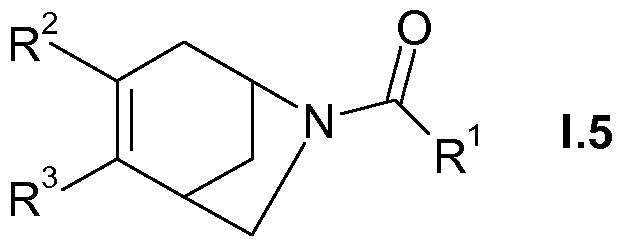
121 Ep: the epo has been informed by wipo that ep was designated in this application

Ref document number: 08850194

Country of ref document: EP

Kind code of ref document: A2

REEP Request for entry into the european phase

Ref document number: 2008850194

Country of ref document: EP

WWE Wipo information: entry into national phase

Ref document number: 2008850194

Country of ref document: EP

WWE Wipo information: entry into national phase

Ref document number: 2704628

Country of ref document: CA

WWE Wipo information: entry into national phase

Ref document number: 2010533594

Country of ref document: JP

NENP Non-entry into the national phase

Ref country code: DE

WWE Wipo information: entry into national phase

Ref document number: 12742680

Country of ref document: US