WO2009071508A1 - Radikalisch vernetzbare polymerisat-zusammensetzungen enthaltend epoxy-funktionelle copolymere - Google Patents
Radikalisch vernetzbare polymerisat-zusammensetzungen enthaltend epoxy-funktionelle copolymere Download PDFInfo
- Publication number
- WO2009071508A1 WO2009071508A1 PCT/EP2008/066531 EP2008066531W WO2009071508A1 WO 2009071508 A1 WO2009071508 A1 WO 2009071508A1 EP 2008066531 W EP2008066531 W EP 2008066531W WO 2009071508 A1 WO2009071508 A1 WO 2009071508A1
- Authority
- WO
- WIPO (PCT)
- Prior art keywords
- epoxy
- functional
- monomers
- polymer compositions
- radically crosslinkable
- Prior art date
- Legal status (The legal status is an assumption and is not a legal conclusion. Google has not performed a legal analysis and makes no representation as to the accuracy of the status listed.)
- Ceased
Links
Classifications
-
- C—CHEMISTRY; METALLURGY
- C08—ORGANIC MACROMOLECULAR COMPOUNDS; THEIR PREPARATION OR CHEMICAL WORKING-UP; COMPOSITIONS BASED THEREON
- C08F—MACROMOLECULAR COMPOUNDS OBTAINED BY REACTIONS ONLY INVOLVING CARBON-TO-CARBON UNSATURATED BONDS
- C08F290/00—Macromolecular compounds obtained by polymerising monomers on to polymers modified by introduction of aliphatic unsaturated end or side groups
- C08F290/02—Macromolecular compounds obtained by polymerising monomers on to polymers modified by introduction of aliphatic unsaturated end or side groups on to polymers modified by introduction of unsaturated end groups
- C08F290/06—Polymers provided for in subclass C08G
- C08F290/061—Polyesters; Polycarbonates
-
- C—CHEMISTRY; METALLURGY
- C08—ORGANIC MACROMOLECULAR COMPOUNDS; THEIR PREPARATION OR CHEMICAL WORKING-UP; COMPOSITIONS BASED THEREON
- C08F—MACROMOLECULAR COMPOUNDS OBTAINED BY REACTIONS ONLY INVOLVING CARBON-TO-CARBON UNSATURATED BONDS
- C08F283/00—Macromolecular compounds obtained by polymerising monomers on to polymers provided for in subclass C08G
- C08F283/01—Macromolecular compounds obtained by polymerising monomers on to polymers provided for in subclass C08G on to unsaturated polyesters
-
- C—CHEMISTRY; METALLURGY
- C08—ORGANIC MACROMOLECULAR COMPOUNDS; THEIR PREPARATION OR CHEMICAL WORKING-UP; COMPOSITIONS BASED THEREON
- C08F—MACROMOLECULAR COMPOUNDS OBTAINED BY REACTIONS ONLY INVOLVING CARBON-TO-CARBON UNSATURATED BONDS
- C08F290/00—Macromolecular compounds obtained by polymerising monomers on to polymers modified by introduction of aliphatic unsaturated end or side groups
- C08F290/02—Macromolecular compounds obtained by polymerising monomers on to polymers modified by introduction of aliphatic unsaturated end or side groups on to polymers modified by introduction of unsaturated end groups
- C08F290/06—Polymers provided for in subclass C08G
-
- C—CHEMISTRY; METALLURGY
- C08—ORGANIC MACROMOLECULAR COMPOUNDS; THEIR PREPARATION OR CHEMICAL WORKING-UP; COMPOSITIONS BASED THEREON
- C08L—COMPOSITIONS OF MACROMOLECULAR COMPOUNDS
- C08L51/00—Compositions of graft polymers in which the grafted component is obtained by reactions only involving carbon-to-carbon unsaturated bonds; Compositions of derivatives of such polymers
- C08L51/08—Compositions of graft polymers in which the grafted component is obtained by reactions only involving carbon-to-carbon unsaturated bonds; Compositions of derivatives of such polymers grafted on to macromolecular compounds obtained otherwise than by reactions only involving unsaturated carbon-to-carbon bonds
Definitions
- the invention relates to free-radically crosslinkable polymer compositions containing epoxy-functional copolymers
- Radical cross-linkable polymer compositions based on, for example, unsaturated polyester resins (UP resins) are frequently used for the production of composite components.
- Unsaturated polyester resins are obtainable by polycondensation of dicarboxylic acids or dicarboxylic acid anhydrides with polyols.
- the free-radically crosslinkable polymer compositions further comprise monomers having ethylenically unsaturated groups, generally styrene.
- styrene is added to the radically crosslinkable polymer composition to dissolve the crosslinkable polymer and to ensure that the radically crosslinkable polymer composition is a flowable mass.
- the radically crosslinkable polymer compositions often also contain fiber materials such as glass fibers, carbon fibers or corresponding fiber mats
- LPA low-profile additives
- the low-profile additives are usually thermoplastics such as polystyrene, polymethyl methacrylate and in particular polyvinyl acetate, which frequently also contain carboxyl-functional comonomer units.
- EP-A 0075765 recommends free-radically crosslinkable polymer compositions for the production of composite components, which contain, as LPA polymers based on vinyl acetate or alkyl acrylates and additionally ethylenically unsaturated fatty acid esters, through which the formation of composite components with as smooth as possible less corrugated surfaces is favored.
- US Pat. No. 4,525,498 discloses radically crosslinkable polymer compositions comprising unsaturated polyester resin, vinyl acetate-based or alkyl acrylate-based LPA and saturated, epoxy group-bearing, low molecular weight compounds by which the shrinkage-reducing effect of the LPA during curing increased the composition and the surface properties of the composite components can be improved.
- a significant increase in the mechanical properties of the composite components did not cause the addition of epoxide group-bearing, low molecular weight compounds. In addition, low molecular weight compounds tend to migrate and are easily released from the composite components.
- US Pat. No. 4,284,736 recommends free-radically crosslinkable polymer compositions which contain as LPA terpolymers based on vinyl esters, glycidyl esters of unsaturated monocarboxylic acids and at least 45% by weight of vinyl halides, based on the total weight of the respective terpolymer.
- the compositions described therein are by good compatibility with organic and inorganic pigments and, after curing, by characterized a uniform pigmentation of the composite components.
- the use of vinyl halide polymer-containing polymers is frowned upon for environmental reasons, since they tend, for example, to dehydrochlorination and release large amounts of hydrochloric acid on disposal.
- Copolymers based on vinyl esters and ethylenically unsaturated, epoxy-functional monomers are used in various fields of application.
- EP-A 0897376 describes corresponding copolymers as sizing agents for reinforcing glass fibers.
- the sizing agents are aqueous compositions of saturated, thermoplastic polyurethanes, vinyl acetate-glycidyl methacrylate copolymers and silane coupling agents, which are applied to the fibers in thin layers as they are used.
- the object was to add free-radically crosslinkable polymer compositions such vinyl halide-free additives that counteract the volume shrinkage in the curing of the radically crosslinkable polymer compositions and at the same time to composite components with an improved mechanical property profile, such as an improved flexural strength, lead and beyond the other disadvantages mentioned above do not have.
- the object has surprisingly been achieved with free-radically crosslinkable polymer compositions which contain vinyl halide-free, epoxy-functional vinyl ester copolymers.
- the invention relates to radically crosslinkable polymer compositions containing one or more radically crosslinkable polymers, one or more ethylenically unsaturated monomers (reactive monomers), optionally initiators, optionally fillers and optionally further additives, characterized in that additionally one or more vinyl halide-free, epoxy-functional vinyl ester copolymers (epoxy-functional copolymers) are contained.
- the epoxy-functional copolymers are obtainable by free-radically initiated polymerization of a) one or more vinyl esters and b) one or more ethylenically unsaturated, epoxy-functional monomers and optionally one or more further ethylenically unsaturated monomers other than vinyl halides.
- Preferred vinyl esters are vinyl esters of unbranched or branched carboxylic acids having 1 to 18 carbon atoms.
- Particularly preferred vinyl esters are vinyl acetate, vinyl propionate, vinyl butyrate, vinyl 2-ethylhexanoate, vinyl laurate and vinyl esters of C-C-branched monocarboxylic acids having 5 to 13 C atoms, for example vinyl pivalate, VeoVa9 R or VeoValO R (trade names of Hexion) or mixtures of the vinyl ester monomers mentioned.
- Most preferred is vinyl acetate.
- Vinylester a) 15 to 99.9 weight .-% ⁇ is set, particularly preferably 20 to 99 wt .-%, each based on the total weight of the monomers to prepare the epoxy functional copolymers.
- the ethylenically unsaturated, epoxy-functional monomers b) preferably have 1 to 20 C atoms, more preferably 1 to 10 C atoms, which may be linear or branched, open-chain or cyclic.
- Examples of preferred ethylenically unsaturated, epoxy-functional monomers b) are glycidyl acrylate, glycidyl methacrylate (GMA) or allyl glycidyl ether; particularly preferred are glycidyl acrylate and glycidyl methacrylate; most preferred is glycidyl methacrylate.
- GMA glycidyl methacrylate
- allyl glycidyl ether particularly preferred are glycidyl acrylate and glycidyl methacrylate; most preferred is glycidyl methacrylate.
- 0.1 to 20 wt .-%, particularly preferably 0.2 to 15 wt .-% ethylenically unsaturated, epoxy-functional monomers b) are used, each based on the total weight of the monomers for the preparation of the epoxy-functional Copolyme- re ,
- one or more monomers can be used selected from the group consisting of acrylates and methacrylates of unbranched or branched alcohols having 1 to 20 C atoms, vinyl aromatics, olefins and dienes (monomers c)) ,
- Preferred monomers c) from the group of the esters of acrylic acid or methacrylic acid are esters of unbranched or branched alcohols having 1 to 15 C atoms.
- Particularly preferred acrylic acid esters or methacrylic acid esters are methyl acrylate, methyl methacrylate, ethyl acrylate, ethyl methacrylate, propyl acrylate, propyl methacrylate, n-, iso- or t-butyl acrylate, n-, iso- and t-butyl methacrylate, 2-ethylhexyl acrylate, norbornyl acrylate, isobornyl acrylate, stearyl acrylate.
- acrylic acid esters or methacrylic acid esters are methyl acrylate, ethyl acrylate, methyl methacrylate, n-, iso- and t-butyl acrylate, 2-ethylhexyl acrylate and isobornyl acrylate.
- Preferred dienes are 1,3-butadiene and isoprene.
- Examples of copolymerizable olefins are ethene and propene.
- vinyl aromatic styrene and vinyl toluene can be copolymerized.
- ethylenically unsaturated monomers for the preparation of the epoxy-functional copolymers it is also possible to use one or more monomers selected from the group comprising ethylenically unsaturated carboxylic acids, ethylenically unsaturated saturated alcohols, ethylenically unsaturated sulfonic acids and ethylenically unsaturated phosphonic acids (monomers d)).
- ethylenically unsaturated mono- and dicarboxylic acids having 3 to 20 C atoms
- ethylenically unsaturated alcohols having 3 to 20 C atoms
- vinyl sulfonate and vinyl phosphonate for the preparation of the epoxy-functional copolymers.
- acrylic acid methacrylic acid, crotonic acid, fumaric acid, maleic acid, 2-hydroxyethyl acrylate, 2-hydroxyethyl methacrylate, hydroxypropyl acrylate or hydroxypropyl methacrylate.
- the proportion of monomers d) in the epoxy-functional copolymers is preferably 0 to 15% by weight, more preferably 0 to 10% by weight, based in each case on the total weight of the epoxy-functional copolymers.
- epoxy-functional copolymers obtainable by free-radically initiated polymerization of one or more vinyl esters a) selected from the group comprising vinyl acetate, vinyl pivalate, vinyl laurate, VeoVa9 R and VeoVal0 R , and one or more ethylenically unsaturated, epoxy-functional monomers b) selected from the group comprising glycidyl acrylate, glycidyl methacrylate (GMA) and allyl glycidyl ether, and optionally one or more monomers c) selected from the group of (meth) acrylic esters, in particular methyl acrylate, methyl methacrylate, ethyl acrylate, n-, iso or t-butyl acrylate , 2-ethylhexyl acrylate, isobornyl acrylate or stearyl acrylate, from the group of dienes, in particular isoprene or 1,3-butadiene, from the group of
- epoxy-functional copolymers based on vinyl acetate and one or more monomers b), such as in particular glycidyl methacrylate, and optionally vinyl laurate, acrylic acid or crotonic acid in the abovementioned amounts.
- the epoxy-functional copolymers preferably contain ⁇ 1, more preferably 1 to 200 and most preferably 10 to 150 epoxy-functional monomer units per 1000 monomer units.
- the epoxy-functional copolymers have molecular weights Mw of preferably ⁇ 6,500 g / mol, more preferably from 6,500 to 1,500,000 g / mol, very preferably from 6,500 to 1,000,000 g / mol and most preferably from 10,000 to 800,000 g / mol.
- the epoxy-functional copolymers preferably contain the epoxy-functional monomer units in random distribution, i. the epoxy-functional copolymers are preferably not grafted with epoxy-functional monomers or compounds.
- the preparation of the epoxy-functional copolymers is carried out by free-radical substance, suspension, emulsion or Engelspolymerisationsclar the monomers a) and b) and optionally the monomers c) to d) in the presence of free-radical initiators - such as in EP-A 1812478 or DE-A 10309857 described.
- Suitable reactive monomers are the monomers which are suitable, preferably or particularly preferred, which are also suitable, preferred or particularly preferred for the polymerization for the preparation of the epoxy-functional copolymers.
- Very particularly preferred reactive monomers are styrene, methyl methacrylate, methyl acrylate and butyl acrylate. The most preferred reactive monomer is styrene.
- Preferred free-radically crosslinkable polymers are unsaturated polyester resins or vinyl ester resins.
- the unsaturated polyester resins are reaction products of one or more dicarboxylic acids or one or more dicarboxylic acid anhydrides with one or more polyols.
- the preparation of the unsaturated polyester resins is known to the person skilled in the art.
- the dicarboxylic acids or the dicarboxylic acid anhydrides preferably have 2 to 20, particularly preferably 4 to 20 and most preferably 4 to 10 carbon atoms.
- the unsaturated polyester resins contain at least one ethylenically unsaturated dicarboxylic acid or at least one ethylenically unsaturated dicarboxylic anhydride.
- Preferred ethylenically unsaturated dicarboxylic acids or dicarboxylic acid anhydrides are maleic acid, maleic anhydride, fumaric acid, methylmaleic acid and itaconic acid. Particularly preferred are maleic acid, maleic anhydride and fumaric acid.
- saturated dicarboxylic acids or anhydrides can be used.
- Suitable saturated acids or dicarboxylic acid anhydrides are, for example, orthophthalic acid, isophthalic acid, phthalic anhydride, terephthalic acid, hexahydrophthalic acid, adipic acid, succinic acid and isophthalic acid.
- Suitable polyols preferably have 2 to 20 and more preferably 2 to 10 carbon atoms. Polyols preferably carry 2 to 3, more preferably 2 alcohol groups. Examples of suitable polyols are ethylene glycol, diethylene glycol,
- Propylene glycol dipropylene glycol, butylene glycol, Neopentylgly- kol, glycerol and 1, 1, 1-trimethylolpropane.
- the unsaturated polyester resins have molecular weights Mw of preferably 500 to 10,000 g / mol, more preferably 500 to 6,000 g / mol, and most preferably 1,000 to 6,000 g / mol.
- Vinyl ester resins are reaction products which are formed by polyadditions or esterification reactions of phenol derivatives and ethylenically unsaturated mono- or dicarboxylic acids or dicarboxylic anhydrides having 3 to 20 carbon atoms, such as, for example, acrylic acids or methacrylic acids.
- Preferred phenol derivatives are bisphenol A and phenol novolac.
- the preparation of the vinyl ester resins is known to the person skilled in the art.
- Suitable initiators are, for example, t-butyl perbenzoate, t-butyl peroxy-2-ethylhexanoate, t-butyl peroxypivalate, t-butyl peroxyneodecanoate, dibenzoyl peroxide, t-amyl peroxypivalate, di (2-ethylhexyl) peroxydicarbonate, 1,1-bis (t-butyl peroxy ) -3, 3, 5-trimethylcyclohexane, di (4-t-butylcyclohexyl) peroxydicarbonate, azobisisobutyronitrile.
- Suitable fillers are, for example, talc, aluminum hydroxide, kaolin, calcium carbonate, dolomite, glass beads or glass fibers, quartz, aluminum oxide or barium sulfate.
- the radically crosslinkable polymer compositions preferably contain from 30 to 60 parts by weight of radically crosslinkable polymers, from 5 to 40 parts by weight of epoxy-functional copolymers, from 30 to 160 parts by weight of reactive monomers, optionally from 0.5 to 2% by weight.
- Parts initiator optionally fillers such as 25 to 100 parts by weight of glass fiber or 50 to 200 parts by weight of calcium carbonate, optionally further additives such as 0.5 to 3 parts by weight of mold release agents, for example zinc stearate, and optionally other additives, for example Pigments, thickeners, flame-retardant additives.
- the free-radically crosslinkable polymer compositions may comprise further polymers, for example polymers known to act as low-profile additive, such as polyvinyl acetate, carboxyl-functional polyvinyl acetate or polymethyl methacrylate.
- the proportion of the further polymers is 0 to 100 wt .-%, preferably 0 to 50 wt .-%, each based on the amount by weight of epoxy functional copolymers in the respective radically crosslinkable polymer composition.
- Another object of the invention are methods for preparing the radically crosslinkable polymer compositions by mixing one or more radically crosslinkable polymers, one or more ethylenically unsaturated monomers (reactive monomers) and optionally of initiators, optionally of fillers and, where appropriate, of further additives, characterized in that in addition one or more vinyl halide-free, epoxy-functional vinyl ester copolymers (epoxy-functional copolymers) admixed.
- the epoxy-functional copolymers and the radically crosslinkable polymers are dissolved separately or together, optionally in combination with other polymers, generally in reactive monomers and optionally mixed with further additives such as fillers, thickeners, initiators and processing aids. If the epoxy-functional copolymers or the radically crosslinkable polymers are dissolved in reactive monomers, the radically crosslinkable polymers are preferably used as 50 to 70% solution in reactive monomers and the epoxy-functional copolymers preferably as 30 to 50% solution in used reactive monomers.
- the mixing of the components for the preparation of the radically crosslinkable polymer compositions can be carried out using the customary devices known to the person skilled in the art, such as, for example, reactors, stirred vessels or mixers, and stirrers, such as, for example, blade, armature or blade stirrers.
- Another object of the invention are composite components obtainable by curing the radically crosslinkable polymer compositions.
- the curing of the radical-crosslinkable polymer compositions preferably takes place at temperatures of ⁇ 20 0 C, particularly preferably from 20 to 200 0 C and most preferably 20-165 0 C.
- the curing in the opposite waiting of one or more initiators by radical-initiated polymerization.
- the free-radically crosslinkable polymer compositions are compacted on curing at the particular temperature using pressures of ⁇ 1 mbar, more preferably from 1 to 200,000 mbar, and most preferably from 1,000 to 200,000 mbar.
- the composite components can be obtained from the free-radically crosslinkable polymer compositions by all common production methods, for example by means of sheet molding compound technology (SMC), bulk molding compound technology (BMC), resin transfer molding (RTM) or resine injection Molding (RIM).
- SMC sheet molding compound technology
- BMC bulk molding compound technology
- RTM resin transfer molding
- RIM resine injection Molding
- the composite components by means of BMC technology (BuIk Molding Compound) or SMC technology (Sheet Molding Compound) are produced.
- BMC technology BuIk Molding Compound
- SMC technology Sheet Molding Compound
- the solutions of the radically crosslinkable polymers in reactive monomer and the epoxy-functional copolymers and optionally the further components such as the initiator, filler, mold release agent or other polymers, low-profile additives or additives are mixed to form a pasty mass, Thereafter, if appropriate, glass fiber is admixed, and then the resulting free-radically crosslinkable polymer compositions are cured using pressure and temperature to form the composite component. For example, reflectors for car headlights are produced with this technology.
- a radically crosslinkable polymer composition in the form of a pasty mass of a solution of free-radically crosslinkable polymers in reactive monomer and the epoxy-functional Copolymer and optionally the other components such as initiator, filler, mold release agents, other polymers, low-profile additives or additives produced and applied to a polyamide film.
- glass fiber is sprinkled onto this layer, then optionally a further layer of the pasty mass is applied and finally covered with a further polyamide film.
- This sheet sandwich is then peeled from the film, cut into pieces and pressed using compression and temperature to composite components.
- Composite components made by this technique are used, for example, as tailgates of automobiles.
- the composite components according to the invention have advantageous performance properties, such as improved mechanical strength, in particular high bending strength.
- the mechanical strength can be increased by using epoxy-functional copolymers having a larger number of epoxy-functional monomer units and / or a higher molecular weight M w.
- the epoxy-functional copolymers act as low-profile additives in the production of the composite components.
- Another object of the invention is the use of the epoxy-functional copolymers as low-profile additives (LPA).
- LPA low-profile additives
- the monomer solution was added within 240 minutes and the initiator solution within 300 minutes. After the end of the initiator feeds for 2 hours at 80 0 C nachpolyme- was rised. A clear polymer solution having a solids content of 79% by weight was obtained. Under vacuum and elevated temperature, the ethyl acetate was distilled off. The dried film of ethyl acetate solution (layer thickness 70 microns) was clear. The copolymer had a content of glycidyl methacrylate of 1 wt .-%, based on the total mass of the monomers used.
- Example 1 Analogously to the procedure of Example 1, a copolymer was prepared which was obtained from 97% by weight of vinyl acetate and 3% by weight of glycidyl methacrylate. The polymer properties are listed in Table 1.
- Example 3 Analogously to the procedure of Example 1, a copolymer was prepared which was obtained from 97% by weight of vinyl acetate and 3% by weight of glycidyl methacrylate. Unlike Example 1 but instead of ethyl acetate 247 g of isopropanol were used. The polymer properties are listed in Table 1.
- Example 1 Analogously to the procedure of Example 1, a copolymer was prepared which consisted of 95% by weight of vinyl acetate and 5% by weight. Glycidyl methacrylate was obtained. The polymer properties are listed in Table 1.
- Example 5 Analogously to the procedure of Example 1, a copolymer was prepared which was obtained from 94% by weight of vinyl acetate and 6% by weight of glycidyl methacrylate. The polymer properties are listed in Table 1.
- Example 2 Analogously to the procedure of Example 1, a copolymer was prepared, which was obtained from 90 wt .-% vinyl acetate and 10 wt .-% glycidyl methacrylate. The polymer properties are listed in Table 1.
- Example 2 Analogously to the procedure of Example 1, a copolymer was prepared, which was obtained from 88 wt .-% vinyl acetate and 12 wt .-% glycidyl methacrylate. The polymer properties are listed in Table 1.
- VAc vinyl acetate
- GMA glycidyl methacrylate
- the percentage by weight refers to the total weight of the monomers.
- Hoppler Hoppler viscosity according to DIN 53015 (10% in ethyl acetate, 2O 0 C)
- K-value determined according to DIN EN ISO 1628-2 (1 wt .-% in acetone).
- Mw Mw (weight average) determined by SEC
- a mixture of 100 parts by weight of an unsaturated polyester resin (orthophthalic acid-maleic anhydride resin, 65% dissolved in styrene) with 1 part by weight of a cobalt accelerator (NL 49-P from Akzo Nobel), 1.5 parts by weight of an initiator (Butanox M 50 by Akzo Nobel) and optionally 2 parts by weight of polymer additive (Table 2) intimately mixed and poured into a mold. After curing for 24 hours at room temperature, 24 hours at 65 ° C and 2 h at 100 0 C, the test specimen (length / width / height 100mm / 15mm / 2mm) were obtained. The corresponding test specimens are characterized in greater detail by the data in Table 2.
- GMA glycidyl methacrylate; the indication in Gew. -% refers to the total weight of the copolymer.
- Mw molecular weight M w (weight average) determined by means of SEC "Si ze exclusion chromatography", polystyrene standard, THF; 6O 0 C.
- BF flexural strength: determined according to DIN EN I SO 14125. The flexural strength of the composite components was determined on the basis of the test specimens according to EN ISO 14125. The test results for the various specimens are listed in Table 2.
- test body V9 modified with a vinyl acetate homopolymer has a considerably poorer flexural strength than the unmodified test body V8.
- addition of the epoxy-functional copolymer of Example 3 led to an increase in the flexural strength of specimens in Example 10.
- Examples 10 to 13 show that by further increasing the number of epoxy-functional monomer units or the molecular weight Mw of the epoxy Functional copolymers, the flexural strengths of the specimens can be significantly increased.
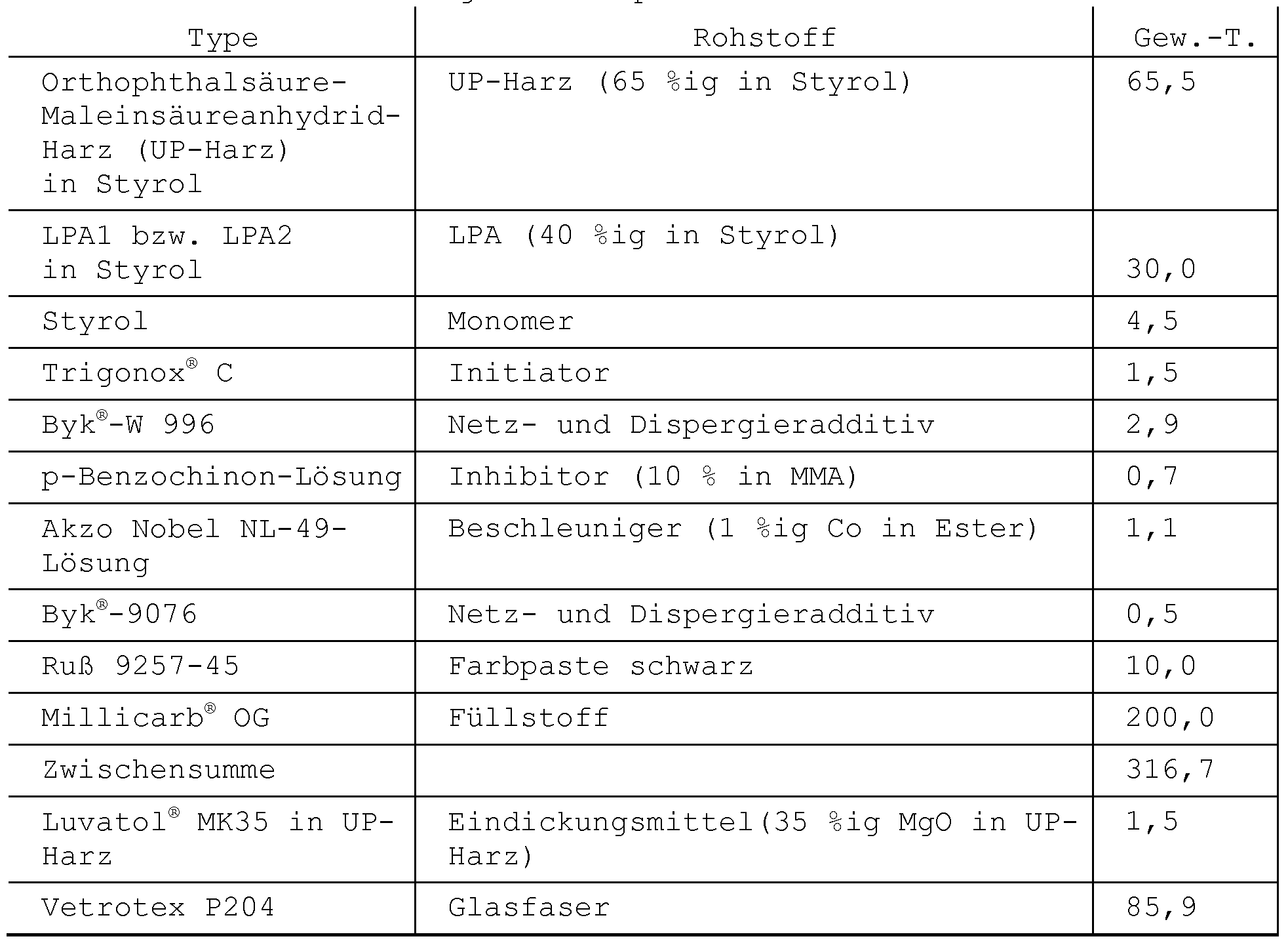
- a paste was kneaded. Shortly before processing, Luvatol MK 35, a thickener, was stirred in. Thereafter, a hand laminate was made with the paste and the glass fibers and processed into an SMC. The product was stored for 3 days at 20 ° C. and 50% room humidity. Then it was pressed at 160 0 C in a common SMC press to a composite component.
Landscapes
- Chemical & Material Sciences (AREA)
- Health & Medical Sciences (AREA)
- Chemical Kinetics & Catalysis (AREA)
- Medicinal Chemistry (AREA)
- Polymers & Plastics (AREA)
- Organic Chemistry (AREA)
- Compositions Of Macromolecular Compounds (AREA)
- Epoxy Resins (AREA)
- Addition Polymer Or Copolymer, Post-Treatments, Or Chemical Modifications (AREA)
Abstract
Description



Claims
Priority Applications (4)
| Application Number | Priority Date | Filing Date | Title |
|---|---|---|---|
| CA2704889A CA2704889C (en) | 2007-12-03 | 2008-12-01 | Radically cross-linkable polymer compositions containing epoxy-functional copolymers |
| US12/746,035 US20100256287A1 (en) | 2007-12-03 | 2008-12-01 | Radically cross-linkable polymer compositions containing epoxy-functional copolymers |
| CN2008801187709A CN101883823A (zh) | 2007-12-03 | 2008-12-01 | 含环氧官能的共聚物的自由基可交联聚合物组合物 |
| EP08858142A EP2217660A1 (de) | 2007-12-03 | 2008-12-01 | Radikalisch vernetzbare polymerisat-zusammensetzungen enthaltend epoxy-funktionelle copolymere |
Applications Claiming Priority (2)
| Application Number | Priority Date | Filing Date | Title |
|---|---|---|---|
| DE102007055692.8 | 2007-12-03 | ||
| DE102007055692A DE102007055692A1 (de) | 2007-12-03 | 2007-12-03 | Radikalisch vernetzbare Polymerisat-Zusammensetzungen enthaltend Epoxy-funktionelle Copolymere |
Publications (1)
| Publication Number | Publication Date |
|---|---|
| WO2009071508A1 true WO2009071508A1 (de) | 2009-06-11 |
Family
ID=40336469
Family Applications (1)
| Application Number | Title | Priority Date | Filing Date |
|---|---|---|---|
| PCT/EP2008/066531 Ceased WO2009071508A1 (de) | 2007-12-03 | 2008-12-01 | Radikalisch vernetzbare polymerisat-zusammensetzungen enthaltend epoxy-funktionelle copolymere |
Country Status (6)
| Country | Link |
|---|---|
| US (1) | US20100256287A1 (de) |
| EP (1) | EP2217660A1 (de) |
| CN (1) | CN101883823A (de) |
| CA (1) | CA2704889C (de) |
| DE (1) | DE102007055692A1 (de) |
| WO (1) | WO2009071508A1 (de) |
Families Citing this family (3)
| Publication number | Priority date | Publication date | Assignee | Title |
|---|---|---|---|---|
| DE102008054482A1 (de) * | 2008-12-10 | 2010-06-17 | Wacker Chemie Ag | Pfropfcopolymere und deren Verwendung als Low-Profile-Additive |
| CN111154370B (zh) * | 2020-01-15 | 2021-06-08 | 华东理工大学 | 一种抗菌丙烯酸酯涂料及其制备方法与应用 |
| CN113930060A (zh) * | 2021-10-25 | 2022-01-14 | 河北多凯复合材料有限公司 | 一种新型高性能防静电阻燃复合材料及其制备方法 |
Citations (12)
| Publication number | Priority date | Publication date | Assignee | Title |
|---|---|---|---|---|
| US3574157A (en) * | 1969-02-03 | 1971-04-06 | Fred Markus | Coating composition of epoxy resins,polyester resins,and vinyl monomers |
| US4284736A (en) * | 1971-01-18 | 1981-08-18 | Union Carbide Corporation | Unsaturated polyester compositions |
| US4448941A (en) * | 1981-12-07 | 1984-05-15 | Ford Motor Company | Resin binder for fiber composite materials |
| WO1995009202A1 (en) * | 1993-09-28 | 1995-04-06 | Cambridge Industries, Inc. | Additives to improve surface characteristics of unsaturated polyester molding composition |
| WO2001016207A1 (en) * | 1999-09-01 | 2001-03-08 | Reichhold, Inc. | High performance polyetherester containing laminating resin compositions |
| US6329475B1 (en) * | 1992-08-12 | 2001-12-11 | The Dow Chemical Company | Curable epoxy vinylester composition having a low peak exotherm during cure |
| EP0897376B1 (de) * | 1996-05-08 | 2002-01-16 | Owens Corning Composites S.P.R.L. | Schlichtemittel mit hoher löslichkeit für fasern |
| EP1203647A1 (de) * | 2000-11-02 | 2002-05-08 | Wacker Polymer Systems GmbH & Co. KG | Verfahren zur Herstellung von Holzpressplatten |
| US20020161138A1 (en) * | 1999-09-29 | 2002-10-31 | Mitsubishi Jidosha Kogyo Kabushiki Kaisha | Damping resin composition and damping resin article for structure using the resin composition |
| DE10309857A1 (de) | 2003-03-06 | 2004-09-23 | Wacker Polymer Systems Gmbh & Co. Kg | Epoxy-modifizierte Vinylchlorid-Vinylester-Copolymer-Festharze |
| US7030198B2 (en) * | 2000-12-06 | 2006-04-18 | Quarella S.P.A. | Curable compositions comprising an epoxidised unsaturated polyester and mineral fillers |
| EP1812478A1 (de) | 2004-10-21 | 2007-08-01 | Wacker Polymer Systems GmbH & Co. KG | Silan-modifizierte polyvinylalkohole |
Family Cites Families (15)
| Publication number | Priority date | Publication date | Assignee | Title |
|---|---|---|---|---|
| US3437514A (en) * | 1967-08-02 | 1969-04-08 | Ford Motor Co | Radiation crosslinking of alpha-beta unsaturated paint binder resin |
| US3718714A (en) | 1970-09-16 | 1973-02-27 | Union Carbide Corp | Unsaturated polyester compositions |
| US3689309A (en) * | 1970-12-21 | 1972-09-05 | Ford Motor Co | Epoxy-vinyl copolymer and graded-rubber paint and process |
| US3997627A (en) * | 1973-08-29 | 1976-12-14 | Mitsubishi Rayon Co., Ltd. | Polyester molding compositions containing hydroxy containing vinyl monomers and coated molded articles thereof |
| US4341877A (en) * | 1980-06-04 | 1982-07-27 | Ppg Industries, Inc. | Sizing composition and sized glass fibers and process |
| US4525498A (en) | 1980-10-16 | 1985-06-25 | Union Carbide Corporation | Polyester fiber reinforced molding compounds |
| CA1196118A (en) | 1981-09-11 | 1985-10-29 | Kenneth E. Atkins | Polyester molding compositions |
| US4473618A (en) * | 1983-05-13 | 1984-09-25 | Owens-Corning Fiberglas Corporation | Chrome-free sizing composition containing titanium acetyl acetonate for glass fiber gun roving |
| US5541253A (en) * | 1994-10-11 | 1996-07-30 | The B. F. Goodrich Company | High solids copolymer dispersion from a latex and its use in sealants |
| US6221425B1 (en) * | 1998-01-30 | 2001-04-24 | Advanced Cardiovascular Systems, Inc. | Lubricious hydrophilic coating for an intracorporeal medical device |
| US7279174B2 (en) * | 2003-05-08 | 2007-10-09 | Advanced Cardiovascular Systems, Inc. | Stent coatings comprising hydrophilic additives |
| CN1528622A (zh) * | 2003-10-17 | 2004-09-15 | 江阴协统汽车附件有限公司 | 汽车外装用涂漆间苯型片状模塑料保险杠 |
| AU2006229153A1 (en) * | 2005-03-28 | 2006-10-05 | Toray Industries, Inc. | Polylactic acid foam |
| DE102006019686A1 (de) | 2006-04-27 | 2007-10-31 | Wacker Polymer Systems Gmbh & Co. Kg | Verwendung von carboxylfunktionellen Polyvinylacetaten zur Herstellung von BMC-Formteilen |
| DE102007055694A1 (de) * | 2007-12-03 | 2009-06-04 | Wacker Chemie Ag | Vernetzbare Vinylester-Copolymerisate und deren Verwendung als Low-Profile-Additive |
-
2007
- 2007-12-03 DE DE102007055692A patent/DE102007055692A1/de not_active Ceased
-
2008
- 2008-12-01 US US12/746,035 patent/US20100256287A1/en not_active Abandoned
- 2008-12-01 WO PCT/EP2008/066531 patent/WO2009071508A1/de not_active Ceased
- 2008-12-01 EP EP08858142A patent/EP2217660A1/de not_active Withdrawn
- 2008-12-01 CN CN2008801187709A patent/CN101883823A/zh active Pending
- 2008-12-01 CA CA2704889A patent/CA2704889C/en not_active Expired - Fee Related
Patent Citations (12)
| Publication number | Priority date | Publication date | Assignee | Title |
|---|---|---|---|---|
| US3574157A (en) * | 1969-02-03 | 1971-04-06 | Fred Markus | Coating composition of epoxy resins,polyester resins,and vinyl monomers |
| US4284736A (en) * | 1971-01-18 | 1981-08-18 | Union Carbide Corporation | Unsaturated polyester compositions |
| US4448941A (en) * | 1981-12-07 | 1984-05-15 | Ford Motor Company | Resin binder for fiber composite materials |
| US6329475B1 (en) * | 1992-08-12 | 2001-12-11 | The Dow Chemical Company | Curable epoxy vinylester composition having a low peak exotherm during cure |
| WO1995009202A1 (en) * | 1993-09-28 | 1995-04-06 | Cambridge Industries, Inc. | Additives to improve surface characteristics of unsaturated polyester molding composition |
| EP0897376B1 (de) * | 1996-05-08 | 2002-01-16 | Owens Corning Composites S.P.R.L. | Schlichtemittel mit hoher löslichkeit für fasern |
| WO2001016207A1 (en) * | 1999-09-01 | 2001-03-08 | Reichhold, Inc. | High performance polyetherester containing laminating resin compositions |
| US20020161138A1 (en) * | 1999-09-29 | 2002-10-31 | Mitsubishi Jidosha Kogyo Kabushiki Kaisha | Damping resin composition and damping resin article for structure using the resin composition |
| EP1203647A1 (de) * | 2000-11-02 | 2002-05-08 | Wacker Polymer Systems GmbH & Co. KG | Verfahren zur Herstellung von Holzpressplatten |
| US7030198B2 (en) * | 2000-12-06 | 2006-04-18 | Quarella S.P.A. | Curable compositions comprising an epoxidised unsaturated polyester and mineral fillers |
| DE10309857A1 (de) | 2003-03-06 | 2004-09-23 | Wacker Polymer Systems Gmbh & Co. Kg | Epoxy-modifizierte Vinylchlorid-Vinylester-Copolymer-Festharze |
| EP1812478A1 (de) | 2004-10-21 | 2007-08-01 | Wacker Polymer Systems GmbH & Co. KG | Silan-modifizierte polyvinylalkohole |
Also Published As
| Publication number | Publication date |
|---|---|
| CA2704889C (en) | 2012-09-11 |
| CN101883823A (zh) | 2010-11-10 |
| US20100256287A1 (en) | 2010-10-07 |
| EP2217660A1 (de) | 2010-08-18 |
| DE102007055692A1 (de) | 2009-06-04 |
| CA2704889A1 (en) | 2009-06-11 |
Similar Documents
| Publication | Publication Date | Title |
|---|---|---|
| DE69717292T2 (de) | Selbstvernetzende wässrige dispersionen | |
| EP2406295B1 (de) | Verwendung von vinylester-copolymeren als low-profile-additive (lpa) | |
| EP2010581A1 (de) | Verwendung von carboxylfunktionellen polyvinylacetaten zur herstellung von bmc-formteilen | |
| EP0501176A1 (de) | Eingedickte härtbare Formmasse aus ungesättigten Polyesterharzen | |
| DE69600984T2 (de) | Acryl- oder Methacrylformmasse und Verfahren zu desssen Produktion | |
| EP2227494B1 (de) | Vernetzbare vinylester-copolymerisate und deren verwendung als low-profile-additive | |
| EP2217660A1 (de) | Radikalisch vernetzbare polymerisat-zusammensetzungen enthaltend epoxy-funktionelle copolymere | |
| EP3555019B1 (de) | Verwendung von vinylacetat-copolymeren als schwindmass-reduzierender zusatz in kalthärtenden systemen | |
| EP2356159A1 (de) | Pfropfcopolymere und deren verwendung als low-profile additive | |
| KR101404837B1 (ko) | 보호 콜로이드로 안정화된 중합물의 저프로파일 첨가제(lpa)로서의 용도 | |
| EP2569341B1 (de) | Low-profile-additive auf basis nachwachsender rohstoffe | |
| WO2009065749A1 (de) | Herstellung von lösungen von vinylpolymeren in reaktiven monomeren | |
| EP2010582A1 (de) | Verwendung von funktionalisierten polyvinylestern zur erhöhung der oberflächenspannung von bmc/smc-formteilen | |
| DE2116874B2 (de) | Warmhärtbare Masse auf Basis von Butadienpolymerisaten und ihre Verwendung | |
| WO2024217658A1 (de) | Verwendung von vinylacetat-copolymeren als low-profile-additiv | |
| WO2013107889A1 (de) | Verwendung von funktionalisierten polymerisaten als low-profile-additive (lpa) | |
| WO2020228953A1 (de) | Verwendung von vinylacetat-copolymeren als low-profile-additiv | |
| DE4238536A1 (de) | Härtbare Formmassen | |
| DE2245204A1 (de) | Verstaerkte harzmasse | |
| WO2007134988A1 (de) | Verwendung von silanfunktionellen polyvinylestern als low-profile-additiv | |
| EP2303938A1 (de) | Verwendung von polyvinylester-festharzen als schlagzähmodifizierer für duroplasten |
Legal Events
| Date | Code | Title | Description |
|---|---|---|---|
| WWE | Wipo information: entry into national phase |
Ref document number: 200880118770.9 Country of ref document: CN |
|
| 121 | Ep: the epo has been informed by wipo that ep was designated in this application |
Ref document number: 08858142 Country of ref document: EP Kind code of ref document: A1 |
|
| DPE1 | Request for preliminary examination filed after expiration of 19th month from priority date (pct application filed from 20040101) | ||
| WWE | Wipo information: entry into national phase |
Ref document number: 2704889 Country of ref document: CA |
|
| WWE | Wipo information: entry into national phase |
Ref document number: 2008858142 Country of ref document: EP |
|
| WWE | Wipo information: entry into national phase |
Ref document number: 12746035 Country of ref document: US |
|
| NENP | Non-entry into the national phase |
Ref country code: DE |