WO2009079692A1 - Halogenated analogues of anti-fibrotic agents - Google Patents

Halogenated analogues of anti-fibrotic agents Download PDF

Info

Publication number
WO2009079692A1
WO2009079692A1 PCT/AU2008/001868 AU2008001868W WO2009079692A1 WO 2009079692 A1 WO2009079692 A1 WO 2009079692A1 AU 2008001868 W AU2008001868 W AU 2008001868W WO 2009079692 A1 WO2009079692 A1 WO 2009079692A1
Authority
WO
WIPO (PCT)
Prior art keywords
optionally substituted
group
crci
compound according
conr
Prior art date
Legal status (The legal status is an assumption and is not a legal conclusion. Google has not performed a legal analysis and makes no representation as to the accuracy of the status listed.)
Ceased
Application number
PCT/AU2008/001868
Other languages
French (fr)
Inventor
Darren James Kelly
Spencer John Williams
Steven Zammit
Current Assignee (The listed assignees may be inaccurate. Google has not performed a legal analysis and makes no representation or warranty as to the accuracy of the list.)
University of Melbourne
Fibrotech Therapeutics Pty Ltd
Original Assignee
University of Melbourne
Fibrotech Therapeutics Pty Ltd
Priority date (The priority date is an assumption and is not a legal conclusion. Google has not performed a legal analysis and makes no representation as to the accuracy of the date listed.)
Filing date
Publication date
Priority to JP2010538278A priority Critical patent/JP5730578B2/en
Priority to US12/809,751 priority patent/US8624056B2/en
Priority to CN2008801221536A priority patent/CN102164887A/en
Priority to KR1020167002802A priority patent/KR20160017139A/en
Priority to NZ584613A priority patent/NZ584613A/en
Priority to AU2008341010A priority patent/AU2008341010B2/en
Priority to MX2010006787A priority patent/MX337320B/en
Priority to EP08865709.3A priority patent/EP2220028B1/en
Application filed by University of Melbourne, Fibrotech Therapeutics Pty Ltd filed Critical University of Melbourne
Priority to CN201710172053.5A priority patent/CN107162928B/en
Priority to MX2016000325A priority patent/MX372721B/en
Priority to CA2709937A priority patent/CA2709937C/en
Publication of WO2009079692A1 publication Critical patent/WO2009079692A1/en
Priority to ZA2010/03376A priority patent/ZA201003376B/en
Anticipated expiration legal-status Critical
Ceased legal-status Critical Current

Links

Classifications

    • CCHEMISTRY; METALLURGY
    • C07ORGANIC CHEMISTRY
    • C07CACYCLIC OR CARBOCYCLIC COMPOUNDS
    • C07C45/00Preparation of compounds having >C = O groups bound only to carbon or hydrogen atoms; Preparation of chelates of such compounds
    • C07C45/004Preparation of compounds having >C = O groups bound only to carbon or hydrogen atoms; Preparation of chelates of such compounds by reaction with organometalhalides
    • AHUMAN NECESSITIES
    • A61MEDICAL OR VETERINARY SCIENCE; HYGIENE
    • A61PSPECIFIC THERAPEUTIC ACTIVITY OF CHEMICAL COMPOUNDS OR MEDICINAL PREPARATIONS
    • A61P1/00Drugs for disorders of the alimentary tract or the digestive system
    • A61P1/16Drugs for disorders of the alimentary tract or the digestive system for liver or gallbladder disorders, e.g. hepatoprotective agents, cholagogues, litholytics
    • AHUMAN NECESSITIES
    • A61MEDICAL OR VETERINARY SCIENCE; HYGIENE
    • A61PSPECIFIC THERAPEUTIC ACTIVITY OF CHEMICAL COMPOUNDS OR MEDICINAL PREPARATIONS
    • A61P11/00Drugs for disorders of the respiratory system
    • AHUMAN NECESSITIES
    • A61MEDICAL OR VETERINARY SCIENCE; HYGIENE
    • A61PSPECIFIC THERAPEUTIC ACTIVITY OF CHEMICAL COMPOUNDS OR MEDICINAL PREPARATIONS
    • A61P17/00Drugs for dermatological disorders
    • A61P17/02Drugs for dermatological disorders for treating wounds, ulcers, burns, scars, keloids, or the like
    • AHUMAN NECESSITIES
    • A61MEDICAL OR VETERINARY SCIENCE; HYGIENE
    • A61PSPECIFIC THERAPEUTIC ACTIVITY OF CHEMICAL COMPOUNDS OR MEDICINAL PREPARATIONS
    • A61P29/00Non-central analgesic, antipyretic or antiinflammatory agents, e.g. antirheumatic agents; Non-steroidal antiinflammatory drugs [NSAID]
    • AHUMAN NECESSITIES
    • A61MEDICAL OR VETERINARY SCIENCE; HYGIENE
    • A61PSPECIFIC THERAPEUTIC ACTIVITY OF CHEMICAL COMPOUNDS OR MEDICINAL PREPARATIONS
    • A61P35/00Antineoplastic agents
    • AHUMAN NECESSITIES
    • A61MEDICAL OR VETERINARY SCIENCE; HYGIENE
    • A61PSPECIFIC THERAPEUTIC ACTIVITY OF CHEMICAL COMPOUNDS OR MEDICINAL PREPARATIONS
    • A61P43/00Drugs for specific purposes, not provided for in groups A61P1/00-A61P41/00
    • CCHEMISTRY; METALLURGY
    • C07ORGANIC CHEMISTRY
    • C07CACYCLIC OR CARBOCYCLIC COMPOUNDS
    • C07C235/00Carboxylic acid amides, the carbon skeleton of the acid part being further substituted by oxygen atoms
    • C07C235/02Carboxylic acid amides, the carbon skeleton of the acid part being further substituted by oxygen atoms having carbon atoms of carboxamide groups bound to acyclic carbon atoms and singly-bound oxygen atoms bound to the same carbon skeleton
    • C07C235/32Carboxylic acid amides, the carbon skeleton of the acid part being further substituted by oxygen atoms having carbon atoms of carboxamide groups bound to acyclic carbon atoms and singly-bound oxygen atoms bound to the same carbon skeleton the carbon skeleton containing six-membered aromatic rings
    • C07C235/38Carboxylic acid amides, the carbon skeleton of the acid part being further substituted by oxygen atoms having carbon atoms of carboxamide groups bound to acyclic carbon atoms and singly-bound oxygen atoms bound to the same carbon skeleton the carbon skeleton containing six-membered aromatic rings having the nitrogen atom of at least one of the carboxamide groups bound to a carbon atom of a six-membered aromatic ring
    • CCHEMISTRY; METALLURGY
    • C07ORGANIC CHEMISTRY
    • C07CACYCLIC OR CARBOCYCLIC COMPOUNDS
    • C07C237/00Carboxylic acid amides, the carbon skeleton of the acid part being further substituted by amino groups
    • C07C237/28Carboxylic acid amides, the carbon skeleton of the acid part being further substituted by amino groups having the carbon atom of at least one of the carboxamide groups bound to a carbon atom of a non-condensed six-membered aromatic ring of the carbon skeleton
    • C07C237/42Carboxylic acid amides, the carbon skeleton of the acid part being further substituted by amino groups having the carbon atom of at least one of the carboxamide groups bound to a carbon atom of a non-condensed six-membered aromatic ring of the carbon skeleton having nitrogen atoms of amino groups bound to the carbon skeleton of the acid part, further acylated
    • CCHEMISTRY; METALLURGY
    • C07ORGANIC CHEMISTRY
    • C07CACYCLIC OR CARBOCYCLIC COMPOUNDS
    • C07C45/00Preparation of compounds having >C = O groups bound only to carbon or hydrogen atoms; Preparation of chelates of such compounds
    • C07C45/61Preparation of compounds having >C = O groups bound only to carbon or hydrogen atoms; Preparation of chelates of such compounds by reactions not involving the formation of >C = O groups
    • C07C45/67Preparation of compounds having >C = O groups bound only to carbon or hydrogen atoms; Preparation of chelates of such compounds by reactions not involving the formation of >C = O groups by isomerisation; by change of size of the carbon skeleton
    • C07C45/68Preparation of compounds having >C = O groups bound only to carbon or hydrogen atoms; Preparation of chelates of such compounds by reactions not involving the formation of >C = O groups by isomerisation; by change of size of the carbon skeleton by increase in the number of carbon atoms
    • C07C45/70Preparation of compounds having >C = O groups bound only to carbon or hydrogen atoms; Preparation of chelates of such compounds by reactions not involving the formation of >C = O groups by isomerisation; by change of size of the carbon skeleton by increase in the number of carbon atoms by reaction with functional groups containing oxygen only in singly bound form
    • C07C45/71Preparation of compounds having >C = O groups bound only to carbon or hydrogen atoms; Preparation of chelates of such compounds by reactions not involving the formation of >C = O groups by isomerisation; by change of size of the carbon skeleton by increase in the number of carbon atoms by reaction with functional groups containing oxygen only in singly bound form being hydroxy groups
    • CCHEMISTRY; METALLURGY
    • C07ORGANIC CHEMISTRY
    • C07CACYCLIC OR CARBOCYCLIC COMPOUNDS
    • C07C47/00Compounds having —CHO groups
    • C07C47/52Compounds having —CHO groups bound to carbon atoms of six—membered aromatic rings
    • C07C47/575Compounds having —CHO groups bound to carbon atoms of six—membered aromatic rings containing ether groups, groups, groups, or groups
    • CCHEMISTRY; METALLURGY
    • C07ORGANIC CHEMISTRY
    • C07CACYCLIC OR CARBOCYCLIC COMPOUNDS
    • C07C49/00Ketones; Ketenes; Dimeric ketenes; Ketonic chelates
    • C07C49/76Ketones containing a keto group bound to a six-membered aromatic ring
    • C07C49/84Ketones containing a keto group bound to a six-membered aromatic ring containing ether groups, groups, groups, or groups

Definitions

  • the present invention relates to derivatives of the anti-fibrotic drug, tranilast. More particularly, the present invention relates to halogenated cinnamoylbenzamide derivatives.
  • Tranilast n-[3,4-dimethoxycinnamoyl] anthranilic acid; product name RizabenTM
  • Tranilast is an anti-fibrotic agent used in Japan for the treatment of fibrotic skin disorders such as keloids and scleroderma.
  • Tranilast has also been shown to attenuate TGF- ⁇ - induced collagen synthesis in cardiac fibroblasts using an experimental model of diabetic cardiac disease, and to reduce inflammation in allergic diseases, such as allergic rhinitis and bronchial asthma, etc. In addition, tranilast has been shown to have anti-proliferative activity.
  • compounds that are based on tranilast have the potential to provide compounds that may have pharmaceutical properties with potential anti-fibrotic, antiinflammatory, and anti-proliferative or anti-neoplastic activity, and as alternatives/adjuncts to tranilast. These compounds may also have altered and/or improved metabolism relative to tranilast.
  • the present invention provides a compound of Formula (I)
  • - T is a single bond, a double bond or a triple bond
  • R 1 , R 2 , R 3 , R 4 , and R 5 are each independently selected from the group consisting of: H, halogen, OH, NO 2 , CN, NH 2 , optionally substituted C 1 -C 12 alkyl, optionally substituted C 2 -C 12 alkenyl, optionally substituted C 2 -C 12 alkynyl, optionally substituted C 1 -C 10 heteroalkyl, optionally substituted C 3 -C 12 cycloalkyl, optionally substituted C 3 -C 12 cycloalkenyl, optionally substituted C 2 -C 12 heterocycloalkyl, optionally substituted C 2 -C 12 heterocycloalkenyl, optionally substituted C 6 -C 18 aryl, optionally substituted CrCi 8 heteroaryl, optionally substituted d-C ⁇ alkyloxy, optionally substituted C 2 -Ci 2 alkenyloxy, optionally substituted C 2 -Ci 2 alkyny
  • R 6 and R 7 are present when T is a single bond or a double bond but not when T is a triple bond, each R 6 and R 7 being independently selected from the group consisting of: H, NO 2 , CN, optionally substituted CrCi 2 alkyl, optionally substituted C 2 - Ci 2 alkenyl, optionally substituted C 2 -Ci 2 alkynyl, optionally substituted C 1 -C 1 0 heteroalkyl, optionally substituted C 3 -Ci 2 cycloalkyl, optionally substituted C 3 -Ci 2 cycloalkenyl, optionally substituted C 2 -Ci 2 heterocycloalkyl, optionally substituted C 2 - Ci 2 heterocycloalkenyl, optionally substituted C 6 -Ci 8 aryl, optionally substituted CrCi 8 heteroaryl, optionally substituted CrCi 2 alkyloxy, optionally substituted C 2 -Ci 2 alkenyloxy, optionally substituted C 2 -C
  • R 8 is selected from the group consisting of: H, a N-protecting group, optionally substituted CrCi 2 alkyl, optionally substituted C 2 -Ci 2 alkenyl, optionally substituted C 2 - Ci 2 alkynyl, optionally substituted C 1 -C 1 0 heteroalkyl, optionally substituted C 3 -Ci 2 cycloalkyl, optionally substituted C 3 -Ci 2 cycloalkenyl, optionally substituted CrCi 2 heterocycloalkyl, optionally substituted CrCi 2 heterocycloalkenyl, optionally substituted C 6 -Ci 8 aryl, and optionally substituted CrCi 8 heteroaryl;
  • - R 9 is selected from the group consisting of: H, COOR 11 , CONR 11 R 12 , COS R 11 , OR 11 , NR 11 R 12 , and SR 11 ;
  • - R 10 is selected from the group consisting of: H, halogen, OH, NO 2 , CN, NH 2 , optionally substituted CrCi 2 alkyl, optionally substituted C 2 -Ci 2 alkenyl, optionally substituted C 2 -Ci 2 alkynyl, optionally substituted C 1 -C 1 0 heteroalkyl, optionally substituted C 3 -Ci 2 cycloalkyl, optionally substituted C 3 -Ci 2 cycloalkenyl, optionally substituted C 2 -Ci 2 heterocycloalkyl, optionally substituted C 2 -Ci 2 heterocycloalkenyl, optionally substituted C 6 -Ci 8 aryl, optionally substituted CrCi 8 heteroaryl, optionally substituted Cr
  • each R 11 , R 12 and R 13 is independently selected from the group consisting of H, optionally substituted CrCi 2 alkyl, optionally substituted C 2 -Ci 2 alkenyl, optionally substituted C 2 -Ci 2 alkynyl, optionally substituted C 1 -C 1 0 heteroalkyl, optionally substituted C 3 -Ci 2 cycloalkyl, optionally substituted C 3 -Ci 2 cycloalkenyl, optionally substituted CrCi 2 heterocycloalkyl, optionally substituted CrCi 2 heterocycloalkenyl, optionally substituted C 6 -Ci 8 aryl, and optionally substituted CrCi 8 heteroaryl;
  • - m is an integer selected from the group consisting of O, 1 , 2, 3, and 4;
  • - n is an integer selected from the group consisting of 1 , 2, 3, and 4, and 5;
  • n is an integer selected from the group consisting of 1 , 2, 3, 4, and 5.
  • variables of the compounds of the Formula (I) may be particularly useful in their end use application.
  • At least one of R 1 , R 2 , R 3 , R 4 , and R 5 is selected from the group consisting of CrCi 2 alkyloxy containing at least one halogen atom, CrCi 2 alkenyloxy containing at least one halogen atom, and CrCi 2 alkynyloxy containing at least one halogen atom.
  • the CrCi 2 alkyloxy group is of Formula (II):
  • R 14 , R 15 , and R 16 are each independently selected from the group consisting of: H, halogen, OH, NO 2 , CN, NH 2 , optionally substituted C 1 -
  • R 17 , R 18 , R 19 , and R 20 are each independently selected from the group consisting of: H, halogen, OH, NO 2 , CN, and NH 2 ; at least one of R 14 , R 15 , R 16 , R 17 , R 18 , R 19 , and R 20 is or contains a halogen atom; q is an integer selected from the group consisting of: O, 1 , 2, 3, 4, 5, 6, 7, 8, 9, and 10; and r is an integer selected from the group consisting of: 0, 1 , 2, 3, 4, 5, 6, 7, 8, 9, and 10.
  • q and r are 0, and at least two of R 14 , R 15 , and R 16 are a halogen.
  • the halogen may be selected from the group consisting of: fluorine, chlorine, bromine, and iodine. In some embodiments the halogen is fluorine.
  • R 1 , R 2 , R 3 , R 4 , and R 5 is the group -0-CHF 2 .
  • R 3 is the group -0-CHF 2 .
  • R 2 and R 3 are the group -0-CHF 2
  • T is a double bond or a triple bond.
  • R 9 is selected from the group consisting of: COOR 11 and CONR 11 R 12 . In some embodiments R 9 is selected from the group consisting of: COOH, CONH 2 , and CONHCH 3 .
  • R 9 is NR 11 R 12 . In some embodiments R 9 is NH 2 .
  • n 1
  • R 10 is halogen.
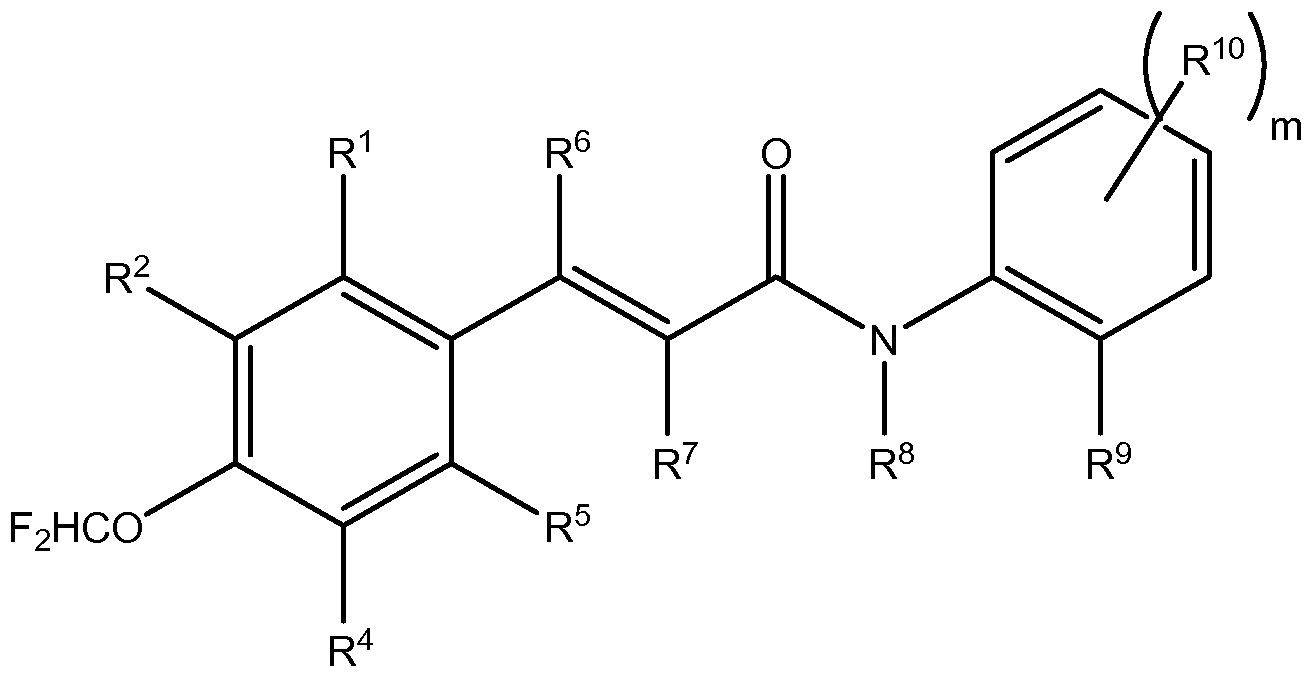
  • the present invention provides a compound of Formula
  • R 1 , R 2 , R 4 , and R 5 are each independently selected from the group consisting of: H, halogen, OH, NO 2 , CN, NH 2 , optionally substituted CrCi 2 alkyl, optionally substituted C 2 -Ci 2 alkenyl, optionally substituted C 2 -Ci 2 alkynyl, optionally substituted C 1 -C 1 0 heteroalkyl, optionally substituted C 3 -Ci 2 cycloalkyl, optionally substituted C 3 -Ci 2 cycloalkenyl, optionally substituted C 2 -Ci 2 heterocycloalkyl, optionally substituted C 2 -Ci 2 heterocycloalkenyl, optionally substituted C 6 -Ci 8 aryl, optionally substituted CrCi 8 heteroaryl, optionally substituted Ci-Ci 2 alkyloxy, optionally substituted C 2 -Ci 2 alken
  • R 6 and R 7 are each independently selected from the group consisting of: H, NO 2 , CN, optionally substituted CrCi 2 alkyl, optionally substituted C 2 -Ci 2 alkenyl, optionally substituted C 2 -Ci 2 alkynyl, optionally substituted C 1 -C 1 0 heteroalkyl, optionally substituted C 3 -Ci 2 cycloalkyl, optionally substituted C 3 -Ci 2 cycloalkenyl, optionally substituted C 2 -Ci 2 heterocycloalkyl, optionally substituted C 2 -Ci 2 heterocycloalkenyl, optionally substituted C 6 -Ci 8 aryl, optionally substituted CrCi 8 heteroaryl, optionally substituted CrCi 2 alkyloxy, optionally substituted C 2 -Ci 2 alkenyloxy, optionally substituted C 2 -Ci 2 alkynyloxy, optionally substituted C 1 -C 10 heteroalkyloxy, optionally
  • R 8 is selected from the group consisting of: H, a N-protecting group, optionally substituted Ci-Ci 2 alkyl, optionally substituted C 2 -Ci 2 alkenyl, optionally substituted C 2 - Ci 2 alkynyl, optionally substituted Ci-Cioheteroalkyl, optionally substituted C 3 - Ci 2 cycloalkyl, optionally substituted C 3 -Ci 2 cycloalkenyl, optionally substituted CrCi 2 heterocycloalkyl, optionally substituted CrCi 2 heterocycloalkenyl, optionally substituted C 6 -Ci 8 aryl, and optionally substituted Ci-Ci 8 heteroaryl;
  • - R 9 is selected from the group consisting of: COOR 11 , CONR 11 R 12 , and NR 11 R 12 ;
  • - R 10 is selected from the group consisting of: H, halogen, OH, NO 2 , CN, NH 2 , optionally substituted CrCi 2 alkyl, optionally substituted C 2 -Ci 2 alkenyl, optionally substituted C 2 -Ci 2 alkynyl, optionally substituted C 1 -C 10 heteroalkyl, optionally substituted C 3 -Ci 2 cycloalkyl, optionally substituted C 3 -Ci 2 cycloalkenyl, optionally substituted C 2 -Ci 2 heterocycloalkyl, optionally substituted C 2 -Ci 2 heterocycloalkenyl, optionally substituted C 6 -Ci 8 aryl, optionally substituted CrCi 8 heteroaryl, optionally substituted CrCi 2 alkyloxy, optionally substituted C 2 -Ci 2
  • each R 11 , R 12 and R 13 is independently selected from the group consisting of H, optionally substituted Ci-Ci 2 alkyl, optionally substituted C 2 -Ci 2 alkenyl, optionally substituted C 2 -Ci 2 alkynyl, optionally substituted d-Cioheteroalkyl, optionally substituted C 3 -Ci 2 cycloalkyl, optionally substituted C 3 -Ci 2 cycloalkenyl, optionally substituted C 1 -C 12 heterocycloalkyl, optionally substituted C 1 -C 12 heterocycloalkenyl, optionally substituted C 6 -Ci 8 aryl, and optionally substituted Ci-Ci 8 heteroaryl; and
  • - m is an integer selected from the group consisting of 0, 1 , 2, 3, and 4.
  • R 2 is the group -0-CHF 2 .
  • R 2 is selected from the group consisting of: optionally substituted d-C ⁇ alkyloxy and optionally substituted C 2 -Ci 2 alkynyloxy.
  • R 1 is the group -0-CHF 2 .
  • R 4 is the group -0-CHF 2 .
  • R 5 is the group -0-CHF 2 .
  • R 1 is selected from the group consisting of: optionally substituted Ci-Ci 2 alkyloxy and optionally substituted C 2 -Ci 2 alkynyloxy.
  • R 4 is selected from the group consisting of: optionally substituted Ci-Ci 2 alkyloxy and optionally substituted C 2 -Ci 2 alkynyloxy.
  • R 5 is selected from the group consisting of: optionally substituted Ci-Ci 2 alkyloxy and optionally substituted C 2 -Ci 2 alkynyloxy.
  • R 6 and R 7 are each independently selected from the group consisting of: H, and optionally substituted Ci-Ci 2 alkyl.
  • R 6 is CH 3 .
  • R 7 is CH 3 .
  • R 8 is H.
  • R 9 is selected from the group consisting of: COOR 11 and CONR 11 R 12 .
  • R 9 is selected from the group consisting of: COOH, CONH 2 , and CONHCH 3 .
  • R 9 is NR 11 R 12 . In some embodiments R 9 is NH 2 . In some embodiments R 10 is a halogen.
  • n 1
  • R 1 , R 4 , and R 5 are each independently selected from the group consisting of: H, halogen, OH, NO 2 , CN, NH 2 , optionally substituted C r Ci 2 alkyl, optionally substituted C 2 -Ci 2 alkenyl, optionally substituted C 2 -Ci 2 alkynyl, optionally substituted C 1 -C 1 0 heteroalkyl, optionally substituted C 3 -Ci 2 cycloalkyl, optionally substituted C 3 -Ci 2 cycloalkenyl, optionally substituted C 2 -Ci 2 heterocycloalkyl, optionally substituted C 2 -Ci 2 heterocycloalkenyl, optionally substituted C 6 -Ci 8 aryl, optionally substituted CrCi 8 heteroaryl, optionally substituted CrCi 2 alkyloxy, optionally substituted C 2 -Ci 2 alkenyloxy, optionally substituted C 2 -Ci 2 alkynyloxy
  • R 1 , R 2 , R 3 , R 4 , and R 5 contains a halogen atom
  • R 8 is selected from the group consisting of: H, a N-protecting group, optionally substituted CrCi 2 alkyl, optionally substituted C 2 -Ci 2 alkenyl, optionally substituted C 2 -Ci 2 alkynyl, optionally substituted C 1 -C 1 0 heteroalkyl, optionally substituted C 3 -Ci 2 cycloalkyl, optionally substituted C 3 -Ci 2 cycloalkenyl, optionally substituted CrCi 2 heterocycloalkyl, optionally substituted CrCi 2 heterocycloalkenyl, optionally substituted C 6 -Ci 8 aryl, and optionally substituted CrCi 8 heteroaryl;
  • R 9 is selected from the group consisting of: COOR 11 , CONR 11 R 12 , and
  • R 10 is selected from the group consisting of: H, halogen, OH, NO 2 , CN, NH 2 , optionally substituted CrCi 2 alkyl, optionally substituted C 2 -Ci 2 alkenyl, optionally substituted C 2 -Ci 2 alkynyl, optionally substituted C 1 -C 1 0 heteroalkyl, optionally substituted C 3 -Ci 2 cycloalkyl, optionally substituted
  • each R 11 , R 12 and R 13 is independently selected from the group consisting of H, optionally substituted CrCi 2 alkyl, optionally substituted C 2 -Ci 2 alkenyl, optionally substituted C 2 -Ci 2 alkynyl, optionally substituted C 1 -C 1 0 heteroalkyl, optionally substituted C 3 -Ci 2 cycloalkyl, optionally substituted C 3 -Ci 2 cycloalkenyl, optionally substituted C 1 -C 12 heterocycloalkyl, optionally substituted C 1 -C 12 heterocycloalkenyl, optionally substituted C 6 -Ci 8 aryl, and optionally substituted CrCi 8 heteroaryl; and m is an
  • R 1 is the group -0-CHF 2 .
  • R 4 is the group -0-CHF 2 .
  • R 5 is the group -0-CHF 2 .
  • R 1 is selected from the group consisting of: optionally substituted Ci-Ci 2 alkyloxy and optionally substituted C 2 -Ci 2 alkynyloxy.
  • R 4 is selected from the group consisting of: optionally substituted Ci-Ci 2 alkyloxy and optionally substituted C 2 -Ci 2 alkynyloxy.
  • R 5 is selected from the group consisting of: optionally substituted CrCi 2 alkyloxy and optionally substituted C 2 -Ci 2 alkynyloxy.
  • R 6 and R 7 are each independently selected from the group consisting of: H, and optionally substituted CrCi 2 alkyl.
  • R 6 is CH 3 .
  • R 7 is CH 3 .
  • R 8 is H.
  • R 9 is selected from the group consisting of: COOR 11 and CONR 11 R 12 . In some embodiments R 9 is selected from the group consisting of: COOH, CONH 2 , and CONHCH 3 .
  • R 9 is NR 11 R 12 . In some embodiments R 9 is NH 2 . In some embodiments R 10 is a halogen.
  • n 1
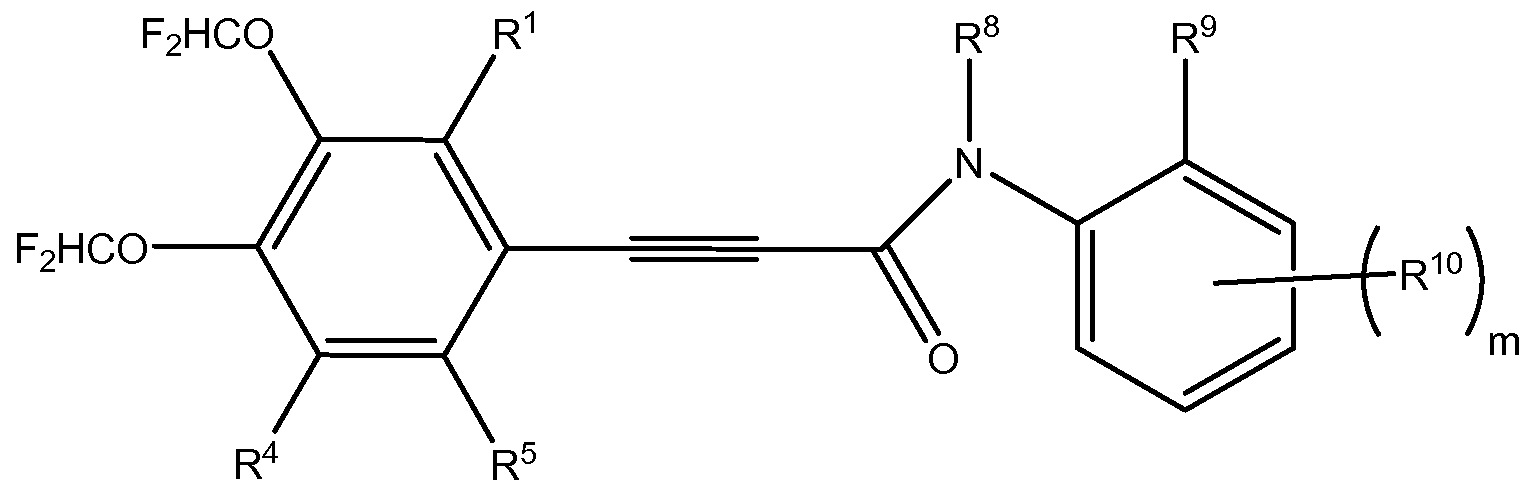
  • the present invention provides a compound of Formula (V)
  • R 1 , R 4 , and R 5 are each independently selected from the group consisting of: H, halogen, OH, NO 2 , CN, NH 2 , optionally substituted CrCi 2 alkyl, optionally substituted C 2 -Ci 2 alkenyl, optionally substituted C 2 -Ci 2 alkynyl, optionally substituted C 1 -C 1 0 heteroalkyl, optionally substituted C 3 -Ci 2 cycloalkyl, optionally substituted C 3 -Ci 2 cycloalkenyl, optionally substituted C 2 -Ci 2 heterocycloalkyl, optionally substituted C 2 - Ci 2 heterocycloalkenyl, optionally substituted C 6 -Ci 8 aryl, optionally substituted CrCi 8 heteroaryl, optionally substituted CrCi 2 alkyloxy, optionally substituted C 2 -Ci 2 alkenyloxy, optionally substituted C 2 -Ci 2 alkynyloxy,
  • - R 8 is selected from the group consisting of: H, a N-protecting group, optionally substituted CrCi 2 alkyl, optionally substituted C 2 -Ci 2 alkenyl, optionally substituted C 2 - Ci 2 alkynyl, optionally substituted C 1 -C 1 0 heteroalkyl, optionally substituted C 3 -Ci 2 cycloalkyl, optionally substituted C 3 -Ci 2 cycloalkenyl, optionally substituted CrCi 2 heterocycloalkyl, optionally substituted CrCi 2 heterocycloalkenyl, optionally substituted C 6 -Ci 8 aryl, and optionally substituted CrCi 8 heteroaryl;
  • - R 9 is selected from the group consisting of: COOR 11 , CONR 11 R 12 , and
  • R 10 is selected from the group consisting of: H, halogen, OH, NO 2 , CN, NH 2 , optionally substituted CrCi 2 alkyl, optionally substituted C 2 -Ci 2 alkenyl, optionally substituted C 2 -Ci 2 alkynyl, optionally substituted C 1 -C 1 0 heteroalkyl, optionally substituted C 3 -Ci 2 cycloalkyl, optionally substituted C 3 -Ci 2 cycloalkenyl, optionally substituted C 2 -Ci 2 heterocycloalkyl, optionally substituted C 2 -Ci 2 heterocycloalkenyl, optionally substituted C 6 -Ci 8 aryl, optionally substituted CrCi 8 heteroaryl, optionally substituted CrCi 2 alkyloxy, optionally substituted C 2 -Ci 2 alkenyloxy, optionally substituted C 2 -Ci 2 alkynyloxy, optionally substituted C 1 -C 1
  • each R 11 , R 12 and R 13 is independently selected from the group consisting of H, optionally substituted CrCi 2 alkyl, optionally substituted C 2 -Ci 2 alkenyl, optionally substituted C 2 -Ci 2 alkynyl, optionally substituted C 1 -C 10 heteroalkyl, optionally substituted C 3 -Ci 2 cycloalkyl, optionally substituted C 3 -Ci 2 cycloalkenyl, optionally substituted CrCi 2 heterocycloalkyl, optionally substituted CrCi 2 heterocycloalkenyl, optionally substituted C 6 -Ci 8 aryl, and optionally substituted CrCi 8 heteroaryl; and
  • - m is an integer selected from the group consisting of O, 1 , 2, 3, and 4.
  • R 1 is the group -0-CHF 2 , R 4 and R 5 are H, whilst in other embodiments R 4 is the group -0-CHF 2 , R 1 and R 5 are H. In still other embodiments R 5 is the group -0-CHF 2 , R 1 and R 4 are H.
  • R 8 is H.
  • R 9 is selected from the group consisting of: COOR 11 and CONR 11 R 12 .
  • R 9 is selected from the group consisting of: COOH, CONH 2 , and CONHCH 3 .
  • R 9 is NR 11 R 12 . In some embodiments R 9 is NH 2 .
  • R 10 is a halogen
  • m is 1 .
  • the embodiments disclosed are also directed to pharmaceutically acceptable salts, pharmaceutically acceptable N- oxides, pharmaceutically acceptable prodrugs, and pharmaceutically active metabolites of such compounds, and pharmaceutically acceptable salts of such metabolites.
  • the compounds of the present invention may have anti-fibrotic, anti-inflammatory, antiproliferative or anti-neoplastic activity and may, therefore, find use as an alternative and/or adjunct to tranilast.
  • the term "optionally substituted” as used throughout the specification denotes that the group may or may not be further substituted or fused (so as to form a polycyclic system), with one or more non-hydrogen substituent groups.
  • Alkyl as a group or part of a group refers to a straight or branched aliphatic hydrocarbon group, such as a C 1 -C 14 alkyl, a C 1 -C 1 0 alkyl or a CrC 6 unless otherwise noted.
  • suitable straight and branched CrC 6 alkyl substituents include methyl, ethyl, n-propyl, 2-propyl, n-butyl, sec-butyl, t-butyl, hexyl, and the like.
  • the group may be a terminal group or a bridging group.
  • Alkylamino includes both mono-alkylamino and dialkylamino, unless specified.
  • Mono-alkylamino means a -NH-Alkyl group, in which alkyl is as defined above.
  • Dialkylamino means a -N(alkyl) 2 group, in which each alkyl may be the same or different and are each as defined herein for alkyl.
  • the alkyl group may be a CrC 6 alkyl group.
  • the group may be a terminal group or a bridging group.
  • Arylamino includes both mono-arylamino and di-arylamino unless specified.
  • Mono-arylamino means a group of formula arylNH-, in which aryl is as defined herein.
  • Di-arylamino means a group of formula (aryl) 2 N- where each aryl may be the same or different and are each as defined herein for aryl.
  • the group may be a terminal group or a bridging group.
  • "Acyl” means an alkyl-CO- group in which the alkyl group is as described herein. Examples of acyl include acetyl and benzoyl.
  • the alkyl group may be a CrC 6 alkyl group.
  • the group may be a terminal group or a bridging group.
  • Alkenyl as a group or part of a group denotes an aliphatic hydrocarbon group containing at least one carbon-carbon double bond and which may be straight or branched such as a group having 2-14 carbon atoms, 2-12 carbon atoms, or 2-6 carbon atoms, in the normal chain.
  • the group may contain a plurality of double bonds in the normal chain and the orientation about each is independently E or Z.
  • Exemplary alkenyl groups include, but are not limited to, ethenyl, propenyl, butenyl, pentenyl, hexenyl, heptenyl, octenyl and nonenyl.
  • the group may be a terminal group or a bridging group.
  • Alkoxy refers to an -O-alkyl group in which alkyl is defined herein.
  • the alkoxy may be a CrC 6 alkoxy. Examples include, but are not limited to, methoxy and ethoxy.
  • the group may be a terminal group or a bridging group.
  • alkenyloxy refers to an -O- alkenyl group in which alkenyl is as defined herein. Preferred alkenyloxy groups are C 2 -C 6 alkenyloxy groups. The group may be a terminal group or a bridging group.
  • Alkynyloxy refers to an -O-alkynyl group in which alkynyl is as defined herein.
  • Preferred alkynyloxy groups are C 2 -C 6 alkynyloxy groups.
  • the group may be a terminal group or a bridging group.
  • Alkoxycarbonyl refers to an -C(O)-O-alkyl group in which alkyl is as defined herein.
  • the alkyl group may be a CrC 6 alkyl group. Examples include, but not limited to, methoxycarbonyl and ethoxycarbonyl.
  • the group may be a terminal group or a bridging group.
  • Alkylsulfinyl means a -S(O)-alkyl group in which alkyl is as defined above.
  • the alkyl group is preferably a CrC 6 alkyl group.
  • Exemplary alkylsulfinyl groups include, but not limited to, methylsulfinyl and ethylsulfinyl.
  • the group may be a terminal group or a bridging group.
  • Alkylsulfonyl refers to a -S(O) 2 -alkyl group in which alkyl is as defined above.
  • the alkyl group may be a CrC 6 alkyl group. Examples include, but not limited to methylsulfonyl and ethylsulfonyl.
  • the group may be a terminal group or a bridging group.
  • Alkynyl as a group or part of a group means an aliphatic hydrocarbon group containing a carbon-carbon triple bond and which may be straight or branched and may have from 2-14 carbon atoms, 2-12 carbon atoms, or 2-6 carbon atoms in the normal chain.
  • Exemplary structures include, but are not limited to, ethynyl and propynyl.
  • the group may be a terminal group or a bridging group.
  • Alkylaminocarbonyl refers to an alkylamino-carbonyl group in which alkylamino is as defined above.
  • the group may be a terminal group or a bridging group.
  • Cycloalkyl refers to a saturated or partially saturated, monocyclic or fused or spiro polycyclic, carbocycle that may contain from 3 to 9 carbons per ring, such as cyclopropyl, cyclobutyl, cyclopentyl, cyclohexyl and the like, unless otherwise specified. It includes monocyclic systems such as cyclopropyl and cyclohexyl, bicyclic systems such as decalin, and polycyclic systems such as adamantane. The group may be a terminal group or a bridging group.
  • Cycloalkenyl means a non-aromatic monocyclic or multicyclic ring system containing at least one carbon-carbon double bond and may have from 5-10 carbon atoms per ring.
  • Exemplary monocyclic cycloalkenyl rings include cyclopentenyl, cyclohexenyl or cycloheptenyl.
  • the cycloalkenyl group may be substituted by one or more substituent groups.
  • the group may be a terminal group or a bridging group.
  • alkyl and cycloalkyl substituents also applies to the alkyl portions of other substituents, such as without limitation, alkoxy, alkyl amines, alkyl ketones, arylalkyl, heteroarylalkyl, alkylsulfonyl and alkyl ester substituents and the like.
  • Cycloalkylalkyl means a cycloalkyl-alkyl- group in which the cycloalkyl and alkyl moieties are as previously described.
  • Exemplary monocycloalkylalkyl groups include cyclopropylmethyl, cyclopentylmethyl, cyclohexylmethyl and cycloheptylmethyl. The group may be a terminal group or a bridging group.
  • Halogen represents fluorine, chlorine, bromine or iodine.
  • Heterocycloalkyl refers to a saturated or partially saturated monocyclic, bicyclic, or polycyclic ring containing at least one heteroatom selected from nitrogen, sulfur, oxygen.
  • the heterocycloalkyl group may have from 1 to 3 heteroatoms in at least one ring. Each ring may be from 3 to 10 membered, such as 4 to 7 membered.
  • suitable heterocycloalkyl substituents include pyrrolidyl, tetrahydrofuryl, tetrahydrothiofuranyl, piperidyl, piperazyl, tetrahydropyranyl, morphilino, 1 ,3-diazapane,
  • the group may be a terminal group or a bridging group.
  • Heterocycloalkenyl refers to a heterocycloalkyl as described above but containing at least one double bond.
  • the group may be a terminal group or a bridging group.
  • Heterocycloalkylalkyl refers to a heterocycloalkyl-alkyl group in which the heterocycloalkyl and alkyl moieties are as previously described.
  • exemplary heterocycloalkylalkyl groups include (2-tetrahydrofuryl)methyl, (2-tetrahydrothiofuranyl) methyl.
  • the group may be a terminal group or a bridging group.
  • Heteroalkyl refers to a straight- or branched-chain alkyl group that may have from 2 to 14 carbons, such as 2 to 10 carbons in the chain, one or more of which has been replaced by a heteroatom selected from S, O, P and N.
  • exemplary heteroalkyls include alkyl ethers, secondary and tertiary alkyl amines, amides, alkyl sulfides, and the like.
  • the group may be a terminal group or a bridging group. As used herein reference to the normal chain when used in the context of a bridging group refers to the direct chain of atoms linking the two terminal positions of the bridging group.
  • Aryl as a group or part of a group denotes (i) an optionally substituted monocyclic, or fused polycyclic, aromatic carbocycle (ring structure having ring atoms that are all carbon) that may have from 5 to 12 atoms per ring.
  • aryl groups include phenyl, naphthyl, and the like; (ii) an optionally substituted partially saturated bicyclic aromatic carbocyclic moiety in which a phenyl and a Cs -7 cycloalkyl or Cs -7 cycloalkenyl group are fused together to form a cyclic structure, such as tetrahydronaphthyl, indenyl or indanyl.
  • the group may be a terminal group or a bridging group.
  • Arylalkenyl means an aryl-alkenyl- group in which the aryl and alkenyl are as previously described. Exemplary arylalkenyl groups include phenylallyl.
  • the group may be a terminal group or a bridging group.
  • Arylalkyl means an aryl-alkyl- group in which the aryl and alkyl moieties are as previously described. Preferred arylalkyl groups contain a C 1-5 alkyl moiety. Exemplary arylalkyl groups include benzyl, phenethyl and naphthelenemethyl. The group may be a terminal group or a bridging group.
  • Heteroaryl either alone or as part of a group refers to groups containing an aromatic ring (such as a 5 or 6 membered aromatic ring) having one or more heteroatoms as ring atoms in the aromatic ring with the remainder of the ring atoms being carbon atoms. Suitable heteroatoms include nitrogen, oxygen and sulphur.
  • heteroaryl examples include thiophene, benzothiophene, benzofuran, benzimidazole, benzoxazole, benzothiazole, benzisothiazole, naphtho[2,3-b]thiophene, furan, isoindolizine, xantholene, phenoxatine, pyrrole, imidazole, pyrazole, pyridine, pyrazine, pyrimidine, pyridazine, indole, isoindole, 1 H-indazole, purine, quinoline, isoquinoline, phthalazine, naphthyridine, quinoxaline, cinnoline, carbazole, phenanthridine, acridine, phenazine, thiazole, isothiazole, phenothiazine, oxazole, isooxazole, furazane, phenoxazine, 2-,
  • Heteroarylalkyl means a heteroaryl-alkyl group in which the heteroaryl and alkyl moieties are as previously described.
  • the heteroarylalkyl groups may contain a lower alkyl moiety.
  • Exemplary heteroarylalkyl groups include pyridylmethyl.
  • the group may be a terminal group or a bridging group.
  • “Lower alkyl” as a group means, unless otherwise specified, an aliphatic hydrocarbon group which may be straight or branched having 1 to 6 carbon atoms in the chain, for example 1 to 4 carbons such as methyl, ethyl, propyl (n-propyl or isopropyl) or butyl (n-butyl, isobutyl or tertiary-butyl).
  • the group may be a terminal group or a bridging group.
  • the free amino group and/or the free carboxyl groups of the compounds of Formula (I) can be liberated either by deprotection of the amino group followed by deprotection of the acid moieties or vice versa.
  • suitable amino protecting groups include formyl, trityl, phthalimido, trichloroacetyl, chloroacetyl, bromoacetyl, iodoacetyl, and urethane-type blocking groups such as benzyloxycarbonyl ('CBz'), 4-phenylbenzyloxycarbonyl, 2- methylbenzyloxycarbonyl, 4-methoxybenzyloxycarbonyl, 4-fluorobenzyloxycarbonyl, 4- chlorobenzyloxycarbonyl, 3-chlorobenzyloxycarbonyl, 2-chlorobenzyloxycarbonyl, 2,4- dichlorobenzyloxycarbonyl, 4-bromobenzyloxycarbonyl, 3-bromobenzyloxycarbonyl, 4- nitrobenzyloxycarbonyl, 4cyanobenzyloxycarbonyl, t-butoxycarbonyl ('tBoc'), 2-(4- xenyl)
  • amino protecting group employed is not critical so long as the derivatised amino group is stable to the condition of subsequent reaction(s) and can be selectively removed as required without substantially disrupting the remainder of the molecule including any other amino protecting group(s).
  • Preferred amino-protecting groups are t-butoxycarbonyl (Boc), and benzyloxycarbonyl (Cbz). Further examples of these groups are found in: Greene, T. W. and Wuts, P. G. M., Protective Groups in Organic Synthesis, Second edition; Wiley-lnterscience: 1991 ; Chapter 7; McOmie, J. F. W. (ed.), Protective Groups in Organic Chemistry, Plenum Press, 1973; and Kocienski, P.
  • carboxyl protecting groups examples include methyl, ethyl, n- propyl, i-propyl, p-nitrobenzyl, p-methylbenzyl, p-methoxybenzyl, 3,4-dimethoxybenzyl, 2,4-dimethoxybenzyl, 2,4,6-trimethoxybenzyl, 2,4,6-trimethylbenzyl, pentamethylbenzyl, 3,4-methylenedioxybenzyl, benzhydryl, 4,4'-dimethoxybenzhydryl, 2,2'4,4'-tetramethoxybenzhydryl, t-butyl, t-amyl, trityl, 4-methoxytrityl, 4,4'- dimethoxytrityl, 4,4,'4"-trimethoxytrityl, 2-phenylprop-2-yl, trimethylsilyl, t-
  • carboxyl protecting groups are methyl and t-butyl. Further examples of these groups are found in: Greene, T. W. and Wuts, P. G. M., Protective Groups in Organic Synthesis, Second edition; Wiley- Interscience: 1991 ; McOmie, J. F. W. (ed.), Protective Groups in Organic Chemistry, Plenum Press, 1973; and Kocienski, P. J., Protecting Groups, Second Edition, Theime Medical Pub., 2000.
  • Some of the compounds of the disclosed embodiments may exist as single stereoisomers, racemates, and/or mixtures of enantiomers and /or diastereomers. All such single stereoisomers, racemates and mixtures thereof, are intended to be within the scope of the subject matter described and claimed.
  • formulae (I), (II), (III), (IV) and (V) are intended to cover, where applicable, solvated as well as unsolvated forms of the compounds.
  • each formula includes compounds having the indicated structure, including the hydrated as well as the non- hydrated forms.
  • the compounds of the various embodiments include pharmaceutically acceptable salts, prodrugs, N- oxides and active metabolites of such compounds, and pharmaceutically acceptable salts of such metabolites.
  • pharmaceutically acceptable salts refers to salts that retain the desired biological activity of the above-identified compounds, and include pharmaceutically acceptable acid addition salts and base addition salts.
  • Suitable pharmaceutically acceptable acid addition salts of compounds of Formula (I) may be prepared from an inorganic acid or from an organic acid. Examples of such inorganic acids are hydrochloric, sulfuric, and phosphoric acid.
  • Appropriate organic acids may be selected from aliphatic, cycloaliphatic, aromatic, heterocyclic carboxylic and sulfonic classes of organic acids, examples of which are formic, acetic, propionic, succinic, glycolic, gluconic, lactic, malic, tartaric, citric, fumaric, maleic, alkyl sulfonic, arylsulfonic.
  • Suitable pharmaceutically acceptable base addition salts of compounds of Formula (I) include metallic salts made from lithium, sodium, potassium, magnesium, calcium, aluminium, and zinc, and organic salts made from organic bases such as choline, diethanolamine, morpholine.
  • organic salts are: ammonium salts, quaternary salts such as tetramethylammonium salt; amino acid addition salts such as salts with glycine and arginine. Additional information on pharmaceutically acceptable salts can be found in Remington's Pharmaceutical Sciences, 19th Edition, Mack Publishing Co., Easton, PA 1995. In the case of agents that are solids, it is understood by those skilled in the art that the inventive compounds, agents and salts may exist in different crystalline or polymorphic forms, all of which are intended to be within the scope of the present invention and specified formulae.
  • Prodrug means a compound which is convertible in vivo by metabolic means (e.g. by hydrolysis, reduction or oxidation) to a compound of formula (I).
  • metabolic means e.g. by hydrolysis, reduction or oxidation
  • an ester prodrug of a compound of formula (I) containing a hydroxyl group may be convertible by hydrolysis in vivo to the parent molecule.
  • Suitable esters of compounds of formula (I) containing a hydroxyl group are for example acetates, citrates, lactates, tartrates, malonates, oxalates, salicylates, propionates, succinates, fumarates, maleates, methylene-bis- ⁇ -hydroxynaphthoates, gestisates, isethionates, di-p-toluoyltartrates, methanesulphonates, ethanesulphonates, benzenesulphonates, p-toluenesulphonates, cyclohexylsulphamates and quinates.
  • ester prodrug of a compound of formula (I) containing a carboxy group may be convertible by hydrolysis in vivo to the parent molecule.
  • ester prodrugs are those described by FJ. Leinweber, Drug Metab. Res., 18:379, 1987.
  • pharmaceutically acceptable refers generally to a substance or composition that is compatible chemically and/or toxicologically with the other ingredients including a formulation, and/or the subject being treated.
  • compounds of the present invention refers generally to compounds, prodrugs thereof, pharmaceutically acceptable salts of the compounds and/or prodrugs, and hydrates or solvates of the compounds, salts, and/or prodrugs, as well as all stereoisomers (including diastereoisomers and enantiomers), tautomers and isotopically labelled compounds.
  • the compounds of the present invention may exist in unsolvated as well as solvated forms with pharmaceutically acceptable solvents such as water, ethanol, and the like, and it is intended that the invention embrace both solvated and unsolvated forms.
  • derivative thereof when used in reference to compounds of the present invention refers generally to prodrugs, pharmaceutically acceptable salts of the compounds and/or prodrugs, and hydrates or solvates of the compounds, salts, and/or prodrugs.
  • R 1 , R 2 , R 3 , R 4 , R 5 , R 6 , R 7 , R 8 , R 9 , R 10 , R 11 , R 12 , R 13 , m, and n are as previously defined. At least one of the groups R 1 , R 2 , R 3 , R 4 or R 5 contains a halogen atom. In some embodiments, one or more of R 1 , R 2 , R 3 , R 4 , and R 5 is a fluoroalkoxy group.
  • Examples of fluoro-substituted Ci -4 alkoxy groups include 1 ,1 , 1 ,3,3, 3-hexafluoro-2- propoxy, 2-trifluoromethyl-2-propoxy, 1 ,1 ,1-trifluoro-2-propoxy, perfluoro-tert-butoxy, 2,2,3,3,4,4,4-heptafluoro-1-butoxy, 4,4,4-trifluoro-1-butoxy, 2,2,3,3,3- pentafluoropropoxy, perfluoroethoxy, 1 ,2,2-trifluoroethoxy, 1 ,1 ,2,2-tetrafluoroethoxy, 2,2,2-trifluoroethoxy, monofluoromethoxy, trifluoromethoxy, and difluoromethoxy.
  • at least one of R 1 , R 2 , R 3 , R 4 , and R 5 is a difluoromethoxy group.
  • Specific compounds of the invention include compounds of any one of Formulae (III, (IV) or (V)
  • compounds of the present invention are analogues of tranilast.
  • the compounds of the invention may have therapeutic uses and/or be used diagnostically or for screening purposes.
  • the compounds of the present invention may be prepared using the reaction routes and synthesis schemes as described below, employing the techniques available in the art using starting materials that are commercially available or can be synthesised using known procedures or adaptations thereof. Whilst the preparation of particular compounds is outlined below, the skilled person will also recognize that the chemical reactions described may be readily adapted to prepare a number of other agents of the various embodiments. For example, the synthesis of non-exemplified compounds may be successfully performed by modifications apparent to those skilled in the art, e.g. by appropriately protecting interfering groups, by changing to other suitable reagents known in the art, or by making routine modifications of reaction conditions. A list of suitable protecting groups in organic synthesis can be found in T. W. Greene's Protective Groups in Organic Synthesis, 3 rd Edition, John Wiley & Sons, 1991.
  • Reagents useful for synthesizing compounds may be obtained or prepared according to techniques known in the art.
  • a synthetic route that may be suitable for producing compounds of Formula (I) is shown in Scheme 1 .
  • a substituted cinnamoyl benzamide (1 ) is prepared via a piperidine-catalyzed Knoevenagel condensation of an appropriately substituted carboxyacetamidobenzoic acid derivative (2) and an appropriately substituted benzaldehyde derivative (3).
  • the benzaldehyde precursor (3) required for the above reaction can either be obtained from commercial sources, or can be synthesized by alkylation of precursor phenolic benzaldehydes with appropriate alkyl halides, haloalkyl tosylates (derived in turn from the corresponding alcohols), haloacetate esters or salts, or chlorodifluoromethyl sulfones.
  • the alkylation reactions can be performed using a suitable base, such as potassium carbonate, in a suitable solvent, such as acetone or DMF.
  • Carboxyacetamidobenzoic acid derivatives (2) can be obtained by the condensation of anthranilic acid derivatives with Meldrum's acid. Another synthetic route that may be suitable for producing compounds of Formula (I) is shown in Scheme 2. In this route, a substituted cinnamic acid (3) is converted to the corresponding acid chloride (4) (or acid bromide) which then reacts with an aminobenzamide derivative or an orthophenylenediamine derivative (5).
  • Cinnamic acid derivatives (3) can be prepared by Knoevenagel condensation of benzaldehydes with malonic acid.
  • Aminobenzamide derivatives (5) can be synthesized by the reaction of primary amines with isatoic anhydride.
  • the cinnamoyl benzamide (1 ) can be reduced by hydrogenation with a suitable catalyst, such as palladium on carbon, RhCI(PPh 3 ) 3 , or by any other methods known in the art (see J. March, Advanced Organic Chemistry, John Wiley & Sons, New York 1985, pp. 694).
  • a suitable catalyst such as palladium on carbon, RhCI(PPh 3 ) 3 , or by any other methods known in the art (see J. March, Advanced Organic Chemistry, John Wiley & Sons, New York 1985, pp. 694).
  • the compounds of Formula (I) and intermediates in their synthesis can be isolated from a reaction mixture using standard work-up and purification procedures. Suitable procedures include solvent extraction, chromatography (thin or thick layer chromatography, HPLC, flash chromatography, MPLC, etc.), recrystallisation etc.
  • the present invention includes salts of the compounds of Formula (I).
  • the salts may serve as intermediates in the purification of compounds or in the preparation of other, for example pharmaceutically acceptable, acid addition salts, or they may be useful for identification, characterisation or purification.
  • the salts can exist in conjunction with the acidic or basic portion of the molecule and can exist as acid addition, primary, secondary, tertiary, or quaternary ammonium, alkali metal, or alkaline earth metal salts.
  • acid addition salts are prepared by the reaction of an acid with a compound of Formula (I).
  • the alkali metal and alkaline earth metal salts are generally prepared by the reaction of the hydroxide form of the desired metal salt with a compound of Formula (I).
  • Acid addition salts are preferably the pharmaceutically acceptable, non-toxic addition salts with suitable acids, such as those with inorganic acids, for example hydrochloric, hydrobromic, nitric, sulphuric or phosphoric acids, or with organic acids, such as organic carboxylic acids, for example, glycollic, maleic, hydroxymaleic, fumaric, malic, tartaric, citric, salicyclic, o-acetoxybenzoic, or organic sulphonic, 2-hydroxyethane sulphonic, toluene-p-sulphonic, or naphthalene-2-sulphonic acid.
  • suitable acids such as those with inorganic acids, for example hydrochloric, hydrobromic, nitric, sulphuric or phosphoric acids
  • organic acids such as organic carboxylic acids, for example, glycollic, maleic, hydroxymaleic, fumaric, malic, tartaric, citric, salicyclic, o-acetoxybenzoic, or
  • the present invention also includes esters of the compounds of Formula (I), such esters being for example aliphatic esters such as alkyl esters.
  • the esters of the compounds of Formula (I) may be pharmaceutically acceptable metabolically labile esters. These are ester derivatives of compounds of Formula (I) that are hydrolysed in vivo to afford the compound of Formula (I) and a pharmaceutically acceptable alcohol.
  • metabolically labile esters include esters formed with alkanols in which the alkanol moiety may be optionally substituted by an alkoxy group, for example methanol, ethanol, propanol and methoxyethanol.
  • the compounds of the various embodiments may be prepared using the reaction routes and synthesis schemes as described above, employing the techniques available in the art using starting materials that are readily available.
  • the person skilled in the art will recognise that the chemical reactions described may be readily adapted to prepare a number of other compounds.
  • the synthesis of non-exemplified compounds may be successfully performed by modifications apparent to those skilled in the art, e.g. by appropriately protecting interfering groups, by changing to other suitable reagents known in the art, or by making routine modifications of reaction conditions.
  • a list of suitable protecting groups in organic synthesis can be found in
  • Reagents useful for synthesizing compounds may be obtained or prepared according to techniques known in the art.
  • Matrix synthesis may be stimulated by platelet derived growth factor
  • PDGF vascular endothelial growth factor
  • Matrix synthesis may be stimulated by both angiotensin Il or transforming growth factor beta (TGF- ⁇ ). Accordingly, neonatal cardiac fibroblasts incubated with angiotensin Il or TGF- ⁇ can be used to demonstrate proline incorporation, which is an indicator of matrix synthesis and thereby a model for fibrosis.
  • TGF- ⁇ transforming growth factor beta
  • Electrospray ionization (ESI) high resolution mass spectra (HRMS) were obtained on a Finnigan hybrid LTQ-FT mass spectrometer (Thermo Electron Corp.).
  • Proton nuclear magnetic resonance ( 1 H NMR) and proton decoupled carbon nuclear magnetic resonance ( 13 C NMR) spectra were obtained on Unity 400, Innova 400 or Innova 500 instruments (Melbourne, Australia) operating at 400 or 500 MHz for 1 H and at 100 or 125 MHz for 13 C. All signals were referenced to solvent peaks (CDCI3: 7.26 ppm for 1 H and 77.0 ppm for 13 C; DMSO-Cf 6 : 2.49 ppm for 1 H and 39.5 ppm for 13 C).
  • Infrared (IR) spectra were obtained using a PerkinElmer Spectrum One FT-IR spectrometer with zinc selenide/diamond Universal ATR Sampling Accessory. Melting points were obtained using a Reichert-Jung hot stage apparatus and are corrected.
  • Analytical thin layer chromatography (TLC) was conducted on 2 mm thick silica gel GF 2 5 4 . Compounds were visualised with solutions of 20% w/w phosphomolybdic acid in ethanol, 20% w/w potassium permanganate in water or under UV (365 nm). Flash chromatography was performed according to the method of Still et al. 1 with Merck Silica Gel 60. Petrol refers to the fraction boiling at 40-60 0 C. All other reagents were used as received.
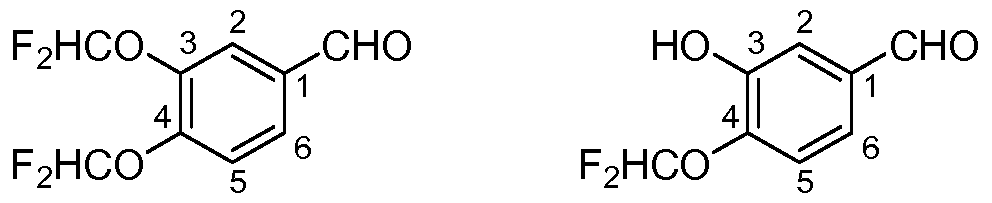
  • Methyl chlorodifluoroacetate (15.3 mL, 145 mmol) was added to a suspension of 3,4- dihydroxybenzaldehyde (5.0 g, 36 mmol) and potassium carbonate (20.0 g, 145 mmol) in DMF (10 mL). The suspension was heated to 60 0 C for 16 h and then diluted with water. The aqueous phase was extracted with EtOAc and the combined organic fractions were washed with saturated aqueous NaHCOs, water, brine, dried and concentrated.
  • Piperidine (100 ⁇ l_, 1.01 mmol) was added to a suspension of 3,4- bis(difluoromethoxy)benzaldehyde (240 mg, 1.01 mmol) and 2- [(carboxyacetyl)amino]benzoic acid (204 mg, 0.92 mmol) in toluene (5.0 mL).
  • the reaction flask was fitted with a Dean-Stark apparatus and heated to reflux for 30 min. The reaction was then cooled to rt and the resulting suspension was filtered and washed with toluene.
  • the piperidinium salt was dissolved in MeOH (5 ml.) and water (2 ml.) and the solution was acidified with 50% aqueous AcOH.
  • Piperidine (100 ⁇ l_, 1.01 mmol) was added to a suspension of 3,4- bis(difluoromethoxy)benzaldehyde (240 mg, 1.01 mmol) and 2-[(carboxyacetyl)amino]- 5-bromobenzoic acid (277 mg, 0.92 mmol) in toluene (5.0 ml_).
  • the reaction flask was fitted with a Dean-Stark apparatus and heated to reflux for 30 min. The reaction was then cooled to rt and the resulting suspension was filtered and washed with toluene.
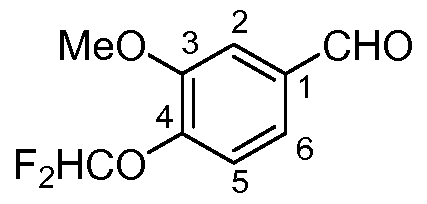
  • Methyl chlorodifluoroacetate (1.4 ml_, 13 mmol) was added to a suspension of vanillin (1.0 g, 6.6 mmol) and potassium carbonate (2.0 g, 14 mol) in DMF (10 ml_). The suspension was heated to 65-70 0 C for 16 h and the suspension was diluted with water. The aqueous phase was extracted with EtOAc and the combined organic fractions were washed with saturated aqueous NaHCO 3 , water, brine, dried and concentrated.
  • Piperidine (0.25 ml_, 2.6 mmol) was added to a suspension of 4-(difluoromethoxy)-3- methoxybenzaldehyde (0.52 g, 2.6 mmol) and 2-[(carboxyacetyl)amino]benzoic acid (0.52 mg, 2.6 mmol) in toluene (5.0 ml_).
  • the reaction flask was fitted with a Dean- Stark apparatus and heated to reflux for 30 min. The reaction was then cooled to rt and the resulting suspension was filtered and washed with toluene.
  • But-2-ynyl bromide (0.29 ml_, 3.4 mmol) was added to a suspension of 4- difluoromethoxy-3-hydroxybenzaldehyde (0.43 g, 2.3 mmol) and potassium carbonate (0.95 g, 6.9 mmol) in acetonitrile (5 ml_). The suspension was heated to reflux for 16 h and then concentrated under reduced pressure. Water was added and the aqueous phase was extracted with EtOAc. The combined organic fractions were washed with water, brine, dried.
  • Methyl chlorodifluoroacetate (0.58 ml_, 5.5 mmol) was added to a suspension of 4- hydroxy-3,4-dimethoxybenzaldehyde (0.50 g, 2.7 mmol) and potassium carbonate (0.76 g, 5.5 mol) in DMF (5.0 ml_).
  • the suspension was heated to 65-70 0 C for 16 h and the suspension was diluted with water.
  • the aqueous phase was extracted with EtOAc and the combined organic fractions were washed with saturated aqueous NaHCO 3 , water, brine, dried and concentrated.
  • Piperidine (110 ⁇ l_, 1.10 mmol) was added to a suspension of 4-(difluoromethoxy)-3,5- dimethoxybenzaldehyde (200 mg, 1.10 mmol) and 2-[(carboxyacetyl)amino]benzoic acid (233 mg, 1.05 mmol) in toluene (5.0 ml_).
  • the reaction flask was fitted with a Dean-Stark apparatus and heated to reflux for 30 min. The reaction was then cooled to rt and the resulting suspension was filtered and washed with toluene.
  • Piperidine (87 ⁇ l_, 0.88 mmol) was added to a suspension of 3,4- bis(difluoromethoxy)benzaldehyde (210 mg, 0.88 mmol) and 2-[(2-carboxy-1- oxopropyl)amino]benzoic acid (199 mg, 0.84 mmol) in toluene (5.0 ml_).
  • the reaction flask was fitted with a Dean-Stark apparatus and heated to reflux for 30 min. The reaction was then cooled to rt and the resulting suspension was filtered and washed with toluene.
  • Methylmagnesium chloride (3 M in THF, 0.95 ml_, 2.8 mmol) was added to a cooled solution of 3,4-bis(difluoromethoxy)benzaldehyde (0.45 g, 1.9 mmol) in anhydrous THF
  • Triethyl phosphonoacetate (0.50 ml_, 2.5 mmol) was added to a stirred suspension of 60% w/w NaH (0.10 g, 2.4 mmol) in anhydrous THF (5.OmL). The suspension was stirred at rt for 30 min and a solution of 3,4-bis(difluoromethoxy)acetophenone (0.40 g,

Landscapes

  • Chemical & Material Sciences (AREA)
  • Organic Chemistry (AREA)
  • Health & Medical Sciences (AREA)
  • Chemical Kinetics & Catalysis (AREA)
  • Life Sciences & Earth Sciences (AREA)
  • Public Health (AREA)
  • Medicinal Chemistry (AREA)
  • Nuclear Medicine, Radiotherapy & Molecular Imaging (AREA)
  • Veterinary Medicine (AREA)
  • Pharmacology & Pharmacy (AREA)
  • General Chemical & Material Sciences (AREA)
  • Animal Behavior & Ethology (AREA)
  • General Health & Medical Sciences (AREA)
  • Engineering & Computer Science (AREA)
  • Bioinformatics & Cheminformatics (AREA)
  • Pain & Pain Management (AREA)
  • Rheumatology (AREA)
  • Dermatology (AREA)
  • Gastroenterology & Hepatology (AREA)
  • Pulmonology (AREA)
  • Pharmaceuticals Containing Other Organic And Inorganic Compounds (AREA)
  • Organic Low-Molecular-Weight Compounds And Preparation Thereof (AREA)
  • Acyclic And Carbocyclic Compounds In Medicinal Compositions (AREA)

Abstract

The present invention relates to halogenated compounds of formula (I) with the substituents as described within the specification. The compounds may be useful as anti-fibrqtic agents. The present invention also relates to methods for their preparation.

Description

HALOGENATED ANALOGUES OF ANTI-FIBROTIC AGENTS
This international patent application claims priority from United States of America provisional patent application No. 61/016,134 filed on 21 December 2007, the contents of each of which are to be taken as incorporated herein by this reference.
Field
The present invention relates to derivatives of the anti-fibrotic drug, tranilast. More particularly, the present invention relates to halogenated cinnamoylbenzamide derivatives.
Background
Anti-inflammatory agents have been used to treat fibrosis with the aim of suppressing chronic inflammation, but such treatments can be unsatisfactory in terms of efficacy and side effects. Numerous studies have been performed to obtain substances that inhibit the production or the activity of the cytokines thought to be involved in fibrosis. Tranilast (n-[3,4-dimethoxycinnamoyl] anthranilic acid; product name Rizaben™) is an anti-fibrotic agent used in Japan for the treatment of fibrotic skin disorders such as keloids and scleroderma. Although the precise mechanisms and mode of action of tranilast are incompletely understood, its ability to inhibit ERK phosphorylation, a major intermediate in the TGF-β signalling pathway, may underlie its antifibrotic effects, with known actions of tranilast including the inhibition of TGF-β-induced extracellular matrix production in a range of cell types. Tranilast has also been shown to attenuate TGF-β- induced collagen synthesis in cardiac fibroblasts using an experimental model of diabetic cardiac disease, and to reduce inflammation in allergic diseases, such as allergic rhinitis and bronchial asthma, etc. In addition, tranilast has been shown to have anti-proliferative activity.
However, it has recently been shown that genetic factors in certain patients may confer susceptibility to tranilast-induced hyperbilirubinemia. One possibility for how this may arise is the presence of Gilbert's syndrome polymorphisms of the glucuronosyltransferase UGT1A 1, which leads to increased susceptibility to tranilast- induced hyperbilirubinemia. Such hyperbilirubinemia may result from the low level of UGT1A1 glucuronosyltransferase present in individuals with this syndrome. Tranilast itself, and its major metabolite N3 (4-desmethyl-tranilast), have been shown to be inhibitors of UGT1A1 , potentially leading to aberrant metabolism of bilirubin and its accumulation.
Accordingly, compounds that are based on tranilast have the potential to provide compounds that may have pharmaceutical properties with potential anti-fibrotic, antiinflammatory, and anti-proliferative or anti-neoplastic activity, and as alternatives/adjuncts to tranilast. These compounds may also have altered and/or improved metabolism relative to tranilast.
Summary
The present invention provides a compound of Formula (I)
Figure imgf000003_0001
Formula (I)
or a pharmaceutically acceptable salt or prodrug thereof, wherein:
- T is a single bond, a double bond or a triple bond;
- R1, R2, R3, R4, and R5 are each independently selected from the group consisting of: H, halogen, OH, NO2, CN, NH2, optionally substituted C1-C12 alkyl, optionally substituted C2-C12 alkenyl, optionally substituted C2-C12 alkynyl, optionally substituted C1-C10 heteroalkyl, optionally substituted C3-C12 cycloalkyl, optionally substituted C3-C12 cycloalkenyl, optionally substituted C2-C12 heterocycloalkyl, optionally substituted C2-C12 heterocycloalkenyl, optionally substituted C6-C18 aryl, optionally substituted CrCi8 heteroaryl, optionally substituted d-C^ alkyloxy, optionally substituted C2-Ci2 alkenyloxy, optionally substituted C2-Ci2 alkynyloxy, optionally substituted C1-C10 heteroalkyloxy, optionally substituted C3-Ci2 cycloalkyloxy, optionally substituted C3-Ci2 cycloalkenyloxy, optionally substituted CrCi2 heterocycloalkyloxy, optionally substituted CrCi2 heterocycloalkenyloxy, optionally substituted C6-Ci8 aryloxy, optionally substituted CrCi8 heteroaryloxy, optionally substituted Ci-Ci2 alkylamino, SR11, SO3H, SO2NR11R12, SO2R11, SONR11R12, SOR11, COR11, COOH, COOR11, CONR11R12, NR11COR12, NR11COOR12, NR11SO2R12, NR11CONR12R13, NR11R12, and acyl; provided that at least one of R1, R2, R3, R4, and R5 contains a halogen;
- R6 and R7 are present when T is a single bond or a double bond but not when T is a triple bond, each R6 and R7 being independently selected from the group consisting of: H, NO2, CN, optionally substituted CrCi2 alkyl, optionally substituted C2- Ci2 alkenyl, optionally substituted C2-Ci2 alkynyl, optionally substituted C1-C10 heteroalkyl, optionally substituted C3-Ci2 cycloalkyl, optionally substituted C3-Ci2 cycloalkenyl, optionally substituted C2-Ci2 heterocycloalkyl, optionally substituted C2- Ci2 heterocycloalkenyl, optionally substituted C6-Ci8 aryl, optionally substituted CrCi8 heteroaryl, optionally substituted CrCi2 alkyloxy, optionally substituted C2-Ci2 alkenyloxy, optionally substituted C2-Ci2 alkynyloxy, optionally substituted C1-C10 heteroalkyloxy, optionally substituted C3-Ci2 cycloalkyloxy, optionally substituted C3-Ci2 cycloalkenyloxy, optionally substituted CrCi2 heterocycloalkyloxy, optionally substituted CrCi2 heterocycloalkenyloxy, optionally substituted C6-Ci8 aryloxy, optionally substituted CrCi8 heteroaryloxy, optionally substituted CrCi2 alkylamino, SR11, SO3H, SO2NR11R12, SO2R11, SONR11R12, SOR11, COR11, COOH, COOR11, CONR11R12, NR11COR12, NR11COOR12, NR11SO2R12, NR11CONR12R13, NR11R12, and acyl;
- R8 is selected from the group consisting of: H, a N-protecting group, optionally substituted CrCi2 alkyl, optionally substituted C2-Ci2 alkenyl, optionally substituted C2- Ci2 alkynyl, optionally substituted C1-C10 heteroalkyl, optionally substituted C3-Ci2 cycloalkyl, optionally substituted C3-Ci2 cycloalkenyl, optionally substituted CrCi2 heterocycloalkyl, optionally substituted CrCi2 heterocycloalkenyl, optionally substituted C6-Ci8 aryl, and optionally substituted CrCi8 heteroaryl;
- R9 is selected from the group consisting of: H, COOR11, CONR11R12, COS R11, OR11, NR11R12, and SR11; - R10 is selected from the group consisting of: H, halogen, OH, NO2, CN, NH2, optionally substituted CrCi2 alkyl, optionally substituted C2-Ci2 alkenyl, optionally substituted C2-Ci2 alkynyl, optionally substituted C1-C10 heteroalkyl, optionally substituted C3-Ci2 cycloalkyl, optionally substituted C3-Ci2 cycloalkenyl, optionally substituted C2-Ci2 heterocycloalkyl, optionally substituted C2-Ci2 heterocycloalkenyl, optionally substituted C6-Ci8 aryl, optionally substituted CrCi8 heteroaryl, optionally substituted CrCi2 alkyloxy, optionally substituted C2-Ci2 alkenyloxy, optionally substituted C2-Ci2 alkynyloxy, optionally substituted C1-C10 heteroalkyloxy, optionally substituted C3-Ci2 cycloalkyloxy, optionally substituted C3-Ci2 cycloalkenyloxy, optionally substituted CrCi2 heterocycloalkyloxy, optionally substituted CrCi2 heterocycloalkenyloxy, optionally substituted C6-Ci8 aryloxy, optionally substituted d- da heteroaryloxy, optionally substituted Ci-C12 alkylamino, SR11, SO3H, SO2NR11R12, SO2R11, SONR11R12, SOR11, COR11, COOH, COOR11, CONR11R12, NR11COR12, NR11COOR12, NR11SO2R12, NR11CONR12R13, NR11R12, and acyl;
- each R11, R12 and R13 is independently selected from the group consisting of H, optionally substituted CrCi2 alkyl, optionally substituted C2-Ci2 alkenyl, optionally substituted C2-Ci2 alkynyl, optionally substituted C1-C10 heteroalkyl, optionally substituted C3-Ci2 cycloalkyl, optionally substituted C3-Ci2 cycloalkenyl, optionally substituted CrCi2 heterocycloalkyl, optionally substituted CrCi2 heterocycloalkenyl, optionally substituted C6-Ci8 aryl, and optionally substituted CrCi8 heteroaryl;
- m is an integer selected from the group consisting of O, 1 , 2, 3, and 4; - n is an integer selected from the group consisting of 1 , 2, 3, and 4, and 5; and
- m + n is an integer selected from the group consisting of 1 , 2, 3, 4, and 5.
As with any group of structurally related compounds which possess a particular utility, certain embodiments of variables of the compounds of the Formula (I), may be particularly useful in their end use application.
In some embodiments at least one of R1, R2, R3, R4, and R5 is selected from the group consisting of CrCi2 alkyloxy containing at least one halogen atom, CrCi2 alkenyloxy containing at least one halogen atom, and CrCi2 alkynyloxy containing at least one halogen atom. In some embodiments, the CrCi2 alkyloxy group is of Formula (II):
Figure imgf000005_0001
Formula (II)
wherein:
R14, R15, and R16 are each independently selected from the group consisting of: H, halogen, OH, NO2, CN, NH2, optionally substituted C1-
C12 alkyl, and optionally substituted C2-C12 alkenyl; R17, R18, R19, and R20 are each independently selected from the group consisting of: H, halogen, OH, NO2, CN, and NH2; at least one of R14, R15, R16, R17, R18, R19, and R20 is or contains a halogen atom; q is an integer selected from the group consisting of: O, 1 , 2, 3, 4, 5, 6, 7, 8, 9, and 10; and r is an integer selected from the group consisting of: 0, 1 , 2, 3, 4, 5, 6, 7, 8, 9, and 10.
In some embodiments q and r are 0, and at least two of R14, R15, and R16 are a halogen.
The halogen may be selected from the group consisting of: fluorine, chlorine, bromine, and iodine. In some embodiments the halogen is fluorine.
In some embodiments at least one of R1, R2, R3, R4, and R5 is the group -0-CHF2. In some embodiments R3 is the group -0-CHF2. In some embodiments R2 and R3 are the group -0-CHF2
In some embodiments T is a double bond or a triple bond.
In some embodiments R9 is selected from the group consisting of: COOR11 and CONR11R12. In some embodiments R9 is selected from the group consisting of: COOH, CONH2, and CONHCH3.
In some embodiments R9 is NR11R12. In some embodiments R9 is NH2.
In some embodiments n is 1.
In some embodiments R10 is halogen. In another aspect the present invention provides a compound of Formula
Figure imgf000007_0001
Formula (III)
or a pharmaceutically acceptable salt or prodrug thereof, wherein: - R1, R2, R4, and R5 are each independently selected from the group consisting of: H, halogen, OH, NO2, CN, NH2, optionally substituted CrCi2 alkyl, optionally substituted C2-Ci2 alkenyl, optionally substituted C2-Ci2 alkynyl, optionally substituted C1-C10 heteroalkyl, optionally substituted C3-Ci2 cycloalkyl, optionally substituted C3-Ci2 cycloalkenyl, optionally substituted C2-Ci2 heterocycloalkyl, optionally substituted C2-Ci2 heterocycloalkenyl, optionally substituted C6-Ci8 aryl, optionally substituted CrCi8 heteroaryl, optionally substituted Ci-Ci2 alkyloxy, optionally substituted C2-Ci2 alkenyloxy, optionally substituted C2-Ci2 alkynyloxy, optionally substituted C1-C10 heteroalkyloxy, optionally substituted C3-Ci2 cycloalkyloxy, optionally substituted C3-Ci2 cycloalkenyloxy, optionally substituted CrCi2 heterocycloalkyloxy, optionally substituted CrCi2 heterocycloalkenyloxy, optionally substituted C6-Ci8 aryloxy, optionally substituted CrCi8 heteroaryloxy, optionally substituted CrCi2 alkylamino, SR11, SO3H, SO2NR11R12, SO2R11, SONR11R12, SOR11, COR11, COOH, COOR11, CONR11R12, NR11COR12, NR11COOR12, NR11SO2R12, NR11CONR12R13, NR11R12, and acyl; provided that at least one of R1, R2, R3, R4, and R5 contains a halogen atom;
R6 and R7 are each independently selected from the group consisting of: H, NO2, CN, optionally substituted CrCi2 alkyl, optionally substituted C2-Ci2 alkenyl, optionally substituted C2-Ci2 alkynyl, optionally substituted C1-C10 heteroalkyl, optionally substituted C3-Ci2 cycloalkyl, optionally substituted C3-Ci2 cycloalkenyl, optionally substituted C2-Ci2 heterocycloalkyl, optionally substituted C2-Ci2 heterocycloalkenyl, optionally substituted C6-Ci8 aryl, optionally substituted CrCi8 heteroaryl, optionally substituted CrCi2 alkyloxy, optionally substituted C2-Ci2 alkenyloxy, optionally substituted C2-Ci2 alkynyloxy, optionally substituted C1-C10 heteroalkyloxy, optionally substituted C3-Ci2 cycloalkyloxy, optionally substituted C3-Ci2 cycloalkenyloxy, optionally substituted CrCi2 heterocycloalkyloxy, optionally substituted CrCi2 heterocycloalkenyloxy, optionally substituted C6-Ci8 aryloxy, optionally substituted d- C18 heteroaryloxy, optionally substituted Ci-C12 alkylamino, SR11, SO3H, SO2NR11R12, SO2R11, SONR11R12, SOR11, COR11, COOH, COOR11, CONR11R12, NR11COR12, NR11COOR12, NR11SO2R12, NR11CONR12R13, NR11R12, and acyl
- R8 is selected from the group consisting of: H, a N-protecting group, optionally substituted Ci-Ci2alkyl, optionally substituted C2-Ci2alkenyl, optionally substituted C2- Ci2alkynyl, optionally substituted Ci-Cioheteroalkyl, optionally substituted C3- Ci2cycloalkyl, optionally substituted C3-Ci2cycloalkenyl, optionally substituted CrCi2 heterocycloalkyl, optionally substituted CrCi2 heterocycloalkenyl, optionally substituted C6-Ci8aryl, and optionally substituted Ci-Ci8heteroaryl;
- R9 is selected from the group consisting of: COOR11, CONR11R12, and NR11R12; - R10 is selected from the group consisting of: H, halogen, OH, NO2, CN, NH2, optionally substituted CrCi2 alkyl, optionally substituted C2-Ci2 alkenyl, optionally substituted C2-Ci2 alkynyl, optionally substituted C1-C10 heteroalkyl, optionally substituted C3-Ci2 cycloalkyl, optionally substituted C3-Ci2 cycloalkenyl, optionally substituted C2-Ci2 heterocycloalkyl, optionally substituted C2-Ci2 heterocycloalkenyl, optionally substituted C6-Ci8 aryl, optionally substituted CrCi8 heteroaryl, optionally substituted CrCi2 alkyloxy, optionally substituted C2-Ci2 alkenyloxy, optionally substituted C2-Ci2 alkynyloxy, optionally substituted C1-C10 heteroalkyloxy, optionally substituted C3-Ci2 cycloalkyloxy, optionally substituted C3-Ci2 cycloalkenyloxy, optionally substituted CrCi2 heterocycloalkyloxy, optionally substituted CrCi2 heterocycloalkenyloxy, optionally substituted C6-Ci8 aryloxy, optionally substituted d- C18 heteroaryloxy, optionally substituted Ci-C12 alkylamino, SR11, SO3H, SO2NR11R12, SO2R11, SONR11R12, SOR11, COR11, COOH, COOR11, CONR11R12, NR11COR12, NR11COOR12, NR11SO2R12, NR11CONR12R13, NR11R12, and acyl;
- each R11, R12 and R13 is independently selected from the group consisting of H, optionally substituted Ci-Ci2alkyl, optionally substituted C2-Ci2alkenyl, optionally substituted C2-Ci2alkynyl, optionally substituted d-Cioheteroalkyl, optionally substituted C3-Ci2cycloalkyl, optionally substituted C3-Ci2cycloalkenyl, optionally substituted C1-C12 heterocycloalkyl, optionally substituted C1-C12 heterocycloalkenyl, optionally substituted C6-Ci8aryl, and optionally substituted Ci-Ci8heteroaryl; and
- m is an integer selected from the group consisting of 0, 1 , 2, 3, and 4.
In some embodiments R2 is the group -0-CHF2.
In some embodiments R2 is selected from the group consisting of: optionally substituted d-C^ alkyloxy and optionally substituted C2-Ci2 alkynyloxy.
In some embodiments R1 is the group -0-CHF2.
In some embodiments R4 is the group -0-CHF2.
In some embodiments R5 is the group -0-CHF2.
In some embodiments R1 is selected from the group consisting of: optionally substituted Ci-Ci2 alkyloxy and optionally substituted C2-Ci2 alkynyloxy.
In some embodiments R4 is selected from the group consisting of: optionally substituted Ci-Ci2 alkyloxy and optionally substituted C2-Ci2 alkynyloxy.
In some embodiments R5 is selected from the group consisting of: optionally substituted Ci-Ci2 alkyloxy and optionally substituted C2-Ci2 alkynyloxy.
In some embodiments R6 and R7 are each independently selected from the group consisting of: H, and optionally substituted Ci-Ci2 alkyl.
In some embodiments R6 is CH3.
In some embodiments R7 is CH3.
In some embodiments R8 is H. In some embodiments R9 is selected from the group consisting of: COOR11 and CONR11R12. In some embodiments R9 is selected from the group consisting of: COOH, CONH2, and CONHCH3.
In some embodiments R9 is NR11R12. In some embodiments R9 is NH2. In some embodiments R10 is a halogen.
In some embodiments m is 1.
In another aspect the present invention provides a compound of Formula (IV)
Figure imgf000010_0001
Formula (IV)
or a pharmaceutically acceptable salt or prodrug thereof, wherein:
R1, R4, and R5 are each independently selected from the group consisting of: H, halogen, OH, NO2, CN, NH2, optionally substituted CrCi2 alkyl, optionally substituted C2-Ci2 alkenyl, optionally substituted C2-Ci2 alkynyl, optionally substituted C1-C10 heteroalkyl, optionally substituted C3-Ci2 cycloalkyl, optionally substituted C3-Ci2 cycloalkenyl, optionally substituted C2-Ci2 heterocycloalkyl, optionally substituted C2-Ci2 heterocycloalkenyl, optionally substituted C6-Ci8 aryl, optionally substituted CrCi8 heteroaryl, optionally substituted CrCi2 alkyloxy, optionally substituted C2-Ci2 alkenyloxy, optionally substituted C2-Ci2 alkynyloxy, optionally substituted C1-C10 heteroalkyloxy, optionally substituted C3-Ci2 cycloalkyloxy, optionally substituted C3-C12 cycloalkenyloxy, optionally substituted Ci-C12 heterocycloalkyloxy, optionally substituted C1-C12 heterocycloalkenyloxy, optionally substituted C6-Ci8 aryloxy, optionally substituted CrCi8 heteroaryloxy, optionally substituted C1-C12 alkylamino, SR11, SO3H, SO2NR11R12, SO2R11, SONR11R12, SOR11, COR11, COOH, COOR11, CONR11R12, NR11COR12, NR11COOR12, NR11SO2R12, NR11CONR12R13,
NR11R12, and acyl; provided that at least one of R1, R2, R3, R4, and R5 contains a halogen atom;
R8 is selected from the group consisting of: H, a N-protecting group, optionally substituted CrCi2 alkyl, optionally substituted C2-Ci2 alkenyl, optionally substituted C2-Ci2 alkynyl, optionally substituted C1-C10 heteroalkyl, optionally substituted C3-Ci2 cycloalkyl, optionally substituted C3-Ci2 cycloalkenyl, optionally substituted CrCi2 heterocycloalkyl, optionally substituted CrCi2 heterocycloalkenyl, optionally substituted C6-Ci8 aryl, and optionally substituted CrCi8 heteroaryl; R9 is selected from the group consisting of: COOR11, CONR11R12, and
NR11R12;
R10 is selected from the group consisting of: H, halogen, OH, NO2, CN, NH2, optionally substituted CrCi2 alkyl, optionally substituted C2-Ci2 alkenyl, optionally substituted C2-Ci2 alkynyl, optionally substituted C1-C10 heteroalkyl, optionally substituted C3-Ci2 cycloalkyl, optionally substituted
C3-Ci2 cycloalkenyl, optionally substituted C2-Ci2 heterocycloalkyl, optionally substituted C2-Ci2 heterocycloalkenyl, optionally substituted C6-Ci8 aryl, optionally substituted CrCi8 heteroaryl, optionally substituted CrCi2 alkyloxy, optionally substituted C2-Ci2 alkenyloxy, optionally substituted C2- Ci2 alkynyloxy, optionally substituted C1-C10 heteroalkyloxy, optionally substituted C3-Ci2 cycloalkyloxy, optionally substituted C3-Ci2 cycloalkenyloxy, optionally substituted CrCi2 heterocycloalkyloxy, optionally substituted CrCi2 heterocycloalkenyloxy, optionally substituted C6-Ci8 aryloxy, optionally substituted CrCi8 heteroaryloxy, optionally substituted C1-C12 alkylamino, SR11, SO3H, SO2NR11R12, SO2R11, SONR11R12, SOR11,
COR11, COOH, COOR11, CONR11R12, NR11COR12, NR11COOR12, NR11SO2R12, NR11CONR12R13, NR11R12, and acyl; each R11, R12 and R13 is independently selected from the group consisting of H, optionally substituted CrCi2 alkyl, optionally substituted C2-Ci2 alkenyl, optionally substituted C2-Ci2 alkynyl, optionally substituted C1-C10 heteroalkyl, optionally substituted C3-Ci2 cycloalkyl, optionally substituted C3-Ci2 cycloalkenyl, optionally substituted C1-C12 heterocycloalkyl, optionally substituted C1-C12 heterocycloalkenyl, optionally substituted C6-Ci8 aryl, and optionally substituted CrCi8 heteroaryl; and m is an integer selected from the group consisting of: 0, 1 , 2, 3, and 4.
In some embodiments R1 is the group -0-CHF2.
In some embodiments R4 is the group -0-CHF2.
In some embodiments R5 is the group -0-CHF2.
In some embodiments R1 is selected from the group consisting of: optionally substituted Ci-Ci2 alkyloxy and optionally substituted C2-Ci2 alkynyloxy.
In some embodiments R4 is selected from the group consisting of: optionally substituted Ci-Ci2 alkyloxy and optionally substituted C2-Ci2 alkynyloxy.
In some embodiments R5 is selected from the group consisting of: optionally substituted CrCi2 alkyloxy and optionally substituted C2-Ci2 alkynyloxy.
In some embodiments R6 and R7 are each independently selected from the group consisting of: H, and optionally substituted CrCi2 alkyl.
In some embodiments R6 is CH3.
In some embodiments R7 is CH3.
In some embodiments R8 is H.
In some embodiments R9 is selected from the group consisting of: COOR11 and CONR11R12. In some embodiments R9 is selected from the group consisting of: COOH, CONH2, and CONHCH3.
In some embodiments R9 is NR11R12. In some embodiments R9 is NH2. In some embodiments R 10 is a halogen.
In some embodiments m is 1.
In another aspect the present invention provides a compound of Formula (V)
Figure imgf000013_0001
Formula (V)
or a pharmaceutically acceptable salt or prodrug thereof, wherein:
- R1, R4, and R5 are each independently selected from the group consisting of: H, halogen, OH, NO2, CN, NH2, optionally substituted CrCi2 alkyl, optionally substituted C2-Ci2 alkenyl, optionally substituted C2-Ci2 alkynyl, optionally substituted C1-C10 heteroalkyl, optionally substituted C3-Ci2 cycloalkyl, optionally substituted C3-Ci2 cycloalkenyl, optionally substituted C2-Ci2 heterocycloalkyl, optionally substituted C2- Ci2 heterocycloalkenyl, optionally substituted C6-Ci8 aryl, optionally substituted CrCi8 heteroaryl, optionally substituted CrCi2 alkyloxy, optionally substituted C2-Ci2 alkenyloxy, optionally substituted C2-Ci2 alkynyloxy, optionally substituted C1-C10 heteroalkyloxy, optionally substituted C3-Ci2 cycloalkyloxy, optionally substituted C3-Ci2 cycloalkenyloxy, optionally substituted CrCi2 heterocycloalkyloxy, optionally substituted CrCi2 heterocycloalkenyloxy, optionally substituted C6-Ci8 aryloxy, optionally substituted CrCi8 heteroaryloxy, optionally substituted CrCi2 alkylamino, SR11, SO3H, SO2NR11R12, SO2R11, SONR11R12, SOR11, COR11, COOH, COOR11, CONR11R12, NR11COR12, NR11COOR12, NR11SO2R12, NR11CONR12R13, NR11R12, and acyl; provided that at least one of R1, R2, R3, R4, and R5 contains a halogen atom;
- R8 is selected from the group consisting of: H, a N-protecting group, optionally substituted CrCi2 alkyl, optionally substituted C2-Ci2 alkenyl, optionally substituted C2- Ci2 alkynyl, optionally substituted C1-C10 heteroalkyl, optionally substituted C3-Ci2 cycloalkyl, optionally substituted C3-Ci2 cycloalkenyl, optionally substituted CrCi2 heterocycloalkyl, optionally substituted CrCi2 heterocycloalkenyl, optionally substituted C6-Ci8 aryl, and optionally substituted CrCi8 heteroaryl; - R9 is selected from the group consisting of: COOR11, CONR11R12, and
NR11R12;
- R10 is selected from the group consisting of: H, halogen, OH, NO2, CN, NH2, optionally substituted CrCi2 alkyl, optionally substituted C2-Ci2 alkenyl, optionally substituted C2-Ci2 alkynyl, optionally substituted C1-C10 heteroalkyl, optionally substituted C3-Ci2 cycloalkyl, optionally substituted C3-Ci2 cycloalkenyl, optionally substituted C2-Ci2 heterocycloalkyl, optionally substituted C2-Ci2 heterocycloalkenyl, optionally substituted C6-Ci8 aryl, optionally substituted CrCi8 heteroaryl, optionally substituted CrCi2 alkyloxy, optionally substituted C2-Ci2 alkenyloxy, optionally substituted C2-Ci2 alkynyloxy, optionally substituted C1-C10 heteroalkyloxy, optionally substituted C3-Ci2 cycloalkyloxy, optionally substituted C3-Ci2 cycloalkenyloxy, optionally substituted CrCi2 heterocycloalkyloxy, optionally substituted CrCi2 heterocycloalkenyloxy, optionally substituted C6-Ci8 aryloxy, optionally substituted d- C18 heteroaryloxy, optionally substituted Ci-C12 alkylamino, SR11, SO3H, SO2NR11R12, SO2R11, SONR11R12, SOR11, COR11, COOH, COOR11, CONR11R12, NR11COR12, NR11COOR12, NR11SO2R12, NR11CONR12R13, NR11R12, and acyl;
- each R11, R12 and R13 is independently selected from the group consisting of H, optionally substituted CrCi2 alkyl, optionally substituted C2-Ci2 alkenyl, optionally substituted C2-Ci2 alkynyl, optionally substituted C1-C10 heteroalkyl, optionally substituted C3-Ci2 cycloalkyl, optionally substituted C3-Ci2 cycloalkenyl, optionally substituted CrCi2 heterocycloalkyl, optionally substituted CrCi2 heterocycloalkenyl, optionally substituted C6-Ci8aryl, and optionally substituted CrCi8 heteroaryl; and
- m is an integer selected from the group consisting of O, 1 , 2, 3, and 4.
In some embodiments R1 is the group -0-CHF2, R4 and R5 are H, whilst in other embodiments R4 is the group -0-CHF2, R1 and R5 are H. In still other embodiments R5 is the group -0-CHF2, R1 and R4 are H.
In some embodiments R8 is H. In some embodiments R9 is selected from the group consisting of: COOR11 and CONR11R12. In some embodiments R9 is selected from the group consisting of: COOH, CONH2, and CONHCH3.
In some embodiments R9 is NR11R12. In some embodiments R9 is NH2.
In some embodiments R10 is a halogen.
In some embodiments m is 1 .
Specific embodiments of the invention provide compounds selected from the group consisting of:
Figure imgf000015_0001
Figure imgf000016_0001
Figure imgf000017_0001
or a pharmaceutically acceptable salt or prodrug thereof.
In addition to compounds of Formulae I, III, and IV, the embodiments disclosed are also directed to pharmaceutically acceptable salts, pharmaceutically acceptable N- oxides, pharmaceutically acceptable prodrugs, and pharmaceutically active metabolites of such compounds, and pharmaceutically acceptable salts of such metabolites.
The compounds of the present invention may have anti-fibrotic, anti-inflammatory, antiproliferative or anti-neoplastic activity and may, therefore, find use as an alternative and/or adjunct to tranilast.
Detailed Description
In this specification a number of terms are used which are well known to a skilled addressee. Nevertheless for the purposes of clarity a number of terms will be defined.
As used herein, the term unsubstituted means that there is no substituent or that the only substituents are hydrogen.
The term "optionally substituted" as used throughout the specification denotes that the group may or may not be further substituted or fused (so as to form a polycyclic system), with one or more non-hydrogen substituent groups. In certain embodiments the substituent groups are one or more groups independently selected from the group consisting of halogen, =0, =S, -CN, -NO2, -CF3, -OCF3, -OCHF2, alkyl, alkenyl, alkynyl, haloalkyl, haloalkenyl, haloalkynyl, heteroalkyl, cycloalkyl, cycloalkenyl, heterocycloalkyl, heterocycloalkenyl, aryl, heteroaryl, cycloalkylalkyl, heterocycloalkylalkyl, heteroarylalkyl, arylalkyl, cycloalkylalkenyl, heterocycloalkylalkenyl, arylalkenyl, heteroarylalkenyl, cycloalkylheteroalkyl, heterocycloalkylheteroalkyl, arylheteroalkyl, heteroarylheteroalkyl, hydroxy, hydroxyalkyl, alkoxy, alkoxyalkyl, alkoxycycloalkyl, alkoxyheterocycloalkyl, alkoxyaryl, alkoxyheteroaryl, alkoxycarbonyl, alkylaminocarbonyl, alkenyloxy, alkynyloxy, cycloalkyloxy, cycloalkenyloxy, heterocycloalkyloxy, heterocycloalkenyloxy, aryloxy, phenoxy, benzyloxy, heteroaryloxy, arylalkyloxy, arylalkyl, heteroarylalkyl, cycloalkylalkyl, heterocycloalkylalkyl, arylalkyloxy, amino, alkylamino, acylamino, aminoalkyl, arylamino, sulfonylamino, sulfinylamino, sulfonyl, alkylsulfonyl, arylsulfonyl, aminosulfonyl, sulfinyl, alkylsulfinyl, arylsulfinyl, aminosulfinylaminoalkyl, -COOH, - COR11, -C(O)OR11, CONHR11, NHCOR11, NHCOOR11, NHCONHR11, C(=NOH)R11, -SH, -SR11, -OR11, and acyl, wherein R11 is H, optionally substituted CrCi2alkyl, optionally substituted C2-Ci2alkenyl, optionally substituted C2-Ci2 alkynyl, optionally substituted C1-C10 heteroalkyl, optionally substituted C3-Ci2 cycloalkyl, optionally substituted C3-Ci2 cycloalkenyl, optionally substituted CrCi2 heterocycloalkyl, optionally substituted CrCi2 heterocycloalkenyl, optionally substituted C6-Ci8 aryl, optionally substituted CrCi8 heteroaryl, and acyl.
"Alkyl" as a group or part of a group refers to a straight or branched aliphatic hydrocarbon group, such as a C1-C14 alkyl, a C1-C10 alkyl or a CrC6 unless otherwise noted. Examples of suitable straight and branched CrC6 alkyl substituents include methyl, ethyl, n-propyl, 2-propyl, n-butyl, sec-butyl, t-butyl, hexyl, and the like. The group may be a terminal group or a bridging group.
"Alkylamino" includes both mono-alkylamino and dialkylamino, unless specified. "Mono-alkylamino" means a -NH-Alkyl group, in which alkyl is as defined above. "Dialkylamino" means a -N(alkyl)2 group, in which each alkyl may be the same or different and are each as defined herein for alkyl. The alkyl group may be a CrC6 alkyl group. The group may be a terminal group or a bridging group.
"Arylamino" includes both mono-arylamino and di-arylamino unless specified.
Mono-arylamino means a group of formula arylNH-, in which aryl is as defined herein.
Di-arylamino means a group of formula (aryl)2N- where each aryl may be the same or different and are each as defined herein for aryl. The group may be a terminal group or a bridging group. "Acyl" means an alkyl-CO- group in which the alkyl group is as described herein. Examples of acyl include acetyl and benzoyl. The alkyl group may be a CrC6 alkyl group. The group may be a terminal group or a bridging group.
"Alkenyl" as a group or part of a group denotes an aliphatic hydrocarbon group containing at least one carbon-carbon double bond and which may be straight or branched such as a group having 2-14 carbon atoms, 2-12 carbon atoms, or 2-6 carbon atoms, in the normal chain. The group may contain a plurality of double bonds in the normal chain and the orientation about each is independently E or Z. Exemplary alkenyl groups include, but are not limited to, ethenyl, propenyl, butenyl, pentenyl, hexenyl, heptenyl, octenyl and nonenyl. The group may be a terminal group or a bridging group.
"Alkoxy" refers to an -O-alkyl group in which alkyl is defined herein. The alkoxy may be a CrC6 alkoxy. Examples include, but are not limited to, methoxy and ethoxy. The group may be a terminal group or a bridging group.
"Alkenyloxy" refers to an -O- alkenyl group in which alkenyl is as defined herein. Preferred alkenyloxy groups are C2-C6 alkenyloxy groups. The group may be a terminal group or a bridging group.
"Alkynyloxy" refers to an -O-alkynyl group in which alkynyl is as defined herein.
Preferred alkynyloxy groups are C2-C6 alkynyloxy groups. The group may be a terminal group or a bridging group.
"Alkoxycarbonyl" refers to an -C(O)-O-alkyl group in which alkyl is as defined herein.
The alkyl group may be a CrC6 alkyl group. Examples include, but not limited to, methoxycarbonyl and ethoxycarbonyl. The group may be a terminal group or a bridging group.
"Alkylsulfinyl" means a -S(O)-alkyl group in which alkyl is as defined above. The alkyl group is preferably a CrC6 alkyl group. Exemplary alkylsulfinyl groups include, but not limited to, methylsulfinyl and ethylsulfinyl. The group may be a terminal group or a bridging group. "Alkylsulfonyl" refers to a -S(O)2-alkyl group in which alkyl is as defined above. The alkyl group may be a CrC6 alkyl group. Examples include, but not limited to methylsulfonyl and ethylsulfonyl. The group may be a terminal group or a bridging group.
"Alkynyl" as a group or part of a group means an aliphatic hydrocarbon group containing a carbon-carbon triple bond and which may be straight or branched and may have from 2-14 carbon atoms, 2-12 carbon atoms, or 2-6 carbon atoms in the normal chain. Exemplary structures include, but are not limited to, ethynyl and propynyl. The group may be a terminal group or a bridging group.
"Alkylaminocarbonyl" refers to an alkylamino-carbonyl group in which alkylamino is as defined above. The group may be a terminal group or a bridging group.
"Cycloalkyl" refers to a saturated or partially saturated, monocyclic or fused or spiro polycyclic, carbocycle that may contain from 3 to 9 carbons per ring, such as cyclopropyl, cyclobutyl, cyclopentyl, cyclohexyl and the like, unless otherwise specified. It includes monocyclic systems such as cyclopropyl and cyclohexyl, bicyclic systems such as decalin, and polycyclic systems such as adamantane. The group may be a terminal group or a bridging group.
"Cycloalkenyl" means a non-aromatic monocyclic or multicyclic ring system containing at least one carbon-carbon double bond and may have from 5-10 carbon atoms per ring. Exemplary monocyclic cycloalkenyl rings include cyclopentenyl, cyclohexenyl or cycloheptenyl. The cycloalkenyl group may be substituted by one or more substituent groups. The group may be a terminal group or a bridging group.
The above discussion of alkyl and cycloalkyl substituents also applies to the alkyl portions of other substituents, such as without limitation, alkoxy, alkyl amines, alkyl ketones, arylalkyl, heteroarylalkyl, alkylsulfonyl and alkyl ester substituents and the like.
"Cycloalkylalkyl" means a cycloalkyl-alkyl- group in which the cycloalkyl and alkyl moieties are as previously described. Exemplary monocycloalkylalkyl groups include cyclopropylmethyl, cyclopentylmethyl, cyclohexylmethyl and cycloheptylmethyl. The group may be a terminal group or a bridging group. "Halogen" represents fluorine, chlorine, bromine or iodine.
"Heterocycloalkyl" refers to a saturated or partially saturated monocyclic, bicyclic, or polycyclic ring containing at least one heteroatom selected from nitrogen, sulfur, oxygen. The heterocycloalkyl group may have from 1 to 3 heteroatoms in at least one ring. Each ring may be from 3 to 10 membered, such as 4 to 7 membered. Examples of suitable heterocycloalkyl substituents include pyrrolidyl, tetrahydrofuryl, tetrahydrothiofuranyl, piperidyl, piperazyl, tetrahydropyranyl, morphilino, 1 ,3-diazapane,
1 ,4-diazapane, 1 ,4-oxazepane, and 1 ,4-oxathiapane. The group may be a terminal group or a bridging group.
"Heterocycloalkenyl" refers to a heterocycloalkyl as described above but containing at least one double bond. The group may be a terminal group or a bridging group.
"Heterocycloalkylalkyl" refers to a heterocycloalkyl-alkyl group in which the heterocycloalkyl and alkyl moieties are as previously described. Exemplary heterocycloalkylalkyl groups include (2-tetrahydrofuryl)methyl, (2-tetrahydrothiofuranyl) methyl. The group may be a terminal group or a bridging group.
"Heteroalkyl" refers to a straight- or branched-chain alkyl group that may have from 2 to 14 carbons, such as 2 to 10 carbons in the chain, one or more of which has been replaced by a heteroatom selected from S, O, P and N. Exemplary heteroalkyls include alkyl ethers, secondary and tertiary alkyl amines, amides, alkyl sulfides, and the like. The group may be a terminal group or a bridging group. As used herein reference to the normal chain when used in the context of a bridging group refers to the direct chain of atoms linking the two terminal positions of the bridging group.
"Aryl" as a group or part of a group denotes (i) an optionally substituted monocyclic, or fused polycyclic, aromatic carbocycle (ring structure having ring atoms that are all carbon) that may have from 5 to 12 atoms per ring. Examples of aryl groups include phenyl, naphthyl, and the like; (ii) an optionally substituted partially saturated bicyclic aromatic carbocyclic moiety in which a phenyl and a Cs-7 cycloalkyl or Cs-7 cycloalkenyl group are fused together to form a cyclic structure, such as tetrahydronaphthyl, indenyl or indanyl. The group may be a terminal group or a bridging group. "Arylalkenyl" means an aryl-alkenyl- group in which the aryl and alkenyl are as previously described. Exemplary arylalkenyl groups include phenylallyl. The group may be a terminal group or a bridging group.
"Arylalkyl" means an aryl-alkyl- group in which the aryl and alkyl moieties are as previously described. Preferred arylalkyl groups contain a C1-5 alkyl moiety. Exemplary arylalkyl groups include benzyl, phenethyl and naphthelenemethyl. The group may be a terminal group or a bridging group.
"Heteroaryl" either alone or as part of a group refers to groups containing an aromatic ring (such as a 5 or 6 membered aromatic ring) having one or more heteroatoms as ring atoms in the aromatic ring with the remainder of the ring atoms being carbon atoms. Suitable heteroatoms include nitrogen, oxygen and sulphur. Examples of heteroaryl include thiophene, benzothiophene, benzofuran, benzimidazole, benzoxazole, benzothiazole, benzisothiazole, naphtho[2,3-b]thiophene, furan, isoindolizine, xantholene, phenoxatine, pyrrole, imidazole, pyrazole, pyridine, pyrazine, pyrimidine, pyridazine, indole, isoindole, 1 H-indazole, purine, quinoline, isoquinoline, phthalazine, naphthyridine, quinoxaline, cinnoline, carbazole, phenanthridine, acridine, phenazine, thiazole, isothiazole, phenothiazine, oxazole, isooxazole, furazane, phenoxazine, 2-, 3- or 4- pyridyl, 2-, 3-, 4-, 5-, or 8- quinolyl, 1-, 3-, 4-, or 5- isoquinolinyl 1-, 2-, or 3- indolyl, and 2-, or 3-thienyl. The group may be a terminal group or a bridging group.
"Heteroarylalkyl" means a heteroaryl-alkyl group in which the heteroaryl and alkyl moieties are as previously described. The heteroarylalkyl groups may contain a lower alkyl moiety. Exemplary heteroarylalkyl groups include pyridylmethyl. The group may be a terminal group or a bridging group.
"Lower alkyl" as a group means, unless otherwise specified, an aliphatic hydrocarbon group which may be straight or branched having 1 to 6 carbon atoms in the chain, for example 1 to 4 carbons such as methyl, ethyl, propyl (n-propyl or isopropyl) or butyl (n-butyl, isobutyl or tertiary-butyl). The group may be a terminal group or a bridging group.
As would be understood by the skilled person, throughout the synthesis of the compounds of Formula (I) it may be necessary to employ a protecting group on the amino group and/or on the carboxyl group in order to reversibly preserve a reactive amino or carboxyl functionality while reacting other functional groups on the compound. In such a case, the free amino group and/or the free carboxyl groups of the compounds of Formula (I) can be liberated either by deprotection of the amino group followed by deprotection of the acid moieties or vice versa.
Examples of suitable amino protecting groups that may be used include formyl, trityl, phthalimido, trichloroacetyl, chloroacetyl, bromoacetyl, iodoacetyl, and urethane-type blocking groups such as benzyloxycarbonyl ('CBz'), 4-phenylbenzyloxycarbonyl, 2- methylbenzyloxycarbonyl, 4-methoxybenzyloxycarbonyl, 4-fluorobenzyloxycarbonyl, 4- chlorobenzyloxycarbonyl, 3-chlorobenzyloxycarbonyl, 2-chlorobenzyloxycarbonyl, 2,4- dichlorobenzyloxycarbonyl, 4-bromobenzyloxycarbonyl, 3-bromobenzyloxycarbonyl, 4- nitrobenzyloxycarbonyl, 4cyanobenzyloxycarbonyl, t-butoxycarbonyl ('tBoc'), 2-(4- xenyl)-isopropoxycarbonyl, 1 ,1-diphenyleth-1-yloxycarbonyl, 1 ,1-diphenylprop-1- yloxycarbonyl, 2-phenylprop-2-yloxycarbonyl, 2-(p-toluyl)-prop-2-yloxycarbonyl, cyclopentanyloxy-carbonyl, 1 -methylcyclopentanyloxycarbonyl, cyclohexanyloxycarbonyl, 1-methylcyclohexanyloxycarbonyl, 2- methylcyclohexanyloxycarbonyl, 2-(4-toluylsulfono)-ethoxycarbonyl, 2-
(methylsulfono)ethoxycarbonyl, 2-(triphenylphosphino)-ethoxycarbonyl, fluorenylmethoxycarbonyl ("FMOC"), 2-(trimethylsilyl)ethoxycarbonyl, allyloxycarbonyl, 1-(trimethylsilylmethyl)prop-1-enyloxycarbonyl, 5-benzisoxalylmethoxycarbonyl, 4- acetoxybenzyloxycarbonyl, 2,2,2-trichloroethoxycarbonyl, 2-ethynyl-2-propoxycarbonyl, cyclopropylmethoxycarbonyl, 4-(decycloxy)benzyloxycarbonyl, isobornyloxycarbonyl, 1- piperidyloxycarbonlyl and the like; benzoylmethylsulfono group, 2-nitrophenylsulfenyl, diphenylphosphine oxide, and the like. The actual amino protecting group employed is not critical so long as the derivatised amino group is stable to the condition of subsequent reaction(s) and can be selectively removed as required without substantially disrupting the remainder of the molecule including any other amino protecting group(s). Preferred amino-protecting groups are t-butoxycarbonyl (Boc), and benzyloxycarbonyl (Cbz). Further examples of these groups are found in: Greene, T. W. and Wuts, P. G. M., Protective Groups in Organic Synthesis, Second edition; Wiley-lnterscience: 1991 ; Chapter 7; McOmie, J. F. W. (ed.), Protective Groups in Organic Chemistry, Plenum Press, 1973; and Kocienski, P. J., Protecting Groups, Second Edition, Theime Medical Pub., 2000. Examples of carboxyl protecting groups that may be used include methyl, ethyl, n- propyl, i-propyl, p-nitrobenzyl, p-methylbenzyl, p-methoxybenzyl, 3,4-dimethoxybenzyl, 2,4-dimethoxybenzyl, 2,4,6-trimethoxybenzyl, 2,4,6-trimethylbenzyl, pentamethylbenzyl, 3,4-methylenedioxybenzyl, benzhydryl, 4,4'-dimethoxybenzhydryl, 2,2'4,4'-tetramethoxybenzhydryl, t-butyl, t-amyl, trityl, 4-methoxytrityl, 4,4'- dimethoxytrityl, 4,4,'4"-trimethoxytrityl, 2-phenylprop-2-yl, trimethylsilyl, t- butyldimethylsilyl, phenacyl, 2,2,2-trichloroethyl, β-(di(n-butyl)methylsilyl)ethyl, p- toluenesulfonoethyl, 4-nitrobenzylsulfonoethyl, allyl, cinnamyl, 1-
(trimethylsilylmethyl)prop-1-en-3-yl, and the like. Preferred carboxyl protecting groups are methyl and t-butyl. Further examples of these groups are found in: Greene, T. W. and Wuts, P. G. M., Protective Groups in Organic Synthesis, Second edition; Wiley- Interscience: 1991 ; McOmie, J. F. W. (ed.), Protective Groups in Organic Chemistry, Plenum Press, 1973; and Kocienski, P. J., Protecting Groups, Second Edition, Theime Medical Pub., 2000.
It is understood that included in the family of compounds of Formula (I) are isomeric forms including diastereoisomers, enantiomers, tautomers, and geometrical isomers in "E" or "Z" configurational isomer or a mixture of E and Z isomers. It is also understood that some isomeric forms such as diastereomers, enantiomers, and geometrical isomers can be separated by physical and/or chemical methods and by those skilled in the art.
Some of the compounds of the disclosed embodiments may exist as single stereoisomers, racemates, and/or mixtures of enantiomers and /or diastereomers. All such single stereoisomers, racemates and mixtures thereof, are intended to be within the scope of the subject matter described and claimed.
Additionally, formulae (I), (II), (III), (IV) and (V) are intended to cover, where applicable, solvated as well as unsolvated forms of the compounds. Thus, each formula includes compounds having the indicated structure, including the hydrated as well as the non- hydrated forms.
In addition to compounds of the formulae (I), (II), (III), (IV) and (V), the compounds of the various embodiments include pharmaceutically acceptable salts, prodrugs, N- oxides and active metabolites of such compounds, and pharmaceutically acceptable salts of such metabolites. The term "pharmaceutically acceptable salts" refers to salts that retain the desired biological activity of the above-identified compounds, and include pharmaceutically acceptable acid addition salts and base addition salts. Suitable pharmaceutically acceptable acid addition salts of compounds of Formula (I) may be prepared from an inorganic acid or from an organic acid. Examples of such inorganic acids are hydrochloric, sulfuric, and phosphoric acid. Appropriate organic acids may be selected from aliphatic, cycloaliphatic, aromatic, heterocyclic carboxylic and sulfonic classes of organic acids, examples of which are formic, acetic, propionic, succinic, glycolic, gluconic, lactic, malic, tartaric, citric, fumaric, maleic, alkyl sulfonic, arylsulfonic. Suitable pharmaceutically acceptable base addition salts of compounds of Formula (I) include metallic salts made from lithium, sodium, potassium, magnesium, calcium, aluminium, and zinc, and organic salts made from organic bases such as choline, diethanolamine, morpholine. Other examples of organic salts are: ammonium salts, quaternary salts such as tetramethylammonium salt; amino acid addition salts such as salts with glycine and arginine. Additional information on pharmaceutically acceptable salts can be found in Remington's Pharmaceutical Sciences, 19th Edition, Mack Publishing Co., Easton, PA 1995. In the case of agents that are solids, it is understood by those skilled in the art that the inventive compounds, agents and salts may exist in different crystalline or polymorphic forms, all of which are intended to be within the scope of the present invention and specified formulae.
"Prodrug" means a compound which is convertible in vivo by metabolic means (e.g. by hydrolysis, reduction or oxidation) to a compound of formula (I). For example an ester prodrug of a compound of formula (I) containing a hydroxyl group may be convertible by hydrolysis in vivo to the parent molecule. Suitable esters of compounds of formula (I) containing a hydroxyl group, are for example acetates, citrates, lactates, tartrates, malonates, oxalates, salicylates, propionates, succinates, fumarates, maleates, methylene-bis-β-hydroxynaphthoates, gestisates, isethionates, di-p-toluoyltartrates, methanesulphonates, ethanesulphonates, benzenesulphonates, p-toluenesulphonates, cyclohexylsulphamates and quinates. As another example an ester prodrug of a compound of formula (I) containing a carboxy group may be convertible by hydrolysis in vivo to the parent molecule. (Examples of ester prodrugs are those described by FJ. Leinweber, Drug Metab. Res., 18:379, 1987). The term "pharmaceutically acceptable" refers generally to a substance or composition that is compatible chemically and/or toxicologically with the other ingredients including a formulation, and/or the subject being treated.
The term "compounds of the present invention" (unless specifically identified otherwise) refers generally to compounds, prodrugs thereof, pharmaceutically acceptable salts of the compounds and/or prodrugs, and hydrates or solvates of the compounds, salts, and/or prodrugs, as well as all stereoisomers (including diastereoisomers and enantiomers), tautomers and isotopically labelled compounds. The compounds of the present invention may exist in unsolvated as well as solvated forms with pharmaceutically acceptable solvents such as water, ethanol, and the like, and it is intended that the invention embrace both solvated and unsolvated forms.
The term "derivative thereof" when used in reference to compounds of the present invention refers generally to prodrugs, pharmaceutically acceptable salts of the compounds and/or prodrugs, and hydrates or solvates of the compounds, salts, and/or prodrugs.
Compounds of the present invention are of Formula (I)
Figure imgf000026_0001
Formula (I)
wherein T, R1, R2, R3, R4, R5, R6, R7, R8, R9, R10, R11, R12, R13, m, and n are as previously defined. At least one of the groups R1, R2, R3, R4 or R5 contains a halogen atom. In some embodiments, one or more of R1, R2, R3, R4, and R5 is a fluoroalkoxy group. Examples of fluoro-substituted Ci-4 alkoxy groups include 1 ,1 , 1 ,3,3, 3-hexafluoro-2- propoxy, 2-trifluoromethyl-2-propoxy, 1 ,1 ,1-trifluoro-2-propoxy, perfluoro-tert-butoxy, 2,2,3,3,4,4,4-heptafluoro-1-butoxy, 4,4,4-trifluoro-1-butoxy, 2,2,3,3,3- pentafluoropropoxy, perfluoroethoxy, 1 ,2,2-trifluoroethoxy, 1 ,1 ,2,2-tetrafluoroethoxy, 2,2,2-trifluoroethoxy, monofluoromethoxy, trifluoromethoxy, and difluoromethoxy. In specific embodiments, at least one of R1, R2, R3, R4, and R5 is a difluoromethoxy group.
Specific compounds of the invention include compounds of any one of Formulae (III, (IV) or (V)
Figure imgf000027_0001
Formula (III)
Figure imgf000027_0002
Formula (IV)
Figure imgf000028_0001
Formula (V)
Even more specific compounds of the invention include the following:
Figure imgf000028_0002
Figure imgf000029_0001
Figure imgf000030_0001
or a pharmaceutically acceptable salt or prodrug thereof.
It will be evident from the foregoing description that compounds of the present invention are analogues of tranilast. As such, the compounds of the invention may have therapeutic uses and/or be used diagnostically or for screening purposes.
The compounds of the present invention may be prepared using the reaction routes and synthesis schemes as described below, employing the techniques available in the art using starting materials that are commercially available or can be synthesised using known procedures or adaptations thereof. Whilst the preparation of particular compounds is outlined below, the skilled person will also recognize that the chemical reactions described may be readily adapted to prepare a number of other agents of the various embodiments. For example, the synthesis of non-exemplified compounds may be successfully performed by modifications apparent to those skilled in the art, e.g. by appropriately protecting interfering groups, by changing to other suitable reagents known in the art, or by making routine modifications of reaction conditions. A list of suitable protecting groups in organic synthesis can be found in T. W. Greene's Protective Groups in Organic Synthesis, 3rd Edition, John Wiley & Sons, 1991.
Alternatively, other reactions disclosed herein or known in the art will be recognized as having applicability for preparing other compounds of the various embodiments.
Reagents useful for synthesizing compounds may be obtained or prepared according to techniques known in the art.
A synthetic route that may be suitable for producing compounds of Formula (I) is shown in Scheme 1 . In this route, a substituted cinnamoyl benzamide (1 ) is prepared via a piperidine-catalyzed Knoevenagel condensation of an appropriately substituted carboxyacetamidobenzoic acid derivative (2) and an appropriately substituted benzaldehyde derivative (3).
Figure imgf000031_0001
(3) (2)
Figure imgf000031_0002
Scheme 1
The benzaldehyde precursor (3) required for the above reaction can either be obtained from commercial sources, or can be synthesized by alkylation of precursor phenolic benzaldehydes with appropriate alkyl halides, haloalkyl tosylates (derived in turn from the corresponding alcohols), haloacetate esters or salts, or chlorodifluoromethyl sulfones. For example, the alkylation may be carried out using CHF2X (X = I, Br, Cl, OTs, etc), CIF2SO2Ph or CIF2CC(O)OMe. The alkylation reactions can be performed using a suitable base, such as potassium carbonate, in a suitable solvent, such as acetone or DMF.
Carboxyacetamidobenzoic acid derivatives (2) can be obtained by the condensation of anthranilic acid derivatives with Meldrum's acid. Another synthetic route that may be suitable for producing compounds of Formula (I) is shown in Scheme 2. In this route, a substituted cinnamic acid (3) is converted to the corresponding acid chloride (4) (or acid bromide) which then reacts with an aminobenzamide derivative or an orthophenylenediamine derivative (5).
Figure imgf000032_0001
Figure imgf000032_0002
(5)
Figure imgf000032_0003
Scheme 2
Cinnamic acid derivatives (3) can be prepared by Knoevenagel condensation of benzaldehydes with malonic acid. Aminobenzamide derivatives (5) can be synthesized by the reaction of primary amines with isatoic anhydride.
To produce compounds of Formula (I) in which T is a single bond the cinnamoyl benzamide (1 ) can be reduced by hydrogenation with a suitable catalyst, such as palladium on carbon, RhCI(PPh3)3, or by any other methods known in the art (see J. March, Advanced Organic Chemistry, John Wiley & Sons, New York 1985, pp. 694).
The compounds of Formula (I) and intermediates in their synthesis can be isolated from a reaction mixture using standard work-up and purification procedures. Suitable procedures include solvent extraction, chromatography (thin or thick layer chromatography, HPLC, flash chromatography, MPLC, etc.), recrystallisation etc.
The present invention includes salts of the compounds of Formula (I). The salts may serve as intermediates in the purification of compounds or in the preparation of other, for example pharmaceutically acceptable, acid addition salts, or they may be useful for identification, characterisation or purification. The salts can exist in conjunction with the acidic or basic portion of the molecule and can exist as acid addition, primary, secondary, tertiary, or quaternary ammonium, alkali metal, or alkaline earth metal salts. Generally, acid addition salts are prepared by the reaction of an acid with a compound of Formula (I). The alkali metal and alkaline earth metal salts are generally prepared by the reaction of the hydroxide form of the desired metal salt with a compound of Formula (I).
Acid addition salts are preferably the pharmaceutically acceptable, non-toxic addition salts with suitable acids, such as those with inorganic acids, for example hydrochloric, hydrobromic, nitric, sulphuric or phosphoric acids, or with organic acids, such as organic carboxylic acids, for example, glycollic, maleic, hydroxymaleic, fumaric, malic, tartaric, citric, salicyclic, o-acetoxybenzoic, or organic sulphonic, 2-hydroxyethane sulphonic, toluene-p-sulphonic, or naphthalene-2-sulphonic acid.
The present invention also includes esters of the compounds of Formula (I), such esters being for example aliphatic esters such as alkyl esters. The esters of the compounds of Formula (I) may be pharmaceutically acceptable metabolically labile esters. These are ester derivatives of compounds of Formula (I) that are hydrolysed in vivo to afford the compound of Formula (I) and a pharmaceutically acceptable alcohol. Examples of metabolically labile esters include esters formed with alkanols in which the alkanol moiety may be optionally substituted by an alkoxy group, for example methanol, ethanol, propanol and methoxyethanol.
The compounds of the various embodiments may be prepared using the reaction routes and synthesis schemes as described above, employing the techniques available in the art using starting materials that are readily available. The person skilled in the art will recognise that the chemical reactions described may be readily adapted to prepare a number of other compounds. For example, the synthesis of non-exemplified compounds may be successfully performed by modifications apparent to those skilled in the art, e.g. by appropriately protecting interfering groups, by changing to other suitable reagents known in the art, or by making routine modifications of reaction conditions. A list of suitable protecting groups in organic synthesis can be found in
T. W. Greene's Protective Groups in Organic Synthesis, 3rd Edition, John Wiley & Sons,
1991. Reagents useful for synthesizing compounds may be obtained or prepared according to techniques known in the art.
The utility of compounds of Formula (I) can be tested using any of the following methods:
(i) In a renal cell line by measuring proline incorporation after transforming growth factor-β stimulation; (ii) Matrix synthesis may be stimulated by platelet derived growth factor
(PDGF). Accordingly, mesangial cells incubated with PDGF can be used to demonstrate proline incorporation, which is an indicator of matrix synthesis and thereby a model for fibrosis; or
(iii) Matrix synthesis may be stimulated by both angiotensin Il or transforming growth factor beta (TGF-β). Accordingly, neonatal cardiac fibroblasts incubated with angiotensin Il or TGF-β can be used to demonstrate proline incorporation, which is an indicator of matrix synthesis and thereby a model for fibrosis.
Examples of materials and methods for use with the compounds of the present invention will now be provided. In providing these examples, it is to be understood that the specific nature of the following description is not to limit the generality of the above description.
Examples Experimental
Electrospray ionization (ESI) high resolution mass spectra (HRMS) were obtained on a Finnigan hybrid LTQ-FT mass spectrometer (Thermo Electron Corp.). Proton nuclear magnetic resonance (1H NMR) and proton decoupled carbon nuclear magnetic resonance (13C NMR) spectra were obtained on Unity 400, Innova 400 or Innova 500 instruments (Melbourne, Australia) operating at 400 or 500 MHz for 1H and at 100 or 125 MHz for 13C. All signals were referenced to solvent peaks (CDCI3: 7.26 ppm for 1H and 77.0 ppm for 13C; DMSO-Cf6: 2.49 ppm for 1H and 39.5 ppm for 13C). Infrared (IR) spectra were obtained using a PerkinElmer Spectrum One FT-IR spectrometer with zinc selenide/diamond Universal ATR Sampling Accessory. Melting points were obtained using a Reichert-Jung hot stage apparatus and are corrected. Analytical thin layer chromatography (TLC) was conducted on 2 mm thick silica gel GF254. Compounds were visualised with solutions of 20% w/w phosphomolybdic acid in ethanol, 20% w/w potassium permanganate in water or under UV (365 nm). Flash chromatography was performed according to the method of Still et al.1 with Merck Silica Gel 60. Petrol refers to the fraction boiling at 40-60 0C. All other reagents were used as received.
Example 1 - Synthesis of compounds of Formula (I)
2-[(Carboxyacetyl)amino]benzoic acid
Figure imgf000035_0001
Anthranilic acid (300 g, 2.08 mol) was added to a solution of Meldrum's acid (272 g, 1.98 mol) in toluene (2.0 L). The reaction flask was fitted with a Dean-Stark apparatus and the suspension was heated to reflux for 3 h. The suspension was cooled, filtered, washed with toluene and dried. 2-[(Carboxyacetyl)amino]benzoic acid (381 g, 86%) was obtained as a colourless solid; mp 171-173 0C; δH (500 MHz, DMSO-Cf6) 3.45 (br s, 2H, CH2), 7.16 (t, J3,4 = ./*,5 = 8Hz' 1 H' H4)' 7-59 (td- J4,5 = Jδβ = 8.0, J3,s = 1.5 Hz, 1 H, H5), 7.97 (dd, J3,4 = 8.0, J3,5 = 1.5 Hz, 1 H, H3), 8.44 (d, J5,6 = 8.0 Hz, 1 H, H6), 11.27 (s, 1 H, NH), 12.83 (br s, 1 H, CO2H), 13.57 (br s, 1 H, CO2H); δc (125 MHz, DMSO-Cf6) 45.0, 1 17.0, 120.3, 123.1 , 131.2, 134.1 , 140.4, 164.9, 169.1 , 169.3; vmax 760, 1234, 1385, 1544, 1684, 1712, 2653, 2964, 3119 cm"1.
3,4-Bis(difluoromethoxy)benzaldehyde & 4-difluoromethoxy-3-hydroxybenzaldehyde
Figure imgf000036_0001
Methyl chlorodifluoroacetate (15.3 mL, 145 mmol) was added to a suspension of 3,4- dihydroxybenzaldehyde (5.0 g, 36 mmol) and potassium carbonate (20.0 g, 145 mmol) in DMF (10 mL). The suspension was heated to 60 0C for 16 h and then diluted with water. The aqueous phase was extracted with EtOAc and the combined organic fractions were washed with saturated aqueous NaHCOs, water, brine, dried and concentrated. The residue was purified by column chromatography, eluting with 10% EtOAc/petrol to give 3,4-bis(difluoromethoxy)benzaldehyde (1.1 g, 13%) as a colourless oil; δH (400 MHz, CDCI3) 6.60 (t, J = 72 Hz, 1 H, OCHF2), 6.64 (t, J = 72 Hz, 1 H, OCHF2), 7.42 (d, J5,6 = 8.0 Hz, 1 H, H5), 7.76-7.78 (m, 2H, HZ, H6), 9.96 (s, 1 H, CHO); δc (125 MHz, CDCI3) 115.2 (t, J = 259 Hz), 1 15.4 (t, J = 259 Hz), 121.5, 122.2, 128.5, 134.2, 142.4, 147.0 189.7; vmax 794, 1038, 1381 , 1509, 1698, cm"1. Further elution provided 4-difluoromethoxy-3-hydroxybenzaldehyde (1.43 g, 21 %) as a colourless crystalline solid; mp 94-95 0C (recrystallized from EtOAc); δH (500 MHz, CDCI3) 5.82 (s, 1 H, OH), 6.65 (t, J = 72.0 Hz, 1 H, CHF2), 7.27 (d, J5,6 = 8.0 Hz, 1 H, H5), 7.44 (dd, J5,6 = 8.0, J2,6 = 2.0 Hz, 1 H, H6), 7.54 (d, J2,6 = 2.0 Hz, 1 H, HZ), 9.92 (s, 1 H, CHO); δc (125 MHz, CDCI3) 115.6 (t, J = 259 Hz), 117.1 , 119.2, 123.1 , 134.6, 142.9, 147.8, 190.9; vmax 1087, 1237, 1508, 1592, 1686, 2859, 3313 cm"1.
(E)-2-[[3,4-Bis(difluoromethoxy)phenyl)-1-oxo-2-propenyl]amino]benzoic acid
Figure imgf000036_0002
Piperidine (100 μl_, 1.01 mmol) was added to a suspension of 3,4- bis(difluoromethoxy)benzaldehyde (240 mg, 1.01 mmol) and 2- [(carboxyacetyl)amino]benzoic acid (204 mg, 0.92 mmol) in toluene (5.0 mL). The reaction flask was fitted with a Dean-Stark apparatus and heated to reflux for 30 min. The reaction was then cooled to rt and the resulting suspension was filtered and washed with toluene. The piperidinium salt was dissolved in MeOH (5 ml.) and water (2 ml.) and the solution was acidified with 50% aqueous AcOH. The crude product was collected by filtration and recrystallised from EtOH/water, filtered and washed with water to afford (E)-2-[[3,4-bis(difluoromethoxy)phenyl)-1-oxo-2-propenyl]amino]benzoic acid (259 mg, 71 %) as a colourless crystalline solid; mp 190-193 0C; δH (400 MHz, DMSO-Cf6) 6.96 (d, J = 15.6 Hz, 1 H, CH=CHCO), 7.18 (t, J3A = J4,5 = 8.0 Hz, 1 H, H4), 7.27 (t, J = 73 Hz, 1 H, OCHF2), 7.38 (d, J5-β- = 8.0 Hz, 1 H, H5'), 7.61 (d, J = 15.6 Hz, 1 H, CH=CHCO), 7.62 (t, J4,5 = J = 8.0 Hz, 1 H, H5), 7.78 (d, J2-β- = 1.6 Hz, 1 H, HZ), 7.68 (dd, J5, 6' = 8.0, J2;& = 1.6 Hz, 1 H, H6'), 8.00 (d, J3A = 8.0 Hz, 1 H, H3), 8.69 (d, J5,6 = 8.0 Hz, 1 H, H6), 11.35 (s, 1 H, NH), 13.56 (br s, 1 H, CO2H); δc (100 MHz, DMSO-Cf6) 116.3 (t, J = 258 Hz), 116.5 (t, J = 258 Hz), 117.0, 120.1 , 120.5, 120.8, 123.0, 123.8,
126.7, 131.1 , 132.8, 133.9, 139.3, 140.7, 141.9, 142.7, 163.5, 169.4; HRMS (ESI") calculated for C18H13F4NO5 [M-H]" 398.0646, found 398.0652; vmax 1034, 1217, 1513,
1604, 1683,2892,3466 cm"1.
5-Bromo-2-[(carboxyacetyl)amino]benzoic acid
Figure imgf000037_0001
5-Bromoanthranilic acid (0.30 g, 1.4 mmol) was added to a solution of Meldrum's acid (0.24 g, 1.7 mmol) in toluene (5.0 ml_). The reaction flask was fitted with a Dean-Stark apparatus and the suspension was heated to reflux for 3 h. The suspension was cooled, filtered, washed with toluene and dried. Crude 5-bromo-2- [(carboxyacetyl)amino]benzoic acid (0.34 g, 81 %) was obtained as a colourless solid; mp 203-206 0C; δH (500 MHz, DMSO-Cf6) 3.48 (s, 2H, CH2), 7.78 (d, J3A = 8.4 Hz, 1 H, H4), 8.04 (s, 1 H, H6), 8.40 (d, J3A = 8.4 Hz, 1 H, H3), 11.20 (s, 1 H, NH), 12.80 (br s, 1 H, CO2H); δc (125 MHz, DMSO-Cf6) 44.7, 1 14.5, 119.4, 122.5, 133.1 , 136.4, 139.4, 164.7,
167.8, 168.9; vmax 1224, 1373, 1520, 1683, 2985 cm"1.
(E)-2-[[3,4-Bis(difluoromethoxy)phenyl)-1-oxo-2-propenyl]amino]-5-bromobenzoic acid
Figure imgf000038_0001
Piperidine (100 μl_, 1.01 mmol) was added to a suspension of 3,4- bis(difluoromethoxy)benzaldehyde (240 mg, 1.01 mmol) and 2-[(carboxyacetyl)amino]- 5-bromobenzoic acid (277 mg, 0.92 mmol) in toluene (5.0 ml_). The reaction flask was fitted with a Dean-Stark apparatus and heated to reflux for 30 min. The reaction was then cooled to rt and the resulting suspension was filtered and washed with toluene. The piperidinium salt was dissolved in MeOH (5 ml.) and water (2 ml.) and the solution was acidified with 50% aqueous AcOH. The crude product was collected by filtration and recrystallised from EtOH/water and filtered to afford (E)-2-[[3,4- bis(difluoromethoxy)phenyl)-1-oxo-2-propenyl]amino]-5-bromobenzoic acid (198 mg, 45%) as a colourless crystalline solid; mp 223-226 0C; δH (400 MHz, DMSO-Cf6) 6.96 (d, J = 15.6 Hz, 1 H, CH=CHCO), 7.26 (t, J = 73 Hz, 1 H, OCHF2), 7.27 (t, J = 73 Hz, 1 H, OCHF2), 7.38 (d, J5 ,6. = 8.0 Hz, 1 H, H5'), 7.61 (d, J = 15.6 Hz, 1 H, CH=CHCO), 7.68 (dd, J5.6. = 8.0, J2.6. = 1.6 Hz, 1 H, H6'), 7.78 (d, J2 , 6. = 1.6 Hz, 1 H, H2'), 7.80 (dd, J3,4 = 9.2, J4,6 = 2.8 Hz, 1 H, H4), 8.08 (d, J4,6 = 2.8 Hz, 1 H, H6), 8.55 (d, J3,4 = 9.2 Hz, 1 H, H3), 11.28 (s, 1 H, NH); δc (100 MHz, DMSO-Cf6) 116.3 (t, J = 259 Hz), 116.5 (t, J = 259 Hz), 1 16.5, 119.3, 120.1 , 120.8, 122.6, 123.5, 126.7, 132.7, 133.2, 136.4, 139.7, 139.8, 141.9, 142.8, 163.6, 168.0; HRMS (ESI") calculated for Ci8H12BrF4NO5 [M-H]" 475.9751 , found 475.9752; vmax 1102, 1 152, 1509, 1595, 1673, 1694, 3128 cm"1.
4-(Difluoromethoxy)-3-methoxybenzaldehyde
Figure imgf000038_0002
Methyl chlorodifluoroacetate (1.4 ml_, 13 mmol) was added to a suspension of vanillin (1.0 g, 6.6 mmol) and potassium carbonate (2.0 g, 14 mol) in DMF (10 ml_). The suspension was heated to 65-70 0C for 16 h and the suspension was diluted with water. The aqueous phase was extracted with EtOAc and the combined organic fractions were washed with saturated aqueous NaHCO3, water, brine, dried and concentrated. The residue was purified by column chromatography, eluting with 10% EtOAc/petrol to give 4-(difluoromethoxy)-3-methoxybenzaldehyde (0.54 g, 41 %) as a colourless oil; δH (400 MHz, CDCI3) 3.95 (s, 3H, OCH3), 6.60 (t, J = 74 Hz, 1 H, OCHF2), 7.30 (d, J5,6 = 8.0 Hz, 1 H, H5), 7.45 (dd, J5,6 = 8.0, J = 2.0 Hz, 1 H, H6), 7.50 (d, J = 2.0 Hz, 1 H, HZ), 9.93 (s, 1 H, CHO); δc (100 MHz, CDCI3) 56.2, 110.9, 115.5 (t, J = 256 Hz), 121.5, 125.0, 134.5, 144.9, 151.5, 190.8.
(E)-2-[[3-Methoxy-4-(difluoromethoxy)phenyl)- 1 -oxo-2-propenyl]amino]benzoic acid
Figure imgf000039_0001
Piperidine (0.25 ml_, 2.6 mmol) was added to a suspension of 4-(difluoromethoxy)-3- methoxybenzaldehyde (0.52 g, 2.6 mmol) and 2-[(carboxyacetyl)amino]benzoic acid (0.52 mg, 2.6 mmol) in toluene (5.0 ml_). The reaction flask was fitted with a Dean- Stark apparatus and heated to reflux for 30 min. The reaction was then cooled to rt and the resulting suspension was filtered and washed with toluene. The piperidinium salt was dissolved in MeOH (5 ml.) and water (2 ml.) and the solution was acidified with 50% aqueous AcOH. The crude product was collected by filtration and recrystallised from EtOH/water, filtered and washed with water to afford (E)-2-[[3-methoxy-4- (difluoromethoxy)phenyl)-1-oxo-2-propenyl]amino]benzoic acid (259 mg, 71 %) as a colourless crystalline solid; mp 172-174 0C; δH (500 MHz, DMSO-Cf6) 3.90 (s, 3H, OCH3), 6.94 (d, J = 15.6 Hz, 1 H, CH=CHCO), 7.12 (t, J = 75 Hz, 1 H, OCHF2), 7.17 (t, J3,4 = As = 8.0 Hz, 1 H, H4), 7.20 (d, J5- fi- = 8.0 Hz, 1 H, H5'), 7.32 (dd, J5.,*, = 8.0, J2-β- = 2.0 Hz, 1 H, H6'), 7.56 (d, J2;& = 2.0 Hz, 1 H, H2'), 7.61 (d, J = 15.6 Hz, 1 H, CH=CHCO), 7.62 (dt, J4,5 = J = 8.0, J3,5 = 1.5 Hz, 1 H, H5), 8.00 (dd, J3,4 = 8.0, J3,5 = 1.5 Hz, 1 H, H3), 8.61 (d, J5,6 = 8.0 Hz, 1 H, H6), 1 1.33 (s, 1 H, NH), 13.60 (br s, 1 H, CO2H); δc (125 MHz, DMSO-Cf6) 56.1 , 112.3, 1 14. 5, 1 16.5 (t, J = 256 Hz), 116.8, 120.4, 120.8, 121.4, 122.7, 122.9, 131.1 , 132.9, 134.0, 140.6, 140.8, 150.7, 163.7, 169.4; HRMS (ESI") calculated for Ci8H15F2NO5 [M-H]" 362.0835, found 362.0839; vmax 1032, 1260, 1586, 1604,1661,2988,3509 cm"1.
3- (But-2-ynyloxy) -4 -difluoromethoxybenzaldehyde
Figure imgf000039_0002
But-2-ynyl bromide (0.29 ml_, 3.4 mmol) was added to a suspension of 4- difluoromethoxy-3-hydroxybenzaldehyde (0.43 g, 2.3 mmol) and potassium carbonate (0.95 g, 6.9 mmol) in acetonitrile (5 ml_). The suspension was heated to reflux for 16 h and then concentrated under reduced pressure. Water was added and the aqueous phase was extracted with EtOAc. The combined organic fractions were washed with water, brine, dried. The product was concentrated under reduced pressure providing 3- (but-2-ynyloxy)-4-difluoromethoxybenzaldehyde (0.53 g, 97%) as a yellow crystalline solid; mp 46-47 0C; δH (500 MHz, CDCI3) 1.86 (t, J = 2.5 Hz, 3H, C≡CCH3), 4.81 (q, J = 2.5 Hz, 2H, OCH2), 6.68 (t, J = 72.0 Hz, 1 H, CHF2), 7.33 (d, J5,6 = 8.0 Hz, 1 H, H5), 7.50 (dd, J5,6 = 8.0, J2,6 = 2.0 Hz, 1 H, H6), 7.63 (d, J2,6 = 2.0 Hz, 1 H, HZ), 9.96 (s, 1 H, CHO); δc (125 MHz, CDCI3) 3.7, 57.5, 72.7, 85.3, 1 13.4, 1 15.6 (t, J = 256 Hz), 121.8, 125.1 , 134.4, 145.3, 149.7, 190.7; vmax 1123, 1268, 1435, 1505, 1597, 1698, 2858 Cm"1.
(E)-3-(3-(But-2-ynyloxy)-4-difluoromethoxyphenyl)-2-propenoic acid
Figure imgf000040_0001
A solution of 3-(but-2-ynyloxy)-4-difluoromethoxybenzaldehyde (0.53 g, 2.2 mmol) and malonic acid (0.34 g, 3.3 mmol) in a mixture of piperidine (0.2 ml.) and pyridine (5.0 ml.) was heated to 120 0C and stirred for 16 h. The mixture was cooled to rt and acidified with 1 M HCI. The crude product was collected by filtration and recrystallised from acetonitrile to give (£)-3-(3-(but-2-ynyloxy)-4-difluoromethoxyphenyl)-2-propenoic acid (0.38 g, 61 %) as a colourless crystalline solid; mp 206-208 0C; δH (500 MHz, DMSO-Cf6) 1.84 (t, J = 2.2 Hz, 3H, C≡CH3), 4.87 (q, J = 2.2 Hz, 2H, OCH2), 6.55 (d, J = 16.0 Hz, I H1 CH=CHCO2H), 7.13 (t, J = 72.0 Hz, 1 H, CHF2), 7.19 (d, J5,6 = 8.0 Hz, 1 H, H5), 7.30 (dd, J5,6 = 8.0, J2,6 = 2.0 Hz, 1 H, H6), 7.52 (d, J2,6 = 2.0 Hz, 1 H, HZ), 7.54 (d, J = 16.0 Hz, 1 H, CH=CHCO2H), 12.41 (br s, 1 H, CO2H); δc (125 MHz, DMSO-Cf6) 3.1 , 56.8, 74.1 , 84.1 , 1 13.6, 1 16.4 (t, J = 256 Hz), 1 19.7, 120.6, 122.0, 132.4, 141.2, 142.9, 148.6, 167.4; vmax 1011 , 1 113, 1267, 1516, 1629, 1686, 2578, 2924 cm"1.
(E)-2-[[3-(3-(But-2-ynyloxy)-4-difluoromethoxyphenyl)-1-oxo-2-propenyl]amino]-5- chloro-N -methylbenzamide
Figure imgf000040_0002
A suspension of (E)-3-(3-(but-2-ynyloxy)-4-difluoromethoxyphenyl)-2-propenoic acid (0.32 g, 1.1 mmol) in CH2CI2 (5 ml.) was treated with oxalyl chloride (0.38 ml_, 6.8 mmol) and catalytic DMF (1 drop). The solution was stirred at rt for 2 h and the solvent was removed under reduced pressure to give the acid chloride as a yellow solid. A solution of the acid chloride (1.1 mmol) in pyridine (3.0 ml.) was added to a cooled solution of 2-amino-5-chloro-Λ/-methylbenzamide (0.47 g, 2.5 mmol) in pyridine (2.0 ml.) at 0 0C. The suspension was stirred at 0 0C for 1 h, warmed to rt and stirred for 16 h and then acidified with 1 M HCI. The precipitate was collected by filtration and recrystallised from acetonitrile providing (£)-2-[[3-(3-(but-2-ynyloxy)-4-methoxyphenyl)- 1-oxo-2-propenyl]amino]-4-chloro-Λ/-methylbenzamide (0.10 g, 20%) as a colourless crystalline solid; mp 172-173 0C; δH (500 MHz, DMSO-Cf6) 1.83 (t, J = 2.5 Hz, 3H, C≡CCH3), 2.77 (d, J = 4.5 Hz, 3H, NHCH3), 4.87 (q, J = 2.5 Hz, 2H, OCH2), 6.84 (d, J = 16.0 Hz, 1 H, CH=CHCO), 7.1 1 (t, J = 72.0 Hz, 1 H, CHF2), 7.18 (d, J5-β- = 8.0 Hz, 1 H, H5'), 7.31 (dd, J3A- = 8.0, J = 2.0 Hz, 1 H, H4), 7.54-7.57 (m, 2H, HZ, H6'), 7.53 (d, J = 16.0 Hz, 1 H, CH=CHCO), 7.77 (d, J5,6 = 8.0 Hz, 1 H, H6), 8.53 (d, J3,5 = 2.0 Hz, 1 H, H3), 8.83 (m, 1 H, NHCH3), 11.52 (s, 1 H, NH); δc (125 MHz, DMSO-Cf6) 3.1 , 26.3, 56.9, 74.2, 84.1 , 1 13.7, 116.4 (t, J = 256 Hz), 120.6, 122.1 , 122.5, 122.6, 126.6, 127.6, 131.4, 132.5, 137.8, 140.5, 141.1 , 148.6, 163.5, 167.3; HRMS (ESI+) calculated for C22H19CIF2N2O4 [M+Na]+ 471.0894, found 471.0894; vmax 1122, 1260, 1505, 1596, 1620, 1662, 3294 cm"1.
(E)-3,4-Bis(difluoromethoxy)phenyl-2-propenoic acid
Figure imgf000041_0001
A solution of 3,4-bis(difluoromethoxy)benzaldehyde (0.41 g, 1.7 mmol) and malonic acid (0.27 g, 2.6 mmol) in a mixture of piperidine (0.2 ml.) and pyridine (5.0 ml.) was heated to 120 0C and stirred for 16 h. The mixture was cooled to rt and acidified with 1 M HCI. The crude product was collected by filtration and recrystallised from EtOH to give (£)-3,4-bis(difluoromethoxy)phenyl-2-propenoic acid (0.38 g, 79%) as a colourless crystalline solid; mp 152-154 0C; δH (500 MHz, DMSO-Cf6) 6.57 (d, J = 16.0 Hz, 1 H, CH=CHCO2H), 7.24 (t, J = 72.0 Hz, 1 H, CHF2), 7.25 (t, J = 72.0 Hz, 1 H, CHF2), 7.36 (d, J5,6 = 8.0 Hz, 1 H, H5), 7.57 (d, J = 16.0 Hz, 1 H, CH=CHCO2H), 7.63 (dd, J5,6 = 8.0, J2,6 = 2.0 Hz, 1 H, H6), 7.72 (d, J2,6 = 2.0 Hz, 1 H, HZ), 12.48 (br s, 1 H, CO2H); δc (125 MHz, DMSO-Cf6); 1 17.0 (t, J = 256 Hz), 117.1 (t, J = 256 Hz), 120.7, 121.4, 121.5, 127.2, 133.4, 142.5, 142.6, 143.5, 167.9; vmax 1037, 1266, 1519, 1632, 1692, 2596, 2971 cm"1.
(E)-2-[[3,4-Bis(difluoromethoxy)phenyl)- 1 -oxo-2-propenyl]amino]-5-chloro-H - methylbenzamide
Figure imgf000042_0001
A suspension of (E)-3,4-bis(difluoromethoxy)phenyl-2-propenoic acid (0.10 g, 0.42 mmol) in CH2CI2 (5 ml.) was treated with oxalyl chloride (0.14 ml_, 1.7 mmol) and catalytic DMF (1 drop). The solution was stirred at rt for 1 h and the solvent was removed under reduced pressure to give the acid chloride as a yellow solid. A solution of the acid chloride (0.42 mmol) in pyridine (2.0 ml.) was added to a cooled solution of 2-amino-5-chloro-Λ/-methylbenzamide (0.12 g, 0.63 mmol) in pyridine (2.0 ml.) at 0 0C. The suspension was stirred at 0 0C for 1 h, warmed to rt and stirred for 16 h and then acidified with 1 M HCI. The precipitate was collected by filtration and recrystallised from EtOH/water providing (E)-2-[[3,4-bis(difluoromethoxy)phenyl)-1-oxo-2-propenyl]amino]- 5-chloro-Λ/-methylbenzamide (80 mg, 43%) as a pale brown crystalline solid; mp 185.5-187.5 0C; δH (500 MHz, DMSO-Cf6) 2.81 (d, J = 4.5 Hz, 3H, NHCH3), 6.93 (d, J = 15.6 Hz, 1 H, CH=CHCO), 7.26 (t, J = 73 Hz, 1 H, OCHF2), 7.27 (t, J = 73 Hz, 1 H, OCHF2), 7.37 (d, J5- fi- = 8.0 Hz, 1 H, H5'), 7.57 (dd, J5- fi- = 8.0, J?fi- = 1.6 Hz, 1 H, H6'), 7.59 (d, J = 15.6 Hz, 1 H, CH=CHCO), 7.66 (dd, J3A = 8.5, J = 2.0 Hz, 1 H, H4), 7.80 (m, 2H, HZ, H6), 8.56 (d, J3A = 8.5 Hz, 1 H, H3), 8.85 (m, 1 H, NHCH3), 11.54 (s, 1 H, NH); δc (125 MHz, DMSO-Cf6) 26.3, 1 16.3 (t, J = 259 Hz), 116.5 (t, J = 259 Hz), 119.9, 120.7, 122.5, 122.6, 123.5, 126.6, 126.7, 127.7, 131.4, 132.8, 137.7, 139.4, 141.9, 142.7, 163.3, 167.3; HRMS (ESI+) calculated for C19H15CIF4N2O4 [M+Na]+ 469.0549, found 469.0549; vmax 1052, 1267, 1508, 1633, 1684, 3303 cm"1.
(E)-2-[[3,4-Bis(difluoromethoxy)phenyl)- 1 -oxo-2-propenyl]amino]-4-chloro-N - methylbenzamide
Figure imgf000043_0001
A suspension of (E)-3,4-bis(difluoromethoxy)phenyl-2-propenoic acid (0.10 g, 0.42 mmol) in CH2CI2 (5 ml.) was treated with oxalyl chloride (0.14 ml_, 1.7 mmol) and catalytic DMF (1 drop). The solution was stirred at rt for 1 h and the solvent was removed under reduced pressure to give the acid chloride as a yellow solid. A solution of the acid chloride (0.42 mmol) in pyridine (2.0 ml.) was added to a cooled solution of 2-amino-4-chloro-Λ/-methylbenzamide (0.12 g, 0.63 mmol) in pyridine (2.0 ml.) at 0 0C. The suspension was stirred at 0 0C for 1 h, warmed to rt and stirred for 16 h and then acidified with 1 M HCI. The precipitate was collected by filtration and recrystallised from EtOH/water providing (E)-2-[[3,4-bis(difluoromethoxy)phenyl)-1-oxo-2-propenyl]amino]- 5-chloro-Λ/-methylbenzamide (95 mg, 51%) as a pale brown crystalline solid; mp 191.5-195.5 0C; δH (500 MHz, DMSO-Cf6) 2.82 (d, J = 4.5 Hz, 3H, NHCH3), 6.94 (d, J = 15.6 Hz, 1 H, CH=CHCO), 7.27 (t, J = 73 Hz, 1 H, OCHF2), 7.28 (t, J = 73 Hz, 1 H, OCHF2), 7.26 (dd, J5,6 = 8.0, J3,5 = 1.6 Hz, 1 H, H5), 7.39 (d, J5.6. = 8.0 Hz, 1 H, H5'), 7.59 (d, J = 15.6 Hz, 1 H, CH=CHCO), 7.69 (dd, J5.6. = 8.5, J2 ,6. = 2.5 Hz, 1 H, H6'), 7.77 (d, J5,6 = 2.5 Hz, 1 H, H6), 7.80 (d, J2-β- = 2.5 Hz, 1 H, HZ), 8.67 (d, J3,5 = 2.5 Hz, 1 H, H3), 8.84 (m, 1 H, NHCH3), 1 1.82 (s, 1 H, NH); δc (125 MHz, DMSO-Cf6) 26.3, 1 16.3 (t, J = 259 Hz), 1 16.5 (t, J = 259 Hz), 119.2, 119.9, 1 19.9, 120.7, 122.6, 123.4, 126.8, 129.6, 132.7, 136.2, 139.7, 140.2, 141.9, 142.8, 163.5, 167.8; HRMS (ESI+) calculated for Ci9H15CIF4N2O4 [M+Na]+ 469.0549, found 469.0546; vmax 1038, 11 13, 1260, 1505, 1578, 1626, 3025, 3382 cm"1.
4-(Difluoromethoxy)-3,5-dimethoxybenzaldehyde
Figure imgf000043_0002
Methyl chlorodifluoroacetate (0.58 ml_, 5.5 mmol) was added to a suspension of 4- hydroxy-3,4-dimethoxybenzaldehyde (0.50 g, 2.7 mmol) and potassium carbonate (0.76 g, 5.5 mol) in DMF (5.0 ml_). The suspension was heated to 65-70 0C for 16 h and the suspension was diluted with water. The aqueous phase was extracted with EtOAc and the combined organic fractions were washed with saturated aqueous NaHCO3, water, brine, dried and concentrated. The crude product was recrystallised from EtOAc/petrol providing 4-(difluoromethoxy)-3,5-dimethoxybenzaldehyde (0.25 g, 39%) as a colourless crystalline solid; mp 113-115 0C; δH (400 MHz, CDCI3) 3.95 (s, 6H, OCH3), 6.65 (t, J = 74 Hz, 1 H, OCHF2), 7.15 (s, 2H, Hl, H6), 9.91 (s, 1 H, CHO); δc (100 MHz, CDCI3) 56.5, 106.3, 116.2 (t, J = 256 Hz), 134.1 , 153.5, 190.8; vmax 831 , 1048, 1099, 1330, 1600, 1699, 2854 Cm"1.
(E)-2-[[4-(difluoromethoxy)-3,5-dimethoxyphenyl)- 1 -oxo-2-propenyl]amino]benzoic acid
Figure imgf000044_0001
Piperidine (110 μl_, 1.10 mmol) was added to a suspension of 4-(difluoromethoxy)-3,5- dimethoxybenzaldehyde (200 mg, 1.10 mmol) and 2-[(carboxyacetyl)amino]benzoic acid (233 mg, 1.05 mmol) in toluene (5.0 ml_). The reaction flask was fitted with a Dean-Stark apparatus and heated to reflux for 30 min. The reaction was then cooled to rt and the resulting suspension was filtered and washed with toluene. The piperidinium salt was dissolved in MeOH (4 ml.) and water (2 ml.) and the solution was acidified with 20% aqueous AcOH. The crude product was collected by filtration and recrystallised from EtOH/water and filtered to afford (E)-2-[[4-(difluoromethoxy)-3,5- dimethoxyphenyl)-1-oxo-2-propenyl]amino]benzoic acid (210 mg, 51%) as a pale yellow crystalline solid; mp 211-215 0C; δH (400 MHz, DMSO-Cf6) 3.87 (s, 6H, OCH3), 6.87 (t, J = 75 Hz, 1 H, OCHF2), 6.98 (d, J = 15.6 Hz, 1 H, CH=CHCO), 7.17 (s, 2H, H2\ H6'), 7.18 (t, J4,5 = Jδβ = 8.0 Hz, 1 H, H5), 7.61 (d, J = 15.6 Hz, 1 H, CH=CHCO), 7.62 (t, J3,4 = As = 8.0 Hz, 1 H, H4), 8.00 (d, J5,6 = 8.0 Hz, 1 H, H6), 8.61 (d, J3,4 = 8.0 Hz, 1 H, H3), 11.33 (s, 1 H, NH), 13.60 (s, 1 H, CO2H); δc (100 MHz, DMSO-Cf6) 56.4, 105.5, 116.8 1 17.2 (t, J = 259 Hz), 120.4, 122.9, 123.1 , 129.6, 131.1 , 132.9, 134.0, 140.8, 141.1 , 152.6, 163.7, 169.4; vmax 1153, 1 113, 1224, 1506, 1593, 1694, 2602, 2946 cm"1.
2-[(2-Carboxy-1-oxopropyl)amino]benzoic acid
Figure imgf000044_0002
Anthranilic acid (1.00 g, 7.29 mmol) was added to a solution of 2,2,5-trimethyl-1 ,3- dioxane-4,6-dione (1.27 g, 8.02 mmol) in toluene (10 ml_). The reaction flask was fitted with a Dean-Stark apparatus and the suspension was heated to reflux for 3 h. The suspension was cooled, filtered, washed with toluene and dried. 2-[(2-Carboxy-1- oxopropyl)amino]benzoic acid (1.46 g, 85%) was obtained as a colourless solid; δH (500 MHz, DMSO-Cf6) 1.31 (d, J = 7.2 Hz, 3H, CH3), 3.52 (q, J = 7.2 Hz, 1 H, CH), 7.16 (t, J3A = J4,5 = 8.0 Hz, 1 H, H4), 7.59 (td, J4,5 = J = 8.0, J3,5 = 1.5 Hz, 1 H, H5), 7.98 (dd, J3,4 = 8.0, J3,5 = 1.5 Hz, 1 H, H3), 8.46 (d, J5,6 = 8.0 Hz, 1 H, H6), 11.36 (s, 1 H, NH), 12.87 (br s, 1 H, CO2H), 13.52 (br s, 1 H, CO2H); δc (125MHz, DMSO-Cf6) 13.6, 48.4, 116.7, 120.0, 122.9, 131.1 , 134.1 , 140.5, 168.2, 169.4, 171.6. vmax 1172, 1251 , 1587, 1679, 2553, 2941 , 2990, 3332 cm"1.
(E)-2-[[3-(3,4-bis(difluoromethoxyl)phenyl-2-methyl-1-oxo-2-propenyl]amino]benzoic acid
Figure imgf000045_0001
Piperidine (87 μl_, 0.88 mmol) was added to a suspension of 3,4- bis(difluoromethoxy)benzaldehyde (210 mg, 0.88 mmol) and 2-[(2-carboxy-1- oxopropyl)amino]benzoic acid (199 mg, 0.84 mmol) in toluene (5.0 ml_). The reaction flask was fitted with a Dean-Stark apparatus and heated to reflux for 30 min. The reaction was then cooled to rt and the resulting suspension was filtered and washed with toluene. The piperidinium salt was dissolved in MeOH (3 ml.) and water (2 ml.) and the solution was acidified with 20% aqueous AcOH. The crude product was collected by filtration and recrystallised from EtOH/water and filtered to afford (£)-2-[[3- (3,4-bis(difluoromethoxyl)phenyl-2-methyl-1 -oxo-2-propenyl]amino]benzoic acid (130 mg, 37%) as a pale yellow crystalline solid; mp 151-153 0C; δH (500 MHz, DMSO-Cf6) 3.87 (d, J = 1.5 Hz, 3H, CH3), 7.18 (t, J4,5 = J = 8.0 Hz, 1 H, H5), 7.25 (t, J = 75 Hz, 1 H, OCHF2), 7.26 (t, J = 75 Hz, 1 H, OCHF2), 7.41-7.48 (m, 3H, H2', H5', H6'), 7.63 (t, J3A = Λs = 8.0 Hz, 1 H, H4), 8.03 (d, J5,6 = 8.0 Hz, 1 H, H6), 8.66 (d, J3,4 = 8.0 Hz, 1 H, H3), 1 1.82 (s, 1 H, NH), 13.72 (s, 1 H, CO2H); δc (125 MHz, DMSO-Cf6) 13.9, 1 16.3 (t, J = 259 Hz), 116.4 (t, J = 259 Hz), 119.8, 120.8, 121.9, 122.8, 127.5, 131.2, 132.5, 133.7, 133.8, 134.2, 141.1 , 141.3, 141.4, 166.5, 169.8; vmax 1028, 1 128, 1382, 1514, 1579, 1679, 3040 cm"1. 6.94 (d, Jfe.,6. = 8.0 Hz, 1 H, H5'), 7.19 (dd, J3 ,& = 8.0, J2-β- = 2.0 Hz, 1 H, H6'), 7.35 (d, J2,6. = 2.0 Hz, 1 H, HZ),
(E)-N-(2-Aminophenyl)-[3-(3,4-bis(difluoromethoxyl)phenyl)]-2-propenamide
Figure imgf000046_0001
A suspension of (E)-3,4-bis(difluoromethoxy)phenyl-2-propenoic acid (0.16 g, 0.57 mmol) in CH2CI2 (5 ml.) was treated with oxalyl chloride (0.19 ml_, 2.3 mmol) and catalytic DMF (1 drop). The solution was stirred at rt for 1 h and the solvent was removed under reduced pressure to give the acid chloride as a yellow solid. A solution of the acid chloride (0.57 mmol) in CH2CI2 (10 ml.) was added to a cooled solution of o phenylenediamine (0.62 g, 0.63 mmol) in pyridine (5.0 ml.) at 0 0C. The suspension was stirred at 0 0C for 1 h, warmed to rt and stirred for 16 h and then acidified with 1 M HCI. The precipitate was collected by filtration providing (E)-2-[[3,4- bis(difluoromethoxy)phenyl)-1 -oxo-2-propenyl]amino]-5-chloro-Λ/-methylbenzamide (10 mg, 5%) as a brown crystalline solid; mp 140-142 0C; δH (500 MHz, DMSO-Cf6) δH (500 MHz, DMSO-Cf6) 5.03 (br s, 2H, NH2), 6.56 (t, J4,s = J = 8.0 Hz, 1 H, HA), Q.I A (d, J5,6 = 8.0 Hz, 1 H, H6), 6.89-6.92 (m, 3H, H5, CH=CHCO), 7.25 (t, J = IA Hz, 1 H, OCHF2), 7.26 (t, J = 74 Hz, 1 H, OCHF2), 7.34 (d, J5-β- = 8.0 Hz, 1 H, H5'), 7.40 (s, 1 H, HZ), 7.52- 7.59 (m, H3, H6', CH=CHCO), 9.41 (s, 1 H, NH); δc (125 MHz, DMSO-Cf6) 116.1 , 1 16.3, 116.3 (t, J = 259 Hz), 116.4 (t, J = 259 Hz), 119.6, 121.1 , 123.4, 123.7, 124.6, 125.8, 125.9, 133.3, 137.5, 141.4, 141.8, 142.4, 163.1 ; vmax 755, 1036, 1261 , 1502, 1615, 1656, 3221 , 3371 cm"1.
3,4-Bis(difluoromethoxy)acetophenone
Figure imgf000046_0002
Methylmagnesium chloride (3 M in THF, 0.95 ml_, 2.8 mmol) was added to a cooled solution of 3,4-bis(difluoromethoxy)benzaldehyde (0.45 g, 1.9 mmol) in anhydrous THF
(30 ml.) at 0 0C. The solution was stirred at 0 0C for 1 h, warmed to rt and stirred for another 1 h. The solution was added to saturated aqueous NH4CI and the aqueous phase was extracted with EtOAc. The combined organic fractions were washed with water, brine, dried and concentrated. The crude alcohol was dissolved in CH2Cb (25 ml.) and 4 A sieves (0.95 g) and PCC (0.61 g, 2.8 mmol) were added. The suspension was stirred at rt for 16 h and filtered through Celite. The crude product was purified by column chromatography, eluting with 10% EtOAc/petrol to give 3,4- bis(difluoromethoxy)acetophenone (0.41 g, 86%) as a colourless oil; δH (400 MHz, CDCI3) 2.58 (s, 3H, CH3), 6.58 (t, J = 73 Hz, 1 H, OCHF2), 6.61 (t, J = 73 Hz, 1 H, OCHF2), 7.32 (d, J5,6 = 8.0 Hz, 1 H, H5), 7.80-7.84 (m, 2H, Hl, H6); δc (100 MHz, CDCI3) 26.40, 1 15.3 (t, J = 262 Hz), 1 15.5 (t, J = 262 Hz), 121.1 , 122.0, 126.9, 135.1 , 141.9, 146.0 195.6; vmax 1038, 1270, 1383, 1508, 1686, 2921 , cm"1.
(E)-Ethyl 3-(3,4-bis(difluoromethoxy)phenyl)-2-butenoate
Figure imgf000047_0001
Triethyl phosphonoacetate (0.50 ml_, 2.5 mmol) was added to a stirred suspension of 60% w/w NaH (0.10 g, 2.4 mmol) in anhydrous THF (5.OmL). The suspension was stirred at rt for 30 min and a solution of 3,4-bis(difluoromethoxy)acetophenone (0.40 g,
1.5 mmol) in anhydrous THF (5.0 ml.) was added to the reaction mixture. The solution was stirred at rt for 16 h and quenched with saturated aqueous NH4CI. The aqueous phase was extracted with EtOAc, washed with water, brine, dried and concentrated. The crude product was purified by column chromatography, eluting with 5%
EtOAc/petrol to give (E)-ethyl 3-(3,4-bis(difluoromethoxy)phenyl)-2-butenoate (0.36 g,
70%) as a colourless oil; δH (400 MHz, CDCI3) 1.31 (t, J = 7.2 Hz, 3H, CH3), 2.54 (s,
3H, CH3), 4.21 (q, J = 7.2 Hz, 2H, CH2), 6.09 (m, 1 H, C=CH), 6.54 (t, J = 73 Hz, 2H,
OCHF2), 7.25 (d, J5,6 = 8.0 Hz, 1 H, H5), 7.32-7.35 (m, 2H, H2, H6); δc (100 MHz, CDCI3) 14.3, 17.8, 60.1 , 1 15.6 (t, J = 262 Hz), 1 15.7 (t, J = 262 Hz), 118.4, 120.7,
122.0, 124.6, 140.9, 142.0, 142.7, 152.7, 166.3; vmax 1036, 1379, 1508, 1709, 2987 cm"1.
(E)-3-(3,4-Bis(difluoromethoxy)phenyl)-2-butenoic acid
Figure imgf000047_0002
Aqueous 1.0 M NaOH (20 ml.) was added to a solution of (£)-ethyl 3-(3,4- bis(difluoromethoxy)phenyl)-2-butenoate (0.36 g, 1.1 mmol) in EtOH (20 ml_). The solution was stirred at rt for 16 h and then concentrated under reduced pressure to remove the EtOH. The aqueous phase was acidified with 1 M HCI and extracted with EtOAc, washed with water, brine, dried and concentrated. The crude product was recrystallised from EtOH/water to afford (E)-3-(3,4-dimethoxyphenyl)-2-butenoic acid (0.28 g, 85%) as a colourless crystalline solid; mp 73-74 0C; δH (500 MHz, CDCI3) 2.60 (d, J = 1.5 Hz, 3H, CH3), 6.15 (q, J = 1.5 Hz, 1 H, C=CH), 6.55 (t, J = 73 Hz, 2H, OCHF2), 7.28 (d, J5,6 = 8.0 Hz, 1 H, H5), 7.36-7.38 (m, 2H, Hl, H6); δc (125 MHz, CDCI3) 18.2, 115.6 (t, J = 262 Hz), 115.7 (t, J = 262 Hz), 117.2, 120.9, 122.1 , 124.7, 140.6, 142.1 , 143.1 , 155.7, 170.1 ; vmax 1042, 1254, 1621 , 1692, 2926 cm"1.
(E) -2-[[3-(3,4-bis(difluoromethoxyl)phenyl) - 1 -oxo-2-butenyl]amino]benzoic acid
Figure imgf000048_0001
A suspension of (E)-3-(3,4-bis(difluoromethoxy)phenyl)-2-butenoic acid (0.12 g, 0.41 mmol) in CH2CI2 (5 ml.) was treated with oxalyl chloride (0.14 ml_, 1.6 mmol) and catalytic DMF (1 drop). The solution was stirred at rt for 16 h and the solvent was removed under reduced pressure to give the acid chloride as a yellow solid. A solution of the acid chloride (0.41 mmol) in pyridine (2.0 ml.) was added to a cooled solution of anthranilic acid (0.12 g, 0.63 mmol) in pyridine (1.0 ml.) at 0 0C. The suspension was stirred at 0 0C for 1 h, warmed to rt and stirred for 16 h and then acidified with 1 M HCI. The precipitate was collected by filtration and recrystallised from EtOH/water providing (E)-2-[[3-(3,4-bis(difluoromethoxyl)phenyl)-1-oxo-2-butenyl]amino]benzoic acid (35 mg, 21 %) as a pale brown crystalline solid; mp 170-173 0C; δH (400 MHz, DMSO-Cf6) 7.17 (t, J3,4 = J4,5 = 8.0 Hz, 1 H, H4), 7.25 (t, J = 74 Hz, 1 H, OCHF2), 7.29 (t, J = 74 Hz, 1 H, OCHF2), 7.39 (d, J5-β- = 8.0 Hz, 1 H, H5'), 7.54 (d, J5-β- = 8.0, 1 H, H6'), 7.56 (s, 1 H, Hl'), 7.60 (t, J4,5 = J = 8.0 Hz, 1 H, H5), 7.98 (d, J3,4 = 8.0 Hz, 1 H, H3), 8.50 (d, J5,6 = 8.0 Hz, 1 H, H6), 1 1.19 (s, 1 H, NH); δc (100 MHz, DMSO-Cf6) 17.0, 1 16.4 (t, J = 258 Hz), 1 16.6 (t, J = 258 Hz), 1 17.2, 1 19.0, 120.4, 120.8, 121 .7, 122.9, 124.4, 131.1 , 133.9, 139.9, 140.6, 141.6, 142.1 , 149.1 , 164.3, 169.3; vmax 768, 1058, 1 1 16, 1379, 1508, 1585, 1683, 3175 cm"1. The details of specific embodiments described in this invention are not to be construed as limitations. Various equivalents and modifications may be made without departing from the essence and scope of this invention, and it is understood that such equivalent embodiments are part of this invention.

Claims

Claims:
1. A compound of Formula (I)
Figure imgf000050_0001
Formula (I)
or a pharmaceutically acceptable salt or prodrug thereof, wherein:
- T is a single bond, a double bond or a triple bond;
- R1, R2, R3, R4, and R5 are each independently selected from the group consisting of: H, halogen, OH, NO2, CN, NH2, optionally substituted CrCi2 alkyl, optionally substituted C2-Ci2 alkenyl, optionally substituted C2-Ci2 alkynyl, optionally substituted C1-C10 heteroalkyl, optionally substituted C3-Ci2 cycloalkyl, optionally substituted C3-Ci2 cycloalkenyl, optionally substituted C2-Ci2 heterocycloalkyl, optionally substituted C2-Ci2 heterocycloalkenyl, optionally substituted C6-Ci8 aryl, optionally substituted CrCi8 heteroaryl, optionally substituted d-Ci2 alkyloxy, optionally substituted C2-Ci2 alkenyloxy, optionally substituted C2-Ci2 alkynyloxy, optionally substituted d-Cio heteroalkyloxy, optionally substituted C3-Ci2 cycloalkyloxy, optionally substituted C3-Ci2 cycloalkenyloxy, optionally substituted CrCi2 heterocycloalkyloxy, optionally substituted CrCi2 heterocycloalkenyloxy, optionally substituted C6-Ci8 aryloxy, optionally substituted CrCi8 heteroaryloxy, optionally substituted CrCi2 alkylamino, SR11, SO3H, SO2NR11 R12, SO2R11 , SONR11 R12, SOR11 , COR11 , COOH, COOR11 , CONR11 R12, NR11COR12, NR11COOR12, NR11SO2R12, NR11CONR12R13, NR11 R12, and acyl; provided that at least one of R1, R2, R3, R4, and R5 contains a halogen; - R6 and R7 are present when T is a single bond or a double bond but not when T is a triple bond, each R6 and R7 being independently selected from the group consisting of: H, NO2, CN, optionally substituted d-C^ alkyl, optionally substituted C2- Ci2 alkenyl, optionally substituted C2-Ci2 alkynyl, optionally substituted CrCi0 heteroalkyl, optionally substituted C3-Ci2 cycloalkyl, optionally substituted C3-Ci2 cycloalkenyl, optionally substituted C2-Ci2 heterocycloalkyl, optionally substituted C2- Ci2 heterocycloalkenyl, optionally substituted C6-Ci8 aryl, optionally substituted CrCi8 heteroaryl, optionally substituted Ci-Ci2 alkyloxy, optionally substituted C2-Ci2 alkenyloxy, optionally substituted C2-Ci2 alkynyloxy, optionally substituted d-Cio heteroalkyloxy, optionally substituted C3-Ci2 cycloalkyloxy, optionally substituted C3-Ci2 cycloalkenyloxy, optionally substituted CrCi2 heterocycloalkyloxy, optionally substituted CrCi2 heterocycloalkenyloxy, optionally substituted C6-Ci8 aryloxy, optionally substituted CrCi8 heteroaryloxy, optionally substituted CrCi2 alkylamino, SR11, SO3H, SO2NR11 R12, SO2R11, SONR11 R12, SOR11, COR11, COOH, COOR11 , CONR11R12, NR11COR12, NR11COOR12, NR11SO2R12, NR11CONR12R13, NR11 R12, and acyl;
- R8 is selected from the group consisting of: H, a N-protecting group, optionally substituted d-d2 alkyl, optionally substituted C2-Ci2 alkenyl, optionally substituted C2- Ci2 alkynyl, optionally substituted d-do heteroalkyl, optionally substituted C3-Ci2 cycloalkyl, optionally substituted C3-Ci2 cycloalkenyl, optionally substituted CrCi2 heterocycloalkyl, optionally substituted CrCi2 heterocycloalkenyl, optionally substituted C6-Ci8 aryl, and optionally substituted CrCi8 heteroaryl;
- R9 is selected from the group consisting of: H, COOR11, CONR11 R12, COS R11 , OR11, NR11 R12, and SR11 ; - R10 is selected from the group consisting of: H, halogen, OH, NO2, CN, NH2, optionally substituted CrCi2 alkyl, optionally substituted C2-Ci2 alkenyl, optionally substituted C2-Ci2 alkynyl, optionally substituted CrCi0 heteroalkyl, optionally substituted C3-Ci2 cycloalkyl, optionally substituted C3-Ci2 cycloalkenyl, optionally substituted C2-Ci2 heterocycloalkyl, optionally substituted C2-Ci2 heterocycloalkenyl, optionally substituted C6-Ci8 aryl, optionally substituted CrCi8 heteroaryl, optionally substituted CrCi2 alkyloxy, optionally substituted C2-Ci2 alkenyloxy, optionally substituted C2-Ci2 alkynyloxy, optionally substituted CrCi0 heteroalkyloxy, optionally substituted C3-Ci2 cycloalkyloxy, optionally substituted C3-Ci2 cycloalkenyloxy, optionally substituted CrCi2 heterocycloalkyloxy, optionally substituted CrCi2 heterocycloalkenyloxy, optionally substituted C6-Ci8 aryloxy, optionally substituted d- Ci8 heteroaryloxy, optionally substituted C1-C12 alkylamino, SR11, SO3H, SO2NR11R12, SO2R11 , SONR11 R12, SOR11, COR11 , COOH, COOR11, CONR11 R12, NR11COR12, NR11COOR12, NR11SO2R12, NR11CONR12R13, NR11 R12, and acyl;
- each R11, R12 and R13 is independently selected from the group consisting of H, optionally substituted CrCi2 alkyl, optionally substituted C2-Ci2 alkenyl, optionally substituted C2-Ci2 alkynyl, optionally substituted C1-C10 heteroalkyl, optionally substituted C3-C12 cycloalkyl, optionally substituted C3-C12 cycloalkenyl, optionally substituted C1-C12 heterocycloalkyl, optionally substituted C1-C12 heterocycloalkenyl, optionally substituted C6-C18 aryl, and optionally substituted C1-C18 heteroaryl;
- m is an integer selected from the group consisting of O, 1 , 2, 3, and 4; - n is an integer selected from the group consisting of 1 , 2, 3, and 4, and 5; and
- - m + n is an integer selected from the group consisting of 1 , 2, 3, 4, and 5.
2. A compound according to claim 1 , wherein at least one of R1 , R2, R3, R4, and R5 is selected from the group consisting of a C1-C12 alkyloxy group containing at least one halogen atom, a C1-C12 alkenyloxy containing at least one halogen atom, and a C1-C12 alkynyloxy containing at least one halogen atom.
3. A compound according to claim 2, wherein the C1-C12 alkyloxy group is of Formula (II);
Figure imgf000052_0001
Formula (II)
wherein:
- R14, R15, and R16 are each independently selected from the group consisting of: H, halogen, OH, NO2, CN, NH2, optionally substituted C1-C12 alkyl, and optionally substituted C2-C12 alkenyl;
R17, R18, R19, and R20 are each independently selected from the group consisting of: H, halogen, OH, NO2, CN, and NH2;
- at least one of R14, R15, R16, R17, R18, R19, and R20 is or contains a halogen atom; q is an integer selected from the group consisting of 0, 1 , 2, 3, 4, 5, 6, 7, 8, 9, and 10; and r is an integer selected from the group consisting of 0, 1 , 2, 3, 4, 5, 6, 7, 8, 9, and 10.
4. A compound according to claim 3, wherein q and r are 0, and at least two of R14, R15, and R16 are a halogen.
5. A compound according to any one of claims 1 to 4, wherein the halogen is fluorine.
6. A compound according to any one of claims 1 to 5, wherein at least one of R1 , R2, R3, R4, and R5 is the group -0-CHF2.
7. A compound according to claim 6, wherein at least R2 and R3 are the group -O- CHF2.
8. A compound according to any one of claims 1 to 7, wherein T is a double bond or a triple bond.
9. A compound according to any one of claims 1 to 8, wherein R9 is selected from the group consisting of: COOR11 and CONR11 R12.
10. A compound according to claim 9, wherein R9 is selected from the group consisting of: COOH, CONH2, and CONHCH3.
1 1 . A compound according to any one of claims 1 to 8, wherein R9 is NR11 R12.
12. A compound according to claim 1 1 , wherein R9 is NH2.
13. A compound according to any one of claims 1 to 12, wherein n is 1.
14. A compound according to any one of claims 1 to 13, wherein R10 is halogen.
15. A compound of Formula
Figure imgf000054_0001
Formula (III)
or a pharmaceutically acceptable salt or prodrug thereof, wherein:
R1, R2, R4, and R5 are each independently selected from the group consisting of: H, halogen, OH, NO2, CN, NH2, optionally substituted CrCi2 alkyl, optionally substituted C2-Ci2 alkenyl, optionally substituted C2-Ci2 alkynyl, optionally substituted CrCi0 heteroalkyl, optionally substituted C3-Ci2 cycloalkyl, optionally substituted C3-Ci2 cycloalkenyl, optionally substituted C2-Ci2 heterocycloalkyl, optionally substituted C2-Ci2 heterocycloalkenyl, optionally substituted C6-Ci8 aryl, optionally substituted CrCi8 heteroaryl, optionally substituted d-Ci2 alkyloxy, optionally substituted C2-Ci2 alkenyloxy, optionally substituted C2-Ci2 alkynyloxy, optionally substituted CrCi0 heteroalkyloxy, optionally substituted C3-Ci2 cycloalkyloxy, optionally substituted C3-Ci2 cycloalkenyloxy, optionally substituted CrCi2 heterocycloalkyloxy, optionally substituted CrCi2 heterocycloalkenyloxy, optionally substituted C6-Ci8 aryloxy, optionally substituted CrCi8 heteroaryloxy, optionally substituted CrCi2 alkylamino, SR11, SO3H, SO2NR11 R12, SO2R11 , SONR11 R12, SOR11 , COR11 , COOH, COOR11 , CONR11 R12, NR11COR12, NR11COOR12, NR11SO2R12, NR11CONR12R13, NR11 R12, and acyl; provided that at least one of R1, R2, R3, R4, and R5 contains a halogen atom;
R6 and R7 are each independently selected from the group consisting of: H, NO2, CN, optionally substituted CrCi2 alkyl, optionally substituted C2-Ci2 alkenyl, optionally substituted C2-Ci2 alkynyl, optionally substituted CrCi0 heteroalkyl, optionally substituted C3-Ci2 cycloalkyl, optionally substituted C3-Ci2 cycloalkenyl, optionally substituted C2-Ci2 heterocycloalkyl, optionally substituted C2-Ci2 heterocycloalkenyl, optionally substituted C6-Ci8 aryl, optionally substituted CrCi8 heteroaryl, optionally substituted CrCi2 alkyloxy, optionally substituted C2-Ci2 alkenyloxy, optionally substituted C2-Ci2 alkynyloxy, optionally substituted d-Cio heteroalkyloxy, optionally substituted C3-Ci2 cycloalkyloxy, optionally substituted C3-Ci2 cycloalkenyloxy, optionally substituted CrCi2 heterocycloalkyloxy, optionally substituted CrCi2 heterocycloalkenyloxy, optionally substituted C6-Ci8 aryloxy, optionally substituted d- Ci8 heteroaryloxy, optionally substituted CrCi2 alkylamino, SR11, SO3H, SO2NR11R12, SO2R11 , SONR11 R12, SOR11, COR11 , COOH, COOR11, CONR11 R12, NR11COR12, NR11COOR12, NR11SO2R12, NR11CONR12R13, NR11 R12, and acyl
- R8 is selected from the group consisting of: H, a N-protecting group, optionally substituted d-Ci2alkyl, optionally substituted C2-Ci2alkenyl, optionally substituted C2-
Ci2alkynyl, optionally substituted d-Cioheteroalkyl, optionally substituted C3- Ci2cycloalkyl, optionally substituted C3-Ci2cycloalkenyl, optionally substituted CrCi2 heterocycloalkyl, optionally substituted CrCi2 heterocycloalkenyl, optionally substituted C6-Ci8aryl, and optionally substituted Crd8heteroaryl; - R9 is selected from the group consisting of: COOR11, CONR11 R12, and
NR11 R12;
- R10 is selected from the group consisting of: H, halogen, OH, NO2, CN, NH2, optionally substituted CrCi2 alkyl, optionally substituted C2-Ci2 alkenyl, optionally substituted C2-Ci2 alkynyl, optionally substituted d-Cio heteroalkyl, optionally substituted C3-Ci2 cycloalkyl, optionally substituted C3-Ci2 cycloalkenyl, optionally substituted C2-Ci2 heterocycloalkyl, optionally substituted C2-Ci2 heterocycloalkenyl, optionally substituted C6-Ci8 aryl, optionally substituted CrCi8 heteroaryl, optionally substituted CrCi2 alkyloxy, optionally substituted C2-Ci2 alkenyloxy, optionally substituted C2-Ci2 alkynyloxy, optionally substituted CrCi0 heteroalkyloxy, optionally substituted C3-Ci2 cycloalkyloxy, optionally substituted C3-Ci2 cycloalkenyloxy, optionally substituted CrCi2 heterocycloalkyloxy, optionally substituted CrCi2 heterocycloalkenyloxy, optionally substituted C6-Ci8 aryloxy, optionally substituted d- Ci8 heteroaryloxy, optionally substituted CrCi2 alkylamino, SR11, SO3H, SO2NR11R12, SO2R11 , SONR11 R12, SOR11, COR11 , COOH, COOR11, CONR11 R12, NR11COR12, NR11COOR12, NR11SO2R12, NR11CONR12R13, NR11 R12, and acyl;
- each R11, R12 and R13 is independently selected from the group consisting of H, optionally substituted d-Ci2alkyl, optionally substituted C2-Ci2alkenyl, optionally substituted C2-Ci2alkynyl, optionally substituted d-Cioheteroalkyl, optionally substituted C3-Ci2cycloalkyl, optionally substituted C3-Ci2cycloalkenyl, optionally substituted CrCi2 heterocycloalkyl, optionally substituted CrCi2 heterocycloalkenyl, optionally substituted C6-Ci 8aryl, and optionally substituted d-Ci8heteroaryl; and - m is an integer selected from the group consisting of 0, 1 , 2, 3, and 4.
16. A compound according to claim 15, wherein R2 is the group -0-CHF2.
17. A compound according to claim 15, wherein R2 is selected from the group consisting of: optionally substituted CrCi2 alkyloxy and optionally substituted C2-Ci2 alkynyloxy
18. A compound according to any one of claims 15 to 17, wherein R1 is the group - 0-CHF2.
19. A compound according to any one of claims 15 to 18, wherein R4 is the group - 0-CHF2.
20. A compound according to any one of claims 15 to 19, wherein R5 is the group - 0-CHF2.
21 . A compound according to any one of claims 15 to 17 and 19 to 20, wherein R1 is selected from the group consisting of: optionally substituted CrCi2 alkyloxy and optionally substituted C2-Ci2 alkynyloxy.
22. A compound according to any one of claims 15 to 18 and 20 to 21 , wherein R4 is selected from the group consisting of: optionally substituted CrCi2 alkyloxy and optionally substituted C2-Ci2 alkynyloxy.
23. A compound according to any one of claims 15 to 19 and 21 to 222, wherein R5 is selected from the group consisting of: optionally substituted CrCi2 alkyloxy and optionally substituted C2-Ci2 alkynyloxy.
24. A compound according to any one of claims 15 to 23, wherein R6 and R7 are each independently selected from the group consisting of: H, and optionally substituted CrCi2 alkyl.
25. A compound according to any one of claims 15 to 24, wherein R6 is CH3.
26. A compound according to any one of claims 15 to 25, wherein R7 is CH3
27. A compound according to any one of claims 15 to 26, wherein R8 is H.
28. A compound according to any one of claims 15 to 27, wherein R9 is selected from the group consisting of: COOR11 and CONR11R12.
29. A compound according to claim 28, wherein R9 is selected from the group consisting of: COOH, CONH2, and CONHCH3.
30. A compound according to any one of claims 15 to 27, wherein R is NR R
31 . A compound according to claim 30, wherein R9 is NH2.
32. A compound according to any one of claims 15 to 31 , wherein R is a halogen
33. A compound according to claim 32, wherein m is 1.
34. A compound of Formula (V)
Figure imgf000057_0001
Formula (V)
or a pharmaceutically acceptable salt or prodrug thereof, wherein:
R1, R4, and R5 are each independently selected from the group consisting of: H, halogen, OH, NO2, CN, NH2, optionally substituted C1-C12 alkyl, optionally substituted C2-C12 alkenyl, optionally substituted C2-C12 alkynyl, optionally substituted C1-C10 heteroalkyl, optionally substituted C3-C12 cycloalkyl, optionally substituted C3-Ci2 cycloalkenyl, optionally substituted C2-Ci2 heterocycloalkyl, optionally substituted C2-Ci2 heterocycloalkenyl, optionally substituted C6-Ci8 aryl, optionally substituted CrCi8 heteroaryl, optionally substituted CVCi2 alkyloxy, optionally substituted C2-Ci2 alkenyloxy, optionally substituted C2-Ci2 alkynyloxy, optionally substituted
C1-C10 heteroalkyloxy, optionally substituted C3-Ci2 cycloalkyloxy, optionally substituted C3-Ci2 cycloalkenyloxy, optionally substituted CrCi2 heterocycloalkyloxy, optionally substituted CrCi2 heterocycloalkenyloxy, optionally substituted C6-Ci8 aryloxy, optionally substituted CrCi8 heteroaryloxy, optionally substituted CrCi2 alkylamino, SR11 , SO3H,
SO2NR11R12, SO2R11, SONR11 R12, SOR11, COR11, COOH, COOR11 , CONR11R12, NR11COR12, NR11COOR12, NR11SO2R12, NR11CONR12R13, NR11 R12, and acyl; provided that at least one of R1 , R2, R3, R4, and R5 contains a halogen atom; - R8 is selected from the group consisting of: H, an N-protecting group, optionally substituted CrCi2 alkyl, optionally substituted C2-Ci2 alkenyl, optionally substituted C2-Ci2 alkynyl, optionally substituted C1-C10 heteroalkyl, optionally substituted C3-Ci2 cycloalkyl, optionally substituted C3-Ci2 cycloalkenyl, optionally substituted CrCi2 heterocycloalkyl, optionally substituted CrCi2 heterocycloalkenyl, optionally substituted C6-Ci8aryl, and optionally substituted CrCi8 heteroaryl;
- R9 is selected from the group consisting of: COOR11 , CONR11R12, and NR11 R12; R10 is selected from the group consisting of: H, halogen, OH, NO2, CN, NH2, optionally substituted CrCi2 alkyl, optionally substituted C2-Ci2 alkenyl, optionally substituted C2-Ci2 alkynyl, optionally substituted C1-C10 heteroalkyl, optionally substituted C3-Ci2 cycloalkyl, optionally substituted C3-Ci2 cycloalkenyl, optionally substituted C2-Ci2 heterocycloalkyl, optionally substituted C2-Ci2 heterocycloalkenyl, optionally substituted C6-Ci8 aryl, optionally substituted CrCi8 heteroaryl, optionally substituted CrCi2 alkyloxy, optionally substituted C2-Ci2 alkenyloxy, optionally substituted C2- Ci2 alkynyloxy, optionally substituted C1-C10 heteroalkyloxy, optionally substituted C3-Ci2 cycloalkyloxy, optionally substituted C3-Ci2 cycloalkenyloxy, optionally substituted CrCi2 heterocycloalkyloxy, optionally substituted CrCi2 heterocycloalkenyloxy, optionally substituted C6-Ci8 aryloxy, optionally substituted CrCi8 heteroaryloxy, optionally substituted C1-C12 alkylamino, SR11 , SO3H, SO2NR11R12, SO2R11, SONR11R12, SOR11, COR11, COOH, COOR11 , CONR11 R12, NR11COR12, NR11COOR12, NR11SO2R12, NR11CONR12R13, NR11 R12, and acyl;
- each R11 , R12 and R13 is independently selected from the group consisting of H, optionally substituted C1-C12 alkyl, optionally substituted C2-C12 alkenyl, optionally substituted C2-C12 alkynyl, optionally substituted C1-C10 heteroalkyl, optionally substituted C3-C12cycloalkyl, optionally substituted C3- C12 cycloalkenyl, optionally substituted C1-C12 heterocycloalkyl, optionally substituted C1-C12 heterocycloalkenyl, optionally substituted C6-C18 aryl, and optionally substituted C1-C18 heteroaryl; and
- m is an integer selected from the group consisting of O, 1 , 2, 3, and 4.
35. A compound according to claim 34, wherein R1 is the group -0-CHF2, R4 and R5 are H.
36. A compound according to claim 34, wherein R4 is the group -0-CHF2, R1 and R5 are H.
37. A compound according to claim 34, wherein R5 is the group -0-CHF2, R1 and R4 are H.
38. A compound according to any one of claims 34 to 37, wherein R8 is H.
39. A compound according to any one of claims 34 to 38, wherein R9 is selected from the group consisting of: COOR11 and CONR11R12.
40. A compound according to claim 39, wherein R9 is selected from the group consisting of: COOH, CONH2, and CONHCH3.
41 . A compound according to any one of claims 34 to 38, wherein R9 is NR11 R12.
42. A compound according to claim 41 , wherein R9 is NH2.
43. A compound according to any one of claims 34 to 42, wherein R10 is a halogen.
44. A compound according to claim 43, wherein m is 1.
45. A compound selected from the group consisting of:
Figure imgf000060_0001
Figure imgf000061_0001
or a pharmaceutically acceptable salt or prodrug thereof.
46. A method for preparing a compound of any one of claims 1 to 45, the method including reacting a compound of formula
Figure imgf000062_0001
with a compound of formula
Figure imgf000062_0002
under conditions to produce a compound of formula
Figure imgf000062_0003
47. A method for preparing a compound of any one of claims 1 to 45, the method including reacting a compound of formula
Figure imgf000062_0004
with a compound of formula
Figure imgf000063_0001
under conditions to produce a compound of formula
Figure imgf000063_0002
48. A method for preparing a compound of any one of claims 1 to 45, and substantially as hereinbefore described with reference to any one or more of the examples.
PCT/AU2008/001868 2007-12-21 2008-12-19 Halogenated analogues of anti-fibrotic agents Ceased WO2009079692A1 (en)

Priority Applications (12)

Application Number Priority Date Filing Date Title
MX2010006787A MX337320B (en) 2007-12-21 2008-12-19 Halogenated analogues of anti-fibrotic agents.
CN2008801221536A CN102164887A (en) 2007-12-21 2008-12-19 Halogenated analogs of anti-fibrotic agents
KR1020167002802A KR20160017139A (en) 2007-12-21 2008-12-19 Halogenated Analogues of Anti-fibrotic Agents
NZ584613A NZ584613A (en) 2007-12-21 2008-12-19 Halogenated cinnamoylbenzamide derivatives for anti-fibrotic drugs
AU2008341010A AU2008341010B2 (en) 2007-12-21 2008-12-19 Halogenated analogues of anti-fibrotic agents
EP08865709.3A EP2220028B1 (en) 2007-12-21 2008-12-19 Halogenated analogues of anti-fibrotic agents
CN201710172053.5A CN107162928B (en) 2007-12-21 2008-12-19 Halogenated analogs of anti-fibrotic agents
JP2010538278A JP5730578B2 (en) 2007-12-21 2008-12-19 Halogenated analogs of antifibrotic agents
US12/809,751 US8624056B2 (en) 2007-12-21 2008-12-19 Halogenated analogues of anti-fibrotic agents
MX2016000325A MX372721B (en) 2007-12-21 2008-12-19 HALOGENATED ANALOGUES OF ANTIFIBROTIC AGENTS.
CA2709937A CA2709937C (en) 2007-12-21 2008-12-19 Halogenated analogues of anti-fibrotic agents
ZA2010/03376A ZA201003376B (en) 2007-12-21 2010-05-13 Halogenated analogues of anti-fibrotic agents

Applications Claiming Priority (2)

Application Number Priority Date Filing Date Title
US1613407P 2007-12-21 2007-12-21
US61/016,134 2007-12-21

Publications (1)

Publication Number Publication Date
WO2009079692A1 true WO2009079692A1 (en) 2009-07-02

Family

ID=40800565

Family Applications (1)

Application Number Title Priority Date Filing Date
PCT/AU2008/001868 Ceased WO2009079692A1 (en) 2007-12-21 2008-12-19 Halogenated analogues of anti-fibrotic agents

Country Status (12)

Country Link
US (1) US8624056B2 (en)
EP (2) EP3045170B1 (en)
JP (2) JP5730578B2 (en)
KR (2) KR20160017139A (en)
CN (2) CN102164887A (en)
AU (1) AU2008341010B2 (en)
CA (1) CA2709937C (en)
MX (2) MX372721B (en)
NZ (1) NZ584613A (en)
SG (1) SG10201506526QA (en)
WO (1) WO2009079692A1 (en)
ZA (1) ZA201003376B (en)

Cited By (7)

* Cited by examiner, † Cited by third party
Publication number Priority date Publication date Assignee Title
WO2012068612A1 (en) 2010-11-24 2012-05-31 Fibrotech Therapeutics Pty Ltd Methods of treating eye diseases associated with inflammation and vascular proliferation
US8624056B2 (en) 2007-12-21 2014-01-07 Fibrotech Therapeutics Pty Ltd Halogenated analogues of anti-fibrotic agents
US8765812B2 (en) 2006-07-05 2014-07-01 Fibrotech Therapeutics Pty Ltd Therapeutic compounds
JP2016124812A (en) * 2014-12-26 2016-07-11 株式会社ヤクルト本社 Compound having znf143 inhibitory activity and use thereof
US9951087B2 (en) 2009-10-22 2018-04-24 Fibrotech Therapeutics Pty Ltd Fused ring analogues of anti-fibrotic agents
US11014873B2 (en) 2017-02-03 2021-05-25 Certa Therapeutics Pty Ltd. Anti-fibrotic compounds
WO2022197681A1 (en) * 2021-03-17 2022-09-22 Occurx Pty Ltd Compounds for the treatment of disorders and salts and polymorphs thereof

Families Citing this family (4)

* Cited by examiner, † Cited by third party
Publication number Priority date Publication date Assignee Title
CN110201144B (en) * 2013-03-15 2024-01-02 得克萨斯州大学系统董事会 Inhibiting pulmonary fibrosis with Nutlin-3a and peptides
WO2015080943A1 (en) * 2013-11-26 2015-06-04 Yale University Novel cell-penetrating compositions and methods using same
CN110357789B (en) * 2018-04-11 2022-09-30 华东理工大学 N-substituted acrylamide derivative as DHODH inhibitor and preparation and application thereof
CN116730977A (en) * 2022-03-04 2023-09-12 华东理工大学 Novel aryl heterocyclic compound, and preparation method and application thereof

Citations (3)

* Cited by examiner, † Cited by third party
Publication number Priority date Publication date Assignee Title
JPH10306024A (en) * 1997-03-07 1998-11-17 Kissei Pharmaceut Co Ltd Preventive and therapeutic agent against glomerular disease
WO2006087393A2 (en) * 2005-02-21 2006-08-24 Relivia S.R.L. Structural analogues of avenanthramides, their use in compositions useful in the treatment of dermatological disorders
WO2008003141A1 (en) 2006-07-05 2008-01-10 Fibrotech Therapeutics Pty Ltd Therapeutic compounds

Family Cites Families (54)

* Cited by examiner, † Cited by third party
Publication number Priority date Publication date Assignee Title
JPS5640710B2 (en) 1973-01-18 1981-09-22
JPS5830302B2 (en) * 1974-04-16 1983-06-28 キツセイヤクヒンコウギヨウ カブシキガイシヤ Shinki Hōkōzoku Carbon Sanamide Yudōtai no Seizō Hōhō
GB1484413A (en) * 1974-04-18 1977-09-01 Kissei Pharmaceutical Aromatic amidocarboxylic acid derivatives
JPS5848545B2 (en) 1974-04-18 1983-10-28 キツセイヤクヒンコウギヨウ カブシキガイシヤ Shinki Hōkōzoku Carbon Sanamide Yudōtai no Seizō Hōhō
JPS511440A (en) * 1974-04-18 1976-01-08 Kissei Pharmaceutical SHINKIHOKOZOKUKARUBONSANJUDOTAI NO SEIZOHOHO
JPS5576852A (en) 1978-12-01 1980-06-10 Hisamitsu Pharmaceut Co Inc Novel derivative of anthranilic acid
JPS5817186B2 (en) 1981-01-23 1983-04-05 キツセイ薬品工業株式会社 Method for producing novel aromatic carboxylic acid derivatives
JPS5838244A (en) * 1981-09-01 1983-03-05 Kissei Pharmaceut Co Ltd Nuclear substituted cinnamoylanthranilate and its preparation
US4587356A (en) * 1981-09-01 1986-05-06 Kissei Pharmaceutical Co., Ltd. Process for the production of nuclear substituted cinnamoylanthranilic acid derivatives
JPS6019754A (en) 1983-07-14 1985-01-31 Kissei Pharmaceut Co Ltd Production of aromatic carboxylic acid amide derivative
JPS60152454A (en) 1984-01-18 1985-08-10 Terumo Corp Amide derivative and 5-lipoxigenase inhibitor containing said derivative as active component
JPH07116029B2 (en) * 1989-04-04 1995-12-13 キッセイ薬品工業株式会社 Tranilast aqueous solution formulation
ES2100943T3 (en) * 1990-02-08 1997-07-01 Eisai Co Ltd DERIVATIVE OF BENZENE SULFONAMIDE.
US5248825A (en) * 1990-09-20 1993-09-28 Merrell Dow Pharmaceuticals Inc. Calcium uptake inhibitors
DK0657422T3 (en) * 1993-12-09 1998-10-12 Ono Pharmaceutical Co Naphthyloxyacetic acid derivatives such as PEG2 agonists and antagonists
KR19990082523A (en) 1996-02-15 1999-11-25 간자와 무츠와 Angiogenesis inhibitors
JPH09278653A (en) 1996-04-05 1997-10-28 Santen Pharmaceut Co Ltd Retinal disease therapeutic agent
DE19624155A1 (en) 1996-06-18 1998-01-08 Hoechst Ag Substituted benzoic acid derivatives, process for their preparation and the use of the compounds for the treatment of diseases
JPH10259129A (en) 1997-01-16 1998-09-29 Kissei Pharmaceut Co Ltd Arterialization inhibitor
FR2759368B1 (en) * 1997-02-10 2001-06-01 Galderma Rech Dermatologique BIAROMATIC COMPOUNDS, COMPOSITIONS CONTAINING THEM, AND USES
JPH10330254A (en) 1997-04-01 1998-12-15 Kissei Pharmaceut Co Ltd Suppressant for progress of pterygium and postoperative relapse
US6127392A (en) * 1997-08-05 2000-10-03 American Home Products Corporation Anthranilic acid analogs
DE19935219A1 (en) * 1999-07-27 2001-02-01 Boehringer Ingelheim Pharma Carboxamides, medicines containing these compounds, their use and manufacture
US6646009B2 (en) * 2001-02-28 2003-11-11 Temple University — Of Commonwealth System of Higher Education N-(aryl)-2-arylethenesulfonamides and therapeutic uses thereof
US7429593B2 (en) * 2001-09-14 2008-09-30 Shionogi & Co., Ltd. Utilities of amide compounds
JP4851671B2 (en) 2001-10-11 2012-01-11 ニチバン株式会社 Tranilast transdermal patch and method for producing the same
JP2005518371A (en) 2001-12-10 2005-06-23 アムジエン・インコーポレーテツド Vanilloid receptor ligands and their use in therapy
IL162533A0 (en) * 2001-12-19 2005-11-20 Atherogenics Inc Chalcone derivatives and their use to treat diseases
EP1466891A1 (en) * 2001-12-27 2004-10-13 Taisho Pharmaceutical Co., Ltd Carboxylic acid derivative
US7351719B2 (en) * 2002-10-31 2008-04-01 Boehringer Ingelheim Pharma Gmbh & Co. Kg Amide compounds having MCH-antagonistic activity and medicaments comprising these compounds
DE10254872A1 (en) * 2002-11-25 2004-06-03 Symrise Gmbh & Co. Kg Anthranilic acid amides and their derivatives as cosmetic and pharmaceutical active ingredients
US7250444B2 (en) * 2003-08-11 2007-07-31 Pfizer Inc. Pyrrole-based HMG-CoA reductase inhibitors
GB0319126D0 (en) * 2003-08-14 2003-09-17 Smithkline Beecham Corp Chemical compounds
DE10346913A1 (en) 2003-10-09 2005-05-04 Merck Patent Gmbh acylhydrazone
US7592373B2 (en) * 2003-12-23 2009-09-22 Boehringer Ingelheim International Gmbh Amide compounds with MCH antagonistic activity and medicaments comprising these compounds
DE102004030987A1 (en) * 2004-06-26 2006-01-12 Merck Patent Gmbh Ortho-substituted (3-hydroxyphenyl) -acetic acid benzylidene hydrazides
US7671077B2 (en) * 2004-07-19 2010-03-02 Leu-Fen Hou Lin Neuroprotective small organic molecules, compositions and uses related thereto
JP2008518957A (en) * 2004-11-04 2008-06-05 メルク エンド カムパニー インコーポレーテッド Niacin receptor agonists, compositions containing such compounds and methods of treatment
US20100041756A1 (en) 2004-11-17 2010-02-18 Michael Lionel Selley method of modulating b cell functioning
WO2006057922A2 (en) * 2004-11-23 2006-06-01 Merck & Co., Inc. Niacin receptor agonists, compositions containing such compounds and methods of treatment
WO2006102645A1 (en) 2005-03-24 2006-09-28 Janssen Pharmaceutica, N.V. Biaryl derived amide modulators of vanilloid vr1 receptor
BRPI0610349A2 (en) * 2005-05-16 2010-06-15 Angiogen Pharmaceuticals Pty L processes and compositions for treating pain
WO2006134013A1 (en) 2005-06-14 2006-12-21 Symrise Gmbh & Co. Kg Mixtures comprising anthranilic acid amides and cooling agents as cosmetic and pharmaceutical compositions for alleviating itching
WO2007015744A1 (en) 2005-07-21 2007-02-08 Incyte Corporation Disubstituted thienyl compounds and their use as pharmaceuticals
EP1959915B1 (en) * 2005-11-30 2015-05-13 Symrise AG Mixtures comprising anthranilic acid amides and antidandruff agents as cosmetic and pharmaceutical compositions for alleviating itching
US20070286892A1 (en) * 2006-06-13 2007-12-13 Uri Herzberg Compositions and methods for preventing or reducing postoperative ileus and gastric stasis in mammals
ES2462925T3 (en) * 2006-06-14 2014-05-26 Symrise Ag Compounds with antimicrobial effect for the treatment of oral fetidity
KR100832747B1 (en) 2006-10-27 2008-05-27 한국화학연구원 Aminopyrazole derivatives, preparation method thereof and composition for preventing or treating ischemic disease containing the same
WO2008057862A2 (en) 2006-11-01 2008-05-15 Bristol-Myers Squibb Company MODULATORS OF GLUCOCORTICOID RECEPTOR, AP-1, AND/OR NF-ϰB ACTIVITY AND USE THEREOF
EP2030617A1 (en) * 2007-08-17 2009-03-04 Sygnis Bioscience GmbH & Co. KG Use of tranilast and derivatives thereof for the therapy of neurological conditions
WO2009068557A1 (en) 2007-11-28 2009-06-04 Neurosearch A/S Novel phenyl-acetamide and phenyl-propionamide derivatives useful as potassium channel modulators
US20090163586A1 (en) 2007-12-20 2009-06-25 Astrazeneca Ab Bis-(Sulfonylamino) Derivatives in Therapy 205
CA2709937C (en) 2007-12-21 2016-03-22 Fibrotech Therapeutics Pty Ltd Halogenated analogues of anti-fibrotic agents
EP2179984A1 (en) * 2008-10-27 2010-04-28 Congenia S.r.l. Acrylamido derivatives useful as inhibitors of the mitochondrial permeability transition

Patent Citations (3)

* Cited by examiner, † Cited by third party
Publication number Priority date Publication date Assignee Title
JPH10306024A (en) * 1997-03-07 1998-11-17 Kissei Pharmaceut Co Ltd Preventive and therapeutic agent against glomerular disease
WO2006087393A2 (en) * 2005-02-21 2006-08-24 Relivia S.R.L. Structural analogues of avenanthramides, their use in compositions useful in the treatment of dermatological disorders
WO2008003141A1 (en) 2006-07-05 2008-01-10 Fibrotech Therapeutics Pty Ltd Therapeutic compounds

Non-Patent Citations (23)

* Cited by examiner, † Cited by third party
Title
"Remington's Pharmaceutical Sciences, 19th ed.", 1995, MACK PUBLISHING CO.
CHENG, M. ET AL.: "Synthesis of propenamides with anti-malarial activities and 3D-QSAR study", ACTA PHARMACEUTICA SINICA, vol. 38, no. 7, 2003, pages 505 - 510, XP008131159 *
DATABASE CAS 10 July 2006 (2006-07-10), XP008138158, accession no. STN Database accession no. 891611-78-2 *
DATABASE CAS 11 August 2006 (2006-08-11), XP008138156, accession no. STN Database accession no. 900671-62-7 *
DATABASE CAS 15 March 2007 (2007-03-15), XP008138155, accession no. STN Database accession no. 926525-60-2 *
DATABASE CAS 18 April 2007 (2007-04-18), XP008138159, accession no. STN Database accession no. 930720-96-0 *
DATABASE CAS 18 March 2007 (2007-03-18), XP008138162, accession no. STN Database accession no. 926872-74-4 *
DATABASE CAS 19 May 2005 (2005-05-19), XP008138153, accession no. STN Database accession no. 850701-35-8 *
DATABASE CAS 20 April 2007 (2007-04-20), XP008138160, accession no. STN Database accession no. 931079-11-7 *
DATABASE CAS 22 August 2006 (2006-08-22), XP008138157, accession no. STN Database accession no. 903317-85-1 *
DATABASE CAS 25 August 2003 (2003-08-25), XP008138180, accession no. STN Database accession no. 572907-40-5 *
DATABASE CAS 25 June 2007 (2007-06-25), XP008138163, accession no. STN Database accession no. 938782-52-6 *
DATABASE CAS 27 February 2006 (2006-02-27), XP008138181, accession no. STN Database accession no. 875398-18-8 *
DATABASE CAS 5 December 2002 (2002-12-05), accession no. STN Database accession no. 475190-68-2 *
GREENE, T. W.; WUTS, P. G. M.: "Protective Groups in Organic Synthesis, 2nd ed.", 1991, WILEY-INTERSCIENCE, article "chapter 7"
J. MARCH: "Advanced Organic Chemistry", 1985, JOHN WILEY & SONS, pages: 694
KOCIENSKI, P. J.: "Protecting Groups, 2nd ed.", 2000, THEIME MEDICAL PUB.
MASAYUKI ISAJI ET AL., BIOCHEMICAL PHARMACOLOGY, vol. 36, no. 4, 1987, pages 469 - 474
MCOMIE, J. F. W.: "Protective Groups in Organic Chemistry", 1973, PLENUM PRESS
PATANI, G.A. ET AL.: "Bioisosterism: A Rational Approach in Drug Design", CHEM. REV., vol. 96, 1996, pages 3147 - 3176, XP000652176, DOI: doi:10.1021/cr950066q *
PATENT ABSTRACTS OF JAPAN *
See also references of EP2220028A4
T.W. GREENE'S: "Protective Groups in Organic Synthesis, 3rd ed.", 1991, JOHN WILEY & SONS

Cited By (22)

* Cited by examiner, † Cited by third party
Publication number Priority date Publication date Assignee Title
US8765812B2 (en) 2006-07-05 2014-07-01 Fibrotech Therapeutics Pty Ltd Therapeutic compounds
US9561201B2 (en) 2006-07-05 2017-02-07 Fibrotech Therapeutics Pty Ltd Therapeutic compounds
US8624056B2 (en) 2007-12-21 2014-01-07 Fibrotech Therapeutics Pty Ltd Halogenated analogues of anti-fibrotic agents
US9951087B2 (en) 2009-10-22 2018-04-24 Fibrotech Therapeutics Pty Ltd Fused ring analogues of anti-fibrotic agents
US9839640B2 (en) 2010-11-24 2017-12-12 Occurx Pty Ltd Methods of treating eye diseases associated with inflammation and vascular proliferation
KR101899613B1 (en) * 2010-11-24 2018-09-17 오쿠렉스 피티와이 리미티드 Methods of Treating Eye Diseases Associated with Inflammation and Vascular Proliferation
EP2642989A4 (en) * 2010-11-24 2014-09-24 Occurx Pty Ltd METHODS OF TREATING OCULAR DISEASES ASSOCIATED WITH INFLAMMATION AND VASCULAR PROLIFERATION
US11583535B2 (en) 2010-11-24 2023-02-21 Occurx Pty Ltd Methods of treating eye diseases associated with inflammation and vascular proliferation
CN103228275B (en) * 2010-11-24 2016-08-10 奥克尔克斯有限公司 The method treating the oculopathy relevant to inflammation and blood vessel hyperplasia
US20130310386A1 (en) * 2010-11-24 2013-11-21 Fibrotech Therapeutics Pty Ltd Methods of treating eye diseases associated with inflammation and vascular proliferation
WO2012068612A1 (en) 2010-11-24 2012-05-31 Fibrotech Therapeutics Pty Ltd Methods of treating eye diseases associated with inflammation and vascular proliferation
CN103228275A (en) * 2010-11-24 2013-07-31 法博太科制药有限公司 Methods of treating eye diseases associated with inflammation and vascular proliferation
US20180117049A1 (en) * 2010-11-24 2018-05-03 Occurx Pty Ltd Methods of treating eye diseases associated with inflammation and vascular proliferation
JP2014502267A (en) * 2010-11-24 2014-01-30 フィブロテック セラピューティクス プロプライエタリー リミテッド Treatment of eye diseases related to inflammation and vascular proliferation
EP3485883A1 (en) 2010-11-24 2019-05-22 OccuRx Pty Ltd Methods of treating eye diseases associated with inflammation and vascular proliferation
US10695353B2 (en) 2010-11-24 2020-06-30 Occurx Pty Ltd Methods of treating eye diseases associated with inflammation and vascular proliferation
US10786510B2 (en) 2010-11-24 2020-09-29 Occurx Pty Ltd Methods of treating eye diseases associated with inflammation and vascular proliferation
US20210244741A1 (en) * 2010-11-24 2021-08-12 Occurx Pty Ltd Methods of treating eye diseases associated with inflammation and vascular proliferation
JP2016124812A (en) * 2014-12-26 2016-07-11 株式会社ヤクルト本社 Compound having znf143 inhibitory activity and use thereof
US11014873B2 (en) 2017-02-03 2021-05-25 Certa Therapeutics Pty Ltd. Anti-fibrotic compounds
US11603349B2 (en) 2017-02-03 2023-03-14 Certa Therapeutics Pty Ltd Anti-fibrotic compounds
WO2022197681A1 (en) * 2021-03-17 2022-09-22 Occurx Pty Ltd Compounds for the treatment of disorders and salts and polymorphs thereof

Also Published As

Publication number Publication date
CA2709937C (en) 2016-03-22
KR20100099134A (en) 2010-09-10
US8624056B2 (en) 2014-01-07
KR101593708B1 (en) 2016-02-12
AU2008341010A1 (en) 2009-07-02
JP5730578B2 (en) 2015-06-10
JP2015180624A (en) 2015-10-15
EP3045170B1 (en) 2018-07-04
CN107162928B (en) 2022-03-11
EP2220028A1 (en) 2010-08-25
JP6063985B2 (en) 2017-01-18
US20110021815A1 (en) 2011-01-27
MX2010006787A (en) 2010-10-04
AU2008341010B2 (en) 2013-04-18
CA2709937A1 (en) 2009-07-02
SG10201506526QA (en) 2015-09-29
KR20160017139A (en) 2016-02-15
ZA201003376B (en) 2011-02-23
EP2220028B1 (en) 2016-03-09
NZ584613A (en) 2011-07-29
CN102164887A (en) 2011-08-24
MX372721B (en) 2020-05-11
EP3045170A1 (en) 2016-07-20
CN107162928A (en) 2017-09-15
US20120059188A9 (en) 2012-03-08
MX337320B (en) 2016-01-06
EP2220028A4 (en) 2011-02-16
JP2011506490A (en) 2011-03-03

Similar Documents

Publication Publication Date Title
EP3045170B1 (en) Halogenated analogues of anti-fibrotic agents
JP6437060B2 (en) Antifibrotic agents of fused ring analogues
WO2010144959A1 (en) Analogues of anti-fibrotic agents
US7319163B2 (en) Thyroid receptor antagonists for the treatment of cardiac and metabolic disorders
CA2446747A1 (en) Thyroid hormone receptor antagonists for cardiac and metabolic disorders ii
US20040116387A1 (en) Phenoxy substituted benzocondensed heteroaryl derivatives as thyroid receptor ligands
AU2002237298A1 (en) Phenoxy substituted benzocondensed heteroaryl derivatives as thyroid receptor ligands
JP2004534082A (en) Substituted aromatic ethers as glycine transport inhibitors
FI85136B (en) FOERFARANDE FOER FRAMSTAELLNING AV BLODKAERLSUTVIDGANDE OCH ANTIHYPERTENSIVA ARALKYL (ARYLETYNYL) ARALKYL-AMINER.
HK1217480B (en) Fused ring analogues of anti-fibrotic agents
HK1129897A (en) Novel 6-5 bicycic heterocyclic derivative and medical use thereof

Legal Events

Date Code Title Description
WWE Wipo information: entry into national phase

Ref document number: 200880122153.6

Country of ref document: CN

121 Ep: the epo has been informed by wipo that ep was designated in this application

Ref document number: 08865709

Country of ref document: EP

Kind code of ref document: A1

DPE1 Request for preliminary examination filed after expiration of 19th month from priority date (pct application filed from 20040101)
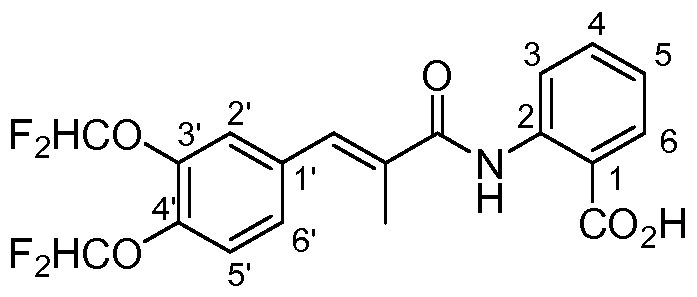
WWE Wipo information: entry into national phase

Ref document number: 584613

Country of ref document: NZ

Ref document number: 2008341010

Country of ref document: AU

ENP Entry into the national phase

Ref document number: 2008341010

Country of ref document: AU

Date of ref document: 20081219

Kind code of ref document: A

ENP Entry into the national phase

Ref document number: 20107011284

Country of ref document: KR

Kind code of ref document: A

WWE Wipo information: entry into national phase

Ref document number: 2008865709

Country of ref document: EP

WWE Wipo information: entry into national phase

Ref document number: 2010538278

Country of ref document: JP

WWE Wipo information: entry into national phase

Ref document number: 2709937

Country of ref document: CA

WWE Wipo information: entry into national phase

Ref document number: MX/A/2010/006787

Country of ref document: MX

NENP Non-entry into the national phase

Ref country code: DE

WWE Wipo information: entry into national phase

Ref document number: 3879/CHENP/2010

Country of ref document: IN

WWE Wipo information: entry into national phase

Ref document number: 12809751

Country of ref document: US