WO2009083686A1 - Compositions pharmaceutiques renfermant au moins un principe actif proteinique protege des enzymes digestives - Google Patents
Compositions pharmaceutiques renfermant au moins un principe actif proteinique protege des enzymes digestives Download PDFInfo
- Publication number
- WO2009083686A1 WO2009083686A1 PCT/FR2008/052357 FR2008052357W WO2009083686A1 WO 2009083686 A1 WO2009083686 A1 WO 2009083686A1 FR 2008052357 W FR2008052357 W FR 2008052357W WO 2009083686 A1 WO2009083686 A1 WO 2009083686A1
- Authority
- WO
- WIPO (PCT)
- Prior art keywords
- active ingredient
- buffer
- composition according
- liquid
- protein
- Prior art date
- Legal status (The legal status is an assumption and is not a legal conclusion. Google has not performed a legal analysis and makes no representation as to the accuracy of the status listed.)
- Ceased
Links
Classifications
-
- A—HUMAN NECESSITIES
- A61—MEDICAL OR VETERINARY SCIENCE; HYGIENE
- A61K—PREPARATIONS FOR MEDICAL, DENTAL OR TOILETRY PURPOSES
- A61K9/00—Medicinal preparations characterised by special physical form
- A61K9/20—Pills, tablets, discs, rods
- A61K9/2004—Excipients; Inactive ingredients
- A61K9/2009—Inorganic compounds
-
- A—HUMAN NECESSITIES
- A61—MEDICAL OR VETERINARY SCIENCE; HYGIENE
- A61K—PREPARATIONS FOR MEDICAL, DENTAL OR TOILETRY PURPOSES
- A61K9/00—Medicinal preparations characterised by special physical form
- A61K9/08—Solutions
-
- A—HUMAN NECESSITIES
- A61—MEDICAL OR VETERINARY SCIENCE; HYGIENE
- A61K—PREPARATIONS FOR MEDICAL, DENTAL OR TOILETRY PURPOSES
- A61K38/00—Medicinal preparations containing peptides
- A61K38/16—Peptides having more than 20 amino acids; Gastrins; Somatostatins; Melanotropins; Derivatives thereof
- A61K38/17—Peptides having more than 20 amino acids; Gastrins; Somatostatins; Melanotropins; Derivatives thereof from animals; from humans
- A61K38/22—Hormones
- A61K38/28—Insulins
-
- A—HUMAN NECESSITIES
- A61—MEDICAL OR VETERINARY SCIENCE; HYGIENE
- A61K—PREPARATIONS FOR MEDICAL, DENTAL OR TOILETRY PURPOSES
- A61K47/00—Medicinal preparations characterised by the non-active ingredients used, e.g. carriers or inert additives; Targeting or modifying agents chemically bound to the active ingredient
- A61K47/02—Inorganic compounds
-
- A—HUMAN NECESSITIES
- A61—MEDICAL OR VETERINARY SCIENCE; HYGIENE
- A61K—PREPARATIONS FOR MEDICAL, DENTAL OR TOILETRY PURPOSES
- A61K9/00—Medicinal preparations characterised by special physical form
- A61K9/0002—Galenical forms characterised by the drug release technique; Application systems commanded by energy
- A61K9/0007—Effervescent
-
- A—HUMAN NECESSITIES
- A61—MEDICAL OR VETERINARY SCIENCE; HYGIENE
- A61K—PREPARATIONS FOR MEDICAL, DENTAL OR TOILETRY PURPOSES
- A61K9/00—Medicinal preparations characterised by special physical form
- A61K9/20—Pills, tablets, discs, rods
- A61K9/2004—Excipients; Inactive ingredients
- A61K9/2013—Organic compounds, e.g. phospholipids, fats
-
- A—HUMAN NECESSITIES
- A61—MEDICAL OR VETERINARY SCIENCE; HYGIENE
- A61K—PREPARATIONS FOR MEDICAL, DENTAL OR TOILETRY PURPOSES
- A61K9/00—Medicinal preparations characterised by special physical form
- A61K9/20—Pills, tablets, discs, rods
- A61K9/2004—Excipients; Inactive ingredients
- A61K9/2013—Organic compounds, e.g. phospholipids, fats
- A61K9/2018—Sugars, or sugar alcohols, e.g. lactose, mannitol; Derivatives thereof, e.g. polysorbates
-
- A—HUMAN NECESSITIES
- A61—MEDICAL OR VETERINARY SCIENCE; HYGIENE
- A61K—PREPARATIONS FOR MEDICAL, DENTAL OR TOILETRY PURPOSES
- A61K9/00—Medicinal preparations characterised by special physical form
- A61K9/20—Pills, tablets, discs, rods
- A61K9/2004—Excipients; Inactive ingredients
- A61K9/2022—Organic macromolecular compounds
- A61K9/2027—Organic macromolecular compounds obtained by reactions only involving carbon-to-carbon unsaturated bonds, e.g. polyvinyl pyrrolidone, poly(meth)acrylates
-
- A—HUMAN NECESSITIES
- A61—MEDICAL OR VETERINARY SCIENCE; HYGIENE
- A61P—SPECIFIC THERAPEUTIC ACTIVITY OF CHEMICAL COMPOUNDS OR MEDICINAL PREPARATIONS
- A61P3/00—Drugs for disorders of the metabolism
- A61P3/08—Drugs for disorders of the metabolism for glucose homeostasis
- A61P3/10—Drugs for disorders of the metabolism for glucose homeostasis for hyperglycaemia, e.g. antidiabetics
-
- A—HUMAN NECESSITIES
- A61—MEDICAL OR VETERINARY SCIENCE; HYGIENE
- A61P—SPECIFIC THERAPEUTIC ACTIVITY OF CHEMICAL COMPOUNDS OR MEDICINAL PREPARATIONS
- A61P35/00—Antineoplastic agents
-
- A—HUMAN NECESSITIES
- A61—MEDICAL OR VETERINARY SCIENCE; HYGIENE
- A61K—PREPARATIONS FOR MEDICAL, DENTAL OR TOILETRY PURPOSES
- A61K38/00—Medicinal preparations containing peptides
Definitions
- compositions containing at least one protein active ingredient protected from diqestives enzymes are provided.
- compositions for use as medicaments or pharmaceutical compositions, containing at least one proteic active principle protected key digestive enzymes.
- said at least one active ingredient is formulated so as to withstand, as it is, its metabolization in the gastric medium and in the intestinal medium.
- Said compositions are compositions for oral administration (via the gastrointestinal tract) of said at least one active protein ingredient (sensitive to digestive enzymes).
- the documents WO 97/33531, WO 02/072075 and US 2003/0017203 describe gastro-resistant forms for the oral administration of peptides. These forms combine a gastro-resistant coating and a pH reducing agent. Said coating protects the active ingredient during its passage in the stomach. Once in the intestinal compartment, said coating is dissolved, releasing both the active ingredient and the pH reducing agent. Due to the action of said pH reducing agent, the pH of the intestine is locally lowered, thereby reducing the proteolytic activity of the intestinal proteases present. Protection at the level of the stomach and at the entrance of the intestine is thus assured by two different means, which successively develop their action. The peptides in question do not intervene in free form or in the presence of a buffer.
- Table 1 presented on page 23 of application WO 97/33531, shows bioavailability results of buffered solutions of calcitonin.
- the tests were carried out to study the influence of the pH of the solution administered locally (directly in the gut of rats) on the absorption of the active principle. These tests were carried out with a view to optimizing the nature of the pH reducing agent involved in the proposed gastroresistant form. These tests do not describe or suggest the oral compositions (pharmaceutical compositions or medicaments) of the invention described herein.
- the application US 2002/0132757 relates to the administration of calcitonin, in the form of solid particles, through epithelial membranes, through the oral or nasal mucous membranes.
- the active ingredient is treated as follows. It is dissolved beforehand in a buffer (simple manufacturing aid). The solution obtained, supplemented with surfactant (s) and agent (s) improving absorption is freeze-dried. The dry particles obtained are finally packaged in a container under pressure with a solvent or suitable vehicle (ethanol, for example). This solvent or vehicle has the function of dispersing under pressure said particles on a surface, the largest possible, mucous membranes. Said particles are not administered in the presence of a buffer;
- the application US 2007/0154559 describes a complicated process for the formulation of active principles intended for oral administration. Improved gastrointestinal absorption is sought.
- the absorption in question is that of nanoparticles which contain said active ingredients.
- the active ingredient is first dissolved in a buffer (simple manufacturing aid) and then complexed with a counter-ion.
- the complex obtained is dissolved in the presence of a polymer and a lipid in an organic solvent.
- An emulsion is then generated between the organic solution obtained and an aqueous solution containing an emulsifying agent.
- the nanoparticles are finally formed by evaporation of said organic solvent.
- the active principle is thus administered neither in free form nor in the presence of a buffer
- the application WO 2007/032018 describes a complicated process for the formulation of active principles, intended for oral administration, of the same type as that described in the US application above.
- the active ingredient is also delivered in the form of nanoparticles.
- the nanoparticles (based on a fatty acid and a polymer) are sensitive to pH. They shrink at acidic pH. The active ingredient is thus better protected during its passage in the stomach.
- Said active ingredient is ICI still administered, neither in free form nor in the presence of a buffer;
- FR 2 123 524 describes an insulin derivative obtained by acylation.
- the chemical reaction in question is implemented in a buffer medium.
- WO 01/36656 describes a biomolecule / hyaluronic acid complex.
- pancreas for the one hand the secretion of bicarbonate (in order to reduce the acidity of said chyme) and secondly the secretion of cholecystokinin, pancreoenzyme which it stimulates the secretion of pancreatic juice rich in enzymes (triglyceride, chymotrypsinogen, transformed into trypsin and chymotrypsin activated by enterokinase).
- enzymes triglyceride, chymotrypsinogen, transformed into trypsin and chymotrypsin activated by enterokinase.
- the inventors propose a completely original solution, not based on a double protection system but on a protection system at the level of the stomach which also inhibits pancreatic secretion (which removes the problem of degradation of the active ingredient at the level of the entry of the intestine).
- the inventors propose a posteriori this explanation of the good results obtained with the compositions of the invention.
- the original protection system proposed is a buffer system. Surprisingly, said original protection system, buffer system, allows the administration, orally (via the gastrointestinal tract), of the protein active ingredient, in free form.
- the present invention therefore relates to novel compositions for use as a medicament or pharmaceutical compositions intended for (suitable for) oral administration of at least one buffered active protein ingredient. More specifically, the compositions of the invention are in liquid or solid form. These are oral compositions and they contain at least one active ingredient protein. They are suitable for oral administration of said active ingredient.
- said liquid compositions contain a system (buffer system) capable of buffering them at a pH greater than 4 and less than or equal to 8;
- the present invention provides compositions, in liquid or solid form, which contain at least one protein active ingredient in free form, and liquids, a system (buffer system) capable of greater than 4 and lower than equal to 8 or, solids, a buffer) capable of exerting, when they are placed in a buffer medium between a pH greater than 4 and a lower pH or even for use as medicaments, for administration via the gastrointestinal tract.
- a system buffer system
- a buffer capable of greater than 4 and lower than equal to 8 or, solids, a buffer
- compositions in liquid form orally administered (via the gastrointestinal tract at least one active ingredient protein, which contain the protein, in free form, as well as liquids, a sy 'buffer) capable of buffering them to a pH greater than 4 equal to 8, or solids, a system (buffer system) suscei when placed in a liquid medium, a buffer effect between 1 to 4 and a pH less than or equal to 8.
- compositions of the invention are obtained by (simple) formulation, of said at least protein in free form, with a system (system te buffer, in liquid form, at a pH greater than or equal to 8 or under solid form, with a sy system likely to exert, when they are placed in liquid solid medium, a buffering effect between a pH greater than 4 and an equal to 8.
- system te buffer in liquid form, at a pH greater than or equal to 8 or under solid form, with a sy system likely to exert, when they are placed in liquid solid medium, a buffering effect between a pH greater than 4 and an equal to 8.
- liquid or solid compositions monoophasic, in any state of oral compositions, which combine within them at least one protein in free form and a buffer system. This allows, as indicated above, the administration by proteinaceous active ingredient, in free form. effective said free form during the gastrointestinal tract.
- the protemic is present, "in the state”, unprotected per se by a physical barrier. It is present as it is or in su with the excipients necessary for its formulation.
- active ingredient is meant in particular said physical protective active ingredient, more or less complex, coating type, matrix, capsule wall (said active principle ré-enrobe, matrix or encapsule (especially in lipos ⁇
- the buffer system in view of pH values ⁇ capable of buffering the compositions of the invention in mi and intestinal medium. It is obviously capable of exerting buffer during the digestion period: advantageously up to 3 hours (in the acidic conditions of basic intestines).
- the person skilled in the art knows of a buffer. We specify, by way of no limitation, the nature of this
- compositions of the invention combine:
- At least one protein active ingredient under the above form generally such an active ingredient (but conjugated with several active principles of this type (or even of active principle of this type and of at least one other active ingredient or separately, is not excluded from the scope of the invention) and
- buffer system capable of exerting buffer in the pH zone stated above.
- compositions of the invention are buffered
- compositions of the invention contain at least one protein active ingredient, which they are capable of protecting digestive enzymes. As mentioned above, as an active ingredient sensitive to digestive enzymes, insulin has been mentioned. The invention has been particularly developed with reference to this active ingredient (see the examples and tests presented further in this text).
- compositions of the invention advantageously contain at least one protein active ingredient (in free form) chosen from insulin, its analogues and derivatives (they generally contain advantageously insulin or one of its analogues or derivatives as sole active principle of this type, or even as sole active principle).
- insulin analogues such as, for example, ⁇ pro insulin, Aspart insulin, Glargme insulin and Detemir insulin. He also knows the insulin derivatives, such as those described in the application FR 2 123 524.
- compositions of the invention advantageously contain, as active principle (in free form): insulin, one of its analogues or derivatives,
- somatotropin human growth hormone
- LHH Linismg Hormone Releasing Hormone
- tryptorelin an analogue of LHH (Luteinismg Hormone Releasing Hormone), such as tryptorelin
- compositions of the invention are likely to contain several of these active ingredients and that the above list, far from being exhaustive, is in no way limiting.
- the buffer systems that are suitable for the purposes of the invention are conventional buffer systems, advantageously of high capacity.
- At least one proteimic active ingredient (in light form) / buffer system for example: insulin / buffer system.
- the system responsible for the buffering effect within the compositions of the invention is advantageously a buffer selected from phosphate, acetate, maleate, phthalate, succinate, citrate, imidazole and tetrabutylammonium buffers.
- a buffer selected from phosphate, acetate, maleate, phthalate, succinate, citrate, imidazole and tetrabutylammonium buffers.
- -amino-2-hydroxymethyl-1,3-propanediol or t-hydroxymethylaminomethane or trometamol or Tham or Tris
- tns-gly ⁇ ne barbitol
- t ⁇ s-EDTA BSA copper sulfate and zwitterionic
- the buffer system of the compositions of the invention can be chosen from the list of buffer systems given in the European Pharmacopoeia, current edition (monograph 4.1.3).
- a phosphate buffer which contains: from 2 to 3% by weight of hydrogenated monosodium phosphate, and from 97 to 98% by weight of monohydrogenated disodium phosphate, which advantageously contains: approximately 2.8% by weight of hydrogenated monosodium dihydrogen phosphate, and about 97.2% by weight of monohydrogenated disodium phosphate
- compositions of the invention (originally associating at least one free-form active ingredient in free form and the selected buffer system: 4 ⁇ pH ⁇ 8) can exist in two variants.
- compositions of the invention may especially be in liquid forms (directly buffered at an adequate pH) such as solutes, suspensions and syrups or in solid forms (which have the buffering effect, when they are taken, in a liquid, generally or following their taking, in the stomach) such as tablets (class 1 swallow), to be sucked, sublingual, dispersible, orodispersible, effervescent capsules, powders, effervescent powders, granular effervescent granules and lyophilizates.
- the galenist can formulate, under one or other of the units listed above, the active ingredient in question with an adequate, responsible for the desired buffering effect.
- the ingredients capable of imparting the effervescent effected c are f. the skilled person.
- the compounds of the invention are advantageously in the form of solid galenic prep, in particular effervescent compressed dispersible tablets.
- compositions of the invention comprise compositions with at least two separate components, comprising compositions which comprise separately:
- compositions of the invention which contain said at least one free protein p ⁇ nci in form (or even said at least one protein protein in free form and at least one other principle acti buffer system associated, usually in a pharmaceutically acceptable e (with, if necessary, the mgrédien to make them effervescent), are obviously susceptible contain other ingredients, conventionally used in galenic form, of the sweetener, aroma and / or manufacturing auxiliaries type (lubricant)
- the liquid compositions may contain only said at least one active proteinic ingredient (or even said at least one active principle proteinic in free form and at least one other active ingredient) and the appropriate buffer system.
- compositions of the invention usually contain, in addition to these two components, formulation ingredients conventionally used in galenics (type ingredients listed above).
- the solid compositions generally contain, in addition to said at least one active proteinic ingredient (or in addition to said at least one active proteinic ingredient in free form and at least one other active ingredient) and the buffer system, a solid carrier (base, possibly with ingredients responsible for effervescence)) with various additives (type ingredients listed above).
- a solid carrier base, possibly with ingredients responsible for effervescence)
- the preparation of the compositions of the invention whether unitary or not, as described above, constitutes the second subject of the presently claimed invention. Said preparation is a buffered or buffer-associated dosage form preparation.
- the (simple) formulation of at least one free form protein active ingredient with a system (buffer system) capable of buffering said composition in liquid form (especially in the gastric and intestinal medium) to a pH greater than 4 and less than or equal to 8 or in solid form, with a system (buffer system) capable of exerting, when placing in liquid medium, in particular aqueous medium, said solid form (in particular in gastric medium and in medium intestinal), a buffering effect between a pH greater than 4 and a pH less than or equal to 8.
- a system buffer system capable of exerting, when placing in liquid medium, in particular aqueous medium, said solid form (in particular in gastric medium and in medium intestinal), a buffering effect between a pH greater than 4 and a pH less than or equal to 8.
- compositions of the invention may be involved in the preparation of the compositions of the invention.
- pancreatic secretions - is particularly effective. This double effect and its effectiveness are really surprising
- the invention offers an original outlet to buffer systems and therefore also relates to the use of a buffer system as specified above, in particular chosen from those identified above, for the protection of At least one protein active ingredient in free form, during its transit via the gastrointestinal tract
- the invention provides an original method of protection, vis-à-vis the digestive enzymes (during gastro-transit -intestinal), protein active ingredients.
- Said method essentially comprises the formulation, in unitary or non-unitary form, of said active ingredients in free form, with a buffer system, as specified above, in particular chosen from those identified above.
- the invention can finally be analyzed as a method of therapeutic treatment comprising the oral administration of at least one active protein ingredient and / or a method of oral administration of at least one such active principle.
- said at least one active principle is administered (formulated in a solid or liquid composition, unitary or otherwise), in free form, with a buffer system as specified above; that is, buffered to a pH as specified above: 4 ⁇ pH ⁇ . 8 (in the case of a liquid form) or capable of being buffered, when placed in a liquid medium, at such a pH (in the case of a solid form)
- a buffer system as specified above; that is, buffered to a pH as specified above: 4 ⁇ pH ⁇ . 8 (in the case of a liquid form) or capable of being buffered, when placed in a liquid medium, at such a pH (in the case of a solid form)
- the therapies concerned are those of the following diseases.
- diabetes in reference to insulin administration
- growth inhibition in reference to the administration of sornatotropin
- osteoporosis in reference to the administration of cal ⁇ tonine
- the prostate with reference to the administration of analogs of the H.H.RTM.
- Tablets A human insulin: 3.5 mg (100 L tromethamoi (TRIS) 100 mg calcium phosphate
- Tests were carried out in vitro to confirm metabolism of pepsin in an acidic medium, the trypsin metabolic role in basic medium and the inactivation of both digestive enzymes in a buffered medium according to the invention.
- insulin is for more than 3 hours at 37 0 C,
- pepsin In buffered medium at pH 6.8, pepsin is no longer activated and insulin is stable for more than 3 hours at 37 ° C.
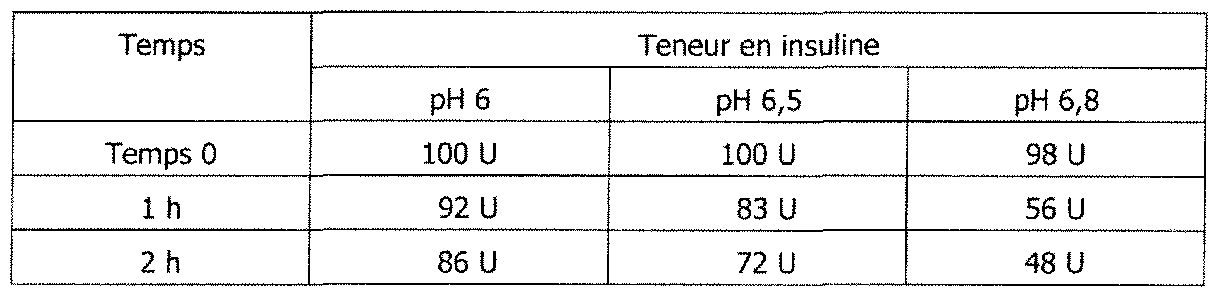
- test 2a phosphate buffer pH 6
- test 2b pH 6.5
- test 2c pH 6.8
- trypsin 750 U stirring at 37 ° C. 1 h / 2 h
- hypoglycemic activity of two types of effervescent co ⁇ was studied on Rat made diabetic (hyperglycemic) by streptozotoone administration.
- Streptozotocin an antibiotic chemically appearing nitro-ureas, has diabetogenic properties by destruction of Langherans pancreas.
- the animals are divided into three lots of eight,
- Lot 1 Normal, non-hyperglycemic animals, receiving by means of an oesophageal probe, 30 units of insulin contained one tablet buffered at pH 6.8 (effervescent tablet B (above)), under a volume of 10 ml / kg.
- Lot 2 diabetic animals, receiving orally with the aid of an oesophageal probe, 30 units of insulin contained in an unbuffered tablet (effervescent tablet of the B-tablet type but without buffer), in a volume of 10 ml / kg.
- unbuffered tablet effervescent tablet of the B-tablet type but without buffer
- Lot 3 diabetic animals, receiving orally with the aid of an oesophageal probe, 30 units of insulin contained in a buffered tablet at pH 6.8 (effervescent tablet B (see above)), in a volume of of 10 ml / kg.
- Blood samples are taken every 15 min for 3 h at the tail of the animal and blood glucose is assessed with an Abbot blood glucose meter.
- test 2 in vitro, in an acid medium, unbuffered, pepsin metabolized (test 2 '). In pepsin buffered medium is no longer active and thus found 100% after 3 hours (test 1),
- the insulin in basic medium, the insulin is trypsin metaboli (test 4 '), in buffered media at pH 6, 6.5 and 6.8, 1 * . said trypsin is inhibited, more or less diminished; In vivo, the unbuffered preparation has virtually no activity. The pre-buffered preparation against a significant hypoglycemic activity.
Landscapes
- Health & Medical Sciences (AREA)
- Life Sciences & Earth Sciences (AREA)
- Chemical & Material Sciences (AREA)
- Medicinal Chemistry (AREA)
- Veterinary Medicine (AREA)
- Public Health (AREA)
- General Health & Medical Sciences (AREA)
- Animal Behavior & Ethology (AREA)
- Pharmacology & Pharmacy (AREA)
- Epidemiology (AREA)
- Bioinformatics & Cheminformatics (AREA)
- Engineering & Computer Science (AREA)
- Biophysics (AREA)
- Molecular Biology (AREA)
- Inorganic Chemistry (AREA)
- Diabetes (AREA)
- Endocrinology (AREA)
- General Chemical & Material Sciences (AREA)
- Nuclear Medicine, Radiotherapy & Molecular Imaging (AREA)
- Organic Chemistry (AREA)
- Chemical Kinetics & Catalysis (AREA)
- Gastroenterology & Hepatology (AREA)
- Immunology (AREA)
- Proteomics, Peptides & Aminoacids (AREA)
- Zoology (AREA)
- Obesity (AREA)
- Hematology (AREA)
- Emergency Medicine (AREA)
- Medicines That Contain Protein Lipid Enzymes And Other Medicines (AREA)
- Medicinal Preparation (AREA)
Abstract
Description




Claims
Priority Applications (15)
| Application Number | Priority Date | Filing Date | Title |
|---|---|---|---|
| BRPI0821373A BRPI0821373B8 (pt) | 2007-12-19 | 2008-12-18 | composições farmacêuticas contendo ao menos um princípio ativo protéico protegido de enzimas digestivas |
| CA2709899A CA2709899C (fr) | 2007-12-19 | 2008-12-18 | Compositions pharmaceutiques renfermant au moins un principe actif proteinique protege des enzymes digestives |
| EP08867946.9A EP2234598B1 (fr) | 2007-12-19 | 2008-12-18 | Compositions pharmaceutiques renfermant au moins un principe actif proteinique protege des enzymes digestives |
| AP2010005298A AP3573A (en) | 2007-12-19 | 2008-12-18 | Pharmaceutical compositions containing at least one proteinaceous active ingredient protected against digestive enzymes |
| ES08867946T ES3055634T3 (en) | 2007-12-19 | 2008-12-18 | Pharmaceutical compositions containing at least one proteinaceous active ingredient protected against digestive enzymes |
| HK11100516.2A HK1146386B (en) | 2007-12-19 | 2008-12-18 | Pharmaceutical compositions containing at least one proteinaceous active ingredient protected against digestive enzymes |
| AU2008345474A AU2008345474B2 (en) | 2007-12-19 | 2008-12-18 | Pharmaceutical compositions containing at least one proteinaceous active ingredient protected against digestive enzymes |
| JP2010538869A JP5676272B2 (ja) | 2007-12-19 | 2008-12-18 | 消化酵素から保護される少なくとも1種のタンパク質活性成分を含む医薬組成物 |
| CN200880125189XA CN101917967B (zh) | 2007-12-19 | 2008-12-18 | 包含至少一种防消化酶消化的蛋白活性成分的药物组合物 |
| KR1020157032578A KR20150132887A (ko) | 2007-12-19 | 2008-12-18 | 소화 효소로부터 보호되는 적어도 하나의 단백질 활성 성분을 함유하는 약학적 조성물 |
| EA201070746A EA023107B1 (ru) | 2007-12-19 | 2008-12-18 | Фармацевтическая композиция, содержащая по меньшей мере один белковый активный ингредиент, защищенный от расщепления ферментами |
| MX2010006927A MX2010006927A (es) | 2007-12-19 | 2008-12-18 | Composiciones farmaceuticas que contienen al menos un ingrediente activo de proteina protegido contra las enzimas digestivas. |
| IL206364A IL206364A (en) | 2007-12-19 | 2010-06-14 | Medicinal preparations containing at least one active protein component protected by digestive enzymes |
| TN2010000290A TN2010000290A1 (fr) | 2007-12-19 | 2010-06-18 | Compositions pharmaceutiques renfermant au moins un principe actif proteinique protege des enzymes digestives |
| MA32934A MA31927B1 (fr) | 2007-12-19 | 2010-06-18 | Compositions pharmaceutiques renfermant au moins un principe actif proteinique protege des enzymes digestives |
Applications Claiming Priority (2)
| Application Number | Priority Date | Filing Date | Title |
|---|---|---|---|
| FR0759971 | 2007-12-19 | ||
| FR0759971A FR2925333B1 (fr) | 2007-12-19 | 2007-12-19 | Compositions pharmaceutiques renfermant au moins un principe actif proteinique protege des enzymes digestives |
Publications (2)
| Publication Number | Publication Date |
|---|---|
| WO2009083686A1 true WO2009083686A1 (fr) | 2009-07-09 |
| WO2009083686A9 WO2009083686A9 (fr) | 2009-10-15 |
Family
ID=39671377
Family Applications (1)
| Application Number | Title | Priority Date | Filing Date |
|---|---|---|---|
| PCT/FR2008/052357 Ceased WO2009083686A1 (fr) | 2007-12-19 | 2008-12-18 | Compositions pharmaceutiques renfermant au moins un principe actif proteinique protege des enzymes digestives |
Country Status (19)
| Country | Link |
|---|---|
| US (1) | US8309123B2 (fr) |
| EP (1) | EP2234598B1 (fr) |
| JP (1) | JP5676272B2 (fr) |
| KR (2) | KR101592609B1 (fr) |
| CN (1) | CN101917967B (fr) |
| AP (1) | AP3573A (fr) |
| AR (1) | AR069847A1 (fr) |
| AU (1) | AU2008345474B2 (fr) |
| BR (1) | BRPI0821373B8 (fr) |
| CA (1) | CA2709899C (fr) |
| EA (1) | EA023107B1 (fr) |
| ES (1) | ES3055634T3 (fr) |
| FR (1) | FR2925333B1 (fr) |
| IL (1) | IL206364A (fr) |
| MA (1) | MA31927B1 (fr) |
| MX (1) | MX2010006927A (fr) |
| TN (1) | TN2010000290A1 (fr) |
| TW (1) | TWI461226B (fr) |
| WO (1) | WO2009083686A1 (fr) |
Families Citing this family (10)
| Publication number | Priority date | Publication date | Assignee | Title |
|---|---|---|---|---|
| US20120035103A1 (en) * | 2010-01-29 | 2012-02-09 | Pillion Dennis J | Method for administration of insulin and pharmaceutical composition thereof |
| US20180104197A9 (en) | 2014-05-01 | 2018-04-19 | Sun Pharmaceutical Industries Limited | Extended release liquid compositions of metformin |
| MX2016014320A (es) | 2014-05-01 | 2017-05-23 | Sun Pharmaceutical Ind Ltd | Composiciones de suspension de liberacion prolongada. |
| US9962336B2 (en) | 2014-05-01 | 2018-05-08 | Sun Pharmaceutical Industries Limited | Extended release suspension compositions |
| US10258583B2 (en) | 2014-05-01 | 2019-04-16 | Sun Pharmaceutical Industries Limited | Extended release liquid compositions of guanfacine |
| BR112017001968A2 (pt) | 2014-07-30 | 2017-11-21 | Sun Pharmaceutical Ind Ltd | embalagem de duas câmaras para uma composição farmacêutica líquida oral de múltiplas doses |
| EP3215128B1 (fr) | 2014-11-04 | 2019-09-04 | Innopharmax, Inc. | Administration orale de médicaments instables ou mal absorbés |
| US10369078B2 (en) | 2016-05-02 | 2019-08-06 | Sun Pharmaceutical Industries Limited | Dual-chamber pack for pharmaceutical compositions |
| US10238803B2 (en) | 2016-05-02 | 2019-03-26 | Sun Pharmaceutical Industries Limited | Drug delivery device for pharmaceutical compositions |
| FR3120189B1 (fr) * | 2021-03-01 | 2024-11-29 | Farid Bennis | Composition pharmaceutique pour une administration par voie orale d’un agoniste du récepteur du GLP-1 |
Citations (8)
| Publication number | Priority date | Publication date | Assignee | Title |
|---|---|---|---|---|
| FR2123524A1 (en) * | 1971-01-28 | 1972-09-08 | Nat Res Dev | N-blocked insulin derivs - with high water solubility, and the corresp o-blocked cpds |
| US4692433A (en) * | 1983-10-12 | 1987-09-08 | The Regents Of The University Of California | Method and composition for regulating serum calcium levels of mammals |
| WO1997033531A1 (fr) * | 1996-03-15 | 1997-09-18 | Unigene Laboratories, Inc. | Produits pharmaceutiques peptidiques oraux |
| WO2001036656A2 (fr) * | 1999-11-15 | 2001-05-25 | Jederstroem Gustaf | Nouveau complexe, son procede de production et son utilisation |
| WO2002072075A1 (fr) * | 2001-03-08 | 2002-09-19 | Unigene Laboratories Inc. | Presentation pharmaceutique d'un peptide administre par voie orale et methode de production |
| US20020132757A1 (en) * | 2000-05-15 | 2002-09-19 | Mccoy Randall E. | Formulations for administering calcitonin and processes for preparing the same |
| WO2007032018A1 (fr) * | 2005-09-15 | 2007-03-22 | Council Of Scientific And Industrial Research | FORMULATION DE NANOPARTICULES SENSIBLES AU pH POUR L'ADMINISTRATION ORALE DE PROTÉINES/PEPTIDES |
| US20070154559A1 (en) * | 2003-12-24 | 2007-07-05 | Chaul-Min Pai | Nanoparticle compositions of water-soluble drugs for oral administration and preparation methods thereof |
Family Cites Families (22)
| Publication number | Priority date | Publication date | Assignee | Title |
|---|---|---|---|---|
| WO1985005029A1 (fr) | 1984-05-09 | 1985-11-21 | Medaphore Inc. | Insuline administree par voie orale et son procede de preparation |
| US4693433A (en) * | 1986-06-06 | 1987-09-15 | Merrill David Martin | Unwind stand for web rolls |
| US6191105B1 (en) * | 1993-05-10 | 2001-02-20 | Protein Delivery, Inc. | Hydrophilic and lipophilic balanced microemulsion formulations of free-form and/or conjugation-stabilized therapeutic agents such as insulin |
| GB9417524D0 (en) * | 1994-08-31 | 1994-10-19 | Cortecs Ltd | Pharmaceutical compositions |
| EP0781142A4 (fr) * | 1994-09-01 | 2003-04-09 | Allied Medical Res Associates | Compositions et procedes d'administration de polypeptides |
| US5824638A (en) | 1995-05-22 | 1998-10-20 | Shire Laboratories, Inc. | Oral insulin delivery |
| US5783556A (en) * | 1996-08-13 | 1998-07-21 | Genentech, Inc. | Formulated insulin-containing composition |
| US6071539A (en) * | 1996-09-20 | 2000-06-06 | Ethypharm, Sa | Effervescent granules and methods for their preparation |
| EP1952802A3 (fr) * | 1997-10-01 | 2009-06-17 | Novadel Pharma Inc. | Vaporisation ou capsule orale, polaire et non polaire |
| SE9801495D0 (sv) * | 1998-04-28 | 1998-04-28 | Astra Ab | Protein formulationa |
| US6531648B1 (en) * | 1998-12-17 | 2003-03-11 | Syngenta Participations Ag | Grain processing method and transgenic plants useful therein |
| SI1031347T1 (en) * | 1999-01-27 | 2002-10-31 | Idea Ag | Transnasal transport/immunisation with highly adaptable carriers |
| US7060675B2 (en) * | 2001-02-15 | 2006-06-13 | Nobex Corporation | Methods of treating diabetes mellitus |
| CN1335182A (zh) * | 2001-08-08 | 2002-02-13 | 华中科技大学 | 胰岛素口腔喷剂及其制备工艺 |
| GB0119859D0 (en) * | 2001-08-15 | 2001-10-10 | Qinetiq Ltd | Eye tracking system |
| US20060258561A1 (en) * | 2003-03-13 | 2006-11-16 | Novo Nordisk A/S | Novel NPH insulin preparations |
| WO2005113008A1 (fr) * | 2004-05-21 | 2005-12-01 | Mediplex Corp. | Delivrance d'agents permettant d'ameliorer l'absorption mucosale d'agents therapeutiques |
| RU2527893C2 (ru) * | 2004-07-19 | 2014-09-10 | Биокон Лимитед | Инсулин-олигомерные конъюгаты, их препараты и применения |
| EP1773376A4 (fr) * | 2004-08-03 | 2009-07-01 | Emisphere Tech Inc | Association d'insuline et d'un biguanide pour administration orale contre le diabète |
| PL1883394T3 (pl) | 2005-05-23 | 2018-09-28 | Sdg, Inc. | Konstrukt lipidowy do dostarczania insuliny ssakowi |
| US20070134332A1 (en) * | 2005-11-21 | 2007-06-14 | Medivas, Llc | Polymer particles for delivery of macromolecules and methods of use |
| WO2007121318A2 (fr) * | 2006-04-12 | 2007-10-25 | Emisphere Technologies, Inc. | Préparations destinées à l'administration d'insuline |
-
2007
- 2007-12-19 FR FR0759971A patent/FR2925333B1/fr active Active
-
2008
- 2008-12-18 EP EP08867946.9A patent/EP2234598B1/fr active Active
- 2008-12-18 AP AP2010005298A patent/AP3573A/xx active
- 2008-12-18 CN CN200880125189XA patent/CN101917967B/zh active Active
- 2008-12-18 JP JP2010538869A patent/JP5676272B2/ja active Active
- 2008-12-18 KR KR1020107013390A patent/KR101592609B1/ko active Active
- 2008-12-18 CA CA2709899A patent/CA2709899C/fr active Active
- 2008-12-18 BR BRPI0821373A patent/BRPI0821373B8/pt active IP Right Grant
- 2008-12-18 WO PCT/FR2008/052357 patent/WO2009083686A1/fr not_active Ceased
- 2008-12-18 AU AU2008345474A patent/AU2008345474B2/en not_active Ceased
- 2008-12-18 ES ES08867946T patent/ES3055634T3/es active Active
- 2008-12-18 MX MX2010006927A patent/MX2010006927A/es active IP Right Grant
- 2008-12-18 EA EA201070746A patent/EA023107B1/ru unknown
- 2008-12-18 KR KR1020157032578A patent/KR20150132887A/ko not_active Ceased
- 2008-12-19 TW TW097149879A patent/TWI461226B/zh not_active IP Right Cessation
- 2008-12-19 AR ARP080105568A patent/AR069847A1/es unknown
- 2008-12-19 US US12/339,310 patent/US8309123B2/en active Active
-
2010
- 2010-06-14 IL IL206364A patent/IL206364A/en active IP Right Grant
- 2010-06-18 MA MA32934A patent/MA31927B1/fr unknown
- 2010-06-18 TN TN2010000290A patent/TN2010000290A1/fr unknown
Patent Citations (9)
| Publication number | Priority date | Publication date | Assignee | Title |
|---|---|---|---|---|
| FR2123524A1 (en) * | 1971-01-28 | 1972-09-08 | Nat Res Dev | N-blocked insulin derivs - with high water solubility, and the corresp o-blocked cpds |
| US4692433A (en) * | 1983-10-12 | 1987-09-08 | The Regents Of The University Of California | Method and composition for regulating serum calcium levels of mammals |
| WO1997033531A1 (fr) * | 1996-03-15 | 1997-09-18 | Unigene Laboratories, Inc. | Produits pharmaceutiques peptidiques oraux |
| WO2001036656A2 (fr) * | 1999-11-15 | 2001-05-25 | Jederstroem Gustaf | Nouveau complexe, son procede de production et son utilisation |
| US20020132757A1 (en) * | 2000-05-15 | 2002-09-19 | Mccoy Randall E. | Formulations for administering calcitonin and processes for preparing the same |
| WO2002072075A1 (fr) * | 2001-03-08 | 2002-09-19 | Unigene Laboratories Inc. | Presentation pharmaceutique d'un peptide administre par voie orale et methode de production |
| US20030017203A1 (en) * | 2001-03-08 | 2003-01-23 | Unigene Laboratories, Inc. | Oral peptide pharmaceutical dosage form and method of production |
| US20070154559A1 (en) * | 2003-12-24 | 2007-07-05 | Chaul-Min Pai | Nanoparticle compositions of water-soluble drugs for oral administration and preparation methods thereof |
| WO2007032018A1 (fr) * | 2005-09-15 | 2007-03-22 | Council Of Scientific And Industrial Research | FORMULATION DE NANOPARTICULES SENSIBLES AU pH POUR L'ADMINISTRATION ORALE DE PROTÉINES/PEPTIDES |
Also Published As
Similar Documents
| Publication | Publication Date | Title |
|---|---|---|
| WO2009083686A1 (fr) | Compositions pharmaceutiques renfermant au moins un principe actif proteinique protege des enzymes digestives | |
| RU2566063C2 (ru) | Композиции и способы перорального введения эксенатида | |
| RU2554814C2 (ru) | Композиции для введения лекарственных средств | |
| CN102369018B (zh) | 糖尿病和代谢综合征的治疗 | |
| CN1197554C (zh) | 固体类脂制剂 | |
| JP7656353B2 (ja) | 向上した安定性を有する脂質ベースのナノ粒子 | |
| JPH10504835A (ja) | 胆汁酸塩および活性化合物の生物学的利用能を向上させる緩衝液を含む薬剤組成物 | |
| CN1202820A (zh) | 胰岛血糖素样促胰岛素肽的经颊释放 | |
| Langoth et al. | Development of a mucoadhesive and permeation enhancing buccal delivery system for PACAP (pituitary adenylate cyclase-activating polypeptide) | |
| WO2022185155A1 (fr) | Composition pharmaceutique pour une administration par voie orale d'un agoniste du recepteur du glp-1 | |
| WO2025166413A1 (fr) | Compositions et procédés d'administration d'agonistes de glp-1 (métabolix) | |
| US20130090288A1 (en) | Pharmaceutical compositions containing at least one protein active ingredient protected from digestive enzymes | |
| FR2819188A1 (fr) | Compositions pulverulentes ou granulees hydrosolubles, a base de phenanthridines et leurs utilisations | |
| HK1146386B (en) | Pharmaceutical compositions containing at least one proteinaceous active ingredient protected against digestive enzymes | |
| HK1155375A (en) | Methods and compositions for oral administration of exenatide |
Legal Events
| Date | Code | Title | Description |
|---|---|---|---|
| WWE | Wipo information: entry into national phase |
Ref document number: 200880125189.X Country of ref document: CN |
|
| 121 | Ep: the epo has been informed by wipo that ep was designated in this application |
Ref document number: 08867946 Country of ref document: EP Kind code of ref document: A1 |
|
| DPE1 | Request for preliminary examination filed after expiration of 19th month from priority date (pct application filed from 20040101) | ||
| DPE1 | Request for preliminary examination filed after expiration of 19th month from priority date (pct application filed from 20040101) | ||
| ENP | Entry into the national phase |
Ref document number: 20107013390 Country of ref document: KR Kind code of ref document: A |
|
| WWE | Wipo information: entry into national phase |
Ref document number: 2709899 Country of ref document: CA Ref document number: 12010501387 Country of ref document: PH |
|
| WWE | Wipo information: entry into national phase |
Ref document number: 2010538869 Country of ref document: JP Ref document number: MX/A/2010/006927 Country of ref document: MX |
|
| NENP | Non-entry into the national phase |
Ref country code: DE |
|
| WWE | Wipo information: entry into national phase |
Ref document number: 2008345474 Country of ref document: AU |
|
| WWE | Wipo information: entry into national phase |
Ref document number: 201070746 Country of ref document: EA |
|
| WWE | Wipo information: entry into national phase |
Ref document number: 5143/DELNP/2010 Country of ref document: IN Ref document number: 2008867946 Country of ref document: EP |
|
| ENP | Entry into the national phase |
Ref document number: 2008345474 Country of ref document: AU Date of ref document: 20081218 Kind code of ref document: A |
|
| ENP | Entry into the national phase |
Ref document number: PI0821373 Country of ref document: BR Kind code of ref document: A2 Effective date: 20100618 |
|
| WWG | Wipo information: grant in national office |
Ref document number: 2008867946 Country of ref document: EP |