WO2009084205A1 - 化粧料の製造方法 - Google Patents
化粧料の製造方法 Download PDFInfo
- Publication number
- WO2009084205A1 WO2009084205A1 PCT/JP2008/003967 JP2008003967W WO2009084205A1 WO 2009084205 A1 WO2009084205 A1 WO 2009084205A1 JP 2008003967 W JP2008003967 W JP 2008003967W WO 2009084205 A1 WO2009084205 A1 WO 2009084205A1
- Authority
- WO
- WIPO (PCT)
- Prior art keywords
- particle size
- average particle
- treated
- powder
- fluorine compound
- Prior art date
- Legal status (The legal status is an assumption and is not a legal conclusion. Google has not performed a legal analysis and makes no representation as to the accuracy of the status listed.)
- Ceased
Links
Images

Classifications
-
- A—HUMAN NECESSITIES
- A61—MEDICAL OR VETERINARY SCIENCE; HYGIENE
- A61Q—SPECIFIC USE OF COSMETICS OR SIMILAR TOILETRY PREPARATIONS
- A61Q1/00—Make-up preparations; Body powders; Preparations for removing make-up
- A61Q1/12—Face or body powders for grooming, adorning or absorbing
-
- A—HUMAN NECESSITIES
- A61—MEDICAL OR VETERINARY SCIENCE; HYGIENE
- A61K—PREPARATIONS FOR MEDICAL, DENTAL OR TOILETRY PURPOSES
- A61K8/00—Cosmetics or similar toiletry preparations
- A61K8/02—Cosmetics or similar toiletry preparations characterised by special physical form
- A61K8/0216—Solid or semisolid forms
- A61K8/022—Powders; Compacted Powders
-
- A—HUMAN NECESSITIES
- A61—MEDICAL OR VETERINARY SCIENCE; HYGIENE
- A61K—PREPARATIONS FOR MEDICAL, DENTAL OR TOILETRY PURPOSES
- A61K8/00—Cosmetics or similar toiletry preparations
- A61K8/02—Cosmetics or similar toiletry preparations characterised by special physical form
- A61K8/0241—Containing particulates characterized by their shape and/or structure
- A61K8/0254—Platelets; Flakes
-
- A—HUMAN NECESSITIES
- A61—MEDICAL OR VETERINARY SCIENCE; HYGIENE
- A61K—PREPARATIONS FOR MEDICAL, DENTAL OR TOILETRY PURPOSES
- A61K8/00—Cosmetics or similar toiletry preparations
- A61K8/18—Cosmetics or similar toiletry preparations characterised by the composition
- A61K8/19—Cosmetics or similar toiletry preparations characterised by the composition containing inorganic ingredients
- A61K8/25—Silicon; Compounds thereof
-
- A—HUMAN NECESSITIES
- A61—MEDICAL OR VETERINARY SCIENCE; HYGIENE
- A61K—PREPARATIONS FOR MEDICAL, DENTAL OR TOILETRY PURPOSES
- A61K8/00—Cosmetics or similar toiletry preparations
- A61K8/18—Cosmetics or similar toiletry preparations characterised by the composition
- A61K8/19—Cosmetics or similar toiletry preparations characterised by the composition containing inorganic ingredients
- A61K8/26—Aluminium; Compounds thereof
-
- A—HUMAN NECESSITIES
- A61—MEDICAL OR VETERINARY SCIENCE; HYGIENE
- A61K—PREPARATIONS FOR MEDICAL, DENTAL OR TOILETRY PURPOSES
- A61K8/00—Cosmetics or similar toiletry preparations
- A61K8/18—Cosmetics or similar toiletry preparations characterised by the composition
- A61K8/30—Cosmetics or similar toiletry preparations characterised by the composition containing organic compounds
- A61K8/31—Hydrocarbons
-
- A—HUMAN NECESSITIES
- A61—MEDICAL OR VETERINARY SCIENCE; HYGIENE
- A61K—PREPARATIONS FOR MEDICAL, DENTAL OR TOILETRY PURPOSES
- A61K8/00—Cosmetics or similar toiletry preparations
- A61K8/18—Cosmetics or similar toiletry preparations characterised by the composition
- A61K8/30—Cosmetics or similar toiletry preparations characterised by the composition containing organic compounds
- A61K8/33—Cosmetics or similar toiletry preparations characterised by the composition containing organic compounds containing oxygen
- A61K8/37—Esters of carboxylic acids
-
- A—HUMAN NECESSITIES
- A61—MEDICAL OR VETERINARY SCIENCE; HYGIENE
- A61K—PREPARATIONS FOR MEDICAL, DENTAL OR TOILETRY PURPOSES
- A61K8/00—Cosmetics or similar toiletry preparations
- A61K8/18—Cosmetics or similar toiletry preparations characterised by the composition
- A61K8/72—Cosmetics or similar toiletry preparations characterised by the composition containing organic macromolecular compounds
- A61K8/81—Cosmetics or similar toiletry preparations characterised by the composition containing organic macromolecular compounds obtained by reactions involving only carbon-to-carbon unsaturated bonds
- A61K8/8105—Compositions of homopolymers or copolymers of unsaturated aliphatic hydrocarbons having only one carbon-to-carbon double bond; Compositions of derivatives of such polymers
- A61K8/8111—Homopolymers or copolymers of aliphatic olefines, e.g. polyethylene, polyisobutene; Compositions of derivatives of such polymers
-
- A—HUMAN NECESSITIES
- A61—MEDICAL OR VETERINARY SCIENCE; HYGIENE
- A61K—PREPARATIONS FOR MEDICAL, DENTAL OR TOILETRY PURPOSES
- A61K8/00—Cosmetics or similar toiletry preparations
- A61K8/18—Cosmetics or similar toiletry preparations characterised by the composition
- A61K8/72—Cosmetics or similar toiletry preparations characterised by the composition containing organic macromolecular compounds
- A61K8/84—Cosmetics or similar toiletry preparations characterised by the composition containing organic macromolecular compounds obtained by reactions otherwise than those involving only carbon-carbon unsaturated bonds
- A61K8/89—Polysiloxanes
- A61K8/891—Polysiloxanes saturated, e.g. dimethicone, phenyl trimethicone, C24-C28 methicone or stearyl dimethicone
-
- A—HUMAN NECESSITIES
- A61—MEDICAL OR VETERINARY SCIENCE; HYGIENE
- A61K—PREPARATIONS FOR MEDICAL, DENTAL OR TOILETRY PURPOSES
- A61K8/00—Cosmetics or similar toiletry preparations
- A61K8/18—Cosmetics or similar toiletry preparations characterised by the composition
- A61K8/92—Oils, fats or waxes; Derivatives thereof, e.g. hydrogenation products thereof
- A61K8/922—Oils, fats or waxes; Derivatives thereof, e.g. hydrogenation products thereof of vegetable origin
-
- A—HUMAN NECESSITIES
- A61—MEDICAL OR VETERINARY SCIENCE; HYGIENE
- A61K—PREPARATIONS FOR MEDICAL, DENTAL OR TOILETRY PURPOSES
- A61K8/00—Cosmetics or similar toiletry preparations
- A61K8/18—Cosmetics or similar toiletry preparations characterised by the composition
- A61K8/92—Oils, fats or waxes; Derivatives thereof, e.g. hydrogenation products thereof
- A61K8/927—Oils, fats or waxes; Derivatives thereof, e.g. hydrogenation products thereof of insects, e.g. shellac
-
- A—HUMAN NECESSITIES
- A61—MEDICAL OR VETERINARY SCIENCE; HYGIENE
- A61Q—SPECIFIC USE OF COSMETICS OR SIMILAR TOILETRY PREPARATIONS
- A61Q1/00—Make-up preparations; Body powders; Preparations for removing make-up
- A61Q1/02—Preparations containing skin colorants, e.g. pigments
- A61Q1/08—Preparations containing skin colorants, e.g. pigments for cheeks, e.g. rouge
-
- A—HUMAN NECESSITIES
- A61—MEDICAL OR VETERINARY SCIENCE; HYGIENE
- A61Q—SPECIFIC USE OF COSMETICS OR SIMILAR TOILETRY PREPARATIONS
- A61Q1/00—Make-up preparations; Body powders; Preparations for removing make-up
- A61Q1/02—Preparations containing skin colorants, e.g. pigments
- A61Q1/10—Preparations containing skin colorants, e.g. pigments for eyes, e.g. eyeliner, mascara
-
- A—HUMAN NECESSITIES
- A61—MEDICAL OR VETERINARY SCIENCE; HYGIENE
- A61K—PREPARATIONS FOR MEDICAL, DENTAL OR TOILETRY PURPOSES
- A61K2800/00—Properties of cosmetic compositions or active ingredients thereof or formulation aids used therein and process related aspects
- A61K2800/80—Process related aspects concerning the preparation of the cosmetic composition or the storage or application thereof
- A61K2800/82—Preparation or application process involves sonication or ultrasonication
Definitions
- the present invention relates to a method for producing a cosmetic (solid powder cosmetic) in which powder is compressed and molded.
- Cosmetics that are molded by compressing powder are manufactured by mixing oil-based ingredients, etc., and then crushing and compression molding. Consideration has been made to improve this.
- a molding method for improving stability such as mold retention and impact resistance has been studied.
- makeup cosmetics such as eye shadows, blushers, and foundations are also strongly desired to have excellent appearance gloss and application gloss.
- Patent Document 1 when molding a powder composition, it is known that a molded body having excellent impact resistance and uniform powder removal can be obtained by pressure molding while applying ultrasonic vibration.
- Patent Document 2 if a powder cosmetic is molded while applying ultrasonic waves, air taken into the powder composition is smoothly and satisfactorily released, so that a uniform and dense powder cosmetic is obtained.
- Patent Document 2 discloses that a composition containing an organic powder having an average crushing strength of 0.05 to 1 kg / mm 2 is filled in a container and then press-molded at a pressure not exceeding 20 kg / cm 2.
- Patent Document 3 describes that a partially friable product can be obtained by applying ultrasonic force to a powder mixture containing 5 to 80 wt% of a thermoplastic product when it is pressurized. Yes.
- the present invention relates to a method for producing a cosmetic material excellent in glossiness, usability, glossiness of a coating film, and stability of a molded powder cosmetic surface.
- the inventors have used powder, liquid oil, and solid oil in combination at a specific ratio, and by pressure molding while irradiating ultrasonic waves, the orientation of the powder is improved, Make-up that is uniform, has excellent usability such as sticking to the skin, moist feeling when applied, stability such as shape retention and impact resistance, and excellent glossiness of the molded cosmetic surface It was found that a fee can be obtained.
- the present invention provides a method for producing a cosmetic that is pressure-molded by applying vibration having a frequency of 10 to 40 kHz and an amplitude of 10 to 100 ⁇ m at the time of molding. Moreover, this invention provides the cosmetics obtained by the said manufacturing method.
- the glossiness of the molded cosmetic surface, the glossiness of the coating film, and the usability and stability are excellent, the application tool is fine and uniform, and the skin is uniform.
- a moist feeling at the time of application can be obtained, and a cosmetic excellent in impact resistance and shape retention during transportation or dropping can be obtained.
- the powder of component (A) used in the present invention is insoluble in water and oil used in normal cosmetics, and may be any of spherical, plate-like, and irregular-shaped powders. By including, the surface gloss of the molded cosmetics can be further increased.
- silicic anhydride magnesium silicate, talc, sericite, mica, synthetic mica, kaolin, boron nitride, scaly glass, aluminum, bismuth oxychloride, zinc oxide, aluminum oxide, Calcium sulfate, barium sulfate, calcium carbonate, titanium oxide, iron oxide, long chain alkyl phosphate metal salt, N-mono long chain alkyl acyl basic amino acid, N-mono long chain alkyl acyl basic amino acid metal salt, etc. .
- a pearl pigment can be mentioned as a plate-like powder.
- the pearl pigment include a flaky base material and a coating layer.
- the base material is selected from mica, synthetic mica, silica, glass, aluminum, and the like, and the coating layer is made of metal, metal oxide, metal complex, and organic pigment. It will be chosen. Specific examples include titanium oxide coated mica, iron oxide coated mica, titanium oxide coated glass, and iron oxide titanium oxide coated mica.
- glass flakes and pearl pigments are preferred, and plate-like powders such as glass flakes (pearl pigments) coated with metal oxides can be used for the gloss and transparency of the molded cosmetic surface. Since it is excellent, it is preferable.
- the plate-like powder preferably has an aspect ratio of 20 to 400, more preferably 30 to 400.
- the powder of component (A) has an average particle size of 0.1 to 300 ⁇ m, preferably 1 to 100 ⁇ m.
- the average particle diameter is a median diameter value measured by dispersing powder in ethanol using a laser diffraction particle diameter measuring apparatus (LA-920, Horiba, Ltd.).
- the aspect ratio is a value obtained by dividing the average particle diameter by the average thickness of the particles.
- the average thickness of the particles is a value obtained by measuring using an electron microscope and dividing the total value by the number of measurements.
- a surface-treated powder can be used as the powder of component (A).
- the surface treatment include silicone treatment, fatty acid treatment, amino acid treatment, lecithin treatment, metal soap treatment, alkyl treatment, fluorine compound treatment, ester treatment, and composite treatment thereof.
- silicone treatment for example, treatment with methylhydrogenpolysiloxane, methylpolysiloxane, trimethylsiloxysilicic acid, silicone resin, etc .
- the fatty acid treatment treatment with myristic acid, stearic acid, etc .
- fluorine compound treatment examples of the treatment include treatment with pearl fluoroalkyl phosphate ester, perfluoroalkyl silane and the like.
- the amount of the surface treatment agent used is preferably 0.1 to 10% by mass, more preferably 2 to 9% by mass, based on the mass of the powder before the treatment.
- the method of surface treatment is not limited and can be performed according to a normal method.
- the component (A) powder one or more kinds can be used, and the total composition contains 75 to 95% by mass, preferably 85 to 95% by mass, and further 85 to 92% by mass. Within this range, the applicator is finely and evenly applied, and the skin is evenly attached, and a moist feeling during application can be obtained.
- one or more selected from plate mica, mica, synthetic mica, sericite and pearl pigment are combined in a total amount of 30 to 95% by mass, and further 50 to 80%.
- the content by mass% is preferable because it gives gloss to the surface of the molded cosmetic and a moist feeling upon application.
- Component (B), which is liquid at 25 ° C. can be used without limitation as long as it is used in ordinary cosmetics.
- fats and oils such as cacao butter, sunflower oil, jojoba oil, olive oil, sunflower oil, macadamia nut oil; higher fatty acids such as isononanoic acid and isostearic acid; isopropyl myristate, isopropyl isostearate, neopentyl glycol dicaprate, malic acid
- Fatty acid esters such as diisostearyl
- hydrocarbon oils such as liquid paraffin, liquid isoparaffin, squalane
- silicone oil fluorine oil and the like.
- One or more liquid oils of component (B) can be used, and 3 to 23.75% by mass, and further 4 to 20% by mass in the total composition is moist feeling and impact resistance during coating. It is preferable because it is excellent.
- Component (C) an oil agent (solid oil) that is solid at 25 ° C., reversibly changes to a solid / liquid state, and is a hydrophobic compound having a melting point of 40 ° C. or higher.
- Waxes composed of hydrocarbon, ester, and silicone components are included and selected from animal waxes, vegetable waxes, mineral waxes, synthetic waxes, and mixtures thereof.
- animal waxes such as beeswax and whale wax
- plant waxes such as carnauba wax, candelilla wax, rice wax, and wood wax
- mineral waxes such as montan wax, ozokerite, ceresin, paraffin wax, petrolatum, and microcrystalline wax
- synthetic waxes such as polyethylene wax, Fischer-Tropsch wax, hardened castor oil, hydrogenated jojoba oil, 12-hydroxystearic acid, stearamide, phthalic anhydride imide, and silicone wax.
- those having a penetration of 15 or less at 25 ° C. measured by the method described in ASTM D-1321 are preferable in terms of gloss and impact resistance of the molded surface, and further 10 or less. Those are more preferred.
- As a solid oil agent at 25 ° C. those having a penetration of 15 or less and those other than that can be used in combination. When using together, it is preferable that the penetration degree in 25 degreeC of the whole solid oil agent at 25 degreeC is 15 or less.
- polyethylene wax For those with a penetration of 15 or less, polyethylene wax, paraffin wax, candelilla wax, carnauba wax, rice wax, montan wax, ozokerite, ceresin, polyethylene wax, Fischer-Tropsch wax, hardened castor oil, hydrogenated jojoba oil, 12 -Hydroxystearic acid, stearic acid amide, phthalic anhydride imide, silicone wax and the like.
- the solid oil of component (C) has a high melting point because it has excellent impact resistance.
- the melting point is preferably 60 ° C. or higher, more preferably 70 ° C. or higher, and preferably 110 ° C. or lower because of excellent melting point.
- the solid oil of component (C) can be used singly or in combination of two or more, and the total composition contains 0.25 to 10% by mass, and more preferably 1 to 5% by mass, with a moist feeling during coating. Since it is excellent in impact resistance, it is preferable.
- the mass ratio of the component (B) to the component (C) is 6: 4 to 9.5: 0.5, preferably 7: 3 to 9: 1.
- the mass ratio of the component (B) is large, the molded surface is excellent in glossiness, but is inferior in impact resistance.
- the cosmetics of the present invention include components used in normal cosmetics, such as surfactants, preservatives, antioxidants, dyes, fragrances, ultraviolet absorbers, moisturizers, bactericides, and anti-inflammatory agents.
- a skin activator and the like can be appropriately contained.
- (B) liquid oil and (C) solid oil are heated and mixed, and (A) powder is added to a mixture (powder composition) having a frequency of 10 to 40 kHz and an amplitude of 10 to 100 ⁇ m.
- Cosmetics can be produced by applying vibration and pressure molding. Furthermore, it is preferable to manufacture by mixing these (A) powder and this uniformly with the temperature which (B) liquid oil and (C) solid oil melt
- (B) liquid oil and (C) solid oil heated and dissolved be an oil component and added to (A) powder previously mixed at that temperature and mixed uniformly.
- As a method for adding the oil component it can be sprayed by spraying.
- the obtained mixture can be compression-molded as it is, but it is preferable that the mixture is cooled to room temperature and then pulverized and pressure-molded.
- the mixture of the pulverized components (A), (B), and (C) is passed through a sieve of 3 mm or less and collected in a predetermined molding container.
- the application of vibration is preferably performed in a state where a weight of about 10 g or more, preferably 100 g or more is applied to the mixture of components (A), (B) and (C).
- the application time of vibration is preferably 0.1 to 2 seconds, more preferably 0.5 to 1.5 seconds, and after application of vibration, the pressure is preferably maintained for 0.1 seconds or more. Holding for 1 to 5 seconds, and further 0.5 to 2 seconds is more preferable because of excellent impact resistance.
- the pressure applied during pressure molding is 10 kg / cm 2 or less, and further 1 to 5 kg / cm 2 , so that it can be applied to the applicator during use, attached to the skin, and moist when applied. Is preferable. Furthermore, it is preferable in that the glossiness of the surface of the molded cosmetic and the glossiness of the coating film are excellent.
- the high-pressure press molding that has been used so far, powders having a large particle size and a large aspect ratio have been broken and changed to a small particle size after molding.
- the particle size distribution of the powder before and after molding and the particle size distribution of the component (A) are not changed before and after molding. Therefore, a molded cosmetic material having a very glossy surface and a very high gloss on the coating film can be obtained.
- the powder cosmetics obtained by the present invention are suitable as makeup cosmetics such as foundations, face powders, white powders, eye shadows, eyebrows, blushers, and body powders.
- the evaluation methods performed in the examples are as follows.
- (Evaluation methods) (1) Measurement of penetration: A solid oil agent was heated and melted at 25 ° C. and cooled, and the sample was measured using a TESTING APPARATUS FOR PENETORATION (NIKKA ENGINEERING). That is, the sample was melted by heating to a temperature 17 ° C. higher than its melting point.
- Two cork stoppers No. 16 were placed side by side on a horizontal base, a brass plate was placed thereon, and a release agent (a mixture of equal amounts of glycerin and water) was thinly applied on the top surface.
- a specified sample container (brass cylinder, inner diameter 25.4 mm, height 31.8 mm, wall thickness 3.2 mm) is placed on a brass plate, the molten sample is poured to the extent that it rises to the upper edge of the sample container for 1 hour at room temperature It was allowed to cool at (22-26 ° C.). This was removed from the brass plate and left in constant temperature water at 25 ° C. for 1 hour.
- a specified needle having a total mass of 100 g was allowed to enter the sample vertically for 5 seconds, the dial gauge was read, and the depth of penetration of the needle was measured. The penetration of the sample is expressed by a numerical value obtained by measuring the depth of penetration of the needle up to 0.1 mm and multiplying this by 10 times. The four measured values were averaged, and the first decimal place was rounded off to obtain the penetration.
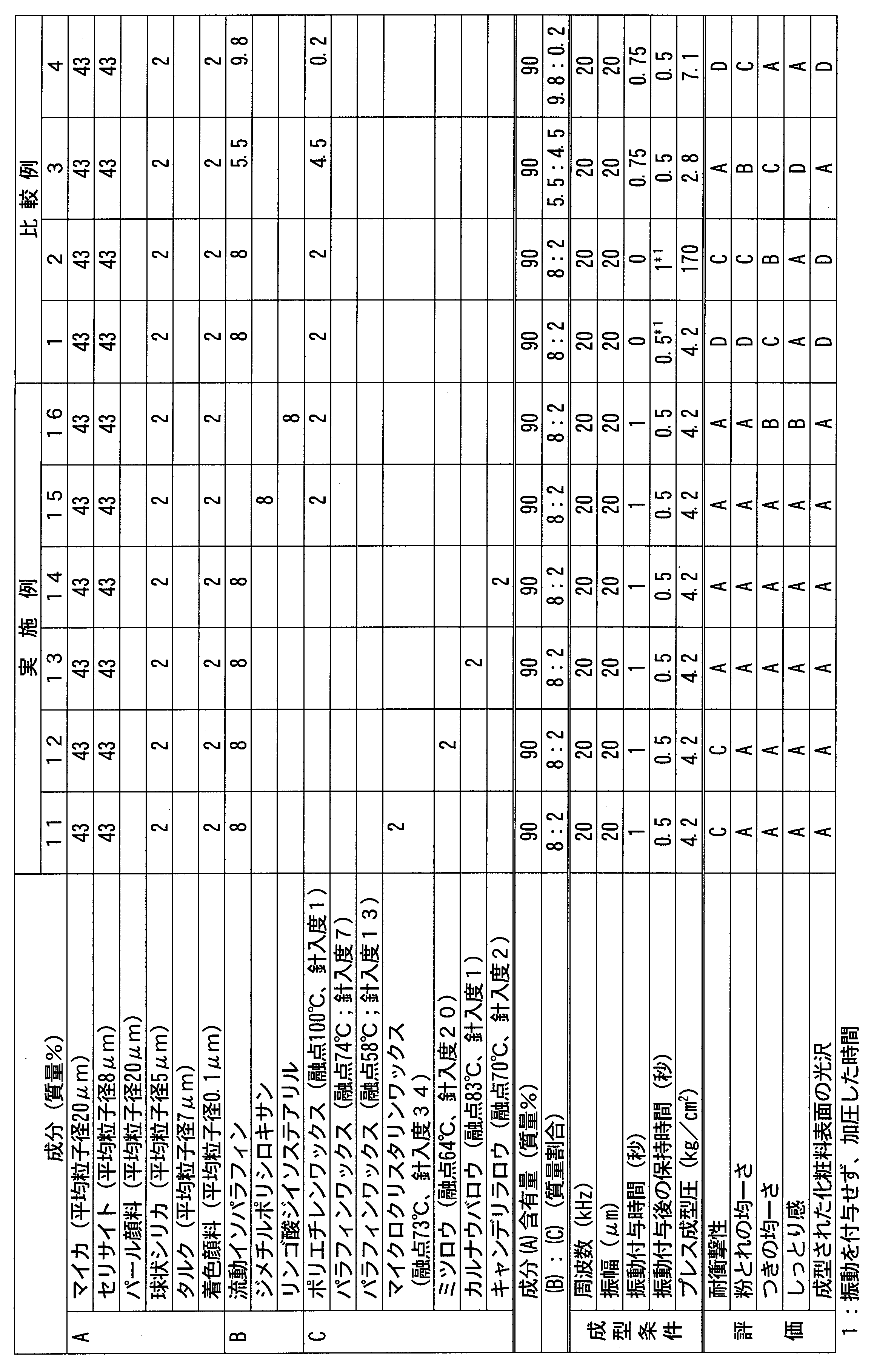
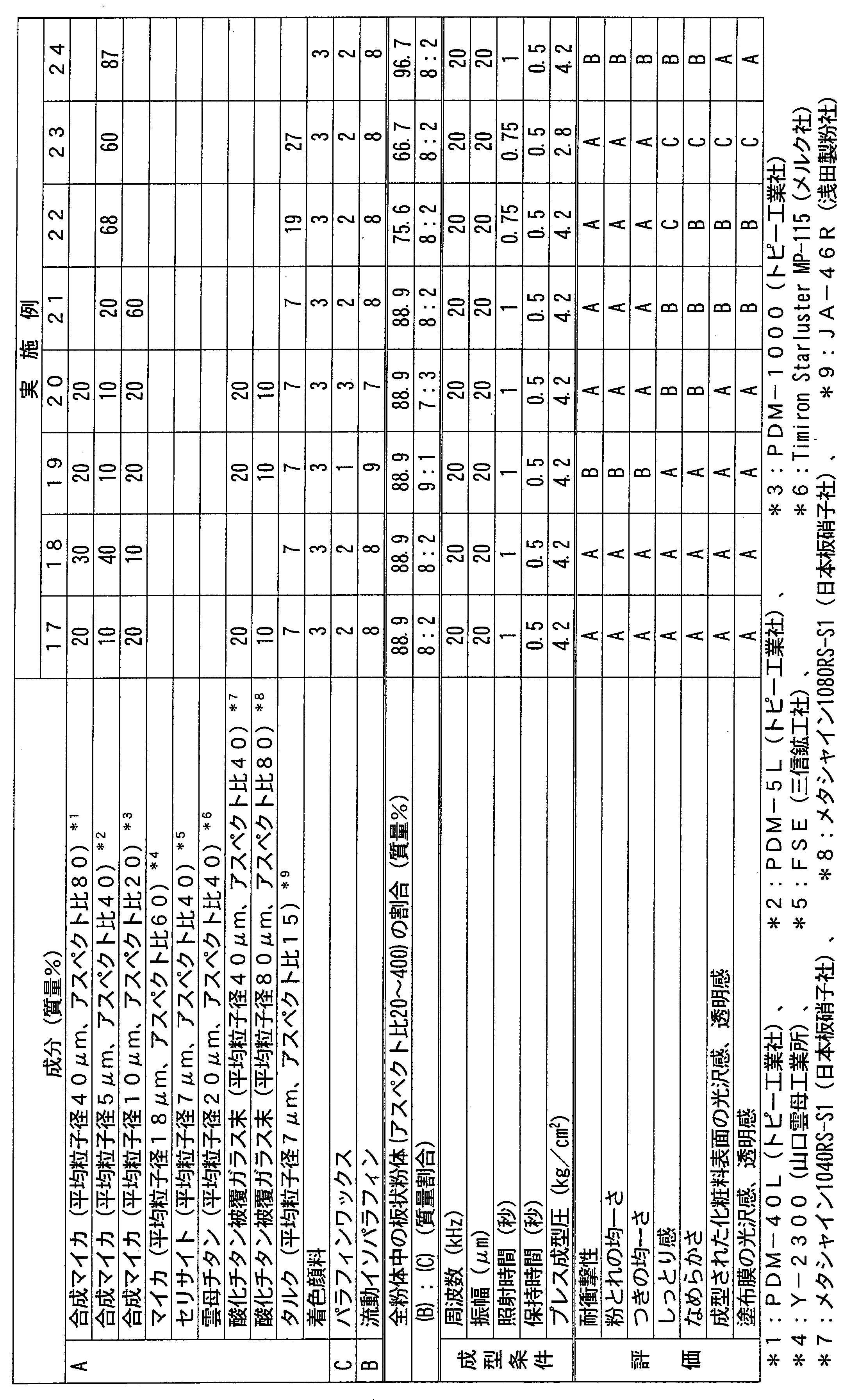
- Examples 1-28 and Comparative Examples 1-6 Manufactures powder cosmetics with the compositions shown in Tables 1 to 4, impact resistance, uniformity of powder on applicator, uniformity on skin, moist feeling during application, glossiness of molded surface Evaluated. The results are also shown in Tables 1 to 4.
- Example 29 (Foundation) A foundation having the following composition was produced.
- Example 30 An eye shadow having the following composition was produced.
- Example 31 A white powder having the following composition was produced.
- Example 32 (blusher) A blusher having the following composition was produced.
- Fluorine compound-treated talc (average particle size 7 ⁇ m) 28.8 (2) Fluorine compound-treated mica (average particle size 10 ⁇ m) 35 (3) Fluorine compound-treated sericite (average particle size 8 ⁇ m) 8 (4) Fluorine compound-treated spherical silicone resin (average particle size 5 ⁇ m) 2 (5) Fluorine compound-treated titanium oxide (average particle size 0.1 ⁇ m) 0.5 (6) Fluorine compound-treated yellow iron oxide (average particle size 0.1 ⁇ m) 0.3 (7) Fluorine compound-treated black iron oxide (average particle size 0.1 ⁇ m) 0.1 (8) Fluorine compound-treated blue No.
- Example 33 An eyebrow having the following composition was produced.
- Example 34 A body powder having the following composition was produced.
- Example 35 (foundation) A foundation having the following composition was produced.
- Example 36 An eye shadow having the following composition was produced.
- Silicone-treated mica titanium (average particle size 20 ⁇ m, aspect ratio 40) 20 (9) Silicone-treated Bengala-coated mica titanium (average particle size 20 ⁇ m, aspect ratio 40) 8 (10) Silicone-treated titanium oxide-coated glass flakes (average particle size 80 ⁇ m, aspect ratio 80) 10 (11) Preservative 0.1 (12) Liquid isoparaffin 8 (13) Polyethylene wax 2
- Example 37 A white powder having the following composition was produced.
- Example 38 A blusher having the following composition was produced.
- Fluorine compound-treated talc (average particle size 7 ⁇ m, aspect ratio 15) 18.8
- Fluorine compound-treated synthetic mica (average particle size 10 ⁇ m, aspect ratio 30) 20
- Fluorine compound-treated sericite (average particle size 8 ⁇ m, aspect ratio 40) 13
- Glass powder (average particle size 25 ⁇ m, aspect ratio 60) 20
- Fluorine compound-treated spherical silicone resin (average particle size 5 ⁇ m) 2 (6)
- Fluorine compound-treated titanium oxide 0.5 (7) Fluorine compound-treated yellow iron oxide 0.3 (8)
- Fluorine compound-treated black iron oxide 0.1 (9) Fluorine compound-treated blue 404 No.
- Example 39 An eyebrow having the following composition was produced.
- Example 40 A body powder having the following composition was produced.
- Each of the powder cosmetics obtained in Examples 29 to 40 has impact resistance, uniformity of application to the applicator, uniformity of adhesion to the skin, moist feeling when applied, and gloss on the surface of the molded cosmetic. It was excellent in feeling and transparency.
- Test example 1 For the powder cosmetics obtained in Example 28 and Comparative Example 6, the particle size distribution of all the powder components contained in the cosmetics was measured using a laser diffraction particle size measuring device (LA-920, Horiba, Ltd.). It was measured by dispersing in ethanol. The results are shown in FIG. From the results shown in FIG. 1, even if the cosmetic composition has the same composition, the powder cosmetic composition of the present invention does not break the powder having a particle size of about 100 ⁇ m by irradiating with ultrasonic waves during pressure molding. It was confirmed that it was contained. Thereby, the powder cosmetics excellent in the glossiness of the shape
Landscapes
- Health & Medical Sciences (AREA)
- Life Sciences & Earth Sciences (AREA)
- General Health & Medical Sciences (AREA)
- Animal Behavior & Ethology (AREA)
- Public Health (AREA)
- Veterinary Medicine (AREA)
- Birds (AREA)
- Epidemiology (AREA)
- Chemical & Material Sciences (AREA)
- Oil, Petroleum & Natural Gas (AREA)
- Inorganic Chemistry (AREA)
- Zoology (AREA)
- Insects & Arthropods (AREA)
- Emergency Medicine (AREA)
- Cosmetics (AREA)
Abstract
Description
(A)平均粒子径0.1~300μmの粉体、
(B)25℃で液状の油剤、
(C)25℃で固体状の油剤
を含有し、成分(A)の含有量が75~95重量%で、
成分(B)及び成分(C)の質量割合が、(B):(C)=6:4~9.5:0.5
である粉末組成物を、
成型時に、周波数10~40kHz、振幅10~100μmの振動を付与して、加圧成型する化粧料の製造方法を提供するものである。
また、本発明は、当該製造方法により得られる化粧料を提供するものである。
また、アスペクト比は、平均粒子径を粒子の平均厚さで割った値である。粒子の平均厚さは、電子顕微鏡を用いて測定し、その合計値を測定個数で割った値である。
具体的には、シリコーン処理としては、例えば、メチルハイドロジェンポリシロキサン、メチルポリシロキサン、トリメチルシロキシケイ酸、シリコーン樹脂等による処理;脂肪酸処理としては、ミリスチン酸、ステアリン酸等による処理;フッ素化合物処理としては、パールフルオロアルキルリン酸エステル、パーフルオロアルキルシラン等による処理が挙げられる。
振動の付与時間は、0.1~2秒、更に0.5~1.5秒が好ましく、振動の付与後、加圧された状態で0.1秒以上保持されるのが好ましく、0.1~5秒、更に0.5~2秒保持されることが、耐衝撃性に優れるのでより好ましい。
これまで使用されてきた高圧型のプレス成型では、粒子径が大きく、アスペクト比の大きい粉体は、成型後、破損し小さい粒子径に変化していた。しかし、本発明では加圧成型時の圧力が低く抑えられるため、成型前後の粉体の粒子径分布、更に成分(A)の粒子径分布が成型前後で変化がない。そのため、成型された化粧料の表面の光沢感、塗布膜の光沢が非常に高いものが得られる。
(評価方法)
(1)針入度の測定:
25℃で固体状の油剤を加熱溶融し、冷却したものを試料とし、TESTING APPARATUS FOR PENETORATION(NIKKA ENGINEERING社)を用いて測定した。
すなわち、試料をその融点より17℃高い温度まで加熱して溶融した。コルク栓(No.16)2個を水平な台に並べて置き、その上に黄銅板を載せ、上面に剥離剤(グリセリンと水を等量ずつ混合したもの)を薄く塗布した。規定の試料容器(黄銅シリンダー、内径25.4mm、高さ31.8mm、壁厚3.2mm)を黄銅板に載せた後、溶融試料を試料容器の上縁に盛り上がる程度に流し込み、1時間室温(22~26℃)で放冷した。これを黄銅板から取り外し、25℃の恒温水中に1時間放置した。質量の合計を100gにした規定の針を試料中に垂直に5秒間進入させ、ダイヤルゲージを読み取り、針の進入した深さを測定した。試料の針入度は、針の進入した深さを0.1mmまで測定し、これを10倍した数値で表す。4個の測定値を平均し、小数点第1位を四捨五入して針入度とした。
縦14mm、横26mmの中皿に充填加圧成型した粉末化粧料を容器にセットし、30cmの高さから厚さ25mmのSUS板上に繰返し落下させた。かけや割れなどの異常が生じるまでの回数により、以下の基準で評価した。
A;15回以上。
B:10~14回。
C:5~9回。
D:1~4回。
10人の専門パネラーにより、各粉末化粧料を用いたときの、塗布具への粉とれの均一さ、肌へのつきの均一さ、塗布時のしっとり感、なめらかさ、塗布膜の光沢感及び透明感、並びに成型された化粧料表面の光沢を官能評価し、下記基準により判定した。
A;7人以上が良いと評価した。
B:4~6人が良いと評価した。
C:2~3人が良いと評価した。
D:1人以下が良いと評価した。
表1~表4に示す組成の粉末化粧料を製造し、耐衝撃性、塗布具への粉とれの均一さ、肌へのつきの均一さ、塗布時のしっとり感、成型された表面の光沢感を評価した。結果を表1~表4に併せて示す。
粉体成分を混合して80~90℃に加熱したものに、別途、液体油と固体油を80~90℃に加熱して融解したものを添加し、均一に混合した。冷却した後に粉砕して、中皿に充填し、表1~表4に示す条件で振動を付与して加圧成型し、粉末化粧料を得た。


以下に示す組成のファンデーションを製造した。
成分(1)~(10)を混合して80~90℃に加熱したものに、成分(11)~(12)を80~90℃に加熱して融解混合したものを添加し、均一に混合した。冷却した後に粉砕し、中皿に充填して加圧成型し、ファンデーションを得た。加圧成型は、周波数20kHz、振幅20μm、照射時間1秒、保持時間0.1秒、プレス成型圧4.2kg/cm2の条件で行った。
(1)シリコーン処理タルク(平均粒子径7μm) 11.5
(2)シリコーン処理マイカ(平均粒子径20μm) 35
(3)シリコーン処理セリサイト(平均粒子径8μm) 20
(4)球状シリコーン樹脂(平均粒子径5μm) 5
(5)シリコーン処理酸化チタン(平均粒子径0.1μm) 10
(6)シリコーン処理黄酸化鉄(平均粒子径0.1μm) 0.8
(7)シリコーン処理黒酸化鉄(平均粒子径0.1μm) 0.1
(8)シリコーン処理ベンガラ(平均粒子径0.1μm) 2.5
(9)シリコーン処理パール顔料(平均粒子径10μm) 5
(10)防腐剤 0.1
(11)流動イソパラフィン 8
(12)ポリエチレンワックス(針入度1) 2
以下に示す組成のアイシャドウを製造した。
成分(1)~(11)を混合して80~90℃に加熱したものに、成分(12)~(13)を80~90℃に加熱して融解混合したものを添加し、均一に混合した。冷却した後に粉砕し、中皿に充填して加圧成型し、アイシャドウを得た。加圧成型は、周波数20kHz、振幅20μm、照射時間1秒、保持時間0.5秒、プレス成型圧4.2kg/cm2の条件で行った。
(1)シリコーン処理タルク(平均粒子径7μm) 24.15
(2)シリコーン処理合成マイカ(平均粒子径10μm) 30
(3)球状ナイロンパウダー(平均粒子径5μm) 2
(4)シリコーン処理酸化チタン(平均粒子径0.1μm) 0.1
(5)シリコーン処理黒酸化鉄(平均粒子径0.1μm) 0.05
(6)シリコーン処理群青(平均粒子径0.1μm) 0.3
(7)赤色226号(平均粒子径0.1μm) 0.3
(8)シリコーン処理雲母チタン(平均粒子径20μm) 20
(9)シリコーン処理ベンガラ被覆雲母チタン
(平均粒子径20μm) 8
(10)シリコーン処理酸化チタン被覆ガラスフレーク
(平均粒子径80μm) 5
(11)防腐剤 0.1
(12)流動イソパラフィン 8
(13)ポリエチレンワックス(針入度1) 2
以下に示す組成の白粉を製造した。
成分(1)~(9)を混合して80~90℃に加熱したものに、成分(10)~(11)を80~90℃に加熱して融解混合したものを添加し、均一に混合した。冷却した後に粉砕し、中皿に充填して加圧成型し、白粉を得た。加圧成型は、周波数20kHz、振幅20μm、照射時間1秒、保持時間0.5秒、プレス成型圧4.2kg/cm2の条件で行った。
(1)フッ素化合物処理タルク(平均粒子径7μm) 34.19
(2)フッ素化合物処理合成マイカ(平均粒子径10μm) 50
(3)フッ素化合物処理セリサイト(平均粒子径8μm) 5
(4)フッ素化合物処理球状ポリメチルメタクリレート粉末
(平均粒子径12μm) 2
(5)フッ素化合物処理酸化チタン(平均粒子径0.1μm) 0.5
(6)フッ素化合物処理黄酸化鉄(平均粒子径0.1μm) 0.1
(7)フッ素化合物処理黒酸化鉄(平均粒子径0.1μm) 0.01
(8)フッ素化合物処理ベンガラ(平均粒子径0.1μm) 0.1
(9)防腐剤 0.1
(10)流動イソパラフィン 6.4
(11)ポリエチレンワックス(針入度1) 1.6
以下に示す組成の頬紅を製造した。
成分(1)~(12)を混合して80~90℃に加熱したものに、成分(13)~(14)を80~90℃に加熱して融解混合したものを添加し、均一に混合した。冷却した後に粉砕し、中皿に充填して加圧成型し、頬紅を得た。加圧成型は、周波数20kHz、振幅20μm、照射時間1秒、保持時間0.5秒、プレス成型圧4.2kg/cm2の条件で行った。
(1)フッ素化合物処理タルク(平均粒子径7μm) 28.8
(2)フッ素化合物処理マイカ(平均粒子径10μm) 35
(3)フッ素化合物処理セリサイト(平均粒子径8μm) 8
(4)フッ素化合物処理球状シリコーン樹脂(平均粒子径5μm) 2
(5)フッ素化合物処理酸化チタン(平均粒子径0.1μm) 0.5
(6)フッ素化合物処理黄酸化鉄(平均粒子径0.1μm) 0.3
(7)フッ素化合物処理黒酸化鉄(平均粒子径0.1μm) 0.1
(8)フッ素化合物処理青色404号(平均粒子径0.1μm) 1.2
(9)雲母チタン(平均粒子径20μm) 10
(10)ベンガラ被覆雲母チタン(平均粒子径20μm) 2
(11)酸化チタン被覆ガラス末(平均粒子径40μm) 4
(12)防腐剤 0.1
(13)流動イソパラフィン 6.4
(14)ポリエチレンワックス(針入度1) 1.6
以下に示す組成のアイブロウを製造した。
成分(1)~(9)を混合して80~90℃に加熱したものに、成分(10)~(11)を80~90℃に加熱して融解混合したものを添加し、均一に混合した。冷却した後に粉砕し、中皿に充填して加圧成型し、アイブロウを得た。加圧成型は、周波数20kHz、振幅20μm、照射時間1秒、保持時間0.5秒、プレス成型圧4.2kg/cm2の条件で行った。
(1)フッ素化合物処理タルク(平均粒子径7μm) 29.7
(2)フッ素化合物処理マイカ(平均粒子径10μm) 5
(3)フッ素化合物処理セリサイト(平均粒子径8μm) 40
(4)フッ素化合物処理球状ナイロン末(平均粒子径5μm) 5
(5)フッ素化合物処理酸化チタン(平均粒子径0.1μm) 0.5
(6)フッ素化合物処理黄酸化鉄(平均粒子径0.1μm) 0.2
(7)フッ素化合物処理黒酸化鉄(平均粒子径0.1μm) 12
(8)フッ素化合物処理ベンガラ(平均粒子径0.1μm) 1.5
(9)防腐剤 0.1
(10)流動イソパラフィン 4.8
(11)ポリエチレンワックス(針入度1) 1.2
以下に示す組成のボディパウダーを製造した。
成分(1)~(10)を混合して80~90℃に加熱したものに、成分(11)~(12)を80~90℃に加熱して融解混合したものを添加し、均一に混合した。冷却した後に粉砕し、中皿に充填して加圧成型し、ボディパウダーを得た。加圧成型は、周波数20kHz、振幅20μm、照射時間1秒、保持時間0.5秒、プレス成型圧4.2kg/cm2の条件で行った。
(1)フッ素化合物処理タルク(平均粒子径7μm) 25.09
(2)フッ素化合物処理マイカ(平均粒子径10μm) 30
(3)フッ素化合物処理セリサイト(平均粒子径8μm) 30
(4)フッ素化合物処理球状シリコーン樹脂(平均粒子径5μm)6
(5)フッ素化合物処理酸化チタン(平均粒子径0.1μm) 0.5
(6)フッ素化合物処理黄酸化鉄(平均粒子径0.1μm) 0.1
(7)フッ素化合物処理黒酸化鉄(平均粒子径0.1μm) 0.01
(8)フッ素化合物処理ベンガラ(平均粒子径0.1μm) 0.1
(9)防腐剤 0.1
(10)流動イソパラフィン 6.4
(11)ポリエチレンワックス(針入度1) 1.6
(12)消炎剤 0.1
以下に示す組成のファンデーションを製造した。
成分(1)~(10)を混合して80~90℃に加熱したものに、成分(11)~(12)を80~90℃に加熱して融解混合したものを添加し、均一に混合した。冷却した後に粉砕し、中皿に充填して加圧成型し、ファンデーションを得た。加圧成型は、周波数20kHz、振幅20μm、照射時間1秒、保持時間0.5秒、プレス成型圧4.2kg/cm2の条件で行った。
(1)シリコーン処理タルク
(平均粒子径7μm、アスペクト比15) 9.5
(2)シリコーン処理マイカ
(平均粒子径18μm、アスペクト比60) 40
(3)シリコーン処理合成マイカ
(平均粒子径20μm、アスペクト比70) 20
(4)シリコーン処理ガラス末
(平均粒子径10μm、アスペクト比25) 5
(5)球状シリコーン樹脂 2
(6)シリコーン処理酸化チタン 10
(7)シリコーン処理黄酸化鉄 0.8
(8)シリコーン処理黒酸化鉄 0.1
(9)シリコーン処理ベンガラ 2.5
(10)防腐剤 0.1
(11)流動イソパラフィン 8
(12)ポリエチレンワックス 2
以下に示す組成のアイシャドウを製造した。
成分(1)~(11)を混合して80~90℃に加熱したものに、成分(12)~(13)を80~90℃に加熱して融解混合したものを添加し、均一に混合した。冷却した後に粉砕し、中皿に充填して加圧成型し、アイシャドウを得た。加圧成型は、周波数20kHz、振幅20μm、照射時間1秒、保持時間0.5秒、プレス成型圧4.2kg/cm2の条件で行った。
(1)シリコーン処理タルク
(平均粒子径7μm、アスペクト比15) 24.15
(2)シリコーン処理合成マイカ
(平均粒子径10μm、アスペクト比60) 25
(3)球状ナイロンパウダー
(平均粒子径5μm) 2
(4)シリコーン処理酸化チタン 0.1
(5)シリコーン処理黒酸化鉄 0.05
(6)シリコーン処理群青 0.3
(7)赤色226号 0.3
(8)シリコーン処理雲母チタン
(平均粒子径20μm、アスペクト比40) 20
(9)シリコーン処理ベンガラ被覆雲母チタン
(平均粒子径20μm、アスペクト比40) 8
(10)シリコーン処理酸化チタン被覆ガラスフレーク
(平均粒子径80μm、アスペクト比80) 10
(11)防腐剤 0.1
(12)流動イソパラフィン 8
(13)ポリエチレンワックス 2
以下に示す組成の白粉を製造した。
成分(1)~(10)を混合して80~90℃に加熱したものに、成分(11)~(12)を80~90℃に加熱して融解混合したものを添加し、均一に混合した。冷却した後に粉砕し、中皿に充填して加圧成型し、白粉を得た。加圧成型は、周波数20kHz、振幅20μm、照射時間1秒、保持時間0.5秒、プレス成型圧4.2kg/cm2の条件で行った。
(1)フッ素化合物処理タルク
(平均粒子径7μm、アスペクト比15) 24.19
(2)フッ素化合物処理合成マイカ
(平均粒子径10μm、アスペクト比60) 50
(3)フッ素化合物処理セリサイト
(平均粒子径8μm、アスペクト比40) 5
(4)ガラス末(平均粒子径25μm、アスペクト比60) 10
(5)フッ素化合物処理球状ポリメチルメタクリレート粉末
(平均粒子径12μm) 2
(6)フッ素化合物処理酸化チタン 0.5
(7)フッ素化合物処理黄酸化鉄 0.1
(8)フッ素化合物処理黒酸化鉄 0.01
(9)フッ素化合物処理ベンガラ 0.1
(10)防腐剤 0.1
(11)流動イソパラフィン 6.4
(12)ポリエチレンワックス 1.6
以下に示す組成の頬紅を製造した。
成分(1)~(13)を混合して80~90℃に加熱したものに、成分(14)~(15)を80~90℃に加熱して融解混合したものを添加し、均一に混合した。冷却した後に粉砕し、中皿に充填し加圧成型して、頬紅を得た。加圧成型は、周波数20kHz、振幅20μm、照射時間1秒、保持時間0.5秒、プレス成型圧4.2kg/cm2の条件で行った。
(1)フッ素化合物処理タルク
(平均粒子径7μm、アスペクト比15) 18.8
(2)フッ素化合物処理合成マイカ
(平均粒子径10μm、アスペクト比30) 20
(3)フッ素化合物処理セリサイト
(平均粒子径8μm、アスペクト比40) 13
(4)ガラス末(平均粒子径25μm、アスペクト比60) 20
(5)フッ素化合物処理球状シリコーン樹脂(平均粒子径5μm)2
(6)フッ素化合物処理酸化チタン 0.5
(7)フッ素化合物処理黄酸化鉄 0.3
(8)フッ素化合物処理黒酸化鉄 0.1
(9)フッ素化合物処理青色404号 1.2
(10)雲母チタン(平均粒子径20μm、アスペクト比40)10
(11)ベンガラ被覆雲母チタン
(平均粒子径20μm、アスペクト比40) 2
(12)酸化チタン被覆ガラス末
(平均粒子径40μm、アスペクト比40) 4
(13)防腐剤 0.1
(14)流動イソパラフィン 6.4
(15)ポリエチレンワックス 1.6
以下に示す組成のアイブロウを製造した。
成分(1)~(11)を混合して80~90℃に加熱したものに、成分(12)~(13)を80~90℃に加熱して融解混合したものを添加し、均一に混合した。冷却した後に粉砕し、中皿に充填し加圧成型して、アイブロウを得た。加圧成型は、周波数20kHz、振幅20μm、照射時間1秒、保持時間0.5秒、プレス成型圧4.2kg/cm2の条件で行った。
(1)フッ素化合物処理タルク
(平均粒子径7μm、アスペクト比15) 2.7
(2)フッ素化合物処理合成マイカ
(平均粒子径10μm、アスペクト比30) 22
(3)フッ素化合物処理セリサイト
(平均粒子径8μm、アスペクト比40) 20
(4)ガラス末(平均粒子径10μm、アスペクト比25) 10
(5)ベンガラ被覆雲母チタン
(平均粒子径20μm、アスペクト比40) 20
(6)フッ素化合物処理球状ナイロン末(平均粒子径μm) 5
(7)フッ素化合物処理酸化チタン 0.5
(8)フッ素化合物処理黄酸化鉄 0.2
(9)フッ素化合物処理黒酸化鉄 12
(10)フッ素化合物処理ベンガラ 1.5
(11)防腐剤 0.1
(12)流動イソパラフィン 4.8
(13)ポリエチレンワックス 1.2
以下に示す組成のボディパウダーを製造した。
成分(1)~(11)を混合して80~90℃に加熱したものに、成分(12)~(14)を80~90℃に加熱して融解混合したものを添加し、均一に混合した。冷却した後に粉砕し、中皿に充填し加圧成型して、ボディパウダーを得た。加圧成型は、周波数20kHz、振幅20μm、照射時間1秒、保持時間0.5秒、プレス成型圧4.2kg/cm2の条件で行った。
(1)フッ素化合物処理タルク
(平均粒子径7μm、アスペクト比15) 15.09
(2)フッ素化合物処理マイカ
(平均粒子径10μm、アスペクト比30) 10
(3)フッ素化合物処理セリサイト
(平均粒子径8μm、アスペクト比40) 30
(4)ガラス末(平均粒子径25μm、アスペクト比60) 20
(5)雲母チタン(平均粒子径20μm、アスペクト比40) 10
(6)フッ素化合物処理球状シリコーン樹脂(平均粒子径5μm)6
(7)フッ素化合物処理酸化チタン 0.5
(8)フッ素化合物処理黄酸化鉄 0.1
(9)フッ素化合物処理黒酸化鉄 0.01
(10)フッ素化合物処理ベンガラ 0.1
(11)防腐剤 0.1
(12)流動イソパラフィン 6.4
(13)ポリエチレンワックス 1.6
(14)消炎剤 0.1
実施例28及び比較例6で得られた粉末化粧料について、化粧料に含まれる全粉体成分の粒度分布を、レーザー回折粒子径測定装置(LA-920、ホリバ製作所)を用い、粉体をエタノールに分散させて測定した。結果を図1に示す。
図1の結果より、同じ組成の化粧料であっても、本発明の粉末化粧料は、加圧成型する際に超音波を照射することにより、粒径100μm程度の粉体も破壊されずに含有されていることが確認された。これにより、成型された表面の光沢感に優れた粉末化粧料が得られるものである。
Claims (6)
- 粉末組成物を加圧成型する化粧料の製造方法であって、
(A)平均粒子径0.1~300μmの粉体、
(B)25℃で液状の油剤、
(C)25℃で固体状の油剤
を含有し、成分(A)の含有量が75~95重量%で、
成分(B)及び成分(C)の質量割合が、(B):(C)=6:4~9.5:0.5
である粉末組成物を、
成型時に、周波数10~40kHz、振幅10~100μmの振動を付与して、加圧成型する化粧料の製造方法。 - 成型時に加えられる圧力が、10kg/cm2以下である請求項1記載の化粧料の製造方法。
- 成分(A)の粉体中、マイカ、合成マイカ、セリサイト、ガラス及びパール顔料から選ばれる板状粉体の1種又は2種以上を30~95重量%含有する請求項1又は2記載の化粧料の製造方法。
- 成分(C)が、針入度15以下のものである請求項1~3のいずれか1項記載の化粧料の製造方法。
- 成分(C)が、融点60℃以上のものである請求項1~4のいずれか1項記載の化粧料の製造方法。
- 請求項1~5のいずれか1項記載の製造方法により得られる化粧料。
Priority Applications (4)
| Application Number | Priority Date | Filing Date | Title |
|---|---|---|---|
| US12/811,005 US20100285079A1 (en) | 2007-12-28 | 2008-12-25 | Method for producing a cosmetic preparation |
| EP08866689.6A EP2223678A4 (en) | 2007-12-28 | 2008-12-25 | PROCESS FOR PREPARING A COSMETIC PREPARATION |
| KR1020107012494A KR101520986B1 (ko) | 2007-12-28 | 2008-12-25 | 화장료의 제조 방법 |
| CN2008801226328A CN101909584B (zh) | 2007-12-28 | 2008-12-25 | 化妆品的制造方法 |
Applications Claiming Priority (4)
| Application Number | Priority Date | Filing Date | Title |
|---|---|---|---|
| JP2007339996A JP5367981B2 (ja) | 2007-12-28 | 2007-12-28 | 固形粉末化粧料の製造方法 |
| JP2007-339995 | 2007-12-28 | ||
| JP2007339995A JP5367980B2 (ja) | 2007-12-28 | 2007-12-28 | 固形粉末化粧料の製造方法 |
| JP2007-339996 | 2007-12-28 |
Publications (1)
| Publication Number | Publication Date |
|---|---|
| WO2009084205A1 true WO2009084205A1 (ja) | 2009-07-09 |
Family
ID=40823941
Family Applications (1)
| Application Number | Title | Priority Date | Filing Date |
|---|---|---|---|
| PCT/JP2008/003967 Ceased WO2009084205A1 (ja) | 2007-12-28 | 2008-12-25 | 化粧料の製造方法 |
Country Status (6)
| Country | Link |
|---|---|
| US (1) | US20100285079A1 (ja) |
| EP (1) | EP2223678A4 (ja) |
| KR (1) | KR101520986B1 (ja) |
| CN (1) | CN101909584B (ja) |
| TW (1) | TWI438008B (ja) |
| WO (1) | WO2009084205A1 (ja) |
Cited By (2)
| Publication number | Priority date | Publication date | Assignee | Title |
|---|---|---|---|---|
| EP2198826A1 (fr) * | 2008-12-18 | 2010-06-23 | L'oreal | Procédé de maquillage et ensemble cosmetique pour la mise en oeuvre d'un tel procédé. |
| WO2010070597A1 (en) * | 2008-12-18 | 2010-06-24 | L'oreal | Method of applying makeup and kit for implementing such a method |
Families Citing this family (7)
| Publication number | Priority date | Publication date | Assignee | Title |
|---|---|---|---|---|
| PT2191730E (pt) * | 2008-11-19 | 2011-05-30 | Nestec Sa | P?s de ?leo s?lidos |
| US9173824B2 (en) * | 2011-05-17 | 2015-11-03 | The Procter & Gamble Company | Mascara and applicator |
| JP2015519954A (ja) * | 2012-05-15 | 2015-07-16 | ザ プロクター アンド ギャンブルカンパニー | 睫毛の凝集を定量的に判定する方法 |
| EP3449896B1 (en) * | 2016-04-28 | 2021-03-17 | Shiseido Company, Ltd. | Oil-in-water solid cosmetic |
| US20200306168A1 (en) * | 2019-03-28 | 2020-10-01 | Elc Management Llc | Color Cosmetic Composition Containing Wax Blend |
| EP4003278A1 (en) * | 2019-07-24 | 2022-06-01 | Shiseido Company, Ltd. | Pressed powder composition |
| KR102321692B1 (ko) * | 2019-09-30 | 2021-11-04 | 코스맥스 주식회사 | 나일론에 폴리메칠실세스퀴옥산이 코팅된 원료를 포함하는 글리터 화장료 조성물 및 그 제조방법 |
Citations (11)
| Publication number | Priority date | Publication date | Assignee | Title |
|---|---|---|---|---|
| JPS63275511A (ja) | 1987-05-07 | 1988-11-14 | Kobayashi Kooc:Kk | 粉体化粧料の成型法 |
| JPH0570325A (ja) | 1990-07-20 | 1993-03-23 | L'oreal Sa | 吸収性または部分的に砕けやすい生成物を提供する粉末 混合物の圧密化方法及びこの方法により得られる生成物 |
| JPH11116441A (ja) * | 1997-10-07 | 1999-04-27 | Kao Corp | 化粧料 |
| JP2000344615A (ja) * | 1999-05-28 | 2000-12-12 | Kose Corp | 粉末固型化粧料 |
| JP2001213721A (ja) * | 2000-01-31 | 2001-08-07 | Kao Corp | 固形粉末化粧料 |
| JP2001354519A (ja) * | 2000-06-16 | 2001-12-25 | Kao Corp | 容器詰め固形粉末化粧料 |
| JP2002275034A (ja) * | 2001-03-21 | 2002-09-25 | Kanebo Ltd | 粉体化粧料 |
| JP2003026537A (ja) * | 2002-06-17 | 2003-01-29 | Shiseido Co Ltd | 着色雲母チタン |
| JP2003261418A (ja) | 2002-03-06 | 2003-09-16 | Kao Corp | 固形粉末化粧料の製造方法 |
| JP2004203789A (ja) * | 2002-12-25 | 2004-07-22 | Kose Corp | 化粧料 |
| JP2004315468A (ja) * | 2003-04-18 | 2004-11-11 | Hakuto Co Ltd | 皮膚外用剤 |
Family Cites Families (1)
| Publication number | Priority date | Publication date | Assignee | Title |
|---|---|---|---|---|
| JP4870923B2 (ja) * | 2004-04-20 | 2012-02-08 | 花王株式会社 | 固形粉末化粧料 |
-
2008
- 2008-12-25 EP EP08866689.6A patent/EP2223678A4/en not_active Withdrawn
- 2008-12-25 US US12/811,005 patent/US20100285079A1/en not_active Abandoned
- 2008-12-25 CN CN2008801226328A patent/CN101909584B/zh not_active Expired - Fee Related
- 2008-12-25 WO PCT/JP2008/003967 patent/WO2009084205A1/ja not_active Ceased
- 2008-12-25 KR KR1020107012494A patent/KR101520986B1/ko not_active Expired - Fee Related
- 2008-12-26 TW TW097150915A patent/TWI438008B/zh not_active IP Right Cessation
Patent Citations (11)
| Publication number | Priority date | Publication date | Assignee | Title |
|---|---|---|---|---|
| JPS63275511A (ja) | 1987-05-07 | 1988-11-14 | Kobayashi Kooc:Kk | 粉体化粧料の成型法 |
| JPH0570325A (ja) | 1990-07-20 | 1993-03-23 | L'oreal Sa | 吸収性または部分的に砕けやすい生成物を提供する粉末 混合物の圧密化方法及びこの方法により得られる生成物 |
| JPH11116441A (ja) * | 1997-10-07 | 1999-04-27 | Kao Corp | 化粧料 |
| JP2000344615A (ja) * | 1999-05-28 | 2000-12-12 | Kose Corp | 粉末固型化粧料 |
| JP2001213721A (ja) * | 2000-01-31 | 2001-08-07 | Kao Corp | 固形粉末化粧料 |
| JP2001354519A (ja) * | 2000-06-16 | 2001-12-25 | Kao Corp | 容器詰め固形粉末化粧料 |
| JP2002275034A (ja) * | 2001-03-21 | 2002-09-25 | Kanebo Ltd | 粉体化粧料 |
| JP2003261418A (ja) | 2002-03-06 | 2003-09-16 | Kao Corp | 固形粉末化粧料の製造方法 |
| JP2003026537A (ja) * | 2002-06-17 | 2003-01-29 | Shiseido Co Ltd | 着色雲母チタン |
| JP2004203789A (ja) * | 2002-12-25 | 2004-07-22 | Kose Corp | 化粧料 |
| JP2004315468A (ja) * | 2003-04-18 | 2004-11-11 | Hakuto Co Ltd | 皮膚外用剤 |
Non-Patent Citations (1)
| Title |
|---|
| See also references of EP2223678A4 |
Cited By (4)
| Publication number | Priority date | Publication date | Assignee | Title |
|---|---|---|---|---|
| EP2198826A1 (fr) * | 2008-12-18 | 2010-06-23 | L'oreal | Procédé de maquillage et ensemble cosmetique pour la mise en oeuvre d'un tel procédé. |
| WO2010070597A1 (en) * | 2008-12-18 | 2010-06-24 | L'oreal | Method of applying makeup and kit for implementing such a method |
| FR2940047A1 (fr) * | 2008-12-18 | 2010-06-25 | Oreal | Procede de maquillage et ensemble cosmetique pour la mise en oeuvre d'un tel procede. |
| FR2940024A1 (fr) * | 2008-12-18 | 2010-06-25 | Oreal | Procede de maquillage et ensemble pour la mise en oeuvre d'un tel procede |
Also Published As
| Publication number | Publication date |
|---|---|
| CN101909584A (zh) | 2010-12-08 |
| KR101520986B1 (ko) | 2015-05-15 |
| EP2223678A4 (en) | 2015-06-24 |
| CN101909584B (zh) | 2012-05-23 |
| TWI438008B (zh) | 2014-05-21 |
| KR20100099156A (ko) | 2010-09-10 |
| EP2223678A1 (en) | 2010-09-01 |
| TW200934527A (en) | 2009-08-16 |
| US20100285079A1 (en) | 2010-11-11 |
Similar Documents
| Publication | Publication Date | Title |
|---|---|---|
| JP4870923B2 (ja) | 固形粉末化粧料 | |
| WO2009084205A1 (ja) | 化粧料の製造方法 | |
| JPH04266808A (ja) | 中空マイクロスフェア含有固型パウダー形態の化粧組成物 | |
| JP5367980B2 (ja) | 固形粉末化粧料の製造方法 | |
| JP2010285409A (ja) | 固形粉末化粧料の製造方法 | |
| JP4376696B2 (ja) | 粉体固形化粧料 | |
| JP5367981B2 (ja) | 固形粉末化粧料の製造方法 | |
| JP7031912B1 (ja) | 複合粉体およびこれを含有する化粧料 | |
| JP5547910B2 (ja) | 固形粉末化粧料の製造方法 | |
| JP2000344615A (ja) | 粉末固型化粧料 | |
| JPH01287010A (ja) | 固型粉末メークアップ化粧料の製造法 | |
| JP2005314300A (ja) | 粉体固形化粧料 | |
| JP2010132591A (ja) | 固形粉末化粧料 | |
| JPS6185309A (ja) | プレス状固型粉末化粧料 | |
| JP5795719B2 (ja) | 固形粉末化粧料の製造方法 | |
| JP5559990B2 (ja) | 固形粉末化粧料の製造方法 | |
| JP2009184944A (ja) | 固形粉末化粧料の製造方法 | |
| JP2021004223A (ja) | 化粧用組成物及び化粧品 | |
| JP2003104841A (ja) | 油性固形化粧料 | |
| WO2010098011A1 (ja) | 粉末化粧料及びその製造方法 | |
| JP3529292B2 (ja) | 油性固形化粧料 | |
| JP2006076982A (ja) | 固形粉末化粧料 | |
| JP5021172B2 (ja) | 固形メーキャップ化粧料 | |
| JPH10251121A (ja) | 固型粉末化粧料 | |
| JPH04368316A (ja) | メーキャップ化粧料 |
Legal Events
| Date | Code | Title | Description |
|---|---|---|---|
| WWE | Wipo information: entry into national phase |
Ref document number: 200880122632.8 Country of ref document: CN |
|
| 121 | Ep: the epo has been informed by wipo that ep was designated in this application |
Ref document number: 08866689 Country of ref document: EP Kind code of ref document: A1 |
|
| ENP | Entry into the national phase |
Ref document number: 20107012494 Country of ref document: KR Kind code of ref document: A |
|
| REEP | Request for entry into the european phase |
Ref document number: 2008866689 Country of ref document: EP |
|
| WWE | Wipo information: entry into national phase |
Ref document number: 2008866689 Country of ref document: EP |
|
| WWE | Wipo information: entry into national phase |
Ref document number: 12811005 Country of ref document: US |
|
| NENP | Non-entry into the national phase |
Ref country code: DE |