WO2009087959A1 - 光学活性2,2’-ビフェノール誘導体及びその製造方法 - Google Patents
光学活性2,2’-ビフェノール誘導体及びその製造方法 Download PDFInfo
- Publication number
- WO2009087959A1 WO2009087959A1 PCT/JP2009/000012 JP2009000012W WO2009087959A1 WO 2009087959 A1 WO2009087959 A1 WO 2009087959A1 JP 2009000012 W JP2009000012 W JP 2009000012W WO 2009087959 A1 WO2009087959 A1 WO 2009087959A1
- Authority
- WO
- WIPO (PCT)
- Prior art keywords
- optically active
- formula
- carbon atoms
- disubstituted
- biphenol derivative
- Prior art date
- Legal status (The legal status is an assumption and is not a legal conclusion. Google has not performed a legal analysis and makes no representation as to the accuracy of the status listed.)
- Ceased
Links
Classifications
-
- C—CHEMISTRY; METALLURGY
- C07—ORGANIC CHEMISTRY
- C07B—GENERAL METHODS OF ORGANIC CHEMISTRY; APPARATUS THEREFOR
- C07B57/00—Separation of optically-active compounds
-
- C—CHEMISTRY; METALLURGY
- C07—ORGANIC CHEMISTRY
- C07C—ACYCLIC OR CARBOCYCLIC COMPOUNDS
- C07C37/00—Preparation of compounds having hydroxy or O-metal groups bound to a carbon atom of a six-membered aromatic ring
-
- C—CHEMISTRY; METALLURGY
- C07—ORGANIC CHEMISTRY
- C07C—ACYCLIC OR CARBOCYCLIC COMPOUNDS
- C07C37/00—Preparation of compounds having hydroxy or O-metal groups bound to a carbon atom of a six-membered aromatic ring
- C07C37/11—Preparation of compounds having hydroxy or O-metal groups bound to a carbon atom of a six-membered aromatic ring by reactions increasing the number of carbon atoms
-
- C—CHEMISTRY; METALLURGY
- C07—ORGANIC CHEMISTRY
- C07C—ACYCLIC OR CARBOCYCLIC COMPOUNDS
- C07C37/00—Preparation of compounds having hydroxy or O-metal groups bound to a carbon atom of a six-membered aromatic ring
- C07C37/50—Preparation of compounds having hydroxy or O-metal groups bound to a carbon atom of a six-membered aromatic ring by reactions decreasing the number of carbon atoms
-
- C—CHEMISTRY; METALLURGY
- C07—ORGANIC CHEMISTRY
- C07C—ACYCLIC OR CARBOCYCLIC COMPOUNDS
- C07C39/00—Compounds having at least one hydroxy or O-metal group bound to a carbon atom of a six-membered aromatic ring
- C07C39/24—Halogenated derivatives
- C07C39/367—Halogenated derivatives polycyclic non-condensed, containing only six-membered aromatic rings as cyclic parts, e.g. halogenated poly-hydroxyphenylalkanes
-
- C—CHEMISTRY; METALLURGY
- C07—ORGANIC CHEMISTRY
- C07B—GENERAL METHODS OF ORGANIC CHEMISTRY; APPARATUS THEREFOR
- C07B2200/00—Indexing scheme relating to specific properties of organic compounds
- C07B2200/07—Optical isomers
Definitions
- the present invention relates to an optically active 2,2′-biphenol derivative and a method for producing the same, and more specifically, optically active 2 having high utility value in fields related to the production of pharmaceutical / agrochemical raw materials and production intermediates thereof. , 2′-biphenol derivative and a method for producing the same.
- 2,2′-biphenol derivatives are important compounds as intermediates for the synthesis of ligands for asymmetric synthesis of various fine chemicals, mainly pharmaceuticals and agricultural chemicals.
- 2,2′-biphenol derivatives include the following formula (A),
- Examples of the method for obtaining the optically active 2,2′-biphenol derivative represented by the above formula (A) include a method in which meso-form biphenyls are converted into an optically active compound and then derived into optically active 2,2′-biphenol.
- a method is known in which racemic 2,2′-biphenols are converted into diastereomeric mixtures and then optically resolved.
- Meso- or racemic biphenols can be produced by replacing substituted resorcinol or substituted phenols with potassium hexacyanoferrate (III) (potassium ferrocyanate), di-t-butyl peroxide, ferric chloride, or oxygen.
- the oxidative ortho-coupling method such as is generally used.
- Non-Patent Document 1 describes 2,2 ′, 6,6′-tetrahydrobiphenyl as an optical compound. There has been reported a method for converting to an acetal derivative of active menthone and then derivatizing it into an optically active 6,6′-disubstituted-2,2′-biphenol.
- a method of optical resolution after converting racemic 2,2′-biphenols to a diastereomeric mixture includes, for example, phosphoric acid of racemic 6,6′-disubstituted-2,2′-biphenols.
- a method in which a derivative is reacted with optically active menthol for esterification and then optically resolved (Patent Document 1), or only one optical isomer of a racemic 6,6′-disubstituted-2,2′-biphenol
- Patent Document 2 There is known a method of selectively crystallizing with an optically active cyclohexanediamine
- Non-Patent Document 1 and Patent Document 1 require a multi-step synthesis route, and thus the operation is complicated, and the method of Patent Document 2 has a problem that the reaction yield is low.
- Patent Document 3 A method for synthesizing racemic 3,3 ′, 6,6′-tetraalkyl-5,5′-dihalogeno-2,2′-biphenol (Patent Document 3) is known. There is no description about a manufacturing method. On the other hand, the following formulas (B), (C)
- optically active 2,2′-biphenol derivative represented by (wherein * represents the same meaning as described above) is useful as a precursor of an asymmetric phase transfer catalyst.
- any compound is synthesized from the optically active 6,6′-dimethyl-2,2′-biphenol represented by the formula (A) (Non-patent Document 2), there is a problem in the production method as described above. was there.
- JP 2004-189696 A JP 10-45648 A : Special table 2005-510551 gazette : SYNLETT, 1995, No. 3,283-284 : Organic Process Research & Development, Vol. 11, pp 628-632, 2007.
- the present invention has been made in view of the above-described prior art, and provides a production method capable of producing an optically active 6,6′-disubstituted-2,2′-biphenol derivative simply and efficiently. The task is to do.
- 6′-disubstituted-2,2′-biphenol derivatives can be obtained efficiently, (B)
- the obtained optically active 6,6′-disubstituted-5,5′-dihalogeno-3,3′-disubstituted-2,2′-biphenol derivative represented by the following formula (2) is Bronsted By reacting with an acid, an optically active 6,6′-disubstituted-5,5′-dihalogeno-2,2′-biphenol derivative represented by the following formula (1) can be efficiently obtained.
- R 1 represents a primary or secondary alkyl group having 1 to 10 carbon atoms which may have a substituent or a cycloalkyl group having 3 to 10 carbon atoms which may have a substituent.
- 6 represents a 6-disubstituted-2,2′-biphenol derivative represented by the formula (2 ′):
- R 1 represents the same meaning as described above, R 2 represents a tertiary alkyl group having 4 to 6 carbon atoms, and X represents a halogen atom).
- a process for producing a 6,6′- -disubstituted-2,2′-biphenol derivative represented by the above formula (3) which is represented by the above formula (2 ′).
- 6′-disubstituted-5,5′-dihalogeno-3,3′-disubstituted-2,2′-biphenol derivative and an optically active diamine are separated, and the salt is
- an optically active 6,6′-disubstituted-5,5′-dihalogeno-3,3′-disubstituted-2,2′-biphenol derivative represented by the above formula (2) is obtained, A Bronsted acid is allowed to act on the compound represented by the formula (2) to obtain the formula (1)
- the optical properties of the 6,6′-disubstituted-5,5′-dihalogeno-3,3′-disubstituted-2,2′-biphenol derivative represented by the above formula (2 ′) By allowing an optically active diamine compound to act on the isomer mixture, the 6,6′-disubstituted-5,5′-dihalogeno-3,3′-disubstituted-2,2 ′ represented by the formula (2 ′) is obtained.
- an optically active 6,6'-disubstituted-5,5'-dihalogeno-2,2'-biphenol derivative represented by the above formula (1).
- an optically active 6,6′-disubstituted-5,5′-dihalogeno-3,3′-disubstituted-2,2′-biphenol derivative represented by the above formula (2).
- a 6,6′-disubstituted-5,5′-dihalogeno-3,3′-disubstituted-2,2′-biphenol derivative represented by the above formula (2 ′). Is done.
- the formula (4) (Wherein R 1 , R 2 , and X are as defined above), a copper salt and an organic base, or an oxy 6,6′-disubstituted-5,5′-dihalogeno-2,2′-biphenol derivative represented by the above formula (2 ′), characterized by allowing a copper (II) halide organic base complex to act A manufacturing method is provided.
- the optically active 6,6′-disubstituted-5,5′-dihalogeno-3,3′-disubstituted-2,2′-biphenol derivative represented by the above formula (2) And a method for producing an optically active 6,6′-disubstituted-5,5′-dihalogeno-2,2′-biphenol derivative represented by the above formula (1), characterized by reacting a Bronsted acid Provided.
- an optically active 6,6′-disubstituted-5,5′-dihalogeno-disubstituted-2,2′-biphenol derivative represented by the above formula (1) is synthesized with a Lewis acid.
- a method for producing an optically active 6,6′-disubstituted-2,2′-biphenol derivative represented by the above formula (3) which is characterized in that it acts.
- a novel optically active 2,2′-biphenol derivative having a high utility value is provided in the field relating to the production of pharmaceutical and agrochemical raw materials and production intermediates thereof. According to the present invention, a 2,2′-biphenol derivative having high optical purity can be easily and efficiently produced.
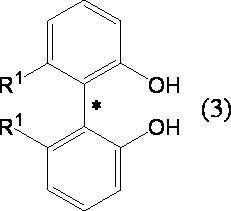
- the present invention relates to an optically active 6,6′-disubstituted-2,2′-biphenol derivative represented by the above formula (3) (hereinafter sometimes referred to as “optically active biphenol derivative (3)”). It relates to a manufacturing method.
- the optically active biphenol derivative (3) is an optically active 6,6′-disubstituted-5,5′-dihalogeno-3,3′-disubstituted-2,2′-biphenol derivative represented by the above formula (2) ( Hereinafter, it can be obtained by acting a Lewis acid on “optically active biphenol derivative (2)”.
- the optically active biphenol derivative (2) is an optical form of the 6,6′-disubstituted-5,5′-dihalogeno-3,3′-disubstituted-2,2′-biphenol derivative represented by the formula (2 ′).
- biphenol derivative (2 ′) an optically active diamine compound
- crystalline product an optically active diamine compound
- R 1 has a primary or secondary alkyl group having 1 to 10 carbon atoms that may have a substituent, or a substituent. And a cycloalkyl group having 3 to 10 carbon atoms which may be present.
- R 1 Specific examples of the primary or secondary alkyl group having 1 to 10 carbon atoms of R 1 include methyl group, ethyl group, n-propyl group, i-propyl group, n-butyl group, i-butyl group, s- Examples thereof include a butyl group, n-pentyl group, n-hexyl group, n-heptyl group, n-octyl group, n-nonyl group, n-decyl group and the like.
- cycloalkyl group having 3 to 10 carbon atoms include a cyclopropyl group, a cyclobutyl group, an aicopentyl group, a cyclohexyl group, and a cyclooctyl group.
- Examples of the substituent for the primary or secondary alkyl group having 1 to 10 carbon atoms of R 1 include an alkoxy group having 1 to 10 carbon atoms such as a methoxy group, an ethoxy group, a propoxy group, and an isopropoxy group; a phenyl group, 4- A phenyl group which may have a substituent such as a methylphenyl group or a 2-chlorophenyl group; an alkoxycarbonyl group having 1 to 10 carbon atoms such as a methoxycarbonyl group, an ethoxycarbonyl group, a propoxycarbonyl group or an isopropoxycarbonyl group; Etc.
- substituent for the cycloalkyl group having 3 to 10 carbon atoms include alkoxy groups having 1 to 10 carbon atoms such as methoxy group, ethoxy group, propoxy group, isopropoxy group; phenyl group, 4-methylphenyl group, 2-chlorophenyl A phenyl group optionally having a substituent such as a group; an alkoxycarbonyl group having 2 to 10 carbon atoms such as a methoxycarbonyl group, an ethoxycarbonyl group, a propoxycarbonyl group, and an isopropoxycarbonyl group;
- X represents a halogen atom such as a fluorine atom, a chlorine atom, a bromine atom, or an iodine atom.
- R 2 represents a tertiary alkyl group having 4 to 6 carbon atoms.
- Specific examples of the tertiary alkyl group having 4 to 6 carbon atoms include t-butyl group, 1,1-dimethylpropyl group, 1,1,2-trimethylpropyl group and the like.
- optically active biphenol derivative (2) Specific examples of the optically active biphenol derivative (2) are shown in Table 1 below.
- the optically active biphenol derivative (2) of the present invention is not limited to these.
- optically active diamine compound used in the present invention is not particularly limited as long as it is an optically active compound having two amino groups in the molecule.
- An active 1,2-diaminoalkane derivative is preferred.
- 1,2-diaminoalkane derivatives include 1,2-diaminopropane, 1-phenyl-1,2-diaminoethane, 3-phenyl-1,2-diaminopropane, 2,3-butanediamine, 1,2-diphenyl-1,2-diaminoethane, 1,2-bis (1-naphthyl) -1,2-diaminoethane, 1,2-bis (2-naphthyl) -1,2-diaminoethane, , 2-cyclohexanediamine, 2- (aminomethyl) pyrrolidine, 2,3-dimethylpyrazine and the like, and examples of optically active 1,2-diaminoalkanes include optically active substances of these specific examples. . Of these, optically active 1,2-diphenyl-1,2-diaminoethane is particularly preferred.
- the use molar ratio of the biphenol derivative (2 ′) and the optically active diamine compound in the reaction of forming a salt from one optical isomer of the biphenol derivative (2 ′) and the optically active diamine compound is [biphenol derivative (2 ′)].
- (Optically active diamine compound) 0.3: 1 to 1: 2, preferably 0.5: 1 to 1: 1.
- reaction for forming a salt of one optical isomer of the biphenol derivative (2 ′) and the optically active diamine compound by reacting the optical isomer mixture of the biphenol derivative (2 ′) with the optically active diamine compound is appropriate.
- a suitable solvent In a suitable solvent.
- the solvent to be used can be used without particular limitation as long as it is inert to the biphenol derivative (2 ') and the optically active diamine compound and does not have any special interaction.
- a salt is formed from the biphenol derivative (2 ′) and the optically active diamine compound, one of the diastereomeric mixtures obtained is selectively precipitated from the system as a crystalline product. It is preferable to select such a solvent.
- alkane solvents such as pentane, hexane, heptane, isopar E, and isopar G
- aromatic solvents such as benzene, toluene, and orthoxylene
- halogen solvents such as methylene chloride, chloroform, dichloroethane, and chlorobenzene
- ester solvents such as methyl acetate and ethyl acetate
- ether solvents such as diethyl ether and tetrahydrofuran
- mixed solvents composed of two or more of these solvents.
- toluene or a mixed solvent of toluene and an alkane solvent is preferable.
- the amount of the solvent to be used is not particularly limited, and is usually represented by [biphenol derivative (2 ′) (parts by weight)]: [solvent (parts by volume)], usually 1: 1 to 1: 100, preferably Is 1: 3 to 1:40.
- the reaction for forming a salt from the optical isomer mixture of the biphenol derivative (2 ′) and the optically active diamine compound is not particularly limited. Specifically, the following methods (a) to (c) are exemplified. Can do. (A) A predetermined amount of the racemic mixture of the biphenol derivative (2 ′) and the optically active diamine compound is dissolved in the solvent under heating up to the boiling point of the solvent, and then allowed to stand at room temperature or under cooling or appropriately stirred. How to do. (B) A method in which a predetermined amount of the biphenol derivative (2 ′) and the optically active diamine compound is dissolved in a solvent while heating up to the boiling point of the solvent, and then a solvent having low solubility is added with stirring. (C) A method in which a predetermined amount of an optically active amine compound is added and the whole volume is stirred while the biphenol derivative (2 ′) is suspended in an appropriate solvent.
- the reaction solution is filtered to remove the biphenol derivative (2 ′).
- a salt of one optical isomer and an optically active diamine compound can be isolated.
- the salt of one optical isomer of the isolated biphenol derivative (2 ') and the optically active diamine compound is stirred in a mixed solvent system of a water-insoluble organic solvent and an acidic aqueous solution, and then separated.
- the desired optically active biphenol derivative (2) can be obtained with high optical purity.
- the water-insoluble organic solvent used here is not particularly limited, and examples thereof include alkane solvents such as pentane, hexane, heptane, Isopar E, and Isopar G; aromatic solvents such as benzene, toluene, and orthoxylene; methylene chloride, Halogen solvents such as chloroform, dichloroethane and chlorobenzene; ester solvents such as methyl acetate and ethyl acetate; ether solvents such as diethyl ether and cyclopropyl methyl ether; and a mixed solvent composed of two or more of these solvents; It is done.
- aromatic systems can be preferably used.
- the crystalline product and the water-insoluble organic solvent are used in the ratio [crystalline product (parts by weight)]: [water-insoluble organic solvent (parts by volume)], usually 1: 1 to 1:50, Preferably, it is 1: 3 to 1:30.
- an aqueous solution of an inorganic acid such as hydrogen chloride or sulfuric acid
- an aqueous solution of an organic acid such as acetic acid, propionic acid or methanesulfonic acid
- hydrochloric acid is preferred from a practical viewpoint.
- the acid concentration of the acidic aqueous solution is not particularly limited and can be used from an aqueous solution having an acid concentration of 0.1 N to a saturated aqueous solution of acid, but an aqueous solution having an acid concentration of 0.5 to 5 N is preferred.
- the amount of the acidic aqueous solution used depends on the acid concentration and the amount of the optically active diamine compound contained in the stoichiometric amount in the crystalline product, but it is preferably 1 to 20 times the mole with respect to 1 mole of the optically active diamine compound. Is 2 to 10 moles.
- the temperature when the crystalline product is stirred and separated in a mixed solvent system of a water-insoluble organic solvent and an acidic aqueous solution can be appropriately adjusted from the melting point to the boiling point of the water-insoluble organic solvent and the acidic aqueous solution. However, it is preferably 0 ° C. to 50 ° C.
- reaction after isolating the salt of one optical isomer of the biphenol derivative (2 ′) and the optically active diamine compound from the reaction liquid of the optical isomer mixture of the biphenol derivative (2 ′) and the optically active diamine compound.
- the liquid contains the other optical isomer of the biphenol derivative (2 ′).
- the other optical isomer of this biphenol derivative (2 ') can be isolated from the reaction solution by a conventional method.
- optically active diamine compound used in the reaction can also be recovered from the reaction solution by a conventional method and reused.
- the optically active biphenol derivative (2) can be efficiently separated from the biphenol derivative (2 ′), but this phenomenon involves substitution of a halogen atom and a tertiary alkyl group on the benzene ring of the compound. It originates in having as a group. Moreover, these substituents can be easily removed by the following Lewis acid treatment as necessary for the synthesis of the target ligand for asymmetric synthesis.
- Lewis acid and Lewis acid treatment examples include copper chloride, zinc chloride, aluminum chloride, titanium tetrachloride, and zirconium chloride. These Lewis acids can be used alone or in combination of two or more.
- the amount of Lewis acid used is 0.01 to 20 times mol, preferably 0.1 to 10 times mol per mol of the optically active biphenol derivative (2).
- Solvents used include alkane solvents such as pentane, hexane, heptane, isopar E, and isopar G; aromatic solvents such as benzene, toluene, and orthoxylene; halogen solvents such as methylene chloride, chloroform, dichloroethane, and chlorobenzene; and And a mixed solvent composed of two or more of these solvents.
- an alkane-based or halogen-based solvent it is preferable to appropriately mix an aromatic solvent such as benzene, toluene, or ortho-xylene as an acceptor for the halogen atom eliminated from the optically active biphenol derivative (2).
- the amount of the solvent used is not particularly limited, and is usually expressed as [optically active biphenol derivative (2) (parts by weight)]: [solvent (volume parts)], and usually 1: 3 to 1: 100, preferably 1: 4 to 1:40.
- the treatment temperature can be suitably carried out from the melting point to the boiling point of the solvent, but is preferably 0 ° C. to 50 ° C.
- the present invention is also a method for producing an optically active biphenol derivative (3), wherein the formula (1) (wherein R 1 and X are the same as the meanings represented in the formula (2)).
- the optically active biphenol derivative (1) is also useful as a synthesis intermediate of the ligand for asymmetric synthesis.
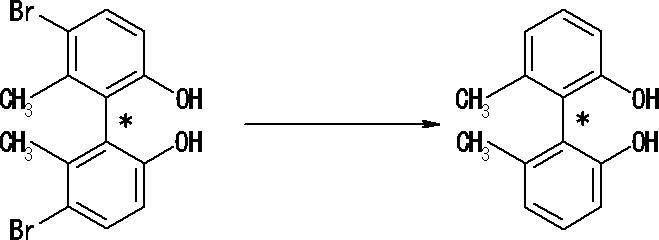
- the optically active biphenol derivative (1) can be obtained by acting a Bronsted acid on the optically active biphenol derivative (2) obtained by optical resolution treatment. Furthermore, an optically active biphenol derivative (3) can be obtained by acting a Lewis acid on the optically active biphenol derivative (1).
- optically active biphenol derivative (1) Specific examples of the optically active biphenol derivative (1) are shown in Table 2 below.
- the optically active biphenol derivative (1) of the present invention is not limited to these.
- c-Pr represents a cyclopropyl group
- c-Pen represents a cyclopentyl group
- c-Hex represents a cyclohexyl group (the same applies hereinafter).
- Bronsted acid used in the present invention examples include inorganic acids such as hydrochloric acid and sulfuric acid; organic sulfonic acids such as paratoluenesulfonic acid and methanesulfonic acid; fluoroalkanoic acids such as trifluoroacetic acid and perfluoropropionic acid; trifluoromethanesulfonic acid And fluoroalkanesulfonic acids such as perfluorobutanesulfonic acid; polymeric sulfonic acids; and the like. These Bronsted acids can be used alone or in combination of two or more. Of these, fluoroalkanesulfonic acids such as trifluoromethanesulfonic acid and perfluorobutanesulfonic acid are preferred in the present invention.
- the use ratio of the optically active biphenol derivative (2) to the Bronsted acid is usually a molar ratio of [optically active biphenol derivative (2)] :( Bronsted acid), usually 10: 1 to 1:10, preferably 10: 2. ⁇ 1: 4.
- the reaction between the optically active biphenol derivative (2) and Bronsted acid can be carried out in a suitable solvent.
- suitable solvent examples include alkane solvents such as pentane, hexane, heptane, Isopar E, and Isopar G; aromatic solvents such as benzene, toluene, and orthoxylene; halogen solvents such as methylene chloride, chloroform, dichloroethane, and chlorobenzene; and And a mixed solvent composed of two or more of these solvents.
- an aromatic solvent such as benzene, toluene, or ortho-xylene as an acceptor for the alkyl group that is eliminated from the optically active biphenol derivative (2).
- the amount of the solvent used is not particularly limited, and is [optically active biphenol derivative (2) (parts by weight)]: [bronted acid aqueous solution (parts by volume)], usually 1: 3 to 1: 100, preferably 1: 5 to 1:50.
- the treatment temperature can be suitably carried out from the melting point to the boiling point of the solvent, but is preferably 0 ° C. to 50 ° C.
- Lewis acid and Lewis acid treatment examples include copper chloride, zinc chloride, aluminum chloride, titanium tetrachloride, and zirconium chloride. These Lewis acids can be used alone or in combination of two or more.
- the amount of Lewis acid used is 0.01 to 20 times mol, preferably 0.1 to 10 times mol, per mol of the optically active biphenol derivative (1).
- This reaction can be carried out in an inert solvent.
- solvents include alkane solvents such as pentane, hexane, heptane, Isopar E, and Isopar G; aromatic solvents such as benzene, toluene, and orthoxylene; halogen solvents such as methylene chloride, chloroform, dichloroethane, and chlorobenzene; and And a mixed solvent composed of two or more of these solvents.
- an alkane-based or halogen-based solvent it is preferable to appropriately mix an aromatic solvent such as benzene, toluene, or ortho-xylene as an acceptor of a halogen atom that is eliminated from the optically active biphenol derivative (1).
- an aromatic solvent such as benzene, toluene, or ortho-xylene
- the amount of the solvent to be used is not particularly limited, but is usually expressed as [optically active biphenol derivative (1) (parts by weight)]: [solvent (volume parts)], and usually 1: 3 to 1: 100, preferably 1: 4 to 1:40.
- the treatment temperature can be suitably carried out from the melting point to the boiling point of the solvent, but is preferably 0 ° C. to 50 ° C.
- the present invention also relates to a method for producing a biphenol derivative (2 ').
- the biphenol derivative (2 ′) is represented by the above-mentioned formula (4) (wherein R 1 , R 2 and X have the same meaning as in the formula (2 ′)).
- a copper salt and an organic base or a copper oxyhalide (II) organic base complex acts on a substituted-4-halogeno-2-substituted-phenol derivative (hereinafter sometimes referred to as “phenol derivative (4)”). Can be obtained.
- the copper salt and organic base to be used include cuprous chloride, cuprous bromide, cuprous iodide and the like as the copper salt, and the organic base includes tetramethylethylenediamine, dimethylethylenediamine, ethylenediamine, DABCO , DBU, triethylamine, diisopropylethylamine, dimethylamine, diethylamine, dibutylamine, diisopropylamine, pyrrolidine, ammonia, methylamine, ethylamine, butylamine, isopropylamine, benzylamine, t-butylamine, pyridine, 2,6-lutidine, DMAP, Examples include pyrimidine, aniline, N-methylaniline, N, N-dimethylaniline, N-methylmorpholine, diphenylethylenediamine, phenethylamine, cyclohexanediamine, sparteine, and cinchonine.
- tetramethylethylenediamine, dibutylamine, t-butylamine, and phenethylamine are preferable.
- These copper salts can be used alone or in combination of two or more.
- an organic base can also be used individually by 1 type or in combination of 2 or more types.
- the reaction using these copper salt and organic base can be carried out in the presence of oxygen or in the presence of an oxidizing agent. Examples of the method in the presence of oxygen include an oxygen atmosphere or an air atmosphere.
- the amount of copper salt used is 0.01 to 20 times mol, preferably 0.1 to 10 times mol, per mol of the phenol derivative (4).
- the amount of the organic base used is 0.5 to 5 times mol, preferably 1.0 to 3.0 times mol for 1 mol of the copper salt.
- Copper oxyhalide (II) organic base complex (Copper oxyhalide (II) organic base complex) Moreover, the copper (II) oxyhalide organic base complex previously prepared from said copper salt and organic base can also be used.
- the amount of the copper (II) oxyhalide organic base complex used is 0.01 to 20 times mol, preferably 0.1 to 10 times mol per mol of the phenol derivative (4).
- the solvent used in this reaction is not particularly limited as long as it does not inhibit the reaction, but hydrocarbons such as hexane, cyclohexane, benzene and toluene, chlorinated solvents such as methylene chloride, chloroform, carbon tetrachloride and chlorobenzene, acetonitrile , Nitrile solvents such as benzonitrile, ketone solvents such as acetone, ethyl methyl ketone, ter-butyl methyl ketone, DMF, N-methylpyrrolidin-2-one (NMP), N, N′-dimethylimidazolidine-2 An amide solvent such as ON (DMI), DMSO or the like can be used.
- hydrocarbons such as hexane, cyclohexane, benzene and toluene
- chlorinated solvents such as methylene chloride, chloroform, carbon tetrachloride and chlorobenzene
- the reaction can be carried out in a two-solution two-phase system of water and an organic solvent.
- a water-insoluble solvent such as hexane, cyclohexane, benzene, toluene or other hydrocarbon type, or a chlorine-based solvent such as methylene chloride, chloroform or chlorobenzene is used alone or in combination.
- hydrocarbon solvents such as hexane, cyclohexane, benzene, and toluene can be used alone or as a mixed solvent.
- the amount of the solvent used is not particularly limited, and is usually expressed as [phenol derivative (4) (parts by weight)]: [solvent (parts by volume)], and usually 1: 3 to 1: 100, preferably 1: 4 to 1:40.
- the treatment temperature can be suitably carried out from the melting point to the boiling point of the solvent, but is preferably 0 ° C. to 50 ° C.
- the target product can be efficiently isolated by applying a conventional post-treatment operation in organic synthetic chemistry and, if necessary, a conventionally known separation and purification means.
- the structure of the target product can be identified and confirmed by measuring 1 H-NMR spectrum, IR spectrum, mass spectrum, elemental analysis, or the like.
- the optical purity of the reaction product was determined using an optical resolution column.
- the measurement conditions for the optical resolution column are shown below.
- the crystalline product was a single diastereomer [1.57 g: 6,6′-dimethyl-5,5′-dibromo-3,3′-di (t-butyl) -2,2′- Yield 90.2% in terms of a 1: 1 mixture of one enantiomer of biphenol and (R, R) -1,2-diphenyl-1,2-diamine].
- Racemic 6,6′-dimethyl-5,5′-dichloro-3,3′-di (t-butyl) -2,2′-biphenol (273 mg, 0.7 mmol), (R, R) -1 , 2-diphenyl-1,2-diamine (110 mg, 0.52 mmol), toluene (0.7 ml), and hexane (3.5 ml) were mixed, and the whole volume was stirred at 70 ° C. for 0.5 hour. The mixture was cooled to ° C and stirring was continued for 1 hour.
- the crystalline product was a single diastereomer [180 mg: 6,6'-dimethyl-5,5'-dichloro-3,3'-di (t-butyl) -2,2'-biphenol Yield 86% in terms of a 1: 1 mixture of one enantiomer and (R, R) -1,2-diphenyl-1,2-diamine].
Landscapes
- Chemical & Material Sciences (AREA)
- Organic Chemistry (AREA)
- Chemical Kinetics & Catalysis (AREA)
- Organic Low-Molecular-Weight Compounds And Preparation Thereof (AREA)
Abstract
Description
本願は、2008年1月8日に、日本に出願された特願2008-001275号に基づき優先権を主張し、その内容をここに援用する。
このような2,2’-ビフェノール誘導体として、例えば、下記式(A)、

一方、下式(B)、(C)

しかしながら、いずれの化合物も、前記式(A)で示される光学活性6,6’-ジメチル-2,2’-ビフェノールから合成されるため(非特許文献2)、前記と同様に製造法に課題があった。
(A)下記式(2’)で示される6,6’-ジ置換-5,5’-ジハロゲノ-3,3’-ジ置換-2,2’-ビフェノール誘導体の光学異性体混合物に、光学活性ジアミン化合物を作用させることで、下記式(2’)で示される6,6’-ジ置換-5,5’-ジハロゲノ-3,3’-ジ置換-2,2’-ビフェノール誘導体の一方の光学異性体のみが、前記光学活性ジアミン化合物と塩を形成して結晶性成績物として単離でき、単離した塩から、光学活性な下記式(2)で示される6,6’-ジ置換-5,5’-ジハロゲノ-3,3’-ジ置換-2,2’-ビフェノール誘導体を効率よく得ることができ、さらにルイス酸と反応させることによって、下記式(3)で示される6,6’-ジ置換-2,2’-ビフェノール誘導体が効率よく得られること、
(B)得られた下記式(2)で示される光学活性6,6’-ジ置換-5,5’-ジハロゲノ-3,3’-ジ置換-2,2’-ビフェノール誘導体は、ブレンステッド酸と反応させることによって、下記式(1)で示される光学活性6,6’-ジ置換-5,5’-ジハロゲノ-2,2’-ビフェノール誘導体を効率よく得ることができ、さらにルイス酸と反応させることによって、下記式(3)で示される6,6’-ジ置換-2,2’-ビフェノール誘導体が効率よく得られること、及び、
(C)下記式(2’)で示される6,6’-ジ置換-5,5’-ジハロゲノ-3,3’-ジ置換-2,2’-ビフェノール誘導体は、下記式(4)で表される5-置換-4-ハロゲノ-2-置換-フェノール誘導体と、銅塩及び有機塩基、又はオキシハロゲン化銅(II)有機塩基錯体を反応させることで、効率よく得られることを見出し、本発明を完成するに至った。


(式中、R1、R2、X、及び*は、前記と同じ意味を表す。)で表される光学活性6,6’-ジ置換-5,5’-ジハロゲノ-3,3’-ジ置換-2,2’-ビフェノール誘導体を得、さらに式(2)で表される化合物にルイス酸を作用させることを特徴とする式(3)で表される化合物の製造方法が提供される。

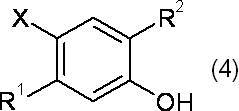
(式中、R1、R2、及びXは、前記と同じ意味を表す。)で表される5-置換-4-ハロゲノ-2-置換-フェノール誘導体と、銅塩及び有機塩基、又はオキシハロゲン化銅(II)有機塩基錯体を、作用させることを特徴とする前記式(2’)で表される6,6’-ジ置換-5,5’-ジハロゲノ-2,2’-ビフェノール誘導体の製造方法が提供される。
また本発明によれば、高い光学純度をもつ2,2’-ビフェノール誘導体を簡便に効率よく製造することができる。
1)本発明は、前記式(3)で示される光学活性6,6’-ジ置換-2,2’-ビフェノール誘導体(以下、「光学活性ビフェノール誘導体(3)」ということがある。)の製造方法に関するものである。
光学活性ビフェノール誘導体(2)は、前記式(2’)で示される6,6’-ジ置換-5,5’-ジハロゲノ-3,3’-ジ置換-2,2’-ビフェノール誘導体の光学異性体混合物(以下、「ビフェノール誘導体(2’)」ということがある。)に光学活性ジアミン化合物を作用させることにより、ビフェノール誘導体(2’)の一方の光学異性体と前記光学活性ジアミン化合物との塩(以下、「結晶性成績物」ということがある。)を得、次いで、この塩を中和し得ることができる。
式(2)、式(3)及び式(2’)中、R1は、置換基を有していてもよい炭素数1~10の1級もしくは2級アルキル基、または置換基を有していてもよい炭素数3~10のシクロアルキル基を表す。
炭素数3~10のシクロアルキル基の具体例としては、シクロプロピル基、シクロブチル基、アイクロペンチル基、シクロヘキシル基、シクロオクチル基等が挙げられる。

本発明に用いる光学活性ジアミン化合物としては、分子内にアミノ基を2個有する光学活性な化合物であれば、特に制限されないが、入手容易性及びより効率よく光学分割が可能であることから、光学活性1,2-ジアミノアルカン誘導体であることが好ましい。
(a)溶媒の沸点までの加温下に、ビフェノール誘導体(2’)のラセミ体混合物と光学活性ジアミン化合物の所定量を溶媒に溶解したのち、室温若しくは冷却下に、放置または適宜な攪拌を行う方法。
(b)溶媒の沸点までの加温下に、ビフェノール誘導体(2’)と光学活性ジアミン化合物の所定量を溶媒に溶解したのち、攪拌下に溶解度の低い溶媒を加える方法。
(c)ビフェノール誘導体(2’)を適当な溶媒に懸濁させたまま、光学活性アミン化合物の所定量を添加し、全容を攪拌する方法。
用いるルイス酸としては、塩化銅、塩化亜鉛、塩化アルミニウム、4塩化チタン、塩化ジルコニウム等が挙げられる。これらのルイス酸は1種単独で、或いは2種以上を組み合わせて用いることができる。
処理温度は溶媒の融点から沸点まで適宜に行うことが可能であるが、好ましくは0℃~50℃である。
下記第2表に光学活性ビフェノール誘導体(1)の具体例を示す。本発明の光学活性ビフェノール誘導体(1)はこれらに限定されるものではない。第1表中、c-Prはシクロプロピル基を、c-Penはシクロペンチル基を、c-Hexはシクロヘキシル基をそれぞれ表す(以下にて同じである)。
本発明で用いるブレンステッド酸としては、塩酸、硫酸等の無機酸;パラトルエンスルホン酸、メタンスルホン酸等の有機スルホン酸;トリフルオロ酢酸、パーフルオロプロピオン酸等のフルオロアルカン酸;トリフルオロメタンスルホン酸、パーフルオロブタンスルホン酸等のフルオロアルカンスルホン酸;高分子スルホン酸;等が挙げられる。これらのブレンステッド酸は1種単独で、或いは2種以上を組み合わせて用いることができる。
本発明においては、これらの中でも、トリフルオロメタンスルホン酸、パーフルオロブタンスルホン酸等のフルオロアルカンスルホン酸が好ましい。
用いるルイス酸としては、塩化銅、塩化亜鉛、塩化アルミニウム、4塩化チタン、塩化ジルコニウム等が挙げられる。これらのルイス酸は1種単独で、或いは2種以上を組み合わせて用いることができる。
処理温度は溶媒の融点から沸点まで適宜に行うことが可能であるが、好ましくは0℃~50℃である。
用いる銅塩及び有機塩基は、銅塩としては、塩化第一銅、臭化第一銅、ヨウ第一化銅等が挙げられ、有機塩基しては、テトラメチルエチレンジアミン、ジメチルエチレンジアミン、エチレンジアミン、DABCO、DBU、トリエチルアミン、ジイソプロピルエチルアミン、ジメチルアミン、ジエチルアミン、ジブチルアミン、ジイソプロピルアミン、ピロリジン、アンモニア、メチルアミン、エチルアミン、ブチルアミン、イソプロピルアミン、ベンジルアミン、t-ブチルアミン、ピリジン、2,6-ルチジン、DMAP、ピリミジン、アニリン、N-メチルアニリン、N,N-ジメチルアニリン、N-メチルモルホリン、ジフェニルエチレンジアミン、フェネチルアミン、シクロヘキサンジアミン、スパルテイン、シンコニン等が挙げられる。中でも、テトラメチルエチレンジアミン、ジブチルアミン、t-ブチルアミン、フェネチルアミンが好ましい。
これらの銅塩は1種単独で、或いは2種以上を組み合わせて用いることができる。また、有機塩基も、1種単独で、或いは2種以上を組み合わせて用いることができる。これらの銅塩および有機塩基を用いた反応は、酸素存在下もしくは酸化剤存在下で行うことができる。酸素存在下とする方法としては、酸素雰囲気下もしくは空気雰囲気下とすることが挙げられる。
有機塩基の使用量は、銅塩1モルに対して、0.5~5倍モル、好ましくは1.0~3.0倍モルである。
また、上記の銅塩及び有機塩基からあらかじめ調製したオキシハロゲン化銅(II)有機塩基錯体も用いることができる。
処理温度は溶媒の融点から沸点まで適宜に行うことが可能であるが、好ましくは0℃~50℃である。
光学分割用カラムの測定条件を下記に示す。
・キャリア:n-ヘキサン/エタノール=97/3(1ml/分)
・検出波長:254nm
・カラム温度:30℃
・保持時間:12分
ラセミ体の6,6’-ジメチル-5,5’-ジブロモ-3,3’-ジ(t-ブチル)-2,2’-ビフェノールの光学分割
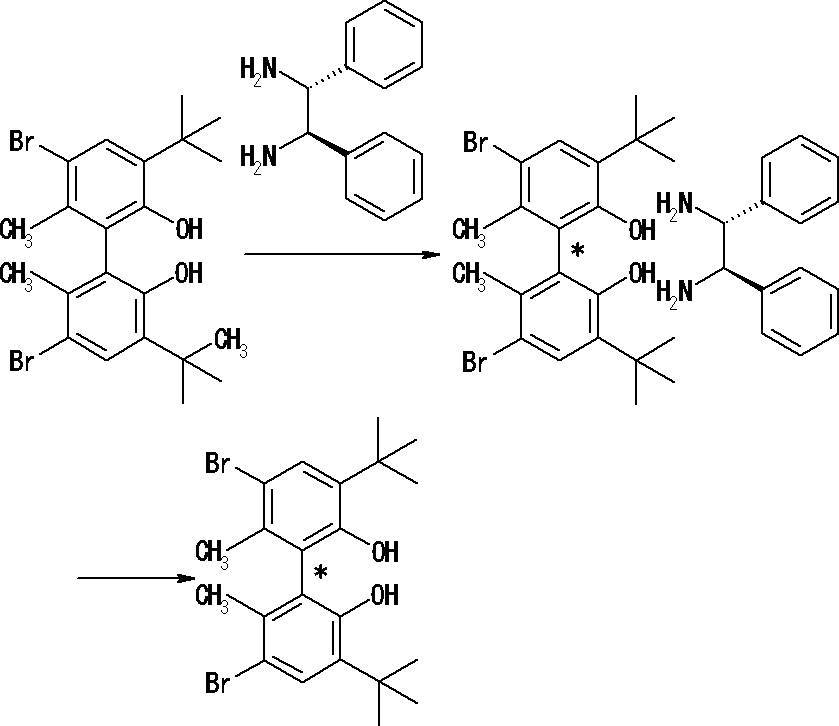
光学活性6,6’-ジメチル-5,5’-ジブロモ-2,2’-ビフェノールの合成

光学活性6,6’-ジメチル-2,2’-ビフェノールの合成
ラセミ体の6,6’-ジメチル-5,5’-ジブロモ-3,3’-ジ(t-ブチル)-2,2’-ビフェノールの製造

ラセミ体の6,6’-ジメチル-5,5’-ジブロモ-3,3’-ジ(t-ブチル)-2,2’-ビフェノールの製造
ラセミ体の6,6’-ジメチル-5,5’-ジクロロ-3,3’-ジ(t-ブチル)-2,2’-ビフェノールの光学分割
光学活性6,6’-ジメチル-5,5’-ジクロロ-2,2’-ビフェノールの合成
ラセミ体の6,6’-ジメチル-5,5’-ジクロロ-3,3’-ジ(t-ブチル)-2,2’-ビフェノールの製造
Claims (10)
- 式(3)

(式中、R1は、置換基を有していてもよい炭素数1~10の1級もしくは2級アルキル基または置換基を有していてもよい炭素数3~10のシクロアルキル基を表し、*は軸不斉中心を表す。)で表される6,6’-ジ置換-2,2’-ビフェノール誘導体の製造方法であって、式(2’)
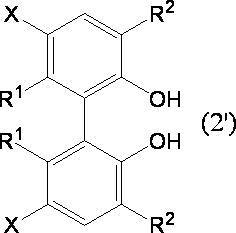
(式中、R1は、前記と同じ意味を表し、R2は炭素数4~6の3級アルキル基を表し、Xはハロゲン原子を表す。)で示される6,6’-ジ置換-5,5’-ジハロゲノ-3,3’-ジ置換-2,2’-ビフェノール誘導体と光学活性ジアミンを作用させて得られる塩を分離し、次いで、該塩を中和することにより、式(2)

(式中、R1、R2、X、及び*は、前記と同じ意味を表す。)で表される光学活性6,6’-ジ置換-5,5’-ジハロゲノ-3,3’-ジ置換-2,2’-ビフェノール誘導体を得、さらに式(2)で表される化合物にルイス酸を作用させることを特徴とする式(3)で表される化合物の製造方法。 - 式(3)
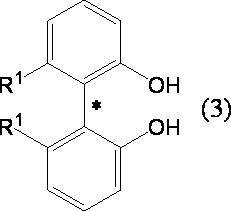
(式中、R1は、置換基を有していてもよい炭素数1~10の1級もしくは2級アルキル基または置換基を有していてもよい炭素数3~10のシクロアルキル基を表し、*は軸不斉中心を表す。)で表される6,6’-ジ置換-2,2’-ビフェノール誘導体の製造方法であって、式(2’)

(式中、R1は、前記と同じ意味を表し、R2は炭素数4~6の3級アルキル基を表し、Xはハロゲン原子を表す。)で示される6,6’-ジ置換-5,5’-ジハロゲノ-3,3’-ジ置換-2,2’-ビフェノール誘導体と光学活性ジアミンを作用させて得られる塩を分離し、次いで、該塩を中和することにより、式(2)
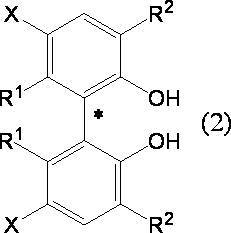
(式中、R1、R2、X、及び*は、前記と同じ意味を表す。)で表される光学活性6,6’-ジ置換-5,5’-ジハロゲノ-3,3’-ジ置換-2,2’-ビフェノール誘導体を得、次いで式(2)で表される化合物にブレンステッド酸を作用させ式(1)
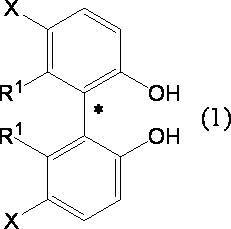
(式中、R1、X、及び*は、前記と同じ意味を表す。)で表される光学活性6,6’-ジ置換-5,5’-ジハロゲノ-2,2’-ビフェノール誘導体を得、さらに式(1)で表される化合物にルイス酸を作用させることを特徴とする式(3)で表される化合物の製造方法。 - 式(2’)
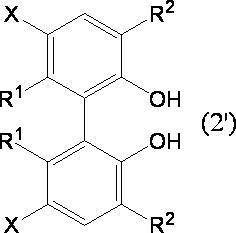
(式中、R1は、置換基を有していてもよい炭素数1~10の1級もしくは2級アルキル基または置換基を有していてもよい炭素数3~10のシクロアルキル基を表し、R2は炭素数4~6の3級アルキル基を表し、Xはハロゲン原子を表す。)で示される6,6’-ジ置換-5,5’-ジハロゲノ-3,3’-ジ置換-2,2’-ビフェノール誘導体と光学活性ジアミンを作用させて得られる塩を分離し、次いで、該塩を中和することを特徴とする式(2)
(式中、R1、R2、及びXは、前記と同じ意味を表す。式中、*は軸不斉中心を表す。)で表される光学活性6,6’-ジ置換-5,5’-ジハロゲノ-3,3’-ジ置換-2,2’-ビフェノール誘導体の製造方法。 - 光学活性ジアミン化合物が、1,2-ジアミノアルカン誘導体であることを特徴とする請求項1~3のいずれかに記載の製造方法。
- 式(1)

(式中、R1は、置換基を有していてもよい炭素数1~10の1級もしくは2級アルキル基または置換基を有していてもよい炭素数3~10のシクロアルキル基を表し、Xはハロゲン原子を表し、*は軸不斉中心を表す。)で表されることを特徴とする光学活性2,2’-ビフェノール誘導体。 - 式(2)

(式中、R1は、置換基を有していてもよい炭素数1~10の1級もしくは2級アルキル基または置換基を有していてもよい炭素数3~10のシクロアルキル基を表し、R2は炭素数4~6の3級アルキル基を表し、Xはハロゲン原子を表し、*は軸不斉中心を表す。)で表されることを特徴とする光学活性2,2’-ビフェノール誘導体。 - 式(2’)

(式中、R1は、置換基を有していてもよい炭素数1~10の1級もしくは2級アルキル基または置換基を有していてもよい炭素数3~10のシクロアルキル基を表し、R2は炭素数4~6の3級アルキル基を表し、Xはハロゲン原子を表す。)で表されることを特徴とする2,2’-ビフェノール誘導体。 - 式(4)
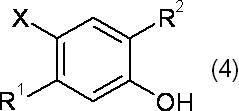
(式中、R1は、置換基を有していてもよい炭素数1~10の1級もしくは2級アルキル基または置換基を有していてもよい炭素数3~10のシクロアルキル基を表し、R2は炭素数4~6の3級アルキル基を表し、Xはハロゲン原子を表す。)で表される5-置換-4-ハロゲノ-2-置換-フェノール誘導体と、銅塩及び有機塩基、又はオキシハロゲン化銅(II)有機塩基錯体を、作用させることを特徴とする式(2’)
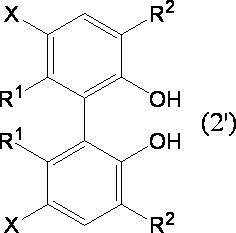
(式中、R1、R2、及びXは前記と同様の意味を表す。)で表される6,6’-ジ置換-5,5’-ジハロゲノ-2,2’-ビフェノール誘導体の製造方法。 - 式(2)

(式中、R1は、置換基を有していてもよい炭素数1~10の1級もしくは2級アルキル基または置換基を有していてもよい炭素数3~10のシクロアルキル基を表し、R2は炭素数4~6の3級アルキル基を表し、Xはハロゲン原子を表し、*は軸不斉中心を表す。)で表される光学活性6,6’-ジ置換-5,5’-ジハロゲノ-3,3’-ジ置換-2,2’-ビフェノール誘導体と、ブレンステッド酸を作用させることを特徴とする式(1)

(式中、R1、X、及び*は前記と同様の意味を表す。)で表される光学活性6,6’-ジ置換-5,5’-ジハロゲノ-2,2’-ビフェノール誘導体の製造方法。 - 式(1)

(式中、R1は、置換基を有していてもよい炭素数1~10の1級もしくは2級アルキル基または置換基を有していてもよい炭素数3~10のシクロアルキル基を表し、Xはハロゲン原子を表し、*は軸不斉中心を表す。)で表される光学活性6,6’-ジ置換-5,5’-ジハロゲノ-ジ置換-2,2’-ビフェノール誘導体を、ルイス酸と作用させることを特徴とする式(3)
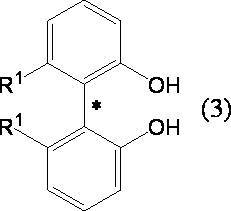
(式中、R1、及び*は前記と同様の意味を表す。)で表される光学活性6,6’-ジ置換-2,2’-ビフェノール誘導体の製造方法。
Priority Applications (5)
| Application Number | Priority Date | Filing Date | Title |
|---|---|---|---|
| JP2009548898A JP5271280B2 (ja) | 2008-01-08 | 2009-01-06 | 光学活性2,2’−ビフェノール誘導体及びその製造方法 |
| CN200980101690.7A CN101918346B (zh) | 2008-01-08 | 2009-01-06 | 光学活性2,2’-联苯酚衍生物及其制造方法 |
| KR1020107014929A KR101182615B1 (ko) | 2008-01-08 | 2009-01-06 | 광학 활성 2,2'-비페놀 유도체 및 그 제조 방법 |
| EP09700542.5A EP2241545B1 (en) | 2008-01-08 | 2009-01-06 | Optically active 2,2'-biphenol derivative and method for producing the same |
| US12/811,805 US8283501B2 (en) | 2008-01-08 | 2009-01-06 | Optically active 2,2′-biphenol derivative and production method of same |
Applications Claiming Priority (2)
| Application Number | Priority Date | Filing Date | Title |
|---|---|---|---|
| JP2008-001275 | 2008-01-08 | ||
| JP2008001275 | 2008-01-08 |
Publications (1)
| Publication Number | Publication Date |
|---|---|
| WO2009087959A1 true WO2009087959A1 (ja) | 2009-07-16 |
Family
ID=40853074
Family Applications (1)
| Application Number | Title | Priority Date | Filing Date |
|---|---|---|---|
| PCT/JP2009/000012 Ceased WO2009087959A1 (ja) | 2008-01-08 | 2009-01-06 | 光学活性2,2’-ビフェノール誘導体及びその製造方法 |
Country Status (6)
| Country | Link |
|---|---|
| US (1) | US8283501B2 (ja) |
| EP (1) | EP2241545B1 (ja) |
| JP (1) | JP5271280B2 (ja) |
| KR (1) | KR101182615B1 (ja) |
| CN (1) | CN101918346B (ja) |
| WO (1) | WO2009087959A1 (ja) |
Families Citing this family (2)
| Publication number | Priority date | Publication date | Assignee | Title |
|---|---|---|---|---|
| CN103193831B (zh) * | 2013-03-01 | 2015-05-27 | 上海交通大学 | 具有手性分离和光诱导功能的单手性金属有机框架材料的制备方法 |
| CN116102406B (zh) * | 2022-09-19 | 2025-02-11 | 清华大学 | 一种多取代轴手性联苯二酚化合物及其制备方法与应用 |
Citations (4)
| Publication number | Priority date | Publication date | Assignee | Title |
|---|---|---|---|---|
| JPH1045648A (ja) | 1996-08-05 | 1998-02-17 | Daicel Chem Ind Ltd | ジヒドロキシビフェニル誘導体の光学異性体分離法 |
| JP2002069022A (ja) * | 2000-08-30 | 2002-03-08 | Mitsubishi Chemicals Corp | フェノール性化合物の酸化カップリング反応体の製造方法 |
| JP2004189696A (ja) | 2002-12-13 | 2004-07-08 | Mitsubishi Chemicals Corp | 光学活性6,6’−ジメチル−1,1’−ビフェニル−2,2’−ジオール誘導体の製造方法 |
| JP2005510551A (ja) | 2001-11-26 | 2005-04-21 | イー・アイ・デュポン・ドウ・ヌムール・アンド・カンパニー | 3,3’,6,6’−テトラアルキル−2,2’−ビフェノールおよび3,3’,6,6’−テトラアルキル−5,5’−ジハロ−2,2’−ビフェノールの調製法 |
Family Cites Families (2)
| Publication number | Priority date | Publication date | Assignee | Title |
|---|---|---|---|---|
| US20040049087A1 (en) | 2002-09-05 | 2004-03-11 | Rafael Shapiro | Process for preparing 3,3',6,6'-tetraalkyl-2,2'-biphenols and 3,3',6,6'-tetraalkyl-5,5'-dihalo-2,2'-biphenols |
| JP4268810B2 (ja) * | 2003-01-23 | 2009-05-27 | 本州化学工業株式会社 | 4,4’−ビフェノールの製造方法 |
-
2009
- 2009-01-06 WO PCT/JP2009/000012 patent/WO2009087959A1/ja not_active Ceased
- 2009-01-06 EP EP09700542.5A patent/EP2241545B1/en active Active
- 2009-01-06 CN CN200980101690.7A patent/CN101918346B/zh not_active Expired - Fee Related
- 2009-01-06 JP JP2009548898A patent/JP5271280B2/ja not_active Expired - Fee Related
- 2009-01-06 US US12/811,805 patent/US8283501B2/en not_active Expired - Fee Related
- 2009-01-06 KR KR1020107014929A patent/KR101182615B1/ko not_active Expired - Fee Related
Patent Citations (4)
| Publication number | Priority date | Publication date | Assignee | Title |
|---|---|---|---|---|
| JPH1045648A (ja) | 1996-08-05 | 1998-02-17 | Daicel Chem Ind Ltd | ジヒドロキシビフェニル誘導体の光学異性体分離法 |
| JP2002069022A (ja) * | 2000-08-30 | 2002-03-08 | Mitsubishi Chemicals Corp | フェノール性化合物の酸化カップリング反応体の製造方法 |
| JP2005510551A (ja) | 2001-11-26 | 2005-04-21 | イー・アイ・デュポン・ドウ・ヌムール・アンド・カンパニー | 3,3’,6,6’−テトラアルキル−2,2’−ビフェノールおよび3,3’,6,6’−テトラアルキル−5,5’−ジハロ−2,2’−ビフェノールの調製法 |
| JP2004189696A (ja) | 2002-12-13 | 2004-07-08 | Mitsubishi Chemicals Corp | 光学活性6,6’−ジメチル−1,1’−ビフェニル−2,2’−ジオール誘導体の製造方法 |
Non-Patent Citations (5)
| Title |
|---|
| ALBERT, H. E.: "Reactions of 3,4,6- Trialkylphenols. III. Oxidation Studies", J. AM. CHEM. SOC., vol. 76, no. 19, 1954, pages 4983 - 4985, XP008137439 * |
| HARADA, T. ET AL.: "Asymmetric Synthesis of 6,6'-Dialkyl and -Diphenyl-2,2'-Biphenyldiols by Using Menthone as a Chiral Template", SYNLETT, no. 3, 1995, pages 283 - 284, XP008137438 * |
| KANOH, S. ET AL.: "Optical Resolution and Absolute Configuration of Axially Dissymmetric 2,2'-Dihydroxy-6,6'-dimethylbiphenyl", BULL. CHEM. SOC. JPN., vol. 60, 1987, pages 2307 - 2309, XP008137441 * |
| ORGANIC PROCESS RESEARCH & DEVELOPMENT, vol. 11, 2007, pages 628 - 632 |
| SYNLETT, vol. 3, 1995, pages 283 - 284 |
Also Published As
| Publication number | Publication date |
|---|---|
| KR20100091249A (ko) | 2010-08-18 |
| CN101918346B (zh) | 2013-07-10 |
| JPWO2009087959A1 (ja) | 2011-05-26 |
| US20100280284A1 (en) | 2010-11-04 |
| CN101918346A (zh) | 2010-12-15 |
| EP2241545A1 (en) | 2010-10-20 |
| EP2241545B1 (en) | 2014-05-14 |
| JP5271280B2 (ja) | 2013-08-21 |
| EP2241545A4 (en) | 2013-01-02 |
| KR101182615B1 (ko) | 2012-09-14 |
| US8283501B2 (en) | 2012-10-09 |
Similar Documents
| Publication | Publication Date | Title |
|---|---|---|
| KR102479201B1 (ko) | (1r,3r)- 및 (1s,3s)-2,2-디할로-3-(치환된 페닐)시클로프로판카르복실산의 제조 방법 | |
| CA2971093A1 (en) | Process of making cenicriviroc and related analogs | |
| Xu et al. | Palladium-catalyzed double arylations of terminal olefins in acetic acid | |
| JP5271280B2 (ja) | 光学活性2,2’−ビフェノール誘導体及びその製造方法 | |
| ITMI20120114A1 (it) | Nuovo procedimento per la preparazione di acido 2,4,5-trifluorofenilacetico | |
| JP5667913B2 (ja) | 2,3−ジクロロピリジンの製造方法 | |
| JP5140776B1 (ja) | 1−置換−3−フルオロアルキルピラゾール−4−カルボン酸エステルの製造方法 | |
| JP5736201B2 (ja) | 2,3−ジクロロピリジンの製造方法 | |
| JP4219696B2 (ja) | 光学活性トランス−1,2−シクロヘキサンジカルボン酸誘導体の製造方法 | |
| JP5360801B2 (ja) | 光学活性な環状アリールエステル誘導体の製造法 | |
| JP2003335735A (ja) | パーフルオロイソプロピルアニリン類の製造方法 | |
| EP1341798A1 (fr) | Diphosphines chirales et leurs complexes metalliques | |
| WO2017056501A1 (ja) | 酸ハライド溶液の製造方法、混合溶液、及びモノエステル化合物の製造方法 | |
| JPWO2017130871A1 (ja) | 酸ハライド溶液の製造方法、及びモノエステル化合物の製造方法 | |
| JP2014144930A (ja) | 1−置換−3−フルオロアルキルピラゾール−4−カルボン酸エステルの製造方法 | |
| KR100841407B1 (ko) | 알리나인-1,6-다이올 유도체와 이의 제조방법 | |
| JP5748210B2 (ja) | 複素環化合物の製造方法 | |
| JP5940418B2 (ja) | 3−ハロゲン化アニリンの製造方法 | |
| KR20230155447A (ko) | 3-브로모-1-(3-클로로피리딘-2-일)-1h-피라졸-5-카르복실산에스테르의 제조 방법 | |
| JP2000136194A (ja) | ホスフィノビナフチルの製造法 | |
| JP5298678B2 (ja) | (アリーロイル又はヘテロアリーロイル)メチルペンタフルオロスルファニルベンゼン化合物の製造方法 | |
| JP2010184904A (ja) | 酢酸化合物の製造方法 | |
| WO2021007141A1 (en) | Process for the synthesis of non-racemic cyclohexenes | |
| JPH1045648A (ja) | ジヒドロキシビフェニル誘導体の光学異性体分離法 | |
| CN103917515A (zh) | 3-氯-4-甲基苯甲酸异丙基酯及其制造方法 |
Legal Events
| Date | Code | Title | Description |
|---|---|---|---|
| WWE | Wipo information: entry into national phase |
Ref document number: 200980101690.7 Country of ref document: CN |
|
| 121 | Ep: the epo has been informed by wipo that ep was designated in this application |
Ref document number: 09700542 Country of ref document: EP Kind code of ref document: A1 |
|
| WWE | Wipo information: entry into national phase |
Ref document number: 2009548898 Country of ref document: JP |
|
| ENP | Entry into the national phase |
Ref document number: 20107014929 Country of ref document: KR Kind code of ref document: A |
|
| WWE | Wipo information: entry into national phase |
Ref document number: 12811805 Country of ref document: US Ref document number: 4179/CHENP/2010 Country of ref document: IN Ref document number: 2009700542 Country of ref document: EP |
|
| NENP | Non-entry into the national phase |
Ref country code: DE |