WO2009088034A1 - Toner jaune - Google Patents
Toner jaune Download PDFInfo
- Publication number
- WO2009088034A1 WO2009088034A1 PCT/JP2009/050123 JP2009050123W WO2009088034A1 WO 2009088034 A1 WO2009088034 A1 WO 2009088034A1 JP 2009050123 W JP2009050123 W JP 2009050123W WO 2009088034 A1 WO2009088034 A1 WO 2009088034A1
- Authority
- WO
- WIPO (PCT)
- Prior art keywords
- toner
- group
- yellow
- displacement
- mass
- Prior art date
- Legal status (The legal status is an assumption and is not a legal conclusion. Google has not performed a legal analysis and makes no representation as to the accuracy of the status listed.)
- Ceased
Links
Images

Classifications
-
- C—CHEMISTRY; METALLURGY
- C09—DYES; PAINTS; POLISHES; NATURAL RESINS; ADHESIVES; COMPOSITIONS NOT OTHERWISE PROVIDED FOR; APPLICATIONS OF MATERIALS NOT OTHERWISE PROVIDED FOR
- C09B—ORGANIC DYES OR CLOSELY-RELATED COMPOUNDS FOR PRODUCING DYES, e.g. PIGMENTS; MORDANTS; LAKES
- C09B29/00—Monoazo dyes prepared by diazotising and coupling
- C09B29/34—Monoazo dyes prepared by diazotising and coupling from other coupling components
- C09B29/36—Monoazo dyes prepared by diazotising and coupling from other coupling components from heterocyclic compounds
- C09B29/3604—Monoazo dyes prepared by diazotising and coupling from other coupling components from heterocyclic compounds containing only a nitrogen as heteroatom
- C09B29/3617—Monoazo dyes prepared by diazotising and coupling from other coupling components from heterocyclic compounds containing only a nitrogen as heteroatom containing a six-membered heterocyclic with only one nitrogen as heteroatom
- C09B29/3621—Monoazo dyes prepared by diazotising and coupling from other coupling components from heterocyclic compounds containing only a nitrogen as heteroatom containing a six-membered heterocyclic with only one nitrogen as heteroatom from a pyridine ring
- C09B29/3626—Monoazo dyes prepared by diazotising and coupling from other coupling components from heterocyclic compounds containing only a nitrogen as heteroatom containing a six-membered heterocyclic with only one nitrogen as heteroatom from a pyridine ring from a pyridine ring containing one or more hydroxyl groups (or = O)
- C09B29/363—Monoazo dyes prepared by diazotising and coupling from other coupling components from heterocyclic compounds containing only a nitrogen as heteroatom containing a six-membered heterocyclic with only one nitrogen as heteroatom from a pyridine ring from a pyridine ring containing one or more hydroxyl groups (or = O) from diazotized amino carbocyclic rings
-
- C—CHEMISTRY; METALLURGY
- C09—DYES; PAINTS; POLISHES; NATURAL RESINS; ADHESIVES; COMPOSITIONS NOT OTHERWISE PROVIDED FOR; APPLICATIONS OF MATERIALS NOT OTHERWISE PROVIDED FOR
- C09B—ORGANIC DYES OR CLOSELY-RELATED COMPOUNDS FOR PRODUCING DYES, e.g. PIGMENTS; MORDANTS; LAKES
- C09B63/00—Lakes
-
- C—CHEMISTRY; METALLURGY
- C09—DYES; PAINTS; POLISHES; NATURAL RESINS; ADHESIVES; COMPOSITIONS NOT OTHERWISE PROVIDED FOR; APPLICATIONS OF MATERIALS NOT OTHERWISE PROVIDED FOR
- C09B—ORGANIC DYES OR CLOSELY-RELATED COMPOUNDS FOR PRODUCING DYES, e.g. PIGMENTS; MORDANTS; LAKES
- C09B67/00—Influencing the physical, e.g. the dyeing or printing properties of dyestuffs without chemical reactions, e.g. by treating with solvents grinding or grinding assistants, coating of pigments or dyes; Process features in the making of dyestuff preparations; Dyestuff preparations of a special physical nature, e.g. tablets, films
- C09B67/006—Preparation of organic pigments
- C09B67/0063—Preparation of organic pigments of organic pigments with only macromolecular substances
-
- G—PHYSICS
- G03—PHOTOGRAPHY; CINEMATOGRAPHY; ANALOGOUS TECHNIQUES USING WAVES OTHER THAN OPTICAL WAVES; ELECTROGRAPHY; HOLOGRAPHY
- G03G—ELECTROGRAPHY; ELECTROPHOTOGRAPHY; MAGNETOGRAPHY
- G03G9/00—Developers
- G03G9/08—Developers with toner particles
- G03G9/0802—Preparation methods
- G03G9/0804—Preparation methods whereby the components are brought together in a liquid dispersing medium
- G03G9/0806—Preparation methods whereby the components are brought together in a liquid dispersing medium whereby chemical synthesis of at least one of the toner components takes place
-
- G—PHYSICS
- G03—PHOTOGRAPHY; CINEMATOGRAPHY; ANALOGOUS TECHNIQUES USING WAVES OTHER THAN OPTICAL WAVES; ELECTROGRAPHY; HOLOGRAPHY
- G03G—ELECTROGRAPHY; ELECTROPHOTOGRAPHY; MAGNETOGRAPHY
- G03G9/00—Developers
- G03G9/08—Developers with toner particles
- G03G9/087—Binders for toner particles
- G03G9/08742—Binders for toner particles comprising macromolecular compounds obtained otherwise than by reactions only involving carbon-to-carbon unsaturated bonds
- G03G9/08771—Polymers having sulfur in the main chain, with or without oxygen, nitrogen or carbon only
-
- G—PHYSICS
- G03—PHOTOGRAPHY; CINEMATOGRAPHY; ANALOGOUS TECHNIQUES USING WAVES OTHER THAN OPTICAL WAVES; ELECTROGRAPHY; HOLOGRAPHY
- G03G—ELECTROGRAPHY; ELECTROPHOTOGRAPHY; MAGNETOGRAPHY
- G03G9/00—Developers
- G03G9/08—Developers with toner particles
- G03G9/087—Binders for toner particles
- G03G9/08784—Macromolecular material not specially provided for in a single one of groups G03G9/08702 - G03G9/08775
- G03G9/08791—Macromolecular material not specially provided for in a single one of groups G03G9/08702 - G03G9/08775 characterised by the presence of specified groups or side chains
-
- G—PHYSICS
- G03—PHOTOGRAPHY; CINEMATOGRAPHY; ANALOGOUS TECHNIQUES USING WAVES OTHER THAN OPTICAL WAVES; ELECTROGRAPHY; HOLOGRAPHY
- G03G—ELECTROGRAPHY; ELECTROPHOTOGRAPHY; MAGNETOGRAPHY
- G03G9/00—Developers
- G03G9/08—Developers with toner particles
- G03G9/09—Colouring agents for toner particles
- G03G9/0906—Organic dyes
- G03G9/091—Azo dyes
Definitions
- the present invention relates to a yellow toner used in an electrophotographic method, an electrostatic recording method, an electrostatic printing method, or a toner jet recording method.
- an electrophotographic method As a method for forming a visible image with toner, an electrophotographic method, an electrostatic recording method, an electrostatic printing method, a toner jet recording method, or the like is known.
- electrophotography an electrostatic latent image of an electrostatic charge is generally formed on a photoreceptor containing a photoconductive substance by various means.
- the latent image is developed with toner, and the toner is transferred to a recording material (transfer material) such as paper.
- the toner image is fixed on the recording material by heat and pressure to obtain a print or a copy.
- toner particles there are various methods for producing toner particles.
- a pulverized toner manufactured by a pulverization method and a polymerized toner manufactured by a suspension polymerization method or an emulsion aggregation method are known.
- a mixture containing a binder resin, a colorant, a charge control agent, and the like is melt-kneaded with a heat-mixable apparatus such as a heating kneader or two rolls.
- a method of obtaining toner particles having a desired particle size is obtained by pulverizing and classifying a material that has been cooled and solidified after melt-kneading using a mechanical or air impingement pulverizer such as a ball mill or a jet mill.
- a monomer in which a polymerizable monomer, a colorant, a charge control agent, a polymerization initiator, and other additives are uniformly dissolved or dispersed is placed in an aqueous phase containing a suspension stabilizer. And suspension polymerization.
- the toner particles having a desired particle diameter are obtained by filtering and drying.
- monomers are emulsion-polymerized in a liquid obtained by adding an emulsion of necessary additives to produce fine resin particles. Thereafter, an organic solvent, an aggregating agent, and the like are added to associate, filter, and dry to obtain toner particles having a desired particle size.
- the durability and fixability of each toner particle unit Is an effective index.
- the hardness (micro compression hardness) of the toner particles indicates the degree of deformation (elasticity / plasticity) of the toner particles. Therefore, in a system that employs a transfer process in which toner particles can be deformed by applying pressure, such as contact transfer, the micro-compression hardness of the toner is an effective index for transferability in addition to durability and fixability. obtain.
- a capsule (core-shell structure) toner composed of a heat-meltable core (core) made of a thermoplastic resin having a low glass transition point and an outer shell (shell) mainly composed of amorphous polyester
- core heat-meltable core
- shell outer shell
- toner 1 By defining the relationship between the amount of displacement compressed when a load is applied to the particles and the load within a specific range, both low-temperature fixability, offset resistance, and durability can be achieved (Patent Documents 2 and 3).
- This capsule toner has a structure in which a core material having a low glass transition point is covered with a relatively thick shell layer, so it is effective in a heat and pressure fixing process, but satisfies a low temperature fixing property in a light load fixing process. And high gloss images tend to be difficult.
- the toner particles have a certain amount. It becomes possible to give hardness. Therefore, this toner maintains good durability stability even in the non-magnetic one-component development system (Patent Document 4).
- Patent Document 4 the toner by this emulsion aggregation method is controlled so that the molecular weight of the resin constituting each layer decreases as the structure of the resin particles moves from the central part to the surface layer, so that the storage stability and high temperature offset resistance are improved. May decrease.
- the load-displacement curve obtained by performing the micro-compression test of the toner particles has an inflection point, and the load at the inflection point is larger than the load applied to the toner in the developing device. Toners have also been proposed.
- this toner although it is easily crushed in the fixing step, it is possible to obtain a stable charging characteristic with excellent durability in the developing device (Patent Document 5).
- Patent Document 5 this toner can satisfy the fixability in the fixing process, but it cannot sufficiently satisfy the low-temperature fixability when it copes with a light load or a high speed of the fixing process, and further has a high image gloss. It tends to be difficult to obtain.
- toner In the field of yellow toner in the polymerization method, it is desired to develop a colorant that has good color reproducibility, storage stability under use environment, and excellent durability in development.
- a colorant having high solubility in an organic solvent including a polymerizable monomer such as styrene
- an additive such as a colorant
- Patent Document 6 and Patent Document 7 As a colorant for yellow toner, a monoazo pigment (Patent Document 6 and Patent Document 7) and a polyazo pigment (Patent Document 8 and Patent Document 9) are disclosed. However, although these pigments have good light resistance, they are insufficient in terms of solubility and color tone in organic solvents.
- Patent Documents 10 and 11 As a coloring dye for yellow toner, C.I. I. Toners using pyridone azo dyes as typified by Solvent Yellow 162 are disclosed (Patent Documents 10 and 11).
- the pyridone azo dye which has high solubility with respect to the organic solvent is also disclosed (patent document 12).
- a dye having high coloring power there is a proposal to use a dye having high coloring power.
- dyes there are pigment compounds containing a highly hydrophilic functional group such as a carboxyl group, a hydroxyl group, and a sulfone group.
- the dye tends to be eluted in the aqueous medium, and thus may be deposited on the surface of the toner particles. Therefore, when producing toner particles by granulating in an aqueous medium, it is necessary to devise the use of the dye (Patent Document 13).
- Patent Document 14 Furthermore, by adjusting the pH of the dispersion stabilizer-containing aqueous dispersion medium to 5.5 to 8.5 and then subjecting it to suspension polymerization, it has good characteristics in terms of durability under high and low humidity, and anti-static member contamination resistance. A polymerized toner having a high image quality and capable of obtaining a high-quality image has also been proposed (Patent Document 15).
- An object of the present invention is to provide a yellow toner having both good developability and excellent fixability.
- a first invention is a yellow toner having toner particles containing at least a binder resin, a colorant, and a polar resin
- the colorant is a dye compound having a structure represented by the following formula (1): [Wherein, R 1 represents an alkyl group or an aryl group, R 2 represents a hydrogen atom, a cyano group, or —CONH 2 , and R 3 represents an alkyloxy group, an alkenyloxy group, an aryloxy group, or an aralkyl group.
- R 8 and R 9 each independently represents a hydrogen atom, an alkyl group, an aryl group, an alkenyl group, or an aralkyl group; and —NR 8 R 9 represents a complex R 4 , R 5 , R 6 and R 7 each independently represent a hydrogen atom, a halogen atom, —CF 3 , —NO 2 , an alkyl group, or an alkyl group. Represents an oxy group.
- the amount of displacement ( ⁇ m) when left for 1 second is the maximum displacement amount X 3 (25) .
- the unloading speed is 9.8 ⁇ 10 ⁇ 5 N / sec.
- the amount of elastic displacement which is the difference between the maximum amount of displacement X 3 (25) and the amount of displacement X 4 (25) , when the amount of displacement ( ⁇ m) at the time when becomes 0 N is defined as the amount of displacement X 4 (25).
- the toner has a glass transition temperature (TgA) measured by a differential scanning calorimetry (DSC) apparatus of 40 ° C. to 60 ° C., a maximum endothermic peak temperature (P 1) of 70 ° C.
- TgA glass transition temperature measured by a differential scanning calorimetry (DSC) apparatus of 40 ° C. to 60 ° C.
- P 1 maximum endothermic peak temperature
- the present invention relates to a yellow toner characterized by satisfying the above relationship.
- a yellow toner having both good developability and excellent fixability is provided.
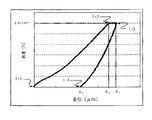
- FIG. 3 is a load-displacement curve in a minute compression test for toner.
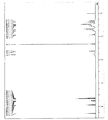
- FIG. 3 is a diagram showing a 1 H-NMR spectrum of dye compound D1 in chloroform-d at room temperature and 400 MHz.
- R 1 represents an alkyl group or an aryl group
- R 2 represents a hydrogen atom, a cyano group, or —CONH 2
- R 3 represents an alkyloxy group, an alkenyloxy group, an aryloxy group, or an aralkyl group.
- R 8 and R 9 each independently represents a hydrogen atom, an alkyl group, an aryl group, an alkenyl group, or an aralkyl group; and —NR 8 R 9 represents a complex R 4 , R 5 , R 6 and R 7 each independently represent a hydrogen atom, a halogen atom, —CF 3 , —NO 2 , an alkyl group, or an alkyl group. Represents an oxy group.
- the present inventors use a colorant containing a coloring compound having a structure represented by the above formula (1) and produce a toner having the above characteristics. As a result, it was found that a yellow toner having both good developability and excellent fixability was provided, and the present invention was achieved.
- R 1 is an alkyl group or an aryl group, for example, include the following. Methyl group, ethyl group, n-propyl group, isopropyl group, n-butyl group, sec-butyl group, tert-butyl group and 2-ethylhexyl group, phenyl group and naphthyl group.
- R 1 represents an alkyl group or an aryl group as described above, and these may be further substituted with a substituent.
- a nonionic group such as an alkyl group, a halogen atom, —CF 3 , and —NO 2 is preferable.
- R 1 is a methyl group or a phenyl group.
- R 2 represents a hydrogen atom, a cyano group, or —CONH 2 , and is preferably a cyano group from the viewpoint of light resistance and easy availability of raw materials.
- R 3 represents an alkyloxy group, an alkenyloxy group, an aryloxy group, an aralkyloxy group, or —NR 8 R 9 . Although it does not specifically limit as said alkyloxy group in said R ⁇ 3 >, For example, the following are mentioned.
- the alkenyloxy group in R 3 is not particularly limited, and examples thereof include a 2-propene-1-oxy group, a 3-butene-2-oxy group, a 1-pentene-3-oxy group, and A 3,7-dimethyl-6-octene-1-oxy group may be mentioned.
- the aryloxy group for R 3 is not particularly limited, and examples thereof include the following. Phenoxy group, methylphenoxy group, dimethylphenoxy group, methoxyphenoxy group, chlorophenoxy group, bromophenoxy group, fluorophenoxy group, trifluoromethylphenoxy group, naphthyloxy group, and 4-octylphenoxy group.
- the aralkyloxy group for R 3 is not particularly limited, and examples thereof include a benzyloxy group and a diphenylmethoxy group.
- R 3 represents any one of the above alkyloxy group, alkenyloxy group, aryloxy group, and aralkyloxy group, and these may be further substituted with a substituent.
- a substituent a nonionic group such as an alkyl group, a halogen atom, —CF 3 , and —NO 2 is preferable.
- R 3 may be —NR 8 R 9 .
- R 8 and R 9 each independently represents a hydrogen atom, an alkyl group, an aryl group, an alkenyl group, or an aralkyl group.
- R 8 and R 9 may be linked to form a heterocyclic ring.
- the alkyl group for R 8 and R 9 is not particularly limited, and examples thereof include a methyl group, an ethyl group, an n-propyl group, an isopropyl group, an n-butyl group, a sec-butyl group, and a tert-butyl group.
- Examples of the alkenyl group in R 8 and R 9 include a vinyl group, a 1-propenyl group, a 2-propenyl group, a 1-butenyl group, a 2-butenyl group, a 3-butenyl group, a 1-cyclohexenyl group, and 2- A cyclohexenyl group is mentioned.
- Examples of the aryl group in R 8 and R 9 include a phenyl group and a naphthyl group, and examples of the aralkyl group include a benzyl group and a phenethyl group.
- R 8 and R 9 may form a heterocyclic ring with a nitrogen atom.
- Specific examples of the heterocyclic ring formed by R 8 and R 9 together with the nitrogen atom include a piperazine ring, a piperidine ring, a pyrrolidine ring, and a morpholine ring.
- R 8 and R 9 represent an alkyl group, an aryl group, an alkenyl group, and an aralkyl group as described above, and these may be further substituted with a substituent.
- the substituent which may be substituted is preferably a nonionic group such as an alkyl group, a halogen atom, —CF 3 , and —NO 2 .
- R 3 is —NR 8 R 9 from the viewpoint of ease of synthesis.
- R 8 and R 9 are preferably each independently an alkyl group.
- R 8 and R 9 are preferably such that the total number of carbon atoms of R 8 and R 9 is 12 or more from the viewpoint of solubility in organic solvents (including polymerizable monomers such as styrene). From the viewpoint of ease, it is preferably 24 or less.
- R 4 , R 5 , R 6 and R 7 each independently represent a hydrogen atom, a halogen atom, —CF 3 , —NO 2 , an alkyl group or an alkyloxy group.
- halogen atom in R 4 , R 5 , R 6 and R 7 examples include a fluorine atom, a chlorine atom, a bromine atom and an iodine atom.
- a fluorine atom a chlorine atom, a bromine atom and an iodine atom.
- R ⁇ 4 >, R ⁇ 5 >, R ⁇ 6 > and R ⁇ 7 > examples include the following are mentioned, respectively.
- R 4 , R 5 , R 6 and R 7 may be alkyloxy groups, and in this case, there is no particular limitation.
- R 4 , R 5 , R 6 and R 7 represent an alkyl group or an alkyloxy group as described above, and these may be further substituted with a substituent.
- the substituent is preferably a nonionic group such as an alkyl group, a halogen atom, —CF 3 , and —NO 2 .
- What is preferable as R 4 , R 5 , R 6 and R 7 is a hydrogen atom from the viewpoint of easy availability of raw materials and light resistance.
- the dye compound having the structure represented by the above formula (1) has a structure represented by the following formula (2).
- the dye compound is more preferable.
- R 1 represents a methyl group or a phenyl group
- R 8 and R 9 each independently represents an alkyl group
- R 8 and R 9 represent a heterocyclic ring formed with a nitrogen atom
- the total number of carbon atoms of R 8 and R 9 are 12 or more 24 or less.
- the dye compound having the structure represented by the above formula (1) or (2) can be synthesized by a known method.
- a diazo component having a structure represented by the following formula (3) and a pyridone compound having a structure represented by the following formula (4) may be diazo coupled. Specifically, first, an aqueous sodium nitrite solution is added to diazo component having a structure represented by the following formula (3) in hydrochloric acid to diazotize. And after diazotizing, this is made to react with the pyridone compound which has a structure represented by following formula (4), and a coupling reaction is performed. Furthermore, the coloring matter compound which has the structure represented by the said Formula (1) or (2) of desired purity can be obtained by refine
- the yellow toner of the present invention is a yellow toner having toner particles containing at least a binder resin, a colorant and a polar resin, and the colorant is a dye compound having a structure represented by the above formula (1).
- One characteristic is to be.
- the method for producing the toner particles is not particularly limited, and examples thereof include a pulverization method, a suspension polymerization method, and an emulsion polymerization method.
- a pulverization method a suspension polymerization method
- an emulsion polymerization method a dye compound having a structure represented by the above formula (1) that does not cause polymerization inhibition. It is.
- the colorant used in the toner of the present invention is selected from the viewpoints of hue angle, saturation, brightness, light resistance, OHP transparency, and dispersibility in the toner.
- the colorant is preferably used in an amount of 1 to 20 parts by mass with respect to 100 parts by mass of the binder resin.
- the content of the dye compound having the structure represented by the above formula (1) is preferably 0.5 to 10 parts by mass with respect to 100 parts by mass of the binder resin.
- the toner of the present invention preferably contains a yellow pigment as another colorant in addition to the dye compound having the structure represented by the above formula (1).
- the yellow pigment include monoazo pigments, disazo pigments, and polyazo pigments. Specific examples include the following. C. I. Pigment yellow 12, C.I. I. Pigment yellow 13, C.I. I. Pigment yellow 14, C.I. I. Pigment yellow 15, C.I. I. Pigment yellow 17, C.I. I. Pigment yellow 62, C.I. I. Pigment yellow 74, C.I. I. Pigment yellow 83, C.I. I. Pigment yellow 93, C.I. I. Pigment yellow 94, C.I. I. Pigment yellow 95, C.I. I.
- Pigment yellow 97 C.I. I. Pigment yellow 109, C.I. I. Pigment yellow 110, C.I. I. Pigment yellow 111, C.I. I. Pigment yellow 120, C.I. I. Pigment yellow 127, C.I. I. Pigment yellow 128, C.I. I. Pigment yellow 129, C.I. I. Pigment yellow 147, C.I. I. Pigment yellow 151, C.I. I. Pigment yellow 154, C.I. I. Pigment yellow 155, C.I. I. Pigment yellow 168, C.I. I. Pigment yellow 174, C.I. I. Pigment yellow 175, C.I. I. Pigment yellow 176, C.I. I.
- Pigment yellow 180 C.I. I. Pigment yellow 181, C.I. I. Pigment yellow 185, C.I. I. Pigment yellow 191, C.I. I. Pigment Yellow 194.
- C.I. I. Pigment Yellow 74 C.I. I. Pigment Yellow 93
- the yellow pigment content is preferably 1 to 20 parts by mass with respect to 100 parts by mass of the binder resin.
- binder resin used in the yellow toner of the present invention examples include commonly used styrene-acrylic copolymers, styrene-methacrylic copolymers, epoxy resins, styrene-butadiene copolymers and the like.
- a vinyl polymerizable monomer capable of radical polymerization can be used.
- a monofunctional polymerizable monomer or a polyfunctional polymerizable monomer can be used as the vinyl polymerizable monomer.
- Styrene Styrenic monomers such as o- (m-, p-) methylstyrene, m- (p-) ethylstyrene; methyl acrylate, methyl methacrylate, ethyl acrylate, ethyl methacrylate, propyl acrylate, Propyl methacrylate, butyl acrylate, butyl methacrylate, octyl acrylate, octyl methacrylate, dodecyl acrylate, dodecyl methacrylate, stearyl acrylate, stearyl methacrylate, behenyl acrylate, behenyl methacrylate, 2-ethylhexyl acrylate, Acrylic ester monomers such as 2-ethylhexyl methacrylate, dimethylaminoethyl acrylate
- These polymerizable monomers may be used alone or in general mixed as appropriate with reference to the theoretical glass transition temperature (Tg) described in the publication Polymer Handbook 2nd edition III-p139 to 192 (manufactured by John Wiley & Sons). Used.
- Tg glass transition temperature
- the yellow toner of the present invention is subjected to a maximum load of 2.94 ⁇ 10 ⁇ 4 N at a load speed of 9.8 ⁇ 10 ⁇ 5 N / sec at a measurement temperature of 25 ° C. in a minute compression test for the toner. After completion, the displacement amount ( ⁇ m) when left for 0.1 seconds is removed at maximum displacement amount X 3 (25) , left for 0.1 seconds, and unloaded at 9.8 ⁇ 10 ⁇ 5 N / sec.
- the yellow toner of the present invention has a maximum load of 2.94 ⁇ 10 ⁇ 4 N at a measurement speed of 50 ° C. and a toner particle load rate of 9.8 ⁇ 10 ⁇ 5 N / sec in a minute compression test for the toner.
- the displacement amount ( ⁇ m) at the time of leaving for 0.1 second after finishing the application is the maximum displacement amount X 3 (50) .
- the unloading speed is 9.8 ⁇ 10 ⁇ 5 N / sec.
- FIG. 3 shows a profile (load-displacement curve) when the yellow toner of the present invention is measured in a micro compression test.
- the horizontal axis represents the amount of displacement of the toner and the vertical axis represents the amount of load applied to the toner.
- an ultra micro hardness tester ENT1100 manufactured by Elionix Co., Ltd. was used for the micro compression test in the present invention.
- the working indenter was measured using a 20 ⁇ m ⁇ 20 ⁇ m square flat indenter.
- 1-1 is an initial state before starting the test, and a load was applied at a speed of 9.8 ⁇ 10 ⁇ 5 N / sec with respect to the maximum load of 2.94 ⁇ 10 ⁇ 4 N.
- the state was 1-2, and the displacement at this time was X 2 ( ⁇ m).
- X 3 the maximum displacement
- the load When the value becomes 0N, the state is 1-4.
- the amount of displacement at this time was X 4 ( ⁇ m).
- the value of Z (50) (hereinafter also referred to as the restoration rate Z (50)) is measured in the same manner as the measurement method of Z (25) except that the measurement is performed at a temperature of 50 ° C. as described above. It is a value.
- a toner is applied on a ceramic cell, and weak air is blown so that the toner is dispersed on the cell.
- the cell is set in the apparatus and measured.
- the cell was brought into a temperature-controllable state, and the temperature of this cell was taken as the measurement temperature. That is, Z (25) was measured at a cell temperature of 25 ° C., and Z (50) was measured at a cell temperature of 50 ° C.
- the toner was dispersed on the cell, and then the cell was placed on the main body. Thereafter, after the cell reached the measurement temperature, it was allowed to stand for 10 minutes or more, and then the measurement was started.
- a toner having one toner particle on a measurement screen (horizontal width: 160 ⁇ m, vertical width: 120 ⁇ m) was selected.
- the number average particle diameter d1 of the toner is ⁇ 0.2 ⁇ m and measured.
- An arbitrary toner is selected from the measurement screen.
- the toner particle diameter measuring means on the measurement screen measures the major axis and minor axis of the toner particles using the software attached to the microhardness meter ENT1100.
- a toner having an aspect ratio [(major axis + minor axis) / 2] obtained from the formula (d1) of ⁇ 0.2 ⁇ m was selected and measured.
- the method for measuring the number average particle diameter (d1) of the toner is as follows.
- a precise particle size distribution measuring device “Coulter Counter Multisizer 3” registered trademark, manufactured by Beckman Coulter, Inc.
- a pore electrical resistance method equipped with a 100 ⁇ m aperture tube is used.
- attached dedicated software “Beckman Coulter Multisizer 3 Version 3.51” (manufactured by Beckman Coulter, Inc.) is used.
- the measurement is performed with 25,000 effective measurement channels.
- the electrolytic aqueous solution used for the measurement special grade sodium chloride is dissolved in ion-exchanged water so as to have a concentration of about 1% by mass, for example, “ISOTON II” (manufactured by Beckman Coulter, Inc.) can be used.
- ISOTON II manufactured by Beckman Coulter, Inc.
- the dedicated software was set as follows. On the “Change Standard Measurement Method (SOM)” screen of the dedicated software, set the total count in the control mode to 50000 particles, set the number of measurements once, and set the Kd value to “standard particles 10.0 ⁇ m” (Beckman Coulter, Inc.) Set the value obtained using By pressing the “Threshold / Noise Level Measurement Button”, the threshold and noise level are automatically set.
- SOM Change Standard Measurement Method
- the current is set to 1600 ⁇ A
- the gain is set to 2
- the electrolyte is set to ISOTON II
- the “aperture tube flush after measurement” is checked.
- the bin interval is set to logarithmic particle size
- the particle size bin is set to 256 particle size bin
- the particle size range is set to 2 ⁇ m to 60 ⁇ m.
- the specific measurement method is as follows. (1) About 200 ml of the electrolytic solution is placed in a glass 250 ml round bottom beaker exclusively for Multisizer 3, set on a sample stand, and the stirrer rod is stirred counterclockwise at 24 rpm.
- the height position of a beaker is adjusted so that the resonance state of the liquid level of the electrolyte solution in a beaker may become the maximum.
- (5) In a state where the electrolytic aqueous solution in the beaker of (4) is irradiated with ultrasonic waves, about 10 mg of toner is added to the electrolytic aqueous solution little by little and dispersed. Then, the ultrasonic dispersion process is continued for another 60 seconds. In the ultrasonic dispersion, the temperature of the water tank is adjusted as appropriate so that the water temperature is 10 ° C. or higher and 40 ° C. or lower.
- the electrolyte aqueous solution (5) in which the toner is dispersed is dropped using a pipette, and the measured concentration is adjusted to about 5%. . Measurement is performed until the number of measured particles reaches 50,000. (7) The measurement data is analyzed with the dedicated software attached to the apparatus, and the number average particle diameter (d1) is calculated. The “average diameter” on the “analysis / number statistics (arithmetic average)” screen when the graph / number% is set in the dedicated software is the number average particle diameter (d1).
- the micro compression test method used in the present invention applies a maximum load of 2.94 ⁇ 10 ⁇ 4 N to the toner.
- the hardness and the restoration rate in the vicinity of the toner surface are measured by applying a small load as compared with the conventional measuring method.
- the minute compression test for the toner by setting the value of the restoration rate Z (25) within the range of the present invention, it is possible to realize both low-temperature toner fixability and durability.
- the toner particles have a shell layer with an optimum hardness, so that the durability is improved and the core layer can be designed to be sufficiently soft, Improvements such as low-temperature fixability and image gloss can also be realized.
- a core-shell structure is formed in the toner particles, the adhesiveness between the core layer and the shell layer is high, and the toughness against external factors at the time of pressurizing the toner is high at room temperature.
- the storability is improved because the core component (especially wax) has bleeding properties when the toner is heated.
- the toner of the present invention since the value of the restoration rate Z (25) is 40 or more, the toner is less likely to be deformed due to stress received in the developing device. Moreover, high temperature offset property improves. On the other hand, when the value of the restoration rate Z (25) is less than 80, the bleedability of the wax does not deteriorate in the fixing step, and offset on the low temperature side hardly occurs and the low temperature fixability is excellent. Also, the image gloss is improved. In addition, since the toner particle surface is not too hard, it is easy for the external additive to adhere to the toner particle surface, and when a large number of printouts are made, it becomes difficult for the external additive on the toner surface to be released, and developability. And transferability tends to be improved.
- the value of the restoration rate Z (50) at a measurement temperature of 50 ° C. is set to 10 to 35. It can suppress more favorably.
- the restoration rate Z (25) and the restoration rate Z (50) can satisfy the above relationship by using, for example, the following method, but are not limited thereto.
- (1) When the toner particles are produced in an aqueous medium, the toner particles contain a polar resin, which will be described later, to form a shell layer made of the polar resin. At this time, the polar resin is selected in consideration of compatibility with the binder resin forming the core layer.
- a monomer constituting the polar resin is added and seed polymerization is performed to form a shell layer.
- Polar resin fine particles having a volume average particle size smaller than that of the core particles are mechanically attached to the core particles.
- polar resin fine particles having a volume average particle size smaller than that of the core particles in the aqueous medium are adhered to the core particles, and then fixed by a heating process.
- the glass transition temperature measured by a differential scanning calorimetry (DSC) apparatus of toner
- DSC differential scanning calorimetry
- the temperature (P1) of the maximum endothermic peak measured by a differential scanning calorimetry (DSC) apparatus of the toner is 70 ° C. to 90 ° C.
- the above TgA and P1 satisfy the relationship of 15 ° C. ⁇ P1 ⁇ TgA ⁇ 50 ° C.
- the preferable range of TgA is 40 ° C to 55 ° C, and the more preferable range is 40 ° C to 50 ° C.
- the preferable range of said P1 is 70 to 85 degreeC, and a more preferable range is 70 to 80 degreeC.
- the preferable range of P1-TgA is 15 ° C. to 40 ° C., and the more preferable range is 20 ° C. to 40 ° C.
- the TgA is 40 ° C. to 60 ° C.
- the adhesion of the toner to the paper during fixing at a low temperature is improved, and the low-temperature fixability is improved.
- P1 is 70 ° C. to 90 ° C.
- the winding property at high temperature is improved due to the moderate bleeding property of the wax.
- the adhesion effect with the paper is improved by the plastic effect of the toner by the wax, and the low-temperature fixability is improved.
- the temperature difference between P1 and TgA is 15 ° C. to 50 ° C.
- the bleed of the wax to the toner surface is optimized, the temperature range where the toner can be fixed is widened, and the winding property is improved.
- TgA, P1 and (P1-TgA) can be adjusted to the above range by adjusting the type and addition amount of the wax and the type and addition amount of the binder resin, but are not limited thereto. It is not a thing.
- the TgA and P1 were measured using a differential scanning calorimeter (DSC measuring apparatus) Q1000 (manufactured by TA Instruments Japan) according to ASTM D3418-82 under the following method and conditions.
- ⁇ Measurement conditions and method> (1) Use modulated mode. (2) Equilibrate at a temperature of 20 ° C. for 5 minutes. (3) Using a modulation of 1.0 ° C / min, the temperature is increased to 140 ° C at 1 ° C / min. (4) Equilibrate at a temperature of 140 ° C. for 5 minutes. (5) The temperature is lowered to 20 ° C. About 3 mg of the measurement sample is accurately weighed.
- the sample is put in an aluminum pan, and an empty aluminum pan is used as a control, and measurement is performed at a temperature rising rate of 1 ° C./min within a measurement range of 20 to 140 ° C.
- the TgA and P1 were determined from the peak position of the DSC curve at the first temperature increase.
- the glass transition temperature (TgA) was the temperature at the intersection of the line connecting the midpoint of the baseline before and after the change in specific heat in the DSC curve at the first temperature increase and the DSC curve.
- the maximum endothermic peak temperature (P1) of the toner is a temperature showing a maximum value in the endothermic peak. When there are a plurality of endothermic peaks, the one having the highest height from the base line in the endothermic peak region was defined as the maximum endothermic peak.
- the toner of the present invention preferably has a viscosity at a temperature of 100 ° C. (hereinafter also referred to as melt viscosity) of 3.0 ⁇ 10 3 Pa ⁇ s to 2.0 ⁇ 10 4 Pa ⁇ s by a flow tester temperature raising method. . More preferably, it is 3.0 ⁇ 10 3 Pa ⁇ s to 1.0 ⁇ 10 4 Pa ⁇ s.
- melt viscosity of the toner is 3.0 ⁇ 10 3 Pa ⁇ s to 2.0 ⁇ 10 4 Pa ⁇ s, wrapping or the like in the fixing device is prevented by appropriate wax bleeding. Further, the adhesion to paper is improved and the low-temperature fixability is improved.
- the melt viscosity can satisfy the above relationship by adjusting the glass transition temperature of the binder resin of the toner and the temperature of the maximum endothermic peak of the wax, but is not limited thereto.
- the value of Z (25) satisfies the above range, the core-shell structure is formed, and the adhesion between the core layer and the shell layer is high. For this reason, even in a toner whose melt viscosity is set to be relatively low so as to satisfy the prescribed melt viscosity, durability and storage stability are not easily lowered.
- the melt viscosity of the toner was measured by the following method. As described above, the melt viscosity of the toner in the present invention is a viscosity of 100 ° C. according to the toner flow tester temperature raising method. The measurement was performed using a flow tester CFT-500D (manufactured by Shimadzu Corporation) under the following conditions according to the operation manual of the apparatus. Sample: About 1.1 g of toner is weighed and molded with a pressure molding machine to obtain a sample.
- the toner particles used in the present invention are toner particles produced by polymerizing a polymerizable monomer composition containing at least a polymerizable monomer, a colorant, and a polar resin in an aqueous medium. Is preferred.
- the toner particles are more preferably toner particles produced by a suspension polymerization method.
- the toner particles used in the present invention are directly produced by suspension polymerization or the like, a polymerization reaction is performed after a polar resin is contained in the polymerizable monomer composition.
- the added polar resin forms a thin shell on the surface of the toner particles according to the balance of polarity exhibited by the polymerizable monomer composition serving as toner particles and the aqueous dispersion medium, and the toner having a core-shell structure Particles are obtained.
- the polar resin used in the present invention has an acid value of 3.0 mgKOH / g to 40.0 mgKOH / g, a peak molecular weight of 3,000 to 250,000, and a value of Mw / Mn of 1.3 to 4 If it has the property which is 0.0, it will not specifically limit.
- Specific examples include polycarbonate resins, polyester resins, epoxy resins, styrene-acrylic acid copolymers, styrene-methacrylic acid copolymers, and styrene-maleic acid copolymers having the above properties.
- the acid value is 3.0 mgKOH / g to 40.0 mgKOH / g
- the peak molecular weight is 3,000 to 50,000
- the value of Mw / Mn is 1.3 to 3.0.
- Styrene-methacrylic acid copolymers and styrene-acrylic acid copolymers are preferred because the amount added during toner production can be freely controlled.
- a preferable addition amount of the polar resin is 1 part by mass to 30 parts by mass with respect to 100 parts by mass of the binder resin. If the addition amount is within the above range, it is preferable because the charge amount distribution of the toner can be kept sharp and good fixability can be obtained.
- the compatibility of the toner with the binder resin is improved.
- the polar resin tends to exist with an inclination from the surface of the toner particle toward the center, the adhesion between the core layer and the shell layer is increased, and the durability of the toner tends to be further improved.
- the surface of the toner particles is affected by the pH of the aqueous medium and the dispersing agent in the process of exposing the toner particles to the aqueous medium.
- the colorant in the toner particles may be deposited on the surface of the toner particles.
- the storage stability of the toner is obtained by using the dye compound having the structure represented by the above formula (1) used in the present invention and making the relationship between the P1 and TgA within the range of the present invention. Can be improved.
- the shell layer is reliably formed by the polar resin, the colorant is appropriately retained in the toner particles.
- the contamination by the colorant on the regulating member and the photoreceptor in the development process can be reduced.
- the fact that the colorant hardly deposits on the surface of the toner particles also means that the colorant can be encapsulated inside the toner particles, so that the light resistance of the colorant is also improved. It is considered that this is because the resin on the toner particle surface blocks light transmission and reduces damage to the colorant.
- a weak hydrogen bond is generated between the oxygen atom of the carbonyl group (—CO—) to which R 3 is bonded and the hydrogen atom of the hydroxy group (—OH) located at the para position of R 2 .
- the dye compound is hardly deteriorated by heat or light, and the light resistance is improved.
- the toner using the coloring compound can keep the values of Z (25) and Z (50) within a suitable range even when used for a long period of time.
- the dye compound Since the hydrogen bond is weak, the dye compound as a whole behaves as a nonpolar substance. For this reason, the dye compound hardly migrates and diffuses into a polar medium such as an aqueous medium. As a result, it is possible to effectively suppress a reduction in toner coloring power and member contamination.
- the peak molecular weight and molecular weight distribution were measured by the following measuring methods.
- a measurement sample was prepared as follows.
- the toner to be measured and tetrahydrofuran (THF) were mixed at a concentration of 5 mg / ml, left at room temperature for 5 hours, and then shaken sufficiently to remove THF and the sample until the samples were not united. Mix well. Furthermore, it left still at room temperature for 24 hours.
- a sample processing filter Mysholy disk H-25-2 manufactured by Tosoh Corporation, Excrodisk 25CR manufactured by Gelman Science Japan
- GPC gel permeation chromatography
- the molecular weight distribution and peak molecular weight of the prepared sample were measured using a GPC measuring apparatus (HLC-8120 GPC manufactured by Tosoh Corporation) under the following measurement conditions according to the operation manual of the apparatus.
- Eluent THF Flow rate: 1.0 ml / min Oven temperature: 40.0 ° C
- Sample injection amount 0.10 ml
- a calibration curve was obtained from standard polystyrene resin (TSK Standard Polystyrene F-850, F-450, F-288, F-128, F-80, F-40, F-20 manufactured by Tosoh Corporation).
- the acid value (mgKOH / g) of polar resin was measured with the following method, and it calculated
- Acid value [(sample end point ⁇ blank end point) ⁇ 1.009 ⁇ 56 ⁇ 1/10] / sample mass (sample preparation)
- sample preparation [(sample end point ⁇ blank end point) ⁇ 1.009 ⁇ 56 ⁇ 1/10] / sample mass (sample preparation)
- sample preparation Weigh accurately 1.0 g of sample in a 200 ml beaker, dissolve in 120 ml of toluene while stirring with a stirrer, and add 30 ml of ethanol.
- an automatic potentiometric titrator AT-400WIN manufactured by Kyoto Electronics Industry Co., Ltd.
- the setting of the apparatus is intended for a sample dissolved in an organic solvent.
- the glass electrode and the comparative electrode used were compatible with organic solvents.
- Product code # 100-H112 (manufactured by Kyoto Electronics Co., Ltd.) was used as the pH glass electrode.
- Product code # 100-R115 (manufactured by Kyoto Electronics Co., Ltd.) was used as the cork-type reference electrode.
- As the internal solution a 3.3 mol / KCl solution was used. (Measurement procedure)
- the prepared sample was set in the autosampler of the apparatus, and the electrode was immersed in the sample solution. Next, a titrant (0.1 mol / liter-KOH (ethanol solution)) is set on the sample solution, and 0.05 ml each is dropped by automatic intermittent titration. did.
- the toner of the present invention may contain a release agent.
- the release agent include the following. Petroleum wax such as paraffin wax, microcrystalline wax, petrolatum and derivatives thereof; montan wax and derivatives thereof; hydrocarbon wax and derivatives thereof according to the Fischer-Tropsch method; polyolefin wax such as low molecular weight polyethylene wax and low molecular weight polypropylene wax and derivatives thereof , Natural waxes such as carnauba wax and candelilla wax and their derivatives. Examples of the derivatives include oxides, block copolymers with vinyl monomers, and graft modified products. Furthermore, the following are mentioned.
- ester wax and hydrocarbon wax are particularly preferred from the viewpoint of excellent releasability. Further, in order to easily control the core-shell structure in the toner of the present invention and to easily exhibit the effects of the present invention, it is more preferable to use a hydrocarbon wax.
- the content of the release agent is preferably 5 parts by mass to 25 parts by mass with respect to 100 parts by mass of the binder resin.
- the content of the release agent is 5 parts by mass to 25 parts by mass, the winding property is improved by having an appropriate bleeding property of the release agent at the time of heating and pressurizing the toner. Further, even when the toner is subjected to stress during development or transfer, exposure of the release agent to the toner surface is small, and uniform triboelectric chargeability of the toner particles can be obtained.
- the amount of the polymerization initiator used varies depending on the desired degree of polymerization, but is generally 3 to 20 parts by mass with respect to 100 parts by mass of the polymerizable vinyl monomer.
- the kind of the polymerization initiator varies slightly depending on the polymerization method, but is used alone or in combination with reference to the 10-hour half-life temperature.
- a polymer or copolymer having a sulfonic acid group, a sulfonic acid group or a sulfonic acid ester group it is particularly preferable to use a polymer or copolymer having a sulfonic acid group, a sulfonic acid group or a sulfonic acid ester group.
- Monomers having a sulfonic acid group, a sulfonic acid group or a sulfonic acid ester group for producing the above polymer are styrene sulfonic acid, 2-acrylamido-2-methylpropane sulfonic acid, 2-methacrylamide-2-methyl. Examples thereof include propane sulfonic acid, vinyl sulfonic acid, methacryl sulfonic acid and alkyl esters thereof.
- the polymer containing a sulfonic acid group, a sulfonic acid group or a sulfonic acid ester group used in the present invention may be a homopolymer of the above monomer, but the above monomer and another monomer. And a copolymer thereof.
- a monomer that forms a copolymer with the above monomer there is a vinyl polymerizable monomer, and a monofunctional polymerizable monomer or a polyfunctional polymerizable monomer can be used.
- a charge control agent may be added to the toner of the present invention as necessary, but a colorless toner is preferable from the viewpoint of color developability.
- the charge control agent include those having a quaternary ammonium salt structure and those having a calixarene structure.
- the formulation of the charge control agent contributes to stabilization of charge characteristics and control of the triboelectric charge amount according to the development system.
- the charge control agent a known one can be used, and a charge control agent that has a high charging speed and can stably maintain a constant charge amount is particularly preferable.
- a charge control agent having a low polymerization inhibitory property and substantially free from a solubilized product in an aqueous dispersion medium is particularly preferable.
- the charge control agent examples include organometallic compounds and chelate compounds that control the toner to be negatively charged. Specifically, monoazo metal compound; acetylacetone metal compound; aromatic oxycarboxylic acid, aromatic dicarboxylic acid, oxycarboxylic acid, dicarboxylic acid-based metal compound; aromatic oxycarboxylic acid, aromatic mono- and polycarboxylic acid And metal salts, anhydrides, esters thereof; and phenol derivatives such as bisphenol. Furthermore, urea derivatives, metal-containing salicylic acid compounds, metal-containing naphthoic acid compounds, boron compounds, quaternary ammonium salts, calixarene, resin-based charge control agents, and the like can be given.
- examples of controlling the toner to be positively charged include the following. Nigrosine-modified products with nigrosine and fatty acid metal salts, etc .; guanidine compounds; imidazole compounds; quaternary ammonium salts such as tributylbenzylammonium-1-hydroxy-4-naphthosulfonate, tetrabutylammonium tetrafluoroborate, and the like
- Onium salts such as phosphonium salts and lake pigments thereof; triphenylmethane dyes and lake pigments thereof (as rake agents, phosphotungstic acid, phosphomolybdic acid, phosphotungsten molybdic acid, tannic acid, lauric acid, gallic acid) Acids, ferricyanides, ferrocyanides, etc.); metal salts of higher fatty acids; resin-based charge control agents.
- the toner of the present invention can contain these charge control agents alone or in combination of two or more.
- charge control agents in order to further improve the effects of the present invention, a metal-containing salicylic acid compound is preferable, and the metal is particularly preferably aluminum or zirconium.
- the most preferred charge control agent includes an aluminum 3,5-di-tert-butylsalicylate compound.
- the blending amount of the charge control agent is preferably 0.01 to 20 parts by mass, and more preferably 0.5 to 10 parts by mass with respect to 100 parts by mass of the binder resin.
- inorganic fine particles and organic fine particles may be externally added for the purpose of improving the fluidity of the toner (fluidity improver) and uniformizing the charge of the toner.
- fine particles added externally silica fine particles, titania fine particles and the like are preferably used. These have a number average primary particle diameter of preferably 4 nm to 80 nm, more preferably 10 nm to 50 nm.
- the externally added fine particles are preferably added in an amount of 0.1 to 20 parts by mass with respect to 100 parts by mass of the toner particles.
- the inorganic fine particles externally added to the toner particles used in the present invention are preferably silica fine particles, and more preferably silica fine particles having a number average primary particle size of 4 nm to 80 nm.
- the number average primary particle size of the silica fine particles is in the above range, the fluidity of the toner is improved and the storage stability of the toner tends to be improved.
- silica fine particles examples include both dry silica produced by vapor phase oxidation of silicon halide or dry silica called fumed silica, and wet silica produced from water glass or the like.
- silica fine particles dry silica having less silanol groups on the surface and inside the silica fine particles and few production residues such as Na 2 O and SO 3 2 ⁇ is more preferable.
- dry silica can be used to obtain composite fine particles of silica and other metal oxides by using other metal halogen compounds such as aluminum chloride and titanium chloride together with silicon halogen compounds in the production process.
- the silica fine particles in the present invention include those composite fine particles.
- the fine particles can be provided with functions such as adjustment of the charge amount of the toner, improvement of environmental stability, and improvement of characteristics in a high humidity environment by the hydrophobic treatment. It is preferable to use it.
- the fine particles added to the toner absorb moisture, the charge amount as the toner tends to decrease, and the developability and transferability may decrease.
- Examples of the treating agent for hydrophobizing the fine particles include unmodified silicone varnish, various modified silicone varnishes, unmodified silicone oil, various modified silicone oils, silane compounds, silane coupling agents, other organosilicon compounds, organic Titanium compounds are included. These treatment agents may be used alone or in combination. Among these, fine particles treated with silicone oil are preferable. More preferably, the fine particles are treated with silicone oil at the same time or after the hydrophobic treatment with the coupling agent.
- the hydrophobized fine powder is good for maintaining a high triboelectric charge amount of toner particles even in a high humidity environment and reducing selective developability.
- the dispersant used in preparing the aqueous dispersion medium in the suspension polymerization method known inorganic and organic dispersants can be used.
- the inorganic dispersant include the following. Tricalcium phosphate, magnesium phosphate, aluminum phosphate, zinc phosphate, magnesium carbonate, calcium carbonate, calcium hydroxide, magnesium hydroxide, aluminum hydroxide, calcium metasilicate, calcium sulfate, barium sulfate, bentonite, silica, alumina .
- examples of the organic dispersant include polyvinyl alcohol, gelatin, methylcellulose, methylhydroxypropylcellulose, ethylcellulose, sodium salt of carboxymethylcellulose, and starch.
- nonionic, anionic, and cationic surfactants when preparing the aqueous dispersion medium, commercially available nonionic, anionic, and cationic surfactants can be used. The following are mentioned as said surfactant.
- an inorganic poorly water-soluble dispersant is preferable, and it is more preferable to use a poorly water-soluble inorganic dispersant that is soluble in an acid.
- the amount of these dispersants used is 0.2 to 2 parts by mass with respect to 100 parts by mass of the polymerizable vinyl monomer. It is preferably 0 parts by mass.
- a commercially available dispersant when preparing an aqueous dispersion medium in which the poorly water-soluble inorganic dispersant as described above is dispersed, a commercially available dispersant may be used as it is. Further, in order to obtain dispersant particles having a fine uniform particle size, the above-mentioned poorly water-soluble inorganic dispersant may be produced in a liquid medium such as water under high speed stirring to prepare an aqueous dispersion medium.
- a preferred dispersant can be obtained by mixing aqueous sodium phosphate solution and aqueous calcium chloride solution at high speed to form fine particles of tricalcium phosphate. .
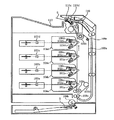
- FIG. 1 is a cross-sectional view of a tandem color printer using an electrophotographic process.
- reference numeral 101 denotes a drum-type electrophotographic photosensitive member (hereinafter referred to as a photosensitive drum) as a latent image carrier that rotates in a direction indicated by an arrow (counterclockwise) at a predetermined process speed.
- the photosensitive drums 101a, 101b, 101c, and 101d respectively share the yellow (Y) component, magenta (M) component, cyan (C) component, and black (Bk) component of the color image.
- the Y, M, C, and Bk image forming apparatuses are referred to as a unit a, a unit b, a unit c, and a unit d, respectively.
- These photosensitive drums 101a to 101d are rotationally driven by a drum motor (DC servo motor) (not shown), but independent driving sources may be provided for the respective photosensitive drums 101a to 101d.
- the rotational drive of the drum motor is controlled by a DSP (digital signal processor) (not shown), and other control is performed by a CPU (not shown).
- the electrostatic adsorption conveyance belt 109a is stretched around a driving roller 109b, fixed rollers 109c and 109e, and a tension roller 109d. .
- unit a yellow of the four colors will be described as an example.
- the photosensitive drum 101a is uniformly charged to a predetermined polarity and potential by the primary charging means 102a during its rotation.
- the photosensitive drum 101a is exposed to a light image by a laser beam exposure means (hereinafter referred to as a scanner) 103a, and an electrostatic latent image of image information is formed on the photosensitive drum 101a.
- a toner image is formed on the photosensitive drum 101a by the developing unit 104a, and the electrostatic latent image is visualized. Similar steps are performed for the other three colors (magenta (B), cyan (C), and black (Bk)).
- the four-color toner images are synchronized by the registration rollers 108c that stop and re-transport the recording medium S conveyed by the paper feed roller 108b at a predetermined timing, and the photosensitive drums 101a to 101d and the electrostatic adsorption conveyance belt 109a.
- the toner images are sequentially transferred to the recording medium S at the nip portion.
- the photosensitive drums 101a to 101d after the transfer of the toner image to the recording medium S are subjected to repeated image formation by removing residual deposits such as transfer residual toner by the cleaning means 106a, 106b, 106c and 106d. .
- the recording medium S on which the toner images are transferred from the four photosensitive drums 101a to 101d is separated from the surface of the electrostatic attraction / conveyance belt 109a by the driving roller 109b and sent to the fixing device 110, where the toner image is fixed by the fixing device 110. Then, the sheet is discharged to the discharge tray 113 by the discharge roller 110c.
- the developing unit 13 includes a developer container 23 containing a nonmagnetic toner 17 as a one-component developer, a stirring member 25 for stirring the nonmagnetic toner in the developer container, A latent image carrier (photosensitive drum) 10 located at an opening extending in the longitudinal direction and a toner carrier 14 disposed opposite to each other, and developing and visualizing the electrostatic latent image on the latent image carrier 10 It is supposed to be.
- the latent image carrier contact charging member 11 is in contact with the latent image carrier 10.
- the bias of the latent image carrier contact charging member 11 is applied by a power source 12.
- the toner carrier 14 is horizontally provided with the substantially right half-periphery surface shown in FIG. 2 protruding into the developer container 23 at the opening and the left substantially half-periphery surface exposed outside the developer container 23.
- the surface exposed to the outside of the developer container 23 is in contact with the latent image carrier 10 located on the left side of the developing unit 13 as shown in FIG.
- a seal member 26 is provided so that non-magnetic toner does not leak from the developer container.
- the toner carrier 14 is rotationally driven in the direction of the arrow, the peripheral speed of the latent image carrier 10 is 50 to 200 mm / s, and the peripheral speed of the toner carrier 14 is 1 to 2 times the peripheral speed of the latent image carrier 10. It is rotating at the peripheral speed.
- a metal plate such as SUS, a rubber material such as urethane or silicone, a metal thin plate of SUS or phosphor bronze having spring elasticity, and a contact surface side to the toner carrier 14.
- a restricting member 16 made of a rubber material and the like is supported on the restricting member support metal plate 24 and is provided so that the vicinity of the free end side is in contact with the outer peripheral surface of the toner carrying member 14 by surface contact.
- the contact direction is a so-called counter direction in which the tip side with respect to the contact portion is located upstream of the rotation direction of the toner carrier 14.
- a plate-like urethane rubber having a thickness of 1.0 mm is bonded to the regulating member support metal plate 24, and the contact pressure (linear pressure) against the toner carrier 14 is appropriately set. is there.
- the contact pressure is preferably 20 to 300 N / m.
- the measurement of the contact pressure is converted from a value obtained by inserting three metal thin plates having a known friction coefficient into the contact portion and pulling out the central one with only a spring.
- the regulating member 16 having a rubber material or the like adhered to the abutting surface side is desirable because it has an adhesive property to the toner, and can suppress the fusion and fixing of the toner to the regulating member during long-term use. Further, the restricting member 16 can be in contact with the toner carrier 14 by edge contact with which the tip is in contact. In the case of edge contact, it is more desirable in terms of toner layer regulation to set the contact angle of the regulating member with respect to the tangent to the toner carrying body at the contact point with the toner carrying body to be 40 degrees or less.
- the toner supply roller 15 (15a is a metal core) is in contact with the contact portion of the regulating member 16 with the surface of the toner carrier 14 on the upstream side in the rotation direction of the toner carrier 14 and is rotatably supported. .
- the contact width of the toner supply roller 15 with respect to the toner carrier 14 is preferably 1 to 8 mm, and it is preferable that the toner carrier 14 has a relative speed at the contact portion.
- the toner layer formed as a thin layer on the toner carrier 14 is transferred to the latent image by a DC bias applied between the toner carrier 14 and the latent image carrier 10 by the power source 27 shown in FIG.
- the electrostatic latent image on the carrier 10 is developed as a toner image.
- the obtained dye compound represented by the formula D1 (hereinafter also simply referred to as the dye compound D1) was subjected to purity test using high performance liquid chromatography (HPLC) (LC2010A, manufactured by Shimadzu Corporation).
- a structure using a time-of-flight mass spectrometer (TOF-MS) (LC / MSD TOF, manufactured by Agilent Technologies) and a nuclear magnetic resonance spectrometer (NMR) (ECA-400, manufactured by JEOL Ltd.) Made a decision.
- TOF-MS time-of-flight mass spectrometer
- NMR nuclear magnetic resonance spectrometer
- ESA-400 manufactured by JEOL Ltd.
- the solution was put into the aqueous medium and stirred at 15,000 r / min for 10 minutes at a temperature of 60 ° C. using a TK homomixer, and granulated.
- a polymerization initiator 2,2′-azobis (2,4-dimethylvaleronitrile) was dissolved to prepare a polymerizable monomer composition. Thereafter, the mixture was transferred to a propeller type stirring device and reacted at a temperature of 65 ° C. for 5 hours while stirring at 100 r / min, and then heated to a temperature of 80 ° C. and reacted for 5 hours.
- the slurry containing the particles was cooled, washed with a water amount 15 times that of the slurry, filtered and dried, and then the particle diameter was adjusted by classification to obtain yellow toner particles.
- Hydrophobic silica fine powder (number average 1) treated with dimethyl silicone oil (20%) as a fluidity improver and frictionally charged to the same polarity (negative polarity) as the toner particles with respect to 100 parts by mass of the yellow toner particles.
- Yellow toner 1 was obtained by mixing 2.0 parts by mass of secondary particle size: 10 nm, BET specific surface area: 170 m 2 / g) with a Henschel mixer (manufactured by Mitsui Miike) at 3,000 r / min for 15 minutes.
- Table 3 shows the physical properties of Yellow Toner 1.
- Example 2 to 16 A yellow toner was produced in the same manner as in Example 1 except that the dye compound D1 in Example 1 was changed to the dye compounds D2 to D16 in Table 2. The obtained toners were designated as yellow toners 2 to 16. Table 3 shows the physical properties of Yellow Toner 2 to 16.
- Example 17 In Example 1, the addition amount of styrene to 65.0 parts by mass, the addition amount of n-butyl acrylate to 35.0 parts by mass, and a hydrocarbon wax having a melting point of 75 ° C. (Viber TM 103, Toyo Petrolite Co., Ltd.) A yellow toner was produced in the same manner as in Example 1 except that the product was changed to The obtained toner was designated as yellow toner 17. Table 3 shows the physical properties of Yellow Toner 17.
- Example 18 A yellow toner was produced in the same manner as in Example 1 except that the sulfonic acid group-containing resin (acrylic base FCA-1001-NS, manufactured by Fujikura Kasei) was not added. The obtained toner was designated as yellow toner 18. Table 3 shows the physical properties of the yellow toner 18.
- Example 19 In Example 1, a yellow toner was produced in the same manner as in Example 1 except that 8.0 parts by mass of behenyl behenate (ester wax) having a melting point of 75 ° C. was added instead of the hydrocarbon wax. The obtained toner was designated as yellow toner 19. Table 3 shows the physical properties of Yellow Toner 19.
- Example 20 In Example 1, a yellow toner was produced in the same manner as in Example 1 except that the amount of hydrocarbon wax added was 3.0 parts by mass. The obtained toner was designated as yellow toner 20. Table 3 shows the physical properties of Yellow Toner 20.
- Example 21 In Example 1, a yellow toner was produced in the same manner as in Example 1 except that the amount of hydrocarbon wax added was 20.0 parts by mass. The obtained toner was designated as yellow toner 21. Table 3 shows the physical properties of Yellow Toner 21.
- Example 23 In Example 1, a yellow toner was produced in the same manner as in Example 1 except that 1.0 part by mass of tertiary lead decyl mercaptan was added. The obtained toner was designated as yellow toner 23. Table 3 shows the physical properties of Yellow Toner 23.
- Example 24 A yellow toner was produced in the same manner as in Example 1, except that the addition amount of styrene was changed to 78.0 parts by mass and the addition amount of n-butyl acrylate was changed to 22.0 parts by mass. The obtained toner was designated as yellow toner 24. Table 3 shows the physical properties of the yellow toner 24.
- Example 26 In Example 1, 6.0 parts by mass of the dye compound D1 was changed to 3 parts by mass of the dye compound D1 and 3 parts by mass of C.I. I. A yellow toner was produced in the same manner as in Example 1 except that Pigment Yellow 93 was used. The obtained toner was designated as yellow toner 26. Table 3 shows the physical properties of the yellow toner 26.
- Example 27 A yellow toner was produced according to the following procedure. (Preparation of resin fine particle dispersion) ⁇ Styrene 70.0 mass parts ⁇ n-butyl acrylate 30.0 mass parts ⁇ Sulphonic acid group-containing resin (acrylic base FCA-1001-NS, manufactured by Fujikura Kasei) 2.0 parts by mass The above components are mixed and dissolved.
- nonionic surfactant Nonipol 400, manufactured by Kao
- anionic surfactant Neogen SC, manufactured by Daiichi Kogyo Seiyaku
- Ion exchange water in which 500 parts of ion-exchanged water is dissolved in a flask, the above mixed solution is added and dispersed and emulsified, and 4 parts by mass of ammonium persulfate is dissolved while slowly stirring and mixing for 10 minutes. 50 parts by mass of the aqueous solution was added. Next, after sufficiently replacing the inside of the system with nitrogen, the flask was heated with an oil bath to 70 ° C. while stirring, and emulsion polymerization was continued for 5 hours. Thereby, an anionic resin fine particle dispersion was obtained.
- release agent particle dispersion -8.0 parts by mass of hydrocarbon wax (HNP-51, manufactured by Nippon Seiwa Co., Ltd.) with a melting point of 77 ° C-5.0 parts by mass of cationic surfactant (Sanisol B50, manufactured by Kao)-Ion-exchanged water 200.0 Part by mass
- HNP-51 hydrocarbon wax
- Sisol B50 cationic surfactant
- the resin fine particle dispersion, the colorant particle dispersion, the release agent particle dispersion, and 1.2 parts by weight of polyaluminum chloride are mixed, and an IKA Ultra Turrax T50 is prepared in a round stainless steel flask. After sufficiently mixing and dispersing, the flask was heated to 51 ° C. with stirring in an oil bath for heating. After maintaining at 51 ° C. for 60 minutes, the above-mentioned fine particle dispersion for shell formation was added thereto. Then, after adjusting the pH in the system to 6.5 using a 0.5 mol / L sodium hydroxide aqueous solution, the stainless steel flask was sealed, and the stirring shaft seal was magnetically sealed while continuing stirring.
- Hydrophobic silica fine powder (number average primary particle diameter) treated with dimethyl silicone oil (20%) as a fluidity improver and charged to the same polarity (negative polarity) as the toner particles with respect to 100 parts of the toner particles. : 10 nm, BET specific surface area: 170 m 2 / g) 2.0 parts was mixed with a Henschel mixer (Mitsui Miike) at 3,000 r / min for 15 minutes to obtain yellow toner 27. Table 3 shows the physical properties of this yellow toner 27.
- Example 28 580 parts by mass of 0.1 mol / L Na 3 (PO 4 ) 2 aqueous solution is added to 710 parts by mass of ion-exchanged water in a reaction vessel equipped with a TK homomixer (manufactured by Tokushu Kika Kogyo) and heated to 60 ° C. After that, the mixture was stirred at 12,000 rpm using a clear mix (emulsifier). To this, 88 parts by mass of a 1.0 mol / L CaCl 2 aqueous solution was added to obtain an aqueous medium of a phosphoric acid and calcium compound having a pH of 5.0 containing Ca 3 (PO 4 ) 2 .
- C.I. I. Pigment Yellow 93 and 100 parts by mass of a styrene monomer were dispersed for 3 hours using a TK homomixer (manufactured by Tokushu Kika Kogyo Co., Ltd.) to obtain a colorant dispersion.
- TK homomixer manufactured by Tokushu Kika Kogyo Co., Ltd.
- the rest of the following formulation was added to the colorant dispersion, heated to a temperature of 60 ° C., and dissolved and mixed for 30 minutes.
- 8 parts by mass of 2,2′-azobis (2,4-dimethylvaleronitrile) as a polymerization initiator was dissolved to prepare a polymerizable monomer composition.
- the stirrer was changed from a high-speed stirrer to a propeller stirring blade, the polymerization was continued for 5 hours at an internal temperature of 60 ° C., then the internal temperature was raised to 80 ° C. and the polymerization was continued for 8 hours.
- the residual monomer was distilled off at 80 ° C. under reduced pressure, and then the mixture was cooled to 30 ° C. to obtain a polymer fine particle dispersion.
- the polymer fine particle dispersion is transferred to a washing container, and while stirring, dilute hydrochloric acid is added and stirred at pH 1.5 for 2 hours to dissolve the phosphoric acid and calcium compound containing Ca 3 (PO 4 ) 2.
- a yellow toner 28 was obtained by mixing 2.0 parts by mass (diameter: 10 nm, BET specific surface area: 170 m 2 / g) with a Henschel mixer (manufactured by Mitsui Miike) at 3,000 r / min for 15 minutes. Table 3 shows the physical properties of the yellow toner 28.
- Example 29 A toner was produced by the pulverization method described below.
- Sulphonic acid group-containing resin (acrylic base FCA-1001-NS, manufactured by Fujikura Kasei) 2.0 parts by mass, pigment compound D1 6.0 parts by mass, negative charge control agent (Bontron E-88, manufactured by Orient Chemical) 1.0 part by mass, hydrocarbon wax having a melting point of 77 ° C.
- a “hybridization system” manufactured by Nara Machinery Co., Ltd.
- Hydrophobic silica fine powder (number average primary particle size: 10 nm, treated with silicone oil as a fluidity improver and charged to the same polarity (negative polarity) as the toner particles with respect to 100 parts by mass of the yellow toner particles.
- a yellow toner 29 was obtained by mixing 2.0 parts by mass of a BET specific surface area of 170 m 2 / g with a Henschel mixer (manufactured by Mitsui Miike) for 5 minutes. Table 3 shows the physical properties of the yellow toner 29.
- Example 1 A yellow toner was produced in the same manner as in Example 1 except that in Example 1, 2.0 parts by mass of divinylbenzene was added for polymerization. The obtained toner was designated as yellow toner 30. Table 3 shows the physical properties of Yellow Toner 30.
- Example 2 A yellow toner was produced in the same manner as in Example 1, except that the addition amount of styrene was changed to 55.0 parts by mass and the addition amount of n-butyl acrylate was changed to 45.0 parts by mass. The obtained toner was designated as yellow toner 31. Table 3 shows the physical properties of the yellow toner 31.
- Example 3 In Example 1, the addition amount of styrene is 80.0 parts by mass, the addition amount of n-butyl acrylate is 20.0 parts by mass, and the wax component is a hydrocarbon wax having a melting point of 88 ° C. (OX-WEISSEN-8, A yellow toner was produced in the same manner as in Example 1 except that it was changed to Nippon Seiwa Co., Ltd. The obtained toner was designated as yellow toner 32. Table 3 shows the physical properties of the yellow toner 32.
- Example 4 A yellow toner was produced in the same manner as in Example 1, except that the wax component was changed to a hydrocarbon wax having a melting point of 55 ° C. (WEISSEN-T-0453, manufactured by Nippon Seiwa Co., Ltd.). The obtained toner was designated as yellow toner 33. Table 3 shows the physical properties of the yellow toner 33.
- Example 5 This was produced in the same manner as in Example 1 except that it was changed to a hydrocarbon wax having a melting point of 105 ° C. (LUVAX-1151, manufactured by Nippon Seiwa Co., Ltd.). The obtained toner is designated as yellow toner 34. Table 3 shows the physical properties of the yellow toner 34.
- Example 6 A yellow toner was produced in the same manner as in Example 1 except that the colorant compound D1 was changed to colorant compounds E1 to E7 and colorant compounds E9 to E11. The obtained toner was designated as yellow toner 35 to 44.
- Table 3 shows the physical properties of the yellow toners 35 to 44.
- Evaluation of yellow toner The evaluation method and evaluation criteria used in the present invention are described below. Evaluation was performed by filling 150 g of the yellow toner (see Table 4) produced in the above Examples and Comparative Examples into a developing device of LBP5400 (manufactured by Canon). The LBP was modified so that a single color could be output, and the image was evaluated. In the evaluation, continuous output was carried out using a chart with a printing ratio of 1% using density detection correction of an evaluation machine. When the total number of output sheets was 20000 (Xerox 4024, LETTER size, 75 g paper, manufactured by Xerox Corporation), the following image evaluation was performed in each environment. Specifically, it was examined in a high temperature and high humidity environment (30 ° C., 80 RH%), a normal temperature and normal humidity environment (20 ° C., 60% RH), and a low temperature low humidity environment (10 ° C., 20% RH).
- C Level at which 5 to 10 circumferential streaks due to toner destruction or coloring compound adhesion are seen at the end of the toner carrier.
- D Level at which the toner is fused in the circumferential direction on the surface of the toner carrying member, the end of the carrying member is scraped, and the toner leaks.
- Paper-OHT hue difference was evaluated as follows. Regarding the color space measurement of transmitted light, an image obtained at the end of the endurance evaluation of 20000 sheets was converted into a transmitted image by an overhead projector (OHP: 9550 manufactured by 3M), and the image projected on the white wall surface was converted into a spectral radiance meter ( It was measured by PR Research (PR650). The angle difference ⁇ h * between the hue angle h * (OHP) of the image projected on the white wall surface and the hue angle h * (paper) of the solid portion on the paper is defined as shown below, and is shown in a four-step evaluation. . A: ⁇ h * ⁇ 5 B: 5 ⁇ h * ⁇ 10 C: 10 ⁇ h * ⁇ 15 D: ⁇ h * > 15
Landscapes
- Physics & Mathematics (AREA)
- Chemical & Material Sciences (AREA)
- General Physics & Mathematics (AREA)
- Organic Chemistry (AREA)
- Chemical Kinetics & Catalysis (AREA)
- Spectroscopy & Molecular Physics (AREA)
- Developing Agents For Electrophotography (AREA)
Abstract
L'invention porte sur un toner jaune qui comporte des particules de toner contenant au moins une résine de liant, un colorant et une résine polaire. Le toner jaune est caractérisé par le fait que le colorant est un composé de coloration ayant une structure particulière, que la récupération Z (25) du toner est de 40 à 80 %, mesuré par un essai de microcompression à une température de 25°C, et que, mesuré avec un dispositif de calorimétrie à balayage différentiel (DSC), le toner a une température de transition vitreuse (TgA) de 40°C à 60°C et une température de pic endothermique maximale (P1) de 70°C à 90°C, et que la température de pic endothermique maximale (P1) et la température de transition vitreuse (TgA) satisfont à une relation 15°C ≤ P1 - TgA ≤ 50°C.
Priority Applications (2)
| Application Number | Priority Date | Filing Date | Title |
|---|---|---|---|
| JP2009548944A JP5079020B2 (ja) | 2008-01-10 | 2009-01-08 | イエロートナー |
| US12/484,506 US20100035171A1 (en) | 2008-01-10 | 2009-06-15 | Yellow toner |
Applications Claiming Priority (2)
| Application Number | Priority Date | Filing Date | Title |
|---|---|---|---|
| JP2008003231 | 2008-01-10 | ||
| JP2008-003231 | 2008-01-10 |
Related Child Applications (1)
| Application Number | Title | Priority Date | Filing Date |
|---|---|---|---|
| US12/484,506 Continuation US20100035171A1 (en) | 2008-01-10 | 2009-06-15 | Yellow toner |
Publications (1)
| Publication Number | Publication Date |
|---|---|
| WO2009088034A1 true WO2009088034A1 (fr) | 2009-07-16 |
Family
ID=40853146
Family Applications (1)
| Application Number | Title | Priority Date | Filing Date |
|---|---|---|---|
| PCT/JP2009/050123 Ceased WO2009088034A1 (fr) | 2008-01-10 | 2009-01-08 | Toner jaune |
Country Status (3)
| Country | Link |
|---|---|
| US (1) | US20100035171A1 (fr) |
| JP (1) | JP5079020B2 (fr) |
| WO (1) | WO2009088034A1 (fr) |
Cited By (14)
| Publication number | Priority date | Publication date | Assignee | Title |
|---|---|---|---|---|
| JP2010054771A (ja) * | 2008-08-28 | 2010-03-11 | Canon Inc | マゼンタトナー |
| JP2011027775A (ja) * | 2009-07-21 | 2011-02-10 | Canon Inc | トナー |
| JP2011112899A (ja) * | 2009-11-27 | 2011-06-09 | Nippon Zeon Co Ltd | 重合トナーの製造方法 |
| JP2012078630A (ja) * | 2010-10-04 | 2012-04-19 | Canon Inc | トナー |
| JP2013166370A (ja) * | 2012-01-20 | 2013-08-29 | Canon Inc | 非水溶性色素化合物、インク、感熱転写記録用シート、及び、カラーフィルター用レジスト組成物 |
| WO2013133449A1 (fr) * | 2012-03-07 | 2013-09-12 | Canon Kabushiki Kaisha | Toner jaune et procédé de production du toner jaune |
| JP2013209639A (ja) * | 2012-02-29 | 2013-10-10 | Canon Inc | アゾ化合物、該アゾ化合物を含有する顔料分散剤、顔料組成物、顔料分散体及びトナー |
| JP2013209642A (ja) * | 2012-02-29 | 2013-10-10 | Canon Inc | アゾ骨格を有する新規化合物、該化合物を含有する顔料分散剤、顔料組成物、顔料分散体およびトナー |
| WO2014003080A1 (fr) * | 2012-06-27 | 2014-01-03 | Canon Kabushiki Kaisha | Encre en poudre jaune |
| WO2014034098A1 (fr) * | 2012-08-30 | 2014-03-06 | キヤノン株式会社 | Toner jaune |
| JP2015507647A (ja) * | 2011-12-09 | 2015-03-12 | センサー・メディカル・テクノロジー・エルエルシー | 曝露を示すための変色可能な染料、このような染料の製造および使用方法、ならびにこのような染料を含む器具 |
| JP2015172744A (ja) * | 2014-02-19 | 2015-10-01 | 日本ゼオン株式会社 | トナー |
| US9382426B2 (en) | 2012-01-20 | 2016-07-05 | Canon Kabushiki Kaisha | Water-insoluble coloring compound, ink, thermal transfer recording sheet, and color filter resist composition |
| JP2016224114A (ja) * | 2015-05-27 | 2016-12-28 | キヤノン株式会社 | トナー |
Families Citing this family (54)
| Publication number | Priority date | Publication date | Assignee | Title |
|---|---|---|---|---|
| JP5634019B2 (ja) * | 2008-10-14 | 2014-12-03 | キヤノン株式会社 | 色素化合物並びに該色素化合物を含有するインク |
| EP3226075B1 (fr) * | 2011-08-19 | 2018-10-24 | Hewlett-Packard Development Company, L.P. | Récipient de toner |
| CN104144988A (zh) | 2012-02-29 | 2014-11-12 | 佳能株式会社 | 颜料分散体以及包含该颜料分散体的滤色器用黄色抗蚀剂组合物和墨组合物 |
| US20170168408A1 (en) | 2014-02-17 | 2017-06-15 | Zeon Corporation | Yellow toner |
| US9904192B2 (en) | 2015-02-19 | 2018-02-27 | Zeon Corporation | Toner |
| JP6643111B2 (ja) | 2015-02-25 | 2020-02-12 | キヤノン株式会社 | トナー |
| JP6727837B2 (ja) | 2015-03-25 | 2020-07-22 | キヤノン株式会社 | トナー及びトナーの製造方法 |
| JP6812134B2 (ja) | 2015-05-14 | 2021-01-13 | キヤノン株式会社 | トナーおよびトナーの製造方法 |
| JP6478810B2 (ja) * | 2015-05-27 | 2019-03-06 | キヤノン株式会社 | イエロートナー |
| JP6738183B2 (ja) | 2015-05-27 | 2020-08-12 | キヤノン株式会社 | トナー |
| JP6739982B2 (ja) | 2015-05-28 | 2020-08-12 | キヤノン株式会社 | トナー |
| US9823595B2 (en) | 2015-06-30 | 2017-11-21 | Canon Kabushiki Kaisha | Toner |
| US9798256B2 (en) | 2015-06-30 | 2017-10-24 | Canon Kabushiki Kaisha | Method of producing toner |
| JP6587456B2 (ja) | 2015-08-21 | 2019-10-09 | キヤノン株式会社 | トナー |
| US9904193B2 (en) | 2015-08-28 | 2018-02-27 | Canon Kabushiki Kaisha | Toner and method of producing toner |
| JP6537413B2 (ja) * | 2015-09-01 | 2019-07-03 | キヤノン株式会社 | トナー、トナーの製造方法 |
| JP2017083822A (ja) | 2015-10-29 | 2017-05-18 | キヤノン株式会社 | トナーの製造方法および樹脂粒子の製造方法 |
| JP6727819B2 (ja) * | 2016-01-28 | 2020-07-22 | キヤノン株式会社 | トナー |
| JP6887833B2 (ja) | 2016-03-18 | 2021-06-16 | キヤノン株式会社 | トナー及びトナーの製造方法 |
| JP7062373B2 (ja) | 2016-04-19 | 2022-05-06 | キヤノン株式会社 | トナー |
| US10151990B2 (en) | 2016-11-25 | 2018-12-11 | Canon Kabushiki Kaisha | Toner |
| US10409180B2 (en) | 2017-02-13 | 2019-09-10 | Canon Kabushiki Kaisha | Resin fine particles, method of producing resin fine particles, method of producing resin particles, and method of producing toner |
| JP7066439B2 (ja) | 2018-02-14 | 2022-05-13 | キヤノン株式会社 | トナー用外添剤、トナー用外添剤の製造方法及びトナー |
| US10768540B2 (en) | 2018-02-14 | 2020-09-08 | Canon Kabushiki Kaisha | External additive, method for manufacturing external additive, and toner |
| CN110597028A (zh) | 2018-06-13 | 2019-12-20 | 佳能株式会社 | 磁性调色剂和磁性调色剂的制造方法 |
| EP3582014B1 (fr) | 2018-06-13 | 2023-08-30 | Canon Kabushiki Kaisha | Toner et procédé de fabrication de toner |
| JP7210222B2 (ja) | 2018-10-19 | 2023-01-23 | キヤノン株式会社 | トナー |
| JP7391658B2 (ja) | 2018-12-28 | 2023-12-05 | キヤノン株式会社 | トナー |
| JP7267740B2 (ja) | 2018-12-28 | 2023-05-02 | キヤノン株式会社 | トナー |
| JP7286314B2 (ja) | 2018-12-28 | 2023-06-05 | キヤノン株式会社 | トナー |
| CN111381468B (zh) | 2018-12-28 | 2024-04-16 | 佳能株式会社 | 调色剂和调色剂制造方法 |
| JP7443047B2 (ja) | 2018-12-28 | 2024-03-05 | キヤノン株式会社 | トナー |
| JP7224976B2 (ja) | 2019-03-14 | 2023-02-20 | キヤノン株式会社 | トナー |
| US11249412B2 (en) | 2019-04-25 | 2022-02-15 | Canon Kabushiki Kaisha | Toner |
| JP7292951B2 (ja) | 2019-04-25 | 2023-06-19 | キヤノン株式会社 | トナー |
| JP7309481B2 (ja) | 2019-07-02 | 2023-07-18 | キヤノン株式会社 | トナー |
| JP7532140B2 (ja) | 2019-08-21 | 2024-08-13 | キヤノン株式会社 | トナー |
| JP7374745B2 (ja) | 2019-12-12 | 2023-11-07 | キヤノン株式会社 | トナー |
| JP7433923B2 (ja) | 2020-01-16 | 2024-02-20 | キヤノン株式会社 | 画像形成方法及び画像形成装置 |
| JP7475887B2 (ja) | 2020-02-14 | 2024-04-30 | キヤノン株式会社 | 磁性トナーの製造方法 |
| JP7483428B2 (ja) | 2020-03-16 | 2024-05-15 | キヤノン株式会社 | トナー |
| JP7757029B2 (ja) | 2020-03-24 | 2025-10-21 | キヤノン株式会社 | トナー |
| JP7512089B2 (ja) | 2020-06-01 | 2024-07-08 | キヤノン株式会社 | トナー |
| JP7458915B2 (ja) | 2020-06-25 | 2024-04-01 | キヤノン株式会社 | トナー |
| JP7551409B2 (ja) | 2020-09-10 | 2024-09-17 | キヤノン株式会社 | トナー |
| JP7621769B2 (ja) | 2020-10-23 | 2025-01-27 | キヤノン株式会社 | トナー |
| JP7551449B2 (ja) | 2020-10-23 | 2024-09-17 | キヤノン株式会社 | トナー及びトナーの製造方法 |
| JP7665311B2 (ja) | 2020-10-23 | 2025-04-21 | キヤノン株式会社 | トナー |
| JP7599914B2 (ja) | 2020-11-06 | 2024-12-16 | キヤノン株式会社 | トナー |
| JP7837791B2 (ja) | 2021-04-28 | 2026-03-31 | キヤノン株式会社 | トナー |
| JP7618496B2 (ja) | 2021-04-28 | 2025-01-21 | キヤノン株式会社 | トナー |
| JP7699969B2 (ja) | 2021-06-08 | 2025-06-30 | キヤノン株式会社 | トナー |
| JP7646465B2 (ja) | 2021-06-08 | 2025-03-17 | キヤノン株式会社 | トナー |
| JP7699968B2 (ja) | 2021-06-08 | 2025-06-30 | キヤノン株式会社 | トナー |
Citations (7)
| Publication number | Priority date | Publication date | Assignee | Title |
|---|---|---|---|---|
| DE1644122A1 (de) * | 1967-09-01 | 1971-05-13 | Cassella Farbwerke Mainkur Ag | Verfahren zur Herstellung wasserunloeslicher Azofarbstoffe |
| JPS57167353A (en) * | 1981-03-25 | 1982-10-15 | Basf Ag | Method of dyeing coating material, organic solvent and mineral oil products |
| JPH0342676A (ja) * | 1989-07-10 | 1991-02-22 | Mitsubishi Kasei Corp | 電子写真用イエロートナー |
| JP2000066445A (ja) * | 1998-05-22 | 2000-03-03 | Nippon Zeon Co Ltd | 重合トナ―、およびその製造方法 |
| JP2005283725A (ja) * | 2004-03-29 | 2005-10-13 | Canon Inc | イエロートナー及び画像形成方法 |
| JP2007171221A (ja) * | 2005-12-19 | 2007-07-05 | Canon Inc | トナー、画像形成方法、プロセスカートリッジ及び現像ユニット |
| JP2007279666A (ja) * | 2006-03-13 | 2007-10-25 | Canon Inc | トナー及びトナーの製造方法 |
Family Cites Families (11)
| Publication number | Priority date | Publication date | Assignee | Title |
|---|---|---|---|---|
| BE789191A (fr) * | 1971-09-24 | 1973-03-22 | Cassella Farbwerke Mainkur Ag | Colorants mono-azoiques insolubles dans l'eau |
| AU6204773A (en) * | 1972-11-16 | 1975-05-01 | Ciba Geigy Ag | Synthetic textile material |
| DE2929763A1 (de) * | 1979-07-23 | 1981-02-19 | Basf Ag | Verfahren zum faerben und bedrucken von cellulosehaltigem textilmaterial |
| DE69519758T2 (de) * | 1994-03-09 | 2001-08-02 | Kao Corp., Tokio/Tokyo | Kapseltoner für Wärme- und Druckfixierung |
| JP3685905B2 (ja) * | 1997-05-19 | 2005-08-24 | 富士ゼロックス株式会社 | 静電荷像現像用トナーの製造方法、静電荷像現像用トナー、静電荷像現像剤及び画像形成方法 |
| JP2004109601A (ja) * | 2002-09-19 | 2004-04-08 | Konica Minolta Holdings Inc | トナーおよび画像形成方法 |
| EP2184645A3 (fr) * | 2004-05-12 | 2011-05-25 | Canon Kabushiki Kaisha | Agent de contrôle de charge, toner, procédé de formation d'image et appareil de formation d'image |
| US7537875B2 (en) * | 2004-09-22 | 2009-05-26 | Canon Kabushiki Kaisha | Toner |
| JP4859254B2 (ja) * | 2006-11-30 | 2012-01-25 | キヤノン株式会社 | 色素化合物及び該色素化合物を含有するイエロートナー |
| JP4510914B2 (ja) * | 2007-03-19 | 2010-07-28 | キヤノン株式会社 | 色素化合物、イエロートナー、感熱転写記録用シート、及びインク |
| CN101809506B (zh) * | 2007-10-01 | 2012-05-30 | 佳能株式会社 | 调色剂 |
-
2009
- 2009-01-08 JP JP2009548944A patent/JP5079020B2/ja not_active Expired - Fee Related
- 2009-01-08 WO PCT/JP2009/050123 patent/WO2009088034A1/fr not_active Ceased
- 2009-06-15 US US12/484,506 patent/US20100035171A1/en not_active Abandoned
Patent Citations (7)
| Publication number | Priority date | Publication date | Assignee | Title |
|---|---|---|---|---|
| DE1644122A1 (de) * | 1967-09-01 | 1971-05-13 | Cassella Farbwerke Mainkur Ag | Verfahren zur Herstellung wasserunloeslicher Azofarbstoffe |
| JPS57167353A (en) * | 1981-03-25 | 1982-10-15 | Basf Ag | Method of dyeing coating material, organic solvent and mineral oil products |
| JPH0342676A (ja) * | 1989-07-10 | 1991-02-22 | Mitsubishi Kasei Corp | 電子写真用イエロートナー |
| JP2000066445A (ja) * | 1998-05-22 | 2000-03-03 | Nippon Zeon Co Ltd | 重合トナ―、およびその製造方法 |
| JP2005283725A (ja) * | 2004-03-29 | 2005-10-13 | Canon Inc | イエロートナー及び画像形成方法 |
| JP2007171221A (ja) * | 2005-12-19 | 2007-07-05 | Canon Inc | トナー、画像形成方法、プロセスカートリッジ及び現像ユニット |
| JP2007279666A (ja) * | 2006-03-13 | 2007-10-25 | Canon Inc | トナー及びトナーの製造方法 |
Cited By (19)
| Publication number | Priority date | Publication date | Assignee | Title |
|---|---|---|---|---|
| JP2010054771A (ja) * | 2008-08-28 | 2010-03-11 | Canon Inc | マゼンタトナー |
| JP2011027775A (ja) * | 2009-07-21 | 2011-02-10 | Canon Inc | トナー |
| JP2011112899A (ja) * | 2009-11-27 | 2011-06-09 | Nippon Zeon Co Ltd | 重合トナーの製造方法 |
| JP2012078630A (ja) * | 2010-10-04 | 2012-04-19 | Canon Inc | トナー |
| JP2015507647A (ja) * | 2011-12-09 | 2015-03-12 | センサー・メディカル・テクノロジー・エルエルシー | 曝露を示すための変色可能な染料、このような染料の製造および使用方法、ならびにこのような染料を含む器具 |
| JP2013166370A (ja) * | 2012-01-20 | 2013-08-29 | Canon Inc | 非水溶性色素化合物、インク、感熱転写記録用シート、及び、カラーフィルター用レジスト組成物 |
| US9382426B2 (en) | 2012-01-20 | 2016-07-05 | Canon Kabushiki Kaisha | Water-insoluble coloring compound, ink, thermal transfer recording sheet, and color filter resist composition |
| JP2013209639A (ja) * | 2012-02-29 | 2013-10-10 | Canon Inc | アゾ化合物、該アゾ化合物を含有する顔料分散剤、顔料組成物、顔料分散体及びトナー |
| JP2013209642A (ja) * | 2012-02-29 | 2013-10-10 | Canon Inc | アゾ骨格を有する新規化合物、該化合物を含有する顔料分散剤、顔料組成物、顔料分散体およびトナー |
| JP2013214058A (ja) * | 2012-03-07 | 2013-10-17 | Canon Inc | イエロートナー及び該イエロートナーの製造方法 |
| US20150037725A1 (en) * | 2012-03-07 | 2015-02-05 | Canon Kabushiki Kaisha | Yellow toner and process for producing the yellow toner |
| US9323168B2 (en) | 2012-03-07 | 2016-04-26 | Canon Kabushiki Kaisha | Yellow toner and process for producing the yellow toner |
| WO2013133449A1 (fr) * | 2012-03-07 | 2013-09-12 | Canon Kabushiki Kaisha | Toner jaune et procédé de production du toner jaune |
| WO2014003080A1 (fr) * | 2012-06-27 | 2014-01-03 | Canon Kabushiki Kaisha | Encre en poudre jaune |
| WO2014034098A1 (fr) * | 2012-08-30 | 2014-03-06 | キヤノン株式会社 | Toner jaune |
| JP2014063154A (ja) * | 2012-08-30 | 2014-04-10 | Canon Inc | イエロートナー |
| US9170513B2 (en) | 2012-08-30 | 2015-10-27 | Canon Kabushiki Kaisha | Yellow toner |
| JP2015172744A (ja) * | 2014-02-19 | 2015-10-01 | 日本ゼオン株式会社 | トナー |
| JP2016224114A (ja) * | 2015-05-27 | 2016-12-28 | キヤノン株式会社 | トナー |
Also Published As
| Publication number | Publication date |
|---|---|
| JP5079020B2 (ja) | 2012-11-21 |
| JPWO2009088034A1 (ja) | 2011-05-26 |
| US20100035171A1 (en) | 2010-02-11 |
Similar Documents
| Publication | Publication Date | Title |
|---|---|---|
| JP5079020B2 (ja) | イエロートナー | |
| JP5306217B2 (ja) | トナー | |
| CN1614520B (zh) | 彩色调色剂及二组分显影剂 | |
| US20030049554A1 (en) | Toner for developing static image and an image forming method | |
| US6921619B2 (en) | Electrostatic image developing | |
| JP5142839B2 (ja) | トナー及び画像形成方法 | |
| JP2008145950A (ja) | トナー | |
| JP3855585B2 (ja) | 画像形成方法 | |
| JP6021476B2 (ja) | トナーの製造方法 | |
| JP2003302792A (ja) | シアントナーおよびトナーセット | |
| US20030148204A1 (en) | Electrostatic latent image developing toner and image forming method | |
| JP2001305802A (ja) | 静電荷像現像用イエロートナー及びその製造方法、静電荷像現像剤、並びに画像形成方法 | |
| JP5344551B2 (ja) | マゼンタトナー | |
| JP2003066646A (ja) | 静電潜像現像用トナー、現像剤及び画像形成方法 | |
| JP5836766B2 (ja) | イエロートナー | |
| JP5274157B2 (ja) | マゼンタトナー | |
| JP2002072569A (ja) | 乾式トナー及び画像形成方法 | |
| JP2002287399A (ja) | 静電荷像現像用トナーおよび画像形成方法 | |
| JP2007094167A (ja) | 静電荷像現像用トナー | |
| JP4040646B2 (ja) | トナーの製造方法及びトナー | |
| JP2013109176A (ja) | イエロートナー及びトナー粒子の製造方法 | |
| JP3576799B2 (ja) | 静電荷像現像用トナー及びトナーの製造方法 | |
| JP4006943B2 (ja) | トナーおよびその製造方法 | |
| JP6521782B2 (ja) | トナー | |
| JP2002351123A (ja) | 静電像現像用トナーおよび画像形成方法 |
Legal Events
| Date | Code | Title | Description |
|---|---|---|---|
| 121 | Ep: the epo has been informed by wipo that ep was designated in this application |
Ref document number: 09701444 Country of ref document: EP Kind code of ref document: A1 |
|
| WWE | Wipo information: entry into national phase |
Ref document number: 2009548944 Country of ref document: JP |
|
| NENP | Non-entry into the national phase |
Ref country code: DE |
|
| 122 | Ep: pct application non-entry in european phase |
Ref document number: 09701444 Country of ref document: EP Kind code of ref document: A1 |