WO2009088043A1 - 表面修飾ジルコニア粒子、その製造方法及び樹脂組成物 - Google Patents
表面修飾ジルコニア粒子、その製造方法及び樹脂組成物 Download PDFInfo
- Publication number
- WO2009088043A1 WO2009088043A1 PCT/JP2009/050151 JP2009050151W WO2009088043A1 WO 2009088043 A1 WO2009088043 A1 WO 2009088043A1 JP 2009050151 W JP2009050151 W JP 2009050151W WO 2009088043 A1 WO2009088043 A1 WO 2009088043A1
- Authority
- WO
- WIPO (PCT)
- Prior art keywords
- acid
- zirconia particles
- white powder
- monocarboxylic acid
- modified
- Prior art date
- Legal status (The legal status is an assumption and is not a legal conclusion. Google has not performed a legal analysis and makes no representation as to the accuracy of the status listed.)
- Ceased
Links
Images


Classifications
-
- C—CHEMISTRY; METALLURGY
- C01—INORGANIC CHEMISTRY
- C01G—COMPOUNDS CONTAINING METALS NOT COVERED BY SUBCLASSES C01D OR C01F
- C01G25/00—Compounds of zirconium
- C01G25/02—Oxides
-
- B—PERFORMING OPERATIONS; TRANSPORTING
- B82—NANOTECHNOLOGY
- B82Y—SPECIFIC USES OR APPLICATIONS OF NANOSTRUCTURES; MEASUREMENT OR ANALYSIS OF NANOSTRUCTURES; MANUFACTURE OR TREATMENT OF NANOSTRUCTURES
- B82Y30/00—Nanotechnology for materials or surface science, e.g. nanocomposites
-
- C—CHEMISTRY; METALLURGY
- C09—DYES; PAINTS; POLISHES; NATURAL RESINS; ADHESIVES; COMPOSITIONS NOT OTHERWISE PROVIDED FOR; APPLICATIONS OF MATERIALS NOT OTHERWISE PROVIDED FOR
- C09C—TREATMENT OF INORGANIC MATERIALS, OTHER THAN FIBROUS FILLERS, TO ENHANCE THEIR PIGMENTING OR FILLING PROPERTIES ; PREPARATION OF CARBON BLACK ; PREPARATION OF INORGANIC MATERIALS WHICH ARE NO SINGLE CHEMICAL COMPOUNDS AND WHICH ARE MAINLY USED AS PIGMENTS OR FILLERS
- C09C1/00—Treatment of specific inorganic materials other than fibrous fillers; Preparation of carbon black
-
- C—CHEMISTRY; METALLURGY
- C01—INORGANIC CHEMISTRY
- C01P—INDEXING SCHEME RELATING TO STRUCTURAL AND PHYSICAL ASPECTS OF SOLID INORGANIC COMPOUNDS
- C01P2002/00—Crystal-structural characteristics
- C01P2002/70—Crystal-structural characteristics defined by measured X-ray, neutron or electron diffraction data
- C01P2002/72—Crystal-structural characteristics defined by measured X-ray, neutron or electron diffraction data by d-values or two theta-values, e.g. as X-ray diagram
-
- C—CHEMISTRY; METALLURGY
- C01—INORGANIC CHEMISTRY
- C01P—INDEXING SCHEME RELATING TO STRUCTURAL AND PHYSICAL ASPECTS OF SOLID INORGANIC COMPOUNDS
- C01P2002/00—Crystal-structural characteristics
- C01P2002/70—Crystal-structural characteristics defined by measured X-ray, neutron or electron diffraction data
- C01P2002/76—Crystal-structural characteristics defined by measured X-ray, neutron or electron diffraction data by a space-group or by other symmetry indications
-
- C—CHEMISTRY; METALLURGY
- C01—INORGANIC CHEMISTRY
- C01P—INDEXING SCHEME RELATING TO STRUCTURAL AND PHYSICAL ASPECTS OF SOLID INORGANIC COMPOUNDS
- C01P2002/00—Crystal-structural characteristics
- C01P2002/80—Crystal-structural characteristics defined by measured data other than those specified in group C01P2002/70
- C01P2002/82—Crystal-structural characteristics defined by measured data other than those specified in group C01P2002/70 by IR- or Raman-data
-
- C—CHEMISTRY; METALLURGY
- C01—INORGANIC CHEMISTRY
- C01P—INDEXING SCHEME RELATING TO STRUCTURAL AND PHYSICAL ASPECTS OF SOLID INORGANIC COMPOUNDS
- C01P2004/00—Particle morphology
- C01P2004/60—Particles characterised by their size
- C01P2004/64—Nanometer sized, i.e. from 1-100 nanometer
Definitions
- the present invention relates to surface-modified zirconia particles, a production method thereof, and a resin composition.
- Patent Document 1 includes zirconia particles having a loss on ignition of 0.1 to 3%, a zirconia particle dispersion containing a dispersant, a dispersion aid and a dispersion medium, a polyfunctional (meth) acrylate monomer, and a photopolymerization initiator.
- a photocurable composition is disclosed.
- the resulting composite of zirconia particles and resin has a problem that the transparency becomes insufficient when the thickness is several tens of ⁇ m or more.
- Patent Document 2 discloses organically modified fine particles in which long chain hydrocarbons are strongly bonded to the surface of metal oxide fine particles.
- a method for producing organically modified fine particles a method for producing metal oxide fine particles in the presence of carboxylic acids in a reaction field in a supercritical hydrothermal synthesis method is disclosed.
- organically modified fine particles have insufficient dispersibility in the resin, and a resin composition having excellent transparency cannot be obtained. There is a problem that it takes time and effort to become special, and the cost increases.
- the present invention provides a surface-modified zirconia particle having excellent dispersibility in a resin, a method for producing the surface-modified zirconia particle, a resin composition having a high refractive index, and excellent transparency, in view of the above-described problems of the prior art. With the goal.
- the gist of the present invention is as follows. (1) Surface-modified zirconia particles having an average particle diameter of 1 to 100 nm comprising monoclinic zirconia particles surface-modified with a monocarboxylic acid having 8 to 18 carbon atoms.
- the monocarboxylic acid having 8 to 18 carbon atoms is 2-ethylhexanoic acid, n-octanoic acid, decanoic acid, dodecanoic acid, tridecanoic acid, tetradecanoic acid, hexadecanoic acid, octadecanoic acid, oleic acid, linoleic acid and
- a resin composition comprising the surface-modified zirconia particles according to any one of (1) to (3) and a resin.
- the resin composition according to (7), wherein the resin is any one selected from the group consisting of polyester, fluororesin, acrylic resin, epoxy resin, and silicone resin.
- a resin film comprising the resin composition according to any one of (7) to (9), having a haze value of 10% or less at a thickness of 150 ⁇ m.
- the present invention it is possible to provide surface-modified zirconia particles having excellent dispersibility in a resin, a method for producing the surface-modified zirconia particles, a resin composition having a high refractive index and excellent transparency.
- FIG. 2 is a diagram showing an FT-IR spectrum obtained in Example 1.
- FIG. 2 is a diagram showing an MS spectrum of a thermal decomposition component obtained in Example 1.
- FIG. The vertical axis represents the intensity with respect to the reference peak.
- the surface-modified zirconia particles of the present invention are more monoclinic zirconia particles that are surface-modified with a monocarboxylic acid having 8 to 18 carbon atoms (hereinafter simply referred to as monocarboxylic acid). Become. Thereby, this zirconia particle can be uniformly disperse
- the carbon number of the monocarboxylic acid is less than 8, it is difficult to disperse the zirconia particles uniformly in the resin composition, and the transparency of the resulting resin composition is lowered, which is not preferable. If the monocarboxylic acid has more than 18 carbon atoms, the melting point of the monocarboxylic acid becomes high, and this makes it difficult to obtain the present zirconia particles when hydrotreating the zirconium salt of the monocarboxylic acid.
- the monocarboxylic acid preferably has a structure in which a carboxyl group is bonded to an organic group having 7 to 17 carbon atoms.
- a hydrocarbon group is mentioned as an organic group.
- the hydrocarbon group is preferably an aliphatic hydrocarbon group, an aromatic hydrocarbon group, or a functional group combining these. Further, the hydrocarbon group may be either saturated or unsaturated, and may be any of linear, branched and cyclic. Furthermore, the hydrocarbon group may be substituted with a functional group such as a fluoro group or a chloro group.
- monocarboxylic acid It consists of 2-ethylhexanoic acid, n-octanoic acid, decanoic acid, dodecanoic acid, tridecanoic acid, tetradecanoic acid, hexadecanoic acid, octadecanoic acid, oleic acid, linoleic acid, and linolenic acid It is preferably at least one selected from the group, and at least one selected from the group consisting of 2-ethylhexanoic acid, n-octanoic acid, decanoic acid, dodecanoic acid, tridecanoic acid, tetradecanoic acid and oleic acid. Is particularly preferred, and is most preferably at least one selected from the group consisting of 2-ethylhexanoic acid, n-octanoic acid, decanoic acid and oleic acid.
- the zirconia particles have an average particle diameter of 1 to 100 nm. This is preferable because the reactivity between the monoclinic zirconia particles and the monocarboxylic acid is increased and stable zirconia particles can be obtained. Further, the present zirconia particles can be blended in the resin with good dispersibility, light scattering can be reduced, and a resin composition excellent in transparency can be obtained, which is preferable. When the average particle diameter of the zirconia particles is less than 1 nm, the crystallinity of the monoclinic zirconia particles is lowered and the refractive index may be lowered, which is not preferable.
- the average particle size of the zirconia particles is more than 100 nm, the transparency of the resulting resin composition may be lowered, which is not preferable.
- the average particle size of the zirconia particles is preferably 1 to 50 nm, particularly preferably 1 to 20 nm.
- the average particle diameter of the aggregated particles in the dispersion medium is preferably 1 to 100 nm. If the average particle diameter of the aggregated particles in the dispersion medium is less than 1 nm, the crystallinity may be lowered and the refractive index may be decreased, which is not preferable. If the average particle diameter exceeds 100 nm, the resulting resin composition is obtained. This is not preferable because the transparency of the glass may be lowered.
- the mechanism of aggregation of the present zirconia particles is considered to proceed as the interface energy between the present zirconia particles and the dispersion medium increases.
- the average particle diameter of the aggregated particles in the dispersion medium is particularly preferably 1 to 50 nm.
- the average particle size of the aggregated particles in the dispersion medium is preferably measured using a particle size distribution measuring device (manufactured by Nikkiso Co., Ltd., Microtrac UPA).
- the amount of monocarboxylic acid is preferably 15 to 50% by mass.
- the zirconia particles may not be sufficiently coated with the monocarboxylic acid, so that it may be difficult to uniformly disperse in the resin. This is not preferable because the transparency of the resulting resin composition may be reduced. If the amount of monocarboxylic acid exceeds 50% by weight, the refractive index of the resulting resin composition may be lowered, which is not preferable.
- the amount of monocarboxylic acid is particularly preferably 20 to 45% by mass, and most preferably 25 to 35% by mass.
- the present zirconia particles are obtained by hydrothermal treatment of a zirconium salt of monocarboxylic acid.
- a zirconium salt of monocarboxylic acid a commercially available product may be used as it is, or it may be produced and used by a conventionally known method as appropriate.
- zirconium salt of monocarboxylic acid zirconium valence is usually known as tetravalent, and zirconium oxycarboxylate is preferred because it is readily available.
- a specific method for producing a zirconium salt of a monocarboxylic acid for example, as shown by the following formula (a), it is preferable to react zirconium oxyhydroxide with a monocarboxylic acid. These reactions may be carried out directly or in a solvent such as water, methanol, ethanol, 1-propanol, 2-propanol, acetone, tetrahydrofuran or the like.
- zirconium oxyhydroxide a commercially available product may be used as it is, or it may be produced and used by a conventionally known method as appropriate.
- Zirconium oxyhydroxide is preferably obtained, for example, by reacting a zirconium salt with an alkali metal hydroxide.
- Zirconium salts include zirconium oxynitrate, zirconium oxyacetate, zirconium oxychloride, and the like. Among them, zirconium oxynitrate is preferable because it has high solubility in a solvent and does not contain a corrosive compound.
- examples of the alkali metal hydroxide include sodium hydroxide, potassium hydroxide, calcium hydroxide and the like, and sodium hydroxide is preferable from the viewpoint of cost.
- zirconium oxyhydroxide is obtained by the reaction of zirconium oxynitrate and sodium hydroxide.
- the reaction temperature is preferably not lower than the melting point of monocarboxylic acid and not higher than 200 ° C.
- the reason for this is that the monocarboxylic acid is a solid below the melting point of the monocarboxylic acid, and the reaction does not proceed easily. Above 200 ° C., the formation of particles may start, which is not preferable.
- the hydrothermal treatment of the monocarboxylic acid zirconium salt is preferably performed by adding water in a molar ratio of 1 to 30 to the monocarboxylic acid zirconium salt. If the molar ratio is less than 1, the crystallinity of the resulting zirconia particles obtained is lowered, and the refractive index may be lowered. A molar ratio of more than 30 is not preferable because it tends to be tetragonal zirconia particles and the dispersibility of the obtained zirconia particles in the resin may be reduced. The molar ratio is particularly preferably 5-23.
- the hydrothermal treatment of the monocarboxylic acid zirconium salt is preferably performed at a temperature of 250 to 400 ° C.
- a hydrothermal treatment temperature of less than 250 ° C. is not preferred because the crystallinity of the resulting zirconia particles obtained may be lowered and the refractive index may be lowered. If the temperature during hydrothermal treatment exceeds 400 ° C., the monocarboxylic acid on the surface of the present zirconia particles is thermally decomposed, and the dispersibility of the obtained present zirconia particles in the resin may be reduced.
- the temperature during the hydrothermal treatment is particularly preferably 300 to 350 ° C.
- the reaction time for hydrothermal synthesis is preferably 3 to 120 minutes. If the reaction time is less than 3 minutes, the hydrothermal reaction does not proceed sufficiently, so that the crystallinity of the obtained zirconia particles is lowered and the refractive index may be lowered, which is not preferable. If the reaction time exceeds 120 minutes, the decomposition of the monocarboxylic acid may proceed, which is not preferable.
- the reaction time is particularly preferably 5 to 60 minutes.
- the mechanism by which the present zirconia particles are obtained has not been elucidated in detail, but is thought to be as follows.
- the zirconium salt of monocarboxylic acid is decomposed into zirconium oxyhydroxide and monocarboxylic acid in the presence of water as shown by the following formula (c).
- the zirconium oxyhydroxide is considered to be decomposed by heat into zirconia particles.
- the monocarboxylic acid existing in the vicinity reacts with the surface of the produced zirconia particle to produce a chemical bond, thereby obtaining the present zirconia particle having a solid coating on the surface. It is thought that
- the obtained zirconia particles can be isolated by purifying the obtained reaction product as necessary.
- the obtained reaction product is extracted with, for example, an organic solvent such as hexane, octane, toluene, xylene, etc., and then separated into impurities by centrifugation, filtration, etc. It is preferable to wash with alcohol such as propanol.
- the zirconia particles can be obtained as a powder by drying, and can also be used as a dispersion by dispersing in an organic solvent such as hexane, octane, toluene, xylene, and tetrahydrofuran.
- concentration of the dispersion can be adjusted as necessary.
- the resin composition of the present invention preferably contains the present zirconia particles and a resin.
- the resin is not particularly limited as long as it can disperse the zirconia particles, but any one selected from the group consisting of polyester, fluororesin, acrylic resin, epoxy resin, and silicone resin is preferable.
- fluororesins examples include vinyl fluoride polymer, vinylidene fluoride polymer, tetrafluoroethylene-hexafluoropropylene-vinylidene fluoride copolymer, tetrafluoroethylene-propylene copolymer, tetrafluoroethylene-hexafluoropropylene- And propylene copolymer, tetrafluoroethylene-ethylene copolymer (hereinafter referred to as ETFE), hexafluoropropylene-tetrafluoroethylene copolymer, perfluoro (alkyl vinyl ether) -tetrafluoroethylene copolymer, and the like. In view of good transparency, workability, and weather resistance, ETFE is preferable.
- the amount of the zirconia particles is preferably 10 to 70% by mass. If the amount of the present zirconia particles is less than 10% by mass, the refractive index may not be sufficiently high, which is not preferable. If the amount of the present zirconia particles exceeds 70% by mass, the aggregation of the fine particles proceeds and the resin composition. This is not preferable because the transparency of the glass may be lowered.
- the amount of the present zirconia particles is particularly preferably 20 to 50% by mass.
- the resin composition of the present invention is preferably formed by appropriately mixing the present zirconia particles and the resin by a known method and appropriately as necessary.
- the present zirconia particles may be mixed with a resin in a powder state.
- a dispersion in which the zirconia particles are dispersed in a solvent such as hexane, toluene, tetrahydrofuran, and a solution or dispersion in which the resin is dissolved or dispersed are mixed to form a dispersion, which is then applied to an object to be coated. Thereafter, it may be formed by drying or the like.
- a known additive for example, an organic ultraviolet blocking agent, a filler, etc.
- an organic ultraviolet blocking agent for example, an organic ultraviolet blocking agent, a filler, etc.
- the resin composition of the present invention is not particularly limited, and examples thereof include a resin film.
- the resin film preferably has a haze value of 20% or less at a thickness of 150 ⁇ m. If the haze value exceeds 20%, the light scattering of the resin film is remarkable, which is not preferable.
- the haze value is preferably 10% or less.
- the haze value of the resin film is measured using a commercially available spectrophotometer by the method shown in JIS7136.
- Examples 1 to 6 and Comparative Examples 1 to 5 are shown below, but the present invention is not limited thereto.
- the average particle diameter in the powder state was measured using a transmission electron microscope apparatus (JEM-1230, manufactured by JEOL Ltd.).
- a measurement sample was prepared by applying a small amount of a dispersion of particles to be measured on a carbon grid and drying it naturally. 100 particles were randomly selected from the obtained TEM images, measured, and the average particle size was calculated.
- the particle size of the aggregated particles in the dispersion was measured using a particle size distribution measuring device (manufactured by Nikkiso Co., Ltd., Microtrac UPA).
- Example 1 In a glass container with a capacity of 300 ml, 2.67 g of zirconium oxynitrate (manufactured by Junsei Chemical Co., Ltd., special grade) and 100 ml of water were dissolved and dissolved, and then 100 g of an aqueous sodium hydroxide solution having a concentration of 1.2% by mass was stirred. The slurry was gradually added and reacted to obtain a slurry containing zirconium oxyhydroxide having a concentration of 0.7% by mass.
- zirconium oxynitrate manufactured by Junsei Chemical Co., Ltd., special grade
- decanoic acid manufactured by Tokyo Chemical Industry Co., Ltd., total carbon number 10
- 28 g of decanoic acid is added to this slurry, and the mixture is stirred for about 5 minutes while being kept at 70 ° C. in an oil bath and allowed to stand for about 1 hour.
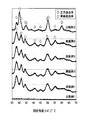
- the obtained white powder was measured using an X-ray diffractometer (manufactured by Rigaku Corporation, model: TTR-III), and it was confirmed to be monoclinic zirconia (see FIG. 1).
- pyrolysis GC-MS thermal decomposition part: Frontier Labs double shot pyrolyzer PY-2020iD thermal decomposition temperature 400 ° C.
- GC part Hewlett ⁇ HP-5890 manufactured by Packard, Inc.
- Temperature conditions 40 ° C. (2 min) ⁇ 300 ° C. (15 min) 20 ° C./min
- MS part SX-102A manufactured by JEOL Ltd.
- Ion source temperature 180 ° C.
- FIG. 3A shows the MS spectrum of the thermal decomposition component of decanoic acid.
- FIG. 2 shows an FT-IR spectrum of monoclinic zirconia particles whose surface is not modified.
- the obtained white powder was monoclinic zirconia particles coated with decanoic acid.
- the obtained white powder was pyrolyzed in a dry air flow at a temperature of 150 to 500 ° C. using a thermal analysis measuring device (manufactured by Shimadzu Corporation, model: DTG-50). As a result of the measurement, it was confirmed that the amount of the pyrolyzate was 30% by mass with respect to the total mass of the obtained white powder particles. Thereby, it was confirmed that content of decanoic acid contained in white powder particle
- the obtained film was peeled off from the glass substrate and measured with a haze meter (Tokyo Denshoku Co., Ltd., model TC-HIIIDPK / II, conforming to JIS 7136).
- the haze value was 1.3%.
- Example 2 A white powder was obtained in the same manner as in Example 1 except that the amount of water charged in the high pressure reaction vessel was changed to 0.15 g (molar ratio 12 relative to zirconium decanoate).
- the average particle size of the white powder was 5 nm.
- the average particle diameter of the aggregated particles in the dispersion liquid in which the white powder was dispersed in xylene was 5 nm.
- the white powder was confirmed to be monoclinic zirconia, the monocarboxylic acid was decanoic acid, and FT-IR measurement results confirmed that decanoic acid was chemically bonded to the particle surface. It was done.
- the obtained white powder was monoclinic zirconia particles coated with decanoic acid.
- the quantity of decanoic acid is 31 mass% with respect to the total mass of the obtained white powder particle.
- this white powder was used for the same operation as in Example 1 to form a film.
- this film was visually confirmed, it was transparent.
- the haze value of the obtained film was 1.5%.
- Example 3 A white powder was obtained in the same manner as in Example 1 except that the amount of water charged in the high-pressure reactor was 0.30 g (molar ratio 23 relative to zirconium decanoate).
- the average particle size of the white powder was 5 nm.
- the average particle diameter of the aggregated particles in the dispersion liquid in which the white powder was dispersed in xylene was 5 nm.
- the white powder was confirmed to be monoclinic zirconia (see FIG. 1), the monocarboxylic acid was decanoic acid, and decanoic acid was chemically bonded to the particle surface from the FT-IR measurement results. It was confirmed that
- the obtained white powder was monoclinic zirconia particles coated with decanoic acid.
- the quantity of decanoic acid is 16 mass% with respect to the total mass of the obtained white powder particle.
- this white powder was used for the same operation as in Example 1 to form a film.
- this film was visually confirmed, it was transparent.
- the haze value of the obtained film was 2.3%.
- Example 4 A white powder was obtained in the same manner as in Example 1 except that the hydrothermal treatment temperature was 400 ° C.
- the average particle size of the white powder was 7 nm.
- the average particle diameter of the aggregated particles in the dispersion liquid in which the white powder was dispersed in xylene was 7 nm.
- the white powder was confirmed to be monoclinic zirconia, the monocarboxylic acid was decanoic acid, and FT-IR measurement results confirmed that decanoic acid was chemically bonded to the particle surface. It was done.
- the obtained white powder was monoclinic zirconia particles coated with decanoic acid.
- the quantity of decanoic acid is 28 mass% with respect to the total mass of the obtained white powder particle.
- this white powder was used for the same operation as in Example 1 to form a film.
- this film was visually confirmed, it was transparent.
- the haze value of the obtained film was 1.3%.
- Example 5 A white powder was obtained in the same manner as in Example 1 except that the hydrothermal treatment temperature was 250 ° C.
- the average particle size of the white powder was 5 nm.
- the average particle diameter of the aggregated particles in the dispersion liquid in which the white powder was dispersed in xylene was 5 nm.
- the white powder was confirmed to be monoclinic zirconia, the monocarboxylic acid was decanoic acid, and FT-IR measurement results confirmed that decanoic acid was chemically bonded to the particle surface. It was done.
- the obtained white powder was monoclinic zirconia particles coated with decanoic acid.
- the quantity of decanoic acid is 42 mass% with respect to the total mass of the obtained white powder particle.
- this white powder was used for the same operation as in Example 1 to form a film.
- this film was visually confirmed, it was transparent.
- the haze value of the obtained film was 1.8%.
- Example 6 A white powder was obtained in the same manner as in Example 1 except that the monocarboxylic acid added to the slurry was oleic acid (18 carbon atoms).
- the average particle size of the white powder was 5 nm.
- the average particle diameter of the aggregated particles in the dispersion liquid in which the white powder was dispersed in xylene was 5 nm.
- the white powder was confirmed to be monoclinic zirconia, the monocarboxylic acid was oleic acid, and FT-IR measurement results confirmed that oleic acid was chemically bonded to the particle surface. It was done.
- the obtained white powder was monoclinic zirconia particles coated with oleic acid.
- the quantity of oleic acid is 25 mass% with respect to the total mass of the obtained white powder particle.
- the amount of the white powder is 0.05 g (5% by mass in the film), 0.17 g (17% by mass in the film), and 0.32 g (32% by mass in the film).
- the refractive index of the obtained film was measured using an Abbe refractometer (manufactured by Atago Co., Ltd., model: 1T type), it was 1.542, 1.548, and 1.558, respectively. confirmed.
- the refractive index of Byron 103 was 1.540.
- Example 1 A white powder was obtained by operating in the same manner as in Example 1 except that water was not put into the high-pressure reaction vessel.
- the obtained white powder was measured in the same manner as in Example 1, generation of particles could not be confirmed by TEM.
- the peak was not observed, it was confirmed that this zirconia particle is not producing
- Example 2 A white powder was obtained in the same manner as in Example 1 except that the amount of water charged in the high-pressure reaction vessel was changed to 0.45 g (molar ratio 35 relative to zirconium decanoate).
- the average particle diameter of the white powder was 8 nm.
- the average particle diameter of the aggregated particles in the dispersion liquid in which the white powder was dispersed in xylene was 400 nm, and it was confirmed that the particles aggregated considerably.
- the main component of the white powder was confirmed to be tetragonal zirconia, the monocarboxylic acid was decanoic acid, and FT-IR measurement results showed that decanoic acid was chemically bonded to the particle surface. Was confirmed.
- the main component of the obtained white powder was tetragonal zirconia particles coated with decanoic acid.
- the quantity of decanoic acid is 12 mass% with respect to the total mass of the obtained white powder particle.
- this white powder was used for the same operation as in Example 1 to form a film.
- this film was visually confirmed, it was cloudy.
- the haze value of the obtained film was 25%.
- Example 3 A white powder was obtained in the same manner as in Example 1 except that the hydrothermal treatment temperature was 200 ° C.
- the generation of particles could not be confirmed by TEM.
- the peak was not observed, it was confirmed that this zirconia particle is not producing
- Example 4 A white powder was obtained in the same manner as in Example 1 except that the monocarboxylic acid added to the slurry was hexanoic acid (carbon number 6).
- the average particle size of the white powder was 7 nm.
- the average particle diameter of the aggregated particles in the dispersion liquid in which the white powder was dispersed in xylene was 700 nm, and it was confirmed that the particles aggregated considerably.
- the white powder was confirmed to be monoclinic zirconia, the monocarboxylic acid was hexanoic acid, and FT-IR measurement results confirmed that hexanoic acid was chemically bonded to the particle surface. It was done.
- the obtained white powder was monoclinic zirconia particles coated with hexanoic acid.
- the quantity of hexanoic acid is 34 mass% with respect to the total mass of the obtained white powder particle.
- Example 2 an operation was performed in the same manner as in Example 1 to form a film.
- this film was visually confirmed, it was cloudy.
- the haze value of the obtained film was 22%.
- Example 5 The operation was performed in the same manner as in Example 1 to obtain a slurry containing zirconium oxyhydroxide having a concentration of 0.7% by mass, and then a concentration operation in which water was vaporized under reduced pressure to perform a concentration operation of 28% by mass of oxywater. A slurry containing zirconium oxide was obtained.
- Example 2 In the same manner as in Example 1 except that 0.4 g of slurry containing zirconium oxyhydroxide having a concentration of 28% by mass and 2.0 g of decanoic acid were mixed in a high-pressure reaction vessel having an internal volume of 5 ml. Operation was performed (molar ratio 20 of water to zirconium oxyhydroxide) to obtain 0.3 g of white powder. The average particle size of this white powder was 7 nm. Moreover, when white powder was disperse
- the main component of the white powder was confirmed to be tetragonal zirconia, the monocarboxylic acid was decanoic acid, and FT-IR measurement results showed that decanoic acid was chemically bonded to the particle surface. Was confirmed.
- the main component of the obtained white powder was tetragonal zirconia particles coated with decanoic acid.
- the quantity of decanoic acid is 9 mass% with respect to the total mass of the obtained white powder particle.
- this white powder was used for the same operation as in Example 1 to form a film.
- this film was visually confirmed, it was cloudy.
- the haze value of the obtained film was 25%.
- Table 1 summarizes the evaluation results of Examples and Comparative Examples.
- the surface-modified zirconia particles of the present invention are useful as a filler for a resin composition having a high refractive index and excellent transparency. It should be noted that the entire contents of the specification, claims, drawings and abstract of Japanese Patent Application No. 2008-001811 filed on January 9, 2008 are cited herein as disclosure of the specification of the present invention. Incorporated.
Landscapes
- Chemical & Material Sciences (AREA)
- Engineering & Computer Science (AREA)
- Organic Chemistry (AREA)
- Nanotechnology (AREA)
- Condensed Matter Physics & Semiconductors (AREA)
- Composite Materials (AREA)
- Physics & Mathematics (AREA)
- General Physics & Mathematics (AREA)
- Materials Engineering (AREA)
- Crystallography & Structural Chemistry (AREA)
- Inorganic Chemistry (AREA)
- Inorganic Compounds Of Heavy Metals (AREA)
- Compositions Of Macromolecular Compounds (AREA)
Abstract
本発明は、樹脂中における分散性が優れる表面修飾ジルコニア粒子及び該表面修飾ジルコニア粒子の製造方法並びに屈折率が高く、透明性に優れる樹脂組成物を提供することを目的とする。 平均粒子径1~100nmの表面修飾ジルコニア粒子は、炭素数8~18のモノカルボン酸により表面修飾されている単斜晶ジルコニア粒子よりなる。炭素数8~18のモノカルボン酸により表面修飾されている単斜晶ジルコニア粒子よりなる平均粒子径1~100nmの表面修飾ジルコニア粒子の製造方法は、炭素数8~18のモノカルボン酸のジルコニウム塩及び該ジルコニウム塩に対して、モル比1~30の水の存在下で水熱処理することにより得られる。
Description
本発明は、表面修飾ジルコニア粒子、その製造方法及び樹脂組成物に関する。
従来、フィラーとして、シリカ等の無機酸化物を用いて、樹脂と複合化することにより、樹脂の機能を向上させることが試みられている。このような無機酸化物と樹脂の複合体を得る方法としては、無機酸化物と樹脂を混練する方法が知られている。しかしながら、透明な複合体に要求される、無機酸化物のナノレベルでの均一な分散が困難であるという問題がある。
特許文献1には、強熱減量が0.1~3%のジルコニア粒子、分散剤、分散助剤及び分散媒を含有するジルコニア粒子分散液、多官能(メタ)アクリレートモノマー及び光重合開始剤を含有する光硬化性組成物が開示されている。しかしながら、得られるジルコニア粒子と樹脂の複合体は、厚みが数十μm以上になると、透明性が不十分となるという問題がある。
特許文献2には、金属酸化物微粒子の表面に長鎖炭化水素が強結合されている有機修飾微粒子が開示されている。また、有機修飾微粒子の製造方法として、超臨界水熱合成法における反応場で、カルボン酸類を共存させて金属酸化物微粒子を製造する方法が開示されている。しかしながら、このような有機修飾微粒子は、樹脂中における分散性が不十分であり、透明性に優れる樹脂組成物が得られないことに加え、高温下において高耐圧が要求されるために反応容器が特殊になること等の手間がかかり、コストが高くなるという問題がある。
特開2005-161111号公報
特開2005-193237号公報
本発明は、上記従来技術が有する問題に鑑み、樹脂中における分散性が優れる表面修飾ジルコニア粒子及び該表面修飾ジルコニア粒子の製造方法並びに屈折率が高く、透明性に優れる樹脂組成物を提供することを目的とする。
本発明は以下の構成を要旨とするものである。
(1)炭素数8~18のモノカルボン酸により表面修飾されている単斜晶ジルコニア粒子よりなる平均粒子径1~100nmの表面修飾ジルコニア粒子。
(1)炭素数8~18のモノカルボン酸により表面修飾されている単斜晶ジルコニア粒子よりなる平均粒子径1~100nmの表面修飾ジルコニア粒子。
(2)前記炭素数8~18のモノカルボン酸の量が全質量の15~50質量%である(1)に記載の表面修飾ジルコニア粒子。
(3)前記炭素数8~18のモノカルボン酸が、2-エチルヘキサン酸、n-オクタン酸、デカン酸、ドデカン酸、トリデカン酸、テトラデカン酸、ヘキサデカン酸、オクタデカン酸、オレイン酸、リノール酸及びリノレン酸からなる群より選ばれる1種以上である(1)又は(2)に記載の表面修飾ジルコニア粒子。
(4)炭素数8~18のモノカルボン酸のジルコニウム塩及び該ジルコニウム塩に対して、モル比1~30の水の存在下で水熱処理する、炭素数8~18のモノカルボン酸により表面修飾されている単斜晶ジルコニア粒子よりなる平均粒子径1~100nmの表面修飾ジルコニア粒子の製造方法。
(5)前記水熱処理は、250~400℃の温度で行われる(4)に記載の表面修飾ジルコニア粒子の製造方法。
(6)前記モノカルボン酸のジルコニウム塩が、オキシ水酸化ジルコニウムと前記炭素数8~18のモノカルボン酸を反応させることにより得られる(4)又は(5)に記載の表面修飾ジルコニア粒子の製造方法。
(7)(1)~(3)のいずれかに記載の表面修飾ジルコニア粒子及び樹脂を含有する樹脂組成物。
(8)前記樹脂が、ポリエステル、フッ素樹脂、アクリル樹脂、エポキシ樹脂及びシリコーン樹脂からなる群より選ばれるいずれかである(7)に記載の樹脂組成物。
(9)表面修飾ジルコニア粒子の量が10~70質量%である(7)又は(8)に記載の樹脂組成物。
(10)厚さ150μmでのヘイズ値が10%以下である、(7)~(9)のいずれかに記載の樹脂組成物からなる樹脂フィルム。
(9)表面修飾ジルコニア粒子の量が10~70質量%である(7)又は(8)に記載の樹脂組成物。
(10)厚さ150μmでのヘイズ値が10%以下である、(7)~(9)のいずれかに記載の樹脂組成物からなる樹脂フィルム。
本発明によれば、樹脂中における分散性が優れる表面修飾ジルコニア粒子及び該表面修飾ジルコニア粒子の製造方法並びに屈折率が高く、透明性に優れる樹脂組成物を提供することができる。
次に、本発明を実施するための最良の形態を説明する。
本発明の表面修飾ジルコニア粒子(以下、単に、本ジルコニア粒子という)は、炭素数8~18のモノカルボン酸(以下、単に、モノカルボン酸という)により表面修飾されている単斜晶ジルコニア粒子よりなる。これにより、本ジルコニア粒子は、樹脂中で均一に分散させることができ、屈折率が高く、透明性に優れる樹脂組成物を得ることができる。
モノカルボン酸の炭素数が8未満であると、本ジルコニア粒子が、樹脂組成物中で均一に分散することが困難となり、得られる樹脂組成物の透明性が低下するので好ましくない。モノカルボン酸の炭素数が18超であると、モノカルボン酸の融点が高くなるため、モノカルボン酸のジルコニウム塩を水熱処理する際に、本ジルコニア粒子を得ることが困難になるので好ましくない。
モノカルボン酸は、炭素数7~17の有機基にカルボキシル基が結合した構造からなるものが好ましい。有機基としては、炭化水素基が挙げられる。炭化水素基は、脂肪族炭化水素基、芳香族炭化水素基又はこれらを組み合わせた官能基が好ましい。また、炭化水素基は、飽和及び不飽和のいずれであってもよく、直鎖状、分枝状及び環状のいずれであってもよい。さらに、炭化水素基は、フルオロ基、クロロ基等の官能基で置換されていてもよい。
モノカルボン酸としては、特に限定されないが、2-エチルヘキサン酸、n-オクタン酸、デカン酸、ドデカン酸、トリデカン酸、テトラデカン酸、ヘキサデカン酸、オクタデカン酸、オレイン酸、リノール酸及びリノレン酸からなる群より選ばれる1種以上であることが好ましく、2-エチルヘキサン酸、n-オクタン酸、デカン酸、ドデカン酸、トリデカン酸、テトラデカン酸及びオレイン酸からなる群より選ばれる1種以上であることが特に好ましく、2-エチルヘキサン酸、n-オクタン酸、デカン酸及びオレイン酸からなる群より選ばれる1種以上であることが最も好ましい。
本ジルコニア粒子は、平均粒子径が1~100nmである。これにより、単斜晶ジルコニア粒子とモノカルボン酸との反応性が大きくなり、安定した本ジルコニア粒子が得られるので好ましい。また、本ジルコニア粒子が、樹脂中に分散性よく配合することができ、光散乱を小さくすることができ、透明性に優れた樹脂組成物を得ることができるので好ましい。本ジルコニア粒子の平均粒子径が1nm未満であると、単斜晶ジルコニア粒子の結晶性が低下して、屈折率が低下するおそれがあるため好ましくない。本ジルコニア粒子の平均粒子径が100nm超であると、得られる樹脂組成物の透明性が低下するおそれがあるため好ましくない。本ジルコニア粒子の平均粒子径は、1~50nmが好ましく、1~20nmが特に好ましい。
また、本ジルコニア粒子は、キシレン中に分散させて、濃度0.1質量%の分散液とした場合に、分散媒中での凝集粒子の平均粒子径が1~100nmであることが好ましい。
分散媒中での凝集粒子の平均粒子径が1nm未満であると、結晶性が低下して屈折率が低下するおそれがあるため好ましくなく、平均粒子径100nm超であると、得られる樹脂組成物の透明性が低下するおそれがあるため好ましくない。本ジルコニア粒子が凝集するメカニズムとしては、本ジルコニア粒子と分散媒との間の界面エネルギーが大きくなると進行するものと考えられる。このため、本ジルコニア粒子の表面がモノカルボン酸で良好に被覆されていることにより、界面エネルギーが低下するために分散性が良好になると考えられる。分散媒中での凝集粒子の平均粒子径が1~50nmであることが特に好ましい。なお、分散媒中での凝集粒子の平均粒子径は、粒径分布測定装置(日機装社製、マイクロトラックUPA)を使用して測定を行うことが好ましい。
分散媒中での凝集粒子の平均粒子径が1nm未満であると、結晶性が低下して屈折率が低下するおそれがあるため好ましくなく、平均粒子径100nm超であると、得られる樹脂組成物の透明性が低下するおそれがあるため好ましくない。本ジルコニア粒子が凝集するメカニズムとしては、本ジルコニア粒子と分散媒との間の界面エネルギーが大きくなると進行するものと考えられる。このため、本ジルコニア粒子の表面がモノカルボン酸で良好に被覆されていることにより、界面エネルギーが低下するために分散性が良好になると考えられる。分散媒中での凝集粒子の平均粒子径が1~50nmであることが特に好ましい。なお、分散媒中での凝集粒子の平均粒子径は、粒径分布測定装置(日機装社製、マイクロトラックUPA)を使用して測定を行うことが好ましい。
本ジルコニア粒子において、モノカルボン酸の量が15~50質量%であることが好ましい。モノカルボン酸の量が15質量%未満であると、本ジルコニア粒子が、モノカルボン酸で充分に被覆されていないために、樹脂中で均一に分散することが困難となるおそれがあり、また、得られる樹脂組成物の透明性が低下するおそれがあるため好ましくない。
モノカルボン酸の量が50量%超であると、得られる樹脂組成物の屈折率が低下するおそれがあるため好ましくない。モノカルボン酸の量は、20~45質量%が特に好ましく、25~35質量%が最も好ましい。
モノカルボン酸の量が50量%超であると、得られる樹脂組成物の屈折率が低下するおそれがあるため好ましくない。モノカルボン酸の量は、20~45質量%が特に好ましく、25~35質量%が最も好ましい。
本ジルコニア粒子は、モノカルボン酸のジルコニウム塩を水熱処理することにより得られる。モノカルボン酸のジルコニウム塩は、市販品をそのまま使用してもよいし、適宜必要に応じて、従来公知の方法で製造して使用してもよい。モノカルボン酸のジルコニウム塩は、ジルコニウムの価数が通常4価のものが知られており、手軽に入手できることから、オキシカルボン酸ジルコニウムが好ましい。モノカルボン酸のジルコニウム塩を製造する具体的な方法としては、例えば、下記式(a)で示す通り、オキシ水酸化ジルコニウムとモノカルボン酸とを反応させることが好ましい。これらの反応は、直接でもいいし、水、メタノール、エタノール、1-プロパノール、2-プロパノール、アセトン、テトラヒドロフラン等の溶媒中で行うこともできる。
ZrO(OH)2+2RCOOH → ZrO(OCOR)2+2H2O・・・(a)
オキシ水酸化ジルコニウムは、市販品をそのまま使用してもよいし、適宜必要に応じて、従来公知の方法で製造して使用してもよい。オキシ水酸化ジルコニウムは、例えば、ジルコニウム塩とアルカリ金属の水酸化物とを反応させて得ることが好ましい。ジルコニウム塩としては、オキシ硝酸ジルコニウム、オキシ酢酸ジルコニウム、オキシ塩化ジルコニウム等が挙げられ、なかでも、溶媒への溶解度が高いことや腐食性の化合物を含有しないこと等から、オキシ硝酸ジルコニウムが好ましい。
オキシ水酸化ジルコニウムは、市販品をそのまま使用してもよいし、適宜必要に応じて、従来公知の方法で製造して使用してもよい。オキシ水酸化ジルコニウムは、例えば、ジルコニウム塩とアルカリ金属の水酸化物とを反応させて得ることが好ましい。ジルコニウム塩としては、オキシ硝酸ジルコニウム、オキシ酢酸ジルコニウム、オキシ塩化ジルコニウム等が挙げられ、なかでも、溶媒への溶解度が高いことや腐食性の化合物を含有しないこと等から、オキシ硝酸ジルコニウムが好ましい。
また、アルカリ金属の水酸化物としては、水酸化ナトリウム、水酸化カリウム、水酸化カルシウム等が挙げられ、なかでも、コスト面から水酸化ナトリウムが好ましい。例として、下記式(b)で示す通り、オキシ硝酸ジルコニウムと水酸化ナトリウムの反応により、オキシ水酸化ジルコニウムが得られる。
ZrO(NO3)2+2NaOH → ZrO(OH)2+2NaNO3・・・(b)
反応温度は、モノカルボン酸の融点以上、200℃以下であることが好ましい。この理由としては、モノカルボン酸の融点以下ではモノカルボン酸は固体であり、反応が進行しにくいためであり、200℃超では粒子の生成が始まるおそれがあることから好ましくない。
反応温度は、モノカルボン酸の融点以上、200℃以下であることが好ましい。この理由としては、モノカルボン酸の融点以下ではモノカルボン酸は固体であり、反応が進行しにくいためであり、200℃超では粒子の生成が始まるおそれがあることから好ましくない。
モノカルボン酸のジルコニウム塩を水熱処理する際には、モノカルボン酸のジルコニウム塩に対して、モル比1~30の水を添加して行われることが好ましい。モル比が1未満であると、得られる本ジルコニア粒子の結晶性が低下し、屈折率が低下するおそれがあるので好ましくない。モル比が30超であると、正方晶ジルコニア粒子となりやすく、得られる本ジルコニア粒子の樹脂中での分散性が低下するおそれがあるため好ましくない。モル比は、5~23が特に好ましい。
モノカルボン酸のジルコニウム塩を水熱処理する際には、250~400℃の温度で行われることが好ましい。水熱処理する際の温度が250℃未満であると、得られる本ジルコニア粒子の結晶性が低下し、屈折率が低下するおそれがあるので好ましくない。水熱処理する際の温度が400℃超であると、本ジルコニア粒子表面のモノカルボン酸が熱分解し、得られる本ジルコニア粒子の樹脂中での分散性が低下するおそれがあるので好ましくない。水熱処理する際の温度は、300~350℃であることが特に好ましい。
水熱合成の反応時間は、3~120分が好ましい。反応時間が3分未満であると、水熱反応が充分に進行しないために、得られるジルコニア粒子の結晶性が低下し、屈折率が低下するおそれがあるので好ましくない。反応時間が120分超であると、モノカルボン酸の分解が進行するおそれがあるので好ましくない。反応時間は5~60分が特に好ましい。
本ジルコニア粒子の得られる機構としては、詳細には解明できていないが、下記の通りであると、考えられる。まず、モノカルボン酸のジルコニウム塩は、下記式(c)で示す通り、水の存在下で、オキシ水酸化ジルコニウムとモノカルボン酸に分解する。この後、オキシ水酸化ジルコニウムは熱により分解して、ジルコニア粒子になると考えられる。このジルコニア粒子が生成した際、その近傍に存在するモノカルボン酸が、生成したジルコニア粒子の表面と反応して化学結合を生成し、モノカルボン酸が表面に強固な被覆をした本ジルコニア粒子が得られるものと考えられる。
ZrO(OCOR)2+2H2O → ZrO(OH)2+2RCOOH → ZrO2+H2O+2RCOOH・・・(c)
水熱処理の後、得られた反応生成物を、適宜必要に応じて、精製することにより、本ジルコニア粒子を単離することができる。得られた反応生成物は、例えば、ヘキサン、オクタン、トルエン、キシレン等の有機溶媒で抽出した後、これを遠心分離、濾過等により、不純物を分離して、乾固させた後、メタノール、エタノール、プロパノール等のアルコールで洗浄することが好ましい。本ジルコニア粒子は、乾燥することにより、粉末として得ることができ、また、ヘキサン、オクタン、トルエン、キシレン、テトラヒドロフラン等の有機溶媒中に分散させて分散液として、使用することもできる。分散液の濃度は必要に応じて適宜調整することができる。
水熱処理の後、得られた反応生成物を、適宜必要に応じて、精製することにより、本ジルコニア粒子を単離することができる。得られた反応生成物は、例えば、ヘキサン、オクタン、トルエン、キシレン等の有機溶媒で抽出した後、これを遠心分離、濾過等により、不純物を分離して、乾固させた後、メタノール、エタノール、プロパノール等のアルコールで洗浄することが好ましい。本ジルコニア粒子は、乾燥することにより、粉末として得ることができ、また、ヘキサン、オクタン、トルエン、キシレン、テトラヒドロフラン等の有機溶媒中に分散させて分散液として、使用することもできる。分散液の濃度は必要に応じて適宜調整することができる。
本発明の樹脂組成物は、本ジルコニア粒子及び樹脂を含有することが好ましい。樹脂としては、本ジルコニア粒子を分散させることが可能な樹脂であれば、特に限定されないが、ポリエステル、フッ素樹脂、アクリル樹脂、エポキシ樹脂及びシリコーン樹脂からなる群より選ばれるいずれかが好ましい。
フッ素樹脂としては、フッ化ビニル重合体、フッ化ビニリデン重合体、テトラフルオロエチレン-ヘキサフルオロプロピレン-フッ化ビニリデン系共重合体、テトラフルオロエチレン-プロピレン共重合体、テトラフルオロエチレン-ヘキサフルオロプロピレン-プロピレン共重合体、テトラフルオロエチレン-エチレン共重合体(以下、ETFEという。)、ヘキサフルオロプロピレン-テトラフルオロエチレン共重合体、パーフルオロ(アルキルビニルエーテル)-テトラフルオロエチレン系共重合体等が挙げられ、透明性、加工性、および耐候性がよい点から、ETFEが好ましい。
本発明の樹脂組成物において、本ジルコニア粒子の量が10~70質量%であることが好ましい。本ジルコニア粒子の量が10質量%未満であると屈折率が充分に高くならないおそれがあるので好ましくなく、本ジルコニア粒子の量が70質量%超であると微粒子の凝集が進行して樹脂組成物の透明性が低下するおそれがあるので好ましくない。本ジルコニア粒子の量は20~50質量%であることが特に好ましい。
本発明の樹脂組成物は、本ジルコニア粒子及び樹脂を適宜、公知の方法により混合し、適宜必要に応じて、成形することが好ましい。
本ジルコニア粒子は、粉体の状態で、樹脂と混合してもよい。また、本ジルコニア粒子をヘキサン、トルエン、テトラヒドロフラン等の溶媒に分散させた分散液と、樹脂を溶解乃至分散させた溶液乃至分散液とを混合して分散液とした後、被塗布物に塗布した後、乾燥等して、成型してもよい。
本発明の樹脂組成物には、本発明の効果を損なわない範囲で、公知の添加剤(例えば、有機系紫外線遮断剤、フィラー等)を添加してもよい。
本発明の樹脂組成物としては、特に限定されないが、樹脂フィルム等が挙げられる。樹脂フィルムは、厚さ150μmでのヘイズ値が20%以下であることが好ましい。ヘイズ値が20%超であると、樹脂フィルムの光散乱が顕著なので好ましくない。ヘイズ値が10%以下であることが好ましい。樹脂フィルムのヘイズ値は、JIS7136に示される手法で、市販の分光光度計を用いて測定される。
以下に、実施例1~6及び比較例1~5を示すが、本発明はこれらによって限定されるものではない。なお、本実施例において、粉末状態での平均粒子径は、透過型電子顕微鏡装置(日本電子社製、JEM-1230)を使用して、測定した。測定サンプルは測定したい粒子の分散液を少量だけカーボングリッド上に塗布し、自然に乾燥させることによって作製した。得られたTEM像の中から無作為に100個の粒子を選んで測定し、平均粒子径を算出した。また、分散液中での凝集粒子の粒子径は、粒径分布測定装置(日機装社製、マイクロトラックUPA)を使用して測定した。
[実施例1]
容量300mlのガラス容器内に、オキシ硝酸ジルコニウム(純正化学社製、特級)2.67g及び水100mlを入れ、溶解させた後、撹拌しながら、濃度1.2質量%の水酸化ナトリウム水溶液100gを徐々に加えて、反応させ、濃度0.7質量%のオキシ水酸化ジルコニウムを含有するスラリーを得た。次に、このスラリーに、デカン酸(東京化成工業社製、全炭素数10)28gを加え、オイルバス中で70℃の状態に保ちながら、5分ほど撹拌し、1時間ほど静置させて、油相と水相に分離させた後、油相のみを回収して、濃度15質量%のデカン酸ジルコニウムを含有する分散液30gを得た。
容量300mlのガラス容器内に、オキシ硝酸ジルコニウム(純正化学社製、特級)2.67g及び水100mlを入れ、溶解させた後、撹拌しながら、濃度1.2質量%の水酸化ナトリウム水溶液100gを徐々に加えて、反応させ、濃度0.7質量%のオキシ水酸化ジルコニウムを含有するスラリーを得た。次に、このスラリーに、デカン酸(東京化成工業社製、全炭素数10)28gを加え、オイルバス中で70℃の状態に保ちながら、5分ほど撹拌し、1時間ほど静置させて、油相と水相に分離させた後、油相のみを回収して、濃度15質量%のデカン酸ジルコニウムを含有する分散液30gを得た。
次に、内容積5mlの高圧反応容器内に、得られたデカン酸ジルコニムを含有する分散液2.0gと、水0.06g(デカン酸ジルコニウムに対するモル比5)とを混合して、電気炉を使用して、300℃で10分間の水熱処理を行った。その後、高圧反応容器を室温まで放冷し、ヘキサン3.0gを加えて、高圧反応容器内の内容物をガラス容器に移し、しばらく放置して、油相と水相に分離させ、油相のみを回収した後、これを、真空乾燥してペースト状の固形物を得た。この得られた固形物に、メタノール1.0gを加えて充分撹拌した後、遠心分離を行い、沈殿物を回収し、乾燥させて、白色の粉末0.3gを得た。この白色粉末の平均粒子径は、5nmであった。また、白色粉末をキシレン中に分散させ、分散液としたところ、分散液中での凝集粒子の平均粒子径は、5nmであった。
得られた白色粉末をX線回折装置(リガク社製、型式:TTR-III)を使用して、測定したところ、単斜晶のジルコニアであることが確認された(図1参照)。
次に、白色粉末にテトラメチルアンモニウムヒドロキシド/メタノール溶液を添加した後、熱分解GC-MS(熱分解部:フロンティアラボ社製 ダブルショットパイロライザー PY-2020iD 熱分解温度400℃、GC部:ヒューレット・パッカード社製、HP-5890 温度条件:40℃(2min)→300℃(15min)20℃/min 注入端温度:300℃、MS部:日本電子社製 SX-102A イオン源温度:180℃、カラム:J&W社製 DB-5(30m 0.25mmφ 0.25μm))を用いて測定したところ、m/Z=55、74、87、143、157、186のフラグメントを確認し、デカン酸であることが確認された(図3(a)参照)。なお、参考のため、図3(b)に、デカン酸の熱分解成分のMSスペクトルを示した。
次に、得られた白色粉末をFT-IR(Nicolet社製、20DXC型)を使用して、測定したところ、COO-伸縮とCH伸縮のピークが確認できた。しかし、C=O伸縮のピークが存在しないことから、単離したカルボン酸が存在しないこと、即ち、単斜晶のジルコニア粒子の表面とカルボン酸が反応して、化学結合が形成されていることが確認された。すなわち、粒子表面にデカン酸が化学結合していることが確認できた(図2参照)。なお、図2には、参考のため、表面が修飾されていない単斜晶のジルコニア粒子のFT-IRスペクトルも示した。
これらの測定結果から、得られた白色粉末は、デカン酸によって被覆された単斜晶ジルコニア粒子であることが確認された。
なお、得られた白色粉末を、熱分析測定装置(島津製作所社製、型式:DTG-50)を使用して、150~500℃の間で50ml/分の乾燥空気流中で熱分解を行い、測定したところ、熱分解物の量が、得られた白色粉末粒子の全質量に対して30質量%であることが確認された。これにより、白色粉末粒子に含まれる、デカン酸の含有量は、30質量%であることが確認された。
(樹脂フィルムの製造)
得られた白色粉末0.02gをテトラヒドロフラン1gに分散させた濃度2質量%の分散液1gと、ポリエステル(東洋紡社製、商品名:バイロン103)をテトラヒドロフランに溶解させた濃度33質量%の溶液3gとを混合し、撹拌して、分散液を得た。この分散液を、厚さ3mmのガラス板の上に、ドクターブレード(テスター産業社製、型式:SA-202型)を使用して、乾燥厚さが150μmとなるように塗工した後、室温で24時間静置して、フィルムを形成した。なお、得られたフィルム中での、本ジルコニア粒子は2質量%であった。
得られた白色粉末0.02gをテトラヒドロフラン1gに分散させた濃度2質量%の分散液1gと、ポリエステル(東洋紡社製、商品名:バイロン103)をテトラヒドロフランに溶解させた濃度33質量%の溶液3gとを混合し、撹拌して、分散液を得た。この分散液を、厚さ3mmのガラス板の上に、ドクターブレード(テスター産業社製、型式:SA-202型)を使用して、乾燥厚さが150μmとなるように塗工した後、室温で24時間静置して、フィルムを形成した。なお、得られたフィルム中での、本ジルコニア粒子は2質量%であった。
また、得られたフィルムを、ガラス基板から剥離して、ヘイズメータ(東京電色社製、型式TC-HIIIDPK/II、JIS7136に準拠)で測定したところ、ヘイズ値は1.3%であった。
[実施例2]
高圧反応容器に入れる水の量を0.15g(デカン酸ジルコニウムに対するモル比12)にした以外は、実施例1と同様にして、白色粉末を得た。
高圧反応容器に入れる水の量を0.15g(デカン酸ジルコニウムに対するモル比12)にした以外は、実施例1と同様にして、白色粉末を得た。
得られた白色粉末について、実施例1と同様にして測定を行ったところ、白色粉末の平均粒子径は、5nmであった。また、白色粉末をキシレン中に分散させた、分散液中での凝集粒子の平均粒子径は、5nmであった。また、白色粉末は、単斜晶のジルコニアであることが確認され、モノカルボン酸は、デカン酸であり、FT-IRの測定結果から、粒子表面にデカン酸が化学結合していることが確認された。
これらの測定結果から、得られた白色粉末は、デカン酸によって被覆された単斜晶のジルコニア粒子であることが確認された。なお、熱分析測定装置による測定結果から、デカン酸の量が、得られた白色粉末粒子の全質量に対して31質量%であることが確認された。
また、この白色粉末を使用して実施例1と同様にして操作を行い、フィルムを形成した。この膜を目視で確認したところ、透明であった。また、得られたフィルムのヘイズ値は1.5%であった。
[実施例3]
高圧反応容器に入れる水の量を0.30g(デカン酸ジルコニウムに対するモル比23)にした以外は、実施例1と同様にして、白色粉末を得た。
高圧反応容器に入れる水の量を0.30g(デカン酸ジルコニウムに対するモル比23)にした以外は、実施例1と同様にして、白色粉末を得た。
得られた白色粉末について、実施例1と同様にして測定を行ったところ、白色粉末の平均粒子径は、5nmであった。また、白色粉末をキシレン中に分散させた、分散液中での凝集粒子の平均粒子径は、5nmであった。また、白色粉末は、単斜晶のジルコニアであることが確認され(図1参照)、モノカルボン酸は、デカン酸であり、FT-IRの測定結果から、粒子表面にデカン酸が化学結合していることが確認された。
これらの測定結果から、得られた白色粉末は、デカン酸によって被覆された単斜晶のジルコニア粒子であることが確認された。なお、熱分析測定装置による測定結果から、デカン酸の量が、得られた白色粉末粒子の全質量に対して16質量%であることが確認された。
また、この白色粉末を使用して実施例1と同様にして操作を行い、フィルムを形成した。この膜を目視で確認したところ、透明であった。また、得られたフィルムのヘイズ値は2.3%であった。
[実施例4]
水熱処理を行う温度を400℃にした以外は、実施例1と同様にして操作を行い、白色粉末を得た。
水熱処理を行う温度を400℃にした以外は、実施例1と同様にして操作を行い、白色粉末を得た。
得られた白色粉末について、実施例1と同様にして測定を行ったところ、白色粉末の平均粒子径は、7nmであった。また、白色粉末をキシレン中に分散させた、分散液中での凝集粒子の平均粒子径は、7nmであった。また、白色粉末は、単斜晶のジルコニアであることが確認され、モノカルボン酸は、デカン酸であり、FT-IRの測定結果から、粒子表面にデカン酸が化学結合していることが確認された。
これらの測定結果から、得られた白色粉末は、デカン酸によって被覆された単斜晶のジルコニア粒子であることが確認された。なお、熱分析測定装置による測定結果から、デカン酸の量が、得られた白色粉末粒子の全質量に対して28質量%であることが確認された。
また、この白色粉末を使用して実施例1と同様にして操作を行い、フィルムを形成した。この膜を目視で確認したところ、透明であった。また、得られたフィルムのヘイズ値は1.3%であった。
[実施例5]
水熱処理を行う温度を250℃にした以外は、実施例1と同様にして操作を行い、白色粉末を得た。
水熱処理を行う温度を250℃にした以外は、実施例1と同様にして操作を行い、白色粉末を得た。
得られた白色粉末について、実施例1と同様にして測定を行ったところ、白色粉末の平均粒子径は、5nmであった。また、白色粉末をキシレン中に分散させた、分散液中での凝集粒子の平均粒子径は、5nmであった。また、白色粉末は、単斜晶のジルコニアであることが確認され、モノカルボン酸は、デカン酸であり、FT-IRの測定結果から、粒子表面にデカン酸が化学結合していることが確認された。
これらの測定結果から、得られた白色粉末は、デカン酸によって被覆された単斜晶のジルコニア粒子であることが確認された。なお、熱分析測定装置による測定結果から、デカン酸の量が、得られた白色粉末粒子の全質量に対して42質量%であることが確認された。
また、この白色粉末を使用して実施例1と同様にして操作を行い、フィルムを形成した。この膜を目視で確認したところ、透明であった。また、得られたフィルムのヘイズ値は1.8%であった。
[実施例6]
スラリーに加えるモノカルボン酸をオレイン酸(炭素数18)にした以外は、実施例1と同様にして操作を行い、白色粉末を得た。
スラリーに加えるモノカルボン酸をオレイン酸(炭素数18)にした以外は、実施例1と同様にして操作を行い、白色粉末を得た。
得られた白色粉末について、実施例1と同様にして測定を行ったところ、白色粉末の平均粒子径は、5nmであった。また、白色粉末をキシレン中に分散させた、分散液中での凝集粒子の平均粒子径は、5nmであった。また、白色粉末は、単斜晶のジルコニアであることが確認され、モノカルボン酸は、オレイン酸であり、FT-IRの測定結果から、粒子表面にオレイン酸が化学結合していることが確認された。
これらの測定結果から、得られた白色粉末は、オレイン酸によって被覆された単斜晶のジルコニア粒子であることが確認された。なお、熱分析測定装置による測定結果から、オレイン酸の量が、得られた白色粉末粒子の全質量に対して25質量%であることが確認された。
また、この白色粉末の量を、0.05g(フィルム中において、5質量%)、0.17g(フィルム中において、17質量%)、0.32g(フィルム中において、32質量%)とする以外は、実施例1と同様にして操作を行い、フィルムを形成した。この膜を目視で確認したところ、透明であった。また、得られたフィルムのヘイズ値は、それぞれ、1.8%、2.3%、3.2%であった。
また、得られたフィルムを、アッベ屈折率計(アタゴ社製、型式:1T型)を使用して屈折率を測定したところ、それぞれ、1.542、1.548、1.558であることが確認された。なお、バイロン103の屈折率は1.540であった。
[比較例1]
高圧反応容器に水を入れなかった以外は、実施例1と同様にして操作を行い、白色粉末を得た。得られた白色粉末について、実施例1と同様に測定を行ったところ、TEMでは粒子の生成を確認することができなかった。また、X線回折装置により測定しても、ピークは観測されなかったことから、本ジルコニア粒子は生成していないことが確認された。
高圧反応容器に水を入れなかった以外は、実施例1と同様にして操作を行い、白色粉末を得た。得られた白色粉末について、実施例1と同様に測定を行ったところ、TEMでは粒子の生成を確認することができなかった。また、X線回折装置により測定しても、ピークは観測されなかったことから、本ジルコニア粒子は生成していないことが確認された。
[比較例2]
高圧反応容器に入れる水の量を0.45g(デカン酸ジルコニウムに対するモル比35)にした以外は、実施例1と同様にして、白色粉末を得た。
高圧反応容器に入れる水の量を0.45g(デカン酸ジルコニウムに対するモル比35)にした以外は、実施例1と同様にして、白色粉末を得た。
得られた白色粉末について、実施例1と同様にして測定を行ったところ、白色粉末の平均粒子径は、8nmであった。また、白色粉末をキシレン中に分散させた、分散液中での凝集粒子の平均粒子径は、400nmであり、かなり凝集することが確認された。また、白色粉末の主成分は、正方晶のジルコニアであることが確認され、モノカルボン酸は、デカン酸であり、FT-IRの測定結果から、粒子表面にデカン酸が化学結合していることが確認された。
これらの測定結果から、得られた白色粉末の主成分は、デカン酸によって被覆された正方晶のジルコニア粒子であることが確認された。なお、熱分析測定装置による測定結果から、デカン酸の量が、得られた白色粉末粒子の全質量に対して12質量%であることが確認された。
また、この白色粉末を使用して実施例1と同様にして操作を行い、フィルムを形成した。この膜を目視で確認したところ、白濁していた。また、得られたフィルムのヘイズ値は25%であった。
[比較例3]
水熱処理を行う温度を200℃にした以外は、実施例1と同様にして操作を行い、白色粉末を得た。得られた白色粉末について、実施例1と同様に測定を行ったところTEMでは、粒子の生成を確認することができなかった。また、X線回折装置により測定しても、ピークは観測されなかったことから、本ジルコニア粒子は生成していないことが確認された。
水熱処理を行う温度を200℃にした以外は、実施例1と同様にして操作を行い、白色粉末を得た。得られた白色粉末について、実施例1と同様に測定を行ったところTEMでは、粒子の生成を確認することができなかった。また、X線回折装置により測定しても、ピークは観測されなかったことから、本ジルコニア粒子は生成していないことが確認された。
[比較例4]
スラリーに加えるモノカルボン酸をヘキサン酸(炭素数6)にした以外は、実施例1と同様にして操作を行い、白色粉末を得た。
スラリーに加えるモノカルボン酸をヘキサン酸(炭素数6)にした以外は、実施例1と同様にして操作を行い、白色粉末を得た。
得られた白色粉末について、実施例1と同様にして測定を行ったところ、白色粉末の平均粒子径は、7nmであった。また、白色粉末をキシレン中に分散させた、分散液中での凝集粒子の平均粒子径は、700nmであり、かなり凝集することが確認された。また、白色粉末は、単斜晶のジルコニアであることが確認され、モノカルボン酸は、ヘキサン酸であり、FT-IRの測定結果から、粒子表面にヘキサン酸が化学結合していることが確認された。
これらの測定結果から、得られた白色粉末は、ヘキサン酸によって被覆された単斜晶のジルコニア粒子であることが確認された。なお、熱分析測定装置による測定結果から、ヘキサン酸の量が、得られた白色粉末粒子の全質量に対して34質量%であることが確認された。
また、この白色粉末を使用して、実施例1と同様にして操作を行い、フィルムを形成した。この膜を目視で確認したところ、白濁していた。また、得られたフィルムのヘイズ値は22%であった。
[比較例5]
実施例1と同様にして操作を行い、濃度0.7質量%のオキシ水酸化ジルコニウムを含有するスラリーを得た後、減圧下で水を気化させる濃縮操作を行って濃度28質量%のオキシ水酸化ジルコニウムを含有するスラリーを得た。
実施例1と同様にして操作を行い、濃度0.7質量%のオキシ水酸化ジルコニウムを含有するスラリーを得た後、減圧下で水を気化させる濃縮操作を行って濃度28質量%のオキシ水酸化ジルコニウムを含有するスラリーを得た。
次に、内容積5mlの高圧反応容器内に、濃度28質量%のオキシ水酸化ジルコニウムを含有するスラリー0.4gと、デカン酸2.0gとを混合した以外は、実施例1と同様にして操作を行い(オキシ水酸化ジルコニウムに対する水のモル比20)、白色の粉末0.3gを得た。この白色粉末の平均粒子径は、7nmであった。また、白色粉末をキシレン中に分散させ、分散液としたところ、分散液中での凝集粒子の平均粒子径は、700nmと凝集していることが確認された。
また、白色粉末の主成分は、正方晶のジルコニアであることが確認され、モノカルボン酸は、デカン酸であり、FT-IRの測定結果から、粒子表面にデカン酸が化学結合していることが確認された。
これらの測定結果から、得られた白色粉末の主成分は、デカン酸によって被覆された正方晶のジルコニア粒子であることが確認された。なお、熱分析測定装置による測定結果から、デカン酸の量が、得られた白色粉末粒子の全質量に対して9質量%であることが確認された。
また、この白色粉末を使用して実施例1と同様にして操作を行い、フィルムを形成した。この膜を目視で確認したところ、白濁していた。また、得られたフィルムのヘイズ値は25%であった。
実施例及び比較例の評価結果をまとめたものを表1に示す。

本発明の表面修飾ジルコニア粒子は、屈折率が高く透明性に優れた樹脂組成物用のフィラーとして有用である。
なお、2008年1月9日に出願された日本特許出願2008-001811号の明細書、特許請求の範囲、図面及び要約書の全内容をここに引用し、本発明の明細書の開示として、取り入れるものである。
なお、2008年1月9日に出願された日本特許出願2008-001811号の明細書、特許請求の範囲、図面及び要約書の全内容をここに引用し、本発明の明細書の開示として、取り入れるものである。
Claims (10)
- 炭素数8~18のモノカルボン酸により表面修飾されている単斜晶ジルコニア粒子よりなる平均粒子径1~100nmの表面修飾ジルコニア粒子。
- 前記炭素数8~18のモノカルボン酸の量が全質量の15~50質量%である請求項1に記載の表面修飾ジルコニア粒子。
- 前記炭素数8~18のモノカルボン酸が、2-エチルヘキサン酸、n-オクタン酸、デカン酸、ドデカン酸、トリデカン酸、テトラデカン酸、ヘキサデカン酸、オクタデカン酸、オレイン酸、リノール酸及びリノレン酸からなる群より選ばれる1種以上である請求項1又は2に記載の表面修飾ジルコニア粒子。
- 炭素数8~18のモノカルボン酸のジルコニウム塩及び該ジルコニウム塩に対して、モル比1~30の水の存在下で水熱処理する、炭素数8~18のモノカルボン酸により表面修飾されている単斜晶ジルコニア粒子よりなる平均粒子径1~100nmの表面修飾ジルコニア粒子の製造方法。
- 前記水熱処理は、250~400℃の温度で行われる請求項4に記載の表面修飾ジルコニア粒子の製造方法。
- 前記モノカルボン酸のジルコニウム塩が、オキシ水酸化ジルコニウムと前記炭素数8~18のモノカルボン酸を反応させることにより得られる請求項4又は5に記載の表面修飾ジルコニア粒子の製造方法。
- 請求項1~3のいずれかに記載の表面修飾ジルコニア粒子及び樹脂を含有する樹脂組成物。
- 前記樹脂が、ポリエステル、フッ素樹脂、アクリル樹脂、エポキシ樹脂及びシリコーン樹脂からなる群より選ばれるいずれかである請求項7に記載の樹脂組成物。
- 表面修飾ジルコニア粒子の量が10~70質量%である請求項7又は8に記載の樹脂組成物。
- 厚さ150μmでのヘイズ値が10%以下である、請求項7~9のいずれかに記載の樹脂組成物からなる樹脂フィルム。
Priority Applications (1)
| Application Number | Priority Date | Filing Date | Title |
|---|---|---|---|
| JP2009548950A JP5445140B2 (ja) | 2008-01-09 | 2009-01-08 | 表面修飾ジルコニア粒子、その製造方法及び樹脂組成物 |
Applications Claiming Priority (2)
| Application Number | Priority Date | Filing Date | Title |
|---|---|---|---|
| JP2008001811 | 2008-01-09 | ||
| JP2008-001811 | 2008-01-09 |
Publications (1)
| Publication Number | Publication Date |
|---|---|
| WO2009088043A1 true WO2009088043A1 (ja) | 2009-07-16 |
Family
ID=40853155
Family Applications (1)
| Application Number | Title | Priority Date | Filing Date |
|---|---|---|---|
| PCT/JP2009/050151 Ceased WO2009088043A1 (ja) | 2008-01-09 | 2009-01-08 | 表面修飾ジルコニア粒子、その製造方法及び樹脂組成物 |
Country Status (3)
| Country | Link |
|---|---|
| JP (1) | JP5445140B2 (ja) |
| TW (1) | TW200942493A (ja) |
| WO (1) | WO2009088043A1 (ja) |
Cited By (12)
| Publication number | Priority date | Publication date | Assignee | Title |
|---|---|---|---|---|
| JP2011057532A (ja) * | 2009-09-14 | 2011-03-24 | Sumitomo Osaka Cement Co Ltd | アルカリ土類金属酸化物ドープジルコニアナノ粒子透明分散液及び透明複合体 |
| JP2013530276A (ja) * | 2010-05-28 | 2013-07-25 | オムヤ・デイベロツプメント・アー・ゲー | 処理された鉱物フィラー生成物、この調製方法およびこの使用 |
| JP2013534459A (ja) * | 2010-04-23 | 2013-09-05 | ピクセリジェント・テクノロジーズ,エルエルシー | ナノ結晶の合成、キャップ形成および分散 |
| JP2014221866A (ja) * | 2013-05-13 | 2014-11-27 | 国立大学法人山形大学 | ジルコニア粒子及びジルコニア含有エポキシ樹脂組成物 |
| JP2015231949A (ja) * | 2015-08-03 | 2015-12-24 | 新日鉄住金化学株式会社 | 光学材料 |
| US9359689B2 (en) | 2011-10-26 | 2016-06-07 | Pixelligent Technologies, Llc | Synthesis, capping and dispersion of nanocrystals |
| JP2017014273A (ja) * | 2016-09-21 | 2017-01-19 | 株式会社日本触媒 | 金属酸化物粒子及びこれを含む組成物 |
| JP2018108914A (ja) * | 2016-12-31 | 2018-07-12 | 大研化学工業株式会社 | 単斜晶ジルコニア系ナノ粒子及びその製造方法 |
| KR101945383B1 (ko) * | 2010-10-27 | 2019-02-07 | 픽셀리전트 테크놀로지스 엘엘씨 | 나노결정의 합성, 캐핑 및 분산 |
| JPWO2018056312A1 (ja) * | 2016-09-23 | 2019-07-04 | 積水化学工業株式会社 | ペロブスカイト太陽電池 |
| RU2698828C1 (ru) * | 2018-12-26 | 2019-08-30 | ФЕДЕРАЛЬНОЕ ГОСУДАРСТВЕННОЕ УНИТАРНОЕ ПРЕДПРИЯТИЕ "ИНСТИТУТ ХИМИЧЕСКИХ РЕАКТИВОВ И ОСОБО ЧИСТЫХ ХИМИЧЕСКИХ ВЕЩЕСТВ НАЦИОНАЛЬНОГО ИССЛЕДОВАТЕЛЬСКОГО ЦЕНТРА "КУРЧАТОВСКИЙ ИНСТИТУТ" (НИЦ "Курчатовский институт - ИРЕА) | Способ модификации диоксида циркония |
| CN114230864A (zh) * | 2021-12-14 | 2022-03-25 | 南京大学 | 一种改性氧化锆纳米粒子醇分散体系及其制备方法和应用、紫外光固化树脂材料 |
Families Citing this family (3)
| Publication number | Priority date | Publication date | Assignee | Title |
|---|---|---|---|---|
| WO2013077218A1 (ja) * | 2011-11-25 | 2013-05-30 | 第一工業製薬株式会社 | 光半導体封止材用樹脂組成物 |
| JP2015081275A (ja) * | 2013-10-22 | 2015-04-27 | 第一工業製薬株式会社 | 光半導体用シリコーン樹脂組成物およびその硬化物 |
| CN118619340B (zh) * | 2024-06-18 | 2025-10-14 | 上海纳琳威科技股份有限公司 | 一种简易制备高折射率透明纳米氧化锆分散液的方法 |
Citations (3)
| Publication number | Priority date | Publication date | Assignee | Title |
|---|---|---|---|---|
| JP2003512287A (ja) * | 1999-10-28 | 2003-04-02 | スリーエム イノベイティブ プロパティズ カンパニー | ジルコニアゾル及びその製造方法 |
| WO2006098899A2 (en) * | 2005-03-11 | 2006-09-21 | 3M Innovative Properties Company | Light management films with zirconia particles |
| JP2007204354A (ja) * | 2005-09-22 | 2007-08-16 | Sony Corp | 金属酸化物ナノ粒子及びその製造方法、並びに、発光素子組立体及び光学材料 |
-
2009
- 2009-01-08 WO PCT/JP2009/050151 patent/WO2009088043A1/ja not_active Ceased
- 2009-01-08 JP JP2009548950A patent/JP5445140B2/ja not_active Expired - Fee Related
- 2009-01-09 TW TW98100663A patent/TW200942493A/zh unknown
Patent Citations (3)
| Publication number | Priority date | Publication date | Assignee | Title |
|---|---|---|---|---|
| JP2003512287A (ja) * | 1999-10-28 | 2003-04-02 | スリーエム イノベイティブ プロパティズ カンパニー | ジルコニアゾル及びその製造方法 |
| WO2006098899A2 (en) * | 2005-03-11 | 2006-09-21 | 3M Innovative Properties Company | Light management films with zirconia particles |
| JP2007204354A (ja) * | 2005-09-22 | 2007-08-16 | Sony Corp | 金属酸化物ナノ粒子及びその製造方法、並びに、発光素子組立体及び光学材料 |
Cited By (19)
| Publication number | Priority date | Publication date | Assignee | Title |
|---|---|---|---|---|
| JP2011057532A (ja) * | 2009-09-14 | 2011-03-24 | Sumitomo Osaka Cement Co Ltd | アルカリ土類金属酸化物ドープジルコニアナノ粒子透明分散液及び透明複合体 |
| US9617657B2 (en) | 2010-04-23 | 2017-04-11 | Pixelligent Technologies, Llc | Synthesis, capping and dispersion of nanocrystals |
| JP2013534459A (ja) * | 2010-04-23 | 2013-09-05 | ピクセリジェント・テクノロジーズ,エルエルシー | ナノ結晶の合成、キャップ形成および分散 |
| JP2018027883A (ja) * | 2010-04-23 | 2018-02-22 | ピクセリジェント・テクノロジーズ,エルエルシー | ナノ結晶の合成、キャップ形成および分散 |
| US9856581B2 (en) | 2010-04-23 | 2018-01-02 | Pixelligent Technologies, Llc | Synthesis, capping and dispersion of nanocrystals |
| JP2013530276A (ja) * | 2010-05-28 | 2013-07-25 | オムヤ・デイベロツプメント・アー・ゲー | 処理された鉱物フィラー生成物、この調製方法およびこの使用 |
| JP2016014143A (ja) * | 2010-05-28 | 2016-01-28 | オムヤ インターナショナル アーゲー | 処理された鉱物フィラー生成物、この調製方法およびこの使用 |
| KR101945383B1 (ko) * | 2010-10-27 | 2019-02-07 | 픽셀리전트 테크놀로지스 엘엘씨 | 나노결정의 합성, 캐핑 및 분산 |
| US10753012B2 (en) | 2010-10-27 | 2020-08-25 | Pixelligent Technologies, Llc | Synthesis, capping and dispersion of nanocrystals |
| US9359689B2 (en) | 2011-10-26 | 2016-06-07 | Pixelligent Technologies, Llc | Synthesis, capping and dispersion of nanocrystals |
| JP2014221866A (ja) * | 2013-05-13 | 2014-11-27 | 国立大学法人山形大学 | ジルコニア粒子及びジルコニア含有エポキシ樹脂組成物 |
| JP2015231949A (ja) * | 2015-08-03 | 2015-12-24 | 新日鉄住金化学株式会社 | 光学材料 |
| JP2017014273A (ja) * | 2016-09-21 | 2017-01-19 | 株式会社日本触媒 | 金属酸化物粒子及びこれを含む組成物 |
| JPWO2018056312A1 (ja) * | 2016-09-23 | 2019-07-04 | 積水化学工業株式会社 | ペロブスカイト太陽電池 |
| JP7074676B2 (ja) | 2016-09-23 | 2022-05-24 | 積水化学工業株式会社 | ペロブスカイト太陽電池 |
| JP2018108914A (ja) * | 2016-12-31 | 2018-07-12 | 大研化学工業株式会社 | 単斜晶ジルコニア系ナノ粒子及びその製造方法 |
| JP2019147733A (ja) * | 2016-12-31 | 2019-09-05 | 大研化学工業株式会社 | 単斜晶ジルコニア系ナノ粒子及びその製造方法 |
| RU2698828C1 (ru) * | 2018-12-26 | 2019-08-30 | ФЕДЕРАЛЬНОЕ ГОСУДАРСТВЕННОЕ УНИТАРНОЕ ПРЕДПРИЯТИЕ "ИНСТИТУТ ХИМИЧЕСКИХ РЕАКТИВОВ И ОСОБО ЧИСТЫХ ХИМИЧЕСКИХ ВЕЩЕСТВ НАЦИОНАЛЬНОГО ИССЛЕДОВАТЕЛЬСКОГО ЦЕНТРА "КУРЧАТОВСКИЙ ИНСТИТУТ" (НИЦ "Курчатовский институт - ИРЕА) | Способ модификации диоксида циркония |
| CN114230864A (zh) * | 2021-12-14 | 2022-03-25 | 南京大学 | 一种改性氧化锆纳米粒子醇分散体系及其制备方法和应用、紫外光固化树脂材料 |
Also Published As
| Publication number | Publication date |
|---|---|
| TW200942493A (en) | 2009-10-16 |
| JPWO2009088043A1 (ja) | 2011-05-26 |
| JP5445140B2 (ja) | 2014-03-19 |
Similar Documents
| Publication | Publication Date | Title |
|---|---|---|
| JP5445140B2 (ja) | 表面修飾ジルコニア粒子、その製造方法及び樹脂組成物 | |
| Li et al. | Preparation and characterization of transparent ZnO/epoxy nanocomposites with high-UV shielding efficiency | |
| JP5628685B2 (ja) | ジルコニア含有ナノ粒子の製造方法 | |
| JP5603582B2 (ja) | 表面修飾ジルコニアナノ結晶粒子およびその製造方法 | |
| US8926743B2 (en) | Metal pigment, method for producing the same, and water base metallic resin composition including the same | |
| KR20110068999A (ko) | 처리된 광물 충전제 생성물, 이의 제조 방법 및 용도 | |
| CN101031512A (zh) | 金属氧化物溶胶的制造方法 | |
| CN1346391A (zh) | 基于氧化铈和两亲化合物的有机溶胶和固体化合物及其制备方法 | |
| CN101679680A (zh) | 处理过的矿物填料产物的制备方法,所得到的矿物填料产物及其用途 | |
| EP2979313A1 (en) | Nanocomposite, method to produce the same, a barrier structure for an electronic device and an oled comprising the same | |
| JP6278624B2 (ja) | 金属酸化物粒子含有組成物および光学部材 | |
| JP7190431B2 (ja) | 被覆無機微粒子及びその製造方法 | |
| JP2008169233A (ja) | ナノ粒子分散液の製造方法、ナノ粒子分散液、ナノコンポジット材の製造方法、ナノコンポジット材及び透明容器又は透明フィルム | |
| Wang et al. | Solution-processed gallium oxide semiconductor nanomaterials via surface chemical activity of liquid metals | |
| CN101066772A (zh) | 醇水体系一步法制备纳米氢氧化镁阻燃剂的方法 | |
| BE1021193B1 (fr) | Charges minerales ignifuges et compositions polymeres ignifugees | |
| Han et al. | Effect of stearic acid, zinc stearate coating on the properties of synthetic hydromagnesite | |
| JP2025178382A (ja) | チタン酸ストロンチウム微粒子 | |
| JP7751975B2 (ja) | チタン酸ストロンチウム微粒子 | |
| JP2008290914A (ja) | 表面修飾金属酸化物微粒子の製造方法 | |
| Balanand et al. | Bulk processing of ZnO nanostructures via microwave assisted oxidation of mechanically seeded Zn dust for functional paints and coatings | |
| JP2019172526A (ja) | チタニアナノ粒子及びそれを用いた紫外線遮蔽材 | |
| WO2015137344A1 (ja) | 樹脂-含フッ素ホウ酸コンポジット粒子複合体 | |
| JP2008024524A (ja) | 金属酸化物ナノ粒子の製造方法、金属ナノ粒子、処理金属ナノ粒子およびその用途 | |
| CN116096677B (zh) | 钛酸锶微粒的制造方法 |
Legal Events
| Date | Code | Title | Description |
|---|---|---|---|
| 121 | Ep: the epo has been informed by wipo that ep was designated in this application |
Ref document number: 09700647 Country of ref document: EP Kind code of ref document: A1 |
|
| WWE | Wipo information: entry into national phase |
Ref document number: 2009548950 Country of ref document: JP |
|
| NENP | Non-entry into the national phase |
Ref country code: DE |
|
| 122 | Ep: pct application non-entry in european phase |
Ref document number: 09700647 Country of ref document: EP Kind code of ref document: A1 |