WO2009093615A1 - クラフトパルプ用洗浄剤及びそれを用いたクラフトパルプの製造方法 - Google Patents
クラフトパルプ用洗浄剤及びそれを用いたクラフトパルプの製造方法 Download PDFInfo
- Publication number
- WO2009093615A1 WO2009093615A1 PCT/JP2009/050890 JP2009050890W WO2009093615A1 WO 2009093615 A1 WO2009093615 A1 WO 2009093615A1 JP 2009050890 W JP2009050890 W JP 2009050890W WO 2009093615 A1 WO2009093615 A1 WO 2009093615A1
- Authority
- WO
- WIPO (PCT)
- Prior art keywords
- pulp
- group
- washing
- general formula
- kraft pulp
- Prior art date
- Legal status (The legal status is an assumption and is not a legal conclusion. Google has not performed a legal analysis and makes no representation as to the accuracy of the status listed.)
- Ceased
Links
Images


Classifications
-
- D—TEXTILES; PAPER
- D21—PAPER-MAKING; PRODUCTION OF CELLULOSE
- D21C—PRODUCTION OF CELLULOSE BY REMOVING NON-CELLULOSE SUBSTANCES FROM CELLULOSE-CONTAINING MATERIALS; REGENERATION OF PULPING LIQUORS; APPARATUS THEREFOR
- D21C9/00—After-treatment of cellulose pulp, e.g. of wood pulp, or cotton linters ; Treatment of dilute or dewatered pulp or process improvement taking place after obtaining the raw cellulosic material and not provided for elsewhere
- D21C9/02—Washing ; Displacing cooking or pulp-treating liquors contained in the pulp by fluids, e.g. wash water or other pulp-treating agents
-
- C—CHEMISTRY; METALLURGY
- C11—ANIMAL OR VEGETABLE OILS, FATS, FATTY SUBSTANCES OR WAXES; FATTY ACIDS THEREFROM; DETERGENTS; CANDLES
- C11D—DETERGENT COMPOSITIONS; USE OF SINGLE SUBSTANCES AS DETERGENTS; SOAP OR SOAP-MAKING; RESIN SOAPS; RECOVERY OF GLYCEROL
- C11D1/00—Detergent compositions based essentially on surface-active compounds; Use of these compounds as a detergent
- C11D1/38—Cationic compounds
- C11D1/42—Amino alcohols or amino ethers
- C11D1/44—Ethers of polyoxyalkylenes with amino alcohols; Condensation products of epoxyalkanes with amines
-
- C—CHEMISTRY; METALLURGY
- C11—ANIMAL OR VEGETABLE OILS, FATS, FATTY SUBSTANCES OR WAXES; FATTY ACIDS THEREFROM; DETERGENTS; CANDLES
- C11D—DETERGENT COMPOSITIONS; USE OF SINGLE SUBSTANCES AS DETERGENTS; SOAP OR SOAP-MAKING; RESIN SOAPS; RECOVERY OF GLYCEROL
- C11D1/00—Detergent compositions based essentially on surface-active compounds; Use of these compounds as a detergent
- C11D1/66—Non-ionic compounds
- C11D1/72—Ethers of polyoxyalkylene glycols
-
- C—CHEMISTRY; METALLURGY
- C11—ANIMAL OR VEGETABLE OILS, FATS, FATTY SUBSTANCES OR WAXES; FATTY ACIDS THEREFROM; DETERGENTS; CANDLES
- C11D—DETERGENT COMPOSITIONS; USE OF SINGLE SUBSTANCES AS DETERGENTS; SOAP OR SOAP-MAKING; RESIN SOAPS; RECOVERY OF GLYCEROL
- C11D1/00—Detergent compositions based essentially on surface-active compounds; Use of these compounds as a detergent
- C11D1/66—Non-ionic compounds
- C11D1/722—Ethers of polyoxyalkylene glycols having mixed oxyalkylene groups; Polyalkoxylated fatty alcohols or polyalkoxylated alkylaryl alcohols with mixed oxyalkylele groups
-
- C—CHEMISTRY; METALLURGY
- C11—ANIMAL OR VEGETABLE OILS, FATS, FATTY SUBSTANCES OR WAXES; FATTY ACIDS THEREFROM; DETERGENTS; CANDLES
- C11D—DETERGENT COMPOSITIONS; USE OF SINGLE SUBSTANCES AS DETERGENTS; SOAP OR SOAP-MAKING; RESIN SOAPS; RECOVERY OF GLYCEROL
- C11D1/00—Detergent compositions based essentially on surface-active compounds; Use of these compounds as a detergent
- C11D1/66—Non-ionic compounds
- C11D1/74—Carboxylates or sulfonates esters of polyoxyalkylene glycols
-
- D—TEXTILES; PAPER
- D21—PAPER-MAKING; PRODUCTION OF CELLULOSE
- D21C—PRODUCTION OF CELLULOSE BY REMOVING NON-CELLULOSE SUBSTANCES FROM CELLULOSE-CONTAINING MATERIALS; REGENERATION OF PULPING LIQUORS; APPARATUS THEREFOR
- D21C9/00—After-treatment of cellulose pulp, e.g. of wood pulp, or cotton linters ; Treatment of dilute or dewatered pulp or process improvement taking place after obtaining the raw cellulosic material and not provided for elsewhere
- D21C9/08—Removal of fats, resins, pitch or waxes; Chemical or physical purification, i.e. refining, of crude cellulose by removing non-cellulosic contaminants, optionally combined with bleaching
- D21C9/086—Removal of fats, resins, pitch or waxes; Chemical or physical purification, i.e. refining, of crude cellulose by removing non-cellulosic contaminants, optionally combined with bleaching with organic compounds or compositions comprising organic compounds
-
- D—TEXTILES; PAPER
- D21—PAPER-MAKING; PRODUCTION OF CELLULOSE
- D21C—PRODUCTION OF CELLULOSE BY REMOVING NON-CELLULOSE SUBSTANCES FROM CELLULOSE-CONTAINING MATERIALS; REGENERATION OF PULPING LIQUORS; APPARATUS THEREFOR
- D21C9/00—After-treatment of cellulose pulp, e.g. of wood pulp, or cotton linters ; Treatment of dilute or dewatered pulp or process improvement taking place after obtaining the raw cellulosic material and not provided for elsewhere
- D21C9/10—Bleaching ; Apparatus therefor
-
- D—TEXTILES; PAPER
- D21—PAPER-MAKING; PRODUCTION OF CELLULOSE
- D21C—PRODUCTION OF CELLULOSE BY REMOVING NON-CELLULOSE SUBSTANCES FROM CELLULOSE-CONTAINING MATERIALS; REGENERATION OF PULPING LIQUORS; APPARATUS THEREFOR
- D21C9/00—After-treatment of cellulose pulp, e.g. of wood pulp, or cotton linters ; Treatment of dilute or dewatered pulp or process improvement taking place after obtaining the raw cellulosic material and not provided for elsewhere
- D21C9/10—Bleaching ; Apparatus therefor
- D21C9/147—Bleaching ; Apparatus therefor with oxygen or its allotropic modifications
Definitions
- the present invention relates to a kraft pulp cleaning agent and a method for producing kraft pulp using the cleaning agent.
- Kraft pulp is generally produced through a cooking process in which wood chips are digested with a mixed solution of caustic soda and sodium sulfide, and a separation process in which black liquor containing lignin is separated from the pulp slurry produced in the cooking process.
- an oxygen delignification reaction step in which oxygen is allowed to act under alkaline and high temperature pressurization is performed after the separation step for the purpose of reducing the drainage load.
- unbleached pulp unbleached kraft pulp
- this unbleached pulp is used for cardboard (boardboard), etc.
- bleached to produce a bleached pulp with improved whiteness is used for fine paper.
- Bleaching is performed by multistage bleaching (multistage bleaching).
- multistage bleaching chlorine dioxide, hydrogen peroxide and the like are generally used as bleaching agents.
- a method for increasing the bleaching efficiency a method of adding a bleaching assistant to the bleaching process has been proposed.
- a polyhydric alcohol, a polyhydric phenol, or an alkylene oxide adduct thereof and an aliphatic monohydric alcohol are proposed.
- Patent Document 1 A method using an etherified product as a bleaching assistant (see Patent Document 1), a method using a bleaching assistant comprising a combination of a specific water-soluble polymer and / or peroxide and a nonionic surfactant (Patent Document) 2)) and the like have been proposed.
- Patent Document 2 a method using a bleaching assistant comprising a combination of a specific water-soluble polymer and / or peroxide and a nonionic surfactant
- Patent Document 2 a method using a bleaching assistant comprising a combination of a specific water-soluble polymer and / or peroxide and a nonionic surfactant
- Patent Document 3 a pulp washing method in which a polyoxyethylene alkylphenyl ether surfactant is added to various washing steps of a pulp production method, and a surfactant is added to the washing step after the cooking step.
- a pulp cleaning method Patent Document 4 has been proposed.
- the present invention can improve the washing efficiency of the pulp and the energy efficiency in the pulp production.
- the pulp after the oxygen delignification reaction step A cleaning agent for kraft pulp that can improve whiteness, can reduce the amount of bleaching agent added, prevents foaming, and can reduce the amount of antifoaming agent used, and the cleaning agent It aims at providing the kraft pulp manufacturing method.
- Means for solving the problems are as follows. That is, ⁇ 1> A cleaning agent used for cleaning the pulp raw material after decomposing the lignin component contained in the digested pulp raw material using oxygen, and the following general formulas (1), (2) and ( 3) a nonionic surfactant comprising at least one selected from the compounds represented by 3), which contains a nonionic surfactant having a lower cloud point than the washing temperature in washing the pulp raw material.
- R 1 O- (PO) n -[(EO) m ⁇ (PO) k ] H...
- R 1 represents either a linear or branched alkyl group or alkenyl group having 10 to 20 carbon atoms.
- n, m, and k represent the average number of added moles, n represents 0 to 10, and the sum of m and k is 1 to 100.
- EO and PO represent an ethylene oxide unit and a propylene oxide unit, respectively, and the addition form of EO and PO in [(EO) m ⁇ (PO) k ] may be either random or block.
- R 2 represents either a linear alkyl group having 10 to 20 carbon atoms or an alkenyl group.
- AO represents at least one oxyalkylene group selected from an oxyethylene group, an oxypropylene group, and an oxybutylene group.
- y represents 1 to 10.
- R 3 is a methyl group.
- R 4 represents an alkyl group having 10 to 20 carbon atoms.
- EO represents an ethylene oxide group.
- x and z both represent the number of moles of ethylene oxide added, and the sum of x and z is 2 to 10.
- a nonionic surfactant composed of at least one selected from the compounds represented by the following general formulas (1), (2) and (3): And since the nonionic surfactant with a cloud point lower than the washing temperature in the washing
- the nonionic surfactant is a cleaning agent for kraft pulp according to the above ⁇ 1>, which has a cloud point of 55 ° C. or lower.
- a kraft pulp manufacturing method comprising: a washing step for washing, wherein the washing step comprises at least one selected from the compounds represented by the general formulas (1), (2) and (3)
- a method for producing kraft pulp comprising adding a detergent for kraft pulp containing an ionic surfactant and a nonionic surfactant having a lower cloud point than the washing temperature in the washing step.
- R 1 O- (PO) n -[(EO) m ⁇ (PO) k ] H...
- R 1 represents either a linear or branched alkyl group or alkenyl group having 10 to 20 carbon atoms.
- n, m, and k represent the average number of added moles, n represents 0 to 10, and the sum of m and k is 1 to 100.
- EO and PO represent an ethylene oxide unit and a propylene oxide unit, respectively, and the addition form of EO and PO in [(EO) m ⁇ (PO) k ] may be either random or block.
- R 2 represents either a linear alkyl group having 10 to 20 carbon atoms or an alkenyl group.
- AO represents at least one oxyalkylene group selected from an oxyethylene group, an oxypropylene group, and an oxybutylene group.
- y represents 1 to 10.
- R 3 is a methyl group.
- R 4 represents an alkyl group having 10 to 20 carbon atoms.
- EO represents an ethylene oxide group.
- x and z both represent the number of moles of ethylene oxide added, and the sum of x and z is 2 to 10.
- the pulp raw material is cooked in the cooking step.
- the oxygen delignification reaction step the lignin component contained in the digested pulp raw material is decomposed using oxygen.
- the nonionic surfactant is at least one selected from the compounds represented by the general formulas (1), (2) and (3), and is based on the washing temperature in the washing step.
- a detergent for kraft pulp containing a nonionic surfactant having a low cloud point is added, and the pulp raw material is washed following the oxygen delignification reaction step. As a result, the cleaning efficiency of the pulp is improved.
- the nonionic surfactant is a method for producing kraft pulp according to any one of ⁇ 3> to ⁇ 4>, wherein a cloud point is 55 ° C. or lower.
- the conventional problems can be solved, the object can be achieved, and the pulp washing efficiency and the energy efficiency in pulp production can be improved.
- Kraft pulp washing that can improve the whiteness of the pulp after the oxygen delignification reaction step, thus reducing the amount of bleach added, preventing foaming and reducing the amount of antifoam added And a kraft pulp manufacturing method using the cleaning agent.
- FIG. 1 is a schematic view for explaining an example of the method for producing kraft pulp of the present invention.
- FIG. 2 is a schematic view for explaining another example of the method for producing kraft pulp of the present invention.
- FIG. 3 is a schematic view for explaining the washing machines A and B in FIG.
- the cleaning agent for kraft pulp of the present invention is used to clean the pulp raw material after decomposing the lignin component contained in the digested pulp raw material with oxygen, and at least a specific nonionic surfactant is used. And other components as necessary.
- the nonionic surfactant used in the present invention is a nonionic surfactant consisting of at least one selected from the compounds represented by the general formulas (1), (2) and (3). And as long as it contains the nonionic surfactant whose cloud point is lower than the washing temperature in the washing
- the nonionic surfactant preferably has a cloud point of 10 ° C. or more lower than the washing temperature, and the washing temperature is usually 65 ° C. to 90 ° C.
- the cloud point of the nonionic surfactant is preferably 55 ° C. or lower.
- the nonionic surfactant when the washing temperature is above the cloud point of the nonionic surfactant, the nonionic surfactant cannot form micelles. In this case, the surface activity is hardly exhibited and the nonionic surfactant component is dispersed in white in the wash water in the form of oil droplets.
- the present invention is characterized in that a nonionic surfactant is used above its cloud point, that is, at a temperature at which it does not function as a natural surfactant.
- the cloud point is a property peculiar to a nonionic surfactant and refers to a temperature at which an aqueous solution becomes cloudy when the temperature of the aqueous solution of the nonionic surfactant is increased.
- nonionic surfactants hydrate due to hydrogen bonds between hydrophilic groups and water molecules, but at temperatures above the cloud point, the hydrogen bonds with water are broken and the degree of hydration decreases. It is a phenomenon.
- it is set as the value measured as follows. (Method for measuring cloud point of nonionic surfactant) After preparing a 2% by weight nonionic surfactant aqueous solution at 25 ° C., 80 g of the nonionic surfactant aqueous solution was weighed in a transparent glass container having a capacity of 100 ml equipped with a thermometer and a stirring rod, Gently raise the temperature while stirring at.
- the solution When the aqueous solution starts to become cloudy, the solution is taken out from the hot bath at a temperature 3 to 5 ° C. and allowed to cool. Even when a 2% by weight nonionic surfactant aqueous solution was already prepared at 25 ° C., it was allowed to stand in a constant temperature water bath at 25 ° C. for 1 hour for a transparent glass container having a capacity of 100 ml as described above. After confirming by visual inspection, if cloudiness is still confirmed, the cloud point is set to 25 ° C. or lower.
- the nonionic surfactant needs to have a certain hydrophobic group in the molecule other than having a cloud point lower than the washing temperature in washing the pulp raw material, and the hydrophobic group has a carbon number as the hydrophobic group.
- Alkylene oxide (EO / PO) adducts of higher alcohols having 10 to 20 linear or branched aliphatic hydrocarbon groups, alkylene oxide (EO / PO) adducts of fatty acid alkyl esters, alkylene oxides of aliphatic amines ( EO) adducts can be used.
- R 1 O- (PO) n -[(EO) m ⁇ (PO) k ] H...
- R 1 represents either a linear or branched alkyl group or alkenyl group having 10 to 20 carbon atoms.
- n, m, and k represent the average number of added moles, n represents 0 to 10, and the sum of m and k is 1 to 100.
- EO and PO represent an ethylene oxide unit and a propylene oxide unit, respectively, and the addition form of EO and PO in [(EO) m ⁇ (PO) k ] may be either random or block.
- the carbon number of R 1 is not particularly limited as long as it is 10 to 20, and is appropriately selected depending on the purpose. Although it can be selected, it is preferably 12 to 18 in that the whiteness improvement effect and the handling property at low temperatures can be more compatible. When the number of carbon atoms is less than 10, the affinity with the colored component is lowered, and the whiteness improvement effect may be lowered. On the other hand, when the number of carbon atoms exceeds 20, the melting point becomes too high, handling properties at low temperatures may be impaired, and the affinity with colored components may be reduced and the whiteness improvement effect may be reduced. is there. Moreover, since the higher fatty acid used as a raw material hardly exists in nature, it is economically disadvantageous.
- the higher alcohol that forms the alcohol residue represented by R 1 O is not particularly limited and may be appropriately selected depending on the intended purpose. Even a synthetic alcohol having a branch has a linear distribution. It may be a natural alcohol having, for example, decyl alcohol, lauryl alcohol, tridecyl alcohol, myristyl alcohol, pentadecyl alcohol, cetyl alcohol, heptadecyl alcohol, stearyl alcohol, oleyl alcohol, nonadecyl alcohol, eicosyl alcohol, Etc. Among these, lauryl alcohol, tridecyl alcohol, cetyl alcohol, and stearyl alcohol are preferable because they can achieve both an effect of improving whiteness and handling at low temperatures. Moreover, as a higher alcohol, the mixture of the said alcohol can also be used.
- the number of moles n of propylene oxide added directly to the higher alcohol residue R 1 O is not particularly limited as long as it is 0 to 10, and can be appropriately selected according to the purpose. 6 is preferred.
- the total number of carbon atoms of R 1 and propylene oxide added directly to the higher alcohol that is, the lower limit value of the carbon number of the (R 1 O— (PO) n —) moiety in the general formula (1)
- the carbon number of the (R 1 O— (PO) n —) moiety in the general formula (1) is less than the lower limit (less than 10), the hydrophobicity necessary for affinity with the colored component is insufficient. The whiteness improvement effect may be reduced.
- the upper limit of the carbon number of the (R 1 O— (PO) n —) moiety in the general formula (1) is not particularly limited as long as it is 50 or less, and may be appropriately selected according to the purpose. However, 45 or less is preferable, and 40 or less is more preferable.
- the carbon number of the (R 1 O— (PO) n —) moiety in the general formula (1) exceeds the upper limit (50), the melting point becomes too high and handling at low temperatures may be impaired. is there.
- the sum of m and k in the general formula (1) is not particularly limited as long as it is 1 to 100, and can be appropriately selected according to the purpose. However, the whiteness improvement effect can be further improved. In this respect, 2 to 80 is preferable, and 5 to 60 is more preferable.
- the sum of m and k is less than 1, the interaction with the colored component becomes weak, and the whiteness improvement effect may be reduced.
- the sum of m and k exceeds 100, the penetration rate into the fiber is slowed, the whiteness improving effect is lowered, and at the same time, the production cost is increased, which may be economically disadvantageous.
- the number of carbons of the higher alcohol that forms the alcohol residue such as the nonionic surfactant of the general formula (1) having a cloud point lower than the washing temperature, or (R 1 O— (PO) n —)
- the number of moles added is determined according to the number of carbons in the portion. For example, when the number of carbon atoms in the (R 1 O— (PO) n —) moiety is the same, the smaller the added mole number of EO, the lower the cloud point, and the same added EO number of EO ( As the number of carbon atoms in the R 1 O— (PO) n —) portion increases, the cloud point decreases.
- the carbon number of the (R 1 O— (PO) n —) moiety in the general formula (1) and the added mole number of EO in the (— [(EO) m ⁇ (PO) k ] H) moiety are the same. If there is, the cloud point can be lowered as the added mole number of PO in the-[(EO) m ⁇ (PO) k ] H) portion increases.
- the number of carbons of the higher alcohol forming the alcohol residue such that the nonionic surfactant in the general formula (1) has a cloud point lower than the washing temperature in accordance with the washing temperature The number of added moles m and k of EO and PO is determined according to the number of carbon atoms in the R 1 O— (PO) n —) moiety.
- polyoxyethylene (4EO) decyl ether polyoxyethylene (5EO) decyl ether, polyoxyethylene (6EO) decyl ether, poly Oxyethylene (7EO) decyl ether, polyoxyethylene (8EO) decyl ether, polyoxyethylene (5EO) secondary alkyl (C12-14) ether, polyoxyethylene (7EO) secondary alkyl (C12- 14) Ether, polyoxyethylene (8EO) secondary alkyl (C12-14) ether, polyoxyethylene (9EO) secondary alkyl (C12-14) ether, polyoxyethylene (3EO) isotridecyl ether, poly Oxyethylene (5EO) isotridecyl ether, poly Xylethylene (7EO) isotridecyl ether, polyoxyethylene (9EO) isotridecyl ether, polyoxyethylene (3EO) lauryl ether, polyoxyethylene (4EO) lauryl ether, polyoxyethylene (5EO)
- Neugen XL-40 manufactured by Daiichi Kogyo Seiyaku Co., Ltd.
- Neugen XL-50 manufactured by Daiichi Kogyo Seiyaku Co., Ltd.
- Daiichi Kogyo Seiyaku Co., Ltd. no Igen XL-70, Daiichi Kogyo Seiyaku Co., Ltd.
- Neugen XL-80 Lion Co., Ltd. Leo Coal SC-50, Lion Co., Ltd. Leo Coal SC-70, Lion Co., Ltd. Leo Coal SC-80, Lion Co., Ltd.
- Leo Coal SC-90 Lion Co., Ltd. Leo Coal TD-30, Lion Co., Ltd. Leo Coal TD-50, Lion Co., Ltd. Leo Coal TD-70, Lion Co., Ltd. Leo Coal TD-90 Manufactured by Lion Corporation, Leox CC-30, Lion Corporation Leox CC-40, Lion Corporation Leox CC-50, Lion Corporation Leox CC-60, Lion Corporation Leox CC-70, Nippon Emulsion Corporation EMALEX102, Nippon Emulsion Corporation EMALEX103, Japan Emulsion Corporation Examples include EMALEX 105 manufactured by Nippon Emulsion Co., Ltd., EMALEX 107 manufactured by Nippon Emulsion Co., Ltd., EMALEX 602 manufactured by Japan Emulsion Co., Ltd., EMALEX 603 manufactured by Japan Emulsion Co., Ltd., EMALEX 606 manufactured by Japan Emulsion Co., Ltd.
- polyoxyethylene (7EO) polyoxypropylene (3PO) isotridecyl ether polyoxyethylene (20EO) poly Oxypropylene (7PO) isotridecyl ether, polyoxyethylene (2EO) polyoxypropylene (1PO) isotridecyl ether, polyoxyethylene (3EO) polyoxypropylene (1PO) isotridecyl ether, polyoxyethylene (5EO) Polyoxypropylene (1PO) isotridecyl ether, polyoxyethylene (9EO) polyoxypropylene (2PO) isotridecyl ether, polyoxyethylene (5EO) polyoxypropylene (3.5PO) secondary alkyl (C12-14) )ether Polyoxyethylene (7EO) polyoxypropylene (4.5PO) secondary alkyl (C12-14) ether, polyoxyethylene (7EO) polyoxypropylene (8.5PO) secondary alkyl (C12-14) ether, And polyoxyethylene (9EO) polyoxypropylene (4.5PO) secondary alkyl (C12-14) ether, poly
- Lionol TD-730 manufactured by Lion Corporation, Lionol TD-2007 manufactured by Lion Corporation, Lionol TDL-20 manufactured by Lion Corporation, Lionol Corporation manufactured by Lion Corporation. TDL-30, Lion Corp. Lionol TDL-50, Lion Corp. Lionol TDM-90, Lion Corp. Lionol L-535, Lion Corp. Lionol L-745, Lion Corp. Lionol L-785, Lion For example, Lionol L-950 manufactured by KK
- the cloud point of the compound represented by the general formula (1) needs to be lower than the washing temperature, and in order to obtain a sufficient effect, the cloud point needs to be 10 ° C. or more lower than the washing temperature. is there. When the cloud point is higher than the washing temperature, it becomes difficult to separate the colored substance (lignin degradation product) and the pulp to be washed with the washing hot water.
- R 2 represents either a linear alkyl group having 10 to 20 carbon atoms or an alkenyl group.
- AO represents at least one oxyalkylene group selected from an oxyethylene group, an oxypropylene group, and an oxybutylene group.
- y represents 1 to 10.
- R 3 is a methyl group.
- (R 2 —CO—) is a fatty acid ester residue.
- the number of carbon atoms of the fatty acid ester residue is not particularly limited as long as it is 10 to 20, and can be appropriately selected according to the purpose, but is preferably 12 to 18. When the number of carbon atoms is less than 10, the affinity with the colored component is lowered, and the whiteness improvement effect may be lowered. On the other hand, when the number of carbon atoms exceeds 20, the melting point becomes too high, and handling properties at low temperatures may be impaired.
- the fatty acid ester is not particularly limited and may be appropriately selected depending on the intended purpose. Examples thereof include methyl caprate, methyl laurate, methyl myristate, methyl palmitate, methyl stearate, and methyl oleate. Can be mentioned.
- the number of added moles y of the polyoxyalkylene group in the general formula (2) is not particularly limited as long as it is 1 to 10, and can be appropriately selected according to the purpose, depending on the alkyl chain length of the fatty acid ester. Thus, it is determined to have a cloud point lower than the washing temperature.
- the polyoxyalkylene group is a polyoxyethylene group
- R 2 is a lauric acid ester
- y is 1 to 9
- R 2 is In the case of oleate, y is 1-10.
- R 4 represents an alkyl group having 10 to 20 carbon atoms.
- EO represents an ethylene oxide group.
- x and z both represent the number of moles of ethylene oxide added, and the sum of x and z is 2 to 10.
- R 4 in the general formula (3) is not particularly limited as long as it is an alkyl group having 10 to 20 carbon atoms, and can be appropriately selected according to the purpose, but is preferably 12 to 18.
- the number of carbon atoms is less than 10, the affinity with the colored component is lowered, and the whiteness improvement effect may be lowered.
- the number of carbon atoms exceeds 20, the melting point becomes too high, and handling properties at low temperatures may be impaired.
- the added mole number x + z of the polyoxyethylene group in the general formula (3) is not particularly limited as long as it is 1 to 10, and can be appropriately selected according to the purpose. According to the alkyl chain length, X + z is determined to have a cloud point below the washing temperature.
- the compound represented by the general formula (3) is not particularly limited and may be appropriately selected depending on the intended purpose.
- polyoxyethylene EO addition number: 2 to 10
- oleylamine manufactured by Lion Corporation
- polyoxyethylene EO addition number: 2 to 10
- C12-14 amine manufactured by Lion Corporation, Esomin C / 12, O / 15
- the dosage form of the cleaning agent for kraft pulp of the present invention is not particularly limited as long as it is a liquid, and can be appropriately selected according to the purpose. Even if a nonionic surfactant is added directly, Or may be diluted with water and added.
- the detergent for kraft pulp of the present invention is not particularly limited as long as it contains the nonionic surfactant, and can be appropriately selected according to the purpose, but the handling property can be further improved. It is preferable to contain water at the point which can do. When water is contained, it depends on the number of moles added such as ethylene oxide, but it may gel in the region where the water content is approximately 30% to 70% by mass. It is preferable to do.
- the water content is preferably 1% by mass to 20% by mass, and more preferably 5% by mass to 15% by mass.
- the amount of the cleaning agent for kraft pulp of the present invention is not particularly limited and can be appropriately selected depending on the purpose.
- the compound represented by the general formulas (1) to (3) 0.003 mass% to 10 mass% is preferable, 0.005 mass% to 1 mass% is more preferable, and 0.01 to 0.1 mass% is still more preferable. If the amount used is less than 0.003% by mass, the desired whiteness improvement effect may not be obtained. If the amount used exceeds 10% by mass, the foaming property is increased or the whiteness is commensurate with the amount added. The improvement effect may not be recognized, and it may be economically disadvantageous.
- the whiteness of the pulp can be improved.
- the kraft pulp manufacturing method includes a bleaching step
- the whiteness of the pulp before bleaching is improved, and chlorine dioxide.
- the amount used can be reduced, foaming can be prevented, and the amount of antifoaming agent added can be reduced.
- the reason why this effect is obtained is not clear, but by using a nonionic surfactant having a cloud point lower than the washing temperature in the washing step, a colored substance on the pulp surface is added to the active agent layer phase-separated by the cloud point.
- Solubilized and repeated washing and dewatering of the pulp in a multi-stage washing process removes colored substances on the pulp surface, improves whiteness, and contributes to a reduction in the amount of chemicals used in the bleaching process . Therefore, the nonionic surfactant is required to have not only a cloud point but also an appropriate hydrophobic chain in the structure.
- the method for producing kraft pulp of the present invention includes at least a cooking step, an oxygen delignification reaction step, and a washing step, and further includes other steps appropriately selected as necessary.
- the nonionic surfactant is at least one selected from the compounds represented by the general formulas (1), (2) and (3), and is based on the washing temperature in the washing step.
- a detergent for kraft pulp containing a nonionic surfactant having a low cloud point is added.
- the nonionic surfactant preferably has a cloud point of 10 ° C. or more lower than the washing temperature, and the washing temperature is usually 65 ° C. to 90 ° C.
- the cloud point of the nonionic surfactant is preferably 55 ° C. or lower.
- the cooking step is a step of cooking the pulp raw material.
- a pulp raw material wood chip
- non-fiber parts such as lignin component, fatty acid sodium salt, and rosin acid sodium salt in the pulp raw material are present. Dissolved. After the alkali cooking, it is separated into pulp slurry and black liquor and washed.
- the oxygen delignification reaction step is a step of decomposing the lignin component contained in the digested pulp raw material using oxygen, that is, a step of decomposing a lignin component that could not be removed in the cooking step.
- the oxygen delignification method in which oxygen is allowed to act under alkaline and high-temperature pressurization was developed and is now widely used. If 40% to 50% of the lignin remaining in the pulp after the cooking process is decomposed by carrying out the oxygen delignification reaction, it is only possible to reduce the amount of chlorine-based bleaching chemicals used in the subsequent stage.
- the wastewater generated in the oxygen delignification reaction step can be circulated to the cooking step, so that chemicals and energy can be recovered and the wastewater load can be reduced.
- the washing step is a step of washing the pulp raw material after the oxygen delignification reaction step, that is, a step of removing lignin decomposition products and colored components generated by the oxygen delignification reaction by washing.
- the washing process is performed between the oxygen delignification reaction process and the bleaching process.
- the washing of the pulp raw material is performed, for example, by adding washing water to the pulp slurry (pulp concentration is about 10% by mass) sent from the cooking step to make a slurry having a pulp concentration of about 1% by mass. Is called.
- the washing step is generally performed by a countercurrent multi-stage washing method.
- the counter-flow multi-stage cleaning method is a method of cleaning by connecting two to five cleaning machines in series.
- Wash water collected by the last-stage washing machine is used as washing water by the previous-stage washing machine
- further washing water used by the previous-stage washing machine is collected and used as washing water for the previous-stage washing machine.
- the temperature of the pulp slurry introduced into the washing machine that is, the washing temperature is usually 65 ° C. to 90 ° C., which is the temperature of the pulp slurry in the vat of the washing machine.
- the washing step is preferably a multi-stage washing step in which a plurality of these washing machines are combined.
- the cleaning step for adding the kraft pulp cleaning agent is followed by a multi-stage cleaning step having at least one rinsing cleaning step, more preferably two or more rinsing cleaning steps. Is desirable.
- the washing machine is used alone, the added kraft pulp detergent may not be sufficiently removed, and the whiteness may not be sufficiently improved due to redeposition of coloring components.
- a multi-stage cleaning machine having two or more stages and add the cleaning agent for kraft pulp to the first-stage cleaning machine immediately after the oxygen delignification reaction step.
- the addition position of the detergent for kraft pulp in the washing machine is not particularly limited as long as it is a place where it can be uniformly mixed with the pulp slurry after the oxygen delignification reaction step before being processed in the washing machine, depending on the purpose.
- the suction port of the pump for feeding the pulp slurry to the washing machine, the inlet of the dilution water for adjusting the concentration of the pulp slurry, the suction port of the dilution water feeding pump, etc. are suitable. is there.
- the kraft pulp cleaning agent does not sufficiently diffuse into the pulp slurry and exhibits a sufficient effect. It may not be done.
- the cleaning agent for kraft pulp is added to the shower used in the washer, there is a possibility of causing foaming trouble.
- the addition of the cleaning agent for kraft pulp of the present invention to the washer is preferably a washer immediately after the oxygen delignification reaction step.
- the oxygen delignification reaction step in a washing step having a counter-current type two-stage vacuum drum type washing machine, it is preferable to add to the pulp slurry fed to the first stage washing machine.
- the bleaching step is a step of bleaching the pulp after the washing step, and an oxidizing agent such as chlorine, hypochlorite, chlorine dioxide, ozone, or hydrogen peroxide is used.
- an oxidizing agent such as chlorine, hypochlorite, chlorine dioxide, ozone, or hydrogen peroxide.
- ECF Exponal Chlorine Free
- the pulp slurry 1 is first charged into the oxygen delignification reaction tower 2 to obtain the pulp slurry 3 after the oxygen delignification reaction.
- the pulp slurry 3 after this oxygen delignification reaction is No. 1 Repulper 4 No. 1 was transferred to the washer. Washed with 1 shower water 6 of washer.
- This No. Pulp (exit pulp sheet) 9 washed with 1 washer was 2 Repulper 10 No. 2 was transferred to the washer. Washed with 2 washer shower water 12.
- This No. Pulp (exit pulp sheet) 15 washed with two washers is transferred to a screen.
- the 1-washer filtrate 7 is no. No. 1 washer filtrate tank 8 and no. Used as No.
- the 2 washer filtrate 13 was No. It was transferred to the filtrate tank 14 of 2 washer.
- the position for adding the detergent for kraft pulp can be uniformly mixed and supplied to the inlet of the first stage washing machine (pulp after the oxygen delignification reaction). It is preferable to add to the slurry 3, No. 1 repulper 4 or No. 1 repulper dilution water 5).
- the kraft pulp manufacturing method of the present invention includes, for example, a cooking step, an oxygen delignification reaction step performed by an O 2 TW (oxygen delignification reaction tower) shown in FIG. It includes a washing process performed by a washer (washing machines A and B in FIG. 2) and a multi-stage bleaching process.
- FIG. 3 is a schematic view for explaining the washing machines A and B in FIG.
- the kraft pulp cleaning agent of the present invention is preferably added to the supply pipe for the filtrate for dilution (a) and pulp (b) in the cleaning machine schematic diagram of FIG. When added to the vat (c) or shower washing (d), mixing may be insufficient and the effect may not be sufficiently obtained, and foaming may occur in the washing machine.
- the washing efficiency of the pulp can be improved.
- the whiteness of the pulp after the oxygen delignification reaction step is improved. Therefore, the amount of bleaching agent added can be reduced, foaming can be prevented, and the amount of antifoaming agent added can be reduced.
- the kraft pulp manufacturing method does not include the bleaching step, and thus does not have the effect of reducing the amount of chlorine used.
- the cleaning efficiency is increased, it is used to obtain the same cleaning effect.
- the amount of hot water to be used can be reduced and the amount of hot water to be used can be reduced, the amount of black liquor generated can be suppressed, and the load on the recovery boiler can be reduced.
- the amount of pulp that can be treated with the same amount of hot water can be increased, and productivity can be improved.
- Examples 1 to 10 and Comparative Examples 1 to 7 1 of the multistage filter washing process after the oxygen delignification reaction process of the cellulose pulp manufacturing apparatus comprising the cooking process, the oxygen delignification reaction process, the multistage filter washing process, and the multistage bleaching process with chlorine dioxide and hydrogen peroxide.
- Hardwood cellulose pulp before the multistage bleaching process was collected from the washer at the stage. Next, 5.6 g as a dry weight of the collected cellulose pulp was weighed into a 500 mL beaker, 65 ° C. warm water was added so that the pulp concentration was 1% by mass, and then EO of various higher alcohols shown in Table 1.
- a kraft pulp cleaning agent comprising a PO adduct
- 10% by weight sodium hydroxide is added to the pulp to a solid content of 4% by weight.
- the pulp slurry was prepared by stirring for 10 minutes while maintaining the temperature.
- the prepared pulp slurry was immediately subjected to suction filtration using a Kiriyama funnel (diameter: 95 mm) to make paper.
- the pulp slurry was divided so as to have a basis weight of 250 g / m 2 to prepare a total of three evaluation sheets.
- the paper for evaluation was pressed and then dried by ventilation for about 24 hours to obtain a sample for measuring whiteness.
- Comparative Example 1 when Comparative Example 1 was not added with a cleaning agent, Comparative Example 6 was compared with Comparative Example 7 when Nonylphenol EO12 molar adduct (Lion Corporation's Liponox NC120) was used as a cleaning agent. Indicates a case where sodium dodecylbenzenesulfonate (Lypon LS-250, manufactured by Lion Corporation), which is an anionic surfactant, is used as a cleaning agent. In Table 1, compounds 1 to 6 were synthesized according to the following Production Examples 1 and 2.
- propylene oxide manufactured by Asahi Glass Co., Ltd.
- 46.4 g (0.8 mol) of propylene oxide (PO) was gradually added so as to maintain 115 ⁇ 5 ° C. and 0.1 to 0.3 MPa (gauge pressure).
- aging was performed for 2 hours, and then unreacted PO was removed under reduced pressure.
- Compound 5 and Compound 6 shown in Table 1 were synthesized in the same manner as in Production Example 2 so as to have a predetermined added mole number.
- the compound 6 it supplied to the propylene oxide adduct of stearyl alcohol separately in steps of ethylene oxide and propylene oxide, and added, and it was set as the block adduct.
- Example 11 the detergent synthesized in the following Production Example 3 was used.
- (Production Example 3) It is obtained by calcining alumina hydroxide / magnesium hydroxide (Kyowa Chemical Industry Co., Ltd., Kyoward 300) having a chemical composition of 2.5 MgO.Al 2 O 3 .nH 2 O for 3 hours at 750 ° C. in a nitrogen stream. A calcined alumina / magnesium hydroxide was obtained.
- the cleaning agent for kraft pulp of Example 12 is manufactured by Lion Corporation, which is an ethylene oxide adduct (average number of moles added: 2 moles) of an aliphatic primary amine derived from coconut oil fatty acid corresponding to the general formula (3). Esomine C / 12 was used.
- ⁇ Measurement of whiteness> Using a spectral color / whiteness meter PF-10 (manufactured by Nippon Denshoku Industries Co., Ltd.), the whiteness at three locations was measured for each produced evaluation sheet, and the average value of the three sheets was determined. Among the evaluation results in the table, the whiteness becomes better as the value becomes larger.
- the whiteness improvement effect ( ⁇ whiteness) was determined from the difference from the whiteness when no nonionic surfactant as a detergent for kraft pulp was added (Comparative Example 1). If the whiteness improvement effect is 1.5% or more under these experimental conditions, it will contribute to the chlorine dioxide reduction effect.
- Example 13 In a kraft pulp factory (coniferous kraft pulp production 350 tons / day), after the cooking process, the enzyme delignification reaction process, and the enzyme delignification reaction process, and the enzyme delignification reaction process, three vacuum drum washers (first stage: No. 1 washer, A kraft pulp manufacturing method including a washing step for washing pulp using a second stage: No. 2 washer and a third stage: No. 3 washer and a bleaching step was performed as follows. No. of vacuum drum washer The nonionic surfactant used in Example 8 was added to a pulp concentration adjusting filtrate introduced into one washer (bat temperature (washing temperature): 80 ° C.) so as to be 300 ppm with respect to the pulp. Next, no.
- the washed pulp discharged from the 3 washer was collected, and the whiteness was measured as follows. As a result, the pulp was improved by 1.0% compared to when no nonionic surfactant (detergent) was added. . Moreover, when the amount of chlorine dioxide used in the bleaching step was measured as follows, it was possible to reduce it by 11.0%.
- ⁇ Whiteness> An evaluation sheet with a basis weight of 250 g / m 2 was prepared using a TAPPI paper machine, and the whiteness was measured according to JIS P8148. The difference ( ⁇ ) from the whiteness when no nonionic surfactant (cleaning agent) was added was used as an evaluation index. Normally, the amount of chlorine dioxide added in the bleaching step of chemical pulp is adjusted by continuously sensing the whiteness of the pulp in the slurry, so if the whiteness improvement effect is 0.5% or more, chlorine dioxide. This will contribute to the reduction effect.
- the reduction rate of the amount of chlorine dioxide used was calculated by (chlorine dioxide addition amount without addition of cleaning agent-chlorine dioxide addition amount with addition of cleaning agent) / chlorine dioxide addition amount without addition of cleaning agent) ⁇ 100 .
- the horizontal axis represents the kappa number (KN number) indicating the degree of delignification after the enzyme delignification reaction
- the vertical axis represents Create a graph with the amount of chlorine dioxide added to obtain the target whiteness of the final pulp after bleaching, and when the delignification degree after the oxygen delignification reaction is the same KN number from this graph
- the amount of addition of chlorine dioxide was read to determine the amount of addition. This was performed in each case of no addition and addition of a cleaning agent, and the reduction rate of the chlorine dioxide was calculated.
- the kappa number was measured according to JIS P8211.
- Example 14 In a kraft pulp manufacturing plant (hardwood kraft pulp production amount of 1050 tons / day), after a cooking process, an enzyme delignification reaction process, and an enzyme delignification reaction process, a vacuum drum washer, a drum-type pressure washer, and press washing A kraft pulp manufacturing method including a washing step of washing using a machine and a bleaching step was performed as follows. 300 ppm of the nonionic surfactant used in Example 8 on the suction side of the filtrate feed pump for adjusting the pulp concentration introduced into the vacuum drum washer (bat temperature (washing temperature): 83 ° C.). It added so that it might become.
- Example 13 the whiteness of the washed pulp collected from the press washer was improved by 1.1% compared to when no nonionic surfactant (detergent) was added, The amount of chlorine dioxide used in the bleaching process was reduced by 5.2%.
- Example 15 In a kraft pulp factory (coniferous kraft pulp production 300 tons / day), after the cooking process, enzyme delignification reaction process, and enzyme delignification reaction process, two vacuum drum type washers (first stage: No1 washer, second A kraft pulp manufacturing method including a washing step for washing pulp using a No. 2 washer and a bleaching step was performed as follows. No. of vacuum drum washer The nonionic surfactant used in Example 8 was 300 ppm with respect to the pulp on the suction side of the filtrate feed pump for adjusting the pulp concentration introduced into one washer (bat temperature (washing temperature): 80 ° C.). It added so that it might become. Next, in the same manner as in Example 13, the vacuum drum washer No. The whiteness of the washed pulp collected from 2 washers is improved by 1.0% compared to when no nonionic surfactant (detergent) is added, and the amount of chlorine dioxide used in the bleaching process is 12.0%. Reduced.
- Example 16 In a kraft pulp manufacturing plant (coniferous kraft pulp production 300 tons / day), a drum displacer (pressure type multi-stage washer: DD washer) was used after the cooking, enzyme delignification reaction, and enzyme delignification reaction steps. Then, a kraft pulp manufacturing method including a washing step for washing the pulp in two stages and a bleaching step was carried out as follows. The nonionic surfactant used in Example 8 was added to the pulp introduced into the DD washer (pulp temperature (washing temperature): 80 ° C.) so as to be 300 ppm based on the pulp.
- DD washer pulse temperature (washing temperature): 80 ° C.
- Example 13 the whiteness of the washed pulp collected from the DD washer outlet is improved by 0.5% compared to when no nonionic surfactant (detergent) was added, The amount of chlorine dioxide used in the bleaching process was reduced by 5.0%.
- the cleaning agent for kraft pulp of the present invention can be suitably used as a cleaning agent used for cleaning kraft pulp used for producing, for example, high-quality paper and cardboard.
Landscapes
- Life Sciences & Earth Sciences (AREA)
- Engineering & Computer Science (AREA)
- Wood Science & Technology (AREA)
- Chemical & Material Sciences (AREA)
- Chemical Kinetics & Catalysis (AREA)
- Oil, Petroleum & Natural Gas (AREA)
- Organic Chemistry (AREA)
- Paper (AREA)
- Detergent Compositions (AREA)
Abstract
本発明のクラフトパルプ用洗浄剤は、蒸解されたパルプ原料に含まれるリグニン成分を酸素を用いて分解した後に、前記パルプ原料を洗浄するのに用いられる洗浄剤であって、下記一般式(1)、(2)及び(3)で表される化合物から選択される少なくとも1種からなる非イオン性界面活性剤であって、前記パルプ原料の洗浄における洗浄温度よりも曇点が低い非イオン性界面活性剤を含有することを特徴とする。 R1O−(PO)n−[(EO)m・(PO)k]H ・・・ 一般式(1) R2−CO−(AO)y−OR3 ・・・ 一般式(2)
Description
本発明は、クラフトパルプ用洗浄剤及び該洗浄剤を用いたクラフトパルプの製造方法に関する。
クラフトパルプは、一般に、木材チップを苛性ソーダ及び硫化ソーダの混合液で蒸解する蒸解工程と、該蒸解工程で生成されたパルプスラリーからリグニンを含む黒液を分離する分離工程とを経て製造される。
最新のクラフトパルプ製造設備では、排水負荷を軽減することを目的として、分離工程後に、アルカリ性、高温加圧下で酸素を作用させる酸素脱リグニン反応工程が行われる。この酸素脱リグニン反応工程の後に、パルプを洗浄することにより、未漂白パルプ(未晒クラフトパルプ)を製造して、この未漂白パルプをダンボール(板紙)などに使用したり、更に、未漂白パルプを漂白して、白色度を向上させた漂白パルプを製造して、この漂白パルプを上質紙などに使用している。
漂白は多段にわたる漂白処理(多段漂白)により実施されている。この多段漂白には、漂白剤として、二酸化塩素、過酸化水素などが一般的に使用されている。また、漂白効率を高める方法として、漂白工程に漂白助剤を添加する方法が提案されており、例えば、多価アルコール、多価フェノール、又はこれらのアルキレンオキシド付加物と脂肪族1価アルコールとのエーテル化物を漂白助剤として使用する方法(特許文献1参照)、特定の水溶性高分子及び/又は過酸化物、並びに非イオン性界面活性剤の組み合わせからなる漂白助剤を用いる方法(特許文献2参照)、などが提案されている。
しかし、漂白剤として二酸化塩素を使用した場合、漂白排水中に含まれる有機塩素化合物が環境に対する汚染源となり得るため、漂白排水を活性汚泥処理などする必要があるという問題や、二酸化塩素などの漂白剤価格の高騰に伴う、製造コストの上昇などの問題があることから、その使用量の削減が求められている。
また、パルプ洗浄方法として、パルプ製造方法の各種洗浄工程にポリオキシエチレンアルキルフェニルエーテル系界面活性剤を添加するパルプ洗浄方法(特許文献3)、蒸解工程後の洗浄工程に界面活性剤を添加するパルプ洗浄方法(特許文献4)、などが提案されている。
最新のクラフトパルプ製造設備では、排水負荷を軽減することを目的として、分離工程後に、アルカリ性、高温加圧下で酸素を作用させる酸素脱リグニン反応工程が行われる。この酸素脱リグニン反応工程の後に、パルプを洗浄することにより、未漂白パルプ(未晒クラフトパルプ)を製造して、この未漂白パルプをダンボール(板紙)などに使用したり、更に、未漂白パルプを漂白して、白色度を向上させた漂白パルプを製造して、この漂白パルプを上質紙などに使用している。
漂白は多段にわたる漂白処理(多段漂白)により実施されている。この多段漂白には、漂白剤として、二酸化塩素、過酸化水素などが一般的に使用されている。また、漂白効率を高める方法として、漂白工程に漂白助剤を添加する方法が提案されており、例えば、多価アルコール、多価フェノール、又はこれらのアルキレンオキシド付加物と脂肪族1価アルコールとのエーテル化物を漂白助剤として使用する方法(特許文献1参照)、特定の水溶性高分子及び/又は過酸化物、並びに非イオン性界面活性剤の組み合わせからなる漂白助剤を用いる方法(特許文献2参照)、などが提案されている。
しかし、漂白剤として二酸化塩素を使用した場合、漂白排水中に含まれる有機塩素化合物が環境に対する汚染源となり得るため、漂白排水を活性汚泥処理などする必要があるという問題や、二酸化塩素などの漂白剤価格の高騰に伴う、製造コストの上昇などの問題があることから、その使用量の削減が求められている。
また、パルプ洗浄方法として、パルプ製造方法の各種洗浄工程にポリオキシエチレンアルキルフェニルエーテル系界面活性剤を添加するパルプ洗浄方法(特許文献3)、蒸解工程後の洗浄工程に界面活性剤を添加するパルプ洗浄方法(特許文献4)、などが提案されている。
本発明は、従来における前記諸問題を解決し、以下の目的を達成することを課題とする。即ち、本発明は、パルプの洗浄効率及びパルプ製造におけるエネルギー効率を向上させることができ、特に、酸素脱リグニン反応工程後に漂白剤によるパルプの漂白を行う場合、酸素脱リグニン反応工程後のパルプの白色度を向上させることができ、もって、漂白剤の添加量を削減でき、発泡を防止し、消泡剤の添加量を削減することができるクラフトパルプ用洗浄剤、及び該洗浄剤を用いたクラフトパルプ製造方法を提供することを目的とする。
前記課題を解決するための手段としては、以下の通りである。即ち、
<1> 蒸解されたパルプ原料に含まれるリグニン成分を酸素を用いて分解した後に、前記パルプ原料を洗浄するのに用いられる洗浄剤であって、下記一般式(1)、(2)及び(3)で表される化合物から選択される少なくとも1種からなる非イオン性界面活性剤であって、前記パルプ原料の洗浄における洗浄温度よりも曇点が低い非イオン性界面活性剤を含有することを特徴とするクラフトパルプ用洗浄剤である。
R1O-(PO)n-[(EO)m・(PO)k]H ・・・ 一般式(1)
ただし、前記一般式(1)中、R1は、炭素数10~20の直鎖又は分岐のアルキル基及びアルケニル基のいずれかを表す。n、m、及びkは、平均付加モル数を表し、nは、0~10を表し、m及びkの和は、1~100である。EO、及びPOは、それぞれ、エチレンオキシド単位、プロピレンオキシド単位を表し、[(EO)m・(PO)k]におけるEO及びPOの付加形態は、ランダム及びブロックのいずれであってもよい。
R2-CO-(AO)y-OR3 ・・・ 一般式(2)
ただし、前記一般式(2)中、R2は、炭素数10~20の直鎖のアルキル基、及びアルケニル基のいずれかを表す。AOは、オキシエチレン基、オキシプロピレン基、及びオキシブチレン基から選択される少なくとも1種のオキシアルキレン基を表す。yは、1~10を表す。R3は、メチル基である。

ただし、前記一般式(3)中、R4は、炭素数10~20のアルキル基を表す。EOは、エチレンオキサイド基を表す。x及びzは、いずれもエチレンオキサイドの付加モル数を表し、x及びzの和は、2~10である。
該<1>に記載のクラフトパルプ用洗浄剤においては、下記一般式(1)、(2)及び(3)で表される化合物から選択される少なくとも1種からなる非イオン性界面活性剤であって、前記パルプ原料の洗浄における洗浄温度よりも曇点が低い非イオン性界面活性剤を含有するので、パルプの洗浄効率が向上される。
<2> 非イオン性界面活性剤は、曇点が55℃以下である前記<1>に記載のクラフトパルプ用洗浄剤である。
<3> パルプ原料を蒸解する蒸解工程と、前記蒸解されたパルプ原料に含まれるリグニン成分を酸素を用いて分解する酸素脱リグニン反応工程と、前記酸素脱リグニン反応工程に続いて前記パルプ原料を洗浄する洗浄工程と、を含むクラフトパルプ製造方法であって、前記洗浄工程において、前記一般式(1)、(2)及び(3)で表される化合物から選択される少なくとも1種からなる非イオン性界面活性剤であって、前記洗浄工程における洗浄温度よりも曇点が低い非イオン性界面活性剤を含有するクラフトパルプ用洗浄剤を添加することを特徴とするクラフトパルプの製造方法である。
R1O-(PO)n-[(EO)m・(PO)k]H ・・・ 一般式(1)
ただし、前記一般式(1)中、R1は、炭素数10~20の直鎖又は分岐のアルキル基及びアルケニル基のいずれかを表す。n、m、及びkは、平均付加モル数を表し、nは、0~10を表し、m及びkの和は、1~100である。EO、及びPOは、それぞれ、エチレンオキシド単位、プロピレンオキシド単位を表し、[(EO)m・(PO)k]におけるEO及びPOの付加形態は、ランダム及びブロックのいずれであってもよい。
R2-CO-(AO)y-OR3 ・・・ 一般式(2)
ただし、前記一般式(2)中、R2は、炭素数10~20の直鎖のアルキル基、及びアルケニル基のいずれかを表す。AOは、オキシエチレン基、オキシプロピレン基、及びオキシブチレン基から選択される少なくとも1種のオキシアルキレン基を表す。yは、1~10を表す。R3は、メチル基である。

ただし、前記一般式(3)中、R4は、炭素数10~20のアルキル基を表す。EOは、エチレンオキサイド基を表す。x及びzは、いずれもエチレンオキサイドの付加モル数を表し、x及びzの和は、2~10である。
該<3>に記載のクラフトパルプの製造方法においては、前記蒸解工程において、パルプ原料が蒸解される。前記酸素脱リグニン反応工程において、前記蒸解されたパルプ原料に含まれるリグニン成分が酸素を用いて分解される。前記洗浄工程において、前記一般式(1)、(2)及び(3)で表される化合物から選択される少なくとも1種からなる非イオン性界面活性剤であって、前記洗浄工程における洗浄温度よりも曇点が低い非イオン性界面活性剤を含有するクラフトパルプ用洗浄剤が添加され、前記酸素脱リグニン反応工程に続いて、前記パルプ原料が洗浄される。その結果、パルプの洗浄効率が向上される。
<4> 洗浄工程後に、パルプ原料を漂白する漂白工程を更に含む前記<3>に記載のクラフトパルプの製造方法である。
<5> 非イオン性界面活性剤は、曇点が55℃以下である前記<3>から<4>のいずれかに記載のクラフトパルプの製造方法である。
<1> 蒸解されたパルプ原料に含まれるリグニン成分を酸素を用いて分解した後に、前記パルプ原料を洗浄するのに用いられる洗浄剤であって、下記一般式(1)、(2)及び(3)で表される化合物から選択される少なくとも1種からなる非イオン性界面活性剤であって、前記パルプ原料の洗浄における洗浄温度よりも曇点が低い非イオン性界面活性剤を含有することを特徴とするクラフトパルプ用洗浄剤である。
R1O-(PO)n-[(EO)m・(PO)k]H ・・・ 一般式(1)
ただし、前記一般式(1)中、R1は、炭素数10~20の直鎖又は分岐のアルキル基及びアルケニル基のいずれかを表す。n、m、及びkは、平均付加モル数を表し、nは、0~10を表し、m及びkの和は、1~100である。EO、及びPOは、それぞれ、エチレンオキシド単位、プロピレンオキシド単位を表し、[(EO)m・(PO)k]におけるEO及びPOの付加形態は、ランダム及びブロックのいずれであってもよい。
R2-CO-(AO)y-OR3 ・・・ 一般式(2)
ただし、前記一般式(2)中、R2は、炭素数10~20の直鎖のアルキル基、及びアルケニル基のいずれかを表す。AOは、オキシエチレン基、オキシプロピレン基、及びオキシブチレン基から選択される少なくとも1種のオキシアルキレン基を表す。yは、1~10を表す。R3は、メチル基である。
該<1>に記載のクラフトパルプ用洗浄剤においては、下記一般式(1)、(2)及び(3)で表される化合物から選択される少なくとも1種からなる非イオン性界面活性剤であって、前記パルプ原料の洗浄における洗浄温度よりも曇点が低い非イオン性界面活性剤を含有するので、パルプの洗浄効率が向上される。
<2> 非イオン性界面活性剤は、曇点が55℃以下である前記<1>に記載のクラフトパルプ用洗浄剤である。
<3> パルプ原料を蒸解する蒸解工程と、前記蒸解されたパルプ原料に含まれるリグニン成分を酸素を用いて分解する酸素脱リグニン反応工程と、前記酸素脱リグニン反応工程に続いて前記パルプ原料を洗浄する洗浄工程と、を含むクラフトパルプ製造方法であって、前記洗浄工程において、前記一般式(1)、(2)及び(3)で表される化合物から選択される少なくとも1種からなる非イオン性界面活性剤であって、前記洗浄工程における洗浄温度よりも曇点が低い非イオン性界面活性剤を含有するクラフトパルプ用洗浄剤を添加することを特徴とするクラフトパルプの製造方法である。
R1O-(PO)n-[(EO)m・(PO)k]H ・・・ 一般式(1)
ただし、前記一般式(1)中、R1は、炭素数10~20の直鎖又は分岐のアルキル基及びアルケニル基のいずれかを表す。n、m、及びkは、平均付加モル数を表し、nは、0~10を表し、m及びkの和は、1~100である。EO、及びPOは、それぞれ、エチレンオキシド単位、プロピレンオキシド単位を表し、[(EO)m・(PO)k]におけるEO及びPOの付加形態は、ランダム及びブロックのいずれであってもよい。
R2-CO-(AO)y-OR3 ・・・ 一般式(2)
ただし、前記一般式(2)中、R2は、炭素数10~20の直鎖のアルキル基、及びアルケニル基のいずれかを表す。AOは、オキシエチレン基、オキシプロピレン基、及びオキシブチレン基から選択される少なくとも1種のオキシアルキレン基を表す。yは、1~10を表す。R3は、メチル基である。
該<3>に記載のクラフトパルプの製造方法においては、前記蒸解工程において、パルプ原料が蒸解される。前記酸素脱リグニン反応工程において、前記蒸解されたパルプ原料に含まれるリグニン成分が酸素を用いて分解される。前記洗浄工程において、前記一般式(1)、(2)及び(3)で表される化合物から選択される少なくとも1種からなる非イオン性界面活性剤であって、前記洗浄工程における洗浄温度よりも曇点が低い非イオン性界面活性剤を含有するクラフトパルプ用洗浄剤が添加され、前記酸素脱リグニン反応工程に続いて、前記パルプ原料が洗浄される。その結果、パルプの洗浄効率が向上される。
<4> 洗浄工程後に、パルプ原料を漂白する漂白工程を更に含む前記<3>に記載のクラフトパルプの製造方法である。
<5> 非イオン性界面活性剤は、曇点が55℃以下である前記<3>から<4>のいずれかに記載のクラフトパルプの製造方法である。
本発明によれば、従来における前記諸問題を解決し、前記目的を達成することができ、パルプの洗浄効率及びパルプ製造におけるエネルギー効率を向上させることができ、特に、パルプの漂白を行う場合、酸素脱リグニン反応工程後のパルプの白色度を向上させることができ、もって、漂白剤の添加量を削減でき、発泡を防止し、消泡剤の添加量を削減することができるクラフトパルプ用洗浄剤、及び該洗浄剤を用いたクラフトパルプ製造方法を提供することができる。
(クラフトパルプ用洗浄剤)
本発明のクラフトパルプ用洗浄剤は、蒸解されたパルプ原料に含まれるリグニン成分を酸素を用いて分解した後に、前記パルプ原料を洗浄するのに用いられ、少なくとも特定の非イオン性界面活性剤を含み、更に必要に応じてその他の成分を含んでなる。
本発明のクラフトパルプ用洗浄剤は、蒸解されたパルプ原料に含まれるリグニン成分を酸素を用いて分解した後に、前記パルプ原料を洗浄するのに用いられ、少なくとも特定の非イオン性界面活性剤を含み、更に必要に応じてその他の成分を含んでなる。
<非イオン性界面活性剤>
本発明に用いられる前記非イオン性界面活性剤としては、前記一般式(1)、(2)及び(3)で表される化合物から選択される少なくとも1種からなる非イオン性界面活性剤であって、前記パルプ原料の洗浄における洗浄温度よりも曇点が低い非イオン性界面活性剤を含有するものである限り、特に制限はなく、目的に応じて適宜選択することができる。
前記非イオン性界面活性剤は、十分な効果を得るためには曇点が洗浄温度より10℃以上低い温度であることが好ましく、前記洗浄温度は、通常65℃~90℃であるため、前記非イオン性界面活性剤の曇点は、55℃以下であることが好ましい。
一般的に洗浄温度が非イオン性界面活性剤の曇点以上にある場合、非イオン性界面活性剤はミセルを形成することができない。この場合、界面活性能は殆ど発揮されず非イオン性界面活性剤成分は油滴状態で洗浄水中に白濁分散する。本発明は、非イオン性界面活性剤をその曇点以上で使用する、すなわち本来の界面活性剤として機能しない温度で使用することを特徴とする。
ここで、前記曇点とは、非イオン性界面活性剤に特有の性質であり、非イオン性界面活性剤水溶液の温度を高めていったときに水溶液が白濁する温度をいう。これは、非イオン性界面活性剤は、親水基と水分子との水素結合により水和するところ、曇点以上の温度では水との水素結合が切断され、水和度が減少するために起こる現象である。本発明では、以下のように測定した値とする。
(非イオン性界面活性剤の曇点測定方法)
25℃で2重量%の非イオン性界面活性剤水溶液を調製した後、温度計及び攪拌棒を備えた容量100mlの透明ガラス製容器に前記非イオン性界面活性剤水溶液を80g秤取り、温浴中で攪拌しながら徐々に温度を上昇させる。水溶液が濁り始めたら3~5℃高い温度で温浴から取り出して放冷し、目視で濁りの消失する温度を測定し、この温度を曇点とする。25℃で2重量%の非イオン性界面活性剤水溶液を調製したときに既に白濁していた場合においても、前記同様に容量100mlの透明ガラス製容器にとって、25℃恒温水槽中に1時間静置した後に目視で確認し、それでも白濁が確認された場合には曇点を25℃以下とする。
前記非イオン性界面活性剤は、前記パルプ原料の洗浄における洗浄温度よりも曇点が低いこと以外にも、分子内に一定の疎水基を有することが必要であり、前記疎水基として炭素数が10~20の直鎖又は分岐の脂肪族炭化水素基を有する高級アルコールのアルキレンオキシド(EO/PO)付加体、脂肪酸アルキルエステルのアルキレンオキシド(EO/PO)付加体、脂肪族アミンのアルキレンオキシド(EO)付加体を使用することができる。
本発明に用いられる前記非イオン性界面活性剤としては、前記一般式(1)、(2)及び(3)で表される化合物から選択される少なくとも1種からなる非イオン性界面活性剤であって、前記パルプ原料の洗浄における洗浄温度よりも曇点が低い非イオン性界面活性剤を含有するものである限り、特に制限はなく、目的に応じて適宜選択することができる。
前記非イオン性界面活性剤は、十分な効果を得るためには曇点が洗浄温度より10℃以上低い温度であることが好ましく、前記洗浄温度は、通常65℃~90℃であるため、前記非イオン性界面活性剤の曇点は、55℃以下であることが好ましい。
一般的に洗浄温度が非イオン性界面活性剤の曇点以上にある場合、非イオン性界面活性剤はミセルを形成することができない。この場合、界面活性能は殆ど発揮されず非イオン性界面活性剤成分は油滴状態で洗浄水中に白濁分散する。本発明は、非イオン性界面活性剤をその曇点以上で使用する、すなわち本来の界面活性剤として機能しない温度で使用することを特徴とする。
ここで、前記曇点とは、非イオン性界面活性剤に特有の性質であり、非イオン性界面活性剤水溶液の温度を高めていったときに水溶液が白濁する温度をいう。これは、非イオン性界面活性剤は、親水基と水分子との水素結合により水和するところ、曇点以上の温度では水との水素結合が切断され、水和度が減少するために起こる現象である。本発明では、以下のように測定した値とする。
(非イオン性界面活性剤の曇点測定方法)
25℃で2重量%の非イオン性界面活性剤水溶液を調製した後、温度計及び攪拌棒を備えた容量100mlの透明ガラス製容器に前記非イオン性界面活性剤水溶液を80g秤取り、温浴中で攪拌しながら徐々に温度を上昇させる。水溶液が濁り始めたら3~5℃高い温度で温浴から取り出して放冷し、目視で濁りの消失する温度を測定し、この温度を曇点とする。25℃で2重量%の非イオン性界面活性剤水溶液を調製したときに既に白濁していた場合においても、前記同様に容量100mlの透明ガラス製容器にとって、25℃恒温水槽中に1時間静置した後に目視で確認し、それでも白濁が確認された場合には曇点を25℃以下とする。
前記非イオン性界面活性剤は、前記パルプ原料の洗浄における洗浄温度よりも曇点が低いこと以外にも、分子内に一定の疎水基を有することが必要であり、前記疎水基として炭素数が10~20の直鎖又は分岐の脂肪族炭化水素基を有する高級アルコールのアルキレンオキシド(EO/PO)付加体、脂肪酸アルキルエステルのアルキレンオキシド(EO/PO)付加体、脂肪族アミンのアルキレンオキシド(EO)付加体を使用することができる。
-高級アルコールのアルキレンオキシド付加体-
前記高級アルコールのアルキレンオキシド付加体としては、下記一般式(1)で表される化合物を使用することができる。
R1O-(PO)n-[(EO)m・(PO)k]H ・・・ 一般式(1)
ただし、前記一般式(1)中、R1は、炭素数10~20の直鎖又は分岐のアルキル基及びアルケニル基のいずれかを表す。n、m、及びkは、平均付加モル数を表し、nは、0~10を表し、m及びkの和は、1~100である。EO、及びPOは、それぞれ、エチレンオキシド単位、プロピレンオキシド単位を表し、[(EO)m・(PO)k]におけるEO及びPOの付加形態は、ランダム及びブロックのいずれであってもよい。
前記高級アルコールのアルキレンオキシド付加体としては、下記一般式(1)で表される化合物を使用することができる。
R1O-(PO)n-[(EO)m・(PO)k]H ・・・ 一般式(1)
ただし、前記一般式(1)中、R1は、炭素数10~20の直鎖又は分岐のアルキル基及びアルケニル基のいずれかを表す。n、m、及びkは、平均付加モル数を表し、nは、0~10を表し、m及びkの和は、1~100である。EO、及びPOは、それぞれ、エチレンオキシド単位、プロピレンオキシド単位を表し、[(EO)m・(PO)k]におけるEO及びPOの付加形態は、ランダム及びブロックのいずれであってもよい。
前記一般式(1)中、R1Oで表されるアルコール残基を形成する高級アルコールにおいて、R1の炭素数としては、10~20である限り、特に制限はなく、目的に応じて適宜選択することができるが、白色度の向上効果と低温時のハンドリング性とをより両立することができる点で、12~18が好ましい。前記炭素数が10未満であると、有色成分との親和性が低下し、白色度向上効果が低下することがある。一方、前記炭素数が20を超えると、融点が高くなりすぎて、低温時のハンドリング性が損なわれることがあり、また、有色成分との親和性が低下し白色度向上効果が低下することがある。また、原料となる高級脂肪酸が自然界に殆ど存在しないことから、経済的にも不利となる。
前記R1Oで表されるアルコール残基を形成する高級アルコールとしては、特に制限はなく、目的に応じて適宜選択することができ、分岐を有する合成アルコールであっても、直鎖で分布を有する天然系アルコールであってもよく、例えば、デシルアルコール、ラウリルアルコール、トリデシルアルコール、ミリスチルアルコール、ペンタデシルアルコール、セチルアルコール、ヘプタデシルアルコール、ステアリルアルコール、オレイルアルコール、ノナデシルアルコール、エイコシルアルコール、などが挙げられる。中でも、ラウリルアルコール、トリデシルアルコール、セチルアルコール、ステアリルアルコールが、白色度の向上効果と低温時のハンドリング性とを両立することができる点で、好ましい。また、高級アルコールとしては、上記アルコールの混合物を使用することもできる。
前記高級アルコール残基R1Oに直接付加しているプロピレンオキサイドの付加モル数nとしては、0~10である限り、特に制限はなく、目的に応じて適宜選択することができるが、2~6が好ましい。
R1の炭素数と高級アルコールに直接付加しているプロピレンオキサイドの炭素数の合計、即ち、一般式(1)中の(R1O-(PO)n-)部分の炭素数の下限値としては、10以上である限り、特に制限はなく、目的に応じて適宜選択することができるが、22以上が好ましく、24以上がより好ましい。前記一般式(1)中の(R1O-(PO)n-)部分の炭素数が、下限値未満(10未満)であると、有色成分との親和に必要な疎水性が不足して、白色度の向上効果が低下することがある。
一方、前記一般式(1)中の(R1O-(PO)n-)部分の炭素数の上限としては、50以下である限り、特に制限はなく、目的に応じて適宜選択することができるが、45以下が好ましく、40以下がより好ましい。前記一般式(1)中の(R1O-(PO)n-)部分の炭素数が、上限値(50)を超えると、融点が高くなりすぎて、低温時のハンドリングが損なわれることがある。
一方、前記一般式(1)中の(R1O-(PO)n-)部分の炭素数の上限としては、50以下である限り、特に制限はなく、目的に応じて適宜選択することができるが、45以下が好ましく、40以下がより好ましい。前記一般式(1)中の(R1O-(PO)n-)部分の炭素数が、上限値(50)を超えると、融点が高くなりすぎて、低温時のハンドリングが損なわれることがある。
一般式(1)中におけるmとkの和としては、1~100である限り、特に制限はなく、目的に応じて適宜選択することができるが、白色度向上効果がより優れたものにできる点で、2~80が好ましく、5~60がより好ましい。前記mとkの和が1未満であると、有色成分との相互作用が弱くなり、白色度向上効果が低下することがある。一方、前記mとkの和が100を超えると、繊維内部への浸透速度が遅くなり、白色度向上効果が低下すると同時に、製造コストが高くなり経済的に不利となることがある。
前記一般式(1)の非イオン性界面活性剤が洗浄温度よりも低い曇点を有するように、アルコール残基を形成する高級アルコールの炭素数や、(R1O-(PO)n-)部分の炭素数に応じて、付加モル数を決定する。例えば、(R1O-(PO)n-)部分の炭素数が同じ場合には、EOの付加モル数が少ないほど曇点を低くすることができ、同じEOの付加モル数であれば(R1O-(PO)n-)部分の炭素数が多いほど曇点は低くなる。また、一般式(1)中の(R1O-(PO)n-)部分の炭素数や(-[(EO)m・(PO)k]H)部分のEOの付加モル数が同じであれば、-[(EO)m・(PO)k]H)部分のPOの付加モル数が多いほど曇点を低くすることができる。以上のように、洗浄温度に合わせて一般式(1)中の非イオン性界面活性剤が洗浄温度よりも低い曇点を有するように、アルコール残基を形成する高級アルコールの炭素数や、(R1O-(PO)n-)部分の炭素数に応じて、EO、POの付加モル数m、kを決定する。
前記一般式(1)で表される化合物としては、n、kが0の場合、ポリオキシエチレン(4EO)デシルエーテル、ポリオキシエチレン(5EO)デシルエーテル、ポリオキシエチレン(6EO)デシルエーテル、ポリオキシエチレン(7EO)デシルエーテル、ポリオキシエチレン(8EO)デシルエーテル、ポリオキシエチレン(5EO)第2級アルキル(C12~14)エーテル、ポリオキシエチレン(7E.O.)第2級アルキル(C12~14)エーテル、ポリオキシエチレン(8EO)第2級アルキル(C12~14)エーテル、ポリオキシエチレン(9EO)第2級アルキル(C12~14)エーテル、ポリオキシエチレン(3EO)イソトリデシルエーテル、ポリオキシエチレン(5EO)イソトリデシルエーテル、ポリオキシエチレン(7EO)イソトリデシルエーテル、ポリオキシエチレン(9EO)イソトリデシルエーテル、ポリオキシエチレン(3EO)ラウリルエーテル、ポリオキシエチレン(4EO)ラウリルエーテル、ポリオキシエチレン(5EO)ラウリルエーテル、ポリオキシエチレン(6EO)ラウリルエーテル、ポリオキシエチレン(7EO)ラウリルエーテル、ポリオキシエチレン(2EO)セチルエーテル、ポリオキシエチレン(3EO)セチルエーテル、ポリオキシエチレン(5EO)セチルエーテル、ポリオキシエチレン(7EO)セチルエーテル、ポリオキシエチレン(2EO)ステアリルエーテル、ポリオキシエチレン(3EO)ステアリルエーテル、ポリオキシエチレン(5EO)ステアリルエーテル、ポリオキシエチレン(6EO)ステアリルエーテル、ポリオキシエチレン(8EO)ステアリルエーテルなどが挙げられる。これらは市販のものが入手可能であり、市販品としては、第一工業製薬株式会社製 ノイゲンXL-40、第一工業製薬株式会社製、ノイゲンXL-50、第一工業製薬株式会社製 ノイゲンXL-60、第一工業製薬株式会社製ノ イゲンXL-70、第一工業製薬株式会社製、ノイゲンXL-80、ライオン株式会社製 レオコールSC-50、ライオン株式会社製 レオコールSC-70、ライオン株式会社製 レオコールSC-80、ライオン株式会社製 レオコールSC-90、ライオン株式会社製 レオコールTD-30、ライオン株式会社製 レオコールTD-50、ライオン株式会社製 レオコールTD-70、ライオン株式会社製 レオコールTD-90、ライオン株式会社製 レオックスCC-30、ライオン株式会社製 レオックスCC-40、ライオン株式会社製 レオックスCC-50、ライオン株式会社製 レオックスCC-60、ライオン株式会社製 レオックスCC-70、日本エマルジョン株式会社製 EMALEX102、日本エマルジョン株式会社製 EMALEX103、日本エマルジョン株式会社製 EMALEX105、日本エマルジョン株式会社製 EMALEX107、日本エマルジョン株式会社製 EMALEX602、日本エマルジョン株式会社製 EMALEX603、日本エマルジョン株式会社製 EMALEX605、日本エマルジョン株式会社製 EMALEX606、日本エマルジョン株式会社製 EMALEX608、などが挙げられる。
前記一般式(1)で表される化合物としては、nが0、kが1~10の場合、ポリオキシエチレン(7EO)ポリオキシプロピレン(3PO)イソトリデシルエーテル、ポリオキシエチレン(20EO)ポリオキシプロピレン(7PO)イソトリデシルエーテル、ポリオキシエチレン(2EO)ポリオキシプロピレン(1PO)イソトリデシルエーテル、ポリオキシエチレン(3EO)ポリオキシプロピレン(1PO)イソトリデシルエーテル、ポリオキシエチレン(5EO)ポリオキシプロピレン(1PO)イソトリデシルエーテル、ポリオキシエチレン(9EO)ポリオキシプロピレン(2PO)イソトリデシルエーテル、ポリオキシエチレン(5EO)ポリオキシプロピレン(3.5PO)第2級アルキル(C12~14)エーテル、ポリオキシエチレン(7EO)ポリオキシプロピレン(4.5PO)第2級アルキル(C12~14)エーテル、ポリオキシエチレン(7EO)ポリオキシプロピレン(8.5PO)第2級アルキル(C12~14)エーテル、ポリオキシエチレン(9EO)ポリオキシプロピレン(5PO)第2級アルキル(C12~14)エーテル、などが挙げられる。これらは市販のものが入手可能であり、市販品の例としては、ライオン株式会社製 ライオノールTD-730、ライオン株式会社製 ライオノールTD-2007、ライオン株式会社製 ライオノールTDL-20、ライオン株式会社製 ライオノールTDL-30、ライオン株式会社製 ライオノールTDL-50、ライオン株式会社製 ライオノールTDM-90、ライオン株式会社製 ライオノールL-535、ライオン株式会社製 ライオノールL-745、ライオン株式会社製 ライオノールL-785、ライオン株式会社製 ライオノールL-950などが挙げられる。
前記一般式(1)で表される化合物の曇点は、洗浄温度よりも低いことが必要であり、十分な効果を得るためには、洗浄温度より10℃以上低い温度であることが必要である。曇点が洗浄温度よりも高いと、洗浄対象である有色物質(リグニン分解物)とパルプとを洗浄温水によって分離することが困難となる。
-脂肪酸アルキルエステルのアルキレンオキシド付加体-
前記脂肪酸アルキルエステルのアルキレンオキシド付加体としては、下記一般式(2)で表される化合物が使用できる。
R2-CO-(AO)y-OR3 ・・・ 一般式(2)
ただし、前記一般式(2)中、R2は、炭素数10~20の直鎖のアルキル基、及びアルケニル基のいずれかを表す。AOは、オキシエチレン基、オキシプロピレン基、及びオキシブチレン基から選択される少なくとも1種のオキシアルキレン基を表す。yは、1~10を表す。R3は、メチル基である。
前記脂肪酸アルキルエステルのアルキレンオキシド付加体としては、下記一般式(2)で表される化合物が使用できる。
R2-CO-(AO)y-OR3 ・・・ 一般式(2)
ただし、前記一般式(2)中、R2は、炭素数10~20の直鎖のアルキル基、及びアルケニル基のいずれかを表す。AOは、オキシエチレン基、オキシプロピレン基、及びオキシブチレン基から選択される少なくとも1種のオキシアルキレン基を表す。yは、1~10を表す。R3は、メチル基である。
前記一般式(2)における(R2-CO-)は、脂肪酸エステル残基である。前記脂肪酸エステル残基の炭素数としては、10~20である限り、特に制限はなく、目的に応じて適宜選択することができるが、12~18が好ましい。前記炭素数が10未満であると、有色成分との親和性が低下し、白色度向上効果が低下することがある。一方、前記炭素数が20を超えると、融点が高なりすぎて低温時のハンドリング性が損なわれることがある。
前記脂肪酸エステルとしては、特に制限はなく、目的に応じて適宜選択することができ、例えば、カプリン酸メチル、ラウリン酸メチル、ミリスチン酸メチル、パルチミン酸メチル、ステアリン酸メチル、オレイン酸メチル、などが挙げられる。
前記一般式(2)中のポリオキシアルキレン基の付加モル数yは、1~10である限り、特に制限はなく、目的に応じて適宜選択することができ、脂肪酸エステルのアルキル鎖長に応じて、洗浄温度よりも低い曇点を有するように決定される。例えば、前記ポリオキシアルキレン基がポリオキシエチレン基である場合、曇点を55℃以下にするためには、R2がラウリン酸エステルである場合、yは、1~9であり、R2がオレイン酸エステルの場合、yは、1~10である。
-脂肪族アミンのアルキレンオキシド付加体-
前記脂肪族アミンのアルキレンオキシド付加体としては、下記一般式(3)で表される化合物を使用することができる。

ただし、前記一般式(3)中、R4は、炭素数10~20のアルキル基を表す。EOは、エチレンオキサイド基を表す。x及びzは、いずれもエチレンオキサイドの付加モル数を表し、x及びzの和は、2~10である。
前記脂肪族アミンのアルキレンオキシド付加体としては、下記一般式(3)で表される化合物を使用することができる。
前記一般式(3)中のR4としては、炭素数10~20のアルキル基である限り、特に制限はなく、目的に応じて適宜選択することができるが、12~18が好ましい。前記炭素数が10未満であると、有色成分との親和性が低下し、白色度向上効果が低下することがある。一方、前記炭素数が20を超えると、融点が高くなりすぎて低温時のハンドリング性が損なわれることがある。
前記一般式(3)中のポリオキシエチレン基の付加モル数x+zとしては、1~10である限り、特に制限はなく、目的に応じて適宜選択することができ、アルキル鎖長に応じて、洗浄温度よりも低い曇点を有するように、x+zが決定される。
前記一般式(3)で表される化合物としては、特に制限はなく、目的に応じて適宜選択することができ、例えば、ポリオキシエチレン(EO付加数:2~10)オレイルアミン(ライオン株式会社製、エソミンO/12、O/17、O/20)、ポリオキシエチレン(EO付加数:2~10)C12-14アミン(ライオン株式会社製、エソミンC/12、O/15)、などが挙げられる。
-その他の成分-
前記その他の成分として、本発明の効果を阻害しない範囲内であれば、他の工程添加剤、例えば、消泡剤、ピッチコントロール剤、スケールコントロール剤を添加してもよい。
前記その他の成分として、本発明の効果を阻害しない範囲内であれば、他の工程添加剤、例えば、消泡剤、ピッチコントロール剤、スケールコントロール剤を添加してもよい。
-クラフトパルプ用洗浄剤の剤型-
本発明のクラフトパルプ用洗浄剤の剤型としては、液体である限り、特に制限はなく、目的に応じて適宜選択することができ、非イオン性界面活性剤を直接添加しても、予め水を配合しても、水で希釈して添加してもよい。
本発明のクラフトパルプ用洗浄剤の剤型としては、液体である限り、特に制限はなく、目的に応じて適宜選択することができ、非イオン性界面活性剤を直接添加しても、予め水を配合しても、水で希釈して添加してもよい。
-クラフトパルプ用洗浄剤中の有効成分量-
本発明のクラフトパルプ用洗浄剤は、前記非イオン性界面活性剤を含有するものである限り、特に制限はなく、目的に応じて適宜選択することができるが、ハンドリング性をより向上することができる点で、水を含有することが好ましい。水を含有する場合、エチレンオキサイドなどの付加モル数に依存するが、概ね水含有量が30質量%~70質量%の領域でゲル化することがあるため、ゲル化しない範囲に水分量を調整することが好ましい。水の含有量としては、1質量%~20質量%が好ましく、5質量%~15質量%がより好ましい。
本発明のクラフトパルプ用洗浄剤は、前記非イオン性界面活性剤を含有するものである限り、特に制限はなく、目的に応じて適宜選択することができるが、ハンドリング性をより向上することができる点で、水を含有することが好ましい。水を含有する場合、エチレンオキサイドなどの付加モル数に依存するが、概ね水含有量が30質量%~70質量%の領域でゲル化することがあるため、ゲル化しない範囲に水分量を調整することが好ましい。水の含有量としては、1質量%~20質量%が好ましく、5質量%~15質量%がより好ましい。
-クラフトパルプ用洗浄剤の使用量-
本発明のクラフトパルプ用洗浄剤の使用量としては、特に制限はなく、目的に応じて適宜選択することができ、前記一般式(1)~(3)で表される化合物として絶乾パルプ当たり0.003質量%~10質量%が好ましく、0.005質量%~1質量%がより好ましく、0.01~0.1質量%が更に好ましい。前記使用量が、0.003質量%未満であると、目的とする白色度の向上効果は得られないことがあり、10質量%を超えると、泡立ち性が高くなったり、添加量に見合う白色度向上効果は認められないことがあり、経済的に不利となることがある。
本発明のクラフトパルプ用洗浄剤の使用量としては、特に制限はなく、目的に応じて適宜選択することができ、前記一般式(1)~(3)で表される化合物として絶乾パルプ当たり0.003質量%~10質量%が好ましく、0.005質量%~1質量%がより好ましく、0.01~0.1質量%が更に好ましい。前記使用量が、0.003質量%未満であると、目的とする白色度の向上効果は得られないことがあり、10質量%を超えると、泡立ち性が高くなったり、添加量に見合う白色度向上効果は認められないことがあり、経済的に不利となることがある。
本発明のクラフトパルプ用洗浄剤によれば、パルプの白色度を向上させることができ、特に、クラフトパルプ製造方法が漂白工程を含む場合に、漂白前のパルプの白色度が向上し、二酸化塩素使用量が削減でき、発泡を防止し、消泡剤の添加量を削減することができる。この効果が得られる理由は定かではないが、洗浄工程における洗浄温度よりも低い曇点を有する非イオン性界面活性剤を用いることにより、曇点によって相分離した活性剤層にパルプ表面の有色物質が可溶化し、多段洗浄工程によってパルプの洗浄及び脱水を繰り返すことによって、パルプ表面の有色物質を除去し、白色度を向上させ、漂白工程で使用する薬品量の低減に寄与するものと考えられる。よって、非イオン性界面活性剤としては曇点だけでなく、構造中に適度な疎水鎖を有することが必要とされる。
(クラフトパルプの製造方法)
本発明のクラフトパルプの製造方法は、少なくとも、蒸解工程と、酸素脱リグニン反応工程と、洗浄工程とを含み、更に必要に応じて適宜選択した、その他の工程を含んでなる。
前記洗浄工程において、前記一般式(1)、(2)及び(3)で表される化合物から選択される少なくとも1種からなる非イオン性界面活性剤であって、前記洗浄工程における洗浄温度よりも曇点が低い非イオン性界面活性剤を含有するクラフトパルプ用洗浄剤を添加する。
前記非イオン性界面活性剤は、十分な効果を得るためには曇点が洗浄温度より10℃以上低い温度であることが好ましく、前記洗浄温度は、通常65℃~90℃であるため、前記非イオン性界面活性剤の曇点は、55℃以下であることが好ましい。
本発明のクラフトパルプの製造方法は、少なくとも、蒸解工程と、酸素脱リグニン反応工程と、洗浄工程とを含み、更に必要に応じて適宜選択した、その他の工程を含んでなる。
前記洗浄工程において、前記一般式(1)、(2)及び(3)で表される化合物から選択される少なくとも1種からなる非イオン性界面活性剤であって、前記洗浄工程における洗浄温度よりも曇点が低い非イオン性界面活性剤を含有するクラフトパルプ用洗浄剤を添加する。
前記非イオン性界面活性剤は、十分な効果を得るためには曇点が洗浄温度より10℃以上低い温度であることが好ましく、前記洗浄温度は、通常65℃~90℃であるため、前記非イオン性界面活性剤の曇点は、55℃以下であることが好ましい。
<蒸解工程>
前記蒸解工程は、パルプ原料を蒸解する工程である。前記蒸解工程において、例えば、パルプ原料(木材チップ)が水酸化ナトリウム及び硫化ナトリウムの混液中で加圧蒸煮され、パルプ原料中のリグニン成分、脂肪酸ナトリウム塩、ロジン酸ナトリウム塩等の非繊維部分が溶解される。アルカリ蒸解後は、パルプスラリーと黒液とに分離され、洗浄される。
前記蒸解工程は、パルプ原料を蒸解する工程である。前記蒸解工程において、例えば、パルプ原料(木材チップ)が水酸化ナトリウム及び硫化ナトリウムの混液中で加圧蒸煮され、パルプ原料中のリグニン成分、脂肪酸ナトリウム塩、ロジン酸ナトリウム塩等の非繊維部分が溶解される。アルカリ蒸解後は、パルプスラリーと黒液とに分離され、洗浄される。
<酸素脱リグニン反応工程>
前記酸素脱リグニン反応工程は、前記蒸解されたパルプ原料に含まれるリグニン成分を酸素を用いて分解する工程、即ち、前記蒸解工程で除去しきれなかったリグニン成分を分解する工程であり、蒸解処理後の初段に、アルカリ性・高温加圧下で、酸素を作用させる酸素脱リグニン法が開発され、現在広く普及するに至っている。蒸解工程後のパルプ中に残存するリグニンの40%~50%が、酸素脱リグニン反応を実施することにより分解されるので、後段の塩素系漂白薬品の使用量を下げることが可能になるのみならず、酸素脱リグニン反応工程で発生した排水を蒸解工程に循環することができるので、薬品とエネルギーを回収することができ、また、排水の負荷を軽減することができる。
前記酸素脱リグニン反応工程は、前記蒸解されたパルプ原料に含まれるリグニン成分を酸素を用いて分解する工程、即ち、前記蒸解工程で除去しきれなかったリグニン成分を分解する工程であり、蒸解処理後の初段に、アルカリ性・高温加圧下で、酸素を作用させる酸素脱リグニン法が開発され、現在広く普及するに至っている。蒸解工程後のパルプ中に残存するリグニンの40%~50%が、酸素脱リグニン反応を実施することにより分解されるので、後段の塩素系漂白薬品の使用量を下げることが可能になるのみならず、酸素脱リグニン反応工程で発生した排水を蒸解工程に循環することができるので、薬品とエネルギーを回収することができ、また、排水の負荷を軽減することができる。
<洗浄工程>
前記洗浄工程は、前記酸素脱リグニン反応工程後に、前記パルプ原料を洗浄する工程、即ち、前記酸素脱リグニン反応によって生成されたリグニン分解物や有色成分を洗浄によって除去する工程である。
後述する漂白工程が行われる場合、前記洗浄工程は、前記酸素脱リグニン反応工程と前記漂白工程との間に行われる。
前記パルプ原料の洗浄は、例えば、蒸解工程から送られてくるパルプスラリー(パルプ濃度は約10質量%)に洗浄水を添加して、パルプ濃度を約1質量%のスラリーとすることなどにより行われる。
前記洗浄工程は、向流多段洗浄方法により実施されることが一般的である。
前記向流多段洗浄方法とは、洗浄機を直列に2~5台連結して、洗浄する方法である。最終段の洗浄機における洗浄液にのみ清水(ボイラーより回収した温水=洗浄温水)が使用される。最終段の洗浄機で回収された洗浄水を前段の洗浄機で洗浄水として使用し、更に前段の洗浄機で使用された洗浄水を回収し、もう一段前の洗浄機の洗浄水として使用する。このような向流洗浄方法を用いると、蒸解工程及び酸素脱リグニン反応工程で使用した薬品だけでなく、リグニン分解物についても高濃度で回収することができる。
前記洗浄機に導入されるパルプスラリーの温度、即ち、洗浄温度は通常65℃~90℃であり、洗浄機のバット中のパルプスラリーの温度である。
前記洗浄工程は、前記酸素脱リグニン反応工程後に、前記パルプ原料を洗浄する工程、即ち、前記酸素脱リグニン反応によって生成されたリグニン分解物や有色成分を洗浄によって除去する工程である。
後述する漂白工程が行われる場合、前記洗浄工程は、前記酸素脱リグニン反応工程と前記漂白工程との間に行われる。
前記パルプ原料の洗浄は、例えば、蒸解工程から送られてくるパルプスラリー(パルプ濃度は約10質量%)に洗浄水を添加して、パルプ濃度を約1質量%のスラリーとすることなどにより行われる。
前記洗浄工程は、向流多段洗浄方法により実施されることが一般的である。
前記向流多段洗浄方法とは、洗浄機を直列に2~5台連結して、洗浄する方法である。最終段の洗浄機における洗浄液にのみ清水(ボイラーより回収した温水=洗浄温水)が使用される。最終段の洗浄機で回収された洗浄水を前段の洗浄機で洗浄水として使用し、更に前段の洗浄機で使用された洗浄水を回収し、もう一段前の洗浄機の洗浄水として使用する。このような向流洗浄方法を用いると、蒸解工程及び酸素脱リグニン反応工程で使用した薬品だけでなく、リグニン分解物についても高濃度で回収することができる。
前記洗浄機に導入されるパルプスラリーの温度、即ち、洗浄温度は通常65℃~90℃であり、洗浄機のバット中のパルプスラリーの温度である。
前記洗浄機としては、特に制限はなく、目的に応じて適宜選択することができ、例えば、ドラム型フィルター、ディフューザー、プレッシャー型ディフューザー、加圧型ドラムフィルター、プレス型ウォッシャー、などが挙げられる。なお、前記洗浄工程としては、これらの洗浄機を複数組み合わせた多段洗浄工程が好ましい。
前記クラフトパルプ用洗浄剤の添加を行う洗浄段の後に続いて少なくとも1段、より好ましくは2段以上のすすぎ洗浄段を有する多段洗浄とすることが、添加したクラフトパルプ用洗浄剤の除去のために望ましい。洗浄機が単独である場合、添加したクラフトパルプ用洗浄剤が十分に除去されず、着色成分の再付着などにより白色度の向上が十分に得られない恐れがある。
洗浄剤効果を向上するために、2段以上の多段洗浄機を使用し、酸素脱リグニン反応工程後の直後の1段目の洗浄機にクラフトパルプ用洗浄剤を添加することが好ましい。
洗浄機でのクラフトパルプ用洗浄剤の添加位置としては、洗浄機で処理される前の酸素脱リグニン反応工程後のパルプスラリーと均一に混合できる場所であれば特に制限はなく、目的に応じて適宜選択することができるが、洗浄機にパルプスラリーを流送するポンプのサクション口、パルプスラリーの濃度を調整するための希釈水の注入口、希釈水の送液ポンプのサクション口などが好適である。これらの添加位置に比べて、例えば、ドラム型フィルターのバットにクラフトパルプ用洗浄剤を直接添加した場合には、クラフトパルプ用洗浄剤が十分にパルプスラリー中に拡散せず、十分な効果が発揮されないことがある。また、洗浄機で使用するシャワーにクラフトパルプ用洗浄剤を添加した場合には、発泡トラブルを引き起こす可能性がある。
本発明のクラフトパルプ用洗浄剤の洗浄機への添加は、酸素脱リグニン反応工程の直後の洗浄機であることが好ましい。例えば、酸素脱リグニン反応工程後、向流式二段真空ドラム式洗浄機を有する洗浄工程では、一段目の洗浄機に流送されるパルプスラリー中に添加することが好ましい。一段目の洗浄機に添加することでパルプ中の有色成分をクラフトパルプ用洗浄剤が十分に取り込み、二段目の洗浄機でクラフトパルプ用洗浄剤の除去が十分に進むからであると考えられる。二段目の洗浄機に添加した場合には、クラフトパルプ用洗浄剤の除去効果が十分に得られないことがある。
前記クラフトパルプ用洗浄剤の添加を行う洗浄段の後に続いて少なくとも1段、より好ましくは2段以上のすすぎ洗浄段を有する多段洗浄とすることが、添加したクラフトパルプ用洗浄剤の除去のために望ましい。洗浄機が単独である場合、添加したクラフトパルプ用洗浄剤が十分に除去されず、着色成分の再付着などにより白色度の向上が十分に得られない恐れがある。
洗浄剤効果を向上するために、2段以上の多段洗浄機を使用し、酸素脱リグニン反応工程後の直後の1段目の洗浄機にクラフトパルプ用洗浄剤を添加することが好ましい。
洗浄機でのクラフトパルプ用洗浄剤の添加位置としては、洗浄機で処理される前の酸素脱リグニン反応工程後のパルプスラリーと均一に混合できる場所であれば特に制限はなく、目的に応じて適宜選択することができるが、洗浄機にパルプスラリーを流送するポンプのサクション口、パルプスラリーの濃度を調整するための希釈水の注入口、希釈水の送液ポンプのサクション口などが好適である。これらの添加位置に比べて、例えば、ドラム型フィルターのバットにクラフトパルプ用洗浄剤を直接添加した場合には、クラフトパルプ用洗浄剤が十分にパルプスラリー中に拡散せず、十分な効果が発揮されないことがある。また、洗浄機で使用するシャワーにクラフトパルプ用洗浄剤を添加した場合には、発泡トラブルを引き起こす可能性がある。
本発明のクラフトパルプ用洗浄剤の洗浄機への添加は、酸素脱リグニン反応工程の直後の洗浄機であることが好ましい。例えば、酸素脱リグニン反応工程後、向流式二段真空ドラム式洗浄機を有する洗浄工程では、一段目の洗浄機に流送されるパルプスラリー中に添加することが好ましい。一段目の洗浄機に添加することでパルプ中の有色成分をクラフトパルプ用洗浄剤が十分に取り込み、二段目の洗浄機でクラフトパルプ用洗浄剤の除去が十分に進むからであると考えられる。二段目の洗浄機に添加した場合には、クラフトパルプ用洗浄剤の除去効果が十分に得られないことがある。
<その他の工程>
前記その他の工程としては、特に制限はなく、目的に応じて適宜選択することができ、例えば、漂白工程、などが挙げられる。
前記その他の工程としては、特に制限はなく、目的に応じて適宜選択することができ、例えば、漂白工程、などが挙げられる。
-漂白工程-
前記漂白工程は、洗浄工程後のパルプを漂白する工程であり、塩素、次亜塩素酸塩、二酸化塩素、オゾン、過酸化水素、などの酸化剤が用いられる。
近年では、環境問題がクローズアップされ、有機塩素化合物やクロロホルムの発生を防止する方法として、塩素や次亜塩素酸塩を用いない、いわゆるECF(Elemental Chlorine Free)漂白方法が採用されてきており、塩素に代えて、オゾン、二酸化塩素が用いられ、次亜塩素酸塩に代えて過酸化水素、二酸化塩素、が用いられる。
前記漂白工程は、洗浄工程後のパルプを漂白する工程であり、塩素、次亜塩素酸塩、二酸化塩素、オゾン、過酸化水素、などの酸化剤が用いられる。
近年では、環境問題がクローズアップされ、有機塩素化合物やクロロホルムの発生を防止する方法として、塩素や次亜塩素酸塩を用いない、いわゆるECF(Elemental Chlorine Free)漂白方法が採用されてきており、塩素に代えて、オゾン、二酸化塩素が用いられ、次亜塩素酸塩に代えて過酸化水素、二酸化塩素、が用いられる。
本発明のクラフトパルプの製造方法では、例えば、図1に示すように、まず、パルプスラリー1が酸素脱リグニン反応塔2に投入されて、酸素脱リグニン反応後のパルプスラリー3が得られる。この酸素脱リグニン反応後のパルプスラリー3が、No.1レパルパー4を経て、No.1ウォッシャーに移されてNo.1ウォッシャーのシャワー水6により洗浄される。このNo.1ウォッシャーで洗浄されたパルプ(出口パルプシート)9が、No.2レパルパー10を経て、No.2ウォッシャーに移されてNo.2ウォッシャーのシャワー水12により洗浄される。このNo.2ウォッシャーで洗浄されたパルプ(出口パルプシート)15が、スクリーンに移される。また、No.1ウォッシャーの濾液7は、No.1ウォッシャーの濾液タンク8に移されて、No.1レパルパー希釈水5として使用され、No.2ウォッシャーの濾液13は、No.2ウォッシャーの濾液タンク14に移されて、No.1ウォッシャーのシャワー水6乃至No.2レパルパー希釈水11として使用される。
クラフトパルプ用洗浄剤の添加位置としては、例えば、図1の洗浄機の場合、多段洗浄工程の一段目の洗浄機の入口に均一に混合して供給可能な位置(酸素脱リグニン反応後のパルプスラリー3、No.1レパルパー4、又はNo.1レパルパー希釈水5)に添加することが好ましい。
クラフトパルプ用洗浄剤の添加位置としては、例えば、図1の洗浄機の場合、多段洗浄工程の一段目の洗浄機の入口に均一に混合して供給可能な位置(酸素脱リグニン反応後のパルプスラリー3、No.1レパルパー4、又はNo.1レパルパー希釈水5)に添加することが好ましい。
また、本発明のクラフトパルプの製造方法は、例えば、蒸解工程と、図2に示すO2TW(酸素脱リグニン反応塔)により実施される酸素脱リグニン反応工程と、向流式真空ドラム2段ウォッシャー(図2における洗浄機A及びB)により実施される洗浄工程と、多段漂白工程とを含む。
図3は、図2における洗浄機A及びBを説明するための概略図である。本発明のクラフトパルプ洗浄剤は図3の洗浄機概略図において希釈用ろ液(a)やパルプ(b)の供給配管中に添加することが均一混合して供給できるために好ましく、洗浄機のバット(c)やシャワー洗浄(d)部に添加した場合、混合が不十分となり効果が十分に得られないことがあり、また洗浄機において発泡することがある。図2及び図3に示すクラフトパルプの製造方法によれば、パルプの洗浄効率を向上させることができ、特に、パルプの漂白を行う場合、酸素脱リグニン反応工程後のパルプの白色度を向上させることができ、もって、漂白剤の添加量を削減でき、発泡を防止し、消泡剤の添加量を削減することができる。
図3は、図2における洗浄機A及びBを説明するための概略図である。本発明のクラフトパルプ洗浄剤は図3の洗浄機概略図において希釈用ろ液(a)やパルプ(b)の供給配管中に添加することが均一混合して供給できるために好ましく、洗浄機のバット(c)やシャワー洗浄(d)部に添加した場合、混合が不十分となり効果が十分に得られないことがあり、また洗浄機において発泡することがある。図2及び図3に示すクラフトパルプの製造方法によれば、パルプの洗浄効率を向上させることができ、特に、パルプの漂白を行う場合、酸素脱リグニン反応工程後のパルプの白色度を向上させることができ、もって、漂白剤の添加量を削減でき、発泡を防止し、消泡剤の添加量を削減することができる。
また、ダンボールの製造の場合、クラフトパルプ製造方法は、前記漂白工程を含まないため、塩素使用量の削減という効果を奏しないが、洗浄効率が上がると、同一の洗浄効果を得るために使用される温水量を削減することができ、また、使用される温水の量を削減することができると、黒液の発生量を抑制することができ、回収ボイラーの負荷を低減することができる。更に、増産が可能である状況であれば、同じ温水量で処理することができるパルプ量を増加することができ、生産性を向上することができる。
以下、本発明の実施例について説明するが、本発明は、これらの実施例に何ら限定されるものではない。
(実施例1~10及び比較例1~7)
蒸解工程と、酸素脱リグニン反応工程と、多段フィルター洗浄工程と、二酸化塩素及び過酸化水素による多段晒漂白工程とからなるセルロースパルプの製造装置の酸素脱リグニン反応工程後の多段フィルター洗浄工程の1段目のウォッシャーから、多段晒漂白工程前の広葉樹セルロースパルプを採取した。次に、採取したセルロースパルプを乾燥質量として5.6gを、500mLビーカーに計り取り、パルプ濃度が1質量%になるように65℃の温水を加えた後、表1に示す各種高級アルコールのEO、PO付加体からなるクラフトパルプ用洗浄剤をパルプに対し固形分で1質量%添加し、10質量%水酸化ナトリウムをパルプに対し固形分で4質量%となるように加え、温浴中で65℃に保った状態で10分間攪拌し、パルプスラリーを調製した。調製後のパルプスラリーを直ちに桐山ロート(直径95mm)を用いて吸引ろ過を行い、抄紙を行った。抄紙の際、パルプスラリーを坪量250g/m2となるように取り分け、計3枚の評価用シートを作製した。抄紙した評価用シートはプレスした後、約24時間、通風乾燥し、白色度測定用試料とした。
なお、比較のために比較例1には洗浄剤無添加の場合、比較例6には洗浄剤としてノニルフェノールのEO12モル付加体(ライオン株式会社製 リポノックスNC120)を使用した場合、比較例7には洗浄剤としてアニオン性界面活性剤であるドデシルベンゼンスルホン酸ナトリウム(ライオン株式会社製 ライポンLS-250)を使用した場合を示す。
表1中、化合物1~6については下記、製造例1、2により合成した。
蒸解工程と、酸素脱リグニン反応工程と、多段フィルター洗浄工程と、二酸化塩素及び過酸化水素による多段晒漂白工程とからなるセルロースパルプの製造装置の酸素脱リグニン反応工程後の多段フィルター洗浄工程の1段目のウォッシャーから、多段晒漂白工程前の広葉樹セルロースパルプを採取した。次に、採取したセルロースパルプを乾燥質量として5.6gを、500mLビーカーに計り取り、パルプ濃度が1質量%になるように65℃の温水を加えた後、表1に示す各種高級アルコールのEO、PO付加体からなるクラフトパルプ用洗浄剤をパルプに対し固形分で1質量%添加し、10質量%水酸化ナトリウムをパルプに対し固形分で4質量%となるように加え、温浴中で65℃に保った状態で10分間攪拌し、パルプスラリーを調製した。調製後のパルプスラリーを直ちに桐山ロート(直径95mm)を用いて吸引ろ過を行い、抄紙を行った。抄紙の際、パルプスラリーを坪量250g/m2となるように取り分け、計3枚の評価用シートを作製した。抄紙した評価用シートはプレスした後、約24時間、通風乾燥し、白色度測定用試料とした。
なお、比較のために比較例1には洗浄剤無添加の場合、比較例6には洗浄剤としてノニルフェノールのEO12モル付加体(ライオン株式会社製 リポノックスNC120)を使用した場合、比較例7には洗浄剤としてアニオン性界面活性剤であるドデシルベンゼンスルホン酸ナトリウム(ライオン株式会社製 ライポンLS-250)を使用した場合を示す。
表1中、化合物1~6については下記、製造例1、2により合成した。
(製造例1)
EO用、またはPO用、もしくはEOとPOの混合用の計量槽、温度計、窒素導入管並びに減圧管を接続したステンレス製電磁誘導回転撹拌機付きオートクレーブにイソトリデシルアルコール〔商品名Exxal13、(エクソン・モービル社製)〕を394g、及び触媒として40%水酸化カリウムを5g仕込み、窒素置換後90℃まで昇温し、0.003Mpaで脱水を行った。その後、120℃まで昇温し、0.5Mpa以下の圧力下でエチレンオキシド(三菱化学株式会社製 酸化エチレン(EO))を176g(アルコール1モルに対して2モル)とプロピレンオキシド(旭硝子株式会社製 酸化プロピレン(PO))116g(アルコール1モルに対して1モル)を均一混合後導入して2時間熟成させ、ランダム付加体を得た。次いで、未反応のEO、POを減圧除去し、冷却後、触媒と当量の80重量%酢酸を添加することにより中和し、目的物であるランダム付加体(化合物1)を得た。
表1に示した化合物2、化合物3は所定の付加モル数となるように製造例1と同様にして合成した。
EO用、またはPO用、もしくはEOとPOの混合用の計量槽、温度計、窒素導入管並びに減圧管を接続したステンレス製電磁誘導回転撹拌機付きオートクレーブにイソトリデシルアルコール〔商品名Exxal13、(エクソン・モービル社製)〕を394g、及び触媒として40%水酸化カリウムを5g仕込み、窒素置換後90℃まで昇温し、0.003Mpaで脱水を行った。その後、120℃まで昇温し、0.5Mpa以下の圧力下でエチレンオキシド(三菱化学株式会社製 酸化エチレン(EO))を176g(アルコール1モルに対して2モル)とプロピレンオキシド(旭硝子株式会社製 酸化プロピレン(PO))116g(アルコール1モルに対して1モル)を均一混合後導入して2時間熟成させ、ランダム付加体を得た。次いで、未反応のEO、POを減圧除去し、冷却後、触媒と当量の80重量%酢酸を添加することにより中和し、目的物であるランダム付加体(化合物1)を得た。
表1に示した化合物2、化合物3は所定の付加モル数となるように製造例1と同様にして合成した。
(製造例2)
ステアリルアルコール(新日本理化株式会社製、コノール30S)108.2g(0.4モル)と、触媒としてKOH(東亜合成株式会社製、フレーク苛性カリ)0.278g(ステアリルアルコールのプロピレンオキシド2モル付加体に対し0.18重量%)を、オートクレーブに仕込み、反応系内を充分窒素置換した後、140±5℃、1時間、減圧下にて充分脱水を行った後、プロピレンオキシド(旭硝子株式会社製、酸化プロピレン(PO))46.4g(0.8モル)を115±5℃、0.1~0.3MPa(ゲージ圧)を保つように徐々に添加した。添加終了後、2時間熟成を行った後、未反応のPOを減圧下にて除去した。引き続いて、冷却を行った後、KOHを0.06g追加し、反応系内を充分窒素置換した後、エチレンオキシド(三菱化学社製、酸化エチレン(EO))387.2g(8.8モル)とプロピレンオキシド324.8g(5.6モル)との混合物を120±5℃、0.1~0.3MPa(ゲージ圧)を保つように徐々に添加した。添加終了後、熟成、未反応のエチレンオキシドとプロピレンオキシドの除去を行った後、冷却を行い酢酸(日本合成化学工業社製、99%工業用酢酸)にてpH=7に調製した(化合物4)。
表1に示した化合物5、化合物6は所定の付加モル数となるように製造例2と同様にして合成した。尚、化合物6については、ステアリルアルコールのプロピレンオキシド付加物に対し、エチレンオキシド、プロピレンオキシドの順に別々に段階的に供給、付加し、ブロック付加体とした。
ステアリルアルコール(新日本理化株式会社製、コノール30S)108.2g(0.4モル)と、触媒としてKOH(東亜合成株式会社製、フレーク苛性カリ)0.278g(ステアリルアルコールのプロピレンオキシド2モル付加体に対し0.18重量%)を、オートクレーブに仕込み、反応系内を充分窒素置換した後、140±5℃、1時間、減圧下にて充分脱水を行った後、プロピレンオキシド(旭硝子株式会社製、酸化プロピレン(PO))46.4g(0.8モル)を115±5℃、0.1~0.3MPa(ゲージ圧)を保つように徐々に添加した。添加終了後、2時間熟成を行った後、未反応のPOを減圧下にて除去した。引き続いて、冷却を行った後、KOHを0.06g追加し、反応系内を充分窒素置換した後、エチレンオキシド(三菱化学社製、酸化エチレン(EO))387.2g(8.8モル)とプロピレンオキシド324.8g(5.6モル)との混合物を120±5℃、0.1~0.3MPa(ゲージ圧)を保つように徐々に添加した。添加終了後、熟成、未反応のエチレンオキシドとプロピレンオキシドの除去を行った後、冷却を行い酢酸(日本合成化学工業社製、99%工業用酢酸)にてpH=7に調製した(化合物4)。
表1に示した化合物5、化合物6は所定の付加モル数となるように製造例2と同様にして合成した。尚、化合物6については、ステアリルアルコールのプロピレンオキシド付加物に対し、エチレンオキシド、プロピレンオキシドの順に別々に段階的に供給、付加し、ブロック付加体とした。
(実施例11、12)
実施例11では下記製造例3により合成した洗浄剤を使用した。
(製造例3)
化学組成が2.5MgO・Al2O3・nH2Oである水酸化アルミナ・マグネシウム(協和化学工業(株)製、キョーワード300)を窒素気流下、750℃で3時間焼成して得られた焼成水酸化アルミナ・マグネシウムを得た。得られた焼成水酸化アルミナ・マグネシウム触媒1.2g、5%の水酸化カリウムメタノール溶液1.3g、及びラウリン酸メチル350gを4リットルオートクレーブに仕込み、オートクレーブ内で触媒の改質を行った。次いで、オートクレーブ内を窒素で置換した後、昇温を行い、温度を180℃、圧力を3atmに維持しつつ、エチレンオキサイド504gを導入し、撹拌しながら反応させ、ラウリン酸ポリオキシエチレンメチルエーテルの平均エチレンオキサイド付加モル数は7.0の付加物を得た。これを実施例11の洗浄剤として使用した。
実施例11では下記製造例3により合成した洗浄剤を使用した。
(製造例3)
化学組成が2.5MgO・Al2O3・nH2Oである水酸化アルミナ・マグネシウム(協和化学工業(株)製、キョーワード300)を窒素気流下、750℃で3時間焼成して得られた焼成水酸化アルミナ・マグネシウムを得た。得られた焼成水酸化アルミナ・マグネシウム触媒1.2g、5%の水酸化カリウムメタノール溶液1.3g、及びラウリン酸メチル350gを4リットルオートクレーブに仕込み、オートクレーブ内で触媒の改質を行った。次いで、オートクレーブ内を窒素で置換した後、昇温を行い、温度を180℃、圧力を3atmに維持しつつ、エチレンオキサイド504gを導入し、撹拌しながら反応させ、ラウリン酸ポリオキシエチレンメチルエーテルの平均エチレンオキサイド付加モル数は7.0の付加物を得た。これを実施例11の洗浄剤として使用した。
また、実施例12のクラフトパルプ用洗浄剤は、一般式(3)に該当するヤシ油脂肪酸由来の脂肪族1級アミンのエチレンオキシド付加体(平均付加モル数2モル)であるライオン株式会社製のエソミンC/12を使用した。
次に、得られた実施例1~12及び比較例1~7について、以下のようにして、白色度、及びクラフトパルプ洗浄剤の曇点を測定した。結果を表2に示す。
<白色度の測定>
分光色彩・白度計PF-10(日本電色工業株式会社製)を用いて、作製した評価用シート1枚につき3箇所の白色度を測定し、3枚のシートの平均値を求めた。表の評価結果中、白色度は値が大きいほど良好となる。白色度の向上効果(Δ白色度)は、クラフトパルプ用洗浄剤としての非イオン性界面活性剤を全く添加しなかった場合(比較例1)の白色度との差により求めた。本実験条件で白色度の向上効果が1.5%以上であれば二酸化塩素の削減効果へ寄与するものとなる。
分光色彩・白度計PF-10(日本電色工業株式会社製)を用いて、作製した評価用シート1枚につき3箇所の白色度を測定し、3枚のシートの平均値を求めた。表の評価結果中、白色度は値が大きいほど良好となる。白色度の向上効果(Δ白色度)は、クラフトパルプ用洗浄剤としての非イオン性界面活性剤を全く添加しなかった場合(比較例1)の白色度との差により求めた。本実験条件で白色度の向上効果が1.5%以上であれば二酸化塩素の削減効果へ寄与するものとなる。
<クラフトパルプ用洗浄剤の曇点の測定>
25℃で2重量%の非イオン性界面活性剤水溶液を調製した後、温度計及び攪拌棒を備えた容量100mlの透明ガラス製のネジ口瓶に前記非イオン性界面活性剤水溶液を80g秤取り、温浴中で攪拌しながら温度を上昇させ、水溶液が濁り始めてから3~5℃高い温度で温浴から取り出して放冷し、目視で濁りの消失する温度を測定し、この温度を曇点とした。25℃で2重量%の非イオン性界面活性剤水溶液を調製したときに既に白濁していた場合には、前記同様に容量100mlの透明ガラス製容器にとって、25℃恒温水槽中に1時間静置した後に目視で白濁を確認した上で、曇点を25℃以下とした。
25℃で2重量%の非イオン性界面活性剤水溶液を調製した後、温度計及び攪拌棒を備えた容量100mlの透明ガラス製のネジ口瓶に前記非イオン性界面活性剤水溶液を80g秤取り、温浴中で攪拌しながら温度を上昇させ、水溶液が濁り始めてから3~5℃高い温度で温浴から取り出して放冷し、目視で濁りの消失する温度を測定し、この温度を曇点とした。25℃で2重量%の非イオン性界面活性剤水溶液を調製したときに既に白濁していた場合には、前記同様に容量100mlの透明ガラス製容器にとって、25℃恒温水槽中に1時間静置した後に目視で白濁を確認した上で、曇点を25℃以下とした。


(実施例13)
クラフトパルプ製造工場(針葉樹クラフトパルプ生産量350トン/日)において、蒸解工程と、酵素脱リグニン反応工程と、酵素脱リグニン反応工程の後に、真空ドラムウォッシャー3台(一段目:No.1ウォッシャー、二段目:No.2ウォッシャー、三段目:No.3ウォッシャー)を用いてパルプを洗浄する洗浄工程と、漂白工程とを含むクラフトパルプ製造方法を下記のように実施した。
真空ドラムウォッシャーのNo.1ウォッシャー(バット温度(洗浄温度):80℃)に導入されるパルプ濃度調整用ろ液に、実施例8で用いた非イオン性界面活性剤をパルプに対して300ppmとなるように添加した。
次に、No.3ウォッシャーから排出された洗浄後のパルプを採取し、白色度を、以下のようにして測定したところ、非イオン性界面活性剤(洗浄剤)未添加時と比較して1.0%向上した。
また、以下のようにして漂白工程における二酸化塩素使用量を測定したところ、11.0%削減できた。
クラフトパルプ製造工場(針葉樹クラフトパルプ生産量350トン/日)において、蒸解工程と、酵素脱リグニン反応工程と、酵素脱リグニン反応工程の後に、真空ドラムウォッシャー3台(一段目:No.1ウォッシャー、二段目:No.2ウォッシャー、三段目:No.3ウォッシャー)を用いてパルプを洗浄する洗浄工程と、漂白工程とを含むクラフトパルプ製造方法を下記のように実施した。
真空ドラムウォッシャーのNo.1ウォッシャー(バット温度(洗浄温度):80℃)に導入されるパルプ濃度調整用ろ液に、実施例8で用いた非イオン性界面活性剤をパルプに対して300ppmとなるように添加した。
次に、No.3ウォッシャーから排出された洗浄後のパルプを採取し、白色度を、以下のようにして測定したところ、非イオン性界面活性剤(洗浄剤)未添加時と比較して1.0%向上した。
また、以下のようにして漂白工程における二酸化塩素使用量を測定したところ、11.0%削減できた。
<白色度>
TAPPI抄紙機を用いて、坪量250g/m2の評価シートを作製し、JIS P8148に準じて白色度の測定を行った。非イオン性界面活性剤(洗浄剤)をまったく添加しなかった場合の白色度との差(Δ)を評価の指標とした。通常、化学パルプの晒漂白工程における二酸化塩素の添加量は、スラリー中のパルプの白色度を連続的に感知して調整するため、白色度の向上効果が0.5%以上であれば二酸化塩素の削減効果へ寄与するものとなる。
TAPPI抄紙機を用いて、坪量250g/m2の評価シートを作製し、JIS P8148に準じて白色度の測定を行った。非イオン性界面活性剤(洗浄剤)をまったく添加しなかった場合の白色度との差(Δ)を評価の指標とした。通常、化学パルプの晒漂白工程における二酸化塩素の添加量は、スラリー中のパルプの白色度を連続的に感知して調整するため、白色度の向上効果が0.5%以上であれば二酸化塩素の削減効果へ寄与するものとなる。
<二酸化塩素使用量>
二酸化塩素使用量の削減率は、(洗浄剤無添加の場合の二酸化塩素添加量-洗浄剤添加時の二酸化塩素添加量)/洗浄剤無添加のときの二酸化塩素添加量)×100により算出した。
二酸化塩素使用量については、酸素脱リグニン反応による脱リグニン度合いの振れによる誤差を排除するために、酵素脱リグニン反応後の脱リグニン度合いを示すカッパー価(KN価)を横軸にとり、縦軸に晒漂白後の最終的に得られるパルプの目標白色度を得るために必要な二酸化塩素添加量をとったグラフを作成し、このグラフから酸素脱リグニン反応後の脱リグニン度合いが同一KN価のときの二酸化塩素添加量を読みとって添加量を求めた。これを洗浄剤未添加・添加のそれぞれの場合で行い、前記二酸化塩素の削減率を算出した。なお、カッパー価の測定は、JIS P8211に準じて測定した。
二酸化塩素使用量の削減率は、(洗浄剤無添加の場合の二酸化塩素添加量-洗浄剤添加時の二酸化塩素添加量)/洗浄剤無添加のときの二酸化塩素添加量)×100により算出した。
二酸化塩素使用量については、酸素脱リグニン反応による脱リグニン度合いの振れによる誤差を排除するために、酵素脱リグニン反応後の脱リグニン度合いを示すカッパー価(KN価)を横軸にとり、縦軸に晒漂白後の最終的に得られるパルプの目標白色度を得るために必要な二酸化塩素添加量をとったグラフを作成し、このグラフから酸素脱リグニン反応後の脱リグニン度合いが同一KN価のときの二酸化塩素添加量を読みとって添加量を求めた。これを洗浄剤未添加・添加のそれぞれの場合で行い、前記二酸化塩素の削減率を算出した。なお、カッパー価の測定は、JIS P8211に準じて測定した。
(実施例14)
クラフトパルプ製造工場(広葉樹クラフトパルプ生産量1050トン/日)において、蒸解工程と、酵素脱リグニン反応工程と、酵素脱リグニン反応工程の後に、真空ドラムウォッシャー、ドラム型加圧洗浄機、及びプレス洗浄機を用いて洗浄する洗浄工程と、漂白工程とを含むクラフトパルプ製造方法を下記のように実施した。
真空ドラムウォッシャー(バット温度(洗浄温度):83℃)に導入されるパルプ濃度調整用のろ液送液ポンプのサクション側に実施例8で用いた非イオン性界面活性剤をパルプに対して300ppmとなるように添加した。
次に、実施例13と同様にして、プレス洗浄機から採取した洗浄後のパルプの白色度は、非イオン性界面活性剤(洗浄剤)未添加時と比較して1.1%向上し、漂白工程における二酸化塩素使用量は5.2%削減できた。
クラフトパルプ製造工場(広葉樹クラフトパルプ生産量1050トン/日)において、蒸解工程と、酵素脱リグニン反応工程と、酵素脱リグニン反応工程の後に、真空ドラムウォッシャー、ドラム型加圧洗浄機、及びプレス洗浄機を用いて洗浄する洗浄工程と、漂白工程とを含むクラフトパルプ製造方法を下記のように実施した。
真空ドラムウォッシャー(バット温度(洗浄温度):83℃)に導入されるパルプ濃度調整用のろ液送液ポンプのサクション側に実施例8で用いた非イオン性界面活性剤をパルプに対して300ppmとなるように添加した。
次に、実施例13と同様にして、プレス洗浄機から採取した洗浄後のパルプの白色度は、非イオン性界面活性剤(洗浄剤)未添加時と比較して1.1%向上し、漂白工程における二酸化塩素使用量は5.2%削減できた。
(実施例15)
クラフトパルプ製造工場(針葉樹クラフトパルプ生産量300トン/日)において、蒸解工程と、酵素脱リグニン反応工程と、酵素脱リグニン反応工程の後に、真空ドラム式ウォッシャー2台(一段目:No1ウォッシャー、二段目:No2ウォッシャー)を用いてパルプを洗浄する洗浄工程と、漂白工程とを含むクラフトパルプ製造方法を下記のように実施した。
真空ドラム式ウォッシャーのNo.1ウォッシャー(バット温度(洗浄温度):80℃)に導入されるパルプ濃度調整用のろ液送液ポンプのサクション側に実施例8で用いた非イオン性界面活性剤をパルプに対して300ppmとなるように添加した。
次に、実施例13と同様にして、真空ドラム式ウォッシャーのNo.2ウォッシャーから採取した洗浄後のパルプの白色度は、非イオン性界面活性剤(洗浄剤)未添加時と比較して1.0%向上し、漂白工程における二酸化塩素使用量は12.0%削減できた。
クラフトパルプ製造工場(針葉樹クラフトパルプ生産量300トン/日)において、蒸解工程と、酵素脱リグニン反応工程と、酵素脱リグニン反応工程の後に、真空ドラム式ウォッシャー2台(一段目:No1ウォッシャー、二段目:No2ウォッシャー)を用いてパルプを洗浄する洗浄工程と、漂白工程とを含むクラフトパルプ製造方法を下記のように実施した。
真空ドラム式ウォッシャーのNo.1ウォッシャー(バット温度(洗浄温度):80℃)に導入されるパルプ濃度調整用のろ液送液ポンプのサクション側に実施例8で用いた非イオン性界面活性剤をパルプに対して300ppmとなるように添加した。
次に、実施例13と同様にして、真空ドラム式ウォッシャーのNo.2ウォッシャーから採取した洗浄後のパルプの白色度は、非イオン性界面活性剤(洗浄剤)未添加時と比較して1.0%向上し、漂白工程における二酸化塩素使用量は12.0%削減できた。
(実施例16)
クラフトパルプ製造工場(針葉樹クラフトパルプ生産量300トン/日)において、蒸解工程と、酵素脱リグニン反応工程と、酵素脱リグニン反応工程の後に、ドラムディスプレーサ(加圧型多段洗浄機:DDウォッシャー)を用いてパルプを2段洗浄する洗浄工程と、漂白工程とを含むクラフトパルプ製造方法を下記のようにして実施した。
DDウォッシャー(パルプ温度(洗浄温度):80℃)に導入されるパルプに実施例8で用いた非イオン性界面活性剤をパルプに対して300ppmとなるように添加した。
次に、実施例13と同様にして、DDウォッシャー出口から採取した洗浄後のパルプの白色度は、非イオン性界面活性剤(洗浄剤)未添加時と比較して0.5%向上し、漂白工程における二酸化塩素使用量は5.0%削減できた。
クラフトパルプ製造工場(針葉樹クラフトパルプ生産量300トン/日)において、蒸解工程と、酵素脱リグニン反応工程と、酵素脱リグニン反応工程の後に、ドラムディスプレーサ(加圧型多段洗浄機:DDウォッシャー)を用いてパルプを2段洗浄する洗浄工程と、漂白工程とを含むクラフトパルプ製造方法を下記のようにして実施した。
DDウォッシャー(パルプ温度(洗浄温度):80℃)に導入されるパルプに実施例8で用いた非イオン性界面活性剤をパルプに対して300ppmとなるように添加した。
次に、実施例13と同様にして、DDウォッシャー出口から採取した洗浄後のパルプの白色度は、非イオン性界面活性剤(洗浄剤)未添加時と比較して0.5%向上し、漂白工程における二酸化塩素使用量は5.0%削減できた。
本発明のクラフトパルプ用洗浄剤は、例えば上質紙、ダンボール、などの製造に用いられるクラフトパルプの洗浄に用いられる洗浄剤として、好適に利用可能である。
Claims (5)
- 蒸解されたパルプ原料に含まれるリグニン成分を酸素を用いて分解した後に、前記パルプ原料を洗浄するのに用いられる洗浄剤であって、
下記一般式(1)、(2)及び(3)で表される化合物から選択される少なくとも1種からなる非イオン性界面活性剤であって、前記パルプ原料の洗浄における洗浄温度よりも曇点が低い非イオン性界面活性剤を含有することを特徴とするクラフトパルプ用洗浄剤。
R1O-(PO)n-[(EO)m・(PO)k]H ・・・ 一般式(1)
ただし、前記一般式(1)中、R1は、炭素数10~20の直鎖又は分岐のアルキル基及びアルケニル基のいずれかを表す。n、m、及びkは、平均付加モル数を表し、nは、0~10を表し、m及びkの和は、1~100である。EO、及びPOは、それぞれ、エチレンオキシド単位、プロピレンオキシド単位を表し、[(EO)m・(PO)k]におけるEO及びPOの付加形態は、ランダム及びブロックのいずれであってもよい。
R2-CO-(AO)y-OR3 ・・・ 一般式(2)
ただし、前記一般式(2)中、R2は、炭素数10~20の直鎖のアルキル基、及びアルケニル基のいずれかを表す。AOは、オキシエチレン基、オキシプロピレン基、及びオキシブチレン基から選択される少なくとも1種のオキシアルキレン基を表す。yは、1~10を表す。R3は、メチル基である。

- 非イオン性界面活性剤は、曇点が55℃以下である請求の範囲第1項に記載のクラフトパルプ用洗浄剤。
- パルプ原料を蒸解する蒸解工程と、
前記蒸解されたパルプ原料に含まれるリグニン成分を酸素を用いて分解する酸素脱リグニン反応工程と、
前記酸素脱リグニン反応工程に続いて前記パルプ原料を洗浄する洗浄工程と、を含むクラフトパルプ製造方法であって、
前記洗浄工程において、前記一般式(1)、(2)及び(3)で表される化合物から選択される少なくとも1種からなる非イオン性界面活性剤であって、前記洗浄工程における洗浄温度よりも曇点が低い非イオン性界面活性剤を含有するクラフトパルプ用洗浄剤を添加することを特徴とするクラフトパルプの製造方法。
R1O-(PO)n-[(EO)m・(PO)k]H ・・・ 一般式(1)
ただし、前記一般式(1)中、R1は、炭素数10~20の直鎖又は分岐のアルキル基及びアルケニル基のいずれかを表す。n、m、及びkは、平均付加モル数を表し、nは、0~10を表し、m及びkの和は、1~100である。EO、及びPOは、それぞれ、エチレンオキシド単位、プロピレンオキシド単位を表し、[(EO)m・(PO)k]におけるEO及びPOの付加形態は、ランダム及びブロックのいずれであってもよい。
R2-CO-(AO)y-OR3 ・・・ 一般式(2)
ただし、前記一般式(2)中、R2は、炭素数10~20の直鎖のアルキル基、及びアルケニル基のいずれかを表す。AOは、オキシエチレン基、オキシプロピレン基、及びオキシブチレン基から選択される少なくとも1種のオキシアルキレン基を表す。yは、1~10を表す。R3は、メチル基である。
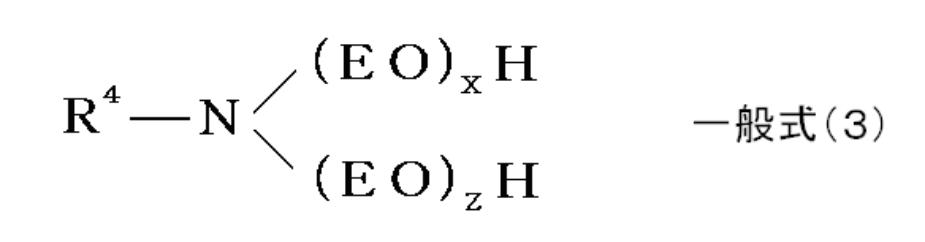
- 洗浄工程後に、パルプ原料を漂白する漂白工程を更に含む請求の範囲第3項に記載のクラフトパルプの製造方法。
- 非イオン性界面活性剤は、曇点が55℃以下である請求の範囲第3項から第4項のいずれかに記載のクラフトパルプの製造方法。
Priority Applications (3)
| Application Number | Priority Date | Filing Date | Title |
|---|---|---|---|
| CN200980103194.5A CN101939481B (zh) | 2008-01-22 | 2009-01-21 | 牛皮纸浆用清洗剂及使用其的牛皮纸浆的制造方法 |
| EP09703584A EP2236665A4 (en) | 2008-01-22 | 2009-01-21 | CLEANER FOR POWER PULP AND MANUFACTURING METHOD FOR POWDERED CELLULOSE MATERIAL |
| JP2009550536A JP5475469B2 (ja) | 2008-01-22 | 2009-01-21 | クラフトパルプ用洗浄剤を用いたクラフトパルプの製造方法 |
Applications Claiming Priority (2)
| Application Number | Priority Date | Filing Date | Title |
|---|---|---|---|
| JP2008012052 | 2008-01-22 | ||
| JP2008-012052 | 2008-01-22 |
Publications (1)
| Publication Number | Publication Date |
|---|---|
| WO2009093615A1 true WO2009093615A1 (ja) | 2009-07-30 |
Family
ID=40901123
Family Applications (1)
| Application Number | Title | Priority Date | Filing Date |
|---|---|---|---|
| PCT/JP2009/050890 Ceased WO2009093615A1 (ja) | 2008-01-22 | 2009-01-21 | クラフトパルプ用洗浄剤及びそれを用いたクラフトパルプの製造方法 |
Country Status (4)
| Country | Link |
|---|---|
| EP (1) | EP2236665A4 (ja) |
| JP (1) | JP5475469B2 (ja) |
| CN (1) | CN101939481B (ja) |
| WO (1) | WO2009093615A1 (ja) |
Cited By (6)
| Publication number | Priority date | Publication date | Assignee | Title |
|---|---|---|---|---|
| JP2011026713A (ja) * | 2009-07-21 | 2011-02-10 | Lion Corp | クラフトパルプ用洗浄剤及びそれを用いたクラフトパルプの製造方法 |
| JP2014500898A (ja) * | 2010-11-11 | 2014-01-16 | イーコラブ インコーポレイティド | 瓶用クリーニングおよびラベル除去のための方法 |
| JP2014240378A (ja) * | 2013-05-11 | 2014-12-25 | 松本油脂製薬株式会社 | アルキレンオキサイド付加物およびその用途 |
| RU2636306C2 (ru) * | 2012-04-18 | 2017-11-21 | ДжиПи СЕЛЛЬЮЛОУС ГМБХ | Использование поверхностно-активного вещества для обработки пульпы и улучшение введения крафт-пульпы в волокно для получения вискозы и других вторичных волокнистых продуктов |
| JP6713105B1 (ja) * | 2019-05-15 | 2020-06-24 | 株式会社片山化学工業研究所 | パルプの洗浄 |
| WO2020230351A1 (ja) * | 2019-05-15 | 2020-11-19 | 株式会社片山化学工業研究所 | パルプの洗浄 |
Families Citing this family (10)
| Publication number | Priority date | Publication date | Assignee | Title |
|---|---|---|---|---|
| US9511167B2 (en) | 2009-05-28 | 2016-12-06 | Gp Cellulose Gmbh | Modified cellulose from chemical kraft fiber and methods of making and using the same |
| MX382645B (es) | 2009-05-28 | 2025-03-13 | Gp Cellulose Gmbh | Celulosa modificada a partir de fibra kraft química y métodos para elaborarla y su uso. |
| US9512563B2 (en) | 2009-05-28 | 2016-12-06 | Gp Cellulose Gmbh | Surface treated modified cellulose from chemical kraft fiber and methods of making and using same |
| US9512237B2 (en) | 2009-05-28 | 2016-12-06 | Gp Cellulose Gmbh | Method for inhibiting the growth of microbes with a modified cellulose fiber |
| CN105143547B (zh) | 2013-03-15 | 2018-05-01 | Gp 纤维素股份有限公司 | 具有增高羧基含量的低粘度牛皮纸纤维及其制造和使用方法 |
| CN104088184B (zh) * | 2014-06-26 | 2017-01-11 | 孔慧 | 一种洗浆助剂及其制浆工艺方法 |
| DE102017200430A1 (de) * | 2017-01-12 | 2018-07-12 | CHT Germany GmbH | Ablagerungsverhinderung in der Zellstoff-Herstellung nach dem Sulfatverfahren (Kraft-Aufschluss) |
| JP7400394B2 (ja) * | 2019-11-25 | 2023-12-19 | セイコーエプソン株式会社 | 解繊方法および繊維体成形方法 |
| JP6908097B2 (ja) * | 2019-12-03 | 2021-07-21 | 栗田工業株式会社 | パルプシートの製造方法及びパルプスラリー用脱水向上剤 |
| KR102426912B1 (ko) * | 2020-04-20 | 2022-07-28 | 박용철 | 친환경 습강지의 제조방법 |
Citations (6)
| Publication number | Priority date | Publication date | Assignee | Title |
|---|---|---|---|---|
| JPS5231563A (en) * | 1975-03-11 | 1977-03-10 | Ytkemiska Inst | Method of clarifying dispersed liquid or dispersed particle |
| JPH0578993A (ja) * | 1991-09-19 | 1993-03-30 | Lion Corp | 抄紙用フエルト洗浄剤 |
| JP2004124329A (ja) * | 2002-10-07 | 2004-04-22 | Hakuto Co Ltd | パルプの洗浄方法 |
| JP2005336620A (ja) * | 2004-05-24 | 2005-12-08 | Daio Paper Corp | パルプの洗浄方法 |
| JP2006176910A (ja) * | 2004-12-22 | 2006-07-06 | Oji Paper Co Ltd | 脱インキパルプの製造方法 |
| JP2008007617A (ja) * | 2006-06-29 | 2008-01-17 | Sanyo Chem Ind Ltd | アルカリ洗浄剤用低起泡性界面活性剤 |
Family Cites Families (5)
| Publication number | Priority date | Publication date | Assignee | Title |
|---|---|---|---|---|
| DE3418523A1 (de) * | 1984-05-18 | 1985-11-21 | Basf Ag, 6700 Ludwigshafen | Endgruppenverschlossene fettalkoholalkoxylate fuer industrielle reinigungsprozesse, insbesondere fuer die flaschenwaesche und fuer die metallreinigung |
| JPH04352893A (ja) * | 1991-05-30 | 1992-12-07 | Nikka Chem Co Ltd | ピッチコントロール剤及びそれを用いたピッチコントロール方法 |
| US5665204A (en) * | 1995-07-20 | 1997-09-09 | Geo Specialty Chemicals, Inc. | Method for de-inking printed waste paper by the washing process using an alkoxylated nonionic surfactant |
| US6534550B1 (en) * | 2000-03-29 | 2003-03-18 | Gerald C. Walterick, Jr. | Foam control composition and method for controlling foam in aqueous systems |
| WO2008076055A1 (en) * | 2006-12-19 | 2008-06-26 | Akzo Nobel N.V. | Process of pulping |
-
2009
- 2009-01-21 CN CN200980103194.5A patent/CN101939481B/zh not_active Expired - Fee Related
- 2009-01-21 EP EP09703584A patent/EP2236665A4/en not_active Withdrawn
- 2009-01-21 WO PCT/JP2009/050890 patent/WO2009093615A1/ja not_active Ceased
- 2009-01-21 JP JP2009550536A patent/JP5475469B2/ja not_active Expired - Fee Related
Patent Citations (6)
| Publication number | Priority date | Publication date | Assignee | Title |
|---|---|---|---|---|
| JPS5231563A (en) * | 1975-03-11 | 1977-03-10 | Ytkemiska Inst | Method of clarifying dispersed liquid or dispersed particle |
| JPH0578993A (ja) * | 1991-09-19 | 1993-03-30 | Lion Corp | 抄紙用フエルト洗浄剤 |
| JP2004124329A (ja) * | 2002-10-07 | 2004-04-22 | Hakuto Co Ltd | パルプの洗浄方法 |
| JP2005336620A (ja) * | 2004-05-24 | 2005-12-08 | Daio Paper Corp | パルプの洗浄方法 |
| JP2006176910A (ja) * | 2004-12-22 | 2006-07-06 | Oji Paper Co Ltd | 脱インキパルプの製造方法 |
| JP2008007617A (ja) * | 2006-06-29 | 2008-01-17 | Sanyo Chem Ind Ltd | アルカリ洗浄剤用低起泡性界面活性剤 |
Non-Patent Citations (1)
| Title |
|---|
| See also references of EP2236665A4 * |
Cited By (7)
| Publication number | Priority date | Publication date | Assignee | Title |
|---|---|---|---|---|
| JP2011026713A (ja) * | 2009-07-21 | 2011-02-10 | Lion Corp | クラフトパルプ用洗浄剤及びそれを用いたクラフトパルプの製造方法 |
| JP2014500898A (ja) * | 2010-11-11 | 2014-01-16 | イーコラブ インコーポレイティド | 瓶用クリーニングおよびラベル除去のための方法 |
| RU2636306C2 (ru) * | 2012-04-18 | 2017-11-21 | ДжиПи СЕЛЛЬЮЛОУС ГМБХ | Использование поверхностно-активного вещества для обработки пульпы и улучшение введения крафт-пульпы в волокно для получения вискозы и других вторичных волокнистых продуктов |
| US10407830B2 (en) | 2012-04-18 | 2019-09-10 | Gp Cellulose Gmbh | Use of surfactant to treat pulp and improve the incorporation of kraft pulp into fiber for the production of viscose and other secondary fiber products |
| JP2014240378A (ja) * | 2013-05-11 | 2014-12-25 | 松本油脂製薬株式会社 | アルキレンオキサイド付加物およびその用途 |
| JP6713105B1 (ja) * | 2019-05-15 | 2020-06-24 | 株式会社片山化学工業研究所 | パルプの洗浄 |
| WO2020230351A1 (ja) * | 2019-05-15 | 2020-11-19 | 株式会社片山化学工業研究所 | パルプの洗浄 |
Also Published As
| Publication number | Publication date |
|---|---|
| EP2236665A1 (en) | 2010-10-06 |
| CN101939481A (zh) | 2011-01-05 |
| EP2236665A4 (en) | 2012-12-12 |
| CN101939481B (zh) | 2014-04-02 |
| JPWO2009093615A1 (ja) | 2011-05-26 |
| JP5475469B2 (ja) | 2014-04-16 |
Similar Documents
| Publication | Publication Date | Title |
|---|---|---|
| JP5475469B2 (ja) | クラフトパルプ用洗浄剤を用いたクラフトパルプの製造方法 | |
| KR100251077B1 (ko) | 휴지잉크제거방법 | |
| US5227019A (en) | Wastepaper deinking process | |
| CN101158113B (zh) | 环保型高效精练剂 | |
| KR930001838B1 (ko) | 탈묵제 | |
| JP5519203B2 (ja) | クラフトパルプの製造方法 | |
| CN101892583A (zh) | 一种麻类织物酶氧前处理工艺 | |
| CA2187461C (en) | Composition for producing paper and process | |
| TWI688606B (zh) | 溶解漿組成物及黏液嫘縈製造方法 | |
| FI73015B (fi) | Foerfaranden foer att avlaegsna blaeck fraon sekundaera fibrer. | |
| JPS58109696A (ja) | 故紙再生用脱インキ剤 | |
| KR20050056943A (ko) | 알킬 알콜 알콕시레이트 계면활성제를 사용한 펄프의탈수지 방법 | |
| WO2006009203A1 (ja) | 繊維用精練剤組成物 | |
| JP2004124329A (ja) | パルプの洗浄方法 | |
| JP2000265385A (ja) | 古紙再生処理用添加剤 | |
| JP6713105B1 (ja) | パルプの洗浄 | |
| JP5457290B2 (ja) | 脱インキパルプの製造方法 | |
| JP2015196932A (ja) | フローテーション用脱墨剤、および再生パルプの製造方法 | |
| JP4604962B2 (ja) | 高白色度脱墨パルプの製造方法 | |
| JPH10508909A (ja) | 繊維製品のリサイクル | |
| JP2014118642A (ja) | 未晒クラフトパルプの洗浄方法 | |
| JP2019035172A (ja) | 脱墨方法、再生紙の製造方法、及び脱墨剤 | |
| CN113692465A (zh) | 纸浆的洗涤 | |
| JP3225143B2 (ja) | 古紙再生用脱墨剤 | |
| JP5479968B2 (ja) | 脱インキパルプの製造方法 |
Legal Events
| Date | Code | Title | Description |
|---|---|---|---|
| WWE | Wipo information: entry into national phase |
Ref document number: 200980103194.5 Country of ref document: CN |
|
| 121 | Ep: the epo has been informed by wipo that ep was designated in this application |
Ref document number: 09703584 Country of ref document: EP Kind code of ref document: A1 |
|
| WWE | Wipo information: entry into national phase |
Ref document number: 2009550536 Country of ref document: JP |
|
| NENP | Non-entry into the national phase |
Ref country code: DE |
|
| WWE | Wipo information: entry into national phase |
Ref document number: 2009703584 Country of ref document: EP |