WO2009095954A2 - Dispositif d'entrée de données, procédé d'entrée de données, programme d'entrée de données et support d'enregistrement contenant le programme - Google Patents
Dispositif d'entrée de données, procédé d'entrée de données, programme d'entrée de données et support d'enregistrement contenant le programme Download PDFInfo
- Publication number
- WO2009095954A2 WO2009095954A2 PCT/JP2008/000119 JP2008000119W WO2009095954A2 WO 2009095954 A2 WO2009095954 A2 WO 2009095954A2 JP 2008000119 W JP2008000119 W JP 2008000119W WO 2009095954 A2 WO2009095954 A2 WO 2009095954A2
- Authority
- WO
- WIPO (PCT)
- Prior art keywords
- scroll
- data input
- value
- scroll amount
- force
- Prior art date
- Legal status (The legal status is an assumption and is not a legal conclusion. Google has not performed a legal analysis and makes no representation as to the accuracy of the status listed.)
- Ceased
Links
Images








Classifications
-
- G—PHYSICS
- G06—COMPUTING OR CALCULATING; COUNTING
- G06F—ELECTRIC DIGITAL DATA PROCESSING
- G06F3/00—Input arrangements for transferring data to be processed into a form capable of being handled by the computer; Output arrangements for transferring data from processing unit to output unit, e.g. interface arrangements
- G06F3/01—Input arrangements or combined input and output arrangements for interaction between user and computer
- G06F3/03—Arrangements for converting the position or the displacement of a member into a coded form
- G06F3/033—Pointing devices displaced or positioned by the user, e.g. mice, trackballs, pens or joysticks; Accessories therefor
- G06F3/0354—Pointing devices displaced or positioned by the user, e.g. mice, trackballs, pens or joysticks; Accessories therefor with detection of two-dimensional [2D] relative movements between the device, or an operating part thereof, and a plane or surface, e.g. 2D mice, trackballs, pens or pucks
- G06F3/03547—Touch pads, in which fingers can move on a surface
-
- G—PHYSICS
- G06—COMPUTING OR CALCULATING; COUNTING
- G06F—ELECTRIC DIGITAL DATA PROCESSING
- G06F3/00—Input arrangements for transferring data to be processed into a form capable of being handled by the computer; Output arrangements for transferring data from processing unit to output unit, e.g. interface arrangements
- G06F3/01—Input arrangements or combined input and output arrangements for interaction between user and computer
- G06F3/03—Arrangements for converting the position or the displacement of a member into a coded form
- G06F3/033—Pointing devices displaced or positioned by the user, e.g. mice, trackballs, pens or joysticks; Accessories therefor
- G06F3/0338—Pointing devices displaced or positioned by the user, e.g. mice, trackballs, pens or joysticks; Accessories therefor with detection of limited linear or angular displacement of an operating part of the device from a neutral position, e.g. isotonic or isometric joysticks
-
- G—PHYSICS
- G06—COMPUTING OR CALCULATING; COUNTING
- G06F—ELECTRIC DIGITAL DATA PROCESSING
- G06F3/00—Input arrangements for transferring data to be processed into a form capable of being handled by the computer; Output arrangements for transferring data from processing unit to output unit, e.g. interface arrangements
- G06F3/01—Input arrangements or combined input and output arrangements for interaction between user and computer
- G06F3/03—Arrangements for converting the position or the displacement of a member into a coded form
- G06F3/033—Pointing devices displaced or positioned by the user, e.g. mice, trackballs, pens or joysticks; Accessories therefor
- G06F3/038—Control and interface arrangements therefor, e.g. drivers or device-embedded control circuitry
-
- G—PHYSICS
- G06—COMPUTING OR CALCULATING; COUNTING
- G06F—ELECTRIC DIGITAL DATA PROCESSING
- G06F3/00—Input arrangements for transferring data to be processed into a form capable of being handled by the computer; Output arrangements for transferring data from processing unit to output unit, e.g. interface arrangements
- G06F3/01—Input arrangements or combined input and output arrangements for interaction between user and computer
- G06F3/048—Interaction techniques based on graphical user interfaces [GUI]
- G06F3/0484—Interaction techniques based on graphical user interfaces [GUI] for the control of specific functions or operations, e.g. selecting or manipulating an object, an image or a displayed text element, setting a parameter value or selecting a range
- G06F3/0485—Scrolling or panning
-
- G—PHYSICS
- G06—COMPUTING OR CALCULATING; COUNTING
- G06F—ELECTRIC DIGITAL DATA PROCESSING
- G06F3/00—Input arrangements for transferring data to be processed into a form capable of being handled by the computer; Output arrangements for transferring data from processing unit to output unit, e.g. interface arrangements
- G06F3/01—Input arrangements or combined input and output arrangements for interaction between user and computer
- G06F3/048—Interaction techniques based on graphical user interfaces [GUI]
- G06F3/0487—Interaction techniques based on graphical user interfaces [GUI] using specific features provided by the input device, e.g. functions controlled by the rotation of a mouse with dual sensing arrangements, or of the nature of the input device, e.g. tap gestures based on pressure sensed by a digitiser
- G06F3/0489—Interaction techniques based on graphical user interfaces [GUI] using specific features provided by the input device, e.g. functions controlled by the rotation of a mouse with dual sensing arrangements, or of the nature of the input device, e.g. tap gestures based on pressure sensed by a digitiser using dedicated keyboard keys or combinations thereof
- G06F3/04892—Arrangements for controlling cursor position based on codes indicative of cursor displacements from one discrete location to another, e.g. using cursor control keys associated to different directions or using the tab key
Definitions
- the present invention relates to a data input device (human input device). Specifically, the data input device changes the scroll amount of the element displayed on the display unit in accordance with the magnitude of the force applied to the force sensor.
- a data input device using rotational input such as a jog input device used for video editing or music editing, or a mouse equipped with a rotating wheel
- rotational input such as a jog input device used for video editing or music editing, or a mouse equipped with a rotating wheel
- the present invention has been made to solve such problems, and is a data input device, a data input method, and data capable of promptly and reliably performing a scroll operation without causing the user to feel an operation burden.
- An object is to provide an input program and a recording medium on which the input program is recorded.
- a force detection unit that detects an applied force
- a scroll amount determination that determines a scroll amount of an element displayed on the display unit based on the magnitude of the force detected by the force detection unit.
- a scroll direction determining means for determining a scroll direction of the element based on a change in the direction of the force detected by the force detecting means.
- the present invention also converts force detection means for detecting applied force as orthogonal coordinate data, conversion means for converting the orthogonal coordinate data detected by the force detection means to polar coordinate data, and conversion by the conversion means. Based on the r value of the polar coordinate data, the scroll amount determining means for determining the scroll amount of the element displayed on the display means, and the scroll direction of the element based on the change in the ⁇ value of the polar coordinate data converted by the converting means And a scroll direction determining means for determining a data input device.
- the scroll amount determination unit may further determine the scroll amount in consideration of a change in the ⁇ value. Device.
- the present invention further includes a storage unit that stores a table in which a correspondence relationship between the r value range and the scroll amount is defined, and the scroll amount determination unit is stored in the storage unit.
- the present invention further includes first determination means for determining whether or not the r value obtained by the conversion means is equal to or greater than a predetermined threshold value, and the scroll amount determination means includes the first scroll amount determination means.
- the data input device according to any one of (2) to (4), wherein the scroll amount is determined when the determination unit determines that the r value is equal to or greater than the predetermined threshold. It is.
- the present invention further includes second determination means for determining whether or not the magnitude of the change in ⁇ value obtained by the conversion means is equal to or greater than a predetermined threshold, and the scroll direction determination means Is characterized in that the scroll direction is determined when it is determined by the second determination means that the magnitude of the change in the ⁇ value is greater than or equal to the predetermined threshold value. It is a data input device given in any 1 paragraph.
- the present invention is also a cellular phone, PHS, notebook personal computer, portable game machine, PDA, electronic notebook, electronic device remote control, digital audio player, camera, digital camera, or camcorder.
- the data input device according to any one of (6) to (6).
- the data input device according to any one of (1) to (7), wherein the present invention is also a peripheral device for a computer or a game device.
- the present invention also includes a force detection step for detecting an applied force, and a scroll amount for determining a scroll amount of an element displayed on the display means based on the magnitude of the force detected by the force detection step.
- a data input method comprising: a determination step; and a scroll direction determination step for determining a scroll direction of the element based on a change in the direction of the force detected by the force detection step.
- the present invention also includes a force detection step for detecting the applied force as orthogonal coordinate data, a conversion step for converting the orthogonal coordinate data detected by the force detection step into polar coordinate data, and conversion by the conversion step.
- a scroll direction determination step for determining the scroll amount of the element displayed on the display means based on the r value of the polar coordinate data, and a scroll direction of the element based on a change in the ⁇ value of the polar coordinate data converted by the conversion step
- a scroll direction determining step for determining the data.
- the present invention also includes a force detection step for detecting the applied force, and a scroll amount for determining the scroll amount of the element displayed on the display means based on the magnitude of the force detected by the force detection step.
- a data input program causing a data input device to execute a determination step and a scroll direction determination step for determining a scroll direction of the element based on a change in the direction of force detected by the force detection step It is.
- the present invention also includes a force detection step of detecting the applied force as orthogonal coordinate data, a conversion step of converting the orthogonal coordinate data detected by the force detection step into polar coordinate data, and conversion by the conversion step.
- a scroll direction determination step for determining the scroll amount of the element displayed on the display means based on the r value of the polar coordinate data, and a scroll direction of the element based on a change in the ⁇ value of the polar coordinate data converted by the conversion step
- a data input program characterized by causing a data input device to execute a scroll direction determining step for determining.
- the user can easily adjust the scroll amount of the element by adjusting the magnitude of the force applied to the force detecting means.
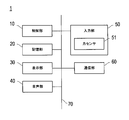
- FIG. 1 is a block diagram showing a configuration of a mobile phone to which a data input device according to the present invention is applied.
- the mobile phone 1 according to the present embodiment includes a control unit 10, a storage unit 20, a display unit 30, a voice unit 40, an input unit 50, and a communication unit 60, which exchange signals. Are connected to each other via a bus 70.
- the control unit 10 is a CPU, and controls the above units and performs various arithmetic processes according to a program.
- the storage unit 20 includes a ROM that stores various programs and parameters in advance, a RAM that temporarily stores programs and data as a work area, and the like.
- the display unit 30 is a liquid crystal display and is used for displaying various types of information.
- the audio unit 40 is a speaker and a microphone, and is used for inputting and outputting audio.
- the input unit 50 includes a force sensor 51, which will be described later, and further includes various function keys 52 such as a selection key for selecting a function of the input unit 50 and a power key for turning on / off the power as necessary. Used for.
- the communication unit 60 performs mobile communication by connecting to a mobile communication network using radio waves in a predetermined frequency band by a predetermined communication method such as FDMA, TDMA, PDC, GSM, CDMA, GPRS.
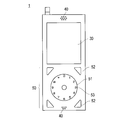
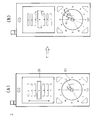
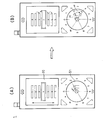
- FIG. 2 is a schematic plan view for explaining the external configuration of the mobile phone 1.
- the input unit 50 of the mobile phone 1 includes a force sensor 51 instead of a numeric keypad that forms an input unit of a normal mobile phone.
- a character 53 composed of numerals and symbols is arranged and displayed on the surface of the casing at the periphery of the key top portion of the force sensor 51.
- the input unit 50 of the mobile phone 1 detects the force applied by the force sensor 51 and operates as a means for controlling the scroll operation of the elements as described later. It also operates as means for selecting and inputting characters such as. That is, the mobile phone 1 detects the force applied by the force sensor 51 of the input unit 50 as orthogonal coordinate data, converts the detected orthogonal coordinate data into polar coordinate data, and assigns a character and each character to a range of ⁇ values. Is assigned and the input is determined by selecting the character assigned to the obtained ⁇ value. As shown in FIG. 3, the character 53 may be arranged and displayed on the key top portion of the force sensor 51 instead of the surface of the housing. Further, as shown in FIG. 4, a character selection / input unit such as a numeric keypad may be provided separately, and the input unit 50 may be operated only as an element scroll operation control unit.
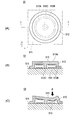
- FIG. 5A and 5B are diagrams showing an example of the configuration of the force sensor 51, where FIG. 5A is a plan view, FIG. 5B is a cross-sectional view taken along the line II in FIG. 5A, and FIG. A state where a force is applied to a part of the sensor 51 is shown.
- the force sensor 51 is a capacitance type force sensor, and includes a base 511 and a displacement portion 512 provided on the base 511 as shown in FIGS.
- the displacement portion 512 is formed by integrally forming a disk-shaped key top portion 512A, a cylindrical peripheral wall portion 512B, and a columnar support portion 512C provided at the central shaft portion, and is made of an elastic material such as rubber or a metal It is formed by, for example, is deformed by receiving an external force, and is configured to restore the original when no external force is received.
- an annular electrode 513 is provided opposite to the inner surface of the key top portion 512A of the displacement portion 512 and the base 511. Then, as shown in FIG. 5C, when a force F is applied to the key top portion 512A of the force sensor 51 by a user's fingertip or the like, the displacement portion 512 is deformed according to the force, and the applied portion The counter electrodes 513 approach each other and the distance is reduced.
- the force sensor 51 takes out the increased capacitance and outputs it as an electrical signal.
- the output from the force sensor 51 is obtained as orthogonal coordinate data, that is, each component force in the orthogonal XY directions (see FIG. 5).
- the method and structure of the force sensor that can be used in the data input device of the present invention are particularly limited as long as the applied force can be converted into an electrical signal and output as orthogonal coordinate data.
- force sensors of various methods and structures using resistance line change, variable resistance change, magnetic force change, etc. can be used.
- FIG. 6 is a flowchart showing a procedure of scroll control by the control unit 10 of the mobile phone 1 in the present embodiment. Note that the algorithm shown in the flowchart of FIG. 6 is stored as a control program in the storage unit 20 of the mobile phone 1 and is appropriately read out and executed by the control unit 10 when the operation of the mobile phone 1 starts.
- the control unit 10 of the mobile phone 1 stands by until there is an input from the input unit 50 (NO in S101).
- the input unit 50 takes out the applied force as orthogonal coordinate data and outputs it to the control unit 10.
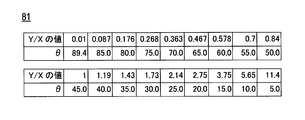
- the control unit 10 When receiving an input from the input unit 50 (YES in S101), the control unit 10 performs polar coordinate conversion on the input orthogonal coordinate data according to the conversion formula shown in FIG. 7 to obtain polar coordinate data, and an r value (magnitude of force). And ⁇ value (force direction) is obtained (S102). Further, the control unit 10 stores the latest r value and ⁇ value obtained in this manner in a predetermined area of the storage unit 20, and stores the r value and ⁇ value previously stored in step S ⁇ b> 102 in the storage unit 20. Store in another area. The conversion to the ⁇ value is performed by storing the X / Y value-to- ⁇ conversion table 81 as shown in FIG. There may be. Although FIG. 8 shows an example of a conversion table of ⁇ values in increments of 5 °, it goes without saying that the interval between conversion tables to be used can be arbitrarily adjusted as necessary.
- the r value obtained in step S102 is compared with a predetermined threshold value (for example, 0.5). If the r value is less than the threshold value (NO in S103), the process returns to step S101 and a new one is input from the input unit 50. Wait for correct input. On the other hand, if the r value is greater than or equal to the threshold value in step S103 (YES in S103), the process proceeds to step S104. As described above, the first determination unit determines whether or not the r value obtained in step S102 is equal to or greater than a predetermined threshold value, and the r value is equal to or greater than the predetermined threshold value by the first determination unit.
- a predetermined threshold value for example, 0.5
- the predetermined threshold is configured to an appropriate level (less than the predetermined threshold (input of r value) can be effectively excluded.
- step S104 the scroll amount conversion table stored in the storage unit 20 is referred to, and the scroll amount is determined based on the r value obtained in step S102.
- FIG. 9 is a diagram showing an example of the scroll amount conversion table.
- this scroll amount conversion table different scroll amounts are assigned for each range of r value 0.5, and the scroll amount is set to increase linearly with respect to the range of r value 0.5.
- the scroll amount conversion table when the key top portion 512A of the force sensor 51 is pressed by the user, the scroll amount can be increased linearly according to the pressing force, and the scroll amount can be easily adjusted. It becomes.
- the storage unit in this embodiment, the storage unit 20
- the table stored in the storage unit is referred to.
- the processing time can be shortened compared to the case where the scroll amount is calculated by calculation, and the scrolling can be reduced from the input to the input unit 50.
- the program can be simplified.
- FIG. 10 is a diagram showing another example of the scroll amount conversion table.
- the scroll amount is set to increase in a quadratic function with respect to the range of r value 0.5.
- the scroll amount can be increased in a quadratic function in accordance with the pressing force, and the scroll can be further increased. Can be done quickly.
- the number of scroll amounts assigned by the scroll amount conversion table, the range of r values to which the scroll amount is assigned (or not assigned), and the size thereof can of course be changed as necessary.
- the r value is converted into the scroll amount with reference to the scroll amount conversion table.
- the present invention is not limited to this, and the scroll amount conversion table is converted to the scroll amount conversion table in step S104.
- the scroll amount may be calculated by calculation based on the r value without reference. Further, if the scroll amount is determined by taking into account the magnitude ⁇ of the change in ⁇ value (described later) (defining the scroll amount as a function of the r value and the ⁇ value), more advanced scroll control is possible. Is possible.
- a predetermined threshold for example, 30 °
- the process returns to step S101 and waits until there is a new input from the input unit 50.
- the absolute value of the magnitude ⁇ of change in ⁇ value is equal to or greater than a predetermined threshold (YES in S105)
- the process proceeds to step S106.
- second determining means for determining whether or not the magnitude ⁇ of the change in ⁇ value obtained in step S105 is equal to or larger than a predetermined threshold value. If the scroll direction is determined when it is determined that the magnitude of change ⁇ is greater than or equal to a predetermined threshold value, an erroneous operation of the input unit 50 or sensor noise can be achieved by setting the predetermined threshold value to an appropriate level. Thus, it is possible to effectively exclude an input unintended by the user (input of a ⁇ value less than a predetermined threshold).
- step S106 the scroll direction is determined based on the change in ⁇ value (the sign of ⁇ ).
- step S107 the scroll amount determined in step S104 and the scroll direction determined in step S106 are determined. Based on this, the elements (list, icon, etc.) displayed on the display unit 30 are scrolled.
- the r value is 0.7
- the r value falls within the range of 0.5 to 1.0, so the scroll amount is determined as 1 from the scroll amount conversion table of FIG.
- the list displayed on the display unit 30 is scrolled upward by one.
- the scroll amount is determined to be 2 from the scroll amount conversion table of FIG. As a result, the list displayed on the display unit 30 is scrolled down by two.
- FIG. 13B Scrolling may be performed by rotating a plurality of icons vertically, as shown in FIG. 13B, scrolling may be performed by rotating a plurality of icons in the horizontal direction, and as shown in FIG. 13D, a plurality of icons and a list may be combined and scrolled in synchronization with each other.
- step S108 the scroll amount determined in step S104 and the scroll direction determined in step S106 are displayed on the display unit 30.
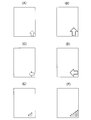
- the current scroll amount and scroll direction are displayed in the size and direction of the arrow at at least one of the four corners or four sides of the display unit 30.
- FIG. 14A shows that a small amount (slow) scrolling is performed in the upward direction
- FIG. 14B a large amount (fast) scrolling is performed in the upward direction
- FIG. 14C it is displayed that a small amount (slowly) scrolling is performed in the left direction
- FIG. 14B a large amount of ( (Fast) Scrolling is displayed.
- 14 (E) and 14 (F) show other display modes, in which the current scroll amount and scroll direction are indicated by the number and direction of arrows.
- 15A and 15B show the scroll amount and the rotation input direction of the key top portion in the direction of the circle radius and the arrow when the rotation input is performed by tracing the key top portion of the force sensor 51.
- (E) and (F) are examples in which the scroll amount and the rotation input direction of the key top portion are indicated by the length of an arc and an arrow. Since the rotation input direction is associated with the scroll direction (for example, in video playback, the clockwise rotation is fast forward, the counterclockwise rotation is rewinding, etc.), and the user knows the current scroll amount and scroll direction even with such display. It is something that can be done.
- the display of the scroll amount and the scroll direction may be always displayed, or may be displayed only for a predetermined time when a predetermined timing or display command is received.
- the display position is not four corners or four sides of the display unit 30 but is displayed in a large size at an arbitrary position of the display unit 30 as shown in FIGS. 15 (C) and (D). May be.
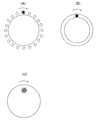
- a plurality of LSDs and the like provided on the peripheral portion of the key top portion of the force sensor 51.
- display may be performed according to the speed and direction in which the lamps are sequentially lit, or as shown in FIG. 16B or FIG.
- a part of the backlight may be turned on in the same manner.
- the control unit 10 of the mobile phone 1 repeatedly executes the above scroll control unless the power is shut off.
- the mobile phone 1 is detected by the force detection means (in this embodiment, the force sensor 51) that detects the applied force as orthogonal coordinate data, and the force detection means. Based on the conversion means for converting the orthogonal coordinate data to polar coordinate data (in this embodiment, step S102 of the scroll control process is applicable) and the display means (in this embodiment, the r value of the polar coordinate data converted by the conversion means).
- the force detection means in this embodiment, the force sensor 51
- the force detection means Based on the conversion means for converting the orthogonal coordinate data to polar coordinate data (in this embodiment, step S102 of the scroll control process is applicable) and the display means (in this embodiment, the r value of the polar coordinate data converted by the conversion means).
- a scroll amount determination means (in this embodiment, step S104 of the scroll control process) that determines the scroll amount of the element (list in this embodiment) displayed on the display unit 30), and a conversion means Scroll direction determining means for determining the scroll direction of the element based on the change in the ⁇ value of the converted polar coordinate data (in this embodiment, scrolling A step S106 of the control process is applicable), the.
- the user can easily adjust the scroll amount by adjusting the magnitude of the force applied to the force detection means, and can scroll the elements at high speed.
- it is sufficient to increase the force applied to the force detection means, and it is not necessary to continue rotating the finger, the stylus pen, or the like at high speed. Therefore, the scroll operation can be performed quickly and reliably without causing the user to feel an operation burden.
- the “display means” according to the present invention is not limited to a liquid crystal display, and may be, for example, an organic EL, a plasma display, or the like.
- the “element” is not limited to a list or an icon, and may be, for example, a browser browsing screen, a document creation software editing screen, a still image, a moving image frame, or the like. That is, the control of the scroll direction and the scroll amount by the data input device of the present invention can also be used to control the fast-forward or rewind speed in, for example, moving image playback software.
- the data input device of the present invention has been described with an example of a mobile phone.
- the present invention is not limited to this, and any device provided with a data input unit (human input device) may be used. It can be applied to both.
- Other examples of the data input device of the present invention include PHS, notebook personal computers, portable game devices, portable computers such as PDAs and electronic notebooks, remote controllers for various electronic devices, digital audio players, digital cameras, camcorders, etc. Home appliances and the like.
- the data input device of the present invention may be configured as a peripheral device such as a personal computer or a game device, particularly as an input device as an alternative to a mouse, a keyboard, a joystick, or the like.
- the data input device and the data input method according to the present invention can be realized by a dedicated hardware circuit for executing each of the above procedures, or by a CPU executing a program describing each of the above procedures.
- the program for operating the data input device may be provided by a computer-readable recording medium such as a floppy (registered trademark) disk or CD-ROM, or a network such as the Internet. May be provided online.
- the program recorded on the computer-readable recording medium is usually transferred and stored in a ROM, a hard disk or the like.
- this program may be provided as, for example, a single application software, or may be incorporated as a function of the data input device into the basic software of the device by being provided as a dedicated driver.
- a data input device capable of promptly and reliably performing a scrolling operation without causing the user to feel an operation burden.
- FIG. 6 is a schematic plan view for explaining another example of the external configuration of the mobile phone 1.
- FIG. 6 is a schematic plan view for explaining another example of the external configuration of the mobile phone 1.
- 2A and 2B are diagrams illustrating an example of a configuration of a force sensor 51, where FIG. 1A is a plan view, FIG. 1B is a cross-sectional view taken along a line II in FIG. 1A, and FIG. The state where force is applied to the part is shown. 6 is a flowchart showing a procedure of character input processing by the control unit 10 of the mobile phone 1.
- FIG. 3 is a schematic diagram illustrating an example of display of scroll amount and scroll direction in the mobile phone 1. It is the schematic which shows another example of the display of the scroll amount and scroll direction in the mobile telephone. It is the schematic which shows another example of the display of the scroll amount and scroll direction in the mobile telephone.
Landscapes
- Engineering & Computer Science (AREA)
- General Engineering & Computer Science (AREA)
- Theoretical Computer Science (AREA)
- Human Computer Interaction (AREA)
- Physics & Mathematics (AREA)
- General Physics & Mathematics (AREA)
- Position Input By Displaying (AREA)
- User Interface Of Digital Computer (AREA)
- Push-Button Switches (AREA)
- Input From Keyboards Or The Like (AREA)
Priority Applications (5)
| Application Number | Priority Date | Filing Date | Title |
|---|---|---|---|
| EP08702851A EP2325730A1 (fr) | 2008-01-31 | 2008-01-31 | Dispositif d'entrée de données, procédé d'entrée de données, programme d'entrée de données et support d'enregistrement contenant le programme |
| PCT/JP2008/000119 WO2009095954A2 (fr) | 2008-01-31 | 2008-01-31 | Dispositif d'entrée de données, procédé d'entrée de données, programme d'entrée de données et support d'enregistrement contenant le programme |
| US12/864,898 US20110006980A1 (en) | 2008-01-31 | 2008-01-31 | Data input device, data input method, data input program, and recording medium containing the program |
| JP2009551317A JPWO2009095954A1 (ja) | 2008-01-31 | 2008-01-31 | データ入力装置、データ入力方法ならびにデータ入力プログラムおよびこれを記録した記録媒体 |
| CN200880128415XA CN102124424A (zh) | 2008-01-31 | 2008-01-31 | 数据输入装置、数据输入方法和数据输入程序及记录有该程序的记录介质 |
Applications Claiming Priority (1)
| Application Number | Priority Date | Filing Date | Title |
|---|---|---|---|
| PCT/JP2008/000119 WO2009095954A2 (fr) | 2008-01-31 | 2008-01-31 | Dispositif d'entrée de données, procédé d'entrée de données, programme d'entrée de données et support d'enregistrement contenant le programme |
Publications (1)
| Publication Number | Publication Date |
|---|---|
| WO2009095954A2 true WO2009095954A2 (fr) | 2009-08-06 |
Family
ID=40913377
Family Applications (1)
| Application Number | Title | Priority Date | Filing Date |
|---|---|---|---|
| PCT/JP2008/000119 Ceased WO2009095954A2 (fr) | 2008-01-31 | 2008-01-31 | Dispositif d'entrée de données, procédé d'entrée de données, programme d'entrée de données et support d'enregistrement contenant le programme |
Country Status (5)
| Country | Link |
|---|---|
| US (1) | US20110006980A1 (fr) |
| EP (1) | EP2325730A1 (fr) |
| JP (1) | JPWO2009095954A1 (fr) |
| CN (1) | CN102124424A (fr) |
| WO (1) | WO2009095954A2 (fr) |
Families Citing this family (41)
| Publication number | Priority date | Publication date | Assignee | Title |
|---|---|---|---|---|
| US7469381B2 (en) | 2007-01-07 | 2008-12-23 | Apple Inc. | List scrolling and document translation, scaling, and rotation on a touch-screen display |
| US8587422B2 (en) | 2010-03-31 | 2013-11-19 | Tk Holdings, Inc. | Occupant sensing system |
| US9007190B2 (en) | 2010-03-31 | 2015-04-14 | Tk Holdings Inc. | Steering wheel sensors |
| JP5759230B2 (ja) | 2010-04-02 | 2015-08-05 | ティーケー ホールディングス,インコーポレーテッド | 手センサを有するステアリング・ホイール |
| WO2013154720A1 (fr) | 2012-04-13 | 2013-10-17 | Tk Holdings Inc. | Capteur de pression comprenant un matériau sensible à la pression à utiliser avec des systèmes de commande et ses procédés d'utilisation |
| WO2013192539A1 (fr) | 2012-06-21 | 2013-12-27 | Nextinput, Inc. | Puces de force mems de niveau de tranche |
| US9032818B2 (en) | 2012-07-05 | 2015-05-19 | Nextinput, Inc. | Microelectromechanical load sensor and methods of manufacturing the same |
| JP6260622B2 (ja) | 2012-09-17 | 2018-01-17 | ティーケー ホールディングス インク.Tk Holdings Inc. | 単一層力センサ |
| JP5590511B2 (ja) * | 2012-09-19 | 2014-09-17 | カシオ計算機株式会社 | 機能駆動装置、機能駆動方法および機能駆動プログラム |
| US10691230B2 (en) | 2012-12-29 | 2020-06-23 | Apple Inc. | Crown input for a wearable electronic device |
| US10275117B2 (en) | 2012-12-29 | 2019-04-30 | Apple Inc. | User interface object manipulations in a user interface |
| US10503388B2 (en) | 2013-09-03 | 2019-12-10 | Apple Inc. | Crown input for a wearable electronic device |
| US11068128B2 (en) | 2013-09-03 | 2021-07-20 | Apple Inc. | User interface object manipulations in a user interface |
| CN105683877B (zh) | 2013-09-03 | 2019-05-28 | 苹果公司 | 用于操纵用户界面对象的用户界面 |
| US10001817B2 (en) | 2013-09-03 | 2018-06-19 | Apple Inc. | User interface for manipulating user interface objects with magnetic properties |
| US10545657B2 (en) | 2013-09-03 | 2020-01-28 | Apple Inc. | User interface for manipulating user interface objects |
| US12287962B2 (en) | 2013-09-03 | 2025-04-29 | Apple Inc. | User interface for manipulating user interface objects |
| WO2015106246A1 (fr) | 2014-01-13 | 2015-07-16 | Nextinput, Inc. | Détecteurs de force pour mems à encapsulation sur tranche, miniaturisés et robustes |
| EP4036685A1 (fr) | 2014-06-27 | 2022-08-03 | Apple Inc. | Interface utilisateur de taille réduite |
| JP2016045247A (ja) * | 2014-08-20 | 2016-04-04 | ティアック株式会社 | 表示装置及びこれを備えるオーディオ機器 |
| TWI582641B (zh) | 2014-09-02 | 2017-05-11 | 蘋果公司 | 按鈕功能性 |
| US20160062571A1 (en) | 2014-09-02 | 2016-03-03 | Apple Inc. | Reduced size user interface |
| TWI676127B (zh) | 2014-09-02 | 2019-11-01 | 美商蘋果公司 | 關於電子郵件使用者介面之方法、系統、電子器件及電腦可讀儲存媒體 |
| WO2016036510A1 (fr) | 2014-09-02 | 2016-03-10 | Apple Inc. | Interface utilisateur de musique |
| US10365807B2 (en) | 2015-03-02 | 2019-07-30 | Apple Inc. | Control of system zoom magnification using a rotatable input mechanism |
| CN117486166A (zh) | 2015-06-10 | 2024-02-02 | 触控解决方案股份有限公司 | 具有容差沟槽的加固的晶圆级mems力传感器 |
| CN110494724B (zh) | 2017-02-09 | 2023-08-01 | 触控解决方案股份有限公司 | 集成数字力传感器和相关制造方法 |
| WO2018148510A1 (fr) | 2017-02-09 | 2018-08-16 | Nextinput, Inc. | Capteur de force de fusion piézorésistif et piézoélectrique intégré |
| JOP20190245A1 (ar) | 2017-04-20 | 2019-10-15 | Novartis Ag | أنظمة توصيل إطلاق مستدام تتضمن روابط بلا أثر لنقطة الربط |
| EP3655740A4 (fr) | 2017-07-19 | 2021-07-14 | Nextinput, Inc. | Empilement de transfert de contrainte dans un capteur de force mems |
| WO2019023309A1 (fr) | 2017-07-25 | 2019-01-31 | Nextinput, Inc. | Capteur de force et d'empreintes digitales intégré |
| US11243126B2 (en) | 2017-07-27 | 2022-02-08 | Nextinput, Inc. | Wafer bonded piezoresistive and piezoelectric force sensor and related methods of manufacture |
| US10394342B2 (en) * | 2017-09-27 | 2019-08-27 | Facebook Technologies, Llc | Apparatuses, systems, and methods for representing user interactions with real-world input devices in a virtual space |
| WO2019079420A1 (fr) | 2017-10-17 | 2019-04-25 | Nextinput, Inc. | Compensation de coefficient de température de décalage pour capteur de force et jauge de contrainte |
| US11385108B2 (en) | 2017-11-02 | 2022-07-12 | Nextinput, Inc. | Sealed force sensor with etch stop layer |
| WO2019099821A1 (fr) | 2017-11-16 | 2019-05-23 | Nextinput, Inc. | Atténuateur de force pour capteur de force |
| US11435830B2 (en) | 2018-09-11 | 2022-09-06 | Apple Inc. | Content-based tactile outputs |
| DK179896B1 (en) | 2018-09-11 | 2019-08-30 | Apple Inc. | CONTENT-BASED TACTILE OUTPUTS |
| TW202027794A (zh) | 2018-10-03 | 2020-08-01 | 瑞士商諾華公司 | 血管生成素樣3多肽之持續遞送 |
| US10962427B2 (en) | 2019-01-10 | 2021-03-30 | Nextinput, Inc. | Slotted MEMS force sensor |
| US12567415B2 (en) | 2023-05-09 | 2026-03-03 | Apple Inc. | Providing and controlling immersive three-dimensional environments |
Citations (1)
| Publication number | Priority date | Publication date | Assignee | Title |
|---|---|---|---|---|
| JP2005507112A (ja) | 2001-10-22 | 2005-03-10 | アップル・コンピューター・インコーポレーテッド | 加速されたスクロールを行う方法および装置 |
Family Cites Families (11)
| Publication number | Priority date | Publication date | Assignee | Title |
|---|---|---|---|---|
| JP3183255B2 (ja) * | 1998-05-14 | 2001-07-09 | 日本電気株式会社 | 小型携帯端末の文字入力装置及びその方法 |
| JP4591941B2 (ja) * | 2001-08-10 | 2010-12-01 | 株式会社ワコー | 容量素子を用いた力検出装置 |
| EP1351121A3 (fr) * | 2002-03-26 | 2009-10-21 | Polymatech Co., Ltd. | Dispositif d'entrée |
| JP4125931B2 (ja) * | 2002-08-26 | 2008-07-30 | 株式会社ワコー | 回転操作量の入力装置およびこれを利用した操作装置 |
| JP4514509B2 (ja) * | 2004-05-14 | 2010-07-28 | アップサイド株式会社 | 力センサー、力検出システム及び力検出プログラム |
| KR100984596B1 (ko) * | 2004-07-30 | 2010-09-30 | 애플 인크. | 터치 감지 입력 장치용 제스처 |
| JP4284271B2 (ja) * | 2004-12-22 | 2009-06-24 | アップサイド株式会社 | データ入力装置、データ入力方法ならびにデータ入力プログラムおよびこれを記録した記録媒体 |
| JP4715257B2 (ja) * | 2005-03-22 | 2011-07-06 | パナソニック株式会社 | データ処理装置 |
| US8049731B2 (en) * | 2005-07-29 | 2011-11-01 | Interlink Electronics, Inc. | System and method for implementing a control function via a sensor having a touch sensitive control input surface |
| JP2007133698A (ja) * | 2005-11-10 | 2007-05-31 | Sony Ericsson Mobilecommunications Japan Inc | 携帯端末 |
| US7720552B1 (en) * | 2006-06-05 | 2010-05-18 | Rockwell Automation Technologies, Inc. | Virtual knob lever arm as analog control element |
-
2008
- 2008-01-31 WO PCT/JP2008/000119 patent/WO2009095954A2/fr not_active Ceased
- 2008-01-31 EP EP08702851A patent/EP2325730A1/fr not_active Withdrawn
- 2008-01-31 CN CN200880128415XA patent/CN102124424A/zh active Pending
- 2008-01-31 US US12/864,898 patent/US20110006980A1/en not_active Abandoned
- 2008-01-31 JP JP2009551317A patent/JPWO2009095954A1/ja active Pending
Patent Citations (1)
| Publication number | Priority date | Publication date | Assignee | Title |
|---|---|---|---|---|
| JP2005507112A (ja) | 2001-10-22 | 2005-03-10 | アップル・コンピューター・インコーポレーテッド | 加速されたスクロールを行う方法および装置 |
Also Published As
| Publication number | Publication date |
|---|---|
| EP2325730A1 (fr) | 2011-05-25 |
| CN102124424A (zh) | 2011-07-13 |
| JPWO2009095954A1 (ja) | 2011-05-26 |
| US20110006980A1 (en) | 2011-01-13 |
Similar Documents
| Publication | Publication Date | Title |
|---|---|---|
| WO2009095954A2 (fr) | Dispositif d'entrée de données, procédé d'entrée de données, programme d'entrée de données et support d'enregistrement contenant le programme | |
| CN102906682B (zh) | 使用触摸检测表面的电子设备和方法 | |
| JP6122037B2 (ja) | 端末機におけるコンテンツ移動方法及び装置 | |
| JP5703873B2 (ja) | 情報処理装置、情報処理方法およびプログラム | |
| JP5628625B2 (ja) | 電子機器、画面制御方法および画面制御プログラム | |
| JP5684621B2 (ja) | 電子機器、表示制御方法及び表示制御プログラム | |
| US20110164060A1 (en) | Display control apparatus, display control method, and display control program | |
| JP2012141978A (ja) | タッチスクリーンを含む装置及びその装置のスクロール方法 | |
| JP2007272905A (ja) | タッチホイールを備えた端末及び該端末におけるコマンド入力方法 | |
| JP2009540471A (ja) | タッチパッド上における挙動を認識してスクロール機能を制御し既定の場所でのタッチダウンによってスクロールを活性化する方法 | |
| JP4284271B2 (ja) | データ入力装置、データ入力方法ならびにデータ入力プログラムおよびこれを記録した記録媒体 | |
| JP2010102474A (ja) | 情報表示装置、携帯情報端末、表示制御方法及び表示制御プログラム | |
| JP2013047945A (ja) | 電子機器、制御方法および制御プログラム | |
| WO2010049029A2 (fr) | Défilement pour interface utilisateur graphique tactile | |
| CN104007917A (zh) | 一种虚拟键盘的控制方法及电子设备 | |
| JPWO2009095955A1 (ja) | アナログ入力装置、アナログ入力方法並びにアナログ入力プログラム及びこれを記録したコンピュータ読み取り可能な記録媒体 | |
| JP2012174247A (ja) | 携帯電子機器、接触操作制御方法および接触操作制御プログラム | |
| JP5923395B2 (ja) | 電子機器 | |
| JP2012174248A (ja) | 携帯電子機器、接触操作制御方法および接触操作制御プログラム | |
| JP2013137697A (ja) | 電子機器、表示制御方法、およびプログラム | |
| JP2016224688A (ja) | 情報処理装置、制御方法、制御プログラム、および記録媒体 | |
| JP2006048589A (ja) | 携帯機器及び携帯機器における方向入力方法並びにプログラム | |
| JP2016218859A (ja) | 情報処理装置、制御方法、および制御プログラム | |
| TWI420385B (zh) | Wireless screen display control | |
| JP5826415B2 (ja) | 表示制御方法及び表示制御プログラム |
Legal Events
| Date | Code | Title | Description |
|---|---|---|---|
| WWE | Wipo information: entry into national phase |
Ref document number: 200880128415.X Country of ref document: CN |
|
| 121 | Ep: the epo has been informed by wipo that ep was designated in this application |
Ref document number: 08702851 Country of ref document: EP Kind code of ref document: A2 |
|
| WWE | Wipo information: entry into national phase |
Ref document number: 2009551317 Country of ref document: JP |
|
| WWE | Wipo information: entry into national phase |
Ref document number: 12864898 Country of ref document: US |
|
| NENP | Non-entry into the national phase |
Ref country code: DE |
|
| WWE | Wipo information: entry into national phase |
Ref document number: 2008702851 Country of ref document: EP |