WO2009096400A1 - Composition de résine de polysulfure d'arylène, son procédé de production et composant électronique de montage en surface - Google Patents
Composition de résine de polysulfure d'arylène, son procédé de production et composant électronique de montage en surface Download PDFInfo
- Publication number
- WO2009096400A1 WO2009096400A1 PCT/JP2009/051305 JP2009051305W WO2009096400A1 WO 2009096400 A1 WO2009096400 A1 WO 2009096400A1 JP 2009051305 W JP2009051305 W JP 2009051305W WO 2009096400 A1 WO2009096400 A1 WO 2009096400A1
- Authority
- WO
- WIPO (PCT)
- Prior art keywords
- resin composition
- polyarylene sulfide
- polyamide
- sulfide resin
- composition according
- Prior art date
- Legal status (The legal status is an assumption and is not a legal conclusion. Google has not performed a legal analysis and makes no representation as to the accuracy of the status listed.)
- Ceased
Links
Images

Classifications
-
- H—ELECTRICITY
- H10—SEMICONDUCTOR DEVICES; ELECTRIC SOLID-STATE DEVICES NOT OTHERWISE PROVIDED FOR
- H10W—GENERIC PACKAGES, INTERCONNECTIONS, CONNECTORS OR OTHER CONSTRUCTIONAL DETAILS OF DEVICES COVERED BY CLASS H10
- H10W74/00—Encapsulations, e.g. protective coatings
- H10W74/40—Encapsulations, e.g. protective coatings characterised by their materials
- H10W74/47—Encapsulations, e.g. protective coatings characterised by their materials comprising organic materials, e.g. plastics or resins
-
- C—CHEMISTRY; METALLURGY
- C08—ORGANIC MACROMOLECULAR COMPOUNDS; THEIR PREPARATION OR CHEMICAL WORKING-UP; COMPOSITIONS BASED THEREON
- C08L—COMPOSITIONS OF MACROMOLECULAR COMPOUNDS
- C08L81/00—Compositions of macromolecular compounds obtained by reactions forming in the main chain of the macromolecule a linkage containing sulfur with or without nitrogen, oxygen or carbon only; Compositions of polysulfones; Compositions of derivatives of such polymers
- C08L81/02—Polythioethers; Polythioether-ethers
-
- C—CHEMISTRY; METALLURGY
- C08—ORGANIC MACROMOLECULAR COMPOUNDS; THEIR PREPARATION OR CHEMICAL WORKING-UP; COMPOSITIONS BASED THEREON
- C08L—COMPOSITIONS OF MACROMOLECULAR COMPOUNDS
- C08L81/00—Compositions of macromolecular compounds obtained by reactions forming in the main chain of the macromolecule a linkage containing sulfur with or without nitrogen, oxygen or carbon only; Compositions of polysulfones; Compositions of derivatives of such polymers
- C08L81/04—Polysulfides
-
- C—CHEMISTRY; METALLURGY
- C08—ORGANIC MACROMOLECULAR COMPOUNDS; THEIR PREPARATION OR CHEMICAL WORKING-UP; COMPOSITIONS BASED THEREON
- C08L—COMPOSITIONS OF MACROMOLECULAR COMPOUNDS
- C08L77/00—Compositions of polyamides obtained by reactions forming a carboxylic amide link in the main chain; Compositions of derivatives of such polymers
- C08L77/06—Polyamides derived from polyamines and polycarboxylic acids
Definitions
- the present invention relates to a polyarylene sulfide resin composition containing polyarylene sulfide and polyamide, a method for producing the same, and an electronic component for surface mounting.
- Polyarylene sulfide typified by polyphenylene sulfide has a high melting point, excellent flame retardancy and chemical resistance, and good fluidity during molding. Widely used in machine parts and automobile parts.
- the mounting method of resin-based electronic components on a printed circuit board is a so-called surface mount method (hereinafter abbreviated as “SMT method”). It has shifted to the surface mounting method called.
- SMT method surface mount method
- tin-lead eutectic solder melting point: 184 ° C.
- tin has been used as an alternative material due to environmental pollution problems.
- lead-free solder in which several kinds of metals are added to the base is used.
- Such a lead-free solder has a melting point higher than that of tin-lead eutectic solder.
- the melting point reaches 220 ° C.
- the material in which the polyarylene sulfide and the aromatic polyamide are blended is an effective means for reducing the chlorine atom content in the material because the polyarylene sulfide is diluted by the blending of the aromatic polyamide.
- polyarylene sulfide itself usually contains several thousand ppm of chlorine atoms, it is difficult to clear the above standard of chlorine atom content of 900 ppm or less even in the case of blending and diluting polyamide. Met.
- the polyarylene sulfide is washed to reduce the amount of chlorine atoms. In this case, not only the amount of chlorine atoms but also the amount of functional groups having reactivity with the polyamide component is reduced at the same time. As a result, the heat resistance reliability and mechanical strength of the blisters described above are eventually reduced.
- JP-A-2-123159 Japanese Patent Laid-Open No. 5-5060
- the problem to be solved by the present invention is that the chlorine atom content in the polyarylene sulfide resin composition can be controlled to an unprecedented low level of 900 ppm or less, and has both heat resistance and mechanical strength.
- a polyarylene sulfide resin composition, a method for producing the same, and an electronic component for surface mounting are provided.
- the present inventor has blended polyarylene sulfide having a predetermined molecular weight and molecular weight distribution and having a linear molecular structure with a polyamide.
- the inventors have found that the chlorine atom content can be reduced to 900 ppm or less, and that excellent reflow heat resistance and mechanical strength can be imparted to a molded product, and the present invention has been completed.
- the present invention has a peak molecular weight in the range of 25,000 to 30,000 in the measurement using gel permeation chromatography, and the ratio between the weight average molecular weight (Mw) and the number average molecular weight (Mn)
- Mw weight average molecular weight
- Mn number average molecular weight
- the polyarylene sulfide (A) and the polyamide (B) having a Mw / Mn) in the range of 5 to 10 and a non-Newtonian index in the range of 0.9 to 1.3 are essential components.
- the present invention relates to a polyarylene sulfide resin composition.
- the polyarylene sulfide resin composition is charged into a twin-screw kneading extruder, and the ratio of the resin component discharge amount (kg / hr) to the screw rotation speed (rpm) (discharge amount / screw rotation speed). ) Is 0.02 to 0.2 (kg / hr ⁇ rpm).
- the present invention relates to an electronic component for surface mounting characterized by comprising a molded product of the polyarylene sulfide resin composition and a metal terminal as essential components.
- the polyarylene sulfide resin composition can control the chlorine atom content in the polyarylene sulfide resin composition to an unprecedented low level of 900 ppm or less and has both heat resistance and mechanical strength.
- the manufacturing method and the electronic component for surface mounting can be provided.
- the polyarylene sulfide resin composition of the present invention expresses excellent heat resistance in a high temperature range, and when used in a surface mounting electronic component, the polyarylene sulfide resin composition may be exposed to a high temperature during soldering to a substrate. It has a feature that the mechanical strength change and appearance change of the electronic component are very small after the soldering process. Therefore, the polyarylene sulfide resin composition of the present invention is particularly useful for connectors, switches, relays, coil bobbins, capacitors, etc. used for soldering onto a printed circuit board in the SMT system.
- the polyarylene sulfide (A) used in the present invention has a peak molecular weight in the range of 25,000 to 30,000 in the measurement using gel permeation chromatography, and the weight average molecular weight (Mw)
- Mw weight average molecular weight
- the ratio (Mw / Mn) to the number average molecular weight (Mn) is in the range of 5 to 10
- the non-Newtonian index is in the range of 0.9 to 1.3.
- the amount of chlorine atoms in the polyarylene sulfide (A) is low. .
- the polyarylene sulfide (A) has a peak molecular weight in the range of 26,000 to 29,000 in the gel permeation chromatography measurement, and the Mw / Mn is 6 from the point that the features of the present invention become more remarkable. Particularly preferred are those in the range of 0.5 to 8.5 and the non-Newtonian index in the range of 1.0 to 1.2.
- the polyarylene sulfide (A) preferably has a chlorine atom content of 1,500 to 2,000 ppm from the viewpoint of reducing the amount of chlorine atoms in the polyarylene sulfide resin composition.
- the resin structure of the polyarylene sulfide (hereinafter abbreviated as “PAS”) (A) has a structure in which an aromatic ring and a sulfur atom are bonded as a repeating unit.
- R 5 and R 6 each independently represent a hydrogen atom, an alkyl group having 1 to 4 carbon atoms, a nitro group, an amino group, a phenyl group, a methoxy group, or an ethoxy group.
- R 5 and R 6 in the formula are preferably hydrogen atoms from the viewpoint of the mechanical strength of the PAS (A).
- those bonded at the para position represented by the following structural formula (2) and those bonded at the meta position represented by the following structural formula (3) are exemplified.
- the bonding of the sulfur atom to the aromatic ring in the repeating unit is a structure bonded at the para-position represented by the structural formula (2). In terms of surface.
- the PAS (A) includes not only the structural moiety represented by the structural formula (1) but also the structural moiety represented by the following structural formulas (4) to (7). And 30 mol% or less of the total with the structural site represented by In particular, in the present invention, the structural portion represented by the structural formulas (4) to (7) is preferably 10 mol% or less from the viewpoint of the heat resistance and mechanical strength of PAS (A).
- the bonding mode thereof may be either a random copolymer or a block copolymer. Good.
- the PAS (A) may have a trifunctional structural site represented by the following structural formula (8) or a naphthyl sulfide bond in its molecular structure, but other structures. From the viewpoint of reducing the chlorine atom content in PAS (A), it is preferably 1 mol% or less, particularly not substantially contained, relative to the total number of moles with the site.
- Such PAS (A) can be produced, for example, by the following (1) to (4).
- (1) A method of reacting sodium sulfide and p-dichlorobenzene in an amide solvent such as N-methylpyrrolidone or dimethylacetamide or a sulfone solvent such as sulfolane.
- (2) A method of polymerizing p-dichlorobenzene in the presence of sulfur and sodium carbonate
- (3) A method of polymerizing in the presence of sodium sulfide or sodium hydrosulfide and sodium hydroxide or hydrogen sulfide and sodium hydroxide in a polar solvent, (4) Method by self-condensation of p-chlorothiophenol
- the method of (1) reacting sodium sulfide and p-dichlorobenzene in an amide solvent such as N-methylpyrrolidone or dimethylacetamide or a sulfone solvent such as sulfolane is easy to control the reaction. From the viewpoint of excellent productivity.
- a solid alkali metal sulfide, dichlorobenzene, alkali metal hydrosulfide can be produced from the viewpoint that industrially efficient production of PAS (A) having a linear structure and a high molecular weight is possible.
- a method in which a reaction slurry containing an organic acid alkali metal salt as an essential component is prepared and heated to perform polymerization in a heterogeneous system is particularly preferable.
- the polymerization method is preferably a method in which the following steps 1 and 2 are essential production steps from the viewpoint of productivity.
- Step 1 Hydrous alkali metal sulfide, or Hydrous alkali metal hydrosulfide and alkali metal hydroxide; N-methylpyrrolidone, A non-hydrolyzable organic solvent
- Process step 2 producing slurry (I) by reacting while dehydrating: Next, in the slurry (I), Dichlorobenzene, The alkali metal hydrosulfide; An alkali metal salt of the hydrolyzate of N-methylpyrrolidone, Process for polymerization by reaction
- Examples of the hydrated alkali metal sulfide used herein include liquid or solid hydrates of compounds such as lithium sulfide, sodium sulfide, potassium sulfide, rubidium sulfide, cesium sulfide, and the solid content concentration thereof is 10 to 80% by mass. In particular, the content is preferably 35 to 65% by mass.
- hydrous alkali metal hydrosulfide examples include liquid or solid hydrates of compounds such as lithium hydrosulfide, sodium hydrosulfide, potassium hydrosulfide, rubidium hydrosulfide, and cesium hydrosulfide.
- the partial concentration is preferably 10 to 80% by mass.
- hydrated lithium hydrosulfide and hydrated sodium hydrosulfide are preferable, and hydrated sodium hydrosulfide is particularly preferable.
- examples of the alkali metal hydroxide include lithium hydroxide, sodium hydroxide, potassium hydroxide, rubidium hydroxide, cesium hydroxide, and aqueous solutions thereof.
- this aqueous solution it is preferable that it is an aqueous solution with a density
- lithium hydroxide, sodium hydroxide, and potassium hydroxide are particularly preferable, and sodium hydroxide is particularly preferable.
- the peak molecular weight and molecular weight distribution (Mw / Mn) of the PAS (A) can be measured using gel permeation chromatography and using 6 types of monodisperse polystyrene for calibration under the following conditions. .
- PAS (A) used in the present invention has a peak molecular weight in the range of 25,000 to 30,000, more preferably 26,000 to 29,000. From the viewpoint of compatibility with the polyamide (B), those having a melt viscosity by a flow tester in the range of 40 to 60 Pa ⁇ s, more preferably 45 to 55 Pa ⁇ s are preferable.
- the measurement is a value measured with a Koka flow tester at 300 ° C., a shear rate of 100 sec ⁇ 1 , a nozzle hole diameter of 0.5 mm, and a length of 1.0 mm.
- the PAS (A) described in detail above further reduces moisture content by reducing the amount of residual metal ions, and further reduces the residual amount of low molecular weight impurities by-produced during polymerization. Is preferably treated with an acid and then washed with water.
- acetic acid acetic acid, hydrochloric acid, sulfuric acid, phosphoric acid, silicic acid, carbonic acid, and propyl acid are preferable because PAS (A) can be efficiently decomposed and the amount of residual metal ions can be reduced efficiently.
- Hydrochloric acid is preferred.
- Examples of the acid treatment method include a method of immersing PAS in an acid or an acid aqueous solution. At this time, further stirring or heating may be performed as necessary.
- an aqueous acetic acid solution having a pH of 4 is heated to 80 to 90 ° C., and PAS (A) is immersed therein, and 20 to 40 The method of stirring for a minute is mentioned.
- the acid-treated PAS (A) is then washed several times with water or warm water in order to physically remove the remaining acid or salt.
- the water used at this time is preferably distilled water or deionized water.
- the PAS (A) to be subjected to the acid treatment is preferably a granular material, and specifically, it may be a granular material such as a pellet or a slurry state material after polymerization.
- the polyamide (B) used in the present invention is polyamide 6 which is an ⁇ -caprolactam polymer, polyamide 11 which is an undecane lactam polymer, polyamide 12 which is a lauryl lactam polymer, tetramethylenediamine / adipic acid cocondensation
- the polyamide 46 include aliphatic polyamides such as polyamide 46, hexamethylene diamine / adipic acid co-condensate, polyamide 610 which is hexamethylene diamine / sebacic acid co-condensate, and aromatic polyamides.
- the aromatic polyamide described in detail below has good compatibility with PAS (A), and the heat resistance of the molded product is good, especially the heat resistance after reflow in surface mount electronic component applications Is preferable from the point that becomes favorable.
- aromatic polyamide used here is specifically the following structural formula a
- R represents an alkylene group having 2 to 12 carbon atoms.
- a terephthalic acid amide structure is formed by the reaction of terephthalic acid or terephthalic acid dihalide with an aliphatic diamine having 2 to 12 carbon atoms.
- aliphatic diamine having 2 to 12 carbon atoms examples include ethylenediamine, propanediamine, 1,4-butanediamine, 1,6-hexanediamine, 1,7-heptanediamine, 1,8- Linear aliphatic alkylenediamines such as octanediamine, 1,9-nonanediamine, 1,10-decanediamine, 1,11-undecanediamine, 1,12-dodecanediamine; 1-butyl-1,2-ethanediamine, 1,1-dimethyl-1,4-butanediamine, 1-ethyl-1,4-butanediamine, 1,2-dimethyl-1,4-butanediamine, 1,3-dimethyl-1,4-butanediamine, 1,4-dimethyl-1,4-butanediamine, 2,3-dimethyl-1,4-butanediamine, 2-methyl-1,5-pentanediamine, 3- Til-1,5-pentanediamine, 2,5-dimethyl-1,6
- linear aliphatic alkylene diamines having 4 to 8 carbon atoms and branched aliphatic alkylene diamines having 5 to 10 carbon atoms are particularly preferred from the viewpoint of moisture resistance and mechanical strength.
- preferred aromatic polyamides include polyamide 6T obtained by a polycondensation reaction using terephthalic acid as the main component of dicarboxylic acid and 1,6-hexanediamine as the main component of diamine, and dicarboxylic acid containing terephthalic acid as the main component.
- Polyamide 6T obtained from an acid component, a diamine component mainly composed of 1,6-hexanediamine, a dicarboxylic acid component mainly composed of terephthalic acid, 1,9-nonanediamine and 2-methyl-1,8 -Polyamide 9T obtained from a diamine component mainly composed of octanediamine.
- the aromatic polyamide has the following structural formula b
- the aromatic polyamide has the following structural formula c
- R has the same meaning as R in the structural formula a, and R 2 represents an aliphatic hydrocarbon group having 4 to 10 carbon atoms). Good.
- the acid amide structure represented by the structural formula c includes an aliphatic dicarboxylic acid having 4 to 10 carbon atoms, an acid esterified product thereof, an acid anhydride thereof, or an acid halide thereof, and 2 to 12 carbon atoms. It is formed by reaction with an aliphatic diamine.
- aliphatic dicarboxylic acid having 4 to 10 carbon atoms include malonic acid, dimethylmalonic acid, succinic acid, glutaric acid, adipic acid, 2-methyladipic acid, trimethyladipic acid, pimelic acid, Aliphatic dicarboxylic acids such as 2,2-dimethylglutaric acid, 3,3-diethylsuccinic acid, azelaic acid, sebacic acid and suberic acid; fats such as 1,3-cyclopentanedicarboxylic acid and 1,4-cyclohexanedicarboxylic acid Aliphatic dicarboxylic acids such as cyclic dicarboxylic acids.
- the acid esterified product of the aliphatic dicarboxylic acid having 4 to 10 carbon atoms include methyl ester, ethyl ester, t-butyl ester and the like.
- the halogen atom constituting the acid halide include a bromine atom and a chlorine atom.
- the aromatic polyamide preferably has an amide structure represented by the structural formula a, structural formula b, or structural formula c as a structural site, and is composed of one dicarboxylic acid molecule and one diamine molecule.
- the acid amide structure is 1 unit
- the terephthalic acid amide structure is 65 mol% or more
- the isophthalic acid amide structure is 20 mol% or more with respect to the total acid amide structure constituting the aromatic polyamide (B).
- the aliphatic hydrocarbon acid amide structure is contained in an amount of 10 mol% or more from the viewpoint that the effect of improving the heat resistance becomes remarkable.
- the aromatic polyamide has a terephthalic acid amide structure represented by the structural formula a of 65 to 70 mol% from the balance between heat resistance and moisture resistance. 20-25 mol% of isophthalic acid amide structure represented by the structural formula b, 10-15 mol% of the acid amide structure represented by the structural formula c, Polyamide composed of
- the aromatic polyamide preferably has a melting point of 290 to 330 ° C. and a glass transition temperature (Tg) of 90 to 140 ° C. from the viewpoint of dispersibility in the PAS (A).
- Tg glass transition temperature
- the molecular weight of the polyamide component used in the present invention preferably has a peak molecular weight in the range of 30,000 to 70,000 as measured by gel permeation chromatography, and in particular, 40,000 to 60,000. It is preferable to have a peak molecular weight in the range. When the molecular weight of the polyamide component is within this range, the releasability when the polyarylene sulfide resin composition of the present invention is used for injection molding is particularly good.
- the gel permeation chromatography conditions for measuring the molecular weight of the polyamide in the present invention are as follows: Hexafluoroisopropanol containing 5 mM sodium trifluoroacetate is used as an eluent, and the molecular weight is determined by polymethyl methacrylate having a known molecular weight. A calibration curve can be prepared and obtained as a polymethylmethacrylate equivalent molecular weight.
- the aromatic polyamide (B) used in the present invention can be produced, for example, by the following methods (1) to (3).
- An acid halide of a dicarboxylic acid component containing terephthalic acid and a diamine component containing an aliphatic diamine having 2 to 12 carbon atoms are dissolved in two kinds of solvents that are not compatible with each other, and then an alkali and a catalytic amount
- An interfacial polymerization method in which two liquids are mixed and stirred in the presence of a quaternary ammonium salt to conduct a polycondensation reaction.
- the polyarylene sulfide resin composition of the present invention preferably contains PAS (A) and polyamide (B) in a mass ratio (A) / (B) of 70/30 to 85/15. Furthermore, in the present invention, by further using the epoxyalkoxysilane compound (C), the dispersibility of the aromatic polyamide is dramatically improved, and the effect of improving heat resistance and flame retardancy becomes more remarkable. It is preferable from the point.
- the epoxyalkoxysilane compound (C) is a silane compound having one or more epoxy groups and two or more alkoxy groups in one molecule.
- the alkoxy group includes an alkoxy group having 1 to 6 carbon atoms, or a polyalkyleneoxy group composed of 2 to 6 units having the alkoxy group as a repeating unit.
- specific examples of the epoxyalkoxysilane compound (C) include ⁇ -glycidoxypropyltrimethoxysilane, ⁇ - (3,4-epoxycyclohexyl) ethyltrimethoxysilane, ⁇ -glycidoxypropyltriethoxysilane. Etc.
- the compounding amount of the epoxyalkoxysilane compound (C) is preferably 0.01 to 5 parts by mass, particularly 0.1 parts by mass with respect to 100 parts by mass of the total amount of the PAS (A) and the aromatic polyamide. It is preferably ⁇ 2 parts by mass.
- the polyarylene sulfide resin composition of the present invention comprises a hydrotalcite compound (D) in addition to each component of PAS (A), aromatic polyamide (B), more preferably the epoxyalkoxysilane compound (C).
- D hydrotalcite compound
- PAS aromatic polyamide
- C epoxyalkoxysilane compound
- the aromatic polyamide suppresses thermal decomposition of the polymer component during melt kneading or heat treatment in the reflow furnace of the molded article, and has excellent mechanical strength and flame retardancy. From the point that further improvement can be achieved and the effect of improving the appearance of the molded product after heat treatment becomes more remarkable.
- the hydrotalcite compound (D) used here has a layered crystal structure of a divalent metal ion and a trivalent metal ion hydroxide, and has a structure including an anion between the layers of the layered crystal structure. It is an inorganic compound or a fired product thereof.
- the divalent metal ions constituting the hydrotalcite compound (D) include Mg 2+ , Mn 2+ , Fe 2+ , Co 2+ , Ni 2+ , Cu 2+ , and Zn 2+.
- the ions include Al 3+ , Fe 3+ , Cr 3+ , Co 3+ , and In 3+ .
- the anions include OH ⁇ , F ⁇ , Cl ⁇ , Br ⁇ , NO 3 ⁇ , CO 3 ⁇ , SO 4 2 ⁇ , Fe (CN) 6 3 ⁇ and CH 3 COO ⁇ , molybdate, polymolybtenene. Acid ions, vanadate ions, and polyvanadate ions may be mentioned.
- the trivalent metal ion is Al 3+ because it has excellent ion exchange ability with the acid component derived from the polyarylene sulfide (A) and has a remarkable effect of preventing gas generation.
- Is preferably CO 3 ⁇ specifically, for example, the following formula M 2+ 1-x Al x (OH) 2. (CO 3 ) X / 2 mH 2 O Formula 1
- M 2+ represents a divalent metal ion selected from the group consisting of Mg, Ca and Zn, and x and m are numerical values satisfying 0 ⁇ x ⁇ 0.5 and 0 ⁇ m ⁇ 2. is there.) It is preferable that it is a compound represented by these.
- the compound satisfying the formula 1 is, for example, Mg 2+ 6 Al 2 (OH) 16 ⁇ (CO 3) ⁇ 4H 2 O
- Mg 0.7 Al 0.3 (OH) 2 (CO 3 ) 0.15 ⁇ 0.54H 2 O Mg 4.5 Al 2 (OH) 13 CO 3 ⁇ 3.5H 2 O
- Mg 4.3 Al 2 (OH) 12.6 CO 3 ⁇ 3.5H 2 O Mg 4.2 Al 2 (OH) 12.4 CO 3
- Zn 6 Al 2 (OH) 16 CO 3 .4H 2 O examples thereof include Ca 6 Al 2 (OH) 16 CO 3 .4H 2 O.
- the blending amount of the hydrotalcite compound (D) is 0.1 to 1.0% by mass in the polyarylene sulfide resin composition of the present invention from the viewpoint that the gas generation preventing effect is remarkable, or the PAS
- the amount is preferably 0.01 to 5 parts by weight, more preferably 0.1 to 2 parts by weight, based on 100 parts by weight of the total weight of (A) and the aromatic polyamide.
- a fibrous reinforcing material (E-1) or an inorganic filler (E-2) is further blended in addition to the above components.
- Examples of the fibrous reinforcing material (E-1) include glass fibers, PAN-based or pitch-based carbon fibers, silica fibers, silica-alumina fibers, zirconia fibers, boron nitride fibers, silicon nitride fibers, boron fibers, boric acid.
- Examples thereof include aluminum fibers, potassium titanate fibers, inorganic fibrous materials such as stainless steel, aluminum, titanium, copper, brass and other metallic fibrous materials, and organic fibrous materials such as aramid fibers.
- the inorganic filler (E-2) includes, for example, silicates such as mica, talc, wollastonite, sericite, kaolin, clay, bentonite, asbestos, alumina silicate, zeolite, pyrophyllite, calcium carbonate, magnesium carbonate, Carbonate such as dolomite, sulfate such as calcium sulfate and barium sulfate, metal oxide such as alumina, magnesium oxide, silica, zirconia, titania and iron oxide, glass beads, ceramic beads, boron nitride, silicon carbide, calcium phosphate, etc. Is mentioned.
- These fibrous reinforcing materials (E-1) and inorganic fillers (E-2) may be used alone or in combination of two or more.
- the blending amount of the fibrous reinforcing material (E-1) or inorganic filler (E-2) used in the present invention is 1 to 1 part per 100 parts by mass of the total amount of PAS (A) and aromatic polyamide (B).
- the range is preferably 200 parts by weight.
- the fibrous reinforcing material (E-1) or the inorganic filler (E-2) is a surface treatment such as a silane coupling agent or a titanium coupling agent as long as the performance of the polyarylene sulfide resin molded article of the present invention is not impaired. What surface-treated with the agent may be used.
- an antioxidant or a stabilizer (F) may be used in combination with the PAS (A) and the aromatic polyamide within a range not impairing the effects of the present invention. Suppresses thermal decomposition of polymer components during melt-kneading or heat treatment in the reflow oven of the molded product, and further improves the excellent mechanical strength and flame retardancy, and improves the appearance of the molded product after heat treatment This is preferable because the effect becomes more remarkable.
- Antioxidants or stabilizers include, for example, phenolic (such as hindered phenols), amine (such as hindered amines), phosphorus, sulfur, hydroquinone, and quinoline antioxidants (or stabilizers). included.
- antioxidants or stabilizers include, for example, phenolic (such as hindered phenols), amine (such as hindered amines), phosphorus, sulfur, hydroquinone, and quinoline antioxidants (or stabilizers). included.
- Phenol antioxidants include hindered phenols such as 2,2′-methylenebis (4-methyl-6-tert-butylphenol), 4,4′-methylenebis (2,6-di-tert-butylphenol). 4,4′-butylidenebis (3-methyl-6-tert-butylphenol), 2,6-di-tert-butyl-p-cresol, 1,3,5-trimethyl-2,4,6-tris (3 , 5-di-t-butyl-4-hydroxybenzyl) benzene, 1,6-hexanediol-bis [3- (3,5-di-t-butyl-4-hydroxyphenyl) propionate], pentaerythritol tetrakis [ 3- (3,5-di-t-butyl-4-hydroxyphenyl) propionate], triethylene glycol-bis [3- (3-t-butyl-5-methyl- -Hydroxyphenyl) propionate], n-oc
- hindered phenols for example, C 2 -C 10 alkylene diol-bis [1,6-hexanediol-bis [3- (3,5-di-t-butyl-4-hydroxyphenyl) propionate] and the like.
- Amine-based antioxidants include hindered amines such as tri- or tetra-C 1 -C 3 alkyl piperidines or derivatives thereof [eg 4-methoxy-2,2,6,6-tetramethylpiperidine, 4-benzoyloxy- 2,2,6,6-tetramethylpiperidine, 4-phenoxy-2,2,6,6-tetramethylpiperidine, etc.], bis (tri, tetra or penta C 1 -C 3 alkylpiperidine) C 2 -C 20 Alkylene dicarboxylic acid esters [for example, bis (2,2,6,6-tetramethyl-4-piperidyl) ogisalate, bis (2,2,6,6-tetramethyl-4-piperidyl) malonate, bis (2,2 , 6,6-Tetramethyl-4-piperidyl) adipate, bis (2,2,6,6-tetramethyl-4-piperidyl) sebacate Bis (1,2,2,6,6-pentamethyl-4-pipe
- phosphorus stabilizers include triisodecyl phosphite, trisnonyl phenyl phosphite, diphenyl isodecyl phosphite, phenyl diisodecyl phosphite, 2,2-methylene bis (4,6-di-).
- hydroquinone antioxidant examples include 2,5-di-t-butylhydroquinone
- examples of the quinoline antioxidant include 6-ethoxy-2,2,4-trimethyl-1,2. -Dihydroquinoline and the like
- sulfur antioxidants include, for example, dilauryl thiodipropionate, distearyl thiodipropionate and the like.
- the blending amount of the antioxidant or stabilizer (F) is 0.1 to 1.0% by mass in the polyarylene sulfide resin composition of the present invention from the viewpoint that the gas generation preventing effect is remarkable, or the The amount is preferably 0.01 to 5 parts by weight, particularly preferably 0.1 to 2 parts by weight, based on 100 parts by weight of the total weight of PAS (A) and the aromatic polyamide.
- the polyarylene sulfide resin composition of the present invention includes 1) phosphoric acids, phosphorous acids and hypophosphorous acids, and 2) phosphoric acid metal salts and phosphorous acid metal salts, as long as the effects of the present invention are not impaired.
- a metal salt of hypophosphite, and 3) one or more phosphorus compounds (G) selected from phosphoric acid compounds such as phosphoric acid esters and phosphorous acid esters, phosphorous acid compounds, and hypophosphorous acid compounds Suppresses thermal decomposition of the polymer component during melt-kneading of the PAS (A) and the aromatic polyamide or during heat treatment of the molded product in a reflow furnace, and has excellent mechanical strength and flame retardancy. It is preferable from the standpoint that the improvement can be achieved and the effect of improving the appearance of the molded article after the heat treatment becomes more remarkable.
- Examples of 1) phosphoric acid, phosphorous acid and hypophosphorous acid include phosphoric acid, phosphorous acid, hypophosphorous acid, pyrophosphorous acid, diphosphorous acid and the like.
- the metal phosphate, metal phosphite, and metal hypophosphite of 2) above are the phosphorus compound of 1) and Groups 1 and 2 of the periodic table, manganese, zinc, aluminum, ammonia, Mention may be made of salts with alkylamines, cycloalkylamines and diamines.
- the phosphoric acid esters and phosphites of 3) are represented by the following general formula. Phosphate ester; (OR) n PO (OH) 3-n Phosphite; (OR) n P (OH) 3-n
- n 1, 2, or 3
- R represents an alkyl group, a phenyl group, or an alkyl group in which a part of these groups is substituted with a hydrocarbon group or the like.
- n 2 or more
- a plurality of (RO) groups in the general formula may be the same or different.
- R examples include methyl, ethyl, n-propyl, n-butyl, t-butyl, n-hexyl, cyclohexyl, n-octyl, nonyl, decyl, stearyl, oleyl And an aliphatic group such as an aliphatic group such as phenyl group and biphenyl group, or an aromatic group having a substituent such as hydroxyl group, methyl group, ethyl group, propyl group, methoxy group and ethoxy group. .
- the preferred phosphorus compound of the present invention is at least one selected from metal phosphates, metal phosphites or metal hypophosphites.
- a salt of a phosphorus compound selected from phosphoric acid, phosphorous acid, and hypophosphorous acid and a metal selected from Groups 1 and 2 of the periodic table, manganese, zinc, and aluminum is more preferable.
- it is calcium hypophosphite.
- the compounding amount of the phosphorus compound (G) is 0.1 to 1.0% by mass in the polyarylene sulfide resin composition of the present invention from the viewpoint that the gas generation preventing effect is remarkable, or the PAS (A)
- the amount is preferably 0.01 to 5 parts by mass, particularly preferably 0.1 to 2 parts by mass with respect to 100 parts by mass of the total mass of the aromatic polyamide.
- the chlorine atom content contained in a heat resistant resin composition may be 900 ppm or less from a viewpoint of chlorine atom content regulation.
- the chlorine atom content contained in the heat-resistant resin composition is the chlorine atom content in a state in which not only the resin component but also all compounding components are contained. It can be carried out by performing combustion (900 ° C., Ar—O 2 atmosphere) in a sealed quartz tube, absorbing the generated gas in pure water, and measuring chloride ions by ion chromatography.
- the polyarylene sulfide resin composition of the present invention includes a processing heat stabilizer, a plasticizer, a mold release agent, a colorant, a lubricant, a weather resistance stabilizer, a foaming agent, and a rust preventive agent as long as the effects of the present invention are not impaired.
- An appropriate amount of wax, crystal nucleating agent, etc. may be added.
- polyarylene sulfide resin composition of the present invention may be appropriately mixed with other resin components in accordance with required characteristics.
- Resin components that can be used here include simple substances such as ethylene, butylene, pentene, butadiene, isoprene, chloroprene, styrene, ⁇ -methylstyrene, vinyl acetate, vinyl chloride, acrylic acid ester, methacrylic acid ester, and (meth) acrylonitrile.
- Polyester such as polyurethane, polyester, polybutylene terephthalate, polyethylene terephthalate, polyacetal, polycarbonate, polysulfone, polyallylsulfone, polyethersulfone, polyphenylene ether, polyetherketone, polyether Single weight of ether ketone, polyimide, polyamideimide, polyetherimide, silicone resin, epoxy resin, phenoxy resin, liquid crystal polymer, polyaryl ether, etc. Body, a random copolymer or a block copolymer and a graft copolymer, and the like.
- the recrystallization peak temperature of PAS (A) in the polyarylene sulfide resin composition is preferably 220 ° C. or higher. It is more preferably in the range of -240 ° C, and further preferably in the range of 222-235 ° C.
- the recrystallization peak temperature of PAS (A) in the polyarylene sulfide resin composition is within such a range, the compatibility with the polyamide (B) is good and the blister resistance is improved.
- the recrystallization peak temperature of the polyamide (B) in the polyarylene sulfide resin composition is preferably 265 ° C. or less, more preferably 240 to 265 ° C., and preferably 255 to 262 ° C. Further preferred.
- the recrystallization peak temperature of the polyamide (B) is in such a range, the compatibility with PAS (A) is good and the blister resistance is improved.
- the content ratio of the polyamide (B) in the resin composition is 8 to 20% by mass, and the resin composition is extracted with hexafluoroisopropanol at 70 ° C. for 15 minutes. What the extraction rate at the time of carrying out is 7 mass% or less is preferable.
- the polyamide is soluble in hexafluoroisopropanol, but the amount of polyamide extracted with hexafluoroisopropanol is lower than the polyamide content ratio in the resin composition. This suggests that it is in a form that is more difficult to dissolve, and is presumed to form a good PAS / polyamide polymer alloy, which is considered to improve heat resistance.
- the content of polyamide (B) in the polyarylene sulfide resin of the present invention is X (mass%)
- the extraction rate when the composition is extracted with hexafluoroisopropanol at 70 ° C. for 15 minutes is Y (mass%).
- the value of Y / X is preferably in the range of 0.01 to 0.40.
- the measuring method of this extraction rate it describes in an Example.
- the method for producing the polyarylene sulfide resin composition described in detail above specifically includes the aromatic polyamide (B) having the essential structural unit of the PAS (A) and terephthalic acid amide, if necessary. Mix other ingredients uniformly with a tumbler or Henschel mixer, etc., then put into a twin-screw extruder, ratio of resin component discharge rate (kg / hr) to screw rotation speed (rpm) (discharge rate / screw) Examples of the method include melt kneading under a condition that the number of rotations is 0.02 to 0.2 (kg / hr ⁇ rpm). By producing under such conditions, the volume average diameter of the aromatic polyamide finely dispersed with the PAS (A) as a matrix can be adjusted to 1.0 to 0.1 ⁇ m.
- the above production method will be described in more detail.
- the discharge amount of the resin component is in the range of 5 to 50 kg / hr at a rotational speed of 250 rpm. In particular, it is preferably 20 to 35 kg / hr from the viewpoint of dispersibility. Therefore, the ratio (discharge amount / screw rotation number) between the resin component discharge amount (kg / hr) and the screw rotation speed (rpm) is particularly 0.08 to 0.14 (kg / hr ⁇ rpm). Is preferred.
- the fibrous reinforcing material (E-1) among the above-mentioned blending components can be introduced into the extruder from the side feeder of the twin-screw extruder so that the dispersibility of the fibrous reinforcing material (E-1) is good. It is preferable from the point which becomes.
- the position of the side feeder is preferably such that the ratio of the distance from the extruder resin charging portion to the side feeder with respect to the total screw length of the twin-screw extruder is 0.1 to 0.6. In particular, 0.2 to 0.4 is particularly preferable.
- the polyarylene sulfide resin composition melt-kneaded in this manner is obtained as pellets, and then subjected to melt molding using a molding machine to obtain the desired molded product.
- melt molding method examples include injection molding, extrusion molding, and compression molding.
- injection molding is particularly preferable for molding of surface mount electronic components.
- the molded product obtained in this way is excellent in heat resistance and has a high elastic modulus in a high temperature range, it can be preferably used for a molded product to be soldered.
- the surface temperature of the substrate in the heating furnace is a high temperature of 280 ° C. or higher, but the conventional PAS is melted or deformed.
- the polyarylene sulfide resin composition of the present invention can be soldered to the substrate without causing the molded article to melt or deform.
- the surface temperature of the substrate to be soldered is a temperature actually measured on the surface of the substrate in the soldering process in the surface mounting method.
- Specific examples of the substrate include printed circuit boards and circuit boards in the SMT system.
- the heating method in the heating furnace (reflow furnace) in the surface mounting method described above includes (1) a heat conduction method in which a substrate is heated on a heat-resistant belt moving on the heater, and (2) about Vapor phase soldering (VPS) method using latent heat when a fluorine-based liquid having a boiling point of 220 ° C. is condensed, (3) Hot air convection heat transfer method through which hot air is forced to circulate, (4) Examples include an infrared method in which heating is performed from the upper or upper and lower surfaces of the substrate with infrared rays, and (5) a method using a combination of heating with hot air and heating with infrared rays.
- VPS Vapor phase soldering
- the molded article of the polyarylene sulfide resin composition of the present invention can be used in a wide range of fields such as precision parts, various electric / electronic parts, machine parts, automotive parts, architecture, sanitary, sports, miscellaneous goods, and the like. Particularly, since it is excellent in flame retardancy, heat resistance, rigidity, etc., it is particularly useful as an electronic component for surface mounting as described above.
- the electronic component for surface mounting has the above-described molded product of the polyarylene sulfide resin composition and a metal terminal as essential components, and is printed on a printed circuit board or circuit board. It is fixed by the surface mounting method.
- the metal terminal of the electronic component is placed on the surface of the substrate so as to be in contact with the current-carrying portion on the substrate through the solder ball, and the inside of the reflow furnace is performed by the heating method described above.
- the electronic component is soldered to the substrate by heating at a temperature.
- surface mounting electronic components include connectors, switches, sensors, resistors, relays, capacitors, sockets, jacks, fuse holders, coil bobbins, IC and LED housings, and the like for surface mounting systems. It is done.
- the molded article of polyarylene sulfide resin obtained by the production method of the present invention can be obtained by adding UL flame resistance test standard UL-94 (underwriter) without adding a flame retardant such as so-called halogenated copper, antimony oxide or metal hydroxide. Laboratories, Incorporated, (UL) Standard No. 94) achieves high flame retardancy equivalent to V-0.
- UL-94 underwriter
- a flame retardant such as so-called halogenated copper, antimony oxide or metal hydroxide.
- Laboratories, Incorporated, (UL) Standard No. 94 achieves high flame retardancy equivalent to V-0.
- Examples 1 to 13 and Comparative Examples 1 to 7 According to the blending ratios shown in Tables 1 to 3, polyarylene sulfide (polyphenylene sulfide), aromatic polyamide and other blending materials (excluding glass fiber chopped strands) were uniformly mixed with a tumbler. Thereafter, the compounded material was charged into a vented twin-screw extruder “TEM-35B” manufactured by Toshiba Machine Co., Ltd., and the side feeder (the ratio of the distance from the resin charging portion to the side feeder with respect to the total length of the screw: 0.28).
- TEM-35B vented twin-screw extruder
- the difference between the mass of the sample weighed before sonication in HFIP and the mass of the sample remaining after sonication in HFIP (excluding the mass of the filter) is the sample extracted by HFIP.
- the value obtained by dividing this by the mass weighed before sonication in HFIP was used as the extraction rate.
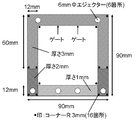
- a pellet is used to form a connector-shaped cavity having a length of 25 mm, a width of 2 mm, a thickness of 0.3 to 0.5 mm, and a pitch of 45 pins and 0.2 mm.
- the mold releasability in the injection molding with the mold having it was evaluated.
- the molding conditions were a resin temperature of 340 ° C. and a mold temperature of 140 ° C., and the cooling time after completion of filling was gradually shortened to determine the time during which the molded product was not ejected from the mold.
- the minimum time T2 during which the molded product was ejected from the mold was 3 seconds or less, the release property was evaluated as “AA”.
- PA6T-1 an aromatic polyamide obtained by reacting 65 mol% terephthalic acid, 25 mol% isophthalic acid and 10 mol% adipic acid as essential monomer components (melting point: 310 ° C., Tg: 120 ° C., peak molecular
- FIG. 1 is a graph showing a temperature profile in an infrared heating furnace in a blister resistance test.
- FIG. 2 shows the shape of a test piece used for evaluation of releasability.
Landscapes
- Chemical & Material Sciences (AREA)
- Health & Medical Sciences (AREA)
- Chemical Kinetics & Catalysis (AREA)
- Medicinal Chemistry (AREA)
- Polymers & Plastics (AREA)
- Organic Chemistry (AREA)
- Compositions Of Macromolecular Compounds (AREA)
- Polyamides (AREA)
- Extrusion Moulding Of Plastics Or The Like (AREA)
- Details Of Resistors (AREA)
Abstract
L'invention décrit une composition de résine de polysulfure d'arylène qui comporte les composants (A) et (B) en tant que composants essentiels : (A) un polysulfure d'arylène qui a un poids moléculaire maximal tombant dans la plage allant de 25000 à 30000 mesuré par chromatographie de perméation sur gel, a un rapport du poids moléculaire moyen en poids (Mw) sur le poids moléculaire moyen en nombre (Mn) (c'est-à-dire un rapport Mw/Mn) tombant dans la plage allant de 5 à 10, et a un indice non newtonien tombant dans la plage allant de 0,9 à 1,3 ; et (B) un polyamide. L'invention concerne également un procédé de production de la composition de résine de polysulfure d'arylène. Elle décrit en outre un composant électronique de montage en surface. La composition de résine de polysulfure d'arylène peut conserver en elle la teneur en atomes de chlore à un niveau aussi faible que 900 ppm ou moins, et présente une certaine résistance à la chaleur et une certaine résistance mécanique.
Priority Applications (1)
| Application Number | Priority Date | Filing Date | Title |
|---|---|---|---|
| JP2009531687A JPWO2009096400A1 (ja) | 2008-01-30 | 2009-01-28 | ポリアリーレンスルフィド樹脂組成物、その製造方法及び表面実装用電子部品 |
Applications Claiming Priority (2)
| Application Number | Priority Date | Filing Date | Title |
|---|---|---|---|
| JP2008-019103 | 2008-01-30 | ||
| JP2008019103 | 2008-01-30 |
Publications (1)
| Publication Number | Publication Date |
|---|---|
| WO2009096400A1 true WO2009096400A1 (fr) | 2009-08-06 |
Family
ID=40912752
Family Applications (1)
| Application Number | Title | Priority Date | Filing Date |
|---|---|---|---|
| PCT/JP2009/051305 Ceased WO2009096400A1 (fr) | 2008-01-30 | 2009-01-28 | Composition de résine de polysulfure d'arylène, son procédé de production et composant électronique de montage en surface |
Country Status (3)
| Country | Link |
|---|---|
| JP (1) | JPWO2009096400A1 (fr) |
| TW (1) | TW200940648A (fr) |
| WO (1) | WO2009096400A1 (fr) |
Cited By (7)
| Publication number | Priority date | Publication date | Assignee | Title |
|---|---|---|---|---|
| JP2009203472A (ja) * | 2008-01-31 | 2009-09-10 | Dic Corp | ポリアリーレンスルフィド樹脂組成物、その製造方法、及び表面実装用電子部品 |
| JP2009263635A (ja) * | 2008-04-03 | 2009-11-12 | Dic Corp | 熱可塑性樹脂組成物、その製造方法、及び表面実装用電子部品 |
| WO2015033855A1 (fr) * | 2013-09-05 | 2015-03-12 | Dic株式会社 | Fibres de sulfure de polyarylène et leur procédé de fabrication |
| WO2015033856A1 (fr) * | 2013-09-05 | 2015-03-12 | Dic株式会社 | Film de polyarylène-sulfure et son procédé de fabrication |
| KR20160065835A (ko) * | 2013-09-26 | 2016-06-09 | 디아이씨 가부시끼가이샤 | 폴리아릴렌설피드 수지 조성물 및 그 성형품, 그리고 표면 실장 전자 부품 |
| JP2016535147A (ja) * | 2013-08-22 | 2016-11-10 | 東レ株式会社 | ポリフェニレンサルファイド樹脂組成物、及びその成形品とその成形品の製造方法 |
| WO2018151191A1 (fr) | 2017-02-16 | 2018-08-23 | 東レ株式会社 | Composition de résine de sulfure de polyphénylène et article moulé |
Families Citing this family (1)
| Publication number | Priority date | Publication date | Assignee | Title |
|---|---|---|---|---|
| CN103627173A (zh) * | 2012-08-24 | 2014-03-12 | 苏州汉扬精密电子有限公司 | 玻璃纤维增强聚苯硫醚/芳香族聚酰胺复合材料及其制备方法 |
Citations (2)
| Publication number | Priority date | Publication date | Assignee | Title |
|---|---|---|---|---|
| JP2004099707A (ja) * | 2002-09-06 | 2004-04-02 | Techno Polymer Co Ltd | 熱可塑性樹脂組成物及び成形品 |
| JP2008007742A (ja) * | 2005-12-28 | 2008-01-17 | Dainippon Ink & Chem Inc | 耐熱性樹脂組成物、その製造方法、耐熱性樹脂成形物、及び表面実装用電子部品 |
-
2009
- 2009-01-21 TW TW098102164A patent/TW200940648A/zh unknown
- 2009-01-28 JP JP2009531687A patent/JPWO2009096400A1/ja active Pending
- 2009-01-28 WO PCT/JP2009/051305 patent/WO2009096400A1/fr not_active Ceased
Patent Citations (2)
| Publication number | Priority date | Publication date | Assignee | Title |
|---|---|---|---|---|
| JP2004099707A (ja) * | 2002-09-06 | 2004-04-02 | Techno Polymer Co Ltd | 熱可塑性樹脂組成物及び成形品 |
| JP2008007742A (ja) * | 2005-12-28 | 2008-01-17 | Dainippon Ink & Chem Inc | 耐熱性樹脂組成物、その製造方法、耐熱性樹脂成形物、及び表面実装用電子部品 |
Cited By (16)
| Publication number | Priority date | Publication date | Assignee | Title |
|---|---|---|---|---|
| JP2009203472A (ja) * | 2008-01-31 | 2009-09-10 | Dic Corp | ポリアリーレンスルフィド樹脂組成物、その製造方法、及び表面実装用電子部品 |
| JP2009263635A (ja) * | 2008-04-03 | 2009-11-12 | Dic Corp | 熱可塑性樹脂組成物、その製造方法、及び表面実装用電子部品 |
| JP2016535147A (ja) * | 2013-08-22 | 2016-11-10 | 東レ株式会社 | ポリフェニレンサルファイド樹脂組成物、及びその成形品とその成形品の製造方法 |
| US10370522B2 (en) | 2013-08-22 | 2019-08-06 | Toray Industries, Inc. | Polyphenylene sulfide resin composition, and moulding and manufacturing process for moulding thereof |
| WO2015033855A1 (fr) * | 2013-09-05 | 2015-03-12 | Dic株式会社 | Fibres de sulfure de polyarylène et leur procédé de fabrication |
| WO2015033856A1 (fr) * | 2013-09-05 | 2015-03-12 | Dic株式会社 | Film de polyarylène-sulfure et son procédé de fabrication |
| JPWO2015033855A1 (ja) * | 2013-09-05 | 2017-03-02 | Dic株式会社 | ポリアリーレンスルフィド繊維及びその製造方法 |
| CN110283457B (zh) * | 2013-09-26 | 2023-03-31 | Dic株式会社 | 聚芳硫醚树脂组合物及其成形品、以及表面安装电子部件 |
| KR20160065835A (ko) * | 2013-09-26 | 2016-06-09 | 디아이씨 가부시끼가이샤 | 폴리아릴렌설피드 수지 조성물 및 그 성형품, 그리고 표면 실장 전자 부품 |
| KR102570299B1 (ko) * | 2013-09-26 | 2023-08-24 | 디아이씨 가부시끼가이샤 | 폴리아릴렌설피드 수지 조성물 및 그 성형품, 그리고 표면 실장 전자 부품 |
| CN110283457A (zh) * | 2013-09-26 | 2019-09-27 | Dic株式会社 | 聚芳硫醚树脂组合物及其成形品、以及表面安装电子部件 |
| JP6455632B1 (ja) * | 2017-02-16 | 2019-01-23 | 東レ株式会社 | ポリフェニレンスルフィド樹脂組成物および成形品 |
| US11174388B2 (en) | 2017-02-16 | 2021-11-16 | Toray Industries, Inc. | Polyphenylene sulfide resin composition and molded article |
| KR102471316B1 (ko) | 2017-02-16 | 2022-11-28 | 도레이 카부시키가이샤 | 폴리페닐렌 설피드 수지 조성물 및 성형품 |
| KR20190112261A (ko) | 2017-02-16 | 2019-10-04 | 도레이 카부시키가이샤 | 폴리페닐렌 설피드 수지 조성물 및 성형품 |
| WO2018151191A1 (fr) | 2017-02-16 | 2018-08-23 | 東レ株式会社 | Composition de résine de sulfure de polyphénylène et article moulé |
Also Published As
| Publication number | Publication date |
|---|---|
| TW200940648A (en) | 2009-10-01 |
| JPWO2009096400A1 (ja) | 2011-05-26 |
Similar Documents
| Publication | Publication Date | Title |
|---|---|---|
| JP4356038B2 (ja) | ポリアリーレンスルフィド樹脂組成物、その製造方法及び表面実装用電子部品 | |
| JP2009263635A (ja) | 熱可塑性樹脂組成物、その製造方法、及び表面実装用電子部品 | |
| CN101821336B (zh) | 阻燃性聚酰胺组合物 | |
| CN101535409B (zh) | 阻燃性聚酰胺组合物 | |
| CN101652429B (zh) | 阻燃性聚酰胺组合物 | |
| JPWO2009096400A1 (ja) | ポリアリーレンスルフィド樹脂組成物、その製造方法及び表面実装用電子部品 | |
| CN101796135B (zh) | 阻燃性聚酰胺组合物 | |
| JP2021113319A (ja) | ポリアリーレンスルフィド樹脂組成物及びその成形品、並びに表面実装電子部品 | |
| CN101175821B (zh) | 阻燃性聚酰胺组合物 | |
| JP5257778B2 (ja) | ポリアリーレンスルフィド樹脂組成物、その製造方法、及び表面実装用電子部品 | |
| US8142899B2 (en) | Heat-resistant resin composition, method of producing the same, heat-resistant resin-molded article, and surface mount electronic component | |
| JP5041209B2 (ja) | 耐熱性樹脂組成物、その製造方法、耐熱性樹脂成形物、及び表面実装用電子部品 | |
| TWI308168B (fr) | ||
| JP2008007742A5 (fr) | ||
| JP5011825B2 (ja) | 耐熱性樹脂組成物、及び表面実装用電子部品 | |
| JP2000186205A (ja) | ポリアミド樹脂組成物 | |
| JP4038607B2 (ja) | ポリアリーレンスルフィド樹脂組成物 |
Legal Events
| Date | Code | Title | Description |
|---|---|---|---|
| WWE | Wipo information: entry into national phase |
Ref document number: 2009531687 Country of ref document: JP |
|
| 121 | Ep: the epo has been informed by wipo that ep was designated in this application |
Ref document number: 09706218 Country of ref document: EP Kind code of ref document: A1 |
|
| NENP | Non-entry into the national phase |
Ref country code: DE |
|
| 122 | Ep: pct application non-entry in european phase |
Ref document number: 09706218 Country of ref document: EP Kind code of ref document: A1 |