WO2009100851A1 - Verwendung von tetramsäurederivaten zur bekämpfung von tierischen schädlingen nach stamm-, zweig-, blütenstand- und knospenbehandlungen - Google Patents
Verwendung von tetramsäurederivaten zur bekämpfung von tierischen schädlingen nach stamm-, zweig-, blütenstand- und knospenbehandlungen Download PDFInfo
- Publication number
- WO2009100851A1 WO2009100851A1 PCT/EP2009/000816 EP2009000816W WO2009100851A1 WO 2009100851 A1 WO2009100851 A1 WO 2009100851A1 EP 2009000816 W EP2009000816 W EP 2009000816W WO 2009100851 A1 WO2009100851 A1 WO 2009100851A1
- Authority
- WO
- WIPO (PCT)
- Prior art keywords
- treatment
- plants
- spp
- branches
- inflorescences
- Prior art date
- Legal status (The legal status is an assumption and is not a legal conclusion. Google has not performed a legal analysis and makes no representation as to the accuracy of the status listed.)
- Ceased
Links
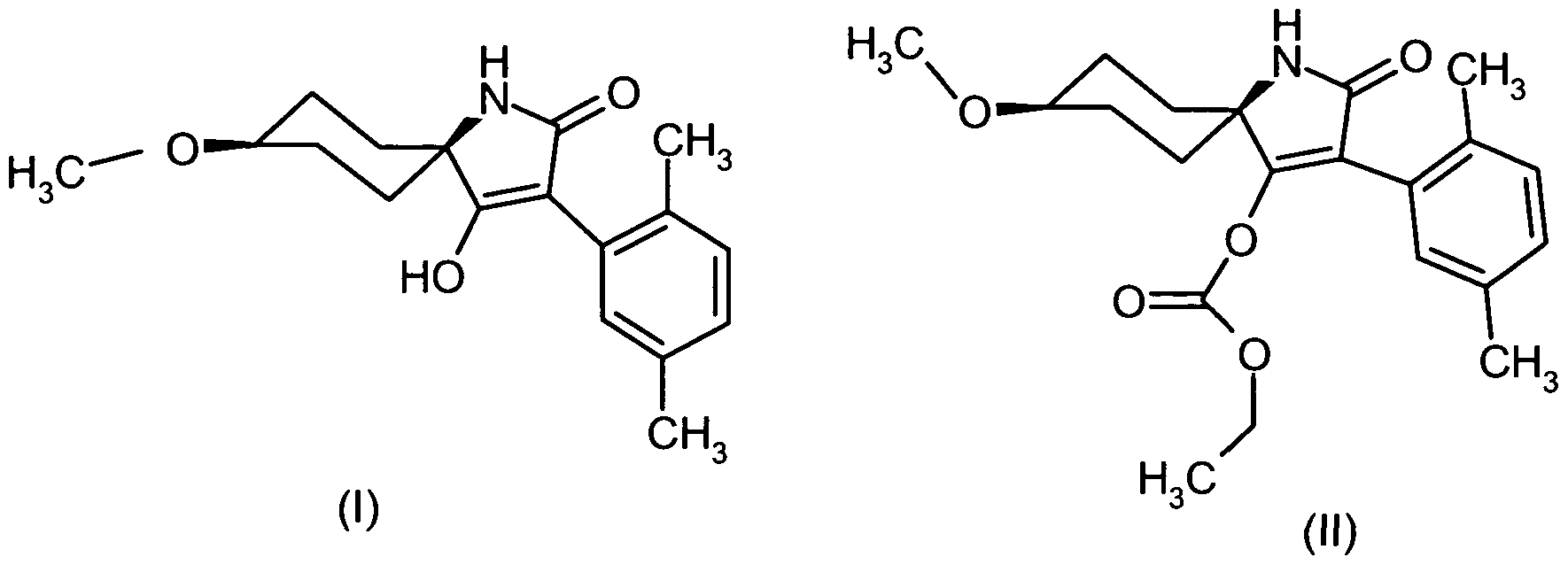
- CLSVJBIHYWPGQY-GGYDESQDSA-N CCOC(OC([C@](CC1)(CC[C@@H]1OC)NC1=O)=C1c1cc(C)ccc1C)=O Chemical compound CCOC(OC([C@](CC1)(CC[C@@H]1OC)NC1=O)=C1c1cc(C)ccc1C)=O CLSVJBIHYWPGQY-GGYDESQDSA-N 0.000 description 1
- IDJJHEIUIYGFDX-QGGXVJLZSA-N Cc1cc(C(C(N[C@]2(CC3)CC[C@H]3OC)=O)=C2O)c(C)cc1 Chemical compound Cc1cc(C(C(N[C@]2(CC3)CC[C@H]3OC)=O)=C2O)c(C)cc1 IDJJHEIUIYGFDX-QGGXVJLZSA-N 0.000 description 1
Classifications
-
- A—HUMAN NECESSITIES
- A01—AGRICULTURE; FORESTRY; ANIMAL HUSBANDRY; HUNTING; TRAPPING; FISHING
- A01N—PRESERVATION OF BODIES OF HUMANS OR ANIMALS OR PLANTS OR PARTS THEREOF; BIOCIDES, e.g. AS DISINFECTANTS, AS PESTICIDES OR AS HERBICIDES; PEST REPELLANTS OR ATTRACTANTS; PLANT GROWTH REGULATORS
- A01N43/00—Biocides, pest repellants or attractants, or plant growth regulators containing heterocyclic compounds
- A01N43/34—Biocides, pest repellants or attractants, or plant growth regulators containing heterocyclic compounds having rings with one nitrogen atom as the only ring hetero atom
- A01N43/36—Biocides, pest repellants or attractants, or plant growth regulators containing heterocyclic compounds having rings with one nitrogen atom as the only ring hetero atom five-membered rings
- A01N43/38—Biocides, pest repellants or attractants, or plant growth regulators containing heterocyclic compounds having rings with one nitrogen atom as the only ring hetero atom five-membered rings condensed with carbocyclic rings
-
- A—HUMAN NECESSITIES
- A01—AGRICULTURE; FORESTRY; ANIMAL HUSBANDRY; HUNTING; TRAPPING; FISHING
- A01N—PRESERVATION OF BODIES OF HUMANS OR ANIMALS OR PLANTS OR PARTS THEREOF; BIOCIDES, e.g. AS DISINFECTANTS, AS PESTICIDES OR AS HERBICIDES; PEST REPELLANTS OR ATTRACTANTS; PLANT GROWTH REGULATORS
- A01N47/00—Biocides, pest repellants or attractants, or plant growth regulators containing organic compounds containing a carbon atom not being member of a ring and having no bond to a carbon or hydrogen atom, e.g. derivatives of carbonic acid
- A01N47/02—Biocides, pest repellants or attractants, or plant growth regulators containing organic compounds containing a carbon atom not being member of a ring and having no bond to a carbon or hydrogen atom, e.g. derivatives of carbonic acid the carbon atom having no bond to a nitrogen atom
- A01N47/06—Biocides, pest repellants or attractants, or plant growth regulators containing organic compounds containing a carbon atom not being member of a ring and having no bond to a carbon or hydrogen atom, e.g. derivatives of carbonic acid the carbon atom having no bond to a nitrogen atom containing —O—CO—O— groups; Thio analogues thereof
Definitions
- the present invention relates to the use of tetramic acid derivatives for combating animal pests after stock treatments (spraying, painting, injection, application), treatments of branches, stems, shoots and branches (painting, spraying, application), inflorescence and bud treatments by injection.
- insects and spider mites after parent treatment (eg by painting, spraying, applying, injecting), after treatment of stems, branches, twigs and shoots (eg by painting, spraying, application) and after injection into flower buds and inflorescences (in Professional circles known as bud-injection) are suitable.
- the present invention relates to the use of tetramic acid derivatives for combating insects and spider mites by stem applications, branch, stalk, branch and shoot applications and inflorescence and flower bud treatments in the field or in closed systems (eg greenhouses or under foil cover) in annuals Cultures (eg ornamental plants) and perennial crops (eg tropical fruits, citrus, conifers, pome fruit, stone fruit, hops).
- closed systems eg greenhouses or under foil cover
- annuals Cultures eg ornamental plants
- perennial crops eg tropical fruits, citrus, conifers, pome fruit, stone fruit, hops.
- citrus such as oranges, grapefruit, tangerines, lemons, limes, bitter oranges, kumquats, satsumas, is understood to mean the use among perennial crops;
- pomaceous fruits such as apples, pears and quinces
- stone fruit such as pepper, nectarines, cherries, plums, plums, apricots
- wine, hops, olives, tea and tropical crops such as mangoes, papayas, figs, pineapples, dates, bananas, durians, kakis, coconuts, cocoa, coffee, avocados, lychees, passion fruits, guavas, oil palm trees;
- almonds and nuts such as hazelnuts, walnuts, pistachios, cashews, Brazil nuts, pecans, butternuts, chestnuts, hickory nuts, macadamia nuts, peanuts,
- soft fruits such as currants, gooseberries, raspberries, blackberries, blueberries, strawberries, cranberries, kiwis, cranberries.
- ornamental plants are understood to be annual and perennial plants, e.g. Cut flowers such as roses, carnations, gerberas, lilies, daisies, chrysanthemums, tulips, daffodils, anemones, poppies, amyrillis, dahlias, azaleas, mallows,
- Bedding plants potted plants and perennials such as roses, marigolds, pansies, geraniums, fuchsias, hibiscus, chrysanthemums, hard-bitten lits, cyclamen, southern violets, sunflowers, begonias,
- Shrubs and conifers such as ficus, rhododendron, spruce, fir, pine, yew, juniper, pine, oleander.
- Thrips are preferred from the family of thrips (Thripidae): Frankliniella spp., Thrips spp., Heliothrips spp., Hercinothrips spp., Caliothrips spp., Scirthothrips spp. in crops such as soft fruits, ornamental plants, potatoes, tropical crops, wine, nuts, citrus, tea. Preference is given to the family of lice and wool lice (Pseudococcidae): Pericerga, Pseudococcus spp., Planococcus spp., Dysmicoccus spp., In crops such as citrus, stone and pome fruit, tea, wine, ornamentals and tropical crops.
- cover-shield lice (Diaspididae): Quadraspidiotus spp., Aonidiella spp., Lepidosaphes spp., Aspidiotus spp., Parlatoria spp., Pseudaulacaspis spp., Unaspis spp., Pinnaspis spp., Selenaspidus spp., In cultures such as eg Citrus, pome fruit, stone fruit, almonds, nuts, olives, tea, ornamental plants, wine, tropical crops.
- plants are understood as meaning all plants and plant populations, such as desired and undesired wild plants or crop plants (including naturally occurring crop plants).
- Crop plants can be plants which can be obtained by conventional breeding and optimization methods or by biotechnological and genetic engineering methods or combinations of these methods, including the transgenic plants and including the plant varieties which can or can not be protected by plant breeders' rights.
- Plant parts are to be understood as meaning all aboveground and subterranean parts and organs of the plants, such as shoot, leaf, flower and root, examples of which include leaves, needles, stems, stems, flowers, fruiting bodies, fruits and seeds, and roots, tubers and rhizomes.
- the plant parts also include crops and vegetative and generative propagation material, such as cuttings, tubers, rhizomes, offshoots and seeds.
- the treatment according to the invention of the plants and plant parts with the active ingredient is carried out directly or by acting on their environment, habitat or storage space according to the usual treatment methods, e.g. by dipping, spraying, evaporating, atomizing, spreading, brushing, injecting and in propagation material, in particular in seeds, further by single or multi-layer wrapping.
- plants and their parts can be treated.
- wild-type or plant species obtained by conventional biological breeding methods, such as crossing or protoplast fusion, and plant cultivars and their parts are treated.
- transgenic plants and plant cultivars produced by genetic engineering Methods are optionally obtained in combination with conventional methods (Genetic Modified Organisms) and their parts treated.
- the term “parts” or “parts of plants” or “plant parts” is explained above.
- Plant varieties are understood as meaning plants having new traits which have been bred by conventional breeding, by mutagenesis or by recombinant DNA techniques. These can be varieties, biotypes and genotypes.
- the treatment according to the invention may also give rise to superadditive ("synergistic") effects.
- superadditive for example, reduced application rates and / or extensions of the spectrum of action and / or an increase in the effect of the substances and agents usable in the invention, better plant growth, increased tolerance to high or low temperatures, increased tolerance to drought or to water or soil salt content, increased flowering power facilitated harvest, acceleration of ripeness, higher crop yields, higher quality and / or higher nutritional value of the harvested products, higher shelf life and / or machinability of the harvested products, which exceed the actual expected effects.
- the preferred plants or plant varieties to be treated according to the invention to be treated include all plants which, as a result of the genetic engineering modification, obtained genetic material which gives these plants particularly advantageous valuable properties ("traits").
- traits are better plant growth, increased tolerance to high or low temperatures, increased tolerance to drought or soil salt content, increased flowering efficiency, easier harvest, acceleration of ripeness, higher crop yields, higher quality and / or higher nutritional value harvest products, higher shelf life and / or workability of the harvested products.
- Further and particularly emphasized examples of such properties are an increased defense of the plants against animal and microbial pests, as against insects, mites, phytopathogenic fungi, bacteria and / or viruses as well as an increased tolerance of the plants against certain herbicidal active substances.
- transgenic plants include the important crops such as cereals (wheat, rice), corn, soybean, potato, cotton, tobacco, oilseed rape and fruit plants (with the fruits apples, pears, citrus fruits and grapes), with corn, soybean, potato , Cotton, tobacco and oilseed rape.
- Traits are particularly emphasized the increased Repelling the plants against insects, arachnids, nematodes and snails by toxins produced in the plants, in particular those by the genetic material from Bacillus thuringiensis (eg by the genes Cry ⁇ A (a), CryIA (b), Cry ⁇ A (c), CryllA , CrylllA, CryIIIB2, Cry9c Cry2Ab, Cry3Bb and CrylF and their combinations) in the plants (hereinafter "Bt plants”). Traits also highlight the increased resistance of plants to fungi, bacteria and viruses by systemic acquired resistance (SAR), systemin, phytoalexins, elicitors and resistance genes and correspondingly expressed proteins and toxins.
- SAR systemic acquired resistance
- Traits which are furthermore particularly emphasized are the increased tolerance of the plants to certain herbicidally active compounds, for example imidazolinones, sulfonylureas, glyphosate or phosphinotricin (eg "PAT" gene).
- the genes which confer the desired properties (“traits") can also occur in combinations with one another in the transgenic plants.
- Examples of “Bt plants” are maize varieties, cotton varieties, soybean varieties and potato varieties which are sold under the trade names YIELD GARD® (eg corn, cotton, soya), KnockOut® (eg maize), StarLink® (eg maize), Bollgard® ( Cotton), Nucotn® (cotton) and NewLeaf® (potato).
- herbicide-tolerant plants are maize varieties, cotton varieties and soybean varieties, which are sold under the trade names Roundup Ready® (tolerance to glyphosate eg corn, cotton, soy), Liberty Link® (tolerance to phosphinotricin, eg rapeseed), IMI® (tolerance to Imidazolinone) and STS® (tolerance to sulfonylureas eg corn).
- Herbicide-resistant (conventionally grown on herbicide tolerance) plants are also mentioned under the name Clearf ⁇ eld® varieties (eg corn). Of course, these statements also apply to future or future marketed plant varieties with these or future developed genetic traits.
- the active compounds of the formulas (I) and (II) can be converted into the customary formulations, such as solutions, emulsions, wettable powders, suspensions, powders, dusts, pastes, soluble powders, granules, suspension-emulsion concentrates, active substance-impregnated natural and synthetic substances and microencapsulations in polymeric substances.
- formulations are prepared in a known manner, e.g. by mixing the active compound with extenders, ie liquid solvents and / or solid carriers, optionally with the use of surface-active agents, ie emulsifiers and / or dispersants and / or foam-forming agents.
- organic solvents can also be used as auxiliary solvents.
- liquid solvents are essentially in Question: Aromatics such as xylene, toluene, or alkylnaphthalenes, chlorinated aromatics and chlorinated aliphatic hydrocarbons such as chlorobenzenes, chloroethylenes or methylene chloride, aliphatic hydrocarbons such as cyclohexane or paraffins, eg petroleum fractions, mineral and vegetable oils, alcohols such as butanol or glycol and their Ethers and esters, ketones such as acetone, methyl ethyl ketone, methyl isobutyl ketone or cyclohexanone, strongly polar solvents such as dimethylformamide and dimethyl sulfoxide, and water.
- Aromatics such as xylene, toluene, or alkylnaphthalenes, chlorinated aromatics and chlorinated aliphatic hydrocarbons such as chlorobenzenes, chlor
- Suitable solid carriers are:
- Ammonium salts and ground natural minerals such as kaolins, clays, talc, chalk, quartz, attapulgite, montmorillonite or diatomaceous earth, and ground synthetic minerals, such as fumed silica, alumina and silicates, as solid carriers for granules are suitable: e.g. crushed and fractionated natural rocks such as calcite, marble, pumice, sepiolite, dolomite and synthetic granules of inorganic and organic flours and granules of organic material such as sawdust, coconut shells, corn cobs and tobacco stalks; suitable emulsifiers and / or foam formers are: e.g.
- nonionic and anionic emulsifiers such as polyoxyethylene fatty acid esters, polyoxyethylene fatty alcohol ethers, e.g. Alkylaryl polyglycol ethers, alkylsulfonates, alkyl sulfates, arylsulfonates and protein hydrolysates; suitable dispersants are: e.g. Lignin-sulphite liquors and methylcellulose.
- Adhesives such as carboxymethyl cellulose, natural and synthetic powdery, granular or latex polymers such as gum arabic, polyvinyl alcohol, polyvinyl acetate, and natural phospholipids such as cephalins and lecithins and synthetic phospholipids may be used in the formulations.
- Other additives may be mineral and vegetable oils.
- Dyes such as inorganic pigments, e.g. Iron oxide, titanium oxide, ferrocyan blue and organic dyes such as alizarin, azo and metal phthalocyanine dyes and trace nutrients such as salts of iron, manganese, boron, copper, cobalt, molybdenum and zinc.
- inorganic pigments e.g. Iron oxide, titanium oxide, ferrocyan blue and organic dyes such as alizarin, azo and metal phthalocyanine dyes and trace nutrients such as salts of iron, manganese, boron, copper, cobalt, molybdenum and zinc.
- the formulations generally contain between 0.1 and 95% by weight of active compound, preferably between 0.5 and 90%, and additionally preferably extenders and / or surface-active agents.
- the active substance content of the application forms prepared from the commercial formulations can vary within wide ranges.
- the active ingredient concentration of the use forms may be from 0.0000001 to 95% by weight of active ingredient, preferably between 0.0001 and 1% by weight.
- the application is done in a custom forms adapted to the application forms.
- Banana trees of the "Cavendish” variety are treated in three replications against banana flower thrips (Thrips hawaiiensis) in which the active ingredients Example (H) (100 OD) are tested against the commercial standard Imidacloprid (100 SL) at the stated application rates In each case, three flower buds are treated, each being evaluated 3 and 91 days after the treatment by scoring the killing of the population on the flower or fruit stalks.
- Banana trees (growth stage BBCH 1130) of the genus "Cavendish” consisting of mother plant and lateral shoot are treated in three replications after foliar treatment against Aspidiotus destructor and against the pineapple louse Dysmicoccus brevipes by pseudo-root application, for which 100 ml spray solution are applied, each containing 50 ml The leaves and 50 ml are sprayed onto the stem Before the stem application, the topmost seed layer is peeled off, which is common practice, the active ingredient (II) (SC 240) in a tank mix with 0.025% Hoestick (XL 500) against the commercial standards Chlorpyrifos-methyl (500 EC) and paraffin oil (Banole oil) (EC 600) tested.
- II active ingredient
- the evaluation takes place 3, 7, 14 and 22 days after the treatment, by scoring the killing of the pineapple louse on the trunk.
Landscapes
- Life Sciences & Earth Sciences (AREA)
- Agronomy & Crop Science (AREA)
- Pest Control & Pesticides (AREA)
- Plant Pathology (AREA)
- Health & Medical Sciences (AREA)
- Engineering & Computer Science (AREA)
- Dentistry (AREA)
- General Health & Medical Sciences (AREA)
- Wood Science & Technology (AREA)
- Zoology (AREA)
- Environmental Sciences (AREA)
- Agricultural Chemicals And Associated Chemicals (AREA)
- Pretreatment Of Seeds And Plants (AREA)
- Organic Low-Molecular-Weight Compounds And Preparation Thereof (AREA)
- Acyclic And Carbocyclic Compounds In Medicinal Compositions (AREA)
Abstract
Description


Claims
Priority Applications (9)
| Application Number | Priority Date | Filing Date | Title |
|---|---|---|---|
| AU2009214378A AU2009214378B2 (en) | 2008-02-13 | 2009-02-06 | Use of tetramic acid derivatives for controlling animal pests after treatment of the trunk, the branches, the inflorescences or the buds |
| US12/867,732 US20100324303A1 (en) | 2008-02-13 | 2009-02-06 | Use of Tetramic Acid Derivatives for Controlling Animal Pests After Treatment of the Trunk, the Branches, the Influorescences or the Buds |
| NZ587308A NZ587308A (en) | 2008-02-13 | 2009-02-06 | Use of tetramic acid derivatives for controlling animal pests after treatment of the trunk, the branches, the inflorescences or the buds |
| CN2009801049525A CN101945579A (zh) | 2008-02-13 | 2009-02-06 | 特特拉姆酸衍生物用于树干、分枝、花序或蓓蕾处理之后防治动物有害物的用途 |
| EP09709687A EP2242363A1 (de) | 2008-02-13 | 2009-02-06 | Verwendung von tetramsäurederivaten zur bekämpfung von tierischen schädlingen nach stamm-, zweig-, blütenstand- und knospenbehandlungen |
| JP2010546244A JP5567500B2 (ja) | 2008-02-13 | 2009-02-06 | 幹、枝、花又は芽の処理後において動物有害生物を防除するためのテトラミン酸誘導体の使用 |
| BRPI0907854A BRPI0907854A8 (pt) | 2008-02-13 | 2009-02-06 | Uso de derivados de ácido tetrâmico para o combate de parasitas animais após tratamentos de tronco, ramos, inflorescências e brotos |
| MA33077A MA32072B1 (fr) | 2008-02-13 | 2010-08-11 | Utilisation de dérivés d'acide tétramique pour la lutte contre les animaux nuisibles par des traitements du tronc, des branches, de l'inflorescence et des bourgeons |
| ZA2010/05721A ZA201005721B (en) | 2008-02-13 | 2010-08-11 | Use of tetramic acid derivatives for controlling animal pests after treatment of the trunk,the branches,the inflorescences or the buds |
Applications Claiming Priority (2)
| Application Number | Priority Date | Filing Date | Title |
|---|---|---|---|
| EP08151372.3 | 2008-02-13 | ||
| EP08151372A EP2090167A1 (de) | 2008-02-13 | 2008-02-13 | Verwendung von Tetramsäurederivaten zur Bekämpfung von tierischen Schädlingen nach Stamm-, Zweig-, Blütenstand- und Knospenbehandlungen |
Publications (2)
| Publication Number | Publication Date |
|---|---|
| WO2009100851A1 true WO2009100851A1 (de) | 2009-08-20 |
| WO2009100851A8 WO2009100851A8 (de) | 2010-08-19 |
Family
ID=39540558
Family Applications (1)
| Application Number | Title | Priority Date | Filing Date |
|---|---|---|---|
| PCT/EP2009/000816 Ceased WO2009100851A1 (de) | 2008-02-13 | 2009-02-06 | Verwendung von tetramsäurederivaten zur bekämpfung von tierischen schädlingen nach stamm-, zweig-, blütenstand- und knospenbehandlungen |
Country Status (12)
| Country | Link |
|---|---|
| US (2) | US20100324303A1 (de) |
| EP (2) | EP2090167A1 (de) |
| JP (1) | JP5567500B2 (de) |
| KR (1) | KR20100115777A (de) |
| CN (1) | CN101945579A (de) |
| AU (1) | AU2009214378B2 (de) |
| BR (1) | BRPI0907854A8 (de) |
| CL (1) | CL2009000297A1 (de) |
| MA (1) | MA32072B1 (de) |
| NZ (1) | NZ587308A (de) |
| WO (1) | WO2009100851A1 (de) |
| ZA (1) | ZA201005721B (de) |
Families Citing this family (2)
| Publication number | Priority date | Publication date | Assignee | Title |
|---|---|---|---|---|
| DE102007009957A1 (de) * | 2006-12-27 | 2008-07-03 | Bayer Cropscience Ag | Verfahren zur verbesserten Nutzung des Produktionsptentials transgener Pflanzen |
| EP2071952A1 (de) * | 2007-12-21 | 2009-06-24 | Bayer CropScience AG | Verwendung von Tetramsäurederivaten zur Bekämpfung von Schaderregern durch Angiessen oder Tröpfchenapplikation |
Family Cites Families (11)
| Publication number | Priority date | Publication date | Assignee | Title |
|---|---|---|---|---|
| DK1277749T3 (da) * | 1996-08-05 | 2007-01-29 | Bayer Cropscience Ag | 2- og 2,5-substituerede phenylketoenoler |
| DE10024934A1 (de) * | 2000-05-19 | 2001-11-22 | Bayer Ag | Wirkstoffkombinationen mit insektiziden akariziden Eigenschaften |
| DE10231333A1 (de) * | 2002-07-11 | 2004-01-22 | Bayer Cropscience Ag | Cis-Alkoxysubstituierte spirocyclische 1-H-Pyrrolidin-2,4-dion-Derivate |
| DE102005003076A1 (de) * | 2005-01-22 | 2006-07-27 | Bayer Cropscience Ag | Verwendung von Tetramsäurederivaten zur Bekämpfung von Insekten aus der Gattung der Pflanzenläuse (Sternorrhyncha) |
| DE102005044826A1 (de) * | 2005-09-20 | 2007-03-29 | Bayer Cropscience Ag | Nikotinyle, Pyrethroide und Ketoenole als Gel- oder Schaumformulierung für mehrjährige Kulturen |
| DE102006014653A1 (de) | 2006-03-28 | 2007-10-04 | Bayer Cropscience Ag | Verwendung von Tetramsäurederivaten zur Bekämpfung von Insekten durch Angiessen, Tröpfchenapplikation oder Bodeninjektion |
| DE102006014480A1 (de) * | 2006-03-29 | 2007-10-04 | Bayer Cropscience Ag | Wirkstoffkombinationen mit insektiziden und akariziden Eigenschaften |
| DE102006022821A1 (de) * | 2006-05-12 | 2007-11-15 | Bayer Cropscience Ag | Verwendung von Tetramsäurederivaten zur Bekämpfung von Insekten aus der Ordnung der Käfer (Coleoptera), Thrips (Tysanoptera), Wanzen (Hemiptera), Fliegen (Diptera) und Zikaden (Auchenorrhynchae) |
| DE102006033154A1 (de) * | 2006-07-18 | 2008-01-24 | Bayer Cropscience Ag | Wirkstoffkombinationen mit insektiziden und akariziden Eigenschaften |
| DE102007009957A1 (de) * | 2006-12-27 | 2008-07-03 | Bayer Cropscience Ag | Verfahren zur verbesserten Nutzung des Produktionsptentials transgener Pflanzen |
| EP2071952A1 (de) * | 2007-12-21 | 2009-06-24 | Bayer CropScience AG | Verwendung von Tetramsäurederivaten zur Bekämpfung von Schaderregern durch Angiessen oder Tröpfchenapplikation |
-
2008
- 2008-02-13 EP EP08151372A patent/EP2090167A1/de not_active Ceased
-
2009
- 2009-02-06 NZ NZ587308A patent/NZ587308A/en not_active IP Right Cessation
- 2009-02-06 AU AU2009214378A patent/AU2009214378B2/en not_active Ceased
- 2009-02-06 CN CN2009801049525A patent/CN101945579A/zh active Pending
- 2009-02-06 US US12/867,732 patent/US20100324303A1/en not_active Abandoned
- 2009-02-06 BR BRPI0907854A patent/BRPI0907854A8/pt not_active Application Discontinuation
- 2009-02-06 WO PCT/EP2009/000816 patent/WO2009100851A1/de not_active Ceased
- 2009-02-06 KR KR1020107018867A patent/KR20100115777A/ko not_active Ceased
- 2009-02-06 EP EP09709687A patent/EP2242363A1/de not_active Withdrawn
- 2009-02-06 JP JP2010546244A patent/JP5567500B2/ja not_active Expired - Fee Related
- 2009-02-09 CL CL2009000297A patent/CL2009000297A1/es unknown
-
2010
- 2010-08-11 ZA ZA2010/05721A patent/ZA201005721B/en unknown
- 2010-08-11 MA MA33077A patent/MA32072B1/fr unknown
-
2013
- 2013-07-11 US US13/939,265 patent/US20130296395A1/en not_active Abandoned
Also Published As
| Publication number | Publication date |
|---|---|
| US20130296395A1 (en) | 2013-11-07 |
| KR20100115777A (ko) | 2010-10-28 |
| AU2009214378A1 (en) | 2009-08-20 |
| NZ587308A (en) | 2012-04-27 |
| ZA201005721B (en) | 2011-10-26 |
| BRPI0907854A2 (pt) | 2015-07-21 |
| US20100324303A1 (en) | 2010-12-23 |
| JP2011511815A (ja) | 2011-04-14 |
| BRPI0907854A8 (pt) | 2016-03-01 |
| AU2009214378B2 (en) | 2015-03-26 |
| WO2009100851A8 (de) | 2010-08-19 |
| CL2009000297A1 (es) | 2010-03-05 |
| JP5567500B2 (ja) | 2014-08-06 |
| CN101945579A (zh) | 2011-01-12 |
| MA32072B1 (fr) | 2011-02-01 |
| EP2242363A1 (de) | 2010-10-27 |
| EP2090167A1 (de) | 2009-08-19 |
Similar Documents
| Publication | Publication Date | Title |
|---|---|---|
| EP2040553B1 (de) | Wirkstoffkombinationen mit insektiziden und akariziden eigenschaften | |
| EP1843660B1 (de) | Verwendung von tetramsäurederivaten zur bekämpfung von insekten aus der gattung der pflanzenläuse (sternorrhyncha) | |
| EP2023723A2 (de) | Verwendung von tetramsäurederivaten zur bekämpfung von insekten | |
| EP2034842B1 (de) | Kombination von spiromesifen mit weichwanzen (miridae) | |
| EP2175723A1 (de) | Verwendung von tetramsäure-derivaten zur bekämpfung von virusübertragenden vektoren | |
| EP1765077B1 (de) | Verwendung von 3-(2,4,6-trimethylphenyl)-4-neopentylcarbonyloxy-5,5-tetramethylen-dihydrofuran-2-on zur bekämpfung von psylliden | |
| WO2009000443A2 (de) | Verwendung von wirkstoffkombinationen mit insektiziden eigenschaften zur bekämpfung von tierischen schädlingen aus der familie der stinkwanzen | |
| AU2008343923B2 (en) | Use of tetramic acid derivatives for controlling nematodes | |
| EP2242363A1 (de) | Verwendung von tetramsäurederivaten zur bekämpfung von tierischen schädlingen nach stamm-, zweig-, blütenstand- und knospenbehandlungen |
Legal Events
| Date | Code | Title | Description |
|---|---|---|---|
| WWE | Wipo information: entry into national phase |
Ref document number: 200980104952.5 Country of ref document: CN |
|
| 121 | Ep: the epo has been informed by wipo that ep was designated in this application |
Ref document number: 09709687 Country of ref document: EP Kind code of ref document: A1 |
|
| REEP | Request for entry into the european phase |
Ref document number: 2009709687 Country of ref document: EP |
|
| WWE | Wipo information: entry into national phase |
Ref document number: 2009709687 Country of ref document: EP |
|
| WWE | Wipo information: entry into national phase |
Ref document number: 587308 Country of ref document: NZ |
|
| WWE | Wipo information: entry into national phase |
Ref document number: 2010546244 Country of ref document: JP |
|
| WWE | Wipo information: entry into national phase |
Ref document number: 12867732 Country of ref document: US |
|
| NENP | Non-entry into the national phase |
Ref country code: DE |
|
| ENP | Entry into the national phase |
Ref document number: 20107018867 Country of ref document: KR Kind code of ref document: A |
|
| ENP | Entry into the national phase |
Ref document number: 2009214378 Country of ref document: AU Date of ref document: 20090206 Kind code of ref document: A |
|
| ENP | Entry into the national phase |
Ref document number: PI0907854 Country of ref document: BR Kind code of ref document: A2 Effective date: 20100813 |