EP1765077B1 - Verwendung von 3-(2,4,6-trimethylphenyl)-4-neopentylcarbonyloxy-5,5-tetramethylen-dihydrofuran-2-on zur bekämpfung von psylliden - Google Patents
Verwendung von 3-(2,4,6-trimethylphenyl)-4-neopentylcarbonyloxy-5,5-tetramethylen-dihydrofuran-2-on zur bekämpfung von psylliden Download PDFInfo
- Publication number
- EP1765077B1 EP1765077B1 EP05755961A EP05755961A EP1765077B1 EP 1765077 B1 EP1765077 B1 EP 1765077B1 EP 05755961 A EP05755961 A EP 05755961A EP 05755961 A EP05755961 A EP 05755961A EP 1765077 B1 EP1765077 B1 EP 1765077B1
- Authority
- EP
- European Patent Office
- Prior art keywords
- plants
- trimethylphenyl
- tetramethylene
- dihydrofuran
- neopentylcarbonyloxy
- Prior art date
- Legal status (The legal status is an assumption and is not a legal conclusion. Google has not performed a legal analysis and makes no representation as to the accuracy of the status listed.)
- Expired - Lifetime
Links
Classifications
-
- A—HUMAN NECESSITIES
- A01—AGRICULTURE; FORESTRY; ANIMAL HUSBANDRY; HUNTING; TRAPPING; FISHING
- A01N—PRESERVATION OF BODIES OF HUMANS OR ANIMALS OR PLANTS OR PARTS THEREOF; BIOCIDES, e.g. AS DISINFECTANTS, AS PESTICIDES OR AS HERBICIDES; PEST REPELLANTS OR ATTRACTANTS; PLANT GROWTH REGULATORS
- A01N43/00—Biocides, pest repellants or attractants, or plant growth regulators containing heterocyclic compounds
- A01N43/34—Biocides, pest repellants or attractants, or plant growth regulators containing heterocyclic compounds having rings with one nitrogen atom as the only ring hetero atom
- A01N43/36—Biocides, pest repellants or attractants, or plant growth regulators containing heterocyclic compounds having rings with one nitrogen atom as the only ring hetero atom five-membered rings
-
- A—HUMAN NECESSITIES
- A01—AGRICULTURE; FORESTRY; ANIMAL HUSBANDRY; HUNTING; TRAPPING; FISHING
- A01N—PRESERVATION OF BODIES OF HUMANS OR ANIMALS OR PLANTS OR PARTS THEREOF; BIOCIDES, e.g. AS DISINFECTANTS, AS PESTICIDES OR AS HERBICIDES; PEST REPELLANTS OR ATTRACTANTS; PLANT GROWTH REGULATORS
- A01N43/00—Biocides, pest repellants or attractants, or plant growth regulators containing heterocyclic compounds
- A01N43/02—Biocides, pest repellants or attractants, or plant growth regulators containing heterocyclic compounds having rings with one or more oxygen or sulfur atoms as the only ring hetero atoms
- A01N43/04—Biocides, pest repellants or attractants, or plant growth regulators containing heterocyclic compounds having rings with one or more oxygen or sulfur atoms as the only ring hetero atoms with one hetero atom
- A01N43/06—Biocides, pest repellants or attractants, or plant growth regulators containing heterocyclic compounds having rings with one or more oxygen or sulfur atoms as the only ring hetero atoms with one hetero atom five-membered rings
- A01N43/12—Biocides, pest repellants or attractants, or plant growth regulators containing heterocyclic compounds having rings with one or more oxygen or sulfur atoms as the only ring hetero atoms with one hetero atom five-membered rings condensed with a carbocyclic ring
-
- A—HUMAN NECESSITIES
- A01—AGRICULTURE; FORESTRY; ANIMAL HUSBANDRY; HUNTING; TRAPPING; FISHING
- A01N—PRESERVATION OF BODIES OF HUMANS OR ANIMALS OR PLANTS OR PARTS THEREOF; BIOCIDES, e.g. AS DISINFECTANTS, AS PESTICIDES OR AS HERBICIDES; PEST REPELLANTS OR ATTRACTANTS; PLANT GROWTH REGULATORS
- A01N43/00—Biocides, pest repellants or attractants, or plant growth regulators containing heterocyclic compounds
Definitions
- the present application relates to the use of 3- (2,4,6-trimethylphenyl) -4-neopentylcarbonyloxy-5,5-tetramethylene- ⁇ 3 -dihydrofuran-2-one for the control of insects of the family Psyllidae (leaf fleas).
- the present invention accordingly relates to the use of 3- (2,4,6-trimethylphenyl) -4-neopentylcarbonyloxy-5,5-tetramethylene- ⁇ 3 -dihydrofran-2-one for the control of insects from the family Psyllidae.
- the compound of formula (I) may preferably be used for the control of insects of the genera Psylla, Diaphorina, Trioza, Paratrioza, Tenalaphara, Agonoscena.
- the following species may be mentioned by way of example: Psylla costalis, Psylla pyricola, Psylla pyrisuga, Psylla mali, Psylla piri, Diaphorina citri, Trioza erythrea, Paratrioza cockerelli, Tenalaphara malayensis (as) Allocarsidara malayensis (new).
- the compound of formula (I) can be used in a variety of cultures, preferably in pome fruit (eg apples, pears), vegetables (eg tomatoes, chillis, eggplants, mortars, beans, peppers), potatoes, ornamental plants, citrus (eg Oranges, grapefruit, mandarins), tropical crops such as Durians, stone fruits (such as cherries, plums, plums), nuts (e.g., pistachios).
- pome fruit eg apples, pears
- vegetables eg tomatoes, chillis, eggplants, mortars, beans, peppers
- potatoes ornamental plants
- citrus eg Oranges, grapefruit, mandarins
- tropical crops such as Durians
- stone fruits such as cherries, plums, plums
- nuts e.g., pistachios
- plants and parts of plants can be treated.
- plants are understood as meaning all plants and plant populations, such as desired and undesired wild plants or crop plants (including naturally occurring crop plants).
- Crop plants can be plants which can be obtained by conventional breeding and optimization methods or by biotechnological and genetic engineering methods or combinations of these methods, including the transgenic plants and including the plant varieties which can or can not be protected by plant breeders' rights.
- Plant parts are to be understood as meaning all aboveground and subterranean parts and organs of the plants, such as shoot, leaf, flower and root, examples of which include leaves, needles, stems, stems, flowers, fruiting bodies, fruits and seeds, and roots, tubers and rhizomes.
- the plant parts also include crops and vegetative and generative propagation material, such as cuttings, tubers, rhizomes, offshoots and seeds.
- the treatment according to the invention of the plants and plant parts with the active ingredient is carried out directly or by acting on their environment, habitat or storage space according to the usual treatment methods, e.g. by dipping, spraying, evaporating, atomizing, spreading, brushing, injecting and in propagation material, in particular in seeds, further by single or multi-layer wrapping.
- plants and their parts can be treated.
- wild-type or plant species obtained by conventional biological breeding methods, such as crossing or protoplast fusion, and plant cultivars and their parts are treated.
- transgenic plants and plant cultivars which have been obtained by genetic engineering methods, if appropriate in combination with conventional methods (Genetically Modified Organisms) and their parts treated.
- the term "parts” or “parts of plants” or “plant parts” has been explained above.
- Plant varieties are understood as meaning plants having new traits which have been bred by conventional breeding, by mutagenesis or by recombinant DNA techniques. These can be varieties, biotypes and genotypes.
- the treatment according to the invention may also give rise to superadditive ("synergistic") effects.
- superadditive for example, reduced application rates and / or extensions of the spectrum of action and / or an increase in the effect of the substances and agents usable in the invention, better plant growth, increased tolerance to high or low temperatures, increased tolerance to drought or to water or soil salt content, increased flowering power facilitated harvest, acceleration of ripeness, higher crop yields, higher quality and / or higher nutritional value of the harvested products, higher shelf life and / or machinability of the harvested products, which exceed the actual expected effects.
- the preferred plants or plant varieties to be treated according to the invention to be treated include all plants which, as a result of the genetic engineering modification, obtained genetic material which gives these plants particularly advantageous valuable properties ("traits").
- traits are better plant growth, increased tolerance to high or low temperatures, increased tolerance to dryness or to bottoms salt, increased flowering, easier harvesting, acceleration of ripeness, higher crop yields, higher quality and / or higher nutritional value of the harvested products , higher shelf life and / or workability of the harvested products.
- Further and particularly emphasized examples of such properties are an increased defense of the plants against animal and microbial pests, as against insects, mites, phytopathogenic fungi, bacteria and / or viruses as well as an increased tolerance of the plants against certain herbicidal active substances.
- transgenic plants include the important crops such as cereals (wheat, rice), corn, soybean, potato, cotton, tobacco, oilseed rape and fruit plants (with the fruits apples, pears, citrus fruits and grapes), with corn, soybean, potato , Cotton, tobacco and oilseed rape.
- Traits that are particularly emphasized are the increased defense of the plants against insects, arachnids, nematodes and snails by toxins formed in the plants, in particular those which are produced in the plants by the genetic material from Bacillus thuringiensis (eg by the genes CryIA (a), CryIA (b), CryIA (c), CryIIA, CryIIIA, CryIIIB2, Cry9c Cry2Ab, Cry3Bb and CryIF and their combinations) following "Bt plants”).
- Traits also highlight the increased resistance of plants to fungi, bacteria and viruses by systemic acquired resistance (SAR), systemin, phytoalexins, elicitors and resistance genes and correspondingly expressed proteins and toxins.
- SAR systemic acquired resistance
- Traits which are furthermore particularly emphasized are the increased tolerance of the plants to certain herbicidally active compounds, for example imidazolinones, sulfonylureas, glyphosate or phosphinotricin (eg "PAT" gene).
- the genes which confer the desired properties (“traits") can also occur in combinations with one another in the transgenic plants.
- Examples of “Bt plants” are maize varieties, cotton varieties, soybean varieties and potato varieties, which are marketed under the trade names YIELD GARD® (eg corn, cotton, soya), KnockOut® (eg corn); StarLink® (eg corn), Bollgard® (cotton), Nucotn® (cotton) and NewLeaf® (potato).
- herbicide-tolerant plants are maize varieties, cotton varieties and soybean varieties, which are sold under the trade names Roundup Ready® (tolerance to glyphosate eg corn, cotton, soy), Liberty Link® (tolerance to phosphinotricin, eg rapeseed), IMI® (tolerance to Imidazolinone) and STS® (tolerance to sulfonylureas eg corn).
- Herbicide-resistant (conventionally grown on herbicide tolerance) plants are also the varieties marketed under the name Clearfield® (eg corn) mentioned. Of course, these statements also apply to future or future marketed plant varieties with these or future developed genetic traits.
- the active ingredient of the formula (I) can be converted into the customary formulations, such as solutions, emulsions, wettable powders, suspensions, powders, dusts, pastes, soluble powders, granules, suspension-emulsion concentrates, active substance-impregnated natural and synthetic substances, and Very fine encapsulation in polymeric substances.
- customary formulations such as solutions, emulsions, wettable powders, suspensions, powders, dusts, pastes, soluble powders, granules, suspension-emulsion concentrates, active substance-impregnated natural and synthetic substances, and Very fine encapsulation in polymeric substances.
- formulations are prepared in a known manner, e.g. by mixing the active compound with extenders, ie liquid solvents and / or solid carriers, optionally with the use of surface-active agents, ie emulsifiers and / or dispersants and / or foam-forming agents.
- organic solvents can also be used as auxiliary solvents.
- Suitable liquid solvents are essentially: aromatics, such as xylene, toluene, or alkylnaphthalenes, chlorinated aromatics and chlorinated aliphatic hydrocarbons, such as chlorobenzenes, chloroethylenes or methylene chloride, aliphatic Hydrocarbons such as cyclohexane or paraffins, for example petroleum fractions, mineral and vegetable oils, alcohols such as butanol or glycol and their ethers and esters, ketones such as acetone, methyl ethyl ketone, methyl isobutyl ketone or cyclohexanone, strongly polar solvents such as dimethylformamide and dimethyl sulfoxide, and water.
- aromatics such as xylene, toluene, or alkylnaphthalenes
- chlorinated aromatics and chlorinated aliphatic hydrocarbons such as chlorobenzenes
- Suitable solid carriers are:
- Ammonium salts and ground natural minerals such as kaolins, clays, talc, chalk, quartz, attapulgite, montmorillonite or diatomaceous earth, and ground synthetic minerals, such as fumed silica, alumina and silicates, as solid carriers for granules are suitable: e.g. crushed and fractionated natural rocks such as calcite, marble, pumice, sepiolite, dolomite and synthetic granules of inorganic and organic flours and granules of organic material such as sawdust, coconut shells, corn cobs and tobacco stalks; suitable emulsifiers and / or foam formers are: e.g.
- nonionic and anionic emulsifiers such as polyoxyethylene fatty acid esters, polyoxyethylene fatty alcohol ethers, e.g. Alkylaryl polyglycol ethers, alkylsulfonates, alkyl sulfates, arylsulfonates and protein hydrolysates; suitable dispersants are: e.g. Lignin-sulphite liquors and methylcellulose.
- Adhesives such as carboxymethyl cellulose, natural and synthetic powdery, granular or latex polymers such as gum arabic, polyvinyl alcohol, polyvinyl acetate, and natural phospholipids such as cephalins and lecithins and synthetic phospholipids may be used in the formulations.
- Other additives may be mineral and vegetable oils.
- Dyes such as inorganic pigments, e.g. Iron oxide, titanium oxide, ferrocyan blue and organic dyes such as alizarin, azo and metal phthalocyanine dyes and trace nutrients such as salts of iron, manganese, boron, copper, cobalt, molybdenum and zinc.
- inorganic pigments e.g. Iron oxide, titanium oxide, ferrocyan blue and organic dyes such as alizarin, azo and metal phthalocyanine dyes and trace nutrients such as salts of iron, manganese, boron, copper, cobalt, molybdenum and zinc.
- the formulations generally contain between 0.1 and 95% by weight of active compound, preferably between 0.5 and 90%, and additionally preferably extenders and / or surface-active agents.
- the active substance content of the application forms prepared from the commercial formulations can vary within wide ranges.
- the active ingredient concentration of the use forms may be from 0.0000001 to 95% by weight of active ingredient, preferably between 0.0001 and 1% by weight.
- the application is done in a custom forms adapted to the application forms.
- the compound of formula (I) (240 SC) was used at a rate of 144 g a.i./ha + 0.2% a.i. Rapeseed oil methyl ester (RME) with 540 l / ha water compared to Spirodiclofenetzwandmengen administration tested.
- RME Rapeseed oil methyl ester
- the spraying was carried out by means of a compressed air-driven back device.
- the experiment was carried out with one tree per plot and three repetitions. There were two applications at intervals of one week.
- Efficacy against leaf fleas was determined by counting the number of live animals per 20 leaves per tree 7 days after the first treatment and 7 and 13 days after the last application. The efficiency was calculated using the Abbott formula. connection Application rate g / ha Efficiency in% Abbott 7TNAA 7TNAB 13TNAB Compound of the formula (I) 144 95 97.5 95.2 240 SC + 0.2% RME spirodiclofen 144 80.3 91.5 88.1 240 SC + 0.2% RME
- the compound of formula (I) (240 SC) was tested at a rate of 72 g a.i./ha with a water application rate of 345 l / ha compared to leverage (48 g a.i./ha imidacloprid + 33 g a.i./ha cyfluthrin).
- the spraying was carried out by means of a hand-driven-back device.
- the experiment was carried out with parcels of 10 m 2 and three repetitions. There were two applications at intervals of one week.
- Efficacy against leaf fleas was determined by counting live animals on 10 leaves 7 days after the first treatment and 7 and 14 days after the second application. The efficiency was calculated using the Abbott formula. connection Application rate g / ha Efficiency in% Abbott 7TNAA 7TNAB 14TNAB Compound of the formula (I) 72 80.3 84.8 98.7 240 SC Leverage Imidacloprid + Cyfluthrin 48 75.4 81.1 92.1 + 33
Landscapes
- Life Sciences & Earth Sciences (AREA)
- Agronomy & Crop Science (AREA)
- Pest Control & Pesticides (AREA)
- Plant Pathology (AREA)
- Health & Medical Sciences (AREA)
- Engineering & Computer Science (AREA)
- Dentistry (AREA)
- General Health & Medical Sciences (AREA)
- Wood Science & Technology (AREA)
- Zoology (AREA)
- Environmental Sciences (AREA)
- Agricultural Chemicals And Associated Chemicals (AREA)
- Pharmaceuticals Containing Other Organic And Inorganic Compounds (AREA)
- Heterocyclic Carbon Compounds Containing A Hetero Ring Having Oxygen Or Sulfur (AREA)
Description
- Die vorliegende Anmeldung betrifft die Verwendung von 3-(2,4,6-Trimethylphenyl)-4-neopentylcarbonyloxy-5,5-tetramethylen-Δ3-dihydrofuran-2-on zur Bekämpfung von Insekten aus der Familie Psyllidae (Blattflöhe).
- Die Verbindung 3-(2,4,6-Trimethylphenyl)-4-neopentylcarbonyloxy-5,5-tetramethylen-Δ3-dihydrofuran-2-on ist aus der
EP-A-0 528 156 bekannt. - Weiterhin ist bekannt, dass unter bestimmten Bedingungen Spirodiclofen eine ovozide Wirkung gegen Psylliden zeigt. Der Anwendungszeitpunkt ist jedoch sehr limitiert, (De Maeyer et al.; BCPC-Conference (2002), Vol. 1,65-72).
- Ferner ist aus der
EP-A-0 528 156 bekannt, dass 3-(2,4,6-Trimethylphenyl)-4-neopentylcarbonyloxy-5,5-tetramethylen-Δ3-dihydrofuran-2-on akarizid und gegen Insekten aus der Familie Aleyrodidae wirksam ist. - Überraschenderweise wurde jetzt gefunden, dass 3-(2,4,6-Trimethylphenyl)-4-neopentylcarbonyloxy-5,5-tetramethylen-Δ3-dihydrofuran-2-on besonders gut zur Bekämpfung von Insekten aus der Familie Psyllidae geeignet ist und darüber hinaus eine wesentlich bessere Wirkung aufweist als Spirodiclofen.
- Die vorliegende Erfindung betrifft demnach die Verwendung von 3-(2,4,6-Trimethylphenyl)-4-neopentylcarbonyloxy-5,5-tetramethylen-Δ3-dihydrofran-2-on zur Bekämpfung von Insekten aus der Familie Psyllidae.
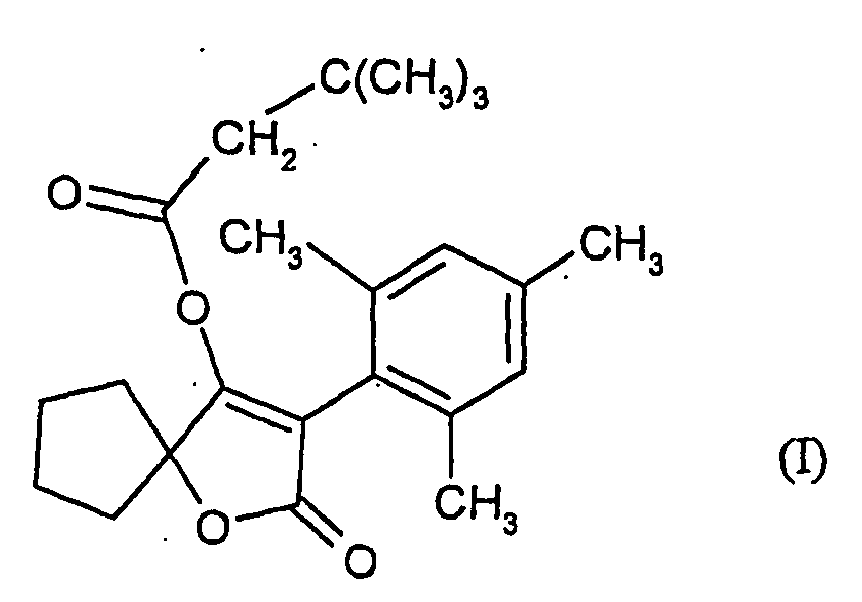
- 3-(2,4,6-Trimethylphenyl)-4-neopentylcarbonyloxy-5,5-tetramethylen-Δ3-dihydrofuran-2-on besitzt die folgende Formel (I):

- Die Verbindung der Formel (I) kann bevorzugt für die Bekämpfung von Insekten aus den Gattungen Psylla, Diaphorina, Trioza, Paratrioza, Tenalaphara, Agonoscena eingesetzt werden. Beispielhaft seien folgende Arten genannt: Psylla costalis, Psylla pyricola, Psylla pyrisuga, Psylla mali, Psylla piri, Diaphorina citri, Trioza erythrea, Paratrioza cockerelli, Tenalaphara malayensis (als) Allocarsidara malayensis (neu).
- Grundsätzlich kann die Verbindung der Formel (I) in einer Vielzahl von Kulturen eingesetzt werden, bevorzugt in Kernobst (z.B. Äpfeln, Birnen), Gemüse (z.B. Tomaten, Chillis, Auberginen, Mören, Bohnen, Paprika), Kartoffeln, Zierpflanzen, Citrus (z.B. Orangen, Grapefruits, Mandarinen), tropischen Kulturen wie z.B. Durians, Steinobst (z.B. Kirschen Pflaumen, Zwetschgen), Nüssen (z.B. Pistazien).
- Erfindungsgemäß können alle Pflanzen und Pflanzenteile behandelt werden. Unter Pflanzen werden hierbei alle Pflanzen und Pflanzenpopulationen verstanden, wie erwünschte und unerwünschte Wildpflanzen oder Kulturpflanzen (einschließlich natürlich vorkommender Kulturpflanzen). Kulturpflanzen können Pflanzen sein, die durch konventionelle Züchtungs- und Optimierungsmethoden oder durch biotechnologische und gentechnologische Methoden oder Kombinationen dieser Methoden erhalten werden können, einschließlich der transgenen Pflanzen und einschließlich der durch Sortenschutzrechte schützbaren oder nicht schützbaren Pflanzensorten. Unter Pflanzenteilen sollen alle oberirdischen und unterirdischen Teile und Organe der Pflanzen, wie Sproß, Blatt, Blüte und Wurzel verstanden werden, wobei beispielhaft Blätter, Nadeln, Stengel, Stämme, Blüten, Fruchtkörper, Früchte und Samen sowie Wurzeln, Knollen und Rhizome aufgeführt werden. Zu den Pflanzenteilen gehört auch Erntegut sowie vegetatives und generatives Vermehrungsmaterial, beispielsweise Stecklinge, Knollen, Rhizome, Ableger und Samen.
- Die erfindungsgemäße Behandlung der Pflanzen und Pflanzenteile mit dem Wirkstoff erfolgt direkt oder durch Einwirkung auf deren Umgebung, Lebensraum oder Lagerraum nach den üblichen Behandlungsmethoden, z.B. durch Tauchen, Sprühen, Verdampfen, Vernebeln, Streuen, Aufstreichen, Injezieren und bei Vermehrungsmaterial, insbesondere bei Samen, weiterhin durch ein- oder mehrschichtiges Umhüllen.
- Wie bereits oben erwähnt, können erfindungsgemäß alle Pflanzen und deren Teile behandelt werden. In einer bevorzugten Ausführungsform werden wild vorkommende oder durch konventionelle biologische Zuchtmethoden, wie Kreuzung oder Protoplastenfusion erhaltenen Pflanzenarten und Pflanzensorten sowie deren Teile behandelt. In einer weiteren bevorzugten Ausführungsform werden transgene Pflanzen und Pflanzensorten, die durch gentechnologische Methoden gegebenenfalls in Kombination mit konventionellen Methoden erhalten wurden (Genetic Modified Organisms) und deren Teile behandelt. Der Begriff "Teile" bzw. "Teile von Pflanzen" oder "Pflanzenteile" wurde oben erläutert.
- Besonders bevorzugt werden erfindungsgemäß Pflanzen der jeweils handelsüblichen oder in Gebrauch befindlichen Pflanzensorten behandelt. Unter Pflanzensorten versteht man Pflanzen mit neuen Eigenschaften ("Traits"), die sowohl durch konventionelle Züchtung, durch Mutagenese oder durch rekombinante DNA-Techniken gezüchtet worden sind. Dies können Sorten, Bio- und Genotypen sein.
- Je nach Pflanzenarten bzw. Pflanzensorten, deren Standort und Wachstumsbedingungen (Böden, Klima, Vegetationsperiode, Ernährung) können durch die erfindungsgemäße Behandlung auch überadditive ("synergistische") Effekte auftreten. So sind beispielsweise erniedrigte Aufwandmengen und/oder Erweiterungen des Wirkungsspektrums und/oder eine Verstärkung der Wirkung der erfindungsgemäß verwendbaren Stoffe und Mittel, besseres Pflanzenwachstum, erhöhte Toleranz gegenüber hohen oder niedrigen Temperaturen, erhöhte Toleranz gegen Trockenheit oder gegen Wasser- bzw. Bodensalzgehalt, erhöhte Blühleistung, erleichterte Ernte, Beschleunigung der Reife, höhere Ernteerträge, höhere Qualität und/oder höherer Ernährungswert der Ernteprodukte, höhere Lagerfähigkeit und/oder Bearbeitbarkeit der Ernteprodukte möglich, die über die eigentlich zu erwartenden Effekte hinausgehen.
- Zu den bevorzugten erfindungsgemäß zu behandelnden transgenen (gentechnologisch erhaltenen) Pflanzen bzw. Pflanzensorten gehören alle Pflanzen, die durch die gentechnologische Modifikation genetisches Material erhielten, welches diesen Pflanzen besondere vorteilhafte wertvolle Eigenschaften ("Traits") verleiht. Beispiele für solche Eigenschaften sind besseres Pflanzenwachstum, erhöhte Toleranz gegenüber hohen oder niedrigen Temperaturen, erhöhte Toleranz gegen Trockenheit oder gegen Wasser- bzw. Bodensalzgehalt, erhöhte Blühleistung, erleichterte Ernte, Beschleunigung der Reife, höhere Ernteerträge, höhere Qualität und/oder höherer Ernährungswert der Ernteprodukte, höhere Lagerfähigkeit und/oder Bearbeitbarkeit der Ernteprodukte. Weitere und besonders hervorgehobene Beispiele für solche Eigenschaften sind eine erhöhte Abwehr der Pflanzen gegen tierische und mikrobielle Schädlinge, wie gegenüber Insekten, Milben, pflanzenpathogenen Pilzen, Bakterien und/oder Viren sowie eine erhöhte Toleranz der Pflanzen gegen bestimmte herbizide Wirkstoffe. Als Beispiele transgener Pflanzen werden die wichtigen Kulturpflanzen, wie Getreide (Weizen, Reis), Mais, Soja, Kartoffel, Baumwolle, Tabak, Raps sowie Obstpflanzen (mit den Früchten Äpfel, Birnen, Zitrusfrüchten und Weintrauben) erwähnt, wobei Mais, Soja, Kartoffel, Baumwolle, Tabak und Raps besonders hervorgehoben werden. Als Eigenschaften ("Traits") werden besonders hervorgehoben die erhöhte Abwehr der Pflanzen gegen Insekten, Spinnentiere, Nematoden und Schnecken durch in den Pflanzen entstehende Toxine, insbesondere solche, die durch das genetische Material aus Bacillus Thuringiensis (z.B. durch die Gene CryIA(a), CryIA(b), CryIA(c), CryIIA, CryIIIA, CryIIIB2, Cry9c Cry2Ab, Cry3Bb und CryIF sowie deren Kombinationen) in den Pflanzen erzeugt werden (im folgenden "Bt Pflanzen"). Als Eigenschaften ("Traits") werden auch besonders hervorgehoben die erhöhte Abwehr von Pflanzen gegen Pilze, Bakterien und Viren durch Systemische Akquirierte Resistenz (SAR), Systemin, Phytoalexine, Elicitoren sowie Resistenzgene und entsprechend exprimierte Proteine und Toxine. Als Eigenschaften ("Traits") werden weiterhin besonders hervorgehoben die erhöhte Toleranz der Pflanzen gegenüber bestimmten herbiziden Wirkstoffen, beispielsweise Imidazolinonen, Sulfonylharnstoffen, Glyphosate oder Phosphinotricin (z.B. "PAT"-Gen). Die jeweils die gewünschten Eigenschaften ("Traits") verleihenden Gene können auch in Kombinationen miteinander in den transgenen Pflanzen vorkommen. Als Beispiele für "Bt Pflanzen" seien Maissorten, Baumwollsorten, Sojasorten und Kartoffelsorten genannt, die unter den Handelsbezeichnungen YIELD GARD® (z.B. Mais, Baumwolle, Soja), KnockOut® (z.B. Mais); StarLink® (z.B. Mais), Bollgard® (Baumwolle), Nucotn® (Baumwolle) und NewLeaf® (Kartoffel) vertrieben werden. Als Beispiele für Herbizid tolerante Pflanzen seien Maissorten, Baumwollsorten und Sojasorten genannt, die unter den Handelsbezeichnungen Roundup Ready® (Toleranz gegen Glyphosate z.B. Mais, Baumwolle, Soja), Liberty Link® (Toleranz gegen Phosphinotricin, z.B. Raps), IMI® (Toleranz gegen Imidazolinone) und STS® (Toleranz gegen Sulfonylharnstoffe z.B. Mais) vertrieben werden. Als Herbizid resistente (konventionell auf Herbizid-Toleranz gezüchtete) Pflanzen seien auch die unter der Bezeichnung Clearfield® vertriebenen Sorten (z.B. Mais) erwähnt. Selbstverständlich gelten diese Aussagen auch für in der Zukunft entwickelte bzw. zukünftig auf den Markt kommende Pflanzensorten mit diesen oder zukünftig entwickelten genetischen Eigenschaften ("Traits").
- Der Wirkstoff der Formel (I) kann in die üblichen Formulierungen überführt werden, wie Lösungen, Emulsionen, Spritzpulver, Suspensionen, Pulver, Stäubemittel, Pasten, lösliche Pulver, Granulate, Suspensions-Emulsions-Konzentrate, Wirkstoff-imprägnierte Natur- und synthetische Stoffe sowie Feinstverkapselungen in polymeren Stoffen.
- Diese Formulierungen werden in bekannter Weise hergestellt, z.B. durch Vermischen des Wirkstoffs mit Streckmitteln, also flüssigen Lösungsmitteln und/oder festen Trägerstoffen, gegebenenfalls unter Verwendung von oberflächenaktiven Mitteln, also Emulgiermitteln und/oder Dispergiermitteln und/oder schaumerzeugenden Mitteln.
- Im Falle der Benutzung von Wasser als Streckmittel können z.B. auch organische Lösungsmittel als Hilfslösungsmittel verwendet werden. Als flüssige Lösungsmittel kommen im wesentlichen in Frage: Aromaten, wie Xylol, Toluol, oder Alkylnaphthaline, chlorierte Aromaten und chlorierte aliphatische Kohlenwasserstoffe, wie Chlorbenzole, Chlorethylene oder Methylenchlorid, aliphatische Kohlenwasserstoffe, wie Cyclohexan oder Paraffine, z.B. Erdölfraktionen, mineralische und pflanzliche Öle, Alkohole, wie Butanol oder Glykol sowie deren Ether und Ester, Ketone wie Aceton, Methylethylketon, Methylisobutylketon oder Cyclohexanon, stark polare Lösungsmittel, wie Dimethylformamid und Dimethylsulfoxid, sowie Wasser.
- Als feste Trägerstoffe kommen in Frage:
- z.B. Ammoniumsalze und natürliche Gesteinsmehle, wie Kaoline, Tonerden, Talkum, Kreide, Quarz, Attapulgit, Montmorillonit oder Diatomeenerde und synthetische Gesteinsmehle, wie hochdisperse Kieselsäure, Aluminiumoxid und Silikate, als feste Trägerstoffe für Granulate kommen in Frage: z.B. gebrochene und fraktionierte natürliche Gesteine wie Calcit, Marmor, Bims, Sepiolith, Dolomit sowie synthetische Granulate aus anorganischen und organischen Mehlen sowie Granulate aus organischem Material wie Sägemehl, Kokosnussschalen, Maiskolben und Tabakstengeln; als Emulgier- und/oder schaumerzeugende Mittel kommen in Frage: z.B. nichtionogene und anionische Emulgatoren, wie Polyoxyethylen-Fettsäure-Ester, Polyoxyethylen-Fettalkohol-Ether, z.B. Alkylaryl-polyglykolether, Alkylsulfonate, Alkylsulfate, Arylsulfonate sowie Eiweißhydrolysate; als Dispergiermittel kommen in Frage: z.B. Lignin-Sulfitablaugen und Methylcellulose.
- Es können in den Formulierungen Haftmittel wie Carboxymethylcellulose, natürliche und synthetische pulvrige, körnige oder latexförmige Polymere verwendet werden, wie Gummiarabicum, Polyvinylalkohol, Polyvinylacetat, sowie natürliche Phospholipide, wie Kephaline und Lecithine und synthetische Phospholipide. Weitere Additive können mineralische und vegetabile Öle sein.
- Es können Farbstoffe wie anorganische Pigmente, z.B. Eisenoxid, Titanoxid, Ferrocyanblau und organische Farbstoffe, wie Alizarin-, Azo- und Metallphthalocyaninfarbstoffe und Spurennährstoffe wie Salze von Eisen, Mangan, Bor, Kupfer, Kobalt, Molybdän und Zink verwendet werden.
- Die Formulierungen enthalten im allgemeinen zwischen 0,1 und 95 Gew.-% Wirkstoff, vorzugsweise zwischen 0,5 und 90 % und daneben bevorzugt Streckmittel und/oder oberflächenaktive Mittel.
- Der Wirkstoffgehalt der aus den handelsüblichen Formulierungen bereiteten Anwendungsformen kann in weiten Bereichen variieren. Die Wirkstoffkonzentration der Anwendungsformen kann von 0,0000001 bis zu 95 Gew.-% Wirkstoff, vorzugsweise zwischen 0,0001 und 1 Gew.-% liegen.
- Die Anwendung geschieht in einer den Anwendungsformen angepassten üblichen Weise.
- 5.45 g (20 mmol) 3-(2,4,6-Trimethylphenyl)-4-hydroxy-5,5-tetramethylen-Δ3-dihydrofuran-2-on (bekannt aus
EP-A-0 528 156 ) werden in 80 ml Dichlormethan vorgelegt, 3.04g (30 mmol) Triethylamin zugesetzt und anschließend bei 0-10°C eine Lösung von 3,50 g (26 mmol) 3,3-Dimethylbuttersäurechlorid in 20 ml Dichlormethan zugetropft. - Nach 2 Stunden werden weitere 0,50 g (5 mmol) Triethylamin und 0,40 g (3 mmol) Säurechlorid zugesetzt und weitere 16 Stunden bei Raumtemperatur gerührt.
- Zur Aufarbeitung wäscht man 2 mal mit 10 %iger Citronensäure und 2 mal mit IN Natronlauge, trocknet die organische Phase mit Natriumsulfat und engt ein.
- Ein weitere Reinigung des Rohproduktes erreicht man durch Verreiben mit Petrolether, absaugen und trocknen.
- Ausbeute: 4.50 g weißer Feststoff (61 % d. Th.) vom Schmelzpunkt: 98°C.
-
Schädling: Trioza erythreae Pflanze: Orange - Die Verbindung der Formel (I) (240 SC) wurde mit einer Aufwandmenge von 144 g a.i./ha + 0,2 % a.i. Rapsölmethylester (RME) mit 540 l/ha Wasser im Vergleich zu Spirodiclofenaufwandmengenvergleich geprüft.
- Die Spritzung erfolgte mittels eines Pressluft-getriebenen Rückengerätes.
- Der Versuch wurde mit einem Baum pro Parzelle und drei Wiederholungen durchgeführt. Dabei erfolgten je zwei Applikationen im Abstand von einer Woche.
- Die Wirksamkeit gegen Blattflöhe wurde durch Zählen der Anzahl lebender Tiere auf 20 Blättern pro Baum 7 Tage nach der ersten Behandlung und 7 und 13 Tagen nach der letzten Anwendung ermittelt. Der Wirkungsgrad wurde mit Hilfe der Abbott-Formel berechnet.
Verbindung Aufwandmenge g/ha Wirkungsgrad in % Abbott 7TNAA 7TNAB 13TNAB Verbindung der Formel (I) 144 95 97,5 95,2 240 SC + 0,2 % RME Spirodiclofen 144 80,3 91,5 88,1 240 SC + 0,2 % RME -
Schädling. Paratrioza cockerelli Pflanze: Tomate - Die Verbindung der Formel (I) (240 SC) wurde mit einer Aufwandmenge von 72 g a.i./ha mit einer Wasseraufwandmenge von 345 l/ha im Vergleich zu Leverage (48 g a.i./ha Imidacloprid + 33 g a.i./ha Cyfluthrin) getestet.
- Die Spritzung erfolgte mittels eines handgetriebenen-Rückengeräts.
- Der Versuch wurde mit Parzellen von 10 m2 und drei Wiederholungen durchgeführt. Dabei erfolgten je zwei Applikationen im Abstand von einer Woche.
- Die Wirksamkeit gegen Blattflöhe wurde durch Zählen lebender Tiere an 10 Blättern 7 Tage nach der ersten Behandlung und 7 und 14 Tage nach der zweiten Anwendung ermittelt. Der Wirkungsgrad wurde mit Hilfe der Abbott-Formel berechnet.
Verbindung Aufwandmenge g/ha Wirkungsgrad in % Abbott 7TNAA 7TNAB 14TNAB Verbindung der Formel (I) 72 80,3 84,8 98,7 240 SC Leverage Imidacloprid + Cyfluthrin 48 75,4 81,1 92,1 + 33
Claims (1)
- Verwendung der Verbindung der Formel (I)
Applications Claiming Priority (2)
| Application Number | Priority Date | Filing Date | Title |
|---|---|---|---|
| DE102004032420A DE102004032420A1 (de) | 2004-07-05 | 2004-07-05 | Verwendung von 3-(2,4,6-Trimethylphenyl)-4-neopentylcarbonyloxy-5,5-tetramethylen-Δ3-dihydrofuran-2-on zur Bekämpfung von Psylliden |
| PCT/EP2005/006780 WO2006002824A1 (de) | 2004-07-05 | 2005-06-23 | Verwendung von 3-(2,4,6-trimethylphenyl)-4-neopentylcarbonyloxy-5,5-tetramethylen ν dihydrofuran-2-on zur bekämpfung von psylliden |
Publications (2)
| Publication Number | Publication Date |
|---|---|
| EP1765077A1 EP1765077A1 (de) | 2007-03-28 |
| EP1765077B1 true EP1765077B1 (de) | 2008-05-21 |
Family
ID=35285339
Family Applications (1)
| Application Number | Title | Priority Date | Filing Date |
|---|---|---|---|
| EP05755961A Expired - Lifetime EP1765077B1 (de) | 2004-07-05 | 2005-06-23 | Verwendung von 3-(2,4,6-trimethylphenyl)-4-neopentylcarbonyloxy-5,5-tetramethylen-dihydrofuran-2-on zur bekämpfung von psylliden |
Country Status (9)
| Country | Link |
|---|---|
| US (1) | US9480253B2 (de) |
| EP (1) | EP1765077B1 (de) |
| KR (1) | KR101216130B1 (de) |
| CN (2) | CN101068469A (de) |
| AT (1) | ATE395826T1 (de) |
| DE (2) | DE102004032420A1 (de) |
| ES (1) | ES2306169T3 (de) |
| MY (1) | MY139291A (de) |
| WO (1) | WO2006002824A1 (de) |
Families Citing this family (15)
| Publication number | Priority date | Publication date | Assignee | Title |
|---|---|---|---|---|
| DE102004011006A1 (de) * | 2004-03-06 | 2005-09-22 | Bayer Cropscience Ag | Suspensionskonzentrate auf Ölbasis |
| DE102004044827A1 (de) | 2004-09-16 | 2006-03-23 | Bayer Cropscience Ag | Jod-phenylsubstituierte cyclische Ketoenole |
| DE102004053191A1 (de) | 2004-11-04 | 2006-05-11 | Bayer Cropscience Ag | 2,6-Diethyl-4-methyl-phenyl substituierte Tetramsäure-Derivate |
| DE102004053192A1 (de) * | 2004-11-04 | 2006-05-11 | Bayer Cropscience Ag | 2-Alkoxy-6-alkyl-phenyl substituierte spirocyclische Tetramsäure-Derivate |
| DE102006016641A1 (de) * | 2006-04-08 | 2007-10-11 | Bayer Cropscience Ag | Verwendung von 3-(2,4,6-Trimethylphenyl)-4-neopentylcarbonyloxy-5,5-tetramethylen-Δ3-dihydrofuran-2-on zur Bekämpfung von Dipteren aus der Familie der Cecidomyiidae |
| DE102006027732A1 (de) * | 2006-06-16 | 2008-01-10 | Bayer Cropscience Ag | Wirkstoffkombinationen mit insektiziden und akariziden Eigenschaften |
| DE102006027730A1 (de) * | 2006-06-16 | 2007-12-20 | Bayer Cropscience Ag | Wirkstoffkombinationen mit insektiziden und akariziden Eigenschaften |
| DE102006033154A1 (de) | 2006-07-18 | 2008-01-24 | Bayer Cropscience Ag | Wirkstoffkombinationen mit insektiziden und akariziden Eigenschaften |
| DE102007001866A1 (de) * | 2007-01-12 | 2008-07-17 | Bayer Cropscience Ag | Spirocyclische Tetronsäure-Derivate |
| BRPI0822468A2 (pt) * | 2008-03-27 | 2014-10-07 | Bayer Cropscience Ag | Uso de derivados de ácido tetrônico para o controle insetos e ácaros de aranha por meio de irrigação do solo, aplicação de gotas ou aplicação por imersão |
| US8846946B2 (en) | 2008-12-02 | 2014-09-30 | Bayer Cropscience Ag | Germinal alkoxy/alkylspirocyclic substituted tetramate derivatives |
| US8389443B2 (en) * | 2008-12-02 | 2013-03-05 | Bayer Cropscience Ag | Geminal alkoxy/alkylspirocyclic substituted tetramate derivatives |
| EA022553B1 (ru) | 2010-01-22 | 2016-01-29 | Байер Интеллектуэль Проперти Гмбх | Применение комбинации биологически активных веществ, набор и средство, содержащие комбинацию биологически активных веществ, для борьбы с вредителями животного происхождения и способ улучшения использования продукционного потенциала трансгенного растения |
| BR112016017098A2 (pt) * | 2014-01-31 | 2018-05-08 | Bayer Cropscience Ag | método de indução de maturação em frutas |
| EP3564225A1 (de) * | 2019-03-21 | 2019-11-06 | Bayer Aktiengesellschaft | Kristalline form von spiromesifen |
Family Cites Families (5)
| Publication number | Priority date | Publication date | Assignee | Title |
|---|---|---|---|---|
| DE4216814A1 (de) | 1991-07-16 | 1993-01-21 | Bayer Ag | 3-aryl-4-hydroxy-(delta)(pfeil hoch)3(pfeil hoch)-dihydrofuranon- und 3-aryl-4-hydroxy-(delta)(pfeil hoch)3(pfeil hoch)-dihydrothiophenon-derivate |
| US5877012A (en) * | 1993-03-25 | 1999-03-02 | Novartis Finance Corporation | Class of proteins for the control of plant pests |
| DE19901943A1 (de) | 1999-01-20 | 2000-07-27 | Bayer Ag | Verwendung von 3-/2,4,6-Trimethylphenyl)-4-neopentylcarbonyloxy-5,5-tetramethylen- -dihydrofuran-2-on zur Bekämpfung der Weißen Fliege |
| DE19913174A1 (de) * | 1999-03-24 | 2000-09-28 | Bayer Ag | Synergistische insektizide Mischungen |
| ES2196996B1 (es) * | 2001-02-22 | 2005-03-01 | Sumitomo Chemical Company, Limited | Compuestos ester, metodos de control de una plaga y utilizacion de los compuestos ester. |
-
2004
- 2004-07-05 DE DE102004032420A patent/DE102004032420A1/de not_active Withdrawn
-
2005
- 2005-06-23 CN CNA2005800296993A patent/CN101068469A/zh active Pending
- 2005-06-23 EP EP05755961A patent/EP1765077B1/de not_active Expired - Lifetime
- 2005-06-23 AT AT05755961T patent/ATE395826T1/de not_active IP Right Cessation
- 2005-06-23 DE DE502005004206T patent/DE502005004206D1/de not_active Expired - Fee Related
- 2005-06-23 ES ES05755961T patent/ES2306169T3/es not_active Expired - Lifetime
- 2005-06-23 CN CN201310349401.3A patent/CN103392704A/zh active Pending
- 2005-06-23 KR KR1020077002440A patent/KR101216130B1/ko not_active Expired - Fee Related
- 2005-06-23 US US11/631,650 patent/US9480253B2/en not_active Expired - Fee Related
- 2005-06-23 WO PCT/EP2005/006780 patent/WO2006002824A1/de not_active Ceased
- 2005-07-01 MY MYPI20053025A patent/MY139291A/en unknown
Also Published As
| Publication number | Publication date |
|---|---|
| KR20070029283A (ko) | 2007-03-13 |
| MY139291A (en) | 2009-09-30 |
| EP1765077A1 (de) | 2007-03-28 |
| US9480253B2 (en) | 2016-11-01 |
| DE502005004206D1 (de) | 2008-07-03 |
| US20070254949A1 (en) | 2007-11-01 |
| WO2006002824A9 (de) | 2007-07-26 |
| KR101216130B1 (ko) | 2012-12-28 |
| ES2306169T3 (es) | 2008-11-01 |
| CN101068469A (zh) | 2007-11-07 |
| ATE395826T1 (de) | 2008-06-15 |
| WO2006002824A1 (de) | 2006-01-12 |
| DE102004032420A1 (de) | 2006-01-26 |
| CN103392704A (zh) | 2013-11-20 |
Similar Documents
| Publication | Publication Date | Title |
|---|---|---|
| EP2220939B1 (de) | Synergistische fungizide Wirkstoffkombinationen | |
| EP1677598B1 (de) | Synergistische fungizide wirkstoffkombinationen | |
| EP2319310B1 (de) | Fungizide Wirkstoffkombinationen enthaltend Fluoxastrobin und Metalaxyl-M | |
| EP2564703B1 (de) | Nematizide Wirkstoffkombinationen umfassend Fluopyram und Cyazypyr | |
| EP1463410B1 (de) | Fungizide wirkstoffkombinationen | |
| EP3001905B1 (de) | Wirkstoffkombinationen mit insektiziden und akariziden eigenschaften | |
| EP1771064B1 (de) | Insektizide auf basis von neonicotinoiden und safenern | |
| EP2043440A1 (de) | Wirkstoffkombinationen mit insektiziden und akariziden eigenschaften | |
| EP2923576B1 (de) | Wirkstoffkombinationen mit insektiziden und akariziden eigenschaften | |
| EP1276375B1 (de) | Fungizide wirkstoffkombinationen | |
| WO2006002824A9 (de) | Verwendung von 3-(2,4,6-trimethylphenyl)-4-neopentylcarbonyloxy-5,5-tetramethylen ν dihydrofuran-2-on zur bekämpfung von psylliden | |
| EP2011394A1 (de) | Verwendung von Tetramsäure - Derivaten zur Bekämpfung von virusübertragenden Vektoren | |
| WO2009000443A2 (de) | Verwendung von wirkstoffkombinationen mit insektiziden eigenschaften zur bekämpfung von tierischen schädlingen aus der familie der stinkwanzen | |
| EP2475255A2 (de) | Verwendung von cyclischen ketoenolen gegen pflanzenpathogene bakterien | |
| EP2007201A2 (de) | Verwendung von 3-(2,4,6-trimethylphenyl)-4-neopentylcarbonyloxy-5,5-tetramethylen- 3-dihydrofuran-2-on zur bekämpfung von dipteren aus der familie der cecidomyiidae | |
| EP2242363A1 (de) | Verwendung von tetramsäurederivaten zur bekämpfung von tierischen schädlingen nach stamm-, zweig-, blütenstand- und knospenbehandlungen | |
| DE102004017981A1 (de) | Fungizide Wirkstoffkombinationen | |
| EP2027773A1 (de) | Verwendung von N-[2-(1,3-Dimethylbutyl)phenyl]-5-fluor-1,3-dimethyl-1H-pyrazol-4-carboxamid | |
| MXPA06015046A (en) | Use of 3-(2,4,6-trimethylphenyl)-4-neopentylcarbonyloxy-5,5-tetramethylene-?- -dihydrofuran-2-on for controlling psyllidae |
Legal Events
| Date | Code | Title | Description |
|---|---|---|---|
| PUAI | Public reference made under article 153(3) epc to a published international application that has entered the european phase |
Free format text: ORIGINAL CODE: 0009012 |
|
| 17P | Request for examination filed |
Effective date: 20070205 |
|
| AK | Designated contracting states |
Kind code of ref document: A1 Designated state(s): AT BE BG CH CY CZ DE DK EE ES FI FR GB GR HU IE IS IT LI LT LU MC NL PL PT RO SE SI SK TR |
|
| GRAP | Despatch of communication of intention to grant a patent |
Free format text: ORIGINAL CODE: EPIDOSNIGR1 |
|
| DAX | Request for extension of the european patent (deleted) | ||
| GRAS | Grant fee paid |
Free format text: ORIGINAL CODE: EPIDOSNIGR3 |
|
| GRAA | (expected) grant |
Free format text: ORIGINAL CODE: 0009210 |
|
| AK | Designated contracting states |
Kind code of ref document: B1 Designated state(s): AT BE BG CH CY CZ DE DK EE ES FI FR GB GR HU IE IS IT LI LT LU MC NL PL PT RO SE SI SK TR |
|
| REG | Reference to a national code |
Ref country code: GB Ref legal event code: FG4D Free format text: NOT ENGLISH |
|
| REG | Reference to a national code |
Ref country code: CH Ref legal event code: EP |
|
| REF | Corresponds to: |
Ref document number: 502005004206 Country of ref document: DE Date of ref document: 20080703 Kind code of ref document: P |
|
| REG | Reference to a national code |
Ref country code: IE Ref legal event code: FG4D Free format text: LANGUAGE OF EP DOCUMENT: GERMAN |
|
| REG | Reference to a national code |
Ref country code: GR Ref legal event code: EP Ref document number: 20080401927 Country of ref document: GR |
|
| PG25 | Lapsed in a contracting state [announced via postgrant information from national office to epo] |
Ref country code: SI Free format text: LAPSE BECAUSE OF FAILURE TO SUBMIT A TRANSLATION OF THE DESCRIPTION OR TO PAY THE FEE WITHIN THE PRESCRIBED TIME-LIMIT Effective date: 20080521 |
|
| PG25 | Lapsed in a contracting state [announced via postgrant information from national office to epo] |
Ref country code: FI Free format text: LAPSE BECAUSE OF FAILURE TO SUBMIT A TRANSLATION OF THE DESCRIPTION OR TO PAY THE FEE WITHIN THE PRESCRIBED TIME-LIMIT Effective date: 20080521 |
|
| REG | Reference to a national code |
Ref country code: ES Ref legal event code: FG2A Ref document number: 2306169 Country of ref document: ES Kind code of ref document: T3 |
|
| PG25 | Lapsed in a contracting state [announced via postgrant information from national office to epo] |
Ref country code: PL Free format text: LAPSE BECAUSE OF FAILURE TO SUBMIT A TRANSLATION OF THE DESCRIPTION OR TO PAY THE FEE WITHIN THE PRESCRIBED TIME-LIMIT Effective date: 20080521 |
|
| BERE | Be: lapsed |
Owner name: BAYER CROPSCIENCE A.G. Effective date: 20080630 |
|
| PG25 | Lapsed in a contracting state [announced via postgrant information from national office to epo] |
Ref country code: IS Free format text: LAPSE BECAUSE OF FAILURE TO SUBMIT A TRANSLATION OF THE DESCRIPTION OR TO PAY THE FEE WITHIN THE PRESCRIBED TIME-LIMIT Effective date: 20080921 |
|
| REG | Reference to a national code |
Ref country code: IE Ref legal event code: FD4D |
|
| PG25 | Lapsed in a contracting state [announced via postgrant information from national office to epo] |
Ref country code: LT Free format text: LAPSE BECAUSE OF FAILURE TO SUBMIT A TRANSLATION OF THE DESCRIPTION OR TO PAY THE FEE WITHIN THE PRESCRIBED TIME-LIMIT Effective date: 20080521 Ref country code: IE Free format text: LAPSE BECAUSE OF FAILURE TO SUBMIT A TRANSLATION OF THE DESCRIPTION OR TO PAY THE FEE WITHIN THE PRESCRIBED TIME-LIMIT Effective date: 20080521 Ref country code: CZ Free format text: LAPSE BECAUSE OF FAILURE TO SUBMIT A TRANSLATION OF THE DESCRIPTION OR TO PAY THE FEE WITHIN THE PRESCRIBED TIME-LIMIT Effective date: 20080521 Ref country code: DK Free format text: LAPSE BECAUSE OF FAILURE TO SUBMIT A TRANSLATION OF THE DESCRIPTION OR TO PAY THE FEE WITHIN THE PRESCRIBED TIME-LIMIT Effective date: 20080521 Ref country code: MC Free format text: LAPSE BECAUSE OF NON-PAYMENT OF DUE FEES Effective date: 20080630 Ref country code: SE Free format text: LAPSE BECAUSE OF FAILURE TO SUBMIT A TRANSLATION OF THE DESCRIPTION OR TO PAY THE FEE WITHIN THE PRESCRIBED TIME-LIMIT Effective date: 20080821 |
|
| PG25 | Lapsed in a contracting state [announced via postgrant information from national office to epo] |
Ref country code: RO Free format text: LAPSE BECAUSE OF FAILURE TO SUBMIT A TRANSLATION OF THE DESCRIPTION OR TO PAY THE FEE WITHIN THE PRESCRIBED TIME-LIMIT Effective date: 20080521 Ref country code: SK Free format text: LAPSE BECAUSE OF FAILURE TO SUBMIT A TRANSLATION OF THE DESCRIPTION OR TO PAY THE FEE WITHIN THE PRESCRIBED TIME-LIMIT Effective date: 20080521 Ref country code: PT Free format text: LAPSE BECAUSE OF FAILURE TO SUBMIT A TRANSLATION OF THE DESCRIPTION OR TO PAY THE FEE WITHIN THE PRESCRIBED TIME-LIMIT Effective date: 20081021 |
|
| PLBE | No opposition filed within time limit |
Free format text: ORIGINAL CODE: 0009261 |
|
| STAA | Information on the status of an ep patent application or granted ep patent |
Free format text: STATUS: NO OPPOSITION FILED WITHIN TIME LIMIT |
|
| PG25 | Lapsed in a contracting state [announced via postgrant information from national office to epo] |
Ref country code: BE Free format text: LAPSE BECAUSE OF NON-PAYMENT OF DUE FEES Effective date: 20080630 |
|
| 26N | No opposition filed |
Effective date: 20090224 |
|
| PG25 | Lapsed in a contracting state [announced via postgrant information from national office to epo] |
Ref country code: EE Free format text: LAPSE BECAUSE OF FAILURE TO SUBMIT A TRANSLATION OF THE DESCRIPTION OR TO PAY THE FEE WITHIN THE PRESCRIBED TIME-LIMIT Effective date: 20080521 Ref country code: BG Free format text: LAPSE BECAUSE OF FAILURE TO SUBMIT A TRANSLATION OF THE DESCRIPTION OR TO PAY THE FEE WITHIN THE PRESCRIBED TIME-LIMIT Effective date: 20080821 Ref country code: DE Free format text: LAPSE BECAUSE OF NON-PAYMENT OF DUE FEES Effective date: 20090101 |
|
| PGFP | Annual fee paid to national office [announced via postgrant information from national office to epo] |
Ref country code: NL Payment date: 20090603 Year of fee payment: 5 |
|
| PG25 | Lapsed in a contracting state [announced via postgrant information from national office to epo] |
Ref country code: AT Free format text: LAPSE BECAUSE OF NON-PAYMENT OF DUE FEES Effective date: 20080623 Ref country code: IT Free format text: LAPSE BECAUSE OF FAILURE TO SUBMIT A TRANSLATION OF THE DESCRIPTION OR TO PAY THE FEE WITHIN THE PRESCRIBED TIME-LIMIT Effective date: 20080521 |
|
| PGFP | Annual fee paid to national office [announced via postgrant information from national office to epo] |
Ref country code: GR Payment date: 20090601 Year of fee payment: 5 |
|
| REG | Reference to a national code |
Ref country code: CH Ref legal event code: PL |
|
| GBPC | Gb: european patent ceased through non-payment of renewal fee |
Effective date: 20090623 |
|
| PG25 | Lapsed in a contracting state [announced via postgrant information from national office to epo] |
Ref country code: LI Free format text: LAPSE BECAUSE OF NON-PAYMENT OF DUE FEES Effective date: 20090630 Ref country code: CH Free format text: LAPSE BECAUSE OF NON-PAYMENT OF DUE FEES Effective date: 20090630 |
|
| PG25 | Lapsed in a contracting state [announced via postgrant information from national office to epo] |
Ref country code: GB Free format text: LAPSE BECAUSE OF NON-PAYMENT OF DUE FEES Effective date: 20090623 |
|
| PG25 | Lapsed in a contracting state [announced via postgrant information from national office to epo] |
Ref country code: LU Free format text: LAPSE BECAUSE OF NON-PAYMENT OF DUE FEES Effective date: 20080623 Ref country code: HU Free format text: LAPSE BECAUSE OF FAILURE TO SUBMIT A TRANSLATION OF THE DESCRIPTION OR TO PAY THE FEE WITHIN THE PRESCRIBED TIME-LIMIT Effective date: 20081122 Ref country code: CY Free format text: LAPSE BECAUSE OF FAILURE TO SUBMIT A TRANSLATION OF THE DESCRIPTION OR TO PAY THE FEE WITHIN THE PRESCRIBED TIME-LIMIT Effective date: 20080521 |
|
| REG | Reference to a national code |
Ref country code: NL Ref legal event code: V1 Effective date: 20110101 |
|
| PG25 | Lapsed in a contracting state [announced via postgrant information from national office to epo] |
Ref country code: NL Free format text: LAPSE BECAUSE OF NON-PAYMENT OF DUE FEES Effective date: 20110101 |
|
| PG25 | Lapsed in a contracting state [announced via postgrant information from national office to epo] |
Ref country code: GR Free format text: LAPSE BECAUSE OF NON-PAYMENT OF DUE FEES Effective date: 20110104 |
|
| REG | Reference to a national code |
Ref country code: FR Ref legal event code: ST Effective date: 20110729 |
|
| PG25 | Lapsed in a contracting state [announced via postgrant information from national office to epo] |
Ref country code: FR Free format text: LAPSE BECAUSE OF NON-PAYMENT OF DUE FEES Effective date: 20080721 |
|
| REG | Reference to a national code |
Ref country code: ES Ref legal event code: PC2A Owner name: BAYER INTELLECTUAL PROPERTY GMBH Effective date: 20150316 Ref country code: ES Ref legal event code: PC2A Owner name: BAYER INTELLECTUAL PROPERTY GMBH Effective date: 20150408 |
|
| REG | Reference to a national code |
Ref country code: GR Ref legal event code: ML Ref document number: 20080401927 Country of ref document: GR Effective date: 20110104 |
|
| PGFP | Annual fee paid to national office [announced via postgrant information from national office to epo] |
Ref country code: ES Payment date: 20190701 Year of fee payment: 15 |
|
| PGFP | Annual fee paid to national office [announced via postgrant information from national office to epo] |
Ref country code: TR Payment date: 20200622 Year of fee payment: 16 |
|
| REG | Reference to a national code |
Ref country code: ES Ref legal event code: FD2A Effective date: 20211105 |
|
| PG25 | Lapsed in a contracting state [announced via postgrant information from national office to epo] |
Ref country code: ES Free format text: LAPSE BECAUSE OF NON-PAYMENT OF DUE FEES Effective date: 20200624 |
|
| PG25 | Lapsed in a contracting state [announced via postgrant information from national office to epo] |
Ref country code: TR Free format text: LAPSE BECAUSE OF NON-PAYMENT OF DUE FEES Effective date: 20210623 |