WO2009104332A1 - Système de segmentation d'un discours, procédé de segmentation d'un discours et programme de segmentation d'un discours - Google Patents
Système de segmentation d'un discours, procédé de segmentation d'un discours et programme de segmentation d'un discours Download PDFInfo
- Publication number
- WO2009104332A1 WO2009104332A1 PCT/JP2008/072851 JP2008072851W WO2009104332A1 WO 2009104332 A1 WO2009104332 A1 WO 2009104332A1 JP 2008072851 W JP2008072851 W JP 2008072851W WO 2009104332 A1 WO2009104332 A1 WO 2009104332A1
- Authority
- WO
- WIPO (PCT)
- Prior art keywords
- utterance
- speech
- dividing
- division
- voice
- Prior art date
- Legal status (The legal status is an assumption and is not a legal conclusion. Google has not performed a legal analysis and makes no representation as to the accuracy of the status listed.)
- Ceased
Links
Images




Classifications
-
- G—PHYSICS
- G10—MUSICAL INSTRUMENTS; ACOUSTICS
- G10L—SPEECH ANALYSIS TECHNIQUES OR SPEECH SYNTHESIS; SPEECH RECOGNITION; SPEECH OR VOICE PROCESSING TECHNIQUES; SPEECH OR AUDIO CODING OR DECODING
- G10L15/00—Speech recognition
- G10L15/04—Segmentation; Word boundary detection
-
- G—PHYSICS
- G10—MUSICAL INSTRUMENTS; ACOUSTICS
- G10L—SPEECH ANALYSIS TECHNIQUES OR SPEECH SYNTHESIS; SPEECH RECOGNITION; SPEECH OR VOICE PROCESSING TECHNIQUES; SPEECH OR AUDIO CODING OR DECODING
- G10L21/00—Speech or voice signal processing techniques to produce another audible or non-audible signal, e.g. visual or tactile, in order to modify its quality or its intelligibility
- G10L21/02—Speech enhancement, e.g. noise reduction or echo cancellation
- G10L21/0272—Voice signal separating
- G10L21/028—Voice signal separating using properties of sound source
Definitions
- the present invention relates to an utterance dividing system, an utterance dividing method, and an utterance dividing program, and more particularly, an input of dialogue voice by two or more speakers, and an utterance uttered by a speaker by another speaker.
- An utterance division system, an utterance division method, and an utterance division program characterized by appropriately dividing an utterance so that the flow of dialogue is easily read even when utterances that overlap in time are made About.
- the speech recognition system divides an input speech signal for each utterance, outputs a speech recognition result (mainly as text) for each utterance, and sequentially outputs the result to a screen, a storage device, or the like.
- Talk here refers to a chunk of speech with a certain length. Intuitively, one utterance corresponds to almost one sentence (or a semantic unit of utterance content equivalent to it).
- a speech unit is cut out by cutting out a voice section that does not include a long silent section from an input voice signal. This is based on the knowledge that a relatively short sentence can be contained in almost one utterance (the content of the sentence can be uttered as speech). In the case of a long sentence, it is often divided into a plurality of utterances, which is because there is a possibility of breathing when uttering such contents.
- Non-Patent Document 1 As a document describing an algorithm for detecting an utterance.
- speech segment start (speech start)
- utterance end if the number of zero-crossings whose amplitude level is greater than or equal to a specified value is greater than or equal to a certain number, speech segment start (speech start), and if the number is less than a certain value, utterance It is considered as end (utterance end).
- utterance which is a processing unit of speech recognition technology, is based on “sentence” (or a semantic unit of utterance content equivalent to it), but it is guaranteed to be equivalent to “sentence”. It has the nature of not.
- each speech of each speaker is divided into utterances, and speech recognition processing is performed on each of them.
- Patent Document 1 An example of a conventional dialog voice recognition system is described in Patent Document 1.
- This conventional interactive speech recognition system includes an utterance detection unit that cuts out utterances from voices uttered by a plurality of speakers, a voice recognition unit that processes the cut out utterances in the order of being cut out, and displays the results in order on the screen.
- Output means An example of a conventional dialog voice recognition system.
- the conventional interactive speech recognition system having such a configuration operates as follows.
- the utterance detection means detects utterances from respective audio signals uttered by a plurality of speakers.
- the detected utterances are sent to the speech recognition means in the order of detection (that is, in the order of the utterance start times), and converted from speech signals to recognition results such as text.
- the recognition result is sent to the output means and displayed on the screen or the like in the order processed by the voice recognition means (that is, in the order of speech detection).
- This method works without problems when the utterances of the main speakers at a certain point of time are independent from each other, such as a voice conversation in a conference.
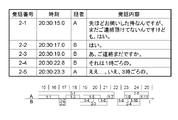
- Fig. 1 is a manual transcript of the two speakers talking alternately while giving each other confirmation and confirmation.
- the table is created by dividing each speaker's utterances at appropriate points in time while considering the contents so that the flow of dialogue becomes clear. By showing in this way, it can be understood well that each of the utterance contents of the speakers A and B shows each other.
- looking at the time-series diagram shown below it can be seen that even when utterances are ideally cut out in this way, some utterances overlap. For example, utterance numbers 1-4, 1-5, and 1-6 are uttered in an overlapping manner.
- FIG. 2 shows an example when this dialogue voice is given to a voice recognition system based on the conventional method.
- conventional speech recognition means is used to perform utterance segmentation processing regardless of the utterance content.
- FIG. 1 there are some cases where separate “utterances” are combined into one “utterance”.
- utterance 2-1 in FIG. 2 is a combination of utterances 1-1, 1-3, 1-5, and 1-7 in FIG. This is because, as described above, in general speech recognition technology, a speech segment that does not include a long silent segment is cut out as one utterance in the input speech signal.
- the utterances 1-9 and 1-11 of speaker A are cut out as one utterance because the length of the silent interval between them is short, and the utterances 1-4 and 1-6 of speaker B are Because the length of the silent section between is short, it is cut out as one utterance, and the utterances 1-8 and 1-10 of speaker B are cut out as one utterance because the length of the silent section between them is short .
- the utterance “Yes” uttered by speaker B at 20: 30: 17.0 is related to the utterance content of speaker A. This is obvious if it is an ideal output as shown in FIG. 1 (utterance 1-1 of the latest speaker A), but in FIG. 2, it is not obvious what the content of the speech 2-1 is. In this case, this “yes” may indicate that speaker B has understood “the case you just asked” or that he / she understands the situation of “not being contacted”. It may not be known, or it may be just for the time signature of speaker A's “yes”.
- speaker A's response to speaker B's inquiry “It's about 1 o'clock” from 20: 30: 22.8 is a negative sentence beginning with “No,” in utterance 1-11 in FIG. It can be seen at a glance that in FIG. 2, the utterance “yes” and the negation “no” are consecutive, as in utterance 2-5, and it is unclear.
- the first problem is that in speech dialogues in which two or more speakers participate, when speech uttered by two or more speakers overlaps in time, a long silent section is included as in the conventional method.
- the output of a dialogue speech recognition system based on a simple method of cutting out a non-speech segment as one utterance makes it difficult to grasp the relevance of each utterance in the dialogue. It is difficult to analyze.
- An object of the present invention is to divide an utterance at an appropriate position so that the output can be easily shaped into a form in which the relevance of each utterance is easier to grasp.
- the utterance dividing system of the present invention includes utterance dividing means for receiving utterances by two or more speakers and further dividing each utterance.
- the utterance dividing means uses information of another utterance that overlaps when determining a division point of a certain utterance.
- Adopting such a configuration when attempting to divide a certain utterance, by using the information of another utterance that overlaps with the utterance in time, the division position of the utterance is determined and divided, whereby the present invention Can achieve the purpose.
- the first effect is to further divide each utterance at an appropriate position where it is easier to grasp the relevance of each utterance in the voice conversation even in a dialog voice where temporally overlapping utterances may occur. It is possible to do.
- each speaker participating in the dialogue tends to speak as much as possible in order not to obstruct other people's speech as much as possible, but to disrupt the flow of dialogue as much as possible. This is because, when another utterance is spoken in an overlapping manner, the point in time when the overlapping utterance is issued is considered to be one semantic break in the utterance.
- speech input device 420 ... speech detection module 430 ; speech recognition module 440 ... Utterance information buffer 450 ... word array buffer 460 ... division point likelihood update module 70 ... recognition result divided modules 480 ... recognition result alignment module 490 ... display device
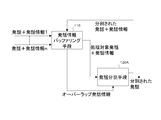
- the first embodiment of the present invention includes utterance information buffering means 110 and utterance dividing means 120. Each of these means generally operates as follows.
- the utterance information buffering means 110 receives an utterance and information about the utterance (utterance information) and temporarily holds it.
- the utterance information includes, for example, start / end times of utterances.
- the utterance dividing means 120 takes out one unprocessed utterance from the utterance information buffering means 110, and tries to divide the utterance. At this time, referring to the utterance information of the utterance, the utterance information of the utterance overlapping with the utterance is extracted from the utterance information buffering means 110 and used.
- utterance data to be processed is input to the utterance information buffering means 110 together with the utterance information.
- the utterance dividing unit 120 selects one utterance that has not been subjected to the utterance dividing process and has the earliest utterance start time from the utterance information buffering unit 110 and sets it as the processing target utterance.
- the utterance dividing unit 120 refers to the utterance information of each utterance stored in the utterance information buffering unit 110 and finds an utterance that temporally overlaps the processing target utterance.
- the utterance dividing means 120 outputs the processing target utterance as it is because the division of the processing target utterance has failed, and on the other hand, there is an utterance that overlaps with the processing target utterance.
- the processing target utterance is divided using the utterance information of the overlap utterances. Specifically, the processing target utterance is divided at the start time of each overlapping utterance.
- the utterance dividing unit 120 outputs the division results of the processing target utterance in order of time.
- the present embodiment by storing the utterances to be divided into the utterance information buffering means 110, it is possible to surely find another utterance that overlaps with a certain utterance in terms of time.
- this embodiment is a form suitable for trying to divide utterances by processing batches of already given utterances.
- voices that have been divided into utterances in some way in advance are stored, and by giving them all at once, it is suitable for the purpose of subdividing each one appropriately.
- this embodiment When this embodiment is used in non-batch online processing, an appropriate delay time is determined, and the utterance is buffered in the utterance information buffering means 110 for each delay time. However, in this case, even if there is an utterance that overlaps with a certain utterance, if the detection of the utterance is not confirmed within the delay time, the utterance should be divided without considering the overlap utterance. As a result, a slight reduction in the division accuracy may occur.
- the second embodiment of the present invention includes an utterance dividing unit 120A instead of the utterance dividing unit 120, as compared with the first embodiment shown in FIG. Is different.
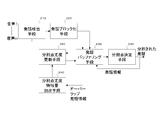
- the utterance dividing unit 120A in the second exemplary embodiment of the present invention includes an utterance blocking unit 121, a division point likelihood holding / updating unit 122, a division point likelihood feature quantity extracting unit 123, The dividing point determining means 124 is included. Each of these means generally operates as follows.
- the utterance blocking means 121 divides the input division processing target utterance into blocks suitable for subsequent processing.
- the dividing point likelihood holding / updating means 122 holds and updates the likelihood (dividing point likelihood) that each block can be a dividing point of the processing target utterance for each block of the processing target utterance.
- the division point likelihood feature quantity extraction unit 123 analyzes an utterance that temporally overlaps the processing target utterance and updates the division point likelihood feature value of each block of the processing target utterance. To extract.
- the dividing point determination unit 124 evaluates the dividing point likelihood of each block of the processing target utterance held in the dividing point likelihood holding / updating unit 122, finally determines the dividing point to be adopted, and determines the processing target utterance. Divide and output at the division point.
- utterance data to be processed is input to the utterance information buffering means 110 together with the utterance information.
- the utterance dividing unit 120A selects, from the utterance information buffering unit 110, one utterance that has not yet been subjected to utterance division processing and has the earliest utterance start time, and sets it as a processing target utterance.
- a new processing target utterance is input to the utterance blocking unit 121 together with the utterance information of the utterance.
- the utterance blocking means 121 divides the input processing target utterance by a predetermined method and blocks it. This is performed by, for example, a method of equally dividing in units of 10 milliseconds.
- the dividing point likelihood holding / updating means 122 initializes the dividing point likelihood to be zero (not a dividing point) for each block of the processing target utterance output by the utterance block forming means 121.
- the utterance information of the utterance that temporally overlaps the processing target utterance is sequentially input from the utterance information buffering means 110 to the dividing point likelihood feature quantity extracting means 123.
- segmentation point likelihood feature-value extraction means 123 analyzes an overlap speech according to the defined algorithm, and obtains a division
- the division point likelihood feature quantities thus obtained are sequentially input to the division point likelihood holding / updating means 122.
- the dividing point likelihood holding / updating means 122 updates the dividing point likelihood for each block of the processing target utterance using these feature amounts according to a predetermined algorithm.
- the block corresponding to the start time of overlapping utterances and the blocks before and after the utterance are updated so that the dividing point likelihood becomes high.
- the overlap utterance duration is very short, the overlap utterance may be a false detection such as noise. To do.
- the non-speech likelihood of the utterance is given as utterance information, a particularly high division point for a block with a high non-speech likelihood closest to the start time of the overlap utterance You may make it hit likelihood.
- the non-voice likelihood means the accuracy indicating how much one minute section of a certain voice matches the noise model. Such non-speech likelihood is obtained for every minute speech section in general speech recognition processing.
- the division point likelihood holding / updating means 122 has obtained the division point likelihood for each block of the processing target utterance. Based on this information, the dividing point determining means 124 determines a final dividing point using a predetermined algorithm. For example, a block having a dividing point likelihood exceeding a predetermined threshold is set as a dividing point. An upper limit may be set for the maximum number of divisions for one utterance.
- the division point determination means 124 outputs the division results of the processing target utterance in time order. When the start time is the same, the data are output in order of the end time.
- the division point determination unit 124 outputs the original processing target speech as it is, assuming that no division point is found.
- the dividing point determination unit 124 may input the divided processing target utterances to the utterance information buffering unit 110 again. In this case, these divided utterances are treated as unprocessed, while the processing target utterances before the division are deleted from the utterance information buffering means 110.
- the utterance dividing unit 120A repeats the above processing until there is no unprocessed utterance in the utterance information buffering unit 110.
- the division point of the processing target utterance when the division point of the processing target utterance is obtained, the division point is determined by determining the division point likelihood in each part of the processing target utterance. For this reason, various information of overlap utterances can be mixed in a complicated manner to perform more accurate division point estimation.
- the utterance division with higher accuracy is possible. This is because each utterance registered in the utterance information buffering means 110 can potentially be further divided, and when the utterance is divided, the overlap utterance end time, the utterance duration time length as the division point likelihood feature amount, This is because the overlap time increases.
- this embodiment is also a mode suitable for attempting to divide utterances by processing batches of already given utterances.
- this embodiment is used in non-batch online processing, an appropriate delay time is determined, and an utterance is buffered in the utterance information buffering means 110 for each delay time. In this way, the re-divided utterance can be obtained with a delay corresponding to the delay time.
- the utterance should be divided without considering the overlap utterance. As a result, a slight reduction in the division accuracy may occur.
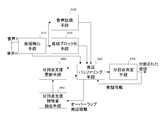
- the third embodiment of the present invention includes an utterance detecting unit 210, an utterance blocking unit 220, an utterance buffering unit 230, a dividing point likelihood feature quantity extracting unit 240, and a dividing point. It consists of likelihood update means 250 and division point determination means 260. Each of these means generally operates as follows.
- the utterance detection means 210 receives one or more voices simultaneously uttered by a plurality of speakers, detects an utterance in the voice using an algorithm defined for each, and sets at least a start time and an end time thereof. Including utterance information. In addition, an audio signal in the utterance section is output at the same time.
- Non-Patent Document 1 Various known methods can be used as an algorithm for detecting an utterance. For example, the method described in Non-Patent Document 1 described above can be used.
- the utterance blocking means 220 divides the input division processing target utterance into blocks suitable for subsequent processing.
- the utterance detection means 210 blocks the input voice by some method, so this block may be used as it is, and in that case, the utterance blocking means 220 can be omitted.
- the blocking that can be seen in the utterance detection unit 210 include a unit for dividing a voice signal into signal processing such as division into time intervals (that is, a quantization unit of the voice signal itself) for each sampling period, and Fourier transform. (Generally called a frame).
- the utterance buffering means 230 holds the utterance information of each utterance and the utterance itself. Moreover, the division
- the division point likelihood feature quantity extraction unit 240 performs basically the same operation as the division point likelihood feature quantity extraction unit 123 in the second embodiment.
- the division point likelihood updating unit 250 updates the division point likelihood for each block of each utterance held by the utterance buffering unit 230, using the feature amount obtained by the division point likelihood feature amount extraction unit 240.
- the division point determination unit 260 evaluates the division point likelihood of each block of one or a plurality of processing target utterances held in the utterance buffering unit 230, determines a division point to be finally adopted, and determines each processing target.
- the utterance is divided at the division point and output.
- the utterance detection unit 210 sequentially processes the input voice and verifies whether or not the utterance is started with each voice at each time. Further, it is verified whether or not the speech that has already detected the start of utterance has ended.
- the speech detection unit 210 detects the start of speech for any of the voices, the time is sent to the speech buffering unit 230. Similarly, the utterance end time is also sent to the utterance buffering means 230.
- the voice signal processed by the utterance detection unit 210 is blocked by the utterance blocking unit 220 and sent to the utterance buffering unit 230. As already described, when the utterance detection unit 210 performs some blocking, the utterance blocking unit 220 may be omitted.
- the utterance buffering means 230 is constituted by a two-dimensional array of blocked utterances that is variable with respect to the time axis direction and the number of speakers.
- the time corresponding to the two-dimensional array and the position of the speaker are secured. If the time of the block is after the utterance start time and before the utterance end time, zero, which is the initial value of the division point likelihood for the block, is set at that position in the two-dimensional array.
- the division point likelihood feature quantity extraction unit 240 is called at an appropriate timing, analyzes an unprocessed block in the utterance buffering unit 230 according to a predetermined algorithm, and obtains a division point likelihood feature quantity. Further, the dividing point likelihood updating means 250 updates the dividing point likelihood of each block according to the algorithm determined based on this feature amount. Details of specific examples are shown below.
- the first example is a case where the start time of overlapping utterances is extracted as a feature amount.
- the dividing point likelihood feature quantity extraction unit 240 first extracts one of the start times of each utterance held by the utterance buffering unit 230 that has not yet been processed, from the earliest time. Next, for each utterance block corresponding to that time, the dividing point likelihood updating means 250 updates the dividing point likelihood to be high.
- the second example is a case where the likelihood of dividing points before and after the start time of overlapping utterances is also updated.
- the division point likelihood feature quantity extraction unit 240 is activated when a block corresponding to the end of the range reflecting the likelihood update is stored in the utterance buffering unit 230 with respect to an unprocessed utterance start time. After being registered.
- the dividing point likelihood updating unit 250 updates each block corresponding to the start time to be processed and the blocks before and after the block so as to increase the likelihood.
- the third example is a case in which the effect of likelihood update is controlled according to the duration of overlapping utterances.
- a timeout time is set in advance, and the timing at which the dividing point likelihood feature quantity extraction unit 240 is activated is a block corresponding to the time when this timeout time has elapsed with respect to an unprocessed speech start time.
- the division point likelihood feature quantity extraction unit 240 obtains the duration time of the utterance starting from the start time to be processed from the information held in the utterance buffering unit 230, and the division point likelihood update unit 250 The block of each utterance corresponding to the start time is updated so as to increase the division point likelihood.
- the likelihood update at this time is the duration of the overlap utterance obtained by the division point likelihood feature amount extraction unit 240. Adjust according to the length. Specifically, as in the second embodiment, when the duration of the overlap utterance is very long, update of the division point likelihood to the block corresponding to the start time is performed conservatively, and the overlap If the duration time of the utterance is very short, the overlap utterance may be a false detection of noise or the like, and therefore, the division point likelihood is updated sparingly.
- each of the feature points is extracted using the division point likelihood feature amount extraction unit 240 and the division point likelihood update unit 250 while ensuring a sufficient delay time for extracting the feature amount. Update the dividing point likelihood for each block of speech.
- the division point likelihood update for the block is not performed, it is determined whether the block is adopted as a division point using the division point likelihood determination means 260. decide. However, if an upper limit is set for the number of divisions for one utterance or processing according to the entire utterance before division is performed by other methods, the division point for the block corresponding to the end time of any utterance is particularly high You have to wait for the likelihood update to complete.
- the timing at which the division point likelihood update for a certain block is completed depends on the delay time requested by the division point likelihood feature quantity extraction unit 240 and the block on which the division point likelihood update unit 250 reflects the feature quantity. It can be uniquely determined according to the range.
- the determination of the dividing points and the output of the divided utterances in the dividing point likelihood determining means 260 are the same as in the second embodiment.
- the utterance buffering means 230 is expressed as a two-dimensional array for the sake of convenience. Actually, however, the use of this two-dimensional array is sparse. Therefore, the utterance buffering means 230 only needs to hold blocks corresponding to the sections detected as utterances by the utterance detection means 210.
- the entire utterance is deleted from the utterance buffering means 230.
- speech segmentation based on the principle of the present invention can be performed on-line using a minimum storage area.
- this embodiment is a preferred embodiment when the present invention is used in non-batch online processing, and is symmetric with the first and second embodiments being suitable for batch applications. Eggplant.
- the fourth embodiment of the present invention is different from the third embodiment shown in FIG. 5 in that it further includes voice recognition means 330.
- the voice recognition unit 330 outputs a recognition result such as a word string or a word lattice by performing voice recognition processing for each utterance cut out by the utterance detection unit 310.
- the utterance buffering means 340 holds the recognition result for each utterance as one of the utterance information, and the dividing point likelihood feature quantity extraction means. 350 and the division
- segmentation point likelihood update means 360 differ in the point which uses the recognition result of an utterance as a division
- the speech recognition means 330 can output the recognition results determined at that time sequentially even if the end of the utterance is not determined, and the upper limit of the number of speech overlapping speech is determined in advance. In this case, a plurality of voice recognition means 330 corresponding to the upper limit are operated simultaneously. In this case, the speech recognition unit 330 operates from the timing when the speech detection unit 310 detects the start of speech from any input speech, and the speech recognition process is continued as long as speech continues, and a recognition result is obtained. If appropriate, it is sent to the utterance buffering means 340 as appropriate.
- the second case is a case where the voice recognition means 330 cannot output a voice recognition result until the end of the utterance is determined, or a plurality of voice recognition means simultaneously for all utterances that can potentially occur simultaneously.
- 330 cannot be operated.
- the utterance detection unit 310 calls the speech recognition unit 330 at the timing when the end of the utterance is detected from any input speech, recognizes the entire utterance as a whole, and recognizes the result as utterance buffering. Send to means 340.
- the operation timing of the dividing point likelihood feature quantity extraction unit 350 and the dividing point likelihood update unit 360 requires a slight delay.
- the former requires that the recognition result for a part of the utterance is confirmed.
- the latter is a delay of only time, and the latter is a delay of the time required until the end of the utterance is detected and the recognition result for the entire utterance is obtained.
- the dividing point likelihood feature quantity extraction unit 350 operates when a recognition result regarding any utterance is obtained.
- the dividing point likelihood feature quantity extraction unit 350 evaluates the word obtained as a recognition result or the part of speech of the word, and the dividing point likelihood update unit 360 preliminarily determines the dividing point determined for each word and part of speech. Based on the likelihood update amount, the segment point likelihood is updated for other speech blocks corresponding to the time when the recognition result appears and the blocks before and after the speech block.
- the embodiment of the present invention includes a voice input device 410, a speech detection module 420, a speech recognition module 430, a speech information buffer 440, a word array buffer 450, and a division likelihood update module 460.
- Each of these modules generally operates as follows.
- the voice input device 410 separately inputs two-channel voice signals and sends them to the utterance detection module 420.
- Two speech detection modules 420 are prepared, and are associated with the respective channels of the voice input device 410.
- Each utterance detection module 420 sequentially analyzes the input audio signal and detects the start time and end time of the utterance.
- Two speech recognition modules 430 are also prepared and are associated with different speech detection modules 420, respectively.
- Each voice recognition module 430 performs voice recognition processing on the utterance detected by the corresponding utterance detection module 420, and outputs the voice recognition result for the voice in the utterance section as a word string.
- the utterance information buffer 440 records, for each utterance detected by the utterance detection module 420, the voice input from which channel, the utterance start time, the utterance end time, and the recognition result word string. A flag indicating whether each utterance has been processed is also stored.
- the word array buffer 450 takes out one unprocessed utterance started at the earliest time from the utterance information buffer 440, and secures an array of the number of words between the words constituting the word string. This array holds division point likelihoods that determine whether the utterance should be divided between the words.
- the division point likelihood update module 460 searches the utterance information buffer 440 for temporally overlapping utterances for the division processing target utterances developed in the word array buffer 450 at that time. With respect to the overlapping utterances found, the start time, the duration length, and the overlap time with the processing target utterance are obtained, and the division point likelihood that is each element of the word array buffer 450 is updated accordingly. . In addition, a vocabulary corresponding to Aizuchi is searched from the recognition result word string of overlap utterances, and if this is found, the element (on the word array buffer 450 that is closest to the time when this word was uttered) ( That is, the division point likelihood between words is updated.
- the recognition result division module 470 refers to the division point likelihood between the words constituting the utterance for the utterance developed in the word array buffer 450, and if it exceeds a predetermined threshold, The utterance is divided using the position as a division point.
- the recognition result alignment module 480 rearranges the utterances divided by the recognition result division module 470 in the order of their start times.
- the display device 490 displays word strings corresponding to utterances as character strings in the order in which the recognition result alignment module 480 is aligned. At this time, it may be traced whether the speech is included in the voice input from which channel, and the channel information may be displayed together. Further, the start time of the utterance may be displayed together.
- the recognition result sorting module 480 constituting the output unit outputs the recognition result to the display device 490, but may output the recognition result to a storage device (not shown) or another subsequent system or program.
- the present invention is not limited to the above embodiments and examples, and various other additions and modifications are possible.
- the present invention can be realized by a computer and a program as well as by realizing the functions of the hardware.
- the program is provided by being recorded on a computer-readable recording medium such as a magnetic disk or a semiconductor memory, and is read by the computer at the time of starting up the computer, etc. It functions as each means in the embodiments and examples.
- the present invention can be applied to an interactive speech recognition system, in particular, an informal conference speech recognition system or a telephone answering speech recognition system.
- These interactive speech recognition systems can be used for interactive text conversion systems, conference record automatic creation systems, telephone answering recording systems, etc. that display dialog speech recognition results on the screen or output them to storage devices.
Landscapes
- Engineering & Computer Science (AREA)
- Computational Linguistics (AREA)
- Health & Medical Sciences (AREA)
- Audiology, Speech & Language Pathology (AREA)
- Human Computer Interaction (AREA)
- Physics & Mathematics (AREA)
- Acoustics & Sound (AREA)
- Multimedia (AREA)
- Quality & Reliability (AREA)
- Signal Processing (AREA)
- Machine Translation (AREA)
Abstract
L'invention a pour but, dans un son de dialogue dans lequel des discours peuvent se chevaucher temporellement, de segmenter des discours à des positions appropriées pour faciliter une meilleure compréhension d'un rapport entre les discours. L'invention concerne un système de segmentation de discours qui comprend des moyens de segmentation de discours (120) pour recevoir des discours prononcés par deux ou plusieurs orateurs et pour segmenter en outre chacun de ces discours. Si un autre discours est fait de manière à recouvrir un discours donné, on considère qu'un point dans le temps correspondant au chevauchement du discours devient une segmentation sémantique. Par conséquent, les moyens de segmentation du discours (120) utilisent les informations d'un autre discours en chevauchement, lors de la détermination d'un point de segmentation d'un discours donné.
Priority Applications (1)
| Application Number | Priority Date | Filing Date | Title |
|---|---|---|---|
| JP2009554201A JP5387416B2 (ja) | 2008-02-19 | 2008-12-16 | 発話分割システム、発話分割方法および発話分割プログラム |
Applications Claiming Priority (2)
| Application Number | Priority Date | Filing Date | Title |
|---|---|---|---|
| JP2008037200 | 2008-02-19 | ||
| JP2008-037200 | 2008-02-19 |
Publications (1)
| Publication Number | Publication Date |
|---|---|
| WO2009104332A1 true WO2009104332A1 (fr) | 2009-08-27 |
Family
ID=40985224
Family Applications (1)
| Application Number | Title | Priority Date | Filing Date |
|---|---|---|---|
| PCT/JP2008/072851 Ceased WO2009104332A1 (fr) | 2008-02-19 | 2008-12-16 | Système de segmentation d'un discours, procédé de segmentation d'un discours et programme de segmentation d'un discours |
Country Status (2)
| Country | Link |
|---|---|
| JP (1) | JP5387416B2 (fr) |
| WO (1) | WO2009104332A1 (fr) |
Cited By (14)
| Publication number | Priority date | Publication date | Assignee | Title |
|---|---|---|---|---|
| WO2011105003A1 (fr) * | 2010-02-25 | 2011-09-01 | パナソニック株式会社 | Appareil de traitement de signal et procédé de traitement de signal |
| WO2012042768A1 (fr) * | 2010-09-28 | 2012-04-05 | パナソニック株式会社 | Dispositif et procédé de traitement de la parole |
| JP2014235263A (ja) * | 2013-05-31 | 2014-12-15 | ヤマハ株式会社 | 音声認識装置およびプログラム |
| CN106297794A (zh) * | 2015-05-22 | 2017-01-04 | 西安中兴新软件有限责任公司 | 一种语音文字的转换方法及设备 |
| JP2017182822A (ja) * | 2017-05-08 | 2017-10-05 | 富士通株式会社 | 入力情報支援装置、入力情報支援方法および入力情報支援プログラム |
| JP2018045208A (ja) * | 2016-09-16 | 2018-03-22 | 株式会社東芝 | 会議支援システム、会議支援方法及びプログラム |
| CN111145782A (zh) * | 2019-12-20 | 2020-05-12 | 深圳追一科技有限公司 | 重叠语音识别方法、装置、计算机设备和存储介质 |
| JP2021144218A (ja) * | 2020-03-10 | 2021-09-24 | エル ソルー カンパニー, リミテッドLlsollu Co., Ltd. | 音声対話再構成方法及び装置 |
| US12118982B2 (en) | 2022-04-11 | 2024-10-15 | Honeywell International Inc. | System and method for constraining air traffic communication (ATC) transcription in real-time |
| US12165629B2 (en) | 2022-02-18 | 2024-12-10 | Honeywell International Inc. | System and method for improving air traffic communication (ATC) transcription accuracy by input of pilot run-time edits |
| US12322410B2 (en) | 2022-04-29 | 2025-06-03 | Honeywell International, Inc. | System and method for handling unsplit segments in transcription of air traffic communication (ATC) |
| CN120319225A (zh) * | 2025-06-19 | 2025-07-15 | 杭州知聊信息技术有限公司 | 一种音频特征分析的音频切片处理方法、系统及存储介质 |
| US12431150B2 (en) | 2020-03-10 | 2025-09-30 | Llsollu Co., Ltd. | Method and apparatus for reconstructing voice conversation |
| WO2026018464A1 (fr) * | 2024-07-18 | 2026-01-22 | 三菱電機株式会社 | Dispositif de traitement vocal, procédé de traitement vocal et programme de traitement vocal |
Citations (5)
| Publication number | Priority date | Publication date | Assignee | Title |
|---|---|---|---|---|
| JPH1069292A (ja) * | 1996-08-29 | 1998-03-10 | Atr Onsei Honyaku Tsushin Kenkyusho:Kk | 発話関係認識装置 |
| JPH11136369A (ja) * | 1997-10-29 | 1999-05-21 | Ntt Software Corp | 多地点間接続音声制御装置 |
| JP2002236494A (ja) * | 2001-02-09 | 2002-08-23 | Denso Corp | 音声区間判別装置、音声認識装置、プログラム及び記録媒体 |
| JP2005202035A (ja) * | 2004-01-14 | 2005-07-28 | Toshiba Corp | 対話情報分析装置 |
| JP2005308950A (ja) * | 2004-04-20 | 2005-11-04 | Sony Corp | 音声処理装置および音声処理システム |
Family Cites Families (1)
| Publication number | Priority date | Publication date | Assignee | Title |
|---|---|---|---|---|
| JP3859612B2 (ja) * | 2003-04-10 | 2006-12-20 | 株式会社アドバンスト・メディア | 会議録音・書き起こしシステム |
-
2008
- 2008-12-16 WO PCT/JP2008/072851 patent/WO2009104332A1/fr not_active Ceased
- 2008-12-16 JP JP2009554201A patent/JP5387416B2/ja active Active
Patent Citations (5)
| Publication number | Priority date | Publication date | Assignee | Title |
|---|---|---|---|---|
| JPH1069292A (ja) * | 1996-08-29 | 1998-03-10 | Atr Onsei Honyaku Tsushin Kenkyusho:Kk | 発話関係認識装置 |
| JPH11136369A (ja) * | 1997-10-29 | 1999-05-21 | Ntt Software Corp | 多地点間接続音声制御装置 |
| JP2002236494A (ja) * | 2001-02-09 | 2002-08-23 | Denso Corp | 音声区間判別装置、音声認識装置、プログラム及び記録媒体 |
| JP2005202035A (ja) * | 2004-01-14 | 2005-07-28 | Toshiba Corp | 対話情報分析装置 |
| JP2005308950A (ja) * | 2004-04-20 | 2005-11-04 | Sony Corp | 音声処理装置および音声処理システム |
Cited By (24)
| Publication number | Priority date | Publication date | Assignee | Title |
|---|---|---|---|---|
| US8644534B2 (en) | 2010-02-25 | 2014-02-04 | Panasonic Corporation | Recording medium |
| CN102388416A (zh) * | 2010-02-25 | 2012-03-21 | 松下电器产业株式会社 | 信号处理装置及信号处理方法 |
| WO2011105003A1 (fr) * | 2010-02-25 | 2011-09-01 | パナソニック株式会社 | Appareil de traitement de signal et procédé de traitement de signal |
| US8682012B2 (en) | 2010-02-25 | 2014-03-25 | Panasonic Corporation | Signal processing method |
| US8498435B2 (en) | 2010-02-25 | 2013-07-30 | Panasonic Corporation | Signal processing apparatus and signal processing method |
| CN103155036A (zh) * | 2010-09-28 | 2013-06-12 | 松下电器产业株式会社 | 语音处理装置及语音处理方法 |
| JPWO2012042768A1 (ja) * | 2010-09-28 | 2014-02-03 | パナソニック株式会社 | 音声処理装置および音声処理方法 |
| CN103155036B (zh) * | 2010-09-28 | 2015-01-14 | 松下电器产业株式会社 | 语音处理装置及语音处理方法 |
| US9064501B2 (en) | 2010-09-28 | 2015-06-23 | Panasonic Intellectual Property Management Co., Ltd. | Speech processing device and speech processing method |
| WO2012042768A1 (fr) * | 2010-09-28 | 2012-04-05 | パナソニック株式会社 | Dispositif et procédé de traitement de la parole |
| JP2014235263A (ja) * | 2013-05-31 | 2014-12-15 | ヤマハ株式会社 | 音声認識装置およびプログラム |
| CN106297794A (zh) * | 2015-05-22 | 2017-01-04 | 西安中兴新软件有限责任公司 | 一种语音文字的转换方法及设备 |
| JP2018045208A (ja) * | 2016-09-16 | 2018-03-22 | 株式会社東芝 | 会議支援システム、会議支援方法及びプログラム |
| JP2017182822A (ja) * | 2017-05-08 | 2017-10-05 | 富士通株式会社 | 入力情報支援装置、入力情報支援方法および入力情報支援プログラム |
| CN111145782A (zh) * | 2019-12-20 | 2020-05-12 | 深圳追一科技有限公司 | 重叠语音识别方法、装置、计算机设备和存储介质 |
| CN111145782B (zh) * | 2019-12-20 | 2021-07-13 | 深圳追一科技有限公司 | 重叠语音识别方法、装置、计算机设备和存储介质 |
| JP2021144218A (ja) * | 2020-03-10 | 2021-09-24 | エル ソルー カンパニー, リミテッドLlsollu Co., Ltd. | 音声対話再構成方法及び装置 |
| JP7681266B2 (ja) | 2020-03-10 | 2025-05-22 | エル ソルー カンパニー,リミテッド | 音声対話再構成方法、音声対話再構成装置、記録媒体及びコンピュータープログラム |
| US12431150B2 (en) | 2020-03-10 | 2025-09-30 | Llsollu Co., Ltd. | Method and apparatus for reconstructing voice conversation |
| US12165629B2 (en) | 2022-02-18 | 2024-12-10 | Honeywell International Inc. | System and method for improving air traffic communication (ATC) transcription accuracy by input of pilot run-time edits |
| US12118982B2 (en) | 2022-04-11 | 2024-10-15 | Honeywell International Inc. | System and method for constraining air traffic communication (ATC) transcription in real-time |
| US12322410B2 (en) | 2022-04-29 | 2025-06-03 | Honeywell International, Inc. | System and method for handling unsplit segments in transcription of air traffic communication (ATC) |
| WO2026018464A1 (fr) * | 2024-07-18 | 2026-01-22 | 三菱電機株式会社 | Dispositif de traitement vocal, procédé de traitement vocal et programme de traitement vocal |
| CN120319225A (zh) * | 2025-06-19 | 2025-07-15 | 杭州知聊信息技术有限公司 | 一种音频特征分析的音频切片处理方法、系统及存储介质 |
Also Published As
| Publication number | Publication date |
|---|---|
| JPWO2009104332A1 (ja) | 2011-06-16 |
| JP5387416B2 (ja) | 2014-01-15 |
Similar Documents
| Publication | Publication Date | Title |
|---|---|---|
| JP5387416B2 (ja) | 発話分割システム、発話分割方法および発話分割プログラム | |
| JP7525648B2 (ja) | エンドツーエンドの複数話者重複音声認識 | |
| CN110047481B (zh) | 用于语音识别的方法和装置 | |
| JP6171617B2 (ja) | 応答対象音声判定装置、応答対象音声判定方法および応答対象音声判定プログラム | |
| EP3254456B1 (fr) | Maquette de scène virtuelle optimisée pour la lecture de réunion spatiale | |
| CN113362828B (zh) | 用于识别语音的方法和装置 | |
| US9940926B2 (en) | Rapid speech recognition adaptation using acoustic input | |
| EP3254455B1 (fr) | Résumé sélectif de conférence | |
| EP3254435B1 (fr) | Système de lecture post-conférence ayant une plus grande qualité perçue qu'entendu à l'origine lors de la conférence | |
| EP3254279B1 (fr) | Nuage de mots de conférence | |
| EP3754961A1 (fr) | Lecture post-téléconférence au moyen d'un transport audio non destructeur | |
| CN101542592A (zh) | 关键词提取装置 | |
| JP5385876B2 (ja) | 音声区間検出方法、音声認識方法、音声区間検出装置、音声認識装置、そのプログラム及び記録媒体 | |
| US10229701B2 (en) | Server-side ASR adaptation to speaker, device and noise condition via non-ASR audio transmission | |
| CN113779208A (zh) | 用于人机对话的方法和装置 | |
| CN114385800A (zh) | 语音对话方法和装置 | |
| WO2014133525A1 (fr) | Adaptation d'asr côté serveur au locuteur, au dispositif et aux conditions de bruit via une transmission audio non-asr | |
| CN112562682A (zh) | 基于多人通话的身份识别方法、系统、设备及存储介质 | |
| EP2763136A1 (fr) | Procédé et système permettant d'obtenir des informations pertinentes à partir d'une communication vocale | |
| KR20180134482A (ko) | 음성 인식을 이용한 주소록 관리 장치, 차량, 주소록 관리 시스템 및 음성 인식을 이용한 주소록 관리 방법 | |
| CN112216270B (zh) | 语音音素的识别方法及系统、电子设备及存储介质 | |
| KR102415519B1 (ko) | 인공지능 음성의 컴퓨팅 탐지 장치 | |
| CN115938393A (zh) | 基于多特征的语音情感识别方法、装置、设备及存储介质 | |
| CN113763921B (zh) | 用于纠正文本的方法和装置 | |
| CN114267339B (zh) | 语音识别处理方法及系统、设备以及存储介质 |
Legal Events
| Date | Code | Title | Description |
|---|---|---|---|
| DPE2 | Request for preliminary examination filed before expiration of 19th month from priority date (pct application filed from 20040101) | ||
| 121 | Ep: the epo has been informed by wipo that ep was designated in this application |
Ref document number: 08872667 Country of ref document: EP Kind code of ref document: A1 |
|
| WWE | Wipo information: entry into national phase |
Ref document number: 2009554201 Country of ref document: JP |
|
| NENP | Non-entry into the national phase |
Ref country code: DE |
|
| 122 | Ep: pct application non-entry in european phase |
Ref document number: 08872667 Country of ref document: EP Kind code of ref document: A1 |