WO2009104939A2 - Préparation pharmaceutique - Google Patents
Préparation pharmaceutique Download PDFInfo
- Publication number
- WO2009104939A2 WO2009104939A2 PCT/KR2009/000856 KR2009000856W WO2009104939A2 WO 2009104939 A2 WO2009104939 A2 WO 2009104939A2 KR 2009000856 W KR2009000856 W KR 2009000856W WO 2009104939 A2 WO2009104939 A2 WO 2009104939A2
- Authority
- WO
- WIPO (PCT)
- Prior art keywords
- release
- aliskiren
- cellulose
- delayed
- pharmaceutical formulation
- Prior art date
- Legal status (The legal status is an assumption and is not a legal conclusion. Google has not performed a legal analysis and makes no representation as to the accuracy of the status listed.)
- Ceased
Links
Images




Classifications
-
- A—HUMAN NECESSITIES
- A61—MEDICAL OR VETERINARY SCIENCE; HYGIENE
- A61K—PREPARATIONS FOR MEDICAL, DENTAL OR TOILETRY PURPOSES
- A61K9/00—Medicinal preparations characterised by special physical form
- A61K9/48—Preparations in capsules, e.g. of gelatin, of chocolate
-
- A—HUMAN NECESSITIES
- A61—MEDICAL OR VETERINARY SCIENCE; HYGIENE
- A61K—PREPARATIONS FOR MEDICAL, DENTAL OR TOILETRY PURPOSES
- A61K9/00—Medicinal preparations characterised by special physical form
- A61K9/20—Pills, tablets, discs, rods
- A61K9/2072—Pills, tablets, discs, rods characterised by shape, structure or size; Tablets with holes, special break lines or identification marks; Partially coated tablets; Disintegrating flat shaped forms
- A61K9/2086—Layered tablets, e.g. bilayer tablets; Tablets of the type inert core-active coat
- A61K9/209—Layered tablets, e.g. bilayer tablets; Tablets of the type inert core-active coat containing drug in at least two layers or in the core and in at least one outer layer
-
- A—HUMAN NECESSITIES
- A61—MEDICAL OR VETERINARY SCIENCE; HYGIENE
- A61K—PREPARATIONS FOR MEDICAL, DENTAL OR TOILETRY PURPOSES
- A61K31/00—Medicinal preparations containing organic active ingredients
- A61K31/16—Amides, e.g. hydroxamic acids
- A61K31/165—Amides, e.g. hydroxamic acids having aromatic rings, e.g. colchicine, atenolol, progabide
-
- A—HUMAN NECESSITIES
- A61—MEDICAL OR VETERINARY SCIENCE; HYGIENE
- A61K—PREPARATIONS FOR MEDICAL, DENTAL OR TOILETRY PURPOSES
- A61K31/00—Medicinal preparations containing organic active ingredients
- A61K31/33—Heterocyclic compounds
- A61K31/395—Heterocyclic compounds having nitrogen as a ring hetero atom, e.g. guanethidine or rifamycins
- A61K31/40—Heterocyclic compounds having nitrogen as a ring hetero atom, e.g. guanethidine or rifamycins having five-membered rings with one nitrogen as the only ring hetero atom, e.g. sulpiride, succinimide, tolmetin, buflomedil
-
- A—HUMAN NECESSITIES
- A61—MEDICAL OR VETERINARY SCIENCE; HYGIENE
- A61K—PREPARATIONS FOR MEDICAL, DENTAL OR TOILETRY PURPOSES
- A61K31/00—Medicinal preparations containing organic active ingredients
- A61K31/33—Heterocyclic compounds
- A61K31/395—Heterocyclic compounds having nitrogen as a ring hetero atom, e.g. guanethidine or rifamycins
- A61K31/41—Heterocyclic compounds having nitrogen as a ring hetero atom, e.g. guanethidine or rifamycins having five-membered rings with two or more ring hetero atoms, at least one of which being nitrogen, e.g. tetrazole
-
- A—HUMAN NECESSITIES
- A61—MEDICAL OR VETERINARY SCIENCE; HYGIENE
- A61K—PREPARATIONS FOR MEDICAL, DENTAL OR TOILETRY PURPOSES
- A61K9/00—Medicinal preparations characterised by special physical form
- A61K9/0002—Galenical forms characterised by the drug release technique; Application systems commanded by energy
- A61K9/0004—Osmotic delivery systems; Sustained release driven by osmosis, thermal energy or gas
-
- A—HUMAN NECESSITIES
- A61—MEDICAL OR VETERINARY SCIENCE; HYGIENE
- A61P—SPECIFIC THERAPEUTIC ACTIVITY OF CHEMICAL COMPOUNDS OR MEDICINAL PREPARATIONS
- A61P3/00—Drugs for disorders of the metabolism
- A61P3/06—Antihyperlipidemics
-
- A—HUMAN NECESSITIES
- A61—MEDICAL OR VETERINARY SCIENCE; HYGIENE
- A61P—SPECIFIC THERAPEUTIC ACTIVITY OF CHEMICAL COMPOUNDS OR MEDICINAL PREPARATIONS
- A61P9/00—Drugs for disorders of the cardiovascular system
Definitions
- the present invention relates to a pharmaceutical formulation comprising a renin inhibitor and an HMG-CoA reductase inhibitor.
- Hyperlipidemia or elevated serum lipids are associated with an increased incidence of cardiovascular disease and atherosclerosis, which include hypercholesterolemia, familial dyslipidemia, diabetic dyslipidemia, nephropathy dyslipidemia, and familial complex hyperlipidemia Blood pressure; Hypercholesterolemia is characterized by elevated levels of low-density lipoprotein (LDL) -cholesterol and total cholesterol in serum, and lowering serum lipids, especially LDL-cholesterol levels, may lower the likelihood of developing cardiovascular disease. The progression of sclerosis may be delayed or may lead to the regression of atherosclerosis [American diabetes association, Diabetic care, 23 (supple.) S57-S65, 2000].
- LDL low-density lipoprotein
- hypercholesterolemia and hyperlipidemia are involved in the early onset of atherosclerosis, characterized by an uneven distribution of lipid deposits in arteries including coronary, carotid and peripheral arteries. Irregular atherosclerosis distribution is also a hallmark of coronary artery injury and cardiovascular disease, and its risk is adversely affected by left ventricular hypertrophy, which occurs as a complication of the presence of diabetes mellitus, sex, smoking and hypertension [Wilson et al., Am. J. Cardiol., Vol. 59 (14), 91G-94G, 1987].
- Hypertension often coexists with coronary artery disease, all of which is a major cause of heart disease.
- the expression of these risk factors is potentially due to the joint mechanism.
- Atherosclerosis due to hypertension and hyperlipidemia is a vicious cycle that worsens in parallel.
- arteriosclerosis worsens
- arteriosclerosis worsens
- HMG-CoA reductase inhibitors co-administration of HMG-CoA reductase inhibitors and conventional hypertension therapeutics is advantageous in the treatment of cardiovascular and renal diseases.
- the combination and combination of HMG-CoA reductase inhibitors and renin inhibitors is one formulation.
- Lenin synthesized in the kidney, catalyzes angiotensin converting enzyme (ACE), which migrates into the blood and cleaves angiotensinogen, releasing angiotensin-I, which is then cleaved in the lungs, kidneys, and other organs.
- ACE angiotensin converting enzyme
- This angiotensin-II directly raises blood pressure by arterial vasoconstriction, and can induce blood pressure elevation, left atrial hypertrophy, vascular hypertrophy, atherosclerosis, kidney failure, stroke, etc., accompanied by aldosterone, a sodium-ion-bearing hormone. .
- Renin enzyme activity inhibitors (hereinafter referred to as renin inhibitors) developed on the basis of such biomechanisms can be used for the treatment of diastolic dysfunction and dilatation heart failure by controlling blood pressure and blood volume and left ventricular hypertrophy by inhibiting the production of angiotensin-II. And it has been widely used as a drug for treating hypertension because it can delay the onset of heart fibrosis increase or reverse its progression.
- renin inhibitors have been shown to have a more pronounced blood pressure lowering action and additional effects by administering alone or in combination with diuretics such as hydrochlorothiazide, calcium channel blockers, angiotensin converting enzyme inhibitors and angiotensin-II receptor blockers [J Hypertens 2007; Jan 25 (1): 217-26, J Manag Care Pharm 2007; Oct 13 (8 Suppl B): 21-33, Cardiol Rev 2007; Nov-Dec 15 (6): 316-23, Am J Hypertens 2006; Feb 24 (2): 243-56].
- diuretics such as hydrochlorothiazide, calcium channel blockers, angiotensin converting enzyme inhibitors and angiotensin-II receptor blockers
- aliskiren is a drug that can be administered once daily even at low bioavailability (less than 2%) because of its long half-life of 24 hours [J Hypertens 2005; 23: 417-26. Aliskiren is also a hypertensive therapeutic drug that has been recognized for its hypotensive action and additional effects when administered alone and in combination with hydrochlorothiazide, calcium channel blockers, angiotensin converting enzyme inhibitors and angiotensin-II receptor blockers [J Hypertens 2007; Jan 25 (1): 217-26, J Manag Care Pharm 2007; Oct 13 (8 Suppl B): 21-33, Cardiol Rev 2007; Nov-Dec 15 (6): 316-23, Am J Hypertens 2006; Feb 24 (2): 243-56].
- Aliskiren's chemical name is 2 (S), 4 (S), 5 (S), 7 (S) -N- (3-amino-2,2-dimethyl-3-oxopropyl) -2,7-di Aliskiren, chemically defined as (1-methylethyl) -4-hydroxy-5-amino-8- [4-methoxy-3- (3-methoxy-propoxy) phenyl] -octanamide, is specifically Is described in EP 678503 A, preferred is its hemi-fumarate salt [Recent patents oncardiovascular drug discovery 2006; Nov 1 (3): 233-40].
- Atorvastatin is one of the most commonly prescribed HMG-CoA reductase inhibitors, which catalyzes the conversion of HMG-CoA reductase 3-hydroxy-3-methylglutaryl-coenzyme (HMG-CoA) to mevalonate. It strongly inhibits the production of cholesterol in the liver and has the effect of lowering the low density lipoprotein cholesterol (LDL-C). These effects are excellent for the treatment of complex hyperlipidemia, the treatment of clinically normal atherosclerosis, and prevention of its progression.
- HMG-CoA HMG-CoA reductase 3-hydroxy-3-methylglutaryl-coenzyme
- HMG-CoA reductase inhibitors are the first choice for the prevention and treatment of heart disease caused by coronary atherosclerosis, such as angina pectoris and myocardial infarction [Lancet 1995; 346: 750-753, Am J Cardiol 1998; 82: 57T-59T, Am J Cardiol 1995; 76: 107C-112C, Hypertens Res 2003; 26: 699-704, Hypertens Res 2003; 26: 273-280, Br Med Bull 2001; 59: 3-16, Am J Med 1998; 104 (Suppl 1): 6S-8S, Clin Pharmacokinet 2002; 41: 343-370.
- atorvastatin strongly inhibits HMG-CoA reductase, which plays a key role in the synthesis of cholesterol in the liver, and at the same time, inhibits inflammation-inducing factors. [Effects of atorvastatin on inflammation and oxidative stress "Heart and Vessels, 2005, 20 (4), 133-136].
- HMG-CoA reductase inhibitors have been recommended for early evening use (Arterioscler Thromb 11: 816-826, Clinic Pharmacol Ther 40: 338-343). Patients undergoing planned angioplasty taking atorvastatin in the evening will have significantly improved endothelial dysfunction than taking it in the morning. In the evening, the total cholesterol, low-density lipoprotein cholesterol and triglyceride levels were greater and the high-density lipoprotein cholesterol levels were higher [Am J Cardiol 2006; 97: 44-47.
- angiotensin converting enzyme inhibitors and angiotensin-II receptor blockers are advantageous in the treatment of cardiovascular and kidney diseases in combination and combination administration of HMG-CoA reductase inhibitors.
- the combination with the HMG-CoA reductase inhibitor such as atorvastatin and combined administration can be expected to lower blood pressure and further effects.
- Atorvastatin inhibits the production of cholesterol in the liver by strongly inhibiting the catalytic action of the conversion of HMG-CoA reductase 3-hydroxy-3-methylglutaryl-coenzyme (HMG-CoA) to mevalonate It has the effect of lowering low density lipoprotein cholesterol (LDL-C).
- LDL-C low density lipoprotein cholesterol
- atorvastatin must act in the liver.
- atorvastatin is a first-pass metabolic drug that is absorbed by the small intestine and enters the liver when taken, and is mostly metabolized by the cytochrome P450 3A4 in the liver to be excreted after acting in the liver.
- Aliskiren shows the highest blood levels 1 ⁇ 3 hours after taking it, but the high-fat diet consumes 71% of the bioavailability and 85% of the highest blood concentration.
- Aliskiren does not inhibit or induce hepatic enzyme cytochrome P450, but it is metabolized by cytochrome P450 3A4 in vitro.
- Combination therapy containing a HMG-CoA reductase inhibitor and a renin inhibitor as a combination therapy to improve various disease states has been proposed as follows.
- WO 2002/40007 describes synergistic combinations for cardiovascular diseases using HMG-CoA reductase inhibitors and renin inhibitors.
- Aliskiren is mentioned as a renin inhibitor that can be used. Therefore, the present invention related to the combination therapy is a pharmaceutical composition for simple complex prescription of drugs, which is merely a simple combination without considering the properties and absorption principle of each drug.
- the present inventors have completed the invention as follows as a result of recognizing and solving the problems of the combination preparation according to the simple combined administration of the renin inhibitor and HMG-CoA reductase inhibitor.
- the technical problem to be solved by the present invention is to minimize the side effects of co-administration of renin inhibitors and HMG-CoA reductase inhibitors, to induce optimal pharmacological effects, and to administer the drug at the time to express the pharmacological effects of each drug To provide a clinical synergistic effect, and to improve the drug compliance.
- the present invention includes a compartment comprising a renin inhibitor as a pharmacologically active ingredient, and a compartment comprising a HMG-CoA (3-hydroxy-3-methylglutaryl-coenzyme) reductase inhibitor as a pharmacologically active ingredient.
- a compartment comprising a renin inhibitor as a pharmacologically active ingredient
- a compartment comprising a HMG-CoA (3-hydroxy-3-methylglutaryl-coenzyme) reductase inhibitor as a pharmacologically active ingredient.
- one of the compartments is a prior release compartment and the other compartment is a delayed release compartment.
- renin inhibitor includes isomers or pharmaceutically acceptable salts thereof
- HMG-CoA reductase inhibitor is also meant to include isomers or pharmaceutically acceptable salts thereof.
- the renin inhibitors are not limited as long as they are affected by HMG-CoA reductase inhibitors, for example aliskiren, remichyrene, enalskiren, zankyrene, deticyrene, terlachirene, isomers thereof or It may be selected from their pharmaceutically acceptable salts.
- the pharmaceutically acceptable salt of aliskiren may be aliskiren hemi-fumarate.
- the HMG-CoA reductase inhibitor may be selected from atorvastatin, simvastatin, pitavastatin, rosuvastatin, fluvastatin, pravastatin, lovastatin, their isomers or pharmaceutically acceptable salts.
- Isomers of atorvastatin include (R, R) isomers, (R, S) isomers, (S, S) isomers or (S, R) isomers and racemates thereof.
- the renin inhibitor in the formulation of the present invention is aliskiren, an isomer thereof or a pharmaceutically acceptable salt (hereinafter referred to as 'aliskiren') and the HMG-CoA reductase inhibitor is atorvastatin, Isomers or pharmaceutically acceptable salts (hereinafter referred to as 'atorvastatin'), or renin inhibitors are aliskirens, isomers or pharmaceutically acceptable salts (hereinafter referred to as 'aliskiren') and HMG-CoA reductase
- the inhibitor is simvastatin, an isomer thereof or a pharmaceutically acceptable salt (hereinafter referred to as 'simvastatin'), or the renin inhibitor is aliskiren, an isomer thereof or a pharmaceutically acceptable salt (hereinafter referred to as 'aliskiren')
- HMG-CoA reductase inhibitors are flufustatin, isomers thereof or pharmaceutically acceptable salts (hereinafter referred
- Allow the salts thereof (hereinafter referred to as “aliskiren” shall mean) and the HMG-CoA reductase inhibitor is lovastatin, an isomer thereof or a salt pharmaceutically acceptable (the "lovastatin” referred to).
- the formulation according to the present invention provides a more effective therapeutic effect by providing a physical compartment controlling the release between two active ingredients, thereby improving the problem of co-administration or co-administration of existing single agents.
- the active ingredient of the pre-release compartment releases at least 80% by weight of the total amount of the active ingredient in the pre-release compartment in the preparation within 1 hour after the release thereof, and preferably 90% of the active ingredient in the preparation within 1 hour. More than% is released.
- the active ingredient of the delayed-release compartment in the preparation of the present invention is released within 40% by weight of the total amount of the active ingredient of the delayed-release compartment until 2 hours after the release of the active ingredient of the prior-release compartment.
- the active ingredient of the compartment is released within 20% by weight of the total amount of the active ingredient of the delayed-release compartment up to 2 hours after the start of the release of the active ingredient of the prior release compartment.
- a pharmaceutical formulation wherein the active ingredient of the delayed-release compartment in the formulations of the present invention is metabolized in the liver 2 hours later than the active ingredient of the prior release compartment.
- the HMG-CoA reductase inhibitor such as atorvastatin may be contained in an amount of 1 to 3000 parts by weight based on 100 parts by weight of a renin inhibitor such as aliskiren in the formulation of the present invention.
- a renin inhibitor such as aliskiren
- Lenin inhibitors such as aliskiren in the formulations of the present invention may be 10-1000 mg per unit formulation, preferably 35-600 mg.
- the HMG-CoA reductase inhibitor such as atorvastatin in the formulation of the present invention is 0.5-160 mg, preferably 1-80 mg in the pharmaceutical formulation.
- Pre-release compartment refers to the compartment that is released earlier than the delayed-release compartment in the pharmaceutical formulation of the present invention, and may further include a pharmaceutically acceptable additive as necessary in addition to the pharmacologically active ingredient.
- the pharmacologically active component of the prior release compartment is either 1) a renin inhibitor or 2) an HMG-CoA reductase inhibitor.
- the formulation of the present invention is a pharmaceutically acceptable diluent, binder, disintegrant, lubricants, stabilizers, pH adjusting agents, dissolution aids and the like commonly used additives within the scope of not impairing the effects of the present invention release of the pharmacologically active ingredient It can be formulated using further within the range which does not interfere with.
- the diluent may be starch, microcrystalline cellulose, lactose, glucose, mannitol, alginate, alkaline earth metal salts, clay, polyethylene glycol, dicalcium phosphate, or a mixture thereof.
- the additive comprises 0.1 to 300 parts by weight, based on 1 part by weight of the active ingredient.
- the diluent may use starch, microcrystalline cellulose, lactose, glucose, mannitol, alginate, alkaline earth metal salts, clay, polyethylene glycol, dicalcium phosphate, mixtures thereof, and the like.
- the binder is starch, microcrystalline cellulose, highly dispersible silica, mannitol, sucrose, lactose, polyethylene glycol, polyvinylpyrrolidone, hydroxypropylmethylcellulose, hydroxypropylcellulose, natural gum, synthetic Gum, copovidone, povidone, gelatin, mixtures thereof, and the like.
- the disintegrant is a starch or modified starch such as sodium starch glycolate, corn starch, potato starch or starch gelatinized starch or modified microcrystalline starch such as bentonite, montmorillonite, or veegum, hydroxy Cellulose such as propyl cellulose or carboxymethyl cellulose Crosslinked cellulose such as sodium alginate or alginate sodium such as alginate Crosslinked cellulose such as guar gum or xanthan gum Crosslinked polyvinylpyrrolidone (crospovidone) Effervescent agents such as polymer sodium bicarbonate, citric acid, or mixtures thereof can be used.
- starch or modified starch such as sodium starch glycolate, corn starch, potato starch or starch gelatinized starch or modified microcrystalline starch such as bentonite, montmorillonite, or veegum
- hydroxy Cellulose such as propyl cellulose or carboxymethyl cellulose
- Crosslinked cellulose such as sodium alginate or alginate sodium such as
- the lubricant is talc, stearic acid, magnesium stearate, calcium stearate, sodium lauryl sulfate, hydrogenated vegetable oil, sodium benzoate, sodium stearyl fumarate, glyceryl behenate, glyceryl monolate, glyceryl Monostearate, glyceryl palmitostearate, polyethylene glycol and the like can be used.
- the stabilizer may be ascorbic acid, citric acid, butylated hydroxy anisole, butylated hydroxy toluene, tocopherol derivatives and the like.
- an alkalizing agent which is a salt of an alkali metal, a salt of an alkaline earth metal, or a mixture thereof, may be used.
- calcium carbonate, sodium carbonate, sodium bicarbonate, magnesium oxide, magnesium carbonate, sodium citrate, or the like may be used.
- the pH adjusting agent may be an acidifying agent such as acetic acid, adipic acid, ascorbic acid, malic acid, succinic acid, tartaric acid, fumaric acid, citric acid and a basic agent such as precipitated calcium carbonate, aqueous ammonia, meglumine Etc. can be used.
- an acidifying agent such as acetic acid, adipic acid, ascorbic acid, malic acid, succinic acid, tartaric acid, fumaric acid, citric acid and a basic agent such as precipitated calcium carbonate, aqueous ammonia, meglumine Etc.
- the dissolution aid may be polyoxyethylene sorbitan fatty acid esters such as sodium lauryl sulfate, polysorbate, sodium docusate and the like.
- a pharmaceutically acceptable additive may be selected and used in the preparation of the present invention as various additives selected from colorants and fragrances.
- a pharmaceutically acceptable additive may be selected and used in the preparation of the present invention as various additives selected from colorants and fragrances.
- the range of additives usable in the present invention is not limited to the use of such additives, and the above additives may be formulated to contain a range of dosages, usually by selection.
- the delayed-release compartment refers to a compartment in which the active ingredient is released after a certain time of release of the prior-release compartment active ingredient.
- the delayed-release compartment comprises (1) a pharmacologically active ingredient and (2) a release control substance or (3) an osmotic pressure regulator and a semipermeable membrane coating base, and optionally, (4) a pharmaceutically acceptable additive. It may include.
- the pharmacologically active component of the delayed-release compartment is 1) a renin inhibitor or 2) an HMG-CoA reductase inhibitor. However, it does not overlap with the pharmacologically active ingredient of the prior-release compartment. For example, if the pharmacologically active ingredient of the prior release compartment is 1) a renin inhibitor, the pharmacologically active ingredient of the delayed release compartment is 2) an HMG-CoA reductase inhibitor. The reverse is also true.
- the active ingredient of the delayed-release compartment in the formulation of the present invention is released within 40% by weight of the total amount of the active ingredient of the delayed-release compartment until 2 hours after the release of the active ingredient of the prior-release compartment.
- the active ingredient is released within 20% by weight of the total amount of the active ingredient in the delayed-release compartment up to 2 hours after the start of the release of the active ingredient in the prior-release compartment.
- the delayed-release compartment in the pharmaceutical formulation of the present invention comprises at least one release controlling substance selected from enteric polymers, water insoluble polymers, hydrophobic compounds, hydrophilic polymers, and mixtures thereof.
- Preferred examples of the release control material is at least one selected from an enteric polymer, a hydrophilic polymer, and a water insoluble polymer, specifically, a water insoluble polymer, hydroxypropyl cellulose, hydroxypropyl methyl cellulose, hydroxypropyl methyl cellulose phthalate, and methacryl. It may be at least one selected from acid, ethyl acrylate copolymer, and carboxyvinyl polymer.
- the release controlling substance comprises 0.01 to 100 parts by weight, based on 1 part by weight of the active ingredient.
- the release control material may be difficult to have a sufficient delay time of less than 0.01 parts by weight, and release of the drug above 100 parts by weight may be difficult to obtain a significant clinical effect.
- the enteric polymer is insoluble or stable under acidic conditions of less than pH5, and refers to a polymer that is dissolved or decomposed under specific pH conditions of pH5 or above.
- the enteric polymers usable in the present invention are selected from the group consisting of enteric cellulose derivatives, enteric acrylic acid copolymers, enteric maleic acid copolymers, enteric polyvinyl derivatives, and mixtures thereof.
- the enteric cellulose derivative is hydroxypropyl methyl cellulose acetate succinate, hydroxypropyl methyl cellulose phthalate, hydroxymethyl ethyl cellulose phthalate, cellulose acetate phthalate, cellulose acetate succinate, cellulose acetate maleate, cellulose benzoate phthalate, cellulose prop Cypionate phthalate, methyl cellulose phthalate, carboxymethyl ethyl cellulose, ethyl hydroxyethyl cellulose phthalate, methyl hydroxyethyl cellulose, and mixtures thereof.
- the enteric acrylic acid copolymer is styrene-acrylic acid copolymer, methyl acrylate.
- -Acrylic acid copolymer methyl methacrylate acrylic acid copolymer, butyl acrylate-styrene-acrylic acid copolymer, methacrylic acid-methyl methacrylate copolymer (E.g., Eudragit L 100, Eudragit S, Degussa, Germany), methacrylic acid-ethyl acrylate copolymer (e.g.
- the enteric maleic acid-based copolymer may be a vinyl acetate-maleic anhydride copolymer, a styrene-maleic anhydride copolymer, a styrene-maleic acid monoester copolymer, or a vinyl methyl ether- 1 selected from maleic anhydride copolymer, ethylene-maleic anhydride copolymer, vinylbutyl ether-maleic anhydride copolymer, acrylonitrile-methyl methacrylate maleic anhydride copolymer, butyl styrene-maleic anhydride copolymer and mixtures thereof
- More than two types and enteric polyvinyl derivatives include polyvinyl alcohol phthalate, polyvinyl acetal phthalate, polyvinyl The T rate phthalate
- the enteric polymer may be included in an amount of 0.1 parts by weight to 20 parts by weight, preferably 0.5 parts by weight to 10 parts by weight, and less than 0.1 parts by weight based on 1 part by weight of the active ingredient. If the amount exceeds 20 parts by weight, the total weight of the preparation may be unnecessarily increased or the elution may be excessively delayed.
- the water-insoluble polymer refers to a polymer that does not dissolve in pharmaceutically acceptable water that controls the release of the drug.
- the water insoluble polymers usable in the present invention include polyvinyl acetate, polymethacrylate copolymers, poly (ethylacrylate, methyl methacrylate) copolymers, poly (ethylacrylate, methyl methacrylate, trimethylaminoethylmethacrylate At least one selected from the group consisting of copolymers, ethyl cellulose, cellulose esters, cellulose ethers, cellulose acylates, cellulose dicylates, cellulose triacylates, cellulose acetates, cellulose diacetates, cellulose triacetates and mixtures thereof This is preferred.
- the water-insoluble polymer may be included in an amount of 0.1 parts by weight to 30 parts by weight, preferably 0.5 parts by weight to 20 parts by weight, and less than 0.1 parts by weight based on 1 part by weight of the active ingredient. If the content is more than 30 parts by weight, the dissolution may be excessively delayed.
- a hydrophobic compound refers to a substance that does not dissolve in pharmaceutically acceptable water that controls the release of the drug.
- the hydrophobic compound usable in the present invention means at least one selected from the group consisting of fatty acids and fatty acid esters, fatty alcohols, waxes, inorganic substances, and mixtures thereof.
- the fatty acids and fatty acid esters are at least one selected from glyceryl palmitostearate, glyceryl stearate, glyceryl bihenate, cetyl palmitate, glyceryl monooleate, stearic acid and mixtures thereof and the fatty acid alcohols are At least one selected from cetostearyl alcohol, cetyl alcohol, stearyl alcohol and mixtures thereof, and waxes are at least one selected from carnauba wax, beeswax, microcrystalline wax, and mixtures thereof, and inorganic materials are talc, sedimentation. It is preferably at least one selected from calcium carbonate, calcium dihydrogen phosphate, zinc oxide, titanium oxide, kaolin, bentonite, montmorillonite, bum and mixtures thereof.
- the hydrophobic compound may be included in an amount of 0.1 parts by weight to 20 parts by weight, preferably 0.5 parts by weight to 10 parts by weight, and less than 0.1 parts by weight, with respect to 1 part by weight of the active ingredient. In case of more than 20 parts by weight, excessive elution may be delayed.
- a hydrophilic polymer refers to a polymeric material that is soluble in pharmaceutically acceptable water that controls the release of the drug.
- the hydrophilic polymer usable in the present invention may be at least one selected from the group consisting of sugars, cellulose derivatives, gums, proteins, polyvinyl derivatives, polymethacrylate copolymers, polyethylene derivatives, carboxyvinyl copolymers, and mixtures thereof. have.
- sugars are dextrins, polydextrins, dextran, pectin and pectin derivatives, alginates, polygalacturonic acids, xylans, arabinoxylans, arabinogalactans, starches, hydroxypropylstarches, amylose, amylopectins, and their
- the at least one cellulose derivative selected from the mixtures is hydroxypropylmethylcellulose, hydroxypropylcellulose, hydroxymethylcellulose, hydroxyethylcellulose, methylcellulose, carboxymethylcellulose sodium, hydroxypropyl methylcellulose acetate succinate, hydroxyethyl
- the at least one gum selected from methyl cellulose, and mixtures thereof is at least one protein selected from guar gum, locust bean gum, tragacanta, carrageenan, acacia gum, gum arabic, gellan gum, xanthan gum, and mixtures thereof.
- Gelatin, casein, zein, and mixtures thereof At least one polyvinyl derivative selected from among polyvinyl alcohol, polyvinyl pyrrolidone, polyvinyl acetal diethylamino acetate, and at least one polymethacrylate copolymer selected from poly (butyl methacrylate) (2-dimethylaminoethyl) methacrylate-methylmethacrylate) copolymer, poly (methacrylate-methylmethacrylate) copolymer, poly (methacrylate-ethylacrylate) copolymer, and mixtures thereof
- the at least one polyethylene derivative selected from among polyethylene glycol,-at least one carboxyvinyl polymer selected from polyethylene oxide and mixtures thereof is preferably carbomer.
- the hydrophilic polymer may be included in an amount of 0.05 parts by weight to 30 parts by weight, preferably 0.5 to 20 parts by weight with respect to 1 part by weight of the active ingredient, and when it is less than 0.05 parts by weight, the release rate may not be controlled. If the excess is excessive, there is a fear that excessive dissolution is delayed.
- the delayed-release compartment in the pharmaceutical formulation of the present invention comprises at least one release controlling substance selected from an enteric polymer, a water insoluble polymer, a hydrophobic compound, a hydrophilic polymer, and a mixture thereof, and preferably includes an enteric polymer and a hydrophilic polymer. Or water-insoluble polymers.
- water-insoluble polymer which is a release controlling substance include polyvinyl acetate, poly (ethyl acrylate, methyl methacrylate, trimethylaminoethyl methacrylate) copolymer, ethyl cellulose, At least one selected from the group consisting of cellulose acetate and mixtures thereof.
- the release controlling substance comprises 0.01 to 100 parts by weight based on 1 part by weight of the active ingredient. If the release control material is less than 0.01 parts by weight, it may be difficult to have a sufficient delay time, and if more than 100 parts by weight there is a fear that the release of the drug does not occur or the delay time is too long.
- the delayed-release compartment of the present invention includes an osmotic pressure regulator and may be a compartment coated with a semipermeable membrane coating base.
- the osmotic pressure control agent is preferably one or more selected from the group consisting of magnesium sulfate, magnesium chloride, sodium chloride, lithium chloride, potassium sulfate, sodium sulfate, lithium sulfate, sodium sulfate and mixtures thereof.
- the osmotic pressure control agent may be included in an amount of 0.01 parts by weight to 10 parts by weight, preferably 0.05 parts by weight to 0.5 parts by weight, with respect to 1 part by weight of the active ingredient. In case of more than 10 parts by weight, drug release may be delayed and it may be difficult to obtain a significant clinical effect.
- the semi-permeable membrane coating base is a substance to be blended into the coating layer of the pharmaceutical formulation, and refers to a substance used to form a membrane that allows some components to pass but not others.
- the semi-permeable coating base may use the above-mentioned water-insoluble polymer.
- the semi-permeable membrane coating base may be included in an amount of 0.01 parts by weight to 10 parts by weight, preferably 0.05 parts by weight to 1.25 parts by weight, with respect to 1 part by weight of the active ingredient, and when it is less than 0.01 parts by weight, it may be difficult to have a sufficient delay time. And, if more than 10 parts by weight there is a problem that the release of the drug does not occur or the delay time is long.
- Formulations of the present invention are conventionally available as diluents, binders, disintegrants, lubricants, pH adjusting agents, antifoaming agents, dissolution aids and the like other than those mentioned as pharmaceutically acceptable release control substances within the scope of not impairing the effects of the present invention.
- starch microcrystalline cellulose, lactose, glucose, mannitol, alginate, alkaline earth metal salt, clay, polyethylene glycol, dicalcium phosphate, or a mixture thereof may be used as a diluent
- starch microcrystalline cellulose, Highly dispersible silica, mannitol, sucrose, lactose, polyethylene glycol, polyvinylpyrrolidone, hydroxypropylmethylcellulose, hydroxypropylcellulose, natural gums, synthetic gums, copovidone, povidone, gelatin, or mixtures thereof can be used.
- starch microcrystalline cellulose, lactose, glucose, mannitol, alginate, alkaline earth metal salt, clay, polyethylene glycol, dicalcium phosphate, or a mixture thereof
- starch microcrystalline cellulose, Highly dispersible silica, mannitol, sucrose, lactose, polyethylene glycol, polyvinylpyrrolidone, hydroxypropylmethyl
- disintegrants include starch, such as sodium starch glycolate, corn starch, potato starch or starch gelatinized starch, or modified starches such as bentonite, montmorillonite, or veegum, clay microcrystalline cellulose, hydroxypropyl cellulose or carboxymethyl cellulose.
- Crosslinked celluloses such as sodium cellulose, alginate such as sodium alginate or sodium alginate; crosslinked polymers such as guar gum, gum crosslinked polyvinylpyrrolidone (crospovidone) such as xanthan gum, sodium bicarbonate, citric acid, and the like Effervescent agents, or mixtures thereof, may be used.
- talc As lubricant, talc, stearic acid, magnesium stearate, calcium stearate, etc., sodium lauryl sulfate, hydrogenated vegetable oil, sodium benzoate, colloidal silicon dioxide, sodium stearyl fumarate, glyceryl behenate, glyceryl monolate, glyceryl monostea Latex, glyceryl palmitostearate, polyethylene glycol and the like can be used.
- the pH adjusting agent may include acidifying agents such as acetic acid, adipic acid, ascorbic acid, malic acid, succinic acid, tartaric acid, fumaric acid, citric acid, and basicizing agents such as precipitated calcium carbonate, aqueous ammonia, and meglumine. Can be used.
- acidifying agents such as acetic acid, adipic acid, ascorbic acid, malic acid, succinic acid, tartaric acid, fumaric acid, citric acid
- basicizing agents such as precipitated calcium carbonate, aqueous ammonia, and meglumine.
- the antifoaming agent may use dimethicone, oleyl alcohol, propylene glycol alginate, simethicone such as simethicone emulsion, and the like.
- the dissolution aid may be polyoxyethylene sorbitan fatty acid esters such as sodium lauryl sulfate, polysorbate, docuate sodium and the like.
- a pharmaceutically acceptable additive may be selected and used in the preparation of the present invention as various additives selected from colorants and fragrances.
- the range of additives usable in the present invention is not limited to the use of such additives, and the above additives may be formulated to contain a range of dosages, usually by selection.
- purified water, ethanol, methylene chloride, or the like may be used as a solvent of the binding solvent and the delayed-release additive, and more preferably, purified water and ethanol are preferable.
- the range of usable additives is not limited to the use of such additives, and the above-mentioned additives may be formulated to contain a range of dosages by selection.
- the pharmaceutical preparations of the present invention can be prepared in a variety of formulations and can be formulated, for example, in tablets, powders, granules, capsules, and the like, such as uncoated tablets, coated tablets, multilayer tablets, or nucleated tablets.
- the pharmaceutical formulation of the present invention may be in the form of a two-phase matrix tablet obtained by tableting after the delayed-release compartment and the prior-release compartment are uniformly mixed.
- the pharmaceutical formulation of the present invention may be in the form of a film coated tablet consisting of a tablet consisting of a delayed-release compartment and a film coating layer consisting of a pre-release compartment surrounding the outside of the tablet, the film coating layer of the film coating layer as it is dissolved Atorvastatin is eluted first.
- the pharmaceutical formulation of the present invention is a delayed-release compartment, obtained by mixing the pharmaceutical additives in the granules constituting the delayed-release compartment and the prior-release compartment, and tableting in a double or triple tablet using a multiple tableting machine and
- the pre-release compartment may be in the form of a multi-layered tablet forming a multi-layered structure.
- This formulation is a tablet for oral administration which is formulated to enable pre-release and delayed release in layers.
- the pharmaceutical formulation of the present invention may be in the form of a nucleated tablet consisting of an inner core consisting of a delayed-release compartment and an outer layer consisting of a prior-release compartment surrounding the outer surface of the inner core.
- the nucleated tablet may be an osmotic nucleated tablet, and the osmotic nucleated tablet contains an osmotic pressure-controlling agent inside the tablet for delayed release, followed by compression, and then coated the surface of the tablet with a semipermeable membrane coating agent to form an inner core.
- compositions of the invention may be in the form of particles, granules, pellets, or tablets comprising delayed-release compartments, or capsules comprising particles, granules, pellets, or tablets, consisting of pre-release compartments.
- the formulations of the present invention may further form a coating layer on the exterior of the delayed release compartment and / or the prior release compartment. That is, the surface of the particles, granules, pellets, or tablets composed of delayed-release compartments and / or pre-release compartments may be coated for the purpose of release control or formulation stability.
- the pharmaceutical formulation of the present invention may be in the form of a kit comprising a delayed-release compartment, and a prior-release compartment, specifically, the kit comprises (a) a prior-release compartment (b) a delayed-release compartment and (c) the It may consist of a container for filling the pre-release compartment and the delayed-release compartment.
- the kit prepares the particles, granules, pellets, or tablets constituting the prerelease compartment, and separately prepares the granules, pellets, or tablets constituting the delayed release compartment, and fills them together with foil, blisters, bottles, and the like. It can be prepared in a form that can be taken at the same time.
- the formulation according to the present invention may be provided in a state such as uncoated tablet without additional coating, but may be in the form of a coated tablet further comprising a coating layer by forming a coating layer on the outside of the formulation, if necessary.
- a coating layer By forming the coating layer, it is possible to provide a formulation capable of further securing the stability of the active ingredient.
- the method of forming the coating layer may be appropriately selected by a person skilled in the art from among the methods capable of forming a film-like coating layer on the surface of the tablet layer, and a method such as a fluidized bed coating method or a fan coating method may be applied. Fan coating can be applied.
- the coating layer may be formed using a coating agent, a coating aid, or a mixture thereof.
- the coating agent may be a cellulose derivative such as hydroxypropylmethylcellulose, hydroxypropylcellulose, sugar derivatives, polyvinyl derivatives, waxes, fats, gelatin, or the like.
- a coating aid may be polyethylene glycol, ethyl cellulose, glycerides, titanium oxide, talc, diethyl phthalate, a mixture thereof, or the like.
- the coating layer may be included in the range of 0.5 to 15 weight percent (% w / w) based on the total weight of the tablet.
- the present invention also provides a pharmaceutical formulation according to the present invention for evening administration.
- the effects of each active ingredient can be maximized and side effects can be minimized.
- cholesterol synthesis is active at night, it is effective to take HMG-CoA reductase inhibitors such as atorvastatin in the evening, and renin inhibitors such as aliskiren last 24 hours. Effective on the highest mornings. Therefore, both types of drugs should be taken in the evening, but when a single agent is administered in combination, there is a risk of causing side effects due to the interaction between the two drugs. Improve the medication guidance.
- formulations of the present invention may be for evening administration.
- delayed-release compartment according to the present invention may be administered in the same manner as the active ingredient of a commercially available pre-release compartment.
- the present invention provides a method for preventing and treating at least one disease selected from metabolic syndrome, cardiovascular disease and kidney disease, comprising administering the pharmaceutical agent of the present invention to a mammal including a human.
- the cardiovascular disease includes hypertension or complications of those with so-called metabolic syndrome in which diabetes, obesity, hyperlipidemia, coronary artery disease, etc. are combined.
- the pharmaceutical preparations of the present invention may be formulated according to the respective diseases or ingredients according to the time-dose dosing principle disclosed by Chrontherapeutics (2003, Peter Redfern, PhP), by any suitable method in the art, Specifically, it may be produced by a method comprising the following steps.
- the active ingredient of the delayed-release compartment is mixed with, or combined with, one or two release controlling substances selected from an enteric polymer, a water insoluble polymer, a hydrophobic compound, and a hydrophilic polymer, and a conventional additive used in pharmaceuticals.
- Delayed-release granules or tablets are obtained through drying, granulation or coating, and tableting, or the active ingredient is semipermeable after mixing, associating, drying, granulating or tableting by administering an osmotic agent and a conventional additive which is used pharmaceutically. It is a step of obtaining delayed-release granules or tablets by coating with a membrane coating base.
- the second step involves the administration of the active ingredient of the prior release compartment with conventionally acceptable pharmaceutically acceptable additives to obtain the oral cavity obtained through conventional procedures for producing oral solids by mixing, coalescing, drying, granulating or coating, and tableting. Obtaining extruded granules or tablets.
- the granules or tablets obtained in the first step and the second step are mixed with pharmaceutical excipients, tableted or filled to obtain a preparation for oral administration.
- the first step and the second step may be reversed or executed simultaneously.
- the pharmaceutical formulation of the present invention may be prepared by the above process, and the formulation method of the third step is described in more detail as follows, but is not limited thereto.
- the particles or granules obtained in the first step are additionally coated as they are or with a release control material, and then mixed with the granules prepared in the second step and compressed into a certain amount of weight to prepare a tablet.
- the obtained tablet can be film coated as necessary for the purpose of improving stability or property.
- the coated tablets or granules obtained in the first step are additionally coated as they are or with a release control material, dried, and then compressed into a predetermined amount to prepare tablets as they are or additionally coated, and then the active ingredients in the pre-release compartments are separately coated with a water-soluble film
- the oral dosage form film-coated tablet containing the active ingredient in the film coating may be prepared by coating the tablet outer layer obtained in the first step.
- the granules obtained in the first step as they are or are additionally coated and dried with a release controlling substance and the granules obtained in the second step can be prepared in a double tablet using a tablet press.
- Coated multi-layered tablets can be prepared by formulating or coating triple or more multi-layered tablets by adding a release aid layer as required by the formulation design or needs.
- the coated tablet or granules obtained in the first step are additionally coated as it is or with a release control material, dried, and then compressed into a predetermined amount to be coated as it is or additionally to the inner core, followed by a nucleated tableting machine together with the granules obtained in the second step.
- the coated nucleated tablet may be prepared by preparing or coating a nucleated tablet in a form in which a pre-release layer surrounds the surface of the first-stage tablet.
- the granules obtained in the first step are additionally coated as is or with a release controlling substance, and the dried granules or tablets and the granules or tablets obtained in the second step are placed in a capsule charger and filled into capsules of a predetermined size by an effective amount of each active ingredient in an appropriate amount.
- Capsules may be prepared by mixing the release control pellets containing the ingredients and filling the capsules with a capsule filling machine.
- the active ingredient-containing preparation of the delayed-release compartment obtained in the first step and the active ingredient-containing preparation of the prior-release compartment obtained in the second step can be prepared together with a foil, blister, bottle, or the like to be used as a kit. .
- the combination preparation of the present invention can deliver the renin inhibitor and the HMG-CoA reductase inhibitor at a certain speed, the side effects are reduced, the drug efficacy is improved, and the medication map is easy. In addition, it is possible to achieve a more pharmacological, clinical, scientific and economically more useful effect in the prevention or treatment of metabolic syndrome, cardiovascular disease, kidney disease than in the case of a combination regimen taking the drug components separately or simultaneously.
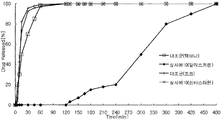
- Example 1 is a graph showing a comparative elution curve between the aliskiren-atorvastatin preparation prepared according to Example 1 and the aliskiren component and atorvastatin component of each single agent Tectna and Lipitor as a control.
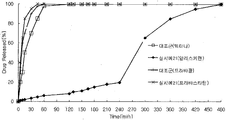
- FIG. 2 is a graph showing a comparative elution curve of the aliskiren-atorvastatin preparation prepared according to Example 4 and the aliskiren component and the atorvastatin component of each single agent, Tectna and Lipitor, as a control.
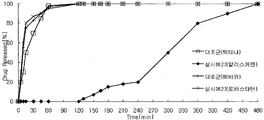
- Figure 3 is a graph showing the comparative elution curve of aliskiren-simvastatin multi-layered tablet prepared according to Example 10 and the aliskiren component and simvastatin component of Tectna and Zoko, respectively, as single agents.
- FIG. 4 is a graph showing a comparative dissolution curve of aliskiren-simvastatin multi-layered tablets prepared according to Example 9 and the aliskiren component and simvastatin component of Tekna and Zoko, which are single agents, as a control agent.
- FIG. 6 is a graph showing the dissolution patterns of Examples 14 and 16 to 18.
- FIG. 6 is a graph showing the dissolution patterns of Examples 14 and 16 to 18.
- FIG. 7 is a graph showing a comparative dissolution curve of aliskiren-pravastatin components of aliskiren-pravastatin sodium capsule (pellet-tablet) preparation prepared according to Example 21 and a single agent Tectna and pravacol to be.
- FIG. 8 is a comparative dissolution curve of aliskiren and lovastatin components of Tektina and mebaco as a single controlled release capsule (granule-granule) formulation of aliskiren-lovastatin prepared according to Example 23, and a control agent. Is a graph.
- Aliskiren hemi-fumarate, microcrystalline cellulose, crospovidone and sodium chloride were sieved through a No. 35 sieve and mixed for 5 minutes with a high speed mixer to prepare a mixture.
- polyvinylpyrrolidone was dissolved in purified water to form a binding solution, which was then combined, granulated, and dried.
- the dried product was placed in a fluidized bed coater, and a cellulose acetate (acetyl group 32%), cellulose acetate (acetyl group 39.8%), and hydroxypropyl methyl cellulose were dissolved and dispersed in 220 mg of ethanol and 980 mg of methylene chloride.
- the granules were coated with a fluid bed granulation coater (GPCG-1: Glatt, Germany) to prepare aliskiren hemi-fumarate delayed-release granules.
- GPCG-1 Glatt, Germany
- the atorvastatin calcium and the excipient microcrystalline cellulose, lactose, corn starch and sodium starch glycolate were sieved through a No. 35 sieve and mixed with a high speed mixer. Separately, hydroxypropyl cellulose and citric acid were dissolved in water to prepare a binding solution, which was added to a high speed mixer together with the main ingredient mixture and fed together. After association, granulation was carried out using an oscillator in No. 18 and dried at 60 ° C. using a hot water dryer. After drying, it was established as No. 20 sieve again. Butylated hydroxyanisole was added to the formulation and mixed.
- Aliskiren hemi-fumarate delayed-release granules of step 1) and atorvastatin calcium pre-release granules of step 2) were mixed in a double cone mixer. Magnesium stearate was added to the mixture for final mixing. The final mixture was compressed using a rotary tablet press (MRC-33: Sejong).
- a coating solution was prepared by dissolving and dispersing hydroxypropyl methylcellulose 2910, hydroxypropyl cellulose, titanium oxide, and talc in 64.8 mg of ethanol and 16.2 mg of purified water, and then applying the above tablet to a high coater (SFC-30N: Sejong Machinery, Korea).
- the film coating layer was formed as a two-phase matrix tablet.
- Aliskiren hemi-fumarate and microcrystalline cellulose were sieved through a No. 35 sieve and mixed for 5 minutes with a high speed mixer to prepare a mixture. Separately, polyvinylpyrrolidone was dissolved in purified water to form a binding solution, which was then combined, granulated, and dried. The dried product was placed in a fluidized bed coater, and a coating solution was prepared by dissolving and dispersing hydroxypropylmethylcellulose phthalate and hydroxypropylmethylcellulose in 220 mg of ethanol and 980 mg of methylene chloride. Glatt, Germany) to prepare aliskiren hemi-fumarate delayed-release granules.
- Simvastatin and excipients microcrystalline cellulose, lactose, corn starch and sodium starch glycolate were sieved through a No. 35 sieve and mixed with a high speed mixer. Separately, hydroxypropyl cellulose and citric acid were dissolved in water to prepare a binding solution, which was added to a high speed mixer together with the main ingredient mixture and fed together. After association, granulation was carried out using an oscillator in No. 18 and dried at 60 ° C. using a hot water dryer. After drying, it was established as No. 20 sieve again. Butylated hydroxyanisole was added to the formulation and mixed.
- Aliskiren hemi-fumarate delayed-release granules of step 1) and simvastatin pre-release granules of step 2) were mixed in a double cone mixer. Magnesium stearate was added to the mixture for final mixing. The final mixture was compressed using a rotary tablet press (MRC-33: Sejong).
- a coating solution was prepared by dissolving and dispersing hydroxypropyl methylcellulose 2910, hydroxypropyl cellulose, titanium oxide, and talc in 64.8 mg of ethanol and 16.2 mg of purified water, and then applying the above tablet to a high coater (SFC-30N: Sejong Machinery, Korea).
- the film coating layer was formed as a two-phase matrix tablet.
- Aliskiren hemi-fumarate and microcrystalline cellulose were sieved through a No. 35 sieve and mixed for 5 minutes with a high speed mixer to prepare a mixture. Separately, polyvinylpyrrolidone was dissolved in purified water to form a binding solution, which was then combined, granulated, and dried. The dried material was placed in a fluidized bed coater, and a coating solution in which Colicoat SR 30D was dissolved and dispersed in 220 mg of ethanol and 980 mg of methylene chloride was prepared. The above granules were coated with a fluidized bed granulator (GPCG-1: Glatt, Germany) to prepare a coating solution. Scheren hemi-fumarate delayed-release granules were prepared.
- GPCG-1 fluidized bed granulator
- Sodium fluvastatin, excipient microcrystalline cellulose, di-mannitol, and sodium starch glycolate were sieved through a No. 35 sieve and mixed with a high speed mixer. Separately, hydroxypropyl cellulose and citric acid were dissolved in water to prepare a binding solution, which was added to a high speed mixer together with the main ingredient mixture and fed together. After association, granulation was carried out using an oscillator in No. 18 and dried at 60 ° C. using a hot water dryer. After drying, it was established as No. 20 sieve again. Butylated hydroxyanisole was added to the formulation and mixed.
- Aliskiren hemi-fumarate delayed-release granules of step 1) and fluvastatin calcium pre-release granules of step 2) were mixed in a double cone mixer. Magnesium stearate was added to the mixture for final mixing. The final mixture was compressed using a rotary tablet press (MRC-33: Sejong).
- a coating solution was prepared by dissolving and dispersing hydroxypropyl methylcellulose 2910, hydroxypropyl cellulose, titanium oxide, and talc in 64.8 mg of ethanol and 16.2 mg of purified water, and then applying the above tablet to a high coater (SFC-30N: Sejong Machinery, Korea).
- the film coating layer was formed as a two-phase matrix tablet.
- Atorvastatin calcium, microcrystalline cellulose, crospovidone and sodium chloride were sieved through a No. 35 sieve and mixed for 5 minutes with a high speed mixer to prepare a mixture.
- polyvinylpyrrolidone and citric acid were dissolved in purified water and combined, granulated, and dried as a binder.
- the dried product was placed in a fluidized bed coater, and a cellulose acetate (acetyl group 32%), cellulose acetate (acetyl group 39.8%), and hydroxypropyl methyl cellulose were dissolved and dispersed in 220 mg of ethanol and 980 mg of methylene chloride.
- the granules were coated with a fluid bed granule coater (GPCG-1: Glatt, Germany). Butylated hydroxyanisole was added to the coating and mixed to prepare atorvastatin delayed-release granules.
- Aliskiren hemi-fumarate and excipients microcrystalline cellulose, lactose, corn starch, sodium starch glycolate were sieved through a No. 35 sieve and mixed with a high speed mixer. Separately, hydroxypropyl cellulose was dissolved in water to prepare a binding solution, which was added to a high speed mixer together with the main ingredient mixture and combined. After association, granulation was carried out using an oscillator in No. 18 and dried at 60 ° C. using a hot water dryer. After drying, it was established as No. 20 sieve again.
- the atorvastatin calcium delayed-release granules of step 1) and aliskiren hemi-fumarate pre-release granules of step 2) were placed in a double cone mixer and mixed. Magnesium stearate was added to the mixture for final mixing. The final mixture was compressed using a rotary tablet press (MRC-33: Sejong).
- a coating solution was prepared by dissolving and dispersing hydroxypropyl methylcellulose 2910, hydroxypropyl cellulose, titanium oxide, and talc in 64.8 mg of ethanol and 16.2 mg of purified water, and then applying the above tablet to a high coater (SFC-30N: Sejong Machinery, Korea).
- the film coating layer was formed as a two-phase matrix tablet.
- Simvastatin and microcrystalline cellulose were sieved through a No. 35 sieve and mixed for 5 minutes with a high speed mixer to prepare a mixture.
- polyvinylpyrrolidone and citric acid were dissolved in purified water and combined, granulated, and dried as a binder.
- the dried product was placed in a fluidized bed coater, and a coating solution was prepared by dissolving and dispersing hydroxypropylmethylcellulose phthalate and hydroxypropylmethylcellulose in 220 mg of ethanol and 980 mg of methylene chloride. Glatt, Germany). Butylated hydroxyanisole was added to the coating and mixed to prepare simvastatin delayed-release granules.
- Aliskiren hemi-fumarate and the excipient microcrystalline cellulose, di-mannitol, sodium starch glycolate were sieved through a No. 35 sieve and mixed with a high speed mixer. Separately, hydroxypropyl cellulose was dissolved in water to prepare a binding solution, which was added to a high speed mixer together with the main ingredient mixture and combined. After association, granulation was carried out using an oscillator in No. 18 and dried at 60 ° C. using a hot water dryer. After drying, it was established as No. 20 sieve again.
- Simvastatin calcium delayed-release granules of step 1) and aliskiren hemi-fumarate pre-release granules of step 2) were mixed in a double cone mixer. Magnesium stearate was added to the mixture for final mixing. The final mixture was compressed using a rotary tablet press (MRC-33: Sejong).
- a coating solution was prepared by dissolving and dispersing hydroxypropyl methylcellulose 2910, hydroxypropyl cellulose, titanium oxide, and talc in 64.8 mg of ethanol and 16.2 mg of purified water, and then applying the above tablet to a high coater (SFC-30N: Sejong Machinery, Korea).
- the film coating layer was formed as a two-phase matrix tablet.
- Fluvastatin sodium and microcrystalline cellulose were sieved through a No. 35 sieve and mixed for 5 minutes with a high speed mixer to prepare a mixture.
- polyvinylpyrrolidone and citric acid were dissolved in purified water and combined, granulated, and dried as a binder.
- the dried product was placed in a fluidized bed coater, and a coating solution in which Colicoat SR 30D was dissolved and dispersed in 220 mg of ethanol and 980 mg of methylene chloride was prepared, and the above granules were coated with a fluidized bed granulator (GPCG-1: Glatt, Germany). Butylated hydroxyanisole was added to the coating and mixed to prepare fluvastatin delayed-release granules.
- GPCG-1 fluidized bed granulator
- Aliskiren hemi-fumarate and excipients microcrystalline cellulose, lactose, corn starch, sodium starch glycolate were sieved through a No. 35 sieve and mixed with a high speed mixer. Separately, hydroxypropyl cellulose was dissolved in water to prepare a binding solution, which was added to a high speed mixer together with the main ingredient mixture and combined. After association, granulation was carried out using an oscillator in No. 18 and dried at 60 ° C. using a hot water dryer. After drying, it was established as No. 20 sieve again.
- Fluvastatin calcium delayed-release granules of step 1) and aliskiren hemi-fumarate pre-release granules of step 2) were mixed in a double cone mixer. Magnesium stearate was added to the mixture for final mixing. The final mixture was compressed using a rotary tablet press (MRC-33: Sejong).
- a coating solution was prepared by dissolving and dispersing hydroxypropyl methylcellulose 2910, hydroxypropyl cellulose, titanium oxide, and talc in 64.8 mg of ethanol and 16.2 mg of purified water, and then applying the above tablet to a high coater (SFC-30N: Sejong Machinery, Korea).
- the film coating layer was formed as a two-phase matrix tablet.
- Atorvastatin calcium and microcrystalline cellulose, crospovidone and sodium chloride as excipients were sieved through a No. 35 sieve and mixed for 5 minutes with a high speed mixer to prepare a mixture.
- polyvinylpyrrolidone and citric acid were dissolved in purified water and combined, granulated, and dried as a binder.
- the dried product was placed in a fluidized bed coater, and a solution of cellulose acetate (acetyl group 32%), cellulose acetate (acetyl group 39.8%), and hydroxypropylmethylcellulose in 220 mg of ethanol and 980 mg of methylene chloride was prepared to prepare the above granulated fluid layer.
- a coating solution was prepared by dissolving and dispersing hydroxypropyl methylcellulose 2910, hydroxypropyl cellulose, titanium oxide, and talc in 64.8 mg of ethanol and 16.2 mg of purified water, and then applying the above tablet to a high coater (SFC-30N: Sejong Machinery, Korea). As a film coating layer was formed to prepare a sustained-release tablet in the form of a multi-layered tablet.
- Atorvastatin calcium and microcrystalline cellulose were sieved through a No. 35 sieve and mixed for 5 minutes with a high speed mixer to prepare a mixture.
- polyvinylpyrrolidone and citric acid were dissolved in purified water and combined, granulated, and dried as a binder.
- the dried product was placed in a fluidized bed coater, and a coating solution was prepared by dissolving and dispersing hydroxypropylmethylcellulose phthalate and hydroxypropylmethylcellulose in 220 mg of ethanol and 980 mg of methylene chloride. Glatt, Germany) and coated.
- Butylated hydroxyanisole was added to the coating and mixed.
- Magnesium stearate was added and finally mixed for 4 minutes in a double cone mixer to prepare simvastatin delayed-release granules.
- a coating solution was prepared by dissolving and dispersing hydroxypropyl methylcellulose 2910, hydroxypropyl cellulose, titanium oxide, and talc in 64.8 mg of ethanol and 16.2 mg of purified water, and then applying the above tablet to a high coater (SFC-30N: Sejong Machinery, Korea). As a film coating layer was formed to prepare a sustained-release tablet in the form of a multi-layered tablet.
- Simvastatin and microcrystalline cellulose were sieved through a No. 35 sieve and mixed for 5 minutes with a high speed mixer to prepare a mixture.
- polyvinylpyrrolidone and citric acid were dissolved in purified water and combined, granulated, and dried as a binder.
- the dried material was placed in a fluidized bed coater, and a coating solution in which Colicoat SR 30D was dissolved and dispersed in 220 mg of ethanol and 980 mg of methylene chloride was prepared, and the above granules were put in a fluid bed granulation coater (GPCG-1: Glatt, Germany) and coated. .
- Butylated hydroxyanisole was added to the coating and mixed.
- Magnesium stearate was added and finally mixed for 4 minutes in a double cone mixer to prepare simvastatin delayed-release granules.
- MRC-37T Sejong
- the composition containing simvastatin of step 1) is placed in a primary powder feeder, and the aliskiren hemi-fumarate delayed-release layer composition of step 2) is placed in a secondary powder feeder, and the tableting is performed under conditions that minimize the incorporation of the layers. It was.
- a coating solution was prepared by dissolving and dispersing hydroxypropyl methylcellulose 2910, hydroxypropyl cellulose, titanium oxide, and talc in 64.8 mg of ethanol and 16.2 mg of purified water, and then applying the above tablet to a high coater (SFC-30N: Sejong Machinery, Korea).
- SFC-30N Sejong Machinery, Korea
- Aliskiren hemi-fumarate and the excipient microcrystalline cellulose, crospovidone, sodium chloride were sieved through a No. 35 sieve and mixed for 5 minutes with a high speed mixer to prepare a mixture.
- polyvinylpyrrolidone was dissolved in purified water to form a binding solution, which was then combined, granulated, and dried.
- the dried product was put into a fluidized bed coater, and a solution of cellulose acetate (acetyl group 32%), cellulose acetate (acetyl group 39.8%), and hydroxypropylmethylcellulose in 220 mg of ethanol and 980 mg of methylene chloride was prepared to prepare the above granulated fluid layer.
- Simvastatin and the excipient microcrystalline cellulose and di-mannitol were sieved through a No. 35 sieve and mixed with a high speed mixer. Separately, hydroxypropylcellulose and citric acid were dissolved in water to prepare a binding solution, which was associated with the main ingredient mixture. After association, granulation was carried out using an oscillator in No. 18 and dried at 60 ° C. using a hot water dryer. After drying, it was established as No. 20 sieve again. Butylated hydroxyanisole and starch sodium glyconate were mixed with the sieved material, and magnesium stearate was added thereto, followed by final mixing in a double cone mixer.
- MRC-37T Sejong
- the composition containing simvastatin of step 2) is placed in a primary powder feeder, and the aliskiren hemi-fumarate delayed-release layer composition of step 1) is placed in a secondary powder feeder, and the tableting is performed under conditions that minimize the incorporation of the layers. It was.
- a coating solution was prepared by dissolving and dispersing hydroxypropyl methylcellulose 2910, hydroxypropyl cellulose, titanium oxide, and talc in 64.8 mg of ethanol and 16.2 mg of purified water, and then applying the above tablet to a high coater (SFC-30N: Sejong Machinery, Korea).
- SFC-30N Sejong Machinery, Korea
- aliskiren hemi-fumarate and microcrystalline cellulose were sieved through a No. 35 sieve and mixed for 5 minutes with a high speed mixer to prepare a mixture.
- polyvinylpyrrolidone was dissolved in purified water to form a binding solution, which was then combined, granulated, and dried.
- the dried product was placed in a fluidized bed coater, and a coating solution obtained by dissolving and dispersing hydroxypropylmethylcellulose phthalate and hydroxypropylmethylcellulose in 220 mg of ethanol and 980 mg of methylene chloride was prepared to prepare the above granules in a fluidized bed granulator (GPCG-1: Glatt, Germany) and coated.
- magnesium stearate was added and mixed for 4 minutes to prepare aliskiren hemi-fumarate delayed-release granules .
- rosuvastatin and the excipient microcrystalline cellulose and di-mannitol were sieved through a No. 35 sieve and mixed with a high speed mixer. Separately, hydroxypropylcellulose and citric acid were dissolved in water to prepare a binding solution, which was associated with the main ingredient mixture. After association, granulation was carried out using an oscillator in No. 18 and dried at 60 ° C. using a hot water dryer. After drying, it was established as No. 20 sieve again. Butylated hydroxyanisole and starch sodium glyconate were mixed with the sieved material, and magnesium stearate was added thereto, followed by final mixing in a double cone mixer.
- a coating solution was prepared by dissolving and dispersing hydroxypropyl methylcellulose 2910, hydroxypropyl cellulose, titanium oxide, and talc in 64.8 mg of ethanol and 16.2 mg of purified water, and then applying the above tablet to a high coater (SFC-30N: Sejong Machinery, Korea). As a film coating layer was formed to prepare a sustained-release tablet in the form of a multi-layered tablet.
- Aliskiren hemi-fumarate, microcrystalline cellulose and pregelatinized starch were sieved through a No. 35 sieve and mixed for 5 minutes with a high speed mixer to prepare a mixture.
- polyvinylpyrrolidone was dissolved in purified water to form a binding solution, which was then combined, granulated, and dried.
- the dried product was placed in a fluidized bed coater, and a solution of colloidal silicon dioxide, ethyl cellulose, and methacrylic acid copolymer type C dissolved in 220 mg of ethanol and 980 mg of methylene chloride was prepared to prepare the above granules in a fluidized bed granulator (GPCG-1: Glatt). , Germany), and after completion of the coating, magnesium stearate was added and mixed for 4 minutes to prepare aliskiren hemi-fumarate delayed-release granules.
- GPCG-1 fluidized bed granulator
- Atorvastatin and the excipient microcrystalline cellulose, lactose and corn starch were sieved through a No. 35 sieve and mixed with a high speed mixer. Separately, hydroxypropylcellulose and citric acid were dissolved in water to prepare a binding solution, which was associated with the main ingredient mixture. After association, granulation was carried out using an oscillator in No. 18 and dried at 60 ° C. using a hot water dryer. After drying, it was established as No. 20 sieve again. Butylated hydroxyanisole and starch sodium glyconate were mixed with the sieved material, and magnesium stearate was added thereto, followed by final mixing in a double cone mixer.
- a coating solution was prepared by dissolving and dispersing hydroxypropylmethylcellulose 2910, titanium oxide, and talc in 64.8 mg of ethanol and 16.2 mg of purified water, and using the above coating as a high coater (SFC-30N: Sejong Machinery, Korea). To form a sustained-release tablet in the form of a multi-layered tablet.
- composition and content of Table 2 according to the preparation method of aliskiren delayed-release granules of Example 12 was prepared aliskiren delayed-release granules.
- aliskiren delayed-release granules were prepared according to the preparation method of the atorvastatin pre-release granules of Example 12.
- Aliskiren hemi-fumarate, microcrystalline cellulose, pregelatinized starch, crospovidone were sieved through a No. 35 sieve and mixed for 5 minutes with a high speed mixer to prepare a mixture.
- polyvinylpyrrolidone was dissolved in purified water to form a binding solution, which was then combined, granulated, and dried.
- the dried product was placed in a fluidized bed coater, and a solution of colloidal silicon dioxide, ethyl cellulose, and methacrylic acid copolymer type C dissolved in 220 mg of ethanol and 980 mg of methylene chloride was prepared to prepare the above granules in a fluidized bed granulator (GPCG-1: Glatt). , Germany).
- magnesium stearate was added and mixed for 4 minutes to prepare aliskiren hemi-fumarate delayed-release granules.
- Example 12 2 According to the ingredients and contents of Table 2, according to the preparation method of Example 12 2) was prepared atorvastatin pre-release granules.
- composition and content of Table 2 according to the preparation method of 1) aliskiren delayed-release granules of Example 12 was prepared aliskiren delayed-release granules.
- Aliskiren delayed-release granules were prepared according to the preparation method of 2) atorvastatin pre-release granules of Example 12.
- composition and the content of Table 2 according to the preparation method of 1) aliskiren delayed-release granules of Example 14 was prepared aliskiren delayed-release granules.
- Aliskiren delayed-release granules were prepared according to the preparation method of Example 12 2) atorvastatin pre-release granules.
- composition and the content of Table 2 according to the preparation method of 1) aliskiren delayed-release granules of Example 14 was prepared aliskiren delayed-release granules.
- Aliskiren delayed-release granules were prepared according to the preparation method of Example 12 2) atorvastatin pre-release layer.
- composition and the content of Table 2 according to the preparation method of 1) aliskiren delayed-release granules of Example 14 was prepared aliskiren delayed-release granules.
- Aliskiren delayed-release granules were prepared according to the preparation method of Example 12 2) atorvastatin pre-release layer.
- the Sugar spheres were sieved through a No. 35 sieve and poured into a fluidized bed granulator (GPCG 1: Glatt), followed by spraying a binder solution in which hydroxypropylmethylcellulose and aliskiren hemi-fumarate were dissolved in water and ethanol.
- GPCG 1 fluidized bed granulator
- the aliskiren hemi-fumarate-containing pellets were formed and dried.
- the pellets were sprayed again with a solution of hydroxypropylmethylcellulose phthalate dissolved in 220 mg of ethanol and 980 mg of methylene chloride to prepare aliskiren hemi-fumarate delayed-release pellets.
- pitavastatin calcium, microcrystalline cellulose and di-mannitol were sieved through a No. 35 sieve and mixed with a high speed mixer. Separately, hydroxypropylcellulose and citric acid were dissolved in water to prepare a binding solution, which was associated with the main ingredient mixture. After association, granulation was carried out using an oscillator in No. 18 and dried at 60 ° C. using a hot water dryer. After drying, it was established as No. 20 sieve again. Butylated hydroxyanisole was added to the sieved material, followed by final mixing in a double cone mixer.
- the final compositions of steps 1) and 2) were mixed with a double cone mixer.
- Sodium starch glycolate was added to the mixture and mixed with a double cone mixer.
- Magnesium stearate was added to the mixture, followed by final mixing.
- the final mixed mixture was put into a powder feeder and filled using a capsule charger (SF 40N, Sejong Machinery, Korea) to complete the preparation of the controlled release formulation in capsule form.
- the sugar spheres were sieved through a No. 35 sieve, poured into a fluid bed granulator (GPCG 1: Glatt), and separately sprayed with a mixture of hydroxypropylmethylcellulose, citric acid and simvastatin in water and ethanol. Len hemi-fumarate containing pellets were formed and dried. Again, the pellets were sprayed with a solution of hydroxypropylmethylcellulose phthalate dissolved in 220 mg of ethanol and 980 mg of methylene chloride to prepare a delayed pellet of HMG-CoA reductase inhibitor.
- GPCG 1 Glatt
- Aliskiren hemi-fumarate, microcrystalline cellulose and di-mannitol were sieved through a No. 35 sieve and mixed with a high speed mixer. Separately, hydroxypropylcellulose was dissolved in water to prepare a binding solution, which was associated with the main ingredient mixture. After association, granulation was carried out using an oscillator in No. 18 and dried at 60 ° C. using a hot water dryer. After drying, it was established as No. 20 sieve again.
- steps 1) and 2) were mixed with a double cone mixer.
- Sodium starch glycolate was added to the mixture and mixed with a double cone mixer.
- Magnesium stearate was added to the mixture, followed by final mixing.
- the final mixed mixture was placed in a powder feeder and filled using a capsule charger to complete the preparation of the controlled release formulation in capsule form.
- the Sugar spheres were sieved through a No. 35 sieve and poured into a fluidized bed granulator (GPCG 1: Glatt), followed by spraying a binder solution in which hydroxypropylmethylcellulose and aliskiren hemi-fumarate were dissolved in water and ethanol.
- GPCG 1 fluidized bed granulator
- the aliskiren hemi-fumarate-containing pellets were formed and dried.
- the pellets were sprayed again with a solution of hydroxypropylmethylcellulose phthalate dissolved in 220 mg of ethanol and 980 mg of methylene chloride to prepare aliskiren hemi-fumarate delayed-release pellets.
- pravastatin sodium, microcrystalline cellulose and di-mannitol were sieved through a No. 35 sieve and mixed with a high speed mixer. Separately, hydroxypropylcellulose and citric acid were dissolved in water to prepare a binding solution, which was associated with the main ingredient mixture. After association, granulation was carried out using an oscillator in No. 18 and dried at 60 ° C. using a hot water dryer. After drying, it was established as No. 20 sieve again. Butylated hydroxyanisole and sodium starch glycolate were added to the sieved material and mixed with a double cone mixer. Magnesium stearate was added to the mixture, followed by final mixing. The final mixture was compressed into tablets using a rotary tablet press (MRC-33: Sejong).
- step 1) The final composition of step 1) and 2) was filled using a capsule charger to complete the preparation of the capsule formulation.
- the sugar spheres were sieved through a No. 35 sieve and poured into a fluidized bed granulator (GPCG 1: Glatt), followed by spraying a binder solution in which hydroxypropylmethylcellulose, citric acid and pitavastatin calcium were dissolved in water and ethanol. Pellets containing HMG-CoA reductase inhibitor were formed and dried. Again, the pellet was sprayed with a solution of hydroxypropylmethylcellulose phthalate dissolved in 220 mg of ethanol and 980 mg of methylene chloride to prepare a delayed-release pellet of HMG-CoA reductase inhibitor.
- GPCG 1 Glatt
- aliskiren hemi-fumarate, microcrystalline cellulose and di-mannitol were sieved through a No. 35 sieve and mixed with a high speed mixer. Separately, hydroxypropylcellulose was dissolved in water to prepare a binding solution, which was associated with the main ingredient mixture. After association, granulation was carried out using an oscillator in No. 18 and dried at 60 ° C. using a hot water dryer. After drying, it was established as No. 20 sieve again. Sodium starch glycolate was added to the sieved material and mixed with a double cone mixer. Magnesium stearate was added to the mixture, followed by final mixing. The final mixture was compressed into tablets using a rotary tablet press (MRC-33: Sejong).
- Aliskiren hemi-fumarate and microcrystalline cellulose were sieved through a No. 35 sieve and mixed with a high speed mixer. Colicoat SR30D was associated with the main ingredient mixture. After association, granulation was carried out using an oscillator in No. 18 and dried at 60 ° C. using a hot water dryer. After the drying was finished again to No. 20 sieve prepared aliskiren hemi-fumarate delayed-release granules.
- Lovastatin, microcrystalline cellulose and di-mannitol were sieved through a No. 35 sieve and mixed with a high speed mixer. Separately, hydroxypropylcellulose and citric acid were dissolved in water to prepare a binding solution, which was associated with the main ingredient mixture. After association, granulation was carried out using an oscillator in No. 18 and dried at 60 ° C. using a hot water dryer. After drying, it was established as No. 20 sieve again. Butylated hydroxyanisole was added to the formulation and mixed.
- steps 1) and 2) were mixed with a double cone mixer.
- Sodium starch glycolate was added to the mixture and mixed with a double cone mixer.
- Magnesium stearate was added to the mixture, followed by final mixing.
- the final mixed mixture was placed in a powder feeder and filled using a capsule charger to complete the preparation of the controlled release formulation in capsule form.
- Rosuvastatin and microcrystalline cellulose were sieved through a No. 35 sieve and mixed with a high speed mixer. Colicoat SR30D, citric acid was associated with the main ingredient mixture. After association, granulation was carried out using an oscillator in No. 18 and dried at 60 ° C. using a hot water dryer. After the drying was finished again to No. 20 sieve to prepare a rosuvastatin delayed-release granules.
- Aliskiren hemi-fumarate, microcrystalline cellulose and di-mannitol were sieved through a No. 35 sieve and mixed with a high speed mixer. Separately, hydroxypropylcellulose was dissolved in water to prepare a binding solution, which was associated with the main ingredient mixture. After association, granulation was carried out using an oscillator in No. 18 and dried at 60 ° C. using a hot water dryer. After drying, it was established as No. 20 sieve again.
- steps 1) and 2) were mixed with a double cone mixer.
- Sodium starch glycolate was added to the mixture and mixed with a double cone mixer.
- Magnesium stearate was added to the mixture, followed by final mixing.
- the final mixed mixture was placed in a powder feeder and filled using a capsule charger to complete the preparation of the controlled release formulation in capsule form.
- Aliskiren hemi-fumarate and microcrystalline cellulose were sieved through a No. 35 sieve, poured into a fluidized bed granulator (GPCG 1: Glatt), mixed, and separately mixed with hydroxypropylmethylcellulose in water to spray a binder solution.
- GPCG 1 fluidized bed granulator
- Len hemi-fumarate containing granules were formed and dried. Again, the above granules were sprayed with a solution of hydroxypropylmethylcellulose phthalate dissolved in 220 mg of ethanol and 980 mg of methylene chloride to prepare aliskiren hemi-fumarate delayed-release granules.
- Atorvastatin calcium, microcrystalline cellulose and di-mannitol were sieved through a No. 35 sieve and mixed with a high speed mixer. Separately, hydroxypropylcellulose and citric acid were dissolved in water to prepare a binding solution, which was associated with the main ingredient mixture. After association, granulation was carried out using an oscillator in No. 18 and dried at 60 ° C. using a hot water dryer. After drying, it was established as No. 20 sieve again. Butylated hydroxyanisole and sodium starch glycolate were added to the sieved material and mixed with a double cone mixer. Magnesium stearate was added to the mixture, followed by final mixing. The final mixture was compressed into tablets using a rotary tablet press (MRC-33: Sejong).
- Fluvastatin sodium and microcrystalline cellulose were sieved through a No. 35 sieve, poured into a fluidized bed granulator (GPCG 1: Glatt), mixed, and separately sprayed with a binder solution made by dissolving hydroxypropylmethylcellulose and citric acid in water. Reductase inhibitor containing granules were formed and dried. The granules were sprayed with hydroxypropyl methyl cellulose phthalate in 220 mg of ethanol and 980 mg of methylene chloride to spray HMG-CoA reductase inhibitor delayed-release granules.
- GPCG 1 fluidized bed granulator
- Aliskiren hemi-fumarate, microcrystalline cellulose and di-mannitol were sieved through a No. 35 sieve and mixed with a high speed mixer. Separately, hydroxypropylcellulose was dissolved in water to prepare a binding solution, which was associated with the main ingredient mixture. After association, granulation was carried out using an oscillator in No. 18 and dried at 60 ° C. using a hot water dryer. After drying, it was established as No. 20 sieve again. Sodium starch glycolate was added to the sieved material and mixed with a double cone mixer. Magnesium stearate was added to the mixture, followed by final mixing. The final mixture was compressed into tablets using a rotary tablet press (MRC-33: Sejong).
- Sivastatin, microcrystalline cellulose and pregelatinized starch were sieved through a No. 35 sieve and mixed for 5 minutes with a high-speed mixer, followed by spraying a binder solution made by dissolving polyvinylpyrrolidone and citric acid in water, and granulating HMG-CoA reductase inhibitor-containing granules. Formed and dried. Again, magnesium stearate is added to the granule mixture, followed by final mixing for 4 minutes.
- a coating solution obtained by dissolving and dispersing hydroxypropylmethylcellulose and methacrylic acid copolymer (type C2) in 132 mg of ethanol and 33 mg of purified water was prepared.
- the nuclear tablets were put into a high coater (SFC-30N: Sejong) and coated with a coating solution to prepare a delayed-release inner core.
- Aliskiren hemi-fumarate, microcrystalline cellulose and di-mannitol were sieved through a No. 35 sieve and mixed with a high speed mixer. Separately, hydroxypropylcellulose was dissolved in water to prepare a binding solution, which was associated with the main ingredient mixture. After association, granulation was carried out using an oscillator in No. 18 and dried at 60 ° C. using a hot water dryer. After drying, it was established as No. 20 sieve again. Sodium starch glycolate was added to the sieved material and mixed with a double cone mixer. Magnesium stearate was added to the mixture, followed by final mixing.
- Nucleotablet tableting machine (RUD-1: Kilian) was used as the inner core of the simvastatin-coated core tablet and the composition containing aliskiren hemi-fumarate as an outer layer, and after the preparation of the nucleated tablet separately hydroxypropylmethylcellulose 2910, titanium oxide and talc were dissolved and dispersed in 132 mg of ethanol and 33 mg of purified water to prepare a coating solution.
- the above nucleated tablet was added to a high coater (SFC-30N: Sejong) and coated with a coating solution to complete nucleated tablet manufacturing.
- Aliskiren delayed-release granules were prepared in the same manner as in the preparation method and composition and content of the aliskiren delayed-release granules of Example 10.
- Simvastatin pre-release granules were prepared in the same manner as in the preparation method and composition and content of the simvastatin pre-release granules of Example 10.
- the granules of steps 1) and 2) were compressed into tablets using a rotary tablet press (MRC-33: Sejong) and packed in a blister packaging container for simultaneous use.
- MRC-33 Sejong
- Atorvastatin delayed-release granules of Example 7 were prepared in the same manner as in the preparation method, composition and content of the atorvastatin delayed-release granules.
- steps 1) and 2) were compressed using a rotary tablet press (MRC-33: Sejong), respectively, and blister packaging containers (Minister A, Heunga Engineering) using blister packaging containers (silver foil, same traveling, PVDC, Packaged for simultaneous use in Jeonmin Industry).
- Example 30 atorvastatin and the excipient microcrystalline cellulose (Vivapur, JRS), corn starch, precipitated calcium carbonate (fed chemicals) were sieved through a No. 35 sieve and a high-speed mixer (Lab. Pharma Mixer P, Diosna, Germany). Separately, hydroxypropyl cellulose (Klucel, BASF) was dissolved in water (50 mg) to prepare a binding solution, which was added to the high-speed mixer (Lab. Pharma Mixer P, Diosna, Germany) together with the main component mixture and combined. After the granulation was finished using No. 18 sieve using an oscillator and dried at 60 ° C. using a hot water dryer.
- Example 31 the pre-release granules were prepared in the composition and content as shown in Table 4 in the same manner as the above-mentioned preparation method of the pre-release granules.
- Example 30 sift aliskiren, lactose, di-mannitol (Pearlitol 160C, Roquette), microcrystalline cellulose in a No. 35 sieve and a high-speed mixer (Lab. Pharma Mixer P, Diosna, Germany) (Lab. Pharma Mixer P, Diosna, Germany) for 5 minutes to prepare a mixture.
- the mixture was poured into a fluidized bed granulation coater (GPCG-1, Glatt, Germany) and sprayed with a binder solution made by dissolving hydroxypropylmethylcellulose separately in water to form granules and dried. Thereafter, the granules were coated by spraying Eudragit RS PO solution (5% w / w) dissolved in a 1: 1 mixture of ethanol and methylene chloride.
- Eudragit RS PO solution 5% w / w
- delayed-release granules were prepared in the composition and content as shown in Table 4 by the same method for preparing delayed-release granules.
- steps 1) and 2) were first mixed in a double cone mixer (Dasan Pharmatech, Korea). Sodium starch glycolate was added to the primary mixture and mixed secondly in a double cone mixer. Magnesium stearate was added to the final mixture.
- the final mixture was compressed into tablets using a rotary tablet press (MRC-33, Sejong Pharmatech, Korea).
- a rotary tablet press MRC-33, Sejong Pharmatech, Korea.
- hydroxypropylmethylcellulose 2910 HP-55, Shin-etsu
- hydroxypropyl cellulose titanium oxide
- talc hydroxypropyl cellulose
- a coating solution (20% w / w) dissolved and dispersed in a solution mixed at a ratio of 8: 2 of purified water was prepared to form a film coating layer using a high coater (SFC-30N, Sejong Pharmatech, Korea). Two-phase matrix tablets were prepared.
- Example 32 atorvastatin and the excipient microcrystalline cellulose, corn starch, precipitated calcium carbonate were sieved through a No. 35 sieve and mixed with a high speed mixer (Lab. Pharma Mixer P, Diosna, Germany). Separately, hydroxypropylcellulose was dissolved in water to prepare a binding solution, which was associated with the main ingredient mixture. After association, granulation was carried out using an oscillator in No. 18 and dried at 60 ° C. using a hot water dryer. After drying, the mixture was re-formed into No. 20 sieve (KYK-60, Korea Medi, Korea). Sodium starch glyconate was mixed with the formulation, and magnesium stearate was added and finally mixed with a double cone mixer (Dasan Pharmatech, Korea). .
- Example 33 the semi-finished product of the pre-release granules was prepared in the composition and content as shown in Table 4 in the same manner as the above-mentioned preparation method of the pre-release granules.
- Example 32 is a mixture prepared by sieving aliskiren, lactose, di-mannitol, microcrystalline cellulose in a No. 35 sieve in a content as shown in Table 4 and mixing for 5 minutes with a high speed mixer (Lab. Pharma Mixer P, Diosna, Germany). It was. The mixture was poured into a fluidized bed granulation coater (GPCG-1, Glatt, Germany) and separately sprayed with a binder solution made by dissolving hydroxypropylmethylcellulose in water (50 mg) to form granules and dried.
- GPCG-1 fluidized bed granulation coater
- granules were sprayed with a hydroxypropylmethylcellulose phthalate solution (5% w / w) dissolved in a 1: 1 mixture of ethanol and methylene chloride to coat the granules.
- a hydroxypropylmethylcellulose phthalate solution 5% w / w
- Magnesium stearate was added thereto and finally mixed with a double cone mixer (Dasan Pharmatech, Korea).
- Example 33 the granule semi-finished product of the delayed-release layer was prepared with the composition and content as shown in Table 4 in the same manner as in the above-described method of preparing delayed-release granules.
- the above tablet was prepared by dissolving and dispersing hydroxypropylmethylcellulose 2910, hydroxypropylcellulose, titanium oxide, and talc in a mixed solution of ethanol and purified water at a ratio of 8: 2 (20% w / w). To form a film coating layer with a high coater (SFC-30N, Sejong Pharmatech, Korea) to prepare a multi-layered tablet formulation.
- a high coater SFC-30N, Sejong Pharmatech, Korea
- Example 34 atorvastatin, microcrystalline cellulose, and corn starch were passed through No. 35 sieve and mixed with a high-speed mixer (Lab. Pharma Mixer P, Diosna, Germany) in the amounts shown in Table 4.
- Hydroxypropyl cellulose and meglumine Sigma was dissolved in water (50 mg) to form a binding solution, which was then combined with the main component mixture. After the association, granulation was carried out using an oscillator with No. 18 and dried at 60 ° C. using a hot water dryer. Again established as No. 20 (KYK-60, Korea Medi, Korea).
- Example 35 the granule semi-finished product of the pre-release layer was prepared in the composition and content as shown in Table 4 by the same method of manufacturing the pre-release granules.
- Example 34 apples a mixture of aliskiren, di-mannitol, microcrystalline cellulose, hydroxypropylmethyl cellulose, citric acid to the content shown in Table 4 in a No. 35 sieve, and again dispersed in a 1: 1 mixture of ethanol and methylene chloride The liquid (20% w / w) was used as the drug layer coating liquid.
- sugar spheres were added to a fluidized bed granule coating machine (GPCG-1, Glatt, Germany), and then the drug coating solution was sprayed and coated. Thereafter, the mixture was further coated with a hydroxypropylmethylcellulose phthalate solution (5% w / w) to prepare aliskiren delayed-release pellets.
- GPCG-1 fluidized bed granule coating machine
- Example 35 the pellet semi-finished product of the delayed-release layer was prepared in the composition and content as shown in Table 4 by the same method for producing a delayed-release pellet.
- steps 1) and 2) were first mixed in a double cone mixer (Dasan Pharmatech, Korea). Sodium starch glycolate was added to the primary mixture, followed by secondary mixing with a double cone mixer. Magnesium stearate was added to the secondary mixture for final mixing.
- the final mixed mixture was put into a powder feeder and filled with a capsule charger (SF-40N, Sejong Pharmatech, Korea) to complete the preparation of the capsule.
- a capsule charger SF-40N, Sejong Pharmatech, Korea
- Example 36 atorvastatin, microcrystalline cellulose, corn starch and precipitated calcium carbonate were sieved through a No. 35 sieve and mixed with a high-speed mixer (Lab. Pharma Mixer P, Diosna, Germany) in the amounts shown in Table 4. Hydroxypropyl cellulose was dissolved in water to prepare a binding solution, which was then combined with the main ingredient mixture. After the association, granulation was carried out using an oscillator with No. 18 sieve and dried at 60 ° C. using a hot water dryer. KYK-60, Korea Medi, Korea). Sodium starch glycolate was added to the formulation and mixed with a double cone mixer (Dasan Pharmatech, Korea). Magnesium stearate was added to the mixture and finally mixed. Was compressed using a rotary tablet press (MRC-33, Sejong Pharmatech, Korea).
- Example 37 the prior-release tablets were prepared in the composition and content as shown in Table 4 by the same method of preparing the previous-release tablet.
- Example 36 a mixture of aliskiren, di-mannitol, microcrystalline cellulose, hydroxypropylmethyl cellulose, and citric acid was passed through No. 35 with a content as shown in Table 4, and again dispersed in a 1: 1 mixture of ethanol and methylene chloride. The liquid (20% w / w) was used as the drug layer coating liquid.
- sugar spheres were added to a fluidized bed granule coating machine (GPCG-1, Glatt, Germany), and then the drug coating solution was sprayed and coated. Thereafter, the mixture was further coated with a hydroxypropylmethylcellulose phthalate solution (5% w / w) to prepare aliskiren delayed-release pellets, which were added to a double cone mixer, and magnesium stearate was added for final mixing.
- GPCG-1 fluidized bed granule coating machine
- Glatt Glatt, Germany
- the pellet of the delayed-release layer was prepared in the composition and content as shown in Table 4 by the same method of manufacturing the delayed-release pellet.
- step 1) and 2) was filled using a capsule charger (SF-40N, Sejong Pharmatech, Korea) to complete the preparation of the capsule.
- Example 38 atorvastatin, microcrystalline cellulose, and di-mannitol were sieved through a No. 35 sieve and mixed in a high-speed mixer (Lab. Pharma Mixer P, Diosna, Germany). Min was dissolved in water to prepare a binding solution, which was then combined with the main component mixture.After the association, granulation was carried out using an oscillator in No. 18 and dried at 60 ° C. using a hot water dryer. (KYK-60, Korea Medi, Korea).
- Example 39 the pre-release granules were prepared in the composition and content shown in Table 5 by the same method of preparing the pre-release granules.
- Example 38 aliskiren, di-mannitol, and microcrystalline cellulose were passed through No. 35 sieve and mixed with a high-speed mixer (Lab. Pharma Mixer P, Diosna, Germany) for 5 minutes to prepare a mixture. The mixture was poured into a fluidized bed granulation coater (GPCG-1, Glatt, Germany) and sprayed with a binder solution made by dissolving hydroxypropylmethylcellulose separately in water to form granules and dried. Thereafter, the granules were coated by spraying Colicoat SR30D.
- GPCG-1 fluidized bed granulation coater
- delayed-release granules were prepared in the composition and content as shown in Table 5 by the same method of manufacturing delayed-release granules as described above.
- Examples 38 and 39 were mixed and capsule filled in the same manner as in the following.
- steps 1) and 2) were first mixed with a double cone mixer (Dasan Pharmatech, Korea).
- Sodium starch glycolate was added to the primary mixture and mixed with a double cone mixer.
- Magnesium stearate was added to the final mixture.
- the final mixed mixture was put into a powder feeder and filled using a capsule charger (SF-40N, Sejong Pharmatech, Korea) to complete the preparation of the controlled release formulation in capsule form.
- Example 40 atorvastatin, microcrystalline cellulose, di-mannitol, precipitated calcium carbonate were sieved through a No. 35 sieve and mixed in a high speed mixer (Lab. Pharma Mixer P, Diosna, Germany) in the amounts shown in Table 5. Roxypropyl cellulose was dissolved in water to prepare a binding solution, which was then combined with the main component mixture. After association, granulation was carried out using an oscillator with No. 18 sieve and dried at 60 ° C. using a hot water dryer. Sieve was sifted (KYK-60, Korea Medi, Korea).
- Example 41 the granule semi-finished product of the pre-release layer was prepared with the composition and content as shown in Table 5 in the same manner as in the above-mentioned preparation method of the pre-release granules.
- Example 40 aliskiren, di-mannitol, microcrystalline cellulose were passed through No. 35 sieve and mixed with a high speed mixer (Lab. Pharma Mixer P, Diosna, Germany) for 5 minutes to prepare a mixture. .
- the mixture was poured into a fluidized bed granulator and separately sprayed with a binder solution made by dissolving hydroxypropylmethylcellulose in water to form granules and dried. Thereafter, Carbomer 71G was added to the granules in powder form, and magnesium stearate was added thereto, followed by final mixing in a double cone mixer (Dasan Pharmatech, Korea).
- the final mixture is compressed into tablets using a rotary tablet press (MRC-33, Sejong Pharmatech, Korea) at a speed of 30 revolutions per minute, hardness 7-9 kp, thickness 3.0 mm, and diameter 5.5 mm. Thereafter, a hydroxypropylmethylcellulose phthalate solution (5% w / w) was coated to prepare aliskiren delayed-release coated tablets.
- MRC-33 Sejong Pharmatech, Korea
- Example 41 the delayed-release coated tablet was prepared in the composition and content as shown in Table 5 by the same method of preparing the delayed-release coated tablet.
- step 1) and 2) was filled using a capsule charger (SF-40N, Sejong Pharmatech, Korea) to complete the preparation of the capsule.
- Example 42 atorvastatin, microcrystalline cellulose, and corn starch were passed through No. 35 sieve and mixed with a high-speed mixer (Lab. Pharma Mixer P, Diosna, Germany) in the amounts shown in Table 5.
- Hydroxypropyl cellulose and meglumine were separately mixed. It was dissolved in water to prepare a binding solution, which was then combined with the main ingredient mixture. After the association, granulation was carried out using an oscillator with No. 18 sieve and dried at 60 ° C. using a hot water dryer.
- Sodium starch glycolate was added to the formulation and mixed with a double cone mixer (Dasan Pharmatech, Korea). Magnesium stearate was added to the mixture and finally mixed. It was compressed using a rotary tablet press (MRC-33, Sejong Pharmatech, Korea).
- Example 43 the prior-release tablets were prepared in the composition and content as shown in Table 4 by the same method of preparing the previous-release tablet.
- Example 42 aliskiren, di-mannitol, and microcrystalline cellulose were sieved through a No. 35 sieve to a content as shown in Table 5 and mixed for 5 minutes with a high speed mixer (Lab. Pharma Mixer P, Diosna, Germany) to prepare a mixture. It was. The mixture was poured into a fluidized bed granulator and sprayed with a combined solution of hydroxypropylmethylcellulose and citric acid dissolved in water to form granules and dried. Thereafter, Carbomer 71G was added to the granules in powder form, and magnesium stearate was added thereto, followed by final mixing in a double cone mixer (Dasan Pharmatech, Korea).
- a high speed mixer Lab. Pharma Mixer P, Diosna, Germany
- the final mixture is compressed into tablets using a rotary tablet press (MRC-33, Sejong Pharmatech, Korea) at a speed of 30 revolutions per minute, hardness 7-9 kp, thickness 3.0 mm, and diameter 5.5 mm. Thereafter, the coating was coated with a hydroxypropylmethylcellulose phthalate solution (5% w / w) to prepare an aliskiren delayed-release coating inner core.
- MRC-33 Sejong Pharmatech, Korea
- Example 43 a delayed-release coated tablet was prepared in the composition and content as shown in Table 5 by the same method of preparing a delayed-release coated tablet as described above.
- Examples 42 and 43 were capsule-filled in the same manner as in the following.
- step 1) and 2) was filled using a capsule charger (SF-40N, Sejong Pharmatech, Korea) to complete the preparation of the capsule.
- Example 44 atorvastatin, microcrystalline cellulose, corn starch, precipitated calcium carbonate were passed through No. 35 sieve and mixed with a high speed mixer (Lab. Pharma Mixer P, Diosna, Germany) in the amounts shown in Table 5. The cellulose was dissolved in water to form a binding solution, which was then combined with the main ingredient mixture. After the association, granulation was carried out using an oscillator using No. 18 sieve and dried at 60 ° C. using a hot water dryer. (KYK-60, Korea Medi, Korea). Sodium starch glycolate was added to the sieved material and mixed with a double cone mixer (Dasan Pharmatech, Korea). Magnesium stearate was added to the mixture and finally mixed.
- a high speed mixer Lab. Pharma Mixer P, Diosna, Germany
- Example 44 aliskiren, di-mannitol, and microcrystalline cellulose were passed through No. 35 sieve and mixed with a high speed mixer (Lab. Pharma Mixer P, Diosna, Germany) for 5 minutes to prepare a mixture. .
- the mixture was poured into a fluidized bed granulator and sprayed with a combined solution of hydroxypropylmethylcellulose and citric acid dissolved in water to form granules and dried. Thereafter, carbomer 71G was added to the granules in a powder state, and magnesium stearate was added thereto, followed by final mixing in a double cone mixer (Dasan Pharmatech, Korea).
- the final mixture was compressed into tablets using a rotary tablet press (MRC-33, Sejong Pharmatech, Korea), and coated with a hydroxypropylmethylcellulose phthalate solution (5% w / w) prepared separately to prepare aliskiren delayed-release coated tablets. Prepared.
- nucleated tablet tableting machine (RUD-1, Killian, Germany) as an inner core with aliskiren-coated tablets and atorvastatin granules as outer layers
- tableting with nucleated tablets was completed, followed by hydroxypropylmethylcellulose 2910 and hydroxypropyl.
- the above tablets were prepared by preparing a coating solution (20% w / w) in which cellulose, titanium oxide, and talc were dissolved and dispersed in a solution of ethanol and purified water at a ratio of 8: 2 (SFC-30N, Sejong Pharmatech, Korea) to form a film coating layer to complete the production of nucleated tablets.
- Pre-release granules were prepared according to the composition and content of Table 5 in the same manner as in Example 1) preparation of atorvastatin pre-release granules.
- steps 1) and 2) were compressed using a rotary tablet press (MRC-33, Sejong Pharmatech, Korea), respectively, and blister packaging containers (Minister A, Heunga Engineering) were used. Same fragrance, PVDC, Jeonmin industry).
- composition of Table 6 was prepared in the same manner as in the preparation method of the two-phase matrix tablet of Example 30, except that the active ingredient of the prior-release compartment was aliskiren and the active ingredient of the delayed-release compartment was atorvastatin to complete the two-phase matrix tablet. It was.
- Example 1 of Example 30 1) According to the preparation method of the atorvastatin pre-release granules, except for the precipitated calcium carbonate, the active ingredient is aliskine, the following, the pre-release granules in the composition and content of Table 6, Example 46 Prepared.
- Example 30 Aliskiren delayed-release granules of Example 30 was carried out according to the method of preparing delayed-release granules, containing precipitated calcium carbonate, the active ingredient as atorvastatin, the delayed-release granules in the composition and content of Table 6, Example 46 Prepared.
- steps 1) and 2) were first mixed with a double cone mixer (Dasan Pharmatech, Korea). Sodium starch glycolate was added to the primary mixture and mixed secondly with a double cone mixer. Magnesium stearate was added to the final mixture.
- the above tablets were prepared by dissolving and dispersing hydroxymethyl cellulose 2910, hydroxypropyl cellulose, titanium oxide, and talc in a mixed solution of ethanol and purified water at a ratio of 8: 2 (20% w / w).
- a two-coat matrix was prepared by forming a film coating layer with a high coater (SFC-30N, Sejong Pharmatech, Korea).
- Example 47 Aliskiren atorvastatin capsule preparation (tablet-tablet)
- composition of Table 6 was prepared in the same manner as in the capsule (tablet-tablet) preparation method of Example 42, except that the active ingredient of the prior-release compartment was aliskiren and the active ingredient of the delayed-release compartment was atorvastatin.
- the preparation in tablet-tablet) form was completed.
- Example 1 of Example 42 1) According to the preparation method of the atorvastatin pre-release tablet, except for meglumine, with the active ingredient as aliskine, the pre-release tablet in the composition and content of Table 6, Example 18 below. Prepared.
- Example 42 Aliskiren delayed-release coating tablet of Example 42 was carried out according to the preparation method, hydroxypropyl cellulose and meglumine dissolved in water as a binding solution and the active ingredient as atorvastatin, Table 6 To prepare a coated tablet with the composition and content of Example 47.
- step 1) and 2) was filled using a capsule charger (SF-40N, Sejong Pharmatech, Korea) to complete the preparation of the capsule.
- composition of Table 6 was prepared in the same manner as in the preparation of the multilayer tablet of Example 32, except that the active ingredient of the prior-release compartment was aliskiren and the active ingredient of the delayed-release compartment was atorvastatin, thereby completing a multilayer tablet formulation. .
- Example 1 of Example 32 1) According to the preparation method of the atorvastatin pre-release granules, except the precipitated calcium carbonate active ingredient as aliskiren, Aliskiren pre-release according to the composition and content of Table 6, Example 48 below Granules were prepared.
- Example 32 Aliskiren delayed-release granules of Example 32, but containing precipitated calcium carbonate, the active ingredient is atorvastatin, atorvastatin delayed-release granules according to the composition and content of Table 6, Example 48 below was prepared.
- the product of 1) was put into the primary powder feeder, and the product of 2) was put into the secondary powder feeder and compressed using a multi-layer tablet press tablet machine (MRC-37T, Sejong Pharmatech, Korea).
- MRC-37T Sejong Pharmatech, Korea
- the above tablet was prepared by preparing a coating solution (20% w / w) in which hydroxymethyl cellulose 2910, hydroxypropyl cellulose, titanium oxide, and talc were dissolved and dispersed in a mixed solution of ethanol and purified water at a ratio of 8: 2.
- a film coating layer was formed with a high coater (SFC-30N, Sejong Pharmatech, Korea) to prepare a multilayer tablet formulation.
- composition of Table 6 was prepared in the same manner as in the capsule (granule-granule) preparation method of Example 38, except that the active ingredient of the prior release compartment was aliskiren and the active ingredient of the delayed release compartment was atorvastatin. Granules).
- Example 1 of Example 38 1) According to the preparation method of atorvastatin pre-release granules, except for meglumine, the active ingredient is aliskiren, Aliskiren ray in the composition and content of Table 6, Example 49 below Release granules were prepared.
- Example 38 According to the preparation method of aliskiren delayed-release granules of Example 38, with hydroxypropyl cellulose and meglumine dissolved in water as a binding solution, the active ingredient is atorvastatin, Table 6, Delayed-release granules were prepared in the composition and content of Example 49.
- step 1) and 2) was filled using a capsule charger (SF-40N, Sejong Pharmatech, Korea) to complete the preparation of the controlled release formulation in capsule form.
- a capsule charger SF-40N, Sejong Pharmatech, Korea
- Example 2 of Example 40 except that di-mannitol, microcrystalline cellulose and precipitated calcium carbonate were sieved through a No. 35 sieve in atorvastatin in place of aliskiren, and mixed with a high speed mixer.
- the delayed-release granules were prepared in the composition and content of Table 6 and Example 50 in the same manner as the preparation method.
- step 1) and 2) was filled using a capsule charger (SF-40N, Sejong Pharmatech, Korea) to complete the preparation of the controlled release formulation in capsule form.
- a capsule charger SF-40N, Sejong Pharmatech, Korea
- a comparative dissolution test of aliskiren / atorvastatin biphasic matrix tablets prepared according to Example 1 and a control drug lipitor: atorvastatin monotherapy, Tectna: aliskiren monoagent
- lipitor lipitor: atorvastatin monotherapy, Tectna: aliskiren monoagent
- atorvastatin dissolution test the dissolution test was carried out based on the dissolution test method of the General Test Method in the eighth amendment of the Korean Pharmacopoeia, and in the aliskiren dissolution test, the eluate was changed from artificial gastric fluid to the starting eluent starting at 120 minutes. The dissolution test was conducted for a total of 480 minutes.
- the dissolution test method for each component is as follows, and the results are shown in FIG.
- Example 1 is a graph showing a comparative elution curve between the aliskiren-atorvastatin preparation prepared according to Example 1 and the aliskiren component and atorvastatin component of each single agent Tectna and Lipitor as a control.
- the x-axis is time and the y-axis is elution rate (%).
- the two-phase matrix tablet of the present invention was confirmed that the atorvastatin component in the dissolution test under the following conditions compared to the control agent Lipitor, almost the same dissolution characteristics, Aliskiren component compared to the control agent Tekterna Very slow elution rates can be seen.
- the dissolution rate of aliskiren components up to 120 minutes which is the artificial gastric juice interval, was less than 10% in the two-phase matrix tablet of aliskiren / atorvastatin of the present invention, but the control formulation was eluted.
- the complete dissolution rate of the aliskiren component of the control agent was 100% in the initial elution section, but the two-phase combined controlled release tablet of aliskiren / atorvastatin of the present invention was about 20% in a total of 240 minutes. I could confirm the slowness.
- the two-phase matrix tablet of aliskiren / atorvastatin of the present invention is different from the elution pattern when the aliskiren monotherapy and the atorvastatin monotherapy are simultaneously administered. After metabolism in the liver first, sufficient time for regeneration of the metabolic enzyme cytochrome P450 can be obtained.
- Dissolution test basis Dissolution test method of General Test Method
- Test method Paddle method, 50 revolutions / minute
- Dissolution test basis Dissolution test method of General Test Method
- Test Method Paddle Method, 50 Turns / Min
- Test solution 0.01M hydrochloric acid solution, 750mL (artificial gas solution)
- a comparative dissolution test of the aliskiren / atorvastatin biphasic matrix tablet prepared according to Example 4 and the control drug (lipitor: atorvastatin monotherapy, Tectna: aliskiren monoagent) was performed.
- the dissolution test was conducted based on the USP30, and the aliskiren dissolution test was carried out based on the dissolution test method of the General Test Method in the eighth amendment of the Korean Pharmacopoeia.
- the eluate was changed from artificial gastric fluid to the original eluate starting at 120 minutes, and the dissolution test was performed for a total of 480 minutes. The result is shown as shown in FIG.
- FIG. 2 is a graph showing a comparative elution curve of the aliskiren-atorvastatin preparation prepared according to Example 4 and the aliskiren component and the atorvastatin component of each single agent, Tectna and Lipitor, as a control.
- the x-axis is time and the y-axis is elution rate (%).
- the two-phase matrix tablet of the present invention was confirmed that the aliskiren component in the dissolution test in the following conditions compared to the control agent Tactna almost the same dissolution characteristics, the atorvastatin component compared to the control agent Lipitor Very slow elution rates can be seen.
- the dissolution rate of the atorvastatin component up to 120 minutes which is the artificial gastric juice interval, was all within 10% in the two-phase matrix tablets of aliskiren / atorvastatin of the present invention, but the control formulation confirmed that dissolution was completed.
- the dissolution rate of the atorvastatin component of the control agent was 100%, but the two-phase matrix tablet of aliskiren / atorvastatin of the present invention was found to be much slower at about 20% in 240 minutes in total.
- the two-phase combined controlled release tablet of aliskiren / atorvastatin according to the present invention has a slower initial release of atorvastatin than aliskiren, unlike the dissolution of the aliskiren monotherapy and the atorvastatin monotherapy. After aliskiren is first metabolized in the liver, ample time for metabolic enzyme cytochrome P450 to be regenerated.
- a comparative dissolution test of the aliskiren / simvastatin multilayer tablet prepared according to Example 10 and a control drug (Zoko: simvastatin monotherapy, Tectna: aliskiren monotherapy) was performed.
- simvastatin dissolution test dissolution test was conducted based on the dissolution test method of the General Test Method in the eighth amendment of the Korean Pharmacopoeia, and in the aliskiren dissolution test, the eluate was changed from artificial gastric fluid to the initial eluate starting at 120 minutes The dissolution test was conducted for a total of 480 minutes.
- Simvastatin component dissolution test method is as follows, and the results are shown in FIG.
- Figure 3 is a graph showing the comparative elution curve of aliskiren-simvastatin multi-layered tablet prepared according to Example 10 and the aliskiren component and simvastatin component of Tectna and Zoko, respectively, as single agents.
- the x-axis is time and the y-axis is elution rate (%).
- the multilayer tablet of the present invention was found to have almost the same elution characteristics as the simvastatin component in comparison with the control preparation, Zoko, in the dissolution test under the following conditions, but the aliskiren (-> renin inhibitor) component was the control formulation. You can see the very slow elution rate compared to the texter.
- the dissolution rate of the aliskiren component up to 120 minutes which is the artificial gastric juice interval, was all within 10% in the two-phase controlled release multilayer tablet of aliskiren / simvastatin of the present invention.
- the elution was confirmed to be complete, and since the dissolution rate of the aliskiren component of the control agent in the initial elution section was 100%, the two-phase controlled release multilayer tablet of aliskiren / simvastatin of the present invention was approximately 240 minutes in total. 20% was much slower.
- the two-phase controlled release multi-layer tablet of aliskiren / simvastatin of the present invention has a slower initial release of aliskiren than simvastatin, unlike the dissolution of the aliskiren single agent and simvastatin monotherapy. After simvastatin is first metabolized in the liver, ample time for metabolic enzyme cytochrome P450 to be regenerated.
- Test method Paddle method, 50 revolutions / minute
- a comparative dissolution test of aliskiren / simvastatin biphasic controlled release multilayer tablets prepared according to Example 9 and a control drug (Zoko: simvastatin singlet, Tectna: aliskiren singlet) was performed.
- the dissolution test was carried out based on the dissolution test method of the General Test Method in the eighth amendment of the Korean Pharmacopoeia, and for the simvastatin dissolution test, the eluate was changed from artificial gastric to initial elution starting at 120 minutes. The dissolution test was conducted for a total of 480 minutes. The results are shown in FIG.
- the test method of aliskiren and simvastatin components is the same as in Experiment 3.
- FIG. 4 is a graph showing a comparative dissolution curve of aliskiren-simvastatin multi-layered tablets prepared according to Example 9 and the aliskiren component and simvastatin component of Tekna and Zoko, which are single agents, as a control agent.
- the x-axis is time and the y-axis is elution rate (%).
- the multi-layered tablet of the present invention was confirmed that the aliskiren component in the dissolution test in the following conditions compared to the control agent Tekna almost the same dissolution characteristics, simvastatin component is very late compared to the control agent Zoko
- the dissolution rate can be checked.
- the dissolution rate of simvastatin components up to 120 minutes which is the artificial gastric juice interval, was found to be within 10% of the multilayer tablets of aliskiren / simvastatin of the present invention, but the control agent was confirmed that the dissolution was completed. Since the elution rate of the simvastatin component in the initial elution section is 100%, the aliskiren / simvastatin multilayer tablet of the present invention was confirmed to be much slower to about 20% in 240 minutes in total.
- the aliskiren / simvastatin multilayer tablet of the present invention is different from the dissolution of the aliskiren monotherapy and the simvastatin monotherapy, and therefore, the initial release of simvastatin is much slower than aliskiren. After metabolism in the liver, enough time to regenerate the metabolic enzyme cytochrome P450 can be obtained.
- Comparative dissolution test of Examples 12 to 15 were carried out. Test method for each component is the same as Experimental Example 1, the results are shown in FIG. 5 is a graph showing the elution aspect of Examples 12 to 15. In the figure, the x-axis is time and the y-axis is elution rate (%).
- the dissolution test under the conditions of Experimental Example 1 showed that the aliskiren component showed a very delayed dissolution rate as the amount of ethyl cellulose increased.
- the aliskiren dissolution rate within 20% from 240 to 240 minutes in Examples 12-15.
- the aliskiren / atorvastatin multilayer tablet of the present invention can delay the initial release of aliskiren by the intended time by controlling the amount of ethylcellulose coated.
- the controlled release multi-layered tablet of aliskiren / atorvastatin of the present invention is different from the dissolution of the aliskiren monotherapy and the atorvastatin monotherapy. After metabolism in the liver first, sufficient time for regeneration of the metabolic enzyme cytochrome P450 can be obtained.
- Example 14 The comparative dissolution test of Examples 14 and 16 to 18 was carried out.
- Dissolution test method for each component is the same as Experimental Example 1, the results are shown in FIG. 6 is a graph showing the dissolution patterns of Examples 14 and 16 to 18.
- FIG. 6 is a graph showing the dissolution patterns of Examples 14 and 16 to 18.
- FIG. In the figure, the x-axis is time and the y-axis is elution rate (%).
- Example 6 shows that the controlled release multilayer tablet of the present invention in the dissolution test under the conditions of Experimental Example 1 has a delay time until the intended time of the aliskiren component when crospovidone is present in the delayed release layer coated with ethyl cellulose. It was confirmed that it was released rapidly. The dissolution rate of the aliskiren component was within 20% for a total of 240 minutes, and the aliskiren component was rapidly released as the amount of crospovidone increased.
- the aliskiren / atorvastatin multilayer tablet of the present invention can rapidly release aliskiren after having a delay time until the intended time by controlling the amount of crospovidone in the delayed release layer coated with ethyl cellulose.
- the aliskiren / atorvastatin multi-layer tablet of the present invention unlike the dissolution of the aliskiren monotherapy and the atorvastatin monotherapy simultaneously, atorvastatin in the liver because the initial release of aliskiren is much slower than atorvastatin. After metabolism, sufficient time for regeneration of the metabolic enzyme cytochrome P450 can be obtained.
- a comparative dissolution test of aliskiren / pravastatin controlled release capsule preparation (pellet-tablet) prepared according to Example 21 and control (pravacol: pravastatin monotherapy, Tectna: aliskiren monotherapy) was performed.
- the dissolution test was carried out based on the dissolution test method of the General Test Method in the eighth amendment of the Korean Pharmacopoeia, and in the aliskiren dissolution test, the eluate was changed from artificial gastric fluid to the initial eluate starting at 120 minutes. The dissolution test was conducted for a total of 480 minutes.
- Pravastatin dissolution test method is as follows, and the results are shown in FIG.
- FIG. 7 is a graph showing a comparative dissolution curve of aliskiren-pravastatin components of aliskiren-pravastatin sodium capsule (pellet-tablet) preparation prepared according to Example 21 and a single agent Tectna and pravacol to be.
- the x-axis is time and the y-axis is elution rate (%).
- the controlled release capsule formulation (pellet-tablet) of the present invention was confirmed that the pravastatin component exhibits almost the same dissolution characteristics as compared to the control formulation pravacol in the dissolution test under the following conditions, aliskiren component control A very slow dissolution rate can be seen when compared to the formulation Tectna.
- the dissolution rate of the aliskiren component up to 120 minutes, which is the artificial gastric juice interval is within 10% of the controlled release capsule formulation (pellet-tablet) of aliskiren / simvastatin of the present invention.
- control agent was confirmed that the elution was completed, the dissolution rate of the aliskiren component of the control agent in the initial eluate section is 100%, but the controlled release capsule formulation of the aliskiren / pravastatin of the present invention (pellet-tablet) It was much slower with about 20% in 240 minutes.
- the controlled release capsule formulation of aliskiren / pravastatin (pellet-tablet) of the present invention is different from the dissolution of the aliskiren single agent and the pravastatin single agent. It's so slow that pravastatin is first metabolized in the liver, giving you ample time to regenerate the metabolic enzyme cytochrome P450.
- Dissolution test basis Dissolution test method of General Test Method
- Test method Paddle method, 50 revolutions / minute
- a comparative dissolution test of aliskiren / lovastatin capsule preparation (granule-granules) prepared according to Example 23 and a control drug (mebaco: lovastatin monotherapy, Tectna: aliskiren monotherapy) was performed.
- the dissolution test was carried out based on the dissolution test method of the General Test Method in the eighth amendment of the KP; The dissolution test was conducted for a total of 480 minutes.
- the lovastatin dissolution test method is as follows, and the results are shown in FIG. 8.
- the analysis method of an aliskiren component is the same as that of Experimental example 1.
- Example 8 is a comparative dissolution curve of aliskiren and lovastatin components of Tektina and mebaco as a single controlled release capsule (granule-granule) formulation of aliskiren-lovastatin prepared according to Example 23, and a control agent. Is a graph. In the figure, the x-axis is time and the y-axis is elution rate (%).
- the controlled release capsule formulation (granule-granule) of the present invention was found that the lovastatin component exhibits almost the same elution characteristics as the control formulation mebaco in the dissolution test under the following conditions, the aliskiren component is a control formulation Very slow elution rates can be seen when compared with an detector. According to the dissolution test results of aliskiren components, the dissolution rate of aliskiren components up to 120 minutes, which is an artificial gastric juice section, is within 10% of the controlled release capsule (granules-granule) of aliskiren / lovastatin of the present invention.
- control agent was confirmed that the elution was completed, the dissolution rate of the aliskiren component of the control agent in the initial eluate section after 100%, the controlled release capsule formulation of the aliskiren / lovastatin of the present invention (granule-granule) It was much slower with about 20% in 240 minutes.
- the controlled release capsule (granule-granule) of aliskiren / lovastatin according to the present invention is different from the dissolution of the aliskiren monotherapy and lovastatin monotherapy. It is so slow that lovastatin is first metabolized in the liver, giving enough time for the regeneration of the metabolic enzyme cytochrome P450.
- Test method Paddle method, 50 revolutions / minute
- Test group Six animals per group were divided into two groups, one group was Aliskiren / atorvastatin simultaneous administration group and the other group was Aliskiren / atorvastatin timed administration group.
- Simultaneous administration group Aliskiren and atorvastatin were simultaneously administered.
- Time difference group Aliskiren was administered with a time difference of 4 hours after atorvastatin.
- Dosage amount 5 mL / kg based on the weight of the subject measured on the day of administration.
- Number of administration A total of 8 administrations were performed once a day at the same time every 8 days.
- Co-administration group 0.33, 0.67, 1, 2, 4, 4.33, 4.67, 5, 6, 8, 10, 12, 16, 24, 28, 48, 52, 72, 76 hours after administration 19 times) blood collection (200 mL as plasma)
- Time difference group blood collection (200 mL as plasma) at 8 days after administration, 0.33, 0.67, 1, 2, 4, 8, 12, 24, 48, 72 hours (total 10 times) after administration
- the blood concentration of aliskiren in the co-administration group was significantly higher than that in the single-administration group, whereas in the time-division group, the blood concentration of the single-administration group was equal to that of the heterozygous heterozygous drug complex The blood concentration of was observed.
- the pharmacokinetics of the specific components may be changed by the interaction during simultaneous administration through the delayed-release agent designed by the metabolic theory and the time-dose dosing theory of the present invention, or the original therapeutic effect may not be obtained. It can be seen that the possibility of developing side effects can be solved.
- the present invention comprises a compartment comprising a renin inhibitor as a pharmacologically active ingredient, and a compartment comprising a HMG-CoA reductase inhibitor as a pharmacologically active ingredient, wherein one of the compartments is a pre-release compartment and the other compartment.
- a pharmaceutical formulation that is a delayed-release compartment. Since the combination preparation of the present invention can deliver the renin inhibitor and the HMG-CoA reductase inhibitor at a certain speed, the side effects are reduced, the drug efficacy is improved, and the medication map is easy. In addition, it is possible to achieve a more pharmacological, clinical, scientific and economically more useful effects in the prevention or treatment of metabolic syndrome, cardiovascular disease, kidney disease, and the like than in the case of the combined prescription of taking the drug components separately or simultaneously.
Landscapes
- Health & Medical Sciences (AREA)
- Chemical & Material Sciences (AREA)
- Medicinal Chemistry (AREA)
- Pharmacology & Pharmacy (AREA)
- Life Sciences & Earth Sciences (AREA)
- Animal Behavior & Ethology (AREA)
- General Health & Medical Sciences (AREA)
- Public Health (AREA)
- Veterinary Medicine (AREA)
- Epidemiology (AREA)
- Engineering & Computer Science (AREA)
- Bioinformatics & Cheminformatics (AREA)
- Organic Chemistry (AREA)
- Chemical Kinetics & Catalysis (AREA)
- General Chemical & Material Sciences (AREA)
- Nuclear Medicine, Radiotherapy & Molecular Imaging (AREA)
- Hematology (AREA)
- Obesity (AREA)
- Diabetes (AREA)
- Cardiology (AREA)
- Heart & Thoracic Surgery (AREA)
- Medicinal Preparation (AREA)
- Acyclic And Carbocyclic Compounds In Medicinal Compositions (AREA)
- Medicines That Contain Protein Lipid Enzymes And Other Medicines (AREA)
- Pharmaceuticals Containing Other Organic And Inorganic Compounds (AREA)
Abstract
L'invention concerne une préparation pharmaceutique comprenant un compartiment contenant un inhibiteur de rénine en tant que constituant pharmacologiquement actif, et un compartiment contenant un inhibiteur de l'HMG-CoA réductase en tant que constituant pharmacologiquement actif, l'un des compartiments étant un compartiment à libération avancée et l'autre des compartiments étant un compartiment à libération retardée. La préparation de combinaison de la présente invention permet d'administrer l'inhibiteur de rénine et l'inhibiteur de l'HMG-CoA réductase avec une différence de temps, à une vitesse spécifique, ce qui réduit les effets secondaires indésirables, améliore l'effet potentialisateur et permet une facilité d'apprentissage des régimes posologiques et une observance du traitement améliorée. En outre, la préparation pharmaceutique de la présente invention présente des avantages pharmacologiques, cliniques, scientifiques et économiques dans la prévention ou le traitement du syndrome métabolique, de la maladie cardiovasculaire, de la maladie rénale et analogues comparé aux régimes médicamenteux complexes dans lesquels des ingrédients médicamenteux sont pris individuellement ou simultanément.
Priority Applications (3)
| Application Number | Priority Date | Filing Date | Title |
|---|---|---|---|
| EP09711817A EP2255796A2 (fr) | 2008-02-22 | 2009-02-23 | Préparation pharmaceutique |
| CN2009801144445A CN102014881A (zh) | 2008-02-22 | 2009-02-23 | 药物制剂 |
| US12/918,993 US20110111021A1 (en) | 2008-02-22 | 2009-02-23 | Pharmaceutical preparation |
Applications Claiming Priority (2)
| Application Number | Priority Date | Filing Date | Title |
|---|---|---|---|
| KR10-2008-0016518 | 2008-02-22 | ||
| KR20080016518 | 2008-02-22 |
Publications (2)
| Publication Number | Publication Date |
|---|---|
| WO2009104939A2 true WO2009104939A2 (fr) | 2009-08-27 |
| WO2009104939A3 WO2009104939A3 (fr) | 2009-11-19 |
Family
ID=40986074
Family Applications (1)
| Application Number | Title | Priority Date | Filing Date |
|---|---|---|---|
| PCT/KR2009/000856 Ceased WO2009104939A2 (fr) | 2008-02-22 | 2009-02-23 | Préparation pharmaceutique |
Country Status (5)
| Country | Link |
|---|---|
| US (1) | US20110111021A1 (fr) |
| EP (1) | EP2255796A2 (fr) |
| KR (1) | KR101164300B1 (fr) |
| CN (1) | CN102014881A (fr) |
| WO (1) | WO2009104939A2 (fr) |
Cited By (1)
| Publication number | Priority date | Publication date | Assignee | Title |
|---|---|---|---|---|
| WO2020017790A1 (fr) * | 2018-07-16 | 2020-01-23 | 주식회사 스마코 | Composition d'enrobage par film présentant des propriétés d'imperméabilisation améliorées et comprimé enrobé avec celle-ci |
Families Citing this family (9)
| Publication number | Priority date | Publication date | Assignee | Title |
|---|---|---|---|---|
| EP2382969A1 (fr) * | 2010-04-30 | 2011-11-02 | Sanovel Ilac Sanayi ve Ticaret A.S. | Formulations d'Aliskiren multi-couches |
| CN102247345A (zh) * | 2011-05-30 | 2011-11-23 | 北京阜康仁生物制药科技有限公司 | 一种新型降血脂组合物 |
| CN102283831B (zh) * | 2011-09-03 | 2014-08-06 | 新乡医学院第一附属医院 | 一种治疗冠心病的西药复方及用途 |
| KR20170012169A (ko) * | 2015-07-24 | 2017-02-02 | 김병용 | 경구용 복합제제 |
| CA3203975A1 (fr) | 2020-12-03 | 2022-06-09 | Battelle Memorial Institute | Compositions de nanoparticules polymeres et de nanostructures d'adn et procedes d'administration non virale |
| CA3216359A1 (fr) | 2021-04-07 | 2022-10-13 | Battelle Memorial Institute | Technologies de conception, de construction, de test et d'apprentissage rapides pour identifier et utiliser des vecteurs non viraux |
| CN113398273B (zh) * | 2021-05-14 | 2022-07-19 | 广西壮族自治区中国科学院广西植物研究所 | 木聚糖衍生物作为亲水性缓释材料在制备药物缓释片中的应用 |
| AU2024353375A1 (en) | 2023-09-29 | 2026-04-09 | Battelle Memorial Institute | Polymer nanoparticle compositions for in vivo expression of polypeptides |
| WO2025122954A1 (fr) | 2023-12-08 | 2025-06-12 | Battelle Memorial Institute | Utilisation de nanostructures d'origami d'adn pour systèmes de stockage de données basés sur des informations moléculaires |
Citations (2)
| Publication number | Priority date | Publication date | Assignee | Title |
|---|---|---|---|---|
| EP0678503A1 (fr) | 1994-04-18 | 1995-10-25 | Ciba-Geigy Ag | Amides des acides delta-amino-gamma-hydroxy-oméga-aryl alkanoiques possédant une activité d'inhibiteurs d'enzyme notamment une activité d'inhibiteurs de rénin |
| WO2002040007A1 (fr) | 2000-11-17 | 2002-05-23 | Novartis Ag | Complexes medicamenteux comportant un inhibiteur de la renine et servant au traitement de maladies cardiovasculaires |
Family Cites Families (6)
| Publication number | Priority date | Publication date | Assignee | Title |
|---|---|---|---|---|
| KR20010022508A (ko) * | 1997-07-31 | 2001-03-15 | 추후보정 | 3-히드록시-3-메틸글루타릴 조효소 a 환원 효소 억제제와니코틴산 화합물의 조성물 및 야간에 1일 1회 투여하여고지질혈증을 치료하는 방법 |
| EP1792616B1 (fr) * | 1997-07-31 | 2009-12-16 | Abbott Respiratory LLC | Composition contenant un inhibiteur de réductase HMG-CoA et un composé d'acide nicotinique destiné au traitement d'hyperlipidémie |
| US6682759B2 (en) * | 2002-02-01 | 2004-01-27 | Depomed, Inc. | Manufacture of oral dosage forms delivering both immediate-release and sustained-release drugs |
| US20090247582A1 (en) * | 2005-04-27 | 2009-10-01 | Randy Lee Webb | Methods of treating atherosclerosis |
| KR100762847B1 (ko) * | 2006-01-27 | 2007-10-04 | 씨제이 주식회사 | 멀티플 유닛 타입 서방성 경구 제제 및 그 제조방법 |
| EP2076288A2 (fr) * | 2006-09-22 | 2009-07-08 | Braincells, Inc. | Combinaison comprenant un inhibiteur de la hmg-coa réductase et un deuxième agent neurogène pour le traitement d'une maladie du system nerveux central et pour augmenter la neurogenèse |
-
2009
- 2009-02-23 WO PCT/KR2009/000856 patent/WO2009104939A2/fr not_active Ceased
- 2009-02-23 CN CN2009801144445A patent/CN102014881A/zh active Pending
- 2009-02-23 US US12/918,993 patent/US20110111021A1/en not_active Abandoned
- 2009-02-23 EP EP09711817A patent/EP2255796A2/fr not_active Withdrawn
- 2009-02-23 KR KR1020090014956A patent/KR101164300B1/ko not_active Expired - Fee Related
Patent Citations (2)
| Publication number | Priority date | Publication date | Assignee | Title |
|---|---|---|---|---|
| EP0678503A1 (fr) | 1994-04-18 | 1995-10-25 | Ciba-Geigy Ag | Amides des acides delta-amino-gamma-hydroxy-oméga-aryl alkanoiques possédant une activité d'inhibiteurs d'enzyme notamment une activité d'inhibiteurs de rénin |
| WO2002040007A1 (fr) | 2000-11-17 | 2002-05-23 | Novartis Ag | Complexes medicamenteux comportant un inhibiteur de la renine et servant au traitement de maladies cardiovasculaires |
Non-Patent Citations (30)
| Title |
|---|
| "Different Time Course for Prevention of Coronary and Stroke Events by Atorvastatin in the Anglo-Scandinavian Cardiac Outcomes Trial-Lipid-Lowering Arm (ASCOT-LLA)", THE AMERICAN JOURNAL OF CARDIOLOGY, vol. 96, 2005, pages 39 - 44 |
| "Effects of atorvastatin on inflammation and oxidative stress", HEART AND VESSELS, vol. 20, no. 4, 2005, pages 133 - 136 |
| "Reduction in Cardiovascular Events With Atorvastatin in 2,532 Patients With Type 2 Diabetes", DIABETES CARE, vol. 28, 2005, pages 1151 - 1157 |
| AM J CARDIOL, vol. 76, 1995, pages 107C - 112C |
| AM J CARDIOL, vol. 82, 1998, pages 57T - 59T |
| AM J CARDIOL, vol. 97, 2006, pages 44 - 47 |
| AM J HYPERTENS, vol. 24, no. 2, February 2006 (2006-02-01), pages 243 - 56 |
| AM J HYPERTENS, vol. 24, no. 2, November 2006 (2006-11-01), pages 243 - 56 |
| AM J MED, vol. 104, no. 1, 1998, pages 6S - 8S |
| AM.J.CARDIOL, vol. 59, no. 14, 1987, pages 91 - 94 |
| ARTERIOSCLER THROMB, vol. 11, pages 816 - 826 |
| BR MED BULL, vol. 59, 2001, pages 3 - 16 |
| CARDIOL REV, vol. 15, no. 6, November 2007 (2007-11-01), pages 316 - 23 |
| CIRCULATION, vol. 115, 2007, pages E69 - E171 |
| CLIN PHARMACOKINET, vol. 41, 2002, pages 343 - 370 |
| CLINIC PHARMACOL THER, vol. 40, pages 338 - 343 |
| EXPERT OPIN THER PATENTS, vol. 13, 2003, pages 589 - 603 |
| HYPERTENS RES, vol. 26, 2003, pages 273 - 280 |
| HYPERTENS RES, vol. 26, 2003, pages 699 - 704 |
| INT J CARDIOL, vol. 109, 2006, pages 48 - 52 |
| J CARDIOVASC PHARMACOL, vol. 14, 1989, pages 221 - 26 |
| J HYPERTENS, vol. 23, 2005, pages 417 - 26 |
| J HYPERTENS, vol. 25, no. 1, January 2007 (2007-01-01), pages 217 - 26 |
| J MANAG CARE PHARM, vol. 13, no. 8, October 2007 (2007-10-01), pages 21 - 33 |
| LANCET, vol. 346, 1995, pages 750 - 753 |
| LANCET, vol. 368, 2006, pages 1449 - 56 |
| PETER REDFERN, CHRONTHERAPEUTICS, 2003 |
| PHARMACOL THER, vol. 61, 1994, pages 325 - 44 |
| RECENT PATENTS ON CARDIOVASCULAR DRUG DISCOVERY, vol. 1, no. 3, November 2006 (2006-11-01), pages 233 - 40 |
| WILSON ET AL., AM. J. CARDIOL., vol. 59, no. 14, 1987, pages 91G - 94G |
Cited By (1)
| Publication number | Priority date | Publication date | Assignee | Title |
|---|---|---|---|---|
| WO2020017790A1 (fr) * | 2018-07-16 | 2020-01-23 | 주식회사 스마코 | Composition d'enrobage par film présentant des propriétés d'imperméabilisation améliorées et comprimé enrobé avec celle-ci |
Also Published As
| Publication number | Publication date |
|---|---|
| KR101164300B1 (ko) | 2012-07-09 |
| US20110111021A1 (en) | 2011-05-12 |
| EP2255796A2 (fr) | 2010-12-01 |
| CN102014881A (zh) | 2011-04-13 |
| KR20090091081A (ko) | 2009-08-26 |
| WO2009104939A3 (fr) | 2009-11-19 |
Similar Documents
| Publication | Publication Date | Title |
|---|---|---|
| WO2009104939A2 (fr) | Préparation pharmaceutique | |
| WO2009125981A9 (fr) | Formulation pharmaceutique | |
| WO2012124973A2 (fr) | Formulation combinée ayant une stabilité améliorée | |
| WO2009134057A2 (fr) | Formulation pharmaceutique contenant un agent bloquant les récepteurs de l'angiotensine ii | |
| WO2009134086A9 (fr) | Préparation pharmaceutique pour le traitement d'une maladie cardiovasculaire | |
| WO2009104932A2 (fr) | Préparation composite | |
| WO2010008203A2 (fr) | Preparation pharmaceutique contenant un inhibiteur des canaux calciques | |
| WO2009104916A9 (fr) | Formulations pharmaceutiques destinées au traitement de maladies cardiovasculaires | |
| KR20240091095A (ko) | 글루코키나제 활성화제 및 α-글루코시다제 억제제를 함유하는 약제학적 병용물, 조성물 및 제제, 및 이들의 제조 방법 및 용도 | |
| CN101005829A (zh) | 喹硫平制剂 | |
| WO2010008244A2 (fr) | Préparation pharmaceutique | |
| WO2009125944A9 (fr) | Préparation pharmaceutique contenant un inhibiteur des canaux calciques non dihydropyridine et un inhibiteur du récepteur de l'angiotensine 2 | |
| WO2011152652A2 (fr) | Préparation d'acéclofénac à libération lente présentant un effet clinique pharmacologique optimal lorsqu'elle est administrée une fois par jour | |
| WO2021145676A1 (fr) | Comprimé comprenant de l'atorvastatine et de l'ézétimibe | |
| WO2009125987A9 (fr) | Préparation pharmaceutique | |
| WO2009142421A2 (fr) | Préparation pharmaceutique (formulation pharmaceutique) | |
| WO2009134056A2 (fr) | Formulation pharmaceutique | |
| WO2015012633A1 (fr) | Formulation complexe contenant de la metformine à libération prolongée et un inhibiteur de la hmg-coa réductase à libération immédiate | |
| WO2019031898A2 (fr) | Composition pharmaceutique et sa méthode de préparation | |
| WO2021040257A1 (fr) | Formulations pharmaceutiques comprenant du sodium palmitoyl-l-prolyl-l-prolyl-glycyl-l-tyrosinate et ses procédés de préparation | |
| WO2018151580A1 (fr) | Préparation pharmaceutique à libération immédiate et à libération prolongée contenant du chlorhydrate d'itopride | |
| WO2010021473A2 (fr) | Formulation pharmaceutique | |
| WO2009151295A2 (fr) | Préparation pharmaceutique comprenant de l'azelnidipine et un inhibiteur de reductase hmg-coa ou un agent bloquant du récepteur de l'angiotensine ii | |
| WO2016209061A1 (fr) | Préparation composite de mosapride et de rabéprazole | |
| WO2020204609A1 (fr) | Composition pharmaceutique comprenant de l'esoméprazole ou un sel pharmaceutiquement acceptable de ce dernier, et présentant un profil à double libération |
Legal Events
| Date | Code | Title | Description |
|---|---|---|---|
| WWE | Wipo information: entry into national phase |
Ref document number: 200980114444.5 Country of ref document: CN |
|
| 121 | Ep: the epo has been informed by wipo that ep was designated in this application |
Ref document number: 09711817 Country of ref document: EP Kind code of ref document: A2 |
|
| NENP | Non-entry into the national phase |
Ref country code: DE |
|
| WWE | Wipo information: entry into national phase |
Ref document number: 2009711817 Country of ref document: EP |
|
| WWE | Wipo information: entry into national phase |
Ref document number: 12918993 Country of ref document: US |