WO2009112014A1 - VERFAHREN ZUR HERSTELLUNG VON CHIRALEN α,β-EPOXYKETONEN - Google Patents
VERFAHREN ZUR HERSTELLUNG VON CHIRALEN α,β-EPOXYKETONEN Download PDFInfo
- Publication number
- WO2009112014A1 WO2009112014A1 PCT/DE2009/000315 DE2009000315W WO2009112014A1 WO 2009112014 A1 WO2009112014 A1 WO 2009112014A1 DE 2009000315 W DE2009000315 W DE 2009000315W WO 2009112014 A1 WO2009112014 A1 WO 2009112014A1
- Authority
- WO
- WIPO (PCT)
- Prior art keywords
- group
- substituents
- chiral
- unsaturated
- saturated
- Prior art date
- Legal status (The legal status is an assumption and is not a legal conclusion. Google has not performed a legal analysis and makes no representation as to the accuracy of the status listed.)
- Ceased
Links
Classifications
-
- C—CHEMISTRY; METALLURGY
- C07—ORGANIC CHEMISTRY
- C07D—HETEROCYCLIC COMPOUNDS
- C07D301/00—Preparation of oxiranes
- C07D301/02—Synthesis of the oxirane ring
- C07D301/03—Synthesis of the oxirane ring by oxidation of unsaturated compounds, or of mixtures of unsaturated and saturated compounds
- C07D301/12—Synthesis of the oxirane ring by oxidation of unsaturated compounds, or of mixtures of unsaturated and saturated compounds with hydrogen peroxide or inorganic peroxides or peracids
Definitions
- the present invention relates to a process for the preparation of chiral ⁇ , ⁇ -epoxyketones.
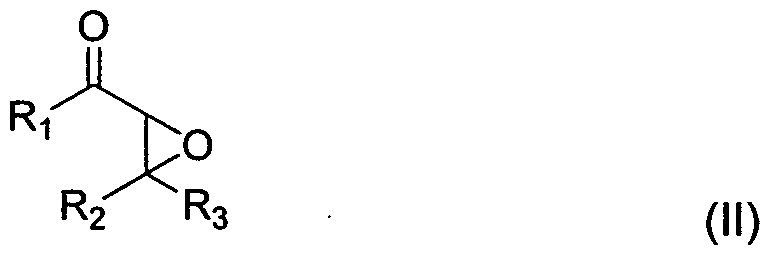
- the present invention is a process for the enantioselective epoxidation of ⁇ , /? - unsaturated ketones, in which a compound of general formula I 1
- R 1 is a branched or unbranched, saturated or unsaturated hydrocarbon radical having 1 to 30 carbon atoms, which may have suitable substituents and may have one or more heteroatoms in the chain
- R 2 is hydrogen, a branched or unbranched, saturated or unsaturated hydrocarbon radical with 1 to 30 carbon atoms which may have suitable substituents and may have one or more heteroatoms in the chain, an aryl group or heteroaryl group which may have suitable substituents,
- R 3 is hydrogen, a branched or unbranched, saturated or unsaturated hydrocarbon radical of 1 to 30 carbon atoms which may have suitable substituents and may have one or more heteroatoms in the chain, an aryl group or heteroaryl group which may have suitable substituents, R 1 , R 2 , R 3 may be the same or different, wherein the radical R 1 with the radicals R 2 and R 3 may form a ring which may be 5- to 20-membered, saturated or unsaturated, alicyclic or heteroalicyclic and have suitable substituents can, with an oxidizing agent to form ⁇ , /? - epoxyketones of general formula II,
- ⁇ , ⁇ -epoxyketones of general formula II are obtained in good yields and excellent enantioselectivities from ⁇ , ⁇ -unsaturated ketones of general formula I by epoxidation with hydrogen peroxide in the presence of a chiral catalyst, such as amino compounds and their acid addition salts
- ⁇ , ⁇ -unsaturated ketones of the general formula I are reacted with a suitable oxidizing agent in the presence of a chiral catalyst.
- a suitable oxidizing agent Any catalyst which promotes the reaction between the ⁇ , ⁇ -unsaturated ketone and the oxidizing agent can be used.
- Organic bases, in particular amines and their acid addition salts, have proved to be particularly suitable.
- the addition salts can be used per se or form in the course of the reaction.
- Preferred amines have a structure of the general formula III, NH 2 R 4
- R 4 is a hydrocarbon group having 1 to 30 carbon atoms, such as a saturated or unsaturated, branched or linear alkyl group, alkenyl group, alkynyl group, aryl group which may have suitable substituents, also heteroatom substituents, a heteroatom-containing hydrocarbon group which may have suitable substituents, and
- the chiral catalyst is preferably selected from chiral amines of the general formula III, from addition salts of achiral amines of the general formula III with chiral acids, from addition salts of chiral amines of the general formula III with achiral or chiral acids.
- achiral acids for example, halogenated carboxylic acids, such as halogenated acetic acids, eg. Trifluoroacetic acid, trichloroacetic acid, difluoroacetic acid and dichloroacetic acid, benzoic acid, substituted benzoic acids, etc.
- halogenated carboxylic acids such as Trifluoroacetic acid, trichloroacetic acid, difluoroacetic acid and dichloroacetic acid, benzoic acid, substituted benzoic acids, etc.
- chiral suitable chiral acids are chiral organic phosphoric acids, phosphorimides, sulfuric acids, sulfonic acids, sulfonamides, carboxylic acids, imides, etc.
- the chiral acids are derived from binaphthol.
- the chiral acid is selected from organic chiral phosphoric acids having the general formula IV,
- R 6 is H, a hydrocarbon group such as a saturated or unsaturated, branched or linear C 1 -C 2 o-alkyl group, C 2 -C 2 o-alkenyl group, C 2 -C 2 o-alkynyl group, A 2ryl group, the suitable substituents, Also, heteroatom substituents may have a heteroatom-containing hydrocarbon group which may have suitable substituents.
- the amine of general formula III is preferably a primary amine. Particularly good results are obtained with amines which are selected from the following compounds of the formulas V, VI and VII
- R 7 represents a hydrocarbon group, such as a saturated or unsaturated, branched or linear alkyl group, alkenyl group, alkynyl group, aryl group, which may have suitable substituents, including heteroatom substituents,, a heteroatom-containing
- R 8 is a hydrocarbon group such as a saturated or unsaturated, branched or linear alkyl group, alkenyl group, alkynyl group, aryl group which may have suitable substituents, including heteroatom substituents, a heteroatom-containing
- R 7 , R 8 may be the same or different, wherein the radicals R 7 and R 8 may form a ring which may be 4- to 20-membered, saturated or unsaturated, alicyclic or heteroalicyclic and may have suitable substituents, and
- R 9 is H, a group -OR 10 in which R 10 is hydrogen, a hydrocarbon group having 1 to 30 carbon atoms, such as a saturated or unsaturated, branched or linear alkyl group, alkenyl group,
- Alkinyl group aryl group, which may have suitable substituents, including heteroatom substituents, a heteroatom-containing hydrocarbon group, the appropriate
- Substituents may have, stands, stand.
- the catalyst is usually used in an amount of 0.1 to 200 mol%, preferably from 1 to 30 mol%, based on the starting compounds. ⁇
- oxidizing agent is in particular H 2 O 2 , which is preferably used in aqueous solution, in particular in a concentration above 30 wt .-%, preferably between 30 and 50 wt .-%.
- Hydrocarbon group in the context of the invention means a saturated or unsaturated, branched or linear alkyl group, alkenyl group, alkynyl group, aryl group which may have suitable substituents, including heteroatom substituents, or a heteroatom-containing hydrocarbon group.
- Alkyl may be unbranched (linear) or branched and has 1 to 30, preferably 1, 2, 3, 4, 5, 6, 7, 8, 9, 10, 11, 12, 13, 14, 15, 16, 17, 18, 19 or 20 carbon atoms.
- Alkyl is preferably methyl, but also ethyl, propyl, isopropyl, butyl, isobutyl, sec-botyl or tert-butyl, as well as pentyl, 1-, 2- or 3-methylpropyl, 1, 1, 1, 2 or 2 , 2-dimethylpropyl, 1-ethylpropyl, hexyl, 1-, 2-, 3- or 4-methylpentyl, 1, 1-, 1, 2-, 1,3-, 2,2-, 2,3- or 3, 3-dimethylbutyl, 1- or 2-ethylbutyl, 1-ethyl-1-methylpropyl, 1-ethyl-2-methylpropyl, 1, 1, 2- or 1, 2,2-trimethylpropyl, but preferably also, for example Trifluoromethyl.
- Alkyl is particularly preferably an alkyl having 1, 2, 3, 4, 5 or 6 carbon atoms, preferably methyl, ethyl, propyl, isopropyl, butyl, isopropyl, sec-butyl, tert-butyl, pentyl, hexyl, trifluoromethyl, pentafluoroethyl or 1 , 1,1-trifluoroethyl.
- Cycloalkyl is preferably cyclopropyl, cyclobutyl, cyclopentyl, cyclohexyl or cycloheptyl.
- Alkylene is preferably methylene, ethylene, propylene, butylene, pentylene or hexylene, but also branched alkylene.
- Alkylene is preferably vinyl.
- Alkynyl is preferably C ⁇ CH.
- Halogen is F, Cl, G, Br or I.
- Alkoxy is preferably methoxy, ethoxy, propoxy or butoxy.
- C 3 -C 8 heterocycloalkyl having one or more heteroatoms selected from N, O and S is preferably 2,3-dihydro-2-, -3-, -A- or -5-furyl, 2,5-dihydro-2 -, -3-, -4- or -5-furyl, tetrahydro-2- or -3-furyl, 1, 3-dioxolan-4-yl, tetrahydro-2- or 3-thienyl, 2,3-dihydro 1-, -2-, -3-, -4- or -5-pyrrolyl, 2,5-dihydro-1-, -2-, -3-, -A- or -5-pyrrolyl, 1-, 2- or 3-pyrrolidinyl, tetrahydro-1-, 2- or -4-imidazolyl, 2,3-dihydro-1-, 2-, -3-, -A- or -5-pyrazolyl, tetrahydro -1
- Optionally substituted means unsubstituted or mono-, di-, tri-, tetra- or pentasubstituted.
- Aryl is preferably phenyl, naphthyl or diphenyl.
- Arylalkyl is preferably benzyl.
- Heteroaryl having one or more heteroatoms selected from N, O and S is preferably 2- or 3-furyl, 2- or 3-thienyl, 1-, 2- or 3-pyrrolyl, 1-, 2-, 4- or 5- imidazolyl, 1-, 3-, 4- or 5-pyrazolyl, 2-, 4- or 5-oxazolyl, 3-, 4- or 5-isoxazolyl, 2-, A- or 5-thiazolyl, 3-, 4- or 5-isothiazolyl, 2-, 3- or 4-pyridyl, 2-, 4-, 5- or 6-pyrimidinyl, furthermore preferably 1,2,3-triazole-1, -A- or -5-yl, 1, 2,4-triazole-i-, -3- or -5-yl, 1- or 5-tetrazolyl, 1, 2,3-oxadiazol-4 or 5-yl, 1, 2,4-oxadiazole -3- or -5-yl, 1, 3,4-thiadiazol-2 or -5-yl, 1, 2,4-thiadiazol-3 or
- substituents are C 1 -C 4 -alk (en) yl, aryl, heteroaryl, halogen, such as F, Cl, Br, I, NO 2 , amino, etc.
- reaction can be carried out in conventional polar or non-polar organic solvents.
- the catalyst salts AC were prepared in situ in dioxane (2-4 ml) of the amine (10 mol%) and the respective acid (10-20 mol%). After stirring for 20 minutes, the ⁇ , ⁇ -unsaturated ketones were added and after a further 20 minutes, 1.5 equivalents of aqueous hydrogen peroxide solution (50% w / w) were added. After a reaction time of 20-72 h at 30-50 0 C, the reaction mixture was cooled and treated with water.
- the mixture was then chromatographed (SiO 2 , ether / pentane)skyreingt.
- catalyst A 1.0 mmol scale relative to the ⁇ .yff-unsaturated ketone.
- the catalyst salt A was prepared from 9-amino-9-deoxyepiquinines (8.1 mg, 0.1 mmol, 10 mol%) and TFA (15.3 / vl_, 0.2 mmol, 20 mol%).
- Catalyst salt B 0.5 mmol scale based on the ⁇ , /? - unsaturated ketone.
- Catalyst salt B was prepared from (RR) -DPEN (10.6 mg, 0.05 mmol, 10 mol%) and S-TRIP (37.6 mg, 0.05 mmol, 10 mol%).
- catalyst C 1.0 mmol scale based on the ⁇ , /? - unsaturated ketone.
- Catalyst salt C was prepared from 9-amino-9-deoxyepiquinidines (8.1 mg, 0.1 mmol, 10 mol%) and TFA (15.3 ⁇ l, 0.2 mmol, 20 mol%).
Landscapes
- Chemical & Material Sciences (AREA)
- Organic Chemistry (AREA)
- Inorganic Chemistry (AREA)
- Epoxy Compounds (AREA)
- Heterocyclic Carbon Compounds Containing A Hetero Ring Having Oxygen Or Sulfur (AREA)
- Organic Low-Molecular-Weight Compounds And Preparation Thereof (AREA)
- Catalysts (AREA)
- Low-Molecular Organic Synthesis Reactions Using Catalysts (AREA)
Abstract
Description




Claims


Priority Applications (7)
| Application Number | Priority Date | Filing Date | Title |
|---|---|---|---|
| JP2010550026A JP5523355B2 (ja) | 2008-03-12 | 2009-03-12 | キラルのα,β−エポキシケトンの製造方法 |
| US12/920,877 US8471046B2 (en) | 2008-03-12 | 2009-03-12 | Method for producing chiral α,β-epoxy ketones |
| ES09720354.1T ES2523717T3 (es) | 2008-03-12 | 2009-03-12 | Método para preparar epoxi-cetonas quirales |
| EP09720354.1A EP2271633B1 (de) | 2008-03-12 | 2009-03-12 | Verfahren zur herstellung von chiralen , -epoxyketonen |
| DK09720354.1T DK2271633T3 (en) | 2008-03-12 | 2009-03-12 | Process for the preparation of chiral alpha, beta-epoxy ketones |
| CN200980108536.2A CN101970421B (zh) | 2008-03-12 | 2009-03-12 | 制备手性α,β-环氧酮的方法 |
| CA2717558A CA2717558A1 (en) | 2008-03-12 | 2009-03-12 | Method for producing chiral .alpha.,.beta.-epoxy ketones |
Applications Claiming Priority (2)
| Application Number | Priority Date | Filing Date | Title |
|---|---|---|---|
| DE102008013962A DE102008013962A1 (de) | 2008-03-12 | 2008-03-12 | Verfahren zur Herstellung von chiralen a,ß-Epoxyketonen |
| DE102008013962.9 | 2008-03-12 |
Publications (1)
| Publication Number | Publication Date |
|---|---|
| WO2009112014A1 true WO2009112014A1 (de) | 2009-09-17 |
Family
ID=40790998
Family Applications (1)
| Application Number | Title | Priority Date | Filing Date |
|---|---|---|---|
| PCT/DE2009/000315 Ceased WO2009112014A1 (de) | 2008-03-12 | 2009-03-12 | VERFAHREN ZUR HERSTELLUNG VON CHIRALEN α,β-EPOXYKETONEN |
Country Status (10)
| Country | Link |
|---|---|
| US (1) | US8471046B2 (de) |
| EP (1) | EP2271633B1 (de) |
| JP (1) | JP5523355B2 (de) |
| KR (1) | KR101558015B1 (de) |
| CN (1) | CN101970421B (de) |
| CA (1) | CA2717558A1 (de) |
| DE (1) | DE102008013962A1 (de) |
| DK (1) | DK2271633T3 (de) |
| ES (1) | ES2523717T3 (de) |
| WO (1) | WO2009112014A1 (de) |
Cited By (1)
| Publication number | Priority date | Publication date | Assignee | Title |
|---|---|---|---|---|
| WO2014024753A1 (ja) * | 2012-08-07 | 2014-02-13 | 国立大学法人名古屋工業大学 | 不斉四級炭素を有するβ-置換-β-トリフルオロメチル-α、β-エポキシケトン化合物およびその製造方法 |
Families Citing this family (1)
| Publication number | Priority date | Publication date | Assignee | Title |
|---|---|---|---|---|
| KR102689388B1 (ko) | 2022-01-12 | 2024-07-30 | 건국대학교 산학협력단 | 화학적 분해가 가능한 에폭시 화합물, 이의 제조방법, 이를 포함하는 에폭시 복합재료 및 이의 분해방법 |
Citations (1)
| Publication number | Priority date | Publication date | Assignee | Title |
|---|---|---|---|---|
| WO2005077908A1 (ja) | 2004-02-18 | 2005-08-25 | Takasago International Corporation | グアニジン化合物及びそれを用いる不斉反応 |
-
2008
- 2008-03-12 DE DE102008013962A patent/DE102008013962A1/de not_active Withdrawn
-
2009
- 2009-03-12 US US12/920,877 patent/US8471046B2/en not_active Expired - Fee Related
- 2009-03-12 CA CA2717558A patent/CA2717558A1/en not_active Abandoned
- 2009-03-12 ES ES09720354.1T patent/ES2523717T3/es active Active
- 2009-03-12 KR KR1020107022159A patent/KR101558015B1/ko not_active Expired - Fee Related
- 2009-03-12 WO PCT/DE2009/000315 patent/WO2009112014A1/de not_active Ceased
- 2009-03-12 JP JP2010550026A patent/JP5523355B2/ja not_active Expired - Fee Related
- 2009-03-12 DK DK09720354.1T patent/DK2271633T3/en active
- 2009-03-12 EP EP09720354.1A patent/EP2271633B1/de not_active Not-in-force
- 2009-03-12 CN CN200980108536.2A patent/CN101970421B/zh not_active Expired - Fee Related
Patent Citations (1)
| Publication number | Priority date | Publication date | Assignee | Title |
|---|---|---|---|---|
| WO2005077908A1 (ja) | 2004-02-18 | 2005-08-25 | Takasago International Corporation | グアニジン化合物及びそれを用いる不斉反応 |
Non-Patent Citations (18)
| Title |
|---|
| GENSKI T ET AL.: "Epoxidation of electron defieient alkenes using tert-butyl hydroperoxide and 1,5,7-triazabieye)o[4.4.0]dec-5-ene and its Derivatives", SYNLETT, 1999, pages 795 - 797 |
| GENSKI T ET AL: "Epoxidation of electron deficient alkenes using tert-butyl hydroperoxide and 1,5,7-triazabicyclo[4.4,0]dec-5-ene and its Derivatives", SYNLETT 1999 DE, no. 6, 1999, pages 795 - 797, XP002534895, ISSN: 0936-5214 * |
| LATTANZI ALESSANDRA: "ADVANCED SYNTHESIS & CATALYSIS", vol. 348, 2006, WILEY VCH VERLAG, article "Bis/3,5-dimethylphenyl)-(S)-pyrrolidin-2-ylmethanol: an Improved Organocatalyst for the Asymmetrie Epoxidation of alpha, beta-Enones", pages: 339 - 346 |
| LATTANZI ALESSANDRA: "Advances in asymmetric epoxidation of alpha,beta-unsaturated carbonyl compounds: The organocatalytic approach", CURRENT ORGANIC SYNTHESIS, vol. 5, no. 2, May 2008 (2008-05-01), pages 117 - 133, XP009119114, ISSN: 1570-1794 * |
| LATTANZI ALESSANDRA: "Bis/3,5-dimethylphenyl)-(S)-pyrrolidin-2-ylmethanol: an Improved Organocatalyst for the Asymmetric Epoxidation of alpha,beta-Enones", ADVANCED SYNTHESIS & CATALYSIS., vol. 348, 2006, WILEY VCH VERLAG, WEINHEIM., pages 339 - 346, XP002534899, ISSN: 1615-4150 * |
| LATTANZI ALESSANDRA: "Enantioselective epoxidation of alpha,beta-enones promoted by alpha,alpha-diphEmyl-L-prolinol as bifunctional organocatalyst", ORGANIC LETTERS, vol. 7, no. 13, 23 June 2005 (2005-06-23), pages 2579 - 2582 |
| LATTANZI ALESSANDRA: "Enantioselective epoxidation of alpha,beta-enones promoted by alpha,alpha-diphenyl-L-prolinol as bifunctional organocatalyst.", ORGANIC LETTERS 23 JUN 2005, vol. 7, no. 13, 23 June 2005 (2005-06-23), pages 2579 - 2582, XP002534898, ISSN: 1523-7060 * |
| LI YAWEN ET AL.: "4-Substituted-alpha,alpha-diaryl-prolinols improve the enantioselective catalytic epoxidation of alpha,beta enones", THE JOURNAL OF ORGANIC CHEMISTRY, vol. 72, no. 1, 5 January 2007 (2007-01-05), pages 288 - 291 |
| LI YAWEN ET AL: "4-Substituted-alpha,alpha-diaryl-prolinols improve the enantioselective catalytic epoxidation of alpha,beta-enones.", THE JOURNAL OF ORGANIC CHEMISTRY 5 JAN 2007, vol. 72, no. 1, 5 January 2007 (2007-01-05), pages 288 - 291, XP002534904, ISSN: 0022-3263 * |
| MCMANUS J C ET AL.: "Enantiopure guanidine bases for enantioselective enone epoxidations: 2, cyclic guanidines", SYNLETT, 2003, pages 369 - 371 |
| MCMANUS J C ET AL.: "Enantiopure guanidine bases for enantioseleetive enone epoxidations: 1, Acyelic guanidines", SYNLETT, pages 365 - 368 |
| MCMANUS J C ET AL: "Enantiopure guanidine bases for enantioselective enone epoxidations: 1, Acyclic guanidines", SYNLETT 2003 DE, no. 3, 2003, pages 365 - 368, XP002534896, ISSN: 0936-5214 * |
| MCMANUS J C ET AL: "Enantiopure guanidine bases for enantioselective enone epoxidations: 2, cyclic guanidines", SYNLETT 2003 DE, no. 3, 2003, pages 369 - 371, XP002534897, ISSN: 0936-5214 * |
| PORTER M J ET AL.: "Asymmetric epoxidation of eleetrondeficient olefins", CHEMICAL COMMUNICATIONS, 21 July 2000 (2000-07-21), pages 1215 - 1225 |
| PORTER M J ET AL: "Asymmetric epoxidation of electron-deficient olefins", CHEMICAL COMMUNICATIONS 20000721 GB, no. 14, 21 July 2000 (2000-07-21), pages 1215 - 1225, XP002534894, ISSN: 1359-7345 * |
| WANG XINGWANG ET AL.: "Asymmetric counteranion-directed catalysis for the epoxidation of enals", ANGEWANDTE CHEMIE (INTERNATIONAL ED. IN ENGLISH, vol. 47, no. 6, 27 December 2007 (2007-12-27), pages 1119 - 1122 |
| WANG XINGWANG ET AL: "Asymmetric counteranion-directed catalysis for the epoxidation of enals.", ANGEWANDTE CHEMIE (INTERNATIONAL ED. IN ENGLISH) 2008, vol. 47, no. 6, 27 December 2007 (2007-12-27), pages 1119 - 1122, XP002534900, ISSN: 1521-3773 * |
| WANG XINGWANG ET AL: "Catalytic asymmetric epoxidation of cyclic enones.", JOURNAL OF THE AMERICAN CHEMICAL SOCIETY 14 MAY 2008, vol. 130, no. 19, 14 May 2008 (2008-05-14), pages 6070 - 6071, XP002534893, ISSN: 1520-5126 * |
Cited By (1)
| Publication number | Priority date | Publication date | Assignee | Title |
|---|---|---|---|---|
| WO2014024753A1 (ja) * | 2012-08-07 | 2014-02-13 | 国立大学法人名古屋工業大学 | 不斉四級炭素を有するβ-置換-β-トリフルオロメチル-α、β-エポキシケトン化合物およびその製造方法 |
Also Published As
| Publication number | Publication date |
|---|---|
| JP2011513443A (ja) | 2011-04-28 |
| ES2523717T3 (es) | 2014-12-01 |
| US8471046B2 (en) | 2013-06-25 |
| KR101558015B1 (ko) | 2015-10-06 |
| JP5523355B2 (ja) | 2014-06-18 |
| KR20100124310A (ko) | 2010-11-26 |
| EP2271633B1 (de) | 2014-08-27 |
| CN101970421A (zh) | 2011-02-09 |
| US20110009650A1 (en) | 2011-01-13 |
| DK2271633T3 (en) | 2014-11-24 |
| EP2271633A1 (de) | 2011-01-12 |
| DE102008013962A1 (de) | 2009-09-17 |
| CA2717558A1 (en) | 2009-09-17 |
| CN101970421B (zh) | 2014-03-26 |
Similar Documents
| Publication | Publication Date | Title |
|---|---|---|
| DE69811612T2 (de) | Verfahren zur Herstellung von Reinst-Epichlorhydrin | |
| DE69616895T2 (de) | Epoxidierungsverfahren unter Verwendung von Titanium enthaltenden Molekularsieben als Katalysatoren | |
| DE1670529A1 (de) | Verfahren zur Herstellung von neuen substituierten,biologisch aktiven s-Triazinen | |
| EP2217579B1 (de) | Verfahren zur herstellung von 3,6-dihydro-1,3,5-triazin-derivaten | |
| EP0280781B1 (de) | Verfahren zur Herstellung von N-Alkyl-N'-methyl-alkylenharnstoffen, insbesondere N,N'-Dimethylalkylenharnstoffen | |
| WO2009112014A1 (de) | VERFAHREN ZUR HERSTELLUNG VON CHIRALEN α,β-EPOXYKETONEN | |
| DE60013049T2 (de) | Verfahren zur Herstellung von Olefinoxiden | |
| DE2239681C3 (de) | Verfahren zur Epoxidierung von olefinisch ungesättigten Verbindungen mit Wasserstoffperoxid | |
| DE2520120A1 (de) | Verfahren zur herstellung von phenolen | |
| EP0124014A2 (de) | Verfahren zur Herstellung von Oxiranen | |
| EP2877451B1 (de) | Verfahren zur herstellung von substituierten indolderivaten | |
| EP2403842B1 (de) | Chirale disulfonimide | |
| EP2697184B1 (de) | Verfahren zur herstellung von aromatischen und heteroaromatischen aminen | |
| EP1654265A1 (de) | Immobilisierbare n-heterozyklische carbene | |
| DE1261852B (de) | Verfahren zur Herstellung von 2-Aminothiazolen | |
| EP0002721A2 (de) | Verfahren zur Herstellung von Hydrazinen | |
| DE1957859A1 (de) | Verfahren zur Herstellung von 2,3-Dihydro-p-oxathiinen und deren Sulfoxiden und Sulfonen | |
| DE2854152A1 (de) | Verfahren zur herstellung von anilinderivaten | |
| DE1815998A1 (de) | Metallorganische Peroxydverbindungen des Molybdaens und des Wolframs,Sowie Verfahren zu ihrer Herstellung und Anwendung | |
| DE19954396A1 (de) | Verfahren zur Herstellung von Nitrosobenzolen | |
| EP0137176A1 (de) | N,N'-Bis-(2,3-epoxypropyl)-derivate cyclischer Dicarbonsäurehydrazide und ein Verfahren zu ihrer Herstellung | |
| PL213050B1 (pl) | Nowy związek 1-glicydoloksy-4-hydroksybutan i sposób wytwarzania 1-glicydoloksy-4-hydroksybutanu | |
| HU188537B (en) | Process for producing new heparine-amine-komplexes |
Legal Events
| Date | Code | Title | Description |
|---|---|---|---|
| WWE | Wipo information: entry into national phase |
Ref document number: 200980108536.2 Country of ref document: CN |
|
| 121 | Ep: the epo has been informed by wipo that ep was designated in this application |
Ref document number: 09720354 Country of ref document: EP Kind code of ref document: A1 |
|
| WWE | Wipo information: entry into national phase |
Ref document number: 6159/DELNP/2010 Country of ref document: IN |
|
| WWE | Wipo information: entry into national phase |
Ref document number: 2717558 Country of ref document: CA |
|
| WWE | Wipo information: entry into national phase |
Ref document number: 12920877 Country of ref document: US |
|
| WWE | Wipo information: entry into national phase |
Ref document number: 2010550026 Country of ref document: JP |
|
| ENP | Entry into the national phase |
Ref document number: 20107022159 Country of ref document: KR Kind code of ref document: A |
|
| WWE | Wipo information: entry into national phase |
Ref document number: 2009720354 Country of ref document: EP |