WO2009123745A1 - Ethylene biosynthesis inhibitor compositions suitable for thermal fogging applications - Google Patents
Ethylene biosynthesis inhibitor compositions suitable for thermal fogging applications Download PDFInfo
- Publication number
- WO2009123745A1 WO2009123745A1 PCT/US2009/002080 US2009002080W WO2009123745A1 WO 2009123745 A1 WO2009123745 A1 WO 2009123745A1 US 2009002080 W US2009002080 W US 2009002080W WO 2009123745 A1 WO2009123745 A1 WO 2009123745A1
- Authority
- WO
- WIPO (PCT)
- Prior art keywords
- weight
- thermal fogging
- liquid composition
- fruit
- ethylene
- Prior art date
- Legal status (The legal status is an assumption and is not a legal conclusion. Google has not performed a legal analysis and makes no representation as to the accuracy of the status listed.)
- Ceased
Links
Classifications
-
- A—HUMAN NECESSITIES
- A01—AGRICULTURE; FORESTRY; ANIMAL HUSBANDRY; HUNTING; TRAPPING; FISHING
- A01N—PRESERVATION OF BODIES OF HUMANS OR ANIMALS OR PLANTS OR PARTS THEREOF; BIOCIDES, e.g. AS DISINFECTANTS, AS PESTICIDES OR AS HERBICIDES; PEST REPELLANTS OR ATTRACTANTS; PLANT GROWTH REGULATORS
- A01N25/00—Biocides, pest repellants or attractants, or plant growth regulators, characterised by their forms, or by their non-active ingredients or by their methods of application, e.g. seed treatment or sequential application; Substances for reducing the noxious effect of the active ingredients to organisms other than pests
- A01N25/02—Biocides, pest repellants or attractants, or plant growth regulators, characterised by their forms, or by their non-active ingredients or by their methods of application, e.g. seed treatment or sequential application; Substances for reducing the noxious effect of the active ingredients to organisms other than pests containing liquids as carriers, diluents or solvents
-
- A—HUMAN NECESSITIES
- A01—AGRICULTURE; FORESTRY; ANIMAL HUSBANDRY; HUNTING; TRAPPING; FISHING
- A01N—PRESERVATION OF BODIES OF HUMANS OR ANIMALS OR PLANTS OR PARTS THEREOF; BIOCIDES, e.g. AS DISINFECTANTS, AS PESTICIDES OR AS HERBICIDES; PEST REPELLANTS OR ATTRACTANTS; PLANT GROWTH REGULATORS
- A01N25/00—Biocides, pest repellants or attractants, or plant growth regulators, characterised by their forms, or by their non-active ingredients or by their methods of application, e.g. seed treatment or sequential application; Substances for reducing the noxious effect of the active ingredients to organisms other than pests
- A01N25/02—Biocides, pest repellants or attractants, or plant growth regulators, characterised by their forms, or by their non-active ingredients or by their methods of application, e.g. seed treatment or sequential application; Substances for reducing the noxious effect of the active ingredients to organisms other than pests containing liquids as carriers, diluents or solvents
- A01N25/04—Dispersions, emulsions, suspoemulsions, suspension concentrates or gels
- A01N25/06—Aerosols
-
- A—HUMAN NECESSITIES
- A01—AGRICULTURE; FORESTRY; ANIMAL HUSBANDRY; HUNTING; TRAPPING; FISHING
- A01N—PRESERVATION OF BODIES OF HUMANS OR ANIMALS OR PLANTS OR PARTS THEREOF; BIOCIDES, e.g. AS DISINFECTANTS, AS PESTICIDES OR AS HERBICIDES; PEST REPELLANTS OR ATTRACTANTS; PLANT GROWTH REGULATORS
- A01N37/00—Biocides, pest repellants or attractants, or plant growth regulators containing organic compounds containing a carbon atom having three bonds to hetero atoms with at the most two bonds to halogen, e.g. carboxylic acids
- A01N37/44—Biocides, pest repellants or attractants, or plant growth regulators containing organic compounds containing a carbon atom having three bonds to hetero atoms with at the most two bonds to halogen, e.g. carboxylic acids containing at least one carboxylic group or a thio analogue, or a derivative thereof, and a nitrogen atom attached to the same carbon skeleton by a single or double bond, this nitrogen atom not being a member of a derivative or of a thio analogue of a carboxylic group, e.g. amino-carboxylic acids
Definitions
- the present invention generally relates to ethylene synthesis inhibitor compositions for the treatment of crops by thermal fogging post-harvest applications.
- Plants produce ethylene by converting methionine through S- adenosylmethionine into 1-aminocyclopropane-l-carboxylic acid (ACC) which is then broken down into ethylene, HCN and carbon dioxide.
- ACC 1-aminocyclopropane-l-carboxylic acid
- the plant enzyme responsible for the production of ACC is ACC synthase.
- Ethylene a gaseous phytohormone, is believed to be involved in the modulation of a number of plant biochemical pathways affecting such processes as abscission, senescence, flowering, fruit setting, fruit ripening, seed germination, sex expression, root growth, internode elongation, epinasty and geotropism.
- Aminoethoxyvinylglycine is a plant growth regulator which inhibits ethylene production. It acts by inhibiting the plant enzyme ACC synthase. AVG is described, for example, in U.S. Patent No. 6,153,559.
- thermal fogging refers to any technique by which active agents are applied to crops by entraining the active agent in a flow of heated air at controlled temperatures, concentrations and velocities to produce a mist.
- Various forms of thermal fogging techniques are known. For example, U.S. Patent No. 6,723,364 describes some of these techniques.
- a thermal fogging device and a corresponding thermal fogging process are also described, for example, in French patent FR 84 10 372.
- Thermal fogging devices produce a thermal fogging mist from the compositions of the present invention.
- Thermal fogging is suitable for delivery of various molecules and agents to harvested crops, crops being grown indoors and outdoors for the maintenance of quality, prevention of disease, control of pests, etc. It is also suitable for the delivery of molecules and agents to enclosed spaces and outdoor spaces for the control of pests and disease vectors.
- Thermal fogging currently is suitable for molecules and agents that have high thermal stability given the high temperatures utilized in the thermal fogging process. Thermally sensitive molecules suffer unacceptable levels of degradation in the currently practiced thermal fogging techniques. Furthermore, the molecules and agents to be thermally fogged must be compatible with solvent systems suited for the thermal fogging process. Current thermal fogging solvent systems can only tolerate small amounts of water, yet polar charged molecules may require significant amounts of water. However, due to the above limitations, many potentially useful chemicals and agents are poorly suited for efficient and effective delivery using current thermal fogging formulations and current thermal fogging equipment.
- the present invention is generally directed to a liquid composition for the treatment of crops comprising an ethylene synthesis inhibitor, a solvent and water, wherein said composition is suitable for application to said crops by thermal fogging.
- the ethylene synthesis inhibitor is aminoethoxyvinylglycine or a salt thereof; most preferably aminoethoxyvinylglycine hydrochloride (AVG HCl).
- the crop is a fruit.
- the fruit is an apple.
- the crop is a vegetable.
- said liquid composition comprises from about 10.0% to about 90.0% by weight of a solvent.
- the solvent is a low molecular weight diol; most preferably, propylene glycol.
- said liquid composition further comprises an adjuvant selected from the group consisting of alcohols, ethers, esters and dialkylamides, as for example, butyl acetate, dimethyl isosorbide, n-butyl lactate and N,N-dimethyl octanonate/decanoate amide.
- said adjuvant is dimethyl isosorbide.
- said liquid composition further comprises a surfactant.
- said surfactant is a silicone surfactant.
- the invention relates to a liquid composition for the treatment of crops comprising from about 1.0% to about 5.0% by weight aminoethyoxyvinylglycine hydrochloride; from about 10.0% to about 90.0% by weight propylene glycol; from about 1.0% to about 5.0% by weight water; from 0.0% to about 5.0% by weight ethanol; from about 1.0% to about 50.0% by weight dimethyl isosorbide; and from about 0.5% to about 1.0% by weight of an organosilicone surfactant, wherein said composition is suitable for application to said crops by thermal fogging.
- the present invention is generally directed to a liquid composition for the treatment of crops comprising an ethylene synthesis inhibitor, a solvent and water, wherein said composition is suitable for application to said crops by thermal fogging.
- crop(s) refers to the edible parts of terrestrial plants.
- the term includes, but is not limited to, foods.
- Foods include, but are not limited to, vegetables, grains and fruits.
- Vegetables include, but are not limited to, beans, corn, tomatoes, broccoli, soybeans, squash, cucumbers, lettuce, potatoes and onions.
- Grains include, but are not limited to, oats, rice, wheat and barley.
- Fruits include, but are not limited to, apples, pears, peaches and kiwi.
- ethylene synthesis inhibitor refers to a substance that inhibits or regulates the production of ethylene in plants, including post-harvest.
- ethylene synthesis inhibitor includes, but is not limited to, aminoethoxyvinylglycine (AVG), aminooxyacetic acid (AOA), rhizobitoxine, methoxyvinyl glycine (MVG), and salts thereof.
- the ethylene synthesis inhibitor is aminoethoxyvinylglycine (AVG) or aminoethoxyvinylglycine HCl (AVG HCl).
- thermal fogging refers to any technique by which active agents are applied to crops by entraining the active agent in a flow of heated air at controlled temperatures, concentrations and velocities to produce a mist.
- Various forms of thermal fogging techniques are known. For example, U.S. Patent No. 6,723,364 describes some of these techniques.
- a thermal fogging device and a corresponding thermal fogging process are also described, for example, in French patent FR 84 10 372.
- Thermal fogging devices produce a thermal fogging mist from the compositions of the present invention. This thermal fogging mist consists of droplets and comprises particles of the ethylene synthesis inhibitor.
- thermofogging technique uses an "electric thermofogger” (or thermal fogger) instead of a “combustion therofogger”.
- the combustion thermofogger uses hot combustion exhaust gas for atomization of the liquid active agent into fine mists while an electric thermofogger uses an electric heater to heat the air for atomization.
- the electric thermofogger has the advantage of not introducing potentially undesirable combustion exhaust gases, such as carbon dioxide, ethylene and water into the system. Also, the electric thermofogger usually has better control of the atomization air temperature.
- Preferred liquid compositions of the present invention comprise between about 0.1% to about 50% ethylene synthesis inhibitor, preferably from about 0.5% to about 10% by weight ethylene synthesis inhibitor, and most preferably from about 1.0% to about 5% by weight ethylene synthesis inhibitor.
- the liquid composition further comprises a solvent or a mixture of solvents.
- Preferred solvents include but are not limited to, polyols, ethers and ether-alcohols.
- the solvent(s) can be either organic or inorganic. Boiling points of the solvents are preferably between about 70 0 C and about 230 0 C.
- the solvent is a low molecular weight diol; most preferably, the solvent is propylene glycol.
- liquid compositions of the present invention comprise between about 10.0% to about 90% by weight of the solvent.
- the liquid compositions of the present invention also contain from about 0.1 to about 15 weight % water, preferably from about 1.0 to about 5.0 weight % water.
- the liquid composition may further comprise an adjuvant selected from the group consisting of alcohols, ethers, esters and dialkylamides, as for example, ethanol, butyl acetate, dimethyl isosorbide, n-butyl lactate and N, N-dimethyl octanonate/decanoate amide. Most preferably, the adjuvant is dimethyl isosorbide. The adjuvant may be helpful to reduce the viscosity and surface tension of the solution.
- an adjuvant selected from the group consisting of alcohols, ethers, esters and dialkylamides, as for example, ethanol, butyl acetate, dimethyl isosorbide, n-butyl lactate and N, N-dimethyl octanonate/decanoate amide.
- the adjuvant is dimethyl isosorbide.
- the adjuvant may be helpful to reduce the viscosity and surface tension of the solution.
- liquid compositions of the present invention comprise between about 5.0% to about 90% by weight of the adjuvant.
- the liquid composition may comprise another active(s) in addition to an ethylene synthesis inhibitor.
- the composition may also comprise an antioxidant, a sprouting inhibitor, another plant growth regulator and/or a fungicide.
- a surfactant may be added to the liquid composition.
- the surfactant is a non-ionic surfactant that is present in amounts between about 0.5% and about 1.0% by weight of the total composition.
- the surfactant is an organosilicone surfactant such as the commercial products Silwet L-77 (available from Helena Chemical Company) or Sylgard 309 (available from Dow- Corning) or an organosilcone blend surfactant such as the commercial product Kinetic (available from Helena Chemical Company).
- the liquid composition for the treatment of crops comprises from about 1.0% to about 5.0% by weight aminoethoxyvinylglycine hydrochloride; from about 10.0% to about 90.0% by weight propylene glycol; from about 1.0% to about 5.0% by weight water; from 0.0% to about 5.0% by weight ethanol; from about 1.0% to about 50.0% by weight dimethyl isosorbide; and from about 0.5% to about 1.0% by weight of an organosilicone surfactant, wherein said composition is suitable for application to said crops by thermal fogging.
- the thermal fogging composition is preferably applied post-harvest.
- the liquid composition for post-harvest treatment is applied within about 7 days post-harvest. In another embodiment, the liquid composition for post-harvest treatment is applied during post-harvest storage. In yet another embodiment, the liquid composition for post-harvest treatment is applied immediately before, or just after, the completion of post-harvest storage.
- the liquid composition may be applied more than once; the frequency with which the applications are made depends on the crop and the desired effect.
- the crop is a fruit.
- the fruit is an apple.
- the crop is a vegetable.
- the phrase "effective amount" of a thermal fogging mist means a sufficient amount of the thermal fogging mist to provide the desired effect without at the same time causing additional toxic effects.
- the amount of the mist that is “effective” will vary depending on a plant, the desired effect, and the like. Thus, it is not always possible to specify an exact “effective amount.” However, an appropriate “effective amount” in any individual case may be determined by one of ordinary skill in the art using routine experimentation.
- Preferred methods of thermal fogging are methods that provide an effective amount of an ethylene synthesis inhibitor to obtain consistent improvements in retarding crop ripening or senescence after harvest.
- Preferred methods of thermal fogging are methods that provide an effective amount of an ethylene synthesis inhibitor to obtain acceleration of sprouting of vegetables including potatoes or onions.
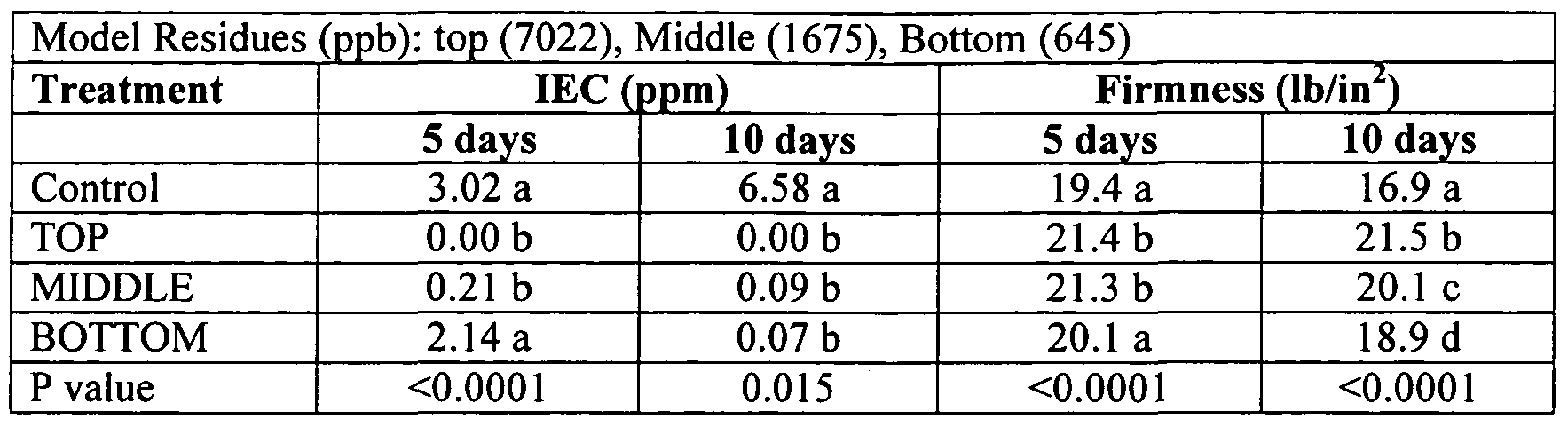
- AVG-HCl thermal fogging was consistently effective in reducing internal ethylene production in apples. Residues higher than approximately 800 parts per billion (ppb) were achieved when measured immediately after application. The dose applied to obtain this level of residues varied depending on fogging parameters used. Effective dosages also increased fruit firmness relative to controls most of the time, when measured 4 to 10 days after application.
- thermofogging treatment varied from pre-climacteric fruit to advanced ripening fruit.
- the first stage was recognized by internal ethylene below 0.1 ppm, usually very firm fruit (above 18 lb/in 2 pressure, but cultivar-dependent), and less than 5 percent of starch degraded. From this point on the ripening process on fruit accelerates leading to increasingly internal ethylene concentration, decrease on fruit firmness, and increase on starch degradation, among other changes.
- thermofogging treatments effectiveness was observed in fruit with various ripening conditions at the moment of the treatment.
- Example 3 Treatment effect after extended storage of apples at low temperature followed by a 7 day period at room temperature, with single and repeated thermal fogging applications of compositions of the present invention.
- Average initial fruit flesh firmness measured at harvest time in a representative number of fruits was 18.4 lbs.
- Single or multiple applications of AVG by thermal fogging effectively delayed the softening process in the fruit flesh (Table 9). Repeated applications tended to delay fruit softening.
Landscapes
- Life Sciences & Earth Sciences (AREA)
- General Health & Medical Sciences (AREA)
- Health & Medical Sciences (AREA)
- Zoology (AREA)
- Agronomy & Crop Science (AREA)
- Pest Control & Pesticides (AREA)
- Plant Pathology (AREA)
- Engineering & Computer Science (AREA)
- Dentistry (AREA)
- Wood Science & Technology (AREA)
- Environmental Sciences (AREA)
- Dispersion Chemistry (AREA)
- Toxicology (AREA)
- Chemical & Material Sciences (AREA)
- Storage Of Fruits Or Vegetables (AREA)
- Agricultural Chemicals And Associated Chemicals (AREA)
Abstract
Description




Claims
Priority Applications (4)
| Application Number | Priority Date | Filing Date | Title |
|---|---|---|---|
| AU2009232336A AU2009232336A1 (en) | 2008-04-03 | 2009-04-02 | Ethylene biosynthesis inhibitor compositions suitable for thermal fogging applications |
| BRPI0909712-0A BRPI0909712A2 (en) | 2008-04-03 | 2009-04-02 | Liquid composition for crop treatment |
| CA2720308A CA2720308A1 (en) | 2008-04-03 | 2009-04-02 | Ethylene biosynthesis inhibitor compositions suitable for thermal fogging applications |
| ZA2010/06629A ZA201006629B (en) | 2008-04-03 | 2010-09-15 | Ethylene biosynthesis inhibitor compositions suitable for thermal fogging applications |
Applications Claiming Priority (2)
| Application Number | Priority Date | Filing Date | Title |
|---|---|---|---|
| US4206708P | 2008-04-03 | 2008-04-03 | |
| US61/042,067 | 2008-04-03 |
Publications (1)
| Publication Number | Publication Date |
|---|---|
| WO2009123745A1 true WO2009123745A1 (en) | 2009-10-08 |
Family
ID=41133810
Family Applications (1)
| Application Number | Title | Priority Date | Filing Date |
|---|---|---|---|
| PCT/US2009/002080 Ceased WO2009123745A1 (en) | 2008-04-03 | 2009-04-02 | Ethylene biosynthesis inhibitor compositions suitable for thermal fogging applications |
Country Status (7)
| Country | Link |
|---|---|
| US (1) | US20090253578A1 (en) |
| AU (1) | AU2009232336A1 (en) |
| BR (1) | BRPI0909712A2 (en) |
| CA (1) | CA2720308A1 (en) |
| CL (1) | CL2009000728A1 (en) |
| WO (1) | WO2009123745A1 (en) |
| ZA (1) | ZA201006629B (en) |
Families Citing this family (3)
| Publication number | Priority date | Publication date | Assignee | Title |
|---|---|---|---|---|
| WO2023288294A1 (en) | 2021-07-16 | 2023-01-19 | Novozymes A/S | Compositions and methods for improving the rainfastness of proteins on plant surfaces |
| EP4525615A2 (en) | 2022-05-14 | 2025-03-26 | Novozymes A/S | Compositions and methods for preventing, treating, supressing and/or eliminating phytopathogenic infestations and infections |
| KR102511470B1 (en) | 2022-07-20 | 2023-03-17 | 서울대학교산학협력단 | Environmental-friendly thermal fogging agent and method for manufacturing the same |
Citations (6)
| Publication number | Priority date | Publication date | Assignee | Title |
|---|---|---|---|---|
| US6723364B1 (en) * | 1998-12-03 | 2004-04-20 | Xeda International | Fog treatment method using a liquid composition for treating fruits and vegetables and implementing device |
| US20050009834A1 (en) * | 2001-05-09 | 2005-01-13 | Shigeyuki Itoh | Azole compounds, process for preparation of the same and use thereof |
| US20050159599A1 (en) * | 2002-03-05 | 2005-07-21 | Shigeyuki Itoh | Cyclic compound, process for producing the same, and pest control agent |
| US20070020304A1 (en) * | 2002-10-25 | 2007-01-25 | Foamix Ltd. | Non-flammable insecticide composition and uses thereof |
| US20070199242A1 (en) * | 2002-08-09 | 2007-08-30 | James Hansen | Promoting early establishment of potato crops by ethylene inhibitors |
| US20080039322A1 (en) * | 2004-05-24 | 2008-02-14 | Yueh Wang | Stable and Water-Soluble Plant Growth Regulator Liquid Compositions and Methods for Use of Same |
Family Cites Families (3)
| Publication number | Priority date | Publication date | Assignee | Title |
|---|---|---|---|---|
| AU2005242218A1 (en) * | 2005-01-14 | 2006-08-03 | Rohm And Haas Company | Plant growth regulation |
| FR2885536B1 (en) * | 2005-05-12 | 2007-07-27 | Roquette Freres | COMPOSITION BASED ON DIANHYDROHEXITOL ETHERS FOR THE TREATMENT OF MATTER OTHER THAN THE HUMAN BODY |
| BRPI0718215A2 (en) * | 2006-11-03 | 2013-11-12 | Valent Biosciences Corp | FORMULATION AND METHOD FOR INHIBITION OF ETHYLEN IN A HARVEST PLANT. |
-
2009
- 2009-03-25 CL CL2009000728A patent/CL2009000728A1/en unknown
- 2009-04-02 US US12/417,016 patent/US20090253578A1/en not_active Abandoned
- 2009-04-02 BR BRPI0909712-0A patent/BRPI0909712A2/en not_active IP Right Cessation
- 2009-04-02 WO PCT/US2009/002080 patent/WO2009123745A1/en not_active Ceased
- 2009-04-02 AU AU2009232336A patent/AU2009232336A1/en not_active Abandoned
- 2009-04-02 CA CA2720308A patent/CA2720308A1/en not_active Abandoned
-
2010
- 2010-09-15 ZA ZA2010/06629A patent/ZA201006629B/en unknown
Patent Citations (6)
| Publication number | Priority date | Publication date | Assignee | Title |
|---|---|---|---|---|
| US6723364B1 (en) * | 1998-12-03 | 2004-04-20 | Xeda International | Fog treatment method using a liquid composition for treating fruits and vegetables and implementing device |
| US20050009834A1 (en) * | 2001-05-09 | 2005-01-13 | Shigeyuki Itoh | Azole compounds, process for preparation of the same and use thereof |
| US20050159599A1 (en) * | 2002-03-05 | 2005-07-21 | Shigeyuki Itoh | Cyclic compound, process for producing the same, and pest control agent |
| US20070199242A1 (en) * | 2002-08-09 | 2007-08-30 | James Hansen | Promoting early establishment of potato crops by ethylene inhibitors |
| US20070020304A1 (en) * | 2002-10-25 | 2007-01-25 | Foamix Ltd. | Non-flammable insecticide composition and uses thereof |
| US20080039322A1 (en) * | 2004-05-24 | 2008-02-14 | Yueh Wang | Stable and Water-Soluble Plant Growth Regulator Liquid Compositions and Methods for Use of Same |
Also Published As
| Publication number | Publication date |
|---|---|
| CA2720308A1 (en) | 2009-10-08 |
| US20090253578A1 (en) | 2009-10-08 |
| AU2009232336A1 (en) | 2009-10-08 |
| CL2009000728A1 (en) | 2009-11-13 |
| ZA201006629B (en) | 2011-05-25 |
| BRPI0909712A2 (en) | 2015-07-28 |
Similar Documents
| Publication | Publication Date | Title |
|---|---|---|
| CN101073320B (en) | Crop and composition contact | |
| Nock et al. | Preharvest application of 1-methylcyclopropene (1-MCP) to control fruit drop of apples, and its effects on postharvest quality | |
| EA023771B1 (en) | Active compound combinations comprising a (thio)carboxamide derivative and an insecticidal or acaricidal or nematicidal active compound | |
| WO2014070476A1 (en) | Control of ripening and senescence in pre-harvest and post-harvest plants and plant materials | |
| Lee | Quality characteristics, carbon dioxide, and ethylene production of asparagus (Asparagus officinalis L.) treated with 1-methylcyclopropene and 2-chloroethylphosphonic acid during storage | |
| US20090253579A1 (en) | Methods of Applying Ethylene Biosynthesis Inhibitor Compositions by Thermal Fogging | |
| US20090253578A1 (en) | Ethylene Biosynthesis Inhibitor Compositions Suitable for Thermal Fogging Applications | |
| EP0337758A2 (en) | Fungicides | |
| WO2017075662A1 (en) | Method of retarding an ethylene response | |
| Rodov et al. | Modified-atmosphere packaging improves keeping quality of Charentais-type melons | |
| EP3010337A1 (en) | Compositions and methods for post-harvest treatment | |
| US9363996B2 (en) | Compositions and method for blocking ethylene response in field crops using 3-(cy-clopropyl-l-enyl)-propanoic salt | |
| CN107592788A (en) | The method for handling crop plants | |
| Sakaldas et al. | The effects of preharvest 1-methylcyclopropene (Harvista) treatments on harvest maturity of'Santa Maria'pear cultivar | |
| European Food Safety Authority | Reasoned opinion on the modification of the existing MRLs for ametoctradin in various commodities | |
| Banda | Postharvest physiology of sweet potato (Ipomoea batatas L.) storage roots: the effects of curing, and ethylene and 1-methylcyclopropene on quality attributes | |
| JP7852810B2 (en) | High-temperature tolerance inducer and method for inducing high-temperature tolerance in plants | |
| US12599128B2 (en) | Composition and method for improving agronomic traits of a plant | |
| Ozer et al. | Postharvest quality of'Hachiya'astringent persimmons (Diospyros kaki L.) as affected by hot water treatment and modified atmosphere packaging. | |
| WO2024238514A1 (en) | Improvement of plant part quality | |
| Streif | Regulation of postharvest fruit ripening by innovative storage technology | |
| Bai JinHe et al. | Effect of 1-MCP pretreatment, CA storage and subsequent marketing temperature on volatile profile of'Gala'apple. | |
| JP2004168669A (en) | Putrefaction-preventing agent for field crop | |
| سارفارازي الباماني et al. | Postharvest Quality of Two Pomegranate Genotypes as Influenced by Storage Temperature and Period | |
| Al-Bamarny et al. | Postharvest Quality of Two Pomegranate Genotypes as Influenced by Storage Temperature and Period. |
Legal Events
| Date | Code | Title | Description |
|---|---|---|---|
| 121 | Ep: the epo has been informed by wipo that ep was designated in this application |
Ref document number: 09727627 Country of ref document: EP Kind code of ref document: A1 |
|
| WWE | Wipo information: entry into national phase |
Ref document number: 587970 Country of ref document: NZ Ref document number: 2009232336 Country of ref document: AU |
|
| WWE | Wipo information: entry into national phase |
Ref document number: 2720308 Country of ref document: CA |
|
| NENP | Non-entry into the national phase |
Ref country code: DE |
|
| ENP | Entry into the national phase |
Ref document number: 2009232336 Country of ref document: AU Date of ref document: 20090402 Kind code of ref document: A |
|
| 122 | Ep: pct application non-entry in european phase |
Ref document number: 09727627 Country of ref document: EP Kind code of ref document: A1 |
|
| ENP | Entry into the national phase |
Ref document number: PI0909712 Country of ref document: BR Kind code of ref document: A2 Effective date: 20100929 |