WO2009134043A2 - 점착 시트, 그 제조 방법, 광학 필터 및 플라즈마 디스플레이 패널 - Google Patents
점착 시트, 그 제조 방법, 광학 필터 및 플라즈마 디스플레이 패널 Download PDFInfo
- Publication number
- WO2009134043A2 WO2009134043A2 PCT/KR2009/002194 KR2009002194W WO2009134043A2 WO 2009134043 A2 WO2009134043 A2 WO 2009134043A2 KR 2009002194 W KR2009002194 W KR 2009002194W WO 2009134043 A2 WO2009134043 A2 WO 2009134043A2
- Authority
- WO
- WIPO (PCT)
- Prior art keywords
- meth
- weight
- adhesive sheet
- parts
- acrylate
- Prior art date
- Legal status (The legal status is an assumption and is not a legal conclusion. Google has not performed a legal analysis and makes no representation as to the accuracy of the status listed.)
- Ceased
Links
Classifications
-
- C—CHEMISTRY; METALLURGY
- C09—DYES; PAINTS; POLISHES; NATURAL RESINS; ADHESIVES; COMPOSITIONS NOT OTHERWISE PROVIDED FOR; APPLICATIONS OF MATERIALS NOT OTHERWISE PROVIDED FOR
- C09J—ADHESIVES; NON-MECHANICAL ASPECTS OF ADHESIVE PROCESSES IN GENERAL; ADHESIVE PROCESSES NOT PROVIDED FOR ELSEWHERE; USE OF MATERIALS AS ADHESIVES
- C09J7/00—Adhesives in the form of films or foils
- C09J7/30—Adhesives in the form of films or foils characterised by the adhesive composition
- C09J7/38—Pressure-sensitive adhesives [PSA]
-
- C—CHEMISTRY; METALLURGY
- C09—DYES; PAINTS; POLISHES; NATURAL RESINS; ADHESIVES; COMPOSITIONS NOT OTHERWISE PROVIDED FOR; APPLICATIONS OF MATERIALS NOT OTHERWISE PROVIDED FOR
- C09J—ADHESIVES; NON-MECHANICAL ASPECTS OF ADHESIVE PROCESSES IN GENERAL; ADHESIVE PROCESSES NOT PROVIDED FOR ELSEWHERE; USE OF MATERIALS AS ADHESIVES
- C09J133/00—Adhesives based on homopolymers or copolymers of compounds having one or more unsaturated aliphatic radicals, each having only one carbon-to-carbon double bond, and at least one being terminated by only one carboxyl radical, or of salts, anhydrides, esters, amides, imides, or nitriles thereof; Adhesives based on derivatives of such polymers
- C09J133/02—Homopolymers or copolymers of acids; Metal or ammonium salts thereof
-
- C—CHEMISTRY; METALLURGY
- C09—DYES; PAINTS; POLISHES; NATURAL RESINS; ADHESIVES; COMPOSITIONS NOT OTHERWISE PROVIDED FOR; APPLICATIONS OF MATERIALS NOT OTHERWISE PROVIDED FOR
- C09J—ADHESIVES; NON-MECHANICAL ASPECTS OF ADHESIVE PROCESSES IN GENERAL; ADHESIVE PROCESSES NOT PROVIDED FOR ELSEWHERE; USE OF MATERIALS AS ADHESIVES
- C09J7/00—Adhesives in the form of films or foils
- C09J7/20—Adhesives in the form of films or foils characterised by their carriers
- C09J7/22—Plastics; Metallised plastics
-
- C—CHEMISTRY; METALLURGY
- C09—DYES; PAINTS; POLISHES; NATURAL RESINS; ADHESIVES; COMPOSITIONS NOT OTHERWISE PROVIDED FOR; APPLICATIONS OF MATERIALS NOT OTHERWISE PROVIDED FOR
- C09J—ADHESIVES; NON-MECHANICAL ASPECTS OF ADHESIVE PROCESSES IN GENERAL; ADHESIVE PROCESSES NOT PROVIDED FOR ELSEWHERE; USE OF MATERIALS AS ADHESIVES
- C09J7/00—Adhesives in the form of films or foils
- C09J7/20—Adhesives in the form of films or foils characterised by their carriers
- C09J7/29—Laminated material
-
- G—PHYSICS
- G02—OPTICS
- G02B—OPTICAL ELEMENTS, SYSTEMS OR APPARATUS
- G02B5/00—Optical elements other than lenses
- G02B5/20—Filters
-
- C—CHEMISTRY; METALLURGY
- C08—ORGANIC MACROMOLECULAR COMPOUNDS; THEIR PREPARATION OR CHEMICAL WORKING-UP; COMPOSITIONS BASED THEREON
- C08K—Use of inorganic or non-macromolecular organic substances as compounding ingredients
- C08K5/00—Use of organic ingredients
- C08K5/0008—Organic ingredients according to more than one of the "one dot" groups of C08K5/01 - C08K5/59
- C08K5/0025—Crosslinking or vulcanising agents; including accelerators
-
- C—CHEMISTRY; METALLURGY
- C08—ORGANIC MACROMOLECULAR COMPOUNDS; THEIR PREPARATION OR CHEMICAL WORKING-UP; COMPOSITIONS BASED THEREON
- C08K—Use of inorganic or non-macromolecular organic substances as compounding ingredients
- C08K5/00—Use of organic ingredients
- C08K5/54—Silicon-containing compounds
- C08K5/541—Silicon-containing compounds containing oxygen
- C08K5/5415—Silicon-containing compounds containing oxygen containing at least one Si—O bond
- C08K5/5419—Silicon-containing compounds containing oxygen containing at least one Si—O bond containing at least one Si—C bond
-
- C—CHEMISTRY; METALLURGY
- C08—ORGANIC MACROMOLECULAR COMPOUNDS; THEIR PREPARATION OR CHEMICAL WORKING-UP; COMPOSITIONS BASED THEREON
- C08L—COMPOSITIONS OF MACROMOLECULAR COMPOUNDS
- C08L2312/00—Crosslinking
-
- C—CHEMISTRY; METALLURGY
- C09—DYES; PAINTS; POLISHES; NATURAL RESINS; ADHESIVES; COMPOSITIONS NOT OTHERWISE PROVIDED FOR; APPLICATIONS OF MATERIALS NOT OTHERWISE PROVIDED FOR
- C09J—ADHESIVES; NON-MECHANICAL ASPECTS OF ADHESIVE PROCESSES IN GENERAL; ADHESIVE PROCESSES NOT PROVIDED FOR ELSEWHERE; USE OF MATERIALS AS ADHESIVES
- C09J2203/00—Applications of adhesives in processes or use of adhesives in the form of films or foils
- C09J2203/318—Applications of adhesives in processes or use of adhesives in the form of films or foils for the production of liquid crystal displays
-
- C—CHEMISTRY; METALLURGY
- C09—DYES; PAINTS; POLISHES; NATURAL RESINS; ADHESIVES; COMPOSITIONS NOT OTHERWISE PROVIDED FOR; APPLICATIONS OF MATERIALS NOT OTHERWISE PROVIDED FOR
- C09J—ADHESIVES; NON-MECHANICAL ASPECTS OF ADHESIVE PROCESSES IN GENERAL; ADHESIVE PROCESSES NOT PROVIDED FOR ELSEWHERE; USE OF MATERIALS AS ADHESIVES
- C09J2433/00—Presence of (meth)acrylic polymer
-
- C—CHEMISTRY; METALLURGY
- C09—DYES; PAINTS; POLISHES; NATURAL RESINS; ADHESIVES; COMPOSITIONS NOT OTHERWISE PROVIDED FOR; APPLICATIONS OF MATERIALS NOT OTHERWISE PROVIDED FOR
- C09J—ADHESIVES; NON-MECHANICAL ASPECTS OF ADHESIVE PROCESSES IN GENERAL; ADHESIVE PROCESSES NOT PROVIDED FOR ELSEWHERE; USE OF MATERIALS AS ADHESIVES
- C09J2467/00—Presence of polyester
- C09J2467/006—Presence of polyester in the substrate
-
- Y—GENERAL TAGGING OF NEW TECHNOLOGICAL DEVELOPMENTS; GENERAL TAGGING OF CROSS-SECTIONAL TECHNOLOGIES SPANNING OVER SEVERAL SECTIONS OF THE IPC; TECHNICAL SUBJECTS COVERED BY FORMER USPC CROSS-REFERENCE ART COLLECTIONS [XRACs] AND DIGESTS
- Y10—TECHNICAL SUBJECTS COVERED BY FORMER USPC
- Y10T—TECHNICAL SUBJECTS COVERED BY FORMER US CLASSIFICATION
- Y10T428/00—Stock material or miscellaneous articles
- Y10T428/28—Web or sheet containing structurally defined element or component and having an adhesive outermost layer
- Y10T428/2848—Three or more layers
Definitions
- the present invention relates to a pressure-sensitive adhesive sheet excellent in high temperature stability, substrate adhesion, adhesion to glass and reworkability, a manufacturing method thereof, an optical filter comprising the above, and a plasma display panel.
- CTR cathode ray tube
- LCD liquid crystal display
- PDP plasma display panel
- Cathode ray tubes which have been widely used until now, are excellent in terms of resolution and image quality, but are not suitable for large screens of 40 inches or more due to the disadvantage of increasing length and weight depending on the size of the screen.
- a plasma display panel (Plasma Display Panel) has the advantage that can be implemented a large screen, and the product is already developed about 100 inches, is leading the large-screen display series with the LCD.
- a phenomenon such as a PDP filter spreading out of the glass occurs due to the high temperature inside the container during transportation using a ship or the like after production.
- Japanese Patent Laid-Open No. 2005-263963 discloses a pressure-sensitive adhesive composition comprising an acrylic copolymer containing an isocyanate group.
- an isocyanate group-containing acrylic copolymer and an acrylic copolymer having no isocyanate group should be used in a two-component type, and therefore, there is a trouble of mixing both before use.
- the isocyanate group contained can react with glass, and there exists a problem that adhesive force with a glass interface becomes high too much.
- Japanese Patent Laid-Open No. 2006-143915 discloses a technique for forming a primer layer from a resin having a reactive functional group on a polyester base film in order to improve the adhesion between the polyester base film and the acrylic pressure sensitive adhesive.
- this technique has the disadvantage that the processing procedure becomes very complicated, and the manufacturing cost greatly increases.
- Japanese Patent Laid-Open No. 2006-290993 discloses a method of increasing adhesion to a substrate by including methacrylate in a hydroxy group-containing acrylic copolymer.
- the above technique does not have a great effect of increasing the glass transition temperature.
- an excessive methacrylate monomer should be added during polymerization. In this case, since the molecular weight of the resin cannot be increased a lot, the problem of poor durability reliability occurs.
- the present invention has been made in view of the above-described problems of the prior art, and has a pressure-sensitive adhesive sheet having excellent substrate adhesion, high temperature stability, adhesion to glass and reworkability, a manufacturing method thereof, the optical filter and the plasma display panel including the same The purpose is to provide.
- the present invention is a means for solving the above problems, a base film having a corona treatment layer on one side or both sides; And
- the present invention also provides another means for solving the above problems, the first step of introducing a hydroxyl group by performing a corona discharge treatment on one side or both sides of the base film;
- It provides a method for producing a pressure-sensitive adhesive sheet according to the present invention comprising a second step of forming a pressure-sensitive adhesive layer on the base film subjected to the corona discharge treatment.
- the present invention also provides another means for solving the above problems, the pressure-sensitive adhesive sheet according to the present invention.
- optical filter comprising a functional film formed on one side or both sides of the adhesive film.
- the present invention also provides a plasma display panel in which the above-described optical filter according to the present invention is attached to the front surface of the panel as another means for solving the above problems.
- the adhesive sheet which has the outstanding base material adhesiveness can be provided through the hydroxyl group introduce
- the present invention the base film having a corona treatment layer on one side or both sides;
- high substrate adhesion can be achieved through the reaction of the hydroxyl group present in the corona treated layer of the base film with the isocyanate compound contained in the pressure-sensitive adhesive layer.
- the kind of base film which comprises the adhesive sheet of this invention is not specifically limited, Any material common in this field can be used. Examples of such a material include a plastic film or glass.
- a polyester film such as polyethylene terephthalate (PET) film is most widely used.
- corona treatment layer is formed on one side or both sides of the base film as described above.
- the term "corona treatment layer” used in the present invention is a layer on which a corona treatment is performed on a base film, and means a region into which a hydroxyl group is introduced through the treatment.
- corona treatment is a treatment method for modifying the surface wettability by introducing a specific functional group (hydroxy group) through irradiation of corona discharge to the substrate to be treated.
- the present invention by forming a corona treatment layer containing a hydroxyl group on one side or both sides of the base film in this way, it is possible to induce a reaction of the hydroxyl group and the pressure-sensitive adhesive layer with the isocyanate compound.
- the method for forming the corona treatment layer on the base film is not particularly limited, and a method generally applied in this field may be adopted.
- the pressure-sensitive adhesive layer formed on the corona treatment layer is an acrylic copolymer; And polyfunctional isocyanate compounds.
- the acrylic copolymer may be a carboxyl group-containing acrylic copolymer.
- the pressure-sensitive adhesive layer can have a high glass transition temperature (Tg), thereby exhibiting excellent high temperature stability.
- the carboxyl group of the said acrylic copolymer can be introduce
- the acrylic copolymer used in the present invention preferably has a weight average molecular weight of 500,000 to 3 million. If the molecular weight is less than 500,000, the elastic modulus of the pressure-sensitive adhesive may be degraded, and high temperature durability may deteriorate. If the molecular weight is more than 3 million, coating property may be degraded or interlayer peeling may occur during long-term use.
- the acrylic copolymer is 85 to 99.9 parts by weight of (meth) acrylic acid ester monomer having a hydrocarbon group (ex. Alkyl group) having 1 to 12 carbon atoms; And 0.1 to 15 parts by weight of a carboxyl group-containing monomer.
- (meth) acrylic acid ester monomers that may be used at this time include methyl (meth) acrylate, ethyl (meth) acrylate, n-propyl (meth) acrylate, isopropyl (meth) acrylate, and butyl (meth).
- the carboxyl group-containing monomer included in the acrylic copolymer of the present invention may provide a high temperature stability to the pressure-sensitive adhesive, and may react with the epoxy- or aziridine-based curing agent described below to serve to impart a crosslinked structure to the pressure-sensitive adhesive.
- the specific kind of such a monomer is not specifically limited, For example, (anhydrous) (meth) acrylic acid, acrylic acid duplex, itaconic acid, maleic acid, maleic anhydride, fumaric acid, and carboxyl alkyl (meth) acrylate (ex. Carboxyl ethyl ( One or more selected from the group consisting of meth) acrylate or carboxyl propyl (meth) acrylate).
- Such carboxyl group-containing monomer is preferably included in an amount of 0.1 to 15 parts by weight in the acrylic copolymer.
- Tg glass transition temperature
- the acrylic copolymer of the present invention may also contain, in addition to the aforementioned monomers, an amount of 5 parts by weight or less of a hydroxyl group-containing monomer capable of crosslinking reaction with the polyfunctional isocyanate compound.
- a hydroxyl group-containing monomer capable of crosslinking reaction with the polyfunctional isocyanate compound.
- the kind of such hydroxy group containing monomer is not specifically limited, For example, 2-hydroxyethyl (meth) acrylate, 2-hydroxypropyl (meth) acrylate, 4-hydroxybutyl (meth) acrylate, 2 At least one selected from the group consisting of hydroxyethylene glycol (meth) acrylate and 2-hydroxypropylene glycol (meth) acrylate.
- such a monomer is contained in the acrylic copolymer of the present invention in an amount of 5 parts by weight or less, and more preferably contained in an amount of 2 parts by weight or less.
- the content exceeds 5 parts by weight, gelation may occur in the resin, and the amount of isocyanate compound that can react with the hydroxyl group (corona treated layer) of the base film may be relatively reduced.
- the acrylic copolymer including the above components can be prepared by a general method in the art, and examples of the method include a solution polymerization, a photo polymerization, a bulk polymerization, a suspension polymerization or an emulsion polymerization method.
- the polyfunctional isocyanate compound included in the pressure-sensitive adhesive layer together with the acrylic copolymer as described above reacts with the hydroxyl group introduced by the corona treatment on the base film to improve substrate adhesion.
- Specific examples of such polyfunctional isocyanate compounds include tolylene diisocyanate, xylene diisocyanate, diphenylmethane diisocyanate, hexamethylene diisocyanate, isoform diisocyanate, tetramethylxylene diisocyanate, naphthalene diisocyanate and any one of the above.
- Such isocyanate compound is preferably included in an amount of 0.01 to 10 parts by weight based on 100 parts by weight of the acrylic copolymer. If the content is less than 0.01 part by weight, there is a fear that the effect of improving the substrate adhesion is reduced, if more than 10 parts by weight, the pot life of the pressure-sensitive adhesive resin is reduced, there is a fear that the coating properties.
- the pressure-sensitive adhesive layer of the present invention may further include 0.01 to 15 parts by weight of the curing agent.
- a curing agent reacts with the carboxyl group of the acrylic copolymer to serve to impart a crosslinked structure.
- conventional ones in this field can be used, and examples thereof include epoxy curing agents or aziridine curing agents, and specifically, ethylene glycol diglycidyl ether, triglycidyl ether, and trimethylolpropane triglycol.
- Cydyl ether N, N, N'N 'tetraglycidyl ethylenediamine, glycerin diglycidyl ether, N, N' toluene-2,4-bis (1-aziridinecarboxamide), N, N 'Diphenylmethane-4,4' bis (1-aziridinecarboxamide), triethylenemelamine, bisisoprotaloyl-1- (2-methylaziridine) and tri-1-aziridinylphosphine oxide One or more selected from the group consisting of, but is not limited thereto.
- such a curing agent is included in the amount of 0.01 to 15 parts by weight in the pressure-sensitive adhesive layer, if the content is less than 0.01 parts by weight, there is a risk that the crosslinking structure is insufficient and durability is lowered, if it exceeds 15 parts by weight, Due to the excessively high degree of crosslinking, the pressure-sensitive adhesive may not relieve stress due to thermal expansion or contraction of the substrate, or may have a tacky at room temperature, resulting in poor adhesion.
- the pressure-sensitive adhesive of the present invention may further include 0.01 parts by weight or less of the siloxane compound.
- the carboxyl group-containing copolymer is used in order to realize a high glass transition temperature in the construction of the pressure-sensitive adhesive layer, there is a fear that the initial peeling force of the pressure-sensitive adhesive layer becomes excessively high, leaving a trace of glue when reworking.
- the siloxane compound surfactant
- x represents an integer of 0 or more
- y represents an integer of 1 or more
- A represents -CH 2 CH 2 CH 2 O (EO) m (PO) n Z
- EO represents ethylene oxide
- PO represents propylene oxide
- Z represents hydrogen, amine or alkyl
- m + n is 1 or more (where n ⁇ 0).
- siloxane compounds include L series products sold by Silwet (ex. Silwet L-7200, Silwet L-7210, Silwet L-7220, Silwet L-7230, Silwet L-7280, Silwet L- 7550, Silwet L-7607, Silwet L-7608, Silwet L-8610, and the like.
- the siloxane compound as described above may be included in an amount of 0.01 parts by weight or less based on 100 parts by weight of the above-described acrylic copolymer.
- the content exceeds 0.01 parts by weight, the initial peeling force is excessively reduced to cause adhesion failure, or the peeling strength with the release film is increased, so that peeling failure with the release film may occur at the time of attachment.
- the lower limit of the content is not particularly limited and may be appropriately adjusted according to the intended use. In the present invention, for example, the content of the siloxane compound may be appropriately adjusted in the range of 0.001 parts by weight or more with respect to 100 parts by weight of the acrylic copolymer.
- the pressure-sensitive adhesive layer of the present invention may further include 0.01 to 10 parts by weight of a silane coupling agent from the viewpoint of improving the adhesive durability.
- a silane coupling agent increases the adhesive force by the passage of time or heat, prevents bubble generation and peeling phenomenon in a high temperature and / or high humidity state, and serves to increase the durability reliability.
- the type of the coupling agent that can be used in the present invention is not particularly limited, and for example, ⁇ - (3,4-epoxycyclohexyl) ethyltrimethoxysilane, ⁇ -glycidoxy propyltrimethoxysilane, ⁇ - General coupling agents such as one or more selected from the group consisting of glycidoxy propylmethyldiethoxysilane and ⁇ -glycidoxy propyltriethoxysilane can be used.
- the content of the coupling agent is less than 0.01 parts by weight, the effect of increasing the adhesive strength may be insignificant, and when the content of the coupling agent is more than 10 parts by weight, bubbles or peeling may occur due to excessive use of the coupling agent. have.
- the pressure-sensitive adhesive layer of the present invention may further include 1 to 100 parts by weight of a tackifying resin in view of adhesion performance control.
- tackifying resins include (hydrogenated) hydrocarbon resins, (hydrogenated) rosin resins, (hydrogenated) rosin ester resins, (hydrogenated) terpene resins, (hydrogenated) terpene phenol resins, polymerized rosin resins and polymerized rosin ester resins One or more selected from the group consisting of. If the content of the tackifying resin as described above is smaller than 1 part by weight, the effect of addition may be insignificant. If it exceeds 100 parts by weight, the compatibility or cohesion improvement effect may be rather deteriorated.
- the pressure-sensitive adhesive layer of the present invention may also suitably include one or more additives selected from the group consisting of a near infrared absorber, an epoxy resin, a curing agent, a plasticizer, an ultraviolet stabilizer, an antioxidant, a colorant, a reinforcing agent, and a filler within a range that does not affect the effect of the invention. It may include.
- the adhesive layer of this invention containing the above components suitably is 1 to 95% of crosslinking density. If the crosslinking density is less than 1%, the durability may be degraded at a high temperature. If the crosslinking density is more than 95%, the stress relaxation effect may be lowered or an interlayer peeling phenomenon may occur.
- the present invention also includes a first step of introducing a hydroxyl group by performing a corona discharge treatment on one side or both sides of the base film;
- It provides a method for producing a pressure-sensitive adhesive sheet comprising a second step of forming a pressure-sensitive adhesive layer on the base film subjected to the corona discharge treatment.
- a corona discharge treatment is performed on one or both surfaces of the base film to introduce a hydroxyl group to react with the isocyanate compound of the pressure-sensitive adhesive layer.
- the corona discharge treatment is a method of increasing the wettability of the surface of the substrate to be treated by high frequency electric discharge.
- Such corona discharge treatment can be performed by irradiating the substrate with a corona generated by applying a high frequency high voltage between two electrodes, whereby a functional group (hydroxy group) can be introduced onto the surface of the substrate film.
- a method of performing such a corona discharge treatment is not particularly limited, and a general method in the art may be used without limitation.
- a pressure-sensitive adhesive layer is formed on the base film into which the hydroxyl group is introduced by the corona treatment as described above.
- the method of forming an adhesive layer is not specifically limited. That is, in the present invention, using a general method in the art, after preparing the pressure-sensitive adhesive composition containing each component described above, it can be applied to the base film to form a pressure-sensitive adhesive layer. At this time, it is preferable to dilute and apply the said composition to the appropriate organic solvent from a viewpoint of a coating improvement.
- siloxane compound when included in the pressure-sensitive adhesive composition, after diluting the compound by 10 to 50 times and mixing it with the acrylic copolymer, preparing the composition by mixing other components (ex. Curing agent, etc.). Preferred, but not limited to.
- the method of hardening an adhesive composition in the manufacturing method of an above-mentioned adhesive layer is not specifically limited.
- a general thermosetting known in the art or a photocuring method using UV or electron beam (EB) or the like can be used.
- the present invention also provides an adhesive sheet according to the present invention described above;
- the optical filter comprises a functional film formed on one side or both sides of the pressure-sensitive adhesive film.
- the optical filter is a functional filter that is attached to the front surface (viewer side) of a display device such as a plasma display panel and performs an action such as shielding of electromagnetic waves and near infrared rays and preventing diffuse reflection.
- Such an optical filter is formed by laminating a glass or plastic film, and various functional films.
- the functional film include a NIR cut film (Near-Infrared Cut film) that blocks near infrared rays that may cause malfunction of the remote control; A color compensation film which enables the display device to express better colors; EMI shielding film to block harmful electromagnetic waves emitted from the module; And an AR film (Anti-reflection film) for preventing glare from an external light source.
- NIR cut film Near-Infrared Cut film
- a color compensation film which enables the display device to express better colors
- EMI shielding film to block harmful electromagnetic waves emitted from the module
- an AR film Anti-reflection film
- one kind or two or more kinds of the functional film may be used according to the use to which the optical filter is applied.
- the present invention also relates to a plasma display panel in which the optical filter according to the present invention is attached to the front surface of the panel.
- panel front refers to the viewer side or the viewer side of the plasma display panel.
- the plasma display panel is a display device using a gas discharge shape (plasma phenomenon), and is composed of a PDP module, an optical filter, and the like.
- the optical filter according to the present invention may be attached to the front of the panel or the front of any one layer laminated on the front of the panel.
- the pressure-sensitive adhesive sheet according to the present invention can be used as the pressure-sensitive adhesive sheet for attaching the optical filter to the entire panel.
- Nitrogen gas was refluxed, and 95 parts by weight of n-butyl acrylate (BA) and 5 parts by weight of acrylic acid were added to a 1000 cc reactor equipped with a cooling device for easy temperature control, and 100 parts by weight of ethyl acetate was added as a solvent. It was. The nitrogen gas was then purged for 20 minutes for oxygen removal and kept at 60 ° C. After the mixture became homogeneous, 0.03 parts by weight of azobisisobutyronitrile (AIBN) diluted in ethyl acetate was added to ethyl acetate as a reaction initiator, and reacted for 8 hours, and the molecular weight measured using a polystyrene standard sample. This 1500K acrylic copolymer (A1) was produced.
- BA n-butyl acrylate
- acrylic acid 100 parts by weight of ethyl acetate was added as a solvent. It was.
- AIBN azobisisobutyronitrile
- the pressure-sensitive adhesive composition was prepared in the composition shown in Table 1.
- the composition was diluted to an appropriate concentration, uniformly mixed, and then coated and dried on a release film having a thickness of 38 ⁇ m to prepare a uniform adhesive layer having a thickness of 25 ⁇ m.
- the prepared pressure-sensitive adhesive layer was laminated to the PET interface of the corona-treated PDP electromagnetic shielding film, and then laminated to the NIR film, and then treated for 30 minutes in an autoclave at 40 ° C. and 4 atm, and then a PDP filter. Got.
- the corona treatment method performed on the base film at this time is described below.
- the PET substrate of the filter for PDP was repeated five times at a roll rotation speed of 10 cycles / min, and a corona treatment was performed, wherein the voltage during discharge was about 300V.
- a filter for PDP was prepared in the same manner as in Example 1 except that the composition of the composition shown in Table 2 was used.
- a filter for PDP was prepared in the same manner as in Example 1 except that the composition of the composition shown in Table 3 was used.
- a filter for PDP was prepared in the same manner as in Example 1.
- a filter for PDP was prepared in the same manner as in Comparative Example 1 except that the composition of the composition shown in Table 5 was used.
- a PDP filter was manufactured in the same manner as in Comparative Example 1, except that the composition of the composition shown in Table 6 was used.
- a filter for PDP was prepared in the same manner as in Example 1, except that the composition of the composition shown in Table 7 was used.
- the adhesive prepared at the interface of PET which is the base film of the filter for PDP was apply
- a pressure-sensitive adhesive prepared on the PET interface which is the base film of the filter for PDP was applied, and the specimen was cut into a size of 2.5 cm x 12 cm to prepare a specimen.
- the specimen was laminated to well-polished glass, stored at 70 ° C. for 1 hour, cooled at room temperature for 30 minutes, and measured for adhesion with glass.
- a physical property analyzer texture analyzer (manufactured by SMS (Stable Micro System) Co., Ltd.) was used, and it was measured by a 180 ° peel test method, and the peeling rate at this time was 0.3 M / min. (Low speed peeling force) and 2.4 M / min (high speed peeling force).
Landscapes
- Chemical & Material Sciences (AREA)
- Organic Chemistry (AREA)
- Physics & Mathematics (AREA)
- Health & Medical Sciences (AREA)
- Chemical Kinetics & Catalysis (AREA)
- Medicinal Chemistry (AREA)
- Polymers & Plastics (AREA)
- General Physics & Mathematics (AREA)
- Optics & Photonics (AREA)
- Adhesives Or Adhesive Processes (AREA)
- Adhesive Tapes (AREA)
- Devices For Indicating Variable Information By Combining Individual Elements (AREA)
Abstract
Description

표 1
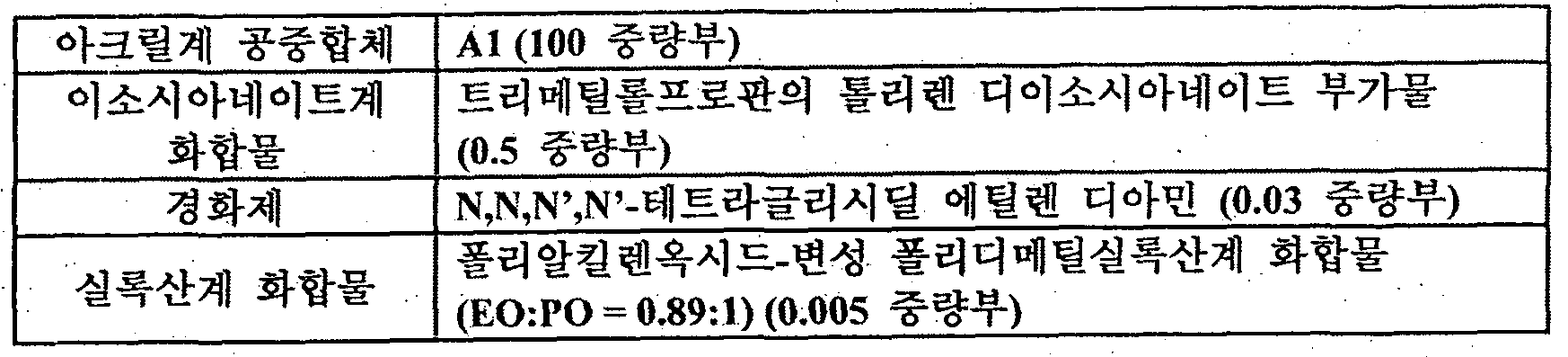
표 2
표 3
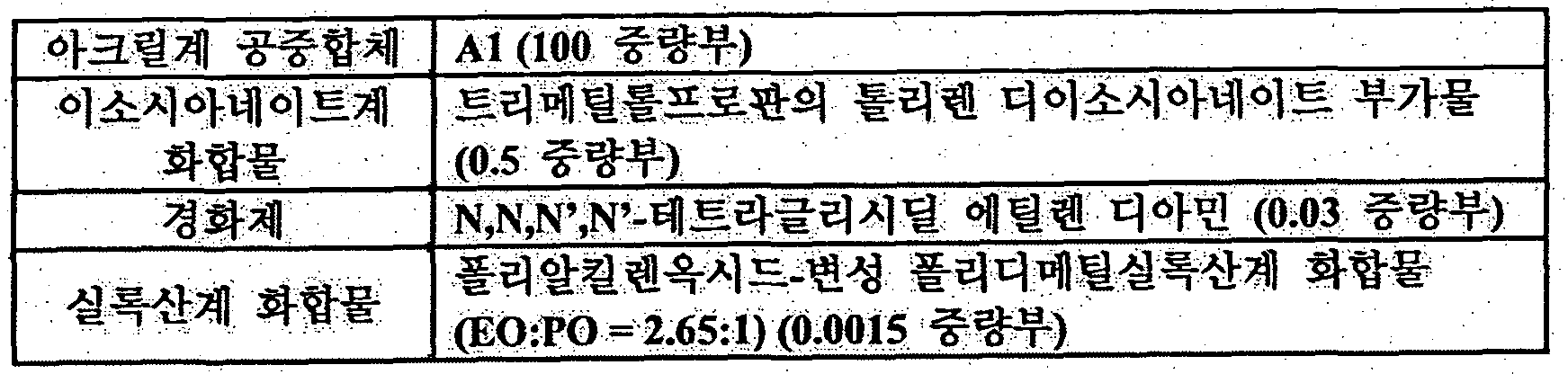
표 4
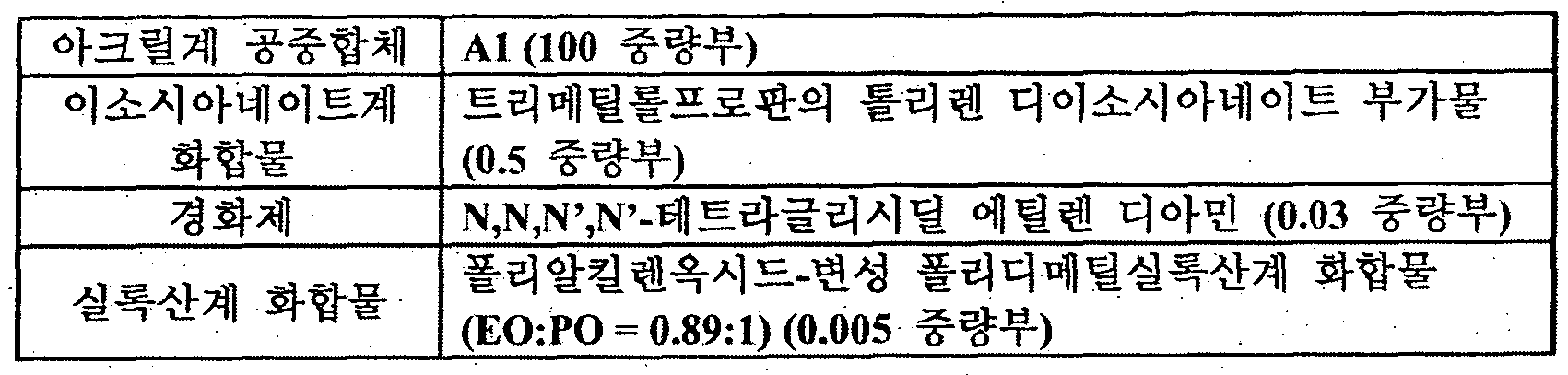
표 5

표 6

표 7


Claims (19)
- 일면 또는 양면에 코로나 처리층을 갖는 기재 필름; 및 상기 기재 필름의 코로나 처리층 상에 형성되고, 아크릴계 공중합체; 및 다관능성 이소시아네이트계 화합물을 함유하는 점착제층을 포함하는 점착 시트.
- 제 1 항에 있어서, 기재 필름이 폴리에스테르 필름인 것을 특징으로 하는 점착 시트.
- 제 1 항에 있어서, 아크릴계 공중합체는 카복실기 함유 아크릴계 공중합체인 것을 특징으로 하는 점착 시트.
- 제 1 항에 있어서, 아크릴계 공중합체는 탄소수 1 내지 12의 탄화수소기를 갖는 (메타)아크릴산 에스테르계 단량체 85 중량부 내지 99.9 중량부; 및 카복실기 함유 단량체 0.1 중량부 내지 15 중량부를 포함하는 것을 특징으로 하는 점착 시트.
- 제 4 항에 있어서, (메타)아크릴산 에스테르계 단량체가 메틸 (메타)아크릴레이트, 에틸 (메타)아크릴레이트, n-프로필 (메타)아크릴레이트, 이소프로필 (메타)아크릴레이트, 부틸 (메타)아크릴레이트, t-부틸 (메타)아크릴레이트, 펜틸 (메타)아크릴레이트, 2-에틸헥실 (메타)아크릴레이트, n-옥틸 (메타)아크릴레이트, 이소옥틸 (메타)아크릴레이트, 이소노닐 (메타)아크릴레이트, 2-에틸부틸 (메타)아크릴레이트 및 벤질 (메타)아크릴레이트로 이루어진 군으로부터 선택된 하나 이상인 것을 특징으로 하는 점착 시트.
- 제 4 항에 있어서, 카복실기 함유 단량체가 (메타)아크릴산, 아크릴산 이중체, 이타콘산, 말레인산, 말레인산 무수물, 푸마르산 및 카복실 알킬 (메타)아크릴레이트로 이루어진 군으로부터 선택된 하나 이상인 것을 특징으로 하는 점착 시트.
- 제 4 항에 있어서, 아크릴계 공중합체가 5 중량부 이하의 히드록시기 함유 단량체를 추가로 포함하는 것을 특징으로 하는 점착 시트.
- 제 1 항에 있어서, 다관능성 이소시아네이트계 화합물이 톨리렌 디이소시아네이트, 크실렌 디이소시아네이트, 디페닐메탄 디이소시아네이트, 헥사메틸렌 디이소시아네이트, 이소포름 디이소시아네이트, 테트라메틸크실렌 디이소시아네이트, 나프탈렌 디이소시아네이트 및 이소시아네이트 화합물과 폴리올의 반응물로 이루어진 군으로부터 선택된 하나 이상인 것을 특징으로 하는 점착 시트.
- 제 1 항에 있어서, 다관능성 이소시아네이트계 화합물은 아크릴계 공중합체 100 중량부에 대하여 0.01 중량부 내지 10 중량부의 양으로 포함되는 것을 특징으로 하는 점착 시트.
- 제 1 항에 있어서, 점착제층이 아크릴계 공중합체 100 중량부에 대하여, 0.01 중량부 내지 15 중량부의 경화제를 추가로 포함하는 것을 특징으로 하는 점착 시트.
- 제 10 항에 있어서, 경화제가 에폭시계 경화제 또는 아지리딘계 경화제인 것을 특징으로 하는 점착 시트.
- 제 1 항에 있어서, 점착제층이 아크릴계 공중합체 100 중량부에 대하여, 0.01 중량부 이하의 실록산계 화합물을 추가로 포함하는 것을 특징으로 하는 점착 시트.
- 제 12 항에 있어서, 실록산계 화합물은 하기 화학식 1로 표시되는 화합물인 것을 특징으로 하는 점착 시트:[화학식 1]
 상기 식에서 x는 0 이상의 정수를 나타내고, y는 1 이상의 정수를 나타내며, A는 -CH2CH2CH2O(EO)m(PO)nZ를 나타내고, 상기에서, EO는 에틸렌옥시드를 나타내며, PO는 프로필렌옥시드를 나타내고, Z는 수소, 아민 또는 알킬을 나타내며, m + n은 1 이상이다(단 n ≠ 0).
 - 제 1 항에 있어서, 점착제층이 아크릴계 공중합체 100 중량부에 대하여, 0.01 중량부 내지 10 중량부의 실란 커플링제를 추가로 포함하는 것을 특징으로 하는 점착 시트.
- 제 1 항에 있어서, 점착제층이 아크릴계 공중합체 100 중량부에 대하여, 1 중량부 내지 100 중량부의 점착성 부여 수지를 추가로 포함하는 것을 특징으로 하는 점착 시트.
- 기재 필름의 일면 또는 양면에 코로나 방전 처리를 수행하여 히드록시기를 도입하는 제 1 단계; 및코로나 방전 처리가 수행된 기재 필름 상에 점착제층을 형성하는 제 2 단계를 포함하는 점착 시트의 제조 방법.
- 제 1 항에 따른 점착 시트; 및 상기 점착 필름의 일면 또는 양면에 형성된 기능성 필름을 포함하는 광학 필터.
- 제 17 항에 있어서, 기능성 필름이 NIR 컷 필름, 색보정 필름, 전자파 차폐 필름 및 AR 필름으로 이루어진 군으로부터 선택된 하나 이상인 것을 특징으로 하는 광학 필터.
- 제 17 항에 따른 광학필터가 패널 전면에 부착되어 있는 플라즈마 디스플레이 패널.
Priority Applications (3)
| Application Number | Priority Date | Filing Date | Title |
|---|---|---|---|
| JP2011507341A JP5704542B2 (ja) | 2008-04-30 | 2009-04-27 | 粘着シート、その製造方法、光学フィルタ及びプラズマディスプレイパネル |
| US12/989,635 US9175193B2 (en) | 2008-04-30 | 2009-04-27 | Adhesive sheet, manufacturing method thereof, optical filter and plasma display panel |
| CN2009801154771A CN102015939A (zh) | 2008-04-30 | 2009-04-27 | 粘合片、其制造方法、滤光片和等离子体显示面板 |
Applications Claiming Priority (2)
| Application Number | Priority Date | Filing Date | Title |
|---|---|---|---|
| KR10-2008-0040811 | 2008-04-30 | ||
| KR1020080040811A KR101171979B1 (ko) | 2008-04-30 | 2008-04-30 | 점착 시트, 그 제조 방법, 상기를 포함하는 광학 필터 및 플라즈마 디스플레이 패널 |
Publications (2)
| Publication Number | Publication Date |
|---|---|
| WO2009134043A2 true WO2009134043A2 (ko) | 2009-11-05 |
| WO2009134043A3 WO2009134043A3 (ko) | 2010-01-21 |
Family
ID=41255538
Family Applications (1)
| Application Number | Title | Priority Date | Filing Date |
|---|---|---|---|
| PCT/KR2009/002194 Ceased WO2009134043A2 (ko) | 2008-04-30 | 2009-04-27 | 점착 시트, 그 제조 방법, 광학 필터 및 플라즈마 디스플레이 패널 |
Country Status (6)
| Country | Link |
|---|---|
| US (1) | US9175193B2 (ko) |
| JP (1) | JP5704542B2 (ko) |
| KR (1) | KR101171979B1 (ko) |
| CN (1) | CN102015939A (ko) |
| TW (1) | TWI551662B (ko) |
| WO (1) | WO2009134043A2 (ko) |
Families Citing this family (10)
| Publication number | Priority date | Publication date | Assignee | Title |
|---|---|---|---|---|
| KR101133740B1 (ko) * | 2009-12-21 | 2012-04-09 | 도레이첨단소재 주식회사 | 반도체기판용 보호필름 |
| JP2013067743A (ja) * | 2011-09-26 | 2013-04-18 | Mitsubishi Plastics Inc | 基材レス両面粘着シート |
| WO2013099798A1 (ja) * | 2011-12-27 | 2013-07-04 | 三菱レイヨン株式会社 | 積層構造体 |
| BR112015000244A2 (pt) * | 2012-07-06 | 2017-06-27 | Firestone Building Prod Co Llc | membranas termoplásticas incluindo polímero com funcionalidade reativa a isocianato |
| KR101780547B1 (ko) * | 2015-07-31 | 2017-09-22 | 삼성에스디아이 주식회사 | 편광판용 점착 필름, 이를 포함하는 편광판 및 이를 포함하는 광학표시장치 |
| KR101882563B1 (ko) | 2015-11-30 | 2018-07-27 | 삼성에스디아이 주식회사 | 편광판용 점착 필름, 이를 위한 편광판용 점착제 조성물, 이를 포함하는 편광판 및 이를 포함하는 광학표시장치 |
| KR102063057B1 (ko) * | 2015-12-30 | 2020-01-07 | 주식회사 엘지화학 | 점착제 조성물 |
| KR102457537B1 (ko) * | 2017-12-05 | 2022-10-20 | 엘지디스플레이 주식회사 | 플렉서블 기판과 이를 포함하는 플렉서블 표시장치 |
| CN110511693A (zh) * | 2019-08-28 | 2019-11-29 | 张家港康得新光电材料有限公司 | 一种泡棉胶带及其制备方法 |
| CN112480772A (zh) * | 2020-12-02 | 2021-03-12 | 上海绘兰材料科技有限公司 | 一种耐高温保护涂层材料及其制备方法 |
Family Cites Families (23)
| Publication number | Priority date | Publication date | Assignee | Title |
|---|---|---|---|---|
| JPH0980230A (ja) * | 1995-09-13 | 1997-03-28 | Sekisui Chem Co Ltd | 偏光板固定構造物 |
| JPH10158473A (ja) * | 1996-12-03 | 1998-06-16 | Hitachi Chem Co Ltd | 光半導体素子封止用エポキシ樹脂組成物、及び該エポキシ樹脂組成物を用いて封止された光半導体装置 |
| KR100385720B1 (ko) * | 1999-04-30 | 2003-05-27 | 주식회사 엘지화학 | 재박리성이 우수한 광학용 아크릴계 감압 점착제 조성물 및 그를이용한 라미네이트 |
| JP4336427B2 (ja) | 1999-10-01 | 2009-09-30 | 帝人株式会社 | 表面保護フィルムおよびそれからなる積層体 |
| JP5135494B2 (ja) * | 1999-12-22 | 2013-02-06 | 綜研化学株式会社 | アクリル系粘着テープおよびその製造方法 |
| JP2001247832A (ja) * | 2000-03-02 | 2001-09-14 | Sekisui Chem Co Ltd | 粘着剤組成物及び粘着テープ |
| US6579941B1 (en) * | 2000-06-12 | 2003-06-17 | Avery Dennison Corporatoin | Adhesive compositions and constructions with outstanding cutting performance |
| DE60128894T2 (de) * | 2000-12-21 | 2008-03-20 | Lg Chem, Ltd. | Acrylklebstoffzusammensetzungen für polarisierende filme sowie diese verwendender polarisierender film |
| TWI296279B (en) * | 2002-02-27 | 2008-05-01 | Nitto Denko Corp | Acrylic pressure-sensitive adhesive composition and pressure-sensitive adhesive tape |
| JP3717498B2 (ja) * | 2003-07-01 | 2005-11-16 | 日東電工株式会社 | 粘着シート巻回体、巻芯及びそれらの製造方法、並びに粘着シート巻回体のリサイクルシステム |
| US7285313B2 (en) * | 2004-01-20 | 2007-10-23 | Lg Chem Ltd. | Acrylic pressure-sensitive adhesive composition for polarizing film |
| JP2005263963A (ja) | 2004-03-18 | 2005-09-29 | Nippon Synthetic Chem Ind Co Ltd:The | 樹脂組成物及びそれを用いた粘着剤組成物 |
| WO2005123274A1 (en) * | 2004-06-17 | 2005-12-29 | Fujifilm Corporation | Process for producing coating film, antireflection film and process for producing the same, sheet polarizer using the film, and image display device using these |
| JP2006143915A (ja) | 2004-11-22 | 2006-06-08 | Lintec Corp | 粘着シート及びその製造方法 |
| TWI266902B (en) * | 2005-01-19 | 2006-11-21 | Lg Chemical Ltd | Filter for plasma display panel with good re-workability and plasma display panel comprising the same |
| JP2006290993A (ja) | 2005-04-08 | 2006-10-26 | Daio Paper Corp | 粘着シート |
| JP2007058162A (ja) * | 2005-07-28 | 2007-03-08 | Nof Corp | ディスプレイ用表面材及びそれを備えたディスプレイ |
| JP4711777B2 (ja) * | 2005-08-11 | 2011-06-29 | 日東電工株式会社 | 粘着シートとその製造方法、及び、製品の加工方法 |
| JP4869015B2 (ja) * | 2005-10-18 | 2012-02-01 | 日東電工株式会社 | 粘着剤組成物、粘着剤層およびその製造方法、ならびに粘着剤付光学部材 |
| KR100932887B1 (ko) * | 2005-12-14 | 2009-12-21 | 주식회사 엘지화학 | 아크릴계 점착제 조성물 |
| WO2007097236A1 (ja) * | 2006-02-24 | 2007-08-30 | Nitto Denko Corporation | 位相差層付偏光板、液晶パネルおよび液晶表示装置 |
| JP5085077B2 (ja) | 2006-09-04 | 2012-11-28 | 日東電工株式会社 | 粘着剤組成物、粘着剤層およびその製造方法、ならびに粘着剤付光学部材 |
| JP5696994B2 (ja) * | 2008-07-16 | 2015-04-08 | エルジー・ケム・リミテッド | 粘着剤組成物、偏光板及び液晶表示装置 |
-
2008
- 2008-04-30 KR KR1020080040811A patent/KR101171979B1/ko active Active
-
2009
- 2009-04-24 TW TW098113671A patent/TWI551662B/zh active
- 2009-04-27 CN CN2009801154771A patent/CN102015939A/zh active Pending
- 2009-04-27 JP JP2011507341A patent/JP5704542B2/ja not_active Expired - Fee Related
- 2009-04-27 US US12/989,635 patent/US9175193B2/en active Active
- 2009-04-27 WO PCT/KR2009/002194 patent/WO2009134043A2/ko not_active Ceased
Also Published As
| Publication number | Publication date |
|---|---|
| US20110102885A1 (en) | 2011-05-05 |
| JP5704542B2 (ja) | 2015-04-22 |
| KR20090114928A (ko) | 2009-11-04 |
| WO2009134043A3 (ko) | 2010-01-21 |
| TWI551662B (zh) | 2016-10-01 |
| JP2011522905A (ja) | 2011-08-04 |
| US9175193B2 (en) | 2015-11-03 |
| KR101171979B1 (ko) | 2012-08-08 |
| CN102015939A (zh) | 2011-04-13 |
| TW201005065A (en) | 2010-02-01 |
Similar Documents
| Publication | Publication Date | Title |
|---|---|---|
| WO2009134043A2 (ko) | 점착 시트, 그 제조 방법, 광학 필터 및 플라즈마 디스플레이 패널 | |
| WO2009131321A2 (en) | Pressure-sensitive adhesive compositions, polarizers and liquid crystal displays comprising the same | |
| US9399695B2 (en) | Pressure-sensitive adhesive compositions, polarizers and liquid crystal displays comprising the same | |
| EP2231807A2 (en) | Pressure-sensitive adhesive composition, protective film, polarizer and liquid crystal display comprising the same | |
| CN104419358B (zh) | 粘结剂组合物、粘结膜和表面保护膜 | |
| KR101340546B1 (ko) | 점착제용 바인더, 그 제조방법, 이를 포함하는 점착제 조성물 및 광학 부재 | |
| CN104293222B (zh) | 抗静电表面保护膜的制造方法和抗静电表面保护膜 | |
| CN112126372B (zh) | 抗静电表面保护膜的制造方法、抗静电表面保护膜 | |
| WO2009088191A2 (ko) | 점착제 조성물, 이를 포함하는 점착 편광판 및 액정표시장치 | |
| CN115731778A (zh) | 透明树脂层 | |
| WO2012070791A2 (ko) | 양면 점착 시트 및 이를 포함하는 터치 패널 표시장치 | |
| WO2010002196A2 (ko) | 점착제 조성물, 편광판 및 액정표시장치 | |
| WO2012070807A2 (ko) | 터치패널용 점착제 조성물, 점착필름 및 터치패널 | |
| WO2011065779A2 (ko) | 점착제 조성물 | |
| WO2012091283A2 (ko) | 편광판용 점착제 조성물 및 이를 포함하는 편광판 | |
| WO2016099187A1 (ko) | 점착제 조성물 | |
| KR20020011341A (ko) | 감압성 접착 시이트 및 기능성 필름의 고정방법 | |
| WO2013176457A1 (ko) | 광학부재, 점착제 조성물 및 액정표시장치 | |
| KR20120087068A (ko) | 점착 시트 | |
| WO2016043521A1 (ko) | 점착제 조성물, 광학용 점착 필름 및 터치 스크린 패널 | |
| WO2013133527A1 (ko) | 점착제 조성물 | |
| WO2020080743A1 (ko) | 다층 점착 필름 | |
| WO2018217046A1 (ko) | 광학투명점착시트 | |
| WO2017065458A1 (ko) | 점착제 조성물 및 이를 포함하는 편광판 | |
| WO2018124371A1 (ko) | 경화수축율이 작은 자외선 경화형 점착 조성물을 포함하는 점착 테이프 및 이의 제조방법 |
Legal Events
| Date | Code | Title | Description |
|---|---|---|---|
| WWE | Wipo information: entry into national phase |
Ref document number: 200980115477.1 Country of ref document: CN |
|
| 121 | Ep: the epo has been informed by wipo that ep was designated in this application |
Ref document number: 09738949 Country of ref document: EP Kind code of ref document: A2 |
|
| WWE | Wipo information: entry into national phase |
Ref document number: 2011507341 Country of ref document: JP |
|
| NENP | Non-entry into the national phase |
Ref country code: DE |
|
| WWE | Wipo information: entry into national phase |
Ref document number: 12989635 Country of ref document: US |
|
| 122 | Ep: pct application non-entry in european phase |
Ref document number: 09738949 Country of ref document: EP Kind code of ref document: A2 |