WO2009142272A1 - ポリエステル系マスキングシート - Google Patents
ポリエステル系マスキングシート Download PDFInfo
- Publication number
- WO2009142272A1 WO2009142272A1 PCT/JP2009/059375 JP2009059375W WO2009142272A1 WO 2009142272 A1 WO2009142272 A1 WO 2009142272A1 JP 2009059375 W JP2009059375 W JP 2009059375W WO 2009142272 A1 WO2009142272 A1 WO 2009142272A1
- Authority
- WO
- WIPO (PCT)
- Prior art keywords
- polyester
- masking sheet
- based masking
- parts
- polyester resin
- Prior art date
- Legal status (The legal status is an assumption and is not a legal conclusion. Google has not performed a legal analysis and makes no representation as to the accuracy of the status listed.)
- Ceased
Links
Classifications
-
- C—CHEMISTRY; METALLURGY
- C09—DYES; PAINTS; POLISHES; NATURAL RESINS; ADHESIVES; COMPOSITIONS NOT OTHERWISE PROVIDED FOR; APPLICATIONS OF MATERIALS NOT OTHERWISE PROVIDED FOR
- C09J—ADHESIVES; NON-MECHANICAL ASPECTS OF ADHESIVE PROCESSES IN GENERAL; ADHESIVE PROCESSES NOT PROVIDED FOR ELSEWHERE; USE OF MATERIALS AS ADHESIVES
- C09J175/00—Adhesives based on polyureas or polyurethanes; Adhesives based on derivatives of such polymers
- C09J175/04—Polyurethanes
- C09J175/06—Polyurethanes from polyesters
-
- C—CHEMISTRY; METALLURGY
- C08—ORGANIC MACROMOLECULAR COMPOUNDS; THEIR PREPARATION OR CHEMICAL WORKING-UP; COMPOSITIONS BASED THEREON
- C08G—MACROMOLECULAR COMPOUNDS OBTAINED OTHERWISE THAN BY REACTIONS ONLY INVOLVING UNSATURATED CARBON-TO-CARBON BONDS
- C08G18/00—Polymeric products of isocyanates or isothiocyanates
- C08G18/06—Polymeric products of isocyanates or isothiocyanates with compounds having active hydrogen
- C08G18/28—Polymeric products of isocyanates or isothiocyanates with compounds having active hydrogen characterised by the compounds used containing active hydrogen
- C08G18/40—High-molecular-weight compounds
- C08G18/42—Polycondensates having carboxylic or carbonic ester groups in the main chain
- C08G18/4288—Polycondensates having carboxylic or carbonic ester groups in the main chain modified by higher fatty oils or their acids or by resin acids
-
- C—CHEMISTRY; METALLURGY
- C08—ORGANIC MACROMOLECULAR COMPOUNDS; THEIR PREPARATION OR CHEMICAL WORKING-UP; COMPOSITIONS BASED THEREON
- C08G—MACROMOLECULAR COMPOUNDS OBTAINED OTHERWISE THAN BY REACTIONS ONLY INVOLVING UNSATURATED CARBON-TO-CARBON BONDS
- C08G18/00—Polymeric products of isocyanates or isothiocyanates
- C08G18/06—Polymeric products of isocyanates or isothiocyanates with compounds having active hydrogen
- C08G18/70—Polymeric products of isocyanates or isothiocyanates with compounds having active hydrogen characterised by the isocyanates or isothiocyanates used
- C08G18/72—Polyisocyanates or polyisothiocyanates
- C08G18/77—Polyisocyanates or polyisothiocyanates having heteroatoms in addition to the isocyanate or isothiocyanate nitrogen and oxygen or sulfur
- C08G18/78—Nitrogen
- C08G18/79—Nitrogen characterised by the polyisocyanates used, these having groups formed by oligomerisation of isocyanates or isothiocyanates
- C08G18/791—Nitrogen characterised by the polyisocyanates used, these having groups formed by oligomerisation of isocyanates or isothiocyanates containing isocyanurate groups
- C08G18/792—Nitrogen characterised by the polyisocyanates used, these having groups formed by oligomerisation of isocyanates or isothiocyanates containing isocyanurate groups formed by oligomerisation of aliphatic and/or cycloaliphatic isocyanates or isothiocyanates
-
- C—CHEMISTRY; METALLURGY
- C09—DYES; PAINTS; POLISHES; NATURAL RESINS; ADHESIVES; COMPOSITIONS NOT OTHERWISE PROVIDED FOR; APPLICATIONS OF MATERIALS NOT OTHERWISE PROVIDED FOR
- C09J—ADHESIVES; NON-MECHANICAL ASPECTS OF ADHESIVE PROCESSES IN GENERAL; ADHESIVE PROCESSES NOT PROVIDED FOR ELSEWHERE; USE OF MATERIALS AS ADHESIVES
- C09J167/00—Adhesives based on polyesters obtained by reactions forming a carboxylic ester link in the main chain; Adhesives based on derivatives of such polymers
- C09J167/02—Polyesters derived from dicarboxylic acids and dihydroxy compounds
-
- C—CHEMISTRY; METALLURGY
- C09—DYES; PAINTS; POLISHES; NATURAL RESINS; ADHESIVES; COMPOSITIONS NOT OTHERWISE PROVIDED FOR; APPLICATIONS OF MATERIALS NOT OTHERWISE PROVIDED FOR
- C09J—ADHESIVES; NON-MECHANICAL ASPECTS OF ADHESIVE PROCESSES IN GENERAL; ADHESIVE PROCESSES NOT PROVIDED FOR ELSEWHERE; USE OF MATERIALS AS ADHESIVES
- C09J167/00—Adhesives based on polyesters obtained by reactions forming a carboxylic ester link in the main chain; Adhesives based on derivatives of such polymers
- C09J167/06—Unsaturated polyesters having carbon-to-carbon unsaturation
-
- C—CHEMISTRY; METALLURGY
- C09—DYES; PAINTS; POLISHES; NATURAL RESINS; ADHESIVES; COMPOSITIONS NOT OTHERWISE PROVIDED FOR; APPLICATIONS OF MATERIALS NOT OTHERWISE PROVIDED FOR
- C09J—ADHESIVES; NON-MECHANICAL ASPECTS OF ADHESIVE PROCESSES IN GENERAL; ADHESIVE PROCESSES NOT PROVIDED FOR ELSEWHERE; USE OF MATERIALS AS ADHESIVES
- C09J7/00—Adhesives in the form of films or foils
- C09J7/30—Adhesives in the form of films or foils characterised by the adhesive composition
- C09J7/38—Pressure-sensitive adhesives [PSA]
-
- C—CHEMISTRY; METALLURGY
- C08—ORGANIC MACROMOLECULAR COMPOUNDS; THEIR PREPARATION OR CHEMICAL WORKING-UP; COMPOSITIONS BASED THEREON
- C08G—MACROMOLECULAR COMPOUNDS OBTAINED OTHERWISE THAN BY REACTIONS ONLY INVOLVING UNSATURATED CARBON-TO-CARBON BONDS
- C08G2170/00—Compositions for adhesives
- C08G2170/40—Compositions for pressure-sensitive adhesives
-
- C—CHEMISTRY; METALLURGY
- C08—ORGANIC MACROMOLECULAR COMPOUNDS; THEIR PREPARATION OR CHEMICAL WORKING-UP; COMPOSITIONS BASED THEREON
- C08L—COMPOSITIONS OF MACROMOLECULAR COMPOUNDS
- C08L2666/00—Composition of polymers characterized by a further compound in the blend, being organic macromolecular compounds, natural resins, waxes or and bituminous materials, non-macromolecular organic substances, inorganic substances or characterized by their function in the composition
- C08L2666/02—Organic macromolecular compounds, natural resins, waxes or and bituminous materials
- C08L2666/26—Natural polymers, natural resins or derivatives thereof according to C08L1/00 - C08L5/00, C08L89/00, C08L93/00, C08L97/00 or C08L99/00
-
- C—CHEMISTRY; METALLURGY
- C08—ORGANIC MACROMOLECULAR COMPOUNDS; THEIR PREPARATION OR CHEMICAL WORKING-UP; COMPOSITIONS BASED THEREON
- C08L—COMPOSITIONS OF MACROMOLECULAR COMPOUNDS
- C08L93/00—Compositions of natural resins; Compositions of derivatives thereof
- C08L93/04—Rosin
-
- C—CHEMISTRY; METALLURGY
- C09—DYES; PAINTS; POLISHES; NATURAL RESINS; ADHESIVES; COMPOSITIONS NOT OTHERWISE PROVIDED FOR; APPLICATIONS OF MATERIALS NOT OTHERWISE PROVIDED FOR
- C09J—ADHESIVES; NON-MECHANICAL ASPECTS OF ADHESIVE PROCESSES IN GENERAL; ADHESIVE PROCESSES NOT PROVIDED FOR ELSEWHERE; USE OF MATERIALS AS ADHESIVES
- C09J2203/00—Applications of adhesives in processes or use of adhesives in the form of films or foils
- C09J2203/31—Applications of adhesives in processes or use of adhesives in the form of films or foils as a masking tape for painting
-
- C—CHEMISTRY; METALLURGY
- C09—DYES; PAINTS; POLISHES; NATURAL RESINS; ADHESIVES; COMPOSITIONS NOT OTHERWISE PROVIDED FOR; APPLICATIONS OF MATERIALS NOT OTHERWISE PROVIDED FOR
- C09J—ADHESIVES; NON-MECHANICAL ASPECTS OF ADHESIVE PROCESSES IN GENERAL; ADHESIVE PROCESSES NOT PROVIDED FOR ELSEWHERE; USE OF MATERIALS AS ADHESIVES
- C09J2400/00—Presence of inorganic and organic materials
- C09J2400/20—Presence of organic materials
- C09J2400/28—Presence of paper
- C09J2400/283—Presence of paper in the substrate
-
- C—CHEMISTRY; METALLURGY
- C09—DYES; PAINTS; POLISHES; NATURAL RESINS; ADHESIVES; COMPOSITIONS NOT OTHERWISE PROVIDED FOR; APPLICATIONS OF MATERIALS NOT OTHERWISE PROVIDED FOR
- C09J—ADHESIVES; NON-MECHANICAL ASPECTS OF ADHESIVE PROCESSES IN GENERAL; ADHESIVE PROCESSES NOT PROVIDED FOR ELSEWHERE; USE OF MATERIALS AS ADHESIVES
- C09J2467/00—Presence of polyester
-
- Y—GENERAL TAGGING OF NEW TECHNOLOGICAL DEVELOPMENTS; GENERAL TAGGING OF CROSS-SECTIONAL TECHNOLOGIES SPANNING OVER SEVERAL SECTIONS OF THE IPC; TECHNICAL SUBJECTS COVERED BY FORMER USPC CROSS-REFERENCE ART COLLECTIONS [XRACs] AND DIGESTS
- Y10—TECHNICAL SUBJECTS COVERED BY FORMER USPC
- Y10T—TECHNICAL SUBJECTS COVERED BY FORMER US CLASSIFICATION
- Y10T428/00—Stock material or miscellaneous articles
- Y10T428/249921—Web or sheet containing structurally defined element or component
- Y10T428/249953—Composite having voids in a component [e.g., porous, cellular, etc.]
- Y10T428/249982—With component specified as adhesive or bonding agent
- Y10T428/249983—As outermost component
-
- Y—GENERAL TAGGING OF NEW TECHNOLOGICAL DEVELOPMENTS; GENERAL TAGGING OF CROSS-SECTIONAL TECHNOLOGIES SPANNING OVER SEVERAL SECTIONS OF THE IPC; TECHNICAL SUBJECTS COVERED BY FORMER USPC CROSS-REFERENCE ART COLLECTIONS [XRACs] AND DIGESTS
- Y10—TECHNICAL SUBJECTS COVERED BY FORMER USPC
- Y10T—TECHNICAL SUBJECTS COVERED BY FORMER US CLASSIFICATION
- Y10T428/00—Stock material or miscellaneous articles
- Y10T428/28—Web or sheet containing structurally defined element or component and having an adhesive outermost layer
- Y10T428/2852—Adhesive compositions
-
- Y—GENERAL TAGGING OF NEW TECHNOLOGICAL DEVELOPMENTS; GENERAL TAGGING OF CROSS-SECTIONAL TECHNOLOGIES SPANNING OVER SEVERAL SECTIONS OF THE IPC; TECHNICAL SUBJECTS COVERED BY FORMER USPC CROSS-REFERENCE ART COLLECTIONS [XRACs] AND DIGESTS
- Y10—TECHNICAL SUBJECTS COVERED BY FORMER USPC
- Y10T—TECHNICAL SUBJECTS COVERED BY FORMER US CLASSIFICATION
- Y10T428/00—Stock material or miscellaneous articles
- Y10T428/28—Web or sheet containing structurally defined element or component and having an adhesive outermost layer
- Y10T428/2852—Adhesive compositions
- Y10T428/2896—Adhesive compositions including nitrogen containing condensation polymer [e.g., polyurethane, polyisocyanate, etc.]
Definitions
- the present invention relates to a masking sheet having a pressure-sensitive adhesive layer on a base material, and more particularly to a polyester-based masking sheet using a polyester resin made from a plant-derived material friendly to the global environment as an active ingredient of the pressure-sensitive adhesive layer.
- the masking sheet is peeled off and discarded after being used on the adherend. So far, this type of masking sheet has mainly used an acrylic material derived from petroleum as an active ingredient of the pressure-sensitive adhesive layer (Patent Document 1).
- the present invention does not use fossil resources (including petroleum resources) as an active ingredient of the pressure-sensitive adhesive layer, and is free from fossil resource depletion and carbon dioxide emission, and is derived from plants that are friendly to the global environment.
- Providing a biomass masking sheet that uses the material, and reducing the burden of rewinding at high speed while maintaining adhesion to the adherend and its back surface, and when used at high temperatures It is another object of the present invention to provide a high-performance biomass masking sheet that can be peeled off without adhesive residue or contamination.
- the present inventors made a polyester resin whose raw material component is a plant-derived material that is not affected by fossil resource depletion on the base material, and contains a tackifier.
- a pressure-sensitive adhesive layer that is cross-linked with a cross-linking agent and setting the gel fraction within the proper range, the burden of rewinding the tape at high speed while maintaining the adhesion to the adherend and the back surface It can be reduced without adhesive residue and contamination even when used at high temperatures, and the peeled waste becomes a high-performance biomass masking sheet that is friendly to the global environment and has no carbon dioxide emission problem due to the above plant-derived materials.
- the present invention has been completed.
- the present invention relates to the following (1) to (8).
- It contains a polyester resin obtained by condensation polymerization at a ratio of 1.40 mol, and a tackifier in an amount of 10 to 50 parts by weight with respect to 100 parts by weight of the polyester resin, and is subjected to a crosslinking treatment with a crosslinking agent.
- a polyester-based masking sheet comprising an adhesive layer having a gel fraction of 40 to 90%.
- polyester-based masking sheet according to any one of (1) to (5), wherein the content of the crosslinking agent is 2 to 13 parts by weight with respect to 100 parts by weight of the polyester resin.
- the “polyester-based masking sheet” in the present invention includes not only a wide sheet-like material but also a usually narrow tape-like material, and various forms of masking products such as a label-like material. Is.
- the present invention uses a polyester resin having a plant-derived material as a raw material component as an active ingredient on a base material, adds a tackifier to the polyester resin, and cross-links with a cross-linking agent to provide a gel fraction in a specific range.
- a pressure-sensitive adhesive layer By providing a pressure-sensitive adhesive layer, it is not affected by depletion of fossil resources, and since it uses plant-derived materials when it is disposed of after use, it can realize carbon neutral even if carbon dioxide is discharged.
- a gentle polyester masking sheet can be provided.
- This masking sheet is a high-performance masking sheet that can reduce the burden when rewinding at a high speed while maintaining the adhesion to the adherend and the back surface. It is possible to peel without adhesive residue or contamination.
- this polyester-based masking sheet is used in the preparation of a pressure-sensitive adhesive containing the above-mentioned polyester resin as an active ingredient, and D phase emulsification [surfactant phase containing water and polyhydric alcohol (phase D) as an oil component above.
- the resin is dispersed to form an O / D type gel emulsion, and water is added to the gel emulsion to form an O / W type emulsion].
- VOC Volatile Organic Compounds
- the polyester resin in the present invention is obtained by using a dicarboxylic acid derived from a plant and a diol derived from a plant as raw material components (monomer components) and subjecting these raw material components to condensation polymerization.
- the above condensation polymerization may be performed by an ordinary method using an organic solvent, or may be performed without a solvent under reduced pressure.
- an appropriate catalyst such as a metal compound such as tetra-n-butyl titanate, tetraisopropyl titanate, antimony trioxide, or butyltin oxide can be used.
- the plant-derived dicarboxylic acid is not particularly limited as long as it is plant-derived, and examples thereof include dimer acid produced from castor oil-derived sebacic acid and oleic acid. Two or more of these dicarboxylic acids can be used in combination.
- the plant-derived diol is not particularly limited as long as it is derived from a plant, and examples thereof include a fatty acid ester derived from castor oil and a dimer diol produced from oleic acid. Two or more kinds of such diols can be used in combination.
- non-plant-derived dicarboxylic acids and diols can also be used in combination. However, these non-plant-derived dicarboxylic acids and diols may be 30% by weight or less, preferably 20% by weight or less, more preferably 10% by weight or less, and most preferably 5% by weight or less of the total raw material components.
- the hydroxyl group contained in the diol is 1.01 to 1.40 mol, particularly 1.02 to 1.30 mol, relative to 1.00 mol of the carboxyl group contained in the dicarboxylic acid. It is desirable to make it react in the ratio.
- the number of hydroxyl groups is less than 1.01 mol, the number of hydroxyl groups at the molecular terminals of the polyester resin obtained by condensation polymerization is reduced, and crosslinking treatment with a crosslinking agent becomes difficult, making it difficult to adjust the gel fraction to an appropriate range.
- the polyester resin obtained by such condensation polymerization preferably has a weight average molecular weight (Mw) usually in the range of 10,000 to 200,000.
- the above-mentioned polyester resin is used as an active ingredient of the pressure-sensitive adhesive, and a tackifier and further a crosslinking agent are added thereto to prepare a pressure-sensitive adhesive.
- the pressure-sensitive adhesive may be prepared using an organic solvent or in the absence of a solvent.
- an emulsion-type pressure-sensitive adhesive emulsified and dispersed in water may be used, and emulsification by D-phase emulsification may be used to facilitate emulsification and dispersion.
- D phase surfactant phase
- the above resin is dispersed as an oil component in a surfactant phase (D phase) containing water and a polyhydric alcohol to form an O / D type gel emulsion.
- a W-type emulsion is used.
- a tackifier and a crosslinking agent may be added together with the resin, or may be blended after obtaining the emulsion.
- VOC measures can be taken, which can contribute to the removal of organic solvent.
- tackifiers can be widely used as the tackifier, but those having a plant-derived material as a main component are desirable.
- tackifiers include rosin resins and terpene resins.
- the said tackifier can be used individually or in combination of 2 or more types.
- the rosin resin include rosin, polymerized rosin, hydrogenated rosin, rosin ester, polymerized rosin ester, hydrogenated rosin ester, and rosin phenol resin.
- Terpene resins include terpene resins, terbene phenol resins, and aromatic modified terpene resins.
- the amount of tackifier is preferably 10 to 50 parts by weight, particularly preferably 15 to 45 parts by weight, based on 100 parts by weight of the polyester resin.
- the amount of the tackifier is more than 50 parts by weight, the adhesive strength becomes too high, and there are problems of adhesive residue and contamination at the time of re-peeling after holding at a high temperature, and re-peeling becomes difficult.
- the amount of the tackifier is less than 10 parts by weight, the adhesive force to the back surface is low, and a problem such as peeling occurs when forming into a roll is likely to occur.
- crosslinking agent a polyfunctional compound capable of reacting with a functional group (carboxyl group, hydroxyl group, etc.) contained in the molecule of the polyester resin to form a crosslinked structure of the resin is used.
- a functional group carboxyl group, hydroxyl group, etc.
- a conventionally well-known thing can be used as such a crosslinking agent.
- polyisocyanurate, polyfunctional isocyanate compound, polyfunctional melamine compound, polyfunctional epoxy compound, polyfunctional oxazoline compound, polyfunctional aziridine compound, metal chelate compound and the like can be mentioned.
- these crosslinking agents versatile polyisocyanurates and polyfunctional isocyanate compounds are preferable.
- polyvalent isocyanurate examples include polyisocyanates of hexamethylene diisocyanate.
- polyisocyanates of hexamethylene diisocyanate examples include polyisocyanates of hexamethylene diisocyanate.
- trade name “Coronate HX” manufactured by Nippon Polyurethane Co., Ltd.
- trade name “Coronate HK” manufactured by Nippon Polyurethane Co., Ltd.
- trade name “Coronate 2096” manufactured by Nippon Polyurethane Co., Ltd.
- the polyfunctional isocyanate compound must be a compound having at least three (trifunctional) isocyanate groups in the molecule, but two (bifunctional) compounds should be used in combination as necessary. You can also. Specific examples include aliphatic polyisocyanates, alicyclic polyisocyanates, aromatic polyisocyanates, and dimers and trimers thereof.
- Aliphatic polyisocyanates include tetramethylene diisocyanates such as 1,2-tetramethylene diisocyanate, 1,3-tetramethylene diisocyanate, 1,4-tetramethylene diisocyanate; 1,2-hexamethylene diisocyanate, 1,3-hexa Hexamethylene diisocyanates such as methylene diisocyanate, 1,4-hexamethylene diisocyanate, 1,5-hexamethylene diisocyanate, 1,6-hexamethylene diisocyanate, 2,5-hexamethylene diisocyanate; other 1,2-ethylene diisocyanate, 2 -Methyl-1,5-pentane diisocyanate, 3-methyl-1,5-pentane diisocyanate, lysine diisocyanate and the like.
- tetramethylene diisocyanates such as 1,2-tetramethylene diisocyanate, 1,3-tetramethylene diisocyanate,
- alicyclic polyisocyanates examples include cyclopentyl diisocyanates such as 1,2-cyclopentyl diisocyanate and 1,3-cyclopentyl diisocyanate; cyclohexyls such as 1,2-cyclohexyl diisocyanate, 1,3-cyclohexyl diisocyanate and 1,4-cyclohexyl diisocyanate.
- Diisocyanate Diisocyanate; isophorone diisocyanate, norbornene diisocyanate, hydrogenated tolylene diisocyanate, hydrogenated xylylene diisocyanate, hydrogenated diphenylmethane diisocyanate, hydrogenated tetramethylxylene diisocyanate, 4,4′-dicyclohexylmethane diisocyanate, and the like.
- Aromatic polyisocyanates include 2,4-tolylene diisocyanate, 2,6-tolylene diisocyanate, 1,4-xylylene diisocyanate, 1,3-xylylene diisocyanate, 4,4′-diphenylmethane diisocyanate, 2, 4'-diphenylmethane diisocyanate, 2,2'-diphenylmethane diisocyanate, 4,4'-diphenyl ether diisocyanate, 2-nitrodiphenyl-4,4'-diisocyanate, 2,2'-diphenylpropane-4,4'-diisocyanate, 3,3'-dimethyldiphenylmethane-4,4'-diisocyanate, 4,4'-diphenylpropane diisocyanate, m-phenylene diisocyanate, p-phenylene diisocyanate, naphthylene-1,4-diisocyanate , Mention may be
- dimers and trimers of polyisocyanates diphenylmethane diisocyanate dimers and trimers, reaction products of trimethylolpropane and tolylene diisocyanate, reaction products of trimethylolpropane and hexamethylene diisocyanate
- polymers such as polymethylene polyphenyl isocyanate, polyether polyisocyanate, and polyester polyisocyanate. Commercially available products can also be used.
- trimer adduct of trimethylolpropane and tolylene diisocyanate the trade name “Coronate L” (manufactured by Nippon Polyurethane Co., Ltd.) or trimethylolpropane and hexamethylene diisocyanate.
- a product name “Coronate HL” (manufactured by Nippon Polyurethane Co., Ltd.) can be exemplified.
- polyfunctional melamine compound examples include methylated methylol melamine and butylated hexamethylol melamine.
- polyfunctional epoxy compound examples include diglycidyl aniline and glycerin diglycidyl ether.
- the amount of the crosslinking agent can be appropriately selected according to the type of the crosslinking agent so that the gel fraction after the crosslinking treatment falls within a specific range.
- the amount is preferably 2 to 13 parts by weight, particularly preferably 2 to 12 parts by weight, per 100 parts by weight of a polyester resin (total amount of dicarboxylic acid and diol as raw material components).
- a suitable catalyst can be used with a crosslinking agent. For example, tetra-n-butyl titanate, tetraisopropyl titanate, butyltin oxide, dioctyltin dilaurate and the like are used.
- the pressure-sensitive adhesive thus prepared is applied onto a substrate and dried at a temperature of usually 60 to 120 ° C. for a predetermined time according to the type of the substrate.
- the cross-linked pressure-sensitive adhesive layer may have a gel fraction of 40 to 90%, preferably 60 to 80%.
- the gel fraction When the gel fraction is higher than 90%, the crosslink density becomes too high, the adhesive force becomes low, and fixing becomes difficult.
- the gel fraction is lower than 40%, fixing becomes difficult due to insufficient cohesive force, and adhesive residue and contamination are likely to occur.
- the base material on which the pressure-sensitive adhesive layer is provided paper made of fibrous materials such as kraft paper, crepe paper, Japanese paper, cloth made of sfumos, polyester, plastic film made of polystyrene, polypropylene, etc. are used.
- a porous substrate is desirable from the viewpoint of easy cutting by hand (workability) and adhesion between the adhesive and the back of the tape when the adhesive is sprayed.
- the material that can be a porous substrate is preferably a paper material made of the above-mentioned fibrous material, particularly a beaten wood pulp or a porous thin paper material obtained by mixing one or more synthetic short fibers.
- Japanese paper made of a new paper material is preferable in terms of excellent strength and elongation.
- the material of the synthetic short fiber examples include polyvinyl alcohol (for example, vinylon), polyamide (for example, nylon), polyester, polyethylene, polypropylene, polyurethane, polyvinyl chloride, polyvinylidene chloride, and polyacrylonitrile.
- the synthetic short fiber mixed in the paper material is vinylon, and the mixing ratio is 5% or more, preferably 5 to 70%, more preferably.
- a porous thin paper material of 15 to 50% is preferably used. Of these, Japanese paper made of such a porous thin paper material is most preferable as the base material of the present invention.
- the basis weight of the porous thin paper material is not particularly limited, but it is usually 15 to 80 g / m 2 , preferably 25 to 50 g / m 2 .
- a base material such as Japanese paper is impregnated with rubber and / or a synthetic resin, whereby tearing or breaking at the time of peeling can be prevented.
- the rubber or synthetic resin include butyl rubber, natural rubber, styrene, butadiene rubber, and acrylate copolymer.
- the polyester-based masking sheet of the present invention has an adhesive strength with respect to the SUS plate at 23 ° C. of 1.5 to 8.0 N / 20 mm, particularly preferably 2.0 to 7.0 N / 20 mm.
- the adhesive strength to the adherend is not sufficient and there is a possibility of peeling during use.
- said adhesive strength exceeds 8.0 N / 20mm, when adhesive force is too strong and peels, there exists a possibility that the adhesive residue and a base material may be torn.
- the adhesive force with respect to a SUS board is defined by the measuring method as described in an Example.
- the polyester-based masking sheet of the present invention has an adhesive force between the adhesive layer and the back surface at 23 ° C., that is, the self-back surface adhesive force is 1.5 N / 20 mm or more, particularly preferably 2.0 N / 20 mm or more. It is. If the above-mentioned self-back surface adhesive strength is less than 1.5 N / 20 mm, the overlying property is deteriorated, and problems such as peeling or slipping off easily occur.
- self-back surface adhesive force is defined by the measuring method as described in an Example.
- the polyester-based masking sheet of the present invention has a self-rear surface high-speed peel adhesive strength at 23 ° C., that is, a so-called unwinding force of 1.0 to 8.0 N / 20 mm, particularly preferably 2.0 to 7.0 N / 20 mm. It is.
- the rewinding force is less than 1.0 N / 20 mm, the rewinding force is too small and the tape is easily rewound beyond a predetermined length, or the tape rewinds due to its own weight due to some beat.
- the polyester-based masking sheet of the present invention does not drop in its own back surface constant load peel test (see Examples), and has a performance that the deviation distance is 60 mm or less. When dropped in this test, the rewinding force is too light and the workability is poor. In addition, the polyester-based masking sheet of the present invention has the performance that it can be re-peeled without any adhesive residue or contamination even when held at a high temperature (for example, 130 ° C.).
- the polyester-based masking sheet of the present invention is useful as a masking tape, a curing tape, a protective film tape, etc. used at the time of masking at the time of painting an automobile because of having the above-mentioned various performances, It can be advantageously used in various applications known as masking sheets.
- the masking sheet peeled off from the adherend consists of an adhesive layer or a plant-derived material. There is no negative impact on the environment.
- polyester resins A to E used in the following examples and comparative examples were produced by the following method.
- the weight average molecular weight Mw was 30,000.
- the usage-amount of said dimer acid and dimer diol was the ratio from which the hydroxyl group contained in dimer diol will be 0.95 mol with respect to 1.00 mol of carboxyl groups contained in dimer acid.
- polyester resin B was obtained in the same manner as in the case of the polyester resin A, except that the amount of dimer acid used was changed to 104.9 g and the amount of dimer diol was kept 100 g.
- the weight average molecular weight Mw was 85,000.
- the usage-amount of said dimer acid and dimer diol was the ratio from which the hydroxyl group contained in dimer diol will be 1.01 mol with respect to 1.00 mol of carboxyl groups contained in dimer acid.
- Polyester resin C was obtained in the same manner as for polyester resin A, except that the amount of dimer acid used was changed to 100.9 g and the amount of dimer diol used was still 100 g.
- the weight average molecular weight Mw was 55,000.
- the usage-amount of said dimer acid and dimer diol was the ratio from which the hydroxyl group contained in dimer diol will be 1.05 mol with respect to 1.00 mol of carboxyl groups contained in dimer acid.
- Polyester resin D was obtained in the same manner as for polyester resin A, except that the amount of dimer acid used was changed to 88.3 g and the amount of dimer diol used was still 100 g.
- the weight average molecular weight Mw was 20,000.
- the usage-amount of said dimer acid and dimer diol was the ratio from which the hydroxyl group contained in dimer diol will be 1.20 mol with respect to 1.00 mol of carboxyl groups contained in dimer acid.
- Polyester resin E was obtained in the same manner as for polyester resin A, except that the amount of dimer acid used was changed to 73.1 g and the amount of dimer diol used was still 100 g.
- the weight average molecular weight Mw was 10,000.
- the usage-amount of said dimer acid and dimer diol was a ratio from which the hydroxyl group contained in dimer diol will be 1.45 mol with respect to 1.00 mol of carboxyl groups contained in dimer acid.
- Example 1 100 parts of polyester resin C, 2 parts of hexamethylene diisocyanate (trade name “TPA-100”, manufactured by Asahi Kasei Chemicals) as a cross-linking agent, and polymerized rosin ester (trade name “Recatac PCJ”, Rika Finetech Co., Ltd.) as a tackifier Tokushima] 20 parts was blended to prepare an adhesive. This was applied to a paper substrate having a basis weight of 30 g / m 2 (“AC-30G” manufactured by Nippon Paper Papillia Co., Ltd.) so that the thickness after drying was 40 ⁇ m, and dried at 100 ° C. for 3 minutes.
- TPA-100 hexamethylene diisocyanate
- Recatac PCJ Rika Finetech Co., Ltd.
- the release-treated surfaces of the polyethylene terephthalate (PET) sheet subjected to the release treatment were bonded together, and aging was conducted for 5 days at 50 ° C. to prepare a polyester-based masking sheet having a cross-linked adhesive layer.
- PET polyethylene terephthalate
- Example 2 A pressure-sensitive adhesive was prepared in the same manner as in Example 1 except that the amount of the crosslinking agent was 4 parts with respect to 100 parts of the polyester resin C to prepare a polyester-based masking sheet.
- Example 3 A pressure-sensitive adhesive was prepared in the same manner as in Example 1 except that the amount of the crosslinking agent was 10 parts with respect to 100 parts of the polyester resin C to prepare a polyester-based masking sheet.
- Example 4 A pressure-sensitive adhesive was prepared in the same manner as in Example 2 except that 100 parts of polyester resin B was used instead of 100 parts of polyester resin C, and a polyester-based masking sheet was prepared.
- Example 5 A pressure-sensitive adhesive was prepared in the same manner as in Example 2 except that 100 parts of the polyester resin D was used instead of 100 parts of the polyester resin C, to prepare a polyester-based masking sheet.
- Example 6 A pressure-sensitive adhesive was prepared in the same manner as in Example 2 except that the amount of the tackifier was 10 parts with respect to 100 parts of the polyester resin C to prepare a polyester-based masking sheet.
- Example 7 A pressure-sensitive adhesive was prepared in the same manner as in Example 2 except that the amount of the tackifier was 40 parts with respect to 100 parts of the polyester resin C, to prepare a polyester-based masking sheet.
- Comparative Example 1 A pressure-sensitive adhesive was prepared in the same manner as in Example 2 except that no tackifier was added, and a polyester-based masking sheet was produced.
- Comparative Example 2 A pressure-sensitive adhesive was prepared in the same manner as in Example 2 except that the amount of the tackifier was 60 parts with respect to 100 parts of the polyester resin C, to prepare a polyester-based masking sheet.
- Comparative Example 3 A pressure-sensitive adhesive was prepared in the same manner as in Example 2 except that 100 parts of polyester resin A was used instead of 100 parts of polyester resin C, and a polyester-based masking sheet was prepared.
- Comparative Example 4 A pressure-sensitive adhesive was prepared in the same manner as in Example 2 except that 100 parts of the polyester resin E was used instead of 100 parts of the polyester resin C, to prepare a polyester-based masking sheet.
- Comparative Example 5 A pressure-sensitive adhesive was prepared in the same manner as in Example 1 except that the amount of the crosslinking agent was 1 part with respect to 100 parts of the polyester resin C, to prepare a polyester-based masking sheet.
- Comparative Example 6 A pressure-sensitive adhesive was prepared in the same manner as in Example 1 except that the blending amount of the crosslinking agent was 15 parts with respect to 100 parts of the polyester resin C, and a polyester-based masking sheet was produced.
- the gel fraction of the adhesive layer, the SUS plate adhesive force, the self-back surface adhesive force, the self-back surface high speed peel test, and the self-back surface constant load peel The test and the high temperature peel test were measured by the following methods, and the results are summarized in Tables 1 to 4 below.
- Tables 1 to 4 the composition of the pressure-sensitive adhesive used (the type of the polyester resin and the hydroxyl group / carboxyl group ratio of the raw material components, the number of parts used of the polyester resin, the tackifier, and the crosslinking agent) is also shown.
- ⁇ SUS board adhesive strength> The pressure-sensitive adhesive layer surface of a polyester-based masking sheet (cut to a width of 20 mm) is adhered to a SUS304 plate with one reciprocating 2 kg roller, and 180 ° peel adhesive strength (“TG-1kN” manufactured by Minebea Co., Ltd.) Adhesive strength) (N / 20 mm) (peeling speed: 300 mm / min, temperature: 23 ⁇ 2 ° C., humidity: 65 ⁇ 5% RH) was measured.
- TG-1kN 180 ° peel adhesive strength
- Adhesive layer surface of polyester masking sheet is bonded and fixed to SUS304 board, and the same adhesive layer surface of polyester masking sheet (cut to 20mm width and 300mm length) is reciprocated on 500g roller. After 30 minutes, the 30 g weight was hung at a right angle under the condition of 40 ° C., and after 1 hour, the distance at which peeling progressed from the initial stage was measured. The initial bond length is 200 mm.
- “impossible to measure” means that in “Comparative Example 1”, since the adhesive strength to the back surface is too low, an accurate value cannot be obtained in the high-speed peel test. “4, 5” indicates a state where an accurate value cannot be obtained due to cohesive failure, and “Comparative Example 6” indicates a state where the measurement cannot be performed due to peeling from the adherend at the time of bonding.
- each of the polyester-based masking sheets of Examples 1 to 7 can reduce the burden when the tape is rewound at a high speed while maintaining the adhesion to the adherend and the back surface. Furthermore, it can be re-peeled without causing adhesive residue or contamination in the high-temperature peel test.
- each of the polyester-based masking sheets of Comparative Examples 1 to 6 is inferior to any of the above characteristics and cannot satisfy all the characteristics.
- each of the polyester-based masking sheets of Examples 1 to 7 can be expected to suppress an increase in CO 2 even if incinerated because the pressure-sensitive adhesive layer is derived from plants, and is friendly to the global environment. It has characteristics as a biomass masking sheet.
- a polyester resin having a plant-derived material as a raw material component is used as an active ingredient, and a tackifier is added thereto, followed by crosslinking treatment with a crosslinking agent to have a gel fraction in a specific range.
Landscapes
- Chemical & Material Sciences (AREA)
- Organic Chemistry (AREA)
- Chemical Kinetics & Catalysis (AREA)
- Health & Medical Sciences (AREA)
- Medicinal Chemistry (AREA)
- Polymers & Plastics (AREA)
- Oil, Petroleum & Natural Gas (AREA)
- Adhesive Tapes (AREA)
- Adhesives Or Adhesive Processes (AREA)
Abstract
本発明は、基材;および前記基材上に設けられ、植物由来のジカルボン酸と植物由来のジオールとをジカルボン酸に含まれるカルボキシル基1.00モルに対しジオールに含まれる水酸基が1.01~1.40モルとなる割合で縮合重合させて得られるポリエステル樹脂と、この前記ポリエステル樹脂100重量部に対し10~50重量部となる量の粘着付与剤とを含有し、架橋剤により架橋処理され、ゲル分率が40~90%である粘着剤層を含むポリエステル系マスキングシートに関する。
Description
本発明は、基材上に粘着剤層を有するマスキングシートに関し、より詳しくは粘着剤層の有効成分として地球環境にやさしい植物由来材料を原料成分としたポリエステル樹脂を使用したポリエステル系マスキングシートに関する。
マスキングシートは、被着体に貼り付けて使用されたのちは、剥離されて廃棄処理される。これまで、この種のマスキングシートには粘着剤層の有効成分として石油由来であるアクリル系の材料が主に用いられてきた(特許文献1)。
上記従来のマスキングシートは、石油由来材料のため、石油枯渇のおそれがあり、また使用後の廃棄処理に二酸化炭素を排出していた。つまり、石油枯渇や産廃時の二酸化炭素排出の点より地球環境への配慮はなされていなかった。
昨今、化石資源の枯渇や地球の温暖化対策として環境への配慮が求められ、再生可能な材料である植物由来材料の使用が推奨され始めている。
昨今、化石資源の枯渇や地球の温暖化対策として環境への配慮が求められ、再生可能な材料である植物由来材料の使用が推奨され始めている。
本発明は、このような事情に照らし、粘着剤層の有効成分として、化石資源(石油資源を含む)を用いず、化石資源の枯渇や二酸化炭素排出の問題のない、地球環境にやさしい植物由来材料を用いたバイオマスマスキングシートを提供すること、また、被着体および自背面に対する粘着力を維持しつつも、高速で巻き戻す際の負担を軽減することを可能とし、さらに高温で使用した場合も糊残りや汚染なく剥離することが可能である、高性能のバイオマスマスキングシートを提供することを課題とする。
本発明者らは、上記の課題に対し、鋭意検討した結果、基材上に化石資源の枯渇に影響されない植物由来材料を原料成分としたポリエステル樹脂を有効成分とし、これに粘着付与剤を含ませ、架橋剤により架橋処理してゲル分率を適正範囲に設定した粘着剤層を設けることにより、被着体および自背面に対する粘着力を維持しつつも、高速でテープを巻き戻す際の負担を軽減でき、また高温で使用した場合も糊残りや汚染なく剥離でき、剥離した廃棄物は上記植物由来材料により二酸化炭素排出の問題のない、地球環境にやさしい高性能のバイオマスマスキングシートとなることを見出し、本発明を完成した。
すなわち、本発明は、以下の(1)~(8)に関する。
(1)基材、および
前記基材上に設けられ、植物由来のジカルボン酸と植物由来のジオールとをジカルボン酸に含まれるカルボキシル基1.00モルに対しジオールに含まれる水酸基が1.01~1.40モルとなる割合で縮合重合させて得られるポリエステル樹脂と、前記ポリエステル樹脂100重量部に対し10~50重量部となる量の粘着付与剤とを含有し、架橋剤により架橋処理され、ゲル分率が40~90%である粘着剤層
を含むポリエステル系マスキングシート。
(2)植物由来のジカルボン酸がダイマー酸であり、植物由来のジオールがダイマージオールである(1)に記載のポリエステル系マスキングシート。
(3)粘着付与剤が植物由来の材料を主成分としたものである(1)または(2)に記載のポリエステル系マスキングシート。
(4)粘着付与剤が、ロジン系樹脂もしくはテルペン系樹脂から選ばれる少なくとも1つである(1)~(3)のいずれかに記載のポリエステル系マスキングシート。
(5)架橋剤がポリイソシアネート化合物である(1)~(4)のいずれかに記載のポリエステル系マスキングシート。
(6)架橋剤の含有量が、ポリエステル樹脂100重量部に対して2~13重量部である(1)~(5)のいずれかに記載のポリエステル系マスキングシート。
(7)ポリエステル樹脂の重量平均分子量が、1万~20万である(1)~(6)のいずれかに記載のポリエステル系マスキングシート。
(8)基材が、多孔性の基材である(1)~(7)のいずれかに記載のポリエステル系マスキングシート。
なお、本発明における「ポリエステル系マスキングシート」には、通常幅広のシート状物だけでなく、通常幅狭のテープ状物も含まれ、その他、ラベル状物などの各種形態のマスキング製品が包含されるものである。
(1)基材、および
前記基材上に設けられ、植物由来のジカルボン酸と植物由来のジオールとをジカルボン酸に含まれるカルボキシル基1.00モルに対しジオールに含まれる水酸基が1.01~1.40モルとなる割合で縮合重合させて得られるポリエステル樹脂と、前記ポリエステル樹脂100重量部に対し10~50重量部となる量の粘着付与剤とを含有し、架橋剤により架橋処理され、ゲル分率が40~90%である粘着剤層
を含むポリエステル系マスキングシート。
(2)植物由来のジカルボン酸がダイマー酸であり、植物由来のジオールがダイマージオールである(1)に記載のポリエステル系マスキングシート。
(3)粘着付与剤が植物由来の材料を主成分としたものである(1)または(2)に記載のポリエステル系マスキングシート。
(4)粘着付与剤が、ロジン系樹脂もしくはテルペン系樹脂から選ばれる少なくとも1つである(1)~(3)のいずれかに記載のポリエステル系マスキングシート。
(5)架橋剤がポリイソシアネート化合物である(1)~(4)のいずれかに記載のポリエステル系マスキングシート。
(6)架橋剤の含有量が、ポリエステル樹脂100重量部に対して2~13重量部である(1)~(5)のいずれかに記載のポリエステル系マスキングシート。
(7)ポリエステル樹脂の重量平均分子量が、1万~20万である(1)~(6)のいずれかに記載のポリエステル系マスキングシート。
(8)基材が、多孔性の基材である(1)~(7)のいずれかに記載のポリエステル系マスキングシート。
なお、本発明における「ポリエステル系マスキングシート」には、通常幅広のシート状物だけでなく、通常幅狭のテープ状物も含まれ、その他、ラベル状物などの各種形態のマスキング製品が包含されるものである。
このように、本発明は、基材上に、植物由来材料を原料成分としたポリエステル樹脂を有効成分とし、これに粘着付与剤を加えて、架橋剤により架橋処理して特定範囲のゲル分率を有する粘着剤層を設けたことにより、化石資源の枯渇に影響されず、使用後廃棄処理する場合に植物由来材料を用いているため二酸化炭素を排出してもカーボンニュートラルを実現できる、地球環境にやさしいポリエステル系マスキングシートを提供できる。またこのマスキングシートは、高性能のマスキングシートとして、被着体および自背面に対する粘着力を維持しつつも、高速で巻き戻す際の負担を軽減することを可能とし、さらに高温で使用した場合も糊残りや汚染なく剥離することが可能である。
また、このポリエステル系マスキングシートは、上記のポリエステル樹脂を有効成分とした粘着剤の調製に際し、D相乳化〔水と多価アルコールを含んだ界面活性剤相(D相)に油成分としての上記樹脂を分散させてO/D型のゲルエマルションとし、このゲルエマルションに水を加えてO/W型のエマルションとする〕などによりエマルション化することが可能であり、これによりVOC(Voratile Organic Compounds)対策も可能で、脱有機溶剤化にも寄与することができる。
また、このポリエステル系マスキングシートは、上記のポリエステル樹脂を有効成分とした粘着剤の調製に際し、D相乳化〔水と多価アルコールを含んだ界面活性剤相(D相)に油成分としての上記樹脂を分散させてO/D型のゲルエマルションとし、このゲルエマルションに水を加えてO/W型のエマルションとする〕などによりエマルション化することが可能であり、これによりVOC(Voratile Organic Compounds)対策も可能で、脱有機溶剤化にも寄与することができる。
本発明におけるポリエステル樹脂は、原料成分(モノマー成分)として植物由来のジカルボン酸と植物由来のジオールとを使用し、これらの原料成分を縮合重合させることにより得られるものである。
上記の縮合重合は、常法により、有機溶剤を使用して行ってもよいし、減圧下無溶剤で行ってもよい。縮合重合反応に際して、テトラ-n一ブチルチタネート、テトライソプロピルチタネート、三酸化アンチモン、ブチルスズオキシドなどの金属化合物などの適宜の触媒を用いて行うことができる。
上記の縮合重合は、常法により、有機溶剤を使用して行ってもよいし、減圧下無溶剤で行ってもよい。縮合重合反応に際して、テトラ-n一ブチルチタネート、テトライソプロピルチタネート、三酸化アンチモン、ブチルスズオキシドなどの金属化合物などの適宜の触媒を用いて行うことができる。
植物由来のジカルボン酸としては、植物由来であれば特に限定されないが、ヒマシ油由来のセバシン酸やオレイン酸などからつくられるダイマー酸などが挙げられる。このようなジカルボン酸は2種以上を併用することもできる。
また、植物由来のジオールとしては、植物由来であれば特に限定されないが、ヒマシ油から誘導される脂肪酸エステルやオレイン酸などからつくられるダイマージオールなどが挙げられる。このようなジオールは2種以上を併用することもできる。
なお、植物由来のジカルボン酸と植物由来のジオールとは別に、植物由来でないジカルボン酸やジオールを併用することもできる。ただし、これら植物由来でないジカルボン酸やジオールは、原料成分全体の30重量%以下、好ましくは20重量%以下、さらに好ましくは10重量%以下、最も好ましくは5重量%以下であるのがよい。
また、植物由来のジオールとしては、植物由来であれば特に限定されないが、ヒマシ油から誘導される脂肪酸エステルやオレイン酸などからつくられるダイマージオールなどが挙げられる。このようなジオールは2種以上を併用することもできる。
なお、植物由来のジカルボン酸と植物由来のジオールとは別に、植物由来でないジカルボン酸やジオールを併用することもできる。ただし、これら植物由来でないジカルボン酸やジオールは、原料成分全体の30重量%以下、好ましくは20重量%以下、さらに好ましくは10重量%以下、最も好ましくは5重量%以下であるのがよい。
ジカルボン酸とジオールとの縮合重合は、ジカルボン酸に含まれるカルボキシル基1.00モルに対して、ジオールに含まれる水酸基が1.01~1.40モル、特に1.02~1.30モルとなる割合で反応させるのが望ましい。
水酸基が1.01モルより少ないと、縮合重合して得られるポリエステル樹脂の分子末端の水酸基が少なくなり、架橋剤による架橋処理が難しくなり、ゲル分率を適正範囲に調整しにくくなる。また、水酸基が1.40モルより多くなると、分子量が低くなり架橋剤による架橋処理でゲル化させるのが難しくなる。
このような縮合重合により得られるポリエステル樹脂は、重量平均分子量(Mw)が、通常1万~20万の範囲にあるのが望ましい。
水酸基が1.01モルより少ないと、縮合重合して得られるポリエステル樹脂の分子末端の水酸基が少なくなり、架橋剤による架橋処理が難しくなり、ゲル分率を適正範囲に調整しにくくなる。また、水酸基が1.40モルより多くなると、分子量が低くなり架橋剤による架橋処理でゲル化させるのが難しくなる。
このような縮合重合により得られるポリエステル樹脂は、重量平均分子量(Mw)が、通常1万~20万の範囲にあるのが望ましい。
本発明においては、上記のポリエステル樹脂を粘着剤の有効成分として、これに粘着付与剤とさらに架橋剤を配合して、粘着剤を調製する。
粘着剤の調製は、有機溶剤を用いて行ってもよいし、無溶剤下で行ってもよい。また、水に乳化分散させたエマルション型の粘着剤としてもよく、乳化分散を容易とするため、D相乳化によるエマルション化を利用してもよい。
D相乳化では、水と多価アルコールを含んだ界面活性剤相(D相)に油成分として上記樹脂を分散させてO/D型のゲルエマルションとし、このゲルエマルションに水を加えてO/W型のエマルションとする。粘着付与剤や架橋剤は上記樹脂と一緒に添加してもよいし、上記エマルションを得たのちに配合してもよい。D相乳化によれば、VOC対策が可能となり、脱有機溶剤化に寄与することができる。
粘着剤の調製は、有機溶剤を用いて行ってもよいし、無溶剤下で行ってもよい。また、水に乳化分散させたエマルション型の粘着剤としてもよく、乳化分散を容易とするため、D相乳化によるエマルション化を利用してもよい。
D相乳化では、水と多価アルコールを含んだ界面活性剤相(D相)に油成分として上記樹脂を分散させてO/D型のゲルエマルションとし、このゲルエマルションに水を加えてO/W型のエマルションとする。粘着付与剤や架橋剤は上記樹脂と一緒に添加してもよいし、上記エマルションを得たのちに配合してもよい。D相乳化によれば、VOC対策が可能となり、脱有機溶剤化に寄与することができる。
粘着付与剤には、従来公知のものを広く使用することができるが、植物由来の材料を主成分としたものが望ましい。このような粘着付与剤としては、例えば、ロジン系樹脂やテルペン系樹脂などが挙げられる。上記粘着付与剤は、単独で、又は2種以上を組み合わせて使用することができる。
ロジン系樹脂には、ロジン、重合ロジン、水添ロジン、ロジンエステル、重合ロジンエステル、水添ロジンエステル、ロジンフェノール樹脂などがある。また、テルペン系樹脂には、テルペン樹脂、テルベンフェノール樹脂、芳香族変性テルペン樹脂などがある。
ロジン系樹脂には、ロジン、重合ロジン、水添ロジン、ロジンエステル、重合ロジンエステル、水添ロジンエステル、ロジンフェノール樹脂などがある。また、テルペン系樹脂には、テルペン樹脂、テルベンフェノール樹脂、芳香族変性テルペン樹脂などがある。
粘着付与剤の量は、ポリエステル樹脂100重量部に対し、10~50重量部が好ましく、特に好ましくは15~45重量部であるのがよい。
粘着付与剤の量が50重量部より多いと、粘着力が高くなりすぎ高温保持後の再剥離に際し糊残りや汚染の問題があり、また再剥離が難しくなる。また、粘着付与剤の量が10重量部より少ないと、自背面に対する粘着力が低くなり、ロール状にした際に剥がれが起きるなどの不具合を生じやすい。
粘着付与剤の量が50重量部より多いと、粘着力が高くなりすぎ高温保持後の再剥離に際し糊残りや汚染の問題があり、また再剥離が難しくなる。また、粘着付与剤の量が10重量部より少ないと、自背面に対する粘着力が低くなり、ロール状にした際に剥がれが起きるなどの不具合を生じやすい。
架橋剤には、ポリエステル樹脂の分子内に含まれる官能基(カルボキシル基、水酸基など)と反応して上記樹脂を架橋構造化しうる多官能性化合物が用いられる。
このような架橋剤としては、従来公知のものを使用することができる。例えば、多価イソシアヌレート、多官能性イソシアネート化合物、多官能性メラミン化合物、多官能性エポキシ化合物、多官能性オキサゾリン化合物、多官能性アジリジン化合物、金属キレート化合物などを挙げることができる。これらの架橋剤の申でも、汎用性のある多価イソシアヌレートや多官能性イソシアネート化合物が好ましい。
このような架橋剤としては、従来公知のものを使用することができる。例えば、多価イソシアヌレート、多官能性イソシアネート化合物、多官能性メラミン化合物、多官能性エポキシ化合物、多官能性オキサゾリン化合物、多官能性アジリジン化合物、金属キレート化合物などを挙げることができる。これらの架橋剤の申でも、汎用性のある多価イソシアヌレートや多官能性イソシアネート化合物が好ましい。
多価イソシアヌレートとしては、ヘキサメチレンジイソシアネートのポリイソシアネート体を挙げることができる。例えば、市販品として、商品名「コロネートHX」(日本ポリウレタン社製)、商品名「コロネートHK」(日本ポリウレタン社製)、商品名「コロネート2096」(日本ポリウレタン社製)、商品名「デュラネートTPA-100」(旭化成ケミカルズ社製)などが挙げられる。
多官能性イソシアネート化合物としては、分子中に少なくとも3個以上(3官能)のイソシアネート基を有する化合物であることが必要であるが、必要に応じて2個(2官能)のものを併用することもできる。
具体的には、脂肪族ポリイソシアネート類、脂環族ポリイソシアネート類、芳香族ポリイソシアネート類およびこれらの二量体や三量体を挙げることができる。
具体的には、脂肪族ポリイソシアネート類、脂環族ポリイソシアネート類、芳香族ポリイソシアネート類およびこれらの二量体や三量体を挙げることができる。
脂肪族ポリイソシアネート類としては、1,2-テトラメチレンジイソシアネート、1,3-テトラメチレンジイソシアネート、1,4-テトラメチレンジイソシアネートなどのテトラメチレンジイソシアネート;1,2-ヘキサメチレンジイソシアネート、1,3-ヘキサメチレンジイソシアネート、1,4-ヘキサメチレンジイソシアネート、1,5-ヘキサメチレンジイソシアネート、1,6-ヘキサメチレンジイソシアネート、2,5-ヘキサメチレンジイソシアネートなどのヘキサメチレンジイソシアネート;その他、1,2-エチレンジイソシアネート、2-メチル-1,5-ペンタンジイソシアネート、3-メチル-1,5-ペンタンジイソシアネート、リジンジイソシアネートなどを挙げることができる。
脂環族ポリイソシアネート類としては、1,2-シクロペンチルジイソシアネート、1,3-シクロペンチルジイソシアネートなどのシクロペンチルジイソシアネート;1,2-シクロヘキシルジイソシアネート、1,3-シクロヘキシルジイソシアネート、1,4-シクロヘキシルジイソシアネートなどのシクロヘキシルジイソシアネート;イソホロンジイソシアネート、ノルボネンジイソシアネート、水素添加トリレンジイソシアネート、水素添加キシリレンジイソシアネート、水素添加ジフェニルメタンジイソシアネート、水素添加テトラメチルキシレンジイソシアネート、4,4´-ジシクロヘキシルメタンジイソシアネートなどを挙げることができる。
芳香族ポリイソシアネート類としては、2,4-トリレンジイソシアネート、2,6-トリレンジイソシアネート、1,4-キシリレンジイソシアネート、1,3-キシリレンジイソシアネート、4,4´-ジフェニルメタンジイソシアネート、2,4´-ジフェニルメタンジイソシアネート、2,2´-ジフェニルメタンジイソシアネート、4,4´-ジフェニルエーテルシイソシアネート、2-ニトロジフェニル-4,4´-ジイソシアネート、2,2´-ジフェニルプロパン-4,4´-ジイソシアネート、3,3´-ジメチルジフェニルメタン-4,4´-ジイソシアネート、4,4´-ジフェニルプロパンジイソシアネート、m-フェニレンジイソシアネート、p-フェニレンジイソシアネート、ナフチレン-1,4-ジイソシアネート、ナフチレン-1,5-ジイソシアネート、3,3´-ジメトキシジフェニル-4,4´-ジイソシアネートなどを挙げることができる。
ポリイソシアネート類の二量体や三量体としては、ジフェニルメタンジイソシアネートの二量体や三量体、トリメチロールプロパンとトリレンジイソシアネートとの反応生成物、トリメチロールプロパンとヘキサメチレンジイソシアネートとの反応生成物、ポリメチレンポリフェニルソシアネート、ポリエーテルポリイソシアネート、ポリエステルポリイソシアネートなどの重合物などを挙げることができる。これらは、市販品を使用することもでき、例えば、トリメチロールプロパンとトリレンジイソシアネートの三量体付加物として、商品名「コロネートL」(日本ポリウレタン社製)や、トリメチロールプロパンとヘキサメチレンジイソシアネートの三量体付加物として、商品名「コロネートHL」(日本ポリウレタン社製)などを挙げることができる。
多官能性メラミン化合物としては、メチル化メチロールメラミン、ブチル化ヘキサメチロールメラミンなどを挙げることができる。
多官能性エポキシ化合物としては、ジグリシジルアニリン、グリセリンジグリシジルエーテルなどを挙げることができる。
多官能性エポキシ化合物としては、ジグリシジルアニリン、グリセリンジグリシジルエーテルなどを挙げることができる。
架橋剤の量は、架橋処理後のゲル分率が特定範囲となるように、架橋剤の種類に応じて適宜選択することができる。
例えば、ポリイソシアネート化合物では、ポリエステル樹脂(原料成分であるジカルボン酸とジオールとの合計量)100重量部あたり、2~13重量部とするのが好ましく、特に好ましくは2~12重量郡である。このような便用量とすることにより、適度な架橋結合が形成されて、粘着力と保持性(凝集力)とを両立する、すぐれた粘着特性が得られ、透明性などにも好結果が得られやすい。
なお、ゲル分率を効率良く得るため、架橋剤と共に適宜の触媒を用いることができる。例えば、テトラ-n-ブチルチタネート、テトライソプロピルチタネート、ブチルスズオキシド、ジオクチルスズジラウレートなどが用いられる。
例えば、ポリイソシアネート化合物では、ポリエステル樹脂(原料成分であるジカルボン酸とジオールとの合計量)100重量部あたり、2~13重量部とするのが好ましく、特に好ましくは2~12重量郡である。このような便用量とすることにより、適度な架橋結合が形成されて、粘着力と保持性(凝集力)とを両立する、すぐれた粘着特性が得られ、透明性などにも好結果が得られやすい。
なお、ゲル分率を効率良く得るため、架橋剤と共に適宜の触媒を用いることができる。例えば、テトラ-n-ブチルチタネート、テトライソプロピルチタネート、ブチルスズオキシド、ジオクチルスズジラウレートなどが用いられる。
本発明においては、このように調製される粘着剤を基材上に塗布し、通常60~120℃の温度で基材の種類に応じた所定時間乾燥して、また、この乾燥と同時またはその後に架橋処理して、基材上に厚さが通常5~100μm、好ましくは10~80μmの範囲にある架橋処理した粘着剤層を有するポリエステル系マスキングシートを得る。
このポリエステル系マスキングシートにおいて、架橋処理した粘着剤層は、ゲル分率が40~90%、好ましくは60~80%であるのがよい。
上記のゲル分率が90%より高いと、架橋密度が高くなりすぎて粘着力が低くなり固定が難しくなる。また、上記のゲル分率が40%より低いと、凝集力不足により固定が難しくなり、また糊残りや汚染が発生しやすい。
上記のゲル分率が90%より高いと、架橋密度が高くなりすぎて粘着力が低くなり固定が難しくなる。また、上記のゲル分率が40%より低いと、凝集力不足により固定が難しくなり、また糊残りや汚染が発生しやすい。
粘着剤層を設ける基材には、クラフト紙、クレープ紙、和紙などの繊維状物質からなる紙、スフモス、ポリエステルなどからなる布、ポリスチレン、ポリプロピレンなどからなるプラスチックフィルムなどが用いられる。
これらの中でも、手で簡単に切れる(作業性)、また粘着剤を吹き付けた際の粘着剤とテープ背面との密着性の点から、多孔性の基材であるのが望ましい。多孔性の基材となりうる材料としては、上記の繊維状物質からなる紙材、特に叩解された木材パルプあるいはこれら1種以上の合成短繊維を混抄してなる多孔性薄葉紙材が好ましく、このような紙材からなる和紙が強度、伸びなどにすぐれる点で好ましい。
これらの中でも、手で簡単に切れる(作業性)、また粘着剤を吹き付けた際の粘着剤とテープ背面との密着性の点から、多孔性の基材であるのが望ましい。多孔性の基材となりうる材料としては、上記の繊維状物質からなる紙材、特に叩解された木材パルプあるいはこれら1種以上の合成短繊維を混抄してなる多孔性薄葉紙材が好ましく、このような紙材からなる和紙が強度、伸びなどにすぐれる点で好ましい。
上記の合成短繊維の材質には、例えば、ポリビニルアルコール(例えばビニロン)、ポリアミド(例えばナイロン)、ポリエステル、ポリエチレン、ポリプロピレン、ポリウレタン、ポリ塩化ビニル、ポリ塩化ビニリデン、ポリアクリロニトリルなどがある。
特に、強度や伸度の向上、適度な剛性を付与できる点から、紙材に混抄される合成短繊維がビニロンであり、その混抄率が5%以上、好ましくは5~70%、さらに好ましくは15~50%である多孔性薄葉紙材が好適に使用される。中でも、このような多孔性薄葉紙材からなる和紙が本発明の基材として最も好ましい。
特に、強度や伸度の向上、適度な剛性を付与できる点から、紙材に混抄される合成短繊維がビニロンであり、その混抄率が5%以上、好ましくは5~70%、さらに好ましくは15~50%である多孔性薄葉紙材が好適に使用される。中でも、このような多孔性薄葉紙材からなる和紙が本発明の基材として最も好ましい。
多孔性薄葉紙材の坪量は、特に限定されないが、通常15~80g/m2、好ましくは25~50g/m2であるのがよい。
また、例えば、日本国特開平2-151427号公報に記載のように、和紙などの基材にゴムおよび/または合成樹脂を含浸させることにより、剥離時に裂けや破断を防止することができる。上記のゴムや合成樹脂には、例えば、ブチルゴム、天然ゴム、スチレン、ブタジエンゴム、アクリル酸エステル共重合体などが用いられる。
また、例えば、日本国特開平2-151427号公報に記載のように、和紙などの基材にゴムおよび/または合成樹脂を含浸させることにより、剥離時に裂けや破断を防止することができる。上記のゴムや合成樹脂には、例えば、ブチルゴム、天然ゴム、スチレン、ブタジエンゴム、アクリル酸エステル共重合体などが用いられる。
本発明のポリエステル系マスキングシートは、23℃におけるSUS板に対する粘着カが1.5~8.0N/20mmであり、特に好ましくは2.0~7.0N/20mmである。上記の粘着力が1.5N/20mm未満では、被着体に対する粘着力が十分でなく使用中に剥離するおそれがある。また、上記の粘着カが8.0N/20mmを超えると、粘着力が強すぎ剥離する際に糊残りや基材が破れるおそれがある。なお、SUS板に対する粘着カは、実施例に記載の測定方法により定義される。
また、本発明のポリエステル系マスキングシートは、23℃での粘着剤層と自背面との粘着力、つまり自背面粘着力が1.5N/20mm以上であり、特に好ましくは2.0N/20mm以上である。上記の自背面粘着力が1.5N/20mm未満であると、重ね貼り特性が悪くなり、剥がれたりずれ落ちたりなどの不具合が生じやすい。なお、自背面粘着力は、実施例に記載の測定方法により定義される。
さらに、本発明のポリエステル系マスキングシートは、23℃における自背面高速剥離粘着力、いわゆる巻き戻し力が1.0~8.0N/20mmであり、特に好ましくは2.0~7.0N/20mmである。
上記の巻き戻し力が1.0N/20mm未満では、巻き戻し力が小さすぎて所定長さ以上に巻き戻ったり、何かの拍子で自重によりテープが巻き戻る現象が生じやすい。また、上記の巻き戻し力が8.0N/20mmを超えると、巻き戻し力が大きすぎて作業性が悪く、また巻き戻し時にテープが切れるなどの不具合が生じやすい。なお、自背面高速剥離粘着力は、実施例に記載の測定方法により定義される。
上記の巻き戻し力が1.0N/20mm未満では、巻き戻し力が小さすぎて所定長さ以上に巻き戻ったり、何かの拍子で自重によりテープが巻き戻る現象が生じやすい。また、上記の巻き戻し力が8.0N/20mmを超えると、巻き戻し力が大きすぎて作業性が悪く、また巻き戻し時にテープが切れるなどの不具合が生じやすい。なお、自背面高速剥離粘着力は、実施例に記載の測定方法により定義される。
本発明のポリエステル系マスキングシートは、自背面定荷重剥離試験(実施例参照)において落下せず、そのずれ距離が60mm以下という性能を備えている。本試験で落下すると巻き戻し力が軽すぎ、作業性に劣るという不具合がある。
また、本発明のポリエステル系マスキングシートは、高温(例えば130℃)で保持した場合でも、糊残りや汚染なく再剥離できるという性能を備えている。
また、本発明のポリエステル系マスキングシートは、高温(例えば130℃)で保持した場合でも、糊残りや汚染なく再剥離できるという性能を備えている。
本発明のポリエステル系マスキングシートは、上記の諸性能を有していることにより、自動車の塗装時のマスキング時に使用されるマスキング用テープ、養生用テープ、保護フィルムテープなどとして有用であり、その他、マスキングシートとして知られる各種の用途に有利に利用することができる。
これらの用途目的で使用したのち、被着体から剥離したマスキングシートは、粘着剤層か植物由来材料からなるため、これを廃棄処理した場合二酸化炭素を排出してもカーボンニュートラルを実現でき、地球環境に悪影響を及ぼすことはない。
これらの用途目的で使用したのち、被着体から剥離したマスキングシートは、粘着剤層か植物由来材料からなるため、これを廃棄処理した場合二酸化炭素を排出してもカーボンニュートラルを実現でき、地球環境に悪影響を及ぼすことはない。
つぎに、本発明の実施例を記載して、より具体的に説明する。なお、以下において、部とあるのは重量部を意味する。また、以下の実施例および比較例で使用したポリエステル樹脂A~Eは、下記の方法で製造したものである。
<ポリエステル樹脂Aの製造>
三つ口セパラブルフラスコに攪拌機、温度計、真空ポンプを付し、これにダイマー酸(商品名「プリポール1009」Mw567 ユニケマ社製)110.7g、ダイマージオール(商品名「プリポール2033」Mw537 ユニケマ社製)100g、触媒としてチタンテトライソプロポキシド(キシダ化学社製)0.532gを仕込み、減圧雰囲気で撹拌しながら200℃まで昇温し、この温度を保持した。約3時間反応を続けてポリエステル樹脂Aを得た。重量平均分子量Mwは3万であった。なお、上記のダイマー酸とダイマージオールとの使用量は、ダイマー酸に含まれるカルボキシル基1.00モルに対して、ダイマージオールに含まれる水酸基が0.95モルとなる割合であった。
三つ口セパラブルフラスコに攪拌機、温度計、真空ポンプを付し、これにダイマー酸(商品名「プリポール1009」Mw567 ユニケマ社製)110.7g、ダイマージオール(商品名「プリポール2033」Mw537 ユニケマ社製)100g、触媒としてチタンテトライソプロポキシド(キシダ化学社製)0.532gを仕込み、減圧雰囲気で撹拌しながら200℃まで昇温し、この温度を保持した。約3時間反応を続けてポリエステル樹脂Aを得た。重量平均分子量Mwは3万であった。なお、上記のダイマー酸とダイマージオールとの使用量は、ダイマー酸に含まれるカルボキシル基1.00モルに対して、ダイマージオールに含まれる水酸基が0.95モルとなる割合であった。
<ポリエステル樹脂Bの製造>
ダイマー酸の使用量を104.9gに変更し、ダイマージオールの使用量は100gのままとした以外は、ポリエステル樹脂Aの場合と同様にして、ポリエステル樹脂Bを得た。重量平均分子量Mwは8.5万であった。なお、上記のダイマー酸とダイマージオールとの使用量は、ダイマー酸に含まれるカルボキシル基1.00モルに対して、ダイマージオールに含まれる水酸基が1.01モルとなる割合であった。
ダイマー酸の使用量を104.9gに変更し、ダイマージオールの使用量は100gのままとした以外は、ポリエステル樹脂Aの場合と同様にして、ポリエステル樹脂Bを得た。重量平均分子量Mwは8.5万であった。なお、上記のダイマー酸とダイマージオールとの使用量は、ダイマー酸に含まれるカルボキシル基1.00モルに対して、ダイマージオールに含まれる水酸基が1.01モルとなる割合であった。
<ポリエステル樹脂Cの製造>
ダイマー酸の使用量を100.9gに変更し、ダイマージオールの使用量は100gのままとした以外は、ポリエステル樹脂Aの場合と同様にして、ポリエステル樹脂Cを得た。重量平均分子量Mwは5.5万であった。なお、上記のダイマー酸とダイマージオールとの使用量は、ダイマー酸に含まれるカルボキシル基1.00モルに対して、ダイマージオールに含まれる水酸基が1.05モルとなる割合であった。
ダイマー酸の使用量を100.9gに変更し、ダイマージオールの使用量は100gのままとした以外は、ポリエステル樹脂Aの場合と同様にして、ポリエステル樹脂Cを得た。重量平均分子量Mwは5.5万であった。なお、上記のダイマー酸とダイマージオールとの使用量は、ダイマー酸に含まれるカルボキシル基1.00モルに対して、ダイマージオールに含まれる水酸基が1.05モルとなる割合であった。
<ポリエステル樹脂Dの製造>
ダイマー酸の使用量を88.3gに変更し、ダイマージオールの使用量は100gのままとした以外は、ポリエステル樹脂Aの場合と同様にして、ポリエステル樹脂Dを得た。重量平均分子量Mwは2万であった。なお、上記のダイマー酸とダイマージオールとの使用量は、ダイマー酸に含まれるカルボキシル基1.00モルに対して、ダイマージオールに含まれる水酸基が1.20モルとなる割合であった。
ダイマー酸の使用量を88.3gに変更し、ダイマージオールの使用量は100gのままとした以外は、ポリエステル樹脂Aの場合と同様にして、ポリエステル樹脂Dを得た。重量平均分子量Mwは2万であった。なお、上記のダイマー酸とダイマージオールとの使用量は、ダイマー酸に含まれるカルボキシル基1.00モルに対して、ダイマージオールに含まれる水酸基が1.20モルとなる割合であった。
<ポリエステル樹脂Eの製造>
ダイマー酸の使用量を73.1gに変更し、ダイマージオールの使用量は100gのままとした以外は、ポリエステル樹脂Aの場合と同様にして、ポリエステル樹脂Eを得た。重量平均分子量Mwは1万であった。なお、上記のダイマー酸とダイマージオールとの使用量は、ダイマー酸に含まれるカルボキシル基1.00モルに対して、ダイマージオールに含まれる水酸基が1.45モルとなる割合であった。
ダイマー酸の使用量を73.1gに変更し、ダイマージオールの使用量は100gのままとした以外は、ポリエステル樹脂Aの場合と同様にして、ポリエステル樹脂Eを得た。重量平均分子量Mwは1万であった。なお、上記のダイマー酸とダイマージオールとの使用量は、ダイマー酸に含まれるカルボキシル基1.00モルに対して、ダイマージオールに含まれる水酸基が1.45モルとなる割合であった。
実施例1
ポリエステル樹脂C100部に、架橋剤としてヘキサメチレンジイソシアネート(商品名「TPA-100」、旭化成ケミカルズ社製)2部、粘着付与剤として重合ロジンエステル〔商品名「リカタックPCJ」、(株)理化ファインテク 徳島製〕20部を配合し、粘着剤を調製した。
これを、坪量30g/m2の紙基材(日本紙パピリア社製「AC-30G」)に乾燥後の厚さが40μmとなるように塗布し、100℃で3分乾燥した。
乾燥後、剥離処理を施したポリエチレンテレフタレート(PET)シートの剥離処理面を貼り合わせ、エージングを50℃で5日問実施し、架橋処理した粘着剤層を有するポリエステル系マスキングシートを作製した。
ポリエステル樹脂C100部に、架橋剤としてヘキサメチレンジイソシアネート(商品名「TPA-100」、旭化成ケミカルズ社製)2部、粘着付与剤として重合ロジンエステル〔商品名「リカタックPCJ」、(株)理化ファインテク 徳島製〕20部を配合し、粘着剤を調製した。
これを、坪量30g/m2の紙基材(日本紙パピリア社製「AC-30G」)に乾燥後の厚さが40μmとなるように塗布し、100℃で3分乾燥した。
乾燥後、剥離処理を施したポリエチレンテレフタレート(PET)シートの剥離処理面を貼り合わせ、エージングを50℃で5日問実施し、架橋処理した粘着剤層を有するポリエステル系マスキングシートを作製した。
実施例2
架橋剤の配合量をポリエステル樹脂C100部に対し4部とした以外は、実施例1と同様にして粘着剤を調製し、ポリエステル系マスキングシートを作製した。
架橋剤の配合量をポリエステル樹脂C100部に対し4部とした以外は、実施例1と同様にして粘着剤を調製し、ポリエステル系マスキングシートを作製した。
実施例3
架橋剤の配合量をポリエステル樹脂C100部に対し10部とした以外は、実施例1と同様にして粘着剤を調製し、ポリエステル系マスキングシートを作製した。
架橋剤の配合量をポリエステル樹脂C100部に対し10部とした以外は、実施例1と同様にして粘着剤を調製し、ポリエステル系マスキングシートを作製した。
実施例4
ポリエステル樹脂C100部に代え、ポリエステル樹脂B100部を使用した以外は、実施例2と同様にして粘着剤を調製し、ポリエステル系マスキングシートを作製した。
ポリエステル樹脂C100部に代え、ポリエステル樹脂B100部を使用した以外は、実施例2と同様にして粘着剤を調製し、ポリエステル系マスキングシートを作製した。
実施例5
ポリエステル樹脂C100部に代え、ポリエステル樹脂D100部を使用した以外は、実施例2と同様にして粘着剤を調製し、ポリエステル系マスキングシートを作製した。
ポリエステル樹脂C100部に代え、ポリエステル樹脂D100部を使用した以外は、実施例2と同様にして粘着剤を調製し、ポリエステル系マスキングシートを作製した。
実施例6
粘着付与剤の配合量をポリエステル樹脂C100部に対し10部とした以外は、実施例2と同様にして粘着剤を調整し、ポリエステル系マスキングシートを作製した。
粘着付与剤の配合量をポリエステル樹脂C100部に対し10部とした以外は、実施例2と同様にして粘着剤を調整し、ポリエステル系マスキングシートを作製した。
実施例7
粘着付与剤の配合量をポリエステル樹脂C100部に対し40部とした以外は、実施例2と同様にして粘着剤を調製し、ポリエステル系マスキングシートを作製した。
粘着付与剤の配合量をポリエステル樹脂C100部に対し40部とした以外は、実施例2と同様にして粘着剤を調製し、ポリエステル系マスキングシートを作製した。
比較例1
粘着付与剤を配合しなかった以外は、実施例2と同様にして粘着剤を調製し、ポリエステル系マスキングシートを作製した。
粘着付与剤を配合しなかった以外は、実施例2と同様にして粘着剤を調製し、ポリエステル系マスキングシートを作製した。
比較例2
粘着付与剤の配合量をポリエステル樹脂C100部に対し60部とした以外は、実施例2と同様にして粘着剤を調製し、ポリエステル系マスキングシートを作製した。
粘着付与剤の配合量をポリエステル樹脂C100部に対し60部とした以外は、実施例2と同様にして粘着剤を調製し、ポリエステル系マスキングシートを作製した。
比較例3
ポリエステル樹脂C100部に代え、ポリエステル樹脂A100部を使用した以外は、実施例2と同様にして粘着剤を調製し、ポリエステル系マスキングシートを作製した。
ポリエステル樹脂C100部に代え、ポリエステル樹脂A100部を使用した以外は、実施例2と同様にして粘着剤を調製し、ポリエステル系マスキングシートを作製した。
比較例4
ポリエステル樹脂C100部に代え、ポリエステル樹脂E100部を使用した以外は、実施例2と同様にして粘着剤を調製し、ポリエステル系マスキングシートを作製した。
ポリエステル樹脂C100部に代え、ポリエステル樹脂E100部を使用した以外は、実施例2と同様にして粘着剤を調製し、ポリエステル系マスキングシートを作製した。
比較例5
架橋剤の配合量をポリエステル樹脂C100部に対し1部とした以外は、実施例1と同様にして粘着剤を調製し、ポリエステル系マスキングシートを作製した。
架橋剤の配合量をポリエステル樹脂C100部に対し1部とした以外は、実施例1と同様にして粘着剤を調製し、ポリエステル系マスキングシートを作製した。
比較例6
架橋剤の配合量をポリエステル樹脂C100部に対し15部とした以外は、実施例1と同様にして粘着剤を調製し、ポリエステル系マスキングシートを作製した。
架橋剤の配合量をポリエステル樹脂C100部に対し15部とした以外は、実施例1と同様にして粘着剤を調製し、ポリエステル系マスキングシートを作製した。
以上の実施例1~7および比較例1~6の各ポリエステル系マスキングシートに関し、粘着剤層のゲル分率、SUS板粘着力、自背面粘着力、自背面高速剥離試験、自背面定荷重剥離試験および高温剥離試験を、下記の方法により測定し、これらの結果を、下記の表1~表4にまとめて示した。なお、各表には、使用した粘着剤の組成(ポリエステル樹脂の種類および原料成分の水酸基/カルボキシル基比、ポリエステル樹脂、粘着付与剤および架橋剤の使用部数)を併記した。
<粘着剤層のゲル分率>
測定片として粘着付与剤を配合せずにその他は各実施例および比較例と同様のサンプルを作製した厚さ50μmのシートを5cm×5cm角に切り出した。
切り出したサンプルを、重さがわかっているポリテトラフルオロエチレン(PTFE)シートで包み重量を秤量し、トルエン中に23℃で7日間放置して、サンプル中のゾル分を抽出した。その後、130℃で2時間乾燥し、乾燥後の重量を秤量した。ゲル分率は、下記の式にて算出した。
ゲル分率(%)=〔(乾燥後の重量-PTEFシート重量)/(乾燥前の重量-PTFEシート重量)〕×100
測定片として粘着付与剤を配合せずにその他は各実施例および比較例と同様のサンプルを作製した厚さ50μmのシートを5cm×5cm角に切り出した。
切り出したサンプルを、重さがわかっているポリテトラフルオロエチレン(PTFE)シートで包み重量を秤量し、トルエン中に23℃で7日間放置して、サンプル中のゾル分を抽出した。その後、130℃で2時間乾燥し、乾燥後の重量を秤量した。ゲル分率は、下記の式にて算出した。
ゲル分率(%)=〔(乾燥後の重量-PTEFシート重量)/(乾燥前の重量-PTFEシート重量)〕×100
<SUS板粘着力>
ポリエステル系マスキングシート(幅20mmにカット)の粘着剤層面をSUS304板に2kgローラー1往復にて粘着させ、引張圧縮試験機(ミネベア社製「TG-1kN」)にて、180°ピール接着力(粘着力)(N/20mm)(剥離速度:300mm/分、温度:23±2℃、湿度:65±5%RH)を測定した。
ポリエステル系マスキングシート(幅20mmにカット)の粘着剤層面をSUS304板に2kgローラー1往復にて粘着させ、引張圧縮試験機(ミネベア社製「TG-1kN」)にて、180°ピール接着力(粘着力)(N/20mm)(剥離速度:300mm/分、温度:23±2℃、湿度:65±5%RH)を測定した。
<自背面粘着力>
ポリエステル系マスキングシートの粘着剤層面をSUS304板に貼り合わせ固定し、その基材面(自背面)に同じくポリエステル系マスキングシート(幅20mmにカット)の粘着剤層面を2kgローラー1往復にて粘着させ、30分置いたのち、引張圧縮試験機(ミネベア社製「TG-1kN」)にて、180°ピール接着力(粘着力)(N/20mm)(剥離速度:300mm/分、温度:23±2℃、湿度:65±5%RH)を測定した。
ポリエステル系マスキングシートの粘着剤層面をSUS304板に貼り合わせ固定し、その基材面(自背面)に同じくポリエステル系マスキングシート(幅20mmにカット)の粘着剤層面を2kgローラー1往復にて粘着させ、30分置いたのち、引張圧縮試験機(ミネベア社製「TG-1kN」)にて、180°ピール接着力(粘着力)(N/20mm)(剥離速度:300mm/分、温度:23±2℃、湿度:65±5%RH)を測定した。
<自背面高速剥離試験>
ポリエステル系マスキングシートの粘着剤層面をSUS304板に貼り合わせ固定し、その基材面(自背面)に同じくポリエステル系マスキングシート(幅20mmにカット)の粘着剤層面を2kgローラー1往復にて粘着させ、30分置いたのち、引張圧縮試験機(ミネベア社製「TG-1kN」)にて、180°ピール接着力(粘着力)(N/20mm)(剥離速度:30m/分、温度:23±2℃、湿度:65±5%RH)を測定した。
ポリエステル系マスキングシートの粘着剤層面をSUS304板に貼り合わせ固定し、その基材面(自背面)に同じくポリエステル系マスキングシート(幅20mmにカット)の粘着剤層面を2kgローラー1往復にて粘着させ、30分置いたのち、引張圧縮試験機(ミネベア社製「TG-1kN」)にて、180°ピール接着力(粘着力)(N/20mm)(剥離速度:30m/分、温度:23±2℃、湿度:65±5%RH)を測定した。
<自背面定荷重剥離試験>
ポリエステル系マスキングシートの粘着剤層面をSUS304板に貼り合わせ固定し、その基材面(自背面)に同じくポリエステル系マスキングシート(幅20mm、長さ300mmにカット)の粘着剤層面を500gローラー1往復にて粘着させ、30分置いたのち、40℃の条件下で30gの重りを直角にぶら下げ、1時間後、初期より剥離が進んだ距離を測定した。初期の接着部分の長さは200mmである。
ポリエステル系マスキングシートの粘着剤層面をSUS304板に貼り合わせ固定し、その基材面(自背面)に同じくポリエステル系マスキングシート(幅20mm、長さ300mmにカット)の粘着剤層面を500gローラー1往復にて粘着させ、30分置いたのち、40℃の条件下で30gの重りを直角にぶら下げ、1時間後、初期より剥離が進んだ距離を測定した。初期の接着部分の長さは200mmである。
<高温剥離試験>
ポリエステル系マスキングシートを幅20mmに切り出し、その粘着剤層面をアルミニウム板に貼り合わせ、130℃の条件下で1時間エージングする。サンプルを取り出し、放置冷却後、手で剥離を行い、糊残りや汚染などの有無を観察した。なお、剥離を行った際、糊残りや汚染などがない場合を“A”、糊残りや汚染が見られた場合を“B”と評価した。
ポリエステル系マスキングシートを幅20mmに切り出し、その粘着剤層面をアルミニウム板に貼り合わせ、130℃の条件下で1時間エージングする。サンプルを取り出し、放置冷却後、手で剥離を行い、糊残りや汚染などの有無を観察した。なお、剥離を行った際、糊残りや汚染などがない場合を“A”、糊残りや汚染が見られた場合を“B”と評価した。


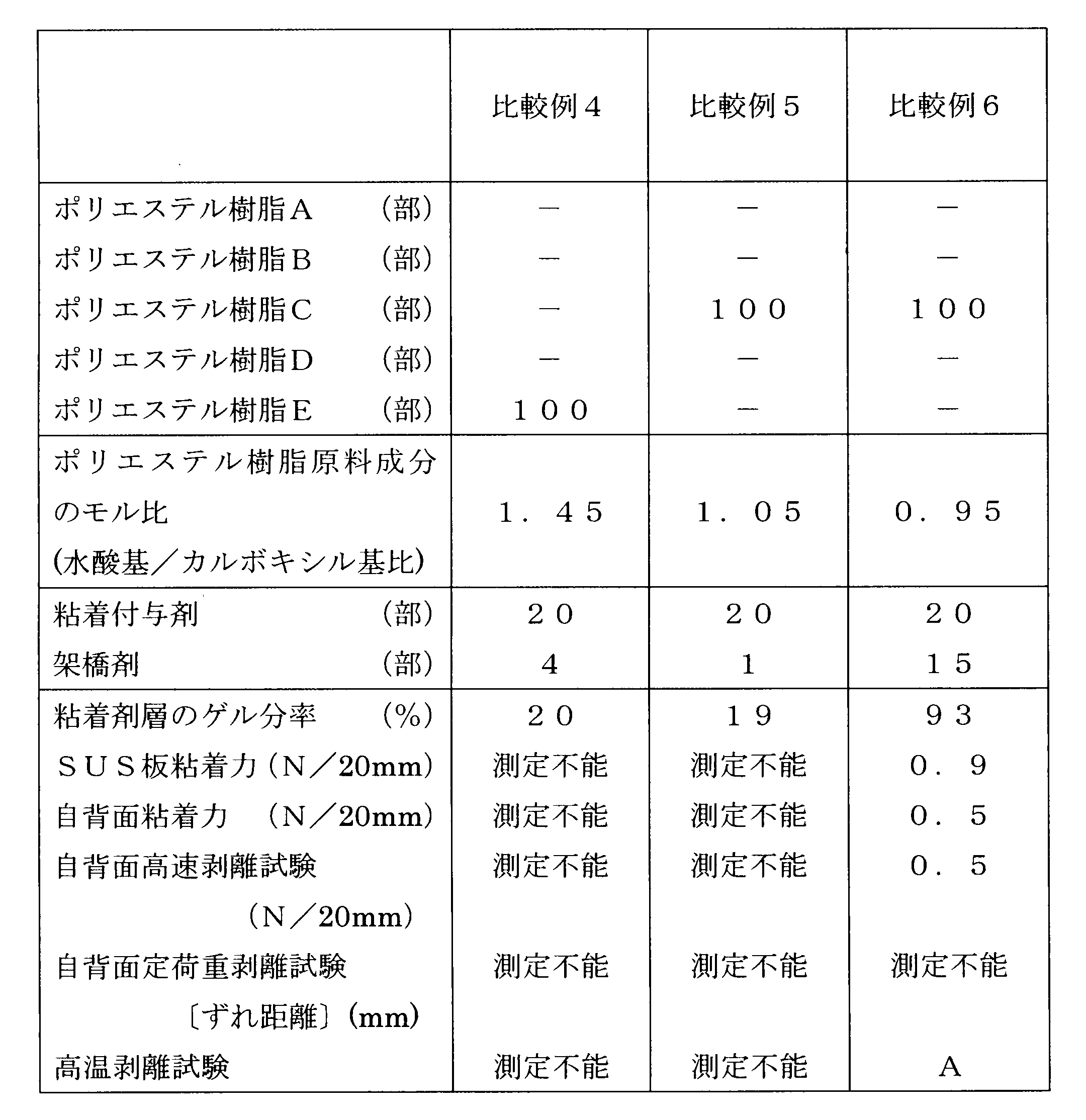
なお、上記の表3,4中、「測定不能」とは、「比較例1」では自背面に対する粘着力が低すぎるために高速剥離試験において正確な値が得られない状態を、「比較例4,5」では凝集破壊により正確な値が得られない状態を、「比較例6」では貼り合わせの時点で被着体から剥がれ、測定ができない状態を、それぞれ示している。
以上の結果から明らかなように、実施例1~7の各ポリエステル系マスキングシートは被着体および自背面に対する粘着力を維持しつつも、高速でテープを巻き戻す際の負担を軽減することができ、さらに高温剥離試験で糊残りや汚染などを生じることなく再剥離できる。これに対して、比較例1~6の各ポリエステル系マスキングシートは上記いずれかの特性に劣り、すべての特性を満足させることができない。
また、実施例1~7の各ポリエステル系マスキングシートは、上記優れた特性に加えて粘着剤層が植物由来であるため焼却処理してもCO2の増加の抑制を期待でき、地球環境にやさしいバイオマスマスキングシートとしての特徴を有している。
また、実施例1~7の各ポリエステル系マスキングシートは、上記優れた特性に加えて粘着剤層が植物由来であるため焼却処理してもCO2の増加の抑制を期待でき、地球環境にやさしいバイオマスマスキングシートとしての特徴を有している。
本発明を特定の態様を参照して詳細に説明したが、本発明の精神と範囲を離れることなく様々な変更および修正が可能であることは、当業者にとって明らかである。
なお、本出願は、2008年5月21日付けで出願された日本特許出願(特願2008-133679)に基づいており、その全体が引用により援用される。
また、ここに引用されるすべての参照は全体として取り込まれる。
なお、本出願は、2008年5月21日付けで出願された日本特許出願(特願2008-133679)に基づいており、その全体が引用により援用される。
また、ここに引用されるすべての参照は全体として取り込まれる。
本発明によれば、基材上に、植物由来材料を原料成分としたポリエステル樹脂を有効成分とし、これに粘着付与剤を加えて、架橋剤により架橋処理して特定範囲のゲル分率を有する粘着剤層を設けたことにより、化石資源の枯渇に影響されず、使用後廃棄処理する場合に植物由来材料を用いているため二酸化炭素を排出してもカーボンニュートラルを実現できる、地球環境にやさしいポリエステル系マスキングシートが提供される。
Claims (8)
- 基材、および
前記基材上に設けられ、植物由来のジカルボン酸と植物由来のジオールとをジカルボン酸に含まれるカルボキシル基1.00モルに対しジオールに含まれる水酸基が1.01~1.40モルとなる割合で縮合重合させて得られるポリエステル樹脂と、前記ポリエステル樹脂100重量部に対し10~50重量部となる量の粘着付与剤とを含有し、架橋剤により架橋処理され、ゲル分率が40~90%である粘着剤層
を含むポリエステル系マスキングシート。 - 植物由来のジカルボン酸がダイマー酸であり、植物由来のジオールがダイマージオールである請求項1に記載のポリエステル系マスキングシート。
- 粘着付与剤が植物由来の材料を主成分としたものである請求項1または2に記載のポリエステル系マスキングシート。
- 粘着付与剤が、ロジン系樹脂もしくはテルペン系樹脂から選ばれる少なくとも1つである請求項1~3のいずれかに記載のポリエステル系マスキングシート。
- 架橋剤がポリイソシアネート化合物である請求項1~4のいずれかに記載のポリエステル系マスキングシート。
- 架橋剤の含有量が、ポリエステル樹脂100重量部に対して2~13重量部である請求項1~5のいずれかに記載のポリエステル系マスキングシート。
- ポリエステル樹脂の重量平均分子量が、1万~20万である請求項1~6のいずれかに記載のポリエステル系マスキングシート。
- 基材が、多孔性の基材である請求項1~7のいずれかに記載のポリエステル系マスキングシート。
Priority Applications (3)
| Application Number | Priority Date | Filing Date | Title |
|---|---|---|---|
| CN2009801182540A CN102037089B (zh) | 2008-05-21 | 2009-05-21 | 聚酯类掩片 |
| EP09750634.9A EP2280048B1 (en) | 2008-05-21 | 2009-05-21 | Polyester-based masking sheet |
| US12/993,732 US20110091716A1 (en) | 2008-05-21 | 2009-05-21 | Polyester-based masking sheet |
Applications Claiming Priority (2)
| Application Number | Priority Date | Filing Date | Title |
|---|---|---|---|
| JP2008-133679 | 2008-05-21 | ||
| JP2008133679A JP5185691B2 (ja) | 2008-05-21 | 2008-05-21 | ポリエステル系マスキングシート |
Publications (1)
| Publication Number | Publication Date |
|---|---|
| WO2009142272A1 true WO2009142272A1 (ja) | 2009-11-26 |
Family
ID=41340199
Family Applications (1)
| Application Number | Title | Priority Date | Filing Date |
|---|---|---|---|
| PCT/JP2009/059375 Ceased WO2009142272A1 (ja) | 2008-05-21 | 2009-05-21 | ポリエステル系マスキングシート |
Country Status (5)
| Country | Link |
|---|---|
| US (1) | US20110091716A1 (ja) |
| EP (1) | EP2280048B1 (ja) |
| JP (1) | JP5185691B2 (ja) |
| CN (1) | CN102037089B (ja) |
| WO (1) | WO2009142272A1 (ja) |
Cited By (5)
| Publication number | Priority date | Publication date | Assignee | Title |
|---|---|---|---|---|
| WO2011049115A1 (ja) * | 2009-10-20 | 2011-04-28 | 日東電工株式会社 | マスキング用粘着テープ |
| WO2011068102A1 (ja) * | 2009-12-03 | 2011-06-09 | 日東電工株式会社 | 粘着シート |
| WO2013146079A1 (ja) * | 2012-03-29 | 2013-10-03 | 日東電工株式会社 | 粘着剤組成物、及び、表面保護用粘着シート |
| CN103492508A (zh) * | 2011-04-22 | 2014-01-01 | 日东电工株式会社 | 表面保护膜 |
| EP2520630A4 (en) * | 2009-12-28 | 2014-02-12 | Nitto Denko Corp | POLYESTER ADHESIVE COMPOSITION |
Families Citing this family (15)
| Publication number | Priority date | Publication date | Assignee | Title |
|---|---|---|---|---|
| JP5357470B2 (ja) * | 2008-09-05 | 2013-12-04 | 日東電工株式会社 | 放射線硬化再剥離型粘着シート |
| JP5368249B2 (ja) * | 2009-10-20 | 2013-12-18 | 日東電工株式会社 | 両面粘着シート |
| JP5627280B2 (ja) * | 2010-05-11 | 2014-11-19 | 日東電工株式会社 | ポリエステルシートの製造方法 |
| JP6228738B2 (ja) * | 2012-03-16 | 2017-11-08 | 日東電工株式会社 | 粘着剤組成物、及び、粘着シート |
| JP5980674B2 (ja) * | 2012-12-28 | 2016-08-31 | 日東電工株式会社 | ポリエステル系粘着剤組成物、及び前記粘着剤組成物を用いた粘着シート |
| JP2014169420A (ja) * | 2013-03-05 | 2014-09-18 | Nitto Denko Corp | 両面粘着テープ |
| JP6343463B2 (ja) * | 2013-03-05 | 2018-06-13 | 日東電工株式会社 | 両面粘着テープ |
| JP2014169419A (ja) * | 2013-03-05 | 2014-09-18 | Nitto Denko Corp | 粘着剤層、粘着テープ、及び、両面粘着テープ |
| WO2014136765A1 (ja) * | 2013-03-05 | 2014-09-12 | 日東電工株式会社 | 粘着剤層、粘着テープ、及び、両面粘着テープ |
| JP6130180B2 (ja) * | 2013-03-25 | 2017-05-17 | 株式会社タムラ製作所 | ロジンエステル含有はんだ付け用フラックス組成物及びソルダーペースト組成物 |
| JP6687997B2 (ja) * | 2013-12-20 | 2020-04-28 | 日東電工株式会社 | 粘着剤組成物、粘着剤層、粘着テープ、及び、両面粘着テープ |
| JP6396062B2 (ja) * | 2014-04-03 | 2018-09-26 | 日東電工株式会社 | ポリエステル系粘着剤組成物、及び、粘着シート |
| CN114555749B (zh) * | 2019-10-23 | 2024-04-26 | 三菱化学株式会社 | 柔性印刷电路板用粘接剂组合物、柔性印刷电路板用粘接剂和柔性印刷电路板 |
| CN112195007B (zh) * | 2020-10-12 | 2021-05-04 | 中瀚新材料科技有限公司 | 一种低介电常数高频传输用热熔胶及其胶膜和制备方法 |
| JP7299428B2 (ja) * | 2021-02-26 | 2023-06-27 | 日東電工株式会社 | 粘着剤組成物および粘着シート |
Citations (8)
| Publication number | Priority date | Publication date | Assignee | Title |
|---|---|---|---|---|
| JPS6250378A (ja) * | 1985-08-26 | 1987-03-05 | ミネソタ マイニング アンド マニユフアクチユアリング コンパニ− | 感圧接着テ−プ |
| JPS63132986A (ja) * | 1986-11-25 | 1988-06-04 | Nippon Oil Co Ltd | 感圧性接着剤 |
| JPH02151427A (ja) | 1988-12-02 | 1990-06-11 | Nitto Denko Corp | 多孔性基材及び接着テープ |
| JPH10158596A (ja) | 1996-12-04 | 1998-06-16 | Nitto Denko Corp | 粘着テープ |
| JP2007191656A (ja) * | 2006-01-23 | 2007-08-02 | Nitto Denko Corp | 粘着剤組成物とその粘着シート |
| JP2007308626A (ja) * | 2006-05-19 | 2007-11-29 | Nitto Denko Corp | 低透湿性粘着シート |
| JP2008013593A (ja) * | 2006-07-03 | 2008-01-24 | Nitto Denko Corp | 透明性に優れるポリエステル系粘着シート |
| JP2008133679A (ja) | 2006-11-29 | 2008-06-12 | Union Corp | レバーハンドルの取付座 |
Family Cites Families (9)
| Publication number | Priority date | Publication date | Assignee | Title |
|---|---|---|---|---|
| US4066600A (en) * | 1975-11-17 | 1978-01-03 | Minnesota Mining And Manufacturing Company | Friction-activatable adhesive and articles thereof |
| US5583187A (en) * | 1995-05-03 | 1996-12-10 | National Starch And Chemical Investment Holding Corporation | Hot melt adhesives based on hydroxy-functional polyesters |
| TWI276671B (en) * | 2000-03-03 | 2007-03-21 | Lintec Corp | Adhesive sheet and adhered article |
| JP2001316646A (ja) * | 2000-05-10 | 2001-11-16 | Lintec Corp | 自己接着性テープ及びその使用方法 |
| EP3925997B1 (en) * | 2005-04-22 | 2024-07-17 | Mitsubishi Chemical Corporation | Biomass-resource-derived polyester and production process thereof |
| JP5221005B2 (ja) * | 2006-05-30 | 2013-06-26 | 日東電工株式会社 | 難燃性粘着シート |
| JP5604037B2 (ja) * | 2008-08-06 | 2014-10-08 | 日東電工株式会社 | ポリエステル、ポリエステル組成物、粘着剤組成物、粘着剤層及び粘着シート |
| JP5519996B2 (ja) * | 2009-10-20 | 2014-06-11 | 日東電工株式会社 | 表面保護用粘着シート |
| JP5368249B2 (ja) * | 2009-10-20 | 2013-12-18 | 日東電工株式会社 | 両面粘着シート |
-
2008
- 2008-05-21 JP JP2008133679A patent/JP5185691B2/ja active Active
-
2009
- 2009-05-21 WO PCT/JP2009/059375 patent/WO2009142272A1/ja not_active Ceased
- 2009-05-21 EP EP09750634.9A patent/EP2280048B1/en active Active
- 2009-05-21 CN CN2009801182540A patent/CN102037089B/zh active Active
- 2009-05-21 US US12/993,732 patent/US20110091716A1/en not_active Abandoned
Patent Citations (8)
| Publication number | Priority date | Publication date | Assignee | Title |
|---|---|---|---|---|
| JPS6250378A (ja) * | 1985-08-26 | 1987-03-05 | ミネソタ マイニング アンド マニユフアクチユアリング コンパニ− | 感圧接着テ−プ |
| JPS63132986A (ja) * | 1986-11-25 | 1988-06-04 | Nippon Oil Co Ltd | 感圧性接着剤 |
| JPH02151427A (ja) | 1988-12-02 | 1990-06-11 | Nitto Denko Corp | 多孔性基材及び接着テープ |
| JPH10158596A (ja) | 1996-12-04 | 1998-06-16 | Nitto Denko Corp | 粘着テープ |
| JP2007191656A (ja) * | 2006-01-23 | 2007-08-02 | Nitto Denko Corp | 粘着剤組成物とその粘着シート |
| JP2007308626A (ja) * | 2006-05-19 | 2007-11-29 | Nitto Denko Corp | 低透湿性粘着シート |
| JP2008013593A (ja) * | 2006-07-03 | 2008-01-24 | Nitto Denko Corp | 透明性に優れるポリエステル系粘着シート |
| JP2008133679A (ja) | 2006-11-29 | 2008-06-12 | Union Corp | レバーハンドルの取付座 |
Non-Patent Citations (1)
| Title |
|---|
| See also references of EP2280048A4 |
Cited By (11)
| Publication number | Priority date | Publication date | Assignee | Title |
|---|---|---|---|---|
| WO2011049115A1 (ja) * | 2009-10-20 | 2011-04-28 | 日東電工株式会社 | マスキング用粘着テープ |
| JP2011088957A (ja) * | 2009-10-20 | 2011-05-06 | Nitto Denko Corp | マスキング用粘着テープ |
| WO2011068102A1 (ja) * | 2009-12-03 | 2011-06-09 | 日東電工株式会社 | 粘着シート |
| CN102639659A (zh) * | 2009-12-03 | 2012-08-15 | 日东电工株式会社 | 粘合片 |
| CN102639659B (zh) * | 2009-12-03 | 2014-01-15 | 日东电工株式会社 | 粘合片 |
| US9593270B2 (en) | 2009-12-03 | 2017-03-14 | Nitto Denko Corporation | Adhesive sheet |
| EP2520630A4 (en) * | 2009-12-28 | 2014-02-12 | Nitto Denko Corp | POLYESTER ADHESIVE COMPOSITION |
| US9260639B2 (en) | 2009-12-28 | 2016-02-16 | Nitto Denko Corporation | Polyester adhesive composition |
| CN103492508A (zh) * | 2011-04-22 | 2014-01-01 | 日东电工株式会社 | 表面保护膜 |
| WO2013146079A1 (ja) * | 2012-03-29 | 2013-10-03 | 日東電工株式会社 | 粘着剤組成物、及び、表面保護用粘着シート |
| JP2013203979A (ja) * | 2012-03-29 | 2013-10-07 | Nitto Denko Corp | 粘着剤組成物、及び、表面保護用粘着シート |
Also Published As
| Publication number | Publication date |
|---|---|
| EP2280048A1 (en) | 2011-02-02 |
| US20110091716A1 (en) | 2011-04-21 |
| JP5185691B2 (ja) | 2013-04-17 |
| CN102037089B (zh) | 2013-06-05 |
| CN102037089A (zh) | 2011-04-27 |
| JP2009280688A (ja) | 2009-12-03 |
| EP2280048B1 (en) | 2019-05-01 |
| EP2280048A4 (en) | 2014-08-27 |
Similar Documents
| Publication | Publication Date | Title |
|---|---|---|
| JP5185691B2 (ja) | ポリエステル系マスキングシート | |
| KR102311458B1 (ko) | 양면 점착 테이프 | |
| CN105829482B (zh) | 粘合剂组合物、粘合剂层、粘合带以及双面粘合带 | |
| CN102597151B (zh) | 粘合剂组合物 | |
| KR102228975B1 (ko) | 점착제층, 점착 테이프 및 양면 점착 테이프 | |
| CN102575131B (zh) | 遮蔽用粘合带 | |
| JP4914132B2 (ja) | 透明性に優れるポリエステル系粘着シート | |
| CN102639659B (zh) | 粘合片 | |
| EP2826832B1 (en) | Adhesive composition and adhesive sheet | |
| EP2492324A1 (en) | Double-faced pressure-sensitive adhesive sheet | |
| KR102047147B1 (ko) | 점착제 조성물 및 점착 시트 | |
| JP2014169420A (ja) | 両面粘着テープ | |
| JP5627280B2 (ja) | ポリエステルシートの製造方法 | |
| JP2014169419A (ja) | 粘着剤層、粘着テープ、及び、両面粘着テープ | |
| CN115038766A (zh) | 粘合带 | |
| JP2002180023A (ja) | 粘着剤組成物とその粘着シート | |
| JPH11286660A (ja) | 粘着シ―ト類 |
Legal Events
| Date | Code | Title | Description |
|---|---|---|---|
| WWE | Wipo information: entry into national phase |
Ref document number: 200980118254.0 Country of ref document: CN |
|
| 121 | Ep: the epo has been informed by wipo that ep was designated in this application |
Ref document number: 09750634 Country of ref document: EP Kind code of ref document: A1 |
|
| WWE | Wipo information: entry into national phase |
Ref document number: 12993732 Country of ref document: US Ref document number: 2009750634 Country of ref document: EP |
|
| NENP | Non-entry into the national phase |
Ref country code: DE |