WO2009145060A1 - Feuille multicouche de marquage lase pour passeports électroniques et passeport électronique - Google Patents
Feuille multicouche de marquage lase pour passeports électroniques et passeport électronique Download PDFInfo
- Publication number
- WO2009145060A1 WO2009145060A1 PCT/JP2009/058936 JP2009058936W WO2009145060A1 WO 2009145060 A1 WO2009145060 A1 WO 2009145060A1 JP 2009058936 W JP2009058936 W JP 2009058936W WO 2009145060 A1 WO2009145060 A1 WO 2009145060A1
- Authority
- WO
- WIPO (PCT)
- Prior art keywords
- multilayer sheet
- sheet
- laser marking
- layer
- mass
- Prior art date
- Legal status (The legal status is an assumption and is not a legal conclusion. Google has not performed a legal analysis and makes no representation as to the accuracy of the status listed.)
- Ceased
Links
Images

Classifications
-
- B—PERFORMING OPERATIONS; TRANSPORTING
- B42—BOOKBINDING; ALBUMS; FILES; SPECIAL PRINTED MATTER
- B42D—BOOKS; BOOK COVERS; LOOSE LEAVES; PRINTED MATTER CHARACTERISED BY IDENTIFICATION OR SECURITY FEATURES; PRINTED MATTER OF SPECIAL FORMAT OR STYLE NOT OTHERWISE PROVIDED FOR; DEVICES FOR USE THEREWITH AND NOT OTHERWISE PROVIDED FOR; MOVABLE-STRIP WRITING OR READING APPARATUS
- B42D25/00—Information-bearing cards or sheet-like structures characterised by identification or security features; Manufacture thereof
- B42D25/40—Manufacture
- B42D25/405—Marking
- B42D25/43—Marking by removal of material
- B42D25/435—Marking by removal of material using electromagnetic radiation, e.g. laser
-
- B—PERFORMING OPERATIONS; TRANSPORTING
- B32—LAYERED PRODUCTS
- B32B—LAYERED PRODUCTS, i.e. PRODUCTS BUILT-UP OF STRATA OF FLAT OR NON-FLAT, e.g. CELLULAR OR HONEYCOMB, FORM
- B32B7/00—Layered products characterised by the relation between layers; Layered products characterised by the relative orientation of features between layers, or by the relative values of a measurable parameter between layers, i.e. products comprising layers having different physical, chemical or physicochemical properties; Layered products characterised by the interconnection of layers
- B32B7/02—Physical, chemical or physicochemical properties
- B32B7/023—Optical properties
-
- B—PERFORMING OPERATIONS; TRANSPORTING
- B23—MACHINE TOOLS; METAL-WORKING NOT OTHERWISE PROVIDED FOR
- B23K—SOLDERING OR UNSOLDERING; WELDING; CLADDING OR PLATING BY SOLDERING OR WELDING; CUTTING BY APPLYING HEAT LOCALLY, e.g. FLAME CUTTING; WORKING BY LASER BEAM
- B23K26/00—Working by laser beam, e.g. welding, cutting or boring
- B23K26/0006—Working by laser beam, e.g. welding, cutting or boring taking account of the properties of the material involved
-
- B—PERFORMING OPERATIONS; TRANSPORTING
- B23—MACHINE TOOLS; METAL-WORKING NOT OTHERWISE PROVIDED FOR
- B23K—SOLDERING OR UNSOLDERING; WELDING; CLADDING OR PLATING BY SOLDERING OR WELDING; CUTTING BY APPLYING HEAT LOCALLY, e.g. FLAME CUTTING; WORKING BY LASER BEAM
- B23K26/00—Working by laser beam, e.g. welding, cutting or boring
- B23K26/352—Working by laser beam, e.g. welding, cutting or boring for surface treatment
- B23K26/354—Working by laser beam, e.g. welding, cutting or boring for surface treatment by melting
-
- B—PERFORMING OPERATIONS; TRANSPORTING
- B32—LAYERED PRODUCTS
- B32B—LAYERED PRODUCTS, i.e. PRODUCTS BUILT-UP OF STRATA OF FLAT OR NON-FLAT, e.g. CELLULAR OR HONEYCOMB, FORM
- B32B27/00—Layered products comprising a layer of synthetic resin
-
- B—PERFORMING OPERATIONS; TRANSPORTING
- B32—LAYERED PRODUCTS
- B32B—LAYERED PRODUCTS, i.e. PRODUCTS BUILT-UP OF STRATA OF FLAT OR NON-FLAT, e.g. CELLULAR OR HONEYCOMB, FORM
- B32B27/00—Layered products comprising a layer of synthetic resin
- B32B27/06—Layered products comprising a layer of synthetic resin as the main or only constituent of a layer, which is next to another layer of the same or of a different material
- B32B27/08—Layered products comprising a layer of synthetic resin as the main or only constituent of a layer, which is next to another layer of the same or of a different material of synthetic resin
-
- B—PERFORMING OPERATIONS; TRANSPORTING
- B32—LAYERED PRODUCTS
- B32B—LAYERED PRODUCTS, i.e. PRODUCTS BUILT-UP OF STRATA OF FLAT OR NON-FLAT, e.g. CELLULAR OR HONEYCOMB, FORM
- B32B27/00—Layered products comprising a layer of synthetic resin
- B32B27/12—Layered products comprising a layer of synthetic resin next to a fibrous or filamentary layer
-
- B—PERFORMING OPERATIONS; TRANSPORTING
- B32—LAYERED PRODUCTS
- B32B—LAYERED PRODUCTS, i.e. PRODUCTS BUILT-UP OF STRATA OF FLAT OR NON-FLAT, e.g. CELLULAR OR HONEYCOMB, FORM
- B32B27/00—Layered products comprising a layer of synthetic resin
- B32B27/34—Layered products comprising a layer of synthetic resin comprising polyamides
-
- B—PERFORMING OPERATIONS; TRANSPORTING
- B32—LAYERED PRODUCTS
- B32B—LAYERED PRODUCTS, i.e. PRODUCTS BUILT-UP OF STRATA OF FLAT OR NON-FLAT, e.g. CELLULAR OR HONEYCOMB, FORM
- B32B27/00—Layered products comprising a layer of synthetic resin
- B32B27/36—Layered products comprising a layer of synthetic resin comprising polyesters
-
- B—PERFORMING OPERATIONS; TRANSPORTING
- B32—LAYERED PRODUCTS
- B32B—LAYERED PRODUCTS, i.e. PRODUCTS BUILT-UP OF STRATA OF FLAT OR NON-FLAT, e.g. CELLULAR OR HONEYCOMB, FORM
- B32B27/00—Layered products comprising a layer of synthetic resin
- B32B27/36—Layered products comprising a layer of synthetic resin comprising polyesters
- B32B27/365—Layered products comprising a layer of synthetic resin comprising polyesters comprising polycarbonates
-
- B—PERFORMING OPERATIONS; TRANSPORTING
- B32—LAYERED PRODUCTS
- B32B—LAYERED PRODUCTS, i.e. PRODUCTS BUILT-UP OF STRATA OF FLAT OR NON-FLAT, e.g. CELLULAR OR HONEYCOMB, FORM
- B32B27/00—Layered products comprising a layer of synthetic resin
- B32B27/40—Layered products comprising a layer of synthetic resin comprising polyurethanes
-
- B—PERFORMING OPERATIONS; TRANSPORTING
- B32—LAYERED PRODUCTS
- B32B—LAYERED PRODUCTS, i.e. PRODUCTS BUILT-UP OF STRATA OF FLAT OR NON-FLAT, e.g. CELLULAR OR HONEYCOMB, FORM
- B32B3/00—Layered products comprising a layer with external or internal discontinuities or unevennesses, or a layer of non-planar shape; Layered products comprising a layer having particular features of form
- B32B3/02—Layered products comprising a layer with external or internal discontinuities or unevennesses, or a layer of non-planar shape; Layered products comprising a layer having particular features of form characterised by features of form at particular places, e.g. in edge regions
-
- B—PERFORMING OPERATIONS; TRANSPORTING
- B41—PRINTING; LINING MACHINES; TYPEWRITERS; STAMPS
- B41M—PRINTING, DUPLICATING, MARKING, OR COPYING PROCESSES; COLOUR PRINTING
- B41M5/00—Duplicating or marking methods; Sheet materials for use therein
- B41M5/26—Thermography ; Marking by high energetic means, e.g. laser otherwise than by burning, and characterised by the material used
-
- B—PERFORMING OPERATIONS; TRANSPORTING
- B42—BOOKBINDING; ALBUMS; FILES; SPECIAL PRINTED MATTER
- B42D—BOOKS; BOOK COVERS; LOOSE LEAVES; PRINTED MATTER CHARACTERISED BY IDENTIFICATION OR SECURITY FEATURES; PRINTED MATTER OF SPECIAL FORMAT OR STYLE NOT OTHERWISE PROVIDED FOR; DEVICES FOR USE THEREWITH AND NOT OTHERWISE PROVIDED FOR; MOVABLE-STRIP WRITING OR READING APPARATUS
- B42D25/00—Information-bearing cards or sheet-like structures characterised by identification or security features; Manufacture thereof
-
- B—PERFORMING OPERATIONS; TRANSPORTING
- B42—BOOKBINDING; ALBUMS; FILES; SPECIAL PRINTED MATTER
- B42D—BOOKS; BOOK COVERS; LOOSE LEAVES; PRINTED MATTER CHARACTERISED BY IDENTIFICATION OR SECURITY FEATURES; PRINTED MATTER OF SPECIAL FORMAT OR STYLE NOT OTHERWISE PROVIDED FOR; DEVICES FOR USE THEREWITH AND NOT OTHERWISE PROVIDED FOR; MOVABLE-STRIP WRITING OR READING APPARATUS
- B42D25/00—Information-bearing cards or sheet-like structures characterised by identification or security features; Manufacture thereof
- B42D25/20—Information-bearing cards or sheet-like structures characterised by identification or security features; Manufacture thereof characterised by a particular use or purpose
- B42D25/24—Passports
-
- B—PERFORMING OPERATIONS; TRANSPORTING
- B42—BOOKBINDING; ALBUMS; FILES; SPECIAL PRINTED MATTER
- B42D—BOOKS; BOOK COVERS; LOOSE LEAVES; PRINTED MATTER CHARACTERISED BY IDENTIFICATION OR SECURITY FEATURES; PRINTED MATTER OF SPECIAL FORMAT OR STYLE NOT OTHERWISE PROVIDED FOR; DEVICES FOR USE THEREWITH AND NOT OTHERWISE PROVIDED FOR; MOVABLE-STRIP WRITING OR READING APPARATUS
- B42D25/00—Information-bearing cards or sheet-like structures characterised by identification or security features; Manufacture thereof
- B42D25/40—Manufacture
- B42D25/405—Marking
- B42D25/41—Marking using electromagnetic radiation
-
- B—PERFORMING OPERATIONS; TRANSPORTING
- B23—MACHINE TOOLS; METAL-WORKING NOT OTHERWISE PROVIDED FOR
- B23K—SOLDERING OR UNSOLDERING; WELDING; CLADDING OR PLATING BY SOLDERING OR WELDING; CUTTING BY APPLYING HEAT LOCALLY, e.g. FLAME CUTTING; WORKING BY LASER BEAM
- B23K2103/00—Materials to be soldered, welded or cut
- B23K2103/16—Composite materials
-
- B—PERFORMING OPERATIONS; TRANSPORTING
- B23—MACHINE TOOLS; METAL-WORKING NOT OTHERWISE PROVIDED FOR
- B23K—SOLDERING OR UNSOLDERING; WELDING; CLADDING OR PLATING BY SOLDERING OR WELDING; CUTTING BY APPLYING HEAT LOCALLY, e.g. FLAME CUTTING; WORKING BY LASER BEAM
- B23K2103/00—Materials to be soldered, welded or cut
- B23K2103/16—Composite materials
- B23K2103/166—Multilayered materials
- B23K2103/172—Multilayered materials wherein at least one of the layers is non-metallic
-
- B—PERFORMING OPERATIONS; TRANSPORTING
- B23—MACHINE TOOLS; METAL-WORKING NOT OTHERWISE PROVIDED FOR
- B23K—SOLDERING OR UNSOLDERING; WELDING; CLADDING OR PLATING BY SOLDERING OR WELDING; CUTTING BY APPLYING HEAT LOCALLY, e.g. FLAME CUTTING; WORKING BY LASER BEAM
- B23K2103/00—Materials to be soldered, welded or cut
- B23K2103/30—Organic materials
- B23K2103/42—Plastics other than composite materials
-
- B—PERFORMING OPERATIONS; TRANSPORTING
- B32—LAYERED PRODUCTS
- B32B—LAYERED PRODUCTS, i.e. PRODUCTS BUILT-UP OF STRATA OF FLAT OR NON-FLAT, e.g. CELLULAR OR HONEYCOMB, FORM
- B32B2250/00—Layers arrangement
- B32B2250/05—5 or more layers
-
- B—PERFORMING OPERATIONS; TRANSPORTING
- B32—LAYERED PRODUCTS
- B32B—LAYERED PRODUCTS, i.e. PRODUCTS BUILT-UP OF STRATA OF FLAT OR NON-FLAT, e.g. CELLULAR OR HONEYCOMB, FORM
- B32B2255/00—Coating on the layer surface
- B32B2255/10—Coating on the layer surface on synthetic resin layer or on natural or synthetic rubber layer
-
- B—PERFORMING OPERATIONS; TRANSPORTING
- B32—LAYERED PRODUCTS
- B32B—LAYERED PRODUCTS, i.e. PRODUCTS BUILT-UP OF STRATA OF FLAT OR NON-FLAT, e.g. CELLULAR OR HONEYCOMB, FORM
- B32B2262/00—Composition or structural features of fibres which form a fibrous or filamentary layer or are present as additives
- B32B2262/02—Synthetic macromolecular fibres
- B32B2262/0261—Polyamide fibres
-
- B—PERFORMING OPERATIONS; TRANSPORTING
- B32—LAYERED PRODUCTS
- B32B—LAYERED PRODUCTS, i.e. PRODUCTS BUILT-UP OF STRATA OF FLAT OR NON-FLAT, e.g. CELLULAR OR HONEYCOMB, FORM
- B32B2262/00—Composition or structural features of fibres which form a fibrous or filamentary layer or are present as additives
- B32B2262/02—Synthetic macromolecular fibres
- B32B2262/0276—Polyester fibres
-
- B—PERFORMING OPERATIONS; TRANSPORTING
- B32—LAYERED PRODUCTS
- B32B—LAYERED PRODUCTS, i.e. PRODUCTS BUILT-UP OF STRATA OF FLAT OR NON-FLAT, e.g. CELLULAR OR HONEYCOMB, FORM
- B32B2307/00—Properties of the layers or laminate
- B32B2307/40—Properties of the layers or laminate having particular optical properties
-
- B—PERFORMING OPERATIONS; TRANSPORTING
- B32—LAYERED PRODUCTS
- B32B—LAYERED PRODUCTS, i.e. PRODUCTS BUILT-UP OF STRATA OF FLAT OR NON-FLAT, e.g. CELLULAR OR HONEYCOMB, FORM
- B32B2307/00—Properties of the layers or laminate
- B32B2307/40—Properties of the layers or laminate having particular optical properties
- B32B2307/402—Coloured
-
- B—PERFORMING OPERATIONS; TRANSPORTING
- B32—LAYERED PRODUCTS
- B32B—LAYERED PRODUCTS, i.e. PRODUCTS BUILT-UP OF STRATA OF FLAT OR NON-FLAT, e.g. CELLULAR OR HONEYCOMB, FORM
- B32B2307/00—Properties of the layers or laminate
- B32B2307/40—Properties of the layers or laminate having particular optical properties
- B32B2307/412—Transparent
-
- B—PERFORMING OPERATIONS; TRANSPORTING
- B32—LAYERED PRODUCTS
- B32B—LAYERED PRODUCTS, i.e. PRODUCTS BUILT-UP OF STRATA OF FLAT OR NON-FLAT, e.g. CELLULAR OR HONEYCOMB, FORM
- B32B2307/00—Properties of the layers or laminate
- B32B2307/50—Properties of the layers or laminate having particular mechanical properties
- B32B2307/538—Roughness
-
- B—PERFORMING OPERATIONS; TRANSPORTING
- B32—LAYERED PRODUCTS
- B32B—LAYERED PRODUCTS, i.e. PRODUCTS BUILT-UP OF STRATA OF FLAT OR NON-FLAT, e.g. CELLULAR OR HONEYCOMB, FORM
- B32B2367/00—Polyesters, e.g. PET, i.e. polyethylene terephthalate
-
- B—PERFORMING OPERATIONS; TRANSPORTING
- B32—LAYERED PRODUCTS
- B32B—LAYERED PRODUCTS, i.e. PRODUCTS BUILT-UP OF STRATA OF FLAT OR NON-FLAT, e.g. CELLULAR OR HONEYCOMB, FORM
- B32B2369/00—Polycarbonates
-
- B—PERFORMING OPERATIONS; TRANSPORTING
- B32—LAYERED PRODUCTS
- B32B—LAYERED PRODUCTS, i.e. PRODUCTS BUILT-UP OF STRATA OF FLAT OR NON-FLAT, e.g. CELLULAR OR HONEYCOMB, FORM
- B32B2425/00—Cards, e.g. identity cards, credit cards
-
- B—PERFORMING OPERATIONS; TRANSPORTING
- B41—PRINTING; LINING MACHINES; TYPEWRITERS; STAMPS
- B41M—PRINTING, DUPLICATING, MARKING, OR COPYING PROCESSES; COLOUR PRINTING
- B41M3/00—Printing processes to produce particular kinds of printed work, e.g. patterns
- B41M3/14—Security printing
-
- B—PERFORMING OPERATIONS; TRANSPORTING
- B42—BOOKBINDING; ALBUMS; FILES; SPECIAL PRINTED MATTER
- B42D—BOOKS; BOOK COVERS; LOOSE LEAVES; PRINTED MATTER CHARACTERISED BY IDENTIFICATION OR SECURITY FEATURES; PRINTED MATTER OF SPECIAL FORMAT OR STYLE NOT OTHERWISE PROVIDED FOR; DEVICES FOR USE THEREWITH AND NOT OTHERWISE PROVIDED FOR; MOVABLE-STRIP WRITING OR READING APPARATUS
- B42D13/00—Loose leaves modified for binding; Inserts
-
- Y—GENERAL TAGGING OF NEW TECHNOLOGICAL DEVELOPMENTS; GENERAL TAGGING OF CROSS-SECTIONAL TECHNOLOGIES SPANNING OVER SEVERAL SECTIONS OF THE IPC; TECHNICAL SUBJECTS COVERED BY FORMER USPC CROSS-REFERENCE ART COLLECTIONS [XRACs] AND DIGESTS
- Y10—TECHNICAL SUBJECTS COVERED BY FORMER USPC
- Y10T—TECHNICAL SUBJECTS COVERED BY FORMER US CLASSIFICATION
- Y10T428/00—Stock material or miscellaneous articles
- Y10T428/24—Structurally defined web or sheet [e.g., overall dimension, etc.]
- Y10T428/24355—Continuous and nonuniform or irregular surface on layer or component [e.g., roofing, etc.]
-
- Y—GENERAL TAGGING OF NEW TECHNOLOGICAL DEVELOPMENTS; GENERAL TAGGING OF CROSS-SECTIONAL TECHNOLOGIES SPANNING OVER SEVERAL SECTIONS OF THE IPC; TECHNICAL SUBJECTS COVERED BY FORMER USPC CROSS-REFERENCE ART COLLECTIONS [XRACs] AND DIGESTS
- Y10—TECHNICAL SUBJECTS COVERED BY FORMER USPC
- Y10T—TECHNICAL SUBJECTS COVERED BY FORMER US CLASSIFICATION
- Y10T428/00—Stock material or miscellaneous articles
- Y10T428/24—Structurally defined web or sheet [e.g., overall dimension, etc.]
- Y10T428/24802—Discontinuous or differential coating, impregnation or bond [e.g., artwork, printing, retouched photograph, etc.]
- Y10T428/24851—Intermediate layer is discontinuous or differential
- Y10T428/24868—Translucent outer layer
- Y10T428/24884—Translucent layer comprises natural oil, wax, resin, gum, glue, gelatin
-
- Y—GENERAL TAGGING OF NEW TECHNOLOGICAL DEVELOPMENTS; GENERAL TAGGING OF CROSS-SECTIONAL TECHNOLOGIES SPANNING OVER SEVERAL SECTIONS OF THE IPC; TECHNICAL SUBJECTS COVERED BY FORMER USPC CROSS-REFERENCE ART COLLECTIONS [XRACs] AND DIGESTS
- Y10—TECHNICAL SUBJECTS COVERED BY FORMER USPC
- Y10T—TECHNICAL SUBJECTS COVERED BY FORMER US CLASSIFICATION
- Y10T428/00—Stock material or miscellaneous articles
- Y10T428/24—Structurally defined web or sheet [e.g., overall dimension, etc.]
- Y10T428/24802—Discontinuous or differential coating, impregnation or bond [e.g., artwork, printing, retouched photograph, etc.]
- Y10T428/24893—Discontinuous or differential coating, impregnation or bond [e.g., artwork, printing, retouched photograph, etc.] including particulate material
- Y10T428/24901—Discontinuous or differential coating, impregnation or bond [e.g., artwork, printing, retouched photograph, etc.] including particulate material including coloring matter
-
- Y—GENERAL TAGGING OF NEW TECHNOLOGICAL DEVELOPMENTS; GENERAL TAGGING OF CROSS-SECTIONAL TECHNOLOGIES SPANNING OVER SEVERAL SECTIONS OF THE IPC; TECHNICAL SUBJECTS COVERED BY FORMER USPC CROSS-REFERENCE ART COLLECTIONS [XRACs] AND DIGESTS
- Y10—TECHNICAL SUBJECTS COVERED BY FORMER USPC
- Y10T—TECHNICAL SUBJECTS COVERED BY FORMER US CLASSIFICATION
- Y10T428/00—Stock material or miscellaneous articles
- Y10T428/24—Structurally defined web or sheet [e.g., overall dimension, etc.]
- Y10T428/24942—Structurally defined web or sheet [e.g., overall dimension, etc.] including components having same physical characteristic in differing degree
- Y10T428/2495—Thickness [relative or absolute]
- Y10T428/24967—Absolute thicknesses specified
Definitions
- the present invention relates to a laser marking multilayer sheet used for an electronic passport and an electronic passport using the multilayer sheet for electronic passport. Especially for electronic passports where the multilayer sheet is marked without damage by laser beam irradiation, and the contrast between the fabric color and the printed part is high, clear characters, symbols and images can be obtained, and heat resistance and productivity are excellent.
- the present invention relates to an electronic passport using a laser marking multilayer sheet and a multilayer sheet for electronic passport.
- the passport plays a role as a so-called identification card (identity lighting card, etc.) issued by a country that is a public organization and has reliability.
- this electronic passport can identify and prove an individual, if a third party other than the country (or a national agency) can easily tamper or forge personal information, The credibility of the ID card will be reduced, which may hinder the progress of international exchange and the global movement of human resources.
- a multilayer sheet comprising at least a surface layer and an inner layer is provided for the purpose of obtaining a multilayer sheet that can be laser-marked with no appearance damage, good contrast, and excellent surface smoothness.
- B-2 0.01 to 5 parts by weight of an energy absorber that absorbs a laser beam and (b-3) with respect to 100 parts by weight of the thermoplastic resin (B) and (b-1) thermoplastic resin )
- a multilayer sheet for laser marking is disclosed in which an inner layer made of a thermoplastic resin composition containing 0.5 to 7 parts by weight of a colorant is formed by melt coextrusion.
- the first surface layer / inner layer / second layer is used for the purpose of obtaining a multilayer sheet having no damage to the appearance, good contrast, excellent surface smoothness and excellent heat resistance.
- a multilayer sheet comprising a surface layer, wherein (A) a transparent second resin comprising a thermoplastic resin composition containing 0.001 to 5 parts by weight of mica and / or carbon black with respect to 100 parts by weight of a transparent thermoplastic resin.
- the thickness composition ratio of the first surface layer / inner layer / second surface layer is 1: 4: 1 to 1: 10: 1, and the first surface layer / inner layer / second surface layer is melt coextruded.
- Laser mark formed Multilayer sheet is disclosed for grayed.
- the multilayer sheets for laser marking in Patent Documents 1 and 2 are excellent in heat-fusibility with these multilayer sheets and thermoplastic resin sheets such as PETG sheets and ABS resin sheets.
- thermoplastic resin sheets such as PETG sheets and ABS resin sheets.
- a sufficient printability for printing letters and numbers by marking is obtained and deserves evaluation.
- JP 2002-273732 A Japanese Patent No. 3889431
- the present invention has been made to solve the above-mentioned problems, has excellent laser marking properties, has a high contrast between the fabric color and the printed portion, and can provide clear characters, symbols, images, and a multilayer sheet.
- An electronic passport using a laser marking multi-layer sheet that has excellent heat-fusibility in the laminating process, as well as sheet conveyance, release from the mold after heat pressing, heat resistance, and bendability.
- it has a laminated structure using a laminating film having strength, flexibility and transparency at the center of the laminated sheet so that it can be bound to an electronic passport cover or back cover by a simple manufacturing process such as sewing.
- To provide an electronic passport using a laser marking multilayer sheet for electronic passport and a laser marking multilayer sheet for electronic passport In particular, it is excellent in preventing tampering and preventing counterfeiting.
- the present invention provides the following laser marking multilayer sheet for electronic passports.
- Laser marking multilayer sheet for electronic passports which is formed by laminating five layers of multilayer sheet A / multilayer sheet B / film C / multilayer sheet B / multilayer sheet A.
- the multilayer sheet A includes a skin layer and a core A transparent laser marking multilayer sheet formed of at least three layers laminated by a coextrusion method, wherein the outermost skin layer of the multilayer sheet A is mainly composed of terephthalic acid units.
- a non-crystalline aromatic polyester resin composition comprising 0.01 to 3 parts by mass of at least one lubricant selected from fatty acid esters, fatty acid amides, and fatty acid metal salts with respect to 100 parts by mass of the reester resin.
- the core layer of the multilayer sheet A averages 0.0001 to 3 parts by mass of carbon black as an energy absorber or 0.0001 to 3 parts by mass of carbon black with respect to 100 parts by mass of the polycarbonate resin.
- a polycarbonate-based resin composition comprising a mixture of 0 to 6 parts by mass of at least one selected from metal oxides, metal sulfides, metal carbonates and metal silicates having a particle diameter of less than 150 nm;
- the total thickness of the multilayer sheet A is 50 to 150 ⁇ m, and the total thickness of the multilayer sheet A is equal to the thickness of the core layer.
- the multilayer sheet B is a multilayer sheet consisting of 35% or more and less than 85%, and the multilayer sheet B has a skin layer and a core layer and is formed of at least three layers laminated by a coextrusion method.
- a non-crystalline aromatic polyester-based resin composition comprising 0.01 to 3 parts by mass of at least one lubricant, and the core layer of the multilayer sheet B is based on 100 parts by mass of the polycarbonate resin.
- a ratio of the thickness of the core layer to the total thickness of the multilayer sheet B is a multilayer sheet consisting of 35% or more and less than 85%, and the film C Consists of one kind of film selected from polyester resin film, thermoplastic urethane resin film, nylon resin film or one kind of cloth selected from polyester cloth and nylon cloth, and the thickness of the film C is 20 to 200 ⁇ m.
- the multilayer sheet A is multilayer sheet A / multilayer sheet B / film C / multilayer sheet B / multilayer.
- the core layer and / or skin layer of the multilayer sheet A and / or multilayer sheet B is 0.1 to 5 parts by mass of an antioxidant and / or anti-coloring agent with respect to 100 parts by mass of the thermoplastic resin, and
- the laser marking multilayer sheet for electronic passports according to any one of [1] to [5], which contains 0.1 to 5 parts by mass of an ultraviolet absorber and / or light stabilizer.
- the laser marking multilayer sheet for electronic passports according to any one of [1] to [7] is used, and the multilayer sheet A / multilayer sheet B / film C / multilayer sheet B / multilayer sheet A is laminated in five layers.
- An electronic passport formed by binding and / or adhering a sheet to an electronic passport cover or back cover using a projecting portion of film C.
- Laser marking method that prints by irradiating a laser beam from the side.
- the laser marking properties are excellent, and the contrast between the fabric color and the printed portion is high, and clear characters, symbols, and images are obtained, and the heat-fusibility in the lamination process of the multilayer sheet is excellent. Furthermore, it is possible to provide a laser marking multilayer sheet for electronic passports and electronic passports that combine sheet transportability, releasability from molds after hot pressing, heat resistance, and bendability, and are excellent in productivity. There is an excellent effect. In particular, it is excellent in preventing tampering and preventing counterfeiting.
- the present invention broadly includes a laser marking multilayer sheet for electronic passports having the invention-specific matters, and is not limited to the following embodiments.
- the laser marking multilayer sheet for electronic passports of the present invention is an electronic product in which five layers of multilayer sheet A / multilayer sheet B / film C / multilayer sheet B / multilayer sheet A are laminated. It is a laser marking multilayer sheet for passports.
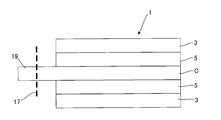
- the multilayer sheet A (reference numeral 3) has a skin layer 3a and a core layer 3b and is a transparent laser marking multilayer sheet formed from at least three layers laminated by a coextrusion method.
- the skin layers 3a which are both outermost layers of the multilayer sheet A are mainly composed of dicarboxylic acid units mainly composed of terephthalic acid units, ethylene glycol units (I), and 1,4-cyclohexanedimethanol units (II).
- Noncrystalline aromatic polyester resin composition comprising 0.01 to 3 parts by mass of at least one lubricant selected from fatty acid esters, fatty acid amides, and fatty acid metal salts with respect to 100 parts by mass of a certain copolyester resin
- the core layer 3b of the multilayer sheet A is an energy absorber with respect to 100 parts by mass of the polycarbonate resin.
- 0.0001 to 3 parts by mass of carbon black or 0.0001 to 3 parts by mass of carbon black and an average particle diameter of less than 150 nm is selected from metal oxides, metal sulfides, metal carbonates and metal silicates.
- a polycarbonate resin composition comprising a mixture of 0 to 6 parts by mass of at least one kind.
- the total thickness of the multilayer sheet A is 50 to 150 ⁇ m
- the ratio of the thickness of the core layer to the total thickness of the multilayer sheet A is 35% or more and less than 85%. It is a multilayer sheet.
- the multi-layer sheet B (reference numeral 5) is a colored laser marking multi-layer sheet having a skin layer 5a and a core layer 5b and formed from at least three layers laminated by a coextrusion method.
- the skin layers 5a which are both outermost layers of the multilayer sheet B are mainly composed of a dicarboxylic acid unit mainly composed of terephthalic acid units, an ethylene glycol unit (I) and 1,4-cyclohexanedimethanol units (II).
- Noncrystalline aromatic polyester resin composition comprising 0.01 to 3 parts by mass of at least one lubricant selected from fatty acid esters, fatty acid amides, and fatty acid metal salts with respect to 100 parts by mass of a certain copolyester resin
- the core layer 5b of the multilayer sheet B is an energy absorber with respect to 100 parts by mass of the polycarbonate resin.
- 0.0001 to 3 parts by mass of carbon black or 0.0001 to 3 parts by mass of carbon black and at least one selected from metal oxide, metal sulfide, metal carbonate and metal silicate is 0. It consists of a polycarbonate resin composition comprising 1 to 6 parts by mass of a mixture of ⁇ 6 parts by mass and a colored inorganic pigment. Further, the total thickness of the multilayer sheet B is 50 to 250 ⁇ m, and the ratio of the thickness of the core layer to the total thickness of the multilayer sheet B is 35% or more and less than 85%. It is a multilayer sheet.
- the film C is composed of one kind of film selected from a polyester resin film, a thermoplastic urethane resin film, and a nylon resin film, or one kind of cloth selected from a polyester cloth and a nylon cloth. Is formed as a laser marking multilayer sheet 1 for electronic passports having a thickness of 20 to 200 ⁇ m.
- Multilayer sheet A The multilayer sheet A has a skin layer and a core layer, and is configured as a transparent laser marking multilayer sheet formed from at least three layers laminated by a coextrusion method.
- the multilayer sheet A is configured as a sheet having at least a three-layer structure including a skin layer 3a and a core layer 3b, and is laminated by a coextrusion method.
- the three-layer sheet according to the present embodiment is “at least three layers” and is not limited to a sheet having a three-layer structure. That is, in the transparent laser marking multilayer sheet A of the present embodiment, “three-layer sheet” is for convenience of explanation, and “three-layer sheet” is “a sheet composed of at least three layers or more”. ", And is not intended to limit the sheet to" three layers ".
- the multilayer sheet A according to the present embodiment may be composed of 5 layers, 7 layers, or an odd number of layers. include.
- the skin layer described later is disposed at the outermost position of the sheet configured from the multilayer structure, and both sides of the sheet Furthermore, it is necessary that the core layer is disposed between the skin layers (between).
- the thickness of the skin layer is not particularly limited, but it is more preferable that the skin layer is formed to have a thickness within a predetermined range described later.
- the multilayer sheet A is composed of the above-mentioned “odd-numbered odd number layers” or more, when the multilayer sheet A is too multilayered, the layer thickness per layer of the skin layer and the core layer to be arranged is If it becomes too thin, there is a risk that a so-called mold stick will be generated in the hot pressing process during lamination. Therefore, the multilayer sheet A composed of 5 layers and more preferably 3 layers is preferable.
- the reason that the transparent laser marking multilayer sheet A composed of the even layers is the same as the transparent laser marking multilayer sheet A composed of the odd layers is the reason why it is composed of the odd layers.
- the layers are arranged as skin layer (PETG) / core layer (PC) / core layer (PC) / skin layer (PETG). It is because it becomes the structure similar to the transparent laser marking multilayer sheet A comprised from these.
- both one and the other are arranged so that the layers are arranged such as skin layer (PETG) / core layer (PC) / skin layer (PETG).
- PETG skin layer
- PC core layer
- PETG skin layer
- Two skin layers are arranged on the outermost side, and one core layer is arranged so as to be sandwiched between the two skin layers to form a multilayer sheet.
- a multilayer sheet composed of five layers as an example, the arrangement of layers such as skin layer (PETG) / core layer (PC) / skin layer (PETG) / core layer (PC) / skin layer (PETG) As is done, two skin layers may be disposed on the outermost sides of one and the other, and a multilayer sheet may be formed by alternately arranging skin layers and core layers.
- the total thickness (total thickness) of the three-layer sheet is 50 to 150 ⁇ m, and the ratio of the thickness of the core layer to the total thickness is 35% or more and less than 85%. It is desirable to consist of. If the total thickness of the three-layer sheet is less than 50 ⁇ m, the problem of the so-called mold stick that the multilayer sheet sticks to the mold at the time of heat-sealing in the multilayer sheet laminating process is likely to occur. This is because it is complicated to control the fusing temperature, the pressing pressure during fusing, the fusing time, and the like, and the molding process is likely to be hindered.
- the multilayer sheet A preferably has a ratio of the thickness of the core layer to the total thickness of 35% or more and less than 85%. If the thickness of the skin layer is too thin, the generation of a mold stick and a decrease in heat-fusibility will occur.On the other hand, if the thickness of the skin layer is too large, the thickness of the core layer, which will be described later, This is because the film is inevitably thinned, resulting in problems such as inferior laser marking properties and warpage after multilayer sheet lamination.
- the thickness of the entire three-layer sheet is set to a desired thickness, not only the local characteristics such as the characteristics of the multilayer sheet A can be easily extracted, but also the laser marking multilayer sheet (multilayer sheet A and It becomes easy to draw out the characteristics of this embodiment as a whole (multilayer sheet made of multilayer sheet B). Furthermore, not only the total thickness of the entire three-layer sheet, but also the ratio of the thickness of the skin layer and the core layer constituting the three-layer sheet in the three-layer sheet is set to the above-described desired ratio, thereby providing three layers. This is preferable because the effect of the present application can be further exhibited, such as the laser marking property being easily improved, in combination with the thickness of the entire sheet being within a desired range.
- the skin layer in the multilayer sheet A is configured as both outermost layers arranged on the outside of the three-layer sheet. That is, this skin layer plays a role as a surface layer (both outermost layers) of a three-layer sheet disposed so as to be sandwiched from both end surfaces (outside) of the core layer in the multilayer sheet A described later.
- the thicknesses of the skin layers are preferably the same. This is because if the multilayer sheet A is composed of skin layers having different thicknesses, as described above, the sheet is warped in the pressing process of the multilayer sheet, which is not preferable. Further, for example, in the case where the multilayer sheet A is composed of three layers of skin layer (PETG) / core layer (PC) / skin layer (PETG), the thickness of the core layer is 35% or more and less than 85%. In this case, the skin layer is 15% or more and less than 65% on both sides.
- PETG skin layer
- PC core layer
- PETG skin layer
- the thickness of the skin layer is too thin, the generation of a mold stick and a decrease in heat-fusibility will occur.On the other hand, if the thickness of the skin layer is too large, the thickness of the core layer, which will be described later, The film is inevitably thinned, and the laser marking property is inferior, and problems such as warpage occur after lamination of the multilayer sheets are undesirable.
- polyester resin composition that is, a copolyester resin described later (see [A-1-1-1]) and a lubricant described later ([A-1-1-2).
- a non-crystalline aromatic polyester resin composition which will be described later.
- the copolyester resin used in the present embodiment is blended as a main component of the amorphous aromatic polyester resin composition.
- the skin layer has a dicarboxylic acid unit mainly composed of terephthalic acid units, an ethylene glycol unit (I), and a glycol unit mainly composed of 1,4-cyclohexanedimethanol unit (II).
- a copolymer comprising ethylene glycol units (I) and 1,4-cyclohexanedimethanol units (II) (I) / (II) 90-30 / 10-70 mol%
- a polymerized polyester resin is used.
- the reason for preparing the component amounts of ethylene glycol and 1,4-cyclohexanedimethanol contained in this copolymerized polyester resin is that the amount of substitution of the ethylene glycol component in the copolymerized polyester resin is less than 10 mol%. This is because the obtained resin does not become sufficiently amorphous, and recrystallization proceeds in the cooling step after heat fusion, resulting in poor heat fusion. Moreover, it is because the resin obtained exceeding 70 mol% is not sufficiently amorphous, and recrystallization proceeds in the cooling step after heat fusion, resulting in poor heat fusion.
- the resin obtained by adjusting the component amounts of ethylene glycol and 1,4-cyclohexanedimethanol becomes sufficiently amorphous, and is excellent in terms of heat-fusibility. Therefore, it can be said to be a desirable resin.
- this copolyester resin for example, about 30 mol% of the ethylene glycol component in polyethylene terephthalate is replaced with 1,4-cyclohexanedimethanol, which is a non-crystalline aromatic polyester resin (trade name “PETG”). , Manufactured by Eastman Chemical Co., Ltd.).
- the lubricant used in this embodiment includes [A-1] a glycol mainly composed of a dicarboxylic acid unit mainly composed of terephthalic acid units, an ethylene glycol unit (I), and 1,4-cyclohexanedimethanol unit (II).
- the addition amount of these lubricants is 0.01 to 3 parts by mass, preferably 0.05 to 1.5 parts by mass. If it is less than 0.01 parts by mass, it will be fused to the press plate at the time of hot pressing, and if it exceeds 3 parts by mass, there will be a problem in the thermal fusion property of the card, which is not preferred.
- fatty acid ester lubricants include butyl stearate, cetyl palmitate, stearic acid monoglyceride, stearic acid diglyceride, stearic acid triglyceride, ester of montan wax acid, wax ester, dicarboxylic acid ester, complex ester, fatty acid amide type
- lubricant include stearic acid amide and ethylene bisstearyl amide.
- the fatty acid metal salt lubricant include calcium stearate, magnesium stearate, zinc stearate, aluminum stearate, barium stearate and the like.
- the core layer is configured as a so-called core layer disposed in the center of the three-layer sheet. That is, this core layer is formed as a core layer of a three-layer sheet so as to be sandwiched between two skin layers disposed on the outermost side.
- the thickness of the core layer it is desirable that the ratio of the thickness in the entire sheet is 35% or more and less than 85%. Preferred is 40% or more and less than 80%.
- the thickness ratio of the core layer is 85% or more, since the total thickness of the transparent laser marking multilayer sheet A is as thin as 50 to 150 ⁇ m, the skin layer becomes relatively thin, and the lubricant is mixed in the skin layer.
- the problem of the mold stick that the transparent laser marking multilayer sheet A sticks to the mold in the heating press process in the laminating process occurs, it is not preferable.
- the thickness ratio of the core layer is less than 35%, the problem of the mold stick does not occur in the laminating process because the skin layer is thick, but the laser marking property is poor or the heat resistance is poor, so the sheet warps. It is not preferable.
- Transparent polycarbonate resin is used as the material constituting the core layer.
- the polycarbonate resin to be used is not particularly limited, but those having a melt volume rate of 4 to 20 can be preferably used. If the melt volume rate is less than 4, it is meaningful in that the toughness of the sheet is improved, but the molding processability is inferior. On the other hand, a melt volume rate exceeding 20 is not preferable because the sheet has poor toughness.
- Energy absorber examples include at least one selected from the group of carbon black, metal oxide, metal sulfide, carbonate, and metal silicate.
- the carbon black is preferably carbon black having an average particle diameter of 10 to 90 nm and a dibutyl phthalate (DBT) oil absorption of 60 to 170 ml / 100 gr. If the average particle size of the carbon black is less than 10 nm, the laser colorability is lowered and handling is too fine, and if it exceeds 90 nm, the transparency of the sheet is lowered or large irregularities are generated on the surface of the sheet. Is not preferable. Further, if the DBT oil absorption is less than 60 ml / 100 gr, the dispersibility is poor, and if it exceeds 170 ml / 100 gr, the impermeability is inferior.
- DBT dibutyl phthalate
- metal oxide as the metal forming the oxide, zinc, magnesium, aluminum, iron, titanium, silicon, antimony, tin, copper, manganese, cobalt, vanadium, niobium, molybdenum, ruthenium, tungsten, palladium, Silver, platinum, etc. are mentioned. Furthermore, ITO, ATO, AZO, etc. are mentioned as a composite metal oxide.
- examples of the metal sulfide include zinc sulfide and cadmium sulfide.
- carbonates calcium carbonate and the like
- metal silicates alumina silicate, iron-containing alumina silicate (mica), hydrous silicate silicate (kaolin), magnesium silicate (talc), silicate Examples include calcium and magnesium silicate.
- metal oxides, composite metal oxides, and metal sulfides have an average particle size of less than 150 nm, preferably less than 100 nm.
- energy absorbers carbon black, metal oxides, and composite metal oxides are preferably used, and each is used alone or in combination.
- the addition amount (blending amount) of the energy absorber is 0.0001 to 3 parts by mass of carbon black added (blending), more preferably 0.0001 to 1 part by mass.
- carbon black and at least one selected from metal oxides, metal sulfides, metal carbonates and metal silicates having an average particle diameter of less than 150 nm are used in combination, the blending amount of the mixture is 0.0001. -6 mass parts is blended, more preferably 0.0001-3 mass parts.
- the addition amount (blending amount) of the energy absorber is prepared for the following reason. That is, the transparent laser marking multilayer sheet A is preferably transparent, and in many cases, the colored laser marking multilayer sheet B, which is the lower layer of the transparent laser marking multilayer sheet A, is printed.
- carbon black having a small average particle diameter is preferably used, and a mixture of carbon black and at least one selected from other metal oxides, metal sulfides, metal carbonates and metal silicates is used as laser energy. Also when used as an absorbent, the average particle size of these metal oxides, metal sulfides, metal carbonates and metal silicates is at least less than 150 nm, preferably less than 100 nm, and more preferably less than 50 nm.
- the transparency of the transparent laser marking multilayer sheet A is not preferred. Further, if the blending amount of these laser energy absorbers exceeds 6 parts by mass, the transparency of the transparent laser marking multilayer sheet A is lowered and the amount of absorbed energy is excessively deteriorated so that sufficient contrast cannot be obtained. . On the other hand, if the addition amount of the laser energy absorber is less than 0.0001 parts by mass, a sufficient contrast cannot be obtained, which is not preferable.
- Antioxidant and / or anti-coloring agent is 0.1 to 5 parts by mass with respect to 100 parts by mass of the polycarbonate resin in the case of the core layer and / or the skin layer in the case of the core layer and / or skin layer. It is preferable to contain. Addition (compounding) of an antioxidant and / or an anti-coloring agent effectively acts on physical property reduction and hue stabilization due to molecular weight reduction during molding processing. As this antioxidant and / or anti-coloring agent, a phenol-based antioxidant or a phosphite-based anti-coloring agent is used.
- phenolic antioxidants include, for example, ⁇ -tocopherol, butylhydroxytoluene, sinapir alcohol, vitamin E, n-octadecyl-3- (3,5-di-t-butyl-4-hydroxyphenyl) propionate 3-5-di-t-butyl-4-hydroxytoluene; pentaerythrityl-tetrakis [3- (3,5-di-t-butyl-4-hydroxyphenyl) propionate], triethylene glycol-bis [3 -(3-t-butyl-5-methyl-4-hydroxyphenyl) propionate], 1,6-hexanediol-bis [3- (3,5-di-t-butyl-4-hydroxyphenyl) propionate], 2-tert-butyl-6- (3′-tert-butyl-5′-methyl-2′-hydroxybenzyl) 4-methylphenyl acrylate, 2,6-di-tert-butyl
- n-octadecyl-3- (3,5-di-tert-butyl-hydroxyphenyl) propionate 1,3,5-trimethyl-2,4,6-tris (3,3) 5-di-tert-butyl-4-hydroxybenzyl) benzene, 1,3,5-tris (3,5-di-tert-butyl-4-hydroxybenzyl) isocyanurate, tetrakis [3- (3,5- Di-tert-butyl-4-hydroxyphenyl) propionyloxymethyl] methane is preferred, and n-octadecyl-3- (3,5-di-tert-butyl-4-hydroxyphenyl) propionate is particularly preferred.
- the said hindered phenolic antioxidant can be used individually or in combination of 2 or more types.
- phosphite ester colorant examples include triphenyl phosphite, tris (nonylphenyl) phosphite, tridecyl phosphite, trioctyl phosphite, trioctadecyl phosphite, didecyl monophenyl phosphite, and dioctyl monophenyl.
- Phosphite diisopropyl monophenyl phosphite, monobutyl diphenyl phosphite, monodecyl diphenyl phosphite, monooctyl diphenyl phosphite, 2,2-methylenebis (4,6-di-tert-butylphenyl) octyl phosphite, tris ( Diethylphenyl) phosphite, tris (di-iso-propylphenyl) phosphite, tris (di-n-butylphenyl) phosphite, tris (2,4-di-tert-butylpheny) ) Phosphite, tris (2,6-di-tert-butylphenyl) phosphite, distearyl pentaerythritol diphosphite, bis (2,4-di-tert-butylphen
- phosphite compounds those that react with dihydric phenols and have a cyclic structure can be used.
- 2,2′-methylenebis (4,6-di-tert-butylphenyl) (2,4-di-tert-butylphenyl) phosphite 2,2′-methylenebis (4,6-di-tert-Butylphenyl) (2-tert-butyl-4-methylphenyl) phosphite
- 2,2′-ethylidenebis (4-methyl-6-tert-butylphenyl) (2-tert-butyl-4-methylphenyl) phosphite and the like.
- tris (2,4-di-tert-butylphenyl) phosphite is particularly preferable.
- the phosphite ester coloration inhibitor may be used alone or in combination of two or more. Moreover, you may use together with a phenolic antioxidant.
- the core layer in the core layer and / or the skin layer 0.1 to 5 parts by mass of the ultraviolet absorber and / or the light stabilizer with respect to 100 parts by mass of the polycarbonate resin and in the case of the skin layer of the copolymer polyester resin. It is preferable to contain. Furthermore, the addition (formulation) of an ultraviolet absorber and / or a light stabilizer effectively acts to suppress light deterioration resistance during storage of the transparent laser marking multilayer sheet A and during actual use of the electronic passport as the final product.
- Examples of the ultraviolet absorber include 2- (2′-hydroxy-5′-methylphenyl) benzotriazole, 2- (2′-hydroxy-3 ′, 5′-di-tert-amylphenyl) benzotriazole, 2- (2′-hydroxy-3 ′, 5′-bis ( ⁇ , ⁇ ′-dimethylbenzyl) phenylbenzotriazole, 2,2′methylenebis [4- (1,1,3,3-tetramethylbutyl) -6- Condensation product of (2H-benzotriazol-2-yl) phenol], methyl-3- [3-tert-butyl-5- (2H-benzotriazol-2-yl) -4-hydroxyphenylpropionate-polyethylene glycol
- the benzotriazole type compound represented by can be mentioned.
- examples of the ultraviolet absorber include 2- (4,6-diphenyl-1,3,5-triazin-2-yl) -5-hexyloxyphenol, 2- (4,6-bis (2,4 And hydroxyphenyltriazine compounds such as -dimethylphenyl) -1,3,5-triazin-2-yl) -5-hexyloxyphenol.
- examples of the ultraviolet absorber include 2,2′-p-phenylenebis (3,1-benzoxazin-4-one) and 2,2′-m-phenylenebis (3,1-benzoxazine-4). -One), and cyclic imino ester compounds such as 2,2'-p, p'-diphenylenebis (3,1-benzoxazin-4-one).
- Examples of the light stabilizer include bis (2,2,6,6-tetramethyl-4-piperidyl) sebacate, bis (1,2,2,6,6-pentamethyl-4-piperidyl) sebacate, tetrakis (2 , 2,6,6-tetramethyl-4-piperidyl) -1,2,3,4-butanetetracarboxylate, tetrakis (1,2,2,6,6-pentamethyl-4-piperidyl) -1,2 , 3,4-Butanetetracarboxylate, poly ⁇ [6- (1,1,3,3-tetramethylbutyl) amino-1,3,5-triazine-2,4-diyl] [(2,2, 6,6-tetramethylpiperidyl) imino] hexamethylene [(2,2,6,6-tetramethylpiperidyl) imino] ⁇ , polymethylpropyl 3-oxy- [4- (2,2,6,6-tetra Methyl) pipette Hindered
- the multilayer sheet A is matted. Further, the both sides of the multilayer sheet A are preferably subjected to mat processing and have an average roughness (Ra) of 0.1 to 5 ⁇ m.
- Ra average roughness
- the reason for forming the mat processing on the surface of the multilayer sheet A is that, for example, when the configuration of the laser marking multilayer sheet of the present embodiment is hot press molded with the multilayer sheet A / multilayer sheet B, the multilayer sheet A When the multilayer sheet is transported to the laminating process, after sucking and adsorbing and transporting, the multilayer sheet is aligned and laminated, and then air is injected.
- the colored laser marking multilayer sheet B of the present invention has a skin layer 5a and a core layer 5b, and is formed from at least three layers laminated by a coextrusion method. Configured as
- the multilayer sheet B is configured as a sheet having at least a three-layer structure including a skin layer and a core layer, and is laminated by a coextrusion method. Since the definition of the three-layer sheet is the same as that of the multilayer sheet A, refer to the description of the three-layer sheet [A-1] of the multilayer sheet A.
- the total thickness (total thickness) of the three-layer sheet is 50 to 250 ⁇ m in total thickness, and the ratio of the thickness of the core layer to the total thickness is 35% or more and less than 85%. It is desirable to become. If the total thickness of the three-layer sheet is less than 50 ⁇ m, the problem of the so-called mold stick that the multilayer sheet sticks to the mold at the time of heat-sealing in the multilayer sheet laminating process is likely to occur. It is necessary to control the fusing temperature, the press pressure during fusing, the fusing time, and the like in order to remove the film, but this control becomes complicated and tends to hinder the molding process.
- the multilayer sheet B has a ratio of the thickness of the core layer to the total thickness of 35% or more and less than 85%. If the thickness of the skin layer is too thin, the generation of a mold stick and a decrease in heat-fusibility will occur.On the other hand, if the thickness of the skin layer is too large, the thickness of the core layer, which will be described later, This is because the film is inevitably thinned, resulting in problems such as inferior laser marking properties and warpage after multilayer sheet lamination.
- the thickness of the entire three-layer sheet is set to a desired thickness, not only the local characteristics such as the characteristics of the multilayer sheet B can be easily extracted, but also the laser marking multilayer sheet (multilayer sheets A and It becomes easy to draw out the characteristics of this embodiment as a whole (multilayer sheet made of multilayer sheet B). Furthermore, not only the total thickness of the entire three-layer sheet, but also the ratio of the thickness of the skin layer and the core layer constituting the three-layer sheet in the three-layer sheet is set to the above-described desired ratio, thereby providing three layers. Combined with setting the thickness of the entire sheet within a desired range, the effects of the present application are further exhibited, such as easier to improve laser marking properties.
- the problem of the fusion property of the multilayer sheet and the mold stick is extremely important in the multilayer sheet B, such as whether it can meet the practical application, productivity, and market needs of the present embodiment as in the multilayer sheet A. Therefore, the relationship between the total thickness of the entire three-layer sheet and the thicknesses of the skin layer and the core layer will be described in detail later in a range that does not overlap with the multilayer sheet A.
- the skin layer in the multilayer sheet B is configured as both outermost layers arranged on the outer side of the three-layer sheet. That is, this skin layer plays a role as a surface layer (both outermost layers) of a three-layer sheet disposed so as to be sandwiched from both end surfaces (outside) of the core layer in the multilayer sheet B described later.
- the thicknesses of the skin layers are preferably the same. This is because if the multilayer sheet B is composed of skin layers having different thicknesses, as described above, the sheet is warped in the pressing step of the multilayer sheet, which is not preferable. Further, for example, when the multilayer sheet B is composed of three layers of skin layer (PETG) / core layer (PC) / skin layer (PETG), the thickness of the core layer is 35% or more and less than 85%. In this case, the skin layer is 15% or more and less than 65% on both sides.
- PETG skin layer
- PC core layer
- PETG skin layer
- the thickness of the skin layer is too thin, the generation of a mold stick and a decrease in heat-fusibility will occur.On the other hand, if the thickness of the skin layer is too large, the thickness of the core layer, which will be described later, The film is inevitably thinned, and the laser marking property is inferior, and problems such as warpage occur after lamination of the multilayer sheets are undesirable.
- copolyester resin The definition of the copolyester resin in the multilayer sheet B is the same as that of the transparent laser marking multilayer sheet A. Therefore, see the description of the copolyester resin of the multilayer sheet A ([A-1-1-1]).
- the addition amount of the lubricant is 0 to 3 parts by mass with respect to 100 parts by mass of the above-described copolymer polyester resin.
- the multilayer sheet B is not on the outermost surface of the laminate when including 0 parts by mass. Therefore, it is not necessary to add a lubricant to the multilayer sheet B.
- a multilayer sheet A / multilayer sheet B or a laminate sheet of multilayer sheet B / other sheet / multilayer sheet B is heat-fused and printed on the surface of the laminate sheet.
- the multilayer sheet B forms the outermost surface of the laminate sheet in this first half step, and therefore it is necessary to add a lubricant. Therefore, in the multilayer sheet B, whether or not a lubricant is necessary differs depending on the method of use and the lamination pattern. Therefore, the addition amount is set to 0 to 3 parts by mass and is added as necessary.
- the definition of the lubricant used when the lubricant is added to the multilayer sheet B is the same as the lubricant used for the multilayer sheet A. Therefore, see the description of the lubricant ([A-1-1-2]) in the multilayer sheet A.
- the core layer in the multilayer sheet B is configured as a so-called core layer arranged at the center of the three-layer sheet in the same manner as the multilayer sheet A. That is, this core layer is formed as a core layer of a three-layer sheet so as to be sandwiched between two skin layers disposed on the outermost side.
- the ratio of the thickness in the entire sheet is 35% or more and less than 85%. Preferable is 40% or more and less than 80%.
- the thickness ratio of the core layer is 85% or more, since the total thickness of the transparent laser marking multilayer sheet B is 50 to 250 ⁇ m, the skin layer becomes relatively thin, and the lubricant is mixed in the skin layer.
- the problem of the mold stick that the transparent laser marking multilayer sheet A sticks to the mold in the heating press process in the laminating process occurs, it is not preferable.
- the thickness ratio of the core layer is less than 35%, the problem of the mold stick does not occur because the skin layer is thick in the laminating process, but since the laser marking property is poor or the heat resistance is poor, the sheet warp is reduced. It is not desirable to occur.
- the material (raw material) constituting the core layer is the same as the multilayer sheet A, refer to the description of the multilayer sheet A.
- the multilayer sheet B is a colored laser marking multilayer sheet, and the core layer of the multilayer sheet B is blended with 1 part by mass or more of a colored inorganic pigment with respect to 100 parts by mass of the polycarbonate resin. This is different from the multilayer sheet A.
- the coloring inorganic pigment is blended in an amount of 1 part by mass or more when marking is performed by irradiating a laser beam to the laminate sheet of the transparent laser marking multilayer sheet A and the colored laser marking multilayer sheet B, as will be described later. This is because the contrast becomes good and the clarity of letters, numbers and images is improved.
- the colored inorganic pigments include titanium oxide, barium oxide and zinc oxide as white pigments, iron oxide, titanium yellow as yellow pigments, iron oxide as red pigments, and cobalt blue ultramarine blue as blue pigments.
- a light colored and lightly colored system is preferable.
- Antioxidant and / or anti-coloring agent The antioxidant and / or anti-coloring agent in the multilayer sheet B is the same as that of the transparent laser marking multilayer sheet A. Moreover, the ultraviolet absorber and / or light stabilizer in the multilayer sheet B are the same as those in the transparent laser marking multilayer sheet A. Therefore, refer to the description of the multilayer sheet A.
- [B-1-5] Matting Moreover, it is preferable that one side of the multilayer sheet B is matted. Furthermore, it is preferable that the both sides of the multilayer sheet B are matted and have an average roughness (Ra) of 0.1 to 5 ⁇ m.
- the mat processing in the multilayer sheet B is the same as that of the transparent laser marking multilayer sheet A. Therefore, refer to the description of the multilayer sheet A.
- the film C of the present invention is used for easily binding the laser marking multilayer sheet for electronic passports of the present invention to an electronic passport. Accordingly, the shape, length, etc. are not particularly limited as long as it is easy to bind the laser marking multilayer sheet for electronic passport, and may be appropriately selected as necessary.
- the thickness of the film C is 20 to 200 ⁇ m.
- the thickness is preferably 50 to 150 ⁇ m. If the thickness of the film C is less than 20 ⁇ m, the strength of the sewing binding portion is insufficient, and there is a concern that the multilayer sheet on which personal information such as personal images, letters, numbers, etc. is laser-marked may be peeled off from the electronic passport. There is a problem that the rigidity of C becomes too large and the electronic passport opens naturally.
- one end of the film C has an overhanging portion that is 5 to 100 mm longer than the multilayer sheet A and the multilayer sheet B (see the overhanging portion in FIG. 1 reference numeral 19).
- the overhanging portion is for assembling one end in the longitudinal direction of the film C to the electronic passport by sewing and / or bonding using the overhanging portion longer than the multilayer sheet A and the multilayer sheet B.
- the dimension of the overhanging portion is preferably 5 to 100 mm, more preferably 5 to 50 mm, and still more preferably 5 to 20 mm.
- the overhang portion it becomes easier to assemble the electronic passport by sewing and / or bonding (using this overhang portion).
- the length of the overhanging portion is determined by the sewing and / or bonding workability, the strength of the sewing binding and the bonding strength.
- polyester resin film from the viewpoint of transparency, flexibility, tear strength, tensile strength and price
- thermoplastic urethane resin film or nylon resin film from the viewpoint of transparency, flexibility, tear strength, tensile strength and price
- polyester cloth nylon cloth
- nylon cloth One type of cloth selected from the following may be used.
- a hot melt adhesive or an adhesive may be applied to one side and / or both sides of the polyester resin film, the thermoplastic urethane resin film or the nylon resin film of the film C as required.
- the application thickness of these hot melt adhesive or adhesive is preferably 0.1 to 20 ⁇ m. If it is less than 0.1 ⁇ m, sufficient adhesive strength will not be exhibited, and if it exceeds 20 ⁇ m, the whole will be too thick, or the rigidity will be too large and the electronic passport will naturally open when assembled to the electronic passport. It is not preferable.
- the polyester cloth and nylon cloth of the film C are preferably impregnated or coated with a thermoplastic resin or a hot melt adhesive, and the thermoplastic resin is preferably a thermoplastic urethane resin.
- the multilayer sheet A is configured as a transparent laser mark three-layer sheet made of PETG / PC (laser mark) / PETG. Furthermore, a colored laser mark multilayer sheet B made of PETG / PC (colored laser mark) / PETG is laminated on the surface opposite to the surface of the multilayer sheet A which is irradiated with the laser, thereby forming an upper layer (multilayer sheet A).
- the core layer PC develops a black color upon laser irradiation
- the laser light further passes through and the core layer PC in the lower layer (multilayer sheet B) also produces a black color.
- the degree of blackening of the portion colored by the laser beam is improved.
- the reflectivity and contrast in order to sufficiently bring out the sharpness of the image (ex. Human face) by laser marking.
- the reflectivity is insufficient or the contrast is low, the sharpness of the image is deteriorated.
- the above-mentioned multilayer sheet A PETG / PC (laser mark) / PETG (transparent laser mark three-layer sheet) is heat-fused with a PETG / PC (white) / PETG three-layer sheet that does not support laser marks.
- the present application synergistically exhibits the effects of the present application by combining the desired multilayer sheet A and multilayer sheet B.
- the laser marking multilayer sheet in the embodiment is described as an arrangement pattern in which the multilayer sheet B is laminated on the lower layer of the multilayer sheet A.
- the arrangement is not limited to such an arrangement. That is, the present invention is not necessarily limited to the case where the multilayer sheet A is disposed in the upper layer and the multilayer sheet B is disposed in the lower layer.
- the multilayer sheet A may be disposed in the lower layer and the multilayer sheet B may be disposed in the upper layer.
- the reason why the multilayer sheet A (multilayer sheet B) may be arranged in the upper layer or the lower layer is that the position (direction) for viewing the laser-marked image or the like is not limited to the vertical direction.
- the multilayer sheet A is disposed in the upper layer when viewed in a plan view in a spread form. Even when the multilayer sheet B is arranged, when the next page is opened and viewed in plan, the arrangement position of the multilayer sheet A and the multilayer sheet B is exactly the same as the arrangement of the multilayer sheet B in the upper layer and the multilayer sheet A in the lower layer. It is because it will be arranged. Therefore, the upper layer and the lower layer here are used for convenience of explanation, and the multilayer sheet A is arranged on the laser irradiation side, and the multilayer sheet B is transmitted through the multilayer sheet A (transmitted).
- the laser marking multilayer sheet in the present embodiment is not limited to being laminated with the multilayer sheet A / multilayer sheet B.
- the multilayer sheet B when being laminated with the multilayer sheet A / multilayer sheet B / multilayer sheet A, the multilayer sheet B /
- the multilayer sheet B when being laminated with the multilayer sheet A / multilayer sheet B / multilayer sheet A, the multilayer sheet B /
- the multilayer sheet A / laminate sheet / multilayer sheet A is further laminated. included. It becomes possible to respond flexibly according to the purpose of use and method of use, and the effects of the present application can be achieved.
- Molding method of transparent laser marking multilayer sheet A and colored laser marking multilayer sheet B In the present invention, to obtain a three-layer transparent laser marking multilayer sheet A and a colored laser marking multilayer sheet B, for example, a coextrusion method in which the resin composition of each layer is coextruded and laminated, each layer is formed into a film, There are a method of laminating this, a method of laminating two layers by a coextrusion method, and a method of laminating a film separately formed thereon, but it is preferable to laminate by a coextrusion method in terms of productivity and cost.
- each layer is blended, or pelletized as necessary, and each is put into each hopper of a three-layer T-die extruder in which T-dies are covalently connected, and the temperature is 200 ° C. to 280 ° C.
- a three-layer laminate can be formed by melting in the range of ° C. and co-extruding with a three-layer T-die and cooling and solidifying with a cooling roll or the like.
- the transparent laser marking multilayer sheet A and the colored laser marking multilayer sheet B of the present invention are not limited to the above methods, and can be formed by a known method, for example, JP-A-10-71763 ( It can be obtained according to the description on pages 6) to (7).
- the multilayer sheet A and the multilayer sheet B obtained as described above are laminated and bonded by heat fusion or the like at a desired temperature for a desired time and at a desired pressure to obtain a laser marking multilayer sheet. More specifically, after each of the multilayer sheets A and B is extruded by melt coextrusion to form a two-layer / three-layer sheet, the roll sheet wound into a roll shape is heated between heating rollers heated to a predetermined temperature, for example, A multilayer sheet A / multilayer sheet B / multilayer sheet A, or multilayer sheet B / other sheet / multilayer sheet B is heated with a heating roller, and a long laminate sheet is manufactured by pressurization and then cut to a predetermined size.
- the multilayer sheet A / multilayer sheet B / multilayer sheet A, or the multilayer sheet B / other sheets / multilayer sheets B are similar to the above by a hot press.
- a sheet laminate sheet can also be produced.
- the laser marking multilayer sheet for electronic passports of the present invention is configured as a five-layer laminate comprising multilayer sheet A / multilayer sheet B / film C / multilayer sheet B / multilayer sheet A. That is, by forming a multilayer sheet A / multilayer sheet B laminate structure, a two-layer laminated laser marking structure comprising at least a transparent laser marking layer and a colored (including white) laser marking layer is formed. And a white layer, the contrast ratio in laser marking is further improved, and the clarity of images and the like is improved. Therefore, the effect of the present application can be achieved.
- laser marking can be performed from either the front surface and / or the back surface by forming a multi-layer laminate of multilayer sheet A / multilayer sheet B / film C / multilayer sheet B / multilayer sheet A.
- the thickness of each layer is preferably 50 to 150 ⁇ m for the multilayer sheet A, 50 to 250 ⁇ m for the multilayer sheet B, and 20 to 200 ⁇ m for the film C.
- the five-layer laminate sheet can be produced by various methods. For example, after multi-layer sheet A / multi-layer sheet B / film C / multi-layer sheet B / multi-layer sheet A are laminated, heat fusion (thermal lamination) is performed by a hot press, or each sheet is pre-hot on one side and / or both sides A melt adhesive or adhesive is applied to a thickness of 0.1 to 20 ⁇ m, and in the case of hot melt adhesive application, multilayer sheet A / multilayer sheet B / film C / multilayer sheet B / multilayer sheet A is applied as described above.
- heat fusion thermal lamination
- the multilayer sheet A is further printed on the surface of the multilayer sheet B, and the multilayer sheet A is multilayer sheet A / (multilayer sheet B).
- Laminate Sheet / Multilayer Sheet A 5 layers are laminated to form a laser marking multilayer sheet for electronic passports. This is because not only the effects of the present application are achieved, but also convenience such as easy molding is improved.
- the multilayer sheet B / film C / multilayer sheet B is heat-sealed by a hot press, or a hot melt adhesive is applied in advance to one side of the multilayer sheet B and heat-sealed by a hot press.
- printing is performed using UV curable ink.
- a hot melt adhesive is applied to one side of the multilayer sheet A in advance.
- a five-layer laminate sheet of multilayer sheet A / multilayer sheet B / film C / multilayer sheet B / multilayer sheet A may be manufactured by a hot press.
- a hot press it is not limited to such a thing, You may form the above-mentioned 5 layer laminated body in the range which does not deviate from the structure and effect of this application.
- the heating press temperature varies depending on the type of film C, but is 100 to 180 ° C., preferably 110 to 160 ° C. If the heating press temperature is less than 100 ° C., adhesion failure may occur. If it exceeds 180 ° C., abnormalities such as warpage and squeeze of the five-layer laminate sheet occur, which is not preferable.
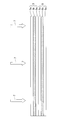
- a laser marking multilayer sheet for electronic passport as shown in FIG. 1 is prepared, and if necessary, a sewing machine binding portion 17 and the like are formed, and further as shown in FIG.
- the laser marking multilayer sheet in the present embodiment is one that develops color by irradiating a laser beam.
- a gas laser such as He—Ne laser, Ar laser, Co 2 laser, and excimer laser, YAG laser, Nd -Solid laser such as YVO 4 laser, semiconductor laser, dye laser and the like.
- YAG laser and Nd ⁇ YVO 4 laser are preferable.
- the above resin composition may include other additives such as a mold release agent, a stabilizer, an antioxidant, an ultraviolet absorber, and a reinforcing agent as long as the characteristics thereof are not impaired. Etc. can be added.
- the laser beam may be a single mode or a multimode as a laser beam, and the beam diameter is as wide as 80 to 100 ⁇ m in addition to a beam diameter reduced to 20 to 40 ⁇ m.
- the contrast between the print coloring portion and the ground is set to 3 or more, and the print quality with good contrast is obtained.
- the laser marking multilayer sheet of the present embodiment when the laser marking multilayer sheet of the present embodiment is irradiated with a laser beam, the multilayer sheet A and the multilayer sheet B constituting the laser marking multilayer sheet are colored, thereby synergistically easily and clearly forming an image. Etc. can be drawn. Therefore, the laser marking multilayer sheet of the present embodiment is excellent in laser markability, and the surface or the interface between the support and the cover is easily and clearly white letters, white symbols and white designs on the black base with a laser beam. In particular, information codes such as barcodes can be marked with high resolution.
- More preferable is a method of laser marking on the aforementioned laser marking multilayer sheet, and printing is performed by irradiating the laser beam 7 from the multilayer sheet A side laminated on the laser marking multilayer sheet as shown in FIG. It is.
- the laser marking multilayer sheet of the present embodiment is excellent in laser markability, and it is even easier to create white letters, white symbols, white designs, etc. on the black background with a laser beam on the surface or interface between the support and the cover.
- the information code such as a barcode can be marked with a high resolution.
- Transparency of the transparent laser marking multilayer sheet A The total light transmittance of the transparent laser marking multilayer sheet A was measured using a spectrophotometer (trade name “EY7000” manufactured by Macbeth). ⁇ : Total light transmittance of 80% or more, ⁇ : Total light transmittance of 60% or more and less than 80%, X: The total light transmittance is less than 60%.
- Sheet transportability After the transparent laser marking multilayer sheet A and the colored laser marking multilayer sheet B of Production Examples 1 to 12 are cut to 95 ⁇ 140 mm, they are transported by a sheet transport machine and laminated with the transparent laser marking multilayer sheet A / the colored laser marking multilayer sheet B. When this was done, the sheet transportability was evaluated according to the following criteria. ⁇ : No problem, ⁇ : Sheet is difficult to desorb from the adsorbing part at the time of sheet lamination, X: Difficult to desorb from the adsorbing part during sheet lamination.
- Air bubble releasing property and heat sealing property a) Bubble releasing property: As described above, the state of remaining bubbles in the laminate after the hot pressing was observed, and the bubble releasing property was evaluated as follows. ⁇ : No bubbles in the laminate, ⁇ : Bubbles remaining in the laminate. b) Thermal fusion property: Adhesion was observed by inserting a cutter blade lightly between the sheets constituting the laminate. ⁇ : No peeling, x: Peeling occurs partially or over the entire surface.
- Laser mark property The laser mark property was evaluated using an Nd.YVO 4 laser (trade name “LT-100SA”, manufactured by Laser Technology Co., Ltd., and product name “RSM103D”, manufactured by Roffin Sinal). Specifically, the laser mark property was determined by performing marking at a laser irradiation rate of 400 mm / sec, and judging from the following whether the contrast was good and the surface layer was broken. ⁇ : Contrast ratio of 3 or more, surface layer destruction, no resin burn, ⁇ : Contrast ratio 2 to less than 3, surface layer destruction, no resin burn, X: Contrast ratio of less than 2 and / or surface layer destruction and resin burnt.
- carbon black Mitsubishi Chemical # 10, average particle diameter 75 nm, DBP oil absorption 86 ml / 100 gr
- energy absorber that absorbs a laser beam and 0.001 part by mass of the above polycarbonate
- phenolic oxidation 0.1 part of n-octadecyl-3- (3,5-di-t-butyl-4-hydroxyphenyl) propionate (trade name “Irganox 1076”, manufactured by Ciba Specialty Chemicals) as an inhibitor
- a UV absorber 2- (2′-hydroxy-3 ′, 5′-di-t-butylphenyl) -5-chlorobenzotriazole (trade name “Tinuvin 327”, manufactured by Ciba Specialty Chemicals Co., Ltd.) ) Is blended in 0.2 parts, and a three-layer car of skin layer / core layer / skin layer by T-die coextrusion method.
- the total thickness of the sheet is 100 ⁇ m, the thicknesses of the skin layers on the front and back sides are the same, and the layer structure is a skin layer (27 ⁇ m) / core layer (46 ⁇ m) / skin layer (27 ⁇ m), The thickness ratio of the core layer was 46%. Furthermore, a three-layer transparent laser marking multilayer sheet A ⁇ 1> was obtained that was matted so that the average surface roughness (Ra) on both sides was 0.5 to 1.8 ⁇ m.
- Transparent laser marking multilayer sheet A ⁇ 2> In the same manner as in Production Example 1, the total thickness of the sheet is set to 100 ⁇ m, the thicknesses of the skin layers on the front and back sides are the same, and the layer structure is skin layer (40 ⁇ m) / core layer (20 ⁇ m) / skin layer (40 ⁇ m) and the thickness of the core layer was 20%. Further, a three-layer transparent laser marking multilayer sheet A ⁇ 2> having been subjected to mat processing so as to have an average surface roughness (Ra) on both sides of 0.5 to 1.8 ⁇ m was obtained.
- Ra average surface roughness
- Transparent laser marking multilayer sheet A ⁇ 3> The same as in Production Example 1, except that the construction of the layer in the production example 1 is skin layer (5 ⁇ m) / core layer (90 ⁇ m) / skin layer (5 ⁇ m), and the thickness of the core layer is 90%. Thus, a transparent laser marking multilayer sheet A ⁇ 3> was obtained.
- Transparent laser marking multilayer sheet A ⁇ 4> In Production Example 1, a transparent laser marking multilayer sheet A ⁇ 4> was obtained in the same manner as in Production Example 1 except that no lubricant was added to the amorphous polyester.
- Transparent laser marking multilayer sheet A ⁇ 5> In Production Example 1, a transparent laser marking multilayer sheet A ⁇ 5> was obtained in the same manner as in Production Example 1 except that the laser light energy absorber carbon black was not blended in the core layer of the three-layer sheet.
- Transparent laser marking multilayer sheet A ⁇ 6> In Production Example 1, a transparent laser marking multilayer sheet A ⁇ 7> was obtained in the same manner as in Production Example 1 except that 5 parts by mass of the laser light energy absorber carbon black was blended in the core layer of the three-layer sheet.
- 0.001 part by mass of carbon black as an energy absorber that absorbs a laser beam is blended with the polycarbonate, and (n-octadecyl-3- (3,5-di-t-) is used as a phenolic antioxidant.
- the thickness of the skin layers on the front and back sides is the same, and the layer structure is the skin layer (15 ⁇ m) / core layer (80 ⁇ m) / skin layer (15 ⁇ m), and the thickness of the core layer is set to 110 ⁇ m.
- the ratio was set to 73%, and a three-layer colored laser marking multilayer sheet B ⁇ 1> was matted so that the average surface roughness (Ra) on both sides was 0.5 to 1.8 ⁇ m. It was.
- Colored laser marking multilayer sheet B ⁇ 3> Manufacture was performed except that the configuration of the layer in the manufacturing example 7 was skin layer (7.5 ⁇ m) / core layer (135 ⁇ m) / skin layer (7.5 ⁇ m), and the thickness of the core layer was 90%. In the same manner as in Example 7, a colored laser marking multilayer sheet B ⁇ 3> was obtained.
- Comparative Example 1 was inferior in laser marking property because the thickness ratio of the core layer of the transparent laser marking multilayer sheet A ⁇ 2> was 20%.
- Comparative Example 2 since the thickness ratio of the core layer of the transparent laser marking multilayer sheet A ⁇ 3> was 90%, the skin layer was thin, and thus there was a problem in the releasability and heat-fusibility after laminating hot pressing. Since Comparative Example 3 did not add a lubricant to the skin layer of the transparent laser marking multilayer sheet A ⁇ 4>, the releasability was poor in the hot press process, making it difficult to use.
- Comparative Example 5 was inferior to the transparency of the transparent laser marking multilayer sheet A ⁇ 6> because carbon black as a laser light energy absorber was increased to 5 parts by mass in the core layer of the transparent laser marking multilayer sheet A ⁇ 6>, and The laser mark property was inferior.
- Comparative Example 6 since the thickness ratio of the core layer of the colored laser marking multilayer sheet B ⁇ 2> was 20%, the laser marking property was inferior.
- Comparative Example 7 since the thickness ratio of the core layer of the colored laser marking multilayer sheet B ⁇ 3> was 90%, a problem occurred in the heat-fusibility due to the thin skin layer. Since the comparative example 8 did not mix
- the transparent laser marking multilayer sheet A and the colored laser marking multilayer sheet B of the present invention are non-PVC multilayer sheets and have a multilayer structure of multilayer sheet A / multilayer sheet B / film C / multilayer sheet B / multilayer sheet A.
- laser light irradiation not only letters and numbers but also images have clear and excellent laser marking properties, and in sheet lamination and heating press processes, sheet conveyance, lamination and heat fusion
- it is a multilayer sheet excellent in heat resistance without deformation “warping” of the laminate sheet.
- binding these laser marking multilayer sheets to an electronic passport it can be bound by a simple method such as sewing. Because it is very effective in preventing counterfeiting by marking, it can be used suitably for electronic passports. That.
Landscapes
- Engineering & Computer Science (AREA)
- Physics & Mathematics (AREA)
- Optics & Photonics (AREA)
- Plasma & Fusion (AREA)
- Mechanical Engineering (AREA)
- Electromagnetism (AREA)
- Health & Medical Sciences (AREA)
- General Health & Medical Sciences (AREA)
- Toxicology (AREA)
- Manufacturing & Machinery (AREA)
- Laminated Bodies (AREA)
- Thermal Transfer Or Thermal Recording In General (AREA)
- Credit Cards Or The Like (AREA)
- Laser Beam Processing (AREA)
Abstract
L'invention concerne une feuille multicouche de marquage laser pour passeport électronique que l'on forme en stratifiant cinq feuilles de la manière suivante: feuille multicouche (A) / feuille multicouche (B) / feuille multicouche (C) / feuille multicouche (B) / feuille multicouche (A). La feuille multicouche (A) est une feuille multicouche de marquage laser transparente. La feuille multicouche (B) est une feuille multicouche de marquage laser colorée. La feuille multicouche (C) est une feuille multicouche de marquage laser composée d'un film pour passeport électronique. La feuille multicouche de marquage laser peut comprendre des lettres, des symboles et des images possédant d'excellentes propriétés de marquage laser et des contrastes élevés entre la couleur de surface originale et les parties imprimées. La feuille multicouche de marquage laser selon l'invention offre, en particulier, l'avantage d'empêcher toute falsification ou contrefaçon.
Priority Applications (3)
| Application Number | Priority Date | Filing Date | Title |
|---|---|---|---|
| US12/992,081 US8322752B2 (en) | 2008-05-26 | 2009-05-13 | Laser-marking multilayer sheet for electronic passports, and electronic passport |
| CN2009801194088A CN102046378B (zh) | 2008-05-26 | 2009-05-13 | 电子护照用激光标记多层片材及电子护照 |
| EP09754568.5A EP2281686B1 (fr) | 2008-05-26 | 2009-05-13 | Feuille multicouche de marquage laser pour passeports électroniques et passeport électronique |
Applications Claiming Priority (2)
| Application Number | Priority Date | Filing Date | Title |
|---|---|---|---|
| JP2008137027A JP4215817B1 (ja) | 2008-05-26 | 2008-05-26 | 電子パスポート用レーザーマーキング多層シート及び電子パスポート |
| JP2008-137027 | 2008-05-26 |
Publications (1)
| Publication Number | Publication Date |
|---|---|
| WO2009145060A1 true WO2009145060A1 (fr) | 2009-12-03 |
Family
ID=40361328
Family Applications (1)
| Application Number | Title | Priority Date | Filing Date |
|---|---|---|---|
| PCT/JP2009/058936 Ceased WO2009145060A1 (fr) | 2008-05-26 | 2009-05-13 | Feuille multicouche de marquage lase pour passeports électroniques et passeport électronique |
Country Status (5)
| Country | Link |
|---|---|
| US (1) | US8322752B2 (fr) |
| EP (1) | EP2281686B1 (fr) |
| JP (1) | JP4215817B1 (fr) |
| CN (1) | CN102046378B (fr) |
| WO (1) | WO2009145060A1 (fr) |
Cited By (1)
| Publication number | Priority date | Publication date | Assignee | Title |
|---|---|---|---|---|
| WO2015079541A1 (fr) * | 2013-11-28 | 2015-06-04 | 日本カラリング株式会社 | Feuille transparente de marquage au laser, stratifié, et procédé pour marquage au laser |
Families Citing this family (24)
| Publication number | Priority date | Publication date | Assignee | Title |
|---|---|---|---|---|
| JP4215816B1 (ja) * | 2008-05-26 | 2009-01-28 | 日本カラリング株式会社 | レーザーマーキング多層シート |
| JP5581308B2 (ja) * | 2009-02-23 | 2014-08-27 | 日本カラリング株式会社 | 電子パスポート用レーザーマーキング多層シート及び電子パスポート |
| JP4456175B1 (ja) * | 2009-10-09 | 2010-04-28 | 日本カラリング株式会社 | 電子パスポート用レーザーマーキング積層体用複合ヒンジシート及び電子パスポート用レーザーマーキング積層体及び電子パスポート |
| US20110318499A1 (en) * | 2010-06-24 | 2011-12-29 | Jagdip Thaker | Laser fusible coating compositions used for laser making systems and methods |
| EP2594405B1 (fr) * | 2010-07-15 | 2016-08-10 | Toyo Seikan Group Holdings, Ltd. | Film pour marquage au laser |
| JP5822467B2 (ja) * | 2011-01-06 | 2015-11-24 | 三菱化学株式会社 | カード用シート及びカード |
| JP2013001089A (ja) * | 2011-06-21 | 2013-01-07 | Nippon Kararingu Kk | カード用シート |
| JP2013176918A (ja) * | 2012-02-28 | 2013-09-09 | Keiwa Inc | ヒンジシート、無線通信情報保持シート体、無線通信情報保持冊子及びヒンジシートの製造方法 |
| US9655691B2 (en) | 2012-05-14 | 2017-05-23 | Align Technology, Inc. | Multilayer dental appliances and related methods and systems |
| DE102013009800B4 (de) * | 2013-06-12 | 2016-07-21 | Bundesdruckerei Gmbh | Verfahren zur Herstellung eines buchförmigen Sicherheits- und/oder Wertdokuments |
| US9922935B2 (en) | 2014-09-17 | 2018-03-20 | Samsung Electronics Co., Ltd. | Semiconductor package and method of fabricating the same |
| KR20160032958A (ko) | 2014-09-17 | 2016-03-25 | 삼성전자주식회사 | 반도체 패키지 및 이의 제조 방법 |
| JP6706113B2 (ja) * | 2015-03-31 | 2020-06-03 | 日本製紙株式会社 | 情報記録用シート |
| DE102016009307A1 (de) * | 2016-08-01 | 2018-02-01 | Giesecke+Devrient Mobile Security Gmbh | Mehrschichtiger Folienstapel und kartenförmiger Datenträger |
| CN106427261A (zh) * | 2016-08-31 | 2017-02-22 | 安徽奥斯博医疗仪器设备有限公司 | 多功能医用胶片 |
| JP6851873B2 (ja) | 2017-03-22 | 2021-03-31 | 株式会社東芝 | 記録媒体 |
| CN110719846B (zh) * | 2017-06-19 | 2021-01-05 | 三菱瓦斯化学株式会社 | 激光打标显色性的卡片用树脂组合物及其卡片 |
| JP7131976B2 (ja) | 2018-06-20 | 2022-09-06 | 株式会社東芝 | 記録媒体及び記録装置 |
| JP7178011B2 (ja) | 2018-10-10 | 2022-11-25 | 東芝インフラシステムズ株式会社 | 記録媒体及び記録装置 |
| EP3660108A1 (fr) * | 2018-11-30 | 2020-06-03 | SABIC Global Technologies B.V. | Compositions comprenant un additif de marquage laser et systèmes et procédés de marquage laser des compositions |
| JP7175185B2 (ja) * | 2018-12-22 | 2022-11-18 | 太平化学製品株式会社 | レーザーマーキング用樹脂組成物、およびレーザーマーキング用シート |
| EP3932685B1 (fr) * | 2019-02-28 | 2023-10-25 | Dai Nippon Printing Co., Ltd. | Stratifié, corps de carte et corps de livret fabriqués à l'aide de celui-ci |
| CN109774330A (zh) * | 2019-03-20 | 2019-05-21 | 江苏天顺印业有限公司 | 一种激光感应变色热转印膜的制备方法及装置 |
| JP2021194801A (ja) * | 2020-06-10 | 2021-12-27 | 凸版印刷株式会社 | レーザー発色性カード |
Citations (4)
| Publication number | Priority date | Publication date | Assignee | Title |
|---|---|---|---|---|
| JP2002273832A (ja) * | 2001-03-19 | 2002-09-25 | Nippon Kararingu Kk | レーザーマーキング用多層シート |
| JP2003285581A (ja) * | 2002-03-28 | 2003-10-07 | Toppan Printing Co Ltd | 電子パスポート |
| WO2006087965A1 (fr) * | 2005-02-21 | 2006-08-24 | Techno Polymer Co., Ltd. | Stratifie pour marquage au laser |
| JP2007210166A (ja) * | 2006-02-08 | 2007-08-23 | Nippon Kararingu Kk | レーザーマーキング用多層シート及びレーザーマーキング方法 |
Family Cites Families (8)
| Publication number | Priority date | Publication date | Assignee | Title |
|---|---|---|---|---|
| NL9200146A (nl) | 1992-01-27 | 1993-08-16 | Dorned Bv | Fraudebestendig identificatiedocument, alsmede werkwijze voor het vervaardigen daarvan. |
| NL9400539A (nl) | 1994-04-06 | 1995-11-01 | Dorned Bv | Identiteitskaart met optisch geheugen. |
| JPH1071763A (ja) | 1996-05-24 | 1998-03-17 | Gunze Ltd | 水性インク印刷用シート |
| CN100500448C (zh) * | 2003-11-10 | 2009-06-17 | 默克专利股份有限公司 | 有色激光标记 |
| US7040981B2 (en) * | 2004-03-11 | 2006-05-09 | Canadian Bank Note Company, Limited | Laminate sheet for security booklets and method for making same |
| US7287704B2 (en) * | 2005-05-03 | 2007-10-30 | Composecure, Llc | Laser markable secure documents |
| FR2893438B1 (fr) * | 2005-11-15 | 2008-06-06 | Gemplus Sa | Support de donnees, piece d'identite electronique et procede de securisation correspondant |
| JP4575422B2 (ja) * | 2007-12-25 | 2010-11-04 | 三菱樹脂株式会社 | カード |
-
2008
- 2008-05-26 JP JP2008137027A patent/JP4215817B1/ja active Active
-
2009
- 2009-05-13 CN CN2009801194088A patent/CN102046378B/zh active Active
- 2009-05-13 US US12/992,081 patent/US8322752B2/en active Active
- 2009-05-13 WO PCT/JP2009/058936 patent/WO2009145060A1/fr not_active Ceased
- 2009-05-13 EP EP09754568.5A patent/EP2281686B1/fr active Active
Patent Citations (4)
| Publication number | Priority date | Publication date | Assignee | Title |
|---|---|---|---|---|
| JP2002273832A (ja) * | 2001-03-19 | 2002-09-25 | Nippon Kararingu Kk | レーザーマーキング用多層シート |
| JP2003285581A (ja) * | 2002-03-28 | 2003-10-07 | Toppan Printing Co Ltd | 電子パスポート |
| WO2006087965A1 (fr) * | 2005-02-21 | 2006-08-24 | Techno Polymer Co., Ltd. | Stratifie pour marquage au laser |
| JP2007210166A (ja) * | 2006-02-08 | 2007-08-23 | Nippon Kararingu Kk | レーザーマーキング用多層シート及びレーザーマーキング方法 |
Cited By (1)
| Publication number | Priority date | Publication date | Assignee | Title |
|---|---|---|---|---|
| WO2015079541A1 (fr) * | 2013-11-28 | 2015-06-04 | 日本カラリング株式会社 | Feuille transparente de marquage au laser, stratifié, et procédé pour marquage au laser |
Also Published As
| Publication number | Publication date |
|---|---|
| EP2281686B1 (fr) | 2016-06-08 |
| JP4215817B1 (ja) | 2009-01-28 |
| JP2009279906A (ja) | 2009-12-03 |
| CN102046378B (zh) | 2013-07-10 |
| EP2281686A4 (fr) | 2012-07-04 |
| EP2281686A1 (fr) | 2011-02-09 |
| CN102046378A (zh) | 2011-05-04 |
| US8322752B2 (en) | 2012-12-04 |
| US20110069134A1 (en) | 2011-03-24 |
Similar Documents
| Publication | Publication Date | Title |
|---|---|---|
| JP4215817B1 (ja) | 電子パスポート用レーザーマーキング多層シート及び電子パスポート | |
| JP4215816B1 (ja) | レーザーマーキング多層シート | |
| JP5581308B2 (ja) | 電子パスポート用レーザーマーキング多層シート及び電子パスポート | |
| JP4456175B1 (ja) | 電子パスポート用レーザーマーキング積層体用複合ヒンジシート及び電子パスポート用レーザーマーキング積層体及び電子パスポート | |
| JP4142086B1 (ja) | カード用オーバーシート | |
| JP2010194757A (ja) | 透明レーザーマーキング多層シート | |
| JP5717690B2 (ja) | 透明レーザーマーキングシート、積層体、及びレーザーマーキング方法 | |
| WO2015079541A1 (fr) | Feuille transparente de marquage au laser, stratifié, et procédé pour marquage au laser | |
| JP5981935B2 (ja) | 電子パスポート用コンビネーションシート、電子パスポート用レーザーマーキング多層シート、及び電子パスポート | |
| JP2011079284A (ja) | 積層ヒンジシート及び電子パスポート用レーザーマーキング積層体及び電子パスポート | |
| JP5173085B1 (ja) | 複合ヒンジシート、電子パスポート用レーザーマーキング多層シート及び電子パスポート | |
| JP2012121313A (ja) | 複合ヒンジシート、電子パスポート用レーザーマーキング多層シート及び電子パスポート | |
| JP2010194756A (ja) | レーザーマーキング多層シート |
Legal Events
| Date | Code | Title | Description |
|---|---|---|---|
| WWE | Wipo information: entry into national phase |
Ref document number: 200980119408.8 Country of ref document: CN |
|
| 121 | Ep: the epo has been informed by wipo that ep was designated in this application |
Ref document number: 09754568 Country of ref document: EP Kind code of ref document: A1 |
|
| WWE | Wipo information: entry into national phase |
Ref document number: 2009754568 Country of ref document: EP |
|
| WWE | Wipo information: entry into national phase |
Ref document number: 12992081 Country of ref document: US |
|
| NENP | Non-entry into the national phase |
Ref country code: DE |