WO2009145131A1 - Elément électroluminescent semi-conducteur composé, appareil d'éclairage utilisant l'élément électroluminescent semi-conducteur composé et procédé de fabrication d'un élément électroluminescent semi-conducteur composé - Google Patents
Elément électroluminescent semi-conducteur composé, appareil d'éclairage utilisant l'élément électroluminescent semi-conducteur composé et procédé de fabrication d'un élément électroluminescent semi-conducteur composé Download PDFInfo
- Publication number
- WO2009145131A1 WO2009145131A1 PCT/JP2009/059504 JP2009059504W WO2009145131A1 WO 2009145131 A1 WO2009145131 A1 WO 2009145131A1 JP 2009059504 W JP2009059504 W JP 2009059504W WO 2009145131 A1 WO2009145131 A1 WO 2009145131A1
- Authority
- WO
- WIPO (PCT)
- Prior art keywords
- region
- columnar crystal
- substrate
- light emitting
- layer
- Prior art date
- Legal status (The legal status is an assumption and is not a legal conclusion. Google has not performed a legal analysis and makes no representation as to the accuracy of the status listed.)
- Ceased
Links
Images


Classifications
-
- H—ELECTRICITY
- H10—SEMICONDUCTOR DEVICES; ELECTRIC SOLID-STATE DEVICES NOT OTHERWISE PROVIDED FOR
- H10H—INORGANIC LIGHT-EMITTING SEMICONDUCTOR DEVICES HAVING POTENTIAL BARRIERS
- H10H20/00—Individual inorganic light-emitting semiconductor devices having potential barriers, e.g. light-emitting diodes [LED]
- H10H20/80—Constructional details
- H10H20/81—Bodies
- H10H20/819—Bodies characterised by their shape, e.g. curved or truncated substrates
-
- H—ELECTRICITY
- H10—SEMICONDUCTOR DEVICES; ELECTRIC SOLID-STATE DEVICES NOT OTHERWISE PROVIDED FOR
- H10P—GENERIC PROCESSES OR APPARATUS FOR THE MANUFACTURE OR TREATMENT OF DEVICES COVERED BY CLASS H10
- H10P14/00—Formation of materials, e.g. in the shape of layers or pillars
- H10P14/20—Formation of materials, e.g. in the shape of layers or pillars of semiconductor materials
- H10P14/24—Formation of materials, e.g. in the shape of layers or pillars of semiconductor materials using chemical vapour deposition [CVD]
-
- H—ELECTRICITY
- H10—SEMICONDUCTOR DEVICES; ELECTRIC SOLID-STATE DEVICES NOT OTHERWISE PROVIDED FOR
- H10P—GENERIC PROCESSES OR APPARATUS FOR THE MANUFACTURE OR TREATMENT OF DEVICES COVERED BY CLASS H10
- H10P14/00—Formation of materials, e.g. in the shape of layers or pillars
- H10P14/20—Formation of materials, e.g. in the shape of layers or pillars of semiconductor materials
- H10P14/27—Formation of materials, e.g. in the shape of layers or pillars of semiconductor materials using selective deposition, e.g. simultaneous growth of monocrystalline and non-monocrystalline semiconductor materials
- H10P14/271—Formation of materials, e.g. in the shape of layers or pillars of semiconductor materials using selective deposition, e.g. simultaneous growth of monocrystalline and non-monocrystalline semiconductor materials characterised by the preparation of substrate for selective deposition
-
- H—ELECTRICITY
- H10—SEMICONDUCTOR DEVICES; ELECTRIC SOLID-STATE DEVICES NOT OTHERWISE PROVIDED FOR
- H10P—GENERIC PROCESSES OR APPARATUS FOR THE MANUFACTURE OR TREATMENT OF DEVICES COVERED BY CLASS H10
- H10P14/00—Formation of materials, e.g. in the shape of layers or pillars
- H10P14/20—Formation of materials, e.g. in the shape of layers or pillars of semiconductor materials
- H10P14/27—Formation of materials, e.g. in the shape of layers or pillars of semiconductor materials using selective deposition, e.g. simultaneous growth of monocrystalline and non-monocrystalline semiconductor materials
- H10P14/276—Lateral overgrowth
- H10P14/278—Pendeoepitaxy
-
- H—ELECTRICITY
- H10—SEMICONDUCTOR DEVICES; ELECTRIC SOLID-STATE DEVICES NOT OTHERWISE PROVIDED FOR
- H10P—GENERIC PROCESSES OR APPARATUS FOR THE MANUFACTURE OR TREATMENT OF DEVICES COVERED BY CLASS H10
- H10P14/00—Formation of materials, e.g. in the shape of layers or pillars
- H10P14/20—Formation of materials, e.g. in the shape of layers or pillars of semiconductor materials
- H10P14/29—Formation of materials, e.g. in the shape of layers or pillars of semiconductor materials characterised by the substrates
- H10P14/2901—Materials
- H10P14/2902—Materials being Group IVA materials
- H10P14/2905—Silicon, silicon germanium or germanium
-
- H—ELECTRICITY
- H10—SEMICONDUCTOR DEVICES; ELECTRIC SOLID-STATE DEVICES NOT OTHERWISE PROVIDED FOR
- H10P—GENERIC PROCESSES OR APPARATUS FOR THE MANUFACTURE OR TREATMENT OF DEVICES COVERED BY CLASS H10
- H10P14/00—Formation of materials, e.g. in the shape of layers or pillars
- H10P14/20—Formation of materials, e.g. in the shape of layers or pillars of semiconductor materials
- H10P14/32—Formation of materials, e.g. in the shape of layers or pillars of semiconductor materials characterised by intermediate layers between substrates and deposited layers
- H10P14/3202—Materials thereof
- H10P14/3214—Materials thereof being Group IIIA-VA semiconductors
- H10P14/3216—Nitrides
-
- H—ELECTRICITY
- H10—SEMICONDUCTOR DEVICES; ELECTRIC SOLID-STATE DEVICES NOT OTHERWISE PROVIDED FOR
- H10P—GENERIC PROCESSES OR APPARATUS FOR THE MANUFACTURE OR TREATMENT OF DEVICES COVERED BY CLASS H10
- H10P14/00—Formation of materials, e.g. in the shape of layers or pillars
- H10P14/20—Formation of materials, e.g. in the shape of layers or pillars of semiconductor materials
- H10P14/34—Deposited materials, e.g. layers
- H10P14/3402—Deposited materials, e.g. layers characterised by the chemical composition
- H10P14/3414—Deposited materials, e.g. layers characterised by the chemical composition being group IIIA-VIA materials
- H10P14/3416—Nitrides
-
- H—ELECTRICITY
- H10—SEMICONDUCTOR DEVICES; ELECTRIC SOLID-STATE DEVICES NOT OTHERWISE PROVIDED FOR
- H10P—GENERIC PROCESSES OR APPARATUS FOR THE MANUFACTURE OR TREATMENT OF DEVICES COVERED BY CLASS H10
- H10P14/00—Formation of materials, e.g. in the shape of layers or pillars
- H10P14/20—Formation of materials, e.g. in the shape of layers or pillars of semiconductor materials
- H10P14/34—Deposited materials, e.g. layers
- H10P14/3438—Doping during depositing
- H10P14/3441—Conductivity type
- H10P14/3442—N-type
-
- H—ELECTRICITY
- H10—SEMICONDUCTOR DEVICES; ELECTRIC SOLID-STATE DEVICES NOT OTHERWISE PROVIDED FOR
- H10P—GENERIC PROCESSES OR APPARATUS FOR THE MANUFACTURE OR TREATMENT OF DEVICES COVERED BY CLASS H10
- H10P14/00—Formation of materials, e.g. in the shape of layers or pillars
- H10P14/20—Formation of materials, e.g. in the shape of layers or pillars of semiconductor materials
- H10P14/34—Deposited materials, e.g. layers
- H10P14/3438—Doping during depositing
- H10P14/3441—Conductivity type
- H10P14/3444—P-type
-
- H—ELECTRICITY
- H10—SEMICONDUCTOR DEVICES; ELECTRIC SOLID-STATE DEVICES NOT OTHERWISE PROVIDED FOR
- H10P—GENERIC PROCESSES OR APPARATUS FOR THE MANUFACTURE OR TREATMENT OF DEVICES COVERED BY CLASS H10
- H10P14/00—Formation of materials, e.g. in the shape of layers or pillars
- H10P14/20—Formation of materials, e.g. in the shape of layers or pillars of semiconductor materials
- H10P14/34—Deposited materials, e.g. layers
- H10P14/3451—Structure
- H10P14/3452—Microstructure
- H10P14/3462—Nanowires
-
- H—ELECTRICITY
- H10—SEMICONDUCTOR DEVICES; ELECTRIC SOLID-STATE DEVICES NOT OTHERWISE PROVIDED FOR
- H10H—INORGANIC LIGHT-EMITTING SEMICONDUCTOR DEVICES HAVING POTENTIAL BARRIERS
- H10H20/00—Individual inorganic light-emitting semiconductor devices having potential barriers, e.g. light-emitting diodes [LED]
- H10H20/80—Constructional details
- H10H20/81—Bodies
- H10H20/813—Bodies having a plurality of light-emitting regions, e.g. multi-junction LEDs or light-emitting devices having photoluminescent regions within the bodies
-
- H—ELECTRICITY
- H10—SEMICONDUCTOR DEVICES; ELECTRIC SOLID-STATE DEVICES NOT OTHERWISE PROVIDED FOR
- H10H—INORGANIC LIGHT-EMITTING SEMICONDUCTOR DEVICES HAVING POTENTIAL BARRIERS
- H10H20/00—Individual inorganic light-emitting semiconductor devices having potential barriers, e.g. light-emitting diodes [LED]
- H10H20/80—Constructional details
- H10H20/81—Bodies
- H10H20/817—Bodies characterised by the crystal structures or orientations, e.g. polycrystalline, amorphous or porous
- H10H20/818—Bodies characterised by the crystal structures or orientations, e.g. polycrystalline, amorphous or porous within the light-emitting regions
Definitions
- the present invention relates to a compound semiconductor light-emitting element that emits light by combining electrons and holes in a compound semiconductor, a lighting device using the same, and a method for manufacturing the compound semiconductor light-emitting element.
- the present invention relates to a structure having a plurality of columnar crystal structures called nanorods.
- nitride nitride semiconductor
- an electric current is injected from the outside, and electrons and holes are combined in the light emitting layer to emit light.
- the development of the light emitting element to be made is remarkable.
- the phosphor is excited by a part of the light emitted from the light emitting element, and the white light obtained by mixing the light generated from the phosphor and the light from the light emitting element is used as a light source to be applied to the lighting device.
- the white light obtained by mixing the light generated from the phosphor and the light from the light emitting element is used as a light source to be applied to the lighting device.
- the first factor that lowers the efficiency is that a part of energy is lost (Stokes loss) by wavelength conversion.
- the excitation light emitted from the light emitting element and absorbed by the phosphor is wavelength-converted to light having energy lower than that of the light generated from the light emitting element, and is emitted to the outside again.
- a loss is caused by the difference in energy between the excitation light from the light emitting element and the emission light from the phosphor, and the efficiency is lowered.
- the second factor for reducing the efficiency is a decrease in efficiency due to non-radiative recombination in the phosphor (decrease in internal quantum efficiency of the phosphor).
- the crystal defects present in the phosphor function as non-radiative recombination centers. This is because some of the carriers generated in the phosphor by the excitation light do not contribute to light emission and are captured by the crystal defects, thereby reducing the light emission efficiency of the phosphor.
- the red phosphor when realizing high color rendering white light emission, the red phosphor emits light weakly at present, and the color rendering properties and the light emission efficiency are in a trade-off relationship.
- the method of exciting phosphors of three colors of RGB with an ultraviolet light emitting semiconductor a phosphor with high efficiency has not been obtained at present.
- a compound semiconductor light emitting device has been proposed. Specifically, the nuclei for crystal growth are grown on the substrate at a temperature lower than the normal growth temperature of the columnar crystal structure, and the nuclei are dispersed by raising the temperature to the normal growth temperature over time. To have. Thereafter, by growing columnar crystal structures as usual, the film thickness and composition of the light emitting layer are varied, and each columnar crystal structure is caused to emit light at different wavelengths. The growth of the columnar crystal structure is described in Patent Document 2 and the like.
- Patent Document 1 is an excellent method for realizing a solid-state light source that enables multicolor light emission on the same substrate and easily in a single growth process, and thus at low cost.
- multicolor light emission is made possible by using variation in growth, there is a problem in accuracy when adjusting to a desired color tone, such as for illumination.
- An object of the present invention is to provide a compound semiconductor light-emitting element that can easily achieve a desired color at a low cost, or to adjust the color finely and with high accuracy, a lighting device using the same, and a compound semiconductor light-emitting element It is to provide a manufacturing method.
- a compound semiconductor light emitting device includes a substrate on one electrode side, a plurality of nanoscale columnar crystal structures extending in a vertical direction on the substrate, and top portions of the plurality of columnar crystal structures. And a second region having a step between the first region and a thickness of the substrate larger than that of the first region.
- a porous first mask layer is formed on the surface of the first region on the substrate, and the plurality of columnar crystal structures are formed on the first and second regions on the substrate in the n-type semiconductor layer and the light emitting layer.
- a p-type semiconductor layer are sequentially stacked.
- the growth rate of the columnar crystal structure is faster than in the second region without the porous mask layer.
- the crystal structure and the columnar crystal structure in the second region can be aligned at the same height, and the tops thereof can be connected to each other by the other electrode.
- the columnar crystal structure in the first region is longer than the columnar crystal structure in the second region by the height of the step between the first region and the second region. Then, since the columnar crystal structures have different aspect ratios in the first region and the second region, it is possible to emit light having different wavelengths in the first region and the second region.
- the aspect ratio of the columnar crystal structure in each region can be set by adjusting the size of the step between the first region and the second region.
- region can be easily set with high precision by a well-known semiconductor process, it becomes easy to adjust the color of luminescent color finely with high precision.
- a desired color can be realized with a single chip, it is easy to realize a desired color at a lower cost than when a plurality of chips are used.
- a lighting device uses the compound semiconductor light emitting element.
- the first region and the remaining region are formed by forming a recess as a first region in a partial region on the substrate on one electrode side. Forming a step between the first region and the second region, forming a porous first mask layer at the bottom of the recess as the first region, and forming n in the first and second regions.
- the above-described compound semiconductor light emitting device can be manufactured.
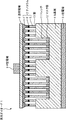
- FIG. 1 is a cross-sectional view schematically showing the structure of a light-emitting diode 1 which is a compound semiconductor light-emitting element according to an embodiment of the present invention.
- GaN is taken as an example of the material of the nanocolumn 2 (columnar crystal structure), but is not limited thereto, and all compound semiconductors including oxides, nitrides, oxynitrides, and the like are used. Can be targeted.
- MBE molecular beam epitaxy
- the light-emitting diode 1 includes a plurality of nanocolumns 2 in which an n-type semiconductor layer 5, a light-emitting layer 6, and a p-type semiconductor layer 7 are sequentially stacked on a Si substrate 4 on the n-type electrode 3 side that is one electrode. Is formed.
- a GaN nanocolumn LED is configured by connecting the top of the nanocolumn 2 with the transparent electrode 8 and the p-type electrode 9 which are the other electrodes.
- a trench 11 (first region) that is a recess is formed in a partial region on the Si substrate 4, and the nanocolumn 2 is grown in the trench 11.
- the mask layer 12 (first mask layer) to be controlled (promoted) is formed.
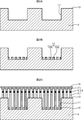
- FIG. 2 is a diagram for explaining a specific manufacturing process of the light-emitting diode 1 as described above.
- a trench 11 is formed on the n-type Si substrate 4 having a plane orientation (111) by an RIE apparatus.
- an Si oxide film is deposited on the surface of the Si substrate 4 on which the trench 11 is formed using an atmospheric pressure CVD apparatus, the outside of the trench 11, that is, the wall 13 is formed using an ordinary lithography process and an RIE apparatus.
- the upper (second region) Si oxide film is removed, and the Si oxide film is left only in the trench 11 to form the mask layer 12 shown in FIG. 2B.
- the Si oxide film 12a is inferior in density to the thermal oxide film, and thus becomes a porous film having a through hole 12b therein. Since the through-holes 12b exist at random, the thicker the Si oxide film 12a, the more rapidly the number of through-holes 12b communicating with the surface of the Si substrate 4 as shown by the mask layer 122 in FIG. 3B. Decrease. 3A and 3B viewed from the top are shown in FIGS. 3C and 3D, respectively.
- the thickness of the Si oxide film 12a is, for example, 5 nm in FIGS. 3A and 3C, and 10 nm in FIGS. 3B and 3D.
- the nanocolumn 2 is grown by the MBE apparatus as shown in FIG. 2C.
- the degree of vacuum is 2e ⁇ 5 torr
- the substrate temperature is 750 ° C.
- the plasma output is 450 W
- trimethylgallium (Ga (CH 3 ) 3 ) as a Ga source Ammonia (NH 3 ) is supplied to the nitrogen raw material.
- silane (SiH 4 ) is supplied in order to add Si having n-type conductivity as an impurity.
- the n-type semiconductor layer 5 is formed in the trench 11.
- the height of the n-type semiconductor layer 5 in the trench 11 and the n-type semiconductor layer 5 on the wall 13 becomes substantially the same.
- the n-type semiconductor layer 5 of the nanocolumn 2 grows faster in the trench 11 than on the wall 13 for the following reason. That is, since the nucleus for growing the nanocolumn 2 does not grow on the Si oxide film 12a, for example, in the case of growing the GaN nanocolumn, Ga atoms and N atoms adsorbed on the Si oxide film 12a move on the Si oxide film 12a. It is considered that it diffuses and reaches the GaN crystal nucleus in the through hole 12b and contributes to the growth of the GaN nanocolumn. As a result, compared to the thin mask 121 shown in FIG. 3A, the thick mask 122 shown in FIG.
- the 3B is supplied with a larger number of atoms contributing to the growth by the GaN crystal nuclei in the through holes 12b, and the growth rate of the nanocolumn 2 is Become faster. Therefore, in the trench 11 having the mask 12 and having the mask 12 and having a low density of crystal nuclei on the wall 13 where the nanocolumn 2 is naturally grown without the mask 12, atoms in the trench 11 contribute to the growth of crystal nuclei. As described above, the growth rate of the nanocolumn 2 becomes faster. It should be noted that changing the materials of the substrate 4 and the mask layer 12 changes the adsorption probability and diffusion rate of each atom, so that the growth rate can also be changed.
- the substrate temperature is lowered to 650 ° C.
- the impurity gas is changed from the silane (SiH 4 ) to trimethylindium (In (CH 3 ) 3 ) as an In raw material, and the flow rate of the In flux is set to 10 nm / min.
- the light emitting layer 6 made of an InGaN quantum well is grown. The growth time is 1 minute.
- the flow rate of Ga flux and the plasma output are the same as when the n-type semiconductor layer 5 is grown. What is important here is that the rate of In flux is much higher than that of Ga flux, and the rate of Ga flux is lower than the rate of N flux.
- the light emitting layer 6 may be formed in an InGaN / GaN multiple quantum well structure.
- a reflective film may be appropriately formed in the n-type semiconductor layer 5.
- the substrate temperature is raised to 750 ° C.
- the impurity gas the trimethyl indium (In (CH 3) 3) cyclopentadienyl magnesium containing Mg having p-type conductivity from (Mg (C 5 H 5) 2)
- the p-type semiconductor layer 7 is grown by changing the flow rate of Mg flux to 1 nm / min and the flow rate of Ga flux to 5 nm / min.
- the growth time is 4 minutes, and the plasma power is the same at 450 W throughout the growth of the nanocolumn 2.
- the diameter of the nanocolumn 2 is gradually increased by gradually changing the flow rate of ammonia (NH 3 ), the flow rate of the carrier gas H 2 , or the growth temperature.
- the p-type layer 14 is formed.
- a laminated p-type contact layer in which a Ni layer having a thickness of 3 nm and an ITO layer having a thickness of 10 nm are laminated on the surface of the p-type layer 14 as shown in FIG. Is formed as the transparent electrode 8, and a p-type pad electrode made of Au having a thickness of 500 nm is formed thereon as the p-type electrode 9.
- the rear surface of the Si substrate 4 is composed of a laminated n-type contact layer and an n-type pad electrode in which a 30 nm thick Ti layer and a 500 nm thick Au layer are laminated by vapor deposition with an EB vapor deposition apparatus.
- the n-type electrode 3 is formed, and the light emitting diode 1 is completed.
- a trench 11 is formed in a partial region of the Si substrate 4, a porous mask layer 12 for controlling (promoting) the growth of the nanocolumn 2 is further formed in the trench 11, and then the nanocolumn 2 is grown.
- the growth of the nanocolumn 2 is faster in the region where the mask layer 12 is present than in the region on the wall 13 where the mask layer 12 is not present. Therefore, when the nanocolumn 2 is grown for a predetermined time, the step between the trench 11 and the wall 13 is absorbed, and the surface of the p-type layer 14 becomes substantially the same height.
- at least two types of nanocolumns 2 having different heights, that is, different aspect ratios and different wavelengths indicating the maximum intensity of the spectrum of emitted light can be formed.
- FIG. 5 shows the experiment results of the present inventors.
- FIG. 5 is a graph showing the relationship between the height (length) of the nanocolumn 2 and the peak wavelength when a 300 nm diameter nanocolumn 2 is grown with the above composition. It is understood that the peak wavelength is longer as the height (length) of the nanocolumn 2 is higher (longer), that is, as the aspect ratio is larger. The reason why the peak wavelength increases as the aspect ratio increases as described above is as follows. First, the supply of atoms related to the mechanism of GaN nanocolumn growth is determined by the adsorption desorption process and the surface diffusion process. In the following, the mechanism of nanocolumn growth will be described using a rough approximation.
- the surface diffusion process is considered to be dominant for Ga atoms under the conditions of nanocolumn growth. That is, Ga atoms leave with a certain probability while diffusing from the base of the nanocolumn toward the tip. It can be assumed that the probability of leaving is proportional to the diffusion time.
- the number of Ga atoms is proportional to the diameter of the nanocolumn.
- the In / Ga ratio increases in proportion to the diameter. From the above, the In / Ga ratio that determines the wavelength depends on the aspect ratio (height / diameter) of the nanocolumn, and changes to the longer wavelength side as the aspect ratio increases.
- LED chips having different wavelengths can be formed on the same chip under the same growth conditions in a region where the mask layer 12 is present and a region on the wall 13 where the mask layer 12 is absent. . Then, the length of each nanocolumn 2 is set so as to radiate the light on the long wavelength side and the light on the short wavelength side of the straight line intersecting the white region in the CIE (Commission International de l'Eclairage) chromaticity diagram. By setting it, white light can be created.
- CIE Commission International de l'Eclairage
- the step is made into three steps, and the wavelength indicating the maximum intensity of the spectrum of the light emitted from the nanocolumn 2 in each region is light having a wavelength at the apex of the triangle surrounding the white region in the CIE chromaticity diagram.
- the mask layer 12 can be easily formed by using the Si oxide film 12a.
- the Si oxide film 12a has a through hole 12b on the order of nm, and the nanocolumn 2 is grown on the mask layer 12. Therefore, it is suitable as the mask layer 12.
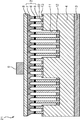
- FIG. 6 is a cross-sectional view schematically showing the structure of a light-emitting diode 21 which is a compound semiconductor light-emitting element according to another embodiment of the present invention
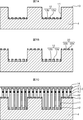
- FIG. 7 explains a specific manufacturing process of the light-emitting diode 21.
- the light-emitting diode 21 is similar to the light-emitting diode 1 described above, and corresponding portions are denoted by the same reference numerals and description thereof is omitted.
- the mask layer 22 is also formed on the wall 13 in the light emitting diode 21.
- the mask layer 22 is formed thin, and the thickness of the mask layer 22 depends on the number of the through holes 22b and the through holes 12b. It should just be chosen so that. In the case of using different materials, the adsorption probability and the diffusion rate change as described above. Therefore, the thickness may be selected so that a desired growth rate is taken into consideration.
- a 5 nm Si oxide film is deposited on the entire surface using the atmospheric pressure CVD apparatus. Thereafter, using a normal lithography process and an RIE apparatus, as shown in FIG. 7A, the Si oxide film outside the trench 11, that is, on the wall 13, is removed, and the Si oxide film 12a is left only in the trench 11. Next, using the atmospheric pressure CVD apparatus again, when a 5 nm Si oxide film is deposited on the entire surface, as shown in FIG. 7B, the 10 nm Si oxide film 12a is formed in the trench 11 and the wall 13 is formed. The 5 nm Si oxide film 22a is formed.
- the mask layer 22 with many through holes 22b is formed on the wall 13, and the mask layer 12 with few through holes 12b is formed in the trench 11, so that the growth rate of the nanocolumns 2 can be made different as described above. it can.
- a compound semiconductor light emitting device includes a substrate on one electrode side, a plurality of nanoscale columnar crystal structures extending vertically on the substrate, and the plurality of columnar crystal structures. And a second region having a step between the first region and the substrate having a thickness greater than that of the first region. And a porous first mask layer is formed on the surface of the first region on the substrate, and the plurality of columnar crystal structures are formed on the first and second regions on the substrate with an n-type semiconductor layer. A light emitting layer and a p-type semiconductor layer are sequentially laminated.
- the growth rate of the columnar crystal structure is faster than in the second region without the porous mask layer.
- the crystal structure and the columnar crystal structure in the second region can be aligned at the same height, and the tops thereof can be connected to each other by the other electrode.
- the columnar crystal structure in the first region is longer than the columnar crystal structure in the second region by the height of the step between the first region and the second region. Then, since the columnar crystal structures have different aspect ratios in the first region and the second region, it is possible to emit light having different wavelengths in the first region and the second region.
- the aspect ratio of the columnar crystal structure in each region can be set by adjusting the size of the step between the first region and the second region.
- region can be easily set with high precision by a well-known semiconductor process, it becomes easy to adjust the color of luminescent color finely with high precision.
- a desired color can be realized with a single chip, it is easy to realize a desired color at a lower cost than when a plurality of chips are used.
- a porous second mask layer having a higher hole density than the first mask layer is formed on the surface of the second region on the substrate.
- the growth rate of the columnar crystal structure is slower in the second region in which the porous second mask layer having a higher hole density than the first mask layer is formed, as compared with the first region.
- the growth rate of the columnar crystal structures in the first region and the second region is adjusted so that the stepped portion between the first region and the second region is longer by the columnar crystal structure in the first region. Therefore, it is easy to align the columnar crystal structures in the first region and the columnar crystal structures in the second region at the same height and connect the tops to each other by the other electrode.
- the first mask layer is preferably a Si oxide film.
- the first mask layer can be easily formed, and the Si oxide film has a through hole on the order of nm, and the columnar crystal structure does not grow on the mask layer. It is suitable as. And as the Si oxide film becomes thinner, the density of the holes becomes higher. Therefore, the growth rate of the columnar crystal structure in the first region can be adjusted by adjusting the thickness of the first mask layer. In this case, since the thickness of the first mask layer can be easily set by a known semiconductor process, it is easy to adjust the growth rate of the columnar crystal structure in the first region.
- the first and second mask layers are preferably Si oxide films, and the second mask layer is preferably thinner than the first mask layer.
- the density of holes in the first and second mask layers can be adjusted. Since the growth rate of the columnar crystal structure becomes slower as the hole density of the mask layer is higher, if the second mask layer is made thinner than the first mask layer, the columnar crystal structure in the second region is higher than that in the first region. The body grows slowly. As a result, the growth rate of the columnar crystal structures in the first region and the second region is adjusted so that the stepped portion between the first region and the second region is longer by the columnar crystal structure in the first region.
- the wavelength indicating the maximum intensity of the spectrum of the light emitted from the columnar crystal structures provided in the first and second regions is a wavelength of a color located at both ends of a straight line intersecting the white region in the CIE chromaticity diagram. It is preferable that the ratio between the length and thickness of each columnar crystal structure provided in the first and second regions is set.
- the substrate includes at least a part of a remaining region excluding the first and second regions, and a third region having a step with the first and second regions on the other surface of the substrate.
- the wavelength indicating the maximum intensity of the spectrum of light emitted by each columnar crystal structure provided in the first, second, and third regions is a vertex of a triangle that surrounds the white region in the CIE chromaticity diagram It is preferable that the ratio between the length and the thickness of each columnar crystal structure in each of the first, second, and third regions is set so that the wavelength of the color is located in the region.
- a lighting device uses the compound semiconductor light emitting element.
- the first region and the remaining region are formed by forming a recess as a first region in a partial region on the substrate on one electrode side. Forming a step between the first region and the second region, forming a porous first mask layer at the bottom of the recess as the first region, and forming n in the first and second regions.
- the above-described compound semiconductor light emitting device can be manufactured.
- the method further includes a step of forming a porous second mask layer having a higher hole density than the first mask layer on the surface of the second region before the growth step.
- a porous second mask layer having a higher hole density than the first mask layer is formed on the surface of the second region on the substrate.
- the growth step when the p-type semiconductor layer is grown, the diameters of the plurality of columnar crystal structures are gradually increased to join the p-type semiconductor layers in the adjacent columnar crystal structures,
- a transparent electrode layer is formed on the surface of the p-type layer formed by joining the p-type semiconductor layers to connect the tops of the plurality of columnar crystal structures.
- the compound semiconductor light-emitting device includes a plurality of nanoscale columnar crystal structures in which an n-type semiconductor layer, a light-emitting layer, and a p-type semiconductor layer are sequentially stacked on a substrate on one electrode side.
- the substrate in which the top of the columnar crystal structure is connected by the other electrode, the substrate has a step, and the substrate is porous only in a region that becomes the recess of the step.
- a region having a mask layer or a recess of the step has a mask layer having fewer holes than a region to be a convex portion.
- the method for producing a compound semiconductor light-emitting device of the present invention also includes a nanoscale columnar crystal structure in which an n-type semiconductor layer, a light-emitting layer, and a p-type semiconductor layer are sequentially stacked on a substrate on one electrode side.
- a compound semiconductor light-emitting device comprising a plurality of the tops of the columnar crystal structures connected to the other electrode by forming a recess in a partial region on the substrate.
- the n-type semiconductor layer, the light emitting layer, and the p-type semiconductor layer are provided on the substrate on one electrode side by providing a conductive buffer layer on the conductive substrate or the insulating substrate.
- a compound semiconductor light-emitting device in which a plurality of nanoscale columnar crystal structures called nanocolumns or nanorods are formed, and the tops of the columnar crystal structures are connected by the other electrode,
- a substrate having a step is used, a porous mask layer is used, the mask layer is formed only in a region that becomes a recess of the step, and a region that becomes a convex portion is formed.
- the mask layer is not formed, or the mask layer is formed together, and the region that becomes the concave portion of the step has fewer holes than the region that becomes the convex portion, that is, a thick mask layer.
- the columnar crystal structure material supplied on the substrate diffuses on the surface of the mask layer in the region having the mask layer or the mask layer having fewer holes and collects in the crystal nucleus, thereby growing the columnar crystal structure. Will be faster.
- the columnar crystal structure group grown for a predetermined time can have the tops to which the other electrode is connected substantially the same height even if the recess exists.
- at least two types of columnar crystal structures having different heights that is, different aspect ratios and different wavelengths indicating the maximum intensity of the spectrum of emitted light can be formed. This makes it possible to realize a solid light source that realizes a desired color such as white light easily and at low cost on the same substrate and in a single growth process.
- the compound semiconductor light-emitting device and the method for manufacturing the same include a conductive buffer layer on a conductive substrate or an insulating substrate.
- an n-type semiconductor layer, a light emitting layer, and a p-type semiconductor layer are sequentially stacked, and a plurality of nanoscale columnar crystal structures called nanocolumns or nanorods are formed, and a top of the columnar crystal structure is formed.
- a substrate having a step is used, and a porous mask layer is used, and only the region that becomes the recess of the step is used.
- the mask layer is formed, and the mask layer is not formed in the region that becomes the convex portion, or the mask layer is formed together, and the region that becomes the concave portion of the step has fewer holes than the region that becomes the convex portion. , That is, a thick mask layer.
- the material of the columnar crystal structure supplied on the substrate gathers in the crystal nucleus in the region with the mask layer or the mask layer with fewer holes, and the columnar crystal structure grows faster and grows for a predetermined time.
- the top portion to which the other electrode is connected can be made to have substantially the same height.
- at least two types of columnar crystal structures having different heights, that is, different aspect ratios and different wavelengths indicating the maximum intensity of the spectrum of emitted light can be formed. This makes it possible to realize a solid light source that realizes a desired color such as white light easily and at low cost on the same substrate and in a single growth process.
Landscapes
- Led Devices (AREA)
Abstract
Priority Applications (4)
| Application Number | Priority Date | Filing Date | Title |
|---|---|---|---|
| EP09754639A EP2290710B1 (fr) | 2008-05-26 | 2009-05-25 | Elément électroluminescent semi-conducteur composé, appareil d'éclairage utilisant l'élément électroluminescent semi-conducteur composé et procédé de fabrication d'un élément électroluminescent semi-conducteur composé |
| KR1020107027011A KR101196579B1 (ko) | 2008-05-26 | 2009-05-25 | 화합물 반도체 발광 소자 및 이를 이용하는 조명 장치 및 화합물 반도체 발광 소자의 제조 방법 |
| US12/993,509 US8247791B2 (en) | 2008-05-26 | 2009-05-25 | Compound semiconductor light emitting element, illuminating apparatus using compound semiconductor light emitting element, and method for manufacturing compound semiconductor light emitting element |
| CN2009801198869A CN102047450B (zh) | 2008-05-26 | 2009-05-25 | 化合物半导体发光元件、采用该化合物半导体发光元件的照明装置以及化合物半导体发光元件的制造方法 |
Applications Claiming Priority (2)
| Application Number | Priority Date | Filing Date | Title |
|---|---|---|---|
| JP2008137220A JP5145120B2 (ja) | 2008-05-26 | 2008-05-26 | 化合物半導体発光素子およびそれを用いる照明装置ならびに化合物半導体発光素子の製造方法 |
| JP2008-137220 | 2008-05-26 |
Publications (1)
| Publication Number | Publication Date |
|---|---|
| WO2009145131A1 true WO2009145131A1 (fr) | 2009-12-03 |
Family
ID=41377006
Family Applications (1)
| Application Number | Title | Priority Date | Filing Date |
|---|---|---|---|
| PCT/JP2009/059504 Ceased WO2009145131A1 (fr) | 2008-05-26 | 2009-05-25 | Elément électroluminescent semi-conducteur composé, appareil d'éclairage utilisant l'élément électroluminescent semi-conducteur composé et procédé de fabrication d'un élément électroluminescent semi-conducteur composé |
Country Status (6)
| Country | Link |
|---|---|
| US (1) | US8247791B2 (fr) |
| EP (1) | EP2290710B1 (fr) |
| JP (1) | JP5145120B2 (fr) |
| KR (1) | KR101196579B1 (fr) |
| CN (1) | CN102047450B (fr) |
| WO (1) | WO2009145131A1 (fr) |
Cited By (1)
| Publication number | Priority date | Publication date | Assignee | Title |
|---|---|---|---|---|
| JP2016527706A (ja) * | 2013-06-07 | 2016-09-08 | グロ アーベーGlo Ab | マルチカラーled及びその製造方法 |
Families Citing this family (21)
| Publication number | Priority date | Publication date | Assignee | Title |
|---|---|---|---|---|
| US8237151B2 (en) | 2009-01-09 | 2012-08-07 | Taiwan Semiconductor Manufacturing Company, Ltd. | Diode-based devices and methods for making the same |
| CN102197299B (zh) | 2008-10-29 | 2013-06-19 | 松下电器产业株式会社 | 检测元件、检测装置及氧浓度测试装置 |
| KR101517851B1 (ko) * | 2009-03-26 | 2015-05-06 | 삼성전자 주식회사 | 반도체 소자의 제조 방법 |
| US8409965B2 (en) * | 2011-04-26 | 2013-04-02 | Taiwan Semiconductor Manufacturing Company, Ltd. | Method and structure for LED with nano-patterned substrate |
| US9035278B2 (en) | 2011-09-26 | 2015-05-19 | Glo Ab | Coalesced nanowire structures with interstitial voids and method for manufacturing the same |
| US8350249B1 (en) | 2011-09-26 | 2013-01-08 | Glo Ab | Coalesced nanowire structures with interstitial voids and method for manufacturing the same |
| JP5896565B2 (ja) * | 2012-10-04 | 2016-03-30 | 株式会社ナノマテリアル研究所 | 半導体デバイス |
| US9537044B2 (en) | 2012-10-26 | 2017-01-03 | Aledia | Optoelectric device and method for manufacturing the same |
| FR2997557B1 (fr) | 2012-10-26 | 2016-01-01 | Commissariat Energie Atomique | Dispositif electronique a nanofil(s) muni d'une couche tampon en metal de transition, procede de croissance d'au moins un nanofil, et procede de fabrication d'un dispositif |
| FR2997420B1 (fr) | 2012-10-26 | 2017-02-24 | Commissariat Energie Atomique | Procede de croissance d'au moins un nanofil a partir d'une couche d'un metal de transition nitrure obtenue en deux etapes |
| FR2997558B1 (fr) * | 2012-10-26 | 2015-12-18 | Aledia | Dispositif opto-electrique et son procede de fabrication |
| FR3004006B1 (fr) * | 2013-03-28 | 2016-10-07 | Aledia | Dispositif electroluminescent a nanofils actifs et nanofils de contact et procede de fabrication |
| KR102227770B1 (ko) | 2014-08-29 | 2021-03-16 | 삼성전자주식회사 | 나노구조 반도체 발광소자 |
| US9593820B1 (en) | 2016-09-28 | 2017-03-14 | Ford Global Technologies, Llc | Vehicle illumination system |
| JP7147132B2 (ja) * | 2017-05-31 | 2022-10-05 | セイコーエプソン株式会社 | 発光装置、プロジェクター、および発光装置の製造方法 |
| JP6988173B2 (ja) | 2017-05-31 | 2022-01-05 | セイコーエプソン株式会社 | 発光装置およびプロジェクター |
| JP6988460B2 (ja) | 2017-12-26 | 2022-01-05 | セイコーエプソン株式会社 | 発光装置、発光装置の製造方法、およびプロジェクター |
| JP7207012B2 (ja) | 2019-02-27 | 2023-01-18 | セイコーエプソン株式会社 | 発光装置の製造方法、発光装置、およびプロジェクター |
| FR3098013B1 (fr) * | 2019-06-25 | 2021-07-02 | Commissariat Energie Atomique | Procédé de fabrication d'un dispositif optoélectronique à diodes électroluminescentes de type axial |
| KR102820819B1 (ko) | 2021-10-18 | 2025-06-16 | 삼성디스플레이 주식회사 | 표시 장치 및 이의 제조 방법 |
| EP4497160A1 (fr) * | 2022-03-21 | 2025-01-29 | Ams-Osram International Gmbh | Composant optoélectronique et procédé de production de composant optoélectronique |
Citations (3)
| Publication number | Priority date | Publication date | Assignee | Title |
|---|---|---|---|---|
| JP2005228936A (ja) | 2004-02-13 | 2005-08-25 | Dongguk Univ | 発光ダイオードおよびその製造方法 |
| JP2005268783A (ja) * | 2004-03-19 | 2005-09-29 | Internatl Business Mach Corp <Ibm> | 自己整合型ナノコラム・エアブリッジを形成する方法およびそれによって形成される構造 |
| JP2007123398A (ja) | 2005-10-26 | 2007-05-17 | Matsushita Electric Works Ltd | 半導体発光素子およびそれを用いる照明装置ならびに半導体発光素子の製造方法 |
Family Cites Families (10)
| Publication number | Priority date | Publication date | Assignee | Title |
|---|---|---|---|---|
| US7122827B2 (en) * | 2003-10-15 | 2006-10-17 | General Electric Company | Monolithic light emitting devices based on wide bandgap semiconductor nanostructures and methods for making same |
| JP2005136238A (ja) * | 2003-10-30 | 2005-05-26 | Kyocera Corp | 発光ダイオードアレイ装置及びそれを用いた発光ダイオードプリンタ |
| US7132677B2 (en) * | 2004-02-13 | 2006-11-07 | Dongguk University | Super bright light emitting diode of nanorod array structure having InGaN quantum well and method for manufacturing the same |
| US8088293B2 (en) * | 2004-07-29 | 2012-01-03 | Micron Technology, Inc. | Methods of forming reticles configured for imprint lithography |
| TWI500072B (zh) * | 2004-08-31 | 2015-09-11 | 學校法人上智學院 | 發光元件之製造方法 |
| WO2006060599A2 (fr) * | 2004-12-02 | 2006-06-08 | The Regents Of The University Of California | Dispositifs a semi-conducteurs bases sur des reseaux de nanotubes coalesces |
| KR100668964B1 (ko) | 2005-09-27 | 2007-01-12 | 엘지전자 주식회사 | 나노 홈을 갖는 발광 소자 및 그의 제조 방법 |
| KR101172942B1 (ko) * | 2006-10-20 | 2012-08-14 | 도꾸리쯔교세이호징 리가가쿠 겐큐소 | 사파이어 기판 및 그것을 이용하는 질화물 반도체 발광 소자 및 질화물 반도체 발광 소자의 제조 방법 |
| CN101971369B (zh) * | 2008-03-14 | 2012-05-23 | 松下电器产业株式会社 | 化合物半导体发光元件、采用该化合物半导体发光元件的照明装置以及化合物半导体发光元件的制造方法 |
| US7906354B1 (en) * | 2010-03-30 | 2011-03-15 | Eastman Kodak Company | Light emitting nanowire device |
-
2008
- 2008-05-26 JP JP2008137220A patent/JP5145120B2/ja not_active Expired - Fee Related
-
2009
- 2009-05-25 CN CN2009801198869A patent/CN102047450B/zh not_active Expired - Fee Related
- 2009-05-25 US US12/993,509 patent/US8247791B2/en not_active Expired - Fee Related
- 2009-05-25 KR KR1020107027011A patent/KR101196579B1/ko not_active Expired - Fee Related
- 2009-05-25 EP EP09754639A patent/EP2290710B1/fr not_active Not-in-force
- 2009-05-25 WO PCT/JP2009/059504 patent/WO2009145131A1/fr not_active Ceased
Patent Citations (3)
| Publication number | Priority date | Publication date | Assignee | Title |
|---|---|---|---|---|
| JP2005228936A (ja) | 2004-02-13 | 2005-08-25 | Dongguk Univ | 発光ダイオードおよびその製造方法 |
| JP2005268783A (ja) * | 2004-03-19 | 2005-09-29 | Internatl Business Mach Corp <Ibm> | 自己整合型ナノコラム・エアブリッジを形成する方法およびそれによって形成される構造 |
| JP2007123398A (ja) | 2005-10-26 | 2007-05-17 | Matsushita Electric Works Ltd | 半導体発光素子およびそれを用いる照明装置ならびに半導体発光素子の製造方法 |
Non-Patent Citations (1)
| Title |
|---|
| See also references of EP2290710A4 |
Cited By (3)
| Publication number | Priority date | Publication date | Assignee | Title |
|---|---|---|---|---|
| JP2016527706A (ja) * | 2013-06-07 | 2016-09-08 | グロ アーベーGlo Ab | マルチカラーled及びその製造方法 |
| US9748437B2 (en) | 2013-06-07 | 2017-08-29 | Glo Ab | Multicolor LED and method of fabricating thereof |
| US10304992B2 (en) | 2013-06-07 | 2019-05-28 | Glo Ab | Multicolor LED and method of fabricating thereof |
Also Published As
| Publication number | Publication date |
|---|---|
| KR101196579B1 (ko) | 2012-11-02 |
| JP5145120B2 (ja) | 2013-02-13 |
| JP2009283876A (ja) | 2009-12-03 |
| EP2290710A1 (fr) | 2011-03-02 |
| CN102047450B (zh) | 2013-03-13 |
| EP2290710A4 (fr) | 2011-06-29 |
| EP2290710B1 (fr) | 2012-08-15 |
| US20110062453A1 (en) | 2011-03-17 |
| US8247791B2 (en) | 2012-08-21 |
| CN102047450A (zh) | 2011-05-04 |
| KR20110003568A (ko) | 2011-01-12 |
Similar Documents
| Publication | Publication Date | Title |
|---|---|---|
| JP5145120B2 (ja) | 化合物半導体発光素子およびそれを用いる照明装置ならびに化合物半導体発光素子の製造方法 | |
| JP5227224B2 (ja) | 化合物半導体発光素子およびそれを用いる照明装置ならびに化合物半導体発光素子の製造方法 | |
| CN111048641B (zh) | 一种单芯片白光发光二极管及其制备方法 | |
| CN102263172B (zh) | 半导体芯片、发光器件和制造半导体芯片的方法 | |
| CN102117771B (zh) | 一种发光二极管外延片和管芯及其制作方法 | |
| JP2008544567A (ja) | 窒化物多重量子ウェルを有するナノロッドアレイ構造の発光ダイオード、その製造方法、及びナノロッド | |
| WO2009041237A1 (fr) | Élément semi-conducteur au nitrure iii émettant de la lumière | |
| CN108389941A (zh) | 显指可调的无荧光粉单芯片白光led器件及其制备方法 | |
| CN103681997A (zh) | 一种所需颜色发光二极管芯片及其制造方法 | |
| JP2002222991A (ja) | 半導体発光素子 | |
| JP2004063732A (ja) | 発光素子 | |
| CN100470864C (zh) | 具有荧光物质的led | |
| CN105226150A (zh) | 一种N-B双掺SiC衬底的GaN基无荧光粉的高效白光LED结构及其制备方法和应用 | |
| CN102122690A (zh) | 多量子阱结构、发光二极管以及发光二极管封装件 | |
| JP4062360B2 (ja) | 発光素子 | |
| JP3969378B2 (ja) | 発光素子 | |
| KR20030072762A (ko) | 반도체 발광 다이오드 및 그의 제조방법 | |
| KR100608919B1 (ko) | 발광 소자 및 이의 제조 방법 | |
| JP2003309288A (ja) | 発光素子 | |
| CN118231551A (zh) | 一种半导体结构及其制造方法 | |
| CN1534801A (zh) | 白光发光二极管及其制作方法 | |
| JP2007150363A (ja) | 発光素子 | |
| JP2005094043A (ja) | 窒化ガリウム系化合物半導体発光素子 | |
| JP2005294876A (ja) | 窒化ガリウム系化合物半導体発光素子 | |
| JP2009010429A (ja) | 窒化ガリウム系化合物半導体発光素子 |
Legal Events
| Date | Code | Title | Description |
|---|---|---|---|
| WWE | Wipo information: entry into national phase |
Ref document number: 200980119886.9 Country of ref document: CN |
|
| 121 | Ep: the epo has been informed by wipo that ep was designated in this application |
Ref document number: 09754639 Country of ref document: EP Kind code of ref document: A1 |
|
| WWE | Wipo information: entry into national phase |
Ref document number: 12993509 Country of ref document: US |
|
| NENP | Non-entry into the national phase |
Ref country code: DE |
|
| ENP | Entry into the national phase |
Ref document number: 20107027011 Country of ref document: KR Kind code of ref document: A |
|
| WWE | Wipo information: entry into national phase |
Ref document number: 2009754639 Country of ref document: EP |