WO2009147815A1 - Procédé de tricotage partiel et tissu - Google Patents
Procédé de tricotage partiel et tissu Download PDFInfo
- Publication number
- WO2009147815A1 WO2009147815A1 PCT/JP2009/002418 JP2009002418W WO2009147815A1 WO 2009147815 A1 WO2009147815 A1 WO 2009147815A1 JP 2009002418 W JP2009002418 W JP 2009002418W WO 2009147815 A1 WO2009147815 A1 WO 2009147815A1
- Authority
- WO
- WIPO (PCT)
- Prior art keywords
- knitting
- stitch
- turn
- course
- return
- Prior art date
- Legal status (The legal status is an assumption and is not a legal conclusion. Google has not performed a legal analysis and makes no representation as to the accuracy of the status listed.)
- Ceased
Links
Images





Classifications
-
- D—TEXTILES; PAPER
- D04—BRAIDING; LACE-MAKING; KNITTING; TRIMMINGS; NON-WOVEN FABRICS
- D04B—KNITTING
- D04B1/00—Weft knitting processes for the production of fabrics or articles not dependent on the use of particular machines; Fabrics or articles defined by such processes
- D04B1/22—Weft knitting processes for the production of fabrics or articles not dependent on the use of particular machines; Fabrics or articles defined by such processes specially adapted for knitting goods of particular configuration
- D04B1/24—Weft knitting processes for the production of fabrics or articles not dependent on the use of particular machines; Fabrics or articles defined by such processes specially adapted for knitting goods of particular configuration wearing apparel
Definitions
- the present invention relates to a turn-back knitting method comprising forward knitting and return knitting, and a knitted fabric knitted by this knitting method.
- Patent Document 1 discloses a knitting method for a knitted fabric in which a neckhole is formed by performing turn back knitting at a neckline portion of a sweater, and then a collar portion is formed at a neckhole formation portion. .
- FIG. 1 is an overall view of a sweater 100 including a front body 20 and a back body 30, and the sweater 100 has a neck portion 41 serving as a neck hole and a collar formed in the portion of the neck portion 41.
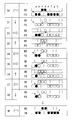
- FIG. 7 is a knitting process diagram for forming the knitting of the neckline portion 41 and the heel portion 40 on the left side of the front body 20 of the sweater 100 by conventional turn-back knitting.
- FIG. 8 is a loop diagram of the knitted fabric knitted by this knitting process. In FIG. 7, among the three columns arranged on the left and right, the number in the left column indicates the number of the knitting process, the middle column indicates the knitting direction of the knitted fabric in the knitting step, and the right column indicates the knitting state of the knitted fabric.
- black circles indicate stitches formed in the knitting process
- white circles indicate stitches locked to the knitting needles
- V indicates a tack
- black triangles indicate a yarn supplying member.
- FB in the right column of FIG. 7 indicates a front needle bed
- BB indicates a rear needle bed
- alphabets indicate knitting needles.
- a stitch knitted with the alphabet knitting needles of FIG. Become. 7 and 8 illustrate a state in which the rib structure is knitted using FB and BB.
- step S00 bottom knitting course in FIG. 8
- the turn-up knitting includes an outward knitting (step S01) and a return knitting (step S02).
- step S01 an outward knitting
- step S02 a return knitting
- step S03 the knitting needles at the end of the knitting width are sequentially removed from the knitting to be in an inactive state (steps S03 to S08), thereby forming the neckline portion 41 of FIG.
- step S09 by performing knitting on the stitches (including the tack) that are locked by the knitting needles (step S09), the collar portion 40 of the sweater is formed.
- the number of turn back knitting becomes difficult as the number of turn back knitting increases. Therefore, for example, when the conventional turn-back knitting is used for knitting the neckline of the sweater, the design is restricted to the shallow neckline.
- a portion of one knitted fabric that has been turned back knitted (region of knitting needles a to e in FIG. 8) is formed with new stitches, and teeth positioned between the front and back needle beds. Go down below your mouth.
- the portion where the turn-up knitting is not performed (the region of the knitting needles f to h in FIG. 8) remains locked to the needle bed.
- the knitting yarn is doubly applied to one knitting needle in a portion where the turn back knitting is not performed, and there is almost no movement allowance of the knitting yarn in this portion.
- the knitted fabric portion that is not subjected to the turn back knitting prevents the knitted fabric portion that is newly formed by performing the turn back knitting from lowering below the tooth opening. For this reason, when the number of turn-up knitting is increased, there is a possibility that the stitches locked to the knitting needles of the portion that performs the turn-up knitting may float and the knitting operation (particularly, knockover) cannot be performed.
- the present invention has been made in view of the above circumstances, and one of its purposes is to provide a turn back knitting method that can increase the number of courses that can be turned back compared to a conventional turn back knitting using a tack. There is to do.
- Another object of the present invention is to provide a turn-up knitting method capable of knitting a knitted fabric in which the boundary portion between the knitted fabric portion knitted back and the knitted fabric portion adjacent to the knitted fabric portion is inconspicuous. It is in.
- the present invention uses a flat knitting machine having at least a pair of front and back needle beds and capable of transferring stitches between the front and back needle beds, and performing turn-back knitting for performing turn-back knitting comprising forward knitting and backward knitting.
- the turnback knitting method of the present invention includes performing a first turnback knitting comprising a first forward knitting and a first return knitting on a base course, and the first turnback knitting includes the following steps. It is characterized by that. (A) Among the stitches of the base course, the empty needles on the needle bed facing the first turn-back point stitch, which is the stitch that is one stitch ahead in the forward knitting direction, than the stitch at which the final stitch of the first forward knitting is formed. Transfer process (transfer process).
- (B) A step of performing the first forward knitting and crossing the first thread portion connected to the terminal stitch at the end of the first forward knitting in the knitting width direction with respect to the first turn-back stitch (outward step).
- (C) A step of returning the first turning point stitch transferred to the empty needle to the knitting needles of the opposing needle bed (backing step).
- (D) By forming a new stitch continuously to the end stitch of the first forward knitting and performing the first return knitting starting from this stitch, the stitch at the end of the first forward knitting and the first return knitting are performed.
- a step of winding the first hook portion connecting the stitch at the starting end of the knitting to the first turning point stitch of the base course (returning step).
- the order of the steps provided in the first turn-back knitting is such that the first thread portion connecting the stitch at the end of the first forward knitting and the stitch at the start of the first return knitting wraps around the first turn-back knitting of the base course. You can choose to. Specifically, the order of the transfer process ⁇ the outbound process ⁇ the return process ⁇ the return process or the outbound process ⁇ the transfer process ⁇ the return process ⁇ the return process may be considered.
- a second turn back knitting composed of a second forward turn knitting and a second return turn knitting may be performed following the first turn back knitting.
- the second turn-back knitting preferably includes the following steps.
- (F) Performing the second forward knitting with the position of the first turn-back stitch as the end, and knitting a second thread portion connected to the end stitch of the second forward knitting with respect to the second turn-back stitch A process of crossing in the width direction (outward process).
- the order of the steps provided in the second turnover knitting may be selected in the same manner as in the first turnover knitting. Specifically, the order of the transfer process ⁇ the outbound process ⁇ the return process ⁇ the return process or the outbound process ⁇ the transfer process ⁇ the return process ⁇ the return process may be considered.
- the second knitting portion connecting the stitches at the end of the second forward knitting and the stitches at the starting end of the second backward knitting is the base course as in the first turning knitting. Select to wrap around the second turning point stitch.
- the process includes a step of knitting one course with respect to the stitches locked to the needle bed, and in this knitting course, the wale connected to the first turnback point stitch It is preferable to perform misknitting at the position of the stitch in the direction.
- the knitted fabric of the present invention has at least a pair of front and back needle beds and is knitted using a flat knitting machine capable of transferring stitches between the front and back needle beds, and on the base course, the first forward path
- a first turn-back knitting section comprising a knitting course and a first return knitting course is provided.
- the knitted fabric of the present invention is a stitch at the end of the first forward knitting course formed continuously from the first turning point stitch which is one of the stitches of the base course and the adjacent stitch of the first turning point stitch.
- a stitch at the start of the first return knitting course formed continuously with the stitch at the end, and the stitch at the start after extending from the stitch at the end and wound once around the first turn-back stitch And a first thread portion connected to the head.
- a second turn back knitting portion that is formed continuously from the first turn back knitting portion and includes a second forward knitting course and a second return knitting course may be provided.
- the knitted fabric is formed continuously with the second turn-back point stitch adjacent to the first turn-back knitting portion on the opposite side to the first turn-back knitting portion and the first turn-back point stitch among the stitches of the base course.
- a stitch at the end of the second forward knitting course, a stitch at the start of the second backward knitting course formed continuously with the stitch at the end, and around the second turn-back stitch extending from the stitch at the end And a second thread portion connected to the stitch at the starting end after being wound once.
- the turn-back knitting method of the present invention changes from the forward knitting to the return knitting by winding a thread portion connecting the end stitch of the forward knitting and the start stitch of the backward knitting around the turn-back knitting that becomes the base point of the turn back. It turns back to become. Since this thread portion is not locked to the knitting needle during the knitting process, it has a relatively large movement allowance.
- the turn-back point stitch around which the thread portion is wound also has a movement allowance because the knitting yarn other than this stitch is not hung on the same knitting needle, although it is hung on the knitting needle. Therefore, according to the turn back knitting method of the present invention, the knitted fabric portion that is not subjected to the turn back knitting is newly formed by the turn back knitting as compared with the conventional turn back knitting using the tack. It is difficult to inhibit the downward movement of the mouth. As a result, the number of turn knitting can be increased, and the degree of freedom in designing the knitted fabric is also improved.
- the knitted fabric knitted by the turn-back knitting method of the present invention does not make the turn-back portion conspicuous because the stitches are not doubled at the turn-back portion.
- the turning point stitch is pulled in the knitting width direction by the thread portion, a slight gap may be formed between the turning point stitch and the stitch adjacent to this stitch.
- the first knitting course that is knitted after the turn back knitting is completed, if the knitting needle is locked with the first turn back point stitch locked, the first turn back point stitch is pulled up in the wale direction. Therefore, the gap becomes vertically long and becomes inconspicuous. The same effect can be obtained even in a configuration in which two turning point stitches are arranged.
- the reason why the first turning point stitch is pulled up in the wale direction as described above is that the number of stitches that continue in the wale direction above the first turning point stitch is reduced by one due to the miss knitting.
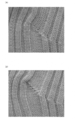
- FIG. 3 is a knitting process diagram of turn-back knitting according to the first embodiment. It is a loop figure of the knitted fabric knitted by the knitting process of Embodiment 1. It is a knitting process diagram of turn-back knitting according to the second embodiment. It is a loop figure of the knitted fabric knitted by the knitting process of Embodiment 2. It is an enlarged photograph of the turned-back portion of the knitted fabric, (A) is a knitted fabric using the turn-back knitting method of the present invention, and (B) is a knitted fabric using the conventional turn-back knitting method. It is a knitting process diagram of a conventional turn-back knitting method. It is a loop figure of the knitted fabric knitted by the conventional knitting process.
- Embodiments 1 and 2 are an example of knitting a sweater 100 that is a tubular knitted fabric including a front body 20 and a back body 30 as shown in FIG. .
- the sweater 100 has a collar portion 40 formed on a neck portion 41, and the turnover knitting of the present invention is used for knitting the neck portion 41 and the collar portion 40.
- the turn-up knitting method of the present invention can be applied to any knitted fabric that has a portion that performs turn-up knitting. Therefore, the application target is not limited to the tubular knitted fabric.
- the flat knitting machine is a flat knitting machine that has a pair of front and back needle beds extending in the left-right direction and facing each other in the front-rear direction.
- a two-bed flat knitting machine having a front needle bed (hereinafter referred to as FB) and a rear needle bed (hereinafter referred to as BB), or two sheets facing further above the front and back needle beds are provided.
- FB front needle bed
- BB rear needle bed
- a four-bed flat knitting machine with a needle bed can be mentioned.
- FIG. 2 is a knitting process diagram showing turn-up knitting in the neckline portion 41 and knitting of the heel portion 40 of the sweater 100 (note that the up and down thin arrows in the middle column and the right column indicate transfer). Show).
- FIG. 3 is a loop diagram of the knitted fabric knitted by the knitting process of FIG. 2, and the numbers arranged on the left and right in FIG. 3 indicate the knitting course knitted.
- 2 and 3 (FIGS. 4 and 5 described later) are the same as FIGS. 7 and 8 referred to in the description of the prior art.
- 2 and 3 are rib structures in which front and back stitches are mixed using FB and BB, and the number of knitting courses and stitches is as described. For convenience, it is less than the actual knitted fabric.
- Step S0 in FIG. 2 shows a state in which the position 50 of the lower end of the buttock 40 in the sweater 100 shown in FIG. 1 has been knitted.
- the knitting course S (see FIG. 3) which is knitted in step S0 and becomes the base course has a rib structure.
- step S0 From the state of step S0, the first first turn back knitting consisting of the first forward knitting and the first return knitting is performed so that the neckline portion is formed.
- stitches with a number are attached with reference numerals in FIG.
- the stitches (first turn-back point stitches 18) locked to the knitting needles c of the BB among the stitches of the knitting course S are transferred to the knitting needles c of the opposing FB.
- the knitting needle c of BB is one ahead in the knitting progress direction with respect to the knitting needle b at the position to be the end of the first forward knitting course formed in step S2.
- step S2 by performing the first forward knitting to form stitches on the knitting needles a and b of the FB (step S2), the knitting course 1 of FIG. 3 is formed.
- the knitting yarn (the first thread portion 13) extending from the stitch 11 at the end of the knitting course 1 locked to the knitting needle b is transferred to the yarn supplying member so as to exceed the position of the knitting needle c.
- the first turn-back point stitch 18 (the knitting needle c of the FB) is made to intersect in the knitting width direction.
- step S3 the first turning point stitch 18 transferred to the knitting needle c of the FB in step S1 is returned to the knitting needle c of the BB (step S3), and the first backward knitting is performed (step S4).
- step S4 the stitch 12 at the start of the first backward knitting is formed continuously with the stitch 11 at the end of the first forward knitting locked to the knitting needle b.
- the first turn back knitting portion comprising the knitting course 1 and the knitting course 2 in FIG. 3 is formed, the stitch 11 at the end of the knitting course 1 by the first forward knitting, and the first return knitting
- the first thread portion 13 that connects the stitch 12 at the start of the knitting course 2 is wound around the first turn-back point stitch 18 that is locked to the knitting needle c of the knitting course S.
- the thread portion 13 in the first turn-back knitting portion is not locked to the knitting needle, and thus has a relatively large movement allowance. Further, the turn-back point stitch 18 around which the thread 13 is wound also has a movement allowance because the knitting yarn other than this stitch is not hung on the same knitting needle. Therefore, it is difficult for the knitted fabric portion not turned back to hinder the knitted fabric portion that is turned back knitted from descending below the mouth.
- the first turn knitting is performed again with the knitting course 2 in FIG. 3 as the base course, and the knitting courses 3 and 4 are knitted.
- the next turn-back point stitch 18 (also the starting stitch 12 in steps S1 to S4) is a stitch knitted by FB. Therefore, in the same manner as the thread portion 13 in steps S1 to S4, the first turn back knitting is performed so that the thread portion 13 in steps S5 to S8 winds from the inner side (inner side of the tube) to the outer side of the sweater. Change the order of the steps in Specifically, the knitting courses 3 and 4 of FIG.
- step S5 ⁇ transfer process
- step S7 ⁇ return process
- step S8 ⁇ return process
- step SF When the necessary number of turn back knitting is completed, one course knitting is performed on the stitches locked to the knitting needles of the needle bed (step SF), and the heel part is formed with the knitting course 5 as the first knitting course. To start. After the knitting course 6, the formation of the buttocks following the knitting course 5 is repeated for a predetermined number of courses.
- the knitting in steps S1 to S4 and the knitting in steps S5 to S8 may be combined as appropriate and repeated as many times as necessary.
- the knitted fabric portion that is not turned back is difficult to hinder the knitted fabric portion that is turned back knitting down below the tooth opening.
- the number of times can be increased as compared with the conventional turn-back knitting method.
- a sweater with a deep neckline can be knitted.
- the turn-back portion can also be a transfer target.
- the knitting yarn applied to the knitting needle of the turn-back portion is transferred, there is a possibility that the transfer may be missed.
- the turn back knitting of the present embodiment since the tack is not performed, it is possible to easily transfer the turn back portion.
- FIG. 4 is a knitting process diagram showing the turn-up knitting in the neckline portion 41 and the knitting of the heel portion 40 in the sweater 100.
- FIG. 5 is a loop diagram of the knitted fabric knitted by the knitting process of FIG.
- step S10 in FIG. 4 shows a state in which the rib structure is knitted using FB and BB up to a position that becomes the lower end 50 of the collar 40 in FIG. Thereby, the base course (knitting course S) of FIG. 5 is knitted.
- step S10 From the state of step S10, turn back knitting is performed so that the neckline portion 41 is formed.
- the turn back knitting includes a first turn back knitting comprising steps S11 to S14 and a second turn back knitting comprising steps S15 to S18.
- the first turn back knitting is performed by the same procedure as the first turn back knitting in the first embodiment. That is, the transfer process (step S11) ⁇ the forward process (step S12) ⁇ the return process (step S13) ⁇ the return process (step S14).
- the knitting course 1 and the knitting course 2 in FIG. 5 are knitted, the stitch 11 at the end of the knitting course 1 by the first forward knitting, and the stitch at the start of the knitting course 2 by the first backward knitting.
- the first thread portion 13 that joins 12 is wound around the first turn-back point stitch 18 of the knitting course S by one turn.
- the stitch 12 at the start of the knitting course 2 is formed in the wale direction continuously to the stitch 11 at the end of the knitting course 1.
- the terminal stitch 11 is formed in the wale direction continuously to the left adjacent stitch of the first turn-back point stitch 18 in the knitting course S.
- step S15 the second turn back knitting of step S15 to step S18 is performed.
- step S16 forward process
- step S17 return process
- step S18 return process
- the knitting course 3 and the knitting course 4 in FIG. 5 are knitted, the stitch 14 at the end of the knitting course 3 by the second forward knitting, and the stitch at the start of the knitting course 4 by the second backward knitting.
- the second hanging yarn portion 16 that joins 15 is wound around the second turn-back point stitch 19 of the knitting course S by one turn.
- the stitch 14 at the end of the knitting course 3 is formed in the wale direction continuously to the first turning point stitch 18 in the knitting course S.
- the stitch 15 at the start of the knitting course 4 is formed in the wale direction continuously to the stitch 14 at the end of the knitting course 3.
- the turn-up knitting consisting of the above-described steps S11 to S18 as many times as necessary to form the neckline 41 of the actual knitted fabric.
- the thread portions 13 and 16 that are the turn back portions are only wound around the turn back stitches 18 and 19, respectively. For this reason, the knitted fabric portion that is not turned back knitted is less likely to hinder the knitted fabric portion that is knitted back down from the lower portion of the mouth, so the number of turn knitting can be increased more than before.
- step S1F where the formation of the collar portion 40 is started, the knitting needles c and e knitting the first turn-back point stitch 18 are misknitted.
- the knitting stitch 14 and the starting stitch 15 formed in the wale direction continuously to the first turn-back stitch 18 are knitted two above the starting stitch 15. It is pulled by the stitch 17 of the course (knitting course 10).
- the first turn-back point stitch 18 pulled to the left in the knitting width direction by the thread portion 13 is also pulled in the wale direction at the same time, so the first turn-back point stitch 18 and the second turn-back point stitch adjacent to the stitch 18
- the gap that is formed between the two and 19 becomes vertically long, and the gap becomes inconspicuous.
- the second turn-back point stitch 19 is also pulled up obliquely upward by the second thread portion 16 connected from the end stitch 14 to the start end stitch 15, so the second turn-back point stitch 19 and the second turn-back point stitch
- the gap formed between the 19 stitches adjacent to the right side of the paper surface becomes vertically long and becomes inconspicuous.
- FIG. 6 is an enlarged photograph of the turned-up portion of the knitted fabric, where (A) is a knitted fabric using the turn-up knitting method of the present invention, and (B) is a knitted fabric using the conventional turn-up knitting method.
- the turn back portion is conspicuous, whereas in the knitted fabric using the turn back knitting method of the present invention, the turn back portion is not so noticeable. .
- the turned-back portion in the region of the back stitch is conspicuous, but in the knitted fabric of the present invention, the turned-back portion is vague and unnoticeable.
- the embodiment of the present invention is not limited to the above-described embodiment, and can be changed as appropriate without departing from the gist of the present invention.
- the knitted fabric to which the turn knitting of the present invention is applied may be a single knitted fabric that is not cylindrical.
- the portion to which the turn knitting is applied is not limited to the neckline portion, and may be, for example, a hip portion or a shoulder line portion.
- the portion to which the turn knitting is applied may be a rib structure different from the embodiment (for example, a 2 ⁇ 2 rib structure), or may be a structure that is not a rib structure, for example, a woven fabric structure. .
Landscapes
- Engineering & Computer Science (AREA)
- Textile Engineering (AREA)
- Knitting Of Fabric (AREA)
- Woven Fabrics (AREA)
Abstract
La présente invention concerne un procédé de tricotage partiel dans lequel le nombre de rangs permettant un tricotage partiel peut être augmenté par rapport à celui d'un procédé de tricotage partiel traditionnel utilisant le plissage. Les étapes suivantes sont réalisées et un premier lisse (13) reliant une maille (11) à l'extrémité d'un premier tricotage de rang en cours à une maille (12) au début d'un premier tricotage de rang de retour est enroulé autour d'une maille (18) au niveau du premier point de retour d'un rang de base (S). L'étape (S1) de transfert de la maille (18) au niveau du premier point de retour d'un rang de base (S) à une aiguille (c) inutilisée d'une fonture d'aiguille opposée. L'étape (S2) permettant de réaliser un premier tricotage de rang en cours et permettant au premier lisse (13), relié la maille (11) à l'extrémité du premier tricotage de rang en cours, de croiser la maille (18) au niveau du premier point de retour dans la direction de la largeur de tricotage. L'étape (S3) permettant de retransférer la maille (18) au niveau du premier point de retour, transférée à une aiguille inutilisée, à une aiguille de tricotage d'une fonture d'aiguille opposée. Et l'étape (S4) permettant de former la maille (12) en continu par rapport à la maille (11) au niveau de l'extrémité du premier tricotage de rang en cours et de réaliser un tricotage de rang de retour en partant de cette maille (12).
Priority Applications (3)
| Application Number | Priority Date | Filing Date | Title |
|---|---|---|---|
| JP2010515757A JP5362717B2 (ja) | 2008-06-05 | 2009-06-01 | 引き返し編成方法、および、編地 |
| CN2009801210080A CN102057092B (zh) | 2008-06-05 | 2009-06-01 | 折回编织方法和针织物 |
| EP09758082.3A EP2312028B1 (fr) | 2008-06-05 | 2009-06-01 | Procédé de tricotage partiel et tissu |
Applications Claiming Priority (2)
| Application Number | Priority Date | Filing Date | Title |
|---|---|---|---|
| JP2008148353 | 2008-06-05 | ||
| JP2008-148353 | 2008-06-05 |
Publications (1)
| Publication Number | Publication Date |
|---|---|
| WO2009147815A1 true WO2009147815A1 (fr) | 2009-12-10 |
Family
ID=41397898
Family Applications (1)
| Application Number | Title | Priority Date | Filing Date |
|---|---|---|---|
| PCT/JP2009/002418 Ceased WO2009147815A1 (fr) | 2008-06-05 | 2009-06-01 | Procédé de tricotage partiel et tissu |
Country Status (4)
| Country | Link |
|---|---|
| EP (1) | EP2312028B1 (fr) |
| JP (1) | JP5362717B2 (fr) |
| CN (1) | CN102057092B (fr) |
| WO (1) | WO2009147815A1 (fr) |
Cited By (3)
| Publication number | Priority date | Publication date | Assignee | Title |
|---|---|---|---|---|
| EP2565309A2 (fr) | 2011-09-01 | 2013-03-06 | Shima Seiki Mfg., Ltd | Procédé de tricotage d'élargissements et tissu tricoté |
| CN113512806A (zh) * | 2020-04-10 | 2021-10-19 | 株式会社岛精机制作所 | 筒状编织物的编织方法及筒状编织物 |
| CN113818131A (zh) * | 2021-10-23 | 2021-12-21 | 斓帛职业培训学校(桐乡)有限公司 | 一种改善全成型灯笼袖袖口不平的编织方法及针织物 |
Families Citing this family (8)
| Publication number | Priority date | Publication date | Assignee | Title |
|---|---|---|---|---|
| JP2012251262A (ja) * | 2011-06-03 | 2012-12-20 | Shima Seiki Mfg Ltd | 編地の編成方法、および編地 |
| CN102747521B (zh) * | 2012-07-24 | 2013-10-02 | 宁波慈星股份有限公司 | 一种以三色鹿子为基本组织的小图编织法 |
| JP2014025159A (ja) * | 2012-07-25 | 2014-02-06 | Shima Seiki Mfg Ltd | 編地の編成方法 |
| JP5980152B2 (ja) * | 2013-03-19 | 2016-08-31 | 株式会社島精機製作所 | 編地の編成方法 |
| CN104831458B (zh) * | 2015-04-24 | 2016-11-30 | 广东溢达纺织有限公司 | 纬编罗纹织物及其编织方法和应用 |
| JP6541621B2 (ja) * | 2016-06-06 | 2019-07-10 | 株式会社島精機製作所 | 筒状編地の編成方法、および筒状編地 |
| CN114164548B (zh) * | 2021-12-31 | 2023-03-31 | 嘉兴市蒂维时装有限公司 | 一种改善全成型开叉卷边的编织方法及织物 |
| CN117026480B (zh) * | 2023-08-04 | 2025-05-16 | 嘉兴市蒂维时装有限公司 | 一种全成型密针组织的编织方法及针织物 |
Citations (2)
| Publication number | Priority date | Publication date | Assignee | Title |
|---|---|---|---|---|
| JP2006111996A (ja) | 2004-10-13 | 2006-04-27 | Shima Seiki Mfg Ltd | 横編機で編まれたvネックニットウエアおよびその編成方法 |
| JP2006161231A (ja) * | 2004-12-09 | 2006-06-22 | Shima Seiki Mfg Ltd | 編地の編成方法、編地を編成させるための編成プログラム |
Family Cites Families (4)
| Publication number | Priority date | Publication date | Assignee | Title |
|---|---|---|---|---|
| TW480299B (en) * | 2000-01-26 | 2002-03-21 | Shima Seiki Mfg | Method of knitting neck portion of knit wear by weft knitting machine and the knit wear |
| TW490521B (en) * | 2000-06-02 | 2002-06-11 | Shima Seiki Mfg | Method of knitting neck portion of knit wear by flat knitting machine and the knit wear |
| JP4002870B2 (ja) * | 2003-08-08 | 2007-11-07 | 株式会社島精機製作所 | ストライプ柄を具える筒状編地の編成方法およびストライプ柄を具える筒状編地 |
| CN101263251B (zh) * | 2005-09-09 | 2011-02-09 | 株式会社岛精机制作所 | 具有衣领的针织品的编织方法 |
-
2009
- 2009-06-01 WO PCT/JP2009/002418 patent/WO2009147815A1/fr not_active Ceased
- 2009-06-01 CN CN2009801210080A patent/CN102057092B/zh active Active
- 2009-06-01 JP JP2010515757A patent/JP5362717B2/ja active Active
- 2009-06-01 EP EP09758082.3A patent/EP2312028B1/fr active Active
Patent Citations (2)
| Publication number | Priority date | Publication date | Assignee | Title |
|---|---|---|---|---|
| JP2006111996A (ja) | 2004-10-13 | 2006-04-27 | Shima Seiki Mfg Ltd | 横編機で編まれたvネックニットウエアおよびその編成方法 |
| JP2006161231A (ja) * | 2004-12-09 | 2006-06-22 | Shima Seiki Mfg Ltd | 編地の編成方法、編地を編成させるための編成プログラム |
Non-Patent Citations (1)
| Title |
|---|
| See also references of EP2312028A4 * |
Cited By (6)
| Publication number | Priority date | Publication date | Assignee | Title |
|---|---|---|---|---|
| EP2565309A2 (fr) | 2011-09-01 | 2013-03-06 | Shima Seiki Mfg., Ltd | Procédé de tricotage d'élargissements et tissu tricoté |
| JP2013053380A (ja) * | 2011-09-01 | 2013-03-21 | Shima Seiki Mfg Ltd | 引き返し編成方法、および編地 |
| CN113512806A (zh) * | 2020-04-10 | 2021-10-19 | 株式会社岛精机制作所 | 筒状编织物的编织方法及筒状编织物 |
| CN113512806B (zh) * | 2020-04-10 | 2023-01-31 | 株式会社岛精机制作所 | 筒状编织物的编织方法及筒状编织物 |
| CN113818131A (zh) * | 2021-10-23 | 2021-12-21 | 斓帛职业培训学校(桐乡)有限公司 | 一种改善全成型灯笼袖袖口不平的编织方法及针织物 |
| CN113818131B (zh) * | 2021-10-23 | 2023-01-31 | 嘉兴市蒂维时装有限公司 | 一种改善全成型灯笼袖袖口不平的编织方法及针织物 |
Also Published As
| Publication number | Publication date |
|---|---|
| CN102057092A (zh) | 2011-05-11 |
| JPWO2009147815A1 (ja) | 2011-10-20 |
| EP2312028B1 (fr) | 2016-03-09 |
| CN102057092B (zh) | 2012-08-29 |
| EP2312028A4 (fr) | 2015-03-11 |
| JP5362717B2 (ja) | 2013-12-11 |
| EP2312028A1 (fr) | 2011-04-20 |
Similar Documents
| Publication | Publication Date | Title |
|---|---|---|
| JP5362717B2 (ja) | 引き返し編成方法、および、編地 | |
| JP5414696B2 (ja) | 編糸の解れ止め方法、および編地 | |
| JP4252751B2 (ja) | 筒状編地のストライプ柄編成方法およびその編地 | |
| JP5306997B2 (ja) | 編地の編成方法および編地 | |
| JP4203414B2 (ja) | 新規な編み出し構造を有する編地およびその編成方法 | |
| JP5844578B2 (ja) | 引き返し編成方法、および編地 | |
| JP2014074240A (ja) | 伏目方法、および編地 | |
| JPWO2004079070A1 (ja) | 編地の編成方法 | |
| JP2013011031A (ja) | 編地の編成方法、および編地 | |
| WO2007099708A1 (fr) | Procede de realisation d'une augmentation et tricot dans lequel des augmentations sont realisees du cote interne de l'extremite du tricot dans le sens de la largeur de tricotage | |
| JP5567565B2 (ja) | 袖と身頃を有するニットウェアおよびその編成方法 | |
| JP4848374B2 (ja) | 衿を有するニットウエアの編成方法 | |
| JP4336287B2 (ja) | 横編機で編まれたvネックニットウエアおよびその編成方法 | |
| EP1471175B1 (fr) | Procede de formation de col | |
| JPWO2010073494A1 (ja) | 内増やし方法、および編地 | |
| JP2006152488A (ja) | 横編機で編まれたニットウエアおよびその編成方法 | |
| JP6280991B2 (ja) | 編地の編成方法 | |
| JP5695859B2 (ja) | 隣接する編地部の接合方法、および編地 | |
| JP2010133055A (ja) | 編地の編成方法 | |
| JP7357506B2 (ja) | 筒状編地の編成方法 | |
| JP2010265557A (ja) | リブ組織の編み出し方法および編地 | |
| JP6518549B2 (ja) | シューズアッパーの編成方法、およびシューズアッパー | |
| JP4814078B2 (ja) | 編地の端部を伏せ目処理する方法および伏せ目処理された編地 | |
| JP2017020131A (ja) | 編地の編成方法、および編地 | |
| JP6738791B2 (ja) | 編地の編成方法、および編地 |
Legal Events
| Date | Code | Title | Description |
|---|---|---|---|
| WWE | Wipo information: entry into national phase |
Ref document number: 200980121008.0 Country of ref document: CN |
|
| 121 | Ep: the epo has been informed by wipo that ep was designated in this application |
Ref document number: 09758082 Country of ref document: EP Kind code of ref document: A1 |
|
| WWE | Wipo information: entry into national phase |
Ref document number: 2010515757 Country of ref document: JP |
|
| NENP | Non-entry into the national phase |
Ref country code: DE |
|
| WWE | Wipo information: entry into national phase |
Ref document number: 2009758082 Country of ref document: EP |