WO2009156071A1 - Kombination von amidin-derivaten mit cyclischen depsipeptiden - Google Patents

Kombination von amidin-derivaten mit cyclischen depsipeptiden Download PDF

Info

Publication number
WO2009156071A1
WO2009156071A1 PCT/EP2009/004304 EP2009004304W WO2009156071A1 WO 2009156071 A1 WO2009156071 A1 WO 2009156071A1 EP 2009004304 W EP2009004304 W EP 2009004304W WO 2009156071 A1 WO2009156071 A1 WO 2009156071A1
Authority
WO
WIPO (PCT)
Prior art keywords
spp
alkyl
products according
aminophenylamidine
sec
Prior art date
Legal status (The legal status is an assumption and is not a legal conclusion. Google has not performed a legal analysis and makes no representation as to the accuracy of the status listed.)
Ceased
Application number
PCT/EP2009/004304
Other languages
English (en)
French (fr)
Other versions
WO2009156071A8 (de
Inventor
Achim Harder
Dittmar Nerger
Thomas Bach
Venkata - Rangarao Kanikanti
Richard Kujanek
Current Assignee (The listed assignees may be inaccurate. Google has not performed a legal analysis and makes no representation or warranty as to the accuracy of the list.)
Elanco Animal Health GmbH
Original Assignee
Bayer Animal Health GmbH
Priority date (The priority date is an assumption and is not a legal conclusion. Google has not performed a legal analysis and makes no representation as to the accuracy of the date listed.)
Filing date
Publication date
Priority to JP2011515161A priority Critical patent/JP2011526262A/ja
Priority to MX2010014442A priority patent/MX2010014442A/es
Priority to US13/000,510 priority patent/US20110201550A1/en
Priority to EP09768920A priority patent/EP2299995A1/de
Priority to BRPI0913996A priority patent/BRPI0913996A2/pt
Priority to AU2009262581A priority patent/AU2009262581A1/en
Application filed by Bayer Animal Health GmbH filed Critical Bayer Animal Health GmbH
Priority to CA2729420A priority patent/CA2729420A1/en
Publication of WO2009156071A1 publication Critical patent/WO2009156071A1/de
Priority to ZA2010/09064A priority patent/ZA201009064B/en
Anticipated expiration legal-status Critical
Publication of WO2009156071A8 publication Critical patent/WO2009156071A8/de
Ceased legal-status Critical Current

Links

Classifications

    • AHUMAN NECESSITIES
    • A61MEDICAL OR VETERINARY SCIENCE; HYGIENE
    • A61KPREPARATIONS FOR MEDICAL, DENTAL OR TOILETRY PURPOSES
    • A61K31/00Medicinal preparations containing organic active ingredients
    • A61K31/13Amines
    • A61K31/155Amidines (), e.g. guanidine (H2N—C(=NH)—NH2), isourea (N=C(OH)—NH2), isothiourea (—N=C(SH)—NH2)
    • AHUMAN NECESSITIES
    • A61MEDICAL OR VETERINARY SCIENCE; HYGIENE
    • A61KPREPARATIONS FOR MEDICAL, DENTAL OR TOILETRY PURPOSES
    • A61K38/00Medicinal preparations containing peptides
    • A61K38/04Peptides having up to 20 amino acids in a fully defined sequence; Derivatives thereof
    • A61K38/15Depsipeptides; Derivatives thereof
    • AHUMAN NECESSITIES
    • A61MEDICAL OR VETERINARY SCIENCE; HYGIENE
    • A61PSPECIFIC THERAPEUTIC ACTIVITY OF CHEMICAL COMPOUNDS OR MEDICINAL PREPARATIONS
    • A61P33/00Antiparasitic agents
    • AHUMAN NECESSITIES
    • A61MEDICAL OR VETERINARY SCIENCE; HYGIENE
    • A61PSPECIFIC THERAPEUTIC ACTIVITY OF CHEMICAL COMPOUNDS OR MEDICINAL PREPARATIONS
    • A61P33/00Antiparasitic agents
    • A61P33/10Anthelmintics
    • AHUMAN NECESSITIES
    • A61MEDICAL OR VETERINARY SCIENCE; HYGIENE
    • A61PSPECIFIC THERAPEUTIC ACTIVITY OF CHEMICAL COMPOUNDS OR MEDICINAL PREPARATIONS
    • A61P43/00Drugs for specific purposes, not provided for in groups A61P1/00-A61P41/00

Definitions

  • the present invention relates to the combination of Aminophenylamidin derivatives with cyclic depsipeptides, products containing this combination and the use of these agents in combination for the control of endoparasites in humans and in animals.
  • Anthelmintisch effective aminophenylamidines and related compounds have long been known, see, for.
  • An important member of this class is the amidantel, which is known to be a potent anthelmintic for dogs (Wollweber H et al. Arzneistoffforschung / Drug Research 29 (1) 31-32; DE-OS-20 29 298). Human use against Ancylostoma duodenale is described in Rim HJ. et al. The Korean Journal of Parasitology 18 (1) 24-36.
  • Amide shell is rapidly deacylated in vivo to the corresponding free amine (Bay d 9216), which is also anthelmintically active (Thomlinson et al., European Journal of Pharmacology, 113 (1985) 255-262).
  • Tribendimidine a symmetrical diamine derivative of amidine sheath
  • Tribendimidine a symmetrical diamine derivative of amidine sheath
  • the control of endoparasites in livestock is the subject of our co-pending patent application DE-Akz. 10 2007 061262.
  • Cyclic depsipeptides and their endoparasiticidal action are known: enniatins and other 18-membered cyclic depsipeptides (EP-A 644 883, EP-A 658 551, EP-A 669 343, WO 95/27498);
  • PF 1022 and emodepside and their action against endoparasites are also already known, see e.g. EP-A 382 173, EP-A 634 408.
  • the subject of the present invention are:
  • Anthelmintisch effective aminophenylamidine derivatives are preferably compounds of formula (I), wherein
  • R, 1 is hydrogen or C i. 4- alkyl
  • R 2 is hydrogen, -COO (C 1-4 alkyl), -CO (C M alkyl), -COCH 2 (C 1 ⁇ alkyl), -COCH2 OPhenyl or -COHetaryl, wherein hetaryl a five- or 6-membered aromatic heterocycle having one or more hetero ring atoms selected from O, N and S, or R 1 and R 2 together represent the radical
  • R 1 is preferably hydrogen.
  • R is preferably hydrogen, -COCH 2 (C 1-4 alkoxy) or, together with R, the radical
  • the anthelmintically effective Arninophenylamidin- derivative is the compound amide shell of the formula
  • the anthelmintic aminophenylamidine derivative is the compound Bay d 9216 of the formula
  • the anthelmintically active aminophenylamidine derivative is tribendimidine of the formula
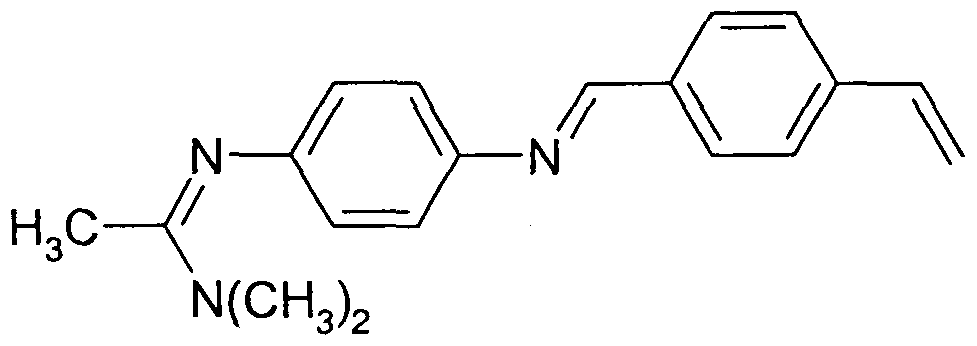
  • Tribendimidine and its synthesis are known.
  • a production method is described, for example, in Yao RH, Chen YQ (1986) "Synthesis of Tribendimidine and its substituted analogues as new anthelmintic agents.” Annual Report of Institute of Parasitic Diseases, Chinese Academy of Preventive Medicine, 1986, pp. 199-202 ,
  • Depsipeptides are similar to peptides and differ from them in that one or more ⁇ -amino acid building blocks are replaced by ⁇ -hydroxycarboxylic acid building blocks.
  • Preferably used according to the invention are cyclic depsipeptides having 18 to 24 ring atoms, in particular having 24 ring atoms (octadepsipeptides).
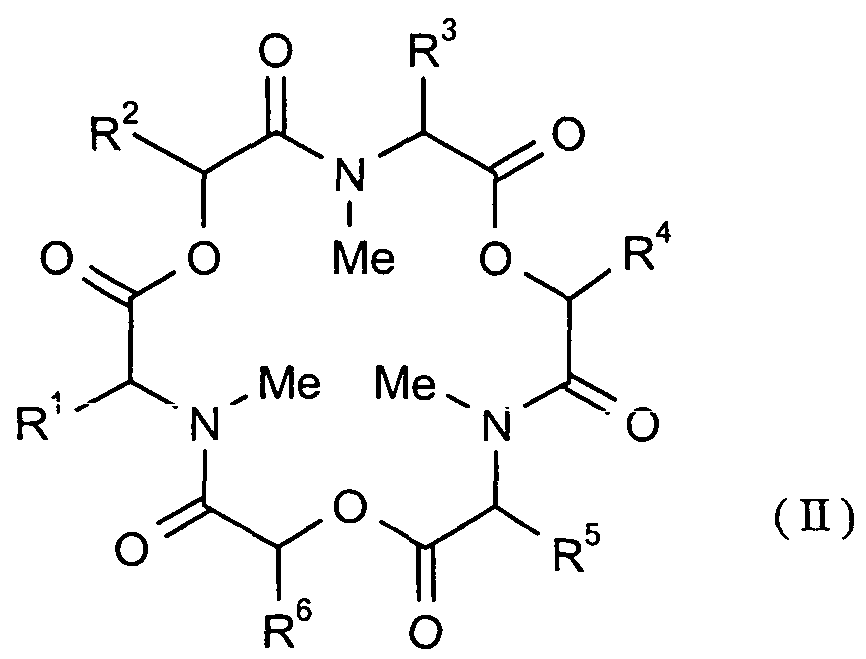
  • depsipeptides with 18 ring atoms include compounds of the general formula (IT):
  • R 1 , R 3 and R 5 independently of one another represent hydrogen straight-chain or branched alkyl having up to 8 carbon atoms, hydroxyalkyl, alkanoyloxyalkyl, alkoxyalkyl, aryloxyalkyl, mercaptoalkyl, alkylthioalkyl, alkylsulphinylalkyl, alkylsulphonylalkyl, carboxyalkyl, alkoxycarbonylalkyl, arylalkoxycarbonylalkyl, carbamoylalkyl, aminoalkyl, alkylaminoalkyl, Dialkylaminoalkyl, guamdinoalkyl, which may optionally be substituted by one or two benzyloxycarbonyl radicals or by one, two, three or four alkyl radicals, alkoxycarbonylaminoalkyl, 9-fluorenyl-methoxycarbonyl (Fmoc) aminoalkyl, alkenyl
  • R 2 , R 4 and R 6 independently represent hydrogen, straight-chain or branched alkyl having up to 8 carbon atoms, hydroxyalkyl, mercaptoalkyl, alkanoyloxyalkyl, alkoxyalkyl, aryloxyalkyl, alkylthioalkyl, alkylsulfinylalkyl, alkylsulfonylalkyl, carboxyalkyl, alkoxycarbonylalkyl, arylalkoxycarbonylalkyl, carbamoylalkyl, aminoalkyl, alkylaminoalkyl , Dialkylaminoalkyl, alkoxycarbonylaminoalkyl, alkenyl, cycloalkyl, cycloalkylalkyl optionally substituted aryl or arylalkyl wherein as substituents may be mentioned halogen, hydroxy, alkyl, alkoxy, and their optical isomers and racemates.
  • R 1 , R 3 and R 5 independently of one another represent straight-chain or branched C 1 -C 8 -alkyl, in particular methyl, ethyl, propyl, isopropyl, butyl, isobutyl, sec-butyl, tert-butyl, pentyl, isopentyl, sec Pentyl, hexyl, isohexyl, sec-hexyl, heptyl, isoheptyl, sec-heptyl, tert-heptyl, octyl, isooctyl, sec-octyl, hydroxy-Ci-C 6 -alkyl, in particular hydroxymethyl, 1-hydroxyethyl , C r C 4 - alkanoyloxy-Ci-C ⁇ -alkyl, in particular acetoxymethyl, 1-acetoxyethyl, Ci-C4-alkoxy-Ci-C 6 -alky
  • R 2 , R 4 and R 6 independently of one another represent straight-chain or branched C 1 -C 8 -alkyl, in particular methyl, ethyl, propyl, isopropyl, butyl, isobutyl, sec-butyl, tert-butyl, pentyl, isopentyl, sec Pentyl, hexyl, isohexyl, sec-hexyl, heptyl, isoheptyl, sec-heptyl, tert-heptyl, octyl, isooctyl, sec-octyl, hydroxy-Ci-C 6 -alkyl, in particular hydroxymethyl, 1 hydroxyethyl, C 1 -C 4 -Al- kanoyloxy-C ⁇ C ö alkyl, in particular acetoxymethyl, 1-acetoxyethyl, C 1 -C 4 -alkoxy-C 1
  • R ', R 3 and R 5 independently of one another represent straight-chain or branched C 1 -C 3 -alkyl, in particular methyl, ethyl, propyl, isopropyl, butyl, isobutyl, sec-butyl, pentyl, isopentyl, sec-pentyl, hexyl, isohexyl , sec-hexyl, heptyl, isoheptyl, sec-heptyl, octyl, isooctyl, sec-octyl, hydroxy-CrC ö alkyl, in particular hydroxymethyl, 1-hydroxyethyl, Ci-C 4 -AIkanoyIoxy-dC 6 - alkyl, in particular acetoxymethyl, 1-acetoxyethyl, C 1 -C 4 -alkoxy C 1 -C 6 -alkyl, in particular Methoxymethyl, 1-methoxyethyl
  • R 2 , R 4 and R 6 independently of one another represent straight-chain or branched Q-Cg-alkyl, in particular methyl, ethyl, propyl, isopropyl, butyl, isobutyl, sec-butyl, tert-butyl, pentyl, isopentyl, sec - pentyl, hexyl, isohexyl, sec-hexyl, heptyl, isoheptyl, sec-heptyl, tert-heptyl, octyl, isooctyl, sec-octyl, hydroxy-Ci-C 6 -alkyl, in particular hydroxymethyl, aryl-ci G t alkyloxy-Ci-Ce-alkyl, in particular benzyloxymethyl, 1-benzyloxyethyl, carboxy-Ci-C ß alkyl, in particular carboxymethyl, carboxyethyl
  • R 1 , R 3 and R 5 independently of one another represent straight-chain or branched C 1 -C 8 -alkyl, in particular methyl, ethyl, propyl, isopropyl, butyl, isobutyl, sec-butyl, pentyl, isopentyl, sec-pentyl, hexyl, isohexyl , sec-hexyl, heptyl, isoheptyl, sec-heptyl, octyl, isooctyl, sec-octyl, C 2 -C 8 -alkenyl, especially allyl, C 3 -C 7 -cycloalkyl-Ci-C 4 -alkyl, in particular Cyclohexylmethyl, phenyl-C r C 4 -alkyl, in particular phenylmethyl,
  • R 2 , R 4 and R 6 independently of one another represent straight-chain or branched C 1 -C 8 -alkyl, in particular methyl, ethyl, propyl, isopropyl, butyl, isobutyl, s.ec.
  • depsipeptide is the compound PF 1022 of the following formula (IIaa) known from EP-OS 382 173:
  • depsipeptides are the compounds known from PCT application WO 93/19053.
  • R ', R 2 , R 3 , R 4 independently of one another represent hydrogen, Q-Cio-alkyl or aryl, in particular
  • Phenyl which are optionally substituted by hydroxy, C] -C ] 0 -alkoxy or halogen.
  • the compounds of the general formula (II) are known and can be prepared by the methods described in EP-A-382 173, DE-A 4 317 432, DE-A 4 317 457, DE-A 4 317 458, EP-A-634 408, EP-A-718 293, EP-A-872 481, EP-A-685 469, EP-A-626375, EP-A-664297, EP-A-669343, EP-A-787 141, EP-A- 865498, EP-A-903 347.
  • the cyclic depsipeptides with 24 ring atoms also include compounds of the general formula (ffld)
  • R a, R 2a, R l la and R 12a independently of one another
  • Ci -8 - alkyl, C ,. 8 -haloalkyl, C 3-6 -cycloalkyl, aralkyl, aryl, R 3a , R 5a , R 7a , R 9a independently of one another represent hydrogen or straight-chain or branched C 1-8 -
  • R 4a , R 6a , R 8a , R 10a independently of one another are hydrogen, straight-chain C]. 5- alkyl, C 2-6 -
  • R 1a , R 2a , R l la and R 12a independently of one another are methyl, ethyl, propyl, isopropyl, n-, s-, t-butyl or phenyl, which is optionally substituted by halogen, C M alkyl, OH, C M is alkoxy, as well as benzyl or phenylethyl, which may optionally be substituted by the radicals indicated for phenyl;
  • R 3a to R 10a have the abovementioned meaning.
  • R la, R 2a, R l la and R I2a independently methyl, ethyl, propyl, isopropyl or n-, s-, t-butyl,
  • R 3a, R 5a, R 7a, R 9a is hydrogen, straight or branched Ci -8 alkyl, especially methyl, ethyl, propyl, i-propyl, n-, s-, t-butyl, optionally substituted by Ci ⁇ - Alkoxy, especially methoxy,
  • Ethoxy, imidazolyl, indolyl or especially methylthio, ethylthio may be substituted, furthermore for pheriyl.
  • R 4a , R 6a , R 8a , R 10a independently of one another represent hydrogen, methyl, ethyl, n-propyl, n-butyl,
  • Vinyl, cyclohexyl optionally substituted by methoxy, ethoxy, imidazolyl, indolyl, methylthio, Ethylthio may be substituted, as well as isopropyl, s-butyl furthermore represents optionally halogen-substituted phenyl, benzyl or phenylethyl.
  • the compounds of the formula (IIId) can also be prepared according to the methods described in EP-A-382 173, DE-A 4 317432, DE-A 4 317457, DE-A 4 317 458, EP-A-634 408, EP-A-718 293, EP-A-872481, EP-A-685 469, EP-A-626 375, EP-A-664 297, EP-A-669 343, EP-A-787 141, EP-A-865 498, Obtained by EP-A-903 347.
  • Very particularly preferred depilatory puffs according to the invention are PF 1022 A (see formula (IIIa) and emodepside (PF 1022-221, compound of the formula (IIIb) in which both Z radicals are the morpholinyl radical.)
  • the INN emodepside stands for the compound with systematic name: Cyclo [(R) -lactoyl-N-methyl-L-leucyl- (R) -3- (p-monopholinophenyl) lactoyl-N-methyl-L-leucyl (i) -lactoyl-N-methyl -L-leucyl- (i?) - 3- (p-mo ⁇ hohnophenyl) lactoyl-N-methyl-L-leucyl.
  • active compounds can be present in stereoisomeric forms or as stereoisomer mixtures, e.g. as enantiomers or racemates. Both the stereoisomer mixtures and the pure stereoisomers can be used according to the invention.
  • salts of the active compounds with pharmaceutically acceptable acids or bases and also solvates, in particular hydrates, of the active substances or their salts.
  • the active substances used in the products according to the invention may, depending on their structure, exist in stereoisomeric forms (enantiomers, diastereomers). According to the invention, the enantiomers or diastereomers and their respective mixtures can be used.
  • the present invention also encompasses the use of the tautomeric forms.
  • the active compounds may also be used in the form of their salts, solvates and solvates of the salts
  • salts physiologically acceptable salts of the active ingredients are preferred in the context of the present invention.
  • Physiologically acceptable salts of the active compounds comprise, depending on the structure of the active substance, acid addition salts of maleic acids, carboxylic acids and sulfonic acids, for example salts of chlorine.
  • Physiologically acceptable salts of the active compounds optionally also include salts of customary bases, such as, by way of example and by way of preference, alkali metal salts (for example sodium and potassium salts), alkaline earth salts (for example calcium and magnesium salts) and ammonium salts derived from ammonia or organic amines having 1 to 16 carbon atoms, such as, by way of example and by way of preference, ethylamine, diethylamine, triethylamine, ethyldiisopropylamine, monoethanolamine, diethanolamine, triethanolamine, dicyclohexylamine, dimethylaminoethanol, procaine, dibenzylamine, N-methylmorpholine, arginine, lysine, ethylenediamine, N-methylpiperidine and choline.
  • customary bases such as, by way of example and by way of preference, alkali metal salts (for example sodium and potassium salts), alkaline earth salts (for example calcium and
  • Solvates in the context of the invention are those forms of the active ingredients which form a complex in the solid or liquid state by coordination with solvent molecules. Hydrates are a special form of solvates that coordinate with water.
  • the present invention also includes prodrugs of the active ingredients.
  • prodrugs includes compounds which may themselves be biologically active or inactive, but are converted to the actual active ingredient during their residence time in the body (for example metabolically or hydrolytically).
  • the products according to the invention are suitable in the case of favorable warm-blooded toxicity for controlling pathogenic endoparasites which occur in humans and in animal husbandry and animal breeding in productive, breeding, zoo, laboratory, experimental and hobby animals. They are effective against all or individual stages of development of the pests and against resistant and normally sensitive species.
  • pathogenic endoparasites it is intended to reduce disease, fatalities and impairments (for example in the production of meat, milk, wool, hides, eggs, honey, etc.) so that the use of the active substances makes it possible to achieve more economical and easier animal husbandry.
  • the pathogenic endoparasites include cestodes, trematodes, nematodes, acantocephalen in particular:
  • Cyclophyllidea eg: Mesocestoides spp., Anoplocephala spp., Paranoplocuspala spp., Moniezia spp., Thysanosomsa spp., Thysaniezia spp., Avitellina spp., Stilesia spp., Cittotaenia spp., Andyra spp., Bertiella spp., Taenia spp., Echinococcus spp., Hydatigera spp., Davainea spp., Raillietina spp., Hymenolepis spp., Echinolepis spp., Echinocotyle spp., Diorchis spp., Dipylidium spp., Joyeuxiella spp., Diplopylidium spp.
  • Echinochasmus spp. Hypoderaeum spp., Fasciola spp., Fasciolides spp., Fasciolopsis spp., Cyclocoelum spp., Typhlocoelum spp., Paramphistomum spp., Calicophoron spp, Cotylophoron spp., Gigantocotyle spp., Fischoederius spp., Gastrothylacus spp., Notocotylus spp., Catatropis spp., Plagiorchis spp., Prosthogonimus spp., Dicrocoelium spp., Eurytrema spp., Troglotrema spp., Paragonimus spp., Collyriclum spp., Nanophyetus spp., Opisthorchis spp., Clonorchis
  • Strongylus spp. Triodontophorus spp., Oesophagodontus spp., Trichonema spp., Gyalocephalus spp., Cylindropharynx spp., Poteriostromum spp., Cyclococercus spp., Cylicostephanus spp., Oesophagostomum spp., Chabertia spp.
  • Stephanurus spp. Ancylostoma spp., Uncinaria spp., Bunostomum spp., Globocephalus spp., Syngamus spp., Cyathostomum spp., Metastrongylus spp., Dictyocaulus spp., Muellerius spp., Protostrongylus spp., Neostrongylus spp., Cystocaulus Spp., Pneumostrongylus spp., Spicocaulus spp., Elaphostrongylus spp., Parelaphostrongylus spp., Crenosoma spp., Paracrenosoma spp., Angiostrongylus spp., Aelurostrongylus spp., Filaroides spp., Paraflaroids spp., Trichostrongylus spp., Haemonchus spp.
  • Oxyuris spp. Enterobius spp., Passaluras spp., Syphacia spp., Aspiculuris spp., Heterakis spp.
  • Ascaridia for example: Ascaris spp., Toxascaris spp., Toxocara spp., Parascaris spp., Anisakis spp., Ascaridia spp.
  • Spirurida Gnathostoma spp., Physaloptera spp., Thelazia spp., Gongylonema spp., Habronema spp., Parabronema spp., Draschia spp., Dracunculus spp.
  • tapeworms e.g. Taenia spp.
  • nematodes such. B .:
  • Spirurida for example: Gnathostoma spp., Physaloptera spp., Thelazia spp., Gongylonema spp., Habronema spp., Parabronema spp., Draschia spp., Dracunculus spp.
  • the livestock include in particular mammals such as e.g. Cattle, horses, sheep, pigs, goats, camels, water buffalo, donkeys, rabbits, fallow deer, reindeer, fur animals such as e.g. Mink, Chinchilla, Raccoon.
  • cattle are preferably sheep and pigs.
  • non-mammal species but which are also livestock: birds, e.g. Chickens, geese, turkeys, ducks; Freshwater and saltwater fish such as Trout, carp, eels, reptiles; Insects such as e.g. Honeybee and silkworm.
  • Hobby animals include dogs and cats.
  • preferred are Toxoscaris spp., Toxocara spp., Trichuris spp., Trichinella spp. and the hookworms Ancylostoma spp. and Uncinaria spp. fought.
  • the products can also be used in humans.
  • Ascaris spp. Ancylostoma spp, Necator spp., Trichuris spp., Strongyloides spp. and Enterobius spp. fought.
  • herbivores are preferred for the application of the abovementioned combinations, ie animals which mainly feed on plants.
  • ruminants such as sheep, goats, cattle.
  • Strongyhda in particular Haemonchus spp., T ⁇ chostrongylus spp., Coope ⁇ a spp. and Ostertagia spp. be fought.
  • sheep are particularly preferably treated.
  • cattle are treated according to the invention.
  • the application can be both prophylactic and therapeutic.
  • the application of the active ingredient is carried out directly or in the form of suitable preparations enteral, parenteral, dermal, nasal, by treatment of the environment or with the aid of active ingredient-containing moldings such.
  • suitable preparations enteral, parenteral, dermal, nasal, by treatment of the environment or with the aid of active ingredient-containing moldings such.
  • active ingredient-containing moldings such as strips, plates, ligaments, collars, ear tags, limb bands, marking devices.
  • Enteral administration of the active ingredient is e.g. oral form of powder, suppositories, tablets, capsules, fasting, potions, granules, drenches, boii, medicated feed or drinking water.
  • the dermal application is e.g. in the form of dipping, spraying, bathing, washing, pour-on and spot-on, and empowering.
  • Parenteral administration is, for example, in the form of injection (mtramuscular, subcutaneous, intravenous, intrape ⁇ toneal) or by implants.
  • Suitable preparations are:
  • Solutions such as injection solutions, other solutions, concentrates for oral administration after dilution, solutions for use on the skin or in body cavities, infusion formulations, gels; Emulsions and suspensions for oral or dermal use and for injection; semi-solid preparations;
  • Solid preparations such as powders, premixes or concentrates, granules, pellets, tablets, tablets, capsules; Aerosols and inhalants, active substance-containing moldings.
  • Injection solutions are administered intravenously, intramuscularly and subcutaneously.
  • Concentrates are applied directly. Concentrates are administered orally after prior dilution to the concentration of use.
  • Solutions for use on the skin are dripped, brushed, rubbed, sprayed on, sprayed on or applied by dipping (dipping, bathing or washing).
  • Gels are applied to the skin or brushed or incorporated into body cavities.
  • Pour-on formulations are infused or sprayed onto limited areas of the skin, whereby the active ingredient either penetrates the skin and acts systemically or spreads on the body surface.
  • Emulsions can be administered orally, dermally or as an injection. Emulsions are either water-in-oil type or oil-in-water type.
  • Suspensions may be administered orally, dermally or as an injection.
  • Semi-solid preparations may be administered orally or dermally.
  • the active compound is mixed with suitable excipients, if appropriate with the addition of auxiliaries, and brought into the desired form.
  • the products according to the invention may optionally contain further active ingredients.
  • the use in combination means either that the anthelmintic aminophenylamidine derivatives and the cyclic depsipeptides in a common preparation formulated and applied together accordingly.
  • the products may also comprise separate preparations for each active substance. If more than two active substances can be used, corresponding to all active ingredients in a common preparation, all active ingredients are formulated in separate formulations, conceivable are also mixed forms in which a part of the active ingredients together and a part of the active ingredients is formulated separately.
  • the products contain the active ingredients in each case in concentrations of 10 ppm to 90 weight percent, preferably 0.1 to 50 weight percent.
  • Ready-to-use preparations usually contain the active compounds in concentrations of 10 ppm to 20 percent by weight, preferably from 0.1 to 10 percent by weight.
  • Preparations which are diluted before use contain the active compounds in concentrations of 0.5-90 wt .-%, preferably from 5 to 50 weight percent.
  • the weight ratio of aminophenylamidine to cyclodepsipeptide in the products according to the invention depends on various factors, but is generally in the range of 10:90 to 50:50, preferably 20:80 to 30:70.
  • Usual dosages of Aminophenylamidine per day are 1 to 100 mg / kg body weight, preferably 2 to 60 mg / kg body weight.
  • Usual dosages of depsipeptides per day are 0.1 to 100 mg / kg, preferably 0.5 to 50 mg / kg, more preferably 1 to 50 mg / kg of body weight per day.
  • the active ingredients are filled in the amounts given below as a powder in a gelatin capsules:
  • the compounds were dissolved in DMSO and added to the incubation medium so that final concentrations of 100, 10, 1, 0.1, 0.01, 0.001 and 0.0001 ⁇ g / ml were present.
  • the controls contained only DMSO.
  • the acetylcholinesterase activity was determined according to the above publication.

Landscapes

  • Health & Medical Sciences (AREA)
  • Life Sciences & Earth Sciences (AREA)
  • Veterinary Medicine (AREA)
  • Chemical & Material Sciences (AREA)
  • Public Health (AREA)
  • Medicinal Chemistry (AREA)
  • General Health & Medical Sciences (AREA)
  • Animal Behavior & Ethology (AREA)
  • Pharmacology & Pharmacy (AREA)
  • Epidemiology (AREA)
  • General Chemical & Material Sciences (AREA)
  • Organic Chemistry (AREA)
  • Nuclear Medicine, Radiotherapy & Molecular Imaging (AREA)
  • Chemical Kinetics & Catalysis (AREA)
  • Engineering & Computer Science (AREA)
  • Bioinformatics & Cheminformatics (AREA)
  • Gastroenterology & Hepatology (AREA)
  • Immunology (AREA)
  • Proteomics, Peptides & Aminoacids (AREA)
  • Tropical Medicine & Parasitology (AREA)
  • Pharmaceuticals Containing Other Organic And Inorganic Compounds (AREA)
  • Medicines That Contain Protein Lipid Enzymes And Other Medicines (AREA)
  • Acyclic And Carbocyclic Compounds In Medicinal Compositions (AREA)

Abstract

Die vorliegende Erfindung betrifft die Kombination von Aminophenylamidin-Derivaten mit cyclischen Depsipeptiden, Erzeugnisse enthaltend diese Kombination sowie die Verwendung dieser Wirkstoffe in Kombination zur Bekämpfung von Endoparasiten beim Mensch und bei Tieren.

Description

Kombination von Amidin-Derivaten mit cyclischen Depsipeptiden
Die vorliegende Erfindung betrifft die Kombination von Aminophenylamidin-Derivaten mit cyclischen Depsipeptiden, Erzeugnisse enthaltend diese Kombination sowie die Verwendung dieser Wirkstoffe in Kombination zur Bekämpfung von Endoparasiten beim Menschen und bei Tieren.
Anthelmintisch wirksame Aminophenylamidine und verwandte Verbindungen sind seit langem bekannt, siehe z. B. DE OS 2 029 297, DE OS 2 029 298, DE OS 2 029 299 und DE OS 2 145 807. Ein wichtiger Vertreter dieser Klasse ist das Amidantel, das als ein potentes Anthelminthikum für Hunde bekannt ist (Wollweber H et al. Arzneimittelforschung/Drug Research 29 (1) 31-32; DE- OS-20 29 298). Die Anwendung beim Menschen gegen Ancylostoma duodenale ist beschrieben bei Rim HJ. et al. The Korean Journal of Parasitology 18 (1) 24-36.
Amidantel wird in vivo recht schnell zum entsprechenden freien Amin (Bay d 9216) deacyliert, das ebenfalls anthelmintisch wirksam ist (Thomlinson et al., European Journal of Pharmacology, 113 (1985) 255-262).
Tribendimidin, ein symmetrisches Diamidin-Derivat von Amindantel, ist seit etwa 20 Jahren bekannt und wird in China als Breitband-Anthelmintikum für die Anwendung beim Menschen ent- wickelt (siehe z. B: Ren, H. N. et al. Chin. J. Parasitol. Parasit. Dis. 5 (1987) 262-264; Keiser, J. et al. Antimicrob. Agents Chemother. 51 (2007) 1096-1098). Die Bekämpfung von Endoparasiten bei Nutztieren ist Gegenstand unserer parallel anhängigen Patentanmeldung DE-Akz. 10 2007 061262.
Cyclische Depsipeptide und ihre endoparasitizide Wirkung sind bekannt: Enniatine und andere 18- gliedrige cyclische Depsipeptide (EP-A 644 883, EP-A 658 551, EP-A 669 343, WO 95/27498);
24-gliedrige cyclische Depsipeptide (EP-A 626 376, EP-A 626 375, EP 787 141, EP-A 903 347,
EP-A 973 756, WO 98/55469, WO 99/47506, WO 00/14079, WO 98/37088, WO 99/67281), cyclische Depsipeptide mit 12 Ringatomen (EP-A 664 297). Cyclische Oktadepsipeptide wie
PF 1022 und Emodepsid und ihre Wirkung gegen Endoparasiten (z.B. gegen Darmnematoden und Gewebsnematoden) sind ebenfalls bereits bekannt, siehe z.B. EP-A 382 173, EP-A 634 408.
Gegenstand der vorliegenden Erfindung sind:
Erzeugnisse enthaltend anthelmintisch wirksame Aminophenylamidin-Derivate und cyclische Depsipeptide.
Anthelmintisch wirksame Aminophenylamidin-Derivate sind vorzugsweise Verbindungen der Formel (I),
Figure imgf000003_0001
worin
R , 1 Wasserstoff oder C i .4-Alkyl bedeutet und
R2 Wasserstoff, -COO(C1-4-Alkyl), -CO(CM-Alkyl), -COCH2(C1 ^-Alkyl), -COCH2OPhenyl oder -COHetaryl bedeutet, wobei Hetaryl für einen fünf- oder 6-gliedrigen aromatischen Heterocyclus mit einem oder mehreren Heteroringatomen ausgewählt aus O, N und S steht, oder R1 und R2 gemeinsam für den Rest
Figure imgf000003_0002
stehen.
R1 steht bevorzugt für Wasserstoff.
R steht bevorzugt für Wasserstoff, -COCH2(C ^-Alkoxy) oder zusammen mit R für den Rest
Figure imgf000003_0003
Gemäß einer bevorzugten Ausführungsform ist das anthelmintisch wirksame Arninophenylamidin- Derivat die Verbindung Amidantel der Formel
Figure imgf000003_0004
Amidantel und seine Herstellung sind beschrieben in DE-OS 2 029 298.
Gemäß einer weiteren bevorzugten Ausführungsform ist das anthelmintisch wirksame Aminophenylamidin-Derivat die Verbindung Bay d 9216 der Formel
Figure imgf000004_0001
Die Herstellung von N-(4-Aminophenyl-N,N'-dimethylacetamidin (Bay d 9216) als Vorstufe ist ebenfalls beschrieben in DE-OS 2 029 298.
Gemäß einer weiteren bevorzugten Ausführungsform ist das anthelmintisch wirksame Aminophenylamidin-Derivat Tribendimidin der Formel
Figure imgf000004_0002
Tribendimidin und seine Synthese sind bekannt. Ein Herstellungsverfahren ist zum Beispiel beschrieben bei Yao RH, Chen YQ (1986) „Synthesis of Tribendimidine and its substituted analogues as new anthelmintic agents." Annual Report of Institute of Parasitic Diseases, Chinese Academy of Preventive Medicine in 1986, S. 199-202.
Depsipeptide sind den Peptiden ähnlich und unterscheiden sich von diesen darin, dass ein oder mehrere α-Aminosäurebausteine durch α-Hydroxycarbonsäurebausteine ersetzt sind. Erfindungsgemäß bevorzugt eingesetzt werden cyclische Depsipeptide mit 18 bis 24 Ringatomen, insbesondere mit 24 Ringatomen (Octadepsipeptide).
Zu den Depsipeptiden mit 18 Ringatomen zählen Verbindungen der allgemeinen Formel (IT):
Figure imgf000004_0003
in welcher R1, R3 und R5 unabhängig voneinander für Wasserstoff geradkettiges oder verzweigtes Alkyl mit bis zu 8 Kohlenstoffatomen, Hydroxyalkyl, Alkanoyloxyalkyl, Alkoxyalkyl, Aryloxyalkyl, Mercaptoalkyl, Alkylthioalkyl, Alkylsulfinylalkyl, Alkylsulfonylalkyl, Carboxyalkyl, Alkoxycarbonylalkyl, Arylalkoxycarbonylalkyl, Carbamoylalkyl, Aminoalkyl, Alkylaminoalkyl, Dialkylaminoalkyl, Guamdinoalkyl, das gegebenenfalls durch einen oder zwei Benzyloxycarbonylreste oder durch einen, zwei, drei oder vier Alkylreste substituiert sein kann, Alkoxycarbonylaminoalkyl, 9-Fluorenyl- methoxycarbonyl(Fmoc)aminoalkyl, Alkenyl, Cycloalkyl, Cycloalkylalkyl sowie gegebenenfalls substituiertes Arylalkyl, wobei als Substituenten genannt seien Halogen, Hydroxy, Alkyl und Alkoxy, stehen,
R2, R4 und R6 unabhängig voneinander für Wasserstoff, geradkettiges oder verzweigtes Alkyl mit bis zu 8 Kohlenstoffatomen, Hydroxyalkyl, Mercaptoalkyl, Alkanoyloxyalkyl, Alkoxyalkyl, Aryloxyalkyl, Alkylthioalkyl, Alkylsulfinylalkyl, Alkylsulfonylalkyl, Carboxyalkyl, Alkoxycarbonylalkyl, Arylalkoxycarbonylalkyl, Carbamoylalkyl, Aminoalkyl, Alkylaminoalkyl, Dialkylaminoalkyl, Alkoxycarbonylaminoalkyl, Alkenyl, Cycloalkyl, Cycloalkylalkyl gegebenenfalls substituiertes Aryl oder Arylalkyl wobei als Substituenten genannt seien Halogen, Hydroxy, Alkyl, Alkoxy, stehen, sowie deren optische Isomere und Racemate.
Bevorzugt sind Verbindungen der Formel (H), in welcher
R1, R3 und R5 unabhängig voneinander für geradkettiges oder verzweigtes C1-C8-AIlCyI, insbesondere Methyl, Ethyl, Propyl, Isopropyl, Butyl, Isobutyl, sec.-Butyl, tert.-Butyl, Pentyl, Isopentyl, sec.-Pentyl, Hexyl, Isohexyl, sec.-Hexyl, Heptyl, Isoheptyl, sec.-Heptyl, tert -Heptyl, Oktyl, Isooktyl, sec. -Oktyl, Hydroxy-Ci-C6-alkyl, insbesondere Hydroxymethyl, 1-Hydroxyethyl, CrC4- Alkanoyloxy-Ci-Cβ-alkyl, insbesondere Acetoxymethyl, 1-Acetoxyethyl, Ci-C4-Alkoxy-Ci-C6-alkyl, insbesondere Methoxymethyl, 1-Methoxyethyl, Aryl-Ci-Gralkyloxy-Ci-Ce-alkyl, insbesondere Benzyloxymethyl, 1-Benzyloxy-ethyl, Mercapto-Ci-Cβ-alkyl, insbesondere Mercaptomethyl, C]-C4- Alky]thio-Ci-C6-alky], insbesondere Methylthioethyl, Ci-Q-Alkylsulfinyl-Ci-Cs-alkyl, insbesondere Methylsulfinylethyl, Ci-C4-Alkylsulfonyl-Ci-C6-alkyl, insbesondere Methylsulfonylethyl, Carboxy- Ci-Cβ-alkyl, insbesondere Carboxymethyl, Carboxyethyl, Ci-C4-Alkoxycarbonyl-CrC6-alkyl, insbesondere Methoxycarbonylmethyl, Ethoxycarbonylethyl, C1-C4-Arylalkoxycarbonyl-Ci-C6-alkyl, insbesondere Benzyloxycarbonylmethyl, Carbamoyl-Ci-Q-alkyl, insbesondere Carbamoylmethyl, Carbamoylethyl, Ammo-CrC6-aikyi, insbesondere Aiiuuopröpyl, Arnmobutyl, CrC4-Alkylarnino-Ci- Cö-alkyl, insbesondere Methylaminopropyl, Methylaminobutyl, Ci-Gt-Dialkylammo-Ci-Cg-alkyl, insbesondere Dimethylammopropyl, Dimethylaminobutyl, Guanido-Ci-C6-alkyl, insbesondere Guamdopropyl, Ci-C4-Alkoxycarbonylamino-Ci-C6-alkyl, insbesondere tert.-Butoxycarbonylamino- propyl, tert.-Butoxycarbonylaminobutyl, 9-Fluorenylmethoxycarbonyl(Fmoc)amino-Ci-C6-alkyl, ms- besondere 9-Fluorenyl-methoxycarbonyl(Fmoc)aminopropyl, 9-Fluorenylmethoxycarbonyl(Fmoc)- aminobutyl, C2-C8-Alkenyl, insbesondere Vinyl, Allyl, Butenyl, C3-C7-Cycloalkyl, insbesondere Cyclopentyl, Cyclohexyl, Cycloheptyl, C3-C7-Cycloalkyl-Ci-C4-alkyl, insbesondere Cyclopentyl- methyl, Cyclohexylmethyl, Cycloheptylmethyl, Phenyl-Ci-C4-alkyl, insbesondere Phenylmethyl das gegebenenfalls durch Reste aus der Reihe Halogen, insbesondere Fluor, Chlor Brom oder Iod, Hydroxy, CrC4- Alkoxy, insbesondere Methoxy oder Ethoxy, Ci-C4-AIlCyI, insbesondere Methyl, substituiert sein kann,
R2, R4 und R6 unabhängig voneinander für geradkettiges oder verzweigtes C)-C8-Alkyl, insbesondere Methyl, Ethyl, Propyl, Isopropyl, Butyl, Isobutyl, sec.-Butyl, tert.-Butyl, Pentyl, Isopentyl, sec.-Pentyl, Hexyl, Isohexyl, sec.-Hexyl, Heptyl, Isoheptyl, sec.-Heptyl, tert.-Heptyl, Oktyl, Isooktyl, sec.-Oktyl, Hydroxy-Ci-C6-alkyl, insbesondere Hydroxymethyl, 1-Hydroxyethyl, C1-C4-Al- kanoyloxy-C^Cö-alkyl, insbesondere Acetoxymethyl, 1-Acetoxyethyl, C1 -C4-AIkOXy-C1 -Cβ-alkyl, insbesondere Methoxymethyl, 1-Methoxyethyl, ATyI-C1 -d-alkyloxy-Q-Ce-alkyl, insbesondere Benzyloxymethyl, 1-Benzyloxy-ethyl, Mercapto-Q-Cö-alkyl, insbesondere Mercaptomethyl, Ci-C4- Alkylthio-CrCö-alkyl, insbesondere Methylthioethyl,
Figure imgf000006_0001
insbesondere Methylsulfinylethyl, Ci-C4-Alkylsulfonyl-Ci-C6-alkyl, insbesondere Methylsulfonylethyl, Carboxy- Ci-C6-alkyl, insbesondere Carboxymethyl, Carboxyethyl, Ci-C4-Alkoxycarbonyl-Ci-C6-alkyl, insbesondere Methoxycarbonylmethyl, Ethoxycarbonylethyl, C1-C4- Arylalkoxycarbonyl-Ci-C6-alkyl, insbesondere Benzyloxycarbonylmethyl, Carbamoyl-Ci-C6-alkyl, insbesondere Carbamoylmethyl, Carbamoylethyl, Amino-Q-Q-alkyl, insbesondere Aminopropyl, Aminobutyl, CrC4-Alkylamino-Ci- C6-alkyl, insbesondere Methylaminopropyl, Methylaminobutyl, Ci-C4-Dialkylamino-C1-C6-alkyl, insbesondere Dimethylaminopropyl, Dimethylaminobutyl, C2-Cg-Alkenyl, insbesondere Vinyl, Allyl, Butenyl, C3-C7-Cycloalkyl, insbesondere Cyclopentyl, Cyclohexyl, Cycloheptyl, C3-C7-CyClOaIlCyI-C1- C4-alkyl, insbesondere Cyclopentylmethyl, Cyclohexylmethyl, Cycloheptylmethyl, Phenyl, Phenyl-d- C4-alkyl, insbesondere Phenylmethyl das gegebenenfalls durch Reste aus der Reihe Halogen, insbesondere Fluor, Chlor Brom oder Iod, Hydroxy, C]-C4- Alkoxy, insbesondere Methoxy oder Ethoxy, Ci-C4-Alkyl, insbesondere Methyl, substituiert sein kann, sowie deren optische Isomere und Racemate.
Besonders bevorzugt sind Verbindungen der Formel (II), in welcher
R', R3 und R5 unabhängig voneinander für geradkettiges oder verzweigtes Ci-C3-Alkyl, insbesondere Methyl, Ethyl, Propyl, Isopropyl, Butyl, Isobutyl, sec.-Butyl, Pentyl, Isopentyl, sec- Pentyl, Hexyl, Isohexyl, sec.-Hexyl, Heptyl, Isoheptyl, sec.-Heptyl, Oktyl, Isooktyl, sec.-Oktyl, Hydroxy-CrCö-alkyl, insbesondere Hydroxymethyl, 1-Hydroxyethyl, Ci-C4-AIkanoyIoxy-d-C6- alkyl, insbesondere Acetoxymethyl, 1-Acetoxyethyl, Ci -C4-AIkOXy-C1 -Cβ-alkyl, insbesondere Methoxymethyl, 1-Methoxyethyl, Aryl-Ci-C4-alkyloxy-Ci-C6-alkyl, insbesondere Benzyloxymethyl, 1-Benzyloxyethyl, Ci-Q-Alkoxycarbonylamino-Ci-Ce-alkyl, insbesondere tert-Butoxycarbonyl- aminopropyl, tert.-Butoxycarbonylaminobutyl, C2-C8-Alkenyl, insbesondere Vinyl, Allyl, C3-C7- Cycloalkyl, insbesondere Cyclopentyl, Cyclohexyl, Cycloheptyl, C3-C7-Cycloalkyl-Ci-C4-alkyl, insbesondere Cyclopentylmethyl, Cyclohexylmethyl, Cycloheptylmethyl, Phenyl-Ci-Q-alkyl, insbesondere Phenylmethyl das gegebenenfalls durch einen oder mehrere gleiche oder verschiedene der oben angegebenen Reste substituiert sein kann,
R2, R4 und R6 unabhängig voneinander für geradkettiges oder verzweigtes Q-Cg-Alkyl, insbeson- dere Methyl, Ethyl, Propyl, Isopropyl, Butyl, Isobutyl, sec.-Butyl, tert.-Butyl, Pentyl, Isopentyl, sec- Pentyl, Hexyl, Isohexyl, sec.-Hexyl, Heptyl, Isoheptyl, sec.-Heptyl, tert.-Heptyl, Oktyl, Isooktyl, sec- Oktyl, Hydroxy-Ci-C6-alkyl, insbesondere Hydroxymethyl, Aryl-Ci-Gt-alkyloxy-Ci-Ce-alkyl, insbesondere Benzyloxymethyl, 1-Benzyloxyethyl, Carboxy-Ci-Cß-alkyl, insbesondere Carboxy- methyl, Carboxyethyl, Ci-C4-Alkoxycarbonyl-Ci-C6-alkyl, insbesondere Methoxycarbonylmethyl, Ethoxycarbonylethyl, Ci-C4-Aryl-alkoxycarbonyl-Ci-C6-alkyl, insbesondere Benzyloxycarbonylme- thyl, Ci-C4-Alkylamino-Ci-C6-alkyl, insbesondere Methylaminopropyl, Methylaminobutyl, CrC4- Dialkylamino-Ci-C6-alkyl, insbesondere Dimethylaminopropyl, Dimethylaminobutyl, C2-C8-Alkenyl, insbesondere Vinyl, Allyl, Butenyl, C3-C7-Cycloalkyl, insbesondere Cyclopentyl, Cyclohexyl, Cycloheptyl, C3-C7-Cycloalkyl-Ci-C4-alkyl, insbesondere Cyclopentylmethyl, Cyclohexylmethyl, Cyclo- heptyl-methyl, Phenyl, Phenyl-C1-C4-alkyl, insbesondere Phenylmethyl das gegebenenfalls durch einen oder mehrere gleiche oder verschiedene der oben angegebenen Reste substituiert sein kann, sowie deren optische Isomere und Racemate.
Ganz besonders bevorzugt sind Verbindungen der Formel (IT), in welcher
R1, R3 und R5 unabhängig voneinander für geradkettiges oder verzweigtes Ci-C8-Alkyl, insbesondere Methyl, Ethyl, Propyl, Isopropyl, Butyl, Isobutyl, sec.-Butyl, Pentyl, Isopentyl, sec- Pentyl, Hexyl, Isohexyl, sec.-Hexyl, Heptyl, Isoheptyl, sec.-Heptyl, Oktyl, Isooktyl, sec.-Oktyl C2-C8- Alkenyl, insbesondere Allyl, C3-C7-Cycloalkyl-Ci-C4-alkyl, insbesondere Cyclohexylmethyl, Phenyl- CrC4-alkyl, insbesondere Phenylmethyl,
R2, R4 und R6 unabhängig voneinander für geradkettiges oder verzweigtes Ci-C8-Alkyl, insbesondere Methyl, Ethyl, Propyl, Isopropyi, Butyl, Isobutyl, sεc. -Butyl, Pentyl, Isopentyl, sec- Pentyl, Hexyl, Isohexyl, sec.-Hexyl, Heptyl, Isoheptyl, sec.-Heptyl, Oktyl, Isooktyl, sec.-Oktyl, C2-C8- Alkenyl, insbesondere Vinyl, Allyl, C3-C7-Cycloalkyl-CrC4-alkyl, insbesondere Cyclohexylmethyl, Phenyl-Ci-C4-alkyl, insbesondere Phenylmethyl das gegebenenfalls durch einen oder mehrere gleiche oder verschiedene der oben angegebenen Reste substituiert sein kann, sowie deren optische Isomere und Racemate.
Im einzelnen seien folgende Verbindungen der allgemeinen Formel (II) genannt, in welcher die Reste R1 bis R6 die folgende Bedeutung haben:
Figure imgf000008_0001
Figure imgf000009_0003
Me = Methyl; Phe = Phenyl
Weiterhin sei als Depsipeptid die aus EP-OS 382 173 bekannte Verbindung PF 1022 der folgenden Formel (UIa) genannt:
Figure imgf000009_0001
Außerdem seien als Depsipeptide die aus der PCT-Anmeldung WO 93/19053 bekannten Verbindungen genannt.
Insbesondere seien aus WO 93/19053 die Verbindungen der folgenden Formel (HIb) genannt:
Figure imgf000009_0002
in welcher
Z für N-Mornholinyl. Amino, Mono- oder Dimethylamino steht.
Außerdem seien Verbindungen der folgenden Formel (Die) genannt:
Figure imgf000010_0001
in welcher
R', R2, R3, R4 unabhängig voneinander für Wasserstoff, Q-Cio-Alkyl oder Aryl, insbesondere
Phenyl stehen, die gegebenenfalls substituiert sind durch Hydroxy, C]-C]0-Alkoxy oder Halogen.
Die Verbindungen der allgemeinen Formel (II) sind bekannt und können nach den in EP-A-382 173, DE-A 4 317 432, DE-A 4 317 457, DE-A 4 317 458, EP-A-634 408, EP-A-718 293, EP-A-872 481, EP-A-685 469, EP-A-626375, EP-A-664297, EP-A-669343, EP-A-787 141, EP-A-865498, EP-A- 903 347 beschriebenen Verfahren erhalten werden.
Zu den cyclischen Depsipeptiden mit 24 Ringatomen zählen auch Verbindungen der allgemeinen Formel (ffld)
Figure imgf000010_0002
in welcher Rla, R2a, Rl la und R12a unabhängig voneinander für Ci-8- Alkyl, C,.8-Halogenalkyl, C3-6-Cycloalkyl, Aralkyl, Aryl stehen, R3a, R5a, R7a, R9a unabhängig voneinander für Wasserstoff oder geradkettiges oder verzweigtes C1-8-
Alkyl steht, das gegebenenfalls durch Hydroxy, > Carboxamid,
Figure imgf000011_0001
(- substituiert sein kann und
Figure imgf000011_0002
ferner für Aryl oder Aralkyl die durch Halogen, Hydroxy, CM-Alkyl, Q-4-AIkOXy substituiert sein können, steht,
R4a, R6a, R8a, R1Oa unabhängig voneinander für Wasserstoff, geradkettiges C].5-Alkyl, C2-6-
Alkenyl, C3.7-Cycloalkyl, die gegebenenfalls durch Hydroxy, Ci-4-AIkOXy, Carboxy, Carboxamid, Imidazolyl, Indolyl, Guanidino, SH oder
Figure imgf000011_0003
substituiert sein können, sowie für Aryl oder Aralkyl die durch Halogen, Hydroxy, Ci-4- Alkyl, Ci-4-AIkOXy substituiert sein können, stehen sowie deren optische Isomere und Racemate.
Bevorzugt werden Verbindungen der Formel (IHd) eingesetzt, in welcher
Rla, R2a, Rl la und R12a unabhängig voneinander für Methyl, Ethyl, Propyl, Isopropyl, n-, s-, t-Butyl oder Phenyl, das gegebenenfalls substituiert ist durch Halogen, CM-Alkyl, OH, CM-Alkoxy, sowie für Benzyl oder Phenylethyl stehen, die gegebenenfalls durch die bei Phenyl angegebenen Reste substituiert sein können;
R3a bis R1Oa die oben angegebene Bedeutung haben.
Besonders bevorzugt sind Verbindungen der Formel (IHd), in welcher
Rla, R2a, Rl la und RI2a unabhängig voneinander für Methyl, Ethyl, Propyl, Isopropyl oder n-, s-, t- Butyl stehen,
R3a, R5a, R7a, R9a für Wasserstoff, geradkettiges oder verzweigtes Ci-8-Alkyl, insbesondere Methyl, Ethyl, Propyl, i-Propyl, n-, s-, t-Butyl, die gegebenenfalls durch Ci ^-Alkoxy, insbesondere Methoxy,
Ethoxy, Imidazolyl, Indolyl oder
Figure imgf000011_0004
insbesondere Methylthio, Ethylthio substituiert sein können, femer für Pheriyl. Benzyl oder Phenethyl stehen, die gegebenenfalls durch Halogen insbesondere Chlor substituiert sein können.
R4a, R6a, R8a, R1Oa unabhängig voneinander für Wasserstoff, Methyl, Ethyl, n-Propyl, n-Butyl,
Vinyl, Cyclohexyl, die gegebenenfalls durch Methoxy, Ethoxy, Imidazolyl, Indolyl, Methylthio, Ethylthio substituiert sein können, sowie für Isopropyl, s-Butyl ferner für gegebenenfalls halogensubstituiertes Phenyl, Benzyl oder Phenylethyl stehen.
Die Verbindungen der Formel (HId) können ebenfalls nach den in EP-A-382 173, DE-A 4 317432, DE-A 4 317457, DE-A 4 317 458, EP-A-634 408, EP-A-718 293, EP-A-872481, EP-A-685 469, EP- A-626 375, EP-A-664 297, EP-A-669 343, EP-A-787 141, EP-A-865 498, EP-A-903 347 beschriebenen Verfahren erhalten werden.
Erfindungsgemäß ganz besonders bevorzugte Depsipepüde sind PF 1022 A (siehe Formel (HIa) und Emodepside (PF 1022-221, Verbindung der Formel (HIb) worin beide Reste Z für den Morpholinyl- rest stehen). Der INN Emodepside steht für die Verbindung mit dem systematischen Namen: Cyclo[(R)-lactoyl-N-methyl-L-leucyl-(R)-3-(p-moφholinophenyl)lactoyl-N-methyl-L-leucyl-(i?)- lactoyl-N-methyl-L-leucyl-(i?)-3-(p-moφhohnophenyl)lactoyl-N-methyl-L-leucyl.
Wirkstoffe können je nach Struktur in stereoisomeren Formen oder als Stereoisomerengemische vorliegen, z.B. als Enantiomere oder Racemate. Sowohl die Stereoisomerengemische als auch die reinen Stereoisomeren können erfindungsgemäß verwendet werden.
Weiterhin können gegebenenfalls verwendet werden: Salze der Wirkstoffe mit pharmazeutisch annehmbaren Säuren oder Basen und auch Solvate, insbesondere Hydrate, der Wirkstoffe oder ihrer Salze.
Die in den erfindungsgemäßen Erzeugnissen verwendeten Wirkstoffe können in Abhängigkeit von ihrer Struktur in stereoisomeren Formen (Enantiomere, Diastereomere) existieren. Erfindungsgemäß könne die Enantiomeren oder Diastereomeren und ihre jeweiligen Mischungen eingesetzt werden.
Sofern die Wirkstoffe in tautomeren Formen vorkommen können, umfasst die vorliegende Erfindung auch den Einsatz der tautomeren Formen.
Die Wirkstoffe können gegebenenfalls auch m Form ihrer Salze, Solvate und Solvate der Salze eingesetzt werden
Als Salze sind im Rahmen der vorliegenden Erfindung physiologisch unbedenkliche Salze der Wirkstoffe bevorzugt.
Physiologisch unbedenkliche Salze der Wirkstoffe umfassen je nach Struktur des Wirkstoffs Säure- additionssalze von Mmeralsäuren, Carbonsäuren und Sulfonsäuren, z.B. Salze der Chlor- wasserstoffsäure, Bromwasserstoffsäure, Schwefelsäure, Phosphorsäure, Methansulfonsäure, Ethan- sulfonsäure, Toluolsulfonsäure, Benzolsulfonsäure, Naphthalindisulfonsäure, Essigsäure, Trifiuor- essigsäure, Propionsäure, Milchsäure, Weinsäure, Äpfelsäure, Zitronensäure, Fumarsäure, Maleinsäure und Benzoesäure.
Physiologisch unbedenkliche Salze der Wirkstoffe umfassen gegebenenfalls auch Salze üblicher Basen, wie beispielhaft und vorzugsweise Alkalimetallsalze (z.B. Natrium- und Kaliumsalze), Erdalkalisalze (z.B. Calcium- und Magnesiumsalze) und Ammoniumsalze, abgeleitet von Ammoniak oder organischen Aminen mit 1 bis 16 C-Atomen, wie beispielhaft und vorzugsweise Ethylamin, Diethylamin, Triethylamin, Ethyldiisopropylamin, Monoethanolamin, Diethanolamin, Triethanolamin, Dicyclohexylamin, Dimethylaminoethanol, Prokain, Dibenzylamin, N-Methylmoφholin, Arginin, Lysin, Ethylendiamin, N-Methylpiperidin und Cholin.
Als Solvate werden im Rahmen der Erfindung solche Formen der Wirkstoffe bezeichnet, welche in festem oder flüssigem Zustand durch Koordination mit Lösungsmittelmolekülen einen Komplex bilden. Hydrate sind eine spezielle Form der Solvate, bei denen die Koordination mit Wasser erfolgt. Außerdem umfasst die vorliegende Erfindung auch Prodrugs der Wirkstoffe. Der Begriff „Prodrugs" umfasst Verbindungen, welche selbst biologisch aktiv oder inaktiv sein können, jedoch während ihrer Verweilzeit im Körper zu dem eigentlichen Wirkstoff umgesetzt werden (beispielsweise metabolisch oder hydrolytisch).
Die erfindungsgemäßen Erzeugnisse eignen sich bei günstiger Warmblütertoxizität zur Bekämpfung von pathogenen Endoparasiten, die bei Menschen und in der Tierhaltung und Tierzucht bei Nutz-, Zucht-, Zoo-, Labor-, Versuchs- und Hobbytieren vorkommen. Sie sind dabei gegen alle oder einzelne Entwicklungsstadien der Schädlinge sowie gegen resistente und normal sensible Arten wirksam. Durch die Bekämpfung der pathogenen Endoparasiten sollen Krankheit, Todesfälle und Leistungsminderungen (z.B. bei der Produktion von Fleisch, Milch, Wolle, Häuten, Eiern, Honig usw.) vermindert werden, so dass durch den Einsatz der Wirkstoffe eine wirtschaftlichere und einfachere Tierhaltung möglich ist. Zu den pathogenen Endoparasiten zählen Cestoden, Trematoden, Nematoden, Acantocephalen insbesondere:
Aus der Ordnung der Pseudophyllidea z.B.: Diphyllobothrium spp., Spirometra spp., Schistocepha- lus spp., Ligula spp., Bothridium spp., Diphiogonoporus spp..
Aus der Ordnung der Cyclophyllidea z.B.: Mesocestoides spp., Anoplocephala spp., Paranoploce- phala spp., Moniezia spp., Thysanosomsa spp., Thysaniezia spp., Avitellina spp., Stilesia spp., Cittotaenia spp., Andyra spp., Bertiella spp., Taenia spp., Echinococcus spp., Hydatigera spp., Davainea spp., Raillietina spp., Hymenolepis spp., Echinolepis spp., Echinocotyle spp., Diorchis spp., Dipylidium spp., Joyeuxiella spp., Diplopylidium spp..
Aus der Unterklasse der Monogenea z.B.: Gyrodactylus spp., Dactylogyrus spp., Polystoma spp..
Aus der Unterklasse der Digenea z.B.: Diplostomum spp., Posthodiplostomum spp., Schistosoma spp., Trichobilharzia spp., Ornithobilharzia spp., Austrobilharzia spp., Gigantobilharzia spp., Leucochloridium spp., Brachylaima spp., Echinostoma spp., Echinoparyphium spp., Echinochasmus spp., Hypoderaeum spp., Fasciola spp., Fasciolides spp., Fasciolopsis spp., Cyclocoelum spp., Typhlocoelum spp., Paramphistomum spp., Calicophoron spp-, Cotylophoron spp., Gigantocotyle spp., Fischoederius spp., Gastrothylacus spp., Notocotylus spp., Catatropis spp., Plagiorchis spp., Prosthogonimus spp., Dicrocoelium spp., Eurytrema spp., Troglotrema spp., Paragonimus spp., Collyriclum spp., Nanophyetus spp., Opisthorchis spp., Clonorchis spp. Metorchis spp., Heterophyes spp., Metagonimus spp..
Aus der Ordnung der Enoplida z.B.: Trichuris spp., Capillaria spp., Trichlomosoides spp., Trichinella spp..
Aus der Ordnung des Rhabditia z.B.: Micronema spp., Strongyloides spp..
Aus der Ordnung der Strongylida z.B.: Strongylus spp., Triodontophorus spp., Oesophagodontus spp., Trichonema spp., Gyalocephalus spp., Cylindropharynx spp., Poteriostromum spp., Cyclococercus spp., Cylicostephanus spp., Oesophagostomum spp., Chabertia spp., Stephanurus spp., Ancylostoma spp., Uncinaria spp., Bunostomum spp., Globocephalus spp., Syngamus spp., Cyathostomum spp., Metastrongylus spp., Dictyocaulus spp., Muellerius spp., Protostrongylus spp., Neostrongylus spp., Cystocaulus spp., Pneumostrongylus spp., Spicocaulus spp., Elaphostrongylus spp., Parelaphostrongylus spp., Crenosoma spp., Paracrenosoma spp., Angiostrongylus spp., Aelurostrongylus spp., Filaroides spp., Parafϊlaroides spp., Trichostrongylus spp., Haemonchus spp., Ostertagia spp., Marshallagia spp., Cooperia spp., Nematodirus spp., Hyostrongylus spp., Obeliscoides spp., Amidostomum spp., Ollulanus spp., Cylicocyclus spp., Cylicodontophorus spp..
Aus der Ordnung der Oxyuπda z.B.: Oxyuris spp., Enterobius spp., Passalurαs spp., Syphacia spp., Aspiculuris spp., Heterakis spp..
Aus der Ordnung der Ascaridia z.B.: Ascaris spp., Toxascaris spp., Toxocara spp., Parascaris spp., Anisakis spp., Ascaridia spp.. Aus der Ordnung der Spirurida z.B.: Gnathostoma spp., Physaloptera spp., Thelazia spp., Gongylonema spp., Habronema spp., Parabronema spp., Draschia spp., Dracunculus spp..
Aus der Ordnung der Filariida z.B.: Stephanofilaria spp., Parafϊlaria spp., Setaria spp., Loa spp., Dirofüaria spp., Litomosoides spp., Brugia spp., Wuchereria spp., Onchocerca spp..
Aus der Gruppe der Gigantohynchida z.B.: Filicollis spp., Moniliformis spp., Macra- canthorhynchus spp., Prosthenorchis spp..
Bevorzugt ist die Bekämpfung von Bandwürmern, z.B. Taenia spp. Ebenfalls bevorzugt ist die Bekämpfung von Nematoden, wie z. B.:
Aus der Ordnung der Spirurida z.B.: Gnathostoma spp., Physaloptera spp., Thelazia spp., Gongylonema spp., Habronema spp., Parabronema spp., Draschia spp., Dracunculus spp..
Besonders bevorzugt ist die Verwendung der erfmdungsgemäßen Erzeugnisse zur Bekämpfung von Strongylida, insbesondere Haemonchus spp., Trichostrongylus spp., Cooperia spp. und Ostertagia spp. sowie von Ascaridida wie z. B. Parascaris spp.
Zu den Nutztieren gehören insbesondere Säugetiere wie z.B. Rinder, Pferde, Schafe, Schweine, Ziegen, Kamele, Wasserbüffel, Esel, Kaninchen, Damwild, Rentiere, Pelztiere wie z.B. Nerze, Chinchilla, Waschbär. Von den Nutztier-Säugetieren bevorzugt sind Rinder Schafe und Schweine Ebenfalls eingeschlossen für die erfindungsgemäße Verwendung sind die folgenden Tierarten, die keine Säugetiere sind, die aber ebenfalls zu den Nutztieren gehören: Vögel, wie z.B. Hühner, Gänse, Puten, Enten; Süß- und Salzwasserfische wie z.B. Forellen, Karpfen, Aale, Reptilien; Insekten wie z.B. Honigbiene und Seidenraupe.
Zu den Hobbytieren gehören bevorzugt Hunde und Katzen. Bei diesen werden bevorzugt Toxoscaris spp., Toxocara spp., Trichuris spp., Trichinella spp. sowie die Hakenwürmer Ancylostoma spp. und Uncinaria spp. bekämpft.
Gemäß einer weiteren Ausführungsform können die Erzeugnisse auch beim Menschen eingesetzt werden. Vorzugsweise werden beim Menschen Ascaris spp., Ancylostoma spp, Necator spp., Trichuris spp., Strongyloides spp. und Enterobius spp. bekämpft. Unter den Saugetieren werden gemäß einer Ausführungsform für die Anwendung von obengenannten Kombinationen die Pflanzenfresser (Herbivoren) bevorzugt, also Tiere, die sich hauptsächlich von Pflanzen ernähren. Besonders bevorzugt ist die Behandlung von Wiederkäuern (wie z. B. Schafe, Ziegen, Rinder).
Als nicht wiederkäuende Pflanzenfresser, die Säugetiere sind, seien als bevorzugtes Beispiel die Pferde genannt. Dort können die obengenannten Kombinationen bevorzugt z. B. zur Bekämpfung von Strongyhda oder insbesondere von Spulwürmern (Ascaπdia), wie z. B. Parascaπs equorum, eingesetzt werden.
Bei den Wiederkäuern können bevorzugt Strongyhda, insbesondere Haemonchus spp., Tπchostrongylus spp., Coopeπa spp. und Ostertagia spp. bekämpft werden.
Besonders bevorzugt werden erfindungsgemäß Schafe behandelt.
Ebenfalls besonders bevorzugt werden erfmdungsgemäß Rinder behandelt.
Die Anwendung kann sowohl prophylaktisch als auch therapeutisch erfolgen.
Die Anwendung des Wirkstoffs erfolgt direkt oder in Form von geeigneten Zubereitungen enteral, parenteral, dermal, nasal, durch Behandlung der Umgebung oder mit Hilfe wirkstoffhaltiger Formkörper wie z. B. Streifen, Platten, Bänder, Halsbänder, Ohrmarken, Gliedmaßenbänder, Markierungsvorrichtungen.
Die enterale Anwendung des Wirkstoffs geschieht z.B. oral m Form von Pulver, Zäpfchen, Tabletten, Kapseln, Fasten, Tränken, Granulaten, Drenchen, BoIi, medikiertem Futter oder Trinkwasser. Die dermale Anwendung geschieht z.B. in Form des Tauchens (Dippen), Sprühens (Sprayen), Badens, Waschens, Aufgießens (pour-on and spot-on) und des Empuderns. Die parenterale Anwendung geschieht z B. in Form der Injektion (mtramusculär, subcutan, intravenös, intrapeπtoneal) oder durch Implantate.
Geeignete Zubereitungen sind:
Losungen wie Injektionsiösungen, υrdlc Lösungen, Konzentrate zur oralen Verabreichung nach Verdünnung, Lösungen zum Gebrauch auf der Haut oder in Körperhöhlen, Aufgußformulierungen, Gele; Emulsionen und Suspensionen zur oralen oder dermalen Anwendung sowie zur Injektion; halbfeste Zubereitungen;
Formulierungen bei denen der Wirkstoff in einer Salbengrundlage oder in einer Öl in Wasser oder Wasser in Öl Emulsionsgrundlage verarbeitet ist;
Feste Zubereitungen wie Pulver, Premixe oder Konzentrate, Granulate, Pellets, Tabletten, BoIi, Kapseln; Aerosole und Inhalate, wirkstoffhaltige Formkörper.
Injektionslösungen werden intravenös, intramusculär und subcutan verabreicht.
Orale Lösungen werden direkt angewendet. Konzentrate werden nach vorheriger Verdünnung auf die Anwendungskonzentration oral angewendet.
Lösungen zum Gebrauch auf der Haut werden aufgeträufelt, aufgestrichen, eingerieben, aufgespritzt, aufgesprüht oder durch Tauchen (Dippen, Baden oder Waschen) aufgebracht.
Gele werden auf die Haut aufgetragen oder aufgestrichen oder in Körperhöhlen eingebracht.
Aufgießformulierungen werden auf begrenzte Bereiche der Haut aufgegossen oder aufgespritzt, wobei der Wirkstoff entweder die Haut durchdringt und systemisch wirkt oder sich auf der Körperoberfläche verteilt.
Emulsionen können oral, dermal oder als Injektion angewendet werden. Emulsionen sind entweder vom Typ Wasser in Öl oder vom Typ Öl in Wasser.
Suspensionen können oral, dermal oder als Injektion angewendet werden.
Halbfeste Zubereitungen können oral oder dermal verabreicht werden.
Zur Herstellung fester Zubereitungen wird der Wirkstoff mit geeigneten Trägerstoffen gegebenenfalls unter Zusatz von Hilfsstoffen vermischt und in die gewünschte Form gebracht.
Die erfindungsgemäßen Erzeugnisse können gegebenenfalls weitere Wirkstoffe enhalten.
Die Anwendung in Kombination bedeutet entweder, dass die anthelmintisch wirksamen Aminophenylamidin-Derivate und die cyclischen Depsipeptide in einer gemeinsamen Zubereitung formuliert und entsprechend gemeinsam appliziert werden. Die Erzeugnisse können aber auch getrennte Zubereitungen für jeden Wirkstoff umfassen. Falls mehr als zwei Wirkstoffe eingesetzt werden sollen können, entsprechend alle Wirkstoffe in einer gemeinsamen Zubereitung, alle Wirkstoffe in getrennten Formulierungen formuliert werden, denkbar sind auch Mischformen, bei denen ein Teil der Wirkstoffe gemeinsam und ein Teil der Wirkstoffe getrennt formuliert wird.
Getrennte Formulierungen erlauben die getrennte oder zeitlich abgestufte Anwendung der jeweiligen Wirkstoffe.
Die Erzeugnisse (Zubereitungen) enthalten die Wirkstoffe jeweils in Konzentrationen von 10 ppm bis 90 Gewichtsprozent, bevorzugt 0,1 bis 50 Gewichtsprozent.
Anwendungsfertige Zubereitungen enthalten die Wirkstoffe üblicherweise in Konzentrationen von jeweils 10 ppm bis 20 Gewichtsprozent, bevorzugt von 0,1 bis 10 Gewichtsprozent.
Zubereitungen die vor Anwendung verdünnt werden, enthalten die Wirkstoffe in Konzentrationen von 0,5-90 Gew.-%, bevorzugt von 5 bis 50 Gewichtsprozent.
Das Gewichtsverhältnis von Aminophenylamidin zu Cyclodepsipeptid in den erfindungsgemäßen Erzeugnissen hängt von verschiedenen Faktoren ab, liegt aber in der Regel im Bereich 10:90 bis 50: 50, bevorzugt 20:80 bis 30:70.
Übliche Dosierungen der Aminophenylamidine pro Tag liegen bei 1 bis 100 mg/kg Körpergewicht, vorzugsweise 2 bis 60 mg/kg Körpergewicht.
Übliche Dosierungen der Depsipeptide liegen pro Tag bei 0,1 bis 100 mg/kg , bevorzugt bei 0,5 bis 50 mg/kg, besonders bevorzugt bei 1 bis 50 mg/kg Körpergewicht pro Tag.
Beispiele
Beispiel 1 (Flüssigformulierung):
Suspensionen in 100 ml Glycerinformal/Glycerin-Polyethylenglykolricinoleat (Cremophor® EL)/Wasser im Mischungsverhältnis 1 : 10 mit:
• 500 mg PF 1022, 1000 mg Tribendimidin
• 500 mg PF 1022, 1500 mg Tribendimidin
• 400 mg Emodepsid, 1000 mg Tribendimidin
• 400 mg Emodepsid, 1500 mg Tribendimidin • 500 mg PF 1022, 1000 mg Amidantel
• 500 mg PF 1022, 1500 mg Amidantel
• 400 mg Emodepsid, 1000 mg Amidantel
• 400 mg Emodepsid, 1500 mg Amidantel
Beispiel 2 fFlüssigformulierung):
Suspensionen in 100 ml Cremophor® EL/Wasser im Mischungsverhältnis 1 : 5 mit:
• 500 mg PF 1022, 1000 mg Tribendimidin
• 500 mg PF 1022, 1500 mg Tribendimidin
• 400 mg Emodepsid, 1000 mg Tribendimidin • 400 mg Emodepsid, 1500 mg Tribendimidin
• 500 mg PF 1022, 1000 mg Amidantel
• 500 mg PF 1022, 1500 mg Amidantel
• 400 mg Emodepsid, 1000 mg Amidantel
• 400 mg Emodepsid, 1500 mg Amidantel
Beispiel 3 CFeststoffformulierung)
Die Wirkstoffe werden in den unten angegebenen Mengen als Pulver in eine Gelatinekapseln gefüllt:
• 100 mg PF 1022, 200 mg Tribendimidin • 100 mg PF 1022, 300 mg Tribendimidin
• 80 mg Emodepsid, 250 mg Tribendimidin
• 100 mg Emodepsid, 300 mg Tribendimidin
• 100 mg PF 1022, 200 mg Amidantel
• 100 mg PF 1022, 300 mg Amidantel • 150 mg Emodepsid, 400 mg Amidantel
• 100 mg Emodepsid, 300 mg Amidantel Biologische Beispiele
Synergistischer Effekt der Kombination von Amidinen (z.B. Amidantel, Bay d 9216) mit cyclischen Oktadepsipeptiden (z.B. PF1022A)
Testverfahren für in vitro Experimente mit Nippostrongylus brasiliensis
Adulte Nippostrongylus brasiliensis wurden aus dem Dünndarm weiblicher Wistar-Ratten isoliert, in 0.9% NaCl transferiert, das 20 μg/ml Sisomycin und 2 μg/ml Canesten enthielt. Die Inkubation der Wurmgruppen (beide Geschlechter) wurde in 1.0 ml Medium durchgeführt, das auch für die Bestimmung der Acetylcholinesterase- Aktivität verwendet wurde. Die Inkubation und die Enzymbestimmung wurden in der Arbeit von Rapson et al. (1987) Z. Parasitenkunde 73, 190-191 beschrieben. Die Verbindungen wurden in DMSO gelöst und dem Inkubationsmedium zugefügt, sodass Endkonzentrationen von 100, 10, 1, 0.1, 0.01, 0.001 and 0.0001 μg/ml vorhanden waren. Die Kontrollen enthielten nur DMSO. In dem Inkubationsmedium wurde die Acetylcholinesterase- Aktivität bestimmt entsprechend der obigen Publikation.
Die Einteilung der Wirksamkeit erfolgte mittels einer Skalierung 0-3, wobei 0 = keine Aktivität (< 50% Enzymhemmung) bedeutet; 1 = schwache Aktivität; 2 = gute Aktivität; 3 = volle Aktivität
Figure imgf000020_0001
Figure imgf000020_0002

Claims

Patentansprüche
1. Erzeugnisse enthaltend anthelmintisch wirksame Aminophenylamidin-Derivate und cyclische Depsipeptide.
2. Erzeugnisse gemäß Anspruch 1, worin das Aminophenylamidin-Derivat eine Verbindung der Formel (I) ist,
Figure imgf000021_0001
woπn
R1 Wasserstoff oder C1-4-Alkyl bedeutet und
R2 Wasserstoff, -COO(C1-4-AIlCyI), -CO(C1-4-Alkyl), -COCH2(C1-4-Alkyl), -COCH2OPhenyl oder -COHetaryl bedeutet, wobei Hetaryl für einen fünf- oder 6- gliedrigen aromatischen Heterocyclus mit einem oder mehreren Heteroringatomen ausgewählt aus O, N und S steht, oder
R1 und R2 gemeinsam für den Rest
Figure imgf000021_0002
stehen.
4. Erzeugnisse gemäß einem der vorstehenden Ansprüche, worin das Aminophenylamidin-
Derivat eine Verbindung der Formel (I) ist, worin
R1 für Wasserstoff steht,
R2 für Wasserstoff, -COCH2(C1 ^- Alkoxy) oder zusammen mit R1 für den Rest
Figure imgf000022_0001
steht.
5. Erzeugnisse gemäß einem der vorstehenden Ansprüche, worin das Aminophenylamidin- Derivat Amidantel, Bay d 9216 oder Tribendimidin ist.
6. Erzeugnisse gemäß einem der vorstehenden Ansprüche, worin das Aminophenylamidin- Derivat Tribendimidin ist.
7. Erzeugnisse gemäß einem der vorstehenden Ansprüche, worin das cyclische Depsipeptid ein 24-gliedriges Octacyclodepsipeptid ist.
8. Erzeugnisse gemäß Anspruch 6, worin das cyclische Depsipeptid Emodepsid ist.
9. Erzeugnisse gemäß Anspruch 6, worin das cyclische Depsipeptid PF 1022 ist.
9. Verwendung von anthelmintisch wirksamen Aminophenyiamidin-Derivaten und cyclischen Oktadepsipeptiden zur Herstellung von Arzneimitteln zur Bekämpfung von Endoparasiten bei Menschen oder Tieren.
PCT/EP2009/004304 2008-06-28 2009-06-16 Kombination von amidin-derivaten mit cyclischen depsipeptiden Ceased WO2009156071A1 (de)

Priority Applications (8)

Application Number Priority Date Filing Date Title
MX2010014442A MX2010014442A (es) 2008-06-28 2009-06-16 Combinacion de derivados de amidina con depsipeptidos ciclicos.
US13/000,510 US20110201550A1 (en) 2008-06-28 2009-06-16 Combination of amidine derivatives with cyclic depsipeptides
EP09768920A EP2299995A1 (de) 2008-06-28 2009-06-16 Kombination von amidin-derivaten mit cyclischen depsipeptiden
BRPI0913996A BRPI0913996A2 (pt) 2008-06-28 2009-06-16 combinação de derivados de amidina com depsipeptídeos cíclicos
AU2009262581A AU2009262581A1 (en) 2008-06-28 2009-06-16 Combination of amidine derivates with cyclic depsipeptides
JP2011515161A JP2011526262A (ja) 2008-06-28 2009-06-16 アミジン誘導体と環状デプシペプチドの組合せ
CA2729420A CA2729420A1 (en) 2008-06-28 2009-06-16 Combination of amidine derivates with cyclic depsipeptides
ZA2010/09064A ZA201009064B (en) 2008-06-28 2010-12-17 Combination of amidine derivatives with cyclic depsipeptides

Applications Claiming Priority (2)

Application Number Priority Date Filing Date Title
DE102008030764A DE102008030764A1 (de) 2008-06-28 2008-06-28 Kombination von Amidin-Derivaten mit cyclischen Depsipeptiden
DE102008030764.5 2008-06-28

Publications (2)

Publication Number Publication Date
WO2009156071A1 true WO2009156071A1 (de) 2009-12-30
WO2009156071A8 WO2009156071A8 (de) 2010-12-29

Family

ID=41010493

Family Applications (1)

Application Number Title Priority Date Filing Date
PCT/EP2009/004304 Ceased WO2009156071A1 (de) 2008-06-28 2009-06-16 Kombination von amidin-derivaten mit cyclischen depsipeptiden

Country Status (13)

Country Link
US (1) US20110201550A1 (de)
EP (1) EP2299995A1 (de)
JP (1) JP2011526262A (de)
AR (1) AR073180A1 (de)
AU (1) AU2009262581A1 (de)
BR (1) BRPI0913996A2 (de)
CA (1) CA2729420A1 (de)
DE (1) DE102008030764A1 (de)
MX (1) MX2010014442A (de)
TW (1) TW201012471A (de)
UY (1) UY31921A (de)
WO (1) WO2009156071A1 (de)
ZA (1) ZA201009064B (de)

Families Citing this family (6)

* Cited by examiner, † Cited by third party
Publication number Priority date Publication date Assignee Title
CN102344391B (zh) * 2011-07-28 2013-12-25 山东新华制药股份有限公司 N-(4-乙酰氨基苯基)-n′,n′-二甲基乙脒的合成方法
CN107835818B (zh) 2015-05-20 2022-04-29 勃林格殷格翰动物保健美国公司 驱虫缩酚酸肽化合物
BR112018013369A2 (pt) 2015-12-28 2019-02-19 Merial, Inc. compostos depsipeptídicos anti-helmínticos
EP3541789A1 (de) 2016-11-16 2019-09-25 Boehringer Ingelheim Animal Health USA Inc. Anthelmintische depsipeptidverbindungen
US11643438B2 (en) 2018-07-20 2023-05-09 The Board Of Regents Of The University Of Oklahoma Antimicrobial peptides and methods of use
CN114146074B (zh) * 2020-09-08 2024-03-01 中国疾病预防控制中心寄生虫病预防控制所(国家热带病研究中心) 抗寄生虫的药物组合及其应用、制备方法

Family Cites Families (27)

* Cited by examiner, † Cited by third party
Publication number Priority date Publication date Assignee Title
DE2029298C3 (de) * 1970-06-13 1980-04-17 Bayer Ag, 5090 Leverkusen Aminophenylamidine, Verfahren zu ihrer Herstellung und diese enthaltende Arzneimittel
DE2029299C3 (de) * 1970-06-13 1980-08-21 Bayer Ag, 5090 Leverkusen Neue Aminophenylamidine, Verfahren zu ihrer Herstellung und diese enthaltende Arzneimittel
DE2029297A1 (de) 1970-06-13 1971-12-30 Farbenfabriken Bayer Ag, 5090 Leverkusen Neue Aminophenyl-cycloamidine, Verfahren zu ihrer Herstellung und ihre Verwendung als Arzneimittel
BE788743A (fr) * 1971-09-14 1973-03-13 Bayer Ag Nouveaux 2-(aminophenylimino)-3- aza-1-thia-cycloalcanes, leur procede de preparation et leur application comme
NO176766C (no) 1989-02-07 1995-05-24 Meiji Seika Kaisha Fremgangsmåte for fremstilling av en forbindelse med anthelmintaktivitet
US5270037A (en) * 1990-07-12 1993-12-14 Boehringer Ingelheim Gmbh Use of interferon and a substance with an antimalarial activity for the treatment of malaria infections
NZ249588A (en) 1992-03-17 1996-08-27 Fujisawa Pharmaceutical Co Anthelmintic agent
DE4317458A1 (de) * 1992-06-11 1993-12-16 Bayer Ag Verwendung von cyclischen Depsipeptiden mit 18 Ringatomen zur Bekämpfung von Endoparasiten, neue cyclische Depsipeptide mit 18 Ringatomen und Verfahren zu ihrer Herstellung
US5747448A (en) * 1993-02-19 1998-05-05 Meiji Seika Kaisha, Ltd. Derivatives of cyclodepsipeptide PF 1022
DE4317457A1 (de) 1993-05-26 1994-12-01 Bayer Ag Octacyclodepsipeptide mit endoparasitizider Wirkung
DE4317432A1 (de) 1993-05-26 1994-12-01 Bayer Ag Octacyclodepsipeptide mit endoparasitizider Wirkung
NZ271739A (en) 1993-09-06 1996-09-25 Fujisawa Pharmaceutical Co Cyclodepsipeptide compounds and pharmaceutical compositions thereof
DE4342907A1 (de) * 1993-12-16 1995-06-22 Bayer Ag Neue cyclische Depsipeptide mit 18 Ringatomen und ihre Verwendung zur Bekämpfung von Endoparasiten
DE4401389A1 (de) * 1994-01-19 1995-07-20 Bayer Ag Verwendung von cyclischen Depsipeptiden mit 12 Ringatomen zur Bekämpfung von Endoparasiten, neue cyclische Depsipeptide mit 12 Ringatomen und Verfahren zu ihrer Herstellung
DE4406025A1 (de) * 1994-02-24 1995-08-31 Bayer Ag Milchsäure-haltige cyclische Depsipeptide mit 18 Ringatomen als endoparasitizide Mittel und Verfahren zu ihrer Herstellung
DE4412492A1 (de) 1994-04-12 1995-10-19 Bayer Ag Verwendung von cyclischen Depsipeptiden mit 18 Ringatomen
DE4437198A1 (de) * 1994-10-18 1996-04-25 Bayer Ag Verfahren zur Sulfonylierung, Sulfenylierung und Phosphorylierung von cyclischen Depsipeptiden
ATE425973T1 (de) * 1995-06-30 2009-04-15 Astellas Pharma Inc Depsipeptid-derivat, verfahren zu dessen herstellung und zwischenprodukt dafur
ATE299871T1 (de) * 1995-09-22 2005-08-15 Meiji Seika Kaisha Neue zyklische depsipeptid pf1022 derivate
DE19545639A1 (de) 1995-12-07 1997-06-12 Bayer Ag Verfahren zur Herstellung von substituierten Arylmilchsäure-haltigen Cyclodepsipeptiden mit 24 Ringatomen
WO1998037088A1 (en) 1997-02-19 1998-08-27 Meiji Seika Kaisha Ltd. Derivatives of cyclodepsipeptide, pf1022 substance
DE19713626A1 (de) * 1997-04-02 1998-10-08 Bayer Ag Neue Thiodepsipeptide zur Bekämpfung von Endoparasiten und ein einfaches Verfahren zu ihrer Herstellung
JP2002502398A (ja) * 1997-06-04 2002-01-22 バイエル・アクチエンゲゼルシヤフト デソキシシクロデプシペプチド及び内部寄生性生物の防除のためのその使用
DE19811559A1 (de) 1998-03-17 1999-09-23 Bayer Ag Cyclooctadepsipeptide
DE19828047A1 (de) 1998-06-24 1999-12-30 Bayer Ag Substituierte Cyclooctadepsipeptide
DE19840320A1 (de) 1998-09-04 2000-03-09 Bayer Ag Aza-Cyclodepsipeptide
DE102007061262A1 (de) 2007-12-19 2009-06-25 Bayer Animal Health Gmbh Neue Verwendung von Tribendimidin

Non-Patent Citations (3)

* Cited by examiner, † Cited by third party
Title
AMLIWALA KIRAN ; BULL KATHRYN ; WILLSON JAMES ; HARDER ACHIM ; HOLDEN-DYE LINDY ; WALKER ROBERT J.: "Emodepside, a cyclo-octadepsipeptide anthelmintic with a novel mode of action", DRUGS OF THE FUTURE, vol. 29, no. 10, 2004, SPAIN, pages 1015 - 1024, XP002547926 *
TOMLINSON G ET AL: "THE EFFECTS OF AMIDANTEL BAY-D-8815 AMIDANTEL AND ITS DEACYLATED DERIVATIVE BAY-D-9216 N-4-1 DIMETHYLAMINOETHYLIDENEAMINOANILINE ON CAENORHABDITIS-ELEGANS", EUROPEAN JOURNAL OF PHARMACOLOGY, ELSEVIER BV, NL, vol. 113, no. 2, 1 January 1985 (1985-01-01), pages 255 - 262, XP002516268, ISSN: 0014-2999 *
XIAO S H ET AL: "Tribendimidine: a promising, safe and broad-spectrum anthelmintic agent from China", ACTA TROPICA, ELSEVIER SCIENCE BV., AMSTERDAM, NL, vol. 94, no. 1, 1 April 2005 (2005-04-01), pages 1 - 14, XP004816420, ISSN: 0001-706X *

Also Published As

Publication number Publication date
CA2729420A1 (en) 2009-12-30
TW201012471A (en) 2010-04-01
JP2011526262A (ja) 2011-10-06
US20110201550A1 (en) 2011-08-18
MX2010014442A (es) 2011-01-21
WO2009156071A8 (de) 2010-12-29
UY31921A (es) 2010-01-29
DE102008030764A1 (de) 2009-12-31
ZA201009064B (en) 2012-02-29
AU2009262581A1 (en) 2009-12-30
BRPI0913996A2 (pt) 2015-10-20
EP2299995A1 (de) 2011-03-30
AR073180A1 (es) 2010-10-20

Similar Documents

Publication Publication Date Title
US7763583B2 (en) Endoparasiticidal compositions for topical application
DE19520275A1 (de) Endoparasitizide Mittel
EP0279343B1 (de) Anthelminthische Wirkstoffkombinationen
EP0662326B1 (de) Endoparasitizide Mittel die Praziquantel und Epsiprantel enthalten
WO2009156071A1 (de) Kombination von amidin-derivaten mit cyclischen depsipeptiden
RU2292905C2 (ru) Эндопаразитицидные средства
EP1189615B1 (de) Endoparasitizide synergistische kombination enthaltend cyclische depsipeptide und piperazine
EP2782572A1 (de) Verwendung von fluopyram zur bekämpfung von endoparasiten
DE102004055316A1 (de) Verhinderung vertikaler Endoparasiten-Infektionen
WO2009077162A1 (de) Neue verwendung von amidin-derivaten

Legal Events

Date Code Title Description
121 Ep: the epo has been informed by wipo that ep was designated in this application

Ref document number: 09768920

Country of ref document: EP

Kind code of ref document: A1

WWE Wipo information: entry into national phase

Ref document number: 2009768920

Country of ref document: EP

WWE Wipo information: entry into national phase

Ref document number: 2009262581

Country of ref document: AU

Ref document number: MX/A/2010/014442

Country of ref document: MX

ENP Entry into the national phase

Ref document number: 2729420

Country of ref document: CA

WWE Wipo information: entry into national phase

Ref document number: 590275

Country of ref document: NZ

ENP Entry into the national phase

Ref document number: 2011515161

Country of ref document: JP

Kind code of ref document: A

NENP Non-entry into the national phase

Ref country code: DE

ENP Entry into the national phase

Ref document number: 2009262581

Country of ref document: AU

Date of ref document: 20090616

Kind code of ref document: A

WWE Wipo information: entry into national phase

Ref document number: 13000510

Country of ref document: US

ENP Entry into the national phase

Ref document number: PI0913996

Country of ref document: BR

Kind code of ref document: A2

Effective date: 20101228