WO2009157353A1 - Analyseur d'acide nucléique, analyseur automatique et procédé d'analyse - Google Patents
Analyseur d'acide nucléique, analyseur automatique et procédé d'analyse Download PDFInfo
- Publication number
- WO2009157353A1 WO2009157353A1 PCT/JP2009/061004 JP2009061004W WO2009157353A1 WO 2009157353 A1 WO2009157353 A1 WO 2009157353A1 JP 2009061004 W JP2009061004 W JP 2009061004W WO 2009157353 A1 WO2009157353 A1 WO 2009157353A1
- Authority
- WO
- WIPO (PCT)
- Prior art keywords
- sample
- reaction
- temperature
- reaction vessel
- nucleic acid
- Prior art date
- Legal status (The legal status is an assumption and is not a legal conclusion. Google has not performed a legal analysis and makes no representation as to the accuracy of the status listed.)
- Ceased
Links
Images

Classifications
-
- G—PHYSICS
- G01—MEASURING; TESTING
- G01N—INVESTIGATING OR ANALYSING MATERIALS BY DETERMINING THEIR CHEMICAL OR PHYSICAL PROPERTIES
- G01N35/00—Automatic analysis not limited to methods or materials provided for in any single one of groups G01N1/00 - G01N33/00; Handling materials therefor
- G01N35/02—Automatic analysis not limited to methods or materials provided for in any single one of groups G01N1/00 - G01N33/00; Handling materials therefor using a plurality of sample containers moved by a conveyor system past one or more treatment or analysis stations
- G01N35/025—Automatic analysis not limited to methods or materials provided for in any single one of groups G01N1/00 - G01N33/00; Handling materials therefor using a plurality of sample containers moved by a conveyor system past one or more treatment or analysis stations having a carousel or turntable for reaction cells or cuvettes
-
- G—PHYSICS
- G01—MEASURING; TESTING
- G01N—INVESTIGATING OR ANALYSING MATERIALS BY DETERMINING THEIR CHEMICAL OR PHYSICAL PROPERTIES
- G01N35/00—Automatic analysis not limited to methods or materials provided for in any single one of groups G01N1/00 - G01N33/00; Handling materials therefor
- G01N35/02—Automatic analysis not limited to methods or materials provided for in any single one of groups G01N1/00 - G01N33/00; Handling materials therefor using a plurality of sample containers moved by a conveyor system past one or more treatment or analysis stations
- G01N35/04—Details of the conveyor system
- G01N2035/046—General conveyor features
- G01N2035/0462—Buffers [FIFO] or stacks [LIFO] for holding carriers between operations
- G01N2035/0463—Buffers [FIFO] or stacks [LIFO] for holding carriers between operations in incubators
-
- G—PHYSICS
- G01—MEASURING; TESTING
- G01N—INVESTIGATING OR ANALYSING MATERIALS BY DETERMINING THEIR CHEMICAL OR PHYSICAL PROPERTIES
- G01N35/00—Automatic analysis not limited to methods or materials provided for in any single one of groups G01N1/00 - G01N33/00; Handling materials therefor
- G01N35/10—Devices for transferring samples or any liquids to, in, or from, the analysis apparatus, e.g. suction devices, injection devices
- G01N2035/1027—General features of the devices
- G01N2035/103—General features of the devices using disposable tips
Definitions
- the present invention relates to an analysis method for qualitative analysis or quantitative analysis of a target nucleic acid contained in a biological sample such as blood or urine, and relates to a technique that requires a temperature change in the sample preparation process.
- Analytical methods that require temperature changes in the sample preparation process include isothermal gene amplification methods such as NASBA, LAMP, and TMA, which are gene amplification methods. Any of these gene amplification methods requires a step of changing the three-dimensional structure of the nucleic acid by heating before the amplification reaction in order to obtain a stable analysis result. Furthermore, since the nucleic acid amplification enzyme tends to lose its activity at a high temperature, a step of cooling the heated reaction solution to at least the amplification reaction temperature of the enzyme is required. Moreover, since the speed of this temperature change is related to the analysis time and the efficiency of changing the nucleic acid three-dimensional structure, it is desirable that the temperature change be quicker.
- isothermal gene amplification methods such as NASBA, LAMP, and TMA, which are gene amplification methods. Any of these gene amplification methods requires a step of changing the three-dimensional structure of the nucleic acid by heating before the amplification reaction in order to obtain a stable analysis result. Furthermore, since the nu
- Japanese Patent Application Laid-Open Nos. 6-281655 and 8-271524 disclose automatic analyzers for analyzing blood and the like using an antigen-antibody reaction, which are equipped with a plurality of thermostats.
- Japanese Patent Application Laid-Open No. 6-277036 discloses an incubator for controlling the temperature of a nucleic acid sample, in which a reaction block holding a plurality of tubes is transferred between a heating block and a cooling block. Or a contact with the cooling block is disclosed.
- Patent Document 1 JP-A-6-281655
- Patent Document 2 JP-A-8-271524
- Patent Document 3 JP-A-6-277036
- Analytical methods that require a temperature change of two or more temperatures in the sample preparation process conventionally use a Peltier element to quickly perform heating and cooling, and realize a rapid temperature change by changing the voltage.
- the conventional analysis method collectively processes a plurality of samples. Since it is necessary to process multiple samples at the same time in all analysis steps, if the temperature change in the sample preparation process varies depending on the assay, or if the reaction time or detection time varies depending on the assay, the different assays cannot be processed simultaneously. It was.
- An object of the present invention is to provide a nucleic acid analyzer that can process different assays on a plurality of samples.
- the present invention relates to a reaction container capable of holding a nucleic acid-containing sample and a reagent, a thermostatic mechanism capable of controlling the temperature of the reaction container set to different temperatures, an analysis mechanism for analyzing the sample held in the reaction container, and a reaction container
- the present invention relates to a nucleic acid analyzer comprising a transfer mechanism that transfers Depending on the assay to be performed on the nucleic acid-containing sample, the transfer mechanism transfers the reaction vessel to the predetermined thermostat in a predetermined order. Thereby, the temperature change according to each assay can be implemented to each sample. Then, the reaction vessel that has undergone the sample preparation process is transferred to the analysis mechanism at a predetermined timing, and the sample is analyzed.
- the reaction vessel can be continuously analyzed even in assays with different temperature changes in the sample liquid preparation process, and assays with different reaction / detection times and detection intervals.
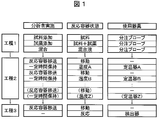
- movement in an Example The schematic flowchart explaining operation
- BRIEF DESCRIPTION OF THE DRAWINGS Schematic explaining the basic composition of the automatic analyzer in an Example. Schematic explaining the reaction container transfer mechanism etc. in an Example. Schematic which shows the relationship between the automatic analyzer and peripheral device in an Example.
- an analysis method that requires a temperature change of two or more temperatures in the sample preparation process (reaction liquid preparation process)
- two or more different incubators set at the temperature required for the assay.
- an analysis using at least the following three steps using a dispensing probe for adjustment and a detector for detecting a target substance.
- Step of adjusting the reaction solution by mixing sample and reagent using a dispensing probe 2) Reaction solution adjustment by moving the reaction vessel between two or more incubators set to the temperature required for the assay Step of performing temperature change in process 3) Step of detecting target substance (target nucleic acid)
- the execution of the reaction solution adjusting step of the above step 1) is not limited to before the above step 2). Any time can be used as long as it is before the target nucleic acid detection step in step 3), and it can be performed before and after step 2), both in the middle of step 2).
- an automatic analyzer that realizes an analysis method that requires a temperature change of two or more temperatures in the reaction solution adjustment process, which includes two or more different incubators set to the temperature required for the assay
- An automatic analyzer comprising a dispensing probe for adjusting a sample, a mechanism for moving a reaction container, and a detector for detecting a target nucleic acid and analyzing the sample by at least the following three functions is disclosed.
- reaction liquid adjustment function 1) A function to mix a sample and a reagent using a dispensing probe and adjust a reaction solution 2) A function to move a reaction vessel between incubators set to a temperature required for an assay by a mechanism for moving the reaction vessel 3) Function for detecting target nucleic acid by detector
- the execution of the reaction liquid adjustment function of function 1) above is not limited to before the temperature change, and any function before the function 3) target substance detection function is executed. It may be the time. It can be implemented before and after function 2), both, or during function 2).
- the detector for detecting the target nucleic acid may be any detector as long as the reaction vessel can be continuously charged and the analytical reaction in the reaction vessel can be detected.
- it is a detector that can continuously put reaction vessels from a certain position by a rotating disk system. More preferably, the detector can detect the reaction process with time and can automatically discard the reaction container after the detection is completed.
- the detection method and detection mechanism of the detector differ depending on the analysis method, and any method and mechanism may be used as long as the target nucleic acid can be quantitatively or qualitatively detected.
- a plurality of reaction containers capable of holding a nucleic acid-containing sample and a reagent
- a plurality of thermostatic mechanisms capable of controlling the temperature of the reaction container set to different temperatures, and the sample held in the reaction container
- An analysis mechanism for analyzing the reaction vessel a transfer mechanism for transferring the reaction container to a predetermined constant temperature mechanism, and a control mechanism for controlling the transfer mechanism.
- a nucleic acid analyzer that transfers reaction vessels to a thermostat in a predetermined order.
- a plurality of thermostatic mechanisms each of which is set at a different temperature and capable of controlling the temperature of the reaction vessel, and a reaction vessel holding the nucleic acid-containing sample and the reagent should be prepared and used as the nucleic acid-containing sample.
- the reaction vessel is transferred to a desired thermostat, the thermostat controls the temperature of the reaction vessel, the reaction vessel is transferred to a different desired thermostat, and the thermostat is Nucleic acid that controls the reaction vessel to a different temperature, performs the desired temperature change on the sample in a desired order by transferring to the constant temperature mechanism, and then transfers the reaction vessel to the analysis mechanism to analyze the sample
- An analysis method for an analysis apparatus is disclosed.
- the analysis mechanism can detect the analysis reaction of the sample over time.
- the analysis mechanism has a rotating disk capable of holding a plurality of reaction vessels.
- the transfer mechanism transfers the reaction container to a desired constant temperature mechanism and analysis mechanism.
- the sample and the reagent are agitated after the temperature of the reaction vessel is controlled by a constant temperature mechanism.
- the time for which the reaction container holding the sample is controlled by the constant temperature mechanism is changed according to the sample temperature before being transferred to the constant temperature mechanism.
- the transfer time from the constant temperature mechanism to the analysis mechanism is changed according to the constant temperature mechanism to which the reaction container has been transferred before being transferred to the analysis mechanism.
- Example 1 In this embodiment, a dispensing probe for adjusting a sample, two or more different incubators set to a temperature necessary for the assay, and a detector for detecting a target substance are used.
- any dispensing probe may be used as long as the sample and the reagent can be accurately dispensed.
- a replaceable detachable dispensing tip is used to prevent sample contamination.
- pipetteman manufactured by Gilson
- electronic pipetter manufactured by Biohit
- the like can be mentioned.
- any incubator may be used as long as the reaction liquid part of the reaction vessel can be in close contact and the temperature required for the assay can be set. If the temperature to be set is higher than room temperature, it is a heating type incubator, and if it is lower than room temperature, it is a cooling type incubator.
- the detector for detecting the target substance may be any detector as long as it can detect the target substance, and the detection method and detection mechanism vary depending on the analysis method. More preferably, it is desirable that the analytical reaction in the reaction vessel can be detected over time.
- this detector includes an excitation light irradiator for exciting fluorescence emission and a detector for detecting excitation light, and detects fluorescence emission. It becomes.
- the target substance is analyzed by performing the following three steps using the above-described three instruments.
- step 1) a sample container containing a sample derived from a biological sample is used as a test sample.
- a dispensing probe a sample is taken from the sample container and dispensed into the reaction container.
- the reagent is dispensed from the reagent container and dispensed into the reaction container.
- the sample and the reagent are mixed by repeating suction and discharge of the dispensing probe. More preferably, in order to prevent contamination of the sample or reagent, the dispensing tip is exchanged for each sample dispensing or reagent dispensing.
- the sample container can be used as a reaction container. In this case, the operation of taking a sample from the sample container and dispensing it into the reaction container can be omitted. Moreover, you may use a mixing stirrer for mixing of reaction container.
- the biological sample in this example is a screening sample such as group screening, health checkup, dock screening, or postal screening, biological sample containing target substances in blood, tissue, urine of outpatients and hospitalized patients in hospitals, or It means a sample to which a biological sample is attached.
- a screening sample such as group screening, health checkup, dock screening, or postal screening, biological sample containing target substances in blood, tissue, urine of outpatients and hospitalized patients in hospitals, or It means a sample to which a biological sample is attached.
- the target substance in the present example means a component derived from an organism including a virus and a microorganism, more preferably a protein, a peptide, an amino acid, and a nucleic acid.
- the test sample may be a sample obtained by performing a pretreatment such as purification on a biological sample.
- a specific example of the pretreatment is a method of purifying a nucleic acid from a biological sample when the target substance is a viral nucleic acid.
- a method of separating and purifying nucleic acid and protein components using phenol and chloroform is a nucleic acid purification method in which nucleic acid is adsorbed on a silica column, washed, and then nucleic acid is eluted from the silica column using a nucleic acid solution.
- any container may be used as long as the container components do not elute into the sample, reagent, and reaction solution.
- a transparent polypropylene container is used. Specific examples include a 1.5 ml Eppendorf tube (manufactured by Eppendorf), a 0.2 ml PCR tube, and the like.
- Step 2) is a step of rapidly changing the temperature of the reaction solution by moving the reaction vessel between two or more incubators according to the temperature condition required as an analysis method. More specifically, when the temperature conditions are 37 ° C. for 15 minutes, 95 ° C. for 5 minutes, and 41 ° C. for 2 minutes, three types of incubators of 37 ° C., 95 ° C., and 41 ° C. are prepared. First, place the reaction vessel in a 37 ° C. incubator and hold for 15 minutes. The reaction vessel is then transferred to a 95 ° C. incubator and held for 5 minutes. Finally, move to 41 ° C and hold for 2 minutes. Preferably, the retention time is increased in consideration of the time for the solution temperature to reach the target temperature after transfer.
- the actual arrival time varies depending on the difference in temperature change, and according to experiments by the inventors of the present application, the arrival time to the target temperature is as shown in Table 1.
- the reaction solution may evaporate due to this temperature change.
- a known method such as a method of adding oil or a method of covering the reaction vessel with a lid and heating the lid can be used.
- Step 3) is a step of detecting a reaction with a detector.
- This method may be any method as long as the target substance can be detected according to the analysis method.
- the reaction vessel is rotated using a rotating disk and detected by a detector in accordance with the rotation period. More preferably, the reaction is detected over time.
- the reaction vessel can be continuously analyzed even in assays with different temperature changes in the sample liquid preparation process or assays with different reaction / detection times and detection intervals.
- the adjustment process of each sample can be perfectly matched. Furthermore, it is possible to change the temperature more rapidly than in the conventional method.
- Example 2 In the present embodiment, an automatic analyzer that automatically performs the analysis described in the first embodiment will be described.
- the automatic analyzer of this embodiment is an apparatus for automatically analyzing an analysis method that requires a temperature change of two or more temperatures in the reaction liquid adjustment process.
- the apparatus operation shown in FIG. 2 and the apparatus shown in FIGS. This is realized by the configuration.
- the difference from the first embodiment will be mainly described with reference to FIGS.
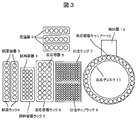
- FIG. 3 shows the basic configuration of the automatic analyzer of this embodiment, excluding the dispensing probe and the reaction container transfer mechanism.
- This apparatus includes a sample container rack 2 in which a sample container 1 in which a test sample is stored can be set, a reagent rack 4 in which a plurality of reagent containers 3 in which reagents that react with various components of the sample are stored, a sample and a reagent A reaction vessel rack 6 containing a reaction vessel 5 for mixing, a dispensing tip rack 8 containing dispensing tips 7, a plurality of incubators 9 set at two or more different temperatures, and a circumference It has the reaction disk 11 which has arrange
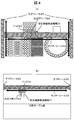
- FIG. 4A and 4B show a dispensing probe 20 for dispensing a sample or a reagent between racks, a reaction container transfer mechanism 21 for transferring a reaction container, and a head 22 for connecting them.
- FIG. 6 is a schematic diagram for explaining a side rail 23 and a center rail 24 for moving the head in the X-axis direction and the Y-axis direction.
- the automatic analyzer of this embodiment automatically analyzes a sample by the operation shown in FIG. That is, the dispensing probe 20 is moved to the position of the dispensing tip rack 8 by the operation of the side rail 23 and the center rail 24, and the dispensing tip 7 is attached.
- the dispensing probe 20 to which the dispensing tip 7 is attached dispenses a sample from the sample container 1 and discharges it to the reaction container 5.
- the dispensing tip 7 is replaced, the reagent is dispensed from the reagent container 3 and discharged to the reaction container 5, and the dispensing probe 20 mixes the reaction solution by repeated suction and discharge.
- the reaction vessel 5 containing the reaction solution is transferred to one of the incubators 9 by the reaction vessel transfer mechanism 21 to change the temperature of the reaction solution.
- the incubator After being held for a predetermined time by the incubator, it is transferred to another incubator 9 by the reaction container transfer mechanism, the temperature of the reaction solution is changed, and similarly held by the incubator for a predetermined time. Transfer between the incubators is performed under the conditions specified in the analysis method.
- the dispensing probe 20 to which the dispensing tip 7 is attached dispenses the reagent from the reagent container 3 and puts the reagent in the reaction container 5. May be discharged.
- the reaction container transfer mechanism 21 places the reaction container 5 on the reaction container carrier 10 disposed on the reaction disk 11.
- the reaction vessel carrier 10 is maintained at a temperature at which the reaction proceeds most effectively.
- the reaction is detected by the detector 12. More preferably, the detector 12 detects the reaction over time in accordance with the rotation period of the reaction disk 11.
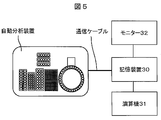
- Fig. 5 shows the relationship between this automatic analyzer and peripheral equipment.
- the automatic analyzer is connected to a storage device 30 that stores detection data, a calculator 31 that performs arithmetic processing on the stored detection data, and a monitor 32 that outputs calculation results.
- These peripheral devices may be connected to the automatic analyzer via the connection cable 33 and function independently, or may be incorporated in the automatic analyzer.
- the detection data detected by the detector 12 is sent to the storage device 30, processed by the calculator 31, and the detection result is output to the monitor 32.
- a mechanism for transferring both the dispensing probe and the reaction vessel is disclosed as a transfer mechanism for transferring the reaction vessel, but the dispensing probe and the reaction vessel may be handled by different transfer mechanisms.
- there is only one transfer mechanism but a plurality of transfer mechanisms may be arranged corresponding to a plurality of constant temperature mechanisms and analysis mechanisms.
Landscapes
- Chemical & Material Sciences (AREA)
- Chemical Kinetics & Catalysis (AREA)
- Physics & Mathematics (AREA)
- Health & Medical Sciences (AREA)
- Life Sciences & Earth Sciences (AREA)
- Analytical Chemistry (AREA)
- Biochemistry (AREA)
- General Health & Medical Sciences (AREA)
- General Physics & Mathematics (AREA)
- Immunology (AREA)
- Pathology (AREA)
- Automatic Analysis And Handling Materials Therefor (AREA)
- Apparatus Associated With Microorganisms And Enzymes (AREA)
- Measuring Or Testing Involving Enzymes Or Micro-Organisms (AREA)
- Investigating Or Analysing Biological Materials (AREA)
Abstract
L'invention porte sur un analyseur d'acide nucléique équipé de récipients de réaction qui peuvent contenir un échantillon contenant de l'acide nucléique et un réactif, des mécanismes thermostatiques qui peuvent contrôler les températures de récipients de réaction réglés à différentes températures, un mécanisme d'analyse qui analyse l'échantillon contenu dans le récipient de réaction, et un mécanisme de transport qui transporte le récipient de réaction. Le mécanisme de transport transporte les récipients de réaction dans un ordre spécifié vers des mécanismes thermostatiques spécifiés correspondant à l'essai devant être conduit sur l'échantillon contenant de l'acide nucléique. Un récipient de réaction dans lequel un échantillon a été préparé est transporté vers un mécanisme d'analyse à une temporisation prescrite, et l'échantillon est analysé.
Priority Applications (3)
| Application Number | Priority Date | Filing Date | Title |
|---|---|---|---|
| US13/000,579 US8574891B2 (en) | 2008-06-23 | 2009-06-17 | Nucleic acid analyzer, automatic analyzer, and analysis method |
| CN200980123709.8A CN102066950B (zh) | 2008-06-23 | 2009-06-17 | 核酸分析装置、自动分析装置以及分析方法 |
| EP09770063.7A EP2306204B1 (fr) | 2008-06-23 | 2009-06-17 | Analyseur d'acide nucléique, analyseur automatique et procédé d'analyse |
Applications Claiming Priority (2)
| Application Number | Priority Date | Filing Date | Title |
|---|---|---|---|
| JP2008162669A JP5372418B2 (ja) | 2008-06-23 | 2008-06-23 | 核酸分析装置,自動分析装置、及び分析方法 |
| JP2008-162669 | 2008-06-23 |
Publications (1)
| Publication Number | Publication Date |
|---|---|
| WO2009157353A1 true WO2009157353A1 (fr) | 2009-12-30 |
Family
ID=41444421
Family Applications (1)
| Application Number | Title | Priority Date | Filing Date |
|---|---|---|---|
| PCT/JP2009/061004 Ceased WO2009157353A1 (fr) | 2008-06-23 | 2009-06-17 | Analyseur d'acide nucléique, analyseur automatique et procédé d'analyse |
Country Status (5)
| Country | Link |
|---|---|
| US (1) | US8574891B2 (fr) |
| EP (1) | EP2306204B1 (fr) |
| JP (1) | JP5372418B2 (fr) |
| CN (1) | CN102066950B (fr) |
| WO (1) | WO2009157353A1 (fr) |
Cited By (4)
| Publication number | Priority date | Publication date | Assignee | Title |
|---|---|---|---|---|
| WO2012063736A1 (fr) * | 2010-11-10 | 2012-05-18 | 株式会社日立ハイテクノロジーズ | Méthode de mise en œuvre de tests génétiques et appareil afférent |
| CN102884169A (zh) * | 2010-05-07 | 2013-01-16 | 株式会社日立高新技术 | 核酸增幅装置及使用了该核酸增幅装置的核酸检查装置 |
| CN103026238A (zh) * | 2010-07-28 | 2013-04-03 | 株式会社日立高新技术 | 核酸分析装置 |
| EP2597143A4 (fr) * | 2010-07-21 | 2014-05-14 | Hitachi High Tech Corp | Procédé de détection d'une amplification d'acide nucléique dans un échantillon et dispositif pour ce faire |
Families Citing this family (9)
| Publication number | Priority date | Publication date | Assignee | Title |
|---|---|---|---|---|
| KR101368463B1 (ko) | 2010-04-23 | 2014-03-03 | 나노바이오시스 주식회사 | 2개의 열 블록을 포함하는 pcr 장치 |
| JP5662055B2 (ja) * | 2010-05-14 | 2015-01-28 | 株式会社日立ハイテクノロジーズ | 核酸増幅装置及び核酸増幅方法 |
| JP5689274B2 (ja) * | 2010-10-05 | 2015-03-25 | 株式会社日立ハイテクノロジーズ | 核酸検査装置及び容器搬送方法 |
| JP5789441B2 (ja) * | 2011-08-01 | 2015-10-07 | 株式会社日立ハイテクノロジーズ | 遺伝子検査システム |
| WO2015086446A1 (fr) * | 2013-12-13 | 2015-06-18 | Sotax Ag | Appareil pour essai de dissolution |
| EP3447116A4 (fr) * | 2016-04-20 | 2019-12-11 | Sysmex Corporation | Dispositif d'analyse d'acides nucléiques et procédé d'analyse d'acides nucléiques |
| US11204358B2 (en) | 2016-05-25 | 2021-12-21 | Universal Bio Research Co., Ltd. | Specimen processing and measuring system |
| CN106967585B (zh) * | 2017-05-23 | 2024-03-12 | 湖州师范学院 | 用于核酸提取与检测的一体化设备 |
| CN113930331A (zh) * | 2021-10-09 | 2022-01-14 | 苏州国科均豪生物科技有限公司 | 荧光免疫检测分析仪温育温度控制方法、介质、pcr检测系统 |
Citations (11)
| Publication number | Priority date | Publication date | Assignee | Title |
|---|---|---|---|---|
| JPS62240862A (ja) * | 1986-02-25 | 1987-10-21 | ザ パーキン―エルマー コーポレイション | 少なくとも1つの核酸配列を増幅する方法及び装置 |
| JPH03262499A (ja) * | 1990-03-12 | 1991-11-22 | Kosumitsuku:Kk | ポリヌクレオチド検出方法およびpcr反応装置 |
| JPH06277036A (ja) | 1993-03-26 | 1994-10-04 | Sanyo Electric Co Ltd | インキュベータ |
| JPH06281655A (ja) | 1993-03-25 | 1994-10-07 | Olympus Optical Co Ltd | 自動分析装置 |
| JPH08196299A (ja) * | 1995-01-26 | 1996-08-06 | Tosoh Corp | サーマルサイクリング反応装置及びこれに用いる反応容器 |
| JPH08271524A (ja) | 1995-03-31 | 1996-10-18 | Suzuki Motor Corp | 酵素免疫反応測定装置 |
| JPH10127268A (ja) * | 1996-09-26 | 1998-05-19 | Becton Dickinson & Co | 液体試料アッセイ用装置、並びにdna増幅・アッセイ用装置及び同方法 |
| JP2003050242A (ja) * | 2001-08-08 | 2003-02-21 | Hitachi Ltd | 生体試料処理装置 |
| JP2003522322A (ja) * | 1998-10-14 | 2003-07-22 | アボット・ラボラトリーズ | サンプルの自動分析のための構造および方法 |
| JP2004504828A (ja) * | 2000-07-28 | 2004-02-19 | ジェネシステム | 標的核酸配列の熱依存性連鎖増幅のための装置 |
| JP2005125311A (ja) * | 2003-09-30 | 2005-05-19 | Japan Science & Technology Agency | 化学反応装置 |
Family Cites Families (5)
| Publication number | Priority date | Publication date | Assignee | Title |
|---|---|---|---|---|
| US5038852A (en) * | 1986-02-25 | 1991-08-13 | Cetus Corporation | Apparatus and method for performing automated amplification of nucleic acid sequences and assays using heating and cooling steps |
| JPS6385361A (ja) * | 1986-09-30 | 1988-04-15 | Toshiba Corp | 自動化学分析装置 |
| JP2005069902A (ja) * | 2003-08-26 | 2005-03-17 | Hitachi Instruments Service Co Ltd | 前処理装置 |
| US7964413B2 (en) * | 2005-03-10 | 2011-06-21 | Gen-Probe Incorporated | Method for continuous mode processing of multiple reaction receptacles in a real-time amplification assay |
| US8895267B2 (en) * | 2006-11-03 | 2014-11-25 | Siemens Healthcare Diagnostics Inc. | Random access system and method for polymerase chain reaction testing |
-
2008
- 2008-06-23 JP JP2008162669A patent/JP5372418B2/ja active Active
-
2009
- 2009-06-17 US US13/000,579 patent/US8574891B2/en not_active Expired - Fee Related
- 2009-06-17 EP EP09770063.7A patent/EP2306204B1/fr active Active
- 2009-06-17 WO PCT/JP2009/061004 patent/WO2009157353A1/fr not_active Ceased
- 2009-06-17 CN CN200980123709.8A patent/CN102066950B/zh active Active
Patent Citations (11)
| Publication number | Priority date | Publication date | Assignee | Title |
|---|---|---|---|---|
| JPS62240862A (ja) * | 1986-02-25 | 1987-10-21 | ザ パーキン―エルマー コーポレイション | 少なくとも1つの核酸配列を増幅する方法及び装置 |
| JPH03262499A (ja) * | 1990-03-12 | 1991-11-22 | Kosumitsuku:Kk | ポリヌクレオチド検出方法およびpcr反応装置 |
| JPH06281655A (ja) | 1993-03-25 | 1994-10-07 | Olympus Optical Co Ltd | 自動分析装置 |
| JPH06277036A (ja) | 1993-03-26 | 1994-10-04 | Sanyo Electric Co Ltd | インキュベータ |
| JPH08196299A (ja) * | 1995-01-26 | 1996-08-06 | Tosoh Corp | サーマルサイクリング反応装置及びこれに用いる反応容器 |
| JPH08271524A (ja) | 1995-03-31 | 1996-10-18 | Suzuki Motor Corp | 酵素免疫反応測定装置 |
| JPH10127268A (ja) * | 1996-09-26 | 1998-05-19 | Becton Dickinson & Co | 液体試料アッセイ用装置、並びにdna増幅・アッセイ用装置及び同方法 |
| JP2003522322A (ja) * | 1998-10-14 | 2003-07-22 | アボット・ラボラトリーズ | サンプルの自動分析のための構造および方法 |
| JP2004504828A (ja) * | 2000-07-28 | 2004-02-19 | ジェネシステム | 標的核酸配列の熱依存性連鎖増幅のための装置 |
| JP2003050242A (ja) * | 2001-08-08 | 2003-02-21 | Hitachi Ltd | 生体試料処理装置 |
| JP2005125311A (ja) * | 2003-09-30 | 2005-05-19 | Japan Science & Technology Agency | 化学反応装置 |
Cited By (9)
| Publication number | Priority date | Publication date | Assignee | Title |
|---|---|---|---|---|
| CN102884169A (zh) * | 2010-05-07 | 2013-01-16 | 株式会社日立高新技术 | 核酸增幅装置及使用了该核酸增幅装置的核酸检查装置 |
| EP2597143A4 (fr) * | 2010-07-21 | 2014-05-14 | Hitachi High Tech Corp | Procédé de détection d'une amplification d'acide nucléique dans un échantillon et dispositif pour ce faire |
| US9714455B2 (en) | 2010-07-21 | 2017-07-25 | Hitachi High-Technologies Corporation | Method for detecting nucleic acid amplification in sample and device therefor |
| CN103026238A (zh) * | 2010-07-28 | 2013-04-03 | 株式会社日立高新技术 | 核酸分析装置 |
| CN103026238B (zh) * | 2010-07-28 | 2015-11-25 | 株式会社日立高新技术 | 核酸分析装置 |
| WO2012063736A1 (fr) * | 2010-11-10 | 2012-05-18 | 株式会社日立ハイテクノロジーズ | Méthode de mise en œuvre de tests génétiques et appareil afférent |
| JP2012100582A (ja) * | 2010-11-10 | 2012-05-31 | Hitachi High-Technologies Corp | 遺伝子検査方法及び検査装置 |
| EP2639311A4 (fr) * | 2010-11-10 | 2014-04-30 | Hitachi High Tech Corp | Méthode de mise en oeuvre de tests génétiques et appareil afférent |
| US9440235B2 (en) | 2010-11-10 | 2016-09-13 | Hitachi High-Technologies Corporation | Genetic testing method and testing apparatus |
Also Published As
| Publication number | Publication date |
|---|---|
| EP2306204A4 (fr) | 2017-11-29 |
| EP2306204A1 (fr) | 2011-04-06 |
| EP2306204B1 (fr) | 2021-08-11 |
| JP2010002353A (ja) | 2010-01-07 |
| CN102066950A (zh) | 2011-05-18 |
| JP5372418B2 (ja) | 2013-12-18 |
| CN102066950B (zh) | 2014-12-17 |
| US8574891B2 (en) | 2013-11-05 |
| US20110104703A1 (en) | 2011-05-05 |
Similar Documents
| Publication | Publication Date | Title |
|---|---|---|
| JP5372418B2 (ja) | 核酸分析装置,自動分析装置、及び分析方法 | |
| Thurow | Strategies for automating analytical and bioanalytical laboratories | |
| JP5393610B2 (ja) | 核酸分析装置 | |
| KR20180051433A (ko) | 소모성 진탕 장치를 포함하는, 전기화학발광을 이용하여 검정법을 수행하기 위한 고처리율 시스템 | |
| US20210033503A1 (en) | Apparatus for automated analysis | |
| JP5063623B2 (ja) | 分析装置、及び円盤ディスクの回転制御方法 | |
| CN110470852B (zh) | 用于分离试验样品中包含的干扰物质的实验室系统和方法 | |
| US10876939B2 (en) | Apparatus for automated analysis | |
| CN103733071B (zh) | 遗传测试系统 | |
| KR20060058682A (ko) | 모듈형 시약 전달 수단을 이용한 자동 임상 분석기의 용량증가 방법 | |
| JP6087138B2 (ja) | 遺伝子検査装置、遺伝子検査方法及びプログラム | |
| EP3149475B1 (fr) | Procédé et appareil pour la réduction de l'entraînement de réactifs et d'échantillons dans des tests analytiques | |
| JP6184806B2 (ja) | 自動化処理モジュール内でチップを廃棄する自動化される方法および処理モジュールを備える処理システム | |
| US20170227565A1 (en) | Method for operating an automated analysis machine |
Legal Events
| Date | Code | Title | Description |
|---|---|---|---|
| WWE | Wipo information: entry into national phase |
Ref document number: 200980123709.8 Country of ref document: CN |
|
| 121 | Ep: the epo has been informed by wipo that ep was designated in this application |
Ref document number: 09770063 Country of ref document: EP Kind code of ref document: A1 |
|
| WWE | Wipo information: entry into national phase |
Ref document number: 2009770063 Country of ref document: EP |
|
| WWE | Wipo information: entry into national phase |
Ref document number: 13000579 Country of ref document: US |
|
| NENP | Non-entry into the national phase |
Ref country code: DE |