WO2010001697A1 - Dispositif de conception, programme de conception, et procédé de conception pour un tissu tricoté au moyen d’un jacquard intarsia - Google Patents
Dispositif de conception, programme de conception, et procédé de conception pour un tissu tricoté au moyen d’un jacquard intarsia Download PDFInfo
- Publication number
- WO2010001697A1 WO2010001697A1 PCT/JP2009/060539 JP2009060539W WO2010001697A1 WO 2010001697 A1 WO2010001697 A1 WO 2010001697A1 JP 2009060539 W JP2009060539 W JP 2009060539W WO 2010001697 A1 WO2010001697 A1 WO 2010001697A1
- Authority
- WO
- WIPO (PCT)
- Prior art keywords
- knitting
- area
- intarsia
- floating
- knitted fabric
- Prior art date
- Legal status (The legal status is an assumption and is not a legal conclusion. Google has not performed a legal analysis and makes no representation as to the accuracy of the status listed.)
- Ceased
Links
Images


Classifications
-
- D—TEXTILES; PAPER
- D04—BRAIDING; LACE-MAKING; KNITTING; TRIMMINGS; NON-WOVEN FABRICS
- D04B—KNITTING
- D04B37/00—Auxiliary apparatus or devices for use with knitting machines
- D04B37/02—Auxiliary apparatus or devices for use with knitting machines with weft knitting machines
Definitions
- This invention relates to the design of a knitted fabric using an interstitial card, and more particularly to the determination of whether the knitting organization or knitting method is intarsia or interstitial card.
- the intarsia jacquard is a jacquard organization provided in the intarsia organization, and the knitting method is a kind of jacquard.
- intarsia jacquard If there are line-shaped patterns or small patterns with a narrow knitting width in the intarsia organization, these patterns can be knitted with either intarsia jacquard or intarsia.
- the knitting method of the intarsia jacquard is the same as that of the jacquard, and in addition to the yarn appearing on the surface of the knitted fabric, there is a yarn passing through the back side of the knitted fabric, so that the knitted fabric becomes thick.
- the same yarn carrier hereinafter simply referred to as a carrier
- the number of carriers can be saved.
- the control of the carrier stop position is simple and the knitting efficiency is high.
- the knitted fabric is not thick, and generally the quality of the knitted fabric is high.
- the knitting area B is the same as the knitting area A even if the knitting width of the knitting area B is one and the knitting area A and the knitting area C have the same color scheme. It is necessary to assign different carriers to the formation area C.
- An object of the present invention is to be able to automatically determine which part of a handle is an intarsia and which part is an intarsia card.
- This invention discriminates whether to perform intarsia knitting where other yarns do not pass through the back side of the knitted fabric or intarsia jacquard through which other yarns pass through the back side of the knitted fabric for the color pattern of the knitted fabric Knitting fabric design equipment
- a storage unit for storing application conditions based on the shape of the pattern and the knitting width for applying the intarsia jacquard knitting As the initial value of the knitting method, the knitting area that satisfies the application conditions of the interstitial card knitting based on the pattern shape and knitting width is set as the floating knitting area, and the same color scheme is used on the left and right in the knitting course direction in the floating knitting area.
- Assign an intarsia jacquard knitting to one knitting area assign an intarsia knitting to a second knitting area that has different color schemes on the left and right in the knitting course direction, and interleave knitting areas other than the floating knitting area.
- An organization method assigning section for assigning a sha organization;
- a knitting data generation unit that generates knitting data of a color scheme according to the knitting method assignment in the knitting method assignment unit.
- the program of the present invention performs intarsia knitting in which the other yarn does not pass through the back of the knitted fabric or the intarsia jacquard through which other yarn passes through the back of the knitted fabric
- An organization method assigning means for assigning a sha organization According to the knitting method assignment by the knitting method assigning means, it functions as a knitting data generating means for generating knitting data of the color scheme.
- the design method of the present invention for the color scheme of the knitted fabric, whether the Intarsia knitting where other yarn does not pass through the back of the knitted fabric or the Intarsia jacquard knitting where other yarn passes through the back of the knitted fabric,
- a method of automatically assigning by a computer Providing the computer with a storage unit for storing application conditions based on the shape of the pattern and the knitting width for applying the intershaja card knitting, As the initial value of the knitting method, the knitting area that satisfies the application conditions of the interstitial card knitting based on the pattern shape and knitting width is set as the floating knitting area, and the same color scheme is used on the left and right in the knitting course direction in the floating knitting area.
- Assign an intarsia jacquard knitting to one knitting area assign an intarsia knitting to a second knitting area that has different color schemes on the left and right in the knitting course direction, and interleave knitting areas other than the floating knitting area.
- An assignment step to assign a sha organization According to the assignment of the knitting method in the assigning step, the step of generating the knitting data of the color scheme is performed by the computer.
- the description relating to the design apparatus also applies to the design method and the design program, and the description relating to the design method also applies to the design apparatus and the design program.
- the terms in this specification refer to known techniques and are interpreted broadly in accordance with the understanding of those skilled in the art.
- the knitting method assigning unit assigns a carrier to each knitting area and is common to the third knitting area and the fourth knitting area having the same color scheme on the left and right in the knitting course direction in the floating knitting area.
- a carrier is assigned, and an intershaja card knitting is assigned with the floating knitting area between the third knitting area and the fourth knitting area as the first knitting area. This also applies to the knitting program and the knitting method.
- a common carrier is assigned to the left and right knitting areas of the knitting area that satisfies the applicable conditions of the interstitial card, and if the color scheme is different, a different carrier is assigned, and the left and right carriers are common.
- An interstitial card can be assigned to a knitting area where the number of carriers can be reduced by using an interstitial card.
- the application condition includes a linear pattern or knitting area having a knitting width of a first predetermined value or less, and a pattern and knitting length having a maximum knitting width of a second predetermined value or less.
- a knitting area in which the knitting width of the pattern not more than the third predetermined value is not more than the fourth predetermined value.
- the interstitial card is applied to a thin linear pattern or knitting area and a knitting area with a narrow knitting width in a small pattern. Therefore, even if another yarn passes through the back side of the knitted fabric, the influence on the quality of the knitted fabric is small.
- assignment changing means for changing carrier assignment by the composition method assignment unit is provided.
- the intarsia and the intarsia card can be changed according to the number of carriers that can be used.
- Block diagram of the knit design device of the embodiment Flow chart showing the knit design program of the embodiment The figure which shows the color scheme used in the Example The figure which shows the allocation of the carrier with respect to the color scheme of FIG. The figure which shows discrimination
- reference numeral 2 denotes a knit design apparatus composed of a computer
- reference numeral 4 denotes a bus to which a color monitor 6, a color printer 8, a keyboard 10, a mouse 12, a network interface 14, a disk drive 16, and the like are connected.
- Reference numeral 18 denotes a storage medium that stores the knit design program of the embodiment.
- the knit design program is read from the disk drive 16 and stored in the ROM 20, for example.
- a general-purpose RAM 22 and an image memory 24 store raster format image data.
- a data conversion unit 26 converts data created by the design apparatus 2 into knitting data that can be executed by the flat knitting machine 36.
- the knit design program may be stored in the ROM 20 or the like from the network interface 14 by a carrier wave.
- a carrier allocation table which is a table for determining carrier allocation for each pattern of the color pattern or for each knitting area in the pattern.
- a linear pattern with a knitting width of 1 stitch is used as a floating knitting area, and more generally, a linear pattern or knitting area is floated with a knitting width of a first predetermined value, for example, 2 stitches or less. The knitting area. Regardless of whether the linear shape is linear or curved, the knitting width here is the first predetermined value.
- a pattern in which the maximum value of the knitting width and the knitting length satisfy both predetermined conditions is excluded from the floating target. This means that patterns of a predetermined size or larger are excluded from floating.
- a knitting area having a knitting width of, for example, 7 stitches or less and a knitting area having a maximum knitting width of 25 stitches or less, or a knitting length of 50 stitches or less is also designated as a floating knitting area.
- the knitted fabric is divided into a plurality of patterns according to the color scheme, and the patterns are divided into knitting areas according to the knitting width and the like.
- the condition for setting the floating knitting area is the application condition of the interstitial card based on the pattern shape and the knitting width.
- the predetermined value to the maximum value of the knitting width of the pattern is the second predetermined value
- the predetermined value to the knitting length is the third predetermined value
- the predetermined value to the knitting width of the knitting area is the fourth predetermined value.
- the floating knitting area may include the entire pattern such as a linear pattern, or a small knitting area having a knitting width of 7 stitches or less in the pattern may be used as the knitting area.
- the conditions for making the floating knitting area stored in the table 28 are called floating conditions. If the carriers are the same on the left and right in the knitting course direction in the floating knitting area, the floating knitting area is intarsia knitted, and if the carriers are different on the left and right, intarsia knitting is performed.
- a common carrier is assigned. If the left and right color schemes are different, different carriers are assigned.
- the floating knitting area is knitted with an interstitial card. Other patterns or knitting areas are knitted in an intarsia. Therefore, even if the floating condition is satisfied, if the left and right color schemes are different, knitting is performed with the intarsia.
- the left and right are directions along the knitting course of the knitted fabric, and are also directions in which the carriage of the flat knitting machine moves.
- the knitting width is the number of stitches along the course direction of the knitting area, and the course direction usually coincides with the left-right direction of the knitted fabric.
- the wale direction is a direction perpendicular to the course direction in the knitted fabric, the knitting length is the number of stitches in the waling direction of the knitting area, and the wale direction usually coincides with the knitting length direction of the knitted fabric.
- the carrier allocation unit 30 allocates a carrier to a color scheme, that is, a design specifying the color scheme of each part of the knitted fabric.
- the design of the knitted fabric includes a design of the organization, which is a design of the shape of the knitted fabric and the tissue pattern. If a pattern with another color scheme exists between the two right and left patterns with the same color scheme, a common carrier is assigned to the two patterns if the other color scheme pattern satisfies the floating condition.
- the intarsia / intarsia card allocating unit 32 allocates intarsia knitting or intarsia card knitting to the pattern or the knitting area of the pattern.
- the knitting area for knitting the intarsia jacquard is a knitting area that satisfies the floating conditions and is the knitting area of the same carrier on the left and right. Otherwise, intarsia organization is assigned.
- the carrier allocating unit 30 and the intarsia / interstitial card allocating unit 32 are collectively referred to as a composition method allocating unit.
- the flat knitting machine 36 is a flat knitting machine, which includes a carriage 37, a carrier rail 38 for running the carrier, a needle bed 39 having a large number of needles, a controller 40, and the like.
- the flat knitting machine 36 is connected to the design apparatus 2 via a LAN (not shown) or the storage medium 18 and performs knitting using the knitting data supplied from the design apparatus 2.
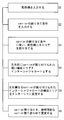
- Fig. 2 shows the processing in the knit design program of the example.
- a color scheme is input, which is to color the knitted fabric using the color monitor 6 or the like with the keyboard 10 or the mouse 12 of FIG.
- the user inputs conditions for assigning carriers to the table 28, in other words, floating conditions.
- the floating condition for the linear pattern is, for example, that the knitting width is 1 stitch, and the other floating conditions are in the pattern where the maximum value of the knitting width of the pattern is 25 stitches or less and the knitting length is 50 stitches or less.
- the knitting area has a knitting width of 7 stitches or less.
- These conditions are input by the user using the keyboard 10 or the mouse 12, and the input result is stored in the table 28. If there is no input, for example, the previous floating condition is validated.
- the condition that the knitting width for the linear pattern is 1 stitch or less may be a fixed condition that does not require user input.
- the linear pattern is wider, for example, a pattern having a knitting width of 2 stitches or less, or a knitting area having a knitting width of 2 stitches or less in a pattern having a maximum knitting width of 3 stitches or more. Also, not only in knitting areas where the maximum knitting width is 25 stitches or less and the knitting width is 50 stitches or less, but the knitting area has a maximum knitting width of 25 stitches or less. May be a knitting area having a knitting width of 7 stitches or less in a pattern of 50 stitches or less. The specific value of the floating condition depends on the user input.
- step 3 according to the carrier allocation conditions, carriers are assigned to the color scheme. That is, if the color scheme A is separated by another color scheme B on the left and right in the course direction, it is determined whether or not the color scheme B satisfies the floating condition. When the color scheme B satisfies the floating condition, the same carrier is allocated to the left and right color scheme A of the color scheme B, and another carrier is allocated when it is not satisfied.
- the narrow knitting area (floating knitting area) to which the left and right common carriers are assigned that is, the linear knitting area, and the knitting area having a knitting width of 7 stitches or less in a small pattern are used as an intershaja card. .
- step 5 for example, all the knitting areas that satisfy the floating condition are set to be interstitial card knitting. Change to Sha. If it is determined in step 4 that all the areas other than the thin knitting area to which the left and right carriers are assigned are intarsia knitting, step 5 is unnecessary.
- step 6 change the carrier allocation according to the number of carriers.
- the user can input the number of usable carriers in step 6, and if the number of assigned carriers exceeds this number, the carrier allocation is changed.
- a knitting area that does not satisfy the floating condition a knitting area that is close to the floating condition is selected, and the knitting method is changed to an intarsia card, thereby reducing the number of carriers to be used.
- Step 6 may be executed automatically by inputting the number of carriers, or may be executed only when the user instructs execution.
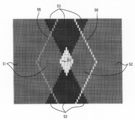
- FIG. 3 to Fig. 5 show examples of carrier allocation in the embodiment and allocation scheme of intarsia or interstitial card.
- FIG. 3 shows a color scheme, and each stitch has a stitch 1 and has 41 to 43 knitted areas and 44 to 45 linear knitted areas, for a total of five colors.
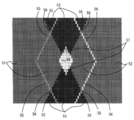
- FIG. 4 shows a carrier allocation result for the color scheme of FIG. Since the knitting area 41 is separated from the left and right by the knitting areas 42 and 43, the knitting area 41 is divided into two areas, ie, carrier areas 51 and 52, and two carriers are required. Although the knitting area 42 is divided into upper and lower parts, since it can be knitted with a common carrier, the carrier areas 53 and 53 are assigned and one carrier is assigned.
- the knitting area 43 is a carrier region 54 and the linear knitting areas 44 and 45 are carrier regions 55 and 56.
- the carrier regions 55 and 56 are linear patterns with a first knitting width, and therefore satisfy the floating conditions.
- the carrier region 54 satisfies the floating condition because the maximum knitting width and the knitting length are small and the knitting areas at the upper and lower ends have a knitting width of, for example, 7 stitches or less.
- a common carrier can be assigned to the left and right sides of the knitting area satisfying the floating condition when the color scheme is the same. For this reason, the same carrier region 53 is allocated to the left and right of the upper and lower ends of the carrier region 54.
- Fig. 5 shows the assignment of either intarsia or intarsia card.
- Carrier regions 51, 52, and 53 are all intarsia knitted.
- a portion of the carrier region 54 that is sandwiched between the carrier region 51 and the carrier region 52 is intarsia knitted.
- the knitting areas 57 and 57 sandwiched between the carrier areas 53 on the left and right sides in the carrier area 54 are knitted in an intarsia card.
- the carrier areas 55 and 56 are mostly knitted with an intarsia jacquard, but the four knitting areas 58 with a small knitting length are intertwined because the left and right carrier areas are different.
- the number of carriers used is six, and the parts that are knitted with the interstitial cards are the parts excluding the knitting areas 57 and 57 and the knitting areas 58 in the carrier areas 55 and 56. All others are intarsia formation. As described above, the number of carriers can be reduced by one as compared with the case where the knitting area 57 is intarsia knitted. Further, by performing intarsia knitting in the knitting area 58, the yarn passing through the back side of the knitted fabric at this portion can be eliminated.
- the carrier was assigned first, and then the organization method of intarsia or intarsia jacquard was assigned.
- These processing orders can be changed as appropriate.For example, if the floating condition is satisfied and the left and right color scheme is the same as the intarsia card, all others are intarsia, for example, after specifying the knitting method and after specifying the knitting method.
- a carrier may be assigned. Also, it is not necessary to automatically assign an intarsia or an intarsia card from the beginning. For example, after manually assigning a carrier and assigning an intarsia or intarja card, the process proceeds to the embodiment from the middle. Then, the assignment of carriers and knitting methods may be changed.
- the following effects can be obtained. (1) It is possible to automatically determine whether intarsia knitting is appropriate or intarsia card knitting is appropriate. (2) The quality of the knitted fabric is improved by reducing the number of carriers to be used and increasing the knitting efficiency by reducing the number of knitting areas for intarsia knitting, or by reducing the number of knitting areas for intarsia jacquard knitting. Can be made.
- Knit design device 4 Bus 6 Color monitor 8 Color printer 10 Keyboard 12 Mouse 14 Network interface 16 Disk drive 18 Storage medium 20 ROM 22 RAM 24 Image memory 26 Data converter 28 Carrier allocation table 30 Carrier allocation section 32 Intarsia / Intarsia Jacquard Allocation Unit 36 Weft Knitting Machine 37 Carriage 38 Carrier Rail 38 39 Needle Bed 40 Controller 41-45 Knitting Area 51-56 Carrier Area 57, 58 Knitting Area
Landscapes
- Engineering & Computer Science (AREA)
- Textile Engineering (AREA)
- Knitting Machines (AREA)
- Knitting Of Fabric (AREA)
- Treatment Of Fiber Materials (AREA)
Abstract
Une partie de stockage est fournie pour stocker des conditions appropriées pour appliquer un tricot intarsia sur des modèles colorés dans un tricot en fonction de la forme du modèle et de la largeur de tricotage. Une zone de tricotage satisfaisant aux conditions d’application du tricot jacquard intarsia est utilisée comme zone de tricotage flotté. Le tricot jacquard intarsia est assigné à une première zone de tricotage présentant la même combinaison de couleur à gauche et à droite dans la direction de rangée de mailles dans la zone de tricotage flotté, et un tricotage intarsia est assigné à une seconde zone de tricotage présentant différentes combinaisons de couleurs à gauche et à droite dans la direction de la rangée de mailles, tandis que le tricotage intarsia est également assigné aux zones de tricotage autres que la zone de tricotage flotté. Les zones de tricotage à utiliser pour l’intarsia peuvent être automatiquement différenciées des zones de tricotage à utiliser pour le jacquard intarsia.
Priority Applications (3)
| Application Number | Priority Date | Filing Date | Title |
|---|---|---|---|
| JP2010518973A JP5414671B2 (ja) | 2008-06-30 | 2009-06-09 | インターシャジャカードを用いた編地のデザイン装置とデザインプログラム、及びデザイン方法 |
| CN2009801251381A CN102076897B (zh) | 2008-06-30 | 2009-06-09 | 使用了嵌花提花的针织物的设计装置及设计方法 |
| EP09773275.4A EP2292819B1 (fr) | 2008-06-30 | 2009-06-09 | Dispositif de conception et procédé de conception pour un tissu tricoté au moyen d'un jacquard intarsia |
Applications Claiming Priority (2)
| Application Number | Priority Date | Filing Date | Title |
|---|---|---|---|
| JP2008169933 | 2008-06-30 | ||
| JP2008-169933 | 2008-06-30 |
Publications (1)
| Publication Number | Publication Date |
|---|---|
| WO2010001697A1 true WO2010001697A1 (fr) | 2010-01-07 |
Family
ID=41465800
Family Applications (1)
| Application Number | Title | Priority Date | Filing Date |
|---|---|---|---|
| PCT/JP2009/060539 Ceased WO2010001697A1 (fr) | 2008-06-30 | 2009-06-09 | Dispositif de conception, programme de conception, et procédé de conception pour un tissu tricoté au moyen d’un jacquard intarsia |
Country Status (4)
| Country | Link |
|---|---|
| EP (1) | EP2292819B1 (fr) |
| JP (1) | JP5414671B2 (fr) |
| CN (1) | CN102076897B (fr) |
| WO (1) | WO2010001697A1 (fr) |
Families Citing this family (4)
| Publication number | Priority date | Publication date | Assignee | Title |
|---|---|---|---|---|
| DE102011113538B3 (de) * | 2011-09-15 | 2012-08-16 | H. Stoll Gmbh & Co. Kg | Verfahren zur Herstellung eines Gestricks mit Intarsiamuster und Zierstichen |
| CN103668734B (zh) * | 2012-08-31 | 2016-06-01 | 北京大豪科技股份有限公司 | 嵌花编织方法及系统 |
| EP2835459B8 (fr) * | 2013-08-08 | 2021-07-14 | KARL MAYER STOLL R&D GmbH | Procédé de fabrication d'une pièce de textile tricoté sur une machine à tricoter rectiligne, dans laquelle des guide-fils à entraînement autonome sont déplacés par des aiguilles expulsées dans le sens inverse du tricotage |
| CN106283373B (zh) * | 2016-09-09 | 2018-06-19 | 深圳市山龙电控有限公司 | 一种嵌花自动解析方法 |
Citations (3)
| Publication number | Priority date | Publication date | Assignee | Title |
|---|---|---|---|---|
| JPH07119004A (ja) * | 1993-08-31 | 1995-05-09 | Shima Seiki Mfg Ltd | ニットペイントシステム及びニットペイント方法 |
| JPH0978412A (ja) * | 1995-09-18 | 1997-03-25 | Shima Seiki Mfg Ltd | 横編機用のホールガーメントのシミュレーション方法と装置 |
| WO2008007623A1 (fr) * | 2006-07-11 | 2008-01-17 | Shima Seiki Manufacturing, Ltd. | Dispositif de simulation, procédé de simulation et programme de simulation de tissu tubulaire |
Family Cites Families (7)
| Publication number | Priority date | Publication date | Assignee | Title |
|---|---|---|---|---|
| FR2706491B1 (fr) * | 1993-06-17 | 1995-07-28 | Chomarat Textiles Plastiques | Procédé et installation pour la réalisation d'un tricot velours jacquard sur un métier circulaire et nouveau type de tricot ainsi réalisé. |
| DE4431898A1 (de) * | 1994-09-07 | 1996-03-14 | Scheller Gmbh | Einrichtung zur Entwicklung eines Steuerprogramms für eine Strick- oder Wirkmaschine |
| US5754431A (en) * | 1995-09-18 | 1998-05-19 | Shima Seiki Manufacturing, Ltd. | Method and apparatus for designing a tubular knitted fabric using a flat knitting machine |
| JP2913266B2 (ja) | 1995-09-18 | 1999-06-28 | 株式会社島精機製作所 | 横編機用の筒状編地のデザイン方法とその装置 |
| ITMI20031367A1 (it) * | 2003-07-03 | 2005-01-04 | Santoni & C Spa | Procedimento per la realizzazione di disegni ad intarsio con una macchina circolare per maglieria. |
| DE102004032270A1 (de) * | 2004-06-30 | 2006-01-19 | Sipra Patententwicklungs- Und Beteiligungsgesellschaft Mbh | Strickmaschine mit wenigstens einem Ringelapparat |
| JP4366321B2 (ja) * | 2005-02-18 | 2009-11-18 | 株式会社島精機製作所 | ニット製品のデザイン装置とデザイン方法、およびそのプログラム |
-
2009
- 2009-06-09 EP EP09773275.4A patent/EP2292819B1/fr active Active
- 2009-06-09 WO PCT/JP2009/060539 patent/WO2010001697A1/fr not_active Ceased
- 2009-06-09 CN CN2009801251381A patent/CN102076897B/zh active Active
- 2009-06-09 JP JP2010518973A patent/JP5414671B2/ja active Active
Patent Citations (3)
| Publication number | Priority date | Publication date | Assignee | Title |
|---|---|---|---|---|
| JPH07119004A (ja) * | 1993-08-31 | 1995-05-09 | Shima Seiki Mfg Ltd | ニットペイントシステム及びニットペイント方法 |
| JPH0978412A (ja) * | 1995-09-18 | 1997-03-25 | Shima Seiki Mfg Ltd | 横編機用のホールガーメントのシミュレーション方法と装置 |
| WO2008007623A1 (fr) * | 2006-07-11 | 2008-01-17 | Shima Seiki Manufacturing, Ltd. | Dispositif de simulation, procédé de simulation et programme de simulation de tissu tubulaire |
Also Published As
| Publication number | Publication date |
|---|---|
| JP5414671B2 (ja) | 2014-02-12 |
| EP2292819B1 (fr) | 2016-05-18 |
| EP2292819A4 (fr) | 2015-03-04 |
| JPWO2010001697A1 (ja) | 2011-12-15 |
| EP2292819A1 (fr) | 2011-03-09 |
| CN102076897B (zh) | 2012-05-30 |
| CN102076897A (zh) | 2011-05-25 |
Similar Documents
| Publication | Publication Date | Title |
|---|---|---|
| JP5414671B2 (ja) | インターシャジャカードを用いた編地のデザイン装置とデザインプログラム、及びデザイン方法 | |
| JP4915434B2 (ja) | 刺繍データ作成装置及び刺繍データ作成プログラム | |
| CN101952497B (zh) | 针织物设计系统 | |
| US8655474B2 (en) | Embroidery data generating apparatus, embroidery data generating method, and non-transitory computer-readable medium storing embroidery data generating program | |
| JP5414668B2 (ja) | 横編機でのループ長ルーチンの設定装置と設定プログラム | |
| US12037727B2 (en) | Variable density tufting patterns | |
| KR20160096115A (ko) | 데이터 처리장치의 설정 가능한 쓰레드 오더링 | |
| JP2020509257A5 (fr) | ||
| KR101387960B1 (ko) | 횡편기에 의한 편성방법 및 편성데이터의 편집장치 | |
| US20140297020A1 (en) | Pattern creating apparatus and pattern creating method | |
| JP5881412B2 (ja) | 横編機用の編成データの生成方法とその装置 | |
| CN108138413B (zh) | 准备簇绒过程的方法 | |
| US10954617B2 (en) | Method of preparing a tufting process for tufting fabric, in particular carpet | |
| CN116745477A (zh) | 反转添纱用修正数据的生成方法及生成系统 | |
| US6202704B1 (en) | Method for pattern representation on inhomogeneous crossing grid |
Legal Events
| Date | Code | Title | Description |
|---|---|---|---|
| WWE | Wipo information: entry into national phase |
Ref document number: 200980125138.1 Country of ref document: CN |
|
| 121 | Ep: the epo has been informed by wipo that ep was designated in this application |
Ref document number: 09773275 Country of ref document: EP Kind code of ref document: A1 |
|
| WWE | Wipo information: entry into national phase |
Ref document number: 2010518973 Country of ref document: JP |
|
| WWE | Wipo information: entry into national phase |
Ref document number: 2009773275 Country of ref document: EP |
|
| NENP | Non-entry into the national phase |
Ref country code: DE |