WO2010001737A1 - ニット製品の編目数の決定方法とデザインシステム、デザインプログラム - Google Patents
ニット製品の編目数の決定方法とデザインシステム、デザインプログラム Download PDFInfo
- Publication number
- WO2010001737A1 WO2010001737A1 PCT/JP2009/061174 JP2009061174W WO2010001737A1 WO 2010001737 A1 WO2010001737 A1 WO 2010001737A1 JP 2009061174 W JP2009061174 W JP 2009061174W WO 2010001737 A1 WO2010001737 A1 WO 2010001737A1
- Authority
- WO
- WIPO (PCT)
- Prior art keywords
- needles
- stitch
- length
- size
- width
- Prior art date
- Legal status (The legal status is an assumption and is not a legal conclusion. Google has not performed a legal analysis and makes no representation as to the accuracy of the status listed.)
- Ceased
Links
Images


Classifications
-
- D—TEXTILES; PAPER
- D04—BRAIDING; LACE-MAKING; KNITTING; TRIMMINGS; NON-WOVEN FABRICS
- D04B—KNITTING
- D04B37/00—Auxiliary apparatus or devices for use with knitting machines
- D04B37/02—Auxiliary apparatus or devices for use with knitting machines with weft knitting machines
-
- D—TEXTILES; PAPER
- D04—BRAIDING; LACE-MAKING; KNITTING; TRIMMINGS; NON-WOVEN FABRICS
- D04B—KNITTING
- D04B1/00—Weft knitting processes for the production of fabrics or articles not dependent on the use of particular machines; Fabrics or articles defined by such processes
- D04B1/22—Weft knitting processes for the production of fabrics or articles not dependent on the use of particular machines; Fabrics or articles defined by such processes specially adapted for knitting goods of particular configuration
- D04B1/24—Weft knitting processes for the production of fabrics or articles not dependent on the use of particular machines; Fabrics or articles defined by such processes specially adapted for knitting goods of particular configuration wearing apparel
- D04B1/246—Upper torso garments, e.g. sweaters, shirts, leotards
-
- D—TEXTILES; PAPER
- D04—BRAIDING; LACE-MAKING; KNITTING; TRIMMINGS; NON-WOVEN FABRICS
- D04B—KNITTING
- D04B7/00—Flat-bed knitting machines with independently-movable needles
- D04B7/24—Flat-bed knitting machines with independently-movable needles for producing patterned fabrics
- D04B7/26—Flat-bed knitting machines with independently-movable needles for producing patterned fabrics with colour patterns
Definitions
- the present invention relates to the determination of the number of stitches of a knitted product. Specifically, the number of stitches in the width direction, that is, the number of knitting widths or needles, and the number of stitches in the length direction, that is, the number of courses are determined. It relates to enabling production of knitted products.
- the gauge means the number of stitches per width or length of the knit product, and the unit is, for example, (eyes / cm).
- a knitting condition is changed, a plurality of texture samples are knitted, and an optimum texture sample is selected. However, the knitting width is constant. Next, the width of the selected sample and the number of stitches per length are measured, and the gauge of the knitted fabric is determined. Since the gauge is determined and the width and length are specified by the pattern data of the target knit product, the number of needles is determined by multiplying the width by the gauge in the width direction. The number of courses is determined by multiplying the length by the gauge in the length direction. As a result, it is possible to reduce the trouble of correcting the gauge while producing the actual knitted product. *
- the inventors have found that the optimum gauge cannot always be determined only by the method of Patent Document 1. If the optimum gauge cannot be found, the knit product does not have a predetermined size, and correction such as increasing or decreasing the number of courses with respect to the knitting data is necessary at the stage where the actual product is knitted. In particular, in the case of sweaters, etc., where tubular knitted fabrics are sewn together and joined together, the knitting width of the texture sample differs greatly from the knitting width of any part because parts with different knitting widths, such as sleeves and body parts, are knitted simultaneously. The optimum gauge for each part could not be set. The inventor has found that the gauge in the length direction of the knitted fabric changes depending on the knitting width even if other conditions are the same. In addition, the gauge in the width direction of the knitted fabric also changes depending on the knitting width, but the influence of the knitting width is small.
- An object of the present invention is to make it possible to determine the number of courses and the number of needles, that is, the knitting width, in order to produce a knit product having a size almost as intended.
- the present invention relates to a method for converting pattern data of a knit product into the number of stitches knitted by a flat knitting machine, A knitting step of knitting a plurality of samples having different numbers of needles with a flat knitting machine; A measurement step for measuring the size of at least the stitch length of each sample, Obtaining a relationship between the number of needles of the sample and the size of the stitch in the length direction; A stitch number determining step for determining the number of courses for the target length in the pattern data based on the relationship between the obtained number of needles of the sample and the size in the stitch length direction and the target width in the pattern data; It is characterized by that.
- the present invention provides a system for converting pattern data of a knit product into the number of stitches knitted by a flat knitting machine.
- the present invention provides a program for converting pattern data of a knit product into the number of stitches knitted by a flat knitting machine.
- the description regarding the method for determining the number of stitches also applies to the design system and the design program as it is, and the description about the design system also applies to the method for determining the number of stitches and the design program as it is.
- the stitch length size depends on the number of needles, that is, the knitting width
- the relationship between the stitch length size and the number of needles is obtained.
- the pattern data specifies the target length and target width of each part of the knit product, and the effect of the number of needles on the size in the width direction of the stitch (width size) affects the size in the length direction (length size). Smaller than.
- the target width is converted into the number of needles by an appropriate method.
- the required number of courses is determined from the target length of each part of the knit product and the relationship between the stitch size and the number of needles. In this way, the influence of the number of needles on the length direction size of the stitch can be corrected, so that a part having a desired length can be knitted.
- Multiple samples may be connected to each other with discarded yarns, and the size in the length direction of the stitch is measured, for example, by measuring the total length of a predetermined number of stitches even if the number of stitches per predetermined length is measured. May be. Since the sample organization itself is well known, the design apparatus and the design program do not have to be involved in the creation of the sample organization data.
- the pattern data specifies the shape and size of the designed knit product, and the length and width are specified as the size.
- the influence of the number of needles on the size of the stitch in the length direction can be corrected, and a knit product having a length substantially equal to the pattern data can be knitted.
- the relationship between the number of needles of the sample and the length direction size of the stitch is obtained as a length function representing the dependency of the length direction size of the stitch on the number of needles.
- a length direction size and a width direction size of a plurality of sample stitches are measured,
- the length function and a width function representing the dependency of the width direction size of the stitch on the number of needles are obtained,
- the stitch number determining step the number of courses for the target length and the number of needles for the target width in the pattern data are determined from the length function and the width function. In this way, parts with the desired length and width can be knitted.
- Block diagram showing the production of knitted products in the example The figure which shows the example of the correction curve of the gauge by the number of needles (knitting width)
- the flowchart which shows the determination algorithm of the stitch number in an Example The figure which shows the width and length of the part in the execution example
- reference numeral 2 denotes a design system, which includes a color monitor 4 and an input keyboard 6 and mouse 8 and is connected to the Internet or the like via a LAN (not shown).
- the design system 2 includes a disk drive and the like, and can be read from a storage medium such as a CD-ROM.
- the design system 2 includes an appropriate computer. 10 is a flat knitting machine, the number of needle beds is two or four, 16 is a finishing machine, for example, performs washing, shrinking, steaming, etc. In the size measuring step 18, knitting with a flat knitting machine 10 Measure the width and length of the test samples 12 to 14, that is, the width and length.
- the measured width and height of a plurality of samples are input to the correction function generator 20 of the design system 2.
- the correction function generator 20 Based on the length and width of a plurality of samples, the correction function generator 20 has a length function that represents the size in the length direction of the stitch as a function of the number of needles, and a width function that represents the size in the width direction of the stitch as a function of the number of needles. Generate and memorize. These functions are functions for each combination of knitting conditions, for example, a target loop length per stitch, a yarn type such as material and thickness, and a finishing type.
- the length direction gauge and the width direction gauge of the knitted fabric for each sample may be input to the correction function generation unit.
- the length direction size and the width direction size are input to generate the length function and the width function, but it is the length direction size that largely changes depending on the number of needles. The function need not be generated.
- the design unit 19 of the design system 2 designs a knit product based on input from the keyboard 6, mouse 8, or LAN (not shown). There are two stages in the design of the knit product. In the first stage, the size of each part is entered in terms of length and width. The size at this stage is specified by a length such as cm or inch, and the data at this stage is called pattern data. Next, the design unit 19 converts the pattern data into design data for the knitted product or knitting data that can be immediately processed by the flat knitting machine 10. In this process, the width and length of the part are converted into the knitting width of the part, that is, the number of needles used for knitting, and the number of courses of the part by the length function and the width function.
- the design unit 19 outputs the knitting data of the test samples 12 to 14 to the flat knitting machine 10 and causes these samples 12 to 14 to be knitted.
- the test samples 12 to 14 are samples having the same number of courses and different numbers of needles.
- the shape of the test samples 12 to 14 is, for example, a rectangle, but other shapes may be used.
- the test samples 12 to 14 have the same type of yarn to be used, the same knitting conditions, the same target loop length per stitch, and the same finishing conditions in the finishing machine 16.
- the design unit 19 outputs knitting data of new test samples 12-14.
- the design system 2 and the flat knitting machine 10 may be connected via a LAN or the like, or may be connected manually via a floppy disk (registered trademark) or the like.
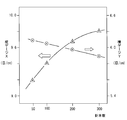
- Fig. 2 shows examples of length function and width function
- the horizontal axis shows the number of needles
- the vertical axis shows the length gauge X and the lateral gauge Y, both of which are the number of stitches per cm. is there.
- the length function is a curve and the width function is a straight line, but these may be a curve or a straight line, and these functions may be stored as a function having the number of needles as a variable, or the number of needles is used as a heading. It may be stored as a table.
- the data in FIG. 2 was knitted for 200 courses each using a flat knitting machine with 12 needles per inch, a flat knitting loop length of 6.0 mm, and wool yarn. Further, as the finishing, it is based on the measured values when steaming, washing and drying are performed. It can be seen that the number of needles in the test sample is 50, 100, 200, and 300, and the vertical gauge changes significantly depending on the number of needles, but the horizontal gauge does not change much. If the number of needles exceeds 300, it is expected that neither the vertical gauge nor the horizontal gauge will depend on the number of needles. Therefore, for example, in a region where the number of needles is larger than 300, the vertical gauge and the horizontal gauge may be corrected to be constant. Also, three types of test samples may be used instead of the four types of test samples.
- the nature of the knitted fabric may change depending on the knitting width. That is, an elongated knitted fabric is easy to extend in the vertical direction, and a wide knitted fabric is difficult to extend in the vertical direction.
- a gauge that is, the number of stitches per predetermined length is obtained with a certain knitting width, and the gauge is applied to the entire knitted fabric. If the knitting width is different, an optimum gauge cannot always be obtained.
- it is a feature of the present invention that the relationship between the knitting width (number of needles) of the knitted fabric and the gauge or stitch size is obtained, and an optimum gauge is set in which the influence of the knitting width is corrected.
- the number of courses of the test sample is constant at 200 courses, but the same results as in FIG. 2 were obtained even when these were changed to 100 courses and 300 courses, for example. That is, the number of needles is a factor that determines the actual gauge, that is, the stitch size.
- Fig. 3 shows the algorithm for gauge correction.
- the reason for the correction is that the influence of the number of needles is corrected in the process of converting the size in the pattern data into the number of courses and the number of needles of the knitted fabric parts.
- the design system 2 stores data such as the knitting condition of the knitted fabric and the type of yarn, for example, the thickness and material of the yarn, and the finishing condition.
- the length function and the width function are set for the combination of these data. I remember it. That is, the length function and the width function are functions for each combination of the knitting condition, the yarn type, and the finishing condition, but a more approximate function may be used.
- the data is output to the design unit 19, and the design unit 19 generates knitting data of the test samples 12-14.
- the knitting conditions, finishing conditions, and yarn types here are the knitting conditions, finishing conditions, and yarn types used in the actual production of the knitted product, and the flat knitting machine 10 follows, for example, three types of tests with different numbers of needles.
- Samples 12-14 are knitted. These samples 12 to 14 are finished with the finishing machine 16 in the same manner as the actual knit product, and the width and height of each test sample are measured manually, for example.
- the measurement result is input to the correction function generator 20.
- the width and length of the knitted fabric may be directly input, or these may be input after being converted into the number of stitches per length, that is, a gauge.
- the correction function generator 20 generates the length function and width function shown in FIG. 2 based on the input data, and stores them together with the yarn type, knitting condition, and finishing condition. Based on the generated height function and width function, the design unit 19 obtains the required number of courses and the number of needles for the height and width of each part in the pattern data. Then, an actual knit product is knitted according to the obtained number of courses and the number of needles. As a result, a knit product of almost the desired size can be produced.
- a program for causing the design system 2 to execute each process of FIG. 3 is the knit design program of the embodiment, and is supplied to the design system 2 via a storage medium such as a CD-ROM or a carrier wave.
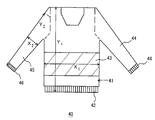
- Fig. 4 shows how to determine the length and width of parts.
- 4 includes a front body 41 and a rear body (not shown) and sleeves 44 and 45, 42 is a hem rubber, 46 is a cuff, and these are both rib-knitted.
- the front body 41 is provided with a pattern 43 having the same thread material and different colors.
- the knitting width X1 of the front body is determined as shown in FIG. 4, for example, and the length Y1 is also determined as shown in FIG.
- the width X2 and the length Y2 are determined as shown in FIG. 4, for example, and the width is generally wider on the armhole side with respect to the cuffs 46.
- the knit product 40 is knitted in a tubular shape, and therefore a tubular knitted fabric having a different knitting width is knitted as a test sample. *
- FIG. 4 shows an example of cylindrical knitting, but it is also conceivable that the knitted product 40 is integrally knitted with a total of four parts, the front body, the back body, and the left and right sleeves. In this case, a plurality of test samples are knitted by changing the knitting width as a flat knitted fabric instead of a tubular knitted fabric.
- the number of courses and the number of needles can be determined by correcting the influence of the number of needles on the stitch size. For this reason, a knitted product closer to the size in the pattern data can be knitted more easily.
Landscapes
- Engineering & Computer Science (AREA)
- Textile Engineering (AREA)
- Knitting Machines (AREA)
Abstract
ニット製品よりも小さく、かつ針本数が異なる複数のサンプルを横編機で編成し、サンプルの丈を測定する。測定した丈に基づいて、サンプルを編成した際の針本数を編目の丈方向サイズに変換する丈関数を求める。求めた丈関数とニット製品の各パーツの目標の丈と目標の幅とから、パーツ毎のコース数を決定する。簡単かつ確実にニット製品のコース数を決定できる。
Description
この発明はニット製品の編目数の決定に関し、具体的には幅方向の目数、即ち編幅あるいは針本数と、丈方向の目数、即ちコース数とを決定し、ほぼ目標のサイズ通りのニット製品を生産できるようにすることに関する。
出願人は、実際のニット製品よりも小さなテストピース、即ち風合いサンプルを編成し、ニット製品のゲージを決定することを提案した(特許文献1:JP2676182)。なおこの明細書において、ゲージはニット製品の幅や丈当たりの編目の数を意味し、単位は例えば(目/cm)などである。特許文献1では編成条件を変えて、複数の風合いサンプルを編成し、最適な風合いのサンプルを選び出す。ただし編幅は一定である。次に、選んだサンプルの幅や丈当たりの目数を測定し、編地のゲージを決定する。ゲージが定まり、目標のニット製品の型紙データで幅と丈とが指定されているので、幅に幅方向のゲージを乗算することにより針本数が定まる。また丈に丈方向のゲージを乗算することにより、コース数が定まる。これらによって、ニット製品の現物を生産しながらゲージを修正する手間を減らすことができる。
しかしながら発明者らは、特許文献1の手法のみでは必ずしも最適なゲージを決定できないことを見出した。最適なゲージが見出せなければ、ニット製品は所定のサイズとならず、現品を編成した段階で、編成データに対しコース数を増減するなどの修正が必要になる。特に筒状編地を無縫製で互いに接合したセーターなどの場合、袖と身頃のように編幅の異なるパーツを同時に編成するため、風合いサンプルの編幅はいずれかのパーツの編幅から大きく異なったものとなり、各パーツに対する最適ゲージを設定することができなかった。発明者が見出したことは、編地の丈方向のゲージは、他の条件が同じでも、編幅に依存して変化することである。またこれ以外に、編地の幅方向のゲージも編幅に依存して変化するが、編幅の影響は小さい。
この発明の課題は、ほぼ目標通りのサイズのニット製品を生産するための、コース数、及び針本数、即ち編幅を決定できるようにすることにある。
この発明は、ニット製品の型紙データを横編機により編成する目数に変換する方法において、
針本数が異なる複数のサンプルを横編機により編成する編成ステップと、
各サンプルの少なくとも編目の丈方向のサイズを測定する測定ステップと、
サンプルの針本数と編目の丈方向のサイズとの関係を求めるステップと、
求めたサンプルの針本数と編目の丈方向サイズとの関係と前記型紙データでの目標の幅とに基づき、前記型紙データでの目標丈に対するコース数を決定する編目数決定ステップ、とを設けたことを特徴とする。
針本数が異なる複数のサンプルを横編機により編成する編成ステップと、
各サンプルの少なくとも編目の丈方向のサイズを測定する測定ステップと、
サンプルの針本数と編目の丈方向のサイズとの関係を求めるステップと、
求めたサンプルの針本数と編目の丈方向サイズとの関係と前記型紙データでの目標の幅とに基づき、前記型紙データでの目標丈に対するコース数を決定する編目数決定ステップ、とを設けたことを特徴とする。
またこの発明は、ニット製品の型紙データを横編機により編成する目数に変換するシステムにおいて、
針本数が異なる複数のサンプルの、針本数と少なくとも編目の丈方向のサイズとの入力値に基づき、針本数と編目の丈方向のサイズとの関係を求めるための手段と、
求めた関係を記憶するための手段と、
記憶した関係と前記型紙データでの目標の幅とに基づきに基づき、前記型紙データでの目標丈に対するコース数を決定する編目数決定手段、とを設けたことを特徴とする。
針本数が異なる複数のサンプルの、針本数と少なくとも編目の丈方向のサイズとの入力値に基づき、針本数と編目の丈方向のサイズとの関係を求めるための手段と、
求めた関係を記憶するための手段と、
記憶した関係と前記型紙データでの目標の幅とに基づきに基づき、前記型紙データでの目標丈に対するコース数を決定する編目数決定手段、とを設けたことを特徴とする。
さらにこの発明は、ニット製品の型紙データを横編機により編成する目数に変換するプログラムにおいて、
コンピュータを、
針本数が異なる複数のサンプルの、針本数と少なくとも編目の丈方向のサイズとの入力値に基づき、針本数と編目の丈方向のサイズとの関係を求めるための手段と、
求めた関係を記憶するための手段と、
記憶した関係と前記型紙データでの目標の幅とに基づきに基づき、前記型紙データでの目標丈に対するコース数を決定する編目数決定手段、として機能させることを特徴とする。
コンピュータを、
針本数が異なる複数のサンプルの、針本数と少なくとも編目の丈方向のサイズとの入力値に基づき、針本数と編目の丈方向のサイズとの関係を求めるための手段と、
求めた関係を記憶するための手段と、
記憶した関係と前記型紙データでの目標の幅とに基づきに基づき、前記型紙データでの目標丈に対するコース数を決定する編目数決定手段、として機能させることを特徴とする。
この明細書において、編目数の決定方法に関する記載はデザインシステムやデザインプログラムにもそのまま当てはまり、デザインシステムに関する記載は編目数の決定方法やデザインプログラムにもそのまま当てはまる。
図2に示すように、編目の丈サイズは針本数、即ち編幅に依存するので、針本数の異なる複数のサンプルを編成すれば、編目の丈サイズと針本数(編幅)との関係を求めることができる。型紙データはニット製品の各パーツの目標の丈と目標の幅とを指定し、編目の幅方向のサイズ(幅サイズ)への針本数の影響は、丈方向のサイズ(丈サイズ)への影響よりも小さい。そこで適宜の手法により、目標の幅を針本数に変換する。次ぎに、ニット製品の各パーツの目標の丈、及び編目の丈サイズと針本数との関係から、必要なコース数が定まる。このようにすると、編目の丈方向サイズへの針本数の影響を補正できるので、所望の丈のパーツを編成できる。
図2に示すように、編目の丈サイズは針本数、即ち編幅に依存するので、針本数の異なる複数のサンプルを編成すれば、編目の丈サイズと針本数(編幅)との関係を求めることができる。型紙データはニット製品の各パーツの目標の丈と目標の幅とを指定し、編目の幅方向のサイズ(幅サイズ)への針本数の影響は、丈方向のサイズ(丈サイズ)への影響よりも小さい。そこで適宜の手法により、目標の幅を針本数に変換する。次ぎに、ニット製品の各パーツの目標の丈、及び編目の丈サイズと針本数との関係から、必要なコース数が定まる。このようにすると、編目の丈方向サイズへの針本数の影響を補正できるので、所望の丈のパーツを編成できる。
複数のサンプルは互いに捨て糸などでつながっていても良く、編目の丈方向サイズは、例えば所定の丈長さ当たりの編目の個数を測定しても、所定個数の編目の合計の丈を測定しても良い。またサンプルの編成自体は周知なので、デザイン装置やデザインプログラムはサンプルの編成データの作成に関与しなくても良い。型紙データはデザインしたニット製品の形状とサイズとを指定し、サイズとして丈と幅とを指定する。
この発明では、編目の丈方向サイズへの針本数の影響を補正し、ほぼ型紙データ通りの丈のニット製品を編成できる。
好ましくは、前記関係を求めるステップでは、サンプルの針本数と編目の丈方向サイズとの関係を、編目の丈方向サイズの針本数への依存性を表す丈関数として求める。
好ましくは、前記関係を求めるステップでは、サンプルの針本数と編目の丈方向サイズとの関係を、編目の丈方向サイズの針本数への依存性を表す丈関数として求める。
より好ましくは、前記測定ステップでは、複数のサンプルの編目の丈方向サイズと幅方向サイズとを測定し、
前記関係を求めるステップでは、前記丈関数と、編目の幅方向サイズの針本数への依存性を表す幅関数とを求め、
前記編目数決定ステップでは、前記丈関数と前記幅関数とから、前記型紙データでの目標の丈に対するコース数と目標の幅に対する針本数とを決定する。
このようにすると、目標通りの丈と幅のパーツを編成できる。
前記関係を求めるステップでは、前記丈関数と、編目の幅方向サイズの針本数への依存性を表す幅関数とを求め、
前記編目数決定ステップでは、前記丈関数と前記幅関数とから、前記型紙データでの目標の丈に対するコース数と目標の幅に対する針本数とを決定する。
このようにすると、目標通りの丈と幅のパーツを編成できる。
以下に本発明を実施するための最適実施例を示す。
図1~図4に実施例を示す。図において、2はデザインシステムで、カラーなどのモニタ4と入力用のキーボード6やマウス8などを備え、図示しないLANなどを介してインターネットなどに接続されている。またディスクドライブなどを備えて、CD-ROMなどの記憶媒体からの読み込みができ、デザインシステム2は適宜のコンピュータからなる。10は横編機で、針床の数は2枚あるいは4枚などとし、16は仕上機で、例えば洗浄や縮絨あるいはスチーム処理などを行い、サイズ測定工程18では、横編機10で編成したテストサンプル12~14の幅と丈、即ち幅と長さを測定する。
複数のサンプルについて、測定した幅と丈をデザインシステム2の補正関数発生部20へ入力する。補正関数発生部20は、複数のサンプルの丈と幅に基づき、針本数の関数として編目の丈方向のサイズを表す丈関数と、針本数の関数として編目の幅方向のサイズを表す幅関数を発生させて記憶する。これらの関数は、編成条件、例えば編目当たりの目標ループ長と、素材及び太さなどの糸の種類、仕上げの種類の組み合わせ毎の関数である。なお補正関数発生部に、サンプル毎の幅と丈とを入力する代わりに、サンプル毎の編地の丈方向ゲージと幅方向ゲージとを入力しても良い。即ち、編目のサイズを表すものとして、サンプルの幅や丈を用いるか、編目サイズの逆数となるゲージを用いるかは任意である。また実施例では、丈方向のサイズと幅方向のサイズとを入力し、丈関数と幅関数とを発生させるが、針本数に依存して変化する割合が大きいのは丈方向のサイズなので、幅関数は発生させなくても良い。
デザインシステム2のデザイン部19では、キーボード6やマウス8、あるいは図示しないLANなどからの入力に基づき、ニット製品のデザインを行う。ニット製品のデザインには2つの段階があり、最初の段階で各パーツのサイズを丈や幅などで入力する。この段階でのサイズはcm単位やインチ単位などの長さで指定され、この段階のデータをパターンデータという。次に、デザイン部19はパターンデータをニット製品のデザインデータ、もしくはデザインデータを直ちに横編機10で処理し得る編成データに変換する。この過程で、パーツの幅や丈は、丈関数や幅関数により、パーツの編幅、即ち編成に用いる針の本数と、パーツのコース数とに変換される。
またデザイン部19は、テストサンプル12~14の編成データを横編機10に対し出力し、これらのサンプル12~14を編成させる。テストサンプル12~14は、例えばコース数が共通で、針本数が異なるサンプルである。テストサンプル12~14の形状は例えば長方形とするが、それ以外の形状でも良い。テストサンプル12~14は、用いる糸の種類が同じで、編成条件が同じで編目当たりの目標ループ長も同じであり、かつ仕上機16での仕上げ条件も同じである。そして糸の種類が変わる、あるいは仕上げの種類が変わる、編成条件が変わるなどの場合、デザイン部19は、新たなテストサンプル12~14の編成データを出力する。なおデザインシステム2と横編機10はLANなどを通じて接続しても、あるいはフロッピーディスク(登録商標)などを介して人手により接続してもよい。
図2に丈関数と幅関数との例を示し、横軸は針本数を、縦軸は丈方向のゲージXと横方向のゲージYとを示し、これらはいずれもcm当たりに編目の数である。図2では、丈関数は曲線、幅関数は直線であるが、これらは曲線でも直線でも良く、これらの関数は針本数を変数とする関数としても記憶しても、あるいは針本数を見出しとするテーブルとして記憶しても良い。
図2のデータは、1インチ当たりの針本数が12本の横編機を用い、平編みで1ループ当たりのループ長を6.0mmとしウールの糸を用いて、各200コース編成した。また仕上げとして、スチーム処理と洗浄、乾燥とを行った際の測定値に基づくものである。テストサンプルの針本数は50本、100本、200本、300本の4種類で、縦ゲージは針本数によって著しく変化するが、横ゲージは余り変化しないことが分かる。なお針本数が300本よりも大きくなると、縦ゲージも横ゲージも針本数に余り依存しなくなることが予想される。従って例えば針本数が300本よりも大きい領域では、縦ゲージも横ゲージも一定であると補正しても良い。また4種類のテストサンプルではなく、3種類のテストサンプルなどを用いても良い。
図2のデータが得られる原因として、編地は元々編幅によって性質が変化することがある。即ち細長い編地は縦方向に伸びやすく、幅の広い編地は縦方向に伸びにくい。前記の特許文献1では、ある編幅でゲージ、即ち所定の長さ当たりの編目の数を求め、そのゲージを編地全体に適用する。すると編幅が異なると、必ずしも最適のゲージが得られない。これに対して編地の編幅(針本数)とゲージあるいは編目のサイズとの関係を求め、編幅の影響を補正した最適なゲージを設定するのが、この発明の特徴である。図2では、テストサンプルのコース数は200コースで一定であるが、これらを例えば100コース及び300コースに変えても、図2と同様の結果が得られた。即ち針本数が実際のゲージ、即ち編目のサイズを決定するファクターである。
図3にゲージ補正のアルゴリズムを示す。ここで補正というのは、パターンデータでのサイズを、編地のパーツのコース数や針本数に変換する過程で、針本数の影響を補正するからである。デザインシステム2は、編地の編成条件と糸の種類、例えば糸の太さと素材、及び仕上げ条件などのデータを記憶しており、これらのデータの組み合わせに対して、丈関数と幅関数とを記憶している。即ち丈関数や幅関数は、編成条件と糸の種類及び仕上げ条件の組み合わせ毎の関数であるが、より近似的な関数を用いても良い。
糸の太さや素材が変わる、編成条件が変わる、あるいは仕上げ条件が変わると、記憶している丈関数や幅関数を適用できないので、補正関数発生部20は新たなテストサンプルが必要であることをデザイン部19へ出力し、デザイン部19はテストサンプル12~14の編成データを発生させる。ここでの編成条件や仕上げ条件、糸の種類は、ニット製品の実生産に用いる編成条件や仕上げ条件、糸の種類であり、横編機10はこれに従って、針本数の異なる例えば3種類のテストサンプル12~14を編成する。これらのサンプル12~14に、仕上機16で実際のニット製品と同様の仕上げを施し、例えばマニュアルで各テストサンプルの幅と丈とを測定する。測定結果を補正関数発生部20へ入力する。入力の仕方は編地の幅と丈とを直接入力しても、あるいはこれらを長さ当たりの編目の数、即ちゲージに変換して入力しても良い。
補正関数発生部20は、入力データに基づき図2の丈関数と幅関数とを発生させ、糸の種類や編成条件、仕上げ条件と共に記憶する。発生させた丈関数と幅関数とに基づき、デザイン部19はパターンデータでの各パーツの丈や幅に対して、必要なコース数及び針本数を求める。そして求めたコース数と針本数により、実際のニット製品を編成する。これによりほぼ目的のサイズのニット製品を生産できる。図3の各処理をデザインシステム2に実行させるプログラムが、実施例のニットデザインプログラムで、CD-ROMなどの記憶媒体や搬送波などを介して、デザインシステム2に供給する。
図4にパーツの丈や幅の決定方法を示す。図4のニット製品40は、前身頃41及び図示しない後身頃と、袖44,45とから成り、42は裾ゴム、46は袖口で、これらはいずれもリブ編成される。また前身頃41は、その内部に糸の素材が同じで、色彩が異なる柄43を備えているものとする。ここで前身頃の編幅X1は例えば図4のように定め、丈Y1も図4のように定める。袖44,45では幅X2と丈Y2を例えば図4のように定め、一般に袖口46に対してアームホール側で幅が広くなるので、編幅X2はこれらの中間の値とする。なお図4では、ニット製品40を筒状編成するので、編幅違いの筒状編地をテストサンプルとして編成する。
図4では筒状編成の例を示したが、ニット製品40を前身頃,後身頃,左右の袖の合計4つのパーツで、インテグラル編成することも考えられる。この場合、テストサンプルは筒状編地ではなく平編地として、編幅を変えて複数編成する。
実施例では、針本数による編目サイズへの影響を補正して、ニット製品のコース数や針本数を決定できる。このためよりパターンデータでのサイズに近いニット製品を、より簡単に編成できる。
2 デザインシステム 4 モニタ 6 キーボード 8 マウス
10 横編機 12~14 テストサンプル 16 仕上機
18 サイズ測定工程 19 デザイン部 20 補正関数発生部
40 ニット製品 41 前身頃 42 裾ゴム 43 柄
44,45 袖 46 袖口
X1,X2 編幅 Y1,Y2 編丈
10 横編機 12~14 テストサンプル 16 仕上機
18 サイズ測定工程 19 デザイン部 20 補正関数発生部
40 ニット製品 41 前身頃 42 裾ゴム 43 柄
44,45 袖 46 袖口
X1,X2 編幅 Y1,Y2 編丈
Claims (5)
- ニット製品の型紙データを横編機により編成する目数に変換する方法において、
針本数が異なる複数のサンプルを横編機により編成する編成ステップと、
各サンプルの少なくとも編目の丈方向のサイズを測定する測定ステップと、
サンプルの針本数と編目の丈方向のサイズとの関係を求めるステップと、
求めたサンプルの針本数と編目の丈方向サイズとの関係と前記型紙データでの目標の幅とに基づき、前記型紙データでの目標丈に対するコース数を決定する編目数決定ステップ、とを設けたことを特徴とする、ニット製品の編目数の決定方法。 - 前記関係を求めるステップでは、サンプルの針本数と編目の丈方向サイズとの関係を、編目の丈方向サイズの針本数への依存性を表す丈関数として求めることを特徴とする、請求項1のニット製品の編目数の決定方法。
- 前記測定ステップでは、複数のサンプルの編目の丈方向サイズと幅方向サイズとを測定し、
前記関係を求めるステップでは、前記丈関数と、編目の幅方向サイズの針本数への依存性を表す幅関数とを求め、
前記編目数決定ステップでは、前記丈関数と前記幅関数とから、前記型紙データでの目標の丈に対するコース数と目標の幅に対する針本数とを決定することを特徴とする、請求項2のニット製品の編目数の決定方法。 - ニット製品の型紙データを横編機により編成する目数に変換するシステムにおいて、
針本数が異なる複数のサンプルの、針本数と少なくとも編目の丈方向のサイズとの入力値に基づき、針本数と編目の丈方向のサイズとの関係を求めるための手段と、
求めた関係を記憶するための手段と、
記憶した関係と前記型紙データでの目標の幅とに基づきに基づき、前記型紙データでの目標丈に対するコース数を決定する編目数決定手段、とを設けたことを特徴とする、ニット製品のデザインシステム。 - ニット製品の型紙データを横編機により編成する目数に変換するプログラムにおいて、
コンピュータを、
針本数が異なる複数のサンプルの、針本数と少なくとも編目の丈方向のサイズとの入力値に基づき、針本数と編目の丈方向のサイズとの関係を求めるための手段と、
求めた関係を記憶するための手段と、
記憶した関係と前記型紙データでの目標の幅とに基づきに基づき、前記型紙データでの目標丈に対するコース数を決定する編目数決定手段、として機能させることを特徴とする、ニット製品のデザインプログラム。
Priority Applications (3)
| Application Number | Priority Date | Filing Date | Title |
|---|---|---|---|
| JP2010518991A JP5414672B2 (ja) | 2008-07-03 | 2009-06-19 | ニット製品の編目数の決定方法とデザインシステム、デザインプログラム |
| CN200980125720.8A CN102084049B (zh) | 2008-07-03 | 2009-06-19 | 针织产品的线圈数的决定方法和设计系统 |
| EP09773315.8A EP2292820B1 (en) | 2008-07-03 | 2009-06-19 | Method and design system for determining knitted article gauge |
Applications Claiming Priority (2)
| Application Number | Priority Date | Filing Date | Title |
|---|---|---|---|
| JP2008-174547 | 2008-07-03 | ||
| JP2008174547 | 2008-07-03 |
Publications (1)
| Publication Number | Publication Date |
|---|---|
| WO2010001737A1 true WO2010001737A1 (ja) | 2010-01-07 |
Family
ID=41465837
Family Applications (1)
| Application Number | Title | Priority Date | Filing Date |
|---|---|---|---|
| PCT/JP2009/061174 Ceased WO2010001737A1 (ja) | 2008-07-03 | 2009-06-19 | ニット製品の編目数の決定方法とデザインシステム、デザインプログラム |
Country Status (4)
| Country | Link |
|---|---|
| EP (1) | EP2292820B1 (ja) |
| JP (1) | JP5414672B2 (ja) |
| CN (1) | CN102084049B (ja) |
| WO (1) | WO2010001737A1 (ja) |
Families Citing this family (2)
| Publication number | Priority date | Publication date | Assignee | Title |
|---|---|---|---|---|
| CN102666955B (zh) * | 2009-11-26 | 2014-03-05 | 株式会社岛精机制作所 | 针织设计装置和设计方法 |
| CN110485042B (zh) * | 2019-08-14 | 2021-02-09 | 江南大学 | 一种二维纸样转换三维全成形服装的针织纸样的方法 |
Citations (3)
| Publication number | Priority date | Publication date | Assignee | Title |
|---|---|---|---|---|
| JPS5530477A (en) * | 1978-08-25 | 1980-03-04 | Sharp Kk | Electronic control apparatus of knitting machine |
| JP2676182B2 (ja) | 1993-11-08 | 1997-11-12 | 株式会社島精機製作所 | ニット製品の生産方法 |
| JP2005015958A (ja) * | 2003-06-26 | 2005-01-20 | Shima Seiki Mfg Ltd | 編地見本の作成方法、ニットデザイン方法、糸径測定装置、及び編地見本の作成装置 |
Family Cites Families (1)
| Publication number | Priority date | Publication date | Assignee | Title |
|---|---|---|---|---|
| TW200738928A (en) * | 2006-04-07 | 2007-10-16 | Merry Far Knitting Co Ltd | Color image manufacturing method for jacquard towel |
-
2009
- 2009-06-19 CN CN200980125720.8A patent/CN102084049B/zh active Active
- 2009-06-19 EP EP09773315.8A patent/EP2292820B1/en active Active
- 2009-06-19 WO PCT/JP2009/061174 patent/WO2010001737A1/ja not_active Ceased
- 2009-06-19 JP JP2010518991A patent/JP5414672B2/ja active Active
Patent Citations (3)
| Publication number | Priority date | Publication date | Assignee | Title |
|---|---|---|---|---|
| JPS5530477A (en) * | 1978-08-25 | 1980-03-04 | Sharp Kk | Electronic control apparatus of knitting machine |
| JP2676182B2 (ja) | 1993-11-08 | 1997-11-12 | 株式会社島精機製作所 | ニット製品の生産方法 |
| JP2005015958A (ja) * | 2003-06-26 | 2005-01-20 | Shima Seiki Mfg Ltd | 編地見本の作成方法、ニットデザイン方法、糸径測定装置、及び編地見本の作成装置 |
Non-Patent Citations (1)
| Title |
|---|
| See also references of EP2292820A4 * |
Also Published As
| Publication number | Publication date |
|---|---|
| EP2292820A1 (en) | 2011-03-09 |
| EP2292820B1 (en) | 2016-03-16 |
| JPWO2010001737A1 (ja) | 2011-12-15 |
| CN102084049B (zh) | 2012-07-18 |
| JP5414672B2 (ja) | 2014-02-12 |
| EP2292820A4 (en) | 2015-03-04 |
| CN102084049A (zh) | 2011-06-01 |
Similar Documents
| Publication | Publication Date | Title |
|---|---|---|
| CA2135318C (en) | Method of producing knitted articles | |
| KR101356987B1 (ko) | 니트 디자인 장치와 디자인 방법, 디자인 프로그램 | |
| JP5414672B2 (ja) | ニット製品の編目数の決定方法とデザインシステム、デザインプログラム | |
| WO2016083523A1 (en) | Yarn for knitting | |
| EP3580380B1 (en) | A method of knitting a fabric using a knitting machine and a knitting machine | |
| CN113846411B (zh) | 一种改善全成型马鞍肩袖笼结构的编织方法及针织物 | |
| Power | Yarn to fabric: Knitting | |
| Rahman et al. | CAD technology aided design and evaluation of performance parameters of warp knitted seamless garment | |
| JP5595912B2 (ja) | ニット製品の編目数の決定方法とデザインシステム、デザインプログラム | |
| JP2004535519A (ja) | 縮み前の織物パターンを準備する方法及びシステム | |
| CN104264382A (zh) | 一种缝纫机缝线动态张力测试装置及测试方法 | |
| JP2009120987A (ja) | 編成コース数の調整方法およびデザイン装置 | |
| JP5800530B2 (ja) | ニットデザイン装置とニットデザイン方法 | |
| CN110616497B (zh) | 一种双针床圆筒套收结构编织方法 | |
| JPS633060B2 (ja) | ||
| JP5749088B2 (ja) | 編地の編成方法と、編地、及びデザインシステム | |
| JP2005015958A (ja) | 編地見本の作成方法、ニットデザイン方法、糸径測定装置、及び編地見本の作成装置 | |
| KR101399255B1 (ko) | 실크 오간자 표면의 가공 방법 및 이를 이용해 생산한 실크 오간자 | |
| Stevenson | Rendered in Yarn | |
| JP2016023398A (ja) | 手芸用目盛付き編み針 | |
| Zhang et al. | A Method for Yarns Calculation in Sock production | |
| CN103031678A (zh) | 一种绣花产品缩水率的控制方法 | |
| JPS638227B2 (ja) |
Legal Events
| Date | Code | Title | Description |
|---|---|---|---|
| WWE | Wipo information: entry into national phase |
Ref document number: 200980125720.8 Country of ref document: CN |
|
| 121 | Ep: the epo has been informed by wipo that ep was designated in this application |
Ref document number: 09773315 Country of ref document: EP Kind code of ref document: A1 |
|
| WWE | Wipo information: entry into national phase |
Ref document number: 2010518991 Country of ref document: JP |
|
| WWE | Wipo information: entry into national phase |
Ref document number: 2009773315 Country of ref document: EP |
|
| NENP | Non-entry into the national phase |
Ref country code: DE |