WO2010001875A1 - 硬化性組成物及びその硬化物 - Google Patents
硬化性組成物及びその硬化物 Download PDFInfo
- Publication number
- WO2010001875A1 WO2010001875A1 PCT/JP2009/061903 JP2009061903W WO2010001875A1 WO 2010001875 A1 WO2010001875 A1 WO 2010001875A1 JP 2009061903 W JP2009061903 W JP 2009061903W WO 2010001875 A1 WO2010001875 A1 WO 2010001875A1
- Authority
- WO
- WIPO (PCT)
- Prior art keywords
- curable composition
- mass
- fine particles
- meth
- acrylate
- Prior art date
- Legal status (The legal status is an assumption and is not a legal conclusion. Google has not performed a legal analysis and makes no representation as to the accuracy of the status listed.)
- Ceased
Links
- 0 *c1ccccc1 Chemical compound *c1ccccc1 0.000 description 1
Classifications
-
- C—CHEMISTRY; METALLURGY
- C09—DYES; PAINTS; POLISHES; NATURAL RESINS; ADHESIVES; COMPOSITIONS NOT OTHERWISE PROVIDED FOR; APPLICATIONS OF MATERIALS NOT OTHERWISE PROVIDED FOR
- C09C—TREATMENT OF INORGANIC MATERIALS, OTHER THAN FIBROUS FILLERS, TO ENHANCE THEIR PIGMENTING OR FILLING PROPERTIES ; PREPARATION OF CARBON BLACK ; PREPARATION OF INORGANIC MATERIALS WHICH ARE NO SINGLE CHEMICAL COMPOUNDS AND WHICH ARE MAINLY USED AS PIGMENTS OR FILLERS
- C09C1/00—Treatment of specific inorganic materials other than fibrous fillers; Preparation of carbon black
- C09C1/28—Compounds of silicon
- C09C1/30—Silicic acid
- C09C1/309—Combinations of treatments provided for in groups C09C1/3009 - C09C1/3081
-
- C—CHEMISTRY; METALLURGY
- C08—ORGANIC MACROMOLECULAR COMPOUNDS; THEIR PREPARATION OR CHEMICAL WORKING-UP; COMPOSITIONS BASED THEREON
- C08L—COMPOSITIONS OF MACROMOLECULAR COMPOUNDS
- C08L33/00—Compositions of homopolymers or copolymers of compounds having one or more unsaturated aliphatic radicals, each having only one carbon-to-carbon double bond, and only one being terminated by only one carboxyl radical, or of salts, anhydrides, esters, amides, imides or nitriles thereof; Compositions of derivatives of such polymers
- C08L33/04—Homopolymers or copolymers of esters
- C08L33/06—Homopolymers or copolymers of esters of esters containing only carbon, hydrogen and oxygen, which oxygen atoms are present only as part of the carboxyl radical
-
- B—PERFORMING OPERATIONS; TRANSPORTING
- B82—NANOTECHNOLOGY
- B82Y—SPECIFIC USES OR APPLICATIONS OF NANOSTRUCTURES; MEASUREMENT OR ANALYSIS OF NANOSTRUCTURES; MANUFACTURE OR TREATMENT OF NANOSTRUCTURES
- B82Y30/00—Nanotechnology for materials or surface science, e.g. nanocomposites
-
- C—CHEMISTRY; METALLURGY
- C08—ORGANIC MACROMOLECULAR COMPOUNDS; THEIR PREPARATION OR CHEMICAL WORKING-UP; COMPOSITIONS BASED THEREON
- C08F—MACROMOLECULAR COMPOUNDS OBTAINED BY REACTIONS ONLY INVOLVING CARBON-TO-CARBON UNSATURATED BONDS
- C08F2/00—Processes of polymerisation
- C08F2/44—Polymerisation in the presence of compounding ingredients, e.g. plasticisers, dyestuffs, fillers
-
- C—CHEMISTRY; METALLURGY
- C08—ORGANIC MACROMOLECULAR COMPOUNDS; THEIR PREPARATION OR CHEMICAL WORKING-UP; COMPOSITIONS BASED THEREON
- C08F—MACROMOLECULAR COMPOUNDS OBTAINED BY REACTIONS ONLY INVOLVING CARBON-TO-CARBON UNSATURATED BONDS
- C08F20/00—Homopolymers and copolymers of compounds having one or more unsaturated aliphatic radicals, each having only one carbon-to-carbon double bond, and only one being terminated by only one carboxyl radical or a salt, anhydride, ester, amide, imide or nitrile thereof
- C08F20/02—Monocarboxylic acids having less than ten carbon atoms, Derivatives thereof
- C08F20/10—Esters
-
- C—CHEMISTRY; METALLURGY
- C08—ORGANIC MACROMOLECULAR COMPOUNDS; THEIR PREPARATION OR CHEMICAL WORKING-UP; COMPOSITIONS BASED THEREON
- C08F—MACROMOLECULAR COMPOUNDS OBTAINED BY REACTIONS ONLY INVOLVING CARBON-TO-CARBON UNSATURATED BONDS
- C08F220/00—Copolymers of compounds having one or more unsaturated aliphatic radicals, each having only one carbon-to-carbon double bond, and only one being terminated by only one carboxyl radical or a salt, anhydride ester, amide, imide or nitrile thereof
- C08F220/02—Monocarboxylic acids having less than ten carbon atoms; Derivatives thereof
- C08F220/10—Esters
- C08F220/12—Esters of monohydric alcohols or phenols
- C08F220/16—Esters of monohydric alcohols or phenols of phenols or of alcohols containing two or more carbon atoms
- C08F220/18—Esters of monohydric alcohols or phenols of phenols or of alcohols containing two or more carbon atoms with acrylic or methacrylic acids
- C08F220/1811—C10or C11-(Meth)acrylate, e.g. isodecyl (meth)acrylate, isobornyl (meth)acrylate or 2-naphthyl (meth)acrylate
-
- C—CHEMISTRY; METALLURGY
- C08—ORGANIC MACROMOLECULAR COMPOUNDS; THEIR PREPARATION OR CHEMICAL WORKING-UP; COMPOSITIONS BASED THEREON
- C08F—MACROMOLECULAR COMPOUNDS OBTAINED BY REACTIONS ONLY INVOLVING CARBON-TO-CARBON UNSATURATED BONDS
- C08F222/00—Copolymers of compounds having one or more unsaturated aliphatic radicals, each having only one carbon-to-carbon double bond, and at least one being terminated by a carboxyl radical and containing at least one other carboxyl radical in the molecule; Salts, anhydrides, esters, amides, imides, or nitriles thereof
- C08F222/10—Esters
- C08F222/1006—Esters of polyhydric alcohols or polyhydric phenols
- C08F222/103—Esters of polyhydric alcohols or polyhydric phenols of trialcohols, e.g. trimethylolpropane tri(meth)acrylate
-
- C—CHEMISTRY; METALLURGY
- C08—ORGANIC MACROMOLECULAR COMPOUNDS; THEIR PREPARATION OR CHEMICAL WORKING-UP; COMPOSITIONS BASED THEREON
- C08F—MACROMOLECULAR COMPOUNDS OBTAINED BY REACTIONS ONLY INVOLVING CARBON-TO-CARBON UNSATURATED BONDS
- C08F292/00—Macromolecular compounds obtained by polymerising monomers on to inorganic materials
-
- C—CHEMISTRY; METALLURGY
- C08—ORGANIC MACROMOLECULAR COMPOUNDS; THEIR PREPARATION OR CHEMICAL WORKING-UP; COMPOSITIONS BASED THEREON
- C08K—Use of inorganic or non-macromolecular organic substances as compounding ingredients
- C08K3/00—Use of inorganic substances as compounding ingredients
- C08K3/34—Silicon-containing compounds
- C08K3/36—Silica
-
- C—CHEMISTRY; METALLURGY
- C08—ORGANIC MACROMOLECULAR COMPOUNDS; THEIR PREPARATION OR CHEMICAL WORKING-UP; COMPOSITIONS BASED THEREON
- C08K—Use of inorganic or non-macromolecular organic substances as compounding ingredients
- C08K9/00—Use of pretreated ingredients
- C08K9/04—Ingredients treated with organic substances
- C08K9/06—Ingredients treated with organic substances with silicon-containing compounds
-
- C—CHEMISTRY; METALLURGY
- C09—DYES; PAINTS; POLISHES; NATURAL RESINS; ADHESIVES; COMPOSITIONS NOT OTHERWISE PROVIDED FOR; APPLICATIONS OF MATERIALS NOT OTHERWISE PROVIDED FOR
- C09C—TREATMENT OF INORGANIC MATERIALS, OTHER THAN FIBROUS FILLERS, TO ENHANCE THEIR PIGMENTING OR FILLING PROPERTIES ; PREPARATION OF CARBON BLACK ; PREPARATION OF INORGANIC MATERIALS WHICH ARE NO SINGLE CHEMICAL COMPOUNDS AND WHICH ARE MAINLY USED AS PIGMENTS OR FILLERS
- C09C1/00—Treatment of specific inorganic materials other than fibrous fillers; Preparation of carbon black
- C09C1/28—Compounds of silicon
- C09C1/30—Silicic acid
- C09C1/3081—Treatment with organo-silicon compounds
-
- C—CHEMISTRY; METALLURGY
- C01—INORGANIC CHEMISTRY
- C01P—INDEXING SCHEME RELATING TO STRUCTURAL AND PHYSICAL ASPECTS OF SOLID INORGANIC COMPOUNDS
- C01P2004/00—Particle morphology
- C01P2004/60—Particles characterised by their size
- C01P2004/64—Nanometer sized, i.e. from 1-100 nanometer
-
- C—CHEMISTRY; METALLURGY
- C01—INORGANIC CHEMISTRY
- C01P—INDEXING SCHEME RELATING TO STRUCTURAL AND PHYSICAL ASPECTS OF SOLID INORGANIC COMPOUNDS
- C01P2006/00—Physical properties of inorganic compounds
- C01P2006/22—Rheological behaviour as dispersion, e.g. viscosity, sedimentation stability
Definitions
- the present invention relates to a curable composition having low viscosity and excellent handling properties, and a cured product having excellent transparency, heat resistance, environmental resistance and molding processability obtained by curing the curable composition.
- the cured product include optical lenses, optical disk substrates, plastic substrates for liquid crystal display elements, color filter substrates, plastic substrates for organic EL display elements, solar cell substrates, touch panels, optical elements, optical waveguides, LED sealing materials, and the like. In particular, it can be suitably used for optical lenses, optical elements, and optical waveguides.
- glass plates are often used as substrates for liquid crystal display elements, color filter substrates, organic EL display element substrates, solar cell substrates, touch panels, and the like.
- plastic materials instead of glass plates. It was.
- an optical lens, an optical element, an optical waveguide, and an LED sealing material in recent years, a plastic material having excellent heat resistance such as reflow resistance has been demanded.
- JP-A-10-77321 discloses a member obtained by curing a resin composition comprising an amorphous thermoplastic resin and bis (meth) acrylate curable with active energy rays with active energy rays. It describes that it can be suitably used for an optical lens, an optical disk substrate, a plastic liquid crystal substrate and the like instead of a glass substrate.
- the conventional plastic material as shown in this publication is poor in heat resistance or has a large shrinkage during curing. Therefore, for example, when applied to a display element substrate, there arises a problem that the material is warped in the manufacturing process, and bending or cracking occurs.
- a method for improving heat resistance and reducing shrinkage there are generally a method of adding an inorganic filler in a resin composition, a method of laminating an inorganic film on a substrate, and the like.
- an inorganic filler is added to the resin composition, the transparency of the cured product (substrate) obtained by curing the resin composition is significantly impaired, the surface smoothness is lost, and the inorganic filler (silica fine particles) is lost. Since the dispersibility is poor, non-uniformity occurs in the substrate, and the substrate is liable to break.
- the inorganic films are laminated, there are the following problems. (1) The adhesion between the inorganic film and the substrate is poor. (2) The inorganic film is peeled off from the substrate or cracks are generated on the substrate. The above problem (2) arises because the difference in shrinkage during curing of the inorganic film and the resin composition cured to be a substrate is large.
- JP-A-5-209027, JP-A-10-231339, and JP-A-10-298252 disclose silica-based degeneracy obtained by hydrolyzing and polycondensing a specific silane compound in a colloidal silica dispersion.
- a curable composition is described in which a polymer is uniformly dispersed in a radical polymerizable vinyl compound such as methyl methacrylate or a bisphenol A type ethylene oxide-modified (meth) acrylate, and gives a cured product having excellent transparency and rigidity. .
- the cured products obtained from these curable compositions also have insufficient heat resistance.
- Japanese Patent No. 4008246 is obtained by removing an organic solvent from a composition having a specific alicyclic structure and containing bifunctional (meth) acrylate and colloidal silica dispersed in an organic solvent.
- a cured product obtained by crosslinking the composite composition is disclosed.
- dispersibility of silica in the composite composition, suppression of curing shrinkage, and molding processability of the cured product are insufficient.
- a silane compound having an alicyclic structure is added to the composition in order to supplement the dispersibility of silica and to reduce the viscosity of the composite composition, but the hydrolysis rate of the silane compound is also described. Is very slow. Therefore, the method of adding a silane compound to the composition has a problem that it is not economical in terms of production time and the effect thereof is hardly exhibited.
- the plastic material in order to apply a plastic material instead of a glass plate to optical components such as optical lenses and optical waveguides, the plastic material has a low water absorption rate, and if it absorbs water, the refractive index may not change. desired. Furthermore, it is desirable that the amount of change in refractive index due to temperature change is small.
- the present invention can solve the problems associated with the above-described prior art, optical lens, optical disk substrate, plastic substrate for liquid crystal display element, substrate for color filter, plastic substrate for organic EL display element, solar cell substrate, touch panel It aims at providing the curable composition which can give the hardened
- the present invention can provide a cured product having excellent transparency, heat resistance, environmental resistance (low water absorption, small change in refractive index due to temperature change) and molding processability, and excellent handling properties.
- An object of the present invention is to provide a curable composition.
- a curable composition comprising a mono (meth) acrylate having an ethylenically unsaturated group and an alicyclic structure, and a polymerization initiator has a low viscosity and good handleability, and the curing It has been found that a cured product having the following characteristics can be obtained by curing the adhesive composition.
- the gist of the present invention is as follows. [1] (a) silica fine particles, (b) (meth) acrylate having two or more ethylenically unsaturated groups and having no ring structure, (c) having one ethylenically unsaturated group and
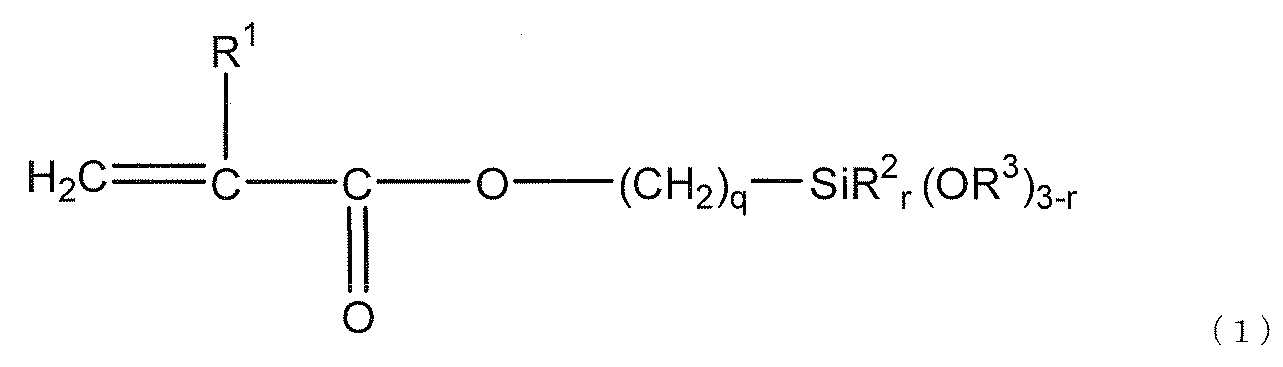
- the silane compound (e) represented by the following general formula (1) includes the (meth) acrylate having an alicyclic structure and (d) a polymerization initiator.
- R 1 represents a hydrogen atom or a methyl group
- R 2 represents an alkyl group having 1 to 3 carbon atoms or a phenyl group
- R 3 represents a hydrogen atom or a hydrocarbon group having 1 to 10 carbon atoms.
- Q is an integer from 1 to 6 and r is an integer from 0 to 2);
- R 4 represents an alkyl group having 1 to 3 carbon atoms or a phenyl group
- R 5 represents a hydrogen atom or a hydrocarbon group having 1 to 10 carbon atoms
- s is an integer of 0 to 6
- t is an integer from 0 to 2.
- the silica fine particles (a) are 5 to 25 parts by mass of the silane compound (e) with respect to 100 parts by mass of the silica fine particles (a) and 5 to The curable composition as described in [1] or [2] above, which is surface-treated with 25 parts by mass of the silane compound (f).
- the glass transition temperature of the homopolymer of the (meth) acrylate (b) and the glass transition temperature of the homopolymer of the (meth) acrylate (c) are both 150 ° C. or higher.
- a curable composition that can give a cured product excellent in transparency, heat resistance, environmental resistance and molding processability, and has excellent handling properties, and further provides the curable composition.
- the cured product is also provided.
- the curable composition of the present invention comprises (a) silica fine particles, (b) (meth) acrylate having 2 or more ethylenically unsaturated groups and having no ring structure (hereinafter simply referred to as “(meth) acrylate (b ))), (C) a (meth) acrylate having an ethylenically unsaturated group and an alicyclic structure (hereinafter also simply referred to as (meth) acrylate (c)), and (d) a polymerization initiator.
- the silica fine particles (a) are surface-treated with a specific silane compound.
- (meth) acrylate means methacrylate and / or acrylate.
- silica fine particles (a) used in the present invention those having an average particle diameter of 1 to 100 nm can be suitably used.
- the average particle diameter is less than 1 nm, the viscosity of the prepared curable composition increases, the content of the silica fine particles (a) in the curable composition is limited, and the dispersion in the curable composition is limited.
- a cured product obtained by curing the curable composition hereinafter also simply referred to as a cured product
- sufficient transparency and heat resistance tend to be not obtained.
- the average particle diameter exceeds 100 nm, the transparency of the cured product may deteriorate.
- the average particle diameter of the silica fine particles (a) is more preferably 1 to 50 nm, further preferably 5 to 50 nm, and most preferably 5 to 40 nm from the viewpoint of the balance between the viscosity of the curable composition and the transparency of the cured product. It is.
- the average particle size of the silica fine particles (a) was determined by observing the silica fine particles with a high-resolution transmission electron microscope (Hitachi Corp., H-9000 type), and arbitrarily selecting 100 silica particles from the observed fine particle image. A particle image can be selected and obtained as a number average particle size by a known image data statistical processing technique.
- silica fine particles having different average particle diameters may be mixed and used in order to increase the filling amount of the silica fine particles (a) into the cured product.
- silica fine particles (a) porous silica sol, or a composite metal oxide of aluminum, magnesium, zinc or the like and silicon may be used.
- the content of the silica fine particles (a) in the curable composition is preferably 20 to 80% by mass as the surface-treated silica fine particles, and the heat resistance and environmental resistance of the cured product and the viscosity of the curable composition. From the viewpoint of the balance, it is more preferably 40 to 60% by mass. Within this range, the fluidity of the curable composition and the dispersibility of the silica fine particles (a) in the curable composition are good. Therefore, if such a curable composition is used, sufficient strength and heat resistance can be obtained. And a cured product having environmental resistance can be easily produced.
- silica fine particles (a) it is preferable to use silica fine particles dispersed in an organic solvent from the viewpoint of dispersibility in the curable composition.
- organic solvent it is preferable to use a solvent in which organic components (such as (meth) acrylate (b) and (meth) acrylate (c) described later) contained in the curable composition are dissolved.
- organic solvent examples include alcohols, ketones, esters, and glycol ethers.
- Alcohol solvents such as butyl alcohol and n-propyl alcohol, and ketone organic solvents such as methyl ethyl ketone and methyl isobutyl ketone are preferred.
- isopropyl alcohol is particularly preferable.
- silica fine particles (a) dispersed in isopropyl alcohol are used, the viscosity of the curable composition after desolvation is lower than when other solvents are used, and the curable composition having a low viscosity is stabilized. Can be produced.
- silica fine particles dispersed in an organic solvent can be produced by a conventionally known method, and are commercially available, for example, under the trade name Snowtech IPA-ST (manufactured by Nissan Chemical Co., Ltd.).
- content of the silica particle (a) in the above-mentioned curable composition of this invention is the silica particle contained in a composition. Refers to the content of itself.
- silica fine particles (a) used in the present invention are surface-treated with the silane compound (e) and the silane compound (f). Each of these silane compounds will be described below.
- the silane compound (e) is represented by the following general formula (1).
- R 1 represents a hydrogen atom or a methyl group
- R 2 represents an alkyl group having 1 to 3 carbon atoms or a phenyl group
- R 3 represents a hydrogen atom or a hydrocarbon group having 1 to 10 carbon atoms.
- Q is an integer from 1 to 6
- r is an integer from 0 to 2.
- R 2 When r is 2, two R 2 may be the same or different, and when r is 1 or less, a plurality of R 3 may be the same or different.
- preferred R 2 is a methyl group
- preferred R 3 is an alkyl group having 1 to 3 carbon atoms
- more preferred R 3 is a methyl group.
- Preferred q is 3, and preferred r is 0.
- the silane compound (e) reduces the viscosity of the curable composition and improves the dispersion stability of the silica fine particles (a) in the curable composition by reacting with the (meth) acrylate (b) described later. For this reason, it is used to reduce curing shrinkage during curing of the curable composition and to impart molding processability to the cured product. That is, when the silica fine particles (a) are not surface-treated with the silane compound (e), the viscosity of the curable composition is increased, the curing shrinkage during curing is increased, the cured product becomes brittle, and the cured product becomes Since cracks are generated, it is not preferable.
- silane compound (e) examples include ⁇ -acryloxypropyldimethylmethoxysilane, ⁇ -acryloxypropylmethyldimethoxysilane, ⁇ -acryloxypropyldiethylmethoxysilane, ⁇ -acryloxypropylethyldimethoxysilane, and ⁇ -acryloxy.
- ⁇ -acryloxypropyldimethylmethoxysilane and ⁇ -acryloxypropylmethyldimethoxysilane are used.
- ⁇ -methacryloxypropyldimethylmethoxysilane, ⁇ -methacryloxypropylmethyldimethoxysilane, ⁇ -acryloxypropyltrimethoxysilane, and ⁇ -methacryloxypropyltrimethoxysilane are preferable, and ⁇ -acryloxypropyltrimethoxy is more preferable.
- Silane Moreover, these can be used in combination of 2 or more types.
- such a silane compound (e) can be manufactured by a well-known method, and is also marketed.
- the amount of the silane compound (e) used for the surface treatment of the silica fine particles (a) is usually 5 to 25 parts by mass, preferably 10 to 20 parts by mass, more preferably 100 parts by mass of the silica fine particles (a). 12 to 18 parts by mass.
- the amount of the silane compound (e) used is less than 5 parts by mass, the viscosity of the curable composition is increased, and the dispersibility of the silica fine particles (a) in the curable composition is deteriorated to cause gelation. there is a possibility.
- silica fine particles (a) when it exceeds 25 mass parts, aggregation of a silica fine particle (a) may be caused.
- the mass of the silica fine particles (a) refers to the mass of the silica fine particles themselves dispersed in the organic solvent. The surface treatment of the silica fine particles (a) will be described later.
- the silane compound (e) When a large amount of acrylate (acrylate (b) and acrylate (c) described later) is contained in the curable composition, the silane compound (e) has an acrylic group, that is, R 1 is a hydrogen atom. It is preferable to use a silane compound represented by the formula (1).
- the silane compound (e) when a large amount of methacrylate (methacrylate (b) and methacrylate (c) described later) is contained in the curable composition, the silane compound (e) contains a methacryl group, that is, R 1 is a methyl group. It is preferable to use a silane compound represented by the general formula (1). In these cases, a curing reaction tends to occur when the curable composition of the present invention is cured.
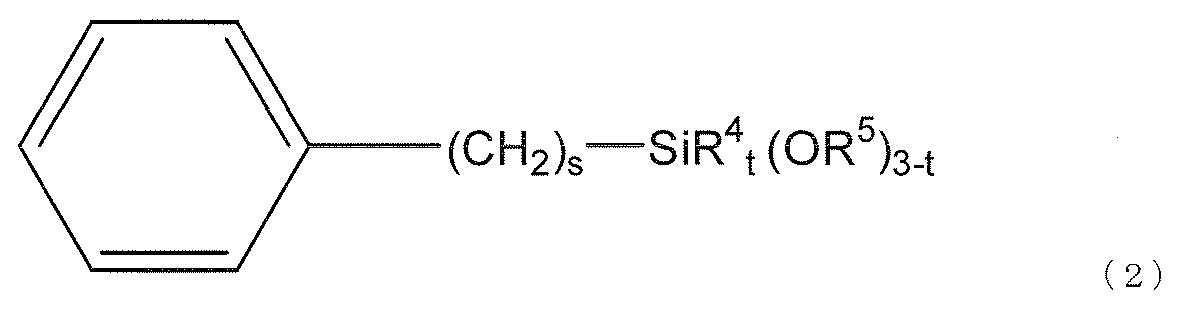
- silane compound (f) used in the present invention is represented by the following general formula (2).
- R 4 represents an alkyl group having 1 to 3 carbon atoms or a phenyl group
- R 5 represents a hydrogen atom or a hydrocarbon group having 1 to 10 carbon atoms
- s is an integer of 0 to 6 Yes
- t is an integer of 0-2.
- a substituent may be bonded to the phenyl group as long as the effects of the present invention are not impaired.
- R 4 When t is 2, two R 4 may be the same or different, and when t is 1 or less, a plurality of R 5 may be the same or different.
- preferred R 4 is a methyl group
- preferred R 5 is an alkyl group having 1 to 3 carbon atoms
- more preferred R 5 is a methyl group.
- Preferred s is 0 or 1
- preferred t is 0.
- silane compound (f) examples include phenyldimethylmethoxysilane, phenylmethyldimethoxysilane, phenyldiethylmethoxysilane, phenylethyldimethoxysilane, phenyltrimethoxysilane, phenyldimethylethoxysilane, phenylmethyldiethoxysilane, and phenyldiethylethoxysilane.
- phenyldimethylmethoxysilane phenylmethyldimethoxysilane, phenyldiethylmethoxysilane, phenylethyldimethoxysilane
- Phenyltrimethoxysilane is preferred, and phenyltrimethoxysilane is more preferred.
- These silane compounds can be used in combination of two or more.
- such a silane compound (f) can be manufactured by a well-known method, and is also marketed.
- the amount of the silane compound (f) used in the surface treatment of the silica fine particles (a) is usually 5 to 25 parts by weight, preferably 10 to 20 parts by weight, more preferably 100 parts by weight of the silica fine particles (a). 12 to 18 parts by mass.
- the usage-amount of a silane compound (f) is less than 5 mass parts, the viscosity of a curable composition may become high, gelling may be produced, or the heat resistance of hardened
- it exceeds 25 mass parts aggregation of a silica fine particle (a) may be caused.
- the mass of the silica fine particles (a) refers to the mass of the silica fine particles themselves dispersed in the organic solvent.
- the surface treatment of the silica fine particles (a) will be described later.
- the amount of the processing agent is too large. ) May cause aggregation and gelation due to a reaction between the silica particles during the surface treatment.
- the number of (meth) acrylates (b) having two or more ethylenically unsaturated groups and not having an alicyclic structure, aromatic ring or heterocyclic ring structure used in the present invention is preferably 2 to 6 Having an ethylenically unsaturated group.
- Examples of (meth) acrylate (b) include trimethylolpropane tri (meth) acrylate, pentaerythritol tri (meth) acrylate, pentaerythritol tetra (meth) acrylate, dipentaerythritol tetra (meth) acrylate, and dipentaerythritol penta.
- a cured product having excellent heat resistance is formed.
- those having three ethylenically unsaturated groups are preferred from the viewpoint of the heat resistance of the cured product, and those having a glass transition temperature of 150 ° C. or higher are preferred.
- trimethylolpropane tri (meth) acrylate having a glass transition temperature of a homopolymer of 200 ° C. or higher and relatively low curing shrinkage among polyfunctional (meth) acrylates is most preferable.
- the glass transition temperature of the homopolymer is measured by the following method. 100 parts by weight of (meth) acrylate (b) and 1 part by weight of diphenyl- (2,4,6-trimethylbenzoyl) phosphine oxide (trade name Speedcure TPO-L; manufactured by Nippon Sebel Hegner) as a photopolymerization initiator was applied to a glass substrate (50 mm ⁇ 50 mm) so that the thickness of the cured film was 100 ⁇ m, and the coating film was exposed to 3 J / cm 2 with an exposure apparatus incorporating an ultrahigh pressure mercury lamp. Is cured.
- tan ⁇ at the first temperature rise was measured with a DMS6100 (manufactured by Seiko Denshi Kogyo Co., Ltd.) in a tensile mode, a temperature range of 20 ° C. to 300 ° C., a temperature rise rate of 2 ° C./min, and a frequency of 1 Hz. From the peak temperature of the value, the glass transition temperature of the homopolymer can be determined.
- the amount of the (meth) acrylate (b) used in the present invention is preferably 20 to 500 parts by mass with respect to 100 parts by mass of the silica fine particles (a) before the surface treatment, and the viscosity of the curable composition From the viewpoint of the dispersion stability of the silica fine particles (a) in the curable composition and the heat resistance of the cured product, the amount is more preferably 30 to 300 parts by mass, still more preferably 50 to 200 parts by mass. If the blending amount is less than 20 parts by mass, the viscosity of the curable composition is increased, and gelation may occur. When the blending amount exceeds 500 parts by mass, shrinkage at the time of curing of the curable composition is increased, and the cured product may be warped or cracked.
- silica fine particles dispersed in an organic solvent are used as the silica fine particles (a)
- the mass of the silica fine particles (a) refers to the mass of the silica fine particles themselves dispersed in the organic solvent.
- the (meth) acrylate (c) having an ethylenically unsaturated group and an alicyclic structure used in the present invention imparts heat resistance and environmental resistance to the cured product and reduces shrinkage during curing. Used to do.
- the (meth) acrylate (c) usually has 1 to 4 ethylenically unsaturated groups.
- (meth) acrylates having one ethylenically unsaturated group and an alicyclic structure are preferably used.
- examples of such (meth) acrylates include cyclohexyl (meth) acrylate and 4-butylcyclohexyl.
- (Meth) acrylate dicyclopentanyl (meth) acrylate, dicyclopentenyl (meth) acrylate, dicyclopentadienyl (meth) acrylate, bornyl (meth) acrylate, isobornyl (meth) acrylate, tricyclodecanyl (meth) And cycloalkyl (meth) acrylates such as acrylate, tricyclodecane dimethanol diacrylate, and adamantyl (meth) acrylate.
- (meth) acrylate (h) is preferably (meth) acrylate having a glass transition temperature of 150 ° C. or higher as the homopolymer.
- the method for measuring the glass transition temperature of the homopolymer is the same as described above.
- dicyclopentanyl (meth) acrylate and adamantyl (meth) acrylate are preferable from the viewpoint of transparency, heat resistance, and environment resistance of the cured product, and a glass transition of a homopolymer.
- adamantyl (meth) acrylate which has a high temperature.
- the alicyclic structure is a structure excluding an aromatic ring structure among structures in which carbon atoms are bonded in a ring shape.
- the amount of (meth) acrylate (c) used in the present invention is preferably 5 to 400 parts by mass with respect to 100 parts by mass of the silica fine particles (a) before the surface treatment, and the viscosity of the curable composition From the viewpoint of the dispersion stability of the silica fine particles (a) in the curable composition and the heat resistance of the cured product, the amount is more preferably 10 to 200 parts by mass, still more preferably 20 to 100 parts by mass. When the blending amount is less than 5 parts by mass, the viscosity of the curable composition is increased, and gelation may occur.
- the mass of the silica fine particles (a) refers to the mass of the silica fine particles themselves dispersed in the organic solvent.
- Examples of the polymerization initiator (d) used in the present invention include a photopolymerization initiator that generates radicals and a thermal polymerization initiator.
- photopolymerization initiator examples include benzophenone, benzoin methyl ether, benzoin propyl ether, diethoxyacetophenone, 1-hydroxy-phenylphenyl ketone, 2,6-dimethylbenzoyldiphenylphosphine oxide, 2,4,6-trimethylbenzoyldiphenylphosphine. Oxides and diphenyl- (2,4,6-trimethylbenzoyl) phosphine oxide. Two or more of these photopolymerization initiators may be used in combination.
- the content of the photopolymerization initiator in the curable composition may be an amount that allows the curable composition to be appropriately cured, and (meth) acrylate (b), methacrylate (c), and a reactive diluent described later.
- the total amount is preferably 0.01 to 10 parts by mass, more preferably 0.02 to 5 parts by mass, and still more preferably 0.1 to 2 parts by mass. If the addition amount of the photopolymerization initiator is too large, the storage stability of the curable composition is lowered, colored, or the crosslinking at the time of crosslinking to obtain a cured product rapidly proceeds, such as cracks during curing. Problems may occur. Moreover, when there are too few addition amounts of a photoinitiator, a curable composition may not fully be hardened.
- thermal polymerization initiator examples include benzoyl peroxide, diisopropyl peroxycarbonate, t-butyl peroxy (2-ethylhexanoate) and the like.
- the content of the thermal polymerization initiator in the curable composition is preferably 2 parts by mass or less, more preferably 0.1 to 2 parts by mass with respect to 100 parts by mass of the curable composition.
- the curable composition of the present invention is, as necessary, a leveling agent, an antioxidant, an ultraviolet absorber, a solvent, as long as the viscosity of the composition and the properties of the cured product, such as transparency and heat resistance, are not impaired.
- a leveling agent an antioxidant, an ultraviolet absorber, a solvent
- leveling agents include polyether-modified dimethylpolysiloxane copolymer, polyester-modified dimethylpolysiloxane copolymer, polyether-modified methylalkylpolysiloxane copolymer, aralkyl-modified methylalkylpolysiloxane copolymer, and polyether-modified. Examples thereof include methylalkylpolysiloxane copolymer.
- filler or pigment examples include calcium carbonate, talc, mica, clay, Aerosil (registered trademark), barium sulfate, aluminum hydroxide, zinc stearate, zinc white, bengara, azo pigment, and the like.
- the curable composition of the present invention containing such various components, B-type viscometer DV-II + Pro (manufactured by BROOKFIELD), 25 ° C., rotor No.
- the viscosity measured at 63 at a rotational speed of 60 rpm is usually 30 to 300 mPa ⁇ s, and it has an extremely low viscosity even when it does not contain a solvent, and has good handling properties. This is because the silica fine particles (a) have a high compatibility with the (meth) acrylates (b) and (c), (meth) acrylates (b) and (c). This is due to the high dispersion stability of the silica fine particles (a) therein.
- the curable composition of the present invention includes, for example, a step of surface-treating colloidal silica (silica fine particles (a)) dispersed in an organic solvent with silane compounds (e) and (f) (step 1), and surface-treated silica fine particles.
- Step (Step 2) of adding (meth) acrylate (b) and (c) to (a) and uniformly mixing (silica fine particles (a) obtained in Step 2 and (meth) acrylate (b) and (c) The step of distilling off and removing the organic solvent and water from the homogeneous mixed solution (step 3), adding the polymerization initiator (d) to the composition distilled off and removing the solvent in step 3, and mixing them uniformly It can manufacture by performing the process (process 4) made into a curable composition sequentially. Each step will be described below.
- step 1 the silica fine particles (a) are surface-treated with the silane compounds (e) and (f).
- the silica fine particles (a) are put into a reactor, and while stirring, the silane compounds (e) and (f) are added, mixed with stirring, and water necessary for further hydrolyzing the silane compound.
- the silane compound is hydrolyzed, and the hydrolyzate of the silane compound is subjected to condensation polymerization on the surface of the silica fine particles (a).
- silica fine particles dispersed in an organic solvent as the silica fine particles (a).
- the disappearance due to hydrolysis of the silane compound can be confirmed by gas chromatography.
- a non-polar column DB-1 manufactured by J & W
- gas chromatography Alignment Co., Ltd. Model 6850
- temperature 50 to 300 ° C. heating rate 10 ° C./min
- He He
- the residual amount of the silane compound can be measured by an internal standard method with a flow rate of 1.2 cc / min and a flame ionization detector, disappearance due to hydrolysis of the silane compound can be confirmed.
- the amount of the silane compound (e) used in the surface treatment of the silica fine particles (a) is usually 5 to 25 parts by mass, preferably 10 to 20 parts per 100 parts by mass of the silica fine particles (a). Part by mass, more preferably 12 to 18 parts by mass.
- the amount of the silane compound (f) used is usually 5 to 25 parts by mass, preferably 10 to 20 parts by mass, more preferably 12 to 18 parts by mass with respect to 100 parts by mass of the silica fine particles (a).
- the lower limit of the amount of water required for carrying out the hydrolysis reaction is 1 times the total number of moles of alkoxy groups and hydroxy groups bonded to the silane compounds (e) and (f), and the upper limit is 10 times. . If the amount of water is too small, the hydrolysis rate may become extremely slow, resulting in lack of economic efficiency, or the surface treatment may not proceed sufficiently. Conversely, if the amount of water is excessively large, the silica fine particles (a) may form a gel.
- a catalyst for the hydrolysis reaction When performing the hydrolysis reaction, a catalyst for the hydrolysis reaction is usually used.
- a catalyst include, for example, inorganic acids such as hydrochloric acid, acetic acid, sulfuric acid, phosphoric acid; Organic acids such as formic acid, propionic acid, oxalic acid, p-toluenesulfonic acid, benzoic acid, phthalic acid, maleic acid; Alkali catalysts such as potassium hydroxide, sodium hydroxide, calcium hydroxide, ammonia; organic metals; Metal alkoxides; Organotin compounds such as dibutyltin dilaurate, dibutyltin dioctylate, dibutyltin diacetate; Aluminum tris (acetylacetonate), titanium tetrakis (acetylacetonate), titanium bis (butoxy) bis (acetylacetonate), titanium bis (isopropoxy) bis (acetylacetonate), zir
- hydrochloric acid, acetic acid, maleic acid, and boron compounds are preferable from the viewpoints of solubility in water and sufficient hydrolysis rate.
- These catalysts can be used alone or in combination of two or more.
- Step 1 when the hydrolysis reaction of the silane compounds (e) and (f) is performed, a water-insoluble catalyst may be used, but a water-soluble catalyst is preferably used.
- a water-soluble catalyst for hydrolysis reaction it is preferable to dissolve the water-soluble catalyst in an appropriate amount of water and add it to the reaction system because the catalyst can be uniformly dispersed.
- the addition amount of the catalyst used for the hydrolysis reaction is not particularly limited, but is usually 0.1 to 10 parts by mass, preferably 0.5 to 5 parts by mass with respect to 100 parts by mass of the silica fine particles (a).
- the mass of the silica fine particles (a) refers to the mass of the silica fine particles themselves dispersed in the organic solvent.
- the reaction temperature of the hydrolysis reaction is not particularly limited, but is usually in the range of 10 to 80 ° C, preferably in the range of 20 to 50 ° C. If the reaction temperature is excessively low, the hydrolysis rate may be extremely slow, resulting in lack of economic efficiency, and the surface treatment may not proceed sufficiently. When the reaction temperature is excessively high, the gelation reaction tends to occur.
- the reaction time for carrying out the hydrolysis reaction is not particularly limited, but is usually in the range of 10 minutes to 48 hours, preferably 30 minutes to 24 hours.
- the surface treatment with the silane compound (e) and the silane compound (f) in step 1 may be performed sequentially, but it is preferable to perform the surface treatment at the same time from the viewpoint of simplification and efficiency of the reaction process.
- step 2 there is no particular limitation on the method of mixing the surface-treated silica fine particles (a) and (meth) acrylates (b) and (c).
- a mixing method for example, a method of mixing with a mixer such as a mixer, a ball mill, or a three roll at room temperature or under heating conditions, or (meth) acrylate (b ) And (c) are added and mixed.
- Step 3 To distill off and remove the organic solvent and water from the homogeneous mixture of silica fine particles (a) and (meth) acrylates (b) and (c) in step 3 (hereinafter collectively referred to as desolvation) It is preferable to heat in a reduced pressure state.
- the temperature is preferably maintained at 20 to 100 ° C., and more preferably 30 to 70 ° C., and further preferably 30 to 50 ° C. in terms of the balance between aggregation gelation prevention and the solvent removal speed. If the temperature is raised too much, the fluidity of the curable composition may be extremely lowered, or the curable composition may be gelled.
- the degree of vacuum at the time of depressurization is usually 10 to 4000 kPa, more preferably 10 to 1000 kPa, and most preferably 10 to 500 kPa in order to balance the solvent removal speed and the prevention of aggregation gelation. If the value of the degree of vacuum is too large, the solvent removal speed becomes extremely slow, which is economical.
- the composition after desolvation contains substantially no solvent.
- substantially means that it is not necessary to go through the step of removing the solvent again when actually obtaining a cured product using the curable composition of the present invention.
- the remaining amount of the organic solvent and water in the curable composition is preferably 1% by mass or less, preferably 0.5% by mass or less, and more preferably 0.1% by mass or less.
- a polymerization inhibitor may be added to 100 parts by mass of the composition after desolvation before desolvation.
- the polymerization inhibitor is used to prevent components contained in the composition from undergoing a polymerization reaction during the solvent removal process or during storage of the composition after the solvent removal and the curable composition.
- the polymerization inhibitor include hydroquinone, hydroquinone monomethyl ether, benzoquinone, pt-butylcatechol, 2,6-di-tert-butyl-4-methylphenol, and the like. These can be used alone or in combination of two or more.
- Step 3 can be performed by transferring the homogeneous mixed liquid of silica fine particles (a) and (meth) acrylates (b) and (c) that have passed through Step 2 to a dedicated apparatus. If carried out in the reactor carried out, it can be carried out in the reactor subsequent to step 2.
- step 4 there is no particular limitation on the method of adding the polymerization initiator (d) to the composition desolvated in step 3 and mixing them uniformly.
- a uniform mixing method for example, a method of mixing with a mixer such as a mixer, a ball mill, or a three roll at room temperature, or a polymerization initiator (d) while continuously stirring in the reactor in which Steps 1 to 3 were performed. The method of adding and mixing is mentioned.
- the curable composition obtained by adding and mixing such a polymerization initiator (d) may be filtered as necessary. This filtration is performed for the purpose of removing foreign substances such as dust in the curable composition.
- the filtration method is not particularly limited, but a method of pressure filtration using a membrane type or cartridge type filter having a pressure filtration pore size of 1.0 ⁇ m is preferable.
- the curable composition of the present invention can be produced through the above steps.
- the silica fine particles (a) which is a constituent component, are treated with a specific silane compound, so that the viscosity is low and the handling property is good even if it does not contain a solvent.
- the curable composition of the present invention is cured to provide an optical lens, an optical disk substrate, a plastic substrate for a liquid crystal display element, a color filter substrate, a plastic substrate for an organic EL display element, a solar cell substrate, a touch panel, an optical element, and a light guide. It becomes hardened
- a cured product is obtained by curing the curable composition of the present invention.
- the curing method include a method of crosslinking the ethylenically unsaturated groups of (meth) acrylates (b) and (c) by irradiation with active energy rays, a method of thermally polymerizing the ethylenically unsaturated groups by applying heat, and the like. Yes, these can be used in combination.
- a photopolymerization initiator is contained in the curable composition in the above step 4.
- a thermal polymerization initiator is contained in the curable composition.
- the cured product of the present invention is formed by coating the curable composition of the present invention on a substrate such as a glass plate, a plastic plate, a metal plate, or a silicon wafer to form a coating film. It can be obtained by irradiation with active energy rays or by heating. For curing, both irradiation with active energy rays and heating may be performed.
- Examples of the method of applying the curable composition include application by a bar coater, applicator, die coater, spin coater, spray coater, curtain coater, roll coater, etc., application by screen printing, and application by dipping.
- the amount of application of the curable composition of the present invention on the substrate is not particularly limited, and can be appropriately adjusted according to the purpose.
- the film thickness of the coating film obtained after the curing treatment by active energy ray irradiation and / or heating is preferably 1 to 200 ⁇ m, and more preferably 5 to 100 ⁇ m.
- the active energy ray used for curing is preferably an electron beam or light in the ultraviolet to infrared wavelength range.
- the light source of the active energy ray for example, an ultra-high pressure mercury light source or a metal halide light source can be used for ultraviolet rays, a metal halide light source or a halogen light source can be used for visible rays, and a halogen light source can be used for infrared rays.
- Light sources such as LEDs can be used.
- the irradiation amount of the active energy ray is appropriately set according to the type of the light source, the film thickness of the coating film, etc., but preferably the reaction rate of the ethylenically unsaturated groups of (meth) acrylate (b) and (c). It can be appropriately set to be 80% or more, more preferably 90% or more.
- curing may be further advanced by heat treatment (annealing treatment).
- the heating temperature at that time is preferably in the range of 80 to 200 ° C.
- the heating time is preferably in the range of 10 minutes to 60 minutes.
- the heating temperature is preferably in the range of 80 to 200 ° C, more preferably in the range of 100 to 150 ° C.
- the heating temperature is lower than 80 ° C., it is necessary to lengthen the heating time, and the economy tends to be lacking.
- the heating temperature is higher than 200 ° C., energy costs are required, and heating heating time and cooling time are required, which tends to be economical.
- the heating time is appropriately set according to the heating temperature, the film thickness of the coating film, etc., but preferably the reaction rate of the ethylenically unsaturated groups of (meth) acrylate (b) and (c) is 80% or more. Preferably, it can be set appropriately to be 90% or more.
- the curing may be further advanced by heat treatment (annealing treatment) as necessary.
- the heating temperature at that time is preferably in the range of 150 to 200 ° C.
- the heating time is preferably in the range of 5 minutes to 60 minutes.
- the cured product of the present invention is excellent in transparency, heat resistance, environment resistance and molding processability, it is an optical lens, a plastic substrate for liquid crystal display elements, a substrate for color filters, a plastic substrate for organic EL display elements, and a solar cell. It can be suitably used as a substrate, a touch panel, an optical element, an optical waveguide, an LED sealing material and the like.
- the refractive index of the cured product can be appropriately selected depending on the application. And since the hardened
- a 5% weight reduction temperature when heated in a nitrogen atmosphere is usually 330 ° C. or higher, and 350 ° C. or higher, and further 380 ° C. or higher can be obtained.
- the 5% weight loss temperature when heated is below 330 ° C., for example, when this cured product is used for an active matrix display element substrate, problems such as warpage and deflection, and in some cases, cracks occur in the manufacturing process. There is a fear.
- the cured product of the present invention is obtained by curing a curable composition containing (meth) acrylates (b) and (c) having a high glass transition temperature of the homopolymer, and is excellent in heat resistance. .
- the cured product of the present invention has a high glass transition temperature.
- the glass transition temperature of the cured product is determined from the peak temperature of the loss tangent tan ⁇ value measured at a frequency of 1 Hz using a dynamic viscoelasticity measurement method, and is usually 200 ° C. or higher, preferably 230 ° C. or higher.
- the glass transition temperature is less than 200 ° C., if this cured product is used for an active matrix display element substrate, problems such as warpage and deflection, and in some cases, cracking may occur in the manufacturing process.
- the cured product of the present invention is excellent in transparency, it is possible to obtain a cured film having a thickness of 100 ⁇ m and a light transmittance of a wavelength of 400 nm of 85% or more, and three heat treatments at 270 ° C. for 1 minute.
- the amount of change in transmittance at a wavelength of 400 nm before and after is usually 3% or less.
- the efficiency of using light is lowered, which is not preferable for applications where light efficiency is important.
- the change in transmittance at a wavelength of 400 nm before and after three heat treatments at 270 ° C. for 1 minute exceeds 3%, when this cured product is used for an active matrix display element substrate, it is colored in the manufacturing process. Problems may arise.
- the cured product of the present invention has a water absorption rate of 2% by mass or less, preferably 1.5% by mass or less, more preferably 1.0% by mass with respect to 100% by mass of the cured product when immersed in water for 24 hours. % Or less.
- the cured product of the present invention has a refractive index change amount of 0.001 or less before and after being immersed in water for 24 hours, preferably 0.0008 or less, more preferably 0.0005 or less.
- the amount of change in the refractive index exceeds 0.001
- the cured product of the present invention is applied to an optical lens or an optical waveguide, the focal length of the light shifts when water is absorbed in the use environment. This is not preferable because image accuracy is lowered and light propagation efficiency is lowered.
- the cured product of the present invention has a refractive index change of 0.001 or less before and after storage at 85 ° C. and 85% saturated humidity for 50 hours, preferably 0.0008 or less, more preferably 0.0005 or less. It is.
- the amount of change in the refractive index exceeds 0.001
- the cured product of the present invention is applied to an optical lens or an optical waveguide, the focal length of the light shifts when water is absorbed in the use environment. This is not preferable because image accuracy is lowered and light propagation efficiency is lowered.
- As a material conventionally used for optical lenses and the like there is polymethyl methacrylate, and the refractive index change amount before and after storage for 50 hours in 85 ° C. and 85% saturated humidity is 0.0015 (1.4912 ⁇ 1.4897). ) And big. The reason for this is considered to be that the cured film swells due to water absorption in a high temperature and high humidity environment.
- the cured product of the present invention has an absolute value of the temperature dependence coefficient of the refractive index at a temperature of 25 ° C. to 55 ° C. of 6.0 ⁇ 10 ⁇ 5 / ° C. or less, preferably 5.0 ⁇ 10 ⁇ 5 / ° C. Hereinafter, it is more preferably 4.0 ⁇ 10 ⁇ 5 / ° C. or less.
- the absolute value of the refractive index temperature dependency coefficient exceeds 6.0 ⁇ 10 ⁇ 5 / ° C., for example, when the cured product of the present invention is applied to an optical lens or an optical waveguide, the temperature changes under the use environment.
- the focal length of the light is shifted, so that the image accuracy is lowered and the light propagation efficiency is lowered.
- a material conventionally used for optical lenses and the like there is polymethyl methacrylate.
- the absolute value of the temperature dependence coefficient of the refractive index is 10.5 ⁇ 10 ⁇ 5 / ° C., and the refractive index with respect to the temperature change. The change is great.
- the refractive index temperature dependence coefficient refers to the slope when the refractive index is measured using a refractometer while changing the measurement temperature in increments of 5 ° C. from 25 ° C. to 55 ° C., and the refractive index is plotted against the measurement temperature. .
- Example 1 In a separable flask, 100 parts by mass of isopropyl alcohol-dispersed colloidal silica (silica content 30% by mass, average particle size 10 to 20 nm, trade name Snowtech IPA-ST; manufactured by Nissan Chemical Co., Ltd.) is placed.
- Diphenyl- (2,4,6-trimethylbenzoyl) phosphine oxide (trade name Speedcure® TPO-L; Nippon Sebel Hegner Co., Ltd.) was added as a photopolymerization initiator to 84.9 parts by mass of the mother liquor obtained by removing this volatile matter. )) 0.845 parts by mass was dissolved, and the resulting solution was subjected to pressure filtration (pressure 0.2 MPa) with a membrane filter (pore diameter 1.0 ⁇ m) to obtain a curable composition 1.
- the viscosity of the curable composition 1 obtained was 74 mPa ⁇ s.
- the viscosity was measured using a B-type viscometer DV-II + Pro (manufactured by BROOKFIELD) with a rotor No. It measured at 63, rotation speed 60rpm, 25 degreeC.
- Example 2 In a separable flask, 100 parts by mass of isopropyl alcohol-dispersed colloidal silica (silica content 30% by mass, average particle size 10 to 20 nm, trade name Snowtech IPA-ST; manufactured by Nissan Chemical Co., Ltd.) is placed. 5.4 parts by mass of ⁇ -methacryloxypropyltrimethoxysilane and 3.6 parts by mass of phenyltrimethoxysilane were mixed with stirring, and 2.9 parts by mass of a 0.1825% by mass HCl solution was further added. The silica fine particles were surface-treated by stirring for 24 hours.
- silica fine particles were surface-treated by stirring for 24 hours.
- 37.5 parts by mass of trimethylolpropane triacrylate (trade name: Biscote # 295; manufactured by Osaka Organic Chemical Co., Ltd., Tg> 250 ° C.) and adamantyl methacrylate (trade name: ADMA; 7.5 parts by mass of Osaka Organic Chemical Co., Ltd. (Tg 180 ° C.) was added and mixed uniformly. Thereafter, the mixture was heated under reduced pressure at 40 ° C. and 100 kPa while stirring to remove volatile components. The amount of volatile matter removed was 72.4 parts by mass.
- t-butylperoxy (2-ethylhexanoate) (trade name perbutyl O; manufactured by NOF Corporation) as a thermal polymerization initiator was added. 845 parts by mass were dissolved, and the resulting solution was subjected to pressure filtration (pressure 0.2 MPa) with a membrane filter (pore diameter 1.0 ⁇ m) to obtain a curable composition 2.
- the solvent concentration in the obtained curable composition 2 was increased by a gas chromatography (Model 6850 manufactured by Agilent) using a nonpolar column DB-1 (manufactured by J & W) at a temperature of 50 to 300 ° C.
- the temperature was measured at 10 ° C./min, He was used as a carrier gas, the flow rate was 1.2 cc / min, and the internal standard method was used with a flame ionization detector.
- the isopropyl alcohol concentration was 0.82% by mass
- the methanol concentration was 0.03% by mass
- the water concentration was 0.10% by mass.
- the viscosity of the obtained curable composition 2 was 231 mPa ⁇ s.
- Example 2 A curable composition 4 was obtained in the same manner as in Example 1 except that ⁇ -methacryloxypropyltrimethoxysilane was not used and the amount of 0.1825 mass% HCl solution was changed to 1.6 parts by mass. .
- the viscosity of the obtained curable composition 4 was 114 mPa ⁇ s.
- Comparative Example 6 In the same manner as in Comparative Example 4, except that 45 parts by mass of dicyclopentadienyl diacrylate (trade name: Light acrylate DCP-A; manufactured by Kyoeisha Chemical Co., Ltd.) was used instead of trimethylolpropane triacrylate and adamantyl methacrylate. Thus, a curable composition 8 was obtained.
- dicyclopentadienyl diacrylate (trade name: Light acrylate DCP-A; manufactured by Kyoeisha Chemical Co., Ltd.) was used instead of trimethylolpropane triacrylate and adamantyl methacrylate.
- Comparative Example 7 In the same manner as in Comparative Example 5, except that 45 parts by mass of dicyclopentadienyl diacrylate (trade name: Light acrylate DCP-A; manufactured by Kyoeisha Chemical Co., Ltd.) was used instead of trimethylolpropane triacrylate and adamantyl methacrylate. Thus, a curable composition 9 was obtained. The resulting curable composition 9 was gelled.
- dicyclopentadienyl diacrylate trade name: Light acrylate DCP-A; manufactured by Kyoeisha Chemical Co., Ltd.
- composition of each component used for the preparation of the above curable composition is shown in Table 1 below.
- Example 1 [Preparation of cured film] ⁇ Active energy ray curing>
- the curable composition was applied on a separate glass substrate (50 mm ⁇ 50 mm) so that the thickness of the cured film was 100 ⁇ m, and the exposure apparatus incorporated an ultrahigh pressure mercury lamp with 3J. / Cm 2 exposure to cure the coating film. Thereafter, annealing was performed at 180 ° C. for 30 minutes.
- the curable composition 2 of Example 2 was applied onto a glass substrate (50 mm ⁇ 50 mm) so that the thickness of the cured film was 100 ⁇ m, and the coating film was cured by heat treatment at 140 ° C. for 10 minutes. Thereafter, annealing was performed at 180 ° C. for 30 minutes.
- A It can be processed (peeled) without causing cracks or cracks.
- B No cracking occurs but some cracks occur.
- C Cracking occurs and processing (peeling) properties are poor.
- ⁇ Transmissivity> The obtained cured film was subjected to heat treatment at 270 ° C. for 1 min three times, and the transmittance (T%) of light having a wavelength of 400 nm before and after was measured in accordance with JIS-K7105 using a spectrophotometer (JASCO Corporation ), UV3100). The results are shown in Table 2. The better the cured film, the greater the transmittance value and the smaller the transmittance change before and after the heat treatment.
- ⁇ Refractive index> The refractive index before and after the obtained cured film was heat-treated three times at 270 ° C. for 1 minute was measured at a measurement temperature of 25 ° C. using a multi-wavelength Abbe refractometer DR-M2 (manufactured by Atago). did. The results are shown in Table 2. The smaller the refractive index change before and after the heat treatment, the better the cured film.
- ⁇ Glass transition temperature Tg> Using the DMS6100 (manufactured by Seiko Denshi Kogyo Co., Ltd.), the cured film obtained was tan ⁇ value at the first temperature rise in the tensile mode, temperature range 20 ° C to 300 ° C, temperature rise rate 2 ° C / min, frequency 1 Hz. And the temperature at the peak of the tan ⁇ value was defined as the glass transition temperature. The results are shown in Table 2. The higher the glass transition point, the better the heat resistance of the cured film.
- ⁇ Temperature dependence coefficient of refractive index> For the cured films obtained in the examples, the refractive index was measured using a multi-wavelength Abbe refractometer DR-M2 (manufactured by Atago Co., Ltd.) while changing the measurement temperature in increments of 5 ° C. from 25 ° C. to 55 ° C. The absolute value of the gradient when the refractive index with respect to the temperature was plotted was taken as the refractive index temperature dependent coefficient. The results are shown in Table 3. The smaller the value, the better the cured film has environmental resistance.
- Examples 1 and 2 have good handling properties because the curable composition has a low viscosity, and the molded cured film has excellent molding processability and excellent transparency and heat resistance. It is.
- Comparative Examples 5 and 7 the dispersibility of the silica fine particles in the curable composition was extremely poor, and gelation occurred during the preparation of the cured product. Comparative Examples 4 and 6 have poor moldability. In Comparative Example 2, the moldability is insufficient and the dispersibility of the silica fine particles is poor, so the transmittance at 400 nm is low and the transparency is poor.
- Comparative Examples 1 and 3 are excellent in moldability, the dispersibility of the silica fine particles in the curable composition is still insufficient, so that the cured product is inferior in heat resistance and is subjected to heat treatment at 270 ° C. for 3 minutes. The decrease in transmittance at 400 nm is large.
- Example 1 and Example 2 have water absorption ratios of 0.88% and 1.26% after 24 hours of water immersion, almost no change in refractive index before and after the water absorption, and excellent environmental resistance. Yes.
- Example 1 the molded cured product of Example 2, the absolute value of the temperature dependence coefficient of the refractive index, respectively 4.1 ⁇ 10 -5 /°C,4.5 ⁇ 10 -5 / °C .
- the polymethylmethacrylate conventionally used in optical lenses has an absolute value of the temperature dependence coefficient of the refractive index of 10.5 ⁇ 10 ⁇ 5 / ° C.
- the amount of change in refractive index with respect to temperature is less than half that of polymethyl methacrylate. That is, the cured product of the present invention is less dependent on the temperature of the refractive index and has excellent environmental resistance.
- the curable composition of the present invention containing silica fine particles surface-treated with two specific silane compounds, two specific (meth) acrylates, and a polymerization initiator has low viscosity and good handling properties. is there.
- a cured product having a low water absorption, a small change in refractive index with respect to a temperature change, and excellent environmental resistance that can be suitably used for an optical lens, an optical waveguide, or the like is provided.
Landscapes
- Chemical & Material Sciences (AREA)
- Organic Chemistry (AREA)
- Health & Medical Sciences (AREA)
- Chemical Kinetics & Catalysis (AREA)
- Medicinal Chemistry (AREA)
- Polymers & Plastics (AREA)
- Engineering & Computer Science (AREA)
- Nanotechnology (AREA)
- Materials Engineering (AREA)
- General Physics & Mathematics (AREA)
- Condensed Matter Physics & Semiconductors (AREA)
- Composite Materials (AREA)
- Crystallography & Structural Chemistry (AREA)
- Physics & Mathematics (AREA)
- Inorganic Chemistry (AREA)
- Polymerisation Methods In General (AREA)
- Compositions Of Macromolecular Compounds (AREA)
- Addition Polymer Or Copolymer, Post-Treatments, Or Chemical Modifications (AREA)
- Macromonomer-Based Addition Polymer (AREA)
- Graft Or Block Polymers (AREA)
Abstract
Description
(1)無機膜と基板との密着性が悪い。
(2)基板から無機膜が剥離したり、基板に割れ等が発生する。
上記(2)の問題は、無機膜および硬化して基板となる樹脂組成物の硬化時の収縮の差が大きい等の理由から生じる。
(1)透明板、光学レンズ、光ディスク基板、液晶表示素子用プラスチック基板、カラーフィルター用基板、有機EL表示素子用プラスチック基板、太陽電池基板、タッチパネル、光学素子、光導波路、LED封止材等に好適に用いることができる
(2)透明性、耐熱性、耐環境性および成形加工性に優れる。
[1](a)シリカ微粒子と、(b)2以上のエチレン性不飽和基を有し且つ環構造を有しない(メタ)アクリレートと、(c)1つのエチレン性不飽和基を有し且つ脂環式構造を有する(メタ)アクリレートと、(d)重合開始剤とを含み、前記シリカ微粒子(a)が、下記一般式(1)で表されるシラン化合物(e)及び下記一般式(2)で表されるシラン化合物(f)で表面処理されていることを特徴とする硬化性組成物:

[6]上記[1]~[5]のいずれかに記載の硬化性組成物を硬化させてなる硬化物。
[硬化性組成物]
本発明の硬化性組成物は、(a)シリカ微粒子と、(b)2以上のエチレン性不飽和基を有し且つ環構造を有しない(メタ)アクリレート(以下単に「(メタ)アクリレート(b)」ともいう)と、(c)エチレン性不飽和基を有し且つ脂環式構造を有する(メタ)アクリレート(以下単に(メタ)アクリレート(c)ともいう)と、(d)重合開始剤とを含み、前記シリカ微粒子(a)が、特定のシラン化合物で表面処理されていることを特徴している。以下これら各構成要素について説明する。尚、ここで(メタ)アクリレートとは、メタクリレート及び/またはアクリレートを意味する。
本発明で用いられるシリカ微粒子(a)としては、平均粒子径が1~100nmのものを好適に用いることができる。平均粒子径が1nm未満であると、作製した硬化性組成物の粘度が増大し、シリカ微粒子(a)の硬化性組成物中での含有量が制限されるとともに硬化性組成物中での分散性が悪化し、硬化性組成物を硬化させて得られる硬化物(以下単に硬化物とも言う)において十分な透明性および耐熱性を得ることができない傾向がある。また、平均粒子径が100nmを越えると硬化物の透明性が悪化する場合がある。
<(e)シラン化合物>
前記シラン化合物(e)は、下記一般式(1)で表される。
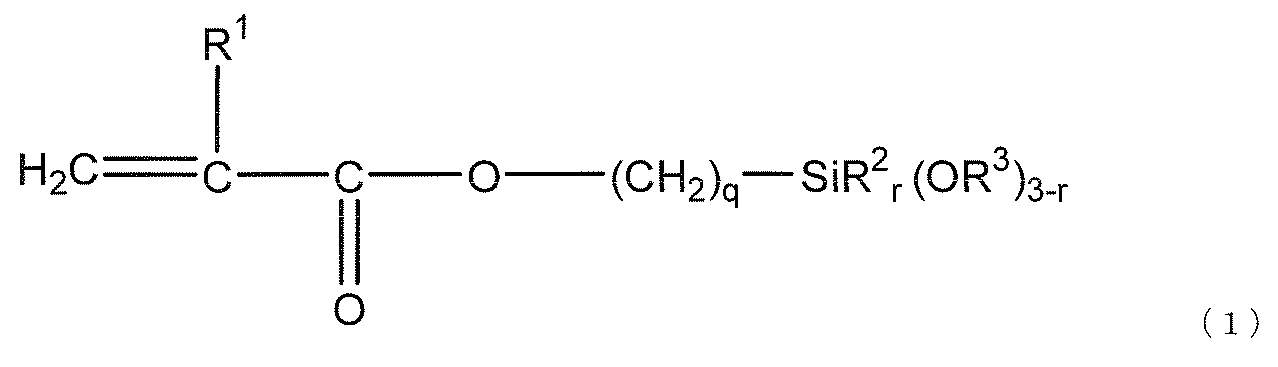
硬化性組成物の粘度の低減、保存安定性の点から、好ましいR2はメチル基であり、好ましいR3は炭素数1~3のアルキル基であり、さらに好ましいR3はメチル基であり、好ましいqは3であり、好ましいrは0である。
シリカ微粒子(a)を表面処理する際のシラン化合物(e)の使用量は、シリカ微粒子(a)100質量部に対して通常5~25質量部、好ましくは10~20質量部、より好ましくは12~18質量部である。シラン化合物(e)の使用量が5質量部未満であると、硬化性組成物の粘度が高くなり、シリカ微粒子(a)の硬化性組成物中への分散性が悪化してゲル化を生じる可能性がある。また、25質量部を超えると、シリカ微粒子(a)の凝集を引き起こすことがある。なお、シリカ微粒子(a)として有機溶媒に分散したシリカ微粒子を使用する場合は、前記シリカ微粒子(a)の質量は、有機溶媒に分散したシリカ微粒子そのもののみの質量を指す。また、シリカ微粒子(a)の表面処理については後述する。
本発明で用いられるシラン化合物(f)は、下記一般式(2)で表される。

硬化性組成物の粘度の低減、保存安定性の点から、好ましいR4はメチル基であり、好ましいR5は炭素数1~3のアルキル基であり、さらに好ましいR5はメチル基であり、好ましいsは0又は1であり、好ましいtは0である。
(1)シリカ微粒子(a)の表面に疎水性が付与される
(2)前記有機溶媒中でのシリカ微粒子(a)の分散性が向上する
(3)後述する(メタ)アクリレート(c)との良好な相溶性により硬化性組成物の粘度が低減する
(4)硬化性組成物の保存安定性が向上すると同時に、吸水率が低くなる。
シリカ微粒子(a)を表面処理する際のシラン化合物(f)の使用量は、シリカ微粒子(a)100質量部に対して通常5~25質量部、好ましくは10~20質量部、より好ましくは12~18質量部である。シラン化合物(f)の使用量が5質量部未満であると、硬化性組成物の粘度が高くなり、ゲル化を生じたり、硬化物の耐熱性が低下したりすることがある。また、25質量部を超えると、シリカ微粒子(a)の凝集を引き起こすことがある。なお、シリカ微粒子(a)として有機溶媒に分散したシリカ微粒子を使用する場合は、前記シリカ微粒子(a)の質量は、有機溶媒に分散したシリカ微粒子そのもののみの質量を指す。また、シリカ微粒子(a)の表面処理については後述する。
本発明で用いられる2以上のエチレン性不飽和基を有し且つ脂環式構造、芳香環または複素環のような環構造を有しない(メタ)アクリレート(b)は、好ましくは2~6個のエチレン性不飽和基を有する。(メタ)アクリレート(b)としては、例えば、トリメチロールプロパントリ(メタ)アクリレート、ペンタエリスリトールトリ(メタ)アクリレート、ペンタエリスリトールテトラ(メタ)アクリレート、ジペンタエリスリトールテトラ(メタ)アクリレート、ジペンタエリスリトールペンタ(メタ)アクリレート、ジペンタエリスリトールヘキサ(メタ)アクリレート、トリメチロールプロパントリオキシエチル(メタ)アクリレート、アリル(メタ)アクリレート等が挙げられる。
これらの中でも硬化物の耐熱性の観点から、3つのエチレン性不飽和基を有するものが好ましく、さらに単独重合体のガラス転移温度が150℃以上であるものが好ましい。特に、単独重合体のガラス転移温度が200℃以上であり、且つ多官能(メタ)アクリレートの中では硬化収縮が比較的少ない、トリメチロールプロパントリ(メタ)アクリレートが最も好ましい。
本発明で用いられるエチレン性不飽和基を有し且つ脂環式構造を有する(メタ)アクリレート(c)は、硬化物に耐熱性、耐環境性を付与することと、硬化時の収縮を低減するために用いられる。(メタ)アクリレート(c)は、通常1~4個のエチレン性不飽和基を有する。
本発明で用いられる(メタ)アクリレート(c)の配合量は、表面処理前のシリカ微粒子(a)100質量部に対して、5~400質量部であることが好ましく、硬化性組成物の粘度、硬化性組成物中のシリカ微粒子(a)の分散安定性、硬化物の耐熱性の点から、より好ましくは10~200質量部であり、さらに好ましくは20~100質量部である。配合量が5質量部未満では、硬化性組成物の粘度が高くなり、ゲル化を生じることがある。配合量が400質量部を超えると、硬化物にクラックを生じたり、硬化物の耐熱性、耐環境性が低下したりすることがある。なお、シリカ微粒子(a)として有機溶媒に分散したシリカ微粒子を使用する場合は、前記シリカ微粒子(a)の質量は、有機溶媒に分散したシリカ微粒子そのもののみの質量を指す。
本発明で用いられる重合開始剤(d)としては、ラジカルを発生する光重合開始剤及び熱重合開始剤が挙げられる。
熱重合開始剤の硬化性組成物中における含有量は、硬化性組成物100質量部に対して、2質量部以下であることが好ましく、0.1~2質量部であることがより好ましい。
本発明の硬化性組成物は、例えば、有機溶媒に分散したコロイダルシリカ(シリカ微粒子(a))をシラン化合物(e)および(f)で表面処理する工程(工程1)、表面処理したシリカ微粒子(a)に(メタ)アクリレート(b)および(c)を添加し、均一混合する工程(工程2)、工程2で得られたシリカ微粒子(a)と(メタ)アクリレート(b)および(c)との均一混合液から有機溶媒及び水を留去・脱溶媒する工程(工程3)、工程3で留去・脱溶媒された組成物に重合開始剤(d)を添加、均一混合して硬化性組成物とする工程(工程4)を順次行うことにより製造することができる。以下各工程について説明する。
工程1では、シリカ微粒子(a)をシラン化合物(e)および(f)で表面処理する。表面処理は、シリカ微粒子(a)を反応器に入れ、攪拌しながら、シラン化合物(e)および(f)を添加、攪拌混合し、さらに該シラン化合物の加水分解を行うのに必要な水と触媒を添加、攪拌しながら、該シラン化合物を加水分解し、シリカ微粒子(a)表面にてシラン化合物の加水分解物を縮重合させることにより行う。なお、前記シリカ微粒子(a)としては、有機溶媒に分散したシリカ微粒子を用いることが好ましいことは、前述のとおりである。
蟻酸、プロピオン酸、シュウ酸、パラトルエンスルホン酸、安息香酸、フタル酸、マレイン酸等の有機酸;
水酸化カリウム、水酸化ナトリウム、水酸化カルシウム、アンモニア等のアルカリ触媒;有機金属;
金属アルコキシド;
ジブチルスズジラウレート、ジブチルスズジオクチレート、ジブチルスズジアセテート等の有機スズ化合物;
アルミニウムトリス(アセチルアセトネート)、チタニウムテトラキス(アセチルアセトネート)、チタニウムビス(ブトキシ)ビス(アセチルアセトネート)、チタニウムビス(イソプロポキシ)ビス(アセチルアセトネート)、ジルコニウムビス(ブトキシ)ビス(アセチルアセトネート)、ジルコニウムビス(イソプロポキシ)ビス(アセチルアセトネート)等の金属キレート化合物;
ホウ素ブトキシド、ホウ酸等のホウ素化合物;
等が挙げられる。
尚、工程1におけるシラン化合物(e)およびシラン化合物(f)による表面処理は、両者を逐次に行ってもよいが、同時に一段で行うほうが反応プロセスの単純化や効率化の点で好ましい。
工程2において、表面処理したシリカ微粒子(a)と(メタ)アクリレート(b)および(c)とを混合する方法に、特に制限は無い。混合方法としてたとえば、室温または加熱条件下でミキサー、ボールミル、3本ロールなどの混合機により混合する方法や、工程1を行った反応器の中で連続的に攪拌しながら(メタ)アクリレート(b)および(c)を添加、混合する方法が挙げられる。
工程3において、シリカ微粒子(a)と(メタ)アクリレート(b)および(c)との均一混合液から有機溶媒及び水を留去・脱溶媒(以下これらをまとめて脱溶媒という)するには、減圧状態で加熱することが好ましい。
工程4において、工程3で脱溶媒された組成物に重合開始剤(d)を添加、均一混合する方法に、特に制限は無い。均一混合方法としてたとえば、室温でミキサー、ボールミル、3本ロールなどの混合機により混合する方法や、工程1~3を行った反応器の中で連続的に攪拌しながら重合開始剤(d)を添加、混合する方法が挙げられる。
本発明の硬化性組成物は、硬化することにより、光学レンズ、光ディスク基板、液晶表示素子用プラスチック基板、カラーフィルター用基板、有機EL表示素子用プラスチック基板、太陽電池基板、タッチパネル、光学素子、光導波路、LED封止材等の部材として用いることができる硬化物となる。
本発明の硬化性組成物を硬化させることにより、硬化物が得られる。硬化の方法としては、活性エネルギー線の照射により(メタ)アクリレート(b)および(c)のエチレン性不飽和基を架橋させる方法、熱をかけてエチレン性不飽和基を熱重合させる方法等があり、これらを併用することもできる。
硬化性組成物に熱をかけて硬化させる場合は、上記の工程4において、硬化性組成物中に熱重合開始剤を含有させる。
活性エネルギー線の光源としては、例えば、紫外線であれば超高圧水銀光源またはメタルハライド光源、可視光線であればメタルハライド光源またはハロゲン光源、赤外線であればハロゲン光源が使用できるが、この他にもレーザー、LEDなどの光源が使用できる。
本発明の硬化物は、透明性、耐熱性、耐環境性及び成形加工性に優れることから、光学レンズ、液晶表示素子用プラスチック基板、カラーフィルター用基板、有機EL表示素子用プラスチック基板、太陽電池基板、タッチパネル、光学素子、光導波路、LED封止材等として好適に用いることができる。
[硬化性組成物の調製]
(実施例1)
セパラブルフラスコに、イソプロピルアルコール分散型コロイダルシリカ(シリカ含量30質量%、平均粒子径10~20nm、商品名スノーテックIPA-ST;日産化学(株)製)100質量部を入れ、該セパラブルフラスコにγ-メタクリロキシプロピルトリメトキシシラン4.5質量部とフェニルトリメトキシシラン4.5質量部を加え、攪拌混合し、さらに0.1825質量%の HCl溶液2.9質量部を加え、20℃で24hr撹拌することにより、シリカ微粒子の表面処理を行った。
セパラブルフラスコに、イソプロピルアルコール分散型コロイダルシリカ(シリカ含量30質量%、平均粒子径10~20nm、商品名スノーテックIPA-ST;日産化学(株)製)100質量部を入れ、該セパラブルフラスコにγ-メタクリロキシプロピルトリメトキシシラン5.4質量部とフェニルトリメトキシシラン3.6質量部を加え、攪拌混合し、さらに0.1825質量%のHCl溶液2.9質量部を加え、20℃で24hr撹拌することにより、シリカ微粒子の表面処理を行った。
次に、表面処理を行ったシリカ微粒子にトリメチロールプロパントリアクリレート(商品名:ビスコート#295;大阪有機化学(株)製、Tg>250℃)37.5質量部とアダマンチルメタクリレート(商品名ADMA;大阪有機化学(株)製、Tg180℃)7.5質量部を加えて均一に混合した。その後、混合液を攪拌しながら40℃、100kPaにて減圧加熱して、揮発分を除去した。揮発分の除去量は72.4質量部であった。
また、得られた硬化性組成物2の粘度は、231mPa・sであった。
フェニルトリメトキシシランを使用せず、0.1825質量%HCl溶液の使用量を1.3質量部に替えた以外は、実施例1と同様にして硬化性組成物3を得た。
γ-メタクリロキシプロピルトリメトキシシランを使用せず、0.1825質量%HCl溶液の使用量を1.6質量部に替えた以外は、実施例1と同様にして硬化性組成物4を得た。
フェニルトリメトキシシランに替えてシクロヘキシルトリメトキシシラン4.5質量部を使用し、0.1825質量%HCl溶液の使用量を3.1質量部に替えた以外は、実施例1と同様にして硬化性組成物5を得た。
γ-メタクリロキシプロピルトリメトキシシランおよびフェニルトリメトキシシランを使用せず、替わりにシクロヘキシルトリメトキシシラン4.5質量部を使用し、また0.1825質量%HCl溶液の使用量を1.7質量部に替えた以外は、実施例1と同様にして硬化性組成物6を得た。
γ-メタクリロキシプロピルトリメトキシシラン及びフェニルトリメトキシシランを使用しない以外は、実施例1と同様にして硬化性組成物7を得た。得られた硬化性組成物7はゲル化した。
トリメチロールプロパントリアクリレートとアダマンチルメタクリレートに替えて、ジシクロペンタジエニルジアクリレート(商品名ライトアクリレートDCP-A;共栄社化学(株)製)45質量部を使用した以外は、比較例4と同様にして硬化性組成物8を得た。
トリメチロールプロパントリアクリレートとアダマンチルメタクリレートに替えて、ジシクロペンタジエニルジアクリレート(商品名ライトアクリレートDCP-A;共栄社化学(株)製)45質量部を使用した以外は、比較例5と同様にして硬化性組成物9を得た。得られた硬化性組成物9はゲル化した。

<活性エネルギー線硬化>
実施例1及び比較例において、硬化性組成物をそれぞれ別々のガラス基板(50mm×50mm)上に、硬化膜の厚みが100μmになるように塗布し、超高圧水銀ランプを組み込んだ露光装置で3J/cm2露光し塗膜を硬化させた。その後、180℃、30分でアニール処理した。
実施例2の硬化性組成物2をガラス基板(50mm×50mm)上に、硬化膜の厚みが100μmになるように塗布し、140℃、10min加熱処理して塗膜を硬化させた。その後、180℃、30minでアニール処理した。
<成形加工性>
上記の硬化膜をガラス基板から剥がす際に、硬化膜に割れまたはクラックが生じることなく、加工できる度合いを下記の指標で評価した。
B: 割れは生じないがクラックが一部生じる。
C: 割れが生じ加工(剥離)性に乏しい。
得られた硬化膜を、270℃、1minにて3回の加熱処理をした前後の波長400nmの光の透過率(T%)を、JIS-K7105に準拠し、分光光度計(日本分光(株)製、UV3100)を用いて測定した。結果を表2に示した。その透過率の値が大きいほど、また、加熱処理前後の透過率変化が少ないほど良好な硬化膜である。
得られた硬化膜を、270℃、1minにて3回の加熱処理をした前後の屈折率を、多波長アッベ屈折率計DR-M2(Atago社製)を用いて、測定温度25℃で測定した。結果を表2に示した。加熱処理前後の屈折率変化が少ないほど良好な硬化膜である。
得られた硬化膜について、DMS6100(セイコー電子工業社製)を用いて、引張モード、温度範囲20℃~300℃、昇温速度2℃/min、周波数1Hzにて第一昇温時のtanδ値を測定し、tanδ値のピークの温度をガラス転移温度とした。結果を表2に示した。そのガラス転移点が高いほど、耐熱性が良好な硬化膜である。
得られた硬化膜について、TG-DTA(セイコー電子工業社製)を用いて、窒素雰囲気下、温度範囲20℃~500℃、昇温速度10℃/minで処理した際の、5%重量減少温度を求めた。結果を表2に示した。その5%重量減少温度の値が高いほど、耐熱性が良好な硬化膜である。
実施例で得られた硬化膜を、純水に24時間浸漬させて、その浸漬の前後における重量変化より吸水率を測定するとともに、屈折率を多波長アッベ屈折率計DR-M2(Atago社製)を用いて、測定温度25℃で測定した。結果を表3に示す。吸水率が低いほど、また屈折率の変化が小さいほど、耐環境性に優れている。
実施例で得られた硬化膜を、恒温恒湿器にて85℃、85%飽和湿度中に50hr保管し、その前後における屈折率を多波長アッベ屈折率計DR-M2(Atago社製)を用いて、測定温度25℃で測定した。結果を表3に示す。屈折率の変化が小さいほど、硬化膜は耐環境性に優れている。
実施例で得られた硬化膜について、多波長アッベ屈折率計DR-M2(Atago社製)を用いて、測定温度を25℃~55℃まで5℃刻みで温度を変えて屈折率を測定し、温度に対する屈折率をプロットした際の傾きを屈折率温度依存係数として、その絶対値を求めた。結果を表3に示す。その値が小さいほど、硬化膜は耐環境性に優れている。
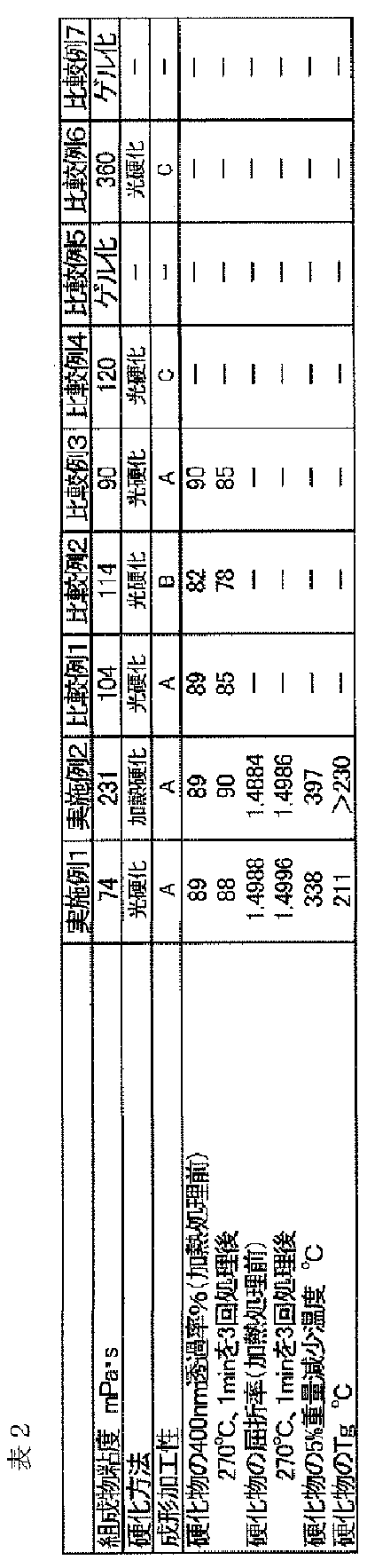

比較例4及び6は、成形加工性に乏しい。また、比較例2は、成形加工性が不十分であるとともに、シリカ微粒子の分散性が悪いため400nmの透過率が低く透明性が劣る。
Claims (7)
- (a)シリカ微粒子と、
(b)2以上のエチレン性不飽和基を有し且つ環構造を有しない(メタ)アクリレートと、
(c)エチレン性不飽和基を有し且つ脂環式構造を有する(メタ)アクリレートと、
(d)重合開始剤と
を含み、
前記シリカ微粒子(a)が、下記一般式(1)で表されるシラン化合物(e)及び下記一般式(2)で表されるシラン化合物(f)で表面処理されていることを特徴とする硬化性組成物:

- 前記(メタ)アクリレート(b)が、3つのエチレン性不飽和基を有し且つ環構造を有しない(メタ)アクリレートであることを特徴とする請求項1に記載の硬化性組成物。
- 前記シリカ微粒子(a)が、
該シリカ微粒子(a)100質量部に対して5~25質量部の前記シラン化合物(e)と、
シリカ微粒子(a)100質量部に対して5~25質量部の前記シラン化合物(f)とで表面処理されていることを特徴とする請求項1または2に記載の硬化性組成物。 - 前記(メタ)アクリレート(b)の単独重合体のガラス転移温度及び前記(メタ)アクリレート(c)の単独重合体のガラス転移温度がともに150℃以上であることを特徴とする請求項1~3のいずれかに記載の硬化性組成物。
- 前記硬化性組成物の粘度が30~300mPa・sであることを特徴とする請求項1~4のいずれかに記載の硬化性組成物。
- 請求項1~5のいずれかに記載の硬化性組成物を硬化させてなる硬化物。
- 請求項6に記載の硬化物からなる光学レンズ。
Priority Applications (5)
| Application Number | Priority Date | Filing Date | Title |
|---|---|---|---|
| JP2010519072A JP5466640B2 (ja) | 2008-07-03 | 2009-06-30 | 硬化性組成物及びその硬化物 |
| CN2009801253298A CN102076723A (zh) | 2008-07-03 | 2009-06-30 | 固化性组合物和其固化物 |
| EP09773453A EP2298822B1 (en) | 2008-07-03 | 2009-06-30 | Hardening composition and resultant hardened material |
| US13/002,245 US20110098411A1 (en) | 2008-07-03 | 2009-06-30 | Curable composition and cured product thereof |
| KR1020117002662A KR101265411B1 (ko) | 2008-07-03 | 2009-06-30 | 경화성 조성물 및 그의 경화물 |
Applications Claiming Priority (4)
| Application Number | Priority Date | Filing Date | Title |
|---|---|---|---|
| JP2008174522 | 2008-07-03 | ||
| JP2008-174522 | 2008-07-03 | ||
| JP2008-225946 | 2008-09-03 | ||
| JP2008225946 | 2008-09-03 |
Publications (1)
| Publication Number | Publication Date |
|---|---|
| WO2010001875A1 true WO2010001875A1 (ja) | 2010-01-07 |
Family
ID=41465970
Family Applications (1)
| Application Number | Title | Priority Date | Filing Date |
|---|---|---|---|
| PCT/JP2009/061903 Ceased WO2010001875A1 (ja) | 2008-07-03 | 2009-06-30 | 硬化性組成物及びその硬化物 |
Country Status (7)
| Country | Link |
|---|---|
| US (1) | US20110098411A1 (ja) |
| EP (1) | EP2298822B1 (ja) |
| JP (1) | JP5466640B2 (ja) |
| KR (1) | KR101265411B1 (ja) |
| CN (1) | CN102076723A (ja) |
| TW (1) | TWI465466B (ja) |
| WO (1) | WO2010001875A1 (ja) |
Cited By (15)
| Publication number | Priority date | Publication date | Assignee | Title |
|---|---|---|---|---|
| WO2010067779A1 (ja) * | 2008-12-09 | 2010-06-17 | 出光興産株式会社 | 光学部品用樹脂原料組成物、光学部品用樹脂および光学部品 |
| JP2010163606A (ja) * | 2008-12-18 | 2010-07-29 | Idemitsu Kosan Co Ltd | 光学部品用樹脂原料組成物、光学部品用樹脂および光学部品 |
| WO2012063644A1 (ja) * | 2010-11-09 | 2012-05-18 | 昭和電工株式会社 | 硬化性組成物およびその硬化物 |
| JP2013163785A (ja) * | 2012-02-13 | 2013-08-22 | Asahi Kasei E-Materials Corp | 感光性シリコーン樹脂組成物 |
| JP2014197135A (ja) * | 2013-03-29 | 2014-10-16 | 凸版印刷株式会社 | 低屈折率層形成用樹脂組成物および反射防止フィルム |
| WO2015019941A1 (ja) * | 2013-08-09 | 2015-02-12 | 昭和電工株式会社 | 半導体ナノ粒子含有硬化性組成物、硬化物、光学材料および電子材料 |
| JP2015093968A (ja) * | 2013-11-14 | 2015-05-18 | 日本ゼオン株式会社 | 重合体修飾シリカの製造方法 |
| JP2015108068A (ja) * | 2013-12-04 | 2015-06-11 | 昭和電工株式会社 | 半導体ナノ粒子含有硬化性組成物、硬化物、光学材料および電子材料 |
| JP5769636B2 (ja) * | 2010-01-29 | 2015-08-26 | Aji株式会社 | レンズ又はレンズアレイの造形方法 |
| JP2015172173A (ja) * | 2013-08-29 | 2015-10-01 | 旭化成株式会社 | 光反射材用樹脂組成物、光反射材、光半導体部品用リフレクタ、及び光半導体部品 |
| JP2015189902A (ja) * | 2014-03-28 | 2015-11-02 | 凸版印刷株式会社 | 断熱層形成用樹脂組成物、透明断熱層及び透明断熱フィルム |
| KR20160119833A (ko) | 2014-06-02 | 2016-10-14 | 쇼와 덴코 가부시키가이샤 | 반도체 나노 입자 함유 경화성 조성물, 경화물, 광학 재료 및 전자 재료 |
| JP2018058944A (ja) * | 2016-10-03 | 2018-04-12 | モメンティブ・パフォーマンス・マテリアルズ・ジャパン合同会社 | 紫外線硬化型シリコーン樹脂組成物、及びそれを用いた物品 |
| JP2023016900A (ja) * | 2017-12-28 | 2023-02-02 | Kjケミカルズ株式会社 | t-ブチルシクロヘキシル(メタ)アクリレートを含有するコーティング組成物 |
| JP2023145500A (ja) * | 2018-08-07 | 2023-10-11 | キャボット コーポレイション | トナー添加剤のための複合粒子 |
Families Citing this family (9)
| Publication number | Priority date | Publication date | Assignee | Title |
|---|---|---|---|---|
| CN104080815B (zh) * | 2012-02-10 | 2016-03-02 | 昭和电工株式会社 | 固化性组合物和其用途 |
| JP5885585B2 (ja) * | 2012-05-21 | 2016-03-15 | 昭和電工株式会社 | 硬化性組成物およびその硬化物 |
| CN104419234B (zh) * | 2013-09-10 | 2017-05-24 | 昭和电工株式会社 | 固化性组合物及其固化物以及硬涂材和硬涂膜 |
| DE112014004730T5 (de) * | 2013-10-15 | 2016-10-27 | Merck Patent Gmbh | Beschichtete Siliciumdioxidpartikel für das Tintenstrahldrucken von organischen elektronischen Vorrichtungen, Herstellungsverfahren dafür und damit hergestelle Vorrrichtungen |
| CN108473811B (zh) * | 2015-12-31 | 2021-05-07 | 3M创新有限公司 | 包含官能化二氧化硅纳米粒子和多官能(甲基)丙烯酸酯单体的防雾涂料组合物 |
| KR102608886B1 (ko) | 2018-09-28 | 2023-12-01 | 동우 화인켐 주식회사 | 자발광 감광성 수지 조성물, 이를 이용한 색변환층을 포함하는 컬러필터 및 화상표시장치 |
| KR102607350B1 (ko) | 2018-12-06 | 2023-11-29 | 동우 화인켐 주식회사 | 자발광 감광성 수지 조성물, 이를 이용한 색변환층을 포함하는 컬러필터 및 화상표시장치 |
| CN109836545A (zh) * | 2019-02-01 | 2019-06-04 | 涌奇材料技术(上海)有限公司 | 一种表面改性有机硅微米球的制备方法及其应用 |
| US11851557B2 (en) * | 2019-02-15 | 2023-12-26 | AGC Inc. | Curable composition, cured product and laminate |
Citations (10)
| Publication number | Priority date | Publication date | Assignee | Title |
|---|---|---|---|---|
| JPH02116036A (ja) * | 1988-10-25 | 1990-04-27 | Seiko Epson Corp | 光記録媒体 |
| JPH05209027A (ja) | 1991-09-24 | 1993-08-20 | Mitsubishi Rayon Co Ltd | 透明性に優れた複合体組成物およびその製法 |
| JPH1077321A (ja) | 1996-07-09 | 1998-03-24 | Mitsubishi Chem Corp | 樹脂組成物及びこれを活性エネルギー線により硬化させてなる部材 |
| JPH10231339A (ja) | 1997-02-19 | 1998-09-02 | Mitsubishi Rayon Co Ltd | 硬化性組成物 |
| JPH10298252A (ja) | 1997-04-23 | 1998-11-10 | Mitsubishi Rayon Co Ltd | 硬化性組成物およびその製造方法 |
| JP2005003772A (ja) * | 2003-06-10 | 2005-01-06 | Olympus Corp | 光学材料用組成物および光学素子 |
| JP2006249322A (ja) * | 2005-03-11 | 2006-09-21 | Mitsubishi Rayon Co Ltd | 光硬化性シート及びそれを用いた成形品の製造方法 |
| JP4008246B2 (ja) | 2002-01-28 | 2007-11-14 | 住友ベークライト株式会社 | 複合体組成物、及びこれを架橋させてなる成形硬化物 |
| JP2008001895A (ja) * | 2006-05-25 | 2008-01-10 | Konica Minolta Opto Inc | 光学用樹脂材料及び光学素子 |
| WO2008015999A1 (en) * | 2006-08-04 | 2008-02-07 | Konica Minolta Opto, Inc. | Composite material and optical element |
Family Cites Families (8)
| Publication number | Priority date | Publication date | Assignee | Title |
|---|---|---|---|---|
| JPS61203108A (ja) * | 1985-03-04 | 1986-09-09 | Toyobo Co Ltd | 光硬化型可撓性組成物 |
| US5332779A (en) * | 1990-06-04 | 1994-07-26 | Kawasaki Steel Corporation | Polymerizable silica sol, adamantane derivative for use in the sol and cured resin prepared using the same |
| US5385988A (en) * | 1991-09-24 | 1995-01-31 | Mitsubishi Rayon Co., Ltd. | Composite composition having high transparency and process for producing same |
| EP1293521B1 (en) * | 2001-09-13 | 2008-02-13 | JSR Corporation | Cyclic olefin addition copolymer and process for producing same, crosslinkable composition, crosslinked product and process for producing same, and optically transparent material and application thereof |
| WO2006051828A1 (ja) * | 2004-11-11 | 2006-05-18 | Mitsubishi Kagaku Media Co., Ltd. | 光記録媒体及びその製造方法 |
| US20060251901A1 (en) * | 2005-05-09 | 2006-11-09 | Armstrong Sean E | Curable composition and substrates possessing protective layer obtained therefrom |
| JPWO2009142237A1 (ja) * | 2008-05-23 | 2011-09-29 | 昭和電工株式会社 | 反応性(メタ)アクリレートポリマーを含有した硬化性組成物およびその硬化物 |
| KR101203301B1 (ko) * | 2008-12-16 | 2012-11-21 | 쇼와 덴코 가부시키가이샤 | 경화성 조성물 및 그의 경화물 |
-
2009
- 2009-06-30 WO PCT/JP2009/061903 patent/WO2010001875A1/ja not_active Ceased
- 2009-06-30 US US13/002,245 patent/US20110098411A1/en not_active Abandoned
- 2009-06-30 CN CN2009801253298A patent/CN102076723A/zh active Pending
- 2009-06-30 JP JP2010519072A patent/JP5466640B2/ja not_active Expired - Fee Related
- 2009-06-30 KR KR1020117002662A patent/KR101265411B1/ko not_active Expired - Fee Related
- 2009-06-30 EP EP09773453A patent/EP2298822B1/en not_active Not-in-force
- 2009-07-02 TW TW098122407A patent/TWI465466B/zh not_active IP Right Cessation
Patent Citations (10)
| Publication number | Priority date | Publication date | Assignee | Title |
|---|---|---|---|---|
| JPH02116036A (ja) * | 1988-10-25 | 1990-04-27 | Seiko Epson Corp | 光記録媒体 |
| JPH05209027A (ja) | 1991-09-24 | 1993-08-20 | Mitsubishi Rayon Co Ltd | 透明性に優れた複合体組成物およびその製法 |
| JPH1077321A (ja) | 1996-07-09 | 1998-03-24 | Mitsubishi Chem Corp | 樹脂組成物及びこれを活性エネルギー線により硬化させてなる部材 |
| JPH10231339A (ja) | 1997-02-19 | 1998-09-02 | Mitsubishi Rayon Co Ltd | 硬化性組成物 |
| JPH10298252A (ja) | 1997-04-23 | 1998-11-10 | Mitsubishi Rayon Co Ltd | 硬化性組成物およびその製造方法 |
| JP4008246B2 (ja) | 2002-01-28 | 2007-11-14 | 住友ベークライト株式会社 | 複合体組成物、及びこれを架橋させてなる成形硬化物 |
| JP2005003772A (ja) * | 2003-06-10 | 2005-01-06 | Olympus Corp | 光学材料用組成物および光学素子 |
| JP2006249322A (ja) * | 2005-03-11 | 2006-09-21 | Mitsubishi Rayon Co Ltd | 光硬化性シート及びそれを用いた成形品の製造方法 |
| JP2008001895A (ja) * | 2006-05-25 | 2008-01-10 | Konica Minolta Opto Inc | 光学用樹脂材料及び光学素子 |
| WO2008015999A1 (en) * | 2006-08-04 | 2008-02-07 | Konica Minolta Opto, Inc. | Composite material and optical element |
Non-Patent Citations (1)
| Title |
|---|
| See also references of EP2298822A4 * |
Cited By (21)
| Publication number | Priority date | Publication date | Assignee | Title |
|---|---|---|---|---|
| WO2010067779A1 (ja) * | 2008-12-09 | 2010-06-17 | 出光興産株式会社 | 光学部品用樹脂原料組成物、光学部品用樹脂および光学部品 |
| JP2010163606A (ja) * | 2008-12-18 | 2010-07-29 | Idemitsu Kosan Co Ltd | 光学部品用樹脂原料組成物、光学部品用樹脂および光学部品 |
| JP5769636B2 (ja) * | 2010-01-29 | 2015-08-26 | Aji株式会社 | レンズ又はレンズアレイの造形方法 |
| WO2012063644A1 (ja) * | 2010-11-09 | 2012-05-18 | 昭和電工株式会社 | 硬化性組成物およびその硬化物 |
| JP2013163785A (ja) * | 2012-02-13 | 2013-08-22 | Asahi Kasei E-Materials Corp | 感光性シリコーン樹脂組成物 |
| JP2014197135A (ja) * | 2013-03-29 | 2014-10-16 | 凸版印刷株式会社 | 低屈折率層形成用樹脂組成物および反射防止フィルム |
| JPWO2015019941A1 (ja) * | 2013-08-09 | 2017-03-02 | 昭和電工株式会社 | 半導体ナノ粒子含有硬化性組成物、硬化物、光学材料および電子材料 |
| WO2015019941A1 (ja) * | 2013-08-09 | 2015-02-12 | 昭和電工株式会社 | 半導体ナノ粒子含有硬化性組成物、硬化物、光学材料および電子材料 |
| JP2015172173A (ja) * | 2013-08-29 | 2015-10-01 | 旭化成株式会社 | 光反射材用樹脂組成物、光反射材、光半導体部品用リフレクタ、及び光半導体部品 |
| JP2015093968A (ja) * | 2013-11-14 | 2015-05-18 | 日本ゼオン株式会社 | 重合体修飾シリカの製造方法 |
| JP2015108068A (ja) * | 2013-12-04 | 2015-06-11 | 昭和電工株式会社 | 半導体ナノ粒子含有硬化性組成物、硬化物、光学材料および電子材料 |
| JP2015189902A (ja) * | 2014-03-28 | 2015-11-02 | 凸版印刷株式会社 | 断熱層形成用樹脂組成物、透明断熱層及び透明断熱フィルム |
| KR20160119833A (ko) | 2014-06-02 | 2016-10-14 | 쇼와 덴코 가부시키가이샤 | 반도체 나노 입자 함유 경화성 조성물, 경화물, 광학 재료 및 전자 재료 |
| JP2018058944A (ja) * | 2016-10-03 | 2018-04-12 | モメンティブ・パフォーマンス・マテリアルズ・ジャパン合同会社 | 紫外線硬化型シリコーン樹脂組成物、及びそれを用いた物品 |
| JP2023016900A (ja) * | 2017-12-28 | 2023-02-02 | Kjケミカルズ株式会社 | t-ブチルシクロヘキシル(メタ)アクリレートを含有するコーティング組成物 |
| JP2023027132A (ja) * | 2017-12-28 | 2023-03-01 | Kjケミカルズ株式会社 | t-ブチルシクロヘキシル(メタ)アクリレートを含有する封止材組成物 |
| JP7433615B2 (ja) | 2017-12-28 | 2024-02-20 | Kjケミカルズ株式会社 | t-ブチルシクロヘキシル(メタ)アクリレートを含有する封止材組成物 |
| JP7470947B2 (ja) | 2017-12-28 | 2024-04-19 | Kjケミカルズ株式会社 | t-ブチルシクロヘキシル(メタ)アクリレートを含有するコーティング組成物 |
| JP2023145500A (ja) * | 2018-08-07 | 2023-10-11 | キャボット コーポレイション | トナー添加剤のための複合粒子 |
| JP2025069220A (ja) * | 2018-08-07 | 2025-04-30 | キャボット コーポレイション | トナー添加剤のための複合粒子 |
| JP7692449B2 (ja) | 2018-08-07 | 2025-06-13 | キャボット コーポレイション | トナー添加剤のための複合粒子 |
Also Published As
| Publication number | Publication date |
|---|---|
| TWI465466B (zh) | 2014-12-21 |
| EP2298822B1 (en) | 2013-02-27 |
| JP5466640B2 (ja) | 2014-04-09 |
| CN102076723A (zh) | 2011-05-25 |
| JPWO2010001875A1 (ja) | 2011-12-22 |
| TW201014870A (en) | 2010-04-16 |
| EP2298822A4 (en) | 2011-06-29 |
| KR101265411B1 (ko) | 2013-05-16 |
| KR20110038107A (ko) | 2011-04-13 |
| US20110098411A1 (en) | 2011-04-28 |
| EP2298822A1 (en) | 2011-03-23 |
Similar Documents
| Publication | Publication Date | Title |
|---|---|---|
| JP5466640B2 (ja) | 硬化性組成物及びその硬化物 | |
| JP5587869B2 (ja) | 硬化性組成物及びその硬化物 | |
| JP6607510B2 (ja) | 光硬化性コーティング組成物、低屈折層および反射防止フィルム | |
| JP5885585B2 (ja) | 硬化性組成物およびその硬化物 | |
| WO2015019941A1 (ja) | 半導体ナノ粒子含有硬化性組成物、硬化物、光学材料および電子材料 | |
| CN104080815B (zh) | 固化性组合物和其用途 | |
| US8840830B2 (en) | Method of molding | |
| WO2012114986A1 (ja) | 硬化性組成物及びその硬化物 | |
| JP4008246B2 (ja) | 複合体組成物、及びこれを架橋させてなる成形硬化物 | |
| JP2014234458A (ja) | 硬化性組成物およびその硬化物 | |
| WO2019069594A1 (ja) | 硬化性組成物及び硬化物 | |
| WO2016182007A1 (ja) | 酸化ジルコニウム粒子と(メタ)アクリレート類を含む重合性組成物とその製造方法 | |
| JP2013018827A (ja) | 硬化性組成物およびその硬化物 | |
| JP5769636B2 (ja) | レンズ又はレンズアレイの造形方法 | |
| WO2012063644A1 (ja) | 硬化性組成物およびその硬化物 | |
| JP2007022071A (ja) | 帯電防止用積層体 |
Legal Events
| Date | Code | Title | Description |
|---|---|---|---|
| WWE | Wipo information: entry into national phase |
Ref document number: 200980125329.8 Country of ref document: CN |
|
| 121 | Ep: the epo has been informed by wipo that ep was designated in this application |
Ref document number: 09773453 Country of ref document: EP Kind code of ref document: A1 |
|
| WWE | Wipo information: entry into national phase |
Ref document number: 2010519072 Country of ref document: JP |
|
| WWE | Wipo information: entry into national phase |
Ref document number: 2009773453 Country of ref document: EP |
|
| WWE | Wipo information: entry into national phase |
Ref document number: 13002245 Country of ref document: US |
|
| NENP | Non-entry into the national phase |
Ref country code: DE |
|
| ENP | Entry into the national phase |
Ref document number: 20117002662 Country of ref document: KR Kind code of ref document: A |