WO2010001984A1 - 有機光電変換素子 - Google Patents
有機光電変換素子 Download PDFInfo
- Publication number
- WO2010001984A1 WO2010001984A1 PCT/JP2009/062172 JP2009062172W WO2010001984A1 WO 2010001984 A1 WO2010001984 A1 WO 2010001984A1 JP 2009062172 W JP2009062172 W JP 2009062172W WO 2010001984 A1 WO2010001984 A1 WO 2010001984A1
- Authority
- WO
- WIPO (PCT)
- Prior art keywords
- compound
- same
- group
- structure represented
- polymer
- Prior art date
- Legal status (The legal status is an assumption and is not a legal conclusion. Google has not performed a legal analysis and makes no representation as to the accuracy of the status listed.)
- Ceased
Links
Classifications
-
- C—CHEMISTRY; METALLURGY
- C08—ORGANIC MACROMOLECULAR COMPOUNDS; THEIR PREPARATION OR CHEMICAL WORKING-UP; COMPOSITIONS BASED THEREON
- C08G—MACROMOLECULAR COMPOUNDS OBTAINED OTHERWISE THAN BY REACTIONS ONLY INVOLVING UNSATURATED CARBON-TO-CARBON BONDS
- C08G61/00—Macromolecular compounds obtained by reactions forming a carbon-to-carbon link in the main chain of the macromolecule
- C08G61/12—Macromolecular compounds containing atoms other than carbon in the main chain of the macromolecule
- C08G61/122—Macromolecular compounds containing atoms other than carbon in the main chain of the macromolecule derived from five- or six-membered heterocyclic compounds, other than imides
- C08G61/123—Macromolecular compounds containing atoms other than carbon in the main chain of the macromolecule derived from five- or six-membered heterocyclic compounds, other than imides derived from five-membered heterocyclic compounds
- C08G61/126—Macromolecular compounds containing atoms other than carbon in the main chain of the macromolecule derived from five- or six-membered heterocyclic compounds, other than imides derived from five-membered heterocyclic compounds with a five-membered ring containing one sulfur atom in the ring
-
- H—ELECTRICITY
- H10—SEMICONDUCTOR DEVICES; ELECTRIC SOLID-STATE DEVICES NOT OTHERWISE PROVIDED FOR
- H10K—ORGANIC ELECTRIC SOLID-STATE DEVICES
- H10K30/00—Organic devices sensitive to infrared radiation, light, electromagnetic radiation of shorter wavelength or corpuscular radiation
- H10K30/20—Organic devices sensitive to infrared radiation, light, electromagnetic radiation of shorter wavelength or corpuscular radiation comprising organic-organic junctions, e.g. donor-acceptor junctions
-
- H—ELECTRICITY
- H10—SEMICONDUCTOR DEVICES; ELECTRIC SOLID-STATE DEVICES NOT OTHERWISE PROVIDED FOR
- H10K—ORGANIC ELECTRIC SOLID-STATE DEVICES
- H10K85/00—Organic materials used in the body or electrodes of devices covered by this subclass
- H10K85/10—Organic polymers or oligomers
- H10K85/111—Organic polymers or oligomers comprising aromatic, heteroaromatic, or aryl chains, e.g. polyaniline, polyphenylene or polyphenylene vinylene
- H10K85/113—Heteroaromatic compounds comprising sulfur or selene, e.g. polythiophene
-
- H—ELECTRICITY
- H10—SEMICONDUCTOR DEVICES; ELECTRIC SOLID-STATE DEVICES NOT OTHERWISE PROVIDED FOR
- H10K—ORGANIC ELECTRIC SOLID-STATE DEVICES
- H10K85/00—Organic materials used in the body or electrodes of devices covered by this subclass
- H10K85/10—Organic polymers or oligomers
- H10K85/151—Copolymers
-
- C—CHEMISTRY; METALLURGY
- C08—ORGANIC MACROMOLECULAR COMPOUNDS; THEIR PREPARATION OR CHEMICAL WORKING-UP; COMPOSITIONS BASED THEREON
- C08G—MACROMOLECULAR COMPOUNDS OBTAINED OTHERWISE THAN BY REACTIONS ONLY INVOLVING UNSATURATED CARBON-TO-CARBON BONDS
- C08G2261/00—Macromolecular compounds obtained by reactions forming a carbon-to-carbon link in the main chain of the macromolecule
- C08G2261/30—Monomer units or repeat units incorporating structural elements in the main chain
- C08G2261/32—Monomer units or repeat units incorporating structural elements in the main chain incorporating heteroaromatic structural elements in the main chain
- C08G2261/322—Monomer units or repeat units incorporating structural elements in the main chain incorporating heteroaromatic structural elements in the main chain non-condensed
- C08G2261/3223—Monomer units or repeat units incorporating structural elements in the main chain incorporating heteroaromatic structural elements in the main chain non-condensed containing one or more sulfur atoms as the only heteroatom, e.g. thiophene
-
- C—CHEMISTRY; METALLURGY
- C08—ORGANIC MACROMOLECULAR COMPOUNDS; THEIR PREPARATION OR CHEMICAL WORKING-UP; COMPOSITIONS BASED THEREON
- C08G—MACROMOLECULAR COMPOUNDS OBTAINED OTHERWISE THAN BY REACTIONS ONLY INVOLVING UNSATURATED CARBON-TO-CARBON BONDS
- C08G2261/00—Macromolecular compounds obtained by reactions forming a carbon-to-carbon link in the main chain of the macromolecule
- C08G2261/30—Monomer units or repeat units incorporating structural elements in the main chain
- C08G2261/32—Monomer units or repeat units incorporating structural elements in the main chain incorporating heteroaromatic structural elements in the main chain
- C08G2261/324—Monomer units or repeat units incorporating structural elements in the main chain incorporating heteroaromatic structural elements in the main chain condensed
- C08G2261/3246—Monomer units or repeat units incorporating structural elements in the main chain incorporating heteroaromatic structural elements in the main chain condensed containing nitrogen and sulfur as heteroatoms
-
- C—CHEMISTRY; METALLURGY
- C08—ORGANIC MACROMOLECULAR COMPOUNDS; THEIR PREPARATION OR CHEMICAL WORKING-UP; COMPOSITIONS BASED THEREON
- C08G—MACROMOLECULAR COMPOUNDS OBTAINED OTHERWISE THAN BY REACTIONS ONLY INVOLVING UNSATURATED CARBON-TO-CARBON BONDS
- C08G2261/00—Macromolecular compounds obtained by reactions forming a carbon-to-carbon link in the main chain of the macromolecule
- C08G2261/30—Monomer units or repeat units incorporating structural elements in the main chain
- C08G2261/34—Monomer units or repeat units incorporating structural elements in the main chain incorporating partially-aromatic structural elements in the main chain
- C08G2261/344—Monomer units or repeat units incorporating structural elements in the main chain incorporating partially-aromatic structural elements in the main chain containing heteroatoms
-
- C—CHEMISTRY; METALLURGY
- C08—ORGANIC MACROMOLECULAR COMPOUNDS; THEIR PREPARATION OR CHEMICAL WORKING-UP; COMPOSITIONS BASED THEREON
- C08G—MACROMOLECULAR COMPOUNDS OBTAINED OTHERWISE THAN BY REACTIONS ONLY INVOLVING UNSATURATED CARBON-TO-CARBON BONDS
- C08G2261/00—Macromolecular compounds obtained by reactions forming a carbon-to-carbon link in the main chain of the macromolecule
- C08G2261/90—Applications
- C08G2261/91—Photovoltaic applications
-
- H—ELECTRICITY
- H10—SEMICONDUCTOR DEVICES; ELECTRIC SOLID-STATE DEVICES NOT OTHERWISE PROVIDED FOR
- H10K—ORGANIC ELECTRIC SOLID-STATE DEVICES
- H10K30/00—Organic devices sensitive to infrared radiation, light, electromagnetic radiation of shorter wavelength or corpuscular radiation
- H10K30/30—Organic devices sensitive to infrared radiation, light, electromagnetic radiation of shorter wavelength or corpuscular radiation comprising bulk heterojunctions, e.g. interpenetrating networks of donor and acceptor material domains
-
- H—ELECTRICITY
- H10—SEMICONDUCTOR DEVICES; ELECTRIC SOLID-STATE DEVICES NOT OTHERWISE PROVIDED FOR
- H10K—ORGANIC ELECTRIC SOLID-STATE DEVICES
- H10K30/00—Organic devices sensitive to infrared radiation, light, electromagnetic radiation of shorter wavelength or corpuscular radiation
- H10K30/50—Photovoltaic [PV] devices
-
- Y—GENERAL TAGGING OF NEW TECHNOLOGICAL DEVELOPMENTS; GENERAL TAGGING OF CROSS-SECTIONAL TECHNOLOGIES SPANNING OVER SEVERAL SECTIONS OF THE IPC; TECHNICAL SUBJECTS COVERED BY FORMER USPC CROSS-REFERENCE ART COLLECTIONS [XRACs] AND DIGESTS
- Y02—TECHNOLOGIES OR APPLICATIONS FOR MITIGATION OR ADAPTATION AGAINST CLIMATE CHANGE
- Y02E—REDUCTION OF GREENHOUSE GAS [GHG] EMISSIONS, RELATED TO ENERGY GENERATION, TRANSMISSION OR DISTRIBUTION
- Y02E10/00—Energy generation through renewable energy sources
- Y02E10/50—Photovoltaic [PV] energy
- Y02E10/549—Organic PV cells
Definitions
- an organic photoelectron having a layer containing an o-polymer composed of an ozoide and an asiazoi group represented by the following formula (pped Phys cs Lee 90 o No 4 43506 20 07)) o
- To R8 may be the same or represent a hydrogen atom, an aki, an aki group, or a group that may have a substituent.
- the hydrogen atom contained in these groups is a fluorine atom. (It may be replaced with)
- R to R may be the same or represent a hydrogen atom, an aki, an aki group, or may have a substitution.
- the hydrogen atoms contained in these tombs are May be replaced by an atom,, may be the same, or 2. If there are a plurality of Rg R, R, R, they are the same.
- the present invention provides the above-mentioned photoelectron in which the combination of the compounds in function is 0 to 000 with respect to the polymer 00.
- a pair of has a function and an organic, has an electronic compound, and has a combination comprising a structure represented by () and a repeating unit consisting of a structure represented by (2), Provide organic photons in contact with.
- R 8 to R 8 may be the same, each represents a hydrogen atom, an alkyl group, an alkyl group, or an ali group which may have a substituent.
- the hydrogen atom contained in these groups is an atom. (It may be replaced with)
- R to R may be the same or represent a hydrogen atom, an aki, an aki group, or a group that may be substituted.
- the hydrogen atoms contained in these groups are G may be replaced by an atom, or may be the same, or 2. If there are a plurality of RR, R, and R, they may not be the same.
- the above-mentioned photoelectric device is provided in which the electronic compound is a run conductor.
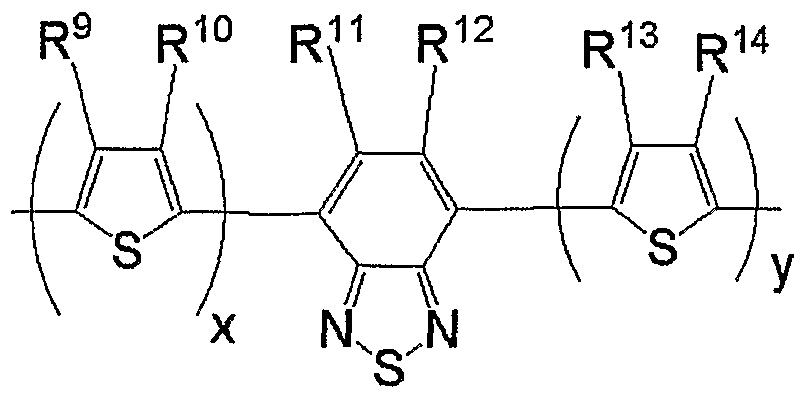
- the polymer used for light includes a repeating unit consisting of a structure represented by () and a structure represented by (2). ⁇ Structure represented by ()
- R R8 which may be the same, represents an aki, an aki group or may have a substitution, and represents a tomb.
- the polymer medium has a decomposability of ⁇ 2 and that the carbon number is 2 It is preferably ⁇ 8, and more preferably 3 ⁇ 2.
- the alkyl group represented by R 1 to R 8 preferably has 20 carbon atoms. Examples of aki include meth, chi, puppy, isoppi, chi, isothi, s chi, chi, chi, chi, isotichi,, tade, octa.
- the alkyl group represented by R 1 to R 8 preferably has 20 carbon atoms. Examples of the space include Metoki, Toki, Pupioki, Pupioki, Toki, Toki, s. Toki, Toki, Inchioki, Oki, Shikioki, Oki, Okuoki, 2 Chikioki, Oxy, Oki, 3, 7 Mekioki. Aki, some or all of the atoms may be replaced with atoms.
- the group represented by R 1 to R 8 may preferably have 6 to 60 carbon atoms, and more preferably 6 to 30 carbon atoms. Examples of a include,, and 2. Examples of the ant group include gem, aki and aki. Examples of the structure represented by () include the following structures.
- the polymer used for light has a structure represented by (). At least 2 or more. ⁇ Structure represented by (2)
- Examples of the alk group represented by R 1 to R 4 include the same groups as the aki groups represented by R 1 described above.
- R may be represented by R to 4.
- Examples of the ant grave may include the same group as may be represented by R as described above.
- Examples of the structure represented by (2) include the following structures.
- the polymer used for clarity may have the structure represented by (2) or 2 or more.
- the repetitive statement consisting of the structure represented by () and the structure represented by (2) the above structure drawn from the example of the structure represented by () and the structure represented by () It is preferable that it is selected from the examples.
- repeating unit represented by (3) is preferred.
- Rg to R are more preferably hydrogen atoms.
- Examples of polymers used for light include the following combinations:
- the end When a polymer used for light is used in the production of an organic photoelectron, if the polymer derived from the polymer or the like remains at the terminal, the durability of the resulting device may be reduced. Therefore, it is preferable to protect the end with a stable group.
- the stable group for protecting the end include aki, aki, ooaki, puaki, a, ano, and multiple values.
- a hydrogen atom may be located at the end.
- children such as Ariano groups are preferred.
- those having a continuous conjugated bond with the structure are preferred, and examples thereof include a bond with a double valence through a carbon bond.
- Examples of an ano include ano and diano.
- the polymer used for light is preferably a conjugated molecule compound.
- the conjugated molecule compound means a compound in which the molecules constituting the compound are qualitatively conjugated.
- the polymer used in the art may be produced by the following method.For example, after adding a suitable polymer for the polymerization reaction to be used, the polymer is dissolved in an organic solution as necessary. It is possible to synthesize by polymerizing using the polymerization method by using a coupling. Things, for example, 2006 8 2 9 2 reports, special 2 2006 3 3 5 9 3 3 Can be produced with reference to the method shown in 1.
- a group having a steric group, an elemental atom, an atom, a chlorine atom, or a meta group having a thiophene group, and a P group having a phosphonate group are combined with sodium, selenium carbonate, selenium carbonate, lithium, Radium tetrakis (toshy), toss (nejidenato) of radicals such as calcium, fluorine tetrathium, tritium chloride, tetrathianium, tetrathia hydroxide ) Radium, radium ate, bis (tris) Radius, bis (octa), and other radishes, and if necessary, tris and tris (2 meth) Sin, G (2
- biskete such as nobis (octaocta) having a rogentometasnetneto group and a di-orbite, or a (diphthy) tandem dilide
- bis (Gisy) package such as package rides and, if necessary, tossin, dysynop, g (s), g (e
- a reducing agent such as gne is used and a reaction is carried out with dehydration if necessary.
- a compound having a gene group Reacts with a compound having a genium group for dehydration, such as for bis (di-si) tungslide, bis (di-fis) punde dilide, etc.
- a compound having a genium group for dehydration such as for bis (di-si) tungslide, bis (di-fis) punde dilide, etc.
- deoxygenation is preferred to reduce response.
- the S z pug and the Ya ao pug are preferred from the viewpoint of reactivity, and the ST a pug and the ya ao pug using the pucke body are preferred.
- the method described in a Of Po e Scece P a Poe C eso 39 5 3 3 55 6 (200) can be referred to. . aa
- the method described in acces 992 25 2 4 223 can be referred to.
- the reaction and the reaction state are not particularly limited as long as the reaction state can be maintained, but n is preferable from the viewpoint of reactivity, and 20 is more preferable.
- C particularly preferred is oC, and from the viewpoint of stability and stability, 2 OC is preferred, 5 is preferred, and 20 C is particularly preferred.
- the light coalescence from the reaction system after the reaction can be carried out according to the method described below.
- a clear mixture can be obtained by adding the reaction solution to a lower layer such as methano and drying it.
- the degree of polymer obtained is low, it can be purified by conventional methods such as recrystallization, continuous extraction with Tux, or color chromatography.
- a pair of which has a function and has a structure represented by (and a combination including a repeating unit consisting of the structure represented by (2).
- Has a function and an organic group has an electronic compound, has a combination containing a repeating unit consisting of a structure represented by () and a structure represented by (2),
- organic photoelectric compound having a function in, and having an electronic compound, a structure represented by (), and a combination comprising a repeating unit consisting of a structure represented by (2).
- the combination of the electronic compound and the electronic compound in the function containing the combination with the structure represented by () is 0 to 00 with respect to the combination 0.
- the combination of the lan conductor in the function containing the lan conductor and the combination is
- the combination of hula conductors in the function is preferably 20 to 400 with respect to the combination 0, and 40 to 25. More preferably, it is 80.20. From the viewpoint of increasing the degree, the combination of hula conductors in function is preferably 2 to 25 with respect to the combination 0, more preferably 40 to 20.
- the light green onion is collected by the electron compound and / or the electron donor compound, and generates an exciton that combines electrons and pho. The exciton formed is in contact with the electron compound and the electron donor compound.
- the O O leeks on the surface separate the child and the pho and generate a charge (child fo) that can move independently.
- the generated electric charges can be taken out as external electric springs () by moving.
- a combination containing a repeating unit consisting of the structure represented by () and the structure represented by (2) usually acts as an electron donating compound.
- a compound, wherein the child-providing compound has the ability to better capture the desired light spectrum, the face has more faces to separate the excitons,
- the above-mentioned 2 or 3 is preferred as a clear photoelectron, and the above 3 is preferred from the viewpoint of increasing the number of surfaces.
- An additional layer may be provided between the photon photon and at least the other photon photon. .
- charge that transports e or electrons, or wa for example, charge that transports e or electrons, or wa.
- Ming photoelectric usually formed on the substrate. It is preferable that the electrode is not deformed when the electrode is formed and the organic layer is formed.
- the material examples include glass, plastic, and polymer film. If is opaque, it is preferable that the opposite (, far away from the board) is transparent.
- extreme charges there are the following chemicals: Specifically, it was prepared using materials such as ijdoxide, zinc oxide, oxide oxide, and their combination idicum suxide (O), diadium oxide, etc. (S) Gold, platinum, silver, etc. are used, and nickel oxide and oxides are preferred.
- the light pole it is also possible to use a point and its conductor, a boltio and its conductor machine.
- the electrode material metals and molecules can be used, and it is preferable that the material has the work function of one of the pair of electrodes.
- Examples of such electrode materials include lithium, sodium, um, bidium, cesium, gneum, um, strontium, lithium, ac, scan, sodium,,, tom, Metals such as Idium, Cesium, Ps, Teum, Um, etc., and alloys on them, or above, gold, silver, platinum, guns, titanium, titanium, gaskets, Tungste, gold on gold, graphite, or a compound of graphite.
- gold gold, gnesium iridium examples include gold, neumoumum gold, iridium gold, thium-umum gold, thium-gumumum gold, tidium ijum gold, and power-moor gold.
- One of the pair of electrodes becomes (positive electrode in the positive battery),
- Electrode manufacturing methods include vacuum deposition, sputtering, ion plating, and plating.
- an organic material containing a polymer used for light can be used, for example. In general, it is ⁇ 00, preferably 2 to 000, more preferably 5 to 500, and further preferably 20 to 200.
- the combination may be a single species or a combination of two or more species.
- a compound and / or a compound other than the above-mentioned compound may be mixed as the electron donor compound and / or the electron compound.
- a polymer used for childhood such as a pyran conductor, an anne conductor, a tin conductor, a tofdian conductor, an oh and its conductor, a bobicazo and its conductor, and a polymer.
- Run conductor and side Examples include a pole conductor with a chain, a boan and its conductor, a potoff and its conductor, a polypi and its conductor, a polybi and its conductor, and a bolivi and its conductor.
- the compound for example, a polymer used for obvious purposes, for example, an oxoazo conductor, an attrameta and its conductor, a zoquinone and its conductor, a toquinone and its conductor, an atraquino and its conductor, a tetraanoanthra meta and its conductor, an onconductor, Dicho and its conductor, Diquinone conductor, Eight and conductor body, Bon and its conductor, Posan and its conductor, Bo and its conductor, 60, etc.
- Naton conductors such as 0 Nats, and la and its conductors are preferred.
- the child-given compound and the compound are relatively determined from the leeks of these compounds.
- Examples of rungs include 60, C0, cavities, and their conductors.
- Examples of 60 conductors include the following. For example, it may be produced by a method from a liquid containing a polymer used for obvious purposes, or may be formed into a thin film by vapor deposition.
- the polymer used for the liquid can be used to clarify the polymer used for light.
- the polymer used for light can usually be solved by the above 0 ⁇ .
- the liquids include spint, , iggraviat, gravureto, to, to, wire, dit, sput, sc
- the light child has a presence adjacent to the function and contains an electronic compound, it is usually ⁇ 0, preferably 2 ⁇ 0 0, and preferably 5 ⁇ 50 0, Further preferred is 20 to 200.
- This may contain components other than electronic compounds.
- Ida is given.
- the amount of this compound is usually 00
- This can be produced by the same method as the organic production method. This is preferably arranged on the cathode (negative electrode in the positive battery). There may be additional layers outside of a pair of clear, functional, organic.
- the buffer layer is preferably provided adjacent to the electrode and between the pair of electrodes.
- the child compound and the electron compound can be used as a material that can be used for the electron and the electron immediately.
- an Akari genus such as a stretch, a genus of an Akari genus, or an oxide. It is also possible to use conductive particles such as chita. By irradiating light such as sunlight from the optoelectronic and transparent electrodes, photoelectric power is generated at the electrode, and it can operate as an organic positive battery. By stacking positive batteries
- a positive battery module By irradiating light from a transparent electrode with a voltage applied to it, photocurrent flows and it can be operated as an organic photosensor. It can also be used as an imager to load optical sensors. Of child By stacking multiple photoelectron photoelectrics, a positive battery module and an organic image sensor can be constructed.
- the average numerator size of the Bosch calculation was determined using a Kusto kutoguraji (C).
- the compound (9 was taken into 300 3 lath after replacement and suspended in 0 m tetradra. The solution was cooled to 0 C, and 8 gB solution prepared above was added.
- the compound (2020 was taken and dissolved in 4 m of ton.) was added to this 25 2 lath, and this P Tosho 0 029 (06 6) was added, and the temperature was 00C. , Washed with 4N sodium oxide solution, water, and saturated saline in this order.
- the reaction was carried out in a gas atmosphere. Then, after the solution was cooled to near, the resulting reaction solution was recovered. Then, after the methano was obtained, this was decompressed. Next, it was dissolved in the obtained foam. The obtained chromic solution was drained and purified through an analysis. Next, the resulting humor solution was poured into a methano solution, and the produced was recovered. After this methano, the pressure was reduced to obtain a polymer (below, this compound is molecular compound 3) 043. It was the polystyrene average molecule 6 of the molecular compound 3, and the post arithmetic average molecule 4 ⁇ 2X03.
- the organic positive battery obtained in this way was a 2 X2 square.
- the organic solar cell J S C () is made into a solar 90 meter (trade name: TENT UN 5 ita, radiation 00 2
- An organic photoelectron was produced in the same manner as in Example 3 except that 3 was used instead of. It was 00.
- An organic photoelectron was prepared in the same way as in Example 5 except that 4 was used instead. It was 0.
- a polymer compound was prepared in the same manner as in Example except that the polymer compound in the regular example was replaced with the polymer compound 3, and the value was evaluated.
- the range of income in the range of 500-700 is 565, at that time
- Molecule compound (c) () Molecule compound 7 ⁇ 5 2 ⁇ 6 2 Molecule compound 7 ⁇ 4 3 ⁇ 4
- Molecular compound 2 5 ⁇ O 6 From the viewpoint of the performance of the photoelectron, a polymer compound with a light pumping rate is preferred as a material for the molecule. As described above, the thin film prepared for the polymer compound showed high yield at long wavelengths.
- the organic solar cell prepared for the molecular compound showed high photoelectricity. Top availability
Landscapes
- Chemical & Material Sciences (AREA)
- Health & Medical Sciences (AREA)
- Chemical Kinetics & Catalysis (AREA)
- Medicinal Chemistry (AREA)
- Polymers & Plastics (AREA)
- Organic Chemistry (AREA)
- Engineering & Computer Science (AREA)
- Materials Engineering (AREA)
- Physics & Mathematics (AREA)
- Electromagnetism (AREA)
- Photovoltaic Devices (AREA)
- Polyoxymethylene Polymers And Polymers With Carbon-To-Carbon Bonds (AREA)
- Electroluminescent Light Sources (AREA)
- Compositions Of Macromolecular Compounds (AREA)
- Addition Polymer Or Copolymer, Post-Treatments, Or Chemical Modifications (AREA)
Abstract
Description


Claims



Priority Applications (3)
| Application Number | Priority Date | Filing Date | Title |
|---|---|---|---|
| US13/001,114 US20110101325A1 (en) | 2008-06-30 | 2009-06-26 | Organic photoelectric conversion element |
| CN2009801246557A CN102077368B (zh) | 2008-06-30 | 2009-06-26 | 有机光电转换元件 |
| EP09773562A EP2302700A4 (en) | 2008-06-30 | 2009-06-26 | ORGANIC PHOTOELECTRIC CONVERTER ELEMENT |
Applications Claiming Priority (4)
| Application Number | Priority Date | Filing Date | Title |
|---|---|---|---|
| JP2008170240 | 2008-06-30 | ||
| JP2008-170240 | 2008-06-30 | ||
| JP2009006349A JP2010034494A (ja) | 2008-06-30 | 2009-01-15 | 有機光電変換素子 |
| JP2009-006349 | 2009-01-15 |
Publications (1)
| Publication Number | Publication Date |
|---|---|
| WO2010001984A1 true WO2010001984A1 (ja) | 2010-01-07 |
Family
ID=41466074
Family Applications (1)
| Application Number | Title | Priority Date | Filing Date |
|---|---|---|---|
| PCT/JP2009/062172 Ceased WO2010001984A1 (ja) | 2008-06-30 | 2009-06-26 | 有機光電変換素子 |
Country Status (6)
| Country | Link |
|---|---|
| US (1) | US20110101325A1 (ja) |
| EP (1) | EP2302700A4 (ja) |
| JP (1) | JP2010034494A (ja) |
| KR (1) | KR20110025854A (ja) |
| CN (1) | CN102077368B (ja) |
| WO (1) | WO2010001984A1 (ja) |
Cited By (2)
| Publication number | Priority date | Publication date | Assignee | Title |
|---|---|---|---|---|
| WO2012060283A1 (ja) * | 2010-11-02 | 2012-05-10 | 住友化学株式会社 | 高分子化合物及びそれを用いた有機光電変換素子 |
| WO2012169605A1 (ja) * | 2011-06-10 | 2012-12-13 | 住友化学株式会社 | 高分子化合物及びそれを用いた電子素子 |
Families Citing this family (7)
| Publication number | Priority date | Publication date | Assignee | Title |
|---|---|---|---|---|
| JP6003399B2 (ja) * | 2011-09-07 | 2016-10-05 | 住友化学株式会社 | 高分子化合物及びそれを用いた有機光電変換素子 |
| CN103857725B (zh) * | 2011-10-07 | 2016-03-02 | 住友化学株式会社 | 高分子化合物及电子元件 |
| JP5874302B2 (ja) * | 2011-10-19 | 2016-03-02 | 住友化学株式会社 | 高分子化合物及びそれを用いた有機光電変換素子 |
| KR20130090736A (ko) * | 2012-02-06 | 2013-08-14 | 주식회사 엘지화학 | 헤테로 방향족 화합물 및 이를 포함하는 유기 태양전지 |
| JP2014205737A (ja) * | 2013-04-11 | 2014-10-30 | 住友化学株式会社 | 化合物及びそれを用いた電子素子 |
| KR102190596B1 (ko) * | 2015-01-09 | 2020-12-14 | 도레이 카부시키가이샤 | 광전 변환 소자 및 이것을 사용한 이미지 센서 |
| CN107004690B (zh) * | 2015-11-12 | 2021-05-14 | 松下知识产权经营株式会社 | 光传感器 |
Citations (6)
| Publication number | Priority date | Publication date | Assignee | Title |
|---|---|---|---|---|
| JP2006182920A (ja) | 2004-12-28 | 2006-07-13 | Sumitomo Chemical Co Ltd | 高分子化合物およびそれを用いた高分子発光素子 |
| JP2006335933A (ja) | 2005-06-03 | 2006-12-14 | Sumitomo Chemical Co Ltd | 高分子化合物およびそれを用いた高分子発光素子 |
| WO2008016067A1 (en) * | 2006-08-01 | 2008-02-07 | Sumitomo Chemical Company, Limited | Polymer compound and polymer light-emitting device |
| JP2008056910A (ja) * | 2006-07-31 | 2008-03-13 | Sumitomo Chemical Co Ltd | 高分子化合物及びそれを用いた高分子発光素子 |
| WO2008044585A1 (fr) * | 2006-10-11 | 2008-04-17 | Toray Industries, Inc. | matériau organique donneur d'électrons pour dispositifs photovoltaïques, matériau et dispositifs photovoltaïques |
| JP2008133346A (ja) * | 2006-11-28 | 2008-06-12 | Sumitomo Chemical Co Ltd | 有機エレクトロルミネッセンス素子及びその製造に有用な組成物 |
Family Cites Families (11)
| Publication number | Priority date | Publication date | Assignee | Title |
|---|---|---|---|---|
| FI109944B (fi) * | 1998-08-11 | 2002-10-31 | Valtion Teknillinen | Optoelektroninen komponentti ja valmistusmenetelmä |
| KR100310252B1 (ko) * | 1999-06-22 | 2001-11-14 | 박종섭 | 유기 반사방지 중합체 및 그의 제조방법 |
| EP1571170B1 (en) * | 2002-10-30 | 2018-09-05 | Sumitomo Chemical Company, Limited | High-molecular compounds and polymer light emitting devices made by using the same |
| JP4461762B2 (ja) * | 2002-10-30 | 2010-05-12 | 住友化学株式会社 | 高分子化合物およびそれを用いた高分子発光素子 |
| WO2005096403A2 (en) * | 2004-03-31 | 2005-10-13 | Matsushita Electric Industrial Co., Ltd. | Organic photoelectric conversion element utilizing an inorganic buffer layer placed between an electrode and the active material |
| JP2006063334A (ja) * | 2004-07-30 | 2006-03-09 | Sumitomo Chemical Co Ltd | 高分子化合物、高分子薄膜およびそれを用いた高分子薄膜素子 |
| TW200607828A (en) * | 2004-07-30 | 2006-03-01 | Sumitomo Chemical Co | Polymer, polymer film and polymer film device using same |
| US20080003422A1 (en) * | 2005-07-27 | 2008-01-03 | Sumitomo Chemical Company, Limited | Polymer Compound, Polymer Thin Film and Polymer Thin Film Device Using the Same |
| JP5034818B2 (ja) * | 2006-09-26 | 2012-09-26 | 住友化学株式会社 | 有機光電変換素子 |
| JP5303896B2 (ja) * | 2007-10-19 | 2013-10-02 | 住友化学株式会社 | 高分子化合物およびそれを用いた有機光電変換素子 |
| CN101945922A (zh) * | 2008-02-18 | 2011-01-12 | 住友化学株式会社 | 组合物及使用其的有机光电转换元件 |
-
2009
- 2009-01-15 JP JP2009006349A patent/JP2010034494A/ja active Pending
- 2009-06-26 KR KR1020117002137A patent/KR20110025854A/ko not_active Withdrawn
- 2009-06-26 US US13/001,114 patent/US20110101325A1/en not_active Abandoned
- 2009-06-26 CN CN2009801246557A patent/CN102077368B/zh not_active Expired - Fee Related
- 2009-06-26 WO PCT/JP2009/062172 patent/WO2010001984A1/ja not_active Ceased
- 2009-06-26 EP EP09773562A patent/EP2302700A4/en not_active Withdrawn
Patent Citations (6)
| Publication number | Priority date | Publication date | Assignee | Title |
|---|---|---|---|---|
| JP2006182920A (ja) | 2004-12-28 | 2006-07-13 | Sumitomo Chemical Co Ltd | 高分子化合物およびそれを用いた高分子発光素子 |
| JP2006335933A (ja) | 2005-06-03 | 2006-12-14 | Sumitomo Chemical Co Ltd | 高分子化合物およびそれを用いた高分子発光素子 |
| JP2008056910A (ja) * | 2006-07-31 | 2008-03-13 | Sumitomo Chemical Co Ltd | 高分子化合物及びそれを用いた高分子発光素子 |
| WO2008016067A1 (en) * | 2006-08-01 | 2008-02-07 | Sumitomo Chemical Company, Limited | Polymer compound and polymer light-emitting device |
| WO2008044585A1 (fr) * | 2006-10-11 | 2008-04-17 | Toray Industries, Inc. | matériau organique donneur d'électrons pour dispositifs photovoltaïques, matériau et dispositifs photovoltaïques |
| JP2008133346A (ja) * | 2006-11-28 | 2008-06-12 | Sumitomo Chemical Co Ltd | 有機エレクトロルミネッセンス素子及びその製造に有用な組成物 |
Non-Patent Citations (5)
| Title |
|---|
| APPLIED PHYSICS LETTERS, vol. 90, 2007, pages 143506, XP012094005 * |
| APPLIED PHYSICS LETTERS, vol. 90, no. 14, 2007, pages 143506 |
| JOURNAL OF POLYMER SCIENCE, PART A, POLYMER CHEMISTRY, vol. 39, 2001, pages 1533 - 1556 |
| MACROMOLECULES, vol. 25, 1992, pages 1214 - 1223 |
| See also references of EP2302700A4 |
Cited By (4)
| Publication number | Priority date | Publication date | Assignee | Title |
|---|---|---|---|---|
| WO2012060283A1 (ja) * | 2010-11-02 | 2012-05-10 | 住友化学株式会社 | 高分子化合物及びそれを用いた有機光電変換素子 |
| WO2012169605A1 (ja) * | 2011-06-10 | 2012-12-13 | 住友化学株式会社 | 高分子化合物及びそれを用いた電子素子 |
| JP2012255117A (ja) * | 2011-06-10 | 2012-12-27 | Sumitomo Chemical Co Ltd | 高分子化合物及びそれを用いた電子素子 |
| US9396831B2 (en) | 2011-06-10 | 2016-07-19 | Sumitomo Chemical Company, Limited | Polymer compound and electronic device using the same |
Also Published As
| Publication number | Publication date |
|---|---|
| US20110101325A1 (en) | 2011-05-05 |
| KR20110025854A (ko) | 2011-03-11 |
| CN102077368A (zh) | 2011-05-25 |
| EP2302700A1 (en) | 2011-03-30 |
| JP2010034494A (ja) | 2010-02-12 |
| CN102077368B (zh) | 2012-08-22 |
| EP2302700A4 (en) | 2012-06-20 |
Similar Documents
| Publication | Publication Date | Title |
|---|---|---|
| US12490573B2 (en) | Conductive substrate, perovskite substrate using the conductive substrate and solar cell using the perovskite substrate | |
| US10840504B2 (en) | High performance inorganic complexes for next-generation redox flow batteries | |
| CN112041370B (zh) | 方酸基聚合物、它们的制造方法和它们的用途 | |
| ITMI20081869A1 (it) | Copolimeri pi-coniugati a basso gap contenenti unita' benzotriazoliche | |
| US5405937A (en) | Polymers derived from fluorinated thiophenes, and conductive polymers derived therefrom | |
| WO2010005094A1 (ja) | 光電変換素子 | |
| WO2010001982A1 (ja) | フェノキサジン系高分子化合物及びそれを用いた発光素子 | |
| US20100267984A1 (en) | Oxyfluorophosphate synthesis process and compound therefrom | |
| WO2010013844A1 (ja) | 光電変換素子 | |
| DE112008002774T5 (de) | Polymerverbindung und organischer photoelektrischer Konverter unter deren Verwendung | |
| EP3699969A1 (en) | Solar cell | |
| WO2010016613A1 (ja) | 光電変換素子 | |
| WO2007119954A1 (en) | Preparing method for organic thin layer of organic light emitting devices using electrochemical deposition | |
| EP3279223A1 (de) | Verwendung thianthrenhaltiger polymere als ladungsspeicher | |
| CN109503459A (zh) | 一种有机电致发光材料及其合成方法与其在器件中的应用 | |
| Umezawa et al. | Electroreductive polymerization of organodichloromonosilanes | |
| CN107430942B (zh) | 色素敏化太阳能电池及色素敏化太阳能电池用电解液 | |
| WO1987003607A1 (fr) | Polymeres ayant une structure isoindole et leur procede de preparation | |
| TW201522312A (zh) | 光電化學元件用電荷輸送材料 | |
| TWI441848B (zh) | Pigment sensitized solar cells with pigments and pigments sensitized solar cells | |
| JP6199992B2 (ja) | 高分子化合物、有機光電変換素子、及び該素子の製造方法 | |
| JP2010163396A (ja) | 導電性高分子用ドーパント及びそれを用いた導電性高分子 | |
| JP5318479B2 (ja) | 発光性イオン液体 | |
| JP5364307B2 (ja) | イオン性化合物の製造方法 | |
| Remigio | Reactivity and Electrochemical Study of Peripherally Fluorinated Boron Subphthalocyanines |
Legal Events
| Date | Code | Title | Description |
|---|---|---|---|
| WWE | Wipo information: entry into national phase |
Ref document number: 200980124655.7 Country of ref document: CN |
|
| 121 | Ep: the epo has been informed by wipo that ep was designated in this application |
Ref document number: 09773562 Country of ref document: EP Kind code of ref document: A1 |
|
| WWE | Wipo information: entry into national phase |
Ref document number: 13001114 Country of ref document: US |
|
| WWE | Wipo information: entry into national phase |
Ref document number: 2009773562 Country of ref document: EP |
|
| NENP | Non-entry into the national phase |
Ref country code: DE |
|
| ENP | Entry into the national phase |
Ref document number: 20117002137 Country of ref document: KR Kind code of ref document: A |