WO2010016228A1 - 分子化合物を含有する顕色性組成物及び記録材料 - Google Patents
分子化合物を含有する顕色性組成物及び記録材料 Download PDFInfo
- Publication number
- WO2010016228A1 WO2010016228A1 PCT/JP2009/003694 JP2009003694W WO2010016228A1 WO 2010016228 A1 WO2010016228 A1 WO 2010016228A1 JP 2009003694 W JP2009003694 W JP 2009003694W WO 2010016228 A1 WO2010016228 A1 WO 2010016228A1
- Authority
- WO
- WIPO (PCT)
- Prior art keywords
- bis
- hydroxyphenylsulfonyl
- phenyloxy
- group
- compound
- Prior art date
- Legal status (The legal status is an assumption and is not a legal conclusion. Google has not performed a legal analysis and makes no representation as to the accuracy of the status listed.)
- Ceased
Links
Images


Classifications
-
- B—PERFORMING OPERATIONS; TRANSPORTING
- B41—PRINTING; LINING MACHINES; TYPEWRITERS; STAMPS
- B41M—PRINTING, DUPLICATING, MARKING, OR COPYING PROCESSES; COLOUR PRINTING
- B41M5/00—Duplicating or marking methods; Sheet materials for use therein
- B41M5/26—Thermography ; Marking by high energetic means, e.g. laser otherwise than by burning, and characterised by the material used
- B41M5/30—Thermography ; Marking by high energetic means, e.g. laser otherwise than by burning, and characterised by the material used using chemical colour formers
- B41M5/333—Colour developing components therefor, e.g. acidic compounds
- B41M5/3333—Non-macromolecular compounds
- B41M5/3335—Compounds containing phenolic or carboxylic acid groups or metal salts thereof
- B41M5/3336—Sulfur compounds, e.g. sulfones, sulfides, sulfonamides
-
- B—PERFORMING OPERATIONS; TRANSPORTING
- B41—PRINTING; LINING MACHINES; TYPEWRITERS; STAMPS
- B41M—PRINTING, DUPLICATING, MARKING, OR COPYING PROCESSES; COLOUR PRINTING
- B41M5/00—Duplicating or marking methods; Sheet materials for use therein
- B41M5/26—Thermography ; Marking by high energetic means, e.g. laser otherwise than by burning, and characterised by the material used
- B41M5/30—Thermography ; Marking by high energetic means, e.g. laser otherwise than by burning, and characterised by the material used using chemical colour formers
- B41M5/333—Colour developing components therefor, e.g. acidic compounds
-
- B—PERFORMING OPERATIONS; TRANSPORTING
- B41—PRINTING; LINING MACHINES; TYPEWRITERS; STAMPS
- B41M—PRINTING, DUPLICATING, MARKING, OR COPYING PROCESSES; COLOUR PRINTING
- B41M5/00—Duplicating or marking methods; Sheet materials for use therein
- B41M5/124—Duplicating or marking methods; Sheet materials for use therein using pressure to make a masked colour visible, e.g. to make a coloured support visible, to create an opaque or transparent pattern, or to form colour by uniting colour-forming components
- B41M5/132—Chemical colour-forming components; Additives or binders therefor
- B41M5/155—Colour-developing components, e.g. acidic compounds; Additives or binders therefor; Layers containing such colour-developing components, additives or binders
-
- B—PERFORMING OPERATIONS; TRANSPORTING
- B41—PRINTING; LINING MACHINES; TYPEWRITERS; STAMPS
- B41M—PRINTING, DUPLICATING, MARKING, OR COPYING PROCESSES; COLOUR PRINTING
- B41M5/00—Duplicating or marking methods; Sheet materials for use therein
- B41M5/26—Thermography ; Marking by high energetic means, e.g. laser otherwise than by burning, and characterised by the material used
-
- C—CHEMISTRY; METALLURGY
- C07—ORGANIC CHEMISTRY
- C07C—ACYCLIC OR CARBOCYCLIC COMPOUNDS
- C07C317/00—Sulfones; Sulfoxides
- C07C317/16—Sulfones; Sulfoxides having sulfone or sulfoxide groups and singly-bound oxygen atoms bound to the same carbon skeleton
- C07C317/22—Sulfones; Sulfoxides having sulfone or sulfoxide groups and singly-bound oxygen atoms bound to the same carbon skeleton with sulfone or sulfoxide groups bound to carbon atoms of six-membered aromatic rings of the carbon skeleton
Definitions
- the present invention relates to a color developing composition and a recording material containing a molecular compound containing a diphenylsulfone derivative or the like as a component compound.
- Recording materials that utilize the color developed by the reaction between the color-forming dye and the developer can be recorded in a relatively simple device in a short time without the need for complicated processing such as development and fixing. It is widely used in heat-sensitive recording paper for recording or pressure-sensitive copying paper for forms that simultaneously copy several sheets. These recording materials are required to develop colors quickly, maintain the whiteness of an uncolored portion (hereinafter referred to as “background”), and have a colored image and a high fastness to the background. In recent years, it has come to be used in large quantities in fields where the reliability of recorded images, such as labels, is important, against plasticizers and oils and the like contained in organic polymer materials used for packaging. There has been a strong demand for a recording material having a color image having high storage stability. Therefore, problems have been studied from various aspects such as development of various auxiliary agents such as storage stabilizers as well as color-forming dyes and developers, but no satisfactory one has been found yet.
- JP-A-8-333329 Japanese Patent No. 3936775
- the present inventor has sufficient color development sensitivity by using a molecular compound containing the compound represented by formula (I) as a component compound as a developer composition.
- the inventors have found that it is possible to obtain a recording material that is excellent in storage stability and has very little background stain in the heat resistance test of the background, and has completed the present invention.
- the present invention provides (1) Formula (I) [Wherein Y represents a linear or branched, saturated or unsaturated hydrocarbon group having 1 to 12 carbon atoms, a linear or branched, saturated or unsaturated carbon having an ether bond or a thioether bond.
- R 1 , R 2 , R 3 , and R 4 each independently represents an alkyl group having 1 to 6 carbon atoms or an alkenyl group having 2 to 6 carbon atoms.
- n, p, q and r each represents an integer of 0 to 4.
- m represents an integer of 0-2.
- the present invention relates to a color developing composition comprising a molecular compound having a compound represented by the formula:
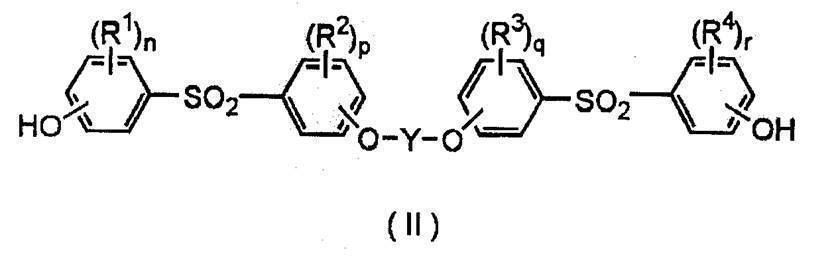
- the compound represented by the formula (I) is represented by the formula (II) (Wherein Y, R 1 to R 4 , n, p, q, r are the same as above), and the color developing composition according to (1) above, (3) The above (1) or (2), wherein the compound represented by the formula (I) is 2,2′-bis [4- (4-hydroxyphenylsulfonyl) phenyloxy] diethyl ether It relates to the described color developing composition.
- the color developing composition is a composition containing two or more products obtained by reacting 4,4′-dihydroxydiphenylsulfone with 2,2′-dichlorodiethyl ether.
- the present invention relates to a recording material comprising the developer composition according to any one of (1) to (5) above.
- FIG. 2 is a diagram showing a powder X-ray diffraction pattern of the composition obtained in Synthesis Example 1.
- FIG. 4 is a diagram showing a powder X-ray diffraction pattern of the composition obtained in Synthesis Example 2.
- FIG. It is a figure which shows the powder X-ray-diffraction pattern of the composition obtained by the synthesis example 3.
- the molecular compound is a compound that can exist stably by two or more component compounds, such as a hydrogen bond or van der. It is a compound bonded by a relatively weak interaction other than a covalent bond typified by a Waals force, and includes hydrates, solvates, addition compounds, inclusion compounds and the like.
- Y represents a chain or branched, saturated or unsaturated hydrocarbon group having 1 to 12 carbon atoms, a chain or branched, saturated or unsaturated ether bond or thioether bond.
- “Chain or branched, saturated or unsaturated hydrocarbon group having 1 to 12 carbon atoms” includes methylene group, ethylene group, trimethylene group, tetramethylene group, pentamethylene group, hexamethylene group, heptamethylene group , Octamethylene group, nonamethylene group, decamethylene group, undecamethylene group, dodecamethylene group, methylmethylene group, dimethylmethylene group, methylethylene group, ethylethylene group, 1,2-dimethylethylene group, 1-methyltrimethylene group Alkylene groups such as 1-methyltetramethylene group, 1,3-dimethyltrimethylene group and 1-ethyl-4-methyltetramethylene group, alkenylene groups such as vinylene group, propenylene group and 2-butenylene group, ethynylene group, And alkynylene groups such as 2-butynylene group.
- Examples of “chain or branched, saturated or unsaturated hydrocarbon group having 1 to 8 carbon atoms having an ether bond or a thioether bond” include ethyleneoxyethylene group, tetramethyleneoxytetramethylene group, ethyleneoxyethyleneoxy Groups having an ether bond such as ethylene group, ethyleneoxymethyleneoxyethylene group, 1,3-dioxane-5,5-bismethylene group, ethylenethioethylene group, tetramethylenethiotetramethylene group, ethylenethioethylenethioethylene group, ethylene Examples thereof include a group having a thioether bond such as a thiomethylene thioethylene group.
- Examples thereof include 1,2-xylyl group, 1,3-xylyl group, 1,4-xylyl group and the like.
- 2-hydroxypropylene group 2-hydroxy-2-methylpropylene group, 2-hydroxy-2-ethylpropylene group, 2-hydroxy-2-propylpropylene group, 2-hydroxy-2-butylpropylene group, etc. Can be mentioned.
- R 1 , R 2 , R 3 , and R 4 each independently represents an alkyl group having 1 to 6 carbon atoms or an alkenyl group having 2 to 6 carbon atoms.
- alkyl group having 1 to 6 carbon atoms include methyl group, ethyl group, n-propyl group, isopropyl group, n-butyl group, sec-butyl group, tert-butyl group, n-pentyl group, isopentyl group, Examples include neopentyl group, tert-pentyl group, n-hexyl group, isohexyl group, 1-methylpentyl group, 2-methylpentyl group and the like.
- alkenyl group having 2 to 6 carbon atoms examples include vinyl group, allyl group, isopropenyl group, 1-propenyl group, 2-butenyl group, 3-butenyl group, 1,3-butanedienyl group, 2-methyl-2 -Propenyl group and the like.
- a diphenylsulfone derivative represented by the formula (II) is preferable.
- Specific examples of the compound represented by the formula (I) used in the present invention include bis [4- (4-hydroxyphenylsulfonyl) phenyloxy] methane, 1,2-bis [4- (4-hydroxyphenyl). Sulfonyl) phenyloxy] ethane, 1,3-bis [4- (4-hydroxyphenylsulfonyl) phenyloxy] propane, 1,4-bis [4- (4-hydroxyphenylsulfonyl) phenyloxy] butane, 1,5 -Bis [4- (4-hydroxyphenylsulfonyl) phenyloxy] pentane, 1,6-bis [4- (4-hydroxyphenylsulfonyl) phenyloxy] hexane, 1,7-bis [4- (4-hydroxyphenyl) Sulfonyl) phenyloxy] heptane, 1,8-bis [4- (4-hydroxyphenylsulfonyl) fe
- m 2 for example, a dihydroxydiphenylsulfone derivative, a dihalogenated alkyl, a dihalogenated alkenyl, a dihalogenated alkyl ether, a dihalogenated xylene, etc., and the presence of a basic substance It can be produced by reacting in a two-layer system of a water solvent or water and a water-insoluble organic solvent such as benzene, ketone or ester.
- dihydroxydiphenylsulfone used as a raw material 4,4'-dihydroxydiphenylsulfone derivatives or 2,4'-dihydroxydiphenylsulfone derivatives are preferred because they are easily available. Particularly preferred is 4,4'-dihydroxydiphenyl sulfone.
- the compound represented by the formula (I) may be a compound represented by the formula (I) alone, or a combination of two or more compounds of the formula (I).
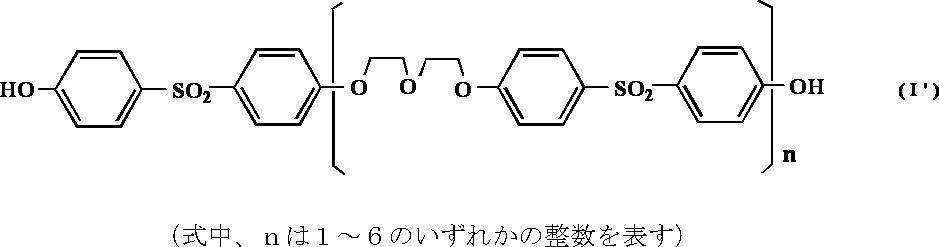
- a product containing, as a main component, the formula (I ′) obtained by reacting 4,4′-dihydroxydiphenylsulfone with 2,2′-dichlorodiethyl ether can also be used.
- the compound represented by the formula (I) used in the present invention is usually a crystal, but may be amorphous or liquid. Moreover, although it may take a crystal polymorphism, it belongs to this invention as a compound represented by a formula (I) irrespective of these forms.
- the substance that forms a molecular compound with the compound represented by formula (I) is not particularly limited as long as it can form a molecular compound with the compound and can be used as a recording material.
- Specific examples include water, methanol, ethanol, isopropanol, n-butanol, n-octanol, 2-ethylhexanol, allyl alcohol, propargyl alcohol, 1,2-butanediol, 1,3-butanediol, 1, Alcohols such as 4-butanediol, cyclohexanediol, 2-bromo-2-nitropropane-1,3-diol, 2,2-dibromo-2-nitroethanol, 4-chlorophenyl-3-iodopropargyl formal, formaldehyde Aldehydes such as acetaldehyde, n-butyraldehyde, propionaldehyde, benzaldehy
- thiocyanates such as methylene bisthiocyanate, methylene bisisothiocyanate and isothiocyanates, nitro such as tris (hydroxymethyl) nitromethane
- Compounds ammonia, methylamine, ethylamine, propylamine, butylamine, pentylamine, hexylamine, allylamine, hydroxylamine, ethanolamine, benzylamine, ethylenediamine, 1,2-propanediamine, 1,3-propanediamine, 1 , 4-butanediamine, 1,5-pentanediamine, 1,6-hexanediamine, diethylenetriamine, triethylenetetramine, tetraethylenepentamine, dipropylenediamine, N, N-dimethylethylenedi
- Nitrogen- and sulfur-containing heterocyclic compounds such as cholesterol, alkaloids such as brucine, quinine and theophylline, Natural essential oils such as all, hinokitiol, menthol, terpineol, borneol, nopol, citral, citronellol, citronellal, geraniol, menthone, eugenol, linalool, dimethyloctanol, synthetic fragrances such as cinnamon, jasmine, lemon, ascorbic acid, nicotinic acid And vitamins such as nicotinamide and related compounds.
- water, methanol, and 1,4-dioxane are preferable.
- the molecular compound used in the present invention is obtained by directly mixing a compound represented by the formula (I) or a mixture containing the compound and the above-mentioned substance that forms the molecular compound with the compound or the like, or in a solvent. It can obtain by mixing with.
- the target molecular compound can be obtained by allowing the vapor of these substances to act on the compound represented by the formula (I).
- a molecular compound of the compound represented by the formula (I) and a certain substance is formed, and the molecular compound and the target component compound are reacted by the above-described method to obtain the target molecular compound. You can also.
- the molecular compound used for this invention can also be produced
- 4,4′-dihydroxydiphenylsulfone and 2,2′-dichlorodiethyl ether are reacted to produce a mixture containing 2,2′-bis [4- (4-hydroxyphenylsulfonyl) phenyloxy] diethyl ether
- the molecular compound is contained by bringing it into contact with a compound that can form a molecular compound with 2,2′-bis [4- (4-hydroxyphenylsulfonyl) phenyloxy] diethyl ether.
- a mixture can be obtained.
- Formation of the molecular compound can be confirmed by thermal analysis (TG and DTA), infrared absorption spectrum (IR), X-ray diffraction pattern, solid NMR spectrum, and the like.
- the composition of the molecular compound can be confirmed by thermal analysis, 1 HNMR spectrum, high performance liquid chromatography (HPLC), elemental analysis or the like.
- the ratio of each component compound constituting the molecular compound used in the present invention may vary depending on the generation conditions. Moreover, the molecular compound which consists of three or more components can also be obtained by making 2 or more types of substances react with the compound represented by Formula (I).
- the molecular compound used in the present invention is preferably crystalline. In this case, even the same molecular compound may take a crystal polymorph. Crystallinity can be confirmed mainly by examining the X-ray diffraction pattern. The presence of crystal polymorphs can be confirmed by thermal analysis, X-ray diffraction patterns, solid state NMR, and the like.
- the developer composition containing a molecular compound containing the compound represented by formula (I) as a component compound may be composed of only the molecular compound, or the molecular compound. It may be configured to contain other compounds.
- the use ratio of the color developing composition of the present invention to the color developing dye is 0.01 to 100 parts by mass with respect to 1 part by mass of the color developing dye.
- the color developing dye is used.
- the amount is preferably 0.01 to 10 parts by weight, particularly preferably 0.2 to 5 parts by weight with respect to 1 part by weight.
- When used as a developer it is preferably with respect to 1 part by weight of the color developing dye. Is 1 to 10 parts by mass, particularly preferably 1.5 to 5 parts by mass.
- two or more molecular compounds having a compound represented by the formula (I) as a component compound may be used in combination as a developer composition.
- one of the developer compositions of the present invention can be used as an image storage stabilizer and the other as a developer.
- a method for preparing such a mixture of two or more kinds they may be mixed in advance or may be mixed at the time of use. Further, as a mixing method with the color forming dye or the like, it may be mixed as a powder, added at the time of preparing and dispersing the coating liquid, or added in the state of a dispersion.
- the developer composition of the present invention is used as a developer, it is very effective.
- molecular compounds having the compound represented by formula (I) as a component compound have different crystal forms depending on the conditions for precipitating crystals, such as the type of solvent and the precipitation temperature. It belongs to the present invention as a compound. These can be clarified by the melting point of the crystal, infrared spectroscopic analysis, X-ray diffraction analysis or the like.
- the recording material of the present invention further includes other color developers, other image storage stabilizers, sensitizers, fillers, dispersants, antioxidants, desensitizers, anti-tacking agents, antifoaming agents, and light stabilizers.
- one or two or more kinds of fluorescent brighteners can be contained as required.
- the amount of each used is usually in the range of 0.01 to 15 parts by weight, preferably 1 to 10 parts by weight with respect to 1 part by weight of the chromophoric dye.
- These chemicals may be contained in the coloring layer, but in the case of a multilayer structure, they may be contained in any layer such as a protective layer.
- these layers can contain an antioxidant, a light stabilizer, and the like.
- an antioxidant and a light stabilizer can be contained in these layers in the form of being encapsulated in a microcapsule if necessary.
- Examples of the developer used when the developer composition of the present invention is used in combination with another developer can include the following. These may be used alone or in combination of two or more as required.
- Bisphenol A 4,4′-sec-butylidene bisphenol, 4,4′-cyclohexylidene bisphenol, 2,2′-bis (4-hydroxyphenyl) -3,3′-dimethylbutane, 2,2′- Dihydroxydiphenyl, pentamethylene-bis (4-hydroxybenzoate), 2,2′-dimethyl-3,3′-di (4-hydroxyphenyl) pentane, 2,2′-di (4-dihydroxyphenyl) hexane, , 2-bis (4-hydroxyphenyl) propane, 2,2-bis (4-hydroxyphenyl) butane, 2,2-bis (4-hydroxy-3-methylphenyl) propane, 4,4 ′-(1- Phenylethylidene) bisphenol, 4,4'-ethylidenebisphenol, (hydroxyphenyl) methyl
- these developers can be appropriately used at a ratio of 0.1 to 10 parts by mass with respect to 1 part by mass of the color developing composition of the present invention.
- 3-di (n-butyl) is used as a dye.
- a thermal recording paper can be produced by combining the mass parts.
- the above developers such as 4-hydroxy-4'-n-propoxydiphenylsulfone, 4-hydroxy-4'-allyloxydiphenylsulfone, 2,4'-dihydroxydiphenylsulfone may be combined.
- Acidic clay When used for pressure-sensitive copying paper, acidic clay, activated clay, apatalite, bentonite, colloidal silica, aluminum silicate, magnesium silicate, zinc silicate, tin silicate, calcined kaolin, talc, and other inorganic acidic substances, Aliphatic carboxylic acids such as acid, maleic acid, tartaric acid, citric acid, succinic acid, stearic acid, benzoic acid, pt-butylbenzoic acid, phthalic acid, gallic acid, salicylic acid, 3-isopropylsalicylic acid, 3-phenylsalicylic acid 3-cyclohexylsalicylic acid, 3,5-di-t-butylsalicylic acid, 3-methyl-5-benzylsalicylic acid, 3-phenyl-5- (2,2-dimethylbenzyl) salicylic acid, 3,5-di- (2 -Methylbenzyl) salicylic acid, aromatic hydroxy such as 2-hydroxy
- the content of the composition is not particularly limited.
- the mass ratio of the developer is preferably in the range of 10: 0.01 to 0.01: 10, more preferably in the range of 10: 0.1 to 0.1: 10, 10: More preferably, it is in the range of 1 to 1:10.
- Examples of the chromogenic dye used in the recording material of the present invention include leuco dyes such as fluorane, phthalide, lactam, triphenylmethane, phenothiazine, and spiropyran, but are not limited thereto. Instead, any color-forming dye that develops color by contact with an acidic substance can be used. In addition, these color-forming dyes are used alone to produce a recording material having the color to be developed, but two or more of them can be used in combination. For example, it is possible to produce a recording material that develops true black color by using a mixture of red, blue, and green primary color developing dyes or black coloring dyes.
- chromogenic dyes for example, 3-diethylamino-6-methyl-7-anilinofluorane, 3-di (n-butyl) amino-6-methyl-7-anilinofluorane, 3- (N-methyl-N-cyclohexylamino) -6-methyl-7-anilinofluorane, 3- (N-ethyl-N-isobutylamino) -6-methyl-7-anilinofluorane, 3- (N -Methyl-N-propylamino) -6-methyl-7-anilinofluorane, 3- (N-ethyl-N-isoamylamino) -6-methyl-7-anilinofluorane, 3- (N-ethyl) -P-toluidino) -6-methyl-7-anilinofluorane, 3-diethylamino-7- (m-trifluoromethylanilino) fluorane, 3-di (n-
- the black dye is preferably 3-diethylamino-6-methyl-7-anilinofluorane, 3-di (n-butyl) amino-6-methyl-7-anilinofluorane, 3- (N-methyl- N-cyclohexylamino) -6-methyl-7-anilinofluorane, 3- (N-methyl-N-propylamino) -6-methyl-7-anilinofluorane, 3- (N-ethyl-N- Isoamylamino) -6-methyl-7-anilinofluorane, 3- (N-ethyl-p-toluidino) -6-methyl-7-anilinofluorane, 3-diethylamino-7- (m-trifluoromethyl) Anilino) fluorane, 3-di (n-pentyl) amino-6-methyl-7-anilinofluorane, 3- (N-ethyl-N-ethoxypropylamino)
- blue, green, red and yellow are 3,3-bis (p-dimethylaminophenyl) -6-dimethylaminophthalide, 3- (4-diethylamino-2-ethoxyphenyl) -3- (1-ethyl-2-methyl-3-indolyl) -4-azaphthalide, 3- (4-diethylamino-2-ethoxyphenyl) -3- (1-octyl-2-methyl-3-indolyl) -4-azaphthalide 3-diethylamino-7-dibenzylaminofluorane, 3- (N-ethyl-p-tolyl) amino-7-N-methylanilinofluorane, 3,3-bis (4-diethylamino-2-ethoxyphenyl) ) -4-Azaphthalide, 3,6,6′-tris (dimethylamino) spiro [fluorene-9,3′-phthalide], 3-diethylamino-7-chlor
- Examples of the image storage stabilizer used when the color developing composition of the present invention is used in combination with another image storage stabilizer include the following. These may be used alone or in combination of two or more as required. 1,1,3-tris (2-methyl-4-hydroxy-5-t-butylphenyl) butane, 1,1,3-tris (2-methyl-4-hydroxy-5-t-cyclohexylphenyl) butane, 4,4'-butylidenebis (6-t-butyl-3-methylphenol), 2,2'-methylenebis (6-t-butyl-4-methylphenol), 2,2'-methylenebis (6-t-butyl) -4-ethylphenol), 4,4'-thiobis (6-tert-butyl-3-methylphenol), 1,3,5-tris (2,6-dimethyl-4-tert-butyl-3-hydroxybenzyl) ) Isocyanurate, 1,3,5-tris [[3,5-bis (1,1-dimethylethyl) -4-hydroxyphen
- 1,1,3-tris (2-methyl-4-hydroxy-5-t-butylphenyl) butane, 1,1,3-tris (2-methyl-4-hydroxy-5-t-cyclohexylphenyl) ) Butane, 4,4′-butylidenebis (6-tert-butyl-3-methylphenol), 2,2′-methylenebis (4-ethyl-6-tert-butylphenol), 1,3,5-tris (2, 6-dimethyl-4-tert-butyl-3-hydroxybenzyl) isocyanurate, 2-methyl-2-[[4-[[4- (phenylmethoxy) phenyl] sulfonyl] phenoxy] methyl] -oxirane, 4,4 Mention may be made of '-sulfonylbis (2,6-dibromophenol), 2- (2'-hydroxy-5'-methylphenyl) benzotriazole.
- a sensitizer such as stearamide, benzamide, stearic acid anilide, acetoacetanilide, thioacetanilide, dibenzyl oxalate, di (4-methylbenzyl) oxalate, di (4-chlorobenzyl) oxalate, dimethyl phthalate, Dimethyl terephthalate, dibenzyl terephthalate, dibenzyl isophthalate, bis (tert-butylphenol), 4,4′-dimethoxydiphenylsulfone, 4,4′-diethoxydiphenylsulfone, 4,4′-dipropoxydiphenylsulfone, 4, 4′-diisopropoxydiphenylsulfone, 4,4′-dibutoxydiphenylsulfone, 4,4′-diisobutoxydip
- these sensitizers can be appropriately used at a ratio of 0.1 to 10 parts by mass with respect to 1 part by mass of the dye.
- 3-di (n-butyl) amino-6-methyl is used as the dye.
- a thermosensitive recording paper is prepared with 2 parts by mass of the developer composition of the present invention and 1 part by mass of di (p-methylbenzyl) oxalate as a sensitizer for 1 part by mass of -7-anilinofluorane. Can do.
- the above sensitizers such as 1,2-di- (3-methylphenoxy) ethane, 1,2-bis (phenoxymethyl) benzene, diphenylsulfone and the like may be combined.
- silica, clay, kaolin, calcined kaolin, talc, satin white, aluminum hydroxide, calcium carbonate, magnesium carbonate, zinc oxide, titanium oxide, barium sulfate, magnesium silicate, aluminum silicate, plastic pigment, and the like can be used.
- alkaline earth metal salts are preferred in the recording material of the present invention.
- carbonates are preferable, and calcium carbonate, magnesium carbonate and the like are preferable.
- the filler is used in an amount of 0.1 to 15 parts by weight, preferably 1 to 10 parts by weight, based on 1 part by weight of the coloring dye. It is also possible to use a mixture of the above fillers.
- dispersant examples include sulfosuccinates such as dioctyl sodium sulfosuccinate, sodium dodecylbenzenesulfonate, sodium lauryl alcohol sulfate, fatty acid salts, and the like.
- Antioxidants include 2,2'-methylenebis (4-methyl-6-tert-butylphenol), 2,2'-methylenebis (4-ethyl-6-tert-butylphenol), 4,4'-propylmethylenebis (3-methyl-6-tert-butylphenol), 4,4′-butylidenebis (3-methyl-6-tert-butylphenol), 4,4′-thiobis (2-tert-butyl-5-methylphenol), 1, 1,3-tris (2-methyl-4-hydroxy-5-tert-butylphenol) butane, 4- [4- ⁇ 1,1-bis (4-hydroxyphenyl) ethyl ⁇ - ⁇ , ⁇ '-dimethylbenzyl] Phenol, 1,1,3-tris (2-methyl-4-hydroxy-5-cyclohexylphenyl) butane, 2,2'-methylene Bis (6-tert-butyl-4-methylphenol), 2,2′-methylenebis (6-tert-butyl-4-ethylphenol), 4,
- desensitizers include aliphatic higher alcohols, polyethylene glycol, guanidine derivatives and the like.
- anti-sticking agent examples include stearic acid, zinc stearate, calcium stearate, carnauba wax, paraffin wax, ester wax and the like.
- the light stabilizer examples include salicylic acid UV absorbers such as phenyl salicylate, p-tert-butylphenyl salicylate, p-octylphenyl salicylate, 2,4-dihydroxybenzophenone, 2-hydroxy-4-methoxybenzophenone, 2-hydroxy- 4-benzyloxybenzophenone, 2-hydroxy-4-dodecyloxybenzophenone, 2,2'-dihydroxy-4-methoxybenzophenone, 2,2'-dihydroxy-4,4'-dimethoxybenzophenone, 2-hydroxy-4-methoxy Benzophenone ultraviolet absorbers such as -5-sulfobenzophenone and bis (2-methoxy-4-hydroxy-5-benzoylphenyl) methane, 2- (2'-hydroxy-5'-methylphenyl) benzotriazole, 2- 2′-hydroxy-5′-tert-butylphenyl) benzotriazole, 2- (2′-hydroxy-3 ′, 5′-di-
- fluorescent dyes examples include 4,4′-bis [2-anilino-4- (hydroxyethyl) amino-1,3,5-triazinyl-6-amino] stilbene-2,2′-disulfonic acid disodium salt, 4 , 4′-bis [2-anilino-4-bis (hydroxyethyl) amino-1,3,5-triazinyl-6-amino] stilbene-2,2′-disulfonic acid disodium salt, 4,4′-bis [2-Methoxy-4- (hydroxyethyl) amino-1,3,5-triazinyl-6-amino] stilbene-2,2′-disulfonic acid disodium salt, 4,4′-bis [2-anilino-4 -(Hydroxypropyl) amino-1,3,5-triazinyl-6-amino] stilbene-2,2'-disulfonic acid disodium salt, 4,4'-bis [2-m-sulfoanilino- -Bis (
- Example 1 (Preparation of thermal recording paper) [Example 1] ⁇ Dye dispersion (liquid A) 3-Di-n-butylamino-6-methyl-7-anilinofluorane 16 parts Polyvinyl alcohol 10% aqueous solution 84 parts Developer solution (liquid B) Composition of Synthesis Example 1 16 parts Polyvinyl alcohol 10% aqueous solution 84 parts Filler dispersion (liquid C) Calcium carbonate 27.8 parts Polyvinyl alcohol 10% aqueous solution 26.2 parts Water 71 parts First, each mixture of liquids A to C is sufficiently ground with a sand grinder to prepare a dispersion of each component of liquids A to C, and 1 part by weight of liquid A, 2 parts by weight of liquid B, C 4 parts by mass of the liquid was mixed to obtain a coating liquid.
- This coating solution was applied and dried on white paper using a wire rod (Webster, wire bar No. 12), and then subjected to a calendaring process to produce a thermal recording paper (the coating solution was in dry mass). About 5.5 g / m 2 ).
- Example 2 A thermal recording paper was prepared by the method described in Example 1 except that the composition of Synthesis Example 2 was used in place of the composition of Synthesis Example 1 in the developer dispersion liquid (B solution) of Example 1. .
- Example 3 A thermal recording paper was prepared by the method described in Example 1 except that the composition of Synthesis Example 3 was used instead of the composition of Synthesis Example 1 in the developer dispersion liquid (B solution) of Example 1. .
- Example 4 A thermal recording paper was prepared by the method described in Example 1 except that the composition of Synthesis Example 4 was used in place of the composition of Synthesis Example 1 in the developer dispersion liquid (B solution) of Example 1. .
- thermo recording paper produced in Examples 1 to 4 and Comparative Examples 1 to 2 was cut out and held at 80 ° C. and 90 ° C. for 24 hours in a thermostatic chamber (trade name: DK-400, manufactured by YAMATO). Then, the background density (Macbeth value) of each test paper was measured. The results are summarized in Table 1.
- the developer composition of the present invention When used as a recording material, it is possible to provide a recording material having sufficient color development sensitivity, excellent storage stability, and extremely low background contamination in a heat resistance test.
Landscapes
- Chemical & Material Sciences (AREA)
- Organic Chemistry (AREA)
- Chemical Kinetics & Catalysis (AREA)
- General Chemical & Material Sciences (AREA)
- Physics & Mathematics (AREA)
- Optics & Photonics (AREA)
- Organic Low-Molecular-Weight Compounds And Preparation Thereof (AREA)
- Heat Sensitive Colour Forming Recording (AREA)
Abstract
Description

で表されるジフェニルスルホン誘導体等を用いた記録材料があるが画像の保存安定性等の点で未だ充分であるとは言いがたかった(特許文献1)。
一方、本発明で使用する分子化合物は特許文献2に記載されているが、記録材料としての用途は記載されておらず、記録材料としての価値は不明であった。

[式中、Yは、鎖状若しくは分岐状の、飽和若しくは不飽和の炭素数1~12の炭化水素基、鎖状若しくは分岐状の、飽和若しくは不飽和の、エーテル結合或いはチオエーテル結合を有する炭素数1~8の炭化水素基、又は次式
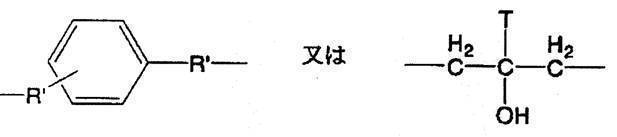
(式中、各R’は同一又は相異なっていてもよく、メチレン基又はエチレン基を表し、Tは水素原子又は炭素数1~4の炭化水素基を示す)を示す。R1、R2、R3、及びR4は夫々独立して、炭素数1~6のアルキル基又は炭素数2~6のアルケニル基を示す。n、p、q、rは0~4のいずれかの整数を示す。mは0~2のいずれかの整数を示す。]
で表される化合物を成分化合物とする分子化合物を含有することを特徴とする顕色性組成物に関する。
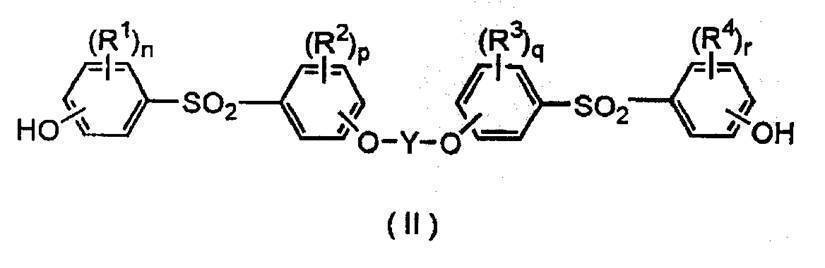
(式中、Y、R1~R4、n、p、q、rは前記と同じ)で表される化合物であることを特徴とする上記(1)に記載の顕色性組成物に関し、(3)式(I)で表される化合物が、2,2’-ビス[4-(4-ヒドロキシフェニルスルホニル)フェニルオキシ]ジエチルエーテルであることを特徴とする上記(1)又は(2)記載の顕色性組成物に関する。
本発明における分子化合物とは、単独で安定に存在することのできる化合物の2種以上の成分化合物が水素結合やファンデルワールス力などに代表される共有結合以外の比較的弱い相互作用によって結合した化合物であり、水和物、溶媒和物、付加化合物、包接化合物などが含まれる。

(式中、各R’は同一又は相異なっていてもよく、メチレン基又はエチレン基を表し、Tは水素原子又は炭素数1~4のアルキル基を示す。)を示す。

としては、1,2-キシリル基、1,3-キシリル基、1,4-キシリル基等が挙げられる。

としては、2-ヒドロキシプロピレン基、2-ヒドロキシ-2-メチルプロピレン基、2-ヒドロキシ-2-エチルプロピレン基、2-ヒドロキシ-2-プロピルプロピレン基、2-ヒドロキシ-2-ブチルプロピレン基等が挙げられる。
「炭素数1~6のアルキル基」としては、メチル基、エチル基、n-プロピル基、イソプロピル基、n-ブチル基、sec-ブチル基、tert-ブチル基、n-ペンチル基、イソペンチル基、ネオペンチル基、tert-ペンチル基、n-ヘキシル基、イソヘキシル基、1-メチルペンチル基、2-メチルペンチル基等が挙げられる。
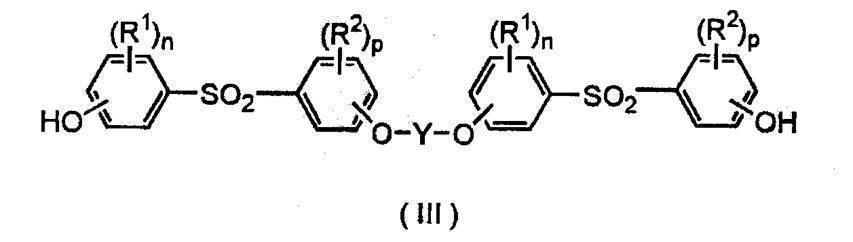

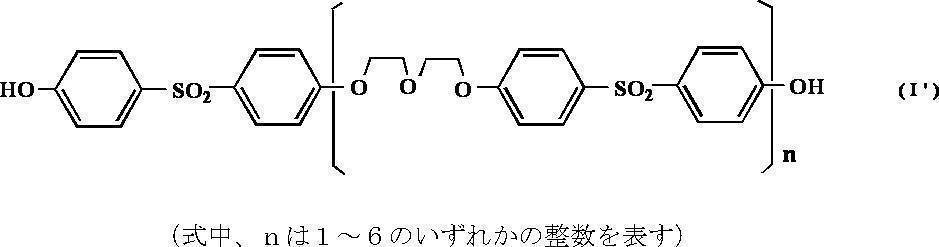
この反応組成物は、重合度の異なる反応生成物の混合物からなり、式(I’)で表されるn=1~6のすべての化合物が含有されている場合が好ましいが、反応条件等によってその生成比率が異なり、n=2以上の化合物については1種以上が含まれていればよい。n=1の化合物は反応組成物の固形分中、5~80質量%含まれているのが好ましく、さらに10~60質量%、特に20~50質量%の範囲が好ましい。
なお、本発明に用いられる分子化合物は、式(I)で表される化合物又はそれを含有する混合物の製造過程で生成させることもできる。
例えば、4,4’-ジヒドロキシジフェニルスルホンと2,2’-ジクロロジエチルエーテルとを反応して2,2’-ビス[4-(4-ヒドロキシフェニルスルホニル)フェニルオキシ]ジエチルエーテルを含む混合物を製造するような場合、その製造過程で2,2’-ビス[4-(4-ヒドロキシフェニルスルホニル)フェニルオキシ]ジエチルエーテルと分子化合物を形成しうる化合物と接触させる等して該分子化合物を含有する混合物を得ることができる。
式(I)で表される化合物を成分化合物とする分子化合物を含有する顕色性組成物は、該分子化合物のみで構成されていてもよく、また該分子化合物以外の化合物を含んで構成されていてもよい。
本発明の顕色性組成物を感熱記録材料に使用する場合には、既知の画像保存安定剤、顕色剤の使用方法と同様に行えばよく、例えば、本発明の顕色性組成物の微粒子及び発色性染料の微粒子のそれぞれをポリビニルアルコールやセルロースなどの水溶性結合剤の水溶液中に分散させた懸濁液を混合して紙等の支持体に塗布して乾燥することにより記録材料を製造することができる。また、上述したように発色層中に含有せしめる方法のほか、多層構造からなる場合には、例えば、保護層、アンダーコート層等任意の層中に含有せしめることもできる。
ビスフェノールA、4,4’-sec-ブチリデンビスフェノール、4,4’-シクロヘキシリデンビスフェノール、2,2’-ビス(4-ヒドロキシフェニル)-3,3’-ジメチルブタン、2,2’-ジヒドロキシジフェニル、ペンタメチレン-ビス(4-ヒドロキシベンゾエート)、2,2’-ジメチル-3,3’-ジ(4-ヒドロキシフェニル)ペンタン、2,2’-ジ(4-ジヒドロキシフェニル)ヘキサン、2,2-ビス(4-ヒドロキシフェニル)プロパン、2,2-ビス(4-ヒドロキシフェニル)ブタン、2,2-ビス(4-ヒドロキシ-3-メチルフェニル)プロパン、4,4’-(1-フェニルエチリデン)ビスフェノール、4,4’-エチリデンビスフェノール、(ヒドロキシフェニル)メチルフェノール、2,2-ビス(4-ヒドロキシフェニル)-4-メチルペンタン、4,4-イソプロピリデンビス-o-クレゾール、4,4’-ジヒドロキシ-ジフェニルメタン、2,2’-ビス(4-ヒドロキシ-3-フェニル-フェニル)プロパン、4,4’-(1,3-フェニレンジイソプロピリデン)ビスフェノール、4,4’-(1,4-フェニレンジイソプロピリデン)ビスフェノール、2,2-ビス(4-ヒドロキシフェニル)酢酸ブチル等のビスフェノール化合物、4,4’-ジヒドロキシジフェニルチオエーテル、1,7-ジ(4-ヒドロキシフェニルチオ)-3,5-ジオキサヘプタン、2,2’-ジ(4-ヒドロキシフェニルチオ)ジエチルエーテル、4,4’-ジヒドロキシ-3,3’-ジメチルフェニルチオエーテル、1,5-ジ(4-ヒドロキシフェニルチオ)-3-オキサペンタン、ビス(4-ヒドロキシフェニルチオエトキシ)メタン、特開2003-154760に記載の2,2’-メチレンビス(4-t-ブチルフェノール)2核縮合物を主体とする縮合混合物等の含硫黄ビスフェノール、4-ヒドロキシ安息香酸ベンジル、4-ヒドロキシ安息香酸エチル、4-ヒドロキシ安息香酸プロピル、4-ヒドロキシ安息香酸イソプロピル、4-ヒドロキシ安息香酸ブチル、4-ヒドロキシ安息香酸イソブチル、4-ヒドロキシ安息香酸クロロベンジル、4-ヒドロキシ安息香酸メチルベンジル、4-ヒドロキシ安息香酸ジフェニルメチル等の4-ヒドロキシ安息香酸エステル類、安息香酸亜鉛、4-ニトロ安息香酸亜鉛等の安息香酸金属塩、4-ヒドロキシ安息香酸とポリヒドリックアルコールとの縮合物、ビス(4-(2-(4-メトキシフェノキシ)エトキシ))サリチル酸、3,5-ビス(α-メチルベンジル)サリチル酸、3,5-ビス-tert-ブチルサリチル酸などのサリチル酸類、サリチル酸亜鉛、ビス(4-(オクチルオキシカルボニルアミノ)-2-ヒドロキシ安息香酸)亜鉛等のサリチル酸金属塩、4,4’-ジヒドロキシジフェニルスルホン、4-ヒドロキシ-4’-イソプロポキシジフェニルスルホン、4-ヒドロキシ-4’-ブトキシジフェニルスルホン、4-ヒドロキシ-4’-フェニルスルホニルオキシ-3,3’-フェニルスルホニルジフェニルスルホン、4,4’-ジヒドロキシ-3,3’-ジアリルジフェニルスルホン、3,4-ジヒドロキシ-4’-メチルジフェニルスルホン、4,4’-ジヒドロキシ-3,3’,5,5’-テトラブロモジフェニルスルホン、2-(4-ヒドロキシフェニルスルホニル)フェノール、2-(4-ヒドロキシフェニルスルホニル)フェノールと4,4’-スルホニルジフェノールの混合物、4-(4-メチルフェニルスルホニル)フェノールと2-(4-メチルフェニルスルホニル)フェノールとの等量混合物、4,4’-スルホニルビス(2-(2-プロペニル))フェノール、4-((4-(プロポキシ)フェニル)スルホニル)フェノール、4-((4-(アリロキシ)フェニル)スルホニル)フェノール、4-((4-(ベンジロキシ)フェニル)スルホニル)フェノール、2,4-ビス(フェニルスルホニル)-5-メチル-フェノール等のヒドロキシスルホン類、4-フェニルスルホニルフェノキシ亜鉛マグネシウム、アルミニウム、チタン等のヒドロキシスルホン類の多価金属塩類、4-ヒドロキシフタル酸ジメチル、4-ヒドロキシフタル酸ジシクロヘキシル、4-ヒドロキシフタル酸ジフェニル等の4-ヒドロキシフタル酸ジエステル類、2-ヒドロキシ-6-カルボキシナフタレン等のヒドロキシナフタレン酸エステル類、ヒドロキシアセトフェノン、p-フェニルフェノール、4-ヒドロキシフェニル酢酸ベンジル、p-ベンジルフェノール、ハイドロキノン-モノベンジルエーテル、トリハロメチルスルホン類、4,4’-ビス((4-メチルフェニルスルホニル)アミノカルボニルアミノ)ジフェニルメタン、N-(4-メチルフェニルスルホニル)-N’-(3-(4-メチルフェニルスルホニルオキシ)フェニル)ウレア等のスルホニルウレア類、テトラシアノキノジメタン類、2,4-ジヒドロキシ-2’-メトキシベンズアニリド、N-(2-ヒドロキシフェニル)-2-((4-ヒドロキシフェニル)チオ)アセタミド、N-(4-ヒドロキシフェニル)-2-((4-ヒドロキシフェニル)チオ)アセタミド、4-ヒドロキシベンゼンスルホンアニリド、4’-ヒドロキシ-4-メチルベンゼンスルホンアニリド、4,4’-ビス((4-メチル-3-フェノキシカルボニル)アミノフェニルウレイド)ジフェニルスルホン、3-(3-フェニルウレイド)ベンゼンスルホンアミド、オクタデシルリン酸、下記式(I’)で表されるジフェニルスルホン架橋型化合物又はそれらの混合物等を例示することができる。
1,1,3-トリス(2-メチル-4-ヒドロキシ-5-t-ブチルフェニル)ブタン、1,1,3-トリス(2-メチル-4-ヒドロキシ-5-t-シクロヘキシルフェニル)ブタン、4,4’-ブチリデンビス(6-t-ブチル-3-メチルフェノール)、2,2’-メチレンビス(6-t-ブチル-4-メチルフェノール)、2,2’-メチレンビス(6-t-ブチル-4-エチルフェノール)、4,4’-チオビス(6-t-ブチル-3-メチルフェノール)、1,3,5-トリス(2,6-ジメチル-4-t-ブチル-3-ヒドロキシベンジル)イソシアヌレート、1,3,5-トリス[[3,5-ビス(1,1-ジメチルエチル)-4-ヒドロキシフェニル]メチル]-1,3,5-トリアジン-2,4,6(1H,3H,5H)-トリオン、2-メチル-2-[[4-[[4-(フェニルメトキシ)フェニル]スルホニル]フェノキシ]メチル]-オキシラン、2,4,8,10-(テトラ(t-ブチル)-6-ヒドロキシ-12H-ジベンゾ[d,g][1,3,2]ジオキサホスホシン-6-オキサイドナトリウム塩、2,2-ビス(4’-ヒドロキシ-3’,5’-ジブロモフェニル)プロパン、4,4’-スルホニルビス(2,6-ジブロモフェノール)、2-(2’-ヒドロキシ-5’-メチルフェニル)ベンゾトリアゾール、4-ベンジルオキシ-4-(2-メチルグリジルオキシ)-ジフェニルスルホン、4,4’-ジグリジルオキシジフェニルスルホン、1,4-ジグリジルオキシベンゼン、4-(α-(ヒドロキシメチル)ベンジルオキシ)-4’-ヒドロキシジフェニルスルホン、2,2-メチレンビス(4,6-tert-ブチルフェニル)フォスフェイト等を挙げることができる。
攪拌機、温度計を備えた1Lの4つ口ナス型フラスコに水(14.5g)、NaOH8.0g(0.20mol)を加え90℃で溶解した。ここに4,4’-ジヒドロキシジフェニルスルホン(以下4,4’-BPSと略)25.0g(0.10mol) を添加した。110℃まで昇温後、2,2’-ジクロロジエチルエーテル(以下DCEEと略)7.1g(0.05mol) を30分かけて滴下した。滴下終了後110℃を保持、6.5時間縮合反応を行った。反応終了後、水250.0gを加え、室温に保ち、20% H2SO4を加えてpH調整した。pH調整後、90℃で一時間還流させた後、放冷した。結晶を濾別し、70℃にて減圧乾燥して式(I’)で表される化合物を主成分とする組成物を収量22.8gで得た。

(n=1体~n=6体の混合物であり、n=1体である2,2’-ビス[4-(4-ヒドロキシフェニルスルホニル)フェニルオキシ]ジエチルエーテルを35質量%含有する)
攪拌機、温度計を備えた3Lの4つ口ナス型フラスコに水(143.5g)、NaOH108.0g(2.7mol)を加え90℃で溶解した。ここに4,4’-BPS337.5g(1.35mol)を添加した。110℃まで昇温後、DCEE16.2g(0.11mol)を30分かけて滴下した。滴下終了後110℃を保持、4時間縮合反応を行った。反応終了後、水2000gを加え、室温に保ち、ろ過にて析出物を取り除いた。溶液を20% H2SO4を加えてpH調整し、90℃で1時間還流させた後、析出した固体を濾別し、70℃にて減圧乾燥して2,2’-ビス[4-(4-ヒドロキシフェニルスルホニル)フェニルオキシ]ジエチルエーテルを収量37.9gで得た。
[合成例1]
参考合成例1で得られた反応組成物に1,4-ジオキサン300mlを添加し、3時間加熱還流させた。室温まで放冷後、減圧下で1,4-ジオキサンを留去し、残渣について更に室温で減圧乾燥し、2,2’-ビス[4-(4-ヒドロキシフェニルスルホニル)フェニルオキシ]ジエチルエーテルと1,4-ジオキサンの組成比率1:1(モル比)から成る分子化合物を含有する組成物を得た。前記の分子化合物を含有することはTG/DTA、1HNMR及びX線回折パターンにより確認した。また本化合物が結晶性化合物を含有することをX線回折パターンより確認した。
参考合成例1で得られた反応組成物に水300mlを添加し、3時間加熱還流させた。室温まで放冷後、減圧下で水を留去し、残渣について更に室温で減圧乾燥し、2,2’-ビス[4-(4-ヒドロキシフェニルスルホニル)フェニルオキシ]ジエチルエーテルと水の組成比率1:1(モル比)から成る分子化合物を含有する組成物を得た。前記の分子化合物を含有することはTG/DTA、1HNMR及びX線回折パターンにより確認した。また本化合物が結晶性化合物を含有することをX線回折パターンより確認した。
参考合成例2で合成した2,2’-ビス[4-(4-ヒドロキシフェニルスルホニル)フェニルオキシ]ジエチルエーテルに1,4-ジオキサン300mlを添加し、3時間加熱還流させた。室温まで放冷後、減圧下で1,4-ジオキサンを留去し、残渣について更に室温で減圧乾燥し、2,2’-ビス[4-(4-ヒドロキシフェニルスルホニル)フェニルオキシ]ジエチルエーテルと1,4-ジオキサンの組成比率1:1(モル比)から成る分子化合物を含有する組成物を得た。前記の分子化合物を含有することはTG/DTA、1HNMR及びX線回折パターンにより確認した。また本化合物が結晶性化合物を含有することをX線回折パターンより確認した。
参考合成例2で合成した2,2’-ビス[4-(4-ヒドロキシフェニルスルホニル)フェニルオキシ]ジエチルエーテルに水300mlを添加し、3時間加熱還流させた。室温まで放冷後、減圧下で水を留去し、残渣について更に室温で減圧乾燥し、2,2’-ビス[4-(4-ヒドロキシフェニルスルホニル)フェニルオキシ]ジエチルエーテルと水の組成比率1:1(モル比)から成る分子化合物を含有する組成物を得た。前記の分子化合物を含有することはTG/DTA、1HNMR及びX線回折パターンにより確認した。また本化合物が結晶性化合物を含有することをX線回折パターンより確認した。
合成例1~4で得られた組成物のそれぞれをX線回折装置UltimaIV(リガク社製)を用いて分析した。結果を図1~4に示す。
[実施例1]
・染料分散液(A液)
3-ジ-n-ブチルアミノ-6-メチル-7-アニリノフルオラン 16部
ポリビニルアルコール10%水溶液 84部
・顕色剤分散液(B液)
合成例1の組成物 16部
ポリビニルアルコール10%水溶液 84部
・填料分散液(C液)
炭酸カルシウム 27.8部
ポリビニルアルコール10%水溶液 26.2部
水 71部
まず、A~C液の各組成の混合物をそれぞれサンドグラインダーで充分に磨砕して、A~C液の各成分の分散液を調整し、A液1質量部、B液2質量部、C液4質量部を混合して塗布液とした。この塗布液をワイヤーロッド(Webster社製、ワイヤーバーNo.12)を使用して白色紙に塗布・乾燥した後、カレンダー掛け処理をして、感熱記録紙を作製した(塗布液は乾燥質量で約5.5g/m2)。
実施例1の顕色剤分散液(B液)中、合成例1の組成物の代わりに合成例2の組成物を用いた以外は、実施例1に記載の方法で感熱記録紙を作製した。
実施例1の顕色剤分散液(B液)中、合成例1の組成物の代わりに合成例3の組成物を用いた以外は、実施例1に記載の方法で感熱記録紙を作製した。
実施例1の顕色剤分散液(B液)中、合成例1の組成物の代わりに合成例4の組成物を用いた以外は、実施例1に記載の方法で感熱記録紙を作製した。
実施例1の顕色剤分散液(B液)中、合成例1の組成物の代わりに参考合成例1の組成物を用いた以外は、実施例1に記載の方法で感熱記録紙を作製した。
実施例1の顕色剤分散液(B液)中、合成例1の組成物の代わりに参考合成例2の組成物を用いた以外は、実施例1に記載の方法で感熱記録紙を作製した。
<感熱評価試験-地肌耐熱性試験>
実施例1~4、比較例1~2で作製した感熱記録紙の一部を切り取り、恒温器(商品名:DK-400,YAMATO製)中で80℃、90℃の温度で24時間保持した後、各試験紙の地肌濃度(マクベス値)を測定した。その結果を第1表にまとめて示した。

Claims (6)
- 式(I)
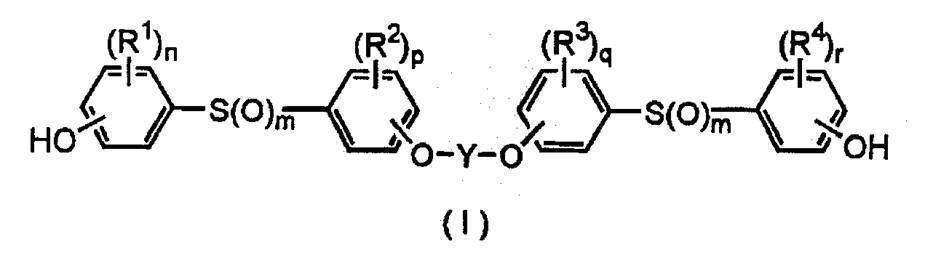
[式中、Yは、鎖状若しくは分岐状の、飽和若しくは不飽和の炭素数1~12の炭化水素基、鎖状若しくは分岐状の、飽和若しくは不飽和の、エーテル結合或いはチオエーテル結合を有する炭素数1~8の炭化水素基、又は次式

(式中、各R’は同一又は相異なっていてもよく、メチレン基又はエチレン基を表し、Tは水素原子又は炭素数1~4の炭化水素基を示す)を示す。R1、R2、R3、及びR4は夫々独立して、炭素数1~6のアルキル基又は炭素数2~6のアルケニル基を示す。n、p、q、rは0~4のいずれかの整数を示す。mは0~2のいずれかの整数を示す。]
で表される化合物を成分化合物とする分子化合物を含有することを特徴とする顕色性組成物。 - 式(I)で表される化合物が、式(II)
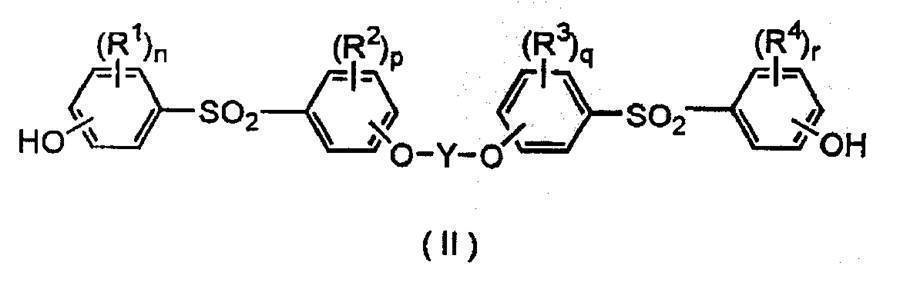
(式中、Y、R1~R4、n、p、q、rは前記と同じ)で表される化合物であることを特徴とする請求項1に記載の顕色性組成物。 - 式(I)で表される化合物が、2,2’-ビス[4-(4-ヒドロキシフェニルスルホニル)フェニルオキシ]ジエチルエーテルであることを特徴とする請求項1又は2記載の顕色性組成物。
- 顕色性組成物が4,4’-ジヒドロキシジフェニルスルホンと2,2’-ジクロロジエチルエーテルとを反応させて得られる生成物を2種以上含有する組成物であることを特徴とする請求項1~3のいずれかに記載の顕色性組成物。
- (A)4,4’-ジヒドロキシジフェニルスルホンと2,2’-ジクロロジエチルエーテルとを反応させて得られる生成物、及び
(B)2,2’-ビス[4-(4-ヒドロキシフェニルスルホニル)フェニルオキシ]ジエチルエーテルと分子化合物を形成しうる化合物
を混合して得られる2,2’-ビス[4-(4-ヒドロキシフェニルスルホニル)フェニルオキシ]ジエチルエーテルと前記ジエチルエーテルと分子化合物を形成しうる化合物との分子化合物を含有することを特徴とする請求項1~4のいずれかに記載の顕色性組成物。 - 請求項1~5のいずれかに記載の顕色性組成物を含有することを特徴とする記録材料。
Priority Applications (5)
| Application Number | Priority Date | Filing Date | Title |
|---|---|---|---|
| EP09804715A EP2332733B1 (en) | 2008-08-04 | 2009-08-03 | Color developing composition containing molecular compound, and recording material |
| JP2010523749A JP5253508B2 (ja) | 2008-08-04 | 2009-08-03 | 分子化合物を含有する顕色性組成物及び記録材料 |
| CN200980130646.9A CN102112321B (zh) | 2008-08-04 | 2009-08-03 | 含有分子化合物的显色性组合物和记录材料 |
| ES09804715T ES2397770T3 (es) | 2008-08-04 | 2009-08-03 | Composición de revelado de color que contiene un compuesto molecular, y material de registro |
| US13/055,855 US8563468B2 (en) | 2008-08-04 | 2009-08-03 | Color developing composition containing molecular compound, and recording material |
Applications Claiming Priority (2)
| Application Number | Priority Date | Filing Date | Title |
|---|---|---|---|
| JP2008-201328 | 2008-08-04 | ||
| JP2008201328 | 2008-08-04 |
Publications (1)
| Publication Number | Publication Date |
|---|---|
| WO2010016228A1 true WO2010016228A1 (ja) | 2010-02-11 |
Family
ID=41663457
Family Applications (1)
| Application Number | Title | Priority Date | Filing Date |
|---|---|---|---|
| PCT/JP2009/003694 Ceased WO2010016228A1 (ja) | 2008-08-04 | 2009-08-03 | 分子化合物を含有する顕色性組成物及び記録材料 |
Country Status (7)
| Country | Link |
|---|---|
| US (1) | US8563468B2 (ja) |
| EP (1) | EP2332733B1 (ja) |
| JP (1) | JP5253508B2 (ja) |
| KR (1) | KR20110022086A (ja) |
| CN (1) | CN102112321B (ja) |
| ES (1) | ES2397770T3 (ja) |
| WO (1) | WO2010016228A1 (ja) |
Cited By (1)
| Publication number | Priority date | Publication date | Assignee | Title |
|---|---|---|---|---|
| EP2366554A3 (en) * | 2010-03-16 | 2012-10-24 | Ricoh Company, Ltd. | Thermosensitive recording medium |
Families Citing this family (7)
| Publication number | Priority date | Publication date | Assignee | Title |
|---|---|---|---|---|
| US20190152248A1 (en) * | 2016-06-28 | 2019-05-23 | Kazumasa Noda | Thermosensitive recording medium and article |
| WO2018139484A1 (ja) * | 2017-01-30 | 2018-08-02 | 日本曹達株式会社 | 記録材料及び記録シート |
| TWI729370B (zh) * | 2019-03-25 | 2021-06-01 | 中國石油化學工業開發股份有限公司 | 一種二苯碸衍生物的組成物及其製法 |
| CN110702671B (zh) * | 2019-09-11 | 2022-02-18 | 广西大学 | 一种功能检测纸及其制备方法和应用 |
| US12115803B2 (en) | 2020-12-10 | 2024-10-15 | Appvion, Llc | Fade-resistant water-dispersible phenol-free direct thermal media |
| US12151498B2 (en) | 2020-12-10 | 2024-11-26 | Appvion, Llc | Multi-purpose phenol-free direct thermal recording media |
| JP2025528105A (ja) | 2022-08-10 | 2025-08-26 | アプヴィオン エルエルシー | 耐油性のためのジアリール尿素の組合せを用いた直接感熱記録媒体 |
Citations (4)
| Publication number | Priority date | Publication date | Assignee | Title |
|---|---|---|---|---|
| JPH08333329A (ja) | 1994-06-06 | 1996-12-17 | Nippon Soda Co Ltd | ジフェニルスルホン誘導体及びそれを用いた記録材料 |
| JPH115776A (ja) * | 1997-06-13 | 1999-01-12 | Nippon Soda Co Ltd | ジフェニルスルホン誘導体を成分化合物とする分子化合物 |
| JP2003154760A (ja) | 2001-11-21 | 2003-05-27 | Nippon Paper Industries Co Ltd | 感熱記録体 |
| JP2008201328A (ja) | 2007-02-22 | 2008-09-04 | Kubota Corp | トラクタの後作業機装着フレーム構造。 |
Family Cites Families (5)
| Publication number | Priority date | Publication date | Assignee | Title |
|---|---|---|---|---|
| AU677141B2 (en) * | 1993-12-27 | 1997-04-10 | Nippon Soda Co., Ltd. | 4-hydroxy-4'-isopropoxydiphenyl sulfone developer composition, wet pulverizing method, and dispersion |
| DE69526078T2 (de) * | 1994-06-06 | 2002-08-14 | Nippon Soda Co. Ltd., Tokio/Tokyo | Diphenylsulfonderivate und daraus hergestelltes aufzeichnungsmaterial |
| JP3913820B2 (ja) * | 1995-10-31 | 2007-05-09 | 日本曹達株式会社 | ジフェニルスルホン架橋型化合物及びそれを用いた記録材料 |
| JP4864218B2 (ja) * | 2001-03-05 | 2012-02-01 | 日本曹達株式会社 | ジフェニルスルホン化合物の製造方法 |
| JP3835749B2 (ja) * | 2002-04-15 | 2006-10-18 | 日本曹達株式会社 | フェノール性化合物を用いた記録材料 |
-
2009
- 2009-08-03 KR KR1020117001978A patent/KR20110022086A/ko not_active Ceased
- 2009-08-03 WO PCT/JP2009/003694 patent/WO2010016228A1/ja not_active Ceased
- 2009-08-03 ES ES09804715T patent/ES2397770T3/es active Active
- 2009-08-03 EP EP09804715A patent/EP2332733B1/en not_active Not-in-force
- 2009-08-03 CN CN200980130646.9A patent/CN102112321B/zh not_active Expired - Fee Related
- 2009-08-03 US US13/055,855 patent/US8563468B2/en not_active Expired - Fee Related
- 2009-08-03 JP JP2010523749A patent/JP5253508B2/ja not_active Expired - Fee Related
Patent Citations (5)
| Publication number | Priority date | Publication date | Assignee | Title |
|---|---|---|---|---|
| JPH08333329A (ja) | 1994-06-06 | 1996-12-17 | Nippon Soda Co Ltd | ジフェニルスルホン誘導体及びそれを用いた記録材料 |
| JPH115776A (ja) * | 1997-06-13 | 1999-01-12 | Nippon Soda Co Ltd | ジフェニルスルホン誘導体を成分化合物とする分子化合物 |
| JP3936775B2 (ja) | 1997-06-13 | 2007-06-27 | 日本曹達株式会社 | ジフェニルスルホン誘導体を成分化合物とする分子化合物 |
| JP2003154760A (ja) | 2001-11-21 | 2003-05-27 | Nippon Paper Industries Co Ltd | 感熱記録体 |
| JP2008201328A (ja) | 2007-02-22 | 2008-09-04 | Kubota Corp | トラクタの後作業機装着フレーム構造。 |
Non-Patent Citations (1)
| Title |
|---|
| See also references of EP2332733A4 |
Cited By (2)
| Publication number | Priority date | Publication date | Assignee | Title |
|---|---|---|---|---|
| EP2366554A3 (en) * | 2010-03-16 | 2012-10-24 | Ricoh Company, Ltd. | Thermosensitive recording medium |
| US8709974B2 (en) | 2010-03-16 | 2014-04-29 | Ricoh Company, Ltd. | Thermosensitive recording medium |
Also Published As
| Publication number | Publication date |
|---|---|
| EP2332733A1 (en) | 2011-06-15 |
| US8563468B2 (en) | 2013-10-22 |
| CN102112321A (zh) | 2011-06-29 |
| US20110120345A1 (en) | 2011-05-26 |
| EP2332733A4 (en) | 2011-08-24 |
| CN102112321B (zh) | 2014-03-12 |
| EP2332733B1 (en) | 2012-11-28 |
| JP5253508B2 (ja) | 2013-07-31 |
| JPWO2010016228A1 (ja) | 2012-01-19 |
| ES2397770T3 (es) | 2013-03-11 |
| KR20110022086A (ko) | 2011-03-04 |
Similar Documents
| Publication | Publication Date | Title |
|---|---|---|
| JP5253508B2 (ja) | 分子化合物を含有する顕色性組成物及び記録材料 | |
| JP6184325B2 (ja) | フェノールスルホン酸アリールエステル、顕色剤および感熱記録材料 | |
| EP2289704B1 (en) | Color-developing composition and recording material containing the same | |
| JP3717083B2 (ja) | ジフェニルスルホン誘導体及びそれを用いた記録材料 | |
| JP5107424B2 (ja) | 顕色性組成物及びそれを含有する記録材料 | |
| JPH10297089A (ja) | 記録材料 | |
| JP4583688B2 (ja) | フェノール性化合物及びそれを用いた記録材料 | |
| JP4017205B2 (ja) | トリアジン誘導体及びそれを用いた記録材料 | |
| JPWO2001025193A1 (ja) | フェノール性化合物及びそれを用いた記録材料 | |
| JP4938035B2 (ja) | ジフェニルスルホン架橋型化合物を含有する記録材料用組成物 | |
| JP5352106B2 (ja) | 新規ジフェニルスルホン誘導体及びその用途 | |
| WO2010089984A1 (ja) | フェノール性化合物および記録材料 | |
| JP5713505B2 (ja) | フェノール性化合物を用いた記録材料 | |
| JPWO2004039770A1 (ja) | ジフェニルスルホン誘導体を用いた記録材料及び新規ジフェニルスルホン誘導体化合物 | |
| JP3976833B2 (ja) | トリアジン誘導体およびそれを用いた発色性記録材料 | |
| JP4252245B2 (ja) | ビスフェノール化合物及びそれを用いた記録材料 | |
| JP4149182B2 (ja) | フェノール性化合物及びそれを用いた記録材料 | |
| JP4252221B2 (ja) | ビスフェノール化合物及びそれを用いた記録材料 | |
| JP4217514B2 (ja) | フェノール性化合物及びそれを用いた記録材料 | |
| JP4204881B2 (ja) | フェノール性化合物及びそれを用いた記録材料 | |
| JPH06122278A (ja) | 感熱記録体 | |
| JP2005007867A (ja) | 感熱記録体 | |
| JP2004203790A (ja) | (チオ)ウレア性化合物及びそれを用いた記録材料 | |
| JP2004002330A (ja) | フェノール性化合物及びそれを用いた記録材料 | |
| JP2002249481A (ja) | フェノール性化合物及びそれを用いた記録材料 |
Legal Events
| Date | Code | Title | Description |
|---|---|---|---|
| WWE | Wipo information: entry into national phase |
Ref document number: 200980130646.9 Country of ref document: CN |
|
| 121 | Ep: the epo has been informed by wipo that ep was designated in this application |
Ref document number: 09804715 Country of ref document: EP Kind code of ref document: A1 |
|
| WWE | Wipo information: entry into national phase |
Ref document number: 2010523749 Country of ref document: JP |
|
| WWE | Wipo information: entry into national phase |
Ref document number: 13055855 Country of ref document: US Ref document number: 2009804715 Country of ref document: EP |
|
| ENP | Entry into the national phase |
Ref document number: 20117001978 Country of ref document: KR Kind code of ref document: A |
|
| NENP | Non-entry into the national phase |
Ref country code: DE |